January 2012 [Health] Plan Management Navigator

Join Our Mailing List

With 2012 Benchmarking Study Invitation

By Marco Georeno

Health Care Analyst

Dear Dr. Marcinko and ME-P Readers

At the risk of appearing overwhelmed with New Year’s enthusiasm, we think the attached edition of Plan Management Navigator is especially interesting:

1. We report on the cost decisions made by low cost Blue Cross Blue Shield plans. Low cost plans make decisions that differ from their higher cost peers. Hallmarks of these decisions include levels and distributions of expenses between functions, the levels and distribution of staff between functions, the levels of compensation and its distribution between functions and the distribution between functions, and levels of, non-labor expenses. Overall, low cost Blue Cross Blue Shield Plans have “tactical” administrative expenses that were $5.63 PMPM, or 29%, lower than their higher cost counterparts. These tactical expenses are all administrative expenses excluding medical management and sales and marketing.

2. We provide an update on the most recent operating and financial results for firms participating in our monthly Dashboard.

3. We invite appropriate ME-P readers to participate in the 2012 benchmarking study. Participation is very timely given that the weak economy is placing great pressure on commercial enrollment, creating the risk that administrative expenses could be a source of negative operating leverage.

Assessment

A more detailed version of this analysis is available to licensed users of Blue Cross Blue Shield Sherlock Expense Evaluation Report (SEER). Please call us for further information if you have an interest.

Link: Navigator Late January 2012

Sherlock Company

mgeoreno@sherlockco.com

Ph: 215-628-2289

Fax: 215-542-0690

Conclusion

And so, your thoughts and comments on this ME-P are appreciated. Please review our top-left column, and top-right sidebar materials, links, URLs and related websites, too. Then, subscribe to the ME-P. It is fast, free and secure.

Link: http://feeds.feedburner.com/HealthcareFinancialsthePostForcxos

Speaker: If you need a moderator or speaker for an upcoming event, Dr. David E. Marcinko; MBA – Publisher-in-Chief of the Medical Executive-Post – is available for seminar or speaking engagements. Contact: MarcinkoAdvisors@msn.com

Our Other Print Books and Related Information Sources:

Health Dictionary Series: http://www.springerpub.com/Search/marcinko

Practice Management: http://www.springerpub.com/product/9780826105752

Physician Financial Planning: http://www.jbpub.com/catalog/0763745790

Medical Risk Management: http://www.jbpub.com/catalog/9780763733421

Healthcare Organizations: www.HealthcareFinancials.com

Physician Advisors: www.CertifiedMedicalPlanner.com

Subscribe Now: Did you like this Medical Executive-Post, or find it helpful, interesting and informative? Want to get the latest ME-Ps delivered to your email box each morning? Just subscribe using the link below. You can unsubscribe at any time. Security is assured.

Link: http://feeds.feedburner.com/HealthcareFinancialsthePostForcxos

Sponsors Welcomed: And, credible sponsors and like-minded advertisers are always welcomed.

Link: https://healthcarefinancials.wordpress.com/2007/11/11/advertise

Product DetailsProduct DetailsProduct Details

Product Details Product Details

Product Details

On e-Claim Only Dental Plans

About their Hidden Costs – I’m Talking PHI Breaches

By D. Kellus Pruitt DDS

If the rumor is true about Bluebell Ice Cream’s “e-claim-only” dental benefit plan that is to go into effect in March, how many in the east-central Texas town of Brenham (pop. 16,000) will be properly warned about the danger to themselves, their families and Bluebell officials’ reputations because of reckless policy?

Transmissions Risks

Each time their dentists send an electronic dental claim (e-claim) over the internet to insurance employees in Chicago as a favor to a patient – and especially the insurer – the Bluebell employee’s digital medical identity which is worth fifty bucks on the black market, rides along to destinations unknown. It’s my guess that very few Bluebell employees are yet aware of the increasing risk of medical identity theft from dentists’ e-claims – much less given the opportunity to opt out of the risk by simply visiting a dentist who still uses the telephone, fax and US Mail.

Security Risks Growing

It certainly won’t improve my popularity with 9 out of 10 dentists for saying this, but risks of identity theft from HIPAA-covered dental offices are climbing daily. In the introduction to a recent interview with Larry Ponemon, chairman and founder of the Ponemon Institute, GovernmentIT.com editor Tom Sullivan ominously described the ever-increasing risk of a massive “data spill” of perhaps millions of patients’ protected health information (PHI):

 “The street value of health information is 50 times greater than that of other data types. Even worse, the healthcare industry is among the weakest at protecting such information. With organized criminals trying to steal medical IDs, sloppy mistakes becoming more commonplace, mobile devices serving as single sign-on gateways to records and even bioterrorism now a factor, healthcare is ripe for some a wake-up call – one that just might come in the form a damaging ‘data spill.’” (See: “Q&A: How a health ‘data spill’ could be more damaging than what BP did to the Gulf.”

Tom Sullivan – Editor [December 05, 2011]

http://govhealthit.com/news/qa-how-health-data-spill-could-be-worse-what-bp-did-gulf?page=0,0

According to Dr. Ponemon:

“The basic issue, when you think about data theft not data loss – because it’s hard to know whether that lost data ultimately ends up in the hands of the cybercriminal and all of these bad things occur – but in the case of identity theft, the end goal has been historically to steal a person’s identity, and just like getting a financial record, getting a health record probably has your credit card, debit card, and payment information contained in that record.”

Of Credit Cards … and More!

But that’s not all. Credit cards are just chump change. He continues:

“The financial records are actually lucrative for the bad guy, but the health record is actually much, much more valuable item because it not only gives you the financial information but it also contains the health credential, and it’s very hard to detect a medical identity theft. What we’ve found in our studies is that medical identity theft is likely to be on the rise and, of course, there’s an awareness within the healthcare organizations that participate in our study that they’re starting to see this as more of a medical identity theft crime. It’s not just about stealing credit cards and buying goodies, it’s about stealing who you are, possibly getting medical treatment and, therefore, messing up your medical record.”

Dr. Ponemon suggests that the victim may not know about the theft until he or she “stumbles on something that alerts them their medical identity was stolen.” Perhaps something like death following anaphylactic shock from a medication that was once digitally highlighted as “Allergic to.” Understandably, Ponemon adds that respondents recognized altered medical histories as an emerging threat they believed was affecting the patients in their organizations. Such danger for dental patients is almost non-existent if their dentists simply don’t put PHI on office computers.

Should a data breach of Bluebell Ice Cream employees’ identities occur in Brenham or Chicago, which is more likely than not, the fact that electronic dental records do nothing to improve the quality of dental care won’t make Brenham citizens any happier with local Bluebell officials. 

Conclusion       

And so, your thoughts and comments on this ME-P are appreciated. Please review our top-left column, and top-right sidebar materials, links, URLs and related websites, too. Then, subscribe to the ME-P. It is fast, free and secure.

Link: http://feeds.feedburner.com/HealthcareFinancialsthePostForcxos

Speaker: If you need a moderator or speaker for an upcoming event, Dr. David E. Marcinko; MBA – Publisher-in-Chief of the Medical Executive-Post – is available for seminar or speaking engagements. Contact: MarcinkoAdvisors@msn.com

Our Other Print Books and Related Information Sources:

Health Dictionary Series: http://www.springerpub.com/Search/marcinko

Practice Management: http://www.springerpub.com/product/9780826105752

Physician Financial Planning: http://www.jbpub.com/catalog/0763745790

Medical Risk Management: http://www.jbpub.com/catalog/9780763733421

Healthcare Organizations: www.HealthcareFinancials.com

Physician Advisors: www.CertifiedMedicalPlanner.com

Subscribe Now: Did you like this Medical Executive-Post, or find it helpful, interesting and informative? Want to get the latest ME-Ps delivered to your email box each morning? Just subscribe using the link below. You can unsubscribe at any time. Security is assured.

Link: http://feeds.feedburner.com/HealthcareFinancialsthePostForcxos

Sponsors Welcomed: And, credible sponsors and like-minded advertisers are always welcomed.

Link: https://healthcarefinancials.wordpress.com/2007/11/11/advertise


Product Details

About Pancreas Cancer Survival Rates

 Still Not Improving

Join Our Mailing List

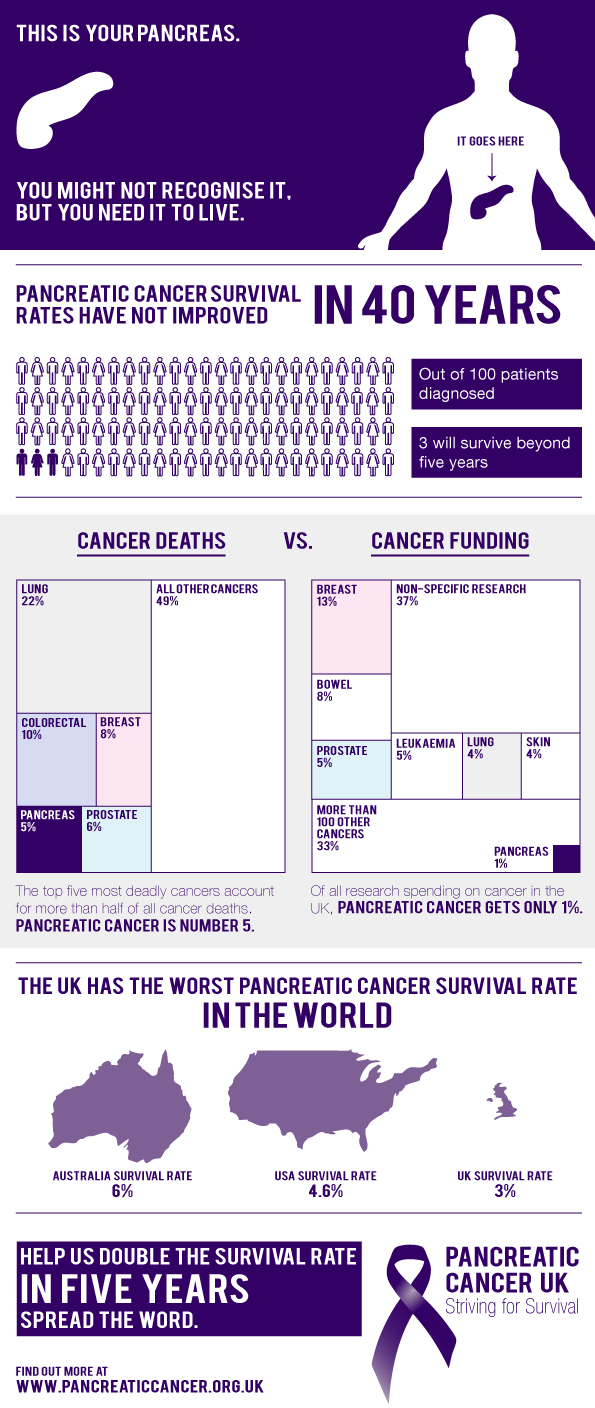
Here is an infographic to highlight the main statistics about pancreatic cancer that are unknown – you know, less than 3% of people who are diagnosed will live to see five years post-diagnosis?

Assessment

The tree maps showing the difference between death rates and funding for the different forms of cancer is also interesting

Source: Pancreatic Cancer UK

Speaker: If you need a moderator or speaker for an upcoming event, Dr. David E. Marcinko; MBA – Publisher-in-Chief of the Medical Executive-Post – is available for seminar or speaking engagements. Contact: MarcinkoAdvisors@msn.com

Our Other Print Books and Related Information Sources:

Health Dictionary Series: http://www.springerpub.com/Search/marcinko

Practice Management: http://www.springerpub.com/product/9780826105752

Physician Financial Planning: http://www.jbpub.com/catalog/0763745790

Medical Risk Management: http://www.jbpub.com/catalog/9780763733421

Healthcare Organizations: www.HealthcareFinancials.com

Physician Advisors: www.CertifiedMedicalPlanner.com

Subscribe Now: Did you like this Medical Executive-Post, or find it helpful, interesting and informative? Want to get the latest ME-Ps delivered to your email box each morning? Just subscribe using the link below. You can unsubscribe at any time. Security is assured.

Link: http://feeds.feedburner.com/HealthcareFinancialsthePostForcxos

Sponsors Welcomed: And, credible sponsors and like-minded advertisers are always welcomed.

Link: https://healthcarefinancials.wordpress.com/2007/11/11/advertise

Product DetailsProduct DetailsProduct Details

Controlling Health Care Spending [An NIHCM Foundation Webinar]

The Imperative to Act and Diverse Views of the Road Forward

Join Our Mailing List 

The U.S.now spends $2.5 trillion annually on health care, accounting for well over 17 percent of GDP and growing rapidly with challenging fiscal consequences. Despite the imperative to control spending, we face much uncertainty about how to move to a more sustainable path.

Political opposition threatens implementation of the Affordable Care Act, and many of its cost-control measures are still unproven. A long-term fix for Medicare physician payment remains elusive. The trigger mechanism activated by the failure of the Super Committee is poised to affect myriad health programs, but decisions on the specific cuts await sure-to-be intense congressional negotiations.

And, the many ideas for entitlement reform that were advanced during deficit reduction talks continue to generate much debate but little consensus.

Topics

To shed light on these complex issues, this webinar will feature leading health policy experts discussing topics including:

  • health spending growth and the implications for government budgets, employers and individuals
  • the societal trade-offs we face as health spending grows and as we think about ways to control spending
  • alternative viewpoints on the viability of cost control approaches now being tried and the most promising options for the future.

Assessment

Visit NIHCM Foundation’s website to view an agenda and additional resources on health care spending. And, please register by noon (EST) on February 1st.

Conclusion        

And so, your thoughts and comments on this ME-P are appreciated. Please review our top-left column, and top-right sidebar materials, links, URLs and related websites, too. Then, subscribe to the ME-P. It is fast, free and secure.

Link: http://feeds.feedburner.com/HealthcareFinancialsthePostForcxos

Speaker: If you need a moderator or speaker for an upcoming event, Dr. David E. Marcinko; MBA – Publisher-in-Chief of the Medical Executive-Post – is available for seminar or speaking engagements. Contact: MarcinkoAdvisors@msn.com

Our Other Print Books and Related Information Sources:

Health Dictionary Series: http://www.springerpub.com/Search/marcinko

Practice Management: http://www.springerpub.com/product/9780826105752

Physician Financial Planning: http://www.jbpub.com/catalog/0763745790

Medical Risk Management: http://www.jbpub.com/catalog/9780763733421

Healthcare Organizations: www.HealthcareFinancials.com

Physician Advisors: www.CertifiedMedicalPlanner.com

Subscribe Now: Did you like this Medical Executive-Post, or find it helpful, interesting and informative? Want to get the latest ME-Ps delivered to your email box each morning? Just subscribe using the link below. You can unsubscribe at any time. Security is assured.

Link: http://feeds.feedburner.com/HealthcareFinancialsthePostForcxos

Sponsors Welcomed: And, credible sponsors and like-minded advertisers are always welcomed.

Link: https://healthcarefinancials.wordpress.com/2007/11/11/advertise

Product Details

Apply AcademyHealth / NCHS Health Policy Fellowships

How to Apply – January 9th Deadline Looming!

Join Our Mailing List 

Vision

AcademyHealth seeks to improve health and health care by generating new knowledge and moving knowledge into action.

Mission

As the pre-eminent professional society for health services researchers and health policy analysts, AcademyHealth collaborates with the health services research community and other key stakeholders to support the development of health services research by:

  • Expanding and improving the scientific basis of the field;
  • Increasing the capabilities and skills of researchers;  
  • Promoting the development of the necessary financial, human, infrastructure, and data resources;
  • Facilitate the use of the best available research and information;
  • Translating research findings and the lessons of experience into useful information for clinical, management, and policy decisions;  
  • Enhancing communication and interaction between health services researchers and health policymakers;
  • Assist health policy and practice leaders in addressing major health challenges;
  • Providing high quality policy and technical assistance;
  • Offering educational programs that advance the use of policy analysis and research; and
  • Identifying areas where additional research and information are needed.

Assessment

Link: http://www.academyhealth.org/Training/content.cfm?ItemNumber=1435&navItemNumber=2332

Conclusion      

And so, your thoughts and comments on this ME-P are appreciated. Please review our top-left column, and top-right sidebar materials, links, URLs and related websites, too. Then, subscribe to the ME-P. It is fast, free and secure.

Link: http://feeds.feedburner.com/HealthcareFinancialsthePostForcxos

Speaker: If you need a moderator or speaker for an upcoming event, Dr. David E. Marcinko; MBA – Publisher-in-Chief of the Medical Executive-Post – is available for seminar or speaking engagements. Contact: MarcinkoAdvisors@msn.com

Our Other Print Books and Related Information Sources:

Health Dictionary Series: http://www.springerpub.com/Search/marcinko

Practice Management: http://www.springerpub.com/product/9780826105752

Physician Financial Planning: http://www.jbpub.com/catalog/0763745790

Medical Risk Management: http://www.jbpub.com/catalog/9780763733421

Healthcare Organizations: www.HealthcareFinancials.com

Physician Advisors: www.CertifiedMedicalPlanner.com

Subscribe Now: Did you like this Medical Executive-Post, or find it helpful, interesting and informative? Want to get the latest ME-Ps delivered to your email box each morning? Just subscribe using the link below. You can unsubscribe at any time. Security is assured.

Link: http://feeds.feedburner.com/HealthcareFinancialsthePostForcxos

Sponsors Welcomed: And, credible sponsors and like-minded advertisers are always welcomed.

Link: https://healthcarefinancials.wordpress.com/2007/11/11/advertise

Product DetailsProduct DetailsProduct Details       


Do Doctors have an Obligation to Bill their Patients for Co-Payments?

Ask an Advisor – Query

Join Our Mailing List 

I have read about pro-bono care on the ME-P. But, as doctors, are we required to bill our patients their co-pay amount by law, or can it be written off at our discretion? In other words, if we decide not to bill them, will we be penalized by Medicare.

Conclusion

And so, your thoughts and comments on this ME-P are appreciated.  Feel free to review our top-left column, and top-right sidebar materials, links, URLs and related websites, too. Then, subscribe to the ME-P. It is fast, free and secure.

Link: http://feeds.feedburner.com/HealthcareFinancialsthePostForcxos

Speaker: If you need a moderator or speaker for an upcoming event, Dr. David E. Marcinko; MBA – Publisher-in-Chief of the Medical Executive-Post – is available for seminar or speaking engagements. Contact: MarcinkoAdvisors@msn.com

Our Other Print Books and Related Information Sources:

Health Dictionary Series: http://www.springerpub.com/Search/marcinko

Practice Management: http://www.springerpub.com/product/9780826105752

Physician Financial Planning: http://www.jbpub.com/catalog/0763745790

Medical Risk Management: http://www.jbpub.com/catalog/9780763733421

Healthcare Organizations: www.HealthcareFinancials.com

Physician Advisors: www.CertifiedMedicalPlanner.com

Subscribe Now: Did you like this Medical Executive-Post, or find it helpful, interesting and informative? Want to get the latest ME-Ps delivered to your email box each morning? Just subscribe using the link below. You can unsubscribe at any time. Security is assured.

Link: http://feeds.feedburner.com/HealthcareFinancialsthePostForcxos

Sponsors Welcomed: And, credible sponsors and like-minded advertisers are always welcomed.

Link: https://healthcarefinancials.wordpress.com/2007/11/11/advertise  

   Product Details

Health Plans and the Three Levers of Innovation for Affordable Care

Unlocking Affordable Care

Number 2 in a Series of 6

By Sam Muppalla – Vice President, McKesson Health Solutions, Network Performance Management (NPM)

Last week, for the ME-P, I wrote about the increasing Pressure to Deliver Affordable, High-Quality Care.

In the face of those pressures, many health plans have begun to explore innovative approaches to product, care model, and reimbursement designs. What are they doing?

In this second installment of our series about unlocking affordable care, I’d like to take look at how some of the pilots in these areas show promise.

Product Innovation

One path health plans are using to achieve affordable care is through the deployment of value-based insurance designs (VBID). At the heart of this approach is the utilization of member incentives to reduce barriers to high value Rx and services. Conversely, it also incorporates disincentives for low value services or Rx. Typical member incentives include premium reduction, co-pay/coinsurance waiver/reduction, and health reimbursement accounts (HRA). Co-pay increase or cost sharing are typical disincentives. Member steerage to high value providers is another typical goal of VBID. The design of the supporting networks is critical to the success of VBID products. The network design has to ensure that the composition, the quality and the value of the participating providers can fulfill the benefit design and match steerage goals of the member incentives. Furthermore, the network level provider reimbursement guidelines should be complimentary to the member incentives.

For example, member incentive for a preventive exam during a Primary Care Physician (PCP) office visit could be matched by a Pay for Performance (P4P) provider incentive (on top of regular capitation) to perform the examination. Without the incentive, the Per Member Per Month (PMPM) capitation might be a disincentive for the PCP to perform the preventative exam.

describe the image

Figure 1: Network steerage is a critical component of product innovation.

Care Model Innovation

Innovative care models provide another approach to the delivery of affordable, high-quality health services. Population management-based care model designs, such as Patient Centered Medical Home (PCMH) and Accountable Care Organization (ACO) designs, are an important advancement towards affordable care. These designs deploy a care team-based approach rather than a traditional siloed services approach to ensure a continuity of care.

The PCMH care model results in continuity of care via a physician who leads the medical team that coordinates all aspects of preventive, acute and chronic needs of patients using the best available evidence and appropriate technology. The emphasis for PCMH is about collaboration to manage a population’s health.

Another example of a care model with a team-based approach is the ACO care model. In this care model, the emphasis is on accountability for providing the required healthcare services for a defined population. Health plans are rolling out ACO pilots across the nation.

For example, the Pension System (of the California Public Employees’ Retirement System) formed a partnership with the Blue Shield of California Health Maintenance Organization, Catholic Healthcare West, and Hill Physicians Medical Group with the goal of improving quality of care while reducing costs. Some of the early findings are showing positive results:

  • 17 percent reduction in patient re-admissions since the pilot began
  • Length of stay reduced by one half day
  • Almost a 14 percent drop in the total days patients spend in a facility
  • 50 percent reduction in the number of patients who stay in a hospital 20 or more days

These results show that it is possible to utilize care models to improve the quality of outcomes while reducing the cost of healthcare.

It is worth noting that health plans are not limited to adopting one care design innovation over another. Greater benefits can accrue to both consumer and provider by combining approaches—leveraging both collaborative and accountable care designs.

Adoption of population management is forcing a change from paying for individual providers’ services to paying for health management of a population across a team of providers. Supporting this requires the reimbursement systems to understand the structure of the care team, role of the various providers within the care team and the relationships between the providers in the care team.

In other words, it will need to understand the provider network structure to calculate the reimbursement. Another complexity is that providers participating in PCMH or ACO care models may also be directly contracted with the health plan. Selecting which payment arrangement to use in these scenarios will require an understanding of providers’ relationships with the plan.

Reimbursement Innovation

Along with innovations in product and care model designs, health plans are also innovating in the area of provider reimbursement. These innovation efforts primarily focus on enabling incentives for quality and performance, while controlling the rate of medical cost growth. These objectives reflect the need to move away from a healthcare system that bases provider reimbursement on volume to one that bases provider reimbursement on the value of the outcome. Within this approach, a variety of different models are evolving (see Figure 2). 

describe the image

Figure 2: Mixing and matching payment models.

Evolving in parallel with individual models is an understanding that the ability to mix and match different reimbursement designs will deliver greater value than the utilization of just one design. Health plans are mixing and matching different reimbursement methodologies to optimize provider performance. This implies that a provider is likely to have multiple valid payment arrangements at any given time. Picking the appropriate payment arrangement will require the reimbursement engine to understand the role of the provider in the network and the full context of all of the provider’s relationships.

Assessment

Next week, I’ll be discussing why the alignment between products, care models, provider reimbursement, and network design is so important when it comes to scaling these innovative approaches.

If you can’t wait that long for that discussion, you can read the entire Unlocking Affordable Care by Aligning Products white paper now; it’s available on our website.

Conclusion

And so, your thoughts and comments on this ME-P are appreciated. Feel free to review our top-left column, and top-right sidebar materials, links, URLs and related websites, too. Then, subscribe to the ME-P. It is fast, free and secure.

Link: http://feeds.feedburner.com/HealthcareFinancialsthePostForcxos

Speaker: If you need a moderator or speaker for an upcoming event, Dr. David E. Marcinko; MBA – Publisher-in-Chief of the Medical Executive-Post – is available for seminar or speaking engagements. Contact: MarcinkoAdvisors@msn.com

Our Other Print Books and Related Information Sources:

Health Dictionary Series: http://www.springerpub.com/Search/marcinko

Practice Management: http://www.springerpub.com/product/9780826105752

Physician Financial Planning: http://www.jbpub.com/catalog/0763745790

Medical Risk Management: http://www.jbpub.com/catalog/9780763733421

Healthcare Organizations: www.HealthcareFinancials.com

Physician Advisors: www.CertifiedMedicalPlanner.com

Subscribe Now: Did you like this Medical Executive-Post, or find it helpful, interesting and informative? Want to get the latest ME-Ps delivered to your email box each morning? Just subscribe using the link below. You can unsubscribe at any time. Security is assured.

Link: http://feeds.feedburner.com/HealthcareFinancialsthePostForcxos

Sponsors Welcomed: And, credible sponsors and like-minded advertisers are always welcomed. Link: https://healthcarefinancials.wordpress.com/2007/11/11/advertise

   Product Details

Health Plans Under Pressure to Deliver Affordable and High Quality Care

Join Our Mailing List

US Healthcare Expenditures Reaching Unsustainable Levels

[By Sam Muppalla]

Vice President: McKesson Health Solutions, Network Performance Management (NPM)

Expenditures on healthcare in the United States continue to increase and are rapidly reaching unsustainable levels. Pressures by businesses, households and the government to address these escalating costs and ensure high-quality healthcare are multiplying.

This is the first in a series of six essays that examine the challenges facing health plans and the ways that network design can unlock affordable care by aligning products, care models, and reimbursement.

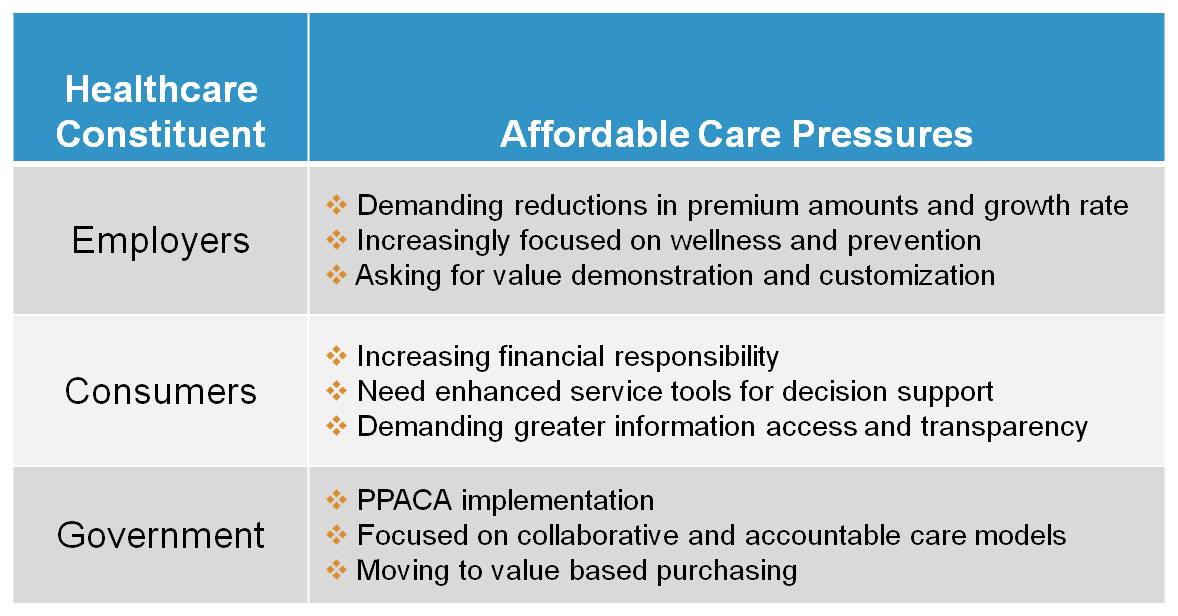
Health insurance companies are faced with addressing a rapidly changing healthcare environment on multiple fronts. These changes are being driven by the goal of achieving a more affordable, higher quality healthcare system. Shifting market needs, increased regulatory initiatives, and a demand for administrative efficiency are requiring innovative approaches to unlocking affordable care. These pressures are originating from key healthcare stakeholders—employers, members and the government (Figure 1).

Employer Pressure

As the competition for the group insurance market increases, health plans need to respond to employer demands for products that deliver greater value. Delivering high value requires products which are tailored to the health of the employer’s specific population and emphasize wellness and prevention. An employer that can offer benefits and programs tailored to meet their employee needs can both improve their workforce productivity and optimize their healthcare spend. The employer’s insistence for reduction in premiums and decrease in the rate of premium growth is challenging health plans to develop more innovative strategies.

Consumer/Member Pressure

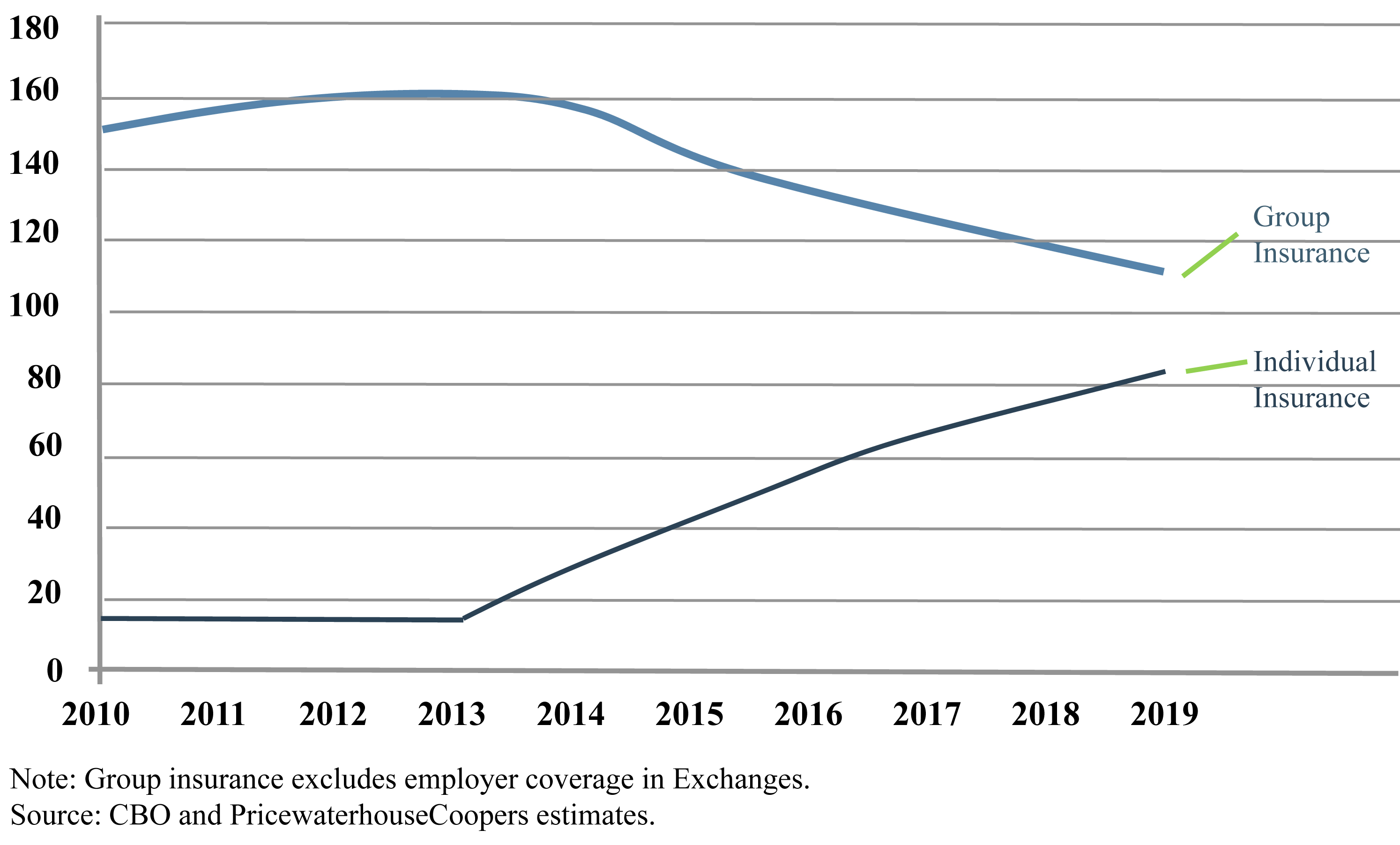
With the passage of the Patient Protection and Affordable Care Act of 2010 (PPACA), the Congressional Budget Office (CBO) estimates (Figure 2) that approximately 32 million more individuals will require access to healthcare services. This represents a significant increase in the number of new healthcare consumers at a time when health insurance companies are required to guarantee issue and re-newability of coverage. Steering this influx of new members to the right care teams will be a very critical core competency for health plans to develop. It is one of the few risk management tools left in the plan’s arsenal in a guaranteed access world. The growth of the individual market is also being accompanied by an increase in member financial responsibility. Members are increasingly demanding greater transparency into their provider quality, performance and cost information.

Government/Regulatory Pressure

Evolving healthcare regulation puts still more pressure on health plans. New regulations within the PPACA Section 9016, stipulate an 80% MLR cap for small groups (fewer than 100 lives) and an 85% Medical Loss Ratio (MLR) cap for large groups (more than 100 lives). These regulations also cap the percentage of revenues that can be earmarked for operational and administrative expenses at 15-20%. This poses a unique challenge for health plans; it requires plans to innovate in the areas of products, care models, and reimbursement designs without increasing the administrative and operational overhead.

There are roughly eighteen additional PPACA provisions that put further pressure on health plans by promoting increased collaboration (sections: 6301, 4201, 3027, 3011, 3021, 10333, 3022, 3024) and accountability (sections: 2705, 3006 & 10301, 3001, 3025, 2706, 2704, 3023, 3004, 3008 and 3002). The Bureau of National Affairs best summarized these provisions by stating,

“The comprehensive provisions in the act regarding payment and delivery reform reflect both the payment system continuum—from fee-for-service to bonus incentives for quality to bundled payments to partial and full global payments as well as the delivery system continuum—from independent clinicians and hospitals to small group practices to multi-provider networks to partially or virtually integrated organizations to fully integrated systems with common ownership and employment.”

These demands mean that health plans need to offer new high-value products that incorporate outcome-based reimbursement to drive quality outcomes and not pay for potentially avoidable costs.

According to studies by the Robert Wood Johnson Foundation and Prometheus Payment (2009), “Up to 40 cents of every dollar spent on chronic conditions and 15 to 20 cents of every dollar spent on acute hospitalization and procedures are attributable to potentially avoidable complications (PACs).”

With evidence like this health plans are taking a new, hard look at when and how care is delivered.

Assessment

Next time, we’ll be looking at how health plans are responding to these challenges with innovations in products, care models, and reimbursement structures. Visit the blog next week for “The Three Levers of Innovation for Care Affordability.”

If you can’t wait, you can read the entire Unlocking Affordable Care by Aligning Products white paper now; it’s available on our website.

A Webinar 

On December 8th, we’ll be hosting a webinar on Lean Provider Lessons for Post Reform Success. Plan to attend this free webinar for more insights into designing for affordable high-quality care.

Channel Surfing the ME-P

Have you visited our other topic channels? Established to facilitate idea exchange and link our community together, the value of these topics is dependent upon your input. Please take a minute to visit. And, to prevent that annoying spam, we ask that you register. It is fast, free and secure.

Conclusion

Your thoughts and comments on this ME-P are appreciated. Feel free to review our top-left column, and top-right sidebar materials, links, URLs and related websites, too. Then, subscribe to the ME-P. It is fast, free and secure.

Speaker: If you need a moderator or speaker for an upcoming event, Dr. David E. Marcinko; MBA – Publisher-in-Chief of the Medical Executive-Post – is available for seminar or speaking engagements. Contact: MarcinkoAdvisors@msn.com

OUR OTHER PRINT BOOKS AND RELATED INFORMATION SOURCES:

Product DetailsProduct DetailsProduct Details

Product Details  Product Details

   Product Details

Newt Gingrich has his Way with the ADA

Dentists should be furious with Gingrich for commandeering the ADA

By D. Kellus Pruitt DDS

On This Week roundtable discussion this morning [Sunday], George Will began his comments about Newt Gingrich, now a frontrunner, by saying that he “embodies everything disagreeable about modern Washington.”

Dentists should be furious with not only Gingrich, but with our inattentive dental leaders as well.

Why? 

A couple of days ago, Steve Chapman posted “Gingrich’s corruption” on the ChicagoTribune.com.

http://www.chicagotribune.com/news/opinion/chapman/chi-gingrichs-corruption-20111118,0,4581968.story

Chapman writes:

“Conservatives may be able to forgive Newt Gingrich for being an adulterer and for his flip-flops on climate change and mandatory health insurance. They are willing to put those aside because they think he’s shown a fierce attachment to their cause. But, the latest revelations will be harder to digest, because they suggest that his allegiance is for sale.”

He punctuates the condemnation with a quote from USA Today:

http://www.usatoday.com/news/politics/story/2011-11-16/newt-gingrich-think-tank-opeds/51246512/1  

“In a series of op-eds stretching over several years, Gingrich repeatedly advocated for various health-care related issues, including electronic health care records, ways to improve the health care sector, and medical malpractice reform without acknowledging the issues were directly connected to members of the Center for Health Transformation, a for-profit think tank he founded in 2003.”

Newt, for a Freddie Mac historian, you’re pretty sly!

According to information that Center for Health Transformation [CHT] spokeswoman Susan Meyers provided USA Today, healthcare stakeholders participating in Gingrich’s “think tank” can expect to pay Gingrich between $5,000 and $200,000, “depending on how many employees attend the center’s meetings and use other services.”

Wouldn’t you just love to ask Ms. Meyers if Gingrich’s think tank members are more likely to realize a return on their investment than their software offers dentists?

I suggested to the editor of the Chicago Tribune to specifically ask ADA President-elect Dr. Robert Faiella questions about the cost and safety of EHRs in dentistry. Then I followed the comment with,

 “And, be sure to tell Dr. Faiella that D. Kellus Pruitt DDS referred you to him. Though we’ve never met, he knows who I am. If you get around to it, you might ask him how much HIPAA compliance raises the cost of dentistry. There are thousands of dentists who would find the President-elect’s answer to that question truly enlightening.”

I Do Find this Fun

Psst…! Chicago Tribune Editor; want a hot tip? I know of a local but far-reaching lead concerning the malignant, corporate corruption described by Steve Chapman in his article. A reporter wouldn’t have to travel far to aggravate employees of a secretive, command and control organization. The ADA National Headquarters is just down the street at 211 East Chicago Avenue. In 2004, the widely-overlooked, not-for-profit’s lack of transparency made it especially vulnerable to Gingrich’s deceptive selling points!

ADA Officials

I think everyone agrees that asking ADA officials reasonable questions about the cost and safety of any high-tech dental product they recommend – including electronic dental record systems – is not unreasonable.

In fact, now that Steve Chapman has shown Newt Gingrich’s profit motives for misleading our dental leaders, caution seems prudent.

This could be ornery-fun if, like me, someone on your staff gets a kick out of asking shy good ol’ boys questions they are hardly ready to answer. I wish the Tribune luck getting past anonymous, unaccountable gatekeepers who shield ADA officials from accountability. I suggest sending your questions to Dr. Robert Faiella. He is not only the unresponsive Chair of the ADA Electronic Health Record Workgroup, but he is the ADA’s latest insensitive President-elect.

Dentists should be furious with Newt Gingrich for commandeering the ADA

Psst…! Chicago Tribune Editor! You interested in another hot tip? I know of a local but potentially far-reaching lead concerning the malignant, corporate corruption described by Steve Chapman in his article exposing Newt Gingrich’s poor manners.

Should you choose to do so, you won’t have to travel far to aggravate employees of a stoic, command and control organization. The national headquarters for the American Dental Association is just down the street at 211 East Chicago Avenue. The widely-forgotten, not-for-profit’s traditional lack of transparency made it especially vulnerable to Gingrich’s deception back in 2004.

I think everyone agrees that asking ADA leaders reasonable questions about the cost and safety of any high-tech dental product they recommend – including electronic dental record systems – is not unreasonable.

In fact, now that Steve Chapman has shown us Newt Gingrich’s motives for misleading our dental leaders, caution seems prudent.

This could be ornery-fun if someone on your staff gets a kick out of asking shy good ol’ boys questions they are not yet ready to answer.

Nevertheless, the ADA will refuse to respond to questions, Editor. Even while I was still a member of the professional organization up until a year ago, it clearly aggravated dental leaders when I repeatedly questioned the cost and safety of EDRs on local, state and national levels of the organization.

I always find evasion intriguing. Maybe you will have better luck getting past anonymous, unaccountable gatekeepers who shield the good ol’ boys from transparency.

Assessment 

Join Our Mailing List

Here’s the official to whom I suggest you futileyly address your questions: Dr. Robert Faiella. He is not only the unresponsive Chair of the ADA Electronic Health Record Workgroup, but he is theADA’s latest insensitive President-elect.

Conclusion

And so, your thoughts and comments on this ME-P are appreciated. Feel free to review our top-left column, and top-right sidebar materials, links, URLs and related websites, too. Then, subscribe to the ME-P. It is fast, free and secure.

Link: http://feeds.feedburner.com/HealthcareFinancialsthePostForcxos

Our Other Print Books and Related Information Sources:

Health Dictionary Series: http://www.springerpub.com/Search/marcinko

Practice Management: http://www.springerpub.com/product/9780826105752

Physician Financial Planning: http://www.jbpub.com/catalog/0763745790

Medical Risk Management: http://www.jbpub.com/catalog/9780763733421

Healthcare Organizations: www.HealthcareFinancials.com

Physician Advisors: www.CertifiedMedicalPlanner.com

Subscribe Now: Did you like this Medical Executive-Post, or find it helpful, interesting and informative? Want to get the latest ME-Ps delivered to your email box each morning? Just subscribe using the link below. You can unsubscribe at any time. Security is assured.

Link: http://feeds.feedburner.com/HealthcareFinancialsthePostForcxos

Sponsors Welcomed: And, credible sponsors and like-minded advertisers are always welcomed.

Link: https://healthcarefinancials.wordpress.com/2007/11/11/advertise

Product DetailsProduct DetailsProduct Details       

Product Details  Product Details

   Product Details

Caffeine, Health and Health Insurance Premiums

Join Our Mailing List

Physically Harmful, Risk Premium Rated — or Not?

[By Dr. David Edward Marcinko MBA CMP™]

[Editor-in-Chief]

Q: As both a doctor and health insurance agent, back in the day, many patients asked me about the health effects of caffeine consumption; especially malpractice attorneys during my expert witness depositions.

Other clients often wondered about how consumption affected their health insurance premium quotes.

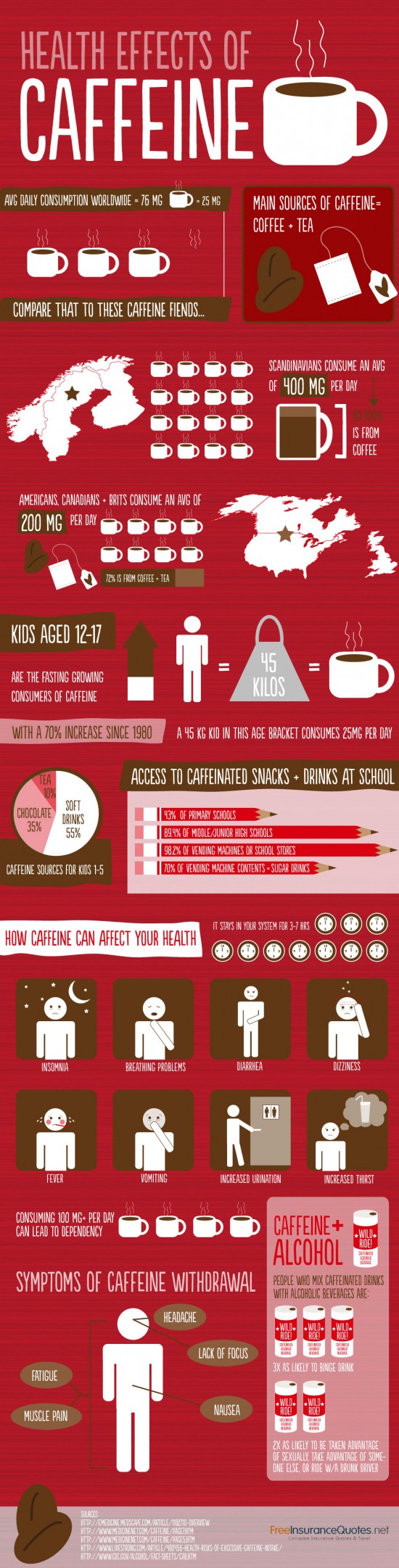
A-1: Here are some reported effects of caffeine. The following effects are commonly attributed to over-use of caffeine. While reading them, bear in mind that what is true for one person may not be true for someone else:

1. Stimulates your heart, respiratory system, and central nervous system

2. Makes your blood more `sludgy’ by raising the level of fatty acids in the blood

3. Causes messages to be passed along your nervous system more quickly

4. Stimulates blood circulation

5. Raises blood pressure

6. Causes your stomach to produce more acid

7. Irritates the stomach lining

8. Makes digestion less effective by relaxing the muscles of your intestinal system

9. Its diuretic effect caused increased urination – although you’d have to drink about 8 coups of coffee in one sitting for this to occur

And so, here is an additional sampling of information about the health effects of caffeine.

A-2: And, caffeine has no affects on health insurance premium rates; smoking does!

Assessment

Source: www.freeinsurancequotes.net

Conclusion

Your thoughts and comments on this ME-P are appreciated. Feel free to review our top-left column, and top-right sidebar materials, links, URLs and related websites, too. Then, subscribe to the ME-P. It is fast, free and secure.

Speaker: If you need a moderator or speaker for an upcoming event, Dr. David E. Marcinko; MBA – Publisher-in-Chief of the Medical Executive-Post – is available for seminar or speaking engagements. Contact: MarcinkoAdvisors@msn.com

OUR OTHER PRINT BOOKS AND RELATED INFORMATION SOURCES:

Product Details  Product Details

Healthcare Videos Worth Watching for 2011 [A Parody]

At Least According to … FierceHealthcare.com

By Staff Reporters

Join Our Mailing List 

What do “Top Gun,” “The Terminator” and “West Side Story” all have in common with the healthcare industry? Each is parodied in videos that make the HealthcareFinance 2011 list of must-watch YouTube clips from the medical realm.

(Check out our previous must-watch list of healthcare videos)

Deeper Value

Although each video–five in all–clearly has high entertainment value (for example, you’ll never be able to listen to Johnny Cash’s “Ring of Fire” in the same way again), some do have messages that go beyond the wackiness portrayed on the parody surface … to reveal a deeper more insightful truth or value!

Link: Click here to get started

Assessment of the Parody

“Many a true word is spoken in jest” and “Some truths, too painful or too likely to provoke, can be spoken only when the listener has been disarmed by laughter” are proverbial truths.

The idea appears to have been recorded first by Geoffrey Chaucer with the line, “A man may seye full sooth (truth) in game and pley” in his “The Canterbury Tales” (circa 1387).

In “King Lear” (1605), William Shakespeare wrote,”Jesters do oft prove prophets”; and some years later, the modern version was rendered in the “Roxburghe Ballad” (circa 1665): “Many a true word hath been spoken in jest.”

Conclusion

And so, your thoughts and comments on this ME-P are appreciated. Feel free to review our top-left column, and top-right sidebar materials, links, URLs and related websites, too. Then, subscribe to the ME-P. It is fast, free and secure.

Link: http://feeds.feedburner.com/HealthcareFinancialsthePostForcxos

Speaker: If you need a moderator or speaker for an upcoming event, Dr. David E. Marcinko; MBA – Publisher-in-Chief of the Medical Executive-Post – is available for seminar or speaking engagements. Contact: MarcinkoAdvisors@msn.com

Our Other Print Books and Related Information Sources:

Health Dictionary Series: http://www.springerpub.com/Search/marcinko

Practice Management: http://www.springerpub.com/product/9780826105752

Physician Financial Planning: http://www.jbpub.com/catalog/0763745790

Medical Risk Management: http://www.jbpub.com/catalog/9780763733421

Healthcare Organizations: www.HealthcareFinancials.com

Physician Advisors: www.CertifiedMedicalPlanner.com

Subscribe Now: Did you like this Medical Executive-Post, or find it helpful, interesting and informative? Want to get the latest ME-Ps delivered to your email box each morning? Just subscribe using the link below. You can unsubscribe at any time. Security is assured.

Link: http://feeds.feedburner.com/HealthcareFinancialsthePostForcxos

Sponsors Welcomed: And, credible sponsors and like-minded advertisers are always welcomed.

Link: https://healthcarefinancials.wordpress.com/2007/11/11/advertise

Product DetailsProduct DetailsProduct Details       

Product Details  Product Details

   Product Details

Can You Get Cancer From Oral Sex?

Yes Virginia and Virgil – You Can!

Join Our Mailing List 

Yes, and the US is seeing a sharp increase in the number of cases of oral and throat cancer especially among young men, caused by HPV infections contracted during oral sex.

Source: The Mount Sinai Medical Centre

Conclusion

And so, your thoughts and comments on this ME-P are appreciated. Feel free to review our top-left column, and top-right sidebar materials, links, URLs and related websites, too. Then, subscribe to the ME-P. It is fast, free and secure.

Link: http://feeds.feedburner.com/HealthcareFinancialsthePostForcxos

Speaker: If you need a moderator or speaker for an upcoming event, Dr. David E. Marcinko; MBA – Publisher-in-Chief of the Medical Executive-Post – is available for seminar or speaking engagements. Contact: MarcinkoAdvisors@msn.com

Our Other Print Books and Related Information Sources:

Health Dictionary Series: http://www.springerpub.com/Search/marcinko

Practice Management: http://www.springerpub.com/product/9780826105752

Physician Financial Planning: http://www.jbpub.com/catalog/0763745790

Medical Risk Management: http://www.jbpub.com/catalog/9780763733421

Healthcare Organizations: www.HealthcareFinancials.com

Physician Advisors: www.CertifiedMedicalPlanner.com

Subscribe Now: Did you like this Medical Executive-Post, or find it helpful, interesting and informative? Want to get the latest ME-Ps delivered to your email box each morning? Just subscribe using the link below. You can unsubscribe at any time. Security is assured.

Link: http://feeds.feedburner.com/HealthcareFinancialsthePostForcxos

Sponsors Welcomed: And, credible sponsors and like-minded advertisers are always welcomed.

Link: https://healthcarefinancials.wordpress.com/2007/11/11/advertise

Product DetailsProduct DetailsProduct Details       

Product Details  Product Details

   Product Details

About Healthcare Financials.com

WELCOME ALL HEALTH 2.0 COLLEAGUES

[An Open Invitation]

Product Details 

All hospitals and healthcare organizations, both emerging and mature, face a daunting financial scenario in today’s volatile healthcare reimbursement environment.  Decreasing revenues, increasing costs, and high consumer expectations present a complex challenge for CEOs, CFOs, physicians and nurse executives, administrators, financial advisors and department managers who must not only lead in today’s climate, but also position their organizations for tomorrow’s financial tumult and potential political changes of the Obama Administration.

Produced by a team of leading doctors, physician executives, nurses, medical professionals, economists, administrators, lawyers, and accountants, skilled business leaders and IT consultants, among many others; Healthcare Organizations [Journal of Financial Management Strategies] on CD-ROM, or SaaS, looks at ways to manage assets, costs, human resources and healthcare claims.  Everything – from inventory management to hybrid and activity based cost analysis in order to accelerate the cash conversion cycle – is scrutinized.  And, modern health economic themes like competitive strategy, workplace violence and financial benchmarks, for both public and private entities, are included.

We also examine contemporaneous topics such as the lessons learned from the corporate healthcare market competition and the PPMC imbroglio of the early 2000’s, and the domestic financial meltdown of 2009. This includes current methods for achieving hospital objectives, negotiating and analyzing cost-volume-profit contracts, and understanding the financial impact of regulatory requirements under HIPAA, STARK I-III, OSHA, the US Patriot Acts, the Deficit Reduction Act [DRA], the often contentious Sarbanes-Oxley Act, ARRA and HITECH Acts, and the Fair and Accurate Credit Transactions [FACT] Act.

In addition, information technology issues like electronic medical records (eMRs), RFID controls, RSS feeds and blogs, Health 2.0 initiatives and computerized physician order entry (CPOE) systems are examined in detail. Virtually no  operational, strategic business, health economics, or financial management topic is omitted.

“This wide-ranging examination of the fiscal

management scene for hospitals, healthcare

organizations, clinics and outpatient centers 

includes case models, extensive appendices, 

and detailed checklists and templates that

step the reader through a review of main

issues for each chapter.”

Health Care Organizations [Journal of Financial Management Strategies] on CD-ROM, or SaaS, is dedicated to meeting the administrative needs of our nation’s healthcare organizations in order to help them maintain a competitive edge in the markets they serve; and to take advantage of emerging business opportunities. We therefore invite you to be the first health economics cynosure in your hospital, facility, or healthcare system to join us for the journey.

Let Health Care Organizations [Journal of Financial Management Strategies] be your guide. 

Subscribe today … Succeed tomorrow!

Dr. David Edward Marcinko MBA, CMP

[Founder, CEO and Editor-in-Chief]

iMBA Inc – Suite #5901 Wilbanks Drive

Norcross, GA 30092-1141

Product Details 

On Health Insurance in America

Just how bad is it –  economically?

Join Our Mailing List 

QUESTION: How bad is the health insurance problem in America?

ANSWER: 4% of Americans are uninsured with many more under-insured, 75% of all bankruptcies are from the result of medical bills and 60% of insured individuals are in debt from health related expenses.

The cost of healthcare is no longer affordable to many middle class families, even with health insurance, so some would say it is pretty bad.

But, are these figures correct?

Assessment

Brought to you by: lowcosthealthinsurance.com

Conclusion

And so, your thoughts and comments on this ME-P are appreciated. Feel free to review our top-left column, and top-right sidebar materials, links, URLs and related websites, too. Then, subscribe to the ME-P. It is fast, free and secure.

Link: http://feeds.feedburner.com/HealthcareFinancialsthePostForcxos

Speaker: If you need a moderator or speaker for an upcoming event, Dr. David E. Marcinko; MBA – Publisher-in-Chief of the Medical Executive-Post – is available for seminar or speaking engagements. Contact: MarcinkoAdvisors@msn.com

Our Other Print Books and Related Information Sources:

Health Dictionary Series: http://www.springerpub.com/Search/marcinko

Practice Management: http://www.springerpub.com/product/9780826105752

Physician Financial Planning: http://www.jbpub.com/catalog/0763745790

Medical Risk Management: http://www.jbpub.com/catalog/9780763733421

Healthcare Organizations: www.HealthcareFinancials.com

Physician Advisors: www.CertifiedMedicalPlanner.com

Subscribe Now: Did you like this Medical Executive-Post, or find it helpful, interesting and informative? Want to get the latest ME-Ps delivered to your email box each morning? Just subscribe using the link below. You can unsubscribe at any time. Security is assured.

Link: http://feeds.feedburner.com/HealthcareFinancialsthePostForcxos

Sponsors Welcomed: And, credible sponsors and like-minded advertisers are always welcomed.

Link: https://healthcarefinancials.wordpress.com/2007/11/11/advertise

Product DetailsProduct DetailsProduct Details       

Product Details  Product Details

   Product Details

About Costs of Care.Org

What it is – AND – How it Works?

Join Our Mailing List

Costs of Care, a nonprofit 501(c)(3), is a social venture that helps doctors understand how the decisions they make impact what patients pay for care.

By harnessing social media, mobile applications, and other information technologies, they give doctors and patients the information needed to deflate medical bills.

Health Economics Factoid

“The cost of health care now causes a bankruptcy in America every thirty seconds.”

(President Obama to the 2009 Joint Session of Congress)

Essay Contest

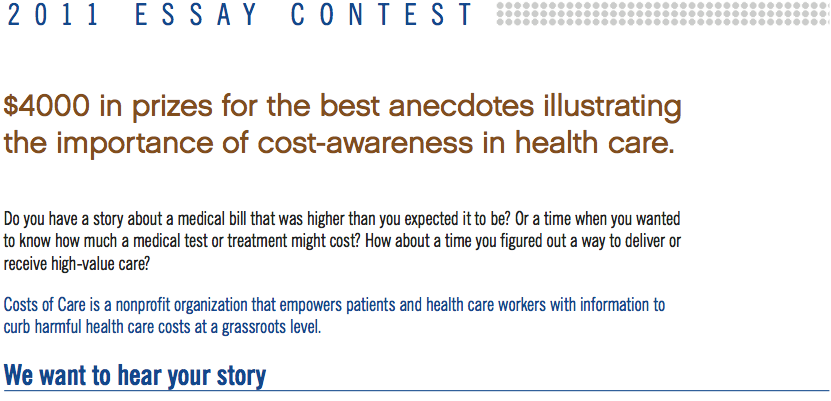
Costs of Care will be launching an essay contest for 2011 after Labor Day, with $4,000 in prizes for the best anecdotes illustrating the importance of cost awareness in health care! www.costsofcare.org/essay


Assessment

And so, give em’ a click and tell us what you think http://www.costsofcare.org/  Better yet! Enter the essay contest and/or give a donation. It’s tax deductible.

Conclusion

Your thoughts and comments on this ME-P are appreciated. Feel free to review our top-left column, and top-right sidebar materials, links, URLs and related websites, too. Then, subscribe to the ME-P. It is fast, free and secure.

Speaker: If you need a moderator or speaker for an upcoming event, Dr. David E. Marcinko; MBA – Publisher-in-Chief of the Medical Executive-Post – is available for seminar or speaking engagements. Contact: MarcinkoAdvisors@msn.com

OUR OTHER PRINT BOOKS AND RELATED INFORMATION SOURCES:

Product Details

Product DetailsProduct Details

How Lifetime Benefits and Contributions Point the Way Toward Reforming Our Senior Entitlement Programs

By Staff Reporters

From Expert Voices

By C. Eugene Steuerle PhD [Institute Fellow and Richard B. Fisher Chair, The Urban Institute]
By Stephanie Rennane [University of Maryland]

For August 2011

Reforms to Medicare and Social Security will likely be debated over the next few months as the new “super committee” formed by the debt ceiling agreement works to develop its long-term deficit reduction plan.

The Essay

In this essay, Dr. Eugene Steuerle and Stephanie Rennane help to inform this debate by presenting findings from their newly updated analysis showing that seniors retiring today can expect to receive dramatically more in entitlement program benefits during retirement than they contributed to the programs while working.

For example, the average Medicare beneficiary can expect $3 in benefits for every $1 paid in payroll taxes.

Link: http://nihcm.org/images/stories/EV-Steuerle-Rennane-FINAL.pdf

Assessment

The authors posit that the magnitude of the resources involved when viewing these programs in tandem over a lifetime gives policymakers new impetus and flexibility to develop coordinated entitlement reforms that promote a coherent, equitable and sustainable support system for current and future generations of seniors.

Conclusion

And so, your thoughts and comments on this ME-P are appreciated. Feel free to review our top-left column, and top-right sidebar materials, links, URLs and related websites, too. Then, subscribe to the ME-P. It is fast, free and secure.

Link: http://feeds.feedburner.com/HealthcareFinancialsthePostForcxos

Our Other Print Books and Related Information Sources:

Health Dictionary Series: http://www.springerpub.com/Search/marcinko

Practice Management: http://www.springerpub.com/product/9780826105752

Physician Financial Planning: http://www.jbpub.com/catalog/0763745790

Medical Risk Management: http://www.jbpub.com/catalog/9780763733421

Healthcare Organizations: www.HealthcareFinancials.com

Physician Advisors: www.CertifiedMedicalPlanner.com

Subscribe Now: Did you like this Medical Executive-Post, or find it helpful, interesting and informative? Want to get the latest ME-Ps delivered to your email box each morning? Just subscribe using the link below. You can unsubscribe at any time. Security is assured.

Link: http://feeds.feedburner.com/HealthcareFinancialsthePostForcxos

Sponsors Welcomed: And, credible sponsors and like-minded advertisers are always welcomed.

Link: https://healthcarefinancials.wordpress.com/2007/11/11/advertise

Product DetailsProduct DetailsProduct Details       

Product Details  Product Details

   Product Details 

A Nutrition Label for Health Insurance Plans?

Appreciating “Search Frictions”

By Dr. David Edward Marcinko MBA CMP™

[Editor-in-Chief]

Because products vary so much across many characteristics, health insurance is not easy to shop for. Comparing plans is an apples-to-oranges problem.

Of Search Frictions and Economic Externalities

As a former insurance agent for more than a decade, this is a situation by design – to obfuscate the patient and consumer.  

The challenges of comparison – health insurance plan – shopping then, creates what economist and colleague Austin Frakt PhD calls “search frictions” or inefficiencies in the ability to wisely choose. This may be likened to economic “externalities” and perhaps even motivated the recent development of (draft) standards for health plan labeling.

Beginning March 2012

So, how much will the new health plan labels, required starting next March, help consumers in their search for plans? How much grease will they add to the otherwise highly frictional process? I sure don’t know.

A good place to start however, is an examination of those frictions. What are they and how much do they matter?

Link: http://www.healthcare.gov/news/factsheets/labels08172011b.pdf

Assessment

Did food nutrition labeling, and the old food pyramid help – or confuse – consumers? What about the old and new cigarette warning label warnings? Or – the prohibition of alcohol for pregnant women – helpful or not! Any labeling for that matter?

Conclusion

And so, your thoughts and comments on this ME-P are appreciated. Feel free to review our top-left column, and top-right sidebar materials, links, URLs and related websites, too. Then, subscribe to the ME-P. It is fast, free and secure.

Link: http://feeds.feedburner.com/HealthcareFinancialsthePostForcxos

Our Other Print Books and Related Information Sources:

Health Dictionary Series: http://www.springerpub.com/Search/marcinko

Practice Management: http://www.springerpub.com/product/9780826105752

Physician Financial Planning: http://www.jbpub.com/catalog/0763745790

Medical Risk Management: http://www.jbpub.com/catalog/9780763733421

Healthcare Organizations: www.HealthcareFinancials.com

Physician Advisors: www.CertifiedMedicalPlanner.com

Subscribe Now: Did you like this Medical Executive-Post, or find it helpful, interesting and informative? Want to get the latest ME-Ps delivered to your email box each morning? Just subscribe using the link below. You can unsubscribe at any time. Security is assured.

Link: http://feeds.feedburner.com/HealthcareFinancialsthePostForcxos

Sponsors Welcomed: And, credible sponsors and like-minded advertisers are always welcomed.

Link: https://healthcarefinancials.wordpress.com/2007/11/11/advertise

Product Details  Product Details

America’s One-Stop Shop for Healthcare [HIEs]

Health Insurance Exchanges [HIEs]

Join Our Mailing List 

Brought to you by ACS a Xerox Company

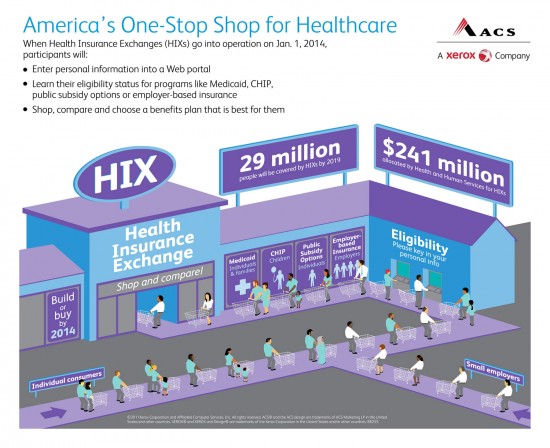
For some Americans, selecting a health insurance plan will soon feel a bit like shopping. As part of healthcare reform, each state is required to have a Health Insurance Exchange (HIE or HIX) in operation by Jan. 1, 2014.

Given the complexity of the topic, we’ve created the attached infographic that visually represents the process Americans will experience when participating. If you’re planning to write about HIXs in the near future – we hope you’ll consider using this graphic to help explain the process to your readers.

Here is additional information on HIXs to support the infographic:

  • Q:  How will states develop a HIX? A: States can either build their own HIX structure or buy a platform from the federal government.
  • Q:  Who can participate in a HIX? A: Only individuals without other coverage, individuals from whom coverage is unaffordable or inadequate, or small employers can participate in the exchange in 2014. Large employers can join the exchange in 2017.
  • Q:  How many people are expected to participate? A: The Exchanges are expected to cover as many as 29 million people by 2019, including five million with employment-based coverage.

Conclusion

Your thoughts and comments on this ME-P are appreciated. Feel free to review our top-left column, and top-right sidebar materials, links, URLs and related websites, too. Then, subscribe to the ME-P. It is fast, free and secure.

Link: http://feeds.feedburner.com/HealthcareFinancialsthePostForcxos

Speaker: If you need a moderator or speaker for an upcoming event, Dr. David E. Marcinko; MBA – Publisher-in-Chief of the Medical Executive-Post – is available for seminar or speaking engagements. Contact: MarcinkoAdvisors@msn.com

OUR OTHER PRINT BOOKS AND RELATED INFORMATION SOURCES:

DICTIONARIES: http://www.springerpub.com/Search/marcinko
PHYSICIANS: www.MedicalBusinessAdvisors.com
PRACTICES: www.BusinessofMedicalPractice.com
HOSPITALS: http://www.crcpress.com/product/isbn/9781466558731
CLINICS: http://www.crcpress.com/product/isbn/9781439879900
BLOG: www.MedicalExecutivePost.com
FINANCE: Financial Planning for Physicians and Advisors
INSURANCE: Risk Management and Insurance Strategies for Physicians and Advisors

Product DetailsProduct DetailsProduct Details

Product Details  Product Details

   Product Details 

Medicare and the Budget Control Act’s Joint Select Committee

Creating Spending Reductions for the Next Decade?

By Children’s Home Society of Florida Foundation

Join Our Mailing List 

Under the compromise between President Obama and leaders of the House and Senate, the Budget Control Act of 2011 created spending reductions of over $900 billion during the next decade. The bill also requires leaders of the House and Senate to appoint members to a Joint Select Committee. The committee has three Republican, three Democratic Senators, three Republican and three Democratic Representatives.

House and Senate leaders have now appointed the committee members. The 12 committee members are tasked with creating a $1.5 trillion budget solution by Thanksgiving. Their bill will be voted on without amendments by December 23, 2011.

If the committee is not able to develop and pass a bill by Dec. 23, there will be $1.2 trillion in budget cuts. Half of the cuts will come from the Department of Defense and one-half will be reductions in payments to Medicare providers.

Majority Leader Harry Reid (D-NV) appointed three Senators. The Co-Chair of the Joint Select Committee will be Sen. Patty Murray (D-WA). His other two appointees are Sen. John Kerry (D-MA) and Sen. Max Baucus (D-MT). Sen. Kerry is Chair of the Senate Foreign Relations Committee and Sen. Baucus is Chair of the Senate Finance Committee.

Republican Leader Mitch McConnell (R-KY) appointed Sen. John Kyl (R-AZ), Sen. Pat Toomey (R-PA) and Sen. Rob Portman (R-OH). Sen. Kyl is the Republican Whip and a senior member of the Finance Committee. Sen. Toomey is a member of the Budget Committee. Sen. Portman was previously Director of the Office of Management and Budget.

Speaker John Boehner (R-OH) appointed Rep. Jeb Hensarling (R-TX) as Co-Chair of the committee. His other appointments are Rep. Dave Camp (R-MI) and Rep. Fred Upton (R-MI). Rep. Camp is Chairman of the Ways and Means Committee and Rep. Upton chairs the Energy and Commerce Committee.

Democratic Leader Nancy Pelosi (D-CA) appointed Rep. James Clyburn (D-SC), House Ways and Means Member Xavier Becerra (D-CA) and Budget Committee Member Chris Van Hollen (D-MD).

The Joint Select Committee is expected to initiate meetings in September after Congress returns from the August recess.

Editor’s Note: There will undoubtedly be a spirited debate. All of the twelve committee members will want to avoid drastic budget cuts for the Department of Defense or Medicare providers. The group will need to discuss potential cuts in discretionary expenditures, defense and entitlements. With the appointments of key taxwriters Baucus and Camp, it is clear that taxes will also be a part of the discussion. Whether or not there are tax increases as part of the budget solution remains to be seen.

Conclusion

And so, your thoughts and comments on this ME-P are appreciated. Feel free to review our top-left column, and top-right sidebar materials, links, URLs and related websites, too. Then, subscribe to the ME-P. It is fast, free and secure.

Link: http://feeds.feedburner.com/HealthcareFinancialsthePostForcxos

Speaker: If you need a moderator or speaker for an upcoming event, Dr. David E. Marcinko; MBA – Publisher-in-Chief of the Medical Executive-Post – is available for seminar or speaking engagements. Contact: MarcinkoAdvisors@msn.com

Our Other Print Books and Related Information Sources:

Health Dictionary Series: http://www.springerpub.com/Search/marcinko

Practice Management: http://www.springerpub.com/product/9780826105752

Physician Financial Planning: http://www.jbpub.com/catalog/0763745790

Medical Risk Management: http://www.jbpub.com/catalog/9780763733421

Healthcare Organizations: www.HealthcareFinancials.com

Physician Advisors: www.CertifiedMedicalPlanner.com

Subscribe Now: Did you like this Medical Executive-Post, or find it helpful, interesting and informative? Want to get the latest ME-Ps delivered to your email box each morning? Just subscribe using the link below. You can unsubscribe at any time. Security is assured.

Link: http://feeds.feedburner.com/HealthcareFinancialsthePostForcxos

Sponsors Welcomed: And, credible sponsors and like-minded advertisers are always welcomed.

Link: https://healthcarefinancials.wordpress.com/2007/11/11/advertise

Product Details  Product Details

   Product Details 


Benchmarks of Health Plan Administrative Costs

2011 Edition‏

[By John Park]

Join Our Mailing List 

Recently, we began the release of our fourteenth annual edition of administrative performance benchmarks for health plans. It is the culmination of 515 health plan years of experience with all major sectors of the health plan industry. The attached brochure briefly describes our 2011 benchmarks.

First Universe Release

The first universe to be released was comprised of data of Blue Cross Blue Shield plans. Nearly 70% of all Blue Cross Blue Shield licensees participated this year.  A summary of the results for this universe is here:

http://www.sherlockco.com/docs/navigator/Navigator%20July%2011.pdf.

Results

In short, per member administrative expenses increased by only 1.0% in 2010 and only 1.8% when you adjust to back out changes in product mix.

This growth rate is very low by any standard.

Sherlock Company’s Benchmarks

Between the MLR provisions of the Accountable Care Act, which are intended to “create incentives for” health plans” to become more efficient,” and a weak overall economy, health plans face greater pressure to optimize their administrative costs. Sherlock Company’s benchmarks of administrative expenses enable your plan to quickly determine whether it is operating at best practice and to identify which functional areas provide the highest return on management’s efforts to improve performance.

Accordingly health plans serving more than one-half of all insured Americans are users of our benchmarks.

Assessment

Additional information can be found at http://www.sherlockco.com/seer.shtml

Sherlock Company

Douglas B. Sherlock, CFA

Senior Health Care Analyst

sherlock@sherlockco.com

Ph:  215-628-2289

Fax: 215-542-0690

Conclusion

Your thoughts and comments on this ME-P are appreciated. Feel free to review our top-left column, and top-right sidebar materials, links, URLs and related websites, too. Then, subscribe to the ME-P. It is fast, free and secure.

Link: http://feeds.feedburner.com/HealthcareFinancialsthePostForcxos

Speaker: If you need a moderator or speaker for an upcoming event, Dr. David E. Marcinko; MBA – Publisher-in-Chief of the Medical Executive-Post – is available for seminar or speaking engagements. Contact: MarcinkoAdvisors@msn.com

OUR OTHER PRINT BOOKS AND RELATED INFORMATION SOURCES:

DICTIONARIES: http://www.springerpub.com/Search/marcinko
PHYSICIANS: www.MedicalBusinessAdvisors.com
PRACTICES: www.BusinessofMedicalPractice.com
HOSPITALS: http://www.crcpress.com/product/isbn/9781466558731
CLINICS: http://www.crcpress.com/product/isbn/9781439879900
BLOG: www.MedicalExecutivePost.com
FINANCE: Financial Planning for Physicians and Advisors
INSURANCE: Risk Management and Insurance Strategies for Physicians and Advisors

Product DetailsProduct DetailsProduct Details

Product Details  Product Details

   Product Details 

Understanding US Health Care Spending

Dear ME-P Colleagues,

Nancy Chockley, President and CEO

The NIHCM Foundation is pleased to announce the release of a new data brief, Understanding U.S. Health Care Spending.

In it, we examine why we spend more than $8,000 per person on health care and the factors driving spending growth. Our analysis documents the extreme concentration of expenditures, with just 5 percent of the population responsible for almost half of all spending, and demonstrate the importance of rising spending for hospital and physician services as the primary drivers of expenditure growth.

Findings are based on NIHCM analysis of the most recent data from the National Health Expenditure Accounts and the Medical Expenditure Panel Survey.

We hope that you find this publication helpful for your own work.

Sincerely,
Julie Schoenman [Director of Research and Development]

Product DetailsProduct DetailsProduct Details       

Product Details  Product Details

   Product Details 

[Health] Plan Management Navigator

For July 2011

Join Our Mailing List 

By Douglas B. Sherlock, CFA

Please find attached below the July 2011 Edition of Plan Management Navigator. In this month’s edition, we summarize the administrative cost trends of Blue Cross Blue Shield Plans participating in our recently completed benchmarking study. The 27 plans, nearly 70% of total Blue plans, collectively serve 38.3 million members with comprehensive products.

Results 

The median administrative expense ratio for this peer group in 2010 was 9.2%, down from 9.7% in 2009, 9.9% in 2008 and 10.4% in 2007.

While per member Sales and Marketing cost trends increased, Corporate Services costs decreased. Provider and Medical Management and Account and Membership Administration cost growth, per member, sharply declined.

Managed Expenses 

Health plans are heavily committed to the management of administrative expenses. To adapt to the weak economic environment, they are taking steps to assure that the effects of premium rate pressures and enrollment weakness do not amplify reductions operating profits. They do this by not treating their administrative expenses as substantially fixed. In addition, the Patient Protection and Affordable Care Act’s increased scrutiny of premium rates, and enforcement of medical cost minimums (relative to premiums), elevates administrative expense control as the central aspect of managerial discretion.

Assessment

Link: Navigator July 11

Conclusion

And so, your thoughts and comments on this ME-P are appreciated. Feel free to review our top-left column, and top-right sidebar materials, links, URLs and related websites, too. Then, subscribe to the ME-P. It is fast, free and secure.

Link: http://feeds.feedburner.com/HealthcareFinancialsthePostForcxos

Speaker: If you need a moderator or speaker for an upcoming event, Dr. David E. Marcinko; MBA – Publisher-in-Chief of the Medical Executive-Post – is available for seminar or speaking engagements. Contact: MarcinkoAdvisors@msn.com

Our Other Print Books and Related Information Sources:

Health Dictionary Series: http://www.springerpub.com/Search/marcinko

Practice Management: http://www.springerpub.com/product/9780826105752

Physician Financial Planning: http://www.jbpub.com/catalog/0763745790

Medical Risk Management: http://www.jbpub.com/catalog/9780763733421

Healthcare Organizations: www.HealthcareFinancials.com

Physician Advisors: www.CertifiedMedicalPlanner.com

Subscribe Now: Did you like this Medical Executive-Post, or find it helpful, interesting and informative? Want to get the latest ME-Ps delivered to your email box each morning? Just subscribe using the link below. You can unsubscribe at any time. Security is assured.

Link: http://feeds.feedburner.com/HealthcareFinancialsthePostForcxos

Sponsors Welcomed                               

And, credible sponsors and like-minded advertisers are always welcomed.

Link: https://healthcarefinancials.wordpress.com/2007/11/11/advertise

Product DetailsProduct DetailsProduct Details       

Product Details  Product Details

   Product Details 

How Many Children Could Loose Healthcare?

Perhaps 15-18 Million of Them

By Voices for America’s Children

Join Our Mailing List 

No matter how you slice it, the House budget plan leaves millions of children uninsured.

Assessment

Here’s what the Medicaid cuts would mean for children by 2021.

Conclusion

And so, your thoughts and comments on this ME-P are appreciated. Feel free to review our top-left column, and top-right sidebar materials, links, URLs and related websites, too. Then, subscribe to the ME-P. It is fast, free and secure.

Link: http://feeds.feedburner.com/HealthcareFinancialsthePostForcxos

Speaker: If you need a moderator or speaker for an upcoming event, Dr. David E. Marcinko; MBA – Publisher-in-Chief of the Medical Executive-Post – is available for seminar or speaking engagements. Contact: MarcinkoAdvisors@msn.com

Our Other Print Books and Related Information Sources:

Health Dictionary Series: http://www.springerpub.com/Search/marcinko

Practice Management: http://www.springerpub.com/product/9780826105752

Physician Financial Planning: http://www.jbpub.com/catalog/0763745790

Medical Risk Management: http://www.jbpub.com/catalog/9780763733421

Healthcare Organizations: www.HealthcareFinancials.com

Physician Advisors: www.CertifiedMedicalPlanner.com

Subscribe Now: Did you like this Medical Executive-Post, or find it helpful, interesting and informative? Want to get the latest ME-Ps delivered to your email box each morning? Just subscribe using the link below. You can unsubscribe at any time. Security is assured.

Link: http://feeds.feedburner.com/HealthcareFinancialsthePostForcxos

Sponsors Welcomed: And, credible sponsors and like-minded advertisers are always welcomed.

Link: https://healthcarefinancials.wordpress.com/2007/11/11/advertise

Product DetailsProduct DetailsProduct Details       

Product Details  Product Details

   Product Details 

About The Healthcare Blue Book

A Free Consumer Guide to Healthcare Services

By Staff Reporters

What it is?

The Healthcare Blue Book is a free consumer guide to help you determine fair prices in your area for healthcare services.

How it works?

If you pay for your own healthcare, have a high deductible or need a service your insurance does not fully cover, they can help. The Healthcare Blue Book will help you find fair prices for surgery, hospital stays, doctor visits, medical tests and much more.

Assessment

So, give em’ a click and tell us what you think?

www.HealthCareBlueBook.com

Speaker: If you need a moderator or speaker for an upcoming event, Dr. David E. Marcinko; MBA – Publisher-in-Chief of the Medical Executive-Post – is available for seminar or speaking engagements. Contact: MarcinkoAdvisors@msn.com

Our Other Print Books and Related Information Sources:

Health Dictionary Series: http://www.springerpub.com/Search/marcinko

Practice Management: http://www.springerpub.com/product/9780826105752

Physician Financial Planning: http://www.jbpub.com/catalog/0763745790

Medical Risk Management: http://www.jbpub.com/catalog/9780763733421

Healthcare Organizations: www.HealthcareFinancials.com

Physician Advisors: www.CertifiedMedicalPlanner.com

Subscribe Now: Did you like this Medical Executive-Post, or find it helpful, interesting and informative? Want to get the latest ME-Ps delivered to your email box each morning? Just subscribe using the link below. You can unsubscribe at any time. Security is assured.

Link: http://feeds.feedburner.com/HealthcareFinancialsthePostForcxos

Product DetailsProduct DetailsProduct Details       

Product Details  Product Details

   Product Details 

Who Can’t Afford Health Care?

Expensive Even with Insurance

By Thomas Porostock

Health Care, even with insurance can be expensive, but what if you actually can’t afford medical care?


Conclusion

And so, your thoughts and comments on this ME-P are appreciated. Feel free to review our top-left column, and top-right sidebar materials, links, URLs and related websites, too. Then, subscribe to the ME-P. It is fast, free and secure.

Link: http://feeds.feedburner.com/HealthcareFinancialsthePostForcxos

Speaker: If you need a moderator or speaker for an upcoming event, Dr. David E. Marcinko; MBA – Publisher-in-Chief of the Medical Executive-Post – is available for seminar or speaking engagements. Contact: MarcinkoAdvisors@msn.com

Our Other Print Books and Related Information Sources:

Health Dictionary Series: http://www.springerpub.com/Search/marcinko

Practice Management: http://www.springerpub.com/product/9780826105752

Physician Financial Planning: http://www.jbpub.com/catalog/0763745790

Medical Risk Management: http://www.jbpub.com/catalog/9780763733421

Healthcare Organizations: www.HealthcareFinancials.com

Physician Advisors: www.CertifiedMedicalPlanner.com

Subscribe Now: Did you like this Medical Executive-Post, or find it helpful, interesting and informative? Want to get the latest ME-Ps delivered to your email box each morning? Just subscribe using the link below. You can unsubscribe at any time. Security is assured.

Link: http://feeds.feedburner.com/HealthcareFinancialsthePostForcxos

Sponsors Welcomed: And, credible sponsors and like-minded advertisers are always welcomed.

Link: https://healthcarefinancials.wordpress.com/2007/11/11/advertise

Product DetailsProduct DetailsProduct Details

Product Details  Product Details

   Product Details 

Private v. Public Healthcare

A Look Around the World

Join Our Mailing List

By MPH Degree Programs.com 


Conclusion

And so, your thoughts and comments on this ME-P are appreciated. Feel free to review our top-left column, and top-right sidebar materials, links, URLs and related websites, too. Then, subscribe to the ME-P. It is fast, free and secure.

Link: http://feeds.feedburner.com/HealthcareFinancialsthePostForcxos

Speaker: If you need a moderator or speaker for an upcoming event, Dr. David E. Marcinko; MBA – Publisher-in-Chief of the Medical Executive-Post – is available for seminar or speaking engagements. Contact: MarcinkoAdvisors@msn.com

Our Other Print Books and Related Information Sources:

Health Dictionary Series: http://www.springerpub.com/Search/marcinko

Practice Management: http://www.springerpub.com/product/9780826105752

Physician Financial Planning: http://www.jbpub.com/catalog/0763745790

Medical Risk Management: http://www.jbpub.com/catalog/9780763733421

Healthcare Organizations: www.HealthcareFinancials.com

Physician Advisors: www.CertifiedMedicalPlanner.com

Subscribe Now: Did you like this Medical Executive-Post, or find it helpful, interesting and informative? Want to get the latest ME-Ps delivered to your email box each morning? Just subscribe using the link below. You can unsubscribe at any time. Security is assured.

Link: http://feeds.feedburner.com/HealthcareFinancialsthePostForcxos

Sponsors WelcomedAnd, credible sponsors and like-minded advertisers are always welcomed.

Link: https://healthcarefinancials.wordpress.com/2007/11/11/advertise

Product DetailsProduct DetailsProduct Details

Product Details  Product Details

   Product Details 

A Review of HIPAA EHR Security Regulations

Join Our Mailing List

Focus on the Hospital Industry

Carol S. MillerBy Carol S. Miller BSN MBA

With the implementation of EMRs, Internet access, intranet availability throughout the hospital and physician complexes, as well as from home or any virtual site, the potential for security violations and associated vulnerabilities may have already caused serious harm to many hospitals and to the IT community in general.  Implementation of HIPAA security standards across the United States at hospitals, clinics, medical complexes, universities, federal facilities such as the VA, DoD or IHS and others have been inconsistent.  In addition, the HIPAA privacy regulations have given the responsibility for the patient health record to the patient — the impact of which has not been fully addressed nor is it supported by healthcare IT rules and regulations.

In Control?

Throughout the entire healthcare industry, there are concerns over who has access, who is in control, and whether the release of information impacts the privacy and security of the patient medical information or presents a risk to patient well-being, the quality of patient care, compliance issues, and potential fines to the hospital community.

The simple fact is that security is a problem that could have a catastrophic effect on any hospital.  Most Chief Information Officers have increased their “security-related” and “computer specialist” staff to address security issues, but most believe that their security is still vulnerable and needs to be improved.  Understanding a complex group of technologies and processes that have been built and modified many times over the years, especially at a large university or medical center complex, will be not only time-consuming, but also costly.  Security, like complex IT systems, was never designed in any organized manner.  It simply expanded as more and more access was made available, patient rights were defined, technology capabilities expanded, and more Internet-related communications and document-sharing occurred.

Hospital Security Concerns

Further, HIPAA security requirements were thrown into the mix in an era when hospital budgets were shrinking, and hospitals were trying to meet their costs through consolidation or reduction of programs and staff.

The prime concerns for information security are:

  • confidentiality – information is accessible only by authorized people and processes;
  • integrity – information is not altered or destroyed; and
  • availability – information is there when you need it.

Hospitals will continue to review, update and further document their security issues, monitor changes, and develop processes to mitigate the problems.  Gap analyses will continue to determine where vulnerabilities are or potentially could occur.  This process will be time consuming, but will enable the hospitals to determine how each system is integrated into their portfolio of systems and applications, and how it will be integrated with new technology.  Most importantly, it will facilitate identification of the detailed process of requesting, securing, and approving access to confidential patient records, systems, or applications.  It will enable hospitals to move forward with other technology enhancements in a secure manner.

Patchwork Security Quill

As stated previously, security has grown piecemeal as needs have been integrated with system, application, and software program growth.  It is literally a patchwork of various security functions and restrictions that may just be applicable to a certain application or software product or may be applicable to several applications but not all.  Various security software or SaaS packages have been deployed at different facilities across the United States that provide firewalls, access controls, tracking systems, and various other HIPAA security compliant capabilities; however, even with all these controls no one person within a hospital environment is fully aware of all the security requirements, security structures, the integration of the security network or whether any of the security network works efficiently and effectively.  Building a basic understanding of the entire network is the basis for developing and improving the entire HIPAA-related security process.  Besides the security involved within the hospital systems and through the Internet, there is still the issue of physical security, security theft or inappropriate access to patient information.

Typical Security Queries

The following list provides examples of typical questions related to security of information stored either on the laptop or on an accessible Intranet site from the laptop that should be addressed. All of these questions relate to additional time and expense in having an assigned individual monitor all aspects of this tracking process:

  • Is there an accurate record or log of each piece of equipment referenced at the hospital?
  • Do I know how many of the laptops are portable and used at home?
  • Are personal digital assistants (PDAs) and laptops encrypted and is the employee required to change passwords frequently?
  • Do I know how many of these portable systems are used for personal services?
  • Do I know how many of these laptops are used by family members?
  • Do I know how secure the portable systems are?
  • Do I know if they are just password protected or whether other security measures are in place?
  • Is every piece of equipment accounted for when employees leave, including PDA, laptop, CD, DVD, or other storage devices?
  • Do I know who can access confidential patient information from a remote office or home?
  • Is there a defined process for discarding old computers and old media?
  • Do employees know the hospital’s reporting process if their laptop is stolen or hacked?
  • Is virus and spyware software continually updated?
  • Are employees provided with information on how to secure their laptops or blackberries?
  • Do employees know what to do when attachments from unknown sources are sent and/or downloaded?
  • Does the employee use home-burned CDs/DVDs on their laptop?
  • Is system backup maintained by every employee?
  • Do employees know to “log off” when leaving their desktop or is there an automatic “log off” capability built within the system?

Security Administrators and Managers

Hospitals are employing security administrators and security staff to identify potential risks, vulnerabilities, risk scenarios, and develop policy and procedures to address all of these issues.  HIPAA compliance reviews and approval processes from HIPAA officers or legal counsel will be an added process for the hospital as part of any security consideration.  All of these security review processes, requirements, and staffing represent new and most likely unbudgeted costs with higher-than-anticipated associated costs to the hospital.  Costs need to be based on the affiliated risk, and the associated manpower or technical systems/software required to fix the risk; these indirect costs (i.e., not direct labor costs related to patient care) are being met from the hospital profits.

Risk Assessment Queries

Every covered entity should complete a risk assessment and review it periodically.  Focus areas that need to be addressed in the risk plan include the following:

  • workforce clearance (does the job require access to patient information and is it documented in the job description);
  • training (ongoing awareness and reminders); and
  • termination (what are the processes and procedures for assuring that a terminated employee does not have future access to any confidential patient information).

Today it is important for all hospitals to focus on contingency plans and disaster recovery to prevent any arbitrary loss of patient information.  Hospitals need to plan for and demonstrate that disasters such as Katrina or 9/11 or Japan or Alabama will not affect the security of the systems or access to patient information.

Many hospitals provide routine reviews, and system maintenance and updates to combat potential security problems or concerns with regard to confidential patient information.  However, inadvertent or even intentional changes to systems can cause serious data problems as the data integrates throughout the hospital IT environment.  Security breaches at this level can come from inside or outside the hospital.  They can be malicious or accidental and they can be related to system function disruption or data degradation.  They can relate to potential failures to properly share data and coordinate information.  They can also be the cause of major patient clinical errors, physician dissatisfaction, inaccurate record information, duplication of records, and as always, additional cost to the hospital that must identify the potential breach, develop a solution, and correct the issue at hand.

Main Concern

Direct access to information is probably the biggest security issue.  It affects personnel access to the systems they need in their daily jobs and tends to be poorly controlled.  Because hospitals need to provide access to information, they are sometimes lax about who has that access.  As an example, ask any hospital to not only identify each access user on the system, but also identify who uses each specific application.  Few hospitals have that capability. They would require additional resources to develop not only a major computerized index, but also the time and attention to monitor and to change users’ rights to access.  Many hospitals routinely request that the business or IT manager provide access for new employees that is similar to what another comparable staff person has — not really addressing the particular “right to know” or determining whether the new employee really needs a particular level of access.  Experience within the hospital environment also shows that many of the staff still have the same access to systems that they have had for years, even though they may have changed positions several times.

Finally, many staff have access to confidential patient information, yet few of the hospitals have ever linked this “right of access” to a background check.  Access to the hospital system is given to employees to perform a job.  In turn, the hospital is widely opening its doors to access a wide range of financial or confidential information, or even competitive information.  Many of these hospitals have employed designated staff to change and delete access rights, or allow read-only access, or read/write access; however, vulnerability still can exist.  Security is a trade-off between control and flexibility and there will always be weak points.  For those hospitals that have in place a comprehensive security review process, policy and procedures, and a contingency plan, the risks and liability can be limited.

Assessment

Regardless of the cost, HIPAA security and privacy regulations have changed the hospital environment.  The hospital and its IT and security staff need to be proactive.  There is simply too much at stake and potentially too many issues where mistakes could cause the hospital a serious system problem or result in a large fine.  HIPAA and the responsibility to provide reasonable patient care risk reduction mandate secure healthcare IT operations.  To do less simply allows patient care and healthcare delivery outcomes to be exposed to unacceptable levels of unnecessary risk.

About the Author

Carol S. Miller has an extensive healthcare background in operations, business development and capture in both the public and private sector. Over the last 10 years she has provided management support to projects in the Department of Health and Human Services, Veterans Affairs, and Department of Defense medical programs. In most recent years, Carol has served as Vice President and Senior Account Executive for NCI Information Systems, Inc., Assistant Vice President at SAIC, and Program Manager at MITRE. She has led the successful capture of large IDIQ/GWAC programs, managed the operations of multiple government contracts, interacted with many government key executives, and increased the new account portfolios for each firm she supported.

She earned her MBA from Marymount University; BS in Business from Saint Joseph’s College, and BS in Nursing from the University of Pittsburgh. She is a Certified PMI Project Management Professional (PMP) (PMI PMP) and a Certified HIPAA Professional (CHP), with Top Secret Security clearance issued by the DoD in 2006. Ms. Miller is also a HIMSS Fellow, Past President and current Board member and an ACT/IAC Fellow.

Conclusion

Your thoughts and comments on this ME-P are appreciated. Feel free to review our top-left column, and top-right sidebar materials, links, URLs and related websites, too. Then, subscribe to the ME-P. It is fast, free and secure.

Speaker: If you need a moderator or speaker for an upcoming event, Dr. David E. Marcinko; MBA – Publisher-in-Chief of the Medical Executive-Post – is available for seminar or speaking engagements. Contact: MarcinkoAdvisors@msn.com

OUR OTHER PRINT BOOKS AND RELATED INFORMATION SOURCES:

Product DetailsProduct Details

IRS and the Affordable Care Act

Proud of Track Record

By Children’s Home Society of Florida Foundation

Join Our Mailing List 

IRS Commissioner Douglas Shulman testified before the Senate Appropriations Subcommittee on Financial Services and General Government on June 8 2011. He stated, “Mr. Chairman, the IRS is also proud of its implementation track record over the past few years.”

IRS Successes

There are multiple areas the IRS views as significant successes:

1. Collecting Taxes on International Funds – The IRS created a “landmark deal” with the government of Switzerland and has recovered substantial amounts of income tax. Over 15,000 taxpayers participated in the Voluntary Disclosure Program (VDP). In addition, 4,000 other taxpayers have voluntarily disclosed bank accounts throughout the world. The bank accounts have produced substantial taxes and penalties for the IRS. In addition, the overseas funds will be subject to U.S. taxes in the future.

2. Preparer Tax Identification Numbers (PTIN) – The PTIN now is required for all tax return preparers. Over 700,000 preparers have registered. This enables the IRS to monitor preparers’ qualificatons and to identify preparers who are committing tax fraud.

3. Telephone Support – The IRS has a goal of 93% toll-free tax law accuracy. The toll-free customer satisfaction rating for the IRS the past year was 92%.

4. Website – http://www.irs.gov has been very popular with taxpayers. There were 305 million webpage visits to the site in the past year. This is up 14% over the prior year. The “Where’s My Refund?” electronic tracking tool also increased in popularity.

5. Smart Phone – The IRS unveiled its first application for smart phones called “IRS2Go.” This application allows taxpayers with smart phones to check the status of tax refunds and obtain additional information.

6. eFiling – Each year, over 100 million taxpayers use the eFile Program. The IRS has been able to close five of 10 sites that previously were processing paper returns because of the efficiency of the eFile System.

IRS Changes

The IRS is also preparing for major increased responsibility that will be required under the Affordable Care Act (ACA). Under the wide-ranging healthcare law, there will be major changes for most Americans. The majority of these changes will affect individuals in 2014:

1. Premium Assistance Tax Credit – Individuals with lower and moderate incomes may qualify for a healthcare tax credit.

2. Advanced Premium Payments – Individuals who qualify for the healthcare tax credit may receive advance monthly payments to their healthcare insurance provider.

3. Reconciling Tax Credits – For those individuals who receive advance healthcare payments to providers, their tax return will necessarily require a reconciliation of the tax credits with the advance payments. It appears that the first date for this return will be April 15, 2015. IRS forms will include a reconciliation for the 2014 tax credits.

4. Individual Coverage Requirement – For individuals in 2014, there will be a mandatory coverage requirement. Those without coverage will be required to make a payment to the IRS.

5. Employer Payments – For employers who are required to participate in the healthcare programs for employees, they will need to report that participation or make an employer payment to the IRS.

ACA

Editor’s Note: Your editor and this organization take no position with respect to IRS practices and the comments of IRS Commissioner Shulman. This information is offered as a service to our readers.

Channel Surfing the ME-P

Have you visited our other topic channels? Established to facilitate idea exchange and link our community together, the value of these topics is dependent upon your input. Please take a minute to visit. And, to prevent that annoying spam, we ask that you register. It is fast, free and secure.

Conclusion

Your thoughts and comments on this ME-P are appreciated. Feel free to review our top-left column, and top-right sidebar materials, links, URLs and related websites, too. Then, subscribe to the ME-P. It is fast, free and secure.

Speaker: If you need a moderator or speaker for an upcoming event, Dr. David E. Marcinko; MBA – Publisher-in-Chief of the Medical Executive-Post – is available for seminar or speaking engagements. Contact: MarcinkoAdvisors@msn.com

OUR OTHER PRINT BOOKS AND RELATED INFORMATION SOURCES:

Product DetailsProduct DetailsProduct Details

Product Details  Product Details

   Product Details 

The Cost of a Cared For-Nation

By Infographics

Courtesy Medical Billing and Coding

 Join Our Mailing List 

There’s nothing cheap about medical care expenses. In fact, there’s only one constant when it comes to the price of healthcare and medical treatment: it’s expensive.

Now Just imagine picking up the tab for an entire nation. The price of Medical services are rising at a faster rate than any other service and far exceed the pace of inflation. The following graphic breaks down the most expensive medical procedures by cost and takes a closer look into the rising cost of healthcare in our country.

Assessment

Have you ever wondered which states pay the highest premiums or how much the average premium has gone up in recent years? Take a look to learn more.


Source: http://carrington.edu/cccblog/carrington-college-california-news/health-care-cost/

Conclusion

And so, your thoughts and comments on this ME-P are appreciated. Feel free to review our top-left column, and top-right sidebar materials, links, URLs and related websites, too. Then, subscribe to the ME-P. It is fast, free and secure.

Link: http://feeds.feedburner.com/HealthcareFinancialsthePostForcxos

Speaker: If you need a moderator or speaker for an upcoming event, Dr. David E. Marcinko; MBA – Publisher-in-Chief of the Medical Executive-Post – is available for seminar or speaking engagements. Contact: MarcinkoAdvisors@msn.com

Our Other Print Books and Related Information Sources:

Health Dictionary Series: http://www.springerpub.com/Search/marcinko 

Practice Management: http://www.springerpub.com/product/9780826105752

Physician Financial Planning: http://www.jbpub.com/catalog/0763745790

Medical Risk Management: http://www.jbpub.com/catalog/9780763733421

Healthcare Organizations: www.HealthcareFinancials.com

Physician Advisors: www.CertifiedMedicalPlanner.com

Subscribe Now: Did you like this Medical Executive-Post, or find it helpful, interesting and informative? Want to get the latest ME-Ps delivered to your email box each morning? Just subscribe using the link below. You can unsubscribe at any time. Security is assured.

Link: http://feeds.feedburner.com/HealthcareFinancialsthePostForcxos

Sponsors Welcomed: And, credible sponsors and like-minded advertisers are always welcomed.

Link: https://healthcarefinancials.wordpress.com/2007/11/11/advertise

Product DetailsProduct DetailsProduct Details       

Product Details  Product Details

   Product Details 


Why Your Stitches Cost $1,500 [Part II]

InfoGraphics – Part 2

Courtesy Medical Billing and Coding

Join Our Mailing List

The United States has fallen behind other nations, failing to provide affordable health care to its citizens. Americans spend $477 billion a year MORE on health care than other advanced countries.

So why do we pay so much compared to other wealthy nations?

Part 2 of 2 in a Series

This Infographic is part two in a two part series which dissects the state of our health care system and presents some alarming numbers.

Assessment

Link: http://www.medicalbillingandcoding.org/medicals-costs-2/

Part 1: https://medicalexecutivepost.com/2011/04/25/why-your-stitches-cost-1500/

Conclusion

And so, your thoughts and comments on this ME-P are appreciated. Feel free to review our top-left column, and top-right sidebar materials, links, URLs and related websites, too. Then, subscribe to the ME-P. It is fast, free and secure.

Link: http://feeds.feedburner.com/HealthcareFinancialsthePostForcxos

Speaker: If you need a moderator or speaker for an upcoming event, Dr. David E. Marcinko; MBA – Publisher-in-Chief of the Medical Executive-Post – is available for seminar or speaking engagements. Contact: MarcinkoAdvisors@msn.com

Our Other Print Books and Related Information Sources:

Health Dictionary Series: http://www.springerpub.com/Search/marcinko

Practice Management: http://www.springerpub.com/product/9780826105752

Physician Financial Planning: http://www.jbpub.com/catalog/0763745790

Medical Risk Management: http://www.jbpub.com/catalog/9780763733421

Healthcare Organizations: www.HealthcareFinancials.com

Physician Advisors: www.CertifiedMedicalPlanner.com

Subscribe Now: Did you like this Medical Executive-Post, or find it helpful, interesting and informative? Want to get the latest ME-Ps delivered to your email box each morning? Just subscribe using the link below. You can unsubscribe at any time. Security is assured.

Link: http://feeds.feedburner.com/HealthcareFinancialsthePostForcxos

Sponsors Welcomed: And, credible sponsors and like-minded advertisers are always welcomed.

Link: https://healthcarefinancials.wordpress.com/2007/11/11/advertise

Product DetailsProduct DetailsProduct Details       

Product Details  Product Details

   Product Details

Bitching about Dental Insurance

Join Our Mailing List

Both Hippocratic and Patriotic

By D. Kellus Pruitt DDS

For the benefit of our trusting patients, let’s start openly discussing the unethical practices of dental insurance companies’ right here. Marketplace conversation about deceit in healthcare is not only the Hippocratic thing to do, but once the awkwardness wears off, it’s really, really fun sport. We simply must lower the cost of dental care in the nation, and I say we start with dental insurance executives’ salaries and bonuses. Are you with me; Doctor? And let’s not forget all the non-productive busywork insurance companies never reimburse us for.

Are you Fed Up?

Are you fed up with successfully doing intricate handwork to exacting tolerances in mouths of anxious patients and then having to fight to get the patients’ insurance company to pay what they rightfully owe THEIR CLIENT? Are you tired of the way anonymous and unaccountable insurance employees treat you and your staff when their company’s contractual relationship is not with anyone in your office?

In my opinion, Delta Dental, United Concordia, UnitedHealth, BCBSTX and most other secretive dental insurance companies have been cheating Americans for decades under the cover of the McCarran-Ferguson Act of 1945 – which protects them from prosecution by the FTC and cries out to be repealed (tell your Congressperson).

The Age of Transparency

Even in the age of transparency, old habits die hard, especially when there is a profit and campaign funds involved. Dental “insurance” has always harbored fraudulent business activities and has never made sense as a wise purchase – even if one doesn’t brush their teeth. It’s a business built on complicated rules, client deceit and intrusion into their relationship with their dentist.

Dental insurance crime as policy has long avoided market correction because up until now, dentists had no control over the media (and dentistry is boring). Not unexpectedly, when business entities are shielded from accountability in an otherwise free market, it is always the clueless consumer who wastes money on lousy dental insurance policies.

IMHO

In my opinion, employers should be offering their employees the choice of cash or dental insurance. Then let Adam Smith’s invisible hand of competition spank the butts of the greedy and deceitful.

Dentists

Dentists, if you were given the opportunity to effectively voice your opinion directly to employers who carelessly purchase bad dental plans they know nothing about according to the appearance of an ad, what would you say? So why aren’t you saying it right here, right now? If not now, when, Doc?

Assessment

If you don’t make your complaints known, do you think MBA benevolence will eventually improve the dental insurance industry in the nation? I say we do what feels natural and bitch. Let’s live on the wild side and take our chances on someone calling us “unprofessional.” We owe it to our patients to promote honesty in our community. Otherwise, how can your silence possibly help your patients?

Conclusion

Your thoughts and comments on this ME-P are appreciated. Feel free to review our top-left column, and top-right sidebar materials, links, URLs and related websites, too. Then, subscribe to the ME-P. It is fast, free and secure.

Speaker: If you need a moderator or speaker for an upcoming event, Dr. David E. Marcinko; MBA – Publisher-in-Chief of the Medical Executive-Post – is available for seminar or speaking engagements. Contact: MarcinkoAdvisors@msn.com

OUR OTHER PRINT BOOKS AND RELATED INFORMATION SOURCES:

Product Details 

Should Health Insurance Pay for Patient Exercise Programs?

Or – Enough with the “Benefits” Already!

By Dr. David Edward Marcinko MBA, CMP™

[Former Licensed Insurance Agent]

[ME-P Editor-in-Chief]

An editorial just published in the Journal of the American Medical Association says research supports consideration of a wider policy of reimbursing for structured exercise programs, particularly in high-risk groups, such as diabetics.

Link: http://jama.ama-assn.org/content/305/17/1808.full

Present Status

Currently, health-insurance plans don’t treat exercise as medicine; only some plans offer a fitness benefit, usually a partial reimbursement for gym membership.

Link: http://blogs.wsj.com/health/2011/05/04/reader-consult-should-insurance-reimburse-for-exercise-programs/

Yet, the push for this benefit does seem to be growing.

My Opinion

And yes, as a doctor and surgeon who treated diabetic bone and soft tissue infections, ulcers and related necrotic gangrene for two decades, there’s something to this philosophy in-theory. But, this “theory” is not grounded in risk-management principles or economic sense; and it does seem counter-intuitive to most insurance models that I know.

Note: Most adult diabetics are Type II, maturity onset and controllable.

Examples

For example, auto insurance does not pay for routine car maintenance, nor does home owner’s insurance or most other standard insurance policy types.

Question: Why should health insurance be any different?

Answer: Because it is a public good.

Oh, come on now!  Obeying moral codes and legal boundaries is also a public good for civility; but we don’t mitigate the risk of breaking them with insurance policies; do we?

Why? They would be too expensive. Believe me, if insurance companies thought they could make a buck this way, they surely would!

Assessment

Aren’t these types of benefits already in place in some Flexible Spending Accounts, High Deductible Medical [Health] Savings Accounts , and employee cafeteria plans, etc.

Moreover, don’t we all know that we aren’t supposed to smoke, use street drugs, drink excessively, pig-out, or have promiscuous sex? Yet – we still do – like the diabetic who excessively indulges.

If you want to get-or-stay healthy[ier]; exercise more and eat less. A simple – understandable – and free healthcare Rx; but no best selling book, “breaking news” or JAMA report, here.

Conclusion

And so, your thoughts and comments on this ME-P are appreciated. Should health insurance pay for exercise programs? Feel free to review our top-left column, and top-right sidebar materials, links, URLs and related websites, too. Then, subscribe to the ME-P. It is fast, free and secure.

Link: http://feeds.feedburner.com/HealthcareFinancialsthePostForcxos

Speaker: If you need a moderator or speaker for an upcoming event, Dr. David E. Marcinko; MBA – Publisher-in-Chief of the Medical Executive-Post – is available for seminar or speaking engagements. Contact: MarcinkoAdvisors@msn.com

Our Other Print Books and Related Information Sources:

Health Dictionary Series: http://www.springerpub.com/Search/marcinko

Practice Management: http://www.springerpub.com/product/9780826105752

Physician Financial Planning: http://www.jbpub.com/catalog/0763745790

Medical Risk Management: http://www.jbpub.com/catalog/9780763733421

Healthcare Organizations: www.HealthcareFinancials.com

Physician Advisors: www.CertifiedMedicalPlanner.com

Subscribe Now: Did you like this Medical Executive-Post, or find it helpful, interesting and informative? Want to get the latest ME-Ps delivered to your email box each morning? Just subscribe using the link below. You can unsubscribe at any time. Security is assured.

Link: http://feeds.feedburner.com/HealthcareFinancialsthePostForcxos

Sponsors Welcomed: And, credible sponsors and like-minded advertisers are always welcomed.

Link: https://healthcarefinancials.wordpress.com/2007/11/11/advertise

Product DetailsProduct DetailsProduct Details       

Product Details  Product Details

   Product Details 

The Great Health Care Challenges [A Slide show]

The US Health Care Crisis and the Complexities of Reform

By Austin Frakt PhD

Dr. Austin Frakt blogs over at The Incidental Economist which contemplates health care with a focus on research, and an eye on reform. It is about economics, health policy, health services, health care and – yes – politics. And, Austin is a health policy wonk that we admire here at the ME-P

 www.TheIncidentalEconomist.com 

Last fall he created a slide show on the challenges presented by our health care system. He has updated it circa March 11 2011 and has now allowed us, and others, to post freely. We appreciate him for this educational gesture.

Thank you.

Ann Miller RN MHA

[Executive-Director]

Link: Frakt Great Healthcare Challenges

About Austin Frakt PhD

Austin is the creator, manager, host, and primary author of The Incidental Economist. He is a health economist with an educational background in physics and engineering. After receiving his PhD in statistical and applied mathematics he spent four years at a research and consulting firm conducting policy evaluations for federal health agencies. Austin now has a joint appointment with the Department of Health Policy and Management at Boston University’s (BU’s) School of Public Health and Health Care Financing & Economics (HCFE) at the Boston VA Healthcare System, U.S. Department of Veterans Affairs. He studies economic issues pertaining U.S. health care policy with a recent but not exclusive focus on Medicare and the uninsured. He has authored numerous peer-reviewed, scholarly publications, many relevant to health care financing, economics, and policy. His papers have appeared in Health Care Financing Review, Health Affairs, Health Economics, International Journal of Health Care Finance and Economics, Journal of Health Politics, Policy and Law, among other journals. For over a year, he has been a regular columnist for Kaiser Health News and he has contributed commentary for the New York Times’ Room for Debate forum.

Austin’s interests include economics and health care, of course, but also politics, personal finance, and the amusements of family life. Outside of his principal work duties, he manages his household’s finances, is CFO of a small business, and looks after his two children.

You are welcome to “friend” Austin on Facebook, follow the blog via his Google Buzz feed, and subscribe to his Google Reader bundles. Austin does not have a personal Twitter account. When he has something to communicate he does it on this blog. If you wish, contact Austin with anything on your mind via the contact form. (The views expressed in Austin’s posts are his own and do not necessarily reflect the positions of the Department of Veterans Affairs or Boston University.)

Conclusion

And so, your thoughts and comments on this ME-P are appreciated. Feel free to review our top-left column, and top-right sidebar materials, links, URLs and related websites, too. Then, subscribe to the ME-P. It is fast, free and secure.

Speaker: If you need a moderator or speaker for an upcoming event, Dr. David E. Marcinko; MBA – Publisher-in-Chief of the Medical Executive-Post – is available for seminar or speaking engagements. Contact: MarcinkoAdvisors@msn.com and http://www.springerpub.com/Search/marcinko

Our Other Print Books and Related Information Sources:

Health Dictionary Series: http://www.springerpub.com/Search/marcinko

Practice Management: http://www.springerpub.com/product/9780826105752

Physician Financial Planning: http://www.jbpub.com/catalog/0763745790

Medical Risk Management: http://www.jbpub.com/catalog/9780763733421

Healthcare Organizations: www.HealthcareFinancials.com

Physician Advisors: www.CertifiedMedicalPlanner.com

Subscribe Now: Did you like this Medical Executive-Post, or find it helpful, interesting and informative? Want to get the latest ME-Ps delivered to your email box each morning? Just subscribe using the link below. You can unsubscribe at any time. Security is assured.

Link: http://feeds.feedburner.com/HealthcareFinancialsthePostForcxos

Sponsors Welcomed: And, credible sponsors and like-minded advertisers are always welcomed.

Link: https://healthcarefinancials.wordpress.com/2007/11/11/advertise

Product DetailsProduct DetailsProduct Details       

Product Details  Product Details

   Product Details 

Why Your Stitches Cost $1,500 [Part I]

InfoGraphics – Part 1

Courtesy Medical Billing and Coding

Join Our Mailing List

The United State has fallen behind other nations, failing to provide affordable health care to its citizens. Americans spend $477 billion a year MORE on health care than other advanced countries.

So why do we pay so much compared to other wealthy nations?

Part 1 of 2 in a Series

This Infographic is part one in a two part series which dissects the state of our health care system and presents some alarming numbers.

Link: http://www.medicalbillingandcoding.org/medical-costs-1/

Part 2: https://medicalexecutivepost.com/?p=30972&preview=true

Conclusion

And so, your thoughts and comments on this ME-P are appreciated. Feel free to review our top-left column, and top-right sidebar materials, links, URLs and related websites, too. Then, subscribe to the ME-P. It is fast, free and secure.

Link: http://feeds.feedburner.com/HealthcareFinancialsthePostForcxos

Speaker: If you need a moderator or speaker for an upcoming event, Dr. David E. Marcinko; MBA – Publisher-in-Chief of the Medical Executive-Post – is available for seminar or speaking engagements. Contact: MarcinkoAdvisors@msn.com

Health Dictionary Series: http://www.springerpub.com/Search/marcinko

Practice Management: http://www.springerpub.com/product/9780826105752

Physician Financial Planning: http://www.jbpub.com/catalog/0763745790

Medical Risk Management: http://www.jbpub.com/catalog/9780763733421

Healthcare Organizations: www.HealthcareFinancials.com

Physician Advisors: www.CertifiedMedicalPlanner.com

Subscribe Now: Did you like this Medical Executive-Post, or find it helpful, interesting and informative? Want to get the latest ME-Ps delivered to your email box each morning? Just subscribe using the link below. You can unsubscribe at any time. Security is assured.

Link: http://feeds.feedburner.com/HealthcareFinancialsthePostForcxos

Sponsors WelcomedAnd, credible sponsors and like-minded advertisers are always welcomed.

Link: https://healthcarefinancials.wordpress.com/2007/11/11/advertise

Product DetailsProduct DetailsProduct Details       

Product Details  Product Details

   Product Details 

Are Doctors Throwing in the Towel?

Doctors versus Insurers

By Staff Reporters

Despite the success of entrepreneurial doctors – the number of doctors who enter private practice are in decline.

The Survey

For example, according to a survey by the “Physicians Foundation”, 89% of respondents believe the traditional model of independent private practice “is a dinosaur soon to go extinct.”

Survey: http://www.physiciansfoundations.org/uploadedFiles/Health%20Reform%20and%20the%20Decline%20of%20Physician%20Private%20Practice.pdf

Pod Cast: http://healthystate.org/archives/5764

Assessment

So we ask; what do you think?

Are physicians “throwing in the towel” and leaving private medical practice?  

Conclusion

Your thoughts and comments on this ME-P are appreciated. Our goal is to prevent same. Feel free to review our top-left column, and top-right sidebar materials, links, URLs and related websites, too. Then, subscribe to the ME-P. It is fast, free and secure.

Link: http://feeds.feedburner.com/HealthcareFinancialsthePostForcxos

Speaker: If you need a moderator or speaker for an upcoming event, Dr. David E. Marcinko; MBA – Publisher-in-Chief of the Medical Executive-Post – is available for seminar or speaking engagements. Contact: MarcinkoAdvisors@msn.com

Our Other Print Books and Related Information Sources:

Health Dictionary Series: http://www.springerpub.com/Search/marcinko

Practice Management: http://www.springerpub.com/product/9780826105752

Physician Financial Planning: http://www.jbpub.com/catalog/0763745790

Medical Risk Management: http://www.jbpub.com/catalog/9780763733421

Healthcare Organizations: www.HealthcareFinancials.com

Physician Advisors: www.CertifiedMedicalPlanner.com

Subscribe Now: Did you like this Medical Executive-Post, or find it helpful, interesting and informative? Want to get the latest ME-Ps delivered to your email box each morning? Just subscribe using the link below. You can unsubscribe at any time. Security is assured.

Link: http://feeds.feedburner.com/HealthcareFinancialsthePostForcxos

Sponsors Welcomed: And, credible sponsors and like-minded advertisers are always welcomed.

Link: https://healthcarefinancials.wordpress.com/2007/11/11/advertise

Product DetailsProduct DetailsProduct Details       

Product Details  Product Details

   Product Details

On the Anniversary of the Affordable Care Act [A Video]

An Audio-Video Review One Year Later

By Staff Reporters

Join Our Mailing List

Reforms under the Affordable Care Act have brought an end to some of the worst abuses of the insurance industry. These reforms have given Americans new rights and benefits, by helping more children get health coverage, ending lifetime and most annual limits on care, allowing young adults under 26 to stay on their parent’s health insurance, and giving patients access to recommended preventive services without cost.

Link: http://www.healthcare.gov/?gclid=CO72rYyUkKgCFeM85QoddjY3yg

Other Benefits

Many other new benefits of the law have taken effect, including 50% discounts on brand-name drugs for seniors in the Medicare “donut hole,” and tax credits for small businesses that provide insurance to employees. More rights, protections and benefits for Americans are on the way through 2014.

Assessment

See major parts of the law on this interactive timeline, or read the Patient’s Bill of Rights.

And, find out how the Patient Protection and Affordable Care Act [ACA]  provides better benefits and better health.

Video Link: http://www.healthcare.gov/law/introduction/index.html

Conclusion

And so, your thoughts and comments on this ME-P are appreciated. Is this post a shill for Obama-Care and the Federal Government? Feel free to review our top-left column, and top-right sidebar materials, links, URLs and related websites, too. Then, subscribe to the ME-P. It is fast, free and secure.

Link: http://feeds.feedburner.com/HealthcareFinancialsthePostForcxos

Speaker: If you need a moderator or speaker for an upcoming event, Dr. David E. Marcinko; MBA – Publisher-in-Chief of the Medical Executive-Post – is available for seminar or speaking engagements. Contact: MarcinkoAdvisors@msn.com

Our Other Print Books and Related Information Sources:

Health Dictionary Series: http://www.springerpub.com/Search/marcinko

Practice Management: http://www.springerpub.com/product/9780826105752

Physician Financial Planning: http://www.jbpub.com/catalog/0763745790

Medical Risk Management: http://www.jbpub.com/catalog/9780763733421

Healthcare Organizations: www.HealthcareFinancials.com

Physician Advisors: www.CertifiedMedicalPlanner.com

Subscribe Now: Did you like this Medical Executive-Post, or find it helpful, interesting and informative? Want to get the latest ME-Ps delivered to your email box each morning? Just subscribe using the link below. You can unsubscribe at any time. Security is assured.

Link: http://feeds.feedburner.com/HealthcareFinancialsthePostForcxos

Sponsors Welcomed: And, credible sponsors and like-minded advertisers are always welcomed.

Link: https://healthcarefinancials.wordpress.com/2007/11/11/advertise

Product Details 

Understanding MCO-Medical Practice Contract Standards

The Conversion to Negotiated Managed Healthcare is Significant

Dr. David Edward Marcinko, MBA CMP™

Prof. Hope Rachel Hetico, RN MHA CPHQ CMP™

www.BusinessofMedicalPractice.com

The conversion to managed healthcare and capitation financing is a significant marketing force and not merely a temporary business trend. More than 60% of all physicians in the country are now employees of a MCO. Those that embrace these forces will thrive, while those opposed will not.

Developing an Attractive Practice

After you have evaluated the HMOs in your geographic area, you must then make your practice more attractive to them, since there are far too many physicians in most regions today. The following issues are considered by most MCO financial managers and business experts, as they decide whether or not to include you in their network:

General Standards

  • Is there a local or community need for your practice, with a sound patient base that is not too small or large? Remember, practices that already have a significant number of patients have some form of leverage since MCOs know that patients do not like switching their primary care doctors or pediatricians, and women do not want to be forced to change their OB/GYN specialist. If the group leaves the plan, members may complain to their employers and give a negative impression of the plan.
  • A positive return on investment (ROI) from your economically sound practice is important to MCOs because they wish to continue their relationship with you. Often, this means it is difficult for younger practitioners to enter a plan, since plan actuaries realize that there is a high attrition rate among new practitioners. They also realize that more established practices have high overhead costs and may tend to enter into less lucrative contract offerings just to pay the bills.
  • A merger or acquisition is a strategy for the MCO internal business plan that affords a seamless union should a practice decide to sell out or consolidate at a later date. Therefore, a strategy should include things such as: strong managerial and cost accounting principles, a group identity rather than individual mindset, profitability, transferable systems and processes, a corporate form of business, and a vertically integrated organization if the practice is a multi-specialty group.
  • Human resources, capital, and IT service should complement the existing management information system (MIS) framework. This is often difficult for the solo or small group practice and may indicate the need to consolidate with similar groups to achieve needed economies of scale and capital, especially in areas of high MCO penetration.
  • Consolidated financial statements should conform to Generally Accepted Accounting Principles (GAAP), Internal Revenue Code (IRC), Office of the Inspector General (OIG), and other appraisal standards.
  • Strong and respected MD leadership in the medical and business community is an asset. MCOs prefer to deal with physician executives with advanced degrees. You may not need a MBA or CPA, but you should be familiar with basic business, managerial, and financial principles. This includes a conceptual understanding of horizontal and vertical integration, cost principles, cost volume analysis, financial ratio analysis, and cost behavior.
  • The doctors on staff should be willing to treat all conditions and types of patients. The adage “more risk equates to more reward” is still applicable and most groups should take all the full risk contracting they can handle, providing they are not pooled contracts.
  • Are you a team player or solo act? The former personality type might do better in a group or MCO-driven practice, while a fee-for-service market is still possible and may be better suited to the latter personality type.
  • Each member of a physician group, or a solo doctor, should have a valid license, DEA narcotics license, continuing medical education, adequate malpractice insurance, board qualification or certification, hospital privileges, agree with the managed care philosophy, and have partners in a group practice that meet all the same participation criteria. Be available for periodic MCO review by a company representative.

Specific Medical Office Standards

MCOs may require that the following standards are maintained in the medical office setting:

  • It is clean and presentable with a professional appearance.
  • It is readily accessible and has a barrier-free design (see OSHA requirements).
  • There is appropriate medical emergency and resuscitation equipment.
  • The waiting room can accommodate 5 – 7 patients with private changing areas.
  • There is an adequate capacity (e.g., 5,000 – 10,000 member minimum), business plan, and office assistants for the plan.
  • There is an office hour minimum (e.g., 20 hours/week).
  • 24/7 on-call coverage is available, with electronic tracking and eMRs.
  • There are MCO-approved sub-contractors.

Assessment

What have we missed?

Front Matter Link: Front Matter BoMP – 3


Conclusion

Your thoughts and comments on this ME-P are appreciated. Feel free to review our top-left column, and top-right sidebar materials, links, URLs and related websites, too. Then, subscribe to the ME-P. It is fast, free and secure.

Speaker: If you need a moderator or speaker for an upcoming event, Dr. David E. Marcinko; MBA – Publisher-in-Chief of the Medical Executive-Post – is available for seminar or speaking engagements. Contact: MarcinkoAdvisors@msn.com

OUR OTHER PRINT BOOKS AND RELATED INFORMATION SOURCES:

Product Details 

Healthcare Reform at a Glance

A One-Stop-Look-See with Comparisons

By Staff Reporters

Link: Health-Care-Reform-Comparison-in-Brief

[Courtesy: BuckConsultants]

Conclusion

And so, your thoughts and comments on this ME-P are appreciated. Feel free to review our top-left column, and top-right sidebar materials, links, URLs and related websites, too. Then, subscribe to the ME-P. It is fast, free and secure.

Speaker: If you need a moderator or speaker for an upcoming event, Dr. David E. Marcinko; MBA – Publisher-in-Chief of the Medical Executive-Post – is available for seminar or speaking engagements. Contact: MarcinkoAdvisors@msn.com and http://www.springerpub.com/Search/marcinko

Our Other Print Books and Related Information Sources:

Health Dictionary Series: http://www.springerpub.com/Search/marcinko

Practice Management: http://www.springerpub.com/product/9780826105752

Physician Financial Planning: http://www.jbpub.com/catalog/0763745790

Medical Risk Management: http://www.jbpub.com/catalog/9780763733421

Healthcare Organizations: www.HealthcareFinancials.com

Physician Advisors: www.CertifiedMedicalPlanner.com

Subscribe Now: Did you like this Medical Executive-Post, or find it helpful, interesting and informative? Want to get the latest ME-Ps delivered to your email box each morning? Just subscribe using the link below. You can unsubscribe at any time. Security is assured.

Link: http://feeds.feedburner.com/HealthcareFinancialsthePostForcxos

Sponsors Welcomed: And, credible sponsors and like-minded advertisers are always welcomed.

Link: https://healthcarefinancials.wordpress.com/2007/11/11/advertise

Product Details 

Seeking Healthcare Administration Experts and Contributing Print Authors

Healthcare Organizations [second edition]

By Ann Miller RN MHA

[Executive-Director]

Join Our Mailing List 

Greetings ME-P Readers, Experts and Subscribers,

As you may know, we are now preparing the next edition of our book: Healthcare Organizations [Management Strategies, Operational Techniques and Case Studies]. And so, we solicit your interest in crafting new material or simply updating original chapters for subscriber, ACPE, Barnes & Noble, MGMA, ACHE and related distribution channels.

Tentative Table of Contents [400 pages]

  1. On the Origins and Development of Quality Initiatives in Healthcare
  2. Competitive Analysis of the Contemporary Healthcare Ecosystem
  3. Capital Formation Strategies for Healthcare Entities
  4. Inventory Management and Economic Order Quantity Analysis
  5. Improving Operations and Management to Achieve Objectives
  6. Financial and Clinical Features of Hospital Information Systems
  7. Managing Health Information Technology Security Risks
  8. Monitoring, Managing and Enhancing Hospital Revenue Cycles  
  9. Patient [Customer] Relations Management in Healthcare
  10. Healthcare Organization Compliance Processes and Tactics
  11. Reviewing OSHA Standards and Health Policy Practices
  12. Operational Impact of HIPAA, Sarbanes-Oxley and the USA PATRIOT ACT
  13. Understanding Continuous Healthcare Process Improvement
  14. Using Medical Informatics to Track Health Care
  15. Appreciating Six-Sigma Healthcare Quality Improvement
  16. Hospital-Flow Through Efficiency and Logistics.

Editorial support is available, and you would enjoy increasing subject-matter notoriety, exposure and public relations in an erudite and credible fashion. ME-P expert reader synergy seems ideal and our time line for submission is ample in a prose writing style that is “wide, and deep.”  Scheduled release is 2012.

Assessment [first edition]

Foreword: http://healthcarefinancials.com/aboutus.aspx

Style and format: http://healthcarefinancials.com/Documents/Clinical%20and%20Financial%20Features%20of%20Hospital%20IT%20Systems.pdf

Prior authors: http://healthcarefinancials.com/contributors.aspx

TOC: http://healthcarefinancials.com/Documents/TABLE%20OF%20CONTENTS.pdf

We look forward to working with you and appreciate your continued “crowd-sourced” interest in this important body of work. So, please advise me of your interest: MarcinkoAdvisors@msn.com

Conclusion

And so, your thoughts and comments on this ME-P are appreciated. Feel free to review our top-left column, and top-right sidebar materials, links, URLs and related websites, too. Then, subscribe to the ME-P. It is fast, free and secure.

Speaker: If you need a moderator or speaker for an upcoming event, Dr. David E. Marcinko; MBA – Publisher-in-Chief of the Medical Executive-Post – is available for seminar or speaking engagements. Contact: MarcinkoAdvisors@msn.com and http://www.springerpub.com/Search/marcinko

Our Other Print Books and Related Information Sources:

Health Dictionary Series: http://www.springerpub.com/Search/marcinko

Practice Management: http://www.springerpub.com/product/9780826105752

Physician Financial Planning: http://www.jbpub.com/catalog/0763745790

Medical Risk Management: http://www.jbpub.com/catalog/9780763733421

Healthcare Organizations: www.HealthcareFinancials.com

Physician Advisors: www.CertifiedMedicalPlanner.com

Subscribe Now: Did you like this Medical Executive-Post, or find it helpful, interesting and informative? Want to get the latest ME-Ps delivered to your email box each morning? Just subscribe using the link below. You can unsubscribe at any time. Security is assured.

Link: http://feeds.feedburner.com/HealthcareFinancialsthePostForcxos

Sponsors Welcomed: And, credible sponsors and like-minded advertisers are always welcomed.

Link: https://healthcarefinancials.wordpress.com/2007/11/11/advertise

Product DetailsProduct DetailsProduct Details       

Product Details  Product Details

   Product Details 

About HealthCareAndYou.org

What it is – How it works?

By Staff Reporters

Join Our Mailing List 

At a time when many Americans are confused about the healthcare overhaul law, a coalition of groups representing doctors, nurses, pharmacists and consumers has launched a website to answer questions about the Affordable Care Act.

The new website – HealthCareandYou.org – doesn’t delve into the politics behind the law, but spells out what the law means to consumers, depending on the state they live in and their age. The website also provides a timeline, telling consumers when different parts of the law go into effect.

The Site

According to the site, The Affordable Care Act is a health care law that aims to improve our current health care system by increasing access to health coverage for Americans and introducing new protections for people who have health insurance.

If you have health insurance, you will benefit from steps to stop insurance companies from cancelling your coverage if you get sick. The law will also require insurance plans to cover your out-of-pocket costs for many proven preventive and screening services, such as colonoscopies and mammograms, to catch problems at their earliest, most treatable stages.

Your job might not offer health insurance. Or, maybe you have been denied coverage because of a pre-existing condition such as asthma or cancer. The law now offers health plans for people with pre-existing conditions who have had trouble finding care. And it will increase access to coverage for more Americans in 2014.

The law helps small businesses pay for health insurance for their employees. And it supports programs that will help increase the number of primary care physicians, nurses, physician assistants and other health care professionals.

Assessment

It is important to understand what the law means for you. Check out what changes have already taken place and learn more about what is happening in your state.

Link: http://www.healthcareandyou.org

Conclusion

And so, your thoughts and comments on this ME-P are appreciated. Feel free to review our top-left column, and top-right sidebar materials, links, URLs and related websites, too. Then, subscribe to the ME-P. It is fast, free and secure.

Speaker: If you need a moderator or speaker for an upcoming event, Dr. David E. Marcinko; MBA – Publisher-in-Chief of the Medical Executive-Post – is available for seminar or speaking engagements. Contact: MarcinkoAdvisors@msn.com and http://www.springerpub.com/Search/marcinko

Our Other Print Books and Related Information Sources:

Health Dictionary Series: http://www.springerpub.com/Search/marcinko

Practice Management: http://www.springerpub.com/product/9780826105752

Physician Financial Planning: http://www.jbpub.com/catalog/0763745790

Medical Risk Management: http://www.jbpub.com/catalog/9780763733421

Healthcare Organizations: www.HealthcareFinancials.com

Physician Advisors: www.CertifiedMedicalPlanner.com

Subscribe Now: Did you like this Medical Executive-Post, or find it helpful, interesting and informative? Want to get the latest ME-Ps delivered to your email box each morning? Just subscribe using the link below. You can unsubscribe at any time. Security is assured.

Link: http://feeds.feedburner.com/HealthcareFinancialsthePostForcxos

Sponsors Welcomed: And, credible sponsors and like-minded advertisers are always welcomed.

Link: https://healthcarefinancials.wordpress.com/2007/11/11/advertise

Product DetailsProduct DetailsProduct Details       

Product Details  Product Details

   Product Details 

“Journal of Financial Management Strategies” for Healthcare Organizations

ADVERTISEMENT

Hospitals and Healthcare Organizations

[A Textbook of Financial Management Strategies]

Buy from Amazon


Update on How Physicians Get Paid in 2010-11 [A slide show]

Part 2: [A Visual .ppt Presentation]

By Dr. David Edward Marcinko; MBA

[Editor-in-Chief]

From prior posts and comments on this ME-P, we know that most patients don’t have a clue about how doctors get paid in the real world of health insurance reimbursement.

A Popular Topic

We know this because prior posts on the topic have consistently been among the most popular on this platform. For example:

Part 1: https://healthcarefinancials.wordpress.com/2008/09/12/how-doctors-get-paid

Assessment

And so, we have taken the liberty of drilling down the topic, to a more granular level, in this attached .ppt presentation.

Link: How Doctors Get Paid in 2010 

Conclusion

And so, your thoughts and comments on this ME-P special presentation are appreciated. Tell us what you think?

Feel free to review our top-left column, and top-right sidebar materials, links, URLs and related websites, too. Then, be sure to subscribe to the ME-P. It is fast, free and secure.

Link: http://feeds.feedburner.com/HealthcareFinancialsthePostForcxos

Speaker: If you need a moderator or speaker for an upcoming event, Dr. David E. Marcinko; MBA – Publisher-in-Chief of the Medical Executive-Post – is available for seminar or speaking engagements. Contact: MarcinkoAdvisors@msn.com 

Our Other Print Books and Related Information Sources:

Practice Management: http://www.springerpub.com/prod.aspx?prod_id=23759

Physician Financial Planning: http://www.jbpub.com/catalog/0763745790

Medical Risk Management: http://www.jbpub.com/catalog/9780763733421

Healthcare Organizations: www.HealthcareFinancials.com

Physician Advisors: www.CertifiedMedicalPlanner.com

Subscribe Now: Did you like this Medical Executive-Post, or find it helpful, interesting and informative? Want to get the latest ME-Ps delivered to your email box each morning? Just subscribe using the link below. You can unsubscribe at any time. Security is assured.

Link: http://feeds.feedburner.com/HealthcareFinancialsthePostForcxos

Sponsors Welcomed: And, credible sponsors and like-minded advertisers are always welcomed.

Link: https://healthcarefinancials.wordpress.com/2007/11/11/advertise

Product DetailsProduct DetailsProduct Details      

David B. Nash MD MBA FACP

ADVERTISEMENT
Product Details

Hospitals & Healthcare Organizations

FOREWORD 

David Nash MD MBA

It should come as no surprise to our readers that the nation faces a financial crisis in healthcare. 

Currently, the United States spends nearly 16% of the world’s largest economy on providing healthcare services to its citizens.  Another way of looking at this same information is to realize that we spend nearly $6,500 per man, woman, and child per year to deliver health services.  And, what do we get for the money we spend?  

This is an important policy question and the answer is disquieting.  Although the man and woman on the street may believe we have the best health system in the world, on an international basis, using well-accepted epidemiologic outcome measures, our investment does not yield much!  

According to information from the World Health Organization and other international bodies, the United States of America ranks somewhere towards the bottom of the top fifteen developed nations in the world, regarding the outcome in terms of improved health for the monies we spend on healthcare. 

From a financial and economic perspective then, it appears as though the 16% of the GDP going to healthcare may not represent a solid investment with a good return. 

It is then timely that our colleagues at the Institute of Medical Business Advisors, Inc. have brought us their greatest work: Healthcare Organizations: [Financial Management Strategies]; a two-volume set of nearly 1,200 pages.  

Certainly, this comprehensive manual, and its quarterly updates, is not for everyone. It is intended only for those executives and administrators who understand that clinics, hospitals and healthcare organizations are complex businesses, with advances in science, technology, management principles and patient/consumer awareness often eclipsed by regulations, rights, and economic restrictions.  Navigating a course where sound organizational management is intertwined with financial acumen requires a strategy designed by subject matter experts. Fortunately, Healthcare Organizations: [Financial Management Strategies] provides that blueprint.

Allow me to outline its strengths and put it into context relative to other policy works around the nation. 

For nearly two years, the research team at iMBA, Inc., has sought out the best minds in the healthcare industrial complex to organize the seemingly impossible-to-understand strategic financial backbone of the domestic healthcare system.   

The periodical print-guide is organized into two volumes in order to appropriately cover many of the key topics at hand.  It has a natural flow, starting with Competitive Strategy and moving through Asset Management, Cost Management, and Claims Management.  

Volume 1, most especially the Competitive Strategy section, has broad appeal and would be of interest to most people in the health insurance industry, including managed care, hospitals, third party benefit managers and the pharmaceutical industry. 

Volume 2 continues in a well-organized theme, progressing from Risk Management and Compliance to Health Policy, Information Technology, and most importantly, Financial Benchmarking. 

Volume 2 would be of greater interest to those in the policy sphere, both in Washington, DC, in state legislatures, consulting companies, medical colleges, and graduate schools of health administration, public health and related fields. Every day colleagues ask me to help explain the seemingly incomprehensible financial design of our healthcare system.  These two volumes would go a long way toward answering their queries. 

I also believe both volumes would be appropriate as text books and reference tools in graduate level courses taught in schools of business, public health, health administration, and medicine. 

In my travels about the nation, many faculty members would also benefit from the support of these two volumes as it is nearly impossible, even for experts in the field, to grasp all of the rapidly evolving details. 

On a personal level, I was particularly taken with the Competitive Strategy section and it brought back enjoyable memories of my work nearly twenty-five years ago at the Wharton School, on the campus of the University of Pennsylvania.  There, I was exposed to some of the best economic minds in the healthcare business and it was a watershed event for me forming some of my earliest opinions about the healthcare system. 

I also very much enjoyed the section on Health Policy, most especially, the section on the Sarbanes-Oxley Act for hospitals and healthcare organizations.  I believe we have not fully embraced the comprehensive nature of Sarbanes-Oxley on the hospital side, and envision a day when hospital boards will be held accountable for quality, in the same way that proprietary corporations are held accountable for the strength and comprehensiveness of their audit reports. Simply put, Sarbanes-Oxley for quality is around the corner and this volume goes a long way toward preparing our basic understanding of the Act and its potential future implications. Congratulations to all authors, but this one in particular deserves specific mention. As a board member for a major national integrated delivery system, I am happy that there appears to be a greater interest in the intricacies of Sarbanes-Oxley on the healthcare side of the ledger. 

In summary, Healthcare Organizations: [Financial Management Strategies] represents a unique marriage between the Institute of Medical Business Advisors, Inc., and its many contributors from across the nation.  As its mission statement suggests, I believe this massive interpretive text carries out its vision to connect healthcare financial advisors, hospital administrators, business consultants, and medical colleagues everywhere. It will help them learn more about organizational behavior, strategic planning, medical management trends and the fluctuating healthcare environment; and consistently engage everyone in a relationship of trust and a mutually beneficial symbiotic learning environment.  

Editor-in-Chief and healthcare economist Dr. David Edward Marcinko and his colleagues at the Institute of Medical Advisors, Inc should be complimented for conceiving and completing this vitally important project. There is no question that Healthcare Organizations: [Journal of Financial Management Strategies] will indeed enable us to leverage our cognitive assets and prepare a future generation of leaders capable of tackling the many challenges present in our healthcare economy.  

My suggestion therefore, is to “read it, refer to it, recommend it, and reap.”  

David B. Nash MD, MBA
The Dr. Raymond C and Doris N. Professor and
Chair of the Department of Health Policy
Jefferson Medical College
Thomas Jefferson University
Philadelphia, Pa, USA
 

Conclusion

Your thoughts and comments on this ME-P are appreciated. Feel free to review our top-left column, and top-right sidebar materials, links, URLs and related websites, too. Then, subscribe to the ME-P. It is fast, free and secure.

Link: http://feeds.feedburner.com/HealthcareFinancialsthePostForcxos

Speaker: If you need a moderator or speaker for an upcoming event, Dr. David E. Marcinko; MBA – Publisher-in-Chief of the Medical Executive-Post – is available for seminar or speaking engagements. Contact: MarcinkoAdvisors@msn.com

OUR OTHER PRINT BOOKS AND RELATED INFORMATION SOURCES:

LEXICONS: http://www.springerpub.com/Search/marcinko
PHYSICIANS: www.MedicalBusinessAdvisors.com
PRACTICES: www.BusinessofMedicalPractice.com
HOSPITALS: http://www.crcpress.com/product/isbn/9781466558731
CLINICS: http://www.crcpress.com/product/isbn/9781439879900
ADVISORS: www.CertifiedMedicalPlanner.org
BLOG: www.MedicalExecutivePost.com

Product Details

Subscribe and Pass it On … the ME-P

Be Part of What We Do!

Tell Someone About the Medical Executive-Post!

By Ann Miller RN MHA [Executive-Director]


Shout Outs!

Seen something particularly interesting on the ME-P? Then tell your colleagues and friends about us.

Contributions

Or, got a health care administration, health economics or financial planning insight? Write for the ME-P. We have more than 50 topic channels for all areas of expertise.

Send your ideas or article to Ann: MarcinkoAdvisors@msn.com

Speaker: If you need a moderator or speaker for an upcoming event, Dr. David E. Marcinko; MBA – Publisher-in-Chief of the Medical Executive-Post – is available for seminar or speaking engagements. Contact: MarcinkoAdvisors@msn.com and http://www.springerpub.com/Search/marcinko

Get our Widget: Get this widget!

Our Other Print Books and Related Information Sources:

Health Dictionary Series: http://www.springerpub.com/Search/marcinko

Practice Management: http://www.springerpub.com/product/9780826105752

Physician Financial Planning: http://www.jbpub.com/catalog/0763745790

Medical Risk Management: http://www.jbpub.com/catalog/9780763733421

Healthcare Organizations: www.HealthcareFinancials.com

Physician Advisors: www.CertifiedMedicalPlanner.com

Subscribe Now: Did you like this Medical Executive-Post, or find it helpful, interesting and informative? Want to get the latest ME-Ps delivered to your email box each morning? Just subscribe using the link below. You can unsubscribe at any time. Security is assured.

Link: http://feeds.feedburner.com/HealthcareFinancialsthePostForcxos

Sponsors WelcomedAnd, credible sponsors and like-minded advertisers are always welcomed.

Link: https://healthcarefinancials.wordpress.com/2007/11/11/advertise

Product Details 

[Health] Plan Management Navigator

January 2011

By Douglas B. Sherlock, CFA
Senior Health Care Analyst

Dear ME-P Readers and Subscribers,

 Join Our Mailing List 

At the risk of appearing overwhelmed with New Year’s enthusiasm, we think this edition of Plan Management Navigator is especially interesting:

1. We report on the cost decisions made by low cost Blue Cross Blue Shield plans. Low cost plans make decisions that differ from their higher cost peers. Hallmarks of these decisions include levels and distributions of expenses between functions, the levels and distribution of staff between functions, the levels of compensation and its distribution between functions and the distribution between functions, and levels of, non-labor expenses. Overall, low cost Blue Cross Blue Shield Plans have “tactical” administrative expenses that are $5.75 PMPM, or 30%, lower than their higher cost counterparts. These tactical expenses are all administrative expenses excluding medical management and sales and marketing.

Last month we published a similar study of the choices of low cost Independent / Provider-Sponsored Plans. Low cost health plans had tactical costs that were 36% lower than their peers, or by $6.39.

A more detailed version of either of these analyses is available to licensed users of each of our benchmarks. Please call us for further information if you have an interest.

2. We introduce a new service on our website that will enable you to determine how a health plan is doing relative to the 2010 benchmarks. You can select your universe and then determine whether you are high or low and, if so, by how much.

3. We invite you to participate in the 2011 benchmarking study. We are now forming universes. We think that, under pending MLR rules, participation is very timely.

Link: Navigator January 2011

Thank you for your continued interest in our research.

Assessment

sherlock@sherlockco.com
Ph:  215-628-2289
Fax: 215-542-0690

Conclusion

And so, your thoughts and comments on this ME-P are appreciated. Feel free to review our top-left column, and top-right sidebar materials, links, URLs and related websites, too. Then, subscribe to the ME-P. It is fast, free and secure.

Speaker: If you need a moderator or speaker for an upcoming event, Dr. David E. Marcinko; MBA – Publisher-in-Chief of the Medical Executive-Post – is available for seminar or speaking engagements. Contact: MarcinkoAdvisors@msn.com and http://www.springerpub.com/Search/marcinko

Get our Widget: Get this widget!

Our Other Print Books and Related Information Sources:

Health Dictionary Series: http://www.springerpub.com/Search/marcinko

Practice Management: http://www.springerpub.com/product/9780826105752

Physician Financial Planning: http://www.jbpub.com/catalog/0763745790

Medical Risk Management: http://www.jbpub.com/catalog/9780763733421

Healthcare Organizations: www.HealthcareFinancials.com

Physician Advisors: www.CertifiedMedicalPlanner.com

Subscribe Now: Did you like this Medical Executive-Post, or find it helpful, interesting and informative? Want to get the latest ME-Ps delivered to your email box each morning? Just subscribe using the link below. You can unsubscribe at any time. Security is assured.

Link: http://feeds.feedburner.com/HealthcareFinancialsthePostForcxos

Sponsors Welcomed: And, credible sponsors and like-minded advertisers are always welcomed.

Link: https://healthcarefinancials.wordpress.com/2007/11/11/advertise

Product DetailsProduct DetailsProduct Details