A Review of LP / LLC Transfer Hazards for Physicians

Join Our Mailing List

Can standard boilerplate and default corporate law provisions inadvertently disinherit your family from controlling the business or cost millions in additional estate/gift tax?

By Ed Morrow, JD, LL.M. (tax), MBA, CFP®

[Manager, Wealth Strategies Communications, Key Private Bank]

Many physicians use limited liability companies, limited liability partnerships or limited partnerships (“LLCs”, “LLPs” and “LPs”) to operate a trade or business, to hold real estate, or even to hold investment assets.  When only immediate family are owners, these are often referred to as family limited partnerships or limited liability companies (“FLPs” and “FLLCs”).  There are numerous business, asset protection and estate planning reasons for using these entities (hereinafter lumped together for simplicity as “LLCs”).  In many cases, these are preferable to old-fashioned corporations (see separate companion article on LP/LLC Advantages).

As a doctor – you must be very careful, however, when transferring LLC shares during lifetime or at death, to your spouse, children, trusts or others.  Especially when there are co-owners outside the immediate family.  This is due to a stark difference between LLC/partnership law and corporate law and the concept known as “assignee interests”.  Understanding this is even more crucial in 2012 because of the overwhelming demand and interest in transferring LLC interests to irrevocable trusts to exploit the $5.12million gift tax exclusion, which is slated to reduce to only $1 million in 2013.

An LLC owner (called a “member”, not a “stockholder”) has two bundles of rights:

  1. Economic rights – which are the rights to receive property from the LLC both during existence and upon liquidation, along with tax attributes and profit/losses; and
  2. Management rights – the right to vote, participate in management and receive reports and accountings.

It is the latter category that can cause problems when transferring LLC interests by gift or at death.

Members of an LLC usually establish an Operating Agreement to set the rules for transfer of interests.  State statutes (such as the Uniform Limited Liability Company Act) usually provide default rules where the document is silent.

The problem occurs when an LLC member transfers a portion of his or her ownership interest in the LLC to another person, either during lifetime or at death.  At that point, the transferee may become a “mere assignee” of the LLC interest, and not a full “substitute member.”  Under the laws of most states, unless the Operating Agreement provides or parties otherwise agree, an assignee only receives the transferor’s economic rights in the LLC, but not the management rights.

In fact, some court cases require member consent even if the operating agreement seems to otherwise permit such transfers (Ott v. Monroe, 719 S.E.2d 309, 282 Va. 403 (2011).  These state laws were enacted to protect business owners from unwillingly becoming partners with someone they never intended or contracted to be partners with.

This treatment is completely different from transferring C or S corporation stock – when you buy P&G stock, you get the same rights as the previous owner.  S Corporation stock is not even allowed to have differing classes of ownership interests (although voting/non-voting is permitted).  Usually, this quirk in the law has numerous asset protection benefits to LLC owners (discussed in the companion article), but it can cause havoc to one’s business planning in unforeseen circumstances.

Examples of Inadvertent Loss of Control

#1- Doctors Able and Baker, unrelated parties, form and operate an LLC.  Able owns 49% and Baker owns 51%.  Baker has a controlling interest in the LLC.  Baker dies and his 51% interest in the LLC is transferred to his revocable living trust.  Now, the trust is a “mere assignee” and while the trust receives 100% of Baker’s economic rights in the LLC (51% of the total LLC economic rights), it has none of the management rights.  After Baker’s death, Able will have 100% of the LLC’s management rights.  The trustee may have serious difficulty even getting books and records of the LLC, much less have any say on reviewing Able’s business decisions (including new hire and new salary expectations).

#2 – Same ownership structure as above, but Baker leaves assets via Transfer on Death designation or via Will to his spouse, children or others directly.  Same result.

#3 – Same ownership scenario as above, but Baker gifts his membership interests during life to his spouse, children, UTMA account or an irrevocable grantor trust.  Same result.

#3a – Same scenario as above, but Baker simply transfers his shares to his revocable living trust (called “funding”) via Schedule A attached to trust or other assignment.  Same result.

#4 – Same scenario, but Dr. Baker got express permission of Able to transfer his LLC interest to his revocable living trust and have it remain a full substitute member.  No issue – until Baker dies and the LLC interests pass to a new subtrust, such as a bypass, marital, QTIP, or other irrevocable trust, or to beneficiaries outright.  Able must have agreed to this subsequent transfer as well, otherwise the transfer to the new subtrust will be a mere assignee interest and the Baker family loses control.

Creditor Issues

Again, Able and Baker own 49%/51%.  Baker has some creditor issues from a tort claim and co-signed loans unrelated to the LLC.  He files bankruptcy to reorganize or get a clean start (or perhaps the creditor forces a bankruptcy).  This is probably another trigger that causes Baker to lose all of his management rights in the LLC.

Incapacity Issues

Again, Able and Baker own 49% and 51% economic and management rights respectively.  This time, Baker has a stroke or an accident and his wife or one of his family takes over as guardian or conservator.  Similar result.  Able now has 100% controlling management rights, even though Baker still keeps the same economic rights.  He can fire Baker and raise his own salary.

Estate/Gift Tax Issues 

Able and Baker’s company is worth $10Million.  Baker’s 51% interest gets marketability discount, but a controlling premium, so valuation experts and the IRS agree it is worth $4Million.  Able’s 49% interest gets a marketability and lack of control discount, so his interest is only worth $3 million.  Yet when Baker dies, he leaves this 51% interest to his spouse (or marital trust) as a mere assignee, and because the interest has no voting control or management rights, it may be worth only about $3 million in the hands of the spouse/trust (because there is no “control” or management rights, the 51% is worth considerably less).  Thus, Baker’s 51% interest is taxed at $4 million, but only gets a $3 million marital deduction (this same discrepancy is true for charitable gifts, which is why physicians should also be careful gifting LLC interests to charities or charitable trusts).  Did $1 million in value inadvertently pass to Able?  At best, this wastes Baker’s estate tax exemption.  At worst, it may lead to an additional 55% tax (and probably penalties, since it would unlikely be reported and caught on audit) on $1million, or $550,000 additional tax that could easily be avoided.

This same issue arises in gifting shares to a spouse or to a trust for a spouse that is intended to qualify for the marital deduction (or to charities or charitable trusts).

In addition, gifting a mere “assignee” interest risks disqualifying any LLC/LP gifts for the “present interest” annual exclusion under IRC 2503(e) ($13,000 per donor per donee) pursuant to the recent IRS wins in the Hackl, Fisher and Price cases.

Furthermore, it adds grist to a favorite line of attack that the IRS uses to add to taxpayers’ estate tax bill.  If a taxpayer has a “retained interest” in a gift, the IRS has been successful in pulling such gifts back into a taxpayer’s estate (therefore causing additional 35-55% estate tax).

What Can Physicians Who Own LP/LLCs Do?

If you want to transfer both economic rights and management rights in your LLCs, similar to shares of stock of a corporation, then the LLC’s written Operating Agreement should be reviewed and/or revised to admit certain transferees or assignees (like a guardian/conservator, spouse, children, trust, subtrusts, etc) as full “substitute members”, while other transferees (like creditors, ex-spouses) can remain “mere assignees”, with no management rights.

LLC owners may decide on other variations on the above solution if desired.  For instance, some owners might prefer to exclude a surviving spouse or children from management rights, but be perfectly comfortable with having an independent or agreed upon trustee of a marital trust accede to those rights.  The key to good planning is to know the consequences of gifts/bequests beforehand to adequately plan.

Make sure your entire wealth management team is on the same page when orchestrating your wealth planning.  Ask whether they use a checklist of any sorts in their planning, or even if they do, whether they communicate the checklist with other advisors on your team – many do not.

Assessment

As noted in Atul Gawande’s The Checklist Manifesto, simple checklists can often prevent mistakes and miscommunications among even the most educated of professionals – this is certainly true for asset protection and tax planning for LLC interests, and at no time more than in 2012 with all of the anticipated tax changes and proposals threatening to snare any missteps in planning.

ABOUT THE AUTHOR

© 2012 Edwin P. Morrow III and KeyBank, NA.  The author holds the following designations:  J.D., LL.M. (masters in tax law), MBA, CFP® and RFC®.  He is a Board Certified Specialist in Estate Planning, Probate and Trust Law through the Ohio State Bar Association.  He is an approved arbitrator for the Financial Industry Regulatory Association (FINRA).  He currently provides educational and consultative services nationwide for the financial advisors and clients of Key Private Bank.  Contact:  (937) 285-5343 or:  Edwin_P_Morrow@KeyBank.com Ed is also a friend of the ME-P and designated “thought-leader”. 

Conclusion

Your thoughts and comments on this ME-P are appreciated. Feel free to review our top-left column, and top-right sidebar materials, links, URLs and related websites, too. Then, subscribe to the ME-P. It is fast, free and secure.

Link: http://feeds.feedburner.com/HealthcareFinancialsthePostForcxos

Speaker: If you need a moderator or speaker for an upcoming event, Dr. David E. Marcinko; MBA – Publisher-in-Chief of the Medical Executive-Post – is available for seminar or speaking engagements. Contact: MarcinkoAdvisors@msn.com

OUR OTHER PRINT BOOKS AND RELATED INFORMATION SOURCES:

DICTIONARIES: http://www.springerpub.com/Search/marcinko
PHYSICIANS: www.MedicalBusinessAdvisors.com
PRACTICES: www.BusinessofMedicalPractice.com
HOSPITALS: http://www.crcpress.com/product/isbn/9781466558731
CLINICS: http://www.crcpress.com/product/isbn/9781439879900
BLOG: www.MedicalExecutivePost.com
FINANCE: Financial Planning for Physicians and Advisors
INSURANCE: Risk Management and Insurance Strategies for Physicians and Advisors

Product Details  Product Details

Increasing Operating Room Efficiency and Flow-Thru Logistics

Achieving Better Prep, Execution, and Discharge in the OR

By Denice Soyring Higman

By Adam Higman

By Dragana Gough

http://www.soyringconsulting.com

Join Our Mailing List 

Pre-Operative Phase

The OR should run like a well-oiled machine with patients moving through each stage seamlessly as the slightest factor can have lasting negative effects.  As with most things, the process of improvement must start at the beginning with Pre-admission Preparation.  Ensuring that patient files have an up-to-date History and Physical (H&P) and Laboratory and Radiology reports, as well as financial clearance will aid in the improvement process.

Some Vital Queries

One of the keys to improving preoperative performance is involving physicians. Assess where things stand by asking these questions:

  • Is Anesthesia involved in team decision making?
  • Are Medical Staff taking an active role in throughput?
  • Is your Anesthesia staff reviewing patient charts for the next day?
  • Anesthesia staff should assess a scheduled patient when the health history suggests potential problems

Holding Area or Not?

It depends.  Most hospitals do not use holding areas for all patients, even though the areas may exist.  Typical uses for holding areas include inpatient surgery patients and anesthesia services for line insertions, etc.  For smoother transitions in the OR, you should consider elimination of multiple stops for outpatients.

Operative Phase

Operative throughput should start with an assessment of your instrument and supplies. This begins with a review of your case cart readiness, including the number of trays and instruments, used and unused.  The goal of this review is to eliminate any additional unneeded instrument counting/processing.  To avoid case delays, ensure that all materials and supplies pulled for the case are correct and your preference cards are updated.  As with any procedure, make sure that the equipment is functioning correctly and that all personnel are fully trained for the job.  Perform proper maintenance checks ahead of time and review storage and organization procedures to ensure that the equipment is readily available for the next case start time.  Unreliable items that frequently break/malfunction can have a huge effect on turnover.

Team Approach to Operating Room Turnover

It is imperative that the OR staff be ready to start on time and every person in surgery should have a part of the turnover process.  Surgeons can set the stage for expectations, especially if they are present during turnover/set-up.  Do not let them perform a disappearing act.  Work with surgeon’s office staff on scheduling issues if there continues to be a problem.  For Anesthesia, Scrub, and Circulator staff, create buy-in for quick turnover time, utilize specialty teams, if possible, publicize turnover results (monthly), and celebrate improvements.  Anesthesia can help transport patients from Holding/Day Surgery to OR and housekeeping needs to be readily available to assist with cleanup.  Nursing staff can assist with cleanup of rooms and patient transport.  The bottom line, everyone needs to pitch in whether it is in their “job description” or not.

Post-Operative Phase

To continue the momentum, make strides in post-op procedures starting with discharging from the post-anesthesia care unit (PACU).  Acute care facilities should consider discharging select, low acuity patients directly from PACU.

Pre-Order Now

We are now preparing the next edition of our book: “Healthcare Organizations” [Management Strategies, Tools, Techniques and Case Studies]. In-Process from: (c) Productivity Press 2012
http://www.crcpress.com/product/isbn/9781439879900

Conclusion

And so, your thoughts and comments on this ME-P are appreciated. Feel free to review our top-left column, and top-right sidebar materials, links, URLs and related websites, too. Then, subscribe to the ME-P. It is fast, free and secure.

Link: http://feeds.feedburner.com/HealthcareFinancialsthePostForcxos

Our Other Print Books and Related Information Sources:

Health Dictionary Series: http://www.springerpub.com/Search/marcinko

Practice Management: http://www.springerpub.com/product/9780826105752

Physician Financial Planning: http://www.jbpub.com/catalog/0763745790

Medical Risk Management: http://www.jbpub.com/catalog/9780763733421

Healthcare Organizations: www.HealthcareFinancials.com

Physician Advisors: www.CertifiedMedicalPlanner.com

Subscribe Now: Did you like this Medical Executive-Post, or find it helpful, interesting and informative? Want to get the latest ME-Ps delivered to your email box each morning? Just subscribe using the link below. You can unsubscribe at any time. Security is assured.

Link: http://feeds.feedburner.com/HealthcareFinancialsthePostForcxos

Sponsors Welcomed: And, credible sponsors and like-minded advertisers are always welcomed.

Link: https://healthcarefinancials.wordpress.com/2007/11/11/advertise

Variations in Medical Practice Patterns for Financial Advisors

Join Our Mailing List

Lessons Learned for both Physicians and Financial Advisors

By David K Luke MIM, Certified Medical Planner® candidate

[Physician Financial Advisor – Fee-Only]

http://www.NetWorthAdvice.com

http://www.DocFP.com

www.CertifiedMedicalPlanner.org

Physicians are constantly being trained in new techniques and methodologies, learning about new treatments and new drugs as they become available. For example, Elaine Zablocki (Zalocki, Elaine, Changing Physician Practice Patterns: Strategies for Success in a Capitated Health Care System, New York: Aspen Publishers, 1995 Print) gives examples from a physician profiling study done by Blue Cross Blue Shield of Nebraska (p 13-14).

BCBSN circa 1993

In 1993 BCBSN began to analyze data on Nebraska patients and discovered striking variations in practice patterns in different parts of the state.  One observation was that in two small rural areas there was a particularly high hospital surgical admission rates for nonmalignant gynecological conditions. Another observation was of wide variations in physician practice patterns for ENT surgical procedures such as tympanostomy tubes and surgery for nose and sinus problems. Some ENT physicians were performing three times as many procedures per patient as the average. According to medical director David Bouda, MD “our overall approach has been to take this information to the local physician group or area that seems to be different compared to others, present the data, and then have some kind of dialogue with the physicians. We say, ‘Here’s a group of physicians who seem to be exceptional in these ways – – what do you think about this?’”. The effort seems to pay off.  In the case of the high admission rates for hysterectomy cases, BDBSN saw a steady decline over 3 years. In the ENT example, questionable claims dropped markedly. The general approach to changing physician practices patterns was to take an educational approach getting physicians to pay attention to established parameters modified or created by his or her peers which would have a greater impact on health care costs than harassing the physicians over the phone regarding hospital length of stay or procedure questioning.

Defensive Doctors?

Not surprisingly, physicians often became defensive the first time they see this type of data. There is no point challenging an individual at this point. What I found interesting about the study, in spite of it being dated, was the comment that “…after all, educating physicians about practice patterns to promote better health care is a long-term process”. Are you a better doctor today then you were X years ago? Of course! Change is good even though it can be painful. Are you disingenuous because you practice medicine in a better fashion than you did years ago? Of course not! The concern would be if a practitioner doesn’t change (or worse refuses to change) in spite of being enlightened by a different method or approach.

Of the Financial Advisory Business

Enlightenment occurs in the financial advisory business as well. I started in the financial world in May of 1986  as a new recruit with my new graduate business degree working for GM of Canada in the Treasury Department. I spent time managing the foreign currency exposure, assisting the chief investment officer in the daily cash management (taking over for him while he was on vacation) and supervising the Borrowings Department at GMAC of Canada. All of these responsibilities involved making daily multiple transactions with brokers in the million dollars plus territory. In 1989 we moved our small family to Arizona so I could ply my trade as a stockbroker and help people retire successfully. Over the years the business has evolved greatly. When I got started in the trade, pretty much everything was sales commission driven. While “fee-only” existed, it was still very much in the pioneering phase with very fee practitioners. Over the years, especially beginning around 5 years ago, like the physician that observes the data in the above examples, I began to perceive that perhaps there was a better way to give advice to my clients. In the beginning I was defensive and even suspicious that these “fee-only” folks were just a little too bit self-righteous. Changing a few words from the observation of physicians above we could say:

“after all, educating financial advisors about practice patterns to promote better financial advice is a long-term process”

My Own Journey as a Financial Advisor

In 2010 I joined Net Worth Advisory Group as a fee-only advisor and have not looked back.  Am I a hypocrite because now I espouse a view and business model that is in some respects totally different then the views and business model I used 5, 10 or 20 years ago? I don’t think so.  In fact, to NOT have changed would have been the easier thing to do. I believe that following my conscience (yes, I used that self-righteous word “conscience” in this discussion) and changing to a much more client centric model, dropping thousands of dollars in retainer fees, dropping licenses that I had worked so hard to obtain, and really learning how to be a better financial planner was certainly initially a big sacrifice.

The point is … I knew I had to do it … and that was that. I believe the business model I have now is absolutely in the best interest of our clients. I wish I had this model available 23 years ago.

And today, in the medical industry, a better model is patient centered care. What an exciting opportunity, for all physicians, to reduce practice variation and pursue the grail of evidence based medicine [EBM].

NOTES: It should be noted that the “father” of medical variations may be Jack Wennberg MD, who studied prostatectomy, hysterectomy and appendectomy rates in the 1970’s and continues his work today at http://www.dartmouthatlas.org/

Conclusion

Your thoughts and comments on this ME-P are appreciated. Feel free to review our top-left column, and top-right sidebar materials, links, URLs and related websites, too. Then, subscribe to the ME-P. It is fast, free and secure.

Link: http://feeds.feedburner.com/HealthcareFinancialsthePostForcxos

Speaker: If you need a moderator or speaker for an upcoming event, Dr. David E. Marcinko; MBA – Publisher-in-Chief of the Medical Executive-Post – is available for seminar or speaking engagements. Contact: MarcinkoAdvisors@msn.com

Our Other Print Books and Related Information Sources:

Health Dictionary Series: http://www.springerpub.com/Search/marcinko

Practice Management: http://www.springerpub.com/product/9780826105752

Physician Financial Planning: http://www.jbpub.com/catalog/0763745790

Medical Risk Management: http://www.jbpub.com/catalog/9780763733421

Hospitals: http://www.crcpress.com/product/isbn/9781439879900

Physician Advisors: www.CertifiedMedicalPlanner.org

Product DetailsProduct DetailsProduct Details

Product Details  Product Details

Product Details


What Did You Do When the Stock Market was Down?

Join Our Mailing List 

Investing Hero or Zero … On Market Timing or NOT!

By Staff Reporters

Here at the ME-P, we believe we have some of the most intelligent and savvy readers in the blog-o-sphere. And – why not?

Most are physicians, nurses and medical specialist of all stripes. Others are CPAs, financial advisors and wealth managers. And, some are medical management and HIT consultants with PhDs and MBAs, etc. More than a few more even have dual and triple degrees and professional designations, like www.CertifiedMedicalPlanner.com

The Question

Accordingly, our friends over at The Finance Buff recently asked:

Q: Do you remember those days last summer when the Dow went down 400 points one day and then it went up 400 points the next day, before it went down another 400 points the following day?

Going Granular

Well – if you do – what did you, or your clients do about it? Did you invest more, stay put, bail out or something else? Go granular on us and your fellow ME-P readers, subscribers and lurkers.

Assessment

Please tell us who you are, what you did during the “flash-crash” a few years ago, or last summer’s mini-meltdown, and how it turned out in hindsight?

Conclusion

And so, your thoughts and comments on this ME-P are appreciated. Please review our top-left column, and top-right sidebar materials, links, URLs and related websites, too. Then, subscribe to the ME-P. It is fast, free and secure.

Link: http://feeds.feedburner.com/HealthcareFinancialsthePostForcxos

Speaker: If you need a moderator or speaker for an upcoming event, Dr. David E. Marcinko; MBA – Publisher-in-Chief of the Medical Executive-Post – is available for seminar or speaking engagements. Contact: MarcinkoAdvisors@msn.com

Our Other Print Books and Related Information Sources:

Health Dictionary Series: http://www.springerpub.com/Search/marcinko

Practice Management: http://www.springerpub.com/product/9780826105752

Physician Financial Planning: http://www.jbpub.com/catalog/0763745790

Medical Risk Management: http://www.jbpub.com/catalog/9780763733421

Healthcare Organizations: www.HealthcareFinancials.com

Physician Advisors: www.CertifiedMedicalPlanner.com

Subscribe Now: Did you like this Medical Executive-Post, or find it helpful, interesting and informative? Want to get the latest ME-Ps delivered to your email box each morning? Just subscribe using the link below. You can unsubscribe at any time. Security is assured.

Link: http://feeds.feedburner.com/HealthcareFinancialsthePostForcxos

Sponsors Welcomed: And, credible sponsors and like-minded advertisers are always welcomed.

Link: https://healthcarefinancials.wordpress.com/2007/11/11/advertise

Product Details  Product Details

PIMCO Interviews Somnath Basu PhD MBA on Retirement Planning

Join Our Mailing List 

A “Worried Sick” Encore Presentation

By Staff Reporters

Retirement is one of the most important life events many of us will ever experience; for doctor, nurse, FA, consultant or layman alike.

From both a personal and financial perspective, realizing a comfortable retirement is an incredibly extensive process that takes sensible planning and years of persistence. Even once reached, managing your retirement is an ongoing responsibility that carries well into one’s golden years.  While all of us would like to retire comfortably, the complexity and time required in building a successful retirement plan can make the whole process seem nothing short of daunting.

However, it can often be done with fewer headaches (and financial pain) than you might think – all it takes is a little homework, an attainable savings and investment plan, and a long-term commitment.

And so, in this encore presentation, Dr. Basu breaks down the process needed to plan, implement, execute and ultimately enjoy a comfortable retirement.

Assessment

During this DC Dialogue of late 2010, PIMCO talked with Dr. Somnath Basu, professor and Director of the California Institute of Finance at California Lutheran University,  and ME-P “thought leader”, on retirement planning issues of concern to us all

Link: http://www.agebander.com/pdf/DCD048-080310_SomnathBasu_FINAL-1.pdf

Conclusion

Your thoughts and comments on this ME-P are appreciated. Feel free to review our top-left column, and top-right sidebar materials, links, URLs and related websites, too. Then, subscribe to the ME-P. It is fast, free and secure.

Link: http://feeds.feedburner.com/HealthcareFinancialsthePostForcxos

Speaker: If you need a moderator or speaker for an upcoming event, Dr. David E. Marcinko; MBA – Publisher-in-Chief of the Medical Executive-Post – is available for seminar or speaking engagements. Contact: MarcinkoAdvisors@msn.com

OUR OTHER PRINT BOOKS AND RELATED INFORMATION SOURCES:

Product Details  Product Details

How You Can Interact with the ME-P

First Join Us – then Opine and Contribute in Several Ways

By Hope R. Hetico RN MHA [Managing Editor]

By Ann Miller RN MHA [Executive-Director]

Join Our Mailing List

WRITE AN ESSAY

We’re looking for writers, journalists, reporters, bloggers and thought-leaders. Send us your 500-1,500 word original eassay to post, and get noticed by your peers.

CONTRIBUTE  OR COMMENT

Op-Ed pieces, opinions and comments are need too, for our live and inter-connected virtual community.

ADVERTISE

Want to reach a dedicated audience of healthcare professionals and financial services insiders and industry observers? We reach an active daily, and growing monthly, list of “movers and shakers”. Email us to find out about advertising options, or customize a campaign to fit your needs and audience.

ME-P CLASSIFIEDS

Reach a super focused healthcare audience with your text ads that can target doctors and related medical professionals, financial advisors, medical management consultants and health plan execs, as well as IT and other folks in our integrated 2.0 ecosystem – with your important message.

Contact us today!

Ann Miller RN MHA

MarcinkoAdvisors@msn.com

[Executive-Director]

Broadening the Strategic Value of Integrated Medical Provider Management‏

How Health Plans Can Create Scalable and Competitive Products that Enable Affordable and High-Quality Care

Join Our Mailing List 

By Sam Muppalla – Vice President, McKesson Health Solutions Network Performance Management

[Part 6 in a 6 part series]

Over the past few weeks, I’ve covered a lot of ground in this ME-P series of six essays. We looked at the pressures on health plans and the ways in which those pressures are forcing a new dynamic in how the plans create new, scalable competitive products that enable affordable, high-quality care. We talked about some of the innovations that leading health plans are bringing to the areas of product, network, care model and reimbursement designs.

The pilot initiatives in these areas continue to show positive results. The next level of scaling requires an integrated and automated approach to enable health plans to deploy, manage and maintain these innovations in a much more rapid fashion. This all has to be done without increasing health plan costs while delivering new value to a health plan’s customers, providers and members.

Affordable Care Can be Achieved

It is our position at NPM that achieving this alignment will deliver affordable care. Additionally, through this alignment, health plans will gain a competitive and cost savings leadership position. Through collaborative and independent research with our health plan partners, we have identified three main areas of competitive and cost savings leadership. The potential cost savings of achieving alignment are impressive. For example, working with a regional Blues plan with three million members, the potential cost savings due to achieving an integrated approach to network design were projected to be:

Administrative Cost Savings [Total Potential Annual Savings = $13 million to $25 million]

  • Provider data administration cost reductions: $5 million to $10 million
  • Provider outreach cost reductions: $0.75 million to $1.25 million
  • Contract management cost reductions: $1 million to $3 million
  • Administrative reimbursement cost reductions: $3 million to $5 million
  • Provider service cost reductions: $1.5 million to $2.5 million
  • Credentialing cost reductions: $1.5 million to $3 million

Medical Cost Savings [Total Potential Annual Savings = $45 million to $100 million]

  • Streamlined member health advocacy: $5 million to $10 million
  • Pay for Performance: $15 million to $40 million
  • Network design and performance improvements: $25 million to $50 million

Provider IT Cost Savings [Total Potential Annual Savings = $.5 million to $2.5 million]

  • Redundant system consolidations: $0.25 million to $2 million
  • IT change management cost reductions: $0.25 million to $0.5 million

The total aggregated annual potential for savings is between $59 million and $127 million.

Some Final Thoughts

In 2009, the National Health Expenditure (NHE) rose to $2.5 trillion or 17.6 percent of the Gross Domestic Product (GDP) with private health insurance accounting for 32 percent of the NHE. Yet all of this spending is not translating into any measure of higher quality care as the World Health Organization (WHO) also ranks the U.S. as 72nd in overall level of health in the world. To affect high-quality, affordable care, health plans must be able to harness innovative product, network, care model and reimbursement designs. Network design is the critical element that will orchestrate the operational scaling of innovation. Therefore, automation of network design and efficient implementation of it through end-to-end integration will be crucial to success of health plans in the post reform world.

Assessment

Thanks for taking the time to follow me, and the ME-P, on this journey. If you’ve joined us late in the discussion, fear not. We’ve collected all the related threads in the Unlocking Affordable Care by Aligning Products white paper, which you can download by visiting our website at http://ow.ly/7MFKb.

MORE: Strategic Management Improvement

Conclusion

And so, your thoughts and comments on this ME-P are appreciated. Please review our top-left column, and top-right sidebar materials, links, URLs and related websites, too. Then, subscribe to the ME-P. It is fast, free and secure.

Link: http://feeds.feedburner.com/HealthcareFinancialsthePostForcxos

Speaker: If you need a moderator or speaker for an upcoming event, Dr. David E. Marcinko; MBA – Publisher-in-Chief of the Medical Executive-Post – is available for seminar or speaking engagements. Contact: MarcinkoAdvisors@msn.com

Our Other Print Books and Related Information Sources:

Health Dictionary Series: http://www.springerpub.com/Search/marcinko

Practice Management: http://www.springerpub.com/product/9780826105752

Physician Financial Planning: http://www.jbpub.com/catalog/0763745790

Medical Risk Management: http://www.jbpub.com/catalog/9780763733421

Healthcare Organizations: www.HealthcareFinancials.com

Physician Advisors: www.CertifiedMedicalPlanner.com

Subscribe Now: Did you like this Medical Executive-Post, or find it helpful, interesting and informative? Want to get the latest ME-Ps delivered to your email box each morning? Just subscribe using the link below. You can unsubscribe at any time. Security is assured.

Link: http://feeds.feedburner.com/HealthcareFinancialsthePostForcxos

Sponsors Welcomed: And, credible sponsors and like-minded advertisers are always welcomed.

Link: https://healthcarefinancials.wordpress.com/2007/11/11/advertise


Self-Directed IRAs for Medical Professionals

Join Our Mailing List

Eschewing Limited Investment Choices

[By Rick Kahler CFP® MS ChFC CCIM]

Most people, and medical professionals, with Individual Retirement Accounts [IRAs] open them with a bank or brokerage firm (the custodian) that limits what investments can go into the account. These custodians typically limit your investments to stocks, bonds and mutual funds with firms where they have distribution agreements.

The Self-Directed IRA

A little-known option that allows owners of an IRA to have unlimited control of the investments they can hold is the self-directed IRA. Assets permitted in self-directed IRAs include real estate, promissory notes, mortgages, tax lien certificates, US gold coins, and private placement securities.

For example, I have clients who use self-directed IRAs to hold promissory notes, mortgages, and contracts for deed. The IRA acts like a bank by making a loan (secured by real estate) to a non-related party. They can often earn 5% to 10% returns. Of course, there is also a significant risk of having to foreclose on the loan and losing a portion of the investment.

But, before you jump into a self-directed IRA, you need to do some homework. When you make an investment in a self-directed account, you are on your own. The custodian does little more than be sure your documents are in order. It’s up to you to do your own due diligence on the merits of the investment.

Beware the Unscrupulous Promoters

Self-directed IRAs are proving to be such a magnet for unscrupulous promoters of dubious investment schemes that the SEC has issued an investor alert warning owners against fraudulent promoters. The best advice is the old axiom, “if it sounds too good to be true, it probably is.”

Tips and Pearls

That said; Ed Slot, publisher of the IRA Advisor, has some tips for self-directed IRA owners:

  • Be sure the investment is allowed in an IRA. Life insurance, collectables, numismatic coins, and S-corporation stock are not allowed.
  • Don’t partner with or purchase anything from a “disqualified person,”—a spouse, child, grandchild, or someone acting in a fiduciary role for the IRA.
  • If you sell real estate held in a traditional IRA, gains will be taxed at ordinary income rates when the proceeds come out of the IRA instead of as long-term capital gains. Gains on real estate held in Roth IRAs, however, come out tax-free.
  • Don’t think putting your business into an IRA could allow profits to grow tax-free. The Unrelated Business Income Tax is levied on a business owned by a tax-exempt entity like an IRA.
  • The IRS prohibits a “disqualified person” from running or occupying any business or investment owned by your IRA. You or your extended family cannot farm land owned by your IRA. You cannot occupy, even for a day, a property owned by your IRA. Doing so nullifies your IRA and makes it completely taxable.
  • Investment real estate in an IRA might be best owned free and clear of any financing. The Unrelated Debt-Financed Income tax applies to mortgage loans. Also, personally guaranteeing a loan is a prohibited transaction that nullifies your IRA.
  • You must value the assets of the IRA annually. This is a no-brainer for stocks, bonds, and mutual funds, but for real estate it may mean paying for costly annual appraisals.
  • Real estate owned in an IRA must generate enough cash flow to pay all its expenses. Writing a personal check for repairs or loaning money to the IRA are prohibited transactions that make the IRA fully taxable.
  • Holding illiquid investments in a self-directed IRA poses a problem when you reach 70½ and must begin taking distributions.

Assessment

Self-directed IRAs can be a great tool to bolster retirement income, when used properly. Just be sure you consider all the pitfalls before taking the plunge.

Channel Surfing the ME-P

Have you visited our other topic channels? Established to facilitate idea exchange and link our community together, the value of these topics is dependent upon your input. Please take a minute to visit. And, to prevent that annoying spam, we ask that you register. It is fast, free and secure.

Conclusion

Your thoughts and comments on this ME-P are appreciated. Feel free to review our top-left column, and top-right sidebar materials, links, URLs and related websites, too. Then, subscribe to the ME-P. It is fast, free and secure.

Speaker: If you need a moderator or speaker for an upcoming event, Dr. David E. Marcinko; MBA – Publisher-in-Chief of the Medical Executive-Post – is available for seminar or speaking engagements. Contact: MarcinkoAdvisors@msn.com

OUR OTHER PRINT BOOKS AND RELATED INFORMATION SOURCES:

Product Details  Product Details

The Human SubWay Map

Systems Anatomy Under our Skin

Join Our Mailing List

This underskin is an infographic that traces the routes of eight different systems within the body (Digestive, Respiratory, Arterial, etc.), and highlights the major connection points.

Source:  just-sam.com

Conclusion    

And so, your thoughts and comments on this ME-P are appreciated. Please review our top-left column, and top-right sidebar materials, links, URLs and related websites, too. Then, subscribe to the ME-P. It is fast, free and secure.

Link: http://feeds.feedburner.com/HealthcareFinancialsthePostForcxos

Speaker: If you need a moderator or speaker for an upcoming event, Dr. David E. Marcinko; MBA – Publisher-in-Chief of the Medical Executive-Post – is available for seminar or speaking engagements. Contact: MarcinkoAdvisors@msn.com

Our Other Print Books and Related Information Sources:

Health Dictionary Series: http://www.springerpub.com/Search/marcinko

Practice Management: http://www.springerpub.com/product/9780826105752

Physician Financial Planning: http://www.jbpub.com/catalog/0763745790

Medical Risk Management: http://www.jbpub.com/catalog/9780763733421

Healthcare Organizations: www.HealthcareFinancials.com

Physician Advisors: www.CertifiedMedicalPlanner.com

Subscribe Now: Did you like this Medical Executive-Post, or find it helpful, interesting and informative? Want to get the latest ME-Ps delivered to your email box each morning? Just subscribe using the link below. You can unsubscribe at any time. Security is assured.

Link: http://feeds.feedburner.com/HealthcareFinancialsthePostForcxos

Sponsors Welcomed: And, credible sponsors and like-minded advertisers are always welcomed.

Link: https://healthcarefinancials.wordpress.com/2007/11/11/advertise


Product Details  Product Details

An Integrated Approach to Healthcare Network Alignment and Scalable Innovation‏

More on Healthcare Network Design and Automation

Join Our Mailing List

[Part 5 in a 6 part series]

By Sam Muppalla – Vice President, McKesson Health Solutions Network Performance Management

Previously, on this ME-P, I wrote about the barriers to alignment across product, network, care and reimbursement innovations. And, yes, I teased you with the three-word preview of what was to come this week: Integrated Building Blocks. The idea of building blocks lies at the heart of an approach to achieving alignment and scaling innovation, so let’s dive in.

Unlocking potential administrative, IT and medical savings — while also creating sustainable alignment of the innovation engines — requires various building blocks be in place as a sound foundation for network design and implementation. These building blocks deliver the required functionality in the most efficient manner. When these building blocks are utilized in an integrated fashion, the current barriers are removed and innovation alignment is achieved.

Four Essential Building Blocks

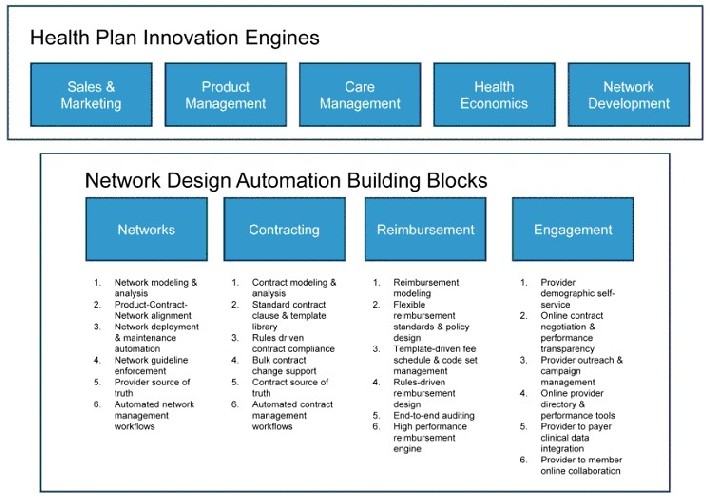
There are four essential network design automation building blocks that comprise the foundation for innovation: networks, contracting, reimbursement and engagement.

Each of these building blocks enables capabilities by delivering necessary functionality within and across the spectrum of network design. Reaching levels of maturity with this capability unlocks additional value and alignment.

Networks

The network building block enables health plans to differentiate and compete. The purpose is to differentiate their value for each customer segment by aligning the product and care model designs with the underlying network designs. It ensures network performance by facilitating the selection of appropriate providers into networks and the alignment of provider reimbursement with network design objectives. It enables networks to be mapped to member-facing and provider-facing products. The provider-facing products can be used for contracting and provider rate differentiation. The member-facing products can be aligned with benefits and serve as steerage targets for benefit designers.

These constructs, in conjunction with each other, enable productization of care model and payment innovation. For example, a health plan could define a “Medical Home Network” that consists of medical homes and supporting providers in a given geography. It could then enable PCMH-specific reimbursement (e.g., PMPM capitation + Fee For Services (FFS) for preventive services + P4P for EBM) by defining a provider-facing product and associating specific reimbursement policies with that provider product. Additionally, it could also define a member-facing product (e.g., PPO Value) which combines the medical home network with the general market PPO network. This in turn will allow the health plan to define a benefit extension which gives a 10 percent premium reduction to members who use Medical Home Network providers for their primary care. In short, a health plan is now able to monetize its care innovation (PCMH), align benefit design to network design for steerage, and align its provider payment with member incentives (around preventive services), while incenting higher quality care (P4P).

The network building block also achieves administrative cost leadership through comprehensive provider data governance and automation of core provider processes.

Contracting

The contracting building block is designed to enable health plans to reduce contract administrative costs while increasing provider payment accuracy. It optimizes the management of the provider contracting lifecycle through the automation of contract authoring, offering negotiating and acceptance while ensuring the standardization of terms and policies. This building block achieves reduced medical expenditure driven by contract standards adherence, reduced claims mis-payments, and increased speed to market for new payment innovations. It also can support rules-based enforcement of network level reimbursement guidelines to ensure consistent network performance.

Reimbursement

The reimbursement building block enables health plans to maximize the effectiveness of their medical expenditures by paying for value versus volume and by incenting team-based performance. It is the single source of truth for all forms of reimbursement including traditional claims pricing, episodes of care, shared savings, capitation and P4P. This building block enables the mixing and matching of reimbursement methodologies to incent optimal provider performance. It supports a modeling engine to analyze the financial impact of reimbursement and contract changes. It incorporates network-aware provider/contract selection for claims pricing intake. This is a rules driven, high performance service that leverages provider relationship information to select the right provider, the right governing contract and the right reimbursement model for each incoming claim. Additionally, it includes provider transparency services that enable health plan provider portals to support online pricing lookups and reimbursement status/detail inquiries for providers. These services can be extended to support provider performance scorecards and benchmarks.

Engagement

The engagement building block is designed to increase collaboration and participation. It enables meaningful engagement among health plans, providers and members in order to improve health outcomes and reduce costs. This building block achieves reduced administrative and service costs, increased member participation and adherence, increased provider satisfaction and adoption of care/payment initiatives, and the enablement of collaborative/integrated care delivery models such as PCMH and ACO.

Utilizing flexible, automated and integrated building block capabilities is the key to sustainable success that not only unlocks the promise of affordable care to customer segments but also delivers on reduced administrative, medical and IT costs. Incorporating information technologies that can facilitate, if not altogether replace, the manual interactions will be an important part of every organization’s evolution.

Assessment

Next week, in our final part 6 of this series, we’ll wrap up this discussion with a look at some of the potential savings health plans could achieve through alignment and an integrated approach to network design. The potential savings are not slight, so stay tuned. As always, if you just don’t want to wait for next week, visit our website and download the entire Unlocking Affordable Care by Aligning Products white paper; it’s available now.

Conclusion

Your thoughts and comments on this ME-P are appreciated. Feel free to review our top-left column, and top-right sidebar materials, links, URLs and related websites, too. Then, subscribe to the ME-P. It is fast, free and secure.

Speaker: If you need a moderator or speaker for an upcoming event, Dr. David E. Marcinko; MBA – Publisher-in-Chief of the Medical Executive-Post – is available for seminar or speaking engagements. Contact: MarcinkoAdvisors@msn.com

OUR OTHER PRINT BOOKS AND RELATED INFORMATION SOURCES:


Product Details

Finding [In]-Equality in [Medical and Financial Services] Executive Leadership

On Women Rising in the Professional Workforce

Join Our Mailing List 

Over the course of thousands of years, men have continued success in their dominant roles. However, it’s no surprise that 21st century data seems to be leaning toward the women; especially female physicians and female executives in the financial services industry.

Of course, we have written on leadership and gender differences before, on this ME-P, and in our textbooks, journal, handbooks and CDs, etc. All hve been medically focused or aimed at the financial services industry sector.

But, this infographic illustrates the overall success and independence that women have now experienced. Not only in relationships and family – but in business, medicine, finance and education – women have seen increasing gains of power.

Source: educationalleadership.com

Conclusion

Your thoughts and comments on this ME-P are appreciated. Feel free to review our top-left column, and top-right sidebar materials, links, URLs and related websites, too. Then, subscribe to the ME-P. It is fast, free and secure.

Speaker: If you need a moderator or speaker for an upcoming event, Dr. David E. Marcinko; MBA – Publisher-in-Chief of the Medical Executive-Post – is available for seminar or speaking engagements. Contact: MarcinkoAdvisors@msn.com

OUR OTHER PRINT BOOKS AND RELATED INFORMATION SOURCES:

Product Details  Product Details

Product Details

***

Meet Dr. James Winston Phillips JD LLM MBA

Certified Medical Planner

Out Newest M E-P “Thought-Leader”

[By Ann Milller RN MHA]

James Winston Phillips, MD, MBA, JD, LLM is President and founder of: The OTHER Medical Education, Inc.

Academic Credentials

Dr. Phillips academic credentials include a B.A. and M.D. from the University of Louisville, a M.B.A. from Jacksonville University, a J.D. from Florida Coastal School of Law and a LL.M. from Thomas Jefferson School of Law in International Taxation with concentrations in 1) International Financial Services and 2) Wealth Management and Private Banking.

Additional course work was completed at Stetson University College of Law LL.M. program in Elder Law and the University of Alabama School of Law LL.M. program in U.S. Taxation. Course work has been completed for a Ph.D. with the thesis pending. Dr. Phillips completed a general surgery residency at University of Florida / Jacksonville, a plastic surgery fellowship at University of Florida / Gainesville and a Hand Fellowship at the University of Miami. Dr. Phillips clinical career includes positions in academic medicine, private practice and as an independent contractor.

Personal Philosophy

Jim believes that modern healthcare professionals receive the best medical education in the world, but receive little or no education in the business of medicine in medical or professional school or during clinical training.

According to Dr. Phillips: Medicine may be a calling – but – the practice of medicine is a business.

Assessment:

Dr. Phillips’s quest for higher education led to the founding of: The OTHER Medical Education, Inc., a place where health care professionals can obtain the business education they need. Clients include a wide variety of health care professionals including physicians, dentists, pharmacists, veterinarians, podiatrists, nurse practitioners, physician assistants, and others. These health care professionals may have their own practices, work within someone’s practice or be employed by a health care facility or company. They may or may not be involved in the decision making process of the practice. However, they recognize sound business practices even if not directly involved in the decision making process, and are involved in their own personal finances.

The OTHER Medical Education, Inc

Post Office Box 600284

Saint Johns, FL 32260-0284

904-613-3062

Conclusion

Feel free to welcome Dr. Phillips to the Medical Executive-Post. We look forward to his insightful posts, comments and other contributions. Better yet! Give his site a click – or telephone call – and tell us what you think!

Foreword

Foreword Phillips

   Pre-Order Now:

http://www.crcpress.com/product/isbn/9781439879900

Selecting Practice Management Consultants Wisely

Business Education Needed for Physicians and all Medical Colleagues

By Dr. David Edward Marcinko MBA CMP™

[Publisher-in-Chief]

While the doctors consult, the patient dies

-English Proverb

There are many self-help publications, online resources and management guru’s purporting to impart business information to their physician clients. Within the current managed care climate, economic malaise, and specter of nationalized healthcare following the 2010 health insurance reform legislation, medical business consultants are all the rage.

However, in the same vein, physician bankruptcies are mounting, medical student loan delinquencies are increasing, physician finances are friable and medical and ancillary practices are closing at record numbers. What gives?

Do Doctors Lack Business Knowledge?

Perhaps the answer lies in the lack of real business, accounting, financial and managerial acumen by the average practitioner? This growing concern is prompting more and more doctors to seek the help of a healthcare consultant or financial advisor. But, just what does a practice management consultant do, what credentials are needed to be in the business, and how can a healthcare advisor help you coordinate all aspects of your practice’s life? 

Here are two examples of major practice management fiascos.

Corporate Medicine and Doctor Super-Groups

As the managed and healthcare care crisis exacerbates, and Obama Care [Patient Protection and Affordable Care Act] unfolds over the next eight years, there will be many examples of irrational practice management behavior on the part of physicians, and no specialty is immune.

Just collectively reflect a moment on colleagues willing to securitize their practices a decade ago – and currently with so the so called medical super groups – and cash out to Wall Street for riches that were not rightly deserved. Where are firms such as MedPartners, Phycor, FPA and Coastal Healthcare now? A survey of the Cain Brothers Physician Practice Management Corporation Index of publicly traded PPMCs revealed a market capital loss of more than 99%, since inception; despite their various heath 2.0 re-incarnations. And, how will modern financial regulatory reform, Dodd-Frank, the SEC, insurance company and banking controls resulting from Wall Street’s 2008-09 economic debacles, impact physicians?

A Southern Gentleman and Solo Physician

Or, consider the personal situation of a solo Southern primary care physician who learned an accounting lesson the hard way when he asked his CPA to appraise his business. Upon sale, his attorney brother-in-law drew up the contract, as he was pleased the practice quickly sold for its full asking price. What he didn’t know, but would soon discover, is that accounting value or “book” value — the figure his accountant gave him — is far different than the fair-market value that he could have received for his long years of toil. Was the CPA wrong? Not really. Was the gentleman doctor incorrect? No. Both were merely operating under a different set of practice management terms, and accounting definitions, without communication or knowledge of each other’s perspectives. 

Assessment

Product Details

Link: www.BusinessofMedicalPractice.com

Conclusion

And so, your thoughts and comments on this ME-P are appreciated. Feel free to review our top-left column, and top-right sidebar materials, links, URLs and related websites, too. Then, subscribe to the ME-P. It is fast, free and secure.

http://feeds.feedburner.com/HealthcareFinancialsthePostForcxos

Speaker: If you need a moderator or speaker for an upcoming event, Dr. David E. Marcinko; MBA – Publisher-in-Chief of the Medical Executive-Post – is available for seminar or speaking engagements. Contact: MarcinkoAdvisors@msn.com

Our Other Print Books and Related Information Sources:

Health Dictionary Series: http://www.springerpub.com/Search/marcinko

Practice Management: http://www.springerpub.com/product/9780826105752

Physician Financial Planning: http://www.jbpub.com/catalog/0763745790

Medical Risk Management: http://www.jbpub.com/catalog/9780763733421

Healthcare Organizations: www.HealthcareFinancials.com

Physician Advisors: www.CertifiedMedicalPlanner.com

Subscribe Now: Did you like this Medical Executive-Post, or find it helpful, interesting and informative? Want to get the latest ME-Ps delivered to your email box each morning? Just subscribe using the link below. You can unsubscribe at any time. Security is assured.

Link: http://feeds.feedburner.com/HealthcareFinancialsthePostForcxos

Sponsors Welcomed: And, credible sponsors and like-minded advertisers are always welcomed.

Link: https://healthcarefinancials.wordpress.com/2007/11/11/advertise

Product DetailsProduct DetailsProduct Details       

The Quest for “Alpha”

Join Our Mailing List

A New Book Review

By Peter Benedek PhD CFA

In “The Quest for Alpha” Larry Swedroe systematically dismantles the theory that active money management (defined by him as stock selection and market timing) can lead to alpha (returns above risk-adjusted benchmark) after fees. He argues that “if markets are highly efficient, efforts to outperform are unlikely to prove productive after the expense of the efforts.

If that’s true, the winning strategy is to focus on the following: asset allocation, fund construction, costs, tax efficiency, and the building of globally diversified portfolios that minimize, if not eliminate, the taking of idiosyncratic, and therefore uncompensated, risks.”

He also argues that “In order to show that markets are inefficient, we need to see evidence of persistent outperformance beyond the randomly expected. Otherwise, we cannot differentiate skill from luck.”

Swedroe then ploughs through the available evidence on: mutual funds, pension plans, hedge funds, private equity/venture capital, individual investors and behavioral finance, to conclude that the evidence does not support the pursuit of active management in the quest for persistent alpha after costs.

Some messages [for doctors] and us all

  • “all activity is counterproductive” or “please don’t do something, just stand there”
  • attempts to generate alpha by the various means mentioned above are thwarted by: (1) highly efficient markets, (2) “the costs of exploiting any inefficiencies are sufficiently great to make it difficult to generate persistent alpha sufficient to overcome the costs of the effort, and (3) “if there are inefficiencies, the competition to exploit them causes them to disappear rapidly”
  • “since the underlying basis of most stock market forecasts is an economic forecast, the evidence suggests that stock market strategists who predict bull and bear markets will have no greater success than do economists” (and he equates economists forecasting skill level equivalent to guessing)
  • described “the winning investment strategy” involves a globally diversified portfolio of passively managed funds (such as index funds and exchange traded funds) tailored to an individual’s unique ability, willingness and need to take risk….(as well as) integrating an investment plan into a well-developed estate, tax, and risk management (insurance  of all types) plan.”
  • referring to the futility of active management and getting its practitioners to recognize that, he quotes Sinclair “It is difficult to get a man to understand something when his salary depends on his not understanding it”
  • William Sharpe is quoted as explaining the active vs. passive debate as: “If “active” and “passive” management styles are defined in sensible ways, it must be the case that: (1) before costs, the return on the average actively managed dollar will equal the return on the average passively managed dollar, and (2) after costs, the return on the average actively managed dollar will be less than the return on the average passively managed dollar”…so “active management is a negative sum game, also known as the loser’s game…(and) the quest for the Holy Grail of alpha is the triumph of hope, hype, and marketing over wisdom and experience.
  • Swedroe explains how one might improve portfolio performance relative to S&P500 alone by increasing its diversification across asset classes

Assessment

To paraphrase the message of the book, you have to be lucky, not smart, to generate after costs, alpha on a risk-adjusted basis with active management. And there are very many smart [physician] investors competing, but very few will end up being lucky.

So doctors, you’ll want to read this book, and then re-read it every time you get the urge to be active.

Conclusion

Your thoughts and comments on this ME-P are appreciated. Feel free to review our top-left column, and top-right sidebar materials, links, URLs and related websites, too. Then, subscribe to the ME-P. It is fast, free and secure.

Link: http://feeds.feedburner.com/HealthcareFinancialsthePostForcxos

Speaker: If you need a moderator or speaker for an upcoming event, Dr. David E. Marcinko; MBA – Publisher-in-Chief of the Medical Executive-Post – is available for seminar or speaking engagements. Contact: MarcinkoAdvisors@msn.com

OUR OTHER PRINT BOOKS AND RELATED INFORMATION SOURCES:

DICTIONARIES: http://www.springerpub.com/Search/marcinko
PHYSICIANS: www.MedicalBusinessAdvisors.com
PRACTICES: www.BusinessofMedicalPractice.com
HOSPITALS: http://www.crcpress.com/product/isbn/9781466558731
CLINICS: http://www.crcpress.com/product/isbn/9781439879900
BLOG: www.MedicalExecutivePost.com
FINANCE: Financial Planning for Physicians and Advisors
INSURANCE: Risk Management and Insurance Strategies for Physicians and Advisors

Product DetailsProduct DetailsProduct Details

Product Details  Product Details

   Product Details 

Black Licorice May Be A Bad Halloween Treat

The Polarizing Food

By Staff Reporters 

             “I love it”                                                                               “I hate it”

Black licorice is a polarizing food — people either love it or hate it.

FDA Warnings

For those in the former category, the FDA has a word of warning: don’t eat too much of the stuff this Halloween. And if you’re 40 or up, be particularly careful about raiding your kid’s plastic pumpkin, since eating 2 ounces of black licorice a day for at least two weeks can possibly lead to an irregular heart rhythm.

Assessment

http://blogs.wsj.com/health/2011/10/26/keep-a-leash-on-your-halloween-licorice-sweet-tooth-fda-says/?mod=WSJBlog&mod=WSJ_health

Conclusion

And so, your thoughts and comments on this ME-P are appreciated. Feel free to review our top-left column, and top-right sidebar materials, links, URLs and related websites, too. Then, subscribe to the ME-P. It is fast, free and secure.

Link: http://feeds.feedburner.com/HealthcareFinancialsthePostForcxos

Speaker: If you need a moderator or speaker for an upcoming event, Dr. David E. Marcinko; MBA – Publisher-in-Chief of the Medical Executive-Post – is available for seminar or speaking engagements. Contact: MarcinkoAdvisors@msn.com

Our Other Print Books and Related Information Sources:

Health Dictionary Series: http://www.springerpub.com/Search/marcinko

Practice Management: http://www.springerpub.com/product/9780826105752

Physician Financial Planning: http://www.jbpub.com/catalog/0763745790

Medical Risk Management: http://www.jbpub.com/catalog/9780763733421

Healthcare Organizations: www.HealthcareFinancials.com

Physician Advisors: www.CertifiedMedicalPlanner.com

Subscribe Now: Did you like this Medical Executive-Post, or find it helpful, interesting and informative? Want to get the latest ME-Ps delivered to your email box each morning? Just subscribe using the link below. You can unsubscribe at any time. Security is assured.

Link: http://feeds.feedburner.com/HealthcareFinancialsthePostForcxos

Sponsors Welcomed: And, credible sponsors and like-minded advertisers are always welcomed.

Link: https://healthcarefinancials.wordpress.com/2007/11/11/advertise

Product DetailsProduct DetailsProduct Details

Product Details  Product Details

   Product Details

About ME-P Seminars

Book Dr. David E. Marcinko for your Next Seminar

By Ann Miller RN MHA

[Executive-Director]

Why Book Dr. DEM?

Dr. Marcinko believes nothing is purely management -or- medical -or- business -or- financial anymore – and nothing is purely personal.

Background and Credentials

David Edward Marcinko is CEO of the Medical Executive-Post [www.MedicalExecutivePost.com] and Founder of iMBA Inc [www.MedicalBusinessAdvisors.com] the parent holding company of several related communications firms [www.CertifiedMedicalPlanner.com].

He is a frequent education and motivational speaker on the business integration between medical practice management and financial planning for all healthcare professionals, in the US and Europe.

Understanding New Medical Practice Business Models

As a doctor, physician-executive and successful entrepreneur who transitioned out of clinical medicine, Marcinko understands how the practice and financial aspects of physician lives are tied together and how recognizing this makes it easier to make sound decisions in two areas; traditionally and for the new-wave narrative known as collaborative medicine and Health 2.0.

After all, he has been writing, speaking and publishing on all of it – and more – for the past three decades www.HealthcareFinancials.com

Interactive Philosophy

In his interactive seminars, participants can share as much or as little of their stories as they wish, but David describes them as being aimed at demonstrating where practice and money is concerned, nothing is purely “health economics”, nothing is purely “business management”, and nothing is purely “personal.”

Dr. Marcinko believes that only when this philosophy is understood, can doctors really take control of their present economic lives, current medical practices and future dreams.

Targeted Delivery

Dr. Marcinko’s presentations are generally aimed at a specific life-cycle: new practitioners, mid-life providers, and/or mature medical professionals.

Assessment

Dr. DEM is also available to speak to medical and financial services societies, at insurance or business development centers, pharmaceutical meetings and other like-minded organizations to deliver either contemporaneous seminars – or tailoring presentations to specific audience needs.

Conclusion

Your thoughts and comments on this ME-P are appreciated. Feel free to review our top-left column, and top-right sidebar materials, links, URLs and related websites, too. Then, subscribe to the ME-P. It is fast, free and secure.

Speaker: If you need a moderator or speaker for an upcoming event, Dr. David E. Marcinko; MBA – Publisher-in-Chief of the Medical Executive-Post – is available for seminar or speaking engagements. Contact: MarcinkoAdvisors@msn.com

OUR OTHER PRINT BOOKS AND RELATED INFORMATION SOURCES:


Product DetailsProduct DetailsProduct Details

Product Details  Product Details

   Product Details

Examining the College Credit Bubble

Join Our Mailing List

Expensive – Even for Medical Professionals!

By Rick Kahler CFP®, MS, ChFC, CCIM

The latest bubble forming on the horizon isn’t in real estate or stocks. It’s the cost of a college education, up four times the rate of inflation since 1985—twice as much as health care costs.

What’s Driving this Stratospheric Rise?

Just like the housing crisis, easy credit and poor government policy.

The Federal Government as Champion

For decades governments have championed making a college education affordable for all, just as they did home ownership. Since some segments of society couldn’t afford an education or a house, the answer was to encourage lenders to make loans they wouldn’t normally have made. This was done by guaranteeing lenders that if the loans went bad; the government would take them over.

Dual Results

There were two results of this seemingly noble policy. First, with easy credit available, almost any jobless teenager could borrow up to $250,000 for a college degree without a worry in the world of paying it back until graduation.

Easy credit drives up prices, as the increased demand exceeds supply. Colleges increased tuition at a dizzying rate, simply because they could easily fill classes with students who could easily pay the tuition by painless borrowing. Normal market forces were thwarted, and prices rose exponentially and consistently. Four years of tuition that cost $50,000 in 1985 costs $200,000 today.

The second result is a replay of the housing crisis. According to an article by Malcolm Harris in the September/October 2011 issue of Utne Reader, students now owe more than $800 billion in outstanding student debt, of which only 40% is in active repayment. The majority of student loans are in default or deferment. Since these debts are guaranteed to the lenders,U.S. taxpayers are on the hook for them.

Unintended Consequences

The government’s artificially gaming markets to give credit to those the market would normally deny, while well intended, causes unintended consequences. The distortions create a new set of problems, sometimes as bad as or worse than those that inspired the attempted fix in the first place. More often than not, most of the parties to the transaction ultimately lose.

The Students

Among the losers are the students themselves. Few take the time to calculate the overt cost of obtaining their education with the corresponding salary it prepares them to earn. But, Laurence Kotikoff, professor of economics at Boston University, describes the hidden costs in the September 2, 2011, InvestmentNews. These include the time spent learning rather than earning, plus the progressive income tax which taxes annual earnings rather than lifetime earnings. According to a recent study by economists Stacy Dale and Alan Krueger, going to more selective colleges and universities makes little difference to future income.

Of Doctors and Plumbers

Kotikoff compares two students, neither of whom borrows for their education. One becomes a doctor and the other a plumber. The doctor spends 11 years of her life in school in order to earn $185,895 annually. The plumber spends two years and earns $71,685. The bottom line is that the plumber’s sustainable spending is equal to the doctor’s.

Re-Gaining Affordability

If the government stopped guaranteeing college loans, the initial result would be significantly less demand for a college education. Tuition rates would plummet, eventually becoming affordable once again as the source of easy credit dries up.

Assessment

Without easy borrowing as an option, parents and students would be encouraged to begin college saving early. Students would have new incentive to earn money for college and also do well in high school to qualify for scholarships. The result would be more students graduating without debt and feeling less pressure to take the first job available. Then, the money that today’s grads apply to student loans could instead be invested in retirement plans.

The Author

Rick Kahler, Certified Financial Planner®, MS, ChFC, CCIM, is the founder and president of Kahler Financial Group in Rapid City, South Dakota. In 2009 his firm was named by Wealth Manager as the largest financial planning firm in a seven-state area. A pioneer in the evolution of integrating financial psychology with traditional financial planning profession, Rick is a co-founder of the five-day intensive Healing Money Issues Workshop offered by Onsite Workshops of Nashville, Tennessee. He is one of only a handful of planners nationwide who partner with professional coaches and financial therapists to deliver financial coaching and therapy to his clients. Learn more at KahlerFinancial.com

Conclusion

Your thoughts and comments on this ME-P are appreciated. Feel free to review our top-left column, and top-right sidebar materials, links, URLs and related websites, too. Then, subscribe to the ME-P. It is fast, free and secure.

Link: http://feeds.feedburner.com/HealthcareFinancialsthePostForcxos

Speaker: If you need a moderator or speaker for an upcoming event, Dr. David E. Marcinko; MBA – Publisher-in-Chief of the Medical Executive-Post – is available for seminar or speaking engagements. Contact: MarcinkoAdvisors@msn.com

OUR OTHER PRINT BOOKS AND RELATED INFORMATION SOURCES:

DICTIONARIES: http://www.springerpub.com/Search/marcinko
PHYSICIANS: www.MedicalBusinessAdvisors.com
PRACTICES: www.BusinessofMedicalPractice.com
HOSPITALS: http://www.crcpress.com/product/isbn/9781466558731
CLINICS: http://www.crcpress.com/product/isbn/9781439879900
BLOG: www.MedicalExecutivePost.com
FINANCE: Financial Planning for Physicians and Advisors
INSURANCE: Risk Management and Insurance Strategies for Physicians and Advisors

Product Details  Product Details

Let’s Meet Dr. Peter Benedek CFA

At Your Service as Our Newest ME-P “Thought-Leader”

By Ann Miller RN MHA

[Executive-Director]

www.retirementaction.com

Peter Benedek retired in 2002, after almost thirty years working as an engineer, manager and then executive in telecommunications Research and Development. While having a PhD in Electrical Engineering, he was always also interested in the financial world.

Enabling Others to Control their Destinies

However, due to work and family pressures, he had the opportunity to delve deeply in a formal finance related study only after retirement. The collapse of telecom industry, coincidental with retirement, reinforced his interest in financial related matters – not just as an intellectual pursuit – but also as a means to better understand how to manage his own personal financial affairs, and assist others to better manage their affairs in order to achieve some level of control over their destinies.

What Peter Brings to the ME-P Ecosystem

Dr. Benedek is no novice however. In the summer of 2006 he successfully completed the three levels of study toward the Chartered Financial Analyst designation offered by the CFA Institute®. He is thus a CFA charter-holder.

Assessment 

In addition to authoring his pro bono website, he started providing research and consulting services to investment management firms in 2009.

Conclusion

Your thoughts and comments on this ME-P are appreciated. Feel free to review our top-left column, and top-right sidebar materials, links, URLs and related websites, too. Then, subscribe to the ME-P. It is fast, free and secure.

Speaker: If you need a moderator or speaker for an upcoming event, Dr. David E. Marcinko; MBA – Publisher-in-Chief of the Medical Executive-Post – is available for seminar or speaking engagements. Contact: MarcinkoAdvisors@msn.com

OUR OTHER PRINT BOOKS AND RELATED INFORMATION SOURCES:


Product Details  Product Details

About Healthcare Financials.com

WELCOME ALL HEALTH 2.0 COLLEAGUES

[An Open Invitation]

Product Details 

All hospitals and healthcare organizations, both emerging and mature, face a daunting financial scenario in today’s volatile healthcare reimbursement environment.  Decreasing revenues, increasing costs, and high consumer expectations present a complex challenge for CEOs, CFOs, physicians and nurse executives, administrators, financial advisors and department managers who must not only lead in today’s climate, but also position their organizations for tomorrow’s financial tumult and potential political changes of the Obama Administration.

Produced by a team of leading doctors, physician executives, nurses, medical professionals, economists, administrators, lawyers, and accountants, skilled business leaders and IT consultants, among many others; Healthcare Organizations [Journal of Financial Management Strategies] on CD-ROM, or SaaS, looks at ways to manage assets, costs, human resources and healthcare claims.  Everything – from inventory management to hybrid and activity based cost analysis in order to accelerate the cash conversion cycle – is scrutinized.  And, modern health economic themes like competitive strategy, workplace violence and financial benchmarks, for both public and private entities, are included.

We also examine contemporaneous topics such as the lessons learned from the corporate healthcare market competition and the PPMC imbroglio of the early 2000’s, and the domestic financial meltdown of 2009. This includes current methods for achieving hospital objectives, negotiating and analyzing cost-volume-profit contracts, and understanding the financial impact of regulatory requirements under HIPAA, STARK I-III, OSHA, the US Patriot Acts, the Deficit Reduction Act [DRA], the often contentious Sarbanes-Oxley Act, ARRA and HITECH Acts, and the Fair and Accurate Credit Transactions [FACT] Act.

In addition, information technology issues like electronic medical records (eMRs), RFID controls, RSS feeds and blogs, Health 2.0 initiatives and computerized physician order entry (CPOE) systems are examined in detail. Virtually no  operational, strategic business, health economics, or financial management topic is omitted.

“This wide-ranging examination of the fiscal

management scene for hospitals, healthcare

organizations, clinics and outpatient centers 

includes case models, extensive appendices, 

and detailed checklists and templates that

step the reader through a review of main

issues for each chapter.”

Health Care Organizations [Journal of Financial Management Strategies] on CD-ROM, or SaaS, is dedicated to meeting the administrative needs of our nation’s healthcare organizations in order to help them maintain a competitive edge in the markets they serve; and to take advantage of emerging business opportunities. We therefore invite you to be the first health economics cynosure in your hospital, facility, or healthcare system to join us for the journey.

Let Health Care Organizations [Journal of Financial Management Strategies] be your guide. 

Subscribe today … Succeed tomorrow!

Dr. David Edward Marcinko MBA, CMP

[Founder, CEO and Editor-in-Chief]

iMBA Inc – Suite #5901 Wilbanks Drive

Norcross, GA 30092-1141

Product Details 

How Much Money Should a Medical Practice Spend on a Strategic Marketing Campaign?

Join Our Mailing List

Today – A Frequently Asked Question

By John Deutsch

As a web services company specializing in medical practice marketing and medical web design, we are asked this question frequently.

Introduction

In this turbulent post healthcare reform era, physicians are now being challenged to either adjust to the market or be forced to join a hospital in order to stay profitable. The physicians who are adjusting to the changes are adopting new ideas in order to remain profitable – such as implementing Electronic Medical Record (EMR) systems with government stimulus money, introducing new cash-based or high profit services such as aesthetic treatments, or introducing concierge medicine care and launching marketing campaigns to attract higher-profit patients.

So – What is the industry standard for marketing budgets?

While suggested marketing budgets vary significantly from one industry to the next, the US Small Business Administration (SBA) suggests a marketing budget between 2% and 10% of gross revenue.

However, budgets for Business-to-Consumer, retail companies and pharmaceutical companies can exceed 20%. But, with a range of between 2% and 20%, where should a medical practice be?

How much should I spend?

Here’s a few questions to consider when identifying a marketing budget for your practice. Start with a recommended 5% marketing budget and add/subtract from there.

1)  Do you receive the majority of your patients through physician referrals – SUBTRACT 2%? If you do, and consider that a business model of receiving referrals from physicians is a sustainable one then you’re in the clear. Keep in mind that many practices are now being bought by hospitals and will therefore refer internally.

2)  Do you have any high-profit or cash-pay products/services – ADD 2%? If your business depends almost entirely on insurance/medicare reimbursement and there is limited profit margin on these products, your business is at a very high-risk since the trends in reimbursement have not been positive. You should consider introducing new products/services to diversify your revenue channels.

3)  Have you recently introduced new high-profit products/services such as aesthetics, concierge, diagnostics or nutraceuticals – ADD 5%? If you have, you’ve likely introduced new hard costs into your business. You therefore need to market these services enough to surpass your break-even point and generate a positive ROI on these new ventures.

4)  Are you located in or near a major metropolitan area – ADD 1%? If you have the ability to draw from a large pool of customers, especially where competition is higher, you must have sufficient marketing budget.

5)  Are you losing market share to another business in your area – ADD 2%? If you are, it is a slippery slope. The vast majority of medical practices are poorly marketed, even hospitals. Introducing a new marketing campaign in order to win back your market share will likely not require significant investment.

6)  Are your current marketing efforts producing a positive ROI – ADD MAX? If your marketing efforts are producing a positive ROI its an easy decision – max out your budget to a level that is sustainable for your current work load capability while maintaining a positive ROI on your marketing efforts. Sometimes businesses lose focus on which marketing campaigns are working and which are not. They get lumped together and focus is lost. Try to identify which of your marketing campaigns have been a success, track these campaigns as much as possible and make educated decisions for increasing the budget – while decreasing budgets on your poor performers. Internet marketing is one of the most effective forms of marketing and also offers the highest ability for precise ROI tracking.

About the Author

John Deutsch is the founder and CEO of Medical Web Experts, a marketing group for physicians, hospitals and healthcare organizations. Since 2001 he has specialized in healthcare marketing and has implemented hundreds of marketing campaigns. For additional marketing tips by John Deutsch, please read his blogs: johndeutsch.blogspot.com and medicalwebexperts.com/blog/

Conclusion

Your thoughts and comments on this ME-P are appreciated. Feel free to review our top-left column, and top-right sidebar materials, links, URLs and related websites, too. Then, subscribe to the ME-P. It is fast, free and secure.

Link: http://feeds.feedburner.com/HealthcareFinancialsthePostForcxos

Speaker: If you need a moderator or speaker for an upcoming event, Dr. David E. Marcinko; MBA – Publisher-in-Chief of the Medical Executive-Post – is available for seminar or speaking engagements. Contact: MarcinkoAdvisors@msn.com

OUR OTHER PRINT BOOKS AND RELATED INFORMATION SOURCES:

DICTIONARIES: http://www.springerpub.com/Search/marcinko
PHYSICIANS: www.MedicalBusinessAdvisors.com
PRACTICES: www.BusinessofMedicalPractice.com
HOSPITALS: http://www.crcpress.com/product/isbn/9781466558731
CLINICS: http://www.crcpress.com/product/isbn/9781439879900
BLOG: www.MedicalExecutivePost.com
FINANCE: Financial Planning for Physicians and Advisors
INSURANCE: Risk Management and Insurance Strategies for Physicians and Advisors

   Product Details 

A Word About ME-P Links and Commentary

We Are More Than Just … Posts

By Ann Miller RN MHA

[Executive-Director]

Join Our Mailing List

OK, we know our ME-P posts are popular with readers and subscribers. We have more than 2,500 of them, after all.

Comments versus Posts

But, if you are not reading comments, you are not getting all you can from each post. And, if you are not reading the links in each post, you are not getting all you can from the Medical Executive-Post.

So, please don’t fail to check out the comments, and learn from them, too! Along with our contributors and “thought-leaders”, we have some of the smartest readership around the blog-o-sphere.

Assessment

And, rest assured; we almost never block them.

Intelligence – Candor – Goodwill to all!

Conclusion

Your thoughts and comments on this ME-P are appreciated. This is the very essence of social media. Feel free to review our top-left column, and top-right sidebar materials, links, URLs and related websites, too. Then, subscribe to the ME-P. It is fast, free and secure.

Link: http://feeds.feedburner.com/HealthcareFinancialsthePostForcxos

Speaker: If you need a moderator or speaker for an upcoming event, Dr. David E. Marcinko; MBA – Publisher-in-Chief of the Medical Executive-Post – is available for seminar or speaking engagements. Contact: MarcinkoAdvisors@msn.com

Our Other Print Books and Related Information Sources:

Health Dictionary Series: http://www.springerpub.com/Search/marcinko

Practice Management: http://www.springerpub.com/product/9780826105752

Physician Financial Planning: http://www.jbpub.com/catalog/0763745790

Medical Risk Management: http://www.jbpub.com/catalog/9780763733421

Healthcare Organizations: www.HealthcareFinancials.com

Physician Advisors: www.CertifiedMedicalPlanner.com

Subscribe Now: Did you like this Medical Executive-Post, or find it helpful, interesting and informative? Want to get the latest ME-Ps delivered to your email box each morning? Just subscribe using the link below. You can unsubscribe at any time. Security is assured.

Link: http://feeds.feedburner.com/HealthcareFinancialsthePostForcxos

Sponsors Welcomed: And, credible sponsors and like-minded advertisers are always welcomed.

Link: https://healthcarefinancials.wordpress.com/2007/11/11/advertise

Product DetailsProduct DetailsProduct Details       

Product Details  Product Details

   Product Details 

Does Financial Regulation Kill Jobs?

Perhaps Not!

By Marian Wang
ProPublica, Sept. 12, 2011, 1:20 pm

Join Our Mailing List

With the presidential campaign in motion, and President Obama urging immediate passage of his new jobs bill, the attention in Washington has shifted almost exclusively to the economy and job creation. And, that means a shift away from regulation, right? Not necessarily.

Growth Spurts?

Some regulators and financial industry experts are predicting the opposite—that new financial regulations will spur some growth.

For example, The New York Times’ DealBook blog cited derivatives regulation [1] as one example. Dodd-Frank requires a substantial chunk of the $600-trillion derivatives market to trade on exchanges or on new electronic trading platforms.

“I have no doubt that these new regulations, instituting new types of clearing, trading and reporting platforms, will foster a landslide of hiring in the financial sector,”

Bart Chilton of the Commodity Futures Trading Commission said in a recent speech cited by the Times. As another New York Times piece noted, previous financial regulation laws have resulted in additional jobs for accountants and lawyers [2], at least.

But, separate from the jobs created to actually handle new regulation, others have pointed out that regulations can have a long-term, positive effect on overall economic growth by preventing the types of crises that put an industry on life-support.

The Studies

Last year, two studies by central bankers and regulators found that the short-term impacts of stricter capital requirements were “significantly smaller” than the estimates published by banking groups, the Times reported.

Rather, the studies said that stricter regulation would lead to more long-term growth [3] by preventing future crises.

Banks see higher capital requirements

  • Which require them to have more financial cushion to balance out risk-taking as a damper on profits.
  • And, they have repeatedly warned that tougher rules will hamper lending, reduce investment and slow economic growth.

Assessment

But, not everyone sees it that way. Swiss regulators, for instance, indicated last year that they would impose even tougher capital standards on their country’s banks on the premise that investors would rather put their trust [4]—and their dollars—in safer banks.

Conclusion

And so, your thoughts and comments on this ME-P are appreciated. Feel free to review our top-left column, and top-right sidebar materials, links, URLs and related websites, too. Then, subscribe to the ME-P. It is fast, free and secure.

Link: http://feeds.feedburner.com/HealthcareFinancialsthePostForcxos

Speaker: If you need a moderator or speaker for an upcoming event, Dr. David E. Marcinko; MBA – Publisher-in-Chief of the Medical Executive-Post – is available for seminar or speaking engagements. Contact: MarcinkoAdvisors@msn.com

Our Other Print Books and Related Information Sources:

Health Dictionary Series: http://www.springerpub.com/Search/marcinko

Practice Management: http://www.springerpub.com/product/9780826105752

Physician Financial Planning: http://www.jbpub.com/catalog/0763745790

Medical Risk Management: http://www.jbpub.com/catalog/9780763733421

Subscribe Now: Did you like this Medical Executive-Post, or find it helpful, interesting and informative? Want to get the latest ME-Ps delivered to your email box each morning? Just subscribe using the link below. You can unsubscribe at any time. Security is assured.

Link: http://feeds.feedburner.com/HealthcareFinancialsthePostForcxos

Sponsors Welcomed: And, credible sponsors and like-minded advertisers are always welcomed.

Link: https://healthcarefinancials.wordpress.com/2007/11/11/advertise

Product Details  Product Details

PODCAST: Dr. Somnath Basu on Retirement Happiness

Join Our Mailing List

By Staff Reporters

A PodCast Clip

This brief podcast clip features Dr. Somnath Basu, director of the California Institute for Finance [CIF].

Dr. Basu, a popular ME-P thought-leader, shares his insights on what makes people happy in retirement.

PODCAST: https://www.youtube.com/watch?v=iTrtmW831Xk

Conclusion

Your thoughts and comments on this ME-P are appreciated. Feel free to review our top-left column, and top-right sidebar materials, links, URLs and related websites, too. Then, subscribe to the ME-P. It is fast, free and secure.

Link: http://feeds.feedburner.com/HealthcareFinancialsthePostForcxos

Speaker: If you need a moderator or speaker for an upcoming event, Dr. David E. Marcinko; MBA – Publisher-in-Chief of the Medical Executive-Post – is available for seminar or speaking engagements.

How Lifetime Benefits and Contributions Point the Way Toward Reforming Our Senior Entitlement Programs

By Staff Reporters

From Expert Voices

By C. Eugene Steuerle PhD [Institute Fellow and Richard B. Fisher Chair, The Urban Institute]
By Stephanie Rennane [University of Maryland]

For August 2011

Reforms to Medicare and Social Security will likely be debated over the next few months as the new “super committee” formed by the debt ceiling agreement works to develop its long-term deficit reduction plan.

The Essay

In this essay, Dr. Eugene Steuerle and Stephanie Rennane help to inform this debate by presenting findings from their newly updated analysis showing that seniors retiring today can expect to receive dramatically more in entitlement program benefits during retirement than they contributed to the programs while working.

For example, the average Medicare beneficiary can expect $3 in benefits for every $1 paid in payroll taxes.

Link: http://nihcm.org/images/stories/EV-Steuerle-Rennane-FINAL.pdf

Assessment

The authors posit that the magnitude of the resources involved when viewing these programs in tandem over a lifetime gives policymakers new impetus and flexibility to develop coordinated entitlement reforms that promote a coherent, equitable and sustainable support system for current and future generations of seniors.

Conclusion

And so, your thoughts and comments on this ME-P are appreciated. Feel free to review our top-left column, and top-right sidebar materials, links, URLs and related websites, too. Then, subscribe to the ME-P. It is fast, free and secure.

Link: http://feeds.feedburner.com/HealthcareFinancialsthePostForcxos

Our Other Print Books and Related Information Sources:

Health Dictionary Series: http://www.springerpub.com/Search/marcinko

Practice Management: http://www.springerpub.com/product/9780826105752

Physician Financial Planning: http://www.jbpub.com/catalog/0763745790

Medical Risk Management: http://www.jbpub.com/catalog/9780763733421

Healthcare Organizations: www.HealthcareFinancials.com

Physician Advisors: www.CertifiedMedicalPlanner.com

Subscribe Now: Did you like this Medical Executive-Post, or find it helpful, interesting and informative? Want to get the latest ME-Ps delivered to your email box each morning? Just subscribe using the link below. You can unsubscribe at any time. Security is assured.

Link: http://feeds.feedburner.com/HealthcareFinancialsthePostForcxos

Sponsors Welcomed: And, credible sponsors and like-minded advertisers are always welcomed.

Link: https://healthcarefinancials.wordpress.com/2007/11/11/advertise

Product DetailsProduct DetailsProduct Details       

Product Details  Product Details

   Product Details 

Dr. Somnath Basu on Financial Planning Client Expectations [PodCast]

Join Our Mailing List

By Staff Reporters

On Client Attitudes in the New Economy

In this encore podcast, Somnath Basu PhD examines how the recent economic turmoil has changed financial planning clients’ attitudes and expectations.

Dr. Basu is a popular ME-P contributor and thought-leader.

Assessment: http://www.youtube.com/watch?v=jzAkB8h5v3Q

Conclusion

Your thoughts and comments on this ME-P are appreciated. Feel free to review our top-left column, and top-right sidebar materials, links, URLs and related websites, too. Then, subscribe to the ME-P. It is fast, free and secure.

Speaker: If you need a moderator or speaker for an upcoming event, Dr. David E. Marcinko; MBA – Publisher-in-Chief of the Medical Executive-Post – is available for seminar or speaking engagements. Contact: MarcinkoAdvisors@msn.com

OUR OTHER PRINT BOOKS AND RELATED INFORMATION SOURCES:

Product DetailsProduct DetailsProduct Details

Product Details  Product Details

   Product Details 

How to Take Care of Your Eyes

 Join Our Mailing List 

In celebration of National Eye Health Week we at Ultralase have immersed ourselves in the world of vision in order to produce this handy graphic containing facts and tips to help encourage you, and the rest of the world to Love Your Eyes. Brought to you by www.ultralase.com


Conclusion

And so, your thoughts and comments on this ME-P are appreciated. Feel free to review our top-left column, and top-right sidebar materials, links, URLs and related websites, too. Then, subscribe to the ME-P. It is fast, free and secure.

Link: http://feeds.feedburner.com/HealthcareFinancialsthePostForcxos

Our Other Print Books and Related Information Sources:

Health Dictionary Series: http://www.springerpub.com/Search/marcinko

Practice Management: http://www.springerpub.com/product/9780826105752

Physician Financial Planning: http://www.jbpub.com/catalog/0763745790

Medical Risk Management: http://www.jbpub.com/catalog/9780763733421

Healthcare Organizations: www.HealthcareFinancials.com

Physician Advisors: www.CertifiedMedicalPlanner.com

Subscribe Now: Did you like this Medical Executive-Post, or find it helpful, interesting and informative? Want to get the latest ME-Ps delivered to your email box each morning? Just subscribe using the link below. You can unsubscribe at any time. Security is assured.

Link: http://feeds.feedburner.com/HealthcareFinancialsthePostForcxos

Sponsors Welcomed: And, credible sponsors and like-minded advertisers are always welcomed.

Link: https://healthcarefinancials.wordpress.com/2007/11/11/advertise

Product DetailsProduct DetailsProduct Details       

Product Details  Product Details

   Product Details 

What Does the S&P Downgrade Mean?

If France Is Rated Higher Than the US!

By Marian Wang
ProPublica, Aug. 8, 2011, 5:38 p.m.

Join Our Mailing List

The decision by credit rating agency Standard & Poor’s to downgrade the United States [1] after markets closed on Friday may have kicked up political [2] consternation [3] and triggered a market plunge [4], but it also raises important questions about the reliability of credit ratings and, for that matter, the firms that bestow them.

Just over a dozen countries currently have an AAA [5]—or lowest-risk—rating from each of the three main rating agencies: Moody’s, Fitch, and Standard & Poor’s. Until this weekend, the United States was among them. (It’s now roughly on par with Australia, which also has two AAAs and one AA+.)

So, which countries are among the lucky few that still have perfect ratings from all three firms? The United Kingdom and France, just to name a couple. S&P apparently thinks that both the U.K. and France are safer investments than the United States.

The United States still has a higher per-capita GDP [6] than most countries, including both the U.K. and France. Last year, the U.S. GDP grew 2.9 percent [6]—almost double the U.K.’s 1.4 percent and France’s 1.5 percent. Between April and June of this year, the U.S. GDP grew 1.3 percent [7] while the U.K. economy grew 0.2 percent [8]. A June forecast from the Bank of France estimated that the country’s economy would grow 0.4 percent [9] in the second quarter. (U.S. growth, granted, is still slower than it used to be [10].)

As a percentage of GDP, both the U.K. and France have a higher percentage of external debt [11], or debt owed to outside bondholders. In 2010—the latest year for which the Organization for Economic Cooperation and Development has numbers—U.S. external debt was 61 percent of GDP, compared to France’s 67 percent and the U.K.’s 86 percent. Austria also maintains a lowest-risk rating from all three firms, and its external debt was 66 percent of GDP last year. 

Let’s not forget unemployment. Our July 2011 unemployment rate figure was 9.1 percent [10]. That’s higher than the U.K.’s, which has hovered around 7.7 percent [6], but it’s lower than France, which had 9.7 percent unemployment in June.

S&P, in explaining the historic downgrade—the first in U.S. history—cited both the U.S. debt burden and the political brinksmanship over the debt ceiling as reasons it lowered the credit rating of the United States to AA+, with a negative outlook.

So, what do the ratings mean, really? It seems to be a question that economists and investors are asking, too.

“France is not, in my view, a AAA country,” a UBS economist told Bloomberg [12]. And yet there are no indications [13] that France will face a downgrade, the Wall Street Journal reports. In fact, all three of the rating agencies recently affirmed France’s triple-As [12].

Credit rating agencies have taken a collective hit to their reputations for issuing flimsy triple-A credit ratings on securities that collapsed and helped trigger the financial meltdown. A Senate investigation earlier this year identified the firms as “a key cause [14]” of the financial crisis. Documents released by congressional investigators also pointed to serious conflicts of interest [15] that caused some ratings firms to bend to the wishes of the banks that paid for their ratings. 

Assessment

As we’ve written, some of the same problems with company culture [16] and inaccurate ratings [17] have persisted. Meanwhile, the Office of Credit Ratings—an office created by Dodd-Frank, the financial reform bill, to oversee these firms—hasn’t even been set up because Congress didn’t allocate funds for it. Other efforts written into the measure to lessen U.S. reliance on ratings and open up the firms to more liability have been slowed or stalled altogether.

Wiping out the references to credit ratings in U.S. law is a “harder task than the legislation assumes,” said Barbara Roper, director of investor protection for the Consumer Federation of America. The downgrade, she thinks, may provide just enough impetus to keep those efforts moving. 

Conclusion

And so, your thoughts and comments on this ME-P are appreciated. Feel free to review our top-left column, and top-right sidebar materials, links, URLs and related websites, too. Then, subscribe to the ME-P. It is fast, free and secure.

Link: http://feeds.feedburner.com/HealthcareFinancialsthePostForcxos

Our Other Print Books and Related Information Sources:

Health Dictionary Series: http://www.springerpub.com/Search/marcinko

Practice Management: http://www.springerpub.com/product/9780826105752

Physician Financial Planning: http://www.jbpub.com/catalog/0763745790

Medical Risk Management: http://www.jbpub.com/catalog/9780763733421

Healthcare Organizations: www.HealthcareFinancials.com

Physician Advisors: www.CertifiedMedicalPlanner.com

Subscribe Now: Did you like this Medical Executive-Post, or find it helpful, interesting and informative? Want to get the latest ME-Ps delivered to your email box each morning? Just subscribe using the link below. You can unsubscribe at any time. Security is assured.

Link: http://feeds.feedburner.com/HealthcareFinancialsthePostForcxos

Sponsors Welcomed: And, credible sponsors and like-minded advertisers are always welcomed.

Link: https://healthcarefinancials.wordpress.com/2007/11/11/advertise


Product Details  Product Details

About the HumanCondition [HCX]

Join Our Mailing List

Transformational Experiences and Innovation in Healthcare

[By Staff Reporters]

To solve human problems

HumanCondition [HCX] was created with the notion that in order to truly innovate – you need to be sensitive, yet take risks and make bold moves. Listen well, understand modern technologies and above all understand how to benefit from insightful, sensitive and intelligent design.

The Vision

The HCX vision is through a wide lens to see opportunities others would miss. They make sure to vet carefully to avoid dredging and believe there are smarter and faster ways to problem solving if you know the appropriate tools to use–and if these tools don’t exist, to create them. Intelligent human capital coupled with the application of off-the-shelf and advanced technologies is a powerful mix.

To Innovate

The term innovation means a new way of doing something. It may refer to incremental or revolutionary changes in thinking, products, processes, or organizations. Ideas alone are one thing, yet true innovation is an idea applied successfully.

How to innovate?

HCX believes that in order to solve real business needs and problems you have to first really understand the problems. Don’t take a shotgun approach to problem solving. Rather, build insight, define goals, present observations then begin iterative ideation using modern design thinking.

To love what you do

You don’t often find such a diverse mix of talent from the creative, technical and business strategy worlds in one place. HCX stays focused on the end user’s experience and business objectives. What do you want them to say when they leave, and what do you want them to tell their friends and neighbors? How many years do you want them to remember your experience?

Assessment

HCX analyzes challenging problems in health care and develops insightful solutions through proven methodologies. HCX works with healthcare facilities, pharmaceutical organizations, medical manufactures, teaching organizations and governments to define and create systems, products, training and communications toolsets that address the very specific needs of the healthcare industry.

Link: http://www.hcxdesign.com

Assessment

So, give em’ a click and tell us what you think?

Conclusion

Your thoughts and comments on this ME-P are appreciated. Feel free to review our top-left column, and top-right sidebar materials, links, URLs and related websites, too. Then, subscribe to the ME-P. It is fast, free and secure.

OUR OTHER PRINT BOOKS AND RELATED INFORMATION SOURCES:

Speaker: If you need a moderator or speaker for an upcoming event, Dr. David E. Marcinko; MBA – Publisher-in-Chief of the Medical Executive-Post – is available for seminar or speaking engagements. Contact: MarcinkoAdvisors@msn.com

Product DetailsProduct DetailsProduct Details

Product Details  Product Details

   Product Details 

Implementing the Global Strategic Health Plan

A Human Resources Issue for International Physician Entrepreneurs

By Henry H. Goldman PhD CPCM


Strategic planning is a fairly easy business managerial chore; not so for healthcare. Yet, physician executives and medical managers can usually determine the direction in which the company should move. They can generally determine, or make educated guesses about new services, products, expanded markets, changes in competition, innovations in technology, financing requirements, etc.

Gs and Os

Goals and objectives setting are staples of business management, worldwide. Most large organizations have accepted Russell Ackoff’s plea for them to create their own futures. It is not a difficult task to create a comprehensive set of alternative strategies at the corporate or divisional level. Making the strategies work for healthcare is the real issue.

Implementation

Implementing the strategic plan is an often-overlooked aspect of the planning process. Corporate and medical executives assume that the plan will be implemented. Generals always expect that their orders will be carried out, even if those orders are wrong. While strategy formulation is regarded as a staff function, strategic implementation is generally viewed as a key function of line management. If the strategic plan is to be put into place in a timely manner and the results of that plan, the anticipations and expectations that long-term goals and short-term objectives will be attained, then planners must examine the organizational issues involved in making the plan happen.

Full Link: goldman.strategic planning

Conclusion

The clear understanding of and the ability to deal with these issues during the strategy formulation process may make the difference between an international healthcare strategic plan that has become only an academic exercise – and a living, vital guideline to future profits and continued corporate success.

About the Author

Risk Management Associates International, LLP
5005 SW Raintree Circle
Lee’s Summit, MO 64082

Henry H. Goldman, Ph.D. is the Managing Director of the GOLDMAN-NELSON GROUP (USA), a global management consulting and executive training organization that he founded in 1981. Dr. Goldman’s areas of expertise include supervisory and management training, decision-making and problem solving, team building, international financial management, and strategic planning. He is frequently invited to facilitate programs and workshops on such diverse subjects as “Leading Organizational Change,” “Decision-Making for Managers,” “Budgeting in the Borderlands,” as well as issues dealing with global business and finance. Goldman recently served as Co-Editor of Taking Stock: A Survey on the Practice and Future of Change Management (Berlin, 2005). He has worked with executives and managers, worldwide, to develop an understanding of management and financial concerns in a global marketplace. He has conducted training programs along the Pacific Rim, Southern Africa, and the Middle East and among the Newly Independent States of the former Soviet Union. His clients include MGM Studios, Lucent Technologies–China, General Motors, Hughes Aircraft Company and Citizens’ Development Corps. He served as adjunct professor of management at the University of Macau, China, where he taught “Team Building” to MBA students. He is currently affiliated with the National Graduate School and Boston University’s Center for Executive Education. Dr. Goldman was recently appointed to the Mine Relief Global Business Council to assist in the remediation of land mines, world-wide, with a particular focus on the Turkey-Syria border.

Speaker: If you need a moderator or speaker for an upcoming event, Dr. David E. Marcinko; MBA – Publisher-in-Chief of the Medical Executive-Post – is available for seminar or speaking engagements. Contact: MarcinkoAdvisors@msn.com

Our Other Print Books and Related Information Sources:

Health Dictionary Series: http://www.springerpub.com/Search/marcinko

Practice Management: http://www.springerpub.com/product/9780826105752

Physician Financial Planning: http://www.jbpub.com/catalog/0763745790

Medical Risk Management: http://www.jbpub.com/catalog/9780763733421

Healthcare Organizations: www.HealthcareFinancials.com

Physician Advisors: www.CertifiedMedicalPlanner.com

Subscribe Now: Did you like this Medical Executive-Post, or find it helpful, interesting and informative? Want to get the latest ME-Ps delivered to your email box each morning? Just subscribe using the link below. You can unsubscribe at any time. Security is assured.

Link: http://feeds.feedburner.com/HealthcareFinancialsthePostForcxos

Sponsors Welcomed: And, credible sponsors and like-minded advertisers are always welcomed.

Link: https://healthcarefinancials.wordpress.com/2007/11/11/advertise

Product Details 

Some Data on Cosmetic Surgery

Infographics

Courtesy Medical Billing and Coding

Here are some fun facts about the many people undergo some sort of cosmetic surgery in the world

Conclusion

And so, your thoughts and comments on this ME-P are appreciated. Feel free to review our top-left column, and top-right sidebar materials, links, URLs and related websites, too. Then, subscribe to the ME-P. It is fast, free and secure.

Link: http://feeds.feedburner.com/HealthcareFinancialsthePostForcxos

Speaker: If you need a moderator or speaker for an upcoming event, Dr. David E. Marcinko; MBA – Publisher-in-Chief of the Medical Executive-Post – is available for seminar or speaking engagements. Contact: MarcinkoAdvisors@msn.com

Our Other Print Books and Related Information Sources:

Health Dictionary Series: http://www.springerpub.com/Search/marcinko

Practice Management: http://www.springerpub.com/product/9780826105752

Physician Financial Planning: http://www.jbpub.com/catalog/0763745790

Medical Risk Management: http://www.jbpub.com/catalog/9780763733421

Healthcare Organizations: www.HealthcareFinancials.com

Physician Advisors: www.CertifiedMedicalPlanner.com

Subscribe Now: Did you like this Medical Executive-Post, or find it helpful, interesting and informative? Want to get the latest ME-Ps delivered to your email box each morning? Just subscribe using the link below. You can unsubscribe at any time. Security is assured.

Link: http://feeds.feedburner.com/HealthcareFinancialsthePostForcxos

Sponsors Welcomed: And, credible sponsors and like-minded advertisers are always welcomed.

Link: https://healthcarefinancials.wordpress.com/2007/11/11/advertise

Product DetailsProduct DetailsProduct Details       

On Physician Relations Management [PRM] Technology

Join Our Mailing List

Criteria for Selection

By Dr. Gary L. Bode MSA, CPA, LLC

Both research and experience reveals an often confusing, complicated world of claims, features, and upgrades, a wide array of technical architectures, and an even wider array of pricing structures when it comes to choosing Physician [Customer] Relations Management [PRM] software.

For me – as a medical practice management consultant – critical criteria for selection includes the following features.

Scalability:

In a young medical practice, a scalable marketing program and PRM infrastructure should be flexible enough to accommodate specialty trends effortlessly and seamlessly without crushing your marketing infrastructure or its’ people, patients or processes. A scalable PRM infrastructure should allow a new channel, a new patient segment, a medical product or service-line seamlessly and with minimum incremental effort or cost.

Interoperability:

You may need an authoring tool today to develop your collateral data, and so select a simple MSFT Word® program. Later, you may want to conduct campaigns to re-introduce your practice or gauge satisfaction among current patients through an online survey. The software you build or purchase for individual activities should be able to co-exist and talk to each other. The software you purchase does not have to be monolithic, but it needs to be modular and work together incrementally.

For example, your e-mail campaign software, CPOESs [computerized physician order entry systems] and e-prescribing functions should work with your authoring tools and eMR.

In today’s complex and fast paced evolution of PRM products, newer technologies need to co-exist with older legacy technologies, and futuristic eMR systems; so interoperability is one of the critical criteria for PRM technology selection.

Ease of Use:

As a young medical practice, pulled in different directions, it is important to have a PRM solution that is easy to use and does not necessitate extensive user training.

Cost structure:

Remember, all PRM software comes with obvious costs as well as hidden costs. Ask the right questions and find out the hidden costs for systems implementation, integration and user training.

Assessment

Channel Surfing the ME-P

Have you visited our other topic channels? Established to facilitate idea exchange and link our community together, the value of these topics is dependent upon your input. Please take a minute to visit. And, to prevent that annoying spam, we ask that you register. It is fast, free and secure.

Conclusion

Your thoughts and comments on this ME-P are appreciated. Feel free to review our top-left column, and top-right sidebar materials, links, URLs and related websites, too. Then, subscribe to the ME-P. It is fast, free and secure.

Speaker: If you need a moderator or speaker for an upcoming event, Dr. David E. Marcinko; MBA – Publisher-in-Chief of the Medical Executive-Post – is available for seminar or speaking engagements. Contact: MarcinkoAdvisors@msn.com

OUR OTHER PRINT BOOKS AND RELATED INFORMATION SOURCES:


Product Details 

John Maynard Keynes v.s. FA Hayek

A Rapping Video

By Staff Reporters

Join Our Mailing List

Is the Great Recession over?

***

***

How is prosperity best created? By government spending or free, unencumbered markets!

***

ext

***

John Maynard Keynes and FA Hayek rap it out on this YouTube video, released last week by collaborators John Papola and Russ Roberts.


Video Links:

  • Check out the very hilarious and brilliant video here.
  • Round 1 here.
  • And here’s a podcast about Papola and Hayek’s collaboration.

MORE:

Conclusion

In any case, early planning is the key to supporting both your kids’ futures and your retirement. Making logical college funding decisions, rather than emotional ones, creates a win/win for everyone.

Your thoughts and comments on this ME-P are appreciated. Feel free to review our top-left column, and top-right sidebar materials, links, URLs and related websites, too. Then, subscribe to the ME-P. It is fast, free and secure.

Link: http://feeds.feedburner.com/HealthcareFinancialsthePostForcxos

Speaker: If you need a moderator or speaker for an upcoming event, Dr. David E. Marcinko; MBA – Publisher-in-Chief of the Medical Executive-Post – is available for seminar or speaking engagements. Contact: MarcinkoAdvisors@msn.com

OUR OTHER PRINT BOOKS AND RELATED INFORMATION SOURCES:

DICTIONARIES: http://www.springerpub.com/Search/marcinko
PHYSICIANS: www.MedicalBusinessAdvisors.com
PRACTICES: www.BusinessofMedicalPractice.com
HOSPITALS: http://www.crcpress.com/product/isbn/9781466558731
CLINICS: http://www.crcpress.com/product/isbn/9781439879900
BLOG: www.MedicalExecutivePost.com
FINANCE: Financial Planning for Physicians and Advisors
INSURANCE: Risk Management and Insurance Strategies for Physicians and Advisors

Product DetailsProduct DetailsProduct Details

Product Details  Product Details

Dr. Marcinko Interviewed by PedSource.com

On … Medical Practice Mission Statements [“Use Them or Lose Them”]

By Jill Fahy

Join Our Mailing List

You won’t find a formal mission statement posted on the website or framed on the wall at East Bay Pediatrics, in Berkeley, California.

Dr. Marcinko Speaks

But, you will find a few words on medical practice Mission Statements, from our ME-P Editor-in-Chief Dr. David E. Marcinko MBA CMP™, right here.

Assessment

http://www.pedsource.com/library/mission-statements-use-them-or-lose-them

About

PCC created PedSource, an online community for pediatricians, to share insights they’ve gained through their extensive experiences improving revenue and implementing technology in pediatric practices. Their vision is to share resources and build a community to improve the health of pediatric practices nationwide.

Conclusion

And so, your thoughts and comments on this ME-P are appreciated. Feel free to review our top-left column, and top-right sidebar materials, links, URLs and related websites, too. Then, subscribe to the ME-P. It is fast, free and secure.

Link: http://feeds.feedburner.com/HealthcareFinancialsthePostForcxos

Speaker: If you need a moderator or speaker for an upcoming event, Dr. David E. Marcinko; MBA – Publisher-in-Chief of the Medical Executive-Post – is available for seminar or speaking engagements. Contact: MarcinkoAdvisors@msn.com

Our Other Print Books and Related Information Sources:

Health Dictionary Series: http://www.springerpub.com/Search/marcinko

Practice Management: http://www.springerpub.com/product/9780826105752

Physician Financial Planning: http://www.jbpub.com/catalog/0763745790

Medical Risk Management: http://www.jbpub.com/catalog/9780763733421

Healthcare Organizations: www.HealthcareFinancials.com

Physician Advisors: www.CertifiedMedicalPlanner.com

Subscribe Now: Did you like this Medical Executive-Post, or find it helpful, interesting and informative? Want to get the latest ME-Ps delivered to your email box each morning? Just subscribe using the link below. You can unsubscribe at any time. Security is assured.

Link: http://feeds.feedburner.com/HealthcareFinancialsthePostForcxos

Sponsors Welcomed: And, credible sponsors and like-minded advertisers are always welcomed.

Link: https://healthcarefinancials.wordpress.com/2007/11/11/advertise

Product DetailsProduct DetailsProduct Details       

Product Details  Product Details

   Product Details 

Nominate the “100 Most Influential People in Health Care”

Consider our ME-P Thought-Leaders in Your Deliberations

[By Staff Reporters]

Join Our Mailing List

Between now and this Friday, May 6th 2011, you can nominate the individuals you believe have been the most influential in changing the face of health care for Modern Healthcare magazine’s annual list of “100 Most Influential People in Healthcare.

The ME-P Blog’s “Thought-Leaders”

Why not nominate the experts who regularly post to our ME-P blog? These include the “thought-leaders” listed on our right side bar.

VOTE HERE:

http://www.modernhealthcare.com/section/100-Most-Influential

Assessment

Please help us recognize our friends’ hard work and commitment to improving health care.

Conclusion

Your thoughts and comments on this ME-P are appreciated. Feel free to review our top-left column, and top-right sidebar materials, links, URLs and related websites, too. Then, subscribe to the ME-P. It is fast, free and secure.

Speaker: If you need a moderator or speaker for an upcoming event, Dr. David E. Marcinko; MBA – Publisher-in-Chief of the Medical Executive-Post – is available for seminar or speaking engagements. Contact: MarcinkoAdvisors@msn.com

OUR OTHER PRINT BOOKS AND RELATED INFORMATION SOURCES:

Product DetailsProduct DetailsProduct Details

Product Details  Product Details

   Product Details

The Great Health Care Challenges [A Slide show]

The US Health Care Crisis and the Complexities of Reform

By Austin Frakt PhD

Dr. Austin Frakt blogs over at The Incidental Economist which contemplates health care with a focus on research, and an eye on reform. It is about economics, health policy, health services, health care and – yes – politics. And, Austin is a health policy wonk that we admire here at the ME-P

 www.TheIncidentalEconomist.com 

Last fall he created a slide show on the challenges presented by our health care system. He has updated it circa March 11 2011 and has now allowed us, and others, to post freely. We appreciate him for this educational gesture.

Thank you.

Ann Miller RN MHA

[Executive-Director]

Link: Frakt Great Healthcare Challenges

About Austin Frakt PhD

Austin is the creator, manager, host, and primary author of The Incidental Economist. He is a health economist with an educational background in physics and engineering. After receiving his PhD in statistical and applied mathematics he spent four years at a research and consulting firm conducting policy evaluations for federal health agencies. Austin now has a joint appointment with the Department of Health Policy and Management at Boston University’s (BU’s) School of Public Health and Health Care Financing & Economics (HCFE) at the Boston VA Healthcare System, U.S. Department of Veterans Affairs. He studies economic issues pertaining U.S. health care policy with a recent but not exclusive focus on Medicare and the uninsured. He has authored numerous peer-reviewed, scholarly publications, many relevant to health care financing, economics, and policy. His papers have appeared in Health Care Financing Review, Health Affairs, Health Economics, International Journal of Health Care Finance and Economics, Journal of Health Politics, Policy and Law, among other journals. For over a year, he has been a regular columnist for Kaiser Health News and he has contributed commentary for the New York Times’ Room for Debate forum.

Austin’s interests include economics and health care, of course, but also politics, personal finance, and the amusements of family life. Outside of his principal work duties, he manages his household’s finances, is CFO of a small business, and looks after his two children.

You are welcome to “friend” Austin on Facebook, follow the blog via his Google Buzz feed, and subscribe to his Google Reader bundles. Austin does not have a personal Twitter account. When he has something to communicate he does it on this blog. If you wish, contact Austin with anything on your mind via the contact form. (The views expressed in Austin’s posts are his own and do not necessarily reflect the positions of the Department of Veterans Affairs or Boston University.)

Conclusion

And so, your thoughts and comments on this ME-P are appreciated. Feel free to review our top-left column, and top-right sidebar materials, links, URLs and related websites, too. Then, subscribe to the ME-P. It is fast, free and secure.

Speaker: If you need a moderator or speaker for an upcoming event, Dr. David E. Marcinko; MBA – Publisher-in-Chief of the Medical Executive-Post – is available for seminar or speaking engagements. Contact: MarcinkoAdvisors@msn.com and http://www.springerpub.com/Search/marcinko

Our Other Print Books and Related Information Sources:

Health Dictionary Series: http://www.springerpub.com/Search/marcinko

Practice Management: http://www.springerpub.com/product/9780826105752

Physician Financial Planning: http://www.jbpub.com/catalog/0763745790

Medical Risk Management: http://www.jbpub.com/catalog/9780763733421

Healthcare Organizations: www.HealthcareFinancials.com

Physician Advisors: www.CertifiedMedicalPlanner.com

Subscribe Now: Did you like this Medical Executive-Post, or find it helpful, interesting and informative? Want to get the latest ME-Ps delivered to your email box each morning? Just subscribe using the link below. You can unsubscribe at any time. Security is assured.

Link: http://feeds.feedburner.com/HealthcareFinancialsthePostForcxos

Sponsors Welcomed: And, credible sponsors and like-minded advertisers are always welcomed.

Link: https://healthcarefinancials.wordpress.com/2007/11/11/advertise

Product DetailsProduct DetailsProduct Details       

Product Details  Product Details

   Product Details 

Donating to the Victims in Japan

How the ME-P is Helping Out

By Dr. David Edward Marcinko, MBA CMP™

[Publisher and Editor-in-Chief]

Millions of Japanese are struggling in the cold; without electricity or heat. And, rolling blackouts have been implemented as the earth-quake and tsunami devastated country faces a crippled power grid.

And, of course, all medical professionals realize that there is no “safe threshold” for any amount of ionizing radiation. 

Info Link: http://www.msnbc.msn.com/id/42079799/ns/world_news-disaster_in_japan/?gt1=43001

You Can Help

And so, one way you – our ME-P readers and subscribers can help your fellow physicians who are already on the ground in Japan helping to care for the wounded – is to donate to Doctors Without Borders.

Donors can give between $35 to up to $10,000 or more directly on its website.

Thank you.

Our Other Print Books and Related Information Sources:

Health Dictionary Series: http://www.springerpub.com/Search/marcinko

Practice Management: http://www.springerpub.com/product/9780826105752

Physician Financial Planning: http://www.jbpub.com/catalog/0763745790

Medical Risk Management: http://www.jbpub.com/catalog/9780763733421

Healthcare Organizations: www.HealthcareFinancials.com

Physician Advisors: www.CertifiedMedicalPlanner.com

Subscribe Now: Did you like this Medical Executive-Post, or find it helpful, interesting and informative? Want to get the latest ME-Ps delivered to your email box each morning? Just subscribe using the link below. You can unsubscribe at any time. Security is assured.

Link: http://feeds.feedburner.com/HealthcareFinancialsthePostForcxos

Sponsors Welcomed: And, credible sponsors and like-minded advertisers are always welcomed.

Link: https://healthcarefinancials.wordpress.com/2007/11/11/advertise

Call for Authors, Contributors, Opinions and Essays

The Network and Forum for Doctors, and their Financial Advisors and Management Consultants

By Ann Miller RN MHA

[Executive-Director

MarcinkoAdvisors@msn.com

Join Our Mailing List 

The Medical Executive-Post publishes material that is practical, versatile, and user-friendly for our target audience in the integrated healthcare industrial and financial services complex. So, if you have an essay, article, op-ed piece or post proposal on a topic that would benefit our readers and subscribers, we would like to hear from you.

Topic Specificity

Or, become part of our ME-P search team and get published for fun and profit! We’ll give you an occasional topic, and you tell us how your life and medical or financial advisory practice has been affected by it. Just send in your best stories and musings in essay form.

Examples:

Doctors: tell us your most interesting Health 2.0 story from the patient clinical examination room.

Financial Advisors: tell us your most interesting Web 2.0 story from a physician-client engagement.

Conclusion

Your thoughts and comments on this ME-P are appreciated. Feel free to review our top-left column, and top-right sidebar materials, links, URLs and related websites, too. Then, subscribe to the ME-P. It is fast, free and secure.

Link: http://feeds.feedburner.com/HealthcareFinancialsthePostForcxos

Speaker: If you need a moderator or speaker for an upcoming event, Dr. David E. Marcinko; MBA – Publisher-in-Chief of the Medical Executive-Post – is available for seminar or speaking engagements. Contact: MarcinkoAdvisors@msn.com

OUR OTHER PRINT BOOKS AND RELATED INFORMATION SOURCES:

DICTIONARIES: http://www.springerpub.com/Search/marcinko
PHYSICIANS: www.MedicalBusinessAdvisors.com
PRACTICES: www.BusinessofMedicalPractice.com
HOSPITALS: http://www.crcpress.com/product/isbn/9781466558731
CLINICS: http://www.crcpress.com/product/isbn/9781439879900
BLOG: www.MedicalExecutivePost.com
FINANCE: Financial Planning for Physicians and Advisors
INSURANCE: Risk Management and Insurance Strategies for Physicians and Advisors

Product DetailsProduct DetailsProduct Details

Product Details  Product Details

   Product Details 

Planning your eMR Escape from IT Hell

Lessons I Learned in B-School

Dr. David Edward Marcinko MBA

[Publisher-in-Chief]

www.BusinessofMedicalPractice.com

Of course, as a doctor, you will spend weeks or months in the “sales and demo cycle” for selecting an EMR. If you’re lucky you will have time to consider all workflows; if you’re even luckier you will test drive the system and make sure training goes smoothly. You will also try to ensure that deployment will be easy. However, another thing not to forget is to plan how to get out of an HIT application or her system after it’s been installed for a while.

Why Get Out?

Why is getting out important? Every application looks better in a demo than in a working environment and every solution becomes “legacy” sooner or later. Every system will be replaced or augmented at some point in time. The cost of acquisition (“barrier to entry”) is well understood now as something we need to calculate. But the “barrier to exit” or switching cost is something you must calculate at the time you decide what systems to purchase.

If you can’t answer the “how, in 6, 18, or 24 months, will I be able to move on to the next-better technology or system?” Question if you’ve not completed your due diligence in the sales cycle. Vendor sales staff are quite reticent to answer the “how do I leave your system” question; you will need to press hard and ask for a plan before signing any contracts.

The Hard Questions

When preparing an RFI or RFP, ask eMR vendors specific questions about how easy it is to get out of their technology (rather than just how easy to it is to deploy and interoperate). Put in specific test cases and have your folks consider this fact when they are looking at all new purchases.

The Expert Speaks

And, according to HIT expert Shahid N. Shah MS, writing for Chapter 13 in the third edition of our book, the “Business of Medical Practice”, here are some specific factors to consider:

Front Matter Link: Front Matter BoMP – 3

  • Do you own your data or does the vendor? If you don’t have crystal clear statements in writing that the data is yours and that you can do whatever you want with it, don’t sign the contract. Look for a new vendor.
  • Is the database structure and all data easily accessible to you without involving the vendor? If only your vendor can see the data, you’re locked in so be very wary. Find out what database the vendor is using and make sure you can get to the database directly without needing their permission.
  • Are the data formats that the system uses to communicate with other vendors open? If not, you don’t own your data. Be sure that at least CCR and CCD formats are available and that all document data is accessible in standard PDF or MS Office friendly formats. Discrete data should be extractable in XML or HL7.
  • How much of the technology stack is based on industry standards? The more proprietary the tech, the more you’re locked in.
  • Are all the programming APIs open, documented, and available without paying royalties or license costs? If not, when you try to get out you’ll pay dearly.

Assessment

In B-school, back in the day, the first thing we learned when writing a business plan and/or seeking banking, angel or VC money was formulating an exit strategy. Or, how do I get my [own] investors money back? A lesson I still remember today and can apply to eMRs. How about you?

Conclusion

And so, your thoughts and comments on this ME-P are appreciated. Feel free to review our top-left column, and top-right sidebar materials, links, URLs and related websites, too. Then, subscribe to the ME-P. It is fast, free and secure.

Speaker: If you need a moderator or speaker for an upcoming event, Dr. David E. Marcinko; MBA – Publisher-in-Chief of the Medical Executive-Post – is available for seminar or speaking engagements. Contact: MarcinkoAdvisors@msn.com and http://www.springerpub.com/Search/marcinko

Our Other Print Books and Related Information Sources:

Health Dictionary Series: http://www.springerpub.com/Search/marcinko

Practice Management: http://www.springerpub.com/product/9780826105752

Physician Financial Planning: http://www.jbpub.com/catalog/0763745790

Medical Risk Management: http://www.jbpub.com/catalog/9780763733421

Healthcare Organizations: www.HealthcareFinancials.com

Physician Advisors: www.CertifiedMedicalPlanner.com

Subscribe Now: Did you like this Medical Executive-Post, or find it helpful, interesting and informative? Want to get the latest ME-Ps delivered to your email box each morning? Just subscribe using the link below. You can unsubscribe at any time. Security is assured.

Link: http://feeds.feedburner.com/HealthcareFinancialsthePostForcxos

Sponsors Welcomed: And, credible sponsors and like-minded advertisers are always welcomed.

Link: https://healthcarefinancials.wordpress.com/2007/11/11/advertise

Product DetailsProduct DetailsProduct Details       

Product Details  Product Details

   Product Details 

Blog for the ME-P

Informed Writers, Thought-Leaders and Experts Wanted

By Ann Miller RN MHA

[Executive-Director]

Send us your essays, op-ed pieces and /or blogs!

Contact us for more information if you are interested in writing a post or becoming a ME-P blogger. Amateurs, journalists and professionals invited.

Link: MarcinkoAdvisors@msn.com

Subscribe Now: Want to get the latest ME-Ps delivered to your email box each morning? Just subscribe using the link below. You can unsubscribe at any time. Security is assured.

Link: http://feeds.feedburner.com/HealthcareFinancialsthePostForcxos

Sponsors Welcomed: And, credible sponsors and like-minded advertisers are always welcomed.

Link: https://healthcarefinancials.wordpress.com/2007/11/11/advertise

What are Exempt Securities?

Exemptions from the SEC Act of 1933

By Dr. David Edward Marcinko MBA CMP™

[Publisher-in-Chief]

Historical Definition

The SEC Act was landmark legislation that established the SEC and gives it authority over proxy solicitation and registration of organized stock exchanges. In addition, the Act sets disclosure requirements for securities in the secondary market, regulates insider trading, and gives the Federal Reserve authority over credit purchases of securities. When established, the Act reflected an effort to extend and overcome shortcomings of the Securities Act of 1933. These two pieces of legislation are the basis of securities regulation in the twentieth century.

Exemptions

Today, there are many securities which are exempt from the Securities Exchange Commission [SAC] Act of 1933, its’ registration and resuting prospectus requirements.

They include the following securities and types:

  • US Government and Federal Agency issues.
  • Municipal, State issues and commercial paper with a maturity not in excess of 270 days.
  • Intra-state offerings (Rule 147) because they are blue-sky chartered within the state.
  • Small Public offerings (Regulation A) if the value of the securities issued does not exceed $5,000,000 in any 12 month period. An issuer using the Regulation A exemption does not make the normal filings with the SEC in Washington. Instead, they file a simplified disclosure document with their SEC Regional Office, known as an Offering Statement. It must be file at least 10 business days prior to the initial offering of the securities.  No securities may be sold unless issuer has furnished an offering circular (full disclosure document) to the purchaser at least 48 hours prior to the mailing of confirmation of the sale, and, if not completed within 9 months from the date of the offering circular, a revised circular must be filed. Every 6 months, issuers must file a report with the SEC of sales made under the Regulation A exemption until offering is completed.
  • Traditional insurance policies are considered to be securities and are exempt, as are fixed annuities. However, some of the newer forms of life insurance, like variable life, as well as variable annuities, have investment characteristics and, therefore are not exempt from registration.
  • Commercial paper and banker’s acceptances (9 month or shorter maturity), since they are money market instruments.

Assessment

What did we miss?

Here is a guide to help understand how to raise capital and comply with federal securities laws.

Link: http://www.sec.gov/info/smallbus/qasbsec.htm

Conclusion

And so, your thoughts and comments on this ME-P are appreciated. Feel free to review our top-left column, and top-right sidebar materials, links, URLs and related websites, too. Then, subscribe to the ME-P. It is fast, free and secure.

Speaker: If you need a moderator or speaker for an upcoming event, Dr. David E. Marcinko; MBA – Publisher-in-Chief of the Medical Executive-Post – is available for seminar or speaking engagements. Contact: MarcinkoAdvisors@msn.com and http://www.springerpub.com/Search/marcinko

Our Other Print Books and Related Information Sources:

Health Dictionary Series: http://www.springerpub.com/Search/marcinko

Practice Management: http://www.springerpub.com/product/9780826105752

Physician Financial Planning: http://www.jbpub.com/catalog/0763745790

Medical Risk Management: http://www.jbpub.com/catalog/9780763733421

Healthcare Organizations: www.HealthcareFinancials.com

Physician Advisors: www.CertifiedMedicalPlanner.com

Subscribe Now: Did you like this Medical Executive-Post, or find it helpful, interesting and informative? Want to get the latest ME-Ps delivered to your email box each morning? Just subscribe using the link below. You can unsubscribe at any time. Security is assured.

Link: http://feeds.feedburner.com/HealthcareFinancialsthePostForcxos

Sponsors Welcomed: And, credible sponsors and like-minded advertisers are always welcomed.

Link: https://healthcarefinancials.wordpress.com/2007/11/11/advertise

Product Details  Product Details

Product DetailsProduct DetailsProduct Details  

Treatment for Plantar Fasciitis is Expensive and Ineffective

Plantar Fasciitis Truth

By Angry Orthopod, MD

There are nearly 2 million cases of plantar fasciitis in the United States every year. As an orthopaedic surgeon, I’m quite familiar with this issue since nearly 20 percent of my patients come to me about plantar fasciitis.

Although there is a surefire way to fix the problem, the current treatments aren’t really addressing the issue, and they are costing millions for those who suffer from the heel pain. Many are quick to blame the chosen treatments on profit, but I’m here to set the record straight.

Two Factors

There are two main factors that are contributors to mistreatment, neither of which is profit. Many doctors dealing with plantar fasciitis think their treatment plans are the right course of action. That is, expensive surgeries, useless orthotics, and temporary relief through medicine. The other factor leading to the mistreatment is that patients are demanding these treatments; despite how medical studies have shown they are ineffective. Many believe that a surgery will fix their plantar fasciitis problems; it’s a misconception that surgery is what they need.

Expensive Treatments

Honestly, I don’t think the patients or the doctors know how expensive these treatments end up. In 2007 alone, there was an estimated $376 million in expenses for third parties. But what about the patient costs?

The authors of this study revealed that this estimate is low, and I have to agree; it’s definitely a conservative number since the patient’s expenses aren’t part of the study. The study doesn’t take into account lost time from work, OTC items, chiropractic visits, acupuncture, night splints, diagnostic studies, among other costs.

Study: 2010_American_Journal_of_Orthopedics

Assessment

So what should we learn from this? An exorbitant amount of money is spent on these treatments every year, but the real issue isn’t just the expense, it’s that most treatments are unnecessary and ineffective.

How much have you paid to relieve your plantar fasciitis problems? Were the treatments effective?

Link: http://www.plantarfasciitistruth.com/

Conclusion: The “Angry Orthopod” is an orthopedic surgeon who blogs at his self-titled site, The Angry Orthopod. And so, your thoughts and comments on this ME-P are appreciated. Feel free to review our top-left column, and top-right sidebar materials, links, URLs and related websites, too. Then, subscribe to the ME-P. It is fast, free and secure.

Link: http://feeds.feedburner.com/HealthcareFinancialsthePostForcxos

Speaker: If you need a moderator or speaker for an upcoming event, Dr. David E. Marcinko; MBA – Publisher-in-Chief of the Medical Executive-Post – is available for seminar or speaking engagements. Contact: MarcinkoAdvisors@msn.com

Our Other Print Books and Related Information Sources:

Health Dictionary Series: http://www.springerpub.com/Search/marcinko

Practice Management: http://www.springerpub.com/product/9780826105752

Physician Financial Planning: http://www.jbpub.com/catalog/0763745790

Medical Risk Management: http://www.jbpub.com/catalog/9780763733421

Healthcare Organizations: www.HealthcareFinancials.com

Physician Advisors: www.CertifiedMedicalPlanner.com

Subscribe Now: Did you like this Medical Executive-Post, or find it helpful, interesting and informative? Want to get the latest ME-Ps delivered to your email box each morning? Just subscribe using the link below. You can unsubscribe at any time. Security is assured.

Link: http://feeds.feedburner.com/HealthcareFinancialsthePostForcxos

Sponsors Welcomed: And, credible sponsors and like-minded advertisers are always welcomed.

Link: https://healthcarefinancials.wordpress.com/2007/11/11/advertise

Product DetailsProduct DetailsProduct Details       

   Product Details 

Next Generation Physician Recruitment

Filling the Funnel with Candidates

By Susan L. Theuns; PA-C, CPC, CHC

The best-kept secret about physician recruiting is to keep the funnel filled with a pool of candidates. With the dearth of primary care physicians – and some specialists for example – modern healthcare organizations can’t afford to wait for doctors to beat a path to their door; they have to go after the physicians they want.  That means generating a sizeable list of prospects on the front end to narrow it down to the 100 or so doctors who will be called for an initial conversation.  From there, the team may do some 50 telephone screening interviews to generate five site visits in order to select the one perfectly matched prospect who will sign on the dotted line.

The Prospect List

Depending upon the opportunity, there are a number of ways to generate a list of prospects:

  • Direct mail using a purchased list of physicians culled from criteria such as medical specialty and current geographical location.  The American Board of Medical Specialties, the American Medical Association [AMA], and licensure boards can supply these lists.  The organization sends direct mail announcing the opportunity and then has a team member follow-up with outbound calling.  If the physician is not interested, the caller should ask if s/he knows someone who is.
  • Personal calls following recruitment fairs and specialty meetings.
  • Advertising in medical and specialty journals and on the web, Twitter, etc.
  • Resident campaign using posted flyers and announcements.
  • Physician networking based on group member recommendations.
  • Medical Staff Office contacts at the local hospital.
  • Networking through specialty or group management organizations. Some organizations offer free on-line job postings for members.
  • Affiliations with residency programs.

Screenings and Interviews

From the initial pool of candidates, the internal recruiter must call prospects and conduct preliminary screenings to verify licensure status and board certification, gather professional and personal details about the candidate, and answer his or her questions about the opportunity. Whenever possible, research should be done to secure the prospect’s home or cell telephone number. Calling prospects in the evening at home gives them more time and privacy to talk freely.

www.BusinessofMedicalPractice.com

Assessment

Although this screening step generates a smaller list of credible prospects that meet the search criteria generated at the beginning of the recruitment process, it is a more viable one.

Front Matter: Front Matter BoMP – 3

About the Author: Susan Theuns has an extensive background in healthcare, business management, facilities/operations and compliance that spans three decades. She holds degrees in Allied Health and Business Management and has been a Certified Physician Assistant for 32 years. She is also a Certified Professional Coder and is certified in Healthcare Compliance. Susan has published a variety of articles for Coding Edge, Healthcare Compliance Today, and the Group Practice Journal and serves on the Advisory Board for Ingenix.  Her professional memberships and affiliations include the American Medical Group Association, National Honor Society in Business Administration (Delta Mu Delta), Health Care Compliance Association, American Academy of Professional Coders, and the National Commission on Certification of Physician Assistants. She was MedStar Health’s Compliance Director of the Year in 2003 and is currently Administrative Director of Physician Practices for Union Memorial Hospital in Baltimore, Maryland. 

Conclusion

And so, your thoughts and comments on this ME-P are appreciated. Feel free to review our top-left column, and top-right sidebar materials, links, URLs and related websites, too. Then, subscribe to the ME-P. It is fast, free and secure.

Speaker: If you need a moderator or speaker for an upcoming event, Dr. David E. Marcinko; MBA – Publisher-in-Chief of the Medical Executive-Post – is available for seminar or speaking engagements. Contact: MarcinkoAdvisors@msn.com and http://www.springerpub.com/Search/marcinko

Our Other Print Books and Related Information Sources:

Health Dictionary Series: http://www.springerpub.com/Search/marcinko

Practice Management: http://www.springerpub.com/product/9780826105752

Physician Financial Planning: http://www.jbpub.com/catalog/0763745790

Medical Risk Management: http://www.jbpub.com/catalog/9780763733421

Healthcare Organizations: www.HealthcareFinancials.com

Physician Advisors: www.CertifiedMedicalPlanner.com

Subscribe Now: Did you like this Medical Executive-Post, or find it helpful, interesting and informative? Want to get the latest ME-Ps delivered to your email box each morning? Just subscribe using the link below. You can unsubscribe at any time. Security is assured.

Link: http://feeds.feedburner.com/HealthcareFinancialsthePostForcxos

Sponsors Welcomed: And, credible sponsors and like-minded advertisers are always welcomed.

Link: https://healthcarefinancials.wordpress.com/2007/11/11/advertise

Product Details 

Search Guidance for a Chief Medical Security Officer

A Business Case Model

By Richard J. Mata MD MS CIS

Dr. Mata

Join Our Mailing List

The Mighty-Soft Hospital is a futuristic 1,500 bed fortress-like facility operating with a state-of-the-art dual wired-wireless infrastructure complete with computerized physician order entry  system, radio frequency inventory device (RFID) control tags, and integrated electronic medical records (EMRs) that are the envy of its competitors and vendors, and offer a formidable strategic competitive advantage in the marketplace.

Now, imagine the potential liability, PR disaster and chagrin when its enfant terrible CEO is told of a massive security breach similar to the ChoicePoint and Lexis-Nexis fiascos.  The ID theft involves release of critically protected healthcare financial, employment, clinical, and contact information for all of its patients, employees, physicians, business associates, and affiliated medical personnel.

Suddenly, senior management is charged with the task of establishing the new position of Chief Medical Security Officer (CMSO) for Mighty-Soft, and navigating a crisis management dilemma never previously faced by the formerly HIPAA-compliant electronic giant.

The CMSO is to be a senior level management position responsible for championing institutional security.  Awareness of electronic and HIPAA policy and procedure developments, while working to ensure compliance with internal and external standards related to information security, is vital.  The CMSO is to report directly to the CEO and the CIO.

The Search Committee developed the following list of CMSO duties and responsibilities:

  • Chair the hospital’s Information Security and Privacy Committee in its policy development efforts to maintain the security and integrity of information assets in compliance with state and federal laws, and accreditation standards.
  • Provide project management and operational responsibility for the administration, coordination, and implementation of information security policies and procedures across the enterprise-wide hospital system.
  • Perform periodic information security risk assessments including disaster recovery and contingency planning, and coordinate internal audits to ensure that appropriate access to information assets is maintained.
  • Work with the financial division to coordinate a business recovery plan.
  • Serve as a central repository for information security-related issues and performance indicators.  Research security or database software for implementing the central repository, and note that a server based system could be useful for a Wide Area Network (WAN), so this information can be shared with the enterprise-wide hospital system.  Develop, implement, and administer a coordinated process for response to such issues.
  • Function when necessary as an approval authority for platform and/or application security and coordinate efforts to educate the hospital community in good information security practices.
  • Maintain a broad understanding of federal and state laws relating to information security and privacy, security policies, industry best practices, exposures, and their application to the healthcare information technology environment.
  • Make recommendations for short- and long-range security planning in response to future systems, new technology, and new organizational challenges.
  • Act as an advocate for security and privacy on internal and external committees as necessary.
  • Develop, maintain, and administer the security budget required to fulfill organizational information security expectations.
  • Demonstrate effectiveness with consensus building, policy development, and verbal and written communication skills.
  • Possess the clear ability to explain information technology concepts to audiences outside the field.
  • Become the public face for the Mighty-Soft Hospital’s legacy security system.

Minimum Qualifications:

  • MD, DO, DPM, DDS, DMD, with bachelor’s/master’s degree in computer science or related field or equivalent experience.
  • Three or more years of experience in the healthcare industry.
  • Five or more years of experience in information security.
  • Eight or more years of experience in information technology.
  • In-depth understanding of network and system security technology and practices across all major computing areas (mainframe, client/server, PC/LAN, telephony) with a special emphasis on Internet related technology.

Preferred Qualifications:

  • Experience with electronic medical devices.
  • Specific experiences in the healthcare industry.
  • Familiarity with legislation and standards for PHI and patient privacy.
  • Demonstrated successful project management expertise.
  • Professional certification, e.g., CISSP, CISA, PMP.
  • Experience with student record/higher education laws.

Key Issues:

  • What is your IT hardware infrastructure and how are security-related devices deployed?
  • What security requirements are imposed by federal and state authorities on your institution?
  • What would you consider the most important criteria for choosing a CMSO?
  • What relationship will the CMSO have with the CIO, CMIO and CEO?
  • What level of security education/training do you consider necessary for your hospital community?
  • What are the key security issues your CMSO will have to address?
  • What are the key privacy issues?
  • What are the key risk management issues?
  • What are the pros and cons of EHRs for your institution?
  • What do you see as the EHR priorities for your CMSO?
  • What are the security issues of EHRs for your institution?

Assessment

How would you select a CMSO?

Conclusion

And so, your thoughts and comments on this ME-P are appreciated. Feel free to review our top-left column, and top-right sidebar materials, links, URLs and related websites, too. Then, subscribe to the ME-P. It is fast, free and secure.

Speaker: If you need a moderator or speaker for an upcoming event, Dr. David E. Marcinko; MBA – Publisher-in-Chief of the Medical Executive-Post – is available for seminar or speaking engagements. Contact: MarcinkoAdvisors@msn.com

OUR OTHER PRINT BOOKS AND RELATED INFORMATION SOURCES:

Product DetailsProduct DetailsProduct Details

Product Details  Product Details

   Product Details 

Healthcare Reform at a Glance

A One-Stop-Look-See with Comparisons

By Staff Reporters

Link: Health-Care-Reform-Comparison-in-Brief

[Courtesy: BuckConsultants]

Conclusion

And so, your thoughts and comments on this ME-P are appreciated. Feel free to review our top-left column, and top-right sidebar materials, links, URLs and related websites, too. Then, subscribe to the ME-P. It is fast, free and secure.

Speaker: If you need a moderator or speaker for an upcoming event, Dr. David E. Marcinko; MBA – Publisher-in-Chief of the Medical Executive-Post – is available for seminar or speaking engagements. Contact: MarcinkoAdvisors@msn.com and http://www.springerpub.com/Search/marcinko

Our Other Print Books and Related Information Sources:

Health Dictionary Series: http://www.springerpub.com/Search/marcinko

Practice Management: http://www.springerpub.com/product/9780826105752

Physician Financial Planning: http://www.jbpub.com/catalog/0763745790

Medical Risk Management: http://www.jbpub.com/catalog/9780763733421

Healthcare Organizations: www.HealthcareFinancials.com

Physician Advisors: www.CertifiedMedicalPlanner.com

Subscribe Now: Did you like this Medical Executive-Post, or find it helpful, interesting and informative? Want to get the latest ME-Ps delivered to your email box each morning? Just subscribe using the link below. You can unsubscribe at any time. Security is assured.

Link: http://feeds.feedburner.com/HealthcareFinancialsthePostForcxos

Sponsors Welcomed: And, credible sponsors and like-minded advertisers are always welcomed.

Link: https://healthcarefinancials.wordpress.com/2007/11/11/advertise

Product Details 

Seeking Healthcare Administration Experts and Contributing Print Authors

Healthcare Organizations [second edition]

By Ann Miller RN MHA

[Executive-Director]

Join Our Mailing List 

Greetings ME-P Readers, Experts and Subscribers,

As you may know, we are now preparing the next edition of our book: Healthcare Organizations [Management Strategies, Operational Techniques and Case Studies]. And so, we solicit your interest in crafting new material or simply updating original chapters for subscriber, ACPE, Barnes & Noble, MGMA, ACHE and related distribution channels.

Tentative Table of Contents [400 pages]

  1. On the Origins and Development of Quality Initiatives in Healthcare
  2. Competitive Analysis of the Contemporary Healthcare Ecosystem
  3. Capital Formation Strategies for Healthcare Entities
  4. Inventory Management and Economic Order Quantity Analysis
  5. Improving Operations and Management to Achieve Objectives
  6. Financial and Clinical Features of Hospital Information Systems
  7. Managing Health Information Technology Security Risks
  8. Monitoring, Managing and Enhancing Hospital Revenue Cycles  
  9. Patient [Customer] Relations Management in Healthcare
  10. Healthcare Organization Compliance Processes and Tactics
  11. Reviewing OSHA Standards and Health Policy Practices
  12. Operational Impact of HIPAA, Sarbanes-Oxley and the USA PATRIOT ACT
  13. Understanding Continuous Healthcare Process Improvement
  14. Using Medical Informatics to Track Health Care
  15. Appreciating Six-Sigma Healthcare Quality Improvement
  16. Hospital-Flow Through Efficiency and Logistics.

Editorial support is available, and you would enjoy increasing subject-matter notoriety, exposure and public relations in an erudite and credible fashion. ME-P expert reader synergy seems ideal and our time line for submission is ample in a prose writing style that is “wide, and deep.”  Scheduled release is 2012.

Assessment [first edition]

Foreword: http://healthcarefinancials.com/aboutus.aspx

Style and format: http://healthcarefinancials.com/Documents/Clinical%20and%20Financial%20Features%20of%20Hospital%20IT%20Systems.pdf

Prior authors: http://healthcarefinancials.com/contributors.aspx

TOC: http://healthcarefinancials.com/Documents/TABLE%20OF%20CONTENTS.pdf

We look forward to working with you and appreciate your continued “crowd-sourced” interest in this important body of work. So, please advise me of your interest: MarcinkoAdvisors@msn.com

Conclusion

And so, your thoughts and comments on this ME-P are appreciated. Feel free to review our top-left column, and top-right sidebar materials, links, URLs and related websites, too. Then, subscribe to the ME-P. It is fast, free and secure.

Speaker: If you need a moderator or speaker for an upcoming event, Dr. David E. Marcinko; MBA – Publisher-in-Chief of the Medical Executive-Post – is available for seminar or speaking engagements. Contact: MarcinkoAdvisors@msn.com and http://www.springerpub.com/Search/marcinko

Our Other Print Books and Related Information Sources:

Health Dictionary Series: http://www.springerpub.com/Search/marcinko

Practice Management: http://www.springerpub.com/product/9780826105752

Physician Financial Planning: http://www.jbpub.com/catalog/0763745790

Medical Risk Management: http://www.jbpub.com/catalog/9780763733421

Healthcare Organizations: www.HealthcareFinancials.com

Physician Advisors: www.CertifiedMedicalPlanner.com

Subscribe Now: Did you like this Medical Executive-Post, or find it helpful, interesting and informative? Want to get the latest ME-Ps delivered to your email box each morning? Just subscribe using the link below. You can unsubscribe at any time. Security is assured.

Link: http://feeds.feedburner.com/HealthcareFinancialsthePostForcxos

Sponsors Welcomed: And, credible sponsors and like-minded advertisers are always welcomed.

Link: https://healthcarefinancials.wordpress.com/2007/11/11/advertise

Product DetailsProduct DetailsProduct Details       

Product Details  Product Details

   Product Details 

About Consent Care.Net

The Case for Fully Informed Consent

By Dr. Martin Young

MBChB, FCS(SA)Otol.

martin@carespace.net

The issue of ‘informed consent’ is an ever present bugbear in all healthcare systems around the world, raising its head time after time in journals, weblogs, healthcare administration policies and, above all, medical malpractice lawsuits. Every mention emphasizes the need for improving this difficult issue, but in spite thereof little seems to change.  ConsentCare is a new initiative aiming at addressing the challenges of facilitating and enhancing informed consent.

Why the big deal?

Medical ethicists have long known that, if trust is indeed the cornerstone of the successful doctor-patient relationship, that subjecting a person to medical or surgical treatment without discussing all aspects thereof wherever possible, i.e. fully informed consent, constitutes a betrayal of that trust.

Common opinion asserts that good informed consent creates better mental preparation for surgery, decreased anxiety, shorter hospital stays, earlier recognition of complications by patients before they become serious, and a generally higher success rate and satisfaction rate for the surgery.

70% of the detail of discussion about surgical detail and risk held in doctors’ rooms is forgotten by patients by the time the consultation is over. Patients are ordinarily asked to consent to surgical procedures ‘on the spot’ without access to the detailed documentation of the risks of those procedures that they can consider in their own time and own comfortable environment.

A person knowing all the information about his or her procedure acts as another measure of control to avoid outright human error, such as the wrong operation, or operating on the wrong side.

Almost every case of litigation following surgery will address the adequacy of the consent process.

The right to full knowledge about medical or surgical interventions is entrenched as a human right, even legally enforceable by inclusion in the constitutions of some countries.

No longer is a successful surgical outcome adequate protection against litigation, particularly where the consent is deemed to have contained inadequate information.

In an environment where litigation is on the increase, and expectations, demands and knowledge by the public have heightened, adequate and fully informed consent is one of the few protections doctors can apply both to their own benefit and to that of their patients.

The challenges

Good informed consent is not just presentation of a form that demands the patient’s signature on the bottom.  The process is dependent on all aspects of a good doctor-patient interaction, i.e. positive and empathetic communication, good bedside manner, open and frank discussion of alternatives and costs, opportunity to ask questions, to seek independent advice, and to make decisions based on full disclosure of relevant facts.  The result can however be a valuable clinical record of benefit to all role-players in the process of having a surgical procedure.

The demands of taking fully informed consent are considerable.  No patient is the same, and a standard ‘one size fits all’ approach cannot take this into consideration. The same can be said for the doctor taking the consent.  All have individual approaches and styles that should facilitated by the consent process.  Again, ‘one size fits all’ is as inappropriate for doctors as it is for patients.  The challenge for doctors is in documenting the process for both their patients’ and their own benefit.  Without technological assistance this is impossible to do, for example, to the satisfaction of a medical malpractice lawyer hell-bent on proving medical negligence.

Solutions

ConsentCare was designed taking all these considerations into account, but preserving the traditional and familiar signed document as a final result .  A web-based platform was used, making the system accessible to both doctors and patients through a doctor portal and a patient portal, and opening the possibilities of direct doctor-patient communication around the specified procedure.  Call it if you like a ‘mini-Facebook’ around the consent process.

On logging in a doctor adds a new patient, and proceeds through progressive steps, selecting procedure name, adding or editing graphics, and having editorial control over the content at all stages.  An “editor’s” function allows preset information to be saved, speeding up the process for subsequent consents.

For all procedures a detailed consent document specific to the doctor, patient and procedure is produced in pdf form within a few minutes. This can be emailed to a patient beforehand, edited digitally using tablet PC’s, or printed out and discussed on the spot, leaving all options open as per the doctor’s preferences.

The potential

No other process leaves better evidence of a doctor’s ethical approach, transparency, patient care and responsibility than the informed consent process.  This is a document that should be in the patient’s possession as well as in the medical record, an ethical yardstick of due diligence.  It gives very little clinical detail away other than a patient’s name, the procedure, and likelihood of expected risks.  As such, this can assist the detailed case management of patients, warn nursing staff of anticipated complications, and allocate patients to different levels of post operative care.  It becomes a valuable nursing tool, not just a medicolegal hassle.

The record of a doctor’s approach to his patients in terms of attention to informed consent can be an ethical yardstick that raises that doctor’s profile above the rest.  In an era of doctor and hospital ratings, rising healthcare costs, rising litigation, and increasingly limited resources, all payers, i.e. patients, funders and insurers, could benefit from recognizing where their money is best spent.

The doctor’s excuse “I don’t have the time” should no longer be relevant. Technology takes care of that issue.  The consent process is so important, and with such cost-saving potential in the long term, that time considerations should be far secondary to ethical considerations.  In an era where low markups on doctors’ services promote the push to do high numbers of procedures, the consent process could be the one determinant to start reversing that process.

So, doctors, please make the time, cut the volumes, but, funders and insurers, make sure the doctor does not pay a financial penalty, and is remunerated properly for work done properly.  And malpractice insurers, please take note, and lower premiums for users.

Herein lies the true potential of facilitated informed consent, a ‘win-win’ for everyone involved.

Our position 

ConsentCare is a working proof-of-concept,  available for ‘reskinning’ to the designs of any users /institutions, with the same design elements applied to the final document, and can be hosted on private servers.

Interested users are invited to sign in on the website at www.consentcare.net for more information and a look around with basic functionality, and to contact me for more information.

Conclusion

And so, your thoughts and comments on this ME-P are appreciated. Feel free to review our top-left column, and top-right sidebar materials, links, URLs and related websites, too. Then, subscribe to the ME-P. It is fast, free and secure.

Channel Surfing the ME-P

Have you visited our other topic channels? Established to facilitate idea exchange and link our community together, the value of these topics is dependent upon your input. Please take a minute to visit. And, to prevent that annoying spam, we ask that you register. It is fast, free and secure.

Conclusion

Your thoughts and comments on this ME-P are appreciated. Feel free to review our top-left column, and top-right sidebar materials, links, URLs and related websites, too. Then, subscribe to the ME-P. It is fast, free and secure.

Speaker: If you need a moderator or speaker for an upcoming event, Dr. David E. Marcinko; MBA – Publisher-in-Chief of the Medical Executive-Post – is available for seminar or speaking engagements. Contact: MarcinkoAdvisors@msn.com

OUR OTHER PRINT BOOKS AND RELATED INFORMATION SOURCES:

Product Details    

Quality Business Issues in the 21st Century

A  Revisit –  Circa 2011

By Henry H. Goldman PhD, CPCM

[Risk Management Associates International, LLP]

Dear Ms. Ann Miller RN MHA

I’ve attached an article which might be of interest to your ME-P readers, subscribers and clients. 

It’s new and can easily be modified to meet your healthcare needs.

Link: QUALITY ISSUES IN THE 21ST CENTURY[1]

Assessment

Although this essay is not medically specific, the general concepts are applicable to the healthcare industrial complex.

About the Author

Henry H. Goldman PhD

Executive Managing Partner
Risk Management Associates International, LLP
5005 SW Raintree Circle
Lee’s Summit, MO 64082

Henry H. Goldman, Ph.D. is the Managing Director of the GOLDMAN-NELSON GROUP (USA), a global management consulting and executive training organization that he founded in 1981. Dr. Goldman’s areas of expertise include supervisory and management training, decision-making and problem solving, team building, international financial management, and strategic planning. He is frequently invited to facilitate programs and workshops on such diverse subjects as “Leading Organizational Change,” “Decision-Making for Managers,” “Budgeting in the Borderlands,” as well as issues dealing with global business and finance. Goldman recently served as Co-Editor of Taking Stock: A Survey on the Practice and Future of Change Management (Berlin, 2005). He has worked with executives and managers, worldwide, to develop an understanding of management and financial concerns in a global marketplace. He has conducted training programs along the Pacific Rim, Southern Africa, and the Middle East and among the Newly Independent States of the former Soviet Union. His clients include MGM Studios, Lucent Technologies–China, General Motors, Hughes Aircraft Company and Citizens’ Development Corps. He served as adjunct professor of management at the University of Macau, China, where he taught “Team Building” to MBA students. He is currently affiliated with the National Graduate School and Boston University’s Center for Executive Education. Dr. Goldman was recently appointed to the Mine Relief Global Business Council to assist in the remediation of land mines, world-wide, with a particular focus on the Turkey-Syria border.

Conclusion

And so, your thoughts and comments on this ME-P are appreciated. Feel free to review our top-left column, and top-right sidebar materials, links, URLs and related websites, too. Then, subscribe to the ME-P. It is fast, free and secure.

Our Other Print Books and Related Information Sources:

Health Dictionary Series: http://www.springerpub.com/Search/marcinko

Practice Management: http://www.springerpub.com/product/9780826105752

Physician Financial Planning: http://www.jbpub.com/catalog/0763745790

Medical Risk Management: http://www.jbpub.com/catalog/9780763733421

Healthcare Organizations: www.HealthcareFinancials.com

Physician Advisors: www.CertifiedMedicalPlanner.com

Subscribe Now: Did you like this Medical Executive-Post, or find it helpful, interesting and informative? Want to get the latest ME-Ps delivered to your email box each morning? Just subscribe using the link below. You can unsubscribe at any time. Security is assured.

Link: http://feeds.feedburner.com/HealthcareFinancialsthePostForcxos

Sponsors Welcomed: And, credible sponsors and like-minded advertisers are always welcomed.

Link: https://healthcarefinancials.wordpress.com/2007/11/11/advertise

Product DetailsProduct DetailsProduct Details       

Product Details  Product Details

   Product Details 

Improving Revenue Cycles at a West Coast Public Hospital?

Ask an Advisor?

www.BusinessofMedicalPractice.com

Mr. Johnson was the chief financial officer (CFO) of a 222-bed teaching hospital in southern California. Mr. Johnson recognized a lot of problems with the processes within the various revenue cycle departments he managed which impacted cash flow for the facility.  Mr. Johnson met with the hospital chief executive officer (CEO) to express his concerns and the fact that he felt his existing staff did not have the expertise to fix many of the problems they were facing.

Ms. Thomas, the hospital CEO, agreed with Mr. Johnson’s evaluations and concerns and the two prepared a package for the Board of Supervisors to submit a request for proposal to several revenue cycle improvement vendors.  This request was approved by the Board and sent to several vendors with known successful track records in this area.  During the next several weeks the responses were evaluated and a final vendor selected.

It was determined through a Revenue Cycle Performance Evaluation completed by the vendor prior to the kick-off of the engagement that the largest opportunity for improved cash would be to address the bottlenecks in the cash flow, the excessive days in accounts receivable, the backlogged accounts in denied claims and improved process through the entire revenue cycle at this public hospital.

When the engagement began, the net days in accounts receivable were 103 and the time from discharge to final bill was 33 days. The vendor was engaged for a four-year period to provide cash acceleration and revenue cycle improvement on a “pay for performance” [P4P] fee structure.  A historical review of the hospital’s financial data determined an average monthly collection amount (baseline) the hospital was achieving each month prior to the start of this engagement.  The P4P fee structure required the vendor to reach the baseline each month before the hospital was required to pay any profession fees for the services of the vendor.

KEY ISSUES:

What could the hospital do to realize immediate benefits with regard to:

– accelerated cash flow?

– reduced days in accounts receivables?

– streamlined revenue cycle processes?

– better trained existing staff?

– return on investment?

MORE: Rev Cycle Mgmnt

Conclusion

And so, your thoughts and comments on this ME-P are appreciated. Feel free to review our top-left column, and top-right sidebar materials, links, URLs and related websites, too. Then, subscribe to the ME-P. It is fast, free and secure.

Speaker: If you need a moderator or speaker for an upcoming event, Dr. David E. Marcinko; MBA – Publisher-in-Chief of the Medical Executive-Post – is available for seminar or speaking engagements. Contact: MarcinkoAdvisors@msn.com and http://www.springerpub.com/Search/marcinko

Our Other Print Books and Related Information Sources:

Health Dictionary Series: http://www.springerpub.com/Search/marcinko

Practice Management: http://www.springerpub.com/product/9780826105752

Physician Financial Planning: http://www.jbpub.com/catalog/0763745790

Medical Risk Management: http://www.jbpub.com/catalog/9780763733421

Healthcare Organizations: www.HealthcareFinancials.com

Physician Advisors: www.CertifiedMedicalPlanner.com

Subscribe Now: Did you like this Medical Executive-Post, or find it helpful, interesting and informative? Want to get the latest ME-Ps delivered to your email box each morning? Just subscribe using the link below. You can unsubscribe at any time. Security is assured.

Link: http://feeds.feedburner.com/HealthcareFinancialsthePostForcxos

Sponsors Welcomed: And, credible sponsors and like-minded advertisers are always welcomed.

Link: https://healthcarefinancials.wordpress.com/2007/11/11/advertise

Product DetailsProduct DetailsProduct Details

CBO Director Elmendorf Discusses Budget Deficits

Considering the Fiscal Commission Recommendations

By Children’s Home Society of Florida Foundation

Join Our Mailing List 

Last week, on February 10th, the House Budget Committee held a hearing and Congressional Budget Office (CBO) Director Douglas Elmendorf discussed the federal budget deficit. Director Elmendorf emphasized the importance of addressing the deficit and also noted that the Fiscal Commission recommendations are a useful addition to the current discussion.

Of Paul Ryan

Chairman Paul Ryan noted that there still is a major problem with unemployment. According to Chairman Ryan, the recession ended in June of 2009 and between that time and December of 2010, “payroll employment rose by a mere 6/100 of 1% (0.06%).” Chairman Ryan noted that it is essential to restore growth in America. He advocated “low taxes, reasonable regulations sound money and spending restraint.”

Of Chris Van Hollen

Ranking Member Chris Van Hollen (D-MD) also responded to Director Elmendorf. He indicated a willingness to address the deficit. Rep. Van Hollen suggested that “Democrats and Republicans must work together now to put our nation on a fiscally sustainable path and we stand ready to do that.”

Assessment

However, Rep. Lloyd Doggett (D-TX) expressed concern that Chairman Ryan was focusing excessively on spending rather than on tax deductions. Rep. Doggett noted, “Dollar for dollar, cutting funding for cancer research or local law enforcement has the same effect on the deficit as closing a tax loophole that allows a Wall Street corporation to benefit by stashing their tax dollars offshore.” Rep. Doggett suggests that tax deductions will need to be reduced in order to address the deficit challenge.

Conclusion

And so, your thoughts and comments on this ME-P are appreciated. Feel free to review our top-left column, and top-right sidebar materials, links, URLs and related websites, too. Then, subscribe to the ME-P. It is fast, free and secure.

Speaker: If you need a moderator or speaker for an upcoming event, Dr. David E. Marcinko; MBA – Publisher-in-Chief of the Medical Executive-Post – is available for seminar or speaking engagements. Contact: MarcinkoAdvisors@msn.com and http://www.springerpub.com/Search/marcinko

Our Other Print Books and Related Information Sources:

Health Dictionary Series: http://www.springerpub.com/Search/marcinko

Practice Management: http://www.springerpub.com/product/9780826105752

Physician Financial Planning: http://www.jbpub.com/catalog/0763745790

Medical Risk Management: http://www.jbpub.com/catalog/9780763733421

Healthcare Organizations: www.HealthcareFinancials.com

Physician Advisors: www.CertifiedMedicalPlanner.com

Subscribe Now: Did you like this Medical Executive-Post, or find it helpful, interesting and informative? Want to get the latest ME-Ps delivered to your email box each morning? Just subscribe using the link below. You can unsubscribe at any time. Security is assured.

Link: http://feeds.feedburner.com/HealthcareFinancialsthePostForcxos

Sponsors Welcomed: And, credible sponsors and like-minded advertisers are always welcomed.

Link: https://healthcarefinancials.wordpress.com/2007/11/11/advertise

Product DetailsProduct DetailsProduct Details       

Product Details  Product Details