About Moritz Moszkowski

And …. the Black Swans

[By Vitaliy Katsenelson  CFA] write-us@imausa.com 

Today I wanted to share with you undeservedly underrated and under-recorded composer that in my not so humble opinion deserve to be over-rated and over-recorded.

He lived in the golden age of the late romantic, early modern period of classical music, that is, the late 19th to early 20th century.

Lifestyle

I want to share with you the Piano Concerto in E minor by Moritz Moszkowski (part 1part 2 and part 3), German-Jewish composer born in Breslau, Prussia (now Poland).

***

mm

***

According to that most trusted source, Wikipedia, he was very popular in his day but died in poverty, “sold all his copyrights and invested the whole lot in German, Polish and Russian bonds and securities, which were rendered worthless on the outbreak of the war.”

Assessment

Now, I am not trying to draw parallels between the early 20th century and today, but when he poured his life savings into German government bonds, he probably could not imagine that they would be wiped out – there is a black swan for you!

***

Ex-Cathedra black swan

*** 

Conclusion

Your thoughts and comments on this ME-P are appreciated. Feel free to review our top-left column, and top-right sidebar materials, links, URLs and related websites, too. Then, subscribe to the ME-P. It is fast, free and secure.

Speaker: If you need a moderator or speaker for an upcoming event, Dr. David E. Marcinko; MBA – Publisher-in-Chief of the Medical Executive-Post – is available for seminar or speaking engagements. Contact: MarcinkoAdvisors@msn.com

OUR OTHER PRINT BOOKS AND RELATED INFORMATION SOURCES:

Risk Management, Liability Insurance, and Asset Protection Strategies for Doctors and Advisors: Best Practices from Leading Consultants and Certified Medical Planners™8Comprehensive Financial Planning Strategies for Doctors and Advisors: Best Practices from Leading Consultants and Certified Medical Planners™


Investing and Economics is an Imprecise Science

Join Our Mailing List 

BUT … It’s still all about CONSUMERISM!

[By Dr. David Edward Marcinko MBA MBBS [Hon] CMP]

http://www.CertifiedMedicalPlanner.org

DEM 2013There is a major variable, dominant in any marketplace that pushes an economy in a forward direction. It is called consumerism.

This became apparent while I was waiting in a doctor colleague’s office one recent afternoon.

Scenario:

The front office receptionist, who appeared to be about 21 years old, was breaking for lunch and her replacement, and appeared not much older, came over to assist.

Realizing the propensity for a long wait, one was taken by the size of waiting room and the number of patients coming in and out of the office. [Americans consume healthcare and a lot of it].

There was another notable peculiarity. The sample prescription bags being carried out the door were no match for the bags under everyone’s eyes, including the doctor’s. The office staff was probably working overtime, if not two jobs, and the doctor was working harder and faster in a managed care / ACA system.

***

stock-exchange-

[Consumerism driving the Stock Market]

***

Why?

So they all could afford to buy and voraciously consume for their children and themselves. Americans indeed work longer hours than any other industrialized nation.

Assessment

Additionally, as women female medical professionals entered the workforce in unprecedented numbers, the stock markets reached an all time high in 2015, even as money was spent at a feverish pace as the Federal Reserve pumped out money in inflammatory fashion.

Channel Surfing

Have you visited our other topic channels? Established to facilitate idea exchange and link our community together, the value of these topics is dependent upon your input. Please take a minute to visit. And, to prevent that annoying spam, we ask that you register.

Link: http://feeds.feedburner.com/HealthcareFinancialsthePostForcxos

Conclusion

Your thoughts and comments on this ME-P are appreciated. Feel free to review our top-left column, and top-right sidebar materials, links, URLs and related websites, too. Then, subscribe to the ME-P. It is fast, free and secure.

share

Speaker: If you need a moderator or speaker for an upcoming event, Dr. David E. Marcinko; MBA – Publisher-in-Chief of the Medical Executive-Post – is available for seminar or speaking engagements. Contact: MarcinkoAdvisors@msn.com

OUR OTHER PRINT BOOKS AND RELATED INFORMATION SOURCES:

Product Details

Risk Management, Liability Insurance, and Asset Protection Strategies for Doctors and Advisors: Best Practices from Leading Consultants and Certified Medical Planners™8Comprehensive Financial Planning Strategies for Doctors and Advisors: Best Practices from Leading Consultants and Certified Medical Planners™

On Depressing Investments?

Join Our Mailing List 

OR … Boring is Good!

By Rick Kahler MS CFP® http://www.KahlerFinancial.com

Rick Kahler MS CFP“We are in both a depressing and boring investment environment.”

That not-so-cheery statement came from Cliff Asness, Ph.D., managing and founding principal of AQR Capital Management, LLC, in a recent address to investment advisors gathered at the University of Chicago’s Gleacher Center.

Personally, I can handle “boring” investment environments just fine. Actually, when it comes to my investments I much prefer boring to exciting. I had all the investing excitement I need for a lifetime in 2008-2009. It’s the “depressing” portion of Asness’s remarks that caught my attention.

He maintains that both bonds and stocks are expensive when judged by their historical means—bonds in the 97th and stocks in the 92nd percentile.

  • Does that mean stock and bond markets are in a bubble? Asness says not.
  • Is a stock or bond market crash likely?

According to Asness, it’s anybody’s guess, because, “We really don’t know what causes crashes. It’s folly to try and predict a crash.”

While Asness doesn’t believe markets are in a bubble or that a crash is impending, what he had to say about expectations for future portfolio returns was certainly depressing.

Historical Review

Over the past 115 years, according to Asness’s data, the real return on a 60/40 portfolio (one holding 60% stocks and 40% bonds) has ranged from as high as 11% to as low as 2.2%. A real return is net of inflation. So, for example, if the total return is 8% and inflation is 3%, the real return is 5%. If inflation is only 1% and the total return is 6%, then the real return is 5%.

Now; for the depressing part. The real return of bonds is currently 0% while that of stocks is 3.7%. Do the math and that’s a 2.2% real return for a 60/40 portfolio. That puts the current real returns from stocks in a historical 8th percentile and bonds in the 3rd percentile.

The bottom line is that if you want high odds that in retirement you will never run out of money, you will need to limit your withdrawals to the real return of 2.2%. This leaves the return that equals the inflation rate in the portfolio to preserve the purchasing power of the portfolio. That means for every $1 million you have in investments you can withdraw $22,000 a year in income on which to live.

That is depressing, especially when you consider the professional norm for withdrawal rates is around 4%. For many years I’ve conservatively advocated for 3% withdrawal rates, which if Asness is right could turn out to be aggressive.

So What’s a Physician or other Investor to Do?

Asness’s advice is a bit self-serving, as his company, AQR, is one of the leading mutual fund managers of alternative investment strategies. That said, what he recommends agrees largely with what I’ve written for 24 years: that investors diversify their portfolios among more asset classes than just stocks and bonds.

Additional asset classes that can bolster portfolio returns and lower volatility are commodities, real estate, TIPS bonds, and alternative investment strategies such as long/short, arbitrage, and managed futures mutual funds.

Another option is to increase what you are saving for retirement and reduce your withdrawal rate expectations to something less than the traditional 4%.

***

Photo of hands of businesspeople during discussing

Stock Market

***

Marketing Timing?

Whatever you do, there is one thing Asness and I agree you should not consider. Don’t try to time the market. Selling out stocks and bonds, going to cash, and buying back into the market when the time is “right” almost guarantees a depressing future.

Assessment

Instead, rely on the boring strategy of investing for the long term with asset class diversification. It’s an effective investing anti-depressant.

Channel Surfing

Have you visited our other topic channels? Established to facilitate idea exchange and link our community together, the value of these topics is dependent upon your input. Please take a minute to visit. And, to prevent that annoying spam, we ask that you register.

Link: http://feeds.feedburner.com/HealthcareFinancialsthePostForcxos

Conclusion

Your thoughts and comments on this ME-P are appreciated. Feel free to review our top-left column, and top-right sidebar materials, links, URLs and related websites, too. Then, subscribe to the ME-P. It is fast, free and secure.

Speaker: If you need a moderator or speaker for an upcoming event, Dr. David E. Marcinko; MBA – Publisher-in-Chief of the Medical Executive-Post – is available for seminar or speaking engagements. Contact: MarcinkoAdvisors@msn.com

OUR OTHER PRINT BOOKS AND RELATED INFORMATION SOURCES:

Risk Management, Liability Insurance, and Asset Protection Strategies for Doctors and Advisors: Best Practices from Leading Consultants and Certified Medical Planners™8Comprehensive Financial Planning Strategies for Doctors and Advisors: Best Practices from Leading Consultants and Certified Medical Planners™

Sponsors Welcomed

And, credible sponsors and like-minded advertisers are always welcomed.

Advertise with Us!

About the Institute of Medical Business Advisors, Inc

Join Our Mailing List

Who we are – What we do!

[By Ann Miller RN MHA]

www.MedicalBusinessAdvisors.com

The Institute of Medical Business Advisors, Inc provides a team of experienced, senior level consultants led by iMBA Chief Executive Officer Dr. David Edward Marcinko MBA CMPMBBS [Hon] and President Hope Rachel Hetico RN MHA CMP™ to provide going contact with our clients throughout all phases of each project, with most of the communications between iMBA and the key client participants flowing through this Senior Team.

iMBA Inc., and its skilled staff of certified professionals have many years of significant experience, enjoy a national reputation in the healthcare consulting field, and are supported by an unsurpassed research and support staff of CPAs, MBAs, MPHs, PhDs, CMPs™, CFPs® and JDs to maintain a thorough and extensive knowledge of the healthcare environment.

The iMBA team approach emphasizes providing superior service in a timely, cost-effective manner to our clients by working together to focus on identifying and presenting solutions for our clients’ unique, individual needs.

***

Risk Management and Insurance Foreword for Doctors by Lloyd Krieger MD MBA article-2270211-173CD250000005DC-373_634x447

Financial Planning for Physicians Foreword by Jason Dyken MD MBA

***

Our Team 

The iMBA Inc project team’s exclusive focus on the healthcare industry provides a unique advantage for our clients.  Over the years, our industry specialization has allowed iMBA to maintain instantaneous access to a comprehensive collection of healthcare industry-focused data comprised of both historically-significant resources as well as the most recent information available.

iMBA Inc’s specific, in-depth knowledge and understanding of the “value drivers” in various healthcare markets, in addition to the transaction marketplace for healthcare entities, will provide you with a level of confidence unsurpassed in the public health, health economics, management, administration, and financial planning and consulting fields.

iMBA Inc’s information resources and network of healthcare industry textbook resources enhanced by our professional consultants and research staff, ensure that the iMBA project team will maintain the highest level of knowledge regarding the current and future trends of the specific specialty market related to the project, as well as the healthcare industry overall, which serves as the “foundation” for each of our client engagements.

Comprehensive Financial Planning Strategies for Doctors and Advisors: Best Practices from Leading Consultants and Certified Medical Planners(TM) 

Product Details

Product DetailsProduct Details

Product DetailsProduct DetailsProduct Details


Medical Executive-Post

And, through the balanced collaboration of this rich-media sharing and ranking ME-P forum, we have become a leading network at the intersection of health administration, practice management, medical economics, business strategy and financial planning for doctors and their consulting advisors. Even if not seeking our products or services, we hope this knowledge silo is useful to you.

In the Health 2.0 era of political reform, our goal is to: “bridge the gap between practice mission and financial solidarity for all medical professionals.”

Join the ME-P Nation today … and tell us what you think! 

We are at your service.

← Back

Thank you for your response. ✨

The Stock Market Has Been Flat For Six Months

Join Our Mailing List

This is Great News!

By Lon Jefferies MBA CFP® http://www.NetWorthAdvice.com

Lon JefferiesInvestors have experienced a very uneventful 2015.

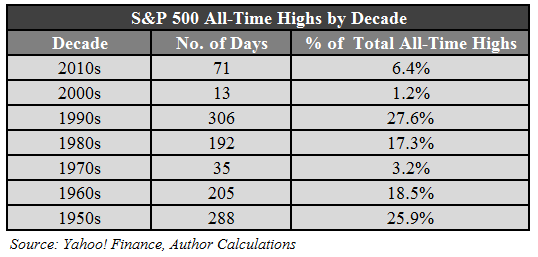
In fact, for seven months the Dow Jones Industrial Average was at essentially the same value.* This lack of fluctuation has been even more pronounced over the last two months. As of the market close on May 14th, 2015, the S&P 500 has closed between 2,040 and 2,120 for 71 days in a row.

Further, for nearly a full month, the DOW hasn’t experienced a 1-month high OR low and traded within a 2% range the entire time (always between -1% and 1%).** This was the longest streak in over 100 years!

***

one-month-return

***

Believe it or not, this may be the best pattern possible for the U.S. stock market.

***

Trendline Image

***

History tells us that the market is likely to increase in value over time. If we were to plot the market’s value from the time the market first opened to the current day, a chart of those two points would illustrate a return as such:

Trendline Image

However, we all know that the market doesn’t provide a consistent return. On individual trading days, the market can either increase or decrease in value, and the range of potential gains or losses is wide. Over extended periods of time, the market’s actual value may be above or below the expected trend line. In fact, the market’s actual historical return may look more like:

Historical vs Trendline

***

Historical vs Trendline

***

Anyone who is familiar with Net Worth Advisory Group is likely aware that we are not the type to make market predictions. We have no idea whether the market is near a temporary top or is still experiencing the upward trend after hitting the bottom of an S curve in 2008. However, let’s assume the market has reached the top of an S curve and is currently above the trend line that would represent consistent growth (similar to the illustration above).

If that is the case, there are two ways the market could get back in line with the trend line representing consistent long-term growth. The first and most obvious way this could happen is for actual market performance to curve downwards towards the trend line. This would represent a market correction or even crash.

***

crash

***

The second, and perhaps less obvious way that actual returns could become aligned with the long-term trend line is for time to allow the trend line to catch up to the actual returns we have experienced since 2008.

In this scenario, the market doesn’t slump but remains stable while time enables price-to-earnings ratios, valuations, and the economy a chance to catch up.

Time Catch Up

***

Time Catch Up

***

Very few investors enjoy or take advantage of a market correction. In fact, most investors lose control of their emotions when the market experiences a drastic downturn, and do exactly the opposite of what they should do: they sell at market lows – hardly a profitable investment strategy.

Consequently, if we are to avoid an over-heated market, it is likely better for most investors if the market realigns itself with the long-term growth rate by remaining flat for awhile and allowing the trend line time to catch up.

Allow me to reemphasize that I am not predicting that the market is in fact at a temporary high and above where it should be. I have no idea what the market will do tomorrow, over the next month, or over the next year. That is why I’m a believer in having a well diversified portfolio that represents your risk tolerance and you stick to it through thick and thin.

However, let’s look at the other side of the coin and assume the market is still at the bottom of an S curve, below the long-term trend line, and needs to experience further growth in order to catch up. Even in this scenario, an extended period of flat market performance is hardly a bad thing – it would simply make the potential upside needed to get back to market norms all the larger.

Market Under Valued

***

Market Under Valued

***

Assessment

It turns out that an extended period of flat market performance may very well be a positive for investors in any environment, regardless of whether the market is currently over or under-valued.

Channel Surfing

Have you visited our other topic channels? Established to facilitate idea exchange and link our community together, the value of these topics is dependent upon your input. Please take a minute to visit. And, to prevent that annoying spam, we ask that you register.

Link: http://feeds.feedburner.com/HealthcareFinancialsthePostForcxos

Conclusion

Your thoughts and comments on this ME-P are appreciated. Feel free to review our top-left column, and top-right sidebar materials, links, URLs and related websites, too. Then, subscribe to the ME-P. It is fast, free and secure.

Speaker: If you need a moderator or speaker for an upcoming event, Dr. David E. Marcinko; MBA – Publisher-in-Chief of the Medical Executive-Post – is available for seminar or speaking engagements. Contact: MarcinkoAdvisors@msn.com

OUR OTHER PRINT BOOKS AND RELATED INFORMATION SOURCES:

Sponsors Welcomed

And, credible sponsors and like-minded advertisers are always welcomed.

Support Med Executive-Post

Risk Management, Liability Insurance, and Asset Protection Strategies for Doctors and Advisors: Best Practices from Leading Consultants and Certified Medical Planners™8Comprehensive Financial Planning Strategies for Doctors and Advisors: Best Practices from Leading Consultants and Certified Medical Planners™

What If the Stock Market Falls 30%?

Join Our Mailing List

Are YOU ready, Doctor?

By Michael Zhuang,

[Principal of MZ Capital Management – Contributor to Morningstar and Physicians Practice]

Ever since it touched bottom on March 9th, 2009, the market has been going up and up and up with barely any hiccup. That’s dangerous! Because our minds could get complacent. That’s why I want to do a mental exercise with all of you: What would you do if the market falls 30%?

First of all, recognize these two important facts:

1.    Market fall of 30% and above happened every ten years or so.

If we use history as a guide, we should expect a 10% odds of that happening over the next 12 months. (So don’t be surprised.)

2.    All market tumbles of that magnitude were recovered within 18 months in the US. (So don’t despair.)

So instead of seeing a 30% fall a bad thing: a horrible hit to your wealth, how about seeing that as a good thing: a deep discount of productive assets on sale that happens only once every decade.

Here is what you should do before, during and after a 30% fall of the market.

1.    Start with having an appropriate asset allocation. Depending on your age and risk tolerance, maybe it’s a 70/30 portfolio, or a 60/40 one, or a 50/50 one.

2.    Stick to it through good market and bad.

3.    Rebalance periodically or opportunistically

Let’s take a 50/50 portfolio for example. After the (stock) market tumble of 30%, the portfolio becomes 35/65. To rebalance back to 50/50, you must sell appreciated bonds and buy discounted stocks.

When you do the above over and over, you create a system of buying low and selling high.

An additional note on rebalance, to keep it simple, you can rebalance every year. The optimal rebalance however, is opportunistic not periodic. The research on that was published in Journal of Financial Analyst and it suggests a rebalance when an asset class has deviated from its target allocation by 20%. When this is done right, you can add about 40 basis points in excess return.

***

stock market

***

Channel Surfing

Have you visited our other topic channels? Established to facilitate idea exchange and link our community together, the value of these topics is dependent upon your input. Please take a minute to visit. And, to prevent that annoying spam, we ask that you register.

Link: http://feeds.feedburner.com/HealthcareFinancialsthePostForcxos

Conclusion

Your thoughts and comments on this ME-P are appreciated. Feel free to review our top-left column, and top-right sidebar materials, links, URLs and related websites, too. Then, subscribe to the ME-P. It is fast, free and secure.

Speaker: If you need a moderator or speaker for an upcoming event, Dr. David E. Marcinko; MBA – Publisher-in-Chief of the Medical Executive-Post – is available for seminar or speaking engagements. Contact: MarcinkoAdvisors@msn.com

OUR OTHER PRINT BOOKS AND RELATED INFORMATION SOURCES:

Risk Management, Liability Insurance, and Asset Protection Strategies for Doctors and Advisors: Best Practices from Leading Consultants and Certified Medical Planners™8Comprehensive Financial Planning Strategies for Doctors and Advisors: Best Practices from Leading Consultants and Certified Medical Planners™

Attention Physician Investors [Don’t Get Soft]

Join Our Mailing List 

On “Easy” … Investing

By Lon Jefferies MBA CFP®

Lon JeffriesDo you realize how easy physicians, and most all investors, have had it lately? There is almost always something happening in the world that can serve as justification for selling investment positions or not investing new dollars.

Yet, there hasn’t been many spooky events impacting the markets during the last several months.

So, let’s examine the investment environment we’ve recently enjoyed.

Geo-political Current Events

There is almost always geopolitical current events that are capable of scaring investment markets. While this generation will always have concern about ISIS, North Korea, Iran, Afghanistan, and terrorism, we haven’t recently experienced the kind of negative political event that has immediately sent the stock market into a tailspin.

Even stories regarding missile strikes in Gaza have been few and far between. The most relevant international political event of late is the United States’ increased cooperation with Raul Castro and Cuba — a positive event.

Global economic situations also have the ability to increase volatility in the stock market. Yet, we haven’t recently been bombarded with headlines about excessive debt in Argentina or other countries on the doorstep of financial collapse.

Actually, international markets are the big investment story thus far in 2015, with Europe, Asia, and emerging markets outperforming U.S. stocks.

Social Tragedies

Social tragedies also have the ability to move the markets. I believe the most dominant story regarding social issues of late has been the horrific stories of potential racism and excessive police violence.

Of course, these events are shocking and unfortunate, but they aren’t usually the type of stories that impact investment markets.

Fortunately, I’m not aware of any school shootings, mass suicides, or broad violent attacks on U.S. soil that have caused a national mourning in 2015.

Natural Disasters

Further, there have been relatively few natural disasters such as hurricanes, earthquakes, or tornados that have significantly set back a geographic area or the nation as a whole.

In fact, the Weather Channel announced that the tornado count is 59 percent below average year-to-date. There were some large snow storms in the North-East earlier this year, but they had a nominal impact on the direction of the stock market.

US Economy

Even the U.S. economy hasn’t produced any data that has been particularly frightening to investors. It was all the way back in October that the Federal Reserve announced the ending of its quantitative easing (QE) program, which caused some to wonder if the economy would start to dry up (it hasn’t…). The concern about potentially higher interest rates has been present for so long that it is now old news, and people seem less and less convinced that higher interest rates would significantly stall the economy. Meanwhile, the unemployment rate continues to decline.

***

statistics ***

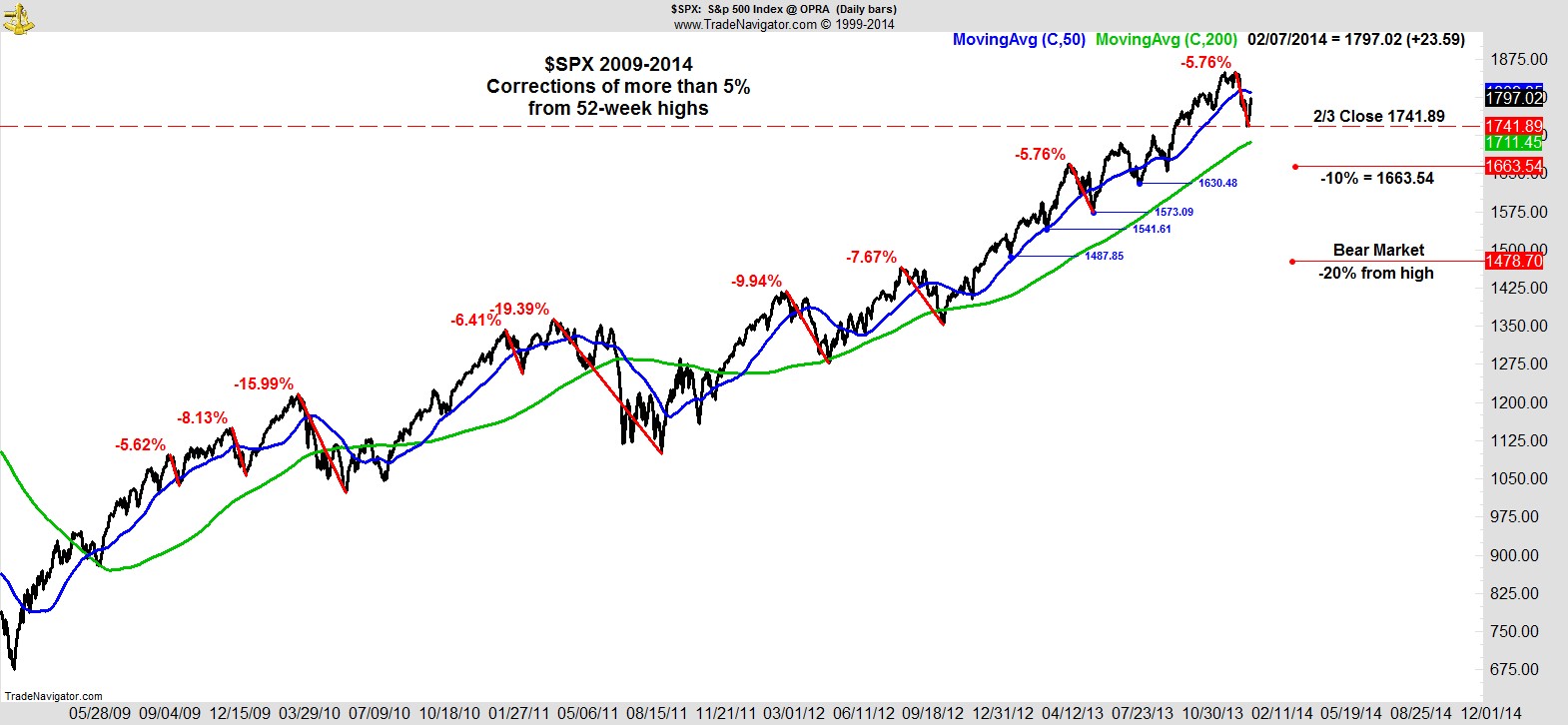
Lastly, the stock market itself has hardly provided reason for heartburn. The total return of the S&P 500 has been positive every year since 2008. The index hasn’t even had a temporary pullback of more than -7.27% (9/18/14 – 10/16/14) since 2011, even though the market historically goes through a -10% correction approximately once per year, on average. In fact, the biggest investment concern of 2014 was that small cap and international stocks didn’t make as much as large cap stocks, causing most diversified portfolios to underperform the larger market indexes such as the S&P 500 and Dow Jones Industrial Average. If your largest investing disappointment is that every part of your diversified portfolio didn’t perform as well as the best performing asset category in the market, you should really focus less on your portfolio and more on enjoying life as a whole.

Volatility

When we examine the factors that typically lead to volatility in the market, we’ve had a relatively tame past couple of months. My purpose in pointing out this fact is not to imply that the market is in a prime position to continue to do well nor on the verge of dropping drastically when the next sign of uncertainty appears. I simply hope to remind investors that the stock market is not always such a smooth ride.

Adverse Actions

The most counter-productive action an investor can take is to liquidate their positions after the market drops. I believe the best way to avoid this mistake is to constantly remind yourself that you are investing for long-term results and that short-term (and potentially drastic) volatility is certain to occur.

Reminding yourself of this fact now, before the volatility arrives, is likely to increase the probability that you will be able to stick to your long-term investment strategy during both the good and bad periods of market performance.

Enter Carl Richards

As Carl Richards points out in his new book The One-Page Financial Plan, no skydiver would try to figure out how a parachute works after jumping out of a plane. Sooner or later, an unfortunate event that will negatively impact the stock market is certain to occur. At that time, remember that just as it always has, the world will continue to turn.

Furthermore, remember that the longer you allow the world to turn, the more positive your investment results are likely to be.

Assessment

Don’t let this unusually quite investment period make you more susceptible to short-term instability once it returns.

Editor’s Note: Since writing this article, the world has experienced the catastrophic earthquake in Nepal on April 25th as well as the horrific riots in Baltimore, which started on April 27th. While these are certainly not the type of events that make the world a better place, the negative impact these occurrences have had on the stock market have again been relatively small, with the S&P 500 decreasing by a total of only 0.50% during the three days following these events [4/27 – 4/29]. Still, I would encourage investors to view these recent events as a reminder that investing and life in general is not always a smooth ride.)

More: 

Conclusion

Your thoughts and comments on this ME-P are appreciated. Feel free to review our top-left column, and top-right sidebar materials, links, URLs and related websites, too. Then, subscribe to the ME-P. It is fast, free and secure.

Speaker: If you need a moderator or speaker for an upcoming event, Dr. David E. Marcinko; MBA – Publisher-in-Chief of the Medical Executive-Post – is available for seminar or speaking engagements. Contact: MarcinkoAdvisors@msn.com

OUR OTHER PRINT BOOKS AND RELATED INFORMATION SOURCES:

Comprehensive Financial Planning Strategies for Doctors and Advisors: Best Practices from Leading Consultants and Certified Medical Planners(TM)

Morningstar Expense Ratio Study Shows Fund Costs Falling

Join Our Mailing List

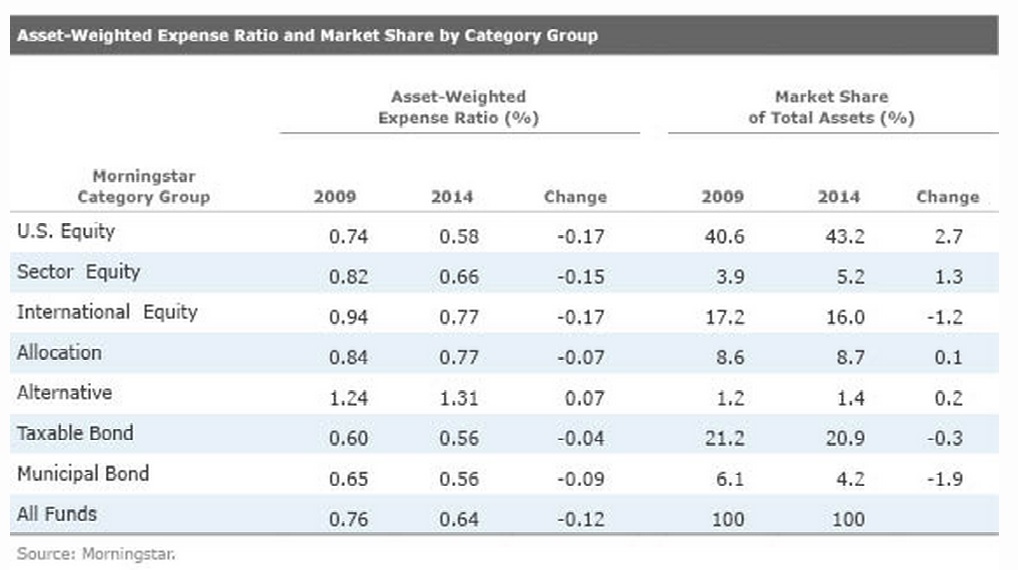
Asset-Weighted Expense Ratios and Market Share

By Morningstar

***

tumblr_nnzc1ahE8I1u8swf1o1_1280

[Click to Enlarge]

Conclusion

Your thoughts and comments on this ME-P are appreciated. Feel free to review our top-left column, and top-right sidebar materials, links, URLs and related websites, too. Then, subscribe to the ME-P. It is fast, free and secure.

Speaker: If you need a moderator or speaker for an upcoming event, Dr. David E. Marcinko; MBA – Publisher-in-Chief of the Medical Executive-Post – is available for seminar or speaking engagements. Contact: MarcinkoAdvisors@msn.com

OUR OTHER PRINT BOOKS AND RELATED INFORMATION SOURCES:

Comprehensive Financial Planning Strategies for Doctors and Advisors: Best Practices from Leading Consultants and Certified Medical Planners(TM)

Crowd-Sourcing Financial Advice?

Join Our Mailing List 

By Dr. David E. Marcinko MBA

If you have some eggs about to expire, or a car that has problems, you can turn to an online community to find some solutions. But, what if you have a financial issue, like what to do with a windfall or how to invest for a kids’ college tuition, and need help?

Can you crowdsource financial advice? 

Ramon Ramirez writes on the Daily Dot’s The Kernel about the personal finance section of Reddit, where people ask for, and receive, all types of advice on personal financial matters; The subreddit has 2.7 million subscribers.

Ramirez finds that “for the armchair experts … weighing in on these questions pro bono is all in a day’s work. They are generally affable, seemingly trustworthy, and largely convincing.” But, one professor of personal finance sees a problem: “Six people suggest six different things to do—now what do I do?

Professor Speak

First of all, who are these people that are answering this plea? Are they professionals? Are they certified financial planners? Do they have any idea what they’re talking about?”

Others say the peer-review part of crowdsourced advice is its most valuable aspect.

“Compare this to a traditional financial advisor. If you’re in here asking about what to invest your retirement into, and I’m suggesting funds that personally enrich me, I’ll get called out on it.”

Left unsaid, but surely true, is how investors will increasingly turn to sites like this to validate their advisors’ advice, or learn why they should change advisors.

***

Soldiers

 ***

***

Assessment

First we had crowd sourced funding, then crowd sourced medicine … and now crowd sourced investing! Prudent, or NOT?

More:

Crowd-Funding:

MORE: P2P

Conclusion

Your thoughts and comments on this ME-P are appreciated. Feel free to review our top-left column, and top-right sidebar materials, links, URLs and related websites, too. Then, subscribe to the ME-P. It is fast, free and secure.

Speaker: If you need a moderator or speaker for an upcoming event, Dr. David E. Marcinko; MBA – Publisher-in-Chief of the Medical Executive-Post – is available for seminar or speaking engagements. Contact: MarcinkoAdvisors@msn.com

OUR OTHER PRINT BOOKS AND RELATED INFORMATION SOURCES:

Comprehensive Financial Planning Strategies for Doctors and Advisors: Best Practices from Leading Consultants and Certified Medical Planners(TM)

An Investor’s Guide to Better Writing

Join Our Mailing List

Seriously?

[By Vitaliy N. Katsenelson, CFA]

ImageProxyI never thought I’d be giving writing advice. I was always the worst student in my literature class in Russia. I never received a grade higher than a C on any Russian essay I ever wrote. I have a theory that my teachers got sick of reading and grading my horrible essays, so they stopped and automatically gave me a passing grade out of pity. I don’t blame them.

When I came to the U.S., my grades in English class in college were not spectacular either; in fact, English was the only class I failed in college and actually had to retake my senior year.

My writing has improved slightly since then – and you, my loyal readers, get to be the judge of my scribbles. However, if the prequalification for giving writing advice was based solely on quantity – on how many words have blackened a perfectly fine white screen or besmirched innocent paper – then I am more than qualified. I have been at it for exactly a decade.

My writing “career” started in 2004 when I was hired as a writer by TheStreet.com. I was not hired because I was good – I wasn’t. But I had an investing background, and TheStreet.com was not very picky; it needed warm bodies (ideally with CFA next to their names) to comment on the markets and stocks. TheStreet.com paid almost nothing, and it was overpaying me.

I had zero experience, but I was ambitious. I took writing very seriously, and therefore my articles were serious. They were filled with big words, and, quite frankly, they were enormously boring. In addition, I was extremely self-conscious about grammar. Sentence structure and punctuation drove me nuts, and I was afraid of confusing words that were spelled similarly but had unrelated meanings (like comma and coma).

***

Typewriter

***

LESSONS LEARNED

This brings me to the first lesson that I want to impart about writing, and it’s one that will drive English teachers insane: Don’t worry about grammar.

Once I stopped worrying about grammar, I felt a huge weight lifted from my shoulders (as all those little punctuation marks emptied themselves from my brain). I completely gave up on a, an and the (my 12-year-old son, who was born here, does a great job fixing those for me), I stopped obsessing about commas (and comas), and I stopped trying to ferret out all the other marvelous secrets of English grammar. I let copy editors – who are very talented and oh so skilled at this – catch me out in all my little peccadilloes. Instead I channel my energy into making writing interesting and funny (if appropriate); this is Lesson No. 2.There are a lot of smart investors, and a lot of them write (just visit the web site Seeking Alpha), but only a small fraction manage to make their writing interesting (again, just visit Seeking Alpha) – and those are the ones who are read more than once.

As I mentioned, when I started writing, my articles were technical and boring. I still feel sorry for the people who read them and especially for my dear friends who felt an obligation to read them.

Then an accident happened. Six months into writing for TheStreet.com, I wrote about the digital video recorder company TiVo. In that article I dared to use a little bit of humor to describe a painful experience I had when I called TiVo’s automated telephone customer service, which did not seem to understand my “slight” Russian accent. To my embarrassment, I had to ask my three-year-old son, who by that time had already acquired a perfect “Disney” accent, to talk to the machine instead, and of course it understood him just fine.

That article was not brilliant – it contained as many or as few insights as my previous articles did – but it was not “proper,” and it was not boring. Suddenly, the feedback from readers was much different – I received a ton of e-mail. Then I understood the power of humor. But it was not just humor: I was able to deliver my otherwise boring message in an interesting way.

I realized that knowing what you want to say is not enough; you need to figure out how to say it.

To this day, I spend hours staring at the computer, trying to come up with an interesting analogy or a compelling angle on how to say something I already know. I often use analogies to tell a story, especially if the topic is complex. They help me relate complex ideas through simple examples.

Let me illustrate. I have a very smart investor friend of German ancestry. True to his roots, he is very efficient in everything he does. (I am stereotyping here, but why not?) He has written a very smart investment book. If you read the whole thing, you’d learn a lot. But that is a big if. His book is as efficient and properly structured as you would expect from a well-engineered German car or an instruction manual for that car. It doesn’t have an extra word or a superfluous sentence. But unfortunately, in the process of making it efficient, he sterilized his book. I was excited to read it but could not get past Chapter 3. I got terminally bored, and I do investments for a living.

Oh, and while we’re on the subject of boredom: Follow novelist Elmore Leonard’s advice when he said, “I try to leave out the parts that people skip.” Don’t try to be descriptive for the sake of being descriptive.

Andrew Blum in 2012 wrote a terrific book called Tubes: A Journey to the Center of the Internet . However, in his other life Andrew is a reporter who covers architecture. His job is to describe inanimate objects. In Tubes he often goes into “descriptive mode,” telling us all about things that do not need to be described. For example, at one point he falls into an exhaustive description of the hotel he stayed in near the Los Angeles International Airport. The hotel room had nothing to do with the story, but he went on and on, describing bars of soap, their colors, the plate they were on and how the sunlight bounced off each one of them.

After making it through the third chapter, I gave up and downloaded the audiobook of Tubes. So maybe Andrew succeeded after all, since I ended up buying two versions of his book. (And I do highly recommend listening to his book if you want to learn about the Internet.)

It took a while for my writing style to develop. A big part of its development came through reading great writers. The two people who had the most impact on me were John Mauldin and Cliff Asness.

John needs no introduction, as his economics newsletter (Mauldin Economics) is read by millions. He has a gift for explaining complex investment topics simply, but he also invites you into his life. He shares stories about the trips he takes and the people he meets; he talks about his kids and their travails, his lack of time for the gym and his penchant for cooking mushrooms. When you read him, you feel as if he’s writing for you – just you. This is different from fiction writing, in which the author’s fingerprints are hidden.

Cliff Asness has had a tremendous impact on me as well. Cliff is a hedge fund manager; he runs the large quant firm AQR Capital Management in Greenwich, Connecticut. Cliff has an incredible gift for being witty. Back in 2005 I read a paper by Cliff discussing the most boring topic on earth: the expensing of employee stock options. At the time, companies did not consider them an expense. Cliff argued that the companies were wrong and needed to show the options on their income statements, just like any other expense.

I had written on the same topic just a few months before, making a similar point. But after I read his paper, I sent Cliff an e-mail with the subject line “I am not worthy.” Cliff’s paper was published in the most boring finance magazine in the whole universe: Financial Analysts Journal (every article in it is full of geeky Greek symbols). To my astoundment, Cliff was able to inject humor where I thought it was not possible. I wrote a very boring, unmemorable article on stock options; Cliff wrote a great, funny article on the same topic that I still remember today.

John Mauldin showed me through his writing that it’s okay to be personal, and Cliff proved it is okay to be funny. No, Cliff proved that you must be funny when you discuss boring topics – this is how you make the reader stick with it. Lesson No. 3: Identify your favorite writers, the ones whose voices you can really relate to, and learn from them.

I could relate to John’s and Cliff’s writings because they fit my personality and my natural writing style. They liberated me from being sanitized, impersonal and boring.

A sublesson here is, Read to write. When you read, always have your writer’s hat on, and pay attention not just to content but to the quality of the writing as well. That is not something that comes automatically to most of us; we have to manually hit the “on” switch.

Lesson No. 4: Be respectful of your environment. This is not an ecological statement; I am talking about your writing environment. If you write long enough, you start to appreciate the importance of your external and internal environment. Stephen King, in his terrific book On Writing: A Memoir on the Craft , said that he listens to heavy metal band AC/DC when he writes; he feels it walls him off from the external world and helps him build his own worlds. I listen to classical music, and if I am really stuck, I start listening to opera.

And if that weren’t weird enough, I write only in italics. This little trick makes my letters look a bit friendlier to me. If you find that you like your font to be pink, go for it. We writers need any edge we can get, and you can always change back to a color and format that is acceptable to society when you are done.

The final lesson: Be prepared for pain – or maybe not. Writing is a very personal process. Some of us are great thinkers, able to puzzle through very complex ideas in our heads and lay them out logically on paper. I have tremendous respect for those lucky ones. For most of us, present company included, writing is usually a painful endeavor that involves staring at a blank screen for hours on end and writing and rewriting multiple times.

In fact, let me take it a step farther: I think through writing. A quote from George Bernard Shaw comes to mind: “Few people think more than two or three times a year; I have made an international reputation for myself by thinking once or twice a week.”

If you ask me a question about something I have not thought about before, even if you give me a minute to think about it, my answer will usually, well … suck. I have not written about that topic yet, and so I may not have thought it through, and the logical links may not have been made. That’s just how my mind operates.

Quite frankly, I am embarrassed for my brain. It’s like the dirty apartment of a confirmed bachelor, with unwashed clothes, empty pizza boxes and beer bottles all over the floor. For an idea to be developed to the point at which it can leave the room, I have to clean it up, organize it, put things in their rightful place. That is why I write – sorry, dear reader, it’s not about you; it’s about me, me and me again.

***

money

***

More:

ASSESSMENT

Writing is not a linear process, and when you sit down to write, your thoughts may not be quite ready to come out – it’s okay if they just haven’t come to a boil yet. Don’t blame it on writer’s block. Author Tom Clancy once said, “Writer’s block is just an official term for being lazy, and the way to get through it is work.” Just take some time off, do something fun and then get back on the writing horse.

ABOUT

Vitaliy N. Katsenelson, CFA, is Chief Investment Officer at Investment Management Associates in Denver, Colo. He is the author of The Little Book of Sideways Markets (Wiley, December 2010). To receive Vitaliy’s future articles by email or read his articles click here.

Investment Management Associates Inc. is a value investing firm based in Denver, Colorado. Its main focus is on growing and preserving wealth for private investors and institutions while adhering to a disciplined value investment process, as detailed in Vitaliy’s book Active Value Investing (Wiley, 2007).

Conclusion

Your thoughts and comments on this ME-P are appreciated. Feel free to review our top-left column, and top-right sidebar materials, links, URLs and related websites, too. Then, subscribe to the ME-P. It is fast, free and secure.

Speaker: If you need a moderator or speaker for an upcoming event, Dr. David E. Marcinko; MBA – Publisher-in-Chief of the Medical Executive-Post – is available for seminar or speaking engagements. Contact: MarcinkoAdvisors@msn.com

OUR OTHER PRINT BOOKS AND RELATED INFORMATION SOURCES:

Comprehensive Financial Planning Strategies for Doctors and Advisors: Best Practices from Leading Consultants and Certified Medical Planners(TM)

Video on Six Costly Investment Behaviors

Join Our Mailing List

Pathetic results compared to the markets

[Principal of MZ Capital Management]

[Contributor to Morningstar and Physicians Practice]

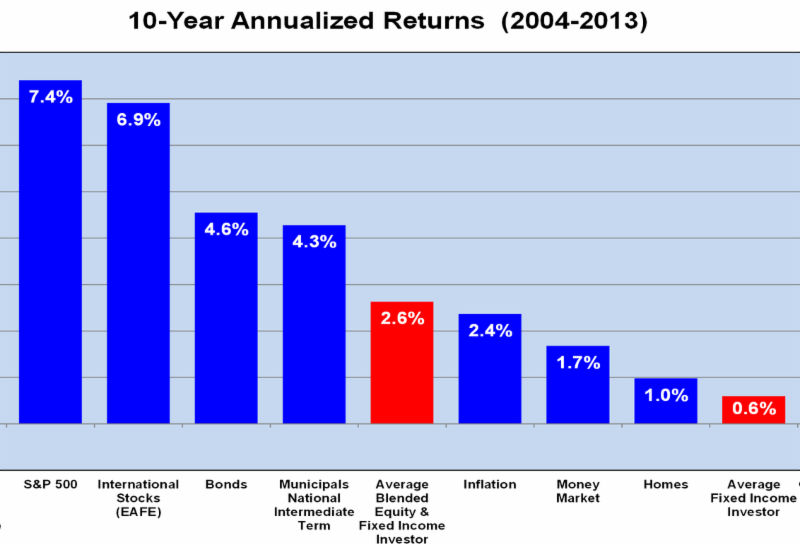
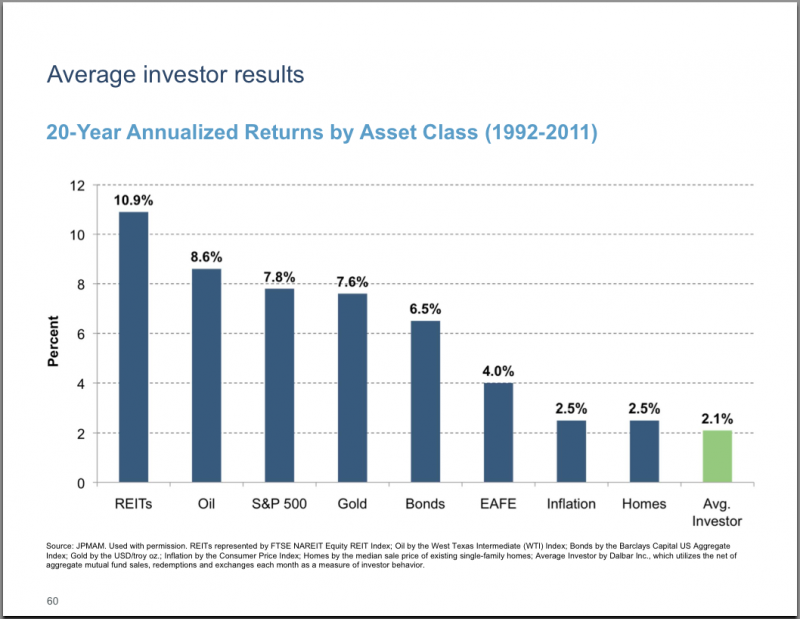
Most investors are very good at hurting themselves financially. According to latest release of Dalbar’s Quantitative Analysis of Investor Behavior (QAIB), the average investor has a return of only 2.6% over the last ten years. That’s pathetic compared to what the markets gave. See the chart below, over the same period, the S&P 500 gave an annualized return of 7.4% and the bond market gave 4.6%.

***

ImageProxy

[Click to Enlarge]

***

Investor behaviors are such a big drag on investment returns that Nobel Prize winner Daniel Kahneman, an Israeli American, advised Israel’s Pension Authority to send out statements once a quarter instead of once a month. Since when Israel’s pensioners don’t get their statements, they don’t do stupid things to their accounts.

So what are those behaviors that are so costly to investment returns? Please watch this five minute long video produced by Independence Advisors.

In a nutshell, the emotional reactions (such as herding) that had helped our hunter-gatherer forebears survive so well and thus are hard-wired into our brains are literally hazardous to successful investing. In a way, the value of an advisor like myself is to separate your emotions from your money.

Assessment

So, how does this relate to physicians and other medical professionals; better or worse?

Conclusion

Your thoughts and comments on this ME-P are appreciated. Feel free to review our top-left column, and top-right sidebar materials, links, URLs and related websites, too. Then, subscribe to the ME-P. It is fast, free and secure.

Speaker: If you need a moderator or speaker for an upcoming event, Dr. David E. Marcinko; MBA – Publisher-in-Chief of the Medical Executive-Post – is available for seminar or speaking engagements. Contact: MarcinkoAdvisors@msn.com

OUR OTHER PRINT BOOKS AND RELATED INFORMATION SOURCES:

Comprehensive Financial Planning Strategies for Doctors and Advisors: Best Practices from Leading Consultants and Certified Medical Planners(TM)

Living and Dying on Financial Planning Averages

Join Our Mailing List

Too simplest … Too manageable?

By Lon Jeffries MBA CFP CMP®

Lon JeffriesNever forget the story of the six-foot tall man who drowned crossing the stream that was only five feet deep, on average.

We want to abide by averages because they make our lives simple and manageable. A couple on a date night assumes a movie will be an average of two hours long so they know when to schedule dinner with friends.

The entrepreneur wants to think in terms of making an average profit of $100,000 per year so he has a guideline regarding the standard of living he can enjoy.

The 65-year old retiree wants to assume he will live to the average age of 84.3 so he knows at what pace he can enjoy his nest egg.

Planning Gone Awry

However, when we rely too heavily on averages, our planning can go awry. If the movie runs longer than two hours, the couple will be late for their dinner date. If the entrepreneur has a slow year and earns less than $100,000, he may end up taking out short term debt to pay his bills. If the retiree lives past age 84.3, he may outlive his money.

Financial Planning Averages

The use of averages is essential in financial planning. A range of assumptions is required in the development of a financial plan – how long will you live, how much will you spend each year, what rate of return will your investments achieve, how much will you pay in taxes, what will the rate of inflation be, etc. Without these assumptions, retirement projections can’t be constructed. Further, the best method for making these assumptions is to use averages – an average life expectancy, an historical average rate of return, an historical average inflation rate, etc.

So, how do we prevent the use of averages from destroying us? The answer is by allowing enough time and repetitions for the law of averages to come into effect. Just because a basketball player shoots free throw shots at a 90% success rate doesn’t mean he will necessarily make the next free throw he takes. It does, however, mean that if he shoots 100 free throws he is likely to make 90 of them.

Beware Assumptions

A financial plan may assume you achieve an average annual rate of return of 7% per year. Of course, this doesn’t mean it is impossible that your portfolio will actually lose 10% over the next 12 months. It is critical to remember that the financial plan assumes you achieve a 7% return over the entirety of your retirement, which may be 30 years. Consequently, if a loss of 10% occurs in the first year of retirement, your portfolio still has another 29 years to achieve returns that average out to 7% per year. Thus, a 10% loss is far from catastrophic to your retirement projections.

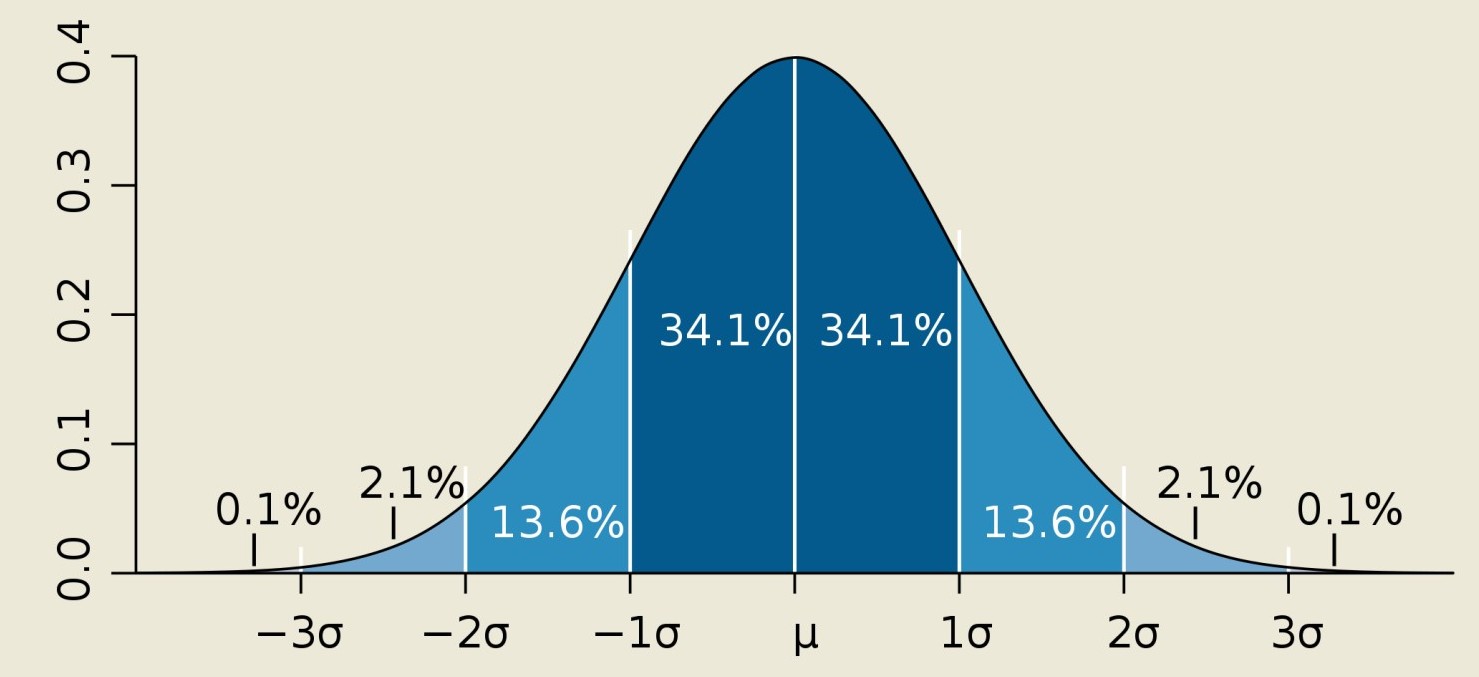
In fact, the primary way a 10% loss could become catastrophic to your portfolio is if it motivates you to make changes to your investments that would prevent the law of averages from applying. If an investor sold their portfolio after suffering the 10% loss, it would essentially guarantee that the anticipated average rate of return won’t be achieved, and consequently, the financial plan would be likely to fail.

***

Bell Curve

***

For this reason, while it is true that over an extended period of time the stock market has averaged an annual return of 10%, we should always remember that there is a significant chance of the market taking a loss during any given year (or three-year) period, and it is possible that the market could endure a decade without any significant gains (similar to the 2000’s).

Still, if the financial plan requires an average investment return over an extended period of time such as a 30-year retirement, even these setbacks are far from certain to dislodge your secure retirement as long as time is granted for the average to work itself out.

Enter Howard Marks

As famed writer and investor Howard Marks said,

“We can’t live by the averages. We can’t say ‘well, I’m happy to survive, on average.’ We gotta survive on the bad days. If you’re a decision maker, you have to survive long enough for the correctness of your decision to become evident. You can’t count on it happening right away.”

Assessment

The use of averages has a purpose in financial planning, and in other aspects of life. We simply need to be confident that the figures we use for our averages are achievable over time, and allow time the opportunity to prove us right.

Pareto’s Law or Principle

The Pareto principle (also known as the 80–20 rule, the law of the vital few, and the principle of factor sparsity) states that, for many events, roughly 80% of the effects come from 20% of the causes Management consultant Joseph M. Juran suggested the principle and named it after Italian economist Vilfredo Pareto, who, while at the University of Lausanne in 1896, published his first paper “Cours d’économie politique.” Essentially, Pareto showed that approximately 80% of the land in Italy was owned by 20% of the population; Pareto developed the principle by observing that 20% of the pea pods in his garden contained 80% of the peas.

It is a common rule of thumb in business; e.g., “80% of your sales come from 20% of your clients.” Mathematically, the 80–20 rule is roughly followed by a power law distribution (also known as a Pareto distribution) for a particular set of parameters, and many natural phenomena have been shown empirically to exhibit such a distribution.[2]

The Pareto principle is only tangentially related to Pareto efficiency. Pareto developed both concepts in the context of the distribution of income and wealth among the population.

More: 

Conclusion

Your thoughts and comments on this ME-P are appreciated. Feel free to review our top-left column, and top-right sidebar materials, links, URLs and related websites, too. Then, subscribe to the ME-P. It is fast, free and secure.

Speaker: If you need a moderator or speaker for an upcoming event, Dr. David E. Marcinko; MBA – Publisher-in-Chief of the Medical Executive-Post – is available for seminar or speaking engagements. Contact: MarcinkoAdvisors@msn.com

OUR OTHER PRINT BOOKS AND RELATED INFORMATION SOURCES:

Comprehensive Financial Planning Strategies for Doctors and Advisors: Best Practices from Leading Consultants and Certified Medical Planners(TM)

The Financial Crisis

Join Our Mailing List

And – Cultural Capture

j kwak

I was asked to write something about an idea that I had slipped into 13 Bankersalmost in passing, about the cultural prestige of the financial industry and the political and regulatory benefits the industry derived from that prestige. My chapter turned into a discussion of the various mechanisms by which status and social networks can influence regulators, creating the equivalent of regulatory capture even without traditional materialist incentives (cash under the table, promises of future jobs, etc.).

Two weeks ago, an investigation by ProPublica and This American Life illustrated the culture of deference, risk aversion, and general sucking-upitude among New York Fed bank examiners that effectively resulted in the capture of regulators by the banks they were supposed to be regulating. As David Beim wrote in a confidential report about the New York Fed, the core problem was “what the culture expected of people and what the culture induced people to do.”

I wrote about the story for the Atlantic and referred to my book chapter, but at the time the chapter was not available for free on the Internet (at least not legally). The good people at the Tobin Project have since put it up on the book’s website, from which you can download it (legally!). Note that they are only allowed to put up one chapter at a time and they rotate them, so this is a limited-time offer.

Link: Cultural Capture and the Financial Crisis

free_278647

More: http://jameskwak.net/

Conclusion

Your thoughts and comments on this ME-P are appreciated. Feel free to review our top-left column, and top-right sidebar materials, links, URLs and related websites, too. Then, subscribe to the ME-P. It is fast, free and secure.

Speaker: If you need a moderator or speaker for an upcoming event, Dr. David E. Marcinko; MBA – Publisher-in-Chief of the Medical Executive-Post – is available for seminar or speaking engagements. Contact: MarcinkoAdvisors@msn.com

OUR OTHER PRINT BOOKS AND RELATED INFORMATION SOURCES:

Comprehensive Financial Planning Strategies for Doctors and Advisors: Best Practices from Leading Consultants and Certified Medical Planners(TM)

Understanding 1031 Exchanges

Join Our Mailing List

The Ultimate Infographic Guide

By 1031 Gateway

In this infographic you will learn how to defer your capital gains taxes utilizing a 1031 exchange, what kinds of properties qualify for 1031, what the basic 1031 rules and time limits are, and how to benefit your heirs by stepping up your basis.

***

1031Exchange

***

Conclusion

Your thoughts and comments on this ME-P are appreciated. Feel free to review our top-left column, and top-right sidebar materials, links, URLs and related websites, too. Then, subscribe to the ME-P. It is fast, free and secure.

More:

Speaker: If you need a moderator or speaker for an upcoming event, Dr. David E. Marcinko; MBA – Publisher-in-Chief of the Medical Executive-Post – is available for seminar or speaking engagements. Contact: MarcinkoAdvisors@msn.com

OUR OTHER PRINT BOOKS AND RELATED INFORMATION SOURCES:

Comprehensive Financial Planning Strategies for Doctors and Advisors: Best Practices from Leading Consultants and Certified Medical Planners(TM)


Do You Have These Horrible Investments in Your Portfolio?

Join Our Mailing List 

Beware Structured Products and Annuities

By Michael Zhuang

Principal of MZ Capital Management

[Contributor to Morningstar and Physicians Practice]

Recently, I had a new client. As part of the on-boarding process, I examined her old portfolio and found some things I didn’t recognize.

***

Cusip Symbol Description Return
25190A104 N/A Deutsche Bk AG London BRH Ret Opt Secs Lkd Ishare MSCI Mexico Capped -21.15%
25190A203 N/A Deutsche Bk AG London BRH Ret Opt Secs Lkd Ishare Euro STOXX 50 Idx -26.60%
90273L815 N/A USB AG London BRH Notes Five 15 -22.30%

***

Structured Products

What these products have in common is they don’t have a ticker symbol, meaning they are not publicly traded securities. They also have weird descriptions and they all lost a lot of money.

I called Fidelity (my custodian firm) to find out what they were and how I could get rid of them. I was told that they are structured products created by the bank(s) to shove into their clients’ accounts (The managing “advisor” works for UBS).

That rang a bell! My very first job was a financial engineer for a French bank – Societe Generale. My job was to create structured products that had appealing features and made the bank a lot of profits. Now, that I finally see them in action from, the client side of the equation; I am not proud.

Annuities

But, these structured products are not nearly as bad as an Allianz annuity that a client bought from an insurance agent “friend” a while back. He bought the annuity eleven years ago for $150-k, and over the years, saw it steadily increases in value to $189-k.

Then, there came a time when he needed the money. So, he called to cash out and was shocked to discover there was a $62-k surrender charge. In other words, he was able to get $127-k back. I subsequently called Allianz on his behalf to find out when the surrender charge would end and was told there was no end! In other words, there would always be a huge surrender charge.

***

insurance

***

What the Heck!

So, what in the heck does that value of $189-k really mean, when every time you want to take out the “value”, you have to pay a hefty ⅓ surrender charge?

Alas, Allianz explained the client can annuitize and take the amount out over ten years (or twenty years,) during which no interest will be accrued.  So, they will take your principal -or- they will take your interest, either way they screw you.

More:

Assessment 

Do you have structured products or annuities in your portfolio? Don’t know – Find out, now!

Conclusion

Your thoughts and comments on this ME-P are appreciated. Feel free to review our top-left column, and top-right sidebar materials, links, URLs and related websites, too. Then, subscribe to the ME-P. It is fast, free and secure.

Speaker: If you need a moderator or speaker for an upcoming event, Dr. David E. Marcinko; MBA – Publisher-in-Chief of the Medical Executive-Post – is available for seminar or speaking engagements. Contact: MarcinkoAdvisors@msn.com

OUR OTHER PRINT BOOKS AND RELATED INFORMATION SOURCES:

Comprehensive Financial Planning Strategies for Doctors and Advisors: Best Practices from Leading Consultants and Certified Medical Planners(TM)

More on “Passive Investing” for Physicians

Join Our Mailing List 

Basic Financial Concepts

tim

By Timothy J. McIntosh; CFPMBA MPH CMP [hon]

By Jeffery S. Coons; PhD CFA

By Dr. David E. Marcinko; MBA CMP™

Passive investing is a monetary plan in which an investor invests in accordance with a pre-determined strategy that doesn’t necessitate any forecasting of the economy or an individual company’s prospects.

Premise

The primary premise is to minimize investing fees and to avoid the unpleasant consequences of failing to correctly predict the future. The most accepted method to invest passively is to mimic the performance of a particular index. Investors typically do this today by purchasing one or more ‘index funds’. By tracking an index, an investor will achieve solid diversification with low expenses.  Thus, a physician-investor could potentially earn a higher rate of return than an investor paying higher management fees.

Passive management is most widespread in the stock markets.  But; with the explosion of exchange traded funds on the major exchanges, index investing has become more popular in other categories of investing. There are now literally hundreds of different index funds.

***

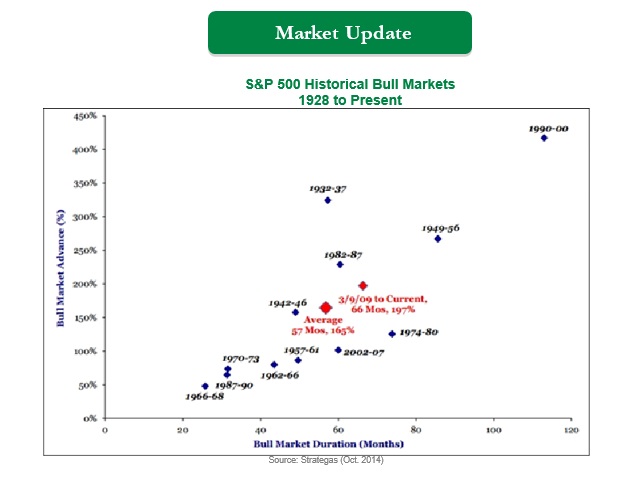
Bull Markets

[Domestic Bull Markets – Historical USA]

***

Passive management is based upon the Efficient Market Hypothesis theory.  The Efficient Market Hypothesis (EMH) states that securities are fairly priced based on information regarding their underlying cash flows and that investors should not anticipate to consistently out-perform the market over the long-term.

The Efficient Market Hypothesis evolved in the 1960s from the Ph.D. dissertation of Eugene Fama.  Fama persuasively made the case that in an active market that includes many well-informed and intelligent investors, securities will be appropriately priced and reflect all available information. If a market is efficient [even emerging and/or world markets], no information or analysis can be expected to result in outperformance of an appropriate benchmark.

***

World Markets

[USA versus World Index]

***

Channel Surfing the ME-P

Have you visited our other topic channels? Established to facilitate idea exchange and link our community together, the value of these topics is dependent upon your input. Please take a minute to visit. And, to prevent that annoying spam, we ask that you register. It is fast, free and secure.

More:

The Author

Timothy J. McIntosh is Chief Investment Officer and founder of SIPCO.  As chairman of the firm’s investment committee, he oversees all aspects of major client accounts and serves as lead portfolio manager for the firm’s equity and bond portfolios. Mr. McIntosh was a Professor of Finance at Eckerd College from 1998 to 2008. He is the author of The Bear Market Survival Guide and the The Sector Strategist.  He is featured in publications like the Wall Street Journal, New York Times, USA Today, Investment Advisor, Fortune, MD News, Tampa Doctor’s Life, and The St. Petersburg Times.  He has been recognized as a Five Star Wealth Manager in Texas Monthly magazine; and continuously named as Medical Economics’ “Best Financial Advisors for Physicians since 2004.  And, he is a contributor to SeekingAlpha.com., a premier website of investment opinion. Mr. McIntosh earned a Bachelor of Science Degree in Economics from Florida State University; Master of Business Administration (M.B.A) degree from the University of Sarasota; Master of Public Health Degree (M.P.H) from the University of South Florida and is a CERTIFIED FINANCIAL PLANNER® practitioner. His previous experience includes employment with Blue Cross/Blue Shield of Florida, Enterprise Leasing Company, and the United States Army Military Intelligence.

Conclusion

Your thoughts and comments on this ME-P are appreciated. Feel free to review our top-left column, and top-right sidebar materials, links, URLs and related websites, too. Then, subscribe to the ME-P. It is fast, free and secure.

Speaker: If you need a moderator or speaker for an upcoming event, Dr. David E. Marcinko; MBA – Publisher-in-Chief of the Medical Executive-Post – is available for seminar or speaking engagements. Contact: MarcinkoAdvisors@msn.com

OUR OTHER PRINT BOOKS AND RELATED INFORMATION SOURCES:

Comprehensive Financial Planning Strategies for Doctors and Advisors: Best Practices from Leading Consultants and Certified Medical Planners(TM)

On Digital Health Investments

Join Our Mailing List

258 Digital Health companies raised over $2 million in Venture Capital in 2014

By Edward Bukstel

Edward Bukstel

    ME-P SPECIAL REPORT

***

$4.1 Billion in Digital Health Investments in 258 Digital Health Investments 2014.

***

business

***

Channel Surfing the ME-P

Have you visited our other topic channels? Established to facilitate idea exchange and link our community together, the value of these topics is dependent upon your input. Please take a minute to visit. And, to prevent that annoying spam, we ask that you register. It is fast, free and secure.

Conclusion

Your thoughts and comments on this ME-P are appreciated. Feel free to review our top-left column, and top-right sidebar materials, links, URLs and related websites, too. Then, subscribe to the ME-P. It is fast, free and secure.

Speaker: If you need a moderator or speaker for an upcoming event, Dr. David E. Marcinko; MBA – Publisher-in-Chief of the Medical Executive-Post – is available for seminar or speaking engagements. Contact: MarcinkoAdvisors@msn.com

OUR OTHER PRINT BOOKS AND RELATED INFORMATION SOURCES:

Product DetailsProduct DetailsProduct Details

Understanding Stock Market Performance Benchmarks

Join Our Mailing List

An important role in monitoring investment portfolio progress

By TIMOTHY J. McINTOSH; MBA, MPH, CFP®, CMP™ [Hon] 

tim

Performance measurement has an important role in monitoring progress toward any portfolio’s goals.  The portfolio’s objective may be to preserve the purchasing power of the assets by achieving returns above inflation or to have total returns adequate to satisfy an annual spending need without eroding original capital, etc.

Whatever the absolute goal, performance numbers need to be evaluated based on an understanding of the market environment over the period being measured.

So, here is a brief review for our ME-P readers, doctors and subscribers; after a good market day today.

17,666.40 +305.36 +1.76%

Time-weighted Returns

One way to put a portfolio’s a time-weighted return in the context of the overall market environment is to compare the performance to relevant alternative investment vehicles. This can be done through comparisons to either market indices, which are board baskets of investable securities, or peer groups, which are collections of returns from managers or funds investing in a similar universe of securities with similar objectives as the portfolio.  By evaluating the performance of alternatives that were available over the period, the investor and his/her advisor are able to gain insight to the general investment environment over the time period.

The Indices

Market indices are frequently used to gain perspective on the market environment and to evaluate how well the portfolio performed relative to that environment.  Market indices are typically segmented into different asset classes.

Common stock market indices include the following:

  • Dow Jones Industrial Average- a price-weighted index of 30 large U.S. corporations.
  • Standard & Poor’s (S&P) 500 Index – a capitalization-weighted index of 500 large U.S. corporations.
  • Value Line Index – an equally-weighted index of 1700 large U.S. corporations.
  • Russell 2000 – a capitalization-weighted index of smaller capitalization U.S. companies.
  • Wilshire 5000 – a cap weighted index of the 5000 largest US corporations.
  • Morgan Stanley Europe Australia, Far East (EAFE) Index – a capitalization-weighted index of the stocks traded in developed economies.

Common bond market indices include the following:

  • Barclays Aggregate Bond Index – a broad index of bonds.
  • Merrill Lynch High Yield Index – an index of below investment grade bonds.
  • JP Morgan Global Government Bond – an index of domestic and foreign government-issued fixed income securities.

The selection of an appropriate market index depends on the goals of the portfolio and the universe of securities from which the portfolio was selected. Just as a portfolio with a short-time horizon and a primary goal of capital preservation should not be expected to perform in line with the S&P 500, a portfolio with a long-term horizon and a primary goal of capital growth should not be evaluated versus Treasury Bills.

***

Healthcare job expense deductions

***

While the Dow Jones Industrial Average and S&P 500 are often quoted in the newspapers, there are clearly broader market indices available to describe the overall performance of the U.S. stock market. Likewise, indices like the S&P 500 and Wilshire 5000 are capitalization-weighted, so their returns are generally dominated by the largest 50 of their 500 – 5000 stocks. Although this capitalization-bias does not typically affect long-term performance comparisons, there may be periods of time in which large cap stocks out- or under-perform mid-to-small cap stocks, thus creating a bias when cap-weighted indices are used versus what is usually non-cap weighted strategies of managers or mutual funds. Finally, the fixed income indices tend to have a bias towards intermediate-term securities versus longer-term bonds.

Peer Groups

Thus, an investor with a long-term time horizon, and therefore potentially a higher allocation to long bonds, should keep this bias in mind when evaluating performance.Peer group comparisons tend to avoid the capitalization-bias of many market indices, although identifying an appropriate peer group is as difficult as identifying an appropriate market index.

Furthermore, peer group universes will tend to have an additional problem of survivorship bias, which is the loss of (generally weaker) performance track records from the database. This is the greatest concern with databases used for marketing purposes by managers, since investment products in these generally self-disclosure databases will be added when a track record looks good and dropped when the product’s returns falter. Whether mutual funds or managers, the potential for survivorship bias and inappropriate manager universes make it important to evaluate the details of how a database is constructed before using it for relative performance comparisons.

***

investing

***

Channel Surfing the ME-P

Have you visited our other topic channels? Established to facilitate idea exchange and link our community together, the value of these topics is dependent upon your input. Please take a minute to visit. And, to prevent that annoying spam, we ask that you register. It is fast, free and secure.

The Author

Timothy J. McIntosh is Chief Investment Officer and founder of SIPCO.  As chairman of the firm’s investment committee, he oversees all aspects of major client accounts and serves as lead portfolio manager for the firm’s equity and bond portfolios. Mr. McIntosh was a Professor of Finance at Eckerd College from 1998 to 2008. He is the author of The Bear Market Survival Guide and the The Sector Strategist.  He is featured in publications like the Wall Street Journal, New York Times, USA Today, Investment Advisor, Fortune, MD News, Tampa Doctor’s Life, and The St. Petersburg Times.  He has been recognized as a Five Star Wealth Manager in Texas Monthly magazine; and continuously named as Medical Economics’ “Best Financial Advisors for Physicians since 2004.  And, he is a contributor to SeekingAlpha.com., a premier website of investment opinion. Mr. McIntosh earned a Bachelor of Science Degree in Economics from Florida State University; Master of Business Administration (M.B.A) degree from the University of Sarasota; Master of Public Health Degree (M.P.H) from the University of South Florida and is a CERTIFIED FINANCIAL PLANNER® practitioner. His previous experience includes employment with Blue Cross/Blue Shield of Florida, Enterprise Leasing Company, and the United States Army Military Intelligence.

Conclusion

Your thoughts and comments on this ME-P are appreciated. Feel free to review our top-left column, and top-right sidebar materials, links, URLs and related websites, too. Then, subscribe to the ME-P. It is fast, free and secure.

Speaker: If you need a moderator or speaker for an upcoming event, Dr. David E. Marcinko; MBA – Publisher-in-Chief of the Medical Executive-Post – is available for seminar or speaking engagements. Contact: MarcinkoAdvisors@msn.com

OUR OTHER PRINT BOOKS AND RELATED INFORMATION SOURCES:

Comprehensive Financial Planning Strategies for Doctors and Advisors: Best Practices from Leading Consultants and Certified Medical Planners(TM)

An Educational Niche Resource Supporting Doctors and their Consulting Advisors

Join Our Mailing List

By Eugene Schmuckler PhD MBA MEd CTS [Academic Provost]

About the Medical Executive-Post

We are an emerging online and onground community that connects medical professionals with financial advisors and management consultants.

We participate in a variety of insightful educational seminars, teaching conferences and national workshops. We produce journals, textbooks and handbooks, white-papers, CDs and award-winning dictionaries. And, our didactic heritage includes innovative R&D, litigation support, opinions for engaged private clients and media sourcing in the sectors we passionately serve.

Through the balanced collaboration of this rich-media sharing and ranking forum, we have become a leading network at the intersection of healthcare administration, practice management, medical economics, business strategy and financial planning for doctors and their consulting advisors. Even if not seeking our products or services, we hope this knowledge silo is useful to you.

In the Health 2.0 era of political reform, our goal is to: “bridge the gap between practice mission and financial solidarity for all medical professionals.”

More: Letterhead.iMBA_Inc.

***

niche

 ***

Enter the Certified Medical Planners™

There is no certification program, course of study or professional designation for FAs who wish to enter the lucrative financial planning space serving physicians and healthcare professionals.

That’s why the R&D efforts of our governing board of physician-directors, accountants, financial advisors, academics and health economists identified the need for integrated personal financial planning and medical practice management as an effective first step in the survival and wealth building life-cycle for physicians, nurses, healthcare executives, administrators and all medical professionals.

Now – more than ever – desperate doctors of all ages are turning to knowledge able financial advisors and medical management consultants for help. Symbiotically too, generalist advisors are finding that the mutual need for extreme niche synergy is obvious.

But, there was no established curriculum or educational program; no corpus of knowledge or codifying terms-of-art; no academic gravitas or fiduciary accountability; and certainly no identifying professional designation that demonstrated integrated subject matter expertise for the increasingly unique healthcare focused financial advisory niche … Until Now!

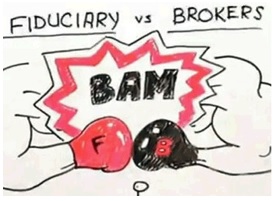
Enter the Certified Medical Planner™ charter professional designation. And, CMPs™ are FIDUCIARIES, 24/7.

FAs

Video: http://vimeo.com/84247360

An Interview with Bennett Aikin AIF®

Physician-Investors and the “F” Word

More:

Channel Surfing the ME-P

Have you visited our other topic channels? Established to facilitate idea exchange and link our community together, the value of these topics is dependent upon your input. Please take a minute to visit. And, to prevent that annoying spam, we ask that you register. It is fast, free and secure.

Conclusion

Your thoughts and comments on this ME-P are appreciated. Feel free to review our top-left column, and top-right sidebar materials, links, URLs and related websites, too. Then, subscribe to the ME-P. It is fast, free and secure.

Speaker: If you need a moderator or speaker for an upcoming event, Dr. David E. Marcinko; MBA – Publisher-in-Chief of the Medical Executive-Post – is available for seminar or speaking engagements. Contact: MarcinkoAdvisors@msn.com

OUR OTHER PRINT BOOKS AND RELATED INFORMATION SOURCES:

Comprehensive Financial Planning Strategies for Doctors and Advisors: Best Practices from Leading Consultants and Certified Medical Planners(TM)

How may we assist you?

← Back

Thank you for your response. ✨

2015 Could Be Rough on Stocks?

Join Our Mailing List

Here’s Why!

Daniel Crosby PhDBy Daniel Crosby, Ph.D.

“In the short run, the market is a voting machine but in the long run, it is a weighing machine.” – Benjamin Graham

***

Believing as I do in the sage advice of Mr. Graham, I recently set out to quantify my growing unease with the heights obtained by the bull market of the last five-plus years. As you read below, please realize that this is not a forecast or prognostication about what will happen – especially not in the short term. Timing the market on any sort of a short-term basis is a fool’s errand, as is deviating from your specific financial plan on the advice of a stranger.

Consider this more of a “Where are we at?” with respect to market valuations, secure in the knowledge that times of sensational highs and lows tend to be fleeting and that the market has a tendency to mean-revert (that is, become a weighing machine) in the long term. Having now sufficiently hemmed and hawed my way through the legal stuff – let me say that I find the market significantly overvalued and think that some sort of defensive measures will be wise for most investors in the year(s) to come.

The Levels

To corroborate this belief, I’d like to present you with four measures of market value, all at historically high levels. They are:

  1. Shiller Cyclically Adjusted Price to Earnings Ratio (CAPE)

What it is – The work of Nobel Prize winning behavioral economist Robert Shiller, the CAPE is the price/earnings ratio based on average, inflation-adjusted earnings for the previous ten years.

What it says – The CAPE currently sits at 27.2, 63.9% higher than its’ historical mean of 16.6. The CAPE has only crested or approached 27 three other times – 1929, 1997-2000, and 2007.

What it means – The CAPE is a poor predictor of short-term market movements (most everything is), but is much more reliable in speaking to the long term return horizon. Using Shiller’s own expected return formula (taken from value investing site GuruFocus), yields an expected return over the next 8 years of .3%. What is much more informative than a single prediction, however, is considering the range of possible distributions for the longer term, which are as follows:

Scenario Returns for next 8 years from today

Really Lucky 5.2%

Lucky 3%

Unlucky -3%

Really Unlucky -7.5%

It is certainly worth noting that even the “Really Lucky” scenario that might play out over the next 8 years vastly underperforms the market average.
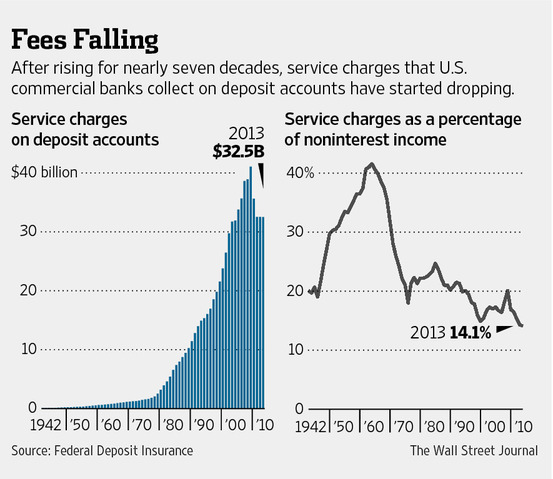
  1. S&P 500 Price to Earnings Ratio

What it is – A simple measure of the price paid for every dollar of earnings among some of the best capitalized and most liquid US securities.

What it says – The current P/E ratio of the S&P 500 is 19.96, well above it’s historical mean of 15.53 and median of 14.57.

What it means – As with the Shiller CAPE, greatly elevated levels of price to earnings have signaled a much lower return environment in the years to come. Ned Davis research has done the math on times when the market has been over or undervalued relative to fundamentals and has discovered the following:

Returns of S&P 500 Percentage Over/Under Valued (3-31-1926 to 5-31-2014)

More than 20% Overvalued (parentheses denote negative returns)

6 months – (.2)

1 year – (3.6)

2 years – (1.6)

3 years – 6.8

More than 20% Undervalued

6 months – 14

1 year – 19.4

2 years – 30.1

3 years – 47.3

Market Performance

6 months – 3.9

1 year – 8

2 years – 16

3 years – 23.6

According to Ned Davis and company, we are now well over 30% overvalued, comfortably above the threshold for the paltry “Overvalued” returns you see above.

*** future***

  1. Wilshire 5000/GDP – aka, “Buffett Valuation Indicator”

What it is – A sort of price to sales marker for the broader economy, once mentioned by Buffett as his favorite measure of market valuation.

What it says – The current market cap/GDP ratio sits at 127.3%, which is more than two standard deviations from the mean value of 68.8%.

What it meansGiven historical returns from this significantly elevated level of market cap to GDP, the predicted return for ’15 is .7%, which includes dividends. Drawing on Buffett’s comments, GuruFocus considers a 75 to 90% ratio fair value, with 90 to 115% modestly overvalued and anything over 115% significantly overvalued. The only other time since 1950 that this indicator has broken past two standard deviations of overvaluation is, you guessed it, in the run up to the 2000 crash.

  1. Crosby Irrationality Index

What it is – A measure of market sentiment that is comprised of sub-measures of volatility, valuation, fund flows, momentum and interest rate spreads.

What it says – The CII has spent all of 2014 at a level of elevated optimism just short of mania. While valuations have driven the score up, it has not reached “manic” levels, largely as a result of this having been “the most hated bull run in history.”

What it means – The CII provides one and three year projections based on the current levels of market sentiment. These projections should be understood less as specific predictions and more as headwinds or tailwinds to growth. The current projections are for slightly negative (-1.001) returns this year that persist even three years down the road (-2.6266).

Caveats

As with any measure, those listed above are subject to a number of failings. The CAPE includes data from the Great Recession that skew the results, a number of the measures fail to account for the interest rate environment, and so on. While no single measure is flawless, when so many measures point in the same direction, I believe it is worth taking note.

This information in and of itself is meaningless but should take on meaning as you discuss your individual needs with your advisor (you DO have an advisor, right?).

More:

For very long-term investors, even profound hiccups in the market may be little more than a contrarian buying opportunity. After all, there are more fun and important things to do in life than obsess over financial footnotes.

Assessment

But for those nearing retirement, an unambiguous picture seems to be emerging that returns for the next 8 to 10 years are likely to be depressed in light of the eye-popping returns of the more recent past. Do not act in haste or deviate from your plan if one is in place, but please accept this gentle warning from a concerned party who knows that “this time is never different.”

Even More:

Channel Surfing the ME-P

Have you visited our other topic channels? Established to facilitate idea exchange and link our community together, the value of these topics is dependent upon your input. Please take a minute to visit. And, to prevent that annoying spam, we ask that you register. It is fast, free and secure.

Conclusion

Your thoughts and comments on this ME-P are appreciated. Feel free to review our top-left column, and top-right sidebar materials, links, URLs and related websites, too. Then, subscribe to the ME-P. It is fast, free and secure.

Speaker: If you need a moderator or speaker for an upcoming event, Dr. David E. Marcinko; MBA – Publisher-in-Chief of the Medical Executive-Post – is available for seminar or speaking engagements. Contact: MarcinkoAdvisors@msn.com

OUR OTHER PRINT BOOKS AND RELATED INFORMATION SOURCES:

Comprehensive Financial Planning Strategies for Doctors and Advisors: Best Practices from Leading Consultants and Certified Medical Planners(TM)

On Hospital Endowment Fund Management

Join Our Mailing List

A Case Model Example

[By Dr. David Edward Marcinko MBA]

http://www.CertifiedMedicalPlanner.org

DEM at Wharton

Just as the field of medicine continuously changes, so too does the field of endowment management.

Endowment managers continue to increase their knowledge of the science and expand their skill in the art.

However, successful endowment managers will continue to focus on the areas that they can control in order to minimize the risk of the areas they cannot.

***

So, here is a case model to show you how it is done.

[Case Model]

Endowment Fund

***

hospital

Invite Dr. Marcinko

***

Channel Surfing the ME-P

Have you visited our other topic channels? Established to facilitate idea exchange and link our community together, the value of these topics is dependent upon your input. Please take a minute to visit. And, to prevent that annoying spam, we ask that you register. It is fast, free and secure.

More:

Conclusion

Your thoughts and comments on this ME-P are appreciated. Feel free to review our top-left column, and top-right sidebar materials, links, URLs and related websites, too. Then, subscribe to the ME-P. It is fast, free and secure.

Speaker: If you need a moderator or speaker for an upcoming event, Dr. David E. Marcinko; MBA – Publisher-in-Chief of the Medical Executive-Post – is available for seminar or speaking engagements. Contact: MarcinkoAdvisors@msn.com

OUR OTHER PRINT BOOKS AND RELATED INFORMATION SOURCES:

Product DetailsProduct Details

***

About Peer-to-Peer Lending [P2PL]

Join Our Mailing List 

What it is – How it works?

big_picBy TIMOTHY J. McINTOSH; MBA, MPH, CFP®, CMP™ [Hon]

Similar to private equity or venture capital, peer-to-peer lending [aka person-to-person lending, peer-to-peer investing and social lending] is the practice of lending money to unrelated individuals without the benefit a traditional financial intermediary like a bank or financial institution. P2P lending takes place online using various platforms and credit checking tools.

And, it has been in existence for about a decade.

Here are some important characteristics:

  • P2PL offers a chance to get a lower interest rate than a bank, and gives investors a chance to receive higher returns. Of course, more rewards means more risk.
  • The two largest P2PL companies are Prosper.com and LendingClub.com.  Prosper is older, Lending Club is bigger.  Prosper allows bidding on the interest rates you’re willing to provide a loan. Lending Club sets the rates.
  • Initial returns on Prosper were disappointing because default rates were high; today it is better. For loans originating in the last six months of 2009, both Lending Club and Prosper have a default rate (including currently late loans) of about 13.5%. Using loans from that same time period, Prosper had overall returns of 8.3% and Lending Club had returns of 4.3%.
  • Since avoiding defaults is an important part of P2PL, investors should buy many lots of notes – for as little as $25 each – which make it relatively easy to achieve broad diversification.  Compared to buying index funds and rebalancing once a year, P2PL is more time-consuming as you must pick the loans to invest in individually.  Filtering through the offered loans is time-consuming, but can be rewarding. Some investors sell off their notes at a discount once the borrower goes late on a payment for instance, or just because they need their money out of the investment before the term is up.
  • No matter how closely watched there will be a drag on returns from the cash in your portfolio.  It takes time to choose loans acceptable and then for them to be approved.  Just as with a mutual fund, this will lower your returns, perhaps as much as 1%.
  • One of the real benefits of P2PL is a low correlation with other investments, as it is different than other asset classes and ought to perform differently from equity and fixed income investments.

я74

More:

Assessment

The Author

Timothy J. McIntosh is Chief Investment Officer and founder of SIPCO.  As chairman of the firm’s investment committee, he oversees all aspects of major client accounts and serves as lead portfolio manager for the firm’s equity and bond portfolios. Mr. McIntosh was a Professor of Finance at Eckerd College from 1998 to 2008. He is the author of The Bear Market Survival Guide and the The Sector Strategist.  He is featured in publications like the Wall Street Journal, New York Times, USA Today, Investment Advisor, Fortune, MD News, Tampa Doctor’s Life, and The St. Petersburg Times.  He has been recognized as a Five Star Wealth Manager in Texas Monthly magazine; and continuously named as Medical Economics’ “Best Financial Advisors for Physicians since 2004.  And, he is a contributor to SeekingAlpha.com., a premier website of investment opinion. Mr. McIntosh earned a Bachelor of Science Degree in Economics from Florida State University; Master of Business Administration (M.B.A) degree from the University of Sarasota; Master of Public Health Degree (M.P.H) from the University of South Florida and is a CERTIFIED FINANCIAL PLANNER® practitioner. His previous experience includes employment with Blue Cross/Blue Shield of Florida, Enterprise Leasing Company, and the United States Army Military Intelligence.

Conclusion

Your thoughts and comments on this ME-P are appreciated. Feel free to review our top-left column, and top-right sidebar materials, links, URLs and related websites, too. Then, subscribe to the ME-P. It is fast, free and secure.

Speaker: If you need a moderator or speaker for an upcoming event, Dr. David E. Marcinko; MBA – Publisher-in-Chief of the Medical Executive-Post – is available for seminar or speaking engagements. Contact: MarcinkoAdvisors@msn.com

OUR OTHER PRINT BOOKS AND RELATED INFORMATION SOURCES:

Comprehensive Financial Planning Strategies for Doctors and Advisors: Best Practices from Leading Consultants and Certified Medical Planners(TM)

A Video Presentation by Political Economic Strategist Greg R. Valliere

Join Our Mailing List

Chief Political and Economic Strategist at Potomac Research Group Holdings, LLC

Video Pod-Cast Sponsored By

  • Sharkey, Howes & Javer
  • 720 S Colorado Blvd – So. Tower, Suite 600
  • Denver, CO 80246

Dear David,

We thoroughly enjoyed our time with those of you who were able to attend our annual Client and Friends Appreciation Event.

Since then, many of you have been requesting to see Greg R. Valliere’s presentation from the event. So, we recently posted the video on our website and would like to invite you, your family and friends to view it. If you missed the event, Greg’s speech was thought provoking, insightful and is well worth a watch.

Enjoy!

SHJ

***

Watch

< Click here to watch now >

SHJ

***

About Greg R. Valliere

Greg R. Valliere is a Chief Political Strategist at Potomac Research Group Holdings, LLC. He coordinates political and economic research. Mr. Valliere focuses on how Congress and the White House shape fiscal policies and monitors the Federal Reserve Board’s interest rate policies. He has over 30 years of experience in covering Washington for institutional investors. 

Prior to joining the firm, Mr. Valliere served as Chief Policy Strategist for Soleil Securities Group Inc. He was also employed at Stanford Group Company, Research Division. He previously held key strategy roles at Charles Schwab’s Washington Research Group and The Washington Forum. 

Mr. Valliere co-founded The Washington Forum in 1974, serving as Chief Political Analyst and Editor of the group’s publications, and ultimately as Research Director. He began his career in 1972 at F-D-C reports, monitoring the pharmaceutical industry. Mr. Valliere is an exclusive commentator for CNBC, appearing regularly on network programs such as ‘Squawk Box,’ ‘Power Lunch,’ ‘The Closing Bell,’ and ‘Kudlow & Company.’ He earned his Bachelor’s degree in Journalism from The George Washington University.

Channel Surfing the ME-P

Have you visited our other topic channels? Established to facilitate idea exchange and link our community together, the value of these topics is dependent upon your input. Please take a minute to visit. And, to prevent that annoying spam, we ask that you register. It is fast, free and secure.

Conclusion

Your thoughts and comments on this ME-P are appreciated. Feel free to review our top-left column, and top-right sidebar materials, links, URLs and related websites, too. Then, subscribe to the ME-P. It is fast, free and secure.

Speaker: If you need a moderator or speaker for an upcoming event, Dr. David E. Marcinko; MBA – Publisher-in-Chief of the Medical Executive-Post – is available for seminar or speaking engagements. Contact: MarcinkoAdvisors@msn.com

OUR OTHER PRINT BOOKS AND RELATED INFORMATION SOURCES:

Financial Planning MDs 2015

Comprehensive Financial Planning Strategies for Doctors and Advisors: Best Practices from Leading Consultants

About the INSTITUTE OF MEDICAL BUSINESS ADVISORS, Inc.

Join Our Mailing List

About

INSTITUTE OF MEDICAL BUSINESS ADVISORS, Inc.

  ***

The Institute of Medical Business Advisors, Inc provides a team of experienced, senior level consultants led by iMBA Chief Executive Officer Dr. David Edward Marcinko MBA CMPMBBS [Hon] and President Hope Rachel Hetico RN MHA CMP™ to provide going contact with our clients throughout all phases of each project, with most of the communications between iMBA and the key client participants flowing through this Senior Team.

Product Details

iMBA Inc., and its skilled staff of certified professionals have many years of significant experience, enjoy a national reputation in the healthcare consulting field, and are supported by an unsurpassed research and support staff of CPAs, MBAs, MPHs, PhDs, CMPs™, CFPs® and JDs to maintain a thorough and extensive knowledge of the healthcare environment.

Product Details

The iMBA team approach emphasizes providing superior service in a timely, cost-effective manner to our clients by working together to focus on identifying and presenting solutions for our clients’ unique, individual needs.

Product Details

The iMBA Inc project team’s exclusive focus on the healthcare industry provides a unique advantage for our clients.  Over the years, our industry specialization has allowed iMBA to maintain instantaneous access to a comprehensive collection of healthcare industry-focused data comprised of both historically-significant resources as well as the most recent information available.  iMBA Inc’s specific, in-depth knowledge and understanding of the “value drivers” in various healthcare markets, in addition to the transaction marketplace for healthcare entities, will provide you with a level of confidence unsurpassed in the public health, health economics, management, administration, and financial planning and consulting fields.

 Product DetailsProduct DetailsProduct Details

iMBA Inc’s information resources and network of healthcare industry textbook resources enhanced by our professional consultants and research staff, ensure that the iMBA project team will maintain the highest level of knowledge regarding the current and future trends of the specific specialty market related to the project, as well as the healthcare industry overall, which serves as the “foundation” for each of our client engagements.

Product Details  Product Details

Ann Miller RN MHA

www.MedicalBusinessAdvisors.com

Financial Advisor Education Letterhead CMP

Solicitation Letterhead.iMBA, Inc

Sample iMBA Engagements

iMBA Seminar Topics

***

Financial Planning MDs 2015

Comprehensive Financial Planning Strategies for Doctors and Advisors: Best Practices from Leading Consultants and Certified Medical Planners™

***

Do You Have a Taxable Investment Account – Doctor?

Join Our Mailing List

Is it Time to Harvest?

[By Lon Jefferies MBA CFP®]

Lon JeffriesTax harvesting is the process of selling assets for the purpose of creating either long-term capital gains or losses to minimize your tax bill. This procedure is usually conducted near the end of a calendar year.

While many people are familiar with the concept of tax loss harvesting, fewer physicians or clients are familiar with the more recently developed process of tax gain harvesting. Between these two procedures, virtually everyone with a taxable (not tax-advantaged) investment account should make adjustments to their portfolio before the year ends.

Who Qualifies For the 0% Capital Gains Rate?

First, it is important to understand that capital gains (the growth on investments within a taxable, non retirement investment account) are taxed differently than ordinary income (wages, pensions, Social Security, IRA distributions, etc.). While short-term capital gains (recognized on the sale of assets held less than a year) are essentially considered ordinary income, long term capital gains, or recognized gains on assets held more than a year, are taxed at advantageous tax rates. While ordinary income tax rates range from 10% to 39.6%, capital gains tax rates range from 0% to 20%.

Second, it is crucial to understand what enables a taxpayer to qualify for the 0% capital gains rate. If a taxpayer is in the 10% or 15% ordinary income tax bracket, they qualify for the 0% long-term capital gains rate.

For a married couple filing jointly, the 15% tax bracket ends at $73,800 of taxable income ($36,900 for single taxpayers). Thus, if a married taxpayer has a taxable income (which includes long-term capital gains but is also after deductions and exemptions) of less than $73,800, all their long-term capital gains will be tax free. If the taxpayer is in a tax bracket anywhere between 25% and 35% (taxable income of $73,800 and $457,600, or between $36,900 and $406,750 for single tax filers), they will pay long-term capital gains taxes at 15%. Only those in the top tax bracket of 39.6% (married taxpayers with a taxable income over $457,600 and single taxpayers with taxable income over $406,750) will pay capital gains taxes at 20%.

Tax Loss Harvesting

During the calendar year, assets have been purchased and sold in most taxable investments accounts. The sale of an asset creates a net gain or loss, both having tax implications. Investors should have an understanding of what their long-term capital gains tax rate will be so they can determine whether a taxable gain or loss is preferable.

For instance, an individual who does not qualify for the 0% capital gains tax rate may wish to minimize the amount of taxable gains they recognize during the year, which would reduce their tax bill. If the investor currently has a net long-term capital gain (which is probable after the strong year the market had in 2013), then it is likely worthwhile to sell any assets in the portfolio that are currently worth less than the investor’s purchase price. This tax loss harvesting would reduce the net gain recognized during the year and lower the investor’s tax bill.

In some cases, by taking advantage of all potential losses within a portfolio an investor has the ability to negate all capital gains created during the year, completely eliminating their capital gains tax bill. Further, the IRS will allow investors to recognize a net capital loss of up to a -$3,000 per year. This -$3,000 loss can be used to lower the taxpayers ordinary income. This is particularly advantageous in that the capital loss reduces a type of income that is taxed at higher tax rates.

Harvesting Gains

Harvesting gains from a taxable portfolio is a more recently developed concept. Once the 0% long-term capital gains tax rate became a permanent part of the tax code with the passing of the American Taxpayer Relief Act of 2012 (signed January 2nd, 2013), in some scenarios it began making sense to recognize long-term capital gains on purpose to potentially avoid a larger tax bill in the future.

Suppose a taxpayer’s taxable income is consistently $65,000 a year. Additionally, suppose our hypothetical taxpayer won’t withdraw funds from his taxable account during the next few years, but may need a large lump sum distribution five years down the road. Recall that the 0% capital gains rate ends when a married taxpayer’s taxable income (which includes long-term capital gains) exceeds $73,800. Consequently, this hypothetical taxpayer has the ability to recognize $8,800 ($73,800 – $65,000) in long-term capital gains every year without increasing his tax bill. If this $8,800 in gains is recognized every year by simply selling and immediately repurchasing appreciated assets, he would raise the cost basis of his investment by $44,000 ($8,800 gain recognized annually for five straight years). He could then sell and withdraw that $44,000 without creating a tax liability.

Alternatively, if the investor does not harvest gains during the years when no distributions are taken, withdrawing $44,000 of gains five years down the road would create a sizable tax bill. He would still be able to recognize $8,800 of gains tax free in the year of distribution, but the remaining $35,200 of gains would cause his taxable income to be over the $73,800 limit, eliminating access to the 0% capital gains rate. That $35,200 would be taxed at the 15% capital gains rate, creating a federal tax bill of $5,280. With proper planning, this significant tax bill can be avoided.

***

Portfolio analysis

***

The Bottom Line

Tax harvesting has no purpose in tax-advantaged retirement accounts such as IRAs and 401ks because all distributions from these accounts are taxed as ordinary income. However, taxable individual or trust investment accounts can almost certainly benefit from tax harvesting. Speak to your accountant and financial planner to understand whether capital gains or losses are desirable for you this year and determine the amount of taxable gains already recognized. This will help you determine what type of harvesting should take place.

Tax harvesting can be a difficult and confusing concept. However, a competent financial planner who utilizes this procedure within your taxable investment account can significantly lower your tax bill. Speak to your adviser to ensure you are reaping the tax benefits available to you.

Channel Surfing the ME-P

Have you visited our other topic channels? Established to facilitate idea exchange and link our community together, the value of these topics is dependent upon your input. Please take a minute to visit. And, to prevent that annoying spam, we ask that you register. It is fast, free and secure.

Conclusion

Your thoughts and comments on this ME-P are appreciated. Feel free to review our top-left column, and top-right sidebar materials, links, URLs and related websites, too. Then, subscribe to the ME-P. It is fast, free and secure.

Speaker: If you need a moderator or speaker for an upcoming event, Dr. David E. Marcinko; MBA – Publisher-in-Chief of the Medical Executive-Post – is available for seminar or speaking engagements. Contact: MarcinkoAdvisors@msn.com

OUR OTHER PRINT BOOKS AND RELATED INFORMATION SOURCES:

Financial Planning MDs 2015

Comprehensive Financial Planning Strategies for Doctors and Advisors: Best Practices from Leading Consultants

My Stock Market Forecast for 2015

Join Our Mailing List 

All Forecasts Will Be Wrong

[By Lon Jefferies MBA CFP®]

Lon JeffriesThe investment media is a rare industry in which professionals are rewarded for making bold projections but never punished for being wrong. The more outlandish a pundit’s forecast the more attention it receives.

Yet, surprisingly little consideration is given to how accurate the prediction turns out to be.

At the beginning of 2014, there were some widely-accepted expectations regarding the investment environment.

Let’s review those predictions and analyze how precise they really were.

Interest Rates

In a study conducted by Bloomberg at the beginning of the year, all 72 economists surveyed predicted higher interest rates and falling bonds prices in 2014. Consequently, investors were questioning whether they should reduce or eliminate the bond portion of their portfolios until the rate increase occurred.

So, have we experienced this rise in interest rates?

On January 1st, 2014, the yield on the 10-year Treasury note was 3 percent. On November 13th, the yield on the same note was 2.35 percent. That’s right — interest rates actually decreased significantly during the year. As a result, intermediate U.S. government bonds (ticker – IEF) produced a return of 7.38% during the year. Not bad for the conservative portion of your portfolio!

Quantitative Easing

The most widely promoted fear among forecasters was that the phasing out of the Federal Reserve’s quantitative easing (QE) program would diminish stock returns. Prognosticators worried that the Fed would lower the amount of loans the government would buy from commercial banks, thus reducing the amount of money available for new businesses to borrow leading to less innovation and the creation of fewer jobs.

But, was the reduction of quantitative easing a legitimate fear? In fact, this possibility came to fruition. In December of 2013, the Federal Reserve was buying $85 billion of financial assets from commercial banks each month. The Fed reduced this amount during every meeting it held this year, finally eliminating the action completely in October.

However, the elimination of Quantitative Easing did not have a negative impact on the unemployment rate, which declined from 6.7% in January to 5.8% in October. Further, the S&P 500 has gained 12.31% year-to-date (as of 11/13/14). Clearly, fading out the Quantitative Easing program didn’t have the negative impact on stocks that many pundits expected.

Increased Volatility

Another widely held viewpoint at the beginning of the year was that 2014 was likely to be more volatile than anything experienced in 2012 or 2013. There was talk about valuations and P/E ratios being too high, concern about the war in Ukraine (ISIS wasn’t even in the headlines yet), and endless noise about unfavorable weather patterns impacting the market.

So, has 2014 been a wild ride? Since 1929, the S&P 500 has experienced either a rise or a decline of more than 1% during 23% of trading days. In 2014, the S&P 500 moved more than 1% only 15% of the time. Less movement equates to less volatility, so again forecasters were inaccurate.

2015 Forecasts

Bloomberg News recently published a story titled Predictors of ’29 Crash See 65% Chance of 2015 Recession, in which the grandson of a prognosticator who luckily forecasted the Great Depression is still getting attention for a guess his grandfather made 85 years ago. If giving credence to forecasters isn’t ridiculous enough, suggesting there is a gene for forecasting is insane!

The article doesn’t mention that the same grandson made similar headlines with the same forecast in both 2010 and 2012; of course, those predictions did not work out so well. You will start hearing many 2015 projections soon, so pay no heed.

***

glasses

***

Ignore the Pundits

The most significant lesson inherent in these numbers is that market expectations are essentially useless. Despite their abysmal track record, the news media loves forecasters because they capture attention and fill space. Unfortunately, pundits making projections are rarely held to their inaccurate forecasts and are allowed to continue making a living showing they have no greater knowledge than the average investor.

Of course, this is not to say that interest rates will never rise, that bond values will never decline, and that the market won’t return to the roller coaster it is. In fact, all those things are certain to happen. Unfortunately, anyone who contends to know “when” likely doesn’t actually know anymore than you or me. For this reason, having and sticking to a diversified investment strategy that coincides with a detailed financial plan is the most probable path to financial success.

More: 

Channel Surfing the ME-P

Have you visited our other topic channels? Established to facilitate idea exchange and link our community together, the value of these topics is dependent upon your input. Please take a minute to visit. And, to prevent that annoying spam, we ask that you register. It is fast, free and secure.

Conclusion

Your thoughts and comments on this ME-P are appreciated. Feel free to review our top-left column, and top-right sidebar materials, links, URLs and related websites, too. Then, subscribe to the ME-P. It is fast, free and secure.

Speaker: If you need a moderator or speaker for an upcoming event, Dr. David E. Marcinko; MBA – Publisher-in-Chief of the Medical Executive-Post – is available for seminar or speaking engagements. Contact: MarcinkoAdvisors@msn.com

OUR OTHER PRINT BOOKS AND RELATED INFORMATION SOURCES:

Comprehensive Financial Planning Strategies for Doctors and Advisors: Best Practices from Leading Consultants

2014 – A Near Record Year for IPOs

Join Our Mailing List

A 2014 Wrap-Up 

[By Inside the Ticker]

***

1

***

2

***

3

***

More:

Assessment

Channel Surfing the ME-P

Have you visited our other topic channels? Established to facilitate idea exchange and link our community together, the value of these topics is dependent upon your input. Please take a minute to visit. And, to prevent that annoying spam, we ask that you register. It is fast, free and secure.

Conclusion

Your thoughts and comments on this ME-P are appreciated. Feel free to review our top-left column, and top-right sidebar materials, links, URLs and related websites, too. Then, subscribe to the ME-P. It is fast, free and secure.

Speaker: If you need a moderator or speaker for an upcoming event, Dr. David E. Marcinko; MBA – Publisher-in-Chief of the Medical Executive-Post – is available for seminar or speaking engagements. Contact: MarcinkoAdvisors@msn.com

OUR OTHER PRINT BOOKS AND RELATED INFORMATION SOURCES:

Financial Planning MDs 2015

Comprehensive Financial Planning Strategies for Doctors and Advisors: Best Practices from Leading Consultants

***

Understanding the “Least” Important Issues for Physician-Investors

Join Our Mailing List 

A Dimensional Fund Advisors Survey

By Rick Kahler MS CFP® http://www.KahlerFinancial.com

Rick Kahler MS CFPIn this ME-P, I will focus on the three least important things investors want to know. The rankings came from a survey of investors, funded by Dimensional Fund Advisors, conducted in March 2014 by Advisor Impact.

All three deserved to be much higher on the list. In my experience, they are what most physicians and all investors really need to know.

The factors

These three factors are:

  • What are the chances the investment will lose money? Only 10% of investors thought it was important to ask about factors that contributed to historic performance. Just one-third thought it important to even ask about historical performance in general.
  • What type of volatility can they expect? Only 17% of investors considered this important.
  • How and why did the advisor select the investment for their portfolio? Only 21% of survey respondents thought this was important, and just 8% asked about the investment managers chosen.

Drilling Down and Going Granular

Some of these factors may seem difficult to understand, but they do matter. Give your financial advisor a chance to explain them; it can help you become a more informed investor.

ME-P Physicians

  1. Chances of losing money

This factor could be better addressed by asking about the specific factors that influenced historic performance of the security over various long-term economic climates. True, looking at the past performance of an investment is never a guarantee of future performance.

Yet, if the historical periods evaluated contain a variety of economic conditions (high inflation, various economic cycles, various political influences, etc.) and long-term holding periods (at least 10 years or more), looking backward may give you a reasonable idea of what future performance might look like.

  1. Volatility

Most investors will cognitively agree they fully understand that most investments that carry any chance of real (after inflation) significant long-term return will fluctuate. I say “cognitively” because, once that fluctuation happens on the downside, all cognitive understanding sometimes goes out the window and the emotional brain takes control.

One way of internalizing the potential fluctuation of an investment is to ask about its volatility. Specifically, it’s standard deviation. This measure of the amount of variation from the average is something an advisor can easily find out for almost every bond, stock, and mutual fund. Take the standard deviation times three, then subtract that number from the average return. This is the amount of value over one year your investment could drop (or rise) in 99% of all years. Stated conversely, there is only a 1% chance your investment would drop further in any one year.

  1. Portfolio Fit

I recently sent back a shirt that hung on me like a tent. While it would have been perfect for a larger guy, it was not a fit for me. Investments are similar. While some are perfect matches for one portfolio, they can be lethal in another. An over-allocation to emerging market stocks may make perfect sense for a newborn, but it could be a retirement disaster for a 90-year-old.

Pensive Financial Advisor for Physicians

Assessment

It’s important to ask why an investment belongs in your portfolio. You want investments (asset classes) that complement one another by tending to fluctuate independently of each other.

In an ideal balance of investments, when some decrease in value the other half increase an equal or greater amount, and all of them earn a real return over time.

Conclusion

Your thoughts and comments on this ME-P are appreciated. Feel free to review our top-left column, and top-right sidebar materials, links, URLs and related websites, too. Then, subscribe to the ME-P. It is fast, free and secure.

Speaker: If you need a moderator or speaker for an upcoming event, Dr. David E. Marcinko; MBA – Publisher-in-Chief of the Medical Executive-Post – is available for seminar or speaking engagements. Contact: MarcinkoAdvisors@msn.com

OUR OTHER PRINT BOOKS AND RELATED INFORMATION SOURCES:

 Comprehensive Financial Planning Strategies for Doctors and Advisors: Best Practices from Leading Consultants and Certified Medical Planners™

On The Next Stock Market Correction?

Join Our Mailing List

Remember the Ace Up Your Sleeve!

By Lon Jefferies MBA CFP® CMP®

Lon JeffriesAfter the historic growth the stock market has experienced since early 2009, many physician investors have felt that a healthy pullback may not be a completely negative thing.

After all, we certainly don’t want another bubble, or stock prices that are clearly out of line with the earning potential of the underlying companies.

Unfortunately, market corrections never feel healthy when they occur. Physicians, investors and almost all people get uncomfortable when the market declines, the media fans the flames by giving investors reason after reason to be afraid, and worries that this is the beginning of the next crash begin to develop.

While many investors admit that a 5% pullback is manageably unpleasant, concerns expand when the market decline hits 10% — right when the media can officially throw around the word “correction.”

Of course, we have no idea when the next drop will occur, but why not mentally prepare ourselves by exploring what has traditionally happened to stock prices once that 10% decline is crossed?

The Data

Ben Carlson, an institutional investment portfolio manager, looked at the S&P data going back to 1950, and found that there have been 28 instances when stocks fell by 10% or more. Thus, on average, the market has entered an official correction every 2.25 years. The last market correction occurred in 2011, so another 10% drop at this time would correlate pretty close to the average amount of time between corrections.

Obviously, the market has done pretty well since that last temporary correction in 2011. Clearly, such a drop is quite normal and far from historically concerning.

  • S&P 500 Losses of 10% or More Since 1950
  • Total Occurrences: 28 Times
  • Average Loss: -21.6%
  • Median Loss: -16.5%
  • Average Length: 7.8 Months
  • Greater Than 20% Loss: 9 Times
  • Greater Than 30% Loss: 5 Times

Your Advantage

Are you thinking “I don’t think I can stomach that median loss of 16.5%?” Then it’s time to pull out the ace up your sleeve. Remember that the data above represents the historical performance of the S&P 500 – an index that is composed of 100% stocks. A capable financial planner would ensure you have an asset allocation mix between stocks, bonds, and cash that represents your tolerance for risk.

Consequently, your portfolio likely isn’t 100% stocks. In fact, the appropriate allocation for an average investor approaching or already enjoying retirement might be closer to only 50% stocks. This means that on average, your portfolio should decline only half as much as the S&P 500 during market downturns.

This ace may bring the loss endured by our sample investor with a 50% stock portfolio down to around 8.25% during the median decline. Are you now back in the “manageably unpleasant” range? If so, you likely have an appropriately constructed portfolio. If not, your risk tolerance may need to be reevaluated to ensure you are not exposing your nest egg to a larger loss than you can endure.

Avoid Harmful Reactions to the Market

Although the recent market pullback produces what seems like a foreign feeling, we’ve been here before. The S&P 500 declined in value by 18.64% over a 5 month period in 2011. However, an investor with a 50% stock portfolio likely only saw their account values drop around 9%-10% — still not fun, but manageable.

Assessment

Of course, we don’t know whether the market will continue to bounce back or again drop into official correction territory. If you continue to hear about the broad markets declining, remember that the average historical correction has been far from catastrophic, and that you have the ace of an appropriate asset allocation up your sleeve.

Financial Planning MDs 2015

Comprehensive Financial Planning Strategies for Doctors and Advisors: Best Practices from Leading Consultants and Certified Medical Planners™

Conclusion

Your thoughts and comments on this ME-P are appreciated. Feel free to review our top-left column, and top-right sidebar materials, links, URLs and related websites, too. Then, subscribe to the ME-P. It is fast, free and secure.

Speaker: If you need a moderator or speaker for an upcoming event, Dr. David E. Marcinko; MBA – Publisher-in-Chief of the Medical Executive-Post – is available for seminar or speaking engagements. Contact: MarcinkoAdvisors@msn.com

OUR OTHER PRINT BOOKS AND RELATED INFORMATION SOURCES:

Product Details  Product Details

“The Wall Street Casino”

 Join Our Mailing List 

Am I Scolded?

[By Rick Kahler MS CFP®] http://www.KahlerFinancial.com

Rick Kahler MS CFPJust recently I heard from an insurance salesman who scolded me for never giving any investment advice except to put all your money into “The Wall Street Casino.”

The impetus for this admonishment was the “up-down”, “buy-sell”, market craziness of this past week; no doubt.

My Story

Over the past 23 years, I’ve penned scores of columns about the benefits of a diversified portfolio of asset classes (Wall Street being just one of them). Still, I would far rather invest 100% of my retirement funds in a diversified portfolio of US stocks than speculate on a roulette wheel. There is a big difference between investing and speculating.

I learned that difference the hard way when I was in my early twenties. I had some money in savings and some mutual funds in an IRA, but they weren’t building wealth fast enough for me. Gold prices were up and going higher, so I took $1000 out of my savings and put it into gold futures. In just a few days, my $1000 had turned into $3000.

My broker suggested putting the $3000 into pork bellies. I didn’t really know what they were, but he seemed to know what he was talking about, so I bought pork bellies. For a few days, everything was fine. Then the price of pork bellies tanked. For five days straight, the price fell so dramatically that trading was stopped at the beginning of the day. I couldn’t even sell. There was nothing to do except watch the losses pile up.

By the time trading resumed, I had a margin call for $12,500 ($50,000 today, adjusted for inflation). To pay it, I had to wipe out my savings and cash in my IRA. At least I had savings, so I didn’t have to go borrow the money.

I had made a classic rookie mistake—speculating instead of investing.

***

blackjack

***

The Money Options Triad

There are three things you can do with money you wish to set aside: save, invest, or speculate.

  1. Saving is putting money away for future needs, often in a bank savings account or CDs. The primary purpose isn’t building wealth; it’s having money when you need it for emergencies or large purchases.
  2. Investing is diversifying money into stocks, bonds, real estate, commodities, and other asset classes. The purpose is to build wealth over the long term, so investing is boring. While you will see the value of your money decline as well as increase, it is unlikely that over a long period of time you will actually suffer a permanent loss of capital. Your returns over time will probably be more than you would earn from simple savings.
  3. Speculating is putting money into a high-risk investment in the hope of building wealth quickly. It’s exciting, dramatic, and risky. Examples of speculating include trying to time the markets through day trading, putting everything you have into one investment, and borrowing to buy stocks, real estate, or commodities. True, great fortunes have been made through speculating, but many more fortunes have been lost. Not only can you lose your initial investment, you can—as I did with my pork bellies—lose way more money than you had to begin with.

When novices skip from saving to speculating, chances are good that they’ll lose big. Unfortunately, too many of them learn the wrong lesson. They decide, “Investing is too risky,” never realizing they were speculating rather than investing.

***

American Flag

***

The Savings Trap

As a result, in the future they may limit themselves to saving. Their money stays safe, but over time they lose in a big way, especially through decreased purchasing power. Investing is not a “casino,” but a way to earn the long-term returns that are so important for building net worth and achieving financial security.

Assessment

So, have I been scolded; my bad?

Conclusion

Your thoughts and comments on this ME-P are appreciated. Feel free to review our top-left column, and top-right sidebar materials, links, URLs and related websites, too. Then, subscribe to the ME-P. It is fast, free and secure.

Speaker: If you need a moderator or speaker for an upcoming event, Dr. David E. Marcinko; MBA – Publisher-in-Chief of the Medical Executive-Post – is available for seminar or speaking engagements. Contact: MarcinkoAdvisors@msn.com

OUR OTHER PRINT BOOKS AND RELATED INFORMATION SOURCES:

Financial Planning MDs 2015

Comprehensive Financial Planning Strategies for Doctors and Advisors: Best Practices from Leading Consultants

Is it Time to Reduce Your Bond Exposure?

Join Our Mailing List 

On Investment Portfolio Analysis

By Lon Jefferies MBA CFP®

Lon Jefferies

For the last half-decade, investors have been continually concerned about rising interest rates and the effect they may have on the bond portion of their investment portfolio.

The fear is that if interest rates rise, the bonds currently held by investors will be outdated and provide investment returns that are less than what new bonds issued at the higher yields would return.

Concerned?

There is validity to this concern – if an investor could buy a bond yielding 4% on the open market, why would anyone buy a bond that yields only 3%, unless they could do so at a significant discount? Given that today’s interest rates are considerably lower than historical averages and expected to rise in the future, would now be a good time to sell some of the bonds in your portfolio?

Consider the Timing

First, let’s consider one of the most basic principles of investing – that markets are unpredictable. Are we certain that interest rates will rise, and are we confident this rate increase will happen soon? I’d contend the answer to both questions is no.

Actually, the majority of investors have believed interest rates would rise since the first round of quantitative easing took place in 2009, and have suspected rates would rise in every calendar year since.  Quite simply, this has not happened. In fact, interest rates are currently lower than they were during the majority of 2009 despite five years of buzz about interest rate hikes.

During this five-year period, how have bonds performed? From 2009 through 2013, the Barclays Aggregate Bond Index (AGG) returned 5.93%, 6.54%, 7.84%, 4.22%, and -2.02%, respectively. Bonds only declined once during the five-year period, by a relatively nominal -2.02%, and still averaged a compound rate of return of 4.86%—not bad for the conservative portion of a portfolio.

Additionally, various bond categories have done even better than the Aggregate Bond Index, which consists of just U.S. government and corporate bond holdings. For instance, emerging market bonds (EMB) achieved a compounded return of 9.30%, while high yield bonds (HYG) returned 12.26% annually over the same five-year span. An investor whose bond portfolio was diversified among a range of asset categories has far from suffered since the expectation of a rate increases began.

Will You Miss the Stability of Bonds?

Let’s also consider the consistency of bonds. Since 1980, the Aggregate Bond Index has achieved a positive return an astonishing 31 out of 34 years (91% of the time!). Given this data, perhaps bonds aren’t as likely to decline in value as some investors think.

Equally amazing, although the bond index has achieved an annual return as high as 32.65% during this time period (in 1982), the largest loss it ever suffered in a calendar year over the same period was just -2.92% (in 1994). Over the entire 34-year period, the index obtained an average annual gain of 8.42%. Bottom line: Over the last 34 years, bonds have offered a lot of return for relatively little risk.

Diversification: the Most Important Factor

Not putting all your eggs in one basket is another basic principal of investing, and the primary motivation for having a significant portion of your portfolio allocated in bonds. It is important to remember that for an investor with a long-term perspective, equities will likely provide the majority of investment growth and return in a portfolio while bonds are needed to reduce volatility and risk.

For example, while a portfolio that was 100% stocks suffered a 38.6% loss in 2008, a portfolio that was 50% stocks and 50% bonds suffered a loss of only 14.5% the same year—still not pleasant, but much more manageable.

***

healthcare costs

***

Correlation

Bonds reduce risk in a portfolio because their return has a low correlation to the return of stocks. How low? Since 1928, both the S&P 500 and the 10-year treasury note have lost value during a calendar year only three times (in 1931, 1941 and 1969). That is less than 4% of all annual periods!

Further, since the Barclays Aggregate Bonds Index was created in 1973, the index has never decreased in value in the same year as the S&P 500. Amazing, but true! Clearly, bonds are fulfilling their role as a diversifier and reducing the volatility in your portfolio.

There is Always a Role for Bonds

Despite the continuous threat of rising interest rates, bonds have continued to perform. More importantly, history illustrates that mixing bonds with stocks smoothes out the investment results of your portfolio.

Assessment

Don’t get sucked in by the media buzz. Bonds are too valuable an asset to disregard.

The Author:

Lon Jefferies is a Certified Financial Planner with a fee-only approach to ensure the client’s best interest is the top priority. He isn’t paid commission and gains nothing through recommendations but his client’s satisfaction. He has contributed to national publications like The Wall Street Journal, The New York Times, USA Today, Morningstar.com and Investment News.   

Conclusion

Your thoughts and comments on this ME-P are appreciated. Feel free to review our top-left column, and top-right sidebar materials, links, URLs and related websites, too. Then, subscribe to the ME-P. It is fast, free and secure.

Speaker: If you need a moderator or speaker for an upcoming event, Dr. David E. Marcinko; MBA – Publisher-in-Chief of the Medical Executive-Post – is available for seminar or speaking engagements. Contact: MarcinkoAdvisors@msn.com

OUR OTHER PRINT BOOKS AND RELATED INFORMATION SOURCES:

Product Details  Product Details

How Banks’ Fee Bonanza Dries Up

Join Our Mailing List

Changes in rules and customer behaviors are squeezing what was for decades a key source of revenue

[By Dr. Carey via FDIC]

***

fees

***

Assessment

More:

Conclusion

Your thoughts and comments on this ME-P are appreciated. Feel free to review our top-left column, and top-right sidebar materials, links, URLs and related websites, too. Then, subscribe to the ME-P. It is fast, free and secure.

Speaker: If you need a moderator or speaker for an upcoming event, Dr. David E. Marcinko; MBA – Publisher-in-Chief of the Medical Executive-Post – is available for seminar or speaking engagements. Contact: MarcinkoAdvisors@msn.com

OUR OTHER PRINT BOOKS AND RELATED INFORMATION SOURCES:

Product DetailsProduct Details

Are All-Time Stock Market Highs Really That Bad?

Join Our Mailing List


The 30th all-time high for the S&P 500 in 2014 alone

By Lon Jefferies MBA CFP®

Lon JefferiesLast week, the S&P 500 achieved an all-time high, exceeding the 2,000 level for the first time ever during intra-day trading. The index ended the day at 2,001 almost exactly triple the market low of 666 achieved in March of 2009 during the global financial crises. Yesterday, it reached another high; 2,007.

Believe it or not, this was the 30th. all-time high for the S&P 500 in 2014 alone.

Fearing the Phrase

Many investors fear the phrase “all-time high,” believing it implies stocks have already captured the gains available in the market and that there is nowhere for the value of these equities to go but down. However, all-time highs are perfectly normal in the stock market. In fact, since 1950 there have been over 1,100 new all-time closing highs achieved by the S&P 500. That is 6.8% of all trading days or roughly 1 out of every 15 days the market is open that it’s closed at a new high level!

In addition, while it is true the S&P 500 hit a new nominal high, it is still significantly under its high when adjusted for inflation. In fact, Will Hausman, an economics professor at the College of William and Mary, calculates that the S&P 500 hit its true high – its inflation-adjusted high – of 2,120 on January 14, 1999. By that metric, 15 years ago the S&P 500 was 10% higher than it is now. Put that way, it is possible the market could continue to appreciate at its current pace without valuations exceeding their historical peak.

***

graph

***

Market highs not necessarily bad

My goal is to point out that the phrase “all-time high” isn’t necessarily bad when relating to the stock market.

Now, just because stocks are at all-time high levels certainly doesn’t make them immune to a decline or even a crash. Stocks were at all-time high levels before the tech bubble of 2000 popped, and if by measured by the NASDAQ index, the market still hasn’t fully recovered. However, stocks aren’t required to decline just because they are at levels unattained before.

Assessment

Physicians and all investors don’t need to feel the need to sell their equity investments or not invest new dollars in the market just because the S&P 500 is at a number we haven’t yet seen. My favorite quote regarding the subject comes from financial columnist Nick Murray: “If you think the market is “too high,” wait until you see it 20 years from now.”

More:

Conclusion

Your thoughts and comments on this ME-P are appreciated. Feel free to review our top-left column, and top-right sidebar materials, links, URLs and related websites, too. Then, subscribe to the ME-P. It is fast, free and secure.

Speaker: If you need a moderator or speaker for an upcoming event, Dr. David E. Marcinko; MBA – Publisher-in-Chief of the Medical Executive-Post – is available for seminar or speaking engagements. Contact: MarcinkoAdvisors@msn.com

OUR OTHER PRINT BOOKS AND RELATED INFORMATION SOURCES:

Product Details

Product Details

A 2014 Stock Market Mid-Year Review

Join Our Mailing List 

What Do We Know?

[A SPECIAL R&D REPORT FOR THE ME-P]

By Lon Jefferies MBA CFP®

Lon JefferiesIf you pay close enough attention to the news media you’ll eventually learn that much emphasis is placed on pundits’ forecasts, but very little consideration is given to how accurate the projections turn out.

When 2014 started, there were some pretty widely-accepted expectations regarding the investment environment. Let’s take a minute to review those anticipations and analyze how precise they turned out to be.

Interest Rates

One of the most universally accepted beliefs going into 2014 was that interest rates were on the cusp of rising, and that consequently, bond returns would drop. (Of course, this has been the expectation for around five years now, but that is a discussion for a later time.) Investors were questioning whether they should reduce or eliminate the bond portion of their portfolios until the rate increase occurred.

So, have we experienced the rise in interest rates we were expecting? On 1/2/14, the yield on the 10-year Treasury note was 3%. As of 6/30/14, the yield on the same note was 2.516%.

That’s right — interest rates have actually decreased over the last six months. Did those who stuck with their investment strategies and maintained their bond positions experience a decline in their portfolio’s value?

Here is how a variation of different bonds have performed year-to-date (as of 6/30/14):

  • US Government Bonds (IEF): 4.89%
  • US TIPS (TIP): 5.25%
  • Corporate Bonds (LQD): 5.37%
  • International Bonds (IGOV): 5.66%
  • Emerging Market Bonds (LEMB): 6.42%

Equities

How about the equities side of the portfolio?

In January, predictions for stocks were all over the map — some predicted a full out correction (a loss of more than -20%), some predicted that we would keep chugging along at 2013′s pace, and most predicted something somewhere in between. There were, however, many factors that were a common cause of concern.

So, was the reduction of the Fed’s Quantitative Easing a legitimate fear? In fact, this possibility has come to fruition. In December, the Fed was buying $85 billion per month of financial assets from commercial banks and other private institutions. The Fed has reduced this monthly amount during every meeting it has held this year, and that amount is now down to $35 billion per month. However, the key question is what impact has this had on the stock market.

Here is how a wide basket of equities have performed year-to-date (as of 6/30/14):

The most widely accept fear among equity investors was the phasing out of the Fed’s Quantitative Easing (QE) program. Investors worried that the Fed would begin lowering the amount of loans the government would buy from commercial banks each month, which would lower the availability of capital in the economy.

Historically, less money in the system leads to less investing in new businesses, less innovation, and fewer jobs created.

  • Large Cap Stocks (IVV): 7.08%
  • Mid Cap Stocks (IJH): 7.57%
  • Small Cap Stocks (IJR): 3.30%
  • Foreign Stocks (IEFA): 4.34%
  • Emerging Markets (IEMG): 4.70%
  • Real Estate (IYR): 16.09%
  • Commodities (DJP): 7.32%
  • Gold (GLD): 10.27%

Volatility

The last widely-held viewpoint at the beginning of the year was that 2014 was likely to be a year more volatile than anything we had experience in 2012 or 2013. There was a lot of clatter about valuations and PE ratios being too high, concern about the war in Ukraine, a consensus that China was about to experience a drastic decline in both imports and exports, and a general feeling that the market was due for a significant (if not healthy) pullback.

Additionally, how much have we heard about unfavorable weather patterns over the last six months?

Managing a Stock Portfolio

Lessons Learned

Of course, all of this is not to say that interest rates will never rise, that bond values will never decline, and that the market won’t return to the roller coaster it is.

In fact, all those things are certain to happen. Unfortunately, anyone who contends to know the uncertain part of this equation — when — likely doesn’t actually know anymore than you or me. For this reason, having and sticking to a diversified investment strategy that coincides with a detailed financial plan is the most likely path to financial success.

The most significant lesson inherent in these numbers is that market expectations are essentially useless. Near the beginning of the year, the vast majority of experts anticipated interest rates to rise, bond values to drop, and volatility to increase. Unfortunately, pundits making projections are rarely held to their inaccurate forecasts and are allowed to continue making a living showing they have no greater knowledge than the average investor.

Assessment

So, has 2014 been a wild ride?

The S&P 500 dropped by -5.51% from 1/22/14 – 2/03/14, and by -3.89% from 4/2/14 – 4/11/14. These are the only declines of more than 2% that the S&P 500 has experienced all year!

Additionally, as of 6/30/14, the S&P 500 has now gone 54 consecutive trading days without an up or down move of greater than 1%, the longest stretch since 1995! By historical standards, 2014 is considered to be a very smooth ride.

More:

Stock Market at New Highs!

Conclusion

Your thoughts and comments on this ME-P are appreciated. Feel free to review our top-left column, and top-right sidebar materials, links, URLs and related websites, too. Then, subscribe to the ME-P. It is fast, free and secure.

Speaker: If you need a moderator or speaker for an upcoming event, Dr. David E. Marcinko; MBA – Publisher-in-Chief of the Medical Executive-Post – is available for seminar or speaking engagements. Contact: MarcinkoAdvisors@msn.com

OUR OTHER PRINT BOOKS AND RELATED INFORMATION SOURCES:

Product Details  Product Details

Product Details

“Retirement Investors Flock Back to Stocks”

Join Our Mailing List 

WSJ Front Page Headlines

[By Rick Kahler MS CFP® http://www.KahlerFinancial.com]

Rick Kahler CFP“Retirement Investors Flock Back to Stocks” was the front page headline of The Wall Street Journal on May 2, 2014.

I retweeted it to my Twitter feed, adding, “Just In Time to Ride Them to the Bottom Again.”

Introduction

Five years ago some of those same investors were abandoning stocks in sheer panic. In early March 2009, the Dow Jones Industrial Average hit a low of 6700. Many financial advisors spent hours listening to frightened clients wanting to sell out their entire portfolios and go to cash. It was an exhausting and traumatic period for doctors, financial advisors and clients.

Calm and Steady

Those who followed advisors’ recommendations to stay the course certainly came out on top. Their portfolios recovered nicely, with double-digit annualized returns for the past five years. Even over the past 10 years, most diversified portfolios earned very respectable returns far in excess of bank CD’s or bond yields.

Panic and Fear

Unfortunately, those who panicked and sold out paid an incredibly high price for the momentary relief of getting off the market roller coaster. Many of them kept their money on the sidelines until recently, waiting until “things were better” to reinvest.

Today-Bubbles?

Apparently that time has come. Here are some numbers from the WSJ article:

Retirement investors have recently increased their stock holdings by almost 40% from the market lows. Today, bond and money market funds make up only 25% of retirement plans, and 67% of new 401(k) contributions go toward purchasing stocks.

In 2007, bond and money market funds accounted for 21% of retirement plans. At the market top in October 2007, the average new 401(k) contribution going into stocks was 69%. Within 18 months stocks had declined almost 60% from their highs.

Correlations?

Do you see any potential correlations here? I have little doubt these individual investors, mistiming the market once more, are setting themselves up to get slaughtered all over again.

But, what about those who did get out of the markets five years ago and now realize they made a big mistake? Suppose you’ve learned the wisdom of staying in the market with a well-diversified portfolio. How do you get back in without waiting for the next crash?

Three Strategies:

Here are three strategies to rebuild your portfolio.

First, don’t go all in, but move into the market gradually with “dollar cost averaging.” Over the next two years, methodically (monthly or quarterly) buy into a diversified mixture of asset classes. If the market turns downward, which carries a high probability, you will buy into a falling market. You will also reduce the possibility of a huge market drop that might cause you to panic and sell out again.

Second, allocate your purchases to a mixture of US and international stocks, as well as options such as real estate investment trust (REIT) funds, commodity funds, managed futures funds, Treasury Inflation Protected (TIPs) bond funds, high yield bond funds, and high quality bond funds.

Finally, once your two-year dollar cost averaging is done and you are fully invested into your asset classes, rebalance at least once a year to maintain your original allocations as the values of the assets change.

For example, if you have allocated 30% of your portfolio to stocks, purchase more if stocks add up to less than 30% or sell some if they are over 30%.

Bull markets

Assessment

The research suggests there is a high probability that things will end badly for individual investors who try to time the markets. A few will succeed, but will confuse their “skill” with the fact they just got lucky. A methodical approach, however, provides a strategy to help you hold on, even in the face of market ups and downs.

Conclusion

Your thoughts and comments on this ME-P are appreciated. Feel free to review our top-left column, and top-right sidebar materials, links, URLs and related websites, too. Then, subscribe to the ME-P. It is fast, free and secure.

Speaker: If you need a moderator or speaker for an upcoming event, Dr. David E. Marcinko; MBA – Publisher-in-Chief of the Medical Executive-Post – is available for seminar or speaking engagements. Contact: MarcinkoAdvisors@msn.com

OUR OTHER PRINT BOOKS AND RELATED INFORMATION SOURCES:

Product DetailsProduct DetailsProduct Details

Product Details  Product Details

Product Details

Two Healthcare Sectors the Stock Market Got Wrong on Election Day 2012

Join Our Mailing List

How various sectors in the Health Care Industry fared under the PP-ACA legislation?

[A SPECIAL R&D REPORT FOR THE ME-P]

By David K. Luke MIM, MS-PFP, CMP™ [Certified Medical Planner™]

Website: http://www.networthadvice.com

David K. LukeThere has been a lot of speculation since the words “Affordable Care Act” were first whispered years ago on how the various sectors in the Health Care Industry would fare under such legislation. I proposed that a good indicator would be to look at the performance of the individual health care sector stocks on the first trading day after the election.

(See With Obama Election Win, “Mr. Market” Weighs in on the ACA Equity Winners and Losers by David K. Luke on November 16, 2012).

Link: With Obama Election Win “Mr. Market” Weighs in on the ACA Equity Winners and Losers

The day after Pres. Obama’s reelection on Wednesday, November 7, 2012 the stock market was down over 2% as measured by the S&P 500 and the Dow Jones Industrial Average (DJIA). The common reason given was increased doubt that the impending “fiscal cliff” issue, which was splitting the House and the Senate, would be resolved. There was however, another big concern on investor’s mind: the future of the Affordable Care Act. While the election was close when measured by the popular vote with President Obama earning 51.06% versus Mitt Romney with 47.20%, the electoral vote showed a hands-down Obama victory with 332 versus 206 votes. Investors voted with their pocketbooks with that first trading session following the election showing certain healthcare sectors up in price, other healthcare sectors with moderate returns, and certain healthcare sectors down in price.

Disparate Health Care Sector Returns

It is interesting to look back now over a year and a half later and see how accurate those investor votes were on that first day of realization that health care reform was continuing forward at a much faster pace now that President Obama would be serving a second term. Keeping in mind that the day was a very negative day as a whole in the stock market, a number of healthcare sectors were up in price. This group includes Hospital Stocks and Medicaid HMOs. Note the phenomenal one-day returns (in a down 2% market!) on the sample stocks in these two groups:

Hospital Stocks

  • Health Management Associates (HMA) +7.3%
  • HCA Holdings Inc. (HCA) +9.4%
  • Community Health Systems Inc. (CYH) +6.0%
  • Tenet Healthcare Corp. (THC) +9.6%

Medicaid HMOs

  • Molina Healthcare Inc. (MOH) +4.6%
  • Centene Corp. (CNC) +10.1%
  • WellCare Health Plans Inc. (WCG) +4.4%

Such positive returns on a big down day in the market indicates investors assessing these healthcare sectors being good investments under an Obama presidency and a positive outlook for the implementation of the Affordable Care Act. The other up sector on that day was the Drug Wholesalers, up almost 1% on that negative day. (See “Selected Health Care Performance” Chart – below).

The market had a tepid response to the Pharmacy Benefit sector, as well as the Generic Pharmacy, Testing Labs, and Big Pharma. In my sample group, these sectors were down -.4%, -7%, -1.7%, and -1.4% respectively. It is important to note however that these sectors while slightly positive or barely negative still performed better than the general market that day.

Two Sectors

But, the two healthcare sectors that the stock market severely punished with the voting of substantially more sellers than buyers by investors on that first post-election day were the Medical Device Companies (down 2.5% in the sample group) and the Medicare Part D Companies (down 4.7% in the sample group). The thought at the time was that Medical Device Companies, facing an impending medical device excise tax of 2.3% on the sale of most medical devices in the United States, would be devastated, and that Medicare Part D Companies would face severe profit constraints with tighter-fisted government regulations imposed by the ACA.

***

Stock_Market

***

The Retro-Specto-Scope

In hindsight, investors were correct on two out of the three predictions based on stock market prices on the various healthcare sectors. Hospital Stocks, Medicaid HMOs, and Drug Wholesalers, the leading sectors indicated to be winners with the impending implementation of the ACA, are up 69.8%, 63.6% and 76.5% respectively in the sample groups since November 7, 2012. This remarkable and closely parallel return for these three sectors seemed to prove that the stock market on November 7, 2012 correctly picked the three winning health care sectors! The S&P 500 index for the same time is up 32.02%, a nice return for 1 ½ years but about half the return of these apparently huge benefactors of the ACA. The healthcare sectors that investors felt less positive about (but more positive than the general stock market) on that first postelection day were Pharmacy Benefit Companies, Generic Pharmacy Companies, Testing Labs, and Big Pharma. These four health care sectors are up 43.8%, 40.5%, 6.4%, and 20.5% respectively. Again, in terms of ranking the sectors, these four sectors performed in line based on the comparative returns of the other healthcare sectors.

Wisdom of Crowds

Amazingly, it appears that the emotional Mr. Market predicated quite accurately on Wednesday, November 7, 2012, in one day of trading, not just which health sectors would be good investments for the near future, but the actually ranking of the future performance of the sectors! It seems as though the stock market, as one large voting machine, precisely dissected the over 20,000 pages + of resulting legislation created from the original 906 pages (pdf here) of the PPACA law and distilled it down to profits and losses with the resulting winners and losers in the health care industry in one trading session.

Two [2] Big Misses

Investors however were way off on their concerns about Medical Device Companies and Medicare Part D Companies. The two sample groups were up 71.3% and 66.4% in the time of November 7, 2012 to May 19, 2014 respectively, more than double the S&P 500 for the same period, and in line with the best performing sectors! This is spite of the fact that stock sample of these two groups were the two worst performers on post-election day trading. What happened?

***

Bear + A Falling Stock Chart

***

The “Medical Device Excise Tax” Fable and the “Private Insurers Will Control Costs” Fairy Tale

Wall Street has sharpened their pencils in the last year and a half and realized they have gravely underestimated the profit potential of the Medical Device makers and the Managed Care Health Insurers, in spite of the ACA. Based on stock price performance of the sample group of major players in the past 18 months, fewer sectors look as profitable as the Medical Device Industry and the Medicare Part D Industry. What happened?

The Medical Device industry states that the tax will cost the US “tens of thousands of jobs” and that those jobs will be shipped overseas. A number of issues that are involved here however refute these claims (http://www.factcheck.org/2013/10/boehner-and-the-medical-device-tax/. It appears that any targeted reductions were not related to the implementation of the tax, which became effective January 1, 2013, in spite of heavy protest by the industry. Medical technology continues to have a bright future regardless of the tax.

The notion that the “Affordable” Care Act will help reign in the rampant cost increases of Medicare’s “Part D” program seem to be elusive. Private insurers have done a poor job of keeping drug prices down, especially when compared to the discounts the government gets for Medicaid. Medicare Part D companies wield significant influence on Capitol Hill, and impending steeper discounts look unlikely.

Everybody Wins, Except …

Before the ACA implementation, about 85% of Americans had health insurance. Currently with an additional 7 million Americans with health insurance thanks to Obamacare, an additional 2.2% of Americans now have coverage, or about 87% of all Americans. How can such a slight increase in new health care consumers be responsible for such large anticipated profits in the health care sector? It cannot. Wall Street is telling us that the new health law is not about new customers, but about increased profit margins for the health care industry. I can draw three conclusions:

  1. The Affordable Care Act may not be so affordable for health consumers
  2. Most companies in the Health Care Industry stand to gain financially with ACA. There is one sure loser with ACA: The physician, who can only look forward to increased workloads and mpending Medicare SGR pay cuts.

THE CHART [Research and Development]

Selected Health Care Sector Stock Performance Random Sampling of Publically Traded Companies From President Obama Re-election Date to Present

Chart

Conclusion

Your thoughts and comments on this ME-P are appreciated. Feel free to review our top-left column, and top-right sidebar materials, links, URLs and related websites, too. Then, subscribe to the ME-P. It is fast, free and secure.

Link: http://feeds.feedburner.com/HealthcareFinancialsthePostForcxos

Speaker: If you need a moderator or speaker for an upcoming event, Dr. David E. Marcinko; MBA – Publisher-in-Chief of the Medical Executive-Post – is available for seminar or speaking engagements. Contact: MarcinkoAdvisors@msn.com

OUR OTHER PRINT BOOKS AND RELATED INFORMATION SOURCES:

Product DetailsProduct DetailsProduct Details

Product DetailsProduct Details

Product Details  Product Details

Product Details

Understanding Average [Physician] Investor Results

Join Our Mailing List 

On the failure of the average investors to keep up with investment markets

[By Lon Jefferies MBA CFP® http://www.NetWorthAdvice.com]

The following chart was recently published by Bob Doll at Nuveen Investments:

investor-results

Epic Failure

Doll attributes the failure of the average investor to keep up with investment markets (or even inflation, for that matter) to market timing and emotionally driven decisions to move into and out of the market.

The Data

How long has it been supposedly common knowledge that investors are better off choosing an investment strategy that represents their risk tolerance and sticking to it both in the good times and bad? Still, this data illustrates that investors are terrible at sticking to their strategy when markets stall, and still have an overwhelming urge to buy after the market has already done well and sell shortly after a market drop (i.e. buy high and sell low).

A Financial Plan

Again, having a defined, documented investment strategy can help you avoid the types of behavior that cause other investors to significantly under-perform the market. This is where having a written financial plan can be invaluable.

Assessment

Of course, working with a financial advisor with a history of executing a steady, buy-and-hold approach can provide important support in avoiding detrimental behaviors during the rough times.

Conclusion

Are doctors different than the average investor noted in this essay?

Your thoughts and comments on this ME-P are appreciated. Feel free to review our top-left column, and top-right sidebar materials, links, URLs and related websites, too. Then, subscribe to the ME-P. It is fast, free and secure.

Link: http://feeds.feedburner.com/HealthcareFinancialsthePostForcxos

Speaker: If you need a moderator or speaker for an upcoming event, Dr. David E. Marcinko; MBA – Publisher-in-Chief of the Medical Executive-Post – is available for seminar or speaking engagements. Contact: MarcinkoAdvisors@msn.com

OUR OTHER PRINT BOOKS AND RELATED INFORMATION SOURCES:

Product Details  Product Details

Cyclical Stocks versus Defensive Stocks

 Join Our Mailing List 

Industry and Economic Cycles

By Tim McIntosh MBA CFP® MPH http://www.SIPLLC.com

TMThe distinction between cyclical stocks and defensive stocks lies in how closely related the stock’s performance is to industry and economic cycles.

Cyclical Stocks

Stocks that operate in industries that are highly correlated to the strength of the domestic economy are considered to be cyclical stocks.

For example, the construction and automobile industries are generally considered cyclical industries given that demand for their products is highly related to the current economic environment. In periods of weak or declining economic growth, demand for automobiles and new construction products decline, thus resulting in a decline in earnings for companies operating within those industries.

Defensive Sticks

Defensive stocks are viewed as being less susceptible to fluctuations in the overall economy.

For example, since demand for food products is generally considered to be less dependent on the strength or weakness of the overall economy, food stocks are generally considered defensive stocks.

Managing a Stock Portfolio

More:

Conclusion

Your thoughts and comments on this ME-P are appreciated. Feel free to review our top-left column, and top-right sidebar materials, links, URLs and related websites, too. Then, subscribe to the ME-P. It is fast, free and secure.

Link: http://feeds.feedburner.com/HealthcareFinancialsthePostForcxos

Speaker: If you need a moderator or speaker for an upcoming event, Dr. David E. Marcinko; MBA – Publisher-in-Chief of the Medical Executive-Post – is available for seminar or speaking engagements. Contact: MarcinkoAdvisors@msn.com

OUR OTHER PRINT BOOKS AND RELATED INFORMATION SOURCES:

Product Details  Product Details

Attempting to Time the Stock Market?

Join Our Mailing List 

A Fruitful or Futile Endeavor?

[By Dr. David Edward Marcinko MBA CMP

BC Dr. MarcinkoSome medical professionals, or their financial advisors, believe they are “smarter than the market” and can time when to jump in and buy stocks or sell everything and go to cash.

A Tale of Two Physician Investors

Wouldn’t it be nice to have the clairvoyance to be out of stocks on the market’s worst days and in on the best days? Consider these two doctors.

The Good Stats

Using the S&P 500 Index, our agile imaginary MD investor managed to steer clear of the worst 12.42% annualized return (including reinvestment of dividends and capital gains) during a recent 20+ years time frame, sufficient to compound a $10,000 investment into $107,100.

The Bad Stats

But, what about another unfortunate DO investor that had the wonderful mistiming to be out of the market on the best day of each year. This ill-fated investor’s portfolio returned only 4.31% annualized from Jan. 1992-March 2012, increasing the $10,000 portfolio value to just $23,500 during the 20 years.

div

Assessment

The design of timing markets may sound easy, but for most all investors it is a losing strategy: http://www.CertifiedMedicalPlanner.org

caution

Conclusion

Your thoughts and comments on this ME-P are appreciated. Feel free to review our top-left column, and top-right sidebar materials, links, URLs and related websites, too. Then, subscribe to the ME-P. It is fast, free and secure.

Link: http://feeds.feedburner.com/HealthcareFinancialsthePostForcxos

Speaker: If you need a moderator or speaker for an upcoming event, Dr. David E. Marcinko; MBA – Publisher-in-Chief of the Medical Executive-Post – is available for seminar or speaking engagements. Contact: MarcinkoAdvisors@msn.com

OUR OTHER PRINT BOOKS AND RELATED INFORMATION SOURCES:

Product Details  Product Details

SPECIAL ISSUE VOTING

***

Poll: Do you support a one-year delay to ICD-10?

Take the Medical-Economics poll, and let them know what you think about the pending ICD-10 delay. » Click here to Vote

About the AIF® Designation

Certified Medical Planner

A Fiduciary Moniker?

[By Dr. David Edward Marcinko MBA CMP®]

DEM blue tieInvestment fiduciaries and professionals are constantly exposed to legal and practical scrutiny — it comes from multiple directions and for various reasons.

And, it is likely that complaints and/or lawsuits alleging investment mismanagement will continue to increase.

Although some of these allegations may be justified, many can be avoided by having clear knowledge of who constitutes a fiduciary and what is required of one.

AIF® Designation Training 

The AIF Designation Training and designation help mitigate this liability by instructing in practices that cover pertinent legislation and best practices. The Accredited Investment Fiduciary® (AIF®) designation represents a thorough knowledge of and ability to apply the fiduciary practices.

And, did you know that all Certified Medical Planners® are fiduciaries for their clients? http://www.CertifiedMedicalPlanner.org

Assessment

So all FAs, feel free to check em’ out at: http://www.fi360.com/

More:

Conclusion

Your thoughts and comments on this ME-P are appreciated. Feel free to review our top-left column, and top-right sidebar materials, links, URLs and related websites, too. Then, subscribe to the ME-P. It is fast, free and secure.

Link: http://feeds.feedburner.com/HealthcareFinancialsthePostForcxos

Speaker: If you need a moderator or speaker for an upcoming event, Dr. David E. Marcinko; MBA – Publisher-in-Chief of the Medical Executive-Post – is available for seminar or speaking engagements. Contact: MarcinkoAdvisors@msn.com

OUR OTHER PRINT BOOKS AND RELATED INFORMATION SOURCES:

Product Details  Product Details


Education versus Retirement

Join Our Mailing List

Not An “all-OR-nothing” Proposition

Rick Kahler CFPBy Rick Kahler MS CFP® http://www.KahlerFinancial.com

I recently had the opportunity to share an evening out with some friends, new parents with six-month-old twins.

The conversation centered on birthing, breastfeeding, and burping!

Thinking Education

One topic we didn’t discuss was baccalaureate degrees. Most people might think it’s premature to consider college education while your kids aren’t even crawling.

Actually, that’s the perfect time to think about it, especially if you intend to fund all or a significant part of your children’s education. Don’t wait till kids are 17, 14, or even 11 to settle on a philosophy of “who pays what” toward their education. If you do, you risk becoming a financial burden to your children in retirement.

Most parents perceive paying their children’s college expenses as a loving act. They believe it will help give their children a good start on a career and chance to get ahead. The facts suggest it actually may accomplish just the opposite. The reason? Most American parents who fund their children’s college education underfund their own retirement.

Parents who fail to fully fund their own retirement may dearly cost their children later. Such parents often rely on their children to take care of them in their final years. Research indicates that looking after parents in their old age comes at a great financial price.

The Research

According to Alan Blaustein, the founder of CarePlanners, elderly parents who underfunded their retirement cost their children an average of 18 hours a week, $30,000 a year in hard costs, and a total of $300,000 in forfeited wages and benefits. Most studies put the total cost from $250,000 to $750,000, depending on the length of time the parents needed care.

Considering that the tuition at many four-year colleges averages around $100,000, most children would be much further ahead to pay for their own education while parents fully funded their own retirement.

Not only does paying for kids’ college education potentially hurt them financially, it also can hurt them academically. I reported last year on research  that found children whose parents pay the tab for college have lower GPA’s than those who earn scholarships, borrow, or work their way through college.

humpty-dumpty

[Retirement-OR- Educational Funding?]

The Psychology

Clearly, the logical and loving approach for parents is to focus on retirement first, even if that means letting children pay for their own education. Yet the average American parent recoils from the thought, finding it unloving, selfish, or irresponsible even in the face of clear evidence that the opposite is true.

Such “illogical” emotional responses to factual data actually make perfect sense. The Nobel Prize-winning psychologist, Daniel Kahneman, discovered that we make 90% of all financial decisions emotionally, not logically. Moreover, the more complex the financial decision, the higher the probability is that we rely on our emotions to make it. Sadly, evolution wired our brains to make poor financial decisions.

So, Start Early

Do yourself and your children a favor and assess your ability to save for retirement when your children are very young. Fully fund your retirement first with maximum contributions to 401(k) plans or IRAs. If there is anything left over, start 529 college savings plans when kids are babies. This will allow the tax-free earnings to grow and multiply by the time they set off to college.

Assessment

Remember, too, that college funding isn’t an “all or nothing” proposition. Many parents choose to pay some college expenses and help the kids find ways to fund the rest through scholarships, jobs, and loans.

More:

Conclusion

In any case, early planning is the key to supporting both your kids’ futures and your retirement. Making logical college funding decisions, rather than emotional ones, creates a win/win for everyone.

Your thoughts and comments on this ME-P are appreciated. Feel free to review our top-left column, and top-right sidebar materials, links, URLs and related websites, too. Then, subscribe to the ME-P. It is fast, free and secure.

Link: http://feeds.feedburner.com/HealthcareFinancialsthePostForcxos

Speaker: If you need a moderator or speaker for an upcoming event, Dr. David E. Marcinko; MBA – Publisher-in-Chief of the Medical Executive-Post – is available for seminar or speaking engagements. Contact: MarcinkoAdvisors@msn.com

OUR OTHER PRINT BOOKS AND RELATED INFORMATION SOURCES:

DICTIONARIES: http://www.springerpub.com/Search/marcinko
PHYSICIANS: www.MedicalBusinessAdvisors.com
PRACTICES: www.BusinessofMedicalPractice.com
HOSPITALS: http://www.crcpress.com/product/isbn/9781466558731
CLINICS: http://www.crcpress.com/product/isbn/9781439879900
BLOG: www.MedicalExecutivePost.com
FINANCE: Financial Planning for Physicians and Advisors
INSURANCE: Risk Management and Insurance Strategies for Physicians and Advisors

Product Details  Product Details

Fiduciary Financial Advisor versus Non-Fiduciary FAs

Join Our Mailing List 

Understanding the Difference

Dr. DEMBy Dr. David Edward Marcinko MBA CMP™

GOAL: To understand the difference between fiduciaries and non-fiduciaries, examine the SEC conduct rules.

Stock-Brokers (non-fiduciaries) are subject to FINRA Conduct Rule 2310(a) which reads:

In recommending to a customer the purchase, sale or exchange of any security, a member shall have reasonable grounds for believing that the recommendation is suitable for such customer upon the basis of the facts, if any, disclosed by such customer as to his security holdings and as to his financial situation and needs.

A fiduciary follows a higher standard of conduct: 

A fiduciary duty is an obligation to act in the best interest of another party. A fiduciary obligation exists whenever the relationship with the client involves a special trust, confidence and reliance on the fiduciary to exercise his discretion or expertise in acting for a client. A person acting in a fiduciary capacity is held to a high standard of honesty and full disclosure in regard to the client and must not obtain a personal benefit at the expense of the client.

Five primary responsibilities as a fiduciary to clients are:

  • To always put clients’ interest first
  • To act with utmost good faith
  • To provide full and fair disclosure of all material facts
  • Not to mislead clients, and
  • To expose all conflicts of interest and all compensation to clients.

More:

Assessment

Conclusion

Your thoughts and comments on this ME-P are appreciated. Feel free to review our top-left column, and top-right sidebar materials, links, URLs and related websites, too. Then, subscribe to the ME-P. It is fast, free and secure.

Link: http://feeds.feedburner.com/HealthcareFinancialsthePostForcxos

Speaker: If you need a moderator or speaker for an upcoming event, Dr. David E. Marcinko; MBA – Publisher-in-Chief of the Medical Executive-Post – is available for seminar or speaking engagements. Contact: MarcinkoAdvisors@msn.com

OUR OTHER PRINT BOOKS AND RELATED INFORMATION SOURCES:

DICTIONARIES: http://www.springerpub.com/Search/marcinko
PHYSICIANS: www.MedicalBusinessAdvisors.com
PRACTICES: www.BusinessofMedicalPractice.com
HOSPITALS: http://www.crcpress.com/product/isbn/9781466558731
CLINICS: http://www.crcpress.com/product/isbn/9781439879900
BLOG: www.MedicalExecutivePost.com
FINANCE: Financial Planning for Physicians and Advisors
INSURANCE: Risk Management and Insurance Strategies for Physicians and Advisors

Product Details  Product Details

On Recent Stock Market Losses

Join Our Mailing List 

Should Physician Investors Be Concerned?

Lon JefferiesBy Lon Jefferies MBA CFP®

Many doctors and some investors viewed the end of January and early February as a pretty scary time. Over a period of just 12 trading days (1/15-2/3), the S&P 500 lost -5.76%. This spurred conversations online and in the media about the end of a long bull market run and even the possibility of a bubble. However, since the end of that tough stretch, the market has responded strongly and is again reaching new all time highs.

What’s Up!

So what happened during that short time span to cause such a response? Was it a concern about the health of emerging markets that caused such a scare, or perhaps the threat of rising interest rates? Did the uncertainty of having a new Fed chairman cause a pullback in the market, or maybe the concern of a terrorist attack in Sochi during the Olympics? These are all clearly issues that obtained a good amount of short-term attention, but I’d contend that none of them were the root cause of the market decline.

Historical Review

History illustrates time and again that market volatility leads to memory problems for many investors.  Check out this chart itemizing all market corrections of 5% or more since the bull market began.

****

original_19861592

****

As you can see, although the S&P 500 index has increased in value from 676.53 on March 9, 2009 to 1,819.75 on February 11, 2014, the S&P 500 has endured nine pullbacks of over 5% during that time frame.

As illustrated by the lengths of the red lines associated with each correction, many of these market declines happened over a similarly short time span.

Consequently, despite the S&P increasing in value by 169% over the last five years, the market has experienced a decline of at least 5% every six and a half months on average.

In fact, nearly a third of the months since the bull market began have seen the market decline, and by an average of 3% per month.  Considering this information, late January and early February wasn’t particularly unusual.

Periodic Pull-Backs

These periodic market pullbacks aren’t specific to the recent strong run. Historically, we typically see three stock market dips of 5% or more every year and one correction of more than 10% every 20 months. Yet, for some reason, the same conversations and concerns are repeated during every market correction. Investors wonder if this is the beginning of an extended market decline or even a crash?

People consider selling their assets and taking their money out of the market. It is so easy to forget that we have seen similar circumstances in the past and that very rarely has anyone benefitted from selling.

Refer back to the chart itemizing all market corrections over the last five years. There wasn’t a single market decline that didn’t recoup all value in a short period of time. Even the 20% decline that occurred in 2011 only took nine months to go from peak to trough to new all time high.

Assessment

As a result, I’d suggest that the January decline in the markets is not only nothing to be concerned about, but it is expected and healthy. In fact, if you have done your homework as an investor and have a well diversified portfolio with a stocks/bonds ratio that matches your risk tolerance, you’ll be hard-pressed to find a market movement that justifies dramatic action.

Of course, there will always be market corrections (even the occasional crash), but as long as your portfolio is built to accurately match your investment time horizon, market values are likely to recover before the pullback is catastrophic to your retirement goals. Next time the market experiences a short-term correction, remember it isn’t anything we haven’t seen before.

Conclusion

Your thoughts and comments on this ME-P are appreciated. Feel free to review our top-left column, and top-right sidebar materials, links, URLs and related websites, too. Then, subscribe to the ME-P. It is fast, free and secure.

Link: http://feeds.feedburner.com/HealthcareFinancialsthePostForcxos

Speaker: If you need a moderator or speaker for an upcoming event, Dr. David E. Marcinko; MBA – Publisher-in-Chief of the Medical Executive-Post – is available for seminar or speaking engagements. Contact: MarcinkoAdvisors@msn.com

OUR OTHER PRINT BOOKS AND RELATED INFORMATION SOURCES:

DICTIONARIES: http://www.springerpub.com/Search/marcinko
PHYSICIANS: www.MedicalBusinessAdvisors.com
PRACTICES: www.BusinessofMedicalPractice.com
HOSPITALS: http://www.crcpress.com/product/isbn/9781466558731
CLINICS: http://www.crcpress.com/product/isbn/9781439879900
BLOG: www.MedicalExecutivePost.com
FINANCE: Financial Planning for Physicians and Advisors
INSURANCE: Risk Management and Insurance Strategies for Physicians and Advisors

Product Details  Product Details

Our ME-P Recommended Books Review

Join Our Mailing List

Purchase today and Profit in 2014

By Ann Miller RN MHA

[Executive-Director]

Product DetailsProduct DetailsProduct Details

Product Details  Product Details

Product DetailsProduct Details

Product Details

Conclusion

Your thoughts and comments on this ME-P are appreciated. Feel free to write a book review or check out our top-left column, and top-right sidebar materials, links, URLs and related websites, too. Then, subscribe to the ME-P. It is fast, free and secure.

Link: http://feeds.feedburner.com/HealthcareFinancialsthePostForcxos

Speaker: If you need a moderator or speaker for an upcoming event, Dr. David E. Marcinko; MBA – Publisher-in-Chief of the Medical Executive-Post – is available for seminar or speaking engagements. Contact: MarcinkoAdvisors@msn.com

###

Determining Intrinsic Stock Value Using the Dividend Discount Model

Join Our Mailing List

What it is – How it works?

By Dr. David Edward Marcinko MBA CMP™

http://www.CertifiedMedicalPlanner.org

DEMM high-def White

The Dividend Discount Model (DDM) is one of the most widely used valuation methods for estimating a stock’s intrinsic value.  A stock can be thought of as the right to receive future dividends. A stock’s intrinsic value is defined as the present value of its dividends under the DDM.

In its simplest form (i.e., zero-growth), the DDM determines a stock’s value by dividing the stock’s dividend by the investor’s required rate of return.  The investor’s required rate of return should reflect current interest rates plus the risk associated with investing in the stock.

Rate of Return

The rate of return determined under the CAP-M [Capital Asset Pricing Model] is frequently used in the DDM.

For example, assuming that ABC Corporation pays a $2.00 dividend per share and that an investor requires a 10 percent return for holding ABC stock, the stock’s intrinsic value is $20 ($2/0.10).

Shortcomings

Shortcomings of the zero growth DDM include the following:

  • The model assumes that the stock’s dividends will remain constant over time.
  • The model assumes that dividends are the only source of return available to stock investors, ignoring the effect of reinvested earnings.
  • The model can only be used to value stocks that pay dividends.
  • The model assumes that the company and the dividends last forever.

Despite its shortcomings, the DDM highlights the point that the stock market is discounting mechanism and that financial investments should be assessed in light of the future cash flows that they are expected to provide investors.

A Variation

One variation on the DDM that may be appealing to healthcare professionals involves determining the present value of a stock’s earnings rather than simply its dividends.

Theoretically, owning a stock entitles investors to a claim on the earnings that are left after accounting for the company’s costs (including interest costs).  A model accounting for a stock’s earnings rather than just dividends may help account for the capital appreciation element of owning stocks because a corporation can either invest its earnings back into the company to pursue growth opportunities or distribute the earnings to shareholders in the form of dividends.

Stock_Market

Conclusion

Your thoughts and comments on this ME-P are appreciated. Feel free to review our top-left column, and top-right sidebar materials, links, URLs and related websites, too. Then, subscribe to the ME-P. It is fast, free and secure.

Link: http://feeds.feedburner.com/HealthcareFinancialsthePostForcxos

Speaker: If you need a moderator or speaker for an upcoming event, Dr. David E. Marcinko; MBA – Publisher-in-Chief of the Medical Executive-Post – is available for seminar or speaking engagements. Contact: MarcinkoAdvisors@msn.com

OUR OTHER PRINT BOOKS AND RELATED INFORMATION SOURCES:

DICTIONARIES: http://www.springerpub.com/Search/marcinko
PHYSICIANS: www.MedicalBusinessAdvisors.com
PRACTICES: www.BusinessofMedicalPractice.com
HOSPITALS: http://www.crcpress.com/product/isbn/9781466558731
CLINICS: http://www.crcpress.com/product/isbn/9781439879900
BLOG: www.MedicalExecutivePost.com
FINANCE: Financial Planning for Physicians and Advisors
INSURANCE: Risk Management and Insurance Strategies for Physicians and Advisors

Product Details  Product Details

How Have Bonds Responded to Higher Interest Rates?

Join Our Mailing List 

A Survey of Economists

By Lon Jefferies MBA CFP™

Lon JeffriesRecently, I pondered the possibility of interest rates rising and the impact it might have on bonds. The article was motivated by a Wall Street Journal survey of 50 top economists who forecasted the yield on the 10-year Treasury bond to rise to 3.47% by the end of 2014.

As you may know, the investment return of existing bonds tends to move inversely to interest rates. Consequently, there has been significant concern that bond values are due for a considerable drop, and investors have constantly questioned whether they should reduce their exposure to fixed-income investments.

The Forecast Results

So how has the economists’ forecast panned out through January? The 10-year Treasury bond began the year at 3.03%, but ended January at 2.65% — a significant decline.

As a result, bonds have generally increased in value. For instance, the iShares Investment Grade Corporate Bond ETF (LQD) is up 1.88% since the New Year, while the iShares Barclays 7-10 Year Treasury Bond (IEF) is up 3.06%. Even the SPDR Barclays International Treasury Bond ETF (BWX) is up .45% in 2014.

Why?

What has caused this unexpected result?

First, the historical inaccuracy of interest rate forecasts is well documented. A study by the University of North Carolina found economists predict future rates far less accurately than a random coin flip would fare as a predictor. Rising interest rates have been a general expectation since shortly after the market crash of 2008. Remember all the people who refinanced their homes away from an adjustable-rate mortgage to a fixed mortgage from 2010-2011 out of fear of rising rates? That rate hike still hasn’t come.

But, more important than the unpredictable nature of interest rates is the way bond performance has historically been related to the stock market’s performance.

In difficult market environments, the investment returns of stocks and bonds tend to have an inverse relationship. In fact, the S&P 500 (a broad measure of the U.S. stock market) has decreased in value during a calendar year five times since 1990 (1990, 2000, 2001, 2002, 2008). In all five instances, the value of U.S. Government Bonds (as measured by the Barclays Long-Term Government Bond Index) has increased (6.29%, 20.28%, 4.34%, 16.99%, and 22.69%, respectively).

RISK

Performance of Equities

How have risky stocks performed in 2014? The S&P 500 is down -3.46%, the Dow Jones Developed Market ex-U.S. market index (a measure of international stock performance) is down -3.64%, and the iShares MSCI Emerging Markets Index is down -8.63%.

It appears investors have fled stocks in a declining market and sought solace in the fixed income benefit that bonds provide, in-step with historic behavioral norms. Of course, higher demand for bonds means higher values. This last month has been a nice reminder of the stability bonds can add to a portfolio in a time of declining stock prices.

Assessment

While it is reasonable to expect interest rates to rise by some measure over the long-term, it would clearly be a mistake to dramatically shift your asset allocation away from bonds if they were determined to be a part of an investment portfolio that matches your risk tolerance.

January 2014 illustrated that bonds tend to increase in value and add benefit to a portfolio during market pullbacks, regardless of what interest rates are doing. In fact, bonds’ historical inverse relationship with stocks may be a larger determinate of performance than interest rate expectations.

More:

Conclusion

Your thoughts and comments on this ME-P are appreciated. Feel free to review our top-left column, and top-right sidebar materials, links, URLs and related websites, too. Then, subscribe to the ME-P. It is fast, free and secure.

Link: http://feeds.feedburner.com/HealthcareFinancialsthePostForcxos

Speaker: If you need a moderator or speaker for an upcoming event, Dr. David E. Marcinko; MBA – Publisher-in-Chief of the Medical Executive-Post – is available for seminar or speaking engagements. Contact: MarcinkoAdvisors@msn.com

OUR OTHER PRINT BOOKS AND RELATED INFORMATION SOURCES:

DICTIONARIES: http://www.springerpub.com/Search/marcinko
PHYSICIANS: www.MedicalBusinessAdvisors.com
PRACTICES: www.BusinessofMedicalPractice.com
HOSPITALS: http://www.crcpress.com/product/isbn/9781466558731
CLINICS: http://www.crcpress.com/product/isbn/9781439879900
BLOG: www.MedicalExecutivePost.com
FINANCE: Financial Planning for Physicians and Advisors
INSURANCE: Risk Management and Insurance Strategies for Physicians and Advisors

Product Details  Product Details

Learn the “Right” Investing Lessons from 2013

Join Our Mailing List 

Understanding the Recency Effect

Lon JeffriesBy Lon Jefferies MBA CFP® www.NetWorthAdvice.com

The year 2013 was viewed as a very positive one by most investors; especially physician-investors.

The S&P 500 index (measuring large cap U.S. stocks) was up 32.39% for the year.

However, the reality is most other asset categories didn’t come close to keeping up with the pace set by U.S. equities.

For instance:

  • Foreign Stocks (IEFA): 22.46%
  • Emerging Markets (IEMG): -2.77%
  • Real Estate (IYR): 1.16%
  • US Government Bonds (IEF): -6.09%
  • US TIPS (TIP): -8.49%
  • Corporate Bonds (LQD): -2.00%
  • International Bonds (IGOV): -1.37%
  • Emerging Market Bonds (LEMB): -6.73%
  • Commodities (DJP): -11.12%
  • Gold (GLD): -28.33%

In Hindsight

In retrospect, the way to maximize your gain last year would have been to hold a completely undiversified portfolio consisting of nothing but U.S. stocks. The danger going forward is to learn the wrong lesson from 2013. Investors always have the temptation to fall prey to the Recency Effect, continuing and exaggerating the behaviors that worked in the recent past believing the environment we’ve just been through will be permanent.

The Long-Term Benefits of Diversification

Many will abandon their investment strategy because it didn’t give them the absolute best result last year, failing to recognize the long-term benefit of diversification. I’d argue that a better perspective is to remind yourself that the definition of diversification is that you always dislike a portion of your portfolio.

Always Laggards

Even in the most widely prosperous market environment, a truly diversified portfolio will have an element or two that lags the market. In fact, if at any time a portion of your portfolio isn’t generating negative returns, you should be concerned about a lack of diversification in your investment strategy.

Allocate Assets Now

Now is an ideal time to review your asset allocation and remind yourself why we diversify. Modifying your allocation with a focus on what happened in 2013 would be similar to guessing a coin flip will land on tails because it did on the previous flip.

Stock Market

Assessment

The correct lesson to take from 2013 is that over time, a well-diversified portfolio is capable of producing sufficient returns to help you reach your investment goals while minimizing risk.

Conclusion

Your thoughts and comments on this ME-P are appreciated. Feel free to review our top-left column, and top-right sidebar materials, links, URLs and related websites, too. Then, subscribe to the ME-P. It is fast, free and secure.

Link: http://feeds.feedburner.com/HealthcareFinancialsthePostForcxos

Speaker: If you need a moderator or speaker for an upcoming event, Dr. David E. Marcinko; MBA – Publisher-in-Chief of the Medical Executive-Post – is available for seminar or speaking engagements. Contact: MarcinkoAdvisors@msn.com

OUR OTHER PRINT BOOKS AND RELATED INFORMATION SOURCES:

DICTIONARIES: http://www.springerpub.com/Search/marcinko
PHYSICIANS: www.MedicalBusinessAdvisors.com
PRACTICES: www.BusinessofMedicalPractice.com
HOSPITALS: http://www.crcpress.com/product/isbn/9781466558731
CLINICS: http://www.crcpress.com/product/isbn/9781439879900
BLOG: www.MedicalExecutivePost.com
FINANCE: Financial Planning for Physicians and Advisors
INSURANCE: Risk Management and Insurance Strategies for Physicians and Advisors

Product Details  Product Details

The Impact of Rising Interest Rates on Bonds

Join Our Mailing List

On Interest and Exchange Rates

Lon JeffriesBy Lon Jefferies MBA CFP® www.NetWorthAdvice.com

An interest rate hike has been widely anticipated for some time. According to an October survey of 50 top economists conducted by the Wall Street Journal, the yield on the 10-year Treasury was forecasted to rise nearly one percentage point to 3.47% by the end of 2014.

What impact would such a rise have on your investment or retirement portfolio?

The Impact

Christopher Philips, a senior analyst in Vanguard’s Investment Strategy Group, points out the historical inaccuracy of such forecasts.

For instance, a similar survey conducted in 2010 had economists predicting a 4.24% 10-year Treasury yield by the end of the year, an increase from 3.61% at the time of the forecast. In actuality, rates declines to 3.30% at year-end. The inaccuracy of these forecasts is well documented.

In fact, as Allen Roth mentioned in the December issue of Financial Planning Magazine, a 2005 study by the University of North Carolina titled “Professional Forecasts of Interest Rates and Exchange Rates” found economists predict future rates far less accurately than a random coin flip would fare as a predictor.

Clearly, we can’t be confident what interest rates will do in 2014, but what if economists are finally correct and rates rise? How damaging would an interest rate increase be for bonds? If interest rates rise one percentage point next year, the intermediate aggregate bond index is expected to lose -2.8% — far from catastrophic. Of course, such potential risk is notably minimal when compared to the downside of owning stocks (remember the -36.93% loss endured by the S&P 500 in 2008?).

Historical Performance

It is also interesting to study how bonds have historically performed in periods of rising interest rates. Craig Israelsen, a BYU professor, recently documented how bonds performed during the two most recent periods of rate increases. Israelsen points out that although the federal discount rate rose from 5.46% to 13.42% from 1977 through 1981, the intermediate government/credit index had a 5.63% annualized return during that period. The next period of rising interest rates was from 2002 through 2006, when the federal discount rate had a fivefold increase: from 1.17% to 5.96%. During this period, the intermediate government/credit index obtained a 4.53% annual return. Clearly, even in an environment of rising interest rates, bond performance was surprisingly strong.

##

Muni Bond Underwriters

###

Most importantly, investors should never forget the value bonds add to a portfolio as a diversifier to stocks. Frequently, the performance of stocks and bonds are inversely related.

For instance, when the stock market suffered during the tech bubble crash of 2000-2002, the Barclays Long-Term Government Bond Index rose 20.28%, 4.34%, and 16.99% in those years, respectively.

Current Indices

More recently, when the S&P 500 lost -36.93% in 2008, the Long-Term Government Bond Index rose 22.69% during the year. This diversification benefit may prove useful when stocks ultimately cool off from the extended hot streak they have experienced since 2009.

In 2013, the Aggregate Bond Index decreased in value by -1.98%. Given the occasional negative correlation in performance between stocks and bonds, is it really surprising that bonds didn’t produce a positive return given the incredible year stocks had (S&P 500 up over 32%)? Additionally, held within a diversified portfolio, isn’t the -1.98% return produced by bonds during the recent equity surge a small price to pay for the additional security they are likely to provide when markets reverse?

Assessment

It doesn’t seem prudent to avoid bonds entirely during periods of expected interest rate increases.

  1. First, forecasts of rising rates are far from certain.
  2. Second, even if interest rates rise bonds are still likely to be far less risky than stocks.
  3. Third, rising interest rates don’t necessarily mean declining bond values are a certainty – in fact, bonds performed quite well during the past two periods of rate increases.
  4. Finally, bonds are a vitally important part of a diversified portfolio, and owning uncorrelated and negatively correlated assets will be critical when equities ultimately lose their momentum.

Conclusion

Your thoughts and comments on this ME-P are appreciated. Feel free to review our top-left column, and top-right sidebar materials, links, URLs and related websites, too. Then, subscribe to the ME-P. It is fast, free and secure.

Link: http://feeds.feedburner.com/HealthcareFinancialsthePostForcxos

Speaker: If you need a moderator or speaker for an upcoming event, Dr. David E. Marcinko; MBA – Publisher-in-Chief of the Medical Executive-Post – is available for seminar or speaking engagements. Contact: MarcinkoAdvisors@msn.com

OUR OTHER PRINT BOOKS AND RELATED INFORMATION SOURCES:

DICTIONARIES: http://www.springerpub.com/Search/marcinko
PHYSICIANS: www.MedicalBusinessAdvisors.com
PRACTICES: www.BusinessofMedicalPractice.com
HOSPITALS: http://www.crcpress.com/product/isbn/9781466558731
CLINICS: http://www.crcpress.com/product/isbn/9781439879900
BLOG: www.MedicalExecutivePost.com
FINANCE: Financial Planning for Physicians and Advisors
INSURANCE: Risk Management and Insurance Strategies for Physicians and Advisors

Product Details  Product Details

Are FAs a Wise Investment?

Join Our Mailing List 

Ask-the-Advisor

Dear Dr. David Edward Marcinko,

Dr. MarcinkoAre financial advisors a wise investment? Mine charges me 1% each year for all my assets under their management. Is it worth it?

—Allen

It is hard to know for sure. But the fact that many financial advisers have different hidden fees suggests to me that they themselves don’t think that people would pay if they charged for their services in a clear and upfront way.

Re-Frame

To help you think about this question in your own life, let’s contrast two cases: In case one, you are charged 1% of your assets under management, and this amount is taken directly from your brokerage account once a month. In case two, you pay the same overall amount, but you send a monthly check to your financial adviser.

Consider

The second case more directly and clearly depicts the cost of your financial adviser, providing a better frame for your question. So, put yourself in the mindset of the second case, and ask yourself if you would pay directly for these services.

I think the best answer, according to colleague and economist Dan Ariely PhD, can be expressed in this manner.

If the answer is yes, keep your financial adviser; if the answer is no, you have your first action plan for the New Year.

More:

Conclusion

Your thoughts and comments on this ME-P are appreciated. Feel free to review our top-left column, and top-right sidebar materials, links, URLs and related websites, too. Then, subscribe to the ME-P. It is fast, free and secure.

Link: http://feeds.feedburner.com/HealthcareFinancialsthePostForcxos

Speaker: If you need a moderator or speaker for an upcoming event, Dr. David E. Marcinko; MBA – Publisher-in-Chief of the Medical Executive-Post – is available for seminar or speaking engagements. Contact: MarcinkoAdvisors@msn.com

OUR OTHER PRINT BOOKS AND RELATED INFORMATION SOURCES:

DICTIONARIES: http://www.springerpub.com/Search/marcinko
PHYSICIANS: www.MedicalBusinessAdvisors.com
PRACTICES: www.BusinessofMedicalPractice.com
HOSPITALS: http://www.crcpress.com/product/isbn/9781466558731
CLINICS: http://www.crcpress.com/product/isbn/9781439879900
BLOG: www.MedicalExecutivePost.com
FINANCE: Financial Planning for Physicians and Advisors
INSURANCE: Risk Management and Insurance Strategies for Physicians and Advisors

Product Details  Product Details