On American Health Care and Financial Services Competitiveness

A MEMORIAL DAY OPINION – EDITORIAL

[Innovation – Not Nationalization – Can Again Lead]

By Dr. David Edward Marcinko; FACFAS, MBA, CPHQ, CMP™

[Publisher-in-Chief]

By Hope Rachel Hetico; RN, MHA, CPHQ, CMP™

[Managing Editor]

Ann Miller; RN, MHA

[Executive-Director]

American Flag

On this 2010 Memorial Day weekend, please allow us to directly reflect for a moment on the decline of the healthcare, banking and financial services industry in America. And; then somewhat indirectly comment on the hopeful emergence of the web 2.0 phenomena of which we all are a part. The competitive applicability to these sectors should be appreciated by the insightful ME-P reader.

Collapse of Command and Control Monopolies and Oligarchies   

Old monopolies everywhere are crumbling because of tougher new competitors and the transparency wrought by electronic connectedness. For example, our old newspaper has to compete with the internet, your electric utility company battles low-cost local start-ups, telephone companies must begin installing fiber optic lines to fend off cable companies; and RIAs and fiduciary focused financial advisors [FAs] will supplant BDs and stock brokers in the financial services sector.

www.CertifiedMedicalPlanner.com

cmp-logo

The airline industry collapsed a few years ago, the banking industry has just collapsed, and the auto industry is recovering as we pen this post. [We have a particular affinity for the auto sector however, as the son of a UAW member and step-daughter of Michiganders]. Regardless, the rush to more intense competition cannot be stopped. As a doctor, FA or other business competitor; you either keep pace or get crushed by quasi-oligarchic organizations like the American Medical Association [AMA], American Podiatric Medical Association [FPMA], American Dental Association [ADA], American Osteopathic Medical Association AOMA], Financial Planning Association [FPA], Certified Financial Planner Board of Standards [CFP BoS], College for Financial Planning [CFP] or the National Association of Personal Financial Advisors [NAPFA], etc. What have they, and Wall Street, done for you … lately? Scandal, taint, doubt, lost-credibility, a business-as-usual ennui, lethargy and ruin! Enter www.Sermo.com

Link: https://healthcarefinancials.wordpress.com/2009/04/19/calling-for-cfp%c2%ae-fiduciary-status-real-education-and-higher-duty/#comment-4136

Health Insurance Companies

In the last-generation of health insurance companies and related fraternal medical organizations, patients exercised great control over physician selection, had quicker access to specialists and encountered fewer restrictions on care. The reverse was true with financial services. But, because of advancing technology, aging demographics, intense R&D, global manufacturing, and escalating domestic HR costs – competitive market forces against traditional and structured staff model managed care companies – many industry analysts [like us] predicted growth would decline [Yes, greed was also involved as healthcare was presumed a recession-proof sector; and didn’t we all own behemoth big-pharma and HMO stocks in our 401-K, and 403-B plans]? But now, many former stock-brokers and FAs are going rogue; er – independent!

“Although inefficiencies in any business often open up in the short term, and can be greatly exploited by creative and visionary entrepreneurs – as in most business structures – market forces will prevail in the long run”.

Leo F. Mullin, MBA

[Former CEO – Delta Airlines]Shadows

Next-Gen with “Fly”

Fortunately, a new generation of enlightened physician and FA entrepreneurs is coming “out-of-the-shadows” as new-wave web 2.0 corporations and RIAs are becoming more flexible, competitive and market responsive. Simultaneously, monolithic and collectivist political ideas keep trying to regulate the medical and financial services workplace with rules, regulations and contracts to control entire populations. Yet, in the new healthcare economy, this new generation of doctors and FAs with “fly,” is headed toward more competition; not less – with more collaboration with patients and clients – regaining self autonomy.

Physician and FA Advocates

Meanwhile, as medical professionals, FAs and patient advocates, we must all choose between staying flexible to ride out tough times – or – adopting a hard, brittle line that will crack under the pressure of competition. We know where we stand at the ME-P, do you?

Flexibility and Virtual Reality

In recent years, many large corporations and top-down business models were not market responsive and change was not inherent in their DNA. These traditional organizations represented a rigid or “used-to-be” mentality, not a flexible or “wanna-be” mindset; according to business columnist Alan Webber. Some financial advisory corporations, and today’s emerging health 2.0 initiatives, may possess the market nimbleness that cannot be recreated in a controlled or collectivist [nationalistic] environment. And so, going forward, it is not difficult to imagine the following new rules for the new financial and virtual medical ecosystem.

[A] Rule No. 1

Forget about “SEC suitability and FINRA rules”, large office suites, surgery centers, fancy equipment, larger hospitals and the bricks and mortar that comprised traditional medical practices or financial product delivery systems. One doctor or niche focused FA with a great idea, good bedside manners or competitive advantage, can outfox a slew of public servants, the AMA, SEC, ADA or FINRA “faux copy-cat examiners”, while still serving the public – and patients – and making money. It’s now a unit-of-one economy where “Me Inc.”, is the standard. Physicians and FAs must maneuver for advantages that boost their standing and credibility among patients, peers, payers, customers and clients. Examples include patient satisfaction surveys; outcomes research analysis, evidence-based-medicine, physician economics credentialing and true integrated fiduciary-focused financial planning.

However, we should also realize the power of networking, vertical integration and the establishment of virtual RIAs or medical practices, which come together to treat a patient, or help a client, and then disband when a successful outcome is achieved. Job security is earned with more successful outcomes; not necessarily a degree, automatic AUMs, certifications or onsite presence. In fact, some competition experts, like Shirley Svorny PhD, a professor of economics and chair of the Department of Economics at California State University, wonder if a medical degree is a barrier – rather than enabler – of affordable healthcare.

Link: https://healthcarefinancials.wordpress.com/2009/01/08/medical-licensing-obstacle-to-affordable-quality-care

Others even presume the establishment of virtual medical schools and hospitals, where students and doctors learn and practice their art on cyber-entities that look and feel like real patients, but are generated electronically through the wonders of virtual reality units. The same can be said for the financial services industry, although much farther down-line given its current slow rate of real education and quasi-professional acceptance.

[B] Rule No. 2

Challenge conventional wisdom, think outside the traditional box, recapture your dreams and ambitions, disregard conventional gurus and work harder than you have ever worked before. Remember the old saying, “if everyone is thinking alike, then nobody is thinking”. Do collective-nistas and nationalized healthcare advocates react rationally; or irrationally? [THINK: Wall Street, medical unions]

[C] Rule No 3

Differentiate yourself among your healthcare and financial advisory peers. Do or learn something new and unknown by your competitors. Market your accomplishments and let the world know. Be a non-conformist. Conformity is an operational standard and a straitjacket on creativity. Doctors and FAs should create and innovate, not blindly follow organization or political “union” leaders [shop stewards, BDs, etc] into oblivion.

[D] Rule No 4

Realize that the present situation is not necessarily the future. Attempt to see the future and discern your place in it. Master the art of the quick change with fast but informed decision making. Do what you love, disregard what you don’t, and let the fates have their way with you. Then, decide for yourself if you are of this ilk – and adhere to any of the above rules? Or, just become an employed [government, BD] doctor or FA shill. Just remember that the political party, or monopoly that can give you a job, can also take it away [THINK: LB, ML, Wachovia, national healthcare, etc].

CP 1

Memorial Day Considerations

Finally, on this Memorial Day weekend, consider that life and career is a journey, and that in this country we have the choice to ponder or pursue any, and all of the above options, and more. We have the ability to think, cogitate and ruminate, as we have done here today. So – please – thank those who have helped turn this idealistic philosophy, into pragmatic daily reality.

For us personally, we thank Bonze Star Medal Winner Captain Cecelia T. Perez, RN. Now – ponder and consider – who do you thank? If no one has impacted you up-close on this Memorial Day weekend and national holiday, please visit our military channel to reflect, comment and opine.

Link: https://healthcarefinancials.wordpress.com/category/military-medicine

Conclusion

And so, your thoughts and comments on this Medical Executive-Post are appreciated. Feel free to review our top-left column, and top-right sidebar materials, links, URLs and related websites, too. Then, be sure to subscribe to the ME-P. It is fast, free and secure.

Link: http://feeds.feedburner.com/HealthcareFinancialsthePostForcxos

Speaker: If you need a moderator or speaker for an upcoming event, Dr. David E. Marcinko; MBA – Publisher-in-Chief of the Executive-Post – is available for seminar or speaking engagements. Contact: MarcinkoAdvisors@msn.com  or Bio: www.stpub.com/pubs/authors/MARCINKO.htm

Get our Widget: Get this widget!

Our Other Print Books and Related Information Sources:

Practice Management: http://www.springerpub.com/prod.aspx?prod_id=23759

Physician Financial Planning: http://www.jbpub.com/catalog/0763745790

Medical Risk Management: http://www.jbpub.com/catalog/9780763733421

Healthcare Organizations: www.HealthcareFinancials.com

Health Administration Terms: www.HealthDictionarySeries.com

Physician Advisors: www.CertifiedMedicalPlanner.com

Subscribe Now: Did you like this Medical Executive-Post, or find it helpful, interesting and informative? Want to get the latest ME-Ps delivered to your email box each morning? Just subscribe using the link below. You can unsubscribe at any time. Security is assured.

Link: http://feeds.feedburner.com/HealthcareFinancialsthePostForcxos

Doctors – Are You Using Health 2.0 Tools?

A New ME-P Survey

By Ann Miller RN, MHA

[Executive Director]

Join Our Mailing List

Web, or more specifically health 2.0, tools have made medical practice more interactive and collaborative for all stakeholders; doctors, patients, payers, hospitals, employers and third party insurance companies. 

But, what actually is Health 2.0? Do you embrace or fear it?

A Definition

Link: https://medicalexecutivepost.com/2010/02/19/health-2-0-empowers-patients/

Link: www.HealthDictionarySeries.com

Survey:

Now, it’s your turn.

Doctors, do you use Health 2.0 tools in your own medical practice [all specialties and degree designations are invited to opine]; either in the cloud [SaaS] or thru on-site programs? Please tell us why or why not! What tools do you use, the risks, benefits, results, costs, etc?

Get our Widget: Get this widget!

Our Other Print Books and Related Information Sources:

Practice Management: http://www.springerpub.com/prod.aspx?prod_id=23759

Physician Financial Planning: http://www.jbpub.com/catalog/0763745790

Medical Risk Management: http://www.jbpub.com/catalog/9780763733421

Healthcare Organizations: www.HealthcareFinancials.com

Health Administration Terms: www.HealthDictionarySeries.com

Physician Advisors: www.CertifiedMedicalPlanner.com

Subscribe Now: Did you like this Medical Executive-Post, or find it helpful, interesting and informative? Want to get the latest ME-Ps delivered to your email box each morning? Just subscribe using the link below. You can unsubscribe at any time. Security is assured.

Link: http://feeds.feedburner.com/HealthcareFinancialsthePostForcxos

Sponsors Welcomed

And, credible sponsors and like-minded advertisers are always welcomed.

Link: https://healthcarefinancials.wordpress.com/2007/11/11/advertise

Advertise on the Medical Executive Post

Promote Yourself, Your Firm or Site, Financial Products and/or Healthcare Support Services … with Us

By Ann Miller RN, MHA

[Executive-Director]

If you want the opportunity to reach a personalized weekly audience of the financial services sector, and health care industry insiders, innovators and watchers, the Medical Executive-Post and its educational forums may be right for you?

https://medicalexecutivepost.com/2007/11/11/advertise/

Widely Read and Discussed

We are discussed, read and viewed by financial advisors, accountants, medical students, physicians, dentists, podiatrists, optometrists and industry analysts; as well as healthcare administrators, office managers, CXOs, doctor-investors, insurance agents, Wall Street insiders and nurse-executives from many hospitals, clinics and health systems in the country.

[picapp align=”none” wrap=”false” link=”term=advertise&iid=56313″ src=”0053/a3c4ae73-2fa8-4264-badc-d987050365cb.jpg?adImageId=13023098&imageId=56313″ width=”380″ height=”570″ /]

Our ME-P Brand

Advertise with us and you’ll put your brand, ad, classified or promo in front of a smart & tightly focused demographic; one at the forefront of our financial services and medical marketplace of collaboratively informed, growing and professional “movers and shakers of the Health 2.0 space.”

Why Advertise with Us?

https://healthcarefinancials.wordpress.com/2007/11/11/advertise/

Contact us for a rate card: MarcinkoAdvisors@msn.com

Get our Widget: Get this widget!

Our Other Print Books and Related Information Sources:

Practice Management: http://www.springerpub.com/prod.aspx?prod_id=23759

Physician Financial Planning: http://www.jbpub.com/catalog/0763745790

Medical Risk Management: http://www.jbpub.com/catalog/9780763733421

Healthcare Organizations: www.HealthcareFinancials.com

Health Administration Terms: www.HealthDictionarySeries.com

Physician Advisors: www.CertifiedMedicalPlanner.com

Subscribe Now: Did you like this Medical Executive-Post, or find it helpful, interesting and informative? Want to get the latest ME-Ps delivered to your email box each morning? Just subscribe using the link below. You can unsubscribe at any time. Security is assured.

Link: http://feeds.feedburner.com/HealthcareFinancialsthePostForcxos

Sponsors Welcomed

And, credible sponsors and like-minded advertisers are always welcomed.

Link: https://healthcarefinancials.wordpress.com/2007/11/11/advertise

Book Review of “Cyber War”

Join Our Mailing List

A Book Review 

[By Darrell K. Pruitt; DDS]

I’m reading “Cyber War” by Richard A. Clark. He served the Pentagon, the State Department, and the National Security Council under Presidents Reagan, Bush, Clinton and Bush. It’s sobering to learn that North Korea has already successfully pulled cyber-war tricks against a vulnerable US. But; to learn that North Korea doesn’t have any Internet vulnerabilities is frightening.

China

And what about China – want to see sophistication? Clark says that within the last year, Canadians discovered a highly sophisticated program they named “GhostNet.” It had infected over an estimated 1300 computers at several countries’ embassies around the world. Get this: The program had the capability to remotely turn on a computer’s camera and microphone without alerting the user and to send the information back to China. So how could such capabilities affect you and me?

GhostNet 

GhostNet had been working for almost 2 years before it was discovered. About the same time, US Intelligence leaked news that Chinese hackers had penetrated the US Power grid and left behind programs that can shut the grid down. Clark suggests that the Chinese intended us to find their program as a deterrent to our national will to intervene if China should find it necessary to annex Taiwan or even the Spratly Islands in the South China Sea – where the reefs shelter some of the largest remaining stocks of fish in the world, in addition to undeveloped oil and gas reserves that rival Kuwait’s.

Gates Speaks

Clark says that according to Defense Secretary Robert Gates, cyber attacks “could threaten the United States’ primary means to project its power and help its allies in the Pacific.”  Clark adds, “The problem is, however, that deterrence only works if the other side is listening. U.S. leaders may not have heard, or fully understood, what Beijing was trying to say. The U.S. has done little or nothing to fix the vulnerabilities in its power grid or in other civilian networks.”

Assessment

If they shut down our power grids, it will be chaos. Are we as a nation flying far too fast into the cloud?

What does this say about eMRs and eHRs, regional health information exchanges, cloud computing, and related health 2.0 initiatives and/or information technology? Sobering thoughts for the weekend.

Conclusion

Your thoughts and comments on this ME-P are appreciated. Feel free to review our top-left column, and top-right sidebar materials, links, URLs and related websites, too. Then, subscribe to the ME-P. It is fast, free and secure.

Speaker: If you need a moderator or speaker for an upcoming event, Dr. David E. Marcinko; MBA – Publisher-in-Chief of the Medical Executive-Post – is available for seminar or speaking engagements. Contact: MarcinkoAdvisors@msn.com

OUR OTHER PRINT BOOKS AND RELATED INFORMATION SOURCES:

 Product DetailsProduct Details


Survey for Financial Advisors and Industry Leaders

Tell Us What You Think!

By Staff Reporters

Join Our Mailing List 

Your Subjective Impressions

The Medical Executive-Post would like to hear your insight on the most pressing issues facing financial advisors, accountants, stock-brokers, insurance agents and financial services industry leaders. Your insights and comments will aid us in our continued commitment to develop content and features that best fit your needs, and the needs of the organizations you lead.

www.CertifiedMedicalPlanner.com

Assessment

And so, as a member of the financial services sector, what keeps you up at night? Is it controlling costs? Obtaining and retaining quality advisor, brokers and agents? Implementing fiduciary accountability and/or quality initiatives and the flight to RIAs, etc? How about the recession or housing bust? Or, our favorite … difficult physician clients?

Plan

Just opine and tell us what you think!

Speaker: If you need a moderator or speaker for an upcoming event, Dr. David E. Marcinko; MBA – Publisher-in-Chief of the Medical Executive-Post – is available for seminar or speaking engagements. Contact: MarcinkoAdvisors@msn.com

Get our Widget: Get this widget!

Our Other Print Books and Related Information Sources:

Practice Management: http://www.springerpub.com/prod.aspx?prod_id=23759

Physician Financial Planning: http://www.jbpub.com/catalog/0763745790

Medical Risk Management: http://www.jbpub.com/catalog/9780763733421

Healthcare Organizations: www.HealthcareFinancials.com

Health Administration Terms: www.HealthDictionarySeries.com

Physician Advisors: www.CertifiedMedicalPlanner.com

Subscribe Now: Did you like this Medical Executive-Post, or find it helpful, interesting and informative? Want to get the latest ME-Ps delivered to your email box each morning? Just subscribe using the link below. You can unsubscribe at any time. Security is assured.

Link: http://feeds.feedburner.com/HealthcareFinancialsthePostForcxos

Sponsors Welcomed

And, credible sponsors and like-minded advertisers are always welcomed.

Link: https://healthcarefinancials.wordpress.com/2007/11/11/advertise

Product Details  Product Details

About ReachMD Media

The Center of New Media in Healthcare?

By Staff Reporters

Join Our Mailing List

ReachMD is an innovative communications company that provides thought-provoking medical news and information to healthcare practitioners. Established to help increasingly time-constrained medical providers stay abreast of new research, treatment protocols and continuing education requirements, ReachMD delivers innovative and informative radio programming via XM Satellite Radio Channel 160 and online streaming developed by doctors for doctors.

The Founder

Founded by Dr. David Preskill, a well-known OB/GYN, ReachMD is a communication and education platform that even the busiest clinician can use.

For example, ReachMD’s first innovation was to allow healthcare providers a method to receive education in 15-minute segments on demand by cell phone. Clinicians can call in anytime from any phone to listen to relevant content, answer a few short voice-activated questions and receive CME credit in a completely paperless transaction.

Launch

In April 2007 ReachMD launched the first-ever national radio channel for medical professionals: a platform for clinical discussion, news and education. This content is broadcast 24/7 on XM Satellite Radio channel 160.

In October 2007, ReachMD launched new online streaming access to all programming and CME content and continues to expand the listening audience and deliver on its’ mission of providing the best communication, education and information to America’s medical professionals.

Assessment

ReachMD strives to provide compelling information to the healthcare community in the most convenient formats. So, give em’ a click, and tell us what you think?

http://www.reachmd.com

Conclusion

And so, your thoughts and comments on this ME-P are appreciated Feel free to review our top-left column, and top-right sidebar materials, links, URLs and related websites, too. Then, be sure to subscribe. It is fast, free and secure.

Speaker: If you need a moderator or speaker for an upcoming event, Dr. David E. Marcinko; MBA – Publisher-in-Chief of the Medical Executive-Post – is available for seminar or speaking engagements. Contact: MarcinkoAdvisors@msn.com

Get our Widget: Get this widget!

Our Other Print Books and Related Information Sources:

Practice Management: http://www.springerpub.com/prod.aspx?prod_id=23759

Physician Financial Planning: http://www.jbpub.com/catalog/0763745790

Medical Risk Management: http://www.jbpub.com/catalog/9780763733421

Healthcare Organizations: www.HealthcareFinancials.com

Health Administration Terms: www.HealthDictionarySeries.com

Physician Advisors: www.CertifiedMedicalPlanner.com

Subscribe Now: Did you like this Medical Executive-Post, or find it helpful, interesting and informative? Want to get the latest ME-Ps delivered to your email box each morning? Just subscribe using the link below. You can unsubscribe at any time. Security is assured.

Link: http://feeds.feedburner.com/HealthcareFinancialsthePostForcxos

Sponsors Welcomed

And, credible sponsors and like-minded advertisers are always welcomed.

Link: https://healthcarefinancials.wordpress.com/2007/11/11/advertise

Sevocity® Announces Free Electronic Health Records (EHR) System

For Educators and Regional Extension Centers (REC)

ADVERTISEMENT

By Catherine G. Huddle

VP, Market Development

www.Sevocity.com

Ph: (210) 412-5653

True Internet / Cloud EHR System Ideal for Educating Providers, Clinical Staff, and REC Support Staff

San Antonio, TX –Sevocity, a division of Conceptual MindWorks, Inc. (CMI), today announced Sevocity U, its Internet-based Ambulatory Electronic Health Records (EHR) program for Regional Extension Centers (RECs), Local Extension Centers (LECs), Management Service Organizations (MSOs), Technical Colleges, Universities, Medical Schools, and other organizations needing a turn-key EHR for training.

The Program

Under the program, educational organizations will receive free use of the fully functional Sevocity EHR for up to 20 users (teachers and students) through a demonstration clinic specifically for the educational organization.   Because Sevocity is a true Internet-based EHR, these organizations will not need to purchase, install, or maintain any servers or special software.  All that is required to access the system is a standard personal computer and an Internet connection, making student access for training and practice easy for the educator.  Sevocity U demonstration clinics will use the fully functional production version of Sevocity EHR.

CCHIT Certified

Sevocity 08 is CCHIT Certified® by the Certification Commission for Healthcare Information Technology (CCHIT®) and meets the Commission’s ambulatory electronic health record (EHR) criteria for 2008.  Sevocity will release its next version of Sevocity EHR this summer, at which time the company will apply for CCHIT 2011.  Sevocity is also committed to “meaningful use” certification and plans to apply as soon as certification is available.  Sevocity’s customer agreement includes a commitment to certification and any other requirements for providers to receive EHR incentives under the American Reinvestment and Recovery Act of 2009 (ARRA).

“We developed this program because we recognize the tremendous challenge Regional Extension Centers and other educators have teaching clinicians and others about Electronic Health Records in a very short period of time and with limited funding,” stated Catherine Huddle, VP of Market Development with Sevocity.   “While more standardization of EHRs is coming, today most systems have the same basic functionality.  Because Sevocity is a true Internet-based EHR and is very easy to use, it provides the ideal platform for educators providing EHR training.”

Join Our Mailing List

Assessment

Sevocity is rolling out this program in phases. Phase I begins today with the availability of Sevocity to the first ten (10) educational organizations that apply. Interested organizations should contact Sevocity at 877-777-2298 or EHReducation@Sevocity.com.

About Sevocity

Based in San Antonio, Texas, Sevocity empowers physician practices and health centers to embrace electronic health record (EHRs) by providing an easy-to-use, Internet-based electronic health record system. Because Sevocity EHR is an Internet-based (or cloud computing) product that provides secure access to clinical information via the Internet, practices and health centers avoid the expensive upfront capital expenditure and ongoing maintenance costs associated with client/server offerings. For more information about Sevocity, visit www.sevocity.com or call (877) 777-2298.

Conclusion

And so, your thoughts and comments on this ME-P are appreciated. Use the product, or give them a click and tell us what you think.

Feel free to review our top-left column, and top-right sidebar materials, links, URLs and related websites, too. Then, be sure to subscribe. It is fast, free and secure.

Get our Widget: Get this widget!

Our Other Print Books and Related Information Sources:

Practice Management: http://www.springerpub.com/prod.aspx?prod_id=23759

Physician Financial Planning: http://www.jbpub.com/catalog/0763745790

Medical Risk Management: http://www.jbpub.com/catalog/9780763733421

Healthcare Organizations: www.HealthcareFinancials.com

Health Administration Terms: www.HealthDictionarySeries.com

Physician Advisors: www.CertifiedMedicalPlanner.com

Subscribe Now: Did you like this Medical Executive-Post, or find it helpful, interesting and informative? Want to get the latest ME-Ps delivered to your email box each morning? Just subscribe using the link below. You can unsubscribe at any time. Security is assured.

Link: http://feeds.feedburner.com/HealthcareFinancialsthePostForcxos

Sponsors Welcomed

And, credible sponsors and like-minded advertisers are always welcomed.

Link: https://healthcarefinancials.wordpress.com/2007/11/11/advertise

Marketing of Physicians by Hospitals

National Survey Results 

ADVERTISEMENT

By Michele von Dambrowski

Dear ME-P Readers and Colleagues,

Thank you for your participation in the National Survey on Marketing of Physicians by Hospitals.  With your valuable input, we have been able to greatly enhance the understanding of how hospitals and health systems are promoting both employed and community physicians.

The Results

Over 300 people participated, far exceeding our expectations.  As promised, survey results can be downloaded from Strategic Health Care Marketing, right here:

Link: SurveyReport-MarketingPhysicians

Audio Conference Invitation

Because of the significance of the survey findings and other acquired information, we have decided to hold a special audio conference on Thursday, June 24 at 1:30 p.m. Eastern Time. Titled “Marketing Physicians and Driving Hospital Revenue,” the 90-minute audio conference will cover survey implications and information gathered from follow-up phone calls with participants. Three marketing professionals will also discuss their successful marketing programs.

Assessment

To learn more about the special audio conference, go to: www.strategichealthcare.com/audioconfs/marketingphysicians.php.

As a survey participant, you are entitled to a $25 discount. After you register, just send me an e-mail indicating you participated in the survey and we’ll apply the discount.

Channel Surfing the ME-P Have you visited our other topic channels? Established to facilitate idea exchange and link our community together, the value of these topics is dependent upon your input. Please take a minute to visit. And, to prevent that annoying spam, we ask that you register. It is fast, free and secure.

Conclusion

Your thoughts and comments on this ME-P are appreciated. Feel free to review our top-left column, and top-right sidebar materials, links, URLs and related websites, too. Then, subscribe to the ME-P. It is fast, free and secure.

Speaker: If you need a moderator or speaker for an upcoming event, Dr. David E. Marcinko; MBA – Publisher-in-Chief of the Medical Executive-Post – is available for seminar or speaking engagements. Contact: MarcinkoAdvisors@msn.com

OUR OTHER PRINT BOOKS AND RELATED INFORMATION SOURCES:

Product DetailsProduct Details

Of Wants, Needs, Economic Sustainability and Even Healthcare Reform

A Social Domestic Healthcare Initiative?

By Somnath Basu PhD, MBA [www.clunet.edu/cif]

[Director California Institute of Finance]

Necessities, conveniences and luxuries are an articulation of the hierarchy within wants and needs. The scale and scope of this hierarchy seems quite seamless at the surface. Food, micro waved dinners to gourmet meals. Transportation needs become personal transportation needs and then into Ferraris. Family picnics are replaced by TVs and then by exotic vacations. Home rentals needs change to the wanting of mansions.

As we move up each of the needs totem poles, our monetary requirements stretch endlessly; otherwise if we were all able to bask in everlasting luxury, the end of capitalism and free markets would be in sight. The ideal of everlasting luxury forever too is therefore necessarily unachievable but something that is pursuable, forever. In this vein of reasoning, all of society’s resources and endeavors must go towards attaining this ideal. What then are the limitations of such pursuits?

The above concept of needs and wants also defines layers of society by their consumption abilities. It also defines the pressures imposed upon the growth of GDP from large sections of society to increase their consumption. It is a single-minded pursuit by the upper middle-class of society to strive towards the entering the class of the wealthy, followed by the middle class seeking upper-middle class status, etc. The wealthy comprise a group who are small in number (10% or less) but who account for more than 67% of the ownership and consumption of resources and production, respectively. As large numbers of people start striving to break into the next higher classes of citizenry, pressures increase for GDP to grow. Over time, the wealthy get wealthier, some new entrants appear in each socio-economic group while the general population at large become poorer and more frustrated from this sum-zero game. At some point, the sustainability of the economic system is tested and then broken; societies develop, peak and then wither through strife.

GDP Pressures

For the event of the entire upper-middle class citizenry of joining the class of the wealthy to happen, the GDP would probably need to grow at about a rate of 10 – 12% per year, for each of the next 10 to 20 years! We can easily deduce that for the remaining 80% of the population, the ideal is mostly unachievable. Thus, it may be useful to ask ourselves what is a desirable benchmark for our way of life? “How much money do we need to be happy?” may be another variable approach. Clearly, there are social costs arising from our relentless pursuits of wealth.

To properly assess the cost-benefits of our economic system we need to explore two issues at the heart of the situation. One is the production of wealth. The second is its distribution. Clearly, distributing some wealth inequally is preferred to distributing nothing equally. The question then becomes one of society’s tolerances of inequality. Thought another way, how is enough provided at each level of society such that there is strive and not strife, such that the entire society is better off.

The Elderly

One victim to the current economic system is the elderly. In relentlessly pursuing growth and consumption of luxuries over anything else, we often forget to save for the years where we are no more productive, in a GDP sense.  The retirement woes of the generation of unprepared baby boomers can be seen in articles and papers in many depressing data forms. The main reason we fall victim to being unprepared for retirement is the need to spend every penny we earn on consumption so as not to forget that we are striving to attain the ranks of the upper echelons of society and which demands that our consumption and lifestyles mimic those we aspire to emulate. Using this example, we can take a closer look at some of our spending patterns and understand the pressures we impose upon our savings, GDP growth and the limitations inherent in such growth.


What is Enough?

We spend about 17% on transportation, another 15% on food, and about 35% on housing. This is the national average. If collectively we wished to move into the class of the wealthy, we would impose immense pressure on GDP, one that would clearly not be sustainable. That begs the question as to what’s enough. There is somewhere along these lines of reasoning a place of social well being, where the pressures of producing wealth do not dominate our lifestyles.

Global Considerations

On another plane an argument can be made for the prolongation of our imperial life cycle. As with any cycle, micro or macro, our rein at the top of the global economic cycle is waning; the question then becomes as to what course of action can slow down our descent. It is the respite we need where we can also plan for our grandchildren and beyond, rather than be engrossed in current mindless consumption and the bequest of their repercussions for generations to come. Slowing down consumption is one way of prolonging our place near the top; our “apparent” successor, China, depends mostly on us to buy the goods that they produce on our behalf. Developing fully China’s own middle markets for consumption and reducing its dependency on our consumption will take more than one lifetime for the Chinese. On the same note, let us not give away our technological supremacy to India either. In pursuit of the bottom line and exporting many technical and business jobs to India in the name of bottom line economics will also eventually impoverish our own citizens.

American Economics Nobel laureates

A recent study conducted by two American Economics Nobel laureates (Joseph Stiglitz and Amartya Kumar Sen) examined the very issue of GDP focus on behalf of the Government of France. Their findings were of a similar vein where they questioned the government’s fixation with GDP and society’s need for a balanced, sustainable and comfortable lifestyle. They found that using only GDP as the benchmark lead to myopia of sorts amongst government officials that people are happy and satisfied or that their relentless pursuit of GDP growth does not matter to them. The scientists also found that a need exists among people to also have an achievable benchmark of happiness and satisfaction with life without the mires of just GDP alone.

In a sense, if people can be liberated from the necessary requirements of basic living (food, shelter, basic healthcare and retirement), the self-induced pressures to outperform economically, along with the accompanying social malaises, would not be necessary; our lifestyles would also possibly change in very meaningful and simplifying ways as we seek more sustainable allocations of our land, labor and capital.

While the idea above may sound utopian at first, it may be useful to note that there are some societies in the world (primarily Scandinavia) where a much smaller version of such a system exists. First, a visit to any of those countries will persuade any American that their style of life is no less than ours. This is in spite of lesser wages and a staggering (income and sales) tax burden. However, ironically, it is the latter reason (high tax rate) that allows the citizens in Scandinavia to enjoy free education (up to any academic level and including boarding, lodging and international studies!), adequate and free healthcare, subsidized and efficient transportation and a basic pension for all upon retirement. However, this magic is mainly because of a small and highly efficient government giving back probably 90 cents for every dollar worth of taxes collected. Now, that is public good.

Join Our Mailing List

The First Issue

What are the issues for us to scale to such a system? Obviously, the first is not having such a big and unwieldy government. Unfortunately, a lean, mean and highly efficient government is not foreseeable for us either in the near future and neither are higher tax rates. Higher tax rates just drives high income individuals and businesses underground and is not a market solution. Can our society at large demanding such a welfare state, be willing participants in such a system and demand such a government? If it did, we certainly could sail smoother through our busy impersonal lives. Having the GDP monkey off our backs will certainly calm us; consider the intense polarization in political thought around the globe arising from inequities of both consumption and thought. A sustainable solution that creates a safety net for all citizens would indeed be desirable for any society.

The Second Issue

This brings back the second issue, the issue of wealth distribution among society. Even when a non-market system (such as taxes) does not work in making society more egalitarian, a reallocation of wealth is somewhat desirable but no tools exist to make this happen. Possibly, the only market solution is philanthropy where suppliers provide capital for fulfilling social needs.

In the true sense of a long run, the ethical decision of philanthropy is also utilitarian; the value of the family name pays back handsomely to the family over the years. It is well known that where moderately large inheritances are left purely to the children and family inheritors, the family descends into decadence and the wealth is squandered in about three generations.

Of Relentless Pursuits

In a society where economic demarcation lines cannot be drawn but exist, the population at large will go towards a state of constant strife for higher status and eventually self-destruct. In other words, a mass population fed on this idea of relentless pursuit of income or wealth will eventually not be able to sustain itself and disintegrate and decay in its social fabric. In the long run, keeping people distracted by wars, economic woes or other narrow global or domestic events will not keep people placated forever; people have a way of collectively being heard.

Our Global Role

While the above may seem like a commentary on our own social system, it is not. The recent financial disasters have taught us that going into the future, no solution can remain purely domestic in nature. This world, through the unifying effect of the financial disaster, has learnt like never before, that any sustainable solution has to be global in nature. Now, more than at any time before, we must shed any feeling of ethnocentrism and nationalism and prepare to enter and lead the world through global solutions. After all, in relation to the about 5.5 other billion people, our way of life is still grand and we remain the Mecca of all aspiring global citizens.

Politics

As a political nation, we have shown that we are more enlightened than any other nation when we elected the Mr. Barack H. Obama as the President of the country. Ask this simple question: which Caucasian majority country will next vote a non-Caucasian to its highest seat? Nowhere, not in our lifetimes, I think.

Yet by electing President Obama, we sent a clear signal to the rest of the world about our system of meritocracy which very few societies can show and also not brag about.  Through this action we have also shown that we have the political will and dedication to bring around changes in shape to global economic systems as well.

A social domestic healthcare initiative, even if it be a non-market solution, is one in the right vein, though only time will tell if we executed the policy correctly or not.


Editor’s Note: Somnath Basu PhD is program director of the California Institute of Finance in the School of Business at California Lutheran University where he’s also a professor of finance. He can be reached at (805) 493 3980 or basu@callutheran.edu. See the agebander at work at www.agebander.com

Assessment

As for myself, I would be willing to pay the costs for a social safety net. If I was assured of some basic amenities by way of food, lodging, healthcare and retirement, I would be quite willing to do the requisite work to pay the appropriate cost and spend the rest of my time in a warm sunny beach and eventually experience the liberating feeling of retirement and enjoy each day as the holiday it is.

Conclusion

Your thoughts and comments on this ME-P are appreciated. Feel free to review our top-left column, and top-right sidebar materials, links, URLs and related websites, too. Then, subscribe to the ME-P. It is fast, free and secure.

Speaker: If you need a moderator or speaker for an upcoming event, Dr. David E. Marcinko; MBA – Publisher-in-Chief of the Medical Executive-Post – is available for seminar or speaking engagements. Contact: MarcinkoAdvisors@msn.com

OUR OTHER PRINT BOOKS AND RELATED INFORMATION SOURCES:

Comprehensive Financial Planning Strategies for Doctors and Advisors: Best Practices from Leading Consultants and Certified Medical Planners™

***

The DDS / Doctor [Salesman] will See [Up-Sell] you Now

Blurring the Line between Medical Professionalism … and Mercantilism

By Dr. David Edward Marcinko; MBA, CMP™

[Publisher-in-Chief]

Concerns and complaints about pushy dentists are apparently becoming more numerous among consumers, as elective cosmetic treatments and marginally effective tests and modalities are increasingly available from the same providers that patients formerly turned to for unbiased dental advice and oral healthcare. All for a price!

http://www.msnbc.msn.com/id/37198272/ns/health-oral_health

So, enter the cosmetic [rank-and-file] dentists and the elective renaissance of the profession – at least economically. An entire industry has even sprung up teaching dentists how to sell various products, and up-sell related services and procedures.

[picapp align=”none” wrap=”false” link=”term=dentists&iid=166771″ src=”0163/1731b859-b744-4a0e-b055-a9e985ad8673.jpg?adImageId=12959860&imageId=166771″ width=”372″ height=”459″ /]

Root-Cause [pun intended]  

Why is this happening? Economics of course! Dental profession success in eradicating cavities, caries and other common mouth disorders – which used to comprise 80% of dental procedures and income – is now a two-edge sword working against their financial self interests … damn!

In fact, I recall about three decades ago when the situation first became acute, as more than a few of our nation’s dental schools closed for lack of interest in matriculation. Right here in Atlanta, the prestigious Emory University School of Dentistry closed its doors while I myself was a patient there; and employed as a surgical resident at a nearby acute care hospital. Contemporaneous cocktail party talk and medical gossip centered on the “death of dentistry” as I exhaled a sigh of relief at my career choice.

Going forward, years later, far too many managed care contracts reimbursed so poorly that they became a loss-leader [access portal to a patient population] for dental practitioners. In other worlds, lose money or break-even on the covered services contract, but profit handsomely by offering [pushing] non-covered services to cohort contract members … and their sphere of influence.

One Word from Mrs. Robinson – Plastics

Plastic surgeons, of course, are still the doctors most commonly associated with non-covered and purely cosmetic and elective treatments such as Botox injections, facelifts and tummy tucks. But, similar elective procedures — which generally aren’t covered by insurance — are being offered by a wide variety of medical specialists.

For example, many dermatologists, who treat patients for skin cancer and other diseases, also promote treatments to smooth wrinkles, lighten age spots and remove hair. Otolarnygologists, who care for patients with conditions of the ear, nose and throat, commonly perform nose jobs, brow lifts and eyelid surgery. And, podiatrists, who are often experts at foot reconstructive, diabetic and ankle surgery, sell shoes, shoe-inserts, laser beam treatments for fungus toenails and various cosmetic and prosthetic devices for deformed toenails and crooked digits.

Medicare Limits – Privates Don’t

At least Medicare requires an ABN [advanced beneficiary notice] for non-covered medical services, and limits non-participating doctors to 115% of the Medicare fee schedule for all providers. Increasingly, some private health plans are doing and proposing, same.  

Practice Management Guru

Now, I have no issue with efficient medical practice management operations, for any specialty. In this era of managed care and health 2.0, governmental intervention is onerous, competition is fierce and patient empowerment is reversing the aging command-control medical establishment. Nor, do I have a problem with offering the entire range of therapeutic and/or elective options to any patient. This is a “good – better – best” elective marketing concept.

In fact, the third edition of our best-selling book, the Business of Medical Practice [Transformational Health 2.0 Skills for Doctors] will soon be released this autumn www.BusinessofMedicalPractice.com. In it, we seek to educate doctors about modern business, management and economics practices; as well as the emerging participatory health 2.0 philosophy and information technology skills. Our goal is enhancing the survival potential of the independent practicing medical professional.

But, the ever expanding menu of treatment options – promoted by a trusted medical professional – should include procedural risks and complications, period of recovery and alternatives, including benign neglect [watchful waiting], marginal benefit and marginal utility, as well as price transparency.

Call this new-wave litany, a type of “informed patient business consent”.

[picapp align=”none” wrap=”false” link=”term=doctor+money&iid=182012″ src=”0178/66353b45-9776-48b9-9bdd-2993a48f32bf.jpg?adImageId=12959922&imageId=182012″ width=”372″ height=”459″ /]

Aphorisms of the Past

Over the years, we have heard phrases like the following from all sorts of independent specialists. I know I have, and so have you. Many are the butt of “insider” jokes:

MD: I’m sure that appendix is hot – I have a car payment to make

DPM: Even the normal foot can be surgically improved

DO: Now, I can bill like a real MD

DDS: We can straighten out – the straightest teeth

DC: I’ll crack your back in only forty sessions … and I finance

But, these are aphorisms of the last-generation. Today we are responsible adults. Let’s grow up and become medical professionals and “DOCTORS” again … not healthcare merchants, sales sharks or equipment shills that offer strategic competitive advantages; but not real patient benefits.  

Join Our Mailing List

Assessment

The old practice management business adage of yesteryear – to work longer hours, see more patients quicker, up-sell marginally effective procedures, or do more treatments in order to realize more income – will not necessarily hold true in the modern era.

http://www.washingtonpost.com/wp-dyn/content/article/2010/05/17/AR2010051703034.html

According to colleague, financial advisor and ME-P thought leader Brian J. Knabe MD – a primary care physician and current www.CertifiedMedicalPlanner.com matriculant – and textbook chapter 27 co-author on physician compensation and salary:

In the environment of Healthcare 2.0, those doctors who embrace efficiency, innovation and appropriate business models will be better positioned to optimize their incomes. 

http://businessofmedicalpractice.com/chapter-27-salary-compensation-2/

Conclusion

Comments from our dental – and other – physician readers are requested. And, so are your general or specific thoughts on this ME-P. Feel free to review our top-left column, and top-right sidebar materials, links, URLs and related websites, too. Then, be sure to subscribe. It is fast, free and secure.

Speaker: If you need a moderator or speaker for an upcoming event, Dr. David E. Marcinko; MBA – Publisher-in-Chief of the Medical Executive-Post – is available for seminar or speaking engagements. Contact: MarcinkoAdvisors@msn.com

Get our Widget: Get this widget!

Our Other Print Books and Related Information Sources:

Practice Management: http://www.springerpub.com/prod.aspx?prod_id=23759

Physician Financial Planning: http://www.jbpub.com/catalog/0763745790

Medical Risk Management: http://www.jbpub.com/catalog/9780763733421

Healthcare Organizations: www.HealthcareFinancials.com

Health Administration Terms: www.HealthDictionarySeries.com

Physician Advisors: www.CertifiedMedicalPlanner.com

Subscribe Now: Did you like this Medical Executive-Post, or find it helpful, interesting and informative? Want to get the latest ME-Ps delivered to your email box each morning? Just subscribe using the link below. You can unsubscribe at any time. Security is assured.

Link: http://feeds.feedburner.com/HealthcareFinancialsthePostForcxos

Sponsors Welcomed

And, credible sponsors and like-minded advertisers are always welcomed.

Link: https://healthcarefinancials.wordpress.com/2007/11/11/advertise

Survey for Physicians and Health Industry Leaders

Tell Us What You Think!

By Staff Reporters

Join Our Mailing List 

Your Subjective Impressions

The Medical Executive-Post would like to hear your insights on the most pressing issues facing doctors, physician and nurse-executives, CXOs and healthcare administrators. Your insight and comments will aid us in our continued commitment to develop content and features that best fit your needs, and the needs of the organizations you lead.

Assessment

And so; as a member of the healthcare industrial complex, what keeps you up at night? Is it controlling costs? Obtaining and retaining quality physicians, nurses and medical providers? Implementing clinical quality initiatives, etc?

Plan

Tell us what you think.

Get our Widget: Get this widget!

Our Other Print Books and Related Information Sources:

Practice Management: http://www.springerpub.com/prod.aspx?prod_id=23759

Physician Financial Planning: http://www.jbpub.com/catalog/0763745790

Medical Risk Management: http://www.jbpub.com/catalog/9780763733421

Healthcare Organizations: www.HealthcareFinancials.com

Health Administration Terms: www.HealthDictionarySeries.com

Physician Advisors: www.CertifiedMedicalPlanner.com

Subscribe Now: Did you like this Medical Executive-Post, or find it helpful, interesting and informative? Want to get the latest ME-Ps delivered to your email box each morning? Just subscribe using the link below. You can unsubscribe at any time. Security is assured.

Link: http://feeds.feedburner.com/HealthcareFinancialsthePostForcxos

Sponsors Welcomed

And, credible sponsors and like-minded advertisers are always welcomed.

Link: https://healthcarefinancials.wordpress.com/2007/11/11/advertise

New Agreement on IRA Charitable Rollovers

Join Our Mailing List

Includes Tax Extenders
By Robert Giese
bob.giese@chsfl.org

After months of negotiation, Senate Finance Committee Chair Max Baucus (D-MT) and House Ways and Means Committee Chair Sander Levin (D-MI) have announced an agreement.

Passed House and Senate

The House and Senate both previously passed bills that would extend over 40 tax provisions, including the IRA Charitable Rollover. Because there were different tax offsets in the House and Senate bills, extended negotiations were required to find tax increases acceptable to both.

The House bill paid for the tax extenders by increasing the tax rate on hedge fund managers. Currently, the “carried interest” or income of hedge fund managers is taxed at capital gain rates. The House proposed to tax this income at the higher ordinary income rates.

American Jobs and Closing Tax Loopholes Act of 2010

Under the compromise published in the American Jobs and Closing Tax Loopholes Act of 2010 (H.R. 4213), the “carried interest” amounts will be subject to increased tax. For hedge fund managers, 75% of income is taxed at ordinary rates and 25% is taxed as long-term capital gain.

Vote this Week

The House plans to vote on the bill the week of May 24. Former Chair of the House Ways and Means Committee Charles Rangel (D-NY) stated, “For a lot of members, it’s a very difficult vote and they don’t want to take a vote unless they have assurance that the Senate is going to pass it.”

Assessment

Sen. Max Baucus indicated that he expected to find the 60 votes required for passage in the Senate. As is true in the House, a number of Senators who represent regions with financial service firms are concerned about the change in the tax on hedge fund managers. However, Sen. Baucus indicates that the votes are likely to be sufficient to pass the bill.

Editor’s Note: Because the tax extenders portion of the bill includes the educational deduction for teachers, a research and development credit for business and many other popular provisions, similar bills normally pass by large margins. Even with the tax offsets, it is probable that the bill will pass in the next few weeks. Charities should begin planning their fall IRA Charitable Rollover marketing campaigns. Because most individuals with larger IRAs take their required minimum distributions in the fall, there is still time to have a successful IRA Rollover Campaign in 2010.

Channel Surfing the ME-P Have you visited our other topic channels? Established to facilitate idea exchange and link our community together, the value of these topics is dependent upon your input. Please take a minute to visit. And, to prevent that annoying spam, we ask that you register. It is fast, free and secure.

Conclusion

Your thoughts and comments on this ME-P are appreciated. Feel free to review our top-left column, and top-right sidebar materials, links, URLs and related websites, too. Then, subscribe to the ME-P. It is fast, free and secure.

Speaker: If you need a moderator or speaker for an upcoming event, Dr. David E. Marcinko; MBA – Publisher-in-Chief of the Medical Executive-Post – is available for seminar or speaking engagements. Contact: MarcinkoAdvisors@msn.com

OUR OTHER PRINT BOOKS AND RELATED INFORMATION SOURCES:

Product Details  Product Details

CRM Considerations for a Health 2.0 Medical Practice

Join Our Mailing List

The Build vs. Buy vs. Outsource Conundrum

By DeeVee Devarakonda MBA

There are several options to build, buy or outsource a medical practice Customer Resource Management infrastructure. And, there are advantages and disadvantages to all three options. I will review all three for our ME-P readers. 

Build:

Rapid technology advances are transforming the business landscape. This makes it very challenging for healthcare organizations to keep abreast of the technologies, to train and manage resources on tools, to grapple with cross-functional, cross-departmental dynamics and build the CRM application. In addition mergers/ acquisitions and other market realities can make CRM operations complex and distract healthcare organizations from delivering excellent patient experience.

It is very tempting for small healthcare organizations to think they can develop what they need in-house themselves. May be May be not. It is very essential to stay focused on your main business and see if the solution is available elsewhere. Figure out if you are in the business of whatever you are doing or let us say in the business to develop patient survey tool or a low-end database. It is best to get outside help wherever you are dealing with an initiative/ task that is not your core competence or where it is to your strategic advantage- be it time-to-value or cost savings.

Buy:

Depending on your business needs you can either buy CRM package solution and implement or build best of breed solutions that are suited to your business needs. You need to pay very close attention to what the software vendors are promising. Naturally they will be more interested in making the sale, than advising on whether it integrates well with your existing technologies, so the onus is on you as a buyer to ask the right questions and make appropriate purchases.

Outsource:

Especially for very young healthcare organizations today, outsourcing can be an option worth exploring to de-risk technology decisions. Outsourcing de-risks marketing program – avoids unnecessary, upfront, massive capital investment and will also equip the marketers with the flexibility to ramp up or down as situation demands. Outsourcing does not mean healthcare organizations can wash their hands off the CRM function. Still it is the business that will have to provide the strategic direction and control the CRM process and outcome. There are also Application Service Provider (ASP) solutions which de-risk technology decisions.

Assessment

One of the attractions of going the hosted route becomes very clear when you have a two doctor practice marketing medical services that require 24×7 availability of information, transaction and service. They have attractive pricing that encourage “pay as you go” paradigm which is of enormous help to young businesses. However, the disadvantages of an ASP [SaaS] are: 1) you can’t integrate with your other enterprise systems for patient 360-degree view 2) you can’t customize to reflect your exact needs 3) you can’t work offline, which can be a disadvantage if you are a mobile “new-wave” medical practice.

MORE: CRM Marketing

Channel Surfing the ME-P

Have you visited our other topic channels? Established to facilitate idea exchange and link our community together, the value of these topics is dependent upon your input. Please take a minute to visit. And, to prevent that annoying spam, we ask that you register. It is fast, free and secure.

Conclusion

Your thoughts and comments on this ME-P are appreciated. Feel free to review our top-left column, and top-right sidebar materials, links, URLs and related websites, too. Then, subscribe to the ME-P. It is fast, free and secure.

Speaker: If you need a moderator or speaker for an upcoming event, Dr. David E. Marcinko; MBA – Publisher-in-Chief of the Medical Executive-Post – is available for seminar or speaking engagements. Contact: MarcinkoAdvisors@msn.com

OUR OTHER PRINT BOOKS AND RELATED INFORMATION SOURCES:

Product DetailsProduct Details

***

Slow, Steady Progress on Estate Tax and Extenders

Increased Exemption Possible?
By Robert Giese
bob.giese@chsfl.org

Senate Finance Chair Max Baucus (D-MT) has been in intensive negotiations with Sen. Jon Kyl (R-AZ) and Sen. Blanche Lincoln (D-AR) over the estate tax. Sen. Kyl and Sen. Lincoln have proposed increasing the $3.5 million exemption that was applicable in 2009 to $5 million per person. In addition, the previous estate tax rate of 45% would be reduced to 35%.

Ongoing Negotiations

Negotiations have been ongoing for several weeks. On May 11, 2010, Sen. Kyl reported, “We have an agreement about how we would like to move forward and an agreement on many of the offsets.” He continued by observing that the offsets are still subject to discussion. It is estimated that the offsets will be from $60 billion to $80 billion.

An Option

While the details of the proposed compromise have not been released, several aides suggested that it may include an estate tax option in 2010. If the option is enacted, lawyers, financial and estate planners could choose either the repeal of estate tax and lose part of the step-up in basis under the 2010 rules or select the new compromise estate exemption and estate tax rate.

Assessment

It may occur that the tax extenders and the estate tax are combined in one legislative bill. Senate Budget Chair Kent Conrad (D-ND) observed this week, “You have got 13 legislative weeks. It seems to me it would be wise to put all the tax measures together.”

Conclusion

The House proposal for the offsets for the tax extenders (including the IRA charitable rollover) is to change the “carried interests” of hedge fund managers from being taxed at capital gain rates to ordinary rates. It now is possible that the change in the law will occur, but it may be phased in over a number of years.

Editor’s Note: The Senate continues to attempt to complete work on the estate tax and the tax extenders by early June. The estate planning community and the charitable community are both hopeful that the Senate will resolve the current great uncertainty in planning by passing compromise legislation in both areas.

And so, your thoughts and comments on this ME-P are appreciated. Feel free to review our top-left column, and top-right sidebar materials, links, URLs and related websites, too. Then, be sure to subscribe. It is fast, free and secure.

Speaker: If you need a moderator or speaker for an upcoming event, Dr. David E. Marcinko; MBA – Publisher-in-Chief of the Medical Executive-Post – is available for seminar or speaking engagements. Contact: MarcinkoAdvisors@msn.com

Get our Widget: Get this widget!

Our Other Print Books and Related Information Sources:

Practice Management: http://www.springerpub.com/prod.aspx?prod_id=23759

Physician Financial Planning: http://www.jbpub.com/catalog/0763745790

Medical Risk Management: http://www.jbpub.com/catalog/9780763733421

Healthcare Organizations: www.HealthcareFinancials.com

Health Administration Terms: www.HealthDictionarySeries.com

Physician Advisors: www.CertifiedMedicalPlanner.com

Subscribe Now: Did you like this Medical Executive-Post, or find it helpful, interesting and informative? Want to get the latest ME-Ps delivered to your email box each morning? Just subscribe using the link below. You can unsubscribe at any time. Security is assured.

Link: http://feeds.feedburner.com/HealthcareFinancialsthePostForcxos

Sponsors Welcomed

And, credible sponsors and like-minded advertisers are always welcomed.

Link: https://healthcarefinancials.wordpress.com/2007/11/11/advertise

Product Details

Be a Financial Services Whistle-Blower!

Have You Ever Worked in the Financial Services Industry?

By Ann Miller; RN, MHA

[Executive-Director]

Join Our Mailing List

Do you have experience in the financial services sector? Have you ever worked for a broker-dealer, or on Wall Street, or for a wire-house, financial advisory or planning firm, or even an insurance company, retail, commercial or investment bank?

If so – the Medical Executive Post is interested in your gossip, insider information, knowledge, personal opinion, insight or related hearsay – both positive and negative. Remain anonymous or be named outright.

Please contact us today: MarcinkoAdvisors@msn.com

Our Other Print Books and Related Information Sources:

Practice Management: http://www.springerpub.com/prod.aspx?prod_id=23759

Physician Financial Planning: http://www.jbpub.com/catalog/0763745790

Medical Risk Management: http://www.jbpub.com/catalog/9780763733421

Physician Advisors: www.CertifiedMedicalPlanner.org

Subscribe Now: Did you like this Medical Executive-Post, or find it helpful, interesting and informative? Want to get the latest ME-Ps delivered to your email box each morning? Just subscribe using the link below. You can unsubscribe at any time. Security is assured.

Link: http://feeds.feedburner.com/HealthcareFinancialsthePostForcxos

Sponsors Welcomed

And, credible sponsors and like-minded advertisers are always welcomed.

Link: https://healthcarefinancials.wordpress.com/2007/11/11/advertise

Product Details  Product Details

On the New Freedom of the Press Act

The Daniel Pearl Freedom of the Press Act

By Staff Reporters

At the Medical Executive-Post, we take freedom of the press very seriously.

H.R. 3714

The Bill, now known as H.R. 3714 – The Daniel Pearl Freedom of the Press Act – was originally introduced to Congress by Senator Chris Dodd on October 1, 2009. Almost 7 months later, on April 30th 2010, HR 3714 passed in Congress. And, on March 17, 2020, President Obama signed into law, The Daniel Pearl Freedom of the Press Act.

The new law requires the State Department, in its annual Human Rights Reports, to recognize global threats to journalists, listing the countries and the governments that partake in heinous crimes against them.

[picapp align=”none” wrap=”false” link=”term=politics+obama&iid=8827073″ src=”1/3/0/0/President_Obama_Signs_c5e8.JPG?adImageId=12902043&imageId=8827073″ width=”380″ height=”401″ /]

Assessment

We agree with the new law and could not be more pleased … better late than never.

http://content.usatoday.com/communities/theoval/post/2010/05/obama-signs-press-freedom-act-declines-to-take-questions/1

Conclusion

And so, your thoughts are appreciated.

Get our Widget: Get this widget!

Our Other Print Books and Related Information Sources:

Practice Management: http://www.springerpub.com/prod.aspx?prod_id=23759

Physician Financial Planning: http://www.jbpub.com/catalog/0763745790

Medical Risk Management: http://www.jbpub.com/catalog/9780763733421

Healthcare Organizations: www.HealthcareFinancials.com

Health Administration Terms: www.HealthDictionarySeries.com

Physician Advisors: www.CertifiedMedicalPlanner.com

Subscribe Now: Did you like this Medical Executive-Post, or find it helpful, interesting and informative? Want to get the latest ME-Ps delivered to your email box each morning? Just subscribe using the link below. You can unsubscribe at any time. Security is assured.

Link: http://feeds.feedburner.com/HealthcareFinancialsthePostForcxos

Sponsors Welcomed

And, credible sponsors and like-minded advertisers are always welcomed.

Link: https://healthcarefinancials.wordpress.com/2007/11/11/advertise

Why Healthcare Variations are Expensive

The Cost of Medical Quality

By Daniel L. Gee; MD MBA

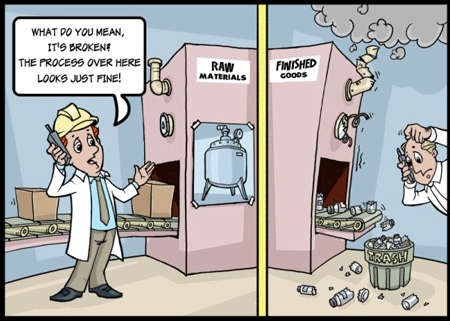
The cost of medical quality actually goes up when the variation and error rate of a process goes up. For example, the costs of pharmaceutical errors alone, in terms of lives and money, are huge. Consider the legal implications of incorrect procedures to an institution. Coding errors that lead to variability in reimbursements costs physicians and other providers, lost revenue.

Think also of the cost of additional safeguards, such as inspectors, that must be put into place to oversee defective processes. When a process is improved, the cost of quality goes down. There are fewer costs due to redundancy, lost time and lost labor.

A Variations Analogue

The concept of looking at medical variations in a process is analogous to the process of teaching a child to ride a bicycle for the first time. The child will be wobbly when he or she gets on the bicycle, at first and, may even fall, several times. As long as you are watching closely, to help the child back on the bicycle, help steer a little and provide encouragement, the child soon learns to ride smoothly and it appears all so natural. The child soon learns to balance from the feedback gained from you and the internal feedback from the brain. After studying the learning process closer, you may find the child to be more successful learning on a set of training wheels or on a bicycle a little smaller in size.

Regardless, the closed loop feedback, analysis, and monitoring by a teacher or process “champion,” keeps the child from wobbling too much and to stay on a straight and narrow course.

A Closed Feedback Loop

Businesses and medical practices wobble too in their processes and, in Six Sigma terminology, this wobbling is the variation that needs continual feedback to help correct and stabilize. Unlike riding a bike, where when once learned it becomes natural and smooth, businesses continue to wobble in their processes and may fall without ever being able to get back up. The institution of Six Sigma methodology is a closed feedback loop to prevent instability in processes.

More: http://businessofmedicalpractice.com/bonus-e-material/

Assessment

Virtual perfection may not be as easily attainable in an industry – like medicine – as computer chips coming off an assembly line; and the healthcare industry certainly has its share of “wobbliness;”

It is, nonetheless, the desire to constantly improve operations, perfect the way healthcare business is done – and tune in to what the patient needs – that separates the Six Sigma Sx improvement method from those QI techniques that have come before.

Moreover, the benefits of setting high performance goals, is a strategic decision to accelerate improvement, promote continual learning and sustaining efforts to succeed. It is a cultural change in medical mind-set to attain quality at its highest level.

Join Our Mailing List

Conclusion

And so, your thoughts and comments on this ME-P are appreciated. What is your SS experience with medical variations? How should we define cost; in economic or human terms? Feel free to review our top-left column, and top-right sidebar materials, links, URLs and related websites, too. Then, be sure to subscribe. It is fast, free and secure.

Speaker: If you need a moderator or speaker for an upcoming event, Dr. David E. Marcinko; MBA – Publisher-in-Chief of the Medical Executive-Post – is available for seminar or speaking engagements. Contact: MarcinkoAdvisors@msn.com

Our Other Print Books and Related Information Sources:

Practice Management: http://www.springerpub.com/prod.aspx?prod_id=23759

Physician Financial Planning: http://www.jbpub.com/catalog/0763745790

Subscribe Now: Did you like this Medical Executive-Post, or find it helpful, interesting and informative? Want to get the latest ME-Ps delivered to your email box each morning? Just subscribe using the link below. You can unsubscribe at any time. Security is assured.

Link: http://feeds.feedburner.com/HealthcareFinancialsthePostForcxos

Sponsors Welcomed

And, credible sponsors and like-minded advertisers are always welcomed.

Link: https://healthcarefinancials.wordpress.com/2007/11/11/advertise

Product DetailsProduct DetailsProduct Details

Product Details  Product Details

Product Details

Financial Reform Amendment Would Address Loan Modification Problems

Proposed New ‘Office of the Homeowner Advocate’

By Paul Kiel, ProPublica – May 7, 2010 11:37 am EDT

An amendment to the financial reform bill filed recently by Sen. Al Franken, D-Minn., and Sen. Olympia Snowe, R-Maine, would create a special office to assist homeowners who are facing problems with the administration’s mortgage modification program. The measure has White House support [1], but is opposed by the financial services industry.

Mortgage Servicers

As we’ve reported, homeowners and housing counselors frequently complain that mortgage servicers frequently lose financial documents [2] and make mistakes [3]—mistakes that can result in foreclosure [4]. Homeowners regularly wait several months [5] for an answer on their application.

About $75 billion has been earmarked for the program from the TARP [6], but very little of that has so far been spent owing to the small number of permanent modifications so far: about 228,000 as of March [7].

The amendment proposes a new “Office of the Homeowner Advocate” that would be devoted to solving homeowner problems with the program. Right now, homeowners with complaints are told to call the HOPE Hotline, which has a staff of counselors to handle escalations—a process that’s been criticized as ineffective [8].

[picapp align=”none” wrap=”false” link=”term=mortgage+reform&iid=1896936″ src=”a/3/e/7/Jesse_Jackson_Rallies_e4dd.jpg?adImageId=12804308&imageId=1896936″ width=”380″ height=”246″ /]

Office of Homeowner Advocate

Under the amendment, all homeowner complaints about servicers would go to this new “Office of the Homeowner Advocate” within the Treasury Department. That would effectively create an appeals process for homeowners who think they’ve been wrongly denied a modification—something that housing counselors and other consumer advocates have long said is desperately needed [9].

“A mandated homeowner’s advocate, built into the process and reportable to Congress, would counteract the servicer unresponsiveness we’ve heard so much about and be able to serve as a recourse for homeowners,” said Richard H. Neiman, superintendent of banks for New York State and a member of the Congressional Oversight Panel for the TARP. Neiman has been pushing for the creation of the office.

The office would have the power to penalize servicers for noncompliance with the program‘s guidelines, but would need the sign-off from Herb Allison, the Treasury official in charge of the TARP, to do so. The Treasury currently has the power to penalize services, but so far has not done so [10].

Financial Services Industry Opposition

The idea has already garnered opposition from the financial services industry. Scott Talbott, a lobbyist with the Financial Services Roundtable, which counts the largest mortgage servicers among its many members [11], said the group opposed the amendment because it would just create “another layer of bureaucracy that could actually slow” the program’s process. He also said there is already adequate oversight of the program.

One of the watchdogs that over-sees the TARP, the Government Accountability Office, reported in March (PDF) that servicers have widely varying ways of dealing with homeowner complaints and some were not systematically tracking them. Several tracked only written ones, the GAO said. Another servicer had closely tracked only those complaints that were addressed to a company executive.

“The unnecessary problems with HAMP are found mostly with servicers who have provided inadequate, inconsistent service to homeowners and delayed or denied homeowner assistance on a mass basis,” said Alys Cohen of the National Consumer Law Center.

Join Our Mailing List

Assessment

The amendment has support from Americans for Financial Reform [12] and a host of consumer advocate groups, including the Center for Responsible Lending, the Service Employees International Union and the United Auto Workers.

The amendment also specifies that any candidate for the homeowner advocate position would have to come from an advocacy background and cannot have worked for a servicer or the Treasury in the previous four years. The advocate’s office would be funded out of the TARP and close down after the federal program ends. The idea is modeled after the Internal Revenue Service’s “taxpayer advocate.” [13] It’s not clear when the amendment might come up for a vote.

Link: http://www.propublica.org/ion/loan-mods/item/financial-reform-amendment-would-address-loan-mod-problems-with-homeowner-a

Conclusion

And so, your thoughts and comments on this ME-P are appreciated. Do you agree with this new proposal? How might medical professionals and/or financial advisors be affected?

Feel free to review our top-left column, and top-right sidebar materials, links, URLs and related websites, too. Then, be sure to subscribe. It is fast, free and secure.

Link: http://feeds.feedburner.com/HealthcareFinancialsthePostForcxos

Speaker: If you need a moderator or speaker for an upcoming event, Dr. David E. Marcinko; MBA – Publisher-in-Chief of the Medical Executive-Post – is available for seminar or speaking engagements. Contact: MarcinkoAdvisors@msn.com

Get our Widget: Get this widget!

Our Other Print Books and Related Information Sources:

Practice Management: http://www.springerpub.com/prod.aspx?prod_id=23759

Physician Financial Planning: http://www.jbpub.com/catalog/0763745790

Medical Risk Management: http://www.jbpub.com/catalog/9780763733421

Healthcare Organizations: www.HealthcareFinancials.com

Health Administration Terms: www.HealthDictionarySeries.com

Physician Advisors: www.CertifiedMedicalPlanner.com

Subscribe Now: Did you like this Medical Executive-Post, or find it helpful, interesting and informative? Want to get the latest ME-Ps delivered to your email box each morning? Just subscribe using the link below. You can unsubscribe at any time. Security is assured.

Link: http://feeds.feedburner.com/HealthcareFinancialsthePostForcxos

Sponsors Welcomed

And, credible sponsors and like-minded advertisers are always welcomed.

Link: https://healthcarefinancials.wordpress.com/2007/11/11/advertise

Product Details  Product Details

About the Institute for Interactive Patient Care [IIPC]

Advancing the role and prevalence of patient and family engagement in the healthcare 2.0 era

By Staff Reporters

The Institute for Interactive Patient Care (IIPC) is a healthcare organization dedicated to empowering patients and improving health outcomes through direct patient engagement. Their mission is to foster widespread adoption of patient and family/caregiver engagement strategies, which are proven to optimize patient care outcomes.

[picapp align=”none” wrap=”false” link=”term=medical+care&iid=299749″ src=”0296/b744a919-026d-4cb2-8a9a-5edd2a9ce15d.jpg?adImageId=12868513&imageId=299749″ width=”317″ height=”480″ /]

Vision

The vision of IIPC and its’ national board of advisors is to create a forum through which healthcare leaders worldwide learn about and adopt best practices in patient engagement as a principle means of improving healthcare outcomes.  To achieve its mission, the IIPC engages in high quality research and advocates for advances in policy, standards and payment reform, all consistent with the mission of IIPC. The IIPC is governed by an independent National Advisory Board comprised of prominent leaders in healthcare. 

Responsibilities

Among its primary responsibilities, advisory members help oversee and validate research projects, as well as to guide the use and dissemination of information and findings from the research in order to promote establishment of patient engagement standards for all care providers. IIPC fills a unique role in healthcare by serving as a reliable source of information and evidence-based data on the impact and efficacy of patient and family/caregiver engagement.

Join Our Mailing List

Assessment

IIPC is a not for profit 501(3)(c) organization.

Link: http://www.instituteipc.org/research/

Conclusion

And so, your thoughts and comments on this ME-P are appreciated. Give the IIPC a click, and tell us what you think? Feel free to review our top-left column, and top-right sidebar materials, links, URLs and related websites, too. Then, be sure to subscribe. It is fast, free and secure.

Speaker: If you need a moderator or speaker for an upcoming event, Dr. David E. Marcinko; MBA – Publisher-in-Chief of the Medical Executive-Post – is available for seminar or speaking engagements. Contact: MarcinkoAdvisors@msn.com

Get our Widget: Get this widget!

Our Other Print Books and Related Information Sources:

Practice Management: http://www.springerpub.com/prod.aspx?prod_id=23759

Physician Financial Planning: http://www.jbpub.com/catalog/0763745790

Medical Risk Management: http://www.jbpub.com/catalog/9780763733421

Healthcare Organizations: www.HealthcareFinancials.com

Health Administration Terms: www.HealthDictionarySeries.com

Physician Advisors: www.CertifiedMedicalPlanner.com

Subscribe Now: Did you like this Medical Executive-Post, or find it helpful, interesting and informative? Want to get the latest ME-Ps delivered to your email box each morning? Just subscribe using the link below. You can unsubscribe at any time. Security is assured.

Link: http://feeds.feedburner.com/HealthcareFinancialsthePostForcxos

Sponsors Welcomed

And, credible sponsors and like-minded advertisers are always welcomed.

Link: https://healthcarefinancials.wordpress.com/2007/11/11/advertise

Seeking ME-P Readership Opinions on eMRs

ADVERTISEMENT

An Exercise in Crowd-Sourcing

By Chris Thorman

Senior Marketing Manager
www.SoftwareAdvice.com

I just finished an essay about market share in the EMR industry and I wanted to give ME-P readers a heads up about it.

Here is the link: http://www.softwareadvice.com/articles/medical/ehr-software-market-share-analysis-1051410/

Essay Content

In the article, I break down:

  • The size of the outpatient EMR market;
  • What EMR vendors have the most physicians using their system; and,
  • What EMR vendors have the most practices using their systems?

Assessment

As I’m sure you can imagine; it was a tough project to get accurate numbers on. And, I’d like to get more eyes on it so we can clear up any discrepancies.  Sort of a ME-P reader “crowd sourcing” project if you will. So, all thoughts on our findings are appreciated. I can be contacted directly here by email, or below: chris@softwareadvice.com

(512) 364-0118 
(800) 918-2764 (toll free)
(360) 838-7866 (fax)
Contact: MarcinkoAdvisors@msn.com

Get our Widget: Get this widget!

Our Other Print Books and Related Information Sources:

Practice Management: http://www.springerpub.com/prod.aspx?prod_id=23759

Physician Financial Planning: http://www.jbpub.com/catalog/0763745790

Medical Risk Management: http://www.jbpub.com/catalog/9780763733421

Healthcare Organizations: www.HealthcareFinancials.com

Health Administration Terms: www.HealthDictionarySeries.com

Physician Advisors: www.CertifiedMedicalPlanner.com

Subscribe Now: Did you like this Medical Executive-Post, or find it helpful, interesting and informative? Want to get the latest ME-Ps delivered to your email box each morning? Just subscribe using the link below. You can unsubscribe at any time. Security is assured.

Link: http://feeds.feedburner.com/HealthcareFinancialsthePostForcxos

Sponsors Welcomed

And, credible sponsors and like-minded advertisers are always welcomed.

Link: https://healthcarefinancials.wordpress.com/2007/11/11/advertise

Celebrating our 1,500th Medical Executive-Post

Even More to Come in the Years Ahead

By Ann Miller; RN, MHA

[Executive-Director]

This ME-P is an information sharing portal for the integrated healthcare industrial complex, medical practice management and financial planning and advisory communities.

We have a search engine to help find essays and follow the breaking news that interests you for this space. Our articles, gossip, videos, books, journals, dictionaries, alerts and related information are continuously updated and ranked by users. 

[picapp align=”none” wrap=”false” link=”term=newspapers&iid=7280686″ src=”a/0/b/d/Portrait_of_a_fbd9.jpg?adImageId=12663513&imageId=7280686″ width=”380″ height=”572″ /]

Publish on the ME-P

And, just recently we’ve celebrated our 1,500th post. Of course, as a participative service, you can publish an article directly on the site or comment on an existing item. You can also vote for an article or a group that captures your interest in order to increase its visibility on the site.

Join Us

But, you must be a member to post; so join us today. We’ve come a long way in less than 3 years, with a lot farther to go!

Link: http://feeds.feedburner.com/HealthcareFinancialsthePostForcxos

Speaker: If you need a moderator or speaker for an upcoming event, Dr. David E. Marcinko; MBA – Publisher-in-Chief of the Medical Executive-Post – is available for seminar or speaking engagements. Contact: MarcinkoAdvisors@msn.com

Get our Widget: Get this widget!

Our Other Print Books and Related Information Sources:

Practice Management: http://www.springerpub.com/prod.aspx?prod_id=23759

Physician Financial Planning: http://www.jbpub.com/catalog/0763745790

Medical Risk Management: http://www.jbpub.com/catalog/9780763733421

Healthcare Organizations: www.HealthcareFinancials.com

Health Administration Terms: www.HealthDictionarySeries.com

Physician Advisors: www.CertifiedMedicalPlanner.com

Subscribe Now: Did you like this Medical Executive-Post, or find it helpful, interesting and informative? Want to get the latest ME-Ps delivered to your email box each morning? Just subscribe using the link below. You can unsubscribe at any time. Security is assured.

Link: http://feeds.feedburner.com/HealthcareFinancialsthePostForcxos

Sponsors Always Welcomed

And, credible sponsors and like-minded advertisers are always welcomed.

Link: https://healthcarefinancials.wordpress.com/2007/11/11/advertise

25 or so – Unintended Consequences of Healthcare Reform

Protean, Pervasive, Prolonged and Painful

By Dr. David Edward Marcinko; MBA, CMP™

[Publisher-in-Chief]

Definition of the Term

Much like the physical laws of nature, action begets consequences, which are usually known, unknown or disregarded by human foibles.

According to Robert Norton, the law of unintended consequences, often cited but rarely defined, is that actions of people—and especially of government—always have effects that are unanticipated or unintended. Economists and other social scientists have heeded its power for centuries; for just as long, politicians and popular opinion have largely ignored it.

My List

And so, regardless of your political affiliation or opinion on healthcare reform in America, passed on March 21 2010 [Patient Protection and Affordable Care Act], there is a plethora of unintended consequences with the [any] new law. So, please indulge me in a bit of healthcare administration prescience:

  1. Healthcare costs will be shifted to doctors in the form of lower reimbursement with higher practice overhead costs for private physicians, and with fewer office employees and more ancillary business and service line extensions.
  2. Hospital based physicians like pathologists, radiologists, anesthesiologists, emergency department doctors and hospitalists will demand, and receive, higher salaries.
  3. Fewer [under populated] primary care physicians with more [over populated] PAs, nurse practitioners and DNPs; with a blunted medical establishment oligopoly.
  4. Higher health insurance costs for employers and most patients, especially young adults without a commensurate increase in aggregate risk.
  5. Medical care access impediments for most Americans, but improvements for those previously uninsured.
  6. Health 2.0 electronic connectivity for the masses with medical data “internet-neutrality”.
  7. Continued rise of evidence based medicine and crowd-sourced healthcare information.
  8. Higher costs for DME, instruments and drugs; particularly in the filed of human genomics and personalized pharmaceuticals.
  9. Increased acceptance of MSAs, HSAs, concierge medicine, private-pay and other direct cash payment methods for medical care.
  10. Realization that eMRs do not improve patient care or reduce costs as “meaningful use” is diluted.
  11. An enterprise wide health data breach of epic proportions, with in-numerable smaller security breaches despite the HIPAA laws.
  12. Long term macro-economically induced national inflation with weakness in the US dollar
  13. Poor quality digital manipulation of medical information with eMR specific inflation due to ARRA and HI-TECH.
  14. Increased national unemployment with widespread underemployment for some Americans.
  15. Modified value added taxation in addition to increased federal tax brackets, rates and related others.
  16. Promotion of outcomes reimbursement models, values based healthcare [episodes of care] and various micro-capitation derivatives.
  17. Many more community hospitals, which lost 12 cents/dollar spent on Medicare and 35 cents/dollar on Medicaid patients last year, will close.
  18. Medicare will become the defacto health insurance, much like public housing, food stamps, the USPS and public transportation. 
  19. There will be fewer viable alternatives to commercial health insurance, other than Medicare and Medicaid, since the antitrust exemption for health insurers was not repealed.
  20. The impact of changing to ICD-10 for medical records coding and billing, will be as significant across the industry, as was Y2K and will push many other HIT projects to lower priority.
  21. New HIPAA 5010 requirements will present substantial changes in the content of the data submitted with claims as well as the data available in response to electronic inquiries.
  22. The Obama health insurance “police” program will be a policy failure, but a  job creator.
  23. Medical practices, often a doctor’s largest financial asset, will go down in value jeopardizing personal retirement plans.
  24. Medicine’s lost professional status will become complete as healthcare becomes commoditized and future grass-roots caregivers are neutered.
  25. Your 2 cents here.

[picapp align=”none” wrap=”false” link=”term=healthcare+professionals&iid=99522″ src=”0095/4e612b02-300a-4dfc-b17c-f2d0d0947cfc.jpg?adImageId=12656185&imageId=99522″ width=”380″ height=”429″ /]

Assessment

In order to be politically correct – not a known trait for me – I will adopt a scientist’s perspective and omit any value judgment regarding the above [positive or negative] unintended consequences.

www.BusinessofMedicalPractice.com

Conclusion

And so, your thoughts and comments on this ME-P are appreciated. 25 consequences not listed? Add your 2 cents. What else can you think of? Am I correct, or not, and how do you feel about the above?

Feel free to review our top-left column, and top-right sidebar materials, links, URLs and related websites, too. Then, be sure to subscribe. It is fast, free and secure.

Speaker: If you need a moderator or speaker for an upcoming event, Dr. David E. Marcinko; MBA – Publisher-in-Chief of the Medical Executive-Post – is available for seminar or speaking engagements. Contact: MarcinkoAdvisors@msn.com

Get our Widget: Get this widget!

Our Other Print Books and Related Information Sources:

Practice Management: http://www.springerpub.com/prod.aspx?prod_id=23759

Physician Financial Planning: http://www.jbpub.com/catalog/0763745790

Medical Risk Management: http://www.jbpub.com/catalog/9780763733421

Healthcare Organizations: www.HealthcareFinancials.com

Health Administration Terms: www.HealthDictionarySeries.com

Physician Advisors: www.CertifiedMedicalPlanner.com

Subscribe Now: Did you like this Medical Executive-Post, or find it helpful, interesting and informative? Want to get the latest ME-Ps delivered to your email box each morning? Just subscribe using the link below. You can unsubscribe at any time. Security is assured.

Join Our Mailing List

Sponsors Welcomed

And, credible sponsors and like-minded advertisers are always welcomed.

Link: https://healthcarefinancials.wordpress.com/2007/11/11/advertise

“The Vanishing Oath”

A Documentary Film

By Ryan Flesher, MD

Join Our Mailing List

Reaching for a patient chart in the ER one night, a young physician is suddenly overwhelmed by a strange mixture of panic, anger and fear. But, such emotions are unacceptable for a doctor.

A Self-Loathing Doctor -OR- Modern Realist? 

Tearing down a hallway, he slips into a room and as the door clicks shut, he slumps to the floor. The truth is wrenching: he hates being a doctor. In the burial ground of his emotions he unearths the regret, guilt, confusion that he feels. Like a sudden rainstorm, years of anguish and disillusionment come pelting downward. Emotions are a dangerous mix of chemicals when buried. Forcing himself to a standing position he returns to his patients, his priority. There is no going back from a defining moment; one cannot un-ring a bell.

“Is there something wrong with me?” he wonders. It is a burning, compelling question that takes him across the globe and back to answer. 

[picapp align=”none” wrap=”false” link=”term=emergency+room&iid=6302230″ src=”4/9/7/b/Paramedics_taking_patient_e10b.jpg?adImageId=12808257&imageId=6302230″ width=”380″ height=”251″ /]

An Insider’s View

This first-ever glimpse takes us into the raw emotions that doctors hold beneath the white coats. Ultimately, he realizes that the untrained hands of corporate executives are health care’s decision makers and a doctor’s suffering is considered intangible. With no heart or vision, the mission is to profit off the backs of doctors and patients.

Physicians are quietly leaving clinical medicine and the momentum is growing. If the attack upon those who heal us does not end … the foundation will collapse. But, from which floor does one fall?

Assessment

This unique film, from an inside view rarely seen, examines the reality of modern medical practice and the obstacles to care that complicate the path to great care.

http://drwes.blogspot.com/2010/05/vanishing-oath-review.html

Conclusion

And so, your thoughts and comments on this ME-P are appreciated. If you view the video, please tell us what you think?

Link: http://www.amazon.com/Vanishing-Oath-Feature-Film-DVD/dp/B003KVMULI/ref=sr_1_1?ie=UTF8&s=dvd&qid=1273494090&sr=8-1

Feel free to review our top-left column, and top-right sidebar materials, links, URLs and related websites, too. Then, be sure to subscribe. It is fast, free and secure.

Link: https://healthcarefinancials.wordpress.com/2007/11/11/advertise

Speaker: If you need a moderator or speaker for an upcoming event, Dr. David E. Marcinko; MBA – Publisher-in-Chief of the Medical Executive-Post – is available for seminar or speaking engagements. Contact: MarcinkoAdvisors@msn.com

Get our Widget: Get this widget!

Our Other Print Books and Related Information Sources:

Practice Management: http://www.springerpub.com/prod.aspx?prod_id=23759

Physician Financial Planning: http://www.jbpub.com/catalog/0763745790

Medical Risk Management: http://www.jbpub.com/catalog/9780763733421

Healthcare Organizations: www.HealthcareFinancials.com

Health Administration Terms: www.HealthDictionarySeries.com

Physician Advisors: www.CertifiedMedicalPlanner.com

Subscribe Now: Did you like this Medical Executive-Post, or find it helpful, interesting and informative? Want to get the latest ME-Ps delivered to your email box each morning? Just subscribe using the link below. You can unsubscribe at any time. Security is assured.

Link: http://feeds.feedburner.com/HealthcareFinancialsthePostForcxos

Sponsors Welcomed

And, credible sponsors and like-minded advertisers are always welcomed.

Link: https://healthcarefinancials.wordpress.com/2007/11/11/advertise

Become a Whistle Blower in the Healthcare Industrial Complex

Have You Ever Worked in the Medical Profession?

By Ann Miller; RN, MHA

[Executive-Director]

Join Our Mailing List

If you ever worked for a private medical practice, health insurance company, third party administrator or payer, hospital, public health clinic, VA or anywhere else in the healthcare space, we’d like to hear from you.

Tell the Medical Executive-Post about your work conditions, doctors or nurses, management shenanigans, or the politics and your observations of what is happening at your healthcare organization. Gossip, insider information, knowledge, personal opinion, insight or related hearsay – both positive and negative – is sought.

The clinical, financial, legal, insurance, pharma or administrative scenes are all fertile grounds for exposure and transparency. You may remain an anonymous tipster, or we will publish your identity upon request for additional credibility.

Please email MarcinkoAdvisors@msn.com or call us at: 770.448.0769

Please contact us today: MarcinkoAdvisors@msn.com

Conclusion

Your thoughts and comments on this ME-P are appreciated. Feel free to review our top-left column, and top-right sidebar materials, links, URLs and related websites, too. Then, subscribe to the ME-P. It is fast, free and secure.

Link: http://feeds.feedburner.com/HealthcareFinancialsthePostForcxos

Speaker: If you need a moderator or speaker for an upcoming event, Dr. David E. Marcinko; MBA – Publisher-in-Chief of the Medical Executive-Post – is available for seminar or speaking engagements. Contact: MarcinkoAdvisors@msn.com

OUR OTHER PRINT BOOKS AND RELATED INFORMATION SOURCES:

LEXICONS: http://www.springerpub.com/Search/marcinko
PHYSICIANS: www.MedicalBusinessAdvisors.com
PRACTICES: www.BusinessofMedicalPractice.com
HOSPITALS: http://www.crcpress.com/product/isbn/9781466558731
CLINICS: http://www.crcpress.com/product/isbn/9781439879900
ADVISORS: www.CertifiedMedicalPlanner.org
BLOG: www.MedicalExecutivePost.com

Product DetailsProduct DetailsProduct Details

Should the Government Mandate 401(k) Annuities?

About the Guaranteed Retirement Accounts Proposal
By Robert Giese
bob.giese@chsfl.org

Recent hearings in the House and Senate have focused on the need for 401(k) and IRA accounts to provide better retirement income. Vice President Joe Biden referred to these discussions in the White House Task Force on the Middle Class. He suggested creating “Guaranteed Retirement Accounts [GRAs].”

The guaranteed retirement accounts may replace conventional 401(k)s and could eventually provide annuity income to individuals.

Response to GAO Report

In response to a White House request, the General Accounting Office (GAO) released a report on April 28, 2010 that discussed some of these retirement issues. The GAO noted that a couple age 62 has at least a 47% probability that one of the two spouses will live to age 90. While life expectancy is in the mid-to-late 70s when one is born, the age at maturity increases as we grow older. Therefore, the average retirement age couple in America has a reasonable prospect that the survivor will live to be age 90.

GAO reports that Social Security is the primary support for lower income retired Americans. For the median retired person, Social Security is expected to provide approximately 47% of retirement income. The balance will come from savings or investments, a qualified plan such as a 401(k) or IRA and retirement earnings from employment.

Better than Conservative Investments?

The GAO report notes that an annuity may provide more income than a conservative investment, such as a bond or CD.

Assessment

Republican lawmakers this week wrote a letter to Treasury Secretary Timothy Geithner and expressed concern about the guaranteed retirement accounts. They noted that a number of the witnesses before the various committees would “dismantle the present private-sector 401(k) system” and replace it with the GRA.
Their letter expressed concern and opposition to any effort to “nationalize” the 401(k) system. The Republican lawmakers continued by noting that over 90% of households have a favorable opinion of 401(k) or IRA accounts.

Conclusion

And so, your thoughts and comments on this ME-P are appreciated. Is this new vehicle really better than a bond or CD? Is it the correct vehicle for a long-term retirement strategy? Is it even appropriate for physicians and medical professionals?

Feel free to review our top-left column, and top-right sidebar materials, links, URLs and related websites, too. Then, be sure to subscribe. It is fast, free and secure.

Link: http://feeds.feedburner.com/HealthcareFinancialsthePostForcxos

Get our Widget: Get this widget!

Our Other Print Books and Related Information Sources:

Practice Management: http://www.springerpub.com/prod.aspx?prod_id=23759

Physician Financial Planning: http://www.jbpub.com/catalog/0763745790

Medical Risk Management: http://www.jbpub.com/catalog/9780763733421

Healthcare Organizations: www.HealthcareFinancials.com

Health Administration Terms: www.HealthDictionarySeries.com

Physician Advisors: www.CertifiedMedicalPlanner.com

Subscribe Now: Did you like this Medical Executive-Post, or find it helpful, interesting and informative? Want to get the latest ME-Ps delivered to your email box each morning? Just subscribe using the link below. You can unsubscribe at any time. Security is assured.

Link: http://feeds.feedburner.com/HealthcareFinancialsthePostForcxos

Sponsors Welcomed

And, credible sponsors and like-minded advertisers are always welcomed.

Link: https://healthcarefinancials.wordpress.com/2007/11/11/advertise

Product Details  Product Details

Exploring Career Change for Physicians

ADVERTISEMENT

Join Our Mailing List

About the Medical Fusion Conference

By Staff Reporters

Physician career change is the focus of the Medical Fusion conference. Non-clinical jobs, medical journalism, medical informatics, physician entrepreneurs, medical device development, and venture capital are all topics that will be covered at this exciting new event.

For all Specialties and Physicians

Whether you are a medical resident who wants to learn about all of the possibilities available to you or a retired physician looking for entrepreneurial side ventures, this is the conference for you. Medical Fusion reports to supply the tools necessary to take your career to the next level.

Non-Clinical Careers

Medical Fusion is for physicians interested in exploring non-clinical career opportunities. Designed to teach physicians how to leverage their medical training and expand their careers, participants receive training from experts with practical knowledge on a variety of non-clinical subjects.

A Tool Box 4 a Black Bag

Medical Fusion is designed as a “tool box” for the modern physician. Clinical physicians today need to know how to leverage their clinical training in new and unique ways. Medical Fusion provides broad exposure to a variety of niche areas, leaving participants with practical steps to begin crafting the career they’ve always wanted. Come learn from physicians who’ve already developed their own unique careers.

Assessment

Medical Fusion is a new medical event for physicians, by physicians.

Link: http://medfusionconf.com/home/tabid/122/Default.aspx

Conclusion

And so, your thoughts and comments on this ME-P are appreciated. Are you a physician seeking a career change away from clinical medicine? Tell us your experiences to-date. Feel free to review our top-left column, and top-right sidebar materials, links, URLs and related websites, too. Then, be sure to subscribe. It is fast, free and secure.

Link: http://feeds.feedburner.com/HealthcareFinancialsthePostForcxos

Speaker: If you need a moderator or speaker for an upcoming event, Dr. David E. Marcinko; MBA – Publisher-in-Chief of the Medical Executive-Post – is available for seminar or speaking engagements. Contact: MarcinkoAdvisors@msn.com

Get our Widget: Get this widget!

Our Other Print Books and Related Information Sources:

Practice Management: http://www.springerpub.com/prod.aspx?prod_id=23759

Physician Financial Planning: http://www.jbpub.com/catalog/0763745790

Medical Risk Management: http://www.jbpub.com/catalog/9780763733421

Healthcare Organizations: www.HealthcareFinancials.com

Health Administration Terms: www.HealthDictionarySeries.com

Physician Advisors: www.CertifiedMedicalPlanner.com

Subscribe Now: Did you like this Medical Executive-Post, or find it helpful, interesting and informative? Want to get the latest ME-Ps delivered to your email box each morning? Just subscribe using the link below. You can unsubscribe at any time. Security is assured.

Link: http://feeds.feedburner.com/HealthcareFinancialsthePostForcxos

Sponsors Welcomed

And, credible sponsors and like-minded advertisers are always welcomed.

Link: https://healthcarefinancials.wordpress.com/2007/11/11/advertise

Product DetailsProduct DetailsProduct Details

Advertise on the ME-P

Consider Advertising on the Medical Executive Post

If you want the opportunity to reach a personalized weekly audience of health care industry insiders, innovators and watchers, the Medical Executive-Post and its educational forums may be right for you?

Read More:  https://medicalexecutivepost.com/2007/11/11/advertise/

Conclusion

And so, your thoughts and comments on this ME-P are appreciated. Feel free to review our top-left column, and top-right sidebar materials, links, URLs and related websites, too. Then, be sure to subscribe. It is fast, free and secure.

Link: http://feeds.feedburner.com/HealthcareFinancialsthePostForcxos

Speaker: If you need a moderator or speaker for an upcoming event, Dr. David E. Marcinko; MBA – Publisher-in-Chief of the Medical Executive-Post – is available for seminar or speaking engagements. Contact: MarcinkoAdvisors@msn.com

Get our Widget: Get this widget!

Our Other Print Books and Related Information Sources:

Practice Management: http://www.springerpub.com/prod.aspx?prod_id=23759

Physician Financial Planning: http://www.jbpub.com/catalog/0763745790

Medical Risk Management: http://www.jbpub.com/catalog/9780763733421

Healthcare Organizations: www.HealthcareFinancials.com

Health Administration Terms: www.HealthDictionarySeries.com

Physician Advisors: www.CertifiedMedicalPlanner.com

Subscribe Now: Did you like this Medical Executive-Post, or find it helpful, interesting and informative? Want to get the latest ME-Ps delivered to your email box each morning? Just subscribe using the link below. You can unsubscribe at any time. Security is assured.

Link: http://feeds.feedburner.com/HealthcareFinancialsthePostForcxos

Sponsors Welcomed

And, credible sponsors and like-minded advertisers are always welcomed.

Link: https://healthcarefinancials.wordpress.com/2007/11/11/advertise

Disorganization at Banks

Causing Mistaken Foreclosures

Join Our Mailing List

By Paul Kiel, ProPublica – May 4, 2010 9:20 pm EDT

Millions of people face losing their homes in the continuing foreclosure crisis, but homeowners often have more than the struggling economy and slumping house prices to worry about: Disorganization within the big banks that service mortgages has made a bad problem worse.

ProPublica is matching local journalists with homeowners having trouble getting loan mods.

Are you a homeowner with a story to tell?
Are you a reporter and want to cover it?

Sometimes the communication breakdown within the banks is so complete that it leads to premature or mistaken foreclosures. Some homeowners, with the help of an attorney or housing counselor, have eventually been able to reverse a foreclosure. Others have lost their homes.

“We believe in many cases people are losing their homes when they should not have,” said Kevin Stein, associate director of the California Reinvestment Coalition, which counts dozens of nonprofits that work with homeowners among its members.

In the worst breakdowns, banks — and other companies that service loans — actually work at cross-purposes, with one arm of the company foreclosing on the home while the other offers help. Servicers say such mistakes are rare and result from the high volume of defaults and foreclosures.

The problems happen even among servicers participating in the administration’s $75 billion foreclosure-prevention program [1]. Servicers operating under the year-old program are forbidden from auctioning someone’s home while a modification decision is pending. It happens anyway.

Consumer advocates say the lapses continue because they go unpunished. “We’ve had too much of the carrot, and we need a stick,” Stein says. The Treasury Department has yet to penalize a servicer for breaking the program’s rules. The program provides federal subsidies to encourage modifications.

Treasury officials overseeing the program say they’re aware of the problems and have moved to fix them. But some states are going further to protect homeowners, with recent rules that stop the foreclosure process if the homeowner requests a modification.

Many homeowners, seeing no other option, have gone to court to reclaim their homes. At least 50 homeowners have recently filed lawsuits alleging the servicer foreclosed with a loan mod request pending or even while they were on a payment plan.

Homeowners have long waits for help

In good times, banks and other servicers — Bank of America is the biggest, followed by Chase and Wells Fargo — were known mainly to homeowners simply as where they sent their monthly mortgage payments. But the companies have been deluged over the past couple of years by requests for help from millions of struggling homeowners.

Homeowners commonly wait six months for an answer on a loan mod application. The federal program for encouraging loan mods includes a three-month trial period, after which servicers are supposed to decide whether to make the modifications permanent. But some homeowners have waited as long as 10 months [2] for a final answer.

Communication breakdowns occur because of the way the servicers are structured. One division typically deals with modifications and another with foreclosures. Servicers also hire a local trustee or attorney to actually pursue foreclosure.

“Often they just simply don’t communicate with each other,” said Laurie Maggiano, the Treasury official in charge of setting policy for the modification program. Such problems were particularly bad last summer, in the first few months of the program, she said. “Basically, you have the right hand at the mortgage company not knowing what the left hand is doing,” said Mark Pearce, North Carolina’s deputy commissioner of banks. Communication glitches and mistakes are “systemic, more than anecdotal” among mortgage servicers, he said.

“We’ve had cases where we’ve informed the mortgage company that they’re about to foreclose on someone.” The experience for the homeowner, he said, can be “Kafkaesque.”

“We’re all human, and the servicers are overworked and trying their best,” said Vicki Vidal, of the Mortgage Bankers Association. She said foreclosure errors are rare, particularly if struggling homeowners are prompt in contacting their servicer.

The Human Face

Frances Gomez, of Tempe, Ariz., lived in her house for over 30 years. Three years ago, she refinanced it with Countrywide, now part of Bank of America, for nearly $300,000. The home’s value has declined dramatically, said Gomez, who put some of the money from the refinancing into her hair salon.

Last year, the recession forced her to close her shop. Gomez fell behind on her mortgage, and after striking out with a company that promised to work with Bank of America to get her a loan mod, she learned in December that her home was scheduled for foreclosure.

So Gomez applied herself. She twice succeeded in getting Bank of America to postpone the sale date and said she was assured it would not happen until her application was reviewed. Gomez had opened a smaller salon and understood there was a good chance she would qualify.

She was still waiting in March when a Realtor, representing the new owner of her home, showed up. Her house had sold at auction — for less than half of what Gomez owed. “They don’t give you an opportunity,” she said. “They just go and do it with no warning.”

It’s not supposed to work that way.

Federal Programs

Under the federal program, which requires servicers to follow a set of guidelines for modifications, servicers must give borrowers a written denial before foreclosing. When Gomez called Bank of America about the sale, she said she was told there was a mistake but nothing could be done. She did get a denial notice [3] — some three weeks after the house was sold and just days before she was evicted.

“I just want people to know what they’re doing,” Gomez, now living with family members, said.

After being contacted by ProPublica, Bank of America reviewed Gomez’s case. Bank spokesman Rick Simon acknowledged that Gomez might not have been told her house would be sold and that the bank made a mistake in denying Gomez, because it did not take into account the income from her new salon business. Simon said a Bank of America representative would seek to negotiate with the new owner of Gomez’s house to see if the sale could be unwound.

Simon said the bank regrets when such mistakes happen due to the “very high volume” of cases and that any errors in Gomez’s case were “inadvertent.”

Timeline: How Michael Hill Almost Lost His Home [4]

Even avoiding a mistaken sale can also be a stressful process.

One day in February, a man approached Ron Bermudez of Emeryville, Calif., in front of his house and told him his home would be sold in a few hours. This came as a shock to Bermudez; Bank of America had told him weeks prior that he’d been approved for a trial modification and the papers would soon arrive. He made a panicked phone call to an attorney, who was able to make sure there was no auction.

Last November, Michael Hill of Lexington, S.C., finally got the call he’d been waiting for. Congratulations, a rep from JPMorgan Chase told him, your trial mortgage modification is approved. Hill’s monthly payment, around $900, would be nearly halved.

Except there was a problem. Chase had foreclosed on Hill’s home a month earlier, and his family was just days away from eviction.

“I listened to her and then I just said, ‘Well, that sounds good,’” recalled Hill, who is married and has two children. “‘Tell me how we’re going to do this, seeing as how you sold the house.’” That, he found out, was news to Chase.

Hill was able to avoid eviction — for now. Chase reversed the sale by paying the man who’d bought the home an extra $19,500 on top of the $86,000 [5] he’d paid at the auction.

After the mistaken foreclosure, he began the trial modification last December. He made those payments, but two months after his trial period was supposed to end, Hill is still waiting for a final answer from Chase.

The miscommunications have continued. He received a letter in January saying that he’d been approved for a permanent modification, but he was then told he’d received it in error.

His family remains partially packed, ready to move should the modification not go through. “I’m on pins and needles every time someone’s knocking on the door or calling,” he said.

Christine Holevas, a Chase spokeswoman, said that Chase had “agreed with Hill’s request to rescind the foreclosure” and was “now reviewing his loan for permanent modification.” She said Chase services “more than 10 million mortgages — the vast majority without a hitch.”

HOPE Hotline

To contest a foreclosure under the federal program, Maggiano, the Treasury official, said a homeowner should call the HOPE Hotline, 888-995-HOPE, a Treasury Department-endorsed hotline staffed by housing counselors. Those counselors can escalate the case if the servicer still won’t correct the problem, she said.

That escalation process has saved “a number” of homeowners from being wrongfully booted out of their homes, Maggiano said. Hill, the South Carolina homeowner, is an example of someone helped by the HOPE Hotline.

Of course, the homeowner must know about the hotline to call it. Gomez, the Arizona homeowner who lost her home to foreclosure, said she’d never heard of it.

Many homeowner advocates say the government’s effort has been largely ineffective at resolving problems with servicers.

“I uniformly hear from attorneys and counseling advocates on the ground that the HOPE Hotline simply parrots back what the servicers have said,” said Alys Cohen, an attorney with the National Consumer Law Center. Cohen said she’d voiced her concerns with Treasury officials, who indicated they’d make improvements.

Bank

New rules to offer more protection

Under the current rules for the federal program, servicers have been barred from conducting a foreclosure sale if the homeowner requested a modification, but are allowed to push along the process, even set a sale date. That allows them to foreclose more quickly if they determine the homeowner doesn’t qualify for a modification.

As a result, a homeowner might get a modification offer one day and a foreclosure notice the next. As of March, servicers were pursuing foreclosure on 1.8 million residences, according to LPS Applied Analytics.

Maggiano, the Treasury official, said that’s been confusing for homeowners. Some “just got discouraged and gave up.”

New rules issued by the Treasury in March say the servicer must first give the homeowner a shot at a modification before beginning the process that leads to foreclosure.

They also require the servicer to adopt new policies to prevent mishaps. For instance, the servicer will be required to provide a written certification to its attorney or trustee that the homeowner does not qualify for the federal program before the house can be sold.

Maggiano said the changes resulted from visits to the servicers’ offices last December that allowed Treasury officials to “much better understand (their) inner workings.”

The rules, however, don’t take effect until June. Nor do they apply to hundreds of thousands of homeowners seeking a modification for whom the process leading to foreclosure has already begun. And Treasury has yet to set any penalties for servicers who don’t follow the rules.

Maggiano said Treasury’s new rule struck a balance to help homeowners who were responsive to servicer communications to stay out of foreclosure while not introducing unnecessary delays for servicers. Some borrowers don’t respond at all to offers of help from the servicers until they’re faced with foreclosure, she said.

Join Our Mailing List

States Differ

Some states, such as North Carolina, have recently gone further to delay moving toward foreclosure if a homeowner requests a modification. State regulators there passed a law that requires a servicer to halt the process if a homeowner requests a modification.

Pearce, the North Carolina official, said the rule was prompted by the delays homeowners have been facing and puts the burden on the servicers to expeditiously review the request. “They’re in total control.”

Stopping the process not only removes the possibility of a sudden foreclosure, he said, but also stops the accumulation of fees, which build up and can add thousands to the homeowner’s debt as the servicer moves toward foreclosure.

In California, state Sen. Mark Leno, a Democrat from San Francisco, is pushing a bill that would do something similar. The servicers “should be working a lot harder to keep homeowners in their home,” he said.

Assessment

Original article: http://www.propublica.org/feature/disorganization-at-banks-causing-mistaken-foreclosures-050410

Conclusion

Your thoughts and comments on this ME-P are appreciated. Feel free to review our top-left column, and top-right sidebar materials, links, URLs and related websites, too. Then, subscribe to the ME-P. It is fast, free and secure.

Link: http://feeds.feedburner.com/HealthcareFinancialsthePostForcxos

Speaker: If you need a moderator or speaker for an upcoming event, Dr. David E. Marcinko; MBA – Publisher-in-Chief of the Medical Executive-Post – is available for seminar or speaking engagements. Contact: MarcinkoAdvisors@msn.com

OUR OTHER PRINT BOOKS AND RELATED INFORMATION SOURCES:

DICTIONARIES: http://www.springerpub.com/Search/marcinko
PHYSICIANS: www.MedicalBusinessAdvisors.com
PRACTICES: www.BusinessofMedicalPractice.com
HOSPITALS: http://www.crcpress.com/product/isbn/9781466558731
CLINICS: http://www.crcpress.com/product/isbn/9781439879900
BLOG: www.MedicalExecutivePost.com
FINANCE: Financial Planning for Physicians and Advisors
INSURANCE: Risk Management and Insurance Strategies for Physicians and Advisors

Product Details  Product Details

Are Primary Care Doctors Becoming More Like Financial Advisors?

Hospitals [BDs] “versus” Family Practitioners [FAs]

By Dr. David Edward Marcinko; MBA, CMP™

[Editor-in-Chief]

The Big Mistake

Those who believe that hospitals need medical specialists like radiologists, pathologists and oncologists, more than primary care doctors, are mistaken. And, those doctors who believe that the majority of “financial advisors” work for their clients are also mistaken. Here’s why in analogy format.

Why Hospitals Need PCPs

Hospitals generally need primary care physicians, more than specialists, because insurance contracts can be negotiated from a position of strength. A solid [large] primary care panel is a must-have for most insurance contracts. Just recall more than a decade ago – when PCPs were told of an emerging new renaissance where they would reign in place of the medical specialists? It never happened then, but it may happen now following healthcare reform.

Also, recall that the growth of fiduciary Registered Investment Advisors [RIAs] was slow until the stock market collapse of 2008. The pace is accelerating today with the political dawn of financial reform.

Patient’s Love their PCPs – Not their Hospitals

Moreover, please realize that few patients shop around for specialists, or hospitals, as they do for PCPs. OK, the OB-GYNs are unique in that they can play a dual role – as specialist and primary care doctor – just ask my wife who would rather eat nails than change her [female] female doctor.

Hospitals also need PCPs as referring physicians to generate business through their ERs, admissions department, outpatient centers, and/or by ordering invasive and non-invasive radiology tests, images, scans or laboratory tests, and/or sending patients to specialists who will do expensive procedures or surgery in their ORs, hospital and/or related facilities.

Doesn’t this sound like a stock broker working for his wire-house or broker-dealer?  

www.HealthcareFinancials.com

The PCP Loss Leader

Primary care is a loss-leader to hospitals as they make little money directly off medical practices, but can generate a great deal from the referrals and procedures the grass-roots docs generate; especially if they “play the game” like commissioned stockbrokers. And, consider brilliant medical diagnosticians, like TV’s Gregory House MD, and all those tests and procedures they can do – just to be sure!

No wonder that physician-executives and hospital administrators like Dr. Lisa Cuddy of the Princeton-Plainsboro Teaching Hospital, in New Jersey, love them.

Ditto for wire-house office managers and stock-brokerage OSJs [Office of Supervisory Jurisdiction] who love their “top producers”, brokers and FAs.

[picapp align=”none” wrap=”false” link=”term=operating+room&iid=288202″ src=”0284/9dbd59b4-ffc4-49c4-8b2e-3b568f74dc9d.jpg?adImageId=12660700&imageId=288202″ width=”380″ height=”253″ /]

Conflicted Missions

Unfortunately, this shifts the mission of PCPs from keeping patients out of the hospital – as physical and fiscal advocate – to sending them to the hospital as a “heavy admitter-referrer” with resulting perks and swagger.

Thus, “success” of the PCP from a hospital perspective is not to avoid referrals or costly procedures, but to gather them.  However, success is a matter of perspective that may be very unfortunate for the patient, state or federal payer, private employer and/or insurance company.

Financial Advisor Analog

Does this PCP conundrum sound like the conflicted situation found with many “independent” financial advisors today? Are PCPs becoming mere patient gatherers, or profit generating shills, for their hospitals, employers or healthcare systems? Where does one’s duty rest? Are we doctor’s or medical product/procedure merchants?

www.CertifiedMedicalPlanner.com

Conclusion

And so, your thoughts and comments on this ME-P are appreciated. Is this analogy correct, or not. Is it too harsh or too gentle – and for whom?

Feel free to review our top-left column, and top-right sidebar materials, links, URLs and related websites, too. Then, be sure to subscribe. It is fast, free and secure.

Link: http://feeds.feedburner.com/HealthcareFinancialsthePostForcxos

Speaker: If you need a moderator or speaker for an upcoming event, Dr. David E. Marcinko; MBA – Publisher-in-Chief of the Medical Executive-Post – is available for seminar or speaking engagements. Contact: MarcinkoAdvisors@msn.com

Get our Widget: Get this widget!

Our Other Print Books and Related Information Sources:

Practice Management: http://www.springerpub.com/prod.aspx?prod_id=23759

Physician Financial Planning: http://www.jbpub.com/catalog/0763745790

Medical Risk Management: http://www.jbpub.com/catalog/9780763733421

Healthcare Organizations: www.HealthcareFinancials.com

Health Administration Terms: www.HealthDictionarySeries.com

Physician Advisors: www.CertifiedMedicalPlanner.com

Subscribe Now: Did you like this Medical Executive-Post, or find it helpful, interesting and informative? Want to get the latest ME-Ps delivered to your email box each morning? Just subscribe using the link below. You can unsubscribe at any time. Security is assured.

Link: http://feeds.feedburner.com/HealthcareFinancialsthePostForcxos

Sponsors Welcomed

And, credible sponsors and like-minded advertisers are always welcomed.

Link: https://healthcarefinancials.wordpress.com/2007/11/11/advertise

Why Practicing Medicine is More than just a Paycheck

Your Healthcare Career Evaluation

By Eugene Schmuckler PhD, MBA

By Dr. David E. Marcinko MBA

www.MedicalBusinessAdvisors.com

Studs Turkel, in his outstanding book Working, makes the comment that work is the mechanism by which many of us get our daily bread and our daily purpose. If this is to be the case then the workplace needs to offer us something more than a paycheck. The Wilson Learning Corporation surveyed 1500 people asking “If you had enough money to live comfortably for the rest of your life, would you continue to work? Seventy percent said that they would continue to work, but 60 percent of those said they would change jobs and seek “more satisfying” work.

Auto Career Advisor

Each of us has in fact been put in charge of our own careers. Our personal career management is a lifelong process. Our task is to be able to discover our place in the world where we will be able to enjoy a high level of wellness. This requires us to now assess our career, not from the eyes of the sixteen year old who initially chose the career. The career you are now pursuing needs to be compatible with your own unique skills, knowledge, personality and interests. It is important to keep in mind that no one is married to his or her job. When it comes to the workplace most of us are in dating relationships.

A Medical Career Worth Examined

As part of your examining your current medical career, answer the following questions: Why do you work? What does work mean to you? What do you want from work?

Research shows that most people work for three major reasons. The first of these is money. Not only is this necessary for our most basic needs it also serves as a means of determining our self-image. A second reason is to be with other people. Being at work enables us to belong, to be part of something beyond ourselves. We become part of a team. Some offices consider co-workers to be part of an extended family. The work setting affords us the opportunity for receiving feedback, recognition and support. The third most often given reason is that work validates us as people if we consider what we do as having meaning. “I chose the medical profession so as to make a difference.” Individuals with career success have a sense of purpose, a feeling that their work has meaning and contributes to a worthwhile cause. This is not a trick question. How well does what you do in your office every day meet your needs for money, affiliation and meaning?

sf

Job Purpose

Without a sense of purpose on the job the chances are that your performance while adequate will not place you in the excellent category. Therefore, it is necessary for each and every one of us to be able to succinctly answer the question, “What is the purpose of your job?” That is a tough question to answer.

As a medical professional you may have seen what you considered to be the purpose of your job radically changed due to changes in the way services are now delivered. While we cannot bring back the past we can work around the present. Think about this for a moment, “If you want something to happen make a space for it.”4 What this means that whether you remain in your current profession or move elsewhere there is a need for you to establish long-range, medium-range, short-range, mini, and micro goals.

Long Term

Long-range goals are those concerned with the overall style of life that you wish to live. Regardless of your current age these goals are necessary. Long-range goals don’t need to be too detailed, because like the federal budget surplus, changes will come along. Just as the government is making projections into the future you too need to be making projections including but not limited to retirement.

Medium Term

Medium-range goals are goals covering the next five years or so. These are the goals that include the next step in your career. These are goals over which we have control and we are able to monitor them and see whether we are on track to accomplishing them and modify our efforts accordingly.

Short Term

Short-range goals generally cover a period of time about one month to one year from now. These are goals that can be set quite realistically and we are able to see fairly quickly whether or not we are on track to reaching them. We don’t want to set these goals at impossible levels but we do want to stretch ourselves. After all, that is the reason you are probably reading this chapter.

Mini-Goals

Mini-goals are those goals covering from about one day to one month. Obviously we have much greater control over these goals than you do over those of a longer-term. By thinking in small blocks of time there is much more control over each individual unit.

Micro-Goals

Micro-goals are goals covering the next 15 minutes to an hour. These are the only goals over which you have direct control. Because of this direct control, micro-goals, even though modest in impact, are extraordinarily important, for it is only through these micro-goals that you can attain your larger goals. If you don’t take steps toward your long-range goals in the next 15 minutes, when will you? The following 15 minutes? The 15 minutes after that? Sooner or later, you have to pick 15 minutes and get going. At some point procrastination has to be put aside.5

Personal Assets Evaluation

In thinking of your goals it now becomes necessary to evaluate your personal assets. Conducting this personal inventory requires you to identify your assets as well as your shortcomings. First, look at a time in your life when you were performing at your best. What were your thoughts and feelings? How did you behave? What were you doing? Now look at the reverse when you were doing poorly. What were your thoughts and feelings at that time? How did you behave? What were you doing?

If you are like others when you were at your best you described yourself as being confident, enthusiastic, organized, relaxed, focused, in control, friendly and decisive. The flip side, when at your worst you were fearful, apathetic, messy, anxious, lacking direction, out of control, argumentative and frustrated.

As you can see the emotions when we are at our best are all positive. This leads to the conclusion that it is to our advantage to be at our best as much as possible. Being at our best derives from working in those areas where we contribute our talents to something we believe in.  As we continue our own personal inventory we need to look at our special abilities. That is, what are you good at and find easy to do. Think of the following questions. It’s not necessary to write down you answers just think about them.

  1. How would you like to be remembered?
  2. What have you always dreamed of contributing to the world?
  3. Looking back on your life, what are some of your major contributions?
  4. When people think of you, what might they say are your most outstanding characteristics?
  5. What do you really want from your life and your work?
  6. In what way may you still feel limited by the past? If so, by what?
  7. What will it take to let go of what has happened, no matter how good or bad? Are you willing to let go?
  8. How might the rut of conformity or comfort be limiting you? Why?
  9. How different do you really want life to be? Why.
  10. Have you ever stated what it is you truly desire? If no, why not?
  11. How good could stand life to be?

doctors

Career Changers

Thinking about remaining in your present career or moving into another one is not easy. You are at the edge of a cliff and need to decide if you are going to turn back or to trust in yourself to successfully make it down to the bottom. People who are afraid of the dark lose their fear with just the slightest of a light in the room. As you have been going through this chapter you have been shining a light, however dim it may appear to you. You can see all of the items around you. The obstacles are there but with your advance knowledge you can anticipate ways to avoid them.

Personal Analysis

Having looked at and possibly re-evaluated your plans you can now do a thorough analysis of your assets. The assets requiring the most scrutiny are the following:

  1. Your talents and skills
  2. Your intelligence
  3. Your motivation
  4. Your friends
  5. Your education
  6. Your family

Your talents and skills are more than likely what has gotten you to the point you are at in your present career. For purposes of definition talents are innate, skills are acquired. Some have talent in interpersonal relations and some in artistic pursuits. Skills may be selected to complement the already present talents. It is skills that are necessary for expanding your options. As you seek out new skill areas ask yourself these questions. Do the skills provide occupational relevance? Might you be able to get others to pay you to teach them the skill? Will the skill be useful throughout life? Will the skill help you conquer new environments and gain new experiences? And, of course, Is it something you like to do?

Intelligence

Intelligence is considered to be the ability of the individual to cope with the world. Originally, intelligence focused primarily in the area of cognitive skills. Recently attention has been directed to what is called emotional intelligence, a concept that directs attention to social skills. Whether you were able to breeze through your courses in college or you truly had to work hard, earning your degrees demonstrates a better than average amount of cognitive intellectual ability. In order to maximize your brainpower, challenge yourself regularly.

Motivation

Motivation looks at how hard you are willing to work, your level of persistence, and the degree to which you want to do well. Different things motivate each of us and our personal motivators can vary from day to day. How many times have you had people say that they could not do your job? What are the activities that are attractive to you? More than likely an important motivator for you is to do something worthwhile. It has also been found that we tend to perform at about the same level as those people who are close to us. What this means is that those people with whom you work are going to have s substantial impact on your motivation.

Friends

Friends of course are invaluable assets. We use our friends as models for our own behavior. Those persons we consider friends share many of our attitudes, actions and opinions. With time we will change to be like our friends and they will change to become like us. Associating with those like us tends to temper our behavior. We try not to associate with the “wrong crowd” lest we become like them.

Education

Education needs to be ongoing. Recently, it was reported “all careers and businesses will be transformed by new technologies in often unpredictable ways. The era of the entrepreneur will make ‘boutique’ businesses more competitive with the behemoths, as mid-sized institutions get squeezed out. And medical break-throughs and the ongoing health movement will enhance-and extend-people’s lives.”[1] The implication of these changes is that new technologies often require a higher level of education and training to use them effectively and new biotechnology jobs will open up. The authors state that all the technological knowledge we work with today will represent only 1 percent of the knowledge that will be available in 2050. The half-life of an engineer’s knowledge today is only five years; in ten years, 90 percent of what an engineer knows will be available on the computer. In electronics, fully half of what a student learns as a freshman is obsolete by his or her senior year. The implication here is that all of us must get used to the idea of lifelong learning.

Join Our Mailing List

Assessment

Finally, family influences who and what we are and do. They can be a support group or they can be a deterrent to your goals. It is incumbent on every individual reading this chapter to consult with immediate family members at all stages of your career planning process.

Conclusion

And so, your thoughts and comments on this ME-P are appreciated. What career stage are you in currently; and are you satisfied-why or why not? Is practicing medicine more than a paycheck?

Feel free to review our top-left column, and top-right sidebar materials, links, URLs and related websites, too. Then, be sure to subscribe. It is fast, free and secure.

Link: http://feeds.feedburner.com/HealthcareFinancialsthePostForcxos

Note Dr. Gene Schmuckler is director of behavior economics for www.CertifiedMedicalPlanner.com, as well as www.MedicalBusinessAdvisors.com. He is an expert on physician career re-engineering, and a retired Professor of Organizational Behavior who taught Dr. Marcinko [our Publisher-in-Chief] in business school, almost two decades ago. He contributed the chapter on physician leadership and personal branding in the third edition of the upcoming book: www.BusinessofMedicalPractice.com to be released in the autumn of 2010.

Speaker: If you need a moderator or speaker for an upcoming event, Dr. David E. Marcinko and Dr. Schmuckler, are available for seminar or speaking engagements.

Contact: MarcinkoAdvisors@msn.com

Subscribe Now: Did you like this Medical Executive-Post, or find it helpful, interesting and informative? Want to get the latest ME-Ps delivered to your email box each morning? Just subscribe using the link below. You can unsubscribe at any time. Security is assured.

Link: http://feeds.feedburner.com/HealthcareFinancialsthePostForcxos

Sponsors Welcomed

And, credible sponsors and like-minded advertisers are always welcomed.

Link: https://healthcarefinancials.wordpress.com/2007/11/11/advertise


4 Campbell, D. If You Don’t Know Where You are Going You’ll Probably End Up Somewhere Else, Niles, IL: Argus Communications, 1974.

5 Campbell, D. op. cit.

[1] The Futurist, March–April 2001.

Product DetailsProduct Details

The International Health Care Rationing Conference

ADVERTISEMENT

Join Our Mailing List

Appreciating Parallels for the Emerging US Healthcare System?

By Mahsa Ghari

Aim of the Conference

In the late 1990s, the Dutch government started to experiment with ‘regulated competition’ in social health insurance. A milestone was the new Health Insurance Act in 2006 introducing a compulsory health insurance scheme for the entire population, carried out by (for-profit) health insurers, contracting individual and institutional health professionals. Safeguarding equal access, the new health insurance scheme introduced several preconditions like compulsory insurance, a basic benefit package, the prohibition of risk selection, a risk-equalization fund, etc. The idea of competitive health insurance was combined with deregulating hospital planning and liberalizing health care tariffs. 

Merit Considerations

In the new scheme medical need is still decisive in health care access decision-making, but merit-considerations are becoming important too. Shortening waiting times, priority arrangements were considered and/or introduced, based on non-medical criteria. Simultaneously, in terms of financing, health status has become important due to own payments-arrangements, limited insurance package options, etc. At the same time, health status disparities due to socioeconomic inequalities seem to be increasing.

Under these circumstances, confronted with increased health spending, we can expect the “R” word becoming more eminent in the Dutch health care debate.

Relevant Rationing Questions

Emerging relevant questions are:

  • Who is responsible for rationing (markets, governments, bureaucrats, MDs or others)?
  • How does it function (explicit or implicit)?
  • What are relevant selection criteria (QUALYs, DALYs, health status, sex, age, etc)?
  • To what extent is current rationing just?
  • What can be done to make it more just?
  • How will health care rationing affect equal access to health care?
  • What is the relationship between rationing and differences in health status etc?

There is a wealth of literature in political theory, as well as in health care policy, economics, social medicine and law addressing these issues. What is needed is a consideration of the values involved, and the impact of, policy decisions on the expression of these values.

The Erasmus Observatory

Therefore, the Erasmus Observatory organized an international conference to discuss health care rationing from a wide range of perspectives.

Speakers

The following speakers have confirmed their contribution:

  • Dr. Bert Boer, Executive member of the Health Care Insurance Board (ethics)
  • Prof. Werner Brouwer (Erasmus University Rotterdam) (economics)
  • Prof. Norman Daniels (Harvard University) (philosophy, medical ethics)
  • Prof. Leonard Fleck (Michigan State University) (philosophy)
  • Prof. Colleen Flood (Toronto University) (law)
  • Dr. Anand Grover (Special Rapporteur United Nations) (law)
  • Prof. John Harris (University of Manchester) (bioethics)
  • Prof. Frances Kamm (Harvard University) (philosophy)
  • Prof. Johan Mackenbach (Erasmus University Rotterdam) (public health)
  • Prof. Alan Maynard (University of York) (economics)
  • Prof. Chris Newdick (University of Reading) (law)
  • Prof. Erik Nord (University of Oslo) (economics)
  • Prof. Bettina Schöne-Seifert (Münster University) (medical ethics)
  • Dr. Keith Syrett (University of Bristol) (law)

Assessment

The conference language will be in English, in Rotterdam on 9 – 10 December 2010, The Netherlands: info@erasmusobservatoryonhealthlaw.nl

Registration: CONFERENCE REGISTRATION FORM[1]

Conclusion

And so, your thoughts and comments on this ME-P are appreciated. Feel free to review our top-left column, and top-right sidebar materials, links, URLs and related websites, too. Then, be sure to subscribe. It is fast, free and secure.

Link: http://feeds.feedburner.com/HealthcareFinancialsthePostForcxos

Get our Widget: Get this widget!

Our Other Print Books and Related Information Sources:

Practice Management: http://www.springerpub.com/prod.aspx?prod_id=23759

Physician Financial Planning: http://www.jbpub.com/catalog/0763745790

Medical Risk Management: http://www.jbpub.com/catalog/9780763733421

Healthcare Organizations: www.HealthcareFinancials.com

Health Administration Terms: www.HealthDictionarySeries.com

Physician Advisors: www.CertifiedMedicalPlanner.com

Subscribe Now: Did you like this Medical Executive-Post, or find it helpful, interesting and informative? Want to get the latest ME-Ps delivered to your email box each morning? Just subscribe using the link below. You can unsubscribe at any time. Security is assured.

Link: http://feeds.feedburner.com/HealthcareFinancialsthePostForcxos

Sponsors Welcomed

And, credible sponsors and like-minded advertisers are always welcomed.

Link: https://healthcarefinancials.wordpress.com/2007/11/11/advertise

Product Details

What About DNA Day?

Join Our Mailing List

Real Celebration or Promotional Stunt

[By Staff Reporters]

Did you know that last week, in celebration of DNA day, the personal genomics company 23andme offered a sizable discount for its complete edition kit?

The Kit

The information provided to consumers is extensive. With the kit, the company promised access to the following kinds of data and information:

  • Ancestry information – relative finder, maternal lines
  • Healthcare – Disease risk, carrier status, drug response, traits
  • Raw genetic data

Assessment

Read more by Phil Baumann RN, right here:

http://philbaumann.com/2010/04/29/is-your-genome-a-controlled-substance/?utm_source=feedburner&utm_medium=email&utm_campaign=Feed%3A+PhilBaumann+%28Phil+Baumann%29

Conclusion

Your thoughts and comments on this ME-P are appreciated. Feel free to review our top-left column, and top-right sidebar materials, links, URLs and related websites, too. Then, subscribe to the ME-P. It is fast, free and secure.

Speaker: If you need a moderator or speaker for an upcoming event, Dr. David E. Marcinko; MBA – Publisher-in-Chief of the Medical Executive-Post – is available for seminar or speaking engagements. Contact: MarcinkoAdvisors@msn.com

OUR OTHER PRINT BOOKS AND RELATED INFORMATION SOURCES:

Dictionary of Health Insurance and Managed Care

Product DetailsProduct DetailsProduct Details

***

Geithner Talks Tough about Banks’ Loan Modification Efforts

But – More Bark Than Bite

By Paul Kiel, ProPublica – April 30, 2010 11:30 am EDT

For nearly a year now, we at ProPublica have been reporting on the problems [1] homeowners have encountered when seeking a mortgage modification [2] under the administration’s program [3].

Yesterday, Treasury Secretary Tim Geithner for the first time acknowledged the depths of the problems, but didn’t offer any new solutions. He committed to release more detailed data on how banks and other servicers are faring—a promise Treasury first made six months ago.

Geithner Speaks

“We are concerned by the wide variation in performance we see across servicers and by the countless frustrated phone calls we receive from borrowers,” Geithner testified yesterday before Congress. He added that the Treasury was “troubled” by “reports that servicers have foreclosed on potentially eligible homeowners” and frequent complaints from homeowners that servicers lose their documents. He said servicers are “not doing enough to help homeowners” and that it was not “acceptable.”

From the Treasury Department

This isn’t the first time Treasury Department officials have directed some tough talk [4] at servicers, including vague threats [5] of penalties [6]. But it remains to be seen whether, as Geithner says, the Treasury will follow through and punish servicers that break the program’s rules. Under the program, which involves paying incentives to servicers, investors and homeowners to encourage modifications, the Treasury has the power to punish servicers by withholding those payments. But Treasury has never issued any such penalties. Nor has the government outlined how much such penalties might be.

Geithner did promise to publish within a month or two more detailed information about each servicer’s performance, data that could give a much clearer picture of how servicers are treating homeowners. Treasury officials have actually been promising to release this sort of data since last year [7]. In December, Herb Allison, the official in charge of the TARP, said [8] it would be released in January. Like everything else with the government’s loan mod program, it’s taken several months longer than it was supposed to.

More Granular Data

The new, more detailed data will show how long it takes each servicer to answer calls from homeowners, how long they take to process applications, and the number of customer complaints each receives. A Treasury spokeswoman also said the reports will provide some sort of breakdown of how many people have been denied mods for which reasons, but it’s not clear yet if that data will be made available by servicer.

Up until now, the Treasury has only been releasing basic information for each of the largest servicers. And each month, we’ve transformed that data into an easy-to-digest breakdown [9].

Assessment

One major problem, the data show, has been the large volume of homeowners in limbo (376,000 as of March). A trial period under the program is supposed to last three months, but for those homeowners, it’s stretched longer, sometimes as long as ten months [6]. In total, 1.2 million homeowners have started trials since the program launched a year ago, but only 231,000 have made it to a permanent modification.

Link: http://www.propublica.org/ion/bailout/item/geithner-talks-tough-about-banks-loan-mod-efforts-but-more-bark-than-bite

Conclusion

And so, your thoughts and comments on this ME-P are appreciated. Feel free to review our top-left column, and top-right sidebar materials, links, URLs and related websites, too. Then, be sure to subscribe. It is fast, free and secure.

Link: http://feeds.feedburner.com/HealthcareFinancialsthePostForcxos

Get our Widget: Get this widget!

Our Other Print Books and Related Information Sources:

Practice Management: http://www.springerpub.com/prod.aspx?prod_id=23759

Physician Financial Planning: http://www.jbpub.com/catalog/0763745790

Medical Risk Management: http://www.jbpub.com/catalog/9780763733421

Healthcare Organizations: www.HealthcareFinancials.com

Health Administration Terms: www.HealthDictionarySeries.com

Physician Advisors: www.CertifiedMedicalPlanner.com

Subscribe Now: Did you like this Medical Executive-Post, or find it helpful, interesting and informative? Want to get the latest ME-Ps delivered to your email box each morning? Just subscribe using the link below. You can unsubscribe at any time. Security is assured.

Link: http://feeds.feedburner.com/HealthcareFinancialsthePostForcxos

Sponsors Welcomed

And, credible sponsors and like-minded advertisers are always welcomed.

Link: https://healthcarefinancials.wordpress.com/2007/11/11/advertise 

Understanding the Medical Career Choice!

Regrets and Recriminations – or Joy and Bliss?

By Eugene Schmuckler PhD, MBA

http://www.CertifiedMedicalPlanner.org

By Dr. David E. Marcinko MBA

www.MedicalBusinessAdvisors.com

Join Our Mailing List 

Jimmy’s mother called out to him at seven in the morning, “Jimmy, get up. It’s time for school.” There was no answer. She called again, this time more loudly, “Jimmy, get up! It’s time for school!” Once more there was no more answer. Exasperated, she went to his room and shook him saying, “Jimmy, it’s time to get ready for school.”

He answered, “Mother, I’m not going to school. There are fifteen hundred kids at that school and every one of them hates me. I’m not going to school.”

“Get to school!” she replied sharply.

“But, Mother, all the teachers hate me, too. I saw three of them talking the other day and one of them was pointing his finger at me. I know they all hate me so I’m not going to school,” Jimmy answered.

“Get to school!” his mother demanded again.

“But mother, I don’t understand it. Why would you want to put me through all of that torture and suffering?” he protested.

“Jimmy, for two good reasons,” she fired back. “First, you’re forty-two years old. Secondly, you’re the principal.”

Similar Physician Sentiments

Many of us have had conversations with medical colleagues at which time sentiments of those expressed by Jimmy have been voiced. The career choice that was made many years ago is now, for some reason, no longer as exciting, interesting and enjoyable, as it was when we first began in the field. The career that was undertaken with great anticipation is now something to dread.

The reason for this is occurrence is not that difficult to understand. Two of the most important decisions individuals are asked to make are ones for which the least amount of training is offered: choice of spouse and choice of career. How many college students receive a degree in the field they identified when they first enrolled at the college or university? In fact, how many entering freshmen list their choice of major as undecided? It is only during the sophomore year when a major must be declared is the choice actually made. So, career choices made at the age of 19 might be due to having taken a course that was interesting or easy, appeared to have many entry level jobs, did not require additional educational or professional training requirements, or was a form of the “family business.” Now as an adult, the individual is functioning in a career field that was selected for him or her by an eighteen-year-old.

Judging Career Success

How do we judge career success? A career represents more than just the job or sequence of jobs we hold in a lifetime. The typical standard for a successful career is by judging how high the individual goes in the organization, how much money is earned, or one’s standing attained in the medical profession.

Yet, career success actually needs to be judged on several dimensions. Career adaptability refers to the willingness and capacity to change occupations and/or the work setting to maintain a standard of career progress.  Many of you did not anticipate the managed care, Health 2.0, or political changes in your chosen medical profession, or specialty, when you began your training.

A second factor is career attitudes. These are your own attitudes about the work itself, our place of work, your level of achievement, and the relationship between work and other parts of your life.

Medical Career Identity

Career identity is that part of your life related to occupational and organizational activities. This is the unique way in which we believe that we fit into the world. Our career is only one part of our being. We play many roles in life each of which combine to make up or totality. At any point in time one role may be more important than another [life saving physicians versus retail sales clerk]. The importance of the roles will generally change over time. Thus at some point you may choose to identify more with your career, and at other times, with your family.

inheritance

Career Performance

A final factor is career performance, a function of both the level of objective career success and the level of psychological success.  How much you earn and your reputation factor into, and reflect, objective career success. To be recognized as a “leader” in a medical field and asked to submit chapters for inclusion in text-books, medical journals or new-wave blogs such as this may be a more important indicator of career success than money.

Psychological success is the second measure of career performance. It is achieved when your self-esteem, the value you place on yourself, increases. As you can see, there is a direct relationship between psychological success and objective success. It may increase as you advance in pay and status at work or decrease with job disappointment and failure. Self-esteem may also increase as one begins to sense personal worth in other ways such as family involvement or developing confidence and competence in a particular field, such as consistently shooting par on the golf course. At that point, objective career success may be secondary in your life. This is why many people choose to become active in their church or in politics. Even though one may have slowed down on the job, or in their professional career they can be extremely content with their life.

Case Model Scenario

Consider the following situation.

You are traveling on business. Although you are on a direct flight, you have a one-hour layover before the second leg of the flight and your final destination. Leaving the plane, after having placed the “occupied” card on your seat you walk down the concourse. On the way, you encounter a friend that you knew in high school. The two of you sit to have a cup of coffee and then you realize that your departure time is rapidly approaching. In fact, you will be cutting it quite close. Running down the concourse you return to the gate only to find that the door has been closed, the jetway is being retracted and the plane is being backed away from the gate. You stare out the window watching the plane go to the end of the runway and then begin its takeoff. Something goes horrible wrong and the plane crashes on takeoff, bursting into flames. It is apparent that there will be no survivors.

Join Our Mailing List

Assessment

To the world you are on that plane (remember the occupied card). Traveling on business your generous insurance policy will be activated. In anticipation of being in a location where they may not have ATM machines you have a good deal of cash, sufficient for at least a month.

Conclusion

Your thoughts and comments on this ME-P are appreciated. Feel free to review our top-left column, and top-right sidebar materials, links, URLs and related websites, too. Then, subscribe to the ME-P. It is fast, free and secure.

Link: http://feeds.feedburner.com/HealthcareFinancialsthePostForcxos

Speaker: If you need a moderator or speaker for an upcoming event, Dr. David E. Marcinko; MBA – Publisher-in-Chief of the Medical Executive-Post – is available for seminar or speaking engagements. Contact: MarcinkoAdvisors@msn.com

OUR OTHER PRINT BOOKS AND RELATED INFORMATION SOURCES:

DICTIONARIES: http://www.springerpub.com/Search/marcinko
PHYSICIANS: www.MedicalBusinessAdvisors.com
PRACTICES: www.BusinessofMedicalPractice.com
HOSPITALS: http://www.crcpress.com/product/isbn/9781466558731
CLINICS: http://www.crcpress.com/product/isbn/9781439879900
BLOG: www.MedicalExecutivePost.com
FINANCE: Financial Planning for Physicians and Advisors
INSURANCE: Risk Management and Insurance Strategies for Physicians and Advisors


McNally, D. Even Eagles Need A Push, New York, NY: Delacorte Press, 1991.

Product DetailsProduct DetailsProduct Details

Product Details  Product Details

   Product Details

Invite Dr. Marcinko

***