On Healthcare Inventory Management

Understanding Fundamental Principles

By Staff Reporters

www.HealthcareFinancials.com

According to industry inventory management expert Mr. David Piasecki, healthcare inventory is a term that describes medical items used in the delivery of healthcare services or for patient use and resale. Much like Durable Medical Equipment, a certain safety margin of stock should always be available. Inventory ranges from normal administrative office supplies to highly specialized chemicals and reagents used in the clinical laboratory. It should be distinguished from capital supplies, such as major equipment, instruments, and other items that are not used up faster than inventory or related inventory wastes.

Historical Review

Historically, asset utilization ratios provided information on how effectively the enterprise used its inventory assets to produce revenues, or deplete its cash. For example, the inventory turnover ratio (ITR) determines the total volume of inventory turnover (change) during a pre-determined accounting period (month or quarter). It is defined as cost of inventory purchased for the period, divided by average inventory (AI) at cost.

Consulting Firms

Dunn and Bradstreet, the supply chain management – consulting firm and others, do not provide exact comparatives for private healthcare ITR. Nonetheless, ITR is useful as an internal performance indicator of inventory turnover speed and cash flow enhancement. Currently however, for public hospitals, 60 – 75 days is estimated to be the average time for inventory turnover.HOFMS

www.HealthcareFinancials.com

The main problem with traditional ITR, similar analyses such as AI and ICP, and the usual inventory costing methods (e.g., last-in first-out, first-in first-out, specific identification, average costs), and even just-in-time inventory costing, is that they do not embrace Supply Chain Inventory Management. This occurs because sources of profit or loss are not recognized in the traditional inventory cost accounting equation:

Assessment

Cost of goods sold = beginning inventory + net purchases – ending inventory

Conclusion

And so, your thoughts and comments on this Medical Executive-Post are appreciated. Feel free to review our top-left column, and top-right sidebar materials, links, URLs and related websites, too. Then, be sure to subscribe to the ME-P. It is fast, free and secure.

Link: http://feeds.feedburner.com/HealthcareFinancialsthePostForcxos

Speaker: If you need a moderator or speaker for an upcoming event, Dr. David E. Marcinko; MBA – Publisher-in-Chief of the Executive-Post – is available for seminar or speaking engagements. Contact: MarcinkoAdvisors@msn.com 

Get our Widget: Get this widget!

Our Other Print Books and Related Information Sources:

Practice Management: http://www.springerpub.com/prod.aspx?prod_id=23759

Physician Financial Planning: http://www.jbpub.com/catalog/0763745790

Medical Risk Management: http://www.jbpub.com/catalog/9780763733421

Healthcare Organizations: www.HealthcareFinancials.com

Health Administration Terms: www.HealthDictionarySeries.com

Physician Advisors: www.CertifiedMedicalPlanner.com

Understanding the Medicare Prospective Payment System

Join Our Mailing List

Origins of Diagnostic Related Groups

By Dr. David Edward Marcinko; MBA, CMP™

[Editor-in-Chief]dem21

The Medicare Prospective Payment System (PPS) was introduced by the federal government in October, 1 1983, as a way to change hospital behavior through financial incentives that encourage more cost-efficient management of medical care. Under PPS, hospitals are paid a pre-determined rate for each Medicare admission. Each patient was classified into a diagnosis-related group (DRG) on the basis of clinical information. Except for certain patients with exceptionally high costs (“outliers”), the hospital is paid a flat rate for the DRG, regardless of the actual services provided.

Enter the DRGs

Each Medicare patient is classified into a DRG according to information from the medical record that appears on the bill:

  • principal diagnosis (why the patient was admitted);
  • complications and co-morbidities (other secondary diagnoses);
  • surgical procedures;
  • age and patient gender; and
  • discharge disposition (routine, transferred, or expired).

Medical Records DocumentationMedical Records

Diagnoses and procedures must be documented by the attending physician in the patient’s medical record. They are then coded by hospital personnel using ICD-9-CM nomenclature. This is a numerical coding scheme of over 13,000 diagnoses and more than 5,000 procedures. The coding process is extremely important since it essentially determines what DRG will be assigned for a patient. Coding an incorrect principal diagnosis or failing to code a significant secondary diagnosis can dramatically affect reimbursement.

DRG Categories

Originally, there were more than 490 DRG categories defined by the Centers for Medicare and Medicaid Services (CMS, formerly known as the Health Care Financing Administration [HCFA]). Each category was designed to be “clinically coherent.” In other words, all patients assigned to a DRG are deemed to have a similar clinical condition. The PPS is based on paying the average cost for treating patients in the same DRG.  Each year CMS makes technical adjustments to the DRG classification system that incorporates new technologies (e.g., laparoscopic procedures) and refines its use as a payment methodology. CMS also initiates changes to the ICD-9-CM coding scheme. The DRG assignment process is computerized in a program called the “grouper” that is used by hospitals and fiscal intermediaries. It was last significantly updated by CMS in 2006.

Assessment

Each year CMS also assigns a relative weight to each DRG. These weights indicate the relative costs for treating patients during the prior year.  The national average charge for each DRG is compared to the overall average. This ratio is published annually in the Federal Register for each DRG. A DRG with a weight of 2.0000, for example, means that charges were historically twice the average; a DRG with a weight of 0.5000 was half the average; and so on.

Conclusion

Your thoughts and comments on this ME-P are appreciated. Feel free to review our top-left column, and top-right sidebar materials, links, URLs and related websites, too. Then, subscribe to the ME-P. It is fast, free and secure.

Link: http://feeds.feedburner.com/HealthcareFinancialsthePostForcxos

Speaker: If you need a moderator or speaker for an upcoming event, Dr. David E. Marcinko; MBA – Publisher-in-Chief of the Medical Executive-Post – is available for seminar or speaking engagements. Contact: MarcinkoAdvisors@msn.com

OUR OTHER PRINT BOOKS AND RELATED INFORMATION SOURCES:

LEXICONS: http://www.springerpub.com/Search/marcinko
PHYSICIANS: www.MedicalBusinessAdvisors.com
PRACTICES: www.BusinessofMedicalPractice.com
HOSPITALS: http://www.crcpress.com/product/isbn/9781466558731
CLINICS: http://www.crcpress.com/product/isbn/9781439879900
ADVISORS: www.CertifiedMedicalPlanner.org
BLOG: www.MedicalExecutivePost.com

Product DetailsProduct DetailsProduct Details

Product Details  Product Details

Product Details

The Largest Purchaser of Domestic Healthcare?

Join Our Mailing List

It’s the Government – Silly

By Ann Miller; RN, MHA

[Executive Director]ERT Prison Healthcare

By far, our federal government is the largest purchaser of healthcare services, according to Robert James Cimasi MHA, AVA, CMP™ of Health Capital Consultants, in St. Louis, MO; and many others.

Obama Care

Although the government faces immense pressure to control healthcare costs, especially during the current HR 3200-3400 debates, it also faces pressure to expend additional funds in order to achieve its ostensible primary mission in its involvement in healthcare, i.e., to expand and improve public health.

Federal Payment Schemes

In many ways the government has led the way for cost control through its development of resource-based reimbursement, prospective payment systems, budget limitations and other payment schemes. However, its conflicting goals have led it to approach these controls in a hesitant and piecemeal manner rather than effecting bold, comprehensive reforms.

Consider, for example, the lack of government intervention in the face of mounting pressure to remove some of the barriers preventing a reduction in US pharmaceutical costs.

Assessment

Today, most experts agree that Uncle Sam pays for at least 51% of domestic healthcare when Medicare, Medicaid, SHIPS, the VA, Indian and Prison Healthcare Systems are considered. In fact, according to our Publisher-in-Chief, Dr. David Edward Marcinko; MBA:

‘We already have a single payer health system in this country, but most folks just don’t realize it.”

Conclusion

Your thoughts and comments on this ME-P are appreciated. Feel free to review our top-left column, and top-right sidebar materials, links, URLs and related websites, too. Then, subscribe to the ME-P. It is fast, free and secure.

Link: http://feeds.feedburner.com/HealthcareFinancialsthePostForcxos

Speaker: If you need a moderator or speaker for an upcoming event, Dr. David E. Marcinko; MBA – Publisher-in-Chief of the Medical Executive-Post – is available for seminar or speaking engagements. Contact: MarcinkoAdvisors@msn.com

OUR OTHER PRINT BOOKS AND RELATED INFORMATION SOURCES:

DICTIONARIES: http://www.springerpub.com/Search/marcinko
PHYSICIANS: www.MedicalBusinessAdvisors.com
PRACTICES: www.BusinessofMedicalPractice.com
HOSPITALS: http://www.crcpress.com/product/isbn/9781466558731
CLINICS: http://www.crcpress.com/product/isbn/9781439879900
BLOG: www.MedicalExecutivePost.com
FINANCE: Financial Planning for Physicians and Advisors
INSURANCE: Risk Management and Insurance Strategies for Physicians and Advisors

Product DetailsProduct DetailsProduct Details

Off-Road Touring with Dr. Marcinko [Part VIII]

Interview with David B. Lumsden; MD

By Dr. David Edward Marcinko; MBA, CMP™

[Publisher-in-Chief]

Dateline: Baltimore Maryland,Dr. Lumsden Formal August 10, 2009.

About David B. Lumsden MD

Dr. David Lumsden; MS, MA practices general orthopedic surgery and trauma as a board certified surgeon and partner with Orthopedic and Hand Surgery Associates in Baltimore, Maryland. He completed his training in community health at Towson State University, earned Master’s Degree in Anatomy / Neuroanatomy at University of Maryland/Baltimore and Exercise Physiology at University of Maryland, College Park. He is a graduate of Penn State University School of Medicine. Dr. Lumsden completed his internship and residency at Union Memorial Hospital with associative residency training at Johns Hopkins and the world renowned Shock Trauma Center at the University of Maryland, Baltimore City. 

Our Brief Interview

When I caught up with David during a recent house-call visit, we discussed many things; especially the American Affordable Health Choices Act [HR-3200]. Unfortunately; I did not have my audio-recorder with me. So, here are a few points of interest about him that I jotted down, from memory, in my ever-present reporter’s notebook. No doubt, I missed many more:

  • He became a physician as a career change in mid-life.
  • He has read HR 3200 in its’ entirety.
  • He hired an attorney for HR 3200 interpretation and review.
  • He is for healthcare reform, but against HR 3200.
  • He is against a public health care plan.
  • He is against individual insurance mandates.
  • He does 10-12 house-calls every month.
  • He does not charge MC, MD or VA house-call patients; rarely bills them and/or accepts assignment without balance billing.
  • He regularly operates on same, under similar terms.
  • He does other pro-bono work.
  • He practices defensive medicine.
  • He is for tort reform.
  • He is not a member of the AMA with no plans to join.

Assessment

Review and vote for -or- against HR 3200 here: http://www.opencongress.org/bill/111-h3200/text

About Off Road with Dr. MarcinkoDavid Lumsden; MD

These sporadic off-road segments will continue through-out my 2009 summer promotional tour. Formal attendance increased toward the later part of the summer as the Obama Administration’s healthcare debates heated up. Our many local book stores and sponsors noted a spike in our CD and book sales, as well as interest in our online www.CertifiedMedicalPlanner.com program and premier quarterly guide: Healthcare Organizations [Journal of Financial Management Strategies] www.HealthcareFinancials.com

Part VII: https://healthcarefinancials.wordpress.com/2009/09/01/off-road-touring-with-dr-marcinko-part-vii/

Conclusion

And so, your thoughts and comments on this Medical Executive-Post are appreciated. Feel free to review our top-left column, and top-right sidebar materials, links, URLs and related websites, too. Then, be sure to subscribe to the ME-P. It is fast, free and secure.

Link: http://feeds.feedburner.com/HealthcareFinancialsthePostForcxos

Speaker: If you need a moderator or speaker for an upcoming event, Dr. David E. Marcinko; MBA – Publisher-in-Chief of the Executive-Post – is available for seminar or speaking engagements. Contact: MarcinkoAdvisors@msn.com 

Get our Widget: Get this widget!

Our Other Print Books and Related Information Sources:

Practice Management: http://www.springerpub.com/prod.aspx?prod_id=23759

Physician Financial Planning: http://www.jbpub.com/catalog/0763745790

Medical Risk Management: http://www.jbpub.com/catalog/9780763733421

Healthcare Organizations: www.HealthcareFinancials.com

Health Administration Terms: www.HealthDictionarySeries.com

Physician Advisors: www.CertifiedMedicalPlanner.com

Subscribe Now: Did you like this Medical Executive-Post, or find it helpful, interesting and informative? Want to get the latest ME-Ps delivered to your email box each morning? Just subscribe using the link below. You can unsubscribe at any time. Security is assured.

Link: http://feeds.feedburner.com/HealthcareFinancialsthePostForcxos

Sponsors Welcomed

And, credible sponsors and like-minded advertisers are always welcomed.

Link: https://healthcarefinancials.wordpress.com/2007/11/11/advertise

HALLOWEEN: Nathaniel Potter MD & Touring with Dr. Marcinko [Part VI]

About Nathaniel Potter, MD

By Dr. David Edward Marcinko; MBA, CMP™
[Publisher-in-Chief]
Dateline: Baltimore MarylandNathaniel Potter MD

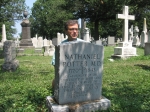
While in Washington DC on the second portion of our recent ME-P book “signing and opining” tour, I had the good fortune to visit the gravesite of the noted physician Nathaniel Potter, MD. Dr. Potter was born in Carolina county Maryland in 1770 and died in Baltimore on 2 January, 1843. He graduated from the University of Pennsylvania in 1796, and settled in Baltimore, where he practiced medicine until his death. In 1807, he associated with Dr. John B. Davidge in founding the University of Maryland, School of Medicine where he ultimately served as professor and dean. He died penniless.

THINK Potter’s field!

About Green Mount Cemetery

Green Mount Cemetery is located in Baltimore, MD. Established in 1839, it is noted for the large number of historical figures that have been interred in its grounds as well as a large number of prominent Baltimore-area families. It retained the name Green Mount when the land was purchased from the heirs of Baltimore merchant Robert Oliver. Green Mount is also a treasury of precious works of art, including striking works by major sculptors like William Rinehart and Hans Schuler. The cemetery was listed in the National Register of Historic Places in 1980.

Assessment

In as much as Dr. Potter was a well know figure to me, I was most pleased at the impromptu visit to his grave. You see, although I attended Temple University because of my future specialty, my first medical school choice would have been at University of Maryland if post-graduate education opportunities had been different at the time. And, I passed the medical school, and the imposing Greek themed Davidge Hall Dome, daily for four years as I rode the number 8 public transportation bus to my undergraduate studies at nearby Loyola University, in Townson Maryland. Of course, the fact that Potter was educated at the University of Pennsylvania School of Medicine, the first in the nation, did not elude me when I worked in its ER as a young medical student in Philadelphia, back in-the-day. University of Maryland was the fifth such medical school in the country.

About Off Road with Dr. Marcinko

These sporadic off-road segments will continue through-out my summer promotional tour. Attendance at several formal and informal engagements increased since the early summer. The previously noted sales spike for our texts, handbooks and dictionaries; as well as interest in our online www.CertifiedMedicalPlanner.org  program.

Part V: https://healthcarefinancials.wordpress.com/2009/08/21/off-road-touring-with-dr-marcinko-part-v/

Conclusion

Your thoughts and comments on this ME-P are appreciated. Feel free to review our top-left column, and top-right sidebar materials, links, URLs and related websites, too. Then, subscribe to the ME-P. It is fast, free and secure.

Speaker: If you need a moderator or speaker for an upcoming event, Dr. David E. Marcinko; MBA – Publisher-in-Chief of the Medical Executive-Post – is available for seminar or speaking engagements. Contact: MarcinkoAdvisors@msn.com

OUR OTHER PRINT BOOKS AND RELATED INFORMATION SOURCES:

Product DetailsProduct Details

Product Details

***

Henry Louis Gehrig, eMRs and Healthcare Reform

What’s the “Iron Horse” Got to Do with Health IT?

By Dr. David Edward Marcinko; MBA, CMP™

[Publisher-in-Chief]Jacobetti VA

According to UPI reports from Charlestown, WVa on August 24 2009, at least 1,200 veterans across the country were mistakenly told by the Veterans Administration [VA] that they suffered from a fatal neurological disorder.

Link: http://www.msnbc.msn.com/id/32541579/ns/health-health_care/

Panicked Veterans

One of the leaders of a Gulf War veterans group is reported to have said that panicked veterans from the states of Alabama, Florida, Kansas, North Carolina, West Virginia and Wyoming contacted the group about the error. Denise Nichols, the vice president of the National Gulf War Resource Center, reportedly blamed a “coding error” for the mistake. In medicine, we call this a “false positive.”

About Henry Louis “Lou” Gehrig

Henry Louis “Lou” Gehrig (June 19, 1903 – June 2, 1941), born Ludwig Heinrich Gehrig, was an American baseball player in the 1920s and 1930s; chiefly remembered for his prowess as a hitter, the longevity of his consecutive games played record and the pathos of his tearful farewell from baseball at age 36, when he was stricken with a fatal disease. Of course, Gehrig was known as the “The Iron Horse” for his durability. Yet, the irony is that Amyotrophic Lateral Sclerosis [ALS], or Lou Gehrig’s disease [sometimes also called Maladie de Charcot] is progressive and fatal. Lou died in 1941 after developing the illness. Will the same death-spiral happen to eHRs and Obama care?

Link: http://www.lougehrig.com

Assessment

Having rotated through the VA system as a young medical student back-in-the-day, I have never been a fan. It smacked of socialized medicine and government plutocracy, and was never a leading-edge example of domestic healthcare, in my informed opinion. Recent HIPAA administrative, security, IT and clinical medical errors are well known. So, to blame the mix-up on an insurance billing and “coding error” seems somewhat disingenuous. Especially now, at a time when eMRs and the Obama Administration’s healthcare reform itself is being vigorously debated by the citizenry. I mean, are there no human checks and balances? Would there be any human intervention if a public healthcare policy was adopted?

Of course, we have written about military medicine previously on this Medical Executive-Post, and devoted an entire channel to it. And, I do realize that more than fifty percent of us receive similar governmental care in some form, or another [Medicare, Medicaid, CHIPS, the Indian and Prison Healthcare Systems, etc].

Link: https://healthcarefinancials.wordpress.com/category/military-medicine/

Nevertheless, shall we give a new moniker to this mistake? How about “Lou Gehrig’s coding error”, and document it in our www.HealthDictionarySeries.com

Conclusion

And so, your thoughts and comments on this Medical Executive-Post are appreciated. Is it even fair to relate this “isolated incident” to the current healthcare reform debate, the eMR conundrum and/or similar discussions on health Information Technology [IT]? Tell us what you think. Feel free to review our top-left column, and top-right sidebar materials, links, URLs and related websites, too. Then, be sure to subscribe to the ME-P. It is fast, free and secure.

Link: http://feeds.feedburner.com/HealthcareFinancialsthePostForcxos

Speaker: If you need a moderator or speaker for an upcoming event, Dr. David E. Marcinko; MBA – Publisher-in-Chief of the Executive-Post – is available for seminar or speaking engagements. Contact: MarcinkoAdvisors@msn.com 

Get our Widget: Get this widget!

Our Other Print Books and Related Information Sources:

Practice Management: http://www.springerpub.com/prod.aspx?prod_id=23759

Physician Financial Planning: http://www.jbpub.com/catalog/0763745790

Medical Risk Management: http://www.jbpub.com/catalog/9780763733421

Healthcare Organizations: www.HealthcareFinancials.com

Health Administration Terms: www.HealthDictionarySeries.com

Physician Advisors: www.CertifiedMedicalPlanner.com

Subscribe Now: Did you like this Medical Executive-Post, or find it helpful, interesting and informative? Want to get the latest ME-Ps delivered to your email box each morning? Just subscribe using the link below. You can unsubscribe at any time. Security is assured.

Link: http://feeds.feedburner.com/HealthcareFinancialsthePostForcxos

Sponsors Welcomed

And, credible sponsors and like-minded advertisers are always welcomed.

Link: https://healthcarefinancials.wordpress.com/2007/11/11/advertise

Superannuation Demographics for Financial Advisors

Join Our Mailing List

www.CertifiedMedicalPlanner.org

“Live Long and Prosper”

By Dr. David Edward Marcinko; MBA, CMP™

By Thomas A. Muldowney; MSFS, CLU, CFP®, CMP™

By Hope Rachel Hetico; RN, MHA, CMP™Senior Citizens

The words of Mr. Spock!

Recently, during my promotional speaking tour for the summer of 2009, I had the occasion to visit a few nursing and related homes for the elderly, sick, infirmed and aged. This harkened warm thoughts back to my time at Temple University in Philadelphia, PA as a young medical student. So, as a health economist and former certified financial planner, I recruited some folks and did some research on the domestic aging population to refresh my understanding of the facts and figures; especially in light of the current healthcare reform political debates [DEM].

Just the Facts  

According to the U.S. Bureau of the Census, there were almost 49 million people in the United States who were over age 60 in 2001. There are approximately 4 million people over the age of 85 living in the US and there are over 60,000 people older than age 100 estimated as of July 1st 2004. For every100 middle aged persons in the United States there are at present about 114 persons over the age of 65. This statistic will change as we move forward through time. In the year 2025, there will be about 253 people over age 65 for every 100 middle-aged people.

Enter the Baby Boomers

Beginning on January 1, 2006 at midnight and every 12 seconds thereafter for fifteen years, a baby boomer will have a birthday and cross over the age threshold of age 60. In the next 30 years, the 60+ age group will more than double, becoming 25% of the total population, and will have to be supported by a proportionately smaller workforce. Research published in June 2005 by AARP (based on data from 2002) estimates that: ‘‘In 2002, roughly $140 billion was spent on nursing home and home health care, with 24% of these costs being paid out of pocket” (O’Brien and Elias, 2004).

Aging Boomers

As the baby boom generation ages, the care needs will expand precipitously. Add to this, scientific and technological improvements in healthcare. These very same people will need more expensive healthcare and more expensive custodial care, and they will need it for an even longer period of time. Who will pay for this expanded need is not so clear. What is clear is that it will take money and lots of it to make these payments.

Money Preservation Variables

There are only three variables associated with the accumulation or preservation of money: ‘‘time, money and rate of return.’’ Time is reduced to the following two questions ‘‘How long until I will need my money?’’ and ‘‘How long will I live?’’ an uncertainty to be sure. Rate of return is either a function of the financial markets or the successful maintenance of a Long Term Care Insurance [LTCI] plan. Because of the volatility in the financial markets, the ‘‘money’’ question is equally as uncertain. In order to accumulate sufficient assets; an aging physician must ’tradeoff’ many other alternatives such as ’lifestyle.’

Assessment

What is certain is this—financial planning is important. More important is the implementation.

Conclusion

Your thoughts and comments on this ME-P are appreciated. Feel free to review our top-left column, and top-right sidebar materials, links, URLs and related websites, too. Then, subscribe to the ME-P. It is fast, free and secure.

Speaker: If you need a moderator or speaker for an upcoming event, Dr. David E. Marcinko; MBA – Publisher-in-Chief of the Medical Executive-Post – is available for seminar or speaking engagements. Contact: MarcinkoAdvisors@msn.com

OUR OTHER PRINT BOOKS AND RELATED INFORMATION SOURCES:

Product Details  Product Details

More on Doctors and Personal Net Worth

Join Our Mailing List

Determinations Using Rules-of-Thumb

[By Staff Reporters]fp-book1

Once the value of all personal assets and liabilities is known, physician net worth can be determined with the following formula: Net worth – assets minus liabilities. Obviously, higher is better.

And, although eschewed in the past, rule-of-thumb determinations are making a comeback because of the recent financial implosion and stock market meltdown.

Benchmarks

In The Millionaire Next Door, Thomas H. Stanley, Ph.D., and William H. Danko gave the following benchmark for net worth accumulation. Although conservative for physicians of a past generation, it may again be more applicable in the future because of the current managed care environment and political turmoil.

Here is the guide: Multiple your age by your annual pre-tax income from all sources, except inheritances; and then divide by ten.

Example

As an HMO pediatrician, Dr. Curtis earned $60,000 last year. So, if she is 35, her net worth should be at least $210,000. How do you get to that point? In a word, consume less and save more. Stanley and Danko found that the typical millionaire set aside 15 percent of earned income annually and has enough invested to survive 10 years, at current income levels if he stopped working. If Dr. Curtis lost her job tomorrow, how long could she pay herself the same salary?

More:

Assessment 

In one non-medical but stark example of inattentiveness to net-worth, John McAfee, the entrepreneur who founded the antivirus software company that bears his name, is now worth about $4 million, down from a peak of more than $100 million, according to the New York Times.

Conclusion

Your thoughts and comments on this ME-P are appreciated. Feel free to review our top-left column, and top-right sidebar materials, links, URLs and related websites, too. Then, subscribe to the ME-P. It is fast, free and secure.

Link: http://feeds.feedburner.com/HealthcareFinancialsthePostForcxos

Speaker: If you need a moderator or speaker for an upcoming event, Dr. David E. Marcinko; MBA – Publisher-in-Chief of the Medical Executive-Post – is available for seminar or speaking engagements. Contact: MarcinkoAdvisors@msn.com

OUR OTHER PRINT BOOKS AND RELATED INFORMATION SOURCES:

DICTIONARIES: http://www.springerpub.com/Search/marcinko
PHYSICIANS: www.MedicalBusinessAdvisors.com
PRACTICES: www.BusinessofMedicalPractice.com
HOSPITALS: http://www.crcpress.com/product/isbn/9781466558731
CLINICS: http://www.crcpress.com/product/isbn/9781439879900
BLOG: www.MedicalExecutivePost.com
FINANCE: Financial Planning for Physicians and Advisors
INSURANCE: Risk Management and Insurance Strategies for Physicians and Advisors

Product Details  Product Details

Comprehensive Financial Planning Strategies for Doctors and Advisors: Best Practices from Leading Consultants and Certified Medical Planners(TM)

What is a Zero-Based Budget?

A Most Cruel – but Needed – Endeavor

[By Staff Reporters]fp-book2

A zero-based budget means you start with the absolute essential expenses and then add-back expenses from there until you run out of money. This is an extremely effective, yet rigorous, exercise for most doctors and medical professionals; and can be used personally or at the office.

Triage and Prioritize

Your first personal financial item should be retirement plan contributions, then your mortgage and other debt payments, and then other required fixed expenses. From the office perspective, the first budget item should be salary expenses for both you and your staff. Operating assets and other big ticket items come next, followed by the more significant items on your net income statement. Some doctors even review their P&L statements quarterly, line by line, in an effort to reduce expenses. Then, you add discretionary personal or business expenses that you have some control over.

More Month than Money

Now, do you run out of money before you reach the end of the month, quarter, or year? Then you better cut back on entertainment at home or that fancy new, but unproven piece of office or medical equipment. This sounds Draconian until you remind yourself that your choice is either (1) entertainment now but no money later or; (2) living a simpler lifestyle now as you invest so you’re able to enjoy yourself at retirement.

Assessment

When you were a young doctor, budgeting may have seemed a task needed far into the future; but at midlife, you are staring retirement right in the face.

Conclusion

Your thoughts and comments on this ME-P are appreciated. Feel free to review our top-left column, and top-right sidebar materials, links, URLs and related websites, too. Then, subscribe to the ME-P. It is fast, free and secure.

Link: http://feeds.feedburner.com/HealthcareFinancialsthePostForcxos

Speaker: If you need a moderator or speaker for an upcoming event, Dr. David E. Marcinko; MBA – Publisher-in-Chief of the Medical Executive-Post – is available for seminar or speaking engagements. Contact: MarcinkoAdvisors@msn.com

OUR OTHER PRINT BOOKS AND RELATED INFORMATION SOURCES:

DICTIONARIES: http://www.springerpub.com/Search/marcinko
PHYSICIANS: www.MedicalBusinessAdvisors.com
PRACTICES: www.BusinessofMedicalPractice.com
HOSPITALS: http://www.crcpress.com/product/isbn/9781466558731
CLINICS: http://www.crcpress.com/product/isbn/9781439879900
BLOG: www.MedicalExecutivePost.com
FINANCE: Financial Planning for Physicians and Advisors
INSURANCE: Risk Management and Insurance Strategies for Physicians and Advisors


Product DetailsProduct DetailsProduct Details

My Favorite Health 2.0 Experience from McDonalds

Meet the Schwieterman’s

By Dr. David Edward Marcinko; MBA, CMP™biz-book

Back in 2005, we published the second edition of our popular textbook: the Business of Medical Practice. And, we are now working on the third edition. At the time however, I was fortunate to have a colleague from the Microsoft Corporation pen our Foreword, now reprinted below for your review.

Link: http://www.springerpub.com/prod.aspx?prod_id=23759


What a Family Tradition!

My favorite story came from Dr. Thomas Schwieterman, a fourth-generation physician working in the same medical office his great grandfather established in 1896 in the town of Mariastein, Ohio. From those same historic environs, Schwieterman has used Microsoft Access to create his own physician assistant application.

The Schwieterman Family Physicians practice kept him so busy that he was wondering how he could keep up with his patient caseload. Schwieterman wanted a faster way to handle prescriptions, provide medical information, and record data for his patient records. He walked into a McDonald’s restaurant one day and had an idea.

The Epiphany

“I ordered a cheeseburger and fries and watched the person at the counter touch the screen of the cash register a few times, and realized the order was getting transferred back to the food preparation area, and that by the time I paid, my order was ready,” he said. “I thought to myself: ‘That’s what I need!’” He searched for commercially available solutions, but when he couldn’t find an exact match for his needs, and when he found prices steep for a small private practice, he decided to create his own – using Access. He also called upon a friend with a Master’s Degree in electrical engineering to help on the coding. His creation boosted his income by 20 percent – “Which was important because we pay more than $60,000 a year for malpractice insurance even though our clinic has never been sued since it was founded 107 years ago.”

Assessment

What my friends at Microsoft especially like about this story is that when Dr. Schwieterman’s colleagues tried his program, liked it, and suggested he try to sell it, he put together a PowerPoint presentation – and landed a partnership agreement with a major healthcare supply and services corporation to market his ChartScribe solution.

Conclusion

So, the pressures facing physicians are great, but so are their resources. Information technology is one resource, this book is another, but the greatest of all is the innate curiosity and drive to discover and create that seems to be so much a part of those who are drawn to this noble profession.

Ahmad Hashem; MD, PhD

Global Healthcare Productivity Manager

Microsoft’s Healthcare Industry Solutions Group

Microsoft Corporation

Redmond, Washington 

Conclusion

And so, your thoughts and comments on this Medical Executive-Post are appreciated. Tell us what you think. Feel free to review our top-left column, and top-right sidebar materials, links, URLs and related websites, too. Then, be sure to subscribe to the ME-P. It is fast, free and secure.

Link: http://feeds.feedburner.com/HealthcareFinancialsthePostForcxos

Speaker: If you need a moderator or speaker for an upcoming event, Dr. David E. Marcinko; MBA – Publisher-in-Chief of the Executive-Post – is available for seminar or speaking engagements. Contact: MarcinkoAdvisors@msn.com 

Get our Widget: Get this widget!

Our Other Print Books and Related Information Sources:

Practice Management: http://www.springerpub.com/prod.aspx?prod_id=23759

Physician Financial Planning: http://www.jbpub.com/catalog/0763745790

Medical Risk Management: http://www.jbpub.com/catalog/9780763733421

Healthcare Organizations: www.HealthcareFinancials.com

Health Administration Terms: www.HealthDictionarySeries.com

Physician Advisors: www.CertifiedMedicalPlanner.com

Subscribe Now: Did you like this Medical Executive-Post, or find it helpful, interesting and informative? Want to get the latest ME-Ps delivered to your email box each morning? Just subscribe using the link below. You can unsubscribe at any time. Security is assured.

Link: http://feeds.feedburner.com/HealthcareFinancialsthePostForcxos

Sponsors Welcomed

And, credible sponsors and like-minded advertisers are always welcomed.

Link: https://healthcarefinancials.wordpress.com/2007/11/11/advertise

Off-Road Touring with Dr. Marcinko [Part IV]

About Atlas Sports Genetics

By Dr. David Edward Marcinko; MBA, CMP™

[Publisher-in-Chief]

Dateline: July 6, 2009people_top

Did you know that for about $150 bucks, Atlas Sports Genetics [ASG], a company in Boulder CO, offers a DNA test kit to evaluate actinin; a protein found in fast-twitch muscle fibers? Yep; it’s true!

About ASG

ATLAS™ stands for Athletic Talent Laboratory Analysis System and is a leading edge athletic talent identification test that uses enhanced DNA analysis to identify those athletes that are genetically predisposed to either speed/power or endurance characteristics. Through the analysis of a specific DNA gene called ACTN3, the SportGene® Test developed by Genetic Technologies in Australia, is now available in the United States through Atlas Sports Genetics.

The Kit

Using a cheek swab sent to the lab, a report on the gene ACTN3 is received by mail several weeks later. The test is touted to be helpful in determining the best sport, or prefect athletic career, for participants. And, it is highly sought after by helicopter parents wishing to pursue a college scholarship or sports contract for junior [i.e., marathoner versus sprinter, etc].

Just take a look here: http://www.atlasgene.com

AssessmentESPN

How did I learn about all this? Why, from an USOEC parent of course, during my travels to Upper Michigan. And me? I’ve been a middle distance runner for 35 years; even with a dislocated finger! LSD anyone; long-slow-distance.


About Off Road with Dr. Marcinko

These sporadic off-road segments will continue through-out my 2009 summer promotional tour. On the one hand, formal attendance at several engagements was a bit sparse because of the death of several recent celebrities and entertainer types. On the other hand, local book stores and sponsors noted a spike in our CD and book sales, as well as interest in our online www.CertifiedMedicalPlanner.com program and premier quarterly guide: Healthcare Organizations [Journal of Financial Management Strategies] www.HealthcareFinancials.com

Part I: https://healthcarefinancials.wordpress.com/2009/07/20/off-road-touring-with-dr-marcinko-part-i/

Part II: https://healthcarefinancials.wordpress.com/2009/07/22/off-road-touring-with-dr-marcinko-part-ii/

Part III: https://healthcarefinancials.wordpress.com/2009/07/24/off-road-touring-with-dr-marcinko-part-iii/

Conclusion

And so, your thoughts and comments on this Medical Executive-Post are appreciated. Tell us what you think about the performance predictive power of ACTN3? Feel free to review our top-left column, and top-right sidebar materials, links, URLs and related websites, too. Then, be sure to subscribe to the ME-P. It is fast, free and secure.

Link: http://feeds.feedburner.com/HealthcareFinancialsthePostForcxos

Speaker: If you need a moderator or speaker for an upcoming event, Dr. David E. Marcinko; MBA – Publisher-in-Chief of the Executive-Post – is available for seminar or speaking engagements. Contact: MarcinkoAdvisors@msn.com 

Get our Widget: Get this widget!

Our Other Print Books and Related Information Sources:

Practice Management: http://www.springerpub.com/prod.aspx?prod_id=23759

Physician Financial Planning: http://www.jbpub.com/catalog/0763745790

Medical Risk Management: http://www.jbpub.com/catalog/9780763733421

Healthcare Organizations: www.HealthcareFinancials.com

Health Administration Terms: www.HealthDictionarySeries.com

Physician Advisors: www.CertifiedMedicalPlanner.com

Subscribe Now: Did you like this Medical Executive-Post, or find it helpful, interesting and informative? Want to get the latest ME-Ps delivered to your email box each morning? Just subscribe using the link below. You can unsubscribe at any time. Security is assured.

Link: http://feeds.feedburner.com/HealthcareFinancialsthePostForcxos

Sponsors Welcomed

And, credible sponsors and like-minded advertisers are always welcomed.

Link: https://healthcarefinancials.wordpress.com/2007/11/11/advertise

Dictionary of Health Insurance and Managed Care

ADVERTISEMENT

Whither the Dictionary of Health Insurance and Managed Care?

HDS

A simple query that demands a cogent answer!

Why do we need the Dictionary of Health Insurance and Managed Care, and, why do payers, providers, benefits managers, consultants, and consumers need a credible and unbiased source of explanations for their health insurance needs and managed care products?

The Answer is Clear!

Health care is the most rapidly changing domestic industry. The revolution occurring in health insurance and managed care delivery is particularly fast. Some might even suggest these machinations were malignant, as many industry segments, professionals, and patients suffer because of them. And so, because knowledge is power in times of great flux, codified information protects all people from physical, as well as economic harm.

We appreciate the support of our sponsors. So, click-on on the links and review all dictionary products.

Link: http://healthdictionaryseries.com/TechnologySecurity.aspx

Link: http://www.findbookprices.com/author/Hope_Hetico

Subscribe Now: Did you like this Medical Executive-Post, or find it helpful, interesting and informative? Want to get the latest ME-Ps delivered to your email box each morning? Just subscribe using the link below. You can unsubscribe at any time. Security is assured.

Link: http://feeds.feedburner.com/HealthcareFinancialsthePostForcxos

Sponsors Welcomed

And, credible sponsors and like-minded advertisers are always welcomed.

Link: https://healthcarefinancials.wordpress.com/2007/11/11/advertise

Product DetailsProduct DetailsProduct Details

On the Gates Incident

A Teaching Moment – I Think Not!

By Dr. David Edward Marcinko; MBA, CMP™

[Publisher in Chief]Obama-Hope

ME-P readers are no doubt aware of the Professor Gates incident in Cambridge Massachusetts? So, please indulge me in presenting one doctors’ opinion on the matter; short and sweet. 

The Participants

Professor Henry L. Gates Jr., is an elderly Harvard educated expert on African American studies.

Sergeant James Crowley attempted to resuscitate Boston Celtics star Reggie Lewis in 1993, and is a police department race relations intermediary.

President Obama is a Harvard Law School Professor who knowingly opined without the facts.

Who’s Right?

Now – if these august participants “got it wrong” – how can “they” expect ordinary citizens to “get it right”?

A Teachable Moment?

The only teachable moment here – is that there was no teachable moment. Or, perhaps the real teachable moment demonstrates that we citizens are getting it “right” – faster than the experts.

ME-P Synergy

So, what’s the synergy with the ME-P? Just this; perhaps a psychiatrist or psychologist should attend the next “beer summit.” Or, that Reggie Lewis was from East Baltimore like me; his fan. And, that he attended Dunbar our local public high school. My teachable moment was thus decades ago – taught not by “governmental experts” – but by my parents. Thanks mom and dad!

Conclusion

And so, your thoughts and comments on this Medical Executive-Post are appreciated. Tell us what you think about the Gates incident. Is this even a fertile topic of discussion for the ME-P?

Channel Surfing

Have you visited our other topic channels? Established to facilitate idea exchange and link our community together, the value of these topics is dependent upon your input. Please take a minute to visit. And, to prevent that annoying spam, we ask that you register. 

Link: http://feeds.feedburner.com/HealthcareFinancialsthePostForcxos

Speaker: If you need a moderator or speaker for an upcoming event, Dr. David E. Marcinko; MBA – Publisher-in-Chief of the Executive-Post – is available for seminar or speaking engagements. Contact: MarcinkoAdvisors@msn.com 

Get our Widget: Get this widget!

Off-Road Touring with Dr. Marcinko [Part III]

Join Our Mailing List

I Dislocate a Finger

By Dr. David Edward Marcinko; MBA, CMP™

[Publisher-in-Chief]

Dateline: Sunday June 28, 2009DEM-MQT MTN

Fresh off my “runner’s” high from meeting Olympians Shani Davis and Apolo Ohno, the other day, I easily ran an extra couple of miles during my daily training run to stay in shape during my arduous speaking and book signing tour. Thus, invigorated in mind and body, and flushed with surging natural endomorphins, I decided to spend the afternoon at Marquette Mountain watching the downhill mountain bike races.

After introducing myself to Bruce Gustafson, the ambulance driver there on professional standby from the local Marquette General Hospital EMT service, I spent an hour or so marveling at how the racers survived the rocky and treacherous down-hill course. Unfortunately, I was not so lucky, and came very close to requiring Bruce’s expert services.

Taking a TumbleDismay

While climbing down the mounting, running actually, I tripped head-over-heels and commenced wildly flailing and rolling down the rocky terrain, stopping just short of smashing into a large birch tree after 50 feet or so. Bouncing straight back up in an instant, I doubt if nearby spectators even noticed what had happened.  Nevertheless, I was most pleased at my adroit body and still youthful ability to assume a dolphin like roll into the fall, dissipating kinetic energy and avoiding injury. Or, so I thought.

Dislocating a Finger

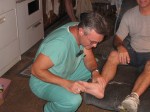
Unfortunately, my fourth right finger began to throb a few seconds later; and then scream at me. Not much medical acumen was needed to note that something was wrong, as the proximal-inter-phalangeal-joint [PIPJ] appeared laterally deviated forty-five degrees, just as the digital apex was turning blue and the joint began swelling before my eyes. Appreciating the impending neurovascular compromise potential, I grabbed the finger, distracted it, reversed the mechanism of injury, let go, and felt it snap back into place.  I promptly sat down as a diaphoretic wave of cold sweat broke out on my forehead, chest, shoulders and arms. Fortunately, the hypo-tensive episode lasted only a few minutes, and I did not go into shock. A visiting nurse came to the rescue, elevating my feet, monitoring vital signs and offering fluids as I recovered quickly. She was indeed my Florence Nightingale and, as I later learned, a Master’s prepared nurse-executive. I was gratefully taken back to my hotel after refusing further medical assistance or X-rays. The finger was grotesquely swollen the next few days but did not hurt much. Simple contrast baths, passive and active ROM exercises, along with the “tincture of time” which I estimate to be 6-8 weeks based on clinical experience, will hopefully be all that is required for complete recovery. Although, it may be some time before full typing flexibility is returned; assuming a “button-hole” extensor tendon rupture incarcerating, strangling or imbricating the phalangeal head, did not occur.Ambulance DEM

Assessment

In my former clinical medical career, I diagnosed, treated and operated on hundreds of injured fingers and toes; for various acute and chronic conditions, fractures, dislocations and related digital anomalies. I even published several peer reviewed papers on same. Still, my course of action may be considered reckless, by some, and should not be repeated. Always seek medical advice.

References:

1. Digital Fractures and Dislocations [Diagnosis and Treatment]. Author: DH Elleby, and DE Marcinko [Clinics in Podiatry. 05/1985; 2(2):233-45].

2. Marcinko DE, and Elleby DH. Digital Fractures and Dislocations; In: Scurran BL, ed. Foot and Ankle Trauma, 2nd ed; Church-Hill-Livingston, Boston, MA.

About Off Road with Dr. Marcinko

These sporadic off-road segments will continue through-out my 2009 summer promotional tour. On the one hand, formal attendance at several engagements was a bit sparse because of the death of several recent celebrities and entertainer types. On the other hand, local book stores and sponsors noted a spike in our CD and book sales, as well as interest in our online www.CertifiedMedicalPlanner.com program as well as our quarterly institutional premium guide; Healthcare Organizations [Journal of Financial Management Strategies] www.HealthcareFinancials.com

Part I: https://healthcarefinancials.wordpress.com/2009/07/20/off-road-touring-with-dr-marcinko-part-i/

Part II: https://healthcarefinancials.wordpress.com/2009/07/22/off-road-touring-with-dr-marcinko-part-ii/

Conclusion

Your thoughts and comments on this ME-P are appreciated. Feel free to review our top-left column, and top-right sidebar materials, links, URLs and related websites, too. Then, subscribe to the ME-P. It is fast, free and secure.

Speaker: If you need a moderator or speaker for an upcoming event, Dr. David E. Marcinko; MBA – Publisher-in-Chief of the Medical Executive-Post – is available for seminar or speaking engagements. Contact: MarcinkoAdvisors@msn.com

OUR OTHER PRINT BOOKS AND RELATED INFORMATION SOURCES:

Product DetailsProduct DetailsProduct Details

Off-Road Touring with Dr. Marcinko [Part II]

Meeting Olympic Champions

By Dr. David Edward Marcinko; MBA, CMP™

[Publisher-in-Chief]

Dateline: Saturday June 27, 2009MGH Bike Race

I attended the Superior BMX Bike Fest today, sponsored in-part by Marquette General Hospital [MGH] and held for amateur and professional cyclists, alike. These brave riders in downtown Marquette MI; segregated by gender and age groups, rode mostly carbon bicycles. Female winner of the Twilight Criterium was 22 year old Sarah Maguire, of Team Priority Health, and the defending state champion. Her time was 33:14.6 for the urban and very hilly short course. The first place male winner was Derek Graham at 28:15.5, and the second place winner was Graham Howard, a former pharmacy graduate student, also from powerhouse Team Priority Health. All were given a hearty ME-P congratulatory “shout-out”, as my services in the medical-tent went un-needed for the entire event.

Apolo, Shani and RyanOEC

Shani Davis, of Marquette High School, is a former US Olympic Education Center [USOEC] ice skater and 1,000 meter Olympic gold medalist at the 2006 Winter Games in Torino, Italy. He is also a close friend of Apolo Anton Ohno who was here to participate in the US Short Track National Speed Skating Trials. Fans of the sport may recall that Apolo is a five time Olympian speed ice-skating medalist and most recent “Dancing with the Star’s” winner. So, he took a celebratory bike ride through the city while in town practicing with the US Olympic team at the nearby Berry Events Center. Both Shani and Apolo cheered for former USOEC speed skater Ryan Bedford, while remaining very approachable to their considerable fan base. I was lucky enough to briefly chat-them-up at the races. All young men are fine examples of amateur athletics in the truest Olympic tradition. 

About Off Road with Dr. Marcinko

These sporadic off-road segments will continue through-out my 2009 summer promotional tour. On the one hand, formal attendance at several engagements was a bit sparse because of the death of several recent celebrities and entertainer types. On the other hand, local book stores and sponsors noted a spike in our CD and book sales, as well as interest in our online www.CertifiedMedicalPlanner.com program and premier quarterly guide: Healthcare Organizations [Journal of Financial Management Strategies] www.HealthcareFinancials.com

Part I: https://healthcarefinancials.wordpress.com/2009/07/20/off-road-touring-with-dr-marcinko-part-i/

Conclusion

And so, your thoughts and comments on this Medical Executive-Post are appreciated. Tell us what you think. Feel free to review our top-left column, and top-right sidebar materials, links, URLs and related websites, too. Then, be sure to subscribe to the ME-P. It is fast, free and secure.

Link: http://feeds.feedburner.com/HealthcareFinancialsthePostForcxos

Speaker: If you need a moderator or speaker for an upcoming event, Dr. David E. Marcinko; MBA – Publisher-in-Chief of the Executive-Post – is available for seminar or speaking engagements. Contact: MarcinkoAdvisors@msn.com 

Get our Widget: Get this widget!

Our Other Print Books and Related Information Sources:

Practice Management: http://www.springerpub.com/prod.aspx?prod_id=23759

Physician Financial Planning: http://www.jbpub.com/catalog/0763745790

Medical Risk Management: http://www.jbpub.com/catalog/9780763733421

Healthcare Organizations: www.HealthcareFinancials.com

Health Administration Terms: www.HealthDictionarySeries.com

Physician Advisors: www.CertifiedMedicalPlanner.com

Subscribe Now: Did you like this Medical Executive-Post, or find it helpful, interesting and informative? Want to get the latest ME-Ps delivered to your email box each morning? Just subscribe using the link below. You can unsubscribe at any time. Security is assured.

Link: http://feeds.feedburner.com/HealthcareFinancialsthePostForcxos

Sponsors Welcomed

And, credible sponsors and like-minded advertisers are always welcomed.

Link: https://healthcarefinancials.wordpress.com/2007/11/11/advertise

Off-Road Touring with Dr. Marcinko [Part I]

“Using-Up” Health Insurance

By Dr. David Edward Marcinko; MBA, CMP™

[Publisher-in-Chief]

Dateline: June 18-19th, 2009dem24          

I flew into Marquette Michigan last night on a puddle jumper from Chicago, Illinois. Marquette will be the home base on my current book promotion and public/private  speaking tour. This second leg of our trip, from Atlanta, was delayed for mechanical reasons. So, rather than follow directions from American Airlines regarding new arrangements, and rushing to wait in a long line of humanity for a new boarding pass on a much later flight, I simply called the travel assistance number on my cell phone. We were re-routed by computer from American, to a Delta Airlines flight, that caused no additional time lag as we later learned the other passengers boarded their American flight three hours late. Many of the elderly and slower moving folks even missed connecting flights which necessitated overnight hotel stays, in some cases.

THINK: outside the box independently, and don’t follow directions mindlessly.  

About Marquette, Michigan

The City of Marquette is located in the central region of Michigan’s Upper Peninsula. With a population of 20,714, it is the UP’s largest community. In addition to being a population center, it serves as the regional center for education, health care, recreation, and retail. This regional draw is particularly evident due to Northern Michigan University and Marquette General Hospital, both of which are located in the City of Marquette. Of course, I visited both.

Quality Healthcare for the Upper PeninsulaUPHC

So, the next morning I called some friends who suggested we head over to the Marquette Upper Peninsula  Healthcare Network System, on Washington Street, for an unplanned and unofficial stop on our current “signing and opining” tour. It seemed very busy for a Friday morning; so we gathered some colleagues and ambled over to Viering’s Restaurant where we discussed the local economy, current state of the healthcare industry and the Obama Administration’s ideas for healthcare reform. When I expressed my surprise at the number of patients in the clinic waiting room areas, I was informed that an unexpected corporate layoff resulted in patients “wanting to use their health insurance, before being RIFed [Reduced-in-Force].” Now, as a doctor, and insurance agent, I find this attitude both very strange; yet not uncommon.

“Using-Up” Health Insurance

I can honestly say that after more than three-decades in the business, I have never heard a single soon-to-be unemployed client say,” I need to use up my life insurance”, or “auto insurance”, or “homeowner’s insurance”, etc. So, what gives with health insurance?

Health Insurance IS Different

Insurance of all types is sold to economically protect against catastrophic events like pre-mature death, auto accidents, or home destruction. But life insurance doesn’t pay for non-lethal issues; auto insurance doesn’t pay for new tires, tune-ups or oil changes; and home owner’s insurance doesn’t pay for regular upkeep and maintenance, etc. So, why do some patients believe that health insurance necessarily needs to be used-up? Were they not healthy before the lay-off announcement; or did they suddenly become ill, thereafter? What do you think? Is this just a local phenomenon, or would it be [is it] pandemic in any community given the same or similar circumstances?

AssessmentUPHC-DEM

For me, this scenario clearly demonstrates two things. First, that Health Insurance is thought of as a personal right and/or corporate fringe-benefit; rather than true financial indemnification. Second, it demonstrates the ability of patients to think ahead; unlike the airline customers on my initial trip here. So, if patients can be forward thinking about their health insurance needs, why don’t they think ahead about their personal health care needs? Why don’t more of us exercise regularly, watch our blood pressure and weight, and/or avoid drugs, alcohol and promiscuous sex, etc.  If we can monitor and pay for routine auto and home maintenance ourselves; why not our routine health needs?  Isn’t good health our most important personal asset? Aren’t we worth it? Do we really want to abrogate our very lives to others? Do we want to concede our responsibilities to a third party, ie, a national [single-payer] governmental controlled healthcare? Those patients wanting to “use their health insurance”, before unemployment, certainly seem to think so.

About Off Road with Dr. Marcinko

These sporadic off-road segments will continue through-out my 2009 summer promotional tour. On the one hand, formal attendance at several engagements was initially a bit sparse because of the death of several recent celebrities and entertainer types. On the other hand, local book stores and sponsors noted a spike in our CD and book sales, as well as interest in our online www.CertifiedMedicalPlanner.com program and premier quarterly guide: Healthcare Organizations [Journal of Financial Management Strategies] www.HealthcareFinancials.com

Conclusion

And so, your thoughts and comments on this Medical Executive-Post are appreciated. Tell us what you think. Feel free to review our top-left column, and top-right sidebar materials, links, URLs and related websites, too. Then, be sure to subscribe to the ME-P. It is fast, free and secure.

Link: http://feeds.feedburner.com/HealthcareFinancialsthePostForcxos

Speaker: If you need a moderator or speaker for an upcoming event, Dr. David E. Marcinko; MBA – Publisher-in-Chief of the Executive-Post – is available for seminar or speaking engagements. Contact: MarcinkoAdvisors@msn.com 

Get our Widget: Get this widget!

Our Other Print Books and Related Information Sources:

Practice Management: http://www.springerpub.com/prod.aspx?prod_id=23759

Physician Financial Planning: http://www.jbpub.com/catalog/0763745790

Medical Risk Management: http://www.jbpub.com/catalog/9780763733421

Healthcare Organizations: www.HealthcareFinancials.com

Health Administration Terms: www.HealthDictionarySeries.com

Physician Advisors: www.CertifiedMedicalPlanner.com

Subscribe Now: Did you like this Medical Executive-Post, or find it helpful, interesting and informative? Want to get the latest ME-Ps delivered to your email box each morning? Just subscribe using the link below. You can unsubscribe at any time. Security is assured.

Link: http://feeds.feedburner.com/HealthcareFinancialsthePostForcxos

Sponsors Welcomed

And, credible sponsors and like-minded advertisers are always welcomed.

Link: https://healthcarefinancials.wordpress.com/2007/11/11/advertise

Boosting Medical Practice Goodwill Value

Goodwill Hunting

What’s your Office Really Worth?

[By Dr. David E. MarcinkoStethoscope; MBA]

There are several measures a physician can take to increase the value of medical practice goodwill, which in turn will make the practice more desirable, and profitable, when selling or taking on a partner.

These are listed below for your consideration:  

  • Keep good financial records. Know your capital purchases, and have your balance sheet, statement of cash flow and net income statement up to date.
  • Continually monitor key financial ratios, such as profitability, creditors, long-term debt management and medical equity value-added.
  • Have adequate practice insurance, including property liability coverage, plus have workers’ compensation for staff and life and disability insurance on the key doctors.
  • Build a brand identity for the practice rather than an individual brand identity for you as a physician. This helps in developing a business that others could assume and operate.
  • Have a practice continuation plan that stipulates how the practice will be sold or continued in the event of a physician’s death or disability. Specify who will buy the practice and for how much. And specify whether the purchase will include land, buildings, inventory, licenses and goodwill. Have a covenant that specifies the procedures to follow when a physician leaves the practice.
  • Have strong relationships with everyone who does business with your practice, including supply vendors as well as referring doctors and fellow physicians.
  • Be organized when it comes time to present the supporting information. Don’t accept the first valuation given. Numbers can be changed, if you can present substantive reasons.

MORE: AMA News Interviews Dr. Marcinko

Conclusion

And so, your thoughts and comments on this Medical Executive-Post are appreciated. How have you reacted to the recent declines in both medical practice [business] and personal [doctor] goodwill?

Tell us what you think? Feel free to review our top-left column, and top-right sidebar materials, links, URLs and related websites, too. Then, be sure to subscribe to the ME-P. It is fast, free and secure.

Link: http://feeds.feedburner.com/HealthcareFinancialsthePostForcxos

Speaker: If you need a moderator or speaker for an upcoming event, Dr. David E. Marcinko; MBA – Publisher-in-Chief of the Executive-Post – is available for seminar or speaking engagements. Contact: MarcinkoAdvisors@msn.com

Our Other Print Books and Related Information Sources:

Risk Management, Liability Insurance, and Asset Protection Strategies for Doctors and Advisors: Best Practices from Leading Consultants and Certified Medical Planners™8Comprehensive Financial Planning Strategies for Doctors and Advisors: Best Practices from Leading Consultants and Certified Medical Planners™

Subscribe Now: Did you like this Medical Executive-Post, or find it helpful, interesting and informative? Want to get the latest ME-Ps delivered to your email box each morning? Just subscribe using the link below. You can unsubscribe at any time. Security is assured.

Link: http://feeds.feedburner.com/HealthcareFinancialsthePostForcxos

Sponsors Welcomed

And, credible sponsors and like-minded advertisers are always welcomed.

Link: https://healthcarefinancials.wordpress.com/2007/11/11/advertise

Product DetailsProduct DetailsProduct Details

***

Invite Dr. Marcinko

***

Concierge Medicine and the “Zombie” Medical Practices

Continued Growth of Boutique Medical Practices Today

[By Dr. David Edward Marcinko; MBA CMP™]dem2

The boutique, or direct reimbursement, or cash based medicine, or concierge medical practice business model requires an annual fee for personalized treatment that includes amenities far beyond those offered in the typical practice, or suggested by physician medical unions. Patients pay annual out-of-pocket fees for top tier service, but also use traditional health insurance to cover allowable expenses, such as inpatient hospital stays, outpatient diagnostics and care, and basic tests and physician exams. Typical annual fees can range from $1,500 to $ 5,000 per patient, to family fees that top $25,000 a year, or more. The concept, initially developed for busy corporate executives, has now made its way to others desiring such service.

A Higher Level of Care

Medical providers get to provide a much higher level of care and get to know their patients as they enjoy the incentive to spend appropriate time with them, and over time, get to know them within their unique social/cultural context as well (hence the house calls become important). Patients enjoy the access, the attentiveness, and are willing to spend cash to have the type of unhurried, contemplative time with physicians that is required to develop a trusted relationship and deliver high quality care. The financial remuneration potential is compelling as well.

Now, let us compare and contrast various parameters of traditional medical practice [third party reimbursement] with the same parameters of  so-called “new-wave” concierge medicine. Then, let the next-generation of doctors decide.

Current Traditional Model

  • patients seen at 15-20 min increments
  • 2,000 – 3,000 patients
  • Paperwork, administrative burdens, frustrations, and lack coordinated care
  • Impersonal experience (long waits, un-intelligible interactions with health care system)
  • Average Salary = $150,000-250,000

Concierge Practice Model Potential

  • direct relationship with patients
  • 300-500 patients
  • $1,500 – $3,000 access/retainer fee
  • Reduced overhead, positive interactions, care coordination and increased quality
  • Personalized experience (reduced headaches and paperwork with transparent pricing)
  • 24/7 access, same day appointments with multiple other amenities
  • Average Salary = $100,000 – $500,000

Enter the Franchisors

Concierge medical practices can be developed organically, or use a franchise business model [personal communication, Suzanne R. Dewey, Forté Partners, LLC, Williamstown, MA]. Examples of franchisors include:

Opponents and Pessimists

There have been plenty of opponents, within medicine and outside, to the idea of concierge practices almost from the first day.  For example,

The state of Washington’s insurance commissioner attacked the concept of practices offering all the primary care patients needed for a prepaid fee or retainer, arguing that such practices amounted to the business of underwriting health insurance. He said that the practices would have to meet all the regulatory requirements for such an insurance business, including establishing capital reserves and maintaining loss reserves for the payment of claims. It didn’t work, and besides, few concierge practices offer free traditional medical care once retainers are paid–most concierge physician’s bill insurance plans for all the services covered under their patients’ coverage.  The Medicare folks chimed in and managed to drive one physician out of business, arguing that he had tried to charge Medicare patients an extra $600 a year for services already covered by Medicare, hence he was guilty of illegal “balance billing.” Rather than fight Medicare over the issue, the doctor gave up and closed his practice. [C. Davis, “Big Problems for Medicare and Concierge Medicine,” Sierra Sacramento Valley Medicine, 55:3, May/June, 2004 (www.ssvms.org)]” 

Attacking ME?

Objections to concierge medicine focus on both its causes and its effects, and some critics have even attack me, personally. For example, just look what “they” said in the online journal: “Health Care Strategic Management.”

Many critics argue that concierge medicine merely reflects physician greed and unconcern over the needs of the community. Indeed, a recent book by David Marcinko, Business of Medical Practice [Advanced Profit Maximization Techniques for Savvy Doctors], includes a chapter on “The Case for Concierge Medicine” (Ch. 24) as one of the ways ‘savvy’ physicians can maximize their profit, as if that is what medicine is all about. While the image of physicians may retain some Marcus Welby elements of their rushing to the hospital or a patient’s home in the middle of the night, most physicians would rather stay home and leave the job to someone else, it is argued”.

Nicht Schadenfreude

Just think! My mother always feared I’d be a no-body. Good publicity – bad publicity – just spell the name correctly. Schadenfreude may be defined as a “largely unanticipated delight in the suffering of another which is cognized as trivial “ and I take no delight in the slow collapse of traditional medical practice models; or the economic, professional or personal pain of colleagues. But, I also often tell my critics – and clients – that although it’s awfully nice to be altruistic; I am always mindful of the competitive business adage: “no margin-no mission.” And, in as much as this attack was written in July 2005, I can only wonder if I was prescient, or just lucky? With all due respect, I believe it was the former, rather than the later. Why so? Well, just consider how fast www.ChoiceMed.com is growing. This stuff is not rocket-science.

www.MedicalBusinessAdvisors.combiz-book1

About Concierge Choice Physicians

Concierge Choice Physicians: http://choice.md  is a national organization offering a hybrid business model. Physicians divide their practice between a traditional practice and a retainer practice. The retainer practice is limited to approximately 150 patients. A typical concierge practitioner may have 300-500 patients, while the norm for a traditionalist is about 2,000-3,000 patients.

Assessment – Whither the “Zombies”

I, also ruefully wonder how many “zombie” medical practices [practitioners] are out there? You know the kind – a medical practice with neither a good/bad balance sheet. One with only subsistence level operating performance; a practice that is not growing organically or thru merger activity. It is just barely existing as the doctor-in-charge slowly, agonizingly, milks it to death; or retires, whichever comes first.

Conclusion

Your thoughts and comments on this ME-P are appreciated. Feel free to review our top-left column, and top-right sidebar materials, links, URLs and related websites, too. Then, subscribe to the ME-P. It is fast, free and secure.

Link: http://feeds.feedburner.com/HealthcareFinancialsthePostForcxos

Speaker: If you need a moderator or speaker for an upcoming event, Dr. David E. Marcinko; MBA – Publisher-in-Chief of the Medical Executive-Post – is available for seminar or speaking engagements. Contact: MarcinkoAdvisors@msn.com

OUR OTHER PRINT BOOKS AND RELATED INFORMATION SOURCES:

DICTIONARIES: http://www.springerpub.com/Search/marcinko
PHYSICIANS: www.MedicalBusinessAdvisors.com
PRACTICES: www.BusinessofMedicalPractice.com
HOSPITALS: http://www.crcpress.com/product/isbn/9781466558731
CLINICS: http://www.crcpress.com/product/isbn/9781439879900
BLOG: www.MedicalExecutivePost.com
FINANCE: Financial Planning for Physicians and Advisors
INSURANCE: Risk Management and Insurance Strategies for Physicians and Advisors

Product DetailsProduct DetailsProduct Details

Product DetailsProduct Details

Invite Dr. Marcinko

***

Government-Enabled Patient “Bounty Hunters”

Spider Webbing Technology May Trip-Up Miscreant Doctors

By Dr. David Edward Marcinko; MBA CMP™

HO-JFMS-CD-ROMUnder the Health Insurance Portability Accountability Act (HIPAA), the U. S. Department of Health and Human Service (HHS) have operated an “Incentive Program for Fraud and Abuse Information.”

In this program, HHS pays $100 – $1,000 to Medicare recipients who report abuse in the program.

To assist patients in spotting fraud, HHS has published examples of potential fraud, which include:

  • medical services not provided;
  • duplicated services or procedures;
  • more expenses, services, or procedures claimed for than provided (upcoding/billing);
  • misused Medicare cards and numbers;
  • medical telemarketing scams; and
  • no-medical necessity.

Real Health Fraud Exists

There is no question that real fraud exists. The Office of Inspector General of HHS saved American taxpayers a record $32 billion in 2006, according to Inspector General Glenn A. Fine.  Savings were achieved through an intensive and continuing crackdown on waste, fraud, and abuse in Medicare and over 300 other HHS programs. To discourage flagrant allegations, regulations require that reported information directly contribute to monetary recovery for activities not already under investigation.  For the DRA in 2009, this includes the following:

  • promoting state False Claims Acts (section 6032);
  • enhancing the Fair and Accurate Credit Transaction Act, with “red flags” (PL 108-159); see http://www.gpo.gov/fdsys/pkg/PLAW-108publ159/content-detail.html
  • employee education about false claims recovery (section 6033);
  • augmenting the Medicaid Integrity Program (section 6034);
  • enhancing third party recovery (section 6035); and
  • “mining” medical claims for potential fraud with the help of sophisticated computer technology algorithms – called “spider-webbing” – which locate a common insurance claim denominator and then follow the thread throughout claims review. Indicators of  possible fraud include doctors charging more than peers; providers who administer more tests or procedures per patient; providers who conduct medically “unlikely” procedures; providers who bill for more expensive procedures and equipment when there are cheaper options; and patients who travel long distances for treatment.

Assessment

CMS and private companies are able to save far more money by detecting fraud before claims are paid than recovering the money after the factAnd so, a further erosion of patient confidence can be expected as CMS, and private insurers, assume the “bounty hunter” view of healthcare providers.

Conclusion

Of course, your thoughts and comments on this Medical Executive-Post are appreciated. Do you feel like the hunter; or the hunted? Tell us what you think? Do you ever – or never –  fear the spider? Feel free to review our top-left column, and top-right sidebar materials, links, URLs and related websites, too. Then, be sure to subscribe to the ME-P. It is fast, free and secure.

Link: http://feeds.feedburner.com/HealthcareFinancialsthePostForcxos

Speaker: If you need a moderator or speaker for an upcoming event, Dr. David E. Marcinko; MBA – Publisher-in-Chief of the Executive-Post – is available for seminar or speaking engagements. Contact: MarcinkoAdvisors@msn.com

Our Other Print Books and Related Information Sources:

Practice Management: http://www.springerpub.com/prod.aspx?prod_id=23759

Physician Financial Planning: http://www.jbpub.com/catalog/0763745790

Medical Risk Management: http://www.jbpub.com/catalog/9780763733421

Healthcare Organizations: www.HealthcareFinancials.com

Physician Advisors: www.CertifiedMedicalPlanner.org

Subscribe Now: Did you like this Medical Executive-Post, or find it helpful, interesting and informative? Want to get the latest ME-Ps delivered to your email box each morning? Just subscribe using the link below. You can unsubscribe at any time. Security is assured.

Link: http://feeds.feedburner.com/HealthcareFinancialsthePostForcxos

Sponsors Welcomed

And, credible sponsors and like-minded advertisers are always welcomed.

Link: https://healthcarefinancials.wordpress.com/2007/11/11/advertise


For details about how to report an abuse, see www.usdoj.gov/oig/FOIA/hotline.htm.

Product Details

On Healthcare Intranets and Extranets

Join Our Mailing List

A Primer for Physicians and Medical Executives

Dr. Mata

By Richard J. Mata; MD, MS, CMP™ [Hon]

According to the “Dictionary of Heath Information and Technology”,

“An intranet is a private network that uses Internet Protocols, network connectivity, and possibly the public telecommunication system to securely share part of an organization’s information or operations with its employees”.

Sometimes the term refers only to the most visible service, the internal website.  The same concepts and technologies of the Internet, such as clients and servers running on the Internet protocol suite, are used to build an intranet.

Uses in Healthcare

An intranet is commonly used to provide communication and application services.  The advantages of using an intranet in the healthcare setting include the following:

  • Medical Workforce productivity: Intranets can help employees quickly find and view information and applications relevant to their roles and responsibilities.  Via a simple-to-use web browser interface, users can access data held in any database the organization wants to make available, anytime and  subject to security provisions — from anywhere, increasing employees’ ability to perform their jobs faster, more accurately, and with confidence that they have the right information.
  • Time: With intranets, healthcare organizations can make more information available to employees on a “pull” basis (i.e., employees can link to relevant information at a time that suits them) rather than being deluged indiscriminately by e-mails.
  • Communication: Intranets can serve as powerful tools for communication within a healthcare organization; vertically and horizontally.

Vulnerability and Security Protection

Intranets, like other IT systems, need to be protected by security systems. Any intranet is vulnerable to attack by people intent on destruction or on stealing corporate data. The open nature of the Internet and TCP/IP protocols expose a corporation to attack.  Intranets require a variety of security measures, including hardware and software combinations that provide control of traffic; encryption and passwords to validate users; and software tools to prevent and cure viruses, block objectionable sites, and monitor traffic.

Multiple Lines of Defense

The first line of defense is a firewall and these are commonly set up using proxy servers, which allow system administrators to track all traffic coming in and out of an intranet. Another layer of sophistication is added by using a bastion server firewall, configured to withstand and prevent unauthorized access or services. It is typically segmented from the rest of the intranet in its own subnet or perimeter network. In this way, if the server is broken into, the rest of the intranet won’t be compromised.

Authentication Systems

Authentication systems are an important part of any intranet security scheme. They are used to ensure that anyone trying to log into the intranet or any of its resources is the person they claim to be. Authentication systems typically use user names, passwords, fingerprints and iris scans, and various encryption systems.

Protection and Monitoring

Server-based software is used to protect an intranet and its data. Virus-checking software can check every file coming into the intranet to make sure that it is virus-free, and site-blocking software can bar people on the intranet from getting objectionable material. Monitoring software tracks where people have gone and what services they have used, such as HTTP for Web access.

Filtering Systems and Routers

One way of ensuring that the wrong people or erroneous data can’t get into the intranet is to use a filtering router. This is a special kind of router that examines the IP address and header information in every packet coming into the network, and allows in only those packets that have addresses or other data, like e-mail, that the system administrator has decided should be allowed into the intranet. Increasingly, intranets are being used to deliver tools and applications, e.g., collaboration (to facilitate working in groups and for teleconferences) or sophisticated corporate directories, sales and customer relationship management (CRM) tools, project management, etc, to advance productivity. Intranets are also being used as Health 2.0 culture change platforms

Metrics

Intranet traffic, like public-facing website traffic, is better understood by using web metrics software to track overall activity, as well as through surveys of users. Intranet User experience, editorial, and technology teams work together to produce in-house sites. Most commonly, intranets are owned by the communications, HR or IT areas of large healthcare organizations, or some combination of the three.

Assessment

When part of an intranet is made accessible to customers, partners, suppliers, patients, or others outside the healthcare organization – that part becomes part of an extranet.

Conclusion

Your thoughts and comments on this ME-P are appreciated. Feel free to review our top-left column, and top-right sidebar materials, links, URLs and related websites, too. Then, subscribe to the ME-P. It is fast, free and secure.

Link: http://feeds.feedburner.com/HealthcareFinancialsthePostForcxos

Speaker: If you need a moderator or speaker for an upcoming event, Dr. David E. Marcinko; MBA – Publisher-in-Chief of the Medical Executive-Post – is available for seminar or speaking engagements. Contact: MarcinkoAdvisors@msn.com

OUR OTHER PRINT BOOKS AND RELATED INFORMATION SOURCES:

Product DetailsProduct DetailsProduct Details

Product DetailsProduct Details

***

Medical Negligence and the “Burden of Proof”

Understanding the Malpractice Trial Process

By Dr. Jay S. Grife; Esq, MAinsurance-book

In all civil trials, the plaintiff, as the accuser, has the burden of proving his case.  Much like a criminal defendant, a civil defendant has no burden and is presumed “innocent” of any claim by the plaintiff.  As a result, if the plaintiff presents no evidence, or insufficient evidence to support his claim, the defendant wins without having to present his case.  The burden the plaintiff carries is that he must prove his case by what is called a preponderance of the evidence.  In other words, the plaintiff must prove it is more likely than not that he should win.  The best way to visualize this burden is to imagine a set of scales.  If the scales are even, or tipped in favor of the defendant, then the plaintiff has not carried his burden, and loses.  In order to prevail, the plaintiff must tip the scales in his favor.

Proving Medical Malpractice

To prove a case of medical malpractice, a plaintiff-patient must present evidence that the defendant-doctor was negligent, and the plaintiff does this by proving the treatment provided was below the applicable standard of care.  The “standard of care” is the care and skill that a reasonably prudent practitioner would provide in treating a patient.  It is established by the medical community at large, and is constantly evolving.  Care that violates the standard of care today may not necessarily violate the standard of care several years ago.  This distinction is an important one, since most cases take several years to get to trial.  The standard of care is never based on the outcome of the case; a bad result does not necessarily mean a violation of the standard of care.

The Medical Expert Witnesses

Expert medical testimony is required to establish a violation of the standard of care in virtually all medical malpractice cases.  A plaintiff who fails to present the required expert medical testimony in a medical malpractice case will lose.  The plaintiff must also produce expert medical testimony that the alleged negligence caused the injury.

For example, suppose that a patient’s widow brings a medical malpractice case against a surgeon who admitted the patient for removal of an AO plate embedded in bone.  The plaintiff-widow alleges that the surgeon should have done something to prevent a pulmonary embolism, which occurred three days after the patient was dismissed from the hospital, killing him.  The patient might have an expert who would testify that she would not have removed the AO plate, but left it in place.  Such testimony does not carry the burden of proving care below the standard required of the surgeon.  Indeed, in most cases, the standard of care allows a practitioner to choose from a variety of treatment options within an acceptable range.  Mere testimony by an expert witness that “I would have treated this patient differently” is insufficient to establish a breach of the standard of care.  The bad result also is not itself proof of any negligence.  Nor is there any evidence that the doctor caused the patient’s death (i.e., that the embolism would not have occurred without the alleged negligence of the surgeon). Therefore, doctor wins on all elements.

Assessment

Have you ever been involved in a medical malpractice trial; or other healthcare litigation process? The Medical Executive-Post readers are interested in hearing your story.

Conclusion

And so, your thoughts and comments on this Medical Executive-Post are appreciated. Feel free to review our top-left column, and top-right sidebar materials, links, URLs and related websites, too. Then, be sure to subscribe to the ME-P. It is fast, free and secure.

Link: http://feeds.feedburner.com/HealthcareFinancialsthePostForcxos

Speaker: If you need a moderator or speaker for an upcoming event, Dr. David E. Marcinko; MBA – Publisher-in-Chief of the Executive-Post – is available for seminar or speaking engagements. Contact: MarcinkoAdvisors@msn.com  or Bio: www.stpub.com/pubs/authors/MARCINKO.htm

Get our Widget: Get this widget!

Our Other Print Books and Related Information Sources:

Practice Management: http://www.springerpub.com/prod.aspx?prod_id=23759

Physician Financial Planning: http://www.jbpub.com/catalog/0763745790

Medical Risk Management: http://www.jbpub.com/catalog/9780763733421

Healthcare Organizations: www.HealthcareFinancials.com

Health Administration Terms: www.HealthDictionarySeries.com

Physician Advisors: www.CertifiedMedicalPlanner.com

Subscribe Now: Did you like this Medical Executive-Post, or find it helpful, interesting and informative? Want to get the latest ME-Ps delivered to your email box each morning? Just subscribe using the link below. You can unsubscribe at any time. Security is assured.

Link: http://feeds.feedburner.com/HealthcareFinancialsthePostForcxos

Sponsors Welcomed

And, credible sponsors and like-minded advertisers are always welcomed.

Link: https://healthcarefinancials.wordpress.com/2007/11/11/advertise

Product Details  Product Details

Medical Accounts Receivable and Related Formulae

Join Our Mailing List

Understanding Rationale and Formulae

[By Dr. David Edward Marcinko; MBA, CMP™]

[By Dr. Gary L. Bode; CPA, MSA, CMP™]

HO-JFMS-CD-ROMMedical practices, clinics and hospitals generate a patient account or an account receivable (AR) at the same time as they send the patient a bill or the insurance company a claim. ARs are treated as current assets (cash equivalents) on the healthcare entity balance sheet, and usually with a percentage mark-down to reflect historic collection rates.

The Balance Sheet

The balance sheet is a snapshot of a medical practice or healthcare entity at a specific point in time. This contrasts with the income statement (profit and loss), which shows accounting data across a period of time. The balance sheet uses the accounting formula:

Assets (what the entity owns) = Liabilities (what the entity owes) + Entity Equity (left over).

AR Aging Schedules

HDSAccording to the Dictionary of Health Economics and Finance, an AR aging schedule is a periodic report (30, 60, 90, 180, or 360 days) showing all outstanding ARs identified by patient or payor, and month due. The average duration of an AR is equal to total claims, divided by accounts receivable. Faster is better, of course, but it is not unusual for a hospital to wait six, nine, twelve months, or more for payment. Each of these measures seeks to answer two questions:

1) How many days of revenue are tied up in ARs?

2) How long does it take to collect ARs?

More Formulae

An important measure in the analysis of accounts receivable is the AR Ratio, AR Turnover Rate, and Average Days Receivables, expressed by these formulae:

1. AR Ratio = Current AR Balance / Average Monthly Gross Production
(suggested between 1 and 3 for hospitals)

2. AR Turnover Rate = AR Balance / Average Monthly Receipts

3. Average Days Receivable = AR Balance / Daily Average Charges
(suggested < 90 days for medical practices)

And Even More Measures

Other significant measures include:

1. Collection Period = ARs / Net Patient Revenue / 365 days

2. Gross Collection Percentage = Clinic Collections / Clinic Production
(suggested > 40-80% for hospitals)

3. Net Collection Percentage = Clinic Collections / Clinic Production – (minus) Contractual Adjustments (suggested > 80-90% for medical practices)

4. Contractual Percentage = Contractual adjustments / Gross production
(suggested < 40-50% for hospitals).

Assessment

Often, older ARs are often written off, or charged back as bad debt expenses and never collected at all.

Conclusion

Your thoughts and comments on this ME-P are appreciated. Feel free to review our top-left column, and top-right sidebar materials, links, URLs and related websites, too. Then, subscribe to the ME-P. It is fast, free and secure.

Speaker: If you need a moderator or speaker for an upcoming event, Dr. David E. Marcinko; MBA – Publisher-in-Chief of the Medical Executive-Post – is available for seminar or speaking engagements. Contact: MarcinkoAdvisors@msn.com

OUR OTHER PRINT BOOKS AND RELATED INFORMATION SOURCES:

Product Details

[HEALTH INSURANCE, MANAGED CARE, ECONOMICS, FINANCE AND HEALTH INFORMATION TECHNOLOGY COMPANION DICTIONARY SET]

      Product DetailsProduct DetailsProduct Details

***

Discount Brokerages versus On-Line Brokerages

Physicians Must Appreciate the Differences

By Daniel B. Moisand; CFP® and the ME-P StaffME-P Blogger

Here are a few questions for all physician-investors to consider in 2009:

1. True or False? 

The key to investment success is to pay as little for a trade as possible.

2. True or False? 

The higher the number of trades in an investment account, the better the investment results.

3. True or False? 

The majority of revenue of a discount or on-line brokerage comes from trades. 

A: The answers should be crystal clear! False, False and True. It is almost entirely that simple.

Cost Control

Much like a medical practice, keeping costs down is an important objective of personal finance but, it is certainly not the key to success.  There are many studies that show that active trading garners inferior results compared to a longer term buy and hold type of strategy. One of the most publicized recently was conducted by a UC-Davis team led by Dr. Terrance Odean. The study examined the actual tracing activity of thousands of self-directed accounts at a major discount brokerage over a six-year period. The results were clear. Regardless of trading level, most of the accounts underperformed the market and showed that the higher the number of trades, the worse the result.

Of Bulls and Bears

While the U.S. markets were on a dramatic upswing a decade ago, the general interest level in them increased as well.  More households owned financial assets than ever before. Demographics drive much of this surge. The older edge of the baby boom generation is finding that as the children leave home, they have more income than ever before and saving for retirement becomes a higher priority. The proliferation of defined contribution [401-k, 403-b] retirement plans has also forced more people to take responsibility for their long-term security. When, the US stock market was on a tear; one would have be wise to remember an old Wall Street saying – “Don’t confuse brains with a bull market.” Unfortunately today, far too many self-directed investors did not heed the warnings. The media is full of stories about investors whose portfolios were decimated by the recent bear market. While this loss of wealth is somewhat tragic, in almost all cases the losses were made possible by poor planning and/or poor execution that a mediocre advisor would have avoided.

The Business of Advice

One also cannot conclude that everyone is acting as his or her own investment advisor. The advice business continues to thrive. Sales of load mutual funds have continued to grow, as has commission revenue at full-service firms. No-load funds have continued to grow as well and gain market share from the load funds. However, it would be inaccurate to tie that growth to do-it-yourselfers. Much of the growth of no-load funds can be attributed to the advice of various types of advisors who are recommending the funds. In addition, several traditionally no-load fund families have begun to offer funds through brokers for a load.

The Discounters

For physicians and all clients, the primary attraction to a discounter is cost. Everyone loves a bargain. Once it is determined that it is a good idea to buy say 100 shares of IBM, the trade needs to get executed. When the trade settles one owns 100 shares of IBM, regardless of what was paid for the trade. There is no harm in saving a few bucks. However, the decision to buy the IBM shares and when to sell those shares will have a far greater impact on the investment results than the cost of the trade as long as the level of trading is kept at a prudent level. The fact is that most good advisors use discount firms for custodial and transaction services. The leading providers to advisors are Schwab, Fidelity, and Waterhouse.fp-book1

Ego Driven

In addition to cost savings, discounters appeal to one’s ego for business. Everyone wants to feel like a smart investor; especially doctors. Often, marketing materials will cite the IBM example and portray the cost difference as an example of how the investor is either stupid or being ripped off. There is also a strong appeal to one’s sense of control. An investor is made to feel like they are the masters of their own destiny.  All of this is a worthy goal. One should feel confident, in control, and smart about financial issues. Hiring a professional should not result in losing any of these feelings, rather solidify them. Getting one’s affairs in order is smart. The advisor works for the client so a client should maintain control by only delegating tasks to the extent one is comfortable. Knowing that the particular circumstances are being addressed effectively should yield enhanced confidence.

Sales Pressure Release

The final reason people turn to discount and on-line brokerages is to avoid sales pressure. Unlike the stereotypical stockbroker, no one calls to push a particular stock. Instead, sales pressure is created within the mind of the investor. By maintaining a steady flow of information about stocks and the markets to the account holders, brokerages keep these issues in the forefront of the investor’s minds. This increases the probability that the investor will act on the information and execute a trade. Add some impressive graphics and interfaces and the brokerage can keep an investor glued to the screen. The Internet has made this flow easier and cheaper for the brokerages, lowering costs and increasing the focus on trade volume to achieve profitability.

Assessment

The pressurized information flow however, does little to protect investors during a bear market. Ironically, this focus on trading is one of the very conflicts investors are trying to avoid by fleeing a traditional full service broker.

Conclusion

And so, your thoughts and comments on this Medical Executive-Post are appreciated. What are your feelings on discount and internet brokers? Tell us what you think. Feel free to review our top-left column, and top-right sidebar materials, links, URLs and related websites, too. Then, be sure to subscribe to the ME-P. It is fast, free and secure.

Link: http://feeds.feedburner.com/HealthcareFinancialsthePostForcxos

Speaker: If you need a moderator or speaker for an upcoming event, Dr. David E. Marcinko; MBA – Publisher-in-Chief of the Executive-Post – is available for seminar or speaking engagements. Contact: MarcinkoAdvisors@msn.com 

Get our Widget: Get this widget!

Our Other Print Books and Related Information Sources:

Practice Management: http://www.springerpub.com/prod.aspx?prod_id=23759

Physician Financial Planning: http://www.jbpub.com/catalog/0763745790

Medical Risk Management: http://www.jbpub.com/catalog/9780763733421

Healthcare Organizations: www.HealthcareFinancials.com

Health Administration Terms: www.HealthDictionarySeries.com

Physician Advisors: www.CertifiedMedicalPlanner.com

Subscribe Now: Did you like this Medical Executive-Post, or find it helpful, interesting and informative? Want to get the latest ME-Ps delivered to your email box each morning? Just subscribe using the link below. You can unsubscribe at any time. Security is assured.

Link: http://feeds.feedburner.com/HealthcareFinancialsthePostForcxos

Sponsors Welcomed

And, credible sponsors and like-minded advertisers are always welcomed.

Link: https://healthcarefinancials.wordpress.com/2007/11/11/advertise

Medical Coding and Billing Vocabulary

Join Our Mailing List

Basic HIT Nomenclature and HIPAA

[By Richard J. Mata; MD, MIS, CMP™ [Hon]

For the Health Information Technology [HIT] department of a hospital, clinic or medical practice and its coders, the following medical vocabularies are mandated by the Health Insurance Portability and Accountability Act [HIPAA].

Diseases 

For diseases: the 9th or 10th International Classification of Diseases (ICD) Clinical Modification should be used.  ICD9-CM is maintained by the Centers for Disease Control National Center for Health Statistics, while ICD-10 is maintained by the World Health Organization.

Procedures

For medical procedures: a combination of ICD-9-CM, Current Procedural Terminology maintained by the American Medical Association, the Current Dental Terminology maintained by the American Dental Association, and Healthcare Common Procedure Coding System (HCPCS) maintained by CMS, which is also used for medical devices.

Pharmaceuticals

For drugs: these should be coded according to their National Drug Code classification.

Assessment

“A recent change to Medicare policy made by the Centers for Medicare & Medicaid Services (CMS) helps ensure claims processing isn’t delayed when the only missing information on the CMS-1490S form is the provider or supplier’s National Provider Identifier (NPI).

CMS Transmittal 1747, Change Request 6434, issued May 22, notifies A/B Medicare Administrative Contractors (MAC) and carriers of editorial changes to Medicare policy in Pub. 100-04, Medicare Claims Processing Manual, chapter 1 regarding the monitoring of claims submission violations and the handling of incomplete or invalid claims.

In either case, as stated in the transmittal, “If the beneficiary furnishes all other information but fails to supply the provider or supplier’s NPI, the contractor shall not return the claim but rather look up the provider or supplier’s NPI using the NPI registry.”

http://www.aapc.com/news/index.php/2009/06/missing-npi-no-reason-to-deny-says-cms/

Conclusion

Your thoughts and comments on this ME-P are appreciated. Feel free to review our top-left column, and top-right sidebar materials, links, URLs and related websites, too. Then, subscribe to the ME-P. It is fast, free and secure.

Speaker: If you need a moderator or speaker for an upcoming event, Dr. David E. Marcinko; MBA – Publisher-in-Chief of the Medical Executive-Post – is available for seminar or speaking engagements. Contact: MarcinkoAdvisors@msn.com

OUR OTHER PRINT BOOKS AND RELATED INFORMATION SOURCES:


Product DetailsProduct DetailsProduct Details

Capital Sources for Hospitals

Understanding the Liquidity Crunch -with- Publisher’s Interview

By Calvin W. Weise; MBA, CMA, CPA

www.HealthcareFinancials.com

HO-JFMS-CD-ROMHospital are struggling in the current financial crisis, and like most of us, liquidity is scarce. In general, hospitals have three sources of capital: equity from earnings, equity from donations, and long-term debt.


Equity from Earnings

Earnings generate cash, and a portion of that cash is available to fund capital investments. Besides funding capital investments, cash generated from earnings is used to fund working capital. As operations grow, more working capital is required to fund the difference between the operating receivables and operating payables since days of revenue in receivables tend to be a good deal higher than days of expense in payables. Additionally, cash on hand should increase as operations grow so that days of cash remain constant or increase. Once working capital has been adequately funded, any remaining cash generated from earnings is available to invest in capital.

Donations

Most not-for-profit hospitals engage in active fundraising to generate donations. Donations are a good source of capital in certain markets. Often, fundraising initiatives are less useful than they appear due to the costs expended in the fundraising activities. It is important to ensure that all the costs incurred in fundraising activities are properly attributed.

Long-Term Debt

Borrowing long-term debt has been an important source of capital for hospitals and will continue to be. Debt is particularly attractive due to the low cost associated with borrowing on a tax-exempt basis. Long-term debt, borrowed on a tax-exempt basis, is probably the lowest cost form of capital available to hospitals. Tax-exempt borrowing is fairly complex due to the tax regulations affecting it. Because of its complexity, the costs associated with these transactions are quite high, making it less practical for small borrowings.

Assessment

Tax-exempt borrowing transactions require many lawyers and high-priced investment bankers. Credit rating agencies and credit enhancers are also typically involved. Accessing the tax-exempt markets requires a good bit of sophistication and expertise. Despite these requirements, this capital is highly attractive to hospitals and should be used whenever possible.

Interview

Read: Dr. David Edward Marcinko’s recent interview on the current status of hospitals.

Link [unedited version]: https://healthcarefinancials.wordpress.com/2009/04/01/medical-news-of-arkansas-interviews-dr-marcinko/?preview=true&preview_id=9094&preview_nonce=d9039cf076

Link [edited version]: http://www.arkansasmedicalnews.com/news.php?viewStory=738dem2

Conclusion

And so, your thoughts and comments on this Medical Executive-Post are appreciated. What is the financial status of your hospital, today? How has the cash flow crisis affected it; and your practice? Feel free to review our top-left column, and top-right sidebar materials, links, URLs and related websites, too. Then, be sure to subscribe to the ME-P. It is fast, free and secure.


Link: http://feeds.feedburner.com/HealthcareFinancialsthePostForcxos

Speaker: If you need a moderator or speaker for an upcoming event, Dr. David E. Marcinko; MBA – Publisher-in-Chief of the Executive-Post – is available for seminar or speaking engagements. Contact: MarcinkoAdvisors@msn.com  or Bio: www.stpub.com/pubs/authors/MARCINKO.htm

Get our Widget: Get this widget!

Our Other Print Books and Related Information Sources:

Practice Management: http://www.springerpub.com/prod.aspx?prod_id=23759

Physician Financial Planning: http://www.jbpub.com/catalog/0763745790

Medical Risk Management: http://www.jbpub.com/catalog/9780763733421

Healthcare Organizations: www.HealthcareFinancials.com

Health Administration Terms: www.HealthDictionarySeries.com

Physician Advisors: www.CertifiedMedicalPlanner.com

Subscribe Now: Did you like this Medical Executive-Post, or find it helpful, interesting and informative? Want to get the latest ME-Ps delivered to your email box each morning? Just subscribe using the link below. You can unsubscribe at any time. Security is assured.

Link: http://feeds.feedburner.com/HealthcareFinancialsthePostForcxos

Sponsors Welcomed

And, credible sponsors and like-minded advertisers are always welcomed.

Link: https://healthcarefinancials.wordpress.com/2007/11/11/advertise

Appraising a Medical Practice

The “Art of the Deal” for Buyers and Sellers

By Dr. David Edward Marcinko; MBA, CMP™

Publisher-in-Chiefdem2

Are you considering selling your practice — or merging it with another? Thinking of buying? If you are, you’re hardly alone. Despite the decline of the big physician practice management companies [PPMCs] of the 1990s, the merger-and-acquisition market remains robust for small, private practices, as they respond to the continuing financial squeeze being placed on them, in 2009.


Read: http://www.humana.com/providers/NewsLetters/HumanaWeb1stQ07/articles/CoverStoryOne.html

Assessment

Humana’s YourPractice is a quarterly publication for office staff, physicians and other health care providers within the Humana network, and is produced by Corporate Communications in conjunction with “Physicians Practice”.

biz-book

Note: David Marcinko is also a writer for Physicians Practice 

Conclusion

And so, your thoughts and comments on this Medical Executive-Post are appreciated. Feel free to review our top-left column, and top-right sidebar materials, links, URLs and related websites, too. Then, be sure to subscribe to the ME-P. It is fast, free and secure.

Link: http://feeds.feedburner.com/HealthcareFinancialsthePostForcxos

Speaker: If you need a moderator or speaker for an upcoming event, Dr. David E. Marcinko; MBA – Publisher-in-Chief of the Executive-Post – is available for seminar or speaking engagements. Contact: MarcinkoAdvisors@msn.com  or Bio: www.stpub.com/pubs/authors/MARCINKO.htm

Get our Widget: Get this widget!

Our Other Print Books and Related Information Sources:

Practice Management: http://www.springerpub.com/prod.aspx?prod_id=23759

Physician Financial Planning: http://www.jbpub.com/catalog/0763745790

Medical Risk Management: http://www.jbpub.com/catalog/9780763733421

Healthcare Organizations: www.HealthcareFinancials.com

Health Administration Terms: www.HealthDictionarySeries.com

Physician Advisors: www.CertifiedMedicalPlanner.com

Subscribe Now: Did you like this Medical Executive-Post, or find it helpful, interesting and informative? Want to get the latest ME-Ps delivered to your email box each morning? Just subscribe using the link below. You can unsubscribe at any time. Security is assured.

Link: http://feeds.feedburner.com/HealthcareFinancialsthePostForcxos

Sponsors Welcomed

And, credible sponsors and like-minded advertisers are always welcomed.

Link: https://healthcarefinancials.wordpress.com/2007/11/11/advertise

Doctor – Are You on Your Way to $5.5 Million?

Update 2015

[By Staff Reporters]

[Initially Published on September 16, 2008]

As a physician, how much do you need in your retirement kitty to finance your golden years?

It was a vexing question when this article was first written by Physician’s Money Digest’s Editor-in-Chief, Gregory J. Kelly, and is an even more vexing dilemma in 2009. It is also one that most physicians tend to ignore; hence the reprint.

Assessment

And so, for those doctors curious about whether they’ll be living on Easy Street, or Skid Row, when they hang up their stethoscope, it helps to do some basic math and to review this link:

Read: http://www.hcplive.com/print.php?url=http://www.hcplive.com/publications/pmd/2005/95/4030

Channel Surfing the ME-P

Have you visited our other topic channels? Established to facilitate idea exchange and link our community together, the value of these topics is dependent upon your input. Please take a minute to visit. And, to prevent that annoying spam, we ask that you register. It is fast, free and secure.

More:

  1. More on the Doctor Salary Conundrum
  2. Doctor Salary v. Others [Present Value of Career Wealth]
  3. Are Doctors Members of the Middle Class?
  4. Taxing the [not so] Rich [doctors]
  5. Doctor – Are You on Your Way to $5.5 Million?

Conclusion

Your thoughts and comments on this ME-P are appreciated. Feel free to review our top-left column, and top-right sidebar materials, links, URLs and related websites, too. Then, subscribe to the ME-P. It is fast, free and secure.

Speaker: If you need a moderator or speaker for an upcoming event, Dr. David E. Marcinko; MBA – Publisher-in-Chief of the Medical Executive-Post – is available for seminar or speaking engagements. Contact: MarcinkoAdvisors@msn.com

OUR OTHER PRINT BOOKS AND RELATED INFORMATION SOURCES:

Financial Planning MDs 2015

Comprehensive Financial Planning Strategies for Doctors and Advisors: Best Practices from Leading Consultants and Certified Medical Planners(TM)

Dictionary of Health Economics and Finance

ADVERTISEMENT

Whither the Dictionary of Health Economics and Finance?

DHEF

A simple query that demands a cogent answer!

Medical professionals are struggling to maintain adequate income levels. While some specialties are flourishing, others like primary care barely moved forward, not even incrementally keeping up with inflation. In the words of Atul Gawande, MD, a former surgical resident at Brigham and Women’s Hospital in Boston, and one of the best young medical writers in America,

“Doctors quickly learn that how much they make has little to do with how good they are. It largely depends on how they handle the business side of their practice”.

Therefore, the ability to decipher the alphabet soup of medical economics (i.e., OPHCOO, ALOS, DRG, RBRVS, behavioral health, acuity, etc), and understand those financial terms coming from clinical medicine (i.e., call premium, cost benefit ratios, IGARCH, AACPD, IBNR ABCM, internal rate of return, accounts receivable days outstanding, etc.) is vital for survival. Until we have a common language however, medical professionals cannot possess a shared vision, nor can we communicate successfully to create healthcare entities that provide quality care to patients and reasonable profits to medical practitioners.

We appreciate the support of our sponsors. So, click-on on the links below to review all dictionary products.

 HDS


Subscribe Now: Did you like this Medical Executive-Post, or find it helpful, interesting and informative? Want to get the latest ME-Ps delivered to your email box each morning? Just subscribe using the link below. You can unsubscribe at any time. Security is assured.

Link: http://feeds.feedburner.com/HealthcareFinancialsthePostForcxos

Sponsors Welcomed

And, credible sponsors and like-minded advertisers are always welcomed.

Link: https://healthcarefinancials.wordpress.com/2007/11/11/advertise

Product DetailsProduct DetailsProduct Details

Why Coding Professionals?

More on the NPI, the AAPC, Censorship and Quality Health Care

By Darrell K. Pruitt; DDS

pruittFor those who have been following me recently on Twitter (Proots), you know that unlike me, John Hamm has not yet been kicked off of DrBicuspid, and is awaiting a response from Dr. David J. Pettigrew – a dental coding expert with 14 years of experience as Chief Dental Officer for BCBS of New Jersey. I can only shadow the conversation because, as I said, I was kicked off.

Through John Hamm, I sent word to Dr. Pettigrew that he should just shut up and not enter into a discussion about the NPI number. Pettigrew told Johnhamm that I should come onto the DrBicuspid forum and say that in front of everyone. Of course, I am unable to do that because as shameful as it is to my family, I am still banned from posting anything on DrBicuspid.

For real-time developments concerning Dr. Pettigrew’s public defense of the NPI number, it would be better to follow that chunk of drama on Twitter or DrBicuspid. I’ve got other things cooking here. Can you smell it yet?

As you can see, sports fans, I have had Internet contact with a new class of fat, slow-moving healthcare IT stakeholders, and I haven’t been building long-term relationships fortified by good will – if you know what I mean. 14 years of employment at BCBS of New Jersey fails to impress me much.

American Academy of Professional Coders

Those who have studied alphanumeric science have a national organization called the American Academy of Professional Coders [AAPC] which represents business consultants in a growing healthcare niche. Most are employed by providers who are too busy actually performing healthcare to play games with insurance companies for the money owed them. Like SEO professionals who know gimmicks to increase a client’s page rank in relation to competitors, or perhaps a bolus of bad news from a special bastard, professional coders maximize providers’ profits by keeping on top of the ever-changing hoops involved in paying doctors almost all that is owed them following a shorter than average delay.

ICD-10 is Coming 

Learning coding is job security these days because in a few years the mandated ICD-10 codes will force even dental offices to hire IT staff, which also cuts down on the nation’s unemployment. I’ve taken a peek at the ICD-10, and it makes the ICD-9 look like simple algebra. I’d stick with well-trained coding professionals. They’ll cost more but you do want to approach making a profit, don’t you?

Of Censorship

I submitted the following stinker to be posted on the AAPC Website. To their credit, it was posted almost immediately. That could be a good sign … OOPS! Several minutes later it went back under moderation. I think someone is having problems with it. You’ll have to read it to understand why. It’s tricky to let go of, yet if it remains posted, it looks like a concession. Some poor slob in the AAPC is in a bad position. I hope you are enjoying this as much as I am.

-Darrell

“A recent change to Medicare policy made by the Centers for Medicare & Medicaid Services (CMS) helps ensure claims processing isn’t delayed when the only missing information on the CMS-1490S form is the provider or supplier’s National Provider Identifier (NPI).

CMS Transmittal 1747, Change Request 6434, issued May 22, notifies A/B Medicare Administrative Contractors (MAC) and carriers of editorial changes to Medicare policy in Pub. 100-04, Medicare Claims Processing Manual, chapter 1 regarding the monitoring of claims submission violations and the handling of incomplete or invalid claims.

In either case, as stated in the transmittal, “If the beneficiary furnishes all other information but fails to supply the provider or supplier’s NPI, the contractor shall not return the claim but rather look up the provider or supplier’s NPI using the NPI registry.”

http://www.aapc.com/news/index.php/2009/06/missing-npi-no-reason-to-deny-says-cms/

“How does an NPI number improve patient care?”

By D. Kellus Pruitt DDS – posted on AAPC Website, 6.4.09

Boxing Gloves I see that nobody from the American Academy of Professional Coders has yet attempted to answer my question. Some visitors to the AAPC Website who have followed the comments to the article “Missing NPI Won’t Delay Processing – CMS” (no byline) may think the lack of an answer is odd – that is if they happen to notice. The novice professional coder who still does not know much about HIPAA could easily assume that since the article itself is almost a week old, the lack of a response to my question is nothing more than the natural fading of interest. At some point, people logically move on to newer posts and other parts of their lives.

But I know a secret.

Based on nothing more than glaring silence from anonymous officials of AAPC, I know that my question of whether the NPI number improves care did not go unnoticed by a few knowledgeable and sharp individuals. They know enough not to touch a transparently trick question. The answer of course is:

The NPI number does nothing to improve patient care (Gasp!)

There’s more. Five years ago informatics experts (coders), promised that the ten digit identification number for providers will speed payments lightning fast. When is the last time you heard that fib? I cannot fault abundant optimism, AAPC, but by now you are surely aware that physicians have had to wait for a year or more for payment because of foul-ups at NPPES. Some have had to take out loans to pay the salaries of coding professionals and other new IT members of their staffs.

Improving Healthcare?

And as far as “improving” patient care? That would be worse than a fib. That would be called a harmful lie that upsets me in a very personal way. I know where it is documented that dental patients have been forced to leave dentists they preferred simply because one-third of the dentists in Texas do not have NPI numbers. BCBSTX requires that their clients only see dentists who have the numbers. Otherwise, the client has to pay their dental bill in full and BCBSTX isn’t even obligated to refund the employer the insurance premium. Yet BCBSTX sales reps tell these employers that their employees can see any Texas dentist they choose.

I’m sorry. Sometimes I ramble.

To keep it fair, I will ask if there is anyone who would like to point out the benefits of the NPI number. Your AAPC members and many others, including enthusiastic newbie coders, are interested in hearing from leaders of the organization. Many careers are built upon the complexities caused by digitalization and informatics. I don’t blame you for the complications. After all, you don’t make the rules – you just get along with them really well. It’s like our unavoidably complicated tax code and accountants. Accountants call themselves professionals. So why the hell shouldn’t you?

The Medical Executive-Post

Let me say that I am grateful that you believe enough in transparency that this comment remains posted. It wouldn’t surprise me if someone briefly considered deleting it until they discovered that it will be on the PennWell forum and probably on the Medical Executive-Post anyway. And of course, we can all see that you chose the honorable thing to do.

NPI Fallacy

The NPI fallacy reminds me of a scene in the Mike Judge movie “Idiocracy,” when a character 500 years in the future named Frito is asked why fields are fruitlessly irrigated with a politically-correct brand of green colored sports drink instead of water. Frito, who got his law degree from Costco, doesn’t even have to suffer minimal thought before he quickly repeats what he’s heard so many times, “’Cause it’s got ‘lectrolytes.”

Grnerod finds it incredible that I don’t have an NPI number. “How on earth are you billing and getting paid without an NPI?”

I told him (?) that I don’t work if I don’t get paid. Call me an old school radical.

Conclusion

And so, your thoughts and comments on this Medical Executive-Post are appreciated. What are your feelings on the NPI situation? Does it really improve health care, or not? Feel free to review our top-left column, and top-right sidebar materials, links, URLs and related websites, too. Then, be sure to subscribe to the ME-P. It is fast, free and secure.

Link: http://feeds.feedburner.com/HealthcareFinancialsthePostForcxos

Speaker: If you need a moderator or speaker for an upcoming event, Dr. David E. Marcinko; MBA – Publisher-in-Chief of the Executive-Post – is available for seminar or speaking engagements. Contact: MarcinkoAdvisors@msn.com  or Bio: www.stpub.com/pubs/authors/MARCINKO.htm

Get our Widget: Get this widget!

Our Other Print Books and Related Information Sources:

Practice Management: http://www.springerpub.com/prod.aspx?prod_id=23759

Physician Financial Planning: http://www.jbpub.com/catalog/0763745790

Medical Risk Management: http://www.jbpub.com/catalog/9780763733421

Healthcare Organizations: www.HealthcareFinancials.com

Health Administration Terms: www.HealthDictionarySeries.com

Physician Advisors: www.CertifiedMedicalPlanner.com

Subscribe Now: Did you like this Medical Executive-Post, or find it helpful, interesting and informative? Want to get the latest ME-Ps delivered to your email box each morning? Just subscribe using the link below. You can unsubscribe at any time. Security is assured.

Link: http://feeds.feedburner.com/HealthcareFinancialsthePostForcxos

Sponsors Welcomed

And, credible sponsors and like-minded advertisers are always welcomed.

Link: https://healthcarefinancials.wordpress.com/2007/11/11/advertise

Essential Insights on Successful Physician Budgeting

fp-book5Special Report for all Medical Professionals

By Dr. David Edward Marcinko; MBA

By Hope Rachel Hetico; RN, MHA

What: A Special Report Prepared upon the Request of “Podiatry Today”

Who: Dr. David E Marcinko and Hope Rachel Hetico; MHA


Topic: Essential Insights on Successful Budgeting

Reporter: Jeffrey Hall [Editor “Podiatry Today” Magazine]

Where: Internet Ether

Although some doctors might view a budget as unnecessarily restrictive, sticking to a spending plan can be a useful tool in enhancing the wealth of a medical practice. These authors emphasize keys to smart budgeting and how to track spending and savings in these tough economic times. The universal applicability to all doctors is obvious.

Read the Report Here

Link: http://www.podiatrytoday.com/essential-insights-on-successful-budgeting

Conclusion

And so, your thoughts and comments on this Medical Executive-Post are appreciated?

Subscribe: Link: http://feeds.feedburner.com/HealthcareFinancialsthePostForcxos

Speaker: If you need a moderator or speaker for an upcoming event, Dr. David E. Marcinko; MBA – Publisher-in-Chief of the Executive-Post – is available for seminar or speaking engagements. Contact: MarcinkoAdvisors@msn.com  or Bio: www.stpub.com/pubs/authors/MARCINKO.htm

Get our Widget: Get this widget!

Our Other Print Books and Related Information Sources:

Practice Management: http://www.springerpub.com/prod.aspx?prod_id=23759

Physician Financial Planning: http://www.jbpub.com/catalog/0763745790

Medical Risk Management: http://www.jbpub.com/catalog/9780763733421

Healthcare Organizations: www.HealthcareFinancials.com

Health Administration Terms: www.HealthDictionarySeries.com

Physician Advisors: www.CertifiedMedicalPlanner.com

Subscribe Now: Did you like this Medical Executive-Post, or find it helpful, interesting and informative? Want to get the latest ME-Ps delivered to your email box each morning? Just subscribe using the link below. You can unsubscribe at any time. Security is assured.

Link: http://feeds.feedburner.com/HealthcareFinancialsthePostForcxos

The Power of “ME Inc” for Physicians

Embracing a New Competitive Practice Culture

By Dr. David Edward Marcinko; MBA, CMP™

[Publisher-in-Chief]dem21

There are more than 900,000 physicians in the United States. Yet, the brutal supply/demand/demographic calculus of the matter is that there are just too many aging patients chasing too few doctors. Compensation and reimbursement is plummeting as Uncle Sam becomes the payer-of-choice for more than 52% of us. And, the government as payer will likely increase with the Obama Administration. So, going forward, it is not difficult to imagine the following four rules for a new-wave competitive medical care culture for all physicians.

[A] Rule No. 1

Forget about large office suites, surgery centers, fancy equipment and the bricks and mortar that comprised traditional medical practices. One doctor with a great idea, good bedside manner or competitive advantage, can outfox a slew of CPAs, while still serving the public and making money. It’s a unit-of-one healthcare economy where “ME Inc.”, is the standard and physicians must maneuver for advantages that boost their standing and credibility among patients and payers. Examples include patient satisfaction surveys, the rise of evidence-based medicine; outcomes research analysis, concierge medicine, direct reimbursement payment plans, and economic credentialing; etc.

 [B] Rule No. 2

Challenge conventional wisdom, think outside the traditional payer box, recapture your dreams and ambitions, disregard conventional gurus and work harder – and smarter – than you have ever worked before. Remember the old saying, “if everyone is thinking alike, then nobody is thinking”. Do insurance panel members think rationally or react irrationally?

However, you should realize the power of networking, vertical integration and the establishment of virtual medical practices, which come together to treat a patient, and then disband when a successful outcome achieved. Job security in this structure is achieved with successful outcomes, and perhaps not necessarily a degree in the near future. Medical futurists even presume the establishment of virtual medical schools and hospitals, where students and doctors learn and practice their art on cyber-entities that look and feel like real patients, but are generated electronically through the wonders of virtual reality units.

www.HealthcareFinancials.com

HOFMS

[C] Rule No 3

Differentiate yourself among your medical peers. Do or learn something new and unknown by your competitors. Market your accomplishments and let the world know. Be a non-conformist. The conformity of health insurance plans are an operational standard and a straitjacket on creativity. Doctors should create and innovate, not blindly follow entrenched medical society leaders into oblivion. Seek, and practice, health 2.0 collaboration with all stakeholders.

[D] Rule No 4

Realize that the present situation is not necessarily the future. Attempt to see the future and discern your place in it. Master the art of the quick change and fast but informed decision making. Do what you love, disregard what you don’t, and let the fates have their way with you. Then, decide for yourself if health plans adhere to any of the above rules?

AssessmentKung Fu

Regardless of the future de facto business model of the learned profession of medicine, current practice models are no longer the structure of choice. Rather, a more laissez-faire and highly competitive business model should be pursuedPhysicians have been slow to accept this philosophy.  Remember, as a physician, if you merely want a static job with promised security, pledged retirement benefits, limited goals and structured regulations; join a health plan panel and become their laborer.

However, if you desire more, such as the possibility of a dynamic career, the unlimited security of your brainpower, non-defined retirement contributions, infinite potential with rules you can create along the way; incorporate the power of ME, Inc., in everything you do. Remain a competitive professional and be a physician ... Get fly! 

Conclusion

And so, your thoughts and comments on this Medical Executive-Post are appreciated. Feel free to review our top-left column, and top-right sidebar materials, links, URLs and related websites, too. Then, be sure to subscribe to the ME-P. It is fast, free and secure.

Link: http://feeds.feedburner.com/HealthcareFinancialsthePostForcxos

Speaker: If you need a moderator or speaker for an upcoming event, Dr. David E. Marcinko; MBA – Publisher-in-Chief of the Executive-Post – is available for seminar or speaking engagements. Contact: MarcinkoAdvisors@msn.com  or Bio: www.stpub.com/pubs/authors/MARCINKO.htm

Get our Widget: Get this widget!

Our Other Print Books and Related Information Sources:

Practice Management: http://www.springerpub.com/prod.aspx?prod_id=23759

Physician Financial Planning: http://www.jbpub.com/catalog/0763745790

Medical Risk Management: http://www.jbpub.com/catalog/9780763733421

Healthcare Organizations: www.HealthcareFinancials.com

Health Administration Terms: www.HealthDictionarySeries.com

Physician Advisors: www.CertifiedMedicalPlanner.com

Subscribe Now: Did you like this Medical Executive-Post, or find it helpful, interesting and informative? Want to get the latest ME-Ps delivered to your email box each morning? Just subscribe using the link below. You can unsubscribe at any time. Security is assured.

Link: http://feeds.feedburner.com/HealthcareFinancialsthePostForcxos

Sponsors Welcomed

And, credible sponsors and like-minded advertisers are always welcomed.

Link: https://healthcarefinancials.wordpress.com/2007/11/11/advertise

Product DetailsProduct DetailsProduct Details       

Product Details  Product Details

   Product Details 

ME-P Now on Technorati Finance and Wikio Health

What is Technorati Authority and Wikio for Blogs?

By Staff Reporters

Pensive WomanOn Friday May 4th, 2007, Technorati.com was updated to include the Technorati Authority for blogs and listed on their Blog page and in search results. This update changed the earlier references of “N blogs link here” and “X links from Y blogs” with the single Technorati Authority number. On the blog page, it also shows the Technorati Rank.

Technorati Authority

Technnorati Authority [TA] is the number of blogs linking to a website, like this ME-P, in the last six months. The higher the number, the more Technorati Authority we have. It is important to note that Technorati measures the number of blogs, rather than the number of links. So, if a blog links to the ME-P many times, it still only counts as +1 toward our authority. Of course, new links mean the +1 will last another 180 days.

Technorati Calculations

Technorati Rank is calculated based on how far we are from the top. The blog with the highest Technorati Authority is the #1 ranked blog. The smaller our Technorati Rank, the closer we are to the top. Since at the lower end of the scale many blogs will have the same Technorati Authority, they will share the same Technorati Rank.

Technorati Rankings

The Technorati Top 100 shows the most popular 100 blogs based on Technorati Authority. The #1 ranked blog is the blog forum with the most other distinct blogs linking to it in the last 6 months. If our blog’s rank is, say 305,316, this indicates that there are 305,315 blog ranks separating our blog from the #1 position.

Help Increase our ME-P Rankings

The best way to increase our ME-P Technorati Authority is to write and submit cogent posts and fascinating comments that are interesting to other like-minded ME-P bloggers; so they’ll link to us. Why? Swagger, and free-labor journalistic entrepreneurship, of course. Linking to source material when you blog is also a great way to engage in conversation and help others find what you find interesting. Finally, since we want to let readers see our Technorati Authority on this blog, we have just installed the TA [and Wikio] widgets for all our ME-P readers and subscribers [June 2009]

Link: http://www.wikio.com/subscribe?url=http%3A%2F%2Ffeeds.feedburner.com%2FHealthcareFinancialsthePostForcxos.

Assessment

Remember, authority is determined by the number of unique blogs indexed by Technorati that have linked to us in the past 180 days. Thus, as links from blogs age out of this window and new links are added, our ME-P authority may rise, fall, or stay the same over time. Also, if the same blog links to us many times in the past 180 days, it only counts once towards our authority though it does renew the age of link. Additionally, the link must appear in our blog reactions to be applied to our authority. If the links are not in our blog reactions, please check to see if the blogs and/or your post with the links are in Technorati. If they are not, then encourage blog owners to ping Technorati; or better yet to claim their blogs in Technorati (gives the blog higher priority). And so, blogs are submitted for review and then indexed by Technorati for their blogs and posts.

Raising ME-P Authority

Your thoughts and comments on this Medical Executive-Post are appreciated to raise our Technorati Authority.

Conclusion

Your thoughts and comments on this ME-P are appreciated. Feel free to review our top-left column, and top-right sidebar materials, links, URLs and related websites, too. Then, subscribe to the ME-P. It is fast, free and secure.

Speaker: If you need a moderator or speaker for an upcoming event, Dr. David E. Marcinko; MBA – Publisher-in-Chief of the Medical Executive-Post – is available for seminar or speaking engagements. Contact: MarcinkoAdvisors@msn.com

OUR OTHER PRINT BOOKS AND RELATED INFORMATION SOURCES:

Product DetailsProduct Details

http://www.BusinessofMedicalPractice.com

***


Hospital Loses Twenty-Five Million Dollar Investment

Investment Losses Cited

By Staff Reportersho-journal8 

www.HealthcareFinancials.com

According to Brian Bandell, of the South Florida Business Journal on May 20 2009, Baptist Health South Florida [BHSF] could not climb out of the red in the fiscal second quarter that ended March 31, 2009. Its investment losses wiped out operating income, according to a report the nonprofit issued to its bondholders.

Investment Losses Nix Operating Income

The Miami-based health care provider lost $24.8 million on operating revenue of $530.2 million in its second quarter. That’s improved from a loss of $26.8 million on operating revenues of $470.2 million in the same quarter of 2008.

Link: http://www.bizjournals.com/southflorida/stories/2009/05/18/daily47.html

Assessment

Perhaps the BHSF CFO and CEO should read Tab 8, Chapter 3 on: Hospital Endowment Fund Management, by J. Wayne Firebaugh, Jr; CPA, CFP® CMP™ in Healthcare Organizations [Financial Management Strategies]?

T.O.C. Link: toc_ho[1]

Conclusion

And so, your thoughts, post and comments on this Medical Executive-Post are appreciated; especially from hospital CEOs and major health institutional CFOs and CIOs, etc. Feel free to review our top-left column, and top-right sidebar materials, links, URLs and related websites, too. Then, be sure to subscribe to the ME-P. It is fast, free and secure.

Link: http://feeds.feedburner.com/HealthcareFinancialsthePostForcxos

Speaker: If you need a moderator or speaker for an upcoming event, Dr. David E. Marcinko; MBA – Publisher-in-Chief of the Executive-Post – is available for seminar or speaking engagements. Contact: MarcinkoAdvisors@msn.com  or Bio: www.stpub.com/pubs/authors/MARCINKO.htm

Get our Widget: Get this widget!

Our Other Print Books and Related Information Sources:

Practice Management: http://www.springerpub.com/prod.aspx?prod_id=23759

Physician Financial Planning: http://www.jbpub.com/catalog/0763745790

Medical Risk Management: http://www.jbpub.com/catalog/9780763733421

Healthcare Organizations: www.HealthcareFinancials.com

Health Administration Terms: www.HealthDictionarySeries.com

Physician Advisors: www.CertifiedMedicalPlanner.com

Subscribe Now: Did you like this Medical Executive-Post, or find it helpful, interesting and informative? Want to get the latest ME-Ps delivered to your email box each morning? Just subscribe using the link below. You can unsubscribe at any time. Security is assured.

Link: http://feeds.feedburner.com/HealthcareFinancialsthePostForcxos

Sponsors Welcomed

And, credible sponsors and like-minded advertisers are always welcomed.

Link: https://healthcarefinancials.wordpress.com/2007/11/11/advertise

Beware the Faux Medical Journals

When is a “Journal” … not a Journal?

By Dr. David Edward Marcinko; MBA, CMP™

Publisher-in-Chiefdem23

Allow me to begin this post by making the unusual disclosure that I was the Editor-in-Chief of a print guide in healthcare finance and economics [aka periodical or journal].

Formally, the title was: Healthcare Organizations [Financial Management Strategies]. At 2 volumes, and more than 1,200 pages, it was quite a job to update it quarterly. And, with more than two dozen contributing authors, it was a labor of love indeed. Alas … no more!

ho-journal9

Varying Levels of Credibility

Now, we doctors know that medical journals are not all alike. There are different levels of “credibility.” Some are peer-reviewed, others not. Some are trade magazines. Frankly, some “real” journals are better, and more respected than others. Some entrenched journals are in decline, while other emerging journals are leading-edge in the health 2.0 space. Still others, like the formerly esteemed Journal of the American Medical Association [JAMA], have been accused of outright censorship.

Link: https://healthcarefinancials.wordpress.com/2009/04/02/is-jama-censoring-physician-dissent/

Adventures

Of course, doctors also know that pharmaceutical companies routinely offer us reprints of articles from medical journals that are favorable to their products. But, news of a Merck-sponsored publication for doctors in Australia has come to light in a personal injury lawsuit over Vioxx. It raised more than a few eyebrows in international medical publishing circles. It may have even crossed the line of journalistic, not to mention medical, ethics.

Read: Merck Paid for Medical ‘Journal’ Without Disclosure; by Natasha Singer, May 13, 2009.

Link: http://www.nytimes.com/2009/05/14/business/14vioxxside.html?_r=1&adxnnl=1&adxnnlx=1242313549-xaAEwW4MCd7pJh9OdgWdUQ

Mis-Adverntures

Tracy Staton wrote more about these mis-adventures in a story, dated May 14, 2009, in FiercePharma.

Analysis and Apology

Analysis in the Pipeline: http://seekingalpha.com/article/136942-merck-and-elsevier-cross-the-line-in-joint-medical-journal?source=yahoo

Libology Mea Culpa: http://www.libology.com/blog/tag/excerpta-medica

Assessment

Perhaps; Merck ought to read our Medical-Executive Post on health journalists?

Link: https://healthcarefinancials.wordpress.com/2009/03/17/battered-health-journalists

Or, our Medical-Executive Post on medical experts, reporters and journalists?

Link: https://healthcarefinancials.wordpress.com/2009/03/09/healthcare-experts-versus-health-journalists

Conclusion

Your thoughts and comments on this ME-P are appreciated. Feel free to review our top-left column, and top-right sidebar materials, links, URLs and related websites, too. Then, subscribe to the ME-P. It is fast, free and secure.

Link: http://feeds.feedburner.com/HealthcareFinancialsthePostForcxos

Speaker: If you need a moderator or speaker for an upcoming event, Dr. David E. Marcinko; MBA – Publisher-in-Chief of the Medical Executive-Post – is available for seminar or speaking engagements. Contact: MarcinkoAdvisors@msn.com

OUR OTHER PRINT BOOKS AND RELATED INFORMATION SOURCES:

Product DetailsProduct DetailsProduct Details

Product Details  Product Details

Product Details

College for Financial Planning Credibility

Join Our Mailing List

Confusing Nomenclature? 

By Dr. David Edward Marcinko; MBA, CMP™

[Publisher-in-Chief]

dem2Recently, John H. Robinson – a Honolulu based independent and dual-registered financial advisor who holds a degree in economics from Williams College and who has written and published numerous professional papers – essentially challenged the credibility of the College for Financial Planning.

“Dr. [Somnath] Basu [PhD] is quite correct in pointing out that the College for Financial Planning is not academically accredited and there are no admissions standards other than a nominal three year industry experience standard (three years as a clerk in a brokerage firm will qualify). Mr. [Kevin] Keller [CEO-CFP BoS] defends the curriculum by stating that, “Topics include economic concepts such as supply and demand, fiscal and monetary policy, time-value of money concepts…” The mere fact that that no prior college level academic experience in finance is required is testament to the fact that the coursework is largely 101 level materials.

To illustrate this point by example, economics represents one small chapter of the Investments section of the CFP curriculum. In contrast, econometrics and statistics alone was a semester long 300 level course in my undergraduate economics studies. This is not to suggest that the CFP program does not provide adequate training and preparation for a career in financial planning, but to assert that the CFP designation trumps a graduate or even undergraduate degree in finance or economics is difficult to defend. This was my counterpoint to Mr. [Dan] Moisand’s bellicose labeling of non-CFP certificants as “faux planners”.

Source: http://www.fa-mag.com/online-extras/4037-revisiting-cfp-credentialing.html

Moreover, he stated that:

In fairness, some of Dr. Basu’s ideals on the educational standards for financial planning certification seem a bit extreme as well. For instance, I can’t imagine subjecting doctors, attorneys, or even business school professors to periodic recertification exams.”

Source: http://www.fa-mag.com/online-extras/4037-revisiting-cfp-credentialing.html

The Big Question

And so, the big question for financial advisors and Certified Financial Planners®: Is the College for Financial Planning, a college at all? Is it accredited and more importantly, who accredits it? If not; why not? And, was the name “college” purposely selected to obfuscate?

Moreover, and of more importance to our physician readers, FAs and ME-P subscribers: Do doctors, attorneys or business school professors need to periodically recertify themselves by examinations?

IOW: Is Mr. Robinson correct or not – in fact or meaning – on one or both accounts? How about Dan Moisand? Am I, or Mr. Robinson, a “faux” planner?

Assessment

A paper co-authored by Mr. Robinson, entitled, “Reality Check: The implications of sustainable withdrawal analysis on real world portfolios” was awarded the CFP Board of Standards’ 2008 Outstanding Paper Award. He does not hold the CFP® designation.

Disclosure

Among many other “hats”, I am a former licensed insurance agent, certified financial planner, board certified surgeon, visiting B-school professor, and current academic provost for the CMP™ online program in health economics and medical practice management for fiduciary consultants. Our goal is to “raise the bar” for all colleagues in this space.

Update 2013:

Recent:

Conclusion

Your thoughts and comments on this ME-P are appreciated. Feel free to review our top-left column, and top-right sidebar materials, links, URLs and related websites, too. Then, subscribe to the ME-P. It is fast, free and secure.

Link: http://feeds.feedburner.com/HealthcareFinancialsthePostForcxos

Speaker: If you need a moderator or speaker for an upcoming event, Dr. David E. Marcinko; MBA – Publisher-in-Chief of the Medical Executive-Post – is available for seminar or speaking engagements. Contact: MarcinkoAdvisors@msn.com

OUR OTHER PRINT BOOKS AND RELATED INFORMATION SOURCES:

Health Dictionary Series: http://www.springerpub.com/Search/marcinko

Practice Management: http://www.springerpub.com/product/9780826105752

Physician Financial Planning: http://www.jbpub.com/catalog/0763745790

Medical Risk Management: http://www.jbpub.com/catalog/9780763733421

Hospitals: http://www.crcpress.com/product/isbn/9781439879900

Physician Advisors: www.CertifiedMedicalPlanner.org

Product DetailsProduct DetailsProduct Details

Product Details  Product Details

Product DetailsProduct Details

Understanding Periodic or New Employee Practice Compliance Audits

Perform and Improve as Needed

By Patricia Trites MPA, CHBC; with Staff Reporters 

www.HealthcareFinancials.comho-journal12

There are several types of compliance audits that a medical practice, clinic or healthcare organization might need to perform. The starting point, discussed elsewhere on this ME-P, is to obtain a baseline audit. The next step is periodic audits or reviews that are performed after information is obtained from the baseline audit.

Periodic Audits

Periodic audits are performed on an on-going basis. Depending on the volume of billing, these may occur weekly for a large multi-specialty ambulatory clinic to quarterly for a small medical practice. These periodic audits can be random or scheduled. Sometimes in the process of seeing how things run, a surprise review can be informative to staff and practitioners.

New Employee Audits

New employees require regular training and reviews until there is confidence in their capabilities. Background checks are often helpful to find out whether there are any potential conflicts. In hospitals, health plan offices, surgery centers, and other regulated facilities, background checks are a normal part of the credentialing process. This process typically includes Medicare violations, which would show up on the National Practitioner Data Bank report. However, independent medical practices do not have access to this type of information and may have to rely on other organizations to obtain the information. The OIG and the General Services Administration both maintain a database of excluded persons and entities that can be accessed through the Internet. As part of the organization’s initial and periodic audits, queries of these two databases should be performed for all employees and independent contractors (like locum tenens physicians). Failure to do so can put the practice at risk of large civil money penalties ($10,000 for each occurrence) and liability for refunds of all claims the excluded individual had part in providing or billing.

Assessment

Additional audits can be performed whenever new employees are added, or if there are complaints or issues that arise in the course of business; prn.

Conclusion

And so, your thoughts and comments on this Medical Executive-Post are appreciated? What interesting, informative or strange tidbits have you uncovered in your auditing processes?

Subscribe: Link: http://feeds.feedburner.com/HealthcareFinancialsthePostForcxos

Speaker: If you need a moderator or speaker for an upcoming event, Dr. David E. Marcinko; MBA – Publisher-in-Chief of the Executive-Post – is available for seminar or speaking engagements. Contact: MarcinkoAdvisors@msn.com  or Bio: www.stpub.com/pubs/authors/MARCINKO.htm

Get our Widget: Get this widget!

Our Other Print Books and Related Information Sources:

Practice Management: http://www.springerpub.com/prod.aspx?prod_id=23759

Physician Financial Planning: http://www.jbpub.com/catalog/0763745790

Medical Risk Management: http://www.jbpub.com/catalog/9780763733421

Healthcare Organizations: www.HealthcareFinancials.com

Health Administration Terms: www.HealthDictionarySeries.com

Physician Advisors: www.CertifiedMedicalPlanner.com

Subscribe Now: Did you like this Medical Executive-Post, or find it helpful, interesting and informative? Want to get the latest ME-Ps delivered to your email box each morning? Just subscribe using the link below. You can unsubscribe at any time. Security is assured.

Link: http://feeds.feedburner.com/HealthcareFinancialsthePostForcxos

More On Attempted ME-Post Censorship

Return to Ethridge’s Hill

By Darrell K. Pruitt; DDSpruitt

For those who have stayed up late, here is a sneak preview of some upcoming action – hopefully attracting the best PR people BCBS of New Mexico can field – Becky Kenny and Ross Blackstone. 

ModernHealthcare.com – The Strong Arm? – NOT

You may or may not recall that about two months ago, Martin Ethridgehill, who once worked for BCBSNM, posted a comment on ModernHealthcare.com that was later removed as ordered by Becky Kenny – a PR specialist who represents the interests of BCBSNM. So what did Becky’s recently laid-off colleague say that justified field censorship? The title says it all:  “Don’t Rush eHRs Without Addressing Medical ID Theft.”  It attracted my attention before it attracted BCBSNM’s. They move slower than I do.

Blue Cross – Blue Shield 

Apparently, even though leaders of BCBS think caution might be prudent in paying Texas physicians for health care, the organization is not necessarily in favor of delaying the adoption of eHRs … or something like that. Maybe Jon Stewart will explain it some day for us on Comedy Central.

ME-P … Marcinko Does Not Fold 

And who is this Ross Blackstone? He’s a manly piece of PR. He tried to persuade Dr. David E. Marcinko, publisher of the ME-P, to remove my comment which is not a copy of Ethridgehill’s statement, but is a report on his statement. Blackstone learned that Marcinko doesn’t fold as easily as the publisher of ModernHealthcare.com folded to Becky Kenny’s demand. I bet she got nasty with them.

The Blackstone Video 

So who is Ross Blackstone? I’m trying to get away from posting links because they are so tedious. But you just have to watch “Ross Blackstone Reporter Resume” video on YouTube. 

http://www.youtube.com/watch?v=IuHBnNiYvcU

Assessment

“First they ignore you, then they attack you, and then you win”

-Mohandas Karamchand Gandhi

Conclusion

And so, your thoughts and comments on this Medical Executive-Post are appreciated.

Speaker: If you need a moderator or speaker for an upcoming event, Dr. David E. Marcinko; MBA – Publisher-in-Chief of the Executive-Post – is available for seminar or speaking engagements. Contact: MarcinkoAdvisors@msn.com  or Bio: www.stpub.com/pubs/authors/MARCINKO.htm

Get our Widget: Get this widget!

Our Other Print Books and Related Information Sources:

Practice Management: http://www.springerpub.com/prod.aspx?prod_id=23759

Physician Financial Planning: http://www.jbpub.com/catalog/0763745790

Medical Risk Management: http://www.jbpub.com/catalog/9780763733421

Healthcare Organizations: www.HealthcareFinancials.com

Health Administration Terms: www.HealthDictionarySeries.com

Physician Advisors: www.CertifiedMedicalPlanner.com

Subscribe Now: Did you like this Medical Executive-Post, or find it helpful, interesting and informative? Want to get the latest E-Ps delivered to your email box each morning? Just subscribe using the link below. You can unsubscribe at any time. Security is assured.

Link: http://feeds.feedburner.com/HealthcareFinancialsthePostForcxos

Health Information Technology Security and Encryption

Join Our Mailing List

Understanding the Risks of eMRs and Internet Connectivity

[By Carol S. Miller; RN, MBA]Sun Micro

E-mails, PDA data, and Internet connectivity, unless encrypted, can be read by anyone.  Therefore, if these items are not encrypted, physicians should be careful of what they say and how they say it, especially when discussing any patient information with other providers, vendors, or managed care organizations. In addition, just because you deleted e-mail from the system does not mean that you have deleted it from the server or from the computers that maintain copies of your server’s data.  HIPAA regulations set forth the criteria in electronically transferring patient related data via the Internet.

Secure and Encrypt Messages and Health Information

If you want secure messages, an encryption program should be used. If the message is intercepted the text will be scrambled to anyone other than your intended recipient.  Most physicians feel encryption is too time consuming; however, programs such as Pretty Good Privacy at www.pgp.com provides an easy and nearly seamless integration into e-mail and operating systems, encrypting the sensitive files but still allowing ease of communication.  PCP software developed by MIT and endorsed by HIPAA, uses privacy and strong authentication.  Only the intended recipient can read the data.  If files were intercepted, they would be completely unreadable.  Other software programs are available in the marketplace that will work using a private key – similar to a password.  Tell the program the name of the file you want to encrypt and the private key, and the program uses a mathematical algorithm to encrypt the file.  For reference material on various encryption and security software programs, search the web under “encryption” or go to one of the following sites:  www.zixit.com, www.cisco.com, www.aspencrypt.com, or www.verisgn.com.  

Assessment

In addition to encryption, the office needs a good anti-virus program that is designed to detect and prevent viruses, such as Norton Anti Virus at www.symantec.com and McAfee VirusScan at www.mcafee.com 

Conclusion

Your thoughts and comments on this ME-P are appreciated. Feel free to review our top-left column, and top-right sidebar materials, links, URLs and related websites, too. Then, subscribe to the ME-P. It is fast, free and secure.

Speaker: If you need a moderator or speaker for an upcoming event, Dr. David E. Marcinko; MBA – Publisher-in-Chief of the Medical Executive-Post – is available for seminar or speaking engagements. Contact: MarcinkoAdvisors@msn.com

OUR OTHER PRINT BOOKS AND RELATED INFORMATION SOURCES:

The Business of Medical Practice: Transformational Health 2.0 Skills for Doctors, Third Edition