ON-CALL AND EMERGENCY DEPARTMENT RISKS

Join Our Mailing List 

The  growing revolt

[By staff reporters]

There is a growing revolt of specialists against hospital on-call duties that threatens to violate Federal law and lose status as trauma centers. Specialties most likely to refuse include plastic surgery, ENT, psychiatry, neuro-surgery, ophthalmology and orthopedics.

And, refusing to respond to assigned call is a violation of Federal law and carries fines as much as $50,000 per case.

In contrast, refusing to sign up for call does not violate the law, and more physicians are taking this option. The problem opting-out problem is especially acute in California where hospitals are combating the issues with compensation, reporting the miscreant docs to the authorities, or threatening to remove them from staff completely. In turn, doctors are fighting back with lawsuits.

As an example, essayist Jeff Goldsmith, President of Health Futures Inc, and Associate Professor of Public Health Sciences at the University of Virginia opined back in 1980, that:

*** tracheobronchial+foreign+body+aspiration

[Foreign Body Aspiration]

“We can expect intensified conflict with private physicians over the hospital’s 24-hour mission and service obligation, specifically providing physician coverage after hours and on weekends. Younger physicians have shown decreased willingness to trade their personal time to cover hospital call in exchange for hospital admitting privileges as their elders did. Those admitting privileges are either less essential or completely unnecessary in an increasingly ambulatory practice environment. The present solution is for hospitals to pay stipends to independent practitioners for call coverage or to contract with single specialty groups large enough to rotate call internally.”

Source: Goldsmith, Jeff: The Long Baby Boom, by Johns Hopkins University Press, May 2008.

Conclusion

Your thoughts and comments on this ME-P are appreciated. Feel free to review our top-left column, and top-right sidebar materials, links, URLs and related websites, too. Then, subscribe to the ME-P. It is fast, free and secure.

Speaker: If you need a moderator or speaker for an upcoming event, Dr. David E. Marcinko; MBA – Publisher-in-Chief of the Medical Executive-Post – is available for seminar or speaking engagements. Contact: MarcinkoAdvisors@msn.com

OUR OTHER PRINT BOOKS AND RELATED INFORMATION SOURCES:

Risk Management, Liability Insurance and Asset Protection Strategies for Doctors and Advisors

[Best Practices from Leading Consultants and Certified Medical Planners™] Risk Management, Liability Insurance, and Asset Protection Strategies for Doctors and Advisors: Best Practices from Leading Consultants and Certified Medical Planners™

 Harvard Medical School

Boston Children’s Hospital – Psychiatrist

Yale University

***

The PP-ACA’s Impact on Medical Liability Insurance?

Join Our Mailing List 

A SPECIAL ME-P REPORT

robert-cimasi

BY ROBERT JAMES CIMASI; MHA, ASA, FRICS, MCBA, AVA, CM&AA, CMP

HEALTH CAPITAL CONSULTANTS, LLC

www.HealthCapital.com

Aside from differences in insurer behavior, malpractice lawsuit rates, and political responses at the state level, the ACA may also have an impact on the medical liability insurance market. Following several months of partisan controversy and political debate during President Obama’s first term, Congress passed the ACA in March 2010.[1] While not achieving a universal coverage insurance program or a single payor system, the 2010 healthcare reform legislation marked the beginning of a new era in healthcare reform, resulting in a paradigm change in the way healthcare services are delivered and paid for in the U.S.

Some of the ACA’s initiatives have already had significant impact upon many aspects of the healthcare delivery system, including: (1) increased regulatory scrutiny aimed at combating fraud and abuse and antitrust violations; (2) health plan regulation; (3) addressing physician shortages; (4) access to and quality of care initiatives; and, (5) increased attention to public health and wellness activities, among others.[2]

In contrast, the ACA’s impact on the medical liability insurance market, and the medical malpractice system, is relatively unknown. The Medical Liability Monitor’s 2010 annual rate survey noted that 41% of medical liability insurers did not believe that the ACA would impact medical liability insurance markets;[3] however, by 2011, as stated above, this attitude had changed to reflect increasing concerns about provider consolidation and self-insurance for professional liability by providers.[4] These concerns continue to reflect the thinking of medical liability insurers, in part, because there have been few, if any, answers to alleviate their concerns and measure the ACA’s impact on the incidence and cost of medical malpractice.

Some of the medical liability insurer concerns regarding the ACA’s impact stems from the reality that the only one of two sections of the ACA directly relating to medical liability insurance and the current medical malpractice system have been implemented. Section 6801 of the ACA simply provides a policy statement regarding medical malpractice, stating that the U.S. Senate believes that “health care reform presents an opportunity to address issues related to medical malpractice and medical liability insurance,” and encourages Congress, as a whole, to develop demonstration programs with the goal of discovering alternatives to the current civil litigation system for medical malpractice.[5] Additionally, Section 10607 of the ACA authorizes HHS to award grants to states “for the development, implementation, and evaluation of alternatives to current tort litigation” for medical malpractice claims.[6] This section allows HHS to make $50 million available for these demonstration projects subject to Congressional approval.[7] To date, neither Congress nor the President has requested funding for these projects.[8]

Even without these direct impacts, the medical malpractice system may still face changes as a result of the ACA. First, as providers consolidate with larger health systems, medical liability insurers fear the medical liability insurance market “will shrink as their former customers become their competitors.”[9] From 2011 to 2014, medical liability insurers consistently noted to the Medical Liability Monitor that hospital or ACO acquisitions of physician practices act as “the biggest threat to their market share” because of the entity’s ability to better absorb the risk related to malpractice liability.[10] In theory, this ability to absorb medical professional liability risk will allow higher rates of self-insurance, which can affect the rates of straight indemnity insurers.  Second, the number of malpractice claims is expected to increase as more individuals gain health insurance coverage as a result of ACA enactments.

Obama Care

A 2007 Journal of the American Medical Association study concluded that insured persons who suffer a chronic condition receive higher quality and increased care compared to non-insured persons; reinforcing earlier studies suggesting insured persons receive more care than uninsured persons.[11] Building on this premise, a RAND report on the ACA and liability insurance relationships estimated that with the expected influx of newly-insured individuals, particularly in states expanding Medicaid, more physician-patient encounters will increase the volume of overall medical errors, leading to an increase in medical malpractice lawsuits.[12] Consequently, the RAND report estimates that the number of liability payments in medical malpractice actions will increase by 3.4% between pre-ACA insurance plan enrollment and enrollment post-ACA implementation.[13]

Additionally, the RAND report argues that, due to an increase in insurance plan enrollment, medical malpractice payments per claim will actually decrease in states adopting limitations to the collateral source rule. Under the collateral source rule, the damage awards for injured parties do not take into account payments previously received from other sources; consequently, the damage award includes the value of funds collected by another source (e.g., insurance) while allowing the injured party to keep the benefits of that previous value received.[14] In the medical malpractice context, plaintiffs in states adopting the collateral source rule can collect from the physician (or his medical liability insurer) as well as keep the benefits of healthcare reimbursed by their own health insurer. However, some states limit the application of the collateral source rule in medical malpractice cases where the plaintiff’s health insurance already paid for care resulting from the negligent actions of the physician, thereby preventing the plaintiff from receiving this double windfall. As insurance rates rise, RAND estimates that payouts per claim will decrease by 0.6% nationally.[15] Considering the three effects together, RAND projects that total liability claim costs will increase by 2.8% nationally by 2016 as a result of the ACA.[16]

Conversely, other healthcare industry commentators argue that the ACA’s expansion of coverage to previously uninsured individuals, as well as quality of care initiatives, will actually decrease malpractice costs by reducing the number of adverse events suffered by patients.[17] In a 2010 editorial in the Journal of Law, Medicine, and Ethics, Mark A. Rothstein, the Director of Institute for Bioethics, Health Policy, & Law at the University of Louisville – Louis D. Brandeis School of Law, argued that quality and infrastructure initiatives such as increased EHR usage, expansion of outcomes research and use of evidence-based medical standards, and better care coordination, will limit the number of adverse events that provide the basis for a medical malpractice claim.[18] Further, Rothstein posited that, by simply being insured, “significant numbers of injured patients are likely to forego medical malpractice claims.”[19]

Although President Obama signed the ACA in 2010, the effects of this landmark law on the medical malpractice market remain hazy. The current trend toward healthcare consolidation, accountable care, and self-insurance mirrors similar consolidation practices in the mid-1990s, which increased competition in the medical liability insurance market and eroded proper underwriting practices. Nevertheless, other critical ACA effects remain unknown. The impact of the expansion of health insurance coverage will likely remain unclear for the near future because new enrollees began receiving coverage through health insurance exchanges in 2014, limiting the amount of exposure to healthcare interactions that could give rise to an adverse event and result in a medical malpractice suit. Additionally, the average length of litigation surrounding preventable adverse events lasts 43.1 months from the date of the incident to the date of resolution,[20] which limits medical liability insurers from realizing the full costs of a claim and the aggregate of claims in its risk pool.

RISK

Assessment

Now, assuming that increased enrollment does not affect the average length of medical malpractice litigation,[21] the average newly insured person who suffered a preventable adverse event in July 2014 will not resolve his or her claim until March 2018. With this lag time of almost four years between adverse events and claims, it is likely that the full impact of the ACA on the medical malpractice market and medical liability insurance premiums will not be fully known until the next decade.

Conclusion

Your thoughts and comments on this ME-P are appreciated. Feel free to review our top-left column, and top-right sidebar materials, links, URLs and related websites, too. Then, subscribe to the ME-P. It is fast, free and secure.

Speaker: If you need a moderator or speaker for an upcoming event, Dr. David E. Marcinko; MBA – Publisher-in-Chief of the Medical Executive-Post – is available for seminar or speaking engagements. Contact: MarcinkoAdvisors@msn.com

OUR OTHER PRINT BOOKS AND RELATED INFORMATION SOURCES:

References 

[1]      “Patient Protection and Affordable Care Act,” Public Law 111-148, 124 Stat. 119 (March 23, 2010); “Health Care and Education Reconciliation Act” Public Law 111-152, 124 Stat. 1029 (March 25, 2010).

[2]       “Restructuring, Consolidation in Health Care Make Reform Top Health Law Issue for 2010,” By Susan Carhart et al., BNA Health Law Reporter, Vol. 19, No. 5 (January 8, 2010).

[3]       “Now Hard & Crunchy on the Outside: Could Strong Financials be Hiding a Market That’s Growing Soft Within?” By Chad C. Karls, FCAS, MAAA, Medical Liability Monitor, Vol. 35, No. 10, October 2010, p. 4.

[4]       “From Crunchy Candy to Simmering Frogs: Waiting and Hoping for a Hardening Market as the Market Trends Slowly, Steadily Softer,” By Chad C. Karls, FCAS, MAAA, Medical Liability Monitor, Vol. 36, No. 10 (October 2011), p. 5.

[5]       “Patient Protection and Affordable Care Act,” Public Law 111-148, 124 Stat. 804 (March 23, 2010).

[6]       “Patient Protection and Affordable Care Act,” Public Law 111-148, 124 Stat. 1009 (March 23, 2010).

[7]       “Patient Protection and Affordable Care Act,” Public Law 111-148, 124 Stat. 1014 (March 23, 2010).

[8]       “Medical Liability Reform – Demonstration Grants,” American College of Physicians, 2013, http://www.acponline.org/advocacy/where_we_stand/assets/iii12-medical-liability-reform-demo.pdf (Accessed 12/23/14).

[9]       “From Crunchy Candy to Simmering Frogs: Waiting and Hoping for a Hardening Market as the Market Trends Slowly, Steadily Softer,” By Chad C. Karls, FCAS, MAAA, Medical Liability Monitor, Vol. 36, No. 10 (October 2011), p. 5.

[10]     “The Slinky Effect: With Medical Professional Liability Insurance Rates Continuing to – Slowly and Steadily – Decline During the Most Recent Soft Market, It Appears It will Take Several More Years Before the Market Hardens and Rates Accelerate Upward,” By Chad C. Karls, FCAS, MAAA, Medical Liability Monitor, Vol. 39, No. 10 (October 2014), p. 6; “Casualty Actuarial Society Session Debates Potential Medical Professional Liability Implications of PPACA,” Medical Liability Monitor, Vol. 39, No. 7 (July 2014), p. 4.

[11]     “Insurance Coverage, Medical Care Use, and Short-Term Health Changes Following an Unintentional Injury or the Onset of a Chronic Condition,” By Jack Hadley, Ph.D., Journal of the American Medical Association, Vol. 297, No. 10 (March 14, 2007), p. 1080.

[12]     “How Will the Patient Protection and Affordable Care Act Affect Liability Insurance Costs?” By David I. Auerbach et al., RAND Corporation, 2014, p. 30.

[13]     “How Will the Patient Protection and Affordable Care Act Affect Liability Insurance Costs?” By David I. Auerbach et al., RAND Corporation, 2014, p. 30.

[14]     “How Will the Patient Protection and Affordable Care Act Affect Liability Insurance Costs?” By David I. Auerbach et al., RAND Corporation, 2014, p. 18.

[15]     “How Will the Patient Protection and Affordable Care Act Affect Liability Insurance Costs?” By David I. Auerbach et al., RAND Corporation, 2014, p. 18.

[16]     “How Will the Patient Protection and Affordable Care Act Affect Liability Insurance Costs?” By David I. Auerbach et al., RAND Corporation, 2014, p. 37.

[17]  “How Will the Patient Protection and Affordable Care Act Affect Liability Insurance Costs?” By David I. Auerbach et al., RAND Corporation, 2014, p. 40-41

[18]     “Currents in Contemporary Bioethics: Health Care Reform and Medical Malpractice Claims,” By Mark A. Rothstein, Journal of Law, Medicine, and Ethics, Winter 2010, p. 871.

[19]     “Currents in Contemporary Bioethics: Health Care Reform and Medical Malpractice Claims,” By Mark A. Rothstein, Journal of Law, Medicine, and Ethics, Winter 2010, p. 872.

[20]     “On Average, Physicians Spend Nearly 11 Percent of their 40-Year Careers with an Open, Unresolved Malpractice Claim,” By Seth A. Seabury et al., Health Affairs, Vol. 32, No. 1 (January 2013), p. 114.

[21]     This assumption is faulty, as it is unknown at this point whether or not claims will increase, whether insurers will or will not enter the market, and whether malpractice caseloads will increase due to the ACA.

Risk Management, Liability Insurance and Asset Protection Strategies for Doctors and Advisors

[Best Practices from Leading Consultants and Certified Medical Planners™]

   Risk Management, Liability Insurance, and Asset Protection Strategies for Doctors and Advisors: Best Practices from Leading Consultants and Certified Medical Planners™

 Harvard Medical School

Boston Children’s Hospital – Psychiatrist

Yale University

***

Core Universal Concepts about Wealth Preservation and Asset Protection for Doctors

Join Our Mailing List 

IKE

 By Ike Devji JD PC

Understanding these Four Core Concepts 

Think of asset protection they way you teach patients about wellness.

It’s a system and lifestyle that requires some discipline and good habits in four core areas:

  1. A culture of good habits, procedures, accountability and compliance

Avoiding or eliminating higher risk behavior often starts with having good, professionally drafted, legally compliant policies and procedures on a variety of risk management issues and consistently implementing and enforcing them uniformly. There is no more dangerous and ineffective manager than one who is conflict averse or who wants to be everyone’s friend. Leadership requires that you help everyone be and do their best by managing them actively and creating expectations and boundaries.

  1. Proactively managing all your predictable risks, not just those related to medical malpractice

We won’t dwell on this issue beyond noting that medical malpractice lawsuits are still a real threat and no matter what various experts tell you about statistics, how many actually go trial, or future reductions due to the PP-ACA, etc.; we all have seen the devastating first hand effects of these claims. And, no matter how remote a risk may be;: what if it is you? Are you emotionally, legally and financially prepared[i] for a adverse claim or judgment that could potentially stop your income, cost you your hospital privileges or practice, trigger a payer audit and/or take seven figures off your life’s work and net worth? Most physicians are not.

That said, malpractice liability is not the only, or even the most predictable and recurring exposure you face. You are a physician, but you are also potentially an executive, a parent, a business owner, a compliance officer, a breadwinner, the driver of vehicle, the owner of a home; and wear a variety of other hats you may not even think about. Having experienced help in properly identifying as many of these other, non profession liability risks as possible, and addressing them proactively both personally and professionally is a key part of any defensive strategy.

  1. Insurance, all the right kinds and in the right amounts

Insurance needs to be thought of as an “insurance program”, not a line item, and works as a system of overlapping coverage. Most physicians have an overly simplified vision of what they should have in place, mainly some form of professional liability insurance typically a “1-3” policy meaning $1-MM per occurrence policy with a $3-MM aggregate. Many attorneys advise physicians to buy, “Every dollar you can afford, then have a back-up plan.” This goes far beyond your professional liability or malpractice insurance and includes half a dozen or more varieties of specialty insurance that can be well covered with the help of a top-notch property and casualty (P&C) insurance agent. A word of caution, having an asset protection plan consisting of putting defensive legal tools in place without the complimentary insurance, commonly known as “going bare”, is never the best idea and if nothing else, subjects you to the exposure of massive legal fees for defense costs which are easily six figures.

  1. Defensive legal structures

There will inevitably be gaps in the number of things that can be covered or the dollar limit to which you can insure yourself. Do not ever rely on your “umbrella” policy alone as effective universal coverage. This is where all the trusts, LLCs, partnerships, corporate structures and estate-planning techniques attorneys are fond of and come into play. You must have good policies and procedures with insurance against instances in case those fail, and have a backup plan if the first two layers fail.

Remember that asset protection is fact specific and use your facts. Every doctor seeking asset protection must have a thorough review of his/her own assets, have his/her personal and professional risks identified and have tools and solutions implemented by a qualified and experienced professional.

In other words, the familiar pattern of examination, diagnosis and then personalized treatment. There may be a reasonable and proven course of treatment for any particular problem, but your advisors should always know what the problems are before they start proposing specific solutions.

[i]  The Physician’s (and Business Owner’s) Asset Protection Self Exam: http://www.proassetprotection.com/2012/05/the-physicians-simple-asset-protection-self-exam/

***

207_1

***

Conclusion

Your thoughts and comments on this ME-P are appreciated. Feel free to review our top-left column, and top-right sidebar materials, links, URLs and related websites, too. Then, subscribe to the ME-P. It is fast, free and secure.

Speaker: If you need a moderator or speaker for an upcoming event, Dr. David E. Marcinko; MBA – Publisher-in-Chief of the Medical Executive-Post – is available for seminar or speaking engagements. Contact: MarcinkoAdvisors@msn.com

OUR OTHER PRINT BOOKS AND RELATED INFORMATION SOURCES:

[PHYSICIAN FOCUSED FINANCIAL PLANNING AND RISK MANAGEMENT COMPANION TEXTBOOK SET]

  Risk Management, Liability Insurance, and Asset Protection Strategies for Doctors and Advisors: Best Practices from Leading Consultants and Certified Medical Planners™ Comprehensive Financial Planning Strategies for Doctors and Advisors: Best Practices from Leading Consultants and Certified Medical Planners™

[Dr. Cappiello PhD MBA] *** [Foreword Dr. Krieger MD MBA]

***

Proposing a Possible [San Bernardino CA] Medical Work Place Violence Prevention Initiative?

Join Our Mailing List

The Haddon Matrix for Health Place Injury Prevention and Workplace Violence

By

[Eugene Schmukler; PhD MBA MEd – Certified Trauma Specialist]

***

An invaluable tool for healthcare violence prevention program establishment is the Haddon Matrix. In 1968, William Haddon, Jr., a public health physician with the New York State Health Department, developed a matrix of categories to assist researchers trying to address injury prevention systematically. The idea was to look at injuries in terms of causal factors and contributing factors, rather than just using a descriptive approach. It is only recently that this model has been put to use in the area of workplace violence.

The Matrix Framework

The matrix is a framework designed to apply the traditional public health domains of host, agent, and disease to primary, secondary, and tertiary injury factors. When applied to workplace violence, the “host” is the victim of workplace violence, such as a nurse. The “agent” is a combination of the perpetrator and his or her weapon(s) and the force with which an assault occurs. The “environment” is divided into two sub domains: the physical and the social environments. The location of an assault such as the ER, the street, an examining room, or hospital ward is as important as the social setting in patient interaction, presence of co-workers, and supervisor support.

Modifications

Subsequent versions of the matrix divide the environment into Physical environment and Social, Socio-economic, or Sociocultural environment. Each factor is then considered a pre-event phase, an event phase, and a post-event phase.

***

sad

***

Medical / Healthcare Setting

The Haddon Matrix lends itself to a medical setting in that it uses a classical epidemiological framework to categorize “pre-event,” “event,” and “post-event” activities according to the infectious disease vernacular, host (victim), vector (assailant or weapon), and environment. The strength of the Haddon Matrix is that it includes the ability to assess “pre-events” or precursors in order to develop primary preventive measures.


Phases

Host

Agent

Physical Environment

Social Environment

Pre-event (prior to assault)

Knowledge

Self-efficacy

Training

History of prior violence communicated

Assess objects that could become weapons, actual weapons, egress (means of escape)

Visit in pairs or with escort

Event (assault)

De-escalation

Escape techniques

Alarms/2-way phones

Reduce lethality of patient via increasing your distance

Egress, alarm, cell phone

Code and security procedures

Post-event (post-assault)

Medical care/counseling

Post-event debriefing

Referral

Law enforcement

Evaluate role of physical environment

All staff debrief and learn

Modify plan if appropriate


Policy?

From the perspective of administration, the Haddon Matrix does not implicate policy. This means that the matrix does not necessarily guide policy. When implemented, the Haddon Matrix can be a “politically” neutral, trans-or multi-disciplinary, objective tool that identifies opportunities for intervention. Furthermore, it outlines sensible “targets of change” for the physical and social environment.


Phase

Affected individual and population

Agent used

Environment

Pre-event

Psychological first aid

Communicate efforts to limit action

Have plans in place detailing agency roles in prevention and detection

Event

Population uses skills

Mobilize trauma workers

Communicate that response systems are in place

Post-event

Assessment, triage, and psychological treatment

Communicate, establish outreach centers

Adjust risk communication

End results

Limit distress responses, negative behavior changes and psychological illness

Minimize loss of life and impact of attack

Minimize disruption in daily routines


More: Was the San Bernardino CA Massacre Work Place Violence?

***

Risk Management, Liability Insurance, and Asset Protection Strategies for Doctors and Advisors: Best Practices from Leading Consultants and Certified Medical Planners™    8Risk Management, Liability Insurance, and Asset Protection Strategies for Doctors and Advisors: Best Practices from Leading Consultants and Certified Medical Planners™

***

Assessment

And so, was San Bernardino workplace violence – or not; please opine?

Conclusion

Your thoughts and comments on this ME-P are appreciated. Feel free to review our top-left column, and top-right sidebar materials, links, URLs and related websites, too. Then, subscribe to the ME-P. It is fast, free and secure.

Link: http://feeds.feedburner.com/HealthcareFinancialsthePostForcxos

Speaker: If you need a moderator or speaker for an upcoming event, Dr. David E. Marcinko; MBA – Publisher-in-Chief of the Medical Executive-Post – is available for seminar or speaking engagements. Contact: MarcinkoAdvisors@msn.com

OUR OTHER PRINT BOOKS AND RELATED INFORMATION SOURCES:

***

Product DetailsProduct Details

   8

***

About “Comments” on the Medical Executive-Post

Join Our Mailing List

One of Just Many Ways to Interact with Us

By Ann Miller RN MHA

[Executive-Director]

If you are not reading our subscriber “comments”, you are not getting all you can from each Medical Executive-Post. And, if you are not reading the links in each post, you are not getting all you can from the ME-P.

Industry Specificity

Then, purchase our textbooks, white-papers, handbooks, dictionaries and CDs for deeper integrated and peer-reviewed industry specificity.

Consulting Too!

And, we are now scheduling private consultations, events and corporate engagements, too. Online and on-ground seminars and private appointments are also available! But for now, read and learn from the comments  tab. It’s fast, free and secure!

Conclusion

So, there are several ways to interact with the ME-P, and more are scheduled in the future.

Speaker: If you need a moderator or speaker for an upcoming event, Dr. David E. Marcinko; MBA – Publisher-in-Chief of the Medical Executive-Post – is available for seminar or speaking engagements. Contact: MarcinkoAdvisors@msn.com

OUR OTHER PRINT BOOKS AND RELATED INFORMATION SOURCES:

***

Product DetailsProduct DetailsProduct Details

Product Details

Product DetailsProduct Details

Risk Management, Liability Insurance, and Asset Protection Strategies for Doctors and Advisors: Best Practices from Leading Consultants and Certified Medical Planners™8Comprehensive Financial Planning Strategies for Doctors and Advisors: Best Practices from Leading Consultants and Certified Medical Planners™

***


The Ever Changing “Standard of Medical Care”

Join Our Mailing List

Lard and Nicotine

Via Hend:

According to Wikipedia, a standard of care is a medical or psychological treatment guideline, and can be general or specific. It specifies appropriate treatment based on scientific evidence and collaboration between medical and/or psychological professionals involved in the treatment of a given condition.

Some common examples:

1. Diagnostic and treatment process that a clinician should follow for a certain type of patient, illness, or clinical circumstance. Adjuvant chemotherapy for lung cancer is “a new standard of care, but not necessarily the only standard of care”. (New England Journal of Medicine, 2004)

2. In legal terms, the level at which an ordinary, prudent professional with the same training and experience in good standing in a same or similar community would practice under the same or similar circumstances. An “average” standard would not apply because in that case at least half of any group of practitioners would not qualify. The medical malpractice plaintiff must establish the appropriate standard of care and demonstrate that the standard of care has been breached, with expert testimony.

3. A physician also has a “duty to inform” a patient of any material risks or fiduciary interests of the physician that might cause the patient to reconsider a procedure, and may be liable if injury occurs due to the undisclosed risk, and the patient can prove that if he had been informed he would not have gone through with the procedure, without benefit of hindsight. (Informed Consent Rule.) Full disclosure of all material risks incident to treatment must be fully disclosed, unless doing so would impair urgent treatment. As it relates to mental health professionals standard of care, the California Supreme Court, held that these professionals have “duty to protect” individuals who are specifically threatened by a patient. [Tarasoff v. Regents of the University of California, 17 Cal. 3d 425, 551 P.2d 334, 131 Cal. Rptr. 14 (Cal. 1976)].

4. A recipient of pro bono (free) services (either legal or medical) is entitled to expect the same standard of care as a person who pays for the same services, to prevent an indigent person from being entitled to only substandard care.

Source: https://en.wikipedia.org/wiki/Standard_of_care

***

B2Q2bSgCUAAu4Aw

***

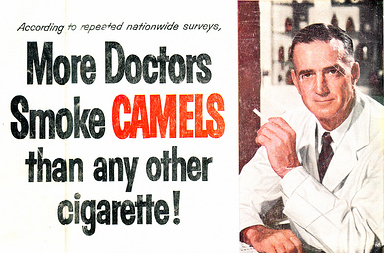
doctors-smoke-camel

***

Assessment

We may not recommend this today, but back in the day…..?

More:

Conclusion

Your thoughts and comments on this ME-P are appreciated. Feel free to review our top-left column, and top-right sidebar materials, links, URLs and related websites, too. Then, subscribe to the ME-P. It is fast, free and secure.

Speaker: If you need a moderator or speaker for an upcoming event, Dr. David E. Marcinko; MBA – Publisher-in-Chief of the Medical Executive-Post – is available for seminar or speaking engagements. Contact: MarcinkoAdvisors@msn.com

OUR OTHER PRINT BOOKS AND RELATED INFORMATION SOURCES:

Risk Management, Liability Insurance, and Asset Protection Strategies for Doctors and Advisors: Best Practices from Leading Consultants and Certified Medical Planners™8Comprehensive Financial Planning Strategies for Doctors and Advisors: Best Practices from Leading Consultants and Certified Medical Planners™

The Surgeons Scorecard

Join Our Mailing List

Coming Soon: ProPublica’s Surgeon Scorecard

***

sergtech

***

Millions of patients a year undergo common elective operations – things like knee and hip replacements or gall bladder removals.

But, there’s almost no information available about the quality of surgeons who do them. ProPublica analyzed 2.3 million Medicare operations and identified 67,000 patients who suffered serious complications as a result: infections, uncontrollable bleeding, even death.

We’ll be reporting the complication rates of 17,000 surgeons — so patients can make an informed choice.

***

Product DetailsProduct Details

[Foreword J. Phillips MD JD MBA] [Foreword D. Nash MD MBA]

Conclusion

Your thoughts and comments on this ME-P are appreciated. Feel free to review our top-left column, and top-right sidebar materials, links, URLs and related websites, too. Then, subscribe to the ME-P. It is fast, free and secure.

Great Book Gifts for Medical School and Health Care Graduates

Join Our Mailing List

[By Staff reporters]

An Educational Resource Supporting Doctors, Universities and Consulting Advisors  

We are an emerging online and onground community that connects medical professionals with financial advisors and management consultants. We participate in a variety of insightful educational seminars, teaching conferences and national workshops. We produce journals, textbooks and handbooks, white-papers, CDs and award-winning dictionaries. And, our didactic heritage includes innovative R&D, litigation support, opinions for engaged private clients and media sourcing in the sectors we passionately serve.

Through the balanced collaboration of this rich-media sharing and ranking forum, we have become a leading network at the intersection of healthcare administration, practice management, medical economics, business strategy and financial planning for doctors and their consulting advisors. Even if not seeking our products or services, we hope this knowledge silo is useful to you.

In the Health 2.0 era of political reform, our goal is to: “bridge the gap between practice mission and financial solidarity for all medical professionals.”

Join the ME-P Nation today … and tell us what you think! 

  ***gifts

***

  OUR BOOKS, TEXTS AND DICTIONARIES ARE VITAL SURVIVAL TOOLS FOR ALL PHYSICIANS … AND THEIR CONSULTING ADVISORS

***

Product Details

Product DetailsProduct Details

       Product DetailsProduct DetailsProduct Details

Risk Management, Liability Insurance, and Asset Protection Strategies for Doctors and Advisors: Best Practices from Leading Consultants and Certified Medical Planners™8Comprehensive Financial Planning Strategies for Doctors and Advisors: Best Practices from Leading Consultants and Certified Medical Planners™

***

Channel Surfing

Have you visited our other topic channels? Established to facilitate idea exchange and link our community together, the value of these topics is dependent upon your input. Please take a minute to visit. And, to prevent that annoying spam, we ask that you register.

Link: http://feeds.feedburner.com/HealthcareFinancialsthePostForcxos

More:

Conclusion

Your thoughts and comments on this ME-P are appreciated. Feel free to review our top-left column, and top-right sidebar materials, links, URLs and related websites, too. Then, subscribe to the ME-P. It is fast, free and secure.

Speaker: If you need a moderator or speaker for an upcoming event, Dr. David E. Marcinko; MBA – Publisher-in-Chief of the Medical Executive-Post – is available for seminar or speaking engagements. Contact: MarcinkoAdvisors@msn.com

OUR OTHER PRINT BOOKS AND RELATED INFORMATION SOURCES:

Join Our Mailing List

A Possible New Niche Area for [Health-Law] Attorneys?

Competent, Ethical and Fair Legal Representation for Doctors

By Michael Lawrence Langan MD

Wretched creatures are compelled by the severity of the torture to confess things they have never done and so by cruel butchery innocent lives are taken; and by new alchemy, gold and silver are coined from human blood.– Father Cornelius Loos (1592)

***


17th-century-tribunal

[“PHP-Approved Attorneys”]

Competent, Ethical and Fair Legal Representation for Doctors

***

Channel Surfing

Have you visited our other topic channels? Established to facilitate idea exchange and link our community together, the value of these topics is dependent upon your input. Please take a minute to visit. And, to prevent that annoying spam, we ask that you register.

Link: http://feeds.feedburner.com/HealthcareFinancialsthePostForcxos

Conclusion

Your thoughts and comments on this ME-P are appreciated. Feel free to review our top-left column, and top-right sidebar materials, links, URLs and related websites, too. Then, subscribe to the ME-P. It is fast, free and secure.

Speaker: If you need a moderator or speaker for an upcoming event, Dr. David E. Marcinko; MBA – Publisher-in-Chief of the Medical Executive-Post – is available for seminar or speaking engagements. Contact: MarcinkoAdvisors@msn.com

OUR OTHER PRINT BOOKS AND RELATED INFORMATION SOURCES:

Risk Management, Liability Insurance, and Asset Protection Strategies for Doctors and Advisors: Best Practices from Leading Consultants and Certified Medical Planners™8Comprehensive Financial Planning Strategies for Doctors and Advisors: Best Practices from Leading Consultants and Certified Medical Planners™

WHAT EVERY DOCTOR MUST APPRECIATE … Liability?

Join Our Mailing List

About our litigation system for 2019-2020

[By Dr. David Edward Marcinko MBA]

LINK: https://medicalexecutivepost.com/dr-david-marcinkos-bookings/

Dr. Marcinko MBADoctors depend on their trusted advisors to be a source of information on a wide variety of complex topics.

As we have seen, one of the areas in which physicians are increasingly seeking guidance from their attorney, accountant, consultant or financial advisor is in the area of risk management, insurance planning and asset protection.

Risk management

The best experts and consultants seek to create safe steady growth and avoid losses and exposures to things like malpractice judgments integrated with asset protection. A natural extension of this stewardship is making sure that the growth and balance of assets are safe from exposure to an increasingly predatory and hostile litigation system. Most doctors have obvious daily risks like malpractice exposures.

Other sources of exposure are more insidious, such as merely being affluent and visible, owning income property, or something as simple as owning and driving a car every day. The numbers are staggering; we are at a point in our litigation system where we have 70,000 lawsuits filed per day in the United States alone, many without any real merit.

Unfortunately being “right” is not enough to keep physicians safe.

Why doctors are concerned?

As illustrated by the numbers above and below, awards continue to spiral out of control, fueled by litigation attorneys who have become partners in lawsuits and who are economically incentivized to create and magnify adversarial relations between parties who might otherwise reach some reasonable, if not amicable, settlement.

So, here are additional facts about our litigation system to consider, for 2015-16:

  • The average medical malpractice award is now $3.9 MM, and some authorities put this number substantially higher;
  • The average legal costs of settling a frivolous lawsuit is $91,000 – plus the actual settlement amount itself.

The average sexual harassment suit against a small medical practice produces a verdict of $530,000. Employees are suing more often, winning more often and winning proportionally larger judgments. They win 75% of the time. Moreover, only the top 5% of Americans has a net worth of over $1MM. Using this baseline, it’s pretty easy to see where even a doctor who is worth only a few million dollars fits in on the food chain.

Here is more proof why doctors and allied medical providers are sued:

  • MDs are high net-worth, high liability, or they will be soon (i.e. new practitioners)
  • DOs have assets that would be difficult to replace if lost or reduced
  • DPMs have professional surgical liability
  • DDSs have employees and own their own practice
  • CRNs are highly visible, traceable, and or collectible
  • ODs own liability generating assets, i.e. rental property
  • NPs and ANPs have a spouse and/or children.

***

meeting-room-

***

Assessment

What doctors and all medical professionals must take to heart is that litigation attorneys are in business. Just like any business, including a medical practice, they have weekly meetings in which they examine growth, cash flow, revenue goals and new leads or opportunities. This economic motivation is a key and explains in part why we see awards rising and why plaintiffs’ attorneys regularly seek and obtain awards above the limits of applicable liability insurance policies.

Conclusion

Your thoughts and comments on this ME-P are appreciated. Feel free to review our top-left column, and top-right sidebar materials, links, URLs and related websites, too. Then, subscribe to the ME-P. It is fast, free and secure.

Speaker: If you need a moderator or speaker for an upcoming event, Dr. David E. Marcinko; MBA – Publisher-in-Chief of the Medical Executive-Post – is available for seminar or speaking engagements. Contact: MarcinkoAdvisors@msn.com

OUR OTHER PRINT BOOKS AND RELATED INFORMATION SOURCES:

Comprehensive Financial Planning Strategies for Doctors and Advisors: Best Practices from Leading Consultants and Certified Medical Planners(TM) 

Understanding the National Practitioner Data Bank (NPDB)

Join Our Mailing List 

What it Is – How it Works?

[By Eric A. Dover MD]

The NPDB, also known as the Data Bank, was written into HCQIA [Health Care Quality Indicators].  It is the national database for all physician reports.

Reporting Entities

Entities that are required to report physicians to this government program are:

  • Medical malpractice payers
  • State health care practitioner licensing and certification authorities
  • Hospitals
  • Other health care entities with formal peer review (HMOs, group practices, managed care organizations)
  • Professional societies with formal peer review
  • Federal and State Government agencies
  • Health insurance companies
  • The information collected by the NPDB includes:
  • Medical malpractice actions against a healthcare provider
  • Any adverse licensure actions by Medical Boards or peer review entities, including revocation, reprimand, censure, suspension, probation or dismissal or closure of any proceedings by reason of the practitioner surrendering the license or leaving the State or jurisdiction.
  • Adverse clinical privileging actions
  • Adverse professional society membership actions
  • Private accreditation organization negative actions or findings against health care practitioners
  • Criminal convictions that are health care-related
  • Exclusions from Federal or State health care programs
  • Entities that can query the NPDB include:
  • Hospitals, health care entities and professional societies with formal peer review
  • State health care practitioner licensing and certification authorities
  • Agencies or contractors administering Federal health care programs
  • State agencies administering State health care programs
  • State Medicaid Fraud Units
  • U.S. Comptroller General, U.S. Attorney General and other law enforcement
  • Self query by health care practitioner
  • Plaintiff’s attorney/pro se plaintiffs, but under limited circumstances
  • “Quality Improvement Organizations”
  • Researchers (statistical data only)
  • Federal and State Government agencies
  • Health plans
  • Researchers (Statistical data only)

Source: http://www.npdb.hrsa.gov/

***

npdb

***

Physician Reportage

Once a physician is reported to the NPDB, their career, if they still have one, is dramatically changed forever.  There is no expungement process to remove defamatory physician reports, whether true or not.  The stain is there forever.  You have the opportunity to write a rebuttal for what it’s worth.  Actions reported to the National Practitioner Data Bank by one entity will most likely trigger cross investigations and actions by other entities.

Source: http://www.drlaw.com/Articles/White-Paper—The-Targeting-of-Physicians—Insigh.aspx

Assessment

It is easy to extrapolate the simplicity of destroying a physician’s career, psyche and family with the untenable protections afforded by HCQIA to those responsible for the destruction.

Channel Surfing the ME-P

Have you visited our other topic channels? Established to facilitate idea exchange and link our community together, the value of these topics is dependent upon your input. Please take a minute to visit. And, to prevent that annoying spam, we ask that you register. It is fast, free and secure.

About

Dr. Eric Dover is a board certified family practice and primary care physician in Portland, Oregon. He is a graduate of the University of California at Los Angeles [UCLA] School of Medicine.

Conclusion

Your thoughts and comments on this ME-P are appreciated. Feel free to review our top-left column, and top-right sidebar materials, links, URLs and related websites, too. Then, subscribe to the ME-P. It is fast, free and secure.

Speaker: If you need a moderator or speaker for an upcoming event, Dr. David E. Marcinko; MBA – Publisher-in-Chief of the Medical Executive-Post – is available for seminar or speaking engagements. Contact: MarcinkoAdvisors@msn.com

OUR OTHER PRINT BOOKS AND RELATED INFORMATION SOURCES:

Comprehensive Financial Planning Strategies for Doctors and Advisors: Best Practices from Leading Consultants and Certified Medical Planners(TM)* 8

Seeking Peer Reviewers for New Medical Risk Management Text Book

Join Our Mailing List 

Our Newest Text Book-in-Production

http://www.CertifiedMedicalPlanner.org

[By Ann Miller RN MHA]

CMP logo

***

RISK MANAGEMENT, LIABILITY INSURANCE, AND ASSET PROTECTION STRATEGIES FOR DOCTOR AND ADVISORS

[Best Practices from Leading Consultants and Certified Medical Planners™]

***

***

Skills Needed

If you are a physician, nurse, accountant, attorney, medical risk manager or healthcare executive, we need you.

Form below or contact us for details to peer-review, etc. MarcinkoAdvisors@msn.com

Assessment

Channel Surfing the ME-P

Have you visited our other topic channels? Established to facilitate idea exchange and link our community together, the value of these topics is dependent upon your input. Please take a minute to visit. And, to prevent that annoying spam, we ask that you register. It is fast, free and secure.

Conclusion

Your thoughts and comments on this ME-P are appreciated. Feel free to review our top-left column, and top-right sidebar materials, links, URLs and related websites, too. Then, subscribe to the ME-P. It is fast, free and secure.

Speaker: If you need a moderator or speaker for an upcoming event, Dr. David E. Marcinko; MBA – Publisher-in-Chief of the Medical Executive-Post – is available for seminar or speaking engagements. Contact: MarcinkoAdvisors@msn.com

OUR OTHER PRINT BOOKS AND RELATED INFORMATION SOURCES:

Comprehensive Financial Planning Strategies for Doctors and Advisors: Best Practices from Leading Consultants and Certified Medical Planners(TM)

[Companion Text Book]


Go back

Your message has been sent

Warning
Warning
Warning
Warning

Warning.

About the INSTITUTE OF MEDICAL BUSINESS ADVISORS, Inc.

Join Our Mailing List

About

INSTITUTE OF MEDICAL BUSINESS ADVISORS, Inc.

  ***

The Institute of Medical Business Advisors, Inc provides a team of experienced, senior level consultants led by iMBA Chief Executive Officer Dr. David Edward Marcinko MBA CMPMBBS [Hon] and President Hope Rachel Hetico RN MHA CMP™ to provide going contact with our clients throughout all phases of each project, with most of the communications between iMBA and the key client participants flowing through this Senior Team.

Product Details

iMBA Inc., and its skilled staff of certified professionals have many years of significant experience, enjoy a national reputation in the healthcare consulting field, and are supported by an unsurpassed research and support staff of CPAs, MBAs, MPHs, PhDs, CMPs™, CFPs® and JDs to maintain a thorough and extensive knowledge of the healthcare environment.

Product Details

The iMBA team approach emphasizes providing superior service in a timely, cost-effective manner to our clients by working together to focus on identifying and presenting solutions for our clients’ unique, individual needs.

Product Details

The iMBA Inc project team’s exclusive focus on the healthcare industry provides a unique advantage for our clients.  Over the years, our industry specialization has allowed iMBA to maintain instantaneous access to a comprehensive collection of healthcare industry-focused data comprised of both historically-significant resources as well as the most recent information available.  iMBA Inc’s specific, in-depth knowledge and understanding of the “value drivers” in various healthcare markets, in addition to the transaction marketplace for healthcare entities, will provide you with a level of confidence unsurpassed in the public health, health economics, management, administration, and financial planning and consulting fields.

 Product DetailsProduct DetailsProduct Details

iMBA Inc’s information resources and network of healthcare industry textbook resources enhanced by our professional consultants and research staff, ensure that the iMBA project team will maintain the highest level of knowledge regarding the current and future trends of the specific specialty market related to the project, as well as the healthcare industry overall, which serves as the “foundation” for each of our client engagements.

Product Details  Product Details

Ann Miller RN MHA

www.MedicalBusinessAdvisors.com

Financial Advisor Education Letterhead CMP

Solicitation Letterhead.iMBA, Inc

Sample iMBA Engagements

iMBA Seminar Topics

***

Financial Planning MDs 2015

Comprehensive Financial Planning Strategies for Doctors and Advisors: Best Practices from Leading Consultants and Certified Medical Planners™

***

The PP-ACA from Medicine to Dentistry

Obamacare and Dentistry

[By D. Kellus Pruitt DDS]

1-darrellpruitt It seems that problems with the PP-ACA have migrated from traditional medicine to the world of dentistry.

“MaineCare dentists hit with massive fines for minor clerical errors, they say – Some clinics face more than $200,000 in penalties under a new audit system that threatens to wipe out services for kids.”

-Joe Lawlor [Staff writer] Portland Press Herald [November 6, 2013]

http://www.pressherald.com/news/MaineCare_dentists_hit_with_massive_fines_for_minor_clerical_errors__they_say_.html

 “The new system gives auditors, who work for a private contractor, financial incentives to find small errors by paying them more for each mistake they discover.” Maine adopted the auditing system to comply with the federal Affordable Care Act, otherwise known as Obamacare.

 Lawlor continues: “The audits are intended to root out fraud and abuse, but dentists told the Portland Press Herald that auditors are finding typographical or clerical errors that do not compromise patients’ care or defraud the government.”

A Clawback?

Dr. Michael Dowling, co-owner of Falmouth Pediatric Dentistry, tells the Herald, “This is not finding fraud and abuse. This is a clawback. They (state officials) are trying to take back money that we billed them legitimately.”

Still want to help the poor so much that you are willing to take your chances with the ACA auditing system, Doc?

Dentists facing bankruptcy

According to Lawlor, some dentists are actually facing bankruptcy because of ridiculously expensive fines over minor errors. Other Maine dentists who are otherwise willing to work for charity-level fees in order to help children who have nowhere else to turn, are dropping out of MaineCare. President Obama’s plan to use outrageous fines to fund the state and federal coffers, as well as the bonuses of ambitious auditors, is destined to fail.

How can the Affordable Care Act [PP-ACA] possibly make care more affordable for children with toothaches, if it runs off all the dentists?

Mobile-Security

Assessment

Is it beginning to look to you like Obamacare might have been designed to serve the interests of unaccountable healthcare stakeholders rather than the interests of doctors and patients – the healthcare principals? Why do we put up with this crap, Doc?

Conclusion

Your thoughts and comments on this ME-P are appreciated. Feel free to review our top-left column, and top-right sidebar materials, links, URLs and related websites, too. Then, subscribe to the ME-P. It is fast, free and secure.

Link: http://feeds.feedburner.com/HealthcareFinancialsthePostForcxos

Speaker: If you need a moderator or speaker for an upcoming event, Dr. David E. Marcinko; MBA – Publisher-in-Chief of the Medical Executive-Post – is available for seminar or speaking engagements. Contact: MarcinkoAdvisors@msn.com

OUR OTHER PRINT BOOKS AND RELATED INFORMATION SOURCES:

LEXICONS: http://www.springerpub.com/Search/marcinko
PHYSICIANS: www.MedicalBusinessAdvisors.com
PRACTICES: www.BusinessofMedicalPractice.com
HOSPITALS: http://www.crcpress.com/product/isbn/9781466558731
CLINICS: http://www.crcpress.com/product/isbn/9781439879900
ADVISORS: www.CertifiedMedicalPlanner.org
BLOG: www.MedicalExecutivePost.com

Product DetailsProduct Details

How Many Die From Medical Mistakes in U.S. Hospitals?

Join Our Mailing List 

Patient SafetyExploring Quality of Care in the US

By Marshall Allen
ProPublica, Sep 19th, 2013, 10:03 am

AMIn 2010, the Office of Inspector General for Health and Human Services said that bad hospital care contributed to the deaths of 180,000 patients in Medicare alone in a given year.

Now comes a study in the current issue [1] of the Journal of Patient Safety that says the numbers may be much higher — between 210,000 and 440,000 patients [2] each year who go to the hospital for care suffer some type of preventable harm that contributes to their death, the study says.

That would make medical errors the third-leading cause of death in America [3], behind heart disease, which is the first, and cancer, which is second.

New Estimates

The new estimates were developed by John T. James, a toxicologist at NASA [4]’s space center in Houston who runs an advocacy organization called Patient Safety America [5]. James has also written a book [6] about the death of his 19-year-old son after what James maintains was negligent hospital care.

Asked about the higher estimates, a spokesman for the American Hospital Association said the group has more confidence in the IOM’s estimate of 98,000 deaths. ProPublica asked three prominent patient safety researchers to review James’ study, however, and all said his methods and findings were credible.

What’s the right number? Nobody knows for sure. There’s never been an actual count of how many patients experience preventable harm. So we’re left with approximations, which are imperfect in part because of inaccuracies in medical records and the reluctance of some providers to report mistakes.

Patient safety experts say measuring the problem is nonetheless important because estimates bring awareness and research dollars to a major public health problem that persists despite decades of improvement efforts.

“We need to get a sense of the magnitude of this,” James said in an interview.

James based his estimates on the findings of four recent studies that identified preventable harm suffered by patients – known as “adverse events” in the medical vernacular – using use a screening method called the Global Trigger Tool [7], which guides reviewers through medical records, searching for signs of infection, injury or error. Medical records flagged during the initial screening are reviewed by a doctor, who determines the extent of the harm.

Four Studies

In the four studies, which examined records of more than 4,200 patients hospitalized between 2002 and 2008, researchers found serious adverse events in as many as 21 percent of cases reviewed and rates of lethal adverse events as high as 1.4 percent of cases.

By combining the findings and extrapolating across 34 million hospitalizations in 2007, James concluded that preventable errors contribute to the deaths of 210,000 [2] hospital patients annually.

That is the baseline. The actual number more than doubles, James reasoned, because the trigger tool doesn’t catch errors in which treatment should have been provided but wasn’t, because it’s known that medical records are missing some evidence of harm, and because diagnostic errors aren’t captured.

An estimate of 440,000 deaths from care in hospitals “is roughly one-sixth of all deaths that occur in the United States each year,” James wrote in his study. He also cited other research that’s shown hospital reporting systems and peer-review capture only a fraction of patient harm or negligent care.

“Perhaps it is time for a national patient bill of rights for hospitalized patients,” James wrote. “All evidence points to the need for much more patient involvement in identifying harmful events and participating in rigorous follow-up investigations to identify root causes.”

###

Ankle-Leg Trauma

###

The Patient Safety Gurus

Dr. Lucian Leape, a Harvard pediatrician who is referred to the “father of patient safety,” [8] was on the committee that wrote the “To Err Is Human” report. He told ProPublica that he has confidence in the four studies and the estimate by James.

Members of the Institute of Medicine committee knew at the time that their estimate of medical errors was low, he said. “It was based on a rather crude method compared to what we do now,” Leape said. Plus, medicine has become much more complex in recent decades, which leads to more mistakes, he said.

Dr. David Classen, one of the leading developers [9]of the Global Trigger Tool, said the James study is a sound use of the tool and a “great contribution.” He said it’s important to update the numbers from the “To Err Is Human” report because in addition to the obvious suffering, preventable harm leads to enormous financial costs.

Dr. Marty Makary, a surgeon at The Johns Hopkins Hospital whose book “Unaccountable” calls for greater transparency in health care, said the James estimate shows that eliminating medical errors must become a national priority. He said it’s also important to increase the awareness of the potential of unintended consequences when doctors perform procedure and tests. The risk of harm needs to be factored into conversations with patients, he said.

Leape, Classen and Makary all said it’s time to stop citing the 98,000 number.

IOM’s Death Estimate

Still, hospital association spokesman Akin Demehin said the group is sticking with the Institute of Medicine’s estimate. Demehin said the IOM figure is based on a larger sampling of medical charts and that there’s no consensus the Global Trigger Tool can be used to make a nationwide estimate. He said the tool is better suited for use in individual hospitals.

The AHA is not attempting to come up with its own estimate, Demehin said.

Assessment

Dr. David Mayer, the vice president of quality and safety at Maryland-based MedStar Health [10], said people can make arguments about how many patient deaths are hastened by poor hospital care, but that’s not really the point. All the estimates, even on the low end, expose a crisis, he said.

“Way too many people are being harmed by unintentional medical error,” Mayer said, “and it needs to be corrected.”

Conclusion

Your thoughts and comments on this ME-P are appreciated. Feel free to review our top-left column, and top-right sidebar materials, links, URLs and related websites, too. Then, subscribe to the ME-P. It is fast, free and secure.

Link: http://feeds.feedburner.com/HealthcareFinancialsthePostForcxos

Speaker: If you need a moderator or speaker for an upcoming event, Dr. David E. Marcinko; MBA – Publisher-in-Chief of the Medical Executive-Post – is available for seminar or speaking engagements. Contact: MarcinkoAdvisors@msn.com

OUR OTHER PRINT BOOKS AND RELATED INFORMATION SOURCES:

DICTIONARIES: http://www.springerpub.com/Search/marcinko
PHYSICIANS: www.MedicalBusinessAdvisors.com
PRACTICES: www.BusinessofMedicalPractice.com
HOSPITALS: http://www.crcpress.com/product/isbn/9781466558731
CLINICS: http://www.crcpress.com/product/isbn/9781439879900
BLOG: www.MedicalExecutivePost.com
FINANCE: Financial Planning for Physicians and Advisors
INSURANCE: Risk Management and Insurance Strategies for Physicians and Advisors

Product DetailsProduct Details

Purchase ME-P Textbooks, Handbooks and Dictionaries to Thrive

 Our Library is Growing … thanks to you

Join Our Mailing List

By Ann Miller RN MHA

[ME-P Executive-Director]

We have been publishing the Medical Executive-Post for more than eight years now. And, with almost 3,000 formal posts, by the nation’s brightest experts, we have a treasure trove of information available to you.

So now, for the first time, all this information – and more – has been codified, updated, copy-righted and copy-protected in print form for your purchase and use. All have been edited by our Publisher – Dr. David Edward Marcinko and Professor Hope Rachel Hetico.

Just click on an image below to order.

Product DetailsProduct DetailsProduct Details

Product Details  Product Details

Product DetailsProduct Details

Assessment

Purchase our white papers, too: https://medicalexecutivepost.com/white-papers/

Conclusion

Your thoughts and comments on this ME-P are appreciated. Feel free to review our top-left column, and top-right sidebar materials, links, URLs and related websites, too. Then, subscribe to the ME-P. It is fast, free and secure.

Link: http://feeds.feedburner.com/HealthcareFinancialsthePostForcxos

Speaker: If you need a moderator or speaker for an upcoming event, Dr. David E. Marcinko; MBA – Publisher-in-Chief of the Medical Executive-Post – is available for seminar or speaking engagements. Contact: MarcinkoAdvisors@msn.com

OUR OTHER PRINT BOOKS AND RELATED INFORMATION SOURCES:

Health Dictionary Series: http://www.springerpub.com/Search/marcinko

Practice Management: http://www.springerpub.com/product/9780826105752

Physician Financial Planning: http://www.jbpub.com/catalog/0763745790

Medical Risk Management: http://www.jbpub.com/catalog/9780763733421

Hospitals: http://www.crcpress.com/product/isbn/9781439879900

Physician Advisors: www.CertifiedMedicalPlanner.org

Business%20Optimization

Health 2.0 Financial Planning for Medical Executive-Post Members

A By-Product of Health 2.0?

By Dr. David Edward Marcinko FACFAS MBA CMP*

[Founder and CEO]

www.MedicalBusinessAdvisors.com

Dr David E Marcinko MBAA decade ago, Editor Gregory J. Kelley of Physician’s MONEY DIGEST and I reported that a 47 year old-doctor with $184,000 annual income would need about $5.5 million dollars for retirement at age 65. Then came the “flash-crash’ of 2007-08, the home mortgage fiasco and the Patient Protection and Accountable Care Act [PP-ACA] of 2010; etc.

No wonder that medical provider career panic is palpable. Much like the new medical home concept, the idea of holistic life planning was born.

Life Planning

Life planning has many detractors and defenders. Formally, life planning has been defined in the following way. 

Financial Life Planning is an approach to financial planning that places the history, transitions, goals, and principles of the client at the center of the planning process.  For the client, their life becomes the axis around which financial planning develops and evolves.

But, for physicians, life planning’s quasi-professional and informal approach to the largely isolated disciplines of medically focused financial planning, was still largely inadequate.

Why? 

Today’s personal financial and practice environment is incredibly more complex than it was in 2007-08, as economic stress from HMOs, Wall Street, liability fears, criminal scrutiny from government agencies, IT mischief from hackers, economic benchmarking from hospitals and the lost confidence of patients all converged to inspire a robust new financial planning 2.0 approach for medical professionals.

Example of a financial planning mistake 

Recall the tale of Dr. Debasis Kanjilal, a pediatrician from New York who put more than $500,000 into the dot.com company, InfoSpace, upon the advice of Merrill Lynch’s star but non fiduciary analyst Henry Bloget.

Is it any wonder that when the company crashed, the analyst was sued, and Merrill settled out of court? Other analysts, such as Mary Meeker of Morgan Stanley, Dean Witter and Jack Grubman from Salomon Smith Barney, were involved in similar fiascos.

Although sad, this story is a matter of public record. Hopefully, doctors now understand that the big brokerage houses that underwrite and recommend stocks may have credibility problems, and that physicians got burned with the adrenalin rush of “self-directed” investment portfolios.

Example of a medical practice management mistake 

Just reflect a moment on colleagues willing to securitize their medical practices a few years ago, and cash out to Wall Street for perceived riches that were not rightly deserved

Where are firms such as MedPartners, Phycor, FPA and Coastal now? A recent survey of the Cain Brothers Physician Practice Management Corporation Index of publicly traded PPMCs revealed a market capital loss of more than 95%, since inception. 

Another Approach?

This disruptive narrative shift was formally noted by the Institute of Medical Business Advisors Inc [iMBA, Inc] and introduced to the medical and financial services industry. This research and corpus of work resulted in hundreds of publications in the Library of Medicine, National Institute of Health (NIH) and the Library of Congress, along with related publications, a dozen textbooks and white papers

http://www.ncbi.nlm.nih.gov/nlmcatalog?term=marcinko

The iMBA approach to financial planning, as championed by the www.CertifiedMedicalPlanner.org professional charter designation, integrates the traditional concepts of fiduciary focused financial planning, with the increasing complex business concepts of medical practice management.

The former ideas are presented in our textbook on financial planning for doctors: Financial Planning for Physicians and Advisors

The later in our companion book: Business of Medical Practice [Edition 3.0]

A textbook for hospital CXOs and physician-executives: Hospitals & Healthcare Organizations

While most issues of risk management, liability and insurance are found in Risk Management and Insurance Strategies for Physicians and Advisors

And, for the perplexed, all definitions are codified in the dictionary glossary Health Dictionary Series

Health 2.0 Paradigm Shift

And so, the ME-P community now realizes that a more integrated approach is needed.  The traditional vision of medical practice management, personal physician financial planning and how they may look in the future are rapidly changing as the retail mentality of medicine is replaced with a wholesale philosophy.

Or, how views on maximizing current practice income might be more profitably sacrificed for the potential of greater wealth upon eventual practice sale and disposition.

Or, how Yale University economist Robert J Shiller warns in “The New Financial Order” [Risk in the 21st Century] that the risk for choosing the wrong healthcare profession or specialty might render physicians obsolete by technological changes, managed care systems or fiscally unsound demographics. 

Physician-Executive

My Assessment

Yet, the opportunity to re-vise the future at any age through personal re-engineering, exists for all of us, and allows a joint exploration of the medicine, business and the meaning and purpose of life.

To allow this deeper and more realistic approach, the advisor and the doctor must build relationships based on fiduciary trust, greater self-knowledge and true medical business and financial enhancement acumen.

Are you up to the task?

Conclusion

Your thoughts and comments on this ME-P are appreciated. Feel free to review our top-left column, and top-right sidebar materials, links, URLs and related websites, too. Then, subscribe to the ME-P. It is fast, free and secure.

Link: http://feeds.feedburner.com/HealthcareFinancialsthePostForcxos

Speaker: If you need a moderator or speaker for an upcoming event, Dr. David E. Marcinko; MBA – Publisher-in-Chief of the Medical Executive-Post – is available for seminar or speaking engagements. Contact: MarcinkoAdvisors@msn.com

OUR OTHER PRINT BOOKS AND RELATED INFORMATION SOURCES:

Product DetailsProduct DetailsProduct Details

Product Details  Product Details

Product DetailsProduct Details

Healthcare Adversaries [video]

Join Our Mailing List

Of HHS and AHIP

By Darrell K. Pruitt DDS

pruitt6If HHS and AHIP continue to give doctors the bum’s rush, what languages can we expect migrant providers to speak well?

The Conference

Last week, I came across a video of a health care conference held a month ago at the University of Miami. During a discussion period, a Miami spinal surgeon named Dr. Nordham warned that more Medicare pay cuts will make small, solo practices like his unsustainable.

Karen Speaks

Panelist Karen Ignagni, who is president and the CEO of America’s Health Insurance Plans (AHIP), reacted defensively in favor of continued unsustainable discounts – but with a hasty, disingenuous response: “We’re seeing out of network charges of 95 times Medicare fees.” While as if on cue, former HHS Secretary Donna Shalala, who is also president of the university, offered her cold interpretation of the small business owner’s legitimate fears: “He’s really complaining that the price is going down [according to law].”

Shalala Speaks

After also ignoring the physician’s plea, “There needs to be more transparency,” Shalala and Ignagni continue an irrelevant, buzzword-filled discussion with each other using flowing hand gestures while shutting out the doctor’s attempts to bring the conversation back on topic. Then abruptly, without giving Dr. Nordham the opportunity to say another word, Shalala slammed the door: “…. I think we’ll take the next question, thank you.” Then she threw him a bone, “It’s a very important question, though.”

###

MD with eHR

Assessment

The 4 minutes of unvarnished disrespect of Dr. Nordham is so transparent that one wonders whether Shalala and Ignagni were even aware that their half-baked PR game was being recorded for C-span.

http://www.c-spanvideo.org/event/214023 (from 2:09:53 to 2:13:42)

They probably thought nobody stays up that late.

More: Chapter 13: IT, eMRs & GroupWare

Conclusion

Your thoughts and comments on this ME-P are appreciated. Feel free to review our top-left column, and top-right sidebar materials, links, URLs and related websites, too. Then, subscribe to the ME-P. It is fast, free and secure.

Link: http://feeds.feedburner.com/HealthcareFinancialsthePostForcxos

Speaker: If you need a moderator or speaker for an upcoming event, Dr. David E. Marcinko; MBA – Publisher-in-Chief of the Medical Executive-Post – is available for seminar or speaking engagements. Contact: MarcinkoAdvisors@msn.com

Our Other Print Books and Related Information Sources:

Health Dictionary Series: http://www.springerpub.com/Search/marcinko

Practice Management: http://www.springerpub.com/product/9780826105752

Physician Financial Planning: http://www.jbpub.com/catalog/0763745790

Medical Risk Management: http://www.jbpub.com/catalog/9780763733421

Hospitals: http://www.crcpress.com/product/isbn/9781439879900

Physician Advisors: www.CertifiedMedicalPlanner.org

Product Details

Fighting Mid-Level Medical Providers

Join Our Mailing List

Scope of practice’ stories vary according to state laws

One of the interesting stories to watch in the coming months in the states is the fight over “scope of practice.” That means: who gets to do what, and under whose supervision. It basically pits doctors against other health care providers — nurses, nurse practitioners, physician assistants, etc. They are sometimes called “extenders” or “non-physician providers.” (There are also big fights within dentistry.)

Dental Therapists [Emerging New Providers?]

The PP-ACA

These fights would heat up even without the Affordable Care Act — you’ve heard about the shortage of primary care physicians and you know there is an aging population that is going to need access to primary care. Throw in the health care law — millions of newly insured people entering the system — as well as delivery system reforms and care innovations that encourage more primary care, care coordination and team-based medicine that invites a larger role from those “extenders.”

Role of Retail Medical Clinics

Association of Health Care Journalists

Joanne Kenen, AHCJ’s health reform topic leader, writes about the questions and issues to be addressed and offers some resources to help reporters follow the story in their own communities. In a blog post tomorrow, she will point to two articles that have been done about the role nurses, physician assistants or other providers can have in providing primary care in underserved areas.

Next Generation Physician Recruitment

Conclusion

Your thoughts and comments on this ME-P are appreciated. Feel free to review our top-left column, and top-right sidebar materials, links, URLs and related websites, too. Then, subscribe to the ME-P. It is fast, free and secure.

Speaker: If you need a moderator or speaker for an upcoming event, Dr. David E. Marcinko; MBA – Publisher-in-Chief of the Medical Executive-Post – is available for seminar or speaking engagements. Contact: MarcinkoAdvisors@msn.com

OUR OTHER PRINT BOOKS AND RELATED INFORMATION SOURCES:

Product Details

Medical Practice and Health 2.0 Risk Management is Now a Part of Financial Planning for Doctors

Join Our Mailing List

Ann Miller RN MHA [Executive-Director]

http://www.CertifiedMedicalPlanner.org

About Us

Our ME-P Editor, Dr. David Edward Marcinko MBA CMP™, is a nationally recognized healthcare financial and business advisor to physicians, clinics, hospitals and medical practices. Based in Atlanta Georgia, as a Certified Medical Planner™, Dr. Marcinko leads the industry delivering expert financial and managerial advice to all healthcare entities and stakeholders regarding managed care contracting, operations, strategic planning, revenue growth, health 2.0 business modeling and physician litigation support.

Dr. Marcinko is a sought-after author and speaker with three-decades of expert healthcare consulting experience. He has authored hundreds of healthcare business, finance, economics and management articles and dozens of text books. He is a chosen speaker among prominent national healthcare groups and financial services associations.

Committed to addressing the needs of each client, Dr. Marcinko and the iMBA Inc team takes great pride in personally leading every consulting team that produces effective response time and measurable results for satisfied colleagues and corporate clients www.MedicalBusinessAdvisors.com 

Product Details  Product Details

Educational Inititatives

That’s why the R&D efforts of our governing board of physician-directors, accountants, financial advisors, academics and health economists identified the need for integrated personal financial planning and medical practice management as an effective first step in the survival and wealth building life-cycle for physicians, nurses, healthcare executives, administrators and all medical professionals.

Now – more than ever – desperate doctors of all ages are turning to knowledge able financial advisors and medical management consultants for help. Symbiotically too, generalist advisors are finding that the mutual need for extreme niche synergy is obvious.

But, there was no established curriculum or educational program; no corpus of knowledge or codifying terms-of-art; no academic gravitas or fiduciary accountability; and certainly no identifying professional designation that demonstrated integrated subject matter expertise for the increasingly unique healthcare focused financial advisory niche … Until Now!

Enter the Certified Medical Planner™ charter professional designation www.CertifiedMedicalPlanner.org

Assessment

And so, for all financial services professionals interested in the fast-moving healthcare advisory space: Medical Practice and Risk Management is Now a Part of Financial Planning for Doctors

Certified Medical Planner

Conclusion

Your thoughts and comments on this ME-P are appreciated. Feel free to review our top-left column, and top-right sidebar materials, links, URLs and related websites, too. Then, subscribe to the ME-P. It is fast, free and secure.

Link: http://feeds.feedburner.com/HealthcareFinancialsthePostForcxos

Speaker: If you need a moderator or speaker for an upcoming event, Dr. David E. Marcinko; MBA – Publisher-in-Chief of the Medical Executive-Post – is available for seminar or speaking engagements. Contact: MarcinkoAdvisors@msn.com

OUR OTHER PRINT BOOKS AND RELATED INFORMATION SOURCES:

DICTIONARIES: http://www.springerpub.com/Search/marcinko
PHYSICIANS: www.MedicalBusinessAdvisors.com
PRACTICES: www.BusinessofMedicalPractice.com
HOSPITALS: http://www.crcpress.com/product/isbn/9781466558731
CLINICS: http://www.crcpress.com/product/isbn/9781439879900
BLOG: www.MedicalExecutivePost.com
FINANCE: Financial Planning for Physicians and Advisors
INSURANCE: Risk Management and Insurance Strategies for Physicians and Advisors

Product Details

Is a Captive Insurance Company (CIC) Right for Your Medical Practice?

 Join Our Mailing List

A Medical Practice Risk Management Strategy

By Guy P. Jones CFP®

Successful practices face multiple risks in their daily operations including loss of a medical license or professional certification, legal defense reimbursement, medical/Medicare collections risk, HIPAA violations, and reputational risk. Small- to medium-sized practices can benefit from risk-management tools that can help them handle such risks more effectively and reduce their overall insurance costs. To that end, the practice may want to consider the establishment of a Captive Insurance Company (CIC) to protect themselves from risks not typically covered by traditional insurance companies.

Captive Insurance Planning

Captive insurance planning is a strategy for physicians to manage risk through the purchase of a property-casualty insurance policy. Premiums paid by the practice to a properly structured CIC should be tax-deductible to the practice under section 162(a) of the IRS code just like their workers’ compensation or malpractice coverage.

When the practice forms a CIC, it receives premium income tax-free up to $1,200,000 per year, per captive. Profits that come out of the CIC come out as a distribution from a C-corp. as qualifying dividends or long-term capital gains, which are currently 15%. Furthermore, the CIC may retain surplus from underwriting profits within reserve accounts, free from income tax. Profits that accumulate within the CIC can be used as a tax-deductible sinking fund in order to save money on malpractice premiums by shifting to a high deductible policy and/or insuring that deductible through the CIC.

No Rules – Just Right

There are no hard-and-fast rules regarding the minimum amount of gross revenue from a practice or the minimum amount of insurance premiums paid by a practice before considering the establishment of a CIC.

Planning Opportunities

The establishment of a CIC creates immense planning opportunities for physicians because of the flexible ownership of the CIC. The CIC is set up as a C-Corp and someone or some entity owns the shares of the C-Corp While it’s important to keep in mind the primary business purpose of the CIC is for risk management, some potential planning opportunities include the following:

  • Wealth Accumulation/Surplus Retirement Income: Physicians own the CIC outside the practice for surplus dollars in retirement.
  • Asset Protection Planning: Most physicians have the CIC owned inside an asset protection trust to potentially shield pre-tax dollars and assets from judgment creditors or litigation.
  • Estate Planning/Wealth Transfer: Physicians who don’t need access to this money may be interested in having the CIC owned outside of their estate to also bypass gift and estate taxes with each premium payment.
  • Practice-Owner Benefits: By the CIC not being an employee benefit plan, it is not subject to the non-discrimination rules of ERISA, and therefore only benefits the owners of the practice.
  • Non-Mandatory Participation for Practice Doctors: Doctors at smaller levels can join together to create a CIC for economies of scale.

Enter the Experts

Physicians would be encouraged to discuss the various CIC planning strategies with their tax, estate planning, and other legal professionals to ensure that the most appropriate structure is utilized to fit their unique planning objectives. As part of our services to the practice, we would be happy to meet with the practice management and advisors to answer any questions and start the process of the feasibility of a CIC for the practice. As reassurance, this is already IRS-tested, and we strictly adhere to each IRS Safe Harbor Revenue Ruling for a conservative model offering very predictable risk management and tax planning results.

Assessment

While this is not intended to be a thorough discussion of CICs, it is meant to initiate a conversation with practices or conduct due diligence with their key advisors as to the many potential benefits of establishing a Captive Insurance Company.

About the Author

Mr. Guy P. Jones is a Certified Financial Planner in Houston, TX who has specialized in serving the financial planning needs of medical professionals and their families since 1990.  He can be reached at 832.677.1692, email: guypjones@guypjones.com, or by visiting his website: www.guypjones.com

Conclusion

Your thoughts and comments on this ME-P are appreciated. Feel free to review our top-left column, and top-right sidebar materials, links, URLs and related websites, too. Then, subscribe to the ME-P. It is fast, free and secure.

Link: http://feeds.feedburner.com/HealthcareFinancialsthePostForcxos

Speaker: If you need a moderator or speaker for an upcoming event, Dr. David E. Marcinko; MBA – Publisher-in-Chief of the Medical Executive-Post – is available for seminar or speaking engagements. Contact: MarcinkoAdvisors@msn.com

OUR OTHER PRINT BOOKS AND RELATED INFORMATION SOURCES:

LEXICONS: http://www.springerpub.com/Search/marcinko
PHYSICIANS: www.MedicalBusinessAdvisors.com
PRACTICES: www.BusinessofMedicalPractice.com
HOSPITALS: http://www.crcpress.com/product/isbn/9781466558731
CLINICS: http://www.crcpress.com/product/isbn/9781439879900
ADVISORS: www.CertifiedMedicalPlanner.org
BLOG: www.MedicalExecutivePost.com

Product DetailsProduct DetailsProduct Details

Product Details  Product Details

Product Details

About the Institute of Medical Business Advisors, Inc

Join Our Mailing List

iMBA, Inc

[www.MedicalBusinessAdvisors.com]

Championing the Financial Success of

Doctors and their Consulting Advisors

[Career Development Products and Services]

Comprehensive Financial Planning Strategies for Doctors and Advisors: Best Practices from Leading Consultants and Certified Medical Planners(TM)

Your Personal DR. Invitation: Letterhead.iMBA_Inc.

Alternative Solutions to Medical Malpractice Insurance

Join Our Mailing List

About Captive Insurance Companies

By William Clay Tucker CAP CMFC CRPS

The Woodville Group, LLC wctucker@thewoodvillegroupllc.com

Most states don’t recognize small captive insurance companies (CIC’s) as beneficial holders for required medical malpractice coverage.

Couple this with the fact that most medical practitioners aren’t insurance experts, and the end result is that doctors have only a few (very similar, quite expensive) malpractice insurance options.

So, when it comes time to purchase or renew your medical malpractice insurance, you have three options:

  1. Retail Med-Mal: While this may seem like the simplest solution, it is also the most expensive. With zero returns on premiums paid, you are funneling your money into a “black hole”. Regardless of your claims history, you never see a return on reserves. In the event of a claim, you may have little – or no – say in your defense or the claims negotiation and settlement process.
  2. Normal Risk Retention Groups (RRGs): Although an RRG is a step in the right direction, your medical group will be sharing overall medical malpractice risks with other medical groups insured by the RRG. While you may get back some of what you put in (as a return on equity or a stock repurchase), the amount depends on the claims experience of the RRG’s insureds as a whole and the financial condition of the RRG at the time of your departure from the RRG. Under this approach, the medical group’s financial investment remains 100% in the RRG during the entire insurance coverage period.
  3.  A Single Practice Risk Retention Group: A medical practice can now form its own small Risk retention Group (RRG).  The RRG retains a small percentage of overall insurance risk (an average of ten percent) and therefore your group’s participation in shared risk with all of other insured medical groups remains small.  The primary reinsurance structure is the reinsuring Captive Insurance Company (CIC) which is owned 100% by your  medical group’s owners and only reinsures the physicians in your medical group practice. In the Single Practice RRG model, the majority of your medical group’s financial investment remains in its CIC, which will remain owned and controlled by the owners of your medical group.

Enter the Single Practice Risk Retention Group

Year after year, as rates go up, doctors are funding their med-mal insurance and never seeing a return on the premiums they pay. With this structure you can insure your medical group’s practice and see a significant return on paid premiums by practicing good medicine and good risk management.

Advantages

Here are just a few advantages that a Single Practice Risk Retention Group can offer:

  • The insurance company is owned by the same medical groups it insures
  • Regulated financial and insurance reporting methodologies, no questionable loopholes or practices
  • Return of stock at book value when medical group is no longer an insured or medical practice changes its insured personnel.
  • Recapture lost wealth through practicing good medicine and risk management!
  • After five years, your medical group could get back more than 50% of what it has paid in total premiums
  • After ten years, your medical group could get back more than 100% of what it has paid in total premiums

Assessment

Those with the highest insurance rates, such as surgeons or OB/GYN doctors have the most to gain from self-insurance structures. In order to get started in forming your own Captive Insurance Company (CIC), you must first understand that this is not meant for a short-term solution. Because of the fees due when getting started, a minimum of three years commitment is required. The longer you hold this insurance with fewer claims, the more assets will be available at its completion. Recapture lost wealth—you owe it to yourself to investigate.

Conclusion

Your thoughts and comments on this ME-P are appreciated. Feel free to review our top-left column, and top-right sidebar materials, links, URLs and related websites, too. Then, subscribe to the ME-P. It is fast, free and secure.

Link: http://feeds.feedburner.com/HealthcareFinancialsthePostForcxos

Speaker: If you need a moderator or speaker for an upcoming event, Dr. David E. Marcinko; MBA – Publisher-in-Chief of the Medical Executive-Post – is available for seminar or speaking engagements. Contact: MarcinkoAdvisors@msn.com

OUR OTHER PRINT BOOKS AND RELATED INFORMATION SOURCES:

LEXICONS: http://www.springerpub.com/Search/marcinko
PHYSICIANS: www.MedicalBusinessAdvisors.com
PRACTICES: www.BusinessofMedicalPractice.com
HOSPITALS: http://www.crcpress.com/product/isbn/9781466558731
CLINICS: http://www.crcpress.com/product/isbn/9781439879900
ADVISORS: www.CertifiedMedicalPlanner.org
BLOG: www.MedicalExecutivePost.com

Product Details  Product Details


Introducing the ProPublica Patient Harm Community

Join Our Mailing List

By Daniel Victor and Marshall Allen
ProPublica, May 21, 2012, 2:32 p.m.

On Facebook

You could fill a baseball stadium many times with the people who experts say die each year from an error [1], injury or infection [2] suffered while undergoing medical treatment. Many more are harmed.

Using Facebook, we’ve created a space to bring together those who have been harmed and others concerned about the problem. Join the community or follow the conversation here. [3]

Shared Stories

Group members have already shared stories of personal disability or the death of a loved one due to surgical mistakes, becoming infected with deadly drug-resistant bacteria and dental mishaps — including cases they claim were not properly addressed by health care providers.

For example, some of ProPublica’s past health-care reporting focused on gaps in nursing oversight [4], drug company payments to doctors [5] and abuses at psychiatric facilities [6]. With Facebook, we want to build a community of people — patients as well as doctors, nurses, regulators and health-care executives and others — who are interested in discussing patient harm, its causes and solutions. Among other things, we’ll post Q&As with experts and provide links to the latest reports, research and policy proposals. Your suggestions are welcome along the way.

Please Join Us

Share your story, ask questions and provide your perspective with other members. Your contribution may help shape our reporting.

The community is moderated by ProPublica reporters Marshall Allen [7] and Olga Pierce [8].

Marshall has covered patient harm since 2006. While at the Las Vegas Sun, Marshall’s series, “Do No Harm: Hospital Care in Las Vegas,” [9] won a Goldsmith Prize for Investigative Journalism and was a Pulitzer Prize finalist.

Assessment

Olga specializes in health policy, insurance issues and data journalism. She is a graduate of the Stabile Investigative Journalism Seminar at Columbia University and a finalist for the 2011 Livingston Awards.

Daniel Victor [10] and Blair Hickman [11], ProPublica’s social media team, try to also keep an eye on things.

Conclusion

Your thoughts and comments on this ME-P are appreciated. Feel free to review our top-left column, and top-right sidebar materials, links, URLs and related websites, too. Then, subscribe to the ME-P. It is fast, free and secure.

Link: http://feeds.feedburner.com/HealthcareFinancialsthePostForcxos

Speaker: If you need a moderator or speaker for an upcoming event, Dr. David E. Marcinko; MBA – Publisher-in-Chief of the Medical Executive-Post – is available for seminar or speaking engagements. Contact: MarcinkoAdvisors@msn.com

Our Other Print Books and Related Information Sources:

Health Dictionary Series: http://www.springerpub.com/Search/marcinko

Practice Management: http://www.springerpub.com/product/9780826105752

Physician Financial Planning: http://www.jbpub.com/catalog/0763745790

Medical Risk Management: http://www.jbpub.com/catalog/9780763733421

Hospitals: http://www.crcpress.com/product/isbn/9781439879900

Physician Advisors: www.CertifiedMedicalPlanner.org

Product Details

How the ME-P Helps Doctors Avoid Malpractice Lawsuits and Related Litigation

ADVERTISEMENT

Join Our Mailing List 

Insurance and Risk Management Strategies for Physicians and Advisors

  Risk Management, Liability Insurance, and Asset Protection Strategies for Doctors and Advisors: Best Practices from Leading Consultants and Certified Medical Planners™

Conclusion

And so, your thoughts and comments on this ME-P are appreciated. Please review our top-left column, and top-right sidebar materials, links, URLs and related websites, too. Then, subscribe to the ME-P. It is fast, free and secure.

Link: http://feeds.feedburner.com/HealthcareFinancialsthePostForcxos

Speaker: If you need a moderator or speaker for an upcoming event, Dr. David E. Marcinko; MBA – Publisher-in-Chief of the Medical Executive-Post – is available for seminar or speaking engagements. Contact: MarcinkoAdvisors@msn.com

***

TESTIMONIAL

 Physicians are all too familiar with the risks and liabilities inherent in the clinical practice of medicine. An exploding scientific literature, increasing sub-specialization, and a public awareness of “quality healthcare” have challenged conventional practice. Some of our colleagues have a very personal understanding of issues like illness, divorce and disability that accompany these professional challenges. Physician executives perceive even greater threats arising not only from the innumerable personal and professional issues of a singular practice, but also the complexities associated with operating a healthcare organization including personnel agreements, conflict mediation, and asset protection.

Understanding the risks associated with these very divergent areas and providing useful information to protect the physician from liability are the primary aims of Dr. David Marcinko’s latest book, Insurance and Risk Management Strategies For Physicians and Advisors.

This book is an excellent primer for physicians of all levels and interests providing important personal and professional advice. It is “must reading” for all medical students who need a fundamental understanding of the current healthcare environment and is equally important to the established physician executive looking for a reference on topics like capitation or the Health Insurance Portability and Accountability Act (HIPAA).

The book begins with a discussion of personal issues for the physician including life, homeowner’s and disability insurance as well as the financial and professional risks associated with divorce. Next the physician’s practice is considered with clear and concise coverage of issues ranging from documentation to business operations. Of importance, the book extends beyond the first layer of practice management to address important topics like sexual harassment and workplace violence.

Dr. David E. Marcinko and his twenty authors from http://www.MedicalBusinessAdvisors.com are all knowledgeable contributors. They have prepared a product that is excellent in its content and organization. The book is organized in a way that is highly useful for a busy practitioner. Topics are introduced without the overuse of jargon and more than adequately explained. There are numerous subheadings and bulleted lists to assist the reader with moving through the text or highlighting a particular topic. Robust examples throughout the book provide the reader with an applied knowledge that complements the didactic sections. The book is well referenced for more in-depth reading on a particular topic with materials from both the written and electronic media.

Of its few limitations, Insurance and Risk Management Strategies For Physicians and Advisors ambitiously attempts to briefly cover a large number of topics. For the most part, this is accomplished well. However, some of the topics were unexpected by the book’s title. While the physician executive will still require a financial or insurance advisor after reading this book, this well written text assists in providing the necessary background on what type of assistance is needed. As a result, physician executives will be in a better position to address insurance, risk management, and financial decisions for themselves, their families, their practices or the organizations they lead.

David C. Stockwell, MD

Anthony D. Slonim, MD, MPH

ORDER HERE 

Buy from Amazon

The Joy of Healthy [Clean] Hands

Join Our Mailing List

Handwashing Revisited for Laymen and Physicians

[By Staff Reporters]

Some laymen in the office were recently wondering about hand washing. Why do we wash our hands after using the restroom? Why do we not wash our hands prior to “doing our business”? And is it really necessary to wash every single time?

So, after some research, the short answer to that last question seems to be a resounding yes. Want to know why?

Source: tradewindsimports.com

Publisher’s Note:

As most ME-P readers are aware, I am a HAI fanatic and even edited and wrote a medical textbook on bone and soft tissue extremity infections, back  in the day. And so, for our medical professional readers, this encore report by www.PodiatryPrep.com will review surgical sterilization and disinfection procedures for doctors and surgeons.

Link: Surgical Sterilization and Disinfection

Dr. David Edward Marcinko MBA  


www.PodiatryPrep.com

Channel Surfing the ME-P

Have you visited our other topic channels? Established to facilitate idea exchange and link our community together, the value of these topics is dependent upon your input. Please take a minute to visit. And, to prevent that annoying spam, we ask that you register. It is fast, free and secure.

Conclusion

Your thoughts and comments on this ME-P are appreciated. Feel free to review our top-left column, and top-right sidebar materials, links, URLs and related websites, too. Then, subscribe to the ME-P. It is fast, free and secure.

Speaker: If you need a moderator or speaker for an upcoming event, Dr. David E. Marcinko; MBA – Publisher-in-Chief of the Medical Executive-Post – is available for seminar or speaking engagements. Contact: MarcinkoAdvisors@msn.com

OUR OTHER PRINT BOOKS AND RELATED INFORMATION SOURCES:

Managing and Mitigating a Doctor’s Risky Life

Insurance and Risk Management Strategies for Doctors

and their Advisors

Book Preview 

http://www.amazon.com/Insurance-Management-Strategies-Physicians-Advisors/dp/0763733423/ref=sr_1_4?s=books&ie=UTF8&qid=1328701489&sr=1-4

ORDER HERE

http://www.jblearning.com/catalog/9780763733421/

Healthcare Videos Worth Watching for 2011 [A Parody]

At Least According to … FierceHealthcare.com

By Staff Reporters

Join Our Mailing List 

What do “Top Gun,” “The Terminator” and “West Side Story” all have in common with the healthcare industry? Each is parodied in videos that make the HealthcareFinance 2011 list of must-watch YouTube clips from the medical realm.

(Check out our previous must-watch list of healthcare videos)

Deeper Value

Although each video–five in all–clearly has high entertainment value (for example, you’ll never be able to listen to Johnny Cash’s “Ring of Fire” in the same way again), some do have messages that go beyond the wackiness portrayed on the parody surface … to reveal a deeper more insightful truth or value!

Link: Click here to get started

Assessment of the Parody

“Many a true word is spoken in jest” and “Some truths, too painful or too likely to provoke, can be spoken only when the listener has been disarmed by laughter” are proverbial truths.

The idea appears to have been recorded first by Geoffrey Chaucer with the line, “A man may seye full sooth (truth) in game and pley” in his “The Canterbury Tales” (circa 1387).

In “King Lear” (1605), William Shakespeare wrote,”Jesters do oft prove prophets”; and some years later, the modern version was rendered in the “Roxburghe Ballad” (circa 1665): “Many a true word hath been spoken in jest.”

Conclusion

And so, your thoughts and comments on this ME-P are appreciated. Feel free to review our top-left column, and top-right sidebar materials, links, URLs and related websites, too. Then, subscribe to the ME-P. It is fast, free and secure.

Link: http://feeds.feedburner.com/HealthcareFinancialsthePostForcxos

Speaker: If you need a moderator or speaker for an upcoming event, Dr. David E. Marcinko; MBA – Publisher-in-Chief of the Medical Executive-Post – is available for seminar or speaking engagements. Contact: MarcinkoAdvisors@msn.com

Our Other Print Books and Related Information Sources:

Health Dictionary Series: http://www.springerpub.com/Search/marcinko

Practice Management: http://www.springerpub.com/product/9780826105752

Physician Financial Planning: http://www.jbpub.com/catalog/0763745790

Medical Risk Management: http://www.jbpub.com/catalog/9780763733421

Healthcare Organizations: www.HealthcareFinancials.com

Physician Advisors: www.CertifiedMedicalPlanner.com

Subscribe Now: Did you like this Medical Executive-Post, or find it helpful, interesting and informative? Want to get the latest ME-Ps delivered to your email box each morning? Just subscribe using the link below. You can unsubscribe at any time. Security is assured.

Link: http://feeds.feedburner.com/HealthcareFinancialsthePostForcxos

Sponsors Welcomed: And, credible sponsors and like-minded advertisers are always welcomed.

Link: https://healthcarefinancials.wordpress.com/2007/11/11/advertise

Product DetailsProduct DetailsProduct Details       

Product Details  Product Details

   Product Details

MRI Visualization in Medicine

What it is –  How it Works

ADVERTISEMENT

Join Our Mailing List 

This graphic is the first in a potential series, looking at the use of visualization in medicine. As a medical service company, we are passionate about advances in technology, and the impact they have on people’s lives.

Assessment

This image is provided as a free resource from Acclarent UK (under a Creative Commons License) for anyone who wishes to use it.

Conclusion

And so, your thoughts and comments on this ME-P are appreciated. Feel free to review our top-left column, and top-right sidebar materials, links, URLs and related websites, too. Then, subscribe to the ME-P. It is fast, free and secure.

Link: http://feeds.feedburner.com/HealthcareFinancialsthePostForcxos

Speaker: If you need a moderator or speaker for an upcoming event, Dr. David E. Marcinko; MBA – Publisher-in-Chief of the Medical Executive-Post – is available for seminar or speaking engagements. Contact: MarcinkoAdvisors@msn.com

Our Other Print Books and Related Information Sources:

Health Dictionary Series: http://www.springerpub.com/Search/marcinko

Practice Management: http://www.springerpub.com/product/9780826105752

Physician Financial Planning: http://www.jbpub.com/catalog/0763745790

Medical Risk Management: http://www.jbpub.com/catalog/9780763733421

Healthcare Organizations: www.HealthcareFinancials.com

Physician Advisors: www.CertifiedMedicalPlanner.com

Subscribe Now: Did you like this Medical Executive-Post, or find it helpful, interesting and informative? Want to get the latest ME-Ps delivered to your email box each morning? Just subscribe using the link below. You can unsubscribe at any time. Security is assured.

Link: http://feeds.feedburner.com/HealthcareFinancialsthePostForcxos

Sponsors Welcomed: And, credible sponsors and like-minded advertisers are always welcomed.

Link: https://healthcarefinancials.wordpress.com/2007/11/11/advertise

Product DetailsProduct DetailsProduct Details       

Product Details  Product Details

   Product Details

Understanding the Risks of Health 2.0 in Medical Practice

Risk Management and Insurance Strategies for Physicians and Financial Advisors

Insurance and Risk Management Strategies for Physicians and Advisors

Channel Surfing the ME-P

Have you visited our other topic channels? Established to facilitate idea exchange and link our community together, the value of these topics is dependent upon your input. Please take a minute to visit. And, to prevent that annoying spam, we ask that you register. It is fast, free and secure.

Conclusion

Your thoughts and comments on this ME-P are appreciated. Feel free to review our top-left column, and top-right sidebar materials, links, URLs and related websites, too. Then, subscribe to the ME-P. It is fast, free and secure.

Speaker: If you need a moderator or speaker for an upcoming event, Dr. David E. Marcinko; MBA – Publisher-in-Chief of the Medical Executive-Post – is available for seminar or speaking engagements. Contact: MarcinkoAdvisors@msn.com

OUR OTHER PRINT BOOKS AND RELATED INFORMATION SOURCES:

Comprehensive Financial Planning Strategies for Doctors and Advisors: Best Practices from Leading Consultants and Certified Medical Planners(TM)* 8

Health-Care Reform Rules Would Restrict Public Reporting

 Information Restricted to “qualified entities” Only

By Marshall Allen

ProPublica, Sept 15th, 2011, 10:46 am

Join Our Mailing List

It’s estimated that hundreds of thousands of patients die annually from preventable harm suffered while undergoing medical care. The infections, injuries and errors could rank as a leading cause of death in the United States.

The PP-ACA of 2010

Last year’s sweeping health-care reform law — the Patient Protection and Affordable Care Act — promised to improve the problem by allowing outside groups to use Medicare billing records to analyze and publicly report on the quality of care. But proposed rules that would guide the release of the data are being criticized by consumer groups that say the rules would make independent accountability impossible.

CMS  

Agencies typically adopt rules to administer laws like the health-care act. The rules being developed [1] by the Centers for Medicare & Medicaid Services (CMS) propose restricting the release of Medicare billing data to “qualified entities.” To qualify, a group would have to:

  • Pay up to $200,000 for the data.
  • Have its methods pre-approved before obtaining the data.
  • Already possess billing information from other sources to combine with the Medicare data — an advantage to insurance companies.
  • Limit public reporting to quality measures approved by the health-care industry.
  • Present its reports and findings to every doctor and facility being measured before they are released to the public — a requirement that would make large-scale reports difficult.

Medicare officials declined to discuss the proposed rules because they are being finalized after a public comment period ended Aug. 8th. But interviews and a review of comments show that the rules have sharply divided consumer-oriented groups and health-care providers.

Safe Patient Project

Lisa McGiffert, director of the Safe Patient Project run by Consumers Union, the nonprofit publisher of Consumer Reports magazine, said the new law was seen as “a real opportunity” because, for the first time, Medicare data could be used to tell the public about the performance of doctors. But the proposed rules would make it impossible for Consumers Union to use the data, she said.

“The best-kept secret inAmericais what doctors are doing,” McGiffert said. “People should be able to find out information about outcomes of care, whether their docs are using appropriate practices and whether they’re providing too much of something that people don’t need.”

Bruce Boissonnault, president and CEO of the Niagara Health Quality Coalition, a nonprofit that’s been independently measuring the quality of health care since 1995, said the rules are needlessly complex and designed to suppress freedom of information. He said the rules would make it impossible for all but industry insiders to access the new data, giving them control over what’s released.

“We will only see the scraps of information that the industry wants us to discuss,” Boissonnault said. “It’s advertising wrapped in a lab coat.”

Boissonnault [2] and Consumers Union [3] submitted public comments, urging Medicare to reconsider the restrictions.

Enter the AMA

The American Medical Association submitted comments [4] mostly supporting the access limitations and in some cases urging more restrictive rules. For instance, the proposed rules say doctors would need 30 days to review any analysis before it’s publicly reported, but the AMA wants that review period increased to 90 days. The AMA also wants Medicare to consider complaints by physicians against an organization before allowing the organization access to the data.

Assessment

The Federation of American Hospitals, which represents investor-owned health-care facilities, said in its comment [5] that it is “very troubled” by the proposed rules, despite the increased restrictions, because billing data have a limited ability to measure quality. The federation wants a limit on the number of qualified entities that have access to the data.

Link: http://www.propublica.org/article/health-care-reform-rules-would-restrict-public-reporting

Conclusion

Your thoughts and comments on this ME-P are appreciated. Feel free to review our top-left column, and top-right sidebar materials, links, URLs and related websites, too. Then, subscribe to the ME-P. It is fast, free and secure.

Link: http://feeds.feedburner.com/HealthcareFinancialsthePostForcxos

Speaker: If you need a moderator or speaker for an upcoming event, Dr. David E. Marcinko; MBA – Publisher-in-Chief of the Medical Executive-Post – is available for seminar or speaking engagements. Contact: MarcinkoAdvisors@msn.com

Our Other Print Books and Related Information Sources:

Health Dictionary Series: http://www.springerpub.com/Search/marcinko

Practice Management: http://www.springerpub.com/product/9780826105752

Physician Financial Planning: http://www.jbpub.com/catalog/0763745790

Medical Risk Management: http://www.jbpub.com/catalog/9780763733421

Healthcare Organizations: www.HealthcareFinancials.com

Physician Advisors: www.CertifiedMedicalPlanner.com

Subscribe Now: Did you like this Medical Executive-Post, or find it helpful, interesting and informative? Want to get the latest ME-Ps delivered to your email box each morning? Just subscribe using the link below. You can unsubscribe at any time. Security is assured.

Link: http://feeds.feedburner.com/HealthcareFinancialsthePostForcxos

Sponsors Welcomed: And, credible sponsors and like-minded advertisers are always welcomed.

Link: https://healthcarefinancials.wordpress.com/2007/11/11/advertise

Product DetailsProduct DetailsProduct Details       

Product Details  Product Details

   Product Details

Doctor’s Lawsuit Targets Parents of Patient Who Overdosed

By Marshall Allen
ProPublica, Aug. 26, 2011, 10:57 am

Join Our Mailing List

The dramatic rise in prescription narcotics use [1]—and the subsequent increase in overdose deaths—has led to a spate of lawsuits around the country targeting doctors for malpractice or running pill mills [2]. But legal experts say the case of one family physician in Henderson,Nev., stands out.

The case of Kevin Buckwalter

Dr. Kevin Buckwalter has turned the tables, filing a lawsuit against the parents of a young woman who died from an overdose of narcotics that he prescribed.

Buckwalter’s suit accuses John and Maggie DeBaun of abusing the legal process, intentionally inflicting emotional distress and interfering with his ability to do business by filing a medical malpractice case against him for the death of their daughter.

“I’ve never heard of such a lawsuit,” said Stacey Tovino, a professor at the William S. Boyd School of Law at theUniversity of Nevada, Las Vegas. Tovino and otherNevada legal experts said it appears to them that Buckwalter abused the legal process in an attempt to intimidate the DeBauns.

Buckwalter did not respond to a call for comment. His brother Bryce, who serves as his attorney, declined to comment about the lawsuit. In an email, he accused this reporter of harassment for attempting to contact his brother, said he would seek a restraining order and threatened to sue ProPublica.

A Controversial Subject?

Buckwalter has been a subject of controversy for several years. A 2008 Las Vegas Sun investigation [3], also by this reporter, highlighted the opinions of four pain-management specialists who reviewed Buckwalter’s care of patients and said it appeared to be negligent.

Staci Voyda, a teenager addicted to prescription narcotics, wrote in her journal that she went to Buckwalter to get off drugs. But his treatment included ramping up her dosages of narcotics. She killed herself in August 2007, and family members say the drugs pushed her over the edge.

Another Buckwalter patient, 69-year-old Barbara Baile, was prescribed large doses of narcotics, which caused constipation so severe it ruptured her bowels. A subsequent infection killed her.

These are prescriptions for Xanax and morphine written by Dr. Kevin Buckwalter for Andrea and Clint Duncan. (Sam Morris/Las VegasSun) | See Las Vegas Sun’s full investigation on Painful Painkillers [4].

The DeBauns’ daughter, Andrea Duncan, died in 2005 from intoxication with opiates and benzodiazepines [5], a class of drugs that includes Valium and Xanax. Four days earlier, her husband Clint, also a Buckwalter patient, had overdosed on prescription narcotics and died.

In a 2007 videotaped deposition [6] for an unrelated lawsuit, Buckwalter described the treatment he provided Duncan. Under oath, Buckwalter said he did not examine Duncan on her first visit because he “did not have time,” yet prescribed her 300 tablets of Xanax, an anti-anxiety medication, and the painkiller hydrocodone, a synthetic opiate.

The following year, the U.S. Drug Enforcement Administration and Nevada State Board of Medical Examiners stripped Buckwalter of his license to prescribe controlled substances. The DEA attributed at least eight overdose deaths [7] to Buckwalter. The medical board blamed him for four cases of malpractice [8], including one in which the patient died. Buckwalter closed his practice.

Dallaslawyer Kay Van Wey, who specializes in pill mill cases, filed six lawsuits against Buckwalter on behalf of patients who died or were harmed. The DeBaun case was filed in April 2009, past the statute of limitations in Nevada. But Van Wey argued in the complaint that the deadline should be extended because Buckwalter allegedly concealed his negligence and altered medical records.

A judge didn’t buy the argument and dismissed the case. Buckwalter claims in his lawsuit that the DeBauns sued to harass and annoy him.

Buckwalter has denied all of the allegations that he provided substandard care. His lawsuit against the medical board to get his prescribing privileges reinstated was unsuccessful.

Jeffrey Stempel, a professor at the UNLV law school, said that for the DeBauns’ lawsuit to be considered an “abuse” of the legal process, there would have to be some ulterior motive other than seeking damages for their daughter’s death.

Assessment

Ann McGinley, another professor at the UNLV law school, said it takes more than simply filing a lawsuit to support a claim of intentional infliction of emotional distress. And given that Buckwalter lost his ability to prescribe controlled substances in 2008, it’s difficult to see how the DeBauns interfered with Buckwalter’s ability to conduct his business, she said.

McGinley said that if lawsuits like Buckwalter’s became more common, they could have a chilling effect, discouraging patients from pursuing legitimate malpractice claims. “My concern is that other doctors will take this on as something that they will do regularly,” she said.

Link: http://www.propublica.org/article/doctors-lawsuit-targets-parents-of-patient-who-overdosed

Conclusion

Your thoughts and comments on this ME-P are appreciated. Feel free to review our top-left column, and top-right sidebar materials, links, URLs and related websites, too. Then, subscribe to the ME-P. It is fast, free and secure.

Speaker: If you need a moderator or speaker for an upcoming event, Dr. David E. Marcinko; MBA – Publisher-in-Chief of the Medical Executive-Post – is available for seminar or speaking engagements. Contact: MarcinkoAdvisors@msn.com

OUR OTHER PRINT BOOKS AND RELATED INFORMATION SOURCES:

Product DetailsProduct DetailsProduct Details

Product Details  Product Details

   Product Details 

About Consent Care.Net

The Case for Fully Informed Consent

By Dr. Martin Young

MBChB, FCS(SA)Otol.

martin@carespace.net

The issue of ‘informed consent’ is an ever present bugbear in all healthcare systems around the world, raising its head time after time in journals, weblogs, healthcare administration policies and, above all, medical malpractice lawsuits. Every mention emphasizes the need for improving this difficult issue, but in spite thereof little seems to change.  ConsentCare is a new initiative aiming at addressing the challenges of facilitating and enhancing informed consent.

Why the big deal?

Medical ethicists have long known that, if trust is indeed the cornerstone of the successful doctor-patient relationship, that subjecting a person to medical or surgical treatment without discussing all aspects thereof wherever possible, i.e. fully informed consent, constitutes a betrayal of that trust.

Common opinion asserts that good informed consent creates better mental preparation for surgery, decreased anxiety, shorter hospital stays, earlier recognition of complications by patients before they become serious, and a generally higher success rate and satisfaction rate for the surgery.

70% of the detail of discussion about surgical detail and risk held in doctors’ rooms is forgotten by patients by the time the consultation is over. Patients are ordinarily asked to consent to surgical procedures ‘on the spot’ without access to the detailed documentation of the risks of those procedures that they can consider in their own time and own comfortable environment.

A person knowing all the information about his or her procedure acts as another measure of control to avoid outright human error, such as the wrong operation, or operating on the wrong side.

Almost every case of litigation following surgery will address the adequacy of the consent process.

The right to full knowledge about medical or surgical interventions is entrenched as a human right, even legally enforceable by inclusion in the constitutions of some countries.

No longer is a successful surgical outcome adequate protection against litigation, particularly where the consent is deemed to have contained inadequate information.

In an environment where litigation is on the increase, and expectations, demands and knowledge by the public have heightened, adequate and fully informed consent is one of the few protections doctors can apply both to their own benefit and to that of their patients.

The challenges

Good informed consent is not just presentation of a form that demands the patient’s signature on the bottom.  The process is dependent on all aspects of a good doctor-patient interaction, i.e. positive and empathetic communication, good bedside manner, open and frank discussion of alternatives and costs, opportunity to ask questions, to seek independent advice, and to make decisions based on full disclosure of relevant facts.  The result can however be a valuable clinical record of benefit to all role-players in the process of having a surgical procedure.

The demands of taking fully informed consent are considerable.  No patient is the same, and a standard ‘one size fits all’ approach cannot take this into consideration. The same can be said for the doctor taking the consent.  All have individual approaches and styles that should facilitated by the consent process.  Again, ‘one size fits all’ is as inappropriate for doctors as it is for patients.  The challenge for doctors is in documenting the process for both their patients’ and their own benefit.  Without technological assistance this is impossible to do, for example, to the satisfaction of a medical malpractice lawyer hell-bent on proving medical negligence.

Solutions

ConsentCare was designed taking all these considerations into account, but preserving the traditional and familiar signed document as a final result .  A web-based platform was used, making the system accessible to both doctors and patients through a doctor portal and a patient portal, and opening the possibilities of direct doctor-patient communication around the specified procedure.  Call it if you like a ‘mini-Facebook’ around the consent process.

On logging in a doctor adds a new patient, and proceeds through progressive steps, selecting procedure name, adding or editing graphics, and having editorial control over the content at all stages.  An “editor’s” function allows preset information to be saved, speeding up the process for subsequent consents.

For all procedures a detailed consent document specific to the doctor, patient and procedure is produced in pdf form within a few minutes. This can be emailed to a patient beforehand, edited digitally using tablet PC’s, or printed out and discussed on the spot, leaving all options open as per the doctor’s preferences.

The potential

No other process leaves better evidence of a doctor’s ethical approach, transparency, patient care and responsibility than the informed consent process.  This is a document that should be in the patient’s possession as well as in the medical record, an ethical yardstick of due diligence.  It gives very little clinical detail away other than a patient’s name, the procedure, and likelihood of expected risks.  As such, this can assist the detailed case management of patients, warn nursing staff of anticipated complications, and allocate patients to different levels of post operative care.  It becomes a valuable nursing tool, not just a medicolegal hassle.

The record of a doctor’s approach to his patients in terms of attention to informed consent can be an ethical yardstick that raises that doctor’s profile above the rest.  In an era of doctor and hospital ratings, rising healthcare costs, rising litigation, and increasingly limited resources, all payers, i.e. patients, funders and insurers, could benefit from recognizing where their money is best spent.

The doctor’s excuse “I don’t have the time” should no longer be relevant. Technology takes care of that issue.  The consent process is so important, and with such cost-saving potential in the long term, that time considerations should be far secondary to ethical considerations.  In an era where low markups on doctors’ services promote the push to do high numbers of procedures, the consent process could be the one determinant to start reversing that process.

So, doctors, please make the time, cut the volumes, but, funders and insurers, make sure the doctor does not pay a financial penalty, and is remunerated properly for work done properly.  And malpractice insurers, please take note, and lower premiums for users.

Herein lies the true potential of facilitated informed consent, a ‘win-win’ for everyone involved.

Our position 

ConsentCare is a working proof-of-concept,  available for ‘reskinning’ to the designs of any users /institutions, with the same design elements applied to the final document, and can be hosted on private servers.

Interested users are invited to sign in on the website at www.consentcare.net for more information and a look around with basic functionality, and to contact me for more information.

Conclusion

And so, your thoughts and comments on this ME-P are appreciated. Feel free to review our top-left column, and top-right sidebar materials, links, URLs and related websites, too. Then, subscribe to the ME-P. It is fast, free and secure.

Channel Surfing the ME-P

Have you visited our other topic channels? Established to facilitate idea exchange and link our community together, the value of these topics is dependent upon your input. Please take a minute to visit. And, to prevent that annoying spam, we ask that you register. It is fast, free and secure.

Conclusion

Your thoughts and comments on this ME-P are appreciated. Feel free to review our top-left column, and top-right sidebar materials, links, URLs and related websites, too. Then, subscribe to the ME-P. It is fast, free and secure.

Speaker: If you need a moderator or speaker for an upcoming event, Dr. David E. Marcinko; MBA – Publisher-in-Chief of the Medical Executive-Post – is available for seminar or speaking engagements. Contact: MarcinkoAdvisors@msn.com

OUR OTHER PRINT BOOKS AND RELATED INFORMATION SOURCES:

Product Details    

“Journal of Financial Management Strategies” for Healthcare Organizations

ADVERTISEMENT

Hospitals and Healthcare Organizations

[A Textbook of Financial Management Strategies]

Buy from Amazon


Financial Planning and Risk Management Strategies for Physicians

Financial Planning Handbook for Physicians and Advisors

Product Details

 • http://www.jblearning.com/catalog/9780763745790/

Insurance Planning and Risk Management Strategies for Physicians and Advisors

Product Details

http://www.jblearning.com/catalog/9780763733421/

ADVERTISEMENT

Speaker: If you need a moderator or speaker for an upcoming event, Dr. David E. Marcinko; MBA – Publisher-in-Chief of the Medical Executive-Post – is available for seminar or speaking engagements. Contact: MarcinkoAdvisors@msn.com and http://www.springerpub.com/Search/marcinko

David B. Nash MD MBA FACP

ADVERTISEMENT
Product Details

Hospitals & Healthcare Organizations

FOREWORD 

David Nash MD MBA

It should come as no surprise to our readers that the nation faces a financial crisis in healthcare. 

Currently, the United States spends nearly 16% of the world’s largest economy on providing healthcare services to its citizens.  Another way of looking at this same information is to realize that we spend nearly $6,500 per man, woman, and child per year to deliver health services.  And, what do we get for the money we spend?  

This is an important policy question and the answer is disquieting.  Although the man and woman on the street may believe we have the best health system in the world, on an international basis, using well-accepted epidemiologic outcome measures, our investment does not yield much!  

According to information from the World Health Organization and other international bodies, the United States of America ranks somewhere towards the bottom of the top fifteen developed nations in the world, regarding the outcome in terms of improved health for the monies we spend on healthcare. 

From a financial and economic perspective then, it appears as though the 16% of the GDP going to healthcare may not represent a solid investment with a good return. 

It is then timely that our colleagues at the Institute of Medical Business Advisors, Inc. have brought us their greatest work: Healthcare Organizations: [Financial Management Strategies]; a two-volume set of nearly 1,200 pages.  

Certainly, this comprehensive manual, and its quarterly updates, is not for everyone. It is intended only for those executives and administrators who understand that clinics, hospitals and healthcare organizations are complex businesses, with advances in science, technology, management principles and patient/consumer awareness often eclipsed by regulations, rights, and economic restrictions.  Navigating a course where sound organizational management is intertwined with financial acumen requires a strategy designed by subject matter experts. Fortunately, Healthcare Organizations: [Financial Management Strategies] provides that blueprint.

Allow me to outline its strengths and put it into context relative to other policy works around the nation. 

For nearly two years, the research team at iMBA, Inc., has sought out the best minds in the healthcare industrial complex to organize the seemingly impossible-to-understand strategic financial backbone of the domestic healthcare system.   

The periodical print-guide is organized into two volumes in order to appropriately cover many of the key topics at hand.  It has a natural flow, starting with Competitive Strategy and moving through Asset Management, Cost Management, and Claims Management.  

Volume 1, most especially the Competitive Strategy section, has broad appeal and would be of interest to most people in the health insurance industry, including managed care, hospitals, third party benefit managers and the pharmaceutical industry. 

Volume 2 continues in a well-organized theme, progressing from Risk Management and Compliance to Health Policy, Information Technology, and most importantly, Financial Benchmarking. 

Volume 2 would be of greater interest to those in the policy sphere, both in Washington, DC, in state legislatures, consulting companies, medical colleges, and graduate schools of health administration, public health and related fields. Every day colleagues ask me to help explain the seemingly incomprehensible financial design of our healthcare system.  These two volumes would go a long way toward answering their queries. 

I also believe both volumes would be appropriate as text books and reference tools in graduate level courses taught in schools of business, public health, health administration, and medicine. 

In my travels about the nation, many faculty members would also benefit from the support of these two volumes as it is nearly impossible, even for experts in the field, to grasp all of the rapidly evolving details. 

On a personal level, I was particularly taken with the Competitive Strategy section and it brought back enjoyable memories of my work nearly twenty-five years ago at the Wharton School, on the campus of the University of Pennsylvania.  There, I was exposed to some of the best economic minds in the healthcare business and it was a watershed event for me forming some of my earliest opinions about the healthcare system. 

I also very much enjoyed the section on Health Policy, most especially, the section on the Sarbanes-Oxley Act for hospitals and healthcare organizations.  I believe we have not fully embraced the comprehensive nature of Sarbanes-Oxley on the hospital side, and envision a day when hospital boards will be held accountable for quality, in the same way that proprietary corporations are held accountable for the strength and comprehensiveness of their audit reports. Simply put, Sarbanes-Oxley for quality is around the corner and this volume goes a long way toward preparing our basic understanding of the Act and its potential future implications. Congratulations to all authors, but this one in particular deserves specific mention. As a board member for a major national integrated delivery system, I am happy that there appears to be a greater interest in the intricacies of Sarbanes-Oxley on the healthcare side of the ledger. 

In summary, Healthcare Organizations: [Financial Management Strategies] represents a unique marriage between the Institute of Medical Business Advisors, Inc., and its many contributors from across the nation.  As its mission statement suggests, I believe this massive interpretive text carries out its vision to connect healthcare financial advisors, hospital administrators, business consultants, and medical colleagues everywhere. It will help them learn more about organizational behavior, strategic planning, medical management trends and the fluctuating healthcare environment; and consistently engage everyone in a relationship of trust and a mutually beneficial symbiotic learning environment.  

Editor-in-Chief and healthcare economist Dr. David Edward Marcinko and his colleagues at the Institute of Medical Advisors, Inc should be complimented for conceiving and completing this vitally important project. There is no question that Healthcare Organizations: [Journal of Financial Management Strategies] will indeed enable us to leverage our cognitive assets and prepare a future generation of leaders capable of tackling the many challenges present in our healthcare economy.  

My suggestion therefore, is to “read it, refer to it, recommend it, and reap.”  

David B. Nash MD, MBA
The Dr. Raymond C and Doris N. Professor and
Chair of the Department of Health Policy
Jefferson Medical College
Thomas Jefferson University
Philadelphia, Pa, USA
 

Conclusion

Your thoughts and comments on this ME-P are appreciated. Feel free to review our top-left column, and top-right sidebar materials, links, URLs and related websites, too. Then, subscribe to the ME-P. It is fast, free and secure.

Link: http://feeds.feedburner.com/HealthcareFinancialsthePostForcxos

Speaker: If you need a moderator or speaker for an upcoming event, Dr. David E. Marcinko; MBA – Publisher-in-Chief of the Medical Executive-Post – is available for seminar or speaking engagements. Contact: MarcinkoAdvisors@msn.com

OUR OTHER PRINT BOOKS AND RELATED INFORMATION SOURCES:

LEXICONS: http://www.springerpub.com/Search/marcinko
PHYSICIANS: www.MedicalBusinessAdvisors.com
PRACTICES: www.BusinessofMedicalPractice.com
HOSPITALS: http://www.crcpress.com/product/isbn/9781466558731
CLINICS: http://www.crcpress.com/product/isbn/9781439879900
ADVISORS: www.CertifiedMedicalPlanner.org
BLOG: www.MedicalExecutivePost.com

Product Details

Going ‘Bare’ Might be an Expensive Mistake

An Opinion on E & O Insurance for FAs

Dr. David Edward Marcinko MBA CMP™

www.CertifiedMedicalPlanner.org

[Publisher-in-Chief]

This post is not about medical malpractice liability insurance. As a doctor, financial advisor and insurance agent I have written and opined on this subject before; informally on this blog and more formally through our handbooks:

http://www.amazon.com/Insurance-Management-Strategies-Physicians-Advisors/dp/0763733423/ref=sr_1_3?ie=UTF8&s=books&qid=1275315795&sr=1-3

and, of course, pragmatically with clients: www.MedicalBusinessAdvisors.com

No, this post is about Errors and Omissions insurance for financial advisors.

About E & O Insurance for FAs

Like many physicians, most financial planners and advisors are confident that the way they practice minimizes the chance of being sued by a disgruntled [patient] client. And, perhaps that has been their experience so far. But just one arbitration case for a substantial claim can cost $10,000 or more, and a conventional lawsuit that goes to court with a jury trial will run about $50,000, even if it’s a totally bogus claim. With the cost of errors and omissions coverage for financial advisors now down to between $650 and $2,000 per year, it doesn’t make much sense to “go bare;” especially after the highly emotional 2008-09 debacle.

Historical Past

In years past, most financial planners opted to go without insurance because premiums on E&O policies ran about $7,500 -10,000 per year. Most of them should think again and take the same advice they give their clients—insure for catastrophic loss. We all know that when the stock market bubble finally bursts, there will be a lot of unhappy clients looking to recoup losses. What better time than now while things are good to put E&O coverage in place.

E & O Coverage

E&O policies cover errors, misstatements, negligence, breach of duty, and other wrongful acts, but fraudulent acts are usually not covered. Many major broker/dealers carry group coverage for the affiliated planners. Deductibles are typically $5,000 per planner and $20,000 for the firm. Policies are not standard—coverage can vary widely. Some cover insurance, some cover only securities, investment advisory and financial planning, and some cover other investment advice (e.g., real estate, franchises, etc.). Make sure the policy you buy covers what you actually do.

Claims-Made Policies

Be aware that these policies, like malpractice coverage, are on a “claims-made basis” rather than an “occurrence basis.” Therefore, prior acts are not usually covered unless the planner had continuous coverage with an insurer since the act was committed. As a result, it is essential to never permit a gap in coverage inasmuch as this could break the chain necessary for coverage of prior acts. So, this is where “tail coverage” comes into play; and it might be expensive!

Assessment

Experts point out that the biggest reason planners get sued is failure to diversify the client’s portfolio adequately. A fair [majority?] number of “financial advisors” are “one-product” sales people who always sell the product they know. This can be an expensive modus operandi. You only buy professional liability insurance because you cannot afford the consequences.

Note: “Minding Your Es & Os,” by Eric L.Reiner, Dow Jones Investment Advisor, February 1997, pp. 56–61, Dow Jones Financial Corp. [908] 389-8700)

Conclusion

And so, your thoughts and comments on this ME-P are appreciated. Feel free to review our top-left column, and top-right sidebar materials, links, URLs and related websites, too. Then, subscribe to the ME-P. It is fast, free and secure.

Speaker: If you need a moderator or speaker for an upcoming event, Dr. David E. Marcinko; MBA – Publisher-in-Chief of the Medical Executive-Post – is available for seminar or speaking engagements. Contact: MarcinkoAdvisors@msn.com and http://www.springerpub.com/Search/marcinko

Our Other Print Books and Related Information Sources:

Health Dictionary Series: http://www.springerpub.com/Search/marcinko

Practice Management: http://www.springerpub.com/product/9780826105752

Physician Financial Planning: http://www.jbpub.com/catalog/0763745790

Medical Risk Management: http://www.jbpub.com/catalog/9780763733421

Physician Advisors: www.CertifiedMedicalPlanner.org

Subscribe Now: Did you like this Medical Executive-Post, or find it helpful, interesting and informative? Want to get the latest ME-Ps delivered to your email box each morning? Just subscribe using the link below. You can unsubscribe at any time. Security is assured.

Link: http://feeds.feedburner.com/HealthcareFinancialsthePostForcxos

Product DetailsProduct DetailsProduct Details

Product Details  Product Details

   Product Details 

The Emerging Discipline of “Slow Medicine” and Professional Liability

Join Our Mailing List

Examining the Heuristic Relationship between Face-Time and Medical Negligence Lawsuits 

By Dr. David Edward Marcinko MBA CMP™

www.BusinessofMedicalPractice.com

[Editor-in-Chief]

Our colleague and blogger Kent Bottles MD has been thinking and posting about the emerging philosophy of “slow medicine”. Of course, health economists realize how complex and difficult it is to transform American health care so that we will enjoy lower per-capita costs along with increased medical care quality in our lives. Unfortunately, grass root practitioners have done just the opposite these last two decades or so. In other words, practicing “faster medicine” with assembly line efficiency relegating office visits to 15, 10 or even 7 minute increments etc, in order to compensate for diminishing MCO/HMO reimbursement. And, this may have been a financially acute perspective for modernity until now!

Defining the Obvious

Slow medicine is practiced by a small, but growing subculture whose pioneer and spokesperson is Dr. Dennis McCullough, author of the book My Mother, Your Mother [Embracing “Slow Medicine,” The Compassionate Approach to Caring for Your Aging Loved Ones].

In other words, slow medicine is a philosophy and set of practices that believes in a conservative medical approach to both acute and chronic care. However, I believe there may be more to it than first perceived.

Link: http://www.thehealthcareblog.com/the_health_care_blog/2010/12/slow-medicine.html#comments

My Experiences

After serving as a medical expert witness in hundreds of malpractice cases [consulting, chart review, discovery depositions, trial appearances and sworn testimony] – both directly and indirectly and for both plaintiff and defendant doctors [predominately] – thru almost twenty year of private practice, my gut tells me the following:

“Patients do not sue doctors they personally like – they do sue doctors they do not like.”

In my opinion and experience, great clinical doctors are often sued while their lesser adept souls are not. Moreover, I believe this pleasing reduced liability relationships is enhanced by more patient face-time; not less. This is not a function of competency, but one of human relationships and “connectedness” with one’s caregiver. It will not be changed by eMRs, or more diagnostic tests [malpractice phobia] or procedures. It will be improved by intense physical examination, touching, eye contact, sympathy, empathy and time [aka: a TRUSTING relationship and pleasing bedside manner forged by TIME]. Period!

And so, for our business managers, CEOs and medical executive readers, let us compromise on terminology and call it “slower medicine.”

Assessment

Link: http://www.amazon.com/Insurance-Management-Strategies-Physicians-Advisors/dp/0763733423/ref=sr_1_3?ie=UTF8&s=books&qid=1275315795&sr=1-3

Conclusion

Your thoughts and comments on this ME-P are appreciated. Feel free to review our top-left column, and top-right sidebar materials, links, URLs and related websites, too. Then, subscribe to the ME-P. It is fast, free and secure.

Speaker: If you need a moderator or speaker for an upcoming event, Dr. David E. Marcinko; MBA – Publisher-in-Chief of the Medical Executive-Post – is available for seminar or speaking engagements. Contact: MarcinkoAdvisors@msn.com

OUR OTHER PRINT BOOKS AND RELATED INFORMATION SOURCES:

Product DetailsProduct DetailsProduct Details

Product Details  Product Details

   Product Details 

Weak Laws and Lenient Enforcement Plague Missouri’s Oversight of Dangerous Doctors

Understanding the Faulty Oversight of Dangerous Doctors?

By Karen Weise
ProPublica, Dec. 13th, 2010, 11:36 am

Join Our Mailing List 

Patients in Missouri face a double whammy of the state’s faulty oversight of dangerous doctors — Missouri law limits the state medical board’s authority to disciple them, and the board doesn’t fully exercise the rights it does have.

St. Louis Post-Dispatch’s Series

These are latest [1] findings in the St. Louis Post-Dispatch’s series looking at the lack of information available to patients [2] about the doctors and hospitals that treat them. “Leniency and secrecy are the rule when it comes to policing Missouri’s 22,000 doctors,” the paper wrote.

The state’s Board of Registration for the Healing Arts makes public little information on doctors [3]. The board doesn’t release information on its own warning letters, on malpractice cases, on restrictions by hospitals or even where a doctor went to medical school. It seldom researches cases that challenge the quality of care, and it never uses its power to immediately suspend doctors, the paper found.

State laws also hamper the board’s oversight. It’s hard to discipline a doctor for one negligent incident, and unlike in most states, Missouri law does not give the board absolute authority over discipline. Instead, it must reach a settlement with a doctor or bring the case before commission in a litigious process that can drag on for years. Meanwhile, doctors continue to practice. Because the process is so long, the board often settles, the paper said.

A Longstanding Problem

This isn’t a new problem for Missouri. The paper wrote: A Post-Dispatch investigation 30 years ago found Missouri was lax in its policing of doctors. Soon after, the legislature changed the board’s makeup to include one non-physician — a “public” member — to represent patients’ interests. For a time, the board became more stringent, but the trend seems to have reversed, and the board is among the least active in the nation.

Assessment

No board members would comment to the Post-Dispatch, though board staff told the paper that it hands were generally tied by the state’s laws. The problematic oversight of doctors echoes much of what ProPublica found in our series looking at the lack of discipline of nurses [4] around the country.

Link: http://www.propublica.org/blog/item/weak-laws-and-lenient-enforcement-plague-missouris-oversight-of-dangerous-d

Conclusion

And so, your thoughts and comments on this ME-P are appreciated. Feel free to review our top-left column, and top-right sidebar materials, links, URLs and related websites, too. Then, subscribe to the ME-P. It is fast, free and secure.

Speaker: If you need a moderator or speaker for an upcoming event, Dr. David E. Marcinko; MBA – Publisher-in-Chief of the Medical Executive-Post – is available for seminar or speaking engagements. Contact: MarcinkoAdvisors@msn.com and http://www.springerpub.com/Search/marcinko

Get our Widget: Get this widget!

Our Other Print Books and Related Information Sources:

Health Dictionary Series: http://www.springerpub.com/Search/marcinko

Practice Management: http://www.springerpub.com/product/9780826105752

Physician Financial Planning: http://www.jbpub.com/catalog/0763745790

Medical Risk Management: http://www.jbpub.com/catalog/9780763733421

Healthcare Organizations: www.HealthcareFinancials.com

Physician Advisors: www.CertifiedMedicalPlanner.com

Subscribe Now: Did you like this Medical Executive-Post, or find it helpful, interesting and informative? Want to get the latest ME-Ps delivered to your email box each morning? Just subscribe using the link below. You can unsubscribe at any time. Security is assured.

Link: http://feeds.feedburner.com/HealthcareFinancialsthePostForcxos

Sponsors Welcomed: And, credible sponsors and like-minded advertisers are always welcomed.

Link: https://healthcarefinancials.wordpress.com/2007/11/11/advertise

Product DetailsProduct DetailsProduct Details       

Product Details  Product Details

   Product Details 

A Brief History of the ME-P

Enhancing Health 2.0 Connectivity for Physicians and their Financial Advisors

By Staff Reporters

Join Our Mailing List 

The Medical Executive-Post [ME-P] was launched in 2006, and was a resounding success. We first went online in October 2006 with an overwhelmingly positive response. Readers and subscribers alike reported finding it a credible source of information with more than half saying the information was far new to them. Our parent company remains: www.MedicalBusinessAdvisors.com

Our Research

In additional, our internal research revealed:

  • 85% of those surveyed considered practice-related, non-clinical information very important to them.
  • 82% heavily favored solutions and essays to specific needs versus general editorial content.
  • 77% found practice management information integrated with financial planning content very unique.
  • 68% felt a journal or newspaper presentation as increasingly irrelevant.

Physician and Financial Advisory Books Launched Since Inception

Product DetailsProduct DetailsProduct Details       

Product Details  Product Details

   Product Details 

Healthcare Organizations Financial Journal: www.HealthcareFinancials.com

Medical Practice Management CD-ROMs

Personal Financial and Medical Management Consulting Services

Link: https://medicalexecutivepost.com/schedule-a-consultation/

Certification Education for Financial Advisors and Management Consultants

Link: www.CertifiedMedicalPlanner.com

More about Us

Link: https://medicalexecutivepost.com/2007/10/08/hello-world/

Advertise with Us

Link: https://medicalexecutivepost.com/2007/11/11/advertise/

Sponsor Us                                             

Link: https://healthcarefinancials.wordpress.com/2007/11/11/advertise

Speaker: If you need a moderator or speaker for an upcoming event, Dr. David E. Marcinko; MBA – Publisher-in-Chief of the Medical Executive-Post – is available for seminar or speaking engagements. Contact: MarcinkoAdvisors@msn.com and http://www.springerpub.com/Search/marcinko

Get our Widget: Get this widget!

Our Other Print Books and Related Information Sources:

Health Dictionary Series: http://www.springerpub.com/Search/marcinko

Practice Management: http://www.springerpub.com/product/9780826105752

Physician Financial Planning: http://www.jbpub.com/catalog/0763745790

Medical Risk Management: http://www.jbpub.com/catalog/9780763733421

Healthcare Organizations: www.HealthcareFinancials.com

Physician Advisors: www.CertifiedMedicalPlanner.com

Subscribe Now: Did you like this Medical Executive-Post, or find it helpful, interesting and informative? Want to get the latest ME-Ps delivered to your email box each morning? Just subscribe using the link below. You can unsubscribe at any time. Security is assured.

Link: http://feeds.feedburner.com/HealthcareFinancialsthePostForcxos

Financial Planning and Risk Management Handbooks from iMBA, Inc

For Doctors and their Financial Advisors

[By Staff Reporters]

For more on these topics, see the handbooks below:

Product Details  Product Details

Conclusion

Your thoughts and comments on this ME-P are appreciated. Feel free to review our top-left column, and top-right sidebar materials, links, URLs and related websites, too. Then, subscribe to the ME-P. It is fast, free and secure.

Speaker: If you need a moderator or speaker for an upcoming event, Dr. David E. Marcinko; MBA – Publisher-in-Chief of the Medical Executive-Post – is available for seminar or speaking engagements. Contact: MarcinkoAdvisors@msn.com

OUR OTHER PRINT BOOKS AND RELATED INFORMATION SOURCES:

Sponsors WelcomedAnd, credible sponsors and like-minded advertisers are always welcomed.

Product DetailsProduct DetailsProduct Details

Insurance and Risk Management Strategies for Physicians and Advisors

Join Our Mailing List

A Vital Handbook for Doctors

[By ME-P Staff Reporters and their Consulting Advisors]

Product Details

For practicing physicians, selecting a knowledgeable insurance advisor and developing a comprehensive personal and corporate risk management plan can be a daunting task. As a consequence of today’s litigious environment in the healthcare industry, physicians must now carefully assess their personal and practice risks as they seek to be indemnified should an event or cause of action occur. This process requires integrated knowledge of the healthcare industrial complex, as well as the rapidly changing insurance industry.

The Reality

Fortunately, Insurance and Risk Management Strategies for Physicians and Advisors confronts the reality that insurance planning in healthcare is decidedly more complex than most other businesses or professions and, in an easy-to-understand manner, explains to physicians and insurance professionals the background, theory, and practicalities of medical risk management and insurance planning.

Certified Medical Planner® Dr. David Edward Marcinko and his team of contributing authors go into great depth on the growing range of insurance planning options in order to assist physicians, and their advisors, to choose the “right” course that balances risk, cost, time, outcome as well as his or her own personal risk tolerance life style.

Insurance and Risk Management Strategies for Physicians and Advisors is ideal for medical professionals and the insurance advisors who seek to serve them, as well as for financial planners, insurance agents and healthcare business advisors wishing to re-educate and help doctors by adding lasting value to their client relationships.

Assessment

Includes tools, templates, case studies, glossary of terms, and examples required to make insurance issues “come alive” in a real world setting

From the Foreword:

“Insurance and Risk Management Strategies for Physicians and Advisors is an essential textbook because it explains to physicians and insurance professionals the background, theory, and practicalities of medical risk management and insurance planning.  The insurance haze is lifted by dual-degreed editor, and Certified Medical Planner© Dr. David Edward Marcinko, and his team of contributing authors.

Insurance and Risk Management Strategies for Physicians and Advisors fulfills its promise as a peerless tool for physicians wanting to make good decisions about the risks they face. It is also ideal for financial planners, insurance agents and healthcare business advisors wishing to re-educate and help doctors by adding lasting value to their client relationships. With time at a premium for all, and so much information packed into one well-organized resource, this book should be on the desk of every physician, or financial advisor serving the healthcare space.

Simply stated, if you read this compelling text with a mind focused on the future, the time you spend will be amply rewarded.”

Lloyd M. Krieger, MD, MBA
Rodeo Drive Plastic Surgery
The Rodeo Collection
421 North Rodeo Drive
Beverly Hills, CA 90210
Phone: 310.550.6300
Fax: 310.550.6363
Email: lkrieger@ucla.edu
http://www.RodeoDrivePlasticSurgery.com

Conclusion

Your thoughts and comments on this ME-P are appreciated. Feel free to review our top-left column, and top-right sidebar materials, links, URLs and related websites, too. Then, subscribe to the ME-P. It is fast, free and secure.

Speaker: If you need a moderator or speaker for an upcoming event, Dr. David E. Marcinko; MBA – Publisher-in-Chief of the Medical Executive-Post – is available for seminar or speaking engagements. Contact: MarcinkoAdvisors@msn.com

OUR OTHER PRINT BOOKS AND RELATED INFORMATION SOURCES:

Product DetailsProduct DetailsProduct Details

Product Details  Product Details

Understanding Medical Practice Stock Sale vs. Assets Sale

Join Our Mailing List

Insights for Physician-Focused Financial Advisors

By Dr. Charles F. Fenton III, FACFAS, JD

www.BusinessofMedicalPractice.com

In most cases, healthcare knowledgeable financial advisors [FAs] recommend that the physician buyer of a medical practice solely purchase the assets of the practice and not the stock of the practice itself http://www.CertifiedMedicalPlanner.org

A Risk Reduction Strategy

Why? By purchasing selected assets, the buyer is ensured that he will not become responsible for the known or unknown liabilities of the corporation; thus a risk reduction strategy. In prior days, avoiding purchasing the stock of the corporation was a wise recommendation www.MedicalBusinessAdvisors.com

Enter the Managed Care Era

However, with the advent of managed care, the purchase of the stock of the corporation can provide the new practitioner with certain competitive advantages.

For example, it may take a new practitioner three to nine months to get onto enough managed care panels to make the practice profitable. Purchase of the stock of the corporation ensures the new practitioner of acquiring the Federal tax identification number of the corporate entity.

Assessment

Since most managed care corporations identify providers by the Federal tax identification number, purchase of the stock of the corporation should allow the new practitioner to be enrolled on managed care panels in a shorter period of time. Instead of applying anew to the managed care entity, the new practitioner merely needs to be listed as a new member of a provider already on the managed care panel.

Conclusion

Your thoughts and comments on this ME-P are appreciated. Feel free to review our top-left column, and top-right sidebar materials, links, URLs and related websites, too. Then, subscribe to the ME-P. It is fast, free and secure.

Speaker: If you need a moderator or speaker for an upcoming event, Dr. David E. Marcinko; MBA – Publisher-in-Chief of the Medical Executive-Post – is available for seminar or speaking engagements. Contact: MarcinkoAdvisors@msn.com

OUR OTHER PRINT BOOKS AND RELATED INFORMATION SOURCES:

Product Details  Product Details

About Medically Induced Trauma Support Services

Dealing with Unexpected Medical Outcomes

By Staff Reporters

Join Our Mailing List 

Medically Induced Trauma Support Services (MITSS), Inc. is a non-profit organization founded in June of 2002 whose mission is “To Support Healing and Restore Hope” to patients, families, and clinicians who have been affected by an adverse medical event.

Definition

Medically induced trauma is defined as an unexpected outcome that occurs during medical and/or surgical care that affects the emotional well being of the patient, family member, or clinician. According to its’ website, MITSS achieves its mission thru the following:

  • Creating Awareness and Education: Since 2002, MITSS has been educating the healthcare community on the uniqueness of medical trauma, the broad scope of its impact, and the crucial need for support services through participation in forums, local and national conferences, and through the media.
  • Direct Support Services to Patients, Families, and Clinicians: MITSS provides educational support groups for patients and their families who have been affected by medical error or unanticipated outcomes led by a clinical psychologist.  MITSS also provides support groups for nursing professionals finding themselves at the “sharp end” of an adverse medical event.
  • Advocacy for Action: MITSS encourages and consults with healthcare institutions in developing infrastructures for clinician peer support systems. They also assist in developing a referral process to the MITSS program for patients and families

Purpose

MITSS aims to create awareness, promote open and honest communication, and to provide services to patients, families, and clinicians affected by medically induced trauma.

Vision

The vision of MITSS is for all those involved in a medically induced trauma to have access to support services.  Their goal is a more compassionate, people-centered healthcare system.

Assessment

Lean more: http://www.mitss.org

Conclusion

And so, your thoughts and comments on this ME-P are appreciated. Give em’ a click and tell us what you think? Are the credit relationships at your healthcare institution proactive or retro-active? Feel free to review our top-left column, and top-right sidebar materials, links, URLs and related websites, too. Then, subscribe to the ME-P. It is fast, free and secure.

Speaker: If you need a moderator or speaker for an upcoming event, Dr. David E. Marcinko; MBA – Publisher-in-Chief of the Medical Executive-Post – is available for seminar or speaking engagements. Contact: MarcinkoAdvisors@msn.com

Get our Widget: Get this widget!

Our Other Print Books and Related Information Sources:

Practice Management: http://www.springerpub.com/prod.aspx?prod_id=23759

Physician Financial Planning: http://www.jbpub.com/catalog/0763745790

Medical Risk Management: http://www.jbpub.com/catalog/9780763733421

Healthcare Organizations: www.HealthcareFinancials.com

Health Administration Terms: www.HealthDictionarySeries.com

Physician Advisors: www.CertifiedMedicalPlanner.com

Subscribe Now: Did you like this Medical Executive-Post, or find it helpful, interesting and informative? Want to get the latest ME-Ps delivered to your email box each morning? Just subscribe using the link below. You can unsubscribe at any time. Security is assured.

Link: http://feeds.feedburner.com/HealthcareFinancialsthePostForcxos

Sponsors Welcomed: And, credible sponsors and like-minded advertisers are always welcomed.

On HIT Continuity Planning

Join Our Mailing List

Setting Up Your HIT Security System

Dr. MataBy Richard J. Mata, MD, CIS, CMP™ [Hon]

In order for a healthcare organization to thrive, it must be able to continue to function no matter what the circumstances are.

When disaster strikes, the organization must mobilize all the talent and resources needed to continue their operations and return to a normal state as soon as possible.

Time is money, and in today’s economy, an hour could be worth thousands of dollars.  Every department in an organization has responsibilities during a disaster.  Planning for a disaster and then dealing with it is a team effort by all parts of an organization.

Phases of Healthcare Business Continuity Planning

A system is required to realize this objective, and part of this system is healthcare entity business continuity planning (BCP).

Phase One: Set up a BCP Project

The first step is to set up a BCP project, which includes feedback from key members from all departments.  Appoint a project manager who has a solid background in the clinical and financial systems and functions that the organization deploys or services it provides.  The project manager can work with business and system analysts to document business flow and interactions with computerized systems that may go down, and how the organization will function on a manual system until service returns.

Phase Two: Review Emergencies and Assess Business Risk

The second phase involves reviewing the different types of emergencies that can arise and assessing the risks to the various business processes already documented.  This is accomplished following a system or service function.

Phase Three: Prepare for Emergencies

The third phase includes identifying of back-ups and recovery strategies to mitigate the effects of an emergency.  A storage area network (SAN) or redundant server could be used as back-ups.

Phase Four: Plan for Disaster Recovery

The fourth phase involves the development of procedures to be followed by a Disaster Recovery Team where human life may be at risk.  A disaster might be caused by weather, sabotage, or electrical power and be specific to the particular organization and its business and IT infrastructure.

Phase Five: Plan for Business Recovery

The fifth phase is critical, and involves developing detailed procedures for the recovery of the business.  Again, the BCP project manager could use each business or service procedure that was documented in phase two and detail which financial or clinical systems are involved, what would be done if the systems were down, and what the plan for recovering the system might be.

Phase Six: Test Business Recovery Procedures

The sixth phase involves simulating authentic emergencies and testing of the business recovery phase.  For example, how would business processes or services be affected by an electrical outage?  How fast can a power generator pick up the outage – and what might happen after a timely pause?  How would patients who were receiving mechanical support be affected?  What would happen to the clinical laboratory?

Phase Seven: Train the Staff

Phase seven covers the training of all employees in the procedures necessary to manage the business recovery process.  These are the procedures tested in phase six, which may require modification.

Phase Eight: Maintain the Currency of the Plan

Phase eight includes treating BCP as a dynamic project to be kept up to date to reflect all changes to business processes and employee structure.

Conclusion

Your thoughts and comments on this ME-P are appreciated. Feel free to review our top-left column, and top-right sidebar materials, links, URLs and related websites, too. Then, subscribe to the ME-P. It is fast, free and secure.

Speaker: If you need a moderator or speaker for an upcoming event, Dr. David E. Marcinko; MBA – Publisher-in-Chief of the Medical Executive-Post – is available for seminar or speaking engagements. Contact: MarcinkoAdvisors@msn.com

OUR OTHER PRINT BOOKS AND RELATED INFORMATION SOURCES:

Product DetailsProduct Details

GE Violated Danish Drug Reporting Law

In the Omniscan Case

By Jeff Gerth, ProPublica – June 17, 2010 5:59 pm EDT

Join Our Mailing List 

General Electric’s health care unit failed to promptly and completely inform regulators about a patient who died after experiencing adverse effects from the company’s MRI drug Omniscan, Danish drug regulators concluded in a ruling last month.

Danish Medicines Agency

The finding by the Danish Medicines Agency comes in the case of a Danish woman who had been injected with Omniscan for a magnetic resonance scan in 2002 and gradually became immobilized and died of a lung embolism the following year. The woman, Birthe Madsen, is believed to be among the first patients whose use of Omniscan and similar medical imaging drugs was associated with a rare and potentially crippling disease now known as nephrogenic systemic fibrosis [1], or NSF. Hundreds of patients became ill after Madsen’s death, before regulators and drug companies learned enough about the risks to begin issuing alerting doctors a few years later.

Government Insurance Agency

Reviewing the reasons Madsen died, a Danish government insurance agency determined in 2004 that Omniscan caused her immobility and in turn her death. Although this was relayed to GE Healthcare, the company did not immediately report it to the medicines agency as required, nor did a follow-up include the insurance agency’s conclusion that Madsen’s death could be attributed to the drug.

Although the reporting lapses violated Danish drug law, the medicines agency told GE Healthcare in a May 21 letter that the statute of limitations had expired and it would not pursue further action against the company. GE Healthcare maintains that its reporting about Omniscan’s side effects has been proper, and spokesman Jeff DeMarrais said in an e-mail that the woman’s death was not initially attributed to Omniscan because the fatal embolism occurred during a lengthy course of treatment “following the patient’s adverse reaction.”

The ruling by the Danish Medicine Agency, coming years after the reporting lapse, appears to have been prompted by an inquiry last October from a member of the Danish parliament about the agency’s response after cases of NSF first came to light in early 2006.

[picapp align=”none” wrap=”false” link=”term=denmark&iid=5207011″ src=”http://view2.picapp.com/pictures.photo/image/5207011/low-angle-view-amalienborg/low-angle-view-amalienborg.jpg?size=500&imageId=5207011″ width=”323″ height=”529″ /]

Contesting Lawsuits

GE currently is contesting more than 400 lawsuits [2] involving U.S. patients who say they contracted the disease after being injected with Omniscan. The company says it acted properly to protect patients and denies its drug causes NSF. Some manufacturers of competing products also have been sued, but in far fewer numbers than GE.

One of the major points of debate in the litigation concerns what GE Healthcare knew [2] and disclosed to regulators about Omniscan’s risks. The company contends it has been proactive and cooperative, while the plaintiffs claim the company failed to disclose damaging information about the drug and put patients in jeopardy.

Critics of GE Healthcare say more forthright disclosure might have helped doctors and regulators respond earlier and more effectively. Among them is Madsen’s son, Casper Schmidt, a Copenhagen lawyer who has carefully documented her case and the actions of various Danish authorities.

“If my mother’s case had been reported more accurately, and if the company had to explain why a patient died,” Schmidt said in an e-mail, “it would have helped enable doctors and regulators to better understand the disease earlier.”

US and European Drug Makers

Drug manufacturers in the United States and Europe are required to promptly report serious adverse reactions so that regulators and medical providers can monitor a product’s safety. They also must update the reports as new information about a case develops. In the U.S., the Food and Drug Administration logs the reports in a database [3].

At the time Madsen was exposed to Omniscan in 2004, tens of millions of patients who had undergone MRIs had been safely injected with such products, known as contrast agents, to enhance the images.

Omniscan [4], approved for use in the United States in 1993, is among a class of such agents that rely on gadolinium, a highly toxic metal. The body normally eliminates the drug quickly after treatment, except in some patients who have impaired kidney function.

Madsen was such a patient. According to Schmidt’s timeline of her treatment, she had at least one dialysis treatment before being injected with Omniscan in January 2002 to evaluate whether her veins were healthy enough for a kidney transplant. She experienced a cascade of crippling symptoms until her death in October 2003 at age 55.

Madsen’s adverse reactions prompted a medical review by a Danish government insurance agency, called Patientforsikringen, or Patient Insurance Agency, to see whether she had suffered drug side effects that might qualify her for state compensation.

The review determined that while Madsen died of a pulmonary embolism, her “immobilization was caused by the acknowledged pharmaceutical injury.”

That conclusion was reported to GE Healthcare on June 1, 2004, but the company failed to relay the information as required, the Danish Medicines Agency said in its May letter. In addition, the agency said a follow-up report from GE Healthcare, while noting several of Madsen’s adverse reactions, was insufficient because it did not repeat the state insurance agency’s finding that she died from an embolism due to being immobilized.

The GE Spokesman

DeMarrais, the GE spokesman, said that at the time, the company’s drug safety experts had a different understanding of Madsen’s death.

“Our filings regarding the case in question reflect that, as of 2004,” DeMarrais wrote, “our (drug safety) unit had not concluded, based on the information available at the time and in good faith, that the patient’s death had been caused by the adverse event that had been linked to the administration of Omniscan, but rather by a pulmonary embolism occurring during a protracted medical course following the patient’s adverse reaction.”

In its May letter, the Danish Medicines Agency said it had combed its files and could find no report from GE about Madsen in June 2004. DeMarrais, however, said the company believes a report was sent that month “at the same time as it was sent to other regulators, as confirmed by the FDA’s receipt of this filing.”

ProPublica Inquiry

At ProPublica’s request, Conor McKechnie, another company spokesman, provided a copy of the FDA filing [5] with Madsen’s name and some other information redacted. (The filing was on the letterhead of Amersham Health, the British maker of scanning drugs that GE acquired in late 2003 and early 2004.)

The filing references “new information” from the Danish insurance agency and states that the patient involved “suffered pulmonary embolism due to immobilization and died.” But it does not quote the insurance agency’s conclusion that “pharmaceutical injury” was to blame for Madsen’s immobility.

McKechnie said the FDA filing is accurate and mentioned immobilization, the embolism and death. DeMarrais said GE Healthcare also has submitted half a dozen more supplemental filings on the case over the last six years. “It would be a mistake,” he added, “to attach unwarranted significance to this particular case at this juncture.”

“It is our position that, consistent with the relevant health risk communication protocols, we provided complete and timely reports to the DMA and other global authorities regarding the adverse events associated with Omniscan that were reported to us,” DeMarrais said in his e-mail.

Dr. Sidney Wolfe, director of the health research group at the consumer watchdog organization Public Citizen, said GE should have been more forthcoming in 2004.

“Incomplete and misleading reports such as this undermine the ability of the government to make decisions more quickly to improve the public health,” said Wolfe, who is on an FDA advisory committee [6] that late last year reviewed Omniscan and other contrast agents.

In May 2006, following the disclosure of 20 NSF cases in Copenhagen, GE Healthcare issued a safety alert to the DMA and regulators around the world. It discussed the new cases and attached a brief description of each one. In the section involving Madsen, the company reported her death as “unrelated to Omniscan.”

By 2007, at the urging of regulators, the manufacturers of gadolinium-based agents put warnings about NSF on their labels. Three years later, much about the disease remains a mystery [7], including the exact cause. Patients experience a painful hardening or thickening of skin around the joints. The disease can be disfiguring and may attack internal organs.

Current Updates

As of last fall, the Patientforsikringen had reviewed 38 cases in which people exposed to Omniscan had suffered injury or death. In 26 cases, the insurance agency determined that GE Healthcare’s drug was the likely cause, according to a spokesman. In those cases, including Madsen’s, the agency made payments to the victims or their relatives.

[picapp align=”none” wrap=”false” link=”term=General+Electric&iid=8962953″ src=”http://view2.picapp.com/pictures.photo/image/8962953/general-electric-ceo-and/general-electric-ceo-and.jpg?size=500&imageId=8962953″ width=”380″ height=”537″ /]

Assessment

GE Healthcare has the opportunity to appeal the insurance agency’s decisions but has not done so, the Patientforsikringen spokesman said in an e-mail last fall. McKechnie said the company did not appeal because it was not a direct party to the agency’s decision.

DeMarrais said the company would respond to the Danish Medicines Agency’s finding of a reporting violation, which can be appealed.

Madsen’s name is redacted in the May 21 letter from the agency, but it was confirmed by her son and by matching the details in the letter with other public information.

Link: http://www.propublica.org/feature/ge-violated-danish-drug-reporting-law-in-omniscan-case

Conclusion

Your thoughts and comments on this ME-P reprint are appreciated. Feel free to review our top-left column, and top-right sidebar materials, links, URLs and related websites, too. Then, be sure to subscribe. It is fast, free and secure.

Get our Widget: Get this widget!

Our Other Print Books and Related Information Sources:

Practice Management: http://www.springerpub.com/prod.aspx?prod_id=23759

Physician Financial Planning: http://www.jbpub.com/catalog/0763745790

Medical Risk Management: http://www.jbpub.com/catalog/9780763733421

Healthcare Organizations: www.HealthcareFinancials.com

Health Administration Terms: www.HealthDictionarySeries.com

Physician Advisors: www.CertifiedMedicalPlanner.com

Subscribe Now: Did you like this Medical Executive-Post, or find it helpful, interesting and informative? Want to get the latest ME-Ps delivered to your email box each morning? Just subscribe using the link below. You can unsubscribe at any time. Security is assured.

Link: http://feeds.feedburner.com/HealthcareFinancialsthePostForcxos

Sponsors Welcomed: And, credible sponsors and like-minded advertisers are always welcomed.

Link: https://healthcarefinancials.wordpress.com/2007/11/11/advertise

Become a Whistle Blower in the Healthcare Industrial Complex

Have You Ever Worked in the Medical Profession?

By Ann Miller; RN, MHA

[Executive-Director]

Join Our Mailing List

If you ever worked for a private medical practice, health insurance company, third party administrator or payer, hospital, public health clinic, VA or anywhere else in the healthcare space, we’d like to hear from you.

Tell the Medical Executive-Post about your work conditions, doctors or nurses, management shenanigans, or the politics and your observations of what is happening at your healthcare organization. Gossip, insider information, knowledge, personal opinion, insight or related hearsay – both positive and negative – is sought.

The clinical, financial, legal, insurance, pharma or administrative scenes are all fertile grounds for exposure and transparency. You may remain an anonymous tipster, or we will publish your identity upon request for additional credibility.

Please email MarcinkoAdvisors@msn.com or call us at: 770.448.0769

Please contact us today: MarcinkoAdvisors@msn.com

Conclusion

Your thoughts and comments on this ME-P are appreciated. Feel free to review our top-left column, and top-right sidebar materials, links, URLs and related websites, too. Then, subscribe to the ME-P. It is fast, free and secure.

Link: http://feeds.feedburner.com/HealthcareFinancialsthePostForcxos

Speaker: If you need a moderator or speaker for an upcoming event, Dr. David E. Marcinko; MBA – Publisher-in-Chief of the Medical Executive-Post – is available for seminar or speaking engagements. Contact: MarcinkoAdvisors@msn.com

OUR OTHER PRINT BOOKS AND RELATED INFORMATION SOURCES:

LEXICONS: http://www.springerpub.com/Search/marcinko
PHYSICIANS: www.MedicalBusinessAdvisors.com
PRACTICES: www.BusinessofMedicalPractice.com
HOSPITALS: http://www.crcpress.com/product/isbn/9781466558731
CLINICS: http://www.crcpress.com/product/isbn/9781439879900
ADVISORS: www.CertifiedMedicalPlanner.org
BLOG: www.MedicalExecutivePost.com

Product DetailsProduct DetailsProduct Details

A [Another] Doctors’ Problem with Electronic Medical Records

ME-P in the Forefront of “Reasonable” Skepticism

By Staff Reporters

There is no doubt that paper medical records can cause harm. They are easily lost and damaged, they disappear during emergencies, and they are often incomplete. 

With incorrect or missing information, doctors end up duplicating tests, making uninformed decisions and delaying care. 

Another POV

Well true enough, but redundancy also reduces the instantaneous and widespread electronic dissemination of incorrect information. For example, we’ve all seen patients allergic to the drug ampicillin, being confused with the drugs penicillin, amoxicillin, dicloxacillin, ticarcillin and bicillin, etc.

Now, just suppose an eMR patient history was inputted incorrectly by a doctor, nurse, or some medical assistant or lightly trained technical aide?  Instant error dissemination – times a zillion!

So, paper notes and medical charting redundancy does involve a bit of double-checking, which is a good thing!

THINK: Wrong sided surgery, never-events, etc.

The Skeptics

Patients – and all of us – deserve better, of course. And, we are naturally skeptical here at the ME-P. But, are electronic charts really the answer?

Alexander Friedman MD [Fellow in maternal-fetal medicine at the University of Pennsylvania], author of this new WSJ essay, sure doesn’t seem to think so. He joins these other experts, opining both for and against eMRs on this ME-P.

Channel: https://healthcarefinancials.wordpress.com/category/information-technology/

Assessment

Link: http://online.wsj.com/article/SB126599531264644979.html

Conclusion

And so, your thoughts and comments are appreciated. Tell us what you think about eMRs. Feel free to review our top-left column, and top-right sidebar materials, links, URLs and related websites, too! Then, be sure to subscribe to the ME-P. It is fast, free and secure.

Link: http://feeds.feedburner.com/HealthcareFinancialsthePostForcxos

Speaker: If you need a moderator or speaker for an upcoming event, Dr. David E. Marcinko; MBA – Publisher-in-Chief of the Medical Executive-Post – is available for seminar or speaking engagements. Contact: MarcinkoAdvisors@msn.com 

Get our Widget: Get this widget!

Our Other Print Books and Related Information Sources:

Practice Management: http://www.springerpub.com/prod.aspx?prod_id=23759

Physician Financial Planning: http://www.jbpub.com/catalog/0763745790

Medical Risk Management: http://www.jbpub.com/catalog/9780763733421

Healthcare Organizations: www.HealthcareFinancials.com

Health Administration Terms: www.HealthDictionarySeries.com

Physician Advisors: www.CertifiedMedicalPlanner.com

Subscribe Now: Did you like this Medical Executive-Post, or find it helpful, interesting and informative? Want to get the latest ME-Ps delivered to your email box each morning? Just subscribe using the link below. You can unsubscribe at any time. Security is assured.

Link: http://feeds.feedburner.com/HealthcareFinancialsthePostForcxos

Sponsors Welcomed

And, credible sponsors and like-minded advertisers are always welcomed.

Link: https://healthcarefinancials.wordpress.com/2007/11/11/advertise

Does Life Insurance Cover Intra-Operative Death?

ASK-AN-ADVISOR

Courts at Odds over Wether Hospital Mishaps are Accidents?

By Staff Reporters

A spouse dies while in surgery. Was he or she covered under your family life insurance plan? Are you entitled to collect?

Assessment

Explore this issue thru an original article by Asher Hawkins [02.08.10] 06:18 PM EST, from Forbes.

Link: http://www.forbes.com/2010/02/08/life-insurance-medical-malpractice-personal-finance-mistake.html?partner=msn

Conclusion

Your thoughts and comments on this ME-P are appreciated. Feel free to review our top-left column, and top-right sidebar materials, links, URLs and related websites, too. Then, subscribe to the ME-P. It is fast, free and secure.

Link: http://feeds.feedburner.com/HealthcareFinancialsthePostForcxos

Speaker: If you need a moderator or speaker for an upcoming event, Dr. David E. Marcinko; MBA – Publisher-in-Chief of the Medical Executive-Post – is available for seminar or speaking engagements. Contact: MarcinkoAdvisors@msn.com

***

Risk Management, Liability Insurance, and Asset Protection Strategies for Doctors and Advisors: Best Practices from Leading Consultants and Certified Medical Planners™8Comprehensive Financial Planning Strategies for Doctors and Advisors: Best Practices from Leading Consultants and Certified Medical Planners™

[Dr. Cappiello PhD MBA] *** [Foreword Dr. Krieger MD MBA]

Front Matter with Foreword by Jason Dyken MD MBA

Book of Month


Risk Assessment of Medical Practice Billing Companies

Join Our Mailing List

Office of Inspector General

trites

[By Pati Trites MPA, CHBC with Staff Reporters]

The Office of Inspector General [OIG] believes a medical billing company’s written policies and procedures, its educational program and its audit and investigation plans should take into consideration the particular statutes, rules and program instructions that apply to each function or department of the billing company.

Co-ordination Needed

Consequently, coordination between these functions is needed, with an emphasis on areas of special concern that have been identified by the OIG through its investigative and audit functions.

Furthermore, the OIG recommends that billing companies conduct a comprehensive self-administered risk analysis or contract for an independent risk analysis by experienced health care consulting professionals. This risk analysis should identify and rank the various compliance and business risks the company may experience in its daily operations.

Risk Analysis

Once completed, the risk analysis should serve as the basis for the written policies the billing company should develop. The OIG provides the following specific list of particular risk areas that should be addressed by billing companies. It should be noted that this list is not all-encompassing and the risk analysis completed as a result of the company’s audit may provide a more individualized roadmap. Nonetheless, this list is a compilation of several years of OIG audits, investigations and evaluations and should provide a solid starting point for a company’s initial effort.

Problem List

Among the risk areas the OIG has identified as particularly problematic are:

  • Billing for items or services not actually documented;
  • Unbundling;
  • Upcoding, such as, for example, “DRG creep;
  • Inappropriate balance billing;
  • Inadequate resolution of overpayments;
  • Lack of integrity in computer systems;
  • Computer software programs that encourage billing personnel to enter data in fields indicating services were rendered though not actually performed or documented;
  • Failure to maintain the confidentiality of information/records;
  • Knowing misuse of provider identification numbers, which results in improper billing;
  • Outpatient services rendered in connection with inpatient stays;
  • Duplicate billing in an attempt to gain duplicate payment;
  • Billing for discharge in lieu of transfer;
  • Failure to properly use modifiers;
  • Billing company incentives that violate the anti-kickback statute or other similar Federal or State statute or regulation;
  • Joint ventures;
  • Routine waiver of copayments and billing third-party insurance only; and
  • Discounts and professional courtesy.

Additional Risk Areas

The physician-executive should understand that a billing company’s prior history of noncompliance with applicable statutes, regulations and Federal health care program requirements may indicate additional types of risk areas where the billing company may be vulnerable and may require necessary policy measures to prevent avoidable recurrence.

Additional risk areas should be assessed by billing companies as well as incorporated into the written policies and procedures and training elements developed as part of their compliance programs.

Assessment 

Join Our Mailing List 

Billing companies that do not code bills should implement policies that require notification to the provider who is coding to implement and follow compliance safeguards with respect to documentation of services rendered.

Moreover, the OIG recommends that billing companies who do not code for their provider clients incorporate in their contractual agreements the provider’s acknowledgment and agreement to address the above coding compliance safeguards.

Conclusion

Your thoughts and comments on this ME-P are appreciated. Feel free to review our top-left column, and top-right sidebar materials, links, URLs and related websites, too. Then, subscribe to the ME-P. It is fast, free and secure.

Link: http://feeds.feedburner.com/HealthcareFinancialsthePostForcxos

Speaker: If you need a moderator or speaker for an upcoming event, Dr. David E. Marcinko; MBA – Publisher-in-Chief of the Medical Executive-Post – is available for seminar or speaking engagements. Contact: MarcinkoAdvisors@msn.com

OUR OTHER PRINT BOOKS AND RELATED INFORMATION SOURCES:

DICTIONARIES: http://www.springerpub.com/Search/marcinko
PHYSICIANS: www.MedicalBusinessAdvisors.com
PRACTICES: www.BusinessofMedicalPractice.com
HOSPITALS: http://www.crcpress.com/product/isbn/9781466558731
CLINICS: http://www.crcpress.com/product/isbn/9781439879900
BLOG: www.MedicalExecutivePost.com
FINANCE: Financial Planning for Physicians and Advisors
INSURANCE: Risk Management and Insurance Strategies for Physicians and Advisors

Product DetailsProduct DetailsProduct Details