The Cost of [Healthcare] Data Storage Through-Out the Years

Join Our Mailing List

A Hard Drive History Infographic

By Mike Thomas historyofharddrives@gmail.com

425 N Prince St
Lancaster, PA 17603
7172079980

Data storage wasn’t as inexpensive as it is today. Technology is always advancing and doing bigger and better things that seemed impossible at one time. With that being said, the price of data storage has only decreased while the size of the storage overall has vastly increased.

The following infographic delves into the price of data storage throughout the years beginning with the first hard drive on the market, the RAMAC 305 that was available in 1956. Follow the timeline throughout history and read about the transformation of these data storing devices. Whether you’re a computer geek, a technology hoarder, or new to the computer world we live in, this infographic is one you will enjoy. Share this on your social media profiles, email it to the IT department at the office, or blog about these outrageously priced data storage devices to gain a new appreciation for the storage capacity we have today.

MD and financial literacy

History Of Data Storage Devices

They just don’t build things quite like they used to. This statement may seem clichéd, but it greatly applies to data – and not in a bad way. Through the years, technology becomes more and more advanced, exceeding expectations and pushing toward new and innovative products and capabilities.

In the case of this infographic, computer memory and data storage have increasingly changed since their beginnings in 1956. If we hadn’t learned how to make memory and data storage servers smaller, then we’d still have rooms solely dedicated to these large machines like the RAMAC 305 that was the size of two large refrigerators. Computers would still be gigantic and immobile, unlike our sleek and portable laptops. Nowadays, our laptops, cell phones, and desktop computers are smaller than years past but are equipped with larger memory capabilities that it once had.

Advances in Computer Data Storage Devices

To gain a better appreciation for the advances in technology, we’ve created an infographic that highlights the data storage throughout the years. Beginning with the RAMAC hard drive, we outline all types of storage devices from 1956 to present. Learn how much money these products cost at the time as well as what the price would be like with inflation factored in. It’s interesting to understand these data storage solutions, particularly how they became smaller in size yet bigger in storage capabilities. Millions of people from school students to business professionals rely on the memory in their computer to save documents, presentations, and other important information.

How crazy would it be if one megabyte of storage still cost $10,000 like in 1956? If that were still the case, laptop prices would be out of this world, and many companies and schools wouldn’t have computers to work on. Sprinkled throughout the infographic are interesting facts on how much a megabyte of storage has cost throughout the years. These amazing statistics demonstrate jut how much the price of storage has decreased since 1956.

RocklandIT Infographic

infographic on the cost of data storage

[click to enlarge]

Save, Store, and Share

Whether you’re an MD, FA, CPA, JD, student, computer geek or just interested in learning more about [medical] data storage devices, feel free to share this information with friends, family, and others. We hope that you enjoy reading this content and we encourage that you blog, tweet, pin, and share this graphic with the world.

Assessment

And, your HIT department, hospital, clinic or office coworker might appreciate viewing this infographic and possibly recollect using one of these storage devices of the past.

Conclusion

Your thoughts and comments on this ME-P are appreciated. Feel free to review our top-left column, and top-right sidebar materials, links, URLs and related websites, too. Then, subscribe to the ME-P. It is fast, free and secure.
Link: http://feeds.feedburner.com/HealthcareFinancialsthePostForcxos

Speaker: If you need a moderator or speaker for an upcoming event, Dr. David E. Marcinko; MBA – Publisher-in-Chief of the Medical Executive-Post – is available for seminar or speaking engagements. Contact: MarcinkoAdvisors@msn.com

OUR OTHER PRINT BOOKS AND RELATED INFORMATION SOURCES:

Health Dictionary Series: http://www.springerpub.com/Search/marcinko
Practice Management: http://www.springerpub.com/product/9780826105752
Physician Financial Planning: http://www.jbpub.com/catalog/0763745790
Medical Risk Management: http://www.jbpub.com/catalog/9780763733421
Hospitals: http://www.crcpress.com/product/isbn/9781439879900
Financial Advisors: http://www.CertifiedMedicalPlanner.org

Product DetailsProduct Details

America’s Health Disadvantage

Join Our Mailing List

A Data Analytics Infographic

By Sandy Osorno

[MPH Graduate Student]

The United States spent $2.6 trillion on health care in 2010 – more than any other country in the world. Yet based on research from a collaborative effort within the National Academy of Sciences, Americans live shorter lives and experience more injuries and illnesses than people in similar high-income countries.

THE MORTALITY GAP

Out of 17 countries surveyed (Australia, Austria, Canada, Denmark, Finland, France, Germany, Italy, Japan, Norway, Portugal, Spain, Sweden, Switzerland, the Netherlands, and the United Kingdom), the U.S. finished dead-last (or perhaps dead first is more appropriate) in nearly every category.*

NOTE: Deaths from Disease and Injury per 100,000 people in 2008

– Japan: 349
– Switzerland: 370
– Australia: 378
– Italy: 383
– France: 397
– Spain: 398
– Canada: 401
– Sweden: 410
– Austria: 421
– Norway: 426
– Netherlands: 427
– Germany: 440
– Finland: 446
– United Kingdom: 462
– Portugal: 468
– Denmark: 500
– United States: 505

NOTE: Average Infant Mortality Rate per 1,000 Live Births in 2005-2009

– Sweden: 2.5
– Japan: 2.6
– Finland: 2.7
– Norway: 3.0
– Portugal: 3.4
– Spain: 3.5
– Italy: 3.6
– Germany: 3.7
– Austria: 3.8
– Denmark: 3.8
– France: 3.8
– Switzerland: 4.2
– Netherlands: 4.2
– Australia: 4.5
– United Kingdom: 4.8
– Canada: 5.2
– United States: 6.7

NOTE: Years of Life Expectancy at Birth in 2007

Males

– Switzerland 79.33
– Australia 79.27
– Japan 79.20
– Sweden 78.92
– Italy 78.82
– Canada 78.35
– Norway 78.25
– Netherlands 78.01
– Spain 77.62
– United Kingdom 77.43
– France 77.41
– Austria 77.33
– Germany 77.11
– Denmark 76.13
– Portugal 75.87
– Finland 75.86
– United States 75.64

Females

– Japan 85.98
– France 84.43
– Switzerland 84.09
– Italy 84.09
– Spain 84.03
– Australia 83.78
– Canada 82.95
– Sweden 82.95
– Austria 82.86
– Finland 82.86
– Norway 82.68
– Germany 82.44
– Netherlands 82.31
– Portugal 82.19
– United Kingdom 81.68
– United States 80.78
– Denmark 80.53

disadvantage

THE MORBIDITY GAP

Out of 57 health indicators (i.e. diabetes, BMI, cholesterol, BP, etc.) divided into four age groups, the U.S. scored lowest in half (28). Furthermore, when compared to its peer countries, the United States’ composite score in each of the four age groups was ranked last.

– Ages 0-4: Last (17 of 17)
– Ages 5-19: Last (17 of 17)
– Ages 20-34: Last (17 of 17)
– Ages 35-49: Last (17 of 17)

“The tragedy is not that the United States is losing a contest with other countries but that Americans are dying and suffering from illness and injury at rates that are demonstrably unnecessary,” said Steven Woolf, Chair, Panel on Understanding Cross-National Health Differences Among High-Income Countries

As of 2010, the United States had the highest prevalence of diabetes (for adults aged 20-79) among the 17 peer countries. Related, the United States has the highest prevalence of adult obesity among the 17 peer countries. As of 2009, the prevalence of obesity in the United States (33.8 percent) was twice the average (16.9 percent).

NOTE: Compared with the aforementioned countries, the United States fares worse in the following nine health domains:

– 1. Adverse birth outcomes. The United States continues to experience the highest infant mortality rate of high-income countries. Additionally, American children are less likely to live to age 5 than children in similar countries.

– 2. Injuries and homicides. Deaths from car accidents, injuries, and violence occur at much higher rates in the United States than in other countries.

– 3. Adolescent pregnancy and sexually transmitted infections. For nearly two decades, the U.S. maintains the highest rate of adolescent pregnancies and its teenagers are more likely to acquire sexually transmitted infections than adolescents in high-income countries.

– 4. HIV and AIDS. The United States has the second highest prevalence of HIV infection among the 17 peer countries and the highest incidence of AIDS.

– 5. Drug-related mortality. Americans lose more years of life to alcohol and other drugs than people in peer countries, even when deaths from drunk driving are excluded.

– 6. Obesity and diabetes. The United States has had the highest obesity rate among high-income countries for decades.

– 7. Heart disease. The U.S. death rate from ischemic heart disease is the second highest among the 17 peer countries.

– 8. Chronic lung disease. Lung disease is more prevalent and associated with higher mortality in the United States than in the United Kingdom and other European countries.

– 9. Disability. Older U.S. adults report a higher prevalence of arthritis and activity limitations than their counterparts in the United Kingdom, other European countries, and Japan.

WHY?

  1. – Experts at the National Research Council and Institute of Medicine posit four possible explanations for the United States’ declining health.
  2. – Health systems. Unlike its peer countries, the United States has a relatively large uninsured population and more limited access to primary care. Americans are more likely to find their health care inaccessible or unaffordable and to report lapses in the quality and safety of care outside of hospitals.
  3. – Health behaviors. Although Americans are currently less likely to smoke and may drink alcohol less heavily than people in peer countries, they consume the most calories per person, have higher rates of drug abuse, are less likely to use seat belts, are involved in more traffic accidents that involve alcohol, and are more likely to use firearms in acts of violence.
  4. – Social and economic conditions. Although the income of Americans is higher on average than in other countries, the United States also has higher levels of poverty (especially child poverty) and income inequality and lower rates of social mobility. Other countries are outpacing the United States in the education of young people, which also affects health. And Americans benefit less from safety net programs that can buffer the negative health effects of poverty and other social disadvantages.
  5. – Physical environments. U.S. communities and the built environment are more likely than those in peer countries to be designed around automobiles, and this may discourage physical activity and contribute to obesity.
  6. – *The panel did find that the U.S. outperforms its peers in some areas of health and health-related behavior. People in the U.S. over age 75 live longer, and Americans have lower death rates from stroke and cancer, better control of blood pressure and cholesterol levels, and lower rates of smoking.

SOURCE: National Research Council and Institute of Medicine. (2013). U.S. Health in International Perspective: Shorter Lives, Poorer Health. Panel on Understanding Cross-National Health Differences Among High-Income Countries, Steven H. Woolf and Laudan Aron, Eds. Committee on Population, Division of Behavioral and Social Sciences and Education, and Board on Population Health and Public Health Practice, Institute of Medicine. Washington, DC: The National Academies Press.

Conclusion

Your thoughts and comments on this ME-P are appreciated. Feel free to review our top-left column, and top-right sidebar materials, links, URLs and related websites, too. Then, subscribe to the ME-P. It is fast, free and secure.

Link: http://feeds.feedburner.com/HealthcareFinancialsthePostForcxos

Speaker: If you need a moderator or speaker for an upcoming event, Dr. David E. Marcinko; MBA – Publisher-in-Chief of the Medical Executive-Post – is available for seminar or speaking engagements. Contact: MarcinkoAdvisors@msn.com

OUR OTHER PRINT BOOKS AND RELATED INFORMATION SOURCES:

Health Dictionary Series: http://www.springerpub.com/Search/marcinko

Practice Management: http://www.springerpub.com/product/9780826105752

Physician Financial Planning: http://www.jbpub.com/catalog/0763745790

Medical Risk Management: http://www.jbpub.com/catalog/9780763733421

Hospitals: http://www.crcpress.com/product/isbn/9781439879900

Physician Advisors: www.CertifiedMedicalPlanner.org

Product DetailsProduct DetailsProduct Details

Product DetailsProduct Details

The status of African American insurance coverage

Join Our Mailing List

A Struggling PP-ACA Sector    

By FinancesOnline.com

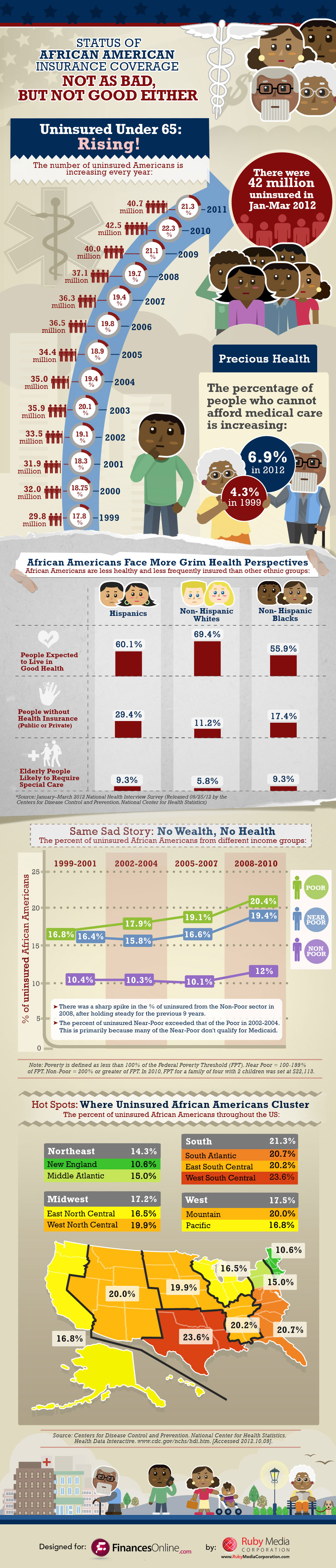
The Affordable Care Act has developed into one of the critical pivots on which the success of President Obama’s second term is expected to turn. Yet, one sector that’s already struggling is African Americans.

In 2012, 17.4 percent of non-Hispanic African Americans were uninsured. More critically, only 55.9 percent of African Americans are expected to continue to live in good health, while a more or less healthy life is expected in 69.4 percen of white Americans.

###

infographic-health-insurance-of-african-americans

###

Assessment

These and other alarming facts were revealed by the National Health Interview Survey of the Center for Disease Control and Prevention, and corroborated by data from the U.S. Census Bureau. Both these agencies were data sources for this infographic, which takes a closer look at the health insurance situation of African Americans.

Conclusion

Your thoughts and comments on this ME-P are appreciated. Feel free to review our top-left column, and top-right sidebar materials, links, URLs and related websites, too. Then, subscribe to the ME-P. It is fast, free and secure.

Link: http://feeds.feedburner.com/HealthcareFinancialsthePostForcxos

Speaker: If you need a moderator or speaker for an upcoming event, Dr. David E. Marcinko; MBA – Publisher-in-Chief of the Medical Executive-Post – is available for seminar or speaking engagements. Contact: MarcinkoAdvisors@msn.com

Our Other Print Books and Related Information Sources:

Health Dictionary Series: http://www.springerpub.com/Search/marcinko

Practice Management: http://www.springerpub.com/product/9780826105752

Physician Financial Planning: http://www.jbpub.com/catalog/0763745790

Medical Risk Management: http://www.jbpub.com/catalog/9780763733421

Hospitals: http://www.crcpress.com/product/isbn/9781439879900

Physician Advisors: www.CertifiedMedicalPlanner.org

Product DetailsProduct DetailsProduct Details

Product Details  Product Details

Product DetailsProduct Details

A Visual on Health Entitlement Spending

Join Our Mailing List

A Story in Six Charts

By Nancy Chockley PhD www.NIHCM.org

Between the fiscal cliff, sequestration, a potential government shut down and the debt ceiling, Washington is experiencing a seemingly endless succession of budgetary crises.

Although health entitlement programs are often on the table in negotiations, there has been little agreement on the scope and direction of meaningful reform. The recent slowdown in health spending growth may strengthen the impulse on some fronts to delay action, but long-term projections leave little doubt that federal health spending will continue to be a major contributor to our fiscal woes.

Assessment

This chart story pulls together essential facts on how much the federal government is spending on mandatory health care programs, how that spending affects the budget, and the hard spending and revenue trade-offs necessary to improve our fiscal outlook.

chart story

Conclusion

Your thoughts and comments on this ME-P are appreciated. Feel free to review our top-left column, and top-right sidebar materials, links, URLs and related websites, too. Then, subscribe to the ME-P. It is fast, free and secure.

Link: http://feeds.feedburner.com/HealthcareFinancialsthePostForcxos

Speaker: If you need a moderator or speaker for an upcoming event, Dr. David E. Marcinko; MBA – Publisher-in-Chief of the Medical Executive-Post – is available for seminar or speaking engagements. Contact: MarcinkoAdvisors@msn.com

OUR OTHER PRINT BOOKS AND RELATED INFORMATION SOURCES:

Health Dictionary Series: http://www.springerpub.com/Search/marcinko

Practice Management: http://www.springerpub.com/product/9780826105752

Physician Financial Planning: http://www.jbpub.com/catalog/0763745790

Medical Risk Management: http://www.jbpub.com/catalog/9780763733421

Hospitals: http://www.crcpress.com/product/isbn/9781439879900

Physician Advisors: www.CertifiedMedicalPlanner.org

Product DetailsProduct Details

Medicare Inpatient Profitability in US Hospitals

Join Our Mailing List

The Impending Need for Cost-Efficiency

[By Objective Health]

Medicare patients often account for the largest proportion of inpatient volume for an average US hospital. With the exception of outlier cases, Medicare inpatient services are adjusted for wage rates and reimbursed as a single predetermined payment across the country.

Over the next few years, Medicare is expected to substantially reduce growth in payment rates, thereby pressuring hospitals to become more cost-efficient.

###

Medicare OH

###

Assessment

This infographic highlights the need for hospitals to manage costs, showing that there is a wide variation in Medicare inpatient profit across US hospitals, which is primarily driven by differences in Medicare cost per case.

Conclusion

Your thoughts and comments on this ME-P are appreciated. Feel free to review our top-left column, and top-right sidebar materials, links, URLs and related websites, too. Then, subscribe to the ME-P. It is fast, free and secure.

Speaker: If you need a moderator or speaker for an upcoming event, Dr. David E. Marcinko; MBA – Publisher-in-Chief of the Medical Executive-Post – is available for seminar or speaking engagements. Contact: MarcinkoAdvisors@msn.com

OUR OTHER PRINT BOOKS AND RELATED INFORMATION SOURCES:

###

Understanding the Pre-Reform Impact of Self-Pay Patients

Join Our Mailing List

On Us Hospitals

Source: Objective Health

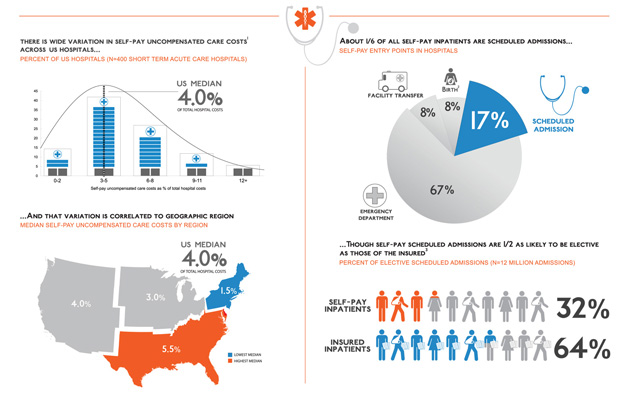
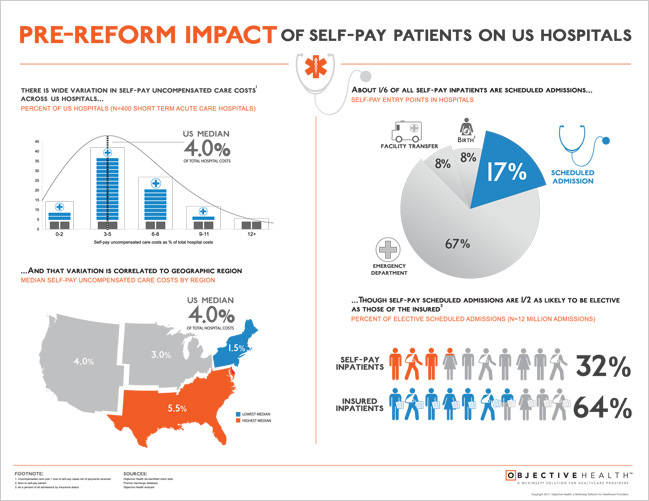
Pre-reform, many hospitals experience significant uncompensated care costs from self-pay patients.

###

Reform Impact

###

This infographic illustrates the variation in self-pay uncompensated care costs across US hospitals and regions.

Assessment

Despite the uncompensated care risk, 1/6th of self-pay inpatients are scheduled admissions, though their procedures are much less elective than the procedures of the insured.

Conclusion

Your thoughts and comments on this ME-P are appreciated. Feel free to review our top-left column, and top-right sidebar materials, links, URLs and related websites, too. Then, subscribe to the ME-P. It is fast, free and secure.

Link: http://feeds.feedburner.com/HealthcareFinancialsthePostForcxos

Speaker: If you need a moderator or speaker for an upcoming event, Dr. David E. Marcinko; MBA – Publisher-in-Chief of the Medical Executive-Post – is available for seminar or speaking engagements. Contact: MarcinkoAdvisors@msn.com

Our Other Print Books and Related Information Sources:

Health Dictionary Series: http://www.springerpub.com/Search/marcinko

Practice Management: http://www.springerpub.com/product/9780826105752

Physician Financial Planning: http://www.jbpub.com/catalog/0763745790

Medical Risk Management: http://www.jbpub.com/catalog/9780763733421

Hospitals: http://www.crcpress.com/product/isbn/9781439879900

Physician Advisors: www.CertifiedMedicalPlanner.org

Product DetailsProduct Details

Why are Medical Bills so High [video]

Join Our Mailing List______________________________

TIME’s Best Cover Story … Ever?
###
TIME magazine just dedicated its current issue to just one article: “Bitter Pill: Why Medical Bills Are Killing Us.”
###
The article, written by Time contributor Steven Brill, is required reading for all healthcare providers, administrators, legislators, patients — basically, everyone; especially readers of this ME-P.

The article is too comprehensive to summarize in one blurb, but Mr. Brill did a good job of describing its origins to Jon Stewart on The Daily Show.

Throughout all of the discussions during the Obamacare debate, the focus was usually on who should pay the medical bills.  Brill said, “We never asked the first question: Why are the bills so high?”

###

###

Assessment

We wish we could say we thought of this, but it was Matt Yglesias who did.

Conclusion

Your thoughts and comments on this ME-P are appreciated. Feel free to review our top-left column, and top-right sidebar materials, links, URLs and related websites, too. Then, subscribe to the ME-P. It is fast, free and secure.

Speaker: If you need a moderator or speaker for an upcoming event, Dr. David E. Marcinko; MBA – Publisher-in-Chief of the Medical Executive-Post – is available for seminar or speaking engagements. Contact: MarcinkoAdvisors@msn.com

OUR OTHER PRINT BOOKS AND RELATED INFORMATION SOURCES:

Product DetailsProduct Details

***

A Better Approach to [Hospital] Cost Estimation

Join Our Mailing List

Re-thinking the Ratios-of-Costs-to-Charges [RCCs] Financial Meter

By Russ Richmond MD

Russ Richmond MDUsing the ratios-of-costs-to-charges [RCCs] can lead hospitals down a garden-variety strategic path that’s wrong for them.

A strategically safer method of cost estimation can more accurately reveal costs.


At a Glance

  • Using ratios of costs to charges (RCCs) to estimate costs can cause hospitals to significantly over- or under-invest in service lines.
  • A focus on improving cost estimation in cost centers where physicians have significant control over operating expenses, such as drugs or implants, can strengthen decision making and strategic planning.
  • Connecting patient file information to purchasing data can lead to more accurate reflections of actual costs and help hospitals gain better visibility across service lines.

To put it bluntly, there is an almost complete lack of understanding of how much it costs to deliver patient care, much less how those costs compare with the outcomes achieved. Instead of focusing on the costs of treating individual patients with specific medical conditions over their full cycle of care, providers aggregate and analyze costs at the specialty or service department level.

—Professors Robert Kaplan and Michael Porter, “The Big Idea: How to Solve the Cost Crisis in Health Care,” Harvard Business Review, September 2011.

Of all the challenges hospitals face in today’s uncertain healthcare environment, estimating their costs might not be their top concern. However, the method most hospitals use to estimate their costs can have serious strategic and financial ramifications on their bottom line.

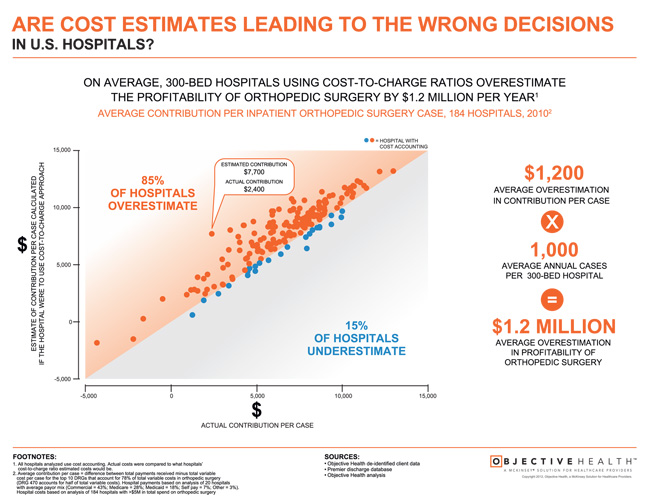
More than 60 percent of hospitals today use ratios of costs to charges (RCCs) as their primary cost estimation method, because true cost accounting is viewed as prohibitively expensive. But using RCCs to estimate costs can lead to significant problems for hospitals. For example, results of a recent study disclose that among 184 mid-sized community hospitals (i.e., with roughly 300 beds), the use of RCCs led 85 percent of the hospitals to overestimate the profitability of orthopedic surgery service lines. On average, the overestimates amounted to $1.2 million per year per hospital.

Such incorrect cost estimates can cascade into potentially serious strategic, financial, and operational issues. Because of faulty cost estimates, hospitals can over-invest—or under-invest—in service lines based only on high-level insight into the actual profitability of these areas. Either scenario has the potential to produce negative consequences.

Suboptimal strategic decision making based on faulty data and conclusions leads to suboptimal results. No hospital can afford such results and stay competitive in an industry of increased cost and pricing transparency.

So what’s the solution for hospitals? Even without switching to a full procedural cost-accounting system, hospitals can make adjustments that improve their cost estimating and thus strengthen their decision making and strategic planning. The operative principle is that hospitals should focus on improving cost estimating in cost centers where physicians have the most control of operating expenses—namely, drugs and implants.

Making the Right Cost Connections

Connecting patient file information, where costs are estimated, with purchasing data, which reflect actual costs, can produce a significant impact on a hospital’s pricing methodology. Drugs and implants, which represent 17 percent of a typical hospital’s total costs, are a good starting point for adoption of this approach.

Drugs. To better estimate drug prices, hospitals should make the patient file/purchasing data connection based on generic class, route of administration, and dosage. The patient charge file and the purchasing file can be connected using a common taxonomy. For instance, a hospital’s purchasing file may record a box of 10 Tylenol tablets as “10 Tylenol tablets of 325 mg,” while the charge may be recorded in the patient charge file as “Acetaminophen cap 325.” This results in a direct text mismatch for calculating cost, which can ultimately lead to faulty cost-estimating data. A common taxonomy would group these two entries into a common bucket to produce an accurate mapping of costs.

Implants. Implants are also a major price item for hospitals. To better estimate implant costs, the patient charge file and the purchasing file should be mapped using the implant log, using the same process described for mapping drug costs. The implant log is used by surgeons after an operation to log the type of procedure, detailed description of supplies used, and general comments.

When a physician orders a knee implant, the implant stock-keeping unit (SKU) number is often recorded in the implant log. If the SKU number in the implant log were mapped to the SKU number in the hospital’s purchasing file, the hospital would be better able to determine the actual cost for the implant. The cost could then be assigned to the patient file, resulting in a more accurate cost picture for orthopedic cases.

For example, to assign true implant costs to a patient who has undergone a knee replacement, a hospital would look up the implant SKU recorded in the implant log by the physician—in this example, SKU123. Then, the hospital would open the purchasing file and locate, for that particular month, the description and price for SKU123 (in this instance, XYZ knee replacement part; cost: $4,950). Next, the hospital would map the more detailed description and price for the implant to the patient charge file. This process can help to ensure that the true cost of the implant used by the physician is assigned to the patient’s charge file.

In some hospitals, the implant log, purchasing file, and patient charge file are part of the same system. For the majority of hospitals, however, the implant log is a separate electronic file, not connected with the other file system or systems. And in some hospitals, the implant log is manually managed.

A hospital can complement this process by comparing its drug and implant costs with price benchmarks from subscription-based national databases or with databases maintained by consulting firms. In our experience, a 65 percent match can be achieved by connecting the drug and implant purchasing files with the detailed charge files, as outlined above. By comparing these costs with price benchmarks from subscription-based or consulting-firm databases, a hospital can better determine how the prices it is paying for drugs and implants compare with national averages.

By connecting these data sets, hospitals can gain better visibility of what they are really spending across various service lines and operational functions.

Understanding a Rural Hospital’s True Costs

The experience of a 250-bed rural hospital in the north central United States provides a good example of the pitfalls of using RCCs to estimate costs. This hospital found itself making key strategic planning decisions based on misleading cost data.

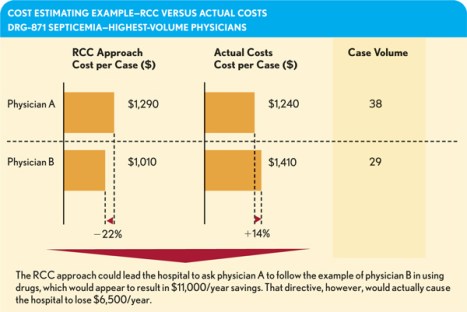
In analyzing the drug usage data from two physicians (A and B) at the hospital, physician B appeared more cost-efficient than physician A at treating the same disease. However, on examining physician B’s actual drug expenditures, hospital leaders realized this physician’s costs were in fact higher than those of physician A (see the exhibitbelow).

###
f-richmond

###

If RCC costs are considered, physician A seems to be treating patients at a higher average cost per case than physician B. But if actual costs are considered, physician A is actually treating at a lower cost per case than physician B. Strategically, based on the RCC analysis, if the hospital encouraged all of its physicians to emulate physician B’s treatment approach, it would lose the opportunity to save money on every case.

The data generated by RCCs can be especially problematic in measuring the profitability of various hospital services lines. Because of these misleading cost data, the team at this rural hospital was under the impression it was making a healthy $477,000 profit annually from its orthopedic surgery group.

The reality was the hospital’s profit from this key service line was about $170,000 less—a material difference for a rural community hospital.

For years, the provider thought it was making money on hip replacement surgery, but those profits were much lower because costs of implants used in these orthopedic procedures were continually underestimated. An incorrect profitability picture such as this can wreak havoc on vital strategic-planning efforts.

The rural hospital is by no means an outlier in regard to its problems with cost estimation. The research finding cited at the beginning of this article suggests institutions regularly underestimate costs per orthopedic procedure (and the costs of implants) because of their use of RCCs.

Rising costs are at the heart of the cost challenges that are prevalent in health care. Healthcare reform was designed, in part, to help alleviate this persistent cost problem, but much work still needs to be done to fully understand the true costs of health care. Once these costs are better understood, the goal then must be to manage costs more effectively, efficiently, and sustainably. A critical starting point is for healthcare providers to have a more accurate and realistic picture of what their current costs are, not what they think costs may be.

By connecting key data sets and analyzing costs in a more systematic way, hospitals can develop a stronger and more accurate understanding of their actual costs. This system will provide more data visibility to enable hospital leaders to enhance strategic decision making related to key service lines, improving value.


About the Author

Russ Richmond, MD, is CEO, Objective Health, Waltham, Mass., and a member of HFMA’s Massachusetts-Rhode Island Chapter (russell_richmond@mckinsey.com).


Footnotes:
a. This amount is based on an average overestimation in contribution per orthopedic surgery case of $1,200 multiplied by an average of 1,000 cases annually per hospital.


###
Sidebar 1:  A Step-by-Step Guide to Improving Hospital Cost-Estimating Processes

Hospital leaders should follow four relatively easy-to-implement steps to improve their cost-estimating processes related to drugs and implants—two cost centers where physicians have significant control over operating expenses.

Step 1: Establish the Data Foundation
Ensure that the hospital has core data sets on which to develop. Keep the following practices in mind:

  • All encounters and detailed charges should be available in corresponding files.
  • All purchased drugs, implants, and other medical/surgical products should be available in a purchasing file (often provided by the group purchasing organization or distributor).
  • All implants should be tracked in electronic implant logs (e.g., in the operating room, intensive care unit, and cath lab).

Step 2: Assemble a Cost-Estimate Improvement Team

This team, which will lead the project, should include the following representatives:

  • Director of pharmacy, to provide guidance and sign-off on drug cost estimates
  • Materials manager, to provide guidance and sign-off on implant cost estimates
  • Chargemaster manager, to incorporate input from pharmacy and materials departments into the granular charge codes that are charged to patients
  • Analytics expert, to connect purchasing files, implant logs, and patient charge files
  • Strategy and finance leaders, to leverage the improved cost accounting to derive savings and align on growth strategy. 

Step 3: Connect the Data Sets

The analytics expert connects the data sets as described in the “Making the Right Cost Connections” section of this article. 

Step 4: Leverage Insights from True Cost Data

Three areas of understanding or capability can ensure that a hospital can put the cost data to effective strategic use.

Understanding of actual profitability of service lines/departments and definition of growth strategies.

A hospital with true cost data can understand which service lines drive most of its profit and which departments lead to maximum losses. This understanding enables hospitals to strategically define departments they should invest in and areas where they should become leaner. On the other hand, a hospital that uses ratios of costs to charges (RCCs) can, at best, give average estimates of service-line profitability, with the potential for categorizing unprofitable service lines as profitable and vice versa. 

Ability to accurately measure clinical variation in the hospital and use the measurements to guide meaningful conversations with your physicians.

A hospital with true cost data can run physician-level data profiles, such as average cost per case for each physician treating a particular disease. Such insight can support meaningful discussions with physician outliers that can influence changes in behavior and thus potentially reduce costs. Hospitals using RCCs cannot approach physicians with the same level of credibility, as seen in the rural hospital example on page 89. If hospitals instead focus on using actual costs in specific strategic costs centers, physicians once considered the hospital’s most cost-efficient may be exposed as the  organization’s most costly. 

Understanding of the impact of macro-purchasing factors such as drug shortages on the profitability of key service lines.  

A hospital that tracks actual costs can take macro-purchasing actors, such as drug shortages, and assign true costs on a daily or monthly basis, thereby allowing the effects of drug shortages on service-line profitability to be quantified. Alternatively, hospitals using RCC-based costing would average out the effects over a year, leading to inaccurate service-line profitability insight during times of drug shortages.


Sidebar 2: Improving Cost Estimates for Drugs: Action Steps by Department

IT Department

  • Create a taxonomy-based categorization tool. Assign each drug description into broad therapeutic class, dosage, and route of administration categories. This can be a string search and categorization tool, using regular expressions, to match a specific set of characters in a string (word).
  • Maintain a central database of drugs and categorizations to be used each month.

Pharmacy Department

  • When documenting purchased drugs, be sure to include compound, dosage, and route of administration information in the entry.
  • Ensure the detailed charge file has charge codes that reflect the individual drugs purchased each month.

Sidebar 3: Improving Cost Estimates for Implants: Action Steps by Department

IT Department

  • Bridge the implant log and the purchasing file. Identify the SKU number for the implant in the purchasing file as well as the implant log. Maintain or create a central database of implants and their SKUs (both the implant-log SKU and the purchasing-file SKU).
  • Connect the detailed charge file with the implant log, using the patient account number.

Purchasing Department

  • Ensure that purchased implants are assigned an internal SKU that can be mapped to the implant log SKU.
  • Ensure that the detailed charge file has charge codes that reflect the individual implants purchased each month. 

Conclusion

Your thoughts and comments on this ME-P are appreciated. Feel free to review our top-left column, and top-right sidebar materials, links, URLs and related websites, too. Then, subscribe to the ME-P. It is fast, free and secure.

Link: http://feeds.feedburner.com/HealthcareFinancialsthePostForcxos

Speaker: If you need a moderator or speaker for an upcoming event, Dr. David E. Marcinko; MBA – Publisher-in-Chief of the Medical Executive-Post – is available for seminar or speaking engagements. Contact: MarcinkoAdvisors@msn.com

OUR OTHER PRINT BOOKS AND RELATED INFORMATION SOURCES:

Product DetailsProduct Details

Product Details

“The Doctor’s Dilemma”

Join Our Mailing List

On Hospital Monopolistic Powers

By Ann Miller RN MHA

As George Bernard Shaw, whose works include “The Doctor’s Dilemma” might have put it, that any lawmaker would grant hospitals monopolistic powers plus the freedom to price as they see fit is enough to make one despair of political humanity.

C.O.N.

And, here is a post on Certificates of Need, too.

http://www.ncsl.org/issues-research/health/con-certificate-of-need-state-laws.aspx

Conclusion

Your thoughts and comments on this ME-P are appreciated. Feel free to review our top-left column, and top-right sidebar materials, links, URLs and related websites, too. Then, subscribe to the ME-P. It is fast, free and secure.

Link: http://feeds.feedburner.com/HealthcareFinancialsthePostForcxos

Speaker: If you need a moderator or speaker for an upcoming event, Dr. David E. Marcinko; MBA – Publisher-in-Chief of the Medical Executive-Post – is available for seminar or speaking engagements. Contact: MarcinkoAdvisors@msn.com

Our Other Print Books and Related Information Sources:

Health Dictionary Series: http://www.springerpub.com/Search/marcinko

Practice Management: http://www.springerpub.com/product/9780826105752

Physician Financial Planning: http://www.jbpub.com/catalog/0763745790

Medical Risk Management: http://www.jbpub.com/catalog/9780763733421

Hospitals: http://www.crcpress.com/product/isbn/9781439879900

Physician Advisors: www.CertifiedMedicalPlanner.org

Product DetailsProduct Details

Books for Savvy Doctors and their Financial Advisors and Management Consultants

Join Our Mailing List

Learn and Prosper from the ME-P

By Ann Miller RN MHA

Product DetailsProduct DetailsProduct Details

Product Details  Product Details

Product DetailsProduct Details

Assessment

Click on each image for more information.

Feel free to write a review and tell us what you think?

Conclusion

Your thoughts and comments on this ME-P are appreciated. Feel free to review our top-left column, and top-right sidebar materials, links, URLs and related websites, too. Then, subscribe to the ME-P. It is fast, free and secure.

Speaker: If you need a moderator or speaker for an upcoming event, Dr. David E. Marcinko; MBA – Publisher-in-Chief of the Medical Executive-Post – is available for seminar or speaking engagements. Contact: MarcinkoAdvisors@msn.com

OUR OTHER PRINT BOOKS AND RELATED INFORMATION SOURCES:

Product Details

About “Hospitals and Healthcare Organizations” in 2014

Join Our Mailing List

Management Strategies, Operational Techniques, Tools, Templates and Case Studies

Product DetailsProduct Details

Search Inside these Books

###

Conclusion

Your thoughts and comments on this ME-P are appreciated. Feel free to review our top-left column, and top-right sidebar materials, links, URLs and related websites, too. Then, subscribe to the ME-P. It is fast, free and secure.

Link: http://feeds.feedburner.com/HealthcareFinancialsthePostForcxos

Speaker: If you need a moderator or speaker for an upcoming event, Dr. David E. Marcinko; MBA – Publisher-in-Chief of the Medical Executive-Post – is available for seminar or speaking engagements. Contact: MarcinkoAdvisors@msn.com

OUR OTHER PRINT BOOKS AND RELATED INFORMATION SOURCES:

DICTIONARIES: http://www.springerpub.com/Search/marcinko
PHYSICIANS: www.MedicalBusinessAdvisors.com
PRACTICES: www.BusinessofMedicalPractice.com
HOSPITALS: http://www.crcpress.com/product/isbn/9781466558731
CLINICS: http://www.crcpress.com/product/isbn/9781439879900
BLOG: www.MedicalExecutivePost.com
FINANCE: Financial Planning for Physicians and Advisors
INSURANCE: Risk Management and Insurance Strategies for Physicians and Advisors

###

Dr. Benjamin Solomon Carson, Sr for President?

Join Our Mailing List

Forget …. Being like Mike – Instead … Be like Ben 

By Dr. David Edward Marcinko MBA CMP™

Hopkins Medical SchoolA unique speech was delivered by neuro-surgeon Benjamin Carson MD on February 7, 2013 at the National Prayer Breakfast in President Barack Obama’s presence.

Who is Ben Carson MD?

Benjamin Solomon “Ben” Carson, Sr. (born September 18, 1951) is an American neurosurgeon and the Director of Pediatric Neurosurgery at Johns Hopkins Hospital. He was awarded the Presidential Medal of Freedom, the highest civilian award in the United States, by President George W. Bush, in 2008.

The Breakfast

During the breakfast, Carson suggested that political correctness is a “dangerous” threat to free speech and encouraged Americans to share their views without hesitation. Carson also included his ideas on the national debt, deficits, taxation and health care; he explains his personal position on each matter.

Here is a teaser quote:

I don’t like to bring up problems without coming up with solutions… What about our taxation system? It is so complex, there is no one who can possibly comply with every jot and tittle. That doesn’t make any sense.

What we need to do is come up with something that’s simple. The inherently fair principle is proportionality: you make 10 billion dollars, you put in a billion. You make 10 dollars, you put in one. Of course, you have to get rid of the loopholes.

Some people say, ‘That’s not fair! It’s doesn’t hurt the guy who made 10 billion dollars.’ Where does it say you have to hurt that guy? He just put a billion dollars into the pot!

My Connectinon to Ben Carson

Ok, I really don’t have any connection to Dr. Carson despite the seven degrees of separation philosophy. But, I did grow up in Baltimore Maryland and played stickball in the parking lot of the famed Johns Hopkins University  Hospital. I was even seen in the ER for a minor injury as a kid.

But, I was not accepted into medical school there, and could not attend Johns Hopkins University up on North Charles Street for my undergraduate career, because of the expense.

The Video

Nevertheless, this video is worth watching. It is 26 minutes in length and it is interesting to watch the president grimace as he gives a complete opposite solution to every problem the country faces.

Link: http://www.youtube.com/watch?v=vyyHegP255g

Ben’s Proposals

I especially liked Ben’s thoughts on the following topics:

  • Replacing the IRS with tithing for all income levels. No need to hurt the successful among us with a graduated tax system.
  • Giving all Americans a Health Savings Account [HSA] at birth. This will not only give them some financial skin-in-the game, but makes them educated stewards of their healthcare needs, treatments and expenses. And, the savings portion would be transferrable to a next generation beneficiary for estate-like continuity.
  • Giving everyone a personal electronic health record [pEHR] at birth.
  • Reforming the welfare state so it does not become a way of life
  • Morality and the PC mania.

Assessment

Ben is one smart pediatric brain surgeon. I would consider voting for him in a heart-beat. But, as a surgeon, I am like him, a doer who wants to solve a problem.

Unfortunately, Washington politicians are often talkers who place self-interest above all. Problem solving often takes a back-seat to pleasing constituents. 

Conclusion

Your thoughts and comments on this ME-P are appreciated. Feel free to review our top-left column, and top-right sidebar materials, links, URLs and related websites, too. Then, subscribe to the ME-P. It is fast, free and secure.

Link: http://feeds.feedburner.com/HealthcareFinancialsthePostForcxos

Speaker: If you need a moderator or speaker for an upcoming event, Dr. David E. Marcinko; MBA – Publisher-in-Chief of the Medical Executive-Post – is available for seminar or speaking engagements. Contact: MarcinkoAdvisors@msn.com

Our Other Print Books and Related Information Sources:

Health Dictionary Series: http://www.springerpub.com/Search/marcinko

Practice Management: http://www.springerpub.com/product/9780826105752

Physician Financial Planning: http://www.jbpub.com/catalog/0763745790

Medical Risk Management: http://www.jbpub.com/catalog/9780763733421

Hospitals: http://www.crcpress.com/product/isbn/9781439879900

Physician Advisors: www.CertifiedMedicalPlanner.org

Product DetailsProduct DetailsProduct Details

Product Details  Product Details

Product DetailsProduct Details

Are Doctors Unique -OR- New Members of the Working Class hoi-polloi?

Join Our Mailing List

United We Stand – Divided We Fall?

By Dr. David Edward Marcinko MBA

BC Dr. MarcinkoPhysician blogger Kent Bottles MD recently asked if doctors are really different; a special class of folks?

And, some colleagues are shocked when an authority like Uwe Reinhardt PhD, of Princeton University, points out that collectively many MDs act just like any other worker in the domestic economy.

LinkAre physicians really that special?

In fact, the classic 1986 letters between the Princeton professor, and former New England Journal of Medicine editor Arnold Relman MD, highlight the tension between how we think of ourselves and how we act.

Medical Labor Unions

Now, also recall that healthcare journalist William F. Shea, opined more than a decade ago, that there were numerous psychological barriers against the formation of physician unions [personal communication].

Barriers

These included (1) the public perception of doctor’s as a “cut above” ordinary workers; (2) doctor’s attempts to wrap collective bargaining in a mantle of patient’s rights that lacked credibility; and (3) the highly educated physician’s ability to re-engineer and seek alternate employment opportunities rather than accept the salary scale or lack of autonomy present in restrictive managed care entities.

Professional Wake Up Call

Tincture of Time

Time has proven Shea both correct and incorrect, as MD resignation through individual re-deployment and/or innovation has been more effective than any “union strike” if called by one practitioner at a time.

On the other hand, more than 40% of all physicians are now collective employees … So, what gives?

Link: Legal Strategies for Doctors Sheltering Employment Income

Assessment

And so, are doctors really different than the man-in-the-street; or more like union workers and the OWStreeters? Did we stand united, or have we fallen individually since the comments of Shea, Reinhardt and Relman?

Conclusion

Your thoughts and comments on this ME-P are appreciated. Feel free to review our top-left column, and top-right sidebar materials, links, URLs and related websites, too. Then, subscribe to the ME-P. It is fast, free and secure.

Speaker: If you need a moderator or speaker for an upcoming event, Dr. David E. Marcinko; MBA – Publisher-in-Chief of the Medical Executive-Post – is available for seminar or speaking engagements. Contact: MarcinkoAdvisors@msn.com

OUR OTHER PRINT BOOKS AND RELATED INFORMATION SOURCES:


Product DetailsProduct DetailsProduct Details

Product Details  Product Details

Product DetailsProduct Details

The Impact Of The U.S. Recession On Hospitals

Join Our Mailing List

Drivers of Decline

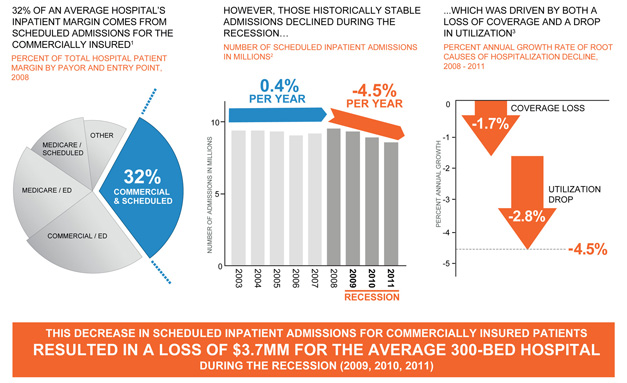
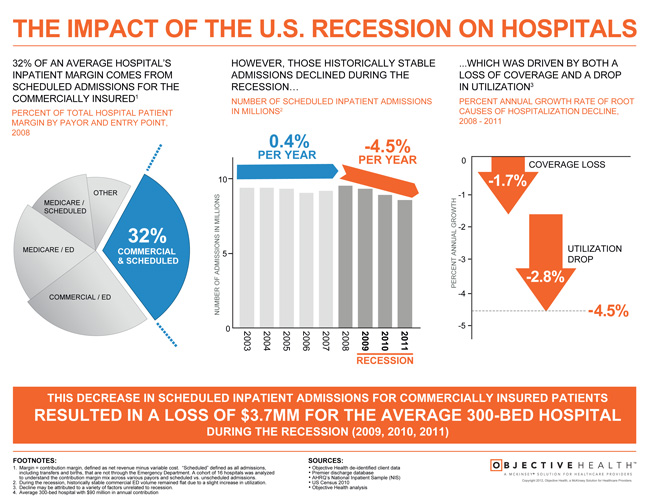
Commercially insured scheduled admissions are the largest contributor to inpatient margins for the average US hospital. During the US recession (2009-2011), volumes in this segment declined. There were two primary drivers of this decline.

####

Recession Impact

Dual Causes

First, commercial insurance coverage decreased, stemming from unemployment and underemployment. This is expected to reverse and rebound as the economy recovers and as healthcare reform is implemented.

Second, even among those who retained coverage, utilization of inpatient services decreased as patients delayed or forewent elective and preventative care. This was influenced by a range of economic factors, including reduced household incomes, higher co-pays, and a reduced ability to leave work for medical care, as well as factor unrelated to the recession, such as a shift to outpatient management of disease.

More: Are Cost Estimates Leading To The Wrong Decisions in US Hospitals?

Assessment

It is unclear whether this second driver will diminish fully as the economy recovers. A slow recovery – or one that fails to see volumes to return to pre-recession levels – suggests that hospitals may need to refocus their strategies on service lines and segments that have historically been less attractive.

Channel Surfing the ME-P

Have you visited our other topic channels? Established to facilitate idea exchange and link our community together, the value of these topics is dependent upon your input. Please take a minute to visit. And, to prevent that annoying spam, we ask that you register. It is fast, free and secure.

Conclusion

Your thoughts and comments on this ME-P are appreciated. Feel free to review our top-left column, and top-right sidebar materials, links, URLs and related websites, too. Then, subscribe to the ME-P. It is fast, free and secure.

Speaker: If you need a moderator or speaker for an upcoming event, Dr. David E. Marcinko; MBA – Publisher-in-Chief of the Medical Executive-Post – is available for seminar or speaking engagements. Contact: MarcinkoAdvisors@msn.com

OUR OTHER PRINT BOOKS AND RELATED INFORMATION SOURCES:

Product Details

Selected NBER Papers of Note for MDs and FAs

Join Our Mailing List

National Bureau of Economic Research

www.NBER.org

The 2012 No. 3 Bulletin includes the articles below:

1)  The Value of Planning Prompts
by Katherine Milkman, John Beshears, James Choi, David Laibson, and Brigitte Madrian
http://www.nber.org/aginghealth/2012no3/w17994.html

2)  The Effect of the Earned Income Tax Credit on Infant Health
by Hilary Hoynes, Douglas Miller, and David Simon
http://www.nber.org/aginghealth/2012no3/w18206.html

3)  Can Health Explain Differences in Employment of Older Men Across Countries?
by Kevin Milligan and David Wise
http://www.nber.org/aginghealth/2012no3/w18229.html

Assessment

Abstracts of Selected Recent NBER Working Papers:
http://www.nber.org/aginghealth/2012no3/WorkingPaperSummaries.html

###

Product DetailsProduct DetailsProduct Details

Product Details  Product Details

Product DetailsProduct Details

An Economic Picture of Domestic Healthcare Spending

Join Our Mailing List

By the Numbers

The healthcare component of the U.S. economy continues to expand, with per-capita spending projected to reach $13,000 by 2020. But, at the same, the industry continues to create jobs: 10 of the fastest-growing occupations are in healthcare-related fields.

Driver of the Economy

As one of the largest segments of the US economy, health care accounts for trillions of dollars in spending, both by governments and private individuals. And so, Top Masters in Healthcare decided to take a closer look at where the money goes in this infographic

###

health

[The Calculus]

Billing Department

So who does the spending?

  • 21% of healthcare spending is done by private businesses
  • 28% of healthcare spending is done by individual households
  • 16% of healthcare spending is done by state and local governments
  • 29% of healthcare spending is done by the Federal government

Where did the spending go?

  • 37% of healthcare spending went towards hospital care
  • 23.6% of healthcare spending went towards physician and clinical services
  • 5.9% of healthcare spending went towards other residential / health / personal care services
  • 4.9% was spent on dental services
  • 3.3% was spent on home health care
  • 3.2% was spent on “other” professional services

Per capita spending

Between 1960 and 2011, per capita health care spending rose by about 5,400 percent from $147 in 1960 to $8,311 in 2011. If other prices rose like that, here’s what it might look like today:

  • Family Dinner: $176.58
  • Tube of Toothpaste: $13.50
  • Volkswagen Beetle: $95,526
  • Gallon of gas: $13.50
  • Average income: $287,010
  • Electric can opener: $479.52

Emergency Department

The top 5 causes of death are heart disease (24.5%) cancer (23.3%) chronic lower respiratory diseases (5.6%) stroke (5.3%) accidents (4.8%) Alzheimer’s disease (3.2%).

Cardiology

  • 470,000 is the number of people who have a second or subsequent heart attack
  • 785,000 is the annual estimate of the number of people who have their first heart attack
  • $444 billion is the cost of heart disease, from health care services to medications to lost job productivity

Oncology

  • One in two men will get cancer during their lifetimes
  • One in three women will get cancer in their lifetimes
  • $226 billion is the annual cost of cancer, including treatment and lost income

Ongoing Care

  • Nearly 1 billion annual physician visits per year. If you had a doctor visit every minute of every day, it would take 1,902 years to have that many trips.
  • One out of 2 adults has a chronic illness
  • Seven out of every ten deaths are a result of a chronic illness

Obesity

  • The heaviest states by obesity rate are Mississippi (34.4%) West Virginia (32.2%) Alabama (32.3%) Tennessee (31.9%) and Louisiana (31.6%)
  • The lightest states by obesity rate are Hawaii (23.1%) Massachusetts (22.3%) Connecticut (21.8%) District of Columbia (21.7%) and Colorado (19.8%)

Diabetes

  • Diabetes can lead to a slew of other serious health problems including neverous system diseases, blindness and eye problems, heart disease and stroke, kidney disease and hypertension.
  • 25.8 million people are current affected by diabetes, 8.3% of the population.
  • 35% of people older than 20 have pre-diabetes
  • $174 billion is the total cost of treating and ealing with diabetes each year

Personnel Department

  • Healthcare provided 14.3 million jobs in 2008. And that number is only going to grow. In fact, health care is expected to be the single fastest-growing sector of the US economy through 2018.
  • Ten of the twenty fastest growing occupations are in healthcare related fields.
  • 4.01 million new jobs are expected to be created in the health care industry by 2018. Compare that to 2.67 million in science/engineering, 1.68 million in education, 1.43 million in administration support and waste management and 1.3 million in construction.
  • Healthcare professionals earned a combined $886 billion in total salaries in 2010

IT Department

  • As our world becomes more connected by technology, doctors and patients are increasingly using the Internet and data storage.
  • 57% of doctor’s offices use electronic medical records.
  • 6 out of 10 adults have looked up health information online.

Pharmacy Department

  • Almost half of Americans take at least one prescription drug.
  • $35.22 is the average price of a brand name drug which is almost 4x as much as the generic price.
  • Spending on prescription drugs has gone from $40.3 billion in 1990 to $259 billion in 2010 and is expected to grow to $457.8 billion by 2019.
  • The cost to bring a new drug to market is between $55 million and $1 billion
  • The cost of patented drugs in the United States is 35-55% higher than other industrialized nations
  • 80% of FDA approved drugs have a generic counterpart
  • Only 23% of doctor visits don’t include a prescription.

Assessment

The impact of the healthcare industry on everyday Americans continues to grow, whether they see it in their insurance bill or whether they earn their salaries from the health care industry. The issue also continues to dominate the political conversation… there’s no escaping it.

Conclusion

Your thoughts and comments on this ME-P are appreciated. Feel free to review our top-left column, and top-right sidebar materials, links, URLs and related websites, too. Then, subscribe to the ME-P. It is fast, free and secure.

Link: http://feeds.feedburner.com/HealthcareFinancialsthePostForcxos

Speaker: If you need a moderator or speaker for an upcoming event, Dr. David E. Marcinko; MBA – Publisher-in-Chief of the Medical Executive-Post – is available for seminar or speaking engagements. Contact: MarcinkoAdvisors@msn.com

OUR OTHER PRINT BOOKS AND RELATED INFORMATION SOURCES:

DICTIONARIES: http://www.springerpub.com/Search/marcinko
PHYSICIANS: www.MedicalBusinessAdvisors.com
PRACTICES: www.BusinessofMedicalPractice.com
HOSPITALS: http://www.crcpress.com/product/isbn/9781466558731
CLINICS: http://www.crcpress.com/product/isbn/9781439879900
BLOG: www.MedicalExecutivePost.com
FINANCE: Financial Planning for Physicians and Advisors
INSURANCE: Risk Management and Insurance Strategies for Physicians and Advisors

Product DetailsProduct DetailsProduct Details

Product Details  Product Details

Product DetailsProduct Details

US Health Spending by Service and Age

Join Our Mailing List

By: Deloitte and h/t Bruce Bartlett

National Health Expenditure Projections, 2012–22: Slow Growth Until Coverage Expands And Economy Improves

Abstract

Health spending growth through 2013 is expected to remain slow because of the sluggish economic recovery, continued increases in cost-sharing requirements for the privately insured, and slow growth for public programs. These factors lead to projected growth rates of near 4 percent through 2013.

However, improving economic conditions, combined with the coverage expansions in the Affordable Care Act and the aging of the population, drive faster projected growth in health spending in 2014 and beyond. Expected growth for 2014 is 6.1 percent, with an average projected growth of 6.2 percent per year thereafter.

Over the 2012–22 period, national health spending is projected to grow at an average annual rate of 5.8 percent. By 2022 health spending financed by federal, state, and local governments is projected to account for 49 percent of national health spending and to reach a total of $2.4 trillion.

Link: http://content.healthaffairs.org/content/early/2013/09/13/hlthaff.2013.0721#aff-

Assessment

Channel Surfing the ME-P

Have you visited our other topic channels? Established to facilitate idea exchange and link our community together, the value of these topics is dependent upon your input. Please take a minute to visit. And, to prevent that annoying spam, we ask that you register. It is fast, free and secure.

Conclusion

Your thoughts and comments on this ME-P are appreciated. Feel free to review our top-left column, and top-right sidebar materials, links, URLs and related websites, too. Then, subscribe to the ME-P. It is fast, free and secure.

Speaker: If you need a moderator or speaker for an upcoming event, Dr. David E. Marcinko; MBA – Publisher-in-Chief of the Medical Executive-Post – is available for seminar or speaking engagements. Contact: MarcinkoAdvisors@msn.com

OUR OTHER PRINT BOOKS AND RELATED INFORMATION SOURCES:

Product DetailsProduct DetailsProduct Details

Product Details  Product Details

Product DetailsProduct Details

Spending for Private Health Insurance in the United States

Join Our Mailing List

Health Costs Doubled in the Past Decade

By NIHCM Foundation www.NIHCM.org

The total cost of health care for a typical family with employer-sponsored coverage has more than doubled in the past decade to nearly $21,000 per year, outpacing both inflation and income growth.

Skyrocketing health care costs are already straining budgets and could jeopardize the availability of affordable coverage under the ACA. To shed light on the factors behind increased spending on private insurance, this brief examines

  • trends in premiums and cost-sharing in the group and non-group markets,
  • how premium dollars are spent by insurers,
  • which sectors are driving premiums upward, and
  • the importance of price increases in explaining spending growth.

healthcare costs

Assessment

Read more…

Conclusion

Your thoughts and comments on this ME-P are appreciated. Feel free to review our top-left column, and top-right sidebar materials, links, URLs and related websites, too. Then, subscribe to the ME-P. It is fast, free and secure.

Speaker: If you need a moderator or speaker for an upcoming event, Dr. David E. Marcinko; MBA – Publisher-in-Chief of the Medical Executive-Post – is available for seminar or speaking engagements. Contact: MarcinkoAdvisors@msn.com

OUR OTHER PRINT BOOKS AND RELATED INFORMATION SOURCES:

Product Details  Product Details

Product Details

Macro-Economics and What the ‘Chained CPI’ Could Mean for Social Security?

Join Our Mailing List

Definition of Chain-Weighted CPI

By Dr. David Edward Marcinko MBA

Dr David E Marcinko MBAAn alternative BLS measurement for the Consumer Price Index (CPI), removing the biases associated with new products, changes in quality and discounted prices.

The chain weighted CPI incorporates the average changes in the quantity of goods purchased, along with standard pricing effects. This allows the chain weighted CPI to reflect situations where customers shift the weight of their purchases from one area of spending to another.

Read more: http://www.investopedia.com/terms/c/chain-linked-cpi.asp#ixzz2FdiMs25f

information

Investopedia Example:

The chain weighted CPI incorporates changes in both the quantities and prices of products. For example, let’s examine clothing purchases between two years. Last year you bought a sweater for $40 and two t-shirts at $35 each. This year, two sweaters were purchased at $35 each and one t-shirt for $45.

Standard CPI calculations would produce an inflation level of 13.64% 

((1 x 35 + 2 x 45)/ (1 x 40 + 2 x 35)) =1.1364

The chain weighted approach estimates inflation to be 4.55%

((2 x 35 + 1 x 45)/ (1 x 40 + 2 x 35)) =1.0455.

Using the chain weighted approach reveals the impact of a customer purchasing more sweaters than t-shirts.

Read more: http://www.investopedia.com/terms/c/chain-linked-cpi.asp#ixzz2FdiceVyv

BLS Application

  • What is the C-CPI-U and when did the Bureau of Labor Statistics (BLS) begin publishing it?

BLS began publishing the Chained Consumer Price Index for All Urban Consumers effective with the release of July 2002 CPI data. Designated the C-CPI-U, the index supplements the existing indexes already produced by the BLS: the CPI for All Urban Consumers (CPI-U) and the CPI for Urban Wage Earners and Clerical Workers (CPI-W).

The C-CPI-U employs a formula that reflects the effect of substitution that consumers make across item categories in response to changes in relative prices.

Read more: C-CPI-U data can be found on the BLS web site at http://data.bls.gov/cgi-bin/surveymost?su

Substitution Bias

  • What is substitution and substitution bias? And does the C-CPI-U eliminate it?

Traditionally, the CPI was considered an upper bound on a cost-of-living index in that the CPI did not reflect the changes in consumption patterns that consumers make in response to changes in relative prices.

Since January 1999, a geometric mean formula has been used to calculate most basic indexes within the CPI; this formula allows for a modest amount of substitution within item categories as relative price changes.

The geometric mean formula, though, does not account for consumer substitution taking place between CPI item categories. For example, pork and beef are two separate CPI item categories. If the price of pork increases while the price of beef does not, consumers might shift away from pork to beef. The C-CPI-U is designed to account for this type of consumer substitution between CPI item categories. In this example, the C-CPI-U would rise, but not by as much as an index that was based on fixed purchase patterns.

With the geometric mean formula in place to account for consumer substitution within item categories, and the C-CPI-U designed to account for consumer substitution between item categories, any remaining substitution bias would be quite small.

Assessment 

Link: What ‘chained CPI’ could mean for Social Security

White Paper: http://www.bls.gov/cpi/super_paris.pdf

Conclusion

Your thoughts and comments on this ME-P are appreciated. Feel free to review our top-left column, and top-right sidebar materials, links, URLs and related websites, too. Then, subscribe to the ME-P. It is fast, free and secure.

Link: http://feeds.feedburner.com/HealthcareFinancialsthePostForcxos

Speaker: If you need a moderator or speaker for an upcoming event, Dr. David E. Marcinko; MBA – Publisher-in-Chief of the Medical Executive-Post – is available for seminar or speaking engagements. Contact: MarcinkoAdvisors@msn.com

Our Other Print Books and Related Information Sources:

Health Dictionary Series: http://www.springerpub.com/Search/marcinko

Practice Management: http://www.springerpub.com/product/9780826105752

Physician Financial Planning: http://www.jbpub.com/catalog/0763745790

Medical Risk Management: http://www.jbpub.com/catalog/9780763733421

Hospitals: http://www.crcpress.com/product/isbn/9781439879900

Physician Advisors: www.CertifiedMedicalPlanner.org

Product DetailsProduct DetailsProduct Details

Product Details  Product Details

Product Details

The Case for Domestic Healthcare Change—Why Bother?

Join Our Mailing List

A Crisis of Volume and Cost

By Jennifer Tomasik MS

“Fee-for-service” has been the dominant financial dynamic in the US healthcare system for decades, whereby providers are reimbursed for the quantity of visits, tests, or procedures that are performed, often without adequate regard for the cost of the interventions relative to patient outcomes.

Atul Speaks

This focus has arguably fueled incredible advances in medical devices, diagnostic tests, pharmaceuticals, and other innovations. Atul Gawande MD, surgeon and author, describes how far medicine has come since the days before penicillin—when convalescence in the shelter of a hospital was the best of only a few treatment options and, therefore, “when what was known you [as a doctor] could know. You could hold it all in your head, and you could do it all.”

The surge in the number of diagnoses and treatments that physicians have access to today is transforming their profession from a field of autonomous craftsmen wielding basic tools to what Gawande suggests should be race-car like “pit crews” that together can deliver on the scientific promise of 4,000 medical and surgical procedures and 6,000 drugs.

A Double-Edged Sword

This is a double-edged sword, as the autonomous mentality on which the field developed is now often at odds with the machine-like functioning expected of an effective and efficient “pit crew.” Together with the fee-for-service incentive structure, these realities have collided in a perfect storm propelling tremendous growth in healthcare spending characterized by fragmentation and high volume, a high cost per episode, and inconsistent quality.

Assessment

And so, we are now witnessing the costly “failure of success” from focusing so extremely on “sick care” while ignoring “well care” attempts to keep individuals and populations healthy from the start.

More info Link: http://www.routledge.com/books/details/9781466558731/

Conclusion

Your thoughts and comments on this ME-P are appreciated. Feel free to review our top-left column, and top-right sidebar materials, links, URLs and related websites, too. Then, subscribe to the ME-P. It is fast, free and secure.

Link: http://feeds.feedburner.com/HealthcareFinancialsthePostForcxos

Speaker: If you need a moderator or speaker for an upcoming event, Dr. David E. Marcinko; MBA – Publisher-in-Chief of the Medical Executive-Post – is available for seminar or speaking engagements. Contact: MarcinkoAdvisors@msn.com

Our Other Print Books and Related Information Sources:

Health Dictionary Series: http://www.springerpub.com/Search/marcinko

Practice Management: http://www.springerpub.com/product/9780826105752

Physician Financial Planning: http://www.jbpub.com/catalog/0763745790

Medical Risk Management: http://www.jbpub.com/catalog/9780763733421

Hospitals: http://www.crcpress.com/product/isbn/9781439879900

Physician Advisors: www.CertifiedMedicalPlanner.org

Our Newest Textbook Release

Buy from Amazon

Learn How to Profit and Thrive in the PP-ACA Era

BOOK FOREWORD / TESTIMONIAL

The Impact Of The U.S. Recession On Hospitals

Join Our Mailing List

By Objective Health via Laura Paden

Hospital Admissions

Commercially insured scheduled admissions are the largest contributor to inpatient margins for the average US hospital.

Recession Impact

During the US recession (2009-2011), volumes in this segment declined. There were two primary drivers of this decline.

  1. First, commercial insurance coverage decreased, stemming from unemployment and underemployment. This is expected to reverse and rebound as the economy recovers and as healthcare reform is implemented.
  2. Second, even among those who retained coverage, utilization of inpatient services decreased as patients delayed or forewent elective and preventative care. This was influenced by a range of economic factors, including reduced household incomes, higher co-pays, and a reduced ability to leave work for medical care, as well as factor unrelated to the recession, such as a shift to outpatient management of disease.

Assessment

It is unclear whether this second driver will diminish fully as the economy recovers. A slow recovery – or one that fails to see volumes to return to pre-recession levels – suggests that hospitals may need to refocus their strategies on service lines and segments that have historically been less attractive.

Conclusion

Your thoughts and comments on this ME-P are appreciated. Feel free to review our top-left column, and top-right sidebar materials, links, URLs and related websites, too. Then, subscribe to the ME-P. It is fast, free and secure.

Link: http://feeds.feedburner.com/HealthcareFinancialsthePostForcxos

Speaker: If you need a moderator or speaker for an upcoming event, Dr. David E. Marcinko; MBA – Publisher-in-Chief of the Medical Executive-Post – is available for seminar or speaking engagements. Contact: MarcinkoAdvisors@msn.com

Our Other Print Books and Related Information Sources:

Health Dictionary Series: http://www.springerpub.com/Search/marcinko

Practice Management: http://www.springerpub.com/product/9780826105752

Physician Financial Planning: http://www.jbpub.com/catalog/0763745790

Medical Risk Management: http://www.jbpub.com/catalog/9780763733421

Hospitals: http://www.crcpress.com/product/isbn/9781439879900

Physician Advisors: www.CertifiedMedicalPlanner.org

Our Newest Textbook Release

Buy from Amazon

Learn How to Profit and Thrive in the PP-ACA Era

BOOK FOREWORD / TESTIMONIAL

More on Patient Centered Medical Homes

Join Our Mailing List

A Road to Patient Satisfaction?

The rise in the medical home concept started over the last six years has been driven by the growing shortage of primary care clinicians and the increase prevalence of chronic diseases.

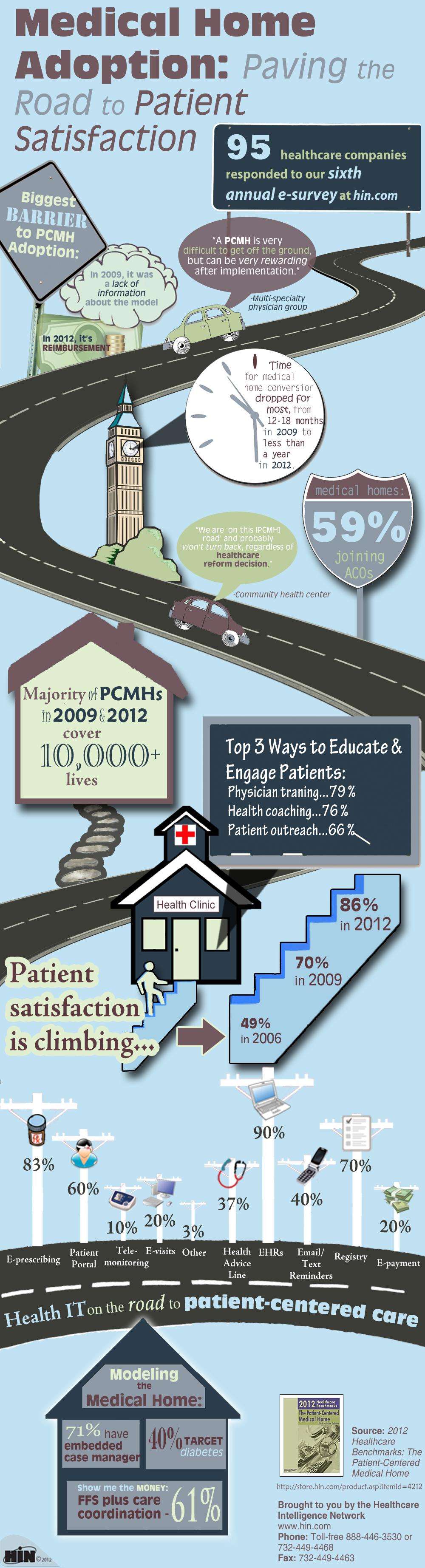
And, medical home adoption has risen from 49 percent in 2006 to 79 percent in 2009 to 86 percent in 2012, according to 95 healthcare companies who completed the sixth annual Healthcare Intelligence Network survey on Patient Centered Medical Homes (PCMH).

The Survey

When asked in 2006, only 33 percent of respondents were trying to establish a medical home.

However, by 2012, 52 percent have established medical homes for their populations including 59 percent of existing medical homes are now or soon will be part of an accountable care organization (ACO). With the rise of patient centered medical homes, ACOs and other emerging healthcare delivery models, healthcare organizations will need to engage patients in ways that increase quality, reduce cost and improve their overall healthcare experience.

Assessment

Healthcare Intelligence Network also created the infographic shown below to accompany the survey highlighting following key areas in medical home adoption from 2006 to 2012:

  • Top three ways to educate and engage patients in the medical home
  • Barriers to patient centered medical home adoption
  • Time for medical home conversion
  • Climbing of patient satisfaction rates
  • Top health IT tools adoption

Conclusion

Your thoughts and comments on this ME-P are appreciated. Feel free to review our top-left column, and top-right sidebar materials, links, URLs and related websites, too. Then, subscribe to the ME-P. It is fast, free and secure.

Link: http://feeds.feedburner.com/HealthcareFinancialsthePostForcxos

Speaker: If you need a moderator or speaker for an upcoming event, Dr. David E. Marcinko; MBA – Publisher-in-Chief of the Medical Executive-Post – is available for seminar or speaking engagements. Contact: MarcinkoAdvisors@msn.com

OUR OTHER PRINT BOOKS AND RELATED INFORMATION SOURCES:

     Our Newest Textbook Release

Buy from Amazon

Learn How to Profit and Thrive in the PP-ACA Era

BOOK FOREWORD / TESTIMONIAL

Why the USA Must Address Rising Healthcare Costs Now!

Join Our Mailing List

Spending expected to increase from 25 to 40 percent by 2037

[By Staff Reporters]

Rising healthcare costs is exploding with the cost of healthcare currently outpacing inflation with federal health spending expecting to increase from 25 percent to 40 percent by 2037 equivalent to 25 percent of the American economy. With the country still in a recession and all the changes in healthcare reform has brought the issue as one of the hot topics for the fall’s presidential election.

Key Drivers of Rising Healthcare Costs

Hospital care and physician/clinical services combined account for half (51%) of the nation’s health expenditures sparking debates on how healthcare spending can be controlled. Some of the key drivers of rising healthcare costs are:

  • Prescription Drugs/Technology – Pharma is usually the biggest culprit associated with rising healthcare costs; however, medical technology has also been cited as a driver to an increase in overall healthcare spending. Cutting edge technology and drugs can fuel healthcare costs due to development costs and services.
  • Rise in Chronic Diseases – Baby boomers getting older, longer life spans, and the epidemic rates of obesity create an expensive dilemma for the healthcare system. Efforts have increased with the adoption of accountable care and healthcare technology to provide tools for chronic disease management while lowering costs.
  • Administrative Costs – 7% of health care expenditures are estimated to go toward for the administrative costs of government health care programs and the net cost of private insurance (e.g. administrative costs, reserves, taxes, profits/losses).

The Infographic

  • The below infographic, created by The Center for American Progress and featured by Compliance and Safety provides a snapshot of the current state of the American healthcare system
  • This infographic outlines several important statistics relevent to the healthcare spending debate including:
  • The U.S spends 2.5x more on healthcare per capita than other wealthy countries, but yet scores far below these same countries in average life expectancy.
  • The growth rate of healthcare spending far exceeds the growth of our national economy and wages
  • On average, current healthcare premiums cost the American family 16% of their gross income.

A Few Queries to Consider

  • How will ACA affect healthcare spending?
  • Can the adoption of Health IT (e.g. chronic disease management tools, patient remote monitoring, mobile health, and others) improve quality of care without increasing healthcare spending?
  • What role should individual states play in controlling costs?
  • How do we effectively address the low income families?

Assessment

This Infographic highlighted the rising healthcare costs and what could be bought with the $2.8 trillion dollars that Americans spend on healthcare yearly.

Related Links

References:

  1. Congress of the United States, Congressional Budget Office;Technological Change and the Growth of Health Care Spending, January 2008.
  2. Centers for Disease Control and Prevention. Rising Health Care Costs Are Unsustainable. April 2011.
  3. Recent opinions/ reports have focused on the viability of a single-payer system in the U.S. W.C. Hsiao’s article “State-based single-payer health care- as solution for the United States?” explores potential adoption among states, and R. Feldman explores unregulated markets vs. single-payer systems in “Quality of care in single-payer and multipayer health systems.”
  4. Martin A.B. et al., “Growth In US Health Spending Remained Slow in 2010; Health Share of Gross Domestic Product Was Unchanged from 2009,” Health Affairs, 2012.
  5. http://www.kaiseredu.org/Issue-Modules/US-Health-Care-Costs/Background-Brief.aspx#footnote8

Conclusion

Your thoughts and comments on this ME-P are appreciated. Feel free to review our top-left column, and top-right sidebar materials, links, URLs and related websites, too. Then, subscribe to the ME-P. It is fast, free and secure.

Link: http://feeds.feedburner.com/HealthcareFinancialsthePostForcxos

Speaker: If you need a moderator or speaker for an upcoming event, Dr. David E. Marcinko; MBA – Publisher-in-Chief of the Medical Executive-Post – is available for seminar or speaking engagements. Contact: MarcinkoAdvisors@msn.com

OUR OTHER PRINT BOOKS AND RELATED INFORMATION SOURCES:

DICTIONARIES: http://www.springerpub.com/Search/marcinko
PHYSICIANS: www.MedicalBusinessAdvisors.com
PRACTICES: www.BusinessofMedicalPractice.com
HOSPITALS: http://www.crcpress.com/product/isbn/9781466558731
CLINICS: http://www.crcpress.com/product/isbn/9781439879900
BLOG: www.MedicalExecutivePost.com
FINANCE: Financial Planning for Physicians and Advisors
INSURANCE: Risk Management and Insurance Strategies for Physicians and Advisors

Product DetailsProduct DetailsProduct Details

Product Details  Product Details

Product Details

Pre-2014 Medicaid Expansion for the PP-ACA

Join Our Mailing List

States Acceptance – Cost and Savings Factors

Link: http://www.healthcarefinancenews.com/infographic/infographic-factors-consider-medicaid-expansion

Conclusion

Your thoughts and comments on this ME-P are appreciated. Feel free to review our top-left column, and top-right sidebar materials, links, URLs and related websites, too. Then, subscribe to the ME-P. It is fast, free and secure.

Speaker: If you need a moderator or speaker for an upcoming event, Dr. David E. Marcinko; MBA – Publisher-in-Chief of the Medical Executive-Post – is available for seminar or speaking engagements. Contact: MarcinkoAdvisors@msn.com

OUR OTHER PRINT BOOKS AND RELATED INFORMATION SOURCES:


Product DetailsProduct DetailsProduct Details

Product Details Product Details

Product Details

Accounting for the Cost of US Health Care

Join Our Mailing List

Conclusion

Your thoughts and comments on this ME-P are appreciated. What are your thoughts on the pre-reform trends and the impact of the recession?

Feel free to review our top-left column, and top-right sidebar materials, links, URLs and related websites, too. Then, subscribe to the ME-P. It is fast, free and secure.

Link: http://feeds.feedburner.com/HealthcareFinancialsthePostForcxos

Speaker: If you need a moderator or speaker for an upcoming event, Dr. David E. Marcinko; MBA – Publisher-in-Chief of the Medical Executive-Post – is available for seminar or speaking engagements. Contact: MarcinkoAdvisors@msn.com

Our Other Print Books and Related Information Sources:

Health Dictionary Series: http://www.springerpub.com/Search/marcinko

Practice Management: http://www.springerpub.com/product/9780826105752

Physician Financial Planning: http://www.jbpub.com/catalog/0763745790

Medical Risk Management: http://www.jbpub.com/catalog/9780763733421

Hospitals: http://www.crcpress.com/product/isbn/9781439879900

Physician Advisors: www.CertifiedMedicalPlanner.org

Our Newest Textbook Release

Buy from Amazon

Learn How to Profit and Thrive in the PP-ACA Era

BOOK FOREWORD / TESTIMONIAL


The NBER Bulletin on Aging and Health

Join Our Mailing List

The National Bureau of Economic Research — 2012 No. 2

The 2012 No. 2 Bulletin includes the articles below:

1)  Can Low-Cost Interventions Affect Retirement Saving Behavior?

by Gopi Shah Goda, Colleen Flaherty Manchester, and Aaron Sojourner –  #17927
by James Choi, Emily Haisley, Jennifer Kurkoski, and Cade Massey – #17843

http://www.nber.org/aginghealth/2012no2/w17927.html

2)  Labor Market Effects of the Massachusetts Health Insurance Reform

by Jonathan Kolstad and Amanda Kowalski

http://www.nber.org/aginghealth/2012no2/w17933.html

3)  Can Germany’s Riester Pensions Fill the Pension Gap?

by Axel Boersch-Supan, Michela Coppola, and Anette Reil-Held

http://www.nber.org/aginghealth/2012no2/w18014.html

4)  Retirement Before the Social Security Entitlement Age

by Kevin Milligan

http://www.nber.org/aginghealth/2012no2/w18051.html

5)  Are Consumers Forward-Looking in Responding to Health Care Prices?

by Aviva Aron-Dine, Liran Einav, Amy Finklestein, and Mark Cullen

http://www.nber.org/aginghealth/2012no2/w17802.html

NBER Profile:  Patricia Danzon

http://www.nber.org/aginghealth/2012no2/danzon.html

NBER Profile:  Doug Staiger

http://www.nber.org/aginghealth/2012no2/staiger.html

Conclusion

Your thoughts and comments on this ME-P are appreciated. Feel free to review our top-left column, and top-right sidebar materials, links, URLs and related websites, too. Then, subscribe to the ME-P. It is fast, free and secure.

Link: http://feeds.feedburner.com/HealthcareFinancialsthePostForcxos

Speaker: If you need a moderator or speaker for an upcoming event, Dr. David E. Marcinko; MBA – Publisher-in-Chief of the Medical Executive-Post – is available for seminar or speaking engagements. Contact: MarcinkoAdvisors@msn.com

Our Other Print Books and Related Information Sources:

Health Dictionary Series: http://www.springerpub.com/Search/marcinko

Practice Management: http://www.springerpub.com/product/9780826105752

Physician Financial Planning: http://www.jbpub.com/catalog/0763745790

Medical Risk Management: http://www.jbpub.com/catalog/9780763733421

Hospitals: http://www.crcpress.com/product/isbn/9781439879900

Physician Advisors: www.CertifiedMedicalPlanner.org

Product DetailsProduct DetailsProduct Details

Product Details Product Details

Product Details

Succeed with the “Business of Medical Practice” Textbook

ADVERTISEMENT

[Transformational Health 2.0 Skills for Doctors]

By Ann Miller RN, MHA

www.BusinessofMedicalPractice.com

December 23rd, 2011 – The Institute of Medical Business Advisors [iMBA] Inc, in Atlanta, GA www.MedicalBusinessAdvisors.com and Springer Publishing Company of New York, just released the third edition of “The Business of Medical Practice” [Transformational Health 2.0 Skills for Doctors] edited by iMBA founder Dr. David Edward Marcinko MBA, CMP™ and President Hope Rachel Hetico RN, MHA, CPHQ, CMP™

Internal Contents

The 37 chapter, 750 page hard-cover textbook provides a comprehensive resource for those physicians, medical professionals, practice managers, nurse executives, health care administrators and graduate students seeking working knowledge on running a private facility or medical clinic.

Three Major Sections

The BoMP is comprised of three enterprise-wide sections: [1] Qualitative Office Operations, [2] Quantitative Aspects of Medical Practice and [3] Health Policies, Ethics and Leadership. Topics like ARRA, HITECH, ACA and the social networking aspects and ramifications of health 2.0 connectivity for all stakeholders are included for modernity.

Tools and Templates

Tools used throughout the book help readers reference and retain complex information. These tools include:

  • Sidebars. Key terms, key concepts, key sources, associations, and factoids all serve to enhance and reinforce the core takeaways from each chapter.
  • Tables. Tables are used to display and reference benchmark data, draw comparisons, and illustrate industry data trends.
  • Figures. Graphical depictions of concepts help you comprehend the material.
  • Charts. Charts allow easily referenced standard industry taxonomies alongside comparisons of related topics.

Assessment

For a further description of the Business of Medical Practice, with online “live’ community, please click: www.BusinessofMedicalPractice.com

To order directly: http://www.springerpub.com/product/9780826105752 

Conclusion

Your thoughts and comments on this ME-P are appreciated. Feel free to review our top-left column, and top-right sidebar materials, links, URLs and related websites, too. Then, subscribe to the ME-P. It is fast, free and secure.

Link: http://feeds.feedburner.com/HealthcareFinancialsthePostForcxos

Speaker: If you need a moderator or speaker for an upcoming event, Dr. David E. Marcinko; MBA – Publisher-in-Chief of the Medical Executive-Post – is available for seminar or speaking engagements. Contact: MarcinkoAdvisors@msn.com

OUR OTHER PRINT BOOKS AND RELATED INFORMATION SOURCES:

DICTIONARIES: http://www.springerpub.com/Search/marcinko
PHYSICIANS: www.MedicalBusinessAdvisors.com
PRACTICES: www.BusinessofMedicalPractice.com
HOSPITALS: http://www.crcpress.com/product/isbn/9781466558731
CLINICS: http://www.crcpress.com/product/isbn/9781439879900
BLOG: www.MedicalExecutivePost.com
FINANCE: Financial Planning for Physicians and Advisors
INSURANCE: Risk Management and Insurance Strategies for Physicians and Advisors

Product Details

Product DetailsProduct DetailsProduct Details

Doctors to Get a Smaller Piece of American Pie?

Join Our Mailing List

And Contracting Lifestyles for Us All

By Rick Kahler MS CFP® ChFC CCIM www.KahlerFinancial.com

“Any way you slice the pie, Americans better come to grips with the fact their lifestyles are going to contract.” That’s the bottom line I’ve gleaned from attending several conferences and listening to some of the nation’s top economists recently.

But, what about Doctors and Medical Professioanals?

New Medical Practice Entrepreneurial Business Rules for Young Physicians [circa 2012]

The Fundamentals

Basically, the US is spending far more than it takes in via tax revenues, creating an annual deficit. The shortfall is covered by borrowing the money, which adds to the national debt. The Treasury Department borrows the money from two sources: private investors (individuals, banks, companies, and other governments) and the Federal Reserve Bank.

The Federal Reserve Bank

Where does the Federal Reserve get money? I’ve written about this before and our Editor has commented on it. They create it with a keystroke, which is the digital-age equivalent of printing money.

The Modern US Monetary System

It’s important to understand that the US government has no intention of ever paying down the US debt. Neither politicians nor economists can agree on whether to stop borrowing (or creating) money to fund the annual deficit. To actually reduce the national debt, we must run surpluses, something we haven’t done in over 15 years and then it was only for one year. We actually have never paid off our debt from WWII.

Deficit Spending

Reducing our deficit spending requires us either to raise taxes, cut spending, or borrow (which includes creating) more money. If we raise taxes to cover the deficit, we will most likely force a recession or depression. We simply can’t take $1.3 trillion out of the private sector without imploding the economy. If we cut spending, we will most likely create a recession or depression, as we simply can’t cut $1.3 trillion of government spending overnight without imploding the economy. If we do both, we will most likely still have a recession or depression.

Print or Borrow

At the moment, Congress can’t agree what to do, so we continue to borrow and print money. An increasing national debt means higher borrowing costs (interest). This means we need more revenues (from taxes or creating more money) to continue to fund Social Security, Medicare, welfare programs, infrastructure, and national defense. Creating (printing) money can lead to rising inflation, though it doesn’t automatically do so, as Japan has demonstrated for 20 years. This results in the devaluation of our global purchasing power, meaning the cost of everything we buy from other countries increases. It’s clear that the most appealing option to politicians and most economists is to continue to borrow and inflate.

Why the Government is Not-Like Medical Professionals

The Message

No matter how you cut and paste these options, one result is the same. Americans’ lifestyles will contract. This will come either from less government support and services, less spendable income via higher taxes, or an erosion of purchasing power from a declining dollar. This is the last message most Americans want to hear. The attitude is like that of the overspender who recently asked me, “How can I cut my expenses but maintain my current lifestyle?” The most honest answer is, “Sorry, but it can’t be done.” True, it’s possible to find creative ways to keep the parts of your lifestyle that matter the most. However, reducing expenses almost always means a lifestyle reduction. This is one reason so many people resist budgeting.

Assessment

For most doctors, lawyers, CPAs, FAs, laborers and all Americans, budgeting means reducing spending, even though that isn’t inherently what budgeting is. In its purest form, it is becoming aware of our current spending patterns and redirecting income to the areas of spending that will best support our desired lifestyle. The more our income shrinks, the more crucial it becomes to redirect it carefully and consciously.

Personal Budgeting Guidelines for Doctors

Conclusion

In other words, if we have to settle for a smaller piece of pie, we’d better make sure we’re buying the kind of pie we really want.

Your thoughts and comments on this ME-P are appreciated. Feel free to review our top-left column, and top-right sidebar materials, links, URLs and related websites, too. Then, subscribe to the ME-P. It is fast, free and secure.

Link: http://feeds.feedburner.com/HealthcareFinancialsthePostForcxos

Speaker: If you need a moderator or speaker for an upcoming event, Dr. David E. Marcinko; MBA – Publisher-in-Chief of the Medical Executive-Post – is available for seminar or speaking engagements. Contact: MarcinkoAdvisors@msn.com

Our Other Print Books and Related Information Sources:

Health Dictionary Series: http://www.springerpub.com/Search/marcinko

Practice Management: http://www.springerpub.com/product/9780826105752

Physician Financial Planning: http://www.jbpub.com/catalog/0763745790

Medical Risk Management: http://www.jbpub.com/catalog/9780763733421

Hospitals: http://www.crcpress.com/product/isbn/9781439879900

Physician Advisors: www.CertifiedMedicalPlanner.org

Product Details  Product Details

Product Details

The Financial Impact of Reducing Avoidable Hospital Admissions

Join Our Mailing List

Population Health Models

By Staff Reporters

Most readers are aware that colleague David B. Nash MD, MBA is the population health guru for the ME-P. In fact, he is an ME-P “thought-leader.” And, to use a modern colloquialism, he was into population health before PH was cool.

Link: http://nashhealthpolicy.blogspot.com

Preventing Avoidable Hospitalizations

And so, as hospitals and health systems accelerate towards population health models, there is an increasing focus for physicians and health systems to work together to prevent avoidable hospitalizations.

The Infographic

This infographic shows that an average 300-bed hospital is at risk of losing $9.5 million in annual contribution when inpatient admissions for 11 potentially avoidable conditions are completely reduced. These 11 conditions, identified by AHRQ, represent diagnoses for which coordinated outpatient care and early intervention can potentially prevent the need for hospitalization.

Source: Objective Health [McKinsey & Company]

Assessment

A colloquialism is a word or phrase that is employed in conversational or informal language but not in formal speech or formal writing.

Conclusion

Your thoughts and comments on this ME-P are appreciated. Feel free to review our top-left column, and top-right sidebar materials, links, URLs and related websites, too. Then, subscribe to the ME-P. It is fast, free and secure.

Link: http://feeds.feedburner.com/HealthcareFinancialsthePostForcxos

Speaker: If you need a moderator or speaker for an upcoming event, Dr. David E. Marcinko; MBA – Publisher-in-Chief of the Medical Executive-Post – is available for seminar or speaking engagements. Contact: MarcinkoAdvisors@msn.com

Our Other Print Books and Related Information Sources:

Health Dictionary Series: http://www.springerpub.com/Search/marcinko

Practice Management: http://www.springerpub.com/product/9780826105752

Physician Financial Planning: http://www.jbpub.com/catalog/0763745790

Medical Risk Management: http://www.jbpub.com/catalog/9780763733421

Hospitals: http://www.crcpress.com/product/isbn/9781439879900

Physician Advisors: www.CertifiedMedicalPlanner.org

Buy from Amazon

Learn How to Profit and Thrive in the PP-ACA Era

BOOK FOREWORD / TESTIMONIAL

Transitioning and Appraising a Podiatry [Medical] Practice

Join Our Mailing List

A Round Table Fair Market Valuation Discussion of One

By Dr. David Edward Marcinko MBA CMP™

[Former – American Society of Health Economists (ASHE) member]

[Editor-in-Chief]

www.CertifiedMedicalPlanner.org

Recently, I was asked to participate in a roundtable of expert’s discussion on the worth or fair market value [FMV] of a typical podiatric [medical] practice on an “ongoing concern” basis.

Of course, this is the type of engagement we often perform at the www.MedicalBusinessAdvisors.com And, I have written about this topic informally on this blog, and more formally in our white-papers and books: www.BusinessofMedicalPractice.com

So, I was pleased to add my experienced opinion to the discussion sponsored by a trade industry magazine upon the invitation of Editor Dr. Barry H. Block JD.

LINK: Podiatry Mgmt Round Table

Assessment

Due to copyright issues, I posted only my comments to the questions posed to all participants. Nevertheless, they are very representative of most medical practices with the exception of the noted podiatric-specific differences.

Invitation: Letterhead.iMBA_Inc.

Product Details

Conclusion

Your thoughts and comments on this ME-P are appreciated. Feel free to review our top-left column, and top-right sidebar materials, links, URLs and related websites, too. Then, subscribe to the ME-P. It is fast, free and secure.

Link: http://feeds.feedburner.com/HealthcareFinancialsthePostForcxos

Speaker: If you need a moderator or speaker for an upcoming event, Dr. David E. Marcinko; MBA – Publisher-in-Chief of the Medical Executive-Post – is available for seminar or speaking engagements. Contact: MarcinkoAdvisors@msn.com

Our Other Print Books and Related Information Sources:

Health Dictionary Series: http://www.springerpub.com/Search/marcinko

Practice Management: http://www.springerpub.com/product/9780826105752

Physician Financial Planning: http://www.jbpub.com/catalog/0763745790

Medical Risk Management: http://www.jbpub.com/catalog/9780763733421

Hospitals: http://www.crcpress.com/product/isbn/9781439879900

Physician Advisors: www.CertifiedMedicalPlanner.org

Product DetailsProduct DetailsProduct Details

The Marcinko Method of Improving Quality while Reducing Medical Errors and Healthcare Costs

Join Our Mailing List

Dr. David Edward Marcinko FACFAS MBA CMP

[Former – Certified Physician in Healthcare Quality]

[Former – Certified Financial Planner]

www.CertifiedMedicalPlanner.org

[Publisher-in-Chief]

THINK TWICE!

Doctor’s Orders

Life Corollaries:

Marcinko’s Rx for Obesity: Eat less – Exercise more – Avoid noxious lifestyles.

Marcinko’s Rx for Practice Success: Treat sick patients – Be humble – Keep faith.

Marcinko’s Rx for Financial Success: Spend less – Earn more – Be a fiduciary. 

Marcinko’s Rx for Wealth & Happiness: Don’t divorce – Love kids – Practice philanthropy.

Professional Medical Corollary:

The Choosing Wisely® list, which is aimed at cutting down on unnecessary testing by doctors and patients.

Assessment  

I am not an oracle. What else can you ad to the list?

Conclusion

Your thoughts and comments on this ME-P are appreciated. Feel free to review our top-left column, and top-right sidebar materials, links, URLs and related websites, too. Then, subscribe to the ME-P. It is fast, free and secure.

Link: http://feeds.feedburner.com/HealthcareFinancialsthePostForcxos

Speaker: If you need a moderator or speaker for an upcoming event, Dr. David E. Marcinko; MBA – Publisher-in-Chief of the Medical Executive-Post – is available for seminar or speaking engagements. Contact: MarcinkoAdvisors@msn.com

OUR OTHER PRINT BOOKS AND RELATED INFORMATION SOURCES:

DICTIONARIES: http://www.springerpub.com/Search/marcinko
PHYSICIANS: www.MedicalBusinessAdvisors.com
PRACTICES: www.BusinessofMedicalPractice.com
HOSPITALS: http://www.crcpress.com/product/isbn/9781466558731
CLINICS: http://www.crcpress.com/product/isbn/9781439879900
BLOG: www.MedicalExecutivePost.com
FINANCE: Financial Planning for Physicians and Advisors
INSURANCE: Risk Management and Insurance Strategies for Physicians and Advisors

Certified Medical Planner

Update on Tax Reform and New Revenue with FFS Medicare Plans?

Join Our Mailing List

About the Bipartisan Policy Center Debt Reduction Task Force

By Children’s Home Society of Florida Foundation

Senator Max Baucus (D-MT) is continuing his series of tax reform hearings as Chairman of the Senate Finance Committee. On June 19, former Sen. Pete Domenici (R-NM) and Alice Rivlin, former Director of the Congressional Budget Office and the Office of Management and Budget, described their solution. Domenici and Rivlin are the Co-Chairs of the Bipartisan Policy Center Debt Reduction Task Force.

The Domenici-Rivlin Plan

Domenici emphasized that there are two essential parts of the potential 2013 financial reform. He stated, “Healthcare reform and tax reform that raises additional revenue are essential pieces of any serious plan.” Then, Rivlin continued to describe the basic principles for tax reform. She commented, “Assume that all income from whatever source is taxable, which would enable you to raise more revenue from much lower rates, and then go back to decide which modifications are absolutely essential, even though they would raise the rates.”

Two Major Changes

The Domenici-Rivlin plan starts with a modification of Medicare. They propose two major changes.

1. Federal Medicare Exchanges. Private companies could offer fee-for-service and other comprehensive Medicare plans. All Medicare beneficiaries could choose their plan.

2. Competitive Pricing. The private plans and traditional fee-for-service Medicare plans would receive federal support at the level of the second-lowest-cost plan. This pricing method encourages plan providers to economize and reduce overall costs.

Tax Reform

Domenici and Rivlin also offered very specific proposals for comprehensive tax reform.

1. Tax Brackets. Their personal tax system has brackets of 28% and 15%. The corporate rate is 28%.

2. Capital Gains. All gains from capital asset sales are taxed at ordinary income rates. Most taxpayers would pay 28% capital gains rates.

3. Child Credit. The credit per child would be $1,600.

4. Itemized Deductions. None; except miscellaneous deductions that exceed 5% of adjusted gross income.

5. Mortgage Deduction. A 15% credit on interest paid with a limit of $25,000 per year.

6. Charitable Gifts. A 15% credit on deductible gifts.

7. State and Local Taxes. Not deductible.

8. IRAs and Retirement Plans. A 15% tax credit or deductions up to $20,000 per year.

Assessment

Ms. Rivlin concluded her discussion by observing that the plan under discussion was similar to the Bowles-Simpson plan approved by the National Commission on Fiscal Responsibility and Reform. She observed, “The basic structure is the same. You can’t get there any other way.”

Editor’s Note:

Sen. Baucus and House Ways and Means Chairman Dave Camp (R-MI) are steadily moving toward major tax reform in 2013. The two bipartisan groups advocating reform have agreed on general principles. However, there still remains a major political discussion at the end of this year before broad-based reform can commence. Your editor and this organization take no specific position on these recommendations. This information is offered because it will have major impact on all Americans.

Conclusion

Your thoughts and comments on this ME-P are appreciated. Feel free to review our top-left column, and top-right sidebar materials, links, URLs and related websites, too. Then, subscribe to the ME-P. It is fast, free and secure.

Link: http://feeds.feedburner.com/HealthcareFinancialsthePostForcxos

Speaker: If you need a moderator or speaker for an upcoming event, Dr. David E. Marcinko; MBA – Publisher-in-Chief of the Medical Executive-Post – is available for seminar or speaking engagements. Contact: MarcinkoAdvisors@msn.com

Our Other Print Books and Related Information Sources:

Health Dictionary Series: http://www.springerpub.com/Search/marcinko

Practice Management: http://www.springerpub.com/product/9780826105752

Physician Financial Planning: http://www.jbpub.com/catalog/0763745790

Medical Risk Management: http://www.jbpub.com/catalog/9780763733421

Hospitals: http://www.crcpress.com/product/isbn/9781439879900

Physician Advisors: www.CertifiedMedicalPlanner.org

Product Details  Product Details


Are Cost Estimates Leading To The Wrong Decisions in US Hospitals?

Join Our Mailing List

Rethinking Cost-to-Charge Ratios

By www.ObjectiveHealth.com

More than half of US hospitals use cost-to-charge ratios as a primary cost estimation method since true procedural cost accounting can be prohibitively expensive.

Risks are Present

Although many hospitals believe that cost-to-charge ratios are relatively acceptable for internal planning purposes, there are many risks of this approach which can lead to sub-optimal strategic decisions.

###

Click to see the full size or download the PDF.

Conclusion

Your thoughts and comments on this ME-P are appreciated. Feel free to review our top-left column, and top-right sidebar materials, links, URLs and related websites, too. Then, subscribe to the ME-P. It is fast, free and secure.

Link: http://feeds.feedburner.com/HealthcareFinancialsthePostForcxos

Speaker: If you need a moderator or speaker for an upcoming event, Dr. David E. Marcinko; MBA – Publisher-in-Chief of the Medical Executive-Post – is available for seminar or speaking engagements. Contact: MarcinkoAdvisors@msn.com

Our Other Print Books and Related Information Sources:

Health Dictionary Series: http://www.springerpub.com/Search/marcinko

Practice Management: http://www.springerpub.com/product/9780826105752

Physician Financial Planning: http://www.jbpub.com/catalog/0763745790

Medical Risk Management: http://www.jbpub.com/catalog/9780763733421

Hospitals: http://www.crcpress.com/product/isbn/9781439879900

Physician Advisors: www.CertifiedMedicalPlanner.org

Product Details

Cash May Soon be King in Hospital Care

Join Our Mailing List

Forget About Health Insurance, Darling!

Only the little people pay with insurance.

By Dr. David Edward Marcinko MBA CMP™

[Editor-in-Chief]

www.CertifiedMedicalPlanner.org

Like many other doctors, I remember my dismay when I saw uninsured patients paying full price for their medical care. Insurance companies used their market clout and patient volumes to negotiate discounts for their insureds that have always been unavailable to the uninsured, MSA, HSA participants or individual healthcare consumers.

The Insider Gossip

There is even industry hearsay that some charity-care and non-profit hospitals charge their indigent patients up to four times more than their insured patients in order to have huge write-offs [bad-debt expenses] so as to secure private and public monetary grants. After all; many non-profit CEOs are well paid, indeed.

But, the tide may be turning on the healthcare institutional level as cash becomes king in the new economy and world of healthcare 2.0

Cash Patients Rule – Insured Patients Drool

Of course, we’ve written about direct care, concierge care and cash care medical practice business models before on this ME-P. And, I’ve been ranting and raving, opining and testifying, as well.  It is being written about in the blog-o-sphere, on the hospital level, increasingly.

Link:  http://www.kevinmd.com/blog/2012/06/hide-health-insurance-status-pay-cash.html

We even have an entire Chapter 29 devoted to the codified topic in our newest book The Business of Medical Practice.

Link: http://businessofmedicalpractice.com/chapter-29/

Source: Austin Frakt PhD’s TIE cartoon via Brad Flansbaum.

The Coming Payment Apocalypse

The days of paying more when paying cash may be coming to an end. Doctors and hospitals are starting to do what every other business has done since the beginning of time – give a discount for cash. States are beginning to require pricing transparency and hospitals and physicians are starting to publish their “cash prices” for all to see.

And, why not when it can take up to two years to be reimbursed a fraction of the billed amount from Medicaid and Medicare payers, and CMS, etc? Now, don’t get me started on some highly discounted private payers and managed care plans.

Assessment

What do you think of this trend as a healthcare provider; Financial Advisor, medical management consultant or patient? Are you in favor of this private business arrangement; or do you favor the proposed public Obama Care business model?  Is it even legal? How about keeping the status-quo?

Conclusion

Your thoughts and comments on this ME-P are appreciated. Feel free to review our top-left column, and top-right sidebar materials, links, URLs and related websites, too. Then, subscribe to the ME-P. It is fast, free and secure.

Link: http://feeds.feedburner.com/HealthcareFinancialsthePostForcxos

Speaker: If you need a moderator or speaker for an upcoming event, Dr. David E. Marcinko; MBA – Publisher-in-Chief of the Medical Executive-Post – is available for seminar or speaking engagements. Contact: MarcinkoAdvisors@msn.com

Our Other Print Books and Related Information Sources:

Health Dictionary Series: http://www.springerpub.com/Search/marcinko

Practice Management: http://www.springerpub.com/product/9780826105752

Physician Financial Planning: http://www.jbpub.com/catalog/0763745790

Medical Risk Management: http://www.jbpub.com/catalog/9780763733421

Hospitals: http://www.crcpress.com/product/isbn/9781439879900

Physician Advisors: www.CertifiedMedicalPlanner.org

Product Details

Product Details

A Video Exploring Better Ways to Pay for Health Care?

Join Our Mailing List

A YouTube Encore Presentation

Harold Luft, Director, Palo Alto Medical Foundation Research Institute; Professor Emeritus of Health Policy and Health Economics explores ways to pay for healthcare. 

Video: http://www.youtube.com/watch?v=FfcVtglVM54

Conclusion

Your thoughts and comments on this ME-P are appreciated. Feel free to review our top-left column, and top-right sidebar materials, links, URLs and related websites, too. Then, subscribe to the ME-P. It is fast, free and secure.

Link: http://feeds.feedburner.com/HealthcareFinancialsthePostForcxos

Speaker: If you need a moderator or speaker for an upcoming event, Dr. David E. Marcinko; MBA – Publisher-in-Chief of the Medical Executive-Post – is available for seminar or speaking engagements. Contact: MarcinkoAdvisors@msn.com

Our Other Print Books and Related Information Sources:

Health Dictionary Series: http://www.springerpub.com/Search/marcinko

Practice Management: http://www.springerpub.com/product/9780826105752

Physician Financial Planning: http://www.jbpub.com/catalog/0763745790

Medical Risk Management: http://www.jbpub.com/catalog/9780763733421

Hospitals: http://www.crcpress.com/product/isbn/9781439879900

Physician Advisors: www.CertifiedMedicalPlanner.org

Product Details

A Review of Healthcare Spending in Developed Countries

Join Our Mailing List

A Selected Graphical Health Economics Comparison

Assessment

Domestic healthcare spending in the USA is now 17% of GDP.

Link: Money supply as a percentage of domestic GDP: https://medicalexecutivepost.com/2012/06/05/understanding-the-money-supply-as-a-percentage-of-gdp/

Conclusion

Your thoughts and comments on this ME-P are appreciated. Feel free to review our top-left column, and top-right sidebar materials, links, URLs and related websites, too. Then, subscribe to the ME-P. It is fast, free and secure.

Link: http://feeds.feedburner.com/HealthcareFinancialsthePostForcxos

Speaker: If you need a moderator or speaker for an upcoming event, Dr. David E. Marcinko; MBA – Publisher-in-Chief of the Medical Executive-Post – is available for seminar or speaking engagements. Contact: MarcinkoAdvisors@msn.com

Our Other Print Books and Related Information Sources:

Health Dictionary Series: http://www.springerpub.com/Search/marcinko

Practice Management: http://www.springerpub.com/product/9780826105752

Physician Financial Planning: http://www.jbpub.com/catalog/0763745790

Medical Risk Management: http://www.jbpub.com/catalog/9780763733421

Hospitals: http://www.crcpress.com/product/isbn/9781439879900

Physician Advisors: www.CertifiedMedicalPlanner.org

Product Details

The Increased Competition of Ambulatory Surgery Centers (ASCs) to US Hospitals

Join Our Mailing List

The Competition Heats Up!

By Dr. David Edward Marcinko MBA CMP™

www.CertifiedMedicalPlanner.org

[Editor-in-Chief]

Over the last 10 years, Ambulatory Surgery Centers’ (ASCs) footprints have increased dramatically.

As hospitals and health systems accelerate towards population health/ global payment models, such as Accountable Care Organizations (ACOs), lower priced ASCs will become more critical competitors to hospitals.

Assessment

I acquired the Certificate-of-Need [CON], co-founded and operated an ASC for 15 years before sale in 2000 to a public company. My local hospital fought me tooth and nail. I likely would not do so, again, today!

Conclusion

Your thoughts and comments on this ME-P are appreciated. Feel free to review our top-left column, and top-right sidebar materials, links, URLs and related websites, too. Then, subscribe to the ME-P. It is fast, free and secure.

Speaker: If you need a moderator or speaker for an upcoming event, Dr. David E. Marcinko; MBA – Publisher-in-Chief of the Medical Executive-Post – is available for seminar or speaking engagements. Contact: MarcinkoAdvisors@msn.com

OUR OTHER PRINT BOOKS AND RELATED INFORMATION SOURCES:

Product Details

A Five Minute Treatise on Healthcare Economics 101

Join Our Mailing List

An Encore YouTube Video by Joe Flowers

[Staff Reporters]

Why it costs so much, yet we still don’t get what we want and need—better healthcare that is cheaper.

Video link: http://www.youtube.com/watch?v=4Ry1AkbxRQU

Conclusion

Your thoughts and comments on this ME-P are appreciated. Feel free to review our top-left column, and top-right sidebar materials, links, URLs and related websites, too. Then, subscribe to the ME-P. It is fast, free and secure.

Speaker: If you need a moderator or speaker for an upcoming event, Dr. David E. Marcinko; MBA – Publisher-in-Chief of the Medical Executive-Post – is available for seminar or speaking engagements. Contact: MarcinkoAdvisors@msn.com

OUR OTHER PRINT BOOKS AND RELATED INFORMATION SOURCES:

Product DetailsProduct DetailsProduct Details

Product Details  Product Details

Product Details

Which Hospitals Are Cutting Costs?

Join Our Mailing List 

And … Where Are They Doing It?

This infographic shows that about only 10% of US hospitals have aggressively cut costs during the recession.  Most hospitals have kept costs close to inflation with 1-5% annual increases.

Of those who aggressively cut costs, many service lines contributed, though general surgery was the largest, followed by neonatal, obstetrics, and infectious diseases.

Conclusion

Your thoughts and comments on this ME-P are appreciated. Feel free to review our top-left column, and top-right sidebar materials, links, URLs and related websites, too. Then, subscribe to the ME-P. It is fast, free and secure.

Speaker: If you need a moderator or speaker for an upcoming event, Dr. David E. Marcinko; MBA – Publisher-in-Chief of the Medical Executive-Post – is available for seminar or speaking engagements. Contact: MarcinkoAdvisors@msn.com

OUR OTHER PRINT BOOKS AND RELATED INFORMATION SOURCES:

Product DetailsProduct Details

Where Do Economies Of Scale Exist In US Hospitals?

NOTE: Click on image to enlarge.

Assessment

The unrelenting pressure on hospitals to control costs will increase over the next few years as institutions look to be profitable at Medicare reimbursement levels.  One area that hospitals often look at to find cost savings is in economies of scale.  There are three main ways of approaching this: by growing a facility’s overall volume, specializing in particular service lines, or integrating with other health systems.

In this infographic, we see that growing overall facility volume doesn’t result in economies of scale.  But, one sees a different story when we look at a more micro level (service line specialization) and a more macro level (increased system size).

Conclusion

Your thoughts and comments on this ME-P are appreciated. Feel free to review our top-left column, and top-right sidebar materials, links, URLs and related websites, too. Then, subscribe to the ME-P. It is fast, free and secure.

Link: http://feeds.feedburner.com/HealthcareFinancialsthePostForcxos

Speaker: If you need a moderator or speaker for an upcoming event, Dr. David E. Marcinko; MBA – Publisher-in-Chief of the Medical Executive-Post – is available for seminar or speaking engagements. Contact: MarcinkoAdvisors@msn.com

Our Other Print Books and Related Information Sources:

Health Dictionary Series: http://www.springerpub.com/Search/marcinko

Practice Management: http://www.springerpub.com/product/9780826105752

Physician Financial Planning: http://www.jbpub.com/catalog/0763745790

Medical Risk Management: http://www.jbpub.com/catalog/9780763733421

Hospitals: http://www.crcpress.com/product/isbn/9781439879900

Physician Advisors: www.CertifiedMedicalPlanner.org

Product Details

Pre-Reform Impact of Self-Pay Patients on US Hospitals

Join Our Mailing List

Pre-healthcare reform, and full PP-ACA implementation, many hospitals experience significant uncompensated care costs from self-pay patients.  This infographic illustrates the variation in self-pay uncompensated care costs across US hospitals and regions.

Despite the uncompensated care risk, 1/6th of self-pay inpatients are scheduled admissions, though their procedures are much less elective than the procedures of the insured.

Conclusion

Your thoughts and comments on this ME-P are appreciated. Feel free to review our top-left column, and top-right sidebar materials, links, URLs and related websites, too. Then, subscribe to the ME-P. It is fast, free and secure.

Link: http://feeds.feedburner.com/HealthcareFinancialsthePostForcxos

Speaker: If you need a moderator or speaker for an upcoming event, Dr. David E. Marcinko; MBA – Publisher-in-Chief of the Medical Executive-Post – is available for seminar or speaking engagements. Contact: MarcinkoAdvisors@msn.com

Our Other Print Books and Related Information Sources:

Health Dictionary Series: http://www.springerpub.com/Search/marcinko

Practice Management: http://www.springerpub.com/product/9780826105752

Physician Financial Planning: http://www.jbpub.com/catalog/0763745790

Medical Risk Management: http://www.jbpub.com/catalog/9780763733421

Hospitals: http://www.crcpress.com/product/isbn/9781439879900

Physician Advisors: www.CertifiedMedicalPlanner.org

Product Details

The Best, Most Revealing Reporting on Our Healthcare System

Join Our Mailing List

Reading and Reviewing

By Blair Hickman and Cora Currier

ProPublica,  March 30, 2012, 1:44 pm

As we wait for the Supreme Court to issue its verdict on the health-care reform law  we rounded up some of the most revealing reporting on the issues.

They’re grouped roughly into articles on high costs and those on insurance.

Assesment

Link: http://www.propublica.org/article/top-muckreads-the-best-most-revealing-reporting-on-our-healthcare-system

Conclusion

Your thoughts and comments on this ME-P are appreciated. Feel free to review our top-left column, and top-right sidebar materials, links, URLs and related websites, too. Then, subscribe to the ME-P. It is fast, free and secure.

Link: http://feeds.feedburner.com/HealthcareFinancialsthePostForcxos

Speaker: If you need a moderator or speaker for an upcoming event, Dr. David E. Marcinko; MBA – Publisher-in-Chief of the Medical Executive-Post – is available for seminar or speaking engagements. Contact: MarcinkoAdvisors@msn.com

Our Other Print Books and Related Information Sources:

Health Dictionary Series: http://www.springerpub.com/Search/marcinko

Practice Management: http://www.springerpub.com/product/9780826105752

Physician Financial Planning: http://www.jbpub.com/catalog/0763745790

Medical Risk Management: http://www.jbpub.com/catalog/9780763733421

Hospitals: http://www.crcpress.com/product/isbn/9781439879900

Physician Advisors: www.CertifiedMedicalPlanner.org

Hospitals & Healthcare Organizations: Management Strategies, Operational Techniques, Tools, Templates and Case Studies

Hospitals & Healthcare Organizations: Management Strategies, Operational Techniques, Tools, Templates and Case Studies

Buy from Amazon

Variations in Medical Practice Patterns for Financial Advisors

Join Our Mailing List

Lessons Learned for both Physicians and Financial Advisors

By David K Luke MIM, Certified Medical Planner® candidate

[Physician Financial Advisor – Fee-Only]

http://www.NetWorthAdvice.com

http://www.DocFP.com

www.CertifiedMedicalPlanner.org

Physicians are constantly being trained in new techniques and methodologies, learning about new treatments and new drugs as they become available. For example, Elaine Zablocki (Zalocki, Elaine, Changing Physician Practice Patterns: Strategies for Success in a Capitated Health Care System, New York: Aspen Publishers, 1995 Print) gives examples from a physician profiling study done by Blue Cross Blue Shield of Nebraska (p 13-14).

BCBSN circa 1993

In 1993 BCBSN began to analyze data on Nebraska patients and discovered striking variations in practice patterns in different parts of the state.  One observation was that in two small rural areas there was a particularly high hospital surgical admission rates for nonmalignant gynecological conditions. Another observation was of wide variations in physician practice patterns for ENT surgical procedures such as tympanostomy tubes and surgery for nose and sinus problems. Some ENT physicians were performing three times as many procedures per patient as the average. According to medical director David Bouda, MD “our overall approach has been to take this information to the local physician group or area that seems to be different compared to others, present the data, and then have some kind of dialogue with the physicians. We say, ‘Here’s a group of physicians who seem to be exceptional in these ways – – what do you think about this?’”. The effort seems to pay off.  In the case of the high admission rates for hysterectomy cases, BDBSN saw a steady decline over 3 years. In the ENT example, questionable claims dropped markedly. The general approach to changing physician practices patterns was to take an educational approach getting physicians to pay attention to established parameters modified or created by his or her peers which would have a greater impact on health care costs than harassing the physicians over the phone regarding hospital length of stay or procedure questioning.

Defensive Doctors?

Not surprisingly, physicians often became defensive the first time they see this type of data. There is no point challenging an individual at this point. What I found interesting about the study, in spite of it being dated, was the comment that “…after all, educating physicians about practice patterns to promote better health care is a long-term process”. Are you a better doctor today then you were X years ago? Of course! Change is good even though it can be painful. Are you disingenuous because you practice medicine in a better fashion than you did years ago? Of course not! The concern would be if a practitioner doesn’t change (or worse refuses to change) in spite of being enlightened by a different method or approach.

Of the Financial Advisory Business

Enlightenment occurs in the financial advisory business as well. I started in the financial world in May of 1986  as a new recruit with my new graduate business degree working for GM of Canada in the Treasury Department. I spent time managing the foreign currency exposure, assisting the chief investment officer in the daily cash management (taking over for him while he was on vacation) and supervising the Borrowings Department at GMAC of Canada. All of these responsibilities involved making daily multiple transactions with brokers in the million dollars plus territory. In 1989 we moved our small family to Arizona so I could ply my trade as a stockbroker and help people retire successfully. Over the years the business has evolved greatly. When I got started in the trade, pretty much everything was sales commission driven. While “fee-only” existed, it was still very much in the pioneering phase with very fee practitioners. Over the years, especially beginning around 5 years ago, like the physician that observes the data in the above examples, I began to perceive that perhaps there was a better way to give advice to my clients. In the beginning I was defensive and even suspicious that these “fee-only” folks were just a little too bit self-righteous. Changing a few words from the observation of physicians above we could say:

“after all, educating financial advisors about practice patterns to promote better financial advice is a long-term process”

My Own Journey as a Financial Advisor

In 2010 I joined Net Worth Advisory Group as a fee-only advisor and have not looked back.  Am I a hypocrite because now I espouse a view and business model that is in some respects totally different then the views and business model I used 5, 10 or 20 years ago? I don’t think so.  In fact, to NOT have changed would have been the easier thing to do. I believe that following my conscience (yes, I used that self-righteous word “conscience” in this discussion) and changing to a much more client centric model, dropping thousands of dollars in retainer fees, dropping licenses that I had worked so hard to obtain, and really learning how to be a better financial planner was certainly initially a big sacrifice.

The point is … I knew I had to do it … and that was that. I believe the business model I have now is absolutely in the best interest of our clients. I wish I had this model available 23 years ago.

And today, in the medical industry, a better model is patient centered care. What an exciting opportunity, for all physicians, to reduce practice variation and pursue the grail of evidence based medicine [EBM].

NOTES: It should be noted that the “father” of medical variations may be Jack Wennberg MD, who studied prostatectomy, hysterectomy and appendectomy rates in the 1970’s and continues his work today at http://www.dartmouthatlas.org/

Conclusion

Your thoughts and comments on this ME-P are appreciated. Feel free to review our top-left column, and top-right sidebar materials, links, URLs and related websites, too. Then, subscribe to the ME-P. It is fast, free and secure.

Link: http://feeds.feedburner.com/HealthcareFinancialsthePostForcxos

Speaker: If you need a moderator or speaker for an upcoming event, Dr. David E. Marcinko; MBA – Publisher-in-Chief of the Medical Executive-Post – is available for seminar or speaking engagements. Contact: MarcinkoAdvisors@msn.com

Our Other Print Books and Related Information Sources:

Health Dictionary Series: http://www.springerpub.com/Search/marcinko

Practice Management: http://www.springerpub.com/product/9780826105752

Physician Financial Planning: http://www.jbpub.com/catalog/0763745790

Medical Risk Management: http://www.jbpub.com/catalog/9780763733421

Hospitals: http://www.crcpress.com/product/isbn/9781439879900

Physician Advisors: www.CertifiedMedicalPlanner.org

Product DetailsProduct DetailsProduct Details

Product Details  Product Details

Product Details


On the Control of Birth Control

Join Our Mailing List

The cost of FDA-approved contraceptive drugs

When President Obama signed the Patient Protection and Affordable Care Act in 2012, the bill included a requirement that companies cover the cost of FDA-approved contraceptive drugs and services with no charge to employees.

The provision became controversial among religious conservatives, forcing Obama to shift responsibility for contraceptive costs to insurance providers when employers object on moral grounds.

Assessment

This infographic created with GOOD looks to answer the question: what is the state of birth-control coverage in America, and where do people stand on the issue?

Conclusion

Your thoughts and comments on this ME-P are appreciated. Feel free to review our top-left column, and top-right sidebar materials, links, URLs and related websites, too. Then, subscribe to the ME-P. It is fast, free and secure.

Link: http://feeds.feedburner.com/HealthcareFinancialsthePostForcxos

Speaker: If you need a moderator or speaker for an upcoming event, Dr. David E. Marcinko; MBA – Publisher-in-Chief of the Medical Executive-Post – is available for seminar or speaking engagements. Contact: MarcinkoAdvisors@msn.com

Our Other Print Books and Related Information Sources:

Health Dictionary Series: http://www.springerpub.com/Search/marcinko

Practice Management: http://www.springerpub.com/product/9780826105752

Physician Financial Planning: http://www.jbpub.com/catalog/0763745790

Medical Risk Management: http://www.jbpub.com/catalog/9780763733421

Hospitals: http://www.crcpress.com/product/isbn/9781439879900

Physician Advisors: www.CertifiedMedicalPlanner.org

Product DetailsProduct DetailsProduct Details

NBER Bulletin on Aging and Health

Join Our Mailing List

Year 2012 – Number One [Selected ME-P Reading Suggestions]

View a printable PDF copy of the 2012 No. 1 NBER Bulletin on Aging and Health at http://www.nber.org/aginghealth/2012no1/2012no1.pdf

The 2012 No. 1 Bulletin includes the articles below:

1)  Why Are Recessions Good for Your Health? by Ann Huff Stevens, Douglas Miller, Marianne Page, and Mateusz Filipski http://www.nber.org/aginghealth/2012no1/w17657.html

2)  How Did the Great Recession Affect Near Retirement-Age Households? by Alan Gustman, Thomas Steinmeier, and Nahid Tabatabai http://www.nber.org/aginghealth/2012no1/w17547.html

3)  The Draw-Down of Retirement Savings by James Poterba, Steven Venti, and David Wise http://www.nber.org/aginghealth/2012no1/w17536.html

4)  Abstracts of Selected Recent NBER Working Papers: http://www.nber.org/aginghealth/2012no1/WorkingPaperSummaries.html

Assessment

NBER Profile: David Neumark http://www.nber.org/aginghealth/2012no1/Neumark.html
Conclusion

Your thoughts and comments on this ME-P are appreciated. Feel free to review our top-left column, and top-right sidebar materials, links, URLs and related websites, too. Then, subscribe to the ME-P. It is fast, free and secure.

Link: http://feeds.feedburner.com/HealthcareFinancialsthePostForcxos

Speaker: If you need a moderator or speaker for an upcoming event, Dr. David E. Marcinko; MBA – Publisher-in-Chief of the Medical Executive-Post – is available for seminar or speaking engagements. Contact: MarcinkoAdvisors@msn.com

Our Other Print Books and Related Information Sources:

Health Dictionary Series: http://www.springerpub.com/Search/marcinko

Practice Management: http://www.springerpub.com/product/9780826105752

Physician Financial Planning: http://www.jbpub.com/catalog/0763745790

Medical Risk Management: http://www.jbpub.com/catalog/9780763733421

Hospitals: http://www.crcpress.com/product/isbn/9781439879900

Physician Advisors: www.CertifiedMedicalPlanner.org

Product DetailsProduct DetailsProduct Details

Product Details  Product Details

Product Details


More on Health Care Costs

Join Our Mailing List

State-by-State Review

Conclusion

Your thoughts and comments on this ME-P are appreciated. Feel free to review our top-left column, and top-right sidebar materials, links, URLs and related websites, too. Then, subscribe to the ME-P. It is fast, free and secure.

Link: http://feeds.feedburner.com/HealthcareFinancialsthePostForcxos

Speaker: If you need a moderator or speaker for an upcoming event, Dr. David E. Marcinko; MBA – Publisher-in-Chief of the Medical Executive-Post – is available for seminar or speaking engagements. Contact: MarcinkoAdvisors@msn.com

Our Other Print Books and Related Information Sources:

Health Dictionary Series: http://www.springerpub.com/Search/marcinko

Practice Management: http://www.springerpub.com/product/9780826105752

Physician Financial Planning: http://www.jbpub.com/catalog/0763745790

Medical Risk Management: http://www.jbpub.com/catalog/9780763733421

Hospitals: http://www.crcpress.com/product/isbn/9781439879900

Physician Advisors: www.CertifiedMedicalPlanner.org

Product Details

Learn How the ME-P Helps Hospitals Improve Patient Care and Still Be Profitable

ADVERTISEMENT

Join Our Mailing List 

Learn our Secrets – PreOrder Now for a First-Mover Advantage

Conclusion

And so, your thoughts and comments on this ME-P are appreciated. Please review our top-left column, and top-right sidebar materials, links, URLs and related websites, too. Then, subscribe to the ME-P. It is fast, free and secure.

Link: http://feeds.feedburner.com/HealthcareFinancialsthePostForcxos

Speaker: If you need a moderator or speaker for an upcoming event, Dr. David E. Marcinko; MBA – Publisher-in-Chief of the Medical Executive-Post – is available for seminar or speaking engagements. Contact: MarcinkoAdvisors@msn.com

Our Other Print Books and Related Information Sources:

Health Dictionary Series: http://www.springerpub.com/Search/marcinko

Practice Management: http://www.springerpub.com/product/9780826105752

Physician Financial Planning: http://www.jbpub.com/catalog/0763745790

Medical Risk Management: http://www.jbpub.com/catalog/9780763733421

Healthcare Organizations: www.HealthcareFinancials.com

Physician Advisors: www.CertifiedMedicalPlanner.com

Subscribe Now: Did you like this Medical Executive-Post, or find it helpful, interesting and informative? Want to get the latest ME-Ps delivered to your email box each morning? Just subscribe using the link below. You can unsubscribe at any time. Security is assured.

Link: http://feeds.feedburner.com/HealthcareFinancialsthePostForcxos

Sponsors Welcomed: And, credible sponsors and like-minded advertisers are always welcomed.

Link: https://healthcarefinancials.wordpress.com/2007/11/11/advertise

TESTIMONIAL

Hospitals and Healthcare Organizations” is a must-read for any physician and other health care provider to understand the multiple, and increasingly complex, interlocking components of the US Healthcare delivery system whether they are employed by a hospital system, or manage their own private practice.

The operational principles, methods, and examples in this book provide a framework applicable on both the large organizational and smaller private practice levels and will result in better patient care. Physicians today know they need to better understand business principles and this book by Dr. David E. Marcinko and Professor Hope Rachel Hetico provides an excellent framework and foundation to learn important principles all doctors need to know.

-Richard Berning, MD

[Pediatric Cardiologist]

ORDER HERE 

Buy from Amazon

The ACA and Rising Healthcare Costs?

Join Our Mailing List
Effects of Affordable Care Act on Private Health Care Costs Remain to be Seen
[By Staff Reporters]
###
The latest data on economic growth shows the American economy spent the last quarter growing at a rate equal to 2.5 percent a year. That’s neither recession-level bad nor full employment recovery-level good, but it’s worth diving into the numbers to see exactly what’s driving this slow expansion.
###
A significant part of the growth came from personal spending on health care as insurance premiums continue to rise, meaning a lot of that growth wasn’t very productive. That health care costs are rising—and rising faster than most other expenses—is a problem that businesses and policymakers have struggled with for years: It’s the major cause of federal budget deficits and the reason behind the health care law passed in 2010. While the effects of the Affordable Care Act on private health care costs remain to be seen—many of its provisions will not go into affect for another two years—health care economists like Harvard’s David Cutler say it draws on nearly every idea that exists to lower costs.
###
But, Cutler adds that while we wait for pilot programs to succeed and scale or fail, more changes to the system—including a public insurance option and further incentives for health providers to reform delivery—should be on the table.While policymakers in Washington and state capitals wait on politics and legal challenges to the 2010 law, consumers can take action themselves to lower costs. Innovative health care companies are coming up with new ways to make cost savings easier to find.

infographic, healthcare, politics, business, cost, transparency, GOOD

Source: Simplee

Conclusion

Your thoughts and comments on this ME-P are appreciated. Feel free to review our top-left column, and top-right sidebar materials, links, URLs and related websites, too. Then, subscribe to the ME-P. It is fast, free and secure.

Link: http://feeds.feedburner.com/HealthcareFinancialsthePostForcxos

Speaker: If you need a moderator or speaker for an upcoming event, Dr. David E. Marcinko; MBA – Publisher-in-Chief of the Medical Executive-Post – is available for seminar or speaking engagements. Contact: MarcinkoAdvisors@msn.com

OUR OTHER PRINT BOOKS AND RELATED INFORMATION SOURCES:

DICTIONARIES: http://www.springerpub.com/Search/marcinko
PHYSICIANS: www.MedicalBusinessAdvisors.com
PRACTICES: www.BusinessofMedicalPractice.com
HOSPITALS: http://www.crcpress.com/product/isbn/9781466558731
CLINICS: http://www.crcpress.com/product/isbn/9781439879900
ADVISORS: www.CertifiedMedicalPlanner.org
PODIATRISTS: www.PodiatryPrep.com
BLOG: www.MedicalExecutivePost.com
FINANCE: Financial Planning for Physicians and Advisors
INSURANCE: Risk Management and Insurance Strategies for Physicians and Advisors

Product DetailsProduct Details