UPDATE: Stock Markets, the Economy and Pandemic

By Staff Reporters

CMP logo

SPONSOR: http://www.CertifiedMedicalPlanner.org

***

  • Stock Markets: US stocks staged a big afternoon comeback for the second day in a row … but still not big enough to close in the green. American Express was the top performer in both the S&P and the Dow after the company reported its highest billings volume ever in Q4. And, enthusiasm over meme stocks more broadly appears to be dwindling along with cryptos. And, while NASDAQ took a hit, Microsoft reported quarterly sales of more than $50 billion for the first time ever.
  • Economy: The weight of the financial world is on Jerome Powell’s shoulders today. The Federal Reserve chair will provide an update on the central bank’s views on sky-high inflation and its plan for interest rate hikes this year (though none are expected until March).
  • Pandemic: Pfizer and BioNTech started clinical trials for an Omicron-specific vaccine yesterday. The results will help the pharma partners decide whether to replace their current jab formula with one that targets the most dominant Covid variant. The new vaccine is being tested both as a three-shot series for un-vaccinated participants and as a booster for the already vaccinated.
  • CITE: https://www.r2library.com/Resource/Title/082610254

***

COMMENTS APPRECIATED

Thank You

Subscribe to the Medical Executive-Post

***

***

UPDATE: Stock Market and the Economy

By Staff Reporters

***

The stock market was very sharply mixed yesterday, and the NASDAQ Composite took the brunt of the damage. Even as the Dow Jones Industrial Average was up triple digits, the NASDAQ fell almost 2% as of 1:45 p.m. ET; and finishing down 210.08 points or (‎-1.33%).

Physicians and other investors looking at the biggest stocks in the NASDAQ would have to go through three dozen stocks on the list before finding a single one that rose more than 1%. Many of the top tech giants were down 1% to 5% or more on the day. Yet there were some winning NASDAQ stocks, and a few in particular might seem surprising to those used to seeing more popular names among top performers.

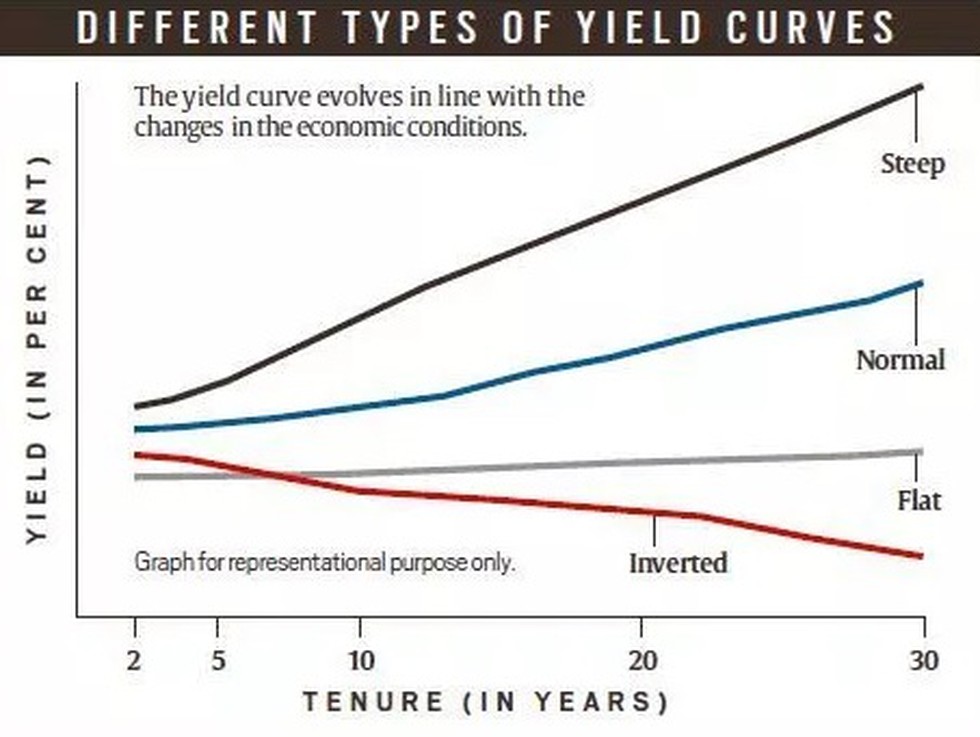
Bond yields gained thanks to bullish attitudes around economic growth.

Economy: The Great Resignation rolls on as a record 4.5 million Americans quit their jobs in November. That’s equivalent to 3% of the workforce.

COMMENTS APPRECIATED.

Thank You

Subscribe to the Medical Executive Post.com

***

***

Stock Market Open New Year’s Eve 12/31/2021

Bond Markets to Close Early Friday

By Staff reporters

***

The stock market, buoyed by a Santa Claus rally and a banner year, will have one more day to extend its gains.

Both the New York Stock Exchange and NASDAQ will be open on New Year’s Eve. Bond markets will close early at 2 p.m. Friday.

The markets typically close on New Year’s Day but this year the holiday falls on a Saturday, when they would have shuttered anyway. Last week, the New York Stock Exchange and Nasdaq closed on Friday, Christmas Eve, in observance of Christmas, which also fell on a Saturday.

***

***

Stock MARKET Update

ALL TIME HIGHS?

***

  • Markets: The S&P begins the week after closing at an all-time high last Friday. The index has closed at a record more times this year (67) than in any other year since 1995. It needs 10 more to tie the mark.
  • More S&P fun facts: Microsoft, Alphabet, Apple, Nvidia, and Tesla alone account for over a third of the S&P’s gains this year.
  • CITE: https://www.r2library.com/Resource/Title/082610254

NOTE: 35,630.18market open‎-340.81 (‎-0.95%)as of 12/13/2021, 11:31 AM EST

COMMENTS APPRECIATED.

***

Thank You

***

Should a diversified investment portfolio produce the same return as US stocks?

 On unrealistic expectations

By Rick Kahler CFP®

I have a complaint. The pot pie at one of my favorite restaurants doesn’t taste like a pot roast. I keep complaining, but nothing changes. I am thinking I may need to find a new restaurant because their cooking skills are just not living up to my expectations.

Or maybe I need to adjust my expectations. How can I expect a pot pie—a savory pastry with a mixture of potatoes, vegetables, and beef chunks—to taste like a beef pot roast? Even though beef is an ingredient in a pot pie, no reasonable diner would expect the two meals to taste the same.

Investing

But, that same reasonable diner might be perfectly comfortable expecting that their diversified investment portfolio should produce the same return as US stocks. This is just as unrealistic as it is to expect pot pie and pot roast to produce the same taste.

A diversified portfolio has a variety of investments in it, just as a pot pie has a variety of ingredients in it. A pot pie provides a complete meal with a nice balance of grain, veggies, and protein with a tasty blend of spices. A pot roast provides just one component of a balanced meal, a heavy dose of protein.

Likewise, a diversified portfolio is a meal in itself. A particular recipe that I like has the equivalent of a flour crust made of high quality bonds, high yield bonds, and Treasury Inflation Protected Securities. Stuffed inside is a delicious blend of real estate investment trusts, international stocks, US stocks, emerging market stocks, commodities, all flavored with managed futures, a long/short fund, and a put/write investment strategy.

The flavor of the diversified portfolio is completely different from an investment of just US stocks. Yet investors regularly try to compare the two.

EXAMPLE:

A few months ago, a reader wanted to know why her small account with a well-known brokerage house was doing three times better than her IRA managed by a fee-only advisor. She was thinking she should put all her IRA money with the brokerage firm.

Following up revealed the ingredients in her IRA: 30% was in a global mix of 1,100 high quality bonds, 300 high yield bonds, and 20 TIPS. The remaining 70% was in a global mix of 12,000 US, international and emerging market companies of all sizes, 300 real estate investment trusts, 21 commodities, a long/short fund with hundreds of positions, and a smattering of other investment strategies.

The small brokerage account had just one ingredient: 31 large US stocks.

Over the previous 15 months, the globally diversified portfolio had returned 9% and the 31 US stocks had returned 21%. Of course, the US stocks in her diversified portfolio had also returned 21%, but just like the chunks of beef in a pot pie, they only made up part of the mix, in this case 17%. So, comparing the diversified pot pie of her IRA return to the single-ingredient pot roast of her brokerage account was not valid.

Over the past nine years nothing has done better among major asset classes than US stocks. Any diversified portfolio will have underperformed them. That phenomenon will inevitably end. The time will come, sooner or later, when US stocks will be one of the worst performers of the decade.

***

***

Assessment

Just as a diversified portfolio will often garner smaller returns when US stocks rise, it will also have substantially higher returns when US stocks crash. At that time, those with diversified portfolios will be thankful that they stayed the course. And millions of other investors will be wishing they had ordered pot pie instead of pot roast.

Conclusion

Your thoughts and comments on this ME-P are appreciated. Feel free to review our top-left column, and top-right sidebar materials, links, URLs and related websites, too. Then, subscribe to the ME-P. It is fast, free and secure. 

Speaker: If you need a moderator or speaker for an upcoming event, Dr. David E. Marcinko; MBA – Publisher-in-Chief of the Medical Executive-Post – is available for seminar or speaking engagements. https://medicalexecutivepost.com/dr-david-marcinkos-bookings/ 

Contact: MarcinkoAdvisors@msn.com

***

https://www.crcpress.com/Comprehensive-Financial-Planning-Strategies-for-Doctors-and-Advisors-Best/Marcinko-Hetico/p/book/9781482240283

***

The Stock Market Has Been Flat For Six Months

Join Our Mailing List

This is Great News!

By Lon Jefferies MBA CFP® http://www.NetWorthAdvice.com

Lon JefferiesInvestors have experienced a very uneventful 2015.

In fact, for seven months the Dow Jones Industrial Average was at essentially the same value.* This lack of fluctuation has been even more pronounced over the last two months. As of the market close on May 14th, 2015, the S&P 500 has closed between 2,040 and 2,120 for 71 days in a row.

Further, for nearly a full month, the DOW hasn’t experienced a 1-month high OR low and traded within a 2% range the entire time (always between -1% and 1%).** This was the longest streak in over 100 years!

***

one-month-return

***

Believe it or not, this may be the best pattern possible for the U.S. stock market.

***

Trendline Image

***

History tells us that the market is likely to increase in value over time. If we were to plot the market’s value from the time the market first opened to the current day, a chart of those two points would illustrate a return as such:

Trendline Image

However, we all know that the market doesn’t provide a consistent return. On individual trading days, the market can either increase or decrease in value, and the range of potential gains or losses is wide. Over extended periods of time, the market’s actual value may be above or below the expected trend line. In fact, the market’s actual historical return may look more like:

Historical vs Trendline

***

Historical vs Trendline

***

Anyone who is familiar with Net Worth Advisory Group is likely aware that we are not the type to make market predictions. We have no idea whether the market is near a temporary top or is still experiencing the upward trend after hitting the bottom of an S curve in 2008. However, let’s assume the market has reached the top of an S curve and is currently above the trend line that would represent consistent growth (similar to the illustration above).

If that is the case, there are two ways the market could get back in line with the trend line representing consistent long-term growth. The first and most obvious way this could happen is for actual market performance to curve downwards towards the trend line. This would represent a market correction or even crash.

***

crash

***

The second, and perhaps less obvious way that actual returns could become aligned with the long-term trend line is for time to allow the trend line to catch up to the actual returns we have experienced since 2008.

In this scenario, the market doesn’t slump but remains stable while time enables price-to-earnings ratios, valuations, and the economy a chance to catch up.

Time Catch Up

***

Time Catch Up

***

Very few investors enjoy or take advantage of a market correction. In fact, most investors lose control of their emotions when the market experiences a drastic downturn, and do exactly the opposite of what they should do: they sell at market lows – hardly a profitable investment strategy.

Consequently, if we are to avoid an over-heated market, it is likely better for most investors if the market realigns itself with the long-term growth rate by remaining flat for awhile and allowing the trend line time to catch up.

Allow me to reemphasize that I am not predicting that the market is in fact at a temporary high and above where it should be. I have no idea what the market will do tomorrow, over the next month, or over the next year. That is why I’m a believer in having a well diversified portfolio that represents your risk tolerance and you stick to it through thick and thin.

However, let’s look at the other side of the coin and assume the market is still at the bottom of an S curve, below the long-term trend line, and needs to experience further growth in order to catch up. Even in this scenario, an extended period of flat market performance is hardly a bad thing – it would simply make the potential upside needed to get back to market norms all the larger.

Market Under Valued

***

Market Under Valued

***

Assessment

It turns out that an extended period of flat market performance may very well be a positive for investors in any environment, regardless of whether the market is currently over or under-valued.

Channel Surfing

Have you visited our other topic channels? Established to facilitate idea exchange and link our community together, the value of these topics is dependent upon your input. Please take a minute to visit. And, to prevent that annoying spam, we ask that you register.

Link: http://feeds.feedburner.com/HealthcareFinancialsthePostForcxos

Conclusion

Your thoughts and comments on this ME-P are appreciated. Feel free to review our top-left column, and top-right sidebar materials, links, URLs and related websites, too. Then, subscribe to the ME-P. It is fast, free and secure.

Speaker: If you need a moderator or speaker for an upcoming event, Dr. David E. Marcinko; MBA – Publisher-in-Chief of the Medical Executive-Post – is available for seminar or speaking engagements. Contact: MarcinkoAdvisors@msn.com

OUR OTHER PRINT BOOKS AND RELATED INFORMATION SOURCES:

Sponsors Welcomed

And, credible sponsors and like-minded advertisers are always welcomed.

Support Med Executive-Post

Risk Management, Liability Insurance, and Asset Protection Strategies for Doctors and Advisors: Best Practices from Leading Consultants and Certified Medical Planners™8Comprehensive Financial Planning Strategies for Doctors and Advisors: Best Practices from Leading Consultants and Certified Medical Planners™

Understanding Stock Market Performance Benchmarks

Join Our Mailing List

An important role in monitoring investment portfolio progress

By TIMOTHY J. McINTOSH; MBA, MPH, CFP®, CMP™ [Hon] 

tim

Performance measurement has an important role in monitoring progress toward any portfolio’s goals.  The portfolio’s objective may be to preserve the purchasing power of the assets by achieving returns above inflation or to have total returns adequate to satisfy an annual spending need without eroding original capital, etc.

Whatever the absolute goal, performance numbers need to be evaluated based on an understanding of the market environment over the period being measured.

So, here is a brief review for our ME-P readers, doctors and subscribers; after a good market day today.

17,666.40 +305.36 +1.76%

Time-weighted Returns

One way to put a portfolio’s a time-weighted return in the context of the overall market environment is to compare the performance to relevant alternative investment vehicles. This can be done through comparisons to either market indices, which are board baskets of investable securities, or peer groups, which are collections of returns from managers or funds investing in a similar universe of securities with similar objectives as the portfolio.  By evaluating the performance of alternatives that were available over the period, the investor and his/her advisor are able to gain insight to the general investment environment over the time period.

The Indices

Market indices are frequently used to gain perspective on the market environment and to evaluate how well the portfolio performed relative to that environment.  Market indices are typically segmented into different asset classes.

Common stock market indices include the following:

  • Dow Jones Industrial Average- a price-weighted index of 30 large U.S. corporations.
  • Standard & Poor’s (S&P) 500 Index – a capitalization-weighted index of 500 large U.S. corporations.
  • Value Line Index – an equally-weighted index of 1700 large U.S. corporations.
  • Russell 2000 – a capitalization-weighted index of smaller capitalization U.S. companies.
  • Wilshire 5000 – a cap weighted index of the 5000 largest US corporations.
  • Morgan Stanley Europe Australia, Far East (EAFE) Index – a capitalization-weighted index of the stocks traded in developed economies.

Common bond market indices include the following:

  • Barclays Aggregate Bond Index – a broad index of bonds.
  • Merrill Lynch High Yield Index – an index of below investment grade bonds.
  • JP Morgan Global Government Bond – an index of domestic and foreign government-issued fixed income securities.

The selection of an appropriate market index depends on the goals of the portfolio and the universe of securities from which the portfolio was selected. Just as a portfolio with a short-time horizon and a primary goal of capital preservation should not be expected to perform in line with the S&P 500, a portfolio with a long-term horizon and a primary goal of capital growth should not be evaluated versus Treasury Bills.

***

Healthcare job expense deductions

***

While the Dow Jones Industrial Average and S&P 500 are often quoted in the newspapers, there are clearly broader market indices available to describe the overall performance of the U.S. stock market. Likewise, indices like the S&P 500 and Wilshire 5000 are capitalization-weighted, so their returns are generally dominated by the largest 50 of their 500 – 5000 stocks. Although this capitalization-bias does not typically affect long-term performance comparisons, there may be periods of time in which large cap stocks out- or under-perform mid-to-small cap stocks, thus creating a bias when cap-weighted indices are used versus what is usually non-cap weighted strategies of managers or mutual funds. Finally, the fixed income indices tend to have a bias towards intermediate-term securities versus longer-term bonds.

Peer Groups

Thus, an investor with a long-term time horizon, and therefore potentially a higher allocation to long bonds, should keep this bias in mind when evaluating performance.Peer group comparisons tend to avoid the capitalization-bias of many market indices, although identifying an appropriate peer group is as difficult as identifying an appropriate market index.

Furthermore, peer group universes will tend to have an additional problem of survivorship bias, which is the loss of (generally weaker) performance track records from the database. This is the greatest concern with databases used for marketing purposes by managers, since investment products in these generally self-disclosure databases will be added when a track record looks good and dropped when the product’s returns falter. Whether mutual funds or managers, the potential for survivorship bias and inappropriate manager universes make it important to evaluate the details of how a database is constructed before using it for relative performance comparisons.

***

investing

***

Channel Surfing the ME-P

Have you visited our other topic channels? Established to facilitate idea exchange and link our community together, the value of these topics is dependent upon your input. Please take a minute to visit. And, to prevent that annoying spam, we ask that you register. It is fast, free and secure.

The Author

Timothy J. McIntosh is Chief Investment Officer and founder of SIPCO.  As chairman of the firm’s investment committee, he oversees all aspects of major client accounts and serves as lead portfolio manager for the firm’s equity and bond portfolios. Mr. McIntosh was a Professor of Finance at Eckerd College from 1998 to 2008. He is the author of The Bear Market Survival Guide and the The Sector Strategist.  He is featured in publications like the Wall Street Journal, New York Times, USA Today, Investment Advisor, Fortune, MD News, Tampa Doctor’s Life, and The St. Petersburg Times.  He has been recognized as a Five Star Wealth Manager in Texas Monthly magazine; and continuously named as Medical Economics’ “Best Financial Advisors for Physicians since 2004.  And, he is a contributor to SeekingAlpha.com., a premier website of investment opinion. Mr. McIntosh earned a Bachelor of Science Degree in Economics from Florida State University; Master of Business Administration (M.B.A) degree from the University of Sarasota; Master of Public Health Degree (M.P.H) from the University of South Florida and is a CERTIFIED FINANCIAL PLANNER® practitioner. His previous experience includes employment with Blue Cross/Blue Shield of Florida, Enterprise Leasing Company, and the United States Army Military Intelligence.

Conclusion

Your thoughts and comments on this ME-P are appreciated. Feel free to review our top-left column, and top-right sidebar materials, links, URLs and related websites, too. Then, subscribe to the ME-P. It is fast, free and secure.

Speaker: If you need a moderator or speaker for an upcoming event, Dr. David E. Marcinko; MBA – Publisher-in-Chief of the Medical Executive-Post – is available for seminar or speaking engagements. Contact: MarcinkoAdvisors@msn.com

OUR OTHER PRINT BOOKS AND RELATED INFORMATION SOURCES:

Comprehensive Financial Planning Strategies for Doctors and Advisors: Best Practices from Leading Consultants and Certified Medical Planners(TM)

Learn the “Right” Investing Lessons from 2013

Join Our Mailing List 

Understanding the Recency Effect

Lon JeffriesBy Lon Jefferies MBA CFP® www.NetWorthAdvice.com

The year 2013 was viewed as a very positive one by most investors; especially physician-investors.

The S&P 500 index (measuring large cap U.S. stocks) was up 32.39% for the year.

However, the reality is most other asset categories didn’t come close to keeping up with the pace set by U.S. equities.

For instance:

  • Foreign Stocks (IEFA): 22.46%
  • Emerging Markets (IEMG): -2.77%
  • Real Estate (IYR): 1.16%
  • US Government Bonds (IEF): -6.09%
  • US TIPS (TIP): -8.49%
  • Corporate Bonds (LQD): -2.00%
  • International Bonds (IGOV): -1.37%
  • Emerging Market Bonds (LEMB): -6.73%
  • Commodities (DJP): -11.12%
  • Gold (GLD): -28.33%

In Hindsight

In retrospect, the way to maximize your gain last year would have been to hold a completely undiversified portfolio consisting of nothing but U.S. stocks. The danger going forward is to learn the wrong lesson from 2013. Investors always have the temptation to fall prey to the Recency Effect, continuing and exaggerating the behaviors that worked in the recent past believing the environment we’ve just been through will be permanent.

The Long-Term Benefits of Diversification

Many will abandon their investment strategy because it didn’t give them the absolute best result last year, failing to recognize the long-term benefit of diversification. I’d argue that a better perspective is to remind yourself that the definition of diversification is that you always dislike a portion of your portfolio.

Always Laggards

Even in the most widely prosperous market environment, a truly diversified portfolio will have an element or two that lags the market. In fact, if at any time a portion of your portfolio isn’t generating negative returns, you should be concerned about a lack of diversification in your investment strategy.

Allocate Assets Now

Now is an ideal time to review your asset allocation and remind yourself why we diversify. Modifying your allocation with a focus on what happened in 2013 would be similar to guessing a coin flip will land on tails because it did on the previous flip.

Stock Market

Assessment

The correct lesson to take from 2013 is that over time, a well-diversified portfolio is capable of producing sufficient returns to help you reach your investment goals while minimizing risk.

Conclusion

Your thoughts and comments on this ME-P are appreciated. Feel free to review our top-left column, and top-right sidebar materials, links, URLs and related websites, too. Then, subscribe to the ME-P. It is fast, free and secure.

Link: http://feeds.feedburner.com/HealthcareFinancialsthePostForcxos

Speaker: If you need a moderator or speaker for an upcoming event, Dr. David E. Marcinko; MBA – Publisher-in-Chief of the Medical Executive-Post – is available for seminar or speaking engagements. Contact: MarcinkoAdvisors@msn.com

OUR OTHER PRINT BOOKS AND RELATED INFORMATION SOURCES:

DICTIONARIES: http://www.springerpub.com/Search/marcinko
PHYSICIANS: www.MedicalBusinessAdvisors.com
PRACTICES: www.BusinessofMedicalPractice.com
HOSPITALS: http://www.crcpress.com/product/isbn/9781466558731
CLINICS: http://www.crcpress.com/product/isbn/9781439879900
BLOG: www.MedicalExecutivePost.com
FINANCE: Financial Planning for Physicians and Advisors
INSURANCE: Risk Management and Insurance Strategies for Physicians and Advisors

Product Details  Product Details

Got Cash Money in the Bank?

Join Our Mailing List

Is it Really a Long-Term Investment?

By Rick Kahler CFP® http://www.KahlerFinancial.com

Rick Kahler CFPGot money in the bank? Of course, that’s a good thing.

But, more than a fourth of Americans think the best long-term investment strategy is money in the bank. However, that may be a bad thing!

So, what about medical professionals; and what is a doctor to do?

The Bankrate Survey

Here is the rather discouraging result of a July survey by Bankrate. One of its questions was, “For money you wouldn’t need for more than 10 years, which one of the following do you think would be the best way to invest the money?”

Cash was the top choice at 26%, followed by real estate at 23%. Sixteen percent of the respondents chose precious metals such as gold. Only 14% would put their long-term investment into the stock market, and just 8% thought bonds were the best choice.

Head-on-Desk Syndrome

Doh! That thumping sound you hear is me banging my head on my desk.

I assume those who opted for cash did so because keeping money in the bank seemed to be the safest choice. For long-term investing, however, that safety is an illusion. The best and safest place to put your nest egg for the future is not in the bank, but in a well-diversified portfolio with a variety of asset classes.

Here’s why:

Savings accounts and CDs are safe places to store relatively small amounts of cash that you expect to need within the next few months or years. The funds are protected by insurance. You know exactly where your money is, and you can get your hands on it anytime you want.

Short Term Stability

This short-term safety does not make the bank a good place for money you will need for retirement or other needs ten years or so into the future. It may seem like safe investing because the amount in your account never goes down. You’re always earning interest. Yet, over time, that interest isn’t enough to keep pace with inflation. The purchasing power of your money decreases, which means you’re actually losing money. It just doesn’t feel like a loss because you don’t see the loss in value.

Stock Markets Fluctuate

In contrast, the stock market fluctuates. The media reports constantly that “the DOW is up” or “NASDAQ is down,” as if those day-to-day numbers matter. This fosters a perception that investing in the stock market is risky. Combine that with the scarcity of education about finances and economics, and it’s no wonder that so many people are afraid of the stock market and view investing almost as a form of gambling.

Wise long-term investing in the stock market is anything but gambling. Instead of trying to buy and sell a few stocks as their prices go up and down, wise investors neutralize the impact of market fluctuations by owning a vast assortment of assets.

A Dual Strategy

This is accomplished with a two-part strategy.

1. The first is to invest in mutual funds rather than individual stocks. With just one mutual fund that invests in an index of stocks, you might own thousands of different companies. Your hard-earned fortune isn’t dependent on the fortunes of just a few companies.

2. The second component is asset class diversification. An asset class is a type of investment, such as U. S. and International stocks, U. S. and International bonds, real estate investment trusts, commodities, market neutral funds, Treasury Inflation-Protected Securities, and junk bonds. Ideally, a diversified portfolio should include nine or more asset classes.

###

MD Retirement planning

###

Assessment

By holding small amounts of a great many different companies and asset classes, you spread your risk so broadly that the inevitable fluctuations are small ripples rather than steep gains or losses. As some types of investments decline in value, other types will be gaining value. Over the long term, the entire portfolio grows.

And, in the long term and for most medical professionals, investing this way is usually safer than money in the bank.

Conclusion

Your thoughts and comments on this ME-P are appreciated. Feel free to review our top-left column, and top-right sidebar materials, links, URLs and related websites, too. Then, subscribe to the ME-P. It is fast, free and secure.

Link: http://feeds.feedburner.com/HealthcareFinancialsthePostForcxos

Speaker: If you need a moderator or speaker for an upcoming event, Dr. David E. Marcinko; MBA – Publisher-in-Chief of the Medical Executive-Post – is available for seminar or speaking engagements. Contact: MarcinkoAdvisors@msn.com

OUR OTHER PRINT BOOKS AND RELATED INFORMATION SOURCES:

DICTIONARIES: http://www.springerpub.com/Search/marcinko
PHYSICIANS: www.MedicalBusinessAdvisors.com
PRACTICES: www.BusinessofMedicalPractice.com
HOSPITALS: http://www.crcpress.com/product/isbn/9781466558731
CLINICS: http://www.crcpress.com/product/isbn/9781439879900
ADVISORS: www.CertifiedMedicalPlanner.org
PODIATRISTS: www.PodiatryPrep.com
BLOG: www.MedicalExecutivePost.com
FINANCE: Financial Planning for Physicians and Advisors
INSURANCE: Risk Management and Insurance Strategies for Physicians and Advisors

Product Details  Product Details

What Happens if the Stock Market Crashes – Doctor?

Join Our Mailing List

There is No Investing Crystal Ball

Lon JeffriesBy Lon Jefferies, MBA CFP CMP™

As the Dow has risen greatly since March 9, 2009, some physicians and investors worry that the market is overheated and due for a severe pullback; as recently experienced very minor events have illustrated.

But, an opposing view is that the current price of the S&P 500 is comparable to its value in 1999, despite the fact that its earnings and dividends have doubled since that time, and suggesting the market has additional room to grow.

The Future is UnKnown

There is no crystal ball. What the stock market will do in the near future is anyone’s guess. As uncertainty is always a factor when investing, developing a portfolio that represents your risk tolerance and investment time horizon is critical.

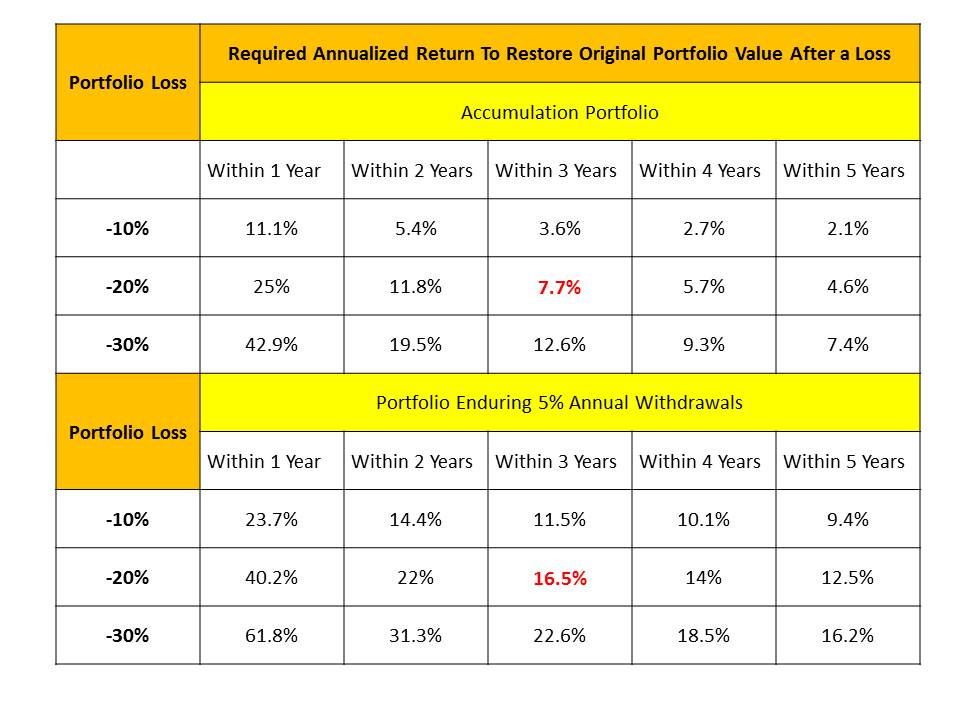
Many physicians and investors realize they need to scale back the assertiveness of their portfolio as they approach retirement, but why is this important? The mechanics of an investment portfolio are very different for a portfolio in the distribution phase than for a portfolio still accumulating assets. If an investor is taking withdrawals from their account, it is much more difficult to recover from losses because distributions only serve to exacerbate the market decline.

crystalball2

Dr. Israelsen Speaks

As Craig Israelsen PhD points out in the February 2013 issue of Financial Planning Magazine with the following illustration, a portfolio enduring annual 5% withdrawals faces a much steeper climb back to break even after a loss than does an accumulation portfolio:

Clearly, the conclusion is if you are taking distributions from your account, or intend to do so soon, it is vitally important to avoid large losses. As it may be realistic for investors still accumulating assets to recover from a -20% loss by obtaining an average annualized return of 7.7% for three years, it is unlikely that a retiree taking distributions from his account will get the 16.5% annual return required for three years in order to recover from a similar loss.

Diversify

Protect yourself from unsustainable losses by maintaining adequate diversification within your portfolio. Bonds serve as a buffer against volatility and will likely decrease your loss during stock market corrections.

Additionally, ensure your portfolio has sufficient exposure to various asset classes: large cap, mid cap, and small cap stocks; US, international, and emerging market stocks; government, corporate, international, and emerging market bonds. Investing in multiple asset categories will protect your portfolio from a catastrophic loss next time a bubble in a market sector pops.

chart

Assessment

Speak with a Certified Medical Planner™ or fiduciary and physician focused financial advisor to ensure your portfolio is assertive enough to meet your retirement goals while maintaining an acceptable level of risk. If you wait for the market to turn before taking action, it may be too late.

www.CertifiedMedicalPlanner.org

Conclusion

Your thoughts and comments on this ME-P are appreciated. Feel free to review our top-left column, and top-right sidebar materials, links, URLs and related websites, too. Then, subscribe to the ME-P. It is fast, free and secure.

Link: http://feeds.feedburner.com/HealthcareFinancialsthePostForcxos

Speaker: If you need a moderator or speaker for an upcoming event, Dr. David E. Marcinko; MBA – Publisher-in-Chief of the Medical Executive-Post – is available for seminar or speaking engagements. Contact: MarcinkoAdvisors@msn.com

***

Risk Management, Liability Insurance, and Asset Protection Strategies for Doctors and Advisors: Best Practices from Leading Consultants and Certified Medical Planners™8Comprehensive Financial Planning Strategies for Doctors and Advisors: Best Practices from Leading Consultants and Certified Medical Planners™

Building Up to the Fiscal Cliff

Join Our Mailing List

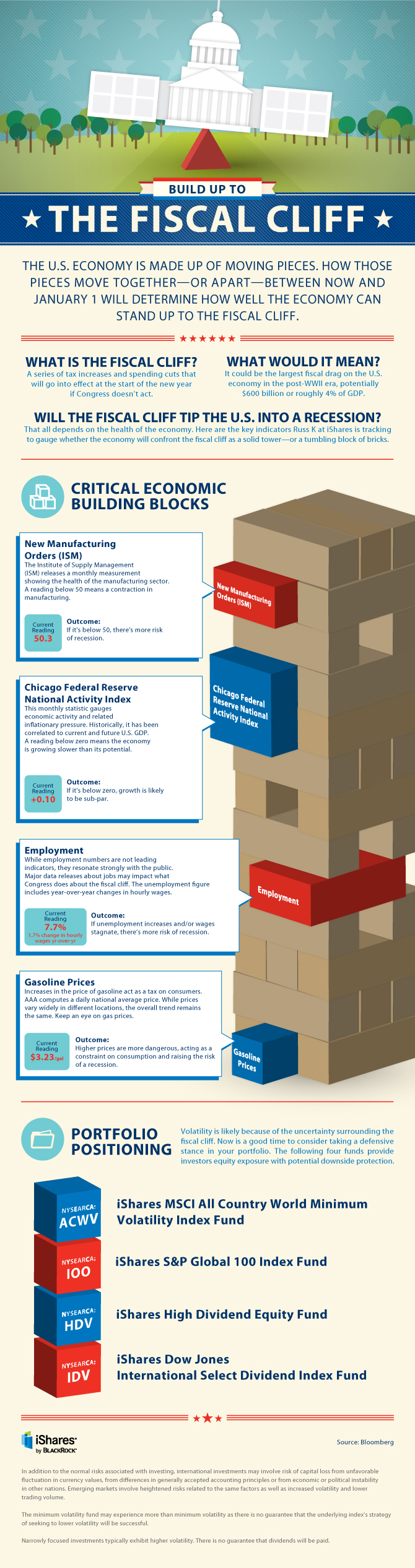
A Historic Review

Fiscal Cliff

Assessment

Doctors, FAs and all ME-P readers. What is your strategy for the fiscal cliff situation?

Conclusion

Your thoughts and comments on this ME-P are appreciated. Feel free to review our top-left column, and top-right sidebar materials, links, URLs and related websites, too. Then, subscribe to the ME-P. It is fast, free and secure.

Link: http://feeds.feedburner.com/HealthcareFinancialsthePostForcxos

Speaker: If you need a moderator or speaker for an upcoming event, Dr. David E. Marcinko; MBA – Publisher-in-Chief of the Medical Executive-Post – is available for seminar or speaking engagements. Contact: MarcinkoAdvisors@msn.com

Our Other Print Books and Related Information Sources:

Health Dictionary Series: http://www.springerpub.com/Search/marcinko

Practice Management: http://www.springerpub.com/product/9780826105752

Physician Financial Planning: http://www.jbpub.com/catalog/0763745790

Medical Risk Management: http://www.jbpub.com/catalog/9780763733421

Hospitals: http://www.crcpress.com/product/isbn/9781439879900

Physician Advisors: www.CertifiedMedicalPlanner.org

Product Details  Product Details

How Well Behaved Are Your Financial Decisions-Doctor?

Join Our Mailing List

“Massively Confused Investors Making Conspicuously Ignorant Choices”

By Somnath Basu PhD, MBA

How well we make investment decisions depends in part on how reasoned or emotional the decision was. The greater the emotional content the more likely will be the mistake. It is useful for all of us to understand the emotional pitfalls of financial decision-making.

Financial Psychologists

An appropriately titled study by a financial psychologist Michael S. Rashes, “Massively Confused Investors Making Conspicuously Ignorant Choices” cites that the widespread phenomenon witnessed in the market, whereby several stocks with similar ticker symbols all went up in value when positive news was announced about any one of them.

Example: http://ideas.repec.org/a/bla/jfinan/v56y2001i5p1911-1927.html

A case in point is the parallel movement between two entirely unrelated stocks, MCIC (ticker symbol for the telecommunications firm, MCI, bought by Worldcom in 1997), and MCI (ticker symbol for the Massmutual Corporate Investors fund). The acquisition of MCI, the telecommunications firm, in 1997-8 caused an upward movement in its stock (MCIC). That movement was also closely correlated with the upward movement in the stock of Massmutual Corporate Investors (MCI), whose ticker symbol was the same as the telecommunications company’s name. Rampant confusion of this sort strongly supports the notion that irrationality, not rationality, rules the financial markets. Another noted scientist, B. Malkiel suggests that when it comes to investing, people generally follow their emotions, not their reason, their hearts, not their minds.

Behavioral Finance and Economic Gurus

This line of argument has been gaining credibility over the last decade or so, not only among behavioral finance experts, but also economists themselves, as well as stock market pundits and the population at large. There is a strong sense among all these groups that greed, exuberance, fear and herding behavior affect markets as much as or more than calculations of P/E ratios, profit projections, or market benchmarks. The bursting of the stock market bubbles of 2000 and 2008 only confirmed these long-held suspicions. As a result, widely used economic models based on rational investor behavior require some reevaluation and could be found to be unreliable at best and irrelevant at worst.

The Decision Biases

The following is only a partial list of the biases that may be induced in you if the financial decisions you make are based on emotion and not on reason. The list includes the bias name, a descriptive definition and an example of application error. Before closing that next trade you make, a good question to ask yourself is whether any of the biases from the list were included in your financial decision. If so, these decisions too need further evaluation.

1. Over-Confidence:

Over-estimating the chances of correctly predicting the direction of price changes!

Example: Attribute good outcomes (i.e., gains) to your skill while attributing bad outcomes (i.e., losses) to your bad luck.

2. Pride and Regret:

Investors often over-estimate their powers of discerning stock winners from losers. Some physicians and other investors (essentially, active traders) may rapidly sell and buy back stocks, in order to capture expected gains.

Example: Selling your winning picks early and holding onto losers hoping they rebound. Studies show that doing the opposite can increase your annual returns by 3-4%.

3. Cognitive Dissonance:

Suggests that investors experience an internal conflict when a belief or assumption of theirs is proven wrong

Example: It’s easier to remember your winning picks than your losing ones since the latter outcomes disagreed with your earlier beliefs.

4. Confirmation Bias:

Suggests that they try to seek out information that will help confirm their existing views whether those views be right or wrong.

Example: When you hear someone agreeing with your investment decision you feel that person is much more knowledgeable than one who disagrees with you.

5. Anchoring:

A phenomenon whereby people stay within range of what they already know in making guesses or estimates about what they do not know.

Example: The Dow Jones Industrial Average (DJIA), which grew from a value of 41 in 1896 to 9,181 in 1998, does not include dividends. They then value the index in 1998, including dividends, at a whopping 652,230. When asked, investors estimate the value of the DJIA would be if dividends were included, all were way off the mark, keeping their answers close to its familiar value of 9,181. The highest guesses came in at under 30,000, less than 5% of the actual value.

6. Representative Heuristics:

An over-reliance on familiar clues, such as past performance of a stock!

Example: most investors assume that the stock of a company with strong earnings will perform well and that the stock of a company with weak earnings will perform poorly. The law of large numbers suggests however that the exact opposite is much likelier to be true.

Conclusion

And so, your thoughts and comments on this ME-P are appreciated. Feel free to review our top-left column, and top-right sidebar materials, links, URLs and related websites, too. Then, subscribe to the ME-P. It is fast, free and secure.

NOTE: Somnath Basu is a Professor of Finance at California Lutheran University and the creator of the innovative AgeBander (www.agebander.com) retirement planning software.