What is the Dow Jones Industrial Average?

DEFINED

By A.I. and Staff Reporters

SPONSOR: http://www.MarcinkoAssociates.com

***
***

The Dow Jones Industrial Average (DJIA), often referred to simply as “the Dow,” is one of the oldest and most well-known stock market indices in the world. It was created in 1896 by Charles Dow, the co-founder of The Wall Street Journal, and is designed to represent the performance of the broader U.S. stock market, specifically focusing on 30 large, publicly traded companies. These companies are considered leaders in their respective industries and serve as a barometer for the overall health of the U.S. economy.

The Composition of the DJIA

The DJIA includes 30 companies, which are selected by the editors of The Wall Street Journal based on various factors such as market influence, reputation, and the stability of the company. These companies represent a wide array of sectors, including technology, finance, healthcare, consumer goods, and energy. Notably, the companies chosen for the DJIA are not necessarily the largest companies in the U.S. by market capitalization, but rather those that are most indicative of the broader economy. Some of the prominent companies listed in the DJIA include names like Apple, Microsoft, Coca-Cola, and Johnson & Johnson.

However, the list of 30 companies is not static. Over time, companies may be added or removed to reflect changes in the economic landscape. For example, if a company experiences significant decline or no longer represents a leading sector, it might be replaced with another company that better reflects modern economic trends. This periodic reshuffling ensures that the DJIA continues to be a relevant measure of economic activity.

How the DJIA is Calculated

The DJIA is a price-weighted index, which means that the value of the index is determined by the share price of the component companies, rather than their market capitalization. To calculate the DJIA, the sum of the stock prices of all 30 companies is divided by a special divisor. This divisor adjusts for stock splits, dividends, and other corporate actions to maintain the integrity of the index over time. The price-weighted method means that higher-priced stocks have a greater impact on the movement of the index, regardless of the overall size or economic weight of the company.

For instance, if a company with a higher stock price like Apple experiences a significant change in value, it will influence the DJIA more than a company with a lower stock price, even if the latter has a larger market capitalization. This makes the DJIA somewhat different from other indices, like the S&P 500, which is weighted by market cap and gives more weight to larger companies in terms of their economic impact.

Significance of the DJIA

The DJIA is widely regarded as a barometer of the U.S. stock market’s performance. Investors and analysts closely monitor the movements of the Dow to gauge the overall health of the economy. When the DJIA rises, it generally suggests that investors are optimistic about the economic outlook and that large companies are performing well. Conversely, when the DJIA falls, it often signals economic uncertainty or a downturn in market conditions.

Despite being a narrow index, with only 30 companies, the DJIA holds substantial sway in financial markets. It is widely covered in the media and is often cited in discussions about the state of the economy. In fact, the performance of the DJIA is considered a key indicator of investor sentiment and economic confidence.

However, the DJIA has its limitations. Since it only includes 30 companies, it does not necessarily represent the broader market or capture the performance of smaller companies. Other indices, like the S&P 500, which includes 500 companies, offer a more comprehensive view of the market’s performance.

Conclusion

The Dow Jones Industrial Average is a key metric for understanding the state of the U.S. economy and the stock market. Although it has evolved over the years, it continues to provide valuable insights into the performance of large, influential companies. While it is not a perfect reflection of the market as a whole, the DJIA remains one of the most important and widely recognized indices in global finance. Through its historical significance and its role in shaping market sentiment, the Dow has cemented its place as a cornerstone of financial analysis.

COMMENTS APPRECIATED

EDUCATION: Books

Like, Refer and Subscribe

***

***

Stocks UP and Stocks DOWN

By Staff Reporters

***

***

Investors were apparently tired of all the volatility yesterday, leading to a relatively calm day where indexes ever-so-slightly slipped. But it was a big day for Netflix after the Wall Street Journal reported that the streaming giant has plans to double its revenue and reach a $1 trillion valuation by 2030.

***

🟢 What’s up

  • Hewlett Packard Enterprise popped 5.11% after Elliott Investment Management took a $1.5 billion stake in the tech company.
  • Rocket Lab rocketed (sorry) 10.14% higher after the space stock inked deals with both the US Air Force and the UK Ministry of Defense.
  • Netflix rose 4.83% on a report from the Wall Street Journal that the streaming giant plans to hit a $1 trillion market capitalization and double its revenue by 2030. The company announces earnings on Thursday.
  • Bank of America and Citigroup both posted strong Q1 earnings that beat analyst forecasts (more on that below). BofA climbed 3.60%, while Citi rose 1.76%.
  • Palantir rose another 6.24% a day after NATO agreed to purchase its AI-powered warfighting system.

What’s down

  • Albertsons tumbled 7.49% after the grocer’s full-year guidance came in below expectations.
  • Allegro Microsystems sank 9.68% on the news that ON Semiconductor has withdrawn its offer to acquire the chipmaker.
  • Applied Digital plummeted 35.94% after the digital infrastructure company missed analyst revenue estimates, despite sales climbing 22% last quarter.
  • #recessionindicator: Coty sank 8.57% after the beauty retailer was double downgraded by Bank of America analysts, citing a slowdown in makeup spending.

COMMENTS APPRECIATED

Like and Refer

***

***

DOJ: Antitrust Reportedly Investigating UnitedHealth Group

By Health Capital Consultants, LLC

***

***

On February 27, 2024, the Wall Street Journal (WSJ) reported that the Department of Justice (DOJ) has launched an antitrust investigation into UnitedHealth Group (UHG), the owner of the biggest health insurer in the U.S. and the leading manager of drug benefits and one of the largest networks of physician groups. This investigation comes as the Biden administration’s antitrust enforcers have ramped up investigations into some of the biggest U.S. companies, including Amazon, Apple, and Google.

CITE: https://www.r2library.com/Resource

This Health Capital Topics article reviews the reported government investigation. (Read more…)

COMMENTS APPRECIATED

Subscribe Today

***

***

DAILY UPDATE: Tesla Lay Offs, Mammograms, Physician Pay, UnitedHealth and Tele-Health as Stock Markets Close Mixed

MEDICAL EXECUTIVE-POST TODAY’S NEWSLETTER BRIEFING

***

Essays, Opinions and Curated News in Health Economics, Investing, Business, Management and Financial Planning for Physician Entrepreneurs and their Savvy Advisors and Consultants

Serving Almost One Million Doctors, Financial Advisors and Medical Management Consultants Daily

A Partner of the Institute of Medical Business Advisors , Inc.

http://www.MedicalBusinessAdvisors.com

SPONSORED BY: Marcinko & Associates, Inc.

***

http://www.MarcinkoAssociates.com

Daily Update Provided By Staff Reporters Since 2007.
How May We Serve You?
© Copyright Institute of Medical Business Advisors, Inc. All rights reserved. 20224

REFER A COLLEAGUE: MarcinkoAdvisors@msn.com

SPONSORSHIPS AVAILABLE: https://medicalexecutivepost.com/sponsors/

ADVERTISE ON THE ME-P: https://tinyurl.com/ytb5955z

***

Stat: 10%. That’s the percentage of Tesla employees that will be impacted by its global workforce reduction. Elon Musk sent an email to employees on Monday informing them of the layoffs, which he said were made to “reduce costs and increase productivity,” according to the WSJ. The move comes as the electric vehicle maker deals with a wider slowdown in EV sales. (the Wall Street Journal)

CITE: https://www.r2library.com/Resource

UnitedHealth Group, reeling from the Change cyberattack, recorded a loss of $1.4 billion in the first quarter. Still, its EPS exceeded expectations and the stock is trading up.


The Florida Medicaid market is a big prize for insurers. Just three plans earned statewide contracts, starting in October.


And … physicians made steady pay gains last year, but increases were undercut by inflation rates. See how other specialties fared, according to a report from Medscape.

The social determinants of health can impact a woman’s chance of being up to date with her mammogram, according to a recent Centers for Disease Control and Prevention report. Women are less likely to get a mammogram if they feel socially isolated, have lost a job or don’t have reliable transportation.


And…A major House subcommittee is considering whether to issue another short-term extension on telehealth flexibilities as they continue to evaluate cost and quality issues or to enact permanent changes to virtual care reimbursement.  The American Telemedicine Association is pushing Congress to make permanent the Medicare telehealth flexibilities implemented during the COVID-19 pandemic.

CITE: https://tinyurl.com/tj8smmes

Here’s where the major benchmarks ended:

  • The S&P 500® index (SPX) declined 10.41 points (0.2%) to 5,051.41, its lowest close in almost two months; the Dow Jones Industrial Average® ($DJI) advanced 63.86 points (0.2%) to 37,798.97; the NASDAQ Composite® ($COMP) eased 19.77 points (0.1%) to 15,865.25.
  • The 10-year Treasury note yield gained almost 4 basis points to 4.667%.
  • The CBOE Volatility Index® (VIX) fell 0.83 to 18.40.

Scaled-back expectations for Fed rate cuts continued to burden interest-rate-sensitive sectors, such as banks and utilities. The KBW Regional Bank Index (KRX) lost 1.4% and ended near a five-month low. The small-cap Russell 2000® Index (RUT) dropped 0.4% and ended at a two-month low.

In other markets, the U.S. dollar index (DXY) strengthened for the fifth consecutive trading day and hit its highest level since late October, reflecting expectations rates will stay elevated. 

CITE: https://tinyurl.com/2h47urt5

COMMENTS APPRECIATED

PLEASE SUBSCRIBE: MarcinkoAdvisors@msns.com

Thank You

***

***

***

***

EDUCATIONAL TEXTBOOKS: https://tinyurl.com/4zdxuuwf

***

DAILY UPDATE: Impending C.P.I. and UPS

By Staff Reporters

***

***

US Economists just polled by The Wall Street Journal forecast a mild 0.2% in increase in consumer prices in the first month of 2024. The inflation rate in the past 12 months would decelerate to 2.9% from a prior 3.4%. If forecasters are right, it would mark the first time the CPI has fallen below 3% in almost three years.

The drama in the report, if there’s any, is likely to come from the more closely followed core CPI that omits food and energy prices. The core rate is viewed as a better predictor of future inflation. Wall Street expects the core rate to rise 0.3% — the upper limit of what the Fed would find tolerable in the short run. The 12-month increase in the core rate could also dip to 3.7% from 3.9%.

CITE: https://www.r2library.com/Resource

UPS, the shipping giant, which forecast weak demand for parcel delivery in 2024, has said it plans to lay off 12,000 employees to save $1 billion in costs. It’s also mulling a sale of its Coyote brokerage unit.

This shocking announcement was made on January 30th and comes just six months after unionized UPS workers landed a “lucrative” new labor deal, which will see delivery drivers earning an average of $170,000 in annual pay and benefits by the end of the five years. “2023 was a unique, and quite candidly, difficult and disappointing year,” said UPS CEO Carol Tomé during the company’s earnings call. “We experienced declines in volume, revenue and operating profits and all three of our business segments.”

***

COMMENTS APPRECIATED

Thank You

***

***

DAILY UPDATE: Apple Credit Card, Drug Prices and the Modest Stock Markets

By Staff Reporters

***

SPONSOR: http://www.MarcinkoAssociates.com

***

Apple is pulling the plug on its credit card partnership with Goldman Sachs Group, the Wall Street Journal reported on Tuesday. The tech giant recently sent a proposal to the Wall Street bank to exit the contract in the next 12 to 15 months, the report said, citing people briefed on the matter.

***

Senators Elizabeth Warren (Democrat) and Mike Braun (Republican) sent a letter to the US Department of Health and Human Services last week, asking it to investigate whether large insurance companies are hiking prescription drug prices at pharmacies they own

***

***

Here is where the major benchmarks ended:

Here’s where the major benchmarks ended:

  • The S&P 500® index (SPX) was up 4.46 points (0.1%) at 4,554.89; the Dow Jones Industrial Average was up 83.51 points (0.2%) at 35,416.98; the NASDAQ Composite® (COMP) was up 40.73 points (0.3%) at 14,281.76.
  • The 10-year Treasury yield was down about 6 basis points at 4.33%.
  • The CBOE® Volatility Index (VIX) was little-changed at 12.69.

Semiconductor and transportation shares were among the weakest performers Tuesday, and regional banks were also under pressure. Small cap stocks also lagged. The Russell 2000® Index (RUT) fell about 0.4% for its lowest close in a week.

Retailers and utilities were among the firmest sectors. In other markets, the U.S. Dollar Index (DXY) weakened to its lowest level since mid-August, reflecting expectations that U.S. interest rates have peaked.

CITE: https://www.r2library.com/Resource

COMMENTS APPRECIATED

Thank You

***

***

DOW THEORY: Explained

What is the Dow Theory?

By Staff Reporters

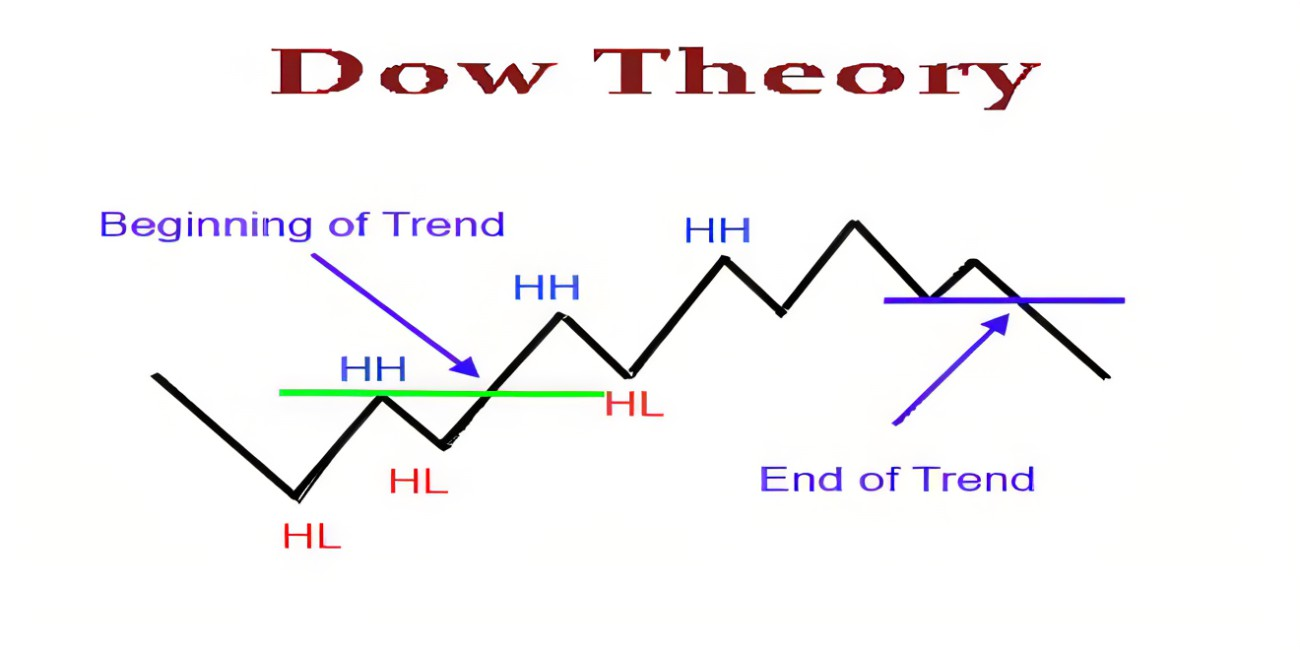
Pioneered by Charles H. Dow, one of the founders of The Wall Street Journal and Dow Jones & Co., and the publisher of MarketWatch, the theory states that if two stock-market averages, most commonly the Dow industrials and transport gauges, reach notable new highs within the same short period, then the broader market is likely headed higher.

It also was one of the first theories that sought to codify a methodology for prognosticating where the market might be headed in the intermediate future. For more than a century, it’s been a staple in the repertoire of technical strategists, who aim to glean insights through analysis of stock-market charts and indicators.

CITE: https://www.r2library.com/Resource

Dow Theory has lost some of its luster in modern times, especially as the Dow has taken a backseat in recent years to the S&P 500 and high flying tech-heavy indexes like the NASDAQ Composite and NASDAQ-100 critics also have lambasted it as overly simplistic.

MORE: https://medicalexecutivepost.com/2022/06/23/the-technicians/

But proponents of the technical Dow Theory can still point to a wealth of historical data showing it generally works as a buy signal, especially if its broadened to include other indexes like the now-dominant S&P 500.

MORE: https://www.investopedia.com/terms/d/dowtheory.asp

***

***

COMMENTS APPRECIATED

Thank You

***

FINED: Wall $treet Financial Firms

By Staff Reporters

***

***

Wall Street HIT with $2 billion in fines!

The three-martini lunch may dwindle to two after a dozen of the largest finance firms agreed to pay more than two billion dollars to settle probes from the SEC and CFTC.

Those regulators claimed that the banks failed to adequately manage employee communication.

And, for the second time in a decade, Regions Bank was found to have charged illegal overdraft fees, the government in a settlement that will require the bank to repay $141 million to customers and pay an additional $50 million in fees.

MORE: https://www.reuters.com/business/finance/us-fines-16-major-wall-street-firms-11-billion-over-recordkeeping-failures-2022-09-27/

***

COMMENTS APPRECIATED

Thank You

***

INVESTING: https://www.routledge.com/Comprehensive-Financial-Planning-Strategies-for-Doctors-and-Advisors-Best/Marcinko-Hetico/p/book/9781482240283

***

“We Can Never Know About The Days [FINANCIAL MARKETS] To Come”

Join Our Mailing List

AS CARLY SIMON USED TO SING …

ArtBy Arthur Chalekian GEPC

[Financial Consultant]

However, that doesn’t stop anyone from making educated guesses about the future of companies, financial markets, and economies.

So, as we enter the second quarter, investment and business professionals have been offering their insights:

  • McKinsey & Company’s March Economic Conditions Snapshot indicated 80 percent of surveyed executives “… expect demand for their companies’ products and services will grow or stay the same in the coming months, and a majority believe (as they have in every survey since 2011) their companies’ profits will increase.” However, they are not as optimistic about the global economy as they were in December. About one-half of executives in developed and emerging markets said economic conditions globally are worse than they were six months ago
  • The Wall Street Journal’s April 2016 Economic Forecasting Survey, which queries 60 economists, reported three-of-four survey participants expect a Fed rate hike in June. Few expect a recession during the next 12 months, putting the odds at 19 percent. Almost one-half stated global risks were the greatest threat to the U.S. economy, followed by financial conditions, a slowdown in consumer spending, falling corporate profits, and U.S. politics.
  • PIMCO’s Cyclical Outlook predicts China’s gross domestic product (GDP) growth may be in the 5.5 to 6.5 percent range. The target is 6.5 percent. In addition, a gradual devaluation of the yuan is possible, although China’s currency policy often produces unexpected twists and turns.
  • BlackRock Investment Institute’s second quarter outlook centered on three themes. First, returns are likely to remain muted in the future. Second, monetary policies appear to be less divergent, which could be a positive for some markets. Third, volatility may persist as the Federal Reserve normalizes monetary policy. Diversity and careful asset selection are likely to be critical in this environment.

***

Photo of hands of businesspeople during discussing

***

Conclusion

Your thoughts and comments on this ME-P are appreciated. Feel free to review our top-left column, and top-right sidebar materials, links, URLs and related websites, too. Then, subscribe to the ME-P. It is fast, free and secure.

While it’s interesting to read experts’ predictions and expectations for coming months and years, it’s important to remember forecasts are not always accurate. An organization that tracked forecasting results through 2012 found forecasts were correct about 47 percent of the time.

Speaker: If you need a moderator or speaker for an upcoming event, Dr. David E. Marcinko; MBA – Publisher-in-Chief of the Medical Executive-Post – is available for seminar or speaking engagements. Contact: MarcinkoAdvisors@msn.com

OUR OTHER PRINT BOOKS AND RELATED INFORMATION SOURCES:

Comprehensive Financial Planning Strategies for Doctors and Advisors: Best Practices from Leading Consultants and Certified Medical Planners™

***

How Have Bonds Responded to Higher Interest Rates?

Join Our Mailing List 

A Survey of Economists

By Lon Jefferies MBA CFP™

Lon JeffriesRecently, I pondered the possibility of interest rates rising and the impact it might have on bonds. The article was motivated by a Wall Street Journal survey of 50 top economists who forecasted the yield on the 10-year Treasury bond to rise to 3.47% by the end of 2014.

As you may know, the investment return of existing bonds tends to move inversely to interest rates. Consequently, there has been significant concern that bond values are due for a considerable drop, and investors have constantly questioned whether they should reduce their exposure to fixed-income investments.

The Forecast Results

So how has the economists’ forecast panned out through January? The 10-year Treasury bond began the year at 3.03%, but ended January at 2.65% — a significant decline.

As a result, bonds have generally increased in value. For instance, the iShares Investment Grade Corporate Bond ETF (LQD) is up 1.88% since the New Year, while the iShares Barclays 7-10 Year Treasury Bond (IEF) is up 3.06%. Even the SPDR Barclays International Treasury Bond ETF (BWX) is up .45% in 2014.

Why?

What has caused this unexpected result?

First, the historical inaccuracy of interest rate forecasts is well documented. A study by the University of North Carolina found economists predict future rates far less accurately than a random coin flip would fare as a predictor. Rising interest rates have been a general expectation since shortly after the market crash of 2008. Remember all the people who refinanced their homes away from an adjustable-rate mortgage to a fixed mortgage from 2010-2011 out of fear of rising rates? That rate hike still hasn’t come.

But, more important than the unpredictable nature of interest rates is the way bond performance has historically been related to the stock market’s performance.

In difficult market environments, the investment returns of stocks and bonds tend to have an inverse relationship. In fact, the S&P 500 (a broad measure of the U.S. stock market) has decreased in value during a calendar year five times since 1990 (1990, 2000, 2001, 2002, 2008). In all five instances, the value of U.S. Government Bonds (as measured by the Barclays Long-Term Government Bond Index) has increased (6.29%, 20.28%, 4.34%, 16.99%, and 22.69%, respectively).

RISK

Performance of Equities

How have risky stocks performed in 2014? The S&P 500 is down -3.46%, the Dow Jones Developed Market ex-U.S. market index (a measure of international stock performance) is down -3.64%, and the iShares MSCI Emerging Markets Index is down -8.63%.

It appears investors have fled stocks in a declining market and sought solace in the fixed income benefit that bonds provide, in-step with historic behavioral norms. Of course, higher demand for bonds means higher values. This last month has been a nice reminder of the stability bonds can add to a portfolio in a time of declining stock prices.

Assessment

While it is reasonable to expect interest rates to rise by some measure over the long-term, it would clearly be a mistake to dramatically shift your asset allocation away from bonds if they were determined to be a part of an investment portfolio that matches your risk tolerance.

January 2014 illustrated that bonds tend to increase in value and add benefit to a portfolio during market pullbacks, regardless of what interest rates are doing. In fact, bonds’ historical inverse relationship with stocks may be a larger determinate of performance than interest rate expectations.

More:

Conclusion

Your thoughts and comments on this ME-P are appreciated. Feel free to review our top-left column, and top-right sidebar materials, links, URLs and related websites, too. Then, subscribe to the ME-P. It is fast, free and secure.

Link: http://feeds.feedburner.com/HealthcareFinancialsthePostForcxos

Speaker: If you need a moderator or speaker for an upcoming event, Dr. David E. Marcinko; MBA – Publisher-in-Chief of the Medical Executive-Post – is available for seminar or speaking engagements. Contact: MarcinkoAdvisors@msn.com

OUR OTHER PRINT BOOKS AND RELATED INFORMATION SOURCES:

DICTIONARIES: http://www.springerpub.com/Search/marcinko
PHYSICIANS: www.MedicalBusinessAdvisors.com
PRACTICES: www.BusinessofMedicalPractice.com
HOSPITALS: http://www.crcpress.com/product/isbn/9781466558731
CLINICS: http://www.crcpress.com/product/isbn/9781439879900
BLOG: www.MedicalExecutivePost.com
FINANCE: Financial Planning for Physicians and Advisors
INSURANCE: Risk Management and Insurance Strategies for Physicians and Advisors

Product Details  Product Details

Vote on Healthcare Reform

A ME-P Healthcare Reform Opinion Poll

By Ann Miller; RN, MHA

[Executive-Director]

According to a new NBC News/Wall Street Journal poll, the public has soured on President Barack H. Obama’s health care reform plan.

In fact, former Governor and Democratic National Committee Chairman Howard Dean MD told Vermont National Public Radio:

“This is essentially the collapse of health care reform in the United States Senate. And, honestly, the best thing to do right now is kill the Senate bill and go back to the House … You have the vast majority of Americans want the choices, they want real choices. They don’t have them in this bill. This is not health care reform and it’s not close to health care reform.” 

Now, as an informed ME-P reader, do you think healthcare reform overhaul is a good idea?

Please VOTE:

Get our Widget: Get this widget!

Our Other Print Books and Related Information Sources:

Practice Management: http://www.springerpub.com/prod.aspx?prod_id=23759

Physician Financial Planning: http://www.jbpub.com/catalog/0763745790

Medical Risk Management: http://www.jbpub.com/catalog/9780763733421

Healthcare Organizations: www.HealthcareFinancials.com

Health Administration Terms: www.HealthDictionarySeries.com

Physician Advisors: www.CertifiedMedicalPlanner.com

Subscribe Now: Did you like this Medical Executive-Post, or find it helpful, interesting and informative? Want to get the latest ME-Ps delivered to your email box each morning? Just subscribe using the link below. You can unsubscribe at any time. Security is assured.

Link: http://feeds.feedburner.com/HealthcareFinancialsthePostForcxos