A MODERN PRESCRIPTION SHOWDOWN: Amazon Pharmacy VS. GoodRx

By Dr. David Edward Marcinko MBA MEd

***

***

In the evolving landscape of digital health care, Amazon Pharmacy and GoodRx have emerged as two leading platforms offering consumers affordable and convenient access to prescription medications. While both aim to simplify the process of obtaining prescriptions, they differ significantly in their approach, pricing models, and user experience.

Amazon Pharmacy, launched in 2020, is a full-service online pharmacy that allows customers to order medications directly through Amazon. It offers fast, free delivery for Prime members and integrates with most insurance plans. One of its standout features is RxPass, a subscription service available to Prime members for $5 per month, which covers unlimited eligible generic medications. This model is particularly attractive to individuals who take multiple generics regularly, as it can significantly reduce out-of-pocket costs.

In contrast, GoodRx, founded in 2011, operates primarily as a price comparison and discount platform. It does not dispense medications itself but partners with local and mail-order pharmacies to help users find the lowest prices. GoodRx provides coupons that can be used at thousands of pharmacies nationwide, often resulting in substantial savings—especially for those without insurance. It also offers GoodRx Gold, a paid membership that unlocks deeper discounts and telehealth services.

***

***

When comparing the two, pricing transparency is a key differentiator. GoodRx excels in showing users a range of prices across different pharmacies, empowering them to choose the most cost-effective option. Amazon Pharmacy, while competitive, typically offers fixed prices and focuses more on convenience and integration with its broader ecosystem.

Convenience is another area where Amazon Pharmacy shines. With its streamlined ordering process, automatic refills, and integration with Amazon’s delivery network, it appeals to users who prioritize ease and speed. GoodRx, while convenient in its own right, requires users to present coupons at the pharmacy or use mail-order services, which may involve more steps.

Insurance compatibility also varies. Amazon Pharmacy accepts most major insurance plans, making it a viable option for insured individuals. GoodRx, on the other hand, is often used by those without insurance or with high deductibles, as its discounts can sometimes beat insurance copays.

However, both platforms have limitations. Amazon Pharmacy’s RxPass is restricted to generic medications and excludes certain states due to regulatory issues. GoodRx’s discounts may not apply to all medications, and prices can fluctuate depending on location and pharmacy.

In terms of user experience, Amazon offers a seamless, tech-driven interface with customer support and medication management tools. GoodRx provides educational resources, price alerts, and a mobile app that helps users track savings and prescriptions.

Ultimately, the choice between Amazon Pharmacy and GoodRx depends on individual needs. For those seeking a one-stop solution with predictable costs and fast delivery, Amazon Pharmacy may be ideal. For users who want to shop around for the best deal or lack insurance, GoodRx offers unmatched flexibility and savings.

As digital health continues to grow, both platforms are reshaping how Americans access medications—making prescriptions more affordable, transparent, and accessible than ever before.

COMMENTS APPRECIATED

EDUCATION: Books

SPEAKING: Dr. Marcinko will be speaking and lecturing, signing and opining, teaching and preaching, storming and performing at many locations throughout the USA this year! His tour of witty and serious pontifications may be scheduled on a planned or ad-hoc basis; for public or private meetings and gatherings; formally, informally, or over lunch or dinner. All medical societies, financial advisory firms or Broker-Dealers are encouraged to submit an RFP for speaking engagements: CONTACT: Ann Miller RN MHA at MarcinkoAdvisors@outlook.com 

Like, Refer and Subscribe

***

***

PHYSICIAN: Pay Cuts in 2025

By Staff Reporters

***

***

Doctors, Facing Another Pay Cut, Call for Permanent Medicare Payment Reform

The Centers for Medicare and Medicaid Services (CMS) is moving forward with a 2.9% cut to physician payments in 2025 despite protest from major industry groups. CMS has finalized the calendar year 2025 Medicare Physician Fee Schedule rule that sets payment rates for next year and also outlines new policies focused on primary care, preserved telehealth flexibilities, and a strengthened Medicare Shared Savings Program (MSSP). 

But, provider groups were quick to condemn CMS’ decision to go ahead with the pay cut, which was proposed in the draft rule released in July. In a statement, Bruce Scott, MD, president of the American Medical Association (AMA), pointed out that that while physicians are receiving a 2.8% payment cut next year, medical practice costs for physicians will increase by 3.5% in 2025. After adjusted for inflation, Medicare reimbursement to physicians has decreased 29% since 2001, the AMA says.

Source: Heather Landi, Fierce Healthcare [11/2/24]

COMMENTS APPRECIATED

Thank You

***

***

DAILY UPDATE: Walmart, HHS and Geriatrics as Companies and Stock Market Still Rise

MEDICAL EXECUTIVE-POST TODAY’S NEWSLETTER BRIEFING

***

Essays, Opinions and Curated News in Health Economics, Investing, Business, Management and Financial Planning for Physician Entrepreneurs and their Savvy Advisors and Consultants

Serving Almost One Million Doctors, Financial Advisors and Medical Management Consultants Daily

A Partner of the Institute of Medical Business Advisors , Inc.

http://www.MedicalBusinessAdvisors.com

SPONSORED BY: Marcinko & Associates, Inc.

***

http://www.MarcinkoAssociates.com

Daily Update Provided By Staff Reporters Since 2007.
How May We Serve You?
© Copyright Institute of Medical Business Advisors, Inc. All rights reserved. 2024

REFER A COLLEAGUE: MarcinkoAdvisors@msn.com

SPONSORSHIPS AVAILABLE: https://medicalexecutivepost.com/sponsors/

ADVERTISE ON THE ME-P: https://tinyurl.com/ytb5955z

***

HAPPY JULY FOURTH

The S&P 500 broke above 5,500 yesterday and stayed there for the first time in market history, notching yet another all-time high for the index—its 32nd this year alone. With so much bullishness it’s understandable that investors may be wondering if we’re at the top yet, but chartists suggests gains tend to beget gains. The bulls have too much momentum to stop now—and if/when the FOMC cuts rates later this year, it seems likely that we’ll see more all-time highs in 2024? Any thoughts.

CITE: https://www.r2library.com/Resource

The Biden administration has awarded $206.3 million of funding to clinician training programs across 42 universities and provider organizations to bolster the nation’s geriatrics care workforce. Programs will be able to integrate geriatrics training into primary care and will work to educate older adults’ families on their care needs. Health and Human Services, in its announcement, noted that primary care providers are a crucial source of care for much of the aging population.


As Walmart shutters its primary care clinics, the retail giant inked a deal to sell its MeMD telehealth business to health tech startup Fabric. Fabric provides a telemedicine platform for a range of customers, including provider groups, with the goal of improving the clinician and patient experience, as well as operational efficiency. The acquisition will expand its provider network, add virtual behavioral health to the company’s services and build on Fabric’s employer and payer solutions.


And…The U.S. Supreme Court has overturned the Chevron deference, stripping power from federal agencies to interpret and enforce regulations. Courts no longer have to defer to reasonable agency interpretations. One healthcare attorney told Fierce Healthcare he predicts the Centers for Medicare & Medicaid Services will be under a microscope from the courts going forward, and there will be more scrutiny towards provider reimbursement cuts, drug pricing regulation and the Inflation Reduction Act.

CITE: https://tinyurl.com/2h47urt5

Here’s where the major benchmarks ended:

  • The S&P 500 index®(SPX)rose 28.01 points (0.51%) to 5,537.02; the Dow Jones Industrial Average® ($DJI) fell 23.85 points (-0.1%) to 39,308.00; the NASDAQ Composite® ($COMP) gained 159.54 points (0.9%) to 18,188.30.
  • The 10-year Treasury note yield (TNX) dropped seven basis points to 4.36%.
  • The CBOE Volatility Index® (VIX) held steady at 12.09.

What’s up

What’s down

  • First Foundation plummeted 23.81% after the bank announced it will raise $225 million to shore up a balance sheet burdened by commercial real estate loans.
  • Constellation Brands fell 3.76% after the alcoholic beverage maker reported stronger than expected earnings but missed Wall Street’s expectations on revenue.
  • Simulations Plus slid 14.87% after it reported strong third-quarter earnings but announced it’s cutting its dividend.
  • CureVac popped then dropped 6.59% after GSK bought the rights to the smaller pharma company’s Covid-19 and flu vaccines for $1.6 billion.

CITE: https://tinyurl.com/tj8smmes

COMMENTS APPRECIATED

PLEASE SUBSCRIBE: MarcinkoAdvisors@msn.com

Thank You

***

***

***

***

EDUCATIONAL TEXTBOOKS: https://tinyurl.com/4zdxuuwf

***

DAILY UPDATE: The CPI, Korion Health and the Stock Markets Rebound

MEDICAL EXECUTIVE-POST TODAY’S NEWSLETTER BRIEFING

***

Essays, Opinions and Curated News in Health Economics, Investing, Business, Management and Financial Planning for Physician Entrepreneurs and their Savvy Advisors and Consultants

Serving Almost One Million Doctors, Financial Advisors and Medical Management Consultants Daily

A Partner of the Institute of Medical Business Advisors , Inc.

http://www.MedicalBusinessAdvisors.com

SPONSORED BY: Marcinko & Associates, Inc.

***

http://www.MarcinkoAssociates.com

Daily Update Provided By Staff Reporters Since 2007.
How May We Serve You?
© Copyright Institute of Medical Business Advisors, Inc. All rights reserved. 20224

REFER A COLLEAGUE: MarcinkoAdvisors@msn.com

SPONSORSHIPS AVAILABLE: https://medicalexecutivepost.com/sponsors/

ADVERTISE ON THE ME-P: https://tinyurl.com/ytb5955z

Happy Shakespeare Day

***

The March Consumer Price Index, which the Bureau of Labor Statistics released last week, revealed that core inflation hit 3.8% Year over Year in March, rising for the first time in 12 months. That’s moving in the wrong direction for the Fed, whose goal is to bring inflation down to 2%.

CITE: https://www.r2library.com/Resource

Here’s where the major benchmarks ended:

  • The S&P 500 index rose 43.37 points (0.9%) to 5,010.60; the Dow Jones Industrial Average® ($DJI) gained 253.58 points (0.7%) to 38,239.98; the NASDAQ Composite advanced 169.30 points (1.1%) to 15,451.31.
  • The 10-year Treasury note yield (TNX) was little changed at 4.617%.
  • The CBOE Volatility Index® (VIX) fell 1.41 to 16.39.

Chipmaker strength lifted the Philadelphia Semiconductor Index (SOX) up 1.7% Monday, partially reclaiming last week’s 9.2% tumble. Banking shares were also among the strongest sectors, while the Russell 2000® Index (RUT) advanced 1%. WTI crude futures earlier dropped to just a few cents above $82 per barrel, the lowest intraday price since late March.

CITE: https://tinyurl.com/2h47urt5

Telemedicine has a lot of potential to bridge barriers and make it convenient for people to access healthcare. But it’s limited by lack of tools. Your doctor can’t reach through the computer screen.”—Akshaya Anand, co-founder of Korion Health, on the startup’s efforts to create an electronic stethoscope for clinicians to record heart and lung movement (Maryland Today)

CITE: https://tinyurl.com/tj8smmes

COMMENTS APPRECIATED

PLEASE SUBSCRIBE: MarcinkoAdvisors@msns.com

Thank You

***

***

***

***

EDUCATIONAL TEXTBOOKS: https://tinyurl.com/4zdxuuwf

***

DAILY UPDATE: Tesla Lay Offs, Mammograms, Physician Pay, UnitedHealth and Tele-Health as Stock Markets Close Mixed

MEDICAL EXECUTIVE-POST TODAY’S NEWSLETTER BRIEFING

***

Essays, Opinions and Curated News in Health Economics, Investing, Business, Management and Financial Planning for Physician Entrepreneurs and their Savvy Advisors and Consultants

Serving Almost One Million Doctors, Financial Advisors and Medical Management Consultants Daily

A Partner of the Institute of Medical Business Advisors , Inc.

http://www.MedicalBusinessAdvisors.com

SPONSORED BY: Marcinko & Associates, Inc.

***

http://www.MarcinkoAssociates.com

Daily Update Provided By Staff Reporters Since 2007.
How May We Serve You?
© Copyright Institute of Medical Business Advisors, Inc. All rights reserved. 20224

REFER A COLLEAGUE: MarcinkoAdvisors@msn.com

SPONSORSHIPS AVAILABLE: https://medicalexecutivepost.com/sponsors/

ADVERTISE ON THE ME-P: https://tinyurl.com/ytb5955z

***

Stat: 10%. That’s the percentage of Tesla employees that will be impacted by its global workforce reduction. Elon Musk sent an email to employees on Monday informing them of the layoffs, which he said were made to “reduce costs and increase productivity,” according to the WSJ. The move comes as the electric vehicle maker deals with a wider slowdown in EV sales. (the Wall Street Journal)

CITE: https://www.r2library.com/Resource

UnitedHealth Group, reeling from the Change cyberattack, recorded a loss of $1.4 billion in the first quarter. Still, its EPS exceeded expectations and the stock is trading up.


The Florida Medicaid market is a big prize for insurers. Just three plans earned statewide contracts, starting in October.


And … physicians made steady pay gains last year, but increases were undercut by inflation rates. See how other specialties fared, according to a report from Medscape.

The social determinants of health can impact a woman’s chance of being up to date with her mammogram, according to a recent Centers for Disease Control and Prevention report. Women are less likely to get a mammogram if they feel socially isolated, have lost a job or don’t have reliable transportation.


And…A major House subcommittee is considering whether to issue another short-term extension on telehealth flexibilities as they continue to evaluate cost and quality issues or to enact permanent changes to virtual care reimbursement.  The American Telemedicine Association is pushing Congress to make permanent the Medicare telehealth flexibilities implemented during the COVID-19 pandemic.

CITE: https://tinyurl.com/tj8smmes

Here’s where the major benchmarks ended:

  • The S&P 500® index (SPX) declined 10.41 points (0.2%) to 5,051.41, its lowest close in almost two months; the Dow Jones Industrial Average® ($DJI) advanced 63.86 points (0.2%) to 37,798.97; the NASDAQ Composite® ($COMP) eased 19.77 points (0.1%) to 15,865.25.
  • The 10-year Treasury note yield gained almost 4 basis points to 4.667%.
  • The CBOE Volatility Index® (VIX) fell 0.83 to 18.40.

Scaled-back expectations for Fed rate cuts continued to burden interest-rate-sensitive sectors, such as banks and utilities. The KBW Regional Bank Index (KRX) lost 1.4% and ended near a five-month low. The small-cap Russell 2000® Index (RUT) dropped 0.4% and ended at a two-month low.

In other markets, the U.S. dollar index (DXY) strengthened for the fifth consecutive trading day and hit its highest level since late October, reflecting expectations rates will stay elevated. 

CITE: https://tinyurl.com/2h47urt5

COMMENTS APPRECIATED

PLEASE SUBSCRIBE: MarcinkoAdvisors@msns.com

Thank You

***

***

***

***

EDUCATIONAL TEXTBOOKS: https://tinyurl.com/4zdxuuwf

***

What is a CONTENT DELIVERY NETWORK, Doctor?

CDNs and What They Mean to Physicians

BY J.M.

[Anonymous IT Expert]

DOCTOR – Do you like the internet? Do you use EMRs/EHRs? Do you like fast internet? Of course you do.

But, without a strong infrastructure of content delivery networks (CDNs), website loading times would be too slow to stream tele-health/tele-medicine visits or tela-radiology services; not to mention Netflix, or argue with Reddit strangers or your patients; etc.

CDNs are geographically distributed networks of servers that handle processing and speed up internet delivery. In practice, CDNs make website content like HTML pages, JavaScript files, style-sheets, images, and videos load faster. They also reduce bandwidth costs, handle more traffic, and provide a little security protection. 

  • CDNs don’t actually host web content, but instead keep cached versions of it at the ready in edge servers. 

***

How CDN Works? How to Find the Cheapest CDN Provider?

***

Fastly is one of a number of significant CDN providers that help form the infrastructure of the internet. And while the outage shows the breadth of its reach, it’s far from the biggest player—Akami, Cloudflare, and Amazon CloudFront take up 75% of revenue in CDN space, per Intricately.

But Fastly, one of the world’s largest cloud computing companies itself, just had an outage that shut down its CDN service, affecting major websites including the New York Times, HBO Max, and the British government’s homepage. 

ASSESSMENT: Were you or your clinic or hospital affected? Your thoughts and comments are appreciated.

ORDER DICTIONARY: https://medicalexecutivepost.com/wp-content/uploads/2007/10/foreword-mata.pdf

INVITE DR. MARCINKO: https://medicalexecutivepost.com/dr-david-marcinkos-

THANK YOU

***

WHY? Give Up Tele-Medicine!

By Michael Kirsch, M.D

***

***

Why This Doctor Gave Up Telemedicine

During the pandemic, I engaged in telemedicine with my patients out of necessity.  This platform was already destined to become part of the medical landscape even prior to the pandemic.  COVID-19 accelerated the process.  The appeal is obvious.  Patients can have medical visits from their own homes without driving to the office, parking, checking in, finding their way to the office, biding time in the waiting room and then driving out afterwards.  And patients could consult physicians from far distances, even across state lines.  Most of the time invested in traditional office visits occurs before and after the actual visits.  So much time wasted! Indeed, telemedicine has answered the prayers of time management enthusiasts.

***

COMMENTS APPRECIATED

Thank You

***

RELATED: https://www.routledge.com/Risk-Management-Liability-Insurance-and-Asset-Protection-Strategies-for/Marcinko-Hetico/p/book/9781498725989

***

SURVEY: Tele-Health Weekly Visits

By MCOL

***

***

% Providing Video Telehealth Visits to 5+ Patients Per Week

 •  Primary Care Physician: 74%
 •  Behavioral Health Provider: 88%
 •  Registered Nurse: 62%
 •  Medical Assistant: 80%

Source: RAND, “Experiences of Health Centers in Implementing Telehealth Visits for Underserved Patients During the COVID-19 Pandemic,” May 2022

***

COMMENTS APPRECIATED

Thank You

***

***

***

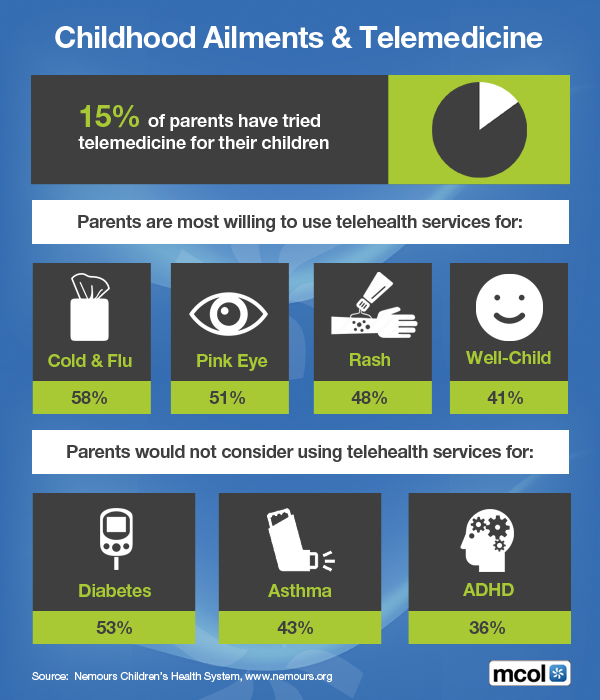
Telemedicine and Childhood Ailments

And … Parents

By http://www.MCOL.com

***

***

Conclusion

Your thoughts and comments on this ME-P are appreciated. Feel free to review our top-left column, and top-right sidebar materials, links, URLs and related websites, too. Then, subscribe to the ME-P. It is fast, free and secure.

Speaker: If you need a moderator or speaker for an upcoming event, Dr. David E. Marcinko; MBA – Publisher-in-Chief of the Medical Executive-Post – is available for seminar or speaking engagements. Contact: MarcinkoAdvisors@msn.com

OUR OTHER PRINT BOOKS AND RELATED INFORMATION SOURCES:

Product DetailsProduct Details

***

SURVEY: 39% of Medical Providers Conduct Covid-19 Screens Via Tele-Health

By staff Reporters

***

39% of Providers Conduct Covid-19 Screens Via Telehealth

In a recent survey providers were asked what types of patient care they deliver via telehealth. The survey found:

 •  Conduct primary care visits (75%)
 •  Conduct chronic care visits (72%)
 •  Order prescription refills (64%)
 •  Conduct COVID-19 screenings (39%)
 •  Conduct urgent care visits (38%)
 •  Address mental health concerns (36%)
 •  Conduct follow-up after a procedure or surgery care (28%)

Source: UnitedHealth Group, “Telehealth Use Will Outlive the Pandemic for Health Care Providers, Survey Shows,” March 15, 2022

***

COMMENTS APPRECIATED

Thank You

***

***

***

Guide to Telehealth

***

Guide to Telehealth – Then, Now, Tomorrow?
By Rebecca Chi

Healthcare providers have employed various forms of telehealth since long before the start of the coronavirus pandemic. Telehealth delivers knowledge and expertise to people and places that need it. A movement that largely began as a way to improve access to healthcare in rural communities saw explosive growth in 2020. Today, telehealth is in wide use and here to stay.

***

Advancing Value-Based Care Through Telehealth

What is telehealth?
The US Health Resources and Services Administration defines telehealth as any electronic information and telecommunications technology that is used to support and promote long-distance clinical healthcare, patient and professional health-related education, public health and health administration. Telehealth technologies benefit providers, healthcare organizations and patients.

The importance of telehealth
The key to maintaining population health and lowering expenditures is delivering timely access to high-quality care.

The US is struggling to improve the quality of healthcare and make the needed shift to value-based models. Innovative telehealth solutions that addressed our country’s worsening healthcare access problem reached the point of widespread adoption in 2020, when the pandemic pushed the healthcare system to its limits.

Telehealth increases convenience of care and access while decreasing costs and maximizing physician time. Providers, payers and employers are increasingly adopting various and connected types of telehealth solutions to improve healthcare operations and patient outcomes. Patients embrace the convenience, safety, accessibility and flexibility of telehealth options.

Click here to continue story. 

***

COMMENTS APPRECIATED.

Thank You

Subscribe to the Medical Executive-Post

***

66% of Nurses Expressed Consideration to Leave The Profession

By staff reporters

***

66% of Nurses Expressed Consideration to Leave The Profession

A survey of 570 nurses between May and June 2021 found:

 •  66% of nurses expressed some level of consideration to leave the profession.
 •  97% of polled participants agree, that increases to pay rates and other incentives would attract and retain nurses.
 •  58% agree that tele-health should be a cornerstone of care delivery.
 •  85% believe that we must improve cross training to adapt to crisis events.
 •  85% strongly believe national licensure would have greatly benefited the country during the pandemic.

Source: Cross Country Healthcare via Businesswire, December 1, 2021

COMMENTS APPRECIATED.

Thank You

***

***

***

***

PODCAST: Virtual Primary Care

Article of Dr. Marshall Chin in the NEJM

By Eric Bricker MD

***

***

YOUR COMMENTS ARE APPRECIATED.

Thank You

***

***

Tele-Health Financial Expansion

BY HEALTH CAPITAL CONSULTANTS, LLC

****

Additional $20 Million Directed to Rural Telehealth Expansion

It has been well documented that the COVID-19 pandemic resulted in unprecedented increases in telemedicine utilization across the U.S. However, rural providers and patients, as evidenced by their lower rates of telemedicine usage during this time, have not been able to take advantage of the opportunities provided by telemedicine to the same extent as urban providers.

On August 18, 2021, the Health Resources and Services Administration (HRSA) of the Department of Health and Human Services (HHS) announced the latest attempt to ameliorate this issue – the distribution of nearly $20 million to 36 recipients for the purpose of strengthening telehealth services in rural and underserved communities and expanding innovation and quality. (Read more…)

CITE: https://www.r2library.com/Resource/Title/0826102549

***

YOUR COMMENTS ARE APPRECIATED.

Thank You

***

***

PODCAST: Employee Health Plan MISALIGNMENT with Fee-for-Service Medicine

Current Partners Not Aligned With PLAN Goals

Dr. Boram (Kim) Park, MD - Dallas, TX | Internal Medicine

BY DR. ERIC BRICKER MD

Employee Health Plans Have Have a MISALIGNMENT Problem with the Current Fee-for-Service Healthcare System…i.e. Their Current Partners Are Not Aligned With Their Goals

***

Health Insurance Carriers Are Misaligned by Owning PBMs That Make More Money in Rebate Kick-Backs When the Employee Health Plan Spends More Money on Expensive Prescription Drugs.

Doctors Are Misaligned When They *Are Employed by Hospitals That Tie Test and Procedure Ordering Volume to Doctor Compensation.

Hospitals are Misaligned When They Buy Physician Practices and Raise the Prices for In-Office Testing and Procedures by 300%… Even Though NOTHING Has Changed Other Than the Sign on the Door.

Accordingly, True Employee Health Plan Innovation is ALIGNMENT Innovation That Provides Care Outside the of the Status Quo Fee-for-Service System.

Onsite Clinics, Near Site Clinics, Direct Primary Care and Capitated Virtual Care All Provide Real Alignment Innovation for Employee Health Plans.

ASSESSMENT: Your comments are appreciated.

CITE: https://www.r2library.com/Resource/Title/0826102549

THANK YOU

***

PODCAST: Tele-Health Benefits Everyone!

State of Telehealth in USA vs EU 2015 - Intersog eHealth

DEFINITION: Telehealth is the distribution of health-related services and information via electronic information and telecommunication technologies. It allows long-distance patient and clinician contact, care, advice, reminders, education, intervention, monitoring, and remote admissions.

Telehealth could include two clinicians discussing a case over video conference; a robotic surgery occurring through remote access; physical therapy done via digital monitoring instruments, live feed and application combinations; tests being forwarded between facilities for interpretation by a higher specialist; home monitoring through continuous sending of patient health data; client to practitioner online conference; or even videophone interpretation during a consult.

CITE: https://medicalexecutivepost.com/2021/06/03/dictionary-of-health-information-technology-and-security-2/

****

Telehealth Benefits Everyone!


Rich talks with veteran Telehealth executive, C.J. Mark about the growth of Telehealth in the last decade. They discuss the issues surrounding Telehealth, and how Covid has accelerated the importance of remote medical care.

PODCAST: https://richardhelppie.com/cj_mark/

ASSESSMENT: Your thoughts and comments are appreciated.

THANK YOU

***

ON RURAL HEALTHCARE PROVIDERS

Executive Order Expands Tele-Medicine to Ease Burden

By Health Capital Consultants, LLC

On August 3, 2020, President Donald Trump signed an executive order aimed at expanding access to care through two avenues: telemedicine and eased financial burdens on rural providers.

Health Disparities Continue to Plague Rural Areas

And so, our colleagues for this Health Capital Topics article will discuss the executive rule and the subsequent agency actions on these fronts.

READ: https://www.healthcapital.com/hcc/newsletter/08_20/HTML/EXEC/convert_executive_telemedicine_access_expansion_8.20.20.php

ASSESSMENT: Your thoughts are appreciated.

THANK YOU

***

ORDER [3rd. edition] TEXTBOOK: https://www.amazon.com/Business-Medical-Practice-Transformational-Doctors/dp/0826105750/ref=sr_1_9?ie=UTF8&qid=1448163039&sr=8-9&keywords=david+marcinko

INVITE DR. MARCINKO: https://medicalexecutivepost.com/dr-david-marcinkos-bookings/

****

Walmart Health To Acquire Telehealth Provider MeMD

BENTONVILLE, Ark., and PHOENIX, Ariz

[By Staff Reporters]

Walmart Health and MeMD, a multi-specialty telehealth provider, announced they have entered into an agreement for Walmart Health to acquire MeMD.

This reinforces Walmart’s commitment to integrated, omni-channel health delivery that leverages data and technology to improve engagement, health
equity and outcomes.

Walmart Health Acquires MeMD multi-specialty telehealth ...

READ LINK: https://corporate.walmart.com/newsroom/2021/05/06/walmart-health-to-acquire-telehealth-provider-memd

ASSESSMENT: Your thoughts are appreciated.

THANK YOU

***

Executive Order Expands Tele-Medicine

Eases Burden on Rural Medical Providers

By Health Capital Consultants, LLC

***

Executive Order Expands Telemedicine and Eases Burden on Rural Providers

On August 3, 2020, President Donald Trump signed an executive order aimed at expanding access to care through two avenues: telemedicine and eased financial burdens on rural providers. The executive order builds on President Trump’s original expansion of coverage for telemedicine services in early March 2020, an order which was praised by the American Telehealth Association (ATA) and American Medical Association (AMA) for swiftly responding to the growing healthcare crisis. This Health Capital Topics article will discuss the executive rule and the subsequent agency actions on these fronts. (Read more…)

***

TH

Historical Digital Health and Tele-Medicine?

Digital Health & Tele-Medicine are NOT 21st Century Concepts!

[via Igor Korolev DO, PhD]

***

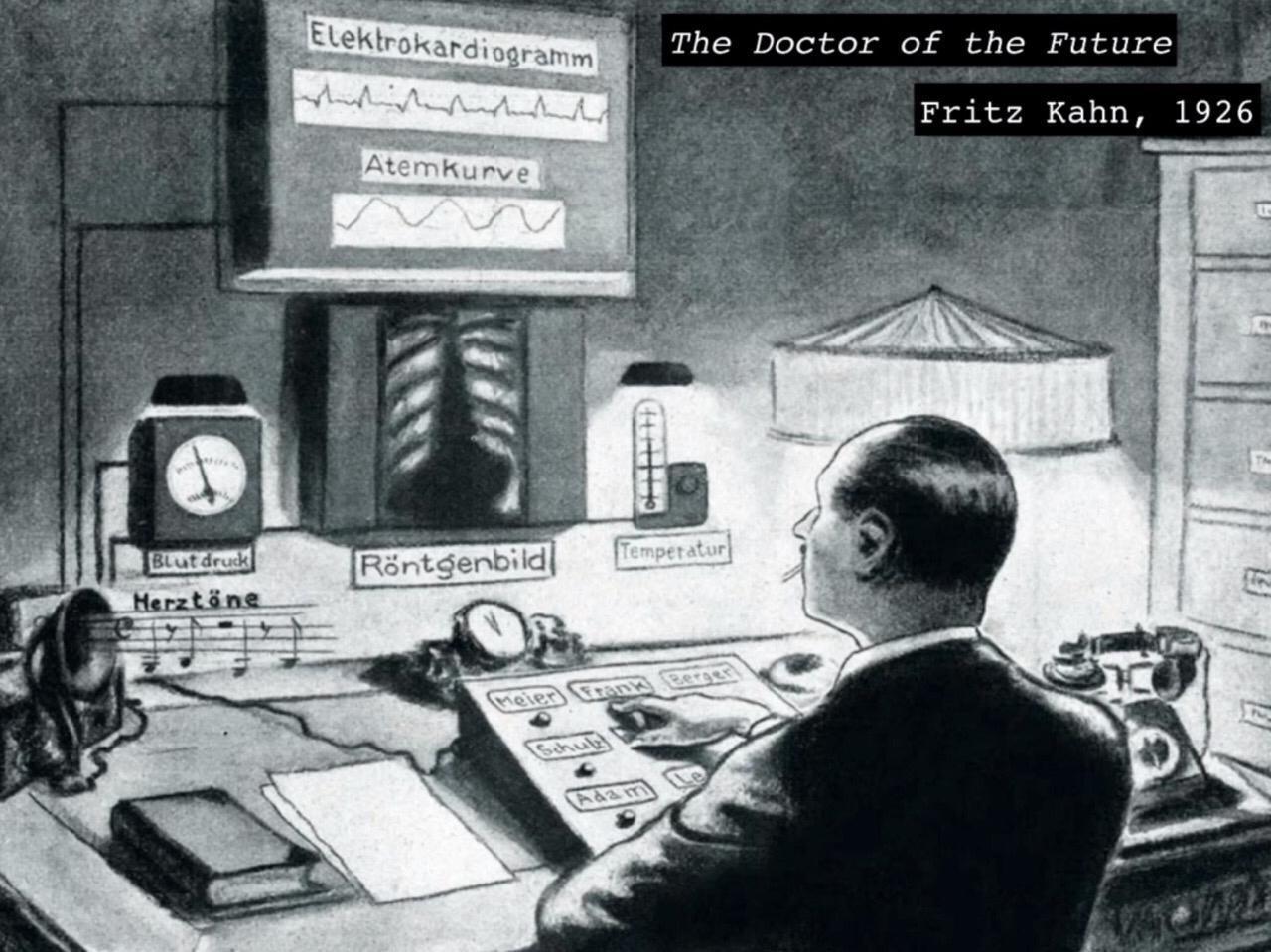
Fritz Kahn, a physician, author, and illustrator imagined the future of medicine nearly 100 years ago!

MORE: https://en.wikipedia.org/wiki/Fritz_Kahn

This 1926 illustration shows “The Doctor of the Future” providing patient care remotely using a telecommunication system & medical devices that track various physiological & health information (electrocardiogram – ECG, X-ray images, temperature, respiratory function, blood pressure).

***

***

***

***

Conclusion: Your thoughts are appreciated.

Product Details

***

The Hospital Room of Tomorrow?

Join Our Mailing List


[By Staff Reporters]

[Click on image to enlarge]

Have you ever wondered what’s just around the corner in terms of the technology we can expect to see in hospitals. You might be surprised by some of the gizmos, gadgetry and other medical advancements that will soon become regular fixtures. This infographic offers a fascinating glimpse into how hospital rooms might look in the very near future.

Conclusion

Your thoughts and comments on this ME-P are appreciated. Feel free to review our top-left column, and top-right sidebar materials, links, URLs and related websites, too. Then, subscribe to the ME-P. It is fast, free and secure.

Speaker: If you need a moderator or speaker for an upcoming event, Dr. David E. Marcinko; MBA – Publisher-in-Chief of the Medical Executive-Post – is available for seminar or speaking engagements. Contact: MarcinkoAdvisors@msn.com

OUR OTHER PRINT BOOKS AND RELATED INFORMATION SOURCES:

Product DetailsProduct Details

About Guardian24/7 Premium Global Concierge Medical Care

What it is – How it works

[By Staff Reporters]

According to their website and TV infomercials, the principals of www.Guardian247.com developed the medical systems and protocols for the President of the United States [POTUS], senior White House officials and members of the President’s cabinet to ensure the best possible medical care anywhere in the world.

Today, the convergence of telemedicine technologies and reliable telecommunications has enabled a business model for this same level of service to be brought to the private sector – for the first time.

Telemedicine Enabled

Utilizing state of the art telemedicine broadband capability, and pre-positioned medical equipment, a team of former White House physicians administer services that are purportedly nearly as effectively as if they were on location, saving hours of time and anxiety for routine medical needs – and possibly saving a life in an emergency situation.

Like an Emergency Room

The company favors a core concept known as A ReadyRoom™ that is an installation of medical equipment, supplies and medications pre-placed and installed in a client’s primary residence and/or remote vacation home, jet or yacht. Custom-tailored to the needs and the client and his/her family and location, the ReadyRoom’s™ state of the art technology allows Guardian’s physicians to direct the proper use of the medicine, supplies and equipment either via telephonic or through advanced video teleconferencing links. The model is reminiscent of an emergency room; always on-call, available for use and expensive.  

Assessment

For those who recognize that their most important asset – is their health –  this company has a serious concierge medicine type solution that is not available to the masses. As CEO of Guardian 24/7, Jonathan Frye leads the company’s efforts to provide presidential-level medical care to clients; anywhere and anytime.

Conclusion

Your thoughts and comments on this ME-P are appreciated. Feel free to review our top-left column, and top-right sidebar materials, links, URLs and related websites, too. Then, subscribe to the ME-P. It is fast, free and secure.

Link: http://feeds.feedburner.com/HealthcareFinancialsthePostForcxos

Speaker: If you need a moderator or speaker for an upcoming event, Dr. David E. Marcinko; MBA – Publisher-in-Chief of the Medical Executive-Post – is available for seminar or speaking engagements. Contact: MarcinkoAdvisors@msn.com

OUR OTHER PRINT BOOKS AND RELATED INFORMATION SOURCES:


Product Details

Reviewing Medical PDAs

Physician Use Growing Slowly

By Carol S. Miller; RN, MBAbiz-book10

Handheld personal digital assistants (PDAs), such as Palm Pilot M130, 500 or 515, Sony Clie, Visor Prism or Pro, Psion, RIM Blackberry, Zaurus, iPhone, Zune and other comparable PDA OS platforms, have revolutionized the communication world this past decade. PDAs and their future counterparts are becoming the catalyst for physicians to use information technology, are becoming the intro for physicians into the world of the electronic medical record software, and becoming the virtual office tool, enabling providers to communicate away from the desktop as well as away from his office practice. The reasons for increased utilization with physicians are portability, pocket-size, provides easy access to information at point of care and regardless of location, improves practice efficiency and workflow, improves drug related decisions and decreases adverse drug events.  

PDA Components

The common uses of PDAs by physician practices are:


  • Personal applications such as scheduling, telephone directories, dictionary, “to-do lists” and others
  • Drug databases
  • Clinic suite that ties into the hospital information system
  • Charge and procedure capture
  • Communications, from provider to provider, provider to hospital, provider to office, and vice versa

Palm Operating System

Palm OS still represents the standard in handheld computing, assisting individuals to manage and access information at any time, at any location.  Handhelds are easy to use.  Physicians are using the Palm OS and/or compatible PDAs to access their office schedules, receive downloads of clinical information on their patients, and enter clinical services and charges when performing services at remote locations.

PDA Selection

In selecting not only the PDA but also the software, the physician needs to answer the following questions:


  • What would you like to use the PDA for – clinical reference data, patient information, non-clinical applications, personal data, etc.?
  • What information do you need to know about the patient that the PDA can simplify?
  • What is the connection route between the hospital, managed care, or lab and your practice? In other words, how do you get access to the data?
  • What are your price considerations?
  • Do you need a color or black and white screen?
  • What is the system support and warranty?
  • How do you plan to connect to the office or hospital? 
  • Do you want to go wireless or obtain information via a telephone connection?
  • Do you plan to render care outside of your office practice, such as in the home, a clinic, hospital setting, etc?  If so, what would you like included on the PDA that would improve communication with the office and save time at point-of-service in documentation?

HIPAA

HIPAA regulations do not specifically address the specific term PDA, but the regulations do include guidelines for protecting patient information and transmission of this data that can impact the use of PDAs.  Physicians are utilizing handheld digital assistants whether they contain clinical information; or just resource data, may be or not are password protected, and may or may not be officially supported by hospitals or clinics.  Providers as they prepare for future applications and usage of PDAs involving patient information must understand the scope of the new HIPAA regulations as it impacts on patient data collected, stored or transmitted.  Any application involving patient identifiable data must be HIPAA compliant.  The key issues are how to protect the patient information stored on the device, i.e., if lost or stolen, and second how to protect patient information transmitted during a synchronization or wireless transaction.  Probably the most vulnerable aspect is the loss rate with recent studies indicating at least 30%.

Security

Most providers using PDAs for patient data utilize a user ID or password level of security. To maintain security, the provider should be required to re-enter their user ID or password every time they enter the application. Likewise, each PDA should have a “time out” feature, requiring a provider to re-enter his ID or password again. This feature will not prevent individuals with technical skills from accessing this information – the only mechanism is encryption.

Synchronization versus Wireless Applications

1. Synchronization transfers information from the enterprise database to the PDA, i.e., hospital lab or x-ray results, patient demographics, consultative notes, and others.  It is important that the hospital or hospital system authorize and approve the physician for using and transmitting this information and in turn, the provider authenticates and validates his agreement with the hospital before data is transmitted.  In addition for protection, an audit trail of who synchronized and what data was transmitted should be maintained by the hospital system.

2. Wireless providers have immediate real time access to patient data; however this process of transmission is more vulnerable than synchronization.  Wireless solutions can utilize a public or private network. HIPAA require encryption for the transmission of data over the public networks – Encryption is optional for others. Sharing data from a wireless over the Internet represents potential security issues; however, more and more technical firms and providers are using a wireless VPN that allows PDA users to connect securely from remote locations just as laptop users do today.

Other Issues

The other issues are who owns the PDA. If the provider does, he or she should be responsible for the security; however if the hospital does, the hospital should be responsible.  More current applications of Palm OS will include built-in modems for easier wireless communication, improved secure transactions, and ability of greater resolution for graphics, and other Web-based services. In addition, current and future applications will include refined voice dictation.  As an example, MDEverywhere’s package called Everynote allows the provider to digitally record notes and in turn links with MDEverywhere’s coded patient encounter.

The Blackberry

A very versatile product is the Blackberry.  It has web browsing capabilities, embedded wireless modem and can (1) write, send receive and respond to messages right from the unit, (2) access web information, (3) has nationwide coverage with no roaming fees, (4) has voice mail message capabilities, and (5) can be the size of a pager or PDA. The next feature with Blackberry will be its text messages to cell telephones.  New units start around $150-$300 with monthly service charges of $20-$50 depending on the plan.  The wireless Internet connection can be accomplished through Go.Web. 

Assessment

The typical cost for a PDA averages between $300 and $600 – depending on color or black and white – plus the cost of additional software and accessories.  For wireless connectivity, the physician will need to connect with a communication partner. Reference sites for PDAs are: www.handheldmed.com (for clinical, reviews, and news), www.pdamd.com (PDA resources), www.freewarepalm.com (free software programs), www.palmpilot.com, www.handspring.com.  The active shopper can refer to www.zdnet.com or www.palmblvd.com

Conclusion

And so, your thoughts and comments on this Medical Executive-Post are appreciated? Who can update the above for modernity?

Subscribe: Link: http://feeds.feedburner.com/HealthcareFinancialsthePostForcxos

Speaker: If you need a moderator or speaker for an upcoming event, Dr. David E. Marcinko; MBA – Publisher-in-Chief of the Executive-Post – is available for seminar or speaking engagements. Contact: MarcinkoAdvisors@msn.com  or Bio: www.stpub.com/pubs/authors/MARCINKO.htm

Get our Widget: Get this widget!

Our Other Print Books and Related Information Sources:

Practice Management: http://www.springerpub.com/prod.aspx?prod_id=23759

Physician Financial Planning: http://www.jbpub.com/catalog/0763745790

Medical Risk Management: http://www.jbpub.com/catalog/9780763733421

Healthcare Organizations: www.HealthcareFinancials.com

Health Administration Terms: www.HealthDictionarySeries.com

Physician Advisors: www.CertifiedMedicalPlanner.com

Subscribe Now: Did you like this Medical Executive-Post, or find it helpful, interesting and informative? Want to get the latest ME-Ps delivered to your email box each morning? Just subscribe using the link below. You can unsubscribe at any time. Security is assured.

Link: http://feeds.feedburner.com/HealthcareFinancialsthePostForcxos

Tele-Medicine is Growing

Join Our Mailing List

About SwiftMD.com

[By Staff Reporters]

radar1According to its website, SwiftMD isn’t just better telemedicine; it’s better medicine because of its physicians’ quality. Patient telephone calls are usually returned within 30 minutes, any time of the day or night. They employ a powerful eHR that is secure, HIPAA-compliant and keeps patients informed about their care. And, it is all done at an affordable price.

Link: www.SwiftMD.com

Features

Here is the prioritized way in which the telemedicine service is said to work:

  • Request – Call 1-877-WWW-SWIFT or request a consultation online.
  • Assess – No emergencies are accepted.
  • Response – A physician calls back, day or night, usually within 30 minutes.
  • Consult – The doctor discusses your condition, consults your eHR, diagnoses and recommends treatment.
  • Record – A SwiftMD health record is also available 24/7 for updated references.

Assessment

According to SwiftMD, the service is easy to us; no more driving across town; or sitting in waiting rooms. Just high-quality medical care when and where needed. Group, individual and family plans are available.

Link: http://www.swiftmd.com/xres/uploads/documents/SwiftMD-WhitePaper20080819a.pdf

UPDATE 2015

Why Teladoc Needs Medical Attention
The Wall Street Journal, October 4, 2015

Only 45% of Diabetes Patients Use Mobile Health Tools
mHealth Intelligence, October 2, 2015

AAFP Still Searching for Right Stance on Telemedicine
MedPage Today, October 2, 2015

Walgreens Expanding Telemedicine on Its App in the Next Month
MedCity News, October 1, 2015

Mobile Health Apps Fall Short in Protecting Data Privacy
Medscape, September 29, 2015

Mental-Health Apps Make Inroads With Consumers and Therapists
The Wall Street Journal, September 27, 2015

Conclusion

Your thoughts and comments on this ME-P are appreciated. Feel free to review our top-left column, and top-right sidebar materials, links, URLs and related websites, too. Then, subscribe to the ME-P. It is fast, free and secure.

Speaker: If you need a moderator or speaker for an upcoming event, Dr. David E. Marcinko; MBA – Publisher-in-Chief of the Medical Executive-Post – is available for seminar or speaking engagements. Contact: MarcinkoAdvisors@msn.com

OUR OTHER PRINT BOOKS AND RELATED INFORMATION SOURCES:

Product DetailsProduct DetailsProduct Details