Understanding Hedge Funds: A Comprehensive Guide

By Staff Reporters

SPONSOR: http://www.CertifiedMedicalPlanner.org

***

***

SPONSOR: http://www.MarcinkoAssociates.com

QUESTION: What is a Hedge Fund?

A hedge fund is a limited partnership of private investors whose money is pooled and managed by professional fund managers. These managers use a wide range of strategies, including leverage (borrowed money) and the trading of nontraditional assets, to earn above-average investment returns. A hedge fund investment is often considered a risky, alternative investment choice and usually requires a high minimum investment or net worth. Hedge funds typically target wealthy investors.

MANAGERS: https://medicalexecutivepost.com/2025/05/23/hedge-fund-hiring-separate-managers/

The hedge fund manager I am considering also runs an offshore fund under a “master feeder” arrangement.

A PHYSICIAN’S QUESTION: What does this mean? In which fund should I invest?

The master feeder arrangement is a two-tiered investment structure whereby investors invest in the feeder fund. The feeder fund in turn invests in the master fund. The master fund is therefore the one that is actually investing in securities. There may be multiple feeder funds under one master fund. Feeder funds under the same master can differ drastically in terms of fees charged, minimums required, types of investors, and many other features – but the investment style will be the same because only the master actually invests in the market.

A master feeder structure is a very popular arrangement because it allows a portfolio manager to pool both onshore and offshore assets into one investment vehicle (the master fund) that allocates gains and losses in an asset-based, proportional manner back to the onshore and offshore investors. All investors, both offshore and onshore, get the same return.  In this manner, the portfolio manager, despite offering more than one fund with different characteristics to different populations, is not faced with the dilemma of which fund to favor with the best investment ideas.

PENSION PLANS: https://medicalexecutivepost.com/2025/05/18/medical-practice-pension-plan-hedge-fund-difficulties/

A manager may offer an offshore fund because there is demand for that manager’s skill either abroad, where investors may wish to preserve anonymity, or more commonly where investors simply do not wish to become entangled with the United States tax code. American citizens should generally avoid the offshore fund, since American citizens are taxed on their allocated share of offshore corporation profits whether or not a distribution occurs. Therefore, there is no benefit for most American taxpayers investing in an offshore fund.

Tax-exempt institutions, such as medical foundations, in the United States may have reason to consider an offshore hedge fund, however. Domestic tax-exempt organizations are generally not subject to unrelated business taxable income (UBTI) – the portion of hedge fund income that comes about as a result of the use of leverage – when investing with an offshore corporation.  If the same tax-exempt organization were to invest in a domestic fund, and if UBTI was generated, then the organization would have to pay taxes on that UBTI. Most domestic hedge funds generate UBTI.

FEES: https://medicalexecutivepost.com/2025/04/05/hedge-fund-wrap-fees/

COMMENTS APPRECIATED

EDUCATION: Books

Read, Review, Like, Refer and Subscribe

***

***

DAILY UPDATE: Health Insurance Options as Bull Market Edges Upward

MEDICAL EXECUTIVE-POST TODAY’S NEWSLETTER BRIEFING

***

Essays, Opinions and Curated News in Health Economics, Investing, Business, Management and Financial Planning for Physician Entrepreneurs and their Savvy Advisors and Consultants

Serving Almost One Million Doctors, Financial Advisors and Medical Management Consultants Daily

A Partner of the Institute of Medical Business Advisors , Inc.

http://www.MedicalBusinessAdvisors.com

SPONSORED BY: Marcinko & Associates, Inc.

***

http://www.MarcinkoAssociates.com

Daily Update Provided By Staff Reporters Since 2007.
How May We Serve You?
© Copyright Institute of Medical Business Advisors, Inc. All rights reserved. 2025

REFER A COLLEAGUE: MarcinkoAdvisors@outlook.com

SPONSORSHIPS AVAILABLE: https://medicalexecutivepost.com/sponsors/

ADVERTISE ON THE ME-P: https://tinyurl.com/ytb5955z

Your Referral Count -0-

***

CITE: https://www.r2library.com/Resource

A June 11th report from global professional services firm Alvarez & Marsal (A&M) predicts that more beneficiaries might soon ditch insurance coverage for options like short-term, limited duration plans or healthcare sharing ministries (HCSMs), which aren’t regulated like health insurance and aren’t required to comply with ACA protections like covering maternity care or pre-existing conditions.

CITE: https://tinyurl.com/2h47urt5

🟢 What’s up

  • Nvidia extended its winning streak to five days, rising another 1.73% as the AI trade continues to recover.
  • EchoStar climbed 13.16% after the parent company of Dish TV disclosed that President Trump did in fact prod the FCC to make a deal.
  • Cyngn soared another 20.07% following a big day of gains after the company that makes self-driving tech for industrial vehicles announced a partnership with Nvidia.
  • Strong earnings from Nike (more on that later) propelled sporting goods stocks higher today. ON Holdings rose 1.74%, while Dick’s Sporting Goods climbed 3.59%.
  • Domestic power producers popped on reports that Trump is planning to issue an executive order increasing energy production to meet AI demand. Vistra gained 2.44%, GE Vernova climbed 2.54%, and Vertiv added 2.71%.

What’s down

  • Coinbase Global ended its winning streak, tumbling 5.77% after GENIUS Act hype propelled the crypto stock skyward all week long. Traders took profits in Circle as well, pushing the stablecoin stock down 15.54%.
  • Chinese EV maker Li Auto fell 1.93% on its weaker-than-expected deliveries forecast for the second quarter.
  • Fellow Chinese EV maker Xiaomi stunned markets with reports that it received 240,000 orders for its new SUV within 18 hours of its debut, but shares still sank 4%.
  • Pony.ai lost 6.31% on a report that Uber is considering helping its founder Travis Kalanick fund his acquisition of the US subsidiary of the Chinese autonomous vehicle company.
  • Gold miners tumbled while the price of the precious metal fell as investors took a risk-on stance. Newmont lost 4.11%, Barrick Mining fell 3.44%, and Kinross Gold shed 6.18%.
  • Today’s trade deal reopens the door for Chinese rare earth imports, bad news for US producers like MP Materials (down 8.59%) and USA Rare Earth (down 12.14%).

CITE: https://tinyurl.com/tj8smmes

Visualize: How private equity tangled banks in a web of debt, from the Financial Times.

COMMENTS APPRECIATED

PLEASE SUBSCRIBE: MarcinkoAdvisors@outlook.com

Thank You

***

***

***

***

EDUCATIONAL TEXTBOOKS: https://tinyurl.com/4zdxuuwf

***

LIFE INSURANCE: Split Dollar Plans

By Staff Reporters

***

***

Split-Dollar Life Insurance: An arrangement under which a life insurance policy’s premium, cash values, and death benefit are split between two parties—usually a corporation and a key employee or executive. Under such an arrangement an employer may own the policy and pay the premiums and give a key employee or executive the right to name the recipient of the death benefit.

***

***

Several factors will affect the cost and availability of life insurance, including age, health, and the type and amount of insurance purchased. Life insurance policies have expenses, including mortality and other charges. If a policy is surrendered prematurely, the policy holder also may pay surrender charges and have income tax implications. You should consider determining whether you are insurable before implementing a strategy involving life insurance.

Any guarantees associated with a policy are dependent on the ability of the issuing insurance company to continue making claim payments.

COMMENTS APPRECIATED

Refer and Subscribe

***

***

MEDICAL LABORATORY RESULTS: Direct Patient Access?

PROS and CONS

BY DR. DAVID EDWARD MARCINKO MBA MEd CMP®

***

***

SPONSOR: http://www.MarcinkoAssociates.com

§ DIRECT PATIENT ACCESS TO LABORATORY RESULTS

According to Patricia Salber MD [personal communication], there are a number of reasons why direct patient access to laboratory medical results is a good idea:

  • Between 8 and 26% of abnormal test results, including those suspicious for cancer, are not followed up in a timely manner.  Direct access could help reduce the number of times this occurs
  • Self-management, particularly of chronic illness has known benefits.  Just like the QS people, many folks with chronic illness obtain and manage to self-acquired lab results every day via gluco-meters, home pulmonary function tests, blood pressure measurements, and so forth.  Direct access to laboratory-acquired data, one could argue is a continuation of that personal responsibility
  • Patients want to be notified about their results in what they perceive as a timely fashion.  In one study, patients who received direct notification of their bone density tests results were more likely to perceive they had timely notification compared to usual care even though there was no measurable effect on actual treatment received after three months
  • Being more responsible for test results could encourage consumers to try to learn more about the meaning of the test results, conceivably increasing their health literacy. 

But, the arguments against direct access discussed include the following:

  • Patients prefer their physicians contact them directly when they have abnormal test results, although the major studies published in 2005 and 2009, preceded the extraordinary use of the internet to access health information that exists today.
  • There is concern over whether patients will know what to do when they receive the results – will they make erroneous interpretations or fail to contact their docs?  This could be, but the intent of the proposed rule is shared access to the results.  We suspect if the rule become law, docs will develop better notification mechanisms so that they reach the patient before the patient directly accesses the results or lab companies will design better lab test notifications with easy-to-understand interpretations or a whole new industry will appear that can provide instantly available individualized lab interpretation…or maybe all three of these would happen and that would be a very good thing.
  • Unknown impact of dual notification (doctors and patients) of lab test results on physician behavior…would docs simply shift responsibility for initiating follow-up care from themselves to their patients?
  • Would direct access of life-changing lab tests, such as HIV or malignancy, lead to unnecessary patient anxiety – or worse?  (Conversely, is there less anxiety, desperation, or suicidal ideation if the bad news is delivered face to face? 
  • Individuals likely may contact their physicians immediately after getting the lab results asking for a telephonic or face-to-face interpretation … it is not known how this would impact physician workload and/or potential for reimbursement [personal communication, Richard Hudson DO, Atlanta, GA].

EDUCATION: Books

SPEAKING: Dr. Marcinko will be speaking and lecturing, signing and opining, teaching and preaching, storming and performing at many locations throughout the USA this year! His tour of witty and serious pontifications may be scheduled on a planned or ad-hoc basis; for public or private meetings and gatherings; formally, informally, or over lunch or dinner. All medical societies, financial advisory firms or Broker-Dealers are encouraged to submit a RFP for speaking engagements: CONTACT: MarcinkoAdvisors@outlook.com 

COMMENTS APPRECIATED

Subscribe, Refer and Like

***

***

QUALIFIED EXCHANGE: 1035 Life Insurance Policy

DEFINITION

By Staff Reporters

***

***

1035 Exchange

DEFINITION: A method of exchanging insurance-related assets without triggering a taxable event. Cash-value life insurance policies and annuity contracts are two products that may qualify for a 1035 exchange.

***

A 1035 exchange is a feature in the tax code that permits individuals to transfer funds from an existing life insurance endowment, or annuity policy to a new one without tax consequences.

The IRS permits these like-kind trades under Internal Revenue Code section 1035, where this process takes its name from.

These transactions are not subject to tax deductions or tax credits but rather tax deferrals, meaning that individuals would only pay taxes on any earnings once they receive money from the policy later.

Without this provision, policyholders would have to close their previous accounts and be subjected to both taxes and surrender charges before they could open a new account.

Cite: https://www.annuity.org/annuities/1035-exchange/

COMMENTS APPRECIATED

Subscribe and Refer

***

***

INSURANCE: Variable Universal Life

DEFINITION

By Staff Reporters

***

***

Variable Universal Life Insurance: Permanent life insurance that allows the policyholder to vary the amount and timing of premiums and, by extension, the death benefit. Universal life insurance policies accumulate cash value which grows tax deferred. Within certain limits, policyholders can direct how this cash value will be allocated among sub-accounts offered within the policy.

Several factors will affect the cost and availability of life insurance, including age, health, and the type and amount of insurance purchased. Life insurance policies have expenses, including mortality and other charges. If a policy is surrendered prematurely, the policyholder also may pay surrender charges and have income tax implications. You should consider determining whether you are insurable before implementing a strategy involving life insurance.

Any guarantees associated with a policy are dependent on the ability of the issuing insurance company to continue making claim payments.

COMMENTS APPRECIATED

Refer and Subscribe

***

***

INFINITE BANKING: Life Insurance Defined

By Staff Reporters

***

***

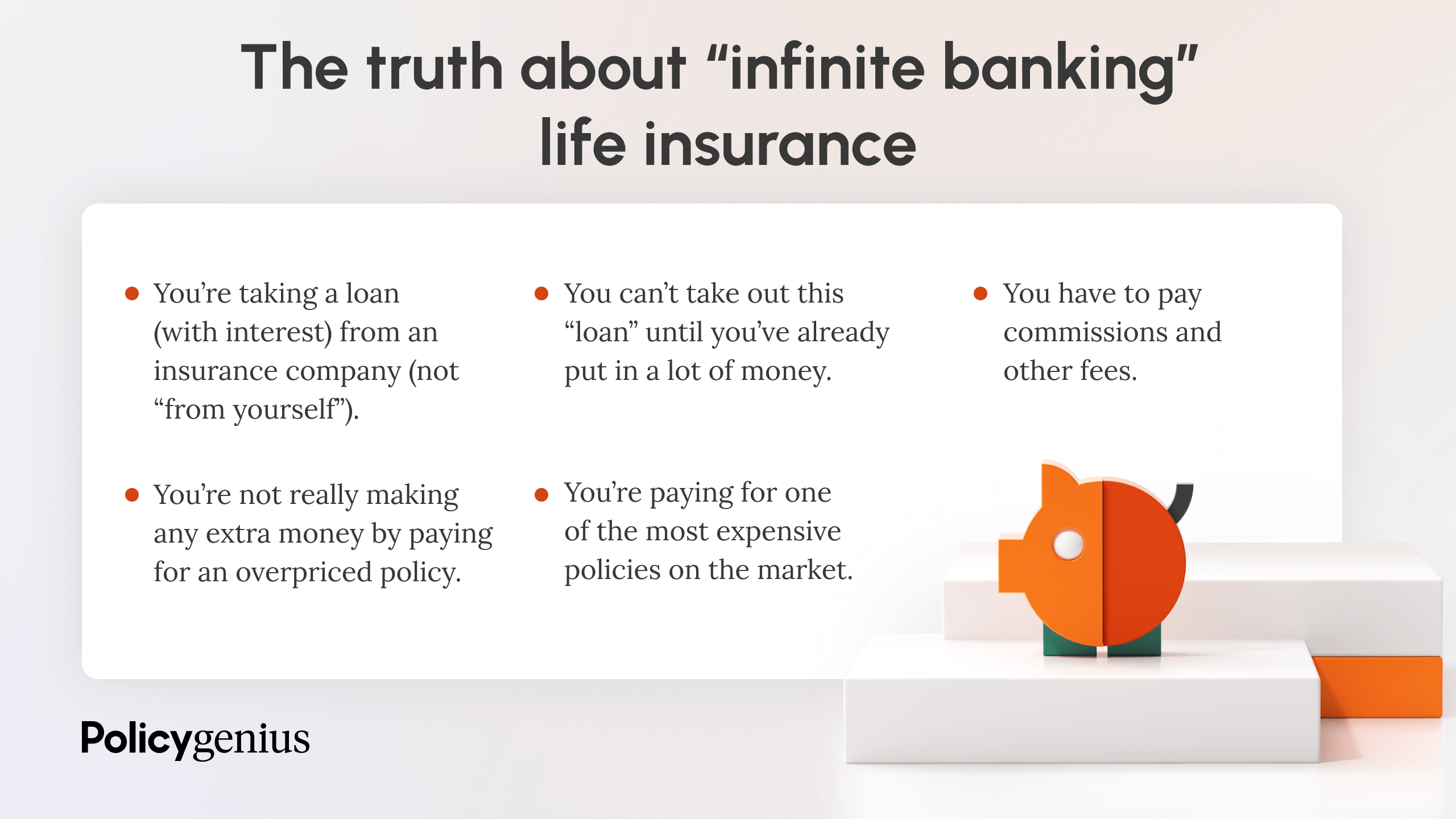
Infinite banking is not a product or service offered by a specific institution. It’s a concept promoted as a way you can “be your own bank” to have more control over your money. 

Infinite banking is a strategy in which you buy a life insurance policy that accumulates interest-earning cash value and take out loans against it, “borrowing from yourself” as a source of capital. Then eventually pay back the loan and start the cycle all over again. To whit:

  1. Buy a cash value life insurance policy, which you own and control.
  2. Pay policy premiums, a portion of which builds cash value.
  3. Cash value earns compounding interest.
  4. Take a loan out against the policy’s cash value, tax-free.
  5. Repay loans with interest.
  6. Cash value accumulates again, and the cycle repeats.

If you use this concept as intended, you’re taking money out of your life insurance policy to purchase everything you’d need for the rest of your life. Cars. Houses. Airplane tickets. Netflix.

So, when you pay back the policy loan, just as you’d have to pay back any mortgage, auto loan, or credit card, you’re paying yourself back.

Nelson Nash popularized this concept in his book Becoming Your Own Banker.

COMMENTS APPRECIATED

Refer and Subscribe

***

***

INSURANCE TERMS: All Doctors Should Know

By Staff Reporters

***

***

DEFINITION BAR SLIDES LEFT TO RIGHT

Understanding Insurance Jargon

1. Premiums

When you purchase an insurance policy, you'll be required to make regular payments, known as premiums. These payments are typically made monthly or annually and are the cost of maintaining your insurance coverage.

2. Deductible

Think of a deductible as the money you have to shell out from your own pocket before your insurance kicks in to help cover your expenses. It's like the upfront cost you need to cover before your insurance really starts working for you.For example, if you have a $500 deductible and make a claim for $1,000, you'll need to pay $500, and your insurer will cover the remaining $500.

3. Policyholder

The policyholder is the person who owns an insurance policy. This individual is responsible for paying premiums and making claims under the policy.

4. Coverage Limit

Every insurance policy has a coverage limit, which is the maximum amount your insurer will pay out for a covered claim. It's crucial to understand your policy's limits to ensure you have adequate coverage.

5. Underwriting

Underwriting is the process insurers use to assess the risk of providing coverage to an individual or entity. It involves evaluating factors such as age, health, and driving record to determine premium rates and eligibility.

Types of Insurance

6. Auto Insurance

Auto insurance provides financial protection in case of accidents, theft, or damage to your vehicle. It's a legal requirement in many places and typically includes liability, collision, and comprehensive coverage.

7. Health Insurance

Health insurance covers medical expenses, including doctor visits, hospital stays, and prescription medications. It can be provided by employers or purchased individually.

8. Homeowners Insurance

Homeowners insurance is like a safety net for your home and stuff. It steps in to help if your place or belongings get damaged or stolen. Plus, it's got your back with liability coverage in case someone gets hurt while on your property.

9. Life Insurance

Life insurance pays out a death benefit to beneficiaries when the policyholder passes away. It can provide financial security to loved ones and cover funeral expenses.

10. Liability Insurance

Liability insurance covers you in case you're responsible for injuring someone or damaging their property. It's often included in auto and homeowners insurance policies.

Navigating Insurance Policies

11. Exclusions

Exclusions are specific events or circumstances that your insurance policy doesn't cover. It's essential to review these carefully to understand what situations won't be reimbursed.

12. Riders

Riders are add-ons to insurance policies that provide additional coverage for specific situations. For example, you can add a rider to your homeowners policy to cover expensive jewelry.

13. Claim

A claim is a formal request to your insurance company for coverage or reimbursement for a loss or damage. It's essential to follow the claims process outlined in your policy.

14. Grace Period

The grace period is the amount of time you have to pay your premium after the due date without your coverage lapsing. Be aware of your policy's grace period to avoid a lapse in coverage.

15. No-Claims Discount

Many insurance companies offer a no-claims discount to policyholders who haven't filed any claims within a specified period. This can lead to lower premiums over time.

Specialized Insurance Terms

16. Subrogation

Subrogation is the process by which an insurance company seeks reimbursement from a third party for a claim it has already paid out. This often occurs in auto accidents when your insurer goes after the at-fault driver's insurance company.

17. Actuary

An actuary is a professional who uses mathematics and statistics to assess risk and set premium rates for insurance policies. They play a crucial role in the insurance industry's financial stability.

18. Adjuster

An insurance adjuster is responsible for investigating claims, evaluating damage, and determining how much the insurance company should pay. They work to ensure fair settlements for policyholders.

19. Premium Credit

Premium credit is a discount offered by insurers to policyholders who meet specific criteria, such as having a good driving record or installing safety features in their home.

20. Salvage Value

When an insured item is damaged or totaled, it may still have some value. Salvage value refers to the amount the insurer can recover by selling the damaged item.

Protecting Your Financial Future

21. Risk Management

Effective risk management involves identifying potential risks and taking steps to minimize or mitigate them. Insurance is one tool in your risk management toolkit.

22. Beneficiary

A beneficiary is the person or entity designated to receive the proceeds of a life insurance policy when the policyholder passes away. It's essential to keep this information up to date.

23. Policy Term

The policy term is the duration for which your insurance policy is valid. It's crucial to renew your policy before it expires to maintain coverage.

24. Umbrella Policy

An umbrella policy provides additional liability coverage beyond the limits of your primary insurance policies. It can protect your assets in the event of a costly lawsuit.

25. Coinsurance

Coinsurance is the percentage of costs that you and your insurance company share after you've met your deductible. It's often seen in health insurance policies.

Insurance in Practice

26. Premium Increase

Your insurance premium may increase due to factors such as claims history, changes in coverage, or external economic conditions. It's essential to shop around for the best rates.

27. Depreciation

Depreciation is the decrease in the value of an asset over time. Insurance policies may account for depreciation when settling claims for damaged property.

28. Reinstatement

If your insurance policy lapses due to non-payment, you may have the option to reinstate it by paying any outstanding premiums and fees.

29. Excess

Excess, also known as a deductible, is the portion of a claim that you're responsible for paying. It's designed to prevent small, frequent claims.

30. Pre-Existing Condition

In health insurance, a pre-existing condition is a medical condition you had before obtaining coverage. Within the framework of the Affordable Care Act, insurance providers are prohibited from refusing coverage or imposing elevated premiums due to pre-existing medical conditions.

Insurance Regulations

31. State Insurance Department

Each state in the United States has a department or commission responsible for regulating insurance within its borders. They oversee insurers' operations and protect consumers.

32. Consumer Reports

Consumer reports provide information on insurance companies' financial strength, customer satisfaction, and claims-handling. They can help you choose a reputable insurer.

33. Guaranteed Renewal

Guaranteed renewal is a provision in some insurance policies that ensures the insurer cannot refuse to renew your policy as long as you pay your premiums.

34. Non-Cancelable Policy

A non-cancelable policy is one that the insurer cannot cancel or change the terms of as long as you pay your premiums. This provides certainty in coverage.

35. Market Conduct Examination

Insurance regulators conduct market conduct examinations to assess insurers' business practices and ensure they comply with laws and regulations.
Insurance for Businesses

36. Business Interruption Insurance

Business interruption insurance provides coverage for lost income and expenses when a covered event, such as a fire or natural disaster, forces your business to close temporarily.

37. Workers’ Compensation

Workers' compensation insurance covers medical expenses and lost wages for employees who are injured on the job. It's typically required by law for businesses with employees.

38. Professional Liability Insurance

Professional liability insurance, often called errors and omissions insurance, protects professionals from liability claims resulting from errors or negligence in their work.

39. Business Owner’s Policy (BOP)

A business owner's policy bundles essential coverages, such as property and liability insurance, into a single policy designed for small businesses. It's a cost-effective option.

40. D&O Insurance

Directors and officers (D&O) insurance protects the personal assets of company leaders in case they are sued for alleged wrongful acts while managing the business.

Advanced Insurance Concepts

41. Aggregate Limit

The aggregate limit is the maximum amount an insurance policy will pay out during a policy term, regardless of the number of claims made.

42. Risk Pooling

Insurance works on the principle of risk pooling, where policyholders collectively share the financial burden of covered losses.

43. Loss Ratio

The loss ratio is a measure of an insurance company's claims payouts compared to its earned premiums. A high loss ratio may indicate financial instability.

44. Surplus Lines Insurance

Surplus lines insurance covers risks that standard insurers won't or can't cover. It's often used for unique or high-risk situations.

45. Rescission

Rescission is the cancellation of an insurance policy retroactively, often due to misrepresentation or fraud on the policyholder's part.

Future of Insurance

46. Insurtech

Insurtech refers to the use of technology, such as artificial intelligence and data analytics, to streamline and improve the insurance industry's processes.

47. Telematics

Telematics devices track driving behavior and can lead to personalized auto insurance rates based on individual habits.

48. Microinsurance

Microinsurance provides affordable coverage to low-income individuals and communities, helping them mitigate risks and protect their assets.

49. Blockchain in Insurance

Blockchain technology can enhance transparency and security in insurance by creating immutable records of policies and claims.

50. Climate Change and Insurance

Climate change poses significant challenges to the insurance industry as it leads to more frequent and severe weather events. Insurers must adapt to these changing risk landscapes.
Insurance is a complex field with a language of its own, but understanding these 50 common insurance terms can help you navigate the world of insurance with confidence. Whether you're looking for auto, health, home, or any other type of insurance, being informed about these terms and concepts is essential to making informed decisions about your coverage.

COMMENTS APPRECIATED

Subscribe and Refer

***

***

LIFE INSURANCE: Generic Policy

By Staff Reporters

***

***

Life Insurance: A contract under which an insurance company promises, in exchange for premiums, to pay a set benefit when the policyholder dies.

Several factors will affect the cost and availability of life insurance, including age, health and the type and amount of insurance purchased. Life insurance policies have expenses, including mortality and other charges. If a policy is surrendered prematurely, the policyholder also may pay surrender charges and have income tax implications. You should consider determining whether you are insurable before implementing a strategy involving life insurance.

Any guarantees associated with a policy are dependent on the ability of the issuing insurance company to continue making claim payments.

COMMENTS APPRECIATED

Refer and Subscribe

***

***

INSURANCE: Term Policy

By Staff Reporters

***

***

Term Insurance: Life insurance that provides coverage for a specific period. If the policyholder dies during that time, his or her beneficiaries receive the benefit from the policy. If the policyholder outlives the term of the policy, it is no longer in effect. Several factors will affect the cost and availability of life insurance, including age, health, and the type and amount of insurance purchased.

Life insurance policies have expenses, including mortality and other charges. If a policy is surrendered prematurely, the policyholder also may pay surrender charges and have income tax implications.

And, you should consider determining whether you are insurable before implementing a strategy involving life insurance. Any guarantees associated with a policy are dependent on the ability of the issuing insurance company to continue making claim payments.

COMMENTS APPRECIATED

Refer and Subscribe

***

***

***

INSURANCE: Long Term Care Economics

LTC

By Anonymous Insurance Agent

***

***

Some retired people live on a fixed income and many of them live right on the edge of their financial capability.  At some time in their life, they may have to make a choice regarding many purchases.  In this case, we will illustrate “choice” using a couple’s purchase of Long-Term-Care Insurance [LTCI].

Of course, economics is the study of choice; wants, needs and scarcity, etc. In our case, if they decide to make the purchase they commit to a lifetime of premium payments. The financial tradeoff is this; if they make the commitment to purchase LTCI, they must give up something else.

CITE: https://www.r2library.com/Resource/Title/0826102549

Example: In order to maintain a monthly premium of $100 ($1,200per year), an elderly patient, retired layman or couple must essentially relegate about $30,000 of financial assets to generate the $100 necessary to make an average premium payment (assumes a 7% rate of return with 4% withdrawal rate) or [4% X $30,000 = $1,200 year]. Thus, if the monthly premium cost is $500 per month, the elder must give up the use of $150,000 of retirement asset just to generate enough cash flow to pay for the LTC insurance. 

The married elder couple has to make the decision among lifestyle (dinners, vacations, gifts to children, prescription drugs, medical care or food and shelter) versus paying an insurance premium to provide for nursing home coverage for a need, which may be very real, but will not occur until sometime in the ambiguous future. 

And so, when faced with such a tough economics, neither of which delivers peace of mind or a respectable solution; many will simply decide that, in either case, they may already end up impoverished. 

Thus, many will often opt for the better lifestyle now … while they can enjoy it … together. 

COMMENTS APPRECIATED

Subscribe Today!

***

HEALTH INSURANCE: https://tinyurl.com/4cf6rat9

***

DAILY UPDATE: Health Insurance Affordability as Stock Markets Broadly Rise

MEDICAL EXECUTIVE-POST TODAY’S NEWSLETTER BRIEFING

***

Essays, Opinions and Curated News in Health Economics, Investing, Business, Management and Financial Planning for Physician Entrepreneurs and their Savvy Advisors and Consultants

Serving Almost One Million Doctors, Financial Advisors and Medical Management Consultants Daily

A Partner of the Institute of Medical Business Advisors , Inc.

http://www.MedicalBusinessAdvisors.com

SPONSORED BY: Marcinko & Associates, Inc.

***

http://www.MarcinkoAssociates.com

Daily Update Provided By Staff Reporters Since 2007.
How May We Serve You?
© Copyright Institute of Medical Business Advisors, Inc. All rights reserved. 2024

REFER A COLLEAGUE: MarcinkoAdvisors@msn.com

SPONSORSHIPS AVAILABLE: https://medicalexecutivepost.com/sponsors/

ADVERTISE ON THE ME-P: https://tinyurl.com/ytb5955z

Your Referral Count -0-

The Commonwealth Fund’s 2024 biennial health insurance survey, released November 21, found that though 79% of US adults had continuous health insurance for 12 months, 23% were under insured, meaning they have health insurance and still can’t afford care. About 56% of those surveyed had adequate insurance coverage all year.

CITE: https://www.r2library.com/Resource

STOCKS UP

  • Rocket Lab rocketed (sorry) 3.44% to a new record high after launching not one, but two different rockets in two different hemispheres in a single day.
  • Bath & Body Works soared 16.51% on a strong beat-and-raise quarter.
  • Robinhood jumped 3.27% after Morgan Stanley analysts doubled their price target for the investing app.
  • Super Micro Computer surged yet another 15.87%, more than doubling in the last seven days, and shareholders cheered its comeback.
  • Hims & Hers Health climbed 23.77% on the news that the new head of the FDA may be an ally.
  • Flying taxi company Vertical Aerospace popped 45.51% after announcing an additional $50 million in funding from one of its biggest shareholders.

STOCKS DOWN

  • Defense contractor stocks got a double whammy today: Hopes of a ceasefire between Israel and Hezbollah, combined with Elon Musk’s declaration on X that buying manned military aircraft is wasteful. Lockheed Martin fell 3.76%, Northrop Grumman dropped 2.39%, and Raytheon Technologies parent company RTX Corp. fell 1.74%.
  • Speaking of Musk, Tesla sank 3.96% after California announced it may exclude the automaker from incentives that encourage drivers to buy EVs in the state.
  • Pipeline operator Oneok lost 4.72% on the news that it will acquire the remaining portion of EnLink Midstream that it doesn’t already own.
  • After rallying last week thanks to its inclusion in the S&P 500, Texas Pacific Land sank 6.71% today as investors took profits.

CITE: https://tinyurl.com/2h47urt5

Here’s where the major benchmarks ended:

  •  The SPX rose 18.03 points (0.30%) to 5,987.37; the $DJI added 440.06 points (0.99%) to 44,736.57; and the NASDAQ Composite® ($COMP) gained 51.18 points (0.27%) to 19,054.84.
  • The 10-year Treasury note yield fell 15 basis points to 4.27%.
  • The CBOE Volatility Index® (VIX)dropped to 14.74, the lowest since November 14.

CITE: https://tinyurl.com/tj8smmes

Visualize: How private equity tangled banks in a web of debt, from the Financial Times.

COMMENTS APPRECIATED

PLEASE SUBSCRIBE: MarcinkoAdvisors@msn.com

Thank You

***

***

***

***

EDUCATIONAL TEXTBOOKS: https://tinyurl.com/4zdxuuwf

***

DEFINITION: “Infinite” Banking?

By Staff Reporters

***

***

Infinite banking is a complicated financial insurance concept.  What’s more, borrowing from a whole life insurance policy rather than a bank introduces a unique set of problems. These loans don’t have set repayment schedules but they do accrue interest. Here’s what you should know about borrowing from an insurance policy:

PROs:

  • Easier to secure than a bank loan, especially if you have bad credit.
  • May only take a few days to receive funds.
  • Interest rates may be lower than other loans.

CONs:

  • You may need to pass a physical to qualify for an insurance policy.
  • Policy loans can decrease the death benefit.
  • Premiums can run significantly higher than comparable term policies
  • Payment issues can result in losing your policy and/or paying tax penalties.
  • Interest rates may be variable and fixed rates can be high.
  • Borrowing limits are often capped at a percentage of the cash value.
  • It can take years to accrue enough cash value to take out a significant loan.

CITE: https://www.r2library.com/Resource

COMMENTS APPRECIATED

SUBSCRIBE TO THE ME-P

Thank You

RISK MANAGEMENT AND INSURANCE: https://www.routledge.com/Risk-Management-Liability-Insurance-and-Asset-Protection-Strategies-for/Marcinko-Hetico/p/book/9781498725989

***

MEDICAL PRACTICE: Business Uses of Life Insurance for Doctors

****

Dr. David Edward Marcinko | The Leading Business Education Network for  Doctors, Financial Advisors and Health Industry Consultants

By Dr. David E. Marcinko MBA CMP®

INVITE DR. MARCINKO: https://medicalexecutivepost.com/dr-david-marcinkos-

CMP logo

SPONSOR: http://www.CertifiedMedicalPlanner.org

[A] Key Person Insurance

Hospitals, a local family practice office, a pharmaceutical company, all likely have one thing in common. Somewhere within these companies or partnerships, there are key employees or profit makers. Due to their expertise, management skills, knowledge, or “history of why,” they have become indispensable to their employers.

If this key employee were to die prematurely, what would potentially happen to the company?  In many cases, especially in smaller companies, it would have a devastating effect on the bottom line, or even precipitate a bankruptcy. In these circumstances, a form of business insurance, called key person coverage, is recommended in order to alleviate the potential financial problems resulting from the death of that employee.

The business would purchase and own a life insurance policy on the key person. Upon the death of the employee, the life insurance proceeds could be used to:

  • Pay off bank loans.
  • Replace the lost profits of the company.
  • Establish a reserve for the search, hiring and training of a replacement.

[B] Business Continuation Funding

See the chapters on buy-sell agreements and asset protection planning.

[C] Executive Bonus Plan

An executive bonus plan (or § 162 plan) is an effective way for a company to provide valued, select employees an additional employment benefit.  One of the main advantages to an executive bonus plan, when compared to other benefits, is its simplicity. In a typical executive bonus plan, an agreement is made between the employer and employee, whereby the employer agrees to pay for the cost of a life insurance policy, in the form of a bonus, on the life of the employee.

The major benefits of such a plan to the employee are that he or she is the immediate owner of the cash values and the death benefit provided.  The only cost to the employee is the payment of income tax on any bonus received.  The employer receives a tax deduction for providing the benefit, improves the morale of its selected employees, and can use the plan as a tool to attract additional talent.

[D] Non-Qualified Salary Continuation

Commonly referred to as deferred compensation, this is a legally binding promise by an employer to pay a salary continuation benefit at a specific point in the future, in exchange for the current and continued performance of its employee.  These plans are normally used to supplement existing retirement plans.

Although there are different variations of deferred compensation, in a typical deferred compensation agreement, the employer will purchase and own a life insurance policy on the life of the employee. The cash value of the policy grows tax deferred during the employee’s working years. After retirement, these cash values can be withdrawn from the policy to reimburse the company for its after-tax retirement payments to the employee. 

Upon the death of the employee, any remaining death benefit would likely be received income tax free by the employer (Alternative Minimum Taxes could apply to any benefit received by certain larger C corporations).  The death benefit could then be used to pay any required survivor benefits to the employee’s spouse, or provide partial or total cost recovery to the employer.

In a typical plan, the terms of the agreement are negotiated as to the amount of benefit received by the employee, when retirement benefits can begin, how long retirement benefits will be paid, and if benefits will be provided for death or disability.  The business has established what is commonly referred to as “golden handcuffs” for the employee.  As a result, the benefit will only be received if the employee continues to work for the company until retirement. If the employee is terminated or quits prior to retirement, the plan would end and no benefits would be payed.

[E] Split Dollar Plans

Split dollar arrangements can be a complicated and confusing concept for even the most experienced insurance professional or financial advisor. This concept is, in its simplest terms, a way for a business to share the cost and benefit of a life insurance policy with a valued employee. In a normal split dollar arrangement, the employee will receive valuable life insurance coverage at little cost to them. The business pays the majority of the premium, but is usually able to recover the entire cost of providing this benefit at termination of employment, death or surrender of the policy.

Following the publication of IRS Notices 2002-8 and 2002-59, there are currently two general approaches to the ownership of business split-dollar life insurance: Employer-owned or Employee-owned.

***

[1] Employer-Owned Method

In the employer-owned method the employer is the sole owner of the policy. A written split-dollar agreement usually permits the employee to name the beneficiary for most of the death proceeds. The employer owns all the cash value and has the unfettered right to borrow or withdraw it as necessary. At the end of the formal agreement, the business can generally (1) continue the policy as key person insurance, (2) transfer ownership to the insured and report the cash values as additional income to the insured, (3) sell the policy to the insured, or (4) use a combination of these methods. This is commonly referred to as “rollout.”

Practitioners should be careful not to include rollout language in the split-dollar agreement. The reason the rollout should not be included is that if the parties formally agree that after a specified number of years—or following a specific event—related only to the circumstances surrounding the policy, that the policy will be turned over to the insured, the IRS could declare that the entire transaction was a sham and that its sole purpose was to avoid taxation of the premiums to the employee, generating substantial interest and penalties in addition to the additional taxes due.

The death proceeds available to the insured employee’s beneficiary is considered a current and reportable economic benefit (REB), and it is an annually taxable event to the employee. If an individual policy is involved, the REB is calculated by multiplying the face amount times the government’s Table 2004 rates or the insurance company’s alternative term rates, using the insured’s age. If a second-to-die policy is involved, the government’s PS38 rates or the company’s alternative PS38 rates will be used. Any part of the premium actually paid by the employee is used to offset any REB dollar-for-dollar.

[2] Employee-Owned Method

With the employee-owned method, the insured-employee is generally the applicant and owner of the policy. Any premiums paid by the business are deemed to be loans to the employee and the employee reports as income an imputed interest rate on the cumulative amount of loan based on Code § 7872. A collateral assignment is made for the benefit of the business to cover the cumulative loan amount. In some cases, the assignment may allow the assignee to have access to the cash values of the policy by way of a policy loan. This method is unavailable for officers and executives of publicly- held corporations because of the current restrictions on corporate loans (the Sarbanes-Oxley Act of 2002).

The employee-owned method is somewhat similar to the older collateral assignment form of split-dollar. The benefits for the employee are both the ability to control large amounts of death proceeds as well as developing equity in the policy. Whether or not this new method catches on will depend greatly on the imputed interest rate published by the IRS every July. If set low enough, this may be an excellent opportunity for the employee to use inexpensive business dollars to pay for life insurance. 

***

CITE: https://www.r2library.com/Resource/Title/0826102549

***

Your Comments are appreciated.

Risk Management, Liability Insurance, and Asset Protection Strategies for Doctors and Advisors : Best Practices from Leading Consultants and Certified Medical Planners™ book cover

Risk Management Textbook: https://www.routledge.com/Risk-Management-Liability-Insurance-and-Asset-Protection-Strategies-for/Marcinko-Hetico/p/book/9781498725989

THANK YOU

***

Life insurance issues that salespeople would prefer you NOT know!

More on Life Insurance

Rick Kahler MS CFP

By Rick Kahler MSFS, CFP®

Here are three points about life insurance that many life insurance salespeople would prefer you not to know:

  1. Not everyone needs it.
  2. Those who most need it are often least able to afford it.
  3. It is not a good investment.

Let’s take a deeper look at each point.

Not everyone needs life insurance. You probably don’t if you are single, financially independent, don’t have large debts, or own property or a business that will be liquidated upon your death. You need life insurance only if anyone would be put at risk or suffer financially because of your death.

Here are four circumstances when insurance is typically necessary:

  1. Parents with young children. Before the kids are born young couples, who typically are both employed, may not really need life insurance. However, when the first child comes along it’s imperative that there is enough insurance to raise each child to financial self-sufficiency.
  2. Business owners with large debts, key employees, or partners. Without life insurance to pay off business debts, an owner’s heirs might struggle to keep a company going or be forced to sell it. Companies often insure the lives of key employees whose loss would severely affect the business. Life insurance is also routinely used to fund “buy/sell” agreements which specify that the estate of the deceased will sell and the surviving partner(s) will buy the decedent’s interest in the company. This is especially important for a minority partner who could not afford to buy the shares of a deceased majority owner.
  3. Employed spouses close to retirement who haven’t fully funded their retirement plans. This is one that is commonly missed. If a surviving spouse depends upon several more years of retirement plan contributions from a partner’s salary in order to fund an adequate retirement, life insurance could make up the difference.
  4. People with large estates (over about $11 million per individual) in assets that can’t be easily liquidated. This need is rare, but we do see it occasionally. It may apply to farms or ranches where nearly 100% of the value of the estate is in land or a closely held business. In order for someone to pass the land or business on to heirs, it is important to have enough life insurance to cover estate taxes.

Those who most need insurance but can least afford it are often young couples with young children.

Typically these are the years when couples struggle to make ends meet with the demands of student loans, house payments, and the costs of a growing family. The good news is that term insurance is usually very inexpensive.

Life insurance is not a good investment.

In my 35-plus years of doing financial planning I have never, not once, seen anyone fully or partially retire on a life insurance investment.

One reason why is that a significant portion of the premiums in the early years of the policy go to paying out commissions. The loss is really never made up, and it takes years just to get back to even. This fact is cleverly hidden in the sales materials that lead you to believe you will never lose a dime, receive guaranteed returns, and get a tax-free income for life. These claims are true, but they are not the whole story.

Assessment

When making decisions about life insurance, remember that it is not meant as a source of income, but as a means to replace income or to pay taxes or debts. Used appropriately, life insurance is a valuable and affordable financial planning resource.

Conclusion

Your thoughts and comments on this ME-P are appreciated. Feel free to review our top-left column, and top-right sidebar materials, links, URLs and related websites, too. Then, subscribe to the ME-P. It is fast, free and secure.

Speaker: If you need a moderator or speaker for an upcoming event, Dr. David E. Marcinko; MBA – Publisher-in-Chief of the Medical Executive-Post – is available for seminar or speaking engagements. https://medicalexecutivepost.com/dr-david-marcinkos-bookings/

Contact: MarcinkoAdvisors@msn.com

https://www.crcpress.com/Risk-Management-Liability-Insurance-and-Asset-Protection-Strategies-for/Marcinko-Hetico/p/book/9781498725989

***

Twelve Steps of Financial Independence for Doctors

Join Our Mailing List

A Basic Guide

By Lon Jefferies  MBA CFP® CMP®

Lon JeffriesWant to get your finances in order? Consider this comprehensive 12-step guide to address each element of your personal financial situation. In most cases, you should not address a step until all previous steps are satisfied.

1. 401(k) 403(b) Match: Without exception, if your employer matches 401(k) contributions, you should maximize whatever they’re offering. If it’s a dollar-for-dollar match, that’s an instant 100 percent return! Even the 50 percent return of a two-for-one match is irresistible.

2. Consumer Debt: Pay off your credit cards and all other unsecured loans, prioritizing the debts with the highest interest rates. Credit cards frequently charge rates as high as 30 percent. Paying off a card with 30 percent APR is comparable to getting a 30 percent investment return. Not completing this step will hamper your entire financial plan.

3. Cash Flow: You can’t develop wealth if you spend more than you make. Construct and follow a written budget to ensure you are living within your means. Your budget should include saving at least 10 percent of your gross income for retirement. Constantly compare actual spending with your budget and hold yourself accountable! Mint.com is an excellent free tool for this step.

4. Emergency Reserve: Develop a liquid savings account consisting of enough money to cover three to six months of expenses. These funds should only be utilized in crisis such as a job loss or medical emergency.

5. Life Insurance: If you have dependent children, you likely need life insurance. Cost-efficient coverage can frequently be obtained via your employer. To calculate the amount of coverage to purchase, first determine how much money your survivors would need to maintain a comfortable lifestyle, and then subtract any income they will generate as well as any savings you’ve accumulated. Alternatively, if you don’t have children in your household and your spouse is self-sufficient, you may not need life insurance coverage.

6. Disability Insurance: Getting hurt can completely derail your financial planning. A loss of income halts your savings and likely leads to increased debt. Obtain enough disability coverage to bridge the gap between earnings and expenses in the event of an injury. Coverage can frequently be purchased through your employer.

7. Estate Planning: Obtain a power of attorney, medical directive and living will. These documents allow you to designate the person you would like to make decisions for you if you become incapacitated. They also specify your preferences regarding life-prolonging medical treatments. Ensure both primary and contingent beneficiaries are assigned to your retirement accounts. Finally, develop a will or trust to ensure all other assets are distributed as you desire when you die.

8. Retirement Contributions: With risk exposures covered, it’s time to return to retirement planning efforts. Again, a 401(k) is an attractive retirement vehicle because it frequently offers an employer match and allows large annual contributions ($18,500 or $25,000 for individuals over age 50). If your employer doesn’t offer a 401(k), you can still contribute up to $6,500 (or $7,000 if over age 50) to an IRA. IRA contributions can be made on behalf of both spouses, even if only one is employed.

9. Traditional or Roth: The type of account that is best for you depends on when you want to pay taxes. A traditional retirement account allows an immediate tax deduction, the investments grow tax deferred, and the money isn’t taxed until the funds are withdrawn from the account. Alternatively, taxes are paid on Roth contributions immediately, but both contributions and growth are completely tax free when withdrawn during retirement. Put simply: will you be in a higher tax bracket now or when you withdraw the funds?

10. Asset Allocation: The most important investment decision you can make is how much of your portfolio will be invested in stocks versus bonds. A higher proportion of stocks leads to increased risk, but the potential for greater returns. The more time you have until the funds are needed, the more risk you can usually afford to take. Consequently, you should reduce the proportion of stocks in your portfolio as you approach retirement in order to minimize your risk factor. Identify an asset allocation that is aggressive enough to accomplish your investment goals while exposing you to an acceptable level of risk.

11. Get Caught Up: According to a recent Fidelity study, your nest egg should be one times your salary by age 35, three times your salary by 45, five times your salary by 55 and seven times your salary by 67.

12. Education Planning: Only after your retirement savings is where it should be can you focus on your children’s college education. At this point, explore a Utah Educational Savings Plan 529 (uesp.org) or a Coverdell Education Savings Account, both of which offer tax advantages if used for schooling.

Assessment

Does this mean you don’t need a financial advisor? Of course not! A qualified, comprehensive financial planner can add value, address shortcomings, and answer questions in each of these areas. Once you have completed each of these steps, you can be confident you have your financial ducks in a row.

###

healthcare-business

Conclusion

Your thoughts and comments on this ME-P are appreciated. Feel free to review our top-left column, and top-right sidebar materials, links, URLs and related websites, too. Then, subscribe to the ME-P. It is fast, free and secure.

Link: http://feeds.feedburner.com/HealthcareFinancialsthePostForcxos

Speaker: If you need a moderator or speaker for an upcoming event, Dr. David E. Marcinko; MBA – Publisher-in-Chief of the Medical Executive-Post – is available for seminar or speaking engagements. Contact: MarcinkoAdvisors@msn.com

Product DetailsProduct DetailsProduct Details

Product Details  Product Details

Risk Management, Liability Insurance, and Asset Protection Strategies for Doctors and Advisors: Best Practices from Leading Consultants and Certified Medical Planners™8Comprehensive Financial Planning Strategies for Doctors and Advisors: Best Practices from Leading Consultants and Certified Medical Planners™

The Monetary Value of Human Life

Join Our Mailing List
How Much are We Worth?
By Matthew Pelletier
[Director of Public Relations]
Compliance and Safety LLC

###

Monetary-Value-of-a-Human-Life
 Assessment

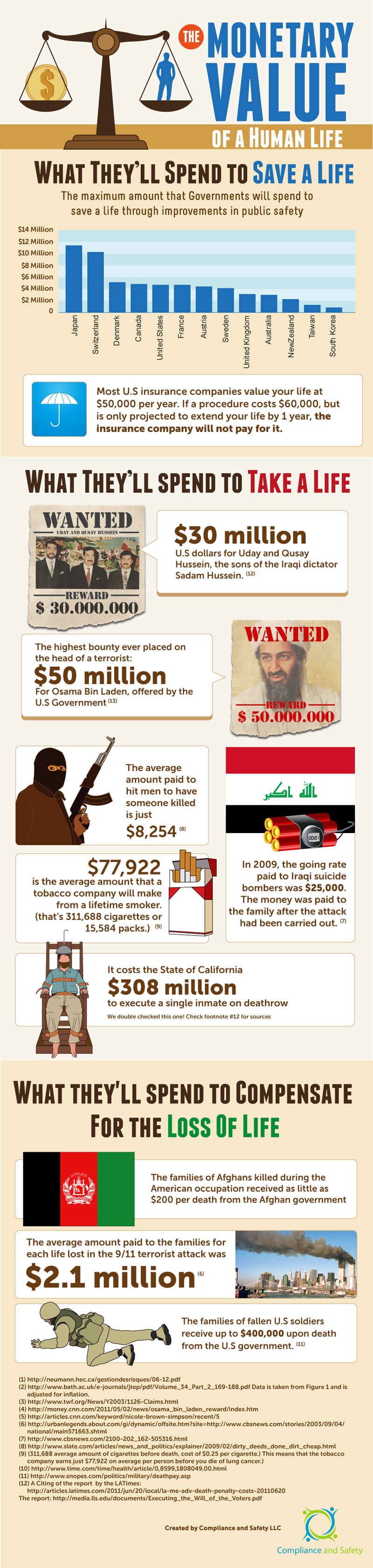
• Japan places the highest value on a human life, spending $11,728,000 to save a single life through improvements in public safety.
• South Korea spent the least, at a measly $878,000.00 per life saved.
• Health insurance companies value life at $50,000 per year of quality life, a depressingly low number compared to what government entities will pay. Keep your workforce healthy with proper Health & Wellness training.
• The families of suicide bombers receive just $25,000 per suicide.
• While the families that lossed a loved one on 9/11 received an average of $2.1 million per death, families of fallen soldiers receive a maximum of just $400,000. Rush Limbaugh did an interesting piece about this huge disparity back in 2002.

Conclusion

Your thoughts and comments on this ME-P are appreciated. Feel free to review our top-left column, and top-right sidebar materials, links, URLs and related websites, too. Then, subscribe to the ME-P. It is fast, free and secure.

Link: http://feeds.feedburner.com/HealthcareFinancialsthePostForcxos

Speaker: If you need a moderator or speaker for an upcoming event, Dr. David E. Marcinko; MBA – Publisher-in-Chief of the Medical Executive-Post – is available for seminar or speaking engagements. Contact: MarcinkoAdvisors@msn.com

OUR OTHER PRINT BOOKS AND RELATED INFORMATION SOURCES:

DICTIONARIES: http://www.springerpub.com/Search/marcinko
PHYSICIANS: www.MedicalBusinessAdvisors.com
PRACTICES: www.BusinessofMedicalPractice.com
HOSPITALS: http://www.crcpress.com/product/isbn/9781466558731
CLINICS: http://www.crcpress.com/product/isbn/9781439879900
BLOG: www.MedicalExecutivePost.com
FINANCE: Financial Planning for Physicians and Advisors
INSURANCE: Risk Management and Insurance Strategies for Physicians and Advisors

  Risk Management, Liability Insurance, and Asset Protection Strategies for Doctors and Advisors: Best Practices from Leading Consultants and Certified Medical Planners™ Risk Management, Liability Insurance, and Asset Protection Strategies for Doctors and Advisors: Best Practices from Leading Consultants and Certified Medical Planners™

Invite Dr. Marcinko

The Centenarian Diet

Join Our Mailing List

Is There Such a Thing?

By Muhammad Saleem

Source: www.TermLifeInsurance.org

Conclusion

Your thoughts and comments on this ME-P are appreciated. Feel free to review our top-left column, and top-right sidebar materials, links, URLs and related websites, too. Then, subscribe to the ME-P. It is fast, free and secure.

Link: http://feeds.feedburner.com/HealthcareFinancialsthePostForcxos

Speaker: If you need a moderator or speaker for an upcoming event, Dr. David E. Marcinko; MBA – Publisher-in-Chief of the Medical Executive-Post – is available for seminar or speaking engagements. Contact: MarcinkoAdvisors@msn.com

Our Other Print Books and Related Information Sources:

Health Dictionary Series: http://www.springerpub.com/Search/marcinko

Practice Management: http://www.springerpub.com/product/9780826105752

Physician Financial Planning: http://www.jbpub.com/catalog/0763745790

Medical Risk Management: http://www.jbpub.com/catalog/9780763733421

Hospitals: http://www.crcpress.com/product/isbn/9781439879900

Physician Advisors: www.CertifiedMedicalPlanner.org

Product Details  Product Details


The High Cost of Dying

Join Our Mailing List

An RIP Visual Presentation

You might think that once you expire, your financial worries are over. But alas, even in the afterlife you will still be paying your debts.

Funerals rank among the most expensive purchases many people will ever make, and the burden of payment often falls on family.

Learn how expensive it really is to die.

Source: lifeinsurancequotes.info

Assessment

So, why hasn’t the cost of healthcare come down over the same period?

Conclusion

And so, your thoughts and comments on this ME-P are appreciated. Please review our top-left column, and top-right sidebar materials, links, URLs and related websites, too. Then, subscribe to the ME-P. It is fast, free and secure.

Link: http://feeds.feedburner.com/HealthcareFinancialsthePostForcxos

Speaker: If you need a moderator or speaker for an upcoming event, Dr. David E. Marcinko; MBA – Publisher-in-Chief of the Medical Executive-Post – is available for seminar or speaking engagements. Contact: MarcinkoAdvisors@msn.com

Our Other Print Books and Related Information Sources:

Health Dictionary Series: http://www.springerpub.com/Search/marcinko

Practice Management: http://www.springerpub.com/product/9780826105752

Physician Financial Planning: http://www.jbpub.com/catalog/0763745790

Medical Risk Management: http://www.jbpub.com/catalog/9780763733421

Healthcare Organizations: www.HealthcareFinancials.com

Physician Advisors: www.CertifiedMedicalPlanner.com

Subscribe Now: Did you like this Medical Executive-Post, or find it helpful, interesting and informative? Want to get the latest ME-Ps delivered to your email box each morning? Just subscribe using the link below. You can unsubscribe at any time. Security is assured.

Link: http://feeds.feedburner.com/HealthcareFinancialsthePostForcxos

Sponsors Welcomed: And, credible sponsors and like-minded advertisers are always welcomed.

Link: https://healthcarefinancials.wordpress.com/2007/11/11/advertise

Product Details  Product Details

Is it Time for Level Life Insurance Commissions? [A Voting and Opinion Poll]

Ending the Churn-em’ and Burn-em’ Ethos 

By Staff Reporters

Join Our Mailing List 

Some insurance agents are currently noting that life insurance ownership is almost at an all time low because of the economy. And, some have even prompted suggestions that a “level commissions” payout would reverse the trend.

The argument goes something like this:

If agents were compensated 10% a year over a 10-year period rather than 100% in year one, annual reviews would increase substantially. The long-standing current method is not geared toward ongoing service, but to “churning” and “flipping”. Clients get better service from their property/casualty agents and wealth advisors because these practitioners have a financial inventive for their clients’ continued allegiance.

What do you think? Please vote and be sure to add your comments below.

Conclusion

And so, your thoughts and comments on this ME-P are appreciated. Feel free to review our top-left column, and top-right sidebar materials, links, URLs and related websites, too. Then, subscribe to the ME-P. It is fast, free and secure.

Link: http://feeds.feedburner.com/HealthcareFinancialsthePostForcxos

Speaker: If you need a moderator or speaker for an upcoming event, Dr. David E. Marcinko; MBA – Publisher-in-Chief of the Medical Executive-Post – is available for seminar or speaking engagements. Contact: MarcinkoAdvisors@msn.com 

Product Details  Product Details

Things You Didn’t Know About Death

Not a Unique Experience

Join Our Mailing List 

Death is an experience that we’re all going to have at one point or another. Why not take a few minutes to learn some interesting and some truly bizarre facts about death, dying, and the dead? Brought to you by medicalinsurance.org

Conclusion

Your thoughts and comments on this ME-P are appreciated. Feel free to review our top-left column, and top-right sidebar materials, links, URLs and related websites, too. Then, subscribe to the ME-P. It is fast, free and secure.

Speaker: If you need a moderator or speaker for an upcoming event, Dr. David E. Marcinko; MBA – Publisher-in-Chief of the Medical Executive-Post – is available for seminar or speaking engagements. Contact: MarcinkoAdvisors@msn.com

OUR OTHER PRINT BOOKS AND RELATED INFORMATION SOURCES:

Product Details  Product Details

What is Term Life Insurance and How Does it Work?

Insurance Basics for Medical Professionals

By Jeffrey H. Rattiner, CPA, CFP®, MBA

Join Our Mailing List 

After determining the need for insurance and the amount to purchase, the doctor-client and financial planner’s next task is to match those needs to the client’s objectives to determine what type of policy the client should purchase. The life insurance industry features more products today than ever before. One reason for this change is that, clearly, the insurance industry has expanded its product base to become more competitive. Another reason is that clients’ needs are constantly changing and the insurance companies must keep up with those needs or run the risk of having funds withdrawn from their companies. New and different types of life insurance products are here to stay. Since life insurance represents a significant part of a client’s risk-management program, planners have to be versed in the specifics of the varied product base.

Term Insurance

Term insurance provides protection against financial loss resulting from death during a specified time. Term insurance is often characterized as providing “pure” protection because it pays only death benefits and does not contain any cash value features. Coverage stops at the end of the policy period. Term insurance comes in two forms: nonrenewable term and annual renewable term.

Nonrenewable Term Insurance

Nonrenewable term insurance offers the client the poorest quality because the insured has to requalify or prove evidence of insurability for coverage every year. As a result, its cost is the lowest since the insurance company annually re-underwrites the individual applying for coverage. This allows the insurance company to be selective and avoid adverse risks.

Risk Management, Liability Insurance, and Asset Protection Strategies for Doctors and Advisors: Best Practices from Leading Consultants and Certified Medical Planners™8

Annual Renewable Term Insurance

Annual renewable term insurance is a quality term product. Under this type of term insurance, the policyholder may continue coverage on an annual basis. The rates are higher than nonrenewable term since the insurance company must continue to renew the policy at the insured’s option. The premiums generally increase as the policy matures, and the policy offers no flexibility. Coverage automatically stops if the premiums are not paid.

Conversion Provisions

Term insurance may offer a conversion provision that allows the insured to convert the term policy into a cash value policy without evidence of insurability, providing the insured with a guaranteed hedge against future un-insurability. The insured can convert the policy to a whole life policy at a later date. This can be done in one of two ways:

1. The insured can go back to the original policy date of issue and pay premiums on the basis of the younger age. All back premiums, including interest, must be paid to date.

2. The insured can pay premiums at the attained age (or at the age of the insured at the time of conversion).

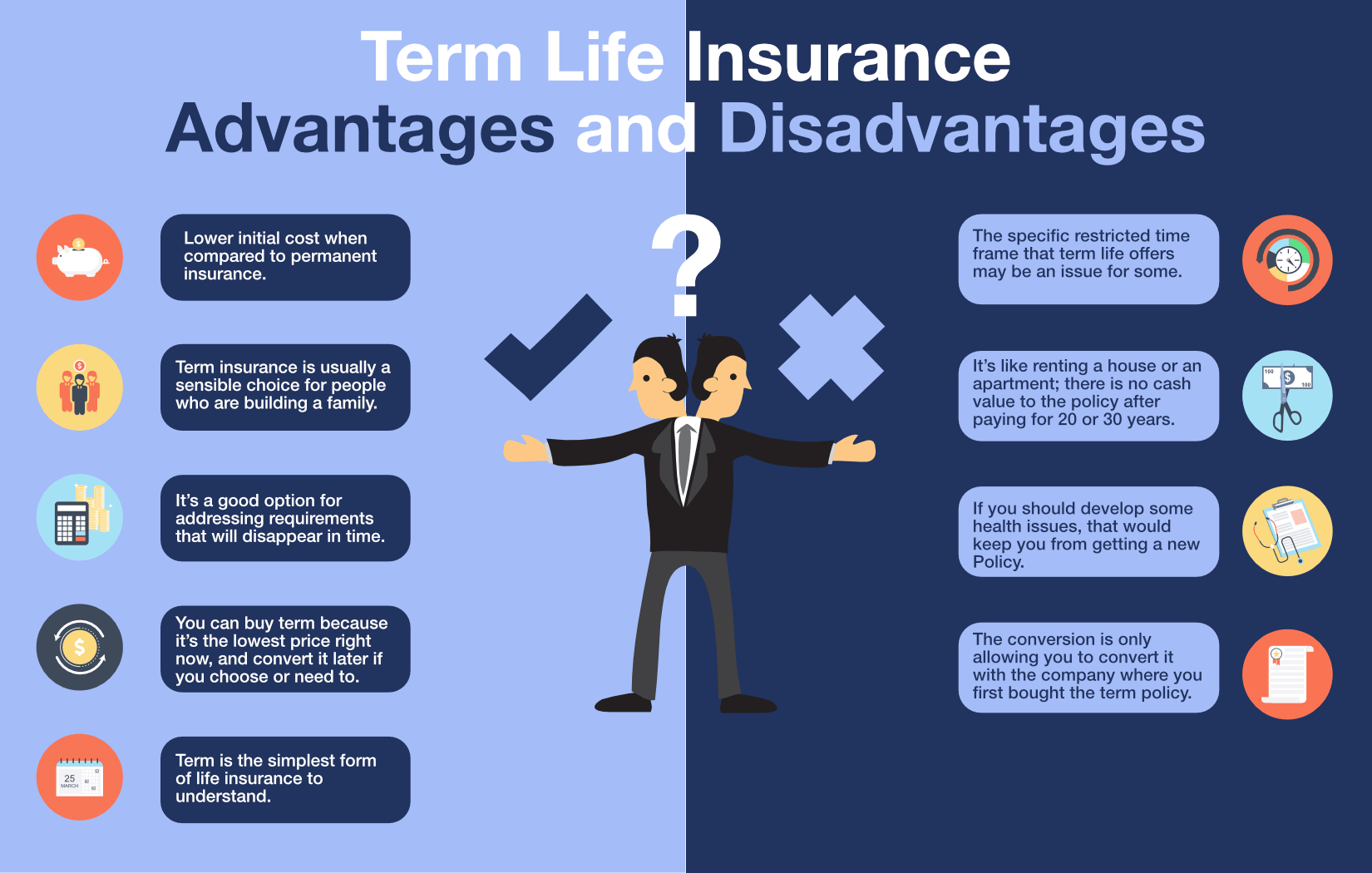
Advantages of term insurance policies include a lower initial cost, allowing dollars to be invested elsewhere, and pure death protection. Disadvantages include the lack of permanence, the absence of a savings element, the expiration of the policy after a specified period, and a periodic increase in cost. The increasing premium structure of term insurance results from the decreased life expectancies of an individual’s later years.

Comprehensive Financial Planning Strategies for Doctors and Advisors: Best Practices from Leading Consultants and Certified Medical Planners™

Assessment

Term insurance is most appropriate for young couples who have children or who otherwise may need a large amount of insurance. It is also appropriate for people who do not want to invest in a cash value insurance vehicle, who cannot afford the higher premiums of cash surrender policies, whose insurance needs will decrease over time, or who have temporary needs. Term insurance consists of mortality charges and policy expense. Because term insurance is quite expensive at the older ages, an alternative product was developed.

Conclusion

Your thoughts and comments on this ME-P are appreciated. Feel free to review our top-left column, and top-right sidebar materials, links, URLs and related websites, too. Then, subscribe to the ME-P. It is fast, free and secure.

Link: http://feeds.feedburner.com/HealthcareFinancialsthePostForcxos

Speaker: If you need a moderator or speaker for an upcoming event, Dr. David E. Marcinko; MBA – Publisher-in-Chief of the Medical Executive-Post – is available for seminar or speaking engagements. Contact: MarcinkoAdvisors@msn.com

OUR OTHER PRINT BOOKS AND RELATED INFORMATION SOURCES:

Product DetailsProduct DetailsProduct Details

  Risk Management, Liability Insurance, and Asset Protection Strategies for Doctors and Advisors: Best Practices from Leading Consultants and Certified Medical Planners™
Comprehensive Financial Planning Strategies for Doctors and Advisors: Best Practices from Leading Consultants and Certified Medical Planners™

   Product Details 

I Jealously “Shake my Fist” at Somnath Basu PhD

On CFP® Mis [Trust] – One Doctor’s Painful Personal Experience

[“So Sorry to Say it … but I Told You So”]

By: Dr David Edward Marcinko; FACFAS, MBA, CMP™

[Publisher-in-Chief]dem21

According to Somnath Basu, writing on April 6, 2009 in Financial Advisor a trade magazine, the painful truth is that many financial practitioners are merely sales people masquerading, as financial planners [FPs] and/or financial advisors [FAs] in an industry whose ethical practices have a shameful track record. Well, I agree, and completely. This includes some who hold the Certified Financial Planner® designation, as well as the more than 98 other lesser related organizations, logo marks and credentialing agencies [none of which demand ERISA-like fiduciary responsibility]. For more on this topic, the ME-P went right to the source last month, in an exclusive interview with Ben Aiken; AIF® of Fi360.com  

fp-book4

The CFP® Credential – What Credential?

Basu further writes that stockbrokers and insurance agents who earn commissions from buying and selling stocks, insurance and other financial products realize that a Certified Financial Planner® credential will help grow the volume of their business or branch them into other related and lucrative products and services. After all, there are more than 55,000 of these “credentialed” folks. And, this marketing designation seems to have won the cultural wars in the hearts and minds of an unsuspecting – i.e., duped public; probably because of sheer numbers. Didn’t a CFP Board CEO state that its’ primary goal was growth, a few years ago? Can you say “masses of asses”, as the oft quoted Bill Gates of Microsoft used to say when only 2,000 micro-softies defeated 400,000 IBMers during the PC operating system wars of the early 1980’s. Quantity, and marketing money, can trump quality in the public-relations business; ya’ know … if you repeat the lie often enough … yada … yada … yada! Yet, as the so-called leading industry designation, the CFP® entry-barrier standard is woefully low. Moreover, the SEC’s [FINRA] Series #7 general securities licensure sales examination is not worth much more than a weekend’s study attention, even to the uninitiated.

insurance-book2

Easy In – Worth Less Out

In our experience, we agree with Basu and others who suggest that scores of lightly educated, and sometimes wholly in-articulate and impatient individuals are zipping through the CFP® Board of Standards approved curriculum in three to six months of online, on-ground, or “self-study”. But, that some can do so without a bachelor’s degree when they join wire-houses and financial institutions, which cannot be trusted to adequately train them, is an abomination. And, even more sadly, some of these CFP™ mark-holders, and other folks, believe they have actually received an “education” from same. Of course, their writing skills are often non-existent and I have cringed when told that, in their opinion, advertiser-driven trade magazines constitute “peer-reviewed” and academic publications. Incidentally, have you noticed how thin these trade-rags are getting lately? Much like the print newspaper industry, are they becoming dinosaurs? One agent even told me, point-blank, that his CLU designation was the equivalent of an “academic PhD in insurance.” This was at an industry seminar, where he thought I was a lay insurance prospect.

THINK: No critical thinking skills.

biz-book4

Education

There is another sentiment that may be applied in many of these cases; “hubris.” I mean, these CFP® people … just don’t know – how much they don’t know.”  The very real difference between training versus education is unknown to many wire-houses and FAs, isn’t it? And, please don’t get me started on the differences in pedagogy, heutagogy and androgogy. Moreover, it’s sad when we see truly educated youngsters become goaded by wire-houses into thinking that these practices are de-rigor for the industry. One such applicant to our Certified Medical Planner™ program, for example, had both an undergraduate degree in finance and a graduate degree in economics from the prestigious Johns Hopkins University – in my home town of Baltimore, MD [name available upon request]. He was told, in his Smith Barney wire-house training program, to eschew CMP™ accountability and RIA fiduciary responsibility, when working with potential physician and lay clients; but to get his CFP® designation to gather more clients. To mimic my now 12 year-old daughter; it seems that: SEC Suitability Rules – and – Fiduciary Accountability Drools. And, to quote Hollywood’s “Mr. T”; I pity the fools, er-a, I mean clients. But, T was an actor, and this is serious business.

cmp-logo1

Of CEU Credits and Ethics

Beside trade-marks and logos, we are all aware that continuing education, and a code of ethics, is another important marketing and advertising component of state insurance agents and CFP licensees. It’s that old “be” – or “pretend to be” – a trusted advisor clap-trap. Well, I say horse-feathers for two reasons. First, both my insurance and CFP® Continuing Educational Unit [CEU] requirements were completed by my daughter [while age 7-10], by filling in the sequentially identical and bubble-coded, multiple-choice, answer-blanks each year. Second, this included the mandatory “ethics” portions of each test. When I complained to my CEU vendor, and state insurance department, I was told to “enjoy-the-break.”  My daughter even got fatigued after the third of fourth time she took the “home-based tests” for me.  After I opened my big mouth, the exact order of questions was changed to increase acuity, but remained essentially the same, nevertheless. My daughter got bored, and quit taking the tests for me, shortly thereafter. She always “passed.”dhimc-book3

Thus, like Basu, I also find that far too many financial advisors are unwilling to devote the time necessary to achieve a sound education that will help attain their goals, and would rather sell variable or whole life products than simple term life, even when the suitability argument overwhelmingly suggests so, for a higher payday. We not only have met sale folks without undergraduate degrees, but also too many of those with only a HS diploma, or GED. Perhaps this is why a popular business truism suggests that the quickest way for the uneducated/under educated class to make big bucks, is in sales. Just note the many classified ads for financial advisors placed in the newspaper job-section, under the heading “sales.” Or, in more youthful cultural terms, “fake it – until you make it.”

Of the iMBA, Inc Experience

According to Executive Director Ann Miller RN MHA, and my experience at the Institute of Medical Business Advisors, Inc:

“Far too many financial advisors who contact us about matriculation in our online Certified Medical Planner™ program – in health economics and management for medical professionals – don’t even know what a Curriculum Vitae [CV] is? Instead, they send in Million Dollar Roundtable awards, Million Dollar Producer awards, or similar sales accomplishments as resume’ boosters. It is also not unusual for them to list some sort of college participation on their resumes, and websites, but no school affiliation or dates of graduation, etc. And, they become furious to learn that we require a college degree for our fiduciary focused CMP™ program, and not from an online institution, either. The onslaught of follow-up nasty phone-calls; faxes and emails are laughable [frightening] too.”  

www.MedicalBusinessAdvisors.com

Assessment

More often than not, it is the financial institutions that FAs and CFP™ certificants’ work for that reward sales behavior with higher commissions, rather than salaries; which encourage such behavior and create the vicious cycles that are now the norm.

THINK: ML, AIG, Citi, WAMU, Wachovia, Hartford, Prudential, etc.

Note: Original author of Restoring Trust in the CFP Mark, Somnath Basu PhD, is program director of the California Institute of Finance in the School of Business at California Lutheran University where he’s also a professor of finance. He can be reached at (805) 493 3980 or basu@callutheran.edu. We have asked him to respond further.

My Story: I am a retired surgeon and former Certified Financial Planner® who resigned my “marketing trademark” over the long-standing fiduciary flap. I watched this chicanery for more than a decade after protesting to magazines like Investment Advisor, Financial Advisor, Registered Rep, Financial Planner, the FPA, etc; up to, and even including the CFP® Board of Standards; to no avail. Feel free to contact me for a copy of a 43 page fax, and other supportive documentation from the CFP® Board of Standards – and their outsourced intellectual property attorneys – over a Federal trademark infringement lawsuit they tried to institute against me for innocent website errors placed by a visually impaired intern. Obviously, they disliked the launch of our CMP™ program. As a health economist and devotee of Ken Arrow PhD, I polity resigned my license, as holding no utility for me, to the shocked CFP Board. They later offered to consider re-instatement for a mere $600 fee with letter of explanation, to which I politely declined. Of course, my first thought after living in the streets of South Philadelphia while in medical school, during the pre-Rocky era, was to say f*** off – but I didn’t. Nevertheless, I still seem to be on their mailing list, years later. No doubt, the list is sold, and re-sold, to various advertisers for much geld. And, why shouldn’t they; an extra bachelor, master and medical degree holder on their PR roster looks pretty good. I distrust the CFP® Board almost as much as I distrust the AMA, and its parsed and disastrous big-pharma funding policies. Right is right – wrong is wrong – and you can’t fool all of the people, all of the time, especially in this age of internet transparency.

Shaking my Fist at Somnath … in Envy

And so, why do I shake my fist at Somnath Basu? It’s admittedly with congratulations, and a bit of schadenfreude, because he wrote an article more eloquently than I ever could, and will likely receive much more publicity [good or slings-arrows] for doing so. You know, it’s very true that one is never a prophet in his own tribe. Oh well, Mazel Tov anyway for stating the obvious, Somnath. The financial services industry – and more specifically – the CFP® emperor have no clothes! Duh!

ho-journal5

Good Guys and White Hats

Now that Basu’s article has appeared in Financial Advisor News e-magazine, the other industry trade magazines are sure to follow the CFP® certification denigration reportage, in copy-cat fashion. And, the fiduciary flap is just getting started. This is indeed unfortunate, because I do know many fine CFP® certificants, and non-CFP® certified financial advisors, who are well-educated, honest and work very diligently on behalf of their clients. It’s just a shame the public has no way of knowing about them – there is no white hat imprimatur or designation for same – most of whom are Registered Investment Advisors [RIAs] or RIA reps. For example, we know great folks like Douglas B. Sherlock MBA, CFA; Robert James Cimasi MHA, AVA, CMP™; J. Wayne Firebaugh, Jr CPA, CFP®, CMP™; Lawrence E. Howes MBA, CFP®; Pati Trites PhD; Gary A. Cook MSFS, CFP®, CLU; Tom Muldowney MSFS, CLU, CFP®, CMP™;  Jeffrey S. Coons PhD, CFP®; Alex Kimura MBA, CFP®; Ken Shubin-Stein MD, CFA; and Hope Hetico RN, MHA, CMP™; etc. And, to use a medical term, there are TNTC [too many, to count] more … thankfully!

Conclusion

Your thoughts and comments on this ME-P are appreciated. Feel free to review our top-left column, and top-right sidebar materials, links, URLs and related websites, too. Then, subscribe to the ME-P. It is fast, free and secure.

Speaker: If you need a moderator or speaker for an upcoming event, Dr. David E. Marcinko; MBA – Publisher-in-Chief of the Medical Executive-Post – is available for seminar or speaking engagements. Contact: MarcinkoAdvisors@msn.com

OUR OTHER PRINT BOOKS AND RELATED INFORMATION SOURCES:

Product DetailsProduct DetailsProduct Details

  Product DetailsProduct Details

Product Details

Key-Man Life Insurance Proceeds Ruling

Join Our Mailing List

IRS Tax Exempt Treatment Ruling

[By Robert Whirley, CPA]

A recent revenue ruling has been issued by the Internal Revenue Service addressing the tax exempt treatment of life insurance policy proceeds on “key-man” policies of Subchapter S-Corporations; medical and/or otherwise. 

Excerpts

Revenue Ruling 2008-42 concludes that premiums paid by the S-Corporation on an employer-owned life insurance contract, of which it is directly or indirectly a beneficiary, do not reduce the S-Corporation’s AAA. Further, the benefits received because of the death of the insured from an employer-owned life insurance contract that meets an exception under Code Sec. 101(j)(2) do not increase its AAA.

Assessment

This may sound like Greek to some doctors. The affect is that life insurance proceeds on key-man policies in an S-Corporation are essentially trapped in the corporation. Any distribution of that cash to surviving S-Corporation shareholders – or to the estate of the deceased shareholder – triggers a taxable event.   

It is therefore vital for any doctor with a life policy paid by your medical practice, or other S-corporation, to discuss the tax policy and estate planning particulars with your accountant.

Channel Surfing the ME-P

Have you visited our other topic channels? Established to facilitate idea exchange and link our community together, the value of these topics is dependent upon your input. Please take a minute to visit. And, to prevent that annoying spam, we ask that you register. It is fast, free and secure.

Conclusion

Your thoughts and comments on this ME-P are appreciated. Feel free to review our top-left column, and top-right sidebar materials, links, URLs and related websites, too. Then, subscribe to the ME-P. It is fast, free and secure.

Speaker: If you need a moderator or speaker for an upcoming event, Dr. David E. Marcinko; MBA – Publisher-in-Chief of the Medical Executive-Post – is available for seminar or speaking engagements. Contact: MarcinkoAdvisors@msn.com

OUR OTHER PRINT BOOKS AND RELATED INFORMATION SOURCES:

Product Details  Product Details


Ask a Financial Advisor

Certified Medical Planner

Second-to-Die Life Insurance

QUESTION: Why has second-to-die life insurance become so popular with medical professionals and others?

Conclusion

Your thoughts and comments on this ME-P are appreciated. Feel free to review our top-left column, and top-right sidebar materials, links, URLs and related websites, too. Then, subscribe to the ME-P. It is fast, free and secure.

Link: http://feeds.feedburner.com/HealthcareFinancialsthePostForcxos

Speaker: If you need a moderator or speaker for an upcoming event, Dr. David E. Marcinko; MBA – Publisher-in-Chief of the Medical Executive-Post – is available for seminar or speaking engagements. Contact: MarcinkoAdvisors@msn.com

OUR OTHER PRINT BOOKS AND RELATED INFORMATION SOURCES:

LEXICONS: http://www.springerpub.com/Search/marcinko
PHYSICIANS: www.MedicalBusinessAdvisors.com
PRACTICES: www.BusinessofMedicalPractice.com
HOSPITALS: http://www.crcpress.com/product/isbn/9781466558731
CLINICS: http://www.crcpress.com/product/isbn/9781439879900
ADVISORS: www.CertifiedMedicalPlanner.org
BLOG: www.MedicalExecutivePost.com

Product DetailsProduct DetailsProduct Details

Product Details  Product Details