Great Book Gifts for Medical School and Health Care Graduates

Join Our Mailing List

[By Staff reporters]

An Educational Resource Supporting Doctors, Universities and Consulting Advisors  

We are an emerging online and onground community that connects medical professionals with financial advisors and management consultants. We participate in a variety of insightful educational seminars, teaching conferences and national workshops. We produce journals, textbooks and handbooks, white-papers, CDs and award-winning dictionaries. And, our didactic heritage includes innovative R&D, litigation support, opinions for engaged private clients and media sourcing in the sectors we passionately serve.

Through the balanced collaboration of this rich-media sharing and ranking forum, we have become a leading network at the intersection of healthcare administration, practice management, medical economics, business strategy and financial planning for doctors and their consulting advisors. Even if not seeking our products or services, we hope this knowledge silo is useful to you.

In the Health 2.0 era of political reform, our goal is to: “bridge the gap between practice mission and financial solidarity for all medical professionals.”

Join the ME-P Nation today … and tell us what you think! 

  ***gifts

***

  OUR BOOKS, TEXTS AND DICTIONARIES ARE VITAL SURVIVAL TOOLS FOR ALL PHYSICIANS … AND THEIR CONSULTING ADVISORS

***

Product Details

Product DetailsProduct Details

       Product DetailsProduct DetailsProduct Details

Risk Management, Liability Insurance, and Asset Protection Strategies for Doctors and Advisors: Best Practices from Leading Consultants and Certified Medical Planners™8Comprehensive Financial Planning Strategies for Doctors and Advisors: Best Practices from Leading Consultants and Certified Medical Planners™

***

Channel Surfing

Have you visited our other topic channels? Established to facilitate idea exchange and link our community together, the value of these topics is dependent upon your input. Please take a minute to visit. And, to prevent that annoying spam, we ask that you register.

Link: http://feeds.feedburner.com/HealthcareFinancialsthePostForcxos

More:

Conclusion

Your thoughts and comments on this ME-P are appreciated. Feel free to review our top-left column, and top-right sidebar materials, links, URLs and related websites, too. Then, subscribe to the ME-P. It is fast, free and secure.

Speaker: If you need a moderator or speaker for an upcoming event, Dr. David E. Marcinko; MBA – Publisher-in-Chief of the Medical Executive-Post – is available for seminar or speaking engagements. Contact: MarcinkoAdvisors@msn.com

OUR OTHER PRINT BOOKS AND RELATED INFORMATION SOURCES:

Join Our Mailing List

On Valuing Physician Work in Medicare

Join Our Mailing List

Time for a Change?

By Miriam J. Laugesen PhD
[Assistant Professor, Department of Health Policy and Management, Mailman School of Public Health, Columbia University]

via: NIHCM Foundation | 1225 19th Street, NW | Suite 710 | Washington | DC | 20036 www.nihcm.org

The Government Accountability Office (GAO) just released an important review of the way the Relative Value Scale Update Committee (RUC) and CMS value physician services for Medicare. The report finds significant flaws in the data and processes used, echoing a recent Expert Voices essay by RUC researcher Miriam Laugesen.

***

spreadsheet

***

Assessment

In this essay, Dr. Laugesen illustrates inaccuracies with work time estimates and the shortcomings of specialty society surveys. She also highlights ways to introduce greater precision and transparency to the process of updating Medicare physician fees. Read more…

EVEN MORE:

Gail Wilensky
The Outlook for Reforming Payments to Graduate Medical Education

John Iglehart
Meeting the Demand for Primary Care: Nurse Practitioners Answer the Call

David Dranove
Federal Antitrust Enforcement in Health Care

Michael L. Millenson
Paradigm, Not Pill: The New Role of Patient-Centered Care

Conclusion

Your thoughts and comments on this ME-P are appreciated. Feel free to review our top-left column, and top-right sidebar materials, links, URLs and related websites, too. Then, subscribe to the ME-P. It is fast, free and secure.

Speaker: If you need a moderator or speaker for an upcoming event, Dr. David E. Marcinko; MBA – Publisher-in-Chief of the Medical Executive-Post – is available for seminar or speaking engagements. Contact: MarcinkoAdvisors@msn.com

OUR OTHER PRINT BOOKS AND RELATED INFORMATION SOURCES:

Product DetailsProduct Details

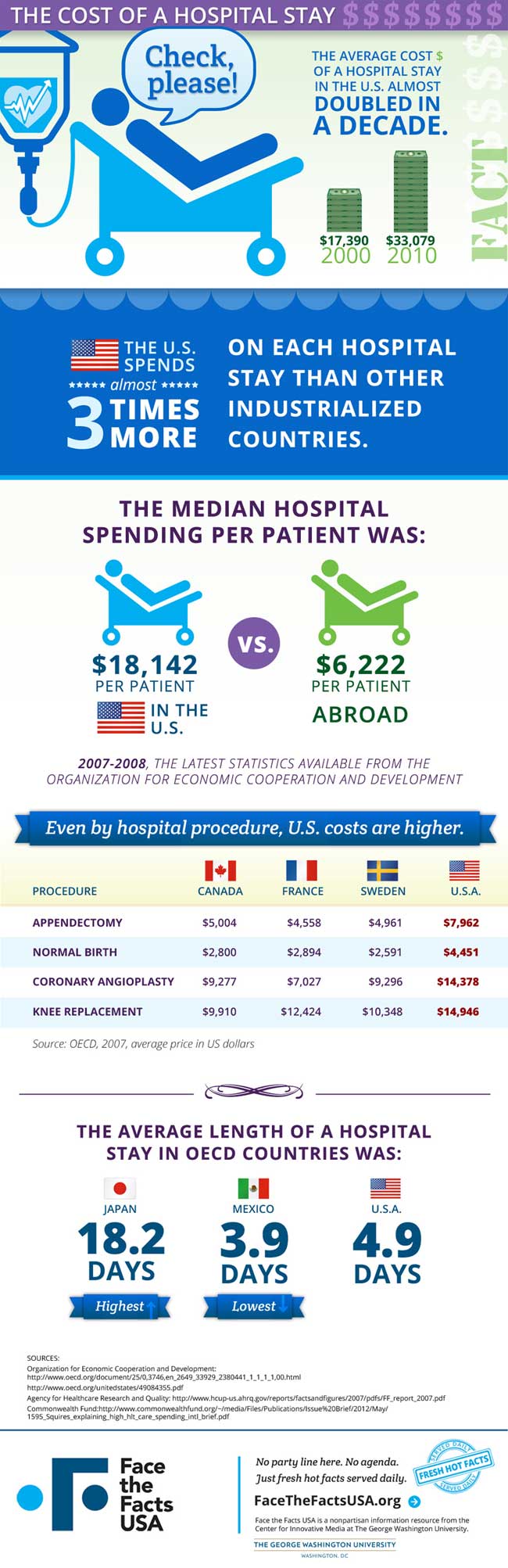
Cost of average U.S. hospital stay $33,079

Join Our Mailing List

A Healthcare Financial Infographic

By FaceThe factsUSA.org.

The cost of the average American hospital stay nearly doubled from 2000 to 2010 while average stay length declined. The decade was a period of low inflation, but some sectors of the economy didn’t get the memo. Charges for a hospitalization soared from an average $17,390 in 2000 to $33,079 in 2010.

In the U.S. we spend almost three times as much on a hospital stay as other industrialized countries, even though their average stay tends to be longer.

***

hospital-stay-us

***

More:

Conclusion

Your thoughts and comments on this ME-P are appreciated. Feel free to review our top-left column, and top-right sidebar materials, links, URLs and related websites, too. Then, subscribe to the ME-P. It is fast, free and secure.

Speaker: If you need a moderator or speaker for an upcoming event, Dr. David E. Marcinko; MBA – Publisher-in-Chief of the Medical Executive-Post – is available for seminar or speaking engagements. Contact: MarcinkoAdvisors@msn.com

OUR OTHER PRINT BOOKS AND RELATED INFORMATION SOURCES:

Product DetailsProduct Details


A Medicare Fraud 2.0 Prediction

Join Our Mailing List

More on Healthcare Fraud and Abuse with Video

Edward Bukstel

 By Edward Bukstel

ME-P SPECIAL REPORT

***

Medicare Fraud 2.0 Prediction.

***

fraud

***

Channel Surfing the ME-P

Have you visited our other topic channels? Established to facilitate idea exchange and link our community together, the value of these topics is dependent upon your input. Please take a minute to visit. And, to prevent that annoying spam, we ask that you register. It is fast, free and secure.

More: Submitted by Perry D’Alessio CPA

Conclusion

Your thoughts and comments on this ME-P are appreciated. Feel free to review our top-left column, and top-right sidebar materials, links, URLs and related websites, too. Then, subscribe to the ME-P. It is fast, free and secure.

Speaker: If you need a moderator or speaker for an upcoming event, Dr. David E. Marcinko; MBA – Publisher-in-Chief of the Medical Executive-Post – is available for seminar or speaking engagements. Contact: MarcinkoAdvisors@msn.com

OUR OTHER PRINT BOOKS AND RELATED INFORMATION SOURCES:

Product DetailsProduct Details

On “Best-in-Class” Independent / Provider Sponsored Health Plans

Join Our Mailing List 

February 2015 Edition of Plan Management

DS

[By Douglas B. Sherlock CFA] Sherlock@sherlockco.com

Please find attached, the February 2015 Edition of Plan Management Navigator.

In this issue, we highlight characteristics among Independent/Provider-Sponsored plans in the lowest 25th percentile in costs, which we consider Best-in-Class health plans. We found that Best-in-Class plans operated with administrative costs that were lower by $10.99 PMPM, excluding Sales and Marketing and Medical Management.

A lower Staffing Ratio was mainly responsible for low costs, while low Staffing Costs also contributed. Non-Labor Costs, however, were actually higher in the Best-in-Class plans. Almost every functional area was lower for the Best-in-Class plans with IS, Claims, and Corporate Services most responsible for overall low costs.  Finance and Accounting was the exception in that its costs were higher.

The Analysis

To perform this analysis, we endeavor to quantify and eliminate the effect of factors largely beyond management control. We then isolate and measure the specific contributing factors that are more susceptible to management.

In addition, we are building the universes for the Sherlock Benchmarks. For the Independent/Provider-Sponsored universe we have 23 plans committed to participate in this year’s study. This is up by 44% from last year and collectively, the committed plans serve 10.5 million people with comprehensive products.

***

conference

***

Participation Solicitation

We are meeting to finalize the survey form in about one month, will distribute the survey forms in late March, collect the completed surveys in May and publish results beginning in July. Participation entails notable efforts on your part since useful outputs require relatively granular inputs. However, the cost is relatively modest.

Link: Navigator – February 2015

Assessment

Please contact me if you are interested in participating. You will be among good company.

Channel Surfing the ME-P

Have you visited our other topic channels? Established to facilitate idea exchange and link our community together, the value of these topics is dependent upon your input. Please take a minute to visit. And, to prevent that annoying spam, we ask that you register. It is fast, free and secure.

Conclusion

Your thoughts and comments on this ME-P are appreciated. Feel free to review our top-left column, and top-right sidebar materials, links, URLs and related websites, too. Then, subscribe to the ME-P. It is fast, free and secure.

Speaker: If you need a moderator or speaker for an upcoming event, Dr. David E. Marcinko; MBA – Publisher-in-Chief of the Medical Executive-Post – is available for seminar or speaking engagements. Contact: MarcinkoAdvisors@msn.com

OUR OTHER PRINT BOOKS AND RELATED INFORMATION SOURCES:

Product DetailsProduct Details

← Back

Thank you for your response. ✨

No More 10 and 90 Day Global Periods

Join Our Mailing List

New Changes on the [CMS Payment Reform] Horizon
[By Dreama Sloan-Kelly MD CCS]

thDid you hear about the changes that are coming down the pike in regards to global services when billing for surgical procedures — be they in the office, in an ambulatory surgical center, or in the hospital?

CMS released their final 2015 Medicare Physician Fee Schedule (MPFS) ruling late last year. Embedded in this document was a proposal by CMS to get rid of both the 10 day and 90 day global periods! In fact, they want to do away with global period billing all together and have all procedures paid based on the work required to do the procedure itself — thereby billing for all post-surgical visits separately using E/M codes.

According to the final ruling, CMS proposes to transform all 10 day global services to ZERO global days starting in 2017. They will do the same in regards to 90 day global services starting in 2018. And, according to the U.S. Department of Health and Human Services (HHS) and the Office of Inspector General (OIG) they have “identified a number of surgical procedures that include more visits in the global period than are being furnished”. They go on to say that they are “also concerned that post-surgical visits are valued higher than visits that were furnished and billed separately by other physicians such as general internists or family physicians”. Based on the final ruling, they plan to begin the transition as previously stated in 2017 after they have considered all comments.

The ruling goes on to state, “as the agency begins revaluation of services as 0-day global periods, we will actively assess whether there is a better construction of a bundled payment for surgical services that incentivizes care coordination and care redesign across an episode of care”. So let’s talk reality and my take on this change.

Over the past few weeks I have read a lot of articles on this subject from various pundits in the industry — they are actually arguing that this change will mean increased reimbursement when you combine the separate payment for the procedure itself along with the visit by visit billing for the post-surgical follow up care when compared to the current reimbursement rate.

***

glasses

***

Personally, I think they are all wrong for the following reasons:

Procedure Reimbursement Amount: This is the wild card. They are going to use the same RVU system that has always been used to calculate payment — but I guarantee you the payment for the procedure will not be anywhere near the reimbursement for the global package. I think the closest we could get to estimating the reimbursement rate of the procedure is to figure out what the current surgical care only rate would be (ie. as if you appended Modifier 54 to the procedure code). Beware that this rate would still encompass the pre-surgical evaluation — which I am assuming would be carved out since that is a part of the current global package they are trying to phase out.

Post Op Visits: Getting a patient to comply with medical visits is hard enough — now adding in the fact they would have to pay a copay each time — most often a specialty co-pay is going to make it even harder. Patient’s understand their follow up visits are currently covered in the cost for the surgery, and hence they tend to show up to these visits knowing they do not have any out of pocket expenses. If the proposed change comes to fruition many of the post-surgical visits may become cost prohibitive for a lot of patients and actually lead to a decrease in the number of follow up visits the patient actually schedules. Once the patient starts to feel better their motivation to return dwindles.

Lower Reimbursement Rate for Post-Surgical Visits: It is clearly stated in the CMS ruling that it is felt the post-surgical follow up care visits are paid at a higher rate than what a regular E/M visit would be paid for had the patient been seen by a primary care provider or an internist. That simple statement confirms to me that when the new procedure rate is combined with the individual visit payment rate, the overall reimbursement rate will be less than what is currently being paid.

So, how do you prepare?

First, stay on top of all bulletins coming from CMS in regards to this issue. Most of your medical societies and/or specialty societies have taken clear positions in regards to this matter — so be sure to stay in the loop and become a part of the process.

Run a report that allows you to pinpoint the average number of post-surgical follow up visits for your most billed procedures. This will give you an idea of the average number of follow up visits for particular procedures you know you will bill for if this transition does occur. Does this mean this number will be exact — NO — I would factor in a decrease of 15-20% for visits across the board based on the dynamics I previously described.

Lastly, begin creating a policy in regards to post-surgical follow up care that can act as an education tool for the patient, teaching them the important benefits of being compliant with their post-surgical care schedule and also warning them about the possible increase in out of pocket cost. Being transparent can go a long way into easing patient’s fear and encouraging their follow through.

As always I have included documentation for your library of information — you can find the CMS 2015 MPFS final ruling fact sheet HERE! I also created a brief video presentation on this hot topic HERE

 ***laptop

***

Channel Surfing the ME-P

Have you visited our other topic channels? Established to facilitate idea exchange and link our community together, the value of these topics is dependent upon your input. Please take a minute to visit. And, to prevent that annoying spam, we ask that you register. It is fast, free and secure.

Conclusion

Your thoughts and comments on this ME-P are appreciated. Feel free to review our top-left column, and top-right sidebar materials, links, URLs and related websites, too. Then, subscribe to the ME-P. It is fast, free and secure.

Speaker: If you need a moderator or speaker for an upcoming event, Dr. David E. Marcinko; MBA – Publisher-in-Chief of the Medical Executive-Post – is available for seminar or speaking engagements. Contact: MarcinkoAdvisors@msn.com

OUR OTHER PRINT BOOKS AND RELATED INFORMATION SOURCES:

Product Details

About the INSTITUTE OF MEDICAL BUSINESS ADVISORS, Inc.

Join Our Mailing List

About

INSTITUTE OF MEDICAL BUSINESS ADVISORS, Inc.

  ***

The Institute of Medical Business Advisors, Inc provides a team of experienced, senior level consultants led by iMBA Chief Executive Officer Dr. David Edward Marcinko MBA CMPMBBS [Hon] and President Hope Rachel Hetico RN MHA CMP™ to provide going contact with our clients throughout all phases of each project, with most of the communications between iMBA and the key client participants flowing through this Senior Team.

Product Details

iMBA Inc., and its skilled staff of certified professionals have many years of significant experience, enjoy a national reputation in the healthcare consulting field, and are supported by an unsurpassed research and support staff of CPAs, MBAs, MPHs, PhDs, CMPs™, CFPs® and JDs to maintain a thorough and extensive knowledge of the healthcare environment.

Product Details

The iMBA team approach emphasizes providing superior service in a timely, cost-effective manner to our clients by working together to focus on identifying and presenting solutions for our clients’ unique, individual needs.

Product Details

The iMBA Inc project team’s exclusive focus on the healthcare industry provides a unique advantage for our clients.  Over the years, our industry specialization has allowed iMBA to maintain instantaneous access to a comprehensive collection of healthcare industry-focused data comprised of both historically-significant resources as well as the most recent information available.  iMBA Inc’s specific, in-depth knowledge and understanding of the “value drivers” in various healthcare markets, in addition to the transaction marketplace for healthcare entities, will provide you with a level of confidence unsurpassed in the public health, health economics, management, administration, and financial planning and consulting fields.

 Product DetailsProduct DetailsProduct Details

iMBA Inc’s information resources and network of healthcare industry textbook resources enhanced by our professional consultants and research staff, ensure that the iMBA project team will maintain the highest level of knowledge regarding the current and future trends of the specific specialty market related to the project, as well as the healthcare industry overall, which serves as the “foundation” for each of our client engagements.

Product Details  Product Details

Ann Miller RN MHA

www.MedicalBusinessAdvisors.com

Financial Advisor Education Letterhead CMP

Solicitation Letterhead.iMBA, Inc

Sample iMBA Engagements

iMBA Seminar Topics

***

Financial Planning MDs 2015

Comprehensive Financial Planning Strategies for Doctors and Advisors: Best Practices from Leading Consultants and Certified Medical Planners™

***

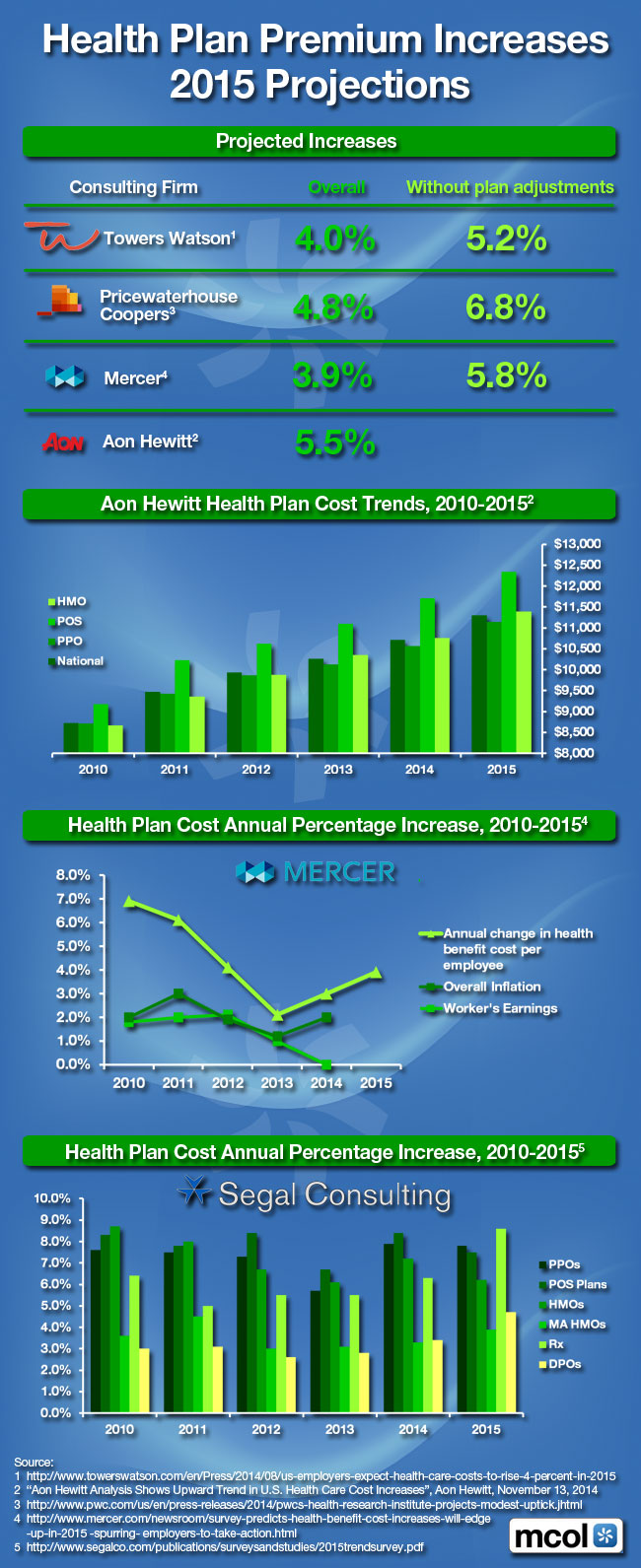
2015 Health Plan Premium Increases

Join Our Mailing List

Projections

By http://www.MCOL.com

premium

Channel Surfing the ME-P

Have you visited our other topic channels? Established to facilitate idea exchange and link our community together, the value of these topics is dependent upon your input. Please take a minute to visit. And, to prevent that annoying spam, we ask that you register. It is fast, free and secure.

Conclusion

Your thoughts and comments on this ME-P are appreciated. Feel free to review our top-left column, and top-right sidebar materials, links, URLs and related websites, too. Then, subscribe to the ME-P. It is fast, free and secure.

Speaker: If you need a moderator or speaker for an upcoming event, Dr. David E. Marcinko; MBA – Publisher-in-Chief of the Medical Executive-Post – is available for seminar or speaking engagements. Contact: MarcinkoAdvisors@msn.com

OUR OTHER PRINT BOOKS AND RELATED INFORMATION SOURCES:

Product DetailsProduct Details

The PP-ACA [Game Changer for Health Care Financing]

Join Our Mailing List 

The fuel which fires the self-funded engine of employee health and welfare plans

[By William Rusteberg]

A SPECIAL ME-P REPORT

PP-ACA Taxes for 2015

Introduction

The Affordable Care Act (ACA) has had a fundamental impact on health care financing in this country. It has effectively provided added incentives for plan sponsors to consider modified self-funding arrangements for their employee health and welfare plans in lieu of fully-insured plans. The advantages of doing so are clear.

Health care costs continue to rise despite passage of the ACA. While the ACA addresses many aspects surrounding the delivery of health care, it does little or nothing to identify and offer solutions to constantly rising costs. On the contrary, many ACA provisions are driving cost up.

Plan sponsors have a choice between assuming a passive strategy with little or no control through fully-insured funding arrangements or the alternative. The alternative affords more control and less cost. It rewards innovation and creativity. It utilizes all the tools a risk manager requires as part of his trade.

More plan sponsors are turning to self-funding in response to the ACA.

Product DetailsProduct DetailsProduct Details

The Market Leading Up To the ACA

The financial and benefit advantages of self-funded health and welfare plans became evident with the passage of the Employee Retirement Income Security Act (ERISA) of 1974. Dramatic growth in self-funding occurred when ERISA preemption, clarified legal environment, rising health care costs, widespread use of risk management, the cost containment movement (Managed Care) and high interest rates were all being experienced.

Fully insured plans continued to be a large segment of the market, especially among smaller employer groups. However, a significant number larger groups remaining fully-insured moved towards minimum premium plans, or plans which were rated retrospectively on an administration cost plus basis. This approach among larger employers mirrored self-funding advantages to some degree, however the insurance companies ultimately bore the entire risk and maintained full control over plan expenses and claim costs. These types of fully-insured funding arrangements were the carrier’s response to the growing phenomenon and popularity of self-funding.

With the advent of managed care in the early 1980’s, the entire dynamics of health care delivery changed. Third party intermediaries became an important element in the health care equation.  These intermediaries performed valuable services in cost containment which initially had a positive impact on health care benefits and costs to the advantage of both the consumer and payer.

Carefully selected health care givers were aggregated into exclusive networks of preferred providers. The theory behind the scheme was valid; selected health care providers would agree to discount their usual fees for service in return for more patients. Steerage was accomplished by rewarding consumers with improved benefits when seeking care through these “preferred” providers. All worked well, with health care costs temporarily softening.

Consumers no longer had to satisfy deductibles to receive most care. Instead, co-pays as low as $10 to see a doctor became the norm. Prescription drugs benefits, now accounting for as much as 25% of a plan’s total spend in today’s market, were easily accessed by paying a small co-pay. Access to care became easier and affordable. Utilization increased.

With increased utilization, consumers began to demand more doctors and hospitals to be added to networks. Over time, just about every doctor and hospital in a given geographic area were all on networks. Competition among insurance companies hinged upon who had the broadest network. The pressure to add medical providers became intense. A seller’s market for medical providers became an established trend that continues to this day. Preferred Provider Organizations (PPO) thus gained the advantage of a seller’s market they created while end users became subject to a weakened and impotent buyer’s market.

Over time PPO’s lost their core characteristic. There was no longer any steerage. The scheme that worked so well in the beginning began to unravel. Costs increased dramatically, year after year.

Plan sponsors failed to recognize the slow progression towards failure of managed care. They continued to subscribe to the theory behind managed care based upon reliance of advice and guidance from “trusted” insurance companies, third party administrators, agents, brokers and insurance experts posing as consultants. Unfortunately, and unknown to plan sponsors, these trusted advisors maintained a vested interest in continuing the scheme. A de facto conspiracy of third party intermediaries formed. The conspiracy continues to this day. It is one of the health care industry’s best kept secrets.

No one can dispute that managed care has failed. Health care costs have continued to increase at double digits year after year, becoming unaffordable for most Americans. Plan Sponsors, concerned and desperate for answers and solutions continue to rely on advice and guidance from third party intermediaries whose vested interests is in maintaining the status quo. To more and more employers health care costs can mean the difference between profit and loss.

The perception that private enterprise has failed in reining in costs is widespread. Private and public budgets can no longer sustain the current level of spending, let alone future health care inflation.

Pointing to failure of the market to keep medical costs affordable, many looked to government for solutions.

Product DetailsProduct Details

The Affordable Care Act & The Impact on Health Care Financing

With the passage of the ACA, we find ourselves in a dynamic and somewhat unpredictable market, particularly the political dimensions as the ACA continues to evolve. However, we do know to a large degree, how the market will be affected and what plan sponsors must do to maintain affordable health care for their employees.

The ACA’s most significant impact centers upon how group medical plans will be financially structured for years to come. The ACA effectively makes fully-insured plans less attractive while providing advantages to self-funded arrangements. Carriers have come to recognize this and are moving to increase their market share. Currently the BUCA’s (Blue Cross, United HealthCare, Cigna and Aetna) administer more self-funded business than fully-insured business on their respective large group blocks of business. They are now actively expanding this funding method to the small group market.

The ACA’s universal intent is to provide government mandated means for affordable health care for all Americans. However, the ACA as it is now written does not address cost of care nor does it mandate parameters around which cost of care is to be based. Instead, the ACA mandates rigid requirements that address what insurance companies can offer in the way of benefits, as well as profit and operating margins. There is nothing in the Act that addresses what medical providers charge and what they are paid.

These far reaching rules have dramatically impacted fully-insured plans. All ACA mandates apply to these plans, whereas self-funded plans are exempt from many of them. Fully-insured plans are effectively handcuffed affording little leeway to be proactive and innovative in plan design and cost basis. Unlike self-funded plans, little can be done to control costs under fully insured plans.

An example of a reverse outcome of good intentions pertains to the Minimum Loss Ratio mandate required of all fully insured plans but exempted under self-funded plans. Fully insured large groups are required to maintain a loss ratio wherein health care claims cannot be less than 85% of premium leaving insurance companies with15% of premium to cover their costs and earn profits. However this has had a reverse effect, the opposite of which is higher costs. The greater the cost (claims), the greater the profit to the insurance company. Fifteen percent of a larger number is larger than 15% of a smaller number.

Insurance companies remaining in the fully-insured market have little or no incentive to reduce health care costs except to remain competitive in the market. With only a handful of fully-insured carriers in any given market there is less competition. Shadow pricing between competitors can very often be an effective means of maximizing insurance company profits at the expense of the plan sponsor and plan participants. A 15% operating and profit margin becomes greater when insurance rates are higher.

A good example of a constricted market can be found in San Antonio, Texas, a market we know well. There are only four major players in the fully-insured market: Blue Cross, United Healthcare, Aetna and Humana. Employer groups who continue to fully-insure will contract with one of these four carriers.

The Lower Rio Grande Valley in deep South Texas, on the other hand, has only one major carrier in the fully-insured market. Blue Cross is the dominant carrier, with occasional, cyclical and short lived forays into the Valley by Aetna and Humana..

Fully insured health insurance carriers have developed proprietary provider networks as an integral part of their insurance plans. None to our knowledge market plans that do not utilize their PPO network as part of the offering. There is an economic reason for this and it has nothing to do with lowering health care costs.

To insure continuing higher profits, health claim costs must continue to escalate. Third party intermediaries negotiate provider agreements in secrecy with both parties agreeing to non-disclose of terms, conditions and pricing to the public. It is our opinion that if you are not allowed to see a contract you are probably paying more than you should. Plan sponsors have simply become third party beneficiaries, accessing provider agreements they cannot see, examine or audit.

Fully insured group medical insurance in today’s market requires accessing proprietary, secretive PPO contracts. These contracts drive costs up each year primarily due to automatic escalator clauses. Other contract provisions include provider re-pricing fees and shared savings provisions based on egregious charge master rates no one ever pays. There are other contract provisions that guarantee continued cost increases but we will save that discussion for another day.

Self-funding provides plan sponsors a means to comply with the ACA with less restrictive mandates and lower costs. In addition, plan sponsors have the ability to design benefits that are far more flexible. They gain the freedom to choose provider reimbursement methods based on transparency, benchmarked off costs instead of phony discounts based on inflated sticker prices no one ever pays. They have the ability to eliminate expensive third party intermediaries that bring no value, They have the ability to directly contract with willing providers based on transparent benchmarking, achieving savings of 20% or more.

The ACA’s adverse impact on fully insured plans include community rating and minimum essential benefit requirements, 3:1 age band rating, pre-existing condition inclusion, and benefit expansions. All of these mandates drive cost up.

A self-funded plan is not subject to community rating nor are they required to include all ten (10) essential benefits. In addition, self-funded plans are not subject to the 3:1 rating rule and can mitigate pre-existing inclusion through selective lasers. Lasers are an underwriting technique that increases exposure/costs only when a loss occurs. If no loss occurs, there is no effective additional load to plan costs unlike fully-insured plans that load the premium costs at the beginning of the plan year, effectively passing on a cost that may or may not be necessary.

Complementing the advantages of self-funding under the ACA, ERISA preempts the state’s ability to mandate health insurance contract terms and benefits, impose premium taxes, impose underwriting constraints and mandated premiums (varies by state) and limit employee benefit plan options.

Product Details  Product Details

The Future under the ACA

Health care costs continue to escalate. Both private and public sector budgets can no longer sustain the current level of spending, let alone future health care inflation.

Over 170 million Americans are insured through employer sponsored health plans today. These employers, fearing the effects of the ACA on their bottom line, are concerned and desperate for answers and solutions to ever increasing health care costs. To more and more of them health care costs can mean the difference between profit and loss.

Acceptance to change, historically, has been slow among employers who have traditionally relied on third party intermediaries to guide them through the complicated maze of our health care system. The ACA has effectively changed that mindset among many plan sponsors.

We are seeing a movement away from managed care by some employers, and to a lesser degree, by health care providers, particularly health care professionals. Employers, for the first time, are questioning managed care contracts they cannot see but upon which their health care costs are based.

We are seeing a major shift to self-funded arrangements which enable plan sponsors to effectively manage costs through avoidance of certain ACA requirements, underwriting advantages, and pro-active risk management.

Assessment

Product Details

Although ERISA was passed into law over 35 years ago, with the advent of the ACA more plan sponsors are accepting full fiduciary responsibility to assure that plan assets are expended prudently and in the best interests of plan participants.

Conclusion

As it stands today, the ACA is the fuel which fires the self-funded engine of employee health and welfare plans, providing flexibility, control and lower costs. It is the parking brakes of fully-insured plans.

About the Author

Bill Rusteberg is a fee based insurance consultant and principal of RiskManagers.us since 1998. He has been involved in the insurance industry for over 41 years specializing in self-funded employee welfare plans. Bill has spoken nationally on continuing changes affecting our health care delivery system, most recently at the Physician Hospital of America (PHA) annual forum in 2013 and the Health Care Administrators Association (HCAA) Executive Forum in 2014. Bill walks his audience through the complicated maze of the American health care delivery system. He exposes industry secrets that drive costs by outlining specific findings not generally known to Plan Sponsors. Bill offers common sense solutions to ever increasing health care costs. Armed with the knowledge industry insiders have kept hidden for years, Plan Sponsors are, for the first time, empowered to negotiate with insurance companies, managed care organizations and other third party intermediaries from a position of strength and can better achieve cost effective health care for their employees while often improving benefits at the same time. Bill is a licensed Risk Manager, Life & Health Counselor, Property & Casualty / Life & Health Insurance agent and Surplus Lines broker in Texas. He holds reciprocal licenses in several other states.

About RiskManagers.us

RiskMangers.us is a specialty company in the benefits market that, while not an insurance company, works directly with health entities, medical providers, and businesses to identify and develop cost effective benefits packages, emphasizing transparency and fairness in direct reimbursement compensation methods

Conclusion

Your thoughts and comments on this ME-P are appreciated. Feel free to review our top-left column, and top-right sidebar materials, links, URLs and related websites, too. Then, subscribe to the ME-P. It is fast, free and secure.

Speaker: If you need a moderator or speaker for an upcoming event, Dr. David E. Marcinko; MBA – Publisher-in-Chief of the Medical Executive-Post – is available for seminar or speaking engagements. Contact: MarcinkoAdvisors@msn.com

OUR OTHER PRINT BOOKS AND RELATED INFORMATION SOURCES:

Financial Planning MDs 2015

Comprehensive Financial Planning Strategies for Doctors and Advisors: Best Practices from Leading Consultants and Certified Medical Planners™

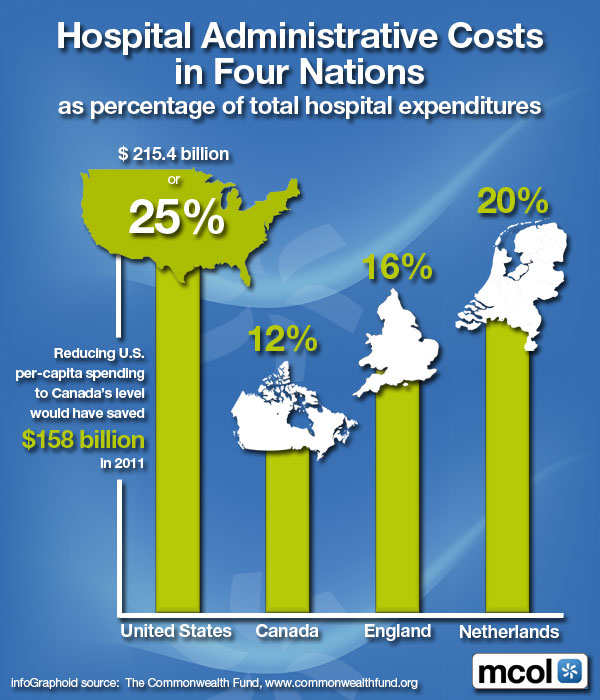
Hospital Admission Costs

Join Our Mailing List

In Four Nations

By http://www.MCOL.com

ImageProxy

Conclusion

Your thoughts and comments on this ME-P are appreciated. Feel free to review our top-left column, and top-right sidebar materials, links, URLs and related websites, too. Then, subscribe to the ME-P. It is fast, free and secure.

Speaker: If you need a moderator or speaker for an upcoming event, Dr. David E. Marcinko; MBA – Publisher-in-Chief of the Medical Executive-Post – is available for seminar or speaking engagements. Contact: MarcinkoAdvisors@msn.com

OUR OTHER PRINT BOOKS AND RELATED INFORMATION SOURCES:

Financial Planning MDs 2015

Comprehensive Financial Planning Strategies for Doctors and Advisors: Best Practices from Leading Consultants

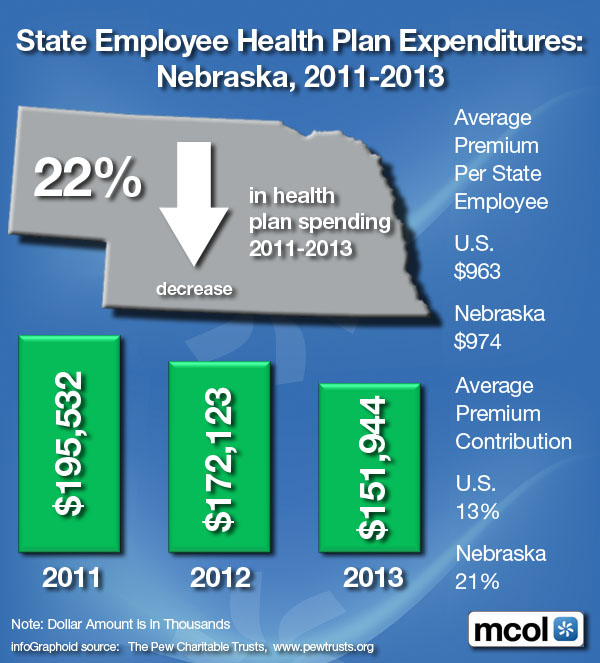
State Employee Health Plan Expenditures

Join Our Mailing List

Nebraska [2011-2013]

By http://www.MCOL.com

Nebraska

Conclusion

Your thoughts and comments on this ME-P are appreciated. Feel free to review our top-left column, and top-right sidebar materials, links, URLs and related websites, too. Then, subscribe to the ME-P. It is fast, free and secure.

Speaker: If you need a moderator or speaker for an upcoming event, Dr. David E. Marcinko; MBA – Publisher-in-Chief of the Medical Executive-Post – is available for seminar or speaking engagements. Contact: MarcinkoAdvisors@msn.com

OUR OTHER PRINT BOOKS AND RELATED INFORMATION SOURCES:

Product DetailsProduct Details


Product Details

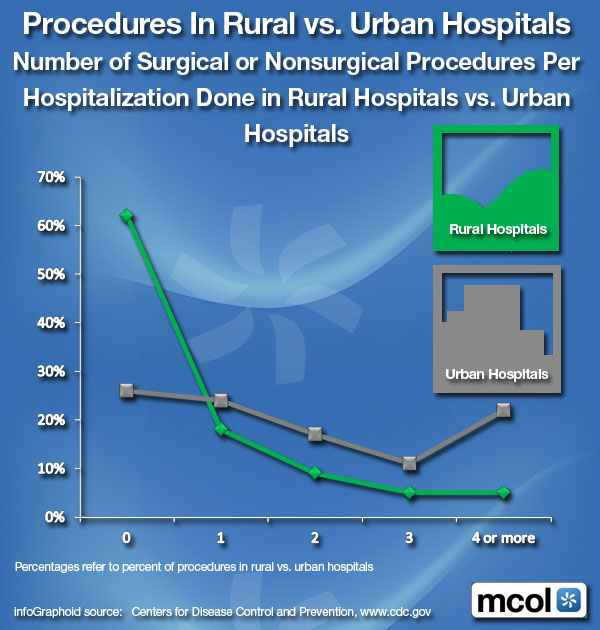
Procedures in Rural v. Urban Hospitals

Join Our Mailing List

Appreciating the Number of Procedures Done per Hospitalization

By http://www.MCOL.com

Hospitals

Conclusion

Your thoughts and comments on this ME-P are appreciated. Feel free to review our top-left column, and top-right sidebar materials, links, URLs and related websites, too. Then, subscribe to the ME-P. It is fast, free and secure.

Speaker: If you need a moderator or speaker for an upcoming event, Dr. David E. Marcinko; MBA – Publisher-in-Chief of the Medical Executive-Post – is available for seminar or speaking engagements. Contact: MarcinkoAdvisors@msn.com

OUR OTHER PRINT BOOKS AND RELATED INFORMATION SOURCES:

Product DetailsProduct Details

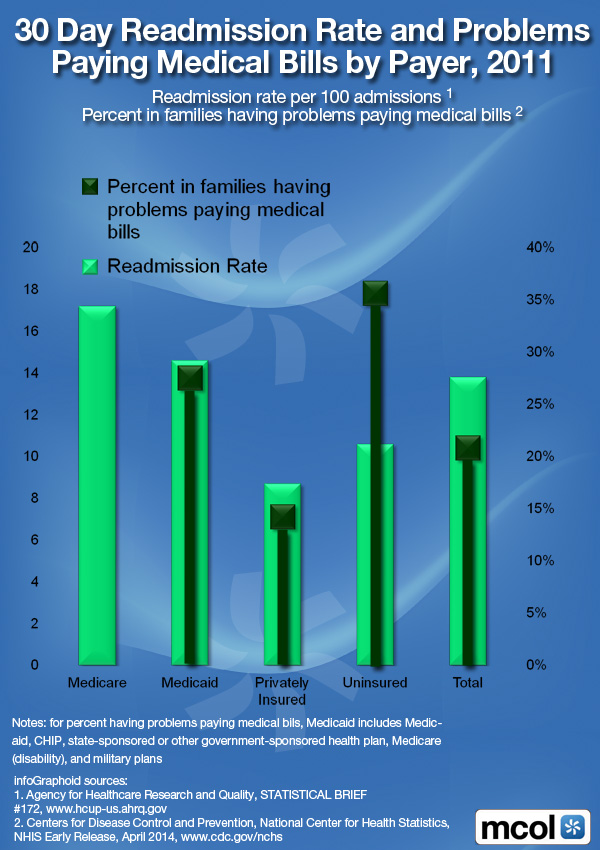
On Hospital 30 Day Re-Admission Rates

Join Our Mailing List

And … Problems Paying Medical Bills for 2011

By http://www.MOCL.com

ImageProxy

Conclusion

Your thoughts and comments on this ME-P are appreciated. Feel free to review our top-left column, and top-right sidebar materials, links, URLs and related websites, too. Then, subscribe to the ME-P. It is fast, free and secure.

Link: http://feeds.feedburner.com/HealthcareFinancialsthePostForcxos

Speaker: If you need a moderator or speaker for an upcoming event, Dr. David E. Marcinko; MBA – Publisher-in-Chief of the Medical Executive-Post – is available for seminar or speaking engagements. Contact: MarcinkoAdvisors@msn.com

OUR OTHER PRINT BOOKS AND RELATED INFORMATION SOURCES:

Product DetailsProduct Details

Product Details

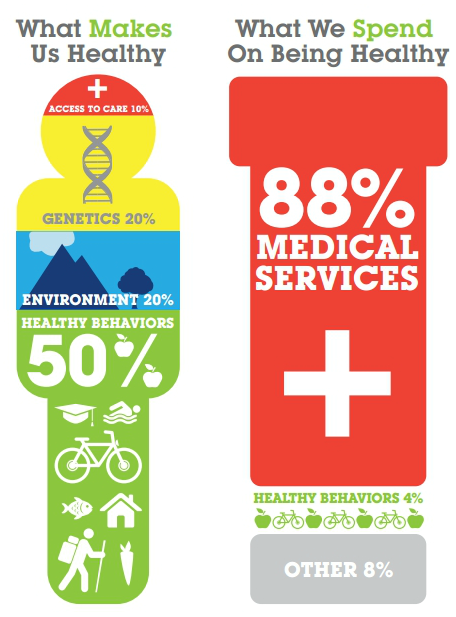
Does Health Care Contribute to Health?

Join Our Mailing List

And … How much does it cost?

By staff reporters

As Ezra Klein noted, The Bipartisan Policy Center included this infographic in their report on obesity and its economic consequences (PDF).

health-infographic

Assessment

Is this graphic even accurate?

Conclusion

Your thoughts and comments on this ME-P are appreciated. Feel free to review our top-left column, and top-right sidebar materials, links, URLs and related websites, too. Then, subscribe to the ME-P. It is fast, free and secure.

Link: http://feeds.feedburner.com/HealthcareFinancialsthePostForcxos

Speaker: If you need a moderator or speaker for an upcoming event, Dr. David E. Marcinko; MBA – Publisher-in-Chief of the Medical Executive-Post – is available for seminar or speaking engagements. Contact: MarcinkoAdvisors@msn.com

OUR OTHER PRINT BOOKS AND RELATED INFORMATION SOURCES:

Product DetailsProduct Details

Product Details


The State SHOP Market-Places 2014

Join Our Mailing List

Total Number of Plans for Small Employers 2014

SHOP

Conclusion

Your thoughts and comments on this ME-P are appreciated. Feel free to review our top-left column, and top-right sidebar materials, links, URLs and related websites, too. Then, subscribe to the ME-P. It is fast, free and secure.

Link: http://feeds.feedburner.com/HealthcareFinancialsthePostForcxos

Speaker: If you need a moderator or speaker for an upcoming event, Dr. David E. Marcinko; MBA – Publisher-in-Chief of the Medical Executive-Post – is available for seminar or speaking engagements. Contact: MarcinkoAdvisors@msn.com

OUR OTHER PRINT BOOKS AND RELATED INFORMATION SOURCES:

Product DetailsProduct Details

Product Details

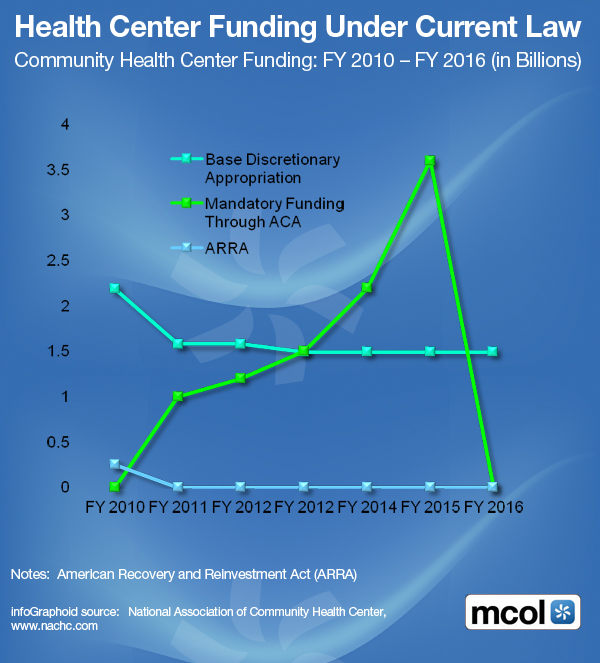
Communithy Health Center Funding Under Current Law

Join Our Mailing List

FY 2010-16 in $-Billions

http://www.MCOL.com

Funding

Conclusion

Your thoughts and comments on this ME-P are appreciated. Feel free to review our top-left column, and top-right sidebar materials, links, URLs and related websites, too. Then, subscribe to the ME-P. It is fast, free and secure.

Link: http://feeds.feedburner.com/HealthcareFinancialsthePostForcxos

Speaker: If you need a moderator or speaker for an upcoming event, Dr. David E. Marcinko; MBA – Publisher-in-Chief of the Medical Executive-Post – is available for seminar or speaking engagements. Contact: MarcinkoAdvisors@msn.com

OUR OTHER PRINT BOOKS AND RELATED INFORMATION SOURCES:

DICTIONARIES: http://www.springerpub.com/Search/marcinko
PHYSICIANS: www.MedicalBusinessAdvisors.com
PRACTICES: www.BusinessofMedicalPractice.com
HOSPITALS: http://www.crcpress.com/product/isbn/9781466558731
CLINICS: http://www.crcpress.com/product/isbn/9781439879900
BLOG: www.MedicalExecutivePost.com
FINANCE: Financial Planning for Physicians and Advisors
INSURANCE: Risk Management and Insurance Strategies for Physicians and Advisors

Product DetailsProduct Details

Product Details

Our ME-P Recommended Books Review

Join Our Mailing List

Purchase today and Profit in 2014

By Ann Miller RN MHA

[Executive-Director]

Product DetailsProduct DetailsProduct Details

Product Details  Product Details

Product DetailsProduct Details

Product Details

Conclusion

Your thoughts and comments on this ME-P are appreciated. Feel free to write a book review or check out our top-left column, and top-right sidebar materials, links, URLs and related websites, too. Then, subscribe to the ME-P. It is fast, free and secure.

Link: http://feeds.feedburner.com/HealthcareFinancialsthePostForcxos

Speaker: If you need a moderator or speaker for an upcoming event, Dr. David E. Marcinko; MBA – Publisher-in-Chief of the Medical Executive-Post – is available for seminar or speaking engagements. Contact: MarcinkoAdvisors@msn.com

###

How “Leaner” Hospitals Can Be Profitable in 2014

    Our Newest Textbooks with Checklists

Buy from Amazon

Learn How to Profit and Thrive in the PP-ACA Era

BOOK FOREWORD / TESTIMONIAL

###

Financial Management Strategies for Hospitals and Healthcare Organizations: Tools, Techniques, Checklists and Case Studies

###

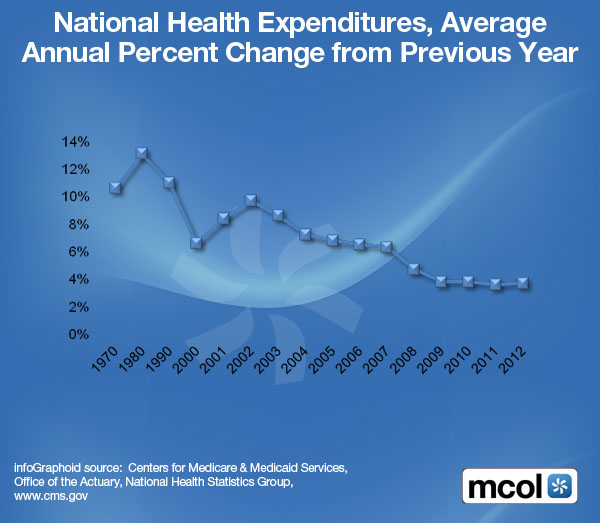
Reviewing National Health Expenditures

Join Our Mailing List

Average Annual Percent Change from the Previous Year

By www.MCOL.com

ImageProxy

Conclusion

Your thoughts and comments on this ME-P are appreciated. Feel free to review our top-left column, and top-right sidebar materials, links, URLs and related websites, too. Then, subscribe to the ME-P. It is fast, free and secure.

Link: http://feeds.feedburner.com/HealthcareFinancialsthePostForcxos

Speaker: If you need a moderator or speaker for an upcoming event, Dr. David E. Marcinko; MBA – Publisher-in-Chief of the Medical Executive-Post – is available for seminar or speaking engagements. Contact: MarcinkoAdvisors@msn.com

OUR OTHER PRINT BOOKS AND RELATED INFORMATION SOURCES:

DICTIONARIES: http://www.springerpub.com/Search/marcinko
PHYSICIANS: www.MedicalBusinessAdvisors.com
PRACTICES: www.BusinessofMedicalPractice.com
HOSPITALS: http://www.crcpress.com/product/isbn/9781466558731
CLINICS: http://www.crcpress.com/product/isbn/9781439879900
BLOG: www.MedicalExecutivePost.com
FINANCE: Financial Planning for Physicians and Advisors
INSURANCE: Risk Management and Insurance Strategies for Physicians and Advisors

Product DetailsProduct Details

Product Details

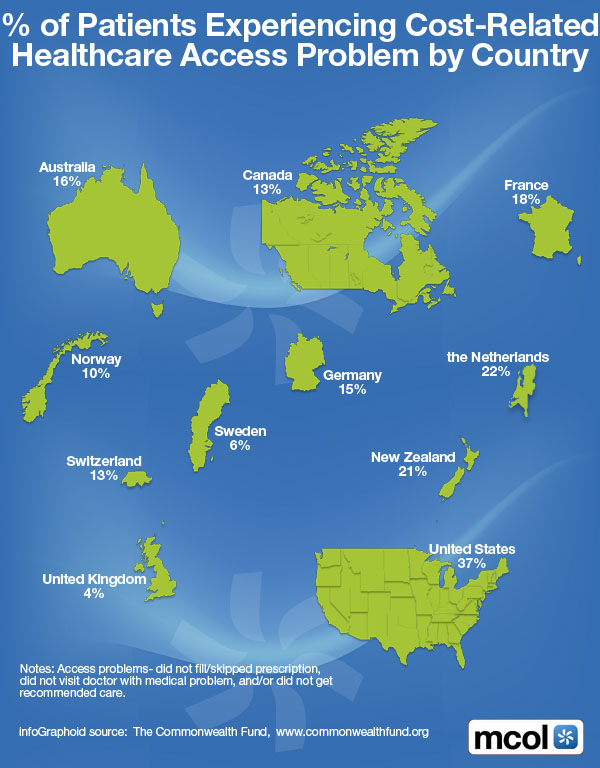
Percentages of Patients Experiencing Cost-Related Healthcare Access Problems

Join Our Mailing List

An Infographic by Country

By www.MCOL.com

dem

Assessment

Now, compare this to healthcare access difficulties in the USA.

Conclusion

Your thoughts and comments on this ME-P are appreciated. Feel free to review our top-left column, and top-right sidebar materials, links, URLs and related websites, too. Then, subscribe to the ME-P. It is fast, free and secure.

Link: http://feeds.feedburner.com/HealthcareFinancialsthePostForcxos

Speaker: If you need a moderator or speaker for an upcoming event, Dr. David E. Marcinko; MBA – Publisher-in-Chief of the Medical Executive-Post – is available for seminar or speaking engagements. Contact: MarcinkoAdvisors@msn.com

OUR OTHER PRINT BOOKS AND RELATED INFORMATION SOURCES:

DICTIONARIES: http://www.springerpub.com/Search/marcinko
PHYSICIANS: www.MedicalBusinessAdvisors.com
PRACTICES: www.BusinessofMedicalPractice.com
HOSPITALS: http://www.crcpress.com/product/isbn/9781466558731
CLINICS: http://www.crcpress.com/product/isbn/9781439879900
ADVISORS: www.CertifiedMedicalPlanner.org
PODIATRISTS: www.PodiatryPrep.com
BLOG: www.MedicalExecutivePost.com
FINANCE: Financial Planning for Physicians and Advisors
INSURANCE: Risk Management and Insurance Strategies for Physicians and Advisors

Product DetailsProduct DetailsProduct Details

Product Details  Product Details

Product DetailsProduct Details

Product Details

Healthcare News TV Videos

Join Our Mailing List

Announcing More New Videos:

Advocacy

Conclusion: Your thoughts and comments on this ME-P are appreciated. Feel free to review our top-left column, and top-right sidebar materials, links, URLs and related websites, too. Then, subscribe to the ME-P. It is fast, free and secure.Link: http://feeds.feedburner.com/HealthcareFinancialsthePostForcxos

Speaker: If you need a moderator or speaker for an upcoming event, Dr. David E. Marcinko; MBA – Publisher-in-Chief of the Medical Executive-Post – is available for seminar or speaking engagements. Contact: MarcinkoAdvisors@msn.com

OUR OTHER PRINT BOOKS AND RELATED INFORMATION SOURCES:

LEXICONS: http://www.springerpub.com/Search/marcinko
PHYSICIANS: www.MedicalBusinessAdvisors.com
PRACTICES: www.BusinessofMedicalPractice.com
HOSPITALS: http://www.crcpress.com/product/isbn/9781466558731
CLINICS: http://www.crcpress.com/product/isbn/9781439879900
ADVISORS: www.CertifiedMedicalPlanner.org
BLOG: www.MedicalExecutivePost.com

Product DetailsProduct DetailsProduct Details

Product Details  Product Details

Product DetailsProduct Details

Product Details


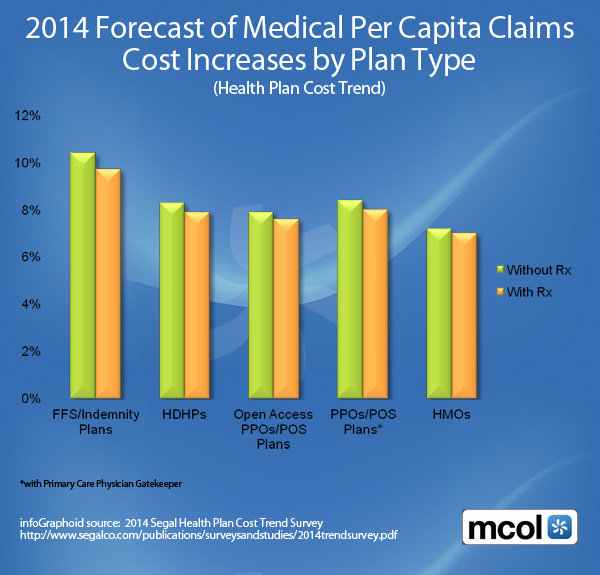
2014 Forecast of Medical Per Capita Claims

Join Our Mailing List

Cost Increases by Plan Type

By www.MCOL.com

###

ImageProxy

###

Your thoughts and comments on this ME-P are appreciated. Feel free to review our top-left column, and top-right sidebar materials, links, URLs and related websites, too. Then, subscribe to the ME-P. It is fast, free and secure.

Link: http://feeds.feedburner.com/HealthcareFinancialsthePostForcxos

Speaker: If you need a moderator or speaker for an upcoming event, Dr. David E. Marcinko; MBA – Publisher-in-Chief of the Medical Executive-Post – is available for seminar or speaking engagements. Contact: MarcinkoAdvisors@msn.com

OUR OTHER PRINT BOOKS AND RELATED INFORMATION SOURCES:

LEXICONS: http://www.springerpub.com/Search/marcinko
PHYSICIANS: www.MedicalBusinessAdvisors.com
PRACTICES: www.BusinessofMedicalPractice.com
HOSPITALS: http://www.crcpress.com/product/isbn/9781466558731
CLINICS: http://www.crcpress.com/product/isbn/9781439879900
ADVISORS: www.CertifiedMedicalPlanner.org
PODIATRISTS: www.PodiatryPrep.com
BLOG: www.MedicalExecutivePost.com

Product DetailsProduct Details

Product Details

Top 12 Articles [Health Administration Reading List]

Join Our Mailing List

By Staff Reporters via Austin Frakt PhD

On Health Economics, Finance and Insurance, Quality Care and Organizational Behavior

1. Substantial Health And Economic Returns From Delayed Aging May Warrant A New Focus For Medical Research

By Dana Goldman and others (Health Affairs)

2. Trends Underlying Employer Sponsored Health Insurance Growth For Americans Younger Than Age Sixty-Five

By Carolina-Nicole Herrera and others (Health Affairs)

3. Accountable Care Organization Formation Is Associated With Integrated Systems But Not High Medical Spending

By David Auerbach, Hangsheng Liu, Peter Hussey, Christopher Lau, and Ateev Mehrotra (Health Affairs)

4. The Quality Of Care Delivered To Patients Within The Same Hospital Varies By Insurance Type

By Christine S. Spencer, Darrell J. Gaskin, and Eric T. Roberts  (Health Affairs)

5. Understanding State Variation In Health Insurance Dynamics Can Help Tailor Enrollment Strategies For ACA Expansion

By John Graves and Katherine Swartz (Health Affairs)

6. When Medicare Cuts Hospital Prices, Seniors Use Less Inpatient Care

By Chapin White and Tracy Yee (Health Affairs)

7. More Americans Living Longer With Cardiovascular Disease Will Increase Costs While Lowering Quality Of Life

By Ankur Pandya, Thomas Gaziano, Milton Weinstein, and David Cutler (Health Affairs)

8. Surgical Skill and Complication Rates after Bariatric Surgery

By John Birkmeyer and others (New England Journal of Medicine)

Reading list

9. Who Is in Control? The Determinants of Patient Adherence with Medication Therapy

By Sergei Koulayev, Niels Skipper and Emilia Simeonova (National Bureau of Economic Research)

10. Fifty Years of Family Planning: New Evidence on the Long-Run Effects of Increasing Access to Contraception

By Martha Bailey (National Bureau of Economic Research)

11. Identifying the Health Production Function: The Case of Hospitals

By John Romley and Neeraj Sood (National Bureau of Economic Research)

12. ACA Standoff

By Jeffrey Drazen and Gregory Curfman (New England Journal of Medicine)

Assessment

Feel free to send us links to your own hot topic reading list so that we may share.

Conclusion

Your thoughts and comments on this ME-P are appreciated. Feel free to review our top-left column, and top-right sidebar materials, links, URLs and related websites, too. Then, subscribe to the ME-P. It is fast, free and secure.

Link: http://feeds.feedburner.com/HealthcareFinancialsthePostForcxos

Speaker: If you need a moderator or speaker for an upcoming event, Dr. David E. Marcinko; MBA – Publisher-in-Chief of the Medical Executive-Post – is available for seminar or speaking engagements. Contact: MarcinkoAdvisors@msn.com

OUR OTHER PRINT BOOKS AND RELATED INFORMATION SOURCES:

LEXICONS: http://www.springerpub.com/Search/marcinko
PHYSICIANS: www.MedicalBusinessAdvisors.com
PRACTICES: www.BusinessofMedicalPractice.com
HOSPITALS: http://www.crcpress.com/product/isbn/9781466558731
CLINICS: http://www.crcpress.com/product/isbn/9781439879900
ADVISORS: www.CertifiedMedicalPlanner.org
PODIATRISTS: www.PodiatryPrep.com
BLOG: www.MedicalExecutivePost.com

Product DetailsProduct Details

Product Details

Upcoming Webinars and Health Administration Essays around the Net

Join Our Mailing List

By Staff Reporters

Some Topics of Interest for ME-P Readers

###

US capitol

###

Assessment

Enjoy these informative private sector and government publications.

Conclusion

Your thoughts and comments on this ME-P are appreciated. Feel free to review our top-left column, and top-right sidebar materials, links, URLs and related websites, too. Then, subscribe to the ME-P. It is fast, free and secure.

Link: http://feeds.feedburner.com/HealthcareFinancialsthePostForcxos

Speaker: If you need a moderator or speaker for an upcoming event, Dr. David E. Marcinko; MBA – Publisher-in-Chief of the Medical Executive-Post – is available for seminar or speaking engagements. Contact: MarcinkoAdvisors@msn.com

OUR OTHER PRINT BOOKS AND RELATED INFORMATION SOURCES:

Health Dictionary Series: http://www.springerpub.com/Search/marcinko

Practice Management: http://www.springerpub.com/product/9780826105752

Physician Financial Planning: http://www.jbpub.com/catalog/0763745790

Medical Risk Management: http://www.jbpub.com/catalog/9780763733421

Hospitals: http://www.crcpress.com/product/isbn/9781439879900

Physician Advisors: www.CertifiedMedicalPlanner.org

Product DetailsProduct DetailsProduct Details

Product Details  Product Details

Product DetailsProduct Details

Why Hospitals Should Use Financial Management Checklists

Join Our Mailing List

Financial Management Strategies for Hospital and Healthcare Organizations [Tools, Techniques, Checklists and Case Studies]

By Neil H. Baum MD

Dr. BaumIt is fitting that ME-P Editor Dr. David Edward Marcinko MBA CMP™ and his fellow experts, have laid out a plan of action in Financial Management Strategies for Hospital and Healthcare Organizations: Tools, Techniques, Checklists and Case Studies that physicians, nurse-executives, administrators and institutional Chief Executive Officers, Chief Financial Officers, MBAs, lawyers and healthcare accountants can follow to help move healthcare financial fitness forward during these unchartered waters.

In medicine – It all began with Dr. Atul Gawande, a surgeon at Massachusetts General Hospital, who reviewed the airline industry and their use of checklists prior to take off of an airplane.

The history of aviation checklists began in 1934 when Boeing was in the final process of testing a U.S. Army fighter plane with a potential contract of nearly 200 planes riding on the final test of the plane. The test aircraft made a normal taxi and takeoff. It began a smooth climb, but then suddenly stalled. The aircraft turned on one wing and fell, bursting into flames upon impact killing two of the test pilots. The investigation found pilot error as the cause. One of the pilots who was unfamiliar with the aircraft had neglected to release the elevator lock prior to take off. The contract with Boeing was in jeopardy.

Thus, the pilots sat down and put their heads together. What was needed was some way of making sure that everything to prevent crashes was being done; that nothing was overlooked. What resulted was a pilot’s checklist developed before takeoff, during flight, before landing, and after landing. These checklists for the pilot and co-pilot made sure that nothing was forgotten and safety of the planes was insured.

Medical Care and Hospitals

So, what does airline safety have to with medical care and hospitals?

There are so many activities that take place in medicine such as the operating room, that are far too complicated to be left to memory of doctors, nurses, anesthesiologists, and others involved in the surgical care of patients.  Dr. Gawande identified the key components of a surgical procedure which include the name of the patient, the procedure to be performed, the estimated length of the procedure, whether the right or left side is the surgical target, how much blood loss is anticipated, whether antibiotics have been given prior to making the incision, and the anesthetic risk of the patient.  This use of a checklist which takes approximately 30 seconds has not only prevented wrong side surgery but also instills a discipline of higher performance.

###

Financial Management Strategies for Hospitals and Healthcare Organizations

Financial Management Strategies for Hospitals and Healthcare Organizations: Tools, Techniques, Checklists and Case Studies

###

From the Clinic to the Boardroom

And so, should [can] we port the clinical checklist example of Atul Gawande for use with non-clinical topics like hospital financial management and administration?

Assessment

Yes – We have a challenge and the Financial Management Strategies for Hospital and Healthcare Organizations: Tools, Techniques, Checklists and Case Studies is a step in the direction to make all of the stakeholders in the healthcare arena become sensitive to reducing and controlling costs and at the same time preserve quality of care.

This can be done.  I suggest you start by reading, using and referring to this excellent book.

And so, what is my final advice? Read the Book!

Some of you who will read this book are CXOs COOs, Chief Medical Officers and maybe even COS. (Chiefs of Staff). But, all of you should become CLOs (Chief Life Officers)!  Read this book and the initials CLO will appear after your name!

Note:

Neil H. Baum MD is a Clinical Associate Professor of Urology at the Tulane Medical School, New Orleans, LA. He is also a thought-leader for this ME-P. 

Conclusion

Your thoughts and comments on this ME-P are appreciated. Feel free to review our top-left column, and top-right sidebar materials, links, URLs and related websites, too. Then, subscribe to the ME-P. It is fast, free and secure.

Speaker: If you need a moderator or speaker for an upcoming event, Dr. David E. Marcinko; MBA – Publisher-in-Chief of the Medical Executive-Post – is available for seminar or speaking engagements. Contact: MarcinkoAdvisors@msn.com

OUR OTHER PRINT BOOKS AND RELATED INFORMATION SOURCES:

Product DetailsProduct DetailsProduct Details

Product DetailsProduct Details

Doubting the Accountable Care Organization B-Model

New Healthcare Business Model or Edsel Model?

Join Our Mailing List 

By David Edward Marcinko MBA http://www.CertifiedMedicalPlanner.org

[Publisher-in-Chief]

Dr. Marcinko with ME-P FansDefined by Professor Michael Porter at Harvard Business School, value is defined as a function of outcomes and costs. Therefore to achieve high value we must deliver the best possible outcomes in the most efficient way, outcomes which matter from the perspective of the individual receiving healthcare and not provider process measures or targets.

Sir Muir Gray expanded on the idea of technical value (outcomes/costs) to specifically describe ‘personal value’ and ‘allocative value’, encouraging us to focus also on shared decision making, individual preferences for care and ensuring that resources are allocated for maximum value.

Healthcare Value and ACOs

According to our Medical Executive-Post Health Dictionary Series of administrative terms http://www.HealthDictionarySeries.org  and health economist and colleague Robert James Cimasi MHA, ASA, AVA CMP™ of www.HealthCapital.com; an ACO is a healthcare organization in which a set of providers, usually large physician groups and hospitals, are held accountable for the cost and quality of care delivered to a specific local population.

ACOs aim to affect provider’s patient expenditures and outcomes by integrating clinical and administrative departments to coordinate care and share financial risk.

ACO Launch

Since their four-page introduction in the PP-ACA of 2010, ACOs have been implemented in both the Federal and commercial healthcare markets, with 32 Pioneer ACOs selected (on December 19, 2011), 116 Federal applications accepted (on April 10, 2012 and July 9, 2012), and at least 160 or more Commercial ACOs in existence today.

Federal Contracts

Federal ACO contracts are established between an ACO and CMS, and are regulated under the CMS Medicare Shared Savings Program (MSSP) Final Rule, published November 2, 2011.  ACOs participating in the MSSP are accountable for the health outcomes, represented by 33 quality metrics, and Medicare beneficiary expenditures of a prospectively assigned population of Medicare beneficiaries.

If a Federal ACO achieves Medicare beneficiary expenditures below a CMS established benchmark (and meets quality targets), they are eligible to receive a portion of the achieved Medicare beneficiary expenditure savings, in the form of a shared savings payment.

Commercial Contracts

Commercial ACO contracts are not limited by any specific legislation, only by the contract between the ACO and a commercial payor.

In addition to shared savings models, Commercial ACOs may incentivize lower costs and improved patient outcomes through reimbursement models that share risk between the payor and the providers, i.e., pay for performance compensation arrangements and/or partial to full capitation.

Although commercial ACOs experience a greater degree of flexibility in their structure and reimbursement, the principals for success for both Federal ACOs and Commercial ACOs are similar.

###

Eidsel

Dr. David E. Marcinko with 1960 Ford Edsel

[© iMBA, Inc. All rights reserved, USA.]

[The Edsel was an automobile marque that was planned, developed, and manufactured by the Ford Motor Company during the 1958, 1959, and 1960 model years. With the Edsel, Ford had expected to make significant inroads into the market share of both General Motors and Chrysler and close the gap between itself and GM in the domestic American automotive market. But, contrary to Ford’s internal plans and projections, the Edsel never gained popularity with contemporary American car buyers and sold poorly. The Ford Motor Company lost millions of dollars on the Edsel’s development, manufacturing and marketing].

More:


Update

Junking the Merit-Based Incentive Payment System (MIPS) would undoubtedly let the proverbial air out of the MACRA balloon, dealing a significant blow to the value-based reimbursement shift; right?

Assessment

Although nearly any healthcare enterprise can integrate and become an ACO, larger enterprises, may be best suited for ACO status.

Larger organizations are more able to accommodate the significant capital requirements of ACO development, implementation, and operation (e.g., healthcare information technology), and sustain the sufficient number of beneficiaries to have a significant impact on quality and cost metrics.

Conclusion

But, will this new B-Model work? Isn’t leading doctors in a shared collaborative effort a bit like herding cats? And, what about patients, HIEs, outcomes management, data analytics and … Population Health via our colleague David B. Nash MD MBA of Thomas Jefferson University, often considered the “father” of Pop Health?

OR, what about the developing IRS scandal and full PP-ACA launch in 2014? Will it affect federal funding, full roll-out, or even repeal of the entire Act?

Your thoughts and comments on this ME-P are appreciated. Feel free to review our top-left column, and top-right sidebar materials, links, URLs and related websites, too. Then, subscribe to the ME-P. It is fast, free and secure.

Link: http://feeds.feedburner.com/HealthcareFinancialsthePostForcxos

Speaker: If you need a moderator or speaker for an upcoming event, Dr. David E. Marcinko; MBA – Publisher-in-Chief of the Medical Executive-Post – is available for seminar or speaking engagements. Contact: MarcinkoAdvisors@msn.com

OUR OTHER PRINT BOOKS AND RELATED INFORMATION SOURCES:

DICTIONARIES: http://www.springerpub.com/Search/marcinko
PHYSICIANS: www.MedicalBusinessAdvisors.com
PRACTICES: www.BusinessofMedicalPractice.com
HOSPITALS: http://www.crcpress.com/product/isbn/9781466558731
CLINICS: http://www.crcpress.com/product/isbn/9781439879900
BLOG: www.MedicalExecutivePost.com
FINANCE: Financial Planning for Physicians and Advisors
INSURANCE: Risk Management and Insurance Strategies for Physicians and Advisors

Product DetailsProduct Details

Purchase ME-P Textbooks, Handbooks and Dictionaries to Thrive

 Our Library is Growing … thanks to you

Join Our Mailing List

By Ann Miller RN MHA

[ME-P Executive-Director]

We have been publishing the Medical Executive-Post for more than eight years now. And, with almost 3,000 formal posts, by the nation’s brightest experts, we have a treasure trove of information available to you.

So now, for the first time, all this information – and more – has been codified, updated, copy-righted and copy-protected in print form for your purchase and use. All have been edited by our Publisher – Dr. David Edward Marcinko and Professor Hope Rachel Hetico.

Just click on an image below to order.

Product DetailsProduct DetailsProduct Details

Product Details  Product Details

Product DetailsProduct Details

Assessment

Purchase our white papers, too: https://medicalexecutivepost.com/white-papers/

Conclusion

Your thoughts and comments on this ME-P are appreciated. Feel free to review our top-left column, and top-right sidebar materials, links, URLs and related websites, too. Then, subscribe to the ME-P. It is fast, free and secure.

Link: http://feeds.feedburner.com/HealthcareFinancialsthePostForcxos

Speaker: If you need a moderator or speaker for an upcoming event, Dr. David E. Marcinko; MBA – Publisher-in-Chief of the Medical Executive-Post – is available for seminar or speaking engagements. Contact: MarcinkoAdvisors@msn.com

OUR OTHER PRINT BOOKS AND RELATED INFORMATION SOURCES:

Health Dictionary Series: http://www.springerpub.com/Search/marcinko

Practice Management: http://www.springerpub.com/product/9780826105752

Physician Financial Planning: http://www.jbpub.com/catalog/0763745790

Medical Risk Management: http://www.jbpub.com/catalog/9780763733421

Hospitals: http://www.crcpress.com/product/isbn/9781439879900

Physician Advisors: www.CertifiedMedicalPlanner.org

Business%20Optimization

The status of African American insurance coverage

Join Our Mailing List

A Struggling PP-ACA Sector    

By FinancesOnline.com

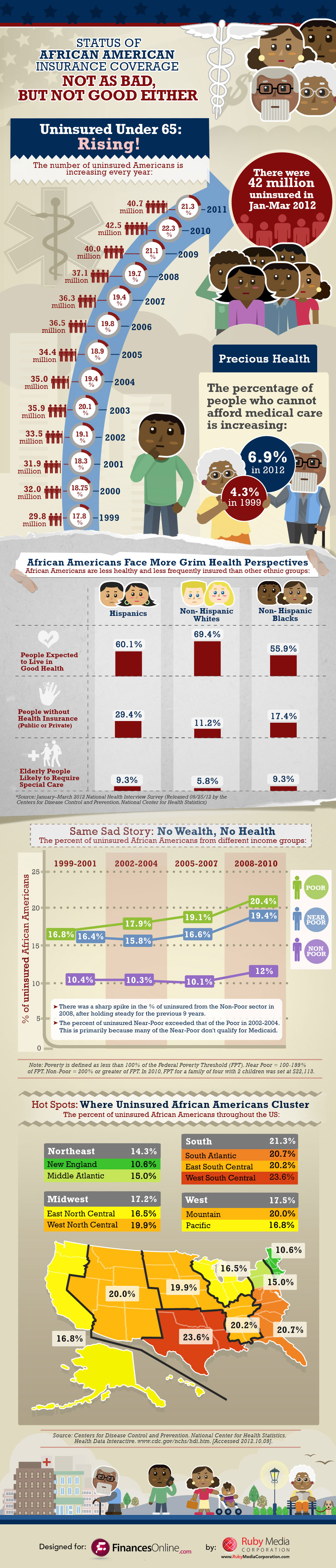
The Affordable Care Act has developed into one of the critical pivots on which the success of President Obama’s second term is expected to turn. Yet, one sector that’s already struggling is African Americans.

In 2012, 17.4 percent of non-Hispanic African Americans were uninsured. More critically, only 55.9 percent of African Americans are expected to continue to live in good health, while a more or less healthy life is expected in 69.4 percen of white Americans.

###

infographic-health-insurance-of-african-americans

###

Assessment

These and other alarming facts were revealed by the National Health Interview Survey of the Center for Disease Control and Prevention, and corroborated by data from the U.S. Census Bureau. Both these agencies were data sources for this infographic, which takes a closer look at the health insurance situation of African Americans.

Conclusion

Your thoughts and comments on this ME-P are appreciated. Feel free to review our top-left column, and top-right sidebar materials, links, URLs and related websites, too. Then, subscribe to the ME-P. It is fast, free and secure.

Link: http://feeds.feedburner.com/HealthcareFinancialsthePostForcxos

Speaker: If you need a moderator or speaker for an upcoming event, Dr. David E. Marcinko; MBA – Publisher-in-Chief of the Medical Executive-Post – is available for seminar or speaking engagements. Contact: MarcinkoAdvisors@msn.com

Our Other Print Books and Related Information Sources:

Health Dictionary Series: http://www.springerpub.com/Search/marcinko

Practice Management: http://www.springerpub.com/product/9780826105752

Physician Financial Planning: http://www.jbpub.com/catalog/0763745790

Medical Risk Management: http://www.jbpub.com/catalog/9780763733421

Hospitals: http://www.crcpress.com/product/isbn/9781439879900

Physician Advisors: www.CertifiedMedicalPlanner.org

Product DetailsProduct DetailsProduct Details

Product Details  Product Details

Product DetailsProduct Details

A Visual on Health Entitlement Spending

Join Our Mailing List

A Story in Six Charts

By Nancy Chockley PhD www.NIHCM.org

Between the fiscal cliff, sequestration, a potential government shut down and the debt ceiling, Washington is experiencing a seemingly endless succession of budgetary crises.

Although health entitlement programs are often on the table in negotiations, there has been little agreement on the scope and direction of meaningful reform. The recent slowdown in health spending growth may strengthen the impulse on some fronts to delay action, but long-term projections leave little doubt that federal health spending will continue to be a major contributor to our fiscal woes.

Assessment

This chart story pulls together essential facts on how much the federal government is spending on mandatory health care programs, how that spending affects the budget, and the hard spending and revenue trade-offs necessary to improve our fiscal outlook.

chart story

Conclusion

Your thoughts and comments on this ME-P are appreciated. Feel free to review our top-left column, and top-right sidebar materials, links, URLs and related websites, too. Then, subscribe to the ME-P. It is fast, free and secure.

Link: http://feeds.feedburner.com/HealthcareFinancialsthePostForcxos

Speaker: If you need a moderator or speaker for an upcoming event, Dr. David E. Marcinko; MBA – Publisher-in-Chief of the Medical Executive-Post – is available for seminar or speaking engagements. Contact: MarcinkoAdvisors@msn.com

OUR OTHER PRINT BOOKS AND RELATED INFORMATION SOURCES:

Health Dictionary Series: http://www.springerpub.com/Search/marcinko

Practice Management: http://www.springerpub.com/product/9780826105752

Physician Financial Planning: http://www.jbpub.com/catalog/0763745790

Medical Risk Management: http://www.jbpub.com/catalog/9780763733421

Hospitals: http://www.crcpress.com/product/isbn/9781439879900

Physician Advisors: www.CertifiedMedicalPlanner.org

Product DetailsProduct Details

Understanding the Pre-Reform Impact of Self-Pay Patients

Join Our Mailing List

On Us Hospitals

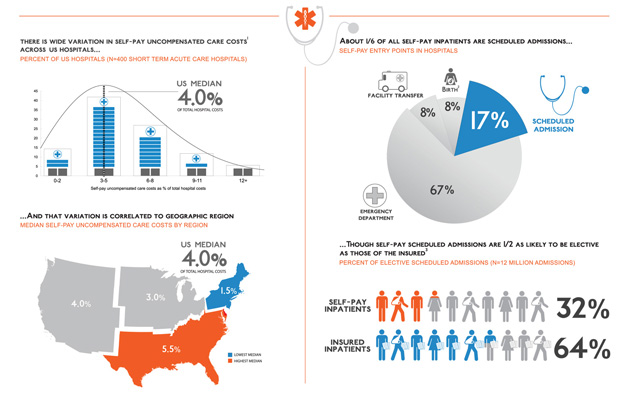
Source: Objective Health

Pre-reform, many hospitals experience significant uncompensated care costs from self-pay patients.

###

Reform Impact

###

This infographic illustrates the variation in self-pay uncompensated care costs across US hospitals and regions.

Assessment

Despite the uncompensated care risk, 1/6th of self-pay inpatients are scheduled admissions, though their procedures are much less elective than the procedures of the insured.

Conclusion

Your thoughts and comments on this ME-P are appreciated. Feel free to review our top-left column, and top-right sidebar materials, links, URLs and related websites, too. Then, subscribe to the ME-P. It is fast, free and secure.

Link: http://feeds.feedburner.com/HealthcareFinancialsthePostForcxos

Speaker: If you need a moderator or speaker for an upcoming event, Dr. David E. Marcinko; MBA – Publisher-in-Chief of the Medical Executive-Post – is available for seminar or speaking engagements. Contact: MarcinkoAdvisors@msn.com

Our Other Print Books and Related Information Sources:

Health Dictionary Series: http://www.springerpub.com/Search/marcinko

Practice Management: http://www.springerpub.com/product/9780826105752

Physician Financial Planning: http://www.jbpub.com/catalog/0763745790

Medical Risk Management: http://www.jbpub.com/catalog/9780763733421

Hospitals: http://www.crcpress.com/product/isbn/9781439879900

Physician Advisors: www.CertifiedMedicalPlanner.org

Product DetailsProduct Details

Why are Medical Bills so High [video]

Join Our Mailing List______________________________

TIME’s Best Cover Story … Ever?
###
TIME magazine just dedicated its current issue to just one article: “Bitter Pill: Why Medical Bills Are Killing Us.”
###
The article, written by Time contributor Steven Brill, is required reading for all healthcare providers, administrators, legislators, patients — basically, everyone; especially readers of this ME-P.

The article is too comprehensive to summarize in one blurb, but Mr. Brill did a good job of describing its origins to Jon Stewart on The Daily Show.

Throughout all of the discussions during the Obamacare debate, the focus was usually on who should pay the medical bills.  Brill said, “We never asked the first question: Why are the bills so high?”

###

###

Assessment

We wish we could say we thought of this, but it was Matt Yglesias who did.

Conclusion

Your thoughts and comments on this ME-P are appreciated. Feel free to review our top-left column, and top-right sidebar materials, links, URLs and related websites, too. Then, subscribe to the ME-P. It is fast, free and secure.

Speaker: If you need a moderator or speaker for an upcoming event, Dr. David E. Marcinko; MBA – Publisher-in-Chief of the Medical Executive-Post – is available for seminar or speaking engagements. Contact: MarcinkoAdvisors@msn.com

OUR OTHER PRINT BOOKS AND RELATED INFORMATION SOURCES:

Product DetailsProduct Details

***

A Better Approach to [Hospital] Cost Estimation

Join Our Mailing List

Re-thinking the Ratios-of-Costs-to-Charges [RCCs] Financial Meter

By Russ Richmond MD

Russ Richmond MDUsing the ratios-of-costs-to-charges [RCCs] can lead hospitals down a garden-variety strategic path that’s wrong for them.

A strategically safer method of cost estimation can more accurately reveal costs.


At a Glance

  • Using ratios of costs to charges (RCCs) to estimate costs can cause hospitals to significantly over- or under-invest in service lines.
  • A focus on improving cost estimation in cost centers where physicians have significant control over operating expenses, such as drugs or implants, can strengthen decision making and strategic planning.
  • Connecting patient file information to purchasing data can lead to more accurate reflections of actual costs and help hospitals gain better visibility across service lines.

To put it bluntly, there is an almost complete lack of understanding of how much it costs to deliver patient care, much less how those costs compare with the outcomes achieved. Instead of focusing on the costs of treating individual patients with specific medical conditions over their full cycle of care, providers aggregate and analyze costs at the specialty or service department level.

—Professors Robert Kaplan and Michael Porter, “The Big Idea: How to Solve the Cost Crisis in Health Care,” Harvard Business Review, September 2011.

Of all the challenges hospitals face in today’s uncertain healthcare environment, estimating their costs might not be their top concern. However, the method most hospitals use to estimate their costs can have serious strategic and financial ramifications on their bottom line.

More than 60 percent of hospitals today use ratios of costs to charges (RCCs) as their primary cost estimation method, because true cost accounting is viewed as prohibitively expensive. But using RCCs to estimate costs can lead to significant problems for hospitals. For example, results of a recent study disclose that among 184 mid-sized community hospitals (i.e., with roughly 300 beds), the use of RCCs led 85 percent of the hospitals to overestimate the profitability of orthopedic surgery service lines. On average, the overestimates amounted to $1.2 million per year per hospital.

Such incorrect cost estimates can cascade into potentially serious strategic, financial, and operational issues. Because of faulty cost estimates, hospitals can over-invest—or under-invest—in service lines based only on high-level insight into the actual profitability of these areas. Either scenario has the potential to produce negative consequences.

Suboptimal strategic decision making based on faulty data and conclusions leads to suboptimal results. No hospital can afford such results and stay competitive in an industry of increased cost and pricing transparency.

So what’s the solution for hospitals? Even without switching to a full procedural cost-accounting system, hospitals can make adjustments that improve their cost estimating and thus strengthen their decision making and strategic planning. The operative principle is that hospitals should focus on improving cost estimating in cost centers where physicians have the most control of operating expenses—namely, drugs and implants.

Making the Right Cost Connections

Connecting patient file information, where costs are estimated, with purchasing data, which reflect actual costs, can produce a significant impact on a hospital’s pricing methodology. Drugs and implants, which represent 17 percent of a typical hospital’s total costs, are a good starting point for adoption of this approach.

Drugs. To better estimate drug prices, hospitals should make the patient file/purchasing data connection based on generic class, route of administration, and dosage. The patient charge file and the purchasing file can be connected using a common taxonomy. For instance, a hospital’s purchasing file may record a box of 10 Tylenol tablets as “10 Tylenol tablets of 325 mg,” while the charge may be recorded in the patient charge file as “Acetaminophen cap 325.” This results in a direct text mismatch for calculating cost, which can ultimately lead to faulty cost-estimating data. A common taxonomy would group these two entries into a common bucket to produce an accurate mapping of costs.

Implants. Implants are also a major price item for hospitals. To better estimate implant costs, the patient charge file and the purchasing file should be mapped using the implant log, using the same process described for mapping drug costs. The implant log is used by surgeons after an operation to log the type of procedure, detailed description of supplies used, and general comments.

When a physician orders a knee implant, the implant stock-keeping unit (SKU) number is often recorded in the implant log. If the SKU number in the implant log were mapped to the SKU number in the hospital’s purchasing file, the hospital would be better able to determine the actual cost for the implant. The cost could then be assigned to the patient file, resulting in a more accurate cost picture for orthopedic cases.

For example, to assign true implant costs to a patient who has undergone a knee replacement, a hospital would look up the implant SKU recorded in the implant log by the physician—in this example, SKU123. Then, the hospital would open the purchasing file and locate, for that particular month, the description and price for SKU123 (in this instance, XYZ knee replacement part; cost: $4,950). Next, the hospital would map the more detailed description and price for the implant to the patient charge file. This process can help to ensure that the true cost of the implant used by the physician is assigned to the patient’s charge file.

In some hospitals, the implant log, purchasing file, and patient charge file are part of the same system. For the majority of hospitals, however, the implant log is a separate electronic file, not connected with the other file system or systems. And in some hospitals, the implant log is manually managed.

A hospital can complement this process by comparing its drug and implant costs with price benchmarks from subscription-based national databases or with databases maintained by consulting firms. In our experience, a 65 percent match can be achieved by connecting the drug and implant purchasing files with the detailed charge files, as outlined above. By comparing these costs with price benchmarks from subscription-based or consulting-firm databases, a hospital can better determine how the prices it is paying for drugs and implants compare with national averages.

By connecting these data sets, hospitals can gain better visibility of what they are really spending across various service lines and operational functions.

Understanding a Rural Hospital’s True Costs

The experience of a 250-bed rural hospital in the north central United States provides a good example of the pitfalls of using RCCs to estimate costs. This hospital found itself making key strategic planning decisions based on misleading cost data.

In analyzing the drug usage data from two physicians (A and B) at the hospital, physician B appeared more cost-efficient than physician A at treating the same disease. However, on examining physician B’s actual drug expenditures, hospital leaders realized this physician’s costs were in fact higher than those of physician A (see the exhibitbelow).

###
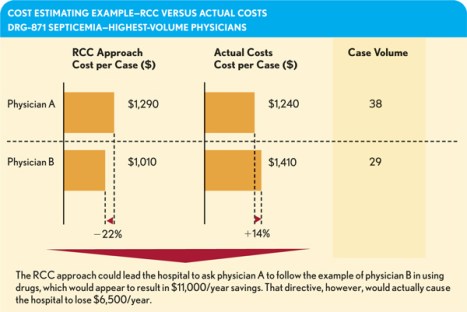
f-richmond

###

If RCC costs are considered, physician A seems to be treating patients at a higher average cost per case than physician B. But if actual costs are considered, physician A is actually treating at a lower cost per case than physician B. Strategically, based on the RCC analysis, if the hospital encouraged all of its physicians to emulate physician B’s treatment approach, it would lose the opportunity to save money on every case.

The data generated by RCCs can be especially problematic in measuring the profitability of various hospital services lines. Because of these misleading cost data, the team at this rural hospital was under the impression it was making a healthy $477,000 profit annually from its orthopedic surgery group.

The reality was the hospital’s profit from this key service line was about $170,000 less—a material difference for a rural community hospital.

For years, the provider thought it was making money on hip replacement surgery, but those profits were much lower because costs of implants used in these orthopedic procedures were continually underestimated. An incorrect profitability picture such as this can wreak havoc on vital strategic-planning efforts.

The rural hospital is by no means an outlier in regard to its problems with cost estimation. The research finding cited at the beginning of this article suggests institutions regularly underestimate costs per orthopedic procedure (and the costs of implants) because of their use of RCCs.

Rising costs are at the heart of the cost challenges that are prevalent in health care. Healthcare reform was designed, in part, to help alleviate this persistent cost problem, but much work still needs to be done to fully understand the true costs of health care. Once these costs are better understood, the goal then must be to manage costs more effectively, efficiently, and sustainably. A critical starting point is for healthcare providers to have a more accurate and realistic picture of what their current costs are, not what they think costs may be.

By connecting key data sets and analyzing costs in a more systematic way, hospitals can develop a stronger and more accurate understanding of their actual costs. This system will provide more data visibility to enable hospital leaders to enhance strategic decision making related to key service lines, improving value.


About the Author

Russ Richmond, MD, is CEO, Objective Health, Waltham, Mass., and a member of HFMA’s Massachusetts-Rhode Island Chapter (russell_richmond@mckinsey.com).


Footnotes:
a. This amount is based on an average overestimation in contribution per orthopedic surgery case of $1,200 multiplied by an average of 1,000 cases annually per hospital.


###
Sidebar 1:  A Step-by-Step Guide to Improving Hospital Cost-Estimating Processes

Hospital leaders should follow four relatively easy-to-implement steps to improve their cost-estimating processes related to drugs and implants—two cost centers where physicians have significant control over operating expenses.

Step 1: Establish the Data Foundation
Ensure that the hospital has core data sets on which to develop. Keep the following practices in mind:

  • All encounters and detailed charges should be available in corresponding files.
  • All purchased drugs, implants, and other medical/surgical products should be available in a purchasing file (often provided by the group purchasing organization or distributor).
  • All implants should be tracked in electronic implant logs (e.g., in the operating room, intensive care unit, and cath lab).

Step 2: Assemble a Cost-Estimate Improvement Team

This team, which will lead the project, should include the following representatives:

  • Director of pharmacy, to provide guidance and sign-off on drug cost estimates
  • Materials manager, to provide guidance and sign-off on implant cost estimates
  • Chargemaster manager, to incorporate input from pharmacy and materials departments into the granular charge codes that are charged to patients
  • Analytics expert, to connect purchasing files, implant logs, and patient charge files
  • Strategy and finance leaders, to leverage the improved cost accounting to derive savings and align on growth strategy. 

Step 3: Connect the Data Sets

The analytics expert connects the data sets as described in the “Making the Right Cost Connections” section of this article. 

Step 4: Leverage Insights from True Cost Data

Three areas of understanding or capability can ensure that a hospital can put the cost data to effective strategic use.

Understanding of actual profitability of service lines/departments and definition of growth strategies.

A hospital with true cost data can understand which service lines drive most of its profit and which departments lead to maximum losses. This understanding enables hospitals to strategically define departments they should invest in and areas where they should become leaner. On the other hand, a hospital that uses ratios of costs to charges (RCCs) can, at best, give average estimates of service-line profitability, with the potential for categorizing unprofitable service lines as profitable and vice versa. 

Ability to accurately measure clinical variation in the hospital and use the measurements to guide meaningful conversations with your physicians.

A hospital with true cost data can run physician-level data profiles, such as average cost per case for each physician treating a particular disease. Such insight can support meaningful discussions with physician outliers that can influence changes in behavior and thus potentially reduce costs. Hospitals using RCCs cannot approach physicians with the same level of credibility, as seen in the rural hospital example on page 89. If hospitals instead focus on using actual costs in specific strategic costs centers, physicians once considered the hospital’s most cost-efficient may be exposed as the  organization’s most costly. 

Understanding of the impact of macro-purchasing factors such as drug shortages on the profitability of key service lines.  

A hospital that tracks actual costs can take macro-purchasing actors, such as drug shortages, and assign true costs on a daily or monthly basis, thereby allowing the effects of drug shortages on service-line profitability to be quantified. Alternatively, hospitals using RCC-based costing would average out the effects over a year, leading to inaccurate service-line profitability insight during times of drug shortages.


Sidebar 2: Improving Cost Estimates for Drugs: Action Steps by Department

IT Department

  • Create a taxonomy-based categorization tool. Assign each drug description into broad therapeutic class, dosage, and route of administration categories. This can be a string search and categorization tool, using regular expressions, to match a specific set of characters in a string (word).
  • Maintain a central database of drugs and categorizations to be used each month.

Pharmacy Department

  • When documenting purchased drugs, be sure to include compound, dosage, and route of administration information in the entry.
  • Ensure the detailed charge file has charge codes that reflect the individual drugs purchased each month.

Sidebar 3: Improving Cost Estimates for Implants: Action Steps by Department

IT Department

  • Bridge the implant log and the purchasing file. Identify the SKU number for the implant in the purchasing file as well as the implant log. Maintain or create a central database of implants and their SKUs (both the implant-log SKU and the purchasing-file SKU).
  • Connect the detailed charge file with the implant log, using the patient account number.

Purchasing Department

  • Ensure that purchased implants are assigned an internal SKU that can be mapped to the implant log SKU.
  • Ensure that the detailed charge file has charge codes that reflect the individual implants purchased each month. 

Conclusion

Your thoughts and comments on this ME-P are appreciated. Feel free to review our top-left column, and top-right sidebar materials, links, URLs and related websites, too. Then, subscribe to the ME-P. It is fast, free and secure.

Link: http://feeds.feedburner.com/HealthcareFinancialsthePostForcxos

Speaker: If you need a moderator or speaker for an upcoming event, Dr. David E. Marcinko; MBA – Publisher-in-Chief of the Medical Executive-Post – is available for seminar or speaking engagements. Contact: MarcinkoAdvisors@msn.com

OUR OTHER PRINT BOOKS AND RELATED INFORMATION SOURCES:

Product DetailsProduct Details

Product Details

“The Doctor’s Dilemma”

Join Our Mailing List

On Hospital Monopolistic Powers

By Ann Miller RN MHA

As George Bernard Shaw, whose works include “The Doctor’s Dilemma” might have put it, that any lawmaker would grant hospitals monopolistic powers plus the freedom to price as they see fit is enough to make one despair of political humanity.

C.O.N.

And, here is a post on Certificates of Need, too.

http://www.ncsl.org/issues-research/health/con-certificate-of-need-state-laws.aspx

Conclusion

Your thoughts and comments on this ME-P are appreciated. Feel free to review our top-left column, and top-right sidebar materials, links, URLs and related websites, too. Then, subscribe to the ME-P. It is fast, free and secure.

Link: http://feeds.feedburner.com/HealthcareFinancialsthePostForcxos

Speaker: If you need a moderator or speaker for an upcoming event, Dr. David E. Marcinko; MBA – Publisher-in-Chief of the Medical Executive-Post – is available for seminar or speaking engagements. Contact: MarcinkoAdvisors@msn.com

Our Other Print Books and Related Information Sources:

Health Dictionary Series: http://www.springerpub.com/Search/marcinko

Practice Management: http://www.springerpub.com/product/9780826105752

Physician Financial Planning: http://www.jbpub.com/catalog/0763745790

Medical Risk Management: http://www.jbpub.com/catalog/9780763733421

Hospitals: http://www.crcpress.com/product/isbn/9781439879900

Physician Advisors: www.CertifiedMedicalPlanner.org

Product DetailsProduct Details

Books for Savvy Doctors and their Financial Advisors and Management Consultants

Join Our Mailing List

Learn and Prosper from the ME-P

By Ann Miller RN MHA

Product DetailsProduct DetailsProduct Details

Product Details  Product Details

Product DetailsProduct Details

Assessment

Click on each image for more information.

Feel free to write a review and tell us what you think?

Conclusion

Your thoughts and comments on this ME-P are appreciated. Feel free to review our top-left column, and top-right sidebar materials, links, URLs and related websites, too. Then, subscribe to the ME-P. It is fast, free and secure.

Speaker: If you need a moderator or speaker for an upcoming event, Dr. David E. Marcinko; MBA – Publisher-in-Chief of the Medical Executive-Post – is available for seminar or speaking engagements. Contact: MarcinkoAdvisors@msn.com

OUR OTHER PRINT BOOKS AND RELATED INFORMATION SOURCES:

Product Details

About “Hospitals and Healthcare Organizations” in 2014

Join Our Mailing List

Management Strategies, Operational Techniques, Tools, Templates and Case Studies

Product DetailsProduct Details

Search Inside these Books

###

Conclusion

Your thoughts and comments on this ME-P are appreciated. Feel free to review our top-left column, and top-right sidebar materials, links, URLs and related websites, too. Then, subscribe to the ME-P. It is fast, free and secure.

Link: http://feeds.feedburner.com/HealthcareFinancialsthePostForcxos

Speaker: If you need a moderator or speaker for an upcoming event, Dr. David E. Marcinko; MBA – Publisher-in-Chief of the Medical Executive-Post – is available for seminar or speaking engagements. Contact: MarcinkoAdvisors@msn.com

OUR OTHER PRINT BOOKS AND RELATED INFORMATION SOURCES:

DICTIONARIES: http://www.springerpub.com/Search/marcinko
PHYSICIANS: www.MedicalBusinessAdvisors.com
PRACTICES: www.BusinessofMedicalPractice.com
HOSPITALS: http://www.crcpress.com/product/isbn/9781466558731
CLINICS: http://www.crcpress.com/product/isbn/9781439879900
BLOG: www.MedicalExecutivePost.com
FINANCE: Financial Planning for Physicians and Advisors
INSURANCE: Risk Management and Insurance Strategies for Physicians and Advisors

###

US Health Spending by Service and Age

Join Our Mailing List

By: Deloitte and h/t Bruce Bartlett

National Health Expenditure Projections, 2012–22: Slow Growth Until Coverage Expands And Economy Improves

Abstract

Health spending growth through 2013 is expected to remain slow because of the sluggish economic recovery, continued increases in cost-sharing requirements for the privately insured, and slow growth for public programs. These factors lead to projected growth rates of near 4 percent through 2013.

However, improving economic conditions, combined with the coverage expansions in the Affordable Care Act and the aging of the population, drive faster projected growth in health spending in 2014 and beyond. Expected growth for 2014 is 6.1 percent, with an average projected growth of 6.2 percent per year thereafter.

Over the 2012–22 period, national health spending is projected to grow at an average annual rate of 5.8 percent. By 2022 health spending financed by federal, state, and local governments is projected to account for 49 percent of national health spending and to reach a total of $2.4 trillion.

Link: http://content.healthaffairs.org/content/early/2013/09/13/hlthaff.2013.0721#aff-

Assessment

Channel Surfing the ME-P

Have you visited our other topic channels? Established to facilitate idea exchange and link our community together, the value of these topics is dependent upon your input. Please take a minute to visit. And, to prevent that annoying spam, we ask that you register. It is fast, free and secure.

Conclusion

Your thoughts and comments on this ME-P are appreciated. Feel free to review our top-left column, and top-right sidebar materials, links, URLs and related websites, too. Then, subscribe to the ME-P. It is fast, free and secure.

Speaker: If you need a moderator or speaker for an upcoming event, Dr. David E. Marcinko; MBA – Publisher-in-Chief of the Medical Executive-Post – is available for seminar or speaking engagements. Contact: MarcinkoAdvisors@msn.com

OUR OTHER PRINT BOOKS AND RELATED INFORMATION SOURCES:

Product DetailsProduct DetailsProduct Details

Product Details  Product Details

Product DetailsProduct Details

Spending for Private Health Insurance in the United States

Join Our Mailing List

Health Costs Doubled in the Past Decade

By NIHCM Foundation www.NIHCM.org

The total cost of health care for a typical family with employer-sponsored coverage has more than doubled in the past decade to nearly $21,000 per year, outpacing both inflation and income growth.

Skyrocketing health care costs are already straining budgets and could jeopardize the availability of affordable coverage under the ACA. To shed light on the factors behind increased spending on private insurance, this brief examines

  • trends in premiums and cost-sharing in the group and non-group markets,
  • how premium dollars are spent by insurers,
  • which sectors are driving premiums upward, and
  • the importance of price increases in explaining spending growth.

healthcare costs

Assessment

Read more…

Conclusion

Your thoughts and comments on this ME-P are appreciated. Feel free to review our top-left column, and top-right sidebar materials, links, URLs and related websites, too. Then, subscribe to the ME-P. It is fast, free and secure.

Speaker: If you need a moderator or speaker for an upcoming event, Dr. David E. Marcinko; MBA – Publisher-in-Chief of the Medical Executive-Post – is available for seminar or speaking engagements. Contact: MarcinkoAdvisors@msn.com

OUR OTHER PRINT BOOKS AND RELATED INFORMATION SOURCES:

Product Details  Product Details

Product Details

The Case for Domestic Healthcare Change—Why Bother?

Join Our Mailing List

A Crisis of Volume and Cost

By Jennifer Tomasik MS

“Fee-for-service” has been the dominant financial dynamic in the US healthcare system for decades, whereby providers are reimbursed for the quantity of visits, tests, or procedures that are performed, often without adequate regard for the cost of the interventions relative to patient outcomes.

Atul Speaks

This focus has arguably fueled incredible advances in medical devices, diagnostic tests, pharmaceuticals, and other innovations. Atul Gawande MD, surgeon and author, describes how far medicine has come since the days before penicillin—when convalescence in the shelter of a hospital was the best of only a few treatment options and, therefore, “when what was known you [as a doctor] could know. You could hold it all in your head, and you could do it all.”

The surge in the number of diagnoses and treatments that physicians have access to today is transforming their profession from a field of autonomous craftsmen wielding basic tools to what Gawande suggests should be race-car like “pit crews” that together can deliver on the scientific promise of 4,000 medical and surgical procedures and 6,000 drugs.

A Double-Edged Sword

This is a double-edged sword, as the autonomous mentality on which the field developed is now often at odds with the machine-like functioning expected of an effective and efficient “pit crew.” Together with the fee-for-service incentive structure, these realities have collided in a perfect storm propelling tremendous growth in healthcare spending characterized by fragmentation and high volume, a high cost per episode, and inconsistent quality.

Assessment

And so, we are now witnessing the costly “failure of success” from focusing so extremely on “sick care” while ignoring “well care” attempts to keep individuals and populations healthy from the start.

More info Link: http://www.routledge.com/books/details/9781466558731/

Conclusion

Your thoughts and comments on this ME-P are appreciated. Feel free to review our top-left column, and top-right sidebar materials, links, URLs and related websites, too. Then, subscribe to the ME-P. It is fast, free and secure.

Link: http://feeds.feedburner.com/HealthcareFinancialsthePostForcxos

Speaker: If you need a moderator or speaker for an upcoming event, Dr. David E. Marcinko; MBA – Publisher-in-Chief of the Medical Executive-Post – is available for seminar or speaking engagements. Contact: MarcinkoAdvisors@msn.com

Our Other Print Books and Related Information Sources:

Health Dictionary Series: http://www.springerpub.com/Search/marcinko

Practice Management: http://www.springerpub.com/product/9780826105752

Physician Financial Planning: http://www.jbpub.com/catalog/0763745790

Medical Risk Management: http://www.jbpub.com/catalog/9780763733421

Hospitals: http://www.crcpress.com/product/isbn/9781439879900

Physician Advisors: www.CertifiedMedicalPlanner.org

Our Newest Textbook Release

Buy from Amazon

Learn How to Profit and Thrive in the PP-ACA Era

BOOK FOREWORD / TESTIMONIAL

The Impact Of The U.S. Recession On Hospitals

Join Our Mailing List

By Objective Health via Laura Paden

Hospital Admissions

Commercially insured scheduled admissions are the largest contributor to inpatient margins for the average US hospital.

Recession Impact

During the US recession (2009-2011), volumes in this segment declined. There were two primary drivers of this decline.

  1. First, commercial insurance coverage decreased, stemming from unemployment and underemployment. This is expected to reverse and rebound as the economy recovers and as healthcare reform is implemented.
  2. Second, even among those who retained coverage, utilization of inpatient services decreased as patients delayed or forewent elective and preventative care. This was influenced by a range of economic factors, including reduced household incomes, higher co-pays, and a reduced ability to leave work for medical care, as well as factor unrelated to the recession, such as a shift to outpatient management of disease.

Assessment

It is unclear whether this second driver will diminish fully as the economy recovers. A slow recovery – or one that fails to see volumes to return to pre-recession levels – suggests that hospitals may need to refocus their strategies on service lines and segments that have historically been less attractive.

Conclusion

Your thoughts and comments on this ME-P are appreciated. Feel free to review our top-left column, and top-right sidebar materials, links, URLs and related websites, too. Then, subscribe to the ME-P. It is fast, free and secure.

Link: http://feeds.feedburner.com/HealthcareFinancialsthePostForcxos

Speaker: If you need a moderator or speaker for an upcoming event, Dr. David E. Marcinko; MBA – Publisher-in-Chief of the Medical Executive-Post – is available for seminar or speaking engagements. Contact: MarcinkoAdvisors@msn.com

Our Other Print Books and Related Information Sources:

Health Dictionary Series: http://www.springerpub.com/Search/marcinko

Practice Management: http://www.springerpub.com/product/9780826105752

Physician Financial Planning: http://www.jbpub.com/catalog/0763745790

Medical Risk Management: http://www.jbpub.com/catalog/9780763733421

Hospitals: http://www.crcpress.com/product/isbn/9781439879900

Physician Advisors: www.CertifiedMedicalPlanner.org

Our Newest Textbook Release

Buy from Amazon

Learn How to Profit and Thrive in the PP-ACA Era

BOOK FOREWORD / TESTIMONIAL

Why the USA Must Address Rising Healthcare Costs Now!

Join Our Mailing List

Spending expected to increase from 25 to 40 percent by 2037

[By Staff Reporters]

Rising healthcare costs is exploding with the cost of healthcare currently outpacing inflation with federal health spending expecting to increase from 25 percent to 40 percent by 2037 equivalent to 25 percent of the American economy. With the country still in a recession and all the changes in healthcare reform has brought the issue as one of the hot topics for the fall’s presidential election.

Key Drivers of Rising Healthcare Costs

Hospital care and physician/clinical services combined account for half (51%) of the nation’s health expenditures sparking debates on how healthcare spending can be controlled. Some of the key drivers of rising healthcare costs are:

  • Prescription Drugs/Technology – Pharma is usually the biggest culprit associated with rising healthcare costs; however, medical technology has also been cited as a driver to an increase in overall healthcare spending. Cutting edge technology and drugs can fuel healthcare costs due to development costs and services.
  • Rise in Chronic Diseases – Baby boomers getting older, longer life spans, and the epidemic rates of obesity create an expensive dilemma for the healthcare system. Efforts have increased with the adoption of accountable care and healthcare technology to provide tools for chronic disease management while lowering costs.
  • Administrative Costs – 7% of health care expenditures are estimated to go toward for the administrative costs of government health care programs and the net cost of private insurance (e.g. administrative costs, reserves, taxes, profits/losses).

The Infographic

  • The below infographic, created by The Center for American Progress and featured by Compliance and Safety provides a snapshot of the current state of the American healthcare system
  • This infographic outlines several important statistics relevent to the healthcare spending debate including:
  • The U.S spends 2.5x more on healthcare per capita than other wealthy countries, but yet scores far below these same countries in average life expectancy.
  • The growth rate of healthcare spending far exceeds the growth of our national economy and wages
  • On average, current healthcare premiums cost the American family 16% of their gross income.

A Few Queries to Consider

  • How will ACA affect healthcare spending?
  • Can the adoption of Health IT (e.g. chronic disease management tools, patient remote monitoring, mobile health, and others) improve quality of care without increasing healthcare spending?
  • What role should individual states play in controlling costs?
  • How do we effectively address the low income families?

Assessment

This Infographic highlighted the rising healthcare costs and what could be bought with the $2.8 trillion dollars that Americans spend on healthcare yearly.
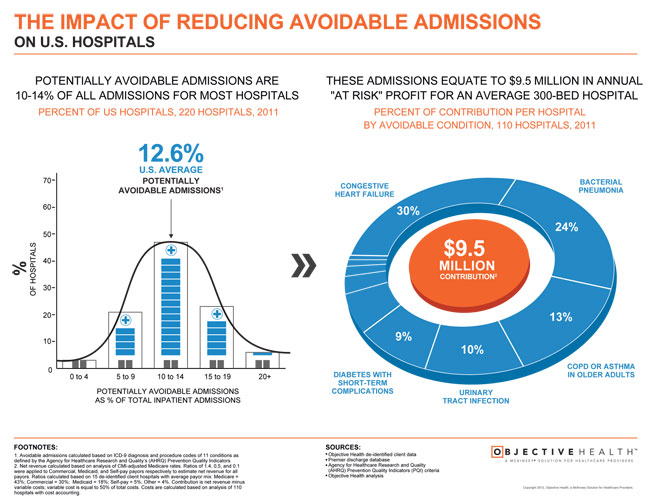
Related Links

References:

  1. Congress of the United States, Congressional Budget Office;Technological Change and the Growth of Health Care Spending, January 2008.
  2. Centers for Disease Control and Prevention. Rising Health Care Costs Are Unsustainable. April 2011.
  3. Recent opinions/ reports have focused on the viability of a single-payer system in the U.S. W.C. Hsiao’s article “State-based single-payer health care- as solution for the United States?” explores potential adoption among states, and R. Feldman explores unregulated markets vs. single-payer systems in “Quality of care in single-payer and multipayer health systems.”
  4. Martin A.B. et al., “Growth In US Health Spending Remained Slow in 2010; Health Share of Gross Domestic Product Was Unchanged from 2009,” Health Affairs, 2012.
  5. http://www.kaiseredu.org/Issue-Modules/US-Health-Care-Costs/Background-Brief.aspx#footnote8

Conclusion

Your thoughts and comments on this ME-P are appreciated. Feel free to review our top-left column, and top-right sidebar materials, links, URLs and related websites, too. Then, subscribe to the ME-P. It is fast, free and secure.

Link: http://feeds.feedburner.com/HealthcareFinancialsthePostForcxos

Speaker: If you need a moderator or speaker for an upcoming event, Dr. David E. Marcinko; MBA – Publisher-in-Chief of the Medical Executive-Post – is available for seminar or speaking engagements. Contact: MarcinkoAdvisors@msn.com

OUR OTHER PRINT BOOKS AND RELATED INFORMATION SOURCES:

DICTIONARIES: http://www.springerpub.com/Search/marcinko
PHYSICIANS: www.MedicalBusinessAdvisors.com
PRACTICES: www.BusinessofMedicalPractice.com
HOSPITALS: http://www.crcpress.com/product/isbn/9781466558731
CLINICS: http://www.crcpress.com/product/isbn/9781439879900
BLOG: www.MedicalExecutivePost.com
FINANCE: Financial Planning for Physicians and Advisors
INSURANCE: Risk Management and Insurance Strategies for Physicians and Advisors

Product DetailsProduct DetailsProduct Details

Product Details  Product Details

Product Details

Accounting for the Cost of US Health Care

Join Our Mailing List

Conclusion

Your thoughts and comments on this ME-P are appreciated. What are your thoughts on the pre-reform trends and the impact of the recession?

Feel free to review our top-left column, and top-right sidebar materials, links, URLs and related websites, too. Then, subscribe to the ME-P. It is fast, free and secure.

Link: http://feeds.feedburner.com/HealthcareFinancialsthePostForcxos

Speaker: If you need a moderator or speaker for an upcoming event, Dr. David E. Marcinko; MBA – Publisher-in-Chief of the Medical Executive-Post – is available for seminar or speaking engagements. Contact: MarcinkoAdvisors@msn.com

Our Other Print Books and Related Information Sources:

Health Dictionary Series: http://www.springerpub.com/Search/marcinko

Practice Management: http://www.springerpub.com/product/9780826105752

Physician Financial Planning: http://www.jbpub.com/catalog/0763745790

Medical Risk Management: http://www.jbpub.com/catalog/9780763733421

Hospitals: http://www.crcpress.com/product/isbn/9781439879900

Physician Advisors: www.CertifiedMedicalPlanner.org

Our Newest Textbook Release

Buy from Amazon

Learn How to Profit and Thrive in the PP-ACA Era

BOOK FOREWORD / TESTIMONIAL


The NBER Bulletin on Aging and Health

Join Our Mailing List

The National Bureau of Economic Research — 2012 No. 2

The 2012 No. 2 Bulletin includes the articles below:

1)  Can Low-Cost Interventions Affect Retirement Saving Behavior?

by Gopi Shah Goda, Colleen Flaherty Manchester, and Aaron Sojourner –  #17927
by James Choi, Emily Haisley, Jennifer Kurkoski, and Cade Massey – #17843

http://www.nber.org/aginghealth/2012no2/w17927.html

2)  Labor Market Effects of the Massachusetts Health Insurance Reform

by Jonathan Kolstad and Amanda Kowalski

http://www.nber.org/aginghealth/2012no2/w17933.html

3)  Can Germany’s Riester Pensions Fill the Pension Gap?

by Axel Boersch-Supan, Michela Coppola, and Anette Reil-Held

http://www.nber.org/aginghealth/2012no2/w18014.html

4)  Retirement Before the Social Security Entitlement Age

by Kevin Milligan

http://www.nber.org/aginghealth/2012no2/w18051.html

5)  Are Consumers Forward-Looking in Responding to Health Care Prices?

by Aviva Aron-Dine, Liran Einav, Amy Finklestein, and Mark Cullen

http://www.nber.org/aginghealth/2012no2/w17802.html

NBER Profile:  Patricia Danzon

http://www.nber.org/aginghealth/2012no2/danzon.html

NBER Profile:  Doug Staiger

http://www.nber.org/aginghealth/2012no2/staiger.html

Conclusion

Your thoughts and comments on this ME-P are appreciated. Feel free to review our top-left column, and top-right sidebar materials, links, URLs and related websites, too. Then, subscribe to the ME-P. It is fast, free and secure.

Link: http://feeds.feedburner.com/HealthcareFinancialsthePostForcxos

Speaker: If you need a moderator or speaker for an upcoming event, Dr. David E. Marcinko; MBA – Publisher-in-Chief of the Medical Executive-Post – is available for seminar or speaking engagements. Contact: MarcinkoAdvisors@msn.com

Our Other Print Books and Related Information Sources:

Health Dictionary Series: http://www.springerpub.com/Search/marcinko

Practice Management: http://www.springerpub.com/product/9780826105752

Physician Financial Planning: http://www.jbpub.com/catalog/0763745790

Medical Risk Management: http://www.jbpub.com/catalog/9780763733421

Hospitals: http://www.crcpress.com/product/isbn/9781439879900

Physician Advisors: www.CertifiedMedicalPlanner.org

Product DetailsProduct DetailsProduct Details

Product Details Product Details

Product Details

On Hospital Tax-Exempt Debt

Join Our Mailing List

An important means of external financing for hospitals

By Calvin W. Wiese CPA CMA

By Dr. David Edward Marcinko MBA

www.CertifiedMedicalPlanner.org

Tax-exempt debt has become an important means of external financing for hospitals, primarily because its cost is very attractive. Interest rates on tax-exempt financing are lower than interest rates on financing that is not tax-exempt because the interest income earned by the holders is exempt from federal income tax. In some states, it is also exempt from state income tax and in some cities; it is also exempt from city income tax. Thus, the holders of these debt instruments (usually bonds) are willing to accept lower rates of interest.

State and Local Governments Only

Hospitals themselves are not capable of issuing tax-exempt debt. Only state and local governments are. A state or local government issues tax-exempt debt for hospitals and then loans the proceeds to hospitals. This is called “conduit” financing: the state or local government acts as a conduit through which hospitals can access tax-exempt debt markets. State and local governments are authorized to loan proceeds of their bond issues to hospitals through state statutes, and each state statute is different. Some states authorize any state or local government to issue bonds to loan to hospitals. Other states restrict such power to special purpose governmental entities only. And some states restrict this power to a single governmental entity that is specially formed for the sole purpose of issuing tax-exempt bonds on behalf of hospitals.

The IRS

The Internal Revenue Service (IRS) regulates the issuance of tax-exempt financing. While the IRS code nominally provides that debt instruments issued by state and local governments are exempt from federal income tax, it imposes special rules on conduit issues. Thus, tax-exempt issues whose proceeds are loaned to hospitals must comply with special IRS rules. Although very complex, these rules primarily regulate the use of proceeds, restricting the use of tax-exempt proceeds to the acquisition of property, plant components and equipment.

Given state statutes, IRS code and applicable security laws (both state and federal), issuing tax-exempt bonds is legally complex. Many lawyers get paid handsome fees every time tax-exempt debt is issued. The quarterback of the legal team is the bond counsel who represents the interests of the bondholders; the bond counsel issues the critical tax opinion that investors rely upon to claim tax-exemption on the interest from these instruments. Everything revolves around getting this opinion.

The Underwriter’s

Given its critical nature, only highly qualified lawyers are accepted by the market to provide this opinion. Underwriter’s counsel represents the interests of the investment bankers; their primary concern is compliance with security laws. Issuer’s counsel represents the interests of the state or local government, and hospital counsel represents the interests of the hospital; both have relatively minor roles. In the event credit enhancement is involved, credit enhancement counsel represents their interests and has significant influence on the process.

The Trustees

Another unique party to most tax-exempt bond issues is the bond trustee. The bond trustee is usually a bank who performs a fiduciary duty on behalf of the bond holders throughout the life of the bonds. The face of the faceless bond holders, they act on their behalf. And they, too, are represented by counsel in the bond issuance process.

State or local government typically appoints bond counsel. In many cases, they work with only a single firm. Not unusually, these relationships are quite cozy, and often result in fees being paid that are well in excess of what otherwise would be paid.

The Documents

An excess of documents is involved in most tax-exempt financings. The heart of the documents is the indenture, which is the agreement between the bond trustee (on behalf of the bond holders) and the state or local government issuer. It contains the promises made to the bond holders, and it describes the work of the bond trustee. The bond trustee will only perform actions on behalf of bond holders that are explicitly set forth in the bond indenture. The bond indenture is the security given to the bond holders, describing all their recourses.

Assessment

The bond indenture is typically supported by the loan agreement between the state or local government that issues the bonds and the hospital to which the proceeds are loaned. Its terms complement the terms of the bond indenture, which together, form the conduit.

Conclusion

Your thoughts and comments on this ME-P are appreciated. Feel free to review our top-left column, and top-right sidebar materials, links, URLs and related websites, too. Then, subscribe to the ME-P. It is fast, free and secure.

Link: http://feeds.feedburner.com/HealthcareFinancialsthePostForcxos

Speaker: If you need a moderator or speaker for an upcoming event, Dr. David E. Marcinko; MBA – Publisher-in-Chief of the Medical Executive-Post – is available for seminar or speaking engagements. Contact: MarcinkoAdvisors@msn.com

Our Other Print Books and Related Information Sources:

Health Dictionary Series: http://www.springerpub.com/Search/marcinko

Practice Management: http://www.springerpub.com/product/9780826105752

Physician Financial Planning: http://www.jbpub.com/catalog/0763745790

Medical Risk Management: http://www.jbpub.com/catalog/9780763733421

Hospitals: http://www.crcpress.com/product/isbn/9781439879900

Physician Advisors: www.CertifiedMedicalPlanner.org

     From Our Newest Textbook Release

Buy from Amazon

Learn How to Profit and Thrive in the PP-ACA Era

BOOK FOREWORD / TESTIMONIAL

Succeed with the “Business of Medical Practice” Textbook

ADVERTISEMENT

[Transformational Health 2.0 Skills for Doctors]

By Ann Miller RN, MHA

www.BusinessofMedicalPractice.com

December 23rd, 2011 – The Institute of Medical Business Advisors [iMBA] Inc, in Atlanta, GA www.MedicalBusinessAdvisors.com and Springer Publishing Company of New York, just released the third edition of “The Business of Medical Practice” [Transformational Health 2.0 Skills for Doctors] edited by iMBA founder Dr. David Edward Marcinko MBA, CMP™ and President Hope Rachel Hetico RN, MHA, CPHQ, CMP™

Internal Contents

The 37 chapter, 750 page hard-cover textbook provides a comprehensive resource for those physicians, medical professionals, practice managers, nurse executives, health care administrators and graduate students seeking working knowledge on running a private facility or medical clinic.

Three Major Sections

The BoMP is comprised of three enterprise-wide sections: [1] Qualitative Office Operations, [2] Quantitative Aspects of Medical Practice and [3] Health Policies, Ethics and Leadership. Topics like ARRA, HITECH, ACA and the social networking aspects and ramifications of health 2.0 connectivity for all stakeholders are included for modernity.

Tools and Templates

Tools used throughout the book help readers reference and retain complex information. These tools include:

  • Sidebars. Key terms, key concepts, key sources, associations, and factoids all serve to enhance and reinforce the core takeaways from each chapter.
  • Tables. Tables are used to display and reference benchmark data, draw comparisons, and illustrate industry data trends.
  • Figures. Graphical depictions of concepts help you comprehend the material.
  • Charts. Charts allow easily referenced standard industry taxonomies alongside comparisons of related topics.

Assessment

For a further description of the Business of Medical Practice, with online “live’ community, please click: www.BusinessofMedicalPractice.com

To order directly: http://www.springerpub.com/product/9780826105752 

Conclusion

Your thoughts and comments on this ME-P are appreciated. Feel free to review our top-left column, and top-right sidebar materials, links, URLs and related websites, too. Then, subscribe to the ME-P. It is fast, free and secure.

Link: http://feeds.feedburner.com/HealthcareFinancialsthePostForcxos

Speaker: If you need a moderator or speaker for an upcoming event, Dr. David E. Marcinko; MBA – Publisher-in-Chief of the Medical Executive-Post – is available for seminar or speaking engagements. Contact: MarcinkoAdvisors@msn.com

OUR OTHER PRINT BOOKS AND RELATED INFORMATION SOURCES:

DICTIONARIES: http://www.springerpub.com/Search/marcinko
PHYSICIANS: www.MedicalBusinessAdvisors.com
PRACTICES: www.BusinessofMedicalPractice.com
HOSPITALS: http://www.crcpress.com/product/isbn/9781466558731
CLINICS: http://www.crcpress.com/product/isbn/9781439879900
BLOG: www.MedicalExecutivePost.com
FINANCE: Financial Planning for Physicians and Advisors
INSURANCE: Risk Management and Insurance Strategies for Physicians and Advisors

Product Details

Product DetailsProduct DetailsProduct Details

The Financial Impact of Reducing Avoidable Hospital Admissions

Join Our Mailing List

Population Health Models

By Staff Reporters

Most readers are aware that colleague David B. Nash MD, MBA is the population health guru for the ME-P. In fact, he is an ME-P “thought-leader.” And, to use a modern colloquialism, he was into population health before PH was cool.

Link: http://nashhealthpolicy.blogspot.com

Preventing Avoidable Hospitalizations

And so, as hospitals and health systems accelerate towards population health models, there is an increasing focus for physicians and health systems to work together to prevent avoidable hospitalizations.

The Infographic

This infographic shows that an average 300-bed hospital is at risk of losing $9.5 million in annual contribution when inpatient admissions for 11 potentially avoidable conditions are completely reduced. These 11 conditions, identified by AHRQ, represent diagnoses for which coordinated outpatient care and early intervention can potentially prevent the need for hospitalization.

Source: Objective Health [McKinsey & Company]

Assessment

A colloquialism is a word or phrase that is employed in conversational or informal language but not in formal speech or formal writing.

Conclusion

Your thoughts and comments on this ME-P are appreciated. Feel free to review our top-left column, and top-right sidebar materials, links, URLs and related websites, too. Then, subscribe to the ME-P. It is fast, free and secure.

Link: http://feeds.feedburner.com/HealthcareFinancialsthePostForcxos

Speaker: If you need a moderator or speaker for an upcoming event, Dr. David E. Marcinko; MBA – Publisher-in-Chief of the Medical Executive-Post – is available for seminar or speaking engagements. Contact: MarcinkoAdvisors@msn.com

Our Other Print Books and Related Information Sources:

Health Dictionary Series: http://www.springerpub.com/Search/marcinko

Practice Management: http://www.springerpub.com/product/9780826105752

Physician Financial Planning: http://www.jbpub.com/catalog/0763745790

Medical Risk Management: http://www.jbpub.com/catalog/9780763733421

Hospitals: http://www.crcpress.com/product/isbn/9781439879900

Physician Advisors: www.CertifiedMedicalPlanner.org

Buy from Amazon

Learn How to Profit and Thrive in the PP-ACA Era

BOOK FOREWORD / TESTIMONIAL

The Tax Man Cometh to Police You on Health Care

Join Our Mailing List

About the New Health Care Tax and IRS Job Creation

WASHINGTON (AP)

The Supreme Court’s decision to uphold most of President Barack Obama’s health care law will come home to roost for most taxpayers in about 2 1/2 years, when they’ll have to start providing proof on their tax returns that they have health insurance.

LINK: New Jobs: IRS to hire thousands more agents to collect new health care taxes

Conclusion

Your thoughts and comments on this ME-P are appreciated. Feel free to review our top-left column, and top-right sidebar materials, links, URLs and related websites, too. Then, subscribe to the ME-P. It is fast, free and secure.

Link: http://feeds.feedburner.com/HealthcareFinancialsthePostForcxos

Speaker: If you need a moderator or speaker for an upcoming event, Dr. David E. Marcinko; MBA – Publisher-in-Chief of the Medical Executive-Post – is available for seminar or speaking engagements. Contact: MarcinkoAdvisors@msn.com

Our Other Print Books and Related Information Sources:

Health Dictionary Series: http://www.springerpub.com/Search/marcinko

Practice Management: http://www.springerpub.com/product/9780826105752

Physician Financial Planning: http://www.jbpub.com/catalog/0763745790

Medical Risk Management: http://www.jbpub.com/catalog/9780763733421

Hospitals: http://www.crcpress.com/product/isbn/9781439879900

Physician Advisors: www.CertifiedMedicalPlanner.org

Product Details  Product Details

How Americans Embrace Medicare Reform

Join Our Mailing List

The 2012 Elections … and Medigap

[By Staff Reporters]

Americans are spending more on Medicare than is coming in.

In fact, Rand Paul states, “It’s your grandparents’ fault for having too many kids and then your fault for not having enough kids. It’s a demographic problem.”

Source: www.mostmedicare.com

Conclusion

Your thoughts and comments on this ME-P are appreciated. Feel free to review our top-left column, and top-right sidebar materials, links, URLs and related websites, too. Then, subscribe to the ME-P. It is fast, free and secure.

Speaker: If you need a moderator or speaker for an upcoming event, Dr. David E. Marcinko; MBA – Publisher-in-Chief of the Medical Executive-Post – is available for seminar or speaking engagements. Contact: MarcinkoAdvisors@msn.com

OUR OTHER PRINT BOOKS AND RELATED INFORMATION SOURCES:

Product Details

A Five Minute Treatise on Healthcare Economics 101

Join Our Mailing List

An Encore YouTube Video by Joe Flowers

[Staff Reporters]

Why it costs so much, yet we still don’t get what we want and need—better healthcare that is cheaper.

Video link: http://www.youtube.com/watch?v=4Ry1AkbxRQU

Conclusion

Your thoughts and comments on this ME-P are appreciated. Feel free to review our top-left column, and top-right sidebar materials, links, URLs and related websites, too. Then, subscribe to the ME-P. It is fast, free and secure.

Speaker: If you need a moderator or speaker for an upcoming event, Dr. David E. Marcinko; MBA – Publisher-in-Chief of the Medical Executive-Post – is available for seminar or speaking engagements. Contact: MarcinkoAdvisors@msn.com

OUR OTHER PRINT BOOKS AND RELATED INFORMATION SOURCES:

Product DetailsProduct DetailsProduct Details

Product Details  Product Details

Product Details

Evaluating ACOs at Mid-Launch

Join Our Mailing List

Moving Forward but Challenges Ahead

[By ME-P Staff]

Accountable Care Organizations [ACOs] are generating considerable attention for their potential to improve the value of our health care spending through better coordination of care and new payment incentives that focus on quality and efficiency of care.

The Challenges

Yet, even as ACOs develop at a fairly rapid clip across the nation, they face substantial challenges.

For example, In this essay, Steven Lieberman reviews the ACO landscape in both the public and private sectors and examines the major obstacles confronting these emerging organizations, including limited tools for influencing patient choice, the need for immediate and sustained cost savings, and system-wide concerns about rising costs due to enhanced market power.

Assessment

Link: http://nihcm.org/images/stories/EV_Lieberman_FINAL.pdf

Conclusion

Your thoughts and comments on this ME-P are appreciated. Feel free to review our top-left column, and top-right sidebar materials, links, URLs and related websites, too. Then, subscribe to the ME-P. It is fast, free and secure.

Link: http://feeds.feedburner.com/HealthcareFinancialsthePostForcxos

Speaker: If you need a moderator or speaker for an upcoming event, Dr. David E. Marcinko; MBA – Publisher-in-Chief of the Medical Executive-Post – is available for seminar or speaking engagements. Contact: MarcinkoAdvisors@msn.com

OUR OTHER PRINT BOOKS AND RELATED INFORMATION SOURCES:

DICTIONARIES: http://www.springerpub.com/Search/marcinko
PHYSICIANS: www.MedicalBusinessAdvisors.com
PRACTICES: www.BusinessofMedicalPractice.com
HOSPITALS: http://www.crcpress.com/product/isbn/9781466558731
CLINICS: http://www.crcpress.com/product/isbn/9781439879900
BLOG: www.MedicalExecutivePost.com
FINANCE: Financial Planning for Physicians and Advisors
INSURANCE: Risk Management and Insurance Strategies for Physicians and Advisors

Product Details

The Best, Most Revealing Reporting on Our Healthcare System

Join Our Mailing List

Reading and Reviewing

By Blair Hickman and Cora Currier

ProPublica,  March 30, 2012, 1:44 pm

As we wait for the Supreme Court to issue its verdict on the health-care reform law  we rounded up some of the most revealing reporting on the issues.

They’re grouped roughly into articles on high costs and those on insurance.

Assesment

Link: http://www.propublica.org/article/top-muckreads-the-best-most-revealing-reporting-on-our-healthcare-system

Conclusion

Your thoughts and comments on this ME-P are appreciated. Feel free to review our top-left column, and top-right sidebar materials, links, URLs and related websites, too. Then, subscribe to the ME-P. It is fast, free and secure.

Link: http://feeds.feedburner.com/HealthcareFinancialsthePostForcxos

Speaker: If you need a moderator or speaker for an upcoming event, Dr. David E. Marcinko; MBA – Publisher-in-Chief of the Medical Executive-Post – is available for seminar or speaking engagements. Contact: MarcinkoAdvisors@msn.com

Our Other Print Books and Related Information Sources:

Health Dictionary Series: http://www.springerpub.com/Search/marcinko

Practice Management: http://www.springerpub.com/product/9780826105752

Physician Financial Planning: http://www.jbpub.com/catalog/0763745790

Medical Risk Management: http://www.jbpub.com/catalog/9780763733421

Hospitals: http://www.crcpress.com/product/isbn/9781439879900

Physician Advisors: www.CertifiedMedicalPlanner.org

Hospitals & Healthcare Organizations: Management Strategies, Operational Techniques, Tools, Templates and Case Studies

Hospitals & Healthcare Organizations: Management Strategies, Operational Techniques, Tools, Templates and Case Studies

Buy from Amazon