Retrospective Audio on the “Doctors’ Riot” of 1788

Join Our Mailing List 

History of Grave Robbers

By Overcast: [Stuff You Missed in History Class]

In the late 1700s, medical colleges needed cadavers for educational dissection, but there were no legal means for obtaining them.

This led to some unorthodox dealings in the acquiring of bodies, and brought New York to a fever pitch in 1788.

Poe

ME-P Editor at the Grave of EA Poe, in Baltimore, MD

[© iMBA Inc. All rights reserved. USA]

Audio Link: http://t.co/DbcgppVEYG

Conclusion

Your thoughts and comments on this ME-P are appreciated. Feel free to review our top-left column, and top-right sidebar materials, links, URLs and related websites, too. Then, subscribe to the ME-P. It is fast, free and secure.

Speaker: If you need a moderator or speaker for an upcoming event, Dr. David E. Marcinko; MBA – Publisher-in-Chief of the Medical Executive-Post – is available for seminar or speaking engagements. Contact: MarcinkoAdvisors@msn.com

OUR OTHER PRINT BOOKS AND RELATED INFORMATION SOURCES:

Product DetailsProduct DetailsProduct Details

Product Details  Product Details

Product Details

Should Eric Shinseki – and others – Resign?

Join Our Mailing List 

Who he Is – Wither the VA Imbroglio

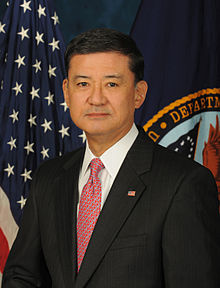
ShinsekiAccording to Wikipedia; Eric Ken Shinseki (/ʃɨnˈsɛki/; born November 28, 1942) is a retired United States Army four-star general who has served since 2009 as the seventh United States Secretary of Veterans Affairs.

His final U.S. Army post was as the 34th Chief of Staff of the Army (1999–2003). He is a veteran of combat in the Vietnam War, where he sustained a foot injury.

Assessment

Veterans Affairs Secretary Eric Shinseki testified on Thursday May 15, 2014 for the first time since a burgeoning scandal broke on allegedly deadly health care delays in the VA system, as he faces calls for his resignation and demands that the VA immediately improve the way it treats America’s vets.

And so we ask in this opinion poll:

Prior ME-P Polls

Members of the ME-P community called for the resignation of former HHS Secretary Kathleen Sebelius.

Link: Should HHS Secretary Kathleen Sebelius be Replaced?

Will our ME-P readers make the correct call; or not?

Conclusion

Your thoughts and comments on this ME-P are appreciated. Feel free to review our top-left column, and top-right sidebar materials, links, URLs and related websites, too. Then, subscribe to the ME-P. It is fast, free and secure.

Link: http://feeds.feedburner.com/HealthcareFinancialsthePostForcxos

Speaker: If you need a moderator or speaker for an upcoming event, Dr. David E. Marcinko; MBA – Publisher-in-Chief of the Medical Executive-Post – is available for seminar or speaking engagements. Contact: MarcinkoAdvisors@msn.com

OUR OTHER PRINT BOOKS AND RELATED INFORMATION SOURCES:

Product DetailsProduct DetailsProduct Details


Making Medical [Financial] Advice Memorable?

Join Our Mailing List 

Can Physician [Advisor] Body Language Assist Patient [Client] Adherence

[By Dr. David Edward Marcinko MBA CMP™]

DEM at Drexel

Recently, I was at Drexel University which is a private research university in Philadelphia. It was founded in 1891 by Anthony J. Drexel, a noted financier and philanthropist. Drexel offers over 70 full-time undergraduate programs and accelerated degrees. At the graduate level, the university offers over 100 masters, doctoral, and professional programs, many available part-time.

Now, I know DU well because as a student from Temple University back in the day, I visited frequently. It was there that I first learned of the work of H. Ebbinghaus on the nature of emotions and the human memory.

Two [2] Examples

As doctors, we usually want to make a memorable impression on our patients and encourage them to remember our medical advice or instructions.

OR, as financial advisors, we want our clients to follow our informed advice. But how?

One suggestion is to take advantage of the Serial Position Effect.

Definition

The Serial Position Effect is a term coined by German psychologist Hermann Ebbinghaus PhD.

Hermann Ebbinghaus (January 24, 1850 — February 26, 1909)

According to Wikipedia, Dr. Ebbinghaus was a German psychologist who pioneered the experimental study of memory, and is known for his discovery of the forgetting curve and the spacing effect. He was also the first person to describe the learning curve. He was the father of the eminent neo-Kantian philosopher Julius Ebbinghaus.

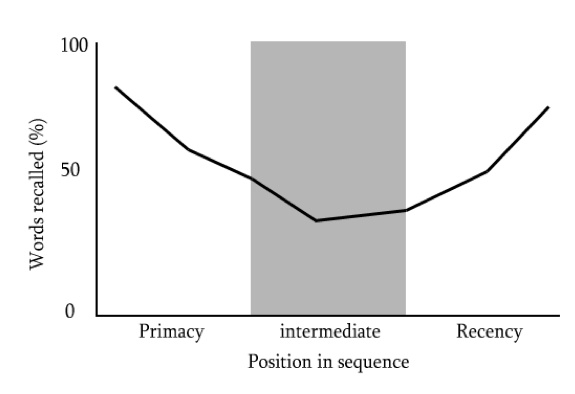
Through his studies, he found that people have a tendency to remember the first (primacy) and last (recency) things to occur, and scarcely the middle.

The graph below demonstrates the Serial Position Effect in recalling a list of words. However, this psychological effect can be applied to many things – from job interviews to television commercials to physician advice.

***Graph

 ***

So, during your next patient interaction or client-advisor relationship, instruct your target either at the beginning or end of the event; or patient encounter. They are much more likely to remember you, and recall the topic, conversation, medical advice or instructions.

Assessment

If you want to be remembered, don’t be in the middle! And, this will make your next patient interaction; or client meeting, much easier.

Conclusion

Your thoughts and comments on this ME-P are appreciated. Feel free to review our top-left column, and top-right sidebar materials, links, URLs and related websites, too. Then, subscribe to the ME-P. It is fast, free and secure.

Link: http://feeds.feedburner.com/HealthcareFinancialsthePostForcxos

Speaker: If you need a moderator or speaker for an upcoming event, Dr. David E. Marcinko; MBA – Publisher-in-Chief of the Medical Executive-Post – is available for seminar or speaking engagements. Contact: MarcinkoAdvisors@msn.com

OUR OTHER PRINT BOOKS AND RELATED INFORMATION SOURCES:

Product DetailsProduct Details

Product Details

Racial Disparities in Life Expectancy at Birth

Join Our Mailing List

For the United States

By http://www.MCOL.com

Life Spans

Conclusion

Your thoughts and comments on this ME-P are appreciated. Feel free to review our top-left column, and top-right sidebar materials, links, URLs and related websites, too. Then, subscribe to the ME-P. It is fast, free and secure.

Link: http://feeds.feedburner.com/HealthcareFinancialsthePostForcxos

Speaker: If you need a moderator or speaker for an upcoming event, Dr. David E. Marcinko; MBA – Publisher-in-Chief of the Medical Executive-Post – is available for seminar or speaking engagements. Contact: MarcinkoAdvisors@msn.com

OUR OTHER PRINT BOOKS AND RELATED INFORMATION SOURCES:

Product DetailsProduct DetailsProduct Details

Product DetailsProduct Details

Product Details


On the Future of Nursing Practice

 Join Our Mailing List

Focus on Scope of Practice

[By Staff Reporters]

Transforming the health care system to meet the demand for safe, quality, and affordable care will require a fundamental rethinking of the roles of many health care professionals, including nurses. The 2010 Affordable Care Act represents the broadest health care overhaul since the 1965 creation of the Medicare and Medicaid programs, but nurses are unable to fully participate in the resulting evolution of the U.S. health care system. This is true for nurses at all levels, whether they practice in schools or community and public health centers or acute care settings. A variety of historical, cultural, regulatory, and policy barriers limit nurses’ ability to contribute to widespread and meaningful change.

In 2008, the Robert Wood Johnson Foundation (RWJF) and the Institute of Medicine (IOM) launched a two-year initiative to respond to the need to assess and transform the nursing profession. The IOM appointed the Committee on the RWJF Initiative on the Future of Nursing, at the IOM, with the purpose of producing a report that would make recommendations for an action-oriented blueprint for the future of nursing.

As part of its report, the committee considered the obstacles all nurses encounter as they take on new roles in the transformation of health care in the United States. While challenges face nurses at all levels, the committee took particular note of the legal barriers in many states that prohibit advance practice registered nurses (APRNs) from practicing to their full education and training. The committee determined that such constraints will have to be lifted in order for nurses to assume the responsibilities they can and should be taking during this time of great need.

***

RN

***

The Changing Health Care System

In the 21st century, the health challenges facing the nation have shifted dramatically. The health care system is in the midst of great change as care providers discover new ways to provide patient-centered care; to deliver more primary care as opposed to specialty care; and to deliver more care in the community rather than the acute care setting. Nurses are well poised to meet these needs by virtue of their numbers, scientific knowledge, and adaptive capacity, and health care organizations would benefit from taking advantage of the contributions nurses can make.

Assessment

As the health care system has expanded over the past 40 years, the education and roles of APRNs, in particular, have evolved in such a way that nurses now enter the workplace qualified to provide more services than had been the case previously. Yet while APRNs are educated and trained to do more, some physicians challenge expanding scopes of practice for nurses. The committee stresses that physicians are highly trained and skilled providers and that some services clearly should be provided by physicians, who have received more extensive and specialized education and training than APRNs. However, given the great need for more affordable health care, nurses should be playing a larger role in the health care system, both in delivering care and in decision making about care.

The committee argues that APRNs are not acting as physician extenders or substitutes. They work throughout the entirety of health care, from health promotion and disease prevention to early diagnosis to prevent or limit disability. APRNs sometimes provide services that many people associate with physicians, such as assessing patient conditions or ordering and evaluating tests, but they also incorporate a range of services from other disciplines, including social work, nutrition, and physical therapy.

Conclusion

Your thoughts and comments on this ME-P are appreciated. Feel free to review our top-left column, and top-right sidebar materials, links, URLs and related websites, too. Then, subscribe to the ME-P. It is fast, free and secure.

Link: http://feeds.feedburner.com/HealthcareFinancialsthePostForcxos

Speaker: If you need a moderator or speaker for an upcoming event, Dr. David E. Marcinko; MBA – Publisher-in-Chief of the Medical Executive-Post – is available for seminar or speaking engagements. Contact: MarcinkoAdvisors@msn.com

OUR OTHER PRINT BOOKS AND RELATED INFORMATION SOURCES:


Product DetailsProduct DetailsProduct Details

Product DetailsProduct Details

Product Details

Dysfunction and Accountability in Health Care

Join Our Mailing List

A Pod Cast

Charles Ornstein talks with David Goldhill author of “Catastrophic Care: Why Everything We Think We Know about Health Care Is Wrong” about excess, poor oversight, and how new data may help spur change.

***

anatomy-physiology-student-tutorial-800x800

***

Link: http://www.propublica.org/podcast/item/podcast-dysfunction-and-accountability-in-health-care/?utm_source=et&utm_medium=email&utm_campaign=dailynewsletter

Conclusion

Your thoughts and comments on this ME-P are appreciated. Feel free to review our top-left column, and top-right sidebar materials, links, URLs and related websites, too. Then, subscribe to the ME-P. It is fast, free and secure.

Link: http://feeds.feedburner.com/HealthcareFinancialsthePostForcxos

Speaker: If you need a moderator or speaker for an upcoming event, Dr. David E. Marcinko; MBA – Publisher-in-Chief of the Medical Executive-Post – is available for seminar or speaking engagements. Contact: MarcinkoAdvisors@msn.com

OUR OTHER PRINT BOOKS AND RELATED INFORMATION SOURCES:

Product DetailsProduct Details

Product Details

Establishing a Healthcare Compliance Program

Join Our Mailing List 

Basic Program Components

trites

[By Pati Trites MPA CHBC]

All healthcare organizations should evaluate compliance policies and procedures for practicality and appropriateness on a regular basis.

The List

The following are suggested items for inclusion in a compliance program:

  • code of ethics;
  • code of conduct;
  • mission and vision statements;
  • employee handbook or manual;
  • rights and responsibilities of patients;
  • protocol for addressing compliance issues;
  • job descriptions;
  • performance evaluations; and
  • competency assessments.

***

Compliance

***

Conclusion

Your thoughts and comments on this ME-P are appreciated. Feel free to review our top-left column, and top-right sidebar materials, links, URLs and related websites, too. Then, subscribe to the ME-P. It is fast, free and secure.

Link: http://feeds.feedburner.com/HealthcareFinancialsthePostForcxos

Speaker: If you need a moderator or speaker for an upcoming event, Dr. David E. Marcinko; MBA – Publisher-in-Chief of the Medical Executive-Post – is available for seminar or speaking engagements. Contact: MarcinkoAdvisors@msn.com

OUR OTHER PRINT BOOKS AND RELATED INFORMATION SOURCES:

Product Details

About the AIF® Designation

Certified Medical Planner

A Fiduciary Moniker?

[By Dr. David Edward Marcinko MBA CMP®]

DEM blue tieInvestment fiduciaries and professionals are constantly exposed to legal and practical scrutiny — it comes from multiple directions and for various reasons.

And, it is likely that complaints and/or lawsuits alleging investment mismanagement will continue to increase.

Although some of these allegations may be justified, many can be avoided by having clear knowledge of who constitutes a fiduciary and what is required of one.

AIF® Designation Training 

The AIF Designation Training and designation help mitigate this liability by instructing in practices that cover pertinent legislation and best practices. The Accredited Investment Fiduciary® (AIF®) designation represents a thorough knowledge of and ability to apply the fiduciary practices.

And, did you know that all Certified Medical Planners® are fiduciaries for their clients? http://www.CertifiedMedicalPlanner.org

Assessment

So all FAs, feel free to check em’ out at: http://www.fi360.com/

More:

Conclusion

Your thoughts and comments on this ME-P are appreciated. Feel free to review our top-left column, and top-right sidebar materials, links, URLs and related websites, too. Then, subscribe to the ME-P. It is fast, free and secure.

Link: http://feeds.feedburner.com/HealthcareFinancialsthePostForcxos

Speaker: If you need a moderator or speaker for an upcoming event, Dr. David E. Marcinko; MBA – Publisher-in-Chief of the Medical Executive-Post – is available for seminar or speaking engagements. Contact: MarcinkoAdvisors@msn.com

OUR OTHER PRINT BOOKS AND RELATED INFORMATION SOURCES:

Product Details  Product Details


How You Can Financially Profit from the PP-ACA?

Join Our Mailing List 

An Obamacare Sales Opportunity

By Dr. David Edward Marcinko MBA CMP™

[Editor-in-Chief] www.CertifiedMedicalPlanner.org

Dr. MarcinkoPresumably, as a result of my financial advisory activities, I received this email solicitation the other day,

So, I thought I’d pass it along [unchanged] to our ME-P readers, FAs, insurance agents and subscribers for comment.

USA BENEFITS GROUP EAGLE DIVISION  ………. PROVIDING CAREER SOLUTIONS FOR 36 YEARS 

[Better Contracts + Better Schedule + Better Career Opportunities] 

Dear Prospect [that would be ME],

I received your resume on Monster.  You already know that the real money in any organization is in sales. The salespeople of the world make things happen and are highly rewarded for that work.  But it’s hard work.

The Product

What if you could find a product that everybody needs, that they have money budgeted to purchase, and are looking for someone to help them buy it?  Do you think you could help that person? That’s exactly  the situation in the health insurance industry today!

Our government is telling people they HAVE to have it.  Folks are either buying it now from somewhere or will soon be eligible for subsidies so they CAN buy it.  And EVERYONE is confused and looking for someone with answers on how to get this product!

You can be that Person

Over the next sixty months, billions of dollars are going to change hands as people readjust to a dynamic health care environment.  How can you get into the river and get your hands on some of that money?  By preparing to serve people!

USA Benefits Group 

The USA Benefits Group is a highly successful team of insurance brokers who are “reform ready” – staying up to date on this perhaps once-in-a-lifetime shift in this industry.  We are independent, non-captive agents who are setting up qualified, turn-key “private exchanges” to help people obtain health insurance in a webinar-based setting from our home offices.

I’m encouraging you to click here: www.usabg.net/dcollins to learn more. If you’re serious and ready to make a move, you can call me toll-free now at 866-328-6182. If you’re qualified, I also have Regional Management positions available.

Advantages of working with my Eagle Division 

  1. 1. 36 year old system for success
  2. 2. 100% control of your future
  3. 3. Equal opportunity
  4. 4. Recession proof
  5. 5. Top Companies to represent
  6. 6. Excellent co-op lead program
  7. 7. Weekly advance commissions ($2,000 To $4,000 Net Weekly)
  8. 8. Vested Lifetime Renewals ($10,000 To $20,000 Monthly In Under 3 Years)
  9. 9. Annual Incentive Trips
  10. 10. Annual Production Bonuses to $50,000+

I’m looking forward to talking to you.
David Collins
DIVISION MANAGER
866.328.6182
DC@usabg.net

Assessment

  • Is this a good product to sell? If so, why does it need an intermediary to push it?
  • Don’t subsidies, carve-outs, exemptions and sales commissions serve to jack-up price and lower quality? [think eMRs]? What about the overall cost of healthcare delivery; up or down?
  • What about the USA Benefits Group; credible or not? Are cold calls the way to go?
  • What is your impression of Division Manager Mr. David Collins and his Eagle Division? Feel free to contact him … and tell him what you think.

Conclusion

Your thoughts and comments on this ME-P are appreciated. Feel free to review our top-left column, and top-right sidebar materials, links, URLs and related websites, too. Then, subscribe to the ME-P. It is fast, free and secure.

Link: http://feeds.feedburner.com/HealthcareFinancialsthePostForcxos

Speaker: If you need a moderator or speaker for an upcoming event, Dr. David E. Marcinko; MBA – Publisher-in-Chief of the Medical Executive-Post – is available for seminar or speaking engagements. Contact: MarcinkoAdvisors@msn.com

OUR OTHER PRINT BOOKS AND RELATED INFORMATION SOURCES:

DICTIONARIES: http://www.springerpub.com/Search/marcinko
PHYSICIANS: www.MedicalBusinessAdvisors.com
PRACTICES: www.BusinessofMedicalPractice.com
HOSPITALS: http://www.crcpress.com/product/isbn/9781466558731
CLINICS: http://www.crcpress.com/product/isbn/9781439879900
BLOG: www.MedicalExecutivePost.com
FINANCE: Financial Planning for Physicians and Advisors
INSURANCE: Risk Management and Insurance Strategies for Physicians and Advisors

Product DetailsProduct DetailsProduct Details

Product Details  Product Details

Product DetailsProduct Details

Product Details

An Open Call for ME-P Support

Join Our Mailing List 

A Letter with Advanced Appreciation

By Ann Miller RN MHA [Executive-Director]

MarcinkoAdvisors@msn.com

Dear ME-P Readers,

As the holidays approach and the year winds down, we’re reminded of how much each of you brings to the ME-P and our work.

We couldn’t do what we do so effectively without the subscribers to our daily news and book purchasers, the comments on our stories, the participants in our groups – the people who not only read our ME-P posts, but think about them, talk about it with friends and colleagues, support and push for change based on what they read.

Donate

We hope you agree that we’ve worked hard this year to deliver on our mission. It’s been a year in which we didn’t hesitate to take on the biggest subjects from the NSA ObamaCare encryption mess to Medicare Part D, from the HIEs to the latest abuses by the CFP-BOD on fiduciary terms, advisor payment definitions and conflicts of CEU interest.

If you value this work, I hope we can count on you to show your support at this season by becoming a ME-P subscriber, reader and donor.

gift

Assessment

With many thanks and best wishes for the holidays.

Conclusion

Your thoughts and comments on this ME-P are appreciated. Feel free to review our top-left column, and top-right sidebar materials, links, URLs and related websites, too. Then, subscribe to the ME-P. It is fast, free and secure.

Link: http://feeds.feedburner.com/HealthcareFinancialsthePostForcxos

Speaker: If you need a moderator or speaker for an upcoming event, Dr. David E. Marcinko; MBA – Publisher-in-Chief of the Medical Executive-Post – is available for seminar or speaking engagements. Contact: MarcinkoAdvisors@msn.com

OUR OTHER PRINT BOOKS AND RELATED INFORMATION SOURCES:

DICTIONARIES: http://www.springerpub.com/Search/marcinko
PRACTICES: www.BusinessofMedicalPractice.com
HOSPITALS: http://www.crcpress.com/product/isbn/9781466558731
CLINICS: http://www.crcpress.com/product/isbn/9781439879900
ADVISORS: www.CertifiedMedicalPlanner.org
BLOG: www.MedicalExecutivePost.com
FINANCE: Financial Planning for Physicians and Advisors
INSURANCE: Risk Management and Insurance Strategies for Physicians and Advisors

Product DetailsProduct DetailsProduct Details

Product Details  Product Details

Product DetailsProduct Details

Product Details

The Price of Pleasure

Join Our Mailing List

Sin Taxes

By Carrie Braza

Sin-taxes

More

Conclusion

Your thoughts and comments on this ME-P are appreciated. Feel free to review our top-left column, and top-right sidebar materials, links, URLs and related websites, too. Then, subscribe to the ME-P. It is fast, free and secure.

Link: http://feeds.feedburner.com/HealthcareFinancialsthePostForcxos

Speaker: If you need a moderator or speaker for an upcoming event, Dr. David E. Marcinko; MBA – Publisher-in-Chief of the Medical Executive-Post – is available for seminar or speaking engagements. Contact: MarcinkoAdvisors@msn.com

OUR OTHER PRINT BOOKS AND RELATED INFORMATION SOURCES:

LEXICONS: http://www.springerpub.com/Search/marcinko
PHYSICIANS: www.MedicalBusinessAdvisors.com
PRACTICES: www.BusinessofMedicalPractice.com
HOSPITALS: http://www.crcpress.com/product/isbn/9781466558731
CLINICS: http://www.crcpress.com/product/isbn/9781439879900
ADVISORS: www.CertifiedMedicalPlanner.org
BLOG: www.MedicalExecutivePost.com

Product DetailsProduct DetailsProduct Details

Product Details  Product Details

On Aging and Getting Better with Age

Join Our Mailing List

Consumer Reports on Health

By Rick Kahler CFP® http://www.KahlerFinancial.com

Rick Kahler CFP

How old is “old?” I don’t know exactly, but after my recent birthday I can say that it’s much older than 58. My 12-year-old son told me, “Dad, I’ve always thought of people who are over 60 as being really old. I don’t think of you as really old, so guess I will need to redefine what is old.”

Old Enough?

Still, I am old enough to know from personal experience that the body begins to slow down and fall apart as we age. I also know from working with clients that aging can be expensive. One of the biggest threats to a retirement nest egg, besides the possibility of outliving it, is the high cost of medical care for increasing health needs.

All this leaves me wondering if there is anything good about getting older.

Consumer Reports on Health

Well, yes, there is. A recent article in Consumer Reports on Health found there are some things that actually get better with age:

1. You get wiser.

This one seems intuitively obvious to me, but as I once heard a researcher say, “If you can’t measure something, it doesn’t exist.” Research conducted by the Universities of Texas and Michigan found that significantly more older people ranked in the top 20% in wisdom performance and the group with an average age of 65 consistently outperformed younger participants. Maybe there’s some truth to the joke about parents seeming to get smarter as their kids get older.

2. You have fewer difficult emotions.

A Gallup survey found that people in their 70’s and 80’s reported less stress, worry, and anger than younger respondents. I found it curious that stress peaks at age 25 and steadily declines, dropping rapidly from age 60 to 73. I guess that leaves me something to look forward to in a couple of years.

3. You become happier.

This was a surprise, especially given my projection that increasing aches and pains probably increase unhappiness. Again, the devil is in the definition of “happiness”. I suggest that we often equate happiness with well-being, which can be broken into three segments: physical, emotional, and financial. Stanford University found that aging is actually associated with increased emotional well-being. The article didn’t mention physical and financial well-being. Based on my experience, I expect that physical well-being decreases with age and financial well-being is dependent upon a complex host of variables.

4. Your marriage gets better.

The Journal of Social and Personal Relationships found that older couples experience greater satisfaction and positive experiences with each other. The report also says happily married older people have better health, quality of life, and relationships with their children and friends. I think that is another one of those intuitively obvious facts that researchers still feel they must validate.

5. Your relationships get deeper and richer.

While younger people have more friends, the quality of older people’s relationships becomes richer. A study done by Case Western Reserve University found that volunteering was the most consistent predictor of cognitive well-being in people over age 72.

Assessment

Even with all these positives, old age isn’t exactly something to look forward to. Yet it doesn’t mean our golden years will necessarily be overridden with tarnish and rust. Living a healthy lifestyle and planning financially for retirement can certainly help make aging more comfortable. And clearly, aging is better than the alternative of not being around to grow old; especially when we factor in one last advantage of aging.

I haven’t yet experienced this personally, but I hear plenty about it from clients and friends. According to these sources, the best thing about aging is grandchildren.

Conclusion

Your thoughts and comments on this ME-P are appreciated. Feel free to review our top-left column, and top-right sidebar materials, links, URLs and related websites, too. Then, subscribe to the ME-P. It is fast, free and secure.

Link: http://feeds.feedburner.com/HealthcareFinancialsthePostForcxos

Speaker: If you need a moderator or speaker for an upcoming event, Dr. David E. Marcinko; MBA – Publisher-in-Chief of the Medical Executive-Post – is available for seminar or speaking engagements. Contact: MarcinkoAdvisors@msn.com

OUR OTHER PRINT BOOKS AND RELATED INFORMATION SOURCES:

Health Dictionary Series: http://www.springerpub.com/Search/marcinko

Practice Management: http://www.springerpub.com/product/9780826105752

Physician Financial Planning: http://www.jbpub.com/catalog/0763745790

Medical Risk Management: http://www.jbpub.com/catalog/9780763733421

Hospitals: http://www.crcpress.com/product/isbn/9781439879900

Physician Advisors: www.CertifiedMedicalPlanner.org

Product Details  Product Details

Product DetailsProduct Details

Comprehensive Financial Planning Strategies for Doctors and Advisors: Best Practices from Leading Consultants and Certified Medical Planners™

Will Future Doctors Need a Medical License?

Join Our Mailing List 

Licensing Doctors – Do Economists Agree?

By Dr. David Edward Marcinko MBA CMP™

[Editor-in-Chief]

Dr. MarcinkoChallenging conventional wisdom is something I like to think … that I do.

After all, I am considered a healthcare ‘thought-leader”, and to the extent possible, we publish outside traditional box thinking on this Medical Executive-Post.

It’s all Relative

But, I am a piker compared to Shirley Svorny PhD.

Who is she?

Dr. Shirley Svorny is chair of the economics department at California State University, Northridge, and she holds a PhD in economics from UCLA

Medical Licensure Issues

Now, remember the old saying, “if everyone is thinking alike, then nobody is thinking”.

Well, a while back, Dr. Svorny wondered if a medical degree is a barrier – rather than enabler – of affordable healthcare. Enter the PP-ACA of 2010.

As an expert on the regulation of health care professionals, including medical professional licensing, she has participated in health policy summits organized by Cato and the Texas Public Policy Foundation. She argued that licensure not only fails to protect consumers from incompetent physicians, but, by raising barriers to entry, makes health care more expensive and less accessible.

Institutional oversight and a sophisticated network of private accrediting and certification organizations, all motivated by the need to protect reputations and avoid legal liability, offer whatever consumer protections exist today. Malpractice attorneys, and monetary gain motives, too!

Her Published Abstract

“Despite the wide reach of medical licensing in health care production through its impact on the nature and cost of care, it has been all but ignored in debates over health care reform.

This paper pulls together statements made by economists whose expertise is in the area of health economics or, more specifically, medical licensure and discipline. Economists who have examined the market for physician services in the United States generally view state licensing as a means by which to enforce cartel-like restrictions on entry that benefit physicians at the expense of consumers. Medical licensing is seen as a constraint on the efficient combination of inputs, a drag on innovations in health care and medical education, and a significant barrier to effective, cost efficient health care.”

Full paper link:  2004-08-svorny-reach_concl

jester_hat

Am I Thought-Leader?

Am I a thought leader? Well, I don’t rightly know; that’s for others to decide. But, I do know that this essay was published a decade ago; in 2004, and at a time before the ME-P’s existence.

And so, based on this essay, Dr. Svorny is surely a “thought-leader” in my opinion

More about Dr. Svorny

In 1986-87, Dr. Svorny managed an industry risk group at Security Pacific Bank. She was a Milken Institute Affiliated Scholar and served as director of the San Fernando Valley Economic Research Center at Cal State Northridge. She has published articles in Economics of Education Review, Contemporary Economic Policy, Urban Affairs Review, Public Choice, Regional Science and Urban Economics, Cato Journal, Applied Economics, The Journal of Medical Licensure and Discipline, The Energy Journal, Economic Inquiry, and the Journal of Labor Research. Her opinion articles have appeared in the Los Angeles Times and the Los Angeles Daily News. Her research interests are in the areas of urban, labor, and health economics.

Assessment

Do traditionalists or collective healthcare reform advocates and health economists react rationally; or irrationally on this issue? What do you think?

Conclusion

Your thoughts and comments on this ME-P are appreciated. Feel free to review our top-left column, and top-right sidebar materials, links, URLs and related websites, too. Then, subscribe to the ME-P. It is fast, free and secure.

Speaker: If you need a moderator or speaker for an upcoming event, Dr. David E. Marcinko; MBA – Publisher-in-Chief of the Medical Executive-Post – is available for seminar or speaking engagements. Contact: MarcinkoAdvisors@msn.com

***

Risk Management, Liability Insurance, and Asset Protection Strategies for Doctors and Advisors: Best Practices from Leading Consultants and Certified Medical Planners™8Comprehensive Financial Planning Strategies for Doctors and Advisors: Best Practices from Leading Consultants and Certified Medical Planners™

Does the U.S. Supreme Court decision resolve the gene-patenting issue?

Join Our Mailing List

Human Genes are NOT Patentable

By Karen Matthias RN MBA

[Vice-President of Marketing]

Hayes, Inc kmatthias@hayesinc.com

Yesterday, the U.S. Supreme Court unanimously agreed that human genes are not patentable, making a distinction between “natural” DNA found in the human body and the laboratory-created “synthetic” DNA. This opinion reinforces those of many in the genetics community who have argued for years that genes are products of nature rather than inventions.

A Resolution?

But, does the Supreme Court decision completely resolve the gene-patenting issue?

Dr. Diane Allingham-Hawkins, Senior Director, Genetic Test Evaluation Program and Technical Editing at Hayes, Inc., doesn’t think so.

“The Justices compromised somewhat in their decision that while human genes as they exist in nature were ruled not patentable, the opinion allowed that synthetic copies – so-called complementary DNA or cDNA – may be”.

The Court did not rule, however, that cDNA meets all requirements of patent eligibility, just that cDNA would not be considered a ’product of nature’.

Issues Not Addressed

In addition, Dr. Allingham-Hawkins points out what the decision does not address.

“Notably, the opinion clearly stated that it was not ruling on any methods patents related to the two genes or on any applications regarding what Myriad had learned about the genes, leaving the door open for narrower genetic testing patents.

Nevertheless, this is a major victory for the plaintiffs in the case and for patients, who will now have choices related to who performs their genetic testing and options to seek second opinions from independent laboratories.”

###

US supreme court building

More 

Our new white paper on the history of gene patenting in the United States can be an excellent resource as you search for background information on this topic.

Download a complimentary copy here:  http://www.hayesinc.com/hayes/resource-center/white-papers/gene-patenting-in-the-united-states/.

Assessment  

Thanks for considering.

Conclusion

Your thoughts and comments on this ME-P are appreciated. Feel free to review our top-left column, and top-right sidebar materials, links, URLs and related websites, too. Then, subscribe to the ME-P. It is fast, free and secure.

Link: http://feeds.feedburner.com/HealthcareFinancialsthePostForcxos

Speaker: If you need a moderator or speaker for an upcoming event, Dr. David E. Marcinko; MBA – Publisher-in-Chief of the Medical Executive-Post – is available for seminar or speaking engagements. Contact: MarcinkoAdvisors@msn.com

OUR OTHER PRINT BOOKS AND RELATED INFORMATION SOURCES:

Health Dictionary Series: http://www.springerpub.com/Search/marcinko

Practice Management: http://www.springerpub.com/product/9780826105752

Physician Financial Planning: http://www.jbpub.com/catalog/0763745790

Medical Risk Management: http://www.jbpub.com/catalog/9780763733421

Hospitals: http://www.crcpress.com/product/isbn/9781439879900

Physician Advisors: www.CertifiedMedicalPlanner.org

Product DetailsProduct Details

Possible Causes of The Military Suicide Epidemic

Join Our Mailing List

Erosion of Protective Factors

By Roy Miller roydotmiller@gmail.com

Hey Dr. Marcinko,

I’m one of the guys that reads you day by day. I come from a family with a military tradition, but unfortunately I couldn’t follow this path due to an eye problem. Instead, I became very passionate about army related stuff and I tend to bookmark and save as much material I can find.

I just came across this worrying material about suicide in the army and I’d like to share it with you, maybe you’ll find it interesting:

It’s quite a huge problem that unfortunately hasn’t made it on the public agenda and it’s continuously ignored, so I’m trying to create some buzz around it.

There are 3 protective factors to prevent suicide:

1. Belongingness:

The cohesion and camaraderie of a military unit can induce intense feelings of belonging for many service members. Time away from the unit, however, may result in a reduced or thwarted sense of belonging, as individuals no longer have the daily support of their units and feel separate and different from civilians. This is especially true for Guardsmen and Reservists.

2. Usefulness:

The responsibility inherent in military service, the importance of tasks assigned to relatively junior personnel and the high level of interaction among unit members establish the importance and usefulness of each unit member, particularly in an operational environment. In contrast, the experience of living in a garrison environment (for active component personnel) or returning to a civilian job (for Guardsmen, Reservists and veterans) or, worse, unemployment, can introduce feelings of uselessness.

3. Aversion to pain or death

Repeated exposure to military training as well as to violence, aggression and death dulls one’s fear of death and increases tolerance for pain. Thus, the very experience of being in the military erodes this protective factor, even for service members who have not deployed or experienced combat, in part because service members experience pain and discomfort from the beginning of their training.

military-suicide

Erosion of moral certainty

Moral injury: “damage to your deeply held beliefs about right and wrong. It might be caused by something that you do or fail to do, or by something that is done to you – but either way it breaks that sense of moral certainty.”

• Failing to protect their ‘brothers’
• Friendly fire
• Deaths of civilians, particularly women and children
• Discharged from the military

Assessment

It is not the fear and the terror that service members endure in the battlefield that inflicts most psychological damage, but feelings of shame and guilt related to the moral injuries they suffer.

Sources:

Conclusion

Your thoughts and comments on this ME-P are appreciated. Feel free to review our top-left column, and top-right sidebar materials, links, URLs and related websites, too. Then, subscribe to the ME-P. It is fast, free and secure.

Link: http://feeds.feedburner.com/HealthcareFinancialsthePostForcxos

Speaker: If you need a moderator or speaker for an upcoming event, Dr. David E. Marcinko; MBA – Publisher-in-Chief of the Medical Executive-Post – is available for seminar or speaking engagements. Contact: MarcinkoAdvisors@msn.com

OUR OTHER PRINT BOOKS AND RELATED INFORMATION SOURCES:

DICTIONARIES: http://www.springerpub.com/Search/marcinko
PHYSICIANS: www.MedicalBusinessAdvisors.com
PRACTICES: www.BusinessofMedicalPractice.com
HOSPITALS: http://www.crcpress.com/product/isbn/9781466558731
CLINICS: http://www.crcpress.com/product/isbn/9781439879900
BLOG: www.MedicalExecutivePost.com
FINANCE: Financial Planning for Physicians and Advisors
INSURANCE: Risk Management and Insurance Strategies for Physicians and Advisors

Product DetailsProduct DetailsProduct Details

Physician-Investors and the “F” Word

Join Our Mailing List

“Fiduciary”

By Rick Kahler MS CFP® ChFC CCIM http://www.KahlerFinancial.com

Rick Kahler CFPOkay, I did it again in a recent column. And, I got into trouble again. That’s what I get for using the F-word.

Mea Culpa

My most recent transgression was to point out the simple fact that insurance agents are compensated by commissions on the products they sell. They have no fiduciary duty to legally act in the best interests of their customers.

Every time I remind readers that sellers of financial products do not have a fiduciary duty to their customers, I get indignant responses from financial salespeople who seem to think I have accused them of being unethical.

Ethics

Not so. Someone who sells financial products may well operate with integrity. In fact, their licenses typically require that they be “fair” and “honest.” These salespeople may care about their customers and be committed to selling only products that they believe will meet their customers’ needs.

But being a fair, honest, and ethical salesperson is not the same thing as having a legal fiduciary duty to the consumer. The word “fiduciary” has a specific meaning in our legal system. It describes those in positions of trust or authority who are required by law to act in the best interests of those they represent. A fiduciary is an advocate for the consumer, who is legally termed a “client.”

Of Doctors and Attorneys

Doctors and attorneys have fiduciary relationships with their patients and clients. The executor of an estate is a fiduciary. So is a trustee, someone acting under a power of attorney, or an agent hired to represent you. Real estate agents can be fiduciaries if they are engaged to represent either buyers or sellers.

Financial planners can also be fiduciaries. Yet those who offer financial advice and services in conjunction with the sale of a financial product are not fiduciaries.

Fiuduciary

Follow the Money

How can you generally tell whether a financial professional is required by law to act in your best interests? Simple. You follow the money. Wherever the professional’s compensation comes from is most likely where the fiduciary responsibility goes.

If you hire a fee-only financial planner, you are directly paying that person for professional advice and services. The planner receives his or her income from you and others like you. You are clients, not customers, and the planner is legally obligated to act on your behalf.

This is not the case if you buy financial investment products or receive financial advice from someone who is compensated by commissions. It doesn’t matter whether this person’s business card says “financial consultant,” “financial planner,” “investment advisor,” or “broker.” Anyone can use those terms.

Commission Sales

But, if someone is paid by commissions from financial companies, he or she is a sales representative whose fiduciary responsibility is to those companies. They may call you their “client,” but in the legal sense, you are not. You are a customer who buys products from a salesperson. Just like those who sell cars, groceries, or shoes, these salespeople owe their primary loyalty to their employers. They are obliged to operate in the best interests of themselves and their companies.

This relationship has a built-in conflict of interest. Because financial salespeople make most of their money from commissions, their recommendations to customers are usually biased toward investments that will be the most profitable for themselves. Their legal responsibilities are to act fairly and honestly. Most either don’t or won’t disclose the amounts and sources of their commissions

More:

Assessment

A financial salesperson who is not a fiduciary certainly can act with integrity. I know many who do. That means they are honest people who want to thrive in business by selling legitimate products in a responsible and ethical way. It does not, however, make them fiduciaries.

Conclusion

Your thoughts and comments on this ME-P are appreciated. Feel free to review our top-left column, and top-right sidebar materials, links, URLs and related websites, too. Then, subscribe to the ME-P. It is fast, free and secure.

Link: http://feeds.feedburner.com/HealthcareFinancialsthePostForcxos

Speaker: If you need a moderator or speaker for an upcoming event, Dr. David E. Marcinko; MBA – Publisher-in-Chief of the Medical Executive-Post – is available for seminar or speaking engagements. Contact: MarcinkoAdvisors@msn.com

OUR OTHER PRINT BOOKS AND RELATED INFORMATION SOURCES:

DICTIONARIES: http://www.springerpub.com/Search/marcinko
PHYSICIANS: www.MedicalBusinessAdvisors.com
PRACTICES: www.BusinessofMedicalPractice.com
HOSPITALS: http://www.crcpress.com/product/isbn/9781466558731
CLINICS: http://www.crcpress.com/product/isbn/9781439879900
BLOG: www.MedicalExecutivePost.com
FINANCE: Financial Planning for Physicians and Advisors
INSURANCE: Risk Management and Insurance Strategies for Physicians and Advisors

Product Details  Product Details

Understanding the Spoils of Healthcare Fraud and Abuse

Self Explanatory – Need we say more?

By ME-P Staff Writers

###

Picture1

[Click on image to enlarge]

###

Assessment

Conclusion

Your thoughts and comments on this ME-P are appreciated. Feel free to review our top-left column, and top-right sidebar materials, links, URLs and related websites, too. Then, subscribe to the ME-P. It is fast, free and secure.

Speaker: If you need a moderator or speaker for an upcoming event, Dr. David E. Marcinko; MBA – Publisher-in-Chief of the Medical Executive-Post – is available for seminar or speaking engagements. Contact: MarcinkoAdvisors@msn.com

OUR OTHER PRINT BOOKS AND RELATED INFORMATION SOURCES:

Product Details

Product DetailsProduct Details

Is your Financial Advisor a Psychopath?

Join Our Mailing List

On Going Rogue?

Research shows the financial industry attracts more than its share of charming, manipulative egotists. Or, does it?

Avatar of Dr. Marcinko Speaking as MSL

Assessment

Here is what to watch for:

Conclusion

Your thoughts and comments on this ME-P are appreciated. Feel free to review our top-left column, and top-right sidebar materials, links, URLs and related websites, too. Then, subscribe to the ME-P. It is fast, free and secure.

Link: http://feeds.feedburner.com/HealthcareFinancialsthePostForcxos

Speaker: If you need a moderator or speaker for an upcoming event, Dr. David E. Marcinko; MBA – Publisher-in-Chief of the Medical Executive-Post – is available for seminar or speaking engagements. Contact: MarcinkoAdvisors@msn.com

Our Other Print Books and Related Information Sources:

Health Dictionary Series: http://www.springerpub.com/Search/marcinko

Practice Management: http://www.springerpub.com/product/9780826105752

Physician Financial Planning: http://www.jbpub.com/catalog/0763745790

Medical Risk Management: http://www.jbpub.com/catalog/9780763733421

Hospitals: http://www.crcpress.com/product/isbn/9781439879900

Physician Advisors: www.CertifiedMedicalPlanner.org

Product Details  Product Details

Understanding Maslow’s Hierarchy of Needs and Your Financial Goals

Join Our Mailing List

Of Financial Wants … and Needs

Courtesy Hemant Beniwal

###

financial needs 300x262 Maslows hierarchy of needs & your financial goals

###

Numeric Figures Life’s Purpose

Financial goals are basically numerical figures of your purpose of life. We all have a purpose in life and the goals should be a part of that purpose. In fact the goals should make you achieve that purpose of life.

The Goals

Your financial goal should have a reasonable priority in fact these goals should be in parallel to your life goals.

Understand what motivates you to keep your goals on track. Lot of time it has been seen that people lose hope or lack motivation in between and they start showing signs of back stepping and indulging in some other interest.

Some time back I wrote about “Setting SMART Financial Goals” which talked about setting Specific, Measurable, Attainable, Relevant & Time-bound goals. But what about purpose of life, prioratising goals & motivation to achieve them.

I think Maslow’s hierarch of needs can help you in identifying purpose of your life, prioratising goals & giving enough motivation to achieve them. If you don’t know about Maslow’s hierarchy check Wikipedia page.

###

Maslows-hierarchy-of-needs-your-financial-goals-Infographics

###

Assessment

Conclusion

Your thoughts and comments on this ME-P are appreciated. Feel free to review our top-left column, and top-right sidebar materials, links, URLs and related websites, too. Then, subscribe to the ME-P. It is fast, free and secure.

Speaker: If you need a moderator or speaker for an upcoming event, Dr. David E. Marcinko; MBA – Publisher-in-Chief of the Medical Executive-Post – is available for seminar or speaking engagements. Contact: MarcinkoAdvisors@msn.com

OUR OTHER PRINT BOOKS AND RELATED INFORMATION SOURCES:

Product Details  Product Details

Comprehensive Financial Planning Strategies for Doctors and Advisors: Best Practices from Leading Consultants and Certified Medical Planners(TM)

Celebrating Spouse’s Day 2013

Join Our Mailing List

Love Your Mate Today … and Every Day

By Ann Miller RN MHA

If you are a ME-P advocate who happens to be married, today may just be your significant other’s lucky day!

Why? Today is Spouse’s Day for 2013: Spouse’s Day

###Spouses-Day

Assessment

This annual holiday, which celebrates your better half, is observed each year on January 26th. So, love on your mate, and remind him/her that you’re committed to the relationship. Assure him/her that if you had to do it all over again, you’d still say, “I do.”

Finally, live today, tomorrow, and the days that follow like you mean your words.  Remember, say what you mean … and mean what you say. That’s the ME-P way!

Conclusion

Your thoughts and comments on this ME-P are appreciated. Feel free to review our top-left column, and top-right sidebar materials, links, URLs and related websites, too. Then, subscribe to the ME-P. It is fast, free and secure.

Link: http://feeds.feedburner.com/HealthcareFinancialsthePostForcxos

Speaker: If you need a moderator or speaker for an upcoming event, Dr. David E. Marcinko; MBA – Publisher-in-Chief of the Medical Executive-Post – is available for seminar or speaking engagements. Contact: MarcinkoAdvisors@msn.com

OUR OTHER PRINT BOOKS AND RELATED INFORMATION SOURCES:

Product Details

Are Doctors Unique -OR- New Members of the Working Class hoi-polloi?

Join Our Mailing List

United We Stand – Divided We Fall?

By Dr. David Edward Marcinko MBA

BC Dr. MarcinkoPhysician blogger Kent Bottles MD recently asked if doctors are really different; a special class of folks?

And, some colleagues are shocked when an authority like Uwe Reinhardt PhD, of Princeton University, points out that collectively many MDs act just like any other worker in the domestic economy.

LinkAre physicians really that special?

In fact, the classic 1986 letters between the Princeton professor, and former New England Journal of Medicine editor Arnold Relman MD, highlight the tension between how we think of ourselves and how we act.

Medical Labor Unions

Now, also recall that healthcare journalist William F. Shea, opined more than a decade ago, that there were numerous psychological barriers against the formation of physician unions [personal communication].

Barriers

These included (1) the public perception of doctor’s as a “cut above” ordinary workers; (2) doctor’s attempts to wrap collective bargaining in a mantle of patient’s rights that lacked credibility; and (3) the highly educated physician’s ability to re-engineer and seek alternate employment opportunities rather than accept the salary scale or lack of autonomy present in restrictive managed care entities.

Professional Wake Up Call

Tincture of Time

Time has proven Shea both correct and incorrect, as MD resignation through individual re-deployment and/or innovation has been more effective than any “union strike” if called by one practitioner at a time.

On the other hand, more than 40% of all physicians are now collective employees … So, what gives?

Link: Legal Strategies for Doctors Sheltering Employment Income

Assessment

And so, are doctors really different than the man-in-the-street; or more like union workers and the OWStreeters? Did we stand united, or have we fallen individually since the comments of Shea, Reinhardt and Relman?

Conclusion

Your thoughts and comments on this ME-P are appreciated. Feel free to review our top-left column, and top-right sidebar materials, links, URLs and related websites, too. Then, subscribe to the ME-P. It is fast, free and secure.

Speaker: If you need a moderator or speaker for an upcoming event, Dr. David E. Marcinko; MBA – Publisher-in-Chief of the Medical Executive-Post – is available for seminar or speaking engagements. Contact: MarcinkoAdvisors@msn.com

OUR OTHER PRINT BOOKS AND RELATED INFORMATION SOURCES:


Product DetailsProduct DetailsProduct Details

Product Details  Product Details

Product DetailsProduct Details

Fixing the Mental Health Infrastructure of the US

Join Our Mailing List

The Political Topic Du Jour

By David K. Luke MIM CMP™ www.NetWorthAdvice.com

David K. LukeThe sad events of the recent tragedy which occurred in at Sandy Hook Elementary School in Connecticut where 20 children and 6 adults were killed painfully reminds us of two problems that are not going away in the United States: continued gun violence and untreated mental illness.

As a Father I could not bear to watch the news coverage. Resolving the problem of high gun violence in this country typically leads to an emotional debate over gun control and gun rights, a debate that in the past has ended with both sides drawing the line and little being accomplished. Politicians that would like to be reelected avoid this emotionally charged hot potato like a leper colony with the hope that the Topic Du Jour will change quickly back to how they can reduce taxes, increase entitlements, or frankly any other issue that will ensure their livelihood for the current elected term. In the meantime, this stalemate is unnecessarily costing the lives of our innocent children and productive citizens that happen to be in the wrong place at the wrong time.

Commonalities

The common thread to almost all of the tragic public gun violence episodes in the past few decades is that the shooter is suffering a serious mental illness. An estimated 26.2 percent of Americans suffer from a diagnosable mental disorder in a given year according to the National Institute of Mental Health (http://www.nimh.nih.gov/health/publications/the-numbers-count-mental-disorders-in-america/index.shtml).

Unique among the developed countries is the position of the United States that those with mental illness, like those with any other disease, can receive treatment as long as they pay for it. Those that can’t or choose not to pay for it often end up in dire straits in one of our emergency rooms (the de facto health care solution in the United States for the uninsured) forcing our overworked and understaffed emergency room health professionals to deal with the problem and our hospital systems with spiraling unpaid ER bills. As a country that was founded on the principles of self-reliance and freedom of choice, we recognize the fact that some individuals may prefer not to pay for their health care by electing to not have private health insurance. Lest we become too judgmental of our fellow citizens that do not have health insurance, we should be reminded that our for-profit health insurance industry in the United States that provides the largest portion of payment for healthcare services also precludes individuals that are unhealthy from purchasing coverage. This is done by hiking premiums to unaffordable levels or simply by flat issuing a denial of coverage. So individuals with mental illness, even those diagnosed with mild depression, are often branded by the system that considers mental health issues as preexisting conditions.

Which brings about the question:  How does an individual with a mental health illness in the US normally get medical treatment?

Link: Chapter 07: Workplace Violence

Standard Protocol

Normally, the individual sees their primary care physician, talks about the problem, is diagnosed by the physician and receives treatment, which often includes prescription medications. The individual’s private health insurance plan (or Medicare or Medicaid, depending on the age or financial qualification of the individual), covers all this with typically a small or no copay at the doctor’s office. If a medication is prescribed, the drug (often a generic) is covered typically by a small copay at the pharmacy. Further checkups and treatment are all typically covered by insurance with little money out-of-pocket.

Here are the complications to the “normal” answer regarding an individual with a mental illness in the United States seeking help:

Reasons Mental Illness Goes Untreated That Involve Lack of Access to Medical Care

  1. The individual does not have insurance.  The cost to treat the problem may be considered unaffordable.
  2. The individual has insurance but the mental illness has been ruled a preexisting condition and is not covered under the policy. The cost to treat the problem may be considered unaffordable.
  3. The individual does not see a health service provider on a regular basis and may not realize that they are sick with a mental illness or consider that it is just stress or a temporary mood change.

Reasons Mental Illness Goes Untreated In Spite of Access to Medical Care

  1. The individual considers seeing a physician for such an issue to be a hassle or too time consuming. Some primary care practices in some parts of the country require a long wait to be scheduled and then a long wait in the waiting room to be seen.
  2. The individual would like to receive treatment for their mental illness, but knows that such treatment will be recorded on their medical records and likewise have repercussions that could include such events as losing their job, tarnishing their reputation in their community, family, church, or other organization, or denying them access to a gun license, pilot’s license, medical licenses, etc. Military service people and police officers, for example can be rightfully disqualified from their positions if certain mental illnesses were revealed on a medical record. Also having a mental illness on their medical record could increase their cost to get life insurance or their ability to get new health insurance should they leave their current employer. Likewise many of these individuals may seek help “off the record” or may avoid seeking help all together and simply “man up” as expected.
  3. The individual, for reasons mentioned above and regardless of medical care access, avoids professional medical care and self-diagnoses their mental illness. Likewise, an individual suffering from severe depression may decide that they have only mild depression and based on “Dr. Google” may start a regimen of Vitamin B, a chromium supplement, and some St. John’s Wort. Self-treatment of mental illness issues with easy access to information and prescription drugs through the internet lulls some individuals into a false sense that they are on the road to recovery when their condition can actually worsen.
  4. The individual may know they need help, may have access to qualified medical help, but may be discouraged from seeking help due to a trusted family member or friend that assures them professional medical help is not necessary. I have even witnessed a loving father tell his diagnosed schizophrenic son who had just experienced a manic episode to “shake it off and be happy”. Can you imagine telling your child who suffers from a serious chronic disease such as heart disease, cancer, or diabetes to just “shake it off and be happy”?
  5. The individual perceives that continued medical treatment of their mental illness could threaten their personal freedoms, by resulting in a court ordered commitment to a psychiatric facility for example. Fearing such restrictions, the individual cuts off all medical treatment. In fact recent news is now coming forth that Adam Lanza, the 20-year-old Sandy Hook shooter, had been taken to a psychiatrist by his mother and was in fear of being committed to a facility, which may have been part of the motive for the mass shooting spree, which included the killing of his mother.

[Re-Thinking our Gun Control Dialog]

Gun control dialog

Will the PP-ACA Fix Our Maligned Mental Health Care System?

Mental health services are a part of the services provided under the Affordable Care Act. The Mental Health Parity and Addiction Equity Act, which was signed into law in 2008, also helped increase coverage that includes mental health services by requiring employers with more than 50 workers to cover them at the same level as other medical conditions offered by the insurance plan.

In other words, the plan could not provide fewer inpatient hospital days or require higher out-of-pocket costs for mental health conditions. It is still possible however for larger employers to not offer mental health coverage in their insurance plans even after 2014. The ACA will require small group and individual plans however to offer the coverage in 2014 through health exchanges created under the law. An individual that earns less than 138 percent of the federal poverty level may be eligible for Medicaid coverage in 2014, which offers mental health benefits.

It is estimated that as many as 30 million people will gain insurance coverage and likewise mental health care beginning in 2014. Some estimates are lower, with the expectation that many will forgo the mandated insurance coverage and pay the “tax” instead. Even with more Americans having access to mental health care, many will opt to forgo such care as outlined above in “Reasons Mental Illness Goes Untreated In Spite Of Access To Medical Care”.

For those folks we can fault the independent American spirit, good old fashioned stubbornness, the desire to avoid any stigma attached to mental illness, or simply the desire to be unencumbered by a system that threatens to “lock you up and put you away” for your disease. As with the case of Adam Lanza, access to mental health care does not mean the disease is cured or that the patient is an obedient, willing participant.

Assessment

Sadly, preventing another Sandy Hook from occurring is impossible. Whether or not the gun debate this time around will produce any results remains to be seen. Where is the limit of personal freedoms? However, with increased mental health access beginning in 2014 and with increased mental health awareness and acceptance we can hope that such events in the future will be less common.

About the Author:

David K. K. Luke focuses on helping physicians and successful retirees with financial planning, investment and risk management. In the past 24 years of industry experience, David has held licenses including general securities registered representative, registered investment advisor, Branch management supervision, and Life, Accident, and Health Producers.  David, a fee-only advisor, is able to help his clients to achieve peace of mind and greater assurance with their financial goals by giving advice and providing investment management that is in their best interest, untainted by commissions or sales objectives. Likewise, in a true fiduciary capacity, he is able to help investors determine the reliability and suitability of products and services that they have been sold by other advisors. David began his career managing money in 1986 in the General Motors of Canada Banking and Investments department where he was engaged in cash management, foreign currency hedging, and the debt issuance of a $100 million Eurobond and a $300 million Note Issuance facility. In 1988 as Supervisor of Borrowings for GMAC Canada David was responsible for the daily average issuance of $125 million in short-term Commercial Paper. David worked as a stock broker and portfolio manager for 2 major national brokerage firms (A.G. Edwards and Wachovia Securities) from 1989 to 2008. Additionally, at Wachovia Securities David was among an elite group of financial advisors approved as a PIM (Private Investment Management) Portfolio Manager. Prior to joining Net Worth Advisory Group in 2010, David managed his own independent firm, Luke Wealth Strategies, working as a registered representative and investment advisor.

He is also a Certified Medical Planner™ charterholder: www.CertifiedMedicalPlanner.org

Conclusion

Your thoughts and comments on this ME-P are appreciated. Feel free to review our top-left column, and top-right sidebar materials, links, URLs and related websites, too. Then, subscribe to the ME-P. It is fast, free and secure.

Link: http://feeds.feedburner.com/HealthcareFinancialsthePostForcxos

Speaker: If you need a moderator or speaker for an upcoming event, Dr. David E. Marcinko; MBA – Publisher-in-Chief of the Medical Executive-Post – is available for seminar or speaking engagements. Contact: MarcinkoAdvisors@msn.com

OUR OTHER PRINT BOOKS AND RELATED INFORMATION SOURCES:

LEXICONS: http://www.springerpub.com/Search/marcinko
PHYSICIANS: www.MedicalBusinessAdvisors.com
PRACTICES: www.BusinessofMedicalPractice.com
HOSPITALS: http://www.crcpress.com/product/isbn/9781466558731
CLINICS: http://www.crcpress.com/product/isbn/9781439879900
ADVISORS: www.CertifiedMedicalPlanner.org
BLOG: www.MedicalExecutivePost.com

Buy from Amazon

Learn How to Profit and Thrive in the PP-ACA Era

BOOK FOREWORD / TESTIMONIAL

The Monetary Value of Human Life

Join Our Mailing List
How Much are We Worth?
By Matthew Pelletier
[Director of Public Relations]
Compliance and Safety LLC

###

Monetary-Value-of-a-Human-Life
 Assessment

• Japan places the highest value on a human life, spending $11,728,000 to save a single life through improvements in public safety.
• South Korea spent the least, at a measly $878,000.00 per life saved.
• Health insurance companies value life at $50,000 per year of quality life, a depressingly low number compared to what government entities will pay. Keep your workforce healthy with proper Health & Wellness training.
• The families of suicide bombers receive just $25,000 per suicide.
• While the families that lossed a loved one on 9/11 received an average of $2.1 million per death, families of fallen soldiers receive a maximum of just $400,000. Rush Limbaugh did an interesting piece about this huge disparity back in 2002.

Conclusion

Your thoughts and comments on this ME-P are appreciated. Feel free to review our top-left column, and top-right sidebar materials, links, URLs and related websites, too. Then, subscribe to the ME-P. It is fast, free and secure.

Link: http://feeds.feedburner.com/HealthcareFinancialsthePostForcxos

Speaker: If you need a moderator or speaker for an upcoming event, Dr. David E. Marcinko; MBA – Publisher-in-Chief of the Medical Executive-Post – is available for seminar or speaking engagements. Contact: MarcinkoAdvisors@msn.com

OUR OTHER PRINT BOOKS AND RELATED INFORMATION SOURCES:

DICTIONARIES: http://www.springerpub.com/Search/marcinko
PHYSICIANS: www.MedicalBusinessAdvisors.com
PRACTICES: www.BusinessofMedicalPractice.com
HOSPITALS: http://www.crcpress.com/product/isbn/9781466558731
CLINICS: http://www.crcpress.com/product/isbn/9781439879900
BLOG: www.MedicalExecutivePost.com
FINANCE: Financial Planning for Physicians and Advisors
INSURANCE: Risk Management and Insurance Strategies for Physicians and Advisors

  Risk Management, Liability Insurance, and Asset Protection Strategies for Doctors and Advisors: Best Practices from Leading Consultants and Certified Medical Planners™ Risk Management, Liability Insurance, and Asset Protection Strategies for Doctors and Advisors: Best Practices from Leading Consultants and Certified Medical Planners™

Invite Dr. Marcinko

The Doctors and Guns Controversy

Join Our Mailing List

Let the Editorialists Opine

Dr. David Edward Marcinko FACFAS MBA CMP

[Publisher and Editor]: http://www.jbpub.com/catalog/9780763733421

Dr David E Marcinko MBAIn late December, three of the nation’s most respected medical journals  published accounts of the gun lobby’s efforts to squelch federally  funded research on gun-related injuries, and to silence physicians who  would talk to their patients about gun ownership or use.

Writing in the  Journal of the American Medical Assn., the Archives of Internal Medicine and the Archives of Pediatric and Adolescent Medicine,  editorialists suggested it is time for researchers and physicians to  link arms and in the interest of the nation and their patients, let  knowledge about guns lead the way.

Assessment

Conclusion

Your thoughts and comments on this ME-P are appreciated. Here are my own: Letter from the Editor on Sandy Hook Elementary School Feel free to review our top-left column, and top-right sidebar materials, links, URLs and related websites, too. Then, subscribe to the ME-P. It is fast, free and secure.

Link: http://feeds.feedburner.com/HealthcareFinancialsthePostForcxos

Speaker: If you need a moderator or speaker for an upcoming event, Dr. David E. Marcinko; MBA – Publisher-in-Chief of the Medical Executive-Post – is available for seminar or speaking engagements. Contact: MarcinkoAdvisors@msn.com

Our Other Print Books and Related Information Sources:

Health Dictionary Series: http://www.springerpub.com/Search/marcinko

Practice Management: http://www.springerpub.com/product/9780826105752

Physician Financial Planning: http://www.jbpub.com/catalog/0763745790

Medical Risk Management: http://www.jbpub.com/catalog/9780763733421

Hospitals: http://www.crcpress.com/product/isbn/9781439879900

Physician Advisors: www.CertifiedMedicalPlanner.org

Product Details

Product Details 

Fighting Mid-Level Medical Providers

Join Our Mailing List

Scope of practice’ stories vary according to state laws

One of the interesting stories to watch in the coming months in the states is the fight over “scope of practice.” That means: who gets to do what, and under whose supervision. It basically pits doctors against other health care providers — nurses, nurse practitioners, physician assistants, etc. They are sometimes called “extenders” or “non-physician providers.” (There are also big fights within dentistry.)

Dental Therapists [Emerging New Providers?]

The PP-ACA

These fights would heat up even without the Affordable Care Act — you’ve heard about the shortage of primary care physicians and you know there is an aging population that is going to need access to primary care. Throw in the health care law — millions of newly insured people entering the system — as well as delivery system reforms and care innovations that encourage more primary care, care coordination and team-based medicine that invites a larger role from those “extenders.”

Role of Retail Medical Clinics

Association of Health Care Journalists

Joanne Kenen, AHCJ’s health reform topic leader, writes about the questions and issues to be addressed and offers some resources to help reporters follow the story in their own communities. In a blog post tomorrow, she will point to two articles that have been done about the role nurses, physician assistants or other providers can have in providing primary care in underserved areas.

Next Generation Physician Recruitment

Conclusion

Your thoughts and comments on this ME-P are appreciated. Feel free to review our top-left column, and top-right sidebar materials, links, URLs and related websites, too. Then, subscribe to the ME-P. It is fast, free and secure.

Speaker: If you need a moderator or speaker for an upcoming event, Dr. David E. Marcinko; MBA – Publisher-in-Chief of the Medical Executive-Post – is available for seminar or speaking engagements. Contact: MarcinkoAdvisors@msn.com

OUR OTHER PRINT BOOKS AND RELATED INFORMATION SOURCES:

Product Details

On the Herpes Simplex Virus (Type 1 HSV-1 & Type 2 HSV-2)

Join Our Mailing List

Many Thanks 1980s

herpes

Sophisticated Ladies

###

Brothel

And … Not So Sophisticated

###

Assessment

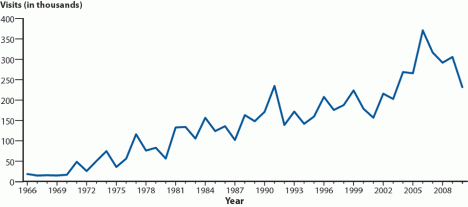
herpes stats

50 Years of Herpes Stats

###

Info Link: http://www.cdc.gov/std/herpes/STDFact-herpes.htm

Conclusion

Your thoughts and comments on this ME-P are appreciated. Feel free to review our top-left column, and top-right sidebar materials, links, URLs and related websites, too. Then, subscribe to the ME-P. It is fast, free and secure.

Link: http://feeds.feedburner.com/HealthcareFinancialsthePostForcxos

Speaker: If you need a moderator or speaker for an upcoming event, Dr. David E. Marcinko; MBA – Publisher-in-Chief of the Medical Executive-Post – is available for seminar or speaking engagements. Contact: MarcinkoAdvisors@msn.com

Our Other Print Books and Related Information Sources:

Health Dictionary Series: http://www.springerpub.com/Search/marcinko

Practice Management: http://www.springerpub.com/product/9780826105752

Physician Financial Planning: http://www.jbpub.com/catalog/0763745790

Medical Risk Management: http://www.jbpub.com/catalog/9780763733421

Hospitals: http://www.crcpress.com/product/isbn/9781439879900

Physician Advisors: www.CertifiedMedicalPlanner.org

Product DetailsProduct DetailsProduct Details

The “Art” of Medicine [Humor]

Join Our Mailing List

It’s all about Linguistics

Assessment

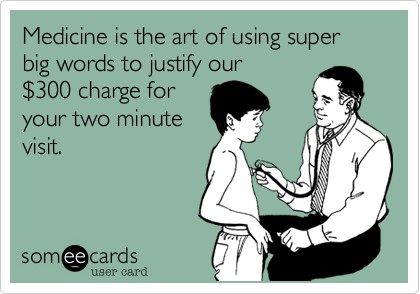
Medicine is the art of using super big words to justify a $300 dollar charge for a two minute office visit.

Conclusion

Your thoughts and comments on this ME-P are appreciated. Feel free to review our top-left column, and top-right sidebar materials, links, URLs and related websites, too. Then, subscribe to the ME-P. It is fast, free and secure.

Link: http://feeds.feedburner.com/HealthcareFinancialsthePostForcxos

Speaker: If you need a moderator or speaker for an upcoming event, Dr. David E. Marcinko; MBA – Publisher-in-Chief of the Medical Executive-Post – is available for seminar or speaking engagements. Contact: MarcinkoAdvisors@msn.com

Our Other Print Books and Related Information Sources:

Health Dictionary Series: http://www.springerpub.com/Search/marcinko

Practice Management: http://www.springerpub.com/product/9780826105752

Physician Financial Planning: http://www.jbpub.com/catalog/0763745790

Medical Risk Management: http://www.jbpub.com/catalog/9780763733421

Hospitals: http://www.crcpress.com/product/isbn/9781439879900

Physician Advisors: www.CertifiedMedicalPlanner.org

Product DetailsProduct DetailsProduct Details

On Financial Institutional Fraud

Join Our Mailing List

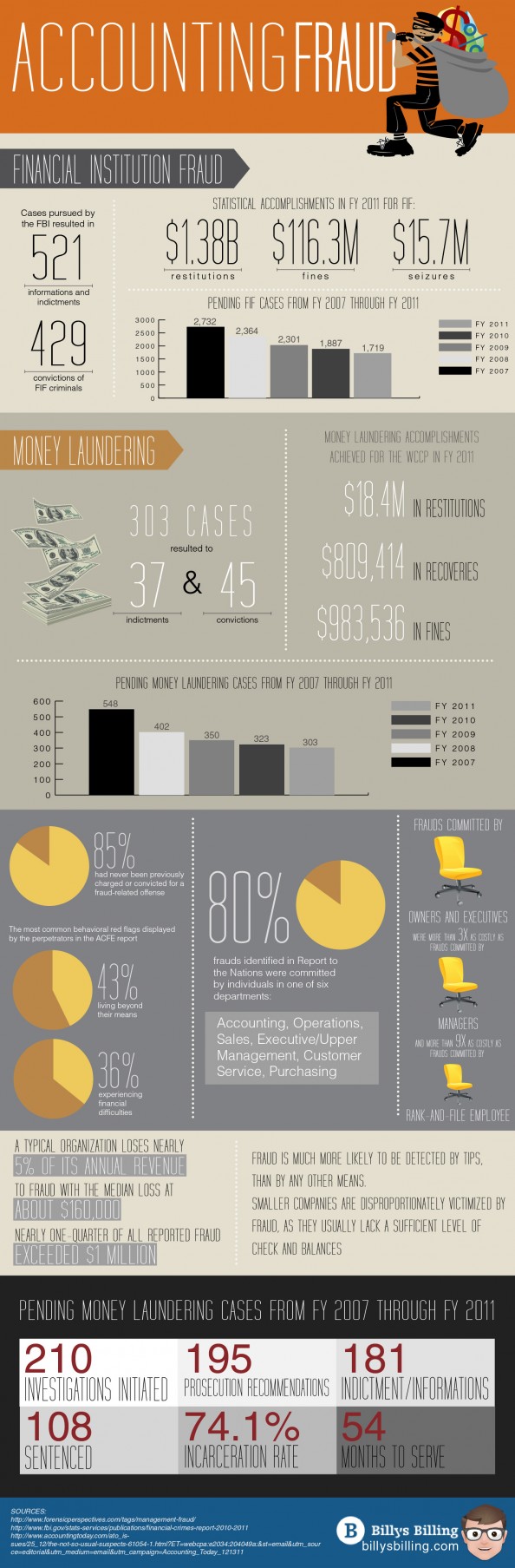
About Accounting Fraud

Definition: Any act or attempt to falsify an accounting statement for financial gain.

A clear example of accounting fraud is the act of deliberately overpricing a company’s assets in order to drive up its share price.

Another example is filing bankruptcy to avoid debt, rather than because of financial hardship.

One of the biggest accounting frauds in history occurred during the Enron scandal in 2001.

Conclusion

Your thoughts and comments on this ME-P are appreciated. Feel free to review our top-left column, and top-right sidebar materials, links, URLs and related websites, too. Then, subscribe to the ME-P. It is fast, free and secure.

Link: http://feeds.feedburner.com/HealthcareFinancialsthePostForcxos

Speaker: If you need a moderator or speaker for an upcoming event, Dr. David E. Marcinko; MBA – Publisher-in-Chief of the Medical Executive-Post – is available for seminar or speaking engagements. Contact: MarcinkoAdvisors@msn.com

Our Other Print Books and Related Information Sources:

Health Dictionary Series: http://www.springerpub.com/Search/marcinko

Practice Management: http://www.springerpub.com/product/9780826105752

Physician Financial Planning: http://www.jbpub.com/catalog/0763745790

Medical Risk Management: http://www.jbpub.com/catalog/9780763733421

Hospitals: http://www.crcpress.com/product/isbn/9781439879900

Physician Advisors: www.CertifiedMedicalPlanner.org

Product DetailsProduct DetailsProduct Details

Product Details  Product Details

Product Details

Is Walking Away from A Mortgage Ever OK?

Join Our Mailing List

One Doctor Asks the ME-P

The scourge of foreclosures has brought a lot of moral issues to light. So, Dr. Jones from Las Vegas asks, is it OK to simply stop paying your mortgage?

The answer you get depends on who you ask and what the circumstances are. If you’ve never thought much about this question, you may soon. There are so many mortgages going into foreclosure that it may soon happen to you or someone you know. And even those who don’t go through foreclosure may still be vulnerable to terrible mortgage conditions.

How Bad Is the Foreclosure Rate?

The epidemic of foreclosures is worse than you would believe. Since 2005, there have been 2.5 million foreclosures. In July of 2010, the foreclosure rate went up 6 percent over the same month a year earlier.

Are You Underwater?

If you owe more on your house than your house is actually worth, you may feel like you’re underwater. With excess borrowing against equity and falling home prices, this situation has reached epidemic proportions. It isn’t just a few people in this situation or even a few million people. One quarter of all families are underwater, with negative equity in their own homes.

The states with the worst numbers of people underwater are Florida, Wisconsin, Nevada, California and Arizona. By far, the worst state for this situation is Nevada. In Nevada, 65 percent of borrowers owe more on their mortgage than their house is worth.

  • What should homeowners do in this situation?
  • Should they continue to pay?
  • Or, do you think they should they simply chuck it all and stop all payments?
  • Would you?

What Do People Think About Walking Away From a Mortgage?

If you have already formed an opinion about whether it’s OK to ditch a mortgage or not, you’re not alone in being opinionated. Everyone has an opinion on this, from renters to homeowners and from the young to the old.

In total, 25 percent of renters think it’s okay to walk away from a mortgage. Homeowners aren’t as hip to ditching, though. Among those who own homes, only 17 percent think it’s OK to stop paying.

Is It a Moral Issue?

Some homeowners believe that whether or not to pay is a moral issue. Their own ethics come into play, telling them that someone who signed a contract should see it through, regardless of how home prices have fallen. The mortgage industry loves that—they are really playing up the idea that paying is a moral obligation.

Assessment

What people believe about this issue often comes down to their age and gender.

To see what age groups and genders believe it’s OK to walk away, review the above graphic. And, men and women aren’t as far apart on this issue as you may think. Many people of both genders believe that if your financial circumstances are dire, it may be OK to ditch that mortgage. What about medical professionals? Do you agree with your peers? Click on the graphic to see.

Conclusion

Your thoughts and comments on this ME-P are appreciated. Feel free to review our top-left column, and top-right sidebar materials, links, URLs and related websites, too. Then, subscribe to the ME-P. It is fast, free and secure.

Link: http://feeds.feedburner.com/HealthcareFinancialsthePostForcxos

Speaker: If you need a moderator or speaker for an upcoming event, Dr. David E. Marcinko; MBA – Publisher-in-Chief of the Medical Executive-Post – is available for seminar or speaking engagements. Contact: MarcinkoAdvisors@msn.com

Our Other Print Books and Related Information Sources:

Product DetailsProduct DetailsProduct Details

Product Details Product Details

Product Details

As With Medical Decisions – Human Emotions Play a Role in Investment Advice

Join Our Mailing List

Appreciating Transferrable Applications in Behavioral Finance

By Sidney A. Blum CFP® CPA/PFS ChFC

By Dr. David E. Marcinko MBA

Whether making medical decisions or financial decisions, both are influenced by emotions. The role of emotions, when making financial decisions, has transferable application in the world of medical decisions.

What Role Should Emotion Play in Financial Advice?

Financial advisors know that one of the most important components of providing financial advice is discussing client goals. Inherently your goals are tied to how you see yourself and in what ways you see your money and net worth as a reflection of yourself. This aspect of your financial life is usually tied to emotions based on perceived positive or negative experiences in your life.

Financial advisors find that they expend considerable time and energy addressing emotions and negative reactions to events in clients’ lives. The goal is to move the focus toward positive steps for reaching client goals. As with other aspects in your life, emotional reactions can distract you from well reasoned actions that benefit in the long run. This is the reason it is beneficial to engage a financial professional to guide you through your financial life circumstances with advice driven by goals rather than emotional negative reactions.

Emotional Intelligence

The use of Emotional Intelligence is a learned skill set. Financial Advisors who are skilled in understanding the four basic emotions that guide them and their clients will find they are more successful in their chosen work!

The Four Basic Emotions

The four emotions are: Glad, Sad, Mad and Scared. These four basic emotions are neither good nor bad – they just “are”!

It is one or more of these emotions that help determine just how “risk adverse” a client will be. It is absolutely necessary for a financial advisor to be aware of the client’s emotional state, whether the client is aware or not. People react emotionally to market downturns. They are probably scared first, but also mad and sad as the market changes. They may get caught up in the market’s emotional swings and lose sight of their own goals and strategy. They think it will always stay that way. Or in an upturn, they believe the market will always stay up. They get caught up in the euphoria of “glad” and again lose sight of their goals and strategy. Many people get caught up in the high market frenzy and end up buying shares that are overpriced; even doctors.

Examples:

Pulling out of the market to protect temporary downside losses in value also means not participating in the upside, which eventually occurs. From the major downturn in the spring of 2009 to the fall of 2009, the market recovered better than 35%. Those who pulled out of the market and stayed out missed out on that portion of their own portfolio’s recovery. Due to reacting emotionally, people buy in up market and sell in a down market – the opposite of what garners them a good return.

Another difficulty is that people lose sight of the fact that a fund investment is in actual companies – some of which survive and some don’t. The nature of the investment market is that there are no guarantees on return of investment. A certain amount of volatility is normal. It is the price you pay for the opportunity of garnering a higher return than with “safe” investments.

And, how safe are “safe” investments? If your “safe” investments are earning 1% while inflation is running at 3% as is the case in 2012, you are losing purchasing power. If the bucket is leaking slowly, it can still end up empty!

So when you feel “glad” about a safe investment, what may be a good feeling may turn out to be a bad investment.

How Advisors Help Clients

How does an advisor help to keep their clients’ focus on the positive steps that can be taken to meet goals instead of reacting solely to current market conditions? How does advisor keep from getting involved in the client’s negative and unproductive emotional reactions?

Financial advisors have seen these situations before, but clients may not be aware that financial markets tend to return to the norm and provide a positive return in the long run. By helping provide a perspective on how the market normally behaves; the focus can be shifted from how the market currently stands, a temporary fluid condition, to the longer range behavior of markets. This provides a sense of stable emotions that allows the client and the advisor to make better financial decisions.

Non-Monetary Goals?

A financial advisor can also help you realize that financial planning is more than investments and that some goals are not solely monetary. It is less stressful and far more productive for people to keep their eyes on their goals, not on the dollar value of their portfolio. In the end, your net worth is not the same as your self‐worth.

Assessment

Because emotions play a significant role in all decisions we make, a major part of an advisor’s job is to help the client keep their focus on the positive steps that can be taken to meet those goals instead of reacting based solely on emotions!

About the Author

Sid graduated from the University of Illinois with a degree in accounting and has been practicing as a CPA since 1975 and financial advisor since 1987. Sid received the CERTIFIED FINANCIAL PLANNER certification in 1987 and in 1988, received the AICPA Certificate of Education Achievement in Personal Financial Planning. In 1989, Sid received the designation of Chartered Financial Consultant (ChFC) and in 1991 the AICPA specialty designation of Personal Financial Specialist (CPA/PFS).

Channel Surfing the ME-P

Have you visited our other topic channels? Established to facilitate idea exchange and link our community together, the value of these topics is dependent upon your input. Please take a minute to visit. And, to prevent that annoying spam, we ask that you register. It is fast, free and secure.

Conclusion

Your thoughts and comments on this ME-P are appreciated. Feel free to review our top-left column, and top-right sidebar materials, links, URLs and related websites, too. Then, subscribe to the ME-P. It is fast, free and secure.

Speaker: If you need a moderator or speaker for an upcoming event, Dr. David E. Marcinko; MBA – Publisher-in-Chief of the Medical Executive-Post – is available for seminar or speaking engagements. Contact: MarcinkoAdvisors@msn.com

OUR OTHER PRINT BOOKS AND RELATED INFORMATION SOURCES:

Product DetailsProduct DetailsProduct Details

  Risk Management, Liability Insurance, and Asset Protection Strategies for Doctors and Advisors: Best Practices from Leading Consultants and Certified Medical Planners™8Comprehensive Financial Planning Strategies for Doctors and Advisors: Best Practices from Leading Consultants and Certified Medical Planners™

Product Details

Should Doctors Know the Top Black and White Hat Hackers?

Join Our Mailing List

Attention Medical Professionals, HIT Specialists and EHR Devotees

[By Staff Writers]

Question: What is LulzSec?

LulzSec, short for “LulzSec Security”, is a hacker group that claims responsibility for several high profile attack.

LulzSec has gotten attention since May 2011 for targeting high profile website with poor security.

Assessment

The most prolific anti-EHR / anti-EDR contributor to this ME-P is investigative reporter Darrell K. Pruitt DDS; friend or foe of HIPAA and HIT data security?

Conclusion

Your thoughts and comments on this ME-P are appreciated. Feel free to review our top-left column, and top-right sidebar materials, links, URLs and related websites, too. Then, subscribe to the ME-P. It is fast, free and secure.

Speaker: If you need a moderator or speaker for an upcoming event, Dr. David E. Marcinko; MBA – Publisher-in-Chief of the Medical Executive-Post – is available for seminar or speaking engagements. Contact: MarcinkoAdvisors@msn.com

OUR OTHER PRINT BOOKS AND RELATED INFORMATION SOURCES:

Product DetailsProduct DetailsProduct Details

Product Details

Opinion Poll on the Most Disruptive Health Issue Today?

Join Our Mailing List

A Voting Opinion Poll

Today’s opinion poll for all modern hospital executives, financial advisors, health economists, patients and physician leaders is right on-point.

It was sent in by an astute ME-P subscriber and we are most pleased to oblige.

VOTE HERE

And so, what is the most singular disruptive development that you should be thinking about if you want your medical practice, clinic, hospital, state, local government or healthcare organization to thrive in the coming years?

Conclusion

Your thoughts and comments on this ME-P are appreciated. Feel free to review our top-left column, and top-right sidebar materials, links, URLs and related websites, too. Then, subscribe to the ME-P. It is fast, free and secure.

Link: http://feeds.feedburner.com/HealthcareFinancialsthePostForcxos

Speaker: If you need a moderator or speaker for an upcoming event, Dr. David E. Marcinko; MBA – Publisher-in-Chief of the Medical Executive-Post – is available for seminar or speaking engagements. Contact: MarcinkoAdvisors@msn.com

Our Other Print Books and Related Information Sources:

Health Dictionary Series: http://www.springerpub.com/Search/marcinko

Practice Management: http://www.springerpub.com/product/9780826105752

Physician Financial Planning: http://www.jbpub.com/catalog/0763745790

Medical Risk Management: http://www.jbpub.com/catalog/9780763733421

Hospitals: http://www.crcpress.com/product/isbn/9781439879900

Physician Advisors: www.CertifiedMedicalPlanner.org

Product DetailsProduct DetailsProduct Details

Product Details  Product Details

Product Details

Appreciating the Financial Toll Drug Use Has on Us

 Join Our Mailing List

The Cost of Drug Abuse

What does it cost to send a drug addict to jail? Far more than it needs to as demonstrated by this infographic.

War on Drugs

Thanks in part to the War on Drugs, more than half of the inmates in the federal prisons are there because of drug-related offenses.

It’s a staggering statistic, one that helps explain the explosive growth of the prison system over the past thirty years, as officials struggle to keep up with the influx of inmates convicted of, in many cases, minor drug possession.

Source: www.clarityway.com via  www.fastcodesign.com

Conclusion

Your thoughts and comments on this ME-P are appreciated. Feel free to review our top-left column, and top-right sidebar materials, links, URLs and related websites, too. Then, subscribe to the ME-P. It is fast, free and secure.

Link: http://feeds.feedburner.com/HealthcareFinancialsthePostForcxos

Speaker: If you need a moderator or speaker for an upcoming event, Dr. David E. Marcinko; MBA – Publisher-in-Chief of the Medical Executive-Post – is available for seminar or speaking engagements. Contact: MarcinkoAdvisors@msn.com

Our Other Print Books and Related Information Sources:

Health Dictionary Series: http://www.springerpub.com/Search/marcinko

Practice Management: http://www.springerpub.com/product/9780826105752

Physician Financial Planning: http://www.jbpub.com/catalog/0763745790

Medical Risk Management: http://www.jbpub.com/catalog/9780763733421

Hospitals: http://www.crcpress.com/product/isbn/9781439879900

Physician Advisors: www.CertifiedMedicalPlanner.org

Product DetailsProduct DetailsProduct Details

Product Details  Product Details

Product Details

What Health Care Fraud Costs Us

Join Our Mailing List

Scrutiny Needed from the Patient Citizenry – Too?

As health care takes the center stage at the forefront of contemporary politics it is under scrutiny from several angles.

The Fraud Rate

One aspect of the health care system that has been garnering growing levels of interest is the rate at which medical fraud occurs. As the developed world steeps itself further and further into the digital age, things like medical history and billing records become more easily susceptible to fraud since they’re accessible from virtually anywhere.

Expensive Care

And, the fact of the matter is that trying to stay healthy is an expensive business. Each year, 300 million Americans spend about $2 trillion on health care, but the amount of that money that is lost to fraud seems to have grown a great deal in recent years.

Types

The government continues to crack down and identify fraudsters in all their forms—and they do come in many forms. Perhaps the most common type of health care fraud concerns how medical care providers bill. This type of fraud relies heavily on the fact that many patients don’t take the proper amount of time to really scrutinize their medical bills and invoices.

Source: InsuranceQuotes.org

Assessment

Fraud can cost a huge amount of money for victim, insurance companies and society. The best defense against fraud remains understanding EOBs forms and what’s on your medical bills.

Conclusion

Your thoughts and comments on this ME-P are appreciated. Feel free to review our top-left column, and top-right sidebar materials, links, URLs and related websites, too. Then, subscribe to the ME-P. It is fast, free and secure.

Speaker: If you need a moderator or speaker for an upcoming event, Dr. David E. Marcinko; MBA – Publisher-in-Chief of the Medical Executive-Post – is available for seminar or speaking engagements. Contact: MarcinkoAdvisors@msn.com

OUR OTHER PRINT BOOKS AND RELATED INFORMATION SOURCES:


Product DetailsProduct DetailsProduct Details

A Barclay Bank Ad Campaign Photo

Join Our Mailing List

“For the best fixed rates”

Source: Paul Higgins and Sandy Teagle – Futurists from Melbourne and Brisbane in Australia.

Assessment

Truth in advertising.

Barclay campaign says pic.twitter.com/0XOmyQjg

Conclusion

Your thoughts and comments on this ME-P are appreciated. Feel free to review our top-left column, and top-right sidebar materials, links, URLs and related websites, too. Then, subscribe to the ME-P. It is fast, free and secure.

Link: http://feeds.feedburner.com/HealthcareFinancialsthePostForcxos

Speaker: If you need a moderator or speaker for an upcoming event, Dr. David E. Marcinko; MBA – Publisher-in-Chief of the Medical Executive-Post – is available for seminar or speaking engagements. Contact: MarcinkoAdvisors@msn.com

OUR OTHER PRINT BOOKS AND RELATED INFORMATION SOURCES:

DICTIONARIES: http://www.springerpub.com/Search/marcinko
PHYSICIANS: www.MedicalBusinessAdvisors.com
PRACTICES: www.BusinessofMedicalPractice.com
HOSPITALS: http://www.crcpress.com/product/isbn/9781466558731
CLINICS: http://www.crcpress.com/product/isbn/9781439879900
BLOG: www.MedicalExecutivePost.com
FINANCE: Financial Planning for Physicians and Advisors
INSURANCE: Risk Management and Insurance Strategies for Physicians and Advisors

Product Details  Product Details

The Marcinko Method of Improving Quality while Reducing Medical Errors and Healthcare Costs

Join Our Mailing List

Dr. David Edward Marcinko FACFAS MBA CMP

[Former – Certified Physician in Healthcare Quality]

[Former – Certified Financial Planner]

www.CertifiedMedicalPlanner.org

[Publisher-in-Chief]

THINK TWICE!

Doctor’s Orders

Life Corollaries:

Marcinko’s Rx for Obesity: Eat less – Exercise more – Avoid noxious lifestyles.

Marcinko’s Rx for Practice Success: Treat sick patients – Be humble – Keep faith.

Marcinko’s Rx for Financial Success: Spend less – Earn more – Be a fiduciary. 

Marcinko’s Rx for Wealth & Happiness: Don’t divorce – Love kids – Practice philanthropy.

Professional Medical Corollary:

The Choosing Wisely® list, which is aimed at cutting down on unnecessary testing by doctors and patients.

Assessment  

I am not an oracle. What else can you ad to the list?

Conclusion

Your thoughts and comments on this ME-P are appreciated. Feel free to review our top-left column, and top-right sidebar materials, links, URLs and related websites, too. Then, subscribe to the ME-P. It is fast, free and secure.

Link: http://feeds.feedburner.com/HealthcareFinancialsthePostForcxos

Speaker: If you need a moderator or speaker for an upcoming event, Dr. David E. Marcinko; MBA – Publisher-in-Chief of the Medical Executive-Post – is available for seminar or speaking engagements. Contact: MarcinkoAdvisors@msn.com

OUR OTHER PRINT BOOKS AND RELATED INFORMATION SOURCES:

DICTIONARIES: http://www.springerpub.com/Search/marcinko
PHYSICIANS: www.MedicalBusinessAdvisors.com
PRACTICES: www.BusinessofMedicalPractice.com
HOSPITALS: http://www.crcpress.com/product/isbn/9781466558731
CLINICS: http://www.crcpress.com/product/isbn/9781439879900
BLOG: www.MedicalExecutivePost.com
FINANCE: Financial Planning for Physicians and Advisors
INSURANCE: Risk Management and Insurance Strategies for Physicians and Advisors

Certified Medical Planner

Transparency Emerges in Dentistry

Join Our Mailing List

Cavities Blamed on Patients

[By D. Kellus Pruitt DDS]

If your car repeatedly requires costly repairs because you never change the oil, would you blame your mechanic?

PBS Frontline

Dentists are justifiably upset because the recent PBS Frontline documentary “Dollars and Dentists” blames them for our nation’s deteriorating oral health.

http://www.pbs.org/wgbh/pages/frontline/dollars-and-dentists/

When in reality, good oral hygiene habits are the very basics of personal accountability – reinforced by painful and embarrassing lessons as needed.

Tradition Dentists Usually Silent

Traditionally, dentists seldom speak up. But at a time when they are finding it difficult to keep their chairs filled, even by discounting their fees, “Dollars and Dentists” struck an inflamed nerve – causing dentists to publicly react in defense of the profession like never before.

As an example, here is Dr. Alan Mead’s blunt response which he posted for his patients to read on his Mead Family Dental website:

“If you have dental problems, it’s mostly your fault. And if you want to have less dental problems, it’s your responsibility. It’s not the fault of the dental insurance company. It’s not the government’s responsibility. It’s on you.”

http://meadfamilydental.com/2012/07/preventable/

Responses

According to other responses, apparently far fewer blameless people are born with “soft teeth” than one might be led to believe by people with lots of cavities. Dentists have politely, but futilely reminded people for decades that it’s refined sugar, bacteria and poor brushing habits that rots teeth.

Assessment

I think the demand for truth in healthcare is going to continue. Over the next few months watch for one or more recognized leaders in the dental profession to actually mention the word “transparency” for the first time since 2008 when an ADA President-elect candidate from California used the word in his campaign platform. He lost. But now that dentists are finally becoming sufficiently annoyed by reporters’ broad accusations of greed and malfeasance, it could be interesting to watch the predictable emergence from obscurity of this perky little healthcare niche – one agitated dentist at a time.

Conclusion

If openness were popular, someone would have long ago told Grandpa his breath smells like death.

Your thoughts and comments on this ME-P are appreciated. Feel free to review our top-left column, and top-right sidebar materials, links, URLs and related websites, too. Then, subscribe to the ME-P. It is fast, free and secure.

Speaker: If you need a moderator or speaker for an upcoming event, Dr. David E. Marcinko; MBA – Publisher-in-Chief of the Medical Executive-Post – is available for seminar or speaking engagements. Contact: MarcinkoAdvisors@msn.com

OUR OTHER PRINT BOOKS AND RELATED INFORMATION SOURCES:


Product Details

Do Clients Trust Financial Advisors More than Doctors or CPAs?

Join Our Mailing List

I Think … Not in My Universe

By Dr. David Edward Marcinko MBA CMP™

[Editor-in-Chief]

www.CertifiedMedicalPlanner.org

Survey after survey has shown that the public does not trust the financial services industry; it was – in fact, the least trusted industry in a recent Rick Edelman survey.

John Hancock?

But, perhaps they were looking at the wrong industries, or maybe investors just don’t trust your firm. A new survey by John Hancock shows that investors with assets of $200,000 or more, trust their financial advisor [FA] more than their primary doctor, accountant, contractor/handyman, boss and real estate agent. It was penned by one young staff writer named Diana Britton.

Link: http://wealthmanagement.com/blog/clients-trust-you-more-doctors-cpas?NL=WM-04&Issue=WM-04_20120611_WM-04_597&YM_RID=marcinkoadvisors%40msn.com&YM_MID=1318408

My View Point is Pretty Unique

Now, I am a doctor and board certified surgeon who held Series #7, #63 and #65 securities licenses, and was a Certified Financial Planner® for more than a decade. I was registered with a BD, SEC and NASD/FINRA, and held life, health and PC insurance licenses. This is the so-called “dual registration” to earn commissions and fees.

And, I’ve got a current partner who is a doctor-CPA who has a Master’s Degree in Accounting.  So, I know from whence I speak.

An Insurance Company!

Now, I resigned all of the above financial services monikers because of their lack of education and fiduciary accountability. These are sales licenses, certifications to hold a certification, and related gimmicks, all. Insurance agents have a duty to the company, not the client. Always ask them to put your best interests ahead of their own – in writing before hire – and watch them run.

Assessment

I suspect this study from an insurance company is less than accurate. How do I know? My gut heuristics tell me. Agency law tells me. No surveys needed or damn statistics for me. How about you? OR, are the marketing and PR gurus winning the public opinion battle with their insurance company advertising chicanery? ie., Hancock’s the future is yours!

If really so, here is my razzy for them.

 
Note: It is for the above reasons, and more, that we started the www.CertifiedMedicalPlanner.org online education program for financial advisors and management consultants that truly want to be trusted.

Conclusion

Your thoughts and comments on this ME-P are appreciated. Diana – call me.  Feel free to review our top-left column, and top-right sidebar materials, links, URLs and related websites, too. Then, subscribe to the ME-P. It is fast, free and secure.

Link: http://feeds.feedburner.com/HealthcareFinancialsthePostForcxos

Speaker: If you need a moderator or speaker for an upcoming event, Dr. David E. Marcinko; MBA – Publisher-in-Chief of the Medical Executive-Post – is available for seminar or speaking engagements. Contact: MarcinkoAdvisors@msn.com

OUR OTHER PRINT BOOKS AND RELATED INFORMATION SOURCES:

DICTIONARIES: http://www.springerpub.com/Search/marcinko
PHYSICIANS: www.MedicalBusinessAdvisors.com
PRACTICES: www.BusinessofMedicalPractice.com
HOSPITALS: http://www.crcpress.com/product/isbn/9781466558731
CLINICS: http://www.crcpress.com/product/isbn/9781439879900
BLOG: www.MedicalExecutivePost.com
FINANCE: Financial Planning for Physicians and Advisors
INSURANCE: Risk Management and Insurance Strategies for Physicians and Advisors

Product DetailsProduct DetailsProduct Details

Product Details  Product Details

Product Details

Doctors on Drugs

Join Our Mailing List

Profitable Prescriptions?

Increasing in costs each year, prescription pills are one of the most profitable and dominating industries in the nation, with annual sales in the hundreds of billions. Prescribed medications constitute a significant bulk of work that medical coders must transcribe.

The Rx Pill Industry

Shockingly, the prescription pill industry uses questionable practices to increase their bottom line, and in turn, increase coding workload through unnecessary prescriptions. Though pharmaceutical companies have long-earned a reputation for wooing doctors with gifts, bribes, and incentives, it was only revealed in recent years that they’ve also been paying doctors huge sums of money to promote certain products. And, some and doctors are taking up on these offers.

These pre-selected medications are not only violating a conflict of interest, but they can also be largely responsible for increases in patient and insurance costs: a doctor may feel obligated to prescribe an expensive “sponsored” medication over a cheaper alternative.

Assessment

This in turn, is reflected on the overall rising cost of healthcare, which unfortunately, is exactly what the doctor ordered.

Conclusion

Your thoughts and comments on this ME-P are appreciated. Feel free to review our top-left column, and top-right sidebar materials, links, URLs and related websites, too. Then, subscribe to the ME-P. It is fast, free and secure.

Link: http://feeds.feedburner.com/HealthcareFinancialsthePostForcxos

Speaker: If you need a moderator or speaker for an upcoming event, Dr. David E. Marcinko; MBA – Publisher-in-Chief of the Medical Executive-Post – is available for seminar or speaking engagements. Contact: MarcinkoAdvisors@msn.com

Our Other Print Books and Related Information Sources:

Health Dictionary Series: http://www.springerpub.com/Search/marcinko

Practice Management: http://www.springerpub.com/product/9780826105752

Physician Financial Planning: http://www.jbpub.com/catalog/0763745790

Medical Risk Management: http://www.jbpub.com/catalog/9780763733421

Hospitals: http://www.crcpress.com/product/isbn/9781439879900

Physician Advisors: www.CertifiedMedicalPlanner.org

Product DetailsProduct DetailsProduct Details

Rating Financial Advisors and Doctors Like Toasters

 Join Our Mailing List 

On Finding a Good Physician and Financial Planner in 2012

[By staff reporters]

What happens when patients and clients are able to compare the performance of primary care physicians and financial advisors? Well, for the first time ever, we’re about to find out.

RATING DOCTORS:

Consumer Reports for Doctors

Consumer Reports, best known for rating the nuts and bolts of cars, household appliances and other electronics, is getting into the business of rating primary care doctors.

The magazine is getting ready to mail out ratings for nearly 500 adult, family and pediatric physician practices in Massachusetts, the first step in a multistate project to evaluate doctors the way it has rated consumer products for decades.

RATING FINANCIAL ADVISORS:

AdviceIQ

www.AdviceIQ.com is an online service that educates all consumers about the need to hire a trusted, local financial advisor, while giving all pre-vetted advisors exposure to local investors. Also, their FAs write insightful articles that inform the public about investing and wealth management, and they syndicate them to top-branded media sites around the country.

BrightScope® for Wealth Managers and Plan Sponsors

BrightScope, Inc. is a financial information company that brings transparency to opaque markets. Delivered through web-based software, BrightScope data drives better decision-making for individual investors, corporate plan sponsors, asset managers, broker-dealers, and financial advisors.

BrightScope primarily operates in two major segments: Retirement Plans and Wealth Management: http://www.brightscope.com/

Assessment

Ultimately, we hope and believe that the reliability of the data, the credibility of the organizations responsible for the research and reporting, and a process based on collaboration and the desire for continuous improvement, will combine to gain the confidence of clients and patients alike and help advance the cause of patient-centered health care and fiduciary focused financial planning.

www.CertifiedMedicalPlanner.org

Conclusion

Your thoughts and comments on this ME-P are appreciated. Feel free to review our top-left column, and top-right sidebar materials, links, URLs and related websites, too. Then, subscribe to the ME-P. It is fast, free and secure.

Link: http://feeds.feedburner.com/HealthcareFinancialsthePostForcxos

Speaker: If you need a moderator or speaker for an upcoming event, Dr. David E. Marcinko; MBA – Publisher-in-Chief of the Medical Executive-Post – is available for seminar or speaking engagements. Contact: MarcinkoAdvisors@msn.com

site

OUR OTHER PRINT BOOKS AND RELATED INFORMATION SOURCES:

DICTIONARIES: http://www.springerpub.com/Search/marcinko
PHYSICIANS: www.MedicalBusinessAdvisors.com
PRACTICES: www.BusinessofMedicalPractice.com
HOSPITALS: http://www.crcpress.com/product/isbn/9781466558731
CLINICS: http://www.crcpress.com/product/isbn/9781439879900
BLOG: www.MedicalExecutivePost.com
FINANCE: Financial Planning for Physicians and Advisors
INSURANCE: Risk Management and Insurance Strategies for Physicians and Advisors

Product Details  Product Details

More on the Art of “Slow” Medicine

Join Our Mailing List

And … Slow Dentistry, too!

By Ann Miller RN MHA

[ME-P Executive-Director]

BOOK REVIEW

We don’t know exactly when, but the practice of medicine has morphed into the delivery of health care.

Of course, if healthcare has become big business, we at the ME-P through our publication, text and handbooks, advertisers and sponsors, as well as speaking and consulting engagements may be partially to blame. But, hopefully not to the extreme it has become in some cases.

For example, did you know that Medicare has a CPT® medical payment code for a ten minute “treadmill” office visit?

God’s Hotel – The Book

So, if you aren’t sure – or are too young to know – of what’s happening today, the new book “God’s Hotel” is for you. It’s an engaging book by Dr. Victoria Sweet, a general internist from Laguna Honda Hospital that chronicles her perspectives from the last almshouse in the United States.

IOW: She is off the insurance grid and has discovered a way to benefit patients, not necessarily medical providers, by practicing something called “slow” medicine.

THINK: Marcus Welby MD

Slow Dentistry

Of course, our own ME-P investigative reporter Darrell K. Pruitt DDS, has been commenting and opining on this issue vis-a-vie the dental insurance industry treadmill of “fast” production line oral care.

For example, he often asks his colleagues: Are you fed up with successfully doing intricate handwork to exacting tolerances in mouths of anxious patients and then having to fight to get the patients’ insurance company to pay what they rightfully owe THEIR CLIENT.

IOW: Working faster and faster, for less and less compensation.

Assessment

“God’s Hotel”: A Doctor, a Hospital, and a Pilgrimage to the Heart of Medicine

Link: http://www.amazon.com/Gods-Hotel-Hospital-Pilgrimage-Medicine/dp/1594488436/ref=sr_1_1?ie=UTF8&qid=1337177871&sr=8-1

More from the ME-P: The Emerging Discipline of “Slow Medicine” and Professional Liability

Conclusion

Your thoughts and comments on this ME-P are appreciated. Feel free to review our top-left column, and top-right sidebar materials, links, URLs and related websites, too. Then, subscribe to the ME-P. It is fast, free and secure.

Speaker: If you need a moderator or speaker for an upcoming event, Dr. David E. Marcinko; MBA – Publisher-in-Chief of the Medical Executive-Post – is available for seminar or speaking engagements. Contact: MarcinkoAdvisors@msn.com

OUR OTHER PRINT BOOKS AND RELATED INFORMATION SOURCES:

Product Details

Ten Ways to Prevent Consumer Financial Fraud Transactions

By Dr. David Edward Marcinko MBA CMP™

[Publisher-in-Chief]

Join Our Mailing List

Avoid Being Ripped-Off in the Modern Era

OK, I grew up on the “mean streets” of Baltimore City and took public transportation to high school through the crack addled neighborhoods, and drug-induced “zombies”, of West Baltimore.

I played stick ball in the parking lot of Johns Hopkins Medical School and Hospital, and watched the gang bangers “groan in – and bail out” of the ER.

Later, I attended Loyola University, daily also via public bus, and then came of age on the streets of South Philadelphia long before attending Temple University. And, I walked to work in the emergency room of Pennsylvania Hospital through it all.

So, as a journalist, doctor and financial advisor today, I guess I’ve got some street credibility or some sort of rep [good or bad]!

Accordingly, it is not unusual for me to be asked to speak or write about modern financial fraud prevention. Simple really … Street smarts!

Assessment

Link: Ten Ways to Prevent Fraud

What else can you add in sanitized form.

Conclusion

Your thoughts and comments on this ME-P are appreciated. Feel free to review our top-left column, and top-right sidebar materials, links, URLs and related websites, too. Then, subscribe to the ME-P. It is fast, free and secure.

Link: http://feeds.feedburner.com/HealthcareFinancialsthePostForcxos

Speaker: If you need a moderator or speaker for an upcoming event, Dr. David E. Marcinko; MBA – Publisher-in-Chief of the Medical Executive-Post – is available for seminar or speaking engagements. Contact: MarcinkoAdvisors@msn.com

OUR OTHER PRINT BOOKS AND RELATED INFORMATION SOURCES:

LEXICONS: http://www.springerpub.com/Search/marcinko
PHYSICIANS: www.MedicalBusinessAdvisors.com
PRACTICES: www.BusinessofMedicalPractice.com
HOSPITALS: http://www.crcpress.com/product/isbn/9781466558731
CLINICS: http://www.crcpress.com/product/isbn/9781439879900
ADVISORS: www.CertifiedMedicalPlanner.org
BLOG: www.MedicalExecutivePost.com

Product Details  Product Details

Celebrate Earth Day 2012

Join Our Mailing List

Do Good – Relax

Conclusion

Your thoughts and comments on this ME-P are appreciated. Feel free to review our top-left column, and top-right sidebar materials, links, URLs and related websites, too. Then, subscribe to the ME-P. It is fast, free and secure.

Link: http://feeds.feedburner.com/HealthcareFinancialsthePostForcxos

Speaker: If you need a moderator or speaker for an upcoming event, Dr. David E. Marcinko; MBA – Publisher-in-Chief of the Medical Executive-Post – is available for seminar or speaking engagements. Contact: MarcinkoAdvisors@msn.com

Our Other Print Books and Related Information Sources:

Health Dictionary Series: http://www.springerpub.com/Search/marcinko

Practice Management: http://www.springerpub.com/product/9780826105752

Physician Financial Planning: http://www.jbpub.com/catalog/0763745790

Medical Risk Management: http://www.jbpub.com/catalog/9780763733421

Hospitals: http://www.crcpress.com/product/isbn/9781439879900

Physician Advisors: www.CertifiedMedicalPlanner.org

Product Details

Use Us – Don’t Abuse Us

The ME-P is Not Peer Reviewed but should be Cited

Join Our Mailing List

By Dr. David Edward Marcinko MBA

[Publisher-in-Chief]

There is an amusing historical story in academia about an unsuccessful candidate for a faculty position. It might serve as an object lesson for us all at the Medical Executive-Post.

The History

After faculty appointment interviews, the exhausted chairman of a prestigious university’s search committee quipped, “What his résumé lacked was five bad papers.”

The Rationale

By that, he meant that while the candidate had published several peer-reviewed papers containing enough genuinely important ideas to satisfy any rational hiring committee — more than could be said of most faculty members — he had too few to satisfy the bean counters, who fretted about how uninformed outsiders might react to the appointment.

Assessment

Researchers have responded as expected to these incentives. But, the additional papers they’ve written often have added little value. In other words, quality trumps quantity, even in the blog-o-sphere. So, please reference and cite us, comment about us, recommend us and use us – but don’t abuse us! Oh! We are copyrighted, too. We are – what we are – and proud of it.

Conclusion

In fact, the economist Philip Cook and Austin Frakt PhD, over at the Incidental Economist, found that in the first five years after publication, many fewer than half of all papers in the two most selective economics journals had ever been cited by other scholars.

So remember, at the ME-P, we are not peer reviewed. However, we are important, helpful, focused, crowdsourced, valuable and growing!

Conclusion

Your thoughts and comments on this ME-P are appreciated. Feel free to review our top-left column, and top-right sidebar materials, links, URLs and related websites, too. Then, subscribe to the ME-P. It is fast, free and secure.

Link: http://feeds.feedburner.com/HealthcareFinancialsthePostForcxos

Our Other Print Books and Related Information Sources:

Health Dictionary Series: http://www.springerpub.com/Search/marcinko

Practice Management: http://www.springerpub.com/product/9780826105752

Physician Financial Planning: http://www.jbpub.com/catalog/0763745790

Medical Risk Management: http://www.jbpub.com/catalog/9780763733421

Healthcare Organizations: www.HealthcareFinancials.com

Physician Advisors: www.CertifiedMedicalPlanner.com

Subscribe Now: Did you like this Medical Executive-Post, or find it helpful, interesting and informative? Want to get the latest ME-Ps delivered to your email box each morning? Just subscribe using the link below. You can unsubscribe at any time. Security is assured.

Link: http://feeds.feedburner.com/HealthcareFinancialsthePostForcxos

Sponsors Welcomed: And, credible sponsors and like-minded advertisers are always welcomed.

Link: https://healthcarefinancials.wordpress.com/2007/11/11/advertise

Product DetailsProduct DetailsProduct Details

Product Details  Product Details

Product Details

A Visual Guide to Pissing Off The Financial World

Join Our Mailing List

On the History of AIG

According to Wikipedia, the American International Group, Inc. (NYSE: AIG) or AIG is an American multinational insurance corporation. Its corporate headquarters is located in the American International Building in New York City. The British headquarters office is on Fenchurch Street in London, continental Europe operations are based in La Défense, Paris, and its Asian headquarters office is in Hong Kong.

According to the 2011 Forbes Global 2000 list, AIG was the 29th-largest public company in the world. It was listed on the Dow Jones Industrial Average from April 8, 2004 to September 22nd, 2008.

AIG suffered from a liquidity crisis when its credit ratings were downgraded below “AA” levels in September 2008. The United States Federal Reserve Bank on September 16, 2008 created an $85 billion credit facility to enable the company to meet increased collateral obligations consequent to the credit rating downgrade, in exchange for the issuance of a stock warrant to the Federal Reserve Bank for 79.9% of the equity of AIG.

###

A Visual Guide to Pissing Off The Financial World

Assessment

The Federal Reserve Bank and the United States Treasury by May 2009 had increased the potential financial support to AIG, with the support of an investment of as much as $70 billion, a $60 billion credit line and $52.5 billion to buy mortgage-based assets owned or guaranteed by AIG, increasing the total amount available to as much as $182.5 billion.

AIG subsequently sold a number of its subsidiaries and other assets to pay down loans received, and continues to seek buyers of its assets.

Many physician investors were affected.

Source: www.CreditLoan.com

Conclusion

And so, your thoughts and comments on this ME-P are appreciated. Please review our top-left column, and top-right sidebar materials, links, URLs and related websites, too. Then, subscribe to the ME-P. It is fast, free and secure.

Link: http://feeds.feedburner.com/HealthcareFinancialsthePostForcxos

Speaker: If you need a moderator or speaker for an upcoming event, Dr. David E. Marcinko; MBA – Publisher-in-Chief of the Medical Executive-Post – is available for seminar or speaking engagements. Contact: MarcinkoAdvisors@msn.com

Our Other Print Books and Related Information Sources:

Health Dictionary Series: http://www.springerpub.com/Search/marcinko

Practice Management: http://www.springerpub.com/product/9780826105752

Physician Financial Planning: http://www.jbpub.com/catalog/0763745790

Medical Risk Management: http://www.jbpub.com/catalog/9780763733421

Healthcare Organizations: www.HealthcareFinancials.com

Physician Advisors: www.CertifiedMedicalPlanner.com

Subscribe Now: Did you like this Medical Executive-Post, or find it helpful, interesting and informative? Want to get the latest ME-Ps delivered to your email box each morning? Just subscribe using the link below. You can unsubscribe at any time. Security is assured.

Link: http://feeds.feedburner.com/HealthcareFinancialsthePostForcxos

Sponsors Welcomed: And, credible sponsors and like-minded advertisers are always welcomed.

Link: https://healthcarefinancials.wordpress.com/2007/11/11/advertise

Product Details  Product Details

Anatomy of a “Best Doctors and Dentists Award” [Marketing] Scam

Join Our Mailing List

What is the value of an honor if it costs $6,000?

By D. Kellus Pruitt DDS

I apologize for misleading those I recklessly told that my name will appear in the December edition of TIME magazine as one of the winners of the Texas Best Doctors and Dentists Award. It’s been an embarrassing learning experience, and my pride is a little wounded from not recognizing signs that an ambitious salesperson in California was lying to me. But I’ll get over it, and will be wiser for the experience.

Wishful Thinking

Looking back on my wishful thinking, I should have known the honor of appearing in TIME magazine simply sounded too good to be true. On the bright side, in preparation for photos that weren’t taken, I did get my hair cut and vacuumed my office for this morning’s interview-turned-sales pitch.

About a month ago, a Texas Best Doctors and Dentists representative calling from a few feet south of the San Francisco Ethics Commission made it past my office manager and got me on the phone. Anthony, whose last name is unintelligible in the recording of our conversation, told me that I had been chosen by the Tarrant County Community to receive the 2012 Award, and would be featured along with other winners in TIME.

“Alright, how much does this cost?”

“There’s no cost to receive the award Doctor, or to appear in TIME magazine. You’ve been chosen based on your reputation in the Tarrant County community.

“OK, what are you selling?”

“We’re not selling anything, Doctor. You know this is the first time TIME magazine is featuring this award and what they are trying to do is they are trying to conduct their readers to the best doctors and dentists from local communities in America.”

Surveys Determine Award Winners?

When I asked him how I was chosen, he explained that the Texas Best Doctors and Dentists Awards firm was hired by TIME to conduct surveys of local specialists and research the popular dentist ratings websites to determine the award winners. Up until he said, “You may be familiar with droogle … “ in two syllables instead of four (DR.Oogle – doctoroogle.com), his pitch was credible. Even though I recognized the faux pas instantly, rather than probing a little deeper and asking him just one more common sense question – perhaps about how the “advertorial” insert in the Texas edition of TIME will be paid for – I apologized to Anthony for rudely assuming he was trying to sell me something. It was then that he knew I wanted to believe him more than experience. That’s the anatomy of a scam, even though no money was exchanged in the lesson.

A Legitimate [Free] Award

The award is indeed legitimate. I won it because of the kindness of my wonderful staff, patients and local colleagues. But I’m by far not the only dentist interviewed in Tarrant County like Anthony said. That was just one more lie targeting my pride – enticing me to consent to today’s interview. Only hours ago, I learned that 100 dentists in the state won the award, so there are probably a couple of dozen award winning dentists like me in Tarrant County.

Declining the Paid Upgrade

Even though I declined to purchase advertisement from Texas Best Doctors and Dentist today, my name will still be listed on the Texas Best Doctors and Dentists Website free of charge, and I’ll also receive a “nice plaque” in the mail in a week or so that will have the TIME magazine logo on it. All I had to do was listen to a 30 minute sales pitch for upgrading my free, ordinary listing on Texas Best Doctors and Dentists Website to something that might attract patients.

Who Needs It?

As far as my name appearing in the advertorial insert in the December edition of TIME magazine, statewide recognition of dentists’ efforts to please patients naturally can’t be given away. Oh hell no. In spite of what Anthony said, a write-up in TIME costs award winners $6,000. I’m certain those who say nice things about my staff and me don’t want us to raise fees to cover the expense of statewide advertising. Who needs it?

Assessment

I don’t think I have room on my wall for a Texas Best Doctors and Dentists Award plaque with a TIME magazine logo. I’m trying to find a place to hang my 1972, B – Team high school basketball plaque I came across while cleaning my office for a surprise sales pitch with no photos.

Conclusion

Your thoughts and comments on this ME-P are appreciated. Feel free to review our top-left column, and top-right sidebar materials, links, URLs and related websites, too. Then, subscribe to the ME-P. It is fast, free and secure.

Link: http://feeds.feedburner.com/HealthcareFinancialsthePostForcxos

Speaker: If you need a moderator or speaker for an upcoming event, Dr. David E. Marcinko; MBA – Publisher-in-Chief of the Medical Executive-Post – is available for seminar or speaking engagements. Contact: MarcinkoAdvisors@msn.com

OUR OTHER PRINT BOOKS AND RELATED INFORMATION SOURCES:

DICTIONARIES: http://www.springerpub.com/Search/marcinko
PHYSICIANS: www.MedicalBusinessAdvisors.com
PRACTICES: www.BusinessofMedicalPractice.com
HOSPITALS: http://www.crcpress.com/product/isbn/9781466558731
CLINICS: http://www.crcpress.com/product/isbn/9781439879900
BLOG: www.MedicalExecutivePost.com
FINANCE: Financial Planning for Physicians and Advisors
INSURANCE: Risk Management and Insurance Strategies for Physicians and Advisors

Product Details