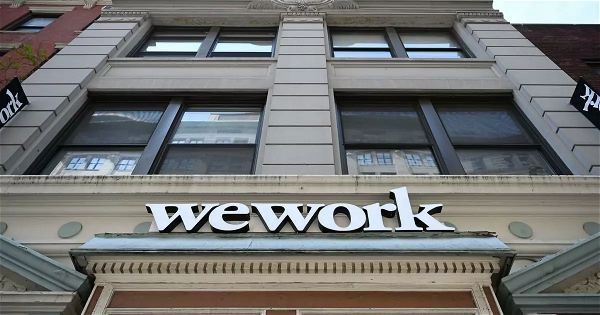
“WeWork”: Officially Bankrupt

WeWork = Did Not Work!

By Staff Reporters

***

***

WeWork, the coworking company just filed for Chapter 11 bankruptcy protection in New Jersey after years of struggles that began with a failed IPO in 2019. It aborted the IPO after investors got a look at its finances and just how much power WeWork’s eccentric founder Adam Neumann possessed.

CITE: https://www.r2library.com/Resource

WeWork (which eventually went public via SPAC) has suffered from having signed on to very expensive leases in its pre-IPO rush to grow.

SPAC: https://medicalexecutivepost.com/2022/06/13/spac-v-direct-listing-v-ipo/

In 2019, the company was valued at $47 billion, but it has since fallen steadily, and this year, its stock has plunged by 98%, giving it a ~$45 million value as of last week.

MORE: https://www.baltimoresun.com/business/ct-biz-wework-bankruptcy-filing-20231107-vdw7fbh7hfdftktesoos6clv6u-story.html

COMMENTS APPRECIATED

Thank You

***

***

DAILY UPDATE: A.I. Financial Audits, Microsoft & Amazon and the Mixed Markets

By Staff Reporters

***

***

We’ve all known the AI audit is coming—but a new report from KPMG proves just how popular AI has already become in the audit process. The report polled more than 200 financial reporting leaders in the US between July and August. The headline takeaway? The AI audit is already close to ubiquitous.

Sixty-five percent of respondents said they’re already using AI in their job functions, while 49% said they’ve “piloted or deployed generative AI solutions.” Meanwhile, 71% said they expect to use AI “extensively in the next three years.”

CITE: https://www.r2library.com/Resource

***

Microsoft and Amazon are reportedly in the midst of a mega deal summing up to approximately $1 billion.The deal will help Amazon acquire 550,000 Microsoft 365 E5 licenses for its corporate workers, alongside one million Microsoft 365 F5 licenses for its front line employees.Amazon employees already use traditional, on-premises Microsoft Office software, but the company is now gearing up to transition to cloud-based productivity tools.

***

Here is where the major benchmarks ended:

  • The S&P 500 Index was up 7.64 points (0.2%) at 4,365.98; the Dow Jones Industrial Average was up 34.54 points (0.1%) at 34,095.86; the NASDAQ Composite (COMP) was up 40.50 points (0.3%) at 13,518.78.
  • The 10-year Treasury note yield was up about 9 basis points at 4.649%.
  • CBOEs Volatility Index (VIX) was down 0.02 at 14.89.

Oilfield services shares and other energy companies were among the weakest performers Monday despite crude oil futures rising after Saudi Arabia and Russia reaffirmed commitments to extra voluntary oil supply cuts until the end of the year.

The banking and real estate sectors were also under pressure. Health care stocks led gainers, as the S&P 500 Health Care Index (SP500-35) climbed to its highest level in nearly three weeks. The small-cap-focused Russell 2000 Index (RUT) dropped about 1.3%

COMMENTS APPRECIATED

Thank You

***

***

PROPOSED CHANGES: Medicare Advantage

JUST ANNOUNCED

By Staff Reporters

***

***

The Biden administration wants to make changes to private Medicare insurance plans that officials say will help seniors find plans that best suit their needs, promote access to behavioral health care and increase use of extra benefits such as fitness and dental plans.

PART C FRAUD: https://medicalexecutivepost.com/2023/10/24/podcast-medicare-advantage-part-c-fraud/

MEDICARE ADVANTAGE ALLEGATIONS: https://medicalexecutivepost.com/2022/09/06/medicare-part-c-advantage-plan-allegations-investigations/

COMMENTS APPRECIATED

Thank You

***

***

FINANCIAL PLANNING: Physician Niche Focused Fiduciaries

(“Informed Voice of a New Generation of Fiduciary Advisors for Healthcare”)

By Dr. David Edward Marcinko MBA CMP

http://www.MarcinkoAssociates.com

As fellow doctors, we understand better than most the more complex financial challenges physicians can face when it comes to their financial planning. Of course, most physicians ultimately make a good income, but it is the saving, asset and risk management tolerance and investing part that many of our colleagues’ struggle with. Far too often physicians receive terrible guidance, have no time to properly manage their own investments and set goals for that day when they no longer wish to practice medicine.

For the average doctor or healthcare professional, the feelings of pride and achievement at finally graduating are typically paired with the heavy burden of hundreds of thousands of dollars in student loan debt.

You dedicated countless hours to learning, studying, and training in your field. You missed birthdays and holidays, time with your families, and sacrificed vacations to provide compassionate and excellent care for your patients. Amidst all of that, there was no time to give your finances even a second thought.

Between undergraduate, medical school, and then internship and residency, most young physicians do not begin saving for retirement until late into their 20s, if not their 30s. You’ve missed an entire decade or more of allowing your money and investments to compound and work for you. When it comes to addressing your financial health and security, there’s no time to waste.

And you may be misled by unscrupulous “advisors”.

For example:

Question: Do you know the difference between a “Fee-Only” and a “Fee-Based financial advisor? Not knowing may cost you tens of thousands of dollars, or more, in excessive advisory fees.

MORE: https://marcinkoassociates.com/financial-planning/

Of course, all of this compound’s physician stress and burnout related issues, as well.

MORE: https://marcinkoassociates.com/process-what-we-do/

COMMENTS APPRECIATED

Thank You

***

***

REAL ESTATE: Commissions

By Staff Reporters

***

A federal jury in Missouri last week found the National Association of Realtors and large brokerages conspired to keep commissions artificially high, finding them liable for $1.8 billion in damages.

MORE: https://medicalexecutivepost.com/2023/01/19/real-estate-for-physician-investors/

This decision could have a major impact on anyone buying or selling a home. For one, it could lead to a 30% decrease in the $100 billion Americans pay in real estate commissions every year, according to investment banking firm Keefe, Bruyette & Woods (KBW).

MORE: https://medicalexecutivepost.com/2022/12/07/daily-update-down-real-estate-and-down-markets/

***

***

CASE MODELS: Healthcare Business Entities

MARCINKO ASSOCIATES, Inc.

SPONSOR: http://www.MarcinkoAssociates.com

***

***

The Marcinko & Associates case study and white-paper compendium is a teaching vehicle that presents potential clients with a critical management issue that serves as a spring board to lively debate in which participants present and defend their analysis and prescriptions. The average case is 2 to 100 pages long (prose, tables, graphs, charts, spread sheets and figures, etc).

CASE MODEL Sample Privatization: https://tinyurl.com/3af5nf7s

ORDER: https://marcinkoassociates.com/case-studies/

THANK YOU

***

DAILY UPDATE: The US Economy Slows as FTX’s Solana and the Markets Rise

SPONSOR: http://www.MarcinkoAssociates.com

***

***

The current hiring market is slowing as the US economy added just 150,000 jobs last month. The employment gains reported by the Labor Department yesterday fell short of expectations and were almost half of the 297,000 jobs created in September. Still, there’s no need to hit the economic panic button. Though the unemployment rate ticked up slightly, to 3.9% in October, it’s been below 4% since late 2021, the longest sub-4% stretch in over 50 years. But the hiring slowdown may be a sign that the US economy is gently showing.

Now, the six-week United Auto Workers strike against the Big Three Detroit carmakers was the primary culprit in the automotive manufacturing sector shedding 33,000 people from payroll. On the flip side, healthcare, government, and construction were the top job creators, adding 58k, 51k, and 23k positions, respectively.

And, the jobs numbers were in the sweet spot for investors. Stocks posted their biggest weekly gain this year. And that’s because investors view the reduced appetite for new hires as a sign the Fed is succeeding at cooling the economy in its fight against inflation. This jobs report makes it even more likely that the FOMC will put the parking brake on its interest rate hikes, and some traders are betting that the central bank might even lower rates next year.

***

And, the victims of Sam Bankman-Fried‘s financial crimes could be set to recoup almost all of the $16 billion Solana that was lost when his crypto exchange FTX collapsed – unless the IRS steps in to seize the funds instead. 

***

Finally, stocks closed out their best week all year after the “Goldilocks” October jobs report could put the Fed’s interest rate hikes on ice. And, Paramount pictures posted double-digit gains for the second straight session.

CITE: https://www.r2library.com/Resource

COMMENTS APPRECIATED

Thank You

***

***

On Merging Medical Practices

By David Edward Marcinko MBA CMP

***

SPONSOR: http://www.MARCINKOASSOCIATES.com

Merging Medical Practices

There are only three possibilities if you want to go into practice for yourself; buy a practice; franchise a business, or start one. However, if you have an existing practice, merging it to form a larger entity can be a satisfying experience. The pace of practice mergers is accelerating, but it is often difficult to make an informed judgment about synergy. Mergers make sense only if the resulting value is more than additive to the original; not duplicative.

CITE: https://www.r2library.com/Resource

Unfortunately, far too many mergers fail to create, or actually destroy existing value. So, look for complimentary processes, personalities and ideas. In a merger of two existing practices, there is no substitute for personal interaction between employees and physician-management. This creates cross-pollination and new ideas in everything from service-lines and the patient production process, to marketing and finance, and to proprietary and intellectual rights. Most importantly, it allows
diversity of ideas.

And so, the following are questions to consider when contemplating a medical practice
merger:


 What are the risks of this transaction and how are they mitigated?
 Will talented employees be retained on both sides and can an exodus be
prevented?
 Are the specific liabilities of each practice known? Remember, the farther outside
your area of specialty or expertise, the greater the risk of being wrong.
 Will I appraise each practice independently, and correctly?
 Where will employee allegiance rest?
 What is the name, and logo, of the new entity? Who will be the CEO?

Vertical Integration: https://medicalexecutivepost.com/2023/04/14/integration-as-a-competitive-strategy-in-healthcare-reform/

More: https://medicalexecutivepost.com/2022/06/19/healthcare-mergers-acquisitions-2021-in-review/

COMMENTS APPRECIATED

Thank You

***

***

***

***

PEPFAR’s Uncertain Future for AIDS Relief

By Staff Reporters

***

An impactful government program is facing an uncertain future. PEPFAR—an acronym for the President’s Emergency Plan for AIDS Relief—was created by former President George W. Bush in 2003 and is credited with saving 25 million lives around the world. Through the program, the US government has invested more than $100 billion in treatment for HIV-AIDS and related illnesses by providing training, medical infrastructure, and antiretroviral drugs. PEPFAR remains the largest commitment by a country to confront a single disease, according to KFF.

Since its inception, PEPFAR has been renewed every five years with bipartisan support. But that wasn’t the case in 2023, as lawmakers let the program expire at the end of September.

CITE: https://www.r2library.com/Resource

COMMENTS APPRECIATED

Thank You

***

***

MICRO-CERTIFICATIONS: Financial Advisors Seeking Physician-Client Niche Success?

Micro-Credentials on the Rise

KNOWLEDGE RICHES IN NICHES

DR. DAVID EDWARD MARCINKO MBA CMP

SPONSOR: http://www.CertifiedMedicalPlanner.org

***

***

Do you ever wish you could acquire specific information for your career activities without having to complete a university Master’s Degree or finish our entire Certified Medical Planner™ professional designation program? Well, Micro-Certifications from the Institute of Medical Business Advisors, Inc., might be the answer. Read on to learn how our three Micro-Certifications offer new opportunities for professional growth in the medical practice, business management, health economics and financial planning, investing and advisory space for physicians, nurses and healthcare professionals.

Micro-Certification Basics

Stock-Brokers, Financial Advisors, Investment Advisors, Accountants, Consultants, Financial Analyists and Financial Planners need to enhance their knowledge skills to better serve the changing and challenging healthcare professional ecosystem. But, it can be difficult to learn and demonstrate mastery of these new skills to employers, clients, physicians or medical prospects. This makes professional advancement difficult. That’s where Micro-Certification and Micro-Credentialing enters the online educational space. It is the process of earning a Micro-Certification, which is like a mini-degree or mini-credential, in a very specific topical area.

Micro-Certification Requirements

Once you’ve completed all of the requirements for our Micro-Certification, you will be awarded proof that you’ve earned it. This might take the form of a paper or digital certificate, which may be a hard document or electronic image, transcript, file, or other official evidence that you’ve completed the necessary work.

Uses of Micro-Certifications

Micro-Certifications may be used to demonstrate to physicians prospective medical clients that you’ve mastered a certain knowledge set. Because of this, Micro-Certifications are useful for those financial service professionals seeking medical clients, employment or career advancement opportunities.

Examples of iMBA, Inc., Micro-Certifications

Here are the three most popular Micro-Certification course from the Institute of Medical Business Advisors, Inc:

  • 1. Health Insurance and Managed Care: To keep up with the ever-changing field of health care physician advice, you must learn new medical practice business models in order to attract and assist physicians and nurse clients. By bringing together the most up-to-date business and medical prctice models [Medicare, Medicaid, PP-ACA, POSs, EPOs, HMOs, PPOs, IPA’s, PPMCs, Accountable Care Organizations, Concierge Medicine, Value Based Care, Physician Pay-for-Performance Initiatives, Hospitalists, Retail and Whole-Sale Medicine, Health Savings Accounts and Medical Unions, etc], this iMBA Inc., Mini-Certification offers a wealth of essential information that will help you understand the ever-changing practices in the next generation of health insurance and managed medical care.
  • 2. Health Economics and Finance: Medical economics, finance, managerial and cost accounting is an integral component of the health care industrial complex. It is broad-based and covers many other industries: insurance, mathematics and statistics, public and population health, provider recruitment and retention, health policy, forecasting, aging and long-term care, and Venture Capital are all commingled arenas. It is essential knowledge that all financial services professionals seeking to serve in the healthcare advisory niche space should possess.
  • 3. Health Information Technology and Security: There is a myth that all physician focused financial advisors understand Health Information Technology [HIT]. In truth, it is often economically misused or financially misunderstood. Moreover, an emerging national HIT architecture often puts the financial advisor or financial planner in a position of maximum uncertainty and minimum productivity regarding issues like: Electronic Medical Records [EMRs] or Electronic Health Records [EHRs], mobile health, tele-health or tele-medicine, Artificial Intelligence [AI], benefits managers and human resource professionals.

Other Topics include: economics, finance, investing, marketing, advertising, sales, start-ups, business plan creation, financial planning and entrepreneurship, etc.

How to Start Learning and Earning Recognition for Your Knowledge

Now that you’re familiar with Micro-Credentialing, you might consider earning a Micro-Certification with us. We offer 3 official Micro-Certificates by completing a one month online course, with a live instructor consisting of twelve asynchronous lessons/online classes [3/wk X 4/weeks = 12 classes]. The earned official completion certificate can be used to demonstrate mastery of a specific skill set and shared with current or future employers, current clients or medical niche financial advisory prospects.

Mini-Certification Tuition, Books and Related Fees

The tuition for each Mini-Certification live online course is $1,250 with the purchase of one required dictionary handbook. Other additional guides, white-papers, videos, files and e-content are all supplied without charge. Alternative courses may be developed in the future subject to demand and may change without notice.

***

Contact: For more information, or to speak with an academic representative, please contact Ann Miller RN MHA CMP™ at: MarcinkoAdvisors@msn.com [24/7] -OR- 770-448-0769[9:00 – 5:00 EST].

***

DAILY UPDATE: HIPPA Web-Tracker Lawsuit and Bank Deposits Delayed as Markets Jump Again!

“FALL BACK WEEKEND”

By Staff Reporters

***

***

The biggest U.S. hospital lobbying group just sued the Biden administration over new guidance barring hospitals and other medical providers from using trackers to monitor users on their websites. The American Hospital Association (AHA), along with the Texas Hospital Association and two nonprofit Texas health systems, filed a lawsuit against the U.S. Department of Health and Human Services (HHS) in federal court in Fort Worth, Texas. The lawsuit accuses the agency of overstepping its authority when it issued the guidance in December, 2022.

***

***

Bank of America customers have been warned of delays to deposits following an unspecified issue that is affecting “multiple financial institutions”. The company reassured customers on Friday that their accounts remained “secure” and that no action was needed. A statement appearing on customer phone applications read: “Some deposits from 11/3 may be temporarily delayed due to an issue impacting multiple financial institutions.

Wells Fargo and Chase just reported similar situations.

***

Here is where the major benchmarks ended:

  • The S&P 500 Index was up 40.56 points (0.9%) at 4,358.34; the Dow Jones Industrial Average (DJI) was up 222.24 points (0.7%) at 34,061.32, up 5.1% for the week; the NASDAQ Composite (COMP) was up 184.09 points (1.4%) at 13,478.28, up 6.6% for the week.
  • The 10-year Treasury note yield was down about 9 basis points at 4.577%.
  • CBOE’s Volatility Index (VIX) was down 0.75 at 14.91.

Banks and other financial companies led Friday’s gainers, on hopes easing Treasury yields will relieve some pressure on lenders’ balance sheets. The KBW Regional Banking Index (KRX) surged 3.3% to end at a seven-week high, while Goldman Sachs Group (GS) shares jumped 4.4% to lead Dow gainers.

Retailer shares were also strong, as were small-caps in general, as the Russell 2000 Index (RUT) posted a gain of 7.6% for the week.

CITE: https://www.r2library.com/Resource

COMMENTS APPRECIATED

Thank You

***

***

***

23andMe: Transitioning to a Healthcare Company

By Staff Reporters

***

***

23andMe is rolling out a $1,188-per-year tool to identify users’ genetic vulnerabilities as part of its broader transition from a DNA-testing service into a healthcare company.

READ MORE HERE: HACKED: 23andMe

COMMENTS APPRECIATED

Thank You

***

***

US TREASURY: Short Term T-Notes Auction

By Staff Reporters

***

***

Even though the Federal Reserve announced its interest rate decision yesterday, Jerome Powell wasn’t the government official investors were most anxious to hear from.

Instead, he was upstaged by Treasury Secretary Janet Yellen, who gave an update on the size of upcoming bond auctions. Although many were concerned about the US selling new debt into a market where interest rates are high and demand for bonds has flagged (pushing yields way up), the market liked what she had to say.

Yellen explained that the government would focus on shorter-term notes rather than longer-term ones, which prompted a rally for 10 and 30 year bonds.

CITE: https://www.r2library.com/Resource

SUBSCRIBE AND COMMENT

Thank You

***

***

CUSTOMIZABLE e-PODIATRY CONSENT FORMS Now Available for 2024

electronically CUSTOMIZABLE FOR EVERY SURGEON

***

http://www.ePodiatryConsentForms.com

CUSTOMIZABLE CMS & AGENCY FOR HEALTHCARE RESEARCH AND QUALITY STYLED PROTOCOLS, CHECKLISTS AND TEMPLATES

.… Specifically for Podiatrists ….   

e-Podiatry Consent Forms™ is an innovative new suite of software programs from the Institute of Medical Business Advisors [iMBA, Inc]. Our products solve your informed consent problems and enhance the education, discussion and documentation of the informed consent process for all podiatrists performing foot, ankle and leg reconstructive surgical procedures.

THE PROBLEM

All podiatrists are being pressured by the Centers for Medicare and Medicaid Services [CMS], the Joint Commission on Accreditation of Healthcare Organizations [JCAHO], liability carriers and private insurance payers to make their consent process more patient-friendly, informed and easily understood. And, the pressure to standardize and comply is great.

Most recently, based on the need to make healthcare even safer, the Agency for Healthcare Research and Quality (AHRQ) undertook a major study to identify patient safety issues and develop recommendations for “best practices”.

The AHRQ Evidence Report

The AHRQ report identified the challenge of addressing shortcomings such as missed, incomplete or not fully comprehended informed consent, as a significant patient safety issue and opportunity for improvement.

The authors of the AHRQ report hypothesized that better informed patients:

“are less likely to experience errors by acting as another layer of protection.”

And, the AHRQ study ranked a “more interactive informed consent process” among the top 11 practices supporting more widespread implementation; especially for surgical consent forms.

THE SOLUTION

Why Us: https://epodiatryconsentforms.com/why-us/

One answer to the modern risk-management problem of “informed consent interactivity” may be e-Podiatry Consent Forms™  We license two core interactive surgical products, and a reference library, with related concepts and products in development:

  • Forefoot, Mid-Foot and Simple Rear-Foot Version
  • Complex Rear-Foot, Ankle and Lower Leg Version
  • Comprehensive content library for extreme customization.

Each e-Podiatry Consent Forms™ CD-ROM [secure email delivery is now available] is increasingly trusted as the simple solution to standardized communications across the entire office-enterprise; from managing-risk, informing-patients and complying with modern regulatory requirements through enhanced patient-centric informed consent encounters.

Thus, by improving the consistency, details, documentation and effectiveness of the informed consent process, e-Podiatry Consent Forms™ equips all podiatric surgeons with the tools needed to augment quality standards, reduce litigation potential and improve patient outcomes and safety.

http://www.ePodiatryConsentForms.com

***

ORDER NOW: http://www.ePodiatryConsentForms.com

Phone: 770-448-0769

***

HEALTH INSURANCE COSTS: Employer Sponsored Shares Up

***

SPONSOR: http://www.MarcinkoAssociates.com

***

***

The average cost of a health insurance plan offered through an employer rose 7% this year, to $23,968 for family plans and $8,435 for individuals, according to a new survey from the private health foundation KFF.

The jump—the highest since 2011—was driven by inflation, as well as higher wages for healthcare workers and hospital system mergers, health policy experts say. Here’s what it means for employers and the 150+ million Americans who get insurance through work:

  • The increase amounted to ~$500 more out of pocket for family plan-holders, and $75 more for solo riders—further squeezing consumer spending power, which is already constrained by wages that haven’t caught up to high inflation.
  • Employers often bear the brunt of increased health spending because, in the interest of staying competitive, they’re wary of offloading too much of the rising costs onto their workers. That’s likely why deductibles haven’t grown much in the past five years.

CITE: https://www.r2library.com/Resource

But things might get worse: 1 in 4 companies surveyed by KFF said they plan to increase employees’ premium contributions in the next two years

COMMENTS APPRECIATED

SUBSCRIBE TO THE ME-P

***

***

DAILY UPDATE: Realtors Liable for $1.8-B as US Millionaires and Stock Markets Rise Anew

By Staff Reporters

***

SPONSOR: http://www.MarcinkoAssociates.com

***

KANSAS CITY, Mo.—A federal jury just found the National Association of Realtors and large residential brokerages liable for about $1.8 billion in damages after determining they conspired to keep commissions for home sales artificially high. The verdict could lead to industry wide upheaval by changing decades-old rules that have helped lock in commission rates even as home prices have skyrocketed—which has allowed real-estate agents to collect ever-larger sums. It comes in the first of two antitrust lawsuits arguing that unlawful industry practices have left consumers unable to lower their costs even though internet-era innovations have allowed many buyers to find homes themselves online.

Real Estate for Physicians: https://medicalexecutivepost.com/2023/01/19/real-estate-for-physician-investors/

The Sitzer/Burnett class action lawsuit alleged that some of the nation’s largest real estate companies, including NAR, Keller Williams, Anywhere (formerly, Realogy), RE/MAX, Berkshire Hathaway’s HomeServices of America and two of its subsidiaries conspired to inflate commissions.

Commercial Real Estate for Physicians: https://medicalexecutivepost.com/2022/05/03/on-doctors-investing-in-commercial-real-estate/

***

  • Over 12% of American families, or over 16 million, are millionaires, per the WSJ.
  • Median net worth for the 80th-90th income percentile saw net worth gains of 69% from 2019 to 2022.
  • The upper-middle class is growing and becoming wealthier, particularly among those aged 55-74.

It’s not just the top 1% that’s getting richer — over 16 million American families now have a net worth over $1 million. That’s over 12% of American families, according to a Wall Street Journal analysis of the Federal Reserve’s Survey of Consumer Finances of over 4,600 American households. This compares to just 9.8 million families who were millionaires in 2019, the WSJ found.

Physician Finances: https://marcinkoassociates.com/financial-planning/

The analysis further noted how nearly eight million families have wealth over $2 million, compared to 4.7 million in 2019. This was particularly pronounced among families in the 55-74 age range. On the whole, median net worth — which measures household assets like houses and vehicles, minus debts like mortgages and student loans — rose an inflation-adjusted 37% between 2019 and 2022 up to around $193,000. Meanwhile, the average net worth rose to over $1 million, though this is skewed by extremely wealthy Americans.

Net worth has increased for all income percentiles even amid rising interest rates, though while the top 10% jumped from $1.84 million to $2.65 million, the bottom 20% rose from $10,780 to $16,900.

CITE: https://www.r2library.com/Resource

Finally, here is where the major US stock market benchmarks ended:

Economists expect the Fed to leave interest rates unchanged today, allowing previous rate increases to take greater hold of the economy and granting the central bank time to assess whether another hike will be necessary. Investors and policymakers will closely scour comments made by Fed Chair Jerome Powell for clues about the central bank’s path over the remainder of the year.

  • The S&P 500 Index was up 26.98 points (0.7%) at 4,193.80, down 2.2% for the month; the Dow Jones Industrial Average was up 123.91 points (0.4%) at 33,052.87, down 1.4% for the month; the NASDAQ Composite was up 61.76 points (0.5%) at 12,851.24, down 2.8% for the month.
  • The 10-year Treasury note yield was up about 3 basis points at 4.909%.
  • CBOE’s Volatility Index (VIX) was down 1.61 at 18.14.

Real estate and financial shares were among the strongest performers Tuesday. Semiconductor companies were also higher. Energy shares lagged as crude oil futures extended their slide, dropping to near $81 a barrel to end at a two-month low. The U.S. dollar index (DXY) strengthened to near 11-month highs in the wake of a Bank of Japan (BoJ) policy shift.

COMMENTS APPRECIATED

Thank You

***

***

PODCAST: The Elon Musk Algorithm Applied to Healthcare

By Eric Bricker MD

***

***

COMMENTS APPRECIATED

Thank You

***

***