Physician Financial Planning IS Medical Risk Management [video]

Join Our Mailing List

By Ann Miller RN MHA

Financial Planning Handbook for Physicians and Advisors

Product Details

Insurance and Risk Management Strategies for Physicians and Advisors

Product Details

[Click on icons for larger image]

###

Business protection strategies for small medical practices

A study recently released by insurance specialist firm The Hartford reveals that small businesses continue to succeed despite challenging economic conditions.

In this video, Ray Sprague, senior vice president for The Hartford’s small commercial insurance segment, shares key takeaways from the study and discusses strategies that small medical practices can implement to protect their business.

VIDEO

http://www.healthcarefinancenews.com/video/business-protection-strategies-small-medical-practices

Gun control dialog

###

Impact of Health Information Technology

Join Our Mailing List

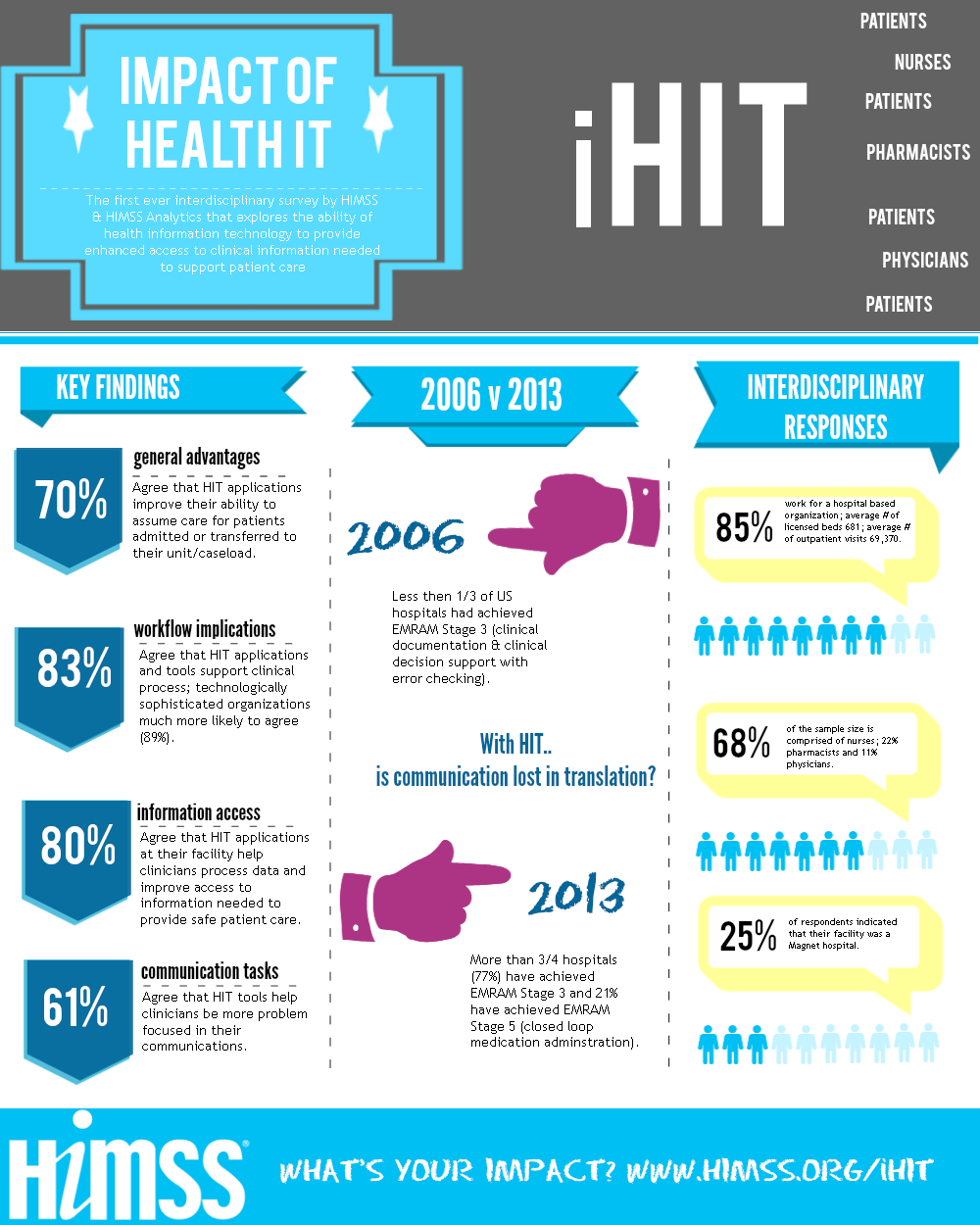
An HIT Infographic

[By HIMSS Clinical Informatics Community]

Practicing clinicians have indicated strong support for the ability of health IT to overcome communication challenges among care providers. Considering that a series of Institute of Medicine reports on errors in healthcare have led to widespread recognition that siloed practices and inadequate communication are primary contributors to medical errors, continued endorsement for health IT will lead to better communication and enhanced quality of care.

The results come from the 2013 iHIT study conducted by HIMSS and HIMSS Analytics, released during HIMSS13, the organization’s annual conference and exhibition. The study was designed to explore the role of health IT from an inter-professional communication perspective. More than 500 clinician respondents working in a care delivery setting provided information on the value of health IT in support of quality care.

Read the Full Study & Final Report

HIMSS 2013 iHIT Study – Final Report
HIMSS 2013 iHIT Study – Executive Summary

 HIT

Assessment

According to the study, the health IT tools in place at the provider organizations of respondents support various clinical processes and provide improved access to the information needed to prepare for delivery of care. This includes having improved access to information needed on patients transferring to a clinician’s unit/caseload, ultimately resulting in enhanced levels of patient care.

Conclusion

Your thoughts and comments on this ME-P are appreciated. Feel free to review our top-left column, and top-right sidebar materials, links, URLs and related websites, too. Then, subscribe to the ME-P. It is fast, free and secure.

Link: http://feeds.feedburner.com/HealthcareFinancialsthePostForcxos

Speaker: If you need a moderator or speaker for an upcoming event, Dr. David E. Marcinko; MBA – Publisher-in-Chief of the Medical Executive-Post – is available for seminar or speaking engagements. Contact: MarcinkoAdvisors@msn.com

OUR OTHER PRINT BOOKS AND RELATED INFORMATION SOURCES:

Product DetailsProduct Details

Informing Doctors about Automobile Motor Oil Changes

Join Our Mailing List 

What doctors need to know before their next service

[By Dr. David Edward Marcinko MBA and Nalley Lexus-Roswell]

DEM 2013Chances are you might have heard a thing or two about oil prices and all the work it takes to get it out of the ground. You may have even walked into an auto parts store and seen a wall filled with a plethora of different types, viscosities, and brands of oil. Luckily, there are choices to be had, and we’re here to walk you through them.

To Lubricate – Not Burn

Right off the bat, the point should be made clear that motor oil is not meant to be burnt. Sure, oils are used to make the gasoline and diesel fuels that power our vehicles, but motor oil is purely there to lubricate the internals of your engine, not to be burnt as an energy source. It’s that type of burning that causes some of the environmental issues. If you notice a blue smoke emitting from the tailpipe of your vehicle, and the need to add oil every so often, your engine might have a serious problem.

But, for normal motor oil usage, the lubrication of engine internals to keep metal from touching metal while the various bits and pieces move a couple thousand times a minute, there are basically two types – conventional and synthetic.

My Jaguar's engine after a steam

Conventional Oil

Conventional motor oil has done a great job for the past hundred years or so, and is still largely the norm when it comes to servicing your vehicle. Why is this? For the vast majority of drivers in normal vehicles, conventional motor oil meets the vehicle’s needs while being lower cost. In fact, a quart of conventional motor oil will only set you back half of what a quart of synthetic oil costs.

What are some of the benefits of conventional motor oil? First of all, there’s the cost proposition. And if you drive a normal vehicle, conventional oil might actually be a better choice, as it’s a thicker substance. Also, for that same reason, conventional oil is often the lubricant of choice in higher-mileage engines, where some worn components might not have the ability to seal that they once had.

Synthetic Oil

Synthetic motor oil, however, is the new wave of engine lubrication. First designed for aircraft applications in the 1970s, it has also found a home in the engines of many high-performance vehicles. With the requirement of maintaining lubricating abilities at high altitudes and temperatures in aircraft, it was a natural fit. Because of the higher tolerances of aircraft and high-performance engines, the thinner nature of synthetic oil is meant to squeeze into every nook and cranny available, exactly what is needed in these finely-crafted engines.

While synthetic oil might cost twice as much as conventional, it’s thermal properties that keep it from breaking down over time mean that oil changes can occur less often at higher mileage intervals, saving you headaches and recouping some of those costs. Also, due to its thinner nature, it flows easier in cold weather, meaning less warm-up time for your engine, decreasing, once again, headaches and harmful exhaust fumes.

My Kitty Oil

I’ve got a near showroom and mint conditioned 2000 Jaguar XJ-V8-LWB. It  is a full-size luxury sedan, offering sporting drive characteristics, mixed with a classic style and interior comfort. It was available in multiple trims which all came very well equipped with upscale amenities. And, this extended wheelbase version offers much more rear seat leg room for long and winding Georgia road trips. The standard steel engine [not nikasil] in this XJ is a 4.0L V8 which produces 290 hp. The upper and lower timing chain tensioners are original, second generation metal, not plastic.

There is also a supercharged version of this vehicle which bumps output to an impressive 370 hp. Even with all of its power and weight, my XJ-8-L is still rated at over 20 mpg on the highway. Ammenities and upgrades include a mobile phone, Magellan GPS, LoJack theft recovery system, CD and MP-3 players, with internal and external cable antenna for satellite radio.

As for oil, my owners manual calls for 10w30 as preferred, but 10w40 is acceptable for hotter climates like Atlanta. Since my XJ-8 has 90,000 miles on it, I tend to use something a little thicker 15w40 and might used 20-50 come summer if it starts consuming in the high heat.

What a Cat!She is my third favorite female after my intelligent and beautiful wife, and smart and lovely daughter.

Assessment

Now that we know the key differences in the available types of motor oil, which should you choose at your next service? For that, your mechanic will take into account your driving style, vehicle mileage, and other factors, and help you decide what is best for your vehicle.

XJ-V8-LWB Jaguar touring sedan


Conclusion

Your thoughts and comments on this ME-P are appreciated. Feel free to review our top-left column, and top-right sidebar materials, links, URLs and related websites, too. Then, subscribe to the ME-P. It is fast, free and secure.

Speaker: If you need a moderator or speaker for an upcoming event, Dr. David E. Marcinko; MBA – Publisher-in-Chief of the Medical Executive-Post – is available for seminar or speaking engagements. Contact: MarcinkoAdvisors@msn.com

OUR OTHER PRINT BOOKS AND RELATED INFORMATION SOURCES:

Product DetailsProduct DetailsProduct Details

Product Details  Product Details

Product DetailsProduct Details

More on the Doctor Salary “WARS” – er! ah! … CONUNDRUM!

Join Our Mailing List

Compensation Trend Data Sources

cropped-dem

By Dr. David Edward Marcinko MBA

[Editor-in-Chief] www.BusinessofMedicalPractice.com

Related chapters: Chapter 27: Salary Compensation and Chapter 29: Concierge Medicine and Chapter 30: Practice Value-Worth


***

PERSONAL PREAMBLE

***

Physician compensation is a contentious issue and often much fodder for public scrutiny. Throw modern pay for performance [P4P], and related metrics, into the mix and few situations produce the same level of emotion as doctors fighting over wages, salary and other forms of reimbursement.

This situation often springs from a failure of both sides to understand mutual compensation terms-of-art when the remuneration deal was first negotiated. This physician salary and compensation information is thus offered as a reference point for further investigations.

Introduction 

More than a decade ago, Fortune magazine carried the headline “When Six Figured Incomes Aren’t Enough. Now Doctors Want a Union.” To the man in the street, it was just a matter of the rich getting richer. The sentiment was quantified in the March 31, 2005 issue of Physician’s Money Digest when Greg Kelly and I reported that a 47-y.o. doctor with 184,000 dollars in annual income would need about 5.5 million dollars for retirement at age.

Of course, physicians were not complaining back then under the traditional fee-for-service system; the imbroglio only began when managed care adversely impacted income and the stock market crashed in 2008.

Today, the situation is vastly different as medical professionals struggle to maintain adequate income levels. Rightly or wrongly, the public has little sympathy for affluent doctors following healthcare reform. While a few specialties flourish, others, such as primary care, barely move.

In the words of colleague Atul Gawande, MD, a surgeon and author from Brigham and Women’s Hospital in Boston, “Doctors quickly learn that how much they make has little to do with how good they are. It largely depends on how they handle the business side of practice.”  And so, it is critical to understand contemporary thoughts on physician compensation and related trends.

Compensation Trend Data Sources

A growing number of surveys measure physician compensation, encompassing a varying depth of analysis. Physician compensation data, divided by specialty and subspecialty, is central to a range of consulting activities including practice assessments and valuations of medical entities. It may be used as a benchmarking tool, allowing the physician executive or consultant to compare a practitioner’s earnings with national and local averages.

The Medical Group Management Association’s (MGMA’s) annual Physician Compensation and Production Correlations Survey is a particularly well-known source of this data in the valuation community. Other information sources include Merritt Hawkins and Associates; and the annual the Health Care Group’s, [www.theHealthCareGroup.com] Goodwill Registry.

###

Portfolio analysis

www.CertifiedMedicalPlanner.org

Assessment

However, all sources are fluid and should be taken with a grain of statistical skepticism, and users are urged to seek out as much data as possible and assess all available information in order to determine a compensation amount that may be reasonably expected for a comparable specialty situation. And, realize that net income is defined as salary after practice expenses but before payment of personal income taxes.

Conclusion

Your thoughts and comments on this ME-P are appreciated. Feel free to review our top-left column, and top-right sidebar materials, links, URLs and related websites, too. Then, subscribe to the ME-P. It is fast, free and secure.

Link: http://feeds.feedburner.com/HealthcareFinancialsthePostForcxos

Speaker: If you need a moderator or speaker for an upcoming event, Dr. David E. Marcinko; MBA – Publisher-in-Chief of the Medical Executive-Post – is available for seminar or speaking engagements. Contact: MarcinkoAdvisors@msn.com

OUR OTHER PRINT BOOKS AND RELATED INFORMATION SOURCES:

DICTIONARIES: http://www.springerpub.com/Search/marcinko
PHYSICIANS: www.MedicalBusinessAdvisors.com
PRACTICES: www.BusinessofMedicalPractice.com
HOSPITALS: http://www.crcpress.com/product/isbn/9781466558731
CLINICS: http://www.crcpress.com/product/isbn/9781439879900
BLOG: www.MedicalExecutivePost.com
FINANCE: Financial Planning for Physicians and Advisors
INSURANCE: Risk Management and Insurance Strategies for Physicians and Advisors

Product Details

Risk Management, Liability Insurance, and Asset Protection Strategies for Doctors and Advisors: Best Practices from Leading Consultants and Certified Medical Planners™ Risk Management, Liability Insurance, and Asset Protection Strategies for Doctors and Advisors: Best Practices from Leading Consultants and Certified Medical Planners™

***

Invite Dr. Marcinko

***

A New Test For Alzheimers Disease [Video Humor]?

Join Our Mailing List

A MOVING PUZZLE

By Dr. David Edward Marcinko MBA

[Editor-in-Chief]

DEM at Univ of PittsburghLast month, I had the opportunity to visit and tour the University of Pittsburgh and the Tower of Learning.

While there, I was given this brain teaser by one of the graduate students. I was told that if you can put this moving puzzle together; you may just be able to say goodbye to Alzheimer’s Disease!

Now, this is really clever and a bit challenging. So, much as we middle-aged folks are concerned with Alzheimer’s disease, this puzzle may help dispel some fear. Give it a try. Just remember, I was told that if you can put this puzzle together … you probably do not have to fear Alzheimer’s!

CLICK BELOW:

http://www.brl.ntt.co.jp/people/hara/fly.swf

Hint: you can move the puzzle pieces outside of the box to separate them to get a better look. Use left clicker to move the pieces around.

Assessment

It took me about 5 minutes to put it together. What about you?

Conclusion

Your thoughts and comments on this ME-P are appreciated. Feel free to review our top-left column, and top-right sidebar materials, links, URLs and related websites, too. Then, subscribe to the ME-P. It is fast, free and secure.

Link: http://feeds.feedburner.com/HealthcareFinancialsthePostForcxos

Speaker: If you need a moderator or speaker for an upcoming event, Dr. David E. Marcinko; MBA – Publisher-in-Chief of the Medical Executive-Post – is available for seminar or speaking engagements. Contact: MarcinkoAdvisors@msn.com

Our Other Print Books and Related Information Sources:

Health Dictionary Series: http://www.springerpub.com/Search/marcinko

Practice Management: http://www.springerpub.com/product/9780826105752

Physician Financial Planning: http://www.jbpub.com/catalog/0763745790

Medical Risk Management: http://www.jbpub.com/catalog/9780763733421

Hospitals: http://www.crcpress.com/product/isbn/9781439879900

Physician Advisors: www.CertifiedMedicalPlanner.org

Product DetailsProduct DetailsProduct Details

Product Details  Product Details

Product DetailsProduct Details

ME-P Book Reviewers Needed

Join Our Mailing List
New Text Book Testimonials Requested
By Dr. David Edward Marcinko MBA
[Editor-in-Chief]
DEM 2013
Greetings all ME-P Readers from Atlanta, Georgia
###
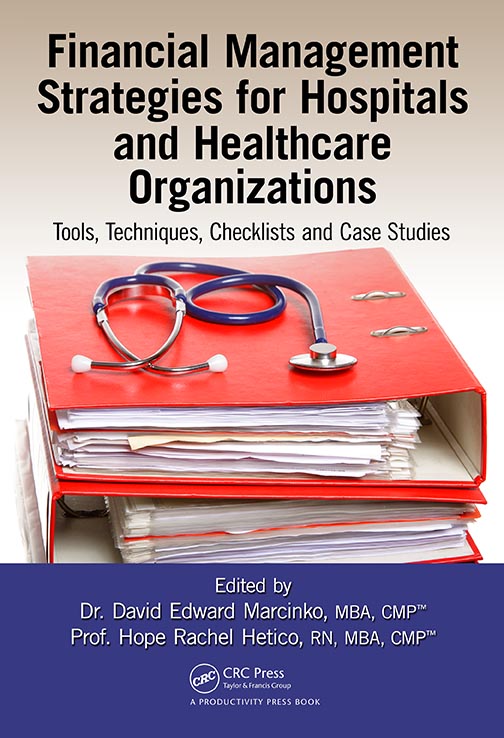
After reading and being inspired by Dr. Atul Gawandi’s December 10, 2007 New  Yorker article, “The Checklist”, as well as the Checklist Manifesto, I am writing to ask that you consider this request to write a 3-5 sentence testimonial review to our upcoming new textbook:  Financial  Management Strategies for Hospitals and Healthcare Organizations: Tools,  Techniques, Checklists and Case Studies

It is the follow up to: Hospitals & Health Care Organizations: Management Strategies, Operational Techniques,  Tools, Templates, and Case Studies

Book Focus

Please realize that the focus of the work is non-clinical in nature, and is replete with managerial case models and administrative checklists following each chapter.

Just as Atul believed the time is right for medical checklists, we believe in a similar philosophy for hospitals, health enitites, and healthcare administration. It is right for any physician or medical practitioner, regardless of degree or specialty designation.

New Book

Ideal Reviewers

Ideal book reviewers are doctors, financial advisors, economists, accountants, nurses, insurance agents, politicians and healthcare CXOs. So, please see the TOC links as we ask you to keep this request confidential.  Regardless of your decision, we remain an apostle of your core vision whenever possible.

Fraternally,

Dr. David Edward Marcinko MBA

[Editor-in-Chief]

INSTITUTE OF MEDICAL BUSINESS ADVISORS, INC.

Suite #5901 Wilbanks Drive Norcross, Georgia, 30092 USA

Phone: 770.448.0769

MarcinkoAdvisors@msn.com

Secrets

###

Strategic Importance of Healthcare Capital Investing

Join Our Mailing List

For Leaders, Governors, Physicians and Hospital Executives

[By Calvin Weise CPA, CMA]

Some of the most important strategic decisions hospital executives make are related to capital expenditures. Almost every hospital has capital investment opportunities that are far in excess of their capital capacity. Capital investments are bets on the future. How these capital bets are placed has long-lasting implications. It is of utmost importance that hospitals bet right.

Hospitals as Business Entity

Hospitals are capital intensive businesses. Hospital buildings are unique structures that require large amounts of capital to construct and maintain. Inside these buildings are pieces of expensive equipment that have fairly short lives. Technological innovations continually drive demand for new and more expensive equipment and facilities. The ability to continually generate capital is the lifeblood of hospitals. In order to compete and succeed, it’s imperative for hospitals to continually invest in large amounts of capital equipment and expensive facilities.

Capital investment is fueled by profit. In order to continually make the necessary capital investments, hospitals must be profitable. Hospitals unable to generate sufficient profit will fail to make important capital investments, weakening their ability to compete and survive.

Hospital managers bear important responsibility in choosing which capital investments to make. There are always more capital opportunities than capital capacity. In many cases, capital opportunities not taken by hospitals create openings for others with capital capacity to fill the vacuum. By not taking such opportunities, hospitals are weakened, and their operating risk increases.

Responsibility

Stewardship is a term that aptly describes the responsibility borne by hospital managers in making capital investments. The New Testament parable of the talents describes this kind of stewardship. In this story, a merchant entrusted three managers with money to invest. One manager was given five units, another two, and a third one. At the end of the investment period, the two managers given five units and two units reported a 100% return. The manager given one unit reported zero return — he was fired and his unit was given to the first manager.

Healthcare Investment Risks

Leadership

This is stewardship — and hospital managers are stewards of their organizations’ assets. Too often, not-for-profit hospital managers hold an erroneous view of the returns expected of them. Like the third manager in the parable, they think zero return on equity is acceptable. They understand capital investment funded by debt needs to cover the interest on the debt, but they view capital investments funded by equity as having no cost associated with the equity. From an accounting perspective, they are right. From a stewardship perspective they are dead wrong — just like the third manager in the parable.

Here’s why: as stewards, they are responsible for managing the entrusted assets. They can either put these assets at risk themselves, or they can put those assets in the market and let other managers put them at risk. If they choose to put them at risk themselves, then they have the mandate of creating as much value from putting them at risk as they would realize if they put them in the market for other managers to put at risk. They have the duty to realize returns that are equivalent to the returns they could realize in the market; otherwise, they should just put them in the market. They can either invest in hospital assets or work the assets themselves, or they can invest in financial market assets so others can work the assets. When they choose to invest in hospital assets, the required return is not zero. That’s the return they get fired for. The required return is equivalent to market returns.

Assessment

Thus, when evaluating performance of hospital management teams, the minimum acceptable performance level is return on equity that is equivalent to the return that could be realized by investing the hospital assets in the market. And when evaluating a capital investment opportunity, it is important to apply a capital charge equivalent to the hospital’s weighted cost of capital — a measure that imputes an appropriate cost to the equity portion of the capital along with the stated interest rate for the debt portion of the capital structure.

Conclusion

Your thoughts and comments on this ME-P are appreciated. Feel free to review our top-left column, and top-right sidebar materials, links, URLs and related websites, too. Then, subscribe to the ME-P. It is fast, free and secure.

Link: http://feeds.feedburner.com/HealthcareFinancialsthePostForcxos

Speaker: If you need a moderator or speaker for an upcoming event, Dr. David E. Marcinko; MBA – Publisher-in-Chief of the Medical Executive-Post – is available for seminar or speaking engagements. Contact: MarcinkoAdvisors@msn.com

Our Other Print Books and Related Information Sources:

Health Dictionary Series: http://www.springerpub.com/Search/marcinko

Practice Management: http://www.springerpub.com/product/9780826105752

Physician Financial Planning: http://www.jbpub.com/catalog/0763745790

Medical Risk Management: http://www.jbpub.com/catalog/9780763733421

Hospitals: http://www.crcpress.com/product/isbn/9781439879900

Physician Advisors: www.CertifiedMedicalPlanner.org

Product DetailsProduct Details

Market for Mobile Health App Services Will Reach $26 Billion By 2017

Join Our Mailing List

mHealth services start to leverage apps to become commercially successful

[By Markus Pohl]

The market for mHealth services has now entered the commercialization phase and will reach $ 26 billion globally by 2017 says the new “Global Mobile Health Market Report 2013-2017 ”by research2guidance. Smartphone applications have begun to enable the mHealth industry to successfully monetize their services.

The Impending Revolution

Ralf-Gordon Jahns, Head of Research at research2guidance, points out “Our findings indicate that the long-expected mobile revolution in healthcare is set to happen. Both healthcare providers and consumers are embracing smartphones as a means to improving healthcare.”

The Publishers

Top mHealth publishers manage to generate more than 3 million free and 300.000 paid downloads in the USA on the iOS platform. The reach on other platforms and in other countries differ at lot but show also the increase of business potential for mHealth apps.

Not only are consumers taking advantage of smartphones to manage and improve their own health, but also healthcare professionals. A significant number (15%) of mHealth applications are primarily designed for healthcare professionals. These include CME (Continued Medical Education), remote monitoring and healthcare management applications.

The Climate

Currently there are 97,000 mHealth applications in major app stores, 42% of them adhering to the paid business model. With more and more traditional healthcare providers joining the mobile applications market, the business models will broaden to include healthcare services, sensor, advertising and drug sales revenues.

“With the growing sophistication level of mHealth applications, only 9% of the total market revenue in the next 5 years will come from application download revenue”explains Patrick Houck Analyst at research2guidance. “84% of total mHealth application market revenue will come from related services and products such as sensors”.

###

eHRs

Assessment

The “Global Mobile Health Market Report 2013-2017 ”by research2guidance is a business guide for traditional healthcare companies, mHealth specialists as well as for mobile operators wishing to successfully engage into the new mHealth market.

About research2guidance:

research2guidance is a Berlin-based mobile app economy specialist. The company’s service offerings include app strategy consulting, market studies and research.

Link to blog post: http://www.research2guidance.com/the-market-for-mhealth-app-services-will-reach-26-billion-by-2017/

Link to graph: http://www.research2guidance.com/wp-content/uploads/2013/03/the-mhealth-market-has-reached-the-commercialization-phase.png

Link to report: http://www.research2guidance.com/shop/index.php/mhealth-report-2

Contact:

Ralf-Gordon Jahns [+49 30 609 893 362] ralf.jahns@research2guidance.com

Conclusion

Your thoughts and comments on this ME-P are appreciated. Feel free to review our top-left column, and top-right sidebar materials, links, URLs and related websites, too. Then, subscribe to the ME-P. It is fast, free and secure.

Speaker: If you need a moderator or speaker for an upcoming event, Dr. David E. Marcinko; MBA – Publisher-in-Chief of the Medical Executive-Post – is available for seminar or speaking engagements. Contact: MarcinkoAdvisors@msn.com

OUR OTHER PRINT BOOKS AND RELATED INFORMATION SOURCES:

Product DetailsProduct Details

Is your Financial Advisor a Psychopath?

Join Our Mailing List

On Going Rogue?

Research shows the financial industry attracts more than its share of charming, manipulative egotists. Or, does it?

Avatar of Dr. Marcinko Speaking as MSL

Assessment

Here is what to watch for:

Conclusion

Your thoughts and comments on this ME-P are appreciated. Feel free to review our top-left column, and top-right sidebar materials, links, URLs and related websites, too. Then, subscribe to the ME-P. It is fast, free and secure.

Link: http://feeds.feedburner.com/HealthcareFinancialsthePostForcxos

Speaker: If you need a moderator or speaker for an upcoming event, Dr. David E. Marcinko; MBA – Publisher-in-Chief of the Medical Executive-Post – is available for seminar or speaking engagements. Contact: MarcinkoAdvisors@msn.com

Our Other Print Books and Related Information Sources:

Health Dictionary Series: http://www.springerpub.com/Search/marcinko

Practice Management: http://www.springerpub.com/product/9780826105752

Physician Financial Planning: http://www.jbpub.com/catalog/0763745790

Medical Risk Management: http://www.jbpub.com/catalog/9780763733421

Hospitals: http://www.crcpress.com/product/isbn/9781439879900

Physician Advisors: www.CertifiedMedicalPlanner.org

Product Details  Product Details

Medicare Inpatient Profitability in US Hospitals

Join Our Mailing List

The Impending Need for Cost-Efficiency

[By Objective Health]

Medicare patients often account for the largest proportion of inpatient volume for an average US hospital. With the exception of outlier cases, Medicare inpatient services are adjusted for wage rates and reimbursed as a single predetermined payment across the country.

Over the next few years, Medicare is expected to substantially reduce growth in payment rates, thereby pressuring hospitals to become more cost-efficient.

###

Medicare OH

###

Assessment

This infographic highlights the need for hospitals to manage costs, showing that there is a wide variation in Medicare inpatient profit across US hospitals, which is primarily driven by differences in Medicare cost per case.

Conclusion

Your thoughts and comments on this ME-P are appreciated. Feel free to review our top-left column, and top-right sidebar materials, links, URLs and related websites, too. Then, subscribe to the ME-P. It is fast, free and secure.

Speaker: If you need a moderator or speaker for an upcoming event, Dr. David E. Marcinko; MBA – Publisher-in-Chief of the Medical Executive-Post – is available for seminar or speaking engagements. Contact: MarcinkoAdvisors@msn.com

OUR OTHER PRINT BOOKS AND RELATED INFORMATION SOURCES:

###

Paying for College

Join Our Mailing List

Maybe Not!

By Rick Kahler MS CFP® ChFC CCIM www.KahlerFinancial.com

Rick Kahler CFPDo you want to give your children the best possible chance to do well in college, earn higher salaries, and save more for their retirement? Then, don’t pay for their college education.

One of the most popular money scripts I encounter is the notion that being a good parent means paying for your child’s college. Many parents do this at the expense of taking care of themselves in retirement, which is a very high price to pay.

The most popular reason I hear from clients for funding children’s’ education is empowerment. They want to spare kids the burden of repaying school loans after graduation. They also want them to be able to focus on their studies without the distraction of having to work to put themselves through college. For most parents, allowing students to concentrate on classes so they can perform well, make better grades, and obtain better jobs, is a sacrifice worth making.

The Myth

There’s just one problem with this scenario. It’s a myth.

In most cases, parents who fund their kid’s’ college education are insuring they will actually do worse in school than those who have to pay their own way. This is the finding of new research conducted by Laura T. Hamilton, published January 7, 2012, by The American Sociological Review under the title “More Is More or More Is Less?” Her study shows that students whose education is funded by parents or through student loans actually have lower GPA’s than students who in some way must work to put themselves through school.

Hamilton found that students who have to “do something” requiring them to take personal responsibility for obtaining the funds for their education do best and carry higher GPA’s. This includes those who receive grants, scholarships, or veteran’s benefits, or who participate in work-study programs.

Parental funds or borrowing “provide the time, money, and proximity (i.e., living on or near campus) necessary to delve deeply into college peer cultures,” Hamilton notes. The gift of time that student loans and parental funding provide isn’t usually poured into studies. Instead, students tend to focus that extra time on increasing their social life. The average college student receiving money from loans or parents spends less time on studies in college than in high school. Even though they spend about 28 hours a week attending class and studying, the research found they devote a full 41 hours a week to social and recreational endeavors.

Put more succinctly, students who have to work to pay their way through college spend slightly more time studying and significantly less time partying.

The Results 

The net result in this is a big personal and societal lose-lose. Those of you who have sacrificed your retirement to help your children through college have potentially done harm to both your children and yourselves. Your kids have probably done worse in college, thus obtaining lower paying jobs. This loss of potential income has downsides for both children and parents. Previous research has shown that parents who don’t fully fund their own retirement years will actually end up costing their children five times as much as the kids would have spent by funding their own college education.

Understandably, a few of you are now choking on your last sip of coffee as you read the last paragraph. This is not at all the outcome you intended.

Money

Assessment

The evidence is clear. Parents who take care of fully funding their own retirement instead of sacrificing to pay for their kids’ education are not being selfish. Instead, they give their children something far more valuable than the cost of tuition: the gift of success and achievement.

Conclusion

Your thoughts and comments on this ME-P are appreciated. Feel free to review our top-left column, and top-right sidebar materials, links, URLs and related websites, too. Then, subscribe to the ME-P. It is fast, free and secure.

Link: http://feeds.feedburner.com/HealthcareFinancialsthePostForcxos

Speaker: If you need a moderator or speaker for an upcoming event, Dr. David E. Marcinko; MBA – Publisher-in-Chief of the Medical Executive-Post – is available for seminar or speaking engagements. Contact: MarcinkoAdvisors@msn.com

OUR OTHER PRINT BOOKS AND RELATED INFORMATION SOURCES:

DICTIONARIES: http://www.springerpub.com/Search/marcinko
PHYSICIANS: www.MedicalBusinessAdvisors.com
PRACTICES: www.BusinessofMedicalPractice.com
HOSPITALS: http://www.crcpress.com/product/isbn/9781466558731
CLINICS: http://www.crcpress.com/product/isbn/9781439879900
BLOG: www.MedicalExecutivePost.com
FINANCE: Financial Planning for Physicians and Advisors
INSURANCE: Risk Management and Insurance Strategies for Physicians and Advisors

Product Details  Product Details

Understanding the Pre-Reform Impact of Self-Pay Patients

Join Our Mailing List

On Us Hospitals

Source: Objective Health

Pre-reform, many hospitals experience significant uncompensated care costs from self-pay patients.

###

Reform Impact

###

This infographic illustrates the variation in self-pay uncompensated care costs across US hospitals and regions.

Assessment

Despite the uncompensated care risk, 1/6th of self-pay inpatients are scheduled admissions, though their procedures are much less elective than the procedures of the insured.

Conclusion

Your thoughts and comments on this ME-P are appreciated. Feel free to review our top-left column, and top-right sidebar materials, links, URLs and related websites, too. Then, subscribe to the ME-P. It is fast, free and secure.

Link: http://feeds.feedburner.com/HealthcareFinancialsthePostForcxos

Speaker: If you need a moderator or speaker for an upcoming event, Dr. David E. Marcinko; MBA – Publisher-in-Chief of the Medical Executive-Post – is available for seminar or speaking engagements. Contact: MarcinkoAdvisors@msn.com

Our Other Print Books and Related Information Sources:

Health Dictionary Series: http://www.springerpub.com/Search/marcinko

Practice Management: http://www.springerpub.com/product/9780826105752

Physician Financial Planning: http://www.jbpub.com/catalog/0763745790

Medical Risk Management: http://www.jbpub.com/catalog/9780763733421

Hospitals: http://www.crcpress.com/product/isbn/9781439879900

Physician Advisors: www.CertifiedMedicalPlanner.org

Product DetailsProduct Details

Deducting Un-Reimbursed Professional Expenses

Join Our Mailing List

Tax expenses must be”ordinary” and “necessary”

By Andrew D. Schwartz CPA http://www.schwartzaccountants.com

Andrew SchwartzAccording to the IRS, to be deductible, the expenditure must be both “ordinary” and “necessary” in connection with your medical profession or specialty.

The Definition

The IRS defines “ordinary” as common and accepted in a particular profession and “necessary” as helpful and appropriate for a particular profession.

The List

Here’s a list of 16 professional expenditures commonly incurred by young or mature health care professionals:

  • Automobile expenses
  • Beepers and pagers
  • Books/library
  • Cellular telephones
  • Computer purchases
  • Education, examinations & licenses
  • Equipment & instruments
  • Job search
  • Malpractice insurance
  • Meals & entertainment
  • Parking & tolls
  •  Professional dues, journals & subscriptions
  • Psychoanalysis as part of training
  • Supplies
  • Travel & lodging
  • Uniforms & cleaning

Assessment

Please note: Employees, like hospitalists, may not deduct professional expenses that are eligible for reimbursement from their employer.

Conclusion

Your thoughts and comments on this ME-P are appreciated. Feel free to review our top-left column, and top-right sidebar materials, links, URLs and related websites, too. Then, subscribe to the ME-P. It is fast, free and secure.

Link: http://feeds.feedburner.com/HealthcareFinancialsthePostForcxos

Speaker: If you need a moderator or speaker for an upcoming event, Dr. David E. Marcinko; MBA – Publisher-in-Chief of the Medical Executive-Post – is available for seminar or speaking engagements. Contact: MarcinkoAdvisors@msn.com

Our Other Print Books and Related Information Sources:

Health Dictionary Series: http://www.springerpub.com/Search/marcinko

Practice Management: http://www.springerpub.com/product/9780826105752

Physician Financial Planning: http://www.jbpub.com/catalog/0763745790

Medical Risk Management: http://www.jbpub.com/catalog/9780763733421

Hospitals: http://www.crcpress.com/product/isbn/9781439879900

Physician Advisors: www.CertifiedMedicalPlanner.org

Product Details  Product Details

Product DetailsProduct DetailsProduct Details

Why are Medical Bills so High [video]

Join Our Mailing List______________________________

TIME’s Best Cover Story … Ever?
###
TIME magazine just dedicated its current issue to just one article: “Bitter Pill: Why Medical Bills Are Killing Us.”
###
The article, written by Time contributor Steven Brill, is required reading for all healthcare providers, administrators, legislators, patients — basically, everyone; especially readers of this ME-P.

The article is too comprehensive to summarize in one blurb, but Mr. Brill did a good job of describing its origins to Jon Stewart on The Daily Show.

Throughout all of the discussions during the Obamacare debate, the focus was usually on who should pay the medical bills.  Brill said, “We never asked the first question: Why are the bills so high?”

###

###

Assessment

We wish we could say we thought of this, but it was Matt Yglesias who did.

Conclusion

Your thoughts and comments on this ME-P are appreciated. Feel free to review our top-left column, and top-right sidebar materials, links, URLs and related websites, too. Then, subscribe to the ME-P. It is fast, free and secure.

Speaker: If you need a moderator or speaker for an upcoming event, Dr. David E. Marcinko; MBA – Publisher-in-Chief of the Medical Executive-Post – is available for seminar or speaking engagements. Contact: MarcinkoAdvisors@msn.com

OUR OTHER PRINT BOOKS AND RELATED INFORMATION SOURCES:

Product DetailsProduct Details

***

Hiring a Director of Post-Surgical and Specialty Care

Join Our Mailing List

For an independent community hospital in the Midwest

By B. Kim Woods RN

[National Healthcare Practice Manager]

Dear Dr. David E Marcinko,

GREETINGS!

Our client has engaged the THOR Group to assist them in hiring a Director of Post-Surgical and Specialty Care for their 260-bed, not-for-profit, JCAHO-accredited, independent community hospital located in the beautiful Midwest.

If any of your ME-P readers is a Registered Nurse with supervisory experience interested in furthering their career in an innovative, high- technology organization, and have a passion for leading a professional team in their provision of high quality patient care, this could be just the job for them.  So, if you know of someone who may be interested in this opportunity, please let me know!

Please see the overview and description of the location below and contact: Kim Woods, RN,  at (816) 401-6622 or email your resume to kimberlyw@thorgroup.com today!

OVERVIEW: 

This Nursing Director is responsible for 3 units: a 10-bed orthopedic post-operative unit, a 12-bed OB/GYN unit comprised of 4 surgical rooms and 8 LDRPs, and a 27-bed post-operative unit with a total of 65 FTEs. You will be leading a professional team to ensure the highest quality of patient care in an innovative, state-of-the art facility.  The organization strives to be the Employer of Choice, committed to upholding their core values, providing highly competitive compensation and benefits, as well as remaining focused on their vision of passionately pursuing excellence in collaboration with physicians, staff, and the community.

###

ME-P Careers

###

ABOUT THE LOCATION:

This beautiful Midwest location has a population of approximately 30,000, yet is just 35 miles from the largest city in the state and 50 miles from the state capitol. Educational, cultural, historic, and outdoor activities abound. The retail sector boasts a thriving downtown historic business district with a wide range of shopping choices that fill the needs of the most discriminating shopper. This community is just right for people who want to enjoy good neighbors, a low crime rate, and an exceptional quality of life.

ABOUT THOR:

For nearly 40 years, The THOR Group, Inc. has provided cutting-edge business solutions to 50,000 top companies and leading healthcare providers throughout the United States.

Regards,

Kimberly Woods, RN, BSN, MBA
National Healthcare Practice Manager
Direct Line: (816) 401-6622
kimberlyw@thorgroup.com

Product DetailsProduct DetailsProduct Details

Product Details  Product Details

Product DetailsProduct Details

What to do with a $25,000 Windfall?

Join Our Mailing List

What Do … You Do?

Doctor – Suddenly you receive a check for a large sum of money?

This infographic has some suggestions on what to do with that extra cash that will have a positive effect on your finances in the long-run.

###

mint-windfall-25kkf-copy

Assessment

Now, suppose the windfall was $250,000 or $2,500,000 or even more! What to do?

Conclusion

Your thoughts and comments on this ME-P are appreciated. Feel free to review our top-left column, and top-right sidebar materials, links, URLs and related websites, too. Then, subscribe to the ME-P. It is fast, free and secure.

Speaker: If you need a moderator or speaker for an upcoming event, Dr. David E. Marcinko; MBA – Publisher-in-Chief of the Medical Executive-Post – is available for seminar or speaking engagements. Contact: MarcinkoAdvisors@msn.com

OUR OTHER PRINT BOOKS AND RELATED INFORMATION SOURCES:

  Risk Management, Liability Insurance, and Asset Protection Strategies for Doctors and Advisors: Best Practices from Leading Consultants and Certified Medical Planners™
Comprehensive Financial Planning Strategies for Doctors and Advisors: Best Practices from Leading Consultants and Certified Medical Planners™

Healthcare Adversaries [video]

Join Our Mailing List

Of HHS and AHIP

By Darrell K. Pruitt DDS

pruitt6If HHS and AHIP continue to give doctors the bum’s rush, what languages can we expect migrant providers to speak well?

The Conference

Last week, I came across a video of a health care conference held a month ago at the University of Miami. During a discussion period, a Miami spinal surgeon named Dr. Nordham warned that more Medicare pay cuts will make small, solo practices like his unsustainable.

Karen Speaks

Panelist Karen Ignagni, who is president and the CEO of America’s Health Insurance Plans (AHIP), reacted defensively in favor of continued unsustainable discounts – but with a hasty, disingenuous response: “We’re seeing out of network charges of 95 times Medicare fees.” While as if on cue, former HHS Secretary Donna Shalala, who is also president of the university, offered her cold interpretation of the small business owner’s legitimate fears: “He’s really complaining that the price is going down [according to law].”

Shalala Speaks

After also ignoring the physician’s plea, “There needs to be more transparency,” Shalala and Ignagni continue an irrelevant, buzzword-filled discussion with each other using flowing hand gestures while shutting out the doctor’s attempts to bring the conversation back on topic. Then abruptly, without giving Dr. Nordham the opportunity to say another word, Shalala slammed the door: “…. I think we’ll take the next question, thank you.” Then she threw him a bone, “It’s a very important question, though.”

###

MD with eHR

Assessment

The 4 minutes of unvarnished disrespect of Dr. Nordham is so transparent that one wonders whether Shalala and Ignagni were even aware that their half-baked PR game was being recorded for C-span.

http://www.c-spanvideo.org/event/214023 (from 2:09:53 to 2:13:42)

They probably thought nobody stays up that late.

More: Chapter 13: IT, eMRs & GroupWare

Conclusion

Your thoughts and comments on this ME-P are appreciated. Feel free to review our top-left column, and top-right sidebar materials, links, URLs and related websites, too. Then, subscribe to the ME-P. It is fast, free and secure.

Link: http://feeds.feedburner.com/HealthcareFinancialsthePostForcxos

Speaker: If you need a moderator or speaker for an upcoming event, Dr. David E. Marcinko; MBA – Publisher-in-Chief of the Medical Executive-Post – is available for seminar or speaking engagements. Contact: MarcinkoAdvisors@msn.com

Our Other Print Books and Related Information Sources:

Health Dictionary Series: http://www.springerpub.com/Search/marcinko

Practice Management: http://www.springerpub.com/product/9780826105752

Physician Financial Planning: http://www.jbpub.com/catalog/0763745790

Medical Risk Management: http://www.jbpub.com/catalog/9780763733421

Hospitals: http://www.crcpress.com/product/isbn/9781439879900

Physician Advisors: www.CertifiedMedicalPlanner.org

Product Details

A Better Approach to [Hospital] Cost Estimation

Join Our Mailing List

Re-thinking the Ratios-of-Costs-to-Charges [RCCs] Financial Meter

By Russ Richmond MD

Russ Richmond MDUsing the ratios-of-costs-to-charges [RCCs] can lead hospitals down a garden-variety strategic path that’s wrong for them.

A strategically safer method of cost estimation can more accurately reveal costs.


At a Glance

  • Using ratios of costs to charges (RCCs) to estimate costs can cause hospitals to significantly over- or under-invest in service lines.
  • A focus on improving cost estimation in cost centers where physicians have significant control over operating expenses, such as drugs or implants, can strengthen decision making and strategic planning.
  • Connecting patient file information to purchasing data can lead to more accurate reflections of actual costs and help hospitals gain better visibility across service lines.

To put it bluntly, there is an almost complete lack of understanding of how much it costs to deliver patient care, much less how those costs compare with the outcomes achieved. Instead of focusing on the costs of treating individual patients with specific medical conditions over their full cycle of care, providers aggregate and analyze costs at the specialty or service department level.

—Professors Robert Kaplan and Michael Porter, “The Big Idea: How to Solve the Cost Crisis in Health Care,” Harvard Business Review, September 2011.

Of all the challenges hospitals face in today’s uncertain healthcare environment, estimating their costs might not be their top concern. However, the method most hospitals use to estimate their costs can have serious strategic and financial ramifications on their bottom line.

More than 60 percent of hospitals today use ratios of costs to charges (RCCs) as their primary cost estimation method, because true cost accounting is viewed as prohibitively expensive. But using RCCs to estimate costs can lead to significant problems for hospitals. For example, results of a recent study disclose that among 184 mid-sized community hospitals (i.e., with roughly 300 beds), the use of RCCs led 85 percent of the hospitals to overestimate the profitability of orthopedic surgery service lines. On average, the overestimates amounted to $1.2 million per year per hospital.

Such incorrect cost estimates can cascade into potentially serious strategic, financial, and operational issues. Because of faulty cost estimates, hospitals can over-invest—or under-invest—in service lines based only on high-level insight into the actual profitability of these areas. Either scenario has the potential to produce negative consequences.

Suboptimal strategic decision making based on faulty data and conclusions leads to suboptimal results. No hospital can afford such results and stay competitive in an industry of increased cost and pricing transparency.

So what’s the solution for hospitals? Even without switching to a full procedural cost-accounting system, hospitals can make adjustments that improve their cost estimating and thus strengthen their decision making and strategic planning. The operative principle is that hospitals should focus on improving cost estimating in cost centers where physicians have the most control of operating expenses—namely, drugs and implants.

Making the Right Cost Connections

Connecting patient file information, where costs are estimated, with purchasing data, which reflect actual costs, can produce a significant impact on a hospital’s pricing methodology. Drugs and implants, which represent 17 percent of a typical hospital’s total costs, are a good starting point for adoption of this approach.

Drugs. To better estimate drug prices, hospitals should make the patient file/purchasing data connection based on generic class, route of administration, and dosage. The patient charge file and the purchasing file can be connected using a common taxonomy. For instance, a hospital’s purchasing file may record a box of 10 Tylenol tablets as “10 Tylenol tablets of 325 mg,” while the charge may be recorded in the patient charge file as “Acetaminophen cap 325.” This results in a direct text mismatch for calculating cost, which can ultimately lead to faulty cost-estimating data. A common taxonomy would group these two entries into a common bucket to produce an accurate mapping of costs.

Implants. Implants are also a major price item for hospitals. To better estimate implant costs, the patient charge file and the purchasing file should be mapped using the implant log, using the same process described for mapping drug costs. The implant log is used by surgeons after an operation to log the type of procedure, detailed description of supplies used, and general comments.

When a physician orders a knee implant, the implant stock-keeping unit (SKU) number is often recorded in the implant log. If the SKU number in the implant log were mapped to the SKU number in the hospital’s purchasing file, the hospital would be better able to determine the actual cost for the implant. The cost could then be assigned to the patient file, resulting in a more accurate cost picture for orthopedic cases.

For example, to assign true implant costs to a patient who has undergone a knee replacement, a hospital would look up the implant SKU recorded in the implant log by the physician—in this example, SKU123. Then, the hospital would open the purchasing file and locate, for that particular month, the description and price for SKU123 (in this instance, XYZ knee replacement part; cost: $4,950). Next, the hospital would map the more detailed description and price for the implant to the patient charge file. This process can help to ensure that the true cost of the implant used by the physician is assigned to the patient’s charge file.

In some hospitals, the implant log, purchasing file, and patient charge file are part of the same system. For the majority of hospitals, however, the implant log is a separate electronic file, not connected with the other file system or systems. And in some hospitals, the implant log is manually managed.

A hospital can complement this process by comparing its drug and implant costs with price benchmarks from subscription-based national databases or with databases maintained by consulting firms. In our experience, a 65 percent match can be achieved by connecting the drug and implant purchasing files with the detailed charge files, as outlined above. By comparing these costs with price benchmarks from subscription-based or consulting-firm databases, a hospital can better determine how the prices it is paying for drugs and implants compare with national averages.

By connecting these data sets, hospitals can gain better visibility of what they are really spending across various service lines and operational functions.

Understanding a Rural Hospital’s True Costs

The experience of a 250-bed rural hospital in the north central United States provides a good example of the pitfalls of using RCCs to estimate costs. This hospital found itself making key strategic planning decisions based on misleading cost data.

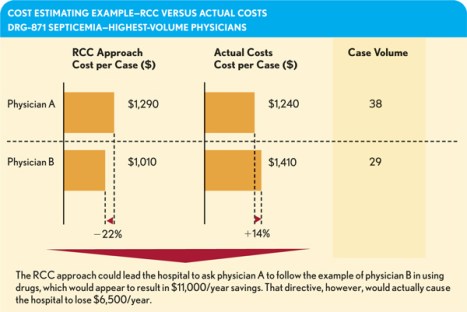
In analyzing the drug usage data from two physicians (A and B) at the hospital, physician B appeared more cost-efficient than physician A at treating the same disease. However, on examining physician B’s actual drug expenditures, hospital leaders realized this physician’s costs were in fact higher than those of physician A (see the exhibitbelow).

###
f-richmond

###

If RCC costs are considered, physician A seems to be treating patients at a higher average cost per case than physician B. But if actual costs are considered, physician A is actually treating at a lower cost per case than physician B. Strategically, based on the RCC analysis, if the hospital encouraged all of its physicians to emulate physician B’s treatment approach, it would lose the opportunity to save money on every case.

The data generated by RCCs can be especially problematic in measuring the profitability of various hospital services lines. Because of these misleading cost data, the team at this rural hospital was under the impression it was making a healthy $477,000 profit annually from its orthopedic surgery group.

The reality was the hospital’s profit from this key service line was about $170,000 less—a material difference for a rural community hospital.

For years, the provider thought it was making money on hip replacement surgery, but those profits were much lower because costs of implants used in these orthopedic procedures were continually underestimated. An incorrect profitability picture such as this can wreak havoc on vital strategic-planning efforts.

The rural hospital is by no means an outlier in regard to its problems with cost estimation. The research finding cited at the beginning of this article suggests institutions regularly underestimate costs per orthopedic procedure (and the costs of implants) because of their use of RCCs.

Rising costs are at the heart of the cost challenges that are prevalent in health care. Healthcare reform was designed, in part, to help alleviate this persistent cost problem, but much work still needs to be done to fully understand the true costs of health care. Once these costs are better understood, the goal then must be to manage costs more effectively, efficiently, and sustainably. A critical starting point is for healthcare providers to have a more accurate and realistic picture of what their current costs are, not what they think costs may be.

By connecting key data sets and analyzing costs in a more systematic way, hospitals can develop a stronger and more accurate understanding of their actual costs. This system will provide more data visibility to enable hospital leaders to enhance strategic decision making related to key service lines, improving value.


About the Author

Russ Richmond, MD, is CEO, Objective Health, Waltham, Mass., and a member of HFMA’s Massachusetts-Rhode Island Chapter (russell_richmond@mckinsey.com).


Footnotes:
a. This amount is based on an average overestimation in contribution per orthopedic surgery case of $1,200 multiplied by an average of 1,000 cases annually per hospital.


###
Sidebar 1:  A Step-by-Step Guide to Improving Hospital Cost-Estimating Processes

Hospital leaders should follow four relatively easy-to-implement steps to improve their cost-estimating processes related to drugs and implants—two cost centers where physicians have significant control over operating expenses.

Step 1: Establish the Data Foundation
Ensure that the hospital has core data sets on which to develop. Keep the following practices in mind:

  • All encounters and detailed charges should be available in corresponding files.
  • All purchased drugs, implants, and other medical/surgical products should be available in a purchasing file (often provided by the group purchasing organization or distributor).
  • All implants should be tracked in electronic implant logs (e.g., in the operating room, intensive care unit, and cath lab).

Step 2: Assemble a Cost-Estimate Improvement Team

This team, which will lead the project, should include the following representatives:

  • Director of pharmacy, to provide guidance and sign-off on drug cost estimates
  • Materials manager, to provide guidance and sign-off on implant cost estimates
  • Chargemaster manager, to incorporate input from pharmacy and materials departments into the granular charge codes that are charged to patients
  • Analytics expert, to connect purchasing files, implant logs, and patient charge files
  • Strategy and finance leaders, to leverage the improved cost accounting to derive savings and align on growth strategy. 

Step 3: Connect the Data Sets

The analytics expert connects the data sets as described in the “Making the Right Cost Connections” section of this article. 

Step 4: Leverage Insights from True Cost Data

Three areas of understanding or capability can ensure that a hospital can put the cost data to effective strategic use.

Understanding of actual profitability of service lines/departments and definition of growth strategies.

A hospital with true cost data can understand which service lines drive most of its profit and which departments lead to maximum losses. This understanding enables hospitals to strategically define departments they should invest in and areas where they should become leaner. On the other hand, a hospital that uses ratios of costs to charges (RCCs) can, at best, give average estimates of service-line profitability, with the potential for categorizing unprofitable service lines as profitable and vice versa. 

Ability to accurately measure clinical variation in the hospital and use the measurements to guide meaningful conversations with your physicians.

A hospital with true cost data can run physician-level data profiles, such as average cost per case for each physician treating a particular disease. Such insight can support meaningful discussions with physician outliers that can influence changes in behavior and thus potentially reduce costs. Hospitals using RCCs cannot approach physicians with the same level of credibility, as seen in the rural hospital example on page 89. If hospitals instead focus on using actual costs in specific strategic costs centers, physicians once considered the hospital’s most cost-efficient may be exposed as the  organization’s most costly. 

Understanding of the impact of macro-purchasing factors such as drug shortages on the profitability of key service lines.  

A hospital that tracks actual costs can take macro-purchasing actors, such as drug shortages, and assign true costs on a daily or monthly basis, thereby allowing the effects of drug shortages on service-line profitability to be quantified. Alternatively, hospitals using RCC-based costing would average out the effects over a year, leading to inaccurate service-line profitability insight during times of drug shortages.


Sidebar 2: Improving Cost Estimates for Drugs: Action Steps by Department

IT Department

  • Create a taxonomy-based categorization tool. Assign each drug description into broad therapeutic class, dosage, and route of administration categories. This can be a string search and categorization tool, using regular expressions, to match a specific set of characters in a string (word).
  • Maintain a central database of drugs and categorizations to be used each month.

Pharmacy Department

  • When documenting purchased drugs, be sure to include compound, dosage, and route of administration information in the entry.
  • Ensure the detailed charge file has charge codes that reflect the individual drugs purchased each month.

Sidebar 3: Improving Cost Estimates for Implants: Action Steps by Department

IT Department

  • Bridge the implant log and the purchasing file. Identify the SKU number for the implant in the purchasing file as well as the implant log. Maintain or create a central database of implants and their SKUs (both the implant-log SKU and the purchasing-file SKU).
  • Connect the detailed charge file with the implant log, using the patient account number.

Purchasing Department

  • Ensure that purchased implants are assigned an internal SKU that can be mapped to the implant log SKU.
  • Ensure that the detailed charge file has charge codes that reflect the individual implants purchased each month. 

Conclusion

Your thoughts and comments on this ME-P are appreciated. Feel free to review our top-left column, and top-right sidebar materials, links, URLs and related websites, too. Then, subscribe to the ME-P. It is fast, free and secure.

Link: http://feeds.feedburner.com/HealthcareFinancialsthePostForcxos

Speaker: If you need a moderator or speaker for an upcoming event, Dr. David E. Marcinko; MBA – Publisher-in-Chief of the Medical Executive-Post – is available for seminar or speaking engagements. Contact: MarcinkoAdvisors@msn.com

OUR OTHER PRINT BOOKS AND RELATED INFORMATION SOURCES:

Product DetailsProduct Details

Product Details

How Banks Make Money From Home Loans

Join Our Mailing List

Understanding the Fractional Reserve US Banking System

The following infographic explains how banks make money from the deposits of customers. Fractional Reserve Banking is a banking system where banks keep a fraction of deposits from a customer, then use the rest for loans to other customers.

###

banks-money-home-loans

###

Assessment

Wiki: http://en.wikipedia.org/wiki/Fractional-reserve_banking

More:

Conclusion

Your thoughts and comments on this ME-P are appreciated. Feel free to review our top-left column, and top-right sidebar materials, links, URLs and related websites, too. Then, subscribe to the ME-P. It is fast, free and secure.

Speaker: If you need a moderator or speaker for an upcoming event, Dr. David E. Marcinko; MBA – Publisher-in-Chief of the Medical Executive-Post – is available for seminar or speaking engagements. Contact: MarcinkoAdvisors@msn.com

OUR OTHER PRINT BOOKS AND RELATED INFORMATION SOURCES:

Product Details  Product Details

What Happens if the Stock Market Crashes – Doctor?

Join Our Mailing List

There is No Investing Crystal Ball

Lon JeffriesBy Lon Jefferies, MBA CFP CMP™

As the Dow has risen greatly since March 9, 2009, some physicians and investors worry that the market is overheated and due for a severe pullback; as recently experienced very minor events have illustrated.

But, an opposing view is that the current price of the S&P 500 is comparable to its value in 1999, despite the fact that its earnings and dividends have doubled since that time, and suggesting the market has additional room to grow.

The Future is UnKnown

There is no crystal ball. What the stock market will do in the near future is anyone’s guess. As uncertainty is always a factor when investing, developing a portfolio that represents your risk tolerance and investment time horizon is critical.

Many physicians and investors realize they need to scale back the assertiveness of their portfolio as they approach retirement, but why is this important? The mechanics of an investment portfolio are very different for a portfolio in the distribution phase than for a portfolio still accumulating assets. If an investor is taking withdrawals from their account, it is much more difficult to recover from losses because distributions only serve to exacerbate the market decline.

crystalball2

Dr. Israelsen Speaks

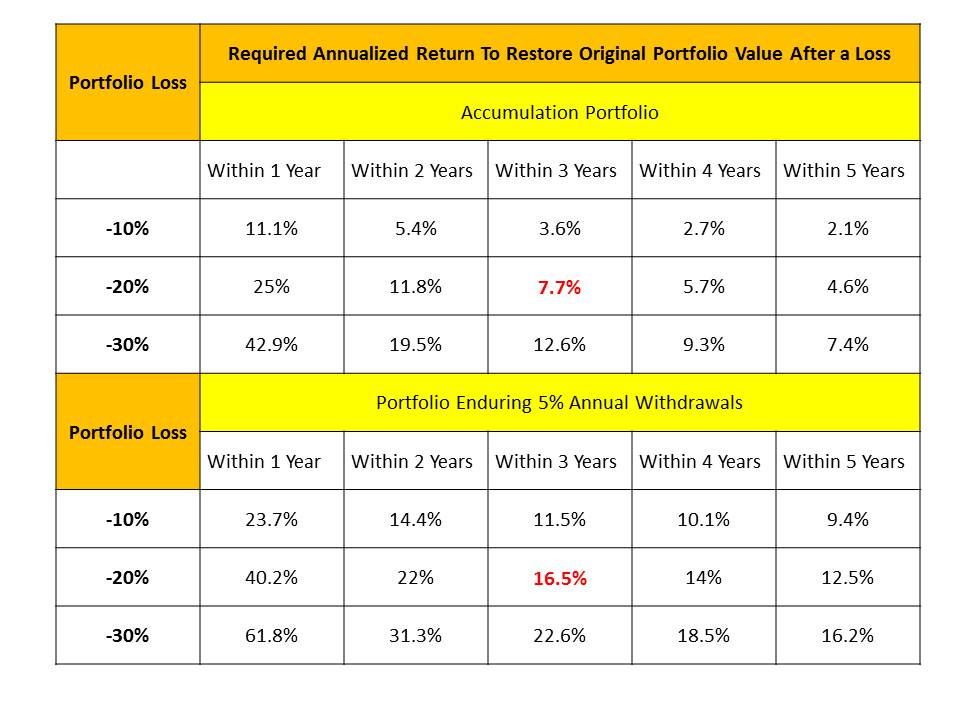
As Craig Israelsen PhD points out in the February 2013 issue of Financial Planning Magazine with the following illustration, a portfolio enduring annual 5% withdrawals faces a much steeper climb back to break even after a loss than does an accumulation portfolio:

Clearly, the conclusion is if you are taking distributions from your account, or intend to do so soon, it is vitally important to avoid large losses. As it may be realistic for investors still accumulating assets to recover from a -20% loss by obtaining an average annualized return of 7.7% for three years, it is unlikely that a retiree taking distributions from his account will get the 16.5% annual return required for three years in order to recover from a similar loss.

Diversify

Protect yourself from unsustainable losses by maintaining adequate diversification within your portfolio. Bonds serve as a buffer against volatility and will likely decrease your loss during stock market corrections.

Additionally, ensure your portfolio has sufficient exposure to various asset classes: large cap, mid cap, and small cap stocks; US, international, and emerging market stocks; government, corporate, international, and emerging market bonds. Investing in multiple asset categories will protect your portfolio from a catastrophic loss next time a bubble in a market sector pops.

chart

Assessment

Speak with a Certified Medical Planner™ or fiduciary and physician focused financial advisor to ensure your portfolio is assertive enough to meet your retirement goals while maintaining an acceptable level of risk. If you wait for the market to turn before taking action, it may be too late.

www.CertifiedMedicalPlanner.org

Conclusion

Your thoughts and comments on this ME-P are appreciated. Feel free to review our top-left column, and top-right sidebar materials, links, URLs and related websites, too. Then, subscribe to the ME-P. It is fast, free and secure.

Link: http://feeds.feedburner.com/HealthcareFinancialsthePostForcxos

Speaker: If you need a moderator or speaker for an upcoming event, Dr. David E. Marcinko; MBA – Publisher-in-Chief of the Medical Executive-Post – is available for seminar or speaking engagements. Contact: MarcinkoAdvisors@msn.com

***

Risk Management, Liability Insurance, and Asset Protection Strategies for Doctors and Advisors: Best Practices from Leading Consultants and Certified Medical Planners™8Comprehensive Financial Planning Strategies for Doctors and Advisors: Best Practices from Leading Consultants and Certified Medical Planners™

“The Doctor’s Dilemma”

Join Our Mailing List

On Hospital Monopolistic Powers

By Ann Miller RN MHA

As George Bernard Shaw, whose works include “The Doctor’s Dilemma” might have put it, that any lawmaker would grant hospitals monopolistic powers plus the freedom to price as they see fit is enough to make one despair of political humanity.

C.O.N.

And, here is a post on Certificates of Need, too.

http://www.ncsl.org/issues-research/health/con-certificate-of-need-state-laws.aspx

Conclusion

Your thoughts and comments on this ME-P are appreciated. Feel free to review our top-left column, and top-right sidebar materials, links, URLs and related websites, too. Then, subscribe to the ME-P. It is fast, free and secure.

Link: http://feeds.feedburner.com/HealthcareFinancialsthePostForcxos

Speaker: If you need a moderator or speaker for an upcoming event, Dr. David E. Marcinko; MBA – Publisher-in-Chief of the Medical Executive-Post – is available for seminar or speaking engagements. Contact: MarcinkoAdvisors@msn.com

Our Other Print Books and Related Information Sources:

Health Dictionary Series: http://www.springerpub.com/Search/marcinko

Practice Management: http://www.springerpub.com/product/9780826105752

Physician Financial Planning: http://www.jbpub.com/catalog/0763745790

Medical Risk Management: http://www.jbpub.com/catalog/9780763733421

Hospitals: http://www.crcpress.com/product/isbn/9781439879900

Physician Advisors: www.CertifiedMedicalPlanner.org

Product DetailsProduct Details

How Doctors Can Avoid an IRS Tax Audit

Join Our Mailing List

Resources and Tax Tps for 2013

Dr. David Edward Marcinko MBA

www.CertifiedMedicalPlanner.org

Dr. MarcinkoTax season is again upon us!

So, here are a few links to help you avoid an IRS audit.

Got Audited?

But, if it happens to you, keep calm and carry on. An audit isn’t the end of the world. The IRS has a video series explaining the whole audit process. Usually, it’s just a notice or phone call asking for details about a few numbers on your return. It rarely requires an in-person interview or an agent showing up at your door.

But, if you do get selected for an audit, don’t forget about Form 911 (.pdf file). It’s used to request help from the Taxpayer Advocate Service. The number might seem like a joke, but the service is an independent department of the IRS that helps people who can’t afford professional representation.

And … Even More Links:

Internal Revenue Servicewww.irs.govSocial Security Administrationwww.ssa.gov – Mass. Dept. of Revenue – www.mass.gov/dor – Mass. Attorney General – www.mass.gov/ag – NIH Loan Repayment Program – http://www.lrp.nih.gov/index.aspx

Other State Departments of Revenue/Taxation

California – http://www.boe.ca.gov – Connecticut – www.ct.gov/drs/site/default.asp – Illinois – http://www.revenue.state.il.us – Maine – http://www.state.me.us/revenue – New Hampshire – http://www.nh.gov/revenue/index.htm – New York – www.tax.state.ny.us – New Jersey – http://www.state.nj.us/treasury/taxation – Rhode Island – www.tax.state.ri.us – Vermont –http://www.state.vt.us/tax/index.shtml

Assessment

Enjoy, and profit from these links and resources.

Conclusion

Your thoughts and comments on this ME-P are appreciated. Feel free to review our top-left column, and top-right sidebar materials, links, URLs and related websites, too. Then, subscribe to the ME-P. It is fast, free and secure.

Speaker: If you need a moderator or speaker for an upcoming event, Dr. David E. Marcinko; MBA – Publisher-in-Chief of the Medical Executive-Post – is available for seminar or speaking engagements. Contact: MarcinkoAdvisors@msn.com

OUR OTHER PRINT BOOKS AND RELATED INFORMATION SOURCES:

Product Details  Product Details