Understanding Modern Healthcare Market Competition

Join Our Mailing List

Updating Competitive Strategy Theory in Healthcare

By Robert James Cimasi; MHA ASA FRICs MCBA AVA CM&AA
By Todd A. Zigrang; MBA MHA ASA FACHE
By Anne P. Sharamitaro; Esq.

www.HealthCapital.com

Michael Porter[i] is considered by many to be one of the world’s leading authorities on competitive strategy and international competitiveness.  In 1980, he published Competitive Strategy: Techniques for Analyzing Industries and Competitors,[ii] in which he argues that all businesses must respond to five competitive forces.

(1) The Threat of New Market Entrants

This force may be defined as the risk of a similar company entering the marketplace and winning business.  There are many barriers to entry of new market entrants in healthcare including: the high cost of equipment, licensure, requirement for physicians and other highly trained technicians, development of physician referral networks and provider contracts, and other significant regulatory requirements.

Certificate of Need (CON) laws, which require governmental approval for new healthcare facilities, equipment, and services have been in place since they were federally mandated in 1974.  State CON laws create a regulatory barrier to entry.  New medical provider entrants commonly face substantial political opposition by established interests, which is manifested in the CON review process.

(2) The Bargaining Power of Suppliers

A supplier can be defined as any business relationship upon which a business relies to deliver a product, service, or outcome.  Healthcare equipment is a highly technical product produced by a limited number of manufacturers. This reduces the range of choices for providers and can increase costs.

(3) Threats from Substitute Products or Services

Substitute products or services are those that are sufficiently equivalent in function or utility to offer consumers an alternate choice of product or service.  An illustration of this in healthcare would be diagnostic imaging as a substitute for surgery, which is often a more costly and risky option for patients. The threat of less invasive or less expensive diagnostic tests other than diagnostic imaging is relatively small for the near term future.

(4) The Bargaining Power of Buyers

This force is the degree of negotiating leverage of an industry’s buyers or customers.  The buyers of healthcare services are ultimately the patients. However, the competitive force of buyers is manifested through healthcare insurers including the U.S. and state governments through the Medicare, Medicaid, TRICARE, and other programs; managed care payors (e.g., Blue Cross/Blue Shield affiliates); workers’ compensation insurers; and, others.  In addition to the government, many of these healthcare insurers are large, national companies, often publicly traded, commanding significant bargaining power over healthcare provider reimbursement.

(5) Rivalry Amongst Existing Firms

This is ongoing competition between existing firms without consideration of the other competitive forces which define industries. Healthcare providers face pressure from other existing providers to obtain favorable provider contracts; maintain the latest technology; increase efficiencies; and, lower prices.

References:

[i]  A professor of Business Administration at the Harvard Business School, Michael Porter serves as an advisor to heads of state, governors, mayors, and CEOs throughout the world.  The recipient of the Wells Prize in Economics, the Adam Smith Award, three McKinsey Awards, and honorary doctorates from the Stockholm School of Economics and six other universities, Porter is the author of fourteen books, among them Competitive Advantage, The Competitive Advantage of Nations, and Cases in Competitive Strategy.

[ii]  Porter, M.E. Competitive Strategy: Techniques for Analyzing Industries and Competitors. The Free Press, 1980.

Conclusion

Your thoughts and comments on this ME-P are appreciated. Feel free to review our top-left column, and top-right sidebar materials, links, URLs and related websites, too. Then, subscribe to the ME-P. It is fast, free and secure.

Link: http://feeds.feedburner.com/HealthcareFinancialsthePostForcxos

Speaker: If you need a moderator or speaker for an upcoming event, Dr. David E. Marcinko; MBA – Publisher-in-Chief of the Medical Executive-Post – is available for seminar or speaking engagements. Contact: MarcinkoAdvisors@msn.com

OUR OTHER PRINT BOOKS AND RELATED INFORMATION SOURCES:

DICTIONARIES: http://www.springerpub.com/Search/marcinko
PHYSICIANS: www.MedicalBusinessAdvisors.com
PRACTICES: www.BusinessofMedicalPractice.com
HOSPITALS: http://www.crcpress.com/product/isbn/9781466558731
CLINICS: http://www.crcpress.com/product/isbn/9781439879900
ADVISORS: www.CertifiedMedicalPlanner.org
PODIATRISTS: www.PodiatryPrep.com
BLOG: www.MedicalExecutivePost.com
FINANCE: Financial Planning for Physicians and Advisors
INSURANCE: Risk Management and Insurance Strategies for Physicians and Advisors


Our Newest Textbook Release

Buy from Amazon

Learn How to Profit and Thrive in the PP-ACA Era

BOOK FOREWORD / TESTIMONIAL

Video on Physician Loans and Doctor Mortgages [Why Over-Pay Big Banks?]

Join Our Mailing List

Bank Offers a Zero Down Payment Physician Mortgage Loan in Kansas and Missouri

Doctors mortgage programs are offered as a benefit in many hospitals. Banks use these physician mortgage loans as an entry point to gain checking, savings, investment, and Home Equity Line of Credit accounts.

It’s important for physicians to realize that a Big banks objective is assets under management and not necessarily the best mortgage for them.

Many banks offered  special  zero down doctor loans and below market mortgages for physicians.  With the upheaval in the mortgage and secondary market requirements (the people who bought those special physician loans), most of the doctors mortgage programs advantages went away, or became no different than what is available to every other borrower.

Get a second opinion

For this reason, it is prudent for physicians to be aware of the changes in doctors loan programs and seek expert independent 2nd Opinions consultations.

Link: www.MedicalBusinessAdvisors.com

Assessment

Many physicians needlessly over pay $10’s of thousands of dollars in interest to big banks. Over a career of homes and refinances, this could add up to well over $100K that could stay in their account.

Video link: http://www.youtube.com/watch?v=ygs81Rsk-Zw

Source: http://www.Physician-Loans.org

Assessment

Conclusion

Your thoughts and comments on this ME-P are appreciated. Feel free to review our top-left column, and top-right sidebar materials, links, URLs and related websites, too. Then, subscribe to the ME-P. It is fast, free and secure.

Link: http://feeds.feedburner.com/HealthcareFinancialsthePostForcxos

Speaker: If you need a moderator or speaker for an upcoming event, Dr. David E. Marcinko; MBA – Publisher-in-Chief of the Medical Executive-Post – is available for seminar or speaking engagements. Contact: MarcinkoAdvisors@msn.com

OUR OTHER PRINT BOOKS AND RELATED INFORMATION SOURCES:

DICTIONARIES: http://www.springerpub.com/Search/marcinko
PHYSICIANS: www.MedicalBusinessAdvisors.com
PRACTICES: www.BusinessofMedicalPractice.com
HOSPITALS: http://www.crcpress.com/product/isbn/9781466558731
CLINICS: http://www.crcpress.com/product/isbn/9781439879900
BLOG: www.MedicalExecutivePost.com
FINANCE: Financial Planning for Physicians and Advisors
INSURANCE: Risk Management and Insurance Strategies for Physicians and Advisors

Product Details  Product Details

Comprehensive Financial Planning Strategies for Doctors and Advisors: Best Practices from Leading Consultants and Certified Medical Planners(TM)

How Doctors Might Buy a Pre-Owned Car?

Join Our Mailing List

Used Automobile Purchasing

This infographic on used car purchasing demonstrates the technical and detailed facts which are presented in a unique design.

Pre-Owned Vehicles

The Infographic shows what you should look for when buying a used car.

Source: DandLock

Assessment

Conclusion

Your thoughts and comments on this ME-P are appreciated. Feel free to review our top-left column, and top-right sidebar materials, links, URLs and related websites, too. Then, subscribe to the ME-P. It is fast, free and secure.

Link: http://feeds.feedburner.com/HealthcareFinancialsthePostForcxos

Speaker: If you need a moderator or speaker for an upcoming event, Dr. David E. Marcinko; MBA – Publisher-in-Chief of the Medical Executive-Post – is available for seminar or speaking engagements. Contact: MarcinkoAdvisors@msn.com

OUR OTHER PRINT BOOKS AND RELATED INFORMATION SOURCES:

Product Details  Product Details

Health IT Vendors Ponied-Up Political Cash to Both Parties

Join Our Mailing List

The Presidential Election 2012

This November saw healthcare executives pay big campaign money to both political parties.

Health IT vendors, however, upped the ante this election year, paying out some hefty donations of their own. Judith Faulkner, CEO of Epic, and Allscripts CEO Glen Tullman are among this year’s top spenders.

Source: http://www.govhealthit.com/news/infographic-health-it-vendors-pony-political-cash-both-parties?topic=75

Conclusion

Your thoughts and comments on this ME-P are appreciated. Feel free to review our top-left column, and top-right sidebar materials, links, URLs and related websites, too. Then, subscribe to the ME-P. It is fast, free and secure.

Link: http://feeds.feedburner.com/HealthcareFinancialsthePostForcxos

Speaker: If you need a moderator or speaker for an upcoming event, Dr. David E. Marcinko; MBA – Publisher-in-Chief of the Medical Executive-Post – is available for seminar or speaking engagements. Contact: MarcinkoAdvisors@msn.com

Our Other Print Books and Related Information Sources:

Health Dictionary Series: http://www.springerpub.com/Search/marcinko

Practice Management: http://www.springerpub.com/product/9780826105752

Physician Financial Planning: http://www.jbpub.com/catalog/0763745790

Medical Risk Management: http://www.jbpub.com/catalog/9780763733421

Hospitals: http://www.crcpress.com/product/isbn/9781439879900

Physician Advisors: www.CertifiedMedicalPlanner.org

Product DetailsProduct DetailsProduct Details

Product Details  Product Details

Product Details

Important Book Reviews by Dr. Peter Benedek CFA

Book Reviews

Join Our Mailing List

By Peter Benedek PhD CFA www.RetirementAction.com

Assessment

Link: http://retirementaction.com/category/books

Conclusion

Your thoughts and comments on this ME-P are appreciated. Feel free to review our top-left column, and top-right sidebar materials, links, URLs and related websites, too. Then, subscribe to the ME-P. It is fast, free and secure.

Link: http://feeds.feedburner.com/HealthcareFinancialsthePostForcxos

Speaker: If you need a moderator or speaker for an upcoming event, Dr. David E. Marcinko; MBA – Publisher-in-Chief of the Medical Executive-Post – is available for seminar or speaking engagements. Contact: MarcinkoAdvisors@msn.com

Our Other Print Books and Related Information Sources:

Health Dictionary Series: http://www.springerpub.com/Search/marcinko

Practice Management: http://www.springerpub.com/product/9780826105752

Physician Financial Planning: http://www.jbpub.com/catalog/0763745790

Medical Risk Management: http://www.jbpub.com/catalog/9780763733421

Hospitals: http://www.crcpress.com/product/isbn/9781439879900

Physician Advisors: www.CertifiedMedicalPlanner.org

Product DetailsProduct DetailsProduct Details

For Doctors Considering Rental House Investments?

Join Our Mailing List

Risks versus Rewards

By Rick Kahler MS CFP® ChFC CCIM www.KahlerFinancial.com

Landlord!

The very word implies wealth, authority, and status. Maybe that’s one of the reasons there are so many books and seminars claiming to teach you how to build wealth by owning rental property.

Yes, medical professionals can get rich as a landlord. Doctors can go broke, too.

And, in between those two extremes, you can find yourself dealing with a bunch of problems like leaking roofs, non-paying tenants, and economic downturns. The risks of building wealth with real estate are substantial. This is true whether you want to become the biggest property owner in town or just buy a second home as a rental to help finance your retirement.

Points of Consideration

With real estate prices still low after the collapse of the housing bubble, and with the current low interest rates, it may be a great time to buy a second home. Before even considering such a purchase, though, here are some important points to consider:

1. Do you plan to eventually live in the house yourself? If so, buying it now and having a tenant pay the mortgage for you might be a great move. Still, you need to take the following factors into consideration and make your decision carefully.

2. Will you need current income from the property? Then you’ll need to be able to buy it without a mortgage. Otherwise, the mortgage and other expenses will eat up most of the rent payments, and you won’t have any cash flow.

3. Do you have the time and skills to manage the property yourself? Water heaters quit, pipes need replaced, and furnaces go on the blink. Will you be able to do your own maintenance or spend the money to hire it done? Are you available to check out prospective tenants and show the property? A management company can relieve you of the hassles of arranging for repairs and vetting tenants. You’ll still pay the bills, though, plus fees of perhaps ten percent of the rent.

4. Be realistic to the point of pessimism about your expected return. Assume that expenses—repairs, maintenance, taxes, and insurance—will be about 50% of the gross rental income. Always figure the income based on a property being vacant for several months of the year.

5. Be aware that a more expensive house won’t necessarily provide a corresponding increase in rent. The rental market eventually tops out. If a $150,000 house rents for $800 a month, a $350,000 house may only rent for about $1400.

6. If your main reason for owning real estate is investment income, and you have a small amount of money or don’t want the risk and management headaches of owning a house, a real estate investment trust (REIT) is often a wiser choice than owning real estate directly.

7. Be patient. If you over-buy income property and try to get rich quick, you risk losing it all. At one-time, Rapid City lost a number of military jobs and rental properties were sitting vacant. As I scrambled to make mortgage payments, it felt as if I didn’t own my rental houses, they owned me. Right now I have interests in companies that own paid-for rental property, but getting to that point took over 30 years.

Assessment

The IRS classifies some income from rental property as “passive.” Trust me, there’s nothing passive about being a landlord. Owning rental property can certainly be one way to add to your net worth and contribute to a comfortable retirement. Just like any other form of wealth-building, however, it requires education, good decision-making, an awareness of the risks, and plenty of effort.

Conclusion

Your thoughts and comments on this ME-P are appreciated. Feel free to review our top-left column, and top-right sidebar materials, links, URLs and related websites, too. Then, subscribe to the ME-P. It is fast, free and secure.

Link: http://feeds.feedburner.com/HealthcareFinancialsthePostForcxos

Speaker: If you need a moderator or speaker for an upcoming event, Dr. David E. Marcinko; MBA – Publisher-in-Chief of the Medical Executive-Post – is available for seminar or speaking engagements. Contact: MarcinkoAdvisors@msn.com

Our Other Print Books and Related Information Sources:

Health Dictionary Series: http://www.springerpub.com/Search/marcinko

Practice Management: http://www.springerpub.com/product/9780826105752

Physician Financial Planning: http://www.jbpub.com/catalog/0763745790

Medical Risk Management: http://www.jbpub.com/catalog/9780763733421

Hospitals: http://www.crcpress.com/product/isbn/9781439879900

Physician Advisors: www.CertifiedMedicalPlanner.org

Product Details  Product Details

Product Details

Physician / Medical Director Needed

Join Our Mailing List

Kuwait (Middle East) position with growing Global Health Care Company‏

By Martin Jones
Research Associate
Sterling Life Sciences

Our firm was hired by a growing Global Health Care Company to help them find an experienced Physician / Medical Director.

The Search

Is there any chance you know of someone who might want to hear about it? They are doing well and have a good reputation so it will be a nice situation for someone who needs a change.

The Job

Here is a copy of job description: http://goo.gl/9yVU8

Assessment

Anyone interested can directly apply online and resume will come to me. They are looking to hire immediately so please feel free to share this information with anyone you think would want to learn more.

Best regards,

Email:martin@sterlinglifesciences.com

www.sterlinglifesciences.com

Conclusion

Your thoughts and comments on this ME-P are appreciated. Feel free to review our top-left column, and top-right sidebar materials, links, URLs and related websites, too. Then, subscribe to the ME-P. It is fast, free and secure.

Link: http://feeds.feedburner.com/HealthcareFinancialsthePostForcxos

Speaker: If you need a moderator or speaker for an upcoming event, Dr. David E. Marcinko; MBA – Publisher-in-Chief of the Medical Executive-Post – is available for seminar or speaking engagements. Contact: MarcinkoAdvisors@msn.com

OUR OTHER PRINT BOOKS AND RELATED INFORMATION SOURCES:

DICTIONARIES: http://www.springerpub.com/Search/marcinko
PHYSICIANS: www.MedicalBusinessAdvisors.com
PRACTICES: www.BusinessofMedicalPractice.com
HOSPITALS: http://www.crcpress.com/product/isbn/9781466558731
CLINICS: http://www.crcpress.com/product/isbn/9781439879900
BLOG: www.MedicalExecutivePost.com
FINANCE: Financial Planning for Physicians and Advisors
INSURANCE: Risk Management and Insurance Strategies for Physicians and Advisors

Product Details

On Financial Therapy Rising

Join Our Mailing List

Uniting Financial Planning and Behavioral Psychology

By Rick Kahler MS CFP® ChFC CCIM www.KahlerFinancial.com

The driver of the van that was to take me from the University of Missouri to the St. Louis airport asked where I was from. When I said, “Rapid City” and we struck up a conversation about his childhood trip to the Sturgis Rally. At one point he asked me, “What were you doing visiting MU?”

A Topic at the Financial Therapy Association (FTA) Conference

There I explained I had attended the third annual Financial Therapy Association (FTA) Conference. There was a silence. Then he continued talking about his memories of visiting the Black Hills.

Bringing up the topic of financial therapy tends to leave people speechless. It isn’t a common term. Plus, it combines two topics that most people want to avoid: therapy and finances. Put them together, and you have a real conversation killer.

Fortunately, there was plenty of conversation for the 85 professionals and students at the three-day FTA conference. For those attending for the first time, it was a “coming home” experience.

Mental Health Needs

Financial therapy addresses a need that until recent years most financial and mental health professionals didn’t talk about or didn’t even know existed. It’s the unconscious and unspoken thoughts, beliefs, and feelings around all things financial. Certified Financial Planners® aren’t required to have training in even basic communication skills, much less the more complex fundamentals of psychology or neuroscience.

Likewise, therapists and psychologists aren’t taught to deal with money, either in working with clients or in managing their own businesses.

As a result, neither profession provides the tools to address clients’ problematic and often self-destructive beliefs and behaviors around money. Destructive behaviors around money usually aren’t about the money.

For this reason, giving people more information about how money, investing, or financial planning works isn’t enough.

Financial Psychology

The exploration of financial psychology or emotion and money isn’t new. Dr. Jacob Needleman and Olivia Mellan were among the mental health pioneers who began raising questions around the psychological side of money in the 1990’s. About the same time, two financial planners, George Kinder and Dick Wagner, co-founded a leaderless group of financial planners, coaches, and therapists called the Nazrudin project to explore the emotional side of money. The Nazrudin project, which still meets annually, spawned scores of books, courses, and organizations raising the awareness and skill level of financial professionals and therapists.

The Nazrudin project was the primary influence that gave me, along with others, the idea of uniting financial planning with experiential therapy. I began referring to it as financial therapy after hearing the term from therapist Bari Tessler.

Financial Therapy

Typically, financial therapy involves a client-centered financial planner (typically only compensated by fee for service), and a therapist or psychologist, that conjointly work with clients. In my experience, this process helps clients who are in some way financially stuck make significant progress.

Academia Required

Link: www.CertifiedMedicalPlanner.org

The one thing missing in the evolution of financial therapy until recently was the involvement of academia. For the first time, the FTA unites academics, therapists, and financial planners in a common pursuit of defining and developing the concept of financial therapy. This is essential if financial therapy is to become a profession.

It may be some time before we see practitioners with advanced degrees in financial therapy. Before that time comes, the FTA has a lot of work to do, including coming up with a scholarly definition of financial therapy.

Assessment

In the meantime, Jeff Zaslow, who reported on our first financial therapy workshop in 2003 for The Wall Street Journal, wrote that it “combines experiential therapy with nuts-and-bolts financial planning.” As we work to foster the emerging profession of financial therapy, that’s still an accurate and effective way to describe it.

Conclusion

Your thoughts and comments on this ME-P are appreciated. Feel free to review our top-left column, and top-right sidebar materials, links, URLs and related websites, too. Then, subscribe to the ME-P. It is fast, free and secure.

Link: http://feeds.feedburner.com/HealthcareFinancialsthePostForcxos

Speaker: If you need a moderator or speaker for an upcoming event, Dr. David E. Marcinko; MBA – Publisher-in-Chief of the Medical Executive-Post – is available for seminar or speaking engagements. Contact: MarcinkoAdvisors@msn.com

Our Other Print Books and Related Information Sources:

Health Dictionary Series: http://www.springerpub.com/Search/marcinko

Practice Management: http://www.springerpub.com/product/9780826105752

Physician Financial Planning: http://www.jbpub.com/catalog/0763745790

Medical Risk Management: http://www.jbpub.com/catalog/9780763733421

Hospitals: http://www.crcpress.com/product/isbn/9781439879900

Physician Advisors: www.CertifiedMedicalPlanner.org

Product DetailsProduct DetailsProduct Details

Product Details  Product Details


The Case for Domestic Healthcare Change—Why Bother?

Join Our Mailing List

A Crisis of Volume and Cost

By Jennifer Tomasik MS

“Fee-for-service” has been the dominant financial dynamic in the US healthcare system for decades, whereby providers are reimbursed for the quantity of visits, tests, or procedures that are performed, often without adequate regard for the cost of the interventions relative to patient outcomes.

Atul Speaks

This focus has arguably fueled incredible advances in medical devices, diagnostic tests, pharmaceuticals, and other innovations. Atul Gawande MD, surgeon and author, describes how far medicine has come since the days before penicillin—when convalescence in the shelter of a hospital was the best of only a few treatment options and, therefore, “when what was known you [as a doctor] could know. You could hold it all in your head, and you could do it all.”

The surge in the number of diagnoses and treatments that physicians have access to today is transforming their profession from a field of autonomous craftsmen wielding basic tools to what Gawande suggests should be race-car like “pit crews” that together can deliver on the scientific promise of 4,000 medical and surgical procedures and 6,000 drugs.

A Double-Edged Sword

This is a double-edged sword, as the autonomous mentality on which the field developed is now often at odds with the machine-like functioning expected of an effective and efficient “pit crew.” Together with the fee-for-service incentive structure, these realities have collided in a perfect storm propelling tremendous growth in healthcare spending characterized by fragmentation and high volume, a high cost per episode, and inconsistent quality.

Assessment

And so, we are now witnessing the costly “failure of success” from focusing so extremely on “sick care” while ignoring “well care” attempts to keep individuals and populations healthy from the start.

More info Link: http://www.routledge.com/books/details/9781466558731/

Conclusion

Your thoughts and comments on this ME-P are appreciated. Feel free to review our top-left column, and top-right sidebar materials, links, URLs and related websites, too. Then, subscribe to the ME-P. It is fast, free and secure.

Link: http://feeds.feedburner.com/HealthcareFinancialsthePostForcxos

Speaker: If you need a moderator or speaker for an upcoming event, Dr. David E. Marcinko; MBA – Publisher-in-Chief of the Medical Executive-Post – is available for seminar or speaking engagements. Contact: MarcinkoAdvisors@msn.com

Our Other Print Books and Related Information Sources:

Health Dictionary Series: http://www.springerpub.com/Search/marcinko

Practice Management: http://www.springerpub.com/product/9780826105752

Physician Financial Planning: http://www.jbpub.com/catalog/0763745790

Medical Risk Management: http://www.jbpub.com/catalog/9780763733421

Hospitals: http://www.crcpress.com/product/isbn/9781439879900

Physician Advisors: www.CertifiedMedicalPlanner.org

Our Newest Textbook Release

Buy from Amazon

Learn How to Profit and Thrive in the PP-ACA Era

BOOK FOREWORD / TESTIMONIAL

Update on Pension Plans for 2013

Join Our Mailing List

The IRS Announces Major Changes

By Children’s Home Society of Florida Foundation

In IR 2012 77 (18 Oct 2012), the IRS announced multiple pension adjustments for 2013:

1. Elective Deferral – An individual with a 401(k) or 403(b) plan may defer income up to $17,500.

2. Catch-Up Contributions – Individuals age 50 and older may contribute an additional amount of $5,500 to a 401(k) or 403(b).

3. IRA Phase-Out – Contributions to a traditional IRA are phased out for individuals with a workplace retirement plan and modified adjusted gross incomes from $59,000 to $69,000. For married couples where the contributing spouse is covered by a workplace retirement plan, the phase-out range is $95,000 to $115,000. If the married couple IRA owner is not covered by a workplace plan, the phase-out range is $178,000 to $188,000.

4. Roth IRA Contributions – Taxpayers who are married may make Roth IRA contributions with a phase-out AGI of $178,000 to $188,000. Singles and heads of household have a phase-out range of $112,000 to $127,000.

Conclusion

Your thoughts and comments on this ME-P are appreciated. Feel free to review our top-left column, and top-right sidebar materials, links, URLs and related websites, too. Then, subscribe to the ME-P. It is fast, free and secure.

Speaker: If you need a moderator or speaker for an upcoming event, Dr. David E. Marcinko; MBA – Publisher-in-Chief of the Medical Executive-Post – is available for seminar or speaking engagements. Contact: MarcinkoAdvisors@msn.com

OUR OTHER PRINT BOOKS AND RELATED INFORMATION SOURCES:


Product Details

The “Art” of Medicine [Humor]

Join Our Mailing List

It’s all about Linguistics

Assessment

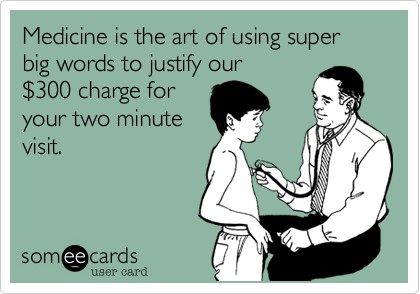
Medicine is the art of using super big words to justify a $300 dollar charge for a two minute office visit.

Conclusion

Your thoughts and comments on this ME-P are appreciated. Feel free to review our top-left column, and top-right sidebar materials, links, URLs and related websites, too. Then, subscribe to the ME-P. It is fast, free and secure.

Link: http://feeds.feedburner.com/HealthcareFinancialsthePostForcxos

Speaker: If you need a moderator or speaker for an upcoming event, Dr. David E. Marcinko; MBA – Publisher-in-Chief of the Medical Executive-Post – is available for seminar or speaking engagements. Contact: MarcinkoAdvisors@msn.com

Our Other Print Books and Related Information Sources:

Health Dictionary Series: http://www.springerpub.com/Search/marcinko

Practice Management: http://www.springerpub.com/product/9780826105752

Physician Financial Planning: http://www.jbpub.com/catalog/0763745790

Medical Risk Management: http://www.jbpub.com/catalog/9780763733421

Hospitals: http://www.crcpress.com/product/isbn/9781439879900

Physician Advisors: www.CertifiedMedicalPlanner.org

Product DetailsProduct DetailsProduct Details

With Obama Election Win “Mr. Market” Weighs in on the ACA Equity Winners and Losers

Join Our Mailing List

The Wisdom of Crowds

By David K. Luke MIM, Certified Medical Planner™

Website: www.networthadvice.com

The first trading session following the election on Wednesday, November 7, 2012 gave us some clues on how different sectors of the health care market may be affected by the ACA, as Obama’s win confirms that health reform marches forward. “Mr. Market” has spoken.

“Mr. Market”

For those that may be unaware, “Mr. Market” was Benjamin Graham’s term for the stock market in explaining fluctuations. Graham is the father of value investing and Warren Buffet’s most influential mentor. According to Graham, Mr. Market is emotionally unstable but doesn’t mind being slighted. If Mr. Market’s quotes are ignored, he will be back again tomorrow with a new quote.

So, the point is that successful investors do not place themselves in emotional whirlwinds often created by the market. This first post-election trading session was such a whirlwind. Large groups of people (such as those that voted with their pocketbook in this telling stock market session) are smarter than an elite few, or so goes the premise of James Surowiecki’s Wisdom of the Crowds.

Now; what did we learn from the combined investing public wisdom about the future of healthcare companies profitability with ACA?

Keep in mind the overall market was down 2.4% on the day as measured by both the Dow Jones Industrial Average and the Standard & Poor 500. The biggest concern of the day was investor worry about the so called “fiscal cliff” and the debate over billions in spending and tax increases. Considering the total market on November 7th, health care stocks performed as a group better than the averages, but Mr. Market definitely parsed health care stocks by sector from “great” to “dreadful” based on the implications of impending health care reform:

Great:

Hospital Stocks

  • Health Management Associates (HMA) +7.3%
  • HCA Holdings Inc. (HCA) +9.4%
  • Community Health Systems Inc. (CYH) +6.0%
  • Tenet Healthcare Corp. (THC) +9.6%

Yes, there were stocks that went up stridently on the big down day. Not surprisingly, hospital stocks are expected to benefit from the estimated 30 million Americans who will line up for insurance coverage beginning in 2014, increasing profits and decreasing bad debts.

Medicaid HMOs

  • Molina Healthcare Inc. (MOH) +4.6%
  • Centene Corp. (CNC) +10.1%
  • WellCare Health Plans Inc. (WCG) +4.4%

Health insurers that typically focus heavily on Medicaid are up in line with ACA provisions to expand care for the poor. Mr. Market tips his hat to Centene Corporation, which has been successful in procuring multi-line coverage contracts with States including long-term care, vision, dental, behavioral health, CHIP and disability.

Good:

Drug Wholesalers

  • McKesson (MCK) +1.3%
  • Cardinal Health (CAH) +.5%
  • AmerisourceBergen (ABC) +1.0%

Growth in prescription drug spending means increased revenues for the drug wholesalers, so ACA should be a positive for this group. But because a majority of wholesaler profits come from generic drugs, and because wholesalers are indirectly affected by changes in pharmacies, pricing pressures will keep the wholesalers in check.

Fair:

Pharmacy Benefit Mangers

  • Express Scripts (ESRX) -0.4%
  • CVS Caremark Corp (CVS) -0.4%

As an intermediary between the payor and everyone else in the health-care system, PBMs process prescriptions for groups such as insurance companies and corporations and use their large size to drive down prices. These companies are incentivized to cut costs and have been thought to benefit greatly from ACA, and will expand prescription drug insurance plans sold through health insurance exchanges starting in 2014.

Generic Pharmaceuticals

  • Teva Pharmaceutical Industries Ltd ADR (TEVA) -0.7%
  • Mylan Inc (MYL) -0.8%
  • Dr. Reddy’s Labs (RDY) -0.6%

Health care reform is good for generic drugs with anticipated increased dispensing of drugs in general.  With more funds spent on Medicaid, the ACA will certainly be generic oriented and should fare better than the name-brand drugs. Pricing pressures are expected over the longer term however.

Testing Laboratories

  • Quest Diagnostics (DGX) -1.5%
  • Laboratory Corp of America (LH) -1.9%

More patients you would think would mean more medical tests. In a recent Gallup survey, physicians attributed 34 percent of overall healthcare costs to defensive medicine (think diagnostic blood tests/invasive biopsies, etc). ACA may curb this expensive part of medicine and appears to have very negative implications going forward as Labs will have intense pressure to reduce rates. However, these larger labs held up better than the market averages suggesting that lab work isn’t going away with ACA.

Big Pharmaceutical Companies

  • Pfizer Inc.  (PFE) -2.2%
  • GlaxoSmithKline PLC (GSK) -0.8%
  • Eli Lily & Co. (LLY) -1.2%

The name-brand large Pharmaceutical companies have agreed to rebate Uncle Sam on Medicaid purchases and must give the elderly discounts. But there will be a lot more of us taking drugs too.

I’ve ranked these 4 health care sectors “fair” considering that broader stock market averages were down 2.4% for the day and Mr. Market was kinder to this group with only a slight negative. Likewise, it appears that he is anointing this group as a benefactor of upcoming reforms.

Not Good:

Medical Device Companies

  • Medtronic Inc. (MDT) -3.0%
  • Stryker Corporation (SYK) -1.6%
  • Boston Scientific Corp. (BSX) -3.6%
  • Zimmer Holdings Inc. (ZMH) -1.8%

The 2.3% excise tax on revenue of medical-device companies is looking more inevitable, in spite of industry lobbying group efforts.

Dreadful:

Medicare Part D Companies

  • Humana Inc. (HUM) -7.9%
  • WellPoint (WLP) -5.5%
  • Cigna Corp. (CI) -0.7%

Even though managed-care companies should gain millions of new customers thanks to the ACA, profit margins are expected to decline significantly.  Mr. Market went easy on Cigna, perhaps because of the company’s focus on self-insured large employers.

Currently

Currently it is unclear how the increased revenue generated from more patients will affect the increased margins to the various sectors of the healthcare market. Also, too much weight should not be placed on this one day action by the market. One thing is clear however, and that is how Mr. Market and the market at large feels at first blush towards the impending implementation of the ACA based on the November 7, 2012 trading of the respective stocks.

Assessment

Remember: Mr. Market is temperamental and can change his mind anytime!

About the Author:

David K. Luke MIM, a Certified Medical Planner™, focuses on helping physicians, medical professionals, and successful retirees with financial planning, investment and risk management. He directs physicians through their complex planning needs, helping them foster a better medical practice and lifestyle. David is a fee-only financial planner.

Disclosure:

Percentage changes in price of stocks represent published change in price from closing price November 6, 2012 to closing price November 7, 2012. Stocks listed here are not considered to be past, present or future recommendations to buy or sell securities and is for educational purposes only. This information should NOT be considered as investment recommendations or advice but rather summary comments and opinions on the health care market by David K. Luke, MIM CMP™, who is entirely responsible for the contents of this article.

Link: www.CertifiedMedicalPlanner.org

Conclusion

Your thoughts and comments on this ME-P are appreciated. Feel free to review our top-left column, and top-right sidebar materials, links, URLs and related websites, too. Then, subscribe to the ME-P. It is fast, free and secure.

Link: http://feeds.feedburner.com/HealthcareFinancialsthePostForcxos

Speaker: If you need a moderator or speaker for an upcoming event, Dr. David E. Marcinko; MBA – Publisher-in-Chief of the Medical Executive-Post – is available for seminar or speaking engagements. Contact: MarcinkoAdvisors@msn.com

OUR OTHER PRINT BOOKS AND RELATED INFORMATION SOURCES:

DICTIONARIES: http://www.springerpub.com/Search/marcinko
PHYSICIANS: www.MedicalBusinessAdvisors.com
PRACTICES: www.BusinessofMedicalPractice.com
HOSPITALS: http://www.crcpress.com/product/isbn/9781466558731
CLINICS: http://www.crcpress.com/product/isbn/9781439879900
BLOG: www.MedicalExecutivePost.com
FINANCE: Financial Planning for Physicians and Advisors
INSURANCE: Risk Management and Insurance Strategies for Physicians and Advisors

Product DetailsProduct DetailsProduct Details

Product Details  Product Details

The Impact Of The U.S. Recession On Hospitals

Join Our Mailing List

By Objective Health via Laura Paden

Hospital Admissions

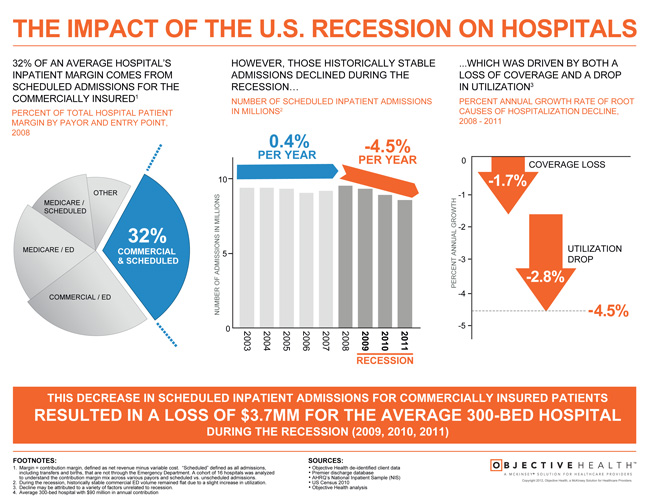
Commercially insured scheduled admissions are the largest contributor to inpatient margins for the average US hospital.

Recession Impact

During the US recession (2009-2011), volumes in this segment declined. There were two primary drivers of this decline.

  1. First, commercial insurance coverage decreased, stemming from unemployment and underemployment. This is expected to reverse and rebound as the economy recovers and as healthcare reform is implemented.
  2. Second, even among those who retained coverage, utilization of inpatient services decreased as patients delayed or forewent elective and preventative care. This was influenced by a range of economic factors, including reduced household incomes, higher co-pays, and a reduced ability to leave work for medical care, as well as factor unrelated to the recession, such as a shift to outpatient management of disease.

Assessment

It is unclear whether this second driver will diminish fully as the economy recovers. A slow recovery – or one that fails to see volumes to return to pre-recession levels – suggests that hospitals may need to refocus their strategies on service lines and segments that have historically been less attractive.

Conclusion

Your thoughts and comments on this ME-P are appreciated. Feel free to review our top-left column, and top-right sidebar materials, links, URLs and related websites, too. Then, subscribe to the ME-P. It is fast, free and secure.

Link: http://feeds.feedburner.com/HealthcareFinancialsthePostForcxos

Speaker: If you need a moderator or speaker for an upcoming event, Dr. David E. Marcinko; MBA – Publisher-in-Chief of the Medical Executive-Post – is available for seminar or speaking engagements. Contact: MarcinkoAdvisors@msn.com

Our Other Print Books and Related Information Sources:

Health Dictionary Series: http://www.springerpub.com/Search/marcinko

Practice Management: http://www.springerpub.com/product/9780826105752

Physician Financial Planning: http://www.jbpub.com/catalog/0763745790

Medical Risk Management: http://www.jbpub.com/catalog/9780763733421

Hospitals: http://www.crcpress.com/product/isbn/9781439879900

Physician Advisors: www.CertifiedMedicalPlanner.org

Our Newest Textbook Release

Buy from Amazon

Learn How to Profit and Thrive in the PP-ACA Era

BOOK FOREWORD / TESTIMONIAL

Short Sale versus Mortgage Foreclosure

Join Our Mailing List

A Third Option?

By Lon Jefferies, CFP® MBA and Dr. David E. Marcinko MBA CMP®

An increasing number of homeowners – even some doctors – owe more on their mortgage than their property is worth. If the borrower doesn’t want to continue making payments, he could explore executing a short sale of the property, or foreclosing on their loan.

So, I’ve summarized some thoughts below.

Short Sale

A short sale enables a property owner to sell their home at market value, and the bank forgives whatever part of the loan isn’t covered by the proceeds of the sale. Some experts believe a bank will not begin discussing a short sale on a property until the owner stops making payments. However, there are reports of individuals obtaining an offer for their home and then negotiating with their lender, and the bank approving the short sale in an attempt to minimize its loss and property management responsibilities. There are even stories of people who were able to buy a new home before finalizing the short sale of their previous home. Of course, purchasing a new home wouldn’t likely be possible immediately after completing a short sale after suffering such a hit to one’s credit.

Before executing a short sale it is critical for the owner to determine whether the property is located in a recourse or nonrecourse state. In a recourse state, a bank may sue a borrower for the difference between a home’s selling price and the amount the seller still owes on a mortgage. As a result of this policy, in a recourse state a property owner may end up filing for bankruptcy even after the short sale. Consequently, a property owner might be better off keeping the home and paying off the mortgage. By contrast, in a nonrecourse state a bank that agrees to a short sale cannot recoup its full loss by suing the property owner. Find out whether your state is a recourse or nonrecourse state here (Utah is a nonrecourse state).

As you might expect, there are potential tax implications to a short sale. Usually, debt forgiven by a lender counts as taxable income. However, for the tax years 2007 through 2012, the Mortgage Forgiveness Debt Relief Act exempts homeowners from up to $2 million in forgiven debt on their primary residence. Note that the law doesn’t apply to business property, rental property or second homes, or to debt that was refinanced to pay off credit cards or other consumer debt. Additionally, beware that this law is set to expire at the end of this year.

Foreclosure

As an alternative to a short sale, foreclosure is another way to dispense with a property. With a foreclosure, the homeowner stops making the mortgage payments and the bank reclaims the house and then resells it in hopes of covering or offsetting the defaulted loan. Foreclosure requires very little from the defaulting borrower. Be aware, however, that in a recourse state a bank can sue the former homeowner for the difference between the amount owed and the resale price. The deficit could even be more than that in a short sale because the home’s post-foreclosure selling price may be hurt by vandalism, theft, or deterioration that can occur when a home stands empty.

Foreclosure also wrecks a defaulting borrower’s credit, making it very difficult for that person to get another loan at a reasonable rate. Experts say that outside of bankruptcy, foreclosure is the worst thing you can have on your credit report. For this reason, for most people a foreclosure should truly be a last resort.

As you might imagine, with both short sale and foreclosure situations an attorney and a real estate agent who specializes in such situations can be helpful, particularly if they have strong connections with the banking community.

A Third (Superior) Option

Lastly, before exploring a short sale or a foreclosure, a borrower should always attempt to work with their lender to modify their mortgage. Negotiating a reduction in the interest rate or principal can help some homeowners hang on to their property. There is no penalty for requesting a loan modification, so it is likely an appealing route to try before considering a short sale or foreclosure. Pursuing a loan modification is simply a matter of talking to your bank and informing them that you can’t meet your payment obligations as they stand.

Conclusion

Your thoughts and comments on this ME-P are appreciated. Feel free to review our top-left column, and top-right sidebar materials, links, URLs and related websites, too. Then, subscribe to the ME-P. It is fast, free and secure.

Link: http://feeds.feedburner.com/HealthcareFinancialsthePostForcxos

Speaker: If you need a moderator or speaker for an upcoming event, Dr. David E. Marcinko; MBA – Publisher-in-Chief of the Medical Executive-Post – is available for seminar or speaking engagements. Contact: MarcinkoAdvisors@msn.com

Our Other Print Books and Related Information Sources:

https://www.crcpress.com/Comprehensive-Financial-Planning-Strategies-for-Doctors-and-Advisors-Best/Marcinko-Hetico/p/book/9781482240283

Product Details  Product Details

The Challenges of Aging

Join Our Mailing List

A Concern of Financial Planning?

By Rick Kahler MS CFP® ChFC CCIM www.KahlerFinancial.com

“Are any of you concerned that you may be experiencing signs of early-onset Alzheimer’s?”

A social anthropologist recently asked this question of a group of us who were aging Baby Boomer professionals. Almost every person in the room slowly raised a hand. She then told us we could all relax. The human brain is not designed to multi-task or retain the flood of information and data we experience daily. The sighs of relief were audible.

Information overload aside, some memory loss is normal as we age. Having some trouble remembering names or thinking of the right word to use in a sentence is a normal part of the aging process. Forgetting where you left something, not remembering why you came into a room, and taking longer to learn new things are also normal and not signs of more serious problems.

Symptoms

Serious symptoms of memory loss can include things like asking the same questions repeatedly, getting lost in familiar places, not being able to follow directions, forgetting to eat or bathe, poor judgment about safety, driving problems, and confusion over time, people and places.

While these symptoms can be indicators of the onset of serious diseases like dementia or Alzheimer’s, they can also be caused by other underlying issues. Medication side effects, depression, dehydration, Lyme disease, lack of vitamins, head injuries, and thyroid problems can all exacerbate memory loss.

Personal Finances

You may be wondering what memory loss has to do with personal finances. In one word; everything. Someone with memory loss should not handle financial decisions. People suffering memory loss often forget to pay bills or pay them twice. They become extremely susceptible to being victimized by fraud and scams.

Unfortunately, the loss of mental capability often occurs gradually. By the time family members realize it’s time to step in, someone may be in serious financial trouble. This is one more reason why it’s valuable for elderly people to have someone monitoring their finances.

Case Model

Several years ago an elderly client called our office requesting we transfer $50,000 into his and his wife’s joint checking account. Since we knew there were ample funds in the account, my associate asked what they needed such a large amount of money for. “I don’t know,” responded our client. He turned away from the phone and shouted to his wife, “Honey, what do we need $50,000 for?” She said she didn’t know, either. He then said, “Well, just make it $30,000.”

We immediately began an audit of their finances and discovered a host of unpaid bills, including insurance policies that had lapsed. After bringing the clients current and reinstating their policies, we phoned their sons, who both lived out-of-state, to alert them to the issues we were seeing. Neither son was aware of how serious their parents’ memory loss had become. They immediately made plans to visit.

The clients acknowledged that they needed help. We facilitated automating most of their payments, and they executed a power of attorney empowering their sons to take complete oversight of all their finances.

Our clients had a trusted advisor and a supportive family looking out for their best interests. Many elderly people aren’t as lucky.

Resources

Fortunately, there are resources available to help. You can find general information on eldercare resources at http://www.eldercare.gov. A listing of geriatric care managers is available at http://www.caremanager.org. There is even an association of daily money managers that will assist with bill paying duties at www.aadmm.com

Assessment

Facing the unkind realities of aging such as memory loss can be daunting. Planning ahead, having family conversations, and using the resources that are available can make dealing with those realities possible.

Conclusion

Your thoughts and comments on this ME-P are appreciated. Feel free to review our top-left column, and top-right sidebar materials, links, URLs and related websites, too. Then, subscribe to the ME-P. It is fast, free and secure.

Speaker: If you need a moderator or speaker for an upcoming event, Dr. David E. Marcinko; MBA – Publisher-in-Chief of the Medical Executive-Post – is available for seminar or speaking engagements. Contact: MarcinkoAdvisors@msn.com

OUR OTHER PRINT BOOKS AND RELATED INFORMATION SOURCES:


Product Details  Product Details

***

What the Presidential Election Means to [Physician] Investors

Join Our Mailing List

Understanding the Fiscal Cliff

By Rick Kahler MS CFP® ChFC CCIM www.KahlerFinancial.com

Whether you’re pleased or disappointed with the outcome of the Presidential election, the question to ask now is, “What does this mean to me?” It’s an especially important question if you own a business, are a medical professional, or are investing for retirement.

Wealth Implications Not Good

If you have wealth, the implications are not good. Keeping the current tax code would take some type of lame duck session compromise in Congress, which Speaker Boehner has said is improbable. It’s wise to expect a reversion to the old tax code on January 1, 2013, which means higher taxes on income, capital gains, and dividends.

Tax Code

Even if Congress revises the tax code, the changes will probably not include lowering taxes for “the rich.” This is the first Presidential election I remember where both candidates promised not to taxes on “the rich,” defined by the current administration as individuals with an adjusted gross income of over $200,000 and couples with $250,000.

Small Businesses [Medical Practices]

If you are a small business person, like a doctor with a private practice, with retained earnings held in a C corporation, you need to move now to take dividends in 2012 and pay the 15% tax. Waiting until next year may mean you pay up to triple that amount, based on comments made by the President. You also need to consider accelerating profit-taking into 2012 to take advantage of the 15% capital gains rate that is sure to increase in 2013 and will possibly double. The large market drop right after Election Day was probably a result of investors harvesting gains.

A Sea Change Regarding Wealth

The fact that a sitting President overcame so many negative economic issues to win reelection is almost unprecedented. It’s a sign of a fundamental change in this country. There is a growing disdain for people who have wealth and a notion that they “owe” society for their success. If you have wealth, you don’t want to appear as if you do. Now is a good time to get serious about good asset protection planning to provide a firewall against those who feel they deserve your wealth more than you.

More Regulations

We can also expect the President and Congress to continue on the path of creating more regulations for all business owners. Not only does this make it harder for those wanting to pursue the old American dream of starting new businesses, it will drive up costs on everything while it drives productivity down.

More regulations will affect your pocketbook in many ways.

For example, while investors and their independent financial advisors need a healthier, more business-friendly regulatory environment, they are not going to get it anytime soon. One study suggests that proposed legislation aimed at independent advisors would raise our costs over $50,000 a year to comply with a plethora of new regulations. Some of those restrictions would even make it illegal for me to publish a blog.

Investing Fundamentals

When it comes to investments, it’s time to rely on the fundamentals we’ve preached forever: you must be globally diversified in many asset classes. You do not want a majority of your assets to be invested disproportionately in any one country, including the US. If more than half of your assets are in US securities, you need to consider better diversification sooner rather than later.

Assessment

This election made it very clear that our movement toward a more government controlled economy will not abate anytime soon. Rather than bemoaning this new economic climate, free-market proponents and capitalists will be wiser to focus on working within it. This includes taking appropriate action to protect themselves, their families, and their investments.

As always, wise physician investors will avoid knee-jerk responses to political and economic shifts, remembering to focus on the long term.

Conclusion

Your thoughts and comments on this ME-P are appreciated. Feel free to review our top-left column, and top-right sidebar materials, links, URLs and related websites, too. Then, subscribe to the ME-P. It is fast, free and secure.

Link: http://feeds.feedburner.com/HealthcareFinancialsthePostForcxos

Speaker: If you need a moderator or speaker for an upcoming event, Dr. David E. Marcinko; MBA – Publisher-in-Chief of the Medical Executive-Post – is available for seminar or speaking engagements. Contact: MarcinkoAdvisors@msn.com

Our Other Print Books and Related Information Sources:

Health Dictionary Series: http://www.springerpub.com/Search/marcinko

Practice Management: http://www.springerpub.com/product/9780826105752

Physician Financial Planning: http://www.jbpub.com/catalog/0763745790

Medical Risk Management: http://www.jbpub.com/catalog/9780763733421

Hospitals: http://www.crcpress.com/product/isbn/9781439879900

Physician Advisors: www.CertifiedMedicalPlanner.org

Product Details  Product Details

Happy Birthday ME-P

Join Our Mailing List

Celebrating our Sixth Year of Successful e-Publication

Click on image for a surprise!

Conclusion

Your thoughts and comments on this ME-P are appreciated. Feel free to review our top-left column, and top-right sidebar materials, links, URLs and related websites, too. Then, subscribe to the ME-P. It is fast, free and secure.

Link: http://feeds.feedburner.com/HealthcareFinancialsthePostForcxos

Speaker: If you need a moderator or speaker for an upcoming event, Dr. David E. Marcinko; MBA – Publisher-in-Chief of the Medical Executive-Post – is available for seminar or speaking engagements. Contact: MarcinkoAdvisors@msn.com

Our Other Print Books and Related Information Sources:

Health Dictionary Series: http://www.springerpub.com/Search/marcinko

Practice Management: http://www.springerpub.com/product/9780826105752

Physician Financial Planning: http://www.jbpub.com/catalog/0763745790

Medical Risk Management: http://www.jbpub.com/catalog/9780763733421

Hospitals: http://www.crcpress.com/product/isbn/9781439879900

Physician Advisors: www.CertifiedMedicalPlanner.org

Product DetailsProduct DetailsProduct Details

Product Details  Product Details

Product Details

Medical Practice and Health 2.0 Risk Management is Now a Part of Financial Planning for Doctors

Join Our Mailing List

Ann Miller RN MHA [Executive-Director]

http://www.CertifiedMedicalPlanner.org

About Us

Our ME-P Editor, Dr. David Edward Marcinko MBA CMP™, is a nationally recognized healthcare financial and business advisor to physicians, clinics, hospitals and medical practices. Based in Atlanta Georgia, as a Certified Medical Planner™, Dr. Marcinko leads the industry delivering expert financial and managerial advice to all healthcare entities and stakeholders regarding managed care contracting, operations, strategic planning, revenue growth, health 2.0 business modeling and physician litigation support.

Dr. Marcinko is a sought-after author and speaker with three-decades of expert healthcare consulting experience. He has authored hundreds of healthcare business, finance, economics and management articles and dozens of text books. He is a chosen speaker among prominent national healthcare groups and financial services associations.

Committed to addressing the needs of each client, Dr. Marcinko and the iMBA Inc team takes great pride in personally leading every consulting team that produces effective response time and measurable results for satisfied colleagues and corporate clients www.MedicalBusinessAdvisors.com 

Product Details  Product Details

Educational Inititatives

That’s why the R&D efforts of our governing board of physician-directors, accountants, financial advisors, academics and health economists identified the need for integrated personal financial planning and medical practice management as an effective first step in the survival and wealth building life-cycle for physicians, nurses, healthcare executives, administrators and all medical professionals.

Now – more than ever – desperate doctors of all ages are turning to knowledge able financial advisors and medical management consultants for help. Symbiotically too, generalist advisors are finding that the mutual need for extreme niche synergy is obvious.

But, there was no established curriculum or educational program; no corpus of knowledge or codifying terms-of-art; no academic gravitas or fiduciary accountability; and certainly no identifying professional designation that demonstrated integrated subject matter expertise for the increasingly unique healthcare focused financial advisory niche … Until Now!

Enter the Certified Medical Planner™ charter professional designation www.CertifiedMedicalPlanner.org

Assessment

And so, for all financial services professionals interested in the fast-moving healthcare advisory space: Medical Practice and Risk Management is Now a Part of Financial Planning for Doctors

Certified Medical Planner

Conclusion

Your thoughts and comments on this ME-P are appreciated. Feel free to review our top-left column, and top-right sidebar materials, links, URLs and related websites, too. Then, subscribe to the ME-P. It is fast, free and secure.

Link: http://feeds.feedburner.com/HealthcareFinancialsthePostForcxos

Speaker: If you need a moderator or speaker for an upcoming event, Dr. David E. Marcinko; MBA – Publisher-in-Chief of the Medical Executive-Post – is available for seminar or speaking engagements. Contact: MarcinkoAdvisors@msn.com

OUR OTHER PRINT BOOKS AND RELATED INFORMATION SOURCES:

DICTIONARIES: http://www.springerpub.com/Search/marcinko
PHYSICIANS: www.MedicalBusinessAdvisors.com
PRACTICES: www.BusinessofMedicalPractice.com
HOSPITALS: http://www.crcpress.com/product/isbn/9781466558731
CLINICS: http://www.crcpress.com/product/isbn/9781439879900
BLOG: www.MedicalExecutivePost.com
FINANCE: Financial Planning for Physicians and Advisors
INSURANCE: Risk Management and Insurance Strategies for Physicians and Advisors

Product Details

The Horrific Waste & Dangers of Paper Medical Records?

Join Our Mailing List

Will that be Paper or Electrons?

[By Staff Reporters]

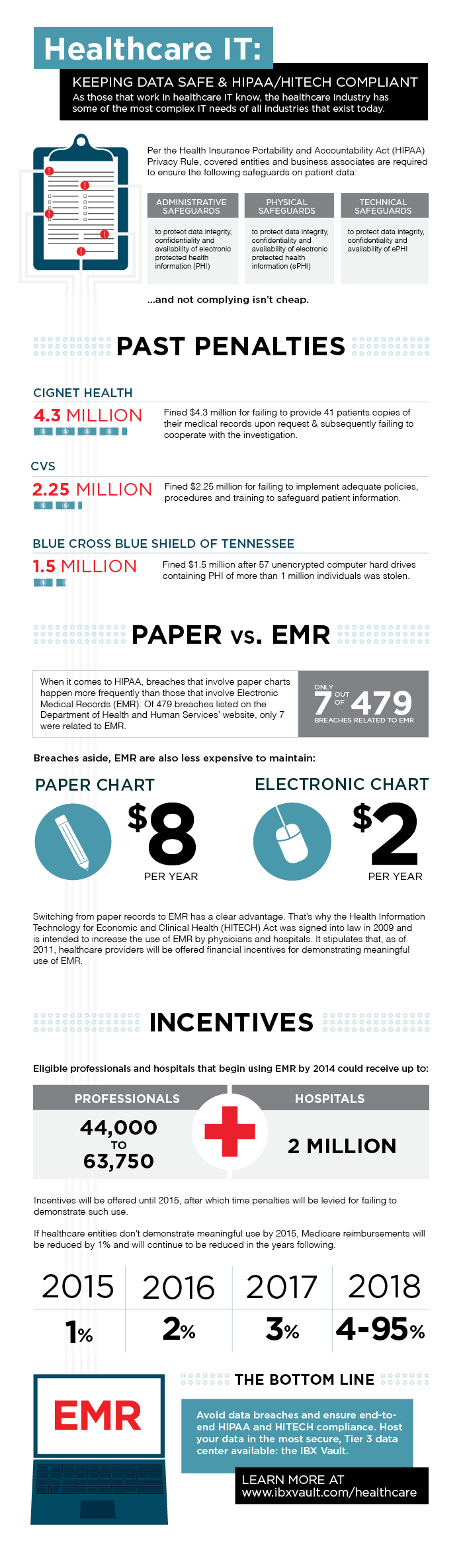
Paper medical records continue to be a serious waste and posses potential HIPAA violations as paper charts are vulnerable to being lost, stolen, or destroyed.

According to some reports, managing paper charts, from transcriptions to labor needed to pull and re-file charts, costs medical practices $116,375 a year on average.

Taking a Look

The waste & dangers of paper medical records infographic shown below created by IBX Vault takes deep look into the administrative, physical, and technical safeguards required by covered entities and business associates per the HIPAA privacy rule to secure patient data. The visualization also compares the potential security risks of paper medical records vs. EMRs stating that only 7 out of 479 breaches were related to EMRs.

[See also: The High Cost of HIPAA Violations Infographic]

Privacy and Treatments

While it is important to note that the adoption of EMRs present some security risks of its own as many critics have cited potential privacy concerns that may lead to expensive medical treatments.

Assessment

Additionally, it is imperative to note the tremendous financial harm that implementing an EMR does to a hospital’s bottom-line.

Conclusion

Your thoughts and comments on this ME-P are appreciated. Feel free to review our top-left column, and top-right sidebar materials, links, URLs and related websites, too. Then, subscribe to the ME-P. It is fast, free and secure.

Speaker: If you need a moderator or speaker for an upcoming event, Dr. David E. Marcinko; MBA – Publisher-in-Chief of the Medical Executive-Post – is available for seminar or speaking engagements. Contact: MarcinkoAdvisors@msn.com

OUR OTHER PRINT BOOKS AND RELATED INFORMATION SOURCES:

Product Details

The Build or Buy HIT Decision

Join Our Mailing List

Best of Both Worlds for Healthcare IT Systems?

By Brent Metfessel MD

An important consideration when looking at the development of new technological functionality is whether to obtain an HIT system from an outside vendor or build the system using primarily internal staff.

Three Parameters

Basically, such a build or buy decision depends on the following aspects:

  • availability of internal resources to hire the highly skilled staff needed to create a new system;
  • availability of vendors with proven expertise in the area of technology relevant to the new project; and
  • flexibility of the vendors to customize their products for hospitals with unique needs.

The temptation to use consultants rather than FTEs to develop and implement the new system needs exploring.

Both Sides and the Consultants

On the positive side, finding consultants that have highly specialized expertise relevant to the project is often less difficult than finding such expertise in people willing to come on board as FTEs.  Such expertise in clinical informatics may be critical to the success of the project.

On the negative side, the cash outlay for multiple consultants can be staggering, especially if multiple consultants come on board with long-term contracts and retainers. Specialized consultants may charge up to $150 to $200 dollars per hour, quickly draining the most robust of IT budgets. Consultants should be used for just that — consulting. They exist on the project for their expertise and transfer of knowledge to the rest of the staff. To use consultants to do the hands-on tasks of actually building the system is generally not an optimal use of the consultant’s time.

Consultants, if used at all, should typically be used on a temporary basis to share their expertise and advice during critical parts of the project.

Buy Off the Shelf

Overall, buying an application off the shelf may be favored for more sophisticated applications. For example, computerized order entry [CPOE] and EMR systems have a number of dedicated vendors that are vying to achieve market share.

For major projects, distributing request for information (RFI) packages to selected vendors enables senior management to critically evaluate the different vendors in parallel, in the end selecting finalists and ultimately the vendor of choice. A critical requirement when evaluating vendors is a strong client reference base. The best predictor of future success is past success, and thus multiple existing satisfied clients are essential for the chosen vendor. Larger academic or tertiary care systems, however, tend to have more access to expertise and more significant customization requirements. Consequently, building a home-grown system rather than outsourcing the work to a vendor may be the best strategy for such institutions.

Vendors

When working with vendors, one should be strategic in price negotiations. One suggestion is to link part of the vendor compensation to the success of the implementation. This puts the vendor partially “at risk” for project success and thus provides additional incentive for vendor cooperation. Additionally, one should not purchase a system or services from the initial bid. It is critical that more than one vendor bids for the project to provide a pricing and negotiation advantage.

There is nothing that states only one vendor can be chosen for a project. Although obtaining everything from one vendor can lead to a more seamless integration and prevent the juggling of multiple vendor relationships, using more than one vendor may in some cases lead to a higher quality end product. This is known as the “best of breed” approach and is a viable option, in particular for complex projects where a single vendor does not adequately meet user needs.

Assessment

For more basic administrative systems, there are also off-the-shelf products from vendors that may be applicable. Where there is less need for customization, a single vendor may work out very well. Where there are significant unique needs that require customization, once again it may be best to develop the system internally or outsource the work to multiple vendors.

There is also the issue of small or rural hospitals that have limited resources. For such institutions, investments in more complex information systems may be difficult. Consequently, many vendors offer “stripped down” versions of their systems at a more affordable price, specifically tailored to the small hospital. The ability to customize the system for unique needs, however, is significantly more limited.

More info: http://www.hitconsultant.net/2012/10/01/healthcare-it-systems-buy-vs-build-or-best-of-both

Conclusion

Your thoughts and comments on this ME-P are appreciated. Feel free to review our top-left column, and top-right sidebar materials, links, URLs and related websites, too. Then, subscribe to the ME-P. It is fast, free and secure.

Speaker: If you need a moderator or speaker for an upcoming event, Dr. David E. Marcinko; MBA – Publisher-in-Chief of the Medical Executive-Post – is available for seminar or speaking engagements. Contact: MarcinkoAdvisors@msn.com

OUR OTHER PRINT BOOKS AND RELATED INFORMATION SOURCES:

Our Newest Textbook Release

Buy from Amazon

Learn How to Profit and Thrive in the PP-ACA Era

BOOK FOREWORD / TESTIMONIAL


Cardiac Director Needed in Philadelphia

Join Our Mailing List

Cardiac Center Service Line

By Megan Morris
Sr. Recruiter
The Children’s Hospital of Philadelphia

Dr. Marcinko,

The Children’s Hospital of Philadelphia is currently putting out a call for applicants for a vacant Director role with oversight of the Cardiac Center Service Line. Based on your experience in the field, I’m reaching out to you for referrals and networking suggestions to ensure that qualified candidates are given every opportunity to apply.

CHOP

The Cardiac Center at The Children’s Hospital of Philadelphia is one of the largest cardiac programs in North America with over 1,700 inpatient admissions and 22,000 outpatient visits representing $350 million in hospital gross revenue.

The Director, Cardiac Service Line will work in partnership with physician leadership, physician practice leadership, and nursing leadership to support and lead the Cardiac service line. The Director, Cardiac Center is accountable for strategic and operational planning, business development, program development, financial management, project implementation, common administrative functions and allied health operations, as appropriate.

Candidates

Ideal candidates will have a Master’s Degree in Business Administration or a related degree; though skilled Bachelor’s level applicants will be considered. The role requires a minimum of 7 years of health care management, preferably in an academic setting.

Assessment

If you know of anyone who may be a strong fit for the role, please feel free to connect them with me directly.

Thank you in advance for your help.

MorrisM@email.chop.edu
Megan (LaFleur) Morris : LinkedIn 

Conclusion

Your thoughts and comments on this ME-P are appreciated. Feel free to review our top-left column, and top-right sidebar materials, links, URLs and related websites, too. Then, subscribe to the ME-P. It is fast, free and secure.

Link: http://feeds.feedburner.com/HealthcareFinancialsthePostForcxos

Speaker: If you need a moderator or speaker for an upcoming event, Dr. David E. Marcinko; MBA – Publisher-in-Chief of the Medical Executive-Post – is available for seminar or speaking engagements. Contact: MarcinkoAdvisors@msn.com

Our Other Print Books and Related Information Sources:

Health Dictionary Series: http://www.springerpub.com/Search/marcinko

Practice Management: http://www.springerpub.com/product/9780826105752

Physician Financial Planning: http://www.jbpub.com/catalog/0763745790

Medical Risk Management: http://www.jbpub.com/catalog/9780763733421

Hospitals: http://www.crcpress.com/product/isbn/9781439879900

Physician Advisors: www.CertifiedMedicalPlanner.org

       Our Newest Textbook Release

Buy from Amazon

Learn How to Profit and Thrive in the PP-ACA Era

BOOK FOREWORD / TESTIMONIAL

Understanding Variations in the Cost of Living

Join Our Mailing List

Understanding the C-O-L

Conclusion

Your thoughts and comments on this ME-P are appreciated. Feel free to review our top-left column, and top-right sidebar materials, links, URLs and related websites, too. Then, subscribe to the ME-P. It is fast, free and secure.

Link: http://feeds.feedburner.com/HealthcareFinancialsthePostForcxos

Speaker: If you need a moderator or speaker for an upcoming event, Dr. David E. Marcinko; MBA – Publisher-in-Chief of the Medical Executive-Post – is available for seminar or speaking engagements. Contact: MarcinkoAdvisors@msn.com

Our Other Print Books and Related Information Sources:

Health Dictionary Series: http://www.springerpub.com/Search/marcinko

Practice Management: http://www.springerpub.com/product/9780826105752

Physician Financial Planning: http://www.jbpub.com/catalog/0763745790

Medical Risk Management: http://www.jbpub.com/catalog/9780763733421

Hospitals: http://www.crcpress.com/product/isbn/9781439879900

Physician Advisors: www.CertifiedMedicalPlanner.org

Product Details  Product Details

Update on Tax Inflation Adjustments in 2013

Join Our Mailing List

Tax Bracket Changes Alert

By Children’s Home Society of Florida Foundation

Each year the IRS publishes multiple changes in various tax brackets and amounts that are increased to reflect the rate of inflation. In Rev. Proc. 2012-41; 2012-45 IRB 1 (18 Oct 2012), the IRS released the inflation-adjusted items for 2013.

There were moderate changes in many items. The following includes some of the more significant income tax adjustments:

1. Kiddie Tax – The exclusion for the Kiddie Tax for 2013 is increased to $1,000. For most children, net unearned income in excess of double the exclusion is taxed at the parent’s rate.

2. Savings Bonds for Higher Education – The phase-out for taxpayers receiving income from United States savings bonds used to pay for qualified higher education expenses will start at $112,050 for joint returns and $74,700 for other returns.

3. Medical Savings Accounts – For self-only coverage, the deductible may range from $2,150 to $3,200 and out-of-pocket expenses may not exceed $4,300. For family coverage, the deductible range is $4,300 to $6,450 and the expense limit is $7,850.

4. Token Benefits for Charitable Gifts – A low-cost item is defined as one that has a value of $10.20 or less. It should include the logo, colors or other identification of the charitable organization. Donors who make gifts in excess of $51 may receive a low-cost item and still qualify for a full deduction. A charity may give an insubstantial benefit to a donor provided that the benefit does not exceed 2% of the value of the gift or a maximum of $102.

Gift and Estate Taxes

There are also several provisions that affect gift and estate taxes:

1. Special Use Valuation – Under Sec. 2032A the qualified property may be reduced in value by up to $1,070,000.

2. Annual Exclusion – The present interest annual exclusion is increased to $14,000 in 2013.

3. Gifts to Non-Citizen Spouse – The applicable limit is $143,000.

4. Reduced Interest on Estate Tax – The installment estate tax “2% portion” for Sec. 6166 is $1,430,000.

Conclusion

Your thoughts and comments on this ME-P are appreciated. Feel free to review our top-left column, and top-right sidebar materials, links, URLs and related websites, too. Then, subscribe to the ME-P. It is fast, free and secure.

Link: http://feeds.feedburner.com/HealthcareFinancialsthePostForcxos

Speaker: If you need a moderator or speaker for an upcoming event, Dr. David E. Marcinko; MBA – Publisher-in-Chief of the Medical Executive-Post – is available for seminar or speaking engagements. Contact: MarcinkoAdvisors@msn.com

OUR OTHER PRINT BOOKS AND RELATED INFORMATION SOURCES:

DICTIONARIES: http://www.springerpub.com/Search/marcinko
PHYSICIANS: www.MedicalBusinessAdvisors.com
PRACTICES: www.BusinessofMedicalPractice.com
HOSPITALS: http://www.crcpress.com/product/isbn/9781466558731
CLINICS: http://www.crcpress.com/product/isbn/9781439879900
BLOG: www.MedicalExecutivePost.com
FINANCE: Financial Planning for Physicians and Advisors
INSURANCE: Risk Management and Insurance Strategies for Physicians and Advisors

Product Details  Product Details


The Rapid Rise of Mobile Health Management Tools

Join Our Mailing List

Chronicling the rapid rise of mobile health management tools

By Staff Reporters

According to UK-based Juniper Research, the number of downloads for health-related apps in 2012 will total 44 million by the end of next year. The research firm also predicts that the number of health app downloads will jump to 142 million by 2016.

m-Health

This infographic created by Allied Health World highlights the rapid rise of mobile health management tools available to the consumer on their smart-phones.

Assessment

It identifies the following three major benefits of m-Health apps:

  • 2x Greater Access to Care
  • 24% Reduction in Lower Admin Costs
  • 25% Savings for Seniors

Conclusion

Your thoughts and comments on this ME-P are appreciated. Feel free to review our top-left column, and top-right sidebar materials, links, URLs and related websites, too. Then, subscribe to the ME-P. It is fast, free and secure.

Link: http://feeds.feedburner.com/HealthcareFinancialsthePostForcxos

Speaker: If you need a moderator or speaker for an upcoming event, Dr. David E. Marcinko; MBA – Publisher-in-Chief of the Medical Executive-Post – is available for seminar or speaking engagements. Contact: MarcinkoAdvisors@msn.com

Our Other Print Books and Related Information Sources:

Health Dictionary Series: http://www.springerpub.com/Search/marcinko

Practice Management: http://www.springerpub.com/product/9780826105752

Physician Financial Planning: http://www.jbpub.com/catalog/0763745790

Medical Risk Management: http://www.jbpub.com/catalog/9780763733421

Hospitals: http://www.crcpress.com/product/isbn/9781439879900

Physician Advisors: www.CertifiedMedicalPlanner.org

Product DetailsProduct DetailsProduct Details

Vote on Election Day 2012

Join Our Mailing List

The ME-P … Endorses?

Dr. David Edward Marcinko MBA

[Publisher-in-Chief]

President Barack Obama and GOP nominee Mitt Romney are essentially neck-and-neck in the homestretch to the presidential election today with considerable healthcare, economic, tax and financial consequences at stake. All are integral topics of this electronic ME-P publication.

And so, although your publisher, editors and staff seek to remain fair, neutral and balanced on the presidential election, we encourage all Medical Executive-Post readers, subscribers and visitors to vote today.

### 

Exercise your franchise or loose it!


Election Day 2012

On the Decline of US Economic Freedom

Join Our Mailing List

A Remarkable Plunge in Economic Freedom

By Rick Kahler MS CFP® ChFC CCIM www.KahlerFinancial.com

The United States has experienced a “remarkable plunge in economic freedom” over the past ten years. This is the conclusion of the 2012 Economic Freedom of the World Annual Report, by Gwartney, Lawson, and Hall.

The GLH Report

The report measures the degree to which a country supports the cornerstones of economic freedom, defined as personal choice, voluntary exchange, freedom to compete, and the security of privately owned property. It surveys forty-two variables used to construct an index that measures 144 countries in five areas of economic freedom: the size of government, property rights, sound money, freedom to trade, and regulation.

Historical Review

For 20 years, from 1980 to 2000, the U.S. usually ranked as the third freest economy in the world behind Hong Kong and Singapore. By 2005 the U.S. fell to eighth, and by 2010 it was ranked 18th. In addition to Hong Kong and Singapore, the US is now less economically free than New Zealand, Switzerland, Australia, Canada, Bahrain, Mauritius, Finland, Chile, UAE, Ireland, United Kingdom, Estonia, Taiwan, Denmark, and Qatar. Right on our heels within .08 of a point are Kuwait, Cyprus, Japan, Oman, Jordan, and Peru.

Size of Government 

The size of government measures the degree to which a country relies on personal choice and free markets rather than government control of markets and politics. Countries with low levels of government spending, a smaller government sector, and lower tax rates did best in this measure. The U.S. ranks 78th in this category and has seen the size of its government and control over markets significantly expand in the past 10 years.

The security of property rights and a legal system that protects them is the foundation of economic freedom and free markets. If businesses and individuals don’t have confidence that contracts will be enforced and their investments protected, it sabotages their incentive to produce. And production is at the heart of any strong economy. The U.S. ranks 28th among nations in property rights and a strong legal system. This decline is one of the more surprising to me.

Reasons for Low US Ratings

The report suggests several reasons for the low rating. One is the U.S. expansion of eminent domain powers that now allows cities to condemn private property for resale to private developers, something that was once unthinkable. Another example is the violation of the property rights of bondholders in the government bailout of GM. Finally, the ramifications of the wars on drugs and terrorism, with laws allowing the government to invade and seize property, have contributed to the sharp decline of property rights.

Sound money is the oil that keeps an economy running. While sovereign governments cannot involuntarily go bankrupt because they can create money, they are constrained by inflation. To earn a high rating in this category a country must have a low and stable rate of inflation. This is where the US scored highest, ranking seventh.

Most Free Countries

The countries with the most freedom to trade internationally have low tariffs, easy clearance and efficient administration of customs, and few controls on the movement of capital. The US ranks 57th in free trade!

Finally, a free economy avoids regulations that restrict entry into markets and restrict exchange. It allows markets to determine prices and avoids regulations that increase costs and restrict people’s ability to get into business. Here, the U.S. ranks 31st.

Report Executive Summary

Link: http://www.cato.org/pubs/efw/efw2012/efw-2012-executive-summary.pdf

Assessment

Clearly, there can be no doubt that the U.S. is in economic decline. The economic freedoms we once took for granted are slowly slipping away. Only time will tell if we will rally and turn back toward the economic principles that once made American the envy of the world, or whether we will continue our slow fall to mediocrity.

Conclusion

Your thoughts and comments on this ME-P are appreciated. Feel free to review our top-left column, and top-right sidebar materials, links, URLs and related websites, too. Then, subscribe to the ME-P. It is fast, free and secure.

Speaker: If you need a moderator or speaker for an upcoming event, Dr. David E. Marcinko; MBA – Publisher-in-Chief of the Medical Executive-Post – is available for seminar or speaking engagements. Contact: MarcinkoAdvisors@msn.com

OUR OTHER PRINT BOOKS AND RELATED INFORMATION SOURCES:

Product Details

Request to Become an ME-P Contributor

Join Our Mailing List

By Ann Miller RN MHA

[Executive-Director]

MarcinkoAdvisors@msn.com

###

We are always looking to add new expert contributors and topics to the ME-P. If you are a financial advisor, healthcare consultant or medical professional that would like to become a contributor, please contact us and let us know what topics you would like to write on – and any prior experience you may have in journalism before other professionals. Informed opinions and comments are welcomed, too! We will be in touch with you shortly about your inquiry.

Thank you, in advance, for your interest in working with us!

###

Our Newest Textbook Release

Buy from Amazon

Learn How to Profit and Thrive in the PP-ACA Era

BOOK FOREWORD / TESTIMONIAL

Social Media for Accountants

Join Our Mailing List

A Brief Audio Teaser

By @PhilBumann – #AcctgChat

Accountants are an important part of healthcare organizations and economies. Whether they work in private practice, corporate enterprise or government, accounts do have vital perspectives and understandings of the language of business.

The Accounting profession has been slow to adopt social and other digital software, but there are value propositions that these financial professionals ought to consider.

This SoundCloud is a brief tease of why accountants should intelligently consider the use of social media to further their professional development, find and strengthen connections, and even market (in a human way) their services.

Assessment

Not the sexiest topic, but even accountants can get something out of social media. The hashtag that has been around for years is #AcctgChat. Tell your accountant friends.

Link:  http://soundcloud.com/philbaumann/social-media-for-accountants

Conclusion

Your thoughts and comments on this ME-P are appreciated. Feel free to review our top-left column, and top-right sidebar materials, links, URLs and related websites, too. Then, subscribe to the ME-P. It is fast, free and secure.

Speaker: If you need a moderator or speaker for an upcoming event, Dr. David E. Marcinko; MBA – Publisher-in-Chief of the Medical Executive-Post – is available for seminar or speaking engagements. Contact: MarcinkoAdvisors@msn.com

OUR OTHER PRINT BOOKS AND RELATED INFORMATION SOURCES:

Product DetailsProduct DetailsProduct Details

Product Details  Product Details

Product Details

Events Planner: November 2012

ADVERTISEMENT

Events-Planner: NOVEMBER 2012

By Staff Writers

“Keeping track of important health economics and financial industry meetings, conferences and summits”

Welcome to this issue of the Medical Executive-Post and our Events-Planner. It contains the latest information on conferences, news, and relevant resources in healthcare finance, economics, research and development, business management, pharmaceutical pricing, and physician/entity reimbursement!  Watch for a new Events-Planner each month.

First, a little about us! The Medical Executive-Post is still a relative newcomer. But today, we have almost 175,000 visitors and readers each month from all over the country, in addition to our growing subscriber base. We have been a successful collaborative effort, thanks to your contributions.  As a result, we are adding new resources daily. And, we hope the website continues to provide the best place to go for journals, books, conferences, educational resources, tools, and other things you need to establish the value your healthcare consulting and financial advisory intervention.

So, enjoy the Medical Executive-Post and this monthly Events-Planner with our compliments.

A Look Ahead this Month – And now, the important dates:

  • November 01-03: National Seminar on Palliative Care. Miami, FLA
  • November 08-08: IOnstitute for Healthcare Improvement. Washington, DC

MarcinkoAdvisors@msn.com

Speaker: If you need a moderator or speaker for an upcoming event, Dr. David E. Marcinko; MBA – Publisher-in-Chief of the Executive-Post – is available for seminar or speaking engagements. Contact: MarcinkoAdvisors@msn.com

Subscribe Now: Did you like this Medical Executive-Post, or find it helpful, interesting and informative? Want to get the latest E-Ps delivered to your email box each morning? Just subscribe using the link below. It’s free. You can unsubscribe at any time. Security is assured.

Link: http://feeds.feedburner.com/HealthcareFinancialsthePostForcxos

Our Newest Textbook Release

Buy from Amazon

Learn How to Profit and Thrive in the PP-ACA Era

BOOK FOREWORD / TESTIMONIAL

IRS Cracking Down on Tax Identity Fraud

Join Our Mailing List

About Stolen Identity Refund Fraud [SIRF]

[By Children’s Home Society of Florida Foundation]

The IRS, the Justice Department and Congress all recognize that stolen identity refund fraud (SIRF) is a major and growing problem. With the increase in electronic filing, individuals are obtaining the Social Security numbers and names of other persons and filing to claim their tax refunds. The Justice Department estimates that there could be up to $26 billion in fraudulent refunds over the next five years.

Assistant Attorney General Kathryn Keneally of the Tax Division of the Justice Department conducted a briefing on September 27 in Washington. She acknowledged, “The stolen identity refund fraud cases present a different kind of crime than we usually see.” Keneally continued and explained the depth of the problem. Treasury officials understand that greater efforts are needed by the IRS, Department of Justice and U.S. Attorney’s Office to confront the problem.

How Identity Thieves Work

How do most identity thieves operate? The essential information for an identity thief is a name and a Social Security number. There are at least three ways that identity thieves are collecting this information and receiving tax refunds.

  1. First, some have persuaded a postal employee to intercept multiple refunds to an address.
  2. A second strategy might involve the use of a doorman to direct refund checks to the identity thief.
  3. Third, bank tellers have been bribed to collect the personal information necessary for the identity thief to file and obtain a fraudulent refund.

Geographic Dispersion

Two areas of the country are particularly affected. Southern District of Florida U.S. Attorney Wilfredo Ferrer acknowledged the problem there. He stated, “This is the fastest growing and most insidious fraud in this district right now. It’s sort of like the crime du jour.” He is regularly finding victims “from all walks of life” who had their identities stolen so the thief could collect a “bogus tax refund.” Ferrer disclosed that there are even victims who work in the office of the U.S. Attorney.

Another area with a significant problem is the Southern District of New York. Deputy U.S. Attorney Richard Zabel pointed out that many New York thieves are involved in tax fraud. He stated, “It’s like Willy Sutton – Why do you rob banks? Because … that’s where the money is!

Well, if you’re doing identity theft, the big money is in the Federal Government’s bank account.”

e-Filing Challenges

The IRS recognizes the challenge with eFiling. On the one hand, the IRS has greatly improved the speed of refunds for lawful taxpayers who eFile. In addition, the eFiling of tens of millions of tax returns saves a huge amount of time and cost for the government in processing tax returns.

However, the challenge with eFiling is that the thieves are able to obtain information and file before the legitimate taxpayer. By the time the actual taxpayer files, the thief has received the refund. In some cases, thieves have promptly transferred the funds outside of the United States.

Large Scale Networks

Some thieves are operating on a fairly large scale. Attorney Zabel referred to one case in New York in 2009. Two individuals filed 7,000 false returns and requested a total of $72 million in refunds. Because the refunds were sent to the same address, the fraud was discovered.

Congressional Legislation

Congress has several bills under consideration that would address the problem. Keneally noted that there are also several regional tax task forces that are moving forward to find and prosecute identity thieves. The Department of Treasury, Department of Justice and the U.S. Attorney’s offices are all cooperating.

Assessment

In addition, the IRS is updating its computer software. If there are multiple refunds to one address or indications that the refund may not be appropriate, the software will “flag” the return for greater review.

Conclusion

Your thoughts and comments on this ME-P are appreciated. Feel free to review our top-left column, and top-right sidebar materials, links, URLs and related websites, too. Then, subscribe to the ME-P. It is fast, free and secure.

Link: http://feeds.feedburner.com/HealthcareFinancialsthePostForcxos

Speaker: If you need a moderator or speaker for an upcoming event, Dr. David E. Marcinko; MBA – Publisher-in-Chief of the Medical Executive-Post – is available for seminar or speaking engagements. Contact: MarcinkoAdvisors@msn.com

OUR OTHER PRINT BOOKS AND RELATED INFORMATION SOURCES:

DICTIONARIES: http://www.springerpub.com/Search/marcinko
PHYSICIANS: www.MedicalBusinessAdvisors.com
PRACTICES: www.BusinessofMedicalPractice.com
HOSPITALS: http://www.crcpress.com/product/isbn/9781466558731
CLINICS: http://www.crcpress.com/product/isbn/9781439879900
BLOG: www.MedicalExecutivePost.com
FINANCE: Financial Planning for Physicians and Advisors
INSURANCE: Risk Management and Insurance Strategies for Physicians and Advisors

 Our Newest Textbook Release

Buy from Amazon

Learn How to Profit and Thrive in the PP-ACA Era

BOOK FOREWORD / TESTIMONIAL

Why You Can’t Afford Poor Health Habits

Join Our Mailing List

By Rick Kahler MS CFP® ChFC CCIM www.KahlerFinancial.com

Does about $40 a month for a fitness center membership seem beyond your budget? Do you cringe at the cost of fresh fruits and vegetables? Is your wallet too lean to let you buy lean protein? And the cost of a medical checkup is something you don’t even want to think about.

At first glance, the cost of staying healthy might seem way too high. Certainly, maintaining good health comes at a cost. Yet in the long run, maintaining poor health will cost far more.

Good Health Finances

Let’s look at some of the ways it pays financially to take care of your health.

1. Exercise. Before you decide you can’t afford a $40 gym membership, consider this: What do you do with the time you don’t spend exercising? Shop? Watch movies? If you’re like most people, you spend some of that time spending money. Maybe even enough money to cover the gym membership. There are also plenty of free ways to exercise, like running, biking, or walking. In Rapid City, all our hills provide a great workout at no extra charge.

2. Diet. Eating a healthy diet doesn’t have to mean adding expensive organic produce to your grocery bill. You can buy plenty of real food that’s canned or frozen. At the same time, subtract highly processed foods and junk. You may even end up saving money. You’ll save even more if you eliminate health-destroying habits like smoking or excessive drinking. This is a two-for-one: you improve your health and save money at the same time.

3. Preventive checkups. Check your insurance coverage. Under current health care laws, some preventive care is fully covered. And if you think a routine visit to the dentist is too expensive, check out the cost of a root canal or getting a tooth pulled.

Every penny you may save by not exercising or eating right, you’ll eventually spend in additional medications, doctor visits, medical co-pays, medical equipment, transportation, and housing costs.

Poor Health Finances

Poor health will directly affect your health insurance premiums. It will indirectly raise your taxes. Even if you’re healthy, you’ll help pay for those with poor health through Medicaid and Medicare taxes.

Probably the greatest cost of poor health, however, is one most of us never consider. This is the decrease in one’s earning power. For most people, their greatest asset is their capacity to earn. Poor health may hold people back from reaching their potential, or even make them unable to continue to earn any income. A survey of pre-retirees found that 80% of them planned on working after 65. Yet only 19% of people over 65 are actually working. Why? Over 40% are unable to work because of poor health.

Poor Health Financial advantages

There is one financial advantage to poor health: it reduces your life expectancy so you run less risk of outliving your money. However, don’t think that dying younger means you can live more lavishly. A recent study shows the number of unhealthy years—with their related health-care costs—are the same regardless of life expectancy.

Assessment

There are many ways to define wellness, most of which include a combination of financial, emotional, and physical health. If a person isn’t healthy, money alone isn’t of much value. But take money out of the picture, and good health is almost impossible to sustain. Our health and our money have a direct impact on each other.

Since good health is such a vital asset, it makes sense to use some of your financial resources to support it. Part of good financial planning and money management is doing what you can to stay healthy enough to enjoy your financial independence.

Conclusion

Your thoughts and comments on this ME-P are appreciated. Feel free to review our top-left column, and top-right sidebar materials, links, URLs and related websites, too. Then, subscribe to the ME-P. It is fast, free and secure.

Speaker: If you need a moderator or speaker for an upcoming event, Dr. David E. Marcinko; MBA – Publisher-in-Chief of the Medical Executive-Post – is available for seminar or speaking engagements. Contact: MarcinkoAdvisors@msn.com

OUR OTHER PRINT BOOKS AND RELATED INFORMATION SOURCES:

     Our New Textbook Release

Buy from Amazon

Learn How to Profit and Thrive in the PP-ACA Era

BOOK FOREWORD / TESTIMONIAL

Helping Sandy’s Victims

Join Our Mailing List

How Readers of the ME-P Can Assist

By Ann Miller RN MHA

[Executive Director]

If you want to help those hurt by hurricane Sandy, you may donate to the American Red Cross via text message, as well as by phone or online.

AMERICAN RED CROSS

The Red Cross is providing shelter, clothes, supplies, food and blood, as needed, for the victims of Sandy. You can donate blood, but in terms of items, you’ll be doing more for those in need by donating money instead of physical goods.

Text message: Text the word REDCROSS to 90999 to donate $10 to American Red Cross Disaster Relief. As in the case with other donations via mobile, the donation will show up on your wireless bill, or be deducted from your balance if you have a prepaid phone. You need to be 18 or older, or have parental permission, to donate this way. (If you change your mind, text the word STOP to 90999).

Phone: 800-RED CROSS (1-800-733-2767); for Spanish speakers, 800-257-7575; for TDD,  800-220-4095.

To donate blood: Visit this Red Cross Web page.

Online: American Red Cross