On Medical Pricing Transparency

For Hospitals, Clinics and Physicians

[By Staff Reporters]

Join Our Mailing List

In 2007, federal and state legislatures called for hospitals across the country to make their prices “transparent.” The term was defined as the full, accurate, and timely disclosure of hospital charges to consumers of healthcare, as well as the process employed to arrive at those fees. Moreover, transparency does not merely involve publishing a list of prices and fees.  Essentially, hospital CXOs must be able to present their prices in a manner that is understandable to the general public and they must be prepared to explain the rationale behind their charges.

State Initiatives

More recently, at least 38 states have already proposed or passed legislation regarding publication of hospital charges. For example, the average cost for a hip, knee or ankle joint replacement is $38,443; while a heart valve operation is $124,561and a back fusion is $60,406.  Torrance California based HealthCare Partners now notes on its Website that it charges $15 for flu vaccines, $61 for a chest X-ray, while a colonoscopy costs $424.

Assessment

Such initiatives demonstrate increased industry competition and advancing patient empowerment with CDHPs.

Current Updates for 2010

Link: http://www.govtrack.us/congress/bill.xpd?bill=h111-2566

Conclusion

Your thoughts and comments on this ME-P are appreciated. Feel free to review our top-left column, and top-right sidebar materials, links, URLs and related websites, too. Then, subscribe to the ME-P. It is fast, free and secure.

Link: http://feeds.feedburner.com/HealthcareFinancialsthePostForcxos

Speaker: If you need a moderator or speaker for an upcoming event, Dr. David E. Marcinko; MBA – Publisher-in-Chief of the Medical Executive-Post – is available for seminar or speaking engagements. Contact: MarcinkoAdvisors@msn.com

OUR OTHER PRINT BOOKS AND RELATED INFORMATION SOURCES:

   Product Details 

Top Income Tax Rates Will Increase

So Says Speaker Nancy Pelosi

By Children’s Home Society of Florida Foundation

Join Our Mailing List

Members of both Parties joined the debate this week on income taxes. Without action by Congress, all of the tax reductions in the 2001/2003 tax acts will be phased out on January 1, 2011.

White House Steadfast

The White House has steadfastly maintained that the reductions for lower and middle-income brackets should be retained, while the reductions for the top brackets must be phased out. Under the White House proposal, individuals with incomes over $200,000 ($250,000 for married couples) would pay higher taxes. The top two brackets will increase to 36% and 39.6%. In addition, the White House proposes that the capital gains tax rate returns to 20%.

The Concerns

Senator Ben Nelson (D-NE) has expressed concern about the increase in taxes on upper income individuals. He is joined by Sen. Charles Grassley (R-IA), who has consistently supported extending all of the 2001/2003 tax brackets. Sen. Grassley suggested that it would be important to continue the tax reductions in order to encourage small business owners to hire new employees and reduce unemployment.

A Temporary Extension?

A long-term deficit hawk on the Democratic side is Senate Budget Committee Chair Kent Conrad (D-ND). He stated for the first time this week that he may be open to a temporary extension of the top brackets at the current 33% and 35% rate. Senator Conrad indicated that at some future time it will be necessary to “pivot” and move aggressively toward deficit reduction. However, he questioned whether the economy is strong enough to start the process of tax increases this year.

[picapp align=”none” wrap=”false” link=”term=income+tax&iid=76487″ src=”http://view4.picapp.com/pictures.photo/image/76487/hourglass-top-calendar/hourglass-top-calendar.jpg?size=500&imageId=76487″ width=”337″ height=”506″ /]

Assessment

House Speaker Nancy Pelosi (D-CA) joined the debate with a strong affirmation of the White House position. She stated, “Our position has been that we support middle-income tax cuts. The tax cuts at the high end have increased the deficit enormously and they have not created jobs in the eight years.”

Editor’s Note: With Congress soon turning to the fall election, it is highly probable that action on income taxes will be deferred until after the election. With bipartisan concern about unemployment and the economy, it is quite likely that the tax reductions at the lower and middle brackets will be extended. The result for upper-income individuals is still uncertain.

Conclusion

And so, your thoughts and comments on this ME-P are appreciated. Feel free to review our top-left column, and top-right sidebar materials, links, URLs and related websites, too. Then, be sure to subscribe to the ME-P. It is fast, free and secure

Speaker: If you need a moderator or speaker for an upcoming event, Dr. David E. Marcinko; MBA – Publisher-in-Chief of the Medical Executive-Post – is available for seminar or speaking engagements. Contact: MarcinkoAdvisors@msn.com

Get our Widget: Get this widget!

Our Other Print Books and Related Information Sources:

Practice Management: http://www.springerpub.com/prod.aspx?prod_id=23759

Physician Financial Planning: http://www.jbpub.com/catalog/0763745790

Medical Risk Management: http://www.jbpub.com/catalog/9780763733421

Healthcare Organizations: www.HealthcareFinancials.com

Health Administration Terms: www.HealthDictionarySeries.com

Physician Advisors: www.CertifiedMedicalPlanner.com

Subscribe Now: Did you like this Medical Executive-Post, or find it helpful, interesting and informative? Want to get the latest ME-Ps delivered to your email box each morning? Just subscribe using the link below. You can unsubscribe at any time. Security is assured.

Link: http://feeds.feedburner.com/HealthcareFinancialsthePostForcxos

Sponsors Welcomed: And, credible sponsors and like-minded advertisers are always welcomed.

Link: https://healthcarefinancials.wordpress.com/2007/11/11/advertise

A Voting Poll on eMRs as a Balance Sheet Item?

A Real or Economically Stimulated Need?

Join Our Mailing List 

Many doctors – and their CPAs – view an in office electronic medical record [eMR] system as a balance sheet item to purchase for a medical practice; much like any other piece of business equipment or medical instrumentation.

Of course, ARRA and the HITECH Acts also treat eMRs like an asset that the Federal government can motivate doctors to purchase thru their “meaningful use” economic stimulus and rebate program … sort of a social engineering fiscal health policy for medical professionals. 

And so, the question for doctors really is: do you believe in eMRs as a stand-alone item above and beyond their rebate earning capacity?

THINK “cash for clunkers”, or the first time home buyer “mortgage credit rebate program”.

In other words, sans this Federal economic rebate program externality, would you purchase an eMR system despite the HITECH Act? Will you purchase one once the rebate period has expired. Are eMRs a depreciating or appreciating asset?

Please opine with your vote!

Conclusion

And so, your thoughts and comments on this ME-P are appreciated. Feel free to review our top-left column, and top-right sidebar materials, links, URLs and related websites, too. Then, be sure to subscribe to the ME-P. It is fast, free and secure.

Speaker: If you need a moderator or speaker for an upcoming event, Dr. David E. Marcinko; MBA – Publisher-in-Chief of the Medical Executive-Post – is available for seminar or speaking engagements. Contact: MarcinkoAdvisors@msn.com

Get our Widget: Get this widget!

Our Other Print Books and Related Information Sources:

Practice Management: http://www.springerpub.com/prod.aspx?prod_id=23759

Physician Financial Planning: http://www.jbpub.com/catalog/0763745790

Medical Risk Management: http://www.jbpub.com/catalog/9780763733421

Healthcare Organizations: www.HealthcareFinancials.com

Health Administration Terms: www.HealthDictionarySeries.com

Physician Advisors: www.CertifiedMedicalPlanner.com

Subscribe Now: Did you like this Medical Executive-Post, or find it helpful, interesting and informative? Want to get the latest ME-Ps delivered to your email box each morning? Just subscribe using the link below. You can unsubscribe at any time. Security is assured.

Link: http://feeds.feedburner.com/HealthcareFinancialsthePostForcxos

Sponsors Welcomed: And, credible sponsors and like-minded advertisers are always welcomed.

Link: https://healthcarefinancials.wordpress.com/2007/11/11/advertise

Taking Medical Jargon Out of Doctors’ Visits

Explaining Healthcare Administration Terms, Too!

By Ann MiIler RN, MHA

[Executive-Director]

Join Our Mailing List

According to the Wall Street Journal, when it comes to understanding medical information, even the most sophisticated patient may not fully understand. Nearly nine out of 10 adults have difficulty following routine medical advice, largely because it’s often incomprehensible to average people, the CDC says. And that’s bad for health care.

Enter the Medical Jargon

Confused by scientific jargon, doctors’ instructions and complex medical phrases, patients are more likely to skip necessary medical tests or fail to properly take their medications, the agency says. Studies show that poor health literacy drives up costs to the health-care system and worsens patient outcomes. 

http://online.wsj.com/article/SB10001424052748703620604575349110536435630.html

Assessment

And so, we too have attempted to explain some of the healthcare administration and practice management jargon in use today

Conclusion

Your thoughts and comments on this ME-P are appreciated. Feel free to review our top-left column, and top-right sidebar materials, links, URLs and related websites, too. Then, subscribe to the ME-P. It is fast, free and secure.

Speaker: If you need a moderator or speaker for an upcoming event, Dr. David E. Marcinko; MBA – Publisher-in-Chief of the Medical Executive-Post – is available for seminar or speaking engagements. Contact: MarcinkoAdvisors@msn.com

OUR OTHER PRINT BOOKS AND RELATED INFORMATION SOURCES:

Product DetailsProduct DetailsProduct Details

 ***

Price Adjustment Medical Costing

End of Life Care Programs

By Dean G. Smith PhD and the Accounting Workgroup

Join Our Mailing List

An alternative to traditional medical resource costing is ‘price adjustment’.  In an international context, this method compares the monetary estimates of resource used, after adjustment for price level differences between countries and over time to standard current values.  In order to attempt comparisons of different cost estimates, analysts must be at least certain as to what items are included in costs and whether costs are being based on opportunity costs, charges, or average costs.

Medicare Cost-to-Charge Ratios

In the US context, the price adjustment approach underlies the use of Medicare Cost-to-Charge Ratios (CCR).  Costs are estimated using the CCR approach by multiplying the number of units of each procedure billed by its Medicare charge and CCR and then summing these costs.  Some health care organizations have begun to invest in sophisticated, computerized cost-accounting systems (CAS) that are capable of providing procedure-specific cost estimates, usually based on relative value units, but these systems often rely on billing data to obtain service units.

The Studies

A couple of studies have used a combination of CCR and CAS to estimate costs (costs to the institution – costs to Medicare are the Medicare charges). In both studies, the CAS was for hospital costs only, with Medicare reimbursement (not institution costs) being used for professional services by using relative value units and a conversion factor from the Medicare Fee Schedule.

Inaccuracy

To overcome the issues of inaccurately (or non-transparently) measuring resource units, it has become more common in clinical trials (a distinct sub-set of possible study methods) to develop case report forms to capture all study end points, including medical service use.  These studies then translate medical service use into costs using standard charges or costs, or a series of representative data sets of charges or costs, to the resource units. These methods have become so common that all submissions to the British Medical Journal are required to document methods using a 35-part form that includes items such as: part 16) Quantities of resources are reported separately from their unit costs; part 17) Methods for the estimation of quantities and unit costs are described; part 18) Currency and price data are recorded; and part 19) Details of currency of price adjustments for inflation or currency conversion are given.

Following these guidelines, a Michigan-based study is collecting data through a resource use data collection form and applying to standard costs per unit of service to produce costs for a RWJ-sponsored palliative care program.

Not the Usual Medical Care

There are a few studies on the costs and cost-effectiveness of end of life programs or the impact of serious illness on patient’s families.  Those studies that do evaluate end of life care programs are usually small in scope, compare the end of life program (e.g., as in hospice) to “usual care,” or have no comparison group, or do not evaluate the costs of the program.

Assessment

Criticisms of studies of only one medical resource/cost item often surround the total costs of care – suggesting that the use of focused studies may not be well received.  In fact, even studies that capture the total costs of medical care services are criticized for not capturing the indirect costs – family expenses on end of life care are substantial and are not factored into most cost-analysis studies. Very few studies try to capture all costs to enable adjustments of costs for selection processes that may influence resource use.

Editor’s Note: Accounting workgroup members:

1 Stephen Seninger PhD: Professor, Bureau of Business and Economic Research, University of Montana, Missoula, MT

2 Ira Byock, MD: Director, Promoting Excellence in End of Life Care, Practical Ethics Center, University of Montana, Missoula, MT

3 Carol D’Onofrio,DrPH: Research Director, Sutter Visiting Nurse Association & Hospice, Piedmont, CA

4 Jennifer Elston-Lafata PhD: Director, Center for Health Services Research, Henry Ford Health System, Detroit, MI 

5 Joe Engelhardt PhD: Research Coordinator, Life Institute VA Medical Center, Albany, NY

6 Carol A. Lockhart PhD: Project Director, Phoenix Care, Hospice of the Valley, Phoenix, AZ

7 Steven H. Miles MD: Professor of Medicine, Center for Bioethics, University of Minnesota, Minneapolis, MN

8 Herbert A. Rosefield: Corrections Care Consultant, Volunteers of America, Raleigh, NC

9 Anne M. Wilkinson PhD:Senior Health Policy Analyst, RAND, Arlington, VA

10 Barbara Volk-Craft RN, MBA  Program Manager: Phoenix Care, Hospice of the Valley, Phoenix, AZ

11 Dean G. Smith, PhD  Professor and Chair, Department of Health Management & Policy, University of Michigan, Ann Arbor, MI

Conclusion

Your thoughts and comments on this ME-P are appreciated. Feel free to review our top-left column, and top-right sidebar materials, links, URLs and related websites, too. Then, subscribe to the ME-P. It is fast, free and secure.

Speaker: If you need a moderator or speaker for an upcoming event, Dr. David E. Marcinko; MBA – Publisher-in-Chief of the Medical Executive-Post – is available for seminar or speaking engagements. Contact: MarcinkoAdvisors@msn.com

OUR OTHER PRINT BOOKS AND RELATED INFORMATION SOURCES:

Product Details

***

Do OTC DNA Tests Give Bogus Results?

Government Finds Little or No Useful Predictive Risk Information

[By Staff Reporters]

46CB1C3AA5898E7B3C85B59E571D

WASHINGTON — U.S. government investigators say personalized DNA tests that claim to predict a person’s likelihood of developing diseases are misleading and offer little or no useful information.

Link: http://www.msnbc.msn.com/id/38363300/ns/health

Assessment

The Energy and Commerce Committee recently heard testimony from the FDA and three genomic testing companies: 23andMe, Navigenics and Pathway Genomics Corp.

Government Report: Genetic tests

Conclusion

Feel free to comment on this ME-P and review our top-left column, and top-right sidebar materials, links, URLs and related websites, too. Then, be sure to subscribe to the ME-P. It is fast, free and secure.

Speaker: If you need a moderator or speaker for an upcoming event, Dr. David E. Marcinko; MBA – Publisher-in-Chief of the Medical Executive-Post – is available for seminar or speaking engagements. Contact: MarcinkoAdvisors@msn.com

Get our Widget: Get this widget!

Our Other Print Books and Related Information Sources:

Practice Management: http://www.springerpub.com/prod.aspx?prod_id=23759

Physician Financial Planning: http://www.jbpub.com/catalog/0763745790

Medical Risk Management: http://www.jbpub.com/catalog/9780763733421

Healthcare Organizations: www.HealthcareFinancials.com

Health Administration Terms: www.HealthDictionarySeries.com

Physician Advisors: www.CertifiedMedicalPlanner.com

Subscribe Now: Did you like this Medical Executive-Post, or find it helpful, interesting and informative? Want to get the latest ME-Ps delivered to your email box each morning? Just subscribe using the link below. You can unsubscribe at any time. Security is assured.

Link: http://feeds.feedburner.com/HealthcareFinancialsthePostForcxos

Sponsors Welcomed: And, credible sponsors and like-minded advertisers are always welcomed.

Link: https://healthcarefinancials.wordpress.com/2007/11/11/advertise

Product DetailsProduct DetailsProduct Details

Dr. David Blumenthal Spins “Professionalism”

My Take on “Meaningful Use”

D. Kellus Pruitt DDS

Recently, lawmakers complained that the federal criteria for “meaningful use” of eHRs – usage required before providers who risk purchasing electronic health record systems can be reimbursed – aren’t strict enough to justify the billions of dollars in incentive payments that the government promised physicians and hospitals. Matthew DoBias, writing for ModernHealthcare, quoted Rep. Wally Herger (Calif.) – the senior Republican on the Ways and Means Committee’s health subcommittee – who said:

“The new HIT regulations are a step in the right direction and should put Medicare on a path to improved quality and efficiency. However; by watering down the final regulations, we have missed an opportunity to advance healthcare delivery and ensure wise use of taxpayer money.”

http://www.modernhealthcare.com/article/20100721/NEWS/100729995/1153

Rep. Wally Herger

“Improved quality” you say, Rep. Herger? That proves that politicians like Herger will say whatever it takes to get elected, even if it’s transparently misleading. Herger’s confident claim of improved quality of care from using eHRs is typical of Washington even though quality claims are widely disputed in most medical circles. And if eHRs were as efficient as Herger and his campaign donor’s claim, then the billions of dollars in incentive payments that have already been billed to our grandchildren wouldn’t be wasted to bribe physicians to purchase eHR systems that are too lousy to move off the shelves. If HIT stakeholders’ products offered value for Americans in the land of the free, they would sell for natural reasons of consumer demand and wouldn’t require a government mandate and Herger’s deception. Besides, what does any politician know about “wise use of taxpayer money” even outside of the medical field, Mr. Herger?

[picapp align=”none” wrap=”false” link=”term=doctor+computer&iid=107036″ src=”http://view3.picapp.com/pictures.photo/image/107036/medical-professional-using/medical-professional-using.jpg?size=500&imageId=107036″ width=”337″ height=”506″ /]

The Criteria

The criteria for meaningful use have been cut down to 15 issues allegedly because demanding all 25 risked improving care and saving money far too ambitiously. Tony Trenkle, director of the Office of E-Health Standards and Services at CMS, puts his special spin to the “watering down” of requirements. He is quoted in an article by Emily Long in NextGov:

“We set the bar where we felt it was appropriate and also signaled for future stages that we would be setting the bar much higher, We’re going along with ways we can modify to reflect real-life experiences we hit once the program begins.”

Why didn’t Trenkle just say, “We at CMS are making this sucker up as we go”?

http://www.nextgov.com/nextgov/ng_20100720_9874.php?oref=topnews

Dr. David Blumenthal

Dr. David Blumenthal, the national coordinator for health IT, has given up apologizing for bankrupt ideas like the CMS’s criteria for “meaningful use” of electronic health records – as if they made sense. They don’t, and Blumenthal must know that the clicking-for-cash busywork plan he inherited is a waste of time and money. Otherwise, the AMA wouldn’t be complaining.

(See “AMA Weighs in on ‘Meaningful Use’ Requirements For E-Records” – Wall Street Journal Blog)

http://blogs.wsj.com/health/2010/07/21/ama-weighs-in-on-meaningful-use-requirements-for-e-records/  

Surely Dr. Blumenthal recognizes that naive lawmakers like Rep. Wally Herger are foolishly demanding unwanted and dangerous micromanagement of healthcare, not in the interest of patients’ welfare, but for political power. (Do Americans really want Wally Herger from California regulating healthcare?) Rather than attempting to sell systems to doctors based on disingenuous claims of unproven value, Blumenthal chose to punt. All he could offer was a lame appeal to pride: “Much more important than incentives will be a professional sense of obligation,” (Emily Long, NextGov, ibid).

The Oath

Doesn’t the Hippocratic Oath, as well as business survival trump the dangerous nonsense Dr. Blumenthal calls “professional obligations”? As if to emphasize that point, just hours ago, some relevant news was posted concerning the danger of eHRs: “A Massachusetts hospital is under scrutiny after hundreds of thousands of patient and employee records went missing earlier this year. The missing files underscore the problems health care providers face when balancing patient privacy and the need to store massive amounts of data, especially as new federal rules for electronic health records come into play.” (See “Massachusetts Hospital Reports 800,000 Personal Records Missing” by Brian T. Horowitz for eWeek, 7/21/10).

http://www.eweek.com/c/a/Health-Care-IT/Massachusetts-Hospital-Reports-800000-Personal-Records-Missing-638660/ 

Assessment

How does risking such harm to patients rise to the level of a “professional obligation”? I think Dr. Blumenthal might be confusing professionalism with patriotism. They are both traditional, flexible buzzwords that start with the letter “P” and are often used for just about any bureaucratic chore – even so far as to prove diametrically opposing views.

Conclusion

Please comment on this post and feel free to review our top-left column, and top-right sidebar materials, links, URLs and related websites, too. Then, be sure to subscribe to the ME-P. It is fast, free and secure.

Speaker: Our publisher, Dr. David E. Marcinko, is a sought after speaker in the areas of health economics, financial planning, medical practice management and related entrepreneurial e-insights for many intersecting sectors in the healthcare industrial complex. Contact the ME-P for availability and scheduling. 

Get our Widget: Get this widget!

Our Other Print Books and Related Information Sources:

Practice Management: http://www.springerpub.com/prod.aspx?prod_id=23759

Physician Financial Planning: http://www.jbpub.com/catalog/0763745790

Medical Risk Management: http://www.jbpub.com/catalog/9780763733421

Healthcare Organizations: www.HealthcareFinancials.com

Physician Advisors: www.CertifiedMedicalPlanner.com

Subscribe Now: Did you like this Medical Executive-Post, or find it helpful, interesting and informative? Want to get the latest ME-Ps delivered to your email box each morning? Just subscribe using the link below. You can unsubscribe at any time. Security is assured.

Link: http://feeds.feedburner.com/HealthcareFinancialsthePostForcxos

Sponsors Welcomed: And, credible sponsors and like-minded advertisers are always welcomed.

Link: https://healthcarefinancials.wordpress.com/2007/11/11/advertise

On the Proposed Tax Cuts

Senate Debate on Extending 2001/2003 Tax Cuts

By Children’s Home Society of Florida Foundation

Join Our Mailing List

The Senate Finance Committee conducted a hearing on July 14, 2010 to discuss the potential extension of tax cuts. In the Economic Growth and Tax Relief Reconciliation Act of 2001 (EGTRRA) and the Jobs and Growth Tax Relief Reconciliation Act of 2003 (JGTRRA), there were tax reductions for nearly all Americans. The tax reductions continue through 2010, but are set to be repealed on January 1, 2011.

Proposals

The White House has proposed to extend these tax cuts for single persons with incomes under $200,000 ($250,000 for couples), but to increase the capital gain rate and top income tax brackets. Under the White House plan, the capital gain rate will increase from 15% to 20%, the 33% bracket increases to 36% and the 35% tax bracket is raised to 39.6%.

[picapp align=”none” wrap=”false” link=”term=income+tax&iid=238905″ src=”http://view1.picapp.com/pictures.photo/image/238905/thinkstock-single-image/thinkstock-single-image.jpg?size=500&imageId=238905″ width=”337″ height=”506″ /]

The Senate

Senate Finance Chair Max Baucus (D-MT) opened the hearing by stating, “Americans are struggling to make ends meet, and we need to do all we can to put more money back in the hands of workers, middle-class families and small businesses so our economy can grow. I support extending the middle-class tax cuts permanently, as soon as possible, so working families can keep more of their hard-earned money.”

Sen. Baucus and the White House are both advocating a permanent extension of the tax cuts for low and middle-income taxpayers, with an increase in taxes for those in the upper brackets.

Ranking Member on the Senate Finance Committee Charles Grassley (R-IA) has repeatedly expressed concern about the increase of taxes on small business owners. He noted, “To those who are pushing the higher marginal rates, I say the burden is on you to show that you are not harming our primary job creators.” Sen. Grassley has noted that two-thirds of new jobs in the past decade have been created by the small business owners who will be subject to the higher taxes.

Editor’s Note: The hearings on taxes are the first step in creation of a tax bill. Because the failure to act this year would result in repeal of all of the tax cuts, it is probable that there will be a tax bill prior to the end of 2010. However, with the shortened legislative calendar due to the fall elections, the tax bill is quite likely to be deferred until after the election.

Conclusion

Douglas Holtz-Eakin is President of the American Action Forum and was formerly the Congressional Budget Office Director. He testified that approximately one-half of the $1 trillion in business income that will be reported in 2011 will be subject to the higher 36% and 39.6% tax brackets. In his opinion these higher rates will reduce the willingness of small businesses to hire new employees.

Please comment and feel free to review our top-left column, and top-right sidebar materials, links, URLs and related websites, too. Then, be sure to subscribe to the ME-P. It is fast, free and secure.

Get our Widget: Get this widget!

Our Other Print Books and Related Information Sources:

Practice Management: http://www.springerpub.com/prod.aspx?prod_id=23759

Physician Financial Planning: http://www.jbpub.com/catalog/0763745790

Medical Risk Management: http://www.jbpub.com/catalog/9780763733421

Healthcare Organizations: www.HealthcareFinancials.com

Physician Advisors: www.CertifiedMedicalPlanner.com

Subscribe Now: Did you like this Medical Executive-Post, or find it helpful, interesting and informative? Want to get the latest ME-Ps delivered to your email box each morning? Just subscribe using the link below. You can unsubscribe at any time. Security is assured.

Link: http://feeds.feedburner.com/HealthcareFinancialsthePostForcxos

Sponsors Welcomed: And, credible sponsors and like-minded advertisers are always welcomed.

Link: https://healthcarefinancials.wordpress.com/2007/11/11/advertise

Where Are We in the Life Cycle of Stock Market Emotions?

Join Our Mailing List

An Opinion Poll

[By Staff Reporters]

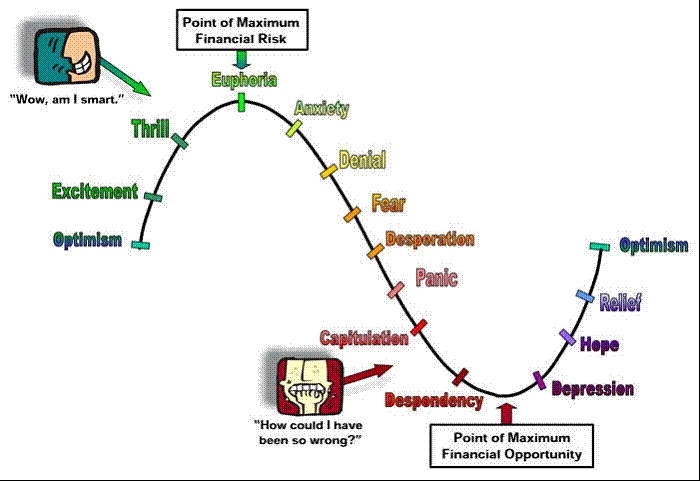
According to behavioral economists and financial advisors like Brian Knabe MD CFP™ CMP™ people feel the pain of loss twice as much as they derive pleasure from an equal gain. Studies show that humans process investment losses using the same part of the brain that responds to mortal danger.

For example, a 10% loss in the market causes twice the emotion as a 10% gain would elicit, and the short time period involved in the “flash crash” of 2008-09 compounded this effect.

And so, we ask in this ME-P poll “Where Are We in the Life Cycle of Stock Market Emotions?”

Conclusion

Your thoughts and comments on this ME-P are appreciated. Feel free to review our top-left column, and top-right sidebar materials, links, URLs and related websites, too. Then, subscribe to the ME-P. It is fast, free and secure.

Link: http://feeds.feedburner.com/HealthcareFinancialsthePostForcxos

Speaker: If you need a moderator or speaker for an upcoming event, Dr. David E. Marcinko; MBA – Publisher-in-Chief of the Medical Executive-Post – is available for seminar or speaking engagements. Contact: MarcinkoAdvisors@msn.com

OUR OTHER PRINT BOOKS AND RELATED INFORMATION SOURCES:

DICTIONARIES: http://www.springerpub.com/Search/marcinko
PHYSICIANS: www.MedicalBusinessAdvisors.com
PRACTICES: www.BusinessofMedicalPractice.com
HOSPITALS: http://www.crcpress.com/product/isbn/9781466558731
CLINICS: http://www.crcpress.com/product/isbn/9781439879900
BLOG: www.MedicalExecutivePost.com
FINANCE: Financial Planning for Physicians and Advisors
INSURANCE: Risk Management and Insurance Strategies for Physicians and Advisors

Product Details  Product Details

Physician Self-Referral “under arrangement” Scrutiny

And IDTF Prohibitions

[By Staff Reporters]

According to Robert James Cimasi MHA, ASA, AVA, CBA, CMP™ certain physician/hospital relationships referred to as “under arrangements” and “per click” leasing ventures have come under increasing regulatory scrutiny.

Definition

An under arrangement transaction occurs when the hospital contracts with a third party (typically a joint venture owned, at least in part, by physicians who may refer) to provide a hospital service, and the hospital then bills and is reimbursed by Medicare for those services and pays the supplier, or joint venture.  As the “entity” to which the physicians refer patients is the hospital, not the joint venture (i.e., the “entity” is deemed to be the entity that submits the reimbursement claim to Medicare) this type of “arrangement” is permitted under Stark.

Stark Revisions

However, buried in the July 2, 2007, 2008 Medicare Physician Fee Schedule proposed rule, CMS has proposed revisions to the Stark regulations that broaden the definition of “entity” to include the person or entity that performs the designated health services and would prohibit space and equipment lease arrangements where per-click payments are made to a physician lessor who refers patients to the lessee.  Although the proposed self-referral prohibitions (as well as arrangements where the physician is the lessee and rents space from a hospital) did not appear in the Final Rule, similar provisions are expected in 2008.

CMS has also passed restrictions related to independent diagnostic testing facility [IDTF] arrangements.

gag

Assessment

For example, since January 1, 2008, IDTFs are no longer allowed to share practice locations, operations, and diagnostic testing equipment with other Medicare-enrolled providers, including leasing and subleasing agreements.

Conclusion

Your thoughts and comments on this ME-P are appreciated. Feel free to review our top-left column, and top-right sidebar materials, links, URLs and related websites, too. Then, subscribe to the ME-P. It is fast, free and secure.

Speaker: If you need a moderator or speaker for an upcoming event, Dr. David E. Marcinko; MBA – Publisher-in-Chief of the Medical Executive-Post – is available for seminar or speaking engagements. Contact: MarcinkoAdvisors@msn.com

OUR OTHER PRINT BOOKS AND RELATED INFORMATION SOURCES:

Product DetailsProduct DetailsProduct Details      

Product DetailsProduct Details

Texas Mortgage Firm Survives and Thrives Despite Repeat Sanctions

The Allied Home Mortgage Capital Caper

By Charles Ornstein and Tracy Weber, ProPublica July 2, 12:24 a.m.

Join Our Mailing List

As his competitors imploded one by one, Jim Hodge, the folksy founder of Allied Home Mortgage Capital [1], touted his sprawling Houston firm as a survivor.

Not only was Allied still standing, Hodge told employees in a company newsletter in December, it was thriving. “The good news,” Hodge wrote, “is that even though we are all having to work harder, most branches are making lots of money.”

But an examination of Hodge’s mortgage company by ProPublica found that its prosperity has come at a price for dozens of customers who claim Allied brokers have put their homes at risk, lied to them or improperly siphoned money from their deals.

The firm has left behind a trail of alleged misconduct and piecemeal government sanctions spanning at least 18 states [2] and seven years. Yet Allied chugs along unimpeded, aided by access to the government-backed Federal Housing Administration [3] loan program.

Over the past year, the FBI and federal prosecutors have made mortgage fraud a priority, filing criminal charges across the country. Regulators, such as the U.S. Department of Housing and Urban Development [4], also say they are getting tough. But Allied’s [5] history shows how even repeat offenders can fall through gaps in the fragmented safety net meant to protect mortgage borrowers.

Now Consider

  • Allied has the highest serious delinquency rate [2] among the top 20 FHA loan originators from June 2008 through May.
  • Nine states have sanctioned the firm in the last 18 months for such violations as using unlicensed brokers and misleading a borrower.
  • Federal agencies have cited or settled with Allied or an affiliate at least six times since 2003 for overcharging clients, underpaying workers or other offenses.
  • At least five lenders have sued, claiming Allied tricked them into funding loans for unqualified buyers by falsifying documents and submitting grossly inflated appraisals, among other allegations.

“Everything is just a nightmare for me,” said Cheryl Stewart, who is suing Allied alleging that its Hammond, La., office misrepresented her income to qualify her for a loan, then deposited money from her closing into the branch manager’s bank account. Stewart said she is on the brink of losing her home as a result. Allied has successfully argued that the case should be moved out of state court and into arbitration.

Despite these repeated complaints, no single agency is investigating the sweep of the company’s actions and whether they represent a pattern or, as Hodge maintains, are to be expected for a company of Allied’s size. It bills itself as the nation’s biggest privately held mortgage broker-banker with some 200 branches.

William Black, an associate professor of economics and law at the University of Missouri-Kansas City, said Allied’s record exemplifies the failings of a regulatory system that has teeth but seldom bites.

“It’s a wonderful example of the overall crisis,” said Black, who has testified before Congress about financial fraud. “What would it take before somebody would take serious action?”

Federal housing officials would not discuss Allied’s performance or their own negative audits of the firm. But after a recent review, the FHA has recommended that the Mortgagee Review Board take action against Allied. The board can fine companies or revoke their access to the FHA market, which has caused firms to close.

Drs. Home

Secret Service Investigations

Separately, the Secret Service, which conducts criminal investigations for the Treasury Department and Federal Deposit Insurance Corp., confirmed that it is looking into allegations of fraud and wrongdoing at Allied’s now-shuttered branch in Hammond.

Although Allied is dwarfed by Wells Fargo, Bank of America, Quicken Loans and JPMorgan Chase, the nation’s largest mortgage firms, it remains a big player in FHA-insured loans.

In the last two years, Allied Home Mortgage Capital originated more FHA mortgages than all but 15 of the more than 10,000 firms that handled such loans. Since 2005, it has processed nearly 40,000 FHA loans worth nearly $5.85 billion, according to the FHA. Those loans now account for at least 70% of Allied’s business, Hodge said.

Allied differs from most other FHA players in that it is both a broker and a lender. It has an affiliated company with a nearly identical name that has been the lender on about 30% of its FHA loans in the last two years.

Since the collapse of the subprime market, the volume of FHA-insured loans has boomed, rising from about 5% of all home loans in 2007 to 20% in 2009. When these loans fail, an insurance fund supported by FHA borrowers picks up the tab.

Both as a broker and a lender, Allied’s rate of seriously delinquent loans is nearly 60% higher than the national average for the past two years. And the FHA paid out more than $500 million from 2005 to 2009 for claims on defaulted loans brokered by Allied, statistics show.

In an interview, Hodge said the delinquency rates reflect more on the lenders that funded the loans than on his brokers.

The $500 million in claims FHA paid out, he said, were covered in part by insurance premiums paid by Allied borrowers — who largely do not default. “They didn’t have a complete loss of a half a billion,” he said.

Hodge said the problems experienced at some of Allied’s branches should not tarnish his firm’s overall record. “If you look at the volume that we did or do,” he said, “it’s not significant.”

Broken Trust

Sal and Ashley DePaula said they had more reason than most people to trust their broker: The manager of Allied’s Hammond branch was a tenant in one of their rental houses.

Over the course of 2006 and 2007, Allied’s staff helped them sell that property to an acquaintance of the manager and refinance several others.

It wasn’t until months later, the DePaulas allege, that they realized they’d become pawns in a scam.

The buyer of the property the couple sold for $93,000, had actually paid $47,000 more than that, according to a lawsuit in state court by the couple and documents they provided. The cash ended up in the account of Shane Smith, the branch manager, a wire-transfer record shows.

Then, after a tornado hit one of the DePaulas’ refinanced rental homes in 2008, they learned they’d never been signed up for the insurance Allied said it had arranged — even though they’d paid for it every month. The couple said they expect to spend more than $36,000 on repairs.

“Had somebody robbed me and stole $50 out of my purse, they would be in jail,” said Ashley DePaula, who said she is “bitter” that no one has been punished.

Last year, the couple learned that Allied had put another borrower’s name on Sal DePaula’s retirement account statement and submitted it in a loan qualification packet.

That other borrower, Louisiana state criminal investigator Terry Apple, said he only realized he was part of an alleged scam when ProPublica showed him a copy of the statement.

“I’m now finding out that I’m just a small part of a very large puzzle,” Apple said.

At least four lawsuits, including one by the DePaulas, have been filed against Allied over the conduct of its Hammond branch. Other borrowers, some of whom are mentioned in legal filings, allege they, too, were defrauded but can’t afford to sue.

“You know how your body can be quivering?” said Franklin Morgan, 62, a disabled Vietnam veteran who faces losing his home. “That’s what my body’s been doing every day.”

In towering stacks of legal documents, attorneys allege that the Hammond office deceived their clients from 2005 through 2007 by misrepresenting loan terms, falsifying records, failing to pay off prior mortgages and diverting hundreds of thousands of dollars. A title lawyer who worked closely with the Allied branch also stands accused — and has been sued by Allied.

The alleged victims include friends and relatives of Allied staff and the birth mother of the assistant manager’s adopted daughter. That assistant manager’s past — including an arrest warrant for allegedly stealing $24,000 from a previous employer — has come to light.

The lawsuits are proceeding, but Ashley DePaula says Allied has offered a small settlement that has not been finalized.

In an interview, Hodge conceded that “serious fraud” had taken place at the branch, which closed in 2008. He also acknowledged personally hiring branch manager Smith even though Smith previously had lost a home to foreclosure and declared personal bankruptcy. Smith and his attorney could not be reached for comment.

Hodge said the Allied corporate office does not appear to be a target of any criminal probe.

“I don’t know all the details,” he said. “It’s a pretty bizarre situation.”

Row Homes

Customers’ Stories

Around the country, other Allied borrowers tell similar tales.

Pete Pauley, pictured with his wife Mary Ellen, sued Allied in W. Va. state court alleging that a broker misled him about a low-interest loan in 2004.

In Charleston, W.Va., businessman Pete Pauley sued Allied in state court alleging that a Weirton, W.Va., broker misled him into signing for a low-interest loan in 2004 whose rate began rapidly rising after one month.

As part of the loan approval process, the branch submitted a letter from a local accountant verifying Pauley’s ownership of his company. That accountant later testified he didn’t know Pauley or write the letter.

Pauley, who runs an oil and gas company, said the experience was humiliating. He and his wife, Mary Ellen, a nurse, learned of other complaints.

Four other couples alleged similar betrayals by another Weirton loan officer, the sister of Pauley’s broker.

Allied settled for $240,000, Pauley said. But Hodge said Allied did so only after the judge strongly encouraged it.

“We ended up buying that guy a house,” he said.

Allied also settled with the other four couples. In addition, it agreed to pay $12,000 in education and restitution costs after the West Virginia attorney general found it had misled borrowers about their loans.

Lenders, too, have felt aggrieved. AmericaHomeKey sold loans brokered by Allied to a secondary investor. After four borrowers failed to make even the first payments on their loans, the investor demanded the lender make good.

AmericaHomeKey then sued Allied in Harris County, Texas, alleging that it had misrepresented the self-employment status of three of the borrowers and failed to check out other basic facts.

“Clearly, these borrowers lacked the financial means and/or the intent to make the payments on these mortgage loans,” the lawsuit said.

Allied disputes the allegations and will defend itself “with vigor,” Hodge said.

In South Carolina, Charleston title attorney Elizabeth Stuckey Murphy testified in a deposition that she became so concerned about possible fraud at Allied’s Goose Creek branch that she complained to the FHA and law enforcement agencies in 2005.

The branch manager, Murphy claimed in a letter to authorities, had padded closing statements with invoices for contracting work by her husband that was never performed — nearly $30,000 in one case alone.

In a deposition two years later, Murphy was asked about her complaint to the FHA hotline. “To date,” she said, “I haven’t received any response.”

Frequent Troubles

Every year since 2003, Allied has landed in trouble somewhere.

It’s a streak that began with twin wallops from the U.S. Department of Housing and Urban Development totaling $420,000 in settlements — a significant sum for the agency. HUD oversees the FHA program, which insures mortgages for buyers who can’t afford big down payments.

In all, regulators and attorneys general in at least 18 states have acted against the firm or its brokers. Most of the matters have been settled without any admission of wrongdoing by Allied.

Washington state banned a former broker in Allied’s Spokane office after he was convicted of 10 felonies for stealing Allied clients’ money and laundering it. Arizona denied a broker’s license to a firm owned by Allied’s Tucson branch manager because she had previously been convicted of embezzling from a bank.

State regulators say they must limit their actions to what happens within their borders. Federal officials say they don’t generally look into state actions unless a mortgage company’s conduct may also violate federal rules.

Assessment

Although HUD and FHA have recently stepped up oversight of the mortgage industry, they have long had tools to police it. Using data collected on every loan, housing officials can statistically track whether mortgage firms are putting borrowers into FHA loans they can’t or don’t pay on. According to this data, Allied for several years has had a serious delinquency rate well above the national average. And, over the last two years at one Houston branch, some borrowers mustered only a few payments or none at all. The serious delinquency rate within one year of closing was 12%, compared with 4.2% nationwide.

Gary Lacefield, a former HUD investigator, said the numbers are an obvious red flag about Allied that regulators should have acted upon. “I see no reason,” he said, “why they shouldn’t have been hammered.”

Note: ProPublica director of research Lisa Schwartz contributed to this story. USA TODAY editors assisted in preparing it for publication.

http://www.propublica.org/article/texas-allied-home-mortgage-capital-thrives-despite-sanctions

Any ME-P medical professionals, readers, clients or FAs affected by this caper?

Channel Surfing the ME-P

Have you visited our other topic channels? Established to facilitate idea exchange and link our community together, the value of these topics is dependent upon your input. Please take a minute to visit. And, to prevent that annoying spam, we ask that you register. It is fast, free and secure.

Conclusion

Your thoughts and comments on this ME-P are appreciated. Feel free to review our top-left column, and top-right sidebar materials, links, URLs and related websites, too. Then, subscribe to the ME-P. It is fast, free and secure.

Speaker: If you need a moderator or speaker for an upcoming event, Dr. David E. Marcinko; MBA – Publisher-in-Chief of the Medical Executive-Post – is available for seminar or speaking engagements. Contact: MarcinkoAdvisors@msn.com

OUR OTHER PRINT BOOKS AND RELATED INFORMATION SOURCES:

Product Details  Product Details

Congratulations Somnath Basu PhD

ME-P Thought-Leader and 2010 USDLA Award Winner

[Excellence in Distance Learning Teaching Award]

By Ann Miller RN, MHA [Executive-Director]

Join Our Mailing List 

The United States Distance Learning Association, the nation’s premier distance learning association since 1987 recently presented its 2010 International Distance Learning Awards, the premier awards for the distance learning industry. And, ME-P thought-leader Somnath Basu PhD, MBA was a category winner. 

These prestigious awards are presented annually to organizations and individuals, and recognize four categories of excellence: 1) 21st Century Best Practice Award; 2) Best Practice Awards for Distance Learning Programming; 3) Excellence in Distance Learning Teaching Awards; and 4) Outstanding Leadership by an Individual Award.

United States Distance Learning Association

The USDLA International Distance Learning Awards are created to acknowledge major accomplishments in distance learning and to highlight those distance learning instructors, programs, and professionals who have achieved and demonstrated extraordinary achievements through the use of online, videoconferencing, and satellite/video delivery technologies globally.

The USDLA Awards

USDLA International Distance Learning Awards honors organizations with its 21 Century Best Practice Awards. This award category recognizes outstanding leadership in the field of distance learning for an agency, institution, or company incorporating blended or individual distance learning technologies.

In addition, the Awards for Best Practice in Distance Learning Programming are presented to outstanding organizations, which have designed and delivered outstanding and comprehensive Best Practices for individual programs or a series of programs through online, videoconferencing, and satellite delivery technologies.

www.CertifiedMedicalPlanner.com

Award levels include Platinum, Gold, Silver and Bronze categories. The Excellence in Distance Learning Teaching Awards  honors outstanding instructors whose programs demonstrate extraordinary achievements in a distance learning environment for teachers or trainers. Award levels include Platinum, Gold, Silver and Bronze categories.

Finally, the Outstanding Leadership by an Individual awards recognize those who have demonstrated strong, innovative skills for the development and/or administration of programs or who are recognized scholars in the field of distance learning globally.

About Dr. Basu

http://www.callutheran.edu/schools/business/graduate/cif/

Somnath Basu PhD is program director of the California Institute of Finance in the School of Business at California Lutheran University where he’s also a professor of finance. He can be reached at (805) 493 3980 or basu@callutheran.edu See his agebander at work at www.agebander.com

 Assessment

The 2010 USDLA International Distance Learning Awards were presented to five major sectors of distance education and training and include the Pre-K – 12, Higher Education, Corporate, Government and Telehealth markets. The 2010 USDLA International Awards were presented at the USDLA International Awards Ceremony, on Tuesday, May 4, 2010 during the USDLA National Conference in St. Louis, Missouri, USA.

Conclusion

Feel free to congratulate Somnath directly by sending him an email: basu@callutheran.edu

Get our Widget: Get this widget!

Our Other Print Books and Related Information Sources:

Practice Management: http://www.springerpub.com/prod.aspx?prod_id=23759

Physician Financial Planning: http://www.jbpub.com/catalog/0763745790

Medical Risk Management: http://www.jbpub.com/catalog/9780763733421

Healthcare Organizations: www.HealthcareFinancials.com

Health Administration Terms: www.HealthDictionarySeries.com

Physician Advisors: www.CertifiedMedicalPlanner.com

Subscribe Now: Did you like this Medical Executive-Post, or find it helpful, interesting and informative? Want to get the latest ME-Ps delivered to your email box each morning? Just subscribe using the link below. You can unsubscribe at any time. Security is assured.

Link: http://feeds.feedburner.com/HealthcareFinancialsthePostForcxos

Sponsors Welcomed: And, credible sponsors and like-minded advertisers are always welcomed.

Understanding HIT Security Risks – The Ugly Truth!

Join Our Mailing List

On the Privacy and Security of Healthcare Records

Dr. Mata

[By Richard J. Mata, MD, CIS]

There is no privacy …  get over it.

Scott McNealy, Former Sun Microsystems CEO

Storing and transmitting health information in electronic form exposes it to risks that do not exist, or exist to a lesser extent, when the information is maintained in paper.  For example, although both paper-based and electronic systems need protection from fire, water, and wear and tear because of aging, electronic data is also vulnerable to hardware or software malfunctions that can make data inaccessible or become corrupt, and to non-secure policies that can make data vulnerable to illegal access.  In addition, cyber-crimes, and unauthorized intrusions originating both internally and externally, are increasing dramatically every year, costing companies millions of dollars.  Nonetheless, electronic medical records (EMRs) are usually considered more secure than paper patient charts because paper records lack an audit trail, papers are easily lost, and their contents can be illegible.

Take Care the Risks

Healthcare organizations must take the new risks seriously, however, because health information is a vital business asset, and protecting it preserves the value of this asset.  In addition, securing patients’ information protects their privacy and enhances the organization’s reputation for professionalism, patient well-being, and trustworthiness.  Hospitals, emerging healthcare organizations (EHOs), physicians, and healthcare entities long ago recognized the value of health information, and implemented security policies and procedures, but as they move more into the electronic arena, it is vital to revise and update policies and procedures to acknowledge the different risks inherent in the digital age.

Three Components of Security

The three classic components of information security are confidentiality, integrity, and availability.  Donn B. Parker, a pioneer in the field of computer information protection,[1] added possession, authenticity, and utility to the original three.  These six attributes of information that need to be protected by information security measures can be defined as follows:  

  • Confidentiality: The protection and ethics of guarding personal information — for example, being cognizant of verbal communication leaks beyond conversation with associated healthcare colleagues.
  • Possession: The ownership or control of information, as distinct from confidentiality — a database of protected health information (PHI) belongs to the patients.
  • Data integrity: The process of retaining the original intention of the definition of the data by an authorized user — this is achieved by preventing accidental or deliberate but unauthorized insertion, modification or destruction of data in a database.  Make frequent backups of data to compare with other versions for changes made.
  • Authenticity: The correct attribution of origin — such as the authorship of an e-mail message or the correct description of information such as a data field that is properly named.  Authenticity may require encryption.
  • Availability: The accessibility of a system resource in a timely manner — for example, the measurement of a system’s uptime.  Is the intranet available?
  • Utility: Usefulness; fitness for a particular use — for example, if data are encrypted and the decryption key is unavailable, the breach of security is in the lack of utility of the data (they are still confidential, possessed, integral, authentic and available).

Ethics

When these attributes are considered in the healthcare context, another factor comes into play: ethics.  According to Dr. J. A. Magnuson, professor of public health informatics at Oregon Health Science University’s Medical Informatics Program, privacy,[2] security, and ethics are inextricably intertwined, and all are critical to public health’s role as a trustee of the public’s data.  As public health becomes increasingly involved in Electronic Data Interchange (EDI;[3]), the information aspects of privacy, security, and ethics become ever more critical.  All doctors take an ethical oath to protect the patient, and the obligation to uphold this oath extends to health data management, even for employees who do not take an oath.

The fields of medicine and information technology (IT) each have separate and related ethical considerations.  Ethics may prohibit technology, for example, when using a specific application that would make a security breach likely.  However, ethics may also demand technology.  Suppose that a new surveillance application would improve public health — is it not ethically imperative to utilize it to save countless lives?  But suppose it also almost guarantees a security breach — what does the ethical position on use of the application become then?  That is an extreme example, though not completely unrealistic.

FISA

Varied Uses

Complicating the picture is the fact that IT in the healthcare arena has so many and varied uses.  For instance, office-, clinic-, and hospital-based medical enterprise resource planning (ERP) is based on the same back-end functions that a company requires, including manufacturing, logistics, distribution, inventory, shipping, invoicing, and accounting.  ERP software can also aid in the control of many business activities, like sales, delivery, billing, production, inventory management, quality management, and human resources management.  However, other applications particular to the medical setting include the following:

  • The EMR, which has the potential to replace medical charts in the future, is feasible.[4]
  • Healthcare application service providers (ASPs)[5] are available via Internet portals.
  • Custom software production may produce more solution-specific applications.
  • Medical speech recognition systems and implementation are replacing dictation systems.
  • Healthcare local area networks (LANs), wide area networks (WANs), voice-over Internet protocol (IP) networks, Web and ATM file servers are ubiquitous.
  • The use of barcodes to monitor pharmaceuticals is decreasing the chance of medication errors and warns providers of potential adverse reactions.
  • Telemedicine and real-time video conferencing are already a reality.
  • Biometrics will be used more often for data access.
  • Personal digital assistant (PDA) wireless connectivity, which relies on digital or broadband technology including satellites, and radio-wave communications are increasingly common.
  • The use of wireless technology in medical devices will be increasing.

No Healthcare Standardization

All of these applications offer advantages, but the security of these IT methods and devices is not yet fully standardized or familiar to health professionals; despite the CCHIT, Office of the National Coordinator for Health Information Technology, etc.  They all involve inherent security and privacy risks, and the prudent healthcare organization will want to ensure that these risks are identified and contained.  For instance, a single firewall or intrusion detection system (IDS) may not be enough.

The process must begin by conducting a security risk assessment — that is, doing a thorough assessment of current systems and data, and performing checks such as real-time intrusion testing, validation of data audit trails, firewall testing, and remediation when gaps or failed systems are exposed.  These activities are part of developing a healthcare security plan, including disaster recovery.

Privacy Officers

To ensure that the risk assessment is thorough, hospital network administrators and Privacy Officers should have a working knowledge of federal regulations and of the following security mechanisms:

  • vulnerability assessment;
  • security policy development;
  • risk management;
  • firewall assessment;
  • security application assessment;
  • network security assessment;
  • incident response and recovery assessment;
  • authentication and authorization systems;
  • security products;
  • firewall implementation;
  • public key infrastructure (PKI) design;
  • virtual private network (VPN) design and implementation
  • intrusion detection systems;
  • penetration testing;
  • security program implementation;
  • security policy assessment; and
  • security awareness training.

The federal government has recognized the importance of health information security by establishing regulatory guidance with its Health Insurance Portability and Accountability Act of 1996 (HIPAA).

The International Standards Organization

Join Our Mailing List 

IT system managers in healthcare settings are also familiar with the comprehensive security model offered by the International Standards Organization (ISO).  For instance, using ISO’s 17799 Code of Practice for Information Security Management, versions 2000, 2005, or 2010 information security is achieved by implementing a suitable set of controls to govern policies, processes, procedures, organizational structures and software and hardware functions.  The Code requires the IT manager to establish, implement, monitor, review, and where necessary, improve these controls to ensure that the specific security and business objectives of a healthcare organization are met.

Assessment

The work of the National Institute of Science and Technology (NIST) in developing innovative technology for the healthcare sector is also of interest to IT system managers.  For instance, research on a computer note-writing system that captures clinical data automatically and a data repository system that captures patient data and integrates it with clinical decision support and knowledge bases are two of the initiatives that have originated with NIST.  In addition, the organization publishes numerous Special Publications that provide guidance on how to establish and maintain IT security.

CASE MODEL: HIT Security

Conclusion

Your thoughts and comments on this ME-P are appreciated. Feel free to review our top-left column, and top-right sidebar materials, links, URLs and related websites, too. Then, subscribe to the ME-P. It is fast, free and secure.

Speaker: If you need a moderator or speaker for an upcoming event, Dr. David E. Marcinko; MBA – Publisher-in-Chief of the Medical Executive-Post – is available for seminar or speaking engagements. Contact: MarcinkoAdvisors@msn.com

OUR OTHER PRINT BOOKS AND RELATED INFORMATION SOURCES:

References:


[1]   Donn B. Parker developed the so-called Parkerian Hexad Principles, which discuss the attributes of information security.

[2]   Privacy generally refers to a ‘people’ context, a state of being free from unauthorized intrusion or invasion.  This concept is as applicable to medical records as it is to your own house.  Confidentiality is viewed more in the context of information, usually dealing with accessing and sharing information or data.

[3]   EDI involves electronic transmission methods, often utilizing networks or the Internet.[3]  The benefits of EDI include speed, data entry savings, and reduction of manual errors; the risks are legion.

[4]   Terms used in the field include electronic medical record (EMR), electronic patient record (EPR), electronic health record (EHR), computer-based patient record (CPR), etc.  These terms can be used interchangeably or generically, but some specific differences have been identified.  For example, an EPR has been defined as encapsulating a record of care provided by a single site, in contrast to an EHR, which provides a longitudinal record of a patient’s care carried out across different institutions and sectors.  However, such differentiations are not consistently observed.

[5]   An application service provider (ASP) is a business that provides computer-based services to customers over a network.

Buy from Amazon

Drowning Out the Noise [A Career and Life Allegory]

A Man Lived by the Side of the Road
By Dr. David Edward Marcinko MBA, CMP™

The “Quiet” 

An old man lived by the side of the road and sold hot dogs. He was hard of hearing, so he had no radio. He had trouble with his eyes, so he had no newspaper.

But, he sold really – really good hot dogs. He put up a sign on the highway telling how good they were. He stood by the side of the road and cried, “Buy a hot dog, mister.” And people bought. He increased his meat and bun orders and he bought a bigger stove to take care of his trade.

The “Noise”

Soon, his son came home from college to help him. But, then something happened. His son said, “Father, haven’t you been listening to the radio? There’s a big depression on. The international situation is terrible and the domestic situation is even worse.”

Whereupon the father thought, “Well, my son has been to college. He listens to the radio and reads the papers, so he ought to know.” So, the father cut down his bun order, took down his advertising signs, and no longer bothered to stand on the highway to sell hot dogs. His hot dog sales fell almost overnight. “You were right, son,” the father said to the boy. “We are certainly in the middle of a great depression.”

-Author Unknown

Assessment

As a physician, professor or entrepreneur, how do you feel about this story? Does the managed care situation, PP-ACA and new healthcare reform focus, depress you? Do you feel alienated from your patients, profession or self?

What about you, financial advisors? Do layoffs in the industry affect your earning capacity? Or, does the market situation just hurt your self esteem? Which is worse; a real or psychologically negative impact?  What about failed mortgage derivative products, collapsed banks, and related ethical scandals? Demoralizing!

And so, are you an optimist or pessimist about life and career? Is it really “different this time?”

Conclusion

Your thoughts and comments on this ME-P are appreciated. Feel free to review our top-left column, and top-right sidebar materials, links, URLs and related websites, too. Then, subscribe to the ME-P. It is fast, free and secure.

Link: http://feeds.feedburner.com/HealthcareFinancialsthePostForcxos

Speaker: If you need a moderator or speaker for an upcoming event, Dr. David E. Marcinko; MBA – Publisher-in-Chief of the Medical Executive-Post – is available for seminar or speaking engagements. Contact: MarcinkoAdvisors@msn.com

OUR OTHER PRINT BOOKS AND RELATED INFORMATION SOURCES:

***

Product Details

Risk Management, Liability Insurance, and Asset Protection Strategies for Doctors and Advisors: Best Practices from Leading Consultants and Certified Medical Planners™

Comprehensive Financial Planning Strategies for Doctors and Advisors: Best Practices from Leading Consultants and Certified Medical Planners™

***

Invite Dr. Marcinko

***


Thomas Jefferson and ADA Sentiment

A Book Review …  and More!

By Darrell K. Pruitt; DDS

I’m currently reading “American Sphinx – The Character of Thomas Jefferson” by Joseph J. Ellis (1998). According to Ellis, Jefferson was often accused of plagiarism – sometimes even for lifting quotes from his own work. I think if the gifted writer were technically guilty of such a crime, he arguably had forgotten the origin of the “stolen” ideas – much like a composer who unwittingly copies a catchy riff from an obscure song that emerges years after being devoured.

Answering Critics 

Ellis offers this as Jefferson’s standard answer to his critics:

“’Neither aiming at originality of principle or sentiment, nor yet copied from any particular and previous writing,’ he explained, he drew his ideas from ‘the harmonizing sentiments of the day, whether expressed in letters, printed essays or in the elementary books of pubic right, as Aristotle, Cicero, Locke, Sidney, etc.’”

We are what we eat.

Not Anonymous

On my good days, I like to compare myself with great people who successfully represented others’ interests in the same spirit as Hippocrates. Like Jefferson, I concentrate sentiment, but in looser wrapped packages. Even though I also cannot always claim authorship of my ideas, like Jefferson, I’m not anonymous.

———————

Wake up, @ADANews. Did you think I was going to somehow disappear? It is probably discouraging to know that I can keep this up for years.

But I don’t think that is necessary. You will surrender soon, ADA, because you are defenseless. You’re policy of silence has you trapped.

Your bureaucracy is caving in on you. The only way out is to renew the ADA’s pledge to be transparent with members. This just has to be.

You can blame one unprofessional ADA member for your PR crisis, and I enthusiastically invite and cherish all blame as a badge of honor.

Yesterday I pointed out that my letter to the editor of the JADA that was never acknowledged suddenly became ME-P’s 8th most popular piece.

ME-P has 221,223 readers … and the JADA? My article had been dormant for months. Know what happened? I posted its link, like this:

Link: https://medicalexecutivepost.com/2009/07/28/journal-of-the-american-dental-association-letter-to-the-editor/ 

I just looked at the article’s rank it popularity. It has climbed to #3. It’s not just me. You are being voted out right now, ADA leaders.

Proots   

Join Our Mailing List

Did you know that Thomas Jefferson, the author of the Declaration of Independence, ostensibly risks being discounted in today’s history books because scientists discovered he marked out “subjects” and replaced it with “citizens” in the Declaration? That’s petty. You should see some of the nouns, adjectives and verbs I reject in early drafts – sometimes all three derivatives of the same word.

Assessment

It’s my opinion that it is Thomas Jefferson’s religious beliefs that’s keeping vocal conservative activists employed in a bad economy – not his alleged desire to be king. A few, loud, slow-thinkers also shop the lame argument that Obama isn’t a US citizen. Let’s move on, already. Regardless how one feels about the man, citizenship is simply a disingenuous dead-end argument. That’s what I think. But that’s an entirely different rant that will one day get a whole new class of disagreeable people pissed at me. Can’t wait.

Conclusion

Feel free to comment and review our top-left column, and top-right sidebar materials, links, URLs and related websites, too. Then, be sure to subscribe to the ME-P. It is fast, free and secure.

Get our Widget: Get this widget!

Our Other Print Books and Related Information Sources:

Practice Management: http://www.springerpub.com/prod.aspx?prod_id=23759

Physician Financial Planning: http://www.jbpub.com/catalog/0763745790

Medical Risk Management: http://www.jbpub.com/catalog/9780763733421

Healthcare Organizations: www.HealthcareFinancials.com

Physician Advisors: www.CertifiedMedicalPlanner.com

Subscribe Now: Did you like this Medical Executive-Post, or find it helpful, interesting and informative? Want to get the latest ME-Ps delivered to your email box each morning? Just subscribe using the link below. You can unsubscribe at any time. Security is assured.

Link: http://feeds.feedburner.com/HealthcareFinancialsthePostForcxos

Sponsors Welcomed: And, credible sponsors and like-minded advertisers are always welcomed.

Link: https://healthcarefinancials.wordpress.com/2007/11/11/advertise 

In-House Cultural Change and the Medical Quality Paradigm Shift

Leadership Concepts for Physicians and Healthcare CXOs

By Dr. David Edward Marcinko MBA

[Editor-in-Chief]

The toughest part of implementing any medical quality improvement program is changing the healthcare organization’s culture. The physician-executive or chief executive officer must be committed to change, not just give lip service to it. The core to TQM or, for that matter, any of the several new popular quality programs, like six-sigma, is the buy-in of senior management to change the culture of the practice organization to support the individual’s pursuit of quality.

Re-Frame the Situation

The cultural change requires a complete reorientation of job descriptions and duties. It requires a collaborative rather than an adversarial work force. The phrase, “it’s not my job,” cannot work in a quality healthcare environment. Medical quality programs cannot work where employees refuse to be “their brothers’ keepers.” This collaborative working system is difficult to implement, but not impossible to achieve. It involves certain basic changes to the traditional American work ethic of “rugged individualism.” It suggests that the individual employee must become a partner in the healthcare enterprise and be just as concerned about quality as the CEO. Quality really does become everybody’s business.

Assessment

Quality requires new thinking about the relationships that have traditionally existed between labor [nurses, therapists, assistants, and aides, etc] and management [physician-owner, CEO, clinic administrator, managers, etc]. It requires a new direction; a new partnership must be forged between management and the clinical floor, between management and administrative staff, and between line and staff management.

Conclusion

Your thoughts and comments on this ME-P are appreciated. Feel free to review our top-left column, and top-right sidebar materials, links, URLs and related websites, too. Then, subscribe to the ME-P. It is fast, free and secure.

Link: http://feeds.feedburner.com/HealthcareFinancialsthePostForcxos

Speaker: If you need a moderator or speaker for an upcoming event, Dr. David E. Marcinko; MBA – Publisher-in-Chief of the Medical Executive-Post – is available for seminar or speaking engagements. Contact: MarcinkoAdvisors@msn.com

OUR OTHER PRINT BOOKS AND RELATED INFORMATION SOURCES:

DICTIONARIES: http://www.springerpub.com/Search/marcinko
PHYSICIANS: www.MedicalBusinessAdvisors.com
PRACTICES: www.BusinessofMedicalPractice.com
HOSPITALS: http://www.crcpress.com/product/isbn/9781466558731
CLINICS: http://www.crcpress.com/product/isbn/9781439879900
BLOG: www.MedicalExecutivePost.com
FINANCE: Financial Planning for Physicians and Advisors
INSURANCE: Risk Management and Insurance Strategies for Physicians and Advisors

Product DetailsProduct Details

Product Details

Update on Senior Donut Hole Rebate Checks

More Seniors to Receive One-Time Donut Hole Rebate Checks

By Staff Reports

Medicare Beneficiaries Whose High Prescription Drug Costs Have Put Them in the Medicare Part D Donut Hole to Receive $250 Rebate Checks as a Result of the Affordable Care Act

WASHINGTON – The next round of more than 300,000 eligible seniors who have entered the Medicare Part D “donut hole” this year have been mailed their tax-free, one time rebate check for $250, U.S. Department of Health and Human Services Secretary Kathleen Sebelius announced recently. These one-time rebate checks are the first step in closing the prescription drug coverage gap under the Affordable Care Act. The first round of checks were distributed in the middle of June. As qualifying Medicare recipients “fall into the donut hole,” they will be sent a rebate check by Medicare.

“Seniors and other Medicare recipients in the Medicare donut hole are struggling to afford the medications they need and their basic living expenses. Seventy percent of our first round of these $250 rebate checks were cashed within a week of eligible Medicare recipients receiving them; so, we know that folks really need some help,” said Secretary Sebelius. “The Affordable Care Act starts to close the donut hole this year, giving much-needed relief to millions of seniors. In 2011, the Affordable Care Act takes an additional step for Medicare beneficiaries in the donut hole by providing them with a 50 percent discount on their brand name medications. Every year from 2012 until 2020, the Affordable Care Act will take progressive steps to close the donut hole.” 

“Seniors also need to know that they will just receive their check at their usual address – they don’t have to take any extra steps,” said Centers for Medicare & Medicaid Services Deputy Administrator and Director for the Center for Medicare, Jonathan Blum. “And they should never give out their personal information. If someone asks for your personal Medicare information over the phone who isn’t a trusted resource like Medicare, please don’t provide it. Seniors or family members should contact us at 1-800-MEDICARE to report any of these types of calls or go to www.stopmedicarefraud.gov to learn more about efforts to fight fraud and scams against seniors.”

On Thursday, July 8th, at 2:00 p.m., HHS Secretary Kathleen Sebelius joined local officials in Manchester, N.H., for a forum with senior citizens to discuss the rebate checks and other benefits of the Affordable Care Act as well as efforts to fight Medicare fraud.

The $250 checks are being mailed to those Medicare beneficiaries who entered the Medicare Part D donut hole, also known as the coverage gap, in the second quarter of 2010 and are not eligible for Medicare Extra Help (also known as the low-income subsidy or LIS) or enrolled in a qualified retiree prescription drug plan. The donut hole is the period in the prescription drug benefit in which the beneficiary pays 100 percent of the cost of their drugs until they reach the catastrophic coverage phase.

About Medicare Extra Help

Medicare Extra Help provides assistance to seniors so they don’t face higher costs or a coverage gap in their prescription drug coverage. Qualifying Medicare beneficiaries who entered the donut hole in the first quarter of 2010 who were not eligible for Medicare Extra Help received a check in the first round of rebates mailed June 10th. Going forward, a check for qualifying beneficiaries newly reaching the donut hole in 2010 will be mailed monthly.

Assessment

More information about the “donut hole” rebate checks, please contact www.HealthCare.gov or 1-800-MEDICARE. For further questions about Extra Help (or the LIS) benefit under Part D, please contact the Social Security Administration at www.ssa.gov.

Conclusion

Doctors and FAs – how will this rebate assist your patients and clients? Feel free to comment and review our top-left column, and top-right sidebar materials, links, URLs and related websites, too. Then, be sure to subscribe to the ME-P. It is fast, free and secure.

Get our Widget: Get this widget!

Our Other Print Books and Related Information Sources:

Practice Management: http://www.springerpub.com/prod.aspx?prod_id=23759

Physician Financial Planning: http://www.jbpub.com/catalog/0763745790

Medical Risk Management: http://www.jbpub.com/catalog/9780763733421

Healthcare Organizations: www.HealthcareFinancials.com

Health Administration Terms: www.HealthDictionarySeries.com

Physician Advisors: www.CertifiedMedicalPlanner.com

Subscribe Now: Did you like this Medical Executive-Post, or find it helpful, interesting and informative? Want to get the latest ME-Ps delivered to your email box each morning? Just subscribe using the link below. You can unsubscribe at any time. Security is assured.

Link: http://feeds.feedburner.com/HealthcareFinancialsthePostForcxos

Sponsors Welcomed: And, credible sponsors and like-minded advertisers are always welcomed.

Link: https://healthcarefinancials.wordpress.com/2007/11/11/advertise

Product DetailsProduct DetailsProduct Details     

Determining the Required Rate of Investment Return

Financial Fundamentals of Medical Practice Sales

Dr. David Edward Marcinko; MBA, CMP™

SPONSOR: www.CertifiedMedicalPlanner.org

A physician investor’s required rate of return [RoR], for the sale of a medical practice, takes into account that monies received sooner have a greater value than those received later. And, the greater the risk in receiving future cash flows the lower their current value. Moreover, one must always keep in mind returns that can be earned on alternative investments.  A required rate of return takes all these factors into account.

The Process

The process of selecting an appropriate required rate of return begins with an assumption that all investors will require, at a minimum, the risk-less rate of return offered by government securities. Government securities with a maturity similar to that of the duration of the investment in a private [practice] company are selected, and normally; and a duration of ten to twenty years is used. Because of the minimal default risk associated with government securities, the rate is referred to as the risk free rate. THINK: Freddie Mac and Fannie Mae.

Physician Investors

Investors typically require returns greater than the risk free rate. The additional return (in excess of the risk free rate) is called the risk premium.  Risk premiums are generally calculated through an analysis of historically realized rates of return segmented by varying levels of risk, and medical practice specialty, etc. This analysis illustrates that higher historical rates of return occur in situations of higher risk. For example, securities issued by the U.S. government have lower rates of return than securities issued by large corporations. Returns on the equity of large corporations are greater than those of debt securities issued by the same firms. Thus, historical rates of return are generally used as a proxy for future required rates of return; despite the market implosion of 2008-10 and can be adjusted for 2024.

Healthcare Business Valuation

When valuing a medical practice, clinic or healthcare business entity, one must compare the risk of the expected cash flows of the entity being valued to the risk of the cash flows of like [private] publicly traded securities and to determine an appropriate required rate of return based on that assessment.

Cash Flows

It is generally assumed that the expected cash flows from an investment in a closely held healthcare business are at least as risky as those of large publicly traded firms. The combination of the large firm equity risk premium and the risk-less rate of return provide an indication of the required rate of return for the buyer or seller. Beyond that, additional risk premiums related to entity size, proportion of debt and health industry conditions exist; and many other possible company specific risk factors may be appropriate.

Assessment

When valuing a small business like a medical practice, we appraisers generally employ required rates of return 10 percent to 30 percent beyond the current long-term risk free rate for the risky and fragmented healthcare industrial complex.

In summary, the required rate of return used to value a closely held medical business represents the return a physician investor demands to invest funds now with the expectation of the uncertain cash flows associated with ownership of a private company.

Conclusion

Your thoughts and comments on this ME-P are appreciated. Feel free to review our top-left column, and top-right sidebar materials, links, URLs and related websites, too. Then, subscribe to the ME-P. It is fast, free and secure.

Speaker: If you need a moderator or speaker for an upcoming event, Dr. David E. Marcinko; MBA – Publisher-in-Chief of the Medical Executive-Post – is available for seminar or speaking engagements. Contact: MarcinkoAdvisors@msn.com

OUR OTHER PRINT BOOKS AND RELATED INFORMATION SOURCES:

Product Details  Product Details


What is the Cost of eHRs?

Join Our Mailing List

A Retrospective Look-Back

By Richard J. Mata; MD CIS CMP™

Studies by the Organization for Economic Cooperation and Development (OECD) show that healthcare spending in the U.S. accounts for 16-17% of GDP, which is more than six-seven percentage points higher than the average of 8.9% in other OECD countries.  This translates into per capita health spending of $5,635 in the U.S. compared with median costs of $2,280 in other OECD countries.[1]  Suggestions as to the economic drivers of U.S. health spending include excessive service use, administrative complexity, population aging, threats of malpractice litigation, defensive medicine practices, and the lack of patient waiting lists.  In further comparisons with the OECD countries, it appears the U.S. overpays for physician visits, hospital stays, and pharmaceuticals.

In the Year 2004

A 2004 OECD paper suggested that one way of improving performance would be to move towards EHR:

Health systems should invest in automated health-data systems, including electronic medical records and systems to automate medication orders in hospitals. Better systems for recording and tracking data on patients, health and health care are needed to make major improvements in the quality of care.[2]

In the U.S., possible savings from the adoption of EHR have been projected to reach $142 billion in physician office visits, and $371 billion in hospital costs over a 15-year period.  These projections have not been validated by the experience in other OECD countries where the adoption movement is ahead of U.S. efforts by anything from four to thirteen years.

Nevertheless, the U.S. began its quest to move towards EHR in 2004 as medical software companies began actively marketing their systems, although funding for this endeavor did not come through until 2006.  In spite of this effort, the U.S. has the lowest percentage of physician providers using any EHR compared to Germany, Canada, United Kingdom, and Australia.  The U. S. physicians’ low adoption rate involves fear of the loss of productivity, lack of financial incentives, and high startup costs of as high as $40,000 per physician EHR adoption.

When spending on IT implementation in the healthcare system is compared on an international level, the U.S. lags dramatically behind the major OECD countries.  The U.S. spends $0.43 per capita compared to a high of $193 in the U.K.  This difference is even more dramatic when compared with the German experience, where IT adoption in the healthcare system is almost universal.  In thirteen years, Germany has spent $1.88 billion.  Their annual per capita cost has been $1.63.  The U.S. has reached only 25% of that expenditure so far.

Barriers to Adoption

The greatest barrier to adoption of EHR in most OECD countries has been the need to simplify the health insurance contracts payment structures with standard nomenclatures that can be adapted to EHR.  The major OECD countries also report that there must be a national adoption of IT standards in the healthcare system as well as a national effort to focus on privacy and confidentiality standards.  This assures better coordination of implementation and provides better strategies for adoptions through public incentives and grants.


Domestic 5 Year Costs

In the U.S., the five-year costs for a national IT healthcare network have been estimated to be as high as $103 billion in capital and $53 billion in interoperability.  Hospital costs for functionality were estimated to be $51 billion, skilled nursing facilities would bear $31 billion of costs, and physician offices would bear $18 billion of the costs. (Anderson, 2006)  EHR systems that have been implemented have been used mainly for administrative rather than clinical purposes.

In the Year 2005

A 2005 study by Richard Hillestad and colleagues at RAND[3] estimates that implementation of a nationwide EHR network would take about 15 years and cost hospitals about $98 billion and physicians about $17 billion.  Over the 15-year period, the average annual cost to hospitals would be $6.5 billion and the average annual cost to physicians would be $1.1 billion (CQ HealthBeat [1], 9/14). However, if 90% of providers adopted such a network, annual savings would total $81 billion, including $77 billion from improved efficiency and $4 billion from reduced medical errors, the RAND study found.  The study estimates that an EHR network would reduce adverse drug events in inpatient hospital settings by 200,000 annually and reduce such events in ambulatory settings by two million annually, saving $1 billion annually in hospitals and $3.5 billion in ambulatory settings.  For hospitals, about 60% of these savings would be from reduced adverse drug events in patients ages 65 and older, while 40% of savings to ambulatory practices from reduced medication errors would be in patients 65 and older (CQ HealthBeat [1], 9/14).

Assessment

In addition, the study estimates that a national EHR network would save Medicare about $23 billion annually and save private insurers about $31 billion annually.  The study projects that the estimated total annual savings of $81 billion would double if providers followed all checkup reminders and other prompts from the system (AP/Las Vegas Sun, 9/14).  Currently, about 20% to 25% of hospitals and 15% to 20% of physician offices have EHR systems, according to the study (CQ HealthBeat [1], 9/14).

But, what is the estimated cost in 2010?

Join Our Mailing List 

Conclusion

Your thoughts and comments on this ME-P are appreciated. Feel free to review our top-left column, and top-right sidebar materials, links, URLs and related websites, too. Then, subscribe to the ME-P. It is fast, free and secure.

Link: http://feeds.feedburner.com/HealthcareFinancialsthePostForcxos

Speaker: If you need a moderator or speaker for an upcoming event, Dr. David E. Marcinko; MBA – Publisher-in-Chief of the Medical Executive-Post – is available for seminar or speaking engagements. Contact: MarcinkoAdvisors@msn.com

OUR OTHER PRINT BOOKS AND RELATED INFORMATION SOURCES:

DICTIONARIES: http://www.springerpub.com/Search/marcinko
PHYSICIANS: www.MedicalBusinessAdvisors.com
PRACTICES: www.BusinessofMedicalPractice.com
HOSPITALS: http://www.crcpress.com/product/isbn/9781466558731
CLINICS: http://www.crcpress.com/product/isbn/9781439879900
BLOG: www.MedicalExecutivePost.com
FINANCE: Financial Planning for Physicians and Advisors
INSURANCE: Risk Management and Insurance Strategies for Physicians and Advisors

References:


[1]    For details of the report, see http://www.oecd.org/dataoecd/29/52/36960035.pdf.

[2]   OECD, Towards High-Performing Health Systems, see http://www.oecd.org/document/26/0,2340,en_2649_37407_31734042_1_1_1_37407,00.htm.

[3]   See http://www.rand.org/health/feature/2006/060414_shekelle.html.  The report is also discussed in some detail in Neergaard, AP/Las Vegas Sun, 9/14/05.  See http://www.ihealthbeat.org/index.cfm?Action=dspItem&itemID=114707.

Product DetailsProduct Details

Product Details

Health Plan Management Navigator

ADVERTISEMENT

July 2010 Edition

By Erin Sawchuk

erinsawchuk@sherlockco.com

Join Our Mailing List

Dear ME-P Readers

Please find attached the early July 2010 Edition of our health Plan Management Navigator. In this month’s edition, we suggest an approach to quantifying best practice of administrative activities of health plans. Determining best practice for health plans is a knotty problem because of the complexity of the product and because some of what makes for best practice cannot be captured in the current year’s administrative expense line. We offer a solution that we hope to implement but we would be grateful for any insights you wish to share on this matter.

Financial and Operating Results

Navigator also summarizes some of the May financial and operating results of health plans reporting in our Dashboard. Operating earnings are weak on soft revenues and compressing margins. Enrollment trends in Medicare, Medicaid and ASO products are relative bright spots. Plans are adapting by reducing staffing ratios.

Link: Early July 2010 Navigator[1]

Web Casts

Please save 2:00 on July 16, and 2:00 on August 5 for two important web conferences. The first will summarize the results of this year’s SEER benchmarks for Independent / Provider-Sponsored plans. The second will summarize this year’s SEER benchmarks for Blue Cross Blue Shield Plans.

The Plan Management Navigators containing the respective peer group data will be sent to you a day or so before the web conference. There is no charge to participate, but we would be grateful if you would let us know in advance. Please reply back to me.

Assessment

Erin Sawchuk [Sherlock Company]

P.O. Box 413

Gwynedd, PA 19436

www.sherlockco.com

215-628-2289 – Phone

Conclusion

Feel free to comment and review our top-left column, and top-right sidebar materials, links, URLs and related websites, too. Then, be sure to subscribe to the ME-P. It is fast, free and secure

Get our Widget: Get this widget!

Our Other Print Books and Related Information Sources:

Practice Management: http://www.springerpub.com/prod.aspx?prod_id=23759

Physician Financial Planning: http://www.jbpub.com/catalog/0763745790

Medical Risk Management: http://www.jbpub.com/catalog/9780763733421

Healthcare Organizations: www.HealthcareFinancials.com

Health Administration Terms: www.HealthDictionarySeries.com

Physician Advisors: www.CertifiedMedicalPlanner.com

Subscribe Now: Did you like this Medical Executive-Post, or find it helpful, interesting and informative? Want to get the latest ME-Ps delivered to your email box each morning? Just subscribe using the link below. You can unsubscribe at any time. Security is assured.

Link: http://feeds.feedburner.com/HealthcareFinancialsthePostForcxos

Sponsors Welcomed: And, credible sponsors and like-minded advertisers are always welcomed.

Link: https://healthcarefinancials.wordpress.com/2007/11/11/advertise

Identifying Suspicious Short Selling

But Not Who’s Behind the Trades

By Karen Weise
ProPublica, July 8, 2010

Last weekend, The Wall Street Journal highlighted new academic research [1] showing that investors may be trading on insider information after companies approach hedge funds for loans.

Researchers found that on average, in the five days before companies announce a loan from a hedge fund, the volume of short sales increases by 75 percent as compared with the 60 days before a deal is announced. There was no comparable uptick in betting against companies that borrowed money from commercial banks instead.

Short Selling

With short selling, hedge funds and other investors make money by wagering that a stock’s price will fall. Borrowing from hedge funds rather than commercial banks can be seen as a sign of distress, as hedge funds tend to charge higher interest rates.

One of the researchers, Debarshi Nandy of the Schulich School of Business at York University in Toronto, told ProPublica that the findings pose an important question of whether hedge funds are using insider information inappropriately.

Working Draft

Here’s a PDF of a working draft of the paper [2]; the final version is not yet published. When companies ask hedge funds to consider giving them a loan, they typically require that the funds sign nondisclosure agreements. That’s because the borrowers divulge confidential financial information in the process of trying to get a loan — information that can provide insight into a company’s future performance. That, in turn, can be valuable to investors.

Examining Changes

In looking at instances when companies made changes to existing loans, researchers found that the short sales on companies amending loans from hedge funds were profitable, whereas similar short sales on companies amending loans from banks resulted in losses. But, the researchers stop short of saying that hedge funds definitely make insider trades. It’s all a little bit hazy because there is little disclosure required for hedge funds and short selling. While the paper identifies “abnormal” shorting activity, the identity of the investors making the trades is a mystery. “If it is truly insider trading by the fund or a ‘tip-ee’ of the fund, it would really be good to get some further data on who is actually doing the trading,” said Anita Krug, an expert in the laws governing hedge funds.

Assessment

Investors are required to notify the  Securities and Exchange Commission when taking large long positions, but there is no equivalent requirement for short bets. During the week that Lehman Brothers collapsed in the fall of 2008, the SEC issued a temporary order [3] requiring investors to report large short positions, but it did not renew that requirement last summer when the order lapsed [4]. The pending financial reform bill also would not require disclosure.

Join Our Mailing List

Conclusion

Short sellers say more regulations would discourage their trading, which they argue helps moderate market bubbles and contributes to market efficiency, says Mark Perlow, an attorney at K&L Gates who represents hedge funds.

Link: http://www.propublica.org/article/identifying-suspicious-short-selling-but-not-whos-behind-the-trades

And so, feel free to comment and review our top-left column, and top-right sidebar materials, links, URLs and related websites, too. Then, be sure to subscribe to the ME-P. It is fast, free and secure.

https://www.crcpress.com/Comprehensive-Financial-Planning-Strategies-for-Doctors-and-Advisors-Best/Marcinko-Hetico/p/book/9781482240283

Health Information Privacy Breaches

Breaches Affecting 500 or More Individuals

By Staff Reporters

Join Our Mailing List

As required by section 13402(e)(4) of the HITECH Act, the DHHS Secretary must post a list of breaches of unsecured protected health information affecting 500 or more individuals. The following breaches have been reported to the Secretary.

www.hhs.gov/ocr/privacy/hipaa/administrative/breachnotificationrule/postedbreaches.html

Conclusion

Your thoughts and comments on this ME-P are appreciated. Feel free to review our top-left column, and top-right sidebar materials, links, URLs and related websites, too. Then, subscribe to the ME-P. It is fast, free and secure.

Link: http://feeds.feedburner.com/HealthcareFinancialsthePostForcxos

Speaker: If you need a moderator or speaker for an upcoming event, Dr. David E. Marcinko; MBA – Publisher-in-Chief of the Medical Executive-Post – is available for seminar or speaking engagements. Contact: MarcinkoAdvisors@msn.com

OUR OTHER PRINT BOOKS AND RELATED INFORMATION SOURCES:

DICTIONARIES: http://www.springerpub.com/Search/marcinko
PHYSICIANS: www.MedicalBusinessAdvisors.com
PRACTICES: www.BusinessofMedicalPractice.com
HOSPITALS: http://www.crcpress.com/product/isbn/9781466558731
CLINICS: http://www.crcpress.com/product/isbn/9781439879900
BLOG: www.MedicalExecutivePost.com
FINANCE: Financial Planning for Physicians and Advisors
INSURANCE: Risk Management and Insurance Strategies for Physicians and Advisors

Product DetailsProduct DetailsProduct Details

The IPS Dentist

Join Our Mailing List

ADVERTISEMENT
Dental Consultants

We’re a highly skilled team of dental consultants with over 45 years of combined dental, medical and management experience.

Multi-Venued

Through a combination of personal on-site visits and modern video conferencing we consult with any practice across the nation to help them increase their profits and create a more successful working environment. We evaluate our clients’ exceptional professional services and add to them to improve patient loyalty and harmony among the staff. We will provide your practice with the tools to have complete control over exponentially increasing accomplishments and professionalism.

Our Commitment

We stand tall on our commitment to making skilled professionals more successful in their day to day transactions with incredible results on our clients’ bottom lines.
IPS works to implement key systems:

* Positive patient experience
* Treatment presentation and acceptance
* Re-Care and profitable hygiene programs
* Product scheduling
* Effective marketing
* Increased referrals
* Control of collections and accounts receivable control
* Professional risk reduction
* Employee motivation
* Team building and training
* Retirement and transitions strategies

Innovative Practice Solutions

And, we give you the tools to evolve your practice into a more profitable operation. By taking the best of what you’re already doing and adding proven systems and methods we help you take your practice to the next level.

Assessment

ipsdentist.com
ipsdentist@yahoo.com

Conclusion

Your thoughts and comments on this ME-P are appreciated. Feel free to review our top-left column, and top-right sidebar materials, links, URLs and related websites, too. Then, subscribe to the ME-P. It is fast, free and secure.

Link: http://feeds.feedburner.com/HealthcareFinancialsthePostForcxos

Speaker: If you need a moderator or speaker for an upcoming event, Dr. David E. Marcinko; MBA – Publisher-in-Chief of the Medical Executive-Post – is available for seminar or speaking engagements. Contact: MarcinkoAdvisors@msn.com

OUR OTHER PRINT BOOKS AND RELATED INFORMATION SOURCES:

DICTIONARIES: http://www.springerpub.com/Search/marcinko
PHYSICIANS: www.MedicalBusinessAdvisors.com
PRACTICES: www.BusinessofMedicalPractice.com
HOSPITALS: http://www.crcpress.com/product/isbn/9781466558731
CLINICS: http://www.crcpress.com/product/isbn/9781439879900
BLOG: www.MedicalExecutivePost.com
FINANCE: Financial Planning for Physicians and Advisors
INSURANCE: Risk Management and Insurance Strategies for Physicians and Advisors

Product DetailsProduct Details

The PPACA and Physician’s Ability to Bill

ADVERTISEMENT

Failure of Physician Referral Sources to Enroll in Medicare’s Provider Enrollment, Chain and Ownership System [PECOS] May Affect their Ability to Bill

Join Our Mailing List


By Garfunkel Wild, PC

In response to, among other things, the Patient Protection and Affordable Care Act that was signed into law earlier this year, the Centers for Medicare and Medicaid Services (CMS) issued an interim final rule on May 5, 2010 that requires all:

  • Physicians [1] and non-physician practitioners [2] who order or refer Medicare beneficiaries for, or furnish Medicare beneficiaries with, Part B covered items and services; and
  • Physicians who certify home health services be enrolled in PECOS as of July 6, 2010 in order for the billing provider to receive payment for the ordered, referred, or furnished items or services under Medicare Part B (and, in the case of home health services, Part A).  Some of the types of claims that will be affected by this new rule include:
  • Claims from laboratories for ordered tests;
  • Claims from imaging centers for ordered imaging procedures;
  • Claims from suppliers of DMEPOS for ordered DMEPOS;
  • Certification for Part A and Part B covered home health services; and
  • Claims from specialists or specialty groups for referred services (including, but not limited to, physical therapy services).

In addition to prohibiting payment for these services, the interim final rule also requires that the teaching physician — NOT the intern or resident — be identified on the claim for Part B services as the referring or ordering physician whenever an intern or resident orders or refers.  This is also effective as of July 6, 2010.

Physician Health

Assessment Therefore, all providers who bill for ordered, referred, or furnished items or services that are payable under Medicare Part B (and home health care providers who bill for Part A and/or Part B covered services) should check the “Ordering and Referring Report” maintained by CMS to confirm whether the ordering or referring provider has an enrollment record in PECOS before submitting a claim as of July 6, 2010.

This Report can be viewed at: www.cms.gov/MedicareProviderSupEnroll/06_MedicareOrderingandReferring.asp.

If the ordering or referring provider is not listed on the Report, there is confusion as to whether billing providers are entitled to submit claims for items and services ordered or referred by such providers.  While CMS has acknowledged that some providers have encountered problems getting their information into PECOS and announced that, for the time being, it will not implement changes that would automatically reject claims based on orders, certifications, and referrals made by providers that have not yet had their applications approved by July 6, 2010, CMS has expressly declined to delay implementation of the interim final rule as of the date of this Alert.

References [1] This includes a doctor of medicine or osteopathy, doctor of dental medicine, doctor of dental surgery, doctor of podiatric medicine, doctor of optometry, and doctor of chiropractic medicine.

Conclusion

Your thoughts and comments on this ME-P are appreciated. Feel free to review our top-left column, and top-right sidebar materials, links, URLs and related websites, too. Then, subscribe to the ME-P. It is fast, free and secure.

Link: http://feeds.feedburner.com/HealthcareFinancialsthePostForcxos

Speaker: If you need a moderator or speaker for an upcoming event, Dr. David E. Marcinko; MBA – Publisher-in-Chief of the Medical Executive-Post – is available for seminar or speaking engagements. Contact: MarcinkoAdvisors@msn.com

OUR OTHER PRINT BOOKS AND RELATED INFORMATION SOURCES:


Product DetailsProduct Details

Product Details


Video Introduction to HealthCare.Gov

Join Our Mailing List

“Take Health Care into Your Own Hands”

[By Staff Reporters]

This new federal government Website is managed by the US Department of Health & Human Services; located at 200 Independence Avenue, S.W. – Washington, D.C. 20201

Assessment: http://www.healthcare.gov/news/videos/tour.html

Conclusion

Your thoughts and comments on this ME-P are appreciated. Feel free to review our top-left column, and top-right sidebar materials, links, URLs and related websites, too. Then, subscribe to the ME-P. It is fast, free and secure.

Speaker: If you need a moderator or speaker for an upcoming event, Dr. David E. Marcinko; MBA – Publisher-in-Chief of the Medical Executive-Post – is available for seminar or speaking engagements. Contact: MarcinkoAdvisors@msn.com

OUR OTHER PRINT BOOKS AND RELATED INFORMATION SOURCES:

Product DetailsProduct DetailsProduct Details

Understanding the Premise of Appraisal Value and Investment Time Horizon

Join Our Mailing List

Key Issues in Healthcare Entity Valuation and Appraisal

By Robert James Cimasi; MHA, ASA, AVA, CBA, CMP™

cimasiwww.HealthCapital.com

The Premise of Value under which any healthcare entity fair market valuation is conducted is an assumption further defining the Standard of Value to be used.

The Premise of Value defines the hypothetical terms of the sale and answers the question, “Value under what further defining circumstances?”  Two general concepts relate to the consideration and selection of the Premise of Value, i.e., “value in use” and “value in exchange.”

Value in Use

Value in use is that premise of value that assumes that the assets will continue to be used as part of an ongoing business enterprise, producing profits as a benefit of ownership.

For example, in valuing the assets of a surgical hospital, the valuator must determine whether it is appropriate to value simply the tangible assets, or if it is appropriate to consider the enterprise as a going concern and incorporate the potential value of intangible assets. Orderly liquidation value involves assuming that the equipment is sold, perhaps separately, over a reasonable period of time. Forced liquidation assumes that the equipment is sold as quickly as possible to the first bidder.

Value in Exchange

Value in exchange is often referred to as “liquidation value.”  Liquidation value describes a sale of the assets of a business enterprise under conditions other than its continued operation as a going concern.

The liquidation can be on the basis of an orderly disposition of the assets where more extensive marketing efforts are made and sufficient time is permitted to achieve the best price for all assets, or on the basis of forced liquidation where assets are sold immediately and without concern for obtaining the best price.

hospital

Liquidation

Of course, costs of liquidation should be considered in the value estimate when using this premise of value.  Shortening the investment time horizon may have a deleterious effect on the valuation of the subject entity as it presents a restriction on the available pool of buyers and investors and the level of physician ownership, as required under the standard of Fair Market Value.

Assessment

Do the dual issues of value premise and time horizon still seem logical in modernity; why or why not? How comfortable are you that a reasonable FMV can be determined for any healthcare entity after passage of  The Patient Protection and Affordable Care Act in March of 2010? Please comment and opine. 

Channel Surfing the ME-P

Have you visited our other topic channels? Established to facilitate idea exchange and link our community together, the value of these topics is dependent upon your input. Please take a minute to visit. And, to prevent that annoying spam, we ask that you register. It is fast, free and secure.

Conclusion

Your thoughts and comments on this ME-P are appreciated. Feel free to review our top-left column, and top-right sidebar materials, links, URLs and related websites, too. Then, subscribe to the ME-P. It is fast, free and secure.

Speaker: If you need a moderator or speaker for an upcoming event, Dr. David E. Marcinko; MBA – Publisher-in-Chief of the Medical Executive-Post – is available for seminar or speaking engagements. Contact: MarcinkoAdvisors@msn.com

OUR OTHER PRINT BOOKS AND RELATED INFORMATION SOURCES:

Product DetailsProduct DetailsProduct Details

The Pros and Cons of eMRs

Join Our Mailing List

Delving Deeper into the Historic Origins of Debate

Dr. Mata

[By Richard J. Mata MD, CIS, CMP™]

Buy from Amazon

According to Wager, Ornstein, and Jenkins, in 2005, the perceived advantages of an EHR system include the following:

  •  Quality of the patient records (legible, complete, organized) — 86%
  •  Better access to patient records (available, convenient, fast) — 86%
  •  Improved documentation for patient care purposes — 93%
  •  Improved documentation of preventive services — 82%
  •  Improved documentation for quality improvement activities — 82%

Items viewed as an advantage by fewer respondents include the following:

  •  Administrative cost savings — 38%
  •  Improved efficiency — 61%
  •  Security of patient records — 64%

Nothing directly was said about cost savings or increased medical care quality. These topics have become more contentious issues during the past few years.

The Gurley Opinion

According to HIT expert Lori Gurley, in 2006, of the American Academy of Medical Administrators:

“The EHR provides the essential infrastructure required to enable the adoption and effective use of new healthcare modalities and information management tools such as integrated care,  evidenced-based medicine, computer-based decision support, care planning and pathways, and outcomes analysis” (Schloefell et al).  Although the benefits that support implementation of an EHR are clear, there are still barriers too, therefore the concept is still not accepted. “However, this could also be said of almost every other area of positive change and improvement within healthcare systems […]” (Schloefell et al).  There must be more involvement by the government and the private sector “to make changes where possible to instigate, motivate, and provide incentives to accelerate the development of solutions to overcome the barriers” (Young).

THINK: ARRA and HITECH, today. Of course, there are obviously advantages and disadvantages to both the paper medical record and the EHR.

Multi-Factorial Issues

Many factors must be considered before any healthcare organization or medical practice should implement an EHR.  The organization must first obtain as much information as possible about this new concept, and then the information must be carefully reviewed and the pros and cons discussed. Only then should the organization make their decision about this very important issue.

“The [EHR] as a part of a Clinical Information System (CIS) is a powerful tool which ties together documentation of the patient visit (clinical information), coding (diagnosis, and treatment procedures), which then translates into more accurate billing processes, reduces reprocessing of medical claims, and that translates into increased customer satisfaction with a provider” (Koeller). Although the technology is available, progress towards an EHR has been slower than expected. “Widespread use of [EHRs] would serve both private-and public-sector objectives to transform healthcare delivery in the United States” […] EHRs would also “enhance the health of citizens and reduce the costs of care” (Dick, Steen, and Detmer).

The MRI Study

According to a 2005-07 survey by the Medical Records Institute, the following factors are driving the push towards EHR systems within medical organizations:

Motivating Factors 2005 Ambulatory
The need to improve clinical processes or workflow efficiency. 89.3% 91.2%
The need to improve quality of care. 85.0% 85.3%
The need to share patient record information among healthcare practitioners and professionals. 81.1% 66.9%
The need to reduce medical errors (improve patient safety). 76.1% 69.1%
The need to provide access to patient records at remote locations. 67.9% 65.4%
The need to improve clinical documentation to support appropriate billing service levels. 67.1% 76.5%
The need to improve clinical data capture. 64.6% 61.0%
The need to facilitate clinical decision support. 60.7% 50.7%
The requirement to contain or reduce healthcare delivery costs. 54.6% 61.8%
The need to establish a more efficient and effective information infrastructure as a competitive advantage. 53.6% 53.7%
The need to meet the requirements of legal, regulatory, or accreditation standards. 50.0% 44.1%
Other 5.7% 5.1%
Totals 280 136
Margin of Error +/- 5.8% +/- 8.4%

Now, compare this with the results of the 2007 survey that focused on the factors driving hospitals to expand their use of EHR.

Driving Factors in a Hospital 2007
Efficiency and convenience, e.g., better networking to the medical community and patients and remote access 57.8%
Satisfaction of physicians and clinician employees 42.2%
The need to survive and thrive in a much more competitive, interconnected world. 41.0%
Regulatory requirements of JCAHO or NCQA. 35.6%
Savings in the Medical Record Department and elsewhere, including transcription. 24.0%
Value-based purchasing/pay for performance 17.7%
Pressure from payer groups, such as Leapfrog Group 15.2%
Possibility of subsidized purchase of HER, e-prescribing systems, etc. by purchasers/payers/large health systems. 8.8%
Totals 329
Margin of Error +/- 5.4%

Assessment

How have these motivating and driving factors changed today; have they really changed in 2010?

Does this deeper dive reveal any other truths; political, social, business or economic? Is this historical review helpful in understanding the reluctance or eagerness for EMR acceptance, or not?

Join Our Mailing List 

Conclusion

Your thoughts and comments on this ME-P are appreciated. Feel free to review our top-left column, and top-right sidebar materials, links, URLs and related websites, too. Then, subscribe to the ME-P. It is fast, free and secure.

Link: http://feeds.feedburner.com/HealthcareFinancialsthePostForcxos

Speaker: If you need a moderator or speaker for an upcoming event, Dr. David E. Marcinko; MBA – Publisher-in-Chief of the Medical Executive-Post – is available for seminar or speaking engagements. Contact: MarcinkoAdvisors@msn.com

OUR OTHER PRINT BOOKS AND RELATED INFORMATION SOURCES:

DICTIONARIES: http://www.springerpub.com/Search/marcinko
PHYSICIANS: www.MedicalBusinessAdvisors.com
PRACTICES: www.BusinessofMedicalPractice.com
HOSPITALS: http://www.crcpress.com/product/isbn/9781466558731
CLINICS: http://www.crcpress.com/product/isbn/9781439879900
BLOG: www.MedicalExecutivePost.com
FINANCE: Financial Planning for Physicians and Advisors
INSURANCE: Risk Management and Insurance Strategies for Physicians and Advisors

Product DetailsProduct DetailsProduct Details

Product Details  Product Details

   Product Details 

Understanding Clinical and Financial Features of Medical Practice eMRs & Hospital IT Systems

ADVERTISEMENT

[A Three Part CD Primer for the Practicing Physician, CXO or Nurse-Executive]

Are You in Medical Practice or Healthcare Administration? – Buy this CD-ROM!

Join Our Mailing List 

PART I: Understanding Hospital Information Systems

For the last 30 years, hospital information systems (HISs) have steadily grown in popularity. At present, nearly every acute care hospital in the United States has at least some form of HIS – at a minimum – performing administrative tasks such as patient billing, payor accounting, and employee payroll tracking. Depending on the size of the hospital, an information system may initially cost from several hundred thousand dollars to tens of millions of dollars. In 2005, about $25.8 billion was spent on hospital information technology (IT) in the United States.

By 2010-11 and beyond, it has become critical that such a system produce a positive return on investment (ROI) through patient care quality improvements, increases in organizational efficiency, or enhanced negotiating power with third-party payors and other stakeholders. Some HIS projects, especially more complex undertakings, have been clear failures to the extent that the organization had to abandon the new HIS in favor of the previous manual system. The goal of Part I is to illustrate how hospitals can maximize the chances for successful implementations of HIS while at the same time providing a positive ROI.

PART II: eMRs for the Independent Medical Practice

Many large organizations have a Chief Information Officer (CIO), a Chief Technology Officer (CTO), perhaps a Chief Medical Information Officer (CMIO), or Chief Medical Officer (CMO) that is tasked to do things like figure out the information technology (IT) and computer systems that support clinical and business goals within a healthcare organization. Smaller groups and practices don’t have enough resources to have dedicated staff for such a purpose so the selection, launch and implementation of eMRs will fall onto the physician staff or other senior leadership at a practice … Are you ready?

PART III: Health Information Technology Risks

Your clinical and business data and how it is used is vital to your medical organization.  Information technology (IT) and its infrastructure must therefore be protected through careful security policies.  These policies are guided in part by the risk inherent in your health organization’s IT infrastructure, its competitive strategy, and its asset and risk management policies.  It is important, however, not to over focus on security implementation so that you overlook the clinical operation management and patient-centered care in your healthcare facility.

There are two parts to the security equation: the first involves meticulous inventory of hardware, accessories, and software and the other involves establishing secure IT policies and procedures.  Management systems like those developed by the International Standards Organization (ISO) and the National Institute of Standards and Technology (NIST) serve as very functional models that can be applied in the clinical setting.

Part III of this CD-ROM  reviews the model codes that offer templates on how to put protections in place and the regulations that have been designed to ensure information security.  It also discusses the business continuity and risk management systems you need to keep your organization functioning in case of security and/or privacy breaches. It also offers interpretation and recommendations in making choices as they relate to the IT systems and discusses good healthcare security and privacy practices.  For example, the use of role-based access in an electronic health record (EHR) is not mandatory, but that does not mean that it cannot be implemented. In fact, it is usually desirable.  Many organizations will used a modified role-based system to limit the amount of protected health information (PHI) that one needs to access.

Special Added Bonus

We also include the following valuable resources for your office staff:

1. Glossary of managed care terms

2. Glossary of health information technology

3. Glossary of medical management abbreviations and practice business acronyms. 

Table of Contents: CD-TOC

Now, be among the first-adopters to use this CD for the vital HIT, eMR and IT administration aspects of your medical office, hospital or clinic. You will be glad you did.

Testimonial:

“I am finally beginning to understand HIT and eMRs” [Dr. Sarah Jane Fergson] 

And, the handsome, sturdy package makes the checklist CD an ideal gift for the recent graduate, mid-career doctor or mature medical practitioner.

Product Specifications:

Compatible with any PC or Mac computer; Adobe Acrobat Reader® required.

Price: Only $99 USD, includes SPH and tax.

TO ORDER: Please send your check or money order [for CD-ROM] to: iMBA Inc, Suite #5901 Wilbanks Drive, Norcross, GA 30092-1141 [770.448.0769] or MarcinkoAdvisors@msn.com

OR – you may order electronically right here:  <a href=”https://www.e-junkie.com/ecom/gb.php?c=cart&i=762864&cl=109140&ejc=2

About Regional Health Information Organizations

Join Our Mailing List

The RHIO Concept – Defined

Dr. Mata

[By Richard J. Mata MD, CIS, CMP™]

Regional Health Information Organizations (RHIOs), or data exchanges, are multi-stakeholder organizations.  They might include groups of hospitals, medical societies, payers, major employers, and other healthcare organizations.

Generally, these stakeholders are developing RHIOs with the goal of affecting the safety, quality, and efficiency of healthcare as well as improving access to healthcare by expanding the use of health information technology.  It is expected that RHIOs will be responsible for motivating and causing integration and information exchange in the nation’s revamped healthcare system

Assessment

Regions in the U.S. continue to use various definitions of “multi-stakeholder organizations.”  For instance, in Wichita, Kansas, the Clinics Patient Index is a software architecture as well as support environment that facilitates integration among outpatient clinics and hospital emergency departments.

And, what will be the affect of [HR 3590], or the Patient Protection and Affordable Care Act, on RHIOs?

Conclusion

Your thoughts and comments on this ME-P are appreciated. Feel free to review our top-left column, and top-right sidebar materials, links, URLs and related websites, too. Then, subscribe to the ME-P. It is fast, free and secure.

Speaker: If you need a moderator or speaker for an upcoming event, Dr. David E. Marcinko; MBA – Publisher-in-Chief of the Medical Executive-Post – is available for seminar or speaking engagements. Contact: MarcinkoAdvisors@msn.com

OUR OTHER PRINT BOOKS AND RELATED INFORMATION SOURCES:

Product DetailsProduct DetailsProduct Details


Gulf Cleanup Training Ignores Advice from Health Agency

Join Our Mailing List

Concerned Workplace Safety Experts 

By Sasha Chavkin, ProPublica – June 17, 2010 2:05 pm EDT

As we’ve reported, workplace safety experts have expressed concern that Gulf oil spill responders aren’t getting enough safety training [1]. On Wednesday, we spoke with a federal official who said the four-hour safety course that BP is providing to Gulf cleanup workers lacks basic information on health risks and is too short to cover the necessary material.

Joseph Hughes, director of the worker training program at the National Institute for Environmental Health Sciences, said the course fails to incorporate important information. Among the subjects not included are chemical inhalation, the health effects of dispersants, and the risks of direct contact with weathered crude oil.

Hughes’ agency, part of the Department of Health and Human Services, helped develop the training. “We tried to recommend what we thought the right training topics were, but all of those were not included,” he said.

ProPublica Reports

As we reported on Wednesday, cleanup workers are continuing to suffer health problems [2] [2] that they believe to be related to chemical exposure, including vomiting, dizziness, and nose and throat irritation.

Hughes also said the course’s four-hour duration — a fraction of the 24-hour training usually required for cleanup workers [3] [3] who may be exposed to hazardous materials — is insufficient and rests upon a faulty interpretation of safety regulations. In 1990, the Occupational Safety and Health Administration issued a directive following the Exxon-Valdez disaster that allowed the minimum training to be cut to four hours [4] [4] for workers performing low-risk tasks such as beach cleanup.

“The idea of the Exxon-Valdez exemption is that they would not have direct contact with crude oil or weathered oil,” Hughes said. However, he said that some spill responders receiving the four-hour training, such as booming and skimming workers on vessels, are “definitely having direct oil contact.”

The BP Spokesman

BP spokesman Toby Odone stated that the safety trainings are appropriate for the work people are doing. “Training for Vessels of Opportunity and shoreline workers is 4+ hours and includes properties of oil, insect bites, heat, marine operations such as laying and collecting boom,” Odone wrote in an e-mail. The Vessels of Opportunity program employs local boat operators and crews in cleanup activities.

Odone also wrote that workers going into oiled areas are accompanied by a technician with 40 hours of training, and that the training was approved by the government. “It was developed with OSHA and approved by OSHA and the US Coast Guard,” he wrote.

OSHA is in charge of monitoring workplace safety for the cleanup. We at ProPublica have been trying to get in touch with officials there since Monday to discuss the safety trainings, but haven’t yet gotten a response.

Hughes said that his office is pressing Unified Command — the interagency spill response team that consists of BP, Transocean, the Coast Guard and numerous federal agencies — to implement an eight-hour training course for those at greater risk of contact with hazardous materials. The course would include the chemical exposure curriculum that is not provided in the current trainings.

“The group that I’m still concerned about is the booming and skimming workers,” Hughes said. “There’s an effort under way to increase the training of those workers that’s being discussed at the highest level.”

On Wednesday, Aubrey Miller, senior medical adviser in Hughes’ agency, testified to a House subcommittee that OSHA is “working with BP to develop a new eight-hour curriculum [5] [5] for worker safety and health training,” according to a transcript of his remarks provided by the agency.

Hughes said he had not heard any dates for when this eight-hour training program would start.

wind

Assessment

As it stands, Hughes said the training goes against the precautionary principle — the concept that the possibility of harm is enough to warrant action to reduce the risks to public health.

We thought it was backwards,” he said of the current curriculum,“that it had a reduced amount of protection for workers.”

Link: http://www.propublica.org/feature/gulf-cleanup-training-ignores-advice-from-health-agency-official-says

Conclusion

Your thoughts and comments on this ME-P are appreciated. Feel free to review our top-left column, and top-right sidebar materials, links, URLs and related websites, too. Then, subscribe to the ME-P. It is fast, free and secure.

Speaker: If you need a moderator or speaker for an upcoming event, Dr. David E. Marcinko; MBA – Publisher-in-Chief of the Medical Executive-Post – is available for seminar or speaking engagements. Contact: MarcinkoAdvisors@msn.com

OUR OTHER PRINT BOOKS AND RELATED INFORMATION SOURCES:

Product DetailsProduct DetailsProduct Details


Defining Electronic Medical Record Systems

Join Our Mailing List

Does Linguistic Obfuscation Exacerbate our Use Ambivalence?

[By Dr. Richard J. Mata; CIS, CMP™]

[By Dr. David E. Marcinko; MBA, CMP™]

The 2003 Institute of Medicine (IOM) Patient Safety Report [1] described an EHR [2] as encompassing:

  • a longitudinal collection of electronic health information for and about persons;
  • [immediate] electronic access to person- and population-level information by authorized users;
  • provision of knowledge and decision-support systems [that enhance the quality, safety, and;
  • efficiency of patient care] with support for efficient processes for health care delivery.

The IOM Report

A 1997 IOM report, The Computer-Based Patient Record: An Essential Technology for Health Care, provides a more extensive definition:

A patient record system is a type of clinical information system, which is dedicated to collecting, storing, manipulating, and making available clinical information important to the delivery of patient care. The central focus of such systems is clinical data and not financial or billing information. Such systems may be limited in their scope to a single area of clinical information (e.g., dedicated to laboratory data), or they may be comprehensive and cover virtually every facet of clinical information pertinent to patient care (e.g., computer-based patient record systems).

The HIMSS Model

The EHR definitional model document developed by the Health Information and Management Systems Society (HIMSS, 2003) includes:

“a working definition of an EHR, attributes, key requirements to meet attributes, and measures or ‘evidence’ to assess the degree to which essential requirements have been met once EHR is implemented.”


The IOM Model

Another IOM report, Key Capabilities of an Electronic Health Record System [Tang, 2003], identifies a set of eight core care delivery functions that EHR systems should be capable of performing in order to promote greater safety, quality and efficiency in health care delivery:

8 Core Principles

Today, we realize that the eight core capabilities that Electronic Health [Medical] Records should possess are:

  1. — Health information and data. Having immediate access to key information – such as patients’ diagnoses, allergies, lab test results, and medications – would improve caregivers’ ability to make sound clinical decisions in a timely manner.
  2. — Result management. The ability for all providers participating in the care of a patient in multiple settings to quickly access new and past test results would increase patient safety and the effectiveness of care.
  3. — Order management. The ability to enter and store orders for prescriptions, tests, and other services in a computer-based system should enhance legibility, reduce duplication, and improve the speed with which orders are executed.
  4. — Decision support. Using reminders, prompts, and alerts, computerized decision-support systems would help improve compliance with best clinical practices, ensure regular screenings and other preventive practices, identify possible drug interactions, and facilitate diagnoses and treatments.
  5. — Electronic communication and connectivity. Efficient, secure, and readily accessible communication among providers and patients would improve the continuity of care, increase the timeliness of diagnoses and treatments, and reduce the frequency of adverse events.
  6. — Patient support. Tools that give patients access to their health records, provide interactive patient education, and help them carry out home monitoring and self-testing can improve control of chronic conditions, such as diabetes.
  7. — Administrative processes. Computerized administrative tools, such as scheduling systems, would greatly improve hospitals’ and clinics’ efficiency and provide more timely service to patients.
  8. — Reporting. Electronic data storage that employs uniform data standards will enable health care organizations to respond more quickly to federal, state, and private reporting requirements, including those that support patient safety and disease surveillance.” [3]

Assessment

With all the confusion surrounding terms like quality improvement and “meaningful use” which can mean major Federal dollars to the coffers of a medical practice, clinic or hospital; are we still confused about basic definitional terms?

And, does eMR linguistic obfuscation exacerbate our use ambivalence and encourage physician/dentist eMR avoidance?

Conclusion

Feel free to review our top-left column, and top-right sidebar materials, links, URLs and related websites, too. Then, be sure to subscribe. It is fast, free and secure.

References:

[1]   See http://www.himss.org/content/files/PatientSafetyFinalReport8252003.pdf.

[2]   EHR (electronic health record) is often used interchangeably with EMR (electronic medical record).  In this discussion, EHR will be used consistently.

[3]   See http://www.iom.edu/.

Product DetailsProduct DetailsProduct Details

Beware Medical and Money Management ‘Groupthink’

Join Our Mailing List

Helping Doctors Understand Peer Comparisons

By J. Wayne Firebaugh CPA, CFP® CMP™

By Dr. David E. Marcinko MBA, CMP™

Source: http://www.CertifiedMedicalPlanner.org

More than a few mutual, hedge and endowment fund managers have noted that they commonly compare their endowment and portfolio allocations to those of peer institutions and that as a result, allocations are often similar to the “average” as reported by one or more surveys/consulting firms.

One interviewed endowment fund manager expanded this thought by presciently noting that expecting materially different performance with substantially the same allocation is unreasonable. It is anecdotally interesting to wonder whether any “seminal” study “proving” the importance of asset allocation could have even had a substantially different conclusion. It seems likely that the pensions and funds surveyed in these types of studies have very similar allocations given the human tendency to measure one-self against peers and to use peers for guidance.

This is a truism in medicine as well as the financial services sector.

Understanding Peer Comparisons

Although peer comparisons can be useful in evaluating your portfolio, or your hospital or medical practice’s own processes, groupthink can be highly contagious and dangerous.

For historical example, in the first quarter of 2000, net flows into equity mutual funds were $140.4 billion as compared to net inflows of $187.7 billion for all of 1999. February’s equity fund inflows were a staggering $55.6 billion, the record for single month investments. For all of 1999, total net mutual fund investments were $169.8 billion[1] meaning that investors “rebalanced” out of asset classes such as bonds just in time for the market’s March 24, 2000 peak (as measured by the S&P 500).

Of course, physicians and investors are not immune to poor decision making in upward trending markets. In 2001, investors withdrew a then-record amount of $30 billion[2] in September, presumably in response to the September 11th terrorist attacks. These investors managed to skillfully “rebalance” their ways out of markets that declined approximately 11.5% during the first several trading sessions after the market reopened, only to reach September 10th levels again after only 19 trading days. In 2002, investors revealed their relentless pursuit of self-destruction when they withdrew a net $27.7 billion from equity funds[3] just before the S&P 500’s 29.9% 2003 growth.

Amateurs versus Professionals [is there such a thing?]

Although it is easy to dismiss the travails of mutual fund investors as representing only the performance of amateurs, it is important to remember that institutions are not automatically immune by virtue of being managed by investment professionals.

For example, in the 1960s and early 1970s, common wisdom stipulated that portfolios include the Nifty Fifty stocks that were viewed to be complete companies.  These stocks were considered “one-decision” stocks for which the only decision was how much to buy. Even institutions got caught up in purchasing such current corporate stalwarts as Joe Schlitz Brewing, Simplicity Patterns, and Louisiana Home & Exploration.  Collective market groupthink pushed these stocks to such prices that Price Earnings ratios routinely exceeded 50 [nothing in the internet age]. Subsequent disappointing performance of this strategy only revealed that common wisdom is often neither common nor wisdom.

The Bear Sterns Example

Recall that The New York Times reported on June 21, 2007, that Bear Stearns had managed to forestall the demise of the Bear Stearns High Grade Structured Credit Strategies and the related Enhanced Leveraged Fund.  The two funds held mortgage-backed debt securities of almost $2 billion many of which were in the sub-prime market.  To compound the problem, the funds borrowed much of the money used to purchase these securities.  The firms who had provided the loans to make these purchases represented some of the smartest names on Wall Street, including JP Morgan, Goldman Sachs, Bank of America, Merrill Lynch, and Deutsche Bank.[4]  Despite its efforts Bear Stearns had to inform investors less than a week later on June 27 that these two funds had collapsed. The subsequent fate of these firms, and the history of the past two years, need not be repeated to appreciate that the king surely had no clothes.

Assessment

What broader message lies in this post relative to such medical initiatives as P4P, various clinical quality improvement endeavors and benchmarks, hospital peer-review, PROs, Medicare compliance, etc?  

Conclusion

Your thoughts and comments on this ME-P are appreciated. Feel free to review our top-left column, and top-right sidebar materials, links, URLs and related websites, too. Then, subscribe to the ME-P. It is fast, free and secure.

Speaker: If you need a moderator or speaker for an upcoming event, Dr. David E. Marcinko; MBA – Publisher-in-Chief of the Medical Executive-Post – is available for seminar or speaking engagements. Contact: MarcinkoAdvisors@msn.com

OUR OTHER PRINT BOOKS AND RELATED INFORMATION SOURCES:

References


[1]   2001 Fact Book, Investment Company Institute.

[2]   Id.

[3]   2003 Fact Book, Investment Company Institute.

[4]    Bajaj, Vikas and Creswell, Julie. “Bear Stearns Staves off Collapse of 2 Hedge Funds.” New York Times, June 21, 2007.

Comprehensive Financial Planning Strategies for Doctors and Advisors: Best Practices from Leading Consultants and Certified Medical Planners(TM)

Speaking and Opining at Health Conference Away Games

On the Road Again … with Me

By Dr. David Edward Marcinko; MBA

[Publisher-in-Chief]

I just returned from a quick unplanned trip to Baltimore, Maryland visiting several individual and corporate consulting clients.  There was also an antecedent side-trip to serve as a pharmaceutical company speaker and workshop conference mentor, as well.

Topics for the manager’s meeting in Atlanta Georgia included healthcare policy and reform, eMRs, economics, compensation and leadership. Not only was it held close to home and where I did my internship, residency and fellowship training, among other things; it was located near where I attended business school almost two decades earlier. So; how could a conference in such a storied location fail to be tons of fun? It can’t – and it didn’t.

[picapp align=”none” wrap=”false” link=”term=baltimore+maryland&iid=301134″ src=”http://view.picapp.com/pictures.photo/image/301134/buildings-the-waterfront/buildings-the-waterfront.jpg?size=500&imageId=301134&#8243; width=”380″ height=”253″ /]

Impressive Venue

I was impressed with the Marriott Marquis hotel organization (lots of conference staff with directions to buildings and meeting rooms), the resources (catering, efficiently delivered and free WiFi everywhere), attendees, presenters, and beautiful downtown urban location.

Impressive Meeting

But, most of all I was impressed with the speakers, topics and content – and floored by the informal post-mortem discussions. I received good-excellent feedback on the slide-show I authored and presented, and even watched a few speakers take their licks, always kindly delivered (all in the name of progress) from an informed and engaged audience. If I’m ever able to perform half as well as the average discussant in the future, I’ll be very pleased, indeed.

Self-Learning Didactics

Of course, I gave and learned a much vis-a-vie the bilateral educational principles of andragogy and heutagogy, although nothing I’m ready to put into writing right now. Rest assured however, future ME-Ps will be of higher quality relative to the counterfactual that I didn’t attend the conference meeting.

Assessment

Finally, I met several colleagues who read, comment and post to the ME-P. All had kind words to say about this electronic forum. From what I heard, it’s beginning to feel like we are becoming a valuable resource to the community we serve. I’m delighted.

Please continue to send in ideas, alert us of important developments in healthcare administration and financial planning; and/or ping us when you see a good paper or topic idea that needs to be fleshed-out, or a book, product or service that deserves to be promoted; etc.

Join Our Mailing List 

Conclusion

Feel free to review our top-left column, and top-right sidebar materials, links, URLs and related websites, too. Then, be sure to subscribe. It is fast, free and secure.

Speaker: If you need a moderator or speaker for an upcoming event, Dr. David E. Marcinko; MBA – Publisher-in-Chief of the Medical Executive-Post – is available for seminar or speaking engagements. Contact: MarcinkoAdvisors@msn.com 

Get our Widget: Get this widget!

Our Other Print Books and Related Information Sources:

Practice Management: http://www.springerpub.com/prod.aspx?prod_id=23759

Physician Financial Planning: http://www.jbpub.com/catalog/0763745790

Medical Risk Management: http://www.jbpub.com/catalog/9780763733421

Healthcare Organizations: www.HealthcareFinancials.com

Health Administration Terms: www.HealthDictionarySeries.com

Physician Advisors: www.CertifiedMedicalPlanner.com

Subscribe Now: Did you like this Medical Executive-Post, or find it helpful, interesting and informative? Want to get the latest ME-Ps delivered to your email box each morning? Just subscribe using the link below. You can unsubscribe at any time. Security is assured.

Link: http://feeds.feedburner.com/HealthcareFinancialsthePostForcxos

Sponsors Welcomed: And, credible sponsors and like-minded advertisers are always welcomed.

Link: https://healthcarefinancials.wordpress.com/2007/11/11/advertise

About the National Health Information Network

Join Our Mailing List

The NHIN Defined

Dr. Mata

By Richard J. Mata MD, CIS, CMP™

On November 15, 2004, DHHS called for public comments on its plans for a National Health Information Network (NHIN) within ten years (see Federal Register, vol. 69, no. 219).

This would include establishing “interoperable” (easily exchanged) EHRs for all citizens.

DHHS Template

DHHS outlined four main purposes for the national network:

  1. inform clinical practice (with data from EHRs);
  2. interconnect clinicians so that they can exchange health information using advanced and secure electronic communication;
  3. personalize care with consumer-based health records and better information for consumers; and
  4. improve public health through advanced bio-surveillance methods and streamlined data collection for quality measurement and research.

Product Details  Assessment

What is the impact of the Patient Protection and Affordable Care Act on the NHIN? How close are the NHIN’s goals and original template to reality?

Your thoughts and commented are appreciated. Feel free to review our top-left column, and top-right sidebar materials, links, URLs and related websites, too. Then, be sure to subscribe. It is fast, free and secure.

Conclusion

Your thoughts and comments on this ME-P are appreciated. Feel free to review our top-left column, and top-right sidebar materials, links, URLs and related websites, too. Then, subscribe to the ME-P. It is fast, free and secure.

Speaker: If you need a moderator or speaker for an upcoming event, Dr. David E. Marcinko; MBA – Publisher-in-Chief of the Medical Executive-Post – is available for seminar or speaking engagements. Contact: MarcinkoAdvisors@msn.com

OUR OTHER PRINT BOOKS AND RELATED INFORMATION SOURCES:

Product Details

Product Details

Understanding Absolute Investment Returns

Exploiting Market Inefficiencies

By J. Wayne Firebaugh CPA, CFP® CMP™

By Dr. David E. Marcinko MBA, CMP™

Source: www.HealthcareFinancials.com

This class of investments seeks to exploit market inefficiencies and generate positive returns regardless of broader market performance. Often, investments in this class are made through the use of hedge funds. Hedge funds will often employ leverage, short-selling, and arbitrage to take advantage of pricing distortions in their targeted strategy area.

Relation to Healthcare Endowments

When investing an endowment’s assets in this category, the physician director or money manager should be aware of fee structures that commonly include performance-related incentive fees, hurdle rates, and claw-back clauses. The endowment managers should also remember that these types of investments generally have much less transparency than other asset classes with which they may be more familiar.

Assessment

Finally, since many of these investments are offered only to accredited investors, the physician or investment manager is often free to pursue much more aggressive strategies than would otherwise be pursued for retail or lay customers.

Join Our Mailing List 

Conclusion

But, can we [anyone] exploit market inefficiencies? Is the market efficient or inefficient? What about Modern Portfolio Theory [MPT] or the Arbitrage Pricing Model? Did we really learn anything from the market crash of 2008?

Your comments on this ME-P are appreciated. Feel free to review our top-left column, and top-right sidebar materials, links, URLs and related websites, too. Then, be sure to subscribe. It is fast, free and secure.

Speaker: If you need a moderator or speaker for an upcoming event, Dr. David E. Marcinko; MBA – Publisher-in-Chief of the Medical Executive-Post – is available for seminar or speaking engagements. Contact: MarcinkoAdvisors@msn.com 

Get our Widget: Get this widget!

Our Other Print Books and Related Information Sources:

Practice Management: http://www.springerpub.com/prod.aspx?prod_id=23759

Physician Financial Planning: http://www.jbpub.com/catalog/0763745790

Medical Risk Management: http://www.jbpub.com/catalog/9780763733421

Healthcare Organizations: www.HealthcareFinancials.com

Health Administration Terms: www.HealthDictionarySeries.com

Physician Advisors: www.CertifiedMedicalPlanner.com

Subscribe Now: Did you like this Medical Executive-Post, or find it helpful, interesting and informative? Want to get the latest ME-Ps delivered to your email box each morning? Just subscribe using the link below. You can unsubscribe at any time. Security is assured.

Link: http://feeds.feedburner.com/HealthcareFinancialsthePostForcxos

Sponsors Welcomed: And, credible sponsors and like-minded advertisers are always welcomed.

Link: https://healthcarefinancials.wordpress.com/2007/11/11/advertise

How the ME-P Views Client Engagements and Consultations

ADVERTISEMENT

An Expert Led – Future Focused Firm – Enhancing Doctor and Advisory Practices

By Ann Miller RN, MHA

[Executive Director]

ME-P consultants use advanced analytics, medical practice intelligence, education, deep experiential insight and publications to deliver measurable value across the full continuum of the independent health care administration and integrated economics and financial services space. Our team includes DOs, CPAs, MDs, DPMs, MBAs, PhDs, CFAs, MSFSs, CFPs®, RNs, CMPs™ and health care leaders, business leaders and CXOs. All have extensive strategic, operational, academic, technological, business and financial experience, certifications and licenses.

[picapp align=”none” wrap=”false” link=”term=financial+advisor&iid=5289604″ src=”5/0/3/9/Group_of_people_333f.jpg?adImageId=12975963&imageId=5289604″ width=”337″ height=”506″ /]

Typical Clients

Our clients include medical practices, hospitals and health systems; financial advisory firms RIAs and BDs; pharmaceutical companies, academic medical centers and physician organizations; private equity and investment firms, health insurance providers and medical device manufacturers are included. We help build a foundation for improving care delivery, related financial services sector performance and overall matrix or organizational advancement through the systems we implement. And, we enable our clients to:

  • Evaluate current performance, identify improvement areas and drive progress over time
  • Uncover opportunities to capture market share and grow volumes
  • Anticipate future demand using our proprietary forecasting model
  • Adopt innovative care delivery processes and structures to meet clinical, financial and service goals
  • Develop informed, effective leadership teams to drive organizational change and growth
  • Launch seminars, lectureships, collaborative workshops and speaking engagements.

The ME-P Difference

Along with the ME-P website, here is how we are different: www.CertifiedMedicalPlanner.com

ME-P is future-focused

We have a track record of predicting trends that keep you ahead of the competition. We continuously scan the horizon to anticipate changes that will transform practices, clinics, hospitals, the financial services industry, RIAs and medical practices.

ME-P is expert-led

Our experts collaborate with you to form powerful relationships, support critical decision making, address challenges and uncover opportunities. We bring a unique understanding of your challenges—many of our experts are former financial services colleagues, physicians, CXOs, insurance agents, executives and nurses, etc.

ME-P is data-driven and action-oriented

Our solutions are grounded in proprietary analytical tools and data. By combining expert insight and data intelligence, we develop recommendations that may empower you to grow top-line and bottom-line performance today and in the future.

ME-P is core to health entity and business process

Through value-added analysis and intelligence, our healthcare business solutions become key tools and drivers for your current and future plans www.HealthcareFinancials.com

Join Our Mailing List 

Conclusion

And so, your thoughts and comments on this ME-P are appreciated. What benchmarks do you use for consulting engagements? Are doctors and FAs more or less likely to retain a consulting firm in today’s competitive environment? Are these two consulting sectors more or less integrated today than yesterday?

Feel free to review our top-left column, and top-right sidebar materials, links, URLs and related websites, too. Then, be sure to subscribe. It is fast, free and secure.

Speaker: If you need a moderator or speaker for an upcoming event, Dr. David E. Marcinko; MBA – Publisher-in-Chief of the Medical Executive-Post – is available for seminar or speaking engagements. Contact: MarcinkoAdvisors@msn.com

Get our Widget: Get this widget!

Our Other Print Books and Related Information Sources:

Practice Management: http://www.springerpub.com/prod.aspx?prod_id=23759

Physician Financial Planning: http://www.jbpub.com/catalog/0763745790

Medical Risk Management: http://www.jbpub.com/catalog/9780763733421

Healthcare Organizations: www.HealthcareFinancials.com

Health Dictionary Series: http://0ga191.web.officelive.com/default.aspx

Physician Advisors: www.CertifiedMedicalPlanner.com

Subscribe Now: Did you like this Medical Executive-Post, or find it helpful, interesting and informative? Want to get the latest ME-Ps delivered to your email box each morning? Just subscribe using the link below. You can unsubscribe at any time. Security is assured.

Link: http://feeds.feedburner.com/HealthcareFinancialsthePostForcxos

Sponsors Welcomed: And, credible sponsors and like-minded advertisers are always welcomed.

Link: https://healthcarefinancials.wordpress.com/2007/11/11/advertise

Are Hospitals Auctioning Debt?

Understanding Modern Cash Flow Strategies

By Ross Filder

By Karen White PhD

www.HealthcareFinancials.com

As a sign of the contracting economic times, some struggling hospitals are using a new method to collect revenue: the Internet. It has become a channel to cut write-offs and bad debt ratios, which lower stock prices if publicly held.

Rather than simply hiring agencies to collect patient bills, hospitals have begun to put their accounts receivable (ARs) up for auction online. Bidders on the debt include the same agencies that serve the hospitals, some of which provide guaranteed payments to hospitals in exchange for access to the debt. 

Strategy Attractive to Buyer and Sellers

The auctions are also attracting other companies that buy the debt outright. For example, one method that a facility based medical practice used to auction debt was for the hospital to determine the criteria it would use for selecting the debt to be auctioned. The criteria generally focus on ARs that are a certain age, but demographic regions, legal accounts, and monthly payment accounts were also be considered.

[picapp align=”none” wrap=”false” link=”term=accounting&iid=289186″ src=”http://view4.picapp.com/pictures.photo/image/289186/corporate-details/corporate-details.jpg?size=500&imageId=289186&#8243; width=”335″ height=”480″ /]

Request for Proposal

Once the criteria are determined, a listing of accounts is generated and supplied to potential buyers along with a Request for Proposal that asks each potential buyer to provide information on their experience in servicing hospital-type ARs, as well as details of their expertise, collection techniques, references, and price. 

Usually the winning bidder will pay a flat price for the entire AR.  It is important for the hospital to understand that when auctioning ARs the winning bidder owns the accounts and their collection tactics will not necessarily comply with the hospital’s standards for collections.

Automation

Automation can lead to decreased paperwork, process standardization, increased productivity, and cleaner claims. In 2004, Hospital & Health Network’s “Most Wired Survey” [1] found that the 100 most wired hospitals — including three out of the four AA+ hospitals in the country — had better control of expenses, higher productivity, and efficient utilization management. These numerics are much higher today. Additionally, these top hospitals tend to be larger and have better access to capital.

Assessment

The positive return on investment in technology increases allocation of funding to technology. This correlation is important because it begins to link the investment in information technology with positive financial returns in all areas of a hospital’s business, including the revenue cycle.

Conclusion

Please comment and opine on this ME-P? Feel free to review our top-left column, and top-right sidebar materials, links, URLs and related websites, too. Then, be sure to subscribe. It is fast, free and secure.

Speaker: If you need a moderator or speaker for an upcoming event, Dr. David E. Marcinko; MBA – Publisher-in-Chief of the Medical Executive-Post – is available for seminar or speaking engagements. Contact: MarcinkoAdvisors@msn.com 

Get our Widget: Get this widget!

Our Other Print Books and Related Information Sources:

Practice Management: http://www.springerpub.com/prod.aspx?prod_id=23759

Physician Financial Planning: http://www.jbpub.com/catalog/0763745790

Medical Risk Management: http://www.jbpub.com/catalog/9780763733421

Healthcare Organizations: www.HealthcareFinancials.com

Health Administration Terms: www.HealthDictionarySeries.com

Physician Advisors: www.CertifiedMedicalPlanner.com

Subscribe Now: Did you like this Medical Executive-Post, or find it helpful, interesting and informative? Want to get the latest ME-Ps delivered to your email box each morning? Just subscribe using the link below. You can unsubscribe at any time. Security is assured.

Link: http://feeds.feedburner.com/HealthcareFinancialsthePostForcxos

Sponsors Welcomed: And, credible sponsors and like-minded advertisers are always welcomed.

Link: https://healthcarefinancials.wordpress.com/2007/11/11/advertise

References:


[1]   See http://www.hhnmostwiredsurvey.com. The Most Wired Survey is conducted annually between January and March to “promote the effective use of information technology in achieving clinical and operating excellence.”

Events Planner: July 2010

ADVERTISEMENT

Events-Planner: JULY 2010

Staff Writers

“Keeping track of important health economics and financial industry meetings, conferences and summits”

Welcome to this issue of the Medical Executive-Post and our Events-Planner. It contains the latest information on conferences, news, and relevant resources in healthcare finance, economics, research and development, business management, pharmaceutical pricing, and physician/entity reimbursement!  Watch for a new Events-Planner each month.

First, a little about us! The Medical Executive-Post is still a relative newcomer. But today, we have almost 175,000 visitors and readers each month from all over the country, in addition to our growing subscriber base. We have been a successful collaborative effort, thanks to your contributions.  As a result, we are adding new resources daily. And, we hope the website continues to provide the best place to go for journals, books, conferences, educational resources, tools, and other things you need to establish the value your healthcare consulting and financial advisory intervention.

So, enjoy the Medical Executive-Post and this monthly Events-Planner with our compliments. 

A Look Ahead this Month

Now, the important dates:

July 15: Leadership Summit on Managed Care Contracting, San Diego, CA

July 20: Leadership Summit on Medicare, Washington, DC

July 21: Creating a Multi-Family Office Workshop, Westin, Chicago, IL

July 22: Process Improvement in Healthcare, Chicago, IL

July 25: Healthcare Payments Expo, Chicago, IL

July 27: Innovative Alternative Strategies Conference, Westin, IL

Please send in your meetings and dates for listing in the next issue of our Events-Planner.

MarcinkoAdvisors@msn.com

Speaker: If you need a moderator or speaker for an upcoming event, Dr. David E. Marcinko; MBA – Publisher-in-Chief of the Executive-Post – is available for seminar or speaking engagements. Contact: MarcinkoAdvisors@msn.com 

Subscribe Now: Did you like this Medical Executive-Post, or find it helpful, interesting and informative? Want to get the latest E-Ps delivered to your email box each morning? Just subscribe using the link below. It’s free. You can unsubscribe at any time. Security is assured.

Link: http://feeds.feedburner.com/HealthcareFinancialsthePostForcxos