PROSPECT THEORY: In Client Empowerment and Financial Decision Making

By Dr. David Edward Marcinko MBA MEd

SPONSOR: http://www.MarcinkoAssociates.com

***

***

PROSPECT THEORY

In the early 1980s, Daniel Kahneman and Amos Tverskey proved in numerous experiments that the reality of decision making differed greatly from the assumptions held by economists. They published their findings in Prospect Theory: An analysis of decision making under risk, which quickly became one of the most cited papers in all of economics.

KAHNEMAN: https://medicalexecutivepost.com/2024/03/28/rip-daniel-kahneman-phd/

To understand the importance of their breakthrough, we first need to take a step back and explain a few things. Up until that point, economists were working under a normative model of decision making. A normative model is a prescriptive approach that concerns itself with how people should make optimal decisions. Basically, if everyone was rational, this is how they should act.

INVESTING PSYCHOLOGY: https://medicalexecutivepost.com/2025/02/21/investing-psychology/

***

***

REAL-LIFE EXAMPLE

Amanda, an RN client, was just informed by her financial advisor that she needed to re-launch her 403-b retirement plan. Since she was leery about investing, she quietly wondered why she couldn’t DIY. Little does her Financial Advisor know that she doesn’t intend to follow his advice, anyway! So, what went wrong?

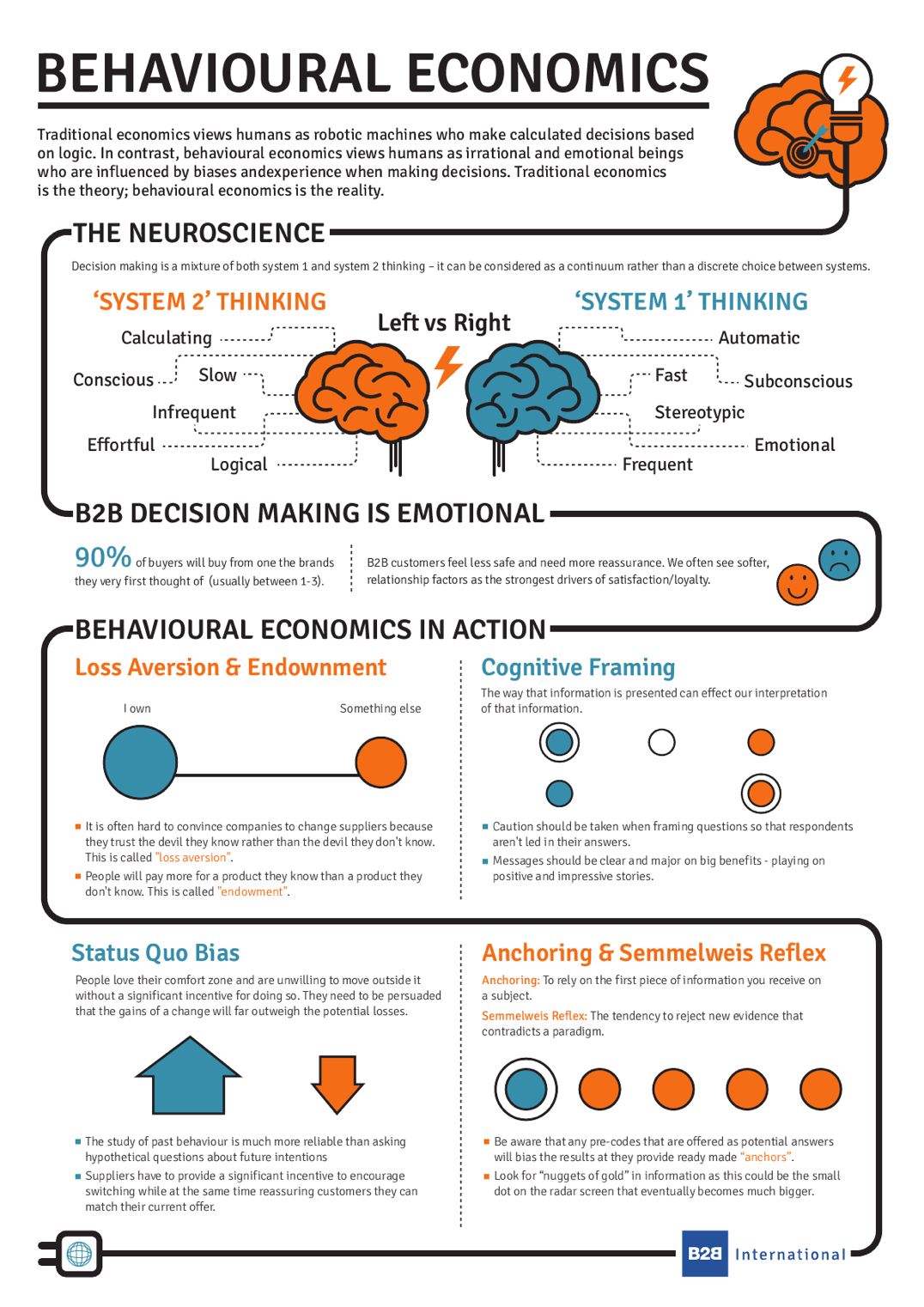
The answer may be that her advisor didn’t deploy a behavioral economics framework to support her decision-making. One such framework is the “prospect theory” model that boils client decision-making into a “three step heuristic.”
 
According to colleague Eugene Schmuckler PhD MBA MEd CTS, Prospect theory makes the unspoken biases that we all have more explicit. By identifying all the background assumptions and preferences that clients [patients] bring to the office, decision-making can be crafted so that everyone [family, doctor and patient] or [FA, client and spouse] is on the same page.

INVESTING MIND TRAPS: https://medicalexecutivepost.com/2025/06/12/psychology-common-finance-and-investing-mind-traps/

Briefly, the three steps are:

1. Simplify choices by focusing on the key differences between investment [treatment] options such as stock, bonds, cash, and index funds. 

2. Understanding that clients [patients] prefer greater certainty when it comes to pursuing financial [health] gains and are willing to accept uncertainty when trying to avoid a loss [illness].

3. Cognitive processes lead clients and patients to overestimate the value of their choices thanks to survivor bias, cognitive dissonance, appeals to authority and hindsight biases.

 CITE: Jaan E. Sidorov MD [Harrisburg, PA] 

Assessment

Much like in healthcare today, the current mass-customized approaches to the financial services industry fall short of recognizing more personalized advisory approaches like prospect theory and assisted client-centered investment decision-making.  

COMMENTS APPRECIATED

EDUCATION: Books

SPEAKING: Dr. Marcinko will be speaking and lecturing, signing and opining, teaching and preaching, storming and performing at many locations throughout the USA this year! His tour of witty and serious pontifications may be scheduled on a planned or ad-hoc basis; for public or private meetings and gatherings; formally, informally, or over lunch or dinner. All medical societies, financial advisory firms or Broker-Dealers are encouraged to submit an RFP for speaking engagements: CONTACT: Ann Miller RN MHA at MarcinkoAdvisors@outlook.com -OR- http://www.MarcinkoAssociates.com

Like and Subscribe

***

***

Physician Career Development Essay

Professional Medical Career Development

  • By Eugene Schmuckler; PhD, MBA
  • By Dr. David E. Marcinko MBA

Dr. Marcinko with ME-P Fans

Dr. Marcinko with Future Medical Students

Invite Dr. Marcinko

Jimmy’s mother called out to him at seven in the morning, “Jimmy, get up. It’s time for school.” There was no answer. She called again, this time more loudly, “Jimmy, get up! It’s time for school!” Once more there was no more answer.

Exasperated, she went to his room and shook him saying, “Jimmy, it’s time to get ready for school.” He answered, “Mother, I’m not going to school. There are fifteen hundred kids at that school and every one of them hates me. I’m not going to school.” “Get to school!” she replied sharply. “But, Mother, all the teachers hate me, too. I saw three of them talking the other day and one of them was pointing his finger at me. I know they all hate me so I’m not going to school,” Jimmy answered. “Get to school!” his mother demanded again. “But mother, I don’t understand it. Why would you want to put me through all of that torture and suffering?” he protested. “Jimmy, for two good reasons,” she fired back.

“First, you’re forty-two years old.”

“Secondly, you’re the principal.”

Introduction 

Many of us have had conversations with medical colleagues at which time sentiments of those expressed by Jimmy have been voiced. The career choice that was made many years ago is now, for some reason, no longer as exciting, interesting and enjoyable, as it was when we first began in the field. The career that was undertaken with great anticipation is now something to dread. 

The reason for this is occurrence is not that difficult to understand.  Two of the most important decisions individuals are asked to make are ones for which the least amount of training is offered: choice of spouse and choice of career. How many college students receive a degree in the field they identified when they first enrolled at the college or university?

In fact, how many entering freshmen list their choice of major as undecided? It is only during the sophomore year when a major must be declared is the choice actually made. So, career choices made at the age of 19 might be due to having taken a course that was interesting or easy, appeared to have many entry level jobs, did not require additional educational or professional training requirements, or was a form of the “family business.”

Now as an adult, the individual is functioning in a career field that was selected for him or her by an eighteen-year-old. How do we judge career success? A career represents more than just the job or sequence of jobs we hold in a lifetime. The typical standard for a successful career is by judging how high the individual goes in the organization, how much money is earned, or one’s standing attained in the profession.

Career success actually needs to be judged on several dimensions. Career adaptability refers to the willingness and capacity to change occupations and/or the work setting to maintain a standard of career progress. 

Many of you did not anticipate the changes in your chosen medical profession, or specialty, when you began your training. A second factor is career attitudes. These are your own attitudes about the work itself, our place of work, your level of achievement, and the relationship between work and other parts of your life.  Career identity is that part of your life related to occupational and organizational activities. This is the unique way in which we believe that we fit into the world.

Our career is only one part of our being. We play many roles in life each of which combine to make up or totality. At any point in time one role may be more important than another. The importance of the roles will generally change over time. Thus at some point you may choose to identify more with your career, and at other times, with your family. 

A final factor is career performance, a function of both the level of objective career success and the level of psychological success.  How much you earn and your reputation factor into, and reflect, objective career success. To be recognized as a “leader” in a field and asked to submit chapters for inclusion in books such as this may be a more important indicator of career success than money.   Psychological success is the second measure of career performance. It is achieved when your self-esteem, the value you place on yourself, increases.

As you can see, there is a direct relationship between psychological success and objective success. It may increase as you advance in pay and status at work or decrease with job disappointment and failure. Self-esteem may also increase as one begins to sense personal worth in other ways such as family involvement or developing confidence and competence in a particular field, such as consistently shooting par on the golf course. At that point, objective career success may be secondary in your life. This is why many persons choose to become active in their church or in politics. Even though one may have slowed down on the job, or in their professional career they can be extremely content with their life. 

Consider the following situation. You are traveling on business. Although you are on a direct flight, you have a one-hour layover before the second leg of the flight and your final destination. Leaving the plane, after having placed the “occupied” card on your seat you walk down the concourse. On the way, you encounter a friend that you knew in high school. The two of you sit to have a cup of coffee and then you realize that your departure time is rapidly approaching. In fact, you will be cutting it quite close. Running down the concourse you return to the gate only to find that the door has been closed, the jetway is being retracted and the plane is being backed away from the gate. You stare out the window watching the plane go to the end of the runway and then begin its takeoff. Something goes horrible wrong and the plane crashes on takeoff, bursting into flames. It is apparent that there will be no survivors. To the world you are on that plane (remember the occupied card). Traveling on business your generous insurance policy will be activated. In anticipation of being in a location where they may not have ATM machines you have a good deal of cash, sufficient for at least a month.

The question for you to consider is: What do you do?

For many of you this will be a good indicator of your career as well as personal success.  

Surgery

Medical Career Paths

In retrospect how many persons are truly aware of their own interests, values, strengths and weaknesses during their teen years?

As with much of human behavior, career choices actually go through a series of stages. Psychologists have for years identified stages of human development.  Kohlberg discussed stages of moral development. In the 1970’s, Daniel Levinson published The Season’s of a Man’s Life, a project he undertook when he began to look inward and tried to understand his behaviors, values and attitudes to work. Discussions with his university colleagues indicated that what he was experiencing was not unique to him.  

For many years the prevailing thought was that the correct way to function in the labor market was to gain employment with a company progressing through the years until such time as you were eligible to receive the “gold watch”, the symbol of retirement. If you entered a professional discipline such as medicine or law, you did that for the rest of your life. 

Today there are still individuals who follow these traditional patterns but there are other career paths that may be taken.  The most traditional career route follows a linear path, one that most of you have rejected. This entails gaining employment in a large, bureaucratic organization with a tall pyramidal structure. It involves a series of upward (hopefully) moves in the organization until the career limit is reached. As the individual progresses upward in the organization he or she may work in different functional departments such as marketing, finance, and production. Organizations having these paths seek employees who tend to be highly oriented toward success defined in organizational terms and exhibit “leadership” skills.

In general, these people demonstrate a strong commitment to the workplace. A person with this type of orientation (Organizationalist) exhibits the following tendencies:

1.  A strong identification with the organization; seeking organization rewards and advancement that are important measures of success and organizational status.

2.  High morale and job satisfaction.

3.  A low tolerance for ambiguity about work goals and assignments.

4. Identification with superiors, showing deference toward them, conforming and complying out of a desire to advance; maintains the chain of command and compliance, and views respect for authority as the way to succeed.

5. Emphasis on organizational goals of efficiency and effectiveness, avoiding controversy and showing concern for threats to organizational success. 

As readers of this essay, you have followed the expert career path, building a career on the basis of personal competence, or the development of a profession (professionals). As you are so painfully aware, you invest heavily, personally and financially in acquiring a particular skill and then you spend the major portion of your life following that skill.

Unlike the pyramidal structure of the linear path, career paths are found in organizations that tend to be relatively flat, have departments in which there is a functional emphasis, emphasize quality and reliability, and have reward systems containing a strong recognition component.  Medical professionals are persons who are job-centered – not organization centered – viewing the demands of the organization as a nuisance that they seek to avoid.

However, that avoidance is impossible since the professional must have an organization in which to work. This is even more prevalent in today’s era of managed health care. At work, professional experience more role conflict and are more alienated. 

Medical professionals exhibit these four tendencies: 

1.  An experience of occupational socialization that instills high standards of performance in the chosen field; highly ideological about work values.

2. Sees organizational authority as nonrational when there is pressure to act in ways that are not professionally acceptable.

3. Tends to feel that their skills are not fully utilized in organizations; self-esteem may be threatened when they do not have the opportunity to do those things for which they have been trained.

4. Seeks recognition from other professionals outside the organization, and refuses to play the organizational status game except as it reflects their worth relative to others in the organization.

Professionals are very concerned with personal achievement and doing well in their chosen field. Organizational rewards serve to reflect the professional’s importance relative to others in the system. This recognition may be extremely fulfilling, especially when he or she is accorded higher status and pay than others. In the absence of organizational rewards the professional may use material objects (large homes, expensive cars) as a way of reflecting status and accomplishment. 

Medical professionals are of the opinion that successful performance, not compliance with authority, is more reinforcing. With this mindset it is not surprising why may medical practitioners balk at working in the managed health care environment.

Many professionally oriented people come from the middle class and have become successful through a higher level of education or by other efforts to acquire competence.  Those on the spiral career path make periodic moves from one occupation to another. Individuals who follow this career path tend to have high personal growth motives and are relatively creative.

Usually, these changes come after you have developed competence in the occupation you are working in and you think it is time to change what you do. The ideal spiral career path is to move from one occupation to an area related to it. This enables you to use some of the basic knowledge that you developed in your past work and to transfer it to your new occupation. The difference between this path and the linear path discussed above is that in this case the mobility pattern is lateral, not upward. 

People who take the transitory career path cannot seem to, and perhaps do not want to settle down. The pattern is one of consistent inconsistency in their work. These are individuals who may find a great deal of satisfaction working as consultants. The work style is marked by an ability to do many things reasonably well. They value independence and variety, and they work best in relatively loose and unstructured organizations that tolerate the type of freedom they demand in their work.

We have so far discussed the four types of career paths and two career orientations.

A final form of career orientation is that of the indifferents, those who simply work for a paycheck. These are individuals who do their work well, but they are not highly committed to their job or the organization.

Some characteristics of indifferents are:

1.  More oriented toward leisure, not the work ethic (is it Friday yet?); separates work from more meaningful aspects of life, and seeks higher-order need satisfaction outside the work organization.

2. Tends to be alienated from work and not committed to the organization.

3. Rejects status symbols in organizations.

4. Withdraws psychologically from work and organizations when possible. 

Indifferents are not necessarily born that way; some are actually a product of their work experiences. People who once had an organizational orientation and were highly loyal may no longer follow orders without question.

For example, you may have had an officer manager who very early in his or her career was extremely committed to you and your organization. He or she may seek rewards and want to advance. However, in later career life, after having been passed over several times for promotion, the person seeks rewards elsewhere. Thus it is possible that through office practices, your organization may turn highly committed organizationalists (or professionals) into indifferents. 

surgery

Medical Career Evaluation

Studs Turkel, in his outstanding book Working, makes the comment that work is the mechanism by which many of us get our daily bread and our daily purpose. If this is to be the case then the workplace needs to offer us something more than a paycheck.

A few years back, the Wilson Learning Corporation surveyed 1,500 people asking “If you had enough money to live comfortably for the rest of your life, would you continue to work?

Seventy percent said that they would continue to work, but 60 percent of those said they would change jobs and seek “more satisfying” work.

Each of us has in fact been put in charge of our own careers. Our personal career management is a lifelong process. Our task is to be able to discover our place in the world where we will be able to enjoy a high level of wellness.

This requires us to now assess our career, not from the eyes of the sixteen year old that initially chose the career. The career you are now pursuing needs to be compatible with your own unique skills, knowledge, personality and interests. It is important to keep in mind that no one is married to his or her job. When it comes to the workplace most of us are in dating relationships. 

As part of your examining your current medical career, answer the following questions:

  • Why do you work?
  • What does work mean to you?
  • What do you want from work? 

Research shows that most people work for three major reasons.

The first of these is money. Not only is this necessary for our most basic needs it also serves as a means of determining our self-image.

A second reason is to be with other people. Being at work enables us to belong, to be part of something beyond ourselves. We become part of a team. Some offices consider co-workers to be part of an extended family. The work setting affords us the opportunity for receiving feedback, recognition and support.

The third most often given reason is that work validates us as people if we consider what we do as having meaning. “I chose the medical profession so as to make a difference.”

Individuals with career success have a sense of purpose, a feeling that their work has meaning and contributes to a worthwhile cause. This is not a trick question. How well does what you do in your office every day meet your needs for money, affiliation and meaning?  Without a sense of purpose on the job the chances are that your performance while adequate will not place you in the excellent category.

Therefore, it is necessary for each and every one of us to be able to succinctly answer the question, “What is the purpose of your job?” That is a tough question to answer.

As a medical professional you may have seen what you considered to be the purpose of your job radically changed due to changes in the way services are now delivered. While we cannot bring back the past we can work around the present. Think about this for a moment, “If you want something to happen make a space for it.” What this means that whether you remain in your current profession or move elsewhere there is a need for you to establish long-range, medium-range, short-range, mini, and micro goals.  

Long-range goals are those concerned with the overall style of life that you wish to live. Regardless of your current age these goals are necessary. Long-range goals don’t need to be too detailed, because like the federal budget surplus, changes will come along. Just as the government is making projections into the future you too need to be making projections including but not limited to retirement. 

Medium-range goals are goals covering the next five years or so. These are the goals that include the next step in your career. These are goals over which we have control and we are able to monitor them and see whether we are on track to accomplishing them and modify our efforts accordingly.

Short-range goals generally cover a period of time about one month to one year from now. These are goals that can be set quite realistically and we are able to see fairly quickly whether or not we are on track to reaching them. We don’t want to set these goals at impossible levels but we do want to stretch ourselves. After all, that is the reason you are probably reading this chapter.  

Mini-goals are those goals covering from about one day to one month. Obviously we have much greater control over these goals than you do over those of a longer-term. By thinking in small blocks of time there is much more control over each individual unit. 

Micro-goals are goals covering the next 15 minutes to an hour. These are the only goals over which you have direct control. Because of this direct control, micro-goals, even though modest in impact, are extraordinarily important, for it is only through these micro-goals that you can attain your larger goals.

If you don’t take steps toward your long-range goals in the next 15 minutes, when will you? The following 15 minutes? The 15 minutes after that? Sooner or later, you have to pick 15 minutes and get going.

At some point procrastination has to be put aside.  In thinking of your goals it now becomes necessary to evaluate your personal assets. Conducting this personal inventory requires you to identify your assets as well as your shortcomings.

First, look at a time in your life when you were performing at your best. What were your thoughts and feelings? How did you behave? What were you doing? Now look at the reverse when you were doing poorly. What were your thoughts and feelings at that time? How did you behave? What were you doing? If you are like others when you were at your best you described yourself as being confident, enthusiastic, organized, relaxed, focused, in control, friendly and decisive.

The flip side, when at your worst you were fearful, apathetic, messy, anxious, lacking direction, out of control, argumentative and frustrated. 

As you can see the emotions when we are at our best are all positive. This leads to the conclusion that it is to our advantage to be at our best as much as possible.

Being at our best derives from working in those areas where we contribute our talents to something we believe in.  As we continue our own personal inventory we need to look at our special abilities. That is, what are you good at and find easy to do.

doctors

Think of the following questions.

It’s not necessary to write down you answers just think about them:

1. How would you like to be remembered?

2. What have you always dreamed of contributing to the world?

3. Looking back on your life, what are some of your major contributions?

4. When people think of you, what might they say are your most outstanding characteristics?

5. What do you really want from your life and your work?

6. In what way may you still feel limited by the past? If so, by what?

7. What will it take to let go of what has happened, no matter how good or bad? Are you willing to let go?

8. How might the rut of conformity or comfort be limiting you? Why?

9. How different do you really want life to be? Why.

10. Have you ever stated what it is you truly desire? If no, why not?

11. How good could stand life to be?  

Thinking about remaining in your present career or moving into another one is not easy. You are at the edge of a cliff and need to decide if you are going to turn back or to trust in yourself to successfully make it down to the bottom. People who are afraid of the dark lose their fear with just the slightest of a light in the room.

As you have been going through this chapter you have been shining a light, however dim it may appear to you. You can see all of the items around you. The obstacles are there but with your advance knowledge you can anticipate ways to avoid them.  Having looked at and possibly re-evaluated your plans you can now do a thorough analysis of your assets.

The assets requiring the most scrutiny are the following:

1.Your talents and skills

2. Your intelligence

3. Your motivation

4. Your friends

5. Your education

6. Your family.

Your talents and skills are more than likely what has gotten you to the point you are at in your present career.

For purposes of definition talents are innate, skills are acquired. Some have talent in interpersonal relations and some in artistic pursuits. Skills may be selected to complement the already present talents. It is skills that are necessary for expanding your options. As you seek out new skill areas ask yourself these questions. Do the skills provide occupational relevance? Might you be able to get others to pay you to teach them the skill? Will the skill be useful throughout life? Will the skill help you conquer new environments and gain new experiences?

And, of course, is it something you like to do? Intelligence is considered to be the ability of the individual to cope with the world.

Originally, intelligence focused primarily in the area of cognitive skills. Recently attention has been directed to what is called emotional intelligence, a concept that directs attention to social skills. Whether you were able to breeze through your courses in college or you truly had to work hard, earning your degrees demonstrates a better than average amount of cognitive intellectual ability. In order to maximize your brainpower, challenge yourself regularly.

Motivation looks at how hard you are willing to work, your level of persistence, and the degree to which you want to do well. Different things motivate each of us and our personal motivators can vary from day to day. How many times have you had people say that they could not do your job? What are the activities that are attractive to you? More than likely an important motivator for you is to do something worthwhile.

It has also been found that we tend to perform at about the same level as those people who are close to us. What this means is that those people with whom you work are going to have s substantial impact on your motivation. 

Friends, of course, are invaluable assets. We use our friends as models for our own behavior. Those persons we consider friends share many of our attitudes, actions and opinions. With time we will change to be like our friends and they will change to become like us. Associating with those like us tends to temper our behavior. We try not to associate with the “wrong crowd” lest we become like them.  Education needs to be ongoing.

Recently, it was reported “all careers and businesses will be transformed by new technologies in often unpredictable ways. The era of the entrepreneur will make ‘boutique’ businesses more competitive with the behemoths, as mid-sized institutions get squeezed out. And, medical breakthroughs and the ongoing health movement will enhance-and extend-people’s lives.”

The implication of these changes is that new technologies often require a higher level of education and training to use them effectively and new biotechnology jobs will open up. The authors state that all the technological knowledge we work with today will represent only 1 percent of the knowledge that will be available in 2050.

The half-life of an engineer’s knowledge today is only five years; in ten years, 90 percent of what an engineer knows will be available on the computer.

In electronics, fully half of what a student learns as a freshman is obsolete by his or her senior year. The implication here is that all of us must get used to the idea of lifelong learning. Family influences who and what we are and do. They can be a support group or they can be a deterrent to your goals. It is incumbent on every individual reading this chapter to consult with immediate family members at all stages of your career planning process.    

Doctors Labor Day

Conclusion

This essay has presented an overview of initial career selection, career pathing and career change in order to help you determine what you truly want to be when you grow up.

As I write, I can not help but reflect on an anecdote shared with me by a colleague.

An individual came to see him expressing concern that at 40 years of age he still hadn’t reached a satisfactory point in his life. My colleague then asked him where he wanted to be. The response was “I don’t know” to which my colleague responded, “Congratulations, you’ve arrived.

Too many times I encounter in my practice, physicians who express the same statements. Unhappy with what they are doing they have no idea as to what it is they would like to be doing. 

Victor Frankl, a psychiatrist who was a holocaust survivor, created an entire school of psychotherapy based upon his experiences in the German concentration camps. In his book, Man’s Search for Meaning, he makes reference to the fact that it became possible for him to determine when a fellow prisoner was going to die simply by that person’s behavior – giving up.

Frankl writes, “Evermore people today have the means to live, but no meaning to live for.      

Thus, it may be appropriate to conclude with this anonymous poem. 

Take time to work-

It is the price of success.Take time to think-

It is the source of power.Take time to play-

It is the secret of perpetual youth.Take time to read- 

It is the fountain of wisdom.Take time to be friendly-

It is the road to happiness.Take time to love and be loved-

It is nourishment for the soul.Take time to share-  

It is too short a life to be selfish.Take time to laugh- 

It is the music of the heart.Take time to dream- 

It is hitching your wagon to a star.

Now, how do you view your medical, executive, professional or healthcare administrative career amid all the turmoil in the industry today? 


McNally, D. Even Eagles Need A Push, New York, NY: Delacorte Press, 1991.

Brousseau, K.R., Driver, M.J., Eneroth, K. and Larson, R.: Career Pandemonium: Realigning organizations and individuals. Academy of Management Executive 10 (4), 52-66. 1996

Presthus, R. The Organizational Society. New York, NY: St. Martin’s Press.Campbell, D. If You Don’t Know Where You are Going You’ll Probably End Up Somewhere Else, Niles, IL: Argus Communications, 1974. 

Campbell, D. op. cit.The Futurist, March–April 2001.

Risk Management, Liability Insurance, and Asset Protection Strategies for Doctors and Advisors: Best Practices from Leading Consultants and Certified Medical Planners™8Comprehensive Financial Planning Strategies for Doctors and Advisors: Best Practices from Leading Consultants and Certified Medical Planners™

[Dr. Cappiello PhD MBA] *** [Foreword Dr. Krieger MD MBA]

Front Matter with Foreword by Jason Dyken MD MBA

Invite Dr. Marcinko

***

Medical Workplace Violence Prevention Guidelines

http://www.MARCINKOAssociates.com

Earliest Guidelines in California Program

By Eugene Schmuckler; PhD MBA MEd CTS

By Dr. David E. Marcinko MBA MEd CMP

UPDATE

Assassination attempt on Donald J.Trump

At least 5 people are dead and multiple people are injured following a shooting at the Natalie Building at St. Francis Hospital in Tulsa, Oklahoma.

***

The impact of medical workplace violence became widely exposed on November 6, 2009 when 39 year old Army psychiatrist Maj. Nidal M. Hasan MD, a 1997 graduate of Virginia Tech University who received a medical doctorate in psychiatry from the Uniformed Services University of the Health Sciences in Bethesda, Maryland, and served as an intern, resident and fellow at the Walter Reed Army Medical Center in the District of Columbia, went on a savage 100 round shooting spree and rampage that killed 13 people and injured 32 others. In April 2010 he was transferred to Bell County Jail in Belton, Texas awaiting trial.

Federal Government Guidelines

The federal government and some states have developed guidelines to assist employers with workplace violence prevention. For instance, one of the earliest sets of guidelines for a comprehensive workplace violence prevention program was published in 1993 by California OSHA. This resulted from the murder of a state employee. In 1996, Guidelines for Preventing Workplace Violence for Healthcare and Social Service Workers was published by OSHA.

OSHA Guidelines

In its guidelines, OSHA sets forth the following essential elements for developing a violence prevention program:

  • Management commitment — as seen by high-level management involvement and support for a written workplace violence prevention policy and its implementation.
  • Meaningful employee involvement — in policy development, joint management-worker violence prevention committees, post-assault counseling and debriefing, and follow-up are all critical program components.
  • Worksite analysis — includes regular walk-through surveys of all patient care areas and the collection and review of all reports of worker assault. A successful job hazard analysis must include strategies and policies for encouraging the reporting of all incidents of workplace violence, including verbal threats that do not result in physical injury.
  • Hazard prevention and control — includes the installation and maintenance of alarm systems in high-risk areas. It may also include the training and posting of security personnel in emergency departments. Adequate staffing is an essential hazard prevention measure, as is adequate lighting and control of access to staff offices and secluded work areas.
  • Pre-placement and periodic training and education — must include educationally appropriate information regarding the risk factors for violence in the healthcare environment and control measures available to prevent violent incidents. Training should include skills in aggressive behavior identification and management, especially for staff working in the mental health and emergency departments.

On May 17, 1999, Governor Gary Locke signed the New Workplace Violence Prevention Act for the state of Washington. This act mandates that each healthcare setting in the state implement a plan to reasonably prevent and protect employees from violence.

New Washington Workplace Violence Prevention Act

According to this act, prevention plans need to address security considerations related to:

  • physical attributes of the healthcare setting;
  • staffing, including security staffing;
  • personnel policies;
  • first aid and emergency procedures;
  • reporting of violent acts; and
  • employee education and training.

Prior to the development of an actual plan, a security and safety assessment needs to be conducted to identify existing or potential hazards. The training component of the plan must include the following topics:

  • general safety procedures;
  • personal safety procedures;
  • the violence escalation cycle;
  • violence-predicting factors;
  • means of obtaining a patient history form from a patient with violent behavior;
  • strategies to avoid physical harm;
  • restraining techniques;
  • appropriate use of medications as chemical restraints;
  • documenting and reporting incidents;
  • the process whereby employees affected by a violent act may debrief;
  •  any resources available to employee for coping with violence; and
  • the healthcare setting’s workplace violence prevention plan.

Assessment

The act further mandates that any hospital operated and maintained by the State of Washington for the care of the mentally ill is required to provide violence prevention training to affected employees identified in the plan on a regular basis and prior.

Conclusion

Your thoughts and comments on this ME-P are appreciated. Feel free to review our top-left column, and top-right sidebar materials, links, URLs and related websites, too. Then, subscribe to the ME-P. It is fast, free and secure.

Speaker: If you need a moderator or speaker for an upcoming event, Dr. David E. Marcinko; MBA – Publisher-in-Chief of the Medical Executive-Post – is available for seminar or speaking engagements. Contact: MarcinkoAdvisors@msn.com

OUR OTHER PRINT BOOKS AND RELATED INFORMATION SOURCES:

PHYSICIANS: www.MedicalBusinessAdvisors.com
HOSPITALS: http://www.crcpress.com/product/isbn/9781466558731
CLINICS: http://www.crcpress.com/product/isbn/9781439879900
BLOG: www.MedicalExecutivePost.com
FINANCE: Financial Planning for Physicians and Advisors
INSURANCE: Risk Management and Insurance Strategies for Physicians and Advisors

Product Details 

A Brief Historical Review of Behavioral Finance and Economics

By Related Influential Thought-Leaders

  • Dr. Brad Klontz CSAC CFP®
  • Dr. Ted Klontz PsyD
  • Dr. Eugene Schmuckler MBA MEd CTS
  • Dr. Kenneth Shubin-Stein FACP CFA
  • Dr. David Edward Marcinko MEd MBA CMP™

***

doctor

***

James O. Prochaska PhD, Professor of Psychology and Director of the Cancer Prevention Research Center at the University of Rhode Island, developed the Trans-Theoretic Model of Behavior Change [TTM] which has been evolving since in 1977. Nominated as one of the five most influential authors in Psychology, by the Institute for Scientific Information and the American Psychological Society, Dr. Prochaska is author of more than 300 papers on behavior change for health promotion and disease prevention.

TTM Stages of Change

In his Trans-Theoretical Model, behavior change is a “process involving progress through a series of these stages:

  • Pre-Contemplation (Not Ready) – “People are not intending to take action in the foreseeable future, and can be unaware that their behavior is problematic”
  • Contemplation (Getting Ready) – “People are beginning to recognize that their behavior is problematic, and start to look at the pros and cons of their continued actions”
  • Preparation (Ready) – “People are intending to take action in the immediate future, and may begin taking small steps toward behavior change”
  • Action – “People have made specific overt modifications in changing their problem behavior or in acquiring new healthy behaviors”
  • Maintenance – “People have been able to sustain action for a while and are working to prevent relapse”
  • Termination – “Individuals have zero temptation and they are sure they will not return to their old unhealthy habit as a way of coping”

Relapse

In addition, researchers conceptualized “relapse” (recycling) which is not a stage in itself but rather the “return from Action or Maintenance to an earlier stage.” In medical care, these stages of behavior change have applicability to anti-hypertension and lipid lowering medication use, as well as depression prevention, weight control and smoking cessation.

***

Psychology

***

Uniting Psychology and Financial Behavior

More recently, validating the emerging alliance between psychology (human behavior) and finance (economics) are two Americans who won the Royal Swedish Academy of Science’s 2002 Nobel Memorial Prize in Economic Science. Their research was nothing short of an explanation for the idiosyncrasies incumbent in human financial decision-making outcomes.

Enter Kahneman and Smith

Daniel Kahneman, PhD, professor of psychology at Princeton University, and Vernon L. Smith, PhD, professor of economics at George Mason University in Fairfax, Va., shared the prize for work that provided insight on everything from stock market bubbles, to regulating utilities, and countless other economic activities. In several cases, the winners tried to explain apparent financial paradoxes.

For example, Professor Kahneman made the economically puzzling discovery that most of his subjects would make a 20-minute trip to buy a calculator for $10 instead of $15, but would not make the same trip to buy a jacket for $120 instead of $125, saving the same $5.

1608708312704

in vitro and in-vivo Economics

Initially, in the 1960’s, Smith set out to demonstrate how economic theory worked in the laboratory (in vitro), while Kahneman was more interested in the ways economic theory mis-predicted people in real-life (in-vivo). He tested the limits of standard economic choice theory in predicting the actions of real people, and his work formalized laboratory techniques for studying economic decision making, with a focus on trading and bargaining.

Later, Smith and Kahneman together were among the first economists to make experimental data a cornerstone of academic output. Their studies included people playing games of cooperation and trust, and simulating different types of markets in a laboratory setting. Their theories assumed that individuals make decisions systematically, based on preferences and available information, in a way that changes little over time, or in different contexts.

University of Chicago

By the late 1970’s, Richard H. Thaler, PhD, an economist at the University of Chicago also began to perform behavioral experiments further suggesting irrational wrinkles in standard financial theory and behavior, enhancing the still embryonic but increasingly popular theories of Kahneman and Smith.

Laboratory

Other economists’ laboratory experiments used ideas about competitive interactions pioneered by game theorists like John Forbes Nash Jr., PhD, who shared the Nobel in 1994, as points of reference.

Assessment

But, Kahneman and Smith often concentrated on cases where people’s actions departed from the systematic, rational strategies that Nash envisioned. Psychologically, this was all a precursor to the informal concept of life or holistic financial planning. Kahneman was awarded the Medal of Freedom, by President Barack Obama, on November 20, 2013.

READ: Behavioral Economics and Psychology DEM

e513455b-e924-451f-9132-d4bbbeb8e033-original

Channel Surfing the ME-P

Have you visited our other topic channels? Established to facilitate idea exchange and link our community together, the value of these topics is dependent upon your input. Please take a minute to visit. And, to prevent that annoying spam, we ask that you register. It is fast, free and secure.

Go back

Your message has been sent

Warning
Warning
Warning
Warning

Warning.

More:

Conclusion

Your thoughts and comments on this ME-P are appreciated. Feel free to review our top-left column, and top-right sidebar materials, links, URLs and related websites, too. Then, subscribe to the ME-P. It is fast, free and secure.

Speaker: If you need a moderator or speaker for an upcoming event, Dr. David E. Marcinko; MBA – Publisher-in-Chief of the Medical Executive-Post – is available for seminar or speaking engagements. Contact: MarcinkoAdvisors@msn.com

OUR OTHER PRINT BOOKS AND RELATED INFORMATION SOURCES:

Comprehensive Financial Planning Strategies for Doctors and Advisors: Best Practices from Leading Consultants and Certified Medical Planners(TM)

***

Invite Dr. Marcinko

***

Assessment of Workplace Violence in Healthcare

ON MEDICAL WORKPLACE VIOLENCE

By Eugene Schmuckler PhD, MBA CTA

By Dr. David E. Marcinko MBA

1. What Is Workplace Violence?

Workplace violence is more than physical assault — it is any act in which a person is abused, threatened, intimidated, harassed, or assaulted in his or her employment. Swearing, verbal abuse, playing “pranks,” spreading rumors, arguments, property damage, vandalism, sabotage, pushing, theft, physical assaults, psychological trauma, anger-related incidents, rape, arson, and murder are all examples of workplace violence. The Registered Nurses Association of Nova Scotia defines violence as “any behavior that results in injury whether real or perceived by an individual, including, but not limited to, verbal abuse, threats of physical harm, and sexual harassment.” As such, workplace violence includes:

  • threatening behavior — such as shaking fists, destroying property, or throwing objects;
  • verbal or written threats — any expression of intent to inflict harm;
  • harassment — any behavior that demeans, embarrasses, humiliates, annoys, alarms, or verbally abuses a person and that is known or would be expected to be unwelcome. This includes words, gestures, intimidation, bullying, or other inappropriate activities;
  • verbal abuse — swearing, insults, or condescending language;
  • muggings — aggravated assaults, usually conducted by surprise with intent to rob; or
  • physical attacks — hitting, shoving, pushing, or kicking.

Workplace violence can be brought about by a number of different actions in the workplace. It may also be the result of non-work related situations such as domestic violence or “road rage.” Workplace violence can be inflicted by an abusive employee, a manager, supervisor, co-worker, customer, family member, or even a stranger.  The University of Iowa Injury Prevention Research Center classifies most workplace violence into one of four categories.

  • Type I Criminal Intent — Results while a criminal activity (e.g., robbery) is being committed and the perpetrator had no legitimate relationship to the workplace.
  • Type II Customer/Client — The perpetrator is a customer or client at the workplace (e.g., healthcare patient) and becomes violent while being assisted by the worker.
  • Type III Worker on Worker — Employees or past employees of the workplace are the perpetrators.
  • Type IV Personal Relationship — The perpetrator usually has a personal relationship with an employee (e.g., domestic violence in the workplace).

2. Effects of Workplace Violence

The healthcare sector continues to lead all other industry sectors in incidents of non-fatal workplace assaults. In 2000, 48% of all non-fatal injuries from violent acts against workers occurred in the healthcare sector. Nurses, nurses’ aides, and orderlies suffer the highest proportion of these injuries. Non-fatal assaults on healthcare workers include assaults, bruises, lacerations, broken bones, and concussions. These reported incidents include only injuries severe enough to result in lost time from work. Of significance is that the median time away from work as a result of an assault or other violent act is 5 days. Almost 25% of these injuries result in longer than 20 days away from work. Obviously, this is quite costly to the facility as well as to the victim.

A study undertaken in Canada found that 46% of 8,780 staff nurses experienced one or more types of violence in the last five shifts worked. Physical assault was defined as being spit on, bitten, hit, or pushed.

Both Canadian and U.S. researchers have described the prevalence of verbal threats and physical assaults in intensive care, emergency departments, and general wards. A study in Florida reported that 100% of emergency department nurses experience verbal threats and 82% reported being physically assaulted. Similar results were found in a study undertaken in a Canadian hospital. Possible reasons for the high incidence of violence in emergency departments include presence of weapons, frustration with long waits for medical care, dissatisfaction with hospital policies, and the levels of violence in the community served by the emergency department.

Similar findings have been reported in studies of mental health professionals, nursing home and long-term care employees, as well as providers of service in home and community health.

Violence in hospitals usually results from patients, and occasionally family members, who feel frustrated, vulnerable, and out of control. Transporting patients, long waits for service, inadequate security, poor environmental design, and unrestricted movement of the public are associated with increased risk of assault in hospitals and may be significant factors in social services workplaces as well. Finally, lack of staff training and the absence of violence prevention programming are associated with elevated risk of assault in hospitals. Although anyone working in a hospital may become a victim of violence, nurses and aides who have the most direct contact with patients are at higher risk. Other hospital personnel at increased risk of violence include emergency response personnel, hospital safety officers, and all healthcare providers. Personnel working in large medical practices fall into this category as well. Although no area is totally immune from acts of violence it most frequently occurs in psychiatric wards, emergency rooms, waiting rooms, and geriatric settings.

Many medical facilities mistakenly focus on systems, operations, infrastructure, and public relations when planning for crisis management and emergency response: they tend to overlook the people. Obviously, no medical facility can operate without employees who are healthy enough to return to work and to be productive. Individuals who have been exposed to a violent incident need to be assured of their safety.

The costs associated with workplace violence crises are not limited to healthcare dollars, absenteeism rates, legal battles, or increased insurance rates. If mishandled, traumatic events can severely impair trust between patients, employees, their peers, and their managers. Without proper planning, an act of violence can disrupt normal group processes, interfere with the delivery of crucial information, and temporarily impair management effectiveness. It may also lead to other negative outcomes such as low employee morale, increased job stress, increased work turnover, reduced trust of management and co-workers, and a hostile working environment.

Data collected by the U.S. Department of Justice shows workplace violence to be the fastest growing category of murder in the country. Homicide, including domestic homicides, is the leading cause of on-the-job death for women, and is the second leading cause for men. The National Institute of Occupational Safety and Health (NIOSH) found that an average of 20 workers is murdered each week in the U.S. In addition, an estimated 1 million workers — 28,000 per week — are victims of non-fatal workplace assaults each year. Workplace attacks, threats, or harassment can include the following monetary costs:

  • $13.5 billion in medical costs per year;
  • 500,000 employees missing 1,750,000 days of work per year; with a 41% increase in stress levels with the concomitant related costs!

workplace-violence

More links: 

Racism in Medicine:

MORE: Work Violence

racist

About the Author

Dr. Eugene Schmuckler was Coordinator of Behavioral Sciences at a Public Training Center before accepting his current position as Academic Dean for iMBA, Inc. He is an international expert on personal re-engineering and coaching whose publications have been translated into Dutch and Russian. He now focuses on career development, change management, coaching and stress reduction for physicians and financial professionals. Behavioral finance, life planning and economic risk tolerance assessments are additional areas of focus. Formerly, Dr. Schmuckler was a senior adjunct faculty member at the Keller Graduate School of Management, Atlanta. He taught courses in Organizational Behavior and Leadership, Strategic Staffing, Training and Development, and the capstone course in human resources management. He is a member of a number of professional organizations including the American Psychological Association, the Academy of Management, and the Society for Human Resource Management. A native of Brooklyn New York, he received his BS degree in Psychology from Brooklyn College. He earned his MBA and PhD degrees in Industrial and Organizational Psychology from Louisiana State University. Currently, he serves on the executive BOD for:  www.MedicalBusinessAdvisors.com  and is the Dean of Admissions for www.CertifiedMedicalPlanner.org

Conclusion

Your thoughts and comments on this ME-P are appreciated. Feel free to review our top-left column, and top-right sidebar materials, links, URLs and related websites, too. Then, subscribe to the ME-P. It is fast, free and secure.

Speaker: If you need a moderator or speaker for an upcoming event, Dr. David E. Marcinko; MBA – Publisher-in-Chief of the Medical Executive-Post – is available for seminar or speaking engagements. Contact: MarcinkoAdvisors@msn.com

OUR OTHER PRINT BOOKS AND RELATED INFORMATION SOURCES:

Product Details

Product Details

Was the San Bernardino CA Massacre Work Place Violence?

Join Our Mailing List 

ASSESSMENT OF WORKPLACE VIOLENCE … A HEALTHCARE P.O.V.

  • By Eugene Schmuckler PhD MBA MEd CTS
  • By Dr. David Edward Marcinko MBA MBBS

What Really Is Workplace Violence?

Workplace violence is more than physical assault — it is any act in which a person is abused, threatened, intimidated, harassed, or assaulted in his or her employment. Swearing, verbal abuse, playing “pranks,” spreading rumors, arguments, property damage, vandalism, sabotage, pushing, theft, physical assaults, psychological trauma, anger-related incidents, rape, arson, and murder are all examples of workplace violence.

Registered Nurses Association of Nova Scotia

The Registered Nurses Association of Nova Scotia defines violence as “any behavior that results in injury whether real or perceived by an individual, including, but not limited to, verbal abuse, threats of physical harm, and sexual harassment.” As such, workplace violence includes:

  • threatening behavior — such as shaking fists, destroying property, or throwing objects;
  • verbal or written threats — any expression of intent to inflict harm;
  • harassment — any behavior that demeans, embarrasses, humiliates, annoys, alarms, or verbally abuses a person and that is known or would be expected to be unwelcome. This includes words, gestures, intimidation, bullying, or other inappropriate activities;
  • verbal abuse — swearing, insults, or condescending language;
  • muggings — aggravated assaults, usually conducted by surprise and with intent to rob; or
  • physical attacks — hitting, shoving, pushing, or kicking.

 Non-work Related Situations

Workplace violence can be brought about by a number of different actions in the workplace. It may also be the result of non-work related situations such as domestic violence or “road rage.” Workplace violence can be inflicted by an abusive employee, a manager, supervisor, co-worker, customer, family member, or even a stranger.

University of Iowa Injury Prevention Research Center

The University of Iowa Injury Prevention Research Center classifies most workplace violence into one of four categories.[1]

  • Type I Criminal Intent — Results while a criminal activity (e.g., robbery) is being committed and the perpetrator had no legitimate relationship to the workplace.
  • Type II Customer/Client — The perpetrator is a customer or client at the workplace (e.g., healthcare patient) and becomes violent while being assisted by the worker.
  • Type III Worker on Worker — Employees or past employees of the workplace are the perpetrators.
  • Type IV Personal Relationship — The perpetrator usually has a personal relationship with an employee (e.g., domestic violence in the workplace).

***

workplace-violence

***

Assessment

And so, was San Bernardino workplace violence – or not; please opine?

More:

ABOUT

Dr. Eugene Schmuckler was Coordinator of Behavioral Sciences at a Public Training Center before accepting his current position as Academic Dean for iMBA, Inc. He is an international expert on personal re-engineering and coaching whose publications have been translated into Dutch and Russian. He now focuses on career development, change management, coaching and stress reduction for physicians and financial professionals. Behavioral finance, life planning and economic risk tolerance assessments are additional areas of focus. Formerly, Dr. Schmuckler was a senior adjunct faculty member at the Keller Graduate School of Management, Atlanta. He taught courses in Organizational Behavior and Leadership, Strategic Staffing, Training and Development, and the capstone course in human resources management. He is a member of a number of professional organizations including the American Psychological Association, the Academy of Management, and the Society for Human Resource Management. A native of Brooklyn New York, he received his BS degree in Psychology from Brooklyn College. He earned his MBA and PhD degrees in Industrial and Organizational Psychology from Louisiana State University. Currently, he serves on the executive BOD for:  www.MedicalBusinessAdvisors.com  and is the Dean of Admissions for www.CertifiedMedicalPlanner.org

Conclusion

Your thoughts and comments on this ME-P are appreciated. Feel free to review our top-left column, and top-right sidebar materials, links, URLs and related websites, too. Then, subscribe to the ME-P. It is fast, free and secure.

Speaker: If you need a moderator or speaker for an upcoming event, Dr. David E. Marcinko; MBA – Publisher-in-Chief of the Medical Executive-Post – is available for seminar or speaking engagements. Contact: MarcinkoAdvisors@msn.com

OUR OTHER PRINT BOOKS AND RELATED INFORMATION SOURCES:

[1]   Cal/OSHA, 1995; UIIPRC, 2001. For an upcoming event, Dr. David E. Marcinko; MBA – Publisher-in-Chief of the Medical Executive-Post – is available for seminar or speaking engagements. Contact: MarcinkoAdvisors@msn.com

***

  Risk Management, Liability Insurance, and Asset Protection Strategies for Doctors and Advisors: Best Practices from Leading Consultants and Certified Medical Planners™  Risk Management, Liability Insurance, and Asset Protection Strategies for Doctors and Advisors: Best Practices from Leading Consultants and Certified Medical Planners™

***

Content Life Cycle and Branding Management for Physicians

Freshness Also Required

By Dr. David Edward Marcinko MBA CMP™

By Eugene Schmuckler PhD, MBA

Join Our Mailing List

Self-Branding in the Modern Era

In 1987 the magazine Fast Company published an article authored by Tom Peters entitled “The Brand Called You.” Although some individuals may shy away from the concept of self-branding in actuality, many of the online social network sites such as Facebook become media by which we in fact brand ourselves.

Peter’s Speaks

In his article, Peter’s stated. “Regardless of position, regardless of the business we happen to be in, all of us need to understand the importance of branding. We are CEOs of their own companies, Me Inc.”

To be in business today, our most important job is to be head marketer for the brand called you. As a medical practitioner how do you differentiate yourself from others in your specialty and why should a new patient choose your practice above those of the others in the field? Branding is about finding your big idea and building your identity and game plan around it. The bottom line: if you can’t explain who you are, and the value you bring to your practice in a short sentence or two, you have work to do.

According to Catherine Kaputa, a personal coach she suggests that there are the objective things: your credentials, the schools you went to, your years of experience, and your skill set, which represent what she refers to as hard power. Then there’s soft power: your image and reputation, your visibility in the community, your network of contacts, supporters and mentors. In today’s competitive marketplace, soft power plays a vital role in attracting people to you and your practice.

Standing Out

Peters suggests that everyone has a chance to stand out. Everyone has a chance to learn, improve, and build up their skills. Everyone has a chance to be a brand worthy of remark. Corporations spend millions of dollars creating and maintaining their distinct brand. The Olympic Rings are representative of a brand which the International Olympic Committee guards zealously. Professional services firms such as McKinsey, foster self-branding among their employees. Major corporations have as employees those individuals who are smart, motivated and talented. Self-branding allows the employees to differentiate themselves from their peers.

For one to engage in self-branding is first necessary to ask the question, “What is it that my practice does that makes it different?” You can begin by identifying the qualities or characteristics that make you distinctive from your competitors-or your colleagues. What have you done lately-this week-to make yourself stand out? What would your healthcare colleagues say is your greatest and clearest strength? What would they say is your most noteworthy personal trait? As a medical practitioner does your customer get dependable, reliable service that meets his or her strategic needs?

In addition, ask yourself: “what do I do that adds remarkable, measurable, distinguished distinctive value.” How do you manage your name brand, and content?

Assessment

Content for online brand visibility needs to be well written, fluid, dynamic, and shared. Source: www.digitalc4.com

Conclusion                

And so, your thoughts and comments on this ME-P are appreciated. Feel free to review our top-left column, and top-right sidebar materials, links, URLs and related websites, too. Then, subscribe to the ME-P. It is fast, free and secure.

Link: http://feeds.feedburner.com/HealthcareFinancialsthePostForcxos

Speaker: If you need a moderator or speaker for an upcoming event, Drs. Gene Schmuckler and David E. Marcinko; MBA – Publisher-in-Chief of the Medical Executive-Post – is available for seminar or speaking engagements. Contact: MarcinkoAdvisors@msn.com

Subscribe Now: Did you like this Medical Executive-Post, or find it helpful, interesting and informative? Want to get the latest ME-Ps delivered to your email box each morning? Just subscribe using the link below. You can unsubscribe at any time. http://feeds.feedburner.com/HealthcareFinancialsthePostForcxos

Sponsors Welcomed: And, credible sponsors and like-minded advertisers are always welcomed. Link: https://healthcarefinancials.wordpress.com/2007/11/11/advertise

Product Details

Essay on Healthcare Leadership

Join Our Mailing List

Versus Healthcare Management

[By Eugene Schmuckler PhD, MBA and Dr. David Edward Marcinko MBA]

Many times, individuals or physicians will use the terms management and leadership synonymously. In actuality the terms have significantly different meanings.

For example, Warren Bennis describes the difference between managers and leaders as “Managers do thing right, Leaders the right thing.”

***

leadership

***

The Managers

Managers are those individuals who have as their primary function managing a team of people and their activities. In effect, managers are those who have been given their authority by the nature of their role and ensure that the work gets done by focusing on day to day tasks and their activities.

On other hand, a leader’s approach is generally innate in its approach. Good leadership skills are difficult to learn because they are far more behavioral in nature than those skills needed for management. Leaders are also very focused on change recognizing that continual improvement can be achieved in their people and their activities can be a great step towards continued success.

Leadership Development

Perhaps some of the best training grounds for the development of leaders are the military. The Marine Corps slogan is “A Few Good Men” and the military academies at Annapolis (Navy), New London, Connecticut (Coast Guard), Colorado Springs (Air Force), and West Point (Army) all have as their main mission, the development of leaders. This is done by a number of different techniques. At graduation, the new officers, regardless of the branch of service, have been taught, and more importantly, have internalized the following: communicate the missions, sensitivity matters, real respect is earned, trust and challenge your soldiers. It is due to these lessons that many graduates of the military academies go on to positions of leadership in the private sector as well as in government.  Communicating the mission refers to conveying to those who work with us what are practice is hoping to accomplish and the role of each employee in achieving that goal. Given an understanding and awareness of the mission, when confronted with a barrier, employees are able to face hard problems when there is no well-defined approach by which to deal with them.

Sensitivity does matter – A leader treats each employee with respect and dignity, regardless of race, gender, cultural background or particular role they actually perform in the practice. Consider how many legal suits are filed against any type of organization, whether it is a medical practice or a large manufacturing facility due to perceived disparate treatment towards the employee based on race, religion, gender sexual preference or other non-work related issues.

Real respect is earned – Having initials after one’s name and the wearing of a lab coat does not automatically entitle an individual to respect. Formal authority has been found to be one of the least effective forms of influence. Only by earning the respect of your staff as well as your patients can you be sure that your intent will be carried out when you are not present. Setting the example in performance and conduct, rather than ‘do as I say, not as I do,” level of activity enables one to exert influence far greater than titles.

Trust and challenge your employees – How many times have practices sought to hire the best and brightest only to second guess the employee. Eric Schmidt, the CEO of Google, describes his management philosophy as having “… an employee base in which everybody is doing exactly what they want every day.” Obviously there are certain policies and procedures, but at the same time, the leader enables decision making to the lowest possible level. This also enables employees to question why certain policies and procedures are still being followed when more effective and efficient methods are available.  (How the Army Prepared Me to Work at Google, Doug Raymond, Harvard Business)

Internal Faults

The phrase “Physician, heal thyself” (Luke 4:23, King James Version) means that we have to attend to our own faults, in preference to pointing out the faults of others. The phrase alludes to the readiness of physicians to heal sickness in others while sometimes not being able or will to heal themselves.  By the same token, it now is necessary for us to learn how to manage ourselves. It suggests that physicians, while often being able to help the sick, cannot always do so, and when sick themselves are no better placed than anyone else (Gary Martin, phrases.org.uk/meanings/281850.html, 2010).

Self Development

“We will have to learn how to develop ourselves. We will have to place ourselves outside the boundaries where we can make the greatest contribution. And we will have to stay mentally alert and engaged during a 50-year working life, which means knowing how and when to change the work we do” (Managing Oneself, Harvard Business Review – Jan. 2005 – pp 100-109, by Peter Drucker).  Although one’s IQ and certain personality characteristics are more or less innate and appear to remain stable over time there are individual capabilities that enable leadership and can be developed. Enhancement of these capabilities can lead to the individual being able to carry out the leadership tasks of setting direction, gaining commitment, and creating alignment. These capabilities include self-management capabilities, social capabilities and work facilitation capabilities.

***

Product Details

***

Assessment

Without question, while it is possible to cram for at test and graduate at the top of one’s class, that does not assure   leadership ability. We all know at least one person who scores at the highest levels on cognitive measures but would be incapable of pouring liquid out of a boot if the instructions were written on the heel.

Conclusion

Your thoughts and comments on this ME-P are appreciated. Feel free to review our top-left column, and top-right sidebar materials, links, URLs and related websites, too. Then, subscribe to the ME-P. It is fast, free and secure.

Speaker: If you need a moderator or speaker for an upcoming event, Dr. David E. Marcinko; MBA – Publisher-in-Chief of the Medical Executive-Post – is available for seminar or speaking engagements. Contact: MarcinkoAdvisors@msn.com

OUR OTHER PRINT BOOKS AND RELATED INFORMATION SOURCES:

Product DetailsProduct DetailsProduct Details

Product DetailsProduct Details

Why Practicing Medicine is More than just a Paycheck

Your Healthcare Career Evaluation

By Eugene Schmuckler PhD, MBA

By Dr. David E. Marcinko MBA

www.MedicalBusinessAdvisors.com

Studs Turkel, in his outstanding book Working, makes the comment that work is the mechanism by which many of us get our daily bread and our daily purpose. If this is to be the case then the workplace needs to offer us something more than a paycheck. The Wilson Learning Corporation surveyed 1500 people asking “If you had enough money to live comfortably for the rest of your life, would you continue to work? Seventy percent said that they would continue to work, but 60 percent of those said they would change jobs and seek “more satisfying” work.

Auto Career Advisor

Each of us has in fact been put in charge of our own careers. Our personal career management is a lifelong process. Our task is to be able to discover our place in the world where we will be able to enjoy a high level of wellness. This requires us to now assess our career, not from the eyes of the sixteen year old who initially chose the career. The career you are now pursuing needs to be compatible with your own unique skills, knowledge, personality and interests. It is important to keep in mind that no one is married to his or her job. When it comes to the workplace most of us are in dating relationships.

A Medical Career Worth Examined

As part of your examining your current medical career, answer the following questions: Why do you work? What does work mean to you? What do you want from work?

Research shows that most people work for three major reasons. The first of these is money. Not only is this necessary for our most basic needs it also serves as a means of determining our self-image. A second reason is to be with other people. Being at work enables us to belong, to be part of something beyond ourselves. We become part of a team. Some offices consider co-workers to be part of an extended family. The work setting affords us the opportunity for receiving feedback, recognition and support. The third most often given reason is that work validates us as people if we consider what we do as having meaning. “I chose the medical profession so as to make a difference.” Individuals with career success have a sense of purpose, a feeling that their work has meaning and contributes to a worthwhile cause. This is not a trick question. How well does what you do in your office every day meet your needs for money, affiliation and meaning?

sf

Job Purpose

Without a sense of purpose on the job the chances are that your performance while adequate will not place you in the excellent category. Therefore, it is necessary for each and every one of us to be able to succinctly answer the question, “What is the purpose of your job?” That is a tough question to answer.

As a medical professional you may have seen what you considered to be the purpose of your job radically changed due to changes in the way services are now delivered. While we cannot bring back the past we can work around the present. Think about this for a moment, “If you want something to happen make a space for it.”4 What this means that whether you remain in your current profession or move elsewhere there is a need for you to establish long-range, medium-range, short-range, mini, and micro goals.

Long Term

Long-range goals are those concerned with the overall style of life that you wish to live. Regardless of your current age these goals are necessary. Long-range goals don’t need to be too detailed, because like the federal budget surplus, changes will come along. Just as the government is making projections into the future you too need to be making projections including but not limited to retirement.

Medium Term

Medium-range goals are goals covering the next five years or so. These are the goals that include the next step in your career. These are goals over which we have control and we are able to monitor them and see whether we are on track to accomplishing them and modify our efforts accordingly.

Short Term

Short-range goals generally cover a period of time about one month to one year from now. These are goals that can be set quite realistically and we are able to see fairly quickly whether or not we are on track to reaching them. We don’t want to set these goals at impossible levels but we do want to stretch ourselves. After all, that is the reason you are probably reading this chapter.

Mini-Goals

Mini-goals are those goals covering from about one day to one month. Obviously we have much greater control over these goals than you do over those of a longer-term. By thinking in small blocks of time there is much more control over each individual unit.

Micro-Goals

Micro-goals are goals covering the next 15 minutes to an hour. These are the only goals over which you have direct control. Because of this direct control, micro-goals, even though modest in impact, are extraordinarily important, for it is only through these micro-goals that you can attain your larger goals. If you don’t take steps toward your long-range goals in the next 15 minutes, when will you? The following 15 minutes? The 15 minutes after that? Sooner or later, you have to pick 15 minutes and get going. At some point procrastination has to be put aside.5

Personal Assets Evaluation

In thinking of your goals it now becomes necessary to evaluate your personal assets. Conducting this personal inventory requires you to identify your assets as well as your shortcomings. First, look at a time in your life when you were performing at your best. What were your thoughts and feelings? How did you behave? What were you doing? Now look at the reverse when you were doing poorly. What were your thoughts and feelings at that time? How did you behave? What were you doing?

If you are like others when you were at your best you described yourself as being confident, enthusiastic, organized, relaxed, focused, in control, friendly and decisive. The flip side, when at your worst you were fearful, apathetic, messy, anxious, lacking direction, out of control, argumentative and frustrated.

As you can see the emotions when we are at our best are all positive. This leads to the conclusion that it is to our advantage to be at our best as much as possible. Being at our best derives from working in those areas where we contribute our talents to something we believe in.  As we continue our own personal inventory we need to look at our special abilities. That is, what are you good at and find easy to do. Think of the following questions. It’s not necessary to write down you answers just think about them.

  1. How would you like to be remembered?
  2. What have you always dreamed of contributing to the world?
  3. Looking back on your life, what are some of your major contributions?
  4. When people think of you, what might they say are your most outstanding characteristics?
  5. What do you really want from your life and your work?
  6. In what way may you still feel limited by the past? If so, by what?
  7. What will it take to let go of what has happened, no matter how good or bad? Are you willing to let go?
  8. How might the rut of conformity or comfort be limiting you? Why?
  9. How different do you really want life to be? Why.
  10. Have you ever stated what it is you truly desire? If no, why not?
  11. How good could stand life to be?

doctors

Career Changers

Thinking about remaining in your present career or moving into another one is not easy. You are at the edge of a cliff and need to decide if you are going to turn back or to trust in yourself to successfully make it down to the bottom. People who are afraid of the dark lose their fear with just the slightest of a light in the room. As you have been going through this chapter you have been shining a light, however dim it may appear to you. You can see all of the items around you. The obstacles are there but with your advance knowledge you can anticipate ways to avoid them.

Personal Analysis

Having looked at and possibly re-evaluated your plans you can now do a thorough analysis of your assets. The assets requiring the most scrutiny are the following:

  1. Your talents and skills
  2. Your intelligence
  3. Your motivation
  4. Your friends
  5. Your education
  6. Your family

Your talents and skills are more than likely what has gotten you to the point you are at in your present career. For purposes of definition talents are innate, skills are acquired. Some have talent in interpersonal relations and some in artistic pursuits. Skills may be selected to complement the already present talents. It is skills that are necessary for expanding your options. As you seek out new skill areas ask yourself these questions. Do the skills provide occupational relevance? Might you be able to get others to pay you to teach them the skill? Will the skill be useful throughout life? Will the skill help you conquer new environments and gain new experiences? And, of course, Is it something you like to do?

Intelligence

Intelligence is considered to be the ability of the individual to cope with the world. Originally, intelligence focused primarily in the area of cognitive skills. Recently attention has been directed to what is called emotional intelligence, a concept that directs attention to social skills. Whether you were able to breeze through your courses in college or you truly had to work hard, earning your degrees demonstrates a better than average amount of cognitive intellectual ability. In order to maximize your brainpower, challenge yourself regularly.

Motivation

Motivation looks at how hard you are willing to work, your level of persistence, and the degree to which you want to do well. Different things motivate each of us and our personal motivators can vary from day to day. How many times have you had people say that they could not do your job? What are the activities that are attractive to you? More than likely an important motivator for you is to do something worthwhile. It has also been found that we tend to perform at about the same level as those people who are close to us. What this means is that those people with whom you work are going to have s substantial impact on your motivation.

Friends

Friends of course are invaluable assets. We use our friends as models for our own behavior. Those persons we consider friends share many of our attitudes, actions and opinions. With time we will change to be like our friends and they will change to become like us. Associating with those like us tends to temper our behavior. We try not to associate with the “wrong crowd” lest we become like them.

Education

Education needs to be ongoing. Recently, it was reported “all careers and businesses will be transformed by new technologies in often unpredictable ways. The era of the entrepreneur will make ‘boutique’ businesses more competitive with the behemoths, as mid-sized institutions get squeezed out. And medical break-throughs and the ongoing health movement will enhance-and extend-people’s lives.”[1] The implication of these changes is that new technologies often require a higher level of education and training to use them effectively and new biotechnology jobs will open up. The authors state that all the technological knowledge we work with today will represent only 1 percent of the knowledge that will be available in 2050. The half-life of an engineer’s knowledge today is only five years; in ten years, 90 percent of what an engineer knows will be available on the computer. In electronics, fully half of what a student learns as a freshman is obsolete by his or her senior year. The implication here is that all of us must get used to the idea of lifelong learning.

Join Our Mailing List

Assessment

Finally, family influences who and what we are and do. They can be a support group or they can be a deterrent to your goals. It is incumbent on every individual reading this chapter to consult with immediate family members at all stages of your career planning process.

Conclusion

And so, your thoughts and comments on this ME-P are appreciated. What career stage are you in currently; and are you satisfied-why or why not? Is practicing medicine more than a paycheck?

Feel free to review our top-left column, and top-right sidebar materials, links, URLs and related websites, too. Then, be sure to subscribe. It is fast, free and secure.

Link: http://feeds.feedburner.com/HealthcareFinancialsthePostForcxos

Note Dr. Gene Schmuckler is director of behavior economics for www.CertifiedMedicalPlanner.com, as well as www.MedicalBusinessAdvisors.com. He is an expert on physician career re-engineering, and a retired Professor of Organizational Behavior who taught Dr. Marcinko [our Publisher-in-Chief] in business school, almost two decades ago. He contributed the chapter on physician leadership and personal branding in the third edition of the upcoming book: www.BusinessofMedicalPractice.com to be released in the autumn of 2010.

Speaker: If you need a moderator or speaker for an upcoming event, Dr. David E. Marcinko and Dr. Schmuckler, are available for seminar or speaking engagements.

Contact: MarcinkoAdvisors@msn.com

Subscribe Now: Did you like this Medical Executive-Post, or find it helpful, interesting and informative? Want to get the latest ME-Ps delivered to your email box each morning? Just subscribe using the link below. You can unsubscribe at any time. Security is assured.

Link: http://feeds.feedburner.com/HealthcareFinancialsthePostForcxos

Sponsors Welcomed

And, credible sponsors and like-minded advertisers are always welcomed.

Link: https://healthcarefinancials.wordpress.com/2007/11/11/advertise


4 Campbell, D. If You Don’t Know Where You are Going You’ll Probably End Up Somewhere Else, Niles, IL: Argus Communications, 1974.

5 Campbell, D. op. cit.

[1] The Futurist, March–April 2001.

Product DetailsProduct Details

Understanding the Medical Career Choice!

Regrets and Recriminations – or Joy and Bliss?

By Eugene Schmuckler PhD, MBA

http://www.CertifiedMedicalPlanner.org

By Dr. David E. Marcinko MBA

www.MedicalBusinessAdvisors.com

Join Our Mailing List 

Jimmy’s mother called out to him at seven in the morning, “Jimmy, get up. It’s time for school.” There was no answer. She called again, this time more loudly, “Jimmy, get up! It’s time for school!” Once more there was no more answer. Exasperated, she went to his room and shook him saying, “Jimmy, it’s time to get ready for school.”

He answered, “Mother, I’m not going to school. There are fifteen hundred kids at that school and every one of them hates me. I’m not going to school.”

“Get to school!” she replied sharply.

“But, Mother, all the teachers hate me, too. I saw three of them talking the other day and one of them was pointing his finger at me. I know they all hate me so I’m not going to school,” Jimmy answered.

“Get to school!” his mother demanded again.

“But mother, I don’t understand it. Why would you want to put me through all of that torture and suffering?” he protested.

“Jimmy, for two good reasons,” she fired back. “First, you’re forty-two years old. Secondly, you’re the principal.”

Similar Physician Sentiments

Many of us have had conversations with medical colleagues at which time sentiments of those expressed by Jimmy have been voiced. The career choice that was made many years ago is now, for some reason, no longer as exciting, interesting and enjoyable, as it was when we first began in the field. The career that was undertaken with great anticipation is now something to dread.

The reason for this is occurrence is not that difficult to understand. Two of the most important decisions individuals are asked to make are ones for which the least amount of training is offered: choice of spouse and choice of career. How many college students receive a degree in the field they identified when they first enrolled at the college or university? In fact, how many entering freshmen list their choice of major as undecided? It is only during the sophomore year when a major must be declared is the choice actually made. So, career choices made at the age of 19 might be due to having taken a course that was interesting or easy, appeared to have many entry level jobs, did not require additional educational or professional training requirements, or was a form of the “family business.” Now as an adult, the individual is functioning in a career field that was selected for him or her by an eighteen-year-old.

Judging Career Success

How do we judge career success? A career represents more than just the job or sequence of jobs we hold in a lifetime. The typical standard for a successful career is by judging how high the individual goes in the organization, how much money is earned, or one’s standing attained in the medical profession.

Yet, career success actually needs to be judged on several dimensions. Career adaptability refers to the willingness and capacity to change occupations and/or the work setting to maintain a standard of career progress.  Many of you did not anticipate the managed care, Health 2.0, or political changes in your chosen medical profession, or specialty, when you began your training.

A second factor is career attitudes. These are your own attitudes about the work itself, our place of work, your level of achievement, and the relationship between work and other parts of your life.

Medical Career Identity

Career identity is that part of your life related to occupational and organizational activities. This is the unique way in which we believe that we fit into the world. Our career is only one part of our being. We play many roles in life each of which combine to make up or totality. At any point in time one role may be more important than another [life saving physicians versus retail sales clerk]. The importance of the roles will generally change over time. Thus at some point you may choose to identify more with your career, and at other times, with your family.

inheritance

Career Performance

A final factor is career performance, a function of both the level of objective career success and the level of psychological success.  How much you earn and your reputation factor into, and reflect, objective career success. To be recognized as a “leader” in a medical field and asked to submit chapters for inclusion in text-books, medical journals or new-wave blogs such as this may be a more important indicator of career success than money.

Psychological success is the second measure of career performance. It is achieved when your self-esteem, the value you place on yourself, increases. As you can see, there is a direct relationship between psychological success and objective success. It may increase as you advance in pay and status at work or decrease with job disappointment and failure. Self-esteem may also increase as one begins to sense personal worth in other ways such as family involvement or developing confidence and competence in a particular field, such as consistently shooting par on the golf course. At that point, objective career success may be secondary in your life. This is why many people choose to become active in their church or in politics. Even though one may have slowed down on the job, or in their professional career they can be extremely content with their life.

Case Model Scenario

Consider the following situation.

You are traveling on business. Although you are on a direct flight, you have a one-hour layover before the second leg of the flight and your final destination. Leaving the plane, after having placed the “occupied” card on your seat you walk down the concourse. On the way, you encounter a friend that you knew in high school. The two of you sit to have a cup of coffee and then you realize that your departure time is rapidly approaching. In fact, you will be cutting it quite close. Running down the concourse you return to the gate only to find that the door has been closed, the jetway is being retracted and the plane is being backed away from the gate. You stare out the window watching the plane go to the end of the runway and then begin its takeoff. Something goes horrible wrong and the plane crashes on takeoff, bursting into flames. It is apparent that there will be no survivors.

Join Our Mailing List

Assessment

To the world you are on that plane (remember the occupied card). Traveling on business your generous insurance policy will be activated. In anticipation of being in a location where they may not have ATM machines you have a good deal of cash, sufficient for at least a month.

Conclusion

Your thoughts and comments on this ME-P are appreciated. Feel free to review our top-left column, and top-right sidebar materials, links, URLs and related websites, too. Then, subscribe to the ME-P. It is fast, free and secure.

Link: http://feeds.feedburner.com/HealthcareFinancialsthePostForcxos

Speaker: If you need a moderator or speaker for an upcoming event, Dr. David E. Marcinko; MBA – Publisher-in-Chief of the Medical Executive-Post – is available for seminar or speaking engagements. Contact: MarcinkoAdvisors@msn.com

OUR OTHER PRINT BOOKS AND RELATED INFORMATION SOURCES:

DICTIONARIES: http://www.springerpub.com/Search/marcinko
PHYSICIANS: www.MedicalBusinessAdvisors.com
PRACTICES: www.BusinessofMedicalPractice.com
HOSPITALS: http://www.crcpress.com/product/isbn/9781466558731
CLINICS: http://www.crcpress.com/product/isbn/9781439879900
BLOG: www.MedicalExecutivePost.com
FINANCE: Financial Planning for Physicians and Advisors
INSURANCE: Risk Management and Insurance Strategies for Physicians and Advisors


McNally, D. Even Eagles Need A Push, New York, NY: Delacorte Press, 1991.

Product DetailsProduct DetailsProduct Details

Product Details  Product Details

   Product Details

Invite Dr. Marcinko

***

When Investing or Stock Trading Is No Longer Fun

Understanding Obsessive-Compulsive Behavior

By: Dr. David Edward Marcinko; FACFAS, MBA, CMP™

By: Dr. Eugene Schmuckler; MBA, CTS

By: Dr. Kenneth H. Shubin-Stein, CFA

By: Richard B. Wagner; JD, CFP®fp-book1

An obsession is a persistent, recurring preoccupation with an idea or thought. A compulsion is an impulse that is experienced as irresistible. Obsessive-compulsive individuals feel compelled to think thoughts that they say they do not want to think or to carry out actions that they say are against their will. These individuals usually realize that their behavior is irrational, but it is beyond their control. In general, these individuals are preoccupied with orderliness, perfectionism, and mental and interpersonal control, at the expense of flexibility, openness, and efficiency.

Specifically, behaviors such as the following may be seen:

  • Preoccupation with details.
  • Perfectionism that interferes with task completion.
  • Excessive devotion to work and office productivity.
  • Scrupulous and inflexible about morality (not accounted for by cultural or religious identification).
  • Inability to discard worn-out or worthless objects without sentimental value.
  • Reluctance to delegate tasks or to work with others.
  • Adopts a miserly spending style toward both self and others.
  • Demonstrates a rigid, inflexible and stubborn nature.

Most people resort to some minor obsessive-compulsive patterns under severe pressure or when trying to achieve goals that they consider critically important. In fact, many individuals refer to this as superstitious behavior. The study habits required for medical students entail a good deal of compulsive behavior.

Related Addictions

As the above examples suggest, there are a variety of addictions possible. Recent news accounts have pointed out that even high-level governmental officials can experience sex addiction. The advent of the Internet has led to what is referred to as Internet addiction where an individual is transfixed to the computer working for hours on end without a specific project in mind. The simple act of “surfing” offers the person afflicted with the addiction some degree of satisfaction.

The Gambler

Still another form of addictive behavior is that of the compulsive gambler. This is the behavior of an individual who is unable to resist the impulse to gamble. Many reasons have been posited for this type of behavior including the death instinct; a need to lose; a wish to repeat a big win; identification with adults the “gambler” knew as an adolescent; and a desire for action and excitement. There are other explanations offered for this form of compulsive behavior. The act of betting allows the individual to express an immature bravery, courage, manliness, and persistence against unfavorable odds. By actually using money and challenging reality, he puts himself into “action” and intense emotion. By means of gambling, the addicted individual is able to pretend that he is favored by “lady luck,” specially chosen, successful, able to beat the system and escape from feelings of discontent.

Just Plain Greed

Greed is another reason. In fact, a 1987 poll conducted by the Chicago Tribune revealed that people who earned less than $30,000 a year, said that $50,000 would fulfill their dreams, whereas those with yearly incomes of over $100,000 said they would need $250,000 to be satisfied. More recent studies confirm that goals keep getting pushed upward as soon as a lower level is reached. Now, consider Bernie Madoff, and the recent sub-prime mortgage debt fiasco in this light?

Compulsive Doctors

Edward Looney, executive director of the Trenton, New Jersey based Council on Compulsive Gambling (CCG) reports that the number of individuals calling with trading-associated problems is doubling annually. In the mid 1980s, when the council was formed, the number of people calling the council’s hotline (1 – 800 Gambler) with stock-market gambling problems was approximately 1.5 percent of all calls received. In 1998 that number grew to 3 percent and it is projected to rise to 7-8 percent by 2005. Dr. Robert Custer, an expert on compulsive gambling reported, that stock market gamblers represent over 20 percent of the gamblers that he has diagnosed. It is evident that on-line trading presents a tremendous risk to the speculator. The CCG describes some of the consequences:

  • Dr. Fred B. is a 43-year-old Caucasian male physician with a salary above $100,000 and in debt for more than $100,000. He is married with two children. He was a day trader.
  • Michael Q. is a 28-year-old Caucasian male registered nurse. He is married and the father of one (7 month old) child. He earns $65,000 and lost $40,000 savings in day trading and is in debt for $25,000. He has suicidal ideation.

Assessment

Join Our Mailing List

Question: So how much money is enough?

Answer: Just a little bit more.

Conclusion

And so, your thoughts and comments on this Medical Executive-Post are appreciated. Feel free to review our top-left column, and top-right sidebar materials, links, URLs and related websites, too. Then, be sure to subscribe to the ME-P. It is fast, free and secure.

Link: http://feeds.feedburner.com/HealthcareFinancialsthePostForcxos

Speaker: If you need a moderator or speaker for an upcoming event, Dr. David E. Marcinko; MBA – Publisher-in-Chief of the Medical Executive-Post – is available for seminar or speaking engagements. Contact: MarcinkoAdvisors@msn.com

Our Other Print Books and Related Information Sources:

Practice Management: http://www.springerpub.com/prod.aspx?prod_id=23759

Physician Financial Planning: http://www.jbpub.com/catalog/0763745790

Medical Risk Management: http://www.jbpub.com/catalog/9780763733421

Physician Advisors: www.CertifiedMedicalPlanner.org

Subscribe Now: Did you like this Medical Executive-Post, or find it helpful, interesting and informative? Want to get the latest ME-Ps delivered to your email box each morning? Just subscribe using the link below. You can unsubscribe at any time. Security is assured.

Link: http://feeds.feedburner.com/HealthcareFinancialsthePostForcxos

Sponsors Welcomed

And, credible sponsors and like-minded advertisers are always welcomed.

Link: https://healthcarefinancials.wordpress.com/2007/11/11/advertise

Product Details  Product Details

Understanding Behavioral Finance and Economics

Historical Review

By: Dr. David Edward Marcinko; MBA, MEd, CMP™

By: Eugene Schmuckler; PhD, MBA, CTS

By: Dr. Kenneth H. Shubin-Stein, CFA

By: Richard B. Wagner; JD, CFP®

***

Validating the emerging alliance between psychology (human behavior) and finance (economics) is the fact that two Americans won the Royal Swedish Academy of Science’s, 2002 Nobel Memorial Prize in Economic Science. Their research was nothing short of an explanation for the idiosyncrasies incumbent in human financial decision-making outcomes.

The Pioneers

Daniel Kahneman, PhD, professor of psychology at Princeton University, and Vernon L. Smith, PhD, professor of economics at George Mason University in Fairfax, Va., shared the prize for work that provided insight on everything from stock market bubbles, to regulating utilities, and countless other economic activities. In several cases, the winners tried to explain apparent financial paradoxes.

The Experiments

For example, Professor Kahneman made the economically puzzling discovery that most of his subjects would make a 20-minute trip to buy a calculator for $10 instead of $15, but would not make the same trip to buy a jacket for $120 instead of $125, saving the same $5.

Initially, in the 1960’s, Smith set out to demonstrate how economic theory worked in the laboratory (in vitro), while Kahneman was more interested in the ways economic theory mis-predicted people in real-life (in-vivo). He tested the limits of standard economic choice theory in predicting the actions of real people, and his work formalized laboratory techniques for studying economic decision making, with a focus on trading and bargaining.

Academe’

Later, Smith and Kahneman together were among the first economists to make experimental data a cornerstone of academic output. Their studies included people playing games of cooperation and trust, and simulating different types of markets in a laboratory setting. Their theories assumed that individuals make decisions systematically, based on preferences and available information, in a way that changes little over time, or in different contexts. By the late 1970’s, Richard H. Thaler, PhD, an economist at the University of Chicago also began to perform behavioral experiments further suggesting irrational wrinkles in standard financial theory and behavior, enhancing the still embryonic but increasingly popular theories of Kahneman and Smith.

Other Pioneers

Other economists’ laboratory experiments used ideas about competitive interactions pioneered by game theorists like John Forbes Nash Jr., PhD, who shared the Nobel in 1994, as points of reference. But, Kahneman and Smith often concentrated on cases where people’s actions depart from the systematic, rational strategies that Nash envisioned. Psychologically, this was all a precursor to the informal concept of life planning.

Enter the Financial Planners

Of course, comprehensive financial planners have always consulted with their clients regarding their goals and objectives, hopes and dreams, but typically from the point of view of money goals, rather than life ideals or business goals. The absence, or presence of biological and/or psychological reasons for them was never conceived, nor discussed. But, quantifying future subjective and objective goals, and doing a technical analysis of factors such as risk tolerance, age, insurance, tax, investing, retirement and estate planning needs, has certainly been the norm, especially for Certified Medical Planners (CMP).

Assessmentcmp-logo

Life planning and behavioral finance then, as proposed for physicians and integrated by the Institute of Medical Business Advisors (iMBA) is somewhat similar. Its uniqueness emanates from a holistic union of personal financial planning and medical practice management, solely for the healthcare space.  Unlike pure life planning, pure financial planning, or pure management theory, it is both a quantitative and qualitative “hard and soft” science. It has an ambitious economic, psychological and managerial niche value proposition never before proposed and codified, while still representing an evolving philosophy. Its’ zealous practitioners are called Certified Medical Planners (CMPs).

www.CertifiedMedicalPlanner.org

Conclusion

Your thoughts and comments on this ME-P are appreciated. Feel free to review our top-left column, and top-right sidebar materials, links, URLs and related websites, too. Then, subscribe to the ME-P. It is fast, free and secure.

Speaker: If you need a moderator or speaker for an upcoming event, Dr. David E. Marcinko; MBA – Publisher-in-Chief of the Medical Executive-Post – is available for seminar or speaking engagements. Contact: MarcinkoAdvisors@msn.com

OUR OTHER PRINT BOOKS AND RELATED INFORMATION SOURCES:

  ***

***