3 Behavioral Biases Hurting Your Finances

By Dr. David Edward Marcinko MBA MEd CMP

SPONSOR: http://www.CertifiedMedicalPlanner.org

***

***

The study of behavioral economics has revealed much about how different biases can affect our finances—often for the worse.

Take loss aversion: Because we feel a financial setback more acutely than a commensurate gain, we often cling to failed investments to avoid realizing the loss. Another potential hazard is present bias, or the tendency to prefer instant gratification over long-term reward, even if the latter gain is greater.

When it comes to money, sometimes it’s difficult to make rational decisions. Here, are three behavioral financial biases that could be impeding financial goals.

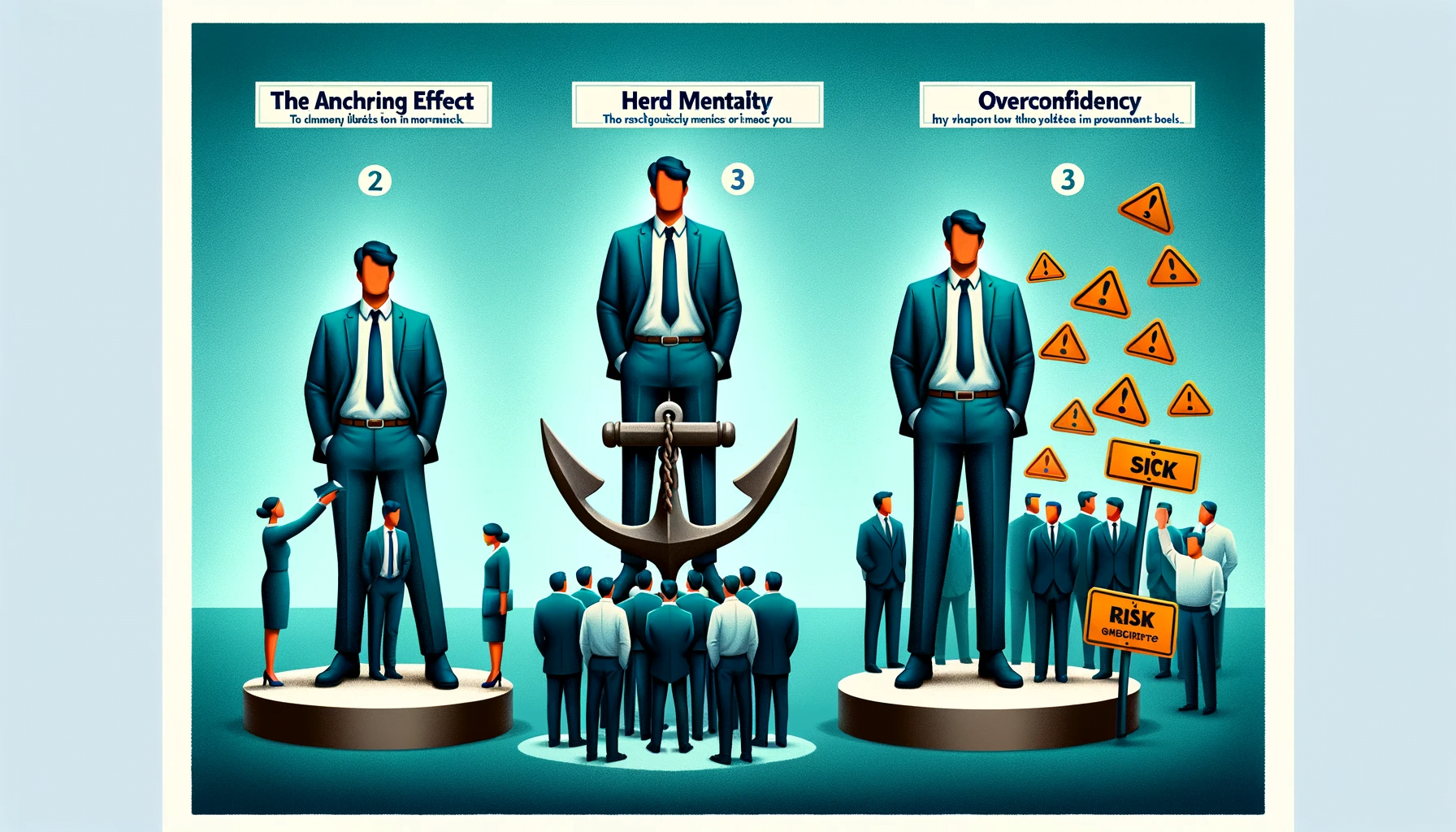
ANCHORING BIAS

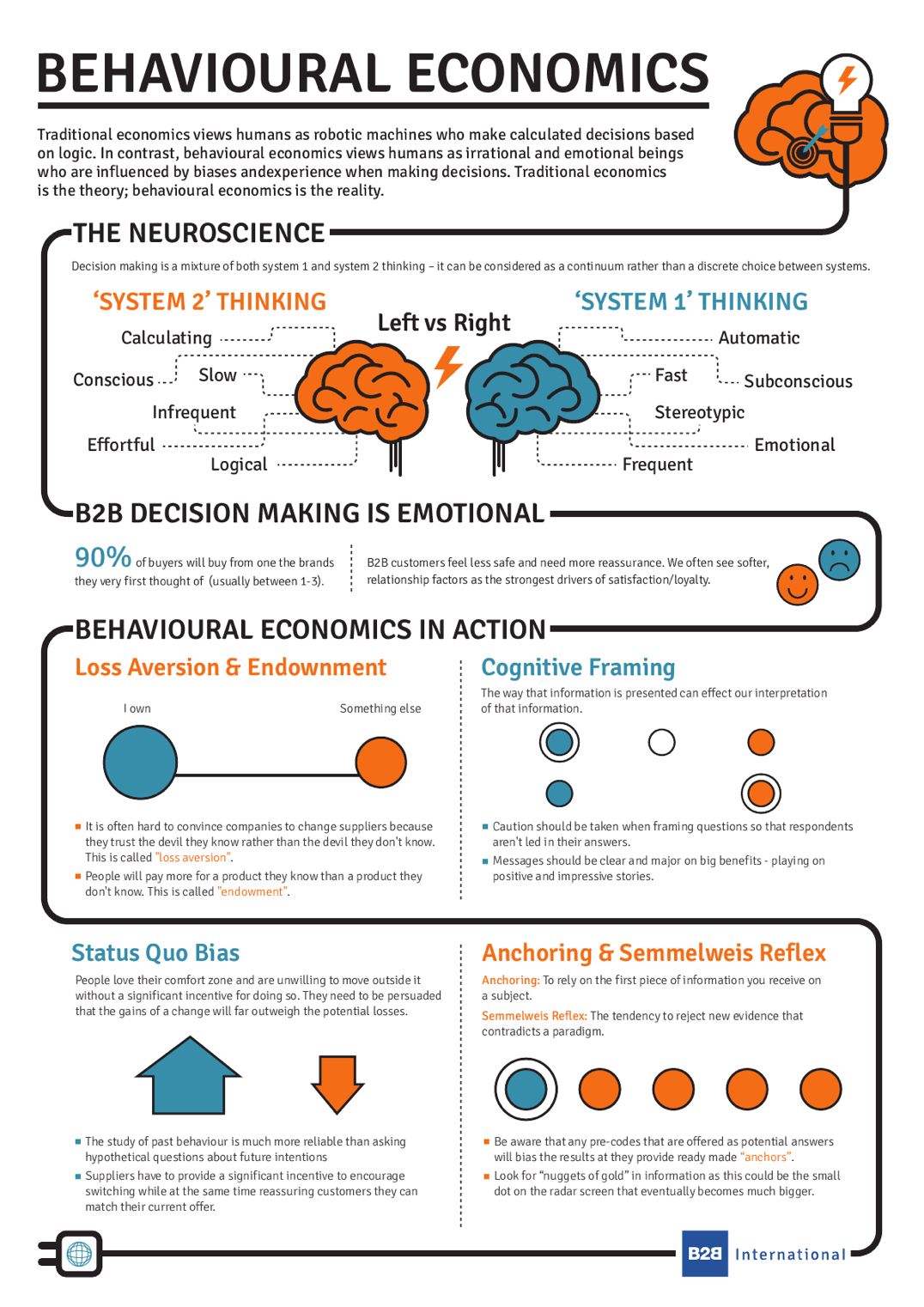
Anchoring Bias happens when we place too much emphasis on the first piece of information we receive regarding a given subject. Anchoring is the mental trick your brain plays when it latches onto the first piece of information it gets, no matter how irrelevant. You might know this as a ‘first impression’ when someone relies on their own first idea of a person or situation.

Example: When shopping for a wedding ring a salesman might tell us to spend three months’ salary. After hearing this, we may feel like we are doing something wrong if we stray from this financial advice, even though the guideline provided may cause us to spend more than we can afford.

Example: Imagine you’re buying a car, and the salesperson starts with a high price. That number sticks in your mind and influences all your subsequent negotiations. Anchoring can skew our decisions and perceptions, making us think the first offer is more important than it is. Or, subsequent offers lower than they really are.

Example: Imagine an investor named Jane who purchased 100 shares of XYZ Corporation at $100 per share several years ago. Over time, the stock price declined to $60 per share. Jane is anchored to her initial price of $100 and is reluctant to sell at a loss because she keeps hoping the stock will return to her original purchase price. She continues to hold onto the stock, even as it declines, due to her anchoring bias. Eventually, the stock price drops to $40 per share, resulting in significant losses for Jane.

In this example, Jane’s nchoring bias to the original purchase price of $100 prevents her from rationalizing to sell the stock and cut her losses, even though market conditions have changed. So, the next time you’re haggling for your self, a potential customer or client, or making another big financial decision, be aware of that initial anchor dragging you down.

HERD MENTALITY BIAS

Herd Mentality Bias makes it very hard for humans to not take action when everyone around us does.

Example: We may hear stories of people making significant monetary profits buying, fixing up, and flipping homes and have the desire to get in on the action, even though we have no experience in real estate.

Example: During the dotcom bubble of the late 1990’s many investors exhibited a herd mentality. As technology stocks soared to astronomical valuations, investors rushed to buy these stocks driven by the fear of missing out on the gains others were enjoying. Even though some of these stocks had questionable fundamentals, the herd mentality led investors to follow the crowd.

In this example, the herd mentality contributed to the overvaluation of technology stocks. Eventually, it led to the dot-com bubble’s burst, causing significant losses for those who had unthinkingly followed the crowd without conducting proper research or analysis.

OVERCONFIDENT INVESTING BIAS

Overconfident Investing Bias happens when we believe we can out-smart other investors via market timing or through quick, frequent trading. This causes the results of a study to be unreliable and hard to reproduce in other research settings.

Example: Data convincingly shows that people and financial planners/advisors and wealth managers who trade most often under-perform the market by a significant margin over time. Active traders lose money.

Example: Overconfidence Investing Bias moreover leads to: (1) excessive trading (which in turn results in lower returns due to costs incurred), (2) underestimation of risk (portfolios of decreasing risk were found for single men, married men, married women, and single women), (3) illusion of knowledge (you can get a lot more data nowadays on the internet) and (4) illusion of control (on-line trading).

ASSESSMENT

Finally, questions remain after consuming this cognitive bias review.

Question: Can behavioral cognitive biases be eliminated by financial advisors in prospecting and client sales endeavors?

A: Indeed they can significantly reduce their impact by appreciating and understanding the above and following a disciplined and rational decision-making sales process.

Question: What is the role of financial advisors in helping clients and prospects address behavioral biases?

A: Financial advisors can provide an objective perspective and help investors recognize and address their biases. They can assist in creating well-structured investment and financial plans, setting realistic goals, and offering guidance to ensure investment decisions align with long-term objectives.

Question: How important is self-discipline in overcoming behavioral biases?

A; Self-discipline is crucial in overcoming behavioral biases. It helps investors and advisors adhere to their investment plans, avoid impulsive decisions, and stay focused on long-term goals reducing the influence of emotional and cognitive biases.

CONCLUSION

Remember, it is far more useful to listen to client beliefs, fears and goals, and to suggest options and offer encouragement to help them discover their own path toward financial well-being. Then, incentivize them with knowledge of the above psychological biases to your mutual success!

EDUCATION: Books

SPEAKING: Dr. Marcinko will be speaking and lecturing, signing and opining, teaching and preaching, storming and performing at many locations throughout the USA this year! His tour of witty and serious pontifications may be scheduled on a planned or ad-hoc basis; for public or private meetings and gatherings; formally, informally, or over lunch or dinner. All medical societies, financial advisory firms or Broker-Dealers are encouraged to submit an RFP for speaking engagements: CONTACT: Ann Miller RN MHA at MarcinkoAdvisors@outlook.com 

REFERENCES:

  • Marcinko, DE; Dictionary of Health Insurance and Managed Care. Springer Publishing Company, New York, 2007.
  • Marcinko, DE: Comprehensive Financial Planning Strategies for Doctors and Advisors: Best Practices from Leading Consultants and Certified Medical Planners™. Productivity Press, NY, 2016.
  • Marcinko, DE: Risk Management, Liability and Insurance Strategies for Doctors and Advisors: Best Practices from Leading Consultants and Certified Medical Planners™. Productivity Press, NY, 2017.
  • Nofsinger, JR: The Psychology of Investing. Rutledge Publishing, 2022
  • Winters, Scott:  The 10X Financial Advisor: Your Blueprint for Massive and Sustainable Growth. Absolute Author Publishing House, 2020.
  • Woodruff, Mandy: https://www.mandimoney.com

COMMENTS APPRECIATED

Like, Subscribe and Refer

***

***

MONEY SCRIPTS: Fundamental Subconscious Beliefs and Economic Behavioral Patterns Defined

SALES PSYCHOLOGY FOR INVESTMENT ADVISORS, FINANCIAL ADVISORS, INSURANCE AGENTS, WEALTH MANAGERS AND FINANCIAL PLANNERS

By Dr. David Edward Marcinko; MBA MEd CMP®

http://www.MarcinkoAssociates.com

***

***

SPONSOR: http://www.CertifiedMedicalPlanner.org

***

***

Stocks were decimated yesterday in the first full trading day following President Trump’s tariff announcement. It was the biggest single-day decline since the start of the Covid-19 pandemic in March 2020. Every Magnificent Seven stock was battered—Apple worst of all. And so perhaps it is a good time to discuss the concept of “Money Scripts”.

***

Money Scripts are unconscious beliefs about money that are typically only partially true, are developed in childhood, and drive adult financial behaviors. Money scripts may be the result of “financial flashpoints,” which are salient early experiences around money that have a lasting impact in adulthood. Money scripts are often passed down through the generations and social groups often share similar money scripts. And so, we argue that Money scripts are at the root of all illogical, ill-advised, self-destructive, or self-limiting financial behaviors.

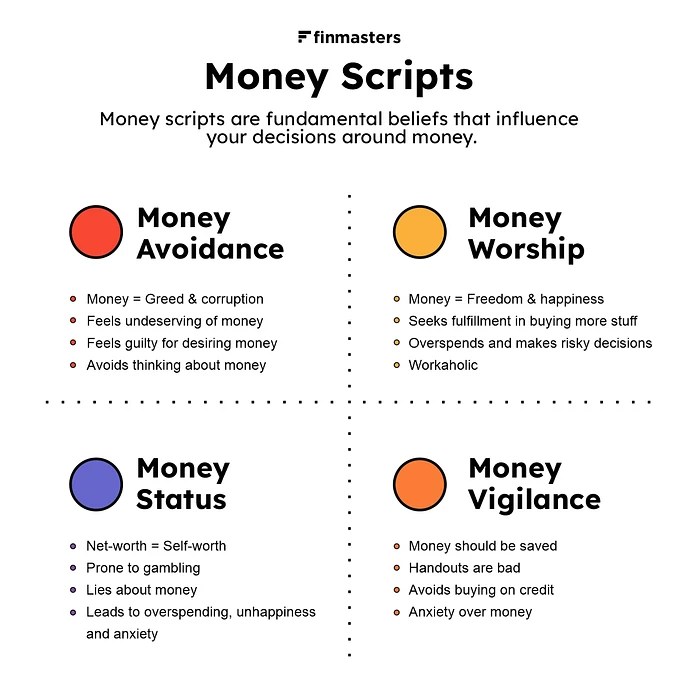
In research at Kansas State University [KSU], researchers identified four distinct Money script patterns, which are associated with financial health and predict financial behaviors. These include: (a) money avoidance, (b) money worship, (c) money status, and (d) money vigilance [personal communication Brad Klontz, PsyD, CFP®, Kenneth Shubin-Stein, MD, MPH, MS, CFA and Sonya Britt, PhD, CFP®].

And so, we all like to think our financial decisions are fully rational, but the truth is that our subconscious beliefs have a dramatic impact on our money and financial decisions. These money scripts are important to know and understand. A summary is below:

            Money Avoidance

Money avoidance scripts are illustrated by beliefs such as “Rich people are greedy,” “It is not okay to have more than you need,” and “I do not deserve a lot of money when others have less than me.” Money avoiders believe that money is bad or that they do not deserve money. They believe that wealthy people are corrupt and there is virtue in living with less money. They may sabotage their financial success or give money away even though they cannot afford to do so. Money avoidance scripts may be associated with lower income and lower net worth and predict financial behaviors including ignoring bank statements, overspending, financial dependence on others, financial enabling of others, and having trouble sticking to a budget.

            Money Worship 

Money worship is typified by beliefs such as “More money will make you happier,” “You can never have enough money,” and “Money would solve all my problems.” Money worshipers are convinced that money is the key to happiness. At the same time, they believe that one can never have enough. Money worships have lower income, lower net worth, and higher credit card debt. They are more likely to be hoarders, spend compulsively, and put work ahead of family.

            Money Status

Money status scripts include “I will not buy something unless it is new,” “Your self-worth equals you net worth,” and “If something isn’t considered the ‘best’ it is not worth buying.” Money status seekers see net worth and self-worth as being synonymous. They pretend to have more money than they do and tend to overspend as a result. They often grew up in poorer families and believe that the universe should take care of their financial needs if they live a virtuous life. Money status scripts are associated with compulsive gambling, overspending, being financially dependent on others, and lying to one’s spouse about spending.

            Money Vigilance

Money vigilant beliefs include “It is important to save for a rainy day,” “You should always look for the best deal, even if it takes more time,” and “I would be a nervous wreck if I did not have an emergency fund.” The money vigilants are alert, watchful and concerned about their financial welfare. They are more likely to save and less likely to buy on credit. As a result, they tend to have higher income and higher net worth. They also have a tendency to be anxious about money and are secretive about their financial status outside of their household. While money vigilance is associated with frugality and saving, excessive anxiety can keep someone from enjoying the benefits that money can provide.

Identification

When money scripts are identified, it is helpful to examine where they came from. A simple behavioral finance technique involves reflecting on the following questions:

  • What three lessons did you learn about money from your mother?
  • What three lessons did you learn about money from your father?
  • What is your first memory around money?
  • What is your most painful money memory?
  • What is your most joyful money memory?
  • What money scripts emerged for you from this experience?
  • How have they helped you?
  • How have they hurt you?
  • What money scripts do you need to change?

Conclusion

Ideally, from a balanced middle ground, we can see past the limitations of money scripts, our self and others who are polarized. Those who believe “Money is meant to be spent” or “Money is meant to be saved” have a world view that results in extreme positions. Labeling them as “correct” or “wrong” is not a useful way to try to shift anyone’s polarized money script beliefs.

EDUCATION: Books

SPEAKING: Dr. Marcinko will be speaking and lecturing, signing and opining, teaching and preaching, storming and performing at many locations throughout the USA this year! His tour of witty and serious pontifications may be scheduled on a planned or ad-hoc basis; for public or private meetings and gatherings; formally, informally, or over lunch or dinner. All medical societies, financial advisory firms or Broker-Dealers are encouraged to submit a RFP for speaking engagements: CONTACT: MarcinkoAdvisors@outlook.com 

COMMENTS APPRECIATED

Read, Refer, Like and Subscribe

***

***

PROSPECT THEORY: Physician-Client Empowerment for Financial Decision Making

BEHAVIORAL ECONOMICS

By Staff Reporters

***

***

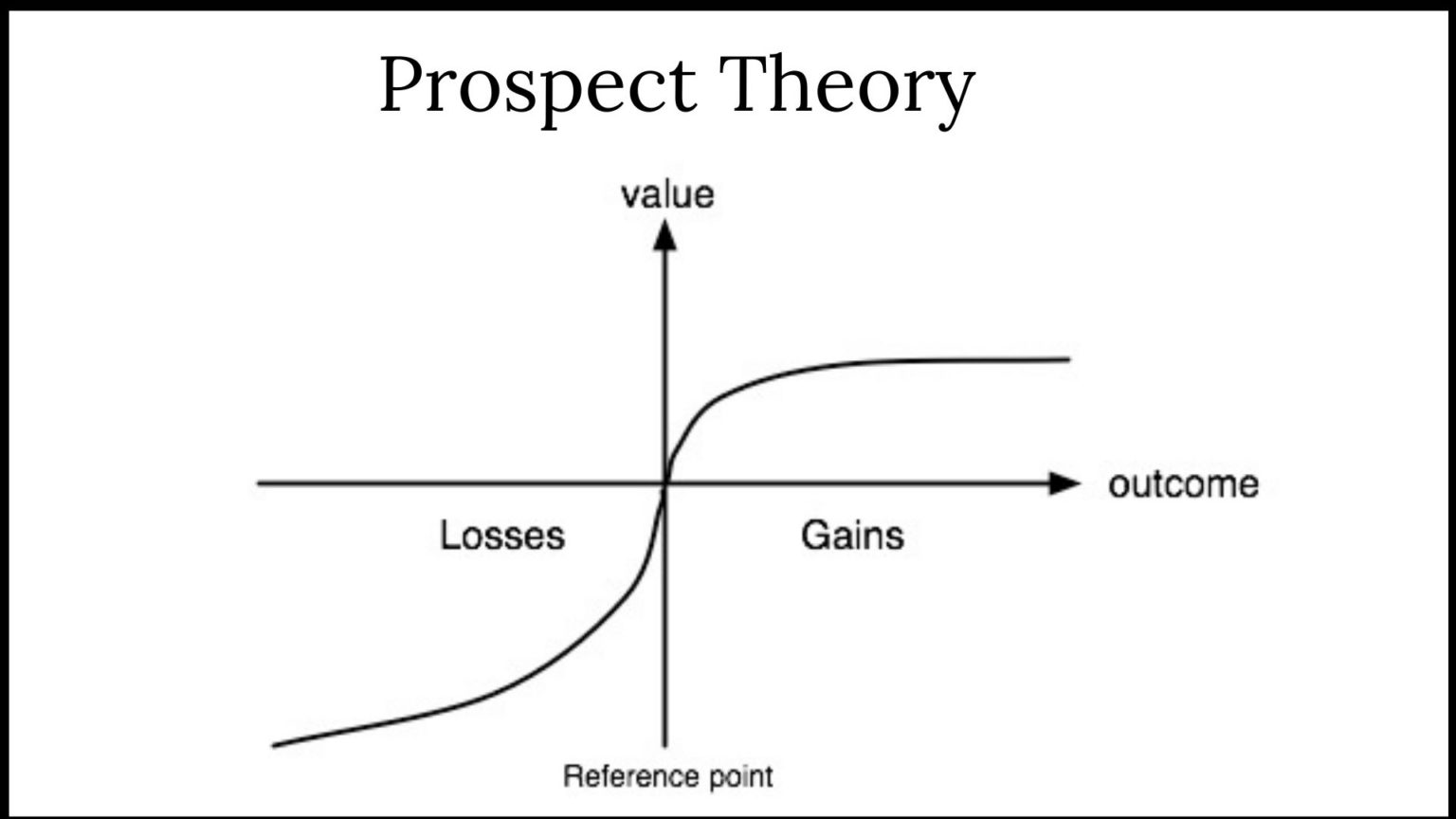
Prospect theory is a psychological and behavioral economics theory developed by Daniel Kahneman and Amos Tversky in 1979. It explains how people make decisions when faced with alternatives involving risk, probability, and uncertainty. According to this theory, decisions are influenced by perceived losses or gains.

Example:

Amanda, a DO client, was just informed by her financial advisor that she needed to re-launch her 403-b retirement plan. Since she was leery about investing, she quietly wondered why she couldn’t DIY. Little does her FA know that she doesn’t intend to follow his advice, anyway! So, what went wrong?

The answer may be that her advisor didn’t deploy a behavioral economics framework to support her decision-making. One such framework is the “prospect theory” model that boils client decision-making into a “three step heuristic.”
 
Prospect theory makes the unspoken biases that we all have more explicit. By identifying all the background assumptions and preferences that clients [patients] bring to the office, decision-making can be crafted so that everyone [family, doctor and patient] or [FA, client and spouse] is on the same page. Briefly, the three steps are:

1. Simplify choices by focusing on the key differences between investment [treatment] options such as stock, bonds, cash, and index funds. 

2. Understanding that clients [patients] prefer greater certainty when it comes to pursuing financial [health] gains and are willing to accept uncertainty when trying to avoid a loss [illness].

3. Cognitive processes lead clients and patients to overestimate the value of their choices thanks to survivor bias, cognitive dissonance, appeals to authority and hindsight biases.

Assessment

Much like healthcare today, the current mass-customized approaches to the financial services industry falls short of recognizing more personalized advisory approaches like prospect theory and assisted client-centered investment decision-making.

 Jaan E. Sidorov MD [Harrisburg, PA]   

COMMENTS APPRECIATED

Read, Refer and Subscribe

***

***

NINE: Psychological Reasons We Do Dumb Things with Money [$$$$]

Yep – Even the Smart Folks!

By Lon Jefferies MBA CMP® CFP®

Dr. David Edward Marcinko MBA MEd CMP®

Lon Jeffries

In the Business Insider, Mandi Woodruff describes nine mental blocks that cause smart people to do dumb things. Review the list and itemize the factors that have negatively impacted your finances.

The Factors

  • Anchoring happens when we place too much emphasis on the first piece of information we receive regarding a given subject. For instance, when shopping for a wedding ring a salesman might tell us to spend three months’ salary. After hearing this, we may feel like we are doing something wrong if we stray from this advice, even though the guideline provided may cause us to spend more than we can afford.
  • Myopia (or nearsightedness) makes it hard for us to imagine what our lives might be like in the future. For example, because we are young, healthy, and in our prime earning years now, it may be hard for us to picture what life will be like when our health depletes and we know longer have the earnings necessary to support our standard of living. This short-sightedness makes it hard to save adequately when we are young, when saving does the most good.
  • Gambler’s fallacy occurs when we subconsciously believe we can use past events to predict the future. It is common for the hottest sector during one calendar year to attract the most investors the following year. Of course, just because an investment did well last year doesn’t mean it will continue to do well this year. In fact, it is more likely to lag the market.
  • Avoidance is simply procrastination. Even though you may only have the opportunity to adjust your health care plan through your employer once per year, researching alternative health plans is too much work and too boring for us to get around to it. Consequently, we stick with a plan that may not be best for us.
  • Confirmation bias causes us to place more emphasis on information that supports the opinion we already have. Consequently, we tend to ignore or downplay opinions that don’t mirror our own, leading us to make uninformed decisions.

NOTE: An interesting example of the confirmation bias is the case of David Rosenberg, who is one of the most well-known perpetual bears on Wall Street. In October, Mr. Rosenberg’s analysis forced him to warm to the current investment environment. His fans and followers, rather than appreciating his research and ability to adjust to new information, criticized him for changing his opinion.

As it turned out Mr. Rosenberg had fans not because of his expert analysis, but because he added intellectual heft to his followers pessimism and quasi-political desire for the system to collapse. Their view was that things were in permanent decline and his analysis, charts, and voice added respectability to their pre-existing bias. Mr. Rosenberg has now lost his fan base not because he was wrong for the last four years, but because he changed his mind.

head

  • Loss aversion affected many investors during the crash of 2008. During the crash, many people decided they couldn’t afford to lose more and sold their investments. Of course, this caused the investors to sell at market troughs and miss the quick, dramatic recovery.
  • Overconfident investing happens when we believe we can out-smart other investors via market timing or through quick, frequent trading. Data convincingly shows that people who trade most often underperform the market by a significant margin over time.
  • Mental accounting takes place when we assign different values to money depending on where we get it from. For instance, even though we may have an aggressive saving goal for the year, it is likely easier for us to save money that we worked for than money that was given to us as a gift.
  • Herd mentality makes it very hard for humans to not take action when everyone around us does. For example, we may hear stories of people making significant profits buying, fixing up, and flipping homes and have the desire to get in on the action, even though we have no experience in real estate.

Assessment

The good news is that being aware of these tendencies can help us avoid mistakes. We’ll never be perfect, but avoiding detrimental decisions based on mental prejudices can give us an advantage in our financial and retirement planning efforts.

Conclusion

Your thoughts and comments on this ME-P are appreciated. Feel free to review our top-left column, and top-right sidebar materials, links, URLs and related websites, too. Then, subscribe to the ME-P. It is fast, free and secure.

Speaker: If you need a moderator or speaker for an upcoming event, Dr. David E. Marcinko; MBA – Publisher-in-Chief of the Medical Executive-Post – is available for seminar or speaking engagements. Contact: MarcinkoAdvisors@msn.com

OUR OTHER PRINT BOOKS AND RELATED INFORMATION SOURCES:

ADVISORS: www.CertifiedMedicalPlanner.org
BLOG: www.MedicalExecutivePost.com

Risk Management, Liability Insurance, and Asset Protection Strategies for Doctors and Advisors: Best Practices from Leading Consultants and Certified Medical Planners™8Comprehensive Financial Planning Strategies for Doctors and Advisors: Best Practices from Leading Consultants and Certified Medical Planners™

Invite Dr. Marcinko

***

Dr. Richard H. Thaler and Behavioral Economics

A behavioral scientist

By Rick Kahler MS CFP®

Human beings make most of our decisions—including financial ones—emotionally, not logically. Unfortunately, too much of the time, our emotions lead us into financial choices that aren’t good for our financial well-being. This is hardly news to financial planners or financial therapists. Nor is it a surprise to any parent who has ever struggled to teach kids how to manage money wisely.

Economic Model Assumptions

Yet many of the economic models and theories related to investing are based on assumptions that, when it comes to money, people act rationally and in their own best interests. There’s a wide gulf between the way economists assume people behave around money and the way people actually make money choices. This doesn’t encourage financial advisors to rely on what economists say about financial patterns, trends, and what to expect from markets or consumers.

2017 Nobel Prize in Economics

It’s significant, then, that the 2017 Nobel Prize in Economics went to Dr. Richard H. Thaler, professor of behavioral science and economics at the University of Chicago Booth School of Business. Dr. Thaler’s work has focused on the differences between logical economic assumptions and real-world human behavior. His research not only demonstrates that people behave emotionally when it comes to money; it also shows that in many ways our irrational economic behavior is predictable.

This predictability can help advisors and organizations find ways to encourage people to make financial decisions in their own better interest. The book Nudge, by Dr. Thaler and Cass R. Sunstein, describes some of those methods.

Example:

One example is making participation the default option for company retirement programs like 401(k)’s. Employees are free to opt out, of course, but they need to actively choose to do so.

A second example is the “Save More Tomorrow” plan, which offers employees the option of automatically increasing their savings whenever they receive raises in the future.

Both of these examples rely on a predictable behavior—human inertia. Most of us tend to postpone, ignore, or forget to take action even when that action would be good for us. So if a system is set up so not taking action leaves us with the choice that serves us better, we are “nudged” toward helping ourselves toward a healthier financial future.

Integration

As one of the pioneers in integrating the emotional aspect of money behavior into the practice of financial planning, I’ve long since come to understand that managing money is about much more than numbers. The world of investing may seem to be cold and calculating, but it’s actually driven by emotions. I’m familiar with the work of researchers who have demonstrated that some 90% of all financial decisions are made emotionally rather than logically.

I was pleased in 2002 when one of those researchers, psychologist Daniel Kahneman, won the Nobel prize in economics for his studies of human behavioral biases and systematic irrational behaviors. (That research was done jointly with psychologist Amos Tversky, who died in 1996.)

I’m even more pleased to see the economics Nobel prize go to a behavioral researcher for the second time. Maybe the realm of economics is beginning to integrate the untidy realities of human emotions into its theories. Eventually, this might lead to new economic models that take into account the emotions that shape people’s money decisions and the fact that money is one of the most emotionally charged aspects of our lives.

Assessment

Perhaps economists are beginning to appreciate the truth of the statement Dr. Thaler made at a news conference after his prize was announced. “In order to do good economics, you have to keep in mind that people are human.”

Conclusion

Your thoughts and comments on this ME-P are appreciated. Feel free to review our top-left column, and top-right sidebar materials, links, urls and related websites, too. Then, subscribe to the ME-P. It is fast, free and secure.

Speaker: If you need a moderator or speaker for an upcoming event, Dr. David E. Marcinko; MBA – Publisher-in-Chief of the Medical Executive-Post – is available for seminar or speaking engagements.

EDITOR

Contact: MarcinkoAdvisors@msn.com

Subscribe: MEDICAL EXECUTIVE POST for curated news, essays, opinions and analysis from the public health, economics, finance, marketing, I.T, business and policy management ecosystem.

***

On Internet and Investing Psychology

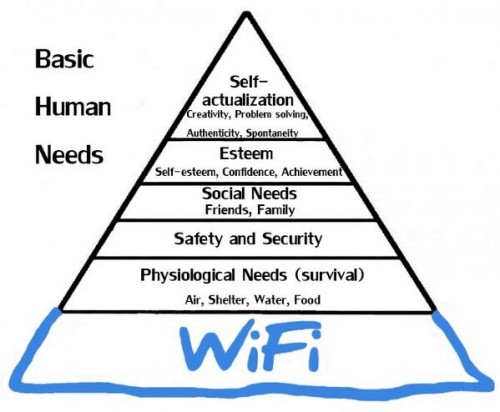
And … Wi-Fi Doctor Investors

[By ME-P Staff Reporters]

***

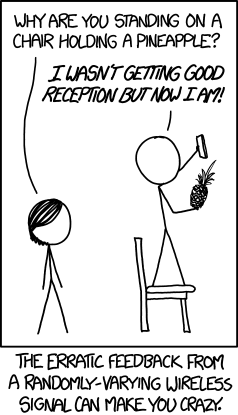
wifi

Sourcehttp://www.xkcd.com

***

OVER HEARD IN THE DOCTOR’S LOUNGE

***

Of course you don’t need a human financial advisor … until you do.

Today, we’ve had unfettered internet access to a wide range of investments, opinions and models for at least two decades. So, why the bravado to go it alone; five straight positive years for equities, since 2009!

The financial advisor’s role is to remove the human element and emotion from investing decisions for something as personal as your wealth. Emotion drives the retail investor to sell low (fear) and buy high (greed). This is the reason why the average equity returns for retail investors is less than half of the S&Ps returns.

No, of course you don’t need a human financial advisor … until you do. And when you do, it may be too late.

***

Dan Ariely PhD

[The Irrational Economist]

WiFi

OUR TEXT BOOK

[BY DOCTORS – FOR DOCTORS – PEER REVIEWED]

[Chapter One]

UNIFYING THE PHYSIOLOGIC AND PSYCHOLOGIC FINANCIAL PLANNING DIVIDE  [Holistic Life Planning, Behavioral Economics, Trading Addiction and the Art of Money]

  • Dr. Brad Klontz PhD CFP
  • Dr. Ted Klontz PsyD
  • Dr. Eugene Schmuckler PhD MBA MEd
  • Dr. Kenneth Shubin-Stein MD CFA
  • Dr. David Edward Marcinko MBA CMP MBBS [Hon]

More:

COACH

Channel Surfing the ME-P

Have you visited our other topic channels? Established to facilitate idea exchange and link our community together, the value of these topics is dependent upon your input. Please take a minute to visit. And, to prevent that annoying spam, we ask that you register. It is fast, free and secure.

Conclusion

Your thoughts and comments on this ME-P are appreciated. Feel free to review our top-left column, and top-right sidebar materials, links, URLs and related websites, too. Then, subscribe to the ME-P. It is fast, free and secure.

Speaker: If you need a moderator or speaker for an upcoming event, Dr. David E. Marcinko; MBA – Publisher-in-Chief of the Medical Executive-Post – is available for seminar or speaking engagements. Contact: MarcinkoAdvisors@msn.com

OUR OTHER PRINT BOOKS AND RELATED INFORMATION SOURCES:

Financial Planning MDs 2015

Comprehensive Financial Planning Strategies for Doctors and Advisors: Best Practices from Leading Consultants

***

PHYSIOLOGY v. PSYCHOLOGY: The Financial Planning Divide

THE PHYSIOLOGIC v. PSYCHOLOGICAL FINANCIAL PLANNING DIVIDE

[Holistic Life Planning, Behavioral Economics & Trading Addiction]

READ HERE: Psychology Behavioral Economics Finance

***

***
By Dr. David Edward Marcinko MBA MEd CMP

COMMENTS APPRECIATED

THANK YOU
***

***

Behavioral Finance for Doctors?

On the Psychology of Investing [Book Review]

By Peter Benedek, PhD CFA

Founder: www.RetirementAction.com

Some of the pioneers of behavioral finance are Drs. Kahneman, Twersky and Thaler. This short introduction to the subject is based on John Nofsinger’s little book entitled “Psychology of Investing” an excellent quick read for all medical professionals or anyone who is interested in learning more about behavioral finance.

Rational Decisions?

Much of modern finance is built on the assumption that investors “make rational decisions” and “are unbiased in their predictions about the future”, however this is not always the case.

Cognitive errors come from (1) prospect theory (people feel good/bad about gain/loss of $500, but not twice as good/bad about a gain/loss of $1,000; they feel worse about a $500 loss than feel good about a $500 gain); (2) mental accounting (meaning that people tend to create separate buckets which they examine individually), (3) Self-deception (e.g. overconfidence), (4) heuristic simplification (shortcuts) and (4) mood can affect ability to reach a logical conclusion.

John Nofsinger’s Book

The following are some of the major chapter headings in Nofsinger’s book, and represent some of the key behavioral finance concepts.

Overconfidence leads to: (1) excessive trading (which in turn results in lower returns due to costs incurred), (2) underestimation of risk (portfolios of decreasing risk were found for single men, married men, married women, and single women), (3) illusion of knowledge (you can get a lot more data nowadays on the internet) and (4) illusion of control (on-line trading).

Pride and Regret leads to: (1) disposition effect (not only selling winners and holding on to the losers, but selling winners too soon- confirming how smart I was, and losers to late- not admitting a bad call, even though selling losers increases one’s wealth due to the tax benefits), (2) reference points (the point from where one measures gains or losses is not necessarily the purchase price, but may perhaps be the most recent 52 week high and it is most likely changing continuously- clearly such a reference point will affect investor’s judgment by perhaps holding on to “loser” too long when in fact it was a winner.)

Considering the Past in decisions about the future, when future outcomes are independent of the past lead to a whole slew of more bad decisions, such as: (1) house money effect (willing to increase the level of risk taken after recent winnings- i.e. playing with house’s money), (2) risk aversion or snake-bite effect (becoming more risk averse after losing money), (3) trying to break-even (at times people will increase their willing to take higher risk to try to recover their losses- e.g. double or nothing), (4) endowment or status quo effect (often people are only prepared to sell something they own for more than they would be willing to buy it- i.e. for investments people tend to do nothing, just hold on to investments they already have) (5) memory and decision making ( decisions are affected by how long ago did the pain/pleasure occur or what was the sequence of pain and pleasure), (6) cognitive dissonance (people avoid important decisions or ignore negative information because of pain associated with circumstances).

Mental Accounting is the act of bucketizing investments and then reviewing the performance of the individual buckets separately (e.g. investing at low savings rate while paying high credit card interest rates).

Examples of mental accounting are: (1) matching costs to benefits (wanting to pay for vacation before taking it and getting paid for work after it was done, even though from perspective of time value of money the opposite should be preferred0, (2) aversion to debt (don’t like long-term debt for short-term benefit), (3) sunk-cost effect (illogically considering non-recoverable costs when making forward-going decisions). In investing, treating buckets separately and ignoring interaction (correlations) induces people not to sell losers (even though they get tax benefits), prevent them from investing in the stock market because it is too risky in isolation (however much less so when looked at as part of the complete portfolio including other asset classes and labor income and occupied real estate), thus they “do not maximize the return for a given level of risk taken).

In building portfolios, assets included should not be chosen on basis of risk and return only, but also correlation; even otherwise well educated individuals make the mistake of assuming that adding a risky asset to a portfolio will increase the overall risk, when in fact the opposite will occur depending on the correlation of the asset to be added with the portfolio (i.e. people misjudge or disregard interactions between buckets, which are key determinants of risk).

This can lead to: (1) building behavioral portfolios (i.e. safety, income, get rich, etc type sub-portfolios, resulting in goal diversification rather than asset diversification), (2) naïve diversification (when aiming for 50:50 stock:bond allocation implementing this as 50:50 in both tax-deferred (401(k)/RRSP) accounts and taxable accounts, rather than placing the bonds in the tax-deferred and stocks in taxable accounts respectively for tax advantages), (3) naïve diversification in retirement accounts (if five investment options are offered then investing 1/5th in each, thus getting an inappropriate level of diversification or no diversification depending on the available choices; or being too heavily invested in one’s employer’s stock).

Representativenes may lead investors to confusing a good company with a good investment (good company may already be overpriced in the market; extrapolating past returns or momentum investing), and familiarity to over-investment in one’s own employer (perhaps inappropriate as when stock tanks one’s job may also be at risk) or industry or country thus not having a properly diversified portfolio.

Emotions can affect investment decisions: mood/feelings/optimism will affect decision to buy or sell risky or conservative assets, even though the mood resulted from matters unrelated to investment. Social interactions such as friends/coworkers/clubs and the media (e.g. CNBC) can lead to herding effects like over (under) valuation.

Financial Strategies

Nofsinger finishes with a final chapter which includes strategies for:

(i) beating the biases: (1) Understand the biases, (2) define your investment objectives, (3) have quantitative investment criteria, i.e. understand why you are buying a specific investor (or even better invest in a passive fashion), (4) diversify among asset classes and within asset classes (and don’t over invest in your employer’s stock), and (5) control your investment environment (check on stock monthly, trade only monthly and review progress toward goals annually).

(ii) using biases for the good: (1) set new employee defaults for retirement plans to being enrolled, (2) get employees to commit some percent of future raises to automatically go toward retirement (save-more-tomorrow).

Assessment

Buy the book (you can get used copies through Amazon). As indicated it is a quick read and occasionally you may even want to re-read it to insure you avoid the biases or use them for the good. Also, the book has long list of references for those inclined to delve into the subject more deeply.

You might even ask “How does all this Behavioral Finance coexist with Efficient Market theory?” and that’s a great question that I’ll leave for another time.

More: SSRN-id2596202

Conclusion

Your thoughts and comments on this ME-P are appreciated. Feel free to review our top-left column, and top-right sidebar materials, links, URLs and related websites, too. Then, subscribe to the ME-P. It is fast, free and secure.

Speaker: If you need a moderator or speaker for an upcoming event, Dr. David E. Marcinko; MBA – Publisher-in-Chief of the Medical Executive-Post – is available for seminar or speaking engagements. Contact: MarcinkoAdvisors@msn.com

OUR OTHER PRINT BOOKS AND RELATED INFORMATION SOURCES:

***

Risk Management, Liability Insurance, and Asset Protection Strategies for Doctors and Advisors: Best Practices from Leading Consultants and Certified Medical Planners™8Comprehensive Financial Planning Strategies for Doctors and Advisors: Best Practices from Leading Consultants and Certified Medical Planners™

A Brief Historical Review of Behavioral Finance and Economics

By Related Influential Thought-Leaders

  • Dr. Brad Klontz CSAC CFP®
  • Dr. Ted Klontz PsyD
  • Dr. Eugene Schmuckler MBA MEd CTS
  • Dr. Kenneth Shubin-Stein FACP CFA
  • Dr. David Edward Marcinko MEd MBA CMP™

***

doctor

***

James O. Prochaska PhD, Professor of Psychology and Director of the Cancer Prevention Research Center at the University of Rhode Island, developed the Trans-Theoretic Model of Behavior Change [TTM] which has been evolving since in 1977. Nominated as one of the five most influential authors in Psychology, by the Institute for Scientific Information and the American Psychological Society, Dr. Prochaska is author of more than 300 papers on behavior change for health promotion and disease prevention.

TTM Stages of Change

In his Trans-Theoretical Model, behavior change is a “process involving progress through a series of these stages:

  • Pre-Contemplation (Not Ready) – “People are not intending to take action in the foreseeable future, and can be unaware that their behavior is problematic”
  • Contemplation (Getting Ready) – “People are beginning to recognize that their behavior is problematic, and start to look at the pros and cons of their continued actions”
  • Preparation (Ready) – “People are intending to take action in the immediate future, and may begin taking small steps toward behavior change”
  • Action – “People have made specific overt modifications in changing their problem behavior or in acquiring new healthy behaviors”
  • Maintenance – “People have been able to sustain action for a while and are working to prevent relapse”
  • Termination – “Individuals have zero temptation and they are sure they will not return to their old unhealthy habit as a way of coping”

Relapse

In addition, researchers conceptualized “relapse” (recycling) which is not a stage in itself but rather the “return from Action or Maintenance to an earlier stage.” In medical care, these stages of behavior change have applicability to anti-hypertension and lipid lowering medication use, as well as depression prevention, weight control and smoking cessation.

***

Psychology

***

Uniting Psychology and Financial Behavior

More recently, validating the emerging alliance between psychology (human behavior) and finance (economics) are two Americans who won the Royal Swedish Academy of Science’s 2002 Nobel Memorial Prize in Economic Science. Their research was nothing short of an explanation for the idiosyncrasies incumbent in human financial decision-making outcomes.

Enter Kahneman and Smith

Daniel Kahneman, PhD, professor of psychology at Princeton University, and Vernon L. Smith, PhD, professor of economics at George Mason University in Fairfax, Va., shared the prize for work that provided insight on everything from stock market bubbles, to regulating utilities, and countless other economic activities. In several cases, the winners tried to explain apparent financial paradoxes.

For example, Professor Kahneman made the economically puzzling discovery that most of his subjects would make a 20-minute trip to buy a calculator for $10 instead of $15, but would not make the same trip to buy a jacket for $120 instead of $125, saving the same $5.

1608708312704

in vitro and in-vivo Economics

Initially, in the 1960’s, Smith set out to demonstrate how economic theory worked in the laboratory (in vitro), while Kahneman was more interested in the ways economic theory mis-predicted people in real-life (in-vivo). He tested the limits of standard economic choice theory in predicting the actions of real people, and his work formalized laboratory techniques for studying economic decision making, with a focus on trading and bargaining.

Later, Smith and Kahneman together were among the first economists to make experimental data a cornerstone of academic output. Their studies included people playing games of cooperation and trust, and simulating different types of markets in a laboratory setting. Their theories assumed that individuals make decisions systematically, based on preferences and available information, in a way that changes little over time, or in different contexts.

University of Chicago

By the late 1970’s, Richard H. Thaler, PhD, an economist at the University of Chicago also began to perform behavioral experiments further suggesting irrational wrinkles in standard financial theory and behavior, enhancing the still embryonic but increasingly popular theories of Kahneman and Smith.

Laboratory

Other economists’ laboratory experiments used ideas about competitive interactions pioneered by game theorists like John Forbes Nash Jr., PhD, who shared the Nobel in 1994, as points of reference.

Assessment

But, Kahneman and Smith often concentrated on cases where people’s actions departed from the systematic, rational strategies that Nash envisioned. Psychologically, this was all a precursor to the informal concept of life or holistic financial planning. Kahneman was awarded the Medal of Freedom, by President Barack Obama, on November 20, 2013.

READ: Behavioral Economics and Psychology DEM

e513455b-e924-451f-9132-d4bbbeb8e033-original

Channel Surfing the ME-P

Have you visited our other topic channels? Established to facilitate idea exchange and link our community together, the value of these topics is dependent upon your input. Please take a minute to visit. And, to prevent that annoying spam, we ask that you register. It is fast, free and secure.

Go back

Your message has been sent

Warning
Warning
Warning
Warning

Warning.

More:

Conclusion

Your thoughts and comments on this ME-P are appreciated. Feel free to review our top-left column, and top-right sidebar materials, links, URLs and related websites, too. Then, subscribe to the ME-P. It is fast, free and secure.

Speaker: If you need a moderator or speaker for an upcoming event, Dr. David E. Marcinko; MBA – Publisher-in-Chief of the Medical Executive-Post – is available for seminar or speaking engagements. Contact: MarcinkoAdvisors@msn.com

OUR OTHER PRINT BOOKS AND RELATED INFORMATION SOURCES:

Comprehensive Financial Planning Strategies for Doctors and Advisors: Best Practices from Leading Consultants and Certified Medical Planners(TM)

***

Invite Dr. Marcinko

***

RIP: Daniel Kahneman PHD

NOBEL PRIZE WINNER AND FATHER OF BEHAVIORAL ECONOMICS

By Staff Reporters

DEFINITION: According to Wikipedia, behavioral economics is the study of the psychological, cognitive, emotional, cultural and social factors involved in the decisions of individuals or institutions, and how these decisions deviate from those implied by classical economic theory.

Behavioral economics is primarily concerned with the bounds of rationality of economic agents. Behavioral models typically integrate insights from psychology, neuroscience and microeconomic theory. The study of behavioral economics includes how market decisions are made and the mechanisms that drive public opinion.

Behavioral economics began as a distinct field of study in the 1970s and ’80s, but can be traced back to 18th-century economists, such as Adam Smith, who deliberated how the economic behavior of individuals could be influenced by their desires.

The status of behavioral economics as a subfield of economics is a fairly recent development; the breakthroughs that laid the foundation for it were published through the last three decades of the 20th century. Behavioral economics is still growing as a field, being used increasingly in research and in teaching.

***

***

Daniel Kahneman PhD, the father of behavioral economics, died yesterday at age 90 years old. He’s best known for applying psychology to economics and uncovering biases and mental shortcuts that make people act irrationally, as he chronicled in his best-selling book Thinking, Fast and Slow.

Kahneman, along with his long-time collaborator and friend Amos Tversky PhD, developed “prospect theory,” or loss-aversion theory, which earned him the Nobel Prize in Economics in 2002 (which he shared with fellow economist Vernon Smith). The idea is that people value losses and gains differently, so we feel more bad about losing $100 than we feel good about making the same amount. He applied this theory to investors, who had previously been considered rational decision-makers. It shows up elsewhere, too—for example, golfers putt better when they’re facing the loss of a stroke than when they might gain one.

Two other biases he identified include:

  • The “peak-end rule” that people remember an experience primarily based on how they felt at its most intense moment and the final part of it. It’s why you consider a whole vacation good if the last day was good—or the opposite.
  • The conjunction fallacy where people erroneously think the probability of two things being true is more likely than just one thing, which the famous “Linda the Bank Teller” problem illustrates.

COMMENTS APPRECIATED

Thank You

***

***

***

HEALTH INSURANCE: Marketing and Behavioral Economics

DR. DAVID EDWARD MARCINKO MBA MEd CMP

By Staff Reporters

***

***

DEFINITION: Behavioral economics is grounded in empirical observations of human behavior, which have demonstrated that people do not always make what neoclassical economists consider the “rational” or “optimal” decision, even if they have the information and the tools available to do so.

For example, why do people often avoid or delay investing in 401ks or exercising, even if they know that doing those things would benefit them? And why do gamblers often risk more after both winning and losing, even though the odds remain the same, regardless of “streaks”?

CITE: https://www.r2library.com/Resource

By asking questions like these and identifying answers through experiments, the field of behavioral economics considers people as human beings who are subject to emotion and impulsivity, and who are influenced by their environments and circumstances.

***

***

The state and federal governments and health insurance companies are harnessing lessons from a still-emerging academic field of behavioral economics to nudge clients and customers into spending more money.

“Behavioral economics was developed by incorporating ideas from psychology into standard economic theories,” said Cait Lamberton, a professor of marketing at the University of Pennsylvania’s Wharton School. “If you see a deal that is available for only a short amount of time [like Medicare open enrollment periods], and thus pay more than you usually would, standard economics would say you’ve made an irrational decision. Behavioral economics says that no, what your brain is doing is responding to scarcity.”

These seemingly irrational choices are called “biases,” many of which can affect how we shop. For example, “loss aversion” makes us hypersensitive to losing money and more likely to buy something like whole life insurance for children.

The “decoy effect” makes us more likely to choose between two sub-optimal options when a third, even worse option is presented. For example, Medicare Part D providers may offer a decoy like an high costs, which may make the cheaper Medicare Part C with more [so-called] benefits look more appealing.

Most companies are well aware of these tendencies and how they drive our decisions. So to save money customers, patients and clients need to understand how the purchasing and shopping experience has been engineered to exploit our biases.

COMMENTS APPRECIATED

Thank You

***

***

BEHAVIORAL FINANCE: Cash is Still “King”

TREATING YOURSELF WITH CASH

By Staff Reporters

http://www.MarcinkoAssociates.com

***

***

Folks are more likely to reach for dollar bills than credit cards when making a guilty pleasure purchase, according to new Stanford research.

MORE: https://medicalexecutivepost.com/2022/06/22/behavioral-finance-for-doctors/

In more than 118,000 real transactions at the university bookstore, buyers tended to slap their plastic on the counter for school supplies but pay with cash for “harder-to-justify” items like a stuffed plush mascot. And when asked how they’d pay for a hypothetical Reiki session, participants leaned toward credit card when the treatment was described as doctor-recommended but toward cash when they were told it was just an impulse purchase.

RELATED: https://medicalexecutivepost.com/2023/02/28/dr-richard-h-thaler-and-behavioral-economics/

***

COMMENTS APPRECIATED

Thank You

***

***

Some Thoughts on Money Happiness

Join Our Mailing List

Can Money Buy Happiness?

By Rick Kahler MS CFP® http://www.KahlerFinancial.com

Rick Kahler CFP

It turns out money can buy happiness, after all—sometimes. Having a good income and the security of money invested for the future don’t insure happiness, of course. They do, however, give us a foundation that can make it easier to find happiness.

Spending

Part of the secret to using money to foster happiness is knowing what to spend it on!

For example, spending money to lift your mood—the whole “retail therapy” idea—does not lead to happiness. It provides only a momentary sense of pleasure, which often in the long run fosters unhappiness. There are ways to spend money that do create happiness.

Here, based in part on several posts about money and happiness by Dr. Jeremy Dean on his site Psyblog, are a few of them:

1. Experiences. Research says you will find greater happiness spending your money on experiences rather than on stuff. Experiences live in our memories much longer and give us more emotional enjoyment than things, which can quickly lose their importance. In fact, just the anticipation of planning an experience often creates happiness. And if you want to take the happiness level up a notch, take a friend along with you.

2. Exercise: The number-one strategy people can use to feel better, increase energy levels, and reduce tension is exercise. Exercising can mean spending money on a gym membership, a personal trainer, and equipment. However, exercising can also be inexpensive. Walking, for example, requires little more than a pair of good walking shoes and—at least here in South Dakota—a warm winter coat.

3. Stuff that will provide you experiences: Buying things that create or are necessary for experiences count as happiness spending. Music is an experience that research says is a mood enhancer; even sad music can bring pleasure. Spending money on music might mean buying concert tickets, but it could also mean buying recordings, an iPod, smart-phone, speakers, and similar equipment.

4. Stuff that supports doing what you’re good at; like medicine: What are you good at and really enjoy? PsyBlog says spending money for things you excel at typically creates happiness. A set of golf clubs and a budget for green fees could be a great purchase if you’re good at golf—or even if you aren’t so good at the game but you enjoy it for the exercise and time with friends. The same goes for buying things to support hobbies, such as art supplies, garden plants, or quilting fabrics. Maybe you enjoy helping others, so charitable giving or spending money on volunteer opportunities would increase your happiness. I love researching almost anything, so spending money on research data can be a mood lifter for me.

5. Coaching/Therapy: Few things are more valuable for long-term happiness than hiring a good coach or therapist. Research shows talk therapy to be as effective as or better than antidepressants. In my co-authored book, Conscious Finance, I describe how spending $80,000 on therapy was the best investment I ever made in my own happiness and well-being.

6. Meditation: The biggest happiness bang for your buck might come from meditation. It isn’t free, but it’s very inexpensive. You will need to attend a class or buy an instructional video or book. I recommend “Open Heart, Open Mind” by Thomas Keating, but there are many others.

****

Happy

****

Assessment

While we know that money by itself isn’t a source of happiness, we also know that having enough money to comfortably meet our basic needs does make us happier. In addition, we can consciously choose to spend in ways that buy happiness. Such investments may not provide financial returns, but they can provide significant happiness returns.

Conclusion

Your thoughts and comments on this ME-P are appreciated. Feel free to review our top-left column, and top-right sidebar materials, links, URLs and related websites, too. Then, subscribe to the ME-P. It is fast, free and secure. Link: http://feeds.feedburner.com/HealthcareFinancialsthePostForcxos

Speaker: If you need a moderator or speaker for an upcoming event, Dr. David E. Marcinko; MBA – Publisher-in-Chief of the Medical Executive-Post – is available for seminar or speaking engagements. Contact: MarcinkoAdvisors@msn.com

OUR OTHER PRINT BOOKS AND RELATED INFORMATION SOURCES:

Product Details  Product Details

  Risk Management, Liability Insurance, and Asset Protection Strategies for Doctors and Advisors: Best Practices from Leading Consultants and Certified Medical Planners™
Comprehensive Financial Planning Strategies for Doctors and Advisors: Best Practices from Leading Consultants and Certified Medical Planners™

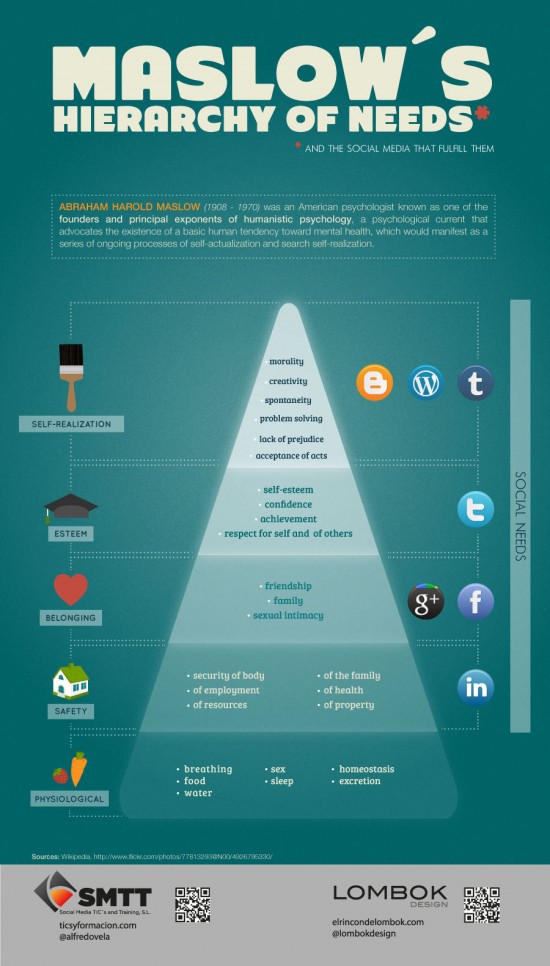
An Update on Maslow’s Hierarchy of e-Needs for Modernity

Join Our Mailing List

Understanding the New-Wave Social Media that Fuels Them

[By Staff Writers]

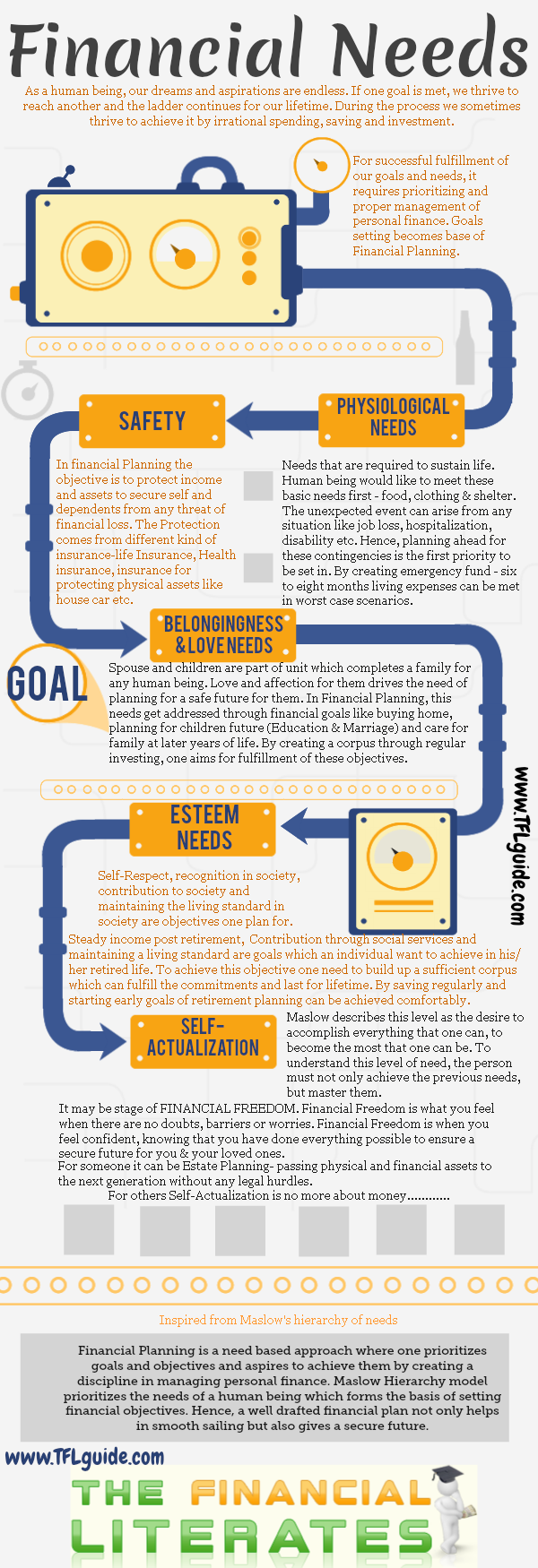
All medical professionals, and some FAs and behavioral economists, realize that Maslow’s hierarchy of needs is often portrayed in the shape of a pyramid, with the largest and most fundamental levels of needs at the bottom, and the need for self-actualization at the top.

So, this infographic takes Maslow’s theory and looks at the electronic social media tools that fulfill these needs.

Source: ticsyformacion.com

Assessment

Yet, another new-paradigm assessment of social media for doctors, financial advisors … and us all.


Product DetailsProduct DetailsProduct Details

Product Details  Product Details

Product Details

Conclusion

Your thoughts and comments on this ME-P are appreciated. Feel free to review our top-left column, and top-right sidebar materials, links, URLs and related websites, too. Then, subscribe to the ME-P. It is fast, free and secure.

Speaker: If you need a moderator or speaker for an upcoming event, Dr. David E. Marcinko; MBA – Publisher-in-Chief of the Medical Executive-Post – is available for seminar or speaking engagements. Contact: MarcinkoAdvisors@msn.com

OUR OTHER PRINT BOOKS AND RELATED INFORMATION SOURCES:

Risk Management, Liability Insurance, and Asset Protection Strategies for Doctors and Advisors: Best Practices from Leading Consultants and Certified Medical Planners™

***

Rationality and Emotions in Financial Decisions [Video]

Join Our Mailing List

Rationality and Emotions in Financial Decisions

By Professor Eyal Winter [SFI Seminars]

https://www.youtube.com/watch?v=NPbfpJb6aZU&feature=player_embedded

Conclusion

Your thoughts and comments on this ME-P are appreciated. Feel free to review our top-left column, and top-right sidebar materials, links, URLs and related websites, too. Then, subscribe to the ME-P. It is fast, free and secure.

Speaker: If you need a moderator or speaker for an upcoming event, Dr. David E. Marcinko; MBA – Publisher-in-Chief of the Medical Executive-Post – is available for seminar or speaking engagements. Contact: MarcinkoAdvisors@msn.com

OUR OTHER PRINT BOOKS AND RELATED INFORMATION SOURCES:

Risk Management, Liability Insurance, and Asset Protection Strategies for Doctors and Advisors: Best Practices from Leading Consultants and Certified Medical Planners™8Comprehensive Financial Planning Strategies for Doctors and Advisors: Best Practices from Leading Consultants and Certified Medical Planners™

***

Our Brain, Computer Operating Systems and Financial Decision Making

Join Our Mailing List

Our default brain operating system is programmed to make poor financial decisions?

Rick Kahler MS CFPBy Rick Kahler MS CFP® http://www.KahlerFinancial.com

If you’ve ever struggled to learn new software or unravel a computer problem, you know that part of the frustration of dealing with technology is its logic. Computers respond according to their default operating systems. If we want them to do something different, they need to be reprogrammed.

In the same way, the default operating systems of our brains are actually programmed to make poor financial decisions. This is normal. Making good financial decisions actually takes a deliberate reprogramming of your internal operating system. Here is why.

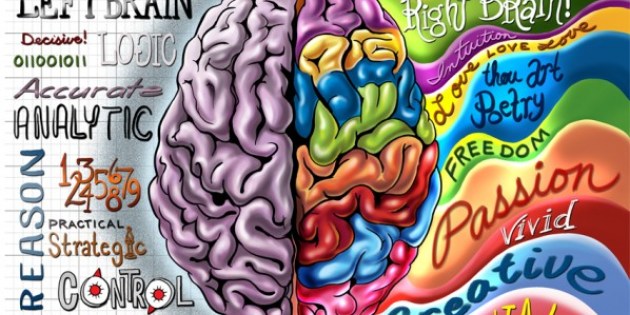
Our brains are divided into three sections: the reptilian brain, the mammalian brain, and the prefrontal cortex.

The reptilian brain is the oldest, most primitive part. In a talk at the Financial Therapy Association’s annual conference in July 2015 in San Jose del Cabo, Mexico, Dr. Ted Klontz explained that the reptilian brain continually scans for threats. It is waiting for death to come walking through the doorway, so it lives in anxiety. Since anything positive is not a threat, it’s oblivious to the positive. It also doesn’t understand the concept of the future, but lives only in this moment.

Left to its own programming, then, of course the reptilian brain might have a problem making monthly contributions to a retirement account. Saving for the future isn’t a concept it even understands. Further, it sees taking money out of the checkbook as a threat because that leaves fewer resources to battle death when it comes through the doorway. Making things even worse, the reptilian brain is nearly impossible to change. The best most of us can do is manage it.

***

Brain view

***

This brings us to the mammalian brain, whose only job is to manage the anxiety of the reptilian brain. It does so in three ways:

  1. Remove the threat (fight),
  2. Run away from the threat (flight),
  3. Get small and disappear to hide from the threat (freeze).

Most of us favor one of these three responses to threats, and according to Dr. Klontz we select our preferred response by the age of six. When the mammalian brain responds, it processes exponentially faster than the thinking part of our brain, the prefrontal cortex. Because of the ease with which the mammalian brain responds to threats, 90% of all decisions—including financial ones—are made here.

With the mammalian brain managing the anxiety of the reptilian brain, we have a more sophisticated response to our potential retirement plan contribution. Some of us will verbally fight and defeat any messenger (article, employer, financial advisor, spouse) that suggests we drain our current resources to send money into a black hole. Others will simply flee the messenger by diverting our attention to the Monday night football game or any task at hand. A portion of us will just freeze into a glassy-eyed stare. Nobody is home.

That leaves us with our only hope, the understanding and thinking part of the brain, the prefrontal cortex. This part of our brain doesn’t fully come on line until the mid-twenties. It functions as the parent of the other two brains, but unfortunately it processes information very slowly and with great effort.

***

brain

***

More:

Assessment

Fortunately, this is the brain that is easiest to change. By training it to become aware when the lower parts of the brain are about to make a hair-trigger decision, we can stop the ensuing action long enough to add logic as well as emotion to the process.

More:

Reprogramming the brain takes time, practice, and using resources like education, mentors, advisors, and counseling. Eventually, wise financial choices like saving for retirement can become the new default programming, even in spite of the reptilian brain.

Conclusion

Your thoughts and comments on this ME-P are appreciated. Feel free to review our top-left column, and top-right sidebar materials, links, URLs and related websites, too. Then, subscribe to the ME-P. It is fast, free and secure.

Speaker: If you need a moderator or speaker for an upcoming event, Dr. David E. Marcinko; MBA – Publisher-in-Chief of the Medical Executive-Post – is available for seminar or speaking engagements. Contact: MarcinkoAdvisors@msn.com

OUR OTHER PRINT BOOKS AND RELATED INFORMATION SOURCES:

***

Comprehensive Financial Planning Strategies for Doctors and Advisors: Best Practices from Leading Consultants and Certified Medical Planners(TM)

***

Do RetroSpective Thoughts on Apple Inc Hint of the ProSpective Future after the “Crash” Today?

Join Our Mailing List

PART I.

Understanding Apple Requires an Analysis of Fundamentals and Psychology

vitalyBy Vitaliy Katsenelson CFA

So many articles have been written recently about Apple — defending it or explaining why this glorious fruit will turn into a shriveling pumpkin by midnight (with Samsung’s help) — that I really haven’t felt the need to contribute to the unending debate.

But, when Apple’s stock crashed to $450 back in January 2013, we bought a little for our clients. After receiving an outraged e-mail from one of them calling the purchase “irresponsible” and proclaiming that everyone (including his neighbor) knows that Apple is going down to $300, I decided it was time to join the discourse. Clients rarely (almost never) contact us about stocks we own in their accounts. More important, this is far from the most “radioactive” stock we own or have owned.

So, here is a column on Apple, I wrote back then.  I have no intention of defending or prosecuting the company, but I would like to share some thoughts about it that many pundits have either overlooked or ignored.

***

Logo of Apple Inc. to be used on a custom landing page/brand page about Apple products on the website of Shopping.com.

***

The Psychlogy

What makes Apple stock difficult to own is psychology. The company’s success since 2000 is a black swan. We tend to think of Nassim Nicholas Taleb’s black swans as significant random negative events, but Apple is a positive one. When co-founder Steve Jobs came back to the company in the late ’90s, Apple was about to take its last breath. Jobs pulled off a miracle. He revived the company’s computer product line, making Macs exciting again, and then came out with three revolutionary “i” products in a row: the iPod, iPhone and iPad. You could argue that the success of each “i” product in itself was a black swan, exceeding all rational expectations and revolutionizing, transforming and in some cases creating new categories of merchandise that had never existed before.

Revenue and Market Capitalization

Apple’s revenue and market capitalization deservedly surpassed those of almighty Microsoft Corp. — the hairy monster with stinky breath that performed CPR on dying Apple in the late ’90s by injecting liquidity into the company by buying its preferred stock. We have a hard time processing this highly improbable success and an even harder time imagining that there is another black swan about to take flight from the Apple labs, especially with no Steve Jobs around to sit on the egg.

Black swans come out of nowhere, unannounced, but their impact may be long-lasting. The wildly successful “i” gadgets dug a formidable moat around Apple. They created the most valuable and still most inspirational brand in the world, funded an enormous research and development effort, enabled huge buying power (Apple locks up supply and pays much lower prices than many of its competitors for parts), filled out a mature product ecosystem and stuffed Apple’s debt-free balance sheet with $137 billion — half the market capitalization of Microsoft. The moat is wide, deep and unlikely to be breached any time soon.

***

Ex-Cathedra black swan

***

High Price

One reason the psychology of owning Apple stock is so difficult: it’s high price. (Note: I am talking not about its valuation but purely about its price.) Apple has had only one stock split since the late ’90s, when it was trading in double digits, and it now changes hands at about $450 (down from $700 just a few months ago). Stock splits create zero economic value in the long run — absolutely none. Apple could split its stock ten to one and you’d have ten $45 shares, and nothing about the company or its business would change. But, I’d argue that a 3 percent “slide” of $1.35 would grab fewer headlines than a $13.50 “drop” — there is a media magnification factor that is hard to ignore.

Hardware versus Software

Is Apple a hardware or a software company? This is a very important question because Apple’s net margins of 25 percent are dangerously higher than those of Microsoft, a software monopoly that, with the minor exception of the Xbox and its new venture into tablets, sells only software, which has a 100 percent incremental margin.

Apple is either a smart hardware company or a software maker dressed in hardware company clothes. Take a look at the PC businesses of traditional “dumb” hardware companies like Dell and Hewlett-Packard Co. (I am not insulting these companies, I am just highlighting their lack of PC-directed R&D.) They buy hard drives from Western Digital Corp., graphic cards from Nvidia Corp., processors from Intel Corp. and an operating system from Microsoft, then they have contract manufacturers put together these parts in Asia and ship PCs all over the world. Dell and HP engineers design the PCs but contribute minimal R&D to their boxes; most of the R&D is done by the suppliers. Dell and HP are really asset-lite marketing and logistics companies — this explains their razor-thin margins. (Side note: Because of a lack of fixed costs, Dell and HP can remain profitable despite the ongoing decline in PC sales.)

Same Surface

On the surface, Apple’s personal computer business is not that much different from Dell’s or HP’s: It uses the same highly commoditized hardware and it also outsources manufacturing, but Apple spends much more on the R&D of its own operating system and creates distinctive, innovative products. Apple gets to keep a slice of revenue that would otherwise go to Microsoft for the operating system. Also, Apple is able to charge a premium (usually a few hundred dollars per PC) for the aesthetic appeal and perceived ease of use of its products.

However, when it comes to the “i” devices, Apple is a much smarter hardware company; its value added goes further than just basic design and software. Though there is a lot of commoditized hardware that goes into an iPhone or iPad, Apple’s skill at fitting an ever-growing number of components into ever-shrinking devices constantly increases. Add world-class touch and feel, superior battery life and durability, and you have a package that turns what would otherwise be commodity items into highly differentiated, and undeniably sexy, products. Apple has even gone a step further and is designing its own microprocessors.

But — and this is a very important “but” — as phones and tablets mature, processor speed, battery life and weight will tend to become uniform across all devices. It is arguable that the competition has already caught up with Apple in the hardware race. As the hardware premium goes away, there will be only two premiums left: Apple’s brand and its ecosystem. (I will go into detail about the “i” ecosystem and what it means for Apple’s margins and profitability in my second essay posted below).

Note that I did not mention the software premium. Unlike Microsoft, which charges for the Windows operating system installed on PCs, Google gives away Android to anyone who dares to make a phone or a tablet. Unless Apple can maintain the operating system lead against Android, that premium will go away.

Assessment

Recently, I spent a few days playing with Nexus 7, Google’s Android-powered 7-inch tablet, which retails for $200 ($130 cheaper than Apple’s iPad mini). Nexus 7 is a good product, but I kept remembering that humans and monkeys share 98 percent of their DNA, and the Android operating system is missing the 2 percent that makes Apple iOS so special.

*** 

Join Our Mailing List

PART II.

How Much Would You Pay for the Apple Ecosystem?

Apple’s ecosystem is an important and durable competitive advantage; it creates a tangible switching cost (or, an inconvenience) after Apple has locked you into the i-ecosystem. It takes time to build an ecosystem that consists of speakers and accessories that will connect only via Apple systems: Apple TV, which easily recreates an iPhone or iPad screen on a TV set; the music collection on iTunes (competition from Spotify and Google Play lessens this advantage); a multitude of great apps (in all honesty, gaming apps have a half-life of only a few weeks, but productivity apps and my $60 TomTom GPS have a much longer half-life); and, last, the underrated Photo Stream, a feature in iOS 6 that allows you to share photos with your close friends and relatives with incredible ease. My family and friends share pictures from our daily lives (kids growing up, ski trips, get-togethers), but that, of course, only works when we’re all on Apple products. (This is why Facebook bought Instagram for $1 billion. Photo Stream is a real competitive threat to Facebook, especially if you want to share pictures with a limited group of close friends.)

The i-ecosystem makes switching from the iPhone to a competitor’s device an unpleasant undertaking, something you won’t do unless you are really significantly dissatisfied with your i-device (or you are simply very bored). How much extra are you willing to pay for your Apple goodies? Brand is more than just prestige; it is the amalgamation of intangible things like perceptions and tangible things like getting incredible phone and e-mail customer service (I’ve been blown away by how great it is!) or having your problems resolved by a genius at the Apple store.

Of course, as the phone and tablet categories mature, Apple’s hardware premium will deflate and its margins will decline. The only question is, by how much?

Let me try to answer

From 2003 to 2012, Apple’s net margins rose from 1.1 percent to 25 percent. In 2003 they were too low; today they are too high. Let’s look at why the margins went up. Gross margins increased from 27.5 percent to 44 percent: Apple is making 16.5 cents more for every dollar of product sold today than it did in 2001. Looking back at Nokia Corp. in its heyday, in 2003 the Finnish cell phone maker was able to command a 41.5 percent margin, which has gradually drifted down to 28 percent.

Today, Nokia is Microsoft’s bitch, completely dependent on the success of the Windows operating system, which is far from certain. Nokia is a sorry shell of what used to be a great company, while Apple, despite its universal hatred by growth managers, is still, well, Apple. Its gross margins will decline, but they won’t approach those of 2003 or Nokia’s current level.

For Apple to conquer emerging markets and keep what it has already won there, it will need to lower prices. The company is not doing horribly in China — its sales are running at $25 billion a year and were up 67 percent in the past quarter.

However, a significant number of the iPhones sold in China (Apple doesn’t disclose the figure) are not $650 iPhone 5’s but the cheaper 4 and 4s models. (Also, on a recent conference call, Verizon Communications mentioned that half of the iPhones it has sold were the 4 and 4s models.) Apple’s price premium over its Android brethren is not as high as everyone thinks.

What is truly astonishing is that Apple’s spending on R&D and selling, general and administrative (SG&A) expenses has fallen from 7.6 percent and 19.5 percent, respectively, in 2003 to a meager 2.2 percent and 6.4 percent today. R&D and SG&A expenses actually increased almost eightfold, but they didn’t grow nearly as fast as sales. Apple spends $3.4 billion on R&D today, compared with $471 million in 2001. This is operational leverage at its best. As long as Apple can grow sales, and R&D and SG&A increase at the same rate as sales or slower, Apple should keep its 18.5 percentage points gain in net margins through operational leverage.

***

***

Growth of sales is an assumption in itself. Apple’s annual sales are approaching $180 billion, and it is only a question of when they will run into the wall of large numbers. At this point, 20 percent-a-year growth means Apple has to sell as many i-thingies as it sold last year plus an additional $36 billion worth. Of course, this argument could have been made $100 billion ago, and the company did report 18 percent revenue growth for the past quarter, but Apple is in the last few innings of this high-growth game; otherwise its sales will exceed the GDP of some large European countries.

If you treat Apple as a pure hardware company, you’ll miss a very important element of its business model: recurrence of revenues through planned obsolescence. Apple releases a new device and a new operating system version every year. Its operating system only supports the past three or four generations of devices and limits functionality on some older devices. If you own an iPhone 3G, iOS 6 will not run on it, and thus a lot of apps will not work on it, so you will most likely be buying a new iPhone soon. In addition — and not unlike in the PC world — newer software usually requires more powerful hardware; the new software just doesn’t run fast enough on old phones. My son got a hand-me-down iPhone 3G but gave it to his cousin a few days later — it could barely run the new software.

As I wrote above, Apple’s success over the past decade is a black swan, an improbable but significant event, thanks in large part to the genius of Steve Jobs. Today investors are worried because Jobs is not there to create another revolutionary product, and they are right to be concerned. Jobs was more important to Apple’s success than Warren Buffett is to Berkshire Hathaway’s today. (Berkshire doesn’t need to innovate; it is a collection of dozens of autonomous companies run by competent managers.) Apple will be dead without continued innovation.

Jobs was the ultimate benevolent dictator, and he was the definition of a micro-manager. In his book Steve Jobs, Walter Isaacson describes how Jobs picked shades of white for Apple Store bathroom tiles and worked on the design of the iPhone box. He had to sign off on every product Apple made, down to and including the iPhone charger. His employees feared, loved and worshiped him, and they followed him into the fire. Jobs could change the direction of the company on a dime — that was what it took to deliver black i-swans. Jobs is gone, so the probability of another product achieving the success of the iPhone or iPad has declined exponentially.

***

Steve Jobs RIP

***

What is really amazing about Apple is how underwhelming its valuation is today — it doesn’t require new black swans.

In an analysis we tried very hard to kill the company. We tanked its gross margins to a Nokia-like 28 percent and still got $30 of earnings per share (the Street’s estimate for 2013 is $45), which puts its valuation, excluding $145 a share in cash, at 10 times earnings. We killed its sales growth to 2 percent a year for ten years, discounted its cash flows and still got a $500 stock.

There is a lot of value in Apple’s enormous ability to generate cash. The company is sitting on an ever-growing pile of it — $137 billion, about one third of its market cap. Over the past 12 months, despite spending $10 billion on capital expenditures, Apple still generated $46 billion of free cash flows. If it continues to generate free cash flows at a similar rate (I am assuming no growth), by the end of 2015 it will have stockpiled $300 of cash per share. At today’s price [2013] it will be commanding a price-earnings ratio (if you exclude cash) of 4.

Of course, the market is not giving Apple credit for its cash, but I think the market is wrong. Unlike Microsoft, which does something dumber than dumb with its cash every other year, Apple has a pristine capital allocation track record. It has not made any foolish acquisitions — or, indeed, any acquisitions of size. Other than buying an Eastern European country and renaming it i-Country, Apple will not be able to acquire a technologically related company of size, nor will it want or need to. The cash it accumulates will end up in shareholders’ hands, either through dividends or share buybacks.

What is Apple worth?

After the financial acrobatics I’ve done trying to murder the valuation of Apple, it is easier to say that it is worth more than $450 than to pinpoint a price target. When I use a significantly decelerating sales growth rate and normalize margins (reducing them, but not as low as Nokia’s current margins), I get a price of about $600 to $800 a share.

Growth managers don’t want Apple to pay a large dividend, as though that would somehow transform this growing teenager into a mature adult. But I have news for them: Apple already is a mature adult. Second, when your return on capital is pushing infinity (as Apple’s is), you don’t need to retain much cash to grow. Two thirds of Apple’s cash is offshore, but that doesn’t make it worthless; it just makes it worth less — only $65 billion, maybe, not $97 billion, once the company pays its tax bill to Uncle Sam.

***

ImageProxy

***

Assessment

In the short term none of the things I am writing about here will matter. Remember, “Everyone knows Apple is going to $300,” as a client recently e-mailed me, as everyone knew it was going to a $1,000 a few months ago when Apple’s stock was trading at $700. The company’s stock will trade on emotion, fundamentals will not matter, and growth managers will likely rotate out of Apple, because once the stock declined from $700 to $450, the label on it changed from “growth” to “value.”

But ultimately, fundamentals will prevail. Like the laws of physics, they can only be suspended for so long. And so, do these retrospective thoughts on Apple hint of future prospects?

More: Should You Buy Apple Stock Ahead of Its September Event

ABOUT

Vitaliy N. Katsenelson CFA is Chief Investment Officer at Investment Management Associates in Denver, Colo. He is the author of Active Value Investing (Wiley 2007) and The Little Book of Sideways Markets (Wiley, 2010).  His books were translated into eight languages.  Forbes Magazine called him “The new Benjamin Graham”.  

Conclusion

Your thoughts and comments on this ME-P are appreciated. Feel free to review our top-left column, and top-right sidebar materials, links, URLs and related websites, too. Then, subscribe to the ME-P. It is fast, free and secure.

Speaker: If you need a moderator or speaker for an upcoming event, Dr. David E. Marcinko; MBA – Publisher-in-Chief of the Medical Executive-Post – is available for seminar or speaking engagements. Contact: MarcinkoAdvisors@msn.com

OUR OTHER PRINT BOOKS AND RELATED INFORMATION SOURCES:

Comprehensive Financial Planning Strategies for Doctors and Advisors: Best Practices from Leading Consultants and Certified Medical Planners(TM)

Front Matter with Foreword by Jason Dyken MD MBA

logos

“BY DOCTORS – FOR DOCTORS – PEER REVIEWED – FIDUCIARY FOCUSED”

 ***

Retail Spending Therapy – Even for Doctors!

Join Our Mailing List 

More Than Just Shopping?

[By Rick Kahler CFP® http://www.KahlerFinancial.com]

Rick Kahler CFP“It’s not just shopping, it’s retail therapy.”

As a bumper sticker or a joke between friends, this may be amusing. For those who shop to relieve stress, it’s not nearly so funny.

Medicating or soothing painful feelings with money is no healthier a behavior than medicating with alcohol or food. When stressed or in difficult circumstances, some people drink, some people eat, and some people shop.

My Experience

I have worked with several people with extreme forms of this behavior, who described their spending clearly as an addiction. It gave them a physical “high” similar to that experienced by an alcoholic or drug addict. Like other addictions, it had destructive consequences, such as creating overwhelming debt, draining life savings, destroying relationships, and even stealing from family members or employers.

Using spending as a medicator does not always show up in such dramatic ways, however. Even people who seem to live moderately and manage money responsibly can be “therapy shoppers” who spend in order to make themselves feel better.

Case Example:

When I first met Dr. Alexandra, for example, she was single, in her 40s, with a well-paying job as a local hospitalist and substantial net worth. She was investing part of her income, was current on all her financial obligations, and had only a modest amount of debt. She was certainly not spending beyond her means or jeopardizing her future security. She didn’t appear to be in any financial difficulty.

When we looked at her budget, however, the doctor was clearly uncomfortable with some of her spending habits. Instead of simply reassuring her that she was managing her money well and not overspending, I explored this issue with her. Eventually I brought up the possibility that she might be medicating her difficult job emotions with spending. It was an “aha” moment for her. She told me, “I’ve been doing that for years.”

Alexandra’s problem wasn’t the amount she spent. It was the reasons behind her spending. If she had a stressful day at work, she would go to the mall, in much the same way another person might stop at a bar for a couple of drinks on the way home. Shopping, finding bargains, and buying herself gifts were unthinking actions she used to soothe herself when she was upset.

***

Frenzy

***

She never stopped to ask herself whether she needed, had a use for, or even wanted the things she bought. She didn’t spend more than she could afford, but she was spending time as well as money unproductively. She was also cluttering her house and her life with clothes she didn’t wear, knickknacks she didn’t care about, and gadgets she didn’t use.

Once she realized the emotional reason for her shopping, Alexandra was able to find more constructive ways to deal with stress. She learned that a conversation with a friend, writing in her journal, meditating, or taking a walk could serve the same purpose as a trip to the mall and were healthier responses to difficult days.

Modifying Behavior

For Alexandra, recognizing that she was using shopping to soothe her emotions was enough to help her change. Others, whose behavior is more deeply ingrained, might find change more difficult. In some cases, they might benefit greatly from working with a psychologist, financial therapist or other counselor with the expertise to help them look at the emotions underlying their spending patterns.

Assessment

If you think you may be using spending to deal with stress, it’s important to look beyond the numbers. The main issue isn’t whether your “retail therapy” is affordable or whether it is causing serious financial difficulties. If a pattern of spending is creating discomfort for you, it may be a good idea to explore what’s behind that spending. 

Conclusion

Your thoughts and comments on this ME-P are appreciated. Feel free to review our top-left column, and top-right sidebar materials, links, URLs and related websites, too. Then, subscribe to the ME-P. It is fast, free and secure.

Speaker: If you need a moderator or speaker for an upcoming event, Dr. David E. Marcinko; MBA – Publisher-in-Chief of the Medical Executive-Post – is available for seminar or speaking engagements. Contact: MarcinkoAdvisors@msn.com

OUR OTHER PRINT BOOKS AND RELATED INFORMATION SOURCES:

Product DetailsProduct DetailsProduct Details

Product Details  Product Details

Product Details

On Money Anxiety?

Join Our Mailing List

Even … While the Housing and Market Indicators are Recovering!

By Rick Kahler MS CFP® http://www.KahlerFinancial.com

Rick Kahler CFPTwo economic indicators suggest that the US economy is recovering from the recession.

The housing market is almost back to 2006 levels in most areas of the country. We’ve also seen record highs for the Dow Jones stock index.

The Money Magazine Survey

Yet, according to a recent survey by Money magazine, many people still feel anxious about their finances. They may be more optimistic about their own current circumstances, but still worry about their future or about the economy in general.

This continued anxiety despite a rosier economic outlook may not seem logical. When you take a closer look, however, it makes perfect sense.

Why the Anxiety?

For one thing, people who suffered job losses, foreclosures, or other financial setbacks during the recession haven’t necessarily recovered emotionally even if they have recovered economically. Like other traumatic life experiences, painful financial experiences can leave lasting emotional damage.

In addition, even those not directly affected financially by the recession were affected emotionally by the alarming economic headlines. Our brains have evolved to react to threats with immediate action, so these news reports triggered a fearful urge to “Do something now!” Unfortunately, some investors panicked and “did something” by selling out of the stock market at the bottom. This may have reduced their anxiety in the short term, but it increased anxiety in the long term as they wrestled with when to get back into the market. Even some who did nothing still experience a lingering sense of anxiety and stress.

Still Filled with Angst

Now that the news is better, though, why aren’t we over all that angst?

For one thing, our brains don’t respond to good economic news in the same immediate way they do to fear-inducing news. A headline like “Dow hits record high” doesn’t give our brains a jolt of happy hormones equal to the shot of fear we get from “Dow hits new low.”

What we do relate to personally are changes that affect us directly, like cash in our pockets, a pay raise, or an observable increase in our purchasing power. Many people aren’t necessarily seeing those affects right now.

Example:

To illustrate this, two of the most significant economic indicators—the housing market and the stock market—don’t affect the vast majority of us on a daily basis. Unless you are buying or selling a home, you don’t really notice or care about real estate values. Gas, food, and consumer goods prices affect the average household the most.

The same is true for the stock market. Some 53% of Americans don’t have any money invested in stocks at all. Even if you do, an increase in the overall value of your retirement account isn’t likely to change your immediate cash flow. And if you haven’t received a raise in several years or can’t find a good job, your reaction to news of a record stock market high is likely to be, “So what? Things still aren’t that good for me.”

To reduce anxiety, then, what we really need is an improvement in our personal circumstances. That change may be a tangible financial one like finding a better job or getting a raise.

***

Money Anxiety

***

Assessment

It also can be a change in focus. You might choose to pay less attention to things you can’t control, like news reports about the economy. This gives your brain less exposure to information that feeds its fear. Another option might be to focus on what you can do: building up an emergency fund, paying down debt, or cutting spending in order to contribute more to a retirement account. In that way, you can turn anxiety in your favor, using it as a motivator to improve your financial situation.

Related:

Conclusion

Your thoughts and comments on this ME-P are appreciated. Feel free to review our top-left column, and top-right sidebar materials, links, URLs and related websites, too. Then, subscribe to the ME-P. It is fast, free and secure.

Link: http://feeds.feedburner.com/HealthcareFinancialsthePostForcxos

Speaker: If you need a moderator or speaker for an upcoming event, Dr. David E. Marcinko; MBA – Publisher-in-Chief of the Medical Executive-Post – is available for seminar or speaking engagements. Contact: MarcinkoAdvisors@msn.com

OUR OTHER PRINT BOOKS AND RELATED INFORMATION SOURCES:

Product Details  Product Details

Understanding Maslow’s Hierarchy of Needs and Your Financial Goals

Join Our Mailing List

Of Financial Wants … and Needs

Courtesy Hemant Beniwal

###

financial needs 300x262 Maslows hierarchy of needs & your financial goals

###

Numeric Figures Life’s Purpose

Financial goals are basically numerical figures of your purpose of life. We all have a purpose in life and the goals should be a part of that purpose. In fact the goals should make you achieve that purpose of life.

The Goals

Your financial goal should have a reasonable priority in fact these goals should be in parallel to your life goals.

Understand what motivates you to keep your goals on track. Lot of time it has been seen that people lose hope or lack motivation in between and they start showing signs of back stepping and indulging in some other interest.

Some time back I wrote about “Setting SMART Financial Goals” which talked about setting Specific, Measurable, Attainable, Relevant & Time-bound goals. But what about purpose of life, prioratising goals & motivation to achieve them.

I think Maslow’s hierarch of needs can help you in identifying purpose of your life, prioratising goals & giving enough motivation to achieve them. If you don’t know about Maslow’s hierarchy check Wikipedia page.

###

Maslows-hierarchy-of-needs-your-financial-goals-Infographics

###

Assessment

Conclusion

Your thoughts and comments on this ME-P are appreciated. Feel free to review our top-left column, and top-right sidebar materials, links, URLs and related websites, too. Then, subscribe to the ME-P. It is fast, free and secure.

Speaker: If you need a moderator or speaker for an upcoming event, Dr. David E. Marcinko; MBA – Publisher-in-Chief of the Medical Executive-Post – is available for seminar or speaking engagements. Contact: MarcinkoAdvisors@msn.com

OUR OTHER PRINT BOOKS AND RELATED INFORMATION SOURCES:

Product Details  Product Details

Comprehensive Financial Planning Strategies for Doctors and Advisors: Best Practices from Leading Consultants and Certified Medical Planners(TM)

Publications Related to Behavioral Finance, Economics and Money

Join Our Mailing List

Interesting Articles by Dan Ariely PhD

NOTE: Dan is the Irrational Economist: He blogs at: http://danariely.com/

By Staff Reporters

LIST:

Conclusion

Your thoughts and comments on this ME-P are appreciated. Feel free to review our top-left column, and top-right sidebar materials, links, URLs and related websites, too. Then, subscribe to the ME-P. It is fast, free and secure.

Link: http://feeds.feedburner.com/HealthcareFinancialsthePostForcxos

Speaker: If you need a moderator or speaker for an upcoming event, Dr. David E. Marcinko; MBA – Publisher-in-Chief of the Medical Executive-Post – is available for seminar or speaking engagements. Contact: MarcinkoAdvisors@msn.com

OUR OTHER PRINT BOOKS AND RELATED INFORMATION SOURCES:

DICTIONARIES: http://www.springerpub.com/Search/marcinko
PHYSICIANS: www.MedicalBusinessAdvisors.com
PRACTICES: www.BusinessofMedicalPractice.com
HOSPITALS: http://www.crcpress.com/product/isbn/9781466558731
CLINICS: http://www.crcpress.com/product/isbn/9781439879900
BLOG: www.MedicalExecutivePost.com
FINANCE: Financial Planning for Physicians and Advisors
INSURANCE: Risk Management and Insurance Strategies for Physicians and Advisors

Product Details

On Financial Therapy Rising

Join Our Mailing List

Uniting Financial Planning and Behavioral Psychology

By Rick Kahler MS CFP® ChFC CCIM www.KahlerFinancial.com

The driver of the van that was to take me from the University of Missouri to the St. Louis airport asked where I was from. When I said, “Rapid City” and we struck up a conversation about his childhood trip to the Sturgis Rally. At one point he asked me, “What were you doing visiting MU?”

A Topic at the Financial Therapy Association (FTA) Conference

There I explained I had attended the third annual Financial Therapy Association (FTA) Conference. There was a silence. Then he continued talking about his memories of visiting the Black Hills.

Bringing up the topic of financial therapy tends to leave people speechless. It isn’t a common term. Plus, it combines two topics that most people want to avoid: therapy and finances. Put them together, and you have a real conversation killer.

Fortunately, there was plenty of conversation for the 85 professionals and students at the three-day FTA conference. For those attending for the first time, it was a “coming home” experience.

Mental Health Needs

Financial therapy addresses a need that until recent years most financial and mental health professionals didn’t talk about or didn’t even know existed. It’s the unconscious and unspoken thoughts, beliefs, and feelings around all things financial. Certified Financial Planners® aren’t required to have training in even basic communication skills, much less the more complex fundamentals of psychology or neuroscience.

Likewise, therapists and psychologists aren’t taught to deal with money, either in working with clients or in managing their own businesses.

As a result, neither profession provides the tools to address clients’ problematic and often self-destructive beliefs and behaviors around money. Destructive behaviors around money usually aren’t about the money.

For this reason, giving people more information about how money, investing, or financial planning works isn’t enough.

Financial Psychology

The exploration of financial psychology or emotion and money isn’t new. Dr. Jacob Needleman and Olivia Mellan were among the mental health pioneers who began raising questions around the psychological side of money in the 1990’s. About the same time, two financial planners, George Kinder and Dick Wagner, co-founded a leaderless group of financial planners, coaches, and therapists called the Nazrudin project to explore the emotional side of money. The Nazrudin project, which still meets annually, spawned scores of books, courses, and organizations raising the awareness and skill level of financial professionals and therapists.

The Nazrudin project was the primary influence that gave me, along with others, the idea of uniting financial planning with experiential therapy. I began referring to it as financial therapy after hearing the term from therapist Bari Tessler.

Financial Therapy

Typically, financial therapy involves a client-centered financial planner (typically only compensated by fee for service), and a therapist or psychologist, that conjointly work with clients. In my experience, this process helps clients who are in some way financially stuck make significant progress.

Academia Required

Link: www.CertifiedMedicalPlanner.org

The one thing missing in the evolution of financial therapy until recently was the involvement of academia. For the first time, the FTA unites academics, therapists, and financial planners in a common pursuit of defining and developing the concept of financial therapy. This is essential if financial therapy is to become a profession.

It may be some time before we see practitioners with advanced degrees in financial therapy. Before that time comes, the FTA has a lot of work to do, including coming up with a scholarly definition of financial therapy.

Assessment

In the meantime, Jeff Zaslow, who reported on our first financial therapy workshop in 2003 for The Wall Street Journal, wrote that it “combines experiential therapy with nuts-and-bolts financial planning.” As we work to foster the emerging profession of financial therapy, that’s still an accurate and effective way to describe it.

Conclusion

Your thoughts and comments on this ME-P are appreciated. Feel free to review our top-left column, and top-right sidebar materials, links, URLs and related websites, too. Then, subscribe to the ME-P. It is fast, free and secure.

Link: http://feeds.feedburner.com/HealthcareFinancialsthePostForcxos

Speaker: If you need a moderator or speaker for an upcoming event, Dr. David E. Marcinko; MBA – Publisher-in-Chief of the Medical Executive-Post – is available for seminar or speaking engagements. Contact: MarcinkoAdvisors@msn.com

Our Other Print Books and Related Information Sources:

Health Dictionary Series: http://www.springerpub.com/Search/marcinko

Practice Management: http://www.springerpub.com/product/9780826105752

Physician Financial Planning: http://www.jbpub.com/catalog/0763745790

Medical Risk Management: http://www.jbpub.com/catalog/9780763733421

Hospitals: http://www.crcpress.com/product/isbn/9781439879900

Physician Advisors: www.CertifiedMedicalPlanner.org

Product DetailsProduct DetailsProduct Details

Product Details  Product Details


On the Emotional and Financial Returns of Paying Off the Mortgage

Join Our Mailing List

The ROI of Sudden Money

By Rick Kahler MS CFP® ChFC CCIM www.KahlerFinancial.com

Suppose you’ve come into some extra cash, doctor. You decide to use it prudently in one of three ways: keeping it in cash, putting it into your retirement plan, or paying off your home mortgage. Which is the better option?

A Personal Decision

I usually find the answer, for most medical professioanls, isn’t just about the money. Paul Thorstenson, an accountant with Ketel Thorstenson, agrees. He calls paying off a home loan “as much a personal decision as an investment one.”

Factors for Doctors to Consider

The first factor to consider is investment return. Thorstenson suggests you think of paying off debt as a risk-free investment. “Because the interest is fully deductible if you itemize, your paydown of the debt is exactly equivalent to making a risk-free investment (like a CD) that pays you a taxable yield equivalent to your interest rate.”

If your interest rate is 4.5%, that’s the return you will earn on the money you invest in paying off your mortgage. If this is difficult to visualize, think of it this way. When you pay off your debt, you are actually buying your loan from your bank much like banks sell loans to one another. You continue to make payments, only now the payments go to you instead of the bank. The money you invested in “buying” (paying off) the mortgage is now earning 4.5% for you instead of your bank.

Paying down (investing) your own debt – for most medical professionals – is usually much better than keeping your funds in a money market, savings account, or certificate of deposit where they earn .5% to 2%.

Invest or Pay Off Debt?

A trickier decision is whether to invest the funds rather than pay debt. While investing always carries some risk, a diversified portfolio with 60% stocks and alternative investments (real estate, commodities, managed futures) and 40% bonds will typically return 6% to 8% over ten or more years.

If you can use your extra cash to maximize a contribution to a retirement account like an IRA or 401(k) or 403(b), you will earn 6% to 8% tax deferred (or tax free with a Roth IRA) which is better than paying off a debt yielding 4.5%. The younger you are, the more sense it makes to contribute the funds to a retirement account.

Non-Retirement Accounts

If the investments are not in a retirement account, then you must compare the after-tax return to get an equivalent comparison. For example, if you are in a 25% tax bracket and will earn 6% on your investment, your after-tax return is 4.5%, exactly equal to what you would earn in our example of paying down the debt. In this case, I would usually take the “guaranteed” investment of paying down the debt.

Mortgage Reduction Tax Benefits

In deciding whether to pay off a home mortgage, there are some additional tax and emotional considerations. Thorstenson notes that there are currently no limitations on the deductibility of loan interest, even by high income taxpayers. The “phaseouts” which expired two years ago will come back again in 2013 when (and if) the Bush tax cuts expire. “With the phaseout you will lose 3% of every dollar of deduction for every dollar of income that exceeds about $150,000.” For most taxpayers, this won’t be a major factor.

Emotional Benefits

Probably more important than the investment and tax considerations are the emotional benefits of paying off home mortgage debt. Thorstenson says, “It gives one a sense of freedom in that you are not handcuffed to a mortgage. I’ve never once seen a client  -or doctor- who had a paid off house leverage it back up and buy a mutual fund.”

Assessment

Like finishing medical school, paying off a home is a great emotional accomplishment. And, that sense of accomplishment may be the most important investment return you can have.

Conclusion

Your thoughts and comments on this ME-P are appreciated. Feel free to review our top-left column, and top-right sidebar materials, links, URLs and related websites, too. Then, subscribe to the ME-P. It is fast, free and secure.

Link: http://feeds.feedburner.com/HealthcareFinancialsthePostForcxos

Speaker: If you need a moderator or speaker for an upcoming event, Dr. David E. Marcinko; MBA – Publisher-in-Chief of the Medical Executive-Post – is available for seminar or speaking engagements. Contact: MarcinkoAdvisors@msn.com

Our Other Print Books and Related Information Sources:

Health Dictionary Series: http://www.springerpub.com/Search/marcinko

Practice Management: http://www.springerpub.com/product/9780826105752

Physician Financial Planning: http://www.jbpub.com/catalog/0763745790

Medical Risk Management: http://www.jbpub.com/catalog/9780763733421

Hospitals: http://www.crcpress.com/product/isbn/9781439879900

Physician Advisors: www.CertifiedMedicalPlanner.org

Product Details  Product Details

For Financial Success – Doctors Must Outsmart their Brains

Join Our Mailing List

On Behavioral Economics 101

By Rick Kahler CFP® MS ChFC CCIM http://www.kahlerfinancial.com

By Dr. David Edward Marcinko MBA http://www.CertifiedMedicalPlanner.org

How’s this for a convincing excuse not to save for retirement? “I can’t help it. The human brain is programmed for financial failure.”

Why?

Emotional Decisions

An estimated 80 percent of our decisions are made emotionally. As all doctors are aware, our brain is divided into three sections. The upper brain, or cerebral cortex, is where we reason. The middle brain, or limbic system, is where we react to emotional impulse. The lower brain – basal ganglia – is what regulates the operations of the body.

Limbic System

The limbic system, where our emotions reside, functions to move us toward pleasure or away from danger. Feelings like fear or anger can cause us to move away from a perceived danger, while feelings of joy or pleasure can impel us toward a perceived benefit or reward. This aspect of our brain serves us very well when it comes to physical danger or life-enhancing decisions like choosing a mate. It isn’t quite so much help when we need to make financial decisions.

The Scenario

Suppose you and your spouse are talking about spending $5,000 on a trip to the Bahamas. Your middle brain lights up. It sees you sitting on a beach, it feels the light breeze twirling your hair, it hears the sound of the waves rolling onto the sand, and it can practically taste the Piña Colada you’re sipping.

Now, suppose you’re discussing putting that $5,000 into an IRA instead. What does your limbic system see, hear, feel, or smell? You writing a check? A brokerage statement? There’s no particular pleasure response for your emotional brain to get excited about. No wonder it’s going to urge you away from the IRA and toward the trip to the Bahamas.

Decision Making

When we’re faced with decisions, the option with the greatest emotional payoff tends to win. This is how our brains are wired to make financial decisions in favor of our short-term pleasure rather than the delayed gratification that is in our long-term best interest.

The secret to overcoming that self-defeating programming is to give our limbic system something to get excited about that supports saving for the future. Successful savers and physicians and all investors learn to link emotional rewards to their financial goals.

On Choices Revisited

Let’s take another look at the choice between an immediate tropical vacation and putting money into an IRA. Someone committed to investing for the future may imagine the same tempting beach scene. What they do, however, is see it happening once a year, or even every day—in the future. They imagine themselves enjoying that beach as one of the rewards of saving for their financial independence.

It’s also possible to trick the limbic system with negative images. Another saver might vividly imagine her-self as a bag lady, living out of garbage cans and sleeping on park benches, if she doesn’t write that check to her IRA. This isn’t nearly as much fun as imagining situations that reward investing, but it has the same effect of adding emotional impact to a financial decision.

In either case, the goal is to create an emotional charge from imagining the IRA contribution that is stronger than the image of spending the money today. The scene with the greatest emotional impact wins.

This is one reason it’s important for us to spend some time defining our life aspirations. Having clear images of what we want in the future makes it easier to imagine ourselves there. It helps us link strong emotional rewards to mundane activities like writing a check to an IRA.

Assessment

The human brain may be programmed for financial failure, but we have the ability to change that programming. With a little effort, we can rewire our brains for financial success.

Conclusion

And so, your thoughts and comments on this ME-P are appreciated. Please review our top-left column, and top-right sidebar materials, links, URLs and related websites, too. Then, subscribe to the ME-P. It is fast, free and secure.

Link: http://feeds.feedburner.com/HealthcareFinancialsthePostForcxos

Speaker: If you need a moderator or speaker for an upcoming event, Dr. David E. Marcinko; MBA – Publisher-in-Chief of the Medical Executive-Post – is available for seminar or speaking engagements. Contact: MarcinkoAdvisors@msn.com

Our Other Print Books and Related Information Sources:

Subscribe Now: Did you like this Medical Executive-Post, or find it helpful, interesting and informative? Want to get the latest ME-Ps delivered to your email box each morning? Just subscribe using the link below. You can unsubscribe at any time. Security is assured.

Link: http://feeds.feedburner.com/HealthcareFinancialsthePostForcxos

Sponsors Welcomed: And, credible sponsors and like-minded advertisers are always welcomed.

Link: https://healthcarefinancials.wordpress.com/2007/11/11/advertise

Product Details  Product Details

Dr. Somnath Basu on Financial Planning Client Expectations [PodCast]

Join Our Mailing List

By Staff Reporters

On Client Attitudes in the New Economy

In this encore podcast, Somnath Basu PhD examines how the recent economic turmoil has changed financial planning clients’ attitudes and expectations.

Dr. Basu is a popular ME-P contributor and thought-leader.

Assessment: http://www.youtube.com/watch?v=jzAkB8h5v3Q

Conclusion

Your thoughts and comments on this ME-P are appreciated. Feel free to review our top-left column, and top-right sidebar materials, links, URLs and related websites, too. Then, subscribe to the ME-P. It is fast, free and secure.

Speaker: If you need a moderator or speaker for an upcoming event, Dr. David E. Marcinko; MBA – Publisher-in-Chief of the Medical Executive-Post – is available for seminar or speaking engagements. Contact: MarcinkoAdvisors@msn.com

OUR OTHER PRINT BOOKS AND RELATED INFORMATION SOURCES:

Product DetailsProduct DetailsProduct Details

Product Details  Product Details

   Product Details 

The Economics of Stock Market Fear for Physicians

Panic Control and the Possibility of Severe Financial Degradation 

By Somnath Basu PhD, MBA [www.clunet.edu/cif]

[Director California Institute of Finance]

An experiential learning of mammoth proportions occurred several weeks ago in the financial markets. The absolute 10 minute freefall of the prices of stocks and bonds, without any pre-notification froze the hearts of many physicians and lay others both in, and outside, of the investment community. The possibility of a one trillion dollar loss had suddenly and unexpectedly turned real. It happened in a matter of minutes. This experience of panic, of the possibility of a severe economic degradation of life becoming immediately real, is like none other that most of us can ever remember experiencing. Even the 1987 crash happened over a large part of that Monday. Like then, this time too there is no known reason of why it happened, though attempts are being made to understand the cause(s). Whatever the reasons may be, it will not change the experience we had of the realization of the fear of a sudden and unexpectedly large loss.

Event Analogies

Before going deeper into the experienced fear, it is useful to provide some analogies to the event. If the meltdown in the financial markets of 2008 was like an earthquake, then this was like a severe aftershock. It is also similar to going down one of those severe roller coaster freefalls that some may consider very undesirable. Alternately, what makes a 30 year old physician be mostly unconcerned about his/her lack of retirement savings while a 60 year old doctor in the same poor condition is much more concerned. Obviously, the possibility of a lower quality of economic life is much more real for the elder than the younger. In such cases we would expect the fear of an economically degraded life to spur people to take preventive or remedial action.
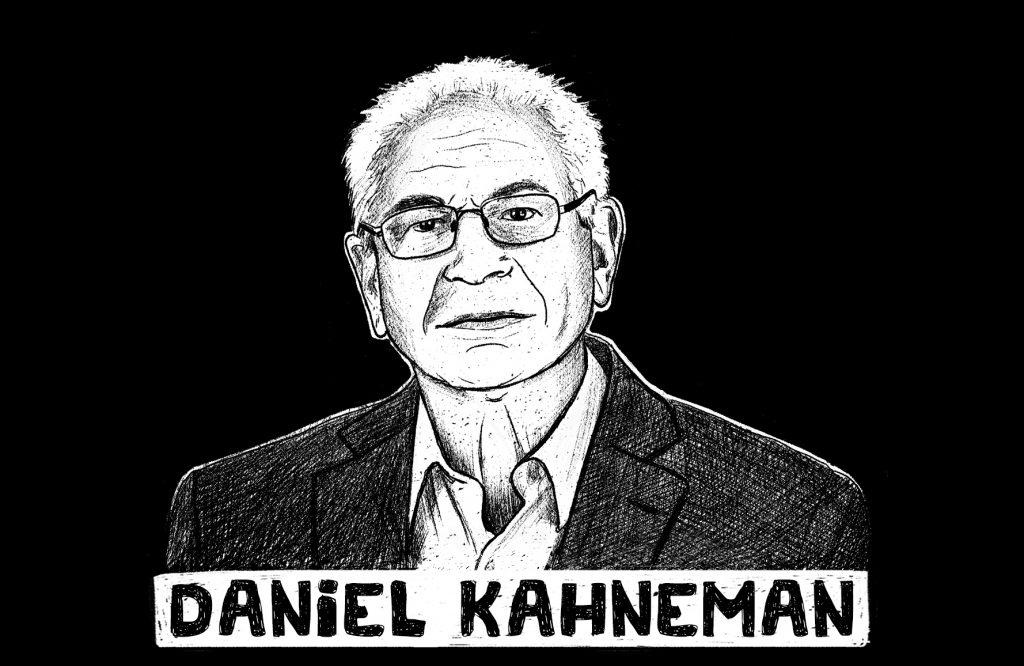
Understanding Fear

To truly understand our responses to fear, we need to go deeper into our minds. According to behavioral psychologists and neurologists both, there are various segments within our mind. For example, one segments of our mind (the frontal lobe) is understood to process analytical tasks. Similarly, other parts of our brain (the older limbic system composed of mammalian and reptilian brains) react to and affect/control our emotions and fear. When we are faced with an immediate threat, this older system takes over control of our reactions and often drives us towards instinctive responses and will not, in general, make the analytically reasoned response. It is similar to learning about all the different ways we need to behave in the wild if we came across a bear. When people actually are faced by such a situation, they rarely remember all their learning and respond with their instincts. Those are the limbic responses. In other words, when threats are real, our emotional mechanisms will dominate our rational mind and we will react according to our older and longer existing nature.

Shocked Limbic System

Such was the effect of the financial freeform. In those 10 minutes the economic shock to our limbic system was the first of its kind, in terms of magnitude. While discussions are held about sudden unexpected losses, typically the impact of sudden huge losses in a very very short period of time is rarely thought of in very meaningful ways because the probability is so very low. This time, it did actually happen! We will bear some consequences which will begin playing themselves out slowly over this summer. For one, the investing nation will be much more circumspect about stocks and other volatile financial instruments. In a more technical way, our risk aversion as a nation will have suddenly increased. This will have an impact on both trading volume and security market prices and eventually on portfolio values. How younger physicians and other investors will react is less known.

www.CertifiedMedicalPlanner.com

Assessment

Finally, there is one important lesson in behavioral finance for us all – and that is for medical professionals to find competent financial advisors and planners who can safely herald all people in these times. It also is probably an important point to understand why the portfolios of older physicians should consider safety of principal first whilst the younger ones focus on growing their wealth.

Editor’s Note: Somnath Basu PhD is program director of the California Institute of Finance in the School of Business at California Lutheran University where he’s also a professor of finance. He can be reached at (805) 493 3980 or basu@callutheran.edu. See the agebander at work at www.agebander.com

Conclusion

And so, your thoughts and comments on this ME-P are appreciated. Would anyone like to discuss neurotransmitters or chime in on the flight or fight response? Are these very human reactions any different for doctors? How about feelings of “fear” or stock-market “panic attacks?”

Feel free to review our top-left column, and top-right sidebar materials, links, URLs and related websites, too. Then, be sure to subscribe. It is fast, free and secure.

Get our Widget: Get this widget!

Our Other Print Books and Related Information Sources:

Practice Management: http://www.springerpub.com/prod.aspx?prod_id=23759

Physician Financial Planning: http://www.jbpub.com/catalog/0763745790

Medical Risk Management: http://www.jbpub.com/catalog/9780763733421

Healthcare Organizations: www.HealthcareFinancials.com

Health Administration Terms: www.HealthDictionarySeries.com

Physician Advisors: www.CertifiedMedicalPlanner.com

Subscribe Now: Did you like this Medical Executive-Post, or find it helpful, interesting and informative? Want to get the latest ME-Ps delivered to your email box each morning? Just subscribe using the link below. You can unsubscribe at any time. Security is assured.

Link: http://feeds.feedburner.com/HealthcareFinancialsthePostForcxos

Sponsors Welcomed

And, credible sponsors and like-minded advertisers are always welcomed. 

Link: https://healthcarefinancials.wordpress.com/2007/11/11/advertise