FINANCIAL PLANNING: Physician and Fiduciary Focused

(“Informed Voice of a New Generation of Fiduciary Advisors for Healthcare”)

By Dr. David Edward Marcinko MBA CMP

http://www.MarcinkoAssociates.com

As fellow doctors, we understand better than most the more complex financial challenges physicians can face when it comes to their financial planning. Of course, most physicians ultimately make a good income, but it is the saving, asset and risk management tolerance and investing part that many of our colleagues’ struggle with. Far too often physicians receive terrible guidance, have no time to properly manage their own investments and set goals for that day when they no longer wish to practice medicine.

For the average doctor or healthcare professional, the feelings of pride and achievement at finally graduating are typically paired with the heavy burden of hundreds of thousands of dollars in student loan debt.

You dedicated countless hours to learning, studying, and training in your field. You missed birthdays and holidays, time with your families, and sacrificed vacations to provide compassionate and excellent care for your patients. Amidst all of that, there was no time to give your finances even a second thought.

Between undergraduate, medical school, and then internship and residency, most young physicians do not begin saving for retirement until late into their 20s, if not their 30s. You’ve missed an entire decade or more of allowing your money and investments to compound and work for you. When it comes to addressing your financial health and security, there’s no time to waste.

And you may be misled by unscrupulous “advisors”.

For example:

Question: Do you know the difference between a “Fee-Only” and a “Fee-Based financial advisor? Not knowing may cost you tens of thousands of dollars, or more, in excessive advisory fees.

MORE: https://marcinkoassociates.com/financial-planning/

Of course, all of this compound’s physician stress and burnout related issues, as well.

MORE: https://marcinkoassociates.com/process-what-we-do/

COMMENTS APPRECIATED

Thank You

***

***

New C-Suite Title Innovations

Who’s Reaching the C-suite in 2020?

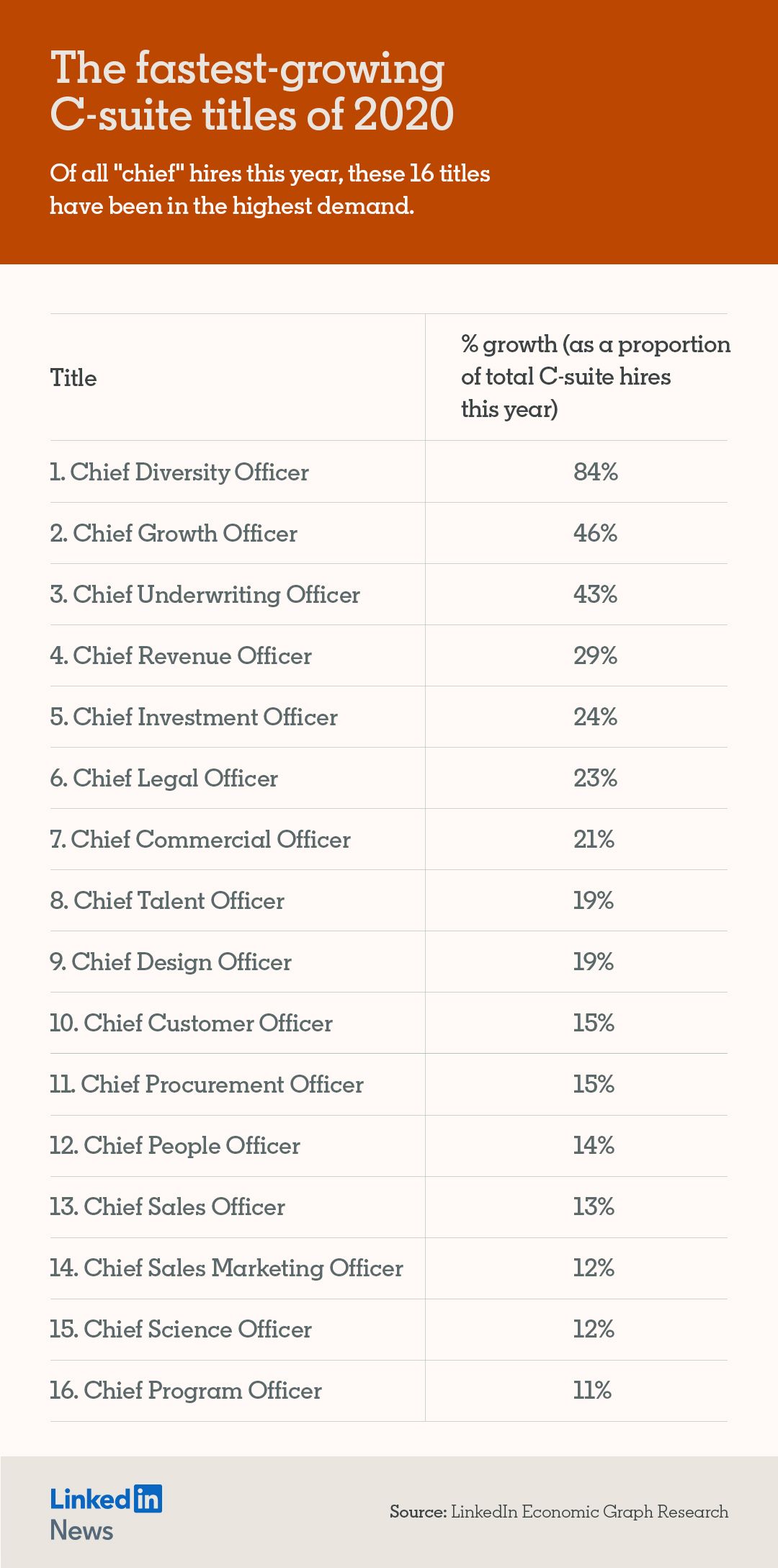
A new analysis by LinkedIn’s Economic Graph team shows the fastest-growing “chief” titles of this year.

Chief diversity officer tops the list: Hiring for the title has grown about 84% as a proportion of total C-suite hires this year, relative to 2019’s share. While that’s the fastest expansion of any C-suite job this year, the title itself is still relatively uncommon in corporate America, accounting for less than half of 1% of all C-suite hires.

Chief growth officers — which often combine oversight of marketing, strategy and other functions — have also been in high demand. The title has been popular for a long time among consumer products companies, but it’s now popping up more often at tech companies.

Others on the list include chief underwriting officer (+43%) and chief revenue officer (+29%), as well as roles focused on people and talent. Regardless of the specialty, there’s widespread agreement that when a specific domain becomes important enough to win a spot in the C-suite, that’s a powerful signal about a company’s overall priorities.

The Emerging Role of Chief Diversity Officer [CDO] 2.0

dem-2

By Dr. David Edward Marcinko MBA MEd

http://www.CertifiedMedicalPlanner.org

My history

I came of age on the mean inner city streets of Baltimore, Maryland and developed a special interest in diversity, inclusion and urban renewal at a young age.

Today, I resonate with the identity of human capital educational leadership; small classes or teams; engaged students and stakeholders; parents and teachers; research and development; and a motivated staff inculcating life-long learning initiatives and critical thinking skills.

Career

Yet, I am not a career opportunist seeking incremental advancement through the halls of academia. Rather, I am a culturally sensitive and bi-racial physician-executive who senses there are deep, but often untapped, human resources embedded within many universities. If true; they are best released by an externally recruited champion of diversity and inclusion.

A Chief Diversity Officer [CDO]; if you will.

This includes a respect for values that celebrate the unique attributes, characteristics and perspectives that make each person who they are; ethnicity; gender; gender identity; language differences; nationality; parental status; physical, mental and developmental abilities; race; religion; sexual orientation; skin color; socio-economic status; work and behavioral styles; the perspectives of each individual DNA shaped by their nation, experiences and culture—and more.

Even when people appear the same on the outside, they are different.

Importantly, such inclusion includes a strategy to leverage diversity.

  • Diversity always exists in social systems.
  • Inclusion, on the other hand, must be created.

In order to leverage diversity, an environment must be created where people feel supported, listened to and able to do their personal best; for example:

The BAKKE DECISION

Historically, and for me, an important ruling on affirmative action by the Supreme Court in 1978 was the BAKKE Case. Allan Bakke, a white man, was denied admission to a medical school that had admitted black candidates with weaker academic credentials. Bakke contended that he was a victim of racial discrimination. The Court ruled Bakke had been illegally denied admission to the medical school, but also that medical schools were entitled to consider race as an admission factor.

***

92bd7cff-d571-4a20-9c4d-fd339ead550d

***

My story

As Department Chair and Residency Director at a local hospital, I was credited with accepting the first women residents and African Americans into our post-graduate education and surgical training program.

So, at this level of blended pedagogy, andragogy and heutagogy, my mission is to be a modern guide on the side; not bombastic sage on the stage. Moreover, this CDO 2.0 position holds special gravitas in order to set the tone for the future growth of inclusion and diversity thru example; in words and deeds.

Assessment

Frankly, I don’t see the CDO role as a mere “job”. It is a calling that requires a “hands-on” ambassador — helping to advise and lead in all related matters. As the sage once opined:

There is no limit to what you can accomplish if you don’t care who gets the credit!

Conclusion

Your thoughts and comments on this ME-P are appreciated. Feel free to review our top-left column, and top-right sidebar materials, links, URLs and related websites, too. Then, subscribe to the ME-P. It is fast, free and secure.

Speaker: If you need a moderator or speaker for an upcoming event, Dr. David E. Marcinko; MBA – Publisher-in-Chief of the Medical Executive-Post – is available for seminar or speaking engagements. Contact: MarcinkoAdvisors@msn.com

OUR OTHER PRINT BOOKS AND RELATED INFORMATION SOURCES:

Risk Management, Liability Insurance, and Asset Protection Strategies for Doctors and Advisors: Best Practices from Leading Consultants and Certified Medical Planners™8

***

MICRO-CERTIFICATIONS: Physician Insider Knowledge for Financial Advisor Success?

Micro-Credentials on the Rise

KNOWLEDGE RICHES IN NICHES

DR. DAVID EDWARD MARCINKO MBA CMP

SPONSOR: http://www.CertifiedMedicalPlanner.org

***

***

Do you ever wish you could acquire specific information for your career activities without having to complete a university Master’s Degree or finish our entire Certified Medical Planner™ professional designation program? Well, Micro-Certifications from the Institute of Medical Business Advisors, Inc., might be the answer. Read on to learn how our three Micro-Certifications offer new opportunities for professional growth in the medical practice, business management, health economics and financial planning, investing and advisory space for physicians, nurses and healthcare professionals.

Micro-Certification Basics

Stock-Brokers, Financial Advisors, Investment Advisors, Accountants, Consultants, Financial Analyists and Financial Planners need to enhance their knowledge skills to better serve the changing and challenging healthcare professional ecosystem. But, it can be difficult to learn and demonstrate mastery of these new skills to employers, clients, physicians or medical prospects. This makes professional advancement difficult. That’s where Micro-Certification and Micro-Credentialing enters the online educational space. It is the process of earning a Micro-Certification, which is like a mini-degree or mini-credential, in a very specific topical area.

Micro-Certification Requirements

Once you’ve completed all of the requirements for our Micro-Certification, you will be awarded proof that you’ve earned it. This might take the form of a paper or digital certificate, which may be a hard document or electronic image, transcript, file, or other official evidence that you’ve completed the necessary work.

Uses of Micro-Certifications

Micro-Certifications may be used to demonstrate to physicians prospective medical clients that you’ve mastered a certain knowledge set. Because of this, Micro-Certifications are useful for those financial service professionals seeking medical clients, employment or career advancement opportunities.

Examples of iMBA, Inc., Micro-Certifications

Here are the three most popular Micro-Certification course from the Institute of Medical Business Advisors, Inc:

  • 1. Health Insurance and Managed Care: To keep up with the ever-changing field of health care physician advice, you must learn new medical practice business models in order to attract and assist physicians and nurse clients. By bringing together the most up-to-date business and medical prctice models [Medicare, Medicaid, PP-ACA, POSs, EPOs, HMOs, PPOs, IPA’s, PPMCs, Accountable Care Organizations, Concierge Medicine, Value Based Care, Physician Pay-for-Performance Initiatives, Hospitalists, Retail and Whole-Sale Medicine, Health Savings Accounts and Medical Unions, etc], this iMBA Inc., Mini-Certification offers a wealth of essential information that will help you understand the ever-changing practices in the next generation of health insurance and managed medical care.
  • 2. Health Economics and Finance: Medical economics, finance, managerial and cost accounting is an integral component of the health care industrial complex. It is broad-based and covers many other industries: insurance, mathematics and statistics, public and population health, provider recruitment and retention, health policy, forecasting, aging and long-term care, and Venture Capital are all commingled arenas. It is essential knowledge that all financial services professionals seeking to serve in the healthcare advisory niche space should possess.
  • 3. Health Information Technology and Security: There is a myth that all physician focused financial advisors understand Health Information Technology [HIT]. In truth, it is often economically misused or financially misunderstood. Moreover, an emerging national HIT architecture often puts the financial advisor or financial planner in a position of maximum uncertainty and minimum productivity regarding issues like: Electronic Medical Records [EMRs] or Electronic Health Records [EHRs], mobile health, tele-health or tele-medicine, Artificial Intelligence [AI], benefits managers and human resource professionals.

Other Topics include: economics, finance, investing, marketing, advertising, sales, start-ups, business plan creation, financial planning and entrepreneurship, etc.

How to Start Learning and Earning Recognition for Your Knowledge

Now that you’re familiar with Micro-Credentialing, you might consider earning a Micro-Certification with us. We offer 3 official Micro-Certificates by completing a one month online course, with a live instructor consisting of twelve asynchronous lessons/online classes [3/wk X 4/weeks = 12 classes]. The earned official completion certificate can be used to demonstrate mastery of a specific skill set and shared with current or future employers, current clients or medical niche financial advisory prospects.

Mini-Certification Tuition, Books and Related Fees

The tuition for each Mini-Certification live online course is $1,250 with the purchase of one required dictionary handbook. Other additional guides, white-papers, videos, files and e-content are all supplied without charge. Alternative courses may be developed in the future subject to demand and may change without notice.

***

Contact: For more information, or to speak with an academic representative, please contact Ann Miller RN MHA CMP™ at: MarcinkoAdvisors@msn.com [24/7] -OR- 770-448-0769[9:00 – 5:00 EST].

***

Our iMBA e-Book Sales and Service

The Institute of Medical Business Advisors is a leading national scope provider of healthcare economics, finance, investing, managerial accounting, policy, management and business administration education and medical practice management textbooks, reports, hand-books, dictionaries, journals, white-papers, fair-market valuations [FMV] and legal advisory opinions using multi-platform and traditional seminars and channels of knowledge distribution. iMBA helps the nation’s financial, healthcare and education professionals make decisive improvements in their direction and performance by empowering them through unbiased information, consultants and proprietary tools, books, templates and B-school styled case models.A virtuous “win-win” situation for all concerned.

Link: https://medicalexecutivepost.com/me-pr-a-new-feature/

The firm serves universities, medical, business, graduate and nursing schools; physicians, dentists, attorneys and legal societies – accountants, financial service providers, stock brokers, RIAs, wealth and hedge fund managers – emerging entities, hospitals, clinics, outpatient centers, CXOs and their BODs – the press, media and related academic entities.

Link: http://www.MarcinkoAssociates.com

***

AT YOUR SERVICE

***

FINANCIAL PLANNING: Physician Niche Focused Fiduciaries

(“Informed Voice of a New Generation of Fiduciary Advisors for Healthcare”)

By Dr. David Edward Marcinko MBA CMP

http://www.MarcinkoAssociates.com

As fellow doctors, we understand better than most the more complex financial challenges physicians can face when it comes to their financial planning. Of course, most physicians ultimately make a good income, but it is the saving, asset and risk management tolerance and investing part that many of our colleagues’ struggle with. Far too often physicians receive terrible guidance, have no time to properly manage their own investments and set goals for that day when they no longer wish to practice medicine.

For the average doctor or healthcare professional, the feelings of pride and achievement at finally graduating are typically paired with the heavy burden of hundreds of thousands of dollars in student loan debt.

You dedicated countless hours to learning, studying, and training in your field. You missed birthdays and holidays, time with your families, and sacrificed vacations to provide compassionate and excellent care for your patients. Amidst all of that, there was no time to give your finances even a second thought.

Between undergraduate, medical school, and then internship and residency, most young physicians do not begin saving for retirement until late into their 20s, if not their 30s. You’ve missed an entire decade or more of allowing your money and investments to compound and work for you. When it comes to addressing your financial health and security, there’s no time to waste.

And you may be misled by unscrupulous “advisors”.

For example:

Question: Do you know the difference between a “Fee-Only” and a “Fee-Based financial advisor? Not knowing may cost you tens of thousands of dollars, or more, in excessive advisory fees.

MORE: https://marcinkoassociates.com/financial-planning/

Of course, all of this compound’s physician stress and burnout related issues, as well.

MORE: https://marcinkoassociates.com/process-what-we-do/

COMMENTS APPRECIATED

Thank You

***

***

MICRO-CERTIFICATIONS: Financial Advisors Seeking Physician-Client Niche Success?

Micro-Credentials on the Rise

KNOWLEDGE RICHES IN NICHES

DR. DAVID EDWARD MARCINKO MBA CMP

SPONSOR: http://www.CertifiedMedicalPlanner.org

***

***

Do you ever wish you could acquire specific information for your career activities without having to complete a university Master’s Degree or finish our entire Certified Medical Planner™ professional designation program? Well, Micro-Certifications from the Institute of Medical Business Advisors, Inc., might be the answer. Read on to learn how our three Micro-Certifications offer new opportunities for professional growth in the medical practice, business management, health economics and financial planning, investing and advisory space for physicians, nurses and healthcare professionals.

Micro-Certification Basics

Stock-Brokers, Financial Advisors, Investment Advisors, Accountants, Consultants, Financial Analyists and Financial Planners need to enhance their knowledge skills to better serve the changing and challenging healthcare professional ecosystem. But, it can be difficult to learn and demonstrate mastery of these new skills to employers, clients, physicians or medical prospects. This makes professional advancement difficult. That’s where Micro-Certification and Micro-Credentialing enters the online educational space. It is the process of earning a Micro-Certification, which is like a mini-degree or mini-credential, in a very specific topical area.

Micro-Certification Requirements

Once you’ve completed all of the requirements for our Micro-Certification, you will be awarded proof that you’ve earned it. This might take the form of a paper or digital certificate, which may be a hard document or electronic image, transcript, file, or other official evidence that you’ve completed the necessary work.

Uses of Micro-Certifications

Micro-Certifications may be used to demonstrate to physicians prospective medical clients that you’ve mastered a certain knowledge set. Because of this, Micro-Certifications are useful for those financial service professionals seeking medical clients, employment or career advancement opportunities.

Examples of iMBA, Inc., Micro-Certifications

Here are the three most popular Micro-Certification course from the Institute of Medical Business Advisors, Inc:

  • 1. Health Insurance and Managed Care: To keep up with the ever-changing field of health care physician advice, you must learn new medical practice business models in order to attract and assist physicians and nurse clients. By bringing together the most up-to-date business and medical prctice models [Medicare, Medicaid, PP-ACA, POSs, EPOs, HMOs, PPOs, IPA’s, PPMCs, Accountable Care Organizations, Concierge Medicine, Value Based Care, Physician Pay-for-Performance Initiatives, Hospitalists, Retail and Whole-Sale Medicine, Health Savings Accounts and Medical Unions, etc], this iMBA Inc., Mini-Certification offers a wealth of essential information that will help you understand the ever-changing practices in the next generation of health insurance and managed medical care.
  • 2. Health Economics and Finance: Medical economics, finance, managerial and cost accounting is an integral component of the health care industrial complex. It is broad-based and covers many other industries: insurance, mathematics and statistics, public and population health, provider recruitment and retention, health policy, forecasting, aging and long-term care, and Venture Capital are all commingled arenas. It is essential knowledge that all financial services professionals seeking to serve in the healthcare advisory niche space should possess.
  • 3. Health Information Technology and Security: There is a myth that all physician focused financial advisors understand Health Information Technology [HIT]. In truth, it is often economically misused or financially misunderstood. Moreover, an emerging national HIT architecture often puts the financial advisor or financial planner in a position of maximum uncertainty and minimum productivity regarding issues like: Electronic Medical Records [EMRs] or Electronic Health Records [EHRs], mobile health, tele-health or tele-medicine, Artificial Intelligence [AI], benefits managers and human resource professionals.

Other Topics include: economics, finance, investing, marketing, advertising, sales, start-ups, business plan creation, financial planning and entrepreneurship, etc.

How to Start Learning and Earning Recognition for Your Knowledge

Now that you’re familiar with Micro-Credentialing, you might consider earning a Micro-Certification with us. We offer 3 official Micro-Certificates by completing a one month online course, with a live instructor consisting of twelve asynchronous lessons/online classes [3/wk X 4/weeks = 12 classes]. The earned official completion certificate can be used to demonstrate mastery of a specific skill set and shared with current or future employers, current clients or medical niche financial advisory prospects.

Mini-Certification Tuition, Books and Related Fees

The tuition for each Mini-Certification live online course is $1,250 with the purchase of one required dictionary handbook. Other additional guides, white-papers, videos, files and e-content are all supplied without charge. Alternative courses may be developed in the future subject to demand and may change without notice.

***

Contact: For more information, or to speak with an academic representative, please contact Ann Miller RN MHA CMP™ at: MarcinkoAdvisors@msn.com [24/7] -OR- 770-448-0769[9:00 – 5:00 EST].

***

Our iMBA e-Book Sales and Service

The Institute of Medical Business Advisors is a leading national scope provider of healthcare economics, finance, investing, managerial accounting, policy, management and business administration education and medical practice management textbooks, reports, hand-books, dictionaries, journals, white-papers, fair-market valuations [FMV] and legal advisory opinions using multi-platform and traditional seminars and channels of knowledge distribution. iMBA helps the nation’s financial, healthcare and education professionals make decisive improvements in their direction and performance by empowering them through unbiased information, consultants and proprietary tools, books, templates and B-school styled case models.A virtuous “win-win” situation for all concerned.

Link: https://medicalexecutivepost.com/me-pr-a-new-feature/

The firm serves universities, medical, business, graduate and nursing schools; physicians, dentists, attorneys and legal societies – accountants, financial service providers, stock brokers, RIAs, wealth and hedge fund managers – emerging entities, hospitals, clinics, outpatient centers, CXOs and their BODs – the press, media and related academic entities.

Link: http://www.MarcinkoAssociates.com

***

AT YOUR SERVICE

***

CERTIFIED MEDICAL PLANNER™: Helping Physicians Financially Thrive to Avoid the “Doctor Effect”

By Dr. David Edward Marcinko, MBA CMP

CEO: D.E. Marcinko & Associates, Inc.

***

SPONSOR: http://www.CERTIFIEDMEDICALPLANNER.org

BEWARE MEDICAL PRACTITIONERS

Several years ago a group of highly trusted and deeply experienced financial services professionals and estate planners noted that far too many of their mature physician clients, using traditional stock brokers, management consultants and financial advisors, seemed to be less successful than those who went it alone. These Do-it-Yourselfers [DIYs] had setbacks and made mistakes, for sure. But, the ME Inc doctors seemed to learn from their mistakes and did not incur the high management and service fees demanded from general or retail one-size-fits-all “advisors.”

In fact, an informal inverse relationship was noted, and dubbed the “Doctor Effect.” In others words, the more consultants an individual doctor retained; the less well they did in all disciplines of the financial planning and medical practice management, continuum.

Of course, the reason for this discrepancy eluded many of them as Wall Street brokerages and wire-houses flooded the media with messages, infomercials, print, radio, TV, texts, tweets, and internet ads to the contrary. Rather than self-learn the basics, the prevailing sentiment seemed to purse the holy grail of finding the “perfect financial advisor.” This realization was a confirmation of the industry culture which seemed to be: Bread for the advisor – Crumbs for the client!

And so, at D.E. Marcinko & Associates, our informed cadre’ of technology focused and highly educated doctors, nurses, financial advisors, attorneys, accountants, psychologists and educational visionaries decided there must be a better way for healthcare colleagues to receive financial planning advice, products and related management services within a culture of fiduciary responsibility.

We trust you agree with this ME Inc, and Certified Medical Planner™ consulting philosophy, as illustrated  on our website.

WEBSITE: http://www.MARCINKOASSOCIATES.com

***

RISK MANAGEMENT FOR PHYSICIANS

https://www.routledge.com/Risk-Management-Liability-Insurance-and-Asset-Protection-Strategies-for/Marcinko-Hetico/p/book/9781498725989

***

MICRO-CREDENTIALS: For Financial Advisors Seeking Physician-Client Niche Success?

Micro-Credentials on the Rise

KNOWLEDGE RICHES IN NICHES

DR. DAVID EDWARD MARCINKO MBA CMP

SPONSOR: http://www.CertifiedMedicalPlanner.org

***

***

Do you ever wish you could acquire specific information for your career activities without having to complete a university Master’s Degree or finish our entire Certified Medical Planner™ professional designation program? Well, Micro-Certifications from the Institute of Medical Business Advisors, Inc., might be the answer. Read on to learn how our three Micro-Certifications offer new opportunities for professional growth in the medical practice, business management, health economics and financial planning, investing and advisory space for physicians, nurses and healthcare professionals.

Micro-Certification Basics

Stock-Brokers, Financial Advisors, Investment Advisors, Accountants, Consultants, Financial Analyists and Financial Planners need to enhance their knowledge skills to better serve the changing and challenging healthcare professional ecosystem. But, it can be difficult to learn and demonstrate mastery of these new skills to employers, clients, physicians or medical prospects. This makes professional advancement difficult. That’s where Micro-Certification and Micro-Credentialing enters the online educational space. It is the process of earning a Micro-Certification, which is like a mini-degree or mini-credential, in a very specific topical area.

Micro-Certification Requirements

Once you’ve completed all of the requirements for our Micro-Certification, you will be awarded proof that you’ve earned it. This might take the form of a paper or digital certificate, which may be a hard document or electronic image, transcript, file, or other official evidence that you’ve completed the necessary work.

Uses of Micro-Certifications

Micro-Certifications may be used to demonstrate to physicians prospective medical clients that you’ve mastered a certain knowledge set. Because of this, Micro-Certifications are useful for those financial service professionals seeking medical clients, employment or career advancement opportunities.

Examples of iMBA, Inc., Micro-Certifications

Here are the three most popular Micro-Certification course from the Institute of Medical Business Advisors, Inc:

  • 1. Health Insurance and Managed Care: To keep up with the ever-changing field of health care physician advice, you must learn new medical practice business models in order to attract and assist physicians and nurse clients. By bringing together the most up-to-date business and medical prctice models [Medicare, Medicaid, PP-ACA, POSs, EPOs, HMOs, PPOs, IPA’s, PPMCs, Accountable Care Organizations, Concierge Medicine, Value Based Care, Physician Pay-for-Performance Initiatives, Hospitalists, Retail and Whole-Sale Medicine, Health Savings Accounts and Medical Unions, etc], this iMBA Inc., Mini-Certification offers a wealth of essential information that will help you understand the ever-changing practices in the next generation of health insurance and managed medical care.
  • 2. Health Economics and Finance: Medical economics, finance, managerial and cost accounting is an integral component of the health care industrial complex. It is broad-based and covers many other industries: insurance, mathematics and statistics, public and population health, provider recruitment and retention, health policy, forecasting, aging and long-term care, and Venture Capital are all commingled arenas. It is essential knowledge that all financial services professionals seeking to serve in the healthcare advisory niche space should possess.
  • 3. Health Information Technology and Security: There is a myth that all physician focused financial advisors understand Health Information Technology [HIT]. In truth, it is often economically misused or financially misunderstood. Moreover, an emerging national HIT architecture often puts the financial advisor or financial planner in a position of maximum uncertainty and minimum productivity regarding issues like: Electronic Medical Records [EMRs] or Electronic Health Records [EHRs], mobile health, tele-health or tele-medicine, Artificial Intelligence [AI], benefits managers and human resource professionals.

Other Topics include: economics, finance, investing, marketing, advertising, sales, start-ups, business plan creation, financial planning and entrepreneurship, etc.

How to Start Learning and Earning Recognition for Your Knowledge

Now that you’re familiar with Micro-Credentialing, you might consider earning a Micro-Certification with us. We offer 3 official Micro-Certificates by completing a one month online course, with a live instructor consisting of twelve asynchronous lessons/online classes [3/wk X 4/weeks = 12 classes]. The earned official completion certificate can be used to demonstrate mastery of a specific skill set and shared with current or future employers, current clients or medical niche financial advisory prospects.

Mini-Certification Tuition, Books and Related Fees

The tuition for each Mini-Certification live online course is $1,250 with the purchase of one required dictionary handbook. Other additional guides, white-papers, videos, files and e-content are all supplied without charge. Alternative courses may be developed in the future subject to demand and may change without notice.

***

Contact: For more information, or to speak with an academic representative, please contact Ann Miller RN MHA CMP™ at Email: MarcinkoAdvisors@msn.com [24/7] -OR- 770-448-0769[9:00 – 5:00 EST].

***

****

MICRO-CREDENTIALS: For Financial Advisors Seeking Physician-Client Niche Success?

Micro-Credentials on the Rise

KNOWLEDGE RICHES IN NICHES

DR. DAVID EDWARD MARCINKO MBA CMP

SPONSOR: http://www.CertifiedMedicalPlanner.org

***

***

Do you ever wish you could acquire specific information for your career activities without having to complete a university Master’s Degree or finish our entire Certified Medical Planner™ professional designation program? Well, Micro-Certifications from the Institute of Medical Business Advisors, Inc., might be the answer. Read on to learn how our three Micro-Certifications offer new opportunities for professional growth in the medical practice, business management, health economics and financial planning, investing and advisory space for physicians, nurses and healthcare professionals.

Micro-Certification Basics

Stock-Brokers, Financial Advisors, Investment Advisors, Accountants, Consultants, Financial Analyists and Financial Planners need to enhance their knowledge skills to better serve the changing and challenging healthcare professional ecosystem. But, it can be difficult to learn and demonstrate mastery of these new skills to employers, clients, physicians or medical prospects. This makes professional advancement difficult. That’s where Micro-Certification and Micro-Credentialing enters the online educational space. It is the process of earning a Micro-Certification, which is like a mini-degree or mini-credential, in a very specific topical area.

Micro-Certification Requirements

Once you’ve completed all of the requirements for our Micro-Certification, you will be awarded proof that you’ve earned it. This might take the form of a paper or digital certificate, which may be a hard document or electronic image, transcript, file, or other official evidence that you’ve completed the necessary work.

Uses of Micro-Certifications

Micro-Certifications may be used to demonstrate to physicians prospective medical clients that you’ve mastered a certain knowledge set. Because of this, Micro-Certifications are useful for those financial service professionals seeking medical clients, employment or career advancement opportunities.

Examples of iMBA, Inc., Micro-Certifications

Here are the three most popular Micro-Certification course from the Institute of Medical Business Advisors, Inc:

  • 1. Health Insurance and Managed Care: To keep up with the ever-changing field of health care physician advice, you must learn new medical practice business models in order to attract and assist physicians and nurse clients. By bringing together the most up-to-date business and medical prctice models [Medicare, Medicaid, PP-ACA, POSs, EPOs, HMOs, PPOs, IPA’s, PPMCs, Accountable Care Organizations, Concierge Medicine, Value Based Care, Physician Pay-for-Performance Initiatives, Hospitalists, Retail and Whole-Sale Medicine, Health Savings Accounts and Medical Unions, etc], this iMBA Inc., Mini-Certification offers a wealth of essential information that will help you understand the ever-changing practices in the next generation of health insurance and managed medical care.
  • 2. Health Economics and Finance: Medical economics, finance, managerial and cost accounting is an integral component of the health care industrial complex. It is broad-based and covers many other industries: insurance, mathematics and statistics, public and population health, provider recruitment and retention, health policy, forecasting, aging and long-term care, and Venture Capital are all commingled arenas. It is essential knowledge that all financial services professionals seeking to serve in the healthcare advisory niche space should possess.
  • 3. Health Information Technology and Security: There is a myth that all physician focused financial advisors understand Health Information Technology [HIT]. In truth, it is often economically misused or financially misunderstood. Moreover, an emerging national HIT architecture often puts the financial advisor or financial planner in a position of maximum uncertainty and minimum productivity regarding issues like: Electronic Medical Records [EMRs] or Electronic Health Records [EHRs], mobile health, tele-health or tele-medicine, Artificial Intelligence [AI], benefits managers and human resource professionals.

Other Topics include: economics, finance, investing, marketing, advertising, sales, start-ups, business plan creation, financial planning and entrepreneurship, etc.

How to Start Learning and Earning Recognition for Your Knowledge

Now that you’re familiar with Micro-Credentialing, you might consider earning a Micro-Certification with us. We offer 3 official Micro-Certificates by completing a one month online course, with a live instructor consisting of twelve asynchronous lessons/online classes [3/wk X 4/weeks = 12 classes]. The earned official completion certificate can be used to demonstrate mastery of a specific skill set and shared with current or future employers, current clients or medical niche financial advisory prospects.

Mini-Certification Tuition, Books and Related Fees

The tuition for each Mini-Certification live online course is $1,250 with the purchase of one required dictionary handbook. Other additional guides, white-papers, videos, files and e-content are all supplied without charge. Alternative courses may be developed in the future subject to demand and may change without notice.

***

Contact: For more information, or to speak with an academic representative, please contact Ann Miller RN MHA CMP™ at Email: MarcinkoAdvisors@msn.com [24/7] -OR- 770-448-0769[9:00 – 5:00 EST].

***

****

MICRO-CERTIFICATIONS: For Financial Advisors Seeking Physician-Client Niche Success?

Micro-Credentials on the Rise

KNOWLEDGE RICHES IN NICHES

DR. DAVID EDWARD MARCINKO MBA CMP

SPONSOR: http://www.CertifiedMedicalPlanner.org

***

***

Do you ever wish you could acquire specific information for your career activities without having to complete a university Master’s Degree or finish our entire Certified Medical Planner™ professional designation program? Well, Micro-Certifications from the Institute of Medical Business Advisors, Inc., might be the answer. Read on to learn how our three Micro-Certifications offer new opportunities for professional growth in the medical practice, business management, health economics and financial planning, investing and advisory space for physicians, nurses and healthcare professionals.

Micro-Certification Basics

Stock-Brokers, Financial Advisors, Investment Advisors, Accountants, Consultants, Financial Analyists and Financial Planners need to enhance their knowledge skills to better serve the changing and challenging healthcare professional ecosystem. But, it can be difficult to learn and demonstrate mastery of these new skills to employers, clients, physicians or medical prospects. This makes professional advancement difficult. That’s where Micro-Certification and Micro-Credentialing enters the online educational space. It is the process of earning a Micro-Certification, which is like a mini-degree or mini-credential, in a very specific topical area.

Micro-Certification Requirements

Once you’ve completed all of the requirements for our Micro-Certification, you will be awarded proof that you’ve earned it. This might take the form of a paper or digital certificate, which may be a hard document or electronic image, transcript, file, or other official evidence that you’ve completed the necessary work.

Uses of Micro-Certifications

Micro-Certifications may be used to demonstrate to physicians prospective medical clients that you’ve mastered a certain knowledge set. Because of this, Micro-Certifications are useful for those financial service professionals seeking medical clients, employment or career advancement opportunities.

Examples of iMBA, Inc., Micro-Certifications

Here are the three most popular Micro-Certification course from the Institute of Medical Business Advisors, Inc:

  • 1. Health Insurance and Managed Care: To keep up with the ever-changing field of health care physician advice, you must learn new medical practice business models in order to attract and assist physicians and nurse clients. By bringing together the most up-to-date business and medical prctice models [Medicare, Medicaid, PP-ACA, POSs, EPOs, HMOs, PPOs, IPA’s, PPMCs, Accountable Care Organizations, Concierge Medicine, Value Based Care, Physician Pay-for-Performance Initiatives, Hospitalists, Retail and Whole-Sale Medicine, Health Savings Accounts and Medical Unions, etc], this iMBA Inc., Mini-Certification offers a wealth of essential information that will help you understand the ever-changing practices in the next generation of health insurance and managed medical care.
  • 2. Health Economics and Finance: Medical economics, finance, managerial and cost accounting is an integral component of the health care industrial complex. It is broad-based and covers many other industries: insurance, mathematics and statistics, public and population health, provider recruitment and retention, health policy, forecasting, aging and long-term care, and Venture Capital are all commingled arenas. It is essential knowledge that all financial services professionals seeking to serve in the healthcare advisory niche space should possess.
  • 3. Health Information Technology and Security: There is a myth that all physician focused financial advisors understand Health Information Technology [HIT]. In truth, it is often economically misused or financially misunderstood. Moreover, an emerging national HIT architecture often puts the financial advisor or financial planner in a position of maximum uncertainty and minimum productivity regarding issues like: Electronic Medical Records [EMRs] or Electronic Health Records [EHRs], mobile health, tele-health or tele-medicine, Artificial Intelligence [AI], benefits managers and human resource professionals.

Other Topics include: economics, finance, investing, marketing, advertising, sales, start-ups, business plan creation, financial planning and entrepreneurship, etc.

How to Start Learning and Earning Recognition for Your Knowledge

Now that you’re familiar with Micro-Credentialing, you might consider earning a Micro-Certification with us. We offer 3 official Micro-Certificates by completing a one month online course, with a live instructor consisting of twelve asynchronous lessons/online classes [3/wk X 4/weeks = 12 classes]. The earned official completion certificate can be used to demonstrate mastery of a specific skill set and shared with current or future employers, current clients or medical niche financial advisory prospects.

Mini-Certification Tuition, Books and Related Fees

The tuition for each Mini-Certification live online course is $1,250 with the purchase of one required dictionary handbook. Other additional guides, white-papers, videos, files and e-content are all supplied without charge. Alternative courses may be developed in the future subject to demand and may change without notice.

***

Contact: For more information, or to speak with an academic representative, please contact Ann Miller RN MHA CMP™ at Email: MarcinkoAdvisors@msn.com [24/7] -OR- 770-448-0769[9:00 – 5:00 EST].

***

MICRO-CERTIFICATIONS: For Financial Advisors Seeking Physician-Client Niche Success?

Micro-Credentials on the Rise

KNOWLEDGE RICHES IN NICHES

DR. DAVID EDWARD MARCINKO MBA CMP

SPONSOR: http://www.CertifiedMedicalPlanner.org

***

***

Do you ever wish you could acquire specific information for your career activities without having to complete a university Master’s Degree or finish our entire Certified Medical Planner™ professional designation program? Well, Micro-Certifications from the Institute of Medical Business Advisors, Inc., might be the answer. Read on to learn how our three Micro-Certifications offer new opportunities for professional growth in the medical practice, business management, health economics and financial planning, investing and advisory space for physicians, nurses and healthcare professionals.

Micro-Certification Basics

Stock-Brokers, Financial Advisors, Investment Advisors, Accountants, Consultants, Financial Analyists and Financial Planners need to enhance their knowledge skills to better serve the changing and challenging healthcare professional ecosystem. But, it can be difficult to learn and demonstrate mastery of these new skills to employers, clients, physicians or medical prospects. This makes professional advancement difficult. That’s where Micro-Certification and Micro-Credentialing enters the online educational space. It is the process of earning a Micro-Certification, which is like a mini-degree or mini-credential, in a very specific topical area.

Micro-Certification Requirements

Once you’ve completed all of the requirements for our Micro-Certification, you will be awarded proof that you’ve earned it. This might take the form of a paper or digital certificate, which may be a hard document or electronic image, transcript, file, or other official evidence that you’ve completed the necessary work.

Uses of Micro-Certifications

Micro-Certifications may be used to demonstrate to physicians prospective medical clients that you’ve mastered a certain knowledge set. Because of this, Micro-Certifications are useful for those financial service professionals seeking medical clients, employment or career advancement opportunities.

Examples of iMBA, Inc., Micro-Certifications

Here are the three most popular Micro-Certification course from the Institute of Medical Business Advisors, Inc:

  • 1. Health Insurance and Managed Care: To keep up with the ever-changing field of health care physician advice, you must learn new medical practice business models in order to attract and assist physicians and nurse clients. By bringing together the most up-to-date business and medical prctice models [Medicare, Medicaid, PP-ACA, POSs, EPOs, HMOs, PPOs, IPA’s, PPMCs, Accountable Care Organizations, Concierge Medicine, Value Based Care, Physician Pay-for-Performance Initiatives, Hospitalists, Retail and Whole-Sale Medicine, Health Savings Accounts and Medical Unions, etc], this iMBA Inc., Mini-Certification offers a wealth of essential information that will help you understand the ever-changing practices in the next generation of health insurance and managed medical care.
  • 2. Health Economics and Finance: Medical economics, finance, managerial and cost accounting is an integral component of the health care industrial complex. It is broad-based and covers many other industries: insurance, mathematics and statistics, public and population health, provider recruitment and retention, health policy, forecasting, aging and long-term care, and Venture Capital are all commingled arenas. It is essential knowledge that all financial services professionals seeking to serve in the healthcare advisory niche space should possess.
  • 3. Health Information Technology and Security: There is a myth that all physician focused financial advisors understand Health Information Technology [HIT]. In truth, it is often economically misused or financially misunderstood. Moreover, an emerging national HIT architecture often puts the financial advisor or financial planner in a position of maximum uncertainty and minimum productivity regarding issues like: Electronic Medical Records [EMRs] or Electronic Health Records [EHRs], mobile health, tele-health or tele-medicine, Artificial Intelligence [AI], benefits managers and human resource professionals.

Other Topics include: economics, finance, investing, marketing, advertising, sales, start-ups, business plan creation, financial planning and entrepreneurship, etc.

How to Start Learning and Earning Recognition for Your Knowledge

Now that you’re familiar with Micro-Credentialing, you might consider earning a Micro-Certification with us. We offer 3 official Micro-Certificates by completing a one month online course, with a live instructor consisting of twelve asynchronous lessons/online classes [3/wk X 4/weeks = 12 classes]. The earned official completion certificate can be used to demonstrate mastery of a specific skill set and shared with current or future employers, current clients or medical niche financial advisory prospects.

Mini-Certification Tuition, Books and Related Fees

The tuition for each Mini-Certification live online course is $1,250 with the purchase of one required dictionary handbook. Other additional guides, white-papers, videos, files and e-content are all supplied without charge. Alternative courses may be developed in the future subject to demand and may change without notice.

***

Contact: For more information, or to speak with an academic representative, please contact Ann Miller RN MHA CMP™ at: MarcinkoAdvisors@msn.com [24/7] -OR- 770-448-0769 [9:00 – 5:00 EST].

***

OnLine MICRO-CERTIFICATIONS: For Financial Advisors Seeking Physician-Client Niche Success?

Micro-Credentials on the Rise

KNOWLEDGE RICHES IN NICHES

DR. DAVID EDWARD MARCINKO MBA CMP

SPONSOR: http://www.CertifiedMedicalPlanner.org

***

***

Do you ever wish you could acquire specific information for your career activities without having to complete a university Master’s Degree or finish our entire Certified Medical Planner™ professional designation program? Well, Micro-Certifications from the Institute of Medical Business Advisors, Inc., might be the answer. Read on to learn how our three Micro-Certifications offer new opportunities for professional growth in the medical practice, business management, health economics and financial planning, investing and advisory space for physicians, nurses and healthcare professionals.

Micro-Certification Basics

Stock-Brokers, Financial Advisors, Investment Advisors, Accountants, Consultants, Financial Analyists and Financial Planners need to enhance their knowledge skills to better serve the changing and challenging healthcare professional ecosystem. But, it can be difficult to learn and demonstrate mastery of these new skills to employers, clients, physicians or medical prospects. This makes professional advancement difficult. That’s where Micro-Certification and Micro-Credentialing enters the online educational space. It is the process of earning a Micro-Certification, which is like a mini-degree or mini-credential, in a very specific topical area.

Micro-Certification Requirements

Once you’ve completed all of the requirements for our Micro-Certification, you will be awarded proof that you’ve earned it. This might take the form of a paper or digital certificate, which may be a hard document or electronic image, transcript, file, or other official evidence that you’ve completed the necessary work.

Uses of Micro-Certifications

Micro-Certifications may be used to demonstrate to physicians prospective medical clients that you’ve mastered a certain knowledge set. Because of this, Micro-Certifications are useful for those financial service professionals seeking medical clients, employment or career advancement opportunities.

Examples of iMBA, Inc., Micro-Certifications

Here are the three most popular Micro-Certification course from the Institute of Medical Business Advisors, Inc:

  • 1. Health Insurance and Managed Care: To keep up with the ever-changing field of health care physician advice, you must learn new medical practice business models in order to attract and assist physicians and nurse clients. By bringing together the most up-to-date business and medical prctice models [Medicare, Medicaid, PP-ACA, POSs, EPOs, HMOs, PPOs, IPA’s, PPMCs, Accountable Care Organizations, Concierge Medicine, Value Based Care, Physician Pay-for-Performance Initiatives, Hospitalists, Retail and Whole-Sale Medicine, Health Savings Accounts and Medical Unions, etc], this iMBA Inc., Mini-Certification offers a wealth of essential information that will help you understand the ever-changing practices in the next generation of health insurance and managed medical care.
  • 2. Health Economics and Finance: Medical economics, finance, managerial and cost accounting is an integral component of the health care industrial complex. It is broad-based and covers many other industries: insurance, mathematics and statistics, public and population health, provider recruitment and retention, health policy, forecasting, aging and long-term care, and Venture Capital are all commingled arenas. It is essential knowledge that all financial services professionals seeking to serve in the healthcare advisory niche space should possess.
  • 3. Health Information Technology and Security: There is a myth that all physician focused financial advisors understand Health Information Technology [HIT]. In truth, it is often economically misused or financially misunderstood. Moreover, an emerging national HIT architecture often puts the financial advisor or financial planner in a position of maximum uncertainty and minimum productivity regarding issues like: Electronic Medical Records [EMRs] or Electronic Health Records [EHRs], mobile health, tele-health or tele-medicine, Artificial Intelligence [AI], benefits managers and human resource professionals.

Other Topics include: economics, finance, investing, marketing, advertising, sales, start-ups, business plan creation, financial planning and entrepreneurship, etc.

How to Start Learning and Earning Recognition for Your Knowledge

Now that you’re familiar with Micro-Credentialing, you might consider earning a Micro-Certification with us. We offer 3 official Micro-Certificates by completing a one month online course, with a live instructor consisting of twelve asynchronous lessons/online classes [3/wk X 4/weeks = 12 classes]. The earned official completion certificate can be used to demonstrate mastery of a specific skill set and shared with current or future employers, current clients or medical niche financial advisory prospects.

Mini-Certification Tuition, Books and Related Fees

The tuition for each Mini-Certification live online course is $1,250 with the purchase of one required dictionary handbook. Other additional guides, white-papers, videos, files and e-content are all supplied without charge. Alternative courses may be developed in the future subject to demand and may change without notice.

***

Contact: For more information, or to speak with an academic representative, please contact Ann Miller RN MHA CMP™ at: MarcinkoAdvisors@msn.com [24/7] -OR- 770-448-0769[9:00 – 5:00 EST].

***

MICRO-CERTIFICATIONS: For Financial Advisors Seeking Physician-Client Niche Success?

Micro-Credentials on the Rise

KNOWLEDGE RICHES IN NICHES

DR. DAVID EDWARD MARCINKO MBA CMP

SPONSOR: http://www.CertifiedMedicalPlanner.org

***

***

Do you ever wish you could acquire specific information for your career activities without having to complete a university Master’s Degree or finish our entire Certified Medical Planner™ professional designation program? Well, Micro-Certifications from the Institute of Medical Business Advisors, Inc., might be the answer. Read on to learn how our three Micro-Certifications offer new opportunities for professional growth in the medical practice, business management, health economics and financial planning, investing and advisory space for physicians, nurses and healthcare professionals.

Micro-Certification Basics

Stock-Brokers, Financial Advisors, Investment Advisors, Accountants, Consultants, Financial Analyists and Financial Planners need to enhance their knowledge skills to better serve the changing and challenging healthcare professional ecosystem. But, it can be difficult to learn and demonstrate mastery of these new skills to employers, clients, physicians or medical prospects. This makes professional advancement difficult. That’s where Micro-Certification and Micro-Credentialing enters the online educational space. It is the process of earning a Micro-Certification, which is like a mini-degree or mini-credential, in a very specific topical area.

Micro-Certification Requirements

Once you’ve completed all of the requirements for our Micro-Certification, you will be awarded proof that you’ve earned it. This might take the form of a paper or digital certificate, which may be a hard document or electronic image, transcript, file, or other official evidence that you’ve completed the necessary work.

Uses of Micro-Certifications

Micro-Certifications may be used to demonstrate to physicians prospective medical clients that you’ve mastered a certain knowledge set. Because of this, Micro-Certifications are useful for those financial service professionals seeking medical clients, employment or career advancement opportunities.

Examples of iMBA, Inc., Micro-Certifications

Here are the three most popular Micro-Certification course from the Institute of Medical Business Advisors, Inc:

  • 1. Health Insurance and Managed Care: To keep up with the ever-changing field of health care physician advice, you must learn new medical practice business models in order to attract and assist physicians and nurse clients. By bringing together the most up-to-date business and medical prctice models [Medicare, Medicaid, PP-ACA, POSs, EPOs, HMOs, PPOs, IPA’s, PPMCs, Accountable Care Organizations, Concierge Medicine, Value Based Care, Physician Pay-for-Performance Initiatives, Hospitalists, Retail and Whole-Sale Medicine, Health Savings Accounts and Medical Unions, etc], this iMBA Inc., Mini-Certification offers a wealth of essential information that will help you understand the ever-changing practices in the next generation of health insurance and managed medical care.
  • 2. Health Economics and Finance: Medical economics, finance, managerial and cost accounting is an integral component of the health care industrial complex. It is broad-based and covers many other industries: insurance, mathematics and statistics, public and population health, provider recruitment and retention, health policy, forecasting, aging and long-term care, and Venture Capital are all commingled arenas. It is essential knowledge that all financial services professionals seeking to serve in the healthcare advisory niche space should possess.
  • 3. Health Information Technology and Security: There is a myth that all physician focused financial advisors understand Health Information Technology [HIT]. In truth, it is often economically misused or financially misunderstood. Moreover, an emerging national HIT architecture often puts the financial advisor or financial planner in a position of maximum uncertainty and minimum productivity regarding issues like: Electronic Medical Records [EMRs] or Electronic Health Records [EHRs], mobile health, tele-health or tele-medicine, Artificial Intelligence [AI], benefits managers and human resource professionals.

Other Topics include: economics, finance, investing, marketing, advertising, sales, start-ups, business plan creation, financial planning and entrepreneurship, etc.

How to Start Learning and Earning Recognition for Your Knowledge

Now that you’re familiar with Micro-Credentialing, you might consider earning a Micro-Certification with us. We offer 3 official Micro-Certificates by completing a one month online course, with a live instructor consisting of twelve asynchronous lessons/online classes [3/wk X 4/weeks = 12 classes]. The earned official completion certificate can be used to demonstrate mastery of a specific skill set and shared with current or future employers, current clients or medical niche financial advisory prospects.

Mini-Certification Tuition, Books and Related Fees

The tuition for each Mini-Certification live online course is $1,250 with the purchase of one required dictionary handbook. Other additional guides, white-papers, videos, files and e-content are all supplied without charge. Alternative courses may be developed in the future subject to demand and may change without notice.

***

Contact: For more information, or to speak with an academic representative, please contact Ann Miller RN MHA CMP™ at: MarcinkoAdvisors@msn.com [24/7] -OR- 770-448-0769[9:00 – 5:00 EST].

***

MICRO-CERTIFICATIONS: For Financial Advisors Seeking Physician-Client Niche Success?

Micro-Credentials on the Rise

KNOWLEDGE RICHES IN NICHES

DR. DAVID EDWARD MARCINKO MBA CMP

SPONSOR: http://www.CertifiedMedicalPlanner.org

***

***

Do you ever wish you could acquire specific information for your career activities without having to complete a university Master’s Degree or finish our entire Certified Medical Planner™ professional designation program? Well, Micro-Certifications from the Institute of Medical Business Advisors, Inc., might be the answer. Read on to learn how our three Micro-Certifications offer new opportunities for professional growth in the medical practice, business management, health economics and financial planning, investing and advisory space for physicians, nurses and healthcare professionals.

Micro-Certification Basics

Stock-Brokers, Financial Advisors, Investment Advisors, Accountants, Consultants, Financial Analyists and Financial Planners need to enhance their knowledge skills to better serve the changing and challenging healthcare professional ecosystem. But, it can be difficult to learn and demonstrate mastery of these new skills to employers, clients, physicians or medical prospects. This makes professional advancement difficult. That’s where Micro-Certification and Micro-Credentialing enters the online educational space. It is the process of earning a Micro-Certification, which is like a mini-degree or mini-credential, in a very specific topical area.

Micro-Certification Requirements

Once you’ve completed all of the requirements for our Micro-Certification, you will be awarded proof that you’ve earned it. This might take the form of a paper or digital certificate, which may be a hard document or electronic image, transcript, file, or other official evidence that you’ve completed the necessary work.

Uses of Micro-Certifications

Micro-Certifications may be used to demonstrate to physicians prospective medical clients that you’ve mastered a certain knowledge set. Because of this, Micro-Certifications are useful for those financial service professionals seeking medical clients, employment or career advancement opportunities.

Examples of iMBA, Inc., Micro-Certifications

Here are the three most popular Micro-Certification course from the Institute of Medical Business Advisors, Inc:

  • 1. Health Insurance and Managed Care: To keep up with the ever-changing field of health care physician advice, you must learn new medical practice business models in order to attract and assist physicians and nurse clients. By bringing together the most up-to-date business and medical prctice models [Medicare, Medicaid, PP-ACA, POSs, EPOs, HMOs, PPOs, IPA’s, PPMCs, Accountable Care Organizations, Concierge Medicine, Value Based Care, Physician Pay-for-Performance Initiatives, Hospitalists, Retail and Whole-Sale Medicine, Health Savings Accounts and Medical Unions, etc], this iMBA Inc., Mini-Certification offers a wealth of essential information that will help you understand the ever-changing practices in the next generation of health insurance and managed medical care.
  • 2. Health Economics and Finance: Medical economics, finance, managerial and cost accounting is an integral component of the health care industrial complex. It is broad-based and covers many other industries: insurance, mathematics and statistics, public and population health, provider recruitment and retention, health policy, forecasting, aging and long-term care, and Venture Capital are all commingled arenas. It is essential knowledge that all financial services professionals seeking to serve in the healthcare advisory niche space should possess.
  • 3. Health Information Technology and Security: There is a myth that all physician focused financial advisors understand Health Information Technology [HIT]. In truth, it is often economically misused or financially misunderstood. Moreover, an emerging national HIT architecture often puts the financial advisor or financial planner in a position of maximum uncertainty and minimum productivity regarding issues like: Electronic Medical Records [EMRs] or Electronic Health Records [EHRs], mobile health, tele-health or tele-medicine, Artificial Intelligence [AI], benefits managers and human resource professionals.

Other Topics include: economics, finance, investing, marketing, advertising, sales, start-ups, business plan creation, financial planning and entrepreneurship, etc.

How to Start Learning and Earning Recognition for Your Knowledge

Now that you’re familiar with Micro-Credentialing, you might consider earning a Micro-Certification with us. We offer 3 official Micro-Certificates by completing a one month online course, with a live instructor consisting of twelve asynchronous lessons/online classes [3/wk X 4/weeks = 12 classes]. The earned official completion certificate can be used to demonstrate mastery of a specific skill set and shared with current or future employers, current clients or medical niche financial advisory prospects.

Mini-Certification Tuition, Books and Related Fees

The tuition for each Mini-Certification live online course is $1,250 with the purchase of one required dictionary handbook. Other additional guides, white-papers, videos, files and e-content are all supplied without charge. Alternative courses may be developed in the future subject to demand and may change without notice.

***

Contact: For more information, or to speak with an academic representative, please contact Ann Miller RN MHA CMP™ at: MarcinkoAdvisors@msn.com [24/7] -OR- 770-448-0769[9:00 – 5:00 EST].

***

Hospital Capital Structure

Understanding the Cost of Capital

[By Calvin W. Wiese; MBA, CPA]

[By David Edward Marcinko MBA]

[Staff Writers]

It is critical to understand and to measure the total cost of capital. Lack of understanding and appreciation of the total cost of capital is widespread, particularly among not-for-profit hospital executives.

Capital Structure Defined

The capital structure includes long-term debt and equity; total capital is the sum of these two. Each of these components has cost associated with it. For the long-term debt portion, this cost is explicit: it is the interest rate plus associated costs of placement and servicing. For the equity portion, the cost is not explicit and is widely misunderstood.

Capital Structure of Hospitals

In many cases, hospital capital structures include significant amounts of equity that has accumulated over many years of favorable operations. Too many physician and healthcare executives wrongly attribute zero cost to the equity portion of their capital structure. Although it is correct that generally accepted accounting principles continue to assign a zero cost to equity, there is opportunity cost associated with equity that needs to be considered. This cost is the opportunity available to utilize that capital in alternative ways.

Cost of Capital

In general, the cost attributed to equity is the return expected by the equity markets on hospital equity. This can be observed by evaluating the equity prices of hospital companies whose equity is traded on public stock exchanges. Usually the equity prices will imply cost of equity in the range of 10% to 14%; at least prior to the recent Wall Street meltdown.

Cost of Equity Exceeds Long-Term Debt

Almost always, the cost of equity implied by hospital equity prices traded on public stock exchanges will substantially exceed the cost of long-term debt. Thus, while many hospital executives will view the cost of equity to be substantially less than the cost of debt (i.e., to be zero), in nearly all cases, the appropriate cost of equity will be substantially greater than the cost of debt.

Weighted Average Cost of Capital

Hospitals need to measure their weighted average cost of capital. WACC is the cost of long-term debt multiplied by the ratio of long-term debt to total capital plus the cost of equity multiplied by the ratio of equity to total capital (where total capital is the sum of long-term debt and equity).

Hospital

Assessment

WACC is then used as the basis for capital charges associated with all capital investments. Capital investments should be expected to generate positive returns after applying this capital charge based on the WACC.

Conclusion

Your thoughts and comments on this ME-P are appreciated. Feel free to review our top-left column, and top-right sidebar materials, links, URLs and related websites, too. Then, subscribe to the ME-P. It is fast, free and secure.

Link: http://feeds.feedburner.com/HealthcareFinancialsthePostForcxos

Speaker: If you need a moderator or speaker for an upcoming event, Dr. David E. Marcinko; MBA – Publisher-in-Chief of the Medical Executive-Post – is available for seminar or speaking engagements. Contact: MarcinkoAdvisors@msn.com

OUR OTHER PRINT BOOKS AND RELATED INFORMATION SOURCES:

DICTIONARIES: http://www.springerpub.com/Search/marcinko
PHYSICIANS: www.MedicalBusinessAdvisors.com
PRACTICES: www.BusinessofMedicalPractice.com
HOSPITALS: http://www.crcpress.com/product/isbn/9781466558731
CLINICS: http://www.crcpress.com/product/isbn/9781439879900
BLOG: www.MedicalExecutivePost.com
FINANCE: Financial Planning for Physicians and Advisors
INSURANCE: Risk Management and Insurance Strategies for Physicians and Advisors

Product DetailsProduct DetailsProduct Details     

Product Details


Understanding Financial Broker and Advisor Licenses

Image result for sec

Series #65 VS Series #7

By Dr. David Edward Marcinko MBA

When I am approached by a prospective client, the question they always ask without fail is “Are you properly licensed?” This is actually the wrong question to ask. The right question should be, “Which license do you have?”

The Types of Licenses

Generally, there are two types of licenses for people who call themselves a “financial advisor.” People who passed the series #65 test and people who passed the series #7 test. The nature of these two licenses is as far apart as heaven and earth.

The Securities License

Series #7 is a securities license. People who have passed this test can legally be a stock-broker. They are actually prohibited by law to give financial advice, except incidental to the financial products they are selling.

A financial advisor with a series #7 license can receive third party payments like kickbacks, commissions etc in conjunction with the products they sell you. They are not required to put your interest first as they are not your fiduciary. Legally they abide by a much lenient “suitability standard.” That is, if they think the product is suitable for you, irrespective of the cost, they are legally off the hook.

All of Morgan Stanley, Merrill Lynch and other Wall Street firms’ financial advisors are required to pass the series 7# license.

The Advisor License

Series #65 is an advisor license. People who have passed this test are legally called registered investment advisors or RIA representative. An RIA representative’s compensation is in the form of fees paid directly by the client. He or She is prohibited to receive any third party payment unless disclosed to and approved by the client first.

###

Wall Street

###

Assessment

When searching for a financial advisor, it’s crucial to find out what licensure he or she has. Do not use a stock-broker as your financial advisor – unless you’re in the habit of letting you friendly neighborhood used car salesman hand pick your vehicle purchases.

More:

Conclusion

Your thoughts and comments on this ME-P are appreciated. Feel free to review our top-left column, and top-right sidebar materials, links, URLs and related websites, too. Then, subscribe to the ME-P. It is fast, free and secure.

Speaker: If you need a moderator or speaker for an upcoming event, Dr. David E. Marcinko; MBA – Publisher-in-Chief of the Medical Executive-Post – is available for seminar or speaking engagements. Contact: MarcinkoAdvisors@msn.com

OUR OTHER PRINT BOOKS AND RELATED INFORMATION SOURCES:

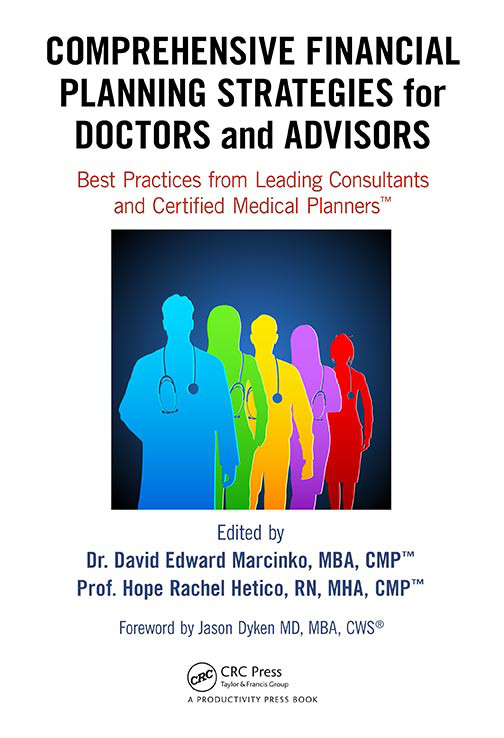
Comprehensive Financial Planning Strategies for Doctors and Advisors: Best Practices from Leading Consultants and Certified Medical Planners(TM)

INDUSTRY STATURE: Certified Medical Planner®

SPONSOR: http://www.CertifiedMedicalPlanner.org

***

***

OUR OEUVRE’ OF TEXT BOOKS IS GROWING WITH OUR INDUSTRY STATURE

We believe that by writing and sharing our experiences in standard textbook, white-paper and new media electronic format, our experts are able to address most areas of physician-focused financial planning, business or medical practice management needs in an understandable and unbiased manner.

But, we recognize that some consultants and financial advisors may appreciate reading current medical business management theory, healthcare economics, technology or financial planning information privately, prior to becoming a Certified Medical Planner® professional.

However, there is a virtual information overload out there, little of which addresses the pragmatic concerns of the modern medical provider or healthcare industry. None imparts the wisdom to become a better financial advisor or medical management consultant. All motivate the purchase of products.

Therefore, as part of the iMBA Research Library for the Certified Medical Planner® program, we highly recommend the following in-house produced books. You may even recognize some of our nationally known contributing authors and CMPs®.

CITE: https://www.r2library.com/Resource/Title/0826102549

TEXT BOOKS AND HAND BOOKS

iMBA Inc offers links to these publications, to members, and non-members, alike:

***

ORDER: https://www.amazon.com/Financial-Management-Strategies-Healthcare-Organizations/dp/1466558733/ref=sr_1_3?ie=UTF8&qid=1380743521&sr=8-3&keywords=david+marcinko

***

ORDER: https://www.amazon.com/Business-Medical-Practice-Transformational-Doctors/dp/0826105750/ref=sr_1_9?ie=UTF8&qid=1448163039&sr=8-9&keywords=david+marcinko

ENJOY THEM ALL

***

Join the ME-P and Become a CERTIFIED MEDICAL PLANNER™

ADVERTISEMENT

Sponsored by: http://www.CertifiedMedicalPlanner.org

As a medical professional, are you looking for ways to make your practice more profitable and boost your efficiency?

Or, as a financial advisor to doctors, are you looking to develop deeper relationships of knowledge and trust with your physician clients?

We can help!

Well, look no more! We can help. Designed with both advisors and physicians’ needs in mind, the ME-P website is filled with practical advice on the most-requested topics. Join us by subscribing so you can read about practice management and physician focused financial planning, and network with your fellow physicians and FAs. You don’t even have to leave the office!

More than 50 topics

  • The ABCs of RVUs
  • Hospital/Practice Integration
  • Employment Contracts
  • eHR Incentives are Here
  • How Health Reform Will Affect You
  • 5010 Transaction Standards
  • Malpractice and liability
  • Fiduciary standards
  • Financial advisors versus planners
  • SEC and FINRA rules and regulations
  • Health economics, finance and insurance
  • Medical business models
  • ACA, and so much more!

Enter the Certified Medical Planners

A Working-White Paper:

Enter the CMPs

Assessment

Get all the benefits of a personal consultant without the hassle and expense of traveling. Subscribe today. Read posts and comment on more than 50 topical channels addressing the hottest topics in medical practice and financial management today.

CMP.Candidate.Welcome

Link: http://www.CertifiedMedicalPlanner.org

Conclusion

Your thoughts and comments on this ME-P are appreciated. Feel free to review our top-left column, and top-right sidebar materials, links, URLs and related websites, too. Then, subscribe to the ME-P. It is fast, free and secure.

Speaker: If you need a moderator or speaker for an upcoming event, Dr. David E. Marcinko; MBA – Publisher-in-Chief of the Medical Executive-Post – is available for seminar or speaking engagements. Contact: MarcinkoAdvisors@msn.com

OUR OTHER PRINT BOOKS AND RELATED INFORMATION SOURCES:

Product DetailsProduct DetailsProduct Details

Product Details  Product Details

   Product Details 

***

[PHYSICIAN FOCUSED FINANCIAL PLANNING AND RISK MANAGEMENT COMPANION TEXTBOOK SET]

  Risk Management, Liability Insurance, and Asset Protection Strategies for Doctors and Advisors: Best Practices from Leading Consultants and Certified Medical Planners™Comprehensive Financial Planning Strategies for Doctors and Advisors: Best Practices from Leading Consultants and Certified Medical Planners™

***

What is a Rapid Learning Health System?

The RLH – From Concept to Action

[By Staff Reporters]

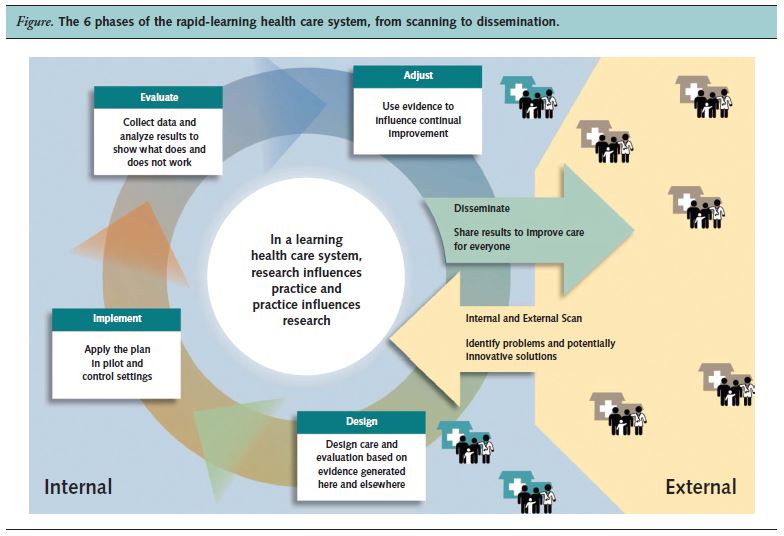
According to Greene, Reid and Larson, clinicians and health systems are facing widespread challenges, including changes in care delivery, escalating health care costs, and the need to keep up with rapid scientific discovery.

Re-organizing U.S. health care and changing its practices to render better, more affordable care requires transformation in how health systems generate and apply knowledge. The “rapid-learning health system” is posited as a conceptual strategy to spur such transformation – leverages and recent developments in health information technology and a growing health data infrastructure to access and apply evidence in real time, while simultaneously drawing knowledge from real-world care-delivery processes to promote innovation and health system change on the basis of rigorous research.

***

TLHCS

[A Rapid Learning Health System]

***

The Essay

This article describes an evolving learning health system at Group Health Cooperative, the 6 phases characterizing its approach, and examples of organization-wide applications.

Link: http://www.ncbi.nlm.nih.gov/pubmed/22868839

It is a practical model that promotes bidirectional discovery and an open mind at the system level, resulting in willingness to make changes on the basis of evidence that is both scientifically sound and practice-based.

Assessment

Rapid learning must be valued as a health system property to realize its full potential for knowledge generation and application.

Citation

Implementing the learning health system: from concept to action. Greene SM1, Reid RJ, Larson EB. Author information: Group Health Cooperative, 320 Westlake Avenue North, GHQ E2N, Seattle, WA 98109, USA. greene.sm@ghc.org

Channel Surfing the ME-P

Have you visited our other topic channels? Established to facilitate idea exchange and link our community together, the value of these topics is dependent upon your input. Please take a minute to visit. And, to prevent that annoying spam, we ask that you register. It is fast, free and secure.

More:

Conclusion

Your thoughts and comments on this ME-P are appreciated. Feel free to review our top-left column, and top-right sidebar materials, links, URLs and related websites, too. Then, subscribe to the ME-P. It is fast, free and secure.

More: http://onlinelibrary.wiley.com/doi/10.1002/hast.134/abstract

Speaker: If you need a moderator or speaker for an upcoming event, Dr. David E. Marcinko; MBA – Publisher-in-Chief of the Medical Executive-Post – is available for seminar or speaking engagements. Contact: MarcinkoAdvisors@msn.com

OUR OTHER PRINT BOOKS AND RELATED INFORMATION SOURCES:

Product DetailsProduct Details

What is E-Learning?

What it is – How it works?

[By Staff Reporters]

Invite Dr. Marcinko

Live Interactive iMBA Education

Electronic Classes can require intense interaction between live faculty members and adult-learners, often more so than in many traditional on-ground courses; and most automated Computer Based Training (CBT) programs.

Students [adult learners] are typically expected to log-in and contribute three to five times each week. With this frequency of interaction, students and faculty all get to know one another, well. There are few opportunities for passivity.

In fact, in the iMBA CERTIFIED MEDICAL PLANNER™ program, students tend to interact with instructors much more than in traditional settings; thus promoting future peer-based discussions and real world applications.

Moreover, in the electronic iMBA classroom, everyone must write; particularly for the R&D loaded CERTIFIED MEDICAL PLANNER™ program. All assignments are typed, creating a permanent record of each person’s contribution. Faculty members find this promotes careful, reflective submissions from most students.

Additionally, instructors can easily monitor student progress and communicate with those who need help, or who have trouble keeping up. This is usually done privately by e-mail, fax or phone after certain online expectations have been clarified.

***

e

***

More:

Conclusion

Your thoughts and comments on this ME-P are appreciated. Feel free to review our top-left column, and top-right sidebar materials, links, URLs and related websites, too. Then, subscribe to the ME-P. It is fast, free and secure.

***

CMP Logo

Become a CMP

***

Speaker: If you need a moderator or speaker for an upcoming event, Dr. David E. Marcinko; MBA – Publisher-in-Chief of the Medical Executive-Post – is available for seminar or speaking engagements. Contact: MarcinkoAdvisors@msn.com

OUR OTHER PRINT BOOKS AND RELATED INFORMATION SOURCES:

Comprehensive Financial Planning Strategies for Doctors and Advisors: Best Practices from Leading Consultants and Certified Medical Planners(TM) 

Understanding the Scientific Publication “H” Index, and others

Join Our Mailing List 

How to evaluate the academic performance of individual scientists

[By Dr. David Edward Marcinko MBA]

Dr. MarcinkoThe “h-index” was introduced in 2005 as a metric for estimating “the importance, significance and broad impact of a scientist’s cumulative contributions.” It takes into account both the number of an individual’s publications and their impact on peers, as indicated by citation counts.

Origination

Its creator, Jorge Hirsch (UC-San Diego) asserts that a “successful scientist” will have an h-index of 20 after 20 years; an “outstanding scientist” will have an index of 40 after 20 years; and a “truly unique individual” will have an index of 60 after 20 years or 90 after 30 years. You can read more about it in Nature and PhysicsWeb.

Web of Science

Curious to know your own h-index? You can easily determine it using Web of Science. Select “Science Citation Index Expanded.” Click “General Search” category and search for your name as author (e.g., SMITH J*). Use “Refine Your Results” by Institution to differentiate yourself from other scientists with the same initial(s). (This is an important step, otherwise your publications will be intermingled with unrelated papers and your h-index will be inaccurate.) Click on “Citation Report” in the box on the right side. Your h-index will be calculated automatically.

An alternative method is to sort your citations by “Times Cited”, using sort box on the right side. Scan down the list until the number of the paper exceeds the number of citations to that paper. For example, your h-index is 20 if your 21st paper has been cited 20 or fewer times, but your 20th paper has been cited 20 or more times.

Critique

Although effective and simple, the h-index suffers from some drawbacks that limit its use in accurately and fairly comparing the scientific output of different researchers. These drawbacks include information loss and low resolution: the former refers to the fact that in addition to h2 citations for papers in the h-core, excess citations are completely ignored, whereas the latter means that it is common for a group of researchers to have an identical h-index.

***

Financial Planning MDs 2015

Comprehensive Financial Planning Strategies for Doctors and Advisors: Best Practices from Leading Consultants

***

Fixing the Bias

To solve these problems, Chun-Ting Zhang proposed the “e-index“, where e2 represents the ignored excess citations, in addition to the h2 citations for h-core papers. Citation information can be completely depicted by using the h-index together with the e-index, which are independent of each other. Some other h-type indices, such as a and R, are h-dependent, have information redundancy with h, and therefore, when used together with h, mask the real differences in excess citations of different researchers.

Link: http://www.plosone.org/article/info%3Adoi%2F10.1371%2Fjournal.pone.0005429

Assessment

Google Scholar is another useful source of citation data.  A.-W. Harzing’s Publish or Perish software is a free application for Windows, Mac OS, and GNU/Linux that uses Google Scholar to compute citation counts, h-indexes, journal impact factors, and many other citation metrics.

Conclusion

Your thoughts and comments on this ME-P are appreciated. Feel free to review our top-left column, and top-right sidebar materials, links, URLs and related websites, too. Then, subscribe to the ME-P. It is fast, free and secure.

Speaker: If you need a moderator or speaker for an upcoming event, Dr. David E. Marcinko; MBA – Publisher-in-Chief of the Medical Executive-Post – is available for seminar or speaking engagements. Contact: MarcinkoAdvisors@msn.com

OUR OTHER PRINT BOOKS AND RELATED INFORMATION SOURCES:

Product DetailsProduct Details

Product Details

Product Details

 Product Details

Product Details

PODCAST: Peter Thiel on “Zero to One”

Join Our Mailing List

Product Details

Conclusion

Your thoughts and comments on this ME-P are appreciated. Feel free to review our top-left column, and top-right sidebar materials, links, URLs and related websites, too. Then, subscribe to the ME-P. It is fast, free and secure.

Speaker: If you need a moderator or speaker for an upcoming event, Dr. David E. Marcinko; MBA – Publisher-in-Chief of the Medical Executive-Post – is available for seminar or speaking engagements. Contact: MarcinkoAdvisors@msn.com

OUR OTHER PRINT BOOKS AND RELATED INFORMATION SOURCES:

David Cummings on Startups

After reading Peter Thiel’s book Zero to OneI was interested in hearing him talk and his presentation at UT Austin doesn’t disappoint.

From YouTube: Thiel is hailed as one of the most successful investors in the world. After co-founding PayPal, he went on to co-found Palantir Technologies and invest in Facebook, where he still serves on the board. He’s played major roles in dozens of successful companies and continually strives toward the next big thing. In “Zero to One,” he emphasizes the need for entrepreneurs to grasp for the ideas that nobody else has in order to truly innovate. This new way of thinking about innovation encourages burgeoning business leaders to carve their own lane in a heavily saturated race toward success.

“Zero to One,” based on a course Thiel taught in 2012 at Stanford University, urges readers to see the broad picture and look past traditional boundaries between…

View original post 12 more words

[Medical] Entrepreneurs Drawn to Starting Incubators?

INFORMATION FROM THE TRENCHES

Join Our Mailing List

More Ideas to Help [Medical] Entrepreneurs

idea

David Cummings on Startups

Last week I was reading an article about a successful entrepreneur that had started an incubator to work on multiple startups simultaneously. Incubators, now called studios or labs, were popularized during the dot com boom, and most failed to work, leaving a negative connotation for many people. Now, the cost to start is 10x cheaper and there are millions of people with mobile broadband connections, making for a different dynamic compared to 15 years ago. While it is still expensive to scale, getting started is easy.

Here are a few ideas why entrepreneurs are drawn to incubators:

  • Timing a market is terribly difficult, so having multiple startups running simultaneously increases the chance of finding a fit
  • For many (most?) entrepreneurs, the starting part is more fun than the scaling part
  • Small, dedicated teams without a legacy customer base can innovate fast, making it more fun to see rapid progress
  • When…

View original post 81 more words

Impact of Stress on Health Risk

Join Our Mailing List

The three types

By http://www.MCOL.com

stress

Conclusion

Your thoughts and comments on this ME-P are appreciated. Feel free to review our top-left column, and top-right sidebar materials, links, URLs and related websites, too. Then, subscribe to the ME-P. It is fast, free and secure.

COACHING

Speaker: If you need a moderator or speaker for an upcoming event, Dr. David E. Marcinko; MBA – Publisher-in-Chief of the Medical Executive-Post – is available for seminar or speaking engagements. Contact: MarcinkoAdvisors@msn.com

OUR OTHER PRINT BOOKS AND RELATED INFORMATION SOURCES:

Product DetailsProduct Details

How to Submit an Article to the ME-P

Join Our Mailing List

Spread the Word – Become a Published Author

By Ann Miller RN MHA [Executive-Director]

To submit an article, an article idea or an article abstract to the ME-P, send an email with the subject “New Article Submission” to Ann Miller RN MHA MarcinkoAdvisors@msn.com

Guidelines

New articles and ideas for articles are welcomed from throughout the world. Please submit ideas, abstracts or article drafts at least initially in English and, preferably, in Microsoft Word or, if not in MSWord, then in an “RTF” (rich text file).

There is no length restriction on articles, and the publisher encourages the use of graphs, charts, exhibits, etc.

Articles are welcomed that deal with any health care finance aspect our topical ecosystem; in addition, articles are also welcomed that deal with topics outside the U.S.

***

ME-P electronic typewriter

Requirements

—Articles should be single-spaced with two spaces between paragraphs and the paragraphs should be left/right justified. We prefer that citations take the form of “footnotes” although “general references” may also be placed at the end of the article.

—Articles should have a cover page with the full article title and, below that, the names of authors, their titles, and brief affiliations (i.e., “Professor, XYZ University, City/State/Country). A working email address and telephone number of the lead author or corresponding author should appear on the cover page

—If there is only one author and you are submitting a full article, an “Abstract” can also be placed on the first page below the author’s name and affiliation. If there is more than one author, place the Abstract on the second page, followed by the article itself. Exhibits are encouraged.

NOTE: Please place exhibits, charts, etc. in the main body of the article at a logical point for the reader; depending on the size of exhibits, they can be on a page that also contains text or, using page breaks, on a separate page. Copyright laws for exhibits do apply of course.

  • We will receive the article, review it, and if accepted for publication.
  • We will proof/copy-edit it and may send it back to the corresponding author for final check/approval. Then we convert the article to a final product for insertion on the web site.

Than you in advance for your consideration.

ANN

***

share

***

 Risk Management, Liability Insurance, and Asset Protection Strategies for Doctors and Advisors: Best Practices from Leading Consultants and Certified Medical Planners™8Comprehensive Financial Planning Strategies for Doctors and Advisors: Best Practices from Leading Consultants and Certified Medical Planners™

The ME-P is Seeking Healthcare “Metaverse” Input

By Ann Miller RN MHA

***

***

Facebook’s latest release, Meta, is said to be the next evolution of social connection. A virtual, 3D network that allows connection and collaboration in ways many of us have never even considered! And while many are buzzing over how Meta will shape everything from education to healthcare – we are eager to get your opinion on our own ME-P ecosystem.

Can patients trust Facebook and others again?

Are you interested in exploring a new platform for connection?

Have you subscribed to the ME-P?

We want to hear all about it! We’re actively collaborating to bring your perspectives to the discussion around the Metaverse and the patient, economics, finance and healthcare community.

If you have insights or experiences to share – just comment and/or let us know.

***

THANK YOU

***

***

The Ever Evolving Future of Medical Education

By Staff Reporters

Medical education in the U.S. and Canada has changed considerably in the last several decades.

***

Lessons from Pre-clinical Medical Education | Biomedical Odyssey

According to the AMA, the major changes are the following:

  • Reducing medical school programs leading to the medical degree to three years. Since graduate medical education (i.e., residency) is many years in duration and includes virtually all the information, that would be part of the typical fourth year..
  • Introducing clinical medicine early in the curriculum.
  • Including medical information and activities into the basic science component of the curriculum.
  • De-emphasizing inactive learning by markedly reducing the number of lectures and employing problem-based learning (PBL) which typically takes place in small groups (e.g., 6-8 students led by a single faculty member). 
  • Employing objective structured clinical examinations (OSCE) in which students are asked to solve a problem in which they are faced with a simulated patient and are asked to solve a clinical problem. Students are evaluated as to how well they communicate/interact with patients, take a medical history, arrive at a clinical diagnosis, and come up with a treatment plan. The simulated patients are trained to act as if they were actual patients. The OSCE includes individual students interacting with a single patient, emulating a real patient-doctor interaction. How well the student performs is evaluated by a faculty member observing the activity via video and by the simulated patient who evaluates the student doctor for such activities as his/her communication skills. 

***

COMMENTS APPRECIATED.

Thank You

Subscribe to the Medical Executive-Post.com

***

***

Risk Management, Liability Insurance, and Asset Protection Strategies for Doctors and Advisors: Best Practices from Leading Consultants and Certified Medical Planners™

ORDER: https://www.routledge.com/Risk-Management-Liability-Insurance-and-Asset-Protection-Strategies-for/Marcinko-Hetico/p/book/9781498725989

***

Does Crowd-Sourcing Democratize the Health Care / Insurance System?

Join Our Mailing List

Where Wall Street’s Legends and Financial-Technology Pioneers Unite

[By Dr. David Edward Marcinko MBA]

DEM white shirt

As a health insurance agent for more than a decade, certified planner and financial advisor for 15 years, medical provider for more than two decades; and Jesuit trained public health advocate throughout my entire career; I understand the concept of health, economic, education and working-class disparities. This includes utilitarianism, healthcare rationing and the allocation of scare resources [time, treasure, and talents] in society.

Yet, there is a new and emerging related ethical concept which no one seems to address. It appears to be a public “good”, but upon deeper reflection may achieve just the opposite effect as the law of unintended consequences takes sway.

So, am a “thought-leader” and early idea-adopter; or just a moral and philosophical luddite?

***

Today, we in the healthcare industrial complex stand on the precipice of our next frontier in finance – one that is aimed at instilling a culture of internet connectivity, crowd-sourcing and health care finance.

As opposed to relying on large private health insurance, state institutions and/or government entities like Medicare, Medicaid, SHIPS, and/or the PP-ACA for capital; SOME private citizens, non-insured patients, and even emerging business entities have begun turning directly to individual investors to fulfill their healthcare financing needs.

Shifting trends in mass communications, advancements in technology and regulatory overhauls have now made it possible to raise large sums of money by pooling it from the masses. This new “crowd-finance” constitution is not only resolving inefficiencies and inequality in conventional capital market business structure, it is empowering a new generation of retail products and trading platforms that are essentially reuniting the “people’s capital” with growth, yield and innovation. I believe this democratization is a good thing.

And, online marketplaces are presently revolutionizing the way people invest, and making it easier for the common-man-in-the street, patients, or other investor to obtain the yield typically swallowed by insurance and banking establishments as well as to access the deal flow previously only attainable through brokerage or insurance company relationships.

***

networks

***

For example, the SEC’s recent promulgation of Reg A+ coupled with a sound venture exchange framework is leading us toward a more level playing field for both smaller issuers and investors. Instead of serving as an exit strategy for the financially privileged, through Reg A+, the investing public will once again be able to partake in the appreciation of coveted growth stocks; or personal aggrandizement to pay off medical providers, hospitals, or insurance companies or various health insurance debts.

New micro-investing apps are now emerging to help even minute sums of capital invest in institutional-grade products via retirement vehicles – ultimately helping convert a nation of spenders into a nation of savers. OR, are they?

Here’s How?

Healthcare – The Moral Duty to Buy Health Insurance

Moral Duty to Buy Health Insurance

Click on this link to read it – Moral Duty to Buy Health Insurance

A warning against crowdsourcing your medical care on social media

Assessment

And so; does crowd-sourcing REALLY democratize the health care / Insurance system? OR, does it promote a type of moral hazard, risk tolerance, or a certain loss of “herd-immunity” against the purchase or proper use of health insurance; when others are desperately trying to pursue personal responsibility.

In other words, insurance is based on the law-of-large-numbers. And, this idea may disrupt that mathematical actuarial concept; thus skewing the bell-shaped-curve and hurting us all.

***

Why Consumers Often Err in Choosing Health Plans

By AUSTIN FRAKT PhD

Evaluating health insurance plans can be daunting and confusing, and most people don’t get much guidance, research shows.

***

Conclusion

Your thoughts and comments on this ME-P are appreciated. Feel free to review our top-left column, and top-right sidebar materials, links, URLs and related websites, too. Then, subscribe to the ME-P. It is fast, free and secure.

Speaker: If you need a moderator or speaker for an upcoming event, Dr. David E. Marcinko; MBA – Publisher-in-Chief of the Medical Executive-Post – is available for seminar or speaking engagements. Contact: MarcinkoAdvisors@msn.com

OUR OTHER PRINT BOOKS AND RELATED INFORMATION SOURCES:

Comprehensive Financial Planning Strategies for Doctors and Advisors: Best Practices from Leading Consultants and Certified Medical Planners(TM)

***

Dr. David Edward Marcinko, editor-in-chief, is a next-generation apostle of Nobel Laureate Kenneth Joseph Arrow, PhD, as a health-care economist, insurance advisor, financial advisor, risk manager, and board-certified surgeon from Temple University in Philadelphia. In the past, he edited eight practice-management books, three medical textbooks and manuals in four languages, five financial planning yearbooks, dozens of interactive CD-ROMs, and three comprehensive health-care administration dictionaries. Internationally recognized for his clinical work, he is a distinguished visiting professor of surgery and a recipient of an honorary Bachelor of Medicine–Bachelor of Surgery (MBBS) degree from Marien Hospital in Aachen, Germany. He provides litigation support and expert witness testimony in state and federal court, with medical publications archived in the Library of Congress and the Library of Medicine at the National Institutes of Health.

***

Book Dr. Marcinko for your Next Seminar!

Book Marcinko

Join Our Mailing List

Book Speaker Dr. David E. Marcinko CMP® MBA for your Next Medical, Pharma, Hospital, University or Financial Services Seminar or Personal and Corporate Coaching Sessions 

dr-david-marcinko11

Dr. David Edward Marcinko, editor-in-chief, is a next-generation apostle of Nobel Laureate Kenneth Joseph Arrow PhD, as a health-care economist, insurance advisor, financial advisor, risk manager, and board-certified surgeon from Temple University in Philadelphia.

In the past, he edited eight practice-management books, three medical textbooks and manuals in four languages, five financial planning yearbooks, dozens of interactive CD-ROMs, and three comprehensive health-care administration dictionaries.

Internationally recognized for his clinical work, he is a past endowed chair; professor of health economics, finance and public health policy management; and distinguished visiting professor of surgery as a Bachelor of Medicine–Bachelor of Surgery (MBBS) degree recipient from Marien Hospital in Aachen, Germany.

He provides litigation support and expert witness testimony in state and federal court, with medical publications archived in the Library of Congress and the Library of Medicine at the National Institutes of Health.

***

iMBA, Inc Seminar Topics

***

DEM avatar

***

[PHYSICIAN FOCUSED FINANCIAL PLANNING AND RISK MANAGEMENT COMPANION TEXTBOOK SET]

  Risk Management, Liability Insurance, and Asset Protection Strategies for Doctors and Advisors: Best Practices from Leading Consultants and Certified Medical Planners™Comprehensive Financial Planning Strategies for Doctors and Advisors: Best Practices from Leading Consultants and Certified Medical Planners™

***

[HOSPITAL OPERATIONS, ORGANIZATIONAL BEHAVIOR AND FINANCIAL MANAGEMENT COMPANION TEXTBOOK SET]

Product DetailsProduct Details

[Foreword Dr. Phillips MD JD MBA LLM] *** [Foreword Dr. Nash MD MBA FACP]

***

[PRIVATE MEDICAL PRACTICE BUSINESS MANAGEMENT TEXTBOOK – 3rd.  Edition]

Product Details

  [Foreword Dr. Hashem MD PhD] *** [Foreword Dr. Silva MD MBA]

***

https://davidedwardmarcinko.com/speaking/

***

Seeking Comments on MARCINKO’S New Financial Planning Textbook for Doctors and their Advisors

Join Our Mailing List

[WHERE LEARNING IS A plus+]

Career Development, Products and Services

“The informed voice of a new generation of fiduciary advisors for healthcare”

CMP logo

http://www.CertifiedMedicalPlanner.org 

 Our New Text – “Take a Peek Inside – Now Available

Comprehensive Financial Planning Strategies for Doctors and Advisors: Best Practices from Leading Consultants and Certified Medical Planners(TM)

Front Matter with Foreword by Jason Dyken MD MBA

http://www.BusinessofMedicalPractice.com

***

ANATOMIC SITES TO TAKE YOUR TEMPERATURE

THE 6 [Six] ANATOMIC SITES TO TAKE YOUR TEMPERATURE

Courtesy: www.CertifiedMedicalPlanner.org

Covid-19 Vital Sign Diagnostics

It is well known that a high temperature is one stigmata of the Corona Virus [88% of cases]; even higher than the seasonal flu.

But, what are the 6 gross anatomic landmarks to take a temperature and how do we adjust for standards of error?

NOTE: This information might save your life.

***

***

LINK: https://www.wikihow.com/Take-a-Temperature

PODCAST: https://www.bing.com/videos/search?q=rectal+thermometer&&view=detail&mid=D8419140B661244A970CD8419140B661244A970C&&FORM=VRDGAR&ru=%2Fvideos%2Fsearch%3Fq%3Drectal%2Bthermometer%26FORM%3DVQFRAF

Your thoughts and comments are appreciated.

BUSINESS TEXTS FOR PHYSICIAN-EXECUTIVES AND MEDICAL CXOs:

1 – https://lnkd.in/eEf-xEH

2 – https://lnkd.in/e2ZmewQ

THANK YOU

***

Meet David K. Luke MIM CMP™ [An ME-P Thought-Leader]

Join Our Mailing List

A Physician Focused Financial Advisior and Certified Medical Planner™

Financial Management Experience

https://www.medicuswealthplanning.com/team/david-k-luke

David K. Luke focuses on helping physicians, medical professionals, and successful retirees with financial planning, investment and risk management.

In the past 24 years of industry experience, David has held licenses including general securities registered representative, registered investment advisor, Branch management supervision, and Life, Accident, and Health Producers.

David, a fee-only advisor, is able to help his clients to achieve peace of mind and greater assurance with their financial goals by giving advice and providing investment management that is in their best interest, untainted by commissions or sales objectives. Likewise, in a true fiduciary capacity, he is able to help investors determine the reliability and suitability of products and services that they have been sold by other advisors.

David began his career managing money in 1986 in the General Motors of Canada Banking and Investments department where he was engaged in cash management, foreign currency hedging, and the debt issuance of a $100 million Eurobond and a $300 million Note Issuance facility. In 1988 as Supervisor of Borrowings for GMAC Canada David was responsible for the daily average issuance of $125 million in short-term Commercial Paper. David worked as a stock broker and portfolio manager for 2 major national brokerage firms (A.G. Edwards and Wachovia Securities) from 1989 to 2008.

Additionally, at Wachovia Securities David was among an elite group of financial advisors approved as a PIM (Private Investment Management) Portfolio Manager. Prior to joining Net Worth Advisory Group in 2010, David managed his own independent firm, Luke Wealth Strategies, working as a registered representative and investment advisor.

Education and Designations

  • President 2009/2010, Financial Planning Association (FPA) – Utah Chapter Affiliate
  • National Association of Personal Financial Advisors (NAPFA)
  • Member, Medical Group Management Association Master of International Management (Finance concentration)
  • American Graduate School of International Management Bachelor of Arts, Brigham Young University
  • Certified Medical Planner™ Professiobnal Designation from iMBA, Inc www.CertifiedMedicalPlanner.org

http://www.CertifiedMedicalPlanner.org

Assessment

David is our newest ME-P “thought-leader”. We look foward to his insider comments and posts. So, please welcome him and give his site a click: http://networthadvice.com/our-team/david-k-luke/

Product DetailsProduct DetailsProduct Details

Product Details  Product Details

Product Details

Book Dr. David E. Marcinko MBA for your Next Seminar

 Join Our Mailing List

Schedule Marcinko for Your Next Seminar!

DEM 2012

***

http://www.CertifiedMedicalPlanner.org

***

Book Dr. David Edward Marcinko CMP®, MBA, MBBS for your Next Medical, Pharma or Financial Services Seminar or Personal and Corporate Coaching Sessions 

Dr. Dave Marcinko enjoys personal coaching and public speaking and gives as many talks each year as possible, at a variety of medical society and financial services conferences around the country and world.

These have included lectures and visiting professorships at major academic centers, keynote lectures for hospitals, economic seminars and health systems, keynote lectures at city and statewide financial coalitions, and annual keynote lectures for a variety of internal yearly meetings.

Topics Link: toc_ho

***

[PHYSICIAN FOCUSED FINANCIAL PLANNING AND RISK MANAGEMENT COMPANION TEXTBOOK SET]

  Risk Management, Liability Insurance, and Asset Protection Strategies for Doctors and Advisors: Best Practices from Leading Consultants and Certified Medical Planners™ Comprehensive Financial Planning Strategies for Doctors and Advisors: Best Practices from Leading Consultants and Certified Medical Planners™

***

[HOSPITAL OPERATIONS, ORGANIZATIONAL BEHAVIOR AND FINANCIAL MANAGEMENT COMPANION TEXTBOOK SET]

Product DetailsProduct Details

[Foreword Dr. Phillips MD JD MBA LLM] *** [Foreword Dr. Nash MD MBA FACP]

***

How to Peform CPR [An Update]

The Crucial Steps You Should Know – Including for Pets

[By Monica Gomez]

Anybody can and anybody should learn how to perform CPR (Cardiopulmonary resuscitation).

According to the American Heart Association, a stunning 70% of Americans don’t know how what to do if somebody is experiencing a cardiac emergency because they don’t know how to administer CPR or they forgot the exact technique. This is especially alarming since almost 90% of cardiac arrests occur at home — where patients depend on the immediate respiratory care response of their family members.

In brief, knowing how to perform CPR can save the life of a loved one someday.

***

CPR-How-To

 CPR-How-To-ChildrenSurvival Rates

While 400,000 cardiac arrests happen outside of hospitals each year in the U.S. alone, hands-on CPR can actually double or triple an adult’s chance of survival. However, you need to act quickly. At four minutes without oxygen, the patient will suffer from permanent brain damage. At eight to ten minutes, the patient can die. Almost 90% of cardiac arrest patients die because no one performed CPR at the scene.

Before You Start CPR

First of all, check if the patient can respond by tapping them on the shoulder and shouting “Are you okay?” If they don’t respond, call for medical emergency services immediately. If others are around, instruct them to call 911 and if you’re alone, do it yourself. If the patient is an animal, call the closest animal hospital. If you happen to be near an AED (defibrillator), read the instructions and give one shock to the patient (this applies to humans only).

CPR Steps For Adults and Children 9 and Older: Hands-Only CPR

  1. Lay the patient on their back and kneel next to their neck and shoulders.
  2. Place the heel of one hand on the center of the patient’s chest.
  3. Place the heel of your other hand over the first and lace fingers together.
  4. Keep your elbows straight and align your shoulders directly over your hands.
  5. Begin compression:
  • As hard as possible
  • At least 100x/minute
  • Allow the chest to rise fully between compressions.

TIP: Give compressions to the beat of disco hit “Stayin’ Alive”!

CPR Steps For Younger Children and Infants

  1.  Tilt the head back a bit and lift chin to open the airway and check for breathing.
  2. If there’s no breathing, give either of these two rescue breaths:
  • Child: Pinch the nose shut and make a complete seal over their mouth
  • Infant: Make a complete seal over their mouth and nose.
  1. Blow in for one second, so the chest visibly rises and repeat this once.
  2. Give 30 chest compressions (100x/minute):
  • Child: Push with one or two hands about two inches deep
  • Infant: Push with two to three fingers about 1.5 inches deep.
  1. Repeat these steps three to four times.

Pet CPR – For Dogs and Cats

[Follow these CPR instructions for puppies]

For Animals Under 10kg/22lbs:

  1.  Use the one-handed technique, wrapping the hand over sternum and chest.
  2. Give 30 chest compressions (100-120x/minute).
  3. Allow the chest to fully recoil between compressions.
  4. Give two mouth-to-snout rescue breaths after each set of compressions (30:2).

For Medium to Giant Dogs:

  • Position the animal on its side.
  • Use the two-handed technique, placing your hands over the widest part of the chest.

For Deep, Narrow-Chested Dogs Like Greyhounds:

  • Use the two-handed technique, placing your hands directly over the heart.

For Barrel-Chested Dogs Like English Bulldogs:

Place animal on its back and use the same positioning and technique as for adult humans Whether you perform CPR on an adult, child, infant, or pets, DO NOT STOP unless:

  • The patient starts breathing
  • An EMS or another citizen responder takes over
  • An AED is ready to use
  • The scene becomes unsafe
  • You are physically incapable of continuing

Assessment

Make sure to practice and/or brush up your CPR abilities today, so you’re ready to potentially save someone’s life in the future! Furthermore, if you’re interested in making it your profession to help people suffering from respiratory conditions like asthma, bronchitis, lung cancer, heart attack, stroke, chronic obstructive pulmonary disease (COPD) or sleep apnea, you should look into Carrington College’s respiratory care program. This two-year program combines classroom lectures, laboratory instruction, and clinical experience in order to prepare you to work in a variety of healthcare settings. If you’d like to assist and educate people regarding respiratory health concerns, our training program is the ideal fit for you!

Conclusion

Your thoughts and comments on this ME-P are appreciated. Feel free to review our top-left column, and top-right sidebar materials, links, URLs and related websites, too. Then, subscribe to the ME-P. It is fast, free and secure.

Speaker: If you need a moderator or speaker for an upcoming event, Dr. David E. Marcinko; MBA – Publisher-in-Chief of the Medical Executive-Post – is available for seminar or speaking engagements. Contact: MarcinkoAdvisors@msn.com

OUR OTHER PRINT BOOKS AND RELATED INFORMATION SOURCES:

Product DetailsProduct Details

Three things hospitals can do to improve their financial situation?

Join Our Mailing List 

About the Dupont Decomposition Equation [DDE]

DEM blueBy Dr. David E. Marcinko MBA CMP

[Editor-in-Chief] http://www.CertifiedMedicalPlanner.org

According to the Dupont Decomposition Equation – which involves the conglomeration of net operating income, revenues, expenses and average operating assets – ROI and economic profit is increased in three prioritized ways:

  1. Cost and expense reductions.
  2. Revenue increases [Rev]
  3. Reduced average operating assets [AOO]

Note: ROI = NOI / Rev X Rev / AOO

Cost and expense reductions

Although many hospitals have reduced expenses, postponed projects and put clinical or information technology projects on hold because of the MU conundrum, this may be unwise and quality may suffer. And, mental health care programs are almost always the first cost center to be reduced in tough times.

Upgrades today, especially with concurrent marketing and advertising promotions, may well be considered a strategic competitive advantage, and at bargain basement prices for those with cash or credit. This cost reduction is easy because it gives the biggest buck-bang in the ROI equation, and is the first line of ROI augmentation by savvy administrators and CEOs. It is also intuitive and wholly “wrung-out” in the marketplace, to date.

Revenue increases

On the other hand, revenues can usually be only incrementally increased by improving services like emergency care, urgent care, wellness, out-patient and/or surgical departments. This is the more difficult part of the equation and yields a positive, but lesser return in the ROI equation.

Three Modern Collections Rules

The following medical practice procedures will markedly increase upfront office collections:  

  • Train staff to handle exceptions. What is your policy if the patient payment is significant? Will you allow 25% payments—one today and three over the next three months? Communicate your policy to all staff. What will you do if a patient shows up without an insurance card? There will be other exceptions. Train employees to call the appropriate practice-management contact when an exception does not fit in the categories you provide and make sure those managers are responsive.
  • Understand that not everyone will shine in collections. The value of this new front-desk function should be reflected in job descriptions and wages. Track staff performance and hold employees accountable for collection goals. The most successful practices collect in the 90% range.
  • Provide professional signage that states your basic policy. “Payments are due at time of service.” Avoid typewritten, lengthy explanations taped to walls or desks that look like clutter.

Reduced average operating assets

Finally, any delay in updating facilities – while easy and may reduce operating assets – there is little ROI advantage and profit potential. Of course, facility asset upgrades mean borrowing funds through tax-exempt bonds – the main source of debt for most hospitals – and is currently difficult or impossible in this climate. Loans from banks, private investors, angels, venture capitalists or other financial institutions are similarly difficult to obtain. Thus, this part of the equation may often be neglected; as is the case now.

***

hospital

***

Conclusion

Your thoughts and comments on this ME-P are appreciated. Feel free to review our top-left column, and top-right sidebar materials, links, URLs and related websites, too. Then, subscribe to the ME-P. It is fast, free and secure.

Speaker: If you need a moderator or speaker for an upcoming event, Dr. David E. Marcinko; MBA – Publisher-in-Chief of the Medical Executive-Post – is available for seminar or speaking engagements. Contact: MarcinkoAdvisors@msn.com

OUR OTHER PRINT BOOKS AND RELATED INFORMATION SOURCES:

Product DetailsProduct Details

A New FINANCIAL PLANNING TEXTBOOK for DRs and Physician Focused Financial Advisors

Join Our Mailing List

 THRIVE IN 2019

Our New Text – “Take a Peek Inside 

Now Available –

***

Comprehensive Financial Planning Strategies for Doctors and Advisors: Best Practices from Leading Consultants and Certified Medical Planners(TM)

Front Matter with Foreword by Jason Dyken MD MBA

logos

“BY DOCTORS – FOR DOCTORS – PEER REVIEWED – FIDUCIARY FOCUSED”

***

Book Reviews

Written by doctors and healthcare professionals, this textbook should be mandatory reading for all medical school students—highly recommended for both young and veteran physicians—and an eliminating factor for any financial advisor who has not read it. The book uses jargon like ‘innovative,’ ‘transformational,’ and ‘disruptive’—all rightly so! It is the type of definitive financial lifestyle planning book we often seek, but seldom find.
LeRoy Howard MA CMPTM, Candidate and Financial Advisor, Fayetteville, North Carolina

I taught diagnostic radiology for over a decade. The physician-focused niche information, balanced perspectives, and insider industry transparency in this book may help save your financial life.
Dr. William P. Scherer MS, Barry University, Ft. Lauderdale, Florida

This book was crafted in response to the frustration felt by doctors who dealt with top financial, brokerage, and accounting firms. These non-fiduciary behemoths often prescribed costly wholesale solutions that were applicable to all, but customized for few, despite ever-changing needs. It is a must-read to learn why brokerage sales pitches or Internet resources will never replace the knowledge and deep advice of a physician-focused financial advisor, medical consultant, or collegial Certified Medical Planner™ financial professional.
—Parin Khotari MBA, Whitman School of Management, Syracuse University, New York

In today’s healthcare environment, in order for providers to survive, they need to understand their current and future market trends, finances, operations, and impact of federal and state regulations. As a healthcare consulting professional for over 30 years supporting both the private and public sector, I recommend that providers understand and utilize the wealth of knowledge that is being conveyed in these chapters. Without this guidance providers will have a hard time navigating the supporting system which may impact their future revenue stream. I strongly endorse the contents of this book.
—Carol S. Miller BSN MBA PMP, President, Miller Consulting Group, ACT IAC Executive Committee Vice-Chair at-Large, HIMSS NCA Board Member

This is an excellent book on financial planning for physicians and health professionals. It is all inclusive yet very easy to read with much valuable information. And, I have been expanding my business knowledge with all of Dr. Marcinko’s prior books. I highly recommend this one, too. It is a fine educational tool for all doctors.
—Dr. David B. Lumsden MD MS MA, Orthopedic Surgeon, Baltimore, Maryland

There is no other comprehensive book like it to help doctors, nurses, and other medical providers accumulate and preserve the wealth that their years of education and hard work have earned them.
—Dr. Jason Dyken MD MBA, Dyken Wealth Strategies, Gulf Shores, Alabama

I plan to give a copy of this book written
by doctors and for doctors’ to all my prospects, physician, and nurse clients. It may be the definitive text on this important topic.
—Alexander Naruska CPA, Orlando, Florida

Health professionals are small business owners who need to apply their self-discipline tactics in establishing and operating successful practices. Talented trainees are leaving the medical profession because they fail to balance the cost of attendance against a realistic business and financial plan. Principles like budgeting, saving, and living below one’s means, in order to make future investments for future growth, asset protection, and retirement possible are often lacking. This textbook guides the medical professional in his/her financial planning life journey from start to finish. It ranks a place in all medical school libraries and on each of our bookshelves.
—Dr. Thomas M. DeLauro DPM, Professor and Chairman – Division of Medical Sciences, New York College of Podiatric Medicine

Physicians are notoriously excellent at diagnosing and treating medical conditions. However, they are also notoriously deficient in managing the business aspects of their medical practices. Most will earn $20-30 million in their medical lifetime, but few know how to create wealth for themselves and their families. This book will help fill the void in physicians’ financial education. I have two recommendations: 1) every physician, young and old, should read this book; and 2) read it a second time!
—Dr. Neil Baum MD, Clinical Associate Professor of Urology, Tulane Medical School, New Orleans, Louisiana

I worked with a Certified Medical Planner™ on several occasions in the past, and will do so again in the future. This book codified the vast body of knowledge that helped in all facets of my financial life and professional medical practice.
Dr. James E. Williams DABPS, Foot and Ankle Surgeon, Conyers, Georgia

This is a constantly changing field for rules, regulations, taxes, insurance, compliance, and investments. This book assists readers, and their financial advisors, in keeping up with what’s going on in the healthcare field that all doctors need to know.
Patricia Raskob CFP® EA ATA, Raskob Kambourian Financial Advisors, Tucson, Arizona

I particularly enjoyed reading the specific examples in this book which pointed out the perils of risk … something with which I am too familiar and have learned (the hard way) to avoid like the Black Death. It is a pleasure to come across this kind of wisdom, in print, that other colleagues may learn before it’s too late— many, many years down the road.
Dr. Robert S. Park MD, Robert Park and Associates Insurance, Seattle, Washington

Although this book targets physicians, I was pleased to see that it also addressed the financial planning and employment benefit needs of nurses; physical, respiratory, and occupational therapists; CRNAs, hospitalists, and other members of the health care team….highly readable, practical, and understandable.
Nurse Cecelia T. Perez RN, Hospital Operating Room Manager, Ellicott City, Maryland

Personal financial success in the PP-ACA era will be more difficult to achieve than ever before. It requires the next generation of doctors to rethink frugality, delay gratification, and redefine the very definition of success and work–life balance. And, they will surely need the subject matter medical specificity and new-wave professional guidance offered in this book. This book is a ‘must-read’ for all health care professionals, and their financial advisors, who wish to take an active role in creating a new subset of informed and pioneering professionals known as Certified Medical Planners™.
—Dr. Mark D. Dollard FACFAS, Private Practice, Tyson Corner, Virginia

As healthcare professionals, it is our Hippocratic duty to avoid preventable harm by paying attention. On the other hand, some of us are guilty of being reckless with our own financial health—delaying serious consideration of investments, taxation, retirement income, estate planning, and inheritances until the worry keeps one awake at night. So, if you have avoided planning for the future for far too long, perhaps it is time to take that first step toward preparedness. This in-depth textbook is an excellent starting point—not only because of its readability, but because of his team’s expertise and thoroughness in addressing the intricacies of modern investments—and from the point of view of not only gifted financial experts, but as healthcare providers, as well … a rare combination.
Dr. Darrell K. Pruitt DDS, Private Practice Dentist, Fort Worth, Texas

This text should be on the bookshelf of all contemporary physicians. The book is physician-focused with unique topics applicable to all medical professionals. But, it also offers helpful insights into the new tax and estate laws, fiduciary accountability for advisors and insurance agents, with investing, asset protection and risk management, and retirement planning strategies with updates for the brave new world of global payments of the Patient Protection and Affordable Care Act. Starting out by encouraging readers to examine their personal ‘money blueprint’ beliefs and habits, the book is divided into four sections offering holistic life cycle financial information and economic education directed to new, mid-career, and mature physicians.

This structure permits one to dip into the book based on personal need to find relief, rather than to overwhelm. Given the complexity of modern domestic healthcare, and the daunting challenges faced by physicians who try to stay abreast of clinical medicine and the ever-evolving laws of personal finance, this textbook could not have come at a better time.
—Dr. Philippa Kennealy MD MPH, The Entrepreneurial MD, Los Angeles, California

Physicians have economic concerns unmatched by any other profession, arriving ten years late to the start of their earning years. This textbook goes to the core of how to level the playing field quickly, and efficaciously, by a new breed of dedicated Certified Medical Planners™. With physician-focused financial advice, each chapter is a building block to your financial fortress.
Thomas McKeon, MBA, Pharmaceutical Representative, Philadelphia, Pennsylvania

An excellent resource … this textbook is written in a manner that provides physician practice owners with a comprehensive guide to financial planning and related topics for their professional practice in a way that is easily comprehended. The style in which it breaks down the intricacies of the current physician practice landscape makes it a ‘must-read’ for those physicians (and their advisors) practicing in the volatile era of healthcare reform.
—Robert James Cimasi, MHA ASA FRICS MCBA CVA CM&AA CMP™, CEO-Health Capital Consultants, LLC, St. Louis, Missouri

Rarely can one find a full compendium of information within a single source or text, but this book communicates the new financial realities we are forced to confront; it is full of opportunities for minimizing tax liability and maximizing income potential. We’re recommending it to all our medical practice management clients across the entire healthcare spectrum.
Alan Guinn, The Guinn Consultancy Group, Inc., Cookeville, Tennessee

Dr. David Edward Marcinko MBA CMP™ and his team take a seemingly endless stream of disparate concepts and integrate them into a simple, straightforward, and understandable path to success. And, he codifies them all into a step-by-step algorithm to more efficient investing, risk management, taxation, and enhanced retirement planning for doctors and nurses. His text is a vital read—and must execute—book for all healthcare professionals and physician-focused financial advisors.
Dr. O. Kent Mercado, JD, Private Practitioner and Attorney, Naperville, Illinois

Kudos. The editors and contributing authors have compiled the most comprehensive reference book for the medical community that has ever been attempted. As you review the chapters of interest and hone in on the most important concerns you may have, realize that the best minds have been harvested for you to plan well… Live well.
Martha J. Schilling; AAMS® CRPC® ETSC CSA, Shilling Group Advisors, LLC, Philadelphia, Pennsylvania

I recommend this book to any physician or medical professional that desires an honest no-sales approach to understanding the financial planning and investing world. It is worthwhile to any financial advisor interested in this space, as well.
David K. Luke, MIM MS-PFP CMP™, Net Worth Advisory Group, Sandy, Utah

Although not a substitute for a formal business education, this book will help physicians navigate effectively through the hurdles of day-to-day financial decisions with the help of an accountant, financial and legal advisor. I highly recommend it and commend Dr. Marcinko and the Institute of Medical Business Advisors, Inc. on a job well done.
Ken Yeung MBA CMP™, Tseung Kwan O Hospital, Hong Kong

I’ve seen many ghost-written handbooks, paperbacks, and vanity-published manuals on this topic throughout my career in mental healthcare. Most were poorly written, opinionated, and cheaply produced self-aggrandizing marketing drivel for those agents selling commission-based financial products and expensive advisory services. So, I was pleasantly surprised with this comprehensive peer-reviewed academic textbook, complete with citations, case examples, and real-life integrated strategies by and for medical professionals. Although a bit late for my career, I recommend it highly to all my younger colleagues … It’s credibility and specificity stand alone.
Dr. Clarice Montgomery PhD MA, Retired Clinical Psychologist

In an industry known for one-size-fits-all templates and massively customized books, products, advice, and services, the extreme healthcare specificity of this text is both refreshing and comprehensive.
Dr. James Joseph Bartley, Columbus, Georgia

My brother was my office administrator and accountant. We both feel this is the most comprehensive textbook available on financial planning for healthcare providers.
Dr. Anthony Robert Naruska DC, Winter Park, Florida

***

business-valuation

***

Happy World Oral Health Day

Join Our Mailing List
Happy World Oral Health Day

[By Staff Reporters]

Today is March 20th – World Oral Health Day (WOHD), a day in which dentists and organizations worldwide are promoting oral health.

***

dental

***

According to the FDI WOHD website, 90% of the world’s population will suffer from oral diseases in their lifetime, and many of them can be avoided with increased governmental, health association and society support and funding for prevention, detection and treatment programs.

Product DetailsProduct Details

R.I.P Robert James Cimasi

In Memoriam

By Dr. David Edward Marcinko MBA

[Publisher Emeritus]

Robert James Cimasi MHA, ASA, FRICS, MCBA, CVA, CM&AA, CMP served as CEO of Health Capital Consultants, a nationally recognized healthcare financial and economic consulting firm headquartered in St. Louis, MO, serving clients in 49 states since 1993.

Mr. Cimasi had over 35 years of experience in serving clients, with a professional focus on the financial and economic aspects of healthcare service sector entities including: valuation consulting and capital formation services; healthcare industry transactions, including joint ventures, mergers, acquisitions, and divestitures; litigation support & expert testimony; and, certificate-of-need and other regulatory and policy planning consulting.

Bob served as an expert witness on cases in numerous courts, and has provided testimony before federal and state legislative committees. He and the experts at HCC also contributed greatly to our many textbooks and related publications. He will be missed.

https://www.healthcapital.com/hcc-news/hcc-news-archives

“Requiem in Pace” 

Rest in peace my friend. Robert Pine said it well when he noted,

“What we have done for ourselves is soon forgotten but what we have done for others remains and is immortal.”

***

What is Population Health?

Join Our Mailing List

DEM white shirtBy David Edward Marcinko MBBS DPM MBA MEd

http://www.DavidEdwardMarcinko.com

What is population health?

In its most fundamental sense, population health seeks to improve or manage the health of a specific population. It is a systematic, holistic approach that aims to prevent disease by keeping people healthy and improving the quality of care.

HDS

http://www.HealthDictionarySeries.org

In fact, according to my colleague David B. Nash MD MBA, Founding Dean and Endowed Chair at the Jefferson College of Population Health, population health programs and interventions work to:

  • Connect prevention, wellness and behavioral health with traditional health care delivery
  • Focus on improving the quality and safety of care, improving access to healthcare services and helping to prevent/manage chronic diseases in the service of a specific population
  • Advance policies and solutions to address socio-economic and cultural factors (social determinants of health) that have an impact on health outcomes
  • Leverage technology and information systems to design social and community interventions and new models of health care delivery that facilitate care coordination and access

WHITE-PAPER: Population and Public Health

Conclusion

Your thoughts and comments on this ME-P are appreciated. Feel free to review our top-left column, and top-right sidebar materials, links, URLs and related websites, too. Then, subscribe to the ME-P. It is fast, free and secure.

Speaker: If you need a moderator or speaker for an upcoming event, Dr. David E. Marcinko; MBA – Publisher-in-Chief of the Medical Executive-Post – is available for seminar or speaking engagements. Contact: MarcinkoAdvisors@msn.com

OUR OTHER PRINT BOOKS AND RELATED INFORMATION SOURCES:

Product DetailsProduct DetailsProduct Details

***

ME-P Health Economics, Financial Planning & Investing, Medical Practice, Risk Management and Insurance Textbooksfor Doctors and Advisors

ME-P At Your Service!

***

[PHYSICIAN FOCUSED FINANCIAL PLANNING AND RISK MANAGEMENT COMPANION TEXTBOOK SET]

  Risk Management, Liability Insurance, and Asset Protection Strategies for Doctors and Advisors: Best Practices from Leading Consultants and Certified Medical Planners™Comprehensive Financial Planning Strategies for Doctors and Advisors: Best Practices from Leading Consultants and Certified Medical Planners™

[HOSPITAL OPERATIONS, ORGANIZATIONAL BEHAVIOR AND FINANCIAL MANAGEMENT COMPANION TEXTBOOK SET]

Product DetailsProduct Details

[Foreword Dr. Phillips MD JD MBA LLM] *** [Foreword Dr. Nash MD MBA FACP]

[HEALTH INSURANCE, MANAGED CARE, ECONOMICS, FINANCE AND HEALTH INFORMATION TECHNOLOGY COMPANION DICTIONARY SET]

      Product DetailsProduct DetailsProduct Details

[Mike Stahl PhD MBA] *** [Foreword Dr.Mata MD CIS] *** [Dr. Getzen PhD]

***

Product Details

http://www.BusinessofMedicalPractice.com

***

Dr. David Edward Marcinko, editor-in-chief, is a next-generation apostle of Nobel Laureate Kenneth Joseph Arrow, PhD, as a health-care economist, insurance advisor, financial advisor, risk manager, and board-certified surgeon from Temple University in Philadelphia. In the past, he edited eight practice-management books, three medical textbooks and manuals in four languages, five financial planning yearbooks, dozens of interactive CD-ROMs, and three comprehensive health-care administration dictionaries. Internationally recognized for his clinical work, he is a distinguished visiting professor of surgery and a recipient of an honorary Bachelor of Medicine–Bachelor of Surgery (MBBS) degree from Marien Hospital in Aachen, Germany. He provides litigation support and expert witness testimony in state and federal court, with medical publications archived in the Library of Congress and the Library of Medicine at the National Institutes of Health.

***

Don’t Forget About Year-End Investment Planning

Join Our Mailing List

danielBy Daniel J. Antokal MBA
[Financial Advisor]

As the year draws to a close, there might be a slew of tasks on your to-do list. One task to consider is setting up a meeting with your financial professional to review your investments. If you take the time to get organized now, it may help you accomplish your long-term goals more efficiently.

Here are some steps that might help:

Evaluate your investment portfolio

During the meeting with your financial professional, review how your overall investment portfolio fared over the past year and determine whether adjustments are needed to keep it on track.

Here are some questions to consider:

  • How did your investments perform during the year? Did they outperform, match, or underperform your expectations?
  • What caused your portfolio to perform the way it did? Was it due to one or multiple factors?
  • Were there any consistencies or anomalies compared to past performance?
  • Does money need to be redirected in order to pursue your short-term and long-term goals?
  • Is your portfolio adequately diversified, and does your existing asset allocation still make sense?

Addressing these issues might help you determine whether your investment strategy needs to change in the coming year.

Aim for balance

During the portfolio review process, look at your current asset allocation among stocks, bonds, and cash alternatives. You might determine that one asset class has outperformed the others and now represents a larger proportion of your portfolio than desired. In this situation, you might want to rebalance your portfolio.

The process of rebalancing typically involves buying and selling securities to restore your portfolio to your targeted asset allocation based on your risk tolerance, investment objectives, and time frame. For example, you might sell some securities in an overweighted asset class and use the proceeds to purchase assets in an underweighted asset class; of course, this could result in a tax liability.

***

statistics

***

Tax losses

If you own taxable investments that have lost money, consider selling shares of losing securities before the end of the year to recognize a tax loss on your tax return. Tax losses, in turn, could be used to offset any tax gains. When attempting to realize a tax loss, remember the wash sale rule, which applies when you sell a security at a loss and repurchase the same security within 30 days of the sale. When this happens, the loss is disallowed for tax purposes.

If you don’t want to sell any of your current investments but want to change your asset allocation over time, you might adjust future investment contributions so that more money is directed to the asset class you want to grow. Once your portfolio’s asset allocation reaches your desired balance, you can revert back to your previous strategy, if desired. Keep in mind that asset allocation and diversification do not guarantee a profit or protect against loss; they are methods used to help manage investment risk.

Your financial professional can help you understand how your investments may be affected by capital gains and other taxes. You can learn more about current tax laws and rates by visiting www.irs.gov.

Set goals for the coming year

After your year-end investment review, you might resolve to increase contributions to an IRA, an employer-sponsored retirement plan, or a college fund next year. With a fresh perspective on where you stand, you may be able to make better choices next year, which could potentially benefit your investment portfolio over the long term.

Conclusion

Your thoughts and comments on this ME-P are appreciated. Feel free to review our top-left column, and top-right sidebar materials, links, URLs and related websites, too. Then, subscribe to the ME-P. It is fast, free and secure.

Speaker: If you need a moderator or speaker for an upcoming event, Dr. David E. Marcinko; MBA – Publisher-in-Chief of the Medical Executive-Post – is available for seminar or speaking engagements. Contact: MarcinkoAdvisors@msn.com

OUR OTHER PRINT BOOKS AND RELATED INFORMATION SOURCES:

***

[PHYSICIAN FOCUSED FINANCIAL PLANNING AND RISK MANAGEMENT COMPANION TEXTBOOK SET]

  Risk Management, Liability Insurance, and Asset Protection Strategies for Doctors and Advisors: Best Practices from Leading Consultants and Certified Medical Planners™ Comprehensive Financial Planning Strategies for Doctors and Advisors: Best Practices from Leading Consultants and Certified Medical Planners™

***

Seeking Comments on iMBA Inc’s New Financial Planning and Medical Risk Management Textbooks for Doctors

For DOCTORS Only!

Tell us What You Think?

***

http://www.BusinessofMedicalPractice.com

Join Our Mailing List

***

[PHYSICIAN FOCUSED FINANCIAL PLANNING AND RISK MANAGEMENT COMPANION TEXTBOOK SET]

 Risk Management, Liability Insurance, and Asset Protection Strategies for Doctors and Advisors: Best Practices from Leading Consultants and Certified Medical Planners™Comprehensive Financial Planning Strategies for Doctors and Advisors: Best Practices from Leading Consultants and Certified Medical Planners™

http://www.CertifiedMedicalPlanner.org

[Education and Certification Program for Financial Advisors]

***

Healthcare Costs During Retirement

Join Our Mailing List

Estimations ….

By http://www.MCOL.com

***

ImageProxy.mvc

***

Conclusion

Your thoughts and comments on this ME-P are appreciated. Feel free to review our top-left column, and top-right sidebar materials, links, URLs and related websites, too. Then, subscribe to the ME-P. It is fast, free and secure.

Speaker: If you need a moderator or speaker for an upcoming event, Dr. David E. Marcinko; MBA – Publisher-in-Chief of the Medical Executive-Post – is available for seminar or speaking engagements. Contact: MarcinkoAdvisors@msn.com

OUR OTHER PRINT BOOKS AND RELATED INFORMATION SOURCES:

[HEALTH INSURANCE, MANAGED CARE, ECONOMICS, FINANCE AND HEALTH INFORMATION TECHNOLOGY COMPANION DICTIONARY SET]

      Product DetailsProduct DetailsProduct Details

[Mike Stahl PhD MBA] *** [Foreword Dr.Mata MD CIS] *** [Dr. Getzen PhD]

***

R U A Genius?


Join Our Mailing List

Well – Are You?

[By staff reporters]

Assessment

Or – just average?

Conclusion

Your thoughts and comments on this ME-P are appreciated. Feel free to review our top-left column, and top-right sidebar materials, links, URLs and related websites, too. Then, subscribe to the ME-P. It is fast, free and secure.

Speaker: If you need a moderator or speaker for an upcoming event, Dr. David E. Marcinko; MBA – Publisher-in-Chief of the Medical Executive-Post – is available for seminar or speaking engagements. Contact: MarcinkoAdvisors@msn.com

OUR OTHER PRINT BOOKS AND RELATED INFORMATION SOURCES:

Sponsors Welcomed

Credible sponsors and like-minded advertisers are always welcomed.

Advertising Info:

all together

Got a Beef With Your EHR?

Join Our Mailing List

So – Go Tell the Feds; Already!

[Staff reporters]

Are you a doctor or medical provider unhappy with your electronic health records system, or unable to share health data because of the actions of other organizations?

Or, are you a healthcare consumer who can’t access your EHRs? The feds want to hear from you.

The Office of the National Coordinator for Health Information Technology has a new online complaint website, healthit.gov/healthitcomplaints. It is the first formal complaint process that ONC has had throughout the journey to EHR meaningful use.

***

Source: Joseph Goedert, Health Data Management [9/18/15]

Conclusion

Your thoughts and comments on this ME-P are appreciated. Feel free to review our top-left column, and top-right sidebar materials, links, URLs and related websites, too. Then, subscribe to the ME-P. It is fast, free and secure.

Speaker: If you need a moderator or speaker for an upcoming event, Dr. David E. Marcinko; MBA – Publisher-in-Chief of the Medical Executive-Post – is available for seminar or speaking engagements. Contact: MarcinkoAdvisors@msn.com

OUR OTHER PRINT BOOKS AND RELATED INFORMATION SOURCES:

[PRIVATE MEDICAL PRACTICE BUSINESS MANAGEMENT TEXTBOOK – 3rd.  Edition]

Product Details

  [Foreword Dr. Hashem MD PhD] *** [Foreword Dr. Silva MD MBA]

***

Eye on the Economy

Join Our Mailing List
The Federal Reserve Resists Change

[By staff reporters]

DJIA: 16,330.47  -179.72  -1.09%

What to watch

The Federal Reserve [FOMC] announced last week that it will leave the federal funds rate unchanged. Unease concerning the domestic implications of international weakness, particularly with regard to inflation, contributed to the Fed’s decision to delay changing its policy right now.

Why it’s important

The Fed’s decision to stay put indicates that policymakers are not as “reasonably confident” that inflation is heading towards their target of 2% as they’d like to be.

For example, Core Inflation [CI], one key economic measure the Fed is watching, is heading into a third year of running below the Fed’s long-run 2% target rate. While the labor market portion of the Fed’s dual mandate appears in good shape, in part indicated by an unemployment rate within their estimate of full employment, policymakers decided to postpone a decision to raise their policy rate for the first time in nearly a decade, citing concerns around the impact that global economic and financial developments could have on domestic conditions.

****

euro

****

Assessment

According to the Vanguard Group, despite the attention given to the timing of when the Fed starts raising rate, some believe the more important questions are how quickly rates will go up and where they stop. Whether liftoff happens in the coming months or even next year, we expect the Fed to make more measured, staggered rate increases than in previous tightening cycles, especially given the fragility in global economic growth.

This “dovish tightening” will gradually normalize policy in a global environment not yet ready for a positive real fed funds rate.

Conclusion

Your thoughts and comments on this ME-P are appreciated. Feel free to review our top-left column, and top-right sidebar materials, links, URLs and related websites, too. Then, subscribe to the ME-P. It is fast, free and secure.

Speaker: If you need a moderator or speaker for an upcoming event, Dr. David E. Marcinko; MBA – Publisher-in-Chief of the Medical Executive-Post – is available for seminar or speaking engagements. Contact: MarcinkoAdvisors@msn.com

OUR OTHER PRINT BOOKS AND RELATED INFORMATION SOURCES:

***

Comprehensive Financial Planning Strategies for Doctors and Advisors: Best Practices from Leading Consultants and Certified Medical Planners(TM)

Front Matter with Foreword by Jason Dyken MD MBA

logos

“BY DOCTORS – FOR DOCTORS – PEER REVIEWED – FIDUCIARY FOCUSED”

***

“The Wisdom of the Blogs”

Join Our Mailing List

Have a Health Care Prediction for 2016?

rote

Send them in. There’s still time.

Want to know what the crystal ball holds in store?

Register for athenahealth’s “The Future of Healthcare: Predictions for 2016.

***

[PRIVATE MEDICAL PRACTICE BUSINESS MANAGEMENT TEXTBOOK – 3rd.  Edition]

Product Details

  [Foreword Dr. Hashem MD PhD] *** [Foreword Dr. Silva MD MBA]

***