How Much Money Do You Make – Doctor?

Join Our Mailing List

Ruminations on the Last Taboo!

By Rick Kahler MS CFP® http://www.KahlerFinancial.com

Rick Kahler CFP“How much money do you make?”

We don’t ask people, let alone doctors and medical professionals, that question; but we’d love to know the answer.

In this country, we’re fixated on a person’s annual income. That’s the primary measure we use to determine social status and define success.

Income Qualifier?

Income also is the qualifier for government welfare programs. It defines people as poor, middle class, or rich. And, of course, it determines how much of your income the government will take. The more you bring in, the higher the percentage of your earnings you will pay in federal, state, and local taxes.

Income as a Poor Indicator of Net Worth

While we project a lot of things onto someone’s income, most of what we project is untrue. Income is not the best indicator of a person’s wealth or net worth.

Examples:

Last year Dr. Brent’s tax return showed an adjusted gross income of $20,000. Dr. Bill’s was $2 million. Who is richer? Most people would say Bill. The US and state governments also would say Bill. Actually, Brent is far and away the wealthier of the two.

Why and How?

Consider these two real-life examples:

  • Dr. Bill lives in New York, New York, which has both high property taxes and a city income tax. Paying city, state, and federal income taxes, plus property taxes on his luxurious home, takes around half of his salary. With take-home pay of about $1 million, Bill spends $1.2 million a year on his mortgage payments, college and private school tuition, and his lifestyle. He overspends his net income by $200,000 a year. He owes more on his condo than it’s worth, and he has significant credit card debt. When you total his assets and liabilities, he has a negative net worth of $1 million. He has managed to hold everything together so far, but technically, Bill is bankrupt.

Jaguar XJ

  • Dr. Brent lives in Rapid City, South Dakota. He is retired, owns a modest home which is paid for, and lives on about $40,000 a year. He didn’t pay any income taxes last year, partly because some of his income is from tax-free municipal bonds and mostly because he wrote off a large investment loss which left him with $20,000 of adjusted gross income. Brent has no debt. His net worth is $5,000,000.

Steering Jaguar

The truth is that what people make tells us very little about whether they are rich or not. In these examples, judging from income alone, it would be easy to reach the inaccurate conclusion that Bill must be far wealthier than Brent. His lifestyle is certainly more lavish—which of course is part of the reason he isn’t wealthy.

Many people who have high incomes but are heavily in debt might have lifestyles lower than others who make significantly less but have no debt. It’s not uncommon that people with high incomes choose to live a lifestyle that is far below what they could afford. In fact, this is one of the best ways to build real wealth.

The Income Non-Indicator

Income is a poor indicator of whether someone is rich. Even more important, it’s a poor indicator of how they handle money. I once worked with a family with an annual income of around $5 million who had a net worth of minus $3.5 million. They may have looked like “millionaires,” but they were not.

On the other hand, I work with many clients who have annual incomes around $100,000 a year, spend $60,000 a year, and are worth $2 to $5 million.

Assessment

The bottom line is that wealth is defined by net worth, not income. A high income doesn’t equal wealth; it equals a better opportunity to build wealth. Not everyone is wise enough to take advantage of that opportunity.

More:

Conclusion

Your thoughts and comments on this ME-P are appreciated. Feel free to review our top-left column, and top-right sidebar materials, links, URLs and related websites, too. Then, subscribe to the ME-P. It is fast, free and secure.

Speaker: If you need a moderator or speaker for an upcoming event, Dr. David E. Marcinko; MBA – Publisher-in-Chief of the Medical Executive-Post – is available for seminar or speaking engagements. Contact: MarcinkoAdvisors@msn.com

OUR OTHER PRINT BOOKS AND RELATED INFORMATION SOURCES:

Product Details  Product Details

Product Details

How Your 2013 Federal Tax Dollars Were Spent

Join Our Mailing List 

A Spreadsheet Breakdown

By Lon Jefferies MBA CFP

Lon JeffriesClick here for a calculator that shows you how the tax you paid in 2013 was spent.

Simply input the amount you paid in federal income tax in 2013 and you’ll see a breakdown of how your money was utilized.

  1. What would you cut in the budget?
  2. What areas would you spend more, or less, on?


Conclusion

Your thoughts and comments on this ME-P are appreciated. Feel free to review our top-left column, and top-right sidebar materials, links, URLs and related websites, too. Then, subscribe to the ME-P. It is fast, free and secure.

Link: http://feeds.feedburner.com/HealthcareFinancialsthePostForcxos

Speaker: If you need a moderator or speaker for an upcoming event, Dr. David E. Marcinko; MBA – Publisher-in-Chief of the Medical Executive-Post – is available for seminar or speaking engagements. Contact: MarcinkoAdvisors@msn.com

OUR OTHER PRINT BOOKS AND RELATED INFORMATION SOURCES:

Product Details  Product Details

The Superior Retirement Account – Will that be Traditional or Roth?

Join Our Mailing List 

Weighing the Costs

Lon Jeffries[By Lon Jefferies MBA CFP®]

As an informed investor and reader of this ME-P, you’re likely familiar with the difference between a traditional IRA/401(k) and a Roth IRA/401(k).

While the traditional account enables you to postpone taxes on both the income invested and its growth until the funds are withdrawn, a Roth account does not provide an initial tax benefit but investment growth is tax free. So which is better?

Let’s answer the question with some simple math. Suppose an investor in the 25 percent federal tax bracket invests $1,000 of pre-tax income, obtains an 8 percent annual return over the next 10 years, and is still in the 25 percent tax bracket in the future. Would this investor profit more investing in a traditional or a Roth account?

As the chart below illustrates, the investor in this scenario would end up with the exact same amount in either a traditional or a Roth account.

So does the decision to invest in a traditional or Roth retirement account not matter? Not so fast.

Constant Tax Rate
Traditional Roth
Initial Tax Bill (25%) $0 $250
Invested Amount (after-tax) $1,000 $750
Future Investment Value $2,159 $1,619
Future Tax Bill (25%) $540 $0
After-Tax Value in 10 Years $1,619 $1,619

Lower Tax Bracket in Future

Let’s assume our investor will have a reduced income when she retires in 10 years, causing her to be in the 15 percent tax bracket in the future. Perhaps the worker is in her prime earning years and will have less income during retirement. In this scenario, due to the up-front 25 percent tax bill, investing the funds in a Roth would lead to the same after-tax value of $1,619. But investing the funds in a traditional account would allow the full $1,000 to experience growth for 10 years, with a reduced future tax bill of 15 percent, leaving $1,835 of after-tax value in the account. This investor would benefit from delaying taxes into the future when she would be in a lower tax bracket.

Lower Tax Rate in the Future
Traditional Roth
Initial Tax Bill (25%) $0 $250
Invested Amount (after-tax) $1,000 $750
Future Investment Value $2,159 $1,619
Future Tax Bill (15%) $324 $0
After-Tax Value in 10 Years

$1,835

$1,619

Higher Tax Bracket in Future

On the other hand, if the investor was in the 15 percent tax bracket this year but expected to be in the 25 percent bracket during retirement (potentially a young employee expecting his earnings to rise), paying taxes now at 15 percent would allow $850 to be invested, which after 10 years of 8 percent growth would be worth $1,835 tax free.

Higher Tax Rate in the Future
Traditional Roth
Initial Tax Bill (15%) $0 $150
Invested Amount (after-tax) $1,000 $850
Future Investment Value $2,159 $1,835
Future Tax Bill (25%) $540 $0
After-Tax Value in 10 Years $1,619 $1,835

Roth Advantages

What if you expect to pay a comparable tax rate both now and in the future? A Roth account offers several advantages in this scenario.

First, as taxes have already been paid on a Roth account, the government doesn’t require investors to take required minimum distributions (RMDs) from these accounts, whereas RMDs are required from traditional retirement accounts beginning at age 70½. Without RMDs, Roth accounts can grow tax free for the investor’s entire lifespan.

Additionally, upon death, Roth accounts pass to an investor’s heirs without any tax liability, while those who inherit a traditional retirement account must pay taxes on the assets.

***

IRA

***

Second, money withdrawn from a traditional retirement account before the investor is 59½ may be subject to a 10 percent penalty. Yet contributed funds to a Roth account (but not the growth on the contributed funds) can be withdrawn at any time without penalty. While withdrawing funds before retirement isn’t advisable, the added liquidity of the Roth account can prove useful in emergencies.

Finally, even if your income is expected to remain constant, investing in a Roth account allows you to lock in your taxes at today’s rate as opposed to taking the risk that national tax rates might be raised in the future.

If you’re unsure how your future tax bracket will compare to your current rate, diversify. Nothing prevents you from having both a traditional and a Roth retirement account. This not only allows you to hedge your bets, but puts you in a position during retirement to take distributions from your tax-deferred account in low-income years and from the tax-free account in years when you are in a high tax bracket.

Assessment

http://www.utahbusiness.com/articles/view/weighing_the_costs/?pg=1

Conclusion

Your thoughts and comments on this ME-P are appreciated. Feel free to review our top-left column, and top-right sidebar materials, links, URLs and related websites, too. Then, subscribe to the ME-P. It is fast, free and secure.

Link: http://feeds.feedburner.com/HealthcareFinancialsthePostForcxos

Speaker: If you need a moderator or speaker for an upcoming event, Dr. David E. Marcinko; MBA – Publisher-in-Chief of the Medical Executive-Post – is available for seminar or speaking engagements. Contact: MarcinkoAdvisors@msn.com

OUR OTHER PRINT BOOKS AND RELATED INFORMATION SOURCES:

Product DetailsProduct DetailsProduct Details

Product Details  Product Details

Why You Should [Still] Know Your Marginal Tax Rate?

Join Our Mailing List

And … Other Financial Planning Topics of Import

Lon JefferiesBy Lon Jefferies MBA CFP®

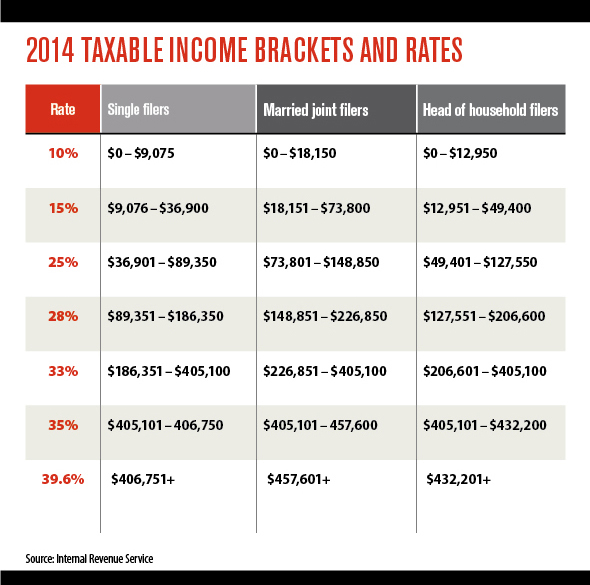
In 2014, the federal tax brackets are 10%, 15%, 25%, 28%, 33%, 35%, and 39.6%. For a taxpayer who is married and files jointly, regardless of how much the household makes, the first $18,150 of income after accounting for deductions and exemptions will only be taxed at the 10% rate.

Similarly, any income the household makes that is more than $18,150 but less than $73,800 is taxed at the 15% rate. At that point, the next $75,050 is taxed at 25%, and so on.

Consequently, not all income a household makes during the course of the year is taxed at the same rate. A marginal tax bracket is the tax rate that applies to the last dollar the household made.

It is crucial for all taxpayers to know their marginal tax rate. This information can help a client identify which type of investment accounts fits their situation best, how to structure an investment portfolio, and how to determine the value of certain deductions when filing their tax return.

Roth or Traditional Retirement Accounts

Contributions to traditional retirement accounts like IRAs and 401(k)s allow taxpayers to avoid recognizing income earned during the tax year and push the need to acknowledge the revenue into a future year. This is valuable because many people are in a higher tax bracket during their working years than they are during retirement. For instance, for a person who is currently in the 25% marginal tax bracket, it may be advantageous to delay recognizing the income until the investor retires and has less income, causing him to be in only the 15% marginal tax bracket. Doing this would enable the taxpayer to pay taxes at only 15% as opposed to 25%.

Alternatively, a Roth IRA or Roth 401(k) allows an investor to pay taxes on contributed income during the year it was earned but the money then grows tax-free. Consequently, a Roth retirement account is great for someone who believes they may be in a higher marginal tax bracket in the future. For example, a young employee in the early stages of his career who is in the 15% tax bracket but believes he may be in the 25% or 28% bracket in the future would benefit from paying all taxes on the income at his current rate of 15% and then getting tax-free investment growth. This would prevent the investor from having to pay the higher future tax rate of 25% or 28% on the invested dollars.

Knowing your marginal tax bracket can help you determine if you would favor paying taxes on your invested dollars at your current tax rate or if you believe you may benefit from pushing the need to recognize the income into a future tax year. This is a critical decision when planning for retirement and it can’t accurately be made without knowing your marginal tax rate.

Capital Gains Rate

A long term capital gains tax rate is the rate that applies to the growth of any asset held for longer than a year that is not within a tax-advantaged account. If you buy stock outside a tax-advantaged account, or purchase investment property, any growth in the value of the investment will be taxed as capital gains when sold.

An investor’s capital gains tax rate is determined by the investor’s marginal tax rate. For most taxpayers the long term capital gains tax rate is 15%. However, if a taxpayer is in the 10% or 15% marginal tax bracket, the long term capital gains tax rate is an amazing 0%! Additionally, many taxpayers in either the 35% or 39.6% tax bracket may end up paying capital gains at a rate of 20%.

Clearly, knowing your marginal tax bracket will help you analyze the appeal of making investments outside of tax-advantaged accounts. People who qualify for the 0% capital gains tax should actively search for ways to take advantage of this benefit.

Additionally, knowing your marginal tax rate can help you determine the best time to recognize long-term capital gains. If your marginal tax rate will be 25% in 2014 — leading to a capital gains tax rate of 15% — but you believe your marginal rate will be 15% in 2015 — leading to a capital gains tax rate of 0% — it would save you money and lower your tax bill to defer recognizing long-term capitals gains until next year.

***

FP

***

Annuities

Annuities are promoted as a way for invested dollars to obtain tax-deferred growth. However, when money is withdrawn from an annuity it is taxed at the investor’s marginal tax rate as opposed to his long term capital gains tax rate. Knowing your marginal tax bracket can help determine whether an annuity adds any value to your portfolio, or whether it could actually be detrimental.

Suppose an investor is in the 15% marginal tax bracket. If this person invests in an annuity, he will avoid paying taxes on any of the investment’s growth until the funds are withdrawn from the annuity. However, at that point the investment’s growth will be taxed at the taxpayer’s marginal income tax bracket of 15%. Alternatively, if this same investor utilized a taxable investment account rather than an annuity, the investment’s growth would be taxed at the investor’s capital gains tax rate of 0% when sold. In this case, investing in an annuity actually created a tax bill for this investor!

Clearly, knowing your marginal tax rate and your resulting capital gains tax rate can help you determine the best type of investment accounts for your personal situation.

Itemized Deductions

The value of your itemized deductions is essentially determined by your marginal tax bracket. For a simplified example, consider a taxpayer who could generate an additional $10,000 of deductions. Doing so would mean the individual would pay taxes on $10,000 of income less than he would without the deduction. If the individual is in the 15% tax bracket, generating the deduction would lower the person’s tax bill by $1,500 dollars ($10,000 x 15%). However, if the individual is in the 25% tax bracket, the same deduction would lower the person’s tax bill by $2,500 ($10,000 x 25%).

Consequently, knowing your marginal tax bracket can help determine when large itemized deductions should be taken. If you would like to donate funds to your favorite charitable institution, knowing which year you will be in the highest marginal tax bracket can help you determine the best time to make the contribution.

***

FA

***

Marginal Tax Rates Change

Many people’s income is relatively constant year-after-year. For these people, there may not be much fluctuation in their marginal tax bracket. However, any time you have a significant increase or decrease in income recognized during a year, your marginal tax rate may change. Whenever possible, it is best to anticipate how your current marginal tax rate might compare to your future marginal tax rate.This is another strong factor that can impact all the key financial decisions effected by your marginal tax rate.

Conclusion

Your thoughts and comments on this ME-P are appreciated. Feel free to review our top-left column, and top-right sidebar materials, links, URLs and related websites, too. Then, subscribe to the ME-P. It is fast, free and secure.

Link: http://feeds.feedburner.com/HealthcareFinancialsthePostForcxos

Speaker: If you need a moderator or speaker for an upcoming event, Dr. David E. Marcinko; MBA – Publisher-in-Chief of the Medical Executive-Post – is available for seminar or speaking engagements. Contact: MarcinkoAdvisors@msn.com

OUR OTHER PRINT BOOKS AND RELATED INFORMATION SOURCES:

Product DetailsProduct DetailsProduct Details

Product DetailsProduct Details

Product Details

Does the Method of Tax Filing Change IRS Audit Potential?

Join Our Mailing List 

Will that be a Paper or Electronic Tax Return?

[By Dr. David Edward Marcinko MBA CMP™]

dr-david-marcinko5I’ve prepared and filed personal, medical practice as well as PC, S and C corporate tax returns for many years now. I bought my first computer in 1988, participated on dial-up bulletin boards with modem soon thereafter, and have been on the internet since 1995.

But, I do to have a definitive answer to this question.

Two Competing Theories

Some CPAs suggest filing the old-school way if you’re worried about an audit. Why? Paper filing means more work for the IRS to access all the information in your return. Others disagree:

Philosophy in Favor of Paper Returns

Some suggest that a paper tax return might reduce your chance of an audit because the IRS must transcribe your information into a computer by hand. The IRS does not transfer all of the information in your return as a result of the prohibitive cost of transcribing returns. When you file a return electronically, a computer instantly analyzes your return for errors and discrepancies.

Source: http://www.ehow.com/info_8488086_filing-increase-chances-irs-audit.html#ixzz2yh9m8pEy

Philosophy in Favor of Electronic Returns

Filing an electron tax return reduces the number of math mistakes on your return and the chance that the IRS makes a mistake when it transfers data by hand. Overall, electronic returns contain fewer errors than paper returns which increase the chance of audits. Also, the IRS may perform an automatic audit when its electronic scanning system cannot read your handwriting.

Source: http://www.taxdebthelp.com/tax-problems/tax-audit/irs-audit-statistics#ixzz2yLVTp0l1

Tax

Assessment

Remember, your duty as a taxpayer is to be truthful and accurate, but you don’t have to make it easy for the IRS.

Conclusion

Your thoughts and comments on this ME-P are appreciated. Feel free to review our top-left column, and top-right sidebar materials, links, URLs and related websites, too. Then, subscribe to the ME-P. It is fast, free and secure.

Link: http://feeds.feedburner.com/HealthcareFinancialsthePostForcxos

Speaker: If you need a moderator or speaker for an upcoming event, Dr. David E. Marcinko; MBA – Publisher-in-Chief of the Medical Executive-Post – is available for seminar or speaking engagements. Contact: MarcinkoAdvisors@msn.com

OUR OTHER PRINT BOOKS AND RELATED INFORMATION SOURCES:

Product Details  Product Details

The [Financial] Case Against Marriage?

Join Our Mailing List 

Popular with Older Couples

By Rick Kahler MS CFP® http://www.KahlerFinancial.com

Rick Kahler CFP“Two can live as cheaply as one.”

This old saying is mostly true. However, when it comes to death, divorce, and taxes; two people are probably better off financially if they don’t marry. Intentionally or not, many federal and state laws reward couples who choose to live together without marriage.

Insurance and Tax Examples

Laws relating to Worker’s Compensation insurance are one example of this. Someone whose spouse has died in a work-related accident may be eligible to receive a monthly benefit, paid for the rest of his or her life. However, most state laws provide that the benefits end if the recipient remarries. This puts a real cost to remarrying.

Example:

Consider as an example a woman who at age 50 loses her husband to a work-related accident and receives a settlement of $2,000 a month for life. Assuming she will live another 35 years and could invest the proceeds in a 3% bond, the present value of that income stream is $520,000. That means a person would need $520,000, invested at 3%, to give a monthly income of $2,000 for 35 years.

Therefore, if this woman fell in love and wanted to remarry two years into receiving the payments, the remaining 33 years of monthly payments she would forfeit has a value of $502,000. This puts a rather quantifiable cost on one’s social, emotional, and religious values.

Tax Code

The tax code also encourages couples to remain unmarried.

Example:

Take a couple who both earn high incomes. Suppose each has taxable income of around $400,000, which is the breakpoint where the 39.6% tax bracket begins. As two singles, as long as their taxable income is $400,000 or less, they both remain in the 35% tax bracket. However, if they marry, their joint income goes to $800,000 while the 35% tax bracket only expands to $450,000 for couples. That means they now pay an additional 4.6% in federal income taxes on the excess of $350,000, or $12,600. Some may be quick to dismiss that amount as trivial, given their income level, but the point is still that marriage for them brings a tangible cost in higher taxes.

###

Heart

###

Prior Marriages

Those with previous marriages may find another disincentive to marriage in the challenge of passing on assets to children upon your death or if the new marriage should end in divorce. If leaving assets to children is a priority, you will probably need to negotiate a prenuptial agreement with your finance. This is especially important for couples with unequal assets.

A prenuptial agreement is a real romance killer. It highlights the reality that every marriage is a business deal, with the added emotional weight of negotiating the divorce settlement before there is a wedding. Some couples find it easier to live together without marriage and keep their assets largely separate.

The Un-Marrieds

For couples that decide not to marry, the potential tax planning is ripe with opportunity.  Such couples can do anything that the tax code or state statutes prohibit married or related parties from doing. This provides some great tax savings and asset protection opportunities.

For example, spouses cannot be the trustees of each other’s irrevocable or asset protection trusts, but unmarried partners absolutely can.

Choosing not to marry is becoming especially popular with older couples. This is because many older people with previous marriages have accumulated two things: assets and children. They find marriage less compelling when they and their new partner won’t have children together.

Assessment

Younger couples who do plan to have children still recognize that marriage is important. For many reasons, marriage isn’t going out of style any time soon. Few of those reasons, however, are financial ones.

Conclusion

Your thoughts and comments on this ME-P are appreciated. Feel free to review our top-left column, and top-right sidebar materials, links, URLs and related websites, too. Then, subscribe to the ME-P. It is fast, free and secure.

Link: http://feeds.feedburner.com/HealthcareFinancialsthePostForcxos

Speaker: If you need a moderator or speaker for an upcoming event, Dr. David E. Marcinko; MBA – Publisher-in-Chief of the Medical Executive-Post – is available for seminar or speaking engagements. Contact: MarcinkoAdvisors@msn.com

OUR OTHER PRINT BOOKS AND RELATED INFORMATION SOURCES:

DICTIONARIES: http://www.springerpub.com/Search/marcinko
PHYSICIANS: www.MedicalBusinessAdvisors.com
PRACTICES: www.BusinessofMedicalPractice.com
HOSPITALS: http://www.crcpress.com/product/isbn/9781466558731
CLINICS: http://www.crcpress.com/product/isbn/9781439879900
BLOG: www.MedicalExecutivePost.com
FINANCE: Financial Planning for Physicians and Advisors
INSURANCE: Risk Management and Insurance Strategies for Physicians and Advisors

Product Details  Product Details

Sale of a Personal Residence

Join Our Mailing List

Tax Implications

By Perry D’Alessio CPA [D’ALESSIO TOCCI & PELL CPA] http://www.DaleCPA.com

perry-dalessio-cpa

For many medical professionals, a home is their largest asset.  In addition, it is their largest tax shelter as well.

Historical Review

Certain costs of the purchase and ownership of the home are deductible expenses if the taxpayer itemizes (i.e. interest with total loan balance not to exceed one million dollars, interest on home equity loan interest up to $100,000, and property taxes). The law regarding the sale of a personal residence changed in mid-1997.

This change in the tax law has been one of the most overlooked by all taxpayers.  The new law states that the first $250,000 ($500,000 for married taxpayers filing jointly) of gain from the sale of a residence will be free of federal income tax.

How to Qualify?

To qualify for this exclusion the medical professional taxpayer must have owned the residence and occupied it for at least two of the last five years prior to the sale.  In addition, if the taxpayer does not meet the above requirement due to change in employment, health or various other reasons, s/he may receive an “exclusion” for a portion of the above amount.  An added bonus is that the taxpayer may take advantage of this same exclusion again after a two-year waiting period.

Assessment

Compared to the old law where a taxpayer had to “buy up” into a higher priced home in order to defer the gain on sale of the old residence, this is a huge benefit.  For healthcare professionals this is an especially fortuitous change in the law.  Depending on the state you reside in a residence is, for the most part, creditor proof, this tends to be one of the investments that is maximized. The potential to reap rather large tax-free treatment is something to keep in mind.

Drs. Home

Conclusion

Your thoughts and comments on this ME-P are appreciated. Feel free to review our top-left column, and top-right sidebar materials, links, URLs and related websites, too. Then, subscribe to the ME-P. It is fast, free and secure.

Link: http://feeds.feedburner.com/HealthcareFinancialsthePostForcxos

Speaker: If you need a moderator or speaker for an upcoming event, Dr. David E. Marcinko; MBA – Publisher-in-Chief of the Medical Executive-Post – is available for seminar or speaking engagements. Contact: MarcinkoAdvisors@msn.com

OUR OTHER PRINT BOOKS AND RELATED INFORMATION SOURCES:

DICTIONARIES: http://www.springerpub.com/Search/marcinko
PHYSICIANS: www.MedicalBusinessAdvisors.com
PRACTICES: www.BusinessofMedicalPractice.com
HOSPITALS: http://www.crcpress.com/product/isbn/9781466558731
CLINICS: http://www.crcpress.com/product/isbn/9781439879900
BLOG: www.MedicalExecutivePost.com
FINANCE: Financial Planning for Physicians and Advisors
INSURANCE: Risk Management and Insurance Strategies for Physicians and Advisors

Product Details  Product Details

Three New Medical Management and Retirement Planning Videos

Join Our Mailing List

Watch These Channel Presentations

By Andrew Schwartz CPA

www.schwartzaccountants.com

Andrew SchwartzRetirement Plan Basics for Practice Owners

Wondering which type of retirement plan makes the most sense for your practice? Here, you’ll also learn why it makes sense to set up and begin to max out your retirement plan savings as soon as possible.

Million Dollar Metrics for General Dentists

General dentists can learn which metrics to generate to gauge how their practice is doing, and compare those metrics with other practices, including a sample of practices that routinely collect one million dollars or more each year.

SIBS: Implementing a Simple Incentive Bonus System

Learn to increase revenues and profits at your practice by implementing a Simple Incentive Bonus System [SIBS]. We’ve seen a lot of clients implement a SIBS and experience immediate results within their practices.

Conclusion

Your thoughts and comments on this ME-P are appreciated. Feel free to review our top-left column, and top-right sidebar materials, links, URLs and related websites, too. Then, subscribe to the ME-P. It is fast, free and secure.

Link: http://feeds.feedburner.com/HealthcareFinancialsthePostForcxos

Speaker: If you need a moderator or speaker for an upcoming event, Dr. David E. Marcinko; MBA – Publisher-in-Chief of the Medical Executive-Post – is available for seminar or speaking engagements. Contact: MarcinkoAdvisors@msn.com

OUR OTHER PRINT BOOKS AND RELATED INFORMATION SOURCES:

DICTIONARIES: http://www.springerpub.com/Search/marcinko
PHYSICIANS: www.MedicalBusinessAdvisors.com
PRACTICES: www.BusinessofMedicalPractice.com
HOSPITALS: http://www.crcpress.com/product/isbn/9781466558731
CLINICS: http://www.crcpress.com/product/isbn/9781439879900
BLOG: www.MedicalExecutivePost.com
FINANCE: Financial Planning for Physicians and Advisors
INSURANCE: Risk Management and Insurance Strategies for Physicians and Advisors

Product DetailsProduct Details

Product Details

Seeking Securities Analysts, Stock-Brokers and Investment Bankers for New “Financial Planning Textbook for Doctors”

  Join Our Mailing List 

Planning our newest major textbook

By Ann Miller RN MHA [ph-770-448-0769]

[Executive-Director]

Dear Stock Brokers, IBs and Securities Analysts,

Greetings from the Institute of Medical Business Advisors, in Atlanta, Georgia.

Historical Review

As you may know, we released: Financial Planning Handbook for Physicians and Advisors, some time ago. It has enjoyed much success and acclaim in the medical and financial service sectors.

Recently, we have been asked to produce the next edition of this book for our target market of physicians, nurses, medical professionals, healthcare administrators – and those in the financial services sector who target this large and fertile, but rapidly changing niche market.

Why Now?

Urgency for the update has been prompted by ARRA, HI-TECH, the flash-crash of 2008 and the day-crash of 2011; by social, macro-economic and demographic changes; by political fiat and especially the PP-ACA.

Our medical colleagues are frustrated, afraid and fearful for their financial futures. They WANT informed advice.

Thus, true integrated financial planning information that targets this market – very expertly and specifically – is greatly needed.

The Invitation 

And so, we ask if you are interested in contributing an updated vision of an existing book chapter.

  • INVESTMENT BANKING-SECURITIES-MARKETS-MARGIN
  • HOSPITAL EMPLOYEE BENEFITS AND STOCK OPTIONS
  • INVESTMENT POLICY STATEMENT CONSTRUCTION

Not to worry – The original MS-WORD® chapter files are archived and available for use. We will forward it to you, upon assignment acceptance.

And, we are again fortunate that our Editor-in-Chief will be Dr. David Edward Marcinko FACFAS MBA CMP™ along with Professor Hope Rachel Hetico RN MHA CMP™ serving as Managing Editor.

They opined at a recent interview for the ME-P.

David and Hope” … We have entered into an emerging era in the financial planning ecosystem. It is a new era where one size does not fit all; and off-the-shelf financial products and mass sales customization is no long adequate for physicians and medical professionals; or their related generic financial planners or wire-house advisors.

It is a period of rapid change, shifting reimbursement paradigms and salary reductions that focus the healthcare industrial complex on pay-for-performance [P4], compensation for value and quality care; rather than procedures performed and quantity of care.

All must learn to do more with less professionally; and plan their personal financial lives more efficiently than ever before. Mistakes will be more difficult to overcome and the wiggle room that high income earning physicians, nurses and medical professionals used to enjoy is being narrowed by demographic, economic, social, technological and political fiat.

This emerging financial planning analog follows the health industry’s fiscal metamorphosis …”

Style Instructions 

The look and feel, format and style, and font and size of the book will remain the same. We use endnotes, not foot notes; and include mini-case reports or illustrative case models. It will be a major text; not a handbook.

Timeline for submission is about 3 months. Additional time is available, if needed, for a comprehensive update. But, we are trying to avoid running too far along into 2014 in order to avoid income tax season and the related time constraints on all concerned.

Writers Search

A Pleasure – Not Burden 

This should be a pleasurable project for you; and not anxiety provoking.

So, if you are a medically focused and experienced financial advisor with an: MBA, CFP®, PhD, MD, DDS, MSA/MS, CPA, RN, CMP®, DO, JD and/or CFA degree or designation, etc; please let me know if you are interested in updating and revising our chapters. OR, authoring a new to the world chapter.

Your Payback 

In return for your conscientious industry, you will receive a complimentary edition of the entire textbook; be listed on this ME-P as thought-leader with related book advertising content attributed to you; and given e-exposure to our almost 600,000 readers and ME-P subscribers …. Such the deal!

And, you will be added to our roster of experts for potential referrals, interviews, pod-casts and other marketing efforts

Assessment

Regardless of your decision, we remain apostles promoting your core vision of physician focused financial planning whenever possible.

Or, you may suggest another possible author- writer-expert contributor; if you wish.

Just let me know; ASAP [MarcinkoAdvisors@msn.com]

Thank you.
ANN
ANN MILLER RN MHA
[Executive-Director]
INSTITUTE OF MEDICAL BUSINESS ADVISORS, INC.
Suite #5901 Wilbanks Drive
Norcross, Georgia, 30092-1141 USA
[Ph] 770.448.0769

DICTIONARIES: http://www.springerpub.com/Search/marcinko
PRACTICES: www.BusinessofMedicalPractice.com
HOSPITALS: http://www.crcpress.com/product/isbn/9781466558731
CLINICS: http://www.crcpress.com/product/isbn/9781439879900
ADVISORS: www.CertifiedMedicalPlanner.org
BLOG: www.MedicalExecutivePost.com 

Product Details  Product Details

NOTICE: This invitation is not for all readers of the ME-P. It is a privilege invitation intended for those who possess the needed credentials, as decided by us, with an inclination to serve.  We reserve the right to accept or reject contributors, and content, at our own non-disclosed discretion.

##

Even More 2013 Year End Tax Planning Tips for Physicians

Join Our Mailing List 

Last Minute Considerations for Medical Professionals … and Us All

By Robert Whirley CPA

2500-190 North Winds Parkway

Alpharetta GA 30009-2245

Dear ME-P Readers:

Year-end tax planning could be especially productive this year because timely action could nail down a host of tax breaks that won’t be around next year unless Congress acts to extend them, which, at the present time, looks doubtful. I have tried to keep this brief but, as typical, the changes this year are voluminous.

High-Income Earners

High-income-earners have other factors to keep in mind when mapping out year-end plans. For the first time, they have to take into account the 3.8% surtax on unearned income and the additional 0.9% Medicare (hospital insurance, or HI) tax that applies to individuals receiving wages with respect to employment in excess of $200,000 ($250,000 for married couples filing jointly and $125,000 for married couples filing separately).

Medicare Tax

The additional Medicare tax may require year-end actions. Employers must withhold the additional Medicare tax from wages in excess of $200,000 regardless of filing status or other income. Self-employed persons must take it into account in figuring estimate tax. There could be situations where an employee may need to have more withheld toward year end to cover the tax.

For example, an individual earns $200,000 from one employer during the first half of the year and a like amount from another employer during the balance of the year. He would owe the additional Medicare tax, but there would be no withholding by either employer for the additional Medicare tax since wages from each employer don’t exceed $200,000.

Also, in determining whether they may need to make adjustments to avoid a penalty for underpayment of estimated tax, individuals also should be mindful that the additional Medicare tax may be over-withheld. This could occur, for example, where only one of two married spouses works and reaches the threshold for the employer to withhold, but the couple’s income won’t be high enough to actually cause the tax to be owed.

Checklist

I have compiled a checklist of additional actions based on current tax rules that may help you save tax dollars if you act before year-end. Not all actions will apply in your particular situation, but you will likely benefit from many of them.

Tax

[Year-End Tax Planning Moves for Individuals]

• Increase the amount you set aside for next year in your employer’s health flexible spending account (FSA) if you set aside too little for this year.

• If you become eligible to make health savings account (HSA) contributions in December of this year, you can make a full year’s worth of deductible HSA contributions for 2013.

• Realize losses on stock while substantially preserving your investment position. There are several ways this can be done. For example, you can sell the original holding, then buy back the same securities at least 31 days later. It may be advisable for us to meet to discuss year-end trades you should consider making.

• Postpone income until 2014 and accelerate deductions into 2013 to lower your 2013 tax bill. This strategy may enable you to claim larger deductions, credits, and other tax breaks for 2013 that are phased out over varying levels of adjusted gross income (AGI). These include child tax credits, higher education tax credits, the above-the-line deduction for higher-education expenses, and deductions for student loan interest. Postponing income also is desirable for those taxpayers who anticipate being in a lower tax bracket next year due to changed financial circumstances. Note, however, that in some cases, it may pay to actually accelerate income into 2013. For example, this may be the case where a person’s marginal tax rate is much lower this year than it will be next year or where lower income in 2014 will result in a higher tax credit for an individual who plans to purchase health insurance on a health exchange and is eligible for a premium assistance credit.

• If you believe a Roth IRA is better than a traditional IRA, and want to remain in the market for the long term, consider converting traditional-IRA money invested in beaten-down stocks (or mutual funds) into a Roth IRA if eligible to do so. Keep in mind, however, that such a conversion will increase your adjusted gross income for 2013.

• If you converted assets in a traditional IRA to a Roth IRA earlier in the year, the assets in the Roth IRA account may have declined in value, and if you leave things as-is, you will wind up paying a higher tax than is necessary. You can back out of the transaction by recharacterizing the rollover or conversion, that is, by transferring the converted amount (plus earnings, or minus losses) from the Roth IRA back to a traditional IRA via a trustee-to-trustee transfer. You can later reconvert to a Roth IRA.

• It may be advantageous to try to arrange with your employer to defer a bonus that may be coming your way until 2014.

• Consider using a credit card to prepay expenses that can generate deductions for this year.

• If you expect to owe state and local income taxes when you file your return next year, consider asking your employer to increase withholding of state and local taxes (or pay estimated tax payments of state and local taxes) before year-end to pull the deduction of those taxes into 2013 if doing so won’t create an alternative minimum tax (AMT) problem.

• Take an eligible rollover distribution from a qualified retirement plan before the end of 2013 if you are facing a penalty for underpayment of estimated tax and the increased withholding option is unavailable or won’t sufficiently address the problem. Income tax will be withheld from the distribution and will be applied toward the taxes owed for 2013. You can then timely roll over the gross amount of the distribution, as increased by the amount of withheld tax, to a traditional IRA. No part of the distribution will be includible in income for 2013, but the withheld tax will be applied pro rata over the full 2013 tax year to reduce previous underpayments of estimated tax.

• Estimate the effect of any year-end planning moves on the alternative minimum tax (AMT) for 2013, keeping in mind that many tax breaks allowed for purposes of calculating regular taxes are disallowed for AMT purposes. These include the deduction for state property taxes on your residence, state income taxes (or state sales tax if you elect this deduction option), miscellaneous itemized deductions, and personal exemption deductions. Other deductions, such as for medical expenses, are calculated in a more restrictive way for AMT purposes than for regular tax purposes in the case of a taxpayer who is over age 65 or whose spouse is over age 65 as of the close of the tax year. As a result, in some cases, deductions should not be accelerated.

• Accelerate big ticket purchases into 2013 in order to assure a deduction for sales taxes on the purchases if you will elect to claim a state and local general sales tax deduction instead of a state and local income tax deduction. Unless Congress acts, this election won’t be available after 2013.

• You may be able to save taxes this year and next by applying a bunching strategy to “miscellaneous” itemized deductions, medical expenses and other itemized deductions.

• If you are a homeowner, make energy saving improvements to the residence, such as putting in extra insulation or installing energy saving windows, or an energy efficient heater or air conditioner. You may qualify for a tax credit if the assets are installed in your home before 2014.

• Unless Congress extends it, the up-to-$4,000 above-the-line deduction for qualified higher education expenses will not be available after 2013. Thus, consider prepaying eligible expenses if doing so will increase your deduction for qualified higher education expenses. Generally, the deduction is allowed for qualified education expenses paid in 2013 in connection with enrollment at an institution of higher education during 2013 or for an academic period beginning in 2013 or in the first 3 months of 2014.

• You may want to pay contested taxes to be able to deduct them this year while continuing to contest them next year.

• You may want to settle an insurance or damage claim in order to maximize your casualty loss deduction this year.

• If you are age 70-1/2 or older, own IRAs and are thinking of making a charitable gift, consider arranging for the gift to be made directly by the IRA trustee. Such a transfer, if made before year-end, can achieve important tax savings.

• Take required minimum distributions (RMDs) from your IRA or 401(k) plan (or other employer-sponsored retired plan) if you have reached age 70-1/2. Failure to take a required withdrawal can result in a penalty of 50% of the amount of the RMD not withdrawn. If you turned age 70-1/2 in 2013, you can delay the first required distribution to 2013, but if you do, you will have to take a double distribution in 2014-the amount required for 2013 plus the amount required for 2014. Think twice before delaying 2013 distributions to 2014-bunching income into 2014 might push you into a higher tax bracket or have a detrimental impact on various income tax deductions that are reduced at higher income levels. However, it could be beneficial to take both distributions in 2014 if you will be in a substantially lower bracket that year, for example, because you plan to retire late this year.

• Make gifts sheltered by the annual gift tax exclusion before the end of the year and thereby save gift and estate taxes. You can give $14,000 in 2013 to each of an unlimited number of individuals but you can’t carry over unused exclusions from one year to the next. The transfers also may save family income taxes where income-earning property is given to family members in lower income tax brackets who are not subject to the kiddie tax.

US capitol

[Year-End Tax-Planning Moves for Businesses & Business Owners]

• Businesses should consider making expenditures that qualify for the business property expensing option. For tax years beginning in 2013, the expensing limit is $500,000 and the investment ceiling limit is $2,000,000. And a limited amount of expensing may be claimed for qualified real property. However, unless Congress changes the rules, for tax years beginning in 2014, the dollar limit will drop to $25,000, the beginning-of-phaseout amount will drop to $200,000, and expensing won’t be available for qualified real property. The generous dollar ceilings that apply this year mean that many small and medium sized businesses that make timely purchases will be able to currently deduct most if not all their outlays for machinery and equipment. What’s more, the expensing deduction is not prorated for the time that the asset is in service during the year. This opens up significant year-end planning opportunities.

• Businesses also should consider making expenditures that qualify for 50% bonus first year depreciation if bought and placed in service this year. This bonus writeoff generally won’t be available next year unless Congress acts to extend it. Thus, enterprises planning to purchase new depreciable property this year or the next should try to accelerate their buying plans, if doing so makes sound business sense.

• Nail down a work opportunity tax credit (WOTC) by hiring qualifying workers (such as certain veterans) before the end of 2013. Under current law, the WOTC won’t be available for workers hired after this year.

• Make qualified research expenses before the end of 2013 to claim a research credit, which won’t be available for post-2013 expenditures unless Congress extends the credit.

• If you are self-employed and haven’t done so yet, set up a self-employed retirement plan.

• Depending on your particular situation, you may also want to consider deferring a debt-cancellation event until 2014, and disposing of a passive activity to allow you to deduct suspended losses.

• If you own an interest in a partnership or S corporation you may need to increase your basis in the entity so you can deduct a loss from it for this year.

Assessment

These are just some of the year-end steps that can be taken to save taxes.

Conclusion

Your thoughts and comments on this ME-P are appreciated. Feel free to review our top-left column, and top-right sidebar materials, links, URLs and related websites, too. Then, subscribe to the ME-P. It is fast, free and secure.

Link: http://feeds.feedburner.com/HealthcareFinancialsthePostForcxos

Speaker: If you need a moderator or speaker for an upcoming event, Dr. David E. Marcinko; MBA – Publisher-in-Chief of the Medical Executive-Post – is available for seminar or speaking engagements. Contact: MarcinkoAdvisors@msn.com

OUR OTHER PRINT BOOKS AND RELATED INFORMATION SOURCES:

LEXICONS: http://www.springerpub.com/Search/marcinko
PHYSICIANS: www.MedicalBusinessAdvisors.com
PRACTICES: www.BusinessofMedicalPractice.com
HOSPITALS: http://www.crcpress.com/product/isbn/9781466558731
CLINICS: http://www.crcpress.com/product/isbn/9781439879900
ADVISORS: www.CertifiedMedicalPlanner.org
BLOG: www.MedicalExecutivePost.com

Product DetailsProduct DetailsProduct Details

Product Details  Product Details

Product DetailsProduct Details

Product Details

The Price of Pleasure

Join Our Mailing List

Sin Taxes

By Carrie Braza

Sin-taxes

More

Conclusion

Your thoughts and comments on this ME-P are appreciated. Feel free to review our top-left column, and top-right sidebar materials, links, URLs and related websites, too. Then, subscribe to the ME-P. It is fast, free and secure.

Link: http://feeds.feedburner.com/HealthcareFinancialsthePostForcxos

Speaker: If you need a moderator or speaker for an upcoming event, Dr. David E. Marcinko; MBA – Publisher-in-Chief of the Medical Executive-Post – is available for seminar or speaking engagements. Contact: MarcinkoAdvisors@msn.com

OUR OTHER PRINT BOOKS AND RELATED INFORMATION SOURCES:

LEXICONS: http://www.springerpub.com/Search/marcinko
PHYSICIANS: www.MedicalBusinessAdvisors.com
PRACTICES: www.BusinessofMedicalPractice.com
HOSPITALS: http://www.crcpress.com/product/isbn/9781466558731
CLINICS: http://www.crcpress.com/product/isbn/9781439879900
ADVISORS: www.CertifiedMedicalPlanner.org
BLOG: www.MedicalExecutivePost.com

Product DetailsProduct DetailsProduct Details

Product Details  Product Details

What All Doctors Need to Know About the Expiring Tax Provisions‏

Join Our Mailing List 

Avoid Losing Out on these Tax Breaks

By Bobby Whirley CPA and Kim Dore

Whirley & Associates, LLC

Certified Public Accountants

2500 Northwinds Parkway

Suite 190 – Alpharetta, GA 30009

770.932.1919 (ph) and 770.932.1192 (fax)

Dear ME-P Subscribers,

We wanted to let ME-P readers know about several important tax provisions affecting individuals and businesses that are slated to expire at the end of this year. While a budget conference is underway between the House and Senate, there is no way to know whether any agreement resulting from these negotiations will extend any expiring tax provisions. Because of this uncertainty, where possible, you should take action now to avoid losing out on tax breaks.

· Above-the-line deduction for certain higher education expenses – An above-the-line deduction is allowed for an individual taxpayer’s qualified tuition and related expenses. For 2013, the maximum deduction is $4,000 for taxpayers with modified AGI of not more than $65,000 ($130,000 for joint filers), and $2,000 for taxpayers with modified AGI that is equal to or more than the above amount but not more than $80,000 ($160,000 for joint filers). In general, the deduction is allowed for any tax year only to the extent the expenses are in connection with enrollment at an institution of higher education during that tax year. However, the deduction is allowed for qualified tuition and related expenses paid during a tax year if they are in connection with an academic term beginning during that tax year or during the first three months of the next tax year. The deduction does not apply for tax years beginning after 2013.

So, you may want to prepay in 2013 tuition due for an academic term beginning in Jan., Feb. or Mar. 2014 if that would increase your 2013 tax savings from the expiring deduction.

· Non-business energy credit –  Subject to limits (listed below), a taxpayer may be able to take a credit under Code Sec. 25C equal to the sum of: (1) 10% of the amount paid or incurred for qualified energy efficiency improvements, such as insulation material, exterior windows and skylights, and exterior doors, installed during 2013; and (2) any residential energy property costs, such as electric heat pumps, central air conditioners, natural gas, propane, or oil water heaters, or qualified natural gas, propane, and oil hot water boilers, paid or incurred in 2013. The expenses must be for property originally placed in service by the taxpayer and located in the U.S., and used as a principal residence at the time of installation. However, the credit is limited as follows:

·        A total combined credit limit of $500 for all tax years after 2005.

·        A combined credit limit of $200 for windows for all tax years after 2005.

·        A credit limit for residential energy property costs for 2013 of $50 for any advanced main air circulating fan; $150 for any qualified natural gas, propane, or oil furnace or hot water boiler; and $300 for any item of energy efficient building property.

So, if you have not made full use of the credit and are contemplating making such energy efficient improvements in the near future, you should do so before year-end to take advantage of the credit.

Tax

· Home mortgage debt forgiveness relief – For indebtedness discharged before Jan. 1, 2014, taxpayers generally may exclude up to $2 million of mortgage debt forgiveness on their principal residence. Gross income doesn’t include any discharge of qualified principal residence indebtedness. Generally, this relief allows the exclusion of income realized as a result of modification of the terms of the mortgage, foreclosure on a principal residence, or where the mortgage loan is not fully satisfied (e.g., in a short sale) and a lender cancels the unsatisfied debt. The basis of the taxpayer’s principal residence is reduced by the excluded amount, but not below zero.

So, if you are in the process of attempting to secure such relief from your lender you should take all possible steps to ensure that the discharge occurs before January 1st. of next year.

· Mortgage insurance premiums treated as deductible interest  – Mortgage insurance premiums paid or accrued by a taxpayer in connection with acquisition indebtedness with respect to the taxpayer’s qualified residence are treated as deductible qualified residence interest, subject to a phase-out based on the taxpayer’s AGI. However, this provision does not apply to premiums paid or accrued after Dec. 31, 2013 or properly allocable to any period after that date.

Thus, prepaying 2014 premiums this year won’t yield a deduction.

·  Above-the-line deduction for expenses of elementary and secondary school teachers. An eligible educator is allowed an above-the-line deduction, not in excess of $250, for otherwise allowable trade or business expenses paid or incurred by him in connection with books, supplies (other than nonathletic supplies for courses of instruction in health or physical education), computer equipment (including related software and services) and other equipment, and supplementary materials used by him in the classroom. The deduction is allowed only to the extent the expenses exceed the amount excludable for the tax year. This provision does not apply for tax years beginning after 2013.

So, a teacher who is not over the limit and who plans to purchase items in 2014 that would qualify for the deduction if it remained in effect should consider accelerating the purchases to 2013 to gain a deduction this year.

More:

Conclusion

Your thoughts and comments on this ME-P are appreciated. Feel free to review our top-left column, and top-right sidebar materials, links, URLs and related websites, too. Then, subscribe to the ME-P. It is fast, free and secure.

Link: http://feeds.feedburner.com/HealthcareFinancialsthePostForcxos

Speaker: If you need a moderator or speaker for an upcoming event, Dr. David E. Marcinko; MBA – Publisher-in-Chief of the Medical Executive-Post – is available for seminar or speaking engagements. Contact: MarcinkoAdvisors@msn.com

OUR OTHER PRINT BOOKS AND RELATED INFORMATION SOURCES:

LEXICONS: http://www.springerpub.com/Search/marcinko
PHYSICIANS: www.MedicalBusinessAdvisors.com
PRACTICES: www.BusinessofMedicalPractice.com
HOSPITALS: http://www.crcpress.com/product/isbn/9781466558731
CLINICS: http://www.crcpress.com/product/isbn/9781439879900
ADVISORS: www.CertifiedMedicalPlanner.org
BLOG: www.MedicalExecutivePost.com

Product Details  Product Details

Update on Estate and Probate Law

Join Our Mailing List 

INCREASING TRUST INCOME TAX EFFICIENCY AFTER ATRA WITH BETTER BYPASS TRUST OPTIONS [Ohio]

By Edwin P. Morrow III; JD LL.M, MBA CFP® RFC® CMP® [Hon]

Ed Morrow III JDDave, Ann and ME-P Readers,

Many doctors are flummoxed with whether they need any “AB” trust in light of the new tax laws.  

I’ve written quite a lot on this and have attached a short and a long version to review:

VIEW: Ohio Law

VIEW: Optimal Basis Increase Trust Sept 2013

You could delete the outdated ME-P sections on EGTTRA and replace them with some of this (although it may be too much for doctors and laypeople, so I’ve also toned-it-down similar to the shorter version above).

Assessment

Also, you should cover captive insurance companies if you have not already. Which physician/practice owners should consider it?  How do you start? How do you choose a captive manager and attorney?  What should you watch out for?  I could do that too, I think I have some material.

More on Alternative Insurance Companies:

More on Asset Protection:

ABOUT THE AUTHOR:

Mr. Edwin P. Morrow III, a friend of the Medical Executive-Post, is a Wealth Specialist and Manager, Wealth Strategies Communications Ohio State Bar Association Certified Specialist, Estate Planning, Probate and Trust Law Key Private Bank Wealth Advisory Services. 10 W. Second St., 27th Floor Dayton, OH 45402. He is an ME-P “thought leader”.

This essay is based on presentation by the author at the Wealth Management Conference at Columbus on June 13, 2013.

Conclusion

Your thoughts and comments on this ME-P are appreciated. Feel free to review our top-left column, and top-right sidebar materials, links, URLs and related websites, too. Then, subscribe to the ME-P. It is fast, free and secure.

Link: http://feeds.feedburner.com/HealthcareFinancialsthePostForcxos

Speaker: If you need a moderator or speaker for an upcoming event, Dr. David E. Marcinko; MBA – Publisher-in-Chief of the Medical Executive-Post – is available for seminar or speaking engagements. Contact: MarcinkoAdvisors@msn.com

OUR OTHER PRINT BOOKS AND RELATED INFORMATION SOURCES:

LEXICONS: http://www.springerpub.com/Search/marcinko
PHYSICIANS: www.MedicalBusinessAdvisors.com
PRACTICES: www.BusinessofMedicalPractice.com
HOSPITALS: http://www.crcpress.com/product/isbn/9781466558731
CLINICS: http://www.crcpress.com/product/isbn/9781439879900
ADVISORS: www.CertifiedMedicalPlanner.org
BLOG: www.MedicalExecutivePost.com

Product DetailsProduct DetailsProduct Details

Product Details  Product Details

Some US Federal Budget Proposals

Join Our Mailing List

Government Shutdown Hoopla for Retirees, Inheritors and Savers

By Rick Kahler CFP® http://www.KahlerFinancial.com

Rick Kahler CFPLost in the hoopla over the government shutdown, defunding Obamacare, and raising the debt ceiling are some proposals contained in President Obama’s budget that will have a significant impact on retirees, inheritors, and savers.

Most of the President’s proposals are aimed at enforcing higher taxes on savers who maximize their retirement plans. This is a way to raise revenue for government entitlement programs, like subsidies for health insurance, Medicare, and Social Security.

Retirement and Retirees

Back from last year is his proposal to cap contributions to IRA’s and 401(k)’s when the balance reaches a level determined by a set formula which is tied to interest rates. The proposal sets the cap at $3.4 million initially. As interest rates rise, the cap will lower. When a saver’s IRA balance hits the cap, he or she will not be allowed to make further contributions to any retirement plan.

This will mostly affect savers who terminate employment and roll large accumulations from profit-sharing plans and lump-sum distributions from defined benefit plans into their IRA’s. It will shut down their ability to save into the future.

Taxes and Inheritors

The President has yet another plan to end tax-deductible contributions for upper income earners. Only 28% of a contribution would be deductible for any taxpayer whose bracket exceeds 28%. For a taxpayer in the highest bracket, this means a tax increase of about 50%.

Another of the President’s proposals would end the ability of anyone other than a spouse to inherit a tax-deferred IRA. Under the proposal, all non-spouses inheriting an IRA would have five years to terminate the IRA and pay income taxes on the distributions. This proposal really impacts Roth IRA conversions, as most parents convert traditional IRA’s to Roths with the intention of leaving their children a non-taxable sum of money that can continue to grow tax free during their lifetime. If the President’s proposal passes, many older savers will discover that the intentions behind their Roth conversions have been nullified.

Forced Savings and Savers

While President Obama wants to cap what successful savers can stash away in retirement plans, he also wants to force employees to save for retirement. Employers will be required to open IRA’s for every employee and to fund the plan at a minimum of 3% of the employee’s pay, unless the employee specifically opts out. The employee can contribute more than 3%, up to the $5,000 cap for those under 50 and $6,000 for those over 50.

Of course, savvy savers and ME-P readers know most of us need to be saving 20% to 50% of our salaries, depending on our ages, so saving just 3% of pay won’t amount to much in the way of retirement income.

Good News

On the positive side, the President wants to end required minimum distributions on IRA balances under $75,000. This will reduce some paperwork for savers with smaller IRA’s who are not making withdrawals.

Typically, most retirees with small IRA’s are those with less savings anyway, who need to take withdrawals from their IRA’s to make ends meet. So it’s doubtful this rule change will have much impact.

Finally, the President proposes letting inherited non-spousal IRA’s enjoy the same benefit of a 60-day rollover window on any distribution, similar to what they can do with a non-inherited IRA. This will simply eliminate a lot of confusion, as most people don’t understand the 60-day rollover provision does not include inherited IRA’s.

Shutdown[US Federal Government Shut-Down]

Assessment

Of course, whether any or all of these proposals make it into law is anyone’s guess. Anyone whose retirement and estate planning includes saving in IRA’s will want to keep an eye on these provisions as the budget moves through Congress.

Conclusion

Your thoughts and comments on this ME-P are appreciated. Feel free to review our top-left column, and top-right sidebar materials, links, URLs and related websites, too. Then, subscribe to the ME-P. It is fast, free and secure.

Link: http://feeds.feedburner.com/HealthcareFinancialsthePostForcxos

Speaker: If you need a moderator or speaker for an upcoming event, Dr. David E. Marcinko; MBA – Publisher-in-Chief of the Medical Executive-Post – is available for seminar or speaking engagements. Contact: MarcinkoAdvisors@msn.com

OUR OTHER PRINT BOOKS AND RELATED INFORMATION SOURCES:

LEXICONS: http://www.springerpub.com/Search/marcinko
PHYSICIANS: www.MedicalBusinessAdvisors.com
PRACTICES: www.BusinessofMedicalPractice.com
HOSPITALS: http://www.crcpress.com/product/isbn/9781466558731
CLINICS: http://www.crcpress.com/product/isbn/9781439879900
ADVISORS: www.CertifiedMedicalPlanner.org
PODIATRISTS: www.PodiatryPrep.com
BLOG: www.MedicalExecutivePost.com

Product DetailsProduct DetailsProduct Details

Product Details  Product Details

How affordable is the new health care law – Really?

Join Our Mailing List 

Calculate your costs

[By Staff Reporters]

The Affordable Care Act is going to change health care for tens of millions of Americans.

But, what about the cost?

LET’S BEGIN

ACA

###

NOW CALCULATE

Whether you’re an individual who has health insurance or needs it, or a small business owner, you need to know how health care reform affects you.

What’s it going to cost? What’s happening in your state?

### 8C9220491-tdy-130929-aca-calculator-4x3-606p_blocks_desktop_large

### 

Link: http://www.nbcnews.com/health/how-affordable-new-health-care-law-really-calculate-your-cost-8C11296290

Conclusion

Your thoughts and comments on this ME-P are appreciated. Feel free to review our top-left column, and top-right sidebar materials, links, URLs and related websites, too. Then, subscribe to the ME-P. It is fast, free and secure.

Link: http://feeds.feedburner.com/HealthcareFinancialsthePostForcxos

Speaker: If you need a moderator or speaker for an upcoming event, Dr. David E. Marcinko; MBA – Publisher-in-Chief of the Medical Executive-Post – is available for seminar or speaking engagements. Contact: MarcinkoAdvisors@msn.com

OUR OTHER PRINT BOOKS AND RELATED INFORMATION SOURCES:

Health Dictionary Series: http://www.springerpub.com/Search/marcinko

Practice Management: http://www.springerpub.com/product/9780826105752

Physician Financial Planning: http://www.jbpub.com/catalog/0763745790

Medical Risk Management: http://www.jbpub.com/catalog/9780763733421

Hospitals: http://www.crcpress.com/product/isbn/9781439879900

Physician Advisors: www.CertifiedMedicalPlanner.org

Product DetailsProduct DetailsProduct Details

Product Details  Product Details

Product DetailsProduct Details

IRS Offers New Simplified Home-Office Deduction

Join Our Mailing List

Effective January 1, 2013

By Andrew D. Schwartz CPA

Andrew SchwartzThe IRS has introduced a simplified option for many home-based businesses and some home-based workers to use to figure their deductions for the business use of their home, effective January 1, 2013.

The new optional deduction, capped at $1,500 per year based on $5 a square foot for up to 300 square feet, will reduce the paperwork and recordkeeping burden on small businesses by an estimated 1.6 million hours annually.

An Easy Path

The new option provides eligible taxpayers an easier path to claiming the home office deduction. Currently, they are generally required to fill out a 43-line Form 8829, often with complex calculations of allocated expenses, depreciation and carryovers of unused deductions. Taxpayers claiming the optional deduction will complete a significantly simplified form.

No Allocation

Though homeowners using the new option cannot depreciate the portion of their home used in a trade or business, they can claim allowable mortgage interest, real estate taxes and casualty losses on the home as itemized deductions on Schedule A of their tax return.  These deductions need not be allocated between personal and business use, as is required under the regular method.

Business expenses unrelated to the home, such as advertising, supplies and wages paid to employees are still fully deductible.

Restrictions

Current restrictions on the home office deduction, such as the requirement that a home office must be used regularly and exclusively for business and the limit tied to the income derived from the particular business, still apply under the new option.

Drs. Home

Assessment

The new simplified option is available starting with the 2013 return which most taxpayers file early in 2014.

Conclusion

Your thoughts and comments on this ME-P are appreciated. Feel free to review our top-left column, and top-right sidebar materials, links, URLs and related websites, too. Then, subscribe to the ME-P. It is fast, free and secure.

Speaker: If you need a moderator or speaker for an upcoming event, Dr. David E. Marcinko; MBA – Publisher-in-Chief of the Medical Executive-Post – is available for seminar or speaking engagements. Contact: MarcinkoAdvisors@msn.com

OUR OTHER PRINT BOOKS AND RELATED INFORMATION SOURCES:

Product Details  Product Details

Product DetailsProduct Details

How a Doctor’s Job Seach May Lower Taxes

Join Our Mailing List 

Same line-of-work Tax Tips

By Andrew D. Schwartz CPA

Andrew SchwartzSummer is often a time when doctors and other people make major life decisions. Common events include buying a home, getting married or changing jobs; especially for hospitalist physicians.

If you’re looking for a new job in your same line of work, you may be able to claim a tax deduction for some of your job hunting expenses.

The Tax Tips

Here are seven things the IRS wants you to know about deducting these costs:

1. Your expenses must be for a job search in your current occupation. You may not deduct expenses related to a search for a job in a new occupation. If your employer or another party reimburses you for an expense, you may not deduct it.

2. You can deduct employment and job placement agency fees you pay while looking for a job.

3. You can deduct the cost of preparing and mailing copies of your résumé to prospective employers.

4. If you travel to look for a new job, you may be able to deduct your travel expenses. However, you can only deduct them if the trip is primarily to look for a new job.

5. You can’t deduct job search expenses if there was a substantial break between the end of your last job and the time you began looking for a new one.

6. You can’t deduct job search expenses if you’re looking for a job for the first time.

7. You usually will claim job search expenses as a miscellaneous itemized deduction. You can deduct only the amount of your total miscellaneous deductions that exceed two percent of your adjusted gross income.

###

jobs

###

Conclusion

Your thoughts and comments on this ME-P are appreciated. Feel free to review our top-left column, and top-right sidebar materials, links, URLs and related websites, too. Then, subscribe to the ME-P. It is fast, free and secure.

Link: http://feeds.feedburner.com/HealthcareFinancialsthePostForcxos

Speaker: If you need a moderator or speaker for an upcoming event, Dr. David E. Marcinko; MBA – Publisher-in-Chief of the Medical Executive-Post – is available for seminar or speaking engagements. Contact: MarcinkoAdvisors@msn.com

OUR OTHER PRINT BOOKS AND RELATED INFORMATION SOURCES:

Product Details  Product Details

Product DetailsProduct Details

How the IRS’s Nonprofit Division Got So Dysfunctional

Join Our Mailing List

The IRS Controversy

By Kim Barker and Justin Elliott

ProPublica, May 17, 2013, 5:14 p.m.

The IRS division responsible for flagging Tea Party groups has long been an agency afterthought, beset by mismanagement, financial constraints and an unwillingness to spell out just what it expects from social welfare nonprofits, former officials and experts say.

The controversy that erupted in the past week, leading to the ousting of the acting Internal Revenue Service commissioner, an investigation by the FBI, and congressional hearings that kicked off Friday, comes against a backdrop of dysfunction brewing for years.

Moves launched in the 1990s were designed to streamline the tax agency and make it more efficient. But they had unintended consequences for the IRS’s Exempt Organizations division.

Checks and balances once in place were taken away. Guidance frequently published by the IRS and closely read by tax lawyers and nonprofits disappeared. Even as political activity by social welfare nonprofits exploded [1] in recent election cycles, repeated requests for the IRS to clarify exactly what was permitted for the secretly funded groups were met, at least publicly, with silence.

All this combined to create an isolated office in Cincinnati, plagued by what an inspector general this week described [2] as “insufficient oversight,” of fewer than 200 low-level employees responsible for reviewing more than 60,000 nonprofit applications a year.

A Major Mistake

In the end, this contributed to what everyone from Republican lawmakers to the president says was a major mistake: The decision by the Ohio unit to flag for further review applications from groups with “Tea Party” and similar labels. This started around March 2010, with little pushback from Washington until the end of June 2011.

“It’s really no surprise that a number of these cases blew up on the IRS,” said Marcus Owens, who ran the Exempt Organizations division from 1990 to 2000. “They had eliminated the trip wires of 25 years.”

Of course, any number of structural fixes wouldn’t stop rogue employees with a partisan ax to grind. No one, including the IRS [3] and the inspector general [4], has presented evidence that political bias was a factor, although congressional and FBI investigators are taking another look.

But what is already clear is that the IRS once had a system in place to review how applications were being handled and to flag potentially problematic ones. The IRS also used to show its hand publicly, by publishing educational articles for agents, issuing many more rulings, and openly flagging which kind of nonprofit applications would get a more thorough review.

All of those checks and balances disappeared in recent years, largely the unforeseen result of an IRS restructuring in 1998, former officials and tax lawyers say.

“Until 2008, we had a dialogue, through various rulings and cases and the participation of various IRS officials at various ABA meetings, as to what is and what is not permissible campaign intervention,” said Gregory Colvin, the co-chair of the American Bar Association subcommittee that dealt with nonprofits, lobbying, and political intervention from 1991 to 2009.

“And there has been absolutely no willingness in the last five years by the IRS to engage in that discussion, at the same time the caseload has exploded at the IRS.”

IRS

Stone Walling

The IRS did not respond to requests for comment on this story.

Social welfare nonprofits, which operate under the 501(c)(4) section of the tax code, have always been a strange hybrid, a catchall category for nonprofits that don’t fall anywhere else. They can lobby. For decades, they have been allowed to advocate for the election or defeat of candidates, as long as that is not their primary purpose. They  also do not have to disclose their donors.

Social welfare nonprofits were only a small part of the exempt division’s work, considered minor when compared with charities. When the groups sought IRS recognition, the agency usually rubber-stamped them. Out of 24,196 applications for social welfare status between 1998 and 2009, the exempt organizations division rejected only 77, according to numbers compiled from annual IRS data books.

Into this loophole came the Supreme Court’s Citizens United decision in January 2010, which changed the campaign-finance game [5] by allowing corporate and union spending on elections.

Sensing an opportunity, some political consultants started creating social welfare nonprofits geared to political purposes. By 2012, more than $320 million in anonymous money poured into federal elections.

A couple of years earlier, beginning in 2010, the Cincinnati workers had flagged applications of tiny Tea Party groups, according to the inspector general, though the groups spent almost no money in federal elections.

Main Question

The main question raised by the audit is how the Cincinnati office and superiors in Washington could have gotten it so wrong. The audit shows no evidence that these workers even looked at records from the Federal Election Commission to vet much larger groups [6] that spent hundreds of thousands and even millions [7] in anonymous money to run election ads.

The IRS Exempt Organizations division, the watchdog for about 1.5 million nonprofits, has always had to deal with controversial groups. For decades, the division periodically listed red flags that would merit an application being sent to the IRS’s Washington, D.C., headquarters for review, said Owens, the former division head.

In the 1970s, that meant flagging all applications for primary and secondary schools in the south facing desegregation. In the 1980s, during the wave of consolidation in the health-care industry, all applications from health-care nonprofits needed to be sent to headquarters. The division’s different field offices had to send these applications up the chain.

“Back then, many more applications came to Washington to be worked — the idea was to have the most sensitive ones come to Washington,” said Paul Streckfus, a former IRS lawyer who screened applications at headquarters in the 1970s and founded the industry publication EO Tax Journal [8] in 1996.

Because this list was public, lawyers and nonprofits knew which cases would automatically be reviewed.

“We had a core of experts in tax law,” recalled Milton Cerny, who worked for the IRS, mainly in Exempt Organizations, from 1960 to 1987. “We had developed a broad group of tax experts to deal with these issues.”

In the 1980s, the division issued many more “revenue rulings” than issued in recent years, said Cerny, then head of the rulings process. These revenue rulings set precedents for the division. Revenue rulings along with regulations are basically the binding IRS rules for nonprofits.

“We would do a revenue ruling, so the public and agents would know,” Cerny said. “Over the years, it apparently was felt that a revenue ruling should only be published at an extraordinary time. So today you’re lucky if you get one a year. Sometimes it’s less than that. It’s amazing to me.”

Other checks and balances had existed too. Not only were certain kinds of applications publicly flagged, there was another mechanism called “post-review,” Owens said. Headquarters in Washington would pull a random sample every month from the different field offices, to see how applications were being reviewed. There was also a surprise “saturation review,” once a year, for each of the offices, where everything from a certain time period needed to be sent to Washington for another look.

So internally, the division had ways, if imperfect, to flag potential problems. It also had ways of letting the public know what exactly agents were looking at and how the division was approaching controversial topics.

For instance, there was the division’s “Continuing Professional Education,” or CPE, technical instruction program. These articles were supposed to be used for training of line agents, collecting and putting out the agency’s best information on a particular topic — on, say, political activity [9] by social welfare nonprofits in 1995.

“People in a group would write up their thoughts: ‘Here’s the law,’” said Beth Kingsley, a Washington lawyer with Harmon, Curran, Spielberg & Eisenberg who’s worked with nonprofits for almost 20 years. “It wasn’t pushing the envelope. It was, ‘This is how we see this issue.’ It told us what the IRS was thinking.”

The system began to change in the mid-1990s. The IRS was having trouble hiring people for low-level positions in field offices like New York or Atlanta — the kinds of workers that typically reviewed applications by nonprofits, Owens said.

In Cincinnati

The answer to this was simple: Cincinnati.

The city had a history of being able to hire people at low federal grades, which in 1995 paid between $19,704 and $38,814 a year — almost the same as those federal grades paid in New York City or Chicago. (Adjusted for inflation, that’s between $30,064 and $59,222 now.)

“That was well below what the prevailing rate was in the New York City area for accountants with training,” Owens said. “We had one accountant who just had gotten out of jail — that’s the sort of people who would show up for jobs. That was really the low point.”

So in 1995, the Exempt Organizations division started to centralize. Instead of field offices evaluating applications for nonprofits in each region, those applications would all be sent to one mailing address, a post-office box in Covington, Ky. Then a central office in Cincinnati would review all the applications.

Almost inadvertently, because people there were willing to work for less than elsewhere, Cincinnati became ground zero for nonprofit applications.

For the time being, the checks remained in place. The criteria for flagged nonprofits were still made public. The Continuing Professional Education text was still made public. Saturation reviews and post reviews were still in place.

But by 1998, after hearings in which Republican Senator Trent Lott accused the IRS of “Gestapo-like” tactics, a new law mandated the agency’s restructuring. In the years that followed, the agency aimed to streamline. For most of the ‘90s, the IRS had more than 100,000 employees. That number would drop every year, to slightly less than 90,000 [10] by 2012.

Change Will Come

Change also came to the Exempt Organizations division.

The IRS tried to remove discretion from lower-level employees around the country by creating rules they had to follow. While the reorganization was designed to centralize power in the agency’s Washington headquarters, it didn’t work out that way.

“The distance between Cincinnati and Washington was such that soon Cincinnati became a power center,” said Streckfus, the former IRS lawyer.

Following reorganization, many highly trained lawyers in Washington who previously handled the most sensitive nonprofit applications were reassigned to focus on special projects, he said.

Owens, who left the IRS in 2000 but stayed in touch with his old division, said the focus on efficiency meant “eliminating those steps deemed unimportant and anachronistic.”

In 2003, the saturation reviews and post reviews ended, and the public list of criteria that would get an application referred to headquarters disappeared, Owens said. Instead, agents in Cincinnati could ask to have cases reviewed, if they wanted. But they didn’t very often.

“No one really knows what kinds of cases are being sent to Washington, if any,” Owens said. “It’s all opaque now. It’s gone dark.”

By the end of 2004, the Continuing Professional Education articles stopped [11].

Recommendations [12] from an ABA task force for IRS guidelines on social welfare nonprofits and politics that same year were met with silence.

Even the IRS’s Political Activities Compliance Initiative, which investigated [13] complaints of charities engaged in politics — primarily churches — closed up shop in early 2009 after less than five years, without any explanation.

Both before and after the changes, the Exempt Organizations division has been a small part of the IRS, which is focused on collecting money and chasing delinquent taxpayers.

US capitol

IRS Employee Count in 2012

Rulings and Agreements, the division that handles applications of all nonprofits, accounted for less than 0.5 percent of all IRS employees in 2012.

Source: IRS Data Books [14], IRS Exempt Organizations Annual Report [15]

Of the 90,000 employees at the agency last year, only 876 worked in the Exempt Organizations’ division, or less than 1 in 1,000 employees.

Of those, 335 worked in the office that actually handles applications of nonprofits.

Most of those — about 300 — worked in Cincinnati, Streckfus estimates. The rest were at headquarters, in Washington D.C.

In Cincinnati, the employees’ primary job was sifting through the applications of nonprofits, making determinations as to whether a nonprofit should be recognized as tax-exempt. In a press release [16] Wednesday, the IRS said fewer than 200 employees were responsible for that work.

In 2012, these employees received 60,780 applications. The bulk of those — 51,748 — were from groups that wanted to be recognized as charities.

But the number of social welfare nonprofit applications spiked from 1,777 in 2011 to 2,774 in 2012. It’s impossible to say how many of those groups indicated whether they would engage in politics, or why the number of applications increased. The IRS said Wednesday that it “has seen an increase in the number of tax-exempt organization applications in which the organization is potentially engaged in political activity,” including both charities and social welfare nonprofits, but didn’t specify any numbers.

Total 501(c)(4) [17] Nonprofit Applications from 2002 to 2012

From 2011 to 2012, applications increased by more than 50 percent.

Source: IRS Data Books [14]

On average, one employee in Cincinnati would be responsible for going through roughly one application per day.

Some would be easy — say, a local soup kitchen. But to evaluate whether a social welfare nonprofit has social welfare as its primary purpose, the agent is supposed to use a “facts and circumstances” test. There is no checklist. Reviewing just one social welfare nonprofit could take days or weeks, to look through a group’s website, track down TV ads and so forth.

“You’ve got 60,000 applications coming through, and it’s hard to do that with the number of agents looking at them,” said Philip Hackney [18], who was in the IRS’s chief counsel office in Washington between 2006 and 2011 but said he wasn’t involved in the Tea Party controversy. “The reality is that they cannot do that, and that’s why you’re seeing them pick stuff out for review. They tried to do that here, and it burned them.”

As we have previously reported, last year the same Cincinnati office sent ProPublica [19] confidential applications from conservative groups. An IRS spokeswoman said the disclosures were inadvertent.

The Commissioner Speaks

Mark Everson, IRS commissioner for four years during the George W. Bush administration, said he believed the fact that the division is understaffed is relevant, but not an excuse for what happened. “The whole service is under-funded,” he pointed out.

And Dan Backer, a lawyer in Washington who represented six of the groups held up because of the Tea Party criteria, said he doesn’t buy the notion that low-level employees in Cincinnati were alone responsible.

“It doesn’t just strain credulity,” Backer said. “It broke credulity and left it laying on the road about a mile back. Clearly these guys were all on the same marching orders.”

The inspector general’s audit was prompted last year after members of Congress, responding to complaints by Tea Party groups, asked for it.

Like former officials interviewed by ProPublica, the audit suggests that officials at IRS headquarters in Washington were unable to manage their subordinates in Cincinnati. When Lois Lerner, the Exempt Organizations division director in Washington, learned [20] in June 2011 about the improper criteria for screening applications, she instructed that they be “immediately revised.”

But just six months later, Cincinnati employees changed [21] the revised criteria to focus on “organizations involved in limiting/expanding government” or “educating on the Constitution.” They did so “without executive approval.”

“The story people are overlooking is: Congress is complaining about underpaid, overworked employees who are not adequately trained,” said Bryan Camp, a former attorney in the IRS chief counsel’s office.

Assessment

In the end, after all the millions of anonymous money spent by some groups to elect candidates in 2012, after all [22] the groups [23] that said in their applications that they would not spend money to elect candidates before doing exactly that, after the Cincinnati office flagged conservative groups, the IRS approved almost all the new applications. Only eight applications were denied.

Source: http://www.propublica.org/article/how-irs-nonprofit-division-got-so-dysfunctional

Conclusion

Your thoughts and comments on this ME-P are appreciated. Feel free to review our top-left column, and top-right sidebar materials, links, URLs and related websites, too. Then, subscribe to the ME-P. It is fast, free and secure.

Link: http://feeds.feedburner.com/HealthcareFinancialsthePostForcxos

Speaker: If you need a moderator or speaker for an upcoming event, Dr. David E. Marcinko; MBA – Publisher-in-Chief of the Medical Executive-Post – is available for seminar or speaking engagements. Contact: MarcinkoAdvisors@msn.com

OUR OTHER PRINT BOOKS AND RELATED INFORMATION SOURCES:

Health Dictionary Series: http://www.springerpub.com/Search/marcinko

Practice Management: http://www.springerpub.com/product/9780826105752

Physician Financial Planning: http://www.jbpub.com/catalog/0763745790

Medical Risk Management: http://www.jbpub.com/catalog/9780763733421

Hospitals: http://www.crcpress.com/product/isbn/9781439879900

Physician Advisors: www.CertifiedMedicalPlanner.org

Product DetailsProduct DetailsProduct Details

Product Details  Product Details

Product DetailsProduct Details


Recent Tax Law Changes and Basic Retirement Planning [video]

Join Our Mailing List

For Healthcare Accountants

By Richard Schwartz CPA

http://schwartzaccountants.com/

Richard Schwartz CPA

Content: Video (mp4) – 105.32MB
Title: Richard Schwartz Webinar 1.23.13 Tax Changes and Retirement

Link: http://www.screencast.com/t/Huco7W8LOl

Richard S Schwartz, CPA, CVA, received a B.A. in Economics from Brandeis University in 1985 and an M.S. in Accounting from the Graduate School of Professional Accounting at Northeastern University in 1990.  Prior to joining his brother at Schwartz and Schwartz,  P.C. in 1993, he worked for the international accounting firm PricewaterhouseCoopers, LLP, in their Emerging Business Services Group.  Since joining Schwartz and Schwartz, P.C. he has worked with individuals providing tax expertise as well as small business owners providing both tax and accounting guidance to help their businesses grow.  In 2006, Rick earned the designation of Certified Valuation Analyst from the National Association of Certified Valuation Analysts (NACVA), which he uses to assist healthcare professionals in their evaluation of whether to purchase a practice.

Conclusion

In any case, early planning is the key to supporting both your kids’ futures and your retirement. Making logical college funding decisions, rather than emotional ones, creates a win/win for everyone.

Your thoughts and comments on this ME-P are appreciated. Feel free to review our top-left column, and top-right sidebar materials, links, URLs and related websites, too. Then, subscribe to the ME-P. It is fast, free and secure.

Link: http://feeds.feedburner.com/HealthcareFinancialsthePostForcxos

Speaker: If you need a moderator or speaker for an upcoming event, Dr. David E. Marcinko; MBA – Publisher-in-Chief of the Medical Executive-Post – is available for seminar or speaking engagements. Contact: MarcinkoAdvisors@msn.com

OUR OTHER PRINT BOOKS AND RELATED INFORMATION SOURCES:

DICTIONARIES: http://www.springerpub.com/Search/marcinko
PHYSICIANS: www.MedicalBusinessAdvisors.com
PRACTICES: www.BusinessofMedicalPractice.com
HOSPITALS: http://www.crcpress.com/product/isbn/9781466558731
CLINICS: http://www.crcpress.com/product/isbn/9781439879900
BLOG: www.MedicalExecutivePost.com
FINANCE: Financial Planning for Physicians and Advisors
INSURANCE: Risk Management and Insurance Strategies for Physicians and Advisors

Product Details  Product Details

Product DetailsProduct Details

Health 2.0 Financial Planning for Medical Executive-Post Members

A By-Product of Health 2.0?

By Dr. David Edward Marcinko FACFAS MBA CMP*

[Founder and CEO]

www.MedicalBusinessAdvisors.com

Dr David E Marcinko MBAA decade ago, Editor Gregory J. Kelley of Physician’s MONEY DIGEST and I reported that a 47 year old-doctor with $184,000 annual income would need about $5.5 million dollars for retirement at age 65. Then came the “flash-crash’ of 2007-08, the home mortgage fiasco and the Patient Protection and Accountable Care Act [PP-ACA] of 2010; etc.

No wonder that medical provider career panic is palpable. Much like the new medical home concept, the idea of holistic life planning was born.

Life Planning

Life planning has many detractors and defenders. Formally, life planning has been defined in the following way. 

Financial Life Planning is an approach to financial planning that places the history, transitions, goals, and principles of the client at the center of the planning process.  For the client, their life becomes the axis around which financial planning develops and evolves.

But, for physicians, life planning’s quasi-professional and informal approach to the largely isolated disciplines of medically focused financial planning, was still largely inadequate.

Why? 

Today’s personal financial and practice environment is incredibly more complex than it was in 2007-08, as economic stress from HMOs, Wall Street, liability fears, criminal scrutiny from government agencies, IT mischief from hackers, economic benchmarking from hospitals and the lost confidence of patients all converged to inspire a robust new financial planning 2.0 approach for medical professionals.

Example of a financial planning mistake 

Recall the tale of Dr. Debasis Kanjilal, a pediatrician from New York who put more than $500,000 into the dot.com company, InfoSpace, upon the advice of Merrill Lynch’s star but non fiduciary analyst Henry Bloget.

Is it any wonder that when the company crashed, the analyst was sued, and Merrill settled out of court? Other analysts, such as Mary Meeker of Morgan Stanley, Dean Witter and Jack Grubman from Salomon Smith Barney, were involved in similar fiascos.

Although sad, this story is a matter of public record. Hopefully, doctors now understand that the big brokerage houses that underwrite and recommend stocks may have credibility problems, and that physicians got burned with the adrenalin rush of “self-directed” investment portfolios.

Example of a medical practice management mistake 

Just reflect a moment on colleagues willing to securitize their medical practices a few years ago, and cash out to Wall Street for perceived riches that were not rightly deserved

Where are firms such as MedPartners, Phycor, FPA and Coastal now? A recent survey of the Cain Brothers Physician Practice Management Corporation Index of publicly traded PPMCs revealed a market capital loss of more than 95%, since inception. 

Another Approach?

This disruptive narrative shift was formally noted by the Institute of Medical Business Advisors Inc [iMBA, Inc] and introduced to the medical and financial services industry. This research and corpus of work resulted in hundreds of publications in the Library of Medicine, National Institute of Health (NIH) and the Library of Congress, along with related publications, a dozen textbooks and white papers

http://www.ncbi.nlm.nih.gov/nlmcatalog?term=marcinko

The iMBA approach to financial planning, as championed by the www.CertifiedMedicalPlanner.org professional charter designation, integrates the traditional concepts of fiduciary focused financial planning, with the increasing complex business concepts of medical practice management.

The former ideas are presented in our textbook on financial planning for doctors: Financial Planning for Physicians and Advisors

The later in our companion book: Business of Medical Practice [Edition 3.0]

A textbook for hospital CXOs and physician-executives: Hospitals & Healthcare Organizations

While most issues of risk management, liability and insurance are found in Risk Management and Insurance Strategies for Physicians and Advisors

And, for the perplexed, all definitions are codified in the dictionary glossary Health Dictionary Series

Health 2.0 Paradigm Shift

And so, the ME-P community now realizes that a more integrated approach is needed.  The traditional vision of medical practice management, personal physician financial planning and how they may look in the future are rapidly changing as the retail mentality of medicine is replaced with a wholesale philosophy.

Or, how views on maximizing current practice income might be more profitably sacrificed for the potential of greater wealth upon eventual practice sale and disposition.

Or, how Yale University economist Robert J Shiller warns in “The New Financial Order” [Risk in the 21st Century] that the risk for choosing the wrong healthcare profession or specialty might render physicians obsolete by technological changes, managed care systems or fiscally unsound demographics. 

Physician-Executive

My Assessment

Yet, the opportunity to re-vise the future at any age through personal re-engineering, exists for all of us, and allows a joint exploration of the medicine, business and the meaning and purpose of life.

To allow this deeper and more realistic approach, the advisor and the doctor must build relationships based on fiduciary trust, greater self-knowledge and true medical business and financial enhancement acumen.

Are you up to the task?

Conclusion

Your thoughts and comments on this ME-P are appreciated. Feel free to review our top-left column, and top-right sidebar materials, links, URLs and related websites, too. Then, subscribe to the ME-P. It is fast, free and secure.

Link: http://feeds.feedburner.com/HealthcareFinancialsthePostForcxos

Speaker: If you need a moderator or speaker for an upcoming event, Dr. David E. Marcinko; MBA – Publisher-in-Chief of the Medical Executive-Post – is available for seminar or speaking engagements. Contact: MarcinkoAdvisors@msn.com

OUR OTHER PRINT BOOKS AND RELATED INFORMATION SOURCES:

Product DetailsProduct DetailsProduct Details

Product Details  Product Details

Product DetailsProduct Details

Deducting Un-Reimbursed Professional Expenses

Join Our Mailing List

Tax expenses must be”ordinary” and “necessary”

By Andrew D. Schwartz CPA http://www.schwartzaccountants.com

Andrew SchwartzAccording to the IRS, to be deductible, the expenditure must be both “ordinary” and “necessary” in connection with your medical profession or specialty.

The Definition

The IRS defines “ordinary” as common and accepted in a particular profession and “necessary” as helpful and appropriate for a particular profession.

The List

Here’s a list of 16 professional expenditures commonly incurred by young or mature health care professionals:

  • Automobile expenses
  • Beepers and pagers
  • Books/library
  • Cellular telephones
  • Computer purchases
  • Education, examinations & licenses
  • Equipment & instruments
  • Job search
  • Malpractice insurance
  • Meals & entertainment
  • Parking & tolls
  •  Professional dues, journals & subscriptions
  • Psychoanalysis as part of training
  • Supplies
  • Travel & lodging
  • Uniforms & cleaning

Assessment

Please note: Employees, like hospitalists, may not deduct professional expenses that are eligible for reimbursement from their employer.

Conclusion

Your thoughts and comments on this ME-P are appreciated. Feel free to review our top-left column, and top-right sidebar materials, links, URLs and related websites, too. Then, subscribe to the ME-P. It is fast, free and secure.

Link: http://feeds.feedburner.com/HealthcareFinancialsthePostForcxos

Speaker: If you need a moderator or speaker for an upcoming event, Dr. David E. Marcinko; MBA – Publisher-in-Chief of the Medical Executive-Post – is available for seminar or speaking engagements. Contact: MarcinkoAdvisors@msn.com

Our Other Print Books and Related Information Sources:

Health Dictionary Series: http://www.springerpub.com/Search/marcinko

Practice Management: http://www.springerpub.com/product/9780826105752

Physician Financial Planning: http://www.jbpub.com/catalog/0763745790

Medical Risk Management: http://www.jbpub.com/catalog/9780763733421

Hospitals: http://www.crcpress.com/product/isbn/9781439879900

Physician Advisors: www.CertifiedMedicalPlanner.org

Product Details  Product Details

Product DetailsProduct DetailsProduct Details

How Doctors Can Avoid an IRS Tax Audit

Join Our Mailing List

Resources and Tax Tps for 2013

Dr. David Edward Marcinko MBA

www.CertifiedMedicalPlanner.org

Dr. MarcinkoTax season is again upon us!

So, here are a few links to help you avoid an IRS audit.

Got Audited?

But, if it happens to you, keep calm and carry on. An audit isn’t the end of the world. The IRS has a video series explaining the whole audit process. Usually, it’s just a notice or phone call asking for details about a few numbers on your return. It rarely requires an in-person interview or an agent showing up at your door.

But, if you do get selected for an audit, don’t forget about Form 911 (.pdf file). It’s used to request help from the Taxpayer Advocate Service. The number might seem like a joke, but the service is an independent department of the IRS that helps people who can’t afford professional representation.

And … Even More Links:

Internal Revenue Servicewww.irs.govSocial Security Administrationwww.ssa.gov – Mass. Dept. of Revenue – www.mass.gov/dor – Mass. Attorney General – www.mass.gov/ag – NIH Loan Repayment Program – http://www.lrp.nih.gov/index.aspx

Other State Departments of Revenue/Taxation

California – http://www.boe.ca.gov – Connecticut – www.ct.gov/drs/site/default.asp – Illinois – http://www.revenue.state.il.us – Maine – http://www.state.me.us/revenue – New Hampshire – http://www.nh.gov/revenue/index.htm – New York – www.tax.state.ny.us – New Jersey – http://www.state.nj.us/treasury/taxation – Rhode Island – www.tax.state.ri.us – Vermont –http://www.state.vt.us/tax/index.shtml

Assessment

Enjoy, and profit from these links and resources.

Conclusion

Your thoughts and comments on this ME-P are appreciated. Feel free to review our top-left column, and top-right sidebar materials, links, URLs and related websites, too. Then, subscribe to the ME-P. It is fast, free and secure.

Speaker: If you need a moderator or speaker for an upcoming event, Dr. David E. Marcinko; MBA – Publisher-in-Chief of the Medical Executive-Post – is available for seminar or speaking engagements. Contact: MarcinkoAdvisors@msn.com

OUR OTHER PRINT BOOKS AND RELATED INFORMATION SOURCES:

Product Details  Product Details

Are Social Security Benefits Taxed?

Join Our Mailing List

And … By How Much?
By Lon Jefferies, MBA CFP™  www.NetWorthAdvice.com

Lon JeffriesDoctor – Ever wondered if your Social Security benefit is subject to federal tax?

The answer depends on your annual household income.

The first step is to calculate your “provisional income,” which is a combination of all your taxable income plus half your Social Security benefit.

Then, comparing your provisional income to the following chart tells you how much of your Social Security benefit is taxed at various income levels.

###

Social Security Tax

Assessment:

Conclusion

Your thoughts and comments on this ME-P are appreciated. Feel free to review our top-left column, and top-right sidebar materials, links, URLs and related websites, too. Then, subscribe to the ME-P. It is fast, free and secure.

Link: http://feeds.feedburner.com/HealthcareFinancialsthePostForcxos

Speaker: If you need a moderator or speaker for an upcoming event, Dr. David E. Marcinko; MBA – Publisher-in-Chief of the Medical Executive-Post – is available for seminar or speaking engagements. Contact: MarcinkoAdvisors@msn.com

OUR OTHER PRINT BOOKS AND RELATED INFORMATION SOURCES:

DICTIONARIES: http://www.springerpub.com/Search/marcinko
PHYSICIANS: www.MedicalBusinessAdvisors.com
PRACTICES: www.BusinessofMedicalPractice.com
HOSPITALS: http://www.crcpress.com/product/isbn/9781466558731
CLINICS: http://www.crcpress.com/product/isbn/9781439879900
BLOG: www.MedicalExecutivePost.com
FINANCE: Financial Planning for Physicians and Advisors
INSURANCE: Risk Management and Insurance Strategies for Physicians and Advisors

Product Details  Product Details

Understanding the New “Inflation Tax”

Join Our Mailing List

More on the CPI

By Rick Kahler MS CFP® ChFC CCIM www.KahlerFinancial.com

Rick Kahler CFPWith all the talk recently, about tax rates and the fiscal cliff, hardly anyone has mentioned what is probably the most effective and least understood tax in the federal arsenal: inflation.

Wait a minute. Isn’t it confusing to call inflation a tax? It is. That confusion is exactly why inflation is the ultimate stealth tax.

The CPI Formula

One of the few deficit-reducing measures that had the support of both parties and President Obama is a change in the way the government measures inflation. Our lawmakers have agreed on another in a series of adjustments to the way they calculate the consumer price index (CPI). The proposed changes will understate the future CPI even more than the current formula already does.

This maneuver is a brilliant way for deficit-reducing lawmakers to both cut spending and increase taxes, without calling their action either a spending cut or a tax increase.

The “Chained” CPI

How is this possible? First, here’s a brief explanation of the proposed change, which is called the chained Consumer Price Index. According to an AP article published in the Rapid City Journal on December 5th, 2012, “the chained CPI assumes that as prices rise, consumers turn to lower-cost alternatives, reducing the amount of inflation they experience.”

The assumption is that, if the price of pork rises while chicken doesn’t, people will buy more chicken. Yet they’re still buying protein. Therefore, presto—no inflation has happened. This argument is like saying if the price of gasoline goes up and the cost of walking doesn’t, people will just walk more, so there’s no problem.

A Spending Cut

The chained CPI is a spending cut because many entitlement programs are indexed to the CPI. These include Social Security, government pensions, veterans benefits, and the interest on some of the national debt. The lower the increase in the CPI; the less benefits will rise.

The AP estimates that once the new CPI is fully phased in, a 65-year old on Social Security will receive $136 a year less. At age 75 the reduction will be $560 annually, and at 85 it will be $984 less.

In addition, as wages increase at the real inflation rate, entitlement programs won’t keep pace. Gradually, fewer people will be eligible for programs like food stamps, Medicaid, heating allowances, and Head Start.

###

cpi

A Tax Increase

The chained CPI is a tax increase for much the same reason. Many income tax brackets and deductions are indexed to inflation. Smaller annual adjustments to the brackets because of the lower CPI will push more people into higher tax brackets.

Tweaking the CPI is nothing new. Politicians from both parties have done so for years to give the illusion of a lower CPI than that calculated by previous methods.

ShadowStats.com, run by John Williams, calculates the current unemployment and inflation rates using the formulas from the 1980s. According to that methodology, the unemployment rate (U-6) is 15% and the CPI is 9%. Yet the government has tweaked the CPI so much that today the official CPI is 2.5%. Under this newest proposal, inflation would be 2.2%.

The Results

You may think understating the current CPI by 0.3% isn’t any big deal, but it is. The decrease represents a 12% drop in the inflation rate, which understates the increase in our cost of living. If your employer reduced your wages by 12%, you’d probably see it as a big deal.

Assessment

Proponents figure the newest CPI adjustment will save $200 billion in spending increases and raise $65 billion in new taxes over ten years. It doesn’t matter whether you call it inflation, chained CPI, or plain old gimmickry. A tax increase by any other name is still a tax increase.

Macro-Economics and What the ‘Chained CPI’ Could Mean for Social Security?

Conclusion

Your thoughts and comments on this ME-P are appreciated. Feel free to review our top-left column, and top-right sidebar materials, links, URLs and related websites, too. Then, subscribe to the ME-P. It is fast, free and secure.

Link: http://feeds.feedburner.com/HealthcareFinancialsthePostForcxos

Speaker: If you need a moderator or speaker for an upcoming event, Dr. David E. Marcinko; MBA – Publisher-in-Chief of the Medical Executive-Post – is available for seminar or speaking engagements. Contact: MarcinkoAdvisors@msn.com

Our Other Print Books and Related Information Sources:

Health Dictionary Series: http://www.springerpub.com/Search/marcinko

Practice Management: http://www.springerpub.com/product/9780826105752

Physician Financial Planning: http://www.jbpub.com/catalog/0763745790

Medical Risk Management: http://www.jbpub.com/catalog/9780763733421

Hospitals: http://www.crcpress.com/product/isbn/9781439879900

Physician Advisors: www.CertifiedMedicalPlanner.org

Product Details  Product Details

A Hospitalist Asks a CPA – “what happened to my paycheck?”

Join Our Mailing List

Law changes will result in smaller paychecks in 2013

DT&PA number of law changes go into effect in 2013 that will result in employees [like hospitalists, nurses, allied healthcare providers and some pHO members, etc] seeing smaller paychecks, including the expiration of the payroll tax cut, the increase in the Social Security taxable wage base, and the new 0.9% Medicare tax imposed on high wage earners.

The following law changes go into effect in 2013

  • The payroll tax cut, which temporarily lowered the Social Security withholding tax rate on wages earned by employees in 2011 and 2012 from 6.2% to 4.2%, has expired. Accordingly, employees will see a 2-percentage-point bump in the amount of Social Security tax withheld from their paychecks from 2012 to 2013.
  • The Social Security taxable wage base has increased by $3,600, from $110,100 to $113,700.
  • An additional 0.9% Medicare surtax is withheld from wages paid to an employee in excess of $200,000 in a calendar year.

Effect of these changes on paychecks

The following illustrations show the effect of these law changes on employees’ paychecks:

… Employees earning $50,000 in 2013 FICA wages will have $1,000 more in FICA taxes withheld ($50,000 × [6.2% – 4.2%]) than they would have in 2012, due to the 2-percentage-point increase in the Social Security tax rate.

… Employees earning $100,000 in 2013 FICA wages will have $2,000 more in FICA taxes withheld ($100,000 × [6.2% – 4.2%]) than they would have in 2012, due to the 2-percentage-point increase in the Social Security tax rate.

… Employees earning $300,000 in 2013 FICA wages will have $3,325.20 more in FICA taxes withheld than they would have in 2012. This includes $2,202 in additional Social Security taxes due to the increase in the Social Security tax rate ($110,100 × [6.2% – 4.2%]), $223.20 in additional Social Security taxes due to the increase in the Social Security taxable wage base ([$113,700 – $110,100] × 6.2%), and $900 in additional Medicare tax ([$300,000 – $200,000] × 0.9%).

… Employees earning $500,000 in 2013 FICA wages will have $5,125.20 more in FICA taxes withheld than they would have in 2012. This includes $2,202 in additional Social Security taxes due to the increase in the Social Security tax rate ($110,100 × [6.2% – 4.2%]), $223.20 in additional Social Security taxes due to the increase in the Social Security taxable wage base ([$113,700 – $110,100] × 6.2%), and $2,700 in additional Medicare tax ([$500,000 – $200,000] × 0.9%).

… Employees earning $1,000,000 in 2013 FICA wages will have $9,625.20 more in FICA taxes withheld than they would have in 2012. This includes $2,202 in additional Social Security taxes due to the increase in the Social Security tax rate ($110,100 × [6.2% – 4.2%]), $223.20 in additional Social Security taxes due to the increase in the Social Security taxable wage base ([$113,700 – $110,100] × 6.2%), and $7,200 in additional Medicare Tax ([$1,000,000 – $200,000] × 0.9%).

###

jobs

Assessment

There is also a new 39.6% income tax withholding rate on high wage earners (previously, the highest withholding tax rate was 35%). This withholding rate is used for single taxpayers with annual wages greater than $402,200 and for married taxpayers with annual wages greater than $458,300.

Channel Surfing the ME-P

Have you visited our other topic channels? Established to facilitate idea exchange and link our community together, the value of these topics is dependent upon your input. Please take a minute to visit. And, to prevent that annoying spam, we ask that you register. It is fast, free and secure.

Conclusion

Your thoughts and comments on this ME-P are appreciated. Feel free to review our top-left column, and top-right sidebar materials, links, URLs and related websites, too. Then, subscribe to the ME-P. It is fast, free and secure.

Speaker: If you need a moderator or speaker for an upcoming event, Dr. David E. Marcinko; MBA – Publisher-in-Chief of the Medical Executive-Post – is available for seminar or speaking engagements. Contact: MarcinkoAdvisors@msn.com

OUR OTHER PRINT BOOKS AND RELATED INFORMATION SOURCES:

Product Details  Product Details

Product DetailsProduct Details

How the Affordable Care Act Affects Taxpayers Now? [Audio-Link]

Join Our Mailing List

Sound Medicine –  How does the Affordable Care Act affect taxpayers now?

By Ann Miller RN MHA

Sound Medicine is a radio show produced by the Indiana University School of Medicine and WFYI Public Radio.

In the last few years Aaron Carroll MS MD associate professor of pediatrics at the Indiana University School of Medicine, has been their go-to guy on health policy.

Audio Link

So, for those of you who would find your day brightened by the sound of his voice, enjoy the following from www.theIncidentalEconomist.com

Assessment

Dr. Carroll discusses how the Affordable Care Act will affect taxpayers in the coming months. The Affordable Care Act officially takes effect in January 2014, but several provisions are being implemented this year. These provisions specifically affect Medicare and Medicaid recipients, caregivers and all taxpayers.

Conclusion

Your thoughts and comments on this ME-P are appreciated. Feel free to review our top-left column, and top-right sidebar materials, links, URLs and related websites, too. Then, subscribe to the ME-P. It is fast, free and secure.

Link: http://feeds.feedburner.com/HealthcareFinancialsthePostForcxos

Speaker: If you need a moderator or speaker for an upcoming event, Dr. David E. Marcinko; MBA – Publisher-in-Chief of the Medical Executive-Post – is available for seminar or speaking engagements. Contact: MarcinkoAdvisors@msn.com

Our Other Print Books and Related Information Sources:

Health Dictionary Series: http://www.springerpub.com/Search/marcinko

Practice Management: http://www.springerpub.com/product/9780826105752

Physician Financial Planning: http://www.jbpub.com/catalog/0763745790

Medical Risk Management: http://www.jbpub.com/catalog/9780763733421

Hospitals: http://www.crcpress.com/product/isbn/9781439879900

Physician Advisors: www.CertifiedMedicalPlanner.org

Product DetailsProduct Details

Selected NBER Papers of Note for MDs and FAs

Join Our Mailing List

National Bureau of Economic Research

www.NBER.org

The 2012 No. 3 Bulletin includes the articles below:

1)  The Value of Planning Prompts
by Katherine Milkman, John Beshears, James Choi, David Laibson, and Brigitte Madrian
http://www.nber.org/aginghealth/2012no3/w17994.html

2)  The Effect of the Earned Income Tax Credit on Infant Health
by Hilary Hoynes, Douglas Miller, and David Simon
http://www.nber.org/aginghealth/2012no3/w18206.html

3)  Can Health Explain Differences in Employment of Older Men Across Countries?
by Kevin Milligan and David Wise
http://www.nber.org/aginghealth/2012no3/w18229.html

Assessment

Abstracts of Selected Recent NBER Working Papers:
http://www.nber.org/aginghealth/2012no3/WorkingPaperSummaries.html

###

Product DetailsProduct DetailsProduct Details

Product Details  Product Details

Product DetailsProduct Details

Explaining the New Taxpayer Relief Act

Join Our Mailing List

aka … The Fiscal Cliff Deal Wake-Up Call

By Lon Jefferies MBA CFP®

www.NetWorthAdvice.com

Lon JeffriesBelow is a brief summary of the major implications of the Taxpayer Relief Act that was passed by congress. The changes under the act are permanent and do not expire like the previous round of Bush tax cuts. Note, however, that laws can always be changed.

The Tax Increase That Will Impact Us All

As of December 31, 2012, the Payroll Tax Cut expired. The cut reduced the FICA tax rate by 2% in 2011 and 2012. Consequently, this Social Security tax rate will return to 6.2% for employees (as opposed to the 4.2% rate during the last two years). This tax will apply to any income below the Social Security Wage Base of $113,700.

Essentially, this change will cause an average taxpayer earning $50k per year to pay $1,000 more in federal taxes.

Income Tax Brackets

The top tax bracket will increase from 35% to 39.6% and will apply to individuals with taxable income in excess of $400k and married couples with incomes over $450k. No other changes were made to the federal income tax.

Income Tax Brackets

Taxpayers in the 10% or 15% or income tax bracket will continue paying 0% tax on long-term capital gains and dividends. A 15% capital gains and dividend tax will continue to apply to all other taxpayers not in the highest tax bracket (again, individuals with incomes above $400k and married couples with incomes above $450k). For taxpayers in the top tax bracket, the capital gains and dividend tax effectually rises to 23.8% – consisting of 20% for capital gains or dividends plus an additional 3.8% Medicare tax to boot.

Phaseout of Deductions and Exemptions

Total itemized deductions are reduced by 3% of any excess income over an established limit. That limit is adjusted gross income (AGI) of $250k for individuals and $300k for married couples. Personal exemptions are also phased out once AGI is above the same limits. The exemptions are reduced by 2% for each $2,500 of excess income over these limits.

Professional Wake Up Call

Estate Taxes

While the top estate tax rate has been increased from 35% to 40%, individuals will continue to pay no taxes on estates less than $5,120,000. This figure will continue to rise with inflation. Note: couples essentially get two of these exemptions, allowing them to pass $10,240,000 to heirs without paying estate taxes.

Alternative Minimum Tax

The new AMT exemption amount will be $50,600 for individuals and $78,750 for married couples. These figures will be adjusted annually for inflation. Speak to an account to determine how this impacts your tax return.

Bonus – Potential 401k to Roth 401k Conversions

If your employer offers Roth 401k accounts, you can now convert your traditional 401k investments to the Roth plan while still employed. This process will be similar to converting a traditional IRA to a Roth IRA and taxes will be due upon conversion. However, your employer isn’t required to offer a Roth 401k, so speak to your employer’s HR department to determine if this is an option. Further, speak with your financial planner for information on whether this is a strategy you should explore.

Conclusion

Your thoughts and comments on this ME-P are appreciated. Feel free to review our top-left column, and top-right sidebar materials, links, URLs and related websites, too. Then, subscribe to the ME-P. It is fast, free and secure.

Link: http://feeds.feedburner.com/HealthcareFinancialsthePostForcxos

Speaker: If you need a moderator or speaker for an upcoming event, Dr. David E. Marcinko; MBA – Publisher-in-Chief of the Medical Executive-Post – is available for seminar or speaking engagements. Contact: MarcinkoAdvisors@msn.com

Our Other Print Books and Related Information Sources:

Health Dictionary Series: http://www.springerpub.com/Search/marcinko

Practice Management: http://www.springerpub.com/product/9780826105752

Physician Financial Planning: http://www.jbpub.com/catalog/0763745790

Medical Risk Management: http://www.jbpub.com/catalog/9780763733421

Hospitals: http://www.crcpress.com/product/isbn/9781439879900

Physician Advisors: www.CertifiedMedicalPlanner.org

Product Details  Product Details

Product Details

Doctor’s and the Fiscal Cliff

Join Our Mailing List

What’s a Physician-Investor to Do?

By Rick Kahler MS CFP® ChFC CCIM www.KahlerFinancial.com

Rick Kahler CFPSo the economic train is speeding faster and faster, and the edge of the fiscal cliff is getting closer and closer, and the passengers are starting to scream. Meanwhile, the guys in the cab of the engine are arguing about whether to hit the brakes or blow the whistle.

What’s the best thing for any investor to do?

Nothing!

Based on my emails this week from clients and readers of my column, there seems to be widespread concern among investors that we’re on the verge of panic and the markets are about to head south.

It reminds me of the good old days, back in the fall of 2008, when the markets were dropping 900 points a day. I’m sensing that the fear among investors about going over the fiscal cliff is similar to the fear of four years ago. The only difference is that the markets aren’t falling today.

Those who assume the markets are about to drop may be right. If that’s the case, what should you be doing to your portfolio to prepare? Assuming it is globally diversified, not a thing.

The News

Many investors, and medical professionals, already are sitting on the sidelines in bonds, shifting through a plethora of bad news and waiting for markets to tank. They have good reason for their expectations. There has been a steady stream of bad news over the past year: a feeble global economic recovery, the near certainty the US will raise taxes and cut spending (a/k/a the fiscal cliff), staggering budget deficits around the globe, the prospect of a EuroZone breakup, a highly negative and divisive presidential election, banking scandals, and a nationwide drought.

Bonds

Considering all the uncertainty, it’s easy to explain why investors have generally favored bonds over stocks during the past 12 months.

With all this bad news, one could expect stocks to be down significantly. For the 12-month period ending September 30, 2012, however, 40 markets had positive returns, with six countries—including the US—delivering a total return in excess of 30%. This is according to the investment analysis firm Morgan Stanley Capital International.

While most investors think successful investing requires constant attention to current events, research says the opposite is true. The more that investors pay attention to the breaking news and adjust their portfolios, the lower their returns.

Fiscal Cliff

Bailing Out

But, with the looming fiscal cliff, shouldn’t a wise investor bail out now and then buy back in at the bottom? It would be like jumping off the train before the crash, then waiting until it has hit the ground, been repaired, and is back on track before you get on again. The only problem is there’s no way to know whether the markets will go down, or if they do, how to know when they hit bottom and it’s time to get back in.

Going to Cash?

The worst action you could take right now is to sell out your portfolio and go to cash.

If you have a globally diversified portfolio, the US decision to tax more and spend less will have much less impact.

For example, our typical 60/40 portfolio only has 13.5% in US stocks and 25% in US bonds. Over half of it is in international stocks, bonds, and non-US correlated investment strategies. It’s designed to cushion even extreme fluctuations in the markets.

Assessment

Anyone who is appropriately diversified has no need for fear as we get closer to plunging off the fiscal cliff. To protect your investments, don’t sell out. To preserve your peace of mind, don’t panic. Above all, don’t jump. The best possible response is to simply stand by and watch the train wreck.

Conclusion

Your thoughts and comments on this ME-P are appreciated. Feel free to review our top-left column, and top-right sidebar materials, links, URLs and related websites, too. Then, subscribe to the ME-P. It is fast, free and secure.

Link: http://feeds.feedburner.com/HealthcareFinancialsthePostForcxos

Speaker: If you need a moderator or speaker for an upcoming event, Dr. David E. Marcinko; MBA – Publisher-in-Chief of the Medical Executive-Post – is available for seminar or speaking engagements. Contact: MarcinkoAdvisors@msn.com

Our Other Print Books and Related Information Sources:

Health Dictionary Series: http://www.springerpub.com/Search/marcinko

Practice Management: http://www.springerpub.com/product/9780826105752

Physician Financial Planning: http://www.jbpub.com/catalog/0763745790

Medical Risk Management: http://www.jbpub.com/catalog/9780763733421

Hospitals: http://www.crcpress.com/product/isbn/9781439879900

Physician Advisors: www.CertifiedMedicalPlanner.org

Product Details  Product Details

Product Details

Physician’s Personal Income Tax Review for 2013

Join Our Mailing List

Are Dramatic Increases Ahead – For us All?

By Children’s Home Society of Florida Foundation

Following the November election, Congress will return for a “lame-duck” legislative session. Major decisions are needed on both taxes and spending. If Congress does not take action, there will be dramatic tax increases on January 1, 2013.

These potential changes include personal income taxes, long term capital gains tax, dividend tax, a new Medicare tax and the estate tax.

Personal Income Taxes

The major change in personal income taxes is that the rates will return to the 2003 schedule. The tax reductions passed in 2001 and 2003 are no longer applicable after 10 years. Therefore, tax rates are scheduled to increase. The table below shows the rates for 2012 and the new increased rates scheduled for 2013.

###

2012 Rates 2013 Rates
10% 15%
15% 15%
25% 28%
28% 31%
33% 36%
35% 39.6%

Long-Term Capital Gains

The long-term capital gains rate for 2012 is 15%. Most investment property held more than one year qualifies for the 15% rate. In 2013, long-term capital gains will be taxed at 20%. However, the new 3.8% Medicare tax will apply to capital gains for higher-income persons. Their top rate will be 23.8%.

Dividend Taxes

Dividend taxes in 2012 are at a reduced level for payments from U.S. corporations and some foreign corporations. In 2012, most dividends are taxed at the 15% long-term capital gain rate. If the law is not changed, in 2013 they will be taxed as ordinary income. The top rate for dividends could be 39.6%. In addition, the 3.8% Medicare tax applies to dividends, producing a potential tax on dividends of 43.4% for higher-income taxpayers.

New Medicare Tax

The Patient Protection and Affordable Care Act (PPACA) creates a new Medicare tax in 2013. The tax is 3.8% on the amount of income that exceeds $200,000 for a single person and $250,000 for a married couple. The tax is generally applicable on interest, dividends, passive income from a business, sales of property and other income from financial instruments.

Fortunately, IRA and other pension income are not subject to the increased Medicare tax. However, this retirement income may increase your total income levels. If total income exceeds the $250,000 or $200,000 levels, then your IRA distributions may cause other investment and capital gain income to be subject to the Medicare tax.

Other Personal Tax Changes

There are other changes that will affect individuals. Under PPACA, individuals with incomes over $200,000 (single) or $250,000 (married couples), will pay an additional payroll tax of 0.9% on the excess amount. The personal exemption phase out and limitations on itemized deductions will be reinstated.

Finally, the medical expense deduction floor increases from 7.5% to 10% for most taxpayers. It is retained at 7.5% for persons age 65 and older. Only qualified medical expenses in excess of the floor are deductible.

Estate Tax

In 2012, the applicable exclusion amount for gift and estate taxes is $5.12 million. In addition, a spouse may pass away and transfer his or her available exemption to a surviving spouse. The surviving spouse therefore could have an estate exemption up to double the standard amount.

If there is no tax bill, the exemption reverts to $1 million plus indexed increases over the past decade. In addition, the current 35% estate tax rate will increase to a top rate of 55%, starting at a $3 million estate. Estates from the $1 million plus indexed amount to $3 million will pay tax at a reduced rate. The marital portability, or option to transfer your exemption to a surviving spouse, will not apply unless extended by Congress.

Editor’s Note: It is probable that there will be significant tax changes on January 1, 2013. Because the November legislative session is very short, Congress may change some provisions, but is not likely to change all of these tax rates. It will be important for all Americans to be in contact with their tax advisor to take appropriate action to reduce taxes in December of 2012.

Conclusion

Your thoughts and comments on this ME-P are appreciated. Feel free to review our top-left column, and top-right sidebar materials, links, URLs and related websites, too. Then, subscribe to the ME-P. It is fast, free and secure.

Link: http://feeds.feedburner.com/HealthcareFinancialsthePostForcxos

Speaker: If you need a moderator or speaker for an upcoming event, Dr. David E. Marcinko; MBA – Publisher-in-Chief of the Medical Executive-Post – is available for seminar or speaking engagements. Contact: MarcinkoAdvisors@msn.com

Our Other Print Books and Related Information Sources:

Health Dictionary Series: http://www.springerpub.com/Search/marcinko

Practice Management: http://www.springerpub.com/product/9780826105752

Physician Financial Planning: http://www.jbpub.com/catalog/0763745790

Medical Risk Management: http://www.jbpub.com/catalog/9780763733421

Hospitals: http://www.crcpress.com/product/isbn/9781439879900

Physician Advisors: www.CertifiedMedicalPlanner.org

Product Details


Will Higher Taxes Damage Your Portfolio?

Join Our Mailing List

Discussing Stock Market Performance

By Lon Jefferies CFP® MBA

Net Worth Advisory Group

Lon Jeffrieslon@networthadvice.com

www.networthadvice.com

Do higher taxes equate to negative stock market returns? Does anyone economic variable accurately predict stock market performance?

A number of our Net Worth Advisory Group physician and lay clients have indicated they are concerned about the impact higher taxes could have on the stock market. News organizations and campaign rhetoric create the impression that there is a cause and effect relationship between taxes (or whatever the hot discussion topic is) and stock market performance. Since 1926, the stock market has obtained positive returns during a calendar year 72% of the time.

Economic Variables

Here are the facts about how various economic variables have impacted investment returns:

  • PERSONAL INCOME TAXES: From 1926-2011 there were 20 years where personal income taxes (for incomes over $150,000, adjusted for inflation) increased over the previous year. The stock market went up 13 of those years, or 65% of the time.
  • CORPORATE TAXES: From 1926-2011 there were 11 years where corporate taxes increased over the previous year. The stock market went up 6 of those years, or 55% of the time.
  • LONG-TERM CAPITAL GAINS: From 1926-2011 there were 11 years where the long-term capital gains tax rate increased over the previous year. The stock market went up 9 of those years, or 82% of the time.
  • INTEREST RATES: From 1956-2011 there were 27 years where interest rates (measured by the Treasury Bill) increased over the previous year. The stock market went up 24 of those years, or 89% of the time.
  • INFLATION: From 1926-2011 there were 43 years where the inflation rate increased over the previous year. The stock market went up 33 of those years, or 77% of the time.
  • NATIONAL DEBT: From 1940-2011 there were 38 years where the national debt as a percentage of gross domestic product (GDP) increased over the previous year. The stock market went up 30 of those years, or 79% of the time.
  • DEFICITS SPENDING: From 1926-2011 there were 38 years where deficit spending increased over the previous year. The stock market went up 30 of those years, or 79% of the time.
  • COMPANY PROFITABILITY: From 1961-2011 there were 25 years where the earnings of S&P 500 companies increased over the previous year. The stock market went up 21 of those years, or 84% of the time.
  • COMPANY DIVIDENDS: From 1961-2011 there were 21 years where S&P 500 companies increased their dividends over the previous year. The stock market went up 17 of those years, or 81% of the time.
  • UNEMPLOYMENT: From 1948-2011 there were 20 years where the unemployment rate increased over the previous year. The stock market went up 9 of those years, or 45% of the time.

Investing and Taxes

Predictions?

As the data indicates, there is no single economic variable, positive or negative that consistently predicts stock market performance. The market may produce positive or negative returns in 2013, but it’s not likely to be because the personal income tax for high income families increased.

The Unemployment Figures

It’s worth noting that the only economic factor that led to a declining market more frequently than not is rising unemployment. While the unemployment rate remains at 7.8%, high by historical standards, it has been steadily decreasing since October of 2009 when it reached 10%.

Additionally, the only other individual indicator that seems to have even a marginally significant negative impact on stock market returns is an increase in the corporate tax rate; if President Obama can get Congress to agree with him, he would like to decrease that rate from 35% to 28% next year. Consequently, history indicates that neither rising unemployment nor increased corporate tax rates will apply in 2013 and should not hamper stock market returns.

Suggestions

History has taught us over and over again that time in the market is much more important than timing the market. It has also taught us that one of the biggest mistakes investors make is to say “these conditions have never existed before and this time is different.”

Need a recent example? Remember the general consensus investors reached about Europe near the beginning of the year? It may surprise you that Europe (as measured by the Vanguard MSCI Europe ETF) has returned over 17% year to date, significantly outpacing the growth of the S&P 500.

Assessment

I personally believe the best game plan for medical professionals is to develop a fundamentally sound diversified portfolio, only investing money you don’t anticipate spending for at least 10 years in stocks, and stay the course.

Conclusion

Your thoughts and comments on this ME-P are appreciated. Feel free to review our top-left column, and top-right sidebar materials, links, URLs and related websites, too. Then, subscribe to the ME-P. It is fast, free and secure.

Link: http://feeds.feedburner.com/HealthcareFinancialsthePostForcxos

Speaker: If you need a moderator or speaker for an upcoming event, Dr. David E. Marcinko; MBA – Publisher-in-Chief of the Medical Executive-Post – is available for seminar or speaking engagements. Contact: MarcinkoAdvisors@msn.com

Our Other Print Books and Related Information Sources:

Health Dictionary Series: http://www.springerpub.com/Search/marcinko

Practice Management: http://www.springerpub.com/product/9780826105752

Physician Financial Planning: http://www.jbpub.com/catalog/0763745790

Medical Risk Management: http://www.jbpub.com/catalog/9780763733421

Hospitals: http://www.crcpress.com/product/isbn/9781439879900

Physician Advisors: www.CertifiedMedicalPlanner.org

Product Details  Product Details

Product Details

Update on Tax Inflation Adjustments in 2013

Join Our Mailing List

Tax Bracket Changes Alert

By Children’s Home Society of Florida Foundation

Each year the IRS publishes multiple changes in various tax brackets and amounts that are increased to reflect the rate of inflation. In Rev. Proc. 2012-41; 2012-45 IRB 1 (18 Oct 2012), the IRS released the inflation-adjusted items for 2013.

There were moderate changes in many items. The following includes some of the more significant income tax adjustments:

1. Kiddie Tax – The exclusion for the Kiddie Tax for 2013 is increased to $1,000. For most children, net unearned income in excess of double the exclusion is taxed at the parent’s rate.

2. Savings Bonds for Higher Education – The phase-out for taxpayers receiving income from United States savings bonds used to pay for qualified higher education expenses will start at $112,050 for joint returns and $74,700 for other returns.

3. Medical Savings Accounts – For self-only coverage, the deductible may range from $2,150 to $3,200 and out-of-pocket expenses may not exceed $4,300. For family coverage, the deductible range is $4,300 to $6,450 and the expense limit is $7,850.

4. Token Benefits for Charitable Gifts – A low-cost item is defined as one that has a value of $10.20 or less. It should include the logo, colors or other identification of the charitable organization. Donors who make gifts in excess of $51 may receive a low-cost item and still qualify for a full deduction. A charity may give an insubstantial benefit to a donor provided that the benefit does not exceed 2% of the value of the gift or a maximum of $102.

Gift and Estate Taxes

There are also several provisions that affect gift and estate taxes:

1. Special Use Valuation – Under Sec. 2032A the qualified property may be reduced in value by up to $1,070,000.

2. Annual Exclusion – The present interest annual exclusion is increased to $14,000 in 2013.

3. Gifts to Non-Citizen Spouse – The applicable limit is $143,000.

4. Reduced Interest on Estate Tax – The installment estate tax “2% portion” for Sec. 6166 is $1,430,000.

Conclusion

Your thoughts and comments on this ME-P are appreciated. Feel free to review our top-left column, and top-right sidebar materials, links, URLs and related websites, too. Then, subscribe to the ME-P. It is fast, free and secure.

Link: http://feeds.feedburner.com/HealthcareFinancialsthePostForcxos

Speaker: If you need a moderator or speaker for an upcoming event, Dr. David E. Marcinko; MBA – Publisher-in-Chief of the Medical Executive-Post – is available for seminar or speaking engagements. Contact: MarcinkoAdvisors@msn.com

OUR OTHER PRINT BOOKS AND RELATED INFORMATION SOURCES:

DICTIONARIES: http://www.springerpub.com/Search/marcinko
PHYSICIANS: www.MedicalBusinessAdvisors.com
PRACTICES: www.BusinessofMedicalPractice.com
HOSPITALS: http://www.crcpress.com/product/isbn/9781466558731
CLINICS: http://www.crcpress.com/product/isbn/9781439879900
BLOG: www.MedicalExecutivePost.com
FINANCE: Financial Planning for Physicians and Advisors
INSURANCE: Risk Management and Insurance Strategies for Physicians and Advisors

Product Details  Product Details


IRS Cracking Down on Tax Identity Fraud

Join Our Mailing List

About Stolen Identity Refund Fraud [SIRF]

[By Children’s Home Society of Florida Foundation]

The IRS, the Justice Department and Congress all recognize that stolen identity refund fraud (SIRF) is a major and growing problem. With the increase in electronic filing, individuals are obtaining the Social Security numbers and names of other persons and filing to claim their tax refunds. The Justice Department estimates that there could be up to $26 billion in fraudulent refunds over the next five years.

Assistant Attorney General Kathryn Keneally of the Tax Division of the Justice Department conducted a briefing on September 27 in Washington. She acknowledged, “The stolen identity refund fraud cases present a different kind of crime than we usually see.” Keneally continued and explained the depth of the problem. Treasury officials understand that greater efforts are needed by the IRS, Department of Justice and U.S. Attorney’s Office to confront the problem.

How Identity Thieves Work

How do most identity thieves operate? The essential information for an identity thief is a name and a Social Security number. There are at least three ways that identity thieves are collecting this information and receiving tax refunds.

  1. First, some have persuaded a postal employee to intercept multiple refunds to an address.
  2. A second strategy might involve the use of a doorman to direct refund checks to the identity thief.
  3. Third, bank tellers have been bribed to collect the personal information necessary for the identity thief to file and obtain a fraudulent refund.

Geographic Dispersion

Two areas of the country are particularly affected. Southern District of Florida U.S. Attorney Wilfredo Ferrer acknowledged the problem there. He stated, “This is the fastest growing and most insidious fraud in this district right now. It’s sort of like the crime du jour.” He is regularly finding victims “from all walks of life” who had their identities stolen so the thief could collect a “bogus tax refund.” Ferrer disclosed that there are even victims who work in the office of the U.S. Attorney.

Another area with a significant problem is the Southern District of New York. Deputy U.S. Attorney Richard Zabel pointed out that many New York thieves are involved in tax fraud. He stated, “It’s like Willy Sutton – Why do you rob banks? Because … that’s where the money is!

Well, if you’re doing identity theft, the big money is in the Federal Government’s bank account.”

e-Filing Challenges

The IRS recognizes the challenge with eFiling. On the one hand, the IRS has greatly improved the speed of refunds for lawful taxpayers who eFile. In addition, the eFiling of tens of millions of tax returns saves a huge amount of time and cost for the government in processing tax returns.

However, the challenge with eFiling is that the thieves are able to obtain information and file before the legitimate taxpayer. By the time the actual taxpayer files, the thief has received the refund. In some cases, thieves have promptly transferred the funds outside of the United States.

Large Scale Networks

Some thieves are operating on a fairly large scale. Attorney Zabel referred to one case in New York in 2009. Two individuals filed 7,000 false returns and requested a total of $72 million in refunds. Because the refunds were sent to the same address, the fraud was discovered.

Congressional Legislation

Congress has several bills under consideration that would address the problem. Keneally noted that there are also several regional tax task forces that are moving forward to find and prosecute identity thieves. The Department of Treasury, Department of Justice and the U.S. Attorney’s offices are all cooperating.

Assessment

In addition, the IRS is updating its computer software. If there are multiple refunds to one address or indications that the refund may not be appropriate, the software will “flag” the return for greater review.

Conclusion

Your thoughts and comments on this ME-P are appreciated. Feel free to review our top-left column, and top-right sidebar materials, links, URLs and related websites, too. Then, subscribe to the ME-P. It is fast, free and secure.

Link: http://feeds.feedburner.com/HealthcareFinancialsthePostForcxos

Speaker: If you need a moderator or speaker for an upcoming event, Dr. David E. Marcinko; MBA – Publisher-in-Chief of the Medical Executive-Post – is available for seminar or speaking engagements. Contact: MarcinkoAdvisors@msn.com

OUR OTHER PRINT BOOKS AND RELATED INFORMATION SOURCES:

DICTIONARIES: http://www.springerpub.com/Search/marcinko
PHYSICIANS: www.MedicalBusinessAdvisors.com
PRACTICES: www.BusinessofMedicalPractice.com
HOSPITALS: http://www.crcpress.com/product/isbn/9781466558731
CLINICS: http://www.crcpress.com/product/isbn/9781439879900
BLOG: www.MedicalExecutivePost.com
FINANCE: Financial Planning for Physicians and Advisors
INSURANCE: Risk Management and Insurance Strategies for Physicians and Advisors

 Our Newest Textbook Release

Buy from Amazon

Learn How to Profit and Thrive in the PP-ACA Era

BOOK FOREWORD / TESTIMONIAL

More Year-End Tax 2014 Planning Insights for Medical Professionals

Join Our Mailing List

Timing of charitable gifts, and type of property contributed, can be important

By Perry D’Alessio CPA www.DaleCPA.com

perry-dalessio-cpa

Charitable contributions should be timed so as to obtain the maximum tax benefits, either in 2012 or 2013. If a taxpayer, like a physician, plans to make a charitable contribution in 2013, s/he should consider making it this year instead if speeding up the deduction would produce an overall tax saving, e.g., because the taxpayer will be in a higher marginal tax bracket in 2012 than in 2013.

On the other hand, a taxpayer who expects to be in a higher bracket in 2013 should consider deferring a contribution until that year. This task is more difficult than in prior years because of uncertainty over future rates.

In making any sizeable charitable contributions, to the extent possible, clients should make the contributions in appreciated capital gain property that would result in long-term capital gain if sold. This way, a deduction generally is obtained for the full value of the property, such as shares of stock, etc., while any regular income tax on the appreciation in value is avoided. (However, for tangible personal property, this favorable treatment is only available if the donated item is related to the exempt purpose of the donee charity).

Observation:

If rates rise after this year, the tax savings on a later sale could be even greater.

It should be noted, however, that contributions of appreciated capital gain property generally are subject to a 30%-of-AGI (Adjusted Gross Income) ceiling, instead of the usual 50% ceiling, unless a special election is made to reduce the deductible amount of the contribution.

Observation:

Making the election will limit the donor’s deduction to the basis of the contributed property. In most cases, the election should be made only if the fair market value of the property is only slightly higher than the basis of the property.

IRA distributions to charity

Older taxpayers who plan to use individual retirement account (IRA) distributions to make charitable contributions should bear in mind that the favorable tax provision for doing so expired at the end of last year. That provision allowed taxpayers age 70 1/2 or older to take advantage of an up-to-$100,000 annual exclusion from gross income for otherwise taxable IRA distributions that were qualified charitable distributions. Such distributions weren’t subject to the charitable contribution percentage limits and weren’t includible in gross income. Since such a distribution was not includible in gross income, it would not increase AGI for purposes of the phase-out of any deduction, exclusion, or tax credit that was limited or lost completely when AGI reached certain specified levels.

To constitute a qualified charitable distribution, the distribution had to be made after the IRA owner attained age 70 1/2 and made directly by the IRA trustee to specified charitable organization. Also, to be excludible from gross income, the distribution had to otherwise be entirely deductible as a charitable contribution deduction under the Internal Revenue Code provisions, without regard to the charitable deduction percentage limits.

Even though a direct distribution from an IRA to a charity was not included in the taxpayer’s gross income, it was taken into account in determining the owner’s required minimum distribution (RMD) for the year.

Qualified Contributions

Qualified charitable contributions aren’t available for distributions made in tax years beginning after Dec. 31, 2011 While there has been some talk of an extending this provision, it is unclear whether it will make it in any such package and if it does, whether there would be a rule allowing January 2013 distributions to be treated as made on Dec. 31, 2012.

Thus, while IRAs may be a potential source of funds for making charitable contributions between now and year end, clients age 70 1/2 or older must be informed that using an IRA to make contributions will be more costly if the special break is not retroactively revived.

Recommendation: An eligible taxpayer interested in making a charitable contribution from his IRA directly to a charity, and who hasn’t yet taken his 2012 RMD from the IRA, should consider waiting until the end of the year to take the RMD.

Recommendation: An eligible taxpayer interested in making a charitable contribution from his IRA directly to a charity, and who hasn’t yet taken his 2012 RMD from the IRA, should consider waiting until the very end of the year to take the RMD. If the rules to see if qualified charitable distributions are revived.

Channel Surfing the ME-P Have you visited our other topic channels? Established to facilitate idea exchange and link our community together, the value of these topics is dependent upon your input. Please take a minute to visit. And, to prevent that annoying spam, we ask that you register. It is fast, free and secure.

Conclusion

Your thoughts and comments on this ME-P are appreciated. Feel free to review our top-left column, and top-right sidebar materials, links, URLs and related websites, too. Then, subscribe to the ME-P. It is fast, free and secure.

Speaker: If you need a moderator or speaker for an upcoming event, Dr. David E. Marcinko; MBA – Publisher-in-Chief of the Medical Executive-Post – is available for seminar or speaking engagements. Contact: MarcinkoAdvisors@msn.com

OUR OTHER PRINT BOOKS AND RELATED INFORMATION SOURCES:

Product Details  Product Details

Product Details

CEOs Support Higher Taxes and Debt Solution

Join Our Mailing List

Campaign to Fix the Debt

By Children’s Home Society of Florida Foundation

The nonpartisan Committee for a Responsible Federal Budget in cooperation with former Sen. Alan Simpson and former White House Chief of Staff Erskine Bowles has created a “Campaign to Fix the Debt.”

Bowles and Simpson were co-chairs of the National Commission on Fiscal Responsibility and Reform. They proposed a bipartisan budget solution at the request of President Barack Obama.

The CEOs Gather

On October 25, over 100 CEOs gathered at the New York Stock Exchange to support a comprehensive budget solution similar to that proposed by the Bowles-Simpson Commission. One of the commission members was Honeywell Chairman and CEO David Cote. He stated, “The U.S. has an opportunity to not only fix our debt issue and have an economic recovery, but we can also be a model for the world and how to deal with debt. What it really comes down to is if we still have the political will to be a great country.”

Cote continued to emphasize that it is important to develop a comprehensive solution. This solution will include “higher revenue, reduced entitlement spending, reduced discretionary spending, and investment in infrastructure and math and science.”

Congressional Leaders

Congressional leaders from both parties responded to this public proclamation by leaders of many of America’s largest corporations. The Senate Democratic leadership indicated that it believes part of the solution involves tax increases on individuals with higher incomes. House Republican leaders continue to oppose these tax increases.

Sen. Bernie Sanders (I-VT) observed that it is important for corporate leaders to pay their “fair share” of taxes. He commented, “Our Wall Street friends might also want to show some courage of their own by suggesting that the wealthiest people in this country, like them, start paying their fair share of taxes.” Sanders noted that many large corporations use various tax provisions to reduce their taxes. In his view, this tax reduction has been a factor in the major deficit problems.

Assessment

Maya MacGuineas, Chair of the Committee for a Responsible Federal Budget, supported this bipartisan effort by the 100 CEOs. She stated, “The collective voice of these business leaders has helped shine a light on the fact that the debt is already affecting Americans where they work and live. We have listened to the CEO Council and heard the consequences of inaction – businesses aren’t investing in an uncertain economy and are slowing job growth to protect their employees. With the CEOs’ backing and the support of the over 280,000 person Grassroots Network, we believe we can successfully push for a comprehensive debt reduction deal.”

Editor’s Note: It is unusual for a bipartisan group of business leaders to be so public in support of both a budget solution and higher taxes. This willingness to place both spending and tax increases on the table is significant.

Conclusion

Your thoughts and comments on this ME-P are appreciated. Feel free to review our top-left column, and top-right sidebar materials, links, URLs and related websites, too. Then, subscribe to the ME-P. It is fast, free and secure.

Link: http://feeds.feedburner.com/HealthcareFinancialsthePostForcxos

Speaker: If you need a moderator or speaker for an upcoming event, Dr. David E. Marcinko; MBA – Publisher-in-Chief of the Medical Executive-Post – is available for seminar or speaking engagements. Contact: MarcinkoAdvisors@msn.com

Our Other Print Books and Related Information Sources:

Health Dictionary Series: http://www.springerpub.com/Search/marcinko

Practice Management: http://www.springerpub.com/product/9780826105752

Physician Financial Planning: http://www.jbpub.com/catalog/0763745790

Medical Risk Management: http://www.jbpub.com/catalog/9780763733421

Hospitals: http://www.crcpress.com/product/isbn/9781439879900

Physician Advisors: www.CertifiedMedicalPlanner.org

Product Details  Product Details

AICPA Gift and Estate Requests

Join Our Mailing List

The American Institute of Certified Public Accounts Recommend

[By Children’s Home Society of Florida Foundation]

At a September 13th hearing of the House Committee on Small Business, Subcommittee on Economic Growth, Tax and Capital Access, Jeffrey A. Porter of the American Institute of Certified Public Accounts (AICPA) discussed recommended tax provisions to be considered in November.

A section of his testimony covered proposed gift and estate tax provisions:

1.  Generation Skipping Tax – AICPA requests that the technical GST  modifications passed in 2010 be made permanent.

2.  Estate and Gift Exemption – The $5 million exemption with indexing should be made permanent.  If a lower exemption is passed, there should be no recovery of gift taxes for transfers made in 2011 and 2012 with the larger exemption.

3.  Uniform Exemption Amount – The gift, estate and generation skipping tax exemptions should remain uniform to avoid undue complexity.

4.  Marital Portability – The option to permit use of the exemption of a prior deceased spouse should be made permanent.  Marital portability should also extend to generation skipping tax.

5.  State Tax Credits – Congress should reinstate a state tax credit.  Under the current system, many states have “decoupled” and the different federal and state systems have created undue complexity.

6.  Tax Liquidity – Revise the installment payment of taxes under Sec. 6166 and extend it to all types of business interest.

7.  Gift and Estate Brackets – Do not create gift and estate “cliff” brackets.  For example, a 15% and a 30% bracket could create great differences for taxpayers with moderately different-sized estates.

Conclusion

Your thoughts and comments on this ME-P are appreciated. Feel free to review our top-left column, and top-right sidebar materials, links, URLs and related websites, too. Then, subscribe to the ME-P. It is fast, free and secure.

Speaker: If you need a moderator or speaker for an upcoming event, Dr. David E. Marcinko; MBA – Publisher-in-Chief of the Medical Executive-Post – is available for seminar or speaking engagements. Contact: MarcinkoAdvisors@msn.com

OUR OTHER PRINT BOOKS AND RELATED INFORMATION SOURCES:

Product Details

Is Federal Tax Reform Even Possible?

Join Our Mailing List

More On the National Commission on Fiscal Responsibility and Reform

By Children’s Home Society of Florida Foundation

In 2010, the National Commission on Fiscal Responsibility and Reform considered possible options for reforming the income tax system. The bipartisan commission was co-chaired by former Senator Alan Simpson and former White House Chief of Staff Erskine Bowles.

Bowles-Simpson

The Bowles-Simpson tax solution involved a substantial reduction in the rates by limiting itemized deductions or converting them to tax credits.

In response to the Simpson-Bowles proposal and those from members of Congress and presidential candidates, the Senate Finance Committee leadership met with the Joint Committee on Taxation (JCT). Committee Chair Max Baucus (D-MT) and ranking member Orrin Hatch (R-UT) requested a study by JCT of various tax reform options.

The JCT experiment discussed options if various tax expenditures were repealed. Based on the JCT analysis, there was only a small reduction in rates possible. However, other commentators noted that the JCT study did not consider all of the base-broadening strategies.

In response to the JCT study, Simpson and Bowles issued a joint statement and noted, “Nothing in the JCT analysis changes our belief that it is possible for tax reform to reduce rates and produce additional revenues if policy makers are willing to make the tough choices to eliminate or scale back tax expenditures.”

The Simpson-Bowles proposal showed a potential to reduce rates to 8%, 14% and 23% if there is a drastic reduction in other tax expenditures. The nonpartisan Committee for a Responsible Federal Budget (CRFB) also responded to the JCT study.

The Committee for a Responsible Federal Budget Responds

The CRFB analysis indicated that the Simpson-Bowles commission strategy could work if there is partial or total elimination of tax expenditures. Another CRFB analysis also indicated that there was a 2005 Treasury study by the President’s Advisory Panel on Tax Reform that claimed a combination of base-broadening and rate reduction is possible.

Assessment

CRFB staff noted, “Although these two analyses differ in some respect, both show that the full elimination of all tax expenditures would allow the top tax rate to fall to 23% while still putting aside more than $1 trillion for deficit reduction.”

Editor’s Note: Your editor and this organization take no specific position on these tax reform strategies. The proposed major rate reduction plans all require significant limits on itemized deductions. Most strategies also tax capital gains at 28%. These changes will be difficult to pass during the major tax reform expected in 2013.

Conclusion

Your thoughts and comments on this ME-P are appreciated. Feel free to review our top-left column, and top-right sidebar materials, links, URLs and related websites, too. Then, subscribe to the ME-P. It is fast, free and secure.

Link: http://feeds.feedburner.com/HealthcareFinancialsthePostForcxos

Speaker: If you need a moderator or speaker for an upcoming event, Dr. David E. Marcinko; MBA – Publisher-in-Chief of the Medical Executive-Post – is available for seminar or speaking engagements. Contact: MarcinkoAdvisors@msn.com

Our Other Print Books and Related Information Sources:

Health Dictionary Series: http://www.springerpub.com/Search/marcinko

Practice Management: http://www.springerpub.com/product/9780826105752

Physician Financial Planning: http://www.jbpub.com/catalog/0763745790

Medical Risk Management: http://www.jbpub.com/catalog/9780763733421

Hospitals: http://www.crcpress.com/product/isbn/9781439879900

Physician Advisors: www.CertifiedMedicalPlanner.org

Product Details  Product Details

The Potential for Major Tax Reform in 2013

Join Our Mailing List

Romney and Schumer Talk Taxes

By Children’s Home Society of Florida Foundation

Members of both parties made speeches on this past October 9th that focused attention on taxes. While there undoubtedly will be discussion of tax provisions in the upcoming November congressional session, the focus of the two speeches this week by Presidential Nominee Mitt Romney and Sen. Chuck Schumer (D-NY) was potential major tax reform in 2013.

Mitt Romney’s Tax Plan

Mr. Romney explained his principal proposal on taxes to reduce the top rate from 35% to 28%. Because the goal is for the plan to be “tax neutral,” the total revenue to be raised should not change from the current amount. The Romney proposal intends to limit itemized deductions to produce a lower top rate and maintain the existing level of tax revenue.

The major itemized deductions are for state and local taxes, home mortgage interest, health insurance and charitable giving. Mr. Romney suggested that a cap of $17,000 on itemized deductions could be one acceptable option.

On a national media news program, Romney was asked whether he would consider reducing the charitable deduction and the home mortgage deduction. He stated, “I can tell you, with regards to the deductions you described – home mortgage interest deduction and charitable contributions – there will, of course, continue to be preferences for those types of expenses.”

In subsequent discussions with news media, aides to the Romney campaign indicated that the cap on deductions could be negotiated to a higher level such as $25,000 or $50,000. All of the final provisions of a tax bill would be subject to negotiation with both parties in Congress.

Romney campaign aides also mentioned other potential options. There could be a percentage cap on itemized deductions similar to the percentage limits for charitable deductions. Another option would be a conversion of some of the itemized deductions to credits.

During the Vice-Presidential debate on October 11, nominee Paul Ryan (R-WI) stated that the tax rate reduction from 35% to 28% could be accomplished without increasing middle-class taxes. He stated that the current levels of taxes paid by upper-income and middle-income Americans could be retained. Vice President Joseph Biden did not agree with this statement and suggested that the current progressivity of the tax system would suffer under the Romney proposal.

Senator Schumer’s Tax Plan

Senator Chuck Schumer (D-NY) spoke on October 9 and discussed in detail both personal and corporate tax reform.

Schumer stated that the tax reform would be quite different from the last comprehensive tax bill in 1986. That bill was negotiated by House Ways and Means Chair Dan Rostenkowski (D-IL), Speaker of the House Tip O’Neill (D-MA) and President Ronald Reagan. Schumer noted, “Our needs today are different compared to 1986, and we cannot take the same approach we did then.”

He observed that the 1986 bill was revenue neutral. However, because the current national debt is “approximately 73% of GDP” and approximately double the debt level of 1986, Schumer indicated that any tax reform must also lead to higher revenues.

Three Legs

The Schumer plan would start with corporate tax reform. This would be revenue neutral. The rate would be reduced from the current 35% by limiting depreciation and other corporate deductions. A lower overall corporate rate is essential in competing with other nations. All other industrialized nations now have lower corporate rates than the United States. Schumer believes that a lower corporate rate will assist in job creation.

Schumer then discussed three options for personal income tax reform.

1. First, he reviewed the proposals such as a reduction to a 25% top rate accompanied by very limited itemized deductions. He noted that the Joint Economic Committee, a nonpartisan group that assists Congress, estimates that this plan would lead to a tax increase for many taxpayers. Couples with incomes over $100,000 would pay $2,681 in higher taxes.

2. Second, the Simpson-Bowles plan from the Bipartisan Debt Commission appointed by President Obama suggested reducing the top rate to 28% through changing many of the deductions to credits. This plan would also involve a tax increase for couples with incomes over $100,000 in the amount of $1,000.

3. Schumer then explored his third approach. He suggested that it is important to protect some tax expenditures, such as those for college education, retirement savings, mortgage interest, charitable deductions, and state and local tax deductions.

In order to protect these tax expenditures, Schumer proposed increasing the top rate to 39.6%. He points to a Congressional Research Service report that states tax cuts “do not appear correlated with economic growth.” If that report is correct, Schumer claims that increasing the rates on upper-income persons will not harm the economy.

A major part of the solution in the view of Schumer is to increase the tax rate on capital gains. A substantial portion of the benefit of the 15% rate on long term capital gains accrues to upper-income persons. Schumer indicates that the capital gain rate should not increase to 39.6%, but should be substantially above the present 15%.

In summary, the Schumer solution involves three elements:

  1. Reduce tax expenditures by limiting itemized deductions.
  2. Increase the top rate to the 39.6% that existed under President Clinton.
  3. Increase the long term capital gain tax rate.

Schumer suggests that a “grand bargain” is possible between the two parties. It would include the higher taxes suggested under his plan together with the entitlement reforms that have been proposed by the other party.

Editor’s Note: Your editor and this organization take no position on the Romney and Schumer tax proposals. It is now probable that there will be a major effort towards tax reform in 2013. While there will be discussion of taxes during the November session, the majority of tax changes are likely to be passed by Congress in 2013.

Conclusion

Your thoughts and comments on this ME-P are appreciated. Feel free to review our top-left column, and top-right sidebar materials, links, URLs and related websites, too. Then, subscribe to the ME-P. It is fast, free and secure.

Link: http://feeds.feedburner.com/HealthcareFinancialsthePostForcxos

Speaker: If you need a moderator or speaker for an upcoming event, Dr. David E. Marcinko; MBA – Publisher-in-Chief of the Medical Executive-Post – is available for seminar or speaking engagements. Contact: MarcinkoAdvisors@msn.com

Our Other Print Books and Related Information Sources:

Health Dictionary Series: http://www.springerpub.com/Search/marcinko

Practice Management: http://www.springerpub.com/product/9780826105752

Physician Financial Planning: http://www.jbpub.com/catalog/0763745790

Medical Risk Management: http://www.jbpub.com/catalog/9780763733421

Hospitals: http://www.crcpress.com/product/isbn/9781439879900

Physician Advisors: www.CertifiedMedicalPlanner.org

Product Details  Product Details


Presidential Debate Prep – Why Doctors Need to Understand Mitt Romney’s Tax Policy

Join Our Mailing List

The 2012 Presidential Election

By Andrew D. Schwartz, CPA

The conventions have passed and the presidential debate season is upon us. And the 2012 Presidential Election is just a few months away. Let’s take a look at Mitt Romney’s tax policy based on information posted on his campaign’s official website www.mittromney.com.

Extend the Bush Tax Cuts:

If Congress doesn’t act by the end of the year, the 2001 Bush tax cuts will expire on December 31st causing tax rates across the board to increase. According to Mitt Romney:

While the entire tax code is in dire need of a fundamental overhaul, Mitt Romney believes in holding the line against increases in marginal tax rates. The goals that President Bush pursued in bringing rates down to their current level— to spur economic growth, encourage savings and investment, and help struggling Americans make ends meet—are just as important today as they were a decade ago. Letting them lapse, as President Obama promises to do in 2012, is a step in precisely the wrong direction. If anything, the lower rates established by President Bush should be regarded as a directional marker on the road to more fundamental reform.

Eliminate Taxes on Investment Income for People Earning Below $200k:

Romney’s Tax Policy includes a provision to cut taxes for taxpayers earning less than $200k. Let’s see what the Romney Campaign calls the Middle-Class Tax Savings Plan:

As with the marginal income tax rates, Mitt Romney will seek to make permanent the lower tax rates for investment income put in place by President Bush. Another step in the right direction would be a Middle-Class Tax Savings Plan that would enable most Americans to save more for retirement. As president, Romney will seek to eliminate taxation on capital gains, dividends, and interest for any taxpayer with an adjusted gross income of under $200,000, helping Americans to prepare for retirement and enjoy the freedom that accompanies financial security. This would encourage more Americans to save and to invest for the long-term, which would in turn free up capital for investment flowing back into the economy and helping to facilitate economic growth.

Implement Tax Simplification:

Promising tax simplification is nothing new. When I started practicing accounting in 1987, President Reagan had just signed the huge Tax Reform Act of 1986 into law. That Tax Act really complicated the tax code, and it has continued to become increasing more complex over the past 25 years. Remember Steve Forbes? He ran two presidential campaigns on his Flat Tax Platform.

Here is Romney’s spin on tax simplification:

In the long run, Mitt Romney will pursue a conservative overhaul of the tax system that includes lower and flatter rates on a broader tax base. The approach taken by the Bowles-Simpson Commission is a good starting point for the discussion. The goal should be a simpler, more efficient, user-friendly, and less onerous tax system. Every American would be readily able to ascertain what they owed and why they owed it, and many forms of unproductive tax gamesmanship would be brought to an end. Conversely, tax reform should not be used as an under-the-radar means of raising taxes. Where reforms that simplify the code or encourage growth have the effect of increasing the tax burden, they should be offset by reductions in marginal rates. Washington’s problem is not too little revenue, but rather too much spending.

Mitt Romney also wants to eliminate the Death Tax and repeal the Alternative Minimum Tax. You can read Mitt Romney’s complete Tax Policy atwww.mittromney.com/sites/default/files/shared/TaxPolicy.pdf

President Obama’s Rebuttal:

There actually isn’t very much information about Obama’s tax policy on his campaign’s official website. Check out The President’s Record on Taxes available at: www.barackobama.com/record/taxes?source=issues-nav and all you will find is mention of the Buffett rule and these four bullet points:

  • President Obama has cut taxes for middle-class families and small businesses. One of the first things he did in office was cut taxes for 95 percent of working families. He has also signed 18 tax cuts for small businesses and extended the payroll tax cut for all American workers and their families, putting an extra $1,000 in the typical middle-class family’s pocket.
  • For too long, the U.S. tax code has benefited the wealthy and well-connected at the expense of the vast majority of Americans. A third of the 400 highest income taxpayers paid an average rate of 15 percent or less in 2008.
  • That’s why President Obama proposed the Buffett Rule, asking millionaires and billionaires to do their fair share. But if you’re one of the 98 percent of American families who make under $250,000 a year, your taxes won’t go up.
  • The President has asked Congress to take action to reform our tax code and close tax loopholes for millionaires and billionaires, as well as hedge fund managers, private jet owners, and oil companies.

President Obama’s official campaign site also includes a link to a report that pokes holes in the Romney Tax Policy, available at:www.taxpolicycenter.org/UploadedPDF/1001628-Base-Broadening-Tax-Reform.pdf.

Which Candidate’s Tax Policy Makes the Most Sense?

Tough question. What makes it tougher is that the President doesn’t write the laws. Instead, the President’s job is to sign bills that have been passed by Congress into law. Even so, having an understanding of the tax philosophy of the country’s two presidential candidates is probably a prudent idea.

Assessment

As an interesting exercise, check out President Obama’s views on taxes from the prior election cycle in our article called What’s The Tax Plan, Man? included in ourOctober 2008 Newsletter, and compare his suggestions from 2008 to what’s been enacted during his first term. A few of the items that he proposed during his previous campaign, including raising the Social Security taxes on people earning more than $250k and implementing a “Make Work Pay” tax credit, have come to fruition during his first term in office.

Conclusion

Your thoughts and comments on this ME-P are appreciated. Feel free to review our top-left column, and top-right sidebar materials, links, URLs and related websites, too. Then, subscribe to the ME-P. It is fast, free and secure.

Link: http://feeds.feedburner.com/HealthcareFinancialsthePostForcxos

Speaker: If you need a moderator or speaker for an upcoming event, Dr. David E. Marcinko; MBA – Publisher-in-Chief of the Medical Executive-Post – is available for seminar or speaking engagements. Contact: MarcinkoAdvisors@msn.com

Our Other Print Books and Related Information Sources:

Health Dictionary Series: http://www.springerpub.com/Search/marcinko

Practice Management: http://www.springerpub.com/product/9780826105752

Physician Financial Planning: http://www.jbpub.com/catalog/0763745790

Medical Risk Management: http://www.jbpub.com/catalog/9780763733421

Hospitals: http://www.crcpress.com/product/isbn/9781439879900

Physician Advisors: www.CertifiedMedicalPlanner.org

Product DetailsProduct DetailsProduct Details

Product Details  Product Details


How Long to Keep Tax Records?

Join Our Mailing List

Understanding the IRS Position

By Andrew D. Schwartz, CPA

At my public accounting firm, we get this question all the time from our medical professional and lay clients:

Q: “How long do I need to keep my tax records?”

Here is the IRS answer to this question:

Well organized records make it easier to prepare a tax return and help provide answers if your return is selected for examination, or to prepare a response if you receive an IRS notice.

What to Keep – Individuals.

In most cases, keep records that support items on your tax return for at least three years after that tax return has been filed. Returns filed before the due date are treated as filed on the due date. Examples include bills, credit card and other receipts, invoices, mileage logs, canceled, imaged or substitute checks or other proof of payment and any other records to support deductions or credits claimed. You should typically keep records relating to property at least three years after you’ve sold or otherwise disposed of the property.

Examples include a home purchase or improvement, stocks and other investments, Individual Retirement Account transactions and rental property records.

What to Keep – Doctors as Small Business Owners.

Typically, keep all your employment tax records for at least four years after the tax becomes due or is paid, whichever is later. Also, keep records documenting gross receipts, proof of purchases, expenses, and assets. Examples include cash register tapes, bank deposit slips, receipt books, purchase and sales invoices, credit card charges and sales slips. Forms 1099-Misc, canceled checks, accounts statements, petty cash slips and real estate closing statements. Electronic records can included databases, saved files, e-mails, instant messages, faxes and voice messages.

There is no period of limitations to assess tax when a return is fraudulent or when no return is filed. If income that you should have reported is not reported, and it is more than 25% of the gross income shown on the return, the time to assess is 6 years from when the return is filed. For filing a claim for credit or refund, the period to make the claim generally is 3 years from the date the original return was filed, or 2 years from the date the tax was paid, whichever is later. For filing a claim for a loss from worthless securities the time to make the claim is 7 years from when the return was due.

Assessment

For more information from the IRS, check out:

  • Publication 552, Recordkeeping for Individuals, provides more information on recordkeeping requirements for individuals.
  • Publication 583, Starting a Business and Keeping Records
  • Publication 463, Travel, Entertainment, Gift, and Car Expenses, provide additional information on required documentation for taxpayers with business expenses.

For a more complete listing, please check out: Record Retention Guide Compiled by the Massachusetts Society of CPAs.

Conclusion

Your thoughts and comments on this ME-P are appreciated. Feel free to review our top-left column, and top-right sidebar materials, links, URLs and related websites, too. Then, subscribe to the ME-P. It is fast, free and secure.

Link: http://feeds.feedburner.com/HealthcareFinancialsthePostForcxos

Speaker: If you need a moderator or speaker for an upcoming event, Dr. David E. Marcinko; MBA – Publisher-in-Chief of the Medical Executive-Post – is available for seminar or speaking engagements. Contact: MarcinkoAdvisors@msn.com

Our Other Print Books and Related Information Sources:

Health Dictionary Series: http://www.springerpub.com/Search/marcinko

Practice Management: http://www.springerpub.com/product/9780826105752

Physician Financial Planning: http://www.jbpub.com/catalog/0763745790

Medical Risk Management: http://www.jbpub.com/catalog/9780763733421

Hospitals: http://www.crcpress.com/product/isbn/9781439879900

Physician Advisors: www.CertifiedMedicalPlanner.org

Product DetailsProduct DetailsProduct Details

Product Details  Product Details

Product Details

On Marginal Tax Rates

Join Our Mailing List

 A Historical Review

The marginal tax rate is the rate paid on the “last dollar” earned.

But, when you view the taxes you paid as a percentage of income, the effective tax rate is less than your marginal rate, especially after you take into account the deductions and exemptions, i.e. income that is not subject to any tax.

Conclusion

Your thoughts and comments on this ME-P are appreciated. Feel free to review our top-left column, and top-right sidebar materials, links, URLs and related websites, too. Then, subscribe to the ME-P. It is fast, free and secure.

Link: http://feeds.feedburner.com/HealthcareFinancialsthePostForcxos

Speaker: If you need a moderator or speaker for an upcoming event, Dr. David E. Marcinko; MBA – Publisher-in-Chief of the Medical Executive-Post – is available for seminar or speaking engagements. Contact: MarcinkoAdvisors@msn.com

Our Other Print Books and Related Information Sources:

Health Dictionary Series: http://www.springerpub.com/Search/marcinko

Practice Management: http://www.springerpub.com/product/9780826105752

Physician Financial Planning: http://www.jbpub.com/catalog/0763745790

Medical Risk Management: http://www.jbpub.com/catalog/9780763733421

Hospitals: http://www.crcpress.com/product/isbn/9781439879900

Physician Advisors: www.CertifiedMedicalPlanner.org

Product DetailsProduct DetailsProduct Details

Product Details  Product Details

Product Details

Is There a Six Month Deferral for the Fiscal Cliff?

Join Our Mailing List

The Budget Control Act of 2011

By Children’s Home Society of Florida Foundation

Speaking in Chicago last week, Senate Whip Richard Durbin (D-IL) proposed a change in the plan to reduce spending starting January 1, 2013. Under the Budget Control Act of 2011, substantial spending cuts in both defense and Medicare providers will commence on that date. These cuts together with potential tax increases have been described as a “fiscal cliff” that could send the nation back into recession.

Spending Cuts

The spending cuts are required because the Joint Congressional Committee in 2011 was unable to agree on a budget and tax plan. The anticipated spending cuts are designed to reduce costs by $1.2 trillion over the next decade.

Sen. Durbin proposes delaying the spending cuts for a term of six months. The Budget Control Act would be modified to allow the Senate Finance Committee and the House Ways and Means Committee an opportunity to develop a new plan.

Under Durbin’s proposal, the two committees must submit bills by June of 2013. The plans must total $4 trillion in budget savings. There would be $1.33 trillion in increased taxes and $2.67 trillion in budget reductions.

Assessment

Following hearings by both committees, the bill would need to be submitted to a conference committee. After passage by both the House and the Senate, the $4 trillion plan could be signed by the President. If all of those steps were completed by June 30, 2013, the mandatory budget cuts would not take place. They would be replaced by the agreements for tax increases and budget cuts in the new law.

Editor’s Note: The mandatory budget reductions in defense and Medicare take effect in 2013 because the Joint Congressional Committee was unable to agree on the balance of tax increases and budget reductions. There will be an opportunity for enacting new tax and budget provisions in the November session following the elections. Because the time is quite short for writing major legislation, many Senators and Representatives would like to defer action to 2013. However, there is a general reluctance to agree on the level of tax increases and budget reductions necessary for a compromise bill.

Conclusion

Your thoughts and comments on this ME-P are appreciated. Feel free to review our top-left column, and top-right sidebar materials, links, URLs and related websites, too. Then, subscribe to the ME-P. It is fast, free and secure.

Link: http://feeds.feedburner.com/HealthcareFinancialsthePostForcxos

Speaker: If you need a moderator or speaker for an upcoming event, Dr. David E. Marcinko; MBA – Publisher-in-Chief of the Medical Executive-Post – is available for seminar or speaking engagements. Contact: MarcinkoAdvisors@msn.com

Our Other Print Books and Related Information Sources:

Health Dictionary Series: http://www.springerpub.com/Search/marcinko

Practice Management: http://www.springerpub.com/product/9780826105752

Physician Financial Planning: http://www.jbpub.com/catalog/0763745790

Medical Risk Management: http://www.jbpub.com/catalog/9780763733421

Hospitals: http://www.crcpress.com/product/isbn/9781439879900

Physician Advisors: www.CertifiedMedicalPlanner.org

Product DetailsProduct DetailsProduct Details

Product Details Product Details

Product Details

The Tax Foundation Reviews the Presidential Candidates’ Tax Proposals

Join Our Mailing List

Goals for Sound Tax Policy

By Children’s Home Society of Florida Foundation

The nonpartisan Tax Foundation states that its goals for sound tax policy include, “simplicity, neutrality, transparency and stability.”

The Review

It published a review on September 6, 2012 of three different major tax proposals. The review discussed the tax proposals of the National Commission on Fiscal Responsibility and Reform, co-chaired by Alan Simpson and Erskine Bowles, the proposals of President Obama and the proposals of Presidential Candidate Mitt Romney. The nonpartisan Tax Commission attempted to provide an objective comparison of the three proposals. It discussed proposals for income tax, capital gains tax, corporate tax and gas tax for each plan.

The National Commission on Fiscal Responsibility and Reform produced a plan in December of 2010. With nine Democrats and nine Republicans on the committee, the plan received 11 of 18 votes. However, it did not receive a sufficiently large majority to be submitted for a vote by the House and Senate.

The plan is commonly described as the “Simpson-Bowles” plan after the Republican and Democratic Co-Chairs of the Commission.

The “Simpson-Bowles” Plan

Simpson-Bowles proposes a 28% top rate on personal income taxes. Capital gains and corporations would also be taxed at 28%. Corporations would not pay tax on earnings overseas. The alternative minimum tax would be repealed. Taxes on gasoline would be increased from 18 cents to 23 cents per gallon.

With the reduction in the top income tax rate, most credits and deductions would be greatly limited. There would be a child credit, an earned income tax credit, a limited deduction for mortgage interest and deductions for health and retirement plans.

The principal goal of Simpson-Bowles is to reduce spending to 21% of gross domestic product (GDP) and to raise taxes to that same level. Simpson-Bowles is projected to balance the budget by 2037.

The Tax Foundation

The Tax Foundation study of proposals by President Obama covered many of the same areas. The top income tax rate would be set at 39.6%. Long-term capital gains are taxed at 30% under the “Buffett Rule.” Dividends are potentially taxed at the top rate of 39.6% plus the 3.8% additional tax under the Affordable Care Act. Corporate taxes for both U.S. and foreign profits are 28%. The alternative minimum tax is retained with the “Buffett Rule” level of 30%.

President Obama proposes retaining most credits and deductions with some technical changes. The benefit of deductions for the upper income brackets of 39.6% and 36% would be limited to the tax savings in the 28% bracket.

Presidential Candidate Mitt Romney proposes a top income tax rate of 28%. Capital gains would continue to be taxed at 15% and dividends at 15%. Corporate tax rates would be reduced to 25%, and foreign income would not be taxed. There would be substantial limits on credits and deductions. There would be limited deductions for home mortgage, charitable gifts, retirement plans and health plans. The alternative minimum tax would be repealed. Candidate Romney’s plans are projected to balance the budget by 2020.

Editor’s Note: This nonpartisan review by Dr. McBride and the Tax Foundation is offered as an educational service to our readers. Your editor and this organization take no position on the specific provisions that are involved. Our readers should recognize that with the complexity of our tax system, the comparison by Dr. McBride involves review of extensive information and a number of judgments on the various proposals.

Conclusion

Your thoughts and comments on this ME-P are appreciated. Feel free to review our top-left column, and top-right sidebar materials, links, URLs and related websites, too. Then, subscribe to the ME-P. It is fast, free and secure.

Link: http://feeds.feedburner.com/HealthcareFinancialsthePostForcxos

Speaker: If you need a moderator or speaker for an upcoming event, Dr. David E. Marcinko; MBA – Publisher-in-Chief of the Medical Executive-Post – is available for seminar or speaking engagements. Contact: MarcinkoAdvisors@msn.com

Our Other Print Books and Related Information Sources:

Health Dictionary Series: http://www.springerpub.com/Search/marcinko

Practice Management: http://www.springerpub.com/product/9780826105752

Physician Financial Planning: http://www.jbpub.com/catalog/0763745790

Medical Risk Management: http://www.jbpub.com/catalog/9780763733421

Hospitals: http://www.crcpress.com/product/isbn/9781439879900

Physician Advisors: www.CertifiedMedicalPlanner.org

Product DetailsProduct DetailsProduct Details

Product Details Product Details

Product Details

2012 Year End Tax Planning for Medical Professionals

Join Our Mailing List

How to Reduce Exposure to Higher post-2012 Taxes on Investment Income and Gains

By Perry Dalesandro CPA perry@dalecpa.com

Doctors and most all individuals face the prospect of a darker tax climate in 2013 for investment income and gains. Under current law, higher-income taxpayers will face a 3.8% surtax on their investment income and gains under changes made by the Affordable Care Act. Additionally, if current tax-reduction provisions sunset, all taxpayers will face higher taxes on investment income and gains, and the vast majority of taxpayers also will face higher rates on their ordinary income. This Alert explores year-end planning moves that can help reduce exposure to higher post-2012 taxes on investment income and   gains. This first part explains who has to worry about the 3.8% surtax and what it covers. It also briefly discusses key sunset rules, and begins examining some essential year-end moves.

Future parts will describe other planning moves in detail.

Who has to worry about the 3.8% Surtax and what it covers

For tax years beginning after Dec. 31, 2012, a 3.8% surtax applies to the lesser of (1) net investment income or (2) the excess of modified adjusted gross income (MAGI) over the threshold amount ($250,000 for joint filers or surviving spouses, $125,000 for a married individual filing a   separate return, and $200,000 in any other case). MAGI is adjusted gross income (AGI) increased by the amount excluded from income as foreign earned income (net of the deductions and exclusions disallowed with respect to the foreign earned income).

Illustration 1: For 2013, a single taxpayer has net investment income of $50,000 and MAGI of $180,000. He won’t be liable for the tax, because his MAGI ($180,000) doesn’t exceed his threshold amount ($200,000).

Illustration 2: For 2013, a single taxpayer has net investment income of $100,000 and MAGI of $220,000. He would pay the tax only on the $20,000 amount by which his MAGI exceeds his threshold amount of $200,000, because that is less than his net investment income of $100,000. Thus, the surtax would be $760 ($20,000 × 3.8%).

Observation: An individual will pay the 3.8% tax on the full amount of his net investment income only if his MAGI exceeds his threshold amount by at least the amount of the net investment income.

Ilustration 3: For 2013, a single taxpayer has net investment income of $100,000 and MAGI of $300,000. Because his MAGI exceeds his threshold amount by $100,000, he would pay the tax on his full $100,000 of net investment income. Thus, the tax would be $3,800 ($100,000 × .038).

The tax is taken into account in determining the amount of estimated tax that an individual must pay, and is not deductible in computing an individual’s income tax.

What is net investment income? For purposes of the Medicare contribution tax, “net investment income” means the excess, if any, of:

(1) the sum of:

… gross income from interest, dividends, annuities, royalties,   and rents, unless those items are derived in the ordinary course of a trade or business to which the Medicare contribution tax doesn’t apply (see below),

… other gross income derived from a trade or business to which the Medicare contribution tax does apply (below),

… net gain (to the extent taken into account in computing taxable income) attributable to the disposition of property other than property held in a trade or business to which the Medicare contribution tax doesn’t apply, over

(2) the allowable deductions that are properly allocable to that gross income or net gain.

Trades and businesses to which tax applies. The 3.8% surtax applies to a trade or business if it is a passive activity of the taxpayer, or a trade or business of trading in financial instruments or commodities.

Investment income won’t include amounts subject to self-employment tax. Specifically, net investment income won’t include any item taken into account in determining self-employment income and subject to the self-employment Medicare tax

Observation: Thus, the same item of income can’t be subject to both self-employment tax and the Medicare contribution tax. If self-employment tax applies, the Medicare contribution tax won’t apply.

The tax doesn’t apply to trades or businesses conducted by a sole proprietor, partnership, or S corporation. But income, gain, or loss on working capital isn’t treated as derived from a trade or business and thus is subject to the tax.

Exception for certain active interests in partnerships and S corporations. Gain or loss from a disposition of an interest in a partnership or S corporation is taken into account by the partner or shareholder as net investment income only to the extent of the net gain or loss that the transferor would take into account if the entity had sold all its property for fair market value immediately before the disposition.

Retirement plan distributions. Investment income doesn’t include distributions from tax-favored retirement plans, such as qualified employer plans and IRAs.

Looming Sunsets Would Affect Almost all Taxpayers

Unless Congress acts, the Bush-era tax breaks-those in the EGTRRA and JGTRRA legislation of 2001 and 2003-will come to an end (i.e., they will sunset) at the end of 2012. Depending on how the November elections play out, the sunsets may be: (1) abolished for everyone, (2) deferred for everyone (as they were in December of 2010, when they originally were to   sunset), or (3) deferred for all taxpayers other than those with higher incomes. Still a fourth, albeit unlikely, possibility is that the parties will not be able to agree on remedial legislation and the Bush-era tax breaks actually will sunset at the end of 2012 for everyone.

There are scores of income tax rules that would be altered if the Bush-era tax breaks sunset at the end of 2012, but arguably the most important ones are as follows:

Tax brackets. The 10% bracket will disappear (lowest bracket will be 15%); the 15% tax bracket for joint filers &  qualified surviving spouses will be 167% (rather than 200%) of the 15% tax bracket for individual filers; and the top four tax brackets will rise from 25%, 28%, 33% and 35% to 28%, 31%, 36% and 39.6%.

Taxation of capital gains and qualified dividends.  Currently, most long-term capital gains are taxed at a maximum rate of 15%, and qualified dividend income is taxed at the same rates that apply to   long-term capital gains. Under the sunset, most long-term capital gains will be taxed at a maximum rate of 20% (18% for certain assets held more than five years). And, dividends paid to individuals will be taxed at the same rates that apply to ordinary income.

If the EGTRRA/JGTRRA sunset rules go into effect at the end of 2012 and dividends and interest are taxed at ordinary income rates up to 39.6% in 2013, it seems highly unlikely that dividends and interest also would be subjected to a 3.8% surtax on net investment income (i.e., Congress would at least repeal the surtax).

Year-end Planning for Investments

Beginning below, and to be continued in future articles, are specific steps that taxpayers can take now in order to reduce or avoid exposure to the 3.8% surtax as well as possibly higher tax rates on capital gains and dividend income.

Accelerate Home Sales

The sale of a residence after 2012 can trigger the 3.8% surtax in one of two ways. It also can expose taxpayers to a higher capital gain tax rate if the sunset rules affect them next year.

  •  Under Code Sec. 121, when taxpayers sell their principal residences, they may exclude up to $250,000 in capital gain if single, and $500,000 in capital gain if married. Gain on a post-2012 sale in excess of   the excluded amount will increase net investment income for purposes of the 3.8% surtax and net capital gain under the general tax rules. And if  taxpayers sell a second home (vacation home, rental property, etc.) after 2012, they pay taxes on the entire capital gain and all of it will be subject to the 3.8% surtax.

Recommendation: A taxpayer expecting to realize a gain on a principal residence substantially in excess of the applicable $250,000/$500,000 limit who is planning to sell either this year  or the next should try to complete the sale before 2013. Doing so rather than selling after 2012 will remove the portion of the gain that doesn’t qualify for the Code Sec. 121 exclusion from the reach of the 3.8% tax. It also will reduce the taxpayer’s exposure to possibly higher rates of tax on capital gains under the sunset rules.

Illustration 4: A married couple  earn a combined salary of $260,000. They plan to sell their principal residence for $1.2 million, and should net a gain of about $700,000, of which $500,000 will be excluded under Code Sec. 121. If they sell this year they  will pay a tax of $30,000 (15%) on their $200,000 of taxable residence gain.  If they wait till next year to sell, their gain will be fully exposed to the  surtax, which in their case equals 3.8% multiplied by the lesser of: (1) $200,000 of net investment income; or (2) $210,000 ($460,000 of MAGI  [$260,000 salary + $200,000 of taxable home sale gain] − the $250,000  threshold). Thus, the tax on their gain will be at least $37,600 ([.15 +   .038] × $200,000). The tax could be even more if they are subject to a higher capital gains tax next year under the sunset rule (or a modified sunset rule).

Illustration 5: A single taxpayer earns a salary of $170,000 and also has $30,000 of investment income (interest and dividends). He plans to sell his vacation home for $500,000 and will net a gain of approximately $400,000. If he sells this year, he’ll pay a $60,000 tax on his gain (.15 × $400,000). If he waits till next year, his MAGI will swell to $600,000 ($170,000 salary + $30,000 investment income +  $400,000 gain). He will pay an additional $15,200 of tax on his vacation home  gain (3.8% of $400,000), on top of the regular capital gain tax.  Additionally, sale of the vacation home in 2013 will expose his $30,000 of  investment income to an additional $1,140 of tax (3.8% of $30,000).

Conclusion

Your thoughts and comments on this ME-P are appreciated. Feel free to review our top-left column, and top-right sidebar materials, links, URLs and related websites, too. Then, subscribe to the ME-P. It is fast, free and secure.

Link: http://feeds.feedburner.com/HealthcareFinancialsthePostForcxos

Product Details  Product Details

Our Other Print Books and Related Information Sources:

Health Dictionary Series: http://www.springerpub.com/Search/marcinko

Practice Management: http://www.springerpub.com/product/9780826105752

Physician Financial Planning: http://www.jbpub.com/catalog/0763745790

Medical Risk Management: http://www.jbpub.com/catalog/9780763733421

Hospitals: http://www.crcpress.com/product/isbn/9781439879900

Physician Advisors: www.CertifiedMedicalPlanner.org

Our Newest Textbook Release

Buy from Amazon

Learn How to Profit and Thrive in the PP-ACA Era

BOOK FOREWORD / TESTIMONIAL

IRS Tips for Charity Minded Medical Professionals

Join Our Mailing List

IRS Help for Charitable Taxpayers

[By Children’s Home Society of Florida Foundation]

The IRS has published a series of six tips that are designed to help charitable taxpayers.  Both the Department of the Treasury and the IRS hope to enable donors to support various charities.  The six recommendations will help donors to be certain that their gifts are deductible.

1.  Tax Exempt Status

A charity must be qualified under the IRS guidelines for a gift to be deductible.  At www.irs.gov there is an “Exempt Organization Select Check” that allows donors to be certain the charity is qualified to receive deductible gifts.

2.  Itemizing

Your charitable gifts are deductible only if you itemize deductions on IRS Form 1040, Schedule A.

3.  Fair Market Value

Gifts of cash are deductible at face value.  Gifts of appreciated stock, land and many other types of property are often deductible at fair market value.  There are special rules for cars, boats, clothing and household items.  If the charity gives value in return, such as goods, services, admission to a charity banquet or sporting event, that amount will reduce the value of your charitable deduction.

4.  Good Records

You need to maintain records of all donations.  All cash gifts must be documented even if they are quite small.  You should keep cancelled checks, bank or credit card statements, payroll deductions or a statement from the charity with its name, contribution, date and amount for your gifts.

5.  Larger Gifts

If your gift is $250 and above, you must receive a receipt or written acknowledgement from the charity.  The acknowledgement should state the amount of the gift and may include a description and fair market value for property gifts.  It must state whether the charity provided goods or services for your gift.  Non-cash gifts over $500 require you to file IRS Form 8283, Non-Cash Charitable Contributions, with your Form 1040.  If the non-cash property is over $5,000 and is not a public stock, bond or mutual fund, you usually must obtain a property appraisal from a qualified appraiser who holds himself or herself out to the public for that purpose.  In some cases, the appraisal must be attached to the return with a signed Form 8283.

6.  Timing

If you make a pledge, the gift will be deductible only when it actually is made.  For example, a donor may make a pledge in November and then make the gift the following March.  The gift is deductible in the year it is made.  End-of-year donations by check or credit card are generally deductible in the year that they are made or placed in the U.S. mail.

Editor’s Note:  In nearly all cases, your charitable gifts will qualify for a substantial reduction in your taxes.  For specific information, go to www.irs.gov and search for IRS Publication 526, Charitable Contributions.  Valuation rules are available in IRS Publication 561, Determining the Value of Donated Property.

Conclusion

Your thoughts and comments on this ME-P are appreciated. Feel free to review our top-left column, and top-right sidebar materials, links, URLs and related websites, too. Then, subscribe to the ME-P. It is fast, free and secure.

Speaker: If you need a moderator or speaker for an upcoming event, Dr. David E. Marcinko; MBA – Publisher-in-Chief of the Medical Executive-Post – is available for seminar or speaking engagements. Contact: MarcinkoAdvisors@msn.com

OUR OTHER PRINT BOOKS AND RELATED INFORMATION SOURCES:

Product Details  Product Details

Product Details

Healthcare Job Expenses Can be Tax Deductible

Join Our Mailing List

Appreciating the Medical Academic Calendar

By Andrew D. Schwartz, CPA

Many healthcare professionals work based on the Academic Calendar. That means that a lot of Doctors switch jobs over the summer. According to our friends at the IRS in their IRS Summertime Tax Tip 2012-06:

Summertime is the season that often leads to major life decisions, such as buying a home, moving or a job change. If you are looking for a new job that is in the same line of work, you may be able to deduct some of your job hunting expenses on your federal income tax return.

The Seven Tips

Here are seven things the IRS wants you to know about deducting costs related to your job search:

  1. To qualify for a deduction, your expenses must be spent on a job search in your current occupation. You may not deduct expenses you incur while looking for a job in a new occupation.
  2. You can deduct employment and outplacement agency fees you pay while looking for a job in your present occupation. If your employer pays you back in a later year for employment agency fees, you must include the amount you received in your gross income, up to the amount of your tax benefit in the earlier year.
  3. You can deduct amounts you spend for preparing and mailing copies of your résumé to prospective employers as long as you are looking for a new job in your present occupation.
  4. If you travel to look for a new job in your present occupation, you may be able to deduct travel expenses to and from the area to which you travelled. You can only deduct the travel expenses if the trip is primarily to look for a new job. The amount of time you spend on personal activity unrelated to your job search compared to the amount of time you spend looking for work is important in determining whether the trip is primarily personal or is primarily to look for a new job.
  5. You cannot deduct your job search expenses if there was a substantial break between the end of your last job and the time you begin looking for a new one.
  6. You cannot deduct job search expenses if you are looking for a job for the first time.
  7. In order to be deductible, the amount that you spend for job search expenses, combined with other miscellaneous expenses, must exceed a certain threshold. To determine your deduction, use Schedule A, Itemized Deductions. Job search expenses are claimed as a miscellaneous itemized deduction. The amount of your miscellaneous deduction that exceeds two percent of your adjusted gross income is deductible.

Assessment

  • For more information about job search expenses, see IRS Publication 529, Miscellaneous Deductions. This publication is available on www.IRS.gov or by calling 800-TAX-FORM (800-829-3676).

Links:

  • Schedule A, Itemized Deductions ( PDF)
  • Publication 529, Miscellaneous Deductions ( PDF)

Conclusion

Your thoughts and comments on this ME-P are appreciated. Feel free to review our top-left column, and top-right sidebar materials, links, URLs and related websites, too. Then, subscribe to the ME-P. It is fast, free and secure.

Link: http://feeds.feedburner.com/HealthcareFinancialsthePostForcxos

Speaker: If you need a moderator or speaker for an upcoming event, Dr. David E. Marcinko; MBA – Publisher-in-Chief of the Medical Executive-Post – is available for seminar or speaking engagements. Contact: MarcinkoAdvisors@msn.com

OUR OTHER PRINT BOOKS AND RELATED INFORMATION SOURCES:

DICTIONARIES: http://www.springerpub.com/Search/marcinko
PHYSICIANS: www.MedicalBusinessAdvisors.com
PRACTICES: www.BusinessofMedicalPractice.com
HOSPITALS: http://www.crcpress.com/product/isbn/9781466558731
CLINICS: http://www.crcpress.com/product/isbn/9781439879900
BLOG: www.MedicalExecutivePost.com
FINANCE: Financial Planning for Physicians and Advisors
INSURANCE: Risk Management and Insurance Strategies for Physicians and Advisors

Product DetailsProduct DetailsProduct Details

Product Details  Product Details

Product Details

Should Olympic Medal Winners Pay Tax?

Join Our Mailing List

A Taxing Question

By Children’s Home Society of Florida Foundation

At press time this evening, the United States was embarked on a successful 2012 Olympics. The U.S. had received 90 medals — 39 gold, 25 silver and 26 bronze. Our Olympic team was on a path to receive well over 100 medals.

While each medal has very high personal value, there also is value to the tangible materials. The gold medals contain approximately $675 in materials, the silver $385 and the bronze medal value is $5. However, the U.S. Olympic Committee (USOC) also provides a cash gift for medal winners. The gift values are $25,000 for a gold medal, $15,000 for a silver medal and $10,000 for a bronze medal.

Should the Olympic winners pay tax?

The general income tax rule is that all prizes are taxable unless specifically excluded. Several Senators and Representatives have proposed that the value of the medal and USOC cash award should be excluded from taxable income.

Senator Marco Rubio (R-FL) introduced the Olympic Tax Elimination Act. It would exempt medal winners from paying tax. Rubio stated, “Athletes representing our nation overseas in the Olympics shouldn’t have to worry about an extra tax bill waiting for them back home.”

Similar bills were introduced in the House by Rep. Blake Farenthold (R-TX), Rep. Mary Bono Mack (R-CA) and Rep. Aaron Schock (R-IL).

 Expenses to Offset Income

All of the bills would exempt the medal and cash award from taxation. CPAs who have commented on the proposal note that the athletes would need to report the cash awards as income, but also could offset this income with “ordinary and necessary” expenses related to the awards. For example, the five women gymnasts who won the gold medal could take deductions for their classes, costs of coaches and their travel expenses.

Assessment

House Ways and Means Committee Chairman Dave Camp (R-MI) joined the group that favors excluding the Olympic medals from taxation. He stated, “These athletes deserve every bit of our support and appreciation for representing the United States on the world stage. Allowing our Olympians to receive and enjoy their medals and awards without having to worry about whether they can pay the taxes on their accomplishment is just one small way we can show that support.”

Conclusion

Your thoughts and comments on this ME-P are appreciated. Feel free to review our top-left column, and top-right sidebar materials, links, URLs and related websites, too. Then, subscribe to the ME-P. It is fast, free and secure.

Link: http://feeds.feedburner.com/HealthcareFinancialsthePostForcxos

Speaker: If you need a moderator or speaker for an upcoming event, Dr. David E. Marcinko; MBA – Publisher-in-Chief of the Medical Executive-Post – is available for seminar or speaking engagements. Contact: MarcinkoAdvisors@msn.com

Our Other Print Books and Related Information Sources:

Health Dictionary Series: http://www.springerpub.com/Search/marcinko

Practice Management: http://www.springerpub.com/product/9780826105752

Physician Financial Planning: http://www.jbpub.com/catalog/0763745790

Medical Risk Management: http://www.jbpub.com/catalog/9780763733421

Hospitals: http://www.crcpress.com/product/isbn/9781439879900

Physician Advisors: www.CertifiedMedicalPlanner.org

Product DetailsProduct DetailsProduct Details

Product Details  Product Details

Product Details