EHR Meaningful Use Rules Finalized

Join Our Mailing List 

The CMS Modifications

[By staff reporters]

Source: Joseph Goedert, Health Data Management [10/7/15]
***
Centers for Medicare and Medicaid Services
***
The Centers for Medicare and Medicaid Services has issued a 752-page final rule covering three components of the electronic health records meaningful use program. The rule finalizes modifications to Stages 1 and 2; the 2015 edition of electronic health records certification criteria; and Stage 3 of meaningful use.
Modifications
Under the modifications to Stages 1 and 2, eligible professionals have 10 meaningful use objectives, down from 18 previously. In Stage 3, there are 8 objectives for eligible professionals and hospitals, and more than 60 percent of measures require interoperability.
Assessment
The entire rule is available here.
***
MD with eHR
***
Conclusion
Your thoughts and comments on this ME-P are appreciated. Feel free to review our top-left column, and top-right sidebar materials, links, URLs and related websites, too. Then, subscribe to the ME-P. It is fast, free and secure.
Speaker: If you need a moderator or speaker for an upcoming event, Dr. David E. Marcinko; MBA – Publisher-in-Chief of the Medical Executive-Post – is available for seminar or speaking engagements. Contact: MarcinkoAdvisors@msn.com

The Changing State of Patient Collections

Join Our Mailing List

Getting a Handle on this Vital Task

[By staff reporters and KAREO]

***

Screen Shot 2015-09-03 at 2.20.16 PM

http://bit.ly/1Qb8XiN

[Click Link to Open]

***

More:

Conclusion

Your thoughts and comments on this ME-P are appreciated. Feel free to review our top-left column, and top-right sidebar materials, links, URLs and related websites, too. Then, subscribe to the ME-P. It is fast, free and secure.

Speaker: If you need a moderator or speaker for an upcoming event, Dr. David E. Marcinko; MBA – Publisher-in-Chief of the Medical Executive-Post – is available for seminar or speaking engagements. Contact: MarcinkoAdvisors@msn.com

OUR OTHER PRINT BOOKS AND RELATED INFORMATION SOURCES:

***

[PRIVATE MEDICAL PRACTICE BUSINESS MANAGEMENT TEXTBOOK – 3rd.  Edition]

Product Details

  [Foreword Dr. Hashem MD PhD] *** [Foreword Dr. Silva MD MBA]

***

[HOSPITAL OPERATIONS, ORGANIZATIONAL BEHAVIOR AND FINANCIAL MANAGEMENT COMPANION TEXTBOOK SET]

Product DetailsProduct Details

[Foreword Dr. Phillips MD JD MBA LLM] *** [Foreword Dr. Nash MD MBA FACP]

 ***

“Welcome to Health: Population 1” the PHA Forum

Join Our Mailing List

[By staff reporters]

This years PHA Forum has The Great Debate during the Executive Institute between Al Lewis and Ron Goetzel on Wellness Programs and ROI, but the PHA Forum also has incredible keynotes, programming and networking.

***

men

***

Read More: “Welcome to Health: Population 1” the PHA Forum

Conclusion

Your thoughts and comments on this ME-P are appreciated. Feel free to review our top-left column, and top-right sidebar materials, links, URLs and related websites, too. Then, subscribe to the ME-P. It is fast, free and secure.

Speaker: If you need a moderator or speaker for an upcoming event, Dr. David E. Marcinko; MBA – Publisher-in-Chief of the Medical Executive-Post – is available for seminar or speaking engagements. Contact: MarcinkoAdvisors@msn.com

OUR OTHER PRINT BOOKS AND RELATED INFORMATION SOURCES:

[HOSPITAL OPERATIONS, ORGANIZATIONAL BEHAVIOR AND FINANCIAL MANAGEMENT COMPANION TEXTBOOK SET]

Product DetailsProduct Details

[Foreword Dr. Phillips MD JD MBA LLM] *** [Foreword Dr. Nash MD MBA FACP]

***

Dealing with Patients Who Refuse to Pay

Join Our Mailing List 

Is your credit card on file?

[By Ann Miller RN MHA]

Handling patients with high deductibles health care plans and/or who refuse to pay in the ACA era is a growing financial risk for private medical practitioners. To help ameliorate the issue, some doctors are using a “credit card on file” program.

Enter “Credit-Card-on-File” Programs

Athenahealth has such a program where, once each year, the doctor swipes the credit card of each patient. Athena’s credit card partner (Elavon) stores the credit card information securely. The patient signs a one-year contract that gives permission to bill that card for any outstanding balances. This is the same concept as having a hotel swipe your credit card when you check-in but not bill you until you have checked-out.

Then, as soon as insurance has adjudicated the claim, the patient receives an email informing them that their credit card will be charged for the remaining balance in 5 days. If they have any issue with the bill they can contact the doctor’s office in that 5 day period. If not, their credit card is automatically charged for the balance due after 5 days. No work on the doctor’s office part is required once the card is swiped.

***

Reading the Fine Print of a Legal Agreement

Reading the Fine Print of a CC on file agreement

***

Assessment

Advantages include no need to send out patient statements, and days-in-AR for patient balances is reduced. And, essentially no staff time is spent collecting patient balances.

Another company (managemypractice.com) offers helpful online courses on how to set this up a credit card on file program regardless of system used.

Conclusion

Your thoughts and comments on this ME-P are appreciated. Feel free to review our top-left column, and top-right sidebar materials, links, URLs and related websites, too. Then, subscribe to the ME-P. It is fast, free and secure.

Speaker: If you need a moderator or speaker for an upcoming event, Dr. David E. Marcinko; MBA – Publisher-in-Chief of the Medical Executive-Post – is available for seminar or speaking engagements. Contact: MarcinkoAdvisors@msn.com

OUR OTHER PRINT BOOKS AND RELATED INFORMATION SOURCES:

Risk Management, Liability Insurance, and Asset Protection Strategies for Doctors and Advisors: Best Practices from Leading Consultants and Certified Medical Planners™8Comprehensive Financial Planning Strategies for Doctors and Advisors: Best Practices from Leading Consultants and Certified Medical Planners™

“This comprehensive text book provides an in-depth presentation of the cyber security and real risk management, asset protection and insurance issues facing all medical profession today. It is far beyond the mere medical malpractice concerns I faced when originally entering practice decades ago.”

Dr. Barbara s. Schlefman MA [Family Foot Care, PA, Tucker, Georgia]

***


Can the EHR Save Private Practice?

Join Our Mailing List

OR … Can Private Practitioners Save the EHR? 

By http://www.Kareo.com

***

Kareo EHR Savior

Click to access Kareo_Private_Practice_EHR_Infographic.pdf

[Click Link to Enlarge and Expand]

***

Channel Surfing

Have you visited our other topic channels? Established to facilitate idea exchange and link our community together, the value of these topics is dependent upon your input. Please take a minute to visit. And, to prevent that annoying spam, we ask that you register.

Link: http://feeds.feedburner.com/HealthcareFinancialsthePostForcxos

More:

  1. The Percentage of Office-Based Doctors with EHRs
  2. Do Nurses like EHRs?
  3. EHRs – Still Not Ready For Prime Time
  4. The “Price” of eHRs

Assessment

Has the “tide-turned”, and physician sentiment changed, since creation of this info-graphic?

Conclusion

Your thoughts and comments on this ME-P are appreciated. Feel free to review our top-left column, and top-right sidebar materials, links, URLs and related websites, too. Then, subscribe to the ME-P. It is fast, free and secure.

Speaker: If you need a moderator or speaker for an upcoming event, Dr. David E. Marcinko; MBA – Publisher-in-Chief of the Medical Executive-Post – is available for seminar or speaking engagements. Contact: MarcinkoAdvisors@msn.com

OUR OTHER PRINT BOOKS AND RELATED INFORMATION SOURCES:

Product DetailsProduct Details

Sponsors Welcomed

And, credible sponsors and like-minded advertisers are always welcomed.

Advertise with Us!

We’ve seen the Future of Translational Medicine

Join Our Mailing List

An Encore Presentation

[By Steve Blank]

A team of 110 researchers and clinicians, in therapeutics, diagnostics, devices and digital health in 25 teams at UCSF, has just shown us the future of translational medicine.  It’s Lean, it’s fast, it works and it’s unlike anything else ever done.

It’s going to get research from the lab to the bedside cheaper and faster.

Lean LaunchPad for Life Sciences and Healthcare

Welcome to the Lean LaunchPad for Life Sciences and Healthcare (part of the National Science Foundation I-Corps).

This post is part of our series on the Lean Startup in Life Science and Health Care.

***

disruptive

 ***

We’ve seen the Future of Translational Medicine and it’s Disruptive

The Class

Our class talked to 2,355 customers, tested 947 hypotheses and invalidated 423 of them.  They had 1,145 engagements with instructors and mentors. (We kept track of all this data by instrumenting the teams with LaunchPad Central software.)

In a packed auditorium in Genentech Hall at UCSF, the teams summarized what they learned after 10 weeks of getting out of the building. This was our version of Demo Day – we call it “Lessons Learned” Day. Each team make two presentations:

  • 2 minutes YouTube Video: General story of what they learned from the class
  • 8 minute Lessons Learned Presentation: Very specific story about what they learned in 10 weeks about their business model

Assessment

In the next few posts I’m going to share a few of the final “Lessons Learned” presentations and videos and then summarize lessons learned from the teaching team.

We’ve seen the Future of Translational Medicine and it’s Disruptive

Conclusion

Your thoughts and comments on this ME-P are appreciated. Feel free to review our top-left column, and top-right sidebar materials, links, URLs and related websites, too. Then, subscribe to the ME-P. It is fast, free and secure.

Speaker: If you need a moderator or speaker for an upcoming event, Dr. David E. Marcinko; MBA – Publisher-in-Chief of the Medical Executive-Post – is available for seminar or speaking engagements. Contact: MarcinkoAdvisors@msn.com

OUR OTHER PRINT BOOKS AND RELATED INFORMATION SOURCES:

Product Details

Product Details

Product Details

“When a practicing physician thinks about their risk exposure resulting from providing patient care, medical malpractice risk immediately comes to mind. But; malpractice and liability risk is barely the tip of the iceberg, and likely not even the biggest risk in the daily practice of medicine. There are risks from having medical records to keep private, risks related to proper billing and collections, risks from patients tripping on your office steps, risks from medical board actions, risk arising from divorce, and the list goes on and on. These liabilities put a doctor’s hard earned assets and career in a very vulnerable position.

These new books from Dr. David Marcinko and Prof. Hope Hetico show doctors the multiple types of risk they face and provides examples of steps to take to minimize them. They are written clearly and to the point, and are a valuable reference for any well-managed practice. Every doctor who wants to take preventive action against the risks coming at them from all sides needs to read these books.”

Richard Berning MD FACC [New Haven, Connecticut, USA]

***

I-Corps at the NIH

Join Our Mailing List

More on Evidence-Based Translational Medicine

By Steve Blank

We have learned a remarkable process that allow us to be highly focused, and we have learned a tool of trade we can now repeat. This has been of tremendous value to us.

Andrew Norris

Principal Investigator BCN Biosciences

Over the last three years the National Science Foundation I-Corps has taught over 700 teams of scientists how to commercialize their technology and how to fail less, increasing their odds for commercial success.

To see if this same curriculum would work for therapeutics, diagnostics, medical devices and digital health, we taught 26 teams at UCSF a life science version of the NSF curriculum. 110 researchers and clinicians, and Principal Investigators got out of the lab and hospital, and talked to 2,355 customers. (Details here)

For the last 10 weeks 19 teams in therapeutics, diagnostics and medical devices from the National Institutes of Health (from four of the largest institutes; NCINHBLI, NINDS, and NCATS) have gone through the I-Corps at NIH.

87 researchers and clinicians spoke to 2,120 customers, tested 695 hypotheses and pivoted 215 times. Every team spoke to over 100 customers.

Three Big Questions
The NIH teams weren’t just teams with ideas, they were fully formed companies with CEO’s and Principal Investigators who already had received a $150,000 grant from the NIH. With that SBIR-Phase 1 funding the teams were trying to establish the technical merit, feasibility, and commercial potential of their technology. Many will apply for a Phase II grant of up to $1 million to continue their R&D efforts.

Going into the class we had three questions:

  1. Could companies who were already pursuing a business model be convinced to revisit their key commercialization hypotheses – and iterate and pivot if needed?
  2. Was getting the Principal Investigators and CEO out of the building more effective than the traditional NIH model of bringing in outside consultants to do commercialization planning?
  3. Would our style of being relentlessly direct with senior scientists, who hadn’t had their work questioned in this fashion since their PhD orals, work with the NIH teams?

I-Corps at the NIH: Evidence-based Translational Medicine 

Evidence-based Translational Medicine
We’ve learned that information from 100 customers is just at the edge of having sufficient data to validate/invalidate a company’s business model hypotheses. As for whether you can/should push scientists past their comfort zone, the evidence is clear – there is no other program that gets teams anywhere close to talking to 100 customers. The reason? For entrepreneurs to get out of the building at this speed and scale is an unnatural act. It’s hard, there are lots of other demands on their time, etc. But we push and cajole hard, (our phrase is we’re relentlessly direct,) knowing that while they might find it uncomfortable the first three days of the class, they come out thanking us.

The experience is demanding but time and again we have seen I-Corps teams transform their business assumptions. This direct interaction with potential users and customers is essential to commercialize science (whether to license the technology or launch a startup.) This process can’t be outsourced. These teams saved years and millions of dollars for themselves, the NIH and the U.S. taxpayer. Evidence is now in-hand that with I-Corps@NIH the NIH has the most effective program for commercializing science.

Lessons Learned Day
Every week of this 10 week class, teams present a summary of what they learned from their customers interviews. For the final presentation each team created a two minute video about their 10-week journey and a 8-minute PowerPoint presentation to tell us where they started, what they learned, how they learned it, and where they’re going. This “Lessons Learned” presentation is much different than a traditional demo day. It gives us a sense of the learning, velocity and trajectory of the teams, rather than a demo day showing us how smart they are at a single point in time.

BCN Biosciences
This video from team BCN Biosciences describes what the intensity, urgency, velocity and trajectory of an I-Corps team felt like. Like a startup it’s relentless.

BCN is developing a drug that increases anti-cancer effect of radiation in lung cancer (and/or reduces normal tissue damage by at least 40%). They were certain their customers were Radiation Oncologists, that MOA data was needed, that they needed to have Phase 1 trial data to license their product, and needed >$5 million and 6 years. After 10 weeks and 100 interviews, they learned that these hypotheses were wrong.

If you can’t see the BCN Biosciences video click here

The I-Corps experience helped the BCN Bioscience team develop an entirely new set set of business model hypotheses – this time validated by customers and partners. The “money slides” for BCN Biosciences are slides 22 and 23.

I-Corps at the NIH: Evidence-based Translational Medicine 

Conclusion

Your thoughts and comments on this ME-P are appreciated. Feel free to review our top-left column, and top-right sidebar materials, links, URLs and related websites, too. Then, subscribe to the ME-P. It is fast, free and secure.

Speaker: If you need a moderator or speaker for an upcoming event, Dr. David E. Marcinko; MBA – Publisher-in-Chief of the Medical Executive-Post – is available for seminar or speaking engagements. Contact: MarcinkoAdvisors@msn.com

OUR OTHER PRINT BOOKS AND RELATED INFORMATION SOURCES:

Product Details

Product Details

Product Details

“When a practicing physician thinks about their risk exposure resulting from providing patient care, medical malpractice risk immediately comes to mind. But; malpractice and liability risk is barely the tip of the iceberg, and likely not even the biggest risk in the daily practice of medicine. There are risks from having medical records to keep private, risks related to proper billing and collections, risks from patients tripping on your office steps, risks from medical board actions, risk arising from divorce, and the list goes on and on. These liabilities put a doctor’s hard earned assets and career in a very vulnerable position.

These new books from Dr. David Marcinko and Prof. Hope Hetico show doctors the multiple types of risk they face and provides examples of steps to take to minimize them. They are written clearly and to the point, and are a valuable reference for any well-managed practice. Every doctor who wants to take preventive action against the risks coming at them from all sides needs to read these books.”

Richard Berning MD FACC [New Haven, Connecticut, USA]

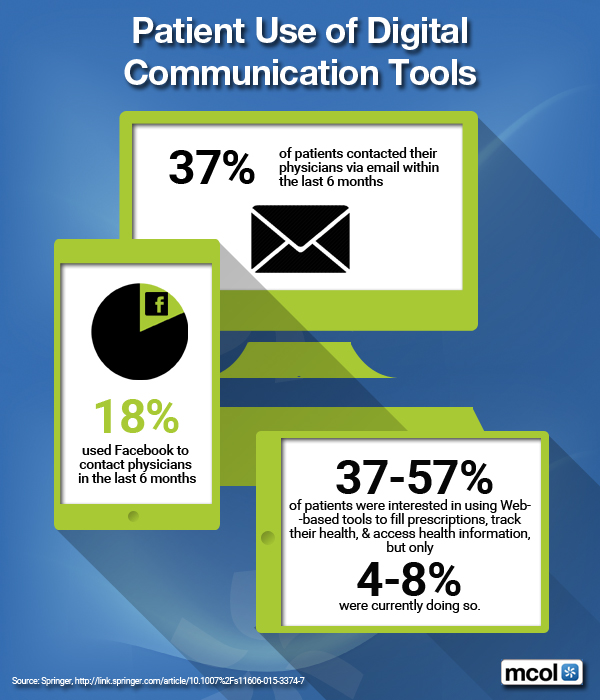
Patient Use of Digital Communication Tools

Join Our Mailing List

An Info-Graphic

http://www.MCOL.com

***

digital tools

***

Conclusion

Your thoughts and comments on this ME-P are appreciated. Feel free to review our top-left column, and top-right sidebar materials, links, URLs and related websites, too. Then, subscribe to the ME-P. It is fast, free and secure.

Speaker: If you need a moderator or speaker for an upcoming event, Dr. David E. Marcinko; MBA – Publisher-in-Chief of the Medical Executive-Post – is available for seminar or speaking engagements. Contact: MarcinkoAdvisors@msn.com

OUR OTHER PRINT BOOKS AND RELATED INFORMATION SOURCES:

Product Details

Product DetailsProduct Details

[Foreword Dr. Phillips MD JD MBA LLM] *** [Foreword Dr. Nash MD MBA FACP]

About the Institute of Medical Business Advisors, Inc

Join Our Mailing List

Who we are – What we do!

[By Ann Miller RN MHA]

www.MedicalBusinessAdvisors.com

The Institute of Medical Business Advisors, Inc provides a team of experienced, senior level consultants led by iMBA Chief Executive Officer Dr. David Edward Marcinko MBA CMPMBBS [Hon] and President Hope Rachel Hetico RN MHA CMP™ to provide going contact with our clients throughout all phases of each project, with most of the communications between iMBA and the key client participants flowing through this Senior Team.

iMBA Inc., and its skilled staff of certified professionals have many years of significant experience, enjoy a national reputation in the healthcare consulting field, and are supported by an unsurpassed research and support staff of CPAs, MBAs, MPHs, PhDs, CMPs™, CFPs® and JDs to maintain a thorough and extensive knowledge of the healthcare environment.

The iMBA team approach emphasizes providing superior service in a timely, cost-effective manner to our clients by working together to focus on identifying and presenting solutions for our clients’ unique, individual needs.

***

Risk Management and Insurance Foreword for Doctors by Lloyd Krieger MD MBA article-2270211-173CD250000005DC-373_634x447

Financial Planning for Physicians Foreword by Jason Dyken MD MBA

***

Our Team 

The iMBA Inc project team’s exclusive focus on the healthcare industry provides a unique advantage for our clients.  Over the years, our industry specialization has allowed iMBA to maintain instantaneous access to a comprehensive collection of healthcare industry-focused data comprised of both historically-significant resources as well as the most recent information available.

iMBA Inc’s specific, in-depth knowledge and understanding of the “value drivers” in various healthcare markets, in addition to the transaction marketplace for healthcare entities, will provide you with a level of confidence unsurpassed in the public health, health economics, management, administration, and financial planning and consulting fields.

iMBA Inc’s information resources and network of healthcare industry textbook resources enhanced by our professional consultants and research staff, ensure that the iMBA project team will maintain the highest level of knowledge regarding the current and future trends of the specific specialty market related to the project, as well as the healthcare industry overall, which serves as the “foundation” for each of our client engagements.

Comprehensive Financial Planning Strategies for Doctors and Advisors: Best Practices from Leading Consultants and Certified Medical Planners(TM) 

Product Details

Product DetailsProduct Details

Product DetailsProduct DetailsProduct Details


Medical Executive-Post

And, through the balanced collaboration of this rich-media sharing and ranking ME-P forum, we have become a leading network at the intersection of health administration, practice management, medical economics, business strategy and financial planning for doctors and their consulting advisors. Even if not seeking our products or services, we hope this knowledge silo is useful to you.

In the Health 2.0 era of political reform, our goal is to: “bridge the gap between practice mission and financial solidarity for all medical professionals.”

Join the ME-P Nation today … and tell us what you think! 

We are at your service.

← Back

Thank you for your response. ✨

Electronic Medical Data Exchange in Denmark

Join Our Mailing List

Used by 91% of doctors according to research2guidance

By Ralf Jahns

ralf

Denmark emerges as the number one country to start an mHealth business according to a survey conducted by research2guidance in partnership with HIMSS Europe. Over 5000 app developers, healthcare professionals and mHealth practitioners took part in the “European mHealth App Market Ranking” survey, where participants were asked to rank the mHealth App market readiness of the 28 EU member states. The results were recently revealed by Ralf Jahns, Managing Director at research2guidance, during the HIMSS Europe event in Riga, the mHealth Summit, on 12th May 2015.

The results, which establish Denmark as having the best market pre-requisites needed for an mHealth business, are based on the average of the scores in five categories: eHealth adoption, level of digitalisation, market potential, ease of starting an mHealth business and mHealth regulatory framework. Hans Erik Henriksen, CEO of Healthcare Denmark commented on the survey findings: “Denmark has a very digitalised society and is familiar with using technology in healthcare, supported by a regulatory framework. The research2gudiance and HIMSS Europe survey confirms the progress we are making. I sincerely hope that this will inspire the European countries and mHealth community in their efforts to progress mobile solutions, which will make a big difference for our citizens”. Denmark ranked top country for eHealth adoption being the only country where exchanging patients’ medical data electronically is used amongst 91% of doctors, whereas the average of other covered countries is only 34%

In terms of market attractiveness and healthcare investments, Denmark is at the top in the mHealth market potential category, together with Austria which also has one of the highest expenditures for health. The ease of starting mHealth business category describes how easy it is to start and maintain a new business based on the number of days needed to start business, the number of necessary start-up procedures to register a business and the level of tax and, in this case, Denmark also ranked extremely high, as the smaller countries – Ireland was also top in this category – tend to support new businesses better compared to larger countries. Rainer Herzog, General Manager at HIMSS Europe, added: “This year’s survey has revealed that the market conditions for mHealth which Denmark offers are truly remarkable. This has been the largest global mHealth research study to date and there are different learnings that could be drawn from the EU countries’ mHealth App Market Ranking. Ultimately though, although mHealth is still it is an emerging market, and a number of countries in Europe are currently in the process of defining their mHealth roadmaps, Denmark leads the way in all aspects”.

eHRs

Download the full mHealth study report here.

Channel Surfing

Have you visited our other topic channels? Established to facilitate idea exchange and link our community together, the value of these topics is dependent upon your input. Please take a minute to visit. And, to prevent that annoying spam, we ask that you register.

Link: http://feeds.feedburner.com/HealthcareFinancialsthePostForcxos

Conclusion

Your thoughts and comments on this ME-P are appreciated. Feel free to review our top-left column, and top-right sidebar materials, links, URLs and related websites, too. Then, subscribe to the ME-P. It is fast, free and secure.

Speaker: If you need a moderator or speaker for an upcoming event, Dr. David E. Marcinko; MBA – Publisher-in-Chief of the Medical Executive-Post – is available for seminar or speaking engagements. Contact: MarcinkoAdvisors@msn.com

OUR OTHER PRINT BOOKS AND RELATED INFORMATION SOURCES:

Product DetailsProduct Details

Product DetailsProduct DetailsProduct Details

The Stock Market Has Been Flat For Six Months

Join Our Mailing List

This is Great News!

By Lon Jefferies MBA CFP® http://www.NetWorthAdvice.com

Lon JefferiesInvestors have experienced a very uneventful 2015.

In fact, for seven months the Dow Jones Industrial Average was at essentially the same value.* This lack of fluctuation has been even more pronounced over the last two months. As of the market close on May 14th, 2015, the S&P 500 has closed between 2,040 and 2,120 for 71 days in a row.

Further, for nearly a full month, the DOW hasn’t experienced a 1-month high OR low and traded within a 2% range the entire time (always between -1% and 1%).** This was the longest streak in over 100 years!

***

one-month-return

***

Believe it or not, this may be the best pattern possible for the U.S. stock market.

***

Trendline Image

***

History tells us that the market is likely to increase in value over time. If we were to plot the market’s value from the time the market first opened to the current day, a chart of those two points would illustrate a return as such:

Trendline Image

However, we all know that the market doesn’t provide a consistent return. On individual trading days, the market can either increase or decrease in value, and the range of potential gains or losses is wide. Over extended periods of time, the market’s actual value may be above or below the expected trend line. In fact, the market’s actual historical return may look more like:

Historical vs Trendline

***

Historical vs Trendline

***

Anyone who is familiar with Net Worth Advisory Group is likely aware that we are not the type to make market predictions. We have no idea whether the market is near a temporary top or is still experiencing the upward trend after hitting the bottom of an S curve in 2008. However, let’s assume the market has reached the top of an S curve and is currently above the trend line that would represent consistent growth (similar to the illustration above).

If that is the case, there are two ways the market could get back in line with the trend line representing consistent long-term growth. The first and most obvious way this could happen is for actual market performance to curve downwards towards the trend line. This would represent a market correction or even crash.

***

crash

***

The second, and perhaps less obvious way that actual returns could become aligned with the long-term trend line is for time to allow the trend line to catch up to the actual returns we have experienced since 2008.

In this scenario, the market doesn’t slump but remains stable while time enables price-to-earnings ratios, valuations, and the economy a chance to catch up.

Time Catch Up

***

Time Catch Up

***

Very few investors enjoy or take advantage of a market correction. In fact, most investors lose control of their emotions when the market experiences a drastic downturn, and do exactly the opposite of what they should do: they sell at market lows – hardly a profitable investment strategy.

Consequently, if we are to avoid an over-heated market, it is likely better for most investors if the market realigns itself with the long-term growth rate by remaining flat for awhile and allowing the trend line time to catch up.

Allow me to reemphasize that I am not predicting that the market is in fact at a temporary high and above where it should be. I have no idea what the market will do tomorrow, over the next month, or over the next year. That is why I’m a believer in having a well diversified portfolio that represents your risk tolerance and you stick to it through thick and thin.

However, let’s look at the other side of the coin and assume the market is still at the bottom of an S curve, below the long-term trend line, and needs to experience further growth in order to catch up. Even in this scenario, an extended period of flat market performance is hardly a bad thing – it would simply make the potential upside needed to get back to market norms all the larger.

Market Under Valued

***

Market Under Valued

***

Assessment

It turns out that an extended period of flat market performance may very well be a positive for investors in any environment, regardless of whether the market is currently over or under-valued.

Channel Surfing

Have you visited our other topic channels? Established to facilitate idea exchange and link our community together, the value of these topics is dependent upon your input. Please take a minute to visit. And, to prevent that annoying spam, we ask that you register.

Link: http://feeds.feedburner.com/HealthcareFinancialsthePostForcxos

Conclusion

Your thoughts and comments on this ME-P are appreciated. Feel free to review our top-left column, and top-right sidebar materials, links, URLs and related websites, too. Then, subscribe to the ME-P. It is fast, free and secure.

Speaker: If you need a moderator or speaker for an upcoming event, Dr. David E. Marcinko; MBA – Publisher-in-Chief of the Medical Executive-Post – is available for seminar or speaking engagements. Contact: MarcinkoAdvisors@msn.com

OUR OTHER PRINT BOOKS AND RELATED INFORMATION SOURCES:

Sponsors Welcomed

And, credible sponsors and like-minded advertisers are always welcomed.

Support Med Executive-Post

Risk Management, Liability Insurance, and Asset Protection Strategies for Doctors and Advisors: Best Practices from Leading Consultants and Certified Medical Planners™8Comprehensive Financial Planning Strategies for Doctors and Advisors: Best Practices from Leading Consultants and Certified Medical Planners™

Inviting Patients to Read Their Doctors’ Notes

Join Our Mailing List 

About OpenNotes

[By Staff Reporters]

In an OpenNotes study, researchers examined the impact on patients and doctors when patients were allowed access to their doctors’ notes via a secure EHR Internet portal. Through the use of surveys, patients’ benefits, concerns, and behaviors, as well as physicians workload, were measured.

***

ME-P electronic typewriter

***

The Players

Beth Israel Deaconess Medical Center (BIDMC) in Boston, Geisinger Health System (GHS) in Pennsylvania, and Harborview Medical Center (HMC) in Seattle were selected for this quasi-experimental year-long study.

The Study

The study included 105 physicians and 13,564 of their patients. Patients were notified when their notes were available, but whether or not to open the note was at their own discretion. The authors analyzed both pre- and post-intervention surveys from the physicians who completed the study; 99 physicians submitted both pre- and post-intervention surveys. Of the patients who viewed at least one note, 41 percent completed post-intervention surveys.

***

eHRs

***

The Results

Almost 99 percent of patients at BIDMC, GHS, and HMC wanted to have continued access to their visit notes at the completion of the study; no physician elected to end this practice. Although a limited geographic area was represented, the positive feedback and clinically relevant benefits demonstrate the potential for a widespread adoption of OpenNotes. Moreover, it may be a powerful tool in helping improve the lives of patients.

Citation: Inviting Patients to Read Their Doctors’ Notes: Author(s): Delbanco, T; Walker, J; Bell, SK and Darrer, JD et; al: American College of Physicians, Annals of Internal Medicine, October 2012.

***

patient

***

Assessment

Open Notes, a grantee of the Robert Wood Johnson Foundation, was developed to demonstrate and evaluate the impact on both patients and clinicians of fully sharing (through an electronic patient portal) all encounter notes between patients and their primary care providers.

More: SOAP[IER] eMRs [Beware the Alphabet Soup Switcher-Roo]

Even More:

Building a Better Electronic Health Record

Free Our Health Records: Get Your Health Records
and Help Save Lives


Conclusion

Your thoughts and comments on this ME-P are appreciated. Feel free to review our top-left column, and top-right sidebar materials, links, URLs and related websites, too. Then, subscribe to the ME-P. It is fast, free and secure.

Speaker: If you need a moderator or speaker for an upcoming event, Dr. David E. Marcinko; MBA – Publisher-in-Chief of the Medical Executive-Post – is available for seminar or speaking engagements. Contact: MarcinkoAdvisors@msn.com

OUR OTHER PRINT BOOKS AND RELATED INFORMATION SOURCES:

Product Details

Automated Medical Office Access Management Systems

Join Our Mailing List 

Patient check-in Kiosks

By Dr. David Edward Marcinko MBA

Dr. MarcinkoAccording to a McLean report published in InfoTech:

“Today’s patients demand the same level of self-service convenience in healthcare that they do in other industries. Medical kiosks save money, reduce wait times, and significantly enhance the patient experience. The payback period for medical kiosks is often as short as 180 days”

 Automated medical office access management [AM] or patient self check-in solutions provide a wide range of functionality including patient registration, insurance verification, and demographic-validation, electronically consent form completion, back-end scheduling, financial systems integration, real-time appointment re-scheduling, direction text mapping and way finding; and more.  Often, solutions can be individualized and integrated with HIT systems using HL7, XML, web and other standard data exchange protocols.

Open Access Patient Scheduling

A sub variant of the above is open-access patient self-scheduling, either in full or part. Benefits include reduced patient appointment wait times, matching and scheduling patients with physician, improved continuity of care, increased productivity per patient visits, higher physician compensation and higher net gains for medical offices and clinics.

Real Time Claim Adjudication

Real Time Claim Adjudication [RTCA] or expecting payment at the time of service is becoming the rule, not the exception, in the modern AM era. RTCA makes a medical practice more like other businesses.

Benefit of Automated Medical Office Access Management

  • Streamlines patient flow with focus on improved patient care
  • Real-time insurance verification
  • Capture credit/debit card information with funds verification
  • Improves office cash flow and collections
  • Provides patient payment receipts
  • Decrease accounts receivable [ARs]
  • Save time and office staff resources
  • Increases office return on investment [ROI]
  • Demographic capture and validation improve marketing
  • Continually improve office operations.

Vendors for the above AM processes include: Phreesia.com, KioHealth.com, MediSolve.Ca; VecnaMedical.com; MeridianKiosks.com; AppointmentDesk.com; and KioskMarketPlace.com; etc.

***

Guy

***

More: Simple Steps to a Patient Registry: Ticket to Care Coordination, Quality Reporting and Pay for Performance

http://store.hin.com/Simple-Steps-to-a-Patient-Registry-Ticket-to-Care-Coordination-Quality-Reporting-and-Pay-for-Performance_p_0-3855.html#

Conclusion

Your thoughts and comments on this ME-P are appreciated. Feel free to review our top-left column, and top-right sidebar materials, links, URLs and related websites, too. Then, subscribe to the ME-P. It is fast, free and secure.

Speaker: If you need a moderator or speaker for an upcoming event, Dr. David E. Marcinko; MBA – Publisher-in-Chief of the Medical Executive-Post – is available for seminar or speaking engagements. Contact: MarcinkoAdvisors@msn.com

OUR OTHER PRINT BOOKS AND RELATED INFORMATION SOURCES:

Product DetailsProduct Details

The 2015 – 18 Physician Pay Check-Up

Join Our Mailing List

Annual Medscape Findings

[By Staff Reporters]

***

Medscape2015Report

***

iMBA Inc., Historical Review

[By Hope R. Hetico RN MHA CMP™]

[By Dr. David Edward Marcinko MBA CMP™]

dave-and-hope9

http://www.CertifiedMedicalPlanner.org

SOAR

***

Other MEDICAL Professional SALARIES 

Dentists are Different

A 2003 Survey of Dental Practices reported net income from dentistry-related sources. Dentists differ from physicians in that 90% are in private practice.

In 2002, the average practitioner’s net income was $174,350. The average dental specialist’s net was $291,250. These figures represent a 0.7% and a 5.8% increase over 2001, respectively. Net income rose steadily since 1986, when general dentists made an average of $69,920 and specialists an average of $97,920.

But, by 2010, according to PayScale.com, the average general dentist earned $98,276 – $157,437; a decreasing trend allocated as follows.

Salary $92,689 – $147,682
Bonus $1,996 – $19,727
Profit Sharing $1,038 – $27,514
Commissions $480.74 – $32,500

Source: http://www.ada.org/prof/resources/pubs/dbguide/newdent/income.asp#private

Source: http://www.payscale.com/research/US/Job=Dentist/Salary

dental

So Are Chiropractors

According to Salary.com, the median salary for strictly office-based chiropractors was $78,994 in 2005; while Collegegrad.com reported the median annual earnings of a salaried chiropractor as $65,330 in 2002; with the middle 50% earning between $44,140 and $102,400.

The U.S. Bureau of Labor Statistics estimated chiropractors earned an average salary of $84,020 in 2004. A Chiropractic Economics survey in 2005 suggested mean salary at $104,363.

Another survey, for 2007, in Chiropractic Economics is available here: http://www.chiroeco.com/article/2007/Issue8/images/CES&ESurvey2007.pdf

And, a range of $44,511 – $82,826 was reported in 2010 by PayScale.com, allocated as follows:

Salary $42,106 – $78,129
Bonus $1,008 – $10,205
Profit Sharing $973 – $8,139
Commission $750 – $10,113
Total PayXTotal Pay combines base annual salary or hourly wage, bonuses, profit sharing, tips, commissions, overtime pay and other forms of cash earnings, as applicable for this job. It does not include equity (stock) compensation, cash value of retirement benefits, or the value of other non-cash benefits (e.g. healthcare). $44,511 – $82,826

Source: http://www.payscale.com/research/US/Job=Chiropractor/Salary

Future Doc!

Podiatrist’s Potential Rising

The salary range for a podiatrist, or Doctor of Podiatric Medicine, in 2006 was reported as $128,000 to $292,000 according to http://www.allied-physicians.com/salary_surveys/physician-salaries.htm.

This robust growth was likely due to expanded education, training, and general allopathic and osteopathic acceptance by the medical community, as well as by insurance companies, employers, patients and various governmental agencies and third party payers.

Increased surgical sub-specialization, in-patient hospital and ambulatory out-patient surgical center activity were also positive compensation factors.

***

Ankle-Leg Trauma

***

Conclusion

Your thoughts and comments on this ME-P are appreciated. Feel free to review our top-left column, and top-right sidebar materials, links, URLs and related websites, too. Then, subscribe to the ME-P. It is fast, free and secure.

Speaker: If you need a moderator or speaker for an upcoming event, Dr. David E. Marcinko; MBA – Publisher-in-Chief of the Medical Executive-Post – is available for seminar or speaking engagements. Contact: MarcinkoAdvisors@msn.com

OUR OTHER PRINT BOOKS AND RELATED INFORMATION SOURCES:

Comprehensive Financial Planning Strategies for Doctors and Advisors: Best Practices from Leading Consultants and Certified Medical Planners(TM)

Product DetailsProduct Details

Product Details

Doctors – Rethink Selling!

Join Our Mailing List

Are You Averting Success?

[By Vicki Rackner MD]

vickiAs a Doctor – Does your aversion to selling get in the way of your success?

It did for me!  Here are some “heal thyself” lessons that might help you get better business outcomes.

My old beliefs about selling

When I entered medical school thirty years ago, I believed, “Doctors shouldn’t sell; it’s unprofessional.”

Further, I believed that I didn’t have to sell.  If I just took good care of patients, my practice would grow.

It was a different story when I traded my scalpel for a pen and a microphone and launched a career writing and speaking and consulting. I had to sell.

And almost every day as an entrepreneur I said to myself, “I hate selling!”

My new beliefs about selling

Here’s how I made peace with selling.

I reframed marketing as the process of engaging a prospect in a conversation; I reframed selling as the process of inspiring someone to take action.

Selling is the process of inspiring someone to take action.

You sell every day.  You sell when you persuade your kids to practice the piano, help a colleague see things your way or get the raise you want and deserve.

To generate revenue, you must persuade your prospects to take a very specific action step: exchange their hard-earned dollars for your value.  You generate more revenue when more prospects make more purchasing choices.

Two ways to inspire prospects to make purchasing choices

Imagine the late Billy Mays doing an infomercial for a surgeon who wanted to remove more gallbladders.

“Are you tired of getting pain every time you eat a French fry? Do you dread another gallbladder attack that’s worse than the pain of childbirth? Leave your gallbladder worries behind you! Come on in and have your gallbladder removed. Take advantage of our special promotional offer. Bring your mother and we’ll remove two gallbladders for the price of one. But, wait; there’s more.  Schedule your procedure this week and we’ll throw in a free appendectomy.”

As silly as this sounds, you may have a picture like this in your head when you think about selling.

That’s not how I helped patients say yes to a surgical procedure.  I created an experience of “facilitated buying.”  

If you’ve ever had an operation, you made a choice at the end of a process called informed consent.   Your doctors with whom you establish a relationship:

  • Gather information
  • Make a diagnosis
  • Make treatment recommendations.

Then your doctors fulfill a duty to help you understand what the treatment involves, the likely benefit you would enjoy and the risks. You were given alternatives, including the option of doing nothing.

Then out of respect for your autonomy, you were asked to make the choice that worked best for you. Many patients chose to delegate the decision to the doctor.

Could you reproduce this informed consent process in your business?  Could you engage a prospect in a conversation, build a relationship, understand where it hurts, render a diagnosis and offer a treatment plan?

My experience with tens of thousands of patients leads me to conclude that most people make good choices once they understand the risks, benefits and alternatives.

My selling lessons

Here are the lessons I learned:

  • Think of your sales funnel as a series of small “yeses” that guide prospects to the facilitated buying conversation.
  • The first yes is the hardest.  Make it easy.  Ask your prospects to accept a free sample of the result you deliver.  Invite them to sign up to get something they want.  Then think about how you can engage more prospects in conversations, and inspire more of them to take that first step.
  • The first sale is the hardest.  Can you go back to your existing clients with a second, third or fourth purchasing option?
  • Respect your buyers’ autonomy.  Don’t push; offer your prospects the opportunity to buy.  If you have correctly identified and clearly explained your value, the right clients will say yes.  If they don’t say yes, consider changing your value proposition to align with something the buyer really wants, or tweaking the way you frame your offer.
  • You can enhance your power to persuade.  This is a skill that can be developed.  You will see a significant ROI whether you want to generate more revenue, inspire more patients to take medication as prescribed or get more of what you want in your relationships.

***

crisis

***

Changing my mindset about selling was transformative. I recognized that the doctor-patient relationship could be a model guiding my interactions with prospects and clients.  All I had to do as an entrepreneur was conduct myself like a doctor.  I was selling all along, even in my surgical practice!

You may not have attended medical school, but you know how you like to be treated by your doctor. What if you treated your prospects and clients the same way you wanted to be treated as a patient?

Prospecting is much easier–and much more fun–when you see yourself like the doctor reaching out to the clients who value the result you help them get. That translates to better business outcomes.

Assessment

Rethinking selling worked for me and for my clients.  It can work for you, too.

What do you think?

About

Vicki Rackner MD is an author, speaker and consultant who offers a bridge between the world of medicine and the world of business. She helps businesses acquire physician clients, and she helps physicians run more successful practices. Contact her at (425) 451-3777.

Conclusion

Your thoughts and comments on this ME-P are appreciated. Feel free to review our top-left column, and top-right sidebar materials, links, URLs and related websites, too. Then, subscribe to the ME-P. It is fast, free and secure.

Speaker: If you need a moderator or speaker for an upcoming event, Dr. David E. Marcinko; MBA – Publisher-in-Chief of the Medical Executive-Post – is available for seminar or speaking engagements. Contact: MarcinkoAdvisors@msn.com

OUR OTHER PRINT BOOKS AND RELATED INFORMATION SOURCES:

Product Details

Product DetailsProduct Details

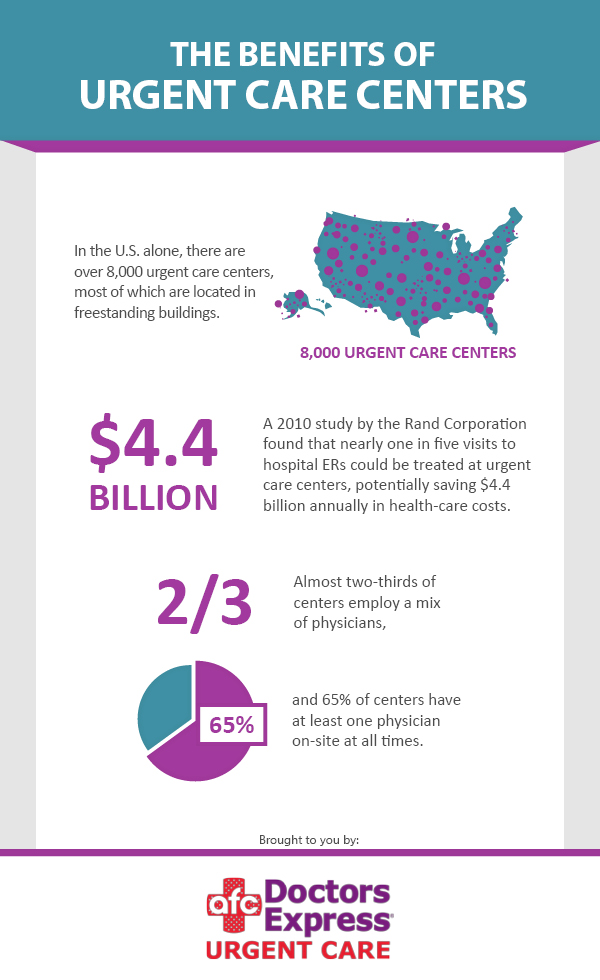
On Urgent Care Centers and Retail Medical Clinics

Join Our Mailing List 

And the Convenient Care Association

[By Dr. David Edward Marcinko MBA]

DEM blueThe Convenient Care Association [CCA] is comprised of companies, medical providers and healthcare systems that provide patients and consumers with accessible, [urgent], affordable and quality healthcare in retail-based locations.

The CCA works primarily to enhance and sustain the growth of the convenient care industry through sharing of best practices and common standards of operation.

urgent urgent

The CCA was founded in October 2006 and the first Convenient Care Clinics [CCCs] opened in 2000. The industry grew quickly since then.

Today there are approximately 1,060 clinics in operation, and CCA member clinics represent more than 95% of the industry.

To date, CCCs have served more than 3.5 million patients with its nurse practitioners [NPs] and physician assistants [PAs]. With this rapid expansion, and projected continued growth, it quickly became clear that the shared concerns and needs of both providers and patients could best be served through an association that allowed for:

  • Sharing best practices, common standards of operation, experiences and ideas.
  • Developing common standards of operation to ensure the highest quality of care.
  • A united voice to advance the needs of CCCs and their customers
  • A unified effort to promote the concept of CCCs, and to respond to questions about this evolving industry.
  • Reaching out to the existing medical community and creating new partnerships.
  • Building synergies with traditional medical service providers.

Assessment

The Public Health Management Corporation [PHMC], a nonprofit public health institute, provides executive management and administrative support for the Convenient Care Association.

urg 2

Conclusion

Your thoughts and comments on this ME-P are appreciated. Feel free to review our top-left column, and top-right sidebar materials, links, URLs and related websites, too. Then, subscribe to the ME-P. It is fast, free and secure.

Speaker: If you need a moderator or speaker for an upcoming event, Dr. David E. Marcinko; MBA – Publisher-in-Chief of the Medical Executive-Post – is available for seminar or speaking engagements. Contact: MarcinkoAdvisors@msn.com

OUR OTHER PRINT BOOKS AND RELATED INFORMATION SOURCES:

Product Details

Product DetailsProduct Details

Fatigue and its Effect on Doctor’s & Prescriptions

Join Our Mailing List

Fatigue Matters 

[By Staff Reporters]

First we had slow medicine, then fast medicine, and now it’s … fatigued medicine.

According to Aaron Carroll MD; fatigue matters even when it comes to doctors … especially when it comes to doctors.

Here is the data link in Healthcare Triage News.

Assessment

For those of you who want to read more, here is the paper we’re discussing!

***

free

***

Conclusion

Your thoughts and comments on this ME-P are appreciated. Feel free to review our top-left column, and top-right sidebar materials, links, URLs and related websites, too. Then, subscribe to the ME-P. It is fast, free and secure.

Speaker: If you need a moderator or speaker for an upcoming event, Dr. David E. Marcinko; MBA – Publisher-in-Chief of the Medical Executive-Post – is available for seminar or speaking engagements. Contact: MarcinkoAdvisors@msn.com

OUR OTHER PRINT BOOKS AND RELATED INFORMATION SOURCES:

Product DetailsProduct Details

Developing New Medical Practice 2.0 “People” Skills

Join Our Mailing List 

The Times are Changing in …. 2015 and Beyond

[By Render S. Davis MHA CHE]

[By Dr. David Edward Marcinko MBA CMP™]

DEM white  shirtMedical practice today is vastly different from a generation ago, and physicians need new skills to be successful, and reduce liability risks while improving care delivery at lower costs.

In order to balance their obligations to both individual patients and to larger groups, physicians now must become more than competent clinicians.

Bedside Manner?

Traditionally, the physician was viewed as the “captain of the ship,” in charge of nearly all the medical decisions, but this changed with the dynamics of managed care and the health reform of the PP-ACA.

Today, the physician’s role may be more akin to the ship’s navigator, utilizing his or her clinical skills and knowledge of the health care environment to chart the patient’s course through a confusing morass of insurance requirements, care choices, and regulations to achieve the best attainable outcome.

Some of these new 2.0 “People” skills include:

  1. Negotiation – working to optimize the patient’s access to appropriate services and facilities;
  2. Being a team player – working in concert with other care givers, from generalist and specialist physicians, to nurses and therapists, to coordinate care delivery within a clinically appropriate and cost-effective framework;
  3. Working within the limits of professional competence – avoiding the pitfalls of payer arrangements that may restrict access to specialty physicians and facilities, by clearly acknowledging when the symptoms or manifestations of a patient’s illness require this higher degree of service; then working on behalf of the patient to seek access to them;
  4. Respecting different cultures and values – inherent in the support of the Principle of Autonomy is acceptance of values that may differ from one’s own. As the United States becomes a more culturally heterogeneous nation, health care providers are called upon to work within and respect the socio-cultural and/or spiritual framework of patients and their families;
  5. Seeking clarity on what constitutes marginal care – within a system of finite resources, physicians will be called upon to carefully and openly communicate with patients regarding access to marginal and/or futile treatments. Addressing the many needs of patients and families at the end of life will be an increasingly important challenge in both communications and delivery of appropriate, yet compassionate care;
  6. Supporting evidence-based practice – physicians should utilize outcomes data to reduce variation in treatments and achieve higher efficiencies and effectiveness of care delivery;
  7. Fostering transparency and openness in communications – physicians should be willing and prepared to discuss all aspects of care and treatment, especially when disclosing problems or issues that may arise;
  8. Exercising decision-making flexibility – treatment algorithms and clinical pathways are extremely useful tools when used within their scope, but physicians must follow the case managed patient closely and have the authority to adjust the plan if clinical circumstances warrant;
  9. Fostering “patient and family centered care – whenever possible, medical treatments should be undertaken in a way that respects the patient’s values and preferences, and recognizes the important role to be played by family in supporting the patient’s care and well-being. For details on engaging families in this process, visit the website for the Institute for Family-Centered Care at www.familycenteredcare.org.;
  10. Becoming skilled in the art of listening and interpreting — In her ground-breaking book, Narrative Ethics: Honoring the Stories of Illness, Rita Charon, MD Ph.D., a professor of Clinical Medicine at Columbia University’s College of Physicians and Surgeons, writes of the extraordinary value of utilizing the patient’s narrative, or personal story, in the care and treatment process. She notes that, “medicine practiced with narrative competence will more ably recognize patients and diseases, convey knowledge and regard, join humbly with colleagues, and accompany patients and their families through ordeals of illness.” In many ways, attention to narrative returns medicine full circle to the compassionate and caring foundations of the patient-physician relationship.

***

Masks

[The Masks of Change]

Courtesy SplitShire

*** 

Assessment

These represent only a handful of examples to illustrate the myriad of new skills that today’s savvy physicians must master in order to meet their timeless professional obligation of compassionate patient care; coupled with risk avoidance, assumption, transference and reduction mechanisms.

*NOTE: Health 2.0 is information exchange plus technology. It employs user-generated content, social networks and decision support tools to address the problems of inaccessible, fragmentary or unusable health care information. Healthcare 2.0 connects users to new kinds of information, fundamentally changing the consumer experience (e.g., buying insurance or deciding on/managing treatment), clinical decision-making (e.g., risk identification or use of best practices) and business processes (e.g., supply-chain management or business analytics.

About the Author

Render Davis was a Certified Healthcare Executive, now retired from Crawford Long Hospital at Emory University, in Atlanta, GA He served as Assistant Administrator for General Services, Policy Development, and Regulatory Affairs from 1977-95.  He is a founding board member of the Health Care Ethics Consortium of Georgia and served on the consortium’s Executive Committee, Advisory Board, Futility Task Force, Strategic Planning Committee, and chaired the Annual Conference Planning Committee, for many years.

MORE:

Channel Surfing the ME-P

Have you visited our other topic channels? Established to facilitate idea exchange and link our community together, the value of these topics is dependent upon your input. Please take a minute to visit. And, to prevent that annoying spam, we ask that you register. It is fast, free and secure.

Conclusion

Your thoughts and comments on this ME-P are appreciated. Feel free to review our top-left column, and top-right sidebar materials, links, URLs and related websites, too. Then, subscribe to the ME-P. It is fast, free and secure.

Speaker: If you need a moderator or speaker for an upcoming event, Dr. David E. Marcinko; MBA – Publisher-in-Chief of the Medical Executive-Post – is available for seminar or speaking engagements. Contact: MarcinkoAdvisors@msn.com

OUR OTHER PRINT BOOKS AND RELATED INFORMATION SOURCES:

Comprehensive Financial Planning Strategies for Doctors and Advisors: Best Practices from Leading Consultants and Certified Medical Planners(TM)* 8

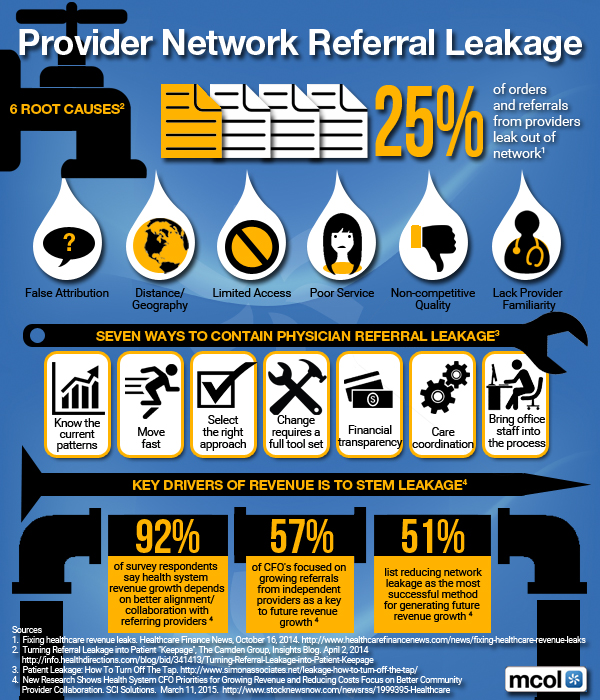
On Medical Provider Network Referral Leakage

Join Our Mailing List

Understanding the Referral Relationship

[By Dr. David Edward Marcinko MBA]

[By http://www.MCOL.com]

DEM blueDeveloping and cultivating a steady stream of referrals involves good planning, an investment of time and energy in the referral relationship, and a keen understanding of referring physicians’ needs and priorities.

Enhancing the referral relationship is a step-by-step process, not unlike the clinical process, that begins by identifying target physicians and their needs, prioritizing the list of referral contacts and then determining the best way to reach them.

A physician may routinely refer patients to a particular specialist because he or she has an out­standing reputation for medical expertise and competence, is more accessible than comparable practitioners or has a convenient location for the referring physician’s patients. The physician may have a relationship with the specialist because of marketing by a local hospital or the specialist’s own practice. And, in some cases the two physicians have a social relationship. Once again, there are many ways to create and maintain the relationship. Physicians should choose the approach that works best for them, put together a plan and stay consistent. Look for ways to make the relationship a win-win for both practices or for the referring hospital or outpatient facility.

If you are not comfortable with developing referral relationships for your practice, seek out partners, office staff or hospital partners who can appropriately assist, train or support you in this effort. Many hospitals have staff focused on physician sales and service.

The Society for Healthcare Strategy and Market Development (SHSMD) recently reported that 41% of hospitals had dedicated sales staff support, with more than half of those using their sales staff to support cardiology and radiology.[i] Often, hospitals are seeking physician speakers for community seminars, wellness programs and other outreach efforts. Ask about participating in these venues. Offer to write articles for newsletters, the Web site or local media outlets. All of these expose the physician and the practice to referral sources as well as the public.

Six Root Causes of Leakage

***

ImageProxy

***

Communication is Key

It really comes down to the age-old golden rule of doing unto others as you would want them to do unto you. Not surprisingly, referral relationships are built on mutual respect, trust and courtesy. Focusing on the needs of the referring physician is the best way for both relationships to thrive.

Communication is especially important in not only nurturing the referral relationship, but also improving the quality of care.

A recent study that examines the attitudes primary care physicians have regarding communication with hospitalists found that 3% of primary care physicians reported being involved in discussions about discharge and 17% to 20% reported always being notified about discharges.[ii]

The study suggests that delayed or inaccurate communication at discharge may negatively effect continuity of care and contribute to adverse events. Communication tools such as computer-generated summaries and standardized formats may result in a more timely transfer of information, making discharge summaries more consistently available during follow-up care.

Many physicians indicate a preference for quick voice mail updates on patients they’ve referred supported by the electronic or faxed record. This type of proactive communication is the basis of a strong and lasting referral relationship. In fact, the relationship can be further strengthened by tailoring communication to individual primary care doctors, according to their preferences.

Indeed, the most responsive specialists ask the referring physician how best to stay in touch because one size does not fit all. Some physicians prefer face-to-face contact, others phone or facsimile and still others e-mail.  The use of electronic medical records and other electronic communication devices can help the physician enhance the consistency, speed and real time level of their physician-to-physician communication.

Primary care doctors want to work with specialists who recognize their role in treating the patient on an ongoing basis. Many want frequent communication about the plan of care and status. At the very least, tertiary specialists should always pay the courtesy of discharge communication—a phone call, e-mail, timely letter or fax when they return the patient to the community physician. The specialist should include the diagnosis, any issues that he or she may have identified; any changes in treatment and medication, follow-up recommendations and a phone or pager number if the referring physician has questions or concerns.

Both sides should keep each other informed of changes within their respective practice including new partnerships, expanded services, staff changes and insurance plan participation. Paying close attention to these relationship and communication basics builds trust and respect among colleagues and improves care to patients.

***

Healthcare Center

***

Systems Can Help With Communication

A cardiac surgeon in the Northeast with a very busy practice dictates immediately following each case, and then at the end of the day calls to update the referring physician even if he just leaves a voice mail with his pager number. The referring physician has 24/7 access to the cardiac surgeon, who, two weeks later, has his practice administrator send a thank-you note for the referral. At a conference of specialists who were questioning their own ability to commit to this level of time, he simply stated “how can you not afford to pay attention to this part of your practice?”

Another example involves a large specialty practice that was challenged with communication back to the referring physician. They hired a clinician to support them as patient/practice case manager, with a primary job focus on communicating about the patient, ensuring discharge information was forwarded and conducting a personal office call with the referring physician. This ensured it was received, understood and if not, helping the referring physician to gain quick access to the specialist.

Citations:

[i] “By the Numbers, 2008.”  Society for Healthcare Strategy and Market Development of the American Hospital Association.

[ii] Sunil Kripalani, M.D., et al., “Deficits in Communication and Information Transfer Between Hospital-Based and Primary Care Physicians,” The Journal of the American Medical Association, Feb. 28 2007, 297; 831-841.

More:

Conclusion

Your thoughts and comments on this ME-P are appreciated. Feel free to review our top-left column, and top-right sidebar materials, links, URLs and related websites, too. Then, subscribe to the ME-P. It is fast, free and secure.

Speaker: If you need a moderator or speaker for an upcoming event, Dr. David E. Marcinko; MBA – Publisher-in-Chief of the Medical Executive-Post – is available for seminar or speaking engagements. Contact: MarcinkoAdvisors@msn.com

OUR OTHER PRINT BOOKS AND RELATED INFORMATION SOURCES:

Product Details

Product DetailsProduct Details

Product DetailsProduct DetailsProduct Details

Are You A Top Performing Financial Advisor?

Join Our Mailing List

An Infographic

[By Gabriel Lalonde]

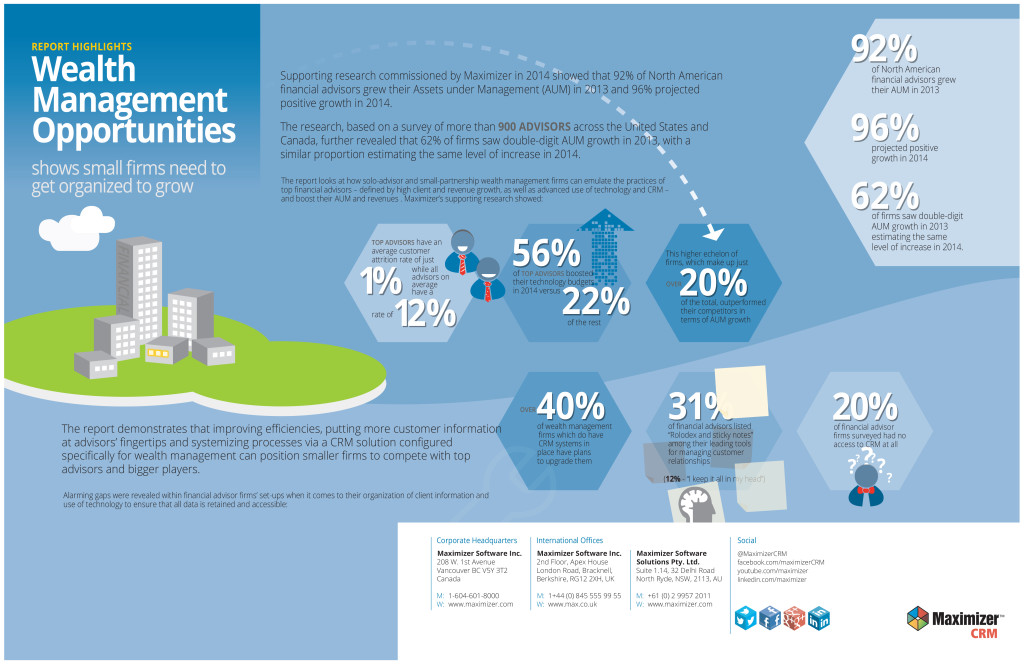
To gain a better understanding of how today’s investment advisor’s are running their practices, Maximizer Software commissioned an original study based on surveys with 903 financial advisers from Canada and the United States.

The goal of the survey was to identify specific issues and trends that make investment advisers more successful.

***

WME-Infographic_highres-1024x664

[Click to Enlarge]

***

Unique

The infographic above illustrates what sets top investment advisers apart from the rest of their peers.

Assessment

To find out how your practice can become a top performer take a look at our report! 

More:

Conclusion

Your thoughts and comments on this ME-P are appreciated. Feel free to review our top-left column, and top-right sidebar materials, links, URLs and related websites, too. Then, subscribe to the ME-P. It is fast, free and secure.

Speaker: If you need a moderator or speaker for an upcoming event, Dr. David E. Marcinko; MBA – Publisher-in-Chief of the Medical Executive-Post – is available for seminar or speaking engagements. Contact: MarcinkoAdvisors@msn.com

OUR OTHER PRINT BOOKS AND RELATED INFORMATION SOURCES:

Comprehensive Financial Planning Strategies for Doctors and Advisors: Best Practices from Leading Consultants and Certified Medical Planners(TM)

Seeking Authors by “Crowd-Sourcing” our Proposed Medical Marketing TextBook

Join Our Mailing List

Seeking Authors by “Crowd-Sourcing” our Proposed Medical Marketing TextBook

SOAR

MEDICAL PRACTICE MARKETING MANAGEMENT, ADVERTISING, SALES, COMMUNICATION AND SOCIAL MEDIA SKILLS

[New-Wave Success Strategies for Savvy Doctors]

Comprehensive Financial Planning Strategies for Doctors and Advisors: Best Practices from Leading Consultants and Certified Medical Planners(TM)

Product Details

← Back

Thank you for your response. ✨

18 Financial Planning Tips For Physicians from a DR-CPA

Join Our Mailing List

For Personal and Medical Practice Management Modernity

Dr. Gary Bode; CPA, MSA, CMP

By Dr. Gary L. Bode CPA MSA CMP [Hon] PA

http://garybodecpa.com/

http://www.CertifiedMedicalPlanner.org

1. Consider establishing an employee stock ownership plan (ESOP).

If you own a clinic or medical practice or business and need to diversify your investment portfolio, consider establishing an ESOP. ESOP’s are the most common form of employee ownership in the U.S. and are used by companies for several purposes, among them motivating and rewarding employees and being able to borrow money to acquire new assets in pretax dollars. In addition, a properly funded ESOP provides you with a mechanism for selling your shares with no current tax liability. Consult a specialist in this area to learn about additional benefits.

2. Make sure there is a succession plan in place.

Have you provided for a succession plan for both management and ownership of your medical practice, clinic or business in the event of your death or incapacity? Many business owners or physician-executives wait too long to recognize the benefits of making a succession plan. These benefits include ensuring an orderly transition at the lowest possible tax cost. Waiting too long can be expensive from a financial perspective (covering gift and income taxes, life insurance premiums, appraiser fees, and legal and accounting fees) and a non-financial perspective (intra-family and intra-company squabbles).

3. Consider the limited liability company (LLC) and limited liability partnership (LLP) forms of ownership.

These entity forms should be considered for both tax and non-tax reasons.

4. Avoid nondeductible compensation.

Compensation can only be deducted if it is reasonable. Recent court-decisions have allowed physician executives or business owners to deduct compensation when (1) the corporation’s success was due to the shareholder-employee, (2) the bonus policy was consistent, and (3) the corporation did not provide unusual corporate prerequisites and fringe benefits.

5. Purchase corporate owned life insurance (COLI).

COLI can be a tax-effective tool for funding deferred executive compensation, funding clinic or company redemption of stock as part of a succession plan, and providing many employees with life insurance in a highly leveraged program. Consult your insurance and tax advisers when considering this technique.

6. Consider establishing a SIMPLE retirement plan.

If you have no more than 100 employees and no other qualified plan, you may set up a Savings Incentive Match Plan for Employees (SIMPLE) into which an employee may contribute up to $12,500 per year if you’re under 50 years old and $15,500 a year if you’re over 50 in 2015. As an employer, you are required to make matching contributions. Talk with a benefits specialist to fully understand the rules and advantages and disadvantages of these accounts.

 ***free_54915

***

7. Establish a Keogh retirement plan before December 31st.

If you are self-employed and want to deduct contributions to a new Keogh retirement plan for this tax year, you must establish the plan by December 31st. You don’t actually have to put the money into your Keogh(s) until the due date of your tax return. Consult with a specialist in this area to ensure that you establish the Keogh or Keoghs that maximize your flexibility and your annual contributions.

8. Section 179 expensing.

Businesses and medical practices may be able to expense up to $25,000 in 2015 for equipment purchases of qualifying property placed in service during the filing year, instead of depreciating the expenditures over a longer time period. The limit is reduced by the amount by which the cost of Section 179 property placed in service during the tax year 2015 exceeds $200,000.

9. Don’t forget deductions for health insurance premiums.

If you are self-employed (or are a partner or a 2-percent S corporation shareholder-employee) you may deduct 100 percent of your medical insurance premiums for yourself and your family as an adjustment to gross income. The adjustment does not reduce net earnings subject to self-employment taxes, and it cannot exceed the earned income from the business under which the plan was established. You may not deduct premiums paid during a calendar month in which you or your spouse is eligible for employer-paid health benefits.

10. Review whether compensation may be subject to self-employment taxes.

If you are a sole proprietor, an active partner in a partnership, or a manager in a limited liability company, the net earned income you receive from the entity may be subject to self-employment taxes.

11. Don’t overlook minimum distributions at age 70½ and rack up a 50 percent penalty.

Minimum distributions from qualified retirement plans and IRAs must begin by April 1 of the year after the year in which you reach age 70½. The amount of the minimum distribution is calculated based on your life expectancy or the joint and last survivor life expectancy of you and your designated beneficiary. If the amount distributed is less than the minimum required amount, an excise tax equal to 50 percent of the amount of the shortfall is imposed.

12. Don’t double up your first minimum distributions and pay unnecessary income and excise taxes.

Minimum distributions are generally required at age seventy and one-half, but you are allowed to delay the first distribution until April 1 of the year following the year you reach age seventy and one-half. In subsequent years, the required distribution must be made by the end of the calendar year. This creates the potential to double up in distributions in the year after you reach age 70½. This double-up may push you into higher tax rates than normal. In many cases, this pitfall can be avoided by simply taking the first distribution in the year in which you reach age 70½.

***

buckets cash

***

13. Don’t forget filing requirements for household employees.

Employers of household employees must withhold and pay social security taxes annually if they paid a domestic employee more than $1,900 a year in 2015 (same as 2014). Federal employment taxes for household employees are reported on your individual income tax return (Form 1040, Schedule H). To avoid underpayment of estimated tax penalties, employers will be required to pay these taxes for domestic employees by increasing their own wage withholding or quarterly estimated tax payments. Although the federal filing is now required annually, many states still have quarterly filing requirements.

14. Consider funding a nondeductible regular or Roth IRA.

Although nondeductible IRAs are not as advantageous as deductible IRAs, you still receive the benefits of tax-deferred income. Note, the income thresholds to qualify for making deductible IRA contributions, even if you or your spouse is an active participant in a employer plan, are increasing.

The $100,000 income test for converting a traditional IRA to a ROTH IRA was permanently eliminated in 2010, allowing anyone to complete the conversion.

You can withdraw all or part of the assets from a traditional IRA and reinvest them (within 60 days) in a Roth IRA. The amount that you withdraw and timely contribute (convert) to the Roth IRA is called a conversion contribution. If properly (and timely) rolled over, the 10 percent additional tax on early distributions will not apply. However, a part or all of the distribution from your traditional IRA may be included in gross income and subjected to ordinary income tax.

Caution: You must roll over into the Roth IRA the same property you received from the traditional IRA. You can roll over part of the withdrawal into a Roth IRA and keep the rest of it. However, the amount you keep will generally be taxable (except for the part that is a return of nondeductible contributions) and may be subject to the 10 percent additional tax on early distributions.

15. Calculate your tax liability as if filing jointly and separately.

In certain situations, filing separately may save money for a married couple. If you or your spouse is in a lower tax bracket or if one of you has large itemized deductions, filing separately may lower your total taxes. Filing separately may also lower the phase out of itemized deductions and personal exemptions, which are based on adjusted gross income. When choosing your filing status, you should also factor in the state tax implications.

16. Avoid the hobby loss rules.

If you choose self-employment over a second job to earn additional income, avoid the hobby loss rules if you incur a loss. The IRS looks at a number of tests, not just the elements of personal pleasure or recreation involved in the activity.

17. Review your will and plan ahead for post-mortem tax strategies.

A number of tax planning strategies can be implemented soon after death. Some of these, such as disclaimers, must be implemented within a certain period of time after death. A number of special elections are also available on a decedent’s final individual income tax return. Also, review your will as the estate tax laws are influx and your will may have been written with differing limits in effect. In 2015, estates of $5,430,000 (up from $5,340,000 in 2014) are exempt from the estate tax with a 40 percent maximum tax rate (made permanent starting in tax year 2013).

18. Check to see if you qualify for the Child Tax Credit.

A $1,000 tax credit is available for each dependent child (including stepchildren and eligible foster children) under the age of 17 at the end of the taxable year. The child credit generally is available only to the extent of a taxpayer’s regular income tax liability. However, for a taxpayer with three or more children, this limitation is increased by the excess of Social Security taxes paid over the sum of other nonrefundable credits and any earned income tax credit allowed to the taxpayer. For 2015 (as in previous years), the income threshold is $3,000.

For more information concerning these financial planning ideas, please call or email us.

More: Enter the CMPs

ABOUT  DR. GARY L. BODE MSA CPA CMP [Hon]

Dr. Gary L. Bode was Chief Executive Officer of Comprehensive Practice Accounting, Inc., a firm specializing in providing tax solutions to medical professionals. Originally, he was a board certified podiatrist and managing partner of a multi-office medical practice for a decade before earning his Master of Science degree in Accounting from the University of North Carolina. He then served as Chief Financial Officer [CFO] for a private mental healthcare facility. Today, Dr. Bode is a nationally known Certified Public Accountant, financial author, educator, and speaker. Areas of expertise include producing customized managerial accounting reports, practice appraisals and valuations, restructurings, and innovative financial accounting as well as proactive tax positioning and tax return preparation for healthcare facilities. He has been quoted in Newsweek.

Channel Surfing the ME-P

Have you visited our other topic channels? Established to facilitate idea exchange and link our community together, the value of these topics is dependent upon your input. Please take a minute to visit. And, to prevent that annoying spam, we ask that you register. It is fast, free and secure.

Conclusion

Your thoughts and comments on this ME-P are appreciated. Feel free to review our top-left column, and top-right sidebar materials, links, URLs and related websites, too. Then, subscribe to the ME-P. It is fast, free and secure.

Speaker: If you need a moderator or speaker for an upcoming event, Dr. David E. Marcinko; MBA – Publisher-in-Chief of the Medical Executive-Post – is available for seminar or speaking engagements. Contact: MarcinkoAdvisors@msn.com

OUR OTHER PRINT BOOKS AND RELATED INFORMATION SOURCES:

Comprehensive Financial Planning Strategies for Doctors and Advisors: Best Practices from Leading Consultants and Certified Medical Planners(TM)* 8

Product DetailsProduct DetailsProduct Details

Is there a Migration of Patients to Paper-Based Dentists?

Join Our Mailing List 

Paper Medical Records Become Popular Again?

[By Kellus Pruitt DDS]

1-darrellpruitt

Starting long ago, I warned that as more dental patients are notified of data breaches – some more than once – we are likely to witness an event mandate stakeholders said would never happen: A migration of patients to paper-based dentists.

Now, because of the rapidly escalating costs and liabilities, defiant, slow adopters of electronic dental records [EDRs] can not only expect to provide dental care at a lower cost than “paperless practices,” but patients are on course to learn that some dentists do not put their patients at risk of medical identity theft by putting identities on computers.

Just sit back and watch!

The Ponemon Institute

In February, the Ponemon Institute published  their “Fifth Annual Study on Medical Identity Theft.”

 “Consumers expect healthcare providers to be proactive in preventing and detecting medical identity theft. Although many respondents are not confident in the security practices of their healthcare provider, 79 percent of respondents say it is important for healthcare providers to ensure the privacy of their health records. Forty-eight percent say they would consider changing healthcare providers if their medical records were lost or stolen. If such a breach occurred, 40 percent say prompt notification by the organization responsible for safeguarding this information is important.”

The Paper-Gold Standard? 

So if your patients start asking you not to put their identities – including medical records – on your computers, what will you do, Doc?

Since encryption is a non-starter in dentistry for solid, business reasons, and will make paperless practices even less competitive with paper-based, would you consider employing staff which knows how to use pegboard, ledger cards and lots of carbon paper (The gold standard of security)?

Or, would you prefer not to give up computerization, yet keep your patients safe?

*** paper

***

More:

Assessment

De-identification of primary electronic dental records is sounding better all the time. Am I right? If patients’ identities are not available, they cannot be hacked.

Channel Surfing the ME-P

Have you visited our other topic channels? Established to facilitate idea exchange and link our community together, the value of these topics is dependent upon your input. Please take a minute to visit. And, to prevent that annoying spam, we ask that you register. It is fast, free and secure.

Conclusion

How does this relate to emails? Your thoughts and comments on this ME-P are appreciated. Feel free to review our top-left column, and top-right sidebar materials, links, URLs and related websites, too. Then, subscribe to the ME-P. It is fast, free and secure.

Speaker: If you need a moderator or speaker for an upcoming event, Dr. David E. Marcinko; MBA – Publisher-in-Chief of the Medical Executive-Post – is available for seminar or speaking engagements. Contact: MarcinkoAdvisors@msn.com

OUR OTHER PRINT BOOKS AND RELATED INFORMATION SOURCES:

Socio Economic Status, Payment Reform and Medical Records

Join Our Mailing List 

Yet Another Component of the Medical Record?

[Dr. David Edward Marcinko MBA CMP™]

http://www.CertifiedMedicalPlanner.org

Dr David E Marcinko MBAHistorically, medical records [paper or electronic] were previously used to aid in the quality of medical care.

Now they are also the basis for payment for services, not as a record or reflection of the care that was actually provided, but as a separate justification for billing. The lack of appropriate documentation now no longer threatens just non-payment for services but risks civil money penalties and criminal charges.

Enter S.E.S.

Today, the idea known as Socio Economic Status [SES] is conceptualized as the social standing, or class of an individual or group. It is often measured as a combination of education, income and occupation. Examinations of socioeconomic status often reveal inequities in access to medical resources, plus issues related to privilege, power and control.

Assessment

SES is increasingly being considered as another payment component [CPT® codes] to medical providers, as reflected in the paper medical record, EMR and elsewhere.

***

eMRs

[Electronic Medical Records]

***

Channel Surfing the ME-P

Have you visited our other topic channels? Established to facilitate idea exchange and link our community together, the value of these topics is dependent upon your input. Please take a minute to visit. And, to prevent that annoying spam, we ask that you register. It is fast, free and secure.

More:

Conclusion

Your thoughts and comments on this ME-P are appreciated. Feel free to review our top-left column, and top-right sidebar materials, links, URLs and related websites, too. Then, subscribe to the ME-P. It is fast, free and secure.

Speaker: If you need a moderator or speaker for an upcoming event, Dr. David E. Marcinko; MBA – Publisher-in-Chief of the Medical Executive-Post – is available for seminar or speaking engagements. Contact: MarcinkoAdvisors@msn.com

OUR OTHER PRINT BOOKS AND RELATED INFORMATION SOURCES:

Comprehensive Financial Planning Strategies for Doctors and Advisors: Best Practices from Leading Consultants and Certified Medical Planners(TM)* 8

Why Healthcare is F@#Ked !

Join Our Mailing List

And … What I Learned at The Wharton School of Business

Edward Bukstel

By Edward Bukstel

ME-P SPECIAL REPORT

***

What I Learned at The Wharton School of Business and Why Healthcare is F@#Ked !

***

Business%20Optimization

***

Channel Surfing the ME-P

Have you visited our other topic channels? Established to facilitate idea exchange and link our community together, the value of these topics is dependent upon your input. Please take a minute to visit. And, to prevent that annoying spam, we ask that you register. It is fast, free and secure.

More:

Conclusion

Your thoughts and comments on this ME-P are appreciated. Feel free to review our top-left column, and top-right sidebar materials, links, URLs and related websites, too. Then, subscribe to the ME-P. It is fast, free and secure.

Speaker: If you need a moderator or speaker for an upcoming event, Dr. David E. Marcinko; MBA – Publisher-in-Chief of the Medical Executive-Post – is available for seminar or speaking engagements. Contact: MarcinkoAdvisors@msn.com

OUR OTHER PRINT BOOKS AND RELATED INFORMATION SOURCES:

Product DetailsProduct Details

No More 10 and 90 Day Global Periods

Join Our Mailing List

New Changes on the [CMS Payment Reform] Horizon
[By Dreama Sloan-Kelly MD CCS]

thDid you hear about the changes that are coming down the pike in regards to global services when billing for surgical procedures — be they in the office, in an ambulatory surgical center, or in the hospital?

CMS released their final 2015 Medicare Physician Fee Schedule (MPFS) ruling late last year. Embedded in this document was a proposal by CMS to get rid of both the 10 day and 90 day global periods! In fact, they want to do away with global period billing all together and have all procedures paid based on the work required to do the procedure itself — thereby billing for all post-surgical visits separately using E/M codes.

According to the final ruling, CMS proposes to transform all 10 day global services to ZERO global days starting in 2017. They will do the same in regards to 90 day global services starting in 2018. And, according to the U.S. Department of Health and Human Services (HHS) and the Office of Inspector General (OIG) they have “identified a number of surgical procedures that include more visits in the global period than are being furnished”. They go on to say that they are “also concerned that post-surgical visits are valued higher than visits that were furnished and billed separately by other physicians such as general internists or family physicians”. Based on the final ruling, they plan to begin the transition as previously stated in 2017 after they have considered all comments.

The ruling goes on to state, “as the agency begins revaluation of services as 0-day global periods, we will actively assess whether there is a better construction of a bundled payment for surgical services that incentivizes care coordination and care redesign across an episode of care”. So let’s talk reality and my take on this change.

Over the past few weeks I have read a lot of articles on this subject from various pundits in the industry — they are actually arguing that this change will mean increased reimbursement when you combine the separate payment for the procedure itself along with the visit by visit billing for the post-surgical follow up care when compared to the current reimbursement rate.

***

glasses

***

Personally, I think they are all wrong for the following reasons:

Procedure Reimbursement Amount: This is the wild card. They are going to use the same RVU system that has always been used to calculate payment — but I guarantee you the payment for the procedure will not be anywhere near the reimbursement for the global package. I think the closest we could get to estimating the reimbursement rate of the procedure is to figure out what the current surgical care only rate would be (ie. as if you appended Modifier 54 to the procedure code). Beware that this rate would still encompass the pre-surgical evaluation — which I am assuming would be carved out since that is a part of the current global package they are trying to phase out.

Post Op Visits: Getting a patient to comply with medical visits is hard enough — now adding in the fact they would have to pay a copay each time — most often a specialty co-pay is going to make it even harder. Patient’s understand their follow up visits are currently covered in the cost for the surgery, and hence they tend to show up to these visits knowing they do not have any out of pocket expenses. If the proposed change comes to fruition many of the post-surgical visits may become cost prohibitive for a lot of patients and actually lead to a decrease in the number of follow up visits the patient actually schedules. Once the patient starts to feel better their motivation to return dwindles.

Lower Reimbursement Rate for Post-Surgical Visits: It is clearly stated in the CMS ruling that it is felt the post-surgical follow up care visits are paid at a higher rate than what a regular E/M visit would be paid for had the patient been seen by a primary care provider or an internist. That simple statement confirms to me that when the new procedure rate is combined with the individual visit payment rate, the overall reimbursement rate will be less than what is currently being paid.

So, how do you prepare?

First, stay on top of all bulletins coming from CMS in regards to this issue. Most of your medical societies and/or specialty societies have taken clear positions in regards to this matter — so be sure to stay in the loop and become a part of the process.

Run a report that allows you to pinpoint the average number of post-surgical follow up visits for your most billed procedures. This will give you an idea of the average number of follow up visits for particular procedures you know you will bill for if this transition does occur. Does this mean this number will be exact — NO — I would factor in a decrease of 15-20% for visits across the board based on the dynamics I previously described.

Lastly, begin creating a policy in regards to post-surgical follow up care that can act as an education tool for the patient, teaching them the important benefits of being compliant with their post-surgical care schedule and also warning them about the possible increase in out of pocket cost. Being transparent can go a long way into easing patient’s fear and encouraging their follow through.

As always I have included documentation for your library of information — you can find the CMS 2015 MPFS final ruling fact sheet HERE! I also created a brief video presentation on this hot topic HERE

 ***laptop

***

Channel Surfing the ME-P

Have you visited our other topic channels? Established to facilitate idea exchange and link our community together, the value of these topics is dependent upon your input. Please take a minute to visit. And, to prevent that annoying spam, we ask that you register. It is fast, free and secure.

Conclusion

Your thoughts and comments on this ME-P are appreciated. Feel free to review our top-left column, and top-right sidebar materials, links, URLs and related websites, too. Then, subscribe to the ME-P. It is fast, free and secure.

Speaker: If you need a moderator or speaker for an upcoming event, Dr. David E. Marcinko; MBA – Publisher-in-Chief of the Medical Executive-Post – is available for seminar or speaking engagements. Contact: MarcinkoAdvisors@msn.com

OUR OTHER PRINT BOOKS AND RELATED INFORMATION SOURCES:

Product Details

Dentists for De-Identification

Join Our Mailing List 

A Start-Up Idea

[By Darrell K. Pruitt DDS]

1-darrellpruittAn early, shoestring proposal for a non-profit dedicated to common sense security solutions.

Why? if patients’ identities are unavailable, they cannot be hacked.

Recently, I’ve considered starting a non-profit dedicated to keeping patients’ identities off of dentists’ computers where they are far too easily fumbled thousands at a time. I think I might call it “Dentists for De-identification.” What do you think?

My son Ryan and I have discussed putting together an educational YouTube cartoon – comparing the cost, convenience and security of encrypted Protected Health Information (PHI), to storing PHI, including medical information, only on paper in bulky metal filing cabinets – leaving only nameless, unencrypted dental records on the computer. De-identification is the “other” HIPAA Safe Harbor, meaning if patients’ de-identified dental information is stolen or hacked, nobody has to be notified. And, since the patients’ nameless dental records remain unencrypted, de-ID should not slow down work flow like encryption does.

***

eHRs

***

One could call employing in-house reference numbers to re-connect patients’ digital dental information to paper-based PHI a hybrid solution to an otherwise intractable security problem. The solution is nothing new, and has a long history of success. For decades, police departments have been substituting in-house reference numbers for citizens’ names to protect the owners. I see no reason it cannot work for dental radiographs as well.

Depending on staff’s familiarity with the alphabet, pulling a patient’s thin paper record from a loud filing cabinet might even take less time than correctly typing in an encryption key (on the first try). What’s more, since there is a limit to the number of patients even the fastest dentists can treat in one day, 4000 or so active patients per dentist is a reasonable estimate of the number of records in a  busy dental practice – which is probably one third of the records in the average physician’s practice. Since the dental information remains digital and only a couple of sheets of paper are needed to reveal the patients’ reference number along with a brief medical history, very little filing space should be needed.

The problems with encryption don’t end with correctly entering the key. Once permitted access to encrypted ePHI, it will take much more time to de-crypt one radiograph than it takes to open a manila folder. Depending on the number of radiographs and other digital images – including complex cone-beam radiographs – a patients’ encrypted diagnostic history could require several minutes to view.

I would want to witness the De-ID non-profit professionally investigate whether de-identification indeed offers a cheaper and more secure solution to data breaches from dental offices. I think we all know by now that full disk encryption will never be the answer.

***

Medical Charts

***

Assessment 

Still too soon? Give it time. The FBI assures us that more massive data breaches are just around the corner.

Channel Surfing the ME-P

Have you visited our other topic channels? Established to facilitate idea exchange and link our community together, the value of these topics is dependent upon your input. Please take a minute to visit. And, to prevent that annoying spam, we ask that you register. It is fast, free and secure.


More:

Conclusion

Your thoughts and comments on this ME-P are appreciated. Feel free to review our top-left column, and top-right sidebar materials, links, URLs and related websites, too. Then, subscribe to the ME-P. It is fast, free and secure.

Speaker: If you need a moderator or speaker for an upcoming event, Dr. David E. Marcinko; MBA – Publisher-in-Chief of the Medical Executive-Post – is available for seminar or speaking engagements. Contact: MarcinkoAdvisors@msn.com
OUR OTHER PRINT BOOKS AND RELATED INFORMATION SOURCES:

Product Details


Questioning the Wisdom Behind Removing Third Molars

Join Our Mailing List

On Dental Economics?

By Mary Otto

Link: http://healthjournalism.org/blog/2015/01/questioning-the-wisdom-behind-removing-third-molars/

About Mary Otto

Mary Otto, a Washington, D.C.-based freelancer, is AHCJ’s topic leader on oral health, curating related material at healthjournalism.org. She welcomes questions and suggestions on oral health resources at mary@healthjournalism.org.

dental

Americans spend about $3 billion annually getting wisdom teeth removed. But some experts are now questioning whether the procedure is always necessary, Elise Oberliesen recently reported in a story for the Los Angeles Times.

Channel Surfing the ME-P

Have you visited our other topic channels? Established to facilitate idea exchange and link our community together, the value of these topics is dependent upon your input. Please take a minute to visit. And, to prevent that annoying spam, we ask that you register. It is fast, free and secure.

Conclusion

Your thoughts and comments on this ME-P are appreciated. Feel free to review our top-left column, and top-right sidebar materials, links, URLs and related websites, too. Then, subscribe to the ME-P. It is fast, free and secure.

Speaker: If you need a moderator or speaker for an upcoming event, Dr. David E. Marcinko; MBA – Publisher-in-Chief of the Medical Executive-Post – is available for seminar or speaking engagements. Contact: MarcinkoAdvisors@msn.com

OUR OTHER PRINT BOOKS AND RELATED INFORMATION SOURCES:

Product DetailsProduct DetailsProduct Details

UNDERSTANDING THE ALLOCATION OF MEDICAL PRACTICE PURCHASE PRICE

Join Our Mailing List

Delineation of Various Practice Assets

[By Dr. Charles F. Fenton III JD PC]

fenton

The final purchase price of a medical practice upon sale will actually be the amalgamation of various assets of the practice.

These assets include the tangible and intangible assets. The tangible assets include the hard assets (such as computers, treatment tables, chairs and furniture, DME and x-ray machines, etc) and the soft assets (such as Q-tips, paper and cotton balls). The intangible assets will include going concern value, goodwill, and the value of any restrictive covenant.

The parties should delineate the allocation of the purchase price amongst those various categories to reach a mutual best fit with the potential tax obligations. The buyer is the one who should strive to make the allocation fit his needs as best as possible.

Generally, the sale of the assets will be ordinary income to the seller and taxed at the seller’s usual rate. The buyer will be able to depreciate the purchased items. However, the characterization of those assets and the allocated portion of the purchase price will determine how much can be depreciated and over what time period the items can be depreciated.

As a general rule, soft assets can be depreciated fully in the year of purchase. Generally, hard assets can be depreciated over a three to seven year time period, depending upon the class of the asset. Also, under Section §179, a certain dollar amount can be “expensed” or deducted in the year of purchase. The sooner and the faster that the assets can be deducted the less current taxes that the buyer will be required to pay. However, intangible assets generally must be deducted over a 15-year period. This prolongs the tax benefits of any payments characterized as such.

***

hospital

***

Nonetheless, purchase of the assets results in better tax consequences that purchase of the stock of the practice. When stock is purchased, there is no depreciation allowance allocated in the current or subsequent years. Instead, the cost of the stock becomes the “basis” of the buyer in the practice. Any gain or loss from that basis will only have tax benefits or tax consequences in the year that the stock is sold or becomes worthless.

Because of the tax consequences of the characterization of the allocations of the purchase price, it is important that the agreement delineate the portion of the practice price which is allocated to each category. Each party should further agree never to claim a different allocation in any future tax filings.

Assessment

Generally, the soft and hard assets will be valued at their current actual cash value. In no event should the purchase price allocated to the soft and hard assets exceed the actual initial cost that the seller paid for the item. The only exception to the foregoing would be if the sale involved the transfer of an appreciable asset.

More:

Channel Surfing the ME-P

Have you visited our other topic channels? Established to facilitate idea exchange and link our community together, the value of these topics is dependent upon your input. Please take a minute to visit. And, to prevent that annoying spam, we ask that you register. It is fast, free and secure.

Conclusion

Your thoughts and comments on this ME-P are appreciated. Feel free to review our top-left column, and top-right sidebar materials, links, URLs and related websites, too. Then, subscribe to the ME-P. It is fast, free and secure.

Speaker: If you need a moderator or speaker for an upcoming event, Dr. David E. Marcinko; MBA – Publisher-in-Chief of the Medical Executive-Post – is available for seminar or speaking engagements. Contact: MarcinkoAdvisors@msn.com

OUR OTHER PRINT BOOKS AND RELATED INFORMATION SOURCES:

Comprehensive Financial Planning Strategies for Doctors and Advisors: Best Practices from Leading Consultants and Certified Medical Planners(TM)

An Educational Niche Resource Supporting Doctors and their Consulting Advisors

Join Our Mailing List

By Eugene Schmuckler PhD MBA MEd CTS [Academic Provost]

About the Medical Executive-Post

We are an emerging online and onground community that connects medical professionals with financial advisors and management consultants.

We participate in a variety of insightful educational seminars, teaching conferences and national workshops. We produce journals, textbooks and handbooks, white-papers, CDs and award-winning dictionaries. And, our didactic heritage includes innovative R&D, litigation support, opinions for engaged private clients and media sourcing in the sectors we passionately serve.

Through the balanced collaboration of this rich-media sharing and ranking forum, we have become a leading network at the intersection of healthcare administration, practice management, medical economics, business strategy and financial planning for doctors and their consulting advisors. Even if not seeking our products or services, we hope this knowledge silo is useful to you.

In the Health 2.0 era of political reform, our goal is to: “bridge the gap between practice mission and financial solidarity for all medical professionals.”

More: Letterhead.iMBA_Inc.

***

niche

 ***

Enter the Certified Medical Planners™

There is no certification program, course of study or professional designation for FAs who wish to enter the lucrative financial planning space serving physicians and healthcare professionals.

That’s why the R&D efforts of our governing board of physician-directors, accountants, financial advisors, academics and health economists identified the need for integrated personal financial planning and medical practice management as an effective first step in the survival and wealth building life-cycle for physicians, nurses, healthcare executives, administrators and all medical professionals.

Now – more than ever – desperate doctors of all ages are turning to knowledge able financial advisors and medical management consultants for help. Symbiotically too, generalist advisors are finding that the mutual need for extreme niche synergy is obvious.

But, there was no established curriculum or educational program; no corpus of knowledge or codifying terms-of-art; no academic gravitas or fiduciary accountability; and certainly no identifying professional designation that demonstrated integrated subject matter expertise for the increasingly unique healthcare focused financial advisory niche … Until Now!

Enter the Certified Medical Planner™ charter professional designation. And, CMPs™ are FIDUCIARIES, 24/7.

FAs

Video: http://vimeo.com/84247360

An Interview with Bennett Aikin AIF®

Physician-Investors and the “F” Word

More:

Channel Surfing the ME-P

Have you visited our other topic channels? Established to facilitate idea exchange and link our community together, the value of these topics is dependent upon your input. Please take a minute to visit. And, to prevent that annoying spam, we ask that you register. It is fast, free and secure.

Conclusion

Your thoughts and comments on this ME-P are appreciated. Feel free to review our top-left column, and top-right sidebar materials, links, URLs and related websites, too. Then, subscribe to the ME-P. It is fast, free and secure.

Speaker: If you need a moderator or speaker for an upcoming event, Dr. David E. Marcinko; MBA – Publisher-in-Chief of the Medical Executive-Post – is available for seminar or speaking engagements. Contact: MarcinkoAdvisors@msn.com

OUR OTHER PRINT BOOKS AND RELATED INFORMATION SOURCES:

Comprehensive Financial Planning Strategies for Doctors and Advisors: Best Practices from Leading Consultants and Certified Medical Planners(TM)

How may we assist you?

← Back

Thank you for your response. ✨

Doctor – What Do You Say When People Ask, “What Do You Do?”

Join Our Mailing List

The Lesson of Magnets?

VR MD

[By Vicki Rackner MD]

http://www.CertifiedMedicalPlanner.org

Whether you’re a clinic employee or a private practitioner, you reap the greatest career satisfaction when you see more of your best-fit patients. How do you attract them?

Magnets

Magnets offer an important lesson.

Depending on the orientation, two magnets will either attract or repel each other.  The strength of the magnetic force is called the magnetism.

The way you present yourself to would-be patients, referring physicians and other SENDERS–people who send you patients– will either attract them or repel them.

Your goal is to optimize your magnetism so you will attract the attention of people you want to engage.

It begins with hello. They say you only have one chance to make a first impression.

One of the first questions people ask you at a social event is, “What do you do?”  To generate referrals, answer in a way that increases the chances of attracting your best-fit patients to your practice. You want your listener to say, “Wow!  I know someone who needs to see you!”

***

Magnets

***

The Three Answers

There are three ways of answering this question:

  1. By title: You could say, “I’m a rheumatologist” or “I’m a pediatrician.”

The problem with this approach is that your title brings an image to the mind of the listener over which you have little control.

I was at a wedding when a budding Barbara Walters-type  started interviewing me.  This child said to me, “You’re a doctor.”  I nodded.  She asked , “What kind of doctor?”  I told her, “I’m   a surgeon.”  She asked “What kind of surgeon?”  I told her,  “A   general surgeon.”  Her eyes got big as saucers as she said, “Oh, you’re the person who puts those warning labels on the cigarette packs!”

  1. By diagnostic and therapeutic activity: You could say, “I treat orthopedic injuries.”  or “I treat diseases of digestion.”

The problem with this approach is that you’re asking your listener to become a diagnostician. Is their mother’s sub-sternal burning angina or acid reflux?

  1. By result:  You could say, “I help women make a gracious transition through menopause.”  Or , “I help parents set their kids up for a life of health.”  This is the approach with the highest magnetism score.

The most attractive positioning statement answers these three questions:

  • Whom do you help?
  • What results do you help people get?
  • Why is this result important ?

Ideally you craft a simple, memorable, repeatable sound bite.  You and your staff members use it.  People calling your office repeat it.

Assessment

The most magnetic positioning statements are deceptively simple.  Keep working at it.  You’ll know when you’ve found yours.  You pique the curiosity of your listener.  They want to learn more

About the Author

Vicki Rackner MD, author, speaker, ME-P thought-leader and President of Targeting Doctors, helps financial advisors accelerate their practice growth by acquiring more physician clients. She calls on her experience as a practicing surgeon, clinical faculty at the University of Washington School of Medicine and nationally-noted expert in physician engagement to offer a bridge between the world of medicine and the world of business.

Conclusion

Your thoughts and comments on this ME-P are appreciated. Feel free to review our top-left column, and top-right sidebar materials, links, URLs and related websites, too. Then, subscribe to the ME-P. It is fast, free and secure.

Speaker: If you need a moderator or speaker for an upcoming event, Dr. David E. Marcinko; MBA – Publisher-in-Chief of the Medical Executive-Post – is available for seminar or speaking engagements. Contact: MarcinkoAdvisors@msn.com

OUR OTHER PRINT BOOKS AND RELATED INFORMATION SOURCES:

Product DetailsProduct Details

The “Selling-Out” of a Profession [Dentistry]?

Join Our Mailing List 

Dentistry …?

[By D. Kellus Pruitt DDS]

1-darrellpruittSeveral years ago, a president-elect of the American Dental Association proclaimed, “The electronic health record may not be the result of changes of our choice. They are going to be mandated. No one is going to ask, ‘Do you want to do this?’ No, it’s going to be, ‘You have to do this.’” (ADA News, October 2008).

Looking back, it is easy to recognize the ADA’s renegade capitulation to HHS as a warning sign of things to come.

The ADA is the same national healthcare institution whose leaders joined Delta Dental in persuading dentists to volunteer for HIPAA’s NPI numbers – never revealing what they are to be used for. It’s the same not-for-profit Chicago corporation which continues to protect non-dues revenue by misleading the nation about the “savings and convenience” of EHRs in dentistry. Among all healthcare organizations, the ADA is alone in their enthusiasm for EHRs and Meaningful Use requirements.

And to top it off, the ADA leadership has progressively become less accessible by the community it serves – NEVER entering into open discussions of urgent dental issues on the internet, even to the extent of ending its commitment to answering dental questions for visitors to Dr. Oz’s Sharecare.com. It’s only dentistry for crying out loud!

As a matter of fact, Dr. Maxine Feinberg, the new ADA President, recently suggested in an interview with the ADA’s Judy Jakush that telephone conversations are “The best kept secret of the ADA which members don’t understand.” What?

Dr. Feinberg: “The best-kept secret is that if you have a problem or complaint, you will likely walk away with a positive experience. And, on the rare occasion that the staff can’t help you, there is a good chance that you will speak to Dr. Kathy O’Loughlin, the executive director. That’s amazing customer service.”

***

Insightful or clueless dentist?

***

What’s not to understand? I understand that ADA membership numbers have taken a hit over the last few years, but nevertheless, the dues of a little over 150,000 dentists still help pay the salaries of ADA employees. That’s a lot of phone calls that will have to be transferred to the right person (the first time), scheduled to call back later or be completely ignored. Isn’t email, or even the US Mail a better idea? Or is lousy communication (unaccountability) with dentists and patients the goal?

About that NPI number

How do you feel about the ADA leading the effort to assess and report your value to your community without ever stepping into your office or talking with a satisfied patient? When you volunteered for your National Provider Identifier at the insistence of the ADA and Delta Dental, you agreed to CMS terms. What? Nobody mentioned that?:

“Spread the mission of the DQA – The DQA, formed in 2008 through a request from the Centers for Medicare & Medicaid Services, is comprised of multiple stakeholders from across the oral health community who are committed to development of consensus-based quality measures.” By Kelly Soderlund for the ADA News, November 3, 2014.

Does “multiple stakeholders” sound as costly to you as it does to me, Doc? I say we already have too many stakeholders. What about the principals (dentists and their patients) who pay the stakeholders’ bills?

***

eHRs

***

Does anyone disagree that DQA looks like the ADA’s desperate mission creep for cash? With the chronic drop in membership, the Chicago corporation has turned to vigorous pursuit of non-dues revenue – probably in the form of federal grants and stimulus money from HHS. The ADA (which prefers clumsy communication via telephone), is asking state and local dental leaders to put their own personal credibility at risk by persuading uninformed dentists to unquestioningly accept multiple stakeholders’ assessment of their value to society – just like clueless dentists cooperated in the NPI effort.

Dr. David Schirmer, chair of the DQA’s education committee, tells ADA News: “Eventually, all of dentistry will need to understand quality measures. But before we reach our grass roots membership, we need our leaders in dentistry to understand.” He adds, “I’m challenging those leaders to pave the way for their younger colleagues and help them understand the long-term impact this will have on dentistry.”

ADA Editor Soderlund: “The DQA has taken the lead on developing quality measures within oral health care. These measures touch every practicing dentist in the United States, and with dentistry, how it’s modeled and how it’s financed changes in the future — specifically as a result of the Affordable Care Act — they’ll become even more prevalent. The mission of the DQA is to advance performance measurement as a means to improve oral health, patient care and safety through a consensus-building process.”

“— specifically as a result of the Affordable Care Act —“ Since you never respond, ADA, how do we know you haven’t sold us out once again for taxpayers’ money?

Assessment

If it’s difficult for the ADA to hold onto membership now, just wait until the nation’s dentists figure out that Obamacare cannot give everyone A’s on their internet report cards. This means the majority of dentists are going to be pissed at the ADA for their bad grades, no matter what.

Conclusion

Your thoughts and comments on this ME-P are appreciated. Feel free to review our top-left column, and top-right sidebar materials, links, URLs and related websites, too. Then, subscribe to the ME-P. It is fast, free and secure.

Speaker: If you need a moderator or speaker for an upcoming event, Dr. David E. Marcinko; MBA – Publisher-in-Chief of the Medical Executive-Post – is available for seminar or speaking engagements. Contact: MarcinkoAdvisors@msn.com

OUR OTHER PRINT BOOKS AND RELATED INFORMATION SOURCES:

Product DetailsProduct Details

How Using a ‘Scorecard’ Can Smooth Your Hospital’s Transition to a Population Health-Based Reimbursement Model

Join Our Mailing List

Transforming Business and Operating Models

[By Russ Richmond MD]

Russ Richmond MDDr. Marcinko and ME-P,

The US healthcare system’s myriad of problems again seized the headlines recently with the release of an Institute of Medicine report, which found that 30 percent of healthcare spending in 2009 – around $750 billion – was wasted. Citing the “urgent need for a system-wide transformation,” the report blamed the lack of coordination at every point in the system for the massive amount of money wasted in healthcare each year.

One critical area in particular need of transformation is the business and operating model that drives healthcare in the US. There is broad-based agreement across the healthcare industry that the current fee-for-service model does not work, and needs to be changed. The sweeping health reform law enacted in 2010 included a range of more holistic, value-based payment structures that are now being referred to as “populatiobn health.”

Population health is an integrated care model that incentivizes the healthcare system to keep patients healthy, thus lowering costs and increasing quality. In this value-based healthcare approach, patient care is better coordinated and shared between different providers. Key population health models include:

  • Bundled/Episodic Payments – This is where provider groups are reimbursed based on an expected cost for a clinically defined episode of care.
  • Accountable Care Organizations (ACOs) – This new model ties provider reimbursement to quality and reduction in the total cost of care for a population of patients.

Both of these care approaches aim to reduce care utilization through prevention programs, case/disease management and integrated care coordination, including better information transfer across different providers. Equally important, they are focused on reducing the cost of treatment by managing physician misuse and overuse and driving volumes to lower cost settings of care.

The shift to coordinated care is rapidly picking up steam across the country. According to a recent American Hospital Association survey of hospital chief executives, some 98 percent of respondents agree that hospitals should investigate and implement population health management strategies. Anecdotally, the hospital leaders participating in the survey indicated that it is not “if” they will have to pursue these risk sharing strategies, but “when.”

Even with healthcare providers now realizing that migrating to a population health approach is inevitable, there is still significant confusion about the crucial details of implementing these models. Hospital managements are worried about being left behind in the headlong rush toward adoption of ACOs and other value-based reimbursement models. Against this backdrop, healthcare providers now confront a growing list of urgent questions:

  • Which of the emerging population health-based care models is right for our hospital?
  • How much risk is prudent for our hospital with these new reimbursement models?
  • Should we move to an ACO, or is that too big of a jump for our hospital?
  • How does our management team even start to plan effectively to make the shift to a prevention-focused care and reimbursement model? Where do we begin?
  • What is the optimal time-frame for making these changes?

Using a “Scorecard” to Assess Your Population Health Readiness

So, how do hospital leaders break through the confusion and uncertainty to put their institutions on a clear path toward a successful population health-based future?

An effective way for hospitals to manage this process is by using a “scorecard” based on industry benchmarks to assess their relative readiness for – or current performance in – adopting a value-based reimbursement model.

The scorecard contains metrics that quantify the financial and volume impact on a hospital when it transitions to a population health-based reimbursement model. These metrics can be grouped into a range of key categories – i.e., top 5% high-cost patients, non- urgent emergency department visits, avoidable admissions, readmissions, physician overuse, outpatient procedures performed in lower cost settings, and proportion of one-day inpatient procedures done as outpatient. Hospital managements can address each of these categories in order to reduce per-member, per-month costs of care.

For example, new risk-sharing models have created more impetus for physicians and health systems to work together to prevent avoidable admissions. In 2011 alone, potentially avoidable admissions accounted for 10-14 percent of total inpatient admissions for most hospitals. With the growing push to reduce avoidable admissions, an average 300-bed hospital could potentially lose $9.5 million in annual contribution, as they would no longer obtain volume/revenue from these avoidable hospitalizations. On the flip side, if a hospital doesn’t prevent avoidable hospitalizations, they would be penalized for these unnecessary visits.

The emerging population health landscape has also resulted in hospitals experiencing growing competition from lower cost settings such as Ambulatory Surgery Centers (ASCs). Over the past decade, the number of ASC operating rooms has doubled. Historically, ASCs and hospitals shared in the growth of common procedures such as shoulder arthroscopy. But, with 60 percent of hospitals now within a 5 minutes drive from an ASC, and given the industry’s accelerating shift to population health models, ASC’s price advantage puts hospitals at a competitive disadvantage.

The scorecard gives hospital executives the ability to accurately assess the financial and volume impacts of population health-based reimbursement models to their institution. This is critical in identifying opportunities for improvement, setting priorities, and making key strategic and operational decisions that will help guide a hospital through periods of great change and uncertainty.

Population-Health

Key Principles for Implementing Population Health

Through our work helping hospitals to prepare for a coordinated care future through strategic assessment tools like scorecards, we have identified three key principles that help to drive a successful transition:

1. First, the entire organization needs to embrace change – To engineer a successful shift to one of the new risk sharing business models, your hospital’s management team – indeed the entire organization – will need to embrace change. The fact is, much of that change is already happening right now, so it makes sense to manage it in a way that works best for your hospital’s specific needs and culture. The scorecard process will help your senior management team to clarify goals, assumptions and priorities around where the hospital needs to go, and how best to get there, in the population health future.

2. Plan for “evolutionary” change – Moving to a new value-based health system need not involve a wrenching “revolution” for your hospital. Indeed, jumping headfirst into the unknown is a recipe for disaster for most providers. Taking well planned, incremental steps is usually the best and least disruptive way to evolve to a fundamentally different reimbursement and care model like population health. For example, some hospitals are starting with their own employee populations to experiment with ACO-like care models.

3. Learn to love data – It’s an article of faith in management that you can’t improve it if you can’t measure it. At the core of the population health scorecard assessment approach is the imperative to collect the right data, analyze them, and then continually measure your actions and results as your hospital travels along the population health journey. Data are essential for effective decision making, and also for implementing a new risk sharing reimbursement model at your institution.

Implementing the fundamental changes necessary to meet the historic challenges now confronting healthcare providers has been compared to swapping out the engines in a jet plane – while it is still airborne! As daunting as that metaphor sounds, hospitals can successfully evolve to the population health-based future if they take the right steps to plan for the changes and implement them in a methodical, data-driven fashion.

Careful planning and practical assessment tools like the scorecard help hospital leaders make smarter strategic decisions around value-based healthcare.

About the Author

Dr. Russ Richmond is the CEO of Objective Health, part of the global McKinsey healthcare practice, which serves hundreds of public- and private-sector organizations worldwide. He is passionate about the use of data to manage health and to improve healthcare performance. Dr. Richmond holds an MD from the University of Cincinnati and a BS in Biology from the University of Michigan.

Conclusion

Your thoughts and comments on this ME-P are appreciated. Feel free to review our top-left column, and top-right sidebar materials, links, URLs and related websites, too. Then, subscribe to the ME-P. It is fast, free and secure.

Speaker: If you need a moderator or speaker for an upcoming event, Dr. David E. Marcinko; MBA – Publisher-in-Chief of the Medical Executive-Post – is available for seminar or speaking engagements. Contact: MarcinkoAdvisors@msn.com

OUR OTHER PRINT BOOKS AND RELATED INFORMATION SOURCES:


Product DetailsProduct DetailsProduct Details

Product Details  Product Details

Product DetailsProduct Details

Today is “Physician Assistant” Day 2014

Join Our Mailing List 

Celebrating PA Day

[By Dr. David Edward Marcinko MBA CMP]

Dr. DEMPhysician Assistant Day, or PA Day, is a celebration of those who assist doctors in their work.

This important event, begun by the American Academy of Physicians’ Assistants, aims to raise awareness of the PA profession, and inform people about healthy living.

A Work Horse – Not a Show Horse

Physician assistants are less high-profile and glamorous than doctors themselves, but the work that they do is essential for the smooth running of hospitals and performing of healthcare.

Many medical establishments are in need of more people to enter the profession, and one of the main aims of PA Day is to get this message across, encouraging people to consider assistance as a career.

***

Unknown-1

***

Assessment

The main celebration takes place on Rockefeller Plaza in New York. You can join in by being there on the day, arranging an event to raise awareness at your local hospital or social hub.

Link: http://www.cute-calendar.com/event/physician-assistant-day/16354.html

More:

Conclusion

Your thoughts and comments on this ME-P are appreciated. Feel free to review our top-left column, and top-right sidebar materials, links, URLs and related websites, too. Then, subscribe to the ME-P. It is fast, free and secure.

Speaker: If you need a moderator or speaker for an upcoming event, Dr. David E. Marcinko; MBA – Publisher-in-Chief of the Medical Executive-Post – is available for seminar or speaking engagements. Contact: MarcinkoAdvisors@msn.com

OUR OTHER PRINT BOOKS AND RELATED INFORMATION SOURCES:

Product DetailsProduct Details

Twelve Reasons Why Patients Still Come FIRST in Healthcare

Join Our Mailing List

More on Patient Engagement

[By Innovation Health]

After a 3 day-long virtual brainstorming session, contributors to the Innovation Health Jam shared their conclusions on why patient engagement remains a top healthcare concern.

patient engagement

Assessment

Click through this link for an infographic summarizing the findings:

12 reasons why patients still come first in healthcare

Conclusion

Your thoughts and comments on this ME-P are appreciated. Feel free to review our top-left column, and top-right sidebar materials, links, URLs and related websites, too. Then, subscribe to the ME-P. It is fast, free and secure.

Speaker: If you need a moderator or speaker for an upcoming event, Dr. David E. Marcinko; MBA – Publisher-in-Chief of the Medical Executive-Post – is available for seminar or speaking engagements. Contact: MarcinkoAdvisors@msn.com

OUR OTHER PRINT BOOKS AND RELATED INFORMATION SOURCES:

Product DetailsProduct Details

Divorcing your EHR Sytem [A How to Approach]

Join Our Mailing List

Planning for an Escape Hatch

[By Shahid N. Shah MS]

Shahid N. ShahAs a doctor, or physician executive, you will spend weeks or months in the “sales and demo cycle” for selecting an EMR. If you’re lucky you will have time to consider all workflows; if you’re even luckier you will test drive the UI and make sure training goes smoothly.

You will also try to ensure that deployment will be easy.

However, another thing not to forget is to plan how to get out of an application or system after it’s been installed for a while.

It’s Harder to Get Out – Than Get in

Why is getting out important? Every application looks better in a demo than in a working environment and every solution becomes “legacy” sooner or later. Every system will be replaced or augmented at some point in time. The cost of acquisition (“barrier to entry”) is well understood now as something we need to calculate. But the “barrier to exit” or switching cost is something you must calculate at the time you decide what systems to purchase.

If you can’t answer the “how, in 6, 18, or 24 months, will I be able to move on to the next-better technology or system?” question then you’ve not completed your due diligence in the sales cycle. Vendor sales staff are quite reticent to answer the “how do I leave your system” question; you will need to press hard and ask for a plan before signing any contracts.

Some Vendor Queries

When preparing an RFI or RFP, ask vendors specific questions about how easy it is to get out of their technology (rather than just how easy to it is to deploy and interoperate). Put in specific test cases and have your folks consider this fact when they are looking at all new purchases.

Here are some specific factors to consider:

  • Do you own your data or does the vendor? If you don’t have crystal clear statements in writing that the data is yours and that you can do whatever you want with it, don’t sign the contract. Look for a new vendor.
  • Is the database structure and all data easily accessible to you without involving the vendor? If only your vendor can see the data, you’re locked in so be very wary. Find out what database the vendor is using and make sure you can get to the database directly without needing their permission.
  • Are the data formats that the system uses to communicate with other vendors open? If not, you don’t own your data. Be sure that at least CCR and CCD formats are available and that all document data is accessible in standard PDF or MS Office friendly formats. Discrete data should be extractable in XML or HL7.
  • How much of the technology stack is based on industry standards? The more proprietary the tech, the more you’re locked in.
  • Are all the programming APIs open, documented, and available without paying royalties or license costs? If not, when you try to get out you’ll pay dearly.

***

EHRs

***

More:

Book Chapter:

Conclusion

Your thoughts and comments on this ME-P are appreciated. Feel free to review our top-left column, and top-right sidebar materials, links, URLs and related websites, too. Then, subscribe to the ME-P. It is fast, free and secure.

Speaker: If you need a moderator or speaker for an upcoming event, Dr. David E. Marcinko; MBA – Publisher-in-Chief of the Medical Executive-Post – is available for seminar or speaking engagements. Contact: MarcinkoAdvisors@msn.com

OUR OTHER PRINT BOOKS AND RELATED INFORMATION SOURCES:

Product Details

Chapter 13: IT, eMRs & GroupWare

More on Medical Professional Job Hunting Expenses

Join Our Mailing List

How to deduct some job hunting costs?

By Andrew Schwartz, CPA

Andrew SchwartzMany people change their job in the mid to late summer; especially doctors, nurses and medical professionals.

So, if you look for a new job in the same line of work, you may be able to deduct some of your job hunting costs.

Key Facts

Here are some key tax facts you should know about if you search for a new job:

  • Same Occupation.  Your expenses must be for a job search in your current line of work. You can’t deduct expenses for a job search in a new occupation.
  • Résumé Costs.  You can deduct the cost of preparing and mailing your résumé.
  • Travel Expenses.  If you travel to look for a new job, you may be able to deduct the cost of the trip. To deduct the cost of the travel to and from the area, the trip must be mainly to look for a new job. You may still be able to deduct some costs if looking for a job is not the main purpose of the trip.
  • Placement Agency. You can deduct some job placement agency fees you pay to look for a job.
  • First Job.  You can’t deduct job search expenses if you’re looking for a job for the first time.
  • Work-Search Break.  You can’t deduct job search expenses if there was a long break between the end of your last job and the time you began looking for a new one.
  • Reimbursed Costs.  Reimbursed expenses are not deductible.
  • Schedule A.  You usually deduct your job search expenses on Schedule A, Itemized Deductions. You’ll claim them as a miscellaneous deduction. You can deduct the total miscellaneous deductions that are more than two percent of your adjusted gross income.
  • Premium Tax Credit.  If you receive advance payment of the premium tax credit in 2014 it is important that you report changes in circumstances, such as changes in your income or family size, to your Health Insurance Marketplace. Advance payments of the premium tax credit provide financial assistance to help you pay for the insurance you buy through the Health Insurance Marketplace. Reporting changes will help you get the proper type and amount of financial assistance so you can avoid getting too much or too little in advance.

***

Healthcare Center

More:

For more on job hunting refer to Publication 529, Miscellaneous Deductions on IRS.gov. You can also call 800-TAX-FORM (800-829-3676) to get it by mail.

IRS YouTube Videos:

IRS Podcasts:

Conclusion

Your thoughts and comments on this ME-P are appreciated. Feel free to review our top-left column, and top-right sidebar materials, links, URLs and related websites, too. Then, subscribe to the ME-P. It is fast, free and secure.

Speaker: If you need a moderator or speaker for an upcoming event, Dr. David E. Marcinko; MBA – Publisher-in-Chief of the Medical Executive-Post – is available for seminar or speaking engagements. Contact: MarcinkoAdvisors@msn.com

OUR OTHER PRINT BOOKS AND RELATED INFORMATION SOURCES:

Financial Planning MDs 2015

Certified Medical Planner

Link: http://www.CertifiedMedicalPlanner.org

NEW BOOK:

Comprehensive Financial Planning Strategies for Doctors and Advisors: Best Practices from Leading Consultants and Certified Medical Planners™

ACOs Defined

Join Our Mailing List

What it is – How it works?

By NPC

ACO-Infographic

More:

CONCLUSION

Your thoughts and comments on this ME-P are appreciated. Feel free to review our top-left column, and top-right sidebar materials, links, URLs and related websites, too. Then, subscribe to the ME-P. It is fast, free and secure.

Speaker: If you need a moderator or speaker for an upcoming event, Dr. David E. Marcinko; MBA – Publisher-in-Chief of the Medical Executive-Post – is available for seminar or speaking engagements. Contact: MarcinkoAdvisors@msn.com

OUR OTHER PRINT BOOKS AND RELATED INFORMATION SOURCES:

Product DetailsProduct Details

PHYSICIANS RESPONDING TO DIMINISHED PATIENT VOLUME

Join Our Mailing List

J.I.T. AND MEDICAL OFFICE PROCESS EFFICIENCY

[By Dr. David Edward Marcinko FACFAS MBA CMP]

dr-david-marcinko1Much of what is done in Just In Time labor control  is aimed at reducing  the doctor’s wait time (radiographs, accu-check sugar levels, urine cultures, blood tests, injections, cast changes, etc.), the patient’s wait time (check-ins, check-outs, insurance verification, pre-certification,  etc.),  the move time (procedure set-up time, referrals, transportation, etc.) and quality time (education, emotional support and hand-holding); increasing actual patient physician service treatment time.

This can be expressed as the sum of four parts: 

     Treatment Time

(+) Wait Time

(+) Move Time

(+) Quality Time

_____________________________

Total Time: (Efficient or Inefficient)

Only the patient’s treatment time (doctor-patient interaction) adds value to the medical service. Wait, move and quality time are all non-value added services and should be eliminated to the extent possible, as they represent  needless expenses. All can, and should be performed, by non-physician personnel.

***

waiting room

***

Tasks to Delegate

The following represent tasks that the doctor can easily delegate in order to increase his or her office time efficiency:

* Patient scheduling, routine telephone calls, office directions, pre and post operative orders, triage, referral and pre-certification  and prior-approval forms and faxes, co-payment recoupment and office visit charges, pharmaceutical representatives and detail people.

* Initial historical review, vital signs, insurance updates, telephone call-backs,  and data gathering information on all patients.

* Injections, allergy testing, PAP smears, cultures, blood tests and phlebotomy, , gram stains, specimen preparation and other similar routine procedures.

* Prescription writing, acne medication, dermatological preparations, refills, pharmacy interaction and drug interaction explanations.

* Minor procedure assisting, suture removals, x-rays, casting, pathology and laboratory reports, ultra-sound, physical therapy and bandaging.

***

cropped-me-p.jpg

***

Tasks Not to Delegate

On the other hand, the following tips to improve physician time management might prove useful:

* Focus on patient and avoid interruptions in the examining room which should not have a telephone or intercom system; a  light or sound signaling system might be considered instead. Listen carefully and repeat  phrases back to patients in order to enhance communications and reduce errors. Reduce socialization time at work, the office or hospital setting.

* Schedule patient/physician call backs in specific time clusters; and/or consider a car phone or portable telephone or other personal digital assistance electronic device. If you have an open door office policy; keep it closed until all calls are returned. Inform your staff to avoid appearing unfriendly.

*  Make a short, intermediate and long terms task list of goals to be accomplished every day. Complete all of the important tasks, and keep track of those yet to be done. Stay flexible. You want to drive the list; not have the list drive you. Avoid an over-achieving mentality. Save something to do tomorrow.

*  Make proper time estimations using the Two-and-a half Rule, since it involves allocating an extra amount of time to perform given tasks, caused by interruptions, unplanned events or other minor problems. In this way, your daily priority task list will be more realistic.

* Use stock letters, paragraphs and/or  “macros” in your dictation system. The use of computerized charting notes is fine as long as the potential for litigation and defending such “canned assembly-line” notations is  considered.

* Avoid practice management, office or business meetings in the evening or after office hours. Rather, hold them before hours in the morning or during lunch time. Have food catered for a staff  treat but do not loose the focus and real purpose of the meeting.

* Review the telephone log and the next day’s schedule before departing for home or the hospital.

* Use the Rule of 7’s,  and realize that if there are more than seven people involved in a committee or office project, there are probably too many. Also realize that when you are appointing committees for TQI endeavors, remember that 5-7 people will provide the same results as a larger group.  If you are a key player, then by all means stay involve. If not, minimize your participation, since the rule reduces some of your non-medical functions. Forget perfection.

* Follow the time efficiency philosophy of professional managers, and “do, delegate or dump”  non-medical tasks; and handle paperwork or other chores only once.

* Reduce the number of needless office, hospital or surgery center meetings; speed read non-medical literature and reduce your material  (operating assets) office needs.

* Keep your office staff and family informed of your desire for office and time efficiency; do not forget your loved ones, religious affiliation, personal or physical (exercise) needs. Maintain a healthy, happy and psychologically fit lifestyle.

Results of JIT Implementation

When correctly applied, JIT labor and inventory controls may reasonably be expected to yield the following benefits:

1. Greater doctor and employee productivity through improved  office physical layout.

2. Reduced treatment and business management time resulting in the potential to see more patients, or the same number of patients with less time urgency and personal stress.

3. Inventories of durable goods are reduced and expensive storage space is made available for revenue generating activities.

4. Patient quality and services are rendered in a cost effective and value added manner.

***

healthCenter6

***

RESPONDING TO DIMINISHED PATIENT VOLUME

The most appropriate response to diminished or declining patient volume is the transformation of as many fixed office costs as possible, to variable costs. This cost reduction strategy does not call for cost cutting per se, but for a change in the relative ratio of fixed to variable costs. It can be accomplished by (1) using temporary staffing, with its associated risks and benefits,  (2) outsourcing as much as possible, with its associated risks and benefits, (3) leasing or renting rather equipment rather than buying, and (4) using JIT purchasing and labor.

Assessment

The reviewed time management techniques represent powerful techniques for increasing practice profits in the competitive environment. Implementation will decrease personal stress and assist the efficient physician develop the most economically profitable service  and operational  flow process possible for the office.

Conclusion

Your thoughts and comments on this ME-P are appreciated. Feel free to review our top-left column, and top-right sidebar materials, links, URLs and related websites, too. Then, subscribe to the ME-P. It is fast, free and secure.

Speaker: If you need a moderator or speaker for an upcoming event, Dr. David E. Marcinko; MBA – Publisher-in-Chief of the Medical Executive-Post – is available for seminar or speaking engagements. Contact: MarcinkoAdvisors@msn.com

OUR OTHER PRINT BOOKS AND RELATED INFORMATION SOURCES:

Product Details

On ACO Business Model Savings?

Join Our Mailing List

Case Report From Wellmark’s Blue Cross Blue Shield ACO Model

By http://www.MCOL.com

ACOs

More:

Comprehensive Financial Planning Strategies for Doctors and Advisors: Best Practices from Leading Consultants and Certified Medical Planners™

Conclusion

Your thoughts and comments on this ME-P are appreciated. Feel free to review our top-left column, and top-right sidebar materials, links, URLs and related websites, too. Then, subscribe to the ME-P. It is fast, free and secure.

Speaker: If you need a moderator or speaker for an upcoming event, Dr. David E. Marcinko; MBA – Publisher-in-Chief of the Medical Executive-Post – is available for seminar or speaking engagements. Contact: MarcinkoAdvisors@msn.com

OUR OTHER PRINT BOOKS AND RELATED INFORMATION SOURCES:

Product DetailsProduct Details

Results of the “Great American Physician Survey”

Join Our Mailing List

Majority of Physicians Remain Happy with Career Choice

By Physicians Practice

Long hours, never-ending regulations, non-compliant patients, and payer problems are just some of the issues awaiting physicians each day they report to work.

***

survey

***

Assessment

Yet, Of the 1,311 physicians taking the 2014 Great American Physician Survey, Sponsored by Kareo, 8 in 10 said they still like being a physician. Furthermore, given the choice to change history and choose another path, 56 percent said thanks, but no thanks.

Conclusion

Your thoughts and comments on this ME-P are appreciated. Feel free to review our top-left column, and top-right sidebar materials, links, URLs and related websites, too. Then, subscribe to the ME-P. It is fast, free and secure.

Speaker: If you need a moderator or speaker for an upcoming event, Dr. David E. Marcinko; MBA – Publisher-in-Chief of the Medical Executive-Post – is available for seminar or speaking engagements. Contact: MarcinkoAdvisors@msn.com

OUR OTHER PRINT BOOKS AND RELATED INFORMATION SOURCES:

Product DetailsProduct Details

Is the VA Worth Saving?

Join Our Mailing List 

Veterans Affairs discovers off-label use for HIPAA [Whistleblower Control?]

1-darrellpruitt

[By Darrell K. Pruitt DDS]

“VA uses patient privacy to go after whistleblowers, critics say,” by Joe Davidson for The Washington Post, July 17, 2014.

http://www.washingtonpost.com/politics/federal_government/va-uses-patient-privacy-to-go-after-whistleblowers-critics-say/2014/07/17/bafa7a02-0dcb-11e4-b8e5-d0de80767fc2_story.html

Davidson writes:

“Citing patient privacy, managers have threatened VA employees or retaliated against those who complain about agency misconduct, according to a key congressman and the union that represents most of the department’s employees.”

Chairman Jeff Miller Speaks

Rep. Jeff Miller (R-Fla.), who as chairman of the House Committee on Veterans’ Affairs is leading a probe into the cover-up of long waiting times for VA patients, tells the Washington Post that the “VA routinely uses HIPAA as an excuse to punish into submission employees who dare to speak out.”

Davidson adds that in a letter to President Obama earlier this month, Miller said,

“If VA cannot protect whistleblowers who reveal corruption it is not a system worth saving.”

As it turns out, the VA is no stranger to HIPAA. In 2006, the VA agreed to pay a $20 million fine because an agency employee took home records on 26.5 million veterans that were subsequently stolen by a burglar. The lost data included names, Social Security numbers, dates of birth and medical information.

***

Hospital with paper MRs

***

In 2012, six years following breach, a humble Roger Baker, the CEO of Veterans Affairs, told reporters,

“Nobody wants to have that same birthmark that we had relative to that laptop. I can tell you for certain that it has had a huge and lasting impact on the VA.”

(See: “6 lasting effects of 2006 VA data breach on privacy, security,” by Mary Mosquera, for GovHealthIT.com, May 24, 2012)

http://www.govhealthit.com/news/6-lasting-effects-2006-va-data-breach-privacy-security#.U8lufPldWz4

Assessment 

I agree with Rep. Miller. The VA is not worth saving.

Conclusion

Your thoughts and comments on this ME-P are appreciated. Feel free to review our top-left column, and top-right sidebar materials, links, URLs and related websites, too. Then, subscribe to the ME-P. It is fast, free and secure.

Speaker: If you need a moderator or speaker for an upcoming event, Dr. David E. Marcinko; MBA – Publisher-in-Chief of the Medical Executive-Post – is available for seminar or speaking engagements. Contact: MarcinkoAdvisors@msn.com

OUR OTHER PRINT BOOKS AND RELATED INFORMATION SOURCES:

Product DetailsProduct Details

Procedures in Rural v. Urban Hospitals

Join Our Mailing List

Appreciating the Number of Procedures Done per Hospitalization

By http://www.MCOL.com

Hospitals

Conclusion

Your thoughts and comments on this ME-P are appreciated. Feel free to review our top-left column, and top-right sidebar materials, links, URLs and related websites, too. Then, subscribe to the ME-P. It is fast, free and secure.

Speaker: If you need a moderator or speaker for an upcoming event, Dr. David E. Marcinko; MBA – Publisher-in-Chief of the Medical Executive-Post – is available for seminar or speaking engagements. Contact: MarcinkoAdvisors@msn.com

OUR OTHER PRINT BOOKS AND RELATED INFORMATION SOURCES:

Product DetailsProduct Details

Overcrowding in the ER

Join Our Mailing List 

State of Emergency

EmilyBy Emily Newhook

Whether you’re suffering from a broken bone or a life-threatening illness, a trip to the emergency room is always a scary prospect.

But, what happens when an ER is faced with more patients than it can accommodate? Between 1995 and 2010, annual ER visits in the U.S. grew by 34 percent, while the number of hospitals with ERs declined by 11 percent.

From long wait times to sky-high medical costs, overcrowding puts undue pressure on patients, providers and administrators when efficient, high-quality care matters most.

***

State-of-Emergency

***

The online MHA degree program MHA@GW created this infographic to show the impact of overcrowding on U.S. emergency rooms. The graphic looks at some of the major causes of congested ERs, examines the impact on care delivery and explores proposed solutions to the problem of overcrowding.

Assessment

Help us raise awareness of this important issue by sharing the infographic above.

Conclusion

Your thoughts and comments on this ME-P are appreciated. Feel free to review our top-left column, and top-right sidebar materials, links, URLs and related websites, too. Then, subscribe to the ME-P. It is fast, free and secure.

Speaker: If you need a moderator or speaker for an upcoming event, Dr. David E. Marcinko; MBA – Publisher-in-Chief of the Medical Executive-Post – is available for seminar or speaking engagements. Contact: MarcinkoAdvisors@msn.com

OUR OTHER PRINT BOOKS AND RELATED INFORMATION SOURCES:

Product DetailsProduct Details

Healthcare’s Start-Up Businesses and New Entrants

Join Our Mailing List

Who Will be Healthcare’s Amazon.com?

[By PwC Health Research Institute]

New entrants are already having an impact

Abundant opportunity in the expanding health sector is attracting new players from far afield, from Fortune 50 retailers and telecom companies to fledgling startups backed by venture capital.

These new entrants, like health, wellness and fitness, are moving fast with fresh ideas about how to satisfy consumers’ appetites for better health and more convenient, affordable, high-quality care.

***

fortune-50

***

New Business Models

Consumers are ready to abandon traditional modes of care for new ones, suggesting billions in healthcare revenue are up for grabs now. Non-traditional players are creating these new modes of care – from home diagnostic kits that snap into smartphones to online services that can triage and prescribe treatments based on computer algorithms.

They are competing to be the Netflix, Amazon.com or Apple of the US health sector, all disruptors that transformed industries.

The Wellness and Fitness Sector

***

wellness market

***

More: https://medicalexecutivepost.com/2015/06/28/why-i-love-amazon-com-but-wont-buy-its-stock/

Conclusion

Your thoughts and comments on this ME-P are appreciated. Feel free to review our top-left column, and top-right sidebar materials, links, URLs and related websites, too. Then, subscribe to the ME-P. It is fast, free and secure.

Speaker: If you need a moderator or speaker for an upcoming event, Dr. David E. Marcinko; MBA – Publisher-in-Chief of the Medical Executive-Post – is available for seminar or speaking engagements. Contact: MarcinkoAdvisors@msn.com

OUR OTHER PRINT BOOKS AND RELATED INFORMATION SOURCES:

Product DetailsProduct Details


Are You Addicted to Your Smartphone-Doctor?

Join Our Mailing List 

Changing the Way we Communicate

[By An Anonymous Physician]

Anonymous DoctorRemember the old on-call beeper system?

Well, smartphones have changed the way people communicate. In fact, I do not know a single doctor, nurse or healthcare professional that does not have one. They let you quickly stay in touch with patients, the hospital, ER or medical clinic through calling, texting, emailing, or social networking tools.

But, a smartphone is also much more than a communication device. There are apps that help you manage your life, learn about the world around you, or simply keep you entertained. It’s easy to see why users are so impressed with their new tech, but can it go too far?  So, how do you know if you’ve become addicted to your smartphone?

Here are a few indicators of concern:

It’s Always With You

One of the first steps to spotting an addiction is assessing how often you use your smartphone and how you feel when it’s not glued to your hand or resting in your pocket. Do you get nervous when your smartphone is out of sight or sitting more than an arm’s length away? Can you leave your phone in another room while you sleep, take a shower, or get dressed? You have voice mail for a reason, and it’s okay to occasionally be unreachable.

You Can’t Wait Without It

Without a doubt, a smartphone makes it easier to pass the time while waiting. You can play a game, read a book, check your email, or even catch up on some work. That’s great for sitting in your own doctor’s waiting room, but it shouldn’t become a need for the brief moments of downtime that crop up during your day. If you can’t wait two minutes for a cashier to ring up your groceries without pulling out your smartphone, you might have an addiction.

It Tracks Your Every Move

Smartphone apps often help you become more productive. You can monitor your diet and exercise, pay your bills and create virtual to-do lists. However, it’s easy to take this too far. You might have an addiction if you feel like you can’t eat, sleep, exercise, or go to the bathroom without logging it on your smartphone. (Yes, there are apps for all of that!)

You Call or Text People in the Same House

It’s easy to see how smartphones can help families stay in touch. But do you really need to text your kids when it’s time to come downstairs for dinner? Your family plan might make it free to call and text within your immediate family, but that doesn’t mean you need a fancy device to communicate when you are actually in the same house.

You Choose Your Phone Over Live Company

A smartphone can be great company when you’re bored and have some time on your own, but is it really better company than your actual friends? Twiddling with your smartphone while attempting to simultaneously carry on a face-to-face conversation is not multitasking! It’s just plain rude.

***

Phone MD

***

Assessment

I am not a psychiatrist by training, but if you find yourself frequently playing with your phone during social gatherings, there’s a pretty good chance that you may have a problem.

If you think you may be addicted to your smartphone, try taking a break from it. Put down the phone and give living, breathing people a chance. You will soon see that the world can be a fascinating place, even without augmented reality.

Conclusion

Your thoughts and comments on this ME-P are appreciated. Feel free to review our top-left column, and top-right sidebar materials, links, URLs and related websites, too. Then, subscribe to the ME-P. It is fast, free and secure.

Speaker: If you need a moderator or speaker for an upcoming event, Dr. David E. Marcinko; MBA – Publisher-in-Chief of the Medical Executive-Post – is available for seminar or speaking engagements. Contact: MarcinkoAdvisors@msn.com

OUR OTHER PRINT BOOKS AND RELATED INFORMATION SOURCES:

Product DetailsProduct Details

Introducing Physician-Focused Consumerism [PFC]

Join Our Mailing List 

A New Process or Just a New Term?

[By Staff Reporters]

According to Javier Sanabria, Physician-Focused Consumerism is a set of initiatives designed to align physician decision making with high-quality healthcare outcomes provided in a cost-efficient manner.

 manage

Physician-focused consumerism can include the redesign of financial incentives, greater access to patient data, decision support tools, ongoing education about treatment alternatives, and an understanding of the financial impact of alternatives on patients. It can be the basis for collaborative efforts between employer health plan sponsors, provider systems, and physicians to help achieve high-quality care in a cost-effective manner.

Assessment

See more at: http://www.healthcaretownhall.com/?p=7450#sthash.AgjagVO7.dpuf

Conclusion

Your thoughts and comments on this ME-P are appreciated. Feel free to review our top-left column, and top-right sidebar materials, links, URLs and related websites, too. Then, subscribe to the ME-P. It is fast, free and secure.

Link: http://feeds.feedburner.com/HealthcareFinancialsthePostForcxos

Speaker: If you need a moderator or speaker for an upcoming event, Dr. David E. Marcinko; MBA – Publisher-in-Chief of the Medical Executive-Post – is available for seminar or speaking engagements. Contact: MarcinkoAdvisors@msn.com

OUR OTHER PRINT BOOKS AND RELATED INFORMATION SOURCES:

Product DetailsProduct DetailsProduct Details

2014 Healthcare Innovation Conferences

Join Our Mailing List

The List for 2014

By Staff Reporters

Making Medical [Financial] Advice Memorable?

Join Our Mailing List 

Can Physician [Advisor] Body Language Assist Patient [Client] Adherence

[By Dr. David Edward Marcinko MBA CMP™]

DEM at Drexel

Recently, I was at Drexel University which is a private research university in Philadelphia. It was founded in 1891 by Anthony J. Drexel, a noted financier and philanthropist. Drexel offers over 70 full-time undergraduate programs and accelerated degrees. At the graduate level, the university offers over 100 masters, doctoral, and professional programs, many available part-time.

Now, I know DU well because as a student from Temple University back in the day, I visited frequently. It was there that I first learned of the work of H. Ebbinghaus on the nature of emotions and the human memory.

Two [2] Examples

As doctors, we usually want to make a memorable impression on our patients and encourage them to remember our medical advice or instructions.

OR, as financial advisors, we want our clients to follow our informed advice. But how?

One suggestion is to take advantage of the Serial Position Effect.

Definition

The Serial Position Effect is a term coined by German psychologist Hermann Ebbinghaus PhD.

Hermann Ebbinghaus (January 24, 1850 — February 26, 1909)

According to Wikipedia, Dr. Ebbinghaus was a German psychologist who pioneered the experimental study of memory, and is known for his discovery of the forgetting curve and the spacing effect. He was also the first person to describe the learning curve. He was the father of the eminent neo-Kantian philosopher Julius Ebbinghaus.

Through his studies, he found that people have a tendency to remember the first (primacy) and last (recency) things to occur, and scarcely the middle.

The graph below demonstrates the Serial Position Effect in recalling a list of words. However, this psychological effect can be applied to many things – from job interviews to television commercials to physician advice.

***Graph

 ***

So, during your next patient interaction or client-advisor relationship, instruct your target either at the beginning or end of the event; or patient encounter. They are much more likely to remember you, and recall the topic, conversation, medical advice or instructions.

Assessment

If you want to be remembered, don’t be in the middle! And, this will make your next patient interaction; or client meeting, much easier.

Conclusion

Your thoughts and comments on this ME-P are appreciated. Feel free to review our top-left column, and top-right sidebar materials, links, URLs and related websites, too. Then, subscribe to the ME-P. It is fast, free and secure.

Link: http://feeds.feedburner.com/HealthcareFinancialsthePostForcxos

Speaker: If you need a moderator or speaker for an upcoming event, Dr. David E. Marcinko; MBA – Publisher-in-Chief of the Medical Executive-Post – is available for seminar or speaking engagements. Contact: MarcinkoAdvisors@msn.com

OUR OTHER PRINT BOOKS AND RELATED INFORMATION SOURCES:

Product DetailsProduct Details

Product Details

3 Reasons Doctors Are Ditching Insurance And Offering Care For Cash

Join Our Mailing List 

Moving away from public healthcare and towards private models

[By Jessica Socheski]

jsWith the new healthcare system in effect, many doctors are moving away from public healthcare and towards private models. Instead of taking insurance, programs like the corporate wellness plans from MDVIP and other direct primary care doctors are choosing to deal in cash only with their patients. And in essence, they are cutting out the expense of a middleman insurance company.

Many doctors have taken it upon themselves to create a model that helps more than it hinders. Here are three reasons why doctors are choosing private healthcare over public.

1. The Patient Comes First

For many people, the new healthcare insurance price has skyrocketed, making it difficult to pay for healthcare let alone use it when needing a doctor. Direct primary care doctors provide their basic or preventative care that their patients can afford without using their insurance and meeting high deductibles.

Doctors who have embraced this model find they are able to offer their patients a variety of services for less money. This offers people the chance to receive quality care without paying an exorbitant amount. Without this model, many people would avoid the doctor all together, which could lead to serious undiscovered health problems.

2. Waiting Game

Since the Affordable Care Act, hospitals, urgent care, and public healthcare offices have noticed an increase in patients, leaving both waiting rooms and doctors inundated with patients. Unfortunately, this leaves doctors and nurses trying to juggle too many patients without enough help to accommodate them. Doctors are overworked and rushed, unable to spend a proper amount of time with a patient.

Consequently, the current healthcare model has pushed many public healthcare doctors towards privatized hair, leaving an even larger doctor deficit and nurse shortage in the public sector. But since these doctors have turned to private healthcare as their new business model, doctors have the time and availability to meet with their patients and build a relationship with them.

Under private healthcare, patients can schedule appointments with their doctors to have a proper visit where both the physician and patient feels they been given an adequate amount of time—the doctor for diagnosing and the patient for quality care.

3. Doctor Freedom

The direct primary healthcare model is not something entirely new. But it is just now growing in popularity as doctors and patients search for relief from a problematic system. Before congress passed legislation in 1973 that led to the expansion of prepaid health plans, the majority of physicians operated in a fee-for-service model.

Under insured health plans, physicians had little flexibility in determining what services they could provide and how to cut costs for their practices. Some insurance companies even dictate the hours during which doctors can be paid.

 Three Reasons Doctors Are Ditching Insurance And Offering Care For Cash

Image Source: http://www.newyorkmedicalservices.com

Assessment

By moving away from insured health, doctors are able to remove the shackles and dictate how they believe their patients should be cared for. Dr. Villarreal, a doctor in Laredo, Texas, states in regards to his direct primary business model, “To me, there’s no other way I would practice medicine. You feel like you’re a doctor again.”

Conclusion

Your thoughts and comments on this ME-P are appreciated. Feel free to review our top-left column, and top-right sidebar materials, links, URLs and related websites, too. Then, subscribe to the ME-P. It is fast, free and secure.

Link: http://feeds.feedburner.com/HealthcareFinancialsthePostForcxos

Speaker: If you need a moderator or speaker for an upcoming event, Dr. David E. Marcinko; MBA – Publisher-in-Chief of the Medical Executive-Post – is available for seminar or speaking engagements. Contact: MarcinkoAdvisors@msn.com

OUR OTHER PRINT BOOKS AND RELATED INFORMATION SOURCES:

Product DetailsProduct Details

Product Details