DOCTORS AND LAWYERS: Often Aren’t Millionaires

Subscribe to continue reading

Subscribe to get access to the rest of this post and other subscriber-only content.

Physician V. Doctor V. Provider V. Prescriber V. Medical Others

HEALTHCARE DEFINITIONS

By Staff Reporters

SPONSOR: http://www.CertifiedMedicalPlanner.org

***

***

When you visit health clinic or hospital for a medical appointment, you’ll be seen by a doctor, healthcare provider and/or medical prescriber. But what do these words really mean?

***

***

Doctors / Physicians

Doctor of Medicine (MD), Doctor of Podiatric Medicine (DPM), Doctor of Osteopathy (DO, or Doctor of Dental Surgery (DDS/DMD). Doctors, also known as physicians, have extensive prescription privileges across various specialties. They can diagnose medical conditions, prescribe medication, and oversee the overall management of patient care. Doctors include general practitioners, specialists such as cardiologists or dermatologists, and surgeons. Their prescription authority encompasses a wide range of medications to address acute and chronic health conditions, ranging from antibiotics to specialized treatments for complex diseases.

MORE: https://medicalexecutivepost.com/2023/06/17/the-md-versus-do-degree/

***

***

Medical Providers

A medical provider is a general term that encompasses a wide range of education levels, skill-sets, and specializations. A provider could be a Physician Assistant (PA), Nurse Practitioner (NP), Clinical Nurse Specialist (CNS), Doctor of Medicine (MD), Doctor of Podiatric Medicine (DPM), Dentist (DDSDMD) or Doctor of Osteopathy (DO).

***

Medical Drug Prescribers

Generally, psychologists and therapists do not have prescription privileges. They focus on psychotherapy and counseling rather than medication management. However, some jurisdictions may grant limited prescription rights to psychologists who undergo additional training and certification. Like psychologists, therapists typically do not have prescription privileges. They focus on providing counseling and psychotherapy to address mental health issues and emotional concerns.

PHARMACISTS: https://medicalexecutivepost.com/2025/02/12/pharmd-doctor-of-pharmacy/

Psychiatrists are medical doctors (MD/DO) who specialize in the diagnosis and treatment of mental health disorders. They have full prescription privileges and can prescribe a wide range of medications to manage psychiatric conditions.

In most cases, physical therapists do not have the authority to prescribe medication. They primarily focus on rehabilitation and physical interventions to improve mobility and function.

MORE: https://medicalexecutivepost.com/2025/02/23/doctorate-physical-therapy/

Nurse practitioners are advanced practice nurses with the authority to diagnose, treat, and prescribe medication independently in many states and countries. They undergo extensive education and training, which allows them to provide a wide range of healthcare services, including medication management.

Similar to nurse practitioners, psychiatric nurse practitioners have the authority to prescribe medication for mental health conditions. They specialize in psychiatric and mental health care, offering comprehensive treatment that may include medication management.

Chiropractors primarily focus on diagnosing and treating musculoskeletal disorders through manual adjustments and therapies. They do not have surgical or prescription privileges in most jurisdictions.

Optometrists are trained to diagnose and treat vision problems, including prescribing corrective lenses and medications for certain eye conditions such as infections or inflammation.

Registered nurses typically do not have prescription privileges. They work under the direction of physicians and nurse practitioners, assisting with patient care but not prescribing medication themselves.

Dentists have limited prescription privileges related to dental care, such as antibiotics or pain medications for dental procedures. However, they do not have the authority to prescribe general medications outside of their scope of practice.

Nutritionists typically do not have prescription privileges. They specialize in providing dietary advice and counseling to promote health and well-being through nutrition but do not prescribe medication.

Depending on their scope of practice and legal regulations in their jurisdiction, nurse midwives may have limited prescription privileges for certain medications related to prenatal care, childbirth, and postpartum care.

MORE: http://www.HealthDictionarySeries.org

COMMENTS APPRECIATED

Like and Refer

***

***

How to Invest When There’s Nowhere to Hide

By Vitaliy Katsenelson; CFA

***

***

How to Invest When There’s Nowhere to Hide
I was having lunch with a close friend of mine. He mentioned that he had accumulated a significant sum of money and did not know what to do with it. It was sitting in bonds, and inflation was eating its purchasing power at a very rapid rate.

He is a dentist and had originally thought about expanding his business, but a shortage of labor and surging wages turned expanding into a risky and low-return investment. He complained that the stock market was extremely expensive. I agreed.*

He said that the only thing left was residential real estate. I pushed back. “What do you think will happen to the affordability of houses if – and most likely when – interest rates go up? Inflation is now 6%. I don’t know where it will be in a year or two, but what if it becomes a staple of the economy? Interest rates will not be where they are today. Even at 5% interest rates [I know, a number unimaginable today] houses become unaffordable to a significant portion of the population. Yes, borrowers’ incomes will be higher in nominal terms, but the impact of the doubling of interest rates on the cost of mortgages will be devastating to affordability.”

He rejoined, “But look at what happened to housing over the last twenty years. Housing prices have consistently increased, even despite the financial crisis.”

I agreed, but I qualified his statement: “Over the past twenty, actually thirty, years interest rates declined. I honestly don’t know where interest rates will be in the future. But probabilistically, knowing what we know now, the chances that they are going to be higher, much higher, are more likely than their staying low. Especially if you think that inflation will persist.”

We quickly shifted our conversation toward more meaningful topics, like kids.

It seems that every year I think we have finally reached the peak of crazy, only to be proven wrong the next year. The stock market and thus index funds, just like real estate, have only gone one way – up. Index funds became the blunt instrument of choice in an always-rising market. So far, this choice has paid off nicely.

The market is the most expensive it has ever been, and thus future returns of the market and index funds will be unexciting. (I am being gentle here.)

You don’t have to be a stock market junkie to notice the pervasive feeling of euphoria. But euphoria is a temporary, not a permanent emotion; and at least when it comes to the stock market, it is usually supplanted by despair. Market appreciation that was driven by expanding valuations was not a gift but a loan – the type of loan that must always be paid back with a high rate of interest.

I don’t know what straw will break the feeble back of this market or what will cause the music to stop (there, you got two analogies for the price of none). We are in an environment where there are very few good options. If you do nothing, your savings will be eaten away by inflation. If you do something, you find that most assets, including the stock market as a whole, are incredibly overvalued.

This is why what we do at IMA is so important.

We are doing the only sensible thing that you can do today. We spend very little time thinking about straws or what will cause the music to stop or how overvalued the market is. We are focusing all our energy on patiently building a portfolio of high-quality, cash-generative, significantly undervalued businesses that have pricing power.

This has admittedly been less rewarding than taking risky bets on unimaginably expensive assets. It may lack the excitement of sinking money into the darlings you see in the news every day, but we hope that our stocks will look like rare gems when the euphoria condenses into despair. As we keep repeating in every letter, the market is insanely overvalued. Our portfolio is anything but – we don’t own “the market”.

*A question may arise: Why did I not tell my dentist friend to pick individual stocks? He runs a busy dental practice and wouldn’t have the time or the training to pick stocks.

Why didn’t I offer him our services? IMA manages all my and my family’s liquid assets, but I have a rule that I never (ever!) break – I don’t manage my friends’ money. I’ll help them as much as possible with free advice but will never have a professional relationship with them. I intentionally create a separation between my personal and professional lives. After a difficult day in the market, I want to be able to go for beers with friends and leave the market at the office.

Also, this simplifies my relationships with my friends. There is no ambiguity in our friendship.

COMMENTS APPRECIATED

Refer, Like and Subscribe

***

***

DENTISTRY: DDS versus DMD Degree

DENTAL ADA DEGREES

By Colgate and Staff Reporters

***

***

DDS vs. DMD Degree

DDS and DMD are the acronyms of the degrees dentists earn after finishing dental school. DDS means Doctor of Dental Surgery, and DMD can mean either Doctor of Medicine in Dentistry or Doctor of Dental Medicine. While the names are different, the American Dental Association (ADA) explains that they represent the same education. Some universities may grant dental graduates with a DDS, and others grant a DMD, but both degrees have the same requirements.

According to the ADA, the Baltimore College of Dental Surgery established the first Doctor of Dental Surgery degrees in 1840. When Harvard University started its dental school in 1867, their degrees were called Dentariae Medicinae Doctorate (Doctor of Medicine in Dentistry) because Harvard uses Latin names for their degrees. Even though these degrees are based on the same educational requirements, they still have different names.

Difference Between a DDS and a DMD Degree?

Today, many universities award a DMD degree. Dentists with either a DDS or a DMD are educated to practice general dentistry. All dentists receive a rigorous education. First, dental schools typically require a four-year undergraduate education. Afterward, graduates go to dental school for another four years of classroom training, clinical training, and dental laboratory training.

Dental students spend the first two years of dental school studying biomedical sciences courses like anatomy, biochemistry, pathology, and pharmacology. The last two years are focused on clinical and laboratory training.

After graduating from dental school, dentists must pass a national written examination called the National Board Dental Examination, followed by a regional clinical board examination. Dentists must also pass a jurisprudence examination about state laws before being given a license to practice dentistry in that state.

Post Graduate Education After a DDS or DMD

Most dentists stick with practicing general dentistry. However, some choose to specialize in a particular area of dentistry after earning their degree. Training programs range from two to six years, depending upon the specialty area. There are several dental specialties, including endodontics, orthodontics, periodontics, prosthodontics, oral surgery, and pediatric dentistry. The ADA can help you find a dentist with a specialty that fits you best.

Dentists receive a rigorous education and have to pass several exams to be able to practice. Whether they have a DDS or DMD after their name, you should choose a dentist based on their skills, types of services provided, communication, and professionalism.

COMMENTS APPRECIATED

Refer and Subscribe

***

***

FEBRUARY: National Children’s Dental Health Month

AMERICAN DENTAL ASSOCIATION

By ADA and Staff Reporters

***

Every day should be about children’s dental health

This is the message behind the ADA’s National Children’s Dental Health Month resources for 2025. Observed nationally each February, the recognition brings together thousands of dedicated professionals, health care providers and educators to promote the benefits of good oral health to children, their caregivers, teachers and many others.

The ADA is offering new materials to celebrate and promote the importance of children’s dental health, not only during the month of February, but all year.

Posters and flyers emphasizing the importance of brushing are available for free download in two kid-friendly, topical designs and two sizes, 8.5″x11″ and 11″x17″. Matching coloring sheets are offered in 8.5″x11″. All materials have instructions for proper brushing and are available in English and Spanish from ADA.org/NCDHM.

***

***

In addition, the ADA’s 2025 Brushing Calendar is available for free download. This 12-month calendar is valuable year-round for promoting healthy behaviors like brushing twice a day with a fluoride toothpaste to help prevent dental disease. Kids can track their daily brushing and flossing routines and exercise their creativity by coloring the calendar image for each month.

Another tool, the NCDHM Program Planning Guide, provides resources for program coordinators, dental societies, teachers and parents to promote the benefits of good oral health to children. The guide includes easy-to-do activities, program planning tips, a sample NCDHM proclamation and more.

“The sooner children understand the value of good oral health habits, the more likely they are to continue these habits well into adulthood,” said ADA President Brett Kessler, D.D.S. “The ADA is proud that NCDHM will once again equip some of the most influential figures in kids’ lives — like parents, educators and health care providers — to help set our nation’s kids on the path to a lifetime of healthy smiles and healthier lives.”

National Children’s Dental Health Month observances began with a one-day event in Cleveland and a one-week celebration in Akron, Ohio, in February 1941. Since then, the concept has evolved into a nationwide program.

The ADA held the first national observance of Children’s Dental Health Day on February 8th, 1949. The one-day event became a week long event in 1955, and in 1981 the program was extended to a month long celebration known today as National Children’s Dental Health Month.

For questions about NCDHM resources, please email ncdhm@ada.org. For oral health resources, visit MouthHealthy.org.

EDUCATION: Books

COMMENTS APPRECIATED

Refer and Subscribe

***

***

DENTIST OATH: Ethical Patient Care

EVIDENCE BASED DENTISTRY

By Staff Reporters

***

***

Evidence Based Dentistry?

Despite the high praise for evidence-based dentistry, there are a number of limitation and criticism that has been given to the process. Chambers DW provides quite a bit of criticism, as well as a number of limitations that evidence-based dentistry provides. In no particular order of importance, a number of mentioned objections towards this format are:

  • Evidence-based dentistry is too clumsy due to the concept being poorly defined
  • The implementation of evidence-based dentistry has been distorted by too heavy of an emphasis of computerized searches for research findings that meet the standards of academics
  • Although EBD advocates enjoy sharing anecdotal accounts of mistakes others have made, faulting others is not proof that one’s own position is correct
  • There is no systematic, high-quality evidence that EBD is effective
  • Patient and practitioner values are the shortest leg of the stool. As they are so little recognized, their integration in EBD is problematic and ethical tensions exist where paternalism privileges science over patient’s self-determined best interests.
  • MORE: https://pmc.ncbi.nlm.nih.gov/articles/PMC6375114/

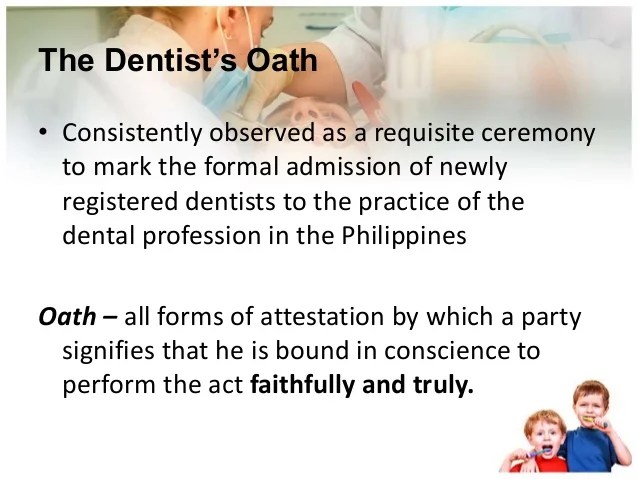
Dental Oath

Although dentists, dental hygienists, and dental assistants may not formally recite the Hippocratic Oath, its principles undeniably apply in their practice, particularly in the high-stakes context of emergency medical care.

By embodying these principles, dental professionals not only fulfill their commitment to ethical patient care but also ensure the safety and well-being of those they serve. 

More: https://www.ada.org/about/principles/code-of-ethics

COMMENTS APPRECIATED

Refer and Subscribe

***

***

IRS Inheritance Rule Change and the “Delta Dental” Data Breach

By Staff Reporters

SPONSOR: http://www.MarcinkoAssociates.com

***

The IRS is demanding billions from small business who took this credit ...

***

The IRS Quietly Changed the Rules on Children’s Inheritance

The IRS just issued Revenue Ruling 2023-2, which had a substantial impact on estate planning, particularly where an irrevocable trust is involved.

In the last decade or so, more families have begun utilizing irrevocable trusts to protect their assets from spend-down in order to qualify for government benefits, such as Medicaid and VA Aid and Attendance. Prior to the issuance of this ruling, it was unclear whether assets passing to beneficiaries through an irrevocable trust would receive a step-up in basis, thereby eliminating any capital gains taxes that would otherwise be owed.

Historically, assets that are disposed of during an individual’s lifetime are subject to capital gains taxes on the increase in value of that asset over time. The amount of capital gains owed is determined largely by the difference between the value at the time of purchase and the value at the time of transfer.

***

Delta Dental of California data breach exposed info of 7 million people

“Delta Dental of California and its affiliates are warning almost seven million patients that they suffered a data breach after personal data was exposed in a MOVEit Transfer software breach.Delta Dental of California provides 24 months of free credit monitoring and identity theft protection services to impacted patients to mitigate the risk of their exposed data.”

LINK: https://tinyurl.com/bp4u2chv

COMMENTS APPRECIATED

Refer a Colleague: MarcinkoAdvisors@msn.com

Your referral Count: 0

Thank You

***

***

9 TECHNOLOGIES THAT WILL SHAPE THE FUTURE OF DENTISTRY

***

By BertalanMesko MD PhD

9 TECHNOLOGIES THAT WILL SHAPE THE FUTURE OF DENTISTRY


Can you imagine that you might get your 3D-printed prosthesis in an hour instead of 4-5 sessions at the dentist? How about having a tele-dentist consultation? Or being able to grow new teeth at the age of 80?

Here are 9 technologies that will shape the future of dentistry!

READ MORE

***

COMMENTS APPRECIATED

Thank You

***

***

Meth Mouth and TEETH!

More About Meth Mouth and Teeth [MMT]

By Anonymous DEA Agent

METH: Crystal meth is the common name for crystal methamphetamine, a strong and highly addictive drug that affects the central nervous system. There is no legal use for it.

It comes in clear crystal chunks or shiny blue-white rocks. Also called “ice” or “glass,” it’s a popular party drug. Usually, users smoke crystal meth with a small glass pipe, but they may also swallow it, snort it, or inject it into a vein. People say they have a quick rush of euphoria shortly after using it. But it’s dangerous. It can damage your body and cause severe psychological problems

Meth Mouth Teeth is severe tooth decay and tooth loss, as well as tooth fracture, acid erosion, and other oral problems, potentially symptomatic of extended use of the drug methamphetamine. The condition is thought to be caused by a combination of side effects of the drug and lifestyle factors, which may be present in long-term users.

However, the legitimacy of meth mouth as a unique condition has been questioned because of the similar effects of some other drugs on teeth. Images of diseased mouths are often used in anti-drug campaigns.

 ******

EDITOR’S NOTE: I do not know if this is a legitimate picture or not. But, I do suggest that we all “Just Say No to Drugs”. And; as a dental school drop out, I have an affinity for all pro-dentite colleagues.

MORE: https://www.maine.gov/dhhs/mecdc/population-health/odh/documents/downloadable-brochures/meth-mouth.pdf

Conclusion

Your thoughts and comments on this ME-P are appreciated. Feel free to review our top-left column, and top-right sidebar materials, links, URLs and related websites, too. Then, subscribe to the ME-P. It is fast, free and secure.

Link: http://feeds.feedburner.com/HealthcareFinancialsthePostForcxos

Speaker: If you need a moderator or speaker for an upcoming event, Dr. David E. Marcinko; MBA – Publisher-in-Chief of the Medical Executive-Post – is available for seminar or speaking engagements. Contact: MarcinkoAdvisors@msn.com

***

Product DetailsProduct DetailsProduct Details

***

ORAL HEALTH AND EQUITY

BY NIHCM

INFO-GRAPHIC
Gum disease remains one of the most prevalent chronic diseases in the United States with 46% of adults over 30 showing symptoms. Although significant improvements have been made to improve oral health in America, many people still experience barriers to preventive or essential dental care.

Black Americans, Latinos, and Native Americans, as well as low-income populations, children and pregnant women are at greater risk of oral health diseases. The disparities experienced by these populations have only been exacerbated by the pandemic. 

***

Image result for caries

***

In this infographic highlights the challenges to achieving optimal oral health and identifies opportunities for advancing health equity moving forward. 

INFO-GRAPHIC: https://nihcm.org/publications/oral-health-health-equity?utm_source=NIHCM+Foundation&utm_campaign=901307447a-Oral_Health_Infographic_091421&utm_medium=email&utm_term=0_6f88de9846-901307447a-167744768

YOUR COMMENTS ARE APPRECIATED.

Thank You

***

Need a New Career in Dentistry – Become a Consultant

Or – Maybe Just a Hobby

By Darrell K. Pruitt; DDS

One might ask how much knowledge of dentistry is required before a person is qualified to call oneself a “dental practice management consultant” – beyond maybe being able to spell HIPAA with only one P, and Hippocrates with two.

Meet Jill Coon, Inc

An anonymous management consultant who works for Jill Coon, Inc of Florida posted this brave suggestion on the company Facebook today:

“Why not take 3 max anterior PA’s and 1 mandibular PA once a year with bitewings to check for caries in front teeth? We actually bill insurance for 3 PA’s not 4. Hygiene production just increased!”

My Translation 

Here is a translation of her question from dental-speak to English:

“Why don’t dentists take routine x-rays of front teeth like they do for back teeth, when doing so increases hygiene production and payments from the insurance companies?”

[Dental team members, please sit on your hands for this one].

Bonus Round 

Bonus question: Can anyone think of any reason why one might not want additional routine x-rays – even if insurance pays for it at 100% (of usual and customary fees)?

Hint: It can be trickier to avoid irradiating the thyroid when taking anterior x-rays than while taking routine bitewing x-rays.

Assessment 

I’ll be back soon with the tricky opinion I will have posted on Jill Coon, Inc Facebook. It will be her first if nobody beats me to it.

http://www.facebook.com/home.php#!/pages/West-Palm-Beach-FL/Jill-Coon-Inc/125510596754?v=wall&ref=mf

Conclusion

Is there anyone out there with almost no knowledge of dental care who wants to match wits with a sales rep for a consulting company that “specializes in dental insurance billing and treatment planning for dental practices”?

Industry Indignation Index: 47

How about it – HHS Secretary Kathleen Sebelius, JD?

And so, your thoughts and comments on this ME-P are appreciated. Feel free to review our top-left column, and top-right sidebar materials, links, URLs and related websites, too. Then, be sure to subscribe to the ME-P. It is fast, free and secure.

Link: http://feeds.feedburner.com/HealthcareFinancialsthePostForcxos

Get our Widget: Get this widget!

Our Other Print Books and Related Information Sources:

Practice Management: http://www.springerpub.com/prod.aspx?prod_id=23759

Physician Financial Planning: http://www.jbpub.com/catalog/0763745790

Medical Risk Management: http://www.jbpub.com/catalog/9780763733421

Healthcare Organizations: www.HealthcareFinancials.com

Health Administration Terms: www.HealthDictionarySeries.com

Physician Advisors: www.CertifiedMedicalPlanner.com

Subscribe Now: Did you like this Medical Executive-Post, or find it helpful, interesting and informative? Want to get the latest ME-Ps delivered to your email box each morning? Just subscribe using the link below. You can unsubscribe at any time. Security is assured.

Link: http://feeds.feedburner.com/HealthcareFinancialsthePostForcxos

Sponsors Welcomed

And, credible sponsors and like-minded advertisers are always welcomed.

Link: https://healthcarefinancials.wordpress.com/2007/11/11/advertise

Product DetailsProduct DetailsProduct Details       

BCBS-TX Must Talk to D. Kellus Pruitt DDS

Join Our Mailing List

Do My Manners Bother Anyone?

[By Darrell K. Pruitt; DDS ]

I posted this on the Dallas Morning News Website in response to an article about BCBSTX downsizing due to the economy.

http://economywatchblog.dallasnews.com/archives/2009/08/health-care-losing-jobs.html

1-darrellpruittDear Jason Roberson – Reporter – The Dallas Morning News 

As a dentist on the east side of Fort Worth whose patients have been harmed by BCBSTX, I say the fewer clients BCBSTX has, the safer Texans are. Changing dentists causes fillings.

Of HIPAA and the NPI Number

It wouldn’t surprise me that until about now, you and most of your readers have never heard of the HIPAA-mandated National Provider Identifier (NPI) number. And it probably doesn’t make much sense to you when I say that it is BCBSTX policy not to process their clients’ dental claims if they come from a dentist who doesn’t have an NPI number, like me. BCBSTX’s horrible policy has not only decreased my number of new patients, but the arbitrary rule also caused a couple of dozen of my long-term patients – who were perfectly satisfied in the comfortable dental home I provided them – to leave me for dentists with NPI numbers. Please note that the 10 digit identification number does nothing improve the quality of care. It only benefits BCBSTX. And did I mention that changing dentists causes fillings?

Not Accepting Assignment 

Even in these tough economic times, I choose to no longer accept BCBSTX. My ethics-based decision hurts me financially, but that is how much I sincerely despise BCBSTX for its NPI policy. Unless Texas Health CEO Doug Hawthorne or a spokeswoman for BCBSTX like Margaret Jarvis or Ross Blackstone mans up to their deception really soon, I hope to help the wheels fall off of BCBSTX as an example to other insensitive CEOs who harm my patients by selling their clueless bosses discount dental plans with no quality control. Special bastards like me proudly volunteer to clean up the neighborhood, just for grins. As a matter of fact, a few sports fans and I are hoping one of the recently laid off BCBSTX employees is named Wilma, who on May 1, 2008 was known as an “overall supervisor” for BCBSTX in the dental claims department. I’m certain that CEO Hawthorne knows her. Then again, it wouldn’t surprise me to learn that he is unconcerned about dentistry.

A Pubic Invitation 

I am publicly inviting Wilma to come forward – even as whistleblower if she still has her job – and share with us the motivation behind the alleged lies she told me during our conversation. Even now, as I listen to our recording, I consider it an entertaining and educational conversation between two people who both know a BCBSTX overall supervisor who brought talking points to an argument. Nevertheless, even while trapped between honesty and her job, Wilma proved to be a devoted employee – willing to risk her own reputation for her boss. The way she sticks with defending a defenseless policy, at times it sounds like the NPI number actually makes sense to her. Then you think, “Surely she is smarter than that.”

Assessment 

I know that coming at the end of one of the strangest comments you have ever attracted, it is appropriately ballsy that I say that there’s a new sheriff in town, Jason. And disrespect around my niche is no longer tolerated if I have anything to do with it. I’ll shoot holes in BCBSTX to help it crash sooner if it will cause fewer Texans experience unnecessary dentistry. How important to one’s oral and systemic health is continuity of care when virtually all oral problems are caused by neglect? Is BCBSTX dental insurance worth the hidden price? Thank you for the opportunity to air out my opinion.

Conclusion

Your thoughts and comments on this ME-P are appreciated. Feel free to review our top-left column, and top-right sidebar materials, links, URLs and related websites, too. Then, subscribe to the ME-P. It is fast, free and secure.

Speaker: If you need a moderator or speaker for an upcoming event, Dr. David E. Marcinko; MBA – Publisher-in-Chief of the Medical Executive-Post – is available for seminar or speaking engagements. Contact: MarcinkoAdvisors@msn.com

OUR OTHER PRINT BOOKS AND RELATED INFORMATION SOURCES:

Product DetailsProduct Details

Blue Cross/Blue Shield of Texas on Facebook

Let’s Have Some Fun!

[By Darrell K. Pruitt; DDS]pruitt

Hello, sports fans. Have you missed me? It’s been about five days since I posted a comment that didn’t follow an article authored by someone else.

My last one was “Pruitt’s Platform – Introduction to an Adventure.” It’s unusual for me to go so long between posting stand-alone pieces, but after putting that title to my introduction, and compounding the challenge by promising to never push out bland stuff, I set my standard high. It took me a few days, but I finally found a deserving old target on a brand new venue that I think will hold your interest. BCBSTX and I have an intense history, so I assume they charged someone anonymous and shy to follow everything I write. I welcome you, whoever you are. Yea, you. The one hiding in the dark corner, justifiably afraid to utter a peep. Keep your pointed head down, friend, and try not to wet your nice pants.

BCBSTX, you should be disappointed to learn that I found your Facebook account. Even for a fat dinosaur, you are an especially thick and slow-moving easy target. I recommend you just surrender now to transparency and start the confessions and reparations before the lawsuits become huge and the lawyers profit more from your collapse than the Texan dental patients you’ve harmed. Let me remind you that the repeal of the McCarran-Ferguson Act is just around the corner, and we all know about the rumor (started by me) that there are attorneys across the nation just waiting to file class-action lawsuits against BCBS for unfair business practices, including restraint of trade for using the NPI number to drive satisfied patients from dental homes they preferred. Finally, BCBSTX will be subject to the same anti-trust laws as the doctors they fear, and I am here to make sure BCBSTX feels the pain. Look what happened to Dell Computer when that huge dinosaur was surrounded by Jeff Jarvis and Dell Hell. The game I’m playing with you is a more nimble, improved variation of Dell Hell, using fewer vulgar words.

You should know by now you are too fat and too slow to hide from me and the sports fans I bring. Nevertheless, I am always fair in telling my targets my goals before I go on to accomplish them. Here is what I am going to do to you, BCBSTX: I intend to pull your anonymous, unaccountable butt out into the wide open for everyone to see – especially the lawmakers you lobby and support with generous donations. Did you know that there is a rumor (also started by me) that some of those same lawmakers you consider friends are aware of most of what I write on the same day I post it? The transparency I bring will eventually trap and crush you, BCBSTX. Or, you can immediately come out and meet me for an open discussion about the inevitable reformation of dental insurance in Texas – putting humble, obedient bureaucrats with names under the direct control of dentists and patients. And of course, it is understood that in order to save Texas citizens millions of dollars in healthcare expense, there will be drastic downsizing of BCBSTX Dental, just like Delta Dental and ADA/IDM are experiencing right now. That means no more bonuses and no more frivolous pursuits like publishing, printing and mailing to Texas dentists those expensive self-serving brochures joyfully titled “NPI Times.” I suggest you get your resumes in order, BCBSTX employees. I’m very good at having my way with archaic business models. Others I have attacked, such as ADA/IDM and Delta Dental, are clearly failing. Coincidence? Perhaps you’d like to tell yourself that when I undermine your support every time you come up for air. Why not send out your sharpest PR specialists? Oh please, would you? Also, equip them with committee-approved talking points that I’ll hang around their necks for a long time.

When I discovered that BCBSTX had a Twitter account, I started asking anonymous employees of BCBSTX about their new NPI number requirement for processing dental claims – even for dentists who have no contractual relationship with the company. But rather than answer a dentist’s questions about their dental policy (incredibly stupid, BCBSTX), the leaders of the command and control company who can no longer command or control their own socks, responded by blocking me from following them. That was irresponsible, childish behavior from one of the largest and most powerful dental insurance companies in the state. Shouldn’t it be important for BCBSTX to respect dentists who must deal with their cumbersome rules?

At a time when managed care dental companies like BCBSTX are lobbying Congress hard to preserve their taxation subsidy, I think it is important for lawmakers to recognize that these huge stakeholders neglect the welfare of those they serve: the principles – dentists and their patients. We are your constituents who count, Congress. Not discount dentistry brokers whose products will not sell in the free market without mandates and taxpayer assistance – simply because they are lousy products.

If BCBSTX had not opened a Facebook account, I would not have opened one myself. I discovered my fat, defenseless opponent when I googlesearched “BCBSTX” the other day. On their first page was the link “What is the NPI number of BCBSTX? – Facebook.” It features a client’s naïve, insignificant question about the NPI number, and it opened the door for my informed, significant one which I copied below, as well as posted on Twitter.

http://www.facebook.com/topic.php?uid=93487018652&topic=8926

By the way, I was disappointed to see that my comment “BCBS-TX Dental Insurance is Rude to everyone,” which I posted on the Medical Executive-Post over three months ago, was no longer on BCBSTX’s first page. It was their third hit for weeks. But since I hadn’t given the comment a bump lately, it has dropped down to the bottom of their second page. Can’t have that! If you don’t mind, please click once or more on the following link and stay there a few minutes. That way, it will push the blunt criticism back up onto BCBSTX’s first page and will once again warn potential clients of BCBSTX’s poor business ethics. If you’re going to be there anyway, why not go ahead and read the sucker? You could find it interesting. Lots of people do.

https://healthcarefinancials.wordpress.com/2009/03/27/bcbs-tx-dental-insurance-is-rude-to-everyone/

As I wrap up this comment, I’ll share with you with the question I left BCBSTX on Facebook almost 6 hours ago concerning their NPI policy. I don’t think Facebook was a good idea for BCBSTX leaders. Sit back and watch me get someone fired today.

Dear BCBSTX:

I would like to point out to readers more information about the NPI number which you are not likely to share. If you have BCBSTX dental insurance, and your dentist does not have an NPI number, BCBSTX will not process your dental claim and the premiums you will have paid to BCBSTX will become unearned profit for BCBSTX.

Is that true, BCBS-TX? Yes or no?

Conclusion

Your thoughts and comments on this ME-P are appreciated. Feel free to review our top-left column, and top-right sidebar materials, links, URLs and related websites, too. Then, subscribe to the ME-P. It is fast, free and secure.

Link: http://feeds.feedburner.com/HealthcareFinancialsthePostForcxos

Speaker: If you need a moderator or speaker for an upcoming event, Dr. David E. Marcinko; MBA – Publisher-in-Chief of the Medical Executive-Post – is available for seminar or speaking engagements. Contact: MarcinkoAdvisors@msn.com

OUR OTHER PRINT BOOKS AND RELATED INFORMATION SOURCES:

DICTIONARIES: http://www.springerpub.com/Search/marcinko
PHYSICIANS: www.MedicalBusinessAdvisors.com
PRACTICES: www.BusinessofMedicalPractice.com
HOSPITALS: http://www.crcpress.com/product/isbn/9781466558731
CLINICS: http://www.crcpress.com/product/isbn/9781439879900
BLOG: www.MedicalExecutivePost.com
FINANCE: Financial Planning for Physicians and Advisors
INSURANCE: Risk Management and Insurance Strategies for Physicians and Advisors

Product Details 

Independent Medical Practitioner as Solo Primary Care Surrogate

Join Our Mailing List

Doctors Facing a Bleak Future Business and Financial Planning Model

By Dr. David Edward Marcinko; MBA, CMP™

[Publisher-in-Chief]dem2

According to Physicians News, on March 19, 2009, the demand for family physicians is growing. Proposals for health system reform focus on increasing the number of primary care physicians in America. Yet, despite these trends, the number of future physicians who chose family medicine dipped this year, according to the 2009 National Resident Matching Program. What gives?

NRMP

The National Resident Matching Program [NRMP] recently announced that a total of 2,329 graduating medical students matched to family medicine training programs. This is a decrease in total student matches from 2008, when 2,404 family medicine residency positions were filled.

Primary Care Demand Explodes

Meanwhile, demand for primary care physicians continues to skyrocket. For example, in its most recent recruitment survey, Merritt Hawkins, a national physician recruiting company, reported primary care physician search assignments had more than doubled from 341 in 2003 to 848 last year. 

The Decline of Solo Medical Practitioners

Regular readers and subscribers to this Medical Executive- Post are aware of the declining number of solo medical practitioners; we have been sounding the alarm here, in our books, journal, speaking engagements and elsewhere for years now.dhimc-book4

In fact, the statistic that we often cite is that more than 40% of the nation’s physicians are employed doctors; not employers as in the past. This business model shift has occurred over the past decade or so, and has accelerated of late. The decline in solo and independent doctors has occurred elsewhere as well, but much more slowly [i.e., dentistry, podiatry and osteopathy] as these specialties have been somewhat isolated from the traditional allopathic mainstream.

Going forward, this solitary model seems to be a good thing, and a fortunate result of the un-intended consequence of previously keeping these folks out of the healthcare mainstream.

The Decline of Independent Medical Practitioners

Now, in the March 2009 issue of Healthcare Finance News, we learn that the number of hospital owned physician practices has been climbing over the last four years, according to the Medical Group Management Association [MGMA]. Think: PHOs back-in-the-day. ho-journal3

And, while this trend only marginally affects patients and patient care, it is quite disruptive to physicians, their families, personal wealth accumulation, retirement and estate planning endeavors.

For example, according to Professor Hope Rachel Hetico, RN, MHA, CMP™ of our firm www.MedicalBusinessAdvisors.com

“The professional good-will valuation component of a medical practice is being decimated. Today, some practices are being bought and sold for tangible asset value, only.

Assessment

Therefore, allow me to identify this emerging trend which suggests independent medical practice as reflective of solo primary medical care. In other words, as independence goes the way of the “dodo-bird”, so goes primary care practitioners precisely at a time when the later is needed more than the former.

Why? Employed doctors stay that way by making money for their employer and hospital-bosses. Specialists make more money than primary care doctors. So, if you want to stay an employed doctor; which specialty would you pursue?

Answer: The NRMP class this year spoke out loud and clear. Any specialty but primary care!

Channel Surfing the ME-P

Have you visited our other topic channels? Established to facilitate idea exchange and link our community together, the value of these topics is dependent upon your input. Please take a minute to visit. And, to prevent that annoying spam, we ask that you register. It is fast, free and secure.

Conclusion

Your thoughts and comments on this ME-P are appreciated. Feel free to review our top-left column, and top-right sidebar materials, links, URLs and related websites, too. Then, subscribe to the ME-P. It is fast, free and secure.

Speaker: If you need a moderator or speaker for an upcoming event, Dr. David E. Marcinko; MBA – Publisher-in-Chief of the Medical Executive-Post – is available for seminar or speaking engagements. Contact: MarcinkoAdvisors@msn.com

OUR OTHER PRINT BOOKS AND RELATED INFORMATION SOURCES:

Product DetailsProduct Details

Product Details 

Collaborative Dental Health 2.0 [Part One of a Three Part Series]

Consumerism is the Hippocratic Way

By Darrell K. Pruitt; DDSpruitt1

The Appearance of DR. Oogle

By September of 2005, when I finally worked up enough courage to ask a patient to post a review for me on DR. Oogle (doctoroogle.com) – a web-based patient referral site – my dental practice had been invisible and struggling for a few years and was still disappearing.  It was the most discouraging period in my career. 

Following the Golden Rule 

In spite of my efforts to always treat my patients like I would want to be treated myself, I was headed for either managed care, which I consider to be an unethical model for dentistry, or bankruptcy. The progressive betrayal of my profession and my patients by leaders in dentistry spawned bitterness and high blood pressure that I still suffer today – even though my practice has fully recovered. My hygienist and I are currently booked almost solid for the next two weeks. I know also that in the next three, misfortune could arise. I have no idea what is in store for dentistry in tomorrow’s economy. If I was in the business of selling advice, or DR. Oogle, I would probably be tempted to radiate much more confidence than I truly feel.

Back in the Day 

When I graduated from dental school in 1982, I was reassured by dentists I respected that one’s practice location is not important if one works hard to consistently provide patients with one’s best efforts.  Dr. Earl Estep, a practice development guru from Athens, Texas, taught me decades ago that word-of-mouth is much more effective for attracting patients who are ready to spend money than advertisements provide, and that one should never forget to ask for referrals, even if it feels “unprofessional.”  This is still solid advice.  For example, two days ago, in a special marketing feature on Jim Du Molin’s The Wealthy Dentist Blog, Chris Barnard suggested,

“Enlist your existing patients in your practice success. Actively seek those all-important word of mouth referrals from your patients.”

Link: http://www.thewealthydentist.com/blog/727/practice-marketing-in-down-times

Even though Barnard doesn’t mention patient referral sites such as DR. Oogle, his other ideas which may or may not fit one’s practice image include quarterly letters, $10 gas cards and iPod raffles in order to

“… Let them know who you are beyond that white lab coat …!”

Just Do it … and Ask

I personally think it is much less complicated, as well as much cheaper, to simply select a recently satisfied patient, look the person in the eye and ask,

“Would you mind putting in a good word for me on this website?” 

Handing a patient a business card with the website handwritten on it becomes easier to do after the first dozen or so, but don’t expect immediate results. My success rate was around 45% when I was actively pursuing favors. When I reached 90 reviews after around nine months, I quit pestering my patients with requests for reviews. Active participation in a patient referral site also provides the incentive to improve one’s practice by motivating both dentists and staff to become wrapped up in treating each patient with extra-special care in the hopes of a nice review. Before anyone knows it, personalized, attentive care becomes a habit, I have found. Other than those who sell ads and party favors, everyone wins.

Enter Dr. Oogle 

I came across DR. Oogle in March 2005. The open-source patient satisfaction measurement application was born in San Francisco at the very end of the .com bust, and had been actively gathering word-of-mouth data about dentists for over two years when I began observing its progress.  By then, DR. Oogle had already accumulated an impressive amount of information concerning patient satisfaction with many of nation’s dentists. I suspect that today, Dr. Oogle’s volume of data is insurmountable by potential competitors. 

Akin to Wikipedia 

I found DR Oogle’s revolutionary marketing concept fascinating simply because like Wikipedia, it is not supported by advertising – thus avoiding a tremendous built-in and transparent bias. The company’s profits are derived solely from dentists like me who agree to pay reasonable monthly fees for the opportunity to participate in the application by displaying their customers’ opinions for public scrutiny. It is what I call playing to win rather than playing not to lose. Five months before I purchased the service, I published an article about DR. Oogle in The Twelfth Night, the monthly newsletter of my local dental society. I believe mine was the first mention of such web-based patient referral sites in any dental publication. Here is the article:

Patient Driven Referral Services

[From: “The Twelfth Night” April, 2005]

In a small community people as a general rule know a lot more about their neighbors than do people in a city.  They also know a lot more about the doctors and dentists in town since there are only a few.  It is fairly common to talk to neighbors and friends to get opinions on who is the best dentist, who to avoid, who is the cheapest, who has the most up to date equipment. 

In a small community, as well as in a city, even a neighbor’s recommendation carries more weight than a dentist’s paid advertisement.  I would imagine that sales of 1 800 Dentist subscriptions are significantly lower in rural Texas than in the metropolitan areas on a per capita basis.  The dentists in small communities know that they are far too easy to find to need to spend money for a referral service or for much advertisement at all. 

Well, Fort Worth and cities across the nation are becoming smaller dental communities because of the internet.  If any of you have googled your name, you may have picked up a hit by one or more patient driven referral services (PDRS). And, if you have not done this lately, you should.  There is a good possibility that the information about your practice location may contain errors.  But more importantly, you may read something pleasingly flattering or terribly humbling about your practice written by a patient you saw last week.

Dr. Oogle is presently the most popular PDRS. A patient’s comments about his or her dentist is posted only after the patient accepts the terms of the agreement; which are that the patient is neither a relative nor an employee of the dentist and that the patient is not otherwise being compensated for the review. The website also requires an authentic e-mail address and other personal information for verification purposes.

There is a filtering system in place in which employees of Dr. Oogle reject (at their discretion) comments which are too good or too bad to be credible.  And there are other ways in which dentists can handle bad reviews and are described on their website. There is, I suppose, always room for an attorney or two if the other attempts at removing a bad review fail.

But, if the PDRS’s survive the lawsuits, and if the first review which comes up under your name happens to be a real stinker written by an easily disgruntled and fervently vindictive patient (I think his name is Fred. You probably know him as he changes dentists often), and if you cannot get it otherwise removed, perhaps you should bury it under as many good reviews as you can encourage your patients to submit. This reaction, not surprisingly, is the reaction recommended by Dr. Oogle.  In fact, they also recommend that we routinely ask our patients to submit reviews to them.  I imagine that there are already dentists who have had cards printed for this purpose. 

Like it or not, our patients are being given more power in the marketing of our practices and their influence is growing. Dr. Oogle’s first reviews of dentists in the greater Ft. Worth area occurred in September of ’04. By the first of February, 5½ months later, there were only 18 dentists who had been reviewed by at least one patient.  As of today, one month later (March 7), there are 16 more. By the time this is published the number could be close to 50. Who knows how many reviews will be posted a year from now if the public perceives value in this kind of information. Many more of us will be listed as either good or bad dentists; legitimately or not. 

Regardless of the outcome of Dr. Oogle’s venture into dentistry, the fact that the public has a thirst for “unbiased” sources of information concerning our practices tells us that more than ever before we have to treat each patient as our most important source of new business or a disappointed patient could soon become a significant obstacle for growth.

Another good thing is that a patient who has to choose a dentist from a list at least soon may have some guidance; other than the fact that his insurance company thinks they are all equally swell.

Darrell K. Pruitt; DDS

[April 2005]

Investigative Reporting 

Since writing the unprecedented article, I have performed numerous simple investigations comparing DR. Oogle’s ratings to dentists’ names on preferred provider lists for various cities.  Invariably, the vast majority of the dentists who sign managed care contracts are found in the bottom 50% of the ratings. Sorry if I hurt some colleagues’ feelings, but that is cold fact. Anyone with a preferred provider list can confirm it. I suspect it has been done thousands of times by many anxious people holding new annual lists of strangers’ names in just the last year. Alert dentists should note that humans are choosy when it comes to trusting someone to use sharp, rotating instruments in their mouths. Dentistry is not like buying a can of beans as discount brokers would have their naïve and trusting clients believe, and most importantly, ethics are not for free.

Apart from the common sense rule that a purchaser of intricate handwork to exacting tolerances generally gets what the dental patient pays for, what else causes fee-for-service dentists to be generally favored over preferred providers?  I think it has to do with hunger.  If one’s meals arrive daily without effort, one forgets how to fish.

Managed care and preferred provider lists protect contract dentists from the naturally cleansing free-market principles taught by economist Adam Smith centuries ago. The beauty of competition in the marketplace occurs every time a dis-satisfied patient shops for a new dentist. When reliable information about patient satisfaction is available, quality is rewarded and encouraged in the neighborhood. Free-market capitalism works as reliably as classical operant conditioning in the best of possible worlds.

Assessment 

It is my opinion that there has always been something dishonest and un-American about discount dentistry with no quality control. I think we need to expose the unfair and unethical managed care business model to free-market forces even if it involves the calculated promotion of a simple, foolproof scheme for dentists interested in graduating from preferred provider lists. Those who feel trapped can begin their escape immediately by preparing some business cards for their managed care dental patients who by now are easily impressed by compassion. I’ll share more in Part 2.

Conclusion

And so, your thoughts and comments on this Medical Executive-Post are appreciated. If US dental patients are lucky, Web 2.0 transparency arrived just in time. Consumerism rules naturally.

Speaker: If you need a moderator or speaker for an upcoming event, Dr. David E. Marcinko; MBA – Publisher-in-Chief of the Executive-Post – is available for seminar or speaking engagements. Contact: MarcinkoAdvisors@msn.com  or Bio: www.stpub.com/pubs/authors/MARCINKO.htm

Our Other Print Books and Related Information Sources:

Practice Management: http://www.springerpub.com/prod.aspx?prod_id=23759

Physician Financial Planning: http://www.jbpub.com/catalog/0763745790

Medical Risk Management: http://www.jbpub.com/catalog/9780763733421

Healthcare Organizations: www.HealthcareFinancials.com

Health Administration Terms: www.HealthDictionarySeries.com

Physician Advisors: www.CertifiedMedicalPlanner.com

Subscribe Now: Did you like this Medical Executive-Post, or find it helpful, interesting and informative? Want to get the latest E-Ps delivered to your email box each morning? Just subscribe using the link below. You can unsubscribe at any time. Security is assured.

Link: http://feeds.feedburner.com/HealthcareFinancialsthePostForcxos

Dentists, HIPAA, IT and Reform

Healthcare Reform and Presidential Candidates 

[Surprising Obama and McCain]

By Darrell K. Pruitt; DDS

pruitt

Some readers of the Medical Executive-Post may wonder why a dentist’s opinions on healthcare reform should be given space on a website that is about the personal business, management, finance and economics of healthcare. 

Like Lab Animals

Even though dentistry is only around 5% of the healthcare market; when it comes to government/insurance regulation using the one-size-fits-all micromanagement model of MBAs and politicians – dentists are your lab animals. So, hear me squeal! 

HIPAA Hurts

Our nation’s leaders could learn sobering lessons about how their rules affect healthcare by observing how they affect dentists.  As businesses, dental practices are naturally much less complicated than medical practices. 

For one thing, dentists maintain only a few thousand active patient charts, whereas family physicians may have three to ten-thousand.  This is because physicians see forty or more patients a day.  Dentists, whose work involves intricate, but routine hands-on procedures in unpredictable mouths, may see ten patients in a busy day – eighteen if one counts checking hygiene patients. 

Sans Bottlenecks 

In dentistry, patient bottlenecks have never occurred in the clinical setting, even when burdened by modern, strategically complicated insurance hoops.  It takes just as long today to pull a tooth as it did in 1960. 

Actually, considering the OSHA mandate of the late ‘80s, defensive medicine and non-productive paperwork such as the meaningless HIPAA privacy release that patients have signed without reading since 2003, dentistry takes a lot more time than it used to. 

Thank goodness patients never take the time to read what they sign or dentistry would take even longer.

Pulling teeth will never be faster than it was a hundred years ago when x-rays, as well as surgical-grade alloys became available. Back then dentists were never delayed by the wait for onset of anesthesia. For a closely related reason, experienced patients didn’t want dentists piddling around indecisively using cold steel. 

Of Peg-Boards and Ledgers 

For decades, the busiest of medical and dental practices ran efficiently using only pegboards, ledger cards and lots of carbon paper, yet the staff still seemed to have time to ask patients about their families. The business of dentistry is so simple that even today some dentists choose to run their practices without the aid of a computer at all – thereby eliminating the unproductive expense of being a covered entity. 

Always remember this: there is nothing holding down the cost of being HIPAA compliant, and doctors with small, three-and-a-half employee businesses will be held to the same standards as hospitals with large staffs and a fondness for busywork – busywork that demands department budgets that include overtime pay.  HIPAA fits a sole-proprietor dental practice like socks on a rooster. 

The Economics of Choice 

Here is another important difference.  For a considerable amount of dental care, one might delay the purchase of a home entertainment center to chew comfortably.  For serious medical care, one might forgo a home to stay alive.  Almost all acute, health-threatening dental emergencies can be quickly solved in an outpatient manner with a simple extraction that costs less than $200, and available in almost any neighborhood.

HIPAA

From a dentist’s perspective, the Health Insurance Portability and Accountability Act [HIPAA] was never about portability.  Oh, I could tell you stories; couldn’t we all.  And, considering how many electronic health records have been fumbled under HIPAA, accountability is a cruel joke as well.  That leaves the original 1996 HIPAA Rule stripped down to HIA – the Health Insurance Act; transparency at last.

The Four Cornerstones

A year ago, President George Bush signed an Executive Order that centered on four “cornerstone” goals to help bring about a systematic approach for measuring quality and value in health care, and for making that information publicly available. They are:

  • Connecting the system through the adoption of interoperable health information technology;
  • Measuring and making available results and outcomes on the quality of health care delivery;
  • Measuring-Transparency and making available information on the price of health care items and services; and,
  • Aligning incentives so payers, providers and patients benefit when all are focused on achieving the best care-value at the lowest unit-cost

The last three cornerstones, Measuring, Measuring-Transparency and Aligning are dependent on providers volunteering for the first – Connecting.  Even though dentists were intended to be included in Bush’s plans for healthcare reform, connecting with dentists never happened – especially for dentists who did not volunteer for an NPI number – which gives stakeholders a legal right to Measure, Measure-Transparency and Align. 

Or, as my dad, a furniture maker, used to say, “Measure twice, cut once (and for your own sake do not get personally involved in the machinery).”

Assessment

As a dentist who has observed physicians methodically lose control of doctor-patient relationships to stakeholders who hold payments for ransom, I say that if this is interoperability, I hope it never connects to my sheet metal file cabinets full of paper.  HIPAA has nothing to offer but expense and liability.

Mark my words. History will show that HIPAA was exposed as a national failure in dentistry first, and that the presidential candidates still don’t know. 

Won’t presidential candidates Barack H. Obama and John S. McCain be surprised! 

Conclusion

Politicians never consider dentistry. Though it is unfortunate and very expensive, it is nothing new. Stick around. I have other issues, as well, and am not bashful. Of course, your thoughts, opinions and comments are appreciated.

Subscribe Now: Did you like this Executive-Post, or find it helpful, interesting and informative? Want to get the latest E-Ps delivered to your email box each morning? Just subscribe using the link below. You can unsubscribe at any time. Security is assured.

Link: http://feeds.feedburner.com/HealthcareFinancialsthePostForcxos

Copyright 2008 iMBA Inc: All rights reserved, USA, unless otherwise noted. Use is restricted to Executive-Post subscribers only. No redistribution is allowed. To avoid violation of iMBA Inc copyright restrictions and redistribution policy, please register for your own free Executive-Post membership. Detailed information and registration links are available at:

Link: http://feeds.feedburner.com/HealthcareFinancialsthePostForcxos

Referrals: Thank you in advance for your electronic referrals to the Executive-Post