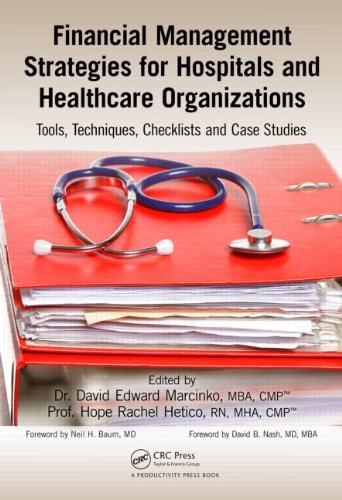
Hospitals and Healthcare Organizations [2 New Print Books]

Join Our Mailing List

ADVERTISEMENT

Healthcare Organization and Hospital Financial Management Strategies

All hospitals and healthcare organizations, both emerging and mature, face a daunting financial scenario in today’s volatile healthcare re-imbursement environment.

Decreasing revenues, increasing costs, and high consumer expectations present a complex challenge for CEOs, CFOs, physicians and nurse executives, administrators, financial advisors and department managers who must not only lead in today’s climate, but also position their organizations for tomorrow’s financial tumult and potential political changes of the Obama Administration and ACA, etc.

A National Team of Contributors

Produced by  economists, administrators – accountants, business leaders, MDs and IT consultants, among others; Hospitals and Healthcare Organizations [Financial Management Strategies] looks at ways to manage assets, costs, human resources and healthcare claims.  Everything – from inventory management to hybrid and activity based cost analysis in order to accelerate the cash conversion cycle – is scrutinized.  And, modern health economic themes like competitive strategy, workplace violence and financial benchmarks, for both public and private entities, are included.

Contemporaneous Health 2.0 Topics

We also examine contemporaneous topics such as the lessons learned from the corporate healthcare market competition and the PPMC imbroglio of the early 2000’s, and the domestic financial meltdown of 2009. This includes current methods for achieving hospital objectives, negotiating and analyzing cost-volume-profit contracts, and understanding the financial impact of regulatory requirements under HIPAA, STARK I-III, OSHA, the US Patriot Acts, the Deficit Reduction Act [DRA], the often contentious Sarbanes-Oxley Act, ARRA and HITECH Acts, and the Fair and Accurate Credit Transactions [FACT] Act. In addition, information technology issues like electronic medical records (eMRs), RFID controls, RSS feeds and blogs, Health 2.0 initiatives and computerized physician order entry (CPOE) systems are examined in detail. Virtually no operational, strategic business, health economics, or financial management topic is omitted.

Assessment

Product DetailsProduct Details

Hospitals and Health Care Organizations [Financial Management Strategies] is dedicated to meeting the administrative needs of our nation’s healthcare organizations in order to help them maintain a competitive edge in the markets they serve; and to take advantage of emerging business opportunities. We therefore invite you to be the first health economics cynosure in your hospital, facility, or healthcare system to join us for the journey.

Channel Surfing the ME-P

Have you visited our other topic channels? Established to facilitate idea exchange and link our community together, the value of these topics is dependent upon your input. Please take a minute to visit. And, to prevent that annoying spam, we ask that you register. It is fast, free and secure.

Conclusion

Your thoughts and comments on this ME-P are appreciated. Feel free to review our top-left column, and top-right sidebar materials, links, URLs and related websites, too. Then, subscribe to the ME-P. It is fast, free and secure.

Speaker: If you need a moderator or speaker for an upcoming event, Dr. David E. Marcinko; MBA – Publisher-in-Chief of the Medical Executive-Post – is available for seminar or speaking engagements. Contact: MarcinkoAdvisors@msn.com

OUR OTHER PRINT BOOKS AND RELATED INFORMATION SOURCES:

Product DetailsProduct DetailsProduct Details

   Product DetailsProduct Details

Grading Texas Lawmakers on Patient Privacy

Join Our Mailing List

Grade Spread Runs Gamut from F to A+

[By D. Kellus Pruitt DDS]

Are the interests of my dental patients in Fort Worth, Texas being adequately represented by their elected officials in Austin and Washington DC? Starting a few months ago, I’ve sent multiple emails concerning patient privacy and identity theft to my elected government officials on state and national levels; as a test of responsiveness.

The Elected Officials

These include:

  • Texas US Senators John Cornyn and Kay Bailey Hutchison
  • US Representatives Joe Barton and Michael Burgess
  • Texas State Senators Wendy Davis and Chris Harris
  • Texas State Representatives Diane Patrick and Marc Veasey.

Of the 8 lawmakers I contacted through their Websites, I received no response from state officials Davis, Harris, Patrick and Veasey. However, from my national representation, only Joe Barton failed to reply. I simply have to give those 5 a grade of F. I assumed my state representatives would be more patient-friendly than members of the US Congress. But, I was wrong.

Texas US Senators 

US Senator Cornyn has responded twice: Once in September and again on December 6. In both emails he says,

“Dear Darrell Pruitt,

Thank you for contacting my offices. Your correspondence has been received, and we will respond to you as quickly as possible.”

I suppose there’s still hope for a response, but he also failed. Cornyn also earned an F.

On the other hand, I’m more disappointed with Kay Bailey Hutchison’s staff than John Cornyn’s. In all 3 of her identical responses to my emails, she addresses me as “Dear Friend,” before wasting my time with a vanilla lecture about the origin and intention of the HITECH Act that I can get from HHS:

“The HITECH Act includes privacy and security provisions to expand current requirements under the Health Insurance Portability and Accountability Act (HIPAA) and strengthens the HIPAA privacy rule, blah, blah, blah.”

If Hutchison’s staff member had read the first paragraph of any of the three emails I sent before he or she assigned me the same canned response all three times, the bonehead would have recognized that an explanation of HIPAA was not what I needed from his or her boss. I’m pretty sure I know more about HIPAA than the Senator, and that is the reason I wrote her in the first place.

Senator Hutchison closed all three emails with,

“I appreciate hearing from you, and I hope that you will not hesitate to contact me on any issue that is important to you. Sincerely, United States Senator Kay Bailey Hutchison”

Then she added,

“PLEASE DO NOT REPLY to this message as this mailbox is only for the delivery of outbound messages, and is not monitored for replies.”

Although I should have known better, following her dead-end reply, I returned to her Website and complimented the Senator for being my patients’ first elected official to respond to my emails. I told Kay Bailey how special her personal attention made me feel as an American… which attracted the same response, which quickly stopped that special feeling. Compared to Hutchison’s predictable responses, Senator Cornyn’s thin promises of a meaningful response some day don’t look so bad. Hutchison gets an F, but I’ll upgrade Cornyn to a D for incomplete.

Enter Dr. Michael Burgess 

And then there is Michael C. Burgess. Compared to this man, everyone else is just a failing politician, in my opinion. Dr. Burgess gets an A+.

In response to both emails I sent to US Representative Michael Burgess MD in the last few weeks, I received sincere, personalized responses. This week, I sent Dr. Burgess a copy of the timely comment I posted Tuesday on this Medical Executive-Post, “Is ‘encryption of PHI’ discussed in dentistry?”

https://medicalexecutivepost.com/2010/12/07/%e2%80%9cthe-ada-practical-guide-to-hipaa-compliance%e2%80%9d/#comment-9242

While Senator Hutchison is unaware that her staff is asleep, and while I’ve been waiting for John Cornyn to get back in touch with me for months, Congressman Burgess’ meaningful and personalized response arrived within 48 hours on Thursday:

Dear Dr. Pruitt:

Thank you for your continued correspondence regarding your concerns for privacy as it relates to health information technologies (HIT). I appreciate hearing from you on this matter.

I assure you that I understand the concerns you have that the implementation of HIT will have harmful effects on patients’ privacy, specifically as it relates to dentistry. As problems arise, I will work closely with the Department of Health and Human Service as well as organized dentistry to make sure that these problems are dealt with quickly and efficiently so that patients continue to receive the rights guaranteed to them in HIPAA.

As one of the few Members of Congress who have run a medical practice and been required to meet HIPAA, I take your concerns to heart and will be vigilant in my oversight.

Again, thank you for taking the time to contact me. I appreciate having the opportunity to represent you in the U.S. House of Representatives. Please feel free to visit my website (www.house.gov/burgess) or contact me with any future concerns.

Sincerely,

Michael C. Burgess, MD

[Member of Congress]

—————————–

So of those 8 elected officials from the Dallas /Ft. Worth area, who you think, I should trust with my patients’ interests next time I vote?  As for my state representatives whom I could run into almost anywhere in my community, they never bothered responding at all.

For months, I’ve emailed Diane Patrick more times than any other lawmaker. Long ago, I assumed that since she is married to a dentist, she might have natural interest in the welfare of dental patients. I was wrong. Even though the Fort Worth District Dental Society supports her campaigns, I have to wonder why?

Assessment 

And as for Marc Veasey, I met the man once, but I don’t think he remembers me. His campaign office is four doors down the hall from me as I type Tip O’Neal’s quote. “All politics is local.”

Conclusion

Your thoughts and comments on this ME-P are appreciated. Feel free to review our top-left column, and top-right sidebar materials, links, URLs and related websites, too. Then, subscribe to the ME-P. It is fast, free and secure.

Speaker: If you need a moderator or speaker for an upcoming event, Dr. David E. Marcinko; MBA – Publisher-in-Chief of the Medical Executive-Post – is available for seminar or speaking engagements. Contact: MarcinkoAdvisors@msn.com

OUR OTHER PRINT BOOKS AND RELATED INFORMATION SOURCES:

Product DetailsProduct DetailsProduct Details

Product Details  Product Details

   Product Details 

ME-P Recommends the “Health Dictionary Series”

Product DetailsProduct DetailsProduct Details       

   ADVERTISEMENT 

“The ADA Practical Guide to HIPAA Compliance”

Book Review – Dark, Dark Reading

By Darrell K. Pruitt DDS

Complying with HIPAA is an investment in the future of your dental practice. HIPAA Privacy sets forth requirements regarding the proper protection, use, and disclosure of patient information. HIPAA Security addresses using and protecting electronic patient information and the electronic technology that can save time, increase revenues, and improve workflow.” So are those evidence-based claims or an advertisement in the $250 ADA publication I purchased?

On Being Leary 

I’ve learned to be wary when dentalcare stakeholders like authors Ed Jones and Carolyn P. Hartley call HIPAA an “investment in the future of your practice” much like I would advise people to be wary of a dentist who sells cosmetic veneers by calling it an “investment in your smile!” All too often it turns out to be an investment in the dentist’s smile.

Unsupported Claims

Contrary to the authors’ unsupported claims in the Introduction of “The ADA Practical Guide to HIPAA Compliance,” there is no evidence that electronic technology saves time, increases revenues or improves workflow in dental offices. And even though Jones and Hartley mention “investment” numerous times in their HIPAA guide, how smart is it for a dentist to sink money into expensive electronic technology that demands mind-numbing documentation (even if it’s done on a computer); that exposes a practice to government inspections which carry liabilities up to $1.5 million even before state attorneys general get involved; that endangers the long-term welfare of both the dental practice as well as dental patients, and that promises no financial return? So just how smart is a HIPAA investment in the future of one’s practice?

Disaster Recovery 

I wasn’t far into Jones and Hartley’s imaginative guide to HIPAA compliance before reading other long-since rejected selling points that are so lame that even rookie eDR vendors know better than to attempt them. The authors’ naïve claim of the digital advantage of easier “disaster recovery” from a fire or hurricane is a good example of ADA-approved HIT fiction. Just ask yourself why disaster recovery was hardly a concern throughout the history of dentistry until the ADA leadership mindlessly bought in to promoting paperless practices and suddenly needed selling points in the worst way.

ADA Slogan

“Dentistry is healthcare that works”.

Beware

Any time dentalcare stakeholders trot out solutions, before asking the price, dentists should determine that there is indeed a corresponding problem that needs to be solved. Here is a simple marketplace test of Jones and Hartley’s disaster recovery claim: Which is cheaper: Disaster recovery insurance or data breach insurance? Common sense says that dentists’ offices are much more likely to be hit by burglars than fires and hurricanes. When burglars break into dentists’ offices, they don’t go for filing cabinets and ledger cards. They steal computers that can contain thousands of patients’ identities. As for the small percentage of US dentists whose offices are located in coastal cities and vulnerable to hurricanes, perhaps those dentists should maintain both digital and paper patient records. After all, which kind is easier to read during power failures that are common with hurricanes as well as ice storms – which occur much more frequently and throughout the nation?  What’s more, pegboards and ledger card boxes in a paper-based practice are not only hack-proof, but their use is unaffected when Internet servers go down, or are hacked. Confused yet? 

“You may decide to engage a technology consultant at some point, but after reading this book, you’ll have specific reasons for that engagement.”

Still Not a Fan

I’m not a fan of creative writers Ed Jones and Carolyn P. Hartley’s style of humor, but I needed a few continuing education credits and decided to pick up 8 easy hours through the ADA by purchasing their HIPAA guide and accompanying test. After finally conquering the first 2 bureaucratic-tedious chapters, it’s a pretty sure bet that I’ll try to wing it on the test long before getting through all 360 pages – many with footnotes even.

In the Minority 

I think studying for a CPA exam would be more riveting reading for me, as well as perhaps more meaningful for my dental patients – even if I were a HIPAA-covered entity. But since I’m one of the 4% of dentists in the nation who still doesn’t store or transmit patients’ protected health information (PHI) in slippery digital form, I never have to worry about attracting a subjective inspection because of my highly visible opinions about the absurdity of HIPAA in dentistry. Fines for being “willfully negligent” start at $50,000, and my transparent lack of respect for the Law would understandably trigger an inspection if I were a HIPAA-covered entity.

Join Our Mailing List 

HIPAA Flexibility 

On the other hand, since the HIPAA Rule is “flexible” by design, and HIPAA-covered dentists can be charged with huge fines – the other 96% of dentists in the nation who use computers in the business office have good reason to be careful about exercising their basic freedoms in the land of the free. It’s easy to see why covered entities aren’t complaining. Not to worry. As always, Proots has your six, good buddy. Are flexible laws really in American citizen’s best interest?

Although authors Jones and Hartley repeatedly point out that the HIPAA Rule’s flexibility is its beauty – even to the extent of allowing dentists to decide whether or not to notify their patients of a breach – dentists simply must be warned of the dangers that are inherent in vague laws: Flexibility for the dentist always means subjectivity for the inspector. History has shown us that subjectivity is dangerous in the hands of poorly-trained people with badges working on commission. The odds of fair treatment following even a self-reported data breach are not in a dentist’s favor. Even the simplest investigation by HHS representatives will cost a dentist at least $100 – even if the dentist is determined to be innocent of a baseless complaint – perhaps filed by a disappointed patient or employee.

Investigations and Violations 

“Violation Category (A) Did Not Know:  For a violation in which it is established that the Covered Entity did not know and, by exercising reasonable diligence, would not have known the Covered Entity violated such provision [$100-$50,000 per violation]. Chapter 2, page 20. HHS Secretary Kathleen Sebelius promised Congress that she intends to efficiently investigate every complaint against providers and vows to stop data breaches through stricter enforcement of the (hazy) HIPAA Rule – starting real soon. How is that not tyranny?

HITECH Subjectivity?

The ADA’s guide to HIPAA compliance has reaffirmed to me that HITECH HIPAA is a subjective law designed for abuse by those who created it. What’s more, eDRs provide NOTHING to dental care that has not been adequately and safely handled by conventional means of communication for decades at far lower costs. Sooner or later, the sudden news about HIPAA’s absurdity in dentistry is going to hit the HIT market like a brick. Following that flash of honesty, anyone who doesn’t agree that HIPAA is absurd in dentistry will do so at risk of snickers. So how complicated is compliance?

Chapter One: Dentist’s Obligations 

Chapter 1, page 1: “This book is concerned with only a portion of [Public Law 104-191]: Subtitle F — Administrative Simplification, hereinafter referred to as ‘HIPAA.’” Later in Chapter 1, Jones and Hartley use a paragraph to describe dentists’ obligations.

“Adopting Health IT presents challenges as well. For example, a dental practice must research and evaluate available systems, assess the current and foreseeable needs of the practice, negotiate the terms of the contract for the system and related services, including items such as the cost and availability of tech support, the number of licenses and authorized users that the contract will include, and the hardware and software features that enable HIPAA and HITECH compliance. Time and energy must be devoted to training staff to use the electronic health record system. A dental practice adopting an electronic health record should consult its attorney both with regard to the acquisition itself (including any contracts, licenses, and other legal documents) as well as with regard to the legal implications of using an electronic health record (for example, the dental practice should understand what will constitute the legal record and how the electronic health record would affect document retention requirements). A dental practice that intends to take advantage of the HITECH Act Medicare or Medicaid reimbursement incentives must understand and stay abreast of developments regarding the incentives, such as the qualifications of an “eligible provider,” how to demonstrate compliance with the “meaningful use” criteria,  how reimbursement incentives will be structured, and certification criteria of dental information systems.” 

Now do you see why the name “HIPAA” works better for stakeholders than “Administrative Simplification”?

HIT Rot 

As another illustration of how effectively stakeholders have hidden rot in HIT, the most common misspelling of HIPAA is “HIPPA,” and most consumers trustingly assume at least one of the Ps stands for “Privacy.” HIPAA hasn’t been about patient privacy since it was amended 8 years ago, and the P stands for “Portability.” And boy-howdy are digital records ever portable! HIPAA has ceased to be a benevolent law for Americans. It’s become instead a bi-partisan plan to take control of healthcare from healthcare principals and award it to healthcare stakeholders such as the HIT industry.

Assessment

You’ll spend a good amount of time implementing the Security Rule in your dental practice, but it’s the maintenance measures that will keep you in compliance.” This is a beautiful, meaningless point, Ed Jones and Carolyn P. Hartley.

Conclusion

Your thoughts and comments on this ME-P are appreciated. Feel free to review our top-left column, and top-right sidebar materials, links, URLs and related websites, too. Then, subscribe to the ME-P. It is fast, free and secure.

Link: http://feeds.feedburner.com/HealthcareFinancialsthePostForcxos

Speaker: If you need a moderator or speaker for an upcoming event, Dr. David E. Marcinko; MBA – Publisher-in-Chief of the Medical Executive-Post – is available for seminar or speaking engagements. Contact: MarcinkoAdvisors@msn.com

OUR OTHER PRINT BOOKS AND RELATED INFORMATION SOURCES:

DICTIONARIES: http://www.springerpub.com/Search/marcinko
PHYSICIANS: www.MedicalBusinessAdvisors.com
PRACTICES: www.BusinessofMedicalPractice.com
HOSPITALS: http://www.crcpress.com/product/isbn/9781466558731
CLINICS: http://www.crcpress.com/product/isbn/9781439879900
BLOG: www.MedicalExecutivePost.com
FINANCE: Financial Planning for Physicians and Advisors
INSURANCE: Risk Management and Insurance Strategies for Physicians and Advisors

Product DetailsProduct DetailsProduct Details

Product Details  Product Details

   Product Details 

Of WikiLeaks, Politics and eMRs [A Voting Opinion Poll]

Is Reporting for “Accidental” Political Downloads a HIT Security Game-Changer?

By Dr. David Edward Marcinko MBA CMP™

[Publisher-in-Chief]

Recently, I read in The New York Times that Federal workers are being told to avoid the website WikiLeaks and stay away from those classified cables leaked from the US State Department! Classified information, whether or not already posted on public websites or disclosed to the media, remains classified, and must be treated as such by federal employees and contractors”,  the Office of Management and Budget [OMB] said in a notice sent out last Friday.

Link: http://www.msnbc.msn.com/id/40512200/ns/us_news-wikileaks_in_security

Of Advice … Not Threats?

According the release, The New York Times was told by a White House official that it does not advise agencies to block WikiLeaks or other websites on government computer systems. Nor does it bar federal employees from reading news stories about the leaks! But – and this is a big one – if they “accidentally download” any leaked cables, they are being told to notify their “information security offices.”

Too Many Conflicting Questions 

  • Is document leaker PFC Bradley Manning a hero and a real patriot – not the mislabeling of an ACT as THE PATRIOT ACT – or traitor goat? What about Julian Assange – is he a full-disclosure hero or guilty of treason – should he be treated as an enemy combatant of the US Government?
  • How could a mere PFC download a quarter million classified documents without raising a red flag? Is the government incompetent? Has it just issued a not so thinly veiled threat to its own citizens with this admonishment? Are we becoming more like China in our use and restrictions of the Internet? Was the big brother prescience of George Orwell’s 1984, correct?
  • Is the admonishment of security officer notification following “accidental download” akin to the “don’t ask – don’t tell” policy on gays in the armed forces? So much for the transparency we were told our current administration wanted.
  • Should we forget about, or modify, the eMR privacy debate and/or should HIPAA be modernized?
  • Should Hillary Clinton resign?

Health Care Security Questions

  • Who exactly is a government employee anyway? And, does this include workers in the VA system, prison health system, Indian Health Service, postal workers, Medicare and Medicaid recipients, school kids with government meal subsidies and/or independent contractors and recipients of budgetary pork projects, US tax credits or federal unemployment benefits, etc?
  • Have these employed folks signed a HIPAA-like “business associate agreement” with Uncle Sam? Should government workers close their eyes and ears, too! And, with the expansion of federal government, does this mean that even more folks will have access to classified information [and more accidental downloads] than ever before? Who is left and allowed to read WikiLeaks and who is actually immune, or not?
  • If government can not protect its own data, records, confidential information or websites with certainty, how does it expect a solo medical professional [DPM, DO, DDS, DC, etc] to do the same with eMRs, and at what cost! HIPAA rules and regulations spell ou very specific health policy mandates and onerous legal punishments and fines for protected health information [PHI] data breach don’t they; not just the notification of a Chief Medical Information Security Officer [CMISO]. Is this a federal double standard?

Historical Re-Do

Federal employees were told to not read the Pentagon Papers. The leaker, economist Daniel Ellsberg PhD, precipitated a national controversy in 1971 when he released them. The right of the press to publish the papers was upheld in New York Times Co. v. United States. As a response, the Nixon administration began a campaign against further leaks – and  a smear campaign against Ellsberg personally – by creating the White House “plumbers”, which in turn led to the Watergate burglary of the LA office of Dr. Lewis Fielding MD [Ellsberg’s psychiatrist] in an effort to discredit him. According to Ellsberg;

“The public is lied to every day by the President, by his spokespeople, by his officers. If you can’t handle the thought that the President lies to the public for all kinds of reasons, you couldn’t stay in the government at that level, or you’re made aware of it, a week … The fact is Presidents rarely say the whole truth—essentially, never say the whole truth—of what they expect and what they’re doing and what they believe and why they’re doing it and rarely refrain from lying, actually, about these matters.”

Note: “Presidential Decisions and Public Dissent”, Conversations with History, July 29, 1998].

Now … Four Decades Later

Has anything changed since the above scandal? Almost forty years later, those with security clearance across the board were given this same directive about WikiLeaks. Will they comply; nope! Did little Johnny refrain when his mother told him not to read Playboy magazine; of course not! The surest way to perusal, or unwanted behavior, is prohibition. Just tell someone NOT to do something, and watch that activity increase.  Human nature is human nature. Recall, the 18th. amendment [1919-1933] was repealed by the 21st. amendment whose 77th. anniversary is celebrated just this week.  

Assessment

Look, like most traditional news organizations and journalists, we at the ME-P fiercely advocate for our First Amendment Rights. Anyone looking at classified information without clearance, while not necessarily illegal when posted by a media organization, is considered to be making an “ethics” violation of the rules of secrecy as established by the intelligence community. And, we always strive to be ethical as part of our Judeo-Christian heritage.

But, citizens and members of the fourth estate are not in the intelligence community. What does this mean for average citizens and private doctors … nothing at all. What a HIPAA breach means to a medical professional however, is another serious matter! Fear the government’s admonition: Do as I say – Not as I do. Use paper medical records; eschew eMRs?

Voting Poll and Survey

Conclusion

Is reporting for “accidental” downloads, or security breaches, an HIT security game-changer? Your thoughts and comments on this ME-P are appreciated. Is WikiLeaks like eMR security; more potentially legal and economically damaging to the leaker than the outed? What about Julian Assange and the need to revise the HIPAA statutes? Is there an analogy here; or not?Feel free to review our top-left column, and top-right sidebar materials, links, URLs and related websites, too. Then, subscribe to the ME-P. It is fast, free and secure.

Speaker: If you need a moderator or speaker for an upcoming event, Dr. David E. Marcinko; MBA – Publisher-in-Chief of the Medical Executive-Post – is available for seminar or speaking engagements. Contact: MarcinkoAdvisors@msn.com and http://www.springerpub.com/Search/marcinko

Get our Widget: Get this widget!

Our Other Print Books and Related Information Sources:

Health Dictionary Series: http://www.springerpub.com/Search/marcinko

Practice Management: http://www.springerpub.com/product/9780826105752

Physician Financial Planning: http://www.jbpub.com/catalog/0763745790

Medical Risk Management: http://www.jbpub.com/catalog/9780763733421

Healthcare Organizations: www.HealthcareFinancials.com

Physician Advisors: www.CertifiedMedicalPlanner.com

Subscribe Now: Did you like this Medical Executive-Post, or find it helpful, interesting and informative? Want to get the latest ME-Ps delivered to your email box each morning? Just subscribe using the link below. You can unsubscribe at any time. Security is assured.

Link: http://feeds.feedburner.com/HealthcareFinancialsthePostForcxos

Sponsors Welcomed: And, credible sponsors and like-minded advertisers are always welcomed.

Link: https://healthcarefinancials.wordpress.com/2007/11/11/advertise

Product DetailsProduct DetailsProduct Details       

Product Details  Product Details

   Product Details 


Settlement Reached with Temple University Health System

Diversion of Controlled Substances

By Anonymous

Join Our Mailing List 

NOV 01, 2010 — PHILADELPHIA – The Temple University Health System (“TUHS”), today, agreed to pay $130,000 to the U.S. government for failing to keep proper receiving, dispensing and inventory records of controlled substances, and failing to take effective precautions to prevent theft or loss of controlled substances, announced United States Attorney Zane David Memeger. In addition, TUHS agreed to implement a detailed Compliance Assessment Plan to review and monitor its policies and procedures relating to controlled substances.

“Hospitals must have effective controls to prevent and detect drug diversion, in order to
prevent people from suffering significant physical harm, addiction or death when they use controlled substances without appropriate supervision from their doctor”,
Memeger said.

Back to 2004

In 2004, Temple University Hospital’s lack of control over controlled substances allowed its then chief resident of anesthesiology to steal 107 vials of Ketamine and smaller amounts of Fentanyl, Midazolam and Morphine. The resident doctor, who attempted to sell the drugs to an undercover Drug Enforcement Administration (DEA) operative was charged and convicted. In addition, from January 2007 to February 2007, an anesthesiologist at Jeanes Hospital, a Temple University Health Systems facility, manipulated the computerized controlled substance distribution system to extract 35 vials of Fentanyl and five vials of Morphine for his own personal use. DEA Special Agent in Charge John J. Bryfonski stated:

“The public expects our health professionals to honor their oath and follow both regulations and the law to assure the health and safety of the people they treat. When these professionals depart from their oath and the law by diverting controlled substance-pharmaceuticals from legitimate medical uses to illegal uses, DEA will investigate and hold them accountable.”

The DEA Audits

Following these thefts, DEA audited five Temple University Health Systems facilities and found that the hospital failed to keep dispensing records for certain controlled substances; failed to note on the required DEA form the number of packages of controlled substances the pharmacy received and the date it received them; failed to verify the amount of controlled substances coming into the pharmacy on each invoice; and kept inaccurate inventory of certain controlled substances.

Stricter Future Controls

TUHS voluntarily initiated changes to their drug dispensing system, to provide stricter measures for accessing the medication and frequent counts of the facilities’ inventory. In addition to the monetary settlement, TUHS agreed to implement an innovative Compliance Assessment Plan whereby an independent consultant will survey the Temple facilities and recommend remedial changes as necessary. The agreement requires TUHS to report to DEA discrepancies revealed during these audits.

Assessment

This resolution is part of the Eastern District of Pennsylvania’s Special Focus team Health Care Fraud initiative. The case was investigated by DEA Philadelphia Division Diversion Group. The case was handled by Assistant United States Attorney Susan R. Becker, Auditor Allison Barnes and Healthcare Fraud Consultant Ray Uhlhorn.

Conclusion

Your thoughts and comments on this ME-P are appreciated. Feel free to review our top-left column, and top-right sidebar materials, links, URLs and related websites, too. Then, subscribe to the ME-P. It is fast, free and secure.

Speaker: If you need a moderator or speaker for an upcoming event, Dr. David E. Marcinko; MBA – Publisher-in-Chief of the Medical Executive-Post – is available for seminar or speaking engagements. Contact: MarcinkoAdvisors@msn.com

OUR OTHER PRINT BOOKS AND RELATED INFORMATION SOURCES:

Product DetailsProduct DetailsProduct Details

Product Details  Product Details

   Product Details 

Is Medicine Still a Sovereign Profession? [A Voting Opinion Poll]

The Social Transformation of American Medicine

By Dr. David Edward Marcinko MBA CMP™

Historical Review, Book Excerpts and ME-P Survey for Modernity

Join Our Mailing List 

The Social Transformation of American Medicine [The rise of a sovereign profession and the making of a vast industry].

This classic book was written by Paul Starr in 1984. I first read it while in business school back in 1994-96. Here is an excerpt from pages 227 and 232. It is even more relevant for the healthcare industrial complex today.

Quoting Kenneth Arrow PhD

The structural features Arrow[*] discusses have a history. He writes that when the market fails, “society” will make adjustments. […] But, modern day economists like Austin Frakt PhD and others, have to ask: For whom did the market fail, and how did “society” make these adjustments?

Of Failed Markets

The competitive market was failing no one more than the medical profession, and it was the profession that organized to change it. […]. By the 1920s, the medical profession had successfully resolved the most difficult problems confronting it as late as 1900. It had […] won stronger licensing laws; turned hospitals, drug manufacturers and public health from threats to its position into bulwarks of support; and checked the entry into health services of corporations and mutual societies. It has succeeded in controlling the development of technology, organizational forms, and the division of labor. In short, it had helped shape the medical system so that its structure supported professional sovereignty instead of undermining it.

Master over Diseases

Over the next few decades, the advent of antibiotics and other advances gave physicians increased mastery of disease and confirmed confidence in their judgment and skill. The chief threat to the sovereignty of the profession was the result of this success. So valuable did medical care appear that to withhold it seemed deeply unjust. Yet as the felt need for medical care rose, so did its cost, beyond what many families could afford. Some agency to spread the cost was unavoidable. It would have to be a third party, and yet this was exactly what physicians feared. The struggle of the profession to maintain its autonomy then became a campaign of resistance not only to programs of reform but also to the very expectations and hopes that the progress of medicine was constantly arousing. To continue to escape the corporation and the state meant preserving a system that was at war with itself.

Notes: Arrow, Kenneth J. “Uncertainty and the Welfare Economics of Medical Care.” American Economic Review 53 (December 1963), pp. 941–73. Dr. Arrow is my favorite health economist and indeed father of the profession*.

Link: 1963Arrow_AER

The Opinion Poll [Please Vote]

Conclusion

And so, your thoughts and comments on this ME-P are appreciated. Is Medicine Still a Sovereign Profession? Feel free to review our top-left column, and top-right sidebar materials, links, URLs and related websites, too. Then, subscribe to the ME-P. It is fast, free and secure.

Speaker: If you need a moderator or speaker for an upcoming event, Dr. David E. Marcinko; MBA – Publisher-in-Chief of the Medical Executive-Post – is available for seminar or speaking engagements. Contact: MarcinkoAdvisors@msn.com and http://www.springerpub.com/Search/marcinko

Get our Widget: Get this widget!

Our Other Print Books and Related Information Sources:

Health Dictionary Series: http://www.springerpub.com/Search/marcinko 

Practice Management: http://www.springerpub.com/product/9780826105752

Physician Financial Planning: http://www.jbpub.com/catalog/0763745790

Medical Risk Management: http://www.jbpub.com/catalog/9780763733421

Healthcare Organizations: www.HealthcareFinancials.com

Physician Advisors: www.CertifiedMedicalPlanner.com

Subscribe Now: Did you like this Medical Executive-Post, or find it helpful, interesting and informative? Want to get the latest ME-Ps delivered to your email box each morning? Just subscribe using the link below. You can unsubscribe at any time. Security is assured.

Link: http://feeds.feedburner.com/HealthcareFinancialsthePostForcxos

Sponsors Welcomed: And, credible sponsors and like-minded advertisers are always welcomed.

Link: https://healthcarefinancials.wordpress.com/2007/11/11/advertise

Product DetailsProduct DetailsProduct Details       

Product Details  Product Details

   Product Details 

On Physicians’ Responses to Payment Changes‏

Expect the Unexpected?

By Nancy Chockley, PhD
President & CEO
National Institute for Health Care Management

Join Our Mailing List 

Across the Blogosphere – Expert Voices

Reducing unit prices is one possible weapon in the battle to stem rising health care spending, but this approach can have unintended consequences if utilization increases by more than prices have fallen.

Current Essay on Medicare Drug Payment Reductions

In his essay, Dr. Jacobson and Dr. Newhouse present findings from their recent research on how physicians have responded to reductions in Medicare payments for chemotherapy drugs. Their work documents an increase in chemotherapy use rates and a switch from the drugs whose reimbursement declined to a drug that offered a higher profit for physicians. These findings serve as a reminder to policymakers that unanticipated behavioral responses can undermine their ability to achieve savings simply through fee reductions.

Assessment

I hope you enjoy reading the essay and others on the NIHCM website.

http://www.nihcm.org/pdf/EV-JacobsonNewhouseFINAL.pdf

Contact Information:

phone:202-296-4426
email: nihcm@nihcm.org
website: www.nihcm.org

Conclusion

And so, your thoughts and comments on this ME-P are appreciated. Feel free to review our top-left column, and top-right sidebar materials, links, URLs and related websites, too. Then, subscribe to the ME-P. It is fast, free and secure.

Speaker: If you need a moderator or speaker for an upcoming event, Dr. David E. Marcinko; MBA – Publisher-in-Chief of the Medical Executive-Post – is available for seminar or speaking engagements. Contact: MarcinkoAdvisors@msn.com and http://www.springerpub.com/Search/marcinko

Get our Widget: Get this widget!

Our Other Print Books and Related Information Sources:

Health Dictionary Series: http://www.springerpub.com/Search/marcinko

Practice Management: http://www.springerpub.com/product/9780826105752

Physician Financial Planning: http://www.jbpub.com/catalog/0763745790

Medical Risk Management: http://www.jbpub.com/catalog/9780763733421

Healthcare Organizations: www.HealthcareFinancials.com

Physician Advisors: www.CertifiedMedicalPlanner.com

Subscribe Now: Did you like this Medical Executive-Post, or find it helpful, interesting and informative? Want to get the latest ME-Ps delivered to your email box each morning? Just subscribe using the link below. You can unsubscribe at any time. Security is assured.

Link: http://feeds.feedburner.com/HealthcareFinancialsthePostForcxos

Sponsors Welcomed:  And, credible sponsors and like-minded advertisers are always welcomed.

Link: https://healthcarefinancials.wordpress.com/2007/11/11/advertise

Product DetailsProduct DetailsProduct Details       

Product Details  Product Details

   Product Details 

The Fiscal Commission Publishes A Draft Report

National Commission on Fiscal Responsibility and Reform

By the Children’s Home Society of Florida Foundation

Join Our Mailing List 

In a surprise press conference on November 10, 2010, Co-Chairs Erskine Bowles and Alan Simpson of the National Commission on Fiscal Responsibility and Reform decided to release a preliminary report. Bowles is a Democrat who served as the Chief of Staff for President Bill Clinton. Simpson is a Republican who previously was a Senator from the state of Wyoming. They indicated that in their view a joint presentation that explained the current positions of the Fiscal Commission would be preferable to leaks by staff members of various provisions. In order to discuss the full range of tax and budget provisions, they released the initial report.

There are 10 guiding principles for the first phase of the report:

1. Patriotic Duty – The “American people are counting on us to put politics aside, pull together not pull apart, and agree on a plan to live within our means and make America strong for the long haul.”

2. Washington Leads the Way – The national government must lead the nation in shared sacrifice and “tighten its belt.”

3. Truth in Promises – The federal government must be truthful and explain the tough budget choices. Washington must be sure to avoid promises that cannot be kept.

4. Gradual Implementation – The economy is still recovering. Budget cuts would not start until 2012 to allow the economic recovery to continue.

5. Protecting Those In Need – There must be an “affordable and sustainable safety net.”

6. Promoting Growth – Government spending will need to continue to support education, infrastructure and research and development.

7. Spending Reductions – All areas of government including defense, domestic spending, entitlements and tax expenditures are up for consideration. Total government spending will be changed initially to 22% of Gross Domestic Product (GDP) and later to 21% of GDP.

8. Government Productivity – The government must also become more efficient and set a target goal of 3% annual increase in productivity for all employees.

9. Simplify the Tax Code – The tax code should be reformed to broaden the base and bring down the deficit. There will be a cap of 21% of GDP for tax receipts.

10. Sound US Finances – Protect Social Security finances, support healthcare and stabilize the federal debt.

Now, based on those ten guiding principles, the Fiscal Commission then established four specific goals:

1. Deficit Reduction – A total of $4 trillion of deficit reduction by the year 2020. Two-thirds or more of that reduction is accomplished through reduced spending, while the balance is through increased taxes.

2. Deficit Level – Reduce the deficit to 2.2% of GDP by the year 2015.

3. Federal Debt – Stabilize the federal debt by 2014. Reduce debt to 60% of GDP by 2024 and 40% of GDP by 2037.

4. Social Security Solvency – Make changes to avoid a potential 22% cut in benefits in 2037.

Co-Chair Erskine Bowles acknowledged that the plan is very comprehensive and will produce strong debate. He noted, “What we have done is laid out a strong predicate for how the nation faces up to a very critical problem.” And, Senator Cranston noted that there will be opposition to most parts of the plan. In his view, the bipartisan Co-Chairs had “harpooned every whale in the ocean.”

Assessment

The final draft of the Fiscal Commission report is due December 1st. Fiscal Commission members will debate the many provisions of the draft report. The hope of the Co-Chairs is that 14 of the 18 members will be willing to vote in favor of the final report. If that happens, the report will then be considered for further action by the House and Senate.

Editors Note: Your editor and this organization take no specific position on these proposals. This information is offered as a service to readers because it has potential impact on all Americans. Because the support transferred to philanthropy depends upon a solid economy in the nation, it is in the interest of all charitable organizations that a bipartisan agreement be achieved. Hopefully, a bipartisan agreement will stabilize the federal fiscal position and restore economic growth that will lead to greater support of philanthropy.

Conclusion

And so, your thoughts and comments on this ME-P are appreciated. Feel free to review our top-left column, and top-right sidebar materials, links, URLs and related websites, too. Then, subscribe to the ME-P. It is fast, free and secure.

Speaker: If you need a moderator or speaker for an upcoming event, Dr. David E. Marcinko; MBA – Publisher-in-Chief of the Medical Executive-Post – is available for seminar or speaking engagements. Contact: MarcinkoAdvisors@msn.com and http://www.springerpub.com/Search/marcinko

Get our Widget: Get this widget!

Our Other Print Books and Related Information Sources:

Health Dictionary Series: http://www.springerpub.com/Search/marcinko

Practice Management: http://www.springerpub.com/product/9780826105752

Physician Financial Planning: http://www.jbpub.com/catalog/0763745790

Medical Risk Management: http://www.jbpub.com/catalog/9780763733421

Healthcare Organizations: www.HealthcareFinancials.com

Physician Advisors: www.CertifiedMedicalPlanner.com

Subscribe Now: Did you like this Medical Executive-Post, or find it helpful, interesting and informative? Want to get the latest ME-Ps delivered to your email box each morning? Just subscribe using the link below. You can unsubscribe at any time. Security is assured.

Link: http://feeds.feedburner.com/HealthcareFinancialsthePostForcxos

Sponsors Welcomed: And, credible sponsors and like-minded advertisers are always welcomed.

Link: https://healthcarefinancials.wordpress.com/2007/11/11/advertise

Product DetailsProduct DetailsProduct Details       

Product Details  Product Details

   Product Details 

On the Texas Health and Human Services Commission’s Legislative Appropriation for Dental Plans

Fair Warning – Texans

By Darrell K. Pruitt DDS

Just like capitation dental plans, in the long run, poor, sick children in hospitals don’t save Texans money

THHS Commission’s Legislative Appropriation

As part of the Texas Health and Human Services Commission’s legislative appropriation request, the Agency is quietly pushing for approval of a short-sighted proposal to change the state’s current Medicaid/CHIP (discounted) fee-for-service delivery model to multiple corporate-run capitation plans – where executives who fund political campaigns get bonuses but cannot be held accountable for the slow lines or the fast dental work.

Expedient Deception?

If HHSC succeeds in their politically-expedient deception, not only will it be even more difficult for poor parents to find dentists who accept Medicaid or CHIP payment, but the communities’ charity dental clinics – the default hope of relief for far too many of the state’s poor already – will be unable to keep up with the surge of basic dental needs in the community. Many free dental clinics already need donations of dentists’ free time more than money.

Current Programs Marginally Acceptable 

Even though the state’s current Medicaid/CHIP program is only marginally acceptable to dentists because of next to charity fees plus aggravating and costly bureaucracy, nothing is more disgusting with dentists and patients than dental managed health organizations (DMHO). If naïve people in Austin have their way, the long waits for dentists’ time – state-paid or volunteer – will increasingly cause children to end up in hospital emergency rooms with painful, life-threatening oral infections that are expensive and preventable.

Assessment 

Your local dentist’s capacity to give back to your community by volunteering in neighborhood free clinics is not limitless. Let’s not make a bad situation worse with capitation. It’s a lie.

Conclusion

And so, your thoughts and comments on this ME-P are appreciated. The time is NOW to contact YOUR TEXAS LEGISLATOR http://www.fyi.legis.state.tx.us/ and tell them a capitated dental managed care delivery model is not in the best interest of Texas children or Texas dentists! Feel free to review our top-left column, and top-right sidebar materials, links, URLs and related websites, too. Then, subscribe to the ME-P. It is fast, free and secure.

Get our Widget: Get this widget!

Our Other Print Books and Related Information Sources:

Health Dictionary Series: http://www.springerpub.com/Search/marcinko

Practice Management: http://www.springerpub.com/product/9780826105752

Physician Financial Planning: http://www.jbpub.com/catalog/0763745790

Medical Risk Management: http://www.jbpub.com/catalog/9780763733421

Healthcare Organizations: www.HealthcareFinancials.com

Physician Advisors: www.CertifiedMedicalPlanner.com

Subscribe Now: Did you like this Medical Executive-Post, or find it helpful, interesting and informative? Want to get the latest ME-Ps delivered to your email box each morning? Just subscribe using the link below. You can unsubscribe at any time. Security is assured.

Link: http://feeds.feedburner.com/HealthcareFinancialsthePostForcxos

Sponsors WelcomedAnd, credible sponsors and like-minded advertisers are always welcomed.

Link: https://healthcarefinancials.wordpress.com/2007/11/11/advertise

Product DetailsProduct DetailsProduct Details       

Product Details  Product Details

   Product Details 

Useful Managed Care Provider, Staffing, Activity and Financial Trends

Part Two

By Dr. David Edward Marcinko MBA

[Publisher-in-Chief]

Dr. DEMIf you read this ME-P regularly or have read my earlier blogs, you know that I am writing a book on practice management for the private medical practitioner.

The Business of Medical Practice [Transformational Health 2.0 Skills for Doctors]; third edition: www.BusinessofMedicalPractice.com

Link: Front Matter BoMP – 3

A recent story in the Chicago Tribune on the difficult business life of private practitioners today reminds me that I need to keep my nose to the grindstone.

For example, according to the sanofi-aventis Pharmaceutical Company Managed Care Digest Series, for 2008-10, the following patterns and comparative trend information has been empirically determined and may provide a basic starting point for medical practitioners to share business management, facilities, personnel, and records information for enhanced success www.managedcaredigest.com

Mid-Level Provider and Staffing Trends

  • Mid-level provider use increased among multi-specialty groups, especially in those with more than half of their revenue from capitated contracts. Use also rose with the size of the practice and was highest with OB/GYN groups.
  • Medical support staff for all multi-specialty groups fell and was lowest in medical groups with less than 10 full-time equivalent (FTE) physicians. However, groups with a large amount of capitated revenue actually added support staff. Smaller groups limited support staff.
  • Compensation costs of support staff increased and the percentages of total operating costs associated with laboratories, professional liability insurance, IT services, and imaging also increased. Support staff costs increase with capitation levels and more than half of all operating costs are tied to support staff endeavors.

Managed Care Activity and Contracting Trends

  • More medical group practices are likely to own interests in preferred provider organizations (PPOs) than in HMOs and the percentages of groups with managed care revenue continues to rise. Multi-specialty and large groups also derive more revenue from MCOs than single specialty or smaller groups.
  • Managed care has little effect on physician payment methods that are still predominantly based on productivity. Physicians were paid differently for at-risk managed care contracts in only a small percentage of cases.
  • Most medical groups (75%) participating in managed care medicine have PPO contracts. Group practices contract with network HMOs more often than solo practices. Single-specialty groups more often have PPO contracts.
  • Capitated lives often raise capitation revenues in large group practices. Group practices are more highly capitated than smaller groups or solo practices. Almost 30% of highly capitated medical groups have more than 15 contracts and 22% have globally capitated contracts.
  • Higher capitation is linked with increased risk contracting. Larger groups have more risk contracting than smaller groups.

Physician Health

Financial Profile Trends

  • Medicare fee-for-service reimbursement is decreasing. Highly capitated groups incur high consulting fees.
  • The share of total gross charges for OB/GYN groups associated with managed care at-risk contracts is rising while non-managed care, or not-at-risk charges are declining.
  • Capitated contracts have little effect on the amount of on-site office non-surgical work. Off-site surgeries are most common for surgery groups, not medical groups.
  • Half of all charges are for on-site non-surgical procedures.
  • Highly capitated medical groups have higher operating costs and lower net profits.
  • Groups without capitation have higher laboratory expenses than those who do.
  • Physician costs are highest in orthopedic surgery group practices. Generally, median costs at most specialty levels are rising and profits shrinking.

Assessment

Obviously, the above information is only a gauge since regional differences, and certain medical sub-specialty practices and carve-outs, do exist.

Part One: Useful Managed Care Patterns and Procedural Utilization Trends

Conclusion

Your thoughts and comments on this ME-P are appreciated. Feel free to review our top-left column, and top-right sidebar materials, links, URLs and related websites, too. Then, subscribe to the ME-P. It is fast, free and secure.

Speaker: If you need a moderator or speaker for an upcoming event, Dr. David E. Marcinko; MBA – Publisher-in-Chief of the Medical Executive-Post – is available for seminar or speaking engagements. Contact: MarcinkoAdvisors@msn.com

OUR OTHER PRINT BOOKS AND RELATED INFORMATION SOURCES:

Product DetailsProduct DetailsProduct Details

Product Details  Product Details

   Product Details 

On the Election Results of November 2010

Gauging the Impact of the Affordable Care Act?

Question:

ME-P readers and others have been asking us – what does the election outcome mean for health care and the ACA?

Answer:

In short, not as much as many think, according to Steve Pizer JD and Austin Frakt PhD of the Incidental Economist.

Link:

http://theincidentaleconomist.com/wordpress/what-the-election-means-for-health-care/?utm_source=feedburner&utm_medium=email&utm_campaign=Feed%3A+TheIncidentalEconomist+%28The+Incidental+Economist+%28Posts%29%29

Conclusion

And so, your thoughts and comments on this ME-P are appreciated. Feel free to review our top-left column, and top-right sidebar materials, links, URLs and related websites, too. Then, subscribe to the ME-P. It is fast, free and secure.

Get our Widget: Get this widget!

Our Other Print Books and Related Information Sources:

Health Dictionary Series: http://www.springerpub.com/Search/marcinko

Practice Management: http://www.springerpub.com/product/9780826105752

Physician Financial Planning: http://www.jbpub.com/catalog/0763745790

Medical Risk Management: http://www.jbpub.com/catalog/9780763733421

Healthcare Organizations: www.HealthcareFinancials.com

Physician Advisors: www.CertifiedMedicalPlanner.com

Subscribe Now: Did you like this Medical Executive-Post, or find it helpful, interesting and informative? Want to get the latest ME-Ps delivered to your email box each morning? Just subscribe using the link below. You can unsubscribe at any time. Security is assured.

Link: http://feeds.feedburner.com/HealthcareFinancialsthePostForcxos

Sponsors Welcomed:  And, credible sponsors and like-minded advertisers are always welcomed.

Link: https://healthcarefinancials.wordpress.com/2007/11/11/advertise

Product DetailsProduct DetailsProduct Details       

Useful Managed Care Patterns and Procedural Utilization Trends

Join Our Mailing List

Part One of Two

By Dr. David Edward Marcinko MBA

[Publisher-in-Chief]

If you read this ME-P regularly or have read my earlier blogs, you know that I am writing a book on practice management for the private medical practitioner.

The Business of Medical Practice [Transformational Health 2.0 Skills for Doctors]; third edition: www.BusinessofMedicalPractice.com

Link: Front Matter BoMP – 3

And, a recent story in the Chicago Tribune on the difficult business life of private practitioners today reminds me that I need to keep my nose to the grindstone.

For example, knowing your medical contract negotiation objectives, gathering information on the choices of contracts and discount payment systems, and understanding the pitfalls to watch for when evaluating a contract are the keys to any successful negotiation process.

Reimbursement Contract Negotiations

According to the sanofi-aventis Pharmaceutical Company Managed Care Digest Series, for 2008-10, the following pattern and trend comparative information has been empirically determined and may provide a basic starting point for practitioners to share business management, facilities, personnel, and other records for enhanced contract negotiation success.

www.managedcaredigest.com

hos

Procedural Utilization Trends

  • Among all physicians in a single-specialty group practice, invasive cardiologists averaged the most encounters with total hospital inpatient admissions down from the prior year. However, encounters rose for cardiologists in multispeciality group practices.
  • Echocardiography was the most commonly performed procedure on HMO seniors, followed by coronary artery bypass graft surgery. Group practices performed cardiovascular stress tests for circulatory problems most often.
  • CT studies of the brain and chest were the most common studies for HMO seniors, while MRI head studies were the most common diagnostic test on commercial HMO members.
  • Colonoscopy was the most common digestive system procedure on senior HMO members, while barium enemas were more common on commercial members.
  • Hospital admission volume decreased for allergists, family practitioners, internists, OB/GYNs, pediatricians, and general surgeons.
  • Internists ordered more in-hospital laboratory procedures than any other physicians in single-specialty groups.
  • Non-hospital MD/DOs used in-hospital radiology services most frequently, continuing a three-year upward trend.
  • Pediatricians averaged the most ambulatory encounters, down from the prior year.
  • Non-hospitalist internists ordered a higher number of in-hospital laboratory procedures than any other single medical specialty group, but allergists and immunologists increased their laboratory usage.
  • The number of ambulatory encounters increased for general surgeons, while group surgeons had the most cases. Capitated surgeons, of all types, had a lower mean number of surgical cases than surgeons in groups without capitation. Surgeons in internal medical groups also had more cases than those in multi-specialty groups.
  • The average number of total office visits per commercial and senior HMO visits fell, along with the number of institutional visits for both commercial and senior HMO members.
  • The average length of hospital stay for all commercial HMO members increased to 3.6 days but decreased to 6 days for all HMO members.
  • The total number of births increased for commercial HMO members served by medical group practices, and decreased for solo practitioners.
  • More than one-third of all medical groups use treatment protocols, rising from the year before. Multi-specialty groups were more likely to use them than single-specialty groups, who often develop their own protocols. The use of industry benchmarks to judge the quality of healthcare delivery also increased.
  • Outcome studies are most common at larger medical groups, and multi-specialty groups pursue quality assurance activities more often than single-specialty groups.
  • Provider interaction during office visits is increasingly coming under scrutiny. Patients approve of cardiologists more frequently than allergists and ophthalmologists.

Assessment

Obviously, the above information is only a gauge since regional differences, and certain medical sub-specialty practices and carve-outs, do exist.

Part Two: Useful Managed Care Provider, Staffing, Activity and Financial Trends

Conclusion

Your thoughts and comments on this ME-P are appreciated. Feel free to review our top-left column, and top-right sidebar materials, links, URLs and related websites, too. Then, subscribe to the ME-P. It is fast, free and secure.

Speaker: If you need a moderator or speaker for an upcoming event, Dr. David E. Marcinko; MBA – Publisher-in-Chief of the Medical Executive-Post – is available for seminar or speaking engagements. Contact: MarcinkoAdvisors@msn.com

OUR OTHER PRINT BOOKS AND RELATED INFORMATION SOURCES:

Product DetailsProduct DetailsProduct Details

Product Details  Product Details

   Product Details 

Vote on What the US Healthcare System Needs?

An Opinion Poll

[Staff Reporters]

HIEs launch tomorrow. So, please vote.

Join Our Mailing List

Conclusion

After voting, feel free to review our top-left column, and top-right sidebar materials, links, URLs and related websites, too. Then, be sure to subscribe to the ME-P. It is fast, free and secure.

Speaker: If you need a moderator or speaker for an upcoming event, Dr. David E. Marcinko; MBA – Publisher-in-Chief of the Medical Executive-Post – is available for seminar or speaking engagements. Contact: MarcinkoAdvisors@msn.com 

Our Other Print Books and Related Information Sources:

Practice Management: http://www.springerpub.com/prod.aspx?prod_id=23759

Physician Financial Planning: http://www.jbpub.com/catalog/0763745790

Medical Risk Management: http://www.jbpub.com/catalog/9780763733421

Subscribe Now: Did you like this Medical Executive-Post, or find it helpful, interesting and informative? Want to get the latest ME-Ps delivered to your email box each morning? Just subscribe using the link below. You can unsubscribe at any time. Security is assured.

Link: http://feeds.feedburner.com/HealthcareFinancialsthePostForcxos

Sponsors Welcomed: And, credible sponsors and like-minded advertisers are always welcomed.

Link: https://healthcarefinancials.wordpress.com/2007/11/11/advertise

Product DetailsProduct Details

What Does Health Reform Mean to You?

A Health Reform Pamphlet from the NCPA

By Staff Reporters

Join Our Mailing List 

The new health care legislation will impact every American. The National Center for Policy Analysis [NCPA] has created a new pamphlet, “What Does Health Reform Mean for You? It explains the new legislation’s major points in a succinct and unbiased way.

Content Overview

The contents of the pamphlet are reviewed below:

http://www.ncpa.org/healthreform/

Full Report

The full report is available here.

Link: What-Does-Health-Reform-Mean-for-You-A-Consumers-Guide

Conclusion

And so, your thoughts and comments on this ME-P are appreciated. Feel free to review our top-left column, and top-right sidebar materials, links, URLs and related websites, too. Then, subscribe to the ME-P. It is fast, free and secure.

Speaker: If you need a moderator or speaker for an upcoming event, Dr. David E. Marcinko; MBA – Publisher-in-Chief of the Medical Executive-Post – is available for seminar or speaking engagements. Contact: MarcinkoAdvisors@msn.com

Other Print Books and Related Information Sources:

Practice Management: http://www.springerpub.com/prod.aspx?prod_id=23759

Physician Financial Planning: http://www.jbpub.com/catalog/0763745790

Medical Risk Management: http://www.jbpub.com/catalog/9780763733421

Healthcare Organizations: www.HealthcareFinancials.com

Physician Advisors: www.CertifiedMedicalPlanner.com

Subscribe Now: Did you like this Medical Executive-Post, or find it helpful, interesting and informative? Want to get the latest ME-Ps delivered to your email box each morning? Just subscribe using the link below. You can unsubscribe at any time. Security is assured.

Link: http://feeds.feedburner.com/HealthcareFinancialsthePostForcxos

Sponsors Welcomed: And, credible sponsors and like-minded advertisers are always welcomed.

Link: https://healthcarefinancials.wordpress.com/2007/11/11/advertise

Dueling New Medicare Reports

Medicare Trustees versus Medicare Actuaries

By Staff Reporters

Join Our Mailing List 

According to John Goodman, President, CEO & Kellye Wright Fellow National Center for Policy Analysis, the release of this year’s Medicare Trustees report was unprecedented.

No Medicare Signature Sign-Off 

As noted on www.TheHealthCareBlog.com, in previous posts there and at this blog here and here, Medicare’s chief actuary not only refused to sign off on it, he disowned it — encouraging readers to ignore it and focus instead on an alternative report, prepared by the office of the Medicare actuaries.

Assessment

Industry Indignation Index: 50

Conclusion

Are doctors different than the average investor noted in this essay?

Your thoughts and comments on this ME-P are appreciated. Feel free to review our top-left column, and top-right sidebar materials, links, URLs and related websites, too. Then, subscribe to the ME-P. It is fast, free and secure.

Link: http://feeds.feedburner.com/HealthcareFinancialsthePostForcxos

Speaker: If you need a moderator or speaker for an upcoming event, Dr. David E. Marcinko; MBA – Publisher-in-Chief of the Medical Executive-Post – is available for seminar or speaking engagements. Contact: MarcinkoAdvisors@msn.com

OUR OTHER PRINT BOOKS AND RELATED INFORMATION SOURCES:

Product DetailsProduct Details

Product Details

Avoiding Managed Care Contract Pitfalls

Join Our Mailing List

A Non-All Inclusive List

By Staff Reporters

There are several key pitfalls to watch out for when evaluating a managed care organization contract, as noted and continually revised by the Advisory Board Company, and others.

  • Profitability — Less than 52% of all senior physician executives know whether their managed care contracts are profitable. “Many simply sign up and hope for the best.”
  • Financial Data — 90% of all executives said the ability to obtain financial information was valuable, yet only 50% could obtain the needed data.
  • Information Technology — IT hardware and sophisticated software is needed to gather, evaluate, and interpret clinical and financial data; yet it is typically “unavailable to the solo or small group practice.”
  • Underpayments — This rate is typically between 3 – 10% and is usually “left on the table.”
  • Cash Flow Forecasting — MCO contracting will soon begin yearly (or longer) compensation disbursements, “causing significant cash flow problems to many physicians.”
  • Stop-Loss Minimums — SLMs are one-time up-front premium charges for stop-loss insurance. However, if the contract is prematurely terminated, you may not receive a pro rata refund unless you ask for it!
  • Automatic Contract Renewals ACRs or “evergreen” contracts automatically renew unless one party objects. This is convenient for both the payor and payee, but may result in overlapping renewal and re-negotiation deadlines. Hence, a contract may be continued on a sub-optimal basis, to the detriment of the providers.
  • Eliminate Retroactive Denials — Eliminate the rejection of claims that were either directly or indirectly approved, initially.  Sample: “MCO reserves the right to perform utilization review [prospective, retrospective and/or concurrent] and to adjust or deny payments for medically inappropriate services.”  
  • Define “Clean” and “Dirty Claims” — Eliminate the rejection of standard medical claim formats like CMS-1450, CMS-1500 or UB-92 for non-material reasons. Make payment of appropriate clean claims within some specific time period, like 30 days, in order to enhance free cash flows.
  • Reject Silent or Faux HMO or PPs, etc — Eliminate leased medical networks or affiliates and reject further payment discounts to larger subscriber cohorts than originally anticipated.
  • Include Terms for Health Information Technology — Eliminate the economic risk of leading edge electronic advancements like EMRs, PHRs, CPOEs, and so on.  
  • Establish ability to recover payments after contract termination — Eliminate financial carry forward for an excessive period of time.
  • Preserve Payment Ability — Provide medical services if requested by patients, who are then billed directly.
  • Minimize Differentials — Establish a standardized rate structure [fee schedule] for all plans and then grant discounts for administrative or other efficiencies; rather than have different schedules for each individual plan.

Certified Medical Planner

Conclusion

Your thoughts and comments on this ME-P are appreciated. Feel free to review our top-left column, and top-right sidebar materials, links, URLs and related websites, too. Then, subscribe to the ME-P. It is fast, free and secure.

Link: http://feeds.feedburner.com/HealthcareFinancialsthePostForcxos

Speaker: If you need a moderator or speaker for an upcoming event, Dr. David E. Marcinko; MBA – Publisher-in-Chief of the Medical Executive-Post – is available for seminar or speaking engagements. Contact: MarcinkoAdvisors@msn.com

OUR OTHER PRINT BOOKS AND RELATED INFORMATION SOURCES:

DICTIONARIES: http://www.springerpub.com/Search/marcinko
PHYSICIANS: www.MedicalBusinessAdvisors.com
PRACTICES: www.BusinessofMedicalPractice.com
HOSPITALS: http://www.crcpress.com/product/isbn/9781466558731
CLINICS: http://www.crcpress.com/product/isbn/9781439879900
BLOG: www.MedicalExecutivePost.com
FINANCE: Financial Planning for Physicians and Advisors

Product DetailsProduct DetailsProduct Details

Product Details 

On Medical Pricing Transparency

For Hospitals, Clinics and Physicians

[By Staff Reporters]

Join Our Mailing List

In 2007, federal and state legislatures called for hospitals across the country to make their prices “transparent.” The term was defined as the full, accurate, and timely disclosure of hospital charges to consumers of healthcare, as well as the process employed to arrive at those fees. Moreover, transparency does not merely involve publishing a list of prices and fees.  Essentially, hospital CXOs must be able to present their prices in a manner that is understandable to the general public and they must be prepared to explain the rationale behind their charges.

State Initiatives

More recently, at least 38 states have already proposed or passed legislation regarding publication of hospital charges. For example, the average cost for a hip, knee or ankle joint replacement is $38,443; while a heart valve operation is $124,561and a back fusion is $60,406.  Torrance California based HealthCare Partners now notes on its Website that it charges $15 for flu vaccines, $61 for a chest X-ray, while a colonoscopy costs $424.

Assessment

Such initiatives demonstrate increased industry competition and advancing patient empowerment with CDHPs.

Current Updates for 2010

Link: http://www.govtrack.us/congress/bill.xpd?bill=h111-2566

Conclusion

Your thoughts and comments on this ME-P are appreciated. Feel free to review our top-left column, and top-right sidebar materials, links, URLs and related websites, too. Then, subscribe to the ME-P. It is fast, free and secure.

Link: http://feeds.feedburner.com/HealthcareFinancialsthePostForcxos

Speaker: If you need a moderator or speaker for an upcoming event, Dr. David E. Marcinko; MBA – Publisher-in-Chief of the Medical Executive-Post – is available for seminar or speaking engagements. Contact: MarcinkoAdvisors@msn.com

OUR OTHER PRINT BOOKS AND RELATED INFORMATION SOURCES:

   Product Details 

A Voting Poll on eMRs as a Balance Sheet Item?

A Real or Economically Stimulated Need?

Join Our Mailing List 

Many doctors – and their CPAs – view an in office electronic medical record [eMR] system as a balance sheet item to purchase for a medical practice; much like any other piece of business equipment or medical instrumentation.

Of course, ARRA and the HITECH Acts also treat eMRs like an asset that the Federal government can motivate doctors to purchase thru their “meaningful use” economic stimulus and rebate program … sort of a social engineering fiscal health policy for medical professionals. 

And so, the question for doctors really is: do you believe in eMRs as a stand-alone item above and beyond their rebate earning capacity?

THINK “cash for clunkers”, or the first time home buyer “mortgage credit rebate program”.

In other words, sans this Federal economic rebate program externality, would you purchase an eMR system despite the HITECH Act? Will you purchase one once the rebate period has expired. Are eMRs a depreciating or appreciating asset?

Please opine with your vote!

Conclusion

And so, your thoughts and comments on this ME-P are appreciated. Feel free to review our top-left column, and top-right sidebar materials, links, URLs and related websites, too. Then, be sure to subscribe to the ME-P. It is fast, free and secure.

Speaker: If you need a moderator or speaker for an upcoming event, Dr. David E. Marcinko; MBA – Publisher-in-Chief of the Medical Executive-Post – is available for seminar or speaking engagements. Contact: MarcinkoAdvisors@msn.com

Get our Widget: Get this widget!

Our Other Print Books and Related Information Sources:

Practice Management: http://www.springerpub.com/prod.aspx?prod_id=23759

Physician Financial Planning: http://www.jbpub.com/catalog/0763745790

Medical Risk Management: http://www.jbpub.com/catalog/9780763733421

Healthcare Organizations: www.HealthcareFinancials.com

Health Administration Terms: www.HealthDictionarySeries.com

Physician Advisors: www.CertifiedMedicalPlanner.com

Subscribe Now: Did you like this Medical Executive-Post, or find it helpful, interesting and informative? Want to get the latest ME-Ps delivered to your email box each morning? Just subscribe using the link below. You can unsubscribe at any time. Security is assured.

Link: http://feeds.feedburner.com/HealthcareFinancialsthePostForcxos

Sponsors Welcomed: And, credible sponsors and like-minded advertisers are always welcomed.

Link: https://healthcarefinancials.wordpress.com/2007/11/11/advertise

Dr. David Blumenthal Spins “Professionalism”

My Take on “Meaningful Use”

D. Kellus Pruitt DDS

Recently, lawmakers complained that the federal criteria for “meaningful use” of eHRs – usage required before providers who risk purchasing electronic health record systems can be reimbursed – aren’t strict enough to justify the billions of dollars in incentive payments that the government promised physicians and hospitals. Matthew DoBias, writing for ModernHealthcare, quoted Rep. Wally Herger (Calif.) – the senior Republican on the Ways and Means Committee’s health subcommittee – who said:

“The new HIT regulations are a step in the right direction and should put Medicare on a path to improved quality and efficiency. However; by watering down the final regulations, we have missed an opportunity to advance healthcare delivery and ensure wise use of taxpayer money.”

http://www.modernhealthcare.com/article/20100721/NEWS/100729995/1153

Rep. Wally Herger

“Improved quality” you say, Rep. Herger? That proves that politicians like Herger will say whatever it takes to get elected, even if it’s transparently misleading. Herger’s confident claim of improved quality of care from using eHRs is typical of Washington even though quality claims are widely disputed in most medical circles. And if eHRs were as efficient as Herger and his campaign donor’s claim, then the billions of dollars in incentive payments that have already been billed to our grandchildren wouldn’t be wasted to bribe physicians to purchase eHR systems that are too lousy to move off the shelves. If HIT stakeholders’ products offered value for Americans in the land of the free, they would sell for natural reasons of consumer demand and wouldn’t require a government mandate and Herger’s deception. Besides, what does any politician know about “wise use of taxpayer money” even outside of the medical field, Mr. Herger?

[picapp align=”none” wrap=”false” link=”term=doctor+computer&iid=107036″ src=”http://view3.picapp.com/pictures.photo/image/107036/medical-professional-using/medical-professional-using.jpg?size=500&imageId=107036″ width=”337″ height=”506″ /]

The Criteria

The criteria for meaningful use have been cut down to 15 issues allegedly because demanding all 25 risked improving care and saving money far too ambitiously. Tony Trenkle, director of the Office of E-Health Standards and Services at CMS, puts his special spin to the “watering down” of requirements. He is quoted in an article by Emily Long in NextGov:

“We set the bar where we felt it was appropriate and also signaled for future stages that we would be setting the bar much higher, We’re going along with ways we can modify to reflect real-life experiences we hit once the program begins.”

Why didn’t Trenkle just say, “We at CMS are making this sucker up as we go”?

http://www.nextgov.com/nextgov/ng_20100720_9874.php?oref=topnews

Dr. David Blumenthal

Dr. David Blumenthal, the national coordinator for health IT, has given up apologizing for bankrupt ideas like the CMS’s criteria for “meaningful use” of electronic health records – as if they made sense. They don’t, and Blumenthal must know that the clicking-for-cash busywork plan he inherited is a waste of time and money. Otherwise, the AMA wouldn’t be complaining.

(See “AMA Weighs in on ‘Meaningful Use’ Requirements For E-Records” – Wall Street Journal Blog)

http://blogs.wsj.com/health/2010/07/21/ama-weighs-in-on-meaningful-use-requirements-for-e-records/  

Surely Dr. Blumenthal recognizes that naive lawmakers like Rep. Wally Herger are foolishly demanding unwanted and dangerous micromanagement of healthcare, not in the interest of patients’ welfare, but for political power. (Do Americans really want Wally Herger from California regulating healthcare?) Rather than attempting to sell systems to doctors based on disingenuous claims of unproven value, Blumenthal chose to punt. All he could offer was a lame appeal to pride: “Much more important than incentives will be a professional sense of obligation,” (Emily Long, NextGov, ibid).

The Oath

Doesn’t the Hippocratic Oath, as well as business survival trump the dangerous nonsense Dr. Blumenthal calls “professional obligations”? As if to emphasize that point, just hours ago, some relevant news was posted concerning the danger of eHRs: “A Massachusetts hospital is under scrutiny after hundreds of thousands of patient and employee records went missing earlier this year. The missing files underscore the problems health care providers face when balancing patient privacy and the need to store massive amounts of data, especially as new federal rules for electronic health records come into play.” (See “Massachusetts Hospital Reports 800,000 Personal Records Missing” by Brian T. Horowitz for eWeek, 7/21/10).

http://www.eweek.com/c/a/Health-Care-IT/Massachusetts-Hospital-Reports-800000-Personal-Records-Missing-638660/ 

Assessment

How does risking such harm to patients rise to the level of a “professional obligation”? I think Dr. Blumenthal might be confusing professionalism with patriotism. They are both traditional, flexible buzzwords that start with the letter “P” and are often used for just about any bureaucratic chore – even so far as to prove diametrically opposing views.

Conclusion

Please comment on this post and feel free to review our top-left column, and top-right sidebar materials, links, URLs and related websites, too. Then, be sure to subscribe to the ME-P. It is fast, free and secure.

Speaker: Our publisher, Dr. David E. Marcinko, is a sought after speaker in the areas of health economics, financial planning, medical practice management and related entrepreneurial e-insights for many intersecting sectors in the healthcare industrial complex. Contact the ME-P for availability and scheduling. 

Get our Widget: Get this widget!

Our Other Print Books and Related Information Sources:

Practice Management: http://www.springerpub.com/prod.aspx?prod_id=23759

Physician Financial Planning: http://www.jbpub.com/catalog/0763745790

Medical Risk Management: http://www.jbpub.com/catalog/9780763733421

Healthcare Organizations: www.HealthcareFinancials.com

Physician Advisors: www.CertifiedMedicalPlanner.com

Subscribe Now: Did you like this Medical Executive-Post, or find it helpful, interesting and informative? Want to get the latest ME-Ps delivered to your email box each morning? Just subscribe using the link below. You can unsubscribe at any time. Security is assured.

Link: http://feeds.feedburner.com/HealthcareFinancialsthePostForcxos

Sponsors Welcomed: And, credible sponsors and like-minded advertisers are always welcomed.

Link: https://healthcarefinancials.wordpress.com/2007/11/11/advertise

Physician Self-Referral “under arrangement” Scrutiny

And IDTF Prohibitions

[By Staff Reporters]

According to Robert James Cimasi MHA, ASA, AVA, CBA, CMP™ certain physician/hospital relationships referred to as “under arrangements” and “per click” leasing ventures have come under increasing regulatory scrutiny.

Definition

An under arrangement transaction occurs when the hospital contracts with a third party (typically a joint venture owned, at least in part, by physicians who may refer) to provide a hospital service, and the hospital then bills and is reimbursed by Medicare for those services and pays the supplier, or joint venture.  As the “entity” to which the physicians refer patients is the hospital, not the joint venture (i.e., the “entity” is deemed to be the entity that submits the reimbursement claim to Medicare) this type of “arrangement” is permitted under Stark.

Stark Revisions

However, buried in the July 2, 2007, 2008 Medicare Physician Fee Schedule proposed rule, CMS has proposed revisions to the Stark regulations that broaden the definition of “entity” to include the person or entity that performs the designated health services and would prohibit space and equipment lease arrangements where per-click payments are made to a physician lessor who refers patients to the lessee.  Although the proposed self-referral prohibitions (as well as arrangements where the physician is the lessee and rents space from a hospital) did not appear in the Final Rule, similar provisions are expected in 2008.

CMS has also passed restrictions related to independent diagnostic testing facility [IDTF] arrangements.

gag

Assessment

For example, since January 1, 2008, IDTFs are no longer allowed to share practice locations, operations, and diagnostic testing equipment with other Medicare-enrolled providers, including leasing and subleasing agreements.

Conclusion

Your thoughts and comments on this ME-P are appreciated. Feel free to review our top-left column, and top-right sidebar materials, links, URLs and related websites, too. Then, subscribe to the ME-P. It is fast, free and secure.

Speaker: If you need a moderator or speaker for an upcoming event, Dr. David E. Marcinko; MBA – Publisher-in-Chief of the Medical Executive-Post – is available for seminar or speaking engagements. Contact: MarcinkoAdvisors@msn.com

OUR OTHER PRINT BOOKS AND RELATED INFORMATION SOURCES:

Product DetailsProduct DetailsProduct Details      

Product DetailsProduct Details

Update on Senior Donut Hole Rebate Checks

More Seniors to Receive One-Time Donut Hole Rebate Checks

By Staff Reports

Medicare Beneficiaries Whose High Prescription Drug Costs Have Put Them in the Medicare Part D Donut Hole to Receive $250 Rebate Checks as a Result of the Affordable Care Act

WASHINGTON – The next round of more than 300,000 eligible seniors who have entered the Medicare Part D “donut hole” this year have been mailed their tax-free, one time rebate check for $250, U.S. Department of Health and Human Services Secretary Kathleen Sebelius announced recently. These one-time rebate checks are the first step in closing the prescription drug coverage gap under the Affordable Care Act. The first round of checks were distributed in the middle of June. As qualifying Medicare recipients “fall into the donut hole,” they will be sent a rebate check by Medicare.

“Seniors and other Medicare recipients in the Medicare donut hole are struggling to afford the medications they need and their basic living expenses. Seventy percent of our first round of these $250 rebate checks were cashed within a week of eligible Medicare recipients receiving them; so, we know that folks really need some help,” said Secretary Sebelius. “The Affordable Care Act starts to close the donut hole this year, giving much-needed relief to millions of seniors. In 2011, the Affordable Care Act takes an additional step for Medicare beneficiaries in the donut hole by providing them with a 50 percent discount on their brand name medications. Every year from 2012 until 2020, the Affordable Care Act will take progressive steps to close the donut hole.” 

“Seniors also need to know that they will just receive their check at their usual address – they don’t have to take any extra steps,” said Centers for Medicare & Medicaid Services Deputy Administrator and Director for the Center for Medicare, Jonathan Blum. “And they should never give out their personal information. If someone asks for your personal Medicare information over the phone who isn’t a trusted resource like Medicare, please don’t provide it. Seniors or family members should contact us at 1-800-MEDICARE to report any of these types of calls or go to www.stopmedicarefraud.gov to learn more about efforts to fight fraud and scams against seniors.”

On Thursday, July 8th, at 2:00 p.m., HHS Secretary Kathleen Sebelius joined local officials in Manchester, N.H., for a forum with senior citizens to discuss the rebate checks and other benefits of the Affordable Care Act as well as efforts to fight Medicare fraud.

The $250 checks are being mailed to those Medicare beneficiaries who entered the Medicare Part D donut hole, also known as the coverage gap, in the second quarter of 2010 and are not eligible for Medicare Extra Help (also known as the low-income subsidy or LIS) or enrolled in a qualified retiree prescription drug plan. The donut hole is the period in the prescription drug benefit in which the beneficiary pays 100 percent of the cost of their drugs until they reach the catastrophic coverage phase.

About Medicare Extra Help

Medicare Extra Help provides assistance to seniors so they don’t face higher costs or a coverage gap in their prescription drug coverage. Qualifying Medicare beneficiaries who entered the donut hole in the first quarter of 2010 who were not eligible for Medicare Extra Help received a check in the first round of rebates mailed June 10th. Going forward, a check for qualifying beneficiaries newly reaching the donut hole in 2010 will be mailed monthly.

Assessment

More information about the “donut hole” rebate checks, please contact www.HealthCare.gov or 1-800-MEDICARE. For further questions about Extra Help (or the LIS) benefit under Part D, please contact the Social Security Administration at www.ssa.gov.

Conclusion

Doctors and FAs – how will this rebate assist your patients and clients? Feel free to comment and review our top-left column, and top-right sidebar materials, links, URLs and related websites, too. Then, be sure to subscribe to the ME-P. It is fast, free and secure.

Get our Widget: Get this widget!

Our Other Print Books and Related Information Sources:

Practice Management: http://www.springerpub.com/prod.aspx?prod_id=23759

Physician Financial Planning: http://www.jbpub.com/catalog/0763745790

Medical Risk Management: http://www.jbpub.com/catalog/9780763733421

Healthcare Organizations: www.HealthcareFinancials.com

Health Administration Terms: www.HealthDictionarySeries.com

Physician Advisors: www.CertifiedMedicalPlanner.com

Subscribe Now: Did you like this Medical Executive-Post, or find it helpful, interesting and informative? Want to get the latest ME-Ps delivered to your email box each morning? Just subscribe using the link below. You can unsubscribe at any time. Security is assured.

Link: http://feeds.feedburner.com/HealthcareFinancialsthePostForcxos

Sponsors Welcomed: And, credible sponsors and like-minded advertisers are always welcomed.

Link: https://healthcarefinancials.wordpress.com/2007/11/11/advertise

Product DetailsProduct DetailsProduct Details     

Health Information Privacy Breaches

Breaches Affecting 500 or More Individuals

By Staff Reporters

Join Our Mailing List

As required by section 13402(e)(4) of the HITECH Act, the DHHS Secretary must post a list of breaches of unsecured protected health information affecting 500 or more individuals. The following breaches have been reported to the Secretary.

www.hhs.gov/ocr/privacy/hipaa/administrative/breachnotificationrule/postedbreaches.html

Conclusion

Your thoughts and comments on this ME-P are appreciated. Feel free to review our top-left column, and top-right sidebar materials, links, URLs and related websites, too. Then, subscribe to the ME-P. It is fast, free and secure.

Link: http://feeds.feedburner.com/HealthcareFinancialsthePostForcxos

Speaker: If you need a moderator or speaker for an upcoming event, Dr. David E. Marcinko; MBA – Publisher-in-Chief of the Medical Executive-Post – is available for seminar or speaking engagements. Contact: MarcinkoAdvisors@msn.com

OUR OTHER PRINT BOOKS AND RELATED INFORMATION SOURCES:

DICTIONARIES: http://www.springerpub.com/Search/marcinko
PHYSICIANS: www.MedicalBusinessAdvisors.com
PRACTICES: www.BusinessofMedicalPractice.com
HOSPITALS: http://www.crcpress.com/product/isbn/9781466558731
CLINICS: http://www.crcpress.com/product/isbn/9781439879900
BLOG: www.MedicalExecutivePost.com
FINANCE: Financial Planning for Physicians and Advisors
INSURANCE: Risk Management and Insurance Strategies for Physicians and Advisors

Product DetailsProduct DetailsProduct Details

Video Introduction to HealthCare.Gov

Join Our Mailing List

“Take Health Care into Your Own Hands”

[By Staff Reporters]

This new federal government Website is managed by the US Department of Health & Human Services; located at 200 Independence Avenue, S.W. – Washington, D.C. 20201

Assessment: http://www.healthcare.gov/news/videos/tour.html

Conclusion

Your thoughts and comments on this ME-P are appreciated. Feel free to review our top-left column, and top-right sidebar materials, links, URLs and related websites, too. Then, subscribe to the ME-P. It is fast, free and secure.

Speaker: If you need a moderator or speaker for an upcoming event, Dr. David E. Marcinko; MBA – Publisher-in-Chief of the Medical Executive-Post – is available for seminar or speaking engagements. Contact: MarcinkoAdvisors@msn.com

OUR OTHER PRINT BOOKS AND RELATED INFORMATION SOURCES:

Product DetailsProduct DetailsProduct Details

Gulf Cleanup Training Ignores Advice from Health Agency

Join Our Mailing List

Concerned Workplace Safety Experts 

By Sasha Chavkin, ProPublica – June 17, 2010 2:05 pm EDT

As we’ve reported, workplace safety experts have expressed concern that Gulf oil spill responders aren’t getting enough safety training [1]. On Wednesday, we spoke with a federal official who said the four-hour safety course that BP is providing to Gulf cleanup workers lacks basic information on health risks and is too short to cover the necessary material.

Joseph Hughes, director of the worker training program at the National Institute for Environmental Health Sciences, said the course fails to incorporate important information. Among the subjects not included are chemical inhalation, the health effects of dispersants, and the risks of direct contact with weathered crude oil.

Hughes’ agency, part of the Department of Health and Human Services, helped develop the training. “We tried to recommend what we thought the right training topics were, but all of those were not included,” he said.

ProPublica Reports

As we reported on Wednesday, cleanup workers are continuing to suffer health problems [2] [2] that they believe to be related to chemical exposure, including vomiting, dizziness, and nose and throat irritation.

Hughes also said the course’s four-hour duration — a fraction of the 24-hour training usually required for cleanup workers [3] [3] who may be exposed to hazardous materials — is insufficient and rests upon a faulty interpretation of safety regulations. In 1990, the Occupational Safety and Health Administration issued a directive following the Exxon-Valdez disaster that allowed the minimum training to be cut to four hours [4] [4] for workers performing low-risk tasks such as beach cleanup.

“The idea of the Exxon-Valdez exemption is that they would not have direct contact with crude oil or weathered oil,” Hughes said. However, he said that some spill responders receiving the four-hour training, such as booming and skimming workers on vessels, are “definitely having direct oil contact.”

The BP Spokesman

BP spokesman Toby Odone stated that the safety trainings are appropriate for the work people are doing. “Training for Vessels of Opportunity and shoreline workers is 4+ hours and includes properties of oil, insect bites, heat, marine operations such as laying and collecting boom,” Odone wrote in an e-mail. The Vessels of Opportunity program employs local boat operators and crews in cleanup activities.

Odone also wrote that workers going into oiled areas are accompanied by a technician with 40 hours of training, and that the training was approved by the government. “It was developed with OSHA and approved by OSHA and the US Coast Guard,” he wrote.

OSHA is in charge of monitoring workplace safety for the cleanup. We at ProPublica have been trying to get in touch with officials there since Monday to discuss the safety trainings, but haven’t yet gotten a response.

Hughes said that his office is pressing Unified Command — the interagency spill response team that consists of BP, Transocean, the Coast Guard and numerous federal agencies — to implement an eight-hour training course for those at greater risk of contact with hazardous materials. The course would include the chemical exposure curriculum that is not provided in the current trainings.

“The group that I’m still concerned about is the booming and skimming workers,” Hughes said. “There’s an effort under way to increase the training of those workers that’s being discussed at the highest level.”

On Wednesday, Aubrey Miller, senior medical adviser in Hughes’ agency, testified to a House subcommittee that OSHA is “working with BP to develop a new eight-hour curriculum [5] [5] for worker safety and health training,” according to a transcript of his remarks provided by the agency.

Hughes said he had not heard any dates for when this eight-hour training program would start.

wind

Assessment

As it stands, Hughes said the training goes against the precautionary principle — the concept that the possibility of harm is enough to warrant action to reduce the risks to public health.

We thought it was backwards,” he said of the current curriculum,“that it had a reduced amount of protection for workers.”

Link: http://www.propublica.org/feature/gulf-cleanup-training-ignores-advice-from-health-agency-official-says

Conclusion

Your thoughts and comments on this ME-P are appreciated. Feel free to review our top-left column, and top-right sidebar materials, links, URLs and related websites, too. Then, subscribe to the ME-P. It is fast, free and secure.

Speaker: If you need a moderator or speaker for an upcoming event, Dr. David E. Marcinko; MBA – Publisher-in-Chief of the Medical Executive-Post – is available for seminar or speaking engagements. Contact: MarcinkoAdvisors@msn.com

OUR OTHER PRINT BOOKS AND RELATED INFORMATION SOURCES:

Product DetailsProduct DetailsProduct Details


Red Flags Delayed Again – A Poll

Take the Modern Physician Survey Poll
Staff Reporters

Join Our Mailing List

The Federal Trade Commission recently delayed the enforcement of its red flags rule until at least December 31st 2010.

So, do you think the “red flags” rule should apply to physician group practices that offer

creditor payment plans to patients?

Take the Poll Now

Assessment

 Product DetailsProduct DetailsProduct Details       

Conclusion

Feel free to comment and review our top-left column, and top-right sidebar materials, links, URLs and related websites, too. Then, be sure to subscribe to the ME-P. It is fast, free and secure.

Speaker: If you need a moderator or speaker for an upcoming event, Dr. David E. Marcinko; MBA – Publisher-in-Chief of the Medical Executive-Post – is available for seminar or speaking engagements. Contact: MarcinkoAdvisors@msn.com

Get our Widget: Get this widget!

Our Other Print Books and Related Information Sources:

Practice Management: http://www.springerpub.com/prod.aspx?prod_id=23759

Physician Financial Planning: http://www.jbpub.com/catalog/0763745790

Medical Risk Management: http://www.jbpub.com/catalog/9780763733421

Healthcare Organizations: www.HealthcareFinancials.com

Health Administration Terms: www.HealthDictionarySeries.com

Physician Advisors: www.CertifiedMedicalPlanner.com

Subscribe Now: Did you like this Medical Executive-Post, or find it helpful, interesting and informative? Want to get the latest ME-Ps delivered to your email box each morning? Just subscribe using the link below. You can unsubscribe at any time. Security is assured.

Link: http://feeds.feedburner.com/HealthcareFinancialsthePostForcxos

Sponsors Welcomed: And, credible sponsors and like-minded advertisers are always welcomed.

Link: https://healthcarefinancials.wordpress.com/2007/11/11/advertise

On Military Brain Injury Treatment

Leader Steps Down Abruptly

By T. Christian Miller, ProPublica, and Daniel Zwerdling, NPR – June 23, 2010 6:33 pm EDT

Join Our Mailing List 

WASHINGTON, D.C.–The leader of the Pentagon’s premiere program for treatment and research into brain injury and post traumatic stress disorders has unexpectedly stepped down from her post, according to senior medical and congressional officials.

Brig. Gen. Loree Sutton told staff members at the Defense Centers of Excellence [1], or DCOE, on Monday that she was giving up her position as director. Sutton, who launched the center in November 2007, had been expected to retire next year, officials with knowledge of the situation said. The center has not publicly announced her leaving.

Tell Us Your Story [2]

Did you or a loved one suffer a traumatic brain injury while serving? ProPublica and NPR want to hear your story. Tell us about your experiences with TBI. [2]

Sudden Departure

Sutton’s departure follows criticism in Congress [3] over the performance of the center and in recent reports [4] by NPR and ProPublica that the military is failing to diagnose and treat soldiers suffering from so-called mild traumatic brain injuries, also called concussions.

It comes just as the Pentagon prepares to open a new, multimillion-dollar showcase treatment facility outside Washington, D.C., for troops with brain injuries [5] and post traumatic stress disorder, often referred to as the signature wounds of the wars in Iraq and Afghanistan.

Late Wednesday, in a sign of disarray within the program, Sutton cancelled a scheduled appearance at the opening of the National Intrepid Center of Excellence [6], a gleaming new facility of waving glass and futuristic virtual reality treatment rooms in Bethesda.

“The war in Iraq and Afghanistan could end tomorrow; our mission to restore health, hope and humanity will endure for decades,” Sutton wrote in her farewell message [7]. “We simply must uphold our commitment to all who have borne the burdens of war on our behalf.”

Sutton did not respond to requests for comment. Her replacement, U.S. Army Col. Bob Saum, also declined to comment.

Adult-Resources

DCOE

Cathy Haight, the acting spokeswoman for DCOE, said Sutton’s departure, though apparently well ahead of schedule, was part of a routine command rotation. Haight said Sutton decided to leave after turning down the Army’s offer to take a new position overseeing the military medical system in Europe.

“If a general officer declines (a new position)…they are in a transition to retire,” Haight said.

In recent months, legislators have questioned Sutton’s ability to carry out the mission of the centers, which is to catalyze research and treatment across the military for soldiers returning with brain injuries and psychological wounds.

Congress directed the military in 2008 to create the brain injury center and other facilities for wounded soldiers. At an April hearing [8] of a House Armed Services subcommittee, Rep. Susan Davis [9], D-Calif., said that the center had failed to carry out its role.

“The Defense Center of Excellence, while having achieved some notable small scale successes, has not inspired great confidence or enthusiasm thus far. The great hope that it would serve as an information clearinghouse has not yet materialized,” Davis said.

“The center has also made some serious management missteps that call into question its ability to properly administer such a large and important function,” Davis continued.

Sudden Scrutiny

Scrutiny of Sutton rose another notch earlier this month, when NPR and ProPublica reported on the military’s problems in handling soldiers with mild traumatic brain injuries. Such injuries leave no visible scars, but can cause lasting mental and physical difficulties.

Military statistics show that about 115,000 troops have suffered such injuries since 2002, but in interviews, Army experts acknowledged the true toll may be far higher. Unpublished research we reviewed suggests that tens of thousands of soldiers may have gone undiagnosed. Our reporting also showed that even when soldiers were diagnosed, at one of America’s largest Army bases, they have had to fight to receive appropriate treatment [10].

Veterans’ Shocked

Still, some veterans’ advocates were shocked and saddened that Sutton was leaving. They said she had been a forceful, visible advocate for wounded troops and their families who had never received the full support of the military’s medical establishment.

Assessment

Critics of the military’s health system have noted a power vaccum at the top of the military medical structure. Four people in just over three years have rotated through the Pentagon’s top health policy position, the assistant secretary of defense for health affairs.

“She was always there for the troops,” said one veterans’ advocate, who did not want to be named for fear of criticizing the military. “She’s become the scapegoat.”

In an April interview with NPR and ProPublica, Sutton shrugged off the criticism. “Leading change,” she said, “is a journey not for the faint of heart.”

“We are very proud of the team that we have built, the concept in terms of the center of centers, the network of networks,” she said. “Are we anywhere close to where we want and need to be? No. Of course not.”

Link: http://www.propublica.org/feature/leader-of-militarys-program-to-treat-brain-injuries-steps-down-abruptly

Your thoughts and comments on this ME-P are appreciated. Feel free to review our top-left column, and top-right sidebar materials, links, URLs and related websites, too. Then, subscribe to the ME-P. It is fast, free and secure.

Link: http://feeds.feedburner.com/HealthcareFinancialsthePostForcxos

Speaker: If you need a moderator or speaker for an upcoming event, Dr. David E. Marcinko; MBA – Publisher-in-Chief of the Medical Executive-Post – is available for seminar or speaking engagements. Contact: MarcinkoAdvisors@msn.com

OUR OTHER PRINT BOOKS AND RELATED INFORMATION SOURCES:

LEXICONS: http://www.springerpub.com/Search/marcinko
PHYSICIANS: www.MedicalBusinessAdvisors.com
PRACTICES: www.BusinessofMedicalPractice.com
HOSPITALS: http://www.crcpress.com/product/isbn/9781466558731
CLINICS: http://www.crcpress.com/product/isbn/9781439879900
ADVISORS: www.CertifiedMedicalPlanner.org
BLOG: www.MedicalExecutivePost.com

Product DetailsProduct DetailsProduct Details

Implementation of the Healthcare Deficit Reduction Act

Signed by President Bush in 2006

By Gregory O. Ginn; PhD, MBA, CPA, MEd

By Hope Rachel Hetico; RN, MHA, CMP™

The Deficit Reduction Act (DRA), S. 1932, was signed by President Bush on February 8, 2006, and became Public Law No. 109-171.  Implementation of the act includes these provisions:

www.CertifiedMedicalPlanner.com

Subtitle A – Provisions Relating to Medicare Part A

  • hospital quality improvement (section 5001);
  • improvements to Medicare-dependent hospital (MDH) programs (section 5003);
  • reduction in payments to skilled nursing facilities (SNFs; section 5004);
  • phase-in of inpatient rehabilitation facility classification criteria (section 5005);
  • development of a strategic plan regarding investment in specialty hospitals (section 5006);
  • demonstration projects to permit gain-sharing arrangements (section 5007); and
  • post-acute care payment reform demonstration programs (section 5008).

Subtitle B  Provisions Relating to Medicare Part B

  • title transfer of certain durable medical equipment (DME) to patients after 13-month rental (section 5101);
  • adjustments in payment for imaging services (section 5102);
  • limitations on payments for procedures in ambulatory surgical centers (ASCs; section 5103);
  • minimum updates for physician services (section 5104);
  • three-year extension of hold-harmless provisions for small rural hospitals and sole community hospitals (section 5105);
  • updates on composite rate components of basic care-mix adjusted prospective payment systems (PPS) for dialysis services (section 5106);
  • accelerated implementation of income-related reductions in Part B premium subsidy (section 5111);
  • Medicare coverage of ultrasound screening for abdominal aortic aneurysms; National Educational And Information Campaign (section 5112);
  • improvements to patient access and utilization of colorectal cancer screening under Medicare (section 5113);
  • delivery of services at federally qualified health centers (FQHC) (section 5114); and
  • waiver of Part B Late Enrollment Penalty for certain international volunteers (section 5115).

Subtitle C – Provisions Relating To Parts A and B

  • home health payments (section 5201);
  • revision of period for providing payment for claims that are not submitted electronically (section 5202);
  • timeframe for Part A and B payments (section 5203); and
  • Medicare Integrity Program (MIP) funding (section 5204).

Subtitle D – Provisions Relating To Part C

  • phase-out of risk adjustment budget neutrality in determining payments to Medicare Advantage organizations (section 5301); and
  • Rural PACE Provider Grant Programs (section 5302).[1]

Join Our Mailing List

The goal of the act is to save nearly $40 billion over five years from mandatory spending programs through slowing the growth in spending for Medicare and Medicaid. Has it been successful to-date?

Assessment

We know from personal experience that the DRA can be implemented by all healthcare stakeholders to the benefits of the industry sector in the aggregate. But, has it been?

Conclusion

And so, your thoughts and comments on this ME-P are appreciated. Feel free to review our top-left column, and top-right sidebar materials, links, URLs and related websites, too. Then, be sure to subscribe to the ME-P. It is fast, free and secure.

Editors Note: Gregory Ginn has been a professor in the Department of Health Care Administration at the University of Nevada, Las Vegas, since 2000. He received his doctorate, MBA, M.Ed., and undergraduate degree from the University of Texas at Austin, and is an inactive Certified Public Accountant registrant in the States of Nebraska and Texas. Before his current position at UNLV, he spent time teaching at Clarkson College, College of Saint Mary, University of Findlay, University of Central Texas, Stephen F. Austin State University, State University of New York at Buffalo, University of Houston at Victoria, University of Texas at Austin, and the Southwest Texas State University. Prior to his academic roles, he was an accountant for Touche Ross & Co., and an Internal Revenue Service Tax Auditor. Dr. Ginn has also been a reviewer for organizations such as: Health Care Management Review and the Health Care Administration Division of the Academy of Management. He is Treasurer for the Nevada Executive Health Care Forum and was a member of the Southern Nevada Wellness Council. His graduate teaching experience in healthcare administration is abundant, having taught courses in: Management of Health Services Organizations, Quantitative Methods, The U.S. Health Care System, Health Care Systems and Policy, Health Care Finance, Group Practice Management, Long-term Care, and Health Care Law.  He has been published in numerous journals, including Journal of Healthcare Management, Hospital Topics, Nursing Homes, Journal of Nursing Administration, International Electronic Journal of Health Education, and Hospital and Health Services Administration. His current and former professional memberships include: American College of Healthcare Executives, Nevada Executive Healthcare Forum, Academy of Management, Association of University Programs in Health Administration, Certified Medial Planner (Hon.) and Heartland Health Care Executives.

Speaker: If you need a moderator or speaker for an upcoming event, Dr. David E. Marcinko; MBA – Publisher-in-Chief of the Medical Executive-Post – is available for seminar or speaking engagements. Contact: MarcinkoAdvisors@msn.com

OUR OTHER PRINT BOOKS AND RELATED INFORMATION SOURCES:


Source: www.ncsl.org/statefed/health/ReconDocs0206.htm

Product DetailsProduct Details

Product Details


GE Violated Danish Drug Reporting Law

In the Omniscan Case

By Jeff Gerth, ProPublica – June 17, 2010 5:59 pm EDT

Join Our Mailing List 

General Electric’s health care unit failed to promptly and completely inform regulators about a patient who died after experiencing adverse effects from the company’s MRI drug Omniscan, Danish drug regulators concluded in a ruling last month.

Danish Medicines Agency

The finding by the Danish Medicines Agency comes in the case of a Danish woman who had been injected with Omniscan for a magnetic resonance scan in 2002 and gradually became immobilized and died of a lung embolism the following year. The woman, Birthe Madsen, is believed to be among the first patients whose use of Omniscan and similar medical imaging drugs was associated with a rare and potentially crippling disease now known as nephrogenic systemic fibrosis [1], or NSF. Hundreds of patients became ill after Madsen’s death, before regulators and drug companies learned enough about the risks to begin issuing alerting doctors a few years later.

Government Insurance Agency

Reviewing the reasons Madsen died, a Danish government insurance agency determined in 2004 that Omniscan caused her immobility and in turn her death. Although this was relayed to GE Healthcare, the company did not immediately report it to the medicines agency as required, nor did a follow-up include the insurance agency’s conclusion that Madsen’s death could be attributed to the drug.

Although the reporting lapses violated Danish drug law, the medicines agency told GE Healthcare in a May 21 letter that the statute of limitations had expired and it would not pursue further action against the company. GE Healthcare maintains that its reporting about Omniscan’s side effects has been proper, and spokesman Jeff DeMarrais said in an e-mail that the woman’s death was not initially attributed to Omniscan because the fatal embolism occurred during a lengthy course of treatment “following the patient’s adverse reaction.”

The ruling by the Danish Medicine Agency, coming years after the reporting lapse, appears to have been prompted by an inquiry last October from a member of the Danish parliament about the agency’s response after cases of NSF first came to light in early 2006.

[picapp align=”none” wrap=”false” link=”term=denmark&iid=5207011″ src=”http://view2.picapp.com/pictures.photo/image/5207011/low-angle-view-amalienborg/low-angle-view-amalienborg.jpg?size=500&imageId=5207011″ width=”323″ height=”529″ /]

Contesting Lawsuits

GE currently is contesting more than 400 lawsuits [2] involving U.S. patients who say they contracted the disease after being injected with Omniscan. The company says it acted properly to protect patients and denies its drug causes NSF. Some manufacturers of competing products also have been sued, but in far fewer numbers than GE.

One of the major points of debate in the litigation concerns what GE Healthcare knew [2] and disclosed to regulators about Omniscan’s risks. The company contends it has been proactive and cooperative, while the plaintiffs claim the company failed to disclose damaging information about the drug and put patients in jeopardy.

Critics of GE Healthcare say more forthright disclosure might have helped doctors and regulators respond earlier and more effectively. Among them is Madsen’s son, Casper Schmidt, a Copenhagen lawyer who has carefully documented her case and the actions of various Danish authorities.

“If my mother’s case had been reported more accurately, and if the company had to explain why a patient died,” Schmidt said in an e-mail, “it would have helped enable doctors and regulators to better understand the disease earlier.”

US and European Drug Makers

Drug manufacturers in the United States and Europe are required to promptly report serious adverse reactions so that regulators and medical providers can monitor a product’s safety. They also must update the reports as new information about a case develops. In the U.S., the Food and Drug Administration logs the reports in a database [3].

At the time Madsen was exposed to Omniscan in 2004, tens of millions of patients who had undergone MRIs had been safely injected with such products, known as contrast agents, to enhance the images.

Omniscan [4], approved for use in the United States in 1993, is among a class of such agents that rely on gadolinium, a highly toxic metal. The body normally eliminates the drug quickly after treatment, except in some patients who have impaired kidney function.

Madsen was such a patient. According to Schmidt’s timeline of her treatment, she had at least one dialysis treatment before being injected with Omniscan in January 2002 to evaluate whether her veins were healthy enough for a kidney transplant. She experienced a cascade of crippling symptoms until her death in October 2003 at age 55.

Madsen’s adverse reactions prompted a medical review by a Danish government insurance agency, called Patientforsikringen, or Patient Insurance Agency, to see whether she had suffered drug side effects that might qualify her for state compensation.

The review determined that while Madsen died of a pulmonary embolism, her “immobilization was caused by the acknowledged pharmaceutical injury.”

That conclusion was reported to GE Healthcare on June 1, 2004, but the company failed to relay the information as required, the Danish Medicines Agency said in its May letter. In addition, the agency said a follow-up report from GE Healthcare, while noting several of Madsen’s adverse reactions, was insufficient because it did not repeat the state insurance agency’s finding that she died from an embolism due to being immobilized.

The GE Spokesman

DeMarrais, the GE spokesman, said that at the time, the company’s drug safety experts had a different understanding of Madsen’s death.

“Our filings regarding the case in question reflect that, as of 2004,” DeMarrais wrote, “our (drug safety) unit had not concluded, based on the information available at the time and in good faith, that the patient’s death had been caused by the adverse event that had been linked to the administration of Omniscan, but rather by a pulmonary embolism occurring during a protracted medical course following the patient’s adverse reaction.”

In its May letter, the Danish Medicines Agency said it had combed its files and could find no report from GE about Madsen in June 2004. DeMarrais, however, said the company believes a report was sent that month “at the same time as it was sent to other regulators, as confirmed by the FDA’s receipt of this filing.”

ProPublica Inquiry

At ProPublica’s request, Conor McKechnie, another company spokesman, provided a copy of the FDA filing [5] with Madsen’s name and some other information redacted. (The filing was on the letterhead of Amersham Health, the British maker of scanning drugs that GE acquired in late 2003 and early 2004.)

The filing references “new information” from the Danish insurance agency and states that the patient involved “suffered pulmonary embolism due to immobilization and died.” But it does not quote the insurance agency’s conclusion that “pharmaceutical injury” was to blame for Madsen’s immobility.

McKechnie said the FDA filing is accurate and mentioned immobilization, the embolism and death. DeMarrais said GE Healthcare also has submitted half a dozen more supplemental filings on the case over the last six years. “It would be a mistake,” he added, “to attach unwarranted significance to this particular case at this juncture.”

“It is our position that, consistent with the relevant health risk communication protocols, we provided complete and timely reports to the DMA and other global authorities regarding the adverse events associated with Omniscan that were reported to us,” DeMarrais said in his e-mail.

Dr. Sidney Wolfe, director of the health research group at the consumer watchdog organization Public Citizen, said GE should have been more forthcoming in 2004.

“Incomplete and misleading reports such as this undermine the ability of the government to make decisions more quickly to improve the public health,” said Wolfe, who is on an FDA advisory committee [6] that late last year reviewed Omniscan and other contrast agents.

In May 2006, following the disclosure of 20 NSF cases in Copenhagen, GE Healthcare issued a safety alert to the DMA and regulators around the world. It discussed the new cases and attached a brief description of each one. In the section involving Madsen, the company reported her death as “unrelated to Omniscan.”

By 2007, at the urging of regulators, the manufacturers of gadolinium-based agents put warnings about NSF on their labels. Three years later, much about the disease remains a mystery [7], including the exact cause. Patients experience a painful hardening or thickening of skin around the joints. The disease can be disfiguring and may attack internal organs.

Current Updates

As of last fall, the Patientforsikringen had reviewed 38 cases in which people exposed to Omniscan had suffered injury or death. In 26 cases, the insurance agency determined that GE Healthcare’s drug was the likely cause, according to a spokesman. In those cases, including Madsen’s, the agency made payments to the victims or their relatives.

[picapp align=”none” wrap=”false” link=”term=General+Electric&iid=8962953″ src=”http://view2.picapp.com/pictures.photo/image/8962953/general-electric-ceo-and/general-electric-ceo-and.jpg?size=500&imageId=8962953″ width=”380″ height=”537″ /]

Assessment

GE Healthcare has the opportunity to appeal the insurance agency’s decisions but has not done so, the Patientforsikringen spokesman said in an e-mail last fall. McKechnie said the company did not appeal because it was not a direct party to the agency’s decision.

DeMarrais said the company would respond to the Danish Medicines Agency’s finding of a reporting violation, which can be appealed.

Madsen’s name is redacted in the May 21 letter from the agency, but it was confirmed by her son and by matching the details in the letter with other public information.

Link: http://www.propublica.org/feature/ge-violated-danish-drug-reporting-law-in-omniscan-case

Conclusion

Your thoughts and comments on this ME-P reprint are appreciated. Feel free to review our top-left column, and top-right sidebar materials, links, URLs and related websites, too. Then, be sure to subscribe. It is fast, free and secure.

Get our Widget: Get this widget!

Our Other Print Books and Related Information Sources:

Practice Management: http://www.springerpub.com/prod.aspx?prod_id=23759

Physician Financial Planning: http://www.jbpub.com/catalog/0763745790

Medical Risk Management: http://www.jbpub.com/catalog/9780763733421

Healthcare Organizations: www.HealthcareFinancials.com

Health Administration Terms: www.HealthDictionarySeries.com

Physician Advisors: www.CertifiedMedicalPlanner.com

Subscribe Now: Did you like this Medical Executive-Post, or find it helpful, interesting and informative? Want to get the latest ME-Ps delivered to your email box each morning? Just subscribe using the link below. You can unsubscribe at any time. Security is assured.

Link: http://feeds.feedburner.com/HealthcareFinancialsthePostForcxos

Sponsors Welcomed: And, credible sponsors and like-minded advertisers are always welcomed.

Link: https://healthcarefinancials.wordpress.com/2007/11/11/advertise

Is the Texas Dental Association too Authoritarian?

Join Our Mailing List

About Employee Mary Kay Linn

[By Darrell Kellus Pruitt; DDS]

Texas Dental Association Executive-Director Mary Kay Linn seems to think that TDA members owe her respect for some reason. I don’t see it. You get what you give TDA employee Mary Kay Linn.

Link: TDA response to Pruitt

I’ve attached the partially answered, authoritarian response from the TDA. I think it speaks for itself. And, I posted the following Twitterpoem today.

Mary Kay Linn, the executive director of the TDA just doesn’t get it.

@theTDA, I received the responses to some of the 30+ questions that were invited by the TDA. Linn’s evasion is transparent and regrettable.

@theTDA, when a Judicial Committee member delivered the PDF, he said Linn told him to tell me that “This is it. No more questions.”

Assessment

He added that: “There will be no follow up responses and that the very busy TDA staff spent far too much time on my questions already.” 

TDA Executive Director Mary Kay Linn, this will not end well for you.

Assessment

How responsive was the TDA; just right, under or overwhelming when pushed? Or, was Dr. Pruitt over-the-top? Does he expect too much from his professional association? Does almost every DDS except him know that the “emperor has no clothes?” Or, is he one member with critical thinking skills instead of blind [misplaced] faith?

Finally, is there an analogy here for the AMA, ADA, APMA, ANA, AOA, etc? Are the aging command-control medical association monopolies crashing down in the era of internet connectivity and professional networking? Do we need new norms and etiquette models of communication? Please opine.

Conclusion

Your thoughts and comments on this ME-P are appreciated. Feel free to review our top-left column, and top-right sidebar materials, links, URLs and related websites, too. Then, subscribe to the ME-P. It is fast, free and secure.

Link: http://feeds.feedburner.com/HealthcareFinancialsthePostForcxos

Speaker: If you need a moderator or speaker for an upcoming event, Dr. David E. Marcinko; MBA – Publisher-in-Chief of the Medical Executive-Post – is available for seminar or speaking engagements. Contact: MarcinkoAdvisors@msn.com

OUR OTHER PRINT BOOKS AND RELATED INFORMATION SOURCES:

DICTIONARIES: http://www.springerpub.com/Search/marcinko
PHYSICIANS: www.MedicalBusinessAdvisors.com
PRACTICES: www.BusinessofMedicalPractice.com
HOSPITALS: http://www.crcpress.com/product/isbn/9781466558731
CLINICS: http://www.crcpress.com/product/isbn/9781439879900
BLOG: www.MedicalExecutivePost.com
FINANCE: Financial Planning for Physicians and Advisors
INSURANCE: Risk Management and Insurance Strategies for Physicians and Advisors

Product Details

Doctors Helping Seniors Avoid Financial Fraud?

The Elder Investment Fraud and Financial Exploitation Project

By Staff Reporters

A new program created in Houston and tested in Texas will teach medical professionals nationwide to identify and report signs of elder financial abuse.

The EIFFE

The Elder Investment Fraud and Financial Exploitation project includes a new survey and prevention campaign to help people 65 year, and older, avoid being fleeced. The program is designed to help geriatric health professionals and financial regulators work more closely to identify, and report and investigate elder financial abuse.

Assessment

And still, FINRA, the SEC and others are procrastinating on fiduciary responsibility for financial advisors.

http://blogs.chron.com/medblog/archives/2010/06/houston_program.html

Conclusion

And so, your thoughts and comments on this ME-P are appreciated. FAs, and CSAs, are you embarrassed by this program? Are you a fiduciary – much like a physician or lawyer? Doctors, how do you feel – burdened, resentful, empowered, etc?

Feel free to review our top-left column, and top-right sidebar materials, links, URLs and related websites, too. Then, be sure to subscribe to the ME-P. It is fast, free and secure.

Get our Widget: Get this widget!

Our Other Print Books and Related Information Sources:

Practice Management: http://www.springerpub.com/prod.aspx?prod_id=23759

Physician Financial Planning: http://www.jbpub.com/catalog/0763745790

Medical Risk Management: http://www.jbpub.com/catalog/9780763733421

Healthcare Organizations: www.HealthcareFinancials.com

Health Administration Terms: www.HealthDictionarySeries.com

Physician Advisors: www.CertifiedMedicalPlanner.com

Subscribe Now: Did you like this Medical Executive-Post, or find it helpful, interesting and informative? Want to get the latest ME-Ps delivered to your email box each morning? Just subscribe using the link below. You can unsubscribe at any time. Security is assured.

Link: http://feeds.feedburner.com/HealthcareFinancialsthePostForcxos

Sponsors Welcomed: And, credible sponsors and like-minded advertisers are always welcomed.

Link: https://healthcarefinancials.wordpress.com/2007/11/11/advertise


Product Details  Product Details

On the New Freedom of the Press Act

The Daniel Pearl Freedom of the Press Act

By Staff Reporters

At the Medical Executive-Post, we take freedom of the press very seriously.

H.R. 3714

The Bill, now known as H.R. 3714 – The Daniel Pearl Freedom of the Press Act – was originally introduced to Congress by Senator Chris Dodd on October 1, 2009. Almost 7 months later, on April 30th 2010, HR 3714 passed in Congress. And, on March 17, 2020, President Obama signed into law, The Daniel Pearl Freedom of the Press Act.

The new law requires the State Department, in its annual Human Rights Reports, to recognize global threats to journalists, listing the countries and the governments that partake in heinous crimes against them.

[picapp align=”none” wrap=”false” link=”term=politics+obama&iid=8827073″ src=”1/3/0/0/President_Obama_Signs_c5e8.JPG?adImageId=12902043&imageId=8827073″ width=”380″ height=”401″ /]

Assessment

We agree with the new law and could not be more pleased … better late than never.

http://content.usatoday.com/communities/theoval/post/2010/05/obama-signs-press-freedom-act-declines-to-take-questions/1

Conclusion

And so, your thoughts are appreciated.

Get our Widget: Get this widget!

Our Other Print Books and Related Information Sources:

Practice Management: http://www.springerpub.com/prod.aspx?prod_id=23759

Physician Financial Planning: http://www.jbpub.com/catalog/0763745790

Medical Risk Management: http://www.jbpub.com/catalog/9780763733421

Healthcare Organizations: www.HealthcareFinancials.com

Health Administration Terms: www.HealthDictionarySeries.com

Physician Advisors: www.CertifiedMedicalPlanner.com

Subscribe Now: Did you like this Medical Executive-Post, or find it helpful, interesting and informative? Want to get the latest ME-Ps delivered to your email box each morning? Just subscribe using the link below. You can unsubscribe at any time. Security is assured.

Link: http://feeds.feedburner.com/HealthcareFinancialsthePostForcxos

Sponsors Welcomed

And, credible sponsors and like-minded advertisers are always welcomed.

Link: https://healthcarefinancials.wordpress.com/2007/11/11/advertise

Celebrating our 1,500th Medical Executive-Post

Even More to Come in the Years Ahead

By Ann Miller; RN, MHA

[Executive-Director]

This ME-P is an information sharing portal for the integrated healthcare industrial complex, medical practice management and financial planning and advisory communities.

We have a search engine to help find essays and follow the breaking news that interests you for this space. Our articles, gossip, videos, books, journals, dictionaries, alerts and related information are continuously updated and ranked by users. 

[picapp align=”none” wrap=”false” link=”term=newspapers&iid=7280686″ src=”a/0/b/d/Portrait_of_a_fbd9.jpg?adImageId=12663513&imageId=7280686″ width=”380″ height=”572″ /]

Publish on the ME-P

And, just recently we’ve celebrated our 1,500th post. Of course, as a participative service, you can publish an article directly on the site or comment on an existing item. You can also vote for an article or a group that captures your interest in order to increase its visibility on the site.

Join Us

But, you must be a member to post; so join us today. We’ve come a long way in less than 3 years, with a lot farther to go!

Link: http://feeds.feedburner.com/HealthcareFinancialsthePostForcxos

Speaker: If you need a moderator or speaker for an upcoming event, Dr. David E. Marcinko; MBA – Publisher-in-Chief of the Medical Executive-Post – is available for seminar or speaking engagements. Contact: MarcinkoAdvisors@msn.com

Get our Widget: Get this widget!

Our Other Print Books and Related Information Sources:

Practice Management: http://www.springerpub.com/prod.aspx?prod_id=23759

Physician Financial Planning: http://www.jbpub.com/catalog/0763745790

Medical Risk Management: http://www.jbpub.com/catalog/9780763733421

Healthcare Organizations: www.HealthcareFinancials.com

Health Administration Terms: www.HealthDictionarySeries.com

Physician Advisors: www.CertifiedMedicalPlanner.com

Subscribe Now: Did you like this Medical Executive-Post, or find it helpful, interesting and informative? Want to get the latest ME-Ps delivered to your email box each morning? Just subscribe using the link below. You can unsubscribe at any time. Security is assured.

Link: http://feeds.feedburner.com/HealthcareFinancialsthePostForcxos

Sponsors Always Welcomed

And, credible sponsors and like-minded advertisers are always welcomed.

Link: https://healthcarefinancials.wordpress.com/2007/11/11/advertise

The International Health Care Rationing Conference

ADVERTISEMENT

Join Our Mailing List

Appreciating Parallels for the Emerging US Healthcare System?

By Mahsa Ghari

Aim of the Conference

In the late 1990s, the Dutch government started to experiment with ‘regulated competition’ in social health insurance. A milestone was the new Health Insurance Act in 2006 introducing a compulsory health insurance scheme for the entire population, carried out by (for-profit) health insurers, contracting individual and institutional health professionals. Safeguarding equal access, the new health insurance scheme introduced several preconditions like compulsory insurance, a basic benefit package, the prohibition of risk selection, a risk-equalization fund, etc. The idea of competitive health insurance was combined with deregulating hospital planning and liberalizing health care tariffs. 

Merit Considerations

In the new scheme medical need is still decisive in health care access decision-making, but merit-considerations are becoming important too. Shortening waiting times, priority arrangements were considered and/or introduced, based on non-medical criteria. Simultaneously, in terms of financing, health status has become important due to own payments-arrangements, limited insurance package options, etc. At the same time, health status disparities due to socioeconomic inequalities seem to be increasing.

Under these circumstances, confronted with increased health spending, we can expect the “R” word becoming more eminent in the Dutch health care debate.

Relevant Rationing Questions

Emerging relevant questions are:

  • Who is responsible for rationing (markets, governments, bureaucrats, MDs or others)?
  • How does it function (explicit or implicit)?
  • What are relevant selection criteria (QUALYs, DALYs, health status, sex, age, etc)?
  • To what extent is current rationing just?
  • What can be done to make it more just?
  • How will health care rationing affect equal access to health care?
  • What is the relationship between rationing and differences in health status etc?

There is a wealth of literature in political theory, as well as in health care policy, economics, social medicine and law addressing these issues. What is needed is a consideration of the values involved, and the impact of, policy decisions on the expression of these values.

The Erasmus Observatory

Therefore, the Erasmus Observatory organized an international conference to discuss health care rationing from a wide range of perspectives.

Speakers

The following speakers have confirmed their contribution:

  • Dr. Bert Boer, Executive member of the Health Care Insurance Board (ethics)
  • Prof. Werner Brouwer (Erasmus University Rotterdam) (economics)
  • Prof. Norman Daniels (Harvard University) (philosophy, medical ethics)
  • Prof. Leonard Fleck (Michigan State University) (philosophy)
  • Prof. Colleen Flood (Toronto University) (law)
  • Dr. Anand Grover (Special Rapporteur United Nations) (law)
  • Prof. John Harris (University of Manchester) (bioethics)
  • Prof. Frances Kamm (Harvard University) (philosophy)
  • Prof. Johan Mackenbach (Erasmus University Rotterdam) (public health)
  • Prof. Alan Maynard (University of York) (economics)
  • Prof. Chris Newdick (University of Reading) (law)
  • Prof. Erik Nord (University of Oslo) (economics)
  • Prof. Bettina Schöne-Seifert (Münster University) (medical ethics)
  • Dr. Keith Syrett (University of Bristol) (law)

Assessment

The conference language will be in English, in Rotterdam on 9 – 10 December 2010, The Netherlands: info@erasmusobservatoryonhealthlaw.nl

Registration: CONFERENCE REGISTRATION FORM[1]

Conclusion

And so, your thoughts and comments on this ME-P are appreciated. Feel free to review our top-left column, and top-right sidebar materials, links, URLs and related websites, too. Then, be sure to subscribe. It is fast, free and secure.

Link: http://feeds.feedburner.com/HealthcareFinancialsthePostForcxos

Get our Widget: Get this widget!

Our Other Print Books and Related Information Sources:

Practice Management: http://www.springerpub.com/prod.aspx?prod_id=23759

Physician Financial Planning: http://www.jbpub.com/catalog/0763745790

Medical Risk Management: http://www.jbpub.com/catalog/9780763733421

Healthcare Organizations: www.HealthcareFinancials.com

Health Administration Terms: www.HealthDictionarySeries.com

Physician Advisors: www.CertifiedMedicalPlanner.com

Subscribe Now: Did you like this Medical Executive-Post, or find it helpful, interesting and informative? Want to get the latest ME-Ps delivered to your email box each morning? Just subscribe using the link below. You can unsubscribe at any time. Security is assured.

Link: http://feeds.feedburner.com/HealthcareFinancialsthePostForcxos

Sponsors Welcomed

And, credible sponsors and like-minded advertisers are always welcomed.

Link: https://healthcarefinancials.wordpress.com/2007/11/11/advertise

Product Details

“Go Elsewhere for Health Care”

What One Doctor Tells Obama Supporters

By Staff Reporters

[picapp align=”none” wrap=”false” link=”term=tea+party&iid=8445957″ src=”5/e/f/6/Tea_Party_Express_6ebb.jpg?adImageId=12359612&imageId=8445957″ width=”380″ height=”253″ /]

According to Stephen Hudak, of the Orlando Sentinel, a Mount Dora doctor [Jack Cassell MD] posted a sign telling Obama health care supporters to go elsewhere for medical care.

http://startthinkingright.wordpress.com/2010/04/02/doctor-cassell-if-you-voted-for-obama-seek-urologic-care-elsewhere/

Timeline for Healthcare Implementation

Timeline of Major Provisions in the Democrats’ Health Care Package

Conclusion

And so, your thoughts and comments are appreciated; especially from our physician readers. Feel free to review our top-left column, and top-right sidebar materials, links, URLs and related websites, too. Then, be sure to subscribe. It is fast, free and secure.

Speaker: If you need a moderator or speaker for an upcoming event, Dr. David E. Marcinko; MBA – Publisher-in-Chief of the Medical Executive-Post – is available for seminar or speaking engagements. Contact: MarcinkoAdvisors@msn.com

Get our Widget: Get this widget!

Our Other Print Books and Related Information Sources:

Practice Management: http://www.springerpub.com/prod.aspx?prod_id=23759

Physician Financial Planning: http://www.jbpub.com/catalog/0763745790

Medical Risk Management: http://www.jbpub.com/catalog/9780763733421

Healthcare Organizations: www.HealthcareFinancials.com

Health Administration Terms: www.HealthDictionarySeries.com

Physician Advisors: www.CertifiedMedicalPlanner.com

Subscribe Now: Did you like this Medical Executive-Post, or find it helpful, interesting and informative? Want to get the latest ME-Ps delivered to your email box each morning? Just subscribe using the link below. You can unsubscribe at any time. Security is assured.

How You Can Investigate Your State’s Oversight of Its Nurses

Reporting Recipe

By Charles Ornstein and Tracy Weber, ProPublica – March 3, 2010 5:38 pm EDT

cropped-me-p-mast-head-nurses.jpg

Nursing boards – and other agencies that oversee such professionals as pharmacists, dentists and mortgage brokers – do not get nearly enough scrutiny. These boards are charged with protecting consumers from unscrupulous or incompetent professionals, but some provide almost no public information about what they do or how they’re run. They are sometimes led by ill-qualified political appointees and lack sufficient personnel. But should these boring bureaucracies fail, the implications for your health, finances, and home can be dire.

Assessment

We realize that many newsrooms face competing priorities and limited resources, so we’re making our reporting recipe public.

Visit our special site with our complete how-to investigation guide [1], with information on all 50 states.

Conclusion

And so, your thoughts and comments on this ME-P are appreciated.

Get our Widget: Get this widget!

Our Other Print Books and Related Information Sources:

Practice Management: http://www.springerpub.com/prod.aspx?prod_id=23759

Physician Financial Planning: http://www.jbpub.com/catalog/0763745790

Medical Risk Management: http://www.jbpub.com/catalog/9780763733421

Healthcare Organizations: www.HealthcareFinancials.com

Health Administration Terms: www.HealthDictionarySeries.com

Physician Advisors: www.CertifiedMedicalPlanner.com

Subscribe Now: Did you like this Medical Executive-Post, or find it helpful, interesting and informative? Want to get the latest ME-Ps delivered to your email box each morning? Just subscribe using the link below. You can unsubscribe at any time. Security is assured.

Link: http://feeds.feedburner.com/HealthcareFinancialsthePostForcxos

Sponsors Welcomed

And, credible sponsors and like-minded advertisers are always welcomed.

Link: https://healthcarefinancials.wordpress.com/2007/11/11/advertise

Dr. Deborah Peel vs. Ms. Mary Grealy on Patient Privacy

Physician versus Lobbyist

By Darrell K. Pruitt; DDS

On March 23, 2010 Dr. Deborah Peel, a psychiatrist in private practice and the founder of Patient Privacy Rights (www.patientprivacyrights.org) posted an opinion piece titled: “Your Medical Records Aren’t Secure” in the Wall Street Journal.

http://online.wsj.com/article/SB10001424052748703580904575132111888664060.html

Her still popular article soon picked up 217 comments – reflecting respectable interest in the conundrum. Since then, her message of caution has gained momentum on the Internet in the security industry, and has even spilled over into appearances on Fox News, MSNBC and PBS in the last week.

Dr. Peel’s Case

Dr. Peel argues that even though the President claims digital health records will reduce costs and improve quality, they could undermine safe and effective care if patients become afraid to confide in their doctors.

“The solution is to insist upon technologies that protect a patient’s right to consent to share any personal data. A step in this direction is to demand that no federal stimulus dollars be used to develop electronic systems that do not have these technologies.”

It is easy to understand why Dr. Peel’s opinions draw the ire of HIT stakeholders both inside and outside government.

Dr. Peel concludes:

“Privacy has been essential to the ethical practice of medicine since the time of Hippocrates in fifth century B.C. The success of health-care reform and electronic record systems requires the same foundation of informed consent patients have always had with paper records systems. But if we squander billions on a health-care system no one trusts, millions will seek treatment outside the system or not at all. The resulting data, filled with errors and omissions, will be worth less than the paper it isn’t written on.” 

Dr. Peel is currently on a campaign to encourage Americans to sign her “Do not disclose” petition.

http://patientprivacyrights.org/do-not-disclose/

HIT Stakeholders Speak Up

Recently, the Wall Street Journal featured an opposing opinion to Dr. Peel’s in an article titled “Industry Rep Calls Patient Privacy ‘Overblown’ Worry”

http://online.wsj.com/article/SB10001424052748704094104575144110418562490.html?mod=googlenews_wsj#articleTabs%3Darticle

Ms. Grealy’s Case

Mary R. Grealy, President of the Healthcare Leadership Council, a coalition of chief executives from the health-care industry, posted her objections to Dr. Peel’s warnings about the dangers of digital records versus paper:

“Dr. Peel seeks to frighten people into believing electronic health records are more vulnerable than paper ones, which is not the case. She fails to acknowledge the important role of the HIPAA in protecting health information, or the extraordinary steps hospitals, health plans and physicians have taken to assure confidentiality. Building upon HIPAA, federal laws adopted this year strongly encourage encryption of data included in electronic health records and have imposed new criminal and civil penalties for violating an individual’s privacy.” 

“More importantly, though, if Dr. Peel’s prescription for this hyperbolic problem were to be followed, it’s actually our health that will be less secure. Burdening patients with the responsibility of deciding what health information should be divulged and what should be shielded from medical professionals brings an infinite array of possible consequences. Would the average patient know what information a surgeon needs in order to perform a complex procedure? It’s highly doubtful”.

“In a broader sense, draconian restrictions on the essential flow of medical information would have society-wide repercussions. It would affect the ability of public health officials to report and track incidences of disease. It would undermine the Food and Drug Administration’s capability to monitor the quality and safety of medical products, and product recalls would be hampered”.

“Perhaps most importantly, medical research into lifesaving cures and treatments would be severely hindered by restricted access to health information. Stymieing the necessary transfer of data contained in one diagnosis, one prescription or one lab test could mean the difference between life and death. That is a very high price to pay in order to address overblown privacy concerns”.

Mary R. Grealy

[Washington]

_____________________________________

Assessment

Mary Grealy doesn’t have a petition to sign.

Whereas Dr. Peel turns to patients for support, Ms. Grealy, President of the Healthcare Leadership Council, a coalition of chief executives from the health-care industry, turns to Washington.

Conclusion

And so, your thoughts and comments on this ME-P are appreciated. Feel free to review our top-left column, and top-right sidebar materials, links, URLs and related websites, too. Then, be sure to subscribe to the ME-P. It is fast, free and secure.

Link: http://feeds.feedburner.com/HealthcareFinancialsthePostForcxos

Our Other Print Books and Related Information Sources:

Practice Management: http://www.springerpub.com/prod.aspx?prod_id=23759

Physician Financial Planning: http://www.jbpub.com/catalog/0763745790

Medical Risk Management: http://www.jbpub.com/catalog/9780763733421

Healthcare Organizations: www.HealthcareFinancials.com

Health Administration Terms: www.HealthDictionarySeries.com

Physician Advisors: www.CertifiedMedicalPlanner.com

Subscribe Now: Did you like this Medical Executive-Post, or find it helpful, interesting and informative? Want to get the latest ME-Ps delivered to your email box each morning? Just subscribe using the link below. You can unsubscribe at any time. Security is assured.

Link: http://feeds.feedburner.com/HealthcareFinancialsthePostForcxos

Sponsors Welcomed

And, credible sponsors and like-minded advertisers are always welcomed.

Link: https://healthcarefinancials.wordpress.com/2007/11/11/advertise

Product DetailsProduct DetailsProduct Details

Data Show Little-Known Bank Regulator Goes Easy on Enforcement

Office of the Comptroller of the Currency

By Marian Wang, ProPublica – March 29, 2010 12:51 pm EDT

The New York Times business section had a piece recently about a little-known bank regulator [1] called the Office of the Comptroller of the Currency. It points out that while the Federal Reserve has shouldered most of the criticism directed toward bank regulators, because of its relative obscurity, the OCC [2] has escaped much of the scrutiny.

[picapp align=”none” wrap=”false” link=”term=John+C.+Dugan&iid=5559429″ src=”b/6/1/5/House_committee_examines_a74a.JPG?adImageId=11861248&imageId=5559429″ width=”380″ height=”500″ /]

John C. Dugan

The Times piece focuses mostly on John C. Dugan, the former bank lobbyist who heads the agency. It highlights criticism that Dugan is too pro-bank, and goes back and forth between criticism and Dugan’s response. Mr. Dugan bristles at the notion that he is too easy on banks and says his agency’s record on consumer protection has been “vigorous and sustained.” He says it is a “cheap shot” to suggest that his lobbying years color his viewpoint and that it demeans his employees and his years of public service. In point-counterpoint situations, what’s often helpful is hard data [3]. The Times brings it into the story later on, with statistics on the OCC’s formal enforcement orders against banks.

Assessment

The OCC has both formal and informal enforcement orders against banks. The Times’ chart shows that the agency rarely takes formal enforcement action against banks, and even more rarely doles out actual penalties to the banks in the form of fines, restitutions or refunds to consumers. The agency defended its small number of enforcement actions, saying it works closely with banks [4] to fix problems while they’re small, so as not to require stronger measures.

Conclusion

And so, your thoughts and comments on this ME-P are appreciated. Feel free to review our top-left column, and top-right sidebar materials, links, URLs and related websites, too. Then, be sure to subscribe to the ME-P. It is fast, free and secure.

Link: http://feeds.feedburner.com/HealthcareFinancialsthePostForcxos

Our Other Print Books and Related Information Sources:

Practice Management: http://www.springerpub.com/prod.aspx?prod_id=23759

Physician Financial Planning: http://www.jbpub.com/catalog/0763745790

Medical Risk Management: http://www.jbpub.com/catalog/9780763733421

Healthcare Organizations: www.HealthcareFinancials.com

Health Administration Terms: www.HealthDictionarySeries.com

Physician Advisors: www.CertifiedMedicalPlanner.com

Subscribe Now: Did you like this Medical Executive-Post, or find it helpful, interesting and informative? Want to get the latest ME-Ps delivered to your email box each morning? Just subscribe using the link below. You can unsubscribe at any time. Security is assured.

Link: http://feeds.feedburner.com/HealthcareFinancialsthePostForcxos

Sponsors Welcomed

And, credible sponsors and like-minded advertisers are always welcomed.

Link: https://healthcarefinancials.wordpress.com/2007/11/11/advertise

Podcast: How the Health Care Bill Comparison News Application Came Together

A Problica Podcast

By Mike Webb, ProPublica – March 26, 2010 12:32 pm EDT

Last week, Olga Pierce and Jeff Larson created a side-by-side comparison of the health care bills [1] to help people see the exact changes in the legislation. Larson developed a news application that highlighted the changed, added or deleted provisions of the bill and Pierce had the unenviable task of going through the 2,000-plus page bill to decipher what the changes were. 

[picapp align=”none” wrap=”false” link=”term=insurance&iid=8337859″ src=”9/d/c/c/President_Obama_Signs_196b.JPG?adImageId=11862302&imageId=8337859″ width=”380″ height=”454″ /]

Assessment

We talked to the pair, as well as to ProPublica’s editor of news applications, Scott Klein, about how and why they did it and the challenges they faced in turning it around so quickly.

Articles related to this podcast:

Why You Should Check Out the Health Care Bills Side by Side [2]

Eye on Health Care Reform [3]

Download this episode

Conclusion

And so, your thoughts and comments on this ME-P and prodcast are appreciated. Feel free to review our top-left column, and top-right sidebar materials, links, URLs and related websites, too. Then, be sure to subscribe to the ME-P. It is fast, free and secure.

Link: http://feeds.feedburner.com/HealthcareFinancialsthePostForcxos

Our Other Print Books and Related Information Sources:

Practice Management: http://www.springerpub.com/prod.aspx?prod_id=23759

Physician Financial Planning: http://www.jbpub.com/catalog/0763745790

Medical Risk Management: http://www.jbpub.com/catalog/9780763733421

Healthcare Organizations: www.HealthcareFinancials.com

Health Administration Terms: www.HealthDictionarySeries.com

Physician Advisors: www.CertifiedMedicalPlanner.com

Subscribe Now: Did you like this Medical Executive-Post, or find it helpful, interesting and informative? Want to get the latest ME-Ps delivered to your email box each morning? Just subscribe using the link below. You can unsubscribe at any time. Security is assured.

Link: http://feeds.feedburner.com/HealthcareFinancialsthePostForcxos

Sponsors Welcomed

And, credible sponsors and like-minded advertisers are always welcomed.

Link: https://healthcarefinancials.wordpress.com/2007/11/11/advertise

Taxing Sin to Modify Behavior and Raise Revenue‏

NIHCM Expert Voices

By Nancy Chockley PhD [President & CEO]
[NIHCM Foundation]

Sin taxes on tobacco and alcohol have a long history in the U.S., and many credit cigarette taxes as being the single most effective strategy in achieving our dramatic reductions in smoking.  Similar taxes have been proposed in recent years as one weapon in our fight against rising obesity rates, and a new study has just added support for this policy by showing that higher prices for sweetened sodas are associated with lower caloric intake, lower weight, and better health.

Rationale Reviews

In his essay, Dr. Jonathan Gruber reviews the rationales for and experience with sin taxes for cigarettes and alcoholic beverages, and offers his insights on using sin taxes to combat obesity.

http://www.nihcm.org/pdf/ExpertVoices_Gruber_April2010.pdf

Related Others

Other recent “Expert Voices” essays on health reform include:

Assessment

I hope you enjoy reading these essays and those that follow, down-line.

Phone: 202-296-4426
email:
nihcm@nihcm.org
Website: www.nihcm.org

Conclusion

Your thoughts and comments on this ME-P are appreciated. Feel free to review our top-left column, and top-right sidebar materials, links, URLs and related websites, too. Then, subscribe to the ME-P. It is fast, free and secure.

Link: http://feeds.feedburner.com/HealthcareFinancialsthePostForcxos

Speaker: If you need a moderator or speaker for an upcoming event, Dr. David E. Marcinko; MBA – Publisher-in-Chief of the Medical Executive-Post – is available for seminar or speaking engagements. Contact: MarcinkoAdvisors@msn.com

OUR OTHER PRINT BOOKS AND RELATED INFORMATION SOURCES:

DICTIONARIES: http://www.springerpub.com/Search/marcinko
PHYSICIANS: www.MedicalBusinessAdvisors.com
PRACTICES: www.BusinessofMedicalPractice.com
HOSPITALS: http://www.crcpress.com/product/isbn/9781466558731
CLINICS: http://www.crcpress.com/product/isbn/9781439879900
BLOG: www.MedicalExecutivePost.com
FINANCE: Financial Planning for Physicians and Advisors
INSURANCE: Risk Management and Insurance Strategies for Physicians and Advisors

Product Details  Product Details

Senior Public Health Official [Dr. Howard Frumkin] is Reassigned

Join Our Mailing List

In Wake of Congressional Inquiries

By Joaquin Sapien, ProPublica – January 22, 2010 5:56 pm EDT

Dr. Howard Frumkin, the embattled director of a little-known but important division of the Centers for Disease Control and Prevention, has been reassigned to a position with less authority, a smaller staff and a lower budget.

Agency for Toxic Substances and Disease Registry

Frumkin had led the CDC’s Agency for Toxic Substances and Disease Registry (ATSDR) and the National Center for Environmental Health since 2005. For the past two years he had endured scathing criticism from Congress and the media for ATSDR’s poor handling of public health problems created by the formaldehyde-contaminated trailers that the government provided to Hurricane Katrina victims. The agency, which assesses public health risks posed by environmental hazards, also was criticized for understating the health risks of several other, less-publicized cases.

Internal CDC e-Mail

An internal CDC e-mail sent by Frumkin on Jan. 15 and obtained by ProPublica said he was leaving his position that day and would become a special assistant to the CDC’s director of Climate Change and Public Health. His old job will be temporarily filled by Henry Falk, who led ATSDR from 2003 to 2005. In the e-mail, Frumkin praised his staff and described more than 20 ATSDR accomplishments during his tenure. They include strengthening the agency’s tobacco laboratory and creating the Climate Change and Public Health program.

A Change of Function

A CDC spokesman said Frumkin’s transfer shouldn’t be considered a demotion but rather a change of function and responsibilities that the CDC’s director, Dr. Thomas Frieden, said would benefit both the agency and Dr. Frumkin, who is a recognized expert on climate change. But Frumkin’s authority has been sharply reduced, even though his salary won’t change. Previously, he oversaw two departments with a combined budget of about $264 million and 746 full-time employees. Now he will be an assistant to the director of a new program that has a budget of about $7.5 million, five full-time employees and five contractors, two of whom are part time. Through a CDC spokesman, Frumkin declined a request to be interviewed for this story.

US capitol

A 2008 ProPublica Report

In 2008, ProPublica reported [1] that Frumkin and others failed to take action after learning that ATSDR botched a study [2] on the trailers provided to Katrina victims. The Federal Emergency Management Agency used the study to assure trailer occupants that the formaldehyde levels weren’t high enough to harm them. ATSDR never corrected FEMA, even though Christopher De Rosa, who led ATSDR’s toxicology and environmental medicine division, repeatedly warned Frumkin that the report didn’t take into account the long-term health consequences of exposure to formaldehyde, like cancer risks. Frumkin eventually reassigned De Rosa to the newly created position of assistant director for toxicology and risk analysis. De Rosa went from leading a staff of about 70 employees to having none. He has since left the agency and is starting a nonprofit that will consult with communities close to environmental hazards.

The involvement of Frumkin and ATSDR in the formaldehyde debacle was the focus of an April 2008 Congressional hearing held by a subcommittee of the House Science and Technology Committee. A report [3] by the subcommittee’s Democratic majority, released that October, concluded that the failure of ATSDR’s leadership “kept Hurricane Katrina and Rita families living in trailers with elevated levels of formaldehyde … for at least one year longer than necessary.”

About six months after the report came out, the same panel, the Subcommittee on Investigations and Oversight, held another hearing [4] that touched on other problems at ATSDR.

Flawed Data

Before that hearing, the Democrats on the subcommittee released a report [5] that revealed other cases in which the agency relied on scientifically flawed data, causing other federal agencies to mislead communities about the dangers of their exposure to hazardous substances.

For example, an ATSDR report about water contamination at Camp Lejeune, a Marine Corps base in North Carolina, said the chemically tainted drinking water didn’t pose an increased cancer risk to residents there. The report was used to deny at least one veteran’s medical benefits for ailments that the veteran believed were related to the contamination. A month after the subcommittee hearing, ATSDR rescinded [6] some of its findings, saying it didn’t adequately consider the presence of benzene, a carcinogen that it found in the water. Eight months later, the agency said it would modify another report that was criticized at the hearing, about a bomb testing site in Vieques, Puerto Rico. For decades, the U.S. military used the site to test ammunition that contained depleted uranium and other toxins. In a 2003 report, ATSDR said that heavy metals and explosive compounds found on Vieques weren’t harmful to people living there. But Frumkin decided to take a fresh look at those findings because ATSDR hadn’t thoroughly investigated the site.

Assessment

Subcommittee investigators acknowledged that Frumkin inherited many of the problems in the report from previous ATSDR directors — the original Vieques and Camp Lejeune reports were both done before Frumkin was named director in 2005. But the investigators said he was aware of the agency’s problems and did little to fix them unless he was under political pressure. A CDC spokesman said that Frumkin’s reassignment had nothing to do with the congressional inquiries.

“Americans should know when their government tells them that they have nothing to worry about from environmental exposure that they really have nothing to worry about,” Rep. Brad MillerHouse Science and Technology Committee, D-N.C., the subcommittee’s chairman, said in a statement to ProPublica regarding Frumkin’s reassignment. “The nation needs ATSDR to do honest, scientifically rigorous work. There are many capable professionals at ATSDR who are committed to doing just that.”

Conclusion

Your thoughts and comments on this ME-P are appreciated. Feel free to review our top-left column, and top-right sidebar materials, links, URLs and related websites, too. Then, subscribe to the ME-P. It is fast, free and secure.

Speaker: If you need a moderator or speaker for an upcoming event, Dr. David E. Marcinko; MBA – Publisher-in-Chief of the Medical Executive-Post – is available for seminar or speaking engagements. Contact: MarcinkoAdvisors@msn.com

OUR OTHER PRINT BOOKS AND RELATED INFORMATION SOURCES:

Product DetailsProduct DetailsProduct Details

VOTE: New Healthcare Reform Legislation

Vote on Healthcare Reform and Tell us What you Think?

Join Our Mailing List

Now that healthcare reform is law, tell us what you think and give us your vote.

You may wish to review this synopsis guide first: http://www.msnbc.msn.com/id/34609984/ns/health-health_care/?GT1=43001

Feel free to answer these queries, in prose form, as well:

1. How will the new law affect the practice of medicine?

2. How does it affect the condition of the national economy?

3. Where do you go to seek succor and support?

Get our Widget: Get this widget!

Our Other Print Books and Related Information Sources:

Practice Management: http://www.springerpub.com/prod.aspx?prod_id=23759

Physician Financial Planning: http://www.jbpub.com/catalog/0763745790

Medical Risk Management: http://www.jbpub.com/catalog/9780763733421

Healthcare Organizations: www.HealthcareFinancials.com

Health Administration Terms: www.HealthDictionarySeries.com

Physician Advisors: www.CertifiedMedicalPlanner.com

Subscribe Now: Did you like this Medical Executive-Post, or find it helpful, interesting and informative? Want to get the latest ME-Ps delivered to your email box each morning? Just subscribe using the link below. You can unsubscribe at any time. Security is assured.

Link: http://feeds.feedburner.com/HealthcareFinancialsthePostForcxos

Sponsors Welcomed

And, credible sponsors and like-minded advertisers are always welcomed.

Link: https://healthcarefinancials.wordpress.com/2007/11/11/advertise

Do you agree with the new healthcare law?

Product DetailsProduct DetailsProduct Details