Racial Disparities in UnInsured Rates

Join Our Mailing List 

On Health Insurance [PP- ACA]

By http://www.MCOL.com

***

graphoid111616

***

Conclusion

Your thoughts and comments on this ME-P are appreciated. Feel free to review our top-left column, and top-right sidebar materials, links, URLs and related websites, too. Then, subscribe to the ME-P. It is fast, free and secure.

Speaker: If you need a moderator or speaker for an upcoming event, Dr. David E. Marcinko; MBA – Publisher-in-Chief of the Medical Executive-Post – is available for seminar or speaking engagements. Contact: MarcinkoAdvisors@msn.com

OUR OTHER PRINT BOOKS AND RELATED INFORMATION SOURCES:

Risk Management, Liability Insurance, and Asset Protection Strategies for Doctors and Advisors: Best Practices from Leading Consultants and Certified Medical Planners™8Comprehensive Financial Planning Strategies for Doctors and Advisors: Best Practices from Leading Consultants and Certified Medical Planners™

***

A MACRA Info-Graphic by CMS

Join Our Mailing List

By CMS

***

macra

***

6 Key Takeaways from MACRA Final Rule

  1. Flexibilities provided in the first transition year may continue in 2018.
  2. During the first year of MIPS, providers will not be evaluated on cost or resource use.
  3. Despite flexibilities allowed under the final rule, it is in providers’ best interest to participate as much as possible during the transition year — and not just for the practice.
  4. Quality measure benchmarks will be published this year.
  5. Vendors need to prepare, too.
  6. Small group providers and solo physicians could get squeezed out.

Source: Becker’s Hospital Review

Conclusion

Your thoughts and comments on this ME-P are appreciated. Feel free to review our top-left column, and top-right sidebar materials, links, URLs and related websites, too. Then, subscribe to the ME-P. It is fast, free and secure.

Speaker: If you need a moderator or speaker for an upcoming event, Dr. David E. Marcinko; MBA – Publisher-in-Chief of the Medical Executive-Post – is available for seminar or speaking engagements. Contact: MarcinkoAdvisors@msn.com

OUR OTHER PRINT BOOKS AND RELATED INFORMATION SOURCES:

Product DetailsProduct Details

***

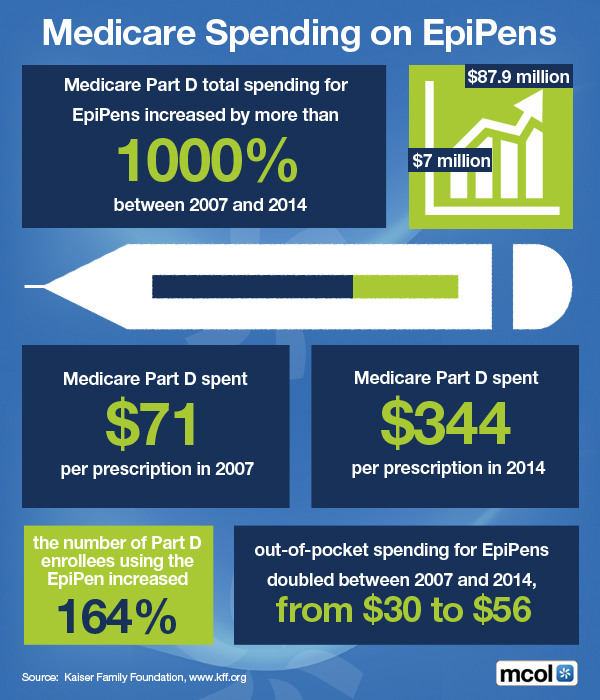
Medicare Spending on EpiPens

Join Our Mailing List 

Part D

By  http://www.MCOL.com

*** graphoid101216

***

Conclusion

Your thoughts and comments on this ME-P are appreciated. Feel free to review our top-left column, and top-right sidebar materials, links, URLs and related websites, too. Then, subscribe to the ME-P. It is fast, free and secure.

Speaker: If you need a moderator or speaker for an upcoming event, Dr. David E. Marcinko; MBA – Publisher-in-Chief of the Medical Executive-Post – is available for seminar or speaking engagements. Contact: MarcinkoAdvisors@msn.com

OUR OTHER PRINT BOOKS AND RELATED INFORMATION SOURCES:

Risk Management, Liability Insurance, and Asset Protection Strategies for Doctors and Advisors: Best Practices from Leading Consultants and Certified Medical Planners™8Comprehensive Financial Planning Strategies for Doctors and Advisors: Best Practices from Leading Consultants and Certified Medical Planners™

***

Massachusetts Governor Charlie Baker Moves to Control Professional Boards

Join Our Mailing List

But has the Medical Board made a Counter Move?

Langan MD[By Michael Lawrence Langan MD]

Governor Baker’s recent move to control professional boards seemed a promising step and I provided detailed documentation to the Director of Constituent Services at the Office of the C…

Massachusetts Governor Charlie Baker Moves to Control Professional Boards (But has the Medical Board made a Countermove?) 

Conclusion

Your thoughts and comments on this ME-P are appreciated. Feel free to review our top-left column, and top-right sidebar materials, links, URLs and related websites, too. Then, subscribe to the ME-P. It is fast, free and secure.

Speaker: If you need a moderator or speaker for an upcoming event, Dr. David E. Marcinko; MBA – Publisher-in-Chief of the Medical Executive-Post – is available for seminar or speaking engagements. Contact: MarcinkoAdvisors@msn.com

OUR OTHER PRINT BOOKS AND RELATED INFORMATION SOURCES:

 Risk Management, Liability Insurance, and Asset Protection Strategies for Doctors and Advisors: Best Practices from Leading Consultants and Certified Medical Planners™

***

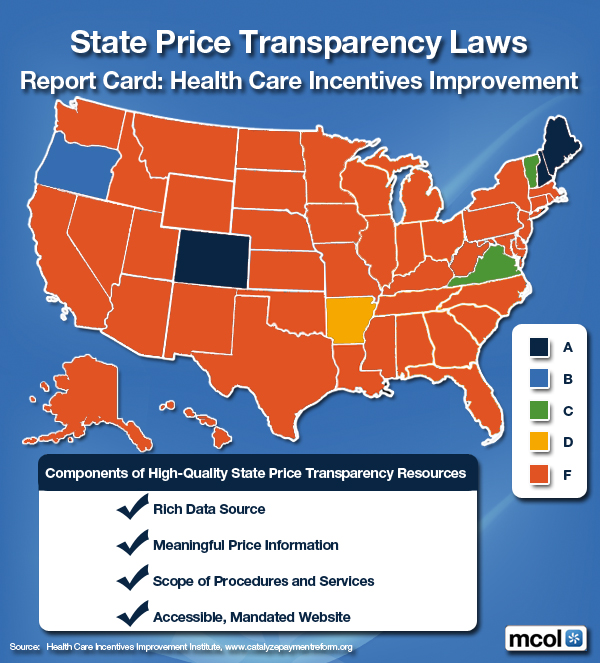
US State Healthcare Price Transparency Laws

Join Our Mailing List

REPORT CARD: Healthcare Incentives Improvement 

http://www.MCOL.com

***

***

Conclusion

Your thoughts and comments on this ME-P are appreciated. Feel free to review our top-left column, and top-right sidebar materials, links, URLs and related websites, too. Then, subscribe to the ME-P. It is fast, free and secure.

Speaker: If you need a moderator or speaker for an upcoming event, Dr. David E. Marcinko; MBA – Publisher-in-Chief of the Medical Executive-Post – is available for seminar or speaking engagements. Contact: MarcinkoAdvisors@msn.com

OUR OTHER PRINT BOOKS AND RELATED INFORMATION SOURCES:

Product DetailsProduct Details

***

What Insurance Means to the Doctor, Patient and Employers

Join Our Mailing List

And … What is Negotiable?

By Adam Russo, Esq.

[Free Market Medical Association]

Download the presentation Here

Conclusion

Your thoughts and comments on this ME-P are appreciated. Feel free to review our top-left column, and top-right sidebar materials, links, URLs and related websites, too. Then, subscribe to the ME-P. It is fast, free and secure.

Speaker: If you need a moderator or speaker for an upcoming event, Dr. David E. Marcinko; MBA – Publisher-in-Chief of the Medical Executive-Post – is available for seminar or speaking engagements. Contact: MarcinkoAdvisors@msn.com

OUR OTHER PRINT BOOKS AND RELATED INFORMATION SOURCES:

 Product DetailsProduct Details

***

A Brief History of Medical Boards

Join Our Mailing List 

From 1792

Dover

[By Eric A Dover MD] 

The first medical board was established in Connecticut in 1792 by the state legislature. It consisted of a group of physicians who evaluated the competency of physicians wishing to practice in the State. Medical Boards eventually evolved and became very powerful with the addition of Medical Practice Acts containing a plethora of administrative rules. The Medical Boards stated mission was, and still is, the protection, health and safety of the public. State Boards formed a national group, the Federation of State Medical Boards (FSMB), in 1912. The FSMB was the first institution to publically list names of disciplined physicians in a monthly bulletin.

In the 1980’s and 1990’s there were a number of high profile cases involving physicians and public safety. One such case, international in scope, concerned surgeon Dr. Jayant Patel. Significant news coverage regarding his surgical outcomes and knowledge resulted in the heightened questioning of Medical Boards and whether they were actually fulfilling their mission of protecting public health and safety. The Oregon Medical Board (OMB) was scrutinized for allegedly “ignoring” 79 complaints, and at least three deaths, attributed to Dr. Patel’s surgical care from 1989 to 1998.  The OMB abdicated all responsibility for the situation with a myriad of excuses for why they had no control over this physician or the HMO he worked for.

The OMB then came to the state legislature with a “fix” to supposedly prevent any further such incidents. The OMB advocated for greater authority over physicians and greater independence from government oversight. With the din of the press and public, the Oregon Legislature gladly granted the OMB their wish. Other states followed Oregon’s example [4-6]. Not a single individual associated with the OMB, whether administrative or board member was investigated in any meaningful way for their horrendous dereliction of duty. Not one of them had their license restricted, suspended or revoked for such serious offenses.  None of them were ordered to pay out of pocket to go to “programs” for competency evaluations, psychological examinations or “courses” to help them become better board members. No one resigned, nor was anyone dismissed, from their position of power. The OMB’s inaction led to a number of deaths and numerous patients with chronic post-surgical medical disorders, yet all individuals involved with the OMB were protected from malpractice lawsuits.

***

md-defeated-

***

With cases such as Dr. Patel’s featured prominently in the mainstream media, Medical Boards nationwide came under intense public pressure and scrutiny as it became clear they were not fulfilling their mission of protecting the public’s health and safety. The public saw physicians as a privileged class, protected by their colleagues and Medical Boards. They were correct to a degree.  Public safety groups like Public Citizen, who had been taking Medical Boards, hospitals and large clinics to task for years regarding what they felt was a lack of physician oversight and discipline, began ranking state medical boards based on how many disciplinary actions they handed out each year.

***

vicious-dogs-module-5ee95aa0e5064756

***

In their 2011 report, Public Citizen’s Health Research Group Ranking of the Rate of State Medical Boards’ Serious Disciplinary Actions, 2009-2011, the authors made the erroneous assumption that the greater the number of physician “disciplines” (actions) per 1000 physicians, the better job that State’s Medical Board was doing.   Therefore, at 6.79 actions per 1000 physicians, Wyoming was doing the “best” job and at 1.33 actions per 1000 physicians, South Carolina was doing the “worst” job.

Medical Boards vary remarkably from state to state. There are only two constants among them. First, each state has a Medical Board. Second, the Board makes all final decisions concerning licensees. Otherwise, there’s no consistency when it comes to what’s sandwiched in between.

Assessment

The Medical Board’s authority is grounded in the States Medical Practice Act, which gives them the authority to enforce laws for licensing, monitoring and disciplining physicians in the state. Every state has its own unique laws and processes, but every medical practice act covers the basics regarding oversight of physicians practicing medicine in the State.  The U.S. Federation of State Medical Boards (FSMB) periodically issues guidelines on the essential elements of a medical practice act.  

ABOUT

Dr. Eric Dover is a board certified family practice and primary care physician in Portland, Oregon. He is a graduate of the University of California at Los Angeles [UCLA] School of Medicine.

Conclusion

Your thoughts and comments on this ME-P are appreciated. Feel free to review our top-left column, and top-right sidebar materials, links, URLs and related websites, too. Then, subscribe to the ME-P. It is fast, free and secure.

Speaker: If you need a moderator or speaker for an upcoming event, Dr. David E. Marcinko; MBA – Publisher-in-Chief of the Medical Executive-Post – is available for seminar or speaking engagements. Contact: MarcinkoAdvisors@msn.com

OUR OTHER PRINT BOOKS AND RELATED INFORMATION SOURCES:

               Risk Management, Liability Insurance, and Asset Protection Strategies for Doctors and Advisors: Best Practices from Leading Consultants and Certified Medical Planners™

 Harvard Medical School

Boston Children’s Hospital – Psychiatrist

Yale University

***

What is Population Health?

Join Our Mailing List

DEM white shirtBy David Edward Marcinko MBBS DPM MBA MEd

http://www.DavidEdwardMarcinko.com

What is population health?

In its most fundamental sense, population health seeks to improve or manage the health of a specific population. It is a systematic, holistic approach that aims to prevent disease by keeping people healthy and improving the quality of care.

HDS

http://www.HealthDictionarySeries.org

In fact, according to my colleague David B. Nash MD MBA, Founding Dean and Endowed Chair at the Jefferson College of Population Health, population health programs and interventions work to:

  • Connect prevention, wellness and behavioral health with traditional health care delivery
  • Focus on improving the quality and safety of care, improving access to healthcare services and helping to prevent/manage chronic diseases in the service of a specific population
  • Advance policies and solutions to address socio-economic and cultural factors (social determinants of health) that have an impact on health outcomes
  • Leverage technology and information systems to design social and community interventions and new models of health care delivery that facilitate care coordination and access

WHITE-PAPER: Population and Public Health

Conclusion

Your thoughts and comments on this ME-P are appreciated. Feel free to review our top-left column, and top-right sidebar materials, links, URLs and related websites, too. Then, subscribe to the ME-P. It is fast, free and secure.

Speaker: If you need a moderator or speaker for an upcoming event, Dr. David E. Marcinko; MBA – Publisher-in-Chief of the Medical Executive-Post – is available for seminar or speaking engagements. Contact: MarcinkoAdvisors@msn.com

OUR OTHER PRINT BOOKS AND RELATED INFORMATION SOURCES:

Product DetailsProduct DetailsProduct Details

***

The Physician Certification Business?

Join Our Mailing List

Let’s Get Government Out of the Physician Certification Business

Accad

By  MD

Are all certification outfits created the same?

Should the government impose free market features?

Any pro-market health economists out there?

***

diploma

Should the government impose its own standards for certification for physicians?

The short answer is “no.”

***

Let’s Get Government Out of the Physician Certification Business

Conclusion

Your thoughts and comments on this ME-P are appreciated. Feel free to review our top-left column, and top-right sidebar materials, links, URLs and related websites, too. Then, subscribe to the ME-P. It is fast, free and secure.

Speaker: If you need a moderator or speaker for an upcoming event, Dr. David E. Marcinko; MBA – Publisher-in-Chief of the Medical Executive-Post – is available for seminar or speaking engagements. Contact: MarcinkoAdvisors@msn.com

OUR OTHER PRINT BOOKS AND RELATED INFORMATION SOURCES:

Risk Management, Liability Insurance, and Asset Protection Strategies for Doctors and Advisors: Best Practices from Leading Consultants and Certified Medical Planners™

***

Mobile HIPAA Solutions for Hospital & Health Systems

Join Our Mailing List 

New-Wave Health Information Technology

Carol S. Miller[By Carol Miller RN MBA] 

To help hospitals and health systems comply with Health Insurance Portability and Accountability Act regulations, best practices are emerging for securing all electronic communication – cloud, wireless, and texting – of protected health information.

These new technologies will continually be evolving with hospitals, providers and patients move to new means of communication.

Below is a description of how mobility solutions are impacted by HIPAA

The recent launches of Apple Health and Google Fit have stirred a lot of interest in health application development.  It is important that hospitals and providers understand the laws around PHI and HIPAA compliance for any healthcare-focused mobile application or software.  While not all healthcare applications fall under HIPAA rules, those that collect, store, or share personally identifiable health information with covered entities (such as hospitals and providers) must be HIPAA-compliant.

Enter PCs in the Examination Room

For years, hospitals have wanted to bring computers into exam rooms, waiting rooms, and treatment rooms to eliminate hard-to-read patient charts, making sure everyone treating the patient was seeing the same information, assuring that everything was recorded as it occurred, and enabling doctors, nurses, and technicians to stay connected to vital information and services wherever they were throughout the hospital.

Many hospitals have adopted Computer on Wheels (COWs) or tablets but many of these were hard to use, had poor touch-screen interface and did not last long on a battery.  Ipads seem to be the logical replacement as long as the iPad can comply with HIPAA rules.

***

men

***

HIPAA Not Aging Well?

HIPAA was written nearly 20 years ago, before mobile health applications were ever envisioned. Because of this, some areas of the law make it hard to determine which applications must be HIPAA- compliant and which are exempt.  Considering the numerous ways security breaches can occur with a mobile device, it is no wonder that HHS is very leery about how PHI is handled on smartphones, wearables, and portable devices.

Compliance

If the applications are going to send or share health data to a hospital, doctor or other covered entity, it MUST be HIPAA-compliant.  Adhering to the Privacy and Security Rules of HIPAA is essential, especially considering the dangers that come with handling protected health data on a device.

Examples include:

  • Phones, tablets, and wearables can be easily stolen and lost, meaning PHI could be compromised
  • Social media and email are easily accessible by the device, making it easy for users to post information that breaches HIPAA privacy laws.
  • Push notifications and other user communications can violate HIPAA laws if they contain PHI
  • Users may intentionally or unintentionally share personally identifiable information, even if the application’s intended use doesn’t account for it
  • Not all users take advanage of the password-protected screen-lock feature, making data visible and accessible to anyone who comes in contact with the device
  • Devices like the iPhone do not include physical keyboards, so users are more likely to use basic passwords that are not as safe as complex options.
  • This protected health information can include everything from medical records and images to scheduled appointment dates.

***

The-Psychology-of-Analytics-When-Working-is-Not-Working

***

Assessment

Regardless of the device, it is important to take all the steps possible to comply with HIPAA guidelines.

More: http://www.BusinessofMedicalPractice.com

Conclusion

Your thoughts and comments on this ME-P are appreciated. Feel free to review our top-left column, and top-right sidebar materials, links, URLs and related websites, too. Then, subscribe to the ME-P. It is fast, free and secure.

Speaker: If you need a moderator or speaker for an upcoming event, Dr. David E. Marcinko; MBA – Publisher-in-Chief of the Medical Executive-Post – is available for seminar or speaking engagements. Contact: MarcinkoAdvisors@msn.com

OUR OTHER PRINT BOOKS AND RELATED INFORMATION SOURCES:

Risk Management, Liability Insurance, and Asset Protection Strategies for Doctors and Advisors: Best Practices from Leading Consultants and Certified Medical Planners™  Risk Management, Liability Insurance, and Asset Protection Strategies for Doctors and Advisors: Best Practices from Leading Consultants and Certified Medical Planners™

***

Update on HIPAA Cloud Solutions for Hospitals and Health Systems

Join Our Mailing List 

New-Wave Technology and PHI

Carol S. Miller

[By Carol Miller RN MBA]

To help hospitals and health systems comply with Health Insurance Portability and Accountability Act regulations, best practices are emerging for securing all electronic cloud communication of protected health information.

These new technologies will continually be evolving with hospitals, providers and patients move to new means of communication.

Cloud Solutions

Cloud solutions are becoming a needed commodity in treating patients today but also present a risk to privacy and security violation. Despite the advantages of cloud computing, organizations are often hesitant to use it because of concerns about security and compliance.

Specifically, they fear potential unauthorized access to patient data and the accompanying liability and reputation damage resulting from the need to report HIPAA breaches. While these concerns are understandable, a review of data on HIPAA breaches published by the HHS shows that these concerns are misplaced.

In fact, by using a cloud-based service with an appropriate security and compliance infrastructure, a facility can significantly reduce its compliance risk.

***

d1052a30277425_561bf03a44905

***

But, because HIPAA compliance involves stringent privacy and security protections for electronic protected health information (PHI), many cloud providers are balking at signing new Business-Associate Agreements.

Most cloud-technology providers, such as Box and Dropbox, do not include the built-in privacy protections that guarantee HIPAA compliance. Because many cloud storage companies store plain-text data on their servers, PHI is especially vulnerable to breaches and compliance violations.

HIPAA Not Aging Well

HIPAA was written nearly 20 years ago, before cloud health applications were even envisioned. Because of this, some areas of the law make it hard to determine which applications must be HIPAA- compliant and which are exempt.  Considering the numerous ways security breaches can occur with a cloud solution, it is no wonder that HHS is very leery about how PHI is handled on server farms in the cloud.

Assessment

Regardless of the storage modality – it is important to take all the steps possible to comply with HIPAA guidelines.

Conclusion

Your thoughts and comments on this ME-P are appreciated. Feel free to review our top-left column, and top-right sidebar materials, links, URLs and related websites, too. Then, subscribe to the ME-P. It is fast, free and secure.

Speaker: If you need a moderator or speaker for an upcoming event, Dr. David E. Marcinko; MBA – Publisher-in-Chief of the Medical Executive-Post – is available for seminar or speaking engagements. Contact: MarcinkoAdvisors@msn.com

OUR OTHER PRINT BOOKS AND RELATED INFORMATION SOURCES:


Risk Management, Liability Insurance, and Asset Protection Strategies for Doctors and Advisors: Best Practices from Leading Consultants and Certified Medical Planners™ Risk Management, Liability Insurance, and Asset Protection Strategies for Doctors and Advisors: Best Practices from Leading Consultants and Certified Medical Planners™

***

Core Universal Concepts about Wealth Preservation and Asset Protection for Doctors

Join Our Mailing List 

IKE

 By Ike Devji JD PC

Understanding these Four Core Concepts 

Think of asset protection they way you teach patients about wellness.

It’s a system and lifestyle that requires some discipline and good habits in four core areas:

  1. A culture of good habits, procedures, accountability and compliance

Avoiding or eliminating higher risk behavior often starts with having good, professionally drafted, legally compliant policies and procedures on a variety of risk management issues and consistently implementing and enforcing them uniformly. There is no more dangerous and ineffective manager than one who is conflict averse or who wants to be everyone’s friend. Leadership requires that you help everyone be and do their best by managing them actively and creating expectations and boundaries.

  1. Proactively managing all your predictable risks, not just those related to medical malpractice

We won’t dwell on this issue beyond noting that medical malpractice lawsuits are still a real threat and no matter what various experts tell you about statistics, how many actually go trial, or future reductions due to the PP-ACA, etc.; we all have seen the devastating first hand effects of these claims. And, no matter how remote a risk may be;: what if it is you? Are you emotionally, legally and financially prepared[i] for a adverse claim or judgment that could potentially stop your income, cost you your hospital privileges or practice, trigger a payer audit and/or take seven figures off your life’s work and net worth? Most physicians are not.

That said, malpractice liability is not the only, or even the most predictable and recurring exposure you face. You are a physician, but you are also potentially an executive, a parent, a business owner, a compliance officer, a breadwinner, the driver of vehicle, the owner of a home; and wear a variety of other hats you may not even think about. Having experienced help in properly identifying as many of these other, non profession liability risks as possible, and addressing them proactively both personally and professionally is a key part of any defensive strategy.

  1. Insurance, all the right kinds and in the right amounts

Insurance needs to be thought of as an “insurance program”, not a line item, and works as a system of overlapping coverage. Most physicians have an overly simplified vision of what they should have in place, mainly some form of professional liability insurance typically a “1-3” policy meaning $1-MM per occurrence policy with a $3-MM aggregate. Many attorneys advise physicians to buy, “Every dollar you can afford, then have a back-up plan.” This goes far beyond your professional liability or malpractice insurance and includes half a dozen or more varieties of specialty insurance that can be well covered with the help of a top-notch property and casualty (P&C) insurance agent. A word of caution, having an asset protection plan consisting of putting defensive legal tools in place without the complimentary insurance, commonly known as “going bare”, is never the best idea and if nothing else, subjects you to the exposure of massive legal fees for defense costs which are easily six figures.

  1. Defensive legal structures

There will inevitably be gaps in the number of things that can be covered or the dollar limit to which you can insure yourself. Do not ever rely on your “umbrella” policy alone as effective universal coverage. This is where all the trusts, LLCs, partnerships, corporate structures and estate-planning techniques attorneys are fond of and come into play. You must have good policies and procedures with insurance against instances in case those fail, and have a backup plan if the first two layers fail.

Remember that asset protection is fact specific and use your facts. Every doctor seeking asset protection must have a thorough review of his/her own assets, have his/her personal and professional risks identified and have tools and solutions implemented by a qualified and experienced professional.

In other words, the familiar pattern of examination, diagnosis and then personalized treatment. There may be a reasonable and proven course of treatment for any particular problem, but your advisors should always know what the problems are before they start proposing specific solutions.

[i]  The Physician’s (and Business Owner’s) Asset Protection Self Exam: http://www.proassetprotection.com/2012/05/the-physicians-simple-asset-protection-self-exam/

***

207_1

***

Conclusion

Your thoughts and comments on this ME-P are appreciated. Feel free to review our top-left column, and top-right sidebar materials, links, URLs and related websites, too. Then, subscribe to the ME-P. It is fast, free and secure.

Speaker: If you need a moderator or speaker for an upcoming event, Dr. David E. Marcinko; MBA – Publisher-in-Chief of the Medical Executive-Post – is available for seminar or speaking engagements. Contact: MarcinkoAdvisors@msn.com

OUR OTHER PRINT BOOKS AND RELATED INFORMATION SOURCES:

[PHYSICIAN FOCUSED FINANCIAL PLANNING AND RISK MANAGEMENT COMPANION TEXTBOOK SET]

  Risk Management, Liability Insurance, and Asset Protection Strategies for Doctors and Advisors: Best Practices from Leading Consultants and Certified Medical Planners™ Comprehensive Financial Planning Strategies for Doctors and Advisors: Best Practices from Leading Consultants and Certified Medical Planners™

[Dr. Cappiello PhD MBA] *** [Foreword Dr. Krieger MD MBA]

***

Common Asset Protection Risk Factors for Physicians

Join Our Mailing List

The “Issues” LIST

IKE

By Ike Devji JD

CHECKLIST

This check list is simple and by no means complete, but it helps explain the detail and variety of issues and exposures involved in preserving the assets you have at risk.

List of Exposures

• Do you and or any family members drive a vehicle?
Do you have employees?
• Do you have a professional malpractice exposure?
• Do you have a legal responsibility to protect medical and financial data?
• Are you married and do you have assets not protected by a pre-nuptial agreement?
• Do you have a current tax obligation?
Do you have children?
• Do you own a business?
• Are you a board member, officer, or director of a corporation?
• Do you have hobbies or engage in activities like hunting, flying, boating, etc?
• Do you have partners whose actions create joint and several liabilities for you?
• Do you have personal guarantees on real estate or for business loans?
• Do you have tail liability for professional services performed in the past?
• Have you made specific legal or financial representations that others have relied upon in a business context?
What kind and what dollar amount of insurance and legal planning have you implemented against these exposures?

Assessment

Knowledge is power, so use the links above to continue your exploration and act on these issues before an exposure threatens, while the widest and most effective array of options can be implemented to protect your success.

***

IRA Cecklists

***

Conclusion

Your thoughts and comments on this ME-P are appreciated. Feel free to review our top-left column, and top-right sidebar materials, links, URLs and related websites, too. Then, subscribe to the ME-P. It is fast, free and secure.

Speaker: If you need a moderator or speaker for an upcoming event, Dr. David E. Marcinko; MBA – Publisher-in-Chief of the Medical Executive-Post – is available for seminar or speaking engagements. Contact: MarcinkoAdvisors@msn.com

OUR OTHER PRINT BOOKS AND RELATED INFORMATION SOURCES:

[PHYSICIAN FOCUSED RISK MANAGEMENT TEXTBOOK]

Risk Management, Liability Insurance, and Asset Protection Strategies for Doctors and Advisors: Best Practices from Leading Consultants and Certified Medical Planners™

***

ME-P Health Economics, Financial Planning & Investing, Medical Practice, Risk Management and Insurance Textbooksfor Doctors and Advisors

ME-P At Your Service!

***

[PHYSICIAN FOCUSED FINANCIAL PLANNING AND RISK MANAGEMENT COMPANION TEXTBOOK SET]

  Risk Management, Liability Insurance, and Asset Protection Strategies for Doctors and Advisors: Best Practices from Leading Consultants and Certified Medical Planners™Comprehensive Financial Planning Strategies for Doctors and Advisors: Best Practices from Leading Consultants and Certified Medical Planners™

[HOSPITAL OPERATIONS, ORGANIZATIONAL BEHAVIOR AND FINANCIAL MANAGEMENT COMPANION TEXTBOOK SET]

Product DetailsProduct Details

[Foreword Dr. Phillips MD JD MBA LLM] *** [Foreword Dr. Nash MD MBA FACP]

[HEALTH INSURANCE, MANAGED CARE, ECONOMICS, FINANCE AND HEALTH INFORMATION TECHNOLOGY COMPANION DICTIONARY SET]

      Product DetailsProduct DetailsProduct Details

[Mike Stahl PhD MBA] *** [Foreword Dr.Mata MD CIS] *** [Dr. Getzen PhD]

***

Product Details

http://www.BusinessofMedicalPractice.com

***

Dr. David Edward Marcinko, editor-in-chief, is a next-generation apostle of Nobel Laureate Kenneth Joseph Arrow, PhD, as a health-care economist, insurance advisor, financial advisor, risk manager, and board-certified surgeon from Temple University in Philadelphia. In the past, he edited eight practice-management books, three medical textbooks and manuals in four languages, five financial planning yearbooks, dozens of interactive CD-ROMs, and three comprehensive health-care administration dictionaries. Internationally recognized for his clinical work, he is a distinguished visiting professor of surgery and a recipient of an honorary Bachelor of Medicine–Bachelor of Surgery (MBBS) degree from Marien Hospital in Aachen, Germany. He provides litigation support and expert witness testimony in state and federal court, with medical publications archived in the Library of Congress and the Library of Medicine at the National Institutes of Health.

***

New Tools for A Healthy Future

Join Our Mailing List

By Terri D. Wright, PhD, MPH                   

***

ImageProxy

***

APHA’s Policy Center Creates Tools for A Healthy Future

DEAR DAVID – The central challenge of the American Public Health Association is to create the healthiest nation in one generation. APHA’s Center for Public Health Policy was established almost 10 years ago to bring together analytical public health expertise and infuse the public health field with expert materials and tools in response to this challenge.

The Center embraces the public health issues that threaten population health. Our work is done through national and state partnerships and by leveraging resources across multiple sectors, including government, philanthropy and non-profit. Fundamental to all that we do: strategies to ensure health equity for all.

We invite you to learn about our work and stay abreast of our progress on producing resources for our members and constituents. The following priorities represent our core work to create a healthy nation:

  • Assuring health equity for all.
  • Promoting systems transformation to integrate public health and health care and improve population health.
  • Improving the natural and built environments to support health and create environmental justice.

We will keep you updated on our priority issues and encourage you to connect with our team.

We invite your feedback as we embark on this journey – phpolicycenter@apha.org

Sincerely,
Terri D Wright Signature

***

[HOSPITAL OPERATIONS, ORGANIZATIONAL [BEHAVIOR AND FINANCIAL MANAGEMENT COMPANION TEXTBOOK SET]

Product DetailsProduct Details

[Foreword Dr. Phillips MD JD MBA LLM] *** [Foreword Dr. Nash MD MBA FACP]

***

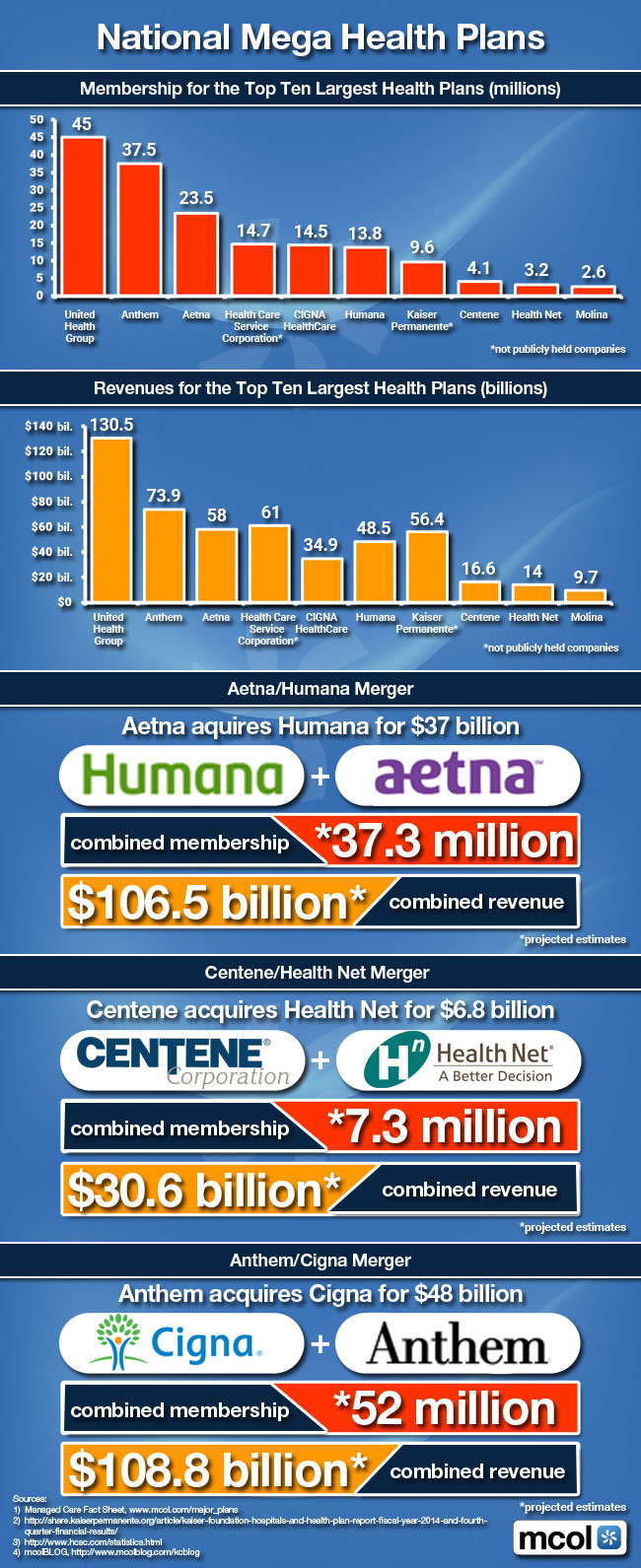
National Mega Health Plans

Join Our Mailing List

Membership Top 10 Largest Plans

By http://www.MCOL.com

ImageProxy

Conclusion

Your thoughts and comments on this ME-P are appreciated. Feel free to review our top-left column, and top-right sidebar materials, links, URLs and related websites, too. Then, subscribe to the ME-P. It is fast, free and secure.

Speaker: If you need a moderator or speaker for an upcoming event, Dr. David E. Marcinko; MBA – Publisher-in-Chief of the Medical Executive-Post – is available for seminar or speaking engagements. Contact: MarcinkoAdvisors@msn.com

OUR OTHER PRINT BOOKS AND RELATED INFORMATION SOURCES:

[HEALTH INSURANCE, MANAGED CARE, ECONOMICS, FINANCE AND HEALTH INFORMATION TECHNOLOGY COMPANION DICTIONARY SET]

Product DetailsProduct DetailsProduct Details

[Mike Stahl PhD MBA] *** [Foreword Dr.Mata MD CIS] *** [Dr. Getzen PhD] 

***

A Possible New Niche Area for [Health-Law] Attorneys?

Competent, Ethical and Fair Legal Representation for Doctors

By Michael Lawrence Langan MD

Wretched creatures are compelled by the severity of the torture to confess things they have never done and so by cruel butchery innocent lives are taken; and by new alchemy, gold and silver are coined from human blood.– Father Cornelius Loos (1592)

***


17th-century-tribunal

[“PHP-Approved Attorneys”]

Competent, Ethical and Fair Legal Representation for Doctors

***

Channel Surfing

Have you visited our other topic channels? Established to facilitate idea exchange and link our community together, the value of these topics is dependent upon your input. Please take a minute to visit. And, to prevent that annoying spam, we ask that you register.

Link: http://feeds.feedburner.com/HealthcareFinancialsthePostForcxos

Conclusion

Your thoughts and comments on this ME-P are appreciated. Feel free to review our top-left column, and top-right sidebar materials, links, URLs and related websites, too. Then, subscribe to the ME-P. It is fast, free and secure.

Speaker: If you need a moderator or speaker for an upcoming event, Dr. David E. Marcinko; MBA – Publisher-in-Chief of the Medical Executive-Post – is available for seminar or speaking engagements. Contact: MarcinkoAdvisors@msn.com

OUR OTHER PRINT BOOKS AND RELATED INFORMATION SOURCES:

Risk Management, Liability Insurance, and Asset Protection Strategies for Doctors and Advisors: Best Practices from Leading Consultants and Certified Medical Planners™8Comprehensive Financial Planning Strategies for Doctors and Advisors: Best Practices from Leading Consultants and Certified Medical Planners™

The Preventing and Reducing Improper Medicare and Medicaid Expenditures Act

Join Our Mailing List 

The PRIME Act

[By Carol Miller RN MBA PMP]

Carol S. Miller

First there was Amazon PRIME; now there is another PRIME.

The Act

This Act was introduced into congress in 2013 and contains a number of provisions that would increase rewards and incentives for those who uncover healthcare fraud, as well as heighten penalties for those who commit it.

What it is

The PRIME  Act would enact stronger penalties for Medicare and Medicaid fraud; curb improper or mistaken payments made by Medicare and Medicaid; establish stronger fraud and waste prevention strategies with Medicare and Medicaid to help phase out the practice of “pay and chase” (i.e., recouping monies already erroneously paid to providers instead of detecting problems on the front end); curb the theft of physician identities; expand the fraud identification and reporting work of the Senior Medicare patrol; take steps to help states identify and prevent Medicaid overpayments; and improve the sharing of fraud data across state and federal agencies and programs.

***

199H

***

HIPAA

The law directs the Secretary to develop a plan to revise the incentive program under HIPAA for the reporting of fraud and abuse to encourage greater participation by individuals reporting Medicare fraud and abuse.

Assessment

The law also requires the plan to include certain recommendations for ways to enhance rewards for individuals reporting and an extension of the incentive program to the Medicaid program.

Conclusion

Your thoughts and comments on this ME-P are appreciated. Feel free to review our top-left column, and top-right sidebar materials, links, URLs and related websites, too. Then, subscribe to the ME-P. It is fast, free and secure.

ABOUT

Ms. Carol S. Miller has an extensive healthcare background in operations, business development and capture in both the public and private sector. Over the last 10 years she has provided management support to projects in the Department of Health and Human Services, Veterans Affairs, and Department of Defense medical programs. In most recent years, Carol has served as Vice President and Senior Account Executive for NCI Information Systems, Inc., Assistant Vice President at SAIC, and Program Manager at MITRE. She has led the successful capture of large IDIQ/GWAC programs, managed the operations of multiple government contracts, interacted with many government key executives, and increased the new account portfolios for each firm she supported. She earned her MBA from Marymount University; BS in Business from Saint Joseph’s College, and BS in Nursing from the University of Pittsburgh. She is a Certified PMI Project Management Professional (PMP) (PMI PMP) and a Certified HIPAA Professional (CHP), with Top Secret Security clearance issued by the DoD in 2006. Ms. Miller is also a HIMSS Fellow.

Speaker: If you need a moderator or speaker for an upcoming event, Dr. David E. Marcinko; MBA – Publisher-in-Chief of the Medical Executive-Post – is available for seminar or speaking engagements. Contact: MarcinkoAdvisors@msn.com

OUR OTHER PRINT BOOKS AND RELATED INFORMATION SOURCES:

Comprehensive Financial Planning Strategies for Doctors and Advisors: Best Practices from Leading Consultants and Certified Medical Planners(TM) 

Product DetailsProduct Details

Moving the Goalpost [Criminal Violations of HIPAA by PHS, Quest and USDTL]

Join Our Mailing List

clinical drug trials

Disrupted Physician

imgres-22

Information obtained under HIPAA Privacy Rule

1.August 6, 2014 to Langan with health materials   2. Quest-Clinical

PastedGraphic-1

The elements of a criminal offense under HIPAA are fairly straightforward.  To commit a “criminal offense” under HIPAA, a person must knowingly and in violation of the HIPAA rules do one (or more) of the following three things.:  use or cause to be used a unique health identifier, obtain individually identifiable health information relating to an individual or disclose individually identifiable health information to another  person.   Criminal penalties under HIPAA, tiered in accordance with the seriousness of the offense, range from a fine of up to $50,000 and/or imprisonment up to a year for a simple violation to a fine up to $100,000 and/or imprisonment up to five years for an offense committed under a false pretense and a fine up to $250000 and/or imprisonment up to ten years for an…

View original post 3,591 more words

The Quality of Life Structured Resident Interview and Care Plan

Join Our Mailing List

Creating person-centered care plans in the nursing home

[By Staff Reporters]

About

The Quality of Life Structured Resident Interview and Care Plan is a system for creating individualized, person-centered care plans in the nursing home.

This interview-based approach to care planning generates the information staff need to tailor a resident’s care plan to their preferences, as well as quantitative measurement of individual and facility-level outcomes.

Funding was provided through a seed money grant by the University of Pittsburgh Institute on Aging. For further information about the University of Pittsburgh Institute on Aging please visit http://www.aging.pitt.edu/

***

woman

***

More: Superannuation Demographics for Financial Advisors

Assessment

The major funding for the Improving Quality of Life in Nursing Homes Through Use of Structured Resident Interviews project was also provided by a grant through The Commonwealth Fund. More information about The Commonwealth Fund can be found at their website here: http://thecommonwealthfund.net/

Contact

Howard Degenholtz, PhD Prinicpal Investigator Department of Health Policy and Management Center for Bioethics and Health Law University of Pittsburgh 130 DeSoto St., A616 Pittsburgh, PA 15213

Link: http://www.improvingqol.pitt.edu/home

Conclusion

Your thoughts and comments on this ME-P are appreciated. Feel free to review our top-left column, and top-right sidebar materials, links, URLs and related websites, too. Then, subscribe to the ME-P. It is fast, free and secure.

Speaker: If you need a moderator or speaker for an upcoming event, Dr. David E. Marcinko; MBA – Publisher-in-Chief of the Medical Executive-Post – is available for seminar or speaking engagements. Contact: MarcinkoAdvisors@msn.com

OUR OTHER PRINT BOOKS AND RELATED INFORMATION SOURCES:

Product Details

Comprehensive Financial Planning Strategies for Doctors and Advisors: Best Practices from Leading Consultants and Certified Medical Planners(TM) 

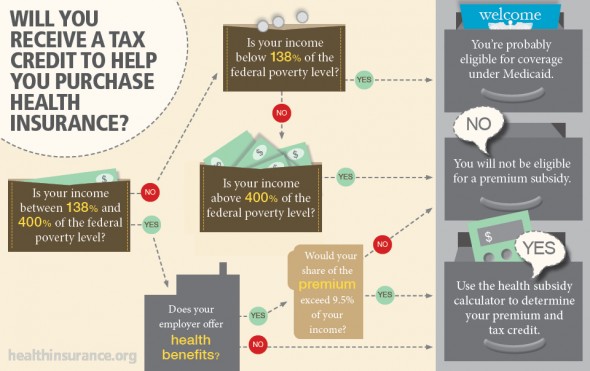
Will you receive a tax credit to help you purchase health insurance?

Join Our Mailing List

An Infographic

By Healthinsurance.org

This infographic helps Americans determine whether they will be eligible for a health insurance premium subsidy under the Affordable Care Act aka Obamacare.

The infographic accompanies a story by blogger Maggie Mahar, who explains not only how eligibility for health insurance tax credits is determined, but also how much recipients should expect to receive.

The article also includes a chart with federal poverty level (FPL) numbers and links to a Kaiser Family Foundation premium subsidy calculator

Link: Healthinsurance.org

The graphic was created by Mahar, HIO editor Steve Anderson, and designer Barb Etzkorn. It was posted on the Blog of the Health Insurance Resource Center, one of the longest running sources of consumer health insurance information on the Web.

***

obamacare-and-premium-subsidies-590x371

[Click to Enlarge]

Assessment

All healthcare and medical professionals should be aware of the information in this info-graphic; all FAs, too!

More:

Conclusion

Your thoughts and comments on this ME-P are appreciated. Feel free to review our top-left column, and top-right sidebar materials, links, URLs and related websites, too. Then, subscribe to the ME-P. It is fast, free and secure.

Speaker: If you need a moderator or speaker for an upcoming event, Dr. David E. Marcinko; MBA – Publisher-in-Chief of the Medical Executive-Post – is available for seminar or speaking engagements. Contact: MarcinkoAdvisors@msn.com

OUR OTHER PRINT BOOKS AND RELATED INFORMATION SOURCES:

Product DetailsProduct Details

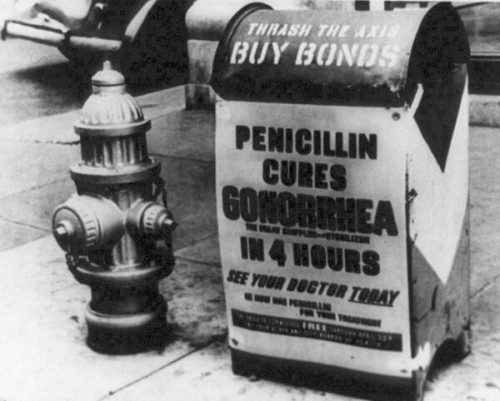
Syphilis Is Surging!

Join Our Mailing List 

Public Health Officials Aren’t Sure Why?

[By Staff Reporters]

Nationwide, the CDC reports that primary and secondary syphilis rates increased by 10 percent between 2012 and 2013—an infection rate more than twice as high as figures from 2001.

Geography

The Atlanta, Baltimore, Detroit, Los Angles, Miami, Orlando, Portland, San Antonio, San Diego and San Francisco metro areas have some of the highest syphilis rates, according to the CDC.

In the San Francisco Bay area, reported cases rose from 438 in 2009 to 814 in 2013. In Washington, D.C., Dr. Raymond C. Martins, senior director of clinical education at Whitman-Walker Health,says that the clinic saw a 32 percent increase in syphilis cases among patients between 2011 and 2014.

And, in recent months, at least 15 cases of ocular syphilis, a serious complication of the disease that can cause blindness, have been reported in California and Washington state, according to an alert released earlier this month by the CDC.

***

PCN

***

Assessment

Most of these infections have occurred among HIV-positive men who have sex with men.

Link: http://www.msn.com/en-us/news/us/syphilis-is-surging-and-us-public-health-officials-arent-sure-why/ar-AAb3qBf?ocid=iehp

More:

Even More: Antibiotic Shortages on the Rise in US

Conclusion

Your thoughts and comments on this ME-P are appreciated. Feel free to review our top-left column, and top-right sidebar materials, links, URLs and related websites, too. Then, subscribe to the ME-P. It is fast, free and secure.

Speaker: If you need a moderator or speaker for an upcoming event, Dr. David E. Marcinko; MBA – Publisher-in-Chief of the Medical Executive-Post – is available for seminar or speaking engagements. Contact: MarcinkoAdvisors@msn.com

OUR OTHER PRINT BOOKS AND RELATED INFORMATION SOURCES:

Product DetailsProduct DetailsProduct Details

On Getting Health Insurance [A Personal Journey]

 Join Our Mailing List 

A Former Teacher Engages Reality

[By Jeffrey M. Hartman]                   

jhIn late 2014, I did something many teachers never have to consider doing. I sought my own health insurance. After leaving my teaching career, I opted to work for myself. My plan was to live off my savings while getting started. This meant I was going to have to buy insurance rather than rely on a school to provide it. The misadventure that unfolded provided unsurprising but unsettling insights.

Bubble-Boy

I lived in a bubble during my teaching career. The comforts my job afforded me affected my perspective. How did people in other fields work so late each day? Why did anyone agree to work during the summer? I had a salary that kept me more than comfortable and health insurance that most people would have envied. Although I frequently reminded myself how fortunate I was, I still took too much of my situation for granted. When I decided to up and leave, reality poured into my bubble.

Great Coverage

Health insurance had never concerned me. Working in schools my entire adult life, I didn’t fret over having coverage. It was a given; an amount taken out of each check. If anything, I felt guilty for having such great coverage. I rarely used it. I happened to be a healthy person and I infrequently visited my doctor. Being so cavalier about my coverage while other people suffered without it made me feel like some kind of heel. My wife used it occasionally, so it wasn’t completely wasted.

A Career Abandoned

By abandoning my career, I forced myself to face a sudden and real need for coverage. I’ll admit resenting the need to have something I wasn’t likely to use, but I accepted the situation and proceeded. I had left other teaching jobs. After each departure, I replaced the job quickly, moving to a better job each time. This was another example of my chosen field distorting reality. Not many people enjoy that kind of mobility. Benefits had come along with each new job. With no intention of taking a new job last fall and no immediate income from working for myself, I was on deck to try HealthCare.gov.

****

Healthcare Gov Search

****

Enter HealthCare.gov

Prior to any of this, most of my experience in dealing with health insurance involved my mother. I helped her get Supplemental Security Income and Medical Assistance. The process was arduous, but after an appeal, she got what she needed. More recently, I assisted my grandmother in connecting with a home health care aide through her insurance. This was tricky as well, but perseverance paid off. Having to deal with these systems gave me a notion of what to expect when navigating a massive health insurance bureaucracy.

Experienced as I was, working through HealthCare.gov tested my patience. The site achieved infamy in early 2014 following its beleaguered launch. I expected the site administrators to have fixed most of the bugs for the second year. Perhaps they had. What I found was convoluted, nonetheless. I managed, but not without incident.

Registration

The first hiccup came during registration. I followed the directions on the screen and provided the requested information, but the site couldn’t verify my identification. I’d never had a problem like this registering for anything else. It prompted me to upload registration documents, but I found no way to do this. I called customer service and a helpful but disaffected person verified my identification simply by asking for my address and Social Security number.

I completed the application and was eager to see my results. Before I registered, I had investigated what coverage might be available. I expected to be eligible for one of several seemingly suitable plans. Upon seeing my results, I was shocked to find my wife and I only qualified for Medicaid. Nothing else was available. I knew Medicaid had a resource limit in my state. I also knew my savings were approximately thirty times that limit. The site never asked about resources. It only asked for income, which was zero at the time. My wife’s income didn’t put us over the Medicaid income limit, but this was irrelevant.

I realized my situation was an anomaly. Most people don’t go from my former income to nothing by choice while not having any solid replacement. At the time, I was paying a high premium for continuing coverage from my former employer. I was determined to get something less costly through the Marketplace for the start of 2015. My state was going to deny me Medicaid. I had to appeal.

Non-Appeals

I couldn’t find a way to appeal online, at least not in my state. I had to mail the completed appeal form. After several weeks, I got no response. The deadline approached for having coverage by the first of the year. I called customer service. The representative told me I’d have to apply for Medicaid and get rejected before appealing. This was going to take too long. I called my state Department of Health and Welfare. A representative confirmed I’d be denied. He urged me to call HealthCare.gov again and simply state I’d been denied instead of going through the process. I did. I handled the appeal over the phone. An hour later, I had new insurance. I had even paid my first premium, which definitely stung.

Over the next month, HealthCare.gov sent me three letters and called me twice to remind me my identification had yet to be verified and my appeal had been denied. I politely informed them I had handled each issue. No one I spoke with could tell that I had, nor could they tell I’d selected and paid for coverage, even though I had.

****

doctors

****

New Coverage

Dealing with the new coverage was almost comical. I’d selected the same provider I had while teaching, but a different plan. My wife and I selected the same physicians we had seen for years. Despite our history with each, making appointments or filling prescriptions required us to provide detailed proof of our existence and needs through phone calls, faxes, and emails. This was necessary for the first several interactions. Inquiries and referrals were much more tedious than what we had known. Over four months, the provider sent us a total of ten new insurance cards. All the inefficiency with both systems prompted some reflection.

One could expect such confusion within large systems. However, I’ve thought of what difficulty others users might face. I’d like to think I’m relatively literate, tech-savvy, and patient. I have family members who would have been stumped after the first few screens of the on-line HealthCare.gov site. The parents of some of the students I taught would have had similar difficulty. People in such situations might have the greatest need for coverage. The complicated and buggy nature of Healthcare.gov requires a small army of customer service operators to help befuddled applicants through problems. I shiver thinking about the resources spent maintaining this backup system in lieu of having a more functional interface, but I guess this creates jobs. Similarly, my actual provider requires a maddening degree of redundancy that might strain the coping skills of needy clients. I wonder how many people just give up when pursing complicated but necessary claims.

Assessment

Perhaps by 2016 HealthCare.gov will be streamlined and smart enough to not confound its users. My provider might be as streamlined and smart as it’s going to get. I’ve rarely seen such bloated systems. Maybe I’ve been ignorant to what other people endure. Having outstanding coverage handed to me while teaching and being healthy my whole life kept me out of touch. My new experiences were mild inconveniences, but I fear how similar complications could stifle those really needing help. I suppose I’ve emerged from my bubble.

More:

ABOUT

Jeffrey M. Hartman is a former teacher who blogs at http://jeffreymhartman.com/

Conclusion

Your thoughts and comments on this ME-P are appreciated. Tell us YOUR story. Feel free to review our top-left column, and top-right sidebar materials, links, URLs and related websites, too. Then, subscribe to the ME-P. It is fast, free and secure.

Speaker: If you need a moderator or speaker for an upcoming event, Dr. David E. Marcinko; MBA – Publisher-in-Chief of the Medical Executive-Post – is available for seminar or speaking engagements. Contact: MarcinkoAdvisors@msn.com

OUR OTHER PRINT BOOKS AND RELATED INFORMATION SOURCES:

Comprehensive Financial Planning Strategies for Doctors and Advisors: Best Practices from Leading Consultants and Certified Medical Planners(TM)

On The State Licensing Process of Physicians

Join Our Mailing List

By State Medical Boards


robert-cimasitodd-zigrang

By ROBERT JAMES CIMASI; MHA, ASA, FRICS, MCBA, AVA, CM&AA, CMP

By TODD A. ZIGRANG; MBA, MHA, ASA, FACHE

(C) Health Capital Consultants, LLC All rights reserved. St. Louis, MO USA

A SPECIAL ME-P REPORT

USA

http://www.HealthCapital.com

Every state and the District of Columbia require the licensure of all allopathic (M.D.) and osteopathic (D.O.) physicians [1] Although the specific criteria for licensure vary by state, each state requires candidates to submit proof of completion of the requisite number of years of graduate medical education and passage of examinations verifying that “the physician is ready and able to practice competently and safely in an independent setting [2].

Moral Character

Additionally, a physician applying for licensure is typically required to have “good moral character,” absent his or her involvement in illegal activities [3] Most physicians satisfy the exam requirement by submitting proof of their successful completion of the United States Medical Licensing Examination (USMLE) or the Comprehensive Osteopathic Medical Licensing Examination (COMLEX-USA) to the licensure board [4] However, as some practicing physicians may have been licensed under a previously administered exam, certain state licensing boards may consider a combination of other examinations sufficient to meet licensure requirements, so long as those exams were completed prior to 2000 [5]

Of State Medical Boards

The licensure of physicians is governed by a state medical board, the “primary responsibility” of which board, according to the Federation of State Medical Boards, is to “protect consumers of health care by ensuring that all physicians…are properly licensed and comply with various laws and regulations pertaining to the practice of medicine[6] To accomplish this goal, state legislatures have delegated certain powers to the state’s medical board, including the power to grant, suspend, and revoke licenses; conduct investigations into complaints against physicians; and, release guidelines related to best medical practices [7] State medical boards have traditionally consisted solely of physicians; however, there has recently been an increase in the number of non-physician board members on state medical boards [8].

History

Over the last 50 years, state medical boards have faced intense scrutiny regarding their commitment to disciplining physicians based on quality concerns [9] In 1960, the American Medical Association (AMA) heard “sobering” facts from the Federation of State Medical Boards that “much confusion over the definitions and objectives exists” related to state medical board enforcement of medical standards [10] From 1963 to 1967, 0.06% of all physicians were subject to discipline, while in 1981, 0.14% of all physicians were subject to discipline, due in large part to the problems identified by the AMA [11] Although the rate of physician discipline rose eightfold by the mid-1990s, to date, there are continuing concerns regarding state medical board enforcement of quality standards.

A March 2011 report by advocacy group Public Citizen found that over 55% of physicians who faced clinical privilege disciplines by hospitals from 1990 to 2009 did not have a corresponding action from a state medical board [12] Additionally, in 2011, state medical boards imposed 3.06 “serious disciplinary actions” (e.g., revocations, surrenders, suspensions, and probations of medical licenses) per 1,000 physicians, an increase from the 2010 rate of 2.97 per 1,000, but a decrease from the 2004 rate of 3.72 per 1,000 [13] Numerous reasons have been offered to explain the disparity in quality enforcement by state medical boards, the most prominent being that physicians are loath to report fellow physicians for major disciplinary actions such as licensure revocation[14]

***

nurses

***

Assessment

Other reasons include a focus by state medical boards on “character-related misconduct” over clinical quality standards [15] as well as a lack of resources to investigate and enforce quality standards, which forces state medical boards to rely on physicians and hospitals to “police” themselves [16].

More:

Channel Surfing the ME-P

Have you visited our other topic channels? Established to facilitate idea exchange and link our community together, the value of these topics is dependent upon your input. Please take a minute to visit. And, to prevent that annoying spam, we ask that you register. It is fast, free and secure.

© 2015 HCC, LLC. All rights reserved. USA

Conclusion

Your thoughts and comments on this ME-P are appreciated. Feel free to review our top-left column, and top-right sidebar materials, links, URLs and related websites, too. Then, subscribe to the ME-P. It is fast, free and secure.

Speaker: If you need a moderator or speaker for an upcoming event, Dr. David E. Marcinko; MBA – Publisher-in-Chief of the Medical Executive-Post – is available for seminar or speaking engagements. Contact: MarcinkoAdvisors@msn.com

OUR OTHER PRINT BOOKS AND RELATED INFORMATION SOURCES:

 REFERENCES

[1]       “State Medical Boards: Future Challenges for Regulation and Quality Enhancement of Medical Care,” By James N. Thompson, Journal of Legal Medicine, Vol. 33, No. 9 (January-March 2012).

[2]       “State Medical Boards: Future Challenges for Regulation and Quality Enhancement of Medical Care,” By James N. Thompson, Journal of Legal Medicine, Vol. 33, No. 9 (January-March 2012); “Healthcare Valuation: The Four Pillars of Healthcare Value,” By Robert James Cimasi, MHA, ASA, FRICS, MCBA, AVA, CM&AA, Hoboken, NJ: John Wiley & Sons, Inc., 2014, p. 449-450.

[3]       “Medical Practice: Education and Licensure,” in “Legal Medicine,” By S. Sandy Sanbar et al., 6th Ed., Mosby, 2004, p. 81.

[4]       “Medical Licensure,” American Medical Association, 2014, http://www.ama-assn.org/ama/pub/education-careers/becoming-physician/medical-licensure.page, (Accessed 12/19/14); “COMLEX-USA,” National Board of Osteopathic Medical Examiners, 2014, http://www.nbome.org/exams-faq.asp (Accessed 12/19/14).

[5]       “Medical Licensure,” American Medical Association, 2014, http://www.ama-assn.org/ama/pub/education-careers/becoming-physician/medical-licensure.page, (Accessed on 12/19/14); “Healthcare Valuation: The Four Pillars of Healthcare Value,” By Robert James Cimasi, MHA, ASA, FRICS, MCBA, AVA, CM&AA, Hoboken, NJ: John Wiley & Sons, Inc., 2014, p. 450.

[6]       “What is a State Medical Board?” Federation of State Medical Boards, 2014, http://www.fsmb.org/policy/what-is-a-smb-faq (Accessed 12/19/14).

[7]       “What is a State Medical Board?” Federation of State Medical Boards, 2014, http://www.fsmb.org/policy/what-is-a-smb-faq (Accessed 12/19/14).

[8]       “What is a State Medical Board?” Federation of State Medical Boards, 2014, http://www.fsmb.org/policy/what-is-a-smb-faq (Accessed 12/19/14); “Character, Competence, and the Principles of Medical Discipline,” By Nadia N. Sawicki, Journal of Health Care Law & Policy, Vol. 13, No. 1, 2010, p. 291.

[9]       “Character, Competence, and the Principles of Medical Discipline,” By Nadia N. Sawicki, Journal of Health Care Law & Policy, Vol. 13, No. 1, 2010, p. 287, n. 7; “To Err is Human: Building a Safer Health System – Summary,” Institute of Medicine, 2000, http://www.iom.edu/~/media/Files/Report%20Files/1999/To-Err-is-Human/To%20Err%20is%20Human%201999%20%20report%20brief.pdf (Accessed 12/19/14).

[10]     “Medical Licensure Statistics for 1960,” Journal of the American Medical Association, Vol. 176, No. 8 (May 27, 1961), p. 694.

[11]     “Medical Licensing Board Characteristics and Physician Discipline: An Empirical Analysis,” By Mark T. Law & Zeynep K. Hansen, Journal of Health Politics, Policy and Law, Vol. 35, No. 1 (February 2010), p. 66.

[12]     “State Medical Boards Fail to Discipline Doctors with Hospital Actions Against Them,” By Alan Levine et al., Public Citizen, March 2011, http://www.citizen.org/documents/1937.pdf (Accessed 12/19/14).

[13]     “Public Citizen’s Health Research Group Ranking of the Rate of State Medical Boards’ Serious Disciplinary Actions, 2009-2011,” By Sidney M. Wolfe, M.D., et al., Public Citizen, May 17, 2012, http://www.citizen.org/documents/2034.pdf (Accessed 12/19/14).

[14]     “Medical Boards are Too Lax, Critics Claim,” By Wayne J. Guglielmo, MA, MedScape, October 17, 2014, http://www.medscape.com/viewarticle/833141 (Accessed 12/3/14);

[15]     “Character, Competence, and the Principles of Medical Discipline,” By Nadia N. Sawicki, Journal of Health Care Law & Policy, Vol. 13, No. 1, 2010, p. 287.

[16]     “Medical Licensing Board Characteristics and Physician Discipline: An Empirical Analysis,” By Mark T. Law & Zeynep K. Hansen, Journal of Health Politics, Policy and Law, Vol. 35, No. 1 (February 2010), p. 90; “Medical Licensure Statistics for 1960,” Journal of the American Medical Association, Vol. 176, No. 8, May 27, 1961, p. 694.

NC Update: H543v2 – 04152015

Comprehensive Financial Planning Strategies for Doctors and Advisors: Best Practices from Leading Consultants and Certified Medical Planners(TM)* 8

Product DetailsProduct Details

Emerging New-Wave Cloud Technology for HIPAA

Join Our Mailing List

Securing Electronic Communication in the Cloud

[By Carol S. Miller BSN MBA PMP]

Carol S. MillerTo help hospitals and health systems comply with burdens of the Health Insurance Portability and Accountability Act [HIPAA] regulations, best practices are emerging for securing all electronic communication – cloud, wireless, and texting –  of protected health information.

These new technologies will continually be evolving with hospitals, providers and patients move to new means of communication.

And so, below is a very brief description of one: cloud solutions.

Cloud Solutions

Cloud solutions are becoming a needed commodity in treating patients today but also present a risk to privacy and security violation.  Despite the advantages of cloud computing, organizations are often hesitant to use it because of concerns about security and compliance.

Specifically, they fear potential unauthorized access to patient data and the accompanying liability and reputation damage resulting from the need to report HIPAA breaches. While these concerns are understandable, a review of data on HIPAA breaches published by the HHS shows that these concerns are misplaced.

In fact, by using a cloud-based service with an appropriate security and compliance infrastructure, a facility can significantly reduce its compliance risk.

***

USB drive

[A.I. and the “SINGULARITY”]*

***

Because HIPAA compliance involves stringent privacy and security protections for electronic protected health information (PHI), many cloud providers are balking at signing new Business-Associate agreements.

Most cloud-technology providers, such as Box and Dropbox, do not include the built-in privacy protections that guarantee HIPAA compliance. Because many cloud storage companies store plaintext data on their servers, PHI is especially vulnerable to breaches and compliance violations.

Note:

The SINGULARITY is that hypothetical moment in time when Artificial Intelligence [AI] will have progressed to the point of a greater-than-human intelligence.

Channel Surfing the ME-P

Have you visited our other topic channels? Established to facilitate idea exchange and link our community together, the value of these topics is dependent upon your input. Please take a minute to visit. And, to prevent that annoying spam, we ask that you register. It is fast, free and secure.

ABOUT THE AUTHOR

  • Carol S. Miller; BSN, MBA, PMP
  • ACT IAC Executive Committee Vice Chair at-Large
  • HIMSS NCA Board Member
  • President – Miller Consulting Group
  • 7344 Hooking Road
  • McLean, VA 22101
  • Phone: 703-407-4704
  • Fax: 703-790-3257
  • email: millerconsultgroup@gmail.com

Conclusion

Your thoughts and comments on this ME-P are appreciated. Feel free to review our top-left column, and top-right sidebar materials, links, URLs and related websites, too. Then, subscribe to the ME-P. It is fast, free and secure.

Speaker: If you need a moderator or speaker for an upcoming event, Dr. David E. Marcinko; MBA – Publisher-in-Chief of the Medical Executive-Post – is available for seminar or speaking engagements. Contact: MarcinkoAdvisors@msn.com


OUR OTHER PRINT BOOKS AND RELATED INFORMATION SOURCES:

Product Details

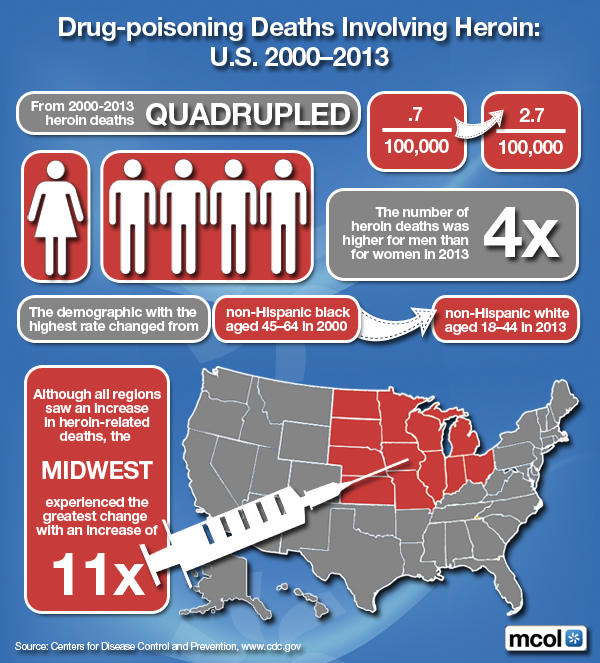
Drug Poisoning Deaths Involving Heroin

Join Our Mailing List 

US 2000-2013 [Quadrupled]

By http://www.MCOL.com

***

ImageProxy

***

More:

Conclusion

Your thoughts and comments on this ME-P are appreciated. Feel free to review our top-left column, and top-right sidebar materials, links, URLs and related websites, too. Then, subscribe to the ME-P. It is fast, free and secure.

Speaker: If you need a moderator or speaker for an upcoming event, Dr. David E. Marcinko; MBA – Publisher-in-Chief of the Medical Executive-Post – is available for seminar or speaking engagements. Contact: MarcinkoAdvisors@msn.com

OUR OTHER PRINT BOOKS AND RELATED INFORMATION SOURCES:

Product DetailsProduct Details

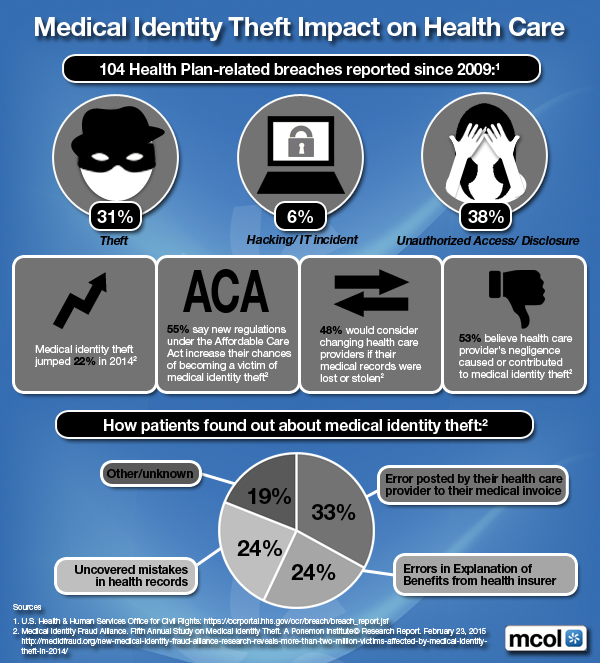
The Impact of Medical Identity Theft on Health Care

Join Our Mailing List

Health Plan Related Breaches Since 2009

By http://www.MCOL.com

ImageProxy

Channel Surfing the ME-P

Have you visited our other topic channels? Established to facilitate idea exchange and link our community together, the value of these topics is dependent upon your input. Please take a minute to visit. And, to prevent that annoying spam, we ask that you register. It is fast, free and secure.

More:

Conclusion

How does this relate to emails? Your thoughts and comments on this ME-P are appreciated. Feel free to review our top-left column, and top-right sidebar materials, links, URLs and related websites, too. Then, subscribe to the ME-P. It is fast, free and secure.

Speaker: If you need a moderator or speaker for an upcoming event, Dr. David E. Marcinko; MBA – Publisher-in-Chief of the Medical Executive-Post – is available for seminar or speaking engagements. Contact: MarcinkoAdvisors@msn.com

OUR OTHER PRINT BOOKS AND RELATED INFORMATION SOURCES:


Product DetailsProduct Details


Socio Economic Status, Payment Reform and Medical Records

Join Our Mailing List 

Yet Another Component of the Medical Record?

[Dr. David Edward Marcinko MBA CMP™]

http://www.CertifiedMedicalPlanner.org

Dr David E Marcinko MBAHistorically, medical records [paper or electronic] were previously used to aid in the quality of medical care.

Now they are also the basis for payment for services, not as a record or reflection of the care that was actually provided, but as a separate justification for billing. The lack of appropriate documentation now no longer threatens just non-payment for services but risks civil money penalties and criminal charges.

Enter S.E.S.

Today, the idea known as Socio Economic Status [SES] is conceptualized as the social standing, or class of an individual or group. It is often measured as a combination of education, income and occupation. Examinations of socioeconomic status often reveal inequities in access to medical resources, plus issues related to privilege, power and control.

Assessment

SES is increasingly being considered as another payment component [CPT® codes] to medical providers, as reflected in the paper medical record, EMR and elsewhere.

***

eMRs

[Electronic Medical Records]

***

Channel Surfing the ME-P

Have you visited our other topic channels? Established to facilitate idea exchange and link our community together, the value of these topics is dependent upon your input. Please take a minute to visit. And, to prevent that annoying spam, we ask that you register. It is fast, free and secure.

More:

Conclusion

Your thoughts and comments on this ME-P are appreciated. Feel free to review our top-left column, and top-right sidebar materials, links, URLs and related websites, too. Then, subscribe to the ME-P. It is fast, free and secure.

Speaker: If you need a moderator or speaker for an upcoming event, Dr. David E. Marcinko; MBA – Publisher-in-Chief of the Medical Executive-Post – is available for seminar or speaking engagements. Contact: MarcinkoAdvisors@msn.com

OUR OTHER PRINT BOOKS AND RELATED INFORMATION SOURCES:

Comprehensive Financial Planning Strategies for Doctors and Advisors: Best Practices from Leading Consultants and Certified Medical Planners(TM)* 8

How Using a ‘Scorecard’ Can Smooth Your Hospital’s Transition to a Population Health-Based Reimbursement Model

Join Our Mailing List

Transforming Business and Operating Models

[By Russ Richmond MD]

Russ Richmond MDDr. Marcinko and ME-P,

The US healthcare system’s myriad of problems again seized the headlines recently with the release of an Institute of Medicine report, which found that 30 percent of healthcare spending in 2009 – around $750 billion – was wasted. Citing the “urgent need for a system-wide transformation,” the report blamed the lack of coordination at every point in the system for the massive amount of money wasted in healthcare each year.

One critical area in particular need of transformation is the business and operating model that drives healthcare in the US. There is broad-based agreement across the healthcare industry that the current fee-for-service model does not work, and needs to be changed. The sweeping health reform law enacted in 2010 included a range of more holistic, value-based payment structures that are now being referred to as “populatiobn health.”

Population health is an integrated care model that incentivizes the healthcare system to keep patients healthy, thus lowering costs and increasing quality. In this value-based healthcare approach, patient care is better coordinated and shared between different providers. Key population health models include:

  • Bundled/Episodic Payments – This is where provider groups are reimbursed based on an expected cost for a clinically defined episode of care.
  • Accountable Care Organizations (ACOs) – This new model ties provider reimbursement to quality and reduction in the total cost of care for a population of patients.

Both of these care approaches aim to reduce care utilization through prevention programs, case/disease management and integrated care coordination, including better information transfer across different providers. Equally important, they are focused on reducing the cost of treatment by managing physician misuse and overuse and driving volumes to lower cost settings of care.

The shift to coordinated care is rapidly picking up steam across the country. According to a recent American Hospital Association survey of hospital chief executives, some 98 percent of respondents agree that hospitals should investigate and implement population health management strategies. Anecdotally, the hospital leaders participating in the survey indicated that it is not “if” they will have to pursue these risk sharing strategies, but “when.”

Even with healthcare providers now realizing that migrating to a population health approach is inevitable, there is still significant confusion about the crucial details of implementing these models. Hospital managements are worried about being left behind in the headlong rush toward adoption of ACOs and other value-based reimbursement models. Against this backdrop, healthcare providers now confront a growing list of urgent questions:

  • Which of the emerging population health-based care models is right for our hospital?
  • How much risk is prudent for our hospital with these new reimbursement models?
  • Should we move to an ACO, or is that too big of a jump for our hospital?
  • How does our management team even start to plan effectively to make the shift to a prevention-focused care and reimbursement model? Where do we begin?
  • What is the optimal time-frame for making these changes?

Using a “Scorecard” to Assess Your Population Health Readiness

So, how do hospital leaders break through the confusion and uncertainty to put their institutions on a clear path toward a successful population health-based future?

An effective way for hospitals to manage this process is by using a “scorecard” based on industry benchmarks to assess their relative readiness for – or current performance in – adopting a value-based reimbursement model.

The scorecard contains metrics that quantify the financial and volume impact on a hospital when it transitions to a population health-based reimbursement model. These metrics can be grouped into a range of key categories – i.e., top 5% high-cost patients, non- urgent emergency department visits, avoidable admissions, readmissions, physician overuse, outpatient procedures performed in lower cost settings, and proportion of one-day inpatient procedures done as outpatient. Hospital managements can address each of these categories in order to reduce per-member, per-month costs of care.

For example, new risk-sharing models have created more impetus for physicians and health systems to work together to prevent avoidable admissions. In 2011 alone, potentially avoidable admissions accounted for 10-14 percent of total inpatient admissions for most hospitals. With the growing push to reduce avoidable admissions, an average 300-bed hospital could potentially lose $9.5 million in annual contribution, as they would no longer obtain volume/revenue from these avoidable hospitalizations. On the flip side, if a hospital doesn’t prevent avoidable hospitalizations, they would be penalized for these unnecessary visits.

The emerging population health landscape has also resulted in hospitals experiencing growing competition from lower cost settings such as Ambulatory Surgery Centers (ASCs). Over the past decade, the number of ASC operating rooms has doubled. Historically, ASCs and hospitals shared in the growth of common procedures such as shoulder arthroscopy. But, with 60 percent of hospitals now within a 5 minutes drive from an ASC, and given the industry’s accelerating shift to population health models, ASC’s price advantage puts hospitals at a competitive disadvantage.

The scorecard gives hospital executives the ability to accurately assess the financial and volume impacts of population health-based reimbursement models to their institution. This is critical in identifying opportunities for improvement, setting priorities, and making key strategic and operational decisions that will help guide a hospital through periods of great change and uncertainty.

Population-Health

Key Principles for Implementing Population Health

Through our work helping hospitals to prepare for a coordinated care future through strategic assessment tools like scorecards, we have identified three key principles that help to drive a successful transition:

1. First, the entire organization needs to embrace change – To engineer a successful shift to one of the new risk sharing business models, your hospital’s management team – indeed the entire organization – will need to embrace change. The fact is, much of that change is already happening right now, so it makes sense to manage it in a way that works best for your hospital’s specific needs and culture. The scorecard process will help your senior management team to clarify goals, assumptions and priorities around where the hospital needs to go, and how best to get there, in the population health future.

2. Plan for “evolutionary” change – Moving to a new value-based health system need not involve a wrenching “revolution” for your hospital. Indeed, jumping headfirst into the unknown is a recipe for disaster for most providers. Taking well planned, incremental steps is usually the best and least disruptive way to evolve to a fundamentally different reimbursement and care model like population health. For example, some hospitals are starting with their own employee populations to experiment with ACO-like care models.

3. Learn to love data – It’s an article of faith in management that you can’t improve it if you can’t measure it. At the core of the population health scorecard assessment approach is the imperative to collect the right data, analyze them, and then continually measure your actions and results as your hospital travels along the population health journey. Data are essential for effective decision making, and also for implementing a new risk sharing reimbursement model at your institution.

Implementing the fundamental changes necessary to meet the historic challenges now confronting healthcare providers has been compared to swapping out the engines in a jet plane – while it is still airborne! As daunting as that metaphor sounds, hospitals can successfully evolve to the population health-based future if they take the right steps to plan for the changes and implement them in a methodical, data-driven fashion.

Careful planning and practical assessment tools like the scorecard help hospital leaders make smarter strategic decisions around value-based healthcare.

About the Author

Dr. Russ Richmond is the CEO of Objective Health, part of the global McKinsey healthcare practice, which serves hundreds of public- and private-sector organizations worldwide. He is passionate about the use of data to manage health and to improve healthcare performance. Dr. Richmond holds an MD from the University of Cincinnati and a BS in Biology from the University of Michigan.

Conclusion

Your thoughts and comments on this ME-P are appreciated. Feel free to review our top-left column, and top-right sidebar materials, links, URLs and related websites, too. Then, subscribe to the ME-P. It is fast, free and secure.

Speaker: If you need a moderator or speaker for an upcoming event, Dr. David E. Marcinko; MBA – Publisher-in-Chief of the Medical Executive-Post – is available for seminar or speaking engagements. Contact: MarcinkoAdvisors@msn.com

OUR OTHER PRINT BOOKS AND RELATED INFORMATION SOURCES:


Product DetailsProduct DetailsProduct Details

Product Details  Product Details

Product DetailsProduct Details

State Requirements for Individual Market Benefit Design and Cost-Sharing

Join Our Mailing List

For Health Benefits

By http://www.MCOL.com

ACA State Requirements

Conclusion

Your thoughts and comments on this ME-P are appreciated. Feel free to review our top-left column, and top-right sidebar materials, links, URLs and related websites, too. Then, subscribe to the ME-P. It is fast, free and secure.

Speaker: If you need a moderator or speaker for an upcoming event, Dr. David E. Marcinko; MBA – Publisher-in-Chief of the Medical Executive-Post – is available for seminar or speaking engagements. Contact: MarcinkoAdvisors@msn.com

OUR OTHER PRINT BOOKS AND RELATED INFORMATION SOURCES:

Product DetailsProduct Details


Employer Health Benefits Post PP-ACA

Join Our Mailing List

Percentage of Employers who View Health Reform Impact on Aspects of Employer Benefits as Moderate / Tremendous

By http://www.MCOL.com

ImageProxy

 HealthcareWebSummit Events

Upcoming Webinars:

On Demand: IBM Webcast: Using Analytics to Improve Outcomes at the Point of Care
On Demand: A Fresh Approach to CDH: 5 Ways to Get In It to Win It
Predictive Modeling Web Summit June 4, 2014
Large Employers and Exchanges: Minimum Standards and Private HIX Considerations June 5, 2014
Cigna’s Collaborative Care Strategy: Engaging Healthcare Professionals June 18, 2014
Provider Contracts and Quality Measurement June 19, 2014
Understanding Medicare DSH Changes-Hospital/Medicare Advantage Plan Implications June 24, 2014
Accountable Care at a Tipping Point: Oliver Wyman ACO Research Findings June 27, 2014
2015 Medical Cost Trends & Implications: PwC Research Behind the Numbers July 15, 2014
Readmissions Web Summit August 14, 2014
Accountable Care Web Summit December 11, 2014

Flash Drives of Past Events

Conclusion

Your thoughts and comments on this ME-P are appreciated. Feel free to review our top-left column, and top-right sidebar materials, links, URLs and related websites, too. Then, subscribe to the ME-P. It is fast, free and secure.

Link: http://feeds.feedburner.com/HealthcareFinancialsthePostForcxos

Speaker: If you need a moderator or speaker for an upcoming event, Dr. David E. Marcinko; MBA – Publisher-in-Chief of the Medical Executive-Post – is available for seminar or speaking engagements. Contact: MarcinkoAdvisors@msn.com

OUR OTHER PRINT BOOKS AND RELATED INFORMATION SOURCES:

Product DetailsProduct DetailsProduct Details


Communithy Health Center Funding Under Current Law

Join Our Mailing List

FY 2010-16 in $-Billions

http://www.MCOL.com

Funding

Conclusion

Your thoughts and comments on this ME-P are appreciated. Feel free to review our top-left column, and top-right sidebar materials, links, URLs and related websites, too. Then, subscribe to the ME-P. It is fast, free and secure.

Link: http://feeds.feedburner.com/HealthcareFinancialsthePostForcxos

Speaker: If you need a moderator or speaker for an upcoming event, Dr. David E. Marcinko; MBA – Publisher-in-Chief of the Medical Executive-Post – is available for seminar or speaking engagements. Contact: MarcinkoAdvisors@msn.com

OUR OTHER PRINT BOOKS AND RELATED INFORMATION SOURCES:

DICTIONARIES: http://www.springerpub.com/Search/marcinko
PHYSICIANS: www.MedicalBusinessAdvisors.com
PRACTICES: www.BusinessofMedicalPractice.com
HOSPITALS: http://www.crcpress.com/product/isbn/9781466558731
CLINICS: http://www.crcpress.com/product/isbn/9781439879900
BLOG: www.MedicalExecutivePost.com
FINANCE: Financial Planning for Physicians and Advisors
INSURANCE: Risk Management and Insurance Strategies for Physicians and Advisors

Product DetailsProduct Details

Product Details

How “Leaner” Hospitals Can Be Profitable in 2014

    Our Newest Textbooks with Checklists

Buy from Amazon

Learn How to Profit and Thrive in the PP-ACA Era

BOOK FOREWORD / TESTIMONIAL

###

Financial Management Strategies for Hospitals and Healthcare Organizations: Tools, Techniques, Checklists and Case Studies

###

On Bull Markets under Democrats

Join Our Mailing List

A Political Discourse by Kevin Outterson

[By Staff Reporters]

The Dow hit an inflation adjusted record high this week (WSJ). Here is the (unadjusted) S&P since 1975 with Republican administrations in red and Democrats in blue.

chart

Before you jump to partisan conclusions, last month, Tyler Cowan reviewed the Blinder and Watson paper on why Democrats preside over superior economic performance (their conclusion: mostly good luck).

Source: Bull markets under Democrats

More:

Conclusion

Your thoughts and comments on this ME-P are appreciated. Feel free to review our top-left column, and top-right sidebar materials, links, URLs and related websites, too. Then, subscribe to the ME-P. It is fast, free and secure.

Link: http://feeds.feedburner.com/HealthcareFinancialsthePostForcxos

Speaker: If you need a moderator or speaker for an upcoming event, Dr. David E. Marcinko; MBA – Publisher-in-Chief of the Medical Executive-Post – is available for seminar or speaking engagements. Contact: MarcinkoAdvisors@msn.com

OUR OTHER PRINT BOOKS AND RELATED INFORMATION SOURCES:

DICTIONARIES: http://www.springerpub.com/Search/marcinko
PHYSICIANS: www.MedicalBusinessAdvisors.com
PRACTICES: www.BusinessofMedicalPractice.com
HOSPITALS: http://www.crcpress.com/product/isbn/9781466558731
CLINICS: http://www.crcpress.com/product/isbn/9781439879900
BLOG: www.MedicalExecutivePost.com
FINANCE: Financial Planning for Physicians and Advisors
INSURANCE: Risk Management and Insurance Strategies for Physicians and Advisors

Product Details  Product Details

ME-P Picks [Public Viewpoints on Health Reform and Policy]

Join Our Mailing List 

By Staff Reporters and related sources

By http://www.MCOL.com

 Delolitte Employer Poll Gives Grades From 500 employers Regearding Healthcare Reform

  1. 33%  would give a grade of an A or B
  2. 38% say a C is an appropriate letter grade
  3. 29% believe a D or F would be more appropriate
  4. 22% of employers say the ACA will reduce costs by the year 2019
  5. 19% said it will improve quality of care by the year 2019
  6. 50% of respondents said it will widen access to health insurance.

Source: Deloitte

Some more new Lists:

Health Insurance

Assessment

Visit: www.CertifiedMedicalPlanner.org

Conclusion

Your thoughts and comments on this ME-P are appreciated. Feel free to review our top-left column, and top-right sidebar materials, links, URLs and related websites, too. Then, subscribe to the ME-P. It is fast, free and secure.

Link: http://feeds.feedburner.com/HealthcareFinancialsthePostForcxos

Speaker: If you need a moderator or speaker for an upcoming event, Dr. David E. Marcinko; MBA – Publisher-in-Chief of the Medical Executive-Post – is available for seminar or speaking engagements. Contact: MarcinkoAdvisors@msn.com

OUR OTHER PRINT BOOKS AND RELATED INFORMATION SOURCES:

DICTIONARIES: http://www.springerpub.com/Search/marcinko
PHYSICIANS: www.MedicalBusinessAdvisors.com
PRACTICES: www.BusinessofMedicalPractice.com
HOSPITALS: http://www.crcpress.com/product/isbn/9781466558731
CLINICS: http://www.crcpress.com/product/isbn/9781439879900
BLOG: www.MedicalExecutivePost.com
FINANCE: Financial Planning for Physicians and Advisors
INSURANCE: Risk Management and Insurance Strategies for Physicians and Advisors

Product DetailsProduct DetailsProduct Details

Product Details  Product Details

Product DetailsProduct Details

Product Details

On Healthcare.Gov System Availability

Join Our Mailing List

A Review of Website “Uptime”

By www.MCOL.com

HG

Conclusion

Your thoughts and comments on this ME-P are appreciated. Feel free to review our top-left column, and top-right sidebar materials, links, URLs and related websites, too. Then, subscribe to the ME-P. It is fast, free and secure.

Link: http://feeds.feedburner.com/HealthcareFinancialsthePostForcxos

Speaker: If you need a moderator or speaker for an upcoming event, Dr. David E. Marcinko; MBA – Publisher-in-Chief of the Medical Executive-Post – is available for seminar or speaking engagements. Contact: MarcinkoAdvisors@msn.com

OUR OTHER PRINT BOOKS AND RELATED INFORMATION SOURCES:

DICTIONARIES: http://www.springerpub.com/Search/marcinko
PHYSICIANS: www.MedicalBusinessAdvisors.com
PRACTICES: www.BusinessofMedicalPractice.com
HOSPITALS: http://www.crcpress.com/product/isbn/9781466558731
CLINICS: http://www.crcpress.com/product/isbn/9781439879900
BLOG: www.MedicalExecutivePost.com
FINANCE: Financial Planning for Physicians and Advisors
INSURANCE: Risk Management and Insurance Strategies for Physicians and Advisors

Product DetailsProduct DetailsProduct Details

Product Details  Product Details

Product DetailsProduct Details

Product Details

How You Can Financially Profit from the PP-ACA?

Join Our Mailing List 

An Obamacare Sales Opportunity

By Dr. David Edward Marcinko MBA CMP™

[Editor-in-Chief] www.CertifiedMedicalPlanner.org

Dr. MarcinkoPresumably, as a result of my financial advisory activities, I received this email solicitation the other day,

So, I thought I’d pass it along [unchanged] to our ME-P readers, FAs, insurance agents and subscribers for comment.

USA BENEFITS GROUP EAGLE DIVISION  ………. PROVIDING CAREER SOLUTIONS FOR 36 YEARS 

[Better Contracts + Better Schedule + Better Career Opportunities] 

Dear Prospect [that would be ME],

I received your resume on Monster.  You already know that the real money in any organization is in sales. The salespeople of the world make things happen and are highly rewarded for that work.  But it’s hard work.

The Product

What if you could find a product that everybody needs, that they have money budgeted to purchase, and are looking for someone to help them buy it?  Do you think you could help that person? That’s exactly  the situation in the health insurance industry today!

Our government is telling people they HAVE to have it.  Folks are either buying it now from somewhere or will soon be eligible for subsidies so they CAN buy it.  And EVERYONE is confused and looking for someone with answers on how to get this product!

You can be that Person

Over the next sixty months, billions of dollars are going to change hands as people readjust to a dynamic health care environment.  How can you get into the river and get your hands on some of that money?  By preparing to serve people!

USA Benefits Group 

The USA Benefits Group is a highly successful team of insurance brokers who are “reform ready” – staying up to date on this perhaps once-in-a-lifetime shift in this industry.  We are independent, non-captive agents who are setting up qualified, turn-key “private exchanges” to help people obtain health insurance in a webinar-based setting from our home offices.

I’m encouraging you to click here: www.usabg.net/dcollins to learn more. If you’re serious and ready to make a move, you can call me toll-free now at 866-328-6182. If you’re qualified, I also have Regional Management positions available.

Advantages of working with my Eagle Division 

  1. 1. 36 year old system for success
  2. 2. 100% control of your future
  3. 3. Equal opportunity
  4. 4. Recession proof
  5. 5. Top Companies to represent
  6. 6. Excellent co-op lead program
  7. 7. Weekly advance commissions ($2,000 To $4,000 Net Weekly)
  8. 8. Vested Lifetime Renewals ($10,000 To $20,000 Monthly In Under 3 Years)
  9. 9. Annual Incentive Trips
  10. 10. Annual Production Bonuses to $50,000+

I’m looking forward to talking to you.
David Collins
DIVISION MANAGER
866.328.6182
DC@usabg.net

Assessment

  • Is this a good product to sell? If so, why does it need an intermediary to push it?
  • Don’t subsidies, carve-outs, exemptions and sales commissions serve to jack-up price and lower quality? [think eMRs]? What about the overall cost of healthcare delivery; up or down?
  • What about the USA Benefits Group; credible or not? Are cold calls the way to go?
  • What is your impression of Division Manager Mr. David Collins and his Eagle Division? Feel free to contact him … and tell him what you think.

Conclusion

Your thoughts and comments on this ME-P are appreciated. Feel free to review our top-left column, and top-right sidebar materials, links, URLs and related websites, too. Then, subscribe to the ME-P. It is fast, free and secure.

Link: http://feeds.feedburner.com/HealthcareFinancialsthePostForcxos

Speaker: If you need a moderator or speaker for an upcoming event, Dr. David E. Marcinko; MBA – Publisher-in-Chief of the Medical Executive-Post – is available for seminar or speaking engagements. Contact: MarcinkoAdvisors@msn.com

OUR OTHER PRINT BOOKS AND RELATED INFORMATION SOURCES:

DICTIONARIES: http://www.springerpub.com/Search/marcinko
PHYSICIANS: www.MedicalBusinessAdvisors.com
PRACTICES: www.BusinessofMedicalPractice.com
HOSPITALS: http://www.crcpress.com/product/isbn/9781466558731
CLINICS: http://www.crcpress.com/product/isbn/9781439879900
BLOG: www.MedicalExecutivePost.com
FINANCE: Financial Planning for Physicians and Advisors
INSURANCE: Risk Management and Insurance Strategies for Physicians and Advisors

Product DetailsProduct DetailsProduct Details

Product Details  Product Details

Product DetailsProduct Details

Product Details

Should HHS Secretary Kathleen Sebelius be Replaced?

 Join Our Mailing List

A Voting and Opinion Poll

[By Ann Miller RN MHA]

We are all aware that critics are calling for the head of Kathleen Sebelius after the clumsy online rollout of the PP-ACA.

And so, we ask:

Assessment

After you vote; please leave a cogent opinion, too.

Conclusion

Your thoughts and comments on this ME-P are appreciated. Feel free to review our top-left column, and top-right sidebar materials, links, URLs and related websites, too. Then, subscribe to the ME-P. It is fast, free and secure.

Link: http://feeds.feedburner.com/HealthcareFinancialsthePostForcxos

Speaker: If you need a moderator or speaker for an upcoming event, Dr. David E. Marcinko; MBA – Publisher-in-Chief of the Medical Executive-Post – is available for seminar or speaking engagements. Contact: MarcinkoAdvisors@msn.com

OUR OTHER PRINT BOOKS AND RELATED INFORMATION SOURCES:

LEXICONS: http://www.springerpub.com/Search/marcinko
PHYSICIANS: www.MedicalBusinessAdvisors.com
PRACTICES: www.BusinessofMedicalPractice.com
HOSPITALS: http://www.crcpress.com/product/isbn/9781466558731
CLINICS: http://www.crcpress.com/product/isbn/9781439879900
ADVISORS: www.CertifiedMedicalPlanner.org
BLOG: www.MedicalExecutivePost.com

Product DetailsProduct Details

Product Details

Is HEALTHCARE.GOV Fundamentally Flawed?

Join Our Mailing List

You Decide

By Ayo Fathiah

Hello Dr. David Edward Marcinko,

My name is Ayo, I’m the mother of two beautiful kids and one of the Americans that was relying on healthcare.gov to provide me with a reasonably priced health insurance.

I came across your ME-P articles when researching what exactly has gone wrong with the website. I was one of the millions that tried to sign up during the first days after the launch and couldn’t get through due to a bunch of errors. While I’m still trying to find the best insurance for my family, I just wanted to share with you some stats showing why the website was a major flop.

***

interface

***

And, I thought it might be interesting to your readers, because I saw a many readers talking about it. Isn’t it surprising that less than 1% of people that went on the website signed up for an insurance?

HCdotGOV_final

The Website

1.) Had extremely low login success rates. 2.) Long delays and time outs 3.) Confusing Error Messages 4.) Non-functional calculators 5.) Scrambled insurance information 6.) Spouses reported as children 7.) Plan pricing misreported.

Assessment

Leading to the larger questions:

  • Will enrollment glitches become provider glitches?
  • Will people who enrolled with the glitchy show up at hospitals with no insurance?
  • Will the information of those who enrolled be at risk?

DANGER: Centralized data SSN Address Ages Names Health conditions Family History

Leads to centralized power over everyday Americans

Good: if we can make an efficient healthcare system

Bad: Governmental Abuse, and all the data an identity thief could want

But this problem runs deeper than just a website… Because the numbers just don’t add up.

Universal healthcare is important, but crony capitalism doesn’t solve anything.

Citations:

  1. http://msnbcmedia.msn.com/i/MSNBC/Sections/A_Politics/_Today_Stories_Teases/Late_October_NBC_WSJ.pdf
  2. https://blog.compete.com/2013/10/15/obamacare-enrollment-stats/
  3. http://www.nextgov.com/health/2013/10/less-1-percent-healthcaregov-visitors-successfully-enrolled-insurance-plan/72041/

Conclusion

Your thoughts and comments on this ME-P are appreciated. Feel free to review our top-left column, and top-right sidebar materials, links, URLs and related websites, too. Then, subscribe to the ME-P. It is fast, free and secure.

Link: http://feeds.feedburner.com/HealthcareFinancialsthePostForcxos

Speaker: If you need a moderator or speaker for an upcoming event, Dr. David E. Marcinko; MBA – Publisher-in-Chief of the Medical Executive-Post – is available for seminar or speaking engagements. Contact: MarcinkoAdvisors@msn.com

OUR OTHER PRINT BOOKS AND RELATED INFORMATION SOURCES:

LEXICONS: http://www.springerpub.com/Search/marcinko
PHYSICIANS: www.MedicalBusinessAdvisors.com
PRACTICES: www.BusinessofMedicalPractice.com
HOSPITALS: http://www.crcpress.com/product/isbn/9781466558731
CLINICS: http://www.crcpress.com/product/isbn/9781439879900
ADVISORS: www.CertifiedMedicalPlanner.org
BLOG: www.MedicalExecutivePost.com

Product DetailsProduct DetailsProduct Details

Product Details  Product Details

Product DetailsProduct Details

Product Details

Healthcare News TV Videos

Join Our Mailing List

Announcing More New Videos:

Advocacy

Conclusion: Your thoughts and comments on this ME-P are appreciated. Feel free to review our top-left column, and top-right sidebar materials, links, URLs and related websites, too. Then, subscribe to the ME-P. It is fast, free and secure.Link: http://feeds.feedburner.com/HealthcareFinancialsthePostForcxos

Speaker: If you need a moderator or speaker for an upcoming event, Dr. David E. Marcinko; MBA – Publisher-in-Chief of the Medical Executive-Post – is available for seminar or speaking engagements. Contact: MarcinkoAdvisors@msn.com

OUR OTHER PRINT BOOKS AND RELATED INFORMATION SOURCES:

LEXICONS: http://www.springerpub.com/Search/marcinko
PHYSICIANS: www.MedicalBusinessAdvisors.com
PRACTICES: www.BusinessofMedicalPractice.com
HOSPITALS: http://www.crcpress.com/product/isbn/9781466558731
CLINICS: http://www.crcpress.com/product/isbn/9781439879900
ADVISORS: www.CertifiedMedicalPlanner.org
BLOG: www.MedicalExecutivePost.com

Product DetailsProduct DetailsProduct Details

Product Details  Product Details

Product DetailsProduct Details

Product Details


Hospital Information Systems and the PP-ACA

Join Our Mailing List

Extension of Hospital Information Systems Beyond the Hospital

By Brent A. Metfessel MD

Dr. MetfesselThe Patient Protection and Affordable Care Act (ACA), affirmed after the November 7th 2012 presidential election, includes a number of policies and potential projects with the aim of improving quality of care while reducing costs – or at least greatly slowing increases in health care costs from year to year.

Included in this effort are CMS payment incentives for providers that can show care patterns that meet the goals of high quality, cost-efficient care.

HHS and ACOs 

On March 31, 2011, the Department of Health and Human Services (HHS) released a set of proposed new rules to aid clinicians, hospitals, and other health facilities and providers to improve coordination of care for Medicare patients using a model known as Accountable Care Organizations (ACOs). ACOs that are shown to lower health care cost growth while meeting CMS quality benchmarks, including measures of patient/caregiver experience of care, care coordination, patient safety, preventive health, and health of high-risk populations, will receive incentive payments as part of the Medicare Shared Savings Program.

But, in some proposed models ACOs may also be held accountable for shared losses.

Care Co-ordination

Coordination of care means that hospitals, physician offices, and other providers have a complete record of patients’ episodes of care, including diagnostic tests, procedures, and medication information.  This potentially would decrease extra costs from unnecessary duplication of services as well as reducing medical errors from incomplete understanding of the patients’ illness histories and medical care provided.

It is also believed that better coordination of care may prevent 30-day hospital readmissions (which occur for nearly one in five Medicare discharges), since needed post-discharge care would be more readily obtainable with more aggressive care coordination.

Medicare patients in ACOs, however, would still be allowed to see providers outside of the ACO, and proposals exist to prevent physicians in ACOs from being penalized for patients with a greater illness severity or complexity.

According to a CMS analysis, ACOs may result in Medicare savings of up to $960 million over three years.  Although the Affordable Care Act’s ACO provisions primarily target Medicare beneficiaries, private insurers are also beginning to create care models based on the accountable care paradigm.  Insurers could offer similar incentives to the ACO model described above, and which might include features such as performance based contracting or tiered benefit models that favor physicians who score highly on care quality and cost-efficiency measures.

Balance

Only the Beginning

ACOs and other implementations of the accountable care paradigm, however, are in their beginning stages, with a number of pilots around the country currently being conducted to more fully evaluate the concept, and there still is some controversy over the best way to achieve these goals. It is a continuing balancing act.

The critical point here is that in all likelihood, with the advent of the ACA and other initiatives, stemming the upward tide of medical cost increases becomes an even higher priority, and no matter what the final models will look like, the success of any of the models requires a high level of care coordination – requiring information systems that are fully compatible and allow seamless and errorless transmission of information between sites of service and the various providers that can be involved in patient care.

More:

  1. Ground Breaking Book Explains Why Accountable Care Organizations May Be the Answer the Health Care Industry Has Been Seeking!
  2. Evaluating ACOs at Mid-Launch
  3. How Using a ‘Scorecard’ Can Smooth Your Hospital’s Transition to a Population Health-Based Reimbursement Model
  4. Doubting the Accountable Care Organization B-Model

Assessment

Thus, wherever a patient goes for care, all the information needed to provide high-quality and cost-efficient care is immediately available.

References

Feds Take Critical Look at Meaningful Use Payments”, InformationWeek Healthcare, October 24, 2012.  http://www.informationweek.com/healthcare/policy/feds-take-critical-look-at-meaningful-us/240009661 [Accessed on November 2, 2012].

Conclusion

Your thoughts and comments on this ME-P are appreciated. Feel free to review our top-left column, and top-right sidebar materials, links, URLs and related websites, too. Then, subscribe to the ME-P. It is fast, free and secure.

Link: http://feeds.feedburner.com/HealthcareFinancialsthePostForcxos

Speaker: If you need a moderator or speaker for an upcoming event, Dr. David E. Marcinko; MBA – Publisher-in-Chief of the Medical Executive-Post – is available for seminar or speaking engagements. Contact: MarcinkoAdvisors@msn.com

OUR OTHER PRINT BOOKS AND RELATED INFORMATION SOURCES:

LEXICONS: http://www.springerpub.com/Search/marcinko
PHYSICIANS: www.MedicalBusinessAdvisors.com
PRACTICES: www.BusinessofMedicalPractice.com
HOSPITALS: http://www.crcpress.com/product/isbn/9781466558731
CLINICS: http://www.crcpress.com/product/isbn/9781439879900
ADVISORS: www.CertifiedMedicalPlanner.org
PODIATRISTS: www.PodiatryPrep.com
BLOG: www.MedicalExecutivePost.com

Product DetailsProduct Details

Product Details

How affordable is the new health care law – Really?

Join Our Mailing List 

Calculate your costs

[By Staff Reporters]

The Affordable Care Act is going to change health care for tens of millions of Americans.

But, what about the cost?

LET’S BEGIN

ACA

###

NOW CALCULATE

Whether you’re an individual who has health insurance or needs it, or a small business owner, you need to know how health care reform affects you.

What’s it going to cost? What’s happening in your state?

### 8C9220491-tdy-130929-aca-calculator-4x3-606p_blocks_desktop_large

### 

Link: http://www.nbcnews.com/health/how-affordable-new-health-care-law-really-calculate-your-cost-8C11296290

Conclusion

Your thoughts and comments on this ME-P are appreciated. Feel free to review our top-left column, and top-right sidebar materials, links, URLs and related websites, too. Then, subscribe to the ME-P. It is fast, free and secure.

Link: http://feeds.feedburner.com/HealthcareFinancialsthePostForcxos

Speaker: If you need a moderator or speaker for an upcoming event, Dr. David E. Marcinko; MBA – Publisher-in-Chief of the Medical Executive-Post – is available for seminar or speaking engagements. Contact: MarcinkoAdvisors@msn.com

OUR OTHER PRINT BOOKS AND RELATED INFORMATION SOURCES:

Health Dictionary Series: http://www.springerpub.com/Search/marcinko

Practice Management: http://www.springerpub.com/product/9780826105752

Physician Financial Planning: http://www.jbpub.com/catalog/0763745790

Medical Risk Management: http://www.jbpub.com/catalog/9780763733421

Hospitals: http://www.crcpress.com/product/isbn/9781439879900

Physician Advisors: www.CertifiedMedicalPlanner.org

Product DetailsProduct DetailsProduct Details

Product Details  Product Details

Product DetailsProduct Details

Affordable Care Act HIEs at Launch

Join Our Mailing List

Some Important Launching Information for Doctors and Business Owners

By Bobby Whirley CPA

[Whirley & Associates LLC – Alpharetta, GA]

Dear ME-P Readers,

The ACA (Affordable Care Act) requires employers to provide their workers with a notice about the state health insurance exchanges.

Today October 1st is the deadline for providing these notices.

These exchanges will sell insurance to individuals who don’t get coverage through their employers. The exchanges are also available to medical practices and small businesses, which may or may not currently offer heath care coverage.

The Fines?

Some doctors or business owners are concerned about paying a fine of up to $100 per day under the general non-compliance penalty provisions.

The recent notice of the Affordable Health Care Act states that there will be no penalty.  Please refer to http://www.dol.gov/ebsa/faqs/faq-noticeofcoverageoptions.html

If your medical practice, clinic or company is covered by the Fair Labor Standards Act (you have one or more employees, sales of over $500,000, and deal in interstate commerce), you must provide a written notice to your employees about the Health Insurance Marketplace by Oct 1, 2013.

Model Notices

The U.S. Department of Labor has two model notices to help employers comply. There is one model for employers who do not offer a health plan and another model for employers who offer a health plan or some or all employees.

More:

The model notices are also available in Spanish and MS Word format at http://www.dol.gov/ebsa/healthreform/

###

Health-Information-Exchange

###

Assessment

Employers may use one of these models, as applicable, or a modified version. More compliance assistance information is available in a Technical Release issued by the US Department of Labor.

Your thoughts and comments on this ME-P are appreciated. Feel free to review our top-left column, and top-right sidebar materials, links, URLs and related websites, too. Then, subscribe to the ME-P. It is fast, free and secure.

Link: http://feeds.feedburner.com/HealthcareFinancialsthePostForcxos

Speaker: If you need a moderator or speaker for an upcoming event, Dr. David E. Marcinko; MBA – Publisher-in-Chief of the Medical Executive-Post – is available for seminar or speaking engagements. Contact: MarcinkoAdvisors@msn.com

OUR OTHER PRINT BOOKS AND RELATED INFORMATION SOURCES:

LEXICONS: http://www.springerpub.com/Search/marcinko
PHYSICIANS: www.MedicalBusinessAdvisors.com
PRACTICES: www.BusinessofMedicalPractice.com
HOSPITALS: http://www.crcpress.com/product/isbn/9781466558731
CLINICS: http://www.crcpress.com/product/isbn/9781439879900
ADVISORS: www.CertifiedMedicalPlanner.org
BLOG: www.MedicalExecutivePost.com

Product DetailsProduct Details

Product Details

Did the NSA End Obamacare?

Join Our Mailing List

Did ambitious NSA officials unintentionally end Obamacare years ago?

[By D. Kellus Pruitt DDS]

1-darrellpruittIf loss of trust in encryption ends Obamacare, can whistleblower Edward Snowden be blamed for that as well? Yep.

What’s even more ominous, the former National Security Agency contractor’s news that encrypted medical records are no longer secure reached Alaska on a weekend.

“Risky electronic health records: Alaska should make information exchange system safer – Imagine: The National Security Agency slips into your doctor’s office and peeks at your medical records,”

by Alaska ACLU executive director Joshua Decker was posted hours ago on Newsminer.com, out of Fairbanks.

http://www.newsminer.com/opinion/community_perspectives/risky-electronic-health-records-alaska-should-make-information-exchange-system/article_a9947eb0-1863-11e3-8153-001a4bcf6878.html

Decker questions the security of the state’s Health Information Exchange (HIE), and offers common sense but costly steps which arguably lessen the danger of privacy breaches – including giving patients the choice of “opting-in” to permit their encrypted, but increasingly vulnerable identities to be shared online via Obamacare’s exchanges.

My POV 

In my opinion, if informed Americans are given the choice of volunteering to risk identity theft, HIEs won’t be around a year from now, and neither will Obamacare. If informed Americans are not given a choice, the costs are even greater. Americans deserve honesty.

National Obamacare Hangs in the Balance

In a related, slow-burning game-changer, Obamacare hangs in the balance, not just for Alaska, but for the nation.

It was September 5th when the Guardian Weekly posted: “Revealed: how US and UK spy agencies defeat internet privacy and security,” written by James Ball, Julian Borger and Glenn Greenwald, and based on top secret NSA information Snowden stole.

http://www.theguardian.com/world/2013/sep/05/nsa-gchq-encryption-codes-security

Snowden told the Guardian that years ago, the NSA joined with the UK’s spy agency GCHQ (Government Communications Headquarters) to successfully make encryption obsolete – including for medical records.

Naturally, if properly informed Americans fear that secrets they tell their doctors might be breached, incorrect EHRs become less than worthless. They become dangerous.

More on Health Information Exchanges

What’s more, even before the added expense of waiting for Americans to opt-in to the exchanges – instead of discouraging them from opting-out – the very funding for the increasingly-battered Obamacare is based on a rumor of savings.

Starting years ago, health IT lobbyists, including former Speaker of the House Newt Gingrich, told lawmakers to expect annual savings of $77 billion and 100,000 lives – quoting the results of a once popular, EHR-friendly 2005 RAND study which was funded by General Electric and Cerner Corporation.

Obamacare

As you can see, while we were not paying attention, we were had!

The RAND Study

Predictably, both GE and Cerner profited immensely from the development and sales of EHR systems before the RAND study was widely discredited months ago – even by RAND.

According to a NY Times article from January, “Cerner’s revenue has nearly tripled since the report was released, to a projected $3 billion in 2013, from $1 billion in 2005.”

(See: “In Second Look, Few Savings From Digital Health Records by Reed Abelson and Julie Creswell, January 10, 2013).

http://www.nytimes.com/2013/01/11/business/electronic-records-systems-have-not-reduced-health-costs-report-says.html?_r=0

Assessment

Last weekend’s bad news for Obamacare is still under the radar, but I predict within days it will become apparent that the mounting obstacle between President Obama and healthcare reform will be in regaining trust his administration squandered while helping GE and Cerner profits at the expense of soon-to-be pissed off American patients.

Conclusion

Your thoughts and comments on this ME-P are appreciated. Feel free to review our top-left column, and top-right sidebar materials, links, URLs and related websites, too. Then, subscribe to the ME-P. It is fast, free and secure.

Link: http://feeds.feedburner.com/HealthcareFinancialsthePostForcxos

Speaker: If you need a moderator or speaker for an upcoming event, Dr. David E. Marcinko; MBA – Publisher-in-Chief of the Medical Executive-Post – is available for seminar or speaking engagements. Contact: MarcinkoAdvisors@msn.com

OUR OTHER PRINT BOOKS AND RELATED INFORMATION SOURCES:

DICTIONARIES: http://www.springerpub.com/Search/marcinko
PHYSICIANS: www.MedicalBusinessAdvisors.com
PRACTICES: www.BusinessofMedicalPractice.com
HOSPITALS: http://www.crcpress.com/product/isbn/9781466558731
CLINICS: http://www.crcpress.com/product/isbn/9781439879900
BLOG: www.MedicalExecutivePost.com
FINANCE: Financial Planning for Physicians and Advisors
INSURANCE: Risk Management and Insurance Strategies for Physicians and Advisors

Product DetailsProduct Details

On Mentally Ill Inmates

Join Our Mailing List
###
By Christie Thompson
[This story was co-produced with WNYC]

In New York, inmates diagnosed with “serious” disorders have been protected from solitary confinement. But, since that policy began, the number of inmates diagnosed with such disorders has dropped.

###

Hospital

###

Link: New York Promised Help for Mentally Ill Inmates – But Still Sticks Many in Solitary

Conclusion

Your thoughts and comments on this ME-P are appreciated. Feel free to review our top-left column, and top-right sidebar materials, links, URLs and related websites, too. Then, subscribe to the ME-P. It is fast, free and secure.

Link: http://feeds.feedburner.com/HealthcareFinancialsthePostForcxos

Speaker: If you need a moderator or speaker for an upcoming event, Dr. David E. Marcinko; MBA – Publisher-in-Chief of the Medical Executive-Post – is available for seminar or speaking engagements. Contact: MarcinkoAdvisors@msn.com

OUR OTHER PRINT BOOKS AND RELATED INFORMATION SOURCES:

Health Dictionary Series: http://www.springerpub.com/Search/marcinko

Practice Management: http://www.springerpub.com/product/9780826105752

Physician Financial Planning: http://www.jbpub.com/catalog/0763745790

Medical Risk Management: http://www.jbpub.com/catalog/9780763733421

Hospitals: http://www.crcpress.com/product/isbn/9781439879900

Physician Advisors: www.CertifiedMedicalPlanner.org

Product DetailsProduct Details

Understanding the Impact of Regulations, Laws, and Healthcare Reform

Join Our Mailing List 

Consequences of the Accountable Care Act [PP-ACA]

By Dr. David Edward Marcinko MBA CMP

[Editor-in-Chief]

Dr David E Marcinko MBAThere is a fair amount of activity that will take place in the next 24 months in response to ICD-10 transition, healthcare reform, Accountable Care Act (ACA), meaningful use compliance and its financial incentives, and other regulatory issues that will require system or software upgrades to support the new efforts.

Some ACA Examples

As an example, The Affordable Care Act is sure to significantly alter reimbursement structures and delivery of care.

Below are several areas that will be affected:

  •  With the projected increase in patient volumes, the associated cost of about 62% will emanate from Medicare cuts: $162 Billion through reducing fee-for-service Medicare payments; $136 Billion from setting Medicare Advantage rates based on Fee-for-Service payments; and $36 Billion from cutting hospital Medicare/Medicaid disproportionate share.
  • Compliance reviews will be increased through the Recovery Audit Contractors (RACs) where Centers for Medicare and Medicaid Services (CMS) expect to obtain $2.9 Billion in additional savings. With the RAC in place, hospitals and providers need to increase their focus and attention in improving documentation quality and validating medical necessity to substantiate their reviews.
  • Reduced payments for readmissions and Medicare penalties for poor outcomes can and will affect the bottom line for both hospitals and providers in the future.
  • By 2015, more than 19 million uninsured will receive coverage and in 2016, another 11 Million uninsured will be insured.  This will create more patients per hospital/provider and will require more full-time equivalents to support the revenue cycle process of registration, documentation, billing and collection.
  • With the ICD-10 conversion will create a more complex requirement for documenting diagnoses and will require software modifications for hospitals and providers as well as significant training.

###

Product Details

[Our Forthcoming Book]

More:

Channel Surfing the ME-P

Have you visited our other topic channels? Established to facilitate idea exchange and link our community together, the value of these topics is dependent upon your input. Please take a minute to visit. And, to prevent that annoying spam, we ask that you register. It is fast, free and secure.

Conclusion

Your thoughts and comments on this ME-P are appreciated. Feel free to review our top-left column, and top-right sidebar materials, links, URLs and related websites, too. Then, subscribe to the ME-P. It is fast, free and secure.

Speaker: If you need a moderator or speaker for an upcoming event, Dr. David E. Marcinko; MBA – Publisher-in-Chief of the Medical Executive-Post – is available for seminar or speaking engagements. Contact: MarcinkoAdvisors@msn.com

OUR OTHER PRINT BOOKS AND RELATED INFORMATION SOURCES:

Product DetailsProduct DetailsProduct Details

Does the U.S. Supreme Court decision resolve the gene-patenting issue?

Join Our Mailing List

Human Genes are NOT Patentable

By Karen Matthias RN MBA

[Vice-President of Marketing]

Hayes, Inc kmatthias@hayesinc.com

Yesterday, the U.S. Supreme Court unanimously agreed that human genes are not patentable, making a distinction between “natural” DNA found in the human body and the laboratory-created “synthetic” DNA. This opinion reinforces those of many in the genetics community who have argued for years that genes are products of nature rather than inventions.

A Resolution?

But, does the Supreme Court decision completely resolve the gene-patenting issue?

Dr. Diane Allingham-Hawkins, Senior Director, Genetic Test Evaluation Program and Technical Editing at Hayes, Inc., doesn’t think so.

“The Justices compromised somewhat in their decision that while human genes as they exist in nature were ruled not patentable, the opinion allowed that synthetic copies – so-called complementary DNA or cDNA – may be”.

The Court did not rule, however, that cDNA meets all requirements of patent eligibility, just that cDNA would not be considered a ’product of nature’.

Issues Not Addressed

In addition, Dr. Allingham-Hawkins points out what the decision does not address.

“Notably, the opinion clearly stated that it was not ruling on any methods patents related to the two genes or on any applications regarding what Myriad had learned about the genes, leaving the door open for narrower genetic testing patents.

Nevertheless, this is a major victory for the plaintiffs in the case and for patients, who will now have choices related to who performs their genetic testing and options to seek second opinions from independent laboratories.”

###

US supreme court building

More 

Our new white paper on the history of gene patenting in the United States can be an excellent resource as you search for background information on this topic.

Download a complimentary copy here:  http://www.hayesinc.com/hayes/resource-center/white-papers/gene-patenting-in-the-united-states/.

Assessment  

Thanks for considering.

Conclusion

Your thoughts and comments on this ME-P are appreciated. Feel free to review our top-left column, and top-right sidebar materials, links, URLs and related websites, too. Then, subscribe to the ME-P. It is fast, free and secure.

Link: http://feeds.feedburner.com/HealthcareFinancialsthePostForcxos

Speaker: If you need a moderator or speaker for an upcoming event, Dr. David E. Marcinko; MBA – Publisher-in-Chief of the Medical Executive-Post – is available for seminar or speaking engagements. Contact: MarcinkoAdvisors@msn.com

OUR OTHER PRINT BOOKS AND RELATED INFORMATION SOURCES:

Health Dictionary Series: http://www.springerpub.com/Search/marcinko

Practice Management: http://www.springerpub.com/product/9780826105752

Physician Financial Planning: http://www.jbpub.com/catalog/0763745790

Medical Risk Management: http://www.jbpub.com/catalog/9780763733421

Hospitals: http://www.crcpress.com/product/isbn/9781439879900

Physician Advisors: www.CertifiedMedicalPlanner.org

Product DetailsProduct Details

Doubting the Accountable Care Organization B-Model

New Healthcare Business Model or Edsel Model?

Join Our Mailing List 

By David Edward Marcinko MBA http://www.CertifiedMedicalPlanner.org

[Publisher-in-Chief]

Dr. Marcinko with ME-P FansDefined by Professor Michael Porter at Harvard Business School, value is defined as a function of outcomes and costs. Therefore to achieve high value we must deliver the best possible outcomes in the most efficient way, outcomes which matter from the perspective of the individual receiving healthcare and not provider process measures or targets.

Sir Muir Gray expanded on the idea of technical value (outcomes/costs) to specifically describe ‘personal value’ and ‘allocative value’, encouraging us to focus also on shared decision making, individual preferences for care and ensuring that resources are allocated for maximum value.

Healthcare Value and ACOs

According to our Medical Executive-Post Health Dictionary Series of administrative terms http://www.HealthDictionarySeries.org  and health economist and colleague Robert James Cimasi MHA, ASA, AVA CMP™ of www.HealthCapital.com; an ACO is a healthcare organization in which a set of providers, usually large physician groups and hospitals, are held accountable for the cost and quality of care delivered to a specific local population.

ACOs aim to affect provider’s patient expenditures and outcomes by integrating clinical and administrative departments to coordinate care and share financial risk.

ACO Launch

Since their four-page introduction in the PP-ACA of 2010, ACOs have been implemented in both the Federal and commercial healthcare markets, with 32 Pioneer ACOs selected (on December 19, 2011), 116 Federal applications accepted (on April 10, 2012 and July 9, 2012), and at least 160 or more Commercial ACOs in existence today.

Federal Contracts

Federal ACO contracts are established between an ACO and CMS, and are regulated under the CMS Medicare Shared Savings Program (MSSP) Final Rule, published November 2, 2011.  ACOs participating in the MSSP are accountable for the health outcomes, represented by 33 quality metrics, and Medicare beneficiary expenditures of a prospectively assigned population of Medicare beneficiaries.

If a Federal ACO achieves Medicare beneficiary expenditures below a CMS established benchmark (and meets quality targets), they are eligible to receive a portion of the achieved Medicare beneficiary expenditure savings, in the form of a shared savings payment.

Commercial Contracts

Commercial ACO contracts are not limited by any specific legislation, only by the contract between the ACO and a commercial payor.

In addition to shared savings models, Commercial ACOs may incentivize lower costs and improved patient outcomes through reimbursement models that share risk between the payor and the providers, i.e., pay for performance compensation arrangements and/or partial to full capitation.

Although commercial ACOs experience a greater degree of flexibility in their structure and reimbursement, the principals for success for both Federal ACOs and Commercial ACOs are similar.

###

Eidsel

Dr. David E. Marcinko with 1960 Ford Edsel

[© iMBA, Inc. All rights reserved, USA.]

[The Edsel was an automobile marque that was planned, developed, and manufactured by the Ford Motor Company during the 1958, 1959, and 1960 model years. With the Edsel, Ford had expected to make significant inroads into the market share of both General Motors and Chrysler and close the gap between itself and GM in the domestic American automotive market. But, contrary to Ford’s internal plans and projections, the Edsel never gained popularity with contemporary American car buyers and sold poorly. The Ford Motor Company lost millions of dollars on the Edsel’s development, manufacturing and marketing].

More:


Update

Junking the Merit-Based Incentive Payment System (MIPS) would undoubtedly let the proverbial air out of the MACRA balloon, dealing a significant blow to the value-based reimbursement shift; right?

Assessment

Although nearly any healthcare enterprise can integrate and become an ACO, larger enterprises, may be best suited for ACO status.

Larger organizations are more able to accommodate the significant capital requirements of ACO development, implementation, and operation (e.g., healthcare information technology), and sustain the sufficient number of beneficiaries to have a significant impact on quality and cost metrics.

Conclusion

But, will this new B-Model work? Isn’t leading doctors in a shared collaborative effort a bit like herding cats? And, what about patients, HIEs, outcomes management, data analytics and … Population Health via our colleague David B. Nash MD MBA of Thomas Jefferson University, often considered the “father” of Pop Health?

OR, what about the developing IRS scandal and full PP-ACA launch in 2014? Will it affect federal funding, full roll-out, or even repeal of the entire Act?

Your thoughts and comments on this ME-P are appreciated. Feel free to review our top-left column, and top-right sidebar materials, links, URLs and related websites, too. Then, subscribe to the ME-P. It is fast, free and secure.

Link: http://feeds.feedburner.com/HealthcareFinancialsthePostForcxos

Speaker: If you need a moderator or speaker for an upcoming event, Dr. David E. Marcinko; MBA – Publisher-in-Chief of the Medical Executive-Post – is available for seminar or speaking engagements. Contact: MarcinkoAdvisors@msn.com

OUR OTHER PRINT BOOKS AND RELATED INFORMATION SOURCES:

DICTIONARIES: http://www.springerpub.com/Search/marcinko
PHYSICIANS: www.MedicalBusinessAdvisors.com
PRACTICES: www.BusinessofMedicalPractice.com
HOSPITALS: http://www.crcpress.com/product/isbn/9781466558731
CLINICS: http://www.crcpress.com/product/isbn/9781439879900
BLOG: www.MedicalExecutivePost.com
FINANCE: Financial Planning for Physicians and Advisors
INSURANCE: Risk Management and Insurance Strategies for Physicians and Advisors

Product DetailsProduct Details

Healthcare Promises [aka ACA]

Join Our Mailing List

On the Affordable Care Act

By Rick Kahler MS CFP® ChFC CCIM www.KahlerFinancial.com

Rick Kahler CFP“I’m not sure what’s wrong or what kind of surgery you need, but we have to operate right now.”

If you heard this from your doctor, you’d jump off the examination table and run for the door. Yet that’s essentially the approach the President and Congress used three years ago to pass a bill, optimistically called the Affordable Care Act, which was the largest transformation of the U.S. health care system in our lifetime.

The Debate

During the frenzied debate our elected leaders made many promises as to the amazing benefits this legislation would bestow on Americans. After listening to speeches from President Obama, Speaker of the House Nancy Pelosi, and President of the Senate Harry Reid, I recounted those promises in this blog on March 21, 2010.

The Promises

Let’s revisit those promises.

  1. All Americans will now receive affordable, or free, quality health care.
  2. No one will ever be denied coverage.
  3. No one will ever go into bankruptcy because of the costs of health care.
  4. There will be increased access to health care for 95% of Americans.
  5. There will be no decline in the quality of health care.
  6. Health care costs will go down.
  7. Health insurance coverage will be affordable to the middle class.
  8. There will be no decline in Medicare benefits.
  9. Insurance premiums will decline for the middle class.
  10. It will unleash unprecedented entrepreneurial opportunity for the economy.
  11. The deficit will decline, saving taxpayers $1.3 trillion.
  12. It will cut $500 billion of waste, fraud, and abuse out of Medicare.
  13. No government funds will be used to fund abortion.

Are these promises coming true? Many of them are pending full implementation of the act in 2014. Others have fallen flat or encountered the law of unintended consequences.

Obama Care

Business Owner’s

I’ve heard recently from several owners of small businesses about their increased health insurance costs. In addition to premium increases of nearly 50% over the past two years, they are seeing increased administrative costs from what one person called the “insanity and complexity” of the new regulations.

Businesses with fewer than 50 employees aren’t required to provide health insurance. The incentive for owners of businesses close to that threshold is to keep employee numbers below 50, which means curtailing growth or even laying people off.

Those without employer-provided insurance are supposed to be able to shop for coverage in new health care exchanges, beginning this October. However, half the states have chosen to rely on the federal government instead of setting up their own exchanges.

This has brought criticism even from former supporters like Democratic Senator Max Baucus of Montana, who helped write the health care bill. He is concerned that the exchanges will not open on time and consumers won’t have the information they need to use them. He told the Huffington Post that Obamacare is headed for a “train wreck.”

ACA Cost Estimates

The proponents said the ACA would cost $938 billion over 10 years. In addition to the promised Medicare savings, this was to be covered by a total tax increase of $562 billion over 10 years. This included a Medicare tax of 3.8% on dividends, rents, interest, and investment income on individuals and small business earning over $250,000.

The Office of Management and Budget, however, places the cost at $1.8 trillion over 10 years, resulting in a shortfall of around $900 billion.

Assessment

Whether Obamacare becomes the wild success the proponents guaranteed is yet to be seen. However, what we’ve seen so far isn’t promising. We as consumers would be well advised to pay close attention and ask tough questions before we accept this drastic surgery.

More

Conclusion

Are these promises coming true? Your thoughts and comments on this ME-P are appreciated. Feel free to review our top-left column, and top-right sidebar materials, links, URLs and related websites, too. Then, subscribe to the ME-P. It is fast, free and secure.

Link: http://feeds.feedburner.com/HealthcareFinancialsthePostForcxos

Speaker: If you need a moderator or speaker for an upcoming event, Dr. David E. Marcinko; MBA – Publisher-in-Chief of the Medical Executive-Post – is available for seminar or speaking engagements. Contact: MarcinkoAdvisors@msn.com

OUR OTHER PRINT BOOKS AND RELATED INFORMATION SOURCES:

DICTIONARIES: http://www.springerpub.com/Search/marcinko
PHYSICIANS: www.MedicalBusinessAdvisors.com
PRACTICES: www.BusinessofMedicalPractice.com
HOSPITALS: http://www.crcpress.com/product/isbn/9781466558731
CLINICS: http://www.crcpress.com/product/isbn/9781439879900
BLOG: www.MedicalExecutivePost.com
FINANCE: Financial Planning for Physicians and Advisors
INSURANCE: Risk Management and Insurance Strategies for Physicians and Advisors

Product DetailsProduct DetailsProduct Details

Product Details  Product Details

Product DetailsProduct Details


“The Doctor’s Dilemma”

Join Our Mailing List

On Hospital Monopolistic Powers

By Ann Miller RN MHA

As George Bernard Shaw, whose works include “The Doctor’s Dilemma” might have put it, that any lawmaker would grant hospitals monopolistic powers plus the freedom to price as they see fit is enough to make one despair of political humanity.

C.O.N.

And, here is a post on Certificates of Need, too.

http://www.ncsl.org/issues-research/health/con-certificate-of-need-state-laws.aspx

Conclusion

Your thoughts and comments on this ME-P are appreciated. Feel free to review our top-left column, and top-right sidebar materials, links, URLs and related websites, too. Then, subscribe to the ME-P. It is fast, free and secure.

Link: http://feeds.feedburner.com/HealthcareFinancialsthePostForcxos

Speaker: If you need a moderator or speaker for an upcoming event, Dr. David E. Marcinko; MBA – Publisher-in-Chief of the Medical Executive-Post – is available for seminar or speaking engagements. Contact: MarcinkoAdvisors@msn.com

Our Other Print Books and Related Information Sources:

Health Dictionary Series: http://www.springerpub.com/Search/marcinko

Practice Management: http://www.springerpub.com/product/9780826105752

Physician Financial Planning: http://www.jbpub.com/catalog/0763745790

Medical Risk Management: http://www.jbpub.com/catalog/9780763733421

Hospitals: http://www.crcpress.com/product/isbn/9781439879900

Physician Advisors: www.CertifiedMedicalPlanner.org

Product DetailsProduct Details