What are Exempt Securities?

Exemptions from the SEC Act of 1933

By Dr. David Edward Marcinko MBA CMP™

[Publisher-in-Chief]

Historical Definition

The SEC Act was landmark legislation that established the SEC and gives it authority over proxy solicitation and registration of organized stock exchanges. In addition, the Act sets disclosure requirements for securities in the secondary market, regulates insider trading, and gives the Federal Reserve authority over credit purchases of securities. When established, the Act reflected an effort to extend and overcome shortcomings of the Securities Act of 1933. These two pieces of legislation are the basis of securities regulation in the twentieth century.

Exemptions

Today, there are many securities which are exempt from the Securities Exchange Commission [SAC] Act of 1933, its’ registration and resuting prospectus requirements.

They include the following securities and types:

  • US Government and Federal Agency issues.
  • Municipal, State issues and commercial paper with a maturity not in excess of 270 days.
  • Intra-state offerings (Rule 147) because they are blue-sky chartered within the state.
  • Small Public offerings (Regulation A) if the value of the securities issued does not exceed $5,000,000 in any 12 month period. An issuer using the Regulation A exemption does not make the normal filings with the SEC in Washington. Instead, they file a simplified disclosure document with their SEC Regional Office, known as an Offering Statement. It must be file at least 10 business days prior to the initial offering of the securities.  No securities may be sold unless issuer has furnished an offering circular (full disclosure document) to the purchaser at least 48 hours prior to the mailing of confirmation of the sale, and, if not completed within 9 months from the date of the offering circular, a revised circular must be filed. Every 6 months, issuers must file a report with the SEC of sales made under the Regulation A exemption until offering is completed.
  • Traditional insurance policies are considered to be securities and are exempt, as are fixed annuities. However, some of the newer forms of life insurance, like variable life, as well as variable annuities, have investment characteristics and, therefore are not exempt from registration.
  • Commercial paper and banker’s acceptances (9 month or shorter maturity), since they are money market instruments.

Assessment

What did we miss?

Here is a guide to help understand how to raise capital and comply with federal securities laws.

Link: http://www.sec.gov/info/smallbus/qasbsec.htm

Conclusion

And so, your thoughts and comments on this ME-P are appreciated. Feel free to review our top-left column, and top-right sidebar materials, links, URLs and related websites, too. Then, subscribe to the ME-P. It is fast, free and secure.

Speaker: If you need a moderator or speaker for an upcoming event, Dr. David E. Marcinko; MBA – Publisher-in-Chief of the Medical Executive-Post – is available for seminar or speaking engagements. Contact: MarcinkoAdvisors@msn.com and http://www.springerpub.com/Search/marcinko

Our Other Print Books and Related Information Sources:

Health Dictionary Series: http://www.springerpub.com/Search/marcinko

Practice Management: http://www.springerpub.com/product/9780826105752

Physician Financial Planning: http://www.jbpub.com/catalog/0763745790

Medical Risk Management: http://www.jbpub.com/catalog/9780763733421

Healthcare Organizations: www.HealthcareFinancials.com

Physician Advisors: www.CertifiedMedicalPlanner.com

Subscribe Now: Did you like this Medical Executive-Post, or find it helpful, interesting and informative? Want to get the latest ME-Ps delivered to your email box each morning? Just subscribe using the link below. You can unsubscribe at any time. Security is assured.

Link: http://feeds.feedburner.com/HealthcareFinancialsthePostForcxos

Sponsors Welcomed: And, credible sponsors and like-minded advertisers are always welcomed.

Link: https://healthcarefinancials.wordpress.com/2007/11/11/advertise

Product Details  Product Details

Product DetailsProduct DetailsProduct Details  

About the Mobile Health Market

Sensor-Based Mobile Apps Show How M-Health Business Models Could Work

By Markus Pohl

Join Our Mailing List 

Making money with mobile healthcare applications takes much more effort than most developers expected. M-Health apps normally do not get into the app stores’ top ranking lists and thus do not receive high download numbers.

m-Health Applications Business Models

But, there are working business models for the mHealth applications. Within the mobile health app category revenue won’t be generated through app stores. More and more mHealth app publishers have understood that they have to adapt their business model accordingly. Turning away from the “normal” pay-per-download models to practices like charging for medical service (call a doc) or sensor based models.

Sensor Based Models

Sensor based business models seem to have particularly caught the attention of mHealth app publishers over the last 6 months. The idea behind this model is not to sell an app but to use the app to promote the sales of a sensor. Revenue will be generated outside the app store.

Trend Examples: 

Here are some examples to highlight this trend.

  • Health and Wellness Monitoring tools combine fitness-related equipment to track pulse, calories, running speed, heart rate, or use sensor-devices to monitor weight control, fetus observation and eye testing. Target groups for these products are fitness and health-conscious users aged mainly between 35 and 45 years.
  • Chronic Condition Monitoring tools monitor health conditions like heart disease, hypertension, diabetes, asthma and obesity. They generate revenue from selling a sensor-device with a free application. Target groups are healthcare providers, medical personnel and chronically ill people between 30 and 50 years.
  • Diagnosis Tools are mainly targeted at professionals, who increasingly demand more portable and easy-to-use devices for easier communication with patients and peers.
  • Educational and Motivational Tools monitor habit patterns (e.g. sleep monitoring via app/device) or serve as useful didactic instruments for science education (e.g. portable microscopes).

Traditional health care service providers and especially medical device manufacturers should be aware of these trends and start to connect to the smartphone world.

To find a detailed overview of mHealth business models – please see the Mobile Health Market Report 2010-2015. Or, take a look at more mobile healthcare research from research2guidance.

Assessment

Outside app store revenue will drive the market. Sensor-based business models prove how to actually make money with mobile applications.

Conclusion

And so, your thoughts and comments on this ME-P are appreciated. Feel free to review our top-left column, and top-right sidebar materials, links, URLs and related websites, too. Then, subscribe to the ME-P. It is fast, free and secure.

Link: http://feeds.feedburner.com/HealthcareFinancialsthePostForcxos

Speaker: If you need a moderator or speaker for an upcoming event, Dr. David E. Marcinko; MBA – Publisher-in-Chief of the Medical Executive-Post – is available for seminar or speaking engagements. Contact: MarcinkoAdvisors@msn.com

Our Other Print Books and Related Information Sources:

Health Dictionary Series: http://www.springerpub.com/Search/marcinko

Practice Management: http://www.springerpub.com/product/9780826105752

Physician Financial Planning: http://www.jbpub.com/catalog/0763745790

Medical Risk Management: http://www.jbpub.com/catalog/9780763733421

Healthcare Organizations: www.HealthcareFinancials.com

Physician Advisors: www.CertifiedMedicalPlanner.com

Subscribe Now: Did you like this Medical Executive-Post, or find it helpful, interesting and informative? Want to get the latest ME-Ps delivered to your email box each morning? Just subscribe using the link below. You can unsubscribe at any time. Security is assured.

Link: http://feeds.feedburner.com/HealthcareFinancialsthePostForcxos

Sponsors Welcomed: And, credible sponsors and like-minded advertisers are always welcomed.

Link: https://healthcarefinancials.wordpress.com/2007/11/11/advertise

Product DetailsProduct DetailsProduct Details       

Product Details  Product Details

   Product Details 

Treatment for Plantar Fasciitis is Expensive and Ineffective

Plantar Fasciitis Truth

By Angry Orthopod, MD

There are nearly 2 million cases of plantar fasciitis in the United States every year. As an orthopaedic surgeon, I’m quite familiar with this issue since nearly 20 percent of my patients come to me about plantar fasciitis.

Although there is a surefire way to fix the problem, the current treatments aren’t really addressing the issue, and they are costing millions for those who suffer from the heel pain. Many are quick to blame the chosen treatments on profit, but I’m here to set the record straight.

Two Factors

There are two main factors that are contributors to mistreatment, neither of which is profit. Many doctors dealing with plantar fasciitis think their treatment plans are the right course of action. That is, expensive surgeries, useless orthotics, and temporary relief through medicine. The other factor leading to the mistreatment is that patients are demanding these treatments; despite how medical studies have shown they are ineffective. Many believe that a surgery will fix their plantar fasciitis problems; it’s a misconception that surgery is what they need.

Expensive Treatments

Honestly, I don’t think the patients or the doctors know how expensive these treatments end up. In 2007 alone, there was an estimated $376 million in expenses for third parties. But what about the patient costs?

The authors of this study revealed that this estimate is low, and I have to agree; it’s definitely a conservative number since the patient’s expenses aren’t part of the study. The study doesn’t take into account lost time from work, OTC items, chiropractic visits, acupuncture, night splints, diagnostic studies, among other costs.

Study: 2010_American_Journal_of_Orthopedics

Assessment

So what should we learn from this? An exorbitant amount of money is spent on these treatments every year, but the real issue isn’t just the expense, it’s that most treatments are unnecessary and ineffective.

How much have you paid to relieve your plantar fasciitis problems? Were the treatments effective?

Link: http://www.plantarfasciitistruth.com/

Conclusion: The “Angry Orthopod” is an orthopedic surgeon who blogs at his self-titled site, The Angry Orthopod. And so, your thoughts and comments on this ME-P are appreciated. Feel free to review our top-left column, and top-right sidebar materials, links, URLs and related websites, too. Then, subscribe to the ME-P. It is fast, free and secure.

Link: http://feeds.feedburner.com/HealthcareFinancialsthePostForcxos

Speaker: If you need a moderator or speaker for an upcoming event, Dr. David E. Marcinko; MBA – Publisher-in-Chief of the Medical Executive-Post – is available for seminar or speaking engagements. Contact: MarcinkoAdvisors@msn.com

Our Other Print Books and Related Information Sources:

Health Dictionary Series: http://www.springerpub.com/Search/marcinko

Practice Management: http://www.springerpub.com/product/9780826105752

Physician Financial Planning: http://www.jbpub.com/catalog/0763745790

Medical Risk Management: http://www.jbpub.com/catalog/9780763733421

Healthcare Organizations: www.HealthcareFinancials.com

Physician Advisors: www.CertifiedMedicalPlanner.com

Subscribe Now: Did you like this Medical Executive-Post, or find it helpful, interesting and informative? Want to get the latest ME-Ps delivered to your email box each morning? Just subscribe using the link below. You can unsubscribe at any time. Security is assured.

Link: http://feeds.feedburner.com/HealthcareFinancialsthePostForcxos

Sponsors Welcomed: And, credible sponsors and like-minded advertisers are always welcomed.

Link: https://healthcarefinancials.wordpress.com/2007/11/11/advertise

Product DetailsProduct DetailsProduct Details       

   Product Details 

Understanding Over the Counter (OTC) Markets

A Decentralized, Dealer-2-Dealer Market

By Dr. David Edward Marcinko MBA

[Publisher-in-Chief]       

www.CertifiedMedicalPlanner.com

Securities are bought and sold every day by physicians and other investors who never meet each other. The market impersonally enables transfer (or sale) of securities from individuals who are selling to those who are buying. These trades may occur on an organized exchange such as the New York Stock Exchange, or, a decentralized, dealer to dealer market, which is called the over-the-counter (OTC).  Any transaction that does not take place on the floor of an exchange, takes place over-the-counter.

A Negotiated Market

The over-the-counter market is a national negotiated market, without a central market place, without a trading floor, composed of a network of thousands of brokers and dealers who make securities transactions for themselves and their customers. Professional buyers and sellers seek each other out electronically and by telephone and negotiate prices on the most favorable basis that can be achieved. Often, these negotiations are accomplished in a matter of seconds, there is no auction procedure comparable to that on the floor of an exchange.

The over-the-counter market is far the largest market in terms of numbers of securities issues traded. There are over 40,000 issues on which regular quotations are published OTC, while there are less than 5,000 stocks listed on all securities exchanges. There are frequently days when the reported volume of over-the-counter trades exceeds that of the NYSE. What really is the over-the-counter market? Is it where securities of inferior quality trade? Here is a list to remember of the types of securities traded exclusively over-the-counter:

  • All Government bonds .
  • All municipal bonds.
  • All mutual funds.
  • All new issues (primary distributions).
  • All variable annuities.
  • All tax shelter programs.
  • All equipment trust certificates.

Of course, the OTC market is also where all of the “unseasoned” issues are traded and most of them are quite speculative, but there certainly are many high quality issues available over-the- counter. Now, let’s take a look at how this over-the-counter market works.

The Market Maker

Whereas, the “main player” on the exchange is the specialist, his OTC counter part, in terms of importance, is the market maker. In the over-the-counter market, many securities firms act as dealers by creating and maintaining markets in selected securities. Dealers act as principals in a securities transaction and buy and sell securities for their own account and risk. Since they do not act as agents or brokers but instead as principals or dealers in securities transactions, they do not receive any commission for their services but instead buy at one price and sell at a higher price making a profit from “mark-up” on the security price. A dealer is said to have a position in a stock when he purchases and holds a security in his inventory. He, of course takes a risk that the market price of the security he holds may decline in value. This is how dealers make money; they buy wholesale and sell it retail, and the physician investor pays retail.

The OTC market bears little resemblance to the one of the mid-sixties. The major difference has been the electronic technological advances as embodied by the NASDAQ system. NASDAQ stands for National Association of Securities Dealers Automated Quotation system. Back in 1966, if you wanted to find out who was the market maker in the particular security you would go to a brightly colored stack of papers called the pink sheets, containing a listing, alphabetically, of over-the-counter stocks and underneath each issue is listed the name of one or more market makers, securities firms willing to trade that stock. After each firm name is the firm’s telephone number and a ‘bid and ask price”, that is, an approximate price representing what the dealer is asking for the stock and is bidding for the stock. 

Back 35-40 years ago, the only way of locating a market maker was by using the pink sheets, while O-T-C traded corporate bonds are quoted on yellow sheets. Under certain conditions, it could take a good deal of effort to try to get the best deal. Today, with the computer that sits on doctor’s desks, or a mobile device or smart-phone, you can push a few buttons and instantaneously see the best bid and the best offer that exists right now on over 5,000 of the most active over-the- counter stocks. Not only that, you can pull up the names of every market maker in that particular stock and the actual (firm) quotes on those securities right now.

Join Our Mailing List

Electronic Sources of Securities Information

Level 1 service, available on the stock broker’s desk top, provides price information only on the highest bid and the lowest offer (the inside market). No market makers are identified, and since this is an inside quote, it may not be used by the registered representative (stock broker) for giving firm quotes. 

Level 2 service provides a doctor subscriber with price information and quotation sizes of all participating registered market makers. When a trader, or medical investor, looks at his computer screen on Level 2, he sees who’s making a market, their firm bid – or – ask; and the size of the market. One can get firm calls from level 2 information.

Level 3 service takes it one step further; and allows registered market makers to enter bid and ask prices (quotes) and quotation sizes into the NASDAQ system and to report their trades. This is the level of service maintained by market makers.

Conclusion

And so, your thoughts and comments on this ME-P are appreciated. Feel free to review our top-left column, and top-right sidebar materials, links, URLs and related websites, too. Then, subscribe to the ME-P. It is fast, free and secure.

Speaker: If you need a moderator or speaker for an upcoming event, Dr. David E. Marcinko; MBA – Publisher-in-Chief of the Medical Executive-Post – is available for seminar or speaking engagements. Contact: MarcinkoAdvisors@msn.com and http://www.springerpub.com/Search/marcinko

Our Other Print Books and Related Information Sources:

Health Dictionary Series: http://www.springerpub.com/Search/marcinko

Practice Management: http://www.springerpub.com/product/9780826105752

Physician Financial Planning: http://www.jbpub.com/catalog/0763745790

Medical Risk Management: http://www.jbpub.com/catalog/9780763733421

Healthcare Organizations: www.HealthcareFinancials.com

Physician Advisors: www.CertifiedMedicalPlanner.com

Subscribe Now: Did you like this Medical Executive-Post, or find it helpful, interesting and informative? Want to get the latest ME-Ps delivered to your email box each morning? Just subscribe using the link below. You can unsubscribe at any time. Security is assured.

Link: http://feeds.feedburner.com/HealthcareFinancialsthePostForcxos

Sponsors Welcomed: And, credible sponsors and like-minded advertisers are always welcomed.

Link: https://healthcarefinancials.wordpress.com/2007/11/11/advertise

Product Details  Product Details

Next Generation Physician Recruitment

Filling the Funnel with Candidates

By Susan L. Theuns; PA-C, CPC, CHC

The best-kept secret about physician recruiting is to keep the funnel filled with a pool of candidates. With the dearth of primary care physicians – and some specialists for example – modern healthcare organizations can’t afford to wait for doctors to beat a path to their door; they have to go after the physicians they want.  That means generating a sizeable list of prospects on the front end to narrow it down to the 100 or so doctors who will be called for an initial conversation.  From there, the team may do some 50 telephone screening interviews to generate five site visits in order to select the one perfectly matched prospect who will sign on the dotted line.

The Prospect List

Depending upon the opportunity, there are a number of ways to generate a list of prospects:

  • Direct mail using a purchased list of physicians culled from criteria such as medical specialty and current geographical location.  The American Board of Medical Specialties, the American Medical Association [AMA], and licensure boards can supply these lists.  The organization sends direct mail announcing the opportunity and then has a team member follow-up with outbound calling.  If the physician is not interested, the caller should ask if s/he knows someone who is.
  • Personal calls following recruitment fairs and specialty meetings.
  • Advertising in medical and specialty journals and on the web, Twitter, etc.
  • Resident campaign using posted flyers and announcements.
  • Physician networking based on group member recommendations.
  • Medical Staff Office contacts at the local hospital.
  • Networking through specialty or group management organizations. Some organizations offer free on-line job postings for members.
  • Affiliations with residency programs.

Screenings and Interviews

From the initial pool of candidates, the internal recruiter must call prospects and conduct preliminary screenings to verify licensure status and board certification, gather professional and personal details about the candidate, and answer his or her questions about the opportunity. Whenever possible, research should be done to secure the prospect’s home or cell telephone number. Calling prospects in the evening at home gives them more time and privacy to talk freely.

www.BusinessofMedicalPractice.com

Assessment

Although this screening step generates a smaller list of credible prospects that meet the search criteria generated at the beginning of the recruitment process, it is a more viable one.

Front Matter: Front Matter BoMP – 3

About the Author: Susan Theuns has an extensive background in healthcare, business management, facilities/operations and compliance that spans three decades. She holds degrees in Allied Health and Business Management and has been a Certified Physician Assistant for 32 years. She is also a Certified Professional Coder and is certified in Healthcare Compliance. Susan has published a variety of articles for Coding Edge, Healthcare Compliance Today, and the Group Practice Journal and serves on the Advisory Board for Ingenix.  Her professional memberships and affiliations include the American Medical Group Association, National Honor Society in Business Administration (Delta Mu Delta), Health Care Compliance Association, American Academy of Professional Coders, and the National Commission on Certification of Physician Assistants. She was MedStar Health’s Compliance Director of the Year in 2003 and is currently Administrative Director of Physician Practices for Union Memorial Hospital in Baltimore, Maryland. 

Conclusion

And so, your thoughts and comments on this ME-P are appreciated. Feel free to review our top-left column, and top-right sidebar materials, links, URLs and related websites, too. Then, subscribe to the ME-P. It is fast, free and secure.

Speaker: If you need a moderator or speaker for an upcoming event, Dr. David E. Marcinko; MBA – Publisher-in-Chief of the Medical Executive-Post – is available for seminar or speaking engagements. Contact: MarcinkoAdvisors@msn.com and http://www.springerpub.com/Search/marcinko

Our Other Print Books and Related Information Sources:

Health Dictionary Series: http://www.springerpub.com/Search/marcinko

Practice Management: http://www.springerpub.com/product/9780826105752

Physician Financial Planning: http://www.jbpub.com/catalog/0763745790

Medical Risk Management: http://www.jbpub.com/catalog/9780763733421

Healthcare Organizations: www.HealthcareFinancials.com

Physician Advisors: www.CertifiedMedicalPlanner.com

Subscribe Now: Did you like this Medical Executive-Post, or find it helpful, interesting and informative? Want to get the latest ME-Ps delivered to your email box each morning? Just subscribe using the link below. You can unsubscribe at any time. Security is assured.

Link: http://feeds.feedburner.com/HealthcareFinancialsthePostForcxos

Sponsors Welcomed: And, credible sponsors and like-minded advertisers are always welcomed.

Link: https://healthcarefinancials.wordpress.com/2007/11/11/advertise

Product Details 

Assessing the Affordable Care Act

Comment Period of Solicitation

By Staff Reporters

Join Our Mailing List 

Last week marked the first anniversary of the Affordable Care Act (ACA) being signed into law by President Obama, and one year into the new era of health care reform it’s clear that Americans remain divided in their views on the ACA.

Depending on the source, polls show the public remains confused about many aspects of the law, with mixed support for several provisions and strong opposition to the individual mandate and other parts of the ACA.

Legal Challenges

With several lawsuits challenging the constitutionality of the ACA, governors and state legislators vowing to refuse funding to implement certain ACA programs, and Congress poised to revise or repeal some or all of the law, opponents of the ACA are hopeful that they will have the chance to go back to the drawing board to craft reform legislation more to their liking.

Supporters

Meanwhile, supporters are pointing to widespread public approval of many of the insurance reforms in the law and claiming that once the health exchanges and other major components of the ACA take effect, public support will continue to grow.

The ME-P Wants to Know:

  • Has your support for the ACA changed at all in the year since it was signed into law?
  • Are you pleased with the outcomes to date of the Affordable Care Act?
  • Will the major provisions that have not yet been implemented be able to fulfill the stated goal of covering more patients while reducing overall health care costs?
  • If you are not a supporter of this law, which sections are in most need of revision? Or are you in favor of complete repeal of this law?
  • If you prefer repeal, what alternative approach to health care reform do you favor?

Assessment

Please opine in the comment box below.

Conclusion

And so, your thoughts and comments on this ME-P are appreciated. Feel free to review our top-left column, and top-right sidebar materials, links, URLs and related websites, too. Then, subscribe to the ME-P. It is fast, free and secure.

Link: http://feeds.feedburner.com/HealthcareFinancialsthePostForcxos

Speaker: If you need a moderator or speaker for an upcoming event, Dr. David E. Marcinko; MBA – Publisher-in-Chief of the Medical Executive-Post – is available for seminar or speaking engagements. Contact: MarcinkoAdvisors@msn.com and http://www.springerpub.com/Search/marcinko

Our Other Print Books and Related Information Sources:

Health Dictionary Series: http://www.springerpub.com/Search/marcinko

Practice Management: http://www.springerpub.com/product/9780826105752

Physician Financial Planning: http://www.jbpub.com/catalog/0763745790

Medical Risk Management: http://www.jbpub.com/catalog/9780763733421

Healthcare Organizations: www.HealthcareFinancials.com

Physician Advisors: www.CertifiedMedicalPlanner.com

Subscribe Now: Did you like this Medical Executive-Post, or find it helpful, interesting and informative? Want to get the latest ME-Ps delivered to your email box each morning? Just subscribe using the link below. You can unsubscribe at any time. Security is assured.

Link: http://feeds.feedburner.com/HealthcareFinancialsthePostForcxos

Sponsors Welcomed: And, credible sponsors and like-minded advertisers are always welcomed.

Link: https://healthcarefinancials.wordpress.com/2007/11/11/advertise

Product DetailsProduct DetailsProduct Details       

Product Details  Product Details

   Product Details 

About Physician Executive Bonus Plans

A Primer for Physicians

By Dr. David Edward Marcinko MBA

[Publisher-in-Chief]

An executive bonus plan (or § 162 plan) is an effective way for a medical practice, clinic or other healthcare company to provide valued, select physician or other employees an additional employment benefit.  One of the main advantages to an executive bonus plan, when compared to other benefits, is its simplicity. In a typical executive bonus plan, an agreement is made between the employer and employee, whereby the employer agrees to pay for the cost of a life insurance policy, in the form of a bonus, on the life of the employee.

Benefits

The major benefits of such a plan to the employee are that he or she is the immediate owner of the cash values and the death benefit provided.  The only cost to the employee is the payment of income tax on any bonus received.  The employer receives a tax deduction for providing the benefit, improves the moral of its selected employees, and can use the plan as a tool to attract additional talent.

Example Dr. Stern is a sole practitioner in rural West Virginia.  Among his employees is Nurse Jackson, who has been with him for over ten years.  She is the single parent for two boys.   Although he pays well, and provides additional benefits, he has been looking for a way to selectively reward Nurse Jackson for her years of service and hard work.  Recently Nurse Jackson has expressed a concern for her children if she were to die prematurely.

Dr. Stern chooses to provide an executive bonus plan by allowing Nurse Jackson to purchase a life insurance policy on her life.  Dr. Stern will provide the premium payments in the form of a bonus to her.  Nurse Jackson must simply pay the tax on this additional income.  Dr. Stern’s practice will get a tax deduction for the premium and improve the morale of an important employee.  Nurse Jackson will get needed protection for her family.

Assessment

More info: http://www.jblearning.com/catalog/9780763733421/

Conclusion

And so, your thoughts and comments on this ME-P are appreciated. Feel free to review our top-left column, and top-right sidebar materials, links, URLs and related websites, too. Then, subscribe to the ME-P. It is fast, free and secure.

Speaker: If you need a moderator or speaker for an upcoming event, Dr. David E. Marcinko; MBA – Publisher-in-Chief of the Medical Executive-Post – is available for seminar or speaking engagements. Contact: MarcinkoAdvisors@msn.com and http://www.springerpub.com/Search/marcinko

Our Other Print Books and Related Information Sources:

Health Dictionary Series: http://www.springerpub.com/Search/marcinko

Practice Management: http://www.springerpub.com/product/9780826105752

Physician Financial Planning: http://www.jbpub.com/catalog/0763745790

Medical Risk Management: http://www.jbpub.com/catalog/9780763733421

Healthcare Organizations: www.HealthcareFinancials.com

Physician Advisors: www.CertifiedMedicalPlanner.com

Subscribe Now: Did you like this Medical Executive-Post, or find it helpful, interesting and informative? Want to get the latest ME-Ps delivered to your email box each morning? Just subscribe using the link below. You can unsubscribe at any time. Security is assured.

Link: http://feeds.feedburner.com/HealthcareFinancialsthePostForcxos

Sponsors Welcomed: And, credible sponsors and like-minded advertisers are always welcomed.

Link: https://healthcarefinancials.wordpress.com/2007/11/11/advertise

Product DetailsProduct DetailsProduct Details       

Product Details  Product Details

   Product Details 

The Truth about Frivolous Tax Arguments

An IRS Warning Report for Doctors and All Citizens

[No Lame Excuses]

By Staff Reporters

Join Our Mailing List 

This IRS report responds to some of the more common frivolous “legal” arguments made by individuals and groups who oppose compliance with the federal tax laws.

Three Parts

The first section groups these arguments under six general categories, with variations within each category. Each contention is briefly explained, followed by a discussion of the legal authority that rejects the contention.

The second section responds to some of the more common frivolous arguments made in collection due process cases brought pursuant to sections 6320 or 6330. These arguments are grouped under ten general categories and contain a brief description of each contention followed by a discussion of the correct legal authority.

A final section explains the penalties that the courts may impose on those who pursue tax cases on frivolous grounds. It should be noted that the cases cited as relevant legal authority are illustrative and are not intended to provide an all-inclusive list relating to frivolous tax arguments.

Link: http://www.irs.gov/taxpros/article/0,,id=159853,00.html

Conclusion

And so, your thoughts and comments on this ME-P are appreciated. Feel free to review our top-left column, and top-right sidebar materials, links, URLs and related websites, too. Then, subscribe to the ME-P. It is fast, free and secure.

Speaker: If you need a moderator or speaker for an upcoming event, Dr. David E. Marcinko; MBA – Publisher-in-Chief of the Medical Executive-Post – is available for seminar or speaking engagements. Contact: MarcinkoAdvisors@msn.com and http://www.springerpub.com/Search/marcinko

Our Other Print Books and Related Information Sources:

Health Dictionary Series: http://www.springerpub.com/Search/marcinko 

Practice Management: http://www.springerpub.com/product/9780826105752

Physician Financial Planning: http://www.jbpub.com/catalog/0763745790

Medical Risk Management: http://www.jbpub.com/catalog/9780763733421

Healthcare Organizations: www.HealthcareFinancials.com

Physician Advisors: www.CertifiedMedicalPlanner.com

Subscribe Now: Did you like this Medical Executive-Post, or find it helpful, interesting and informative? Want to get the latest ME-Ps delivered to your email box each morning? Just subscribe using the link below. You can unsubscribe at any time. Security is assured.

Link: http://feeds.feedburner.com/HealthcareFinancialsthePostForcxos

Sponsors Welcomed: And, credible sponsors and like-minded advertisers are always welcomed.

https://healthcarefinancials.wordpress.com/2007/11/11/advertise

Product DetailsProduct DetailsProduct Details       

Product Details  Product Details

About the Patient Choice Act

On HR 2520

By Staff Reporters

Join Our Mailing List

Austin Frakt PhD, over at www.TheIncidentalEconomist.com has been writing that many of the policy attributes, mechanisms and challenges facing the Affordable Care Act (ACA) are similar to those of the Ryan-Rivlin plan and what Ezra Klein calls Ryan-Coburn. 

http://theincidentaleconomist.com/wordpress/ryan-coburn-ryan-rivlin-and-aca/?utm_source=feedburner&utm_medium=email&utm_campaign=Feed%3A+TheIncidentalEconomist+%28The+Incidental+Economist+%28Posts%29%29

The PCA

Ryan-Coburn is The Patients’ Choice Act (PCA) that was introduced into the last Congress, and is what may be the most comprehensive Republican health reform proposal put into bill form.  Co-sponsor Sen. Richard Burr (R-NC) has said the PCA will be reintroduced in this Congress. 

Assessment

Act Link: Patient Choice Act

Conclusion

And so, your thoughts and comments on this ME-P are appreciated. Feel free to review our top-left column, and top-right sidebar materials, links, URLs and related websites, too. Then, subscribe to the ME-P. It is fast, free and secure.

Speaker: If you need a moderator or speaker for an upcoming event, Dr. David E. Marcinko; MBA – Publisher-in-Chief of the Medical Executive-Post – is available for seminar or speaking engagements. Contact: MarcinkoAdvisors@msn.com and http://www.springerpub.com/Search/marcinko

Our Other Print Books and Related Information Sources:

Health Dictionary Series: http://www.springerpub.com/Search/marcinko 

Practice Management: http://www.springerpub.com/product/9780826105752

Physician Financial Planning: http://www.jbpub.com/catalog/0763745790

Medical Risk Management: http://www.jbpub.com/catalog/9780763733421

Healthcare Organizations: www.HealthcareFinancials.com

Physician Advisors: www.CertifiedMedicalPlanner.com

Subscribe Now: Did you like this Medical Executive-Post, or find it helpful, interesting and informative? Want to get the latest ME-Ps delivered to your email box each morning? Just subscribe using the link below. You can unsubscribe at any time. Security is assured.

Link: http://feeds.feedburner.com/HealthcareFinancialsthePostForcxos

Sponsors Welcomed: And, credible sponsors and like-minded advertisers are always welcomed.

Link: https://healthcarefinancials.wordpress.com/2007/11/11/advertise


Product DetailsProduct DetailsProduct Details       

Product Details  Product Details

   Product Details 


Mike Kitces asks: What Can Financial Planners Learn from Suze Orman and Dave Ramsey?

Join Our Mailing List

Follow Paretto’s Law – or Learn Something Unique and Compete?

By Dr. David Edward Marcinko; FACFAS, MBA, CMP™

[Publisher-in-Chief]

Michael Kitces is an industry pundit, and well known certified financial planner [CFP], who writes for a financial advisory and financial planner audience at thewebsite Nerd’s Eye View:

http://www.kitces.com

He is a bright guy, who holds the following professional degrees and designations:

  • MSFS – Master of Science in Financial Services
  • MTAX – Master’s in Taxation
  • CFP – Certified Financial Planner
  • CLU – Chartered Life Underwriter
  • ChFC – Chartered Financial Consultant
  • RHU – Registered Health Underwriter
  • REBC – Registered Employee Benefits Consultant
  • CASL – Chartered Advisor of Senior Living
  • CWPP – Chartered Wealth Preservation Planner

Yet, in a recent essay, he laments that all the CFPs® in the country added together don’t have as much reach, or impact, as three mass marketing gurus: Suze Orman, David Bach, and Dave Ramsey. And, he is correct.

Markets Vary

These gurus, and the CFPs®, serve different markets for sure. The gurus’ products are free or inexpensive. Their messages are simple and actionable. Once you go beyond the simple messages, however, you will find the gurus no longer satisfying. So, it’s no coincidence that the three gurus focus on controlling spending and getting out of debt. Why?

Eighty percent of us do need to get out of debt and control our spending, period!

Link: Do Financial Planners Have Something To Learn From Suze Orman and Dave Ramsey?

Pareto’s Law

Here is where the mass market is located, said economist V. Pareto PhD more than a century ago. The Pareto principle (also known as the 80-20 rule, the law of the vital few, or the principle of scarsity) states that, for many events, roughly 80% of the effects come from 20% of the causes. It is a common thumb-rule in business; e.g., “80% of your sales come from 20% of your clients”.

Look, most clients can’t control their income but they can be taught to control spending and debt habits [needs versus wants]. Most patients need a family doctor; not a brain surgeon.  And, most of us do not have Einstein’s intelligence, Gate’s wealth, or Hercules’s strength.

But, our lives can vastly be improved by 80%, with just 20% more effort and cost. This is what the gurus know – most of us are average – not so the CFPs® who believe we all need a comprehensive financial plan and have the ability to pay for it and the time to execute and monitor it.

Assessment

And so, CFPs® can’t charge an 80% premium – to 80% of the population – when clients don’t need or want a comprehensive financial plan. Or, when clients can be better off by 80%, and such success can be had for 20% of the cost and effort offered by the CFPs®.

Basic supply-demand economics 101! Ford autos are fine – we all don’t need or want a Mercedes.

More confusing is the fact that even the CFPs® themselves are suspect since prior to 2008 a college degree was not required for the certification mark. And, having same allows the practitioner no additional diagnostic or interventional tools.

IOW: Whatever a CFP® can do – a non-CFP® can do.  And, it is increasingly considered by the well-informed …. to be a marketing mark …. to hold a marketing mark. This is akin to being famous; for being famous.  That’s why I resigned my CFP® mark years ago.

Full Disclosure: I am the Founder of the: http://www.CertifiedMedicalPlanner.org online program. CMP™ certificants – like doctors – hold fiduciary accountability at all times and with unique healthcare industry specificity.

Conclusion

Your thoughts and comments on this ME-P are appreciated. Feel free to review our top-left column, and top-right sidebar materials, links, URLs and related websites, too. Then, subscribe to the ME-P. It is fast, free and secure.

Speaker: If you need a moderator or speaker for an upcoming event, Dr. David E. Marcinko; MBA – Publisher-in-Chief of the Medical Executive-Post – is available for seminar or speaking engagements. Contact: MarcinkoAdvisors@msn.com

OUR OTHER PRINT BOOKS AND RELATED INFORMATION SOURCES:


Product DetailsProduct Details

  Product Details

   Product Details 

Search Guidance for a Chief Medical Security Officer

A Business Case Model

By Richard J. Mata MD MS CIS

Dr. Mata

Join Our Mailing List

The Mighty-Soft Hospital is a futuristic 1,500 bed fortress-like facility operating with a state-of-the-art dual wired-wireless infrastructure complete with computerized physician order entry  system, radio frequency inventory device (RFID) control tags, and integrated electronic medical records (EMRs) that are the envy of its competitors and vendors, and offer a formidable strategic competitive advantage in the marketplace.

Now, imagine the potential liability, PR disaster and chagrin when its enfant terrible CEO is told of a massive security breach similar to the ChoicePoint and Lexis-Nexis fiascos.  The ID theft involves release of critically protected healthcare financial, employment, clinical, and contact information for all of its patients, employees, physicians, business associates, and affiliated medical personnel.

Suddenly, senior management is charged with the task of establishing the new position of Chief Medical Security Officer (CMSO) for Mighty-Soft, and navigating a crisis management dilemma never previously faced by the formerly HIPAA-compliant electronic giant.

The CMSO is to be a senior level management position responsible for championing institutional security.  Awareness of electronic and HIPAA policy and procedure developments, while working to ensure compliance with internal and external standards related to information security, is vital.  The CMSO is to report directly to the CEO and the CIO.

The Search Committee developed the following list of CMSO duties and responsibilities:

  • Chair the hospital’s Information Security and Privacy Committee in its policy development efforts to maintain the security and integrity of information assets in compliance with state and federal laws, and accreditation standards.
  • Provide project management and operational responsibility for the administration, coordination, and implementation of information security policies and procedures across the enterprise-wide hospital system.
  • Perform periodic information security risk assessments including disaster recovery and contingency planning, and coordinate internal audits to ensure that appropriate access to information assets is maintained.
  • Work with the financial division to coordinate a business recovery plan.
  • Serve as a central repository for information security-related issues and performance indicators.  Research security or database software for implementing the central repository, and note that a server based system could be useful for a Wide Area Network (WAN), so this information can be shared with the enterprise-wide hospital system.  Develop, implement, and administer a coordinated process for response to such issues.
  • Function when necessary as an approval authority for platform and/or application security and coordinate efforts to educate the hospital community in good information security practices.
  • Maintain a broad understanding of federal and state laws relating to information security and privacy, security policies, industry best practices, exposures, and their application to the healthcare information technology environment.
  • Make recommendations for short- and long-range security planning in response to future systems, new technology, and new organizational challenges.
  • Act as an advocate for security and privacy on internal and external committees as necessary.
  • Develop, maintain, and administer the security budget required to fulfill organizational information security expectations.
  • Demonstrate effectiveness with consensus building, policy development, and verbal and written communication skills.
  • Possess the clear ability to explain information technology concepts to audiences outside the field.
  • Become the public face for the Mighty-Soft Hospital’s legacy security system.

Minimum Qualifications:

  • MD, DO, DPM, DDS, DMD, with bachelor’s/master’s degree in computer science or related field or equivalent experience.
  • Three or more years of experience in the healthcare industry.
  • Five or more years of experience in information security.
  • Eight or more years of experience in information technology.
  • In-depth understanding of network and system security technology and practices across all major computing areas (mainframe, client/server, PC/LAN, telephony) with a special emphasis on Internet related technology.

Preferred Qualifications:

  • Experience with electronic medical devices.
  • Specific experiences in the healthcare industry.
  • Familiarity with legislation and standards for PHI and patient privacy.
  • Demonstrated successful project management expertise.
  • Professional certification, e.g., CISSP, CISA, PMP.
  • Experience with student record/higher education laws.

Key Issues:

  • What is your IT hardware infrastructure and how are security-related devices deployed?
  • What security requirements are imposed by federal and state authorities on your institution?
  • What would you consider the most important criteria for choosing a CMSO?
  • What relationship will the CMSO have with the CIO, CMIO and CEO?
  • What level of security education/training do you consider necessary for your hospital community?
  • What are the key security issues your CMSO will have to address?
  • What are the key privacy issues?
  • What are the key risk management issues?
  • What are the pros and cons of EHRs for your institution?
  • What do you see as the EHR priorities for your CMSO?
  • What are the security issues of EHRs for your institution?

Assessment

How would you select a CMSO?

Conclusion

And so, your thoughts and comments on this ME-P are appreciated. Feel free to review our top-left column, and top-right sidebar materials, links, URLs and related websites, too. Then, subscribe to the ME-P. It is fast, free and secure.

Speaker: If you need a moderator or speaker for an upcoming event, Dr. David E. Marcinko; MBA – Publisher-in-Chief of the Medical Executive-Post – is available for seminar or speaking engagements. Contact: MarcinkoAdvisors@msn.com

OUR OTHER PRINT BOOKS AND RELATED INFORMATION SOURCES:

Product DetailsProduct DetailsProduct Details

Product Details  Product Details

   Product Details 

Understanding MCO-Medical Practice Contract Standards

The Conversion to Negotiated Managed Healthcare is Significant

Dr. David Edward Marcinko, MBA CMP™

Prof. Hope Rachel Hetico, RN MHA CPHQ CMP™

www.BusinessofMedicalPractice.com

The conversion to managed healthcare and capitation financing is a significant marketing force and not merely a temporary business trend. More than 60% of all physicians in the country are now employees of a MCO. Those that embrace these forces will thrive, while those opposed will not.

Developing an Attractive Practice

After you have evaluated the HMOs in your geographic area, you must then make your practice more attractive to them, since there are far too many physicians in most regions today. The following issues are considered by most MCO financial managers and business experts, as they decide whether or not to include you in their network:

General Standards

  • Is there a local or community need for your practice, with a sound patient base that is not too small or large? Remember, practices that already have a significant number of patients have some form of leverage since MCOs know that patients do not like switching their primary care doctors or pediatricians, and women do not want to be forced to change their OB/GYN specialist. If the group leaves the plan, members may complain to their employers and give a negative impression of the plan.
  • A positive return on investment (ROI) from your economically sound practice is important to MCOs because they wish to continue their relationship with you. Often, this means it is difficult for younger practitioners to enter a plan, since plan actuaries realize that there is a high attrition rate among new practitioners. They also realize that more established practices have high overhead costs and may tend to enter into less lucrative contract offerings just to pay the bills.
  • A merger or acquisition is a strategy for the MCO internal business plan that affords a seamless union should a practice decide to sell out or consolidate at a later date. Therefore, a strategy should include things such as: strong managerial and cost accounting principles, a group identity rather than individual mindset, profitability, transferable systems and processes, a corporate form of business, and a vertically integrated organization if the practice is a multi-specialty group.
  • Human resources, capital, and IT service should complement the existing management information system (MIS) framework. This is often difficult for the solo or small group practice and may indicate the need to consolidate with similar groups to achieve needed economies of scale and capital, especially in areas of high MCO penetration.
  • Consolidated financial statements should conform to Generally Accepted Accounting Principles (GAAP), Internal Revenue Code (IRC), Office of the Inspector General (OIG), and other appraisal standards.
  • Strong and respected MD leadership in the medical and business community is an asset. MCOs prefer to deal with physician executives with advanced degrees. You may not need a MBA or CPA, but you should be familiar with basic business, managerial, and financial principles. This includes a conceptual understanding of horizontal and vertical integration, cost principles, cost volume analysis, financial ratio analysis, and cost behavior.
  • The doctors on staff should be willing to treat all conditions and types of patients. The adage “more risk equates to more reward” is still applicable and most groups should take all the full risk contracting they can handle, providing they are not pooled contracts.
  • Are you a team player or solo act? The former personality type might do better in a group or MCO-driven practice, while a fee-for-service market is still possible and may be better suited to the latter personality type.
  • Each member of a physician group, or a solo doctor, should have a valid license, DEA narcotics license, continuing medical education, adequate malpractice insurance, board qualification or certification, hospital privileges, agree with the managed care philosophy, and have partners in a group practice that meet all the same participation criteria. Be available for periodic MCO review by a company representative.

Specific Medical Office Standards

MCOs may require that the following standards are maintained in the medical office setting:

  • It is clean and presentable with a professional appearance.
  • It is readily accessible and has a barrier-free design (see OSHA requirements).
  • There is appropriate medical emergency and resuscitation equipment.
  • The waiting room can accommodate 5 – 7 patients with private changing areas.
  • There is an adequate capacity (e.g., 5,000 – 10,000 member minimum), business plan, and office assistants for the plan.
  • There is an office hour minimum (e.g., 20 hours/week).
  • 24/7 on-call coverage is available, with electronic tracking and eMRs.
  • There are MCO-approved sub-contractors.

Assessment

What have we missed?

Front Matter Link: Front Matter BoMP – 3


Conclusion

Your thoughts and comments on this ME-P are appreciated. Feel free to review our top-left column, and top-right sidebar materials, links, URLs and related websites, too. Then, subscribe to the ME-P. It is fast, free and secure.

Speaker: If you need a moderator or speaker for an upcoming event, Dr. David E. Marcinko; MBA – Publisher-in-Chief of the Medical Executive-Post – is available for seminar or speaking engagements. Contact: MarcinkoAdvisors@msn.com

OUR OTHER PRINT BOOKS AND RELATED INFORMATION SOURCES:

Product Details 

Learning from a Hospital Cash Flow Management Case Model

Join Our Mailing List

The Mackenzie Hospital Clinic

[By Staff Reporters]


The Mackenzie Hospital Clinic was offered a private fixed-rate MCO contract that would increase revenues by $50,000 for the next fiscal year. The clinic’s 30% gross margin would not change because of the new business.

However, $10,000 would be added to overhead expenses for another part-time assistant. More importantly, the AR collection time would be lengthened to one year, or paid at the end of the contract period.

The cost of services provided for the contract represents the amount of money needed to service the patients produced by the contract. Since gross margin is 30% of revenues, the cost of services is 70% or $35,000.

The financial manager had to decide whether there would be enough internally generated cash flow to accept the contract.

The Financial Facts

The manager knew that adding the extra overhead would result in $45,000 of new spending money (cash flow) needed to care for the patients. He had to further refine his calculations by dividing the $45,000 total by the number of days the contract extends (i.e., 365 days) to determine that the new contract would cost about $123.29 per day of cash flow. Now, the financial manger had to ask: where would the money come from?

He was reluctant to turn away any business for the clinic, so decided he must develop other methods to generate the additional cash. He made the following suggestions:

  • extend AP timelines and reduce AR times; and/or
  • borrow with short-term bridge loans or a line of credit; and/or
  • discuss the situation with vendors for longer or more favorable terms; and
  • do not stop paying corporate taxes.

Key Issues:

1) Consider what changes the Mackenzie Hospital Clinic might implement to ensure that it regularly makes good cash management, budgeting, and risk projection decisions?

2) If the Mackenzie Hospital Clinic is successful and attracts more long-term managed care fixed contracts, the serious nature of the cash flow problem becomes apparent. For instance, adding another nine contracts would multiply the above example tenfold. In other words, the clinic would increase revenues to $1 million with the same 70% cost of services and $100,000 increases in operating overhead expenses.

3) How much free cash flow would be required?

[Using identical mathematical calculations, we determine that $450,000/365 days equals $1,232.88 per day of needed new cash flow.]

4) What happens if the contract only pays off at the end of the year?

Assessment

Any other thoughts?

Conclusion

Your thoughts and comments on this ME-P are appreciated. Feel free to review our top-left column, and top-right sidebar materials, links, URLs and related websites, too. Then, subscribe to the ME-P. It is fast, free and secure.

Speaker: If you need a moderator or speaker for an upcoming event, Dr. David E. Marcinko; MBA – Publisher-in-Chief of the Medical Executive-Post – is available for seminar or speaking engagements. Contact: MarcinkoAdvisors@msn.com

OUR OTHER PRINT BOOKS AND RELATED INFORMATION SOURCES:

Product DetailsProduct DetailsProduct Details

Healthcare Reform at a Glance

A One-Stop-Look-See with Comparisons

By Staff Reporters

Link: Health-Care-Reform-Comparison-in-Brief

[Courtesy: BuckConsultants]

Conclusion

And so, your thoughts and comments on this ME-P are appreciated. Feel free to review our top-left column, and top-right sidebar materials, links, URLs and related websites, too. Then, subscribe to the ME-P. It is fast, free and secure.

Speaker: If you need a moderator or speaker for an upcoming event, Dr. David E. Marcinko; MBA – Publisher-in-Chief of the Medical Executive-Post – is available for seminar or speaking engagements. Contact: MarcinkoAdvisors@msn.com and http://www.springerpub.com/Search/marcinko

Our Other Print Books and Related Information Sources:

Health Dictionary Series: http://www.springerpub.com/Search/marcinko

Practice Management: http://www.springerpub.com/product/9780826105752

Physician Financial Planning: http://www.jbpub.com/catalog/0763745790

Medical Risk Management: http://www.jbpub.com/catalog/9780763733421

Healthcare Organizations: www.HealthcareFinancials.com

Physician Advisors: www.CertifiedMedicalPlanner.com

Subscribe Now: Did you like this Medical Executive-Post, or find it helpful, interesting and informative? Want to get the latest ME-Ps delivered to your email box each morning? Just subscribe using the link below. You can unsubscribe at any time. Security is assured.

Link: http://feeds.feedburner.com/HealthcareFinancialsthePostForcxos

Sponsors Welcomed: And, credible sponsors and like-minded advertisers are always welcomed.

Link: https://healthcarefinancials.wordpress.com/2007/11/11/advertise

Product Details 

Not so Fast – Examining eMR Options and Alternatives

Look Before you Leap

By Shahid N. Shah MS

Because of all the talk about electronic medical records [EMRs] and medical records software, doctors have many reasons to start immediately looking for an EMR vendor.

But, try to resist that urge and look at broader non-EMR solutions that can help remove some of the non-clinical burdens from your staff.

Here are some examples from Chapter 13, in our new book: www.BusinessofMedicalPractice.com

  • Using Microsoft Office Outlook® or an online calendaring system like Google to maintain patient schedules. While most vendors of clinical scheduling will tell you that medical scheduling is too complex to be handled by non-medical scheduling systems, most small and medium sized physician practices can easily get by with free or very inexpensive and non-specialized scheduling tools. By using general-purpose scheduling tools you will find that you can use less expensive consultants or IT help to manage your patient scheduling technology needs.
  • Using off-the-shelf address book software such as those built into Microsoft Office®, the Windows® and Macintosh® operating systems, or online tools such as Google apps you can maintain complete patient and contact registries for managing your patient lists. While a patient registry may not give you all of the features and functions you need immediately they can grow to a system that will meet your needs over time.
  • Using physician practice management systems you can remove much of the financial bookkeeping and insurance record-keeping burdens from your staff. Unlike calendaring or address book functionality which can be adapted from non-medical systems, insurance claims and related bookkeeping is an area where you should choose specific software based on how your practice earns its revenue. For example if a majority of your claims are Medicare related, then you should choose software that is specifically geared towards government claims management. If however your revenue comes less from insurance and more from traditional cash or related means you can easily use small business accounting software like Quicken® or Microsoft accounting.
  • Using computer telephony technology you can integrate automatic call in and call out the services that can be tied to your phone system so that you can track phone calls or send out call reminders.
  • Using integrated medical devices that can capture, collect, and transmit physiological patient data you can reduce paper capture of vital signs and other clinical data so that your staff are freed to do other work.
  • Using e-mail, instant messaging, social networking, and other online advanced tools you can reduce the number of phone calls that your practice receives and needs to return and yet continue to improve the patient physician communication process. One of the most time-consuming parts of any office is the back-and-forth phone calls so any reduction in phone calls will yield significant productivity increases.

Assessment

Any other ideas?

Link: Front Matter BoMP – 3

Conclusion

And so, your thoughts and comments on this ME-P are appreciated. Feel free to review our top-left column, and top-right sidebar materials, links, URLs and related websites, too. Then, subscribe to the ME-P. It is fast, free and secure.

Speaker: If you need a moderator or speaker for an upcoming event, Dr. David E. Marcinko; MBA – Publisher-in-Chief of the Medical Executive-Post – is available for seminar or speaking engagements. Contact: MarcinkoAdvisors@msn.com and http://www.springerpub.com/Search/marcinko

Our Other Print Books and Related Information Sources:

Health Dictionary Series: http://www.springerpub.com/Search/marcinko

Practice Management: http://www.springerpub.com/product/9780826105752

Physician Financial Planning: http://www.jbpub.com/catalog/0763745790

Medical Risk Management: http://www.jbpub.com/catalog/9780763733421

Healthcare Organizations: www.HealthcareFinancials.com

Physician Advisors: www.CertifiedMedicalPlanner.com

Subscribe Now: Did you like this Medical Executive-Post, or find it helpful, interesting and informative? Want to get the latest ME-Ps delivered to your email box each morning? Just subscribe using the link below. You can unsubscribe at any time. Security is assured.

Link: http://feeds.feedburner.com/HealthcareFinancialsthePostForcxos

Sponsors Welcomed: And, credible sponsors and like-minded advertisers are always welcomed.

Link: https://healthcarefinancials.wordpress.com/2007/11/11/advertise

Product Details 

Self-Branding For Physicians

In the Modern Era

[By Eugene Schmuckler PhD, MBA]

www.BusinessofMedicalPractice.com

Join Our Mailing List 

In 1987 the magazine Fast Company published an article authored by Tom Peters entitled “The Brand Called You.” Although some individuals may shy away from the concept of self-branding in actuality, many of the online social network sites such as Facebook become media by which we in fact brand ourselves. In his article, Peter’s stated. “Regardless of position, regardless of the business we happen to be in, all of us need to understand the importance of branding.

Me, Inc

We are CEOs of their own companies: Me Inc. to be in business today, our most important job is to be head marketer for the brand called you. As a medical practitioner how do you differentiate yourself from others in your specialty and why should a new patient choose your practice above those of the others in the field? Branding is about finding your big idea and building your identity and game plan around it. The bottom line: if you can’t explain who you are, and the value you bring to your practice in a short sentence or two, you have work to do.

Coaching

According to Catherine Kaputa, a personal coach she suggests that there are the objective things: your credentials, the schools you went to, your years of experience, and your skill set, which represent what she refers to as hard power. Then there’s soft power: your image and reputation, your visibility in the community, your network of contacts, supporters and mentors. In today’s competitive marketplace, soft power plays a vital role in attracting people to you and your practice.

Stand Out

Peters suggests that everyone has a chance to stand out. Everyone has a chance to learn, improve, and build up their skills. Everyone has a chance to be a brand worthy of remark. Corporations spend millions of dollars creating and maintaining their distinct brand. The Olympic Rings are representative of a brand which the International Olympic Committee guards zealously.

CMP

Self-Branding

Professional services firms such as McKinsey, foster self-branding among their employees. Major corporations have as employees those individuals who are smart, motivated and talented. Self-branding allows the employees to differentiate themselves from their peers.

For one to engage in self-branding is first necessary to ask the question, “What is it that my practice does that makes it different?” You can begin by identifying the qualities or characteristics that make you distinctive from your competitors-or your colleagues. What have you done lately-this week-to make yourself stand out? What would your colleagues say is your greatest and clearest strength? What would they say is your most noteworthy personal trait?

Assessment

As a medical practitioner does your patient-customer get dependable, reliable service that meets his or her strategic needs?

In addition, ask yourself: “what do I do that adds remarkable, measurable, distinguished distinctive value.”

BRANDING WHITE PAPER: Leadership Self Branding MARCINKO

Conclusion

And so, your thoughts and comments on this ME-P are appreciated. Feel free to review our top-left column, and top-right sidebar materials, links, URLs and related websites, too. Then, subscribe to the ME-P. It is fast, free and secure.

Speaker: If you need a moderator or speaker for an upcoming event, Dr. David E. Marcinko; MBA – Publisher-in-Chief of the Medical Executive-Post – is available for seminar or speaking engagements. Contact: https://medicalexecutivepost.com/dr-david-marcinkos-bookings/

Subscribe Now: Did you like this Medical Executive-Post, or find it helpful, interesting and informative? Want to get the latest ME-Ps delivered to your email box each morning? Just subscribe using the link below. You can unsubscribe at any time. Security is assured.

Link: http://feeds.feedburner.com/HealthcareFinancialsthePostForcxos

Sponsors Welcomed: And, credible sponsors and like-minded advertisers are always welcomed.

Link: https://healthcarefinancials.wordpress.com/2007/11/11/advertise

Product DetailsProduct DetailsProduct Details

Product Details  Product Details

   Product Details 

***

Financial Life Planning Defined for Physicians and Advisors

Integrating Financial Planning, Practice Management and Life

By Dr. David Edward Marcinko MBA, CMP™

www.CertifiedMedicalPlanner.com

Life planning has many detractors and defenders. Formally, it has been defined by Mitch Anthony, Gene R. Lawrence and Roy T. Diliberto of the Financial Life Institute, in the following trinitarian way.

Financial Life Planning is an approach to financial planning that places the history, transitions, goals, and principles of the client at the center of the planning process.  For the financial advisor or planner, the life of the client becomes the axis around which financial planning develops and evolves.

Other definitions are: 

  • Financial Life Planning is about coming to the right answers by asking the right questions. This involves broadening the conversation beyond investment selection and asset management to exploring life issues as they relate to money.
  • Financial Life Planning is a process that helps advisors move their practice from financial transaction thinking, to life transition thinking. The first step aiming to help clients “see” the connection between their financial lives and the challenges and opportunities inherent in each life transition.

But, for informed physicians, life planning’s quasi-professional and informal approach to the largely isolate disciplines of financial planning and medical practice management is inadequate. Today’s practice environment is incredibly complex, as compressed economic stress from HMOs, financial insecurity from Wall Street, liability fears from attorneys, criminal scrutiny from government agencies, IT mischief from malicious hackers, economic benchmarking from hospitals and lost confidence from patients all converge to inspire a robust new financial planning approach for medical professionals. Now, add politics and the ACA of 2010.

Our Approach

The iMBA approach to financial planning, as championed by the Certified Medical Planner, integrates the traditional concepts of financial life planning, with the increasing complex business concepts of medical practice management. The former are presented in our textbook on financial planning for doctors. And, the later is in our companion book: “The Business of Medical Practice” www.BusinessofMedicalPractice.com

Others on risk management and insurance; accounting, tax and investing; retirement, practice succession and estate planning, are planned in our future iMBA Handbook series for physicians and their advisors www.MedicalBusinessAdvisors.com

Example

For example, views of medical practice, personal lifestyle, investing and retirement, both what they are and how they may look in the future, are rapidly changing as the retail mentality of medicine is replaced with a wholesale philosophy. Or, how views on maximizing current practice income might be more profitably sacrificed for the potential of greater wealth upon eventual practice sale and disposition. Or, how the ultimate fear represented by Yale University economist Robert J Shiller, in “The New Financial Order”: Risk in the 21st Century, warns that the risk for choosing the wrong profession or specialty, might render physicians obsolete by technological changes, managed care systems or fiscally unsound demographics.

Assessment

Yet, the opportunity to re-vise the future at any age through personal re-engineering, exists for all of us, and allows a joint exploration of the meaning and purpose in life. To allow this deeper and more realistic approach, the advisor and the doctor must build relationships based on trust, greater self-knowledge and true medical business and financial enhancement acumen.

Conclusion

And so, your thoughts and comments on this ME-P are appreciated. Feel free to review our top-left column, and top-right sidebar materials, links, URLs and related websites, too. Then, subscribe to the ME-P. It is fast, free and secure.

Speaker: If you need a moderator or speaker for an upcoming event, Dr. David E. Marcinko; MBA – Publisher-in-Chief of the Medical Executive-Post – is available for seminar or speaking engagements. Contact: MarcinkoAdvisors@msn.com and http://www.springerpub.com/Search/marcinko

Our Other Print Books and Related Information Sources:

Health Dictionary Series: http://www.springerpub.com/Search/marcinko

Practice Management: http://www.springerpub.com/product/9780826105752

Physician Financial Planning: http://www.jbpub.com/catalog/0763745790

Medical Risk Management: http://www.jbpub.com/catalog/9780763733421

Healthcare Organizations: www.HealthcareFinancials.com

Physician Advisors: www.CertifiedMedicalPlanner.com

Subscribe Now: Did you like this Medical Executive-Post, or find it helpful, interesting and informative? Want to get the latest ME-Ps delivered to your email box each morning? Just subscribe using the link below. You can unsubscribe at any time. Security is assured.

Link: http://feeds.feedburner.com/HealthcareFinancialsthePostForcxos

Sponsors Welcomed: And, credible sponsors and like-minded advertisers are always welcomed.

Link: https://healthcarefinancials.wordpress.com/2007/11/11/advertise

Product DetailsProduct DetailsProduct Details       

Product Details  Product Details

   Product Details

Seeking Healthcare Administration Experts and Contributing Print Authors

Healthcare Organizations [second edition]

By Ann Miller RN MHA

[Executive-Director]

Join Our Mailing List 

Greetings ME-P Readers, Experts and Subscribers,

As you may know, we are now preparing the next edition of our book: Healthcare Organizations [Management Strategies, Operational Techniques and Case Studies]. And so, we solicit your interest in crafting new material or simply updating original chapters for subscriber, ACPE, Barnes & Noble, MGMA, ACHE and related distribution channels.

Tentative Table of Contents [400 pages]

  1. On the Origins and Development of Quality Initiatives in Healthcare
  2. Competitive Analysis of the Contemporary Healthcare Ecosystem
  3. Capital Formation Strategies for Healthcare Entities
  4. Inventory Management and Economic Order Quantity Analysis
  5. Improving Operations and Management to Achieve Objectives
  6. Financial and Clinical Features of Hospital Information Systems
  7. Managing Health Information Technology Security Risks
  8. Monitoring, Managing and Enhancing Hospital Revenue Cycles  
  9. Patient [Customer] Relations Management in Healthcare
  10. Healthcare Organization Compliance Processes and Tactics
  11. Reviewing OSHA Standards and Health Policy Practices
  12. Operational Impact of HIPAA, Sarbanes-Oxley and the USA PATRIOT ACT
  13. Understanding Continuous Healthcare Process Improvement
  14. Using Medical Informatics to Track Health Care
  15. Appreciating Six-Sigma Healthcare Quality Improvement
  16. Hospital-Flow Through Efficiency and Logistics.

Editorial support is available, and you would enjoy increasing subject-matter notoriety, exposure and public relations in an erudite and credible fashion. ME-P expert reader synergy seems ideal and our time line for submission is ample in a prose writing style that is “wide, and deep.”  Scheduled release is 2012.

Assessment [first edition]

Foreword: http://healthcarefinancials.com/aboutus.aspx

Style and format: http://healthcarefinancials.com/Documents/Clinical%20and%20Financial%20Features%20of%20Hospital%20IT%20Systems.pdf

Prior authors: http://healthcarefinancials.com/contributors.aspx

TOC: http://healthcarefinancials.com/Documents/TABLE%20OF%20CONTENTS.pdf

We look forward to working with you and appreciate your continued “crowd-sourced” interest in this important body of work. So, please advise me of your interest: MarcinkoAdvisors@msn.com

Conclusion

And so, your thoughts and comments on this ME-P are appreciated. Feel free to review our top-left column, and top-right sidebar materials, links, URLs and related websites, too. Then, subscribe to the ME-P. It is fast, free and secure.

Speaker: If you need a moderator or speaker for an upcoming event, Dr. David E. Marcinko; MBA – Publisher-in-Chief of the Medical Executive-Post – is available for seminar or speaking engagements. Contact: MarcinkoAdvisors@msn.com and http://www.springerpub.com/Search/marcinko

Our Other Print Books and Related Information Sources:

Health Dictionary Series: http://www.springerpub.com/Search/marcinko

Practice Management: http://www.springerpub.com/product/9780826105752

Physician Financial Planning: http://www.jbpub.com/catalog/0763745790

Medical Risk Management: http://www.jbpub.com/catalog/9780763733421

Healthcare Organizations: www.HealthcareFinancials.com

Physician Advisors: www.CertifiedMedicalPlanner.com

Subscribe Now: Did you like this Medical Executive-Post, or find it helpful, interesting and informative? Want to get the latest ME-Ps delivered to your email box each morning? Just subscribe using the link below. You can unsubscribe at any time. Security is assured.

Link: http://feeds.feedburner.com/HealthcareFinancialsthePostForcxos

Sponsors Welcomed: And, credible sponsors and like-minded advertisers are always welcomed.

Link: https://healthcarefinancials.wordpress.com/2007/11/11/advertise

Product DetailsProduct DetailsProduct Details       

Product Details  Product Details

   Product Details 

Smartphone App Market Outperformes Other Booming Markets – 3 Years Benchmark

The Smartphone Applications Market is Impressive 

By Markus Pohl

Join Our Mailing List 

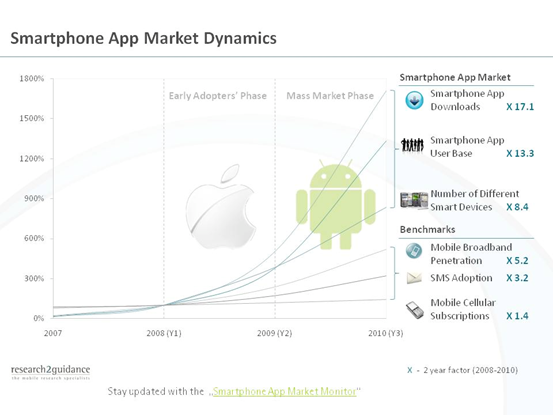
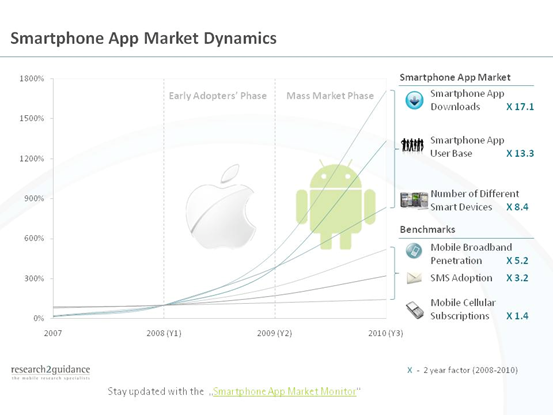
The mobile applications market made it from ramp-up phase to a mass market in only 3 years. This is much faster than previous mobile market sectors needed.

Berlin, March 8th, 2011 

The numbers regarding the smartphone applications market are impressive: Global app download numbers increased by 1700%, user base by 1300%, number of different smart devices by 800%, number of apps by 500% and even app store number increased by 300% in the first 3 years.

With application numbers increasing by almost 100.000 apps per quarter on all major app stores the competition level in a category and platform can change over night, which has an immediate impact on download numbers. Compared to these trends user behavior and demographics in terms of age, gender, usage time, downloads etc. has not changed so quickly over the last three years but will do when applications are proliferating into the mass market. There will be substantial differences per country and platform any company should be aware of, when formulating their application strategy.

Apple dominated the years 2008 and 2009. Since 2010 the hype moved over to Android. With the partnership of Microsoft and Nokia, this might change again as deteriorating average application download numbers on the Android platform will make developers shift again their priorities. What will be the most promising application types and categories will be the next big question.

When looking at the initial phases of other markets, companies really had a lot of time to decide on if, how and when to enter the market. It seems that industry cycles become shorter and shorter and the ability of a company to react very quickly becomes even more important. To stay updated on current trends subscribe to our new “Smartphone App Market Monitor”. This monitoring subscription service will be updated every quarter. Benefit from the intro offer, which saves you 20% until 31st of March.

Twitter: #smartphone #app market outperformes other booming markets – 3 years #benchmark http://j.mp/hRMi6c

About research2guidance:

research2guidance is a Berlin-based market research company specialized in the mobile industry. The company’s service offerings include comprehensive market studies, as well as bespoke research and consultancy.

research2guidance | The Mobile Research Specialists

phone: +49 (0) 30 60 989 3363

mobile: +49 (0) 178 4007736

fax: +49 (0) 30 60 989 3369

email: mp@research2guidance.com

www.research2guidance.com

Conclusion

And so, your thoughts and comments on this ME-P are appreciated. Feel free to review our top-left column, and top-right sidebar materials, links, URLs and related websites, too. Then, subscribe to the ME-P. It is fast, free and secure.

Speaker: If you need a moderator or speaker for an upcoming event, Dr. David E. Marcinko; MBA – Publisher-in-Chief of the Medical Executive-Post – is available for seminar or speaking engagements. Contact: MarcinkoAdvisors@msn.com and http://www.springerpub.com/Search/marcinko

Our Other Print Books and Related Information Sources:

Health Dictionary Series: http://www.springerpub.com/Search/marcinko 

Practice Management: http://www.springerpub.com/product/9780826105752

Physician Financial Planning: http://www.jbpub.com/catalog/0763745790

Medical Risk Management: http://www.jbpub.com/catalog/9780763733421

Healthcare Organizations: www.HealthcareFinancials.com

Physician Advisors: www.CertifiedMedicalPlanner.com

Subscribe Now: Did you like this Medical Executive-Post, or find it helpful, interesting and informative? Want to get the latest ME-Ps delivered to your email box each morning? Just subscribe using the link below. You can unsubscribe at any time. Security is assured.

Link: http://feeds.feedburner.com/HealthcareFinancialsthePostForcxos

Sponsors Welcomed: And, credible sponsors and like-minded advertisers are always welcomed.

Link: https://healthcarefinancials.wordpress.com/2007/11/11/advertise

About Consent Care.Net

The Case for Fully Informed Consent

By Dr. Martin Young

MBChB, FCS(SA)Otol.

martin@carespace.net

The issue of ‘informed consent’ is an ever present bugbear in all healthcare systems around the world, raising its head time after time in journals, weblogs, healthcare administration policies and, above all, medical malpractice lawsuits. Every mention emphasizes the need for improving this difficult issue, but in spite thereof little seems to change.  ConsentCare is a new initiative aiming at addressing the challenges of facilitating and enhancing informed consent.

Why the big deal?

Medical ethicists have long known that, if trust is indeed the cornerstone of the successful doctor-patient relationship, that subjecting a person to medical or surgical treatment without discussing all aspects thereof wherever possible, i.e. fully informed consent, constitutes a betrayal of that trust.

Common opinion asserts that good informed consent creates better mental preparation for surgery, decreased anxiety, shorter hospital stays, earlier recognition of complications by patients before they become serious, and a generally higher success rate and satisfaction rate for the surgery.

70% of the detail of discussion about surgical detail and risk held in doctors’ rooms is forgotten by patients by the time the consultation is over. Patients are ordinarily asked to consent to surgical procedures ‘on the spot’ without access to the detailed documentation of the risks of those procedures that they can consider in their own time and own comfortable environment.

A person knowing all the information about his or her procedure acts as another measure of control to avoid outright human error, such as the wrong operation, or operating on the wrong side.

Almost every case of litigation following surgery will address the adequacy of the consent process.

The right to full knowledge about medical or surgical interventions is entrenched as a human right, even legally enforceable by inclusion in the constitutions of some countries.

No longer is a successful surgical outcome adequate protection against litigation, particularly where the consent is deemed to have contained inadequate information.

In an environment where litigation is on the increase, and expectations, demands and knowledge by the public have heightened, adequate and fully informed consent is one of the few protections doctors can apply both to their own benefit and to that of their patients.

The challenges

Good informed consent is not just presentation of a form that demands the patient’s signature on the bottom.  The process is dependent on all aspects of a good doctor-patient interaction, i.e. positive and empathetic communication, good bedside manner, open and frank discussion of alternatives and costs, opportunity to ask questions, to seek independent advice, and to make decisions based on full disclosure of relevant facts.  The result can however be a valuable clinical record of benefit to all role-players in the process of having a surgical procedure.

The demands of taking fully informed consent are considerable.  No patient is the same, and a standard ‘one size fits all’ approach cannot take this into consideration. The same can be said for the doctor taking the consent.  All have individual approaches and styles that should facilitated by the consent process.  Again, ‘one size fits all’ is as inappropriate for doctors as it is for patients.  The challenge for doctors is in documenting the process for both their patients’ and their own benefit.  Without technological assistance this is impossible to do, for example, to the satisfaction of a medical malpractice lawyer hell-bent on proving medical negligence.

Solutions

ConsentCare was designed taking all these considerations into account, but preserving the traditional and familiar signed document as a final result .  A web-based platform was used, making the system accessible to both doctors and patients through a doctor portal and a patient portal, and opening the possibilities of direct doctor-patient communication around the specified procedure.  Call it if you like a ‘mini-Facebook’ around the consent process.

On logging in a doctor adds a new patient, and proceeds through progressive steps, selecting procedure name, adding or editing graphics, and having editorial control over the content at all stages.  An “editor’s” function allows preset information to be saved, speeding up the process for subsequent consents.

For all procedures a detailed consent document specific to the doctor, patient and procedure is produced in pdf form within a few minutes. This can be emailed to a patient beforehand, edited digitally using tablet PC’s, or printed out and discussed on the spot, leaving all options open as per the doctor’s preferences.

The potential

No other process leaves better evidence of a doctor’s ethical approach, transparency, patient care and responsibility than the informed consent process.  This is a document that should be in the patient’s possession as well as in the medical record, an ethical yardstick of due diligence.  It gives very little clinical detail away other than a patient’s name, the procedure, and likelihood of expected risks.  As such, this can assist the detailed case management of patients, warn nursing staff of anticipated complications, and allocate patients to different levels of post operative care.  It becomes a valuable nursing tool, not just a medicolegal hassle.

The record of a doctor’s approach to his patients in terms of attention to informed consent can be an ethical yardstick that raises that doctor’s profile above the rest.  In an era of doctor and hospital ratings, rising healthcare costs, rising litigation, and increasingly limited resources, all payers, i.e. patients, funders and insurers, could benefit from recognizing where their money is best spent.

The doctor’s excuse “I don’t have the time” should no longer be relevant. Technology takes care of that issue.  The consent process is so important, and with such cost-saving potential in the long term, that time considerations should be far secondary to ethical considerations.  In an era where low markups on doctors’ services promote the push to do high numbers of procedures, the consent process could be the one determinant to start reversing that process.

So, doctors, please make the time, cut the volumes, but, funders and insurers, make sure the doctor does not pay a financial penalty, and is remunerated properly for work done properly.  And malpractice insurers, please take note, and lower premiums for users.

Herein lies the true potential of facilitated informed consent, a ‘win-win’ for everyone involved.

Our position 

ConsentCare is a working proof-of-concept,  available for ‘reskinning’ to the designs of any users /institutions, with the same design elements applied to the final document, and can be hosted on private servers.

Interested users are invited to sign in on the website at www.consentcare.net for more information and a look around with basic functionality, and to contact me for more information.

Conclusion

And so, your thoughts and comments on this ME-P are appreciated. Feel free to review our top-left column, and top-right sidebar materials, links, URLs and related websites, too. Then, subscribe to the ME-P. It is fast, free and secure.

Channel Surfing the ME-P

Have you visited our other topic channels? Established to facilitate idea exchange and link our community together, the value of these topics is dependent upon your input. Please take a minute to visit. And, to prevent that annoying spam, we ask that you register. It is fast, free and secure.

Conclusion

Your thoughts and comments on this ME-P are appreciated. Feel free to review our top-left column, and top-right sidebar materials, links, URLs and related websites, too. Then, subscribe to the ME-P. It is fast, free and secure.

Speaker: If you need a moderator or speaker for an upcoming event, Dr. David E. Marcinko; MBA – Publisher-in-Chief of the Medical Executive-Post – is available for seminar or speaking engagements. Contact: MarcinkoAdvisors@msn.com

OUR OTHER PRINT BOOKS AND RELATED INFORMATION SOURCES:

Product Details    

On Track for Meaningful Use?

Are we on track to be a huge disappointment to our children’s children – or What?

[By Darrell K. Pruitt DDS]

When our grandchildren get the bill for the Obama administration’s subsidies benefitting primarily the health information technology industry, I bet they’re going to be really, really pissed at us for allowing today’s lawmakers to blow their 28 billion dollars to please HIT advocates who mislead consumers as well as lawmakers about the benefits of EHRs.

The Doctors Speak 

According to physicians who actually do the hard lifting in healthcare, the “meaningful use” requirements that they must prove in order to qualify for stimulus money will arguably increase both the cost and danger of healthcare – all for the benefit of stakeholders rather than principals. For one thing, “meaningful use” is meaningless if it fails to help physicians treat their patients. I think HIT stakeholders’ grandchildren should somehow be held accountable to my grandchildren.

Opposing Opinions  

Just days apart this week, two HIT reporters, Rich Daly from ModernHealthcare.com and Joseph Goedert from HealthDataManagment.com described two opposing letters the Office of the National Coordinator for Health Information Technology (ONC) recently received: One from doctors and one from patients (et al).

On Monday, here is how Daly’s article “AMA to ONC: EHR program doesn’t work for docs” began:

http://www.modernhealthcare.com/article/20110302/NEWS/303029950/1153

“Many physicians—specialists in particular—will not participate in the federal electronic health-record adoption incentive program because it requires them to include patient data that they do not otherwise collect, according to a Feb. 25 letter from 39 medical organizations letter to the Office of the National Coordinator for Health Information Technology”

On Wednesday, Joseph Goedert, writing for HealthDataManagment.com began “Consumer Groups: Hold Strong on MU” with this:

http://www.healthdatamanagement.com/news/meaningful-use-criteria-comments-consumers-42080-1.html

“A coalition of 25 consumer groups and unions is asking federal officials to hold firm on more stringent criteria for Stage 2 of electronic health records meaningful use, and expressing support for going further. For instance, because patients still trust their providers more than other information sources, holding providers accountable for actual usage of a patient Web portal ‘is entirely appropriate and we strongly urge ONC to resist pressure from the provider community to absolve them from responsibility for making these services available and useful to their patients,’ according to a comment letter to the Office of the National Coordinator”

  • AARP
  • Advocacy for Patients with Chronic Illness, Inc.
  • AFL-CIO
  • American Association on Health and Disability
  • American Hospice Foundation
  • Caring from a Distance
  • Center for Democracy & Technology
  • Childbirth Connection
  • Consumers for Affordable Health Care
  • Consumers Union
  • Families USA
  • Family Caregiver Alliance
  • Healthwise
  • Mothers Against Medical Error
  • National Alliance for Caregiving
  • National Coalition for Cancer Survivorship
  • National Consumers League
  • National Family Caregivers Association
  • National Health Law Program
  • National Partnership for Women & Families
  • National Women’s Health Network
  • OWL – The Voice of Midlife and Older Women
  • SEIU
  • The Children’s Partnership

Like the “Record Demographics” MU mandate, this is all for the “common good” I suppose. Consumer Advocasy groups wouldn’t mislead patients, would they?

I doubt many Americans represented by these 25 organizations ever imagined a new federal requirement that doctors record each patient’s demographics. (Notice of Proposed Rulemaking: Medicare and Medicaid Programs; Electronic Health Record Incentive Program; Federal Register / Vol. 75, No. 8 / Wednesday, January 13, 2010 / page 1861; RIN 0938-AP78).

This means that the 25 stakeholder groups are doing their best to help American taxpayers hold physicians accountable to record and share their patients’ demographic information with the US government – private information about me and my family members that I personally don’t trust the government to be given – even if I’m in vulnerable need of health care.

Daly’s Article 

According to Daly’s article, the demands of MU are distractions for increasingly busy doctors and staff whose focus, I believe, should include eye-contact with patients with specific health problems rather than irrelevant data needs of third parties, including consumer advocacy groups.

On the other hand, if consumer advocacy groups have successfully defined for the federal government what clueless patients allegedly need, who will the mandate really benefit? 25 consumer advocacy groups don’t equal one consumer, so their letter isn’t grass roots at all. It’s deception wearing lipstick. Gullible and vulnerable patients are again being misrepresented by HIT stakeholders for a cut of our grandchildren’s 28 billion.

Assessment

Finally, if MU requirements are an arguably expensive and dangerous distraction for physicians, how can the law possibly be any less absurd for dentists? I’ll look at meaningful use as well at the ADA’s apparently flagging commitment to EHRs next. The ADA is abandoning state informatics departments – leaving them exposed to ADA members’ questions they are unable to answer. It looks to me that intra-ADA relationships are deteriorating quickly, but nevertheless, traditional stoicism still hasn’t been broken. “Image is everything” – ADA/IDM slogan.

Dentists

Here’s a teaser, dentists: Chances are, your state ADA organization hasn’t yet shared with you how the MU requirement of CPOE (Computerized physician order entry – page 1858) will change your practice communications. If you are a HIPAA-covered entity with an NPI number and you don’t email instructions to your denture lab rather than include a hand-written note with the relevant patient’s plaster models, you won’t qualify for stimulus money. What can possibly go wrong with that meaningful idea?

Conclusion

Your thoughts and comments on this ME-P are appreciated. Feel free to review our top-left column, and top-right sidebar materials, links, URLs and related websites, too. Then, subscribe to the ME-P. It is fast, free and secure.

Speaker: If you need a moderator or speaker for an upcoming event, Dr. David E. Marcinko; MBA – Publisher-in-Chief of the Medical Executive-Post – is available for seminar or speaking engagements. Contact: MarcinkoAdvisors@msn.com

OUR OTHER PRINT BOOKS AND RELATED INFORMATION SOURCES:

Product DetailsProduct DetailsProduct Details

Product Details  Product Details

   Product Details 

About RepairPal.com for Doctors

Doctors – Take the Mystery Out of Auto Repair!

By Staff Reporters

Join Our Mailing List 

RepairPal gives you independent and unbiased repair estimates, user ratings and reviews, plus advice you can’t get anywhere else. It’s easy, accurate, and FREE!

How it Works

If you’ve received a price estimate for a specific automobile repair job, compare it to a RepairPrice estimate to make sure you’re getting a fair deal. They’ll show you what to expect and what to look out for when you have the service or repair performed.

DEM with JAG

Assessment

Doctors, and advisors, take the mystery out of auto repair by giving em’ a click, and telling us what you think.

www.RepairPal.com

Conclusion

Your thoughts and comments on this ME-P are appreciated. Feel free to review our top-left column, and top-right sidebar materials, links, URLs and related websites, too. Then, subscribe to the ME-P. It is fast, free and secure.

Speaker: If you need a moderator or speaker for an upcoming event, Dr. David E. Marcinko; MBA – Publisher-in-Chief of the Medical Executive-Post – is available for seminar or speaking engagements. Contact: MarcinkoAdvisors@msn.com

OUR OTHER PRINT BOOKS AND RELATED INFORMATION SOURCES:

Product Details  Product Details

On the Collapse of Medical Labor Unions?

Join Our Mailing List

Lessons Learned from the State of Wisconsin

[By Dr. David Edward Marcinko MBA, CMP™]

Did you know that healthcare journalist William F. Shea opined a decade ago that there were numerous psychological barriers against the formation of physicians unions [personal communication].

The Reasons

These included (1) public perception of doctor’s as a “cut above” ordinary workers; (2) doctor’s attempts to wrap collective bargaining in a mantle of patient’s rights that lacked credibility; and (3) the highly educated physician’s ability to re-engineer and seek alternate employment opportunities rather than accept the salary scale or lack of autonomy present in restrictive managed care entities.

Assessment

Time has proven him correct as MD resignation through individual re-deployment and/or innovation has been more effective than any “strike” if called for by one practitioner, or union group, at a time.

MORE: Unions

MORE: https://www.beckershospitalreview.com/hospital-physician-relationships/princeton-economists-physicians-are-taking-money-away-from-the-rest-of-us.html?origin=bhre&utm_source=bhre&oly_enc_id=

Conclusion

Your thoughts and comments on this ME-P are appreciated. Feel free to review our top-left column, and top-right sidebar materials, links, URLs and related websites, too. Then, subscribe to the ME-P. It is fast, free and secure.

Link: http://feeds.feedburner.com/HealthcareFinancialsthePostForcxos

Speaker: If you need a moderator or speaker for an upcoming event, Dr. David E. Marcinko; MBA – Publisher-in-Chief of the Medical Executive-Post – is available for seminar or speaking engagements. Contact: MarcinkoAdvisors@msn.com

OUR OTHER PRINT BOOKS AND RELATED INFORMATION SOURCES:

LEXICONS: http://www.springerpub.com/Search/marcinko
PHYSICIANS: www.MedicalBusinessAdvisors.com
PRACTICES: www.BusinessofMedicalPractice.com
HOSPITALS: http://www.crcpress.com/product/isbn/9781466558731
CLINICS: http://www.crcpress.com/product/isbn/9781439879900
ADVISORS: www.CertifiedMedicalPlanner.org
BLOG: www.MedicalExecutivePost.com

Product DetailsProduct DetailsProduct Details

Product Details

Protecting Personal Health Information [PHI on Talk Radio]

Check out the Xerox Blog Talk Radio

By Staff Reporters

Join Our Mailing List 

Federal regulations require that healthcare organizations put new safeguards be put in place to protect a person’s personal health information, also known as PHI. This means new challenges for anyone who handles sensitive data [covered entities]. And, there are also severe penalties if the guidelines aren’t followed.

From ACS

Mark Tripodi, chief innovation officer for ACS’ government healthcare solutions group will explain why data can easily be put at risk and what can be done to ensure organizations meet privacy standards.

Assessment

You can access the recording here: http://bit.ly/eyv65U.

For more on Xerox: http://xrx.sm/news.

Conclusion

Your thoughts and comments on this ME-P are appreciated. Feel free to review our top-left column, and top-right sidebar materials, links, URLs and related websites, too. Then, subscribe to the ME-P. It is fast, free and secure.

Link: http://feeds.feedburner.com/HealthcareFinancialsthePostForcxos

Speaker: If you need a moderator or speaker for an upcoming event, Dr. David E. Marcinko; MBA – Publisher-in-Chief of the Medical Executive-Post – is available for seminar or speaking engagements. Contact: MarcinkoAdvisors@msn.com

OUR OTHER PRINT BOOKS AND RELATED INFORMATION SOURCES:

DICTIONARIES: http://www.springerpub.com/Search/marcinko
PHYSICIANS: www.MedicalBusinessAdvisors.com
PRACTICES: www.BusinessofMedicalPractice.com
HOSPITALS: http://www.crcpress.com/product/isbn/9781466558731
CLINICS: http://www.crcpress.com/product/isbn/9781439879900
BLOG: www.MedicalExecutivePost.com
FINANCE: Financial Planning for Physicians and Advisors
INSURANCE: Risk Management and Insurance Strategies for Physicians and Advisors

Product Details 

Understanding and Using Portfolio Performance Benchmarks

Concerning Periodic Measurements and Meters

By Dr. David Edward Marcinko MBA, CMP™

[Publisher-in-Chief]

The stock market has been booming lately; flirting with DJIA 12,000. Up almost 100% since March 2009, after being down almost 50%. And so, perhaps this is a good time to [re]-evaluate the performance of your investment portfolio[s]. But how?

Performance measurement has an important role in monitoring progress towards any physician’s portfolio’s goals.  The portfolio’s objective may be to preserve the purchasing power of the assets by achieving returns above inflation or to have total returns adequate to satisfy an annual spending need without eroding original capital, etc.  Whatever the absolute goal, performance numbers need to be evaluated based on an understanding of the market environment over the period being measured.

Time Weighted Return

One way to put a portfolio’s a time-weighted return in the context of the overall market environment is to compare the performance to relevant alternative investment vehicles.  This can be done through comparisons to either market indices, which are board baskets of investable securities, or peer groups, which are collections of returns from managers or funds investing in a similar universe of securities with similar objectives as the portfolio.  By evaluating the performance of alternatives that were available over the period, the physician investor and his/her advisor are able to gain insight to the general investment environment over the time period.

The Indices

Market indices are frequently used to gain perspective on the market environment and to evaluate how well the portfolio performed relative to that environment.  Market indices are typically segmented into different asset classes. 

Common stock market indices include the following:

  • Dow Jones Industrial Average- a price-weighted index of 30 large U.S. corporations.
  • Standard & Poor’s (S&P) 500 Index – a capitalization-weighted index of 500 large U.S. corporations.
  • Value Line Index – an equally-weighted index of 1700 large U.S. corporations.
  • Russell 2000 – a capitalization-weighted index of smaller capitalization U.S. companies.
  • Wilshire 5000 – a cap weighted index of the 5000 largest U.S. corporations.
  • Morgan Stanley Europe Australia, Far East (EAFE) Index – a capitalization-weighted index of the stocks traded in developed economies. 

Common bond market indices include the following:

  • Lehman Brothers Government Credit Index – an index of investment grade domestic bonds excluding mortgages [N/A].
  • Lehman Brothers Aggregate Index – the LBGCI plus investment grade mortgages [N/A].
  • Solomon Brothers Bond Index – similar in construction to the LBAI.
  • Merrill Lynch High Yield Index – an index of below investment grade bonds.
  • JP Morgan Global Government Bond – an index of domestic and foreign government-issued fixed income securities. 

The selection of an appropriate market index depends on the goals of the portfolio and the universe of securities from which the portfolio was selected.  Just as a portfolio with a short-time horizon and a primary goal of capital preservation should not be expected to perform in line with the S&P 500, a portfolio with a long-term horizon and a primary goal of capital growth should not be evaluated versus Treasury Bills.

While the Dow Jones Industrial Average and S&P 500 are often quoted in the newspapers, there are clearly broader market indices available to describe the overall performance of the U.S. stock market.  Likewise, indices like the S&P 500 and Wilshire 5000 are capitalization-weighted, so their returns are generally dominated by the largest 50 of their 500 – 5000 stocks.  While this capitalization-bias does not typically affect long-term performance comparisons, there may be periods of time in which large cap stocks out- or under-perform mid-to-small cap stocks, thus creating a bias when cap-weighted indices are used versus what is usually non-cap weighted strategies of managers or mutual funds. 

Finally, the fixed income indices tend to have a bias towards intermediate-term securities versus longer-term bonds.  Thus, an investor with a long-term time horizon, and therefore potentially a higher allocation to long bonds, should keep this bias in mind when evaluating performance.

Assessment

RIP: Lehman Brothers

Peer group comparisons tend to avoid the capitalization-bias of many market indices, although identifying an appropriate peer group is as difficult as identifying an appropriate market index.  Further, peer group universes will tend to have an additional problem of survivorship bias, which is the loss of (generally weaker) performance track records from the database.  This is the greatest concern with databases used for marketing purposes by managers, since investment products in these generally self-disclosure databases will be added when a track record looks good and dropped when the product’s returns falter.  Whether mutual funds or managers, the potential for survivorship bias and inappropriate manager universes make it important to evaluate the details of how a database is constructed before using it for relative performance comparisons.

Conclusion

And so, your thoughts and comments on this ME-P are appreciated. Feel free to review our top-left column, and top-right sidebar materials, links, URLs and related websites, too. Then, subscribe to the ME-P. It is fast, free and secure.

Speaker: If you need a moderator or speaker for an upcoming event, Dr. David E. Marcinko; MBA – Publisher-in-Chief of the Medical Executive-Post – is available for seminar or speaking engagements. Contact: MarcinkoAdvisors@msn.com and http://www.springerpub.com/Search/marcinko

Our Other Print Books and Related Information Sources:

Health Dictionary Series: http://www.springerpub.com/Search/marcinko 

Practice Management: http://www.springerpub.com/product/9780826105752

Physician Financial Planning: http://www.jbpub.com/catalog/0763745790

Medical Risk Management: http://www.jbpub.com/catalog/9780763733421

Healthcare Organizations: www.HealthcareFinancials.com

Physician Advisors: www.CertifiedMedicalPlanner.com

Subscribe Now: Did you like this Medical Executive-Post, or find it helpful, interesting and informative? Want to get the latest ME-Ps delivered to your email box each morning? Just subscribe using the link below. You can unsubscribe at any time. Security is assured.

Link: http://feeds.feedburner.com/HealthcareFinancialsthePostForcxos

Sponsors Welcomed: And, credible sponsors and like-minded advertisers are always welcomed.

Link: https://healthcarefinancials.wordpress.com/2007/11/11/advertise

Product DetailsProduct DetailsProduct Details       

Product Details  Product Details

About HealthCareAndYou.org

What it is – How it works?

By Staff Reporters

Join Our Mailing List 

At a time when many Americans are confused about the healthcare overhaul law, a coalition of groups representing doctors, nurses, pharmacists and consumers has launched a website to answer questions about the Affordable Care Act.

The new website – HealthCareandYou.org – doesn’t delve into the politics behind the law, but spells out what the law means to consumers, depending on the state they live in and their age. The website also provides a timeline, telling consumers when different parts of the law go into effect.

The Site

According to the site, The Affordable Care Act is a health care law that aims to improve our current health care system by increasing access to health coverage for Americans and introducing new protections for people who have health insurance.

If you have health insurance, you will benefit from steps to stop insurance companies from cancelling your coverage if you get sick. The law will also require insurance plans to cover your out-of-pocket costs for many proven preventive and screening services, such as colonoscopies and mammograms, to catch problems at their earliest, most treatable stages.

Your job might not offer health insurance. Or, maybe you have been denied coverage because of a pre-existing condition such as asthma or cancer. The law now offers health plans for people with pre-existing conditions who have had trouble finding care. And it will increase access to coverage for more Americans in 2014.

The law helps small businesses pay for health insurance for their employees. And it supports programs that will help increase the number of primary care physicians, nurses, physician assistants and other health care professionals.

Assessment

It is important to understand what the law means for you. Check out what changes have already taken place and learn more about what is happening in your state.

Link: http://www.healthcareandyou.org

Conclusion

And so, your thoughts and comments on this ME-P are appreciated. Feel free to review our top-left column, and top-right sidebar materials, links, URLs and related websites, too. Then, subscribe to the ME-P. It is fast, free and secure.

Speaker: If you need a moderator or speaker for an upcoming event, Dr. David E. Marcinko; MBA – Publisher-in-Chief of the Medical Executive-Post – is available for seminar or speaking engagements. Contact: MarcinkoAdvisors@msn.com and http://www.springerpub.com/Search/marcinko

Our Other Print Books and Related Information Sources:

Health Dictionary Series: http://www.springerpub.com/Search/marcinko

Practice Management: http://www.springerpub.com/product/9780826105752

Physician Financial Planning: http://www.jbpub.com/catalog/0763745790

Medical Risk Management: http://www.jbpub.com/catalog/9780763733421

Healthcare Organizations: www.HealthcareFinancials.com

Physician Advisors: www.CertifiedMedicalPlanner.com

Subscribe Now: Did you like this Medical Executive-Post, or find it helpful, interesting and informative? Want to get the latest ME-Ps delivered to your email box each morning? Just subscribe using the link below. You can unsubscribe at any time. Security is assured.

Link: http://feeds.feedburner.com/HealthcareFinancialsthePostForcxos

Sponsors Welcomed: And, credible sponsors and like-minded advertisers are always welcomed.

Link: https://healthcarefinancials.wordpress.com/2007/11/11/advertise

Product DetailsProduct DetailsProduct Details       

Product Details  Product Details

   Product Details 

How Investment Professionals Evaluate Time Periods for Portfolio Comparison

On Capturing a Full Range of Market Environments

By Dr. David Edward Marcinko MBA, CMP™

[Publisher-in-Chief]

What is the appropriate time period for portfolio growth comparison? 

Performance measurements over trailing calendar periods, such as the last one, three, five or 10 years, are often used in the mutual fund and investment industry.  While three-to-five-to-ten years may seem like a long enough time for an investment strategy to show its value added, these time periods will often be dominated by either a bull or bear market environment, and/or a large cap or small cap dominated environment, etc. 

Market Cycles

One way to lessen the possibility of the market environment biasing a performance comparison is to focus on a time period that captures full range of market environments; a market cycle. 

The market cycle is defined as a market peak, with high investor confidence and speculation, through a market trough, in which investor bullishness and speculation subsides, to the next market peak. 

A bull market is a market environment of generally rising prices and investor optimism.  While there have been several definitions of a bear market based upon market returns (e.g., a decline of –15 percent or more, two consecutive negative quarters, etc.), the idea implied by its name is a period of high pessimism and sustained losses. 

Thus, one returns-based rule-of-thumb that can be used to identify a bear market is a negative return in the market that takes at least four quarters to overcome. 

http://www.amazon.com/Financial-Planning-Handbook-Physicians-Advisors/dp/0763745790/ref=sr_1_1?ie=UTF8&s=books&qid=1276795609&sr=1-1

Assessment

The stock market has been booming lately. Up almost 100% since March 2009, after being down almost 50%. And so, perhaps this is a good time to re-evaluate the performance of your investment portfolio[s].

And so, by examining performance over a full market cycle, there is a greater likelihood that short-term market dislocations like the “flash crash” of 2009 will not bias the performance comparison.

Conclusion

Your thoughts and comments on this ME-P are appreciated. What is your time period for portfolio evaluation? Feel free to review our top-left column, and top-right sidebar materials, links, URLs and related websites, too. Then, subscribe to the ME-P. It is fast, free and secure.

Speaker: If you need a moderator or speaker for an upcoming event, Dr. David E. Marcinko; MBA – Publisher-in-Chief of the Medical Executive-Post – is available for seminar or speaking engagements. Contact: MarcinkoAdvisors@msn.com and http://www.springerpub.com/Search/marcinko

Our Other Print Books and Related Information Sources:

Health Dictionary Series: http://www.springerpub.com/Search/marcinko

Practice Management: http://www.springerpub.com/product/9780826105752

Physician Financial Planning: http://www.jbpub.com/catalog/0763745790

Medical Risk Management: http://www.jbpub.com/catalog/9780763733421

Healthcare Organizations: www.HealthcareFinancials.com

Physician Advisors: www.CertifiedMedicalPlanner.com

Subscribe Now: Did you like this Medical Executive-Post, or find it helpful, interesting and informative? Want to get the latest ME-Ps delivered to your email box each morning? Just subscribe using the link below. You can unsubscribe at any time. Security is assured.

Link: http://feeds.feedburner.com/HealthcareFinancialsthePostForcxos

Sponsors WelcomedAnd, credible sponsors and like-minded advertisers are always welcomed.

Link: https://healthcarefinancials.wordpress.com/2007/11/11/advertise

Product DetailsProduct DetailsProduct Details       

Product Details  Product Details

Quality Business Issues in the 21st Century

A  Revisit –  Circa 2011

By Henry H. Goldman PhD, CPCM

[Risk Management Associates International, LLP]

Dear Ms. Ann Miller RN MHA

I’ve attached an article which might be of interest to your ME-P readers, subscribers and clients. 

It’s new and can easily be modified to meet your healthcare needs.

Link: QUALITY ISSUES IN THE 21ST CENTURY[1]

Assessment

Although this essay is not medically specific, the general concepts are applicable to the healthcare industrial complex.

About the Author

Henry H. Goldman PhD

Executive Managing Partner
Risk Management Associates International, LLP
5005 SW Raintree Circle
Lee’s Summit, MO 64082

Henry H. Goldman, Ph.D. is the Managing Director of the GOLDMAN-NELSON GROUP (USA), a global management consulting and executive training organization that he founded in 1981. Dr. Goldman’s areas of expertise include supervisory and management training, decision-making and problem solving, team building, international financial management, and strategic planning. He is frequently invited to facilitate programs and workshops on such diverse subjects as “Leading Organizational Change,” “Decision-Making for Managers,” “Budgeting in the Borderlands,” as well as issues dealing with global business and finance. Goldman recently served as Co-Editor of Taking Stock: A Survey on the Practice and Future of Change Management (Berlin, 2005). He has worked with executives and managers, worldwide, to develop an understanding of management and financial concerns in a global marketplace. He has conducted training programs along the Pacific Rim, Southern Africa, and the Middle East and among the Newly Independent States of the former Soviet Union. His clients include MGM Studios, Lucent Technologies–China, General Motors, Hughes Aircraft Company and Citizens’ Development Corps. He served as adjunct professor of management at the University of Macau, China, where he taught “Team Building” to MBA students. He is currently affiliated with the National Graduate School and Boston University’s Center for Executive Education. Dr. Goldman was recently appointed to the Mine Relief Global Business Council to assist in the remediation of land mines, world-wide, with a particular focus on the Turkey-Syria border.

Conclusion

And so, your thoughts and comments on this ME-P are appreciated. Feel free to review our top-left column, and top-right sidebar materials, links, URLs and related websites, too. Then, subscribe to the ME-P. It is fast, free and secure.

Our Other Print Books and Related Information Sources:

Health Dictionary Series: http://www.springerpub.com/Search/marcinko

Practice Management: http://www.springerpub.com/product/9780826105752

Physician Financial Planning: http://www.jbpub.com/catalog/0763745790

Medical Risk Management: http://www.jbpub.com/catalog/9780763733421

Healthcare Organizations: www.HealthcareFinancials.com

Physician Advisors: www.CertifiedMedicalPlanner.com

Subscribe Now: Did you like this Medical Executive-Post, or find it helpful, interesting and informative? Want to get the latest ME-Ps delivered to your email box each morning? Just subscribe using the link below. You can unsubscribe at any time. Security is assured.

Link: http://feeds.feedburner.com/HealthcareFinancialsthePostForcxos

Sponsors Welcomed: And, credible sponsors and like-minded advertisers are always welcomed.

Link: https://healthcarefinancials.wordpress.com/2007/11/11/advertise

Product DetailsProduct DetailsProduct Details       

Product Details  Product Details

   Product Details 

Tax Exempt Hospitals Granted IRS Filing Delay

Recent Developments on Form 990 and Schedule H

By Children’s Home Society of Florida Foundation

Join Our Mailing List 

In Announcement 2011-20; 2011-10 IRB 1 (23 Feb 2011), the IRS granted a three-month automatic filing extension for most tax-exempt hospitals.

Form 990 and Schedule H

Following the development of a new Form 990 Return for Charitable Organizations, the IRS published a comprehensive Schedule H for medical centers. With the passage of the Patient Protection and Affordable Care Act of 2010, both the IRS and many medical centers need additional time to properly prepare for filing of Form 990 with the Schedule H for medical centers.

As a result, the IRS indicates that the earliest permitted filing date for tax-exempt medical centers filing Form 990 and Schedule H will be July 1, 2010. This is the earliest filing date whether the filing is in paper form or electronic format.

Filing Extension Form 8868

For those medical centers with return due dates before August 15, 2011, there is an automatic three-month extension of time to file. This extension is available without filing Form 8868, Application for Extension of Time to File an Exempt Organization Return.

However, there may be new organizations that have not filed Form 990 Schedule H for tax year 2009. In this case, they may choose to file Form 8868 to clarify their intention to extend the deadline. If a medical center requires an additional three months to file, then it should file Form 8868.

Assessment

Finally, for those medical centers that qualify for this automatic extension, there will be no penalty if they file within the additional three-month period.

Conclusion

And so, your thoughts and comments on this ME-P are appreciated. Feel free to review our top-left column, and top-right sidebar materials, links, URLs and related websites, too. Then, subscribe to the ME-P. It is fast, free and secure.

Speaker: If you need a moderator or speaker for an upcoming event, Dr. David E. Marcinko; MBA – Publisher-in-Chief of the Medical Executive-Post – is available for seminar or speaking engagements. Contact: MarcinkoAdvisors@msn.com and http://www.springerpub.com/Search/marcinko

Our Other Print Books and Related Information Sources:

Health Dictionary Series: http://www.springerpub.com/Search/marcinko

Practice Management: http://www.springerpub.com/product/9780826105752

Physician Financial Planning: http://www.jbpub.com/catalog/0763745790

Medical Risk Management: http://www.jbpub.com/catalog/9780763733421

Healthcare Organizations: www.HealthcareFinancials.com

Physician Advisors: www.CertifiedMedicalPlanner.com

Subscribe Now: Did you like this Medical Executive-Post, or find it helpful, interesting and informative? Want to get the latest ME-Ps delivered to your email box each morning? Just subscribe using the link below. You can unsubscribe at any time. Security is assured.

Link: http://feeds.feedburner.com/HealthcareFinancialsthePostForcxos

Sponsors Welcomed: And, credible sponsors and like-minded advertisers are always welcomed.

Link: https://healthcarefinancials.wordpress.com/2007/11/11/advertise

Product DetailsProduct DetailsProduct Details       

Product Details  Product Details

   Product Details 

Events Planner: March 2011

ADVERTISEMENT

Events-Planner: MARCH 2011

By Staff Writers

“Keeping track of important health economics and financial industry meetings, conferences and summits”

Welcome to this issue of the Medical Executive-Post and our Events-Planner. It contains the latest information on conferences, news, and relevant resources in healthcare finance, economics, research and development, business management, pharmaceutical pricing, and physician/entity reimbursement!  Watch for a new Events-Planner each month.

First, a little about us! The Medical Executive-Post is still a relative newcomer. But today, we have almost 175,000 visitors and readers each month from all over the country, in addition to our growing subscriber base. We have been a successful collaborative effort, thanks to your contributions.  As a result, we are adding new resources daily. And, we hope the website continues to provide the best place to go for journals, books, conferences, educational resources, tools, and other things you need to establish the value your healthcare consulting and financial advisory intervention.

So, enjoy the Medical Executive-Post and this monthly Events-Planner with our compliments. 

A Look Ahead this Month – And now, the important dates:

  • March 17: Ethical Insurance Business Meeting, Florham Park, NJ
  • March 27: Creating the Multi Family Office Workshop, Palm Beach Gardens, FLA
  • March 28: Innovative Real Estate Strategies Conference, Palm Beach Gardens, FLA

Please send in your meetings and dates for listing in the next issue of our Events-Planner.

MarcinkoAdvisors@msn.com

Speaker: If you need a moderator or speaker for an upcoming event, Dr. David E. Marcinko; MBA – Publisher-in-Chief of the Executive-Post – is available for seminar or speaking engagements. Contact: MarcinkoAdvisors@msn.com 

Subscribe Now: Did you like this Medical Executive-Post, or find it helpful, interesting and informative? Want to get the latest E-Ps delivered to your email box each morning? Just subscribe using the link below. It’s free. You can unsubscribe at any time. Security is assured.

Link: http://feeds.feedburner.com/HealthcareFinancialsthePostForcxos

Product DetailsProduct DetailsProduct Details       

Product Details  Product Details

   Product Details