The Computers are now Ruling Wall Street

The computers are now ruling Wall Street

By MIT Technology Review

***

 ***

Over the past five years, human hedge fund managers have averaged 4.3 percent returns.

Funds that rely on algorithms to pick stocks, on the other hand—so-called quant-focused funds—have brought in 5.1 percent

Assessment: So, what gives?

More: The Massacre of Hedge Fund Business

Conclusion

Your thoughts and comments on this ME-P are appreciated. Feel free to review our top-left column, and top-right sidebar materials, links, URLs and related websites, too. Then, subscribe to the ME-P. It is fast, free and secure.

Speaker: If you need a moderator or speaker for an upcoming event, Dr. David E. Marcinko; MBA – Publisher-in-Chief of the Medical Executive-Post – is available for seminar or speaking engagements. Contact: MarcinkoAdvisors@msn.com

OUR OTHER PRINT BOOKS AND RELATED INFORMATION SOURCES:

Comprehensive Financial Planning Strategies for Doctors and Advisors: Best Practices from Leading Consultants and Certified Medical Planners™

***

Walking Around the Financial District in New York

Join Our Mailing List

SPECIAL REPORT

USA Wanderings: Walking Around the Financial District in New York

PHOTOGRAPHY

By

***

Comprehensive Financial Planning Strategies for Doctors and Advisors: Best Practices from Leading Consultants and Certified Medical Planners(TM)

***

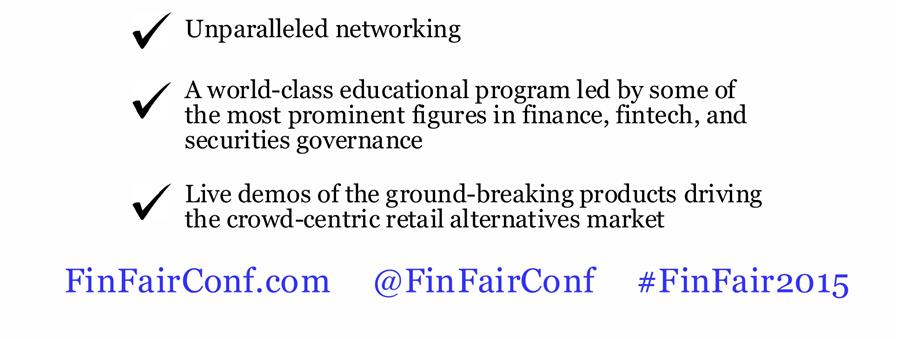
FinFair 2015

***

 ADVERTISEMENT

FF

Truly one of the Most Groundbreaking FinTech & Alternative Finance Programs to Come to Wall Street

Discussions will include:

  • Applications of Reg A+ from small business capital formation to private debt securitizations
  • Enhancing small cap deal distribution & aftermarket support
  • How Reg A+ will Impact Community Investing
  • An introduction to next-Gen Broker Dealers and online financing platforms
  • How Financial Advisors and RIAs will benefit from Reg A+
  • Building vibrant venture exchanges
  • New trends in liquidity and clearing
  • Diversifying fixed-income portfolios with P2P, P2B and P2R debt
  • Distinguishing between a FinTech bubble or a financial revolution.

po

REGISTER HERE

For those who can’t join us in person on the 29th, feel free to join us virtually.

Clear here for details on FinFair’s live broadcast

***

Health 2.0 Financial Planning for Medical Executive-Post Members

A By-Product of Health 2.0?

By Dr. David Edward Marcinko FACFAS MBA CMP*

[Founder and CEO]

www.MedicalBusinessAdvisors.com

Dr David E Marcinko MBAA decade ago, Editor Gregory J. Kelley of Physician’s MONEY DIGEST and I reported that a 47 year old-doctor with $184,000 annual income would need about $5.5 million dollars for retirement at age 65. Then came the “flash-crash’ of 2007-08, the home mortgage fiasco and the Patient Protection and Accountable Care Act [PP-ACA] of 2010; etc.

No wonder that medical provider career panic is palpable. Much like the new medical home concept, the idea of holistic life planning was born.

Life Planning

Life planning has many detractors and defenders. Formally, life planning has been defined in the following way. 

Financial Life Planning is an approach to financial planning that places the history, transitions, goals, and principles of the client at the center of the planning process.  For the client, their life becomes the axis around which financial planning develops and evolves.

But, for physicians, life planning’s quasi-professional and informal approach to the largely isolated disciplines of medically focused financial planning, was still largely inadequate.

Why? 

Today’s personal financial and practice environment is incredibly more complex than it was in 2007-08, as economic stress from HMOs, Wall Street, liability fears, criminal scrutiny from government agencies, IT mischief from hackers, economic benchmarking from hospitals and the lost confidence of patients all converged to inspire a robust new financial planning 2.0 approach for medical professionals.

Example of a financial planning mistake 

Recall the tale of Dr. Debasis Kanjilal, a pediatrician from New York who put more than $500,000 into the dot.com company, InfoSpace, upon the advice of Merrill Lynch’s star but non fiduciary analyst Henry Bloget.

Is it any wonder that when the company crashed, the analyst was sued, and Merrill settled out of court? Other analysts, such as Mary Meeker of Morgan Stanley, Dean Witter and Jack Grubman from Salomon Smith Barney, were involved in similar fiascos.

Although sad, this story is a matter of public record. Hopefully, doctors now understand that the big brokerage houses that underwrite and recommend stocks may have credibility problems, and that physicians got burned with the adrenalin rush of “self-directed” investment portfolios.

Example of a medical practice management mistake 

Just reflect a moment on colleagues willing to securitize their medical practices a few years ago, and cash out to Wall Street for perceived riches that were not rightly deserved

Where are firms such as MedPartners, Phycor, FPA and Coastal now? A recent survey of the Cain Brothers Physician Practice Management Corporation Index of publicly traded PPMCs revealed a market capital loss of more than 95%, since inception. 

Another Approach?

This disruptive narrative shift was formally noted by the Institute of Medical Business Advisors Inc [iMBA, Inc] and introduced to the medical and financial services industry. This research and corpus of work resulted in hundreds of publications in the Library of Medicine, National Institute of Health (NIH) and the Library of Congress, along with related publications, a dozen textbooks and white papers

http://www.ncbi.nlm.nih.gov/nlmcatalog?term=marcinko

The iMBA approach to financial planning, as championed by the www.CertifiedMedicalPlanner.org professional charter designation, integrates the traditional concepts of fiduciary focused financial planning, with the increasing complex business concepts of medical practice management.

The former ideas are presented in our textbook on financial planning for doctors: Financial Planning for Physicians and Advisors

The later in our companion book: Business of Medical Practice [Edition 3.0]

A textbook for hospital CXOs and physician-executives: Hospitals & Healthcare Organizations

While most issues of risk management, liability and insurance are found in Risk Management and Insurance Strategies for Physicians and Advisors

And, for the perplexed, all definitions are codified in the dictionary glossary Health Dictionary Series

Health 2.0 Paradigm Shift

And so, the ME-P community now realizes that a more integrated approach is needed.  The traditional vision of medical practice management, personal physician financial planning and how they may look in the future are rapidly changing as the retail mentality of medicine is replaced with a wholesale philosophy.

Or, how views on maximizing current practice income might be more profitably sacrificed for the potential of greater wealth upon eventual practice sale and disposition.

Or, how Yale University economist Robert J Shiller warns in “The New Financial Order” [Risk in the 21st Century] that the risk for choosing the wrong healthcare profession or specialty might render physicians obsolete by technological changes, managed care systems or fiscally unsound demographics. 

Physician-Executive

My Assessment

Yet, the opportunity to re-vise the future at any age through personal re-engineering, exists for all of us, and allows a joint exploration of the medicine, business and the meaning and purpose of life.

To allow this deeper and more realistic approach, the advisor and the doctor must build relationships based on fiduciary trust, greater self-knowledge and true medical business and financial enhancement acumen.

Are you up to the task?

Conclusion

Your thoughts and comments on this ME-P are appreciated. Feel free to review our top-left column, and top-right sidebar materials, links, URLs and related websites, too. Then, subscribe to the ME-P. It is fast, free and secure.

Link: http://feeds.feedburner.com/HealthcareFinancialsthePostForcxos

Speaker: If you need a moderator or speaker for an upcoming event, Dr. David E. Marcinko; MBA – Publisher-in-Chief of the Medical Executive-Post – is available for seminar or speaking engagements. Contact: MarcinkoAdvisors@msn.com

OUR OTHER PRINT BOOKS AND RELATED INFORMATION SOURCES:

Product DetailsProduct DetailsProduct Details

Product Details  Product Details

Product DetailsProduct Details

What are the Prospects for US Recession? [A Voting and Opinion Poll]

Is Wall Street Driving Main Street?

By Staff Reporters

Join Our Mailing List 

Concern is high that the US economy may be close to or entering recession, yet the fundamentals lend little support to such a projection. There has been no decline in jobs, while corporate health is very strong.

So, the recession concerns appear to be driven more by the decline in stock prices than by economic developments.

IOW: Is Wall Street pessimism driving Main Street gloom?

What do you think? Please vote and be sure to add your comments below.

Conclusion

And so, your thoughts and comments on this ME-P are appreciated. Feel free to review our top-left column, and top-right sidebar materials, links, URLs and related websites, too. Then, subscribe to the ME-P. It is fast, free and secure.

Link: http://feeds.feedburner.com/HealthcareFinancialsthePostForcxos

Speaker: If you need a moderator or speaker for an upcoming event, Dr. David E. Marcinko; MBA – Publisher-in-Chief of the Medical Executive-Post – is available for seminar or speaking engagements. Contact: MarcinkoAdvisors@msn.com  

Product Details

Product Details

On American Health Care and Financial Services Competitiveness

A MEMORIAL DAY OPINION – EDITORIAL

[Innovation – Not Nationalization – Can Again Lead]

By Dr. David Edward Marcinko; FACFAS, MBA, CPHQ, CMP™

[Publisher-in-Chief]

By Hope Rachel Hetico; RN, MHA, CPHQ, CMP™

[Managing Editor]

Ann Miller; RN, MHA

[Executive-Director]

American Flag

On this 2010 Memorial Day weekend, please allow us to directly reflect for a moment on the decline of the healthcare, banking and financial services industry in America. And; then somewhat indirectly comment on the hopeful emergence of the web 2.0 phenomena of which we all are a part. The competitive applicability to these sectors should be appreciated by the insightful ME-P reader.

Collapse of Command and Control Monopolies and Oligarchies   

Old monopolies everywhere are crumbling because of tougher new competitors and the transparency wrought by electronic connectedness. For example, our old newspaper has to compete with the internet, your electric utility company battles low-cost local start-ups, telephone companies must begin installing fiber optic lines to fend off cable companies; and RIAs and fiduciary focused financial advisors [FAs] will supplant BDs and stock brokers in the financial services sector.

www.CertifiedMedicalPlanner.com

cmp-logo

The airline industry collapsed a few years ago, the banking industry has just collapsed, and the auto industry is recovering as we pen this post. [We have a particular affinity for the auto sector however, as the son of a UAW member and step-daughter of Michiganders]. Regardless, the rush to more intense competition cannot be stopped. As a doctor, FA or other business competitor; you either keep pace or get crushed by quasi-oligarchic organizations like the American Medical Association [AMA], American Podiatric Medical Association [FPMA], American Dental Association [ADA], American Osteopathic Medical Association AOMA], Financial Planning Association [FPA], Certified Financial Planner Board of Standards [CFP BoS], College for Financial Planning [CFP] or the National Association of Personal Financial Advisors [NAPFA], etc. What have they, and Wall Street, done for you … lately? Scandal, taint, doubt, lost-credibility, a business-as-usual ennui, lethargy and ruin! Enter www.Sermo.com

Link: https://healthcarefinancials.wordpress.com/2009/04/19/calling-for-cfp%c2%ae-fiduciary-status-real-education-and-higher-duty/#comment-4136

Health Insurance Companies

In the last-generation of health insurance companies and related fraternal medical organizations, patients exercised great control over physician selection, had quicker access to specialists and encountered fewer restrictions on care. The reverse was true with financial services. But, because of advancing technology, aging demographics, intense R&D, global manufacturing, and escalating domestic HR costs – competitive market forces against traditional and structured staff model managed care companies – many industry analysts [like us] predicted growth would decline [Yes, greed was also involved as healthcare was presumed a recession-proof sector; and didn’t we all own behemoth big-pharma and HMO stocks in our 401-K, and 403-B plans]? But now, many former stock-brokers and FAs are going rogue; er – independent!

“Although inefficiencies in any business often open up in the short term, and can be greatly exploited by creative and visionary entrepreneurs – as in most business structures – market forces will prevail in the long run”.

Leo F. Mullin, MBA

[Former CEO – Delta Airlines]Shadows

Next-Gen with “Fly”

Fortunately, a new generation of enlightened physician and FA entrepreneurs is coming “out-of-the-shadows” as new-wave web 2.0 corporations and RIAs are becoming more flexible, competitive and market responsive. Simultaneously, monolithic and collectivist political ideas keep trying to regulate the medical and financial services workplace with rules, regulations and contracts to control entire populations. Yet, in the new healthcare economy, this new generation of doctors and FAs with “fly,” is headed toward more competition; not less – with more collaboration with patients and clients – regaining self autonomy.

Physician and FA Advocates

Meanwhile, as medical professionals, FAs and patient advocates, we must all choose between staying flexible to ride out tough times – or – adopting a hard, brittle line that will crack under the pressure of competition. We know where we stand at the ME-P, do you?

Flexibility and Virtual Reality

In recent years, many large corporations and top-down business models were not market responsive and change was not inherent in their DNA. These traditional organizations represented a rigid or “used-to-be” mentality, not a flexible or “wanna-be” mindset; according to business columnist Alan Webber. Some financial advisory corporations, and today’s emerging health 2.0 initiatives, may possess the market nimbleness that cannot be recreated in a controlled or collectivist [nationalistic] environment. And so, going forward, it is not difficult to imagine the following new rules for the new financial and virtual medical ecosystem.

[A] Rule No. 1

Forget about “SEC suitability and FINRA rules”, large office suites, surgery centers, fancy equipment, larger hospitals and the bricks and mortar that comprised traditional medical practices or financial product delivery systems. One doctor or niche focused FA with a great idea, good bedside manners or competitive advantage, can outfox a slew of public servants, the AMA, SEC, ADA or FINRA “faux copy-cat examiners”, while still serving the public – and patients – and making money. It’s now a unit-of-one economy where “Me Inc.”, is the standard. Physicians and FAs must maneuver for advantages that boost their standing and credibility among patients, peers, payers, customers and clients. Examples include patient satisfaction surveys; outcomes research analysis, evidence-based-medicine, physician economics credentialing and true integrated fiduciary-focused financial planning.

However, we should also realize the power of networking, vertical integration and the establishment of virtual RIAs or medical practices, which come together to treat a patient, or help a client, and then disband when a successful outcome is achieved. Job security is earned with more successful outcomes; not necessarily a degree, automatic AUMs, certifications or onsite presence. In fact, some competition experts, like Shirley Svorny PhD, a professor of economics and chair of the Department of Economics at California State University, wonder if a medical degree is a barrier – rather than enabler – of affordable healthcare.

Link: https://healthcarefinancials.wordpress.com/2009/01/08/medical-licensing-obstacle-to-affordable-quality-care

Others even presume the establishment of virtual medical schools and hospitals, where students and doctors learn and practice their art on cyber-entities that look and feel like real patients, but are generated electronically through the wonders of virtual reality units. The same can be said for the financial services industry, although much farther down-line given its current slow rate of real education and quasi-professional acceptance.

[B] Rule No. 2

Challenge conventional wisdom, think outside the traditional box, recapture your dreams and ambitions, disregard conventional gurus and work harder than you have ever worked before. Remember the old saying, “if everyone is thinking alike, then nobody is thinking”. Do collective-nistas and nationalized healthcare advocates react rationally; or irrationally? [THINK: Wall Street, medical unions]

[C] Rule No 3

Differentiate yourself among your healthcare and financial advisory peers. Do or learn something new and unknown by your competitors. Market your accomplishments and let the world know. Be a non-conformist. Conformity is an operational standard and a straitjacket on creativity. Doctors and FAs should create and innovate, not blindly follow organization or political “union” leaders [shop stewards, BDs, etc] into oblivion.

[D] Rule No 4

Realize that the present situation is not necessarily the future. Attempt to see the future and discern your place in it. Master the art of the quick change with fast but informed decision making. Do what you love, disregard what you don’t, and let the fates have their way with you. Then, decide for yourself if you are of this ilk – and adhere to any of the above rules? Or, just become an employed [government, BD] doctor or FA shill. Just remember that the political party, or monopoly that can give you a job, can also take it away [THINK: LB, ML, Wachovia, national healthcare, etc].

CP 1

Memorial Day Considerations

Finally, on this Memorial Day weekend, consider that life and career is a journey, and that in this country we have the choice to ponder or pursue any, and all of the above options, and more. We have the ability to think, cogitate and ruminate, as we have done here today. So – please – thank those who have helped turn this idealistic philosophy, into pragmatic daily reality.

For us personally, we thank Bonze Star Medal Winner Captain Cecelia T. Perez, RN. Now – ponder and consider – who do you thank? If no one has impacted you up-close on this Memorial Day weekend and national holiday, please visit our military channel to reflect, comment and opine.

Link: https://healthcarefinancials.wordpress.com/category/military-medicine

Conclusion

And so, your thoughts and comments on this Medical Executive-Post are appreciated. Feel free to review our top-left column, and top-right sidebar materials, links, URLs and related websites, too. Then, be sure to subscribe to the ME-P. It is fast, free and secure.

Link: http://feeds.feedburner.com/HealthcareFinancialsthePostForcxos

Speaker: If you need a moderator or speaker for an upcoming event, Dr. David E. Marcinko; MBA – Publisher-in-Chief of the Executive-Post – is available for seminar or speaking engagements. Contact: MarcinkoAdvisors@msn.com  or Bio: www.stpub.com/pubs/authors/MARCINKO.htm

Get our Widget: Get this widget!

Our Other Print Books and Related Information Sources:

Practice Management: http://www.springerpub.com/prod.aspx?prod_id=23759

Physician Financial Planning: http://www.jbpub.com/catalog/0763745790

Medical Risk Management: http://www.jbpub.com/catalog/9780763733421

Healthcare Organizations: www.HealthcareFinancials.com

Health Administration Terms: www.HealthDictionarySeries.com

Physician Advisors: www.CertifiedMedicalPlanner.com

Subscribe Now: Did you like this Medical Executive-Post, or find it helpful, interesting and informative? Want to get the latest ME-Ps delivered to your email box each morning? Just subscribe using the link below. You can unsubscribe at any time. Security is assured.

Link: http://feeds.feedburner.com/HealthcareFinancialsthePostForcxos

Medical News of Arkansas Interviews Dr. Marcinko

Join Our Mailing List

Current Status of Hospitals and the Economy [Op-Ed]

[By Steve Brawner]

atlanta-skylineWhat: An exclusive telephonic and email interview.

Who: Dr. David Edward Marcinko; FACFAS, MBA [Editor, administrator and health economist]

Topic: The recession and economy, hospital operations, and the Obama administration.

Where: The telephone and internet virtual ME-P ether.

Why: To forecast informed opinions and pontifications on the healthcare industrial complex.

Among the dilemmas in healthcare, we seek answers to queries like:

• When will the recession end, and how will it affect hospitals and physicians?
• What operations and organizational policies can hospitals pursue to survive?
• How will the Obama stimulus affect hospitals and healthcare organizations?

Now, in as much as this controversy affects patients, administrators, politicians, Wall Street, nurse-executives and physicians alike, we went right to the source for up-to-date information regarding this current topic.

Assessment

Get ready for this controversial [unedited] interview and Q-A session, with Dr. David Edward Marcinko; Publisher-in-Chief, of this ME-P.

Arkansas Medical News Interviews Dr. Marcinko

Read it Here: interview-dr-marcinko1

Sponsored Link: www.MedicalBusinessAdvisors.com

Conclusion

Your thoughts and comments on this ME-P are appreciated. Feel free to review our top-left column, and top-right sidebar materials, links, URLs and related websites, too. Then, subscribe to the ME-P. It is fast, free and secure.

Speaker: If you need a moderator or speaker for an upcoming event, Dr. David E. Marcinko; MBA – Publisher-in-Chief of the Medical Executive-Post – is available for seminar or speaking engagements. Contact: MarcinkoAdvisors@msn.com

OUR OTHER PRINT BOOKS AND RELATED INFORMATION SOURCES:

[HOSPITAL OPERATIONS, ORGANIZATIONAL BEHAVIOR AND FINANCIAL MANAGEMENT COMPANION TEXTBOOK SET]

Product DetailsProduct Details

***

The Herd Mentality of Wall Street [Advice or Avarice?]

Join Our Mailing List

Understanding the Channel-of-Distribution Follies

By Dr. David Edward Marcinko; MBA, CMP™

[Publisher-in-Chief]

Former Investment Advisor and Reformed Certified Financial Planner™dem23

As a former surgeon, insurance agent, physician-executive who took an honest run at Wall Street’s PPMC infamy in the late 90s; a board certified financial advisor and stock-broker; and current writer, editor, publisher and speaker-consultant on health economic topics – I am not your typical citizen journalist or blogger. Although, I am the founding editor-in-chief of a successful peer-reviewed 1,200 page, quarterly print journal, our companion on-ground publication

For example, I’m not crusty; honest! I don’t often wear – but do have – a fedora, and only occasionally look like I just slouched out of Ben Hecht’s circa,1928 play, “The Font Page.”  I prefer stubble to a shave, and ooze skepticism. OK; call it cynicism, if you will. I do however, reckon myself a professional and independent journalist; as well as one heck-of-a-health economist, personal financial consultant and certified “doubting Thomas.”

Independent Means Un-Bossed and Un-Bowed

Yet, I don’t belong to the American Medical Association [AMA], the Financial Planning Association [FPA] or the American Management Association [AMA]. Actually, I’m not really a team player at all; although my wife does call me one who is “carefully selective”. She is aware of the few teams I’ve successfully played for in my career.

And, I am not afraid to write about the financial services industry; in print or online [see The Financial Services Industry Explained].

Link: https://healthcarefinancials.wordpress.com/2007/11/28/the-financial-services-industry

The Implosion

And so, it is with much repetitive irony that I watch supposedly independent and credible Wall Street firms stagger from one mistake to another, every few years, goading their retail financial advisors to promote – dare I say it – “push” – one flimsy financial product or strategy [CDOs and sub-prime home mortgages] that doesn’t work anymore for the sake of lucre.

And then, the same firm’s clean-house after imploding like they have recently done, by rounding up folks to blame, and firing them for having a herd-mentality.

Shame on them; their advisors [really non-fiduciary brokers and salesmen], naïve clients; and especially the clients that are medical colleagues. Shit-aki, mushrooms for brains; all!

This time however, it was the well known CEO heads that were lopped off. To use a financial medical-metaphor, these guys were “de-capitated”:

  • Merrill Lynch = Stan O’Neal
  • Citigroup = Charles Prince
  • UBS =   Peter Wuffli and Marcel Ospel
  • Wachovia = Ken Thompson
  • AIG = Maurice “Hank” Greenberg
  • Bear Stearns = James Cayne 

Of course, I wrote, called and tried to contact several of these “star CEOs” several years ago, to no avail. For a while, I was probably even on their secretarial email radar and telephone block lists.   

Mary’s Lamb to Slaughter

Now, one must wonder if/when the CEO slaughter of Kerry Killinger at WaMu will follow-much like Mary’s little lamb? So far, it hasn’t completely; but he has been stripped of his role as Chairman of the Board.

Remember, Executive Post readers, it was Kerry who oversaw the star-crossed folly into the sub-prime credit-lending fiasco that haunts us all. But, rest assured, I won’t try to contact him. He is very busy at the moment.

Reputations Lost?

So, will these Wall Street firms lose their pristine reputations as kings-of-the-universe? Nope, not a chance! Some pundits even say that in 2-3 years, the public will have forgotten the shenanigans of these guys and their investment banks and wire-houses [broker-dealers]. It’s called the science of “reputational-risk-management” and these firms coldly calculate it into their business plans.

Just Say No

I say, don’t let them. I say, never-forget. I say, ask for and demand a fiduciary financial advisor next time. It wont’ indemnify you from all financial mischief, of course, but it’ll be a good start. Use an independent registered financial advisor and dis-intermediate the broker-salesmen.

http://www.CertifiedMedicalPlanner.org

Or, don’t be surprised when, not if, something similar happens again.

Assessment

To see how staggering the recent write-downs and credit-loses some firms have written-off, per wholesale banking employee [non-retail brokerage or private client wealth management staff],

Just visit this website: www.HereIsTheCity.com

The site’s findings are amazing.

Full Disclosure

I was a “financial advisor” for SunAmerica/AIG more than a decade ago. I saw the industry “inside-out” with developing problems; back then.

Channel Surfing the ME-P

Have you visited our other topic channels? Established to facilitate idea exchange and link our community together, the value of these topics is dependent upon your input. Please take a minute to visit. And, to prevent that annoying spam, we ask that you register. It is fast, free and secure.

Conclusion

Your thoughts and comments on this ME-P are appreciated. Feel free to review our top-left column, and top-right sidebar materials, links, URLs and related websites, too. Then, subscribe to the ME-P. It is fast, free and secure.

Speaker: If you need a moderator or speaker for an upcoming event, Dr. David E. Marcinko; MBA – Publisher-in-Chief of the Medical Executive-Post – is available for seminar or speaking engagements. Contact: MarcinkoAdvisors@msn.com

OUR OTHER PRINT BOOKS AND RELATED INFORMATION SOURCES:

Product Details  Product Details