How Health Reform Could Expand Medicaid

Join Our Mailing List

PP-ACA Results State-by-State

By Lena Groeger
ProPublica

Experts estimate that nearly 16 million Americans could be added to the Medicaid rolls by 2019 under an expansion in the Affordable Care Act. But, the Supreme Court ruled last Thursday that states can opt out without risk of losing federal support for Medicaid, raising the stakes that some may do so.

The Big Picture

Here is a look at forecast growth in state Medicaid rolls under the expansion. Twenty-six challenged the act in court.

IMAGE LINK: http://www.propublica.org/special/state-by-state-how-health-reform-could-expand-medicaid

Related: Mystery After the Health Care Ruling: Which States Will Refuse Medicaid Expansion?

Conclusion

Your thoughts and comments on this ME-P are appreciated. Feel free to review our top-left column, and top-right sidebar materials, links, URLs and related websites, too. Then, subscribe to the ME-P. It is fast, free and secure.

Speaker: If you need a moderator or speaker for an upcoming event, Dr. David E. Marcinko; MBA – Publisher-in-Chief of the Medical Executive-Post – is available for seminar or speaking engagements. Contact: MarcinkoAdvisors@msn.com

OUR OTHER PRINT BOOKS AND RELATED INFORMATION SOURCES:

Product Details

Health Plan Management Navigator

ADVERTISEMENT

July 2010 Edition

By Erin Sawchuk

erinsawchuk@sherlockco.com

Join Our Mailing List

Dear ME-P Readers

Please find attached the early July 2010 Edition of our health Plan Management Navigator. In this month’s edition, we suggest an approach to quantifying best practice of administrative activities of health plans. Determining best practice for health plans is a knotty problem because of the complexity of the product and because some of what makes for best practice cannot be captured in the current year’s administrative expense line. We offer a solution that we hope to implement but we would be grateful for any insights you wish to share on this matter.

Financial and Operating Results

Navigator also summarizes some of the May financial and operating results of health plans reporting in our Dashboard. Operating earnings are weak on soft revenues and compressing margins. Enrollment trends in Medicare, Medicaid and ASO products are relative bright spots. Plans are adapting by reducing staffing ratios.

Link: Early July 2010 Navigator[1]

Web Casts

Please save 2:00 on July 16, and 2:00 on August 5 for two important web conferences. The first will summarize the results of this year’s SEER benchmarks for Independent / Provider-Sponsored plans. The second will summarize this year’s SEER benchmarks for Blue Cross Blue Shield Plans.

The Plan Management Navigators containing the respective peer group data will be sent to you a day or so before the web conference. There is no charge to participate, but we would be grateful if you would let us know in advance. Please reply back to me.

Assessment

Erin Sawchuk [Sherlock Company]

P.O. Box 413

Gwynedd, PA 19436

www.sherlockco.com

215-628-2289 – Phone

Conclusion

Feel free to comment and review our top-left column, and top-right sidebar materials, links, URLs and related websites, too. Then, be sure to subscribe to the ME-P. It is fast, free and secure

Get our Widget: Get this widget!

Our Other Print Books and Related Information Sources:

Practice Management: http://www.springerpub.com/prod.aspx?prod_id=23759

Physician Financial Planning: http://www.jbpub.com/catalog/0763745790

Medical Risk Management: http://www.jbpub.com/catalog/9780763733421

Healthcare Organizations: www.HealthcareFinancials.com

Health Administration Terms: www.HealthDictionarySeries.com

Physician Advisors: www.CertifiedMedicalPlanner.com

Subscribe Now: Did you like this Medical Executive-Post, or find it helpful, interesting and informative? Want to get the latest ME-Ps delivered to your email box each morning? Just subscribe using the link below. You can unsubscribe at any time. Security is assured.

Link: http://feeds.feedburner.com/HealthcareFinancialsthePostForcxos

Sponsors Welcomed: And, credible sponsors and like-minded advertisers are always welcomed.

Link: https://healthcarefinancials.wordpress.com/2007/11/11/advertise

Kathleen Sebelius Please Pay Attention to Dr. Darrell Pruitt

Deferred Investment [An Incentive to Access]

By D. Kellus Pruitt; DDS

On Friday, the editor of the Chicago Dental Society’s [CDS] blog “Open Wide” posted a progressive, brief article titled, “State of Illinois offers incentive for dentists to treat Medicaid patients” (no byline).

http://chicagodentalsociety.blogspot.com/2009/12/state-of-illinois-offers-incentive-for.html

CDS says that last week, Governor Pat Quinn signed a law which allows Illinois dentists who treat Medicaid patients to accept payment deposited into a tax deferred investment portfolio instead of the traditional delayed, unpredictable payments that offer no tax advantages – only headaches.

Illinois Governor Quinn is a vast improvement over his predecessor. What was his name? He’s gone on to become a TV personality …. Oh yeah. Blagojevich!

I don’t know about you, but for me, Quinn’s incentive to access could offer not only more relief for those who cannot afford dental care in Texas, but it could also be a more or less painless way for dentists to fund IRAs – rather than having to do it at the last minute like I’ll do in a few months – just like every year. Instead of having an IRA hanging over my head, all I would have to do is donate my skills to help a few more people every now and then. That’s noble, charitable duty, friends – even with the Quinn incentive.

I especially respect current Medicaid dentists who work for nothing at all on the more profitable days.

To HHS Secretary Kathleen Sebelius

Pay attention. You only think you run the show.

The nations’ dentists you need aren’t being paid what they deserve, yet they put up with expensive and threatening CMS bureaucracy and struggle on – simply because they wish to ease suffering everyone else chooses to ignore.

Medicare dentists are American heroes to be sure. But let me warn you, Ms. Sebelius, they will turn on you hard and cold if you try to push them around. It’s time that you welcome real dentists to the bargaining table instead of ambitious ADA-approved stakeholders. You need us more than we need you, Ms. Sebelius. Forget the ADA. That is a foundation on which we can build … or not.

And this is for my stunned dentist colleagues in Texas who cross the street to ignore grandiose special bastards like me. Most of you detest the messy stuff I drag around, but nevertheless can’t stop watching from a safe distance. Rather than get your own hands messy, most of you simply pay the TDA to quietly and ineffectively hide or delay huge approaching problems. So what’s the trade-off? To remain “In the Loop,” you must obediently take up your differences with leadership in the approved, professional manner through designated ADA representatives. And. that’s so cute.

Now that you read about Quinn’s incentive, don’t you also hope that a TDA committee has already approved a draft of a deferred investment proposal to be offered to state lawmakers as soon as possible? After all, similar plans are already being tried in not only Illinois, but in four other states as well: Louisiana, Florida, Mississippi and Arkansas.

Hope as we may, nimrods, I fear those in Austin who should be paying attention to legislative opportunities such as this only heard about Quinn’s incentive to access law a minute or so ago at best.

Of Face Book Accounts

Both the TDA and the ADA desperately need functional Facebook accounts like Chicago Dental Society’s. By the way, it is the CDS which will be hosting their annual mid-winter dental conference in Chicago – reliably a tremendous meeting. This year it is Thursday-Saturday, Feb. 25-27, 2010 in the McCormick Place West Building.

http://www.cds.org/mwm_2010/

The TDA’s Facebook Wall is pristine white and graffiti-ready, and the spray paint is free to any artist who walks by. Not unexpectedly, it’s a mess. Nobody is joining, and whoever is in charge of managing the site is busy deleting unacceptable comments from a jerk who has no respect for anyone. (It’s not me). The TDA Facebook is in trouble, and it has been suggested that it should be shut down. It is indeed an embarrassment.

Assessment

Join Our Mailing List

Here’s something we’ll all laugh about later: The one dentist in Texas who could have sent the rogue artist on down the road (me), was kicked off for badmouthing BCBSTX and the NPI number as well as 13 other listed allegations, including posting pornography. I’ll let the TDA Director of Membership explain that and the other allegations if you are curious. I was not provided access to the evidence on which the sudden and uncontestable revocation of my TDA benefit was based. But there’s still hope because a friend of mine resented the way I was treated and complained to the TDA using the approved channels. That was 2 months ago. I wonder how well that one is progressing from the Austin City dump.

The ADA Facebook is no better. Over 1600 fans have piled up at the door waiting for the ADA’s grand opening, yet nothing is happening. What do you think is going on there?

If you’ve missed hearing from me for the last 2 weeks and have an inquisitive mind, I’ve been pursuing answers for such questions about ADA and TDA transparency on Twitter. They call me Proots.

Conclusion

Your thoughts and comments on this ME-P are appreciated. Feel free to review our top-left column, and top-right sidebar materials, links, URLs and related websites, too. Then, subscribe to the ME-P. It is fast, free and secure.

Link: http://feeds.feedburner.com/HealthcareFinancialsthePostForcxos

Speaker: If you need a moderator or speaker for an upcoming event, Dr. David E. Marcinko; MBA – Publisher-in-Chief of the Medical Executive-Post – is available for seminar or speaking engagements. Contact: MarcinkoAdvisors@msn.com

OUR OTHER PRINT BOOKS AND RELATED INFORMATION SOURCES:

DICTIONARIES: http://www.springerpub.com/Search/marcinko
PHYSICIANS: www.MedicalBusinessAdvisors.com
PRACTICES: www.BusinessofMedicalPractice.com
HOSPITALS: http://www.crcpress.com/product/isbn/9781466558731
CLINICS: http://www.crcpress.com/product/isbn/9781439879900
BLOG: www.MedicalExecutivePost.com
FINANCE: Financial Planning for Physicians and Advisors
INSURANCE: Risk Management and Insurance Strategies for Physicians and Advisors

Product Details

Understanding the Healthcare Fraud and Abuse Control Program

Join Our Mailing List

A Joint Project Between the OIG and DOJ

PT

By Patricia Trites; MPA, CHBC, CPC

The Healthcare Fraud and Abuse Control (HCFAC) program is a joint project between the Office of Inspector General [OIG] and the Department of Justice (DOJ).

Functions

The primary functions are to coordinate federal, state, and local enforcement in controlling healthcare fraud, and to conduct investigations relating to delivery and payment of healthcare services, and oversee Medicare and Medicaid exclusions, civil money penalties, and the anti-kickback law. The program is also designed to provide opinions, alerts, and a means for reporting and disclosing final adverse actions against healthcare providers.

HIPAA Policies

HIPAA established the Health Care Fraud and Abuse Control Account within the Medicare Part A Trust Fund and funds DOJ and DHHS activities for operation of the HCFAC. In addition to federal appropriations, the fund receives a portion of funds collected from healthcare fraud and abuse penalties and fines. HIPAA also authorizes funds from general revenues for the Federal Bureau of Investigation (FBI) to combat healthcare fraud and abuse.

Assessment

Anti-fraud and abuse provisions were also included in the Balanced Budget Act of 1997 and the Deficit Reduction Act [DRA] of 2005, and annotated and

Conclusion

Your thoughts and comments on this ME-P are appreciated. Feel free to review our top-left column, and top-right sidebar materials, links, URLs and related websites, too. Then, subscribe to the ME-P. It is fast, free and secure.

Link: http://feeds.feedburner.com/HealthcareFinancialsthePostForcxos

Speaker: If you need a moderator or speaker for an upcoming event, Dr. David E. Marcinko; MBA – Publisher-in-Chief of the Medical Executive-Post – is available for seminar or speaking engagements. Contact: MarcinkoAdvisors@msn.com

OUR OTHER PRINT BOOKS AND RELATED INFORMATION SOURCES:

DICTIONARIES: http://www.springerpub.com/Search/marcinko
PHYSICIANS: www.MedicalBusinessAdvisors.com
PRACTICES: www.BusinessofMedicalPractice.com
HOSPITALS: http://www.crcpress.com/product/isbn/9781466558731
CLINICS: http://www.crcpress.com/product/isbn/9781439879900
BLOG: www.MedicalExecutivePost.com
FINANCE: Financial Planning for Physicians and Advisors
INSURANCE: Risk Management and Insurance Strategies for Physicians and Advisors

Product DetailsProduct DetailsProduct Details

Product Details

Grading the Public Options That Already Exist

Understanding Existing Healthcare Plans

By Sabrina Shankman, www.ProPublica.org

October 28, 2009 12:27 pm EDT

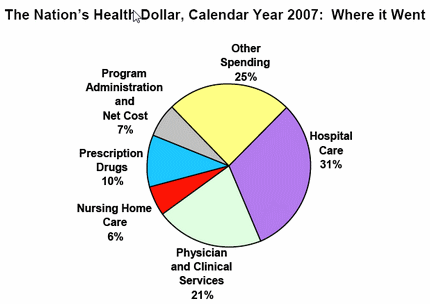
2007 Healthcare Costs

What might a public health option look like in practice? One way to find out is to look at what’s already out there.

Link: http://www.propublica.org/ion/health-care-reform/item/grading-the-public-options-that-already-exist-1028

Assessment

Join Our Mailing List

Conclusion

And so, your thoughts and comments on this Medical Executive-Post are appreciated. Feel free to review our top-left column, and top-right sidebar materials, links, URLs and related websites, too. Then, be sure to subscribe to the ME-P. It is fast, free and secure.

Get our Widget: Get this widget!

Our Other Print Books and Related Information Sources:

Practice Management: http://www.springerpub.com/prod.aspx?prod_id=23759

Physician Financial Planning: http://www.jbpub.com/catalog/0763745790

Medical Risk Management: http://www.jbpub.com/catalog/9780763733421

Healthcare Organizations: www.HealthcareFinancials.com

Health Administration Terms: www.HealthDictionarySeries.com

Physician Advisors: www.CertifiedMedicalPlanner.com

Sponsors Welcomed

And, credible sponsors and like-minded advertisers are always welcomed.

Link: https://healthcarefinancials.wordpress.com/2007/11/11/advertise

The Largest Purchaser of Domestic Healthcare?

Join Our Mailing List

It’s the Government – Silly

By Ann Miller; RN, MHA

[Executive Director]ERT Prison Healthcare

By far, our federal government is the largest purchaser of healthcare services, according to Robert James Cimasi MHA, AVA, CMP™ of Health Capital Consultants, in St. Louis, MO; and many others.

Obama Care

Although the government faces immense pressure to control healthcare costs, especially during the current HR 3200-3400 debates, it also faces pressure to expend additional funds in order to achieve its ostensible primary mission in its involvement in healthcare, i.e., to expand and improve public health.

Federal Payment Schemes

In many ways the government has led the way for cost control through its development of resource-based reimbursement, prospective payment systems, budget limitations and other payment schemes. However, its conflicting goals have led it to approach these controls in a hesitant and piecemeal manner rather than effecting bold, comprehensive reforms.

Consider, for example, the lack of government intervention in the face of mounting pressure to remove some of the barriers preventing a reduction in US pharmaceutical costs.

Assessment

Today, most experts agree that Uncle Sam pays for at least 51% of domestic healthcare when Medicare, Medicaid, SHIPS, the VA, Indian and Prison Healthcare Systems are considered. In fact, according to our Publisher-in-Chief, Dr. David Edward Marcinko; MBA:

‘We already have a single payer health system in this country, but most folks just don’t realize it.”

Conclusion

Your thoughts and comments on this ME-P are appreciated. Feel free to review our top-left column, and top-right sidebar materials, links, URLs and related websites, too. Then, subscribe to the ME-P. It is fast, free and secure.

Link: http://feeds.feedburner.com/HealthcareFinancialsthePostForcxos

Speaker: If you need a moderator or speaker for an upcoming event, Dr. David E. Marcinko; MBA – Publisher-in-Chief of the Medical Executive-Post – is available for seminar or speaking engagements. Contact: MarcinkoAdvisors@msn.com

OUR OTHER PRINT BOOKS AND RELATED INFORMATION SOURCES:

DICTIONARIES: http://www.springerpub.com/Search/marcinko
PHYSICIANS: www.MedicalBusinessAdvisors.com
PRACTICES: www.BusinessofMedicalPractice.com
HOSPITALS: http://www.crcpress.com/product/isbn/9781466558731
CLINICS: http://www.crcpress.com/product/isbn/9781439879900
BLOG: www.MedicalExecutivePost.com
FINANCE: Financial Planning for Physicians and Advisors
INSURANCE: Risk Management and Insurance Strategies for Physicians and Advisors

Product DetailsProduct DetailsProduct Details

Henry Louis Gehrig, eMRs and Healthcare Reform

What’s the “Iron Horse” Got to Do with Health IT?

By Dr. David Edward Marcinko; MBA, CMP™

[Publisher-in-Chief]Jacobetti VA

According to UPI reports from Charlestown, WVa on August 24 2009, at least 1,200 veterans across the country were mistakenly told by the Veterans Administration [VA] that they suffered from a fatal neurological disorder.

Link: http://www.msnbc.msn.com/id/32541579/ns/health-health_care/

Panicked Veterans

One of the leaders of a Gulf War veterans group is reported to have said that panicked veterans from the states of Alabama, Florida, Kansas, North Carolina, West Virginia and Wyoming contacted the group about the error. Denise Nichols, the vice president of the National Gulf War Resource Center, reportedly blamed a “coding error” for the mistake. In medicine, we call this a “false positive.”

About Henry Louis “Lou” Gehrig

Henry Louis “Lou” Gehrig (June 19, 1903 – June 2, 1941), born Ludwig Heinrich Gehrig, was an American baseball player in the 1920s and 1930s; chiefly remembered for his prowess as a hitter, the longevity of his consecutive games played record and the pathos of his tearful farewell from baseball at age 36, when he was stricken with a fatal disease. Of course, Gehrig was known as the “The Iron Horse” for his durability. Yet, the irony is that Amyotrophic Lateral Sclerosis [ALS], or Lou Gehrig’s disease [sometimes also called Maladie de Charcot] is progressive and fatal. Lou died in 1941 after developing the illness. Will the same death-spiral happen to eHRs and Obama care?

Link: http://www.lougehrig.com

Assessment

Having rotated through the VA system as a young medical student back-in-the-day, I have never been a fan. It smacked of socialized medicine and government plutocracy, and was never a leading-edge example of domestic healthcare, in my informed opinion. Recent HIPAA administrative, security, IT and clinical medical errors are well known. So, to blame the mix-up on an insurance billing and “coding error” seems somewhat disingenuous. Especially now, at a time when eMRs and the Obama Administration’s healthcare reform itself is being vigorously debated by the citizenry. I mean, are there no human checks and balances? Would there be any human intervention if a public healthcare policy was adopted?

Of course, we have written about military medicine previously on this Medical Executive-Post, and devoted an entire channel to it. And, I do realize that more than fifty percent of us receive similar governmental care in some form, or another [Medicare, Medicaid, CHIPS, the Indian and Prison Healthcare Systems, etc].

Link: https://healthcarefinancials.wordpress.com/category/military-medicine/

Nevertheless, shall we give a new moniker to this mistake? How about “Lou Gehrig’s coding error”, and document it in our www.HealthDictionarySeries.com

Conclusion

And so, your thoughts and comments on this Medical Executive-Post are appreciated. Is it even fair to relate this “isolated incident” to the current healthcare reform debate, the eMR conundrum and/or similar discussions on health Information Technology [IT]? Tell us what you think. Feel free to review our top-left column, and top-right sidebar materials, links, URLs and related websites, too. Then, be sure to subscribe to the ME-P. It is fast, free and secure.

Link: http://feeds.feedburner.com/HealthcareFinancialsthePostForcxos

Speaker: If you need a moderator or speaker for an upcoming event, Dr. David E. Marcinko; MBA – Publisher-in-Chief of the Executive-Post – is available for seminar or speaking engagements. Contact: MarcinkoAdvisors@msn.com 

Get our Widget: Get this widget!

Our Other Print Books and Related Information Sources:

Practice Management: http://www.springerpub.com/prod.aspx?prod_id=23759

Physician Financial Planning: http://www.jbpub.com/catalog/0763745790

Medical Risk Management: http://www.jbpub.com/catalog/9780763733421

Healthcare Organizations: www.HealthcareFinancials.com

Health Administration Terms: www.HealthDictionarySeries.com

Physician Advisors: www.CertifiedMedicalPlanner.com

Subscribe Now: Did you like this Medical Executive-Post, or find it helpful, interesting and informative? Want to get the latest ME-Ps delivered to your email box each morning? Just subscribe using the link below. You can unsubscribe at any time. Security is assured.

Link: http://feeds.feedburner.com/HealthcareFinancialsthePostForcxos

Sponsors Welcomed

And, credible sponsors and like-minded advertisers are always welcomed.

Link: https://healthcarefinancials.wordpress.com/2007/11/11/advertise

Interview with Jack Levy of Securebill, Inc

President – Securebill, IncMeeting

What: An Interview and Special Report Exclusively Prepared for the ME-P
Who: Mr. Jack Levy, CISSP [President – Securebill, Inc]
Topic: Physician Selection of eHRs
Reporter: Amaury Cifuentes; CFP®
Where: Internet Ether

Although skeptics of eHRs abound, President Barack H. Obama’s signing of the American Recovery and Reinvestment Act [ARRA] of 2009 has created a massive push for their implementation. The Act provides $19.2 billion, including $17.2 billion for financial incentives to be administered by Medicare and Medicaid. This assistance of up to $40 to $65 thousand per eligible physician, and up to $11 million per hospital, begins in 2011.

Link: https://medicalexecutivepost.com/wp-content/uploads/2009/05/jack-levy-interview.pdf

Conclusion

And so, your thoughts and comments on this Medical Executive-Post are appreciated. Feel free to review our top-left column, and top-right sidebar materials, links, URLs and related websites, too. Then, be sure to subscribe to the ME-P. It is fast, free and secure.

Link: http://feeds.feedburner.com/HealthcareFinancialsthePostForcxos

Speaker: If you need a moderator or speaker for an upcoming event, Dr. David E. Marcinko; MBA – Publisher-in-Chief of the Executive-Post – is available for seminar or speaking engagements. Contact: MarcinkoAdvisors@msn.com  or Bio: www.stpub.com/pubs/authors/MARCINKO.htm

Get our Widget: Get this widget!

Our Other Print Books and Related Information Sources:

Practice Management: http://www.springerpub.com/prod.aspx?prod_id=23759

Physician Financial Planning: http://www.jbpub.com/catalog/0763745790

Medical Risk Management: http://www.jbpub.com/catalog/9780763733421

Healthcare Organizations: www.HealthcareFinancials.com

Health Administration Terms: www.HealthDictionarySeries.com

Physician Advisors: www.CertifiedMedicalPlanner.com

Subscribe Now: Did you like this Medical Executive-Post, or find it helpful, interesting and informative? Want to get the latest ME-Ps delivered to your email box each morning? Just subscribe using the link below. You can unsubscribe at any time. Security is assured.

Link: http://feeds.feedburner.com/HealthcareFinancialsthePostForcxos

Sponsors Welcomed

And, credible sponsors and like-minded advertisers are always welcomed.

Link: https://healthcarefinancials.wordpress.com/2007/11/11/advertise

Physician [Fee] Schedule Augmentation

Organizing and Analyzing Financial Data

[By Christy Clodwick; MHA]

biz-book1After all medical practice management data has been gathered, organize it onto a spreadsheet or chart.  This analysis report will help to determine the codes and/or health plans that should be targeted for process improvement.

Focus … Focus … Focus

The focus should be on the highest volume and dollar value codes. Does this mean patients with unusual conditions or low dollar value codes are not treated? Hopefully it will not; but it will push this process forward and the practice will see the greatest benefit from these categories. When you review the report and find that a fee is being paid at a much lower rate, this would be indicative of a necessary negotiation with the payer for an increase for that procedure. Most health plans are committed to preventing disease. Maybe, but they are still actually aimed at treating diseases; not preventing them. If this is true of many payers then they should be willing to provide the incentives for those services to be carried out. You will find that some payers’ fee schedules are very much out of line with a percentage of Medicare payments, therefore the practice administrator should focus on those payers and bring evidence of the inadequacies to their attention.

The Specialists

Specialists are, for the most part, paid at a higher rate than primary care physicians not usually for the same service! And, with GPs as gatekeepers, the specialty doc incomes may have actually decreased in some instances, while the GPs may have increased. There was a time when Medicare had two conversion factors, and this was the result. This inequity could also be used as a tool for better reimbursement rates.

Finalizing the Fee and Revenue Analysis

When the final preparations of the fee analysis have been completed, it is time to react to the results of the findings. There are several options to choose from when it has been determined that a health plans fee schedule is not in tune with the practice’s financial growth. The practice should act on these results as soon as they are discovered, to avoid the loss of any more revenue.

No longer Accepting Health Plans

During the analysis phase, you may determine that a health plan’s payment levels are extremely low. You will have to determine whether the plan is worth negotiating or the practice administrator should consider dropping out of the plan altogether at the end of the contract period. It will have to be carefully determined by the local market. If the practice is in a highly competitive market, this process should not be considered as first choice. However, if the market is very slim, the health care purchaser will be responsible for complaining to the health insurance plan provider that there is simply not enough physician coverage for their employees for the area. This could be a very effective way to force a negotiation with the health care company. If this were the case, the area would have less managed care and more MC/MD.

Not Accepting New Patients from Low Paying Health Plans

One option would be to not accept any more patients from the health plan that is reimbursing the practice with low rates. Although this may initially lower your patient count, over time the practice will benefit from new patients with health plans that have a better reimbursement policy. Include snapshot of what the final analysis or report should look like and the details of what it should include. This can be used in any specialty to assist in putting together the individual practice analysis to achieve the same results. But is it noble or ethical? What about any willing provider laws?

dhimc-book1The Future for Health Care Reimbursement

The health care purchasers who pay most of the bills, such as employers and the government, will soon be challenging the annual increase and the overall cost of health care. The cost increases of the hospital and pharmacy sectors of healthcare are far higher than that of the physician. However, the pressure for cost containment is being felt across the board. This will eventually depress future reimbursement for all healthcare providers.  In the future it will be hard for practices to keep up with the demands of labor, malpractice and supply cost increase. All medical providers need to plan for this future paradigm. To offset this trend, physicians will need to get the most out of the work that they are doing today as well as look to new revenue generating procedures for their practice that will be cheaper and more convenient to the patient.

Process Improvement

The biggest benefits will come from continually improving the process of the daily operations of the practice, as well as ensuring accurate diagnostic coding. This will enable a practice to keep up with charge capturing through the explanation of benefits (EOB) when the charge has been processed and paid by the health insurance provider. When this process identifies that there is room for negotiation, the provider should proceed for a better reimbursement rate. If the provider is in a dominant market, the payers will be more likely to issue sweeping fee increases and so can you give me an example of this ever happening? By completing a Practice Fee Analysis, any practice should be able to use this tool to demonstrate the inequities and negotiate a better reimbursement rate for the practice.

Assessment

The first step in the negotiation process would be to contact a representative of the health insurance company that is in question. If you can produce compelling evidence to the representative, the negotiation process should be the next meeting. These folks may be fired if they do what you suggest, too frequently. Continually updating the practice fee schedule will help the practice stay on top of the contracts that it practices under. Practices that present a well-documented argument may (almost never) be rewarded with positive payer response. Again, proper planning will make for great future performance in any health care practice.

Conclusion

Your thoughts and comments on this ME-P are appreciated. Feel free to review our top-left column, and top-right sidebar materials, links, URLs and related websites, too. Then, subscribe to the ME-P. It is fast, free and secure.

Link: http://feeds.feedburner.com/HealthcareFinancialsthePostForcxos

Speaker: If you need a moderator or speaker for an upcoming event, Dr. David E. Marcinko; MBA – Publisher-in-Chief of the Medical Executive-Post – is available for seminar or speaking engagements. Contact: MarcinkoAdvisors@msn.com

OUR OTHER PRINT BOOKS AND RELATED INFORMATION SOURCES:

Product Details

Negotiating Physician Fee Schedules

Join Our Mailing List

Better Data for Improved Fixed Compensation

[By Christy Clodwick; MHA]

[By Dr. David E. Marcinko MBA]

biz-book1It is known that most health plans operate with fixed fee schedules. While these fee schedules have little or nothing to do with RBRVS, and most are based on a percentage of what Medicare pays, the question is: “are they tied to levels that are more than 3 or 4 years old?”  Physicians who have no negotiating tools or a plan in place, and who question the methodology that the payers are using, are (too casual-left) with a ‘take it or leave it’ response from the health insurance provider.

Gathering the Data

A good solid foundation of data is necessary to negotiate better reimbursement rates successfully. The practice administrator or accountant (not 1 in 100 accountants can actually do this) should have this information readily available, especially if the office has an automated billing system.

Steps to Preparing a Fee Analysis

First and foremost, the medical management team in charge of this project will need to determine the most commonly used CPT® codes for the practice.  The bulk of primary care or family practice physician fees should be derived from the revenue of the office visit, hospital and preventive medicine codes. This in turn may limit the number of codes for the study. The frequency of each CPT code should be listed over a 12 month period.  If applicable, laboratory fees should also be included to see if there are fluctuating reimbursement schemes for these services. The codes on the list should account for at least 75% of the total practice charges.

Determining Top Payers and Reimbursement by Payer

It is known that Medicare and Medicaid use established fee schedules and do not negotiate, therefore the focus should be on the other major payers that make up the bulk of the reimbursement. In this process, make sure that the payers in the report are the practice’s top payers. The practice administrator will also need to determine the reimbursement for each code that is sent to the various payers’ list in the report. The administrator or team leader (the average GP has 3-4 employees, so I don’t think there would be a team leader, here). For this project we can use the Explanation of Benefits EOB that is received from each payer that has been selected for the report.  When including this data, make sure the allowed amount, not the paid amount, is referenced. After this information has been gathered, each payer’s reimbursement rate will need to be calculated as a percentage of Medicare’s reimbursement rate. Medicare’s current rates for any geographical area can be found through the “Medicare Physician Fee Schedule Look-up” tool at:

Link: https://questions.cms.hhs.gov/cgi-bin/cmshhs.cfg/php/enduser/std_alp.php?p_sid=1reSKuxj

This site also provides a reference to Relative Value Unit, (RVU) that Medicare assigns to each code.

RVU Conversion Factors

It is important for the practice administrator or manager to understand the RVU conversion factors and how they work, simply because most payers are in the beginning stages of using this method. To calculate a payment for service you multiply a particular CPT Code by the Medicare conversion factor for that code. For an example we will use the code 99214 – office visit. The Relative Value Unit for that Code is 2.2. The Medicare conversion factor for the same code is $37.34.  The calculation would result in a rate of $82.15.  Geographical adjustments must be taken into account when performing these calculations. The next step in this process would be to review the fees for each code listed in the report. Calculate each fee as a percentage of Medicare’s rates. You will find different statistics for each payer.

dhimc-book1

Apply the Rules and Process

Follow these basic rules when applying this new process:

First, if the charges are being reimbursed at 100%, the fee may be too low. At this point, raising the fee for that code would be acceptable (Usually not the case). Next, If several fees are in this category, the practice should just set all its fees to a percentage of Medicare reimbursement across the board, such as 125 percent (many managed care plans pay at less than MC, i.e., 80% MC). Finally, a tiered fee schedule would be applicable if the payers seem to pay more for certain procedures or diagnostic studies. That would set evaluation and management codes at 125 percent of Medicare reimbursement while charging 150 of Medicare reimbursement for other procedures and diagnostic tests.

Assessment

The medical practice administrator should make sure that, no matter which fee schedule is best suited for the practice, it is updated annually to prevent loss of any increases that may occur per payer.

Conclusion

Your thoughts and comments on this ME-P are appreciated. Feel free to review our top-left column, and top-right sidebar materials, links, URLs and related websites, too. Then, subscribe to the ME-P. It is fast, free and secure.

Speaker: If you need a moderator or speaker for an upcoming event, Dr. David E. Marcinko; MBA – Publisher-in-Chief of the Medical Executive-Post – is available for seminar or speaking engagements. Contact: MarcinkoAdvisors@msn.com

OUR OTHER PRINT BOOKS AND RELATED INFORMATION SOURCES:

Product Details

Long-Term Care Insurance

A Review for Doctors and Advisors

By Gary A. Cook; MSFS, CLU, ChFC, LUTC, RHU, CFP®, CMP™ (Hon)

insurance-book6

Long-term care (LTC) insurance is considered one of the newest forms of personal coverage insurance.  LTC insurance is designed to transfer the financial risk associated with the inability to care for oneself because of a prolonged illness, disability, or the effects of old age.  In particular, it is designed to insure against the financial cost of an extended stay in a nursing home, assisted living facility, Adult Day Care Center, hospice or home health care.  It has been estimated that two out of every five Americans now over the age of 65 will spend time in a nursing home.  As life expectancy increases, so does the potential need for LTC. One unfortunate consequence of being the “new kid on the block” is the lack of actuarial data specifically collected for this style of policy.  This results in policy premiums being underpriced to sustain the claims currently being experienced.  During the first half of 2003, at least three insurance companies stopped writing these policies because of their losses.  Those insurers remaining in this market are expected to increase premiums quickly.  Unless these policies can be profitable for the company, their future will be an uncertain one.

Medicare

Any discussion of LTC must begin with an understanding of what Medicare is designed to cover.  Currently, the only nursing home care that Medicare covers is skilled nursing care and it must be provided in a Medicare-certified skilled nursing facility.  Custodial care is not covered. Most LTC policies have been designed with these types of coverage, or the lack thereof, in mind. To qualify for Medicare Skilled Nursing Care, an individual must meet the following conditions: 

  • Be hospitalized for at least three days within the 30 days preceding the nursing home admission;
  • Be admitted for the same medical condition which required the hospitalization; and
  • The skilled nursing home care must be deemed rehabilitative.

Once these requirements are met, Medicare will pay 100 percent of the costs for the first 20 days.  Medicare covers days 21 to 100 along with a daily co-payment, which is indexed annually.  After the initial 100 days, there is no additional Medicare coverage. Medicare Home Health Services cover part-time or intermittent skilled nursing care, physical therapy, medical supplies and some rehabilitative equipment.  These are generally paid for in full and do not require a hospital stay prior to home health service coverage.

biz-book

Critical LTC Policy Features

According to the U.S. Department of Health and Human Services and the Health Insurance Association of America, there are seven features that should always be included in a good long LTC policy: 

  • Guaranteed renewable (as long as premiums are paid, the policy cannot be canceled).
  • Covers all levels of nursing care (skilled, intermediate and custodial care).
  • Premiums remain level (individual premiums cannot be raised due to health or age, but can be raised only if all other LTC policies as a group are increased).
  • Benefits never reduced.
  • Offers inflation protection.
  • Full coverage for Alzheimer’s Disease (earlier contracts tried to eliminate this coverage).
  • Waiver of premium (during a claim period, further premium payments will not be required).

In addition, there are another seven features considered to be worthwhile and are included in the better LTC policies: 

  • Home health care benefits
  • Adult day care and hospice care
  • Assisted living facility care
  • No prior hospital stay required
  • Optional elimination periods
  • Premium discounts when both spouses are covered
  • Medicare approval not a prerequisite for coverage.

ADLs

Most LTC policies provide benefits for covered insured’s with a cognitive impairment or the inability to perform a specified number of Activities of Daily Living (ADLs). These ADLs generally include those listed below and the inability to perform two of six is generally sufficient to file a claim:

1. Bathing:  Washing oneself in either a tub or shower, or by sponge bath, and includes the task the getting into and out of the tub or shower without hands-on assistance of another person.

2. Dressing:  Putting on or taking off all necessary and appropriate items of clothing and/or any necessary braces or artificial limbs without hands-on assistance of another person.

3. Toileting:  Getting to and from the toilet, getting on and off the toilet, and performing associated personal hygiene without hands-on assistance of another person.

4. Transferring:  Moving in and out of a bed, chair or wheelchair without hands-on assistance of another person.

5. Eating:  The ability to get nourishment into the body without hands-on assistance of another person once it has been prepared and made available.       

6. Continence:  The ability to voluntarily maintain control of bowel and/or bladder function, or in the event of incontinence, the ability to maintain a reasonable level of personal hygiene without hands-on assistance of another person.

Other Issues

Another issue concerning ADLs is whether the covered insured requires “hands-on” assistance or merely needs someone to “stand-by” in the event of difficulty.  Obviously, LTC policies that read the latter are considered more liberal.

fp-book1

Long-Term Care Taxation

Some LTC policies have been designed to meet the required provisions of the Kassenbaum-Kennedy health reform bill, passed in 1996, and subsequently are “Tax Qualified Policies”.  Insured’s who own policies meeting the requirements are permitted to tax deduct some of the policy’s premium, based on age, income and the amount of total itemized medical expenses.  The major benefit of the tax-qualified LTC policy is that the benefit, when received, is not considered taxable income.  There are several initiatives in Congress, however, which would expand and simplify these deductibility rules. 

Assessment

Regardless, the medical professional or financial advisor [FA] should investigate the opportunity afforded them through their current form of business, or client use, for any purchase of a LTC policy. And, small businesses may be permitted to deduct LTC premiums on a discriminatory basis.

Conclusion

And so, your thoughts and comments on this Medical Executive-Post are appreciated. What have we missed, and who might wish to update this post?

Speaker: If you need a moderator or speaker for an upcoming event, Dr. David E. Marcinko; MBA – Publisher-in-Chief of the Executive-Post – is available for seminar or speaking engagements. Contact: MarcinkoAdvisors@msn.com  or Bio: www.stpub.com/pubs/authors/MARCINKO.htm

Get our Widget: Get this widget!

Our Other Print Books and Related Information Sources:

Practice Management: http://www.springerpub.com/prod.aspx?prod_id=23759

Physician Financial Planning: http://www.jbpub.com/catalog/0763745790

Medical Risk Management: http://www.jbpub.com/catalog/9780763733421

Healthcare Organizations: www.HealthcareFinancials.com

Health Administration Terms: www.HealthDictionarySeries.com

Physician Advisors: www.CertifiedMedicalPlanner.com

Subscribe Now: Did you like this Medical Executive-Post, or find it helpful, interesting and informative? Want to get the latest E-Ps delivered to your email box each morning? Just subscribe using the link below. You can unsubscribe at any time. Security is assured.

Link: http://feeds.feedburner.com/HealthcareFinancialsthePostForcxos

Product Details  Product Details

Selecting an Assisted-Living Facility

Join Our Mailing List

Checklist for Financial Planners

[By Staff Reporters]

Thousands of boarding homes cater to the elderly. Their operators promise to provide at least a place to sleep and food to eat. Beyond that, the services and assistance offered will vary from facility to facility. This checklist will help the financial planner or his or her client find a facility that is appropriate in all respects to the client’s resources and needs. Unlike nursing homes, assisted-living facilities often operate without any scrutiny from public agencies. Furthermore, Medicaid often will not be a source of funds.

The Checklist

The items the financial planner and client should consider when selecting a facility are listed below.

      1.   Determine the client’s willingness to live in a group environment.

      2.   Avoid unlicensed facilities, particularly if Medicaid-provided services may be needed in the future.

      3.   Review the facility’s inspection report.

      4.   Review the facility’s service contract and house rules. Look for answers to the following questions:

            a.         Where will the resident live?

                        Are there any types of ownership rights?

                        What flexibility is there with respect to furnishings?

                        Will the same unit be available after a hospital stay?

            b.         What meals are included?

                        Will the facility provide appropriate meals and a special diet?

            c.         What form of transportation does the resident currently use?

                        What transportation is provided by the facility?

                        Can residents shop, dine, attend services or visit doctors?

            d.         What help does the facility provide during a medical emergency?

                        What type of staff training is provided or required? Is there 24-                        hour-a-day staffing?

            e.         What provisions are there for privacy? When are rooms cleaned and when can staff access the rooms?

            f.          What is the basic cost and what are the costs for extras?

                        What is included in each?

                        What provisions for fee increases are there?

            g.         Can a resident see his or her own doctor?

                        Does the facility offer transportation for appointments?

            h.         Who’s in charge of administering and scheduling medication?

                        Can medication and other supplies be purchased at the facility?

            i.          What happens if the resident’s health begins to fail?

                        Does the facility provide additional services to help with ADLs?

            j.          What is the procedure for transfers from one unit to another?

                        Does the resident have any opportunity to express an opinion?

            k.         What’s required if a contract is terminated by facility or resident?

                        What is the provision with respect to refunded fees?

                        Is there a required minimum stay?

Assessment

What have we missed?

Conclusion

Your thoughts and comments on this ME-P are appreciated. Feel free to review our top-left column, and top-right sidebar materials, links, URLs and related websites, too. Then, subscribe to the ME-P. It is fast, free and secure.

Link: http://feeds.feedburner.com/HealthcareFinancialsthePostForcxos

Speaker: If you need a moderator or speaker for an upcoming event, Dr. David E. Marcinko; MBA – Publisher-in-Chief of the Medical Executive-Post – is available for seminar or speaking engagements. Contact: MarcinkoAdvisors@msn.com

OUR OTHER PRINT BOOKS AND RELATED INFORMATION SOURCES:

DICTIONARIES: http://www.springerpub.com/Search/marcinko
PHYSICIANS: www.MedicalBusinessAdvisors.com
PRACTICES: www.BusinessofMedicalPractice.com
HOSPITALS: http://www.crcpress.com/product/isbn/9781466558731
CLINICS: http://www.crcpress.com/product/isbn/9781439879900
BLOG: www.MedicalExecutivePost.com
FINANCE: Financial Planning for Physicians and Advisors
INSURANCE: Risk Management and Insurance Strategies for Physicians and Advisors

Product DetailsProduct DetailsProduct Details

Product Details  Product Details

Advisor’s Checklist for Physicians Seeking Insurance

Background, Education, and Certifications

By Dr. David Edward Marcinko; MBA, CMP™

Publisher-in-Chiefdem22

The following are sample questions and information gathered for Professional Liability Coverage

The Checklist

**Medical specialty information by percentage of practice.

**Information on medical education, including information on medical school, internship information, residency information, and fellowship information, if any.

**Information on medical experience, including information on military discharge (DD214), public health service, moonlighting, ‘locum tenens’, and private practice information. Have dates and locations available. Other information includes:

  • Information on completed continuing education hours in the past two years.
  • Publications, speeches, instruction, etc.
  • Information on medical licenses, including state, license number, expiration dates, and current status.
  • Information on board certifications.
  • The above information may be contained in a Curriculum Vita, if you have one.
  • On an “as applicable” basis:
  • Complete details including dates and outcomes of any board certification revocations or suspensions, license revocations or suspensions, alcohol or drug addictions and treatments, criminal or sexual misconduct charges, or Medicare or Medicaid charges.
  • Previous Insurance Information
  • Insurance history, including the name, policy number, whether the coverage form was occurrence or claims made, policy period, limits of liability, deductible amount, and prior acts date, for your current carrier, and your first, second, third, and fourth prior carrier, if applicable.
  • Information on any insurance company cancellations or non-renewals.
  • If your current policy is a claims-made policy, whether you are obtaining tail coverage from your current insurance company.
  • Copies of prior policies, if available.

Current Medical Practice Information

  • Information on supervision and employment of residents, physician assistants, nurse practitioners, CRNAs, nurse midwives and other physicians;
  • Information on networks or managed care organizations associated with (IPA, PHO, MSO, etc.), including group name, type of organization, and relationship;
  • Information on other contractual relationships other than PPOs, HMOs, IPA, etc;
  • Full information on all hospital privileges, including hospital name, location, and type of privilege.
  • Information on any suspension, denial, revocation, restriction, or other sanctioning of hospital privileges.

Classification and Specialty Identification

Full information on procedures performed, including details of surgeries, average number of patients seen weekly, specialty practice areas, etc.

Prior Claims History (if any)

For each claim, patient’s name; date of occurrence; insurance carrier; location of occurrence; date claim was reported; date claim was closed (if applicable); copies of subpoenas, pleadings, or judgments; amount reserved on your behalf; and amount paid on your behalf.  Provide as complete a description of the allegations as possible.

insurance-book2

Important Note

This checklist is provided as a guide to assist the Healthcare Professional in gathering the information that insurance companies typically request.  Discuss this checklist with your agent to identify additional information as needed.

Assessment

The author has been an expert medical witness in both state and federal court. He is also a former licensed insurance agent and certified financial planner.

Conclusion

And so, your thoughts and comments on this Medical Executive-Post are appreciated.

Speaker: If you need a moderator or speaker for an upcoming event, Dr. David E. Marcinko; MBA – Publisher-in-Chief of the Executive-Post – is available for seminar or speaking engagements. Contact: MarcinkoAdvisors@msn.com  or Bio: www.stpub.com/pubs/authors/MARCINKO.htm

Get our Widget: Get this widget!

Our Other Print Books and Related Information Sources:

Practice Management: http://www.springerpub.com/prod.aspx?prod_id=23759

Physician Financial Planning: http://www.jbpub.com/catalog/0763745790

Medical Risk Management: http://www.jbpub.com/catalog/9780763733421

Healthcare Organizations: www.HealthcareFinancials.com

Health Administration Terms: www.HealthDictionarySeries.com

Physician Advisors: www.CertifiedMedicalPlanner.com

Subscribe Now: Did you like this Medical Executive-Post, or find it helpful, interesting and informative? Want to get the latest E-Ps delivered to your email box each morning? Just subscribe using the link below. You can unsubscribe at any time. Security is assured.

Link: http://feeds.feedburner.com/HealthcareFinancialsthePostForcxos

Sherlock Expense Evaluation Report [SEER]

ADVERTISEMENT

Plan Management Navigator

By Marco Georeno

Ph:  215-628-228956372274      

Please find attached the April 2009 edition of Plan Management Navigator. In it we provide an update on the timing of the Blue Cross Blue Shield universe and the Independent / Provider-Sponsored editions of the Sherlock Expense Evaluation Report (SEER). In addition, we expect to circulate the benchmarking surveys for the Medicaid and Medicare universes on or about June 1st, for completion by July 20th, 2009.

Benchmarking Studies

If you are interested in participating in our benchmarking studies please contact us as soon as possible. Additional information about SEER is available at www.sherlockco.com/seer.shtml or by contacting Doug Sherlock (sherlock@sherlockco.com).

Best Practices for the Healthcare Enterprise

We also endeavor to provide an enterprise view of best practice. Best practice is typically considered to be the most efficient way of achieving a desired outcome. We believe that the best way of determining the best practice in its most practical application is to start with an overall objective and weigh all particular practices in light of how they contribute to that overall objective.

In that vein, over the next several months, Sherlock Company will be offering web conferences focused on best practices. The first conference will address activities within Customer Services, as well as activities or effects in other functional areas. This web conference will be held on Wednesday May 20th at 2:30 PM, Eastern Time. The costs will be $225. Participation is free of charge to health plans participating in our 2009 benchmarking studies. If you are interested in participating, please email Erin Sawchuk (erinsawchuk@sherlockco.com) or call at 215-628-2289.

Assessment

This edition of Navigator also discusses the latest private health plan Dashboard results for the trailing three months ended January 31, 2009.

Link: navigator

Sincerely,
Sherlock Company

Marco Georeno – Analyst
mgeoreno@sherlockco.com

Fax: 215-542-0690

Conclusion

And so, your thoughts and comments on this Medical Executive-Post are appreciated?

Link: http://feeds.feedburner.com/HealthcareFinancialsthePostForcxos

Speaker: If you need a moderator or speaker for an upcoming event, Dr. David E. Marcinko; MBA – Publisher-in-Chief of the Executive-Post – is available for seminar or speaking engagements. Contact: MarcinkoAdvisors@msn.com  or Bio: www.stpub.com/pubs/authors/MARCINKO.htm

Get our Widget: Get this widget!

Our Other Print Books and Related Information Sources:

Practice Management: http://www.springerpub.com/prod.aspx?prod_id=23759

Physician Financial Planning: http://www.jbpub.com/catalog/0763745790

Medical Risk Management: http://www.jbpub.com/catalog/9780763733421

Healthcare Organizations: www.HealthcareFinancials.com

Health Administration Terms: www.HealthDictionarySeries.com

Physician Advisors: www.CertifiedMedicalPlanner.com

Subscribe Now: Did you like this Medical Executive-Post, or find it helpful, interesting and informative? Want to get the latest ME-Ps delivered to your email box each morning? Just subscribe using the link below. You can unsubscribe at any time. Security is assured.

Link: http://feeds.feedburner.com/HealthcareFinancialsthePostForcxos

More about Healthcare Organizations [Financial Management Strategies]

Our Print-Journal Preface

By Hope Rachel Hetico; RN, MHA, CMP™hetico1

As Managing Editor of a two volume – 1,200 pages – premium quarterly print journal, I am often asked about our Preface.

A Two-Volume Guide

As so, our hope is that Healthcare Organizations: [Financial Management Strategies] will shape the hospital management landscape by following three important principles.

What it is – How it works

1. First, we have assembled a world-class editorial advisory board and independent team of contributors and asked them to draw on their experience in economic thought leadership and managerial decision making in the healthcare industrial complex. Like many readers, each struggles mightily with the decreasing revenues, increasing costs, and high consumer expectations in today’s competitive healthcare marketplace. Yet, their practical experience and applied operating vision is a source of objective information, informed opinion, and crucial information for this manual and its quarterly updates.

2. Second, our writing style allows us to condense a great deal of information into each quarterly issue.  We integrate prose, applications and regulatory perspectives with real-world case models, as well as charts, tables, diagrams, sample contracts, and checklists.  The result is a comprehensive oeuvre of financial management and operation strategies, vital to all healthcare facility administrators, comptrollers, physician-executives, and consulting business advisors.

3. Third, as editors, we prefer engaged readers who demand compelling content. According to conventional wisdom, printed manuals like this one should be a relic of the past, from an era before instant messaging and high-speed connectivity. Our experience shows just the opposite.  Applied healthcare economics and management literature has grown exponentially in the past decade and the plethora of Internet information makes updates that sort through the clutter and provide strategic analysis all the more valuable. Oh, it should provide some personality and wit, too! Don’t forget, beneath the spreadsheets, profit and loss statements, and financial models are patients, colleagues and investors who depend on you.ho-journal9

www.HealthcareFinancials.com

Assessment

Rest assured, Healthcare Organizations: [Financial Management Strategies] will become an important peer-reviewed vehicle for the advancement of working knowledge and the dissemination of research information and best practices in our field. In the years ahead, we trust these principles will enhance utility and add value to your subscription. Most importantly, we hope to increase your return on investment [ROI] in some small increment.

Visit and Order Now

Specialty Technical Publishers

8 – 14th Street

Blaine, WA 98230

1-800-251-0381

orders@stpub.com

http://www.stpub.com/pubs/ho.htm

TOC: http://www.stpub.com/pdfs/toc_ho.pdf

Conclusion

And so, your thoughts and comments on this Medical Executive-Post, complimentary e-companion are appreciated. If you would like to contribute material or suggest topics for a future update, please contact me. Subscribers, have we attained our goals and objectives, as a work-in-progress in this preface statement?

Link: http://feeds.feedburner.com/HealthcareFinancialsthePostForcxos

Speaker: If you need a moderator or speaker for an upcoming event, Dr. David E. Marcinko; MBA – Publisher-in-Chief of the Executive-Post – is available for seminar or speaking engagements. Contact: MarcinkoAdvisors@msn.com  or Bio: www.stpub.com/pubs/authors/MARCINKO.htm

Get our Widget: Get this widget!

Our Other Print Books and Related Information Sources:

Practice Management: http://www.springerpub.com/prod.aspx?prod_id=23759

Physician Financial Planning: http://www.jbpub.com/catalog/0763745790

Medical Risk Management: http://www.jbpub.com/catalog/9780763733421

Healthcare Organizations: www.HealthcareFinancials.com

Health Administration Terms: www.HealthDictionarySeries.com

Physician Advisors: www.CertifiedMedicalPlanner.com

Subscribe Now: Did you like this Medical Executive-Post, or find it helpful, interesting and informative? Want to get the latest E-Ps delivered to your email box each morning? Just subscribe using the link below. You can unsubscribe at any time. Security is assured.

Link: http://feeds.feedburner.com/HealthcareFinancialsthePostForcxos

Hospital Non-Profit Care and Community Benefits

The IRS Sounds-Off 

Staff Reportersstk212064rke

According to the Internal Revenue Service [IRS], a survey of nearly 500 not-for-profit hospitals in 2006 revealed that 9 percent total revenues were dedicated to community benefit. The just finalized 2006 report warned that attempts to set a percentage threshold for determining compliance may have a

“disproportionate impact on hospitals, depending upon their size, where they are located their community benefit mix, and other hospital and community demographics.”

Link: http://greisguide.com/?p=1059

Definition

The current “community benefit” standard was established by the IRS in 1969 in Revenue Ruling 69-545.  The standard sets out factors to be considered in measuring community benefit, including: (i) a board made up of a broad base of community members; (ii) an open medical staff; (iii) participation in Medicare and Medicaid; (iv) application of surplus funds toward improving facilities, equipment, patient care, medical training, research, and education; and (v) a full-time emergency room open to all regardless of ability to pay (the emergency room standard applies differently to tax-exempt Long Term and Acute Care Hospitals [LTACH] that do not maintain a full array of emergency department services).  Under the current community benefit standard, individual hospitals are given flexibility to determine what services will-best serve their communities.

www.HealthDictionarySeries.com 

dhimc-book2

Assessment

Some pundits suggest that if Congress doesn’t establish new charity care requirements, the IRS should revert to its community benefit standard last in force in 1969.

Interim Report: http://greisguide.com/wp-content/uploads/2009/02/eo_interim_hospital_report_072007.pdf

Conclusion

And so, your thoughts and comments on this Medical Executive-Post are appreciated? Then, subscribe to the ME-P. It is fast, free and secure.

Link: http://feeds.feedburner.com/HealthcareFinancialsthePostForcxos

Speaker: If you need a moderator or speaker for an upcoming event, Dr. David E. Marcinko; MBA – Publisher-in-Chief of the Executive-Post – is available for seminar or speaking engagements. Contact: MarcinkoAdvisors@msn.com  or Bio: www.stpub.com/pubs/authors/MARCINKO.htm

Get our Widget: Get this widget!

Our Other Print Books and Related Information Sources:

Practice Management: http://www.springerpub.com/prod.aspx?prod_id=23759

Physician Financial Planning: http://www.jbpub.com/catalog/0763745790

Medical Risk Management: http://www.jbpub.com/catalog/9780763733421

Healthcare Organizations: www.HealthcareFinancials.com

Health Administration Terms: www.HealthDictionarySeries.com

Physician Advisors: www.CertifiedMedicalPlanner.com

Subscribe Now: Did you like this Medical Executive-Post, or find it helpful, interesting and informative? Want to get the latest ME-Ps delivered to your email box each morning? Just subscribe using the link below. You can unsubscribe at any time. Security is assured.

Link: http://feeds.feedburner.com/HealthcareFinancialsthePostForcxos

Medicare and Medicaid Health IT Network Proposal

Governmental Initiative for the Elderly and Poor

By Staff Reporters200298593-001

According to Nancy Ferris of Government Health IT, on Mar 18, 2009, a rapid learning health information data network could close some gaps in medical knowledge and cut costs for Medicare and Medicaid recipients.

A Congressional Letter

In a letter to Congress, a group of health policy experts urged creation of a network to share information on Medicare and Medicaid patients in order to improve treatment received. In particular, Lynn Etheredge, one signatory of the letter, wants information to be shared on “dual eligible’s”. This term is defined as low income, elderly patients who receive money for medical care from both Medicare [Federal] and Medicaid [State] sources.dhimc-book6

www.HealthDictionarySeries.com

According to Etheredge, there are 7 million such dually-eligible patients in the US, which represents 40 percent of Medicaid spending, and 25 percent of Medicare spending. Etheredge and the others suggest that a network backed by government policy would hasten treatments for everyone.

Assessment

Others who signed the letter include Kenneth Kizer, who created the health-records system for the Department of Veteran Affairs; Commonwealth Fund President Karen Davis; National Quality Forum [NQF] President and CEO Janet Corrigan and National Committee for Quality Assurance [NCQA] President Margaret O’Kane. 

Link: http://govhealthit.com/articles/2009/03/18/network-for-data-on-medicaid-medicare-patients.aspx

Conclusion

And so, your thoughts and comments on this Medical Executive-Post are appreciated. One conclusion of this letter was that“[Researchers] spend way too much time simply acquiring data.” Do you agree, why or why not? Please opine. Will networked eHRs, eMRs and eDRs really save money and time; or cost money and time? Can they be inter-operable and connected on a nationally networked basis that is cost-effective, secure and available to all providers? What about CCHIT, and other vendors?

Link: http://feeds.feedburner.com/HealthcareFinancialsthePostForcxos

Speaker: If you need a moderator or speaker for an upcoming event, Dr. David E. Marcinko; MBA – Publisher-in-Chief of the Medical Executive-Post – is available for seminar or speaking engagements. Contact: MarcinkoAdvisors@msn.com  or Bio: www.stpub.com/pubs/authors/MARCINKO.htm

Get our Widget: Get this widget!

Our Other Print Books and Related Information Sources:

Practice Management: http://www.springerpub.com/prod.aspx?prod_id=23759

Physician Financial Planning: http://www.jbpub.com/catalog/0763745790

Medical Risk Management: http://www.jbpub.com/catalog/9780763733421

Healthcare Organizations: www.HealthcareFinancials.com

Health Administration Terms: www.HealthDictionarySeries.com

Physician Advisors: www.CertifiedMedicalPlanner.com

Subscribe Now:Did you like this Medical Executive-Post, or find it helpful, interesting and informative? Want to get the latest ME-Ps delivered to your email box each morning? Just subscribe using the link below. You can unsubscribe at any time. Security is assured.

Link: http://feeds.feedburner.com/HealthcareFinancialsthePostForcxos


Product DetailsProduct DetailsProduct Details       

Frank Gehry, Health Reform and the Cleveland Clinic

Join Our Mailing List

Las Vegas Hospital Uses Celebrity Architecture to Fight Disease?

By Dr. David Edward Marcinko; MBA, CMP

[Publisher-in-Chief]

dr-david-marcinko6According to the Las Vegas Sun Newspaper on March 2, 2009, the Cleveland Clinic is the newest top-tier player in Sin-City with an emerging health care system that will shake up the status quo, supposedly creating a multitude of direct and residual benefits for patients throughout the region.

Lou Ruvo Center for Brain Health

In its role as partner with the Cleveland Clinic’s Lou Ruvo Center for Brain Health, the hospital — ranked fourth best nationally by U.S. News & World Report — is projected to influence medical care in Nevada on the strength of its immense organization. And, it is being designed by, none other than esteemed architect, Frank Gehry.

A Huge Project

And, if you believe numerous websites, the behemoth project will include office towers, a park, a 60-story tower for jewelry trading, a hotel conceived by celebrity chef Charlie Palmer, thousands of apartments and a $360 million performing arts center. Of course, in typically flamboyant Gehry fashion, the highly embellished main facility is said to model curvy metallic shapes and “folds of the brain.” Other nescient drawings of the Ruvo Center show it divided in two sections. Offices and examination rooms will be housed in stacked rectangular blocks set slightly off kilter, like a fortress wall built by children.

The Architect

Gehry used this method to design his world famous Guggenheim Museum in Bilbao, Spain (1997) and his Peter B. Lewis Building for the Weatherhead School of Management at Case Western Reserve University in 2002. His style is well known.

Misplaced Priorities

But, with an estimated 40 million uninsured citizens, one only can wonder if this facility could have been built more cost effectively and/or more utilitarian?

Assessment

Moreover, some Clevelanders are grumbling about the clinic’s involvement in such a glamorous project far away, and imagine that the project will drain local resources just as sun-parched Western states have fantasized about tapping the Great Lakes.

Industry Indignation Index: 70

Conclusion

Your thoughts and comments on this ME-P are appreciated. Feel free to review our top-left column, and top-right sidebar materials, links, URLs and related websites, too. Then, subscribe to the ME-P. It is fast, free and secure.

Link: http://feeds.feedburner.com/HealthcareFinancialsthePostForcxos

Speaker: If you need a moderator or speaker for an upcoming event, Dr. David E. Marcinko; MBA – Publisher-in-Chief of the Medical Executive-Post – is available for seminar or speaking engagements. Contact: MarcinkoAdvisors@msn.com

OUR OTHER PRINT BOOKS AND RELATED INFORMATION SOURCES:

Product DetailsProduct DetailsProduct Details

Product Details  Product Details

Product DetailsProduct Details

The Next Financial Crisis?

Your Opinion Counts

Staff Reporterslifeguard-warning

The effects of the current financial meltdown are well-known to all citizenry. And, the next economic crisis is still wholly unforeseen. However, research conducted by the Institute of Medical Business Advisors Inc, suggests it may come from one, or more, of the following sectors:

  • Pension Benefit Guarantee Corporation
  • Home/Commercial Real-Estate Mortgages
  • Medicare and Medicaid
  • Hedge Fund Collapse
  • Social Security Administration
  • Autos, Airlines, Manufacturing, etc
  • Global Financial Catastrophe
  • Terrorist Attack
  • Something else?

Assessment

For more info: www.MedicalBusinessAdvisors.com

Conclusion

What do you think? Let us know what’s on your mind with a post, opinion or comment.

Speaker: If you need a moderator or speaker for an upcoming event, Dr. David E. Marcinko; MBA – Publisher-in-Chief of the Executive-Post – is available for seminar or speaking engagements. Contact: MarcinkoAdvisors@msn.com  or Bio: www.stpub.com/pubs/authors/MARCINKO.htm

Our Other Print Books and Related Information Sources:

Practice Management: http://www.springerpub.com/prod.aspx?prod_id=23759

Physician Financial Planning: http://www.jbpub.com/catalog/0763745790

Medical Risk Management: http://www.jbpub.com/catalog/9780763733421

Healthcare Organizations: www.HealthcareFinancials.com

Health Administration Terms: www.HealthDictionarySeries.com

Physician Advisors: www.CertifiedMedicalPlanner.com

Subscribe Now: Did you like this Medical Executive-Post, or find it helpful, interesting and informative? Want to get the latest E-Ps delivered to your email box each morning? Just subscribe using the link below. You can unsubscribe at any time. Security is assured.

Link: http://feeds.feedburner.com/HealthcareFinancialsthePostForcxos

Medicaid MD Acceptance Slows

Delayed Reimbursements Cited as Root Cause

Staff Reporters

According to the Wall Street Journal, November 18, 2008, fewer doctors are accepting Medicaid patients. And, it’s not just because fees are so low – but because it often takes months to get paid.

Health Affairs Analysis

An analysis by the Center for Studying Health System Change says Byzantine bureaucracies can delay Medicaid payments for months. Using data provided by Athenahealth, a specialist in processing claims and payments for doctors, researchers at the Center for Studying Health System Change found that even in states with relatively high Medicaid payments yet long delays, only 50 percent of doctors took all new Medicaid patients.

Assessment

By contrast, in states with higher and speedier payments, doctor participation was 64 percent. Variations in payment delays varied wildly state to state – from a low of 37 days in Kansas to a high of 115 days in Pennsylvania.

Conclusion

What do you think is the reason for the Medicaid patient slowdown; delayed cash-flow or some other cause? As always, your thoughts and comments on this Executive-Post are appreciated

Related Information Sources:

Practice Management: http://www.springerpub.com/prod.aspx?prod_id=23759

Physician Financial Planning: http://www.jbpub.com/catalog/0763745790

Medical Risk Management: http://www.jbpub.com/catalog/9780763733421

Healthcare Organizations: www.HealthcareFinancials.com

Health Administration Terms: www.HealthDictionarySeries.com

Physician Advisors: www.CertifiedMedicalPlanner.com

Speaker: If you need a moderator or speaker for an upcoming event, Dr. David E. Marcinko; MBA – Publisher-in-Chief of the Executive-Post – is available for seminar or speaking engagements. Contact: MarcinkoAdvisors@msn.com  or Bio: www.stpub.com/pubs/authors/MARCINKO.htm

Subscribe Now: Did you like this Executive-Post, or find it helpful, interesting and informative? Want to get the latest E-Ps delivered to your email box each morning? Just subscribe using the link below. You can unsubscribe at any time. Security is assured.

Link: http://feeds.feedburner.com/HealthcareFinancialsthePostForcxos