MEDICAL OFFICE: Patient Satisfaction Management

The “Soft Science” of Patient Relationship Management

***

By Dr. David Edward Marcinko; MBA MEd CMP

SPONSOR: http://www.CertifiedMedicalPlanner.org

***

INTRODUCTION

Patient satisfaction occurs when patient perceptions exceed their expectations. They get an intangible “something extra” from their visit, above what they paid for. When patient expectations match their perceptions, mutual obligations are fulfilled, making both practitioner and patient “break-even”.

The clinical result, within a relevant range, is only part of the patient’s perceptions. Numerous sub-conscious impressions comprise the remainder. We’ve all had patients love us despite a less than optimal result. We’ve all had patients angrily leave the practice over some non-clinical matter like a trivial billing dispute. A patient’s perception of any health care service is colored by a vast array of prior experiences that set up current expectations. The patient is pleased to the extent that his current perceptions exceed his/her pre existing expectations. This encompasses far more than the clinical result (within a relevant range), and includes such non-treatment issues as the demeanor of the staff, condition of the physical premises, psychological comfort during the visit, etc.

Remember, all patients talk about you anyway. In the past, a happy patient told four others about what a nice doctor you are. Today, patients post website comments or blogs immediately after their visits. They are more likely to complete treatment and follow instructions, thus obtaining a better medical outcome, and, generating additional fees for the practice. They pay quicker, cause less bad-debt and help create a pleasant environment for us to work in.

An unhappy patient vehemently tells nine others, onground or online, what a nasty greedy rip-off artist you are. Sad, but true! They are not as likely to complete treatment, thus incurring a less than optimal result, and generate fewer fees. They pay slower, if at all, create a stressed environment and detrimentally affect the attitude of other patients in the office.

Try to eliminate problems that might cause negative perceptions (i.e., a filthy restroom) and implement controls that help assure positive perceptions. Patient satisfaction is a soft managerial science. It is a numbers game. Most patients don’t pre-define what would be “acceptable” from this encounter, but have vaguely defined ranges of prior expectations anyway, gleaned from a lifetime of health care related experience. Any variance between these this “acceptable” range of expectations and each trivial encounter invokes some degree positive or negative feeling in the patient.

***

***

The total perception of the office experience is an aggregate of multiple trivial, often subliminal, observations. Patient satisfaction is an intangible and amorphous process complicated by:

Inter patient variables: Significant differences between patients in their “expectations”.
Intra patient variables: A single patient can perceive the same thing or situation differently at different times, depending on uncontrollable variables like mood, or, context of occurrence which may (sometimes and/or partially) be controllable by the practice.
Luck of the draw” in physical variables: Does Sally or Mary escort the patient to the exam room? Was it the blue or green exam room? Did the last patient to use the rest room, five minutes ago, leave a disgusting mess?
Heterogeneous staff variables: Even with appropriate training, people are not machines and have their own quirks.

ASSESSMENT

By proactively anticipating the entire visit, from the patient’s perspective, the practitioner can structure and arrange things such that most patients have, mostly positive perceptions, most of the time. This can be done despite all the potential hetero-genicity of the above factors. Patient satisfaction can be improved in any office, and can be done by anyone.

CONCLUSION

Because patient satisfaction is a multi-faceted amorphous subject, there are multiple correct approaches to the subject and no “cook book” recipe on how to proceed. Try and get the big picture. Identify the worst areas and fix them. Identify the best areas and reinforce them. Proceed slowly. It can be done one facet at a time. Adapt things to your own managerial style and personality. Be completely open to suggestion and change.

Finally, be aware that patient relationship and satisfaction implementation strategies frequently overlap.

EDUCATION: Books

SPEAKING: Dr. Marcinko will be speaking and lecturing, signing and opining, teaching and preaching, storming and performing at many locations throughout the USA this year! His tour of witty and serious pontifications may be scheduled on a planned or ad-hoc basis; for public or private meetings and gatherings; formally, informally, or over lunch or dinner. All medical societies, financial advisory firms or Broker-Dealers are encouraged to submit a RFP for speaking engagements: MarcinkoAdvisors@outlook.com 

COMMENTS APPRECIATED

Read Refer, Like and Subscribe

***

***

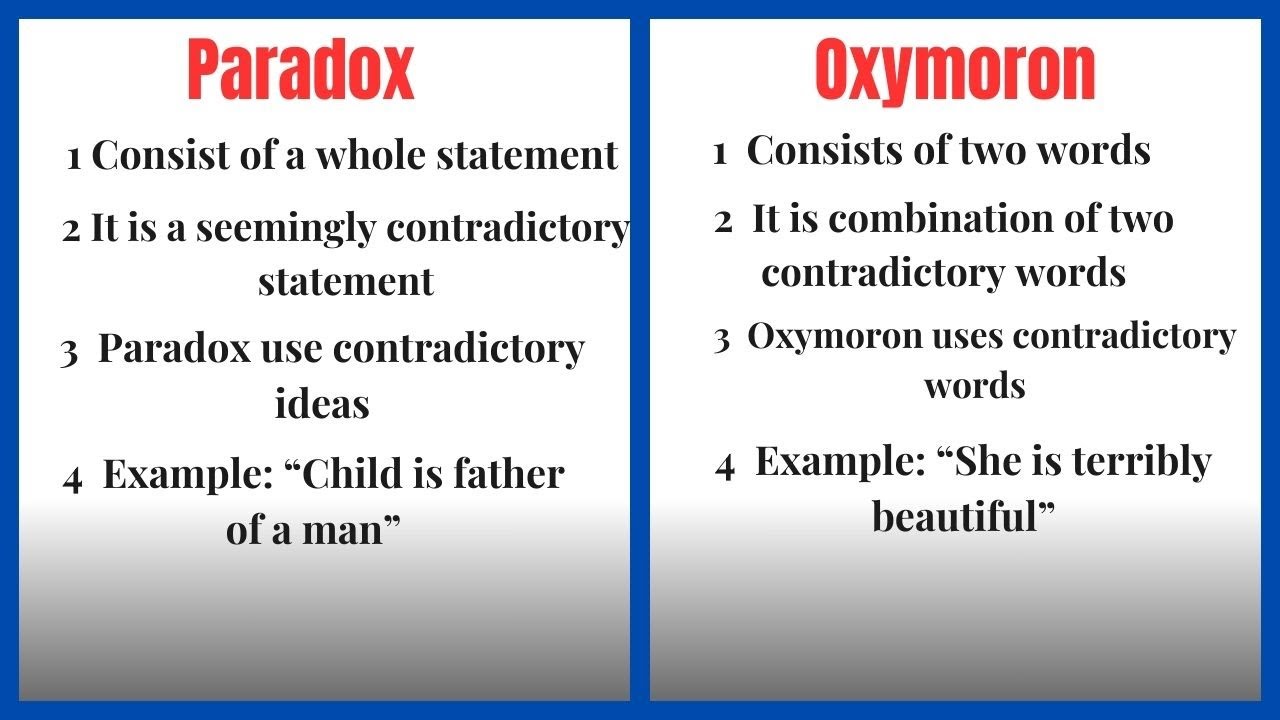
Paradox V. Oxymoron

DEFINITIONS

By Staff Reporters

***

***

Paradoxes are broader concepts that may include statements, situations, or phenomena, revealing a truth through contradiction (e.g., “less is more”).

Oxymorons are combinations of two contradictory words to create a new meaning (e.g., “deafening silence”).

***

Most people tend to confuse a paradox with an oxymoron, and it’s not hard to see why. Most oxymoron examples appear to be compressed version of a paradox, in which it is used to add a dramatic effect and to emphasize contrasting thoughts. Although they may seem greatly similar in form, there are slight differences that set them apart.

A paradox consists of a statement with opposing definitions, while an oxymoron combines two contradictory terms to form a new meaning. But because an oxymoron can play out with just two words, it is often used to describe a given object or idea imaginatively.

As for a paradox, the statement itself makes you question whether something is true or false. It appears to contradict the truth, but if given a closer look, the truth is there but is merely implied.

COMMENTS APPRECIATED

Refer, Like, Subscribe and Read

***

***

EQUALITY: Investment Advice?

“What is good for the goose is good for the gander”

By Rick Kahler CFP®

There is an old adage that says, “What is good for the goose is good for the gander.

In today’s urbanized world, most of us probably wouldn’t have the slightest idea what’s good for geese. Yet we still know that this saying reminds us to be cautious about anyone who makes recommendations they don’t follow themselves.

This is especially important when it comes to investment advice.

Duopoly

Have you ever wondered how your investment advisor invests their money? Have you wondered if the agent selling you cash value life insurance as a retirement investment is investing their retirement in the same? Or whether an advisor recommending a specific mutual fund, stock investment, or bond issue buys the same for their own portfolio?

Ask

My suggestion is to stop wondering and ask. I rarely have a client or prospective client ask me whether I invest my own money in the same way I invest the funds of clients. Most people think it is just too personal to ask how an advisor is investing their own funds and that the advisor may take offense.

Yet knowing how anyone offering investment advice to you invests their own funds is highly relevant. It’s especially wise to ask this if someone is trying to sell you on an “exciting opportunity” that sounds too good to be true. An evasive or vague answer is an obvious red flag. But even with a fiduciary advisor, I believe asking how they invest their own money is a legitimate question. I for one am happy to answer it. Yes, the investment vehicles and strategies I recommend for clients are the same ones I use for myself.

If an advisor is recommending a strategy or investment for you that they don’t subscribe to or invest in themselves, then it’s a good idea to ask another question.

Why not?

Certainly, there are good reasons why an advisor would not have the same asset allocation that they recommend for you. They may be significantly younger or older, or they may have a significantly more aggressive or adverse tolerance for risk. But if your advisor outsources your investments to SEI but uses Vanguard for themselves, I would want to explore that. Or if your advisor is about the same age as you are, but has a significantly different asset allocation and uses none of the investments she recommends that you invest in, I would want to know why.

If an advisor suggests that you put 35% of your investment funds into a private REIT but they don’t own a private REIT, what’s the reason? Or if they are recommending you own a managed futures limited partnership but they don’t own that same partnership or any managed futures funds. Or, maybe they are recommending the A shares of an actively managed mutual fund but themselves purchase passively managed institutional shares.

If you don’t feel comfortable or knowledgeable enough to ask questions like these about specific investments, it’s still important to find out about an advisor’s broader approach to investing. Do they recommend that you “buy and hold,” yet they actively time the market with their own portfolio? Or maybe they actively trade your portfolio while following a “buy and hold” strategy themselves.

Assessment

While portfolio specifics might vary, I want any investment advisor to buy into the same investment philosophy they are recommending to me. If they are going to be timing the market with my funds, I want them to be making the same market moves with their own funds.

If a “sauce” isn’t good enough for the advisor personally, it isn’t good enough to recommend to clients.

Conclusion

Your thoughts and comments on this ME-P are appreciated. Feel free to review our top-left column, and top-right sidebar materials, links, URLs and related websites, too. Then, subscribe to the ME-P. It is fast, free and secure.

Speaker: If you need a moderator or speaker for an upcoming event, Dr. David E. Marcinko; MBA – Publisher-in-Chief of the Medical Executive-Post – is available for seminar or speaking engagements.

Book Marcinko: https://medicalexecutivepost.com/dr-david-marcinkos-bookings/

Subscribe: MEDICAL EXECUTIVE POST for curated news, essays, opinions and analysis from the public health, economics, finance, marketing, IT, business and policy management ecosystem.

***

PODCAST: Doctors, Money and Conflicts of Interest

Medical Ethics – Ever on Guard

***
By Aaron Carroll MD, MS
 ***
I’m a doctor. My father is a doctor. My colleagues are doctors, the people I train are doctors, lots and lots of my friends are doctors.
 ***
But, that doesn’t meant that doctors sometimes aren’t blind to certain issues like their own financial conflicts of interest. Sometimes we have to poke doctors with a stick. That’s how we show our love.
 ***
Conflicts of interest are the topic of this Healthcare Triage video.

PLAY VIDEO LINK

ECON

Assessment

This video episode is adapted from Aaron’s NYT piece on the topic. References can be found in the links there: http://www.nytimes.com/2014/09/09/ups…

John Green — Executive Producer
Stan Muller — Director, Producer
Aaron Carroll — Writer
Mark Olsen — Graphics

http://www.twitter.com/aaronecarroll
http://www.twitter.com/crashcoursestan
http://www.twitter.com/realjohngreen
http://www.twitter.com/olsenvideo

About the Author

Dr. Carroll has published some of the seminal work on various types of health care reform, and continues to be a sought after speaker on cost, quality and access-and the Affordable Care Act and its implications for our future. Considered one of the leading pediatric informaticists in the U.S. he has received millions of dollars in grants to explore the use of information technology in health care. Dr. Carroll was the Primary Investigator on a grant from the Agency for Healthcare Research and Quality to study the true impact of malpractice claims on the practice of medicine.

Conclusion

Your thoughts and comments on this ME-P are appreciated. Feel free to review our top-left column, and top-right sidebar materials, links, URLs and related websites, too. Then, subscribe to the ME-P. It is fast, free and secure.

Speaker: If you need a moderator or speaker for an upcoming event, Dr. David E. Marcinko; MBA – Publisher-in-Chief of the Medical Executive-Post – is available for seminar or speaking engagements. Contact: MarcinkoAdvisors@msn.com

OUR OTHER PRINT BOOKS AND RELATED INFORMATION SOURCES:

Product DetailsProduct Details

Videos on Setting up an ACO

Join Our Mailing List

Opposing Viewpoints in Context?

The Theory

In this first didactic video, Thomas Cassels, Executive Director of the Advisory Board Company’s Health Care Advisory Board, summarizes the forces driving accountable care, outlines the steps necessary for a hospital or health system to transition toward operating as an accountable care organization (ACO), and provides insight into the question of whether all providers must plan to become ACOs.

The Reality

The second video is a real world look at negotiation between a hospital administrator and a PCP over setting up an Accountable Care Organization [ACO].

Video links:

Assessment

True or not?

Conclusion

Your thoughts and comments on this ME-P are appreciated. Feel free to review our top-left column, and top-right sidebar materials, links, URLs and related websites, too. Then, subscribe to the ME-P. It is fast, free and secure.

Link: http://feeds.feedburner.com/HealthcareFinancialsthePostForcxos

Speaker: If you need a moderator or speaker for an upcoming event, Dr. David E. Marcinko; MBA – Publisher-in-Chief of the Medical Executive-Post – is available for seminar or speaking engagements. Contact: MarcinkoAdvisors@msn.com

Our Other Print Books and Related Information Sources:

Health Dictionary Series: http://www.springerpub.com/Search/marcinko

Practice Management: http://www.springerpub.com/product/9780826105752

Physician Financial Planning: http://www.jbpub.com/catalog/0763745790

Medical Risk Management: http://www.jbpub.com/catalog/9780763733421

Healthcare Organizations: www.HealthcareFinancials.com

Physician Advisors: www.CertifiedMedicalPlanner.com

Subscribe Now: Did you like this Medical Executive-Post, or find it helpful, interesting and informative? Want to get the latest ME-Ps delivered to your email box each morning? Just subscribe using the link below. You can unsubscribe at any time. Security is assured.

Link: http://feeds.feedburner.com/HealthcareFinancialsthePostForcxos

Sponsors Welcomed: And, credible sponsors and like-minded advertisers are always welcomed.

Link: https://healthcarefinancials.wordpress.com/2007/11/11/advertise

Product DetailsProduct DetailsProduct Details

Product Details  Product Details

Product Details

Eastern v. Western Medicine

On Differing Views

Join Our Mailing List 

Eastern and Western medicine, both providing methods of patient care, were developed with a completely different view of the body and how its ailments should be treated.

From examination procedures to medicinal theories and treatment methods, these two types of health care show just how complex and varied the practice of medicine can be.

Source: healthexecnews.com

Conclusion

And so, your thoughts and comments on this ME-P are appreciated. Please review our top-left column, and top-right sidebar materials, links, URLs and related websites, too. Then, subscribe to the ME-P. It is fast, free and secure.

Link: http://feeds.feedburner.com/HealthcareFinancialsthePostForcxos

Speaker: If you need a moderator or speaker for an upcoming event, Dr. David E. Marcinko; MBA – Publisher-in-Chief of the Medical Executive-Post – is available for seminar or speaking engagements. Contact: MarcinkoAdvisors@msn.com

Our Other Print Books and Related Information Sources:

Health Dictionary Series: http://www.springerpub.com/Search/marcinko

Practice Management: http://www.springerpub.com/product/9780826105752

Physician Financial Planning: http://www.jbpub.com/catalog/0763745790

Medical Risk Management: http://www.jbpub.com/catalog/9780763733421

Healthcare Organizations: www.HealthcareFinancials.com

Physician Advisors: www.CertifiedMedicalPlanner.com

Subscribe Now: Did you like this Medical Executive-Post, or find it helpful, interesting and informative? Want to get the latest ME-Ps delivered to your email box each morning? Just subscribe using the link below. You can unsubscribe at any time. Security is assured.

Link: http://feeds.feedburner.com/HealthcareFinancialsthePostForcxos

Sponsors Welcomed: And, credible sponsors and like-minded advertisers are always welcomed.

Link: https://healthcarefinancials.wordpress.com/2007/11/11/advertise

Product DetailsProduct DetailsProduct Details

Current Approaches to Patient Self Management – Do They Improve Quality or Lower Costs? [An Encore Video Debate]

A Symposium Debate  

Moderator: Cynthia Bouthot: MA, President, Collaborative Innovation Group.

Dis-Agree: Shahid Shah MS: CEO Netspective; blogger www.HealthCareITGuy.com, and HIT “Thought-Leader” for the ME-P.

Agree: Joseph Kvedar MD: Director, PartnersCenter for Connected Health.

Get Ready to Rumble!

http://healthcare.partners.org/streaming/CCH/symposium2011/Plaza/PlazaThursday01.html

Assessment

Mr. Shah is the author of Ch 13 [Interoperable eMRs for the Small to Medium-Sized Medical Office] in the book: Business of Medical Practice [3rd edition], edited by Dr. David Edward Marcinko MBA CMP™  www.BusinessofMedicalPractice.com

Conclusion

Your thoughts and comments on this ME-P are appreciated. Feel free to review our top-left column, and top-right sidebar materials, links, URLs and related websites, too. Then, subscribe to the ME-P. It is fast, free and secure.

Link: http://feeds.feedburner.com/HealthcareFinancialsthePostForcxos

Speaker: If you need a moderator or speaker for an upcoming event, Dr. David E. Marcinko; MBA – Publisher-in-Chief of the Medical Executive-Post – is available for seminar or speaking engagements. Contact: MarcinkoAdvisors@msn.com

OUR OTHER PRINT BOOKS AND RELATED INFORMATION SOURCES:

DICTIONARIES: http://www.springerpub.com/Search/marcinko
PHYSICIANS: www.MedicalBusinessAdvisors.com
PRACTICES: www.BusinessofMedicalPractice.com
HOSPITALS: http://www.crcpress.com/product/isbn/9781466558731
CLINICS: http://www.crcpress.com/product/isbn/9781439879900
BLOG: www.MedicalExecutivePost.com
FINANCE: Financial Planning for Physicians and Advisors
INSURANCE: Risk Management and Insurance Strategies for Physicians and Advisors

Product Details

RUC versus RUC

Bill Seeks Outside Review of Relative Values in Medicare Services

The AMA, AOA and others defend the RUC process, but some primary care societies support bringing in contractors for a second opinion.

By ME-P Staff Reporters

PRO: http://www.familymedicine.medschool.ucsf.edu/pdf/cepc/0406_pres/BodenhPPTslides.pdf

CON: http://www.nhpf.org/library/handouts/Levy.slides_03-05-10.pdf

Conclusion

And so, your thoughts and comments on this ME-P are appreciated. Feel free to review our top-left column, and top-right sidebar materials, links, URLs and related websites, too. Then, subscribe to the ME-P. It is fast, free and secure.

Link: http://feeds.feedburner.com/HealthcareFinancialsthePostForcxos

Speaker: If you need a moderator or speaker for an upcoming event, Dr. David E. Marcinko; MBA – Publisher-in-Chief of the Medical Executive-Post – is available for seminar or speaking engagements. Contact: MarcinkoAdvisors@msn.com

Our Other Print Books and Related Information Sources:

Health Dictionary Series: http://www.springerpub.com/Search/marcinko 

Practice Management: http://www.springerpub.com/product/9780826105752

Physician Financial Planning: http://www.jbpub.com/catalog/0763745790

Medical Risk Management: http://www.jbpub.com/catalog/9780763733421

Healthcare Organizations: www.HealthcareFinancials.com

Physician Advisors: www.CertifiedMedicalPlanner.com

Subscribe Now: Did you like this Medical Executive-Post, or find it helpful, interesting and informative? Want to get the latest ME-Ps delivered to your email box each morning? Just subscribe using the link below. You can unsubscribe at any time. Security is assured.

Link: http://feeds.feedburner.com/HealthcareFinancialsthePostForcxos

Sponsors WelcomedAnd, credible sponsors and like-minded advertisers are always welcomed.

Link: https://healthcarefinancials.wordpress.com/2007/11/11/advertise


Product DetailsProduct DetailsProduct Details       

Product Details  Product Details

   Product Details 

Dr. Deborah Peel vs. Ms. Mary Grealy on Patient Privacy

Physician versus Lobbyist

By Darrell K. Pruitt; DDS

On March 23, 2010 Dr. Deborah Peel, a psychiatrist in private practice and the founder of Patient Privacy Rights (www.patientprivacyrights.org) posted an opinion piece titled: “Your Medical Records Aren’t Secure” in the Wall Street Journal.

http://online.wsj.com/article/SB10001424052748703580904575132111888664060.html

Her still popular article soon picked up 217 comments – reflecting respectable interest in the conundrum. Since then, her message of caution has gained momentum on the Internet in the security industry, and has even spilled over into appearances on Fox News, MSNBC and PBS in the last week.

Dr. Peel’s Case

Dr. Peel argues that even though the President claims digital health records will reduce costs and improve quality, they could undermine safe and effective care if patients become afraid to confide in their doctors.

“The solution is to insist upon technologies that protect a patient’s right to consent to share any personal data. A step in this direction is to demand that no federal stimulus dollars be used to develop electronic systems that do not have these technologies.”

It is easy to understand why Dr. Peel’s opinions draw the ire of HIT stakeholders both inside and outside government.

Dr. Peel concludes:

“Privacy has been essential to the ethical practice of medicine since the time of Hippocrates in fifth century B.C. The success of health-care reform and electronic record systems requires the same foundation of informed consent patients have always had with paper records systems. But if we squander billions on a health-care system no one trusts, millions will seek treatment outside the system or not at all. The resulting data, filled with errors and omissions, will be worth less than the paper it isn’t written on.” 

Dr. Peel is currently on a campaign to encourage Americans to sign her “Do not disclose” petition.

http://patientprivacyrights.org/do-not-disclose/

HIT Stakeholders Speak Up

Recently, the Wall Street Journal featured an opposing opinion to Dr. Peel’s in an article titled “Industry Rep Calls Patient Privacy ‘Overblown’ Worry”

http://online.wsj.com/article/SB10001424052748704094104575144110418562490.html?mod=googlenews_wsj#articleTabs%3Darticle

Ms. Grealy’s Case

Mary R. Grealy, President of the Healthcare Leadership Council, a coalition of chief executives from the health-care industry, posted her objections to Dr. Peel’s warnings about the dangers of digital records versus paper:

“Dr. Peel seeks to frighten people into believing electronic health records are more vulnerable than paper ones, which is not the case. She fails to acknowledge the important role of the HIPAA in protecting health information, or the extraordinary steps hospitals, health plans and physicians have taken to assure confidentiality. Building upon HIPAA, federal laws adopted this year strongly encourage encryption of data included in electronic health records and have imposed new criminal and civil penalties for violating an individual’s privacy.” 

“More importantly, though, if Dr. Peel’s prescription for this hyperbolic problem were to be followed, it’s actually our health that will be less secure. Burdening patients with the responsibility of deciding what health information should be divulged and what should be shielded from medical professionals brings an infinite array of possible consequences. Would the average patient know what information a surgeon needs in order to perform a complex procedure? It’s highly doubtful”.

“In a broader sense, draconian restrictions on the essential flow of medical information would have society-wide repercussions. It would affect the ability of public health officials to report and track incidences of disease. It would undermine the Food and Drug Administration’s capability to monitor the quality and safety of medical products, and product recalls would be hampered”.

“Perhaps most importantly, medical research into lifesaving cures and treatments would be severely hindered by restricted access to health information. Stymieing the necessary transfer of data contained in one diagnosis, one prescription or one lab test could mean the difference between life and death. That is a very high price to pay in order to address overblown privacy concerns”.

Mary R. Grealy

[Washington]

_____________________________________

Assessment

Mary Grealy doesn’t have a petition to sign.

Whereas Dr. Peel turns to patients for support, Ms. Grealy, President of the Healthcare Leadership Council, a coalition of chief executives from the health-care industry, turns to Washington.

Conclusion

And so, your thoughts and comments on this ME-P are appreciated. Feel free to review our top-left column, and top-right sidebar materials, links, URLs and related websites, too. Then, be sure to subscribe to the ME-P. It is fast, free and secure.

Link: http://feeds.feedburner.com/HealthcareFinancialsthePostForcxos

Our Other Print Books and Related Information Sources:

Practice Management: http://www.springerpub.com/prod.aspx?prod_id=23759

Physician Financial Planning: http://www.jbpub.com/catalog/0763745790

Medical Risk Management: http://www.jbpub.com/catalog/9780763733421

Healthcare Organizations: www.HealthcareFinancials.com

Health Administration Terms: www.HealthDictionarySeries.com

Physician Advisors: www.CertifiedMedicalPlanner.com

Subscribe Now: Did you like this Medical Executive-Post, or find it helpful, interesting and informative? Want to get the latest ME-Ps delivered to your email box each morning? Just subscribe using the link below. You can unsubscribe at any time. Security is assured.

Link: http://feeds.feedburner.com/HealthcareFinancialsthePostForcxos

Sponsors Welcomed

And, credible sponsors and like-minded advertisers are always welcomed.

Link: https://healthcarefinancials.wordpress.com/2007/11/11/advertise

Product DetailsProduct DetailsProduct Details

How Much Do “Financial Advisors” Pay for Doctor [Any Client] Prospect Leads?

More Than you Think in this Murky Advertising World – but – Are Matching Services Effective? 

By Dr. David Edward Marcinko; MBA, CMP™

[Publisher-in-Chief]Dr. David E. Marcinko MBA

Recently, I received the sixth telephone cold call from one Mr. Tim Smith [866 952 4065], in as many months, regarding a service called Prospect Match of Concord California. It purports to match financial advisors with pre-screened clients [like affluent doctors] in my area.

Of course, because of their high quality selection process, only three advisors are “needed” in my locale. I also received this email sales-service pitch.

The Introductory e-mail Sales Pitch

We are hosting a live presentation with Ilene Hirsch of ProspectMatch, and new agent Wayne Dunlap will show you a service that will prospect for you—even in a terrible economy. See How Wayne Dunlap invested $1,094 in his business to earn $39,560 and does it again and again. Join us for 30 minutes and learn how Wayne:

  • Outsources his prospecting, and was
  • Introduced to 73 new prospects; resulting in 23 appointments and in 9 sales. 

Thank you
Eric Palmer (800) 290-7226
www.Brokersalliance.com 

About Prospect Match

“ProspectMatch helps financial professionals who are wasting time and earning too little. If you are earning less than $100,000 a year, you’re either not serious, or doing the wrong things and we can show you what to do. If you are earning $100,000-$300,000 annually, you’ve figured some things out. But those who use our systems see their income top $500,000 annually because they spend their days doing marketing the right way, talking to motivated affluent prospects and they sell the right way.”

Link: www.ProspectMatch.com

Costs

The blog states that there is a one time non-refundable registration [fixed-cost] fee of $149; so that prospects meeting their selection criteria are assigned to me exclusively. For each prospect match, the charge is an additional $20 [variable-cost] fee. This is known as a hybrid business cost model.   

Assessment

Here are a few interesting thoughts and co-incidences for further ME-P subscriber consideration and commentary:

  • The site is a pre or post-retiree sales lead generator for the 45 +age market for annuities; typically the most commission loaded and profitable financial product in the industry today. The fear of Obama-care may be self-promoting for annuities. 
  • It appears to be geared more for insurance sales agents; not RIAs or fiduciaries.
  • The service appears to help mitigate the so-called national “do-not-call” prohibitions. 
  • Explanatory sales booklets and other customized self-promotional literature are available for an additional surcharge, along with other premium upgrade services.
  • We have been getting more than the usual number of contacts recently, either to buy our ME-P mailing list [not for sale-confidentially assured], or to purchase an AMA. APMA or ADA mailing list for doctors, podiatrists and dentists. These folks are apparently unaware of our medical affiliations.
  • How do you feel about being called a “prospect” or book-of-business?
  • I am not – and have never been – a member of the Financial Planning Association [FPA], and I haven’t been a certified financial planner for the last three years; having quit that organization in abject disgust after more than a decade [read related posts – why?]. So, how and why did they target me? Big mistake, too.

Disclosure

I am not a member of the AMA; 82% of eligible [cogent and modern] physicians are not. But, I am founder of the www.CertifiedMedicalPlanner.com for fiduciary advisors and medical management consultants.

ConclusionProspecting Advisors  

And so, your thoughts and comments on this Medical Executive-Post are appreciated. What are the good and bad points of this service? Has any FA used it and what is your experience with it? As a doctor, how do you feel about being targeted as a “prospect” by a third-party head-hunter? Be sure to give the website a click and tell us what you think? 

We will try to contact Tim, or other representative of this advertising/marketing program, for an email interview. Let’s be objective.

Feel free to review our top-left column, and top-right sidebar materials, links, URLs and related websites, too. Then, be sure to subscribe to the ME-P. It is fast, free and secure.

Link: http://feeds.feedburner.com/HealthcareFinancialsthePostForcxos

Speaker: If you need a moderator or speaker for an upcoming event, Dr. David E. Marcinko; MBA – Publisher-in-Chief of the Executive-Post – is available for seminar or speaking engagements. Contact: MarcinkoAdvisors@msn.com 

Our Other Print Books and Related Information Sources:

Practice Management: http://www.springerpub.com/prod.aspx?prod_id=23759

Physician Financial Planning: http://www.jbpub.com/catalog/0763745790

Medical Risk Management: http://www.jbpub.com/catalog/9780763733421

Healthcare Organizations: www.HealthcareFinancials.com

Health Administration Terms: www.HealthDictionarySeries.com

Physician Advisors: www.CertifiedMedicalPlanner.com

Join Our Mailing List

Product Details  Product Details

Criticizing Electronic Medical Records?

By Brent A. Metfessel; MD, MS

By Staff Writers

www.HealthcareFinancials.comHOFMS

Despite ARRA and the HITECH initiatives, eMRs are not without drawbacks. And, with apologies to USCTO Aneesh Chopra, we list the following.   

List of Drawbacks

The following are some of the more notable negatives:

  • Operator dependenceThe term “garbage in, garbage out” applies to eMRs as well. The computer only works as well as the data it receives. If one is resistant to computing and works begrudgingly, is not well-trained, or is rushed for time, the potential exists for significantly incomplete or error-prone documentation.
  • Variable flexibility for unique needs — When one sees a single hospital, one sees just that — a single hospital, with unique needs unlike any other facility. A “one size fits all” approach misses the target. Even within a hospital, needs may change rapidly over time given the continued onslaught of external initiatives and measurement demands. Systems vary in flexibility and the ease with which they can customize options. More flexible systems exist but cost much more.
  • Data entry errors — Although data items normally only have to be entered once, data entry errors may still occur and be propagated throughout the system. Most notably, patient data can more easily be entered into the wrong chart when there is an error in chart selection. In general, simple double-checking and “sanity checks” in the system usually catch these errors, but if the error goes through the system the impact can be significant.
  • Lack of system integration — Interconnectivity of systems becomes more important with eMRs than with any other system. Personnel use the data in many different areas. If there are isolated departmental systems without connectivity, redundant data entry occur leading to confusion in the different departments. Appropriate and intelligent clinical decision support systems can make the job of the physician easier through education, real-time feedback, and through the presentation of choices that allow for clinical judgment.
  • Costs of implementation — Intelligently applied eMR implementations may also be cost saving; long term. For example, one large east coast hospital found that eMRs saved $9,000 to $19,000 annually per physician FTE. This savings was achieved through a decrease in costs for record retrieval, transcription, non-formulary drug ordering, and improvements in billing accuracy. And, in radiology, storage of digital pictures and the use of a picture archival and communication system significantly [PACS] decreased the turnaround time for radiology image interpretation — from 72 hours to only 1 hour. However, there is significant front-loading of costs prior to achieving such costs savings. 

Link: WSJ_Letter_3M_Company_2009-10-16

Assessment

At the American Health Information Management Association [AHIMA] October 2006 conference,  panelists suggested that developing, purchasing, and implementing an EMR would cost over $32,000 per physician, with an outlay of $1,200 per physician per month for maintenance.  This is larger in economic scope, today. Also, there exists no national standard that would require compatibility between the numerous competing eMR vendor systems that may need to communicate with each other, which can escalate costs and frustration in systems that attempt to integrate the features of multiple vendors.

Some recent HIT fiascos:

 Link: http://psnet.ahrq.gov/resource.aspx?resourceID=3090

 Link: http://psnet.ahrq.gov/resource.aspx?resourceID=1905

 Link: http://psnet.ahrq.gov/resource.aspx?resourceID=5286

 Link: http://psnet.ahrq.gov/resource.aspx?resourceID=3891

 http://sanfrancisco.bizjournals.com/sanfrancisco/stories/2009/10/12/newscolumn3.html#

Conclusion

Join Our Mailing List

And so, your thoughts and comments on this Medical Executive-Post are appreciated. What about CCHIT? Feel free to review our top-left column, and top-right sidebar materials, links, URLs and related websites, too. Then, be sure to subscribe to the ME-P. It is fast, free and secure.

Link: http://feeds.feedburner.com/HealthcareFinancialsthePostForcxos

Speaker: If you need a moderator or speaker for an upcoming event, Dr. David E. Marcinko; MBA – Publisher-in-Chief of the Executive-Post – is available for seminar or speaking engagements. Contact: MarcinkoAdvisors@msn.com 

Get our Widget: Get this widget!

Our Other Print Books and Related Information Sources:

Practice Management: http://www.springerpub.com/prod.aspx?prod_id=23759

Physician Financial Planning: http://www.jbpub.com/catalog/0763745790

Medical Risk Management: http://www.jbpub.com/catalog/9780763733421

Healthcare Organizations: www.HealthcareFinancials.com

Health Administration Terms: www.HealthDictionarySeries.com

Physician Advisors: www.CertifiedMedicalPlanner.com

Subscribe Now: Did you like this Medical Executive-Post, or find it helpful, interesting and informative? Want to get the latest ME-Ps delivered to your email box each morning? Just subscribe using the link below. You can unsubscribe at any time. Security is assured.

Link: http://feeds.feedburner.com/HealthcareFinancialsthePostForcxos

Sponsors Welcomed

And, credible sponsors and like-minded advertisers are always welcomed.

Link: https://healthcarefinancials.wordpress.com/2007/11/11/advertise

Championing Electronic Medical Records?

By Brent A. Metfessel; MD, MS

By Staff Writers

www.HealthcareFinancials.comHOFMS

eMRs involve accessibility at the bedside either through bedside terminals, portable workstations, laptops, wireless tablets, and hand-held computers and personal digital assistants (PDAs), (e.g., 3ComtmPalm Pilot®). The inputs can either be uploaded into the main computer system after rounds or transmitted immediately to the system in the case of wireless technology. Bedside technology obviates the need to re-enter data from notes after rounds are complete. This improves recall and avoids redundancy in the work process, saving time that can instead be devoted to patient care. 

Usual eMR Features

Common features of an eMR include the following:

  • history and physical exam documentation, progress notes, and patient demographics;
  • medication and medication allergy information;
  • CPOEs and laboratory results;
  • graphical displays of medical imaging studies including X-rays, CT, and MRI;
  • ordering of drugs, diagnostic tests, and treatments, including decision support and drug interaction alerts;
  • clinical practice guidelines (evidence-based) to aid diagnostic and treatment decisions;
  • alerts that can be sent to patients reminding them of appointments and necessary preventive care;
  • scheduling of appointments;
  • processing of claims for payment; and
  • a GUI, which may include secure Web-based and wireless technologies that allows providers or other authorized healthcare personnel access to health information from remote sites, including outside offices and home.

Assessment

There are also other benefits, as well. For example, instead of calculating fluid balance off-line, the computer can perform calculations immediately, once again saving time and ensuring accurate values. Medication orders can also be entered in real-time, giving the provider the option to react to alerts at the bedside rather than waiting to load the orders into the system in “batch” mode.

Conclusion

Join Our Mailing List

And so, your thoughts and comments on this Medical Executive-Post are appreciated. What about “meaningful use”? Feel free to review our top-left column, and top-right sidebar materials, links, URLs and related websites, too. Then, be sure to subscribe to the ME-P. It is fast, free and secure.

Link: http://feeds.feedburner.com/HealthcareFinancialsthePostForcxos

Speaker: If you need a moderator or speaker for an upcoming event, Dr. David E. Marcinko; MBA – Publisher-in-Chief of the Executive-Post – is available for seminar or speaking engagements. Contact: MarcinkoAdvisors@msn.com 

Get our Widget: Get this widget!

Our Other Print Books and Related Information Sources:

Practice Management: http://www.springerpub.com/prod.aspx?prod_id=23759

Physician Financial Planning: http://www.jbpub.com/catalog/0763745790

Medical Risk Management: http://www.jbpub.com/catalog/9780763733421

Healthcare Organizations: www.HealthcareFinancials.com

Health Administration Terms: www.HealthDictionarySeries.com

Physician Advisors: www.CertifiedMedicalPlanner.com

Subscribe Now: Did you like this Medical Executive-Post, or find it helpful, interesting and informative? Want to get the latest ME-Ps delivered to your email box each morning? Just subscribe using the link below. You can unsubscribe at any time. Security is assured.

Link: http://feeds.feedburner.com/HealthcareFinancialsthePostForcxos

Sponsors Welcomed

And, credible sponsors and like-minded advertisers are always welcomed.

Link: https://healthcarefinancials.wordpress.com/2007/11/11/advertise

Why Most Financial Advisors Won’t be Fiduciaries

Industry Groups Differ On Fiduciary Standard

By Staff ReportersBenjamin Bills

The House Financial Services Committee recently heard two takes on the fiduciary standard – investment advisors who want it applied to broker dealers – and broker-dealers who want to apply a universal standard of care to all advisors, including investment advisors.

Assessment

And so, we encourage all ME-P subscribers to read industry trade magazines [aka ”trade rags”] to learn how some financial advisors fleece physicians and other investors by not being fiduciaries; with sincere apologies to all honest and hard working fiduciary advisors.Become a CMP IOW: Follow the money.

Link: http://www.financialadvisormagazine.com/fa-news/4532-industry-groups-differ-on-fiduciary-standard-.html

www.CertifiedMedicalPlanner.com

Channel Surfing

Have you visited our other topic channels? Established to facilitate idea exchange and link our community together, the value of these topics is dependent upon your input. Please take a minute to visit. And, to prevent that annoying spam, we ask that you register. 

Link: http://feeds.feedburner.com/HealthcareFinancialsthePostForcxos

Get our Widget: Get this widget!

Our Other Print Books and Related Information Sources:

Practice Management: http://www.springerpub.com/prod.aspx?prod_id=23759

Physician Financial Planning: http://www.jbpub.com/catalog/0763745790

Medical Risk Management: http://www.jbpub.com/catalog/9780763733421

Healthcare Organizations: www.HealthcareFinancials.com

Health Administration Terms: www.HealthDictionarySeries.com

Physician Advisors: www.CertifiedMedicalPlanner.com

Subscribe Now: Did you like this Medical Executive-Post, or find it helpful, interesting and informative? Want to get the latest ME-Ps delivered to your email box each morning? Just subscribe using the link below. You can unsubscribe at any time. Security is assured.

Link: http://feeds.feedburner.com/HealthcareFinancialsthePostForcxos

Sponsors Welcomed

And, credible sponsors and like-minded advertisers are always welcomed.

Link: https://healthcarefinancials.wordpress.com/2007/11/11/advertise

Product Details  Product Details


Borges versus Kvedar Video eHR Debate

Join Our Mailing List

The Great HIT Debate

[By Staff Reporters]Boxing Gloves

All ME-P subscribers and readers are invited to watch a debate between Dr. Alberto Borges and Dr. Joseph Kvedar. In the original broadcast, by HCPLive, both participants were asked some very interesting questions about health information technology [HIT] when posed to them. And so, if you were unable to attend the live event, it is now re-broadcasted in podcast form for your review.

About Alberto A. Borges; MD

Al Borges is Founder and CEO of the MS Office eMR Project http://www.msofficeemrproject.com He is the project author, visionary and main content developer for the independent website. As a board certified physician, he practices oncology, hematology, and internal medicine in Arlington, Virginia. He is also a clinical professor at the George Washington University Medical School. Dr. Borges is a colleague and thought-leader for the ME-P

About Joseph C. Kvedar; MD

Joe Kvedar is the Founder and Director of the Center for Connected Health http://www.connected-health.org The Center is known for applying communications technology and online resources to increase access and improve the delivery of quality medical services and patient care outside of the traditional medical setting.  A division of Partners HealthCare; the Center for Connected Health works with Harvard Medical School-affiliated teaching hospitals, including Massachusetts General and Brigham and Women’s Hospitals. Dr. Kvedar is also a board-certified dermatologist and Associate Professor of Dermatology at Harvard Medical School

Podcast Link: http://www.hcplive.com/hcplive/great_debate

Assessment

Feel free to email questions, or to post follow-up comments, for all our viewers to consider and respond. The principals are asked to weigh-in, as well.

And the Winner is … ?

Conclusion

Your thoughts and comments on this ME-P are appreciated. Feel free to review our top-left column, and top-right sidebar materials, links, URLs and related websites, too. Then, subscribe to the ME-P. It is fast, free and secure.

Speaker: If you need a moderator or speaker for an upcoming event, Dr. David E. Marcinko; MBA – Publisher-in-Chief of the Medical Executive-Post – is available for seminar or speaking engagements. Contact: MarcinkoAdvisors@msn.com

OUR OTHER PRINT BOOKS AND RELATED INFORMATION SOURCES:


Product DetailsProduct DetailsProduct Details

Product Details  Product Details

   Product Details 

Predicting the Next Domestic Economic Implosion

Emerging Financial Doomsday Scenarios

By Dr. David Edward Marcinko; MBA, CMP™

Publisher-in-Chief

dem23

Recently, I was pondering the extreme instability that we are facing in this country today, in the two professional sectors in which I work, live and enjoy: [1] health economics and finance; and [2] medicine and medical practice management. In other words; from healthcare and Wall Street reform, to the housing mess and rising unemployment rates; these are challenging and at least, changing times. 

 The Question 

And so, any cogent thinker may reasonably ask: where will the next domestic financial blow-up be? And, what economic doomsday scenario do you predict; and how will it affect the healthcare industrial complex?

The Choices

  • Commercial mortgage debt foreclosures because they have lagged the home mortgage fiasco, but may be deeper, wider and larger than ever imagined.   
  • Life insurance and annuity companies since these entities have watched their investment portfolios sink and their variable annuity business models implode. Moreover, annuity benefits are being cut, premiums are rising and transparency is increasing.
  • Health insurance and healthcare reform since the country can not afford the Obama Administration’s current deficit spending and medical initiatives that will spark long term inflation.
  • Wall Street, the SEC, FINRA, Financial Planner’s Board of Standards, broker-dealers, etc., as the public demands increased competency, fiduciary accountability and transparency in their dealings within a client-focused culture. 

fp-book2

Assessment

Of course, our astute ME-P readers may have other ideas that are certainly welcomed; especially from our informed CPA, CFA, CMP™ and FA readers. Physicians, CEOs, CFOs, nurses, politicians, economists and all ME-P readers and subscribers may opine, as well. 


Conclusion

And so, your thoughts and comments on this Medical Executive-Post are appreciated. Feel free to review our top-left column, and top-right sidebar materials, links, URLs and related websites, too. Then, be sure to subscribe to the ME-P. It is fast, free and secure.

Link: http://feeds.feedburner.com/HealthcareFinancialsthePostForcxos

Speaker: If you need a moderator or speaker for an upcoming event, Dr. David E. Marcinko; MBA – Publisher-in-Chief of the Executive-Post – is available for seminar or speaking engagements. Contact: MarcinkoAdvisors@msn.com  or Bio: www.stpub.com/pubs/authors/MARCINKO.htm

Get our Widget: Get this widget!

Our Other Print Books and Related Information Sources:

Practice Management: http://www.springerpub.com/prod.aspx?prod_id=23759

Physician Financial Planning: http://www.jbpub.com/catalog/0763745790

Medical Risk Management: http://www.jbpub.com/catalog/9780763733421

Healthcare Organizations: www.HealthcareFinancials.com

Health Administration Terms: www.HealthDictionarySeries.com

Physician Advisors: www.CertifiedMedicalPlanner.com

Subscribe Now: Did you like this Medical Executive-Post, or find it helpful, interesting and informative? Want to get the latest ME-Ps delivered to your email box each morning? Just subscribe using the link below. You can unsubscribe at any time. Security is assured.

Link: http://feeds.feedburner.com/HealthcareFinancialsthePostForcxos

Medical News of Arkansas Interviews Dr. Marcinko

Join Our Mailing List

Current Status of Hospitals and the Economy [Op-Ed]

[By Steve Brawner]

atlanta-skylineWhat: An exclusive telephonic and email interview.

Who: Dr. David Edward Marcinko; FACFAS, MBA [Editor, administrator and health economist]

Topic: The recession and economy, hospital operations, and the Obama administration.

Where: The telephone and internet virtual ME-P ether.

Why: To forecast informed opinions and pontifications on the healthcare industrial complex.

Among the dilemmas in healthcare, we seek answers to queries like:

• When will the recession end, and how will it affect hospitals and physicians?
• What operations and organizational policies can hospitals pursue to survive?
• How will the Obama stimulus affect hospitals and healthcare organizations?

Now, in as much as this controversy affects patients, administrators, politicians, Wall Street, nurse-executives and physicians alike, we went right to the source for up-to-date information regarding this current topic.

Assessment

Get ready for this controversial [unedited] interview and Q-A session, with Dr. David Edward Marcinko; Publisher-in-Chief, of this ME-P.

Arkansas Medical News Interviews Dr. Marcinko

Read it Here: interview-dr-marcinko1

Sponsored Link: www.MedicalBusinessAdvisors.com

Conclusion

Your thoughts and comments on this ME-P are appreciated. Feel free to review our top-left column, and top-right sidebar materials, links, URLs and related websites, too. Then, subscribe to the ME-P. It is fast, free and secure.

Speaker: If you need a moderator or speaker for an upcoming event, Dr. David E. Marcinko; MBA – Publisher-in-Chief of the Medical Executive-Post – is available for seminar or speaking engagements. Contact: MarcinkoAdvisors@msn.com

OUR OTHER PRINT BOOKS AND RELATED INFORMATION SOURCES:

[HOSPITAL OPERATIONS, ORGANIZATIONAL BEHAVIOR AND FINANCIAL MANAGEMENT COMPANION TEXTBOOK SET]

Product DetailsProduct Details

***

Financial Advisory “F” Bomb

Placing Client Interest before Self-Interest

Staff Writers

cmp-logo5

We are taking an informal poll, and are asking two key questions of financial intermediary modernity.


#1. As a financial advisor, regardless of designation, do you require a brokerage arbitration agreement; or not? Why or why not?

#2. Does this document place client interest first – as in a true fiduciary relationship – at all times? Please explain your rationale.

#3. Regardless of your philosophy – pro or con – regarding the use of arbitration agreements, do you give clients the option of selecting a fiduciary relationship; or not? Is it in writing?  

Conclusion

And so, your thoughts and comments on this Medical Executive-Post are appreciated. Please respond; clients, doctors, laymen and FAs; etc. Is this query the ultimate “F” bomb?

Speaker: If you need a moderator or speaker for an upcoming event, Dr. David E. Marcinko; MBA – Publisher-in-Chief of the Executive-Post – is available for seminar or speaking engagements. Contact: MarcinkoAdvisors@msn.com  or Bio: www.stpub.com/pubs/authors/MARCINKO.htm

Our Other Print Books and Related Information Sources:

Practice Management: http://www.springerpub.com/prod.aspx?prod_id=23759

Physician Financial Planning: http://www.jbpub.com/catalog/0763745790

Medical Risk Management: http://www.jbpub.com/catalog/9780763733421

Healthcare Organizations: www.HealthcareFinancials.com

Health Administration Terms: www.HealthDictionarySeries.com

Physician Advisors: www.CertifiedMedicalPlanner.com

Subscribe Now: Did you like this Medical Executive-Post, or find it helpful, interesting and informative? Want to get the latest E-Ps delivered to your email box each morning? Just subscribe using the link below. You can unsubscribe at any time. Security is assured.

Link: http://feeds.feedburner.com/HealthcareFinancialsthePostForcxos

Query on Variable Annuities?

Join Our Mailing List

Point-Counter Point Debates

Question:

Annuities are a controversial product in the financial services industry today; especially variable equity annuities. They are often touted as a solution to the retirement income question for medical professionals. Many sales consultants and financial advisors advocate their use; while others absolutely detest and abhor them. And, it has been said that annuities are often sold, but rarely purchased.

For example, insurance fee components are high, sales-loads are great, and most annuities are deferred, but few are annuitized. Some are even sold within qualified retirement plans by fear mongering salesmen/women.

And so, what is your opinion on this controversial subject and ever-evolving contentious financial product? Please omit the default “it depends on the client and situation” answer-of-choice; and clearly opine pro or con; and why.

Assessment

Parsing aside; will annuities remain a bane, or finally morph into a more transparent and efficient product in the future? And, what are some alternatives for physician investors and healthcare executives? Cogent, thoughtful and experienced repliers are appreciated; sales slogans and aphorisms are not. Please opine?

Conclusion

Your thoughts and comments on this ME-P are appreciated. Feel free to review our top-left column, and top-right sidebar materials, links, URLs and related websites, too. Then, subscribe to the ME-P. It is fast, free and secure.

Speaker: If you need a moderator or speaker for an upcoming event, Dr. David E. Marcinko; MBA – Publisher-in-Chief of the Medical Executive-Post – is available for seminar or speaking engagements. Contact: MarcinkoAdvisors@msn.com

OUR OTHER PRINT BOOKS AND RELATED INFORMATION SOURCES:

Comprehensive Financial Planning Strategies for Doctors and Advisors: Best Practices from Leading Consultants and Certified Medical Planners(TM)

Point-Counter Point Debates

Voices of the “Executive-Post” Community

Coming Soon!

Now in Beta Launch Development

The Executive-Post is always seeking new and innovative features for our online community of medical professionals, financial advisors and practice management consultants. And so, as we consider all novel ideas sent in for consideration, we will begin incorporating the “best-of-breed” into our network.

The first concept is our emerging “Point-Counter Point” thread. It will be a debate forum for all medical professionals and financial advisors to lock-horns-on. As stated on our MASTHEAD, we have “an attitude that’s fiercely independent, outspoken, intelligent and so Next-Gen; often edgy, usually controversial.”  And so, let us begin the controversy with this query.

Question

Should a medically focused financial advisor, or management consultant, act as a fiduciary to physicians or other healthcare entity clients?

In other words, doctors and nurses serve in a fiduciary relationship with their patients; and can not opt-out of this bond of trust. Should we – or should we not – hold our financial advisors and management consultants to the same standard of care; part-time, or full-time? Or, does some lower standard suffice?

Fiduciary or not a fiduciary – that is the question?

Voices of the Executive-Post Community

We will moderate, edit and post opposing thoughts and ideas on this subject, in the order they are received. Duplications will be purged. Eloquence counts. Be cogent, on-point and present evidence supporting your views. The more scholarly, legal, ethical, experienced, and/or pragmatic, the better! Less opinion, more facts and detail is appreciated

So, start the dialog and Socratic discussion, now!

You may also vote in real time here: http://certifiedmedicalplanner.com/vote.aspx

Related Information Sources:

Practice Management: http://www.springerpub.com/prod.aspx?prod_id=23759

Financial Planning: http://www.jbpub.com/catalog/0763745790

Risk Management: http://www.jbpub.com/catalog/9780763733421

Healthcare Organizations: www.HealthcareFinancials.com

Administrative Terms: www.HealthDictionarySeries.com

Subscribe Now: Did you like this Executive-Post, or find it helpful, interesting and informative? Want to get the latest E-Ps delivered to your email box each morning? Just subscribe using the link below. You can unsubscribe at any time. Security is assured.

Link: http://feeds.feedburner.com/HealthcareFinancialsthePostForcxos