Clarifying Some NPI Number Mis-Understandings

The NPI Number: What is is – How it works?

By Carol S. Miller RN, MBA

The National Provider Identifier (NPI) is a HIPAA Administrative Simplification Standard that provides a unique identification for covered health care providers, all health plans and health care clearinghouses.  The NPI must be used in administrative and financial transactions adopted under HIPAA and with one identifying number will simplify security and allow greater protection or encryption of the provider number.  The NPI can be used to identify the health care provider on prescriptions, COB between health care plans, inpatient medical record systems, program integrity files, and other areas.

Dependent on his/her medical practice, the provider can obtain an individual or group NPI; however, there are situations where an individual NPI number is required such as with the submission of pharmacy and lab claims.  The NPI remains with the provider regardless of job or location change.  NPI will eventually be the standard identifier for all e-prescribing under Medicare Part D.

A Ten Digit Number

The NPI is a ten digit, intelligence-free numeric identifier with a check digit in the last position to help detect keying errors.  If there is a security breach, the number in itself cannot identify the protected health organization.  The use of one identifier with a check digit simplifies encryption of this number when transmitted electronically and thereby enhances security.

On HIPPA

HIPAA also requires that employers have standard national numbers that identify them on standard transactions.  The Employer Identification Number (EIN), issued by the Internal Revenue Service (IRS) was selected as the identifier for employers.  This number is used as a Federal tax identification number for the means of identifying any business entity and for the purpose of reporting employment taxes.  The EIN number should be protected as a social security number is.

ITL and NIST

Both the Information Technology Laboratory (ITL) and the National Institute of Standards and Technology (NIST) are involved in the development of technical, physical, administrative, and management standards and guidelines for cost-effective security and privacy of sensitive unclassified information in federal computer systems.  These standards and guidelines can be applied to the management of medical IT.

Assessment

Additional reference material for NPI can be found at: www.cms.gov/nationalprovidentstand.

Conclusion

And so, your thoughts and comments on this ME-P are appreciated. Please review our top-left column, and top-right sidebar materials, links, URLs and related websites, too. Then, subscribe to the ME-P. It is fast, free and secure.

Link: http://feeds.feedburner.com/HealthcareFinancialsthePostForcxos

Speaker: If you need a moderator or speaker for an upcoming event, Dr. David E. Marcinko; MBA – Publisher-in-Chief of the Medical Executive-Post – is available for seminar or speaking engagements. Contact: MarcinkoAdvisors@msn.com

Our Other Print Books and Related Information Sources:

Health Dictionary Series: http://www.springerpub.com/Search/marcinko

Practice Management: http://www.springerpub.com/product/9780826105752

Physician Financial Planning: http://www.jbpub.com/catalog/0763745790

Medical Risk Management: http://www.jbpub.com/catalog/9780763733421

Healthcare Organizations: www.HealthcareFinancials.com

Physician Advisors: www.CertifiedMedicalPlanner.com

Subscribe Now: Did you like this Medical Executive-Post, or find it helpful, interesting and informative? Want to get the latest ME-Ps delivered to your email box each morning? Just subscribe using the link below. You can unsubscribe at any time. Security is assured.

Link: http://feeds.feedburner.com/HealthcareFinancialsthePostForcxos

Sponsors Welcomed: And, credible sponsors and like-minded advertisers are always welcomed.

Link: https://healthcarefinancials.wordpress.com/2007/11/11/advertise

PRE-ORDER HERE

http://www.crcpress.com/product/isbn/9781439879900

Top Online Technology Trends of 2011

Join Our Mailing List 

Forget about eHRs and m-Health

Source: gplus.com

Conclusion

And so, your thoughts and comments on this ME-P are appreciated. Please review our top-left column, and top-right sidebar materials, links, URLs and related websites, too. Then, subscribe to the ME-P. It is fast, free and secure.

Link: http://feeds.feedburner.com/HealthcareFinancialsthePostForcxos

Speaker: If you need a moderator or speaker for an upcoming event, Dr. David E. Marcinko; MBA – Publisher-in-Chief of the Medical Executive-Post – is available for seminar or speaking engagements. Contact: MarcinkoAdvisors@msn.com

Our Other Print Books and Related Information Sources:

Health Dictionary Series: http://www.springerpub.com/Search/marcinko

Practice Management: http://www.springerpub.com/product/9780826105752

Physician Financial Planning: http://www.jbpub.com/catalog/0763745790

Medical Risk Management: http://www.jbpub.com/catalog/9780763733421

Healthcare Organizations: www.HealthcareFinancials.com

Physician Advisors: www.CertifiedMedicalPlanner.com

Subscribe Now: Did you like this Medical Executive-Post, or find it helpful, interesting and informative? Want to get the latest ME-Ps delivered to your email box each morning? Just subscribe using the link below. You can unsubscribe at any time. Security is assured.

Link: http://feeds.feedburner.com/HealthcareFinancialsthePostForcxos

Sponsors Welcomed: And, credible sponsors and like-minded advertisers are always welcomed.

Link: https://healthcarefinancials.wordpress.com/2007/11/11/advertise


Product Details

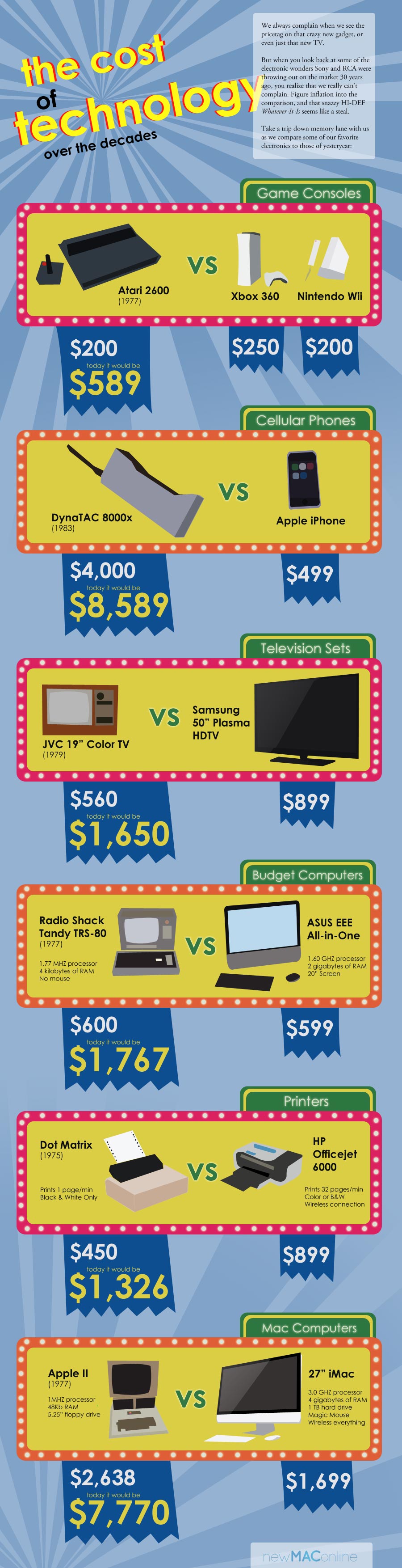
The Cost of Technology Over The Decades

Join Our Mailing List 

Plunging – Yet, Why Hasn’t Medical Care Followed Suit?

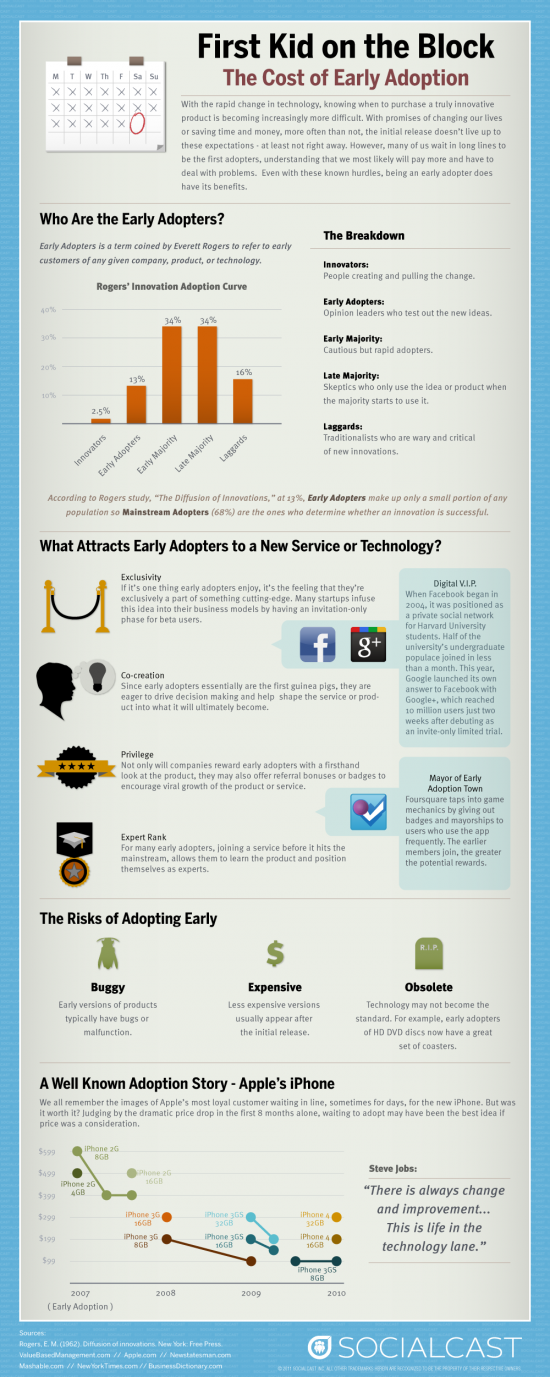
We are grateful to live in this century. For example, movies of the 1980′s have been more than intriguing over the course of the past few months, but times were obviously hard back then. Cell phones weren’t nearly as mobile as they are now, cassette players reigned supreme, and we could talk until blue in the face about hair. Walkman’s and cellular phones with their twenty inch antennas set the pace for this ease of access society we lived in; price tags and all.

Paying for this convenience was quite a task just a few decades ago, as a cell phone cost $4,000+, an Atari was the same price as a Wii, and an Apple 2 ran close to $3,000. We’re still keeping in mind that these products were quite the advancement in their day and age, but footing the bill was not something we’d be interested in today.

Source: http://pinterest.com/pin/304638252/

Assessment

So, why hasn’t the cost of healthcare come down over the same period?

Conclusion

And so, your thoughts and comments on this ME-P are appreciated. Please review our top-left column, and top-right sidebar materials, links, URLs and related websites, too. Then, subscribe to the ME-P. It is fast, free and secure.

Link: http://feeds.feedburner.com/HealthcareFinancialsthePostForcxos

Speaker: If you need a moderator or speaker for an upcoming event, Dr. David E. Marcinko; MBA – Publisher-in-Chief of the Medical Executive-Post – is available for seminar or speaking engagements. Contact: MarcinkoAdvisors@msn.com

Our Other Print Books and Related Information Sources:

Health Dictionary Series: http://www.springerpub.com/Search/marcinko

Practice Management: http://www.springerpub.com/product/9780826105752

Physician Financial Planning: http://www.jbpub.com/catalog/0763745790

Medical Risk Management: http://www.jbpub.com/catalog/9780763733421

Healthcare Organizations: www.HealthcareFinancials.com

Physician Advisors: www.CertifiedMedicalPlanner.com

Subscribe Now: Did you like this Medical Executive-Post, or find it helpful, interesting and informative? Want to get the latest ME-Ps delivered to your email box each morning? Just subscribe using the link below. You can unsubscribe at any time. Security is assured.

Link: http://feeds.feedburner.com/HealthcareFinancialsthePostForcxos

Sponsors Welcomed: And, credible sponsors and like-minded advertisers are always welcomed.

Link: https://healthcarefinancials.wordpress.com/2007/11/11/advertise

   Product Details

Broadening the Strategic Value of Integrated Medical Provider Management‏

How Health Plans Can Create Scalable and Competitive Products that Enable Affordable and High-Quality Care

Join Our Mailing List 

By Sam Muppalla – Vice President, McKesson Health Solutions Network Performance Management

[Part 6 in a 6 part series]

Over the past few weeks, I’ve covered a lot of ground in this ME-P series of six essays. We looked at the pressures on health plans and the ways in which those pressures are forcing a new dynamic in how the plans create new, scalable competitive products that enable affordable, high-quality care. We talked about some of the innovations that leading health plans are bringing to the areas of product, network, care model and reimbursement designs.

The pilot initiatives in these areas continue to show positive results. The next level of scaling requires an integrated and automated approach to enable health plans to deploy, manage and maintain these innovations in a much more rapid fashion. This all has to be done without increasing health plan costs while delivering new value to a health plan’s customers, providers and members.

Affordable Care Can be Achieved

It is our position at NPM that achieving this alignment will deliver affordable care. Additionally, through this alignment, health plans will gain a competitive and cost savings leadership position. Through collaborative and independent research with our health plan partners, we have identified three main areas of competitive and cost savings leadership. The potential cost savings of achieving alignment are impressive. For example, working with a regional Blues plan with three million members, the potential cost savings due to achieving an integrated approach to network design were projected to be:

Administrative Cost Savings [Total Potential Annual Savings = $13 million to $25 million]

  • Provider data administration cost reductions: $5 million to $10 million
  • Provider outreach cost reductions: $0.75 million to $1.25 million
  • Contract management cost reductions: $1 million to $3 million
  • Administrative reimbursement cost reductions: $3 million to $5 million
  • Provider service cost reductions: $1.5 million to $2.5 million
  • Credentialing cost reductions: $1.5 million to $3 million

Medical Cost Savings [Total Potential Annual Savings = $45 million to $100 million]

  • Streamlined member health advocacy: $5 million to $10 million
  • Pay for Performance: $15 million to $40 million
  • Network design and performance improvements: $25 million to $50 million

Provider IT Cost Savings [Total Potential Annual Savings = $.5 million to $2.5 million]

  • Redundant system consolidations: $0.25 million to $2 million
  • IT change management cost reductions: $0.25 million to $0.5 million

The total aggregated annual potential for savings is between $59 million and $127 million.

Some Final Thoughts

In 2009, the National Health Expenditure (NHE) rose to $2.5 trillion or 17.6 percent of the Gross Domestic Product (GDP) with private health insurance accounting for 32 percent of the NHE. Yet all of this spending is not translating into any measure of higher quality care as the World Health Organization (WHO) also ranks the U.S. as 72nd in overall level of health in the world. To affect high-quality, affordable care, health plans must be able to harness innovative product, network, care model and reimbursement designs. Network design is the critical element that will orchestrate the operational scaling of innovation. Therefore, automation of network design and efficient implementation of it through end-to-end integration will be crucial to success of health plans in the post reform world.

Assessment

Thanks for taking the time to follow me, and the ME-P, on this journey. If you’ve joined us late in the discussion, fear not. We’ve collected all the related threads in the Unlocking Affordable Care by Aligning Products white paper, which you can download by visiting our website at http://ow.ly/7MFKb.

MORE: Strategic Management Improvement

Conclusion

And so, your thoughts and comments on this ME-P are appreciated. Please review our top-left column, and top-right sidebar materials, links, URLs and related websites, too. Then, subscribe to the ME-P. It is fast, free and secure.

Link: http://feeds.feedburner.com/HealthcareFinancialsthePostForcxos

Speaker: If you need a moderator or speaker for an upcoming event, Dr. David E. Marcinko; MBA – Publisher-in-Chief of the Medical Executive-Post – is available for seminar or speaking engagements. Contact: MarcinkoAdvisors@msn.com

Our Other Print Books and Related Information Sources:

Health Dictionary Series: http://www.springerpub.com/Search/marcinko

Practice Management: http://www.springerpub.com/product/9780826105752

Physician Financial Planning: http://www.jbpub.com/catalog/0763745790

Medical Risk Management: http://www.jbpub.com/catalog/9780763733421

Healthcare Organizations: www.HealthcareFinancials.com

Physician Advisors: www.CertifiedMedicalPlanner.com

Subscribe Now: Did you like this Medical Executive-Post, or find it helpful, interesting and informative? Want to get the latest ME-Ps delivered to your email box each morning? Just subscribe using the link below. You can unsubscribe at any time. Security is assured.

Link: http://feeds.feedburner.com/HealthcareFinancialsthePostForcxos

Sponsors Welcomed: And, credible sponsors and like-minded advertisers are always welcomed.

Link: https://healthcarefinancials.wordpress.com/2007/11/11/advertise


On Open Letter to Dental Economics

Join Our Mailing List

Fun on a Slow Day [will that be paper or electrons?]

[By Darrell K. Pruitt DDS]

As anyone following the ME-P knows by now, Dental Economics’ officials have been suspiciously unhelpful in locating experts capable of responding to concerns about the cost and safety of EHRs in dentistry – quite the opposite.

The CR Foundation

In addition, Dr. Gordon Christensen’s CR Foundation has also suspiciously avoided discussion of EDRs with this dentist. Nevertheless, I’m certain that like most other EDR stakeholders, employees of DE and CRF at least secretly agree that this consumer has tolerated good ol’ boy behavior in the marketplace far longer than any vendor anywhere else in the free world could ever expect – no matter how important.

Dentrix, too!

At some point, Dental Economics, CR Foundation and Dentrix will either have to answer at least one dentist’s sincere questions about EDRs or censor me from their Facebooks. Over time, not-anonymous censorship would be second only to anonymous censorship as the worst possible choice. If I’m given the opportunity, I’ll prove it.

As readers can tell, sometimes on slow days, even silence from rude people who profit off of my profession irritates me – causing me to want to grab them by the attentions. I’m feeling especially itchy today, so I also posted the following on Dental Economics Facebook:

Dear Dental Economics:

If the AMA finally admits that EHRs are a poor substitute for thinking, don’t you agree it’s time for shy stakeholders in dentistry to accept ownership of their products’ weaknesses? And for other stakeholders to either help me or get out of the damn way?

“EHRs Linked to Errors, Harm, AMA Says — Clinicians can introduce errors when they copy and paste sensitive patient data into electronic health records, according to AMA research.”

http://www.informationweek.com/news/healthcare/EMR/232400325

Or, do you think if dentists remain silent like good little professionals, those who profit from EDRs and related advertisements will suddenly become honest with our patients? I’m not that optimistic. I think if interoperable EDRs are ever to succeed, dentists must pester the unresponsive leaders even while hangers-on would shield them for their own selfish reasons. For example, dentists are unlikely to ever read in Dental Economics the following hints of the imminent failure of EHRs in dentistry: 96% of EHR systems have been breached in the last 2 years and the frequency of breaches rose 32% in the last year – costing over $6.5 billion. The fantasy is over, DE. It’s becoming increasingly difficult for even stakeholders to get giddy about EDRs.

Once the high risks of identity theft from dental offices can no longer be suppressed by stakeholders, our patients’ trust will be forever lost – just to protect the most selfish of people in the healthcare industry from accountability.

Where are you Dentrix?

And what’s the opinion of your CRF investigators, Dr. Gordon Christensen? Are EDRs cheaper than paper dental records or not? As you know, a few months ago your former CEO stated in an article on Dentistry iQ that EDRs offer dentists a “high return on investment,” yet failed to produce evidence supporting his incredible claim.

http://www.dentaleconomics.com/index/display/article-display/2974000845/articles/dental-economics/volume-101/issue-10/features/digital-dentistry-is-this-the-future-of-dentistry.html

Regardless of an institution’s reputation and market share, deceiving doctors and patients for personal gain is just wrong.

Since the misleading statement from the influential CEO has never been corrected, his lie which is still featured on Dentistry iQ continues to harm naïve dentists and clueless patients – but not without the help of 8 Dental Economics editors who voted the CEO’s article as a tie for the “Most important story for the dental profession in 2011.”

http://www.dentistryiq.com/index/display/article-display/9721317527/articles/dentisryiq/hygiene-department/2011/12/best-of_2011_articles.html

Assessment

Way to go, Dental Economics editors! Any of you have enough confidence to discuss why you chose the former CEO’s article? I think your readers would like to hear your reasons. I certainly would. What could it hurt?

Conclusion

Your thoughts and comments on this ME-P are appreciated. Feel free to review our top-left column, and top-right sidebar materials, links, URLs and related websites, too. Then, subscribe to the ME-P. It is fast, free and secure.

Speaker: If you need a moderator or speaker for an upcoming event, Dr. David E. Marcinko; MBA – Publisher-in-Chief of the Medical Executive-Post – is available for seminar or speaking engagements. Contact: MarcinkoAdvisors@msn.com

OUR OTHER PRINT BOOKS AND RELATED INFORMATION SOURCES:


 Product Details

An Integrated Approach to Healthcare Network Alignment and Scalable Innovation‏

More on Healthcare Network Design and Automation

Join Our Mailing List

[Part 5 in a 6 part series]

By Sam Muppalla – Vice President, McKesson Health Solutions Network Performance Management

Previously, on this ME-P, I wrote about the barriers to alignment across product, network, care and reimbursement innovations. And, yes, I teased you with the three-word preview of what was to come this week: Integrated Building Blocks. The idea of building blocks lies at the heart of an approach to achieving alignment and scaling innovation, so let’s dive in.

Unlocking potential administrative, IT and medical savings — while also creating sustainable alignment of the innovation engines — requires various building blocks be in place as a sound foundation for network design and implementation. These building blocks deliver the required functionality in the most efficient manner. When these building blocks are utilized in an integrated fashion, the current barriers are removed and innovation alignment is achieved.

Four Essential Building Blocks

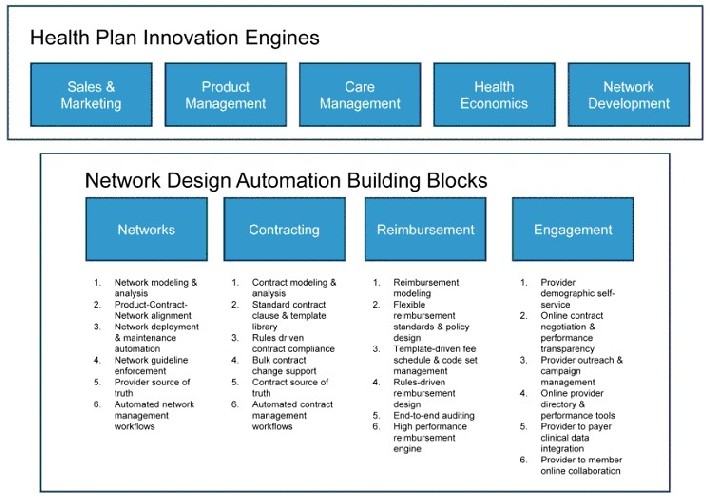
There are four essential network design automation building blocks that comprise the foundation for innovation: networks, contracting, reimbursement and engagement.

Each of these building blocks enables capabilities by delivering necessary functionality within and across the spectrum of network design. Reaching levels of maturity with this capability unlocks additional value and alignment.

Networks

The network building block enables health plans to differentiate and compete. The purpose is to differentiate their value for each customer segment by aligning the product and care model designs with the underlying network designs. It ensures network performance by facilitating the selection of appropriate providers into networks and the alignment of provider reimbursement with network design objectives. It enables networks to be mapped to member-facing and provider-facing products. The provider-facing products can be used for contracting and provider rate differentiation. The member-facing products can be aligned with benefits and serve as steerage targets for benefit designers.

These constructs, in conjunction with each other, enable productization of care model and payment innovation. For example, a health plan could define a “Medical Home Network” that consists of medical homes and supporting providers in a given geography. It could then enable PCMH-specific reimbursement (e.g., PMPM capitation + Fee For Services (FFS) for preventive services + P4P for EBM) by defining a provider-facing product and associating specific reimbursement policies with that provider product. Additionally, it could also define a member-facing product (e.g., PPO Value) which combines the medical home network with the general market PPO network. This in turn will allow the health plan to define a benefit extension which gives a 10 percent premium reduction to members who use Medical Home Network providers for their primary care. In short, a health plan is now able to monetize its care innovation (PCMH), align benefit design to network design for steerage, and align its provider payment with member incentives (around preventive services), while incenting higher quality care (P4P).

The network building block also achieves administrative cost leadership through comprehensive provider data governance and automation of core provider processes.

Contracting

The contracting building block is designed to enable health plans to reduce contract administrative costs while increasing provider payment accuracy. It optimizes the management of the provider contracting lifecycle through the automation of contract authoring, offering negotiating and acceptance while ensuring the standardization of terms and policies. This building block achieves reduced medical expenditure driven by contract standards adherence, reduced claims mis-payments, and increased speed to market for new payment innovations. It also can support rules-based enforcement of network level reimbursement guidelines to ensure consistent network performance.

Reimbursement

The reimbursement building block enables health plans to maximize the effectiveness of their medical expenditures by paying for value versus volume and by incenting team-based performance. It is the single source of truth for all forms of reimbursement including traditional claims pricing, episodes of care, shared savings, capitation and P4P. This building block enables the mixing and matching of reimbursement methodologies to incent optimal provider performance. It supports a modeling engine to analyze the financial impact of reimbursement and contract changes. It incorporates network-aware provider/contract selection for claims pricing intake. This is a rules driven, high performance service that leverages provider relationship information to select the right provider, the right governing contract and the right reimbursement model for each incoming claim. Additionally, it includes provider transparency services that enable health plan provider portals to support online pricing lookups and reimbursement status/detail inquiries for providers. These services can be extended to support provider performance scorecards and benchmarks.

Engagement

The engagement building block is designed to increase collaboration and participation. It enables meaningful engagement among health plans, providers and members in order to improve health outcomes and reduce costs. This building block achieves reduced administrative and service costs, increased member participation and adherence, increased provider satisfaction and adoption of care/payment initiatives, and the enablement of collaborative/integrated care delivery models such as PCMH and ACO.

Utilizing flexible, automated and integrated building block capabilities is the key to sustainable success that not only unlocks the promise of affordable care to customer segments but also delivers on reduced administrative, medical and IT costs. Incorporating information technologies that can facilitate, if not altogether replace, the manual interactions will be an important part of every organization’s evolution.

Assessment

Next week, in our final part 6 of this series, we’ll wrap up this discussion with a look at some of the potential savings health plans could achieve through alignment and an integrated approach to network design. The potential savings are not slight, so stay tuned. As always, if you just don’t want to wait for next week, visit our website and download the entire Unlocking Affordable Care by Aligning Products white paper; it’s available now.

Conclusion

Your thoughts and comments on this ME-P are appreciated. Feel free to review our top-left column, and top-right sidebar materials, links, URLs and related websites, too. Then, subscribe to the ME-P. It is fast, free and secure.

Speaker: If you need a moderator or speaker for an upcoming event, Dr. David E. Marcinko; MBA – Publisher-in-Chief of the Medical Executive-Post – is available for seminar or speaking engagements. Contact: MarcinkoAdvisors@msn.com

OUR OTHER PRINT BOOKS AND RELATED INFORMATION SOURCES:


Product Details

On e-Claim Only Dental Plans

About their Hidden Costs – I’m Talking PHI Breaches

By D. Kellus Pruitt DDS

If the rumor is true about Bluebell Ice Cream’s “e-claim-only” dental benefit plan that is to go into effect in March, how many in the east-central Texas town of Brenham (pop. 16,000) will be properly warned about the danger to themselves, their families and Bluebell officials’ reputations because of reckless policy?

Transmissions Risks

Each time their dentists send an electronic dental claim (e-claim) over the internet to insurance employees in Chicago as a favor to a patient – and especially the insurer – the Bluebell employee’s digital medical identity which is worth fifty bucks on the black market, rides along to destinations unknown. It’s my guess that very few Bluebell employees are yet aware of the increasing risk of medical identity theft from dentists’ e-claims – much less given the opportunity to opt out of the risk by simply visiting a dentist who still uses the telephone, fax and US Mail.

Security Risks Growing

It certainly won’t improve my popularity with 9 out of 10 dentists for saying this, but risks of identity theft from HIPAA-covered dental offices are climbing daily. In the introduction to a recent interview with Larry Ponemon, chairman and founder of the Ponemon Institute, GovernmentIT.com editor Tom Sullivan ominously described the ever-increasing risk of a massive “data spill” of perhaps millions of patients’ protected health information (PHI):

 “The street value of health information is 50 times greater than that of other data types. Even worse, the healthcare industry is among the weakest at protecting such information. With organized criminals trying to steal medical IDs, sloppy mistakes becoming more commonplace, mobile devices serving as single sign-on gateways to records and even bioterrorism now a factor, healthcare is ripe for some a wake-up call – one that just might come in the form a damaging ‘data spill.’” (See: “Q&A: How a health ‘data spill’ could be more damaging than what BP did to the Gulf.”

Tom Sullivan – Editor [December 05, 2011]

http://govhealthit.com/news/qa-how-health-data-spill-could-be-worse-what-bp-did-gulf?page=0,0

According to Dr. Ponemon:

“The basic issue, when you think about data theft not data loss – because it’s hard to know whether that lost data ultimately ends up in the hands of the cybercriminal and all of these bad things occur – but in the case of identity theft, the end goal has been historically to steal a person’s identity, and just like getting a financial record, getting a health record probably has your credit card, debit card, and payment information contained in that record.”

Of Credit Cards … and More!

But that’s not all. Credit cards are just chump change. He continues:

“The financial records are actually lucrative for the bad guy, but the health record is actually much, much more valuable item because it not only gives you the financial information but it also contains the health credential, and it’s very hard to detect a medical identity theft. What we’ve found in our studies is that medical identity theft is likely to be on the rise and, of course, there’s an awareness within the healthcare organizations that participate in our study that they’re starting to see this as more of a medical identity theft crime. It’s not just about stealing credit cards and buying goodies, it’s about stealing who you are, possibly getting medical treatment and, therefore, messing up your medical record.”

Dr. Ponemon suggests that the victim may not know about the theft until he or she “stumbles on something that alerts them their medical identity was stolen.” Perhaps something like death following anaphylactic shock from a medication that was once digitally highlighted as “Allergic to.” Understandably, Ponemon adds that respondents recognized altered medical histories as an emerging threat they believed was affecting the patients in their organizations. Such danger for dental patients is almost non-existent if their dentists simply don’t put PHI on office computers.

Should a data breach of Bluebell Ice Cream employees’ identities occur in Brenham or Chicago, which is more likely than not, the fact that electronic dental records do nothing to improve the quality of dental care won’t make Brenham citizens any happier with local Bluebell officials. 

Conclusion       

And so, your thoughts and comments on this ME-P are appreciated. Please review our top-left column, and top-right sidebar materials, links, URLs and related websites, too. Then, subscribe to the ME-P. It is fast, free and secure.

Link: http://feeds.feedburner.com/HealthcareFinancialsthePostForcxos

Speaker: If you need a moderator or speaker for an upcoming event, Dr. David E. Marcinko; MBA – Publisher-in-Chief of the Medical Executive-Post – is available for seminar or speaking engagements. Contact: MarcinkoAdvisors@msn.com

Our Other Print Books and Related Information Sources:

Health Dictionary Series: http://www.springerpub.com/Search/marcinko

Practice Management: http://www.springerpub.com/product/9780826105752

Physician Financial Planning: http://www.jbpub.com/catalog/0763745790

Medical Risk Management: http://www.jbpub.com/catalog/9780763733421

Healthcare Organizations: www.HealthcareFinancials.com

Physician Advisors: www.CertifiedMedicalPlanner.com

Subscribe Now: Did you like this Medical Executive-Post, or find it helpful, interesting and informative? Want to get the latest ME-Ps delivered to your email box each morning? Just subscribe using the link below. You can unsubscribe at any time. Security is assured.

Link: http://feeds.feedburner.com/HealthcareFinancialsthePostForcxos

Sponsors Welcomed: And, credible sponsors and like-minded advertisers are always welcomed.

Link: https://healthcarefinancials.wordpress.com/2007/11/11/advertise


Product Details

Barriers to Performance Based Healthcare Networks and Medical Cost Savings

 Understanding the need to align care models, payment, products and networks

Join Our Mailing List 

[Number 4 in a series of 6]

By Sam Mupalla – Vice President, McKesson Health Solutions, Network Performance Management (NPM)

I wanted to follow up on last month’s ME-P discussion about Performance-based Networks and Medical Cost Savings. I wrote about the need to align care models, payment, products and networks, and then promised to address some of the barriers standing in the way of achieving alignment. Well, that’s what I’m writing about today.

Strategic Difficulties

Health plan operations responsible for supporting the intent of the provider network designs will find it increasingly difficult to maintain strategies that provide affordable care by applying existing methods and systems.

Currently, the systems and processes that enable these operations are frequently based on systems that are neither integrated nor automated, rather relying on various manual interventions to achieve some scale of efficiency. Creating and maintaining innovative value-based offerings in this environment requires process excellence coupled with tight coordination executed across multiple departments. As the complexity and frequency of demand for these offerings increase, this approach becomes more challenging to sustain, thus risking long term success of the affordable care promise.

Figure 1: Today’s operational engine interactions are not optimized for enabling innovation.

The traditional systems and processes that health plans have used to respond to specific client demands appear in Figure 1.

For example, product demands from consumers may come in through the sales team, which manually interacts with the product management, care management, network development, and health economic teams to design a product to meet the market need. This first set of interactions, in effect, becomes the innovation engine for value-based product designs. Additionally, it becomes the starting point for a myriad of manual and highly paper-based interactions that ripple throughout the enterprise.

The interactions within this innovation engine then set forth a series of parallel and independent sequences with three different operational engines: the provider contracting department, the provider management department and the claims operations department. Each of these areas relies heavily upon their own set of manual and paper-based processes and interactions. The inefficiency of this current approach suggests the potential for an annual administrative cost savings opportunity of $5-25 million, depending on the health plan’s size and current system architecture.

In addition to administrative costs, this approach creates inefficiency and waste in IT costs and medical costs that could be between $40-100 million.

Assessment

So, how can you unlock these savings and eliminate this waste? We’ll discuss that next week. I’ll say only three words here: Integrated Building Blocks. I’m not going to say a word more — but if you can’t wait for next week you can read the entire Unlocking Affordable Care by Aligning Products white paper; it’s available on our website now.

Conclusion

Your thoughts and comments on this ME-P are appreciated. Feel free to review our top-left column, and top-right sidebar materials, links, URLs and related websites, too. Then, subscribe to the ME-P. It is fast, free and secure.

Link: http://feeds.feedburner.com/HealthcareFinancialsthePostForcxos

Speaker: If you need a moderator or speaker for an upcoming event, Dr. David E. Marcinko; MBA – Publisher-in-Chief of the Medical Executive-Post – is available for seminar or speaking engagements. Contact: MarcinkoAdvisors@msn.com

OUR OTHER PRINT BOOKS AND RELATED INFORMATION SOURCES:

DICTIONARIES: http://www.springerpub.com/Search/marcinko
PHYSICIANS: www.MedicalBusinessAdvisors.com
PRACTICES: www.BusinessofMedicalPractice.com
HOSPITALS: http://www.crcpress.com/product/isbn/9781466558731
CLINICS: http://www.crcpress.com/product/isbn/9781439879900
BLOG: www.MedicalExecutivePost.com
FINANCE: Financial Planning for Physicians and Advisors
INSURANCE: Risk Management and Insurance Strategies for Physicians and Advisors

Product DetailsProduct DetailsProduct Details

Product Details  Product Details

   Product Details

How Technology Changed Medicine

A Historic Timeline Review of Advances

Join Our Mailing List

Today we address how technology has changed the medical industry.

Definition

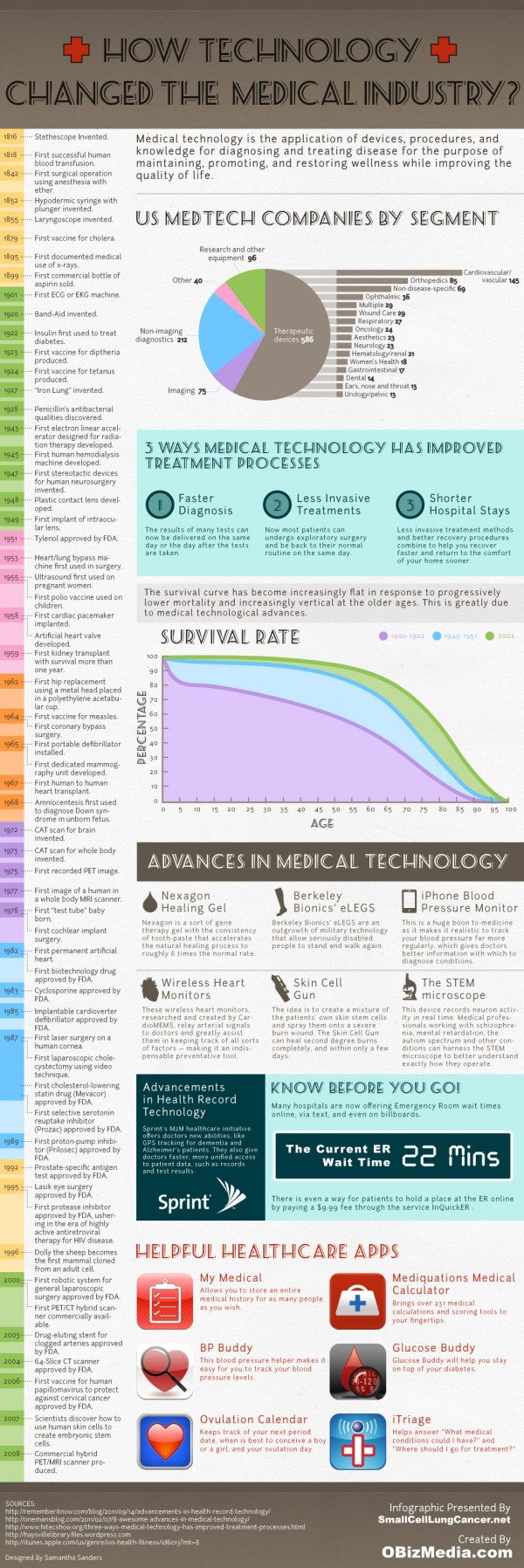
This infographic starts off by stating “medical technology is the application of devices, procedures, and knowledge for diagnosing and treating disease for the purpose of maintaining, promoting, and restoring wellness while improving the quality of life.” On the left of the infographic is a timeline of technological advances in the medical industry, starting with the invention of the stethoscope in 1816 and ending with the production of the first commercial hybrid PET/MRI scanner in 2008.

US Medical Technology Companies by Segment

A pie chart shows us that a great many medical technology companies are focused on therapeutic devices, while the next biggest segment belongs to non-imaging diagnostics. The next largest segment is dedicated to research and other equipment, and the next segment (second to the smallest) is dedicated to imaging. The smallest segment is designated as “other.”

In the therapeutic devices category, the largest piece of that piece of the pie goes to cardiovascular and vascular developments, and the smallest to urology/pelvic with many other therapeutic devices in between.

Three Ways Medical Technology Has Improved Treatment Processes

1. Faster Diagnosis

2. Less Invasive Treatments

3. Shorter Hospital Stays

Survival Rate

It is noted that the survival curve has flattened because of lower mortality and has become increasingly vertical with older people because of the technological advances. A graph shows the percentage of people who lived until a certain age between 1900 and 1902, when only about 10% of people lived past the age of 85, and 2002, when almost 30% of people lived past the age of 85. Based on this graph, most people live to age 55 or older; and around 50% of people live to at least age 80.

Advances in Medical Technology

Some of the advances mentioned are wireless heart monitors, skin cell guns, the STEM microscope, Nexagon healing gel, Berkeley Bionics’ eLEGS, and the iPhone Blood Pressure Monitor. A description of each of these advances is included on the infographic.

Advancements in Health Record Technology and More

Sprint has something called M2M healthcare initiative that provides GPS tracking for patients with Alzheimer’s and dementia, and offers faster access to more unified personal data like heath records and test results.

Now, there is also a “know before you go” option for hospital emergency rooms. Some hospitals place their wait times on billboards, make them available on their website, and even offer the wait time via text. Other hospitals participate in a service called InQuick ER where a patient can pay a $9.99 fee and hold a place in the ER online [noted elsewhere on this ME-P].

Helpful Healthcare Apps

Some of the apps listed are My Medical, which allows one to store medical histories, BP Buddy that helps track blood pressure levels, Glucose Buddy, which helps manage diabetes, and iTriage, that is a diagnostic tool.

Also listed is the Ovulation Calendar – guess what that does? While – the Mediquations Medical Calculator brings 231 medical calculations and scoring tools right to your mobile device.

Source: SmallCellLungCancer.net

Conclusion

Your thoughts and comments on this ME-P are appreciated. Feel free to review our top-left column, and top-right sidebar materials, links, URLs and related websites, too. Then, subscribe to the ME-P. It is fast, free and secure.

Speaker: If you need a moderator or speaker for an upcoming event, Dr. David E. Marcinko; MBA – Publisher-in-Chief of the Medical Executive-Post – is available for seminar or speaking engagements. Contact: MarcinkoAdvisors@msn.com

OUR OTHER PRINT BOOKS AND RELATED INFORMATION SOURCES:

Product DetailsProduct DetailsProduct Details

Product Details  Product Details

Product Details

Current Approaches to Patient Self Management – Do They Improve Quality or Lower Costs? [An Encore Video Debate]

A Symposium Debate  

Moderator: Cynthia Bouthot: MA, President, Collaborative Innovation Group.

Dis-Agree: Shahid Shah MS: CEO Netspective; blogger www.HealthCareITGuy.com, and HIT “Thought-Leader” for the ME-P.

Agree: Joseph Kvedar MD: Director, PartnersCenter for Connected Health.

Get Ready to Rumble!

http://healthcare.partners.org/streaming/CCH/symposium2011/Plaza/PlazaThursday01.html

Assessment

Mr. Shah is the author of Ch 13 [Interoperable eMRs for the Small to Medium-Sized Medical Office] in the book: Business of Medical Practice [3rd edition], edited by Dr. David Edward Marcinko MBA CMP™  www.BusinessofMedicalPractice.com

Conclusion

Your thoughts and comments on this ME-P are appreciated. Feel free to review our top-left column, and top-right sidebar materials, links, URLs and related websites, too. Then, subscribe to the ME-P. It is fast, free and secure.

Link: http://feeds.feedburner.com/HealthcareFinancialsthePostForcxos

Speaker: If you need a moderator or speaker for an upcoming event, Dr. David E. Marcinko; MBA – Publisher-in-Chief of the Medical Executive-Post – is available for seminar or speaking engagements. Contact: MarcinkoAdvisors@msn.com

OUR OTHER PRINT BOOKS AND RELATED INFORMATION SOURCES:

DICTIONARIES: http://www.springerpub.com/Search/marcinko
PHYSICIANS: www.MedicalBusinessAdvisors.com
PRACTICES: www.BusinessofMedicalPractice.com
HOSPITALS: http://www.crcpress.com/product/isbn/9781466558731
CLINICS: http://www.crcpress.com/product/isbn/9781439879900
BLOG: www.MedicalExecutivePost.com
FINANCE: Financial Planning for Physicians and Advisors
INSURANCE: Risk Management and Insurance Strategies for Physicians and Advisors

Product Details

Medical Identity Theft on the Rise

Join Our Mailing List

Open Up Dentists – and Physicians, Too!

[By D. Kellus Pruitt DDS]

If I tell you that your patients’ insurance identities can be sold for $50 each, how much will you trust your employees on Monday, Doc?

The Experts Speak

According to a panel of cyber-security experts at a recent Digital Health Conference, medical identity theft has become one of the most lucrative forms of identity theft. “DHC: EHR Data Target for Identity Thieves” by MedPage Today Associate Staff Writer Cole Petrochko, was posted last week

http://www.medpagetoday.com/PracticeManagement/InformationTechnology/30074

“Presentations at the Digital Health Conference here indicated that a single patient’s electronic health records can fetch $50 on the black market — a much fatter target than more familiar forms of identity theft, such as Social Security numbers ($3), credit card information ($1.50), date of birth ($3), or mother’s maiden name ($6).”

eMRs Not Like Credit-Cards

“And, unlike a credit card number, patients’ healthcare records cannot be cancelled or changed to prevent stolen data from being used by criminals”, said John DeLuca, of EMC Corp., an information technology company.

The Street Value of eDRs 

What do you want to bet that medical identities downloaded from dentists’ computers bring $50; as well. I’d like to share a special, visceral sentiment with my shy, HIPAA covered colleagues:

I warned you, damn it! And, I assume, just like virtually all other silent dentists in the nation, you’ve done NOTHING to safeguard your patients’ identities. Even if you don’t like truth served bluntly, this dentist has your reputation in mind when I warn that if your practice experiences a reportable data breach of over 500 records, and your patients’ identities aren’t encrypted, those who choose to remain with your practice will never trust you as much as they do today – even if you properly report the breach. Of the estimated 20% who will never return, many will probably look for a gentle dentist who doesn’t store patients’ Protected Health Information (PHI) on computers …. Like me. (Yea, that was a sales pitch. As one might expect, I certainly welcome discussion of it with anyone).

ADA Laggards 

After 5 years of awaiting responses from unaccountable leaders inside and outside the American Dental Association concerning HIPAA and EDRs, It feels really good to aggravate 9 out of 10 dentists still reading this – challenging those who normally take offense with professional stoicism to loosen up and share their feelings with everyone for once … God help me, I do love this so.

More About the Black Market 

The black market price for EHRs has increased ten-fold in the last 5 years. In 2006, I warned in a guest column on WTN that it only takes one dishonest employee needing a couple of thousand quick dollars to potentially bankrupt a practice almost without risk of being caught. Back then, the black market price for a stolen medical identity was estimated at only $5 (See: “Careful with that electronic health record, Mr. Leavitt,” WTN News, October 18, 2006).

http://wtnnews.com/articles/3407/

It’s no secret that reticent ADA officials like President-elect Dr. Robert Faiella have suspiciously failed in their duty to be transparent with dues-paying members about the liabilities of the EHRs – even as they continue to recklessly promote paperless practices. The result: Almost all dentists in theUSstill maintain patients’ unencrypted medical identities on their office computers – often guarded by a flimsy password that is still cute a decade later. (Did I hear a gasp?).

Consider This!

Consider this, Doc! If a practice has 3000 active patients with identities worth $150,000, all one dishonest employee needs for dreams to come true is a flash drive and private time with your computer.

Assessment

Show me a dentist who thinks the benefits of EHRs to dental patients still outweigh the liabilities and I’ll show you a dangerously naive healthcare provider who probably doesn’t know about KPMG Auditors. Let’s face the facts bravely, Doc. Now would be a terrible time to invest in an EDR system – even cloud based. The proven, avoidable danger EDRs bring to American dental patients is unacceptable and only getting worse. Give it a year or so.

Channel Surfing the ME-P

Have you visited our other topic channels? Established to facilitate idea exchange and link our community together, the value of these topics is dependent upon your input. Please take a minute to visit. And, to prevent that annoying spam, we ask that you register. It is fast, free and secure.

Conclusion

Your thoughts and comments on this ME-P are appreciated. Feel free to review our top-left column, and top-right sidebar materials, links, URLs and related websites, too. Then, subscribe to the ME-P. It is fast, free and secure.

Speaker: If you need a moderator or speaker for an upcoming event, Dr. David E. Marcinko; MBA – Publisher-in-Chief of the Medical Executive-Post – is available for seminar or speaking engagements. Contact: MarcinkoAdvisors@msn.com

OUR OTHER PRINT BOOKS AND RELATED INFORMATION SOURCES:

Product DetailsProduct Details

Product Details

The Ten Best Apps for [MD] Car Phones

Physician Necessity or Luxury?

By Dr. David Edward Marcinko MBA

[Editor-in-Chief]

The ME-P has published many insightful essays and comments on health information technology and related issues. It’s a hot topic, no doubt. Robust and controversial, too!

Regular readers of the ME-P also know that I’m a Jaguar fanatic; not the animal –  the British automobile. In fact, I’ve got a classic 2000 pearl white, XJ-V8-LWB from Coventry England, sitting in my garage right now. She’s never seen snow or rain; and when I’m not out jogging, on speaking tour or consulting with clients; or involved with this publication – you can usually find me ministering to her needs [and there are many]. Do I spend too much time with her; just ask my wife? She’s another high maintenance babe, but we both love her.

So, how do smart phones and tablet PCs relate to HIT and Jaguars?

Of Smart Phonese and Tablet PCs

Smartphones and tablets have revolutionized the way many of us live, and practice medicine. This change was undoubtedly what prompted one manufacturer to coin the marketing phrase, “There’s an app for that.”

Apps can help with shopping, exercising, learning, health information–and even driving.  So, here we look at the 10 best apps for car owners [courtesy Nalley Lexus-Jaguar] that help with everything from maximizing fuel efficiency and organizing a carpool to locating roadside assistance while using your hands-free via voice commands [checking patient status or relaying hospital orders]. Doctors, Jaguar owners and laymen alike, often love em’.

More http://www.nalleylexusroswellnews.com/Articles/10BestAppsforCarOwners/

Conclusion

Your thoughts and comments on this ME-P are appreciated. Feel free to review our top-left column, and top-right sidebar materials, links, URLs and related websites, too. Then, subscribe to the ME-P. It is fast, free and secure.

Link: http://feeds.feedburner.com/HealthcareFinancialsthePostForcxos

Speaker: If you need a moderator or speaker for an upcoming event, Dr. David E. Marcinko; MBA – Publisher-in-Chief of the Medical Executive-Post – is available for seminar or speaking engagements. Contact: MarcinkoAdvisors@msn.com

OUR OTHER PRINT BOOKS AND RELATED INFORMATION SOURCES:

DICTIONARIES: http://www.springerpub.com/Search/marcinko
PHYSICIANS: www.MedicalBusinessAdvisors.com
PRACTICES: www.BusinessofMedicalPractice.com
HOSPITALS: http://www.crcpress.com/product/isbn/9781466558731
CLINICS: http://www.crcpress.com/product/isbn/9781439879900
BLOG: www.MedicalExecutivePost.com
FINANCE: Financial Planning for Physicians and Advisors
INSURANCE: Risk Management and Insurance Strategies for Physicians and Advisors

   Product Details

Doctor – Is Your Mac Vulnerable to Viruses?

Not Just a PC Problem Anymore!

Join Our Mailing List 

We all know that PCs are more vulnerable to viruses, worms, trojans, malware, adware and other electronic miscreants, than are Macs. And, that some medical professionals absolutely love their iPads and Macs.

But doctor, are you leaving your Mac vulnerable to unwanted intrusions?


Source: MacKeeper

Conclusion

Your thoughts and comments on this ME-P are appreciated. Feel free to review our top-left column, and top-right sidebar materials, links, URLs and related websites, too. Then, subscribe to the ME-P. It is fast, free and secure.

Link: http://feeds.feedburner.com/HealthcareFinancialsthePostForcxos

Speaker: If you need a moderator or speaker for an upcoming event, Dr. David E. Marcinko; MBA – Publisher-in-Chief of the Medical Executive-Post – is available for seminar or speaking engagements. Contact: MarcinkoAdvisors@msn.com

OUR OTHER PRINT BOOKS AND RELATED INFORMATION SOURCES:

DICTIONARIES: http://www.springerpub.com/Search/marcinko
PHYSICIANS: www.MedicalBusinessAdvisors.com
PRACTICES: www.BusinessofMedicalPractice.com
HOSPITALS: http://www.crcpress.com/product/isbn/9781466558731
CLINICS: http://www.crcpress.com/product/isbn/9781439879900
BLOG: www.MedicalExecutivePost.com
FINANCE: Financial Planning for Physicians and Advisors
INSURANCE: Risk Management and Insurance Strategies for Physicians and Advisors

Product Details

The Texas Dental Association Board Must Face the Truth

More on NPI Numbers

[By D. Kellus Pruitt DDS]

Dear Past TDA Board Members

I have some questions similar to the ones that got me suspended from the TDA a year ago: Who among you can defend your decision to persuade trusting TDA members to volunteer for National Provider Identifier (NPI) numbers?

And, why did you give up on the effort while BCBSTX continues to unfairly force dentists who aren’t even HIPAA covered entities to adopt the identifiers?

If you’re still unaware that everyone can see TDA leaders allowed themselves to be manipulated by stakeholders like BCBSTX, prepare yourself. It won’t be long before at least a few TDA members blame you personally for the bad things I warned would come to dentists with NPI numbers. Since the identifier does nothing to improve the quality of care, its promotion cannot be reconciled with the mission statement of the TDA, leaders. I hope angry dentists throughout the state seek the names of those of you who misled them.

A Non-Profit 

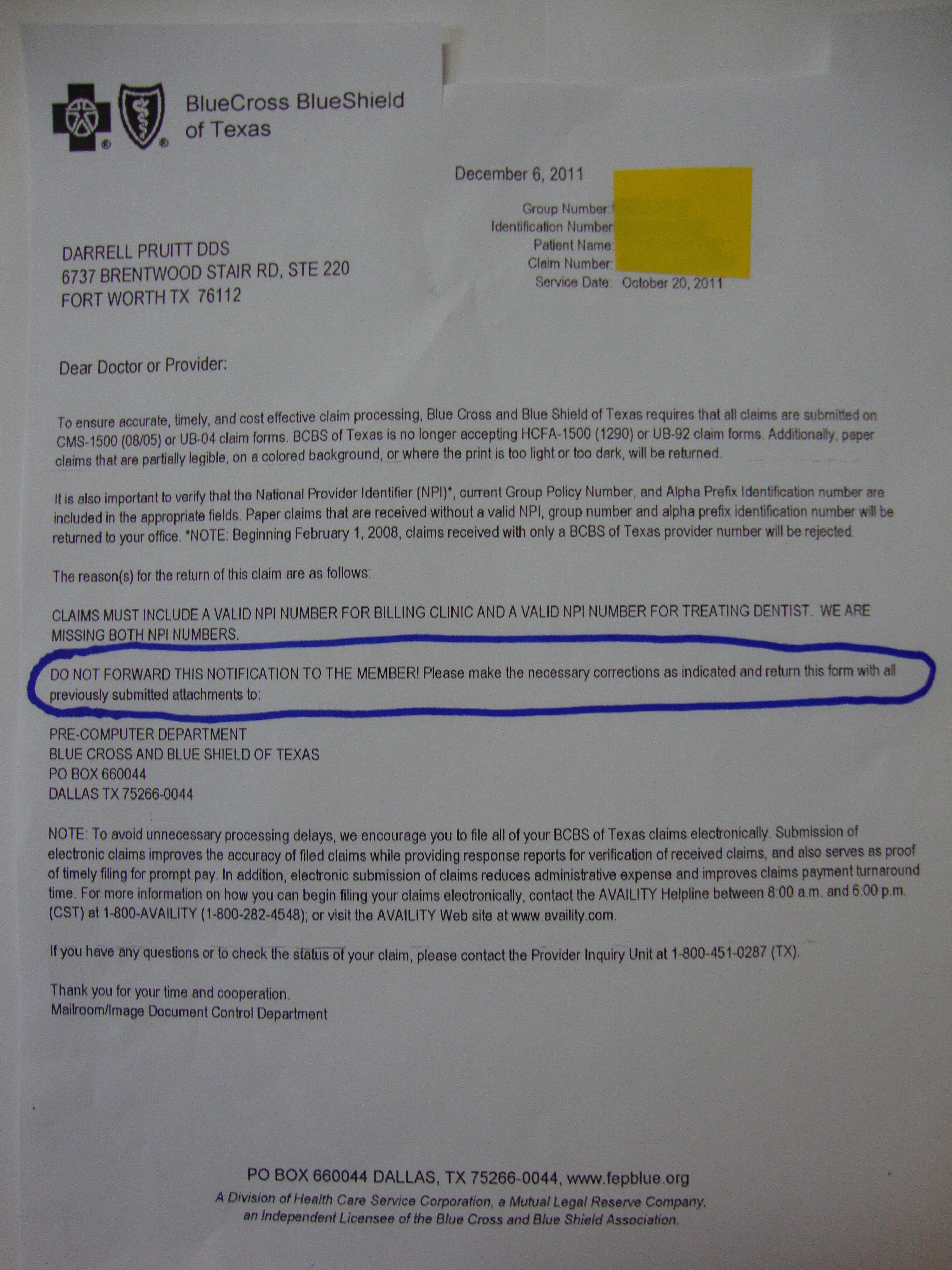
BCBSTX is a non-profit whose handsome profits are paid by taxpayers. The healthcare parasite sells dental insurance to theUSgovernment for federal employees. In their letter to me that I’ve attached, you can see for yourself that along with BCBSTX’s stated refusal to process any of their clients’ dental claims that come from my office, it says in capital letters, “DO NOT FORWARD THIS NOTIFICATION TO THE MEMBER!” How proud does it make you feel to know BCBSTX defines your level of ethics, TDA Board? Two years ago, your Director of Membership censored from the TDA Facebook this dentist’s criticism of BCBSTX’s NPI demands. Sometimes, you bozos are idiots.

I have no contractual relationship with BCBSTX, so as soon as could, I defied BCBSTX’s order and sent their client the letter – making sure to point out that BCBSTX ordered me to keep it secret from her. As you might expect, she’s pissed at BCBSTX! I hope she looks into a class action lawsuit. I bet BCBSTX has been secretly extorting their customers’ dentists by the thousands … but then, do you even care, TDA? What did BCBSTX offer the TDA that caused you to betray dentists and patients who used to have faith in your honesty?

BCBSTX is a Tyrant, and the TDA is an Enabler

There’s more: As a favor to our patients, my office has traditionally called their insurers for coverage information so that those who purchased the dental benefits will know how much of the bill they are responsible for before we start treatment. It’s called transparency.

Today, my office manager informed me that according to alerts she has received from insurers, if I don’t “volunteer” for a National Provider Identifier (NPI) number by 2012, my office will be deprived of the right to product information about BCBSTX’s plans. How does that help anyone, TDA?

Assessment 

Were you aware that this was the purpose of the NPI number when you pushed TDA members to sign up? Do you even care? Because of your silence inTexas’ dental community, it’s really hard to tell.

Conclusion

Your thoughts and comments on this ME-P are appreciated. Feel free to review our top-left column, and top-right sidebar materials, links, URLs and related websites, too. Then, subscribe to the ME-P. It is fast, free and secure.

Speaker: If you need a moderator or speaker for an upcoming event, Dr. David E. Marcinko; MBA – Publisher-in-Chief of the Medical Executive-Post – is available for seminar or speaking engagements. Contact: MarcinkoAdvisors@msn.com

OUR OTHER PRINT BOOKS AND RELATED INFORMATION SOURCES:

Product Details

A Message to all ME-P Readers about Physician Nexus TV for Doctors

Launching a New Video News TV Channel for Physicians

Join Our Mailing List 

By Omar Baig

Dear ME-P Community,

Drum roll please!

We have just launched a 24/7 video news channel.

Now every hour every day we will be adding valuable video content to Nexus. Our community is composed of physicians from 81 countries in time zones that span the world.  So regardless of where the member is or what time of the day it is there will be new and valuable content added within the hour.

You can search by specialty, latest videos, most popular, keyword, etc.

http://physiciannexus.com/video/

We are going through great lengths to ensure you get the highest value content possible.   If there is anything you would like us to add, just let us know.  We are here to serve you.

Instead of having to go to multiple sites to get the content you need, just come to Nexus.  Every minute that is saved is time that you can use to see patients or spend with your family.

We have also included a poll on the homepage which asks the type of information you seek (alternative/additional revenue opportunities, free CME, jobs, or other).  This feedback will be used to better serve our global physician community.

http://physiciannexus.com/main

Finally, I want to thank our entire team, including your ME-P publisher Dr. David Edward Marcinko, and all the members of our Medical Advisory Board for helping to make this vision a reality! 

About the Author

Omar Baig – Physician Nexus Team

2530 Berryessa Road – San Jose, CA 95132

www.PhysicianNexus.com 

Assessment

Visit Physician Nexus at: http://physiciannexus.com/?xg_source=msg_mes_network

Conclusion            

And so, your thoughts and comments on Physician Nexus are appreciated. Please review our top-left column, and top-right sidebar materials, links, URLs and related websites, too. Then, subscribe to the ME-P. It is fast, free and secure.

Link: http://feeds.feedburner.com/HealthcareFinancialsthePostForcxos

Update on Tablet Usage in the Health Care Industry

A Growing Trend?

By Cyndi Laurenti

Join Our Mailing List 

The rapidly evolving technological era has ushered a host of industries into the digital world, including the medical field. Health care professionals in private and public institutions and even masters and PhD programs are quickly learning the immense benefits of utilizing technology in their practices and this has specifically included the use of the tablet computer.

Convenience and Mobility

In addition to the convenience tablets offer in size and mobility, more and more production companies are creating interfaces and programs specifically geared towards the healthcare industry and the tablet computer makes them more accessible and dynamic than the traditional clipboard. This is crucial in an industry where time is of the essence and life-changing decisions are made from moment to moment. Having a tablet computer puts the latest resources and tools in doctors and other health care professionals’ hands so they can make decisions efficiently.

Brand Neutral?

Although Tablet computers tend to be associated with the most popular brands like the iPad by Apple, a recent survey of 178 doctors indicated that even though the healthcare industry wants a tablet, it may not necessarily want the iPad in particular which does not have all the applications they require.

A whole industry of tablets has been specifically designed to meet the medical field’s particular needs, one example being the motion computing tablet PC. The West Clinic in Memphis which was founded by Supportive Oncology Services (SOS) and which caters for over 10,000 patients found that the motion computing tablet computer enabled them not only to streamline information between patients and physicians, but that it also lead to an improved quality of care and life for their patients and increased efficiency for their caregivers.

Other Healthcare Early Adopters

Another facility that adapted the use of tablet computers is the Lancaster General Hospital in Lancaster, PA, which has been rated as one of the top 100 hospitals for its efficiency and quality of care. The doctors and nurses are currently using 170 tablet computers in 21 units for a variety of tasks. Jon White, M.D. called it a ‘productivity tool’ and it is utilized around the hospital for patient safety through an application that assigns drugs through a unique bar code which ensures the right patient is getting the right medication and dose. It is also used to access patient records from anywhere in the hospital, review patient orders or test results, and access a library of medical reference information.

A third facility that utilizes the tablet computer is St. Mary’s Medical Center, an acute care facility in Evanville, Indiana, that provides inpatient and outpatient care. The tablet computer has currently replaced their paper-based patient charts, and cut down nurses’ charting times significantly.

Assessment

There is little doubt that the tablet computer has and will continue to revolutionize the healthcare industry. Tremendous positive changes have been made like the streamlining of once time-consuming and arduous processes. This increased efficiency ultimately translates into quality care for patients and the continued advancement of the medical field.

Conclusion      

And so, your thoughts and comments on this ME-P are appreciated.  Feel free to review our top-left column, and top-right sidebar materials, links, URLs and related websites, too. Then, subscribe to the ME-P. It is fast, free and secure.

Link: http://feeds.feedburner.com/HealthcareFinancialsthePostForcxos

Speaker: If you need a moderator or speaker for an upcoming event, Dr. David E. Marcinko; MBA – Publisher-in-Chief of the Medical Executive-Post – is available for seminar or speaking engagements. Contact: MarcinkoAdvisors@msn.com

Our Other Print Books and Related Information Sources:

Health Dictionary Series: http://www.springerpub.com/Search/marcinko

Practice Management: http://www.springerpub.com/product/9780826105752

Physician Financial Planning: http://www.jbpub.com/catalog/0763745790

Medical Risk Management: http://www.jbpub.com/catalog/9780763733421

Healthcare Organizations: www.HealthcareFinancials.com

Physician Advisors: www.CertifiedMedicalPlanner.com

Subscribe Now: Did you like this Medical Executive-Post, or find it helpful, interesting and informative? Want to get the latest ME-Ps delivered to your email box each morning? Just subscribe using the link below. You can unsubscribe at any time. Security is assured.

Link: http://feeds.feedburner.com/HealthcareFinancialsthePostForcxos

Sponsors Welcomed: And, credible sponsors and like-minded advertisers are always welcomed.

Link: https://healthcarefinancials.wordpress.com/2007/11/11/advertise

   Product Details

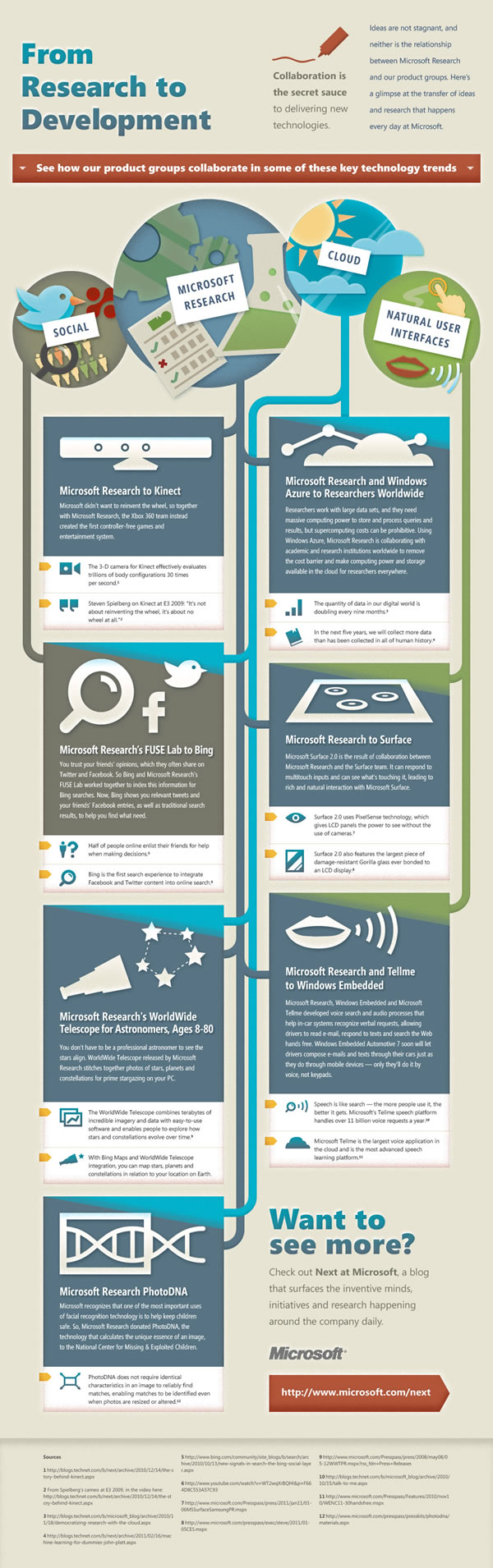
Microsoft Corporation from Research to Development

Collaboration is the secret sauce of delivering new technologies

By Staff Reporters

Join Our Mailing List

U.K. Researcher Garners TR35 Accolade

Pioneering research into programming biology has earned a Microsoft Research scientist a prestigious TR35 award, presented by Technology Review.

BC at MSFT RC

Andrew Phillips, a 34-year-old scientist who leads the Biological Computation group at Microsoft Research Cambridge, received the award, given each year by Technology Review to recognize the world’s top innovators under the age of 35. The awards span energy, medicine, computing, communications, nanotechnology, and other fields.

Link: http://research.microsoft.com/en-us/news/features/phillipstr35-082311.aspx

How they do it?

Here is a glimpse at the transfer of ideas and research that happens every day at Microsoft.

Source: blogs.technet.com

Assessment

Now, here is a thought from a former physician Microsoftie on our own ME-P and iMBA Inc, achievements.

Link: https://medicalexecutivepost.com/2008/02/29/ahmad-hashem-md-phd

Conclusion

Your thoughts and comments on this ME-P are appreciated. Feel free to review our top-left column, and top-right sidebar materials, links, URLs and related websites, too. Then, subscribe to the ME-P. It is fast, free and secure.

Speaker: If you need a moderator or speaker for an upcoming event, Dr. David E. Marcinko; MBA – Publisher-in-Chief of the Medical Executive-Post – is available for seminar or speaking engagements. Contact: MarcinkoAdvisors@msn.com

OUR OTHER PRINT BOOKS AND RELATED INFORMATION SOURCES:

Product Details

Newt Gingrich has his Way with the ADA

Dentists should be furious with Gingrich for commandeering the ADA

By D. Kellus Pruitt DDS

On This Week roundtable discussion this morning [Sunday], George Will began his comments about Newt Gingrich, now a frontrunner, by saying that he “embodies everything disagreeable about modern Washington.”

Dentists should be furious with not only Gingrich, but with our inattentive dental leaders as well.

Why? 

A couple of days ago, Steve Chapman posted “Gingrich’s corruption” on the ChicagoTribune.com.

http://www.chicagotribune.com/news/opinion/chapman/chi-gingrichs-corruption-20111118,0,4581968.story

Chapman writes:

“Conservatives may be able to forgive Newt Gingrich for being an adulterer and for his flip-flops on climate change and mandatory health insurance. They are willing to put those aside because they think he’s shown a fierce attachment to their cause. But, the latest revelations will be harder to digest, because they suggest that his allegiance is for sale.”

He punctuates the condemnation with a quote from USA Today:

http://www.usatoday.com/news/politics/story/2011-11-16/newt-gingrich-think-tank-opeds/51246512/1  

“In a series of op-eds stretching over several years, Gingrich repeatedly advocated for various health-care related issues, including electronic health care records, ways to improve the health care sector, and medical malpractice reform without acknowledging the issues were directly connected to members of the Center for Health Transformation, a for-profit think tank he founded in 2003.”

Newt, for a Freddie Mac historian, you’re pretty sly!

According to information that Center for Health Transformation [CHT] spokeswoman Susan Meyers provided USA Today, healthcare stakeholders participating in Gingrich’s “think tank” can expect to pay Gingrich between $5,000 and $200,000, “depending on how many employees attend the center’s meetings and use other services.”

Wouldn’t you just love to ask Ms. Meyers if Gingrich’s think tank members are more likely to realize a return on their investment than their software offers dentists?

I suggested to the editor of the Chicago Tribune to specifically ask ADA President-elect Dr. Robert Faiella questions about the cost and safety of EHRs in dentistry. Then I followed the comment with,

 “And, be sure to tell Dr. Faiella that D. Kellus Pruitt DDS referred you to him. Though we’ve never met, he knows who I am. If you get around to it, you might ask him how much HIPAA compliance raises the cost of dentistry. There are thousands of dentists who would find the President-elect’s answer to that question truly enlightening.”

I Do Find this Fun

Psst…! Chicago Tribune Editor; want a hot tip? I know of a local but far-reaching lead concerning the malignant, corporate corruption described by Steve Chapman in his article. A reporter wouldn’t have to travel far to aggravate employees of a secretive, command and control organization. The ADA National Headquarters is just down the street at 211 East Chicago Avenue. In 2004, the widely-overlooked, not-for-profit’s lack of transparency made it especially vulnerable to Gingrich’s deceptive selling points!

ADA Officials

I think everyone agrees that asking ADA officials reasonable questions about the cost and safety of any high-tech dental product they recommend – including electronic dental record systems – is not unreasonable.

In fact, now that Steve Chapman has shown Newt Gingrich’s profit motives for misleading our dental leaders, caution seems prudent.

This could be ornery-fun if, like me, someone on your staff gets a kick out of asking shy good ol’ boys questions they are hardly ready to answer. I wish the Tribune luck getting past anonymous, unaccountable gatekeepers who shield ADA officials from accountability. I suggest sending your questions to Dr. Robert Faiella. He is not only the unresponsive Chair of the ADA Electronic Health Record Workgroup, but he is the ADA’s latest insensitive President-elect.

Dentists should be furious with Newt Gingrich for commandeering the ADA

Psst…! Chicago Tribune Editor! You interested in another hot tip? I know of a local but potentially far-reaching lead concerning the malignant, corporate corruption described by Steve Chapman in his article exposing Newt Gingrich’s poor manners.

Should you choose to do so, you won’t have to travel far to aggravate employees of a stoic, command and control organization. The national headquarters for the American Dental Association is just down the street at 211 East Chicago Avenue. The widely-forgotten, not-for-profit’s traditional lack of transparency made it especially vulnerable to Gingrich’s deception back in 2004.

I think everyone agrees that asking ADA leaders reasonable questions about the cost and safety of any high-tech dental product they recommend – including electronic dental record systems – is not unreasonable.

In fact, now that Steve Chapman has shown us Newt Gingrich’s motives for misleading our dental leaders, caution seems prudent.

This could be ornery-fun if someone on your staff gets a kick out of asking shy good ol’ boys questions they are not yet ready to answer.

Nevertheless, the ADA will refuse to respond to questions, Editor. Even while I was still a member of the professional organization up until a year ago, it clearly aggravated dental leaders when I repeatedly questioned the cost and safety of EDRs on local, state and national levels of the organization.

I always find evasion intriguing. Maybe you will have better luck getting past anonymous, unaccountable gatekeepers who shield the good ol’ boys from transparency.

Assessment 

Join Our Mailing List

Here’s the official to whom I suggest you futileyly address your questions: Dr. Robert Faiella. He is not only the unresponsive Chair of the ADA Electronic Health Record Workgroup, but he is theADA’s latest insensitive President-elect.

Conclusion

And so, your thoughts and comments on this ME-P are appreciated. Feel free to review our top-left column, and top-right sidebar materials, links, URLs and related websites, too. Then, subscribe to the ME-P. It is fast, free and secure.

Link: http://feeds.feedburner.com/HealthcareFinancialsthePostForcxos

Our Other Print Books and Related Information Sources:

Health Dictionary Series: http://www.springerpub.com/Search/marcinko

Practice Management: http://www.springerpub.com/product/9780826105752

Physician Financial Planning: http://www.jbpub.com/catalog/0763745790

Medical Risk Management: http://www.jbpub.com/catalog/9780763733421

Healthcare Organizations: www.HealthcareFinancials.com

Physician Advisors: www.CertifiedMedicalPlanner.com

Subscribe Now: Did you like this Medical Executive-Post, or find it helpful, interesting and informative? Want to get the latest ME-Ps delivered to your email box each morning? Just subscribe using the link below. You can unsubscribe at any time. Security is assured.

Link: http://feeds.feedburner.com/HealthcareFinancialsthePostForcxos

Sponsors Welcomed: And, credible sponsors and like-minded advertisers are always welcomed.

Link: https://healthcarefinancials.wordpress.com/2007/11/11/advertise

Product DetailsProduct DetailsProduct Details       

Product Details  Product Details

   Product Details

In Defense of the eDR Industry

One Dentist Consultant’s Opinion

By Paul L. Child Jr, DMD, CDT
CR Foundation
3707 North Canyon Road, Building 7
Provo, UT 84604

Three days ago, I shared the email I sent to Dr. Paul Child and Kathleen Noll concerning their claims that electronic dental records offer dentists a return on investment (ROI). Dr. Child responded yesterday.

Darrell K. Pruitt DDS

———————————————

Dear Dr. Pruitt,

Thank you for your recent communication and questions regarding my recent article in Dental Economics, specifically your question: Does the ROI for Practice Management systems include the cost of HIPPA compliancy?

In regards to your communications with QSI, I cannot comment as I do not represent them. Unfortunately, I too am not able to give you the “proof” you are seeking, as I do not have a specific chart nor do I plan on fabricating one to “prove” the efficacy of computers in the dental office (although a controlled study would be interesting, I’m not sure it would be an effective use of funds to prove something that is already proven in every other industry).

However, I will provide you with information from thousands of our readers at CR as well as many more in our lectures worldwide.

The section of the article to which you are referring is under the title of: Practice and patient records management and patient education. Specifically, the paragraph states:

“Implementation of computers into each operatory and throughout the practice is the first and most frequent adoption of digital dentistry. In North America and most developed countries, this has reached the “early majority” stage as all of the criteria for being an advantage have been met. Dentists who have not yet adopted this prerequisite for digital dentistry should do so now! Daily advances and improved software adapted from other industries allow this technology to be affordable, attain the fastest adop¬tion rate, and offer a high return on investment. Current and highly effective systems include Eaglesoft (Patterson), Dentrix (Schein), PracticeWorks (Carestream Dental), and Web-based software such as Curve Dental” (underlines added for emphasis).

Please note that the sentence in which “high return on investment” is mentioned is referring to “advances and improved software adapted from other industries”. As such, other industries (too many to count) have proved without a doubt, the massive improvement in return on investment in the following areas: improved efficiency (eg. Legible records vs. scribbles, or worse off, incomplete records), improved accuracy of records, use of computers for rapid recollection of stored data, rapid recording of data, time savings, standardization, and many more. A brief look at the medical industry and literature (our closest industry – of which we are a part of) can demonstrate the above. In addition, the observations I made are directed to the use of computers in a practice.

Finally, proper implementation of practice and patient management systems can easily improve ROI, via better record taking, accurate financial statements that can be easily generated daily for better practice management, treatment planning with all options, benefits, and risks recorded – then printed for the patient, and most of all – time savings. What is a dentists time worth? My time is priceless (as is most dentists I know). Yes, there are clearly unknown aspects of this digital transformation from paper to digital. Government and controlling organizations may make new rules and regulations that can positively or negatively affect this process.

But, from our observations of thousands of other dentists that have made this transition, very few – if any, would even think about reverting back to paper.

To your question regarding HIPPA compliance, YES, the overall ROI would include even this. HIPPA compliance is still relatively new to many dentists, even though it has existed for years. This compliance in important for all the reasons you already know. As dentistry evolves and new technologies are introduced (and ruling bodies continue to make new rules and regulations), this digital evolution will continue to prove itself an EXCELLENT ROI for today’s and tomorrow’s dentists.

Best regards,

Paul L. Child Jr., DMD, CDT

Conclusion

Your thoughts and comments on this ME-P are appreciated. Feel free to review our top-left column, and top-right sidebar materials, links, URLs and related websites, too. Then, subscribe to the ME-P. It is fast, free and secure.

Speaker: If you need a moderator or speaker for an upcoming event, Dr. David E. Marcinko; MBA – Publisher-in-Chief of the Medical Executive-Post – is available for seminar or speaking engagements. Contact: MarcinkoAdvisors@msn.com

OUR OTHER PRINT BOOKS AND RELATED INFORMATION SOURCES:

Product Details

On Verilogue’s Patient Conversation Capture and Sharing Technology

Listening to Protected Patient-Physician Conversations

By Staff Reporters

http://www.verilogue.com/

Join Our Mailing List 

This company – Verilogue – purports to bring patients, physicians and the healthcare industry together to share information, enhance disease understanding and participate in medical marketing research.

They believe that in order to develop more effective medicines and communication materials for patients and physicians, the healthcare industry requires more insightful customer data.

The Technology

According to their website, Verilogue’s patent-pending technology system captures information at the point-of-practice™ and enables physicians to digitally record conversations with select patients each month.

In other words, Verilogue provides a secure and confidential way for patients and physicians to share opinions during office interactions.

This medical marketing research adheres to strict information privacy and security standards, which are based, in part, on the Council of American Survey Research Organizations (CASRO) Code of Standards and Ethics for Survey Research.

Assessment

Furthermore, Verilogue states that the physician and patient information they collect is made anonymous and used by the healthcare industry to further enhance understanding of the numerous diseases that face our society today.

By participating in this research, Verilogue participants come together with one common goal, to win the fight against disease.

Note: We first learned of this company thru the post of our colleague Dr. David B. Nash, MBA.

Link: http://www.kevinmd.com/blog/2011/10/patients-physicians-largely-unknown.html

Conclusion

And so, your thoughts and comments on this ME-P are appreciated. Feel free to review our top-left column, and top-right sidebar materials, links, URLs and related websites, too. Then, subscribe to the ME-P. It is fast, free and secure.

Link: http://feeds.feedburner.com/HealthcareFinancialsthePostForcxos

Speaker: If you need a moderator or speaker for an upcoming event, Dr. David E. Marcinko; MBA – Publisher-in-Chief of the Medical Executive-Post – is available for seminar or speaking engagements. Contact: MarcinkoAdvisors@msn.com

Our Other Print Books and Related Information Sources:

Health Dictionary Series: http://www.springerpub.com/Search/marcinko

Practice Management: http://www.springerpub.com/product/9780826105752

Physician Financial Planning: http://www.jbpub.com/catalog/0763745790

Medical Risk Management: http://www.jbpub.com/catalog/9780763733421

Healthcare Organizations: www.HealthcareFinancials.com

Physician Advisors: www.CertifiedMedicalPlanner.com

Subscribe Now: Did you like this Medical Executive-Post, or find it helpful, interesting and informative? Want to get the latest ME-Ps delivered to your email box each morning? Just subscribe using the link below. You can unsubscribe at any time. Security is assured.

Link: http://feeds.feedburner.com/HealthcareFinancialsthePostForcxos

Sponsors Welcomed: And, credible sponsors and like-minded advertisers are always welcomed.

Link: https://healthcarefinancials.wordpress.com/2007/11/11/advertise

Product DetailsProduct DetailsProduct Details       

Product Details  Product Details

   Product Details

Social Media Strategy Survey for Financial Advisors and their Physician Clients

The ME-P Wants to Know

Join Our Mailing List 

Increasingly, more brokerages and wealth management firms are pursuing various social media channels to connect with prospective medical clients and existing customers. Financial Advisors [FAs], RIAs and CPAs are using social media, as well.

Financial Services Late Adopters

Now, while adoption has been slow, this is changing as more firms embrace the technology required to make social media programs successful. This rapidly changing social media landscape means that individuals in the financial services industry, and their related organizations, must be strategic or risk falling behind.

Assessment

Join in and tell us how FAs, BDs, RIAs, CPAs and wealth management firms can, and should, take advantage of social media platforms. Give us your best tips and insights to help firms capitalize on these new opportunities to connect with existing and potential new clients.

Doctors – feels free to chime in as well. How has your FA or CPA been treating you; lately?

Conclusion

And so, your thoughts and comments on this ME-P are appreciated. Feel free to review our top-left column, and top-right sidebar materials, links, URLs and related websites, too. Then, subscribe to the ME-P. It is fast, free and secure.

http://feeds.feedburner.com/HealthcareFinancialsthePostForcxos

Speaker: If you need a moderator or speaker for an upcoming event, Dr. David E. Marcinko; MBA – Publisher-in-Chief of the Medical Executive-Post – is available for seminar or speaking engagements. Contact: MarcinkoAdvisors@msn.com

Our Other Print Books and Related Information Sources:

Health Dictionary Series: http://www.springerpub.com/Search/marcinko

Practice Management: http://www.springerpub.com/product/9780826105752

Physician Financial Planning: http://www.jbpub.com/catalog/0763745790

Medical Risk Management: http://www.jbpub.com/catalog/9780763733421

Healthcare Organizations: www.HealthcareFinancials.com

Physician Advisors: www.CertifiedMedicalPlanner.com

Subscribe Now: Did you like this Medical Executive-Post, or find it helpful, interesting and informative? Want to get the latest ME-Ps delivered to your email box each morning? Just subscribe using the link below. You can unsubscribe at any time. Security is assured.

Link: http://feeds.feedburner.com/HealthcareFinancialsthePostForcxos

Sponsors Welcomed: And, credible sponsors and like-minded advertisers are always welcomed.

Link: https://healthcarefinancials.wordpress.com/2007/11/11/advertise

Product Details  Product Details

Healthcare Videos Worth Watching for 2011 [A Parody]

At Least According to … FierceHealthcare.com

By Staff Reporters

Join Our Mailing List 

What do “Top Gun,” “The Terminator” and “West Side Story” all have in common with the healthcare industry? Each is parodied in videos that make the HealthcareFinance 2011 list of must-watch YouTube clips from the medical realm.

(Check out our previous must-watch list of healthcare videos)

Deeper Value

Although each video–five in all–clearly has high entertainment value (for example, you’ll never be able to listen to Johnny Cash’s “Ring of Fire” in the same way again), some do have messages that go beyond the wackiness portrayed on the parody surface … to reveal a deeper more insightful truth or value!

Link: Click here to get started

Assessment of the Parody

“Many a true word is spoken in jest” and “Some truths, too painful or too likely to provoke, can be spoken only when the listener has been disarmed by laughter” are proverbial truths.

The idea appears to have been recorded first by Geoffrey Chaucer with the line, “A man may seye full sooth (truth) in game and pley” in his “The Canterbury Tales” (circa 1387).

In “King Lear” (1605), William Shakespeare wrote,”Jesters do oft prove prophets”; and some years later, the modern version was rendered in the “Roxburghe Ballad” (circa 1665): “Many a true word hath been spoken in jest.”

Conclusion

And so, your thoughts and comments on this ME-P are appreciated. Feel free to review our top-left column, and top-right sidebar materials, links, URLs and related websites, too. Then, subscribe to the ME-P. It is fast, free and secure.

Link: http://feeds.feedburner.com/HealthcareFinancialsthePostForcxos

Speaker: If you need a moderator or speaker for an upcoming event, Dr. David E. Marcinko; MBA – Publisher-in-Chief of the Medical Executive-Post – is available for seminar or speaking engagements. Contact: MarcinkoAdvisors@msn.com

Our Other Print Books and Related Information Sources:

Health Dictionary Series: http://www.springerpub.com/Search/marcinko

Practice Management: http://www.springerpub.com/product/9780826105752

Physician Financial Planning: http://www.jbpub.com/catalog/0763745790

Medical Risk Management: http://www.jbpub.com/catalog/9780763733421

Healthcare Organizations: www.HealthcareFinancials.com

Physician Advisors: www.CertifiedMedicalPlanner.com

Subscribe Now: Did you like this Medical Executive-Post, or find it helpful, interesting and informative? Want to get the latest ME-Ps delivered to your email box each morning? Just subscribe using the link below. You can unsubscribe at any time. Security is assured.

Link: http://feeds.feedburner.com/HealthcareFinancialsthePostForcxos

Sponsors Welcomed: And, credible sponsors and like-minded advertisers are always welcomed.

Link: https://healthcarefinancials.wordpress.com/2007/11/11/advertise

Product DetailsProduct DetailsProduct Details       

Product Details  Product Details

   Product Details

Are Health 2.0 and Financial Services 2.0 Organizationally Related?

Similar Business Models Emerging!

By David K. Luke, MIM

Investment Advisor

http://networthadvice.com

Defining Health 2.0

Health 2.0 is healthcare with the full involvement of the patient and the doctor. New web technologies, enabled by information, software, and social networking help increase participation and openness between the players. This will permit health care professionals to work in a more suitable “patient-centric” demand driven environment. Health 2.0 is evolving fast as the technology evolves.

Defining Financial Services 2.0

The same technology deployment changes and increased public involvement are prevalent with Financial Services 2.0, including a quickly morphing investor driven landscape creating a more “investor-centric” atmosphere.

Tribulations and Detractors on Both Sides

The move to 2.0 in healthcare and financial services is proving to be beneficial to all parties, but not without tribulations and some detractors.

In Healthcare

Within healthcare, from the patient’s perspective, the ability for patients to have ready access to their medical records, review doctor’s notes, and engage in the process is refreshing and liberating. Older doctors may be unwilling to adapt their practices, however. Many practices are not equipped as strategic business units, which is required now to deal with the patient and is becoming the new norm. Practices will need to evolve and healthcare providers will need to adapt.

For example, nearly 7 out of 10 physicians in a recent study by The MEDSTAT Group and JD Power and Associates considered themselves “anti-managed care” indicating unhappiness with the financial reimbursement system. Some physicians are packing their bags and moving out of practice, into more lucrative business ventures and other pursuits. One criticism of the new Health 2.0 is that it is one more paradigm, one more monkey on the backs of already exhausted physicians.

Another criticism is that some patients are not equipped with the knowledge or experience to interpret correctly all the newly available information, making it difficult for physicians to implement a proper course of action with the patient.

Nonetheless, early adopting physicians to Health 2.0 are having success and utilize e-mail office visits, video-conference appointments, and matching online patient visits with convenient neighborhood locations. The wise physician realizes that Health 2.0 is here to stay, and must be confronted and dealt with.

In Financial Services

Adoption of the new technologies within Financial Services 2.0 has been rapid. The number of Financial Advisors (FA) in the United States has started to shrink as the end investor is increasing access to information and making more decisions without intermediaries. Advisors that are surviving, indeed thriving in this environment are adapting and implementing new technologies. Interactive websites with video, account and investment option access, and reductions in transactions costs while increasing services all seem to benefit the new consumer in Financial Services 2.0. Advisors that are slow to adapt criticize the ease with which investors can now make investment decisions often at their own peril.

Assessment

Some players on both sides of the issue believe that the transaction cost savings touted by new “do it yourself” investing and medical information websites may not be worth the potential [many fold] losses that await the inexperienced investor or patient.

As with physicians and the new realities of Health 2.0, the wise FA is adapting their practice to Financial Services 2.0 not just to cope but also to thrive.

Editor’s Note: David K. Luke is currently enrolled in the online http://www.CertifiedMedicalPlanner.org chartered professional designation program.

Conclusion

Your thoughts and comments on this ME-P are appreciated. Feel free to review our top-left column, and top-right sidebar materials, links, URLs and related websites, too. Then, subscribe to the ME-P. It is fast, free and secure.

Link: http://feeds.feedburner.com/HealthcareFinancialsthePostForcxos

Speaker: If you need a moderator or speaker for an upcoming event, Dr. David E. Marcinko; MBA – Publisher-in-Chief of the Medical Executive-Post – is available for seminar or speaking engagements. Contact: MarcinkoAdvisors@msn.com

OUR OTHER PRINT BOOKS AND RELATED INFORMATION SOURCES:


Product DetailsProduct DetailsProduct Details

Product Details  Product Details

   Product Details

About NoMoreClipboard.com

Another New PHR Company

By Staff Reporters

Even though Google Inc. has given up on the business of electronic personal health records [PHRs], Fort Wayne-based NoMoreClipboard.com is launching a new service it thinks will crack open the market.

cc:ME

The company’s latest service, called cc:Me, gives patients a free and secure web-based account that can receive their electronic medical records from any other system and also can receive new records from any electronic medical record system their doctor or hospital happens to use.

Assessment

So, take a look and tell us what you think:

www.NoMoreClipboard.com

Conclusion

And so, your thoughts and comments on this ME-P are appreciated. Feel free to review our top-left column, and top-right sidebar materials, links, URLs and related websites, too. Then, subscribe to the ME-P. It is fast, free and secure.

Speaker: If you need a moderator or speaker for an upcoming event, Dr. David E. Marcinko; MBA – Publisher-in-Chief of the Medical Executive-Post – is available for seminar or speaking engagements. Contact: MarcinkoAdvisors@msn.com

Our Other Print Books and Related Information Sources:

Health Dictionary Series: http://www.springerpub.com/Search/marcinko

Practice Management: http://www.springerpub.com/product/9780826105752

Physician Financial Planning: http://www.jbpub.com/catalog/0763745790

Medical Risk Management: http://www.jbpub.com/catalog/9780763733421

Healthcare Organizations: www.HealthcareFinancials.com

Physician Advisors: www.CertifiedMedicalPlanner.com

Product Details


Ode to Steve Jobs

Timeline of a Life Well Spent

[By Staff Reporters]

Apple has lost both a product visionary and outspoken leader. And, healthcare has lost an eHR and HIT advocate.

This timeline is an ode to the ideas and words of perhaps the greatest technological revolutionary of the past century.


Assessment

More on AppleUniversity: http://www.infographicsarchive.com/tech-and-gadgets/apple-university-apple-with-without-steve-jobs/

Brought to you by columnfivemedia.com

Conclusion

Your thoughts and comments on this ME-P are appreciated. Feel free to review our top-left column, and top-right sidebar materials, links, URLs and related websites, too. Then, subscribe to the ME-P. It is fast, free and secure.

Speaker: If you need a moderator or speaker for an upcoming event, Dr. David E. Marcinko; MBA – Publisher-in-Chief of the Medical Executive-Post – is available for seminar or speaking engagements. Contact: MarcinkoAdvisors@msn.com

OUR OTHER PRINT BOOKS AND RELATED INFORMATION SOURCES:

Product Details

My Future Vision of eHRs and Medical Professionalism

Join Our Mailing List

From Good Products … to Diminished  Physician Autonomy

Dr. David Edward Marcinko MBA

[Certified Medical Planner™]

Over time, I’m convinced that successful eHR products, and the doctors and medical professionals that use them, will eventually become commodities or commodity-like, much like the PC [hardware] is today.

Of course, getting the product “right” will cause the cost of eHRs to plunge, but it will also mean a slash in physician prestige, professionalism, esteem, social stature, employment prospects and salary. Here’s a few hints why and how this might someday [soon] occur? IMHO.

1. eHR Use Can Cause Docs’ Skills to Diminish

While electronic health records may lessen physician workloads, save time and improve patient care, adapting to the technology can lead physicians to perform in a more standardized, compartmentalized and routine way, eventually causing them to lose some of their clinical decision making and other skills. 

http://www.fierceemr.com/story/ehr-use-can-cause-docs-skills-diminish/2011-09-29?utm_medium=nl&utm_source=internal

2. Will HIT take MDs Jobs and Salaries?

Faster than you might think, robots are coming after doctors’ jobs, according to a recent article from “Slate.” And those who are most vulnerable to the rise of technology may be surprising, according to author Farhad Manjoo, whose wife is a pathologist. It’s highly trained specialists–those by definition who focus on narrow slices of medicine–who may first find themselves at least partially replaced by machines

http://www.fiercepracticemanagement.com/story/will-technology-take-docs-jobs-salaries/2011-09-28?utm_medium=nl&utm_source=internal

Stopping the Madness … Changing the Paradigm

So, how does one stop this madness? By turning the massive amounts of personal data contained within the eHRs into a [increasingly] valuable item. And, by data mining and analyzing it, and then reselling the aggregated or drilled-down information back to other customers [insurance companies, health plans, or Uncle Sam, etc] in an enhanced form. The worth of the eHR user will be maintained, and the value of eHRs will be geometrically augmented.

From Dead to Alive

In other words, the otherwise depreciating “dead or static” eHR thus becomes an appreciating “living or dynamic” asset. But, of course, not for medical provider end-users if they won’t, don’t or can’t “own” the original raw patient data.

I even see third-party firms springing up to outsource the transfer of huge quantities of raw data, into geo-data, meta-data and more granular data forms, as well as doctors leasing eHRs on a revolving basis from the “cloud” – while never owning the actual product.

Assessment

Again, this is similar to what’s happening in the tech sector with SaaS computing. I am not sure exactly when this all will happen, but current players will either join this revolution or lose out.

Disruption again!

Paradigms will change!

End game for the docs!

Conclusion

Your thoughts and comments on this ME-P are appreciated. Feel free to review our top-left column, and top-right sidebar materials, links, URLs and related websites, too. Then, subscribe to the ME-P. It is fast, free and secure.

Speaker: If you need a moderator or speaker for an upcoming event, Dr. David E. Marcinko; MBA – Publisher-in-Chief of the Medical Executive-Post – is available for seminar or speaking engagements. Contact: MarcinkoAdvisors@msn.com

OUR OTHER PRINT BOOKS AND RELATED INFORMATION SOURCES:

Product DetailsProduct DetailsProduct Details

Product Details  Product Details

   Product Details 

On Practice-Based Research Networks

In Dentistry – if only it were that easy

By D. Kellus Pruitt DDS

I like the concept of a Practice-Based Research Network for teasing out latent miracles from dentalcare data, but I’m afraid any hope of networking success is limited by insurmountable cost and safety concerns of EDRs that few in the dental industry are yet willing to recognize.

Dr. Schleyer 

Titus Schleyer, DMD, PhD, Associate Professor and Director, Center for Dental Informatics, University of Pittsburgh published “The feasibility of an electronic dental practice-based research network” a few days ago.

“The long-term goal of our research is to use data from EDRs to improve patient care and its outcomes. The objective of this project is to develop a generalizable method for extracting EDR data for practice-based clinical research, using Dentrix as the test system.

In our first specific aim, we will determine the utilization of clinical data elements useful for research by practitioners by mining the electronic dental records of 100 Dentrix users and generating summary statistics about patient documentation patterns by data field.

The second specific aim will develop a technical Infrastructure for extracting data from Dentrix and integrating them with manually collected research data. The main outcome of this project will be the electronic Dental Practice-Based Research Network (ePBRN), a generalizable method for extracting clinical data from EDRs and reusing them for practice-based research. This project is a first step in making the increasing amount of electronic clinical data available for improving research, clinical care and patient outcomes.”

-Abstract: September 30, 2011

http://halley.exp.sis.pitt.edu/comet/presentColloquium.do?col_id=2348

I agree with Dr. Schleyer. However, until dentists perceive value in EDRs instead of liabilities, the dreams that he and I share about real-time, evidence-based research on an internet platform will be nothing more than just a cool-sounding fantasy of a handful of geeky dentists hoping to get a better peek at an obscure healthcare niche.

On Transparency 

Transparency in dentistry, rather than NPI numbers, has a better chance of revealing cost-effective solutions for painful and even life-threatening health problems. In addition, nothing is holding down the cost of HIPAA compliance, and data breaches from healthcare facilities – including dental offices – are only becoming more common.

Assessment 

Sidestep liability. De-identify now. If a dentist’s EDR system is breached, yet it contains no Protected Health Information [PHI], who cares?

Conclusion

And so, your thoughts and comments on this ME-P are appreciated. Feel free to review our top-left column, and top-right sidebar materials, links, URLs and related websites, too. Then, subscribe to the ME-P. It is fast, free and secure.

Link: http://feeds.feedburner.com/HealthcareFinancialsthePostForcxos

Our Other Print Books and Related Information Sources:

Health Dictionary Series: http://www.springerpub.com/Search/marcinko

Practice Management: http://www.springerpub.com/product/9780826105752

Physician Financial Planning: http://www.jbpub.com/catalog/0763745790

Medical Risk Management: http://www.jbpub.com/catalog/9780763733421

Healthcare Organizations: www.HealthcareFinancials.com

Physician Advisors: www.CertifiedMedicalPlanner.com

Subscribe Now: Did you like this Medical Executive-Post, or find it helpful, interesting and informative? Want to get the latest ME-Ps delivered to your email box each morning? Just subscribe using the link below. You can unsubscribe at any time. Security is assured.

Link: http://feeds.feedburner.com/HealthcareFinancialsthePostForcxos

Sponsors Welcomed: And, credible sponsors and like-minded advertisers are always welcomed.

Link: https://healthcarefinancials.wordpress.com/2007/11/11/advertise

Product DetailsProduct DetailsProduct Details       

Product Details  Product Details

   Product Details 

The Legal eHR [Extreme Caution Ahead]

Is there such a thing?

By Dr. David Edward Marcinko MBA CMP

[Editor-in-Chief]

Electronic medical and healthcare records [eMRs and eHRs] are a hot topic and the subject of many positive and negative posts and comments on this ME-P; and around the healthcare space. Personally, I am agnostic on the subject – trending against – for most physicians at this point in time.

In other words, the technology is just not there yet regarding “ease of use”, inter-operability, common transmission and security standards, and common platform, etc. This is reminiscent of the early days of the word processing industry, when I first used Edix-Wordex, Leading Edge, Word Perfect, Word Star, ASCII, PFR-Write, PC-Write, etc.  It was both exciting and confusing, being a writer and editor, at that time. Sorta like working in an electronic Tower of Babel; or using the many disparate eHR systems existing today?

I am not a Luditte, however. I’m a former American Health Information Management Association (AHIMA), and Healthcare Information and Management Systems Society (HIMSS), member. And, I’m certain that eHRs will be pervasive one day, but I’ll reserve my opinions, my money and information security, and my patient’s data until then. After all, I am a MSFT-Word® guy today as I thank Bill Gates for consolidating the formerly competitive, and chaotic, word processing software space. Yes, sometimes monopolies are a good thing! 

Malpractice Issues

Moreover, it seems I have been a Cassandra [the daughter of King Priam and Queen Hecuba of Troy] of sorts, crying aloud about the professional liability and medical malpractice issues of eMRS; here on this ME-P, during my speeches and lectures, as wells as in our books and CDs. All to no avail; until now!

Links: https://medicalexecutivepost.com/2009/12/23/will-electronic-records-raise-the-legal-standard-of-care-and-increase-malpractice-risk/

I suppose this is a product of my prior work as a licensed insurance agent for the State of Georgia, a malpractice reviewer, a court approved medical-legal expert witness, and author of the book: “Risk Management and Insurance Planning for Physicians and their Advisors”.

Link: http://www.jbpub.com/catalog/9780763733421

Assessment

Q: And so, is there a legal eHR and is it different from traditional eHRs?

A: You bet there is!

Read Link: http://www.himss.org/content/files/LegalEMR_Flyer3.pdf

Conclusion

And so, your thoughts and comments on this ME-P are appreciated. Think I am still mis-guided, or worse, paranoid? Feel free to review our top-left column, and top-right sidebar materials, links, URLs and related websites, too. Then, subscribe to the ME-P. It is fast, free and secure.

Link: http://feeds.feedburner.com/HealthcareFinancialsthePostForcxos

Speaker: If you need a moderator or speaker for an upcoming event, Dr. David E. Marcinko; MBA – Publisher-in-Chief of the Medical Executive-Post – is available for seminar or speaking engagements. Contact: MarcinkoAdvisors@msn.com

Our Other Print Books and Related Information Sources:

Health Dictionary Series: http://www.springerpub.com/Search/marcinko

Practice Management: http://www.springerpub.com/product/9780826105752

Physician Financial Planning: http://www.jbpub.com/catalog/0763745790

Medical Risk Management: http://www.jbpub.com/catalog/9780763733421

Physician Advisors: www.CertifiedMedicalPlanner.org

   Product Details

A Video to Discuss the Advantages of eHRs

From the Office of the National Coordinator for Health Information Technology (ONC)

By Parmeeth Atwal / ONC Office of Communications

Join Our Mailing List

“If I could snap my finger and have one thing transform the quality of care in the country, it would be that everyone would have an electronic health record that would be universally accessible”

-Joseph McCannon [Senior Advisor to the Administrator-CMS]

ONC recently released the video, “The Future of Health Care: Electronic Health Records,” which highlights the benefits of electronic health records (EHRs) through commentary from health information technology leaders.

Featured Experts

The video features remarks from:

  • Dr. Farzad Mostashari, National Coordinator for Health IT;
  • Todd Park, Chief Technology Officer of HHS;
  • Dr. Donald Berwick, Administrator for CMS;
  • Dr. Sachin Jain, Former Senior Advisor to the Administrator of CMS;
  • Christine Bechtel, Vice President, National Partnership for Women & Families;
  • Representatives from Regional Extension Centers (RECs); and
  • Ginger Vieira, a patient advocate

Conclusion

Your thoughts and comments on this ME-P are appreciated. Feel free to review our top-left column, and top-right sidebar materials, links, URLs and related websites, too. Then, subscribe to the ME-P. It is fast, free and secure.

Link: http://feeds.feedburner.com/HealthcareFinancialsthePostForcxos

Speaker: If you need a moderator or speaker for an upcoming event, Dr. David E. Marcinko; MBA – Publisher-in-Chief of the Medical Executive-Post – is available for seminar or speaking engagements. Contact: MarcinkoAdvisors@msn.com

OUR OTHER PRINT BOOKS AND RELATED INFORMATION SOURCES:

LEXICONS: http://www.springerpub.com/Search/marcinko
PHYSICIANS: www.MedicalBusinessAdvisors.com
PRACTICES: www.BusinessofMedicalPractice.com
HOSPITALS: http://www.crcpress.com/product/isbn/9781466558731
CLINICS: http://www.crcpress.com/product/isbn/9781439879900
ADVISORS: www.CertifiedMedicalPlanner.org
BLOG: www.MedicalExecutivePost.com


   Product Details

Introducing Technologist John Deutsch

Our Newest ME-P “Thought-Leader

By Ann Miller RN MHA

[Executive-Director]

Mr. John Deutsch has been a vital component in the exponential growth of numerous healthcare IT and internet companies over the last ten years. He has benefited immensely from a unique mix of professional experiences, boasting a strong background in both marketing and technology.

HIT and EMRs

John deems the emerging field of healthcare technology a significant opportunity to advance today’s healthcare. He is dedicated to delivering solutions to physicians that translate into a greater overall efficiency and a higher level of care. John has worked in the development of four Electronic Medical Record / Patient Portal software solutions and is the founder of Medical Web Experts – a web consulting firm which has helped hundreds of healthcare practices convert to an EMR solution.

CEO of Medical Web Experts (New Wave Enterprises LLC)

John is also the founder and CEO of Medical Web Experts, a web development agency specializing in patient portal technology, EMR, practice marketing and web design.  He oversees the development of their flagship patient portal solution (The Medical Web Experts Enterprise Patient Portal) and directs their internet marketing channel. John founded New Wave in 2003, and he oversees the rapid growth of the company by directing upper management and by developing strategic partnerships with other vendors. He was the co-founder of EMR Experts LLC – a EMR consulting firm.  His extensive experience in helping physicians to grow and streamline their businesses has resulted in hundreds of physicians utilizing his solutions.

Link: http://www.medicalwebexperts.com

John Deutsch
President/CEO
Medical Web Experts
Tel: 619-819-8610
Fax: 619-923-2155
www.medicalwebexperts.com

Assessment

Please give Mr. John Deutsch a warm ME-P welcome. Be sure to visits his websites, read his upcoming posts and comments, and tell us what you think?  

Conclusion

And so, your thoughts and comments on this ME-P are appreciated. Feel free to review our top-left column, and top-right sidebar materials, links, URLs and related websites, too. Then, subscribe to the ME-P. It is fast, free and secure.

Link: http://feeds.feedburner.com/HealthcareFinancialsthePostForcxos

Speaker: If you need a moderator or speaker for an upcoming event, Dr. David E. Marcinko; MBA – Publisher-in-Chief of the Medical Executive-Post – is available for seminar or speaking engagements. Contact: MarcinkoAdvisors@msn.com

Our Other Print Books and Related Information Sources:

Health Dictionary Series: http://www.springerpub.com/Search/marcinko

Practice Management: http://www.springerpub.com/product/9780826105752

Physician Financial Planning: http://www.jbpub.com/catalog/0763745790

Medical Risk Management: http://www.jbpub.com/catalog/9780763733421

Healthcare Organizations: www.HealthcareFinancials.com

Physician Advisors: www.CertifiedMedicalPlanner.com

Subscribe Now: Did you like this Medical Executive-Post, or find it helpful, interesting and informative? Want to get the latest ME-Ps delivered to your email box each morning? Just subscribe using the link below. You can unsubscribe at any time. Security is assured.

Link: http://feeds.feedburner.com/HealthcareFinancialsthePostForcxos

Sponsors Welcomed: And, credible sponsors and like-minded advertisers are always welcomed.

Link: https://healthcarefinancials.wordpress.com/2007/11/11/advertise

Product Details


Seeking Director of Clinical Informatics [RN]

Nursing Informatics or Administration

By Lindsay Good
National Healthcare Recruiter
LGood@csihealthinc.com

Dear ME-P Readers and Subscribers,

I am contacting the ME-P to see if you might know someone that would be qualified and interested in a Director of Clinical Informatics position approximately 10 miles outside of Washington DC area, in Maryland. We are looking for someone with a RN-nursing background that has a master’s degree in Nursing Informatics or Administration. This person MUST have management experience in the clinical information systems arena. This is a full time, permanent position with great benefits and relocation assistance for the right candidate. The pay range is negotiable depending upon years of relevant experience, education and credentials. We do offer a $1,000 referral bonus to you if you refer someone to this position and they get the job.

Responsibilities

The Director of Clinical Informatics applies expert knowledge of clinical information systems to the management and communications of data, information and knowledge in clinical practice and administrations. He/she serves as a member of the HealthCare Excellence in Informatics leadership team, driving the transformation of care delivery at the bedside. Over sees process changes utilizing technology as a tool; facilitates the coordination of system changes; provides onsite leadership and is the hospital liaison to the Care Excellence team. As a member of the Clinical Standards Board, the CI Director will represent one of our hospitals to standardize the clinical care processes and lead the change management strategy at the hospital. She/he is responsible for representing all users of the clinical system to ensure adoption of the new process as well as technology to achieve organizational and health system strategic goals.

In addition, the CI Director will work closely with the Hospital educational resources to ensure the highest standard of education associated with care transformation is provided to the clinical users. The director collaborates with the vorporate informatics team in order to achieve the strategic goals of Care Excellence.

This position reports to the AVP-Quality @ the hospital level with matrix reporting to Corporate for Cerner.

Qualifications

*Master’s Degree in Nursing Informatics or Administration with certification and extensive experience in Informatics.
*Current Maryland RN License
*Minimum of 5 years clinical nursing experience, and 3 years of progressive responsibility in information system administration, including leadership participation in implementation of a major information system.
*Knowledge of research, methodology, healthcare delivery systems and financial/reimbursement issues.
*Ability to work with multidisciplinary teams to facilitate change.
*Experience in group facilitation.
*Strong customer service skills,
*Excellent written and verbal skills.
*Strong problem solving and analytical skills.
*Demonstrated ability to be self-directed

Additional

*Project management skills.
*Computer proficiency in HIS, Windows and Internet environments and Microsoft Suite Applications.

Contact

Lindsay Good
National Healthcare Recruiter
CSI Health
http://www.csihealthinc.com
LGood@csihealthinc.com

Conclusion

And so, your thoughts and comments on this ME-P are appreciated. Feel free to review our top-left column, and top-right sidebar materials, links, URLs and related websites, too. Then, subscribe to the ME-P. It is fast, free and secure.

Link: http://feeds.feedburner.com/HealthcareFinancialsthePostForcxos

Our Other Print Books and Related Information Sources:

Health Dictionary Series: http://www.springerpub.com/Search/marcinko

Practice Management: http://www.springerpub.com/product/9780826105752

Physician Financial Planning: http://www.jbpub.com/catalog/0763745790

Medical Risk Management: http://www.jbpub.com/catalog/9780763733421

Healthcare Organizations: www.HealthcareFinancials.com

Physician Advisors: www.CertifiedMedicalPlanner.com

Subscribe Now: Did you like this Medical Executive-Post, or find it helpful, interesting and informative? Want to get the latest ME-Ps delivered to your email box each morning? Just subscribe using the link below. You can unsubscribe at any time. Security is assured.

Link: http://feeds.feedburner.com/HealthcareFinancialsthePostForcxos

Sponsors Welcomed: And, credible sponsors and like-minded advertisers are always welcomed.

Link: https://healthcarefinancials.wordpress.com/2007/11/11/advertise

  Product Details

White House Proclaims National Health Information Technology Week

Join Our Mailing List

Sixth Annual Event

President Barack Obama has declared the week of Sept. 11-16th, 2011, to be National Health Information Technology Week.

NHIT

National Health Information Technology Week is a time to highlight the importance of efficient information systems that protect the privacy and security of personal health information while improving the delivery of health care in the United States.

Assessment

This White House proclamation underscores the importance of using technology to transform the nation’s health care system and improve the privacy and security of personal health information.

Link: http://www.healthcare-informatics.com/ME2/dirmod.asp?type=news&mod=News&mid=9A02E3B96F2A415ABC72CB5F516B4C10&tier=3&nid=290E96EE4239456DA265E59A1ABAF939

Link: http://www.healthitweek.org/activities.asp

Conclusion

Your thoughts and comments on this ME-P are appreciated. Feel free to review our top-left column, and top-right sidebar materials, links, URLs and related websites, too. Then, subscribe to the ME-P. It is fast, free and secure.

Link: http://feeds.feedburner.com/HealthcareFinancialsthePostForcxos

Speaker: If you need a moderator or speaker for an upcoming event, Dr. David E. Marcinko; MBA – Publisher-in-Chief of the Medical Executive-Post – is available for seminar or speaking engagements. Contact: MarcinkoAdvisors@msn.com

Our Other Print Books and Related Information Sources:

Health Dictionary Series: http://www.springerpub.com/Search/marcinko

Practice Management: http://www.springerpub.com/product/9780826105752

Physician Financial Planning: http://www.jbpub.com/catalog/0763745790

Medical Risk Management: http://www.jbpub.com/catalog/9780763733421

Healthcare Organizations: www.HealthcareFinancials.com

Physician Advisors: www.CertifiedMedicalPlanner.com

Subscribe Now: Did you like this Medical Executive-Post, or find it helpful, interesting and informative? Want to get the latest ME-Ps delivered to your email box each morning? Just subscribe using the link below. You can unsubscribe at any time. Security is assured.

Link: http://feeds.feedburner.com/HealthcareFinancialsthePostForcxos

Sponsors Welcomed: And, credible sponsors and like-minded advertisers are always welcomed.

Link: https://healthcarefinancials.wordpress.com/2007/11/11/advertise

Product Details

AHIMA Appoints Lynne Thomas Gordon as New CEO

 AHIMA Communities of Practice

Press Release: http://www.ahima.org/

Join Our Mailing List

Lynne Thomas Gordon MBA FACHE RHIA  joins the Chicago-based AHIMA after serving as associate vice president for hospital operations and director of the Children’s Hospital at Rush University Medical Center. She also is a member of the Rush University faculty in the graduate program in health systems management.

Thomas Gordon holds active membership in AHIMA and the American College of Healthcare Executives.  She has served on the information management task force of  the Joint Commission and as a governor on the ACHE board. She held additional offices for ACHE and was awarded their Early Career Healthcare Executive Regent’s Award.

Link: http://www.healthcare-informatics.com/ME2/dirmod.asp?type=news&mod=News&mid=9A02E3B96F2A415ABC72CB5F516B4C10&tier=3&nid=427F747927AF47E986C74F30A7E2A40B

Assessment

And so, the ME-P congratulates Lynne on her new appointment and wishes her well.

Conclusion

Feel free to review our top-left column, and top-right sidebar materials, links, URLs and related websites, too. Then, subscribe to the ME-P. It is fast, free and secure.

Link: http://feeds.feedburner.com/HealthcareFinancialsthePostForcxos

Speaker: If you need a moderator or speaker for an upcoming event, Dr. David E. Marcinko; MBA – Publisher-in-Chief of the Medical Executive-Post – is available for seminar or speaking engagements. Contact: MarcinkoAdvisors@msn.com

Our Other Print Books and Related Information Sources:

Health Dictionary Series: http://www.springerpub.com/Search/marcinko

Practice Management: http://www.springerpub.com/product/9780826105752

Physician Financial Planning: http://www.jbpub.com/catalog/0763745790

Medical Risk Management: http://www.jbpub.com/catalog/9780763733421

Healthcare Organizations: www.HealthcareFinancials.com

Physician Advisors: www.CertifiedMedicalPlanner.com

Subscribe Now: Did you like this Medical Executive-Post, or find it helpful, interesting and informative? Want to get the latest ME-Ps delivered to your email box each morning? Just subscribe using the link below. You can unsubscribe at any time. Security is assured.

Link: http://feeds.feedburner.com/HealthcareFinancialsthePostForcxos

Sponsors Welcomed: And, credible sponsors and like-minded advertisers are always welcomed.

Link: https://healthcarefinancials.wordpress.com/2007/11/11/advertise

Product DetailsProduct DetailsProduct Details       

Product Details  Product Details

   Product Details 

On [H]IT Security

Reviewing the Tools of Prevention

By www.SEO.com

Join Our Mailing List

There are a number of tools to fight negligence, including education, executing best practices and vigilance. More challenging is increasing [health] data protection [PHI] amid the surge in malicious attacks coming from inside and outside the organization.

Assessment

What’s encouraging? The Ponemon Institute says more companies are being proactive about data protection.

The infographic above, produced by SEO.com for Dell, gives a bit more context for the threat environment.

Conclusion

Your thoughts and comments on this ME-P are appreciated. Feel free to review our top-left column, and top-right sidebar materials, links, URLs and related websites, too. Then, subscribe to the ME-P. It is fast, free and secure.

Speaker: If you need a moderator or speaker for an upcoming event, Dr. David E. Marcinko; MBA – Publisher-in-Chief of the Medical Executive-Post – is available for seminar or speaking engagements. Contact: MarcinkoAdvisors@msn.com

OUR OTHER PRINT BOOKS AND RELATED INFORMATION SOURCES:

   Product Details 

The Federal Strategic Plan to Reduce Health IT Disparities

Request for Comments

Join Our Mailing List

[By Staff Reporters]

Working to ensure all Americans benefit from health IT is one of the principles guiding the development and execution of the federal health IT strategy. The Federal Health IT Strategic Plan that was released for public comment on March 25, 2011, states that we will strive to: Support health information technology (heath IT) benefits for all.

All Americans should have equal access to quality health care. This includes the benefits conferred by health IT.: The government will endeavor to assure that underserved and at-risk individuals enjoy these benefits to the same extent as all other citizens.

Health IT Disparities Workgroup

For the past few months, the Health IT Disparities Workgroup — comprised of staff from agencies of the U.S. Department of Health and Human Services (HHS): with strategic and operational programs in health IT and co-chaired by the Office of the National Coordinator for Health Information Technology (ONC) and the Office of Minority Health (OMH) — has led a focused effort to further define the federal government’s strategies and tactics to reduce health IT disparities within underserved communities. The result of this process will reflect our commitment to do more to reduce health IT disparities.

The Health IT Disparities Workgroup is developing a federal plan to reduce health IT disparities.: A draft set of strategies/tactics — aligned with the five goals of the Federal Health IT Strategic Plan — is included below: We hope you will assist us by providing comments on the following questions:

  • What do you think of the draft strategies / tactics listed below?
  • What specific activities would you like to see the federal government take on to reduce health IT disparities?

HIT

Health information technologies — such as electronic health records (EHRs), telemedicine, mobile health, and electronic disease registries — have been identified as effective means of helping to deliver safe, effective, affordable health care services; coordinate care across providers and clinical settings; and provide critical population data that may catalyze further policy and delivery system innovations.

Meaningful Use

The growing adoption and meaningful use of health IT is even more critical within the context of underserved communities. Within both rural and urban underserved communities, access to primary and specialty health care resources can be limited. This scarcity in many instances contributes to reduced quality of health care and of health outcomes for people residing in these communities. Within underserved communities, the use of health IT has demonstrated it can improve health outcomes, both from an individual and community-/system-wide perspective.

Federal Planning

Federal planning efforts focused at reducing health disparities, including The National Stakeholder’s Strategy and the HHS Action Plan to Reduce Racial and Ethnic Health Disparities, highlight the proliferation of meaningful use of health IT within underserved communities as a critical objective. This draft set of strategies/tactics (see below) for the federal plan to reduce health IT disparities aims to ensure that underserved communities realize the full benefits of health IT.

Assessment

Read more: http://www.healthit.gov/buzz-blog/from-the-onc-desk/federal-strategic-plan-disparities/#ixzz1X7U1WnCQ

Conclusion

Your thoughts and comments on this ME-P are appreciated. Feel free to review our top-left column, and top-right sidebar materials, links, URLs and related websites, too. Then, subscribe to the ME-P. It is fast, free and secure.

Speaker: If you need a moderator or speaker for an upcoming event, Dr. David E. Marcinko; MBA – Publisher-in-Chief of the Medical Executive-Post – is available for seminar or speaking engagements. Contact: MarcinkoAdvisors@msn.com

OUR OTHER PRINT BOOKS AND RELATED INFORMATION SOURCES:

Product DetailsProduct DetailsProduct Details

The Cost of Early [HIT] Adopters

An eHR Lesson for Physicians?

Join Our Mailing List

With the rapid change in technology, such as eHRs, knowing when to purchase a truly innovative product is becoming increasingly more difficult. With promises of changing our lives or saving time and money, more often than not, the initial release doesn’t live up to these expectations – at least not right away.

Brought to you by www.socialcast.com

Assessment

However, many of us – doctors included – wait in long lines to be the first adopters, understanding that we most likely will pay more and have to deal with problems. Even with these known hurdles, being an early adopter does have its benefits.

Conclusion

And so, your thoughts and comments on this ME-P are appreciated. Feel free to review our top-left column, and top-right sidebar materials, links, URLs and related websites, too. Then, subscribe to the ME-P. It is fast, free and secure.

Link: http://feeds.feedburner.com/HealthcareFinancialsthePostForcxos

Speaker: If you need a moderator or speaker for an upcoming event, Dr. David E. Marcinko; MBA – Publisher-in-Chief of the Medical Executive-Post – is available for seminar or speaking engagements. Contact: MarcinkoAdvisors@msn.com

Our Other Print Books and Related Information Sources:

Health Dictionary Series: http://www.springerpub.com/Search/marcinko

Practice Management: http://www.springerpub.com/product/9780826105752

Physician Financial Planning: http://www.jbpub.com/catalog/0763745790

Medical Risk Management: http://www.jbpub.com/catalog/9780763733421

Healthcare Organizations: www.HealthcareFinancials.com

Physician Advisors: www.CertifiedMedicalPlanner.com

Subscribe Now: Did you like this Medical Executive-Post, or find it helpful, interesting and informative? Want to get the latest ME-Ps delivered to your email box each morning? Just subscribe using the link below. You can unsubscribe at any time. Security is assured.

Link: http://feeds.feedburner.com/HealthcareFinancialsthePostForcxos

Sponsors Welcomed: And, credible sponsors and like-minded advertisers are always welcomed.

Link: https://healthcarefinancials.wordpress.com/2007/11/11/advertise

Product Details 

OCR Imposes Penalties for Employee’s Unauthorized Viewing of PHI

By Garfunkel Wild, PC

Join Our Mailing List 

Early in July, the Department of Health and Human Services Office of Civil Rights (“OCR”) entered into a settlement for $865,500 with UCLA Health System (“UCLAHS”) as a result of complaints alleging that UCLAHS employees repeatedly and without permissible reason looked at the electronic protected health information (“ePHI”) of celebrity patients.

Initial Complaints

Although the complaint was initially made by only two patients, in its investigation OCR determined that from 2005-2008 unauthorized employees of UCLAHS repeatedly looked at the ePHI of numerous other patients as well. In addition to paying the settlement, UCLAHS committed to a correction action plan that includes (1) implementation of policies and procedures; (2) robust training for employees; (3) a commitment to sanction offending employees; and (4) designation of an independent monitor to assess compliance over 3 years.

Assessment

This settlement is the fourth settlement in a year and highlights OCR’s increasing enforcement of violations to HIPAA Privacy and Security Rules. Failure to have an effective HIPAA compliance program can result in significant monetary penalties, and therefore, providers and business associates alike should be evaluating their HIPAA compliance programs to ensure that appropriate safeguards are in place.

Conclusion

Your thoughts and comments on this ME-P are appreciated. Feel free to review our top-left column, and top-right sidebar materials, links, URLs and related websites, too. Then, subscribe to the ME-P. It is fast, free and secure.

Link: http://feeds.feedburner.com/HealthcareFinancialsthePostForcxos

Speaker: If you need a moderator or speaker for an upcoming event, Dr. David E. Marcinko; MBA – Publisher-in-Chief of the Medical Executive-Post – is available for seminar or speaking engagements. Contact: MarcinkoAdvisors@msn.com

OUR OTHER PRINT BOOKS AND RELATED INFORMATION SOURCES:

Product DetailsProduct DetailsProduct Details

Product Details  Product Details

   Product Details 

America’s One-Stop Shop for Healthcare [HIEs]

Health Insurance Exchanges [HIEs]

Join Our Mailing List 

Brought to you by ACS a Xerox Company

For some Americans, selecting a health insurance plan will soon feel a bit like shopping. As part of healthcare reform, each state is required to have a Health Insurance Exchange (HIE or HIX) in operation by Jan. 1, 2014.

Given the complexity of the topic, we’ve created the attached infographic that visually represents the process Americans will experience when participating. If you’re planning to write about HIXs in the near future – we hope you’ll consider using this graphic to help explain the process to your readers.

Here is additional information on HIXs to support the infographic:

  • Q:  How will states develop a HIX? A: States can either build their own HIX structure or buy a platform from the federal government.
  • Q:  Who can participate in a HIX? A: Only individuals without other coverage, individuals from whom coverage is unaffordable or inadequate, or small employers can participate in the exchange in 2014. Large employers can join the exchange in 2017.
  • Q:  How many people are expected to participate? A: The Exchanges are expected to cover as many as 29 million people by 2019, including five million with employment-based coverage.

Conclusion

Your thoughts and comments on this ME-P are appreciated. Feel free to review our top-left column, and top-right sidebar materials, links, URLs and related websites, too. Then, subscribe to the ME-P. It is fast, free and secure.

Link: http://feeds.feedburner.com/HealthcareFinancialsthePostForcxos

Speaker: If you need a moderator or speaker for an upcoming event, Dr. David E. Marcinko; MBA – Publisher-in-Chief of the Medical Executive-Post – is available for seminar or speaking engagements. Contact: MarcinkoAdvisors@msn.com

OUR OTHER PRINT BOOKS AND RELATED INFORMATION SOURCES:

DICTIONARIES: http://www.springerpub.com/Search/marcinko
PHYSICIANS: www.MedicalBusinessAdvisors.com
PRACTICES: www.BusinessofMedicalPractice.com
HOSPITALS: http://www.crcpress.com/product/isbn/9781466558731
CLINICS: http://www.crcpress.com/product/isbn/9781439879900
BLOG: www.MedicalExecutivePost.com
FINANCE: Financial Planning for Physicians and Advisors
INSURANCE: Risk Management and Insurance Strategies for Physicians and Advisors

Product DetailsProduct DetailsProduct Details

Product Details  Product Details

   Product Details 

Hospitals Slowly Affiliating with RBACs

The Rise of Role-Based Access Controls

By Dr. David Edward Marcinko MBA CMP

Last month I visited the University of Pennsylvania in Philadelphia. Of course, I graduated from Temple University myself and worked as an admissions clerk in the ER, back in the day.

There I learned that some local hospitals are affiliating in role-based access control (RBAC) electronic networks by controlling which patients, medical providers or health plans have access based on the needs of patients, payors, physicians, or insurers. User, doctor, and patient rights and services are then grouped by name, and access to medical resources is restricted to only those authorized.

The technology was first pioneered and used in London hospitals several years ago.

Example:

For example, when an RBAC network system is used by a hospital, each individual that is allowed access to the hospital’s network would have a pre-defined role (doctor, nurse, lab technician, administrator, patient, etc.).

If someone is defined as having the role of doctor, for example, then that user can access only resources of the healthcare network that the role of doctor has been allowed access to (electronic medical records, for example).

If another user has access as a diabetic patient, then that user cannot access unapproved health services, like OB-GYN. Each user is assigned one or more roles, and each role is assigned one or more privileges for users in that role.

Assessment

Link: http://www.computerweekly.com/Articles/2007/10/19/227566/How-to-implement-role-based-access-control.htm

Conclusion

And so, your thoughts and comments on this ME-P are appreciated. Feel free to review our top-left column, and top-right sidebar materials, links, URLs and related websites, too. Then, subscribe to the ME-P. It is fast, free and secure.

Link: http://feeds.feedburner.com/HealthcareFinancialsthePostForcxos

Speaker: If you need a moderator or speaker for an upcoming event, Dr. David E. Marcinko; MBA – Publisher-in-Chief of the Medical Executive-Post – is available for seminar or speaking engagements. Contact: MarcinkoAdvisors@msn.com

Our Other Print Books and Related Information Sources:

Health Dictionary Series: http://www.springerpub.com/Search/marcinko

Practice Management: http://www.springerpub.com/product/9780826105752

Physician Financial Planning: http://www.jbpub.com/catalog/0763745790

Medical Risk Management: http://www.jbpub.com/catalog/9780763733421

Healthcare Organizations: www.HealthcareFinancials.com

Physician Advisors: www.CertifiedMedicalPlanner.com

Subscribe Now: Did you like this Medical Executive-Post, or find it helpful, interesting and informative? Want to get the latest ME-Ps delivered to your email box each morning? Just subscribe using the link below. You can unsubscribe at any time. Security is assured.

Link: http://feeds.feedburner.com/HealthcareFinancialsthePostForcxos

Sponsors Welcomed: And, credible sponsors and like-minded advertisers are always welcomed.

Link: https://healthcarefinancials.wordpress.com/2007/11/11/advertise

Product DetailsProduct DetailsProduct Details       

Product Details  Product Details

   Product Details 

USN&WR – Meet the ADA President

Dr. Raymond Gist

By Kellus Pruitt DDS

I just found a US News Health article by Angela Haupt titled, “The Era of Electronic Medical Records.”

http://health.usnews.com/health-news/most-connected-hospitals/articles/2011/07/18/most-connected-hospitals?PageNr=1 

Even though dentistry wasn’t mentioned even once, I took liberties with the comment I posted. Besides, dentistry is never mentioned anywhere in the healthcare press, and that’s just not healthy. That is the point I hope I got across to Angela Haupt when I suggested she become Dr. Gist’s 7th Facebook friend.


Dear US News and World Report:

Last year, President Barack Obama promised that digitizing America’s health records will go beyond just improving care. He said transforming from paper to digital is a “panacea for the economy.” Somehow, illness became a renewable national resource.

I’m pretty sure neither the President nor US News have a clue about the business of dentistry.

Defying your common, misinformed bias for EHRs over paper records, here is a bite of reality from a dentist who actually treats patients: Other than me, the nation’s other 170,000 dentists are stone-silent about adoption of electronic dental records. Don’t you find that odd? What’s more, stakeholders inside and outside the American Dental Association, including even software vendors, avoid public discussions of EDRs. Dr. Oz’s Sharecare.com won’t even touch the topic. Why?…  a reporter might ask.

Do you trust that the widely-respected ADA always represents first and foremost the safety of dental care for both dentists and their patients? Let me fix that for you: ADA President Dr. Raymond Gist recently opened a Facebook, and two days ago, I was fortunate enough to be his second fan and the first to post a comment.

https://www.facebook.com/pages/Raymond-F-Gist/165275266868843

I took advantage of an unprecedented opportunity to speak directly to a vetted ADA official and asked the President, “Are electronic dental records more or less dangerous for dentists and patients than paper records?” I’m disappointed that Dr. Gist still has not responded. Why did he even bother opening a Facebook, one might ask.

Here’s what I think:

Because of the cost and safety issues with digital records that I warned each ADA President about since 2006, EDRs, and especially HIPAA, have become so difficult to defend in a free-market that nobody even tries any more. I think a handful of ADA leaders expected pigs to fly much sooner than this.

Assessment 

Want to do some real reporting, US News? Become Dr. Raymond F. Gist’s 7th Facebook fan and ask him on behalf of your publisher if EDRs are safer than paper dental records. Sure. It’s unconventional, and as far as journalism goes, it’s kind of kinky to post a question on someone’s Facebook. Nevertheless, it could be fun to watch a USN&WR reporter be treated with the same level of respect ADA officials offer dues-paying members.

Conclusion

And so, your thoughts and comments on this ME-P are appreciated. Feel free to review our top-left column, and top-right sidebar materials, links, URLs and related websites, too. Then, subscribe to the ME-P. It is fast, free and secure.

Link: http://feeds.feedburner.com/HealthcareFinancialsthePostForcxos

Our Other Print Books and Related Information Sources:

Health Dictionary Series: http://www.springerpub.com/Search/marcinko

Practice Management: http://www.springerpub.com/product/9780826105752

Physician Financial Planning: http://www.jbpub.com/catalog/0763745790

Medical Risk Management: http://www.jbpub.com/catalog/9780763733421

Healthcare Organizations: www.HealthcareFinancials.com

Physician Advisors: www.CertifiedMedicalPlanner.com

Subscribe Now: Did you like this Medical Executive-Post, or find it helpful, interesting and informative? Want to get the latest ME-Ps delivered to your email box each morning? Just subscribe using the link below. You can unsubscribe at any time. Security is assured.

Link: http://feeds.feedburner.com/HealthcareFinancialsthePostForcxos

Sponsors Welcomed: And, credible sponsors and like-minded advertisers are always welcomed.

Link: https://healthcarefinancials.wordpress.com/2007/11/11/advertise

Product DetailsProduct DetailsProduct Details       

Product Details  Product Details

   Product Details 

Continued Barriers and Issues with eHRs

More on the electronic documentation of medical information

By Carol S. Miller BSN, MBA, PMP

Many providers of health care are moving forward with electronic medical records [eMRs] and documentation of related information.

However,  there are still significant perceived and real barriers impacting some doctors and practitioners of care in moving forward with this process.

Here’s why in four brief points:

  • High Start-up Cost is probably the foremost barrier or concern of providers.  The EHR product, hardware, initial and annual software license, training both initially during implementation and ongoing, and other peripherals,  and the follow on module updates, maintenance, and/or replacements are all associated with a cost that can be quite an expensive proposition especially to a small provider practice.
  • Loss of productivity does occur as the staff and providers learn the new system and associated process changes in day-to-day operation.
  • There are many EHR products in the marketplace.  Providers are faced with decision points on which vendor system to purchase and the degree of modules needed to successfully support the clinical work within that practice.  In general, technical integration such as uncertain quality of system purchased, functionality issues, lack of integration with other applications and other like issues can impact a smooth transition to EHRs and actually create more problems and cost than the existing process in place.  In addition, incompatibility between systems (user interface, system architecture and functionality) can vary between suppliers’ products.
  • Certification, security, ethical matters, privacy and confidentiality issues are still a high concern.  The increased portability and accessibility of electronic medical records may increase the ease with which they can be accessed and stolen by unauthorized persons or unscrupulous users.  Even today large-scale breaches in confidential records occur and others can easily happen whena more integrated connectivity exists between systems, providers, hospitals, and wireless devices.  Continued concerns about security contribute to the widespread adoption of EHRs still are pervasive in the provider community.  Still lingering is the privacy concern and the adequate protection of individual records being managed electronically.  As an example, with an electronic record in a hospital setting, there can easily be over 100 individuals from doctors, nurses, technicians, admissions, quality control, billing staffing and many more who have access to at least part of a patient’s record during an average hospital stay.  In addition, there are multiple individuals at payers, clearinghouses, research firms, and others that have access to patient information at any given time.

Order Book Now [more from this author]

Healthcare Organizations” [Management Strategies, Tools, Techniques and Case Studies].

In-Process from: (c) Productivity Press 2012

http://www.crcpress.com/product/isbn/9781439879900

About the Author

Carol S. Miller has an extensive healthcare background in operations, business development and capture in both the public and private sector. Over the last 10 years she has provided management support to projects in the Department of Health and Human Services, Veterans Affairs, and Department of Defense medical programs. In most recent years, Carol has served as Vice President and Senior Account Executive for NCI Information Systems, Inc., Assistant Vice President at SAIC, and Program Manager at MITRE. She has led the successful capture of large IDIQ/GWAC programs, managed the operations of multiple government contracts, interacted with many government key executives, and increased the new account portfolios for each firm she supported.

She earned her MBA from Marymount University; BS in Business from Saint Joseph’s College, and BS in Nursing from the University of Pittsburgh. She is a Certified PMI Project Management Professional (PMP) (PMI PMP) and a Certified HIPAA Professional (CHP), with Top Secret Security clearance issued by the DoD in 2006. Ms. Miller is also a HIMSS Fellow, Past President and current Board member and an ACT/IAC Fellow.

Conclusion

Your thoughts and comments on this ME-P are appreciated. Feel free to review our top-left column, and top-right sidebar materials, links, URLs and related websites, too. Then, subscribe to the ME-P. It is fast, free and secure.

Link: http://feeds.feedburner.com/HealthcareFinancialsthePostForcxos

Speaker: If you need a moderator or speaker for an upcoming event, Dr. David E. Marcinko; MBA – Publisher-in-Chief of the Medical Executive-Post – is available for seminar or speaking engagements. Contact: MarcinkoAdvisors@msn.com

OUR OTHER PRINT BOOKS AND RELATED INFORMATION SOURCES:

DICTIONARIES: http://www.springerpub.com/Search/marcinko
PHYSICIANS: www.MedicalBusinessAdvisors.com
PRACTICES: www.BusinessofMedicalPractice.com
HOSPITALS: http://www.crcpress.com/product/isbn/9781466558731
CLINICS: http://www.crcpress.com/product/isbn/9781439879900
BLOG: www.MedicalExecutivePost.com
FINANCE: Financial Planning for Physicians and Advisors
INSURANCE: Risk Management and Insurance Strategies for Physicians and Advisors

Product DetailsProduct DetailsProduct Details

Product Details  Product Details

   Product Details

About Google’s Product Graveyard

Join Our Mailing List

Launching Google +

google3

We all know about the demise of Google Health, as well as the new Google+ initiative. So, this post is by no means a prediction about Google+.

In fact, if the initial reviews (which are mixed but with some heavy hitters buying in pretty big) then maybe, just maybe, this list won’t include the latest social effort from the search giant.

For now though, it is interesting to see just how much experimentation the Goog has done and they haven’t been afraid to fail – even entering the healthcare arena!

And, to show the continued pace of product flameouts, just this past weekend Realtime Search was shelved (it is supposed to be back we just don’t know when) and now Wonder Wheel meeting a more permanent fate.

Brought to you by Wordstream.com via  Marketingpilgrim.com

Assessment

More info: http://thehealthcareblog.com/blog/category/tech/

Conclusion

Your thoughts and comments on this ME-P are appreciated. Feel free to review our top-left column, and top-right sidebar materials, links, URLs and related websites, too. Then, subscribe to the ME-P. It is fast, free and secure.

Speaker: If you need a moderator or speaker for an upcoming event, Dr. David E. Marcinko; MBA – Publisher-in-Chief of the Medical Executive-Post – is available for seminar or speaking engagements. Contact: MarcinkoAdvisors@msn.com

OUR OTHER PRINT BOOKS AND RELATED INFORMATION SOURCES:

Product Details 

Xerox Survey Shows Impact of Electronic Health Records

Join Our Mailing List

[By Staff Reporters]

Patients are unclear on the impact of Electronic Health Records (EHRs) and cite security as a top concern, according to a recent survey conducted for Xerox.

Providers must focus on patient communication to explain benefits of EHRs as the country transitions from a paper-based system to digital as part of national healthcare reform.

Brought to you by Xerox

Conclusion

Your thoughts and comments on this ME-P are appreciated. Feel free to review our top-left column, and top-right sidebar materials, links, URLs and related websites, too. Then, subscribe to the ME-P. It is fast, free and secure.

Link: http://feeds.feedburner.com/HealthcareFinancialsthePostForcxos

Speaker: If you need a moderator or speaker for an upcoming event, Dr. David E. Marcinko; MBA – Publisher-in-Chief of the Medical Executive-Post – is available for seminar or speaking engagements. Contact: MarcinkoAdvisors@msn.com

OUR OTHER PRINT BOOKS AND RELATED INFORMATION SOURCES:

DICTIONARIES: http://www.springerpub.com/Search/marcinko
PHYSICIANS: www.MedicalBusinessAdvisors.com
PRACTICES: www.BusinessofMedicalPractice.com
HOSPITALS: http://www.crcpress.com/product/isbn/9781466558731
CLINICS: http://www.crcpress.com/product/isbn/9781439879900
BLOG: www.MedicalExecutivePost.com
FINANCE: Financial Planning for Physicians and Advisors
INSURANCE: Risk Management and Insurance Strategies for Physicians and Advisors

Product DetailsProduct DetailsProduct Details

Product Details  Product Details

   Product Details 

The Real Cost of Social Media for Doctors and FAs

Important Information for Medical and Financial Services Professionals

Join Our Mailing List 

With social media at the height of it’s popularity, advertisers and companies find it an easy and trendy means of expanding their marketing campaigns. Brought to you by focus.com!


Conclusion

And so, your thoughts and comments on this ME-P are appreciated. Feel free to review our top-left column, and top-right sidebar materials, links, URLs and related websites, too. Then, subscribe to the ME-P. It is fast, free and secure.

Link: http://feeds.feedburner.com/HealthcareFinancialsthePostForcxos

Speaker: If you need a moderator or speaker for an upcoming event, Dr. David E. Marcinko; MBA – Publisher-in-Chief of the Medical Executive-Post – is available for seminar or speaking engagements. Contact: MarcinkoAdvisors@msn.com

Our Other Print Books and Related Information Sources:

Health Dictionary Series: http://www.springerpub.com/Search/marcinko

Practice Management: http://www.springerpub.com/product/9780826105752

Physician Financial Planning: http://www.jbpub.com/catalog/0763745790

Medical Risk Management: http://www.jbpub.com/catalog/9780763733421

Healthcare Organizations: www.HealthcareFinancials.com

Physician Advisors: www.CertifiedMedicalPlanner.com

Subscribe Now: Did you like this Medical Executive-Post, or find it helpful, interesting and informative? Want to get the latest ME-Ps delivered to your email box each morning? Just subscribe using the link below. You can unsubscribe at any time. Security is assured.

Link: http://feeds.feedburner.com/HealthcareFinancialsthePostForcxos

Sponsors Welcomed: And, credible sponsors and like-minded advertisers are always welcomed.

Link: https://healthcarefinancials.wordpress.com/2007/11/11/advertise

Product Details 

Can Americans Trust the ADA?

Join Our Mailing List

Trusting the American Dental Association?

[By D. Kellus Pruitt DDS]

In January 2011 – the same month a new Minnesota law demanded dentists purchase e-prescription software whether they want it or not – the ADA Standards Committee on Dental Informatics published White Paper No. 1070: “Implementation of the Electronic Prescription Standard for Dentistry.”

Minnesota lawmakers who logically turned to the respected ADA for what they expected to be reliable and unbiased professional advice, were assured by the Committee that e-prescribing  will not only “insure the elimination of illegible prescriptions” but it will also “reduce preventable errors such as drug to drug interactions, drug-allergy reactions, dosing errors, therapeutic duplication, and other error types.”

http://www.ada.org/sections/scienceAndResearch/pdfs/ADA_White_Paper_No._1070.pdf

Really, ADA? On what evidence did the ADA Department of Dental Informatics base their self-serving claims?

This week, MedicalNewsToday.com reporter Christian Nordqvist posted “11.7% Medication Error Rate In E-Prescribing,” which directly contradicts the ADA’s advice to trusting Minnesota lawmakers and ADA members. Nordqvist writes: “The chances of mistakes occurring in prescriptions sent electronically are no lower than in those written out by hand, a researcher from Massachusetts General Hospital in Boston wrote in the Journal of American Medical Information Association. This will be a disappointment for health reform experts and policymakers [and ADA officials] who assured that E-prescribing would have fewer medication errors, as well as saving the government billions of dollars.”

http://www.medicalnewstoday.com/articles/230296.php

If one considers the JAMIA a credible Journal, research clearly suggests that e-prescribing is a bust for physicians who write many more prescriptions than dentists. Yet ADA officials continue to encourage dentists to adopt paperless practices without mentioning that e-prescriptions not only produce just as many errors as paper, but that they are hundreds of times more expensive because of the cost of computers, software and HIPAA requirements.

In addition, if a dentist’s computer is stolen or hacked – even if he or she properly reports a breach of e-prescription records – the tragedy can easily bankrupt a practice between the HIPAA fines, state attorneys general lawsuits, patient notifications and local media coverage of the breach (as required by HIPAA/HITECH). The Ponemon Institute estimates the cost to be over $200 per dental patient. And the price is only increasing. I just read that HHS is to conduct 150 HIPAA audits in 2012. Ka-ching!!!

https://www.fbo.gov/index?s=opportunity&mode=form&id=9e045aa4f7e6f8499c5b6f74d5b211e9&tab=core&_cview=0

That announcement from HHS should also conveniently boost sales of “The ADA Practical Guide to HIPAA Compliance” (on sale now at ADA.org for $220 while supplies last).

Sounding the Alarm

I personally started warning ADA leaders about this over 5 years ago. Yet as far as I can tell, they continue to blissfully ignore the IT disaster in dentistry. They don’t have to listen to nobody. And it shows.

As illogical as it sounds for an organization whose only purpose is to serve the interests of dues-paying members, the ADA hasn’t a single “vetted” EDR expert who will allow him or herself to be accessed on the internet. One such rumored expert is long-time ADA Trustee Dr. Robert Faiella. Since the Osterville, Massachusetts periodontist is so secretive with the ADA members he serves, like Soviet leaders of the 1970s, it’s hard to tell for sure if he is still in power or even alive.

Suspiciously, in these days of rapidly-expanding openness through social networks, the ADA cannot even contribute experts’ answers to Sharecare.com as promised – much less open a Facebook with over 12,000 waiting fans. So instead of ADA members’ questions about e-prescribing being answered by ADA experts on a convenient venue like a Facebook, ADA members must turn to irrelevant, Committee-approved publications… just like the Soviet Union of the 1970s.

I have personally found it is easier to obtain responses from my US Senator John Cornyn than from shy ADA officials. But then, I’ve discovered that Senator Cornyn is a remarkably caring individual. Not an evasive not-for-profit apparatchik with nice teeth.

Assessment

How long before dentistry’s handful of entrenched ADA leaders apologize for the harm they’ve caused and stop deceiving Americans about electronic dental records? It’s the least Dr. Robert Faiella could do before resigning his ADA position.

As long as obsolete ADA officials wink at a bankrupt policy of deception, can the reclusive not-for-profit organization ever regain America’s trust?

Conclusion

Your thoughts and comments on this ME-P are appreciated. Feel free to review our top-left column, and top-right sidebar materials, links, URLs and related websites, too. Then, subscribe to the ME-P. It is fast, free and secure.

Speaker: If you need a moderator or speaker for an upcoming event, Dr. David E. Marcinko; MBA – Publisher-in-Chief of the Medical Executive-Post – is available for seminar or speaking engagements. Contact: MarcinkoAdvisors@msn.com

OUR OTHER PRINT BOOKS AND RELATED INFORMATION SOURCES:

   Product Details 

About the VA’s “Blue Button” eHR Initiative

The  Blue Button Initiative

By Staff Reporters

On August 2, 2010, President Obama announced the “Blue Button” capability that allows Veterans to download their personal health information from their My HealtheVet account. VA developed the Blue Button in collaboration with the Centers for Medicare and Medicaid Services (CMS), and the Department of Defense, along with the Markle Foundation’s Consumer Engagement Workgroup.

My HealtheVet and the VA Blue Button

The My HealtheVet Personal Health Record (PHR) is comprised of self-entered health metrics (blood pressure, weight, heart rate, etc.), emergency contact information, test results, family health history, military health history, and other health related information. The Blue Button extract that Veterans can download is a so-called “ASCII text file”, the easiest and simplest electronic text format (see sample files: all data, by data class, or by date range).

VA Blue Button files can be printed, or saved on computers and portable storage devices. Having control of this information enables Veterans to share this data with health care providers, caregivers, or people they trust. On October 7, 2010, VA and CMS officially announced the VA Blue Button download feature in a presentation by VA Chief Technology Officer, Dr. Peter Levin, at the Health 2.0 conference in San Francisco. The initiative was launched in collaboration with the White House, the U.S. Chief Technology Officer Aneesh Chopra, and the Department of Health and Human Services Chief Technology Officer, Todd Park.

The VA Blue Button Was Upgraded to Empower Veterans to Manage Their Health Care

With the January 2011 release of the VA Blue Button, registered users of My HealtheVetcan now download a single file that includes these new features:

  • VA Appointments (past and future) *
  • Self-entered health care providers, treatment facilities and health insurance information
  • Ability to customize the Blue Button download based on topics and dates

* Veterans must be in-person authenticated to access VA Appointments.

Assessment

So, give em’ a click and tell us what you think?

http://www.va.gov/BLUEBUTTON/index.asp

Conclusion

Your thoughts and comments on this ME-P are appreciated. Feel free to review our top-left column, and top-right sidebar materials, links, URLs and related websites, too. Then, subscribe to the ME-P. It is fast, free and secure.

Link: http://feeds.feedburner.com/HealthcareFinancialsthePostForcxos

Speaker: If you need a moderator or speaker for an upcoming event, Dr. David E. Marcinko; MBA – Publisher-in-Chief of the Medical Executive-Post – is available for seminar or speaking engagements. Contact: MarcinkoAdvisors@msn.com

OUR OTHER PRINT BOOKS AND RELATED INFORMATION SOURCES:

DICTIONARIES: http://www.springerpub.com/Search/marcinko
PHYSICIANS: www.MedicalBusinessAdvisors.com
PRACTICES: www.BusinessofMedicalPractice.com
HOSPITALS: http://www.crcpress.com/product/isbn/9781466558731
CLINICS: http://www.crcpress.com/product/isbn/9781439879900
BLOG: www.MedicalExecutivePost.com
FINANCE: Financial Planning for Physicians and Advisors
INSURANCE: Risk Management and Insurance Strategies for Physicians and Advisors

Product Details

Product Details  Product Details

   Product Details

xos

Proposed Regulations on HIPAA Accounting of Disclosures

New Rules and Regulations for Covered Healthcare Entities

ADVERTISEMENT

Join Our Mailing List 

By HCR@garfunkelwild.com

Proposed regulations regarding HIPAA accounting of disclosures have been recently published and are open for public comments.  If enacted in their current form, the new regulations will require Covered Entities to make significant revisions to their current HIPAA procedures and may require modifications to current computer systems.  

The HI-TECH Act

Under the HITECH Act, regulations must be enacted that allow individuals to receive a much expanded accounting of disclosures of electronic health information, including disclosures made for treatment, payment and health care operations. 

In order to accomplish this, the proposed regulations differentiate between “accountings of disclosures” and “access reports.”  Accountings will continue to be a list of certain limited types of disclosures.  Access reports will be similar to “audit trails” and must include information regarding each access to an individual’s electronic health information.  Covered Entities must be able to provide, upon request, both accountings and access reports.

Covered Entities

The proposed regulations also include specific requirements, including the following:

  • Accountings and access reports must be available in regard to disclosures or access, as applicable, for 3 years and must be provided within 30 days of the request. 
  • Accountings and access reports will be required only for health information maintained in designated record sets (e.g., medical records, billing records).
  • Accountings and access reports must include information about disclosures of, and access to, information maintained by business associates.
  • There are additional exceptions to the types of disclosures that must be included on an accounting (e.g., exceptions will include disclosures about abuse and to medical examiners).

Conclusion

And so, your thoughts and comments on this ME-P are appreciated. Feel free to review our top-left column, and top-right sidebar materials, links, URLs and related websites, too. Then, subscribe to the ME-P. It is fast, free and secure.

Link: http://feeds.feedburner.com/HealthcareFinancialsthePostForcxos

Speaker: If you need a moderator or speaker for an upcoming event, Dr. David E. Marcinko; MBA – Publisher-in-Chief of the Medical Executive-Post – is available for seminar or speaking engagements. Contact: MarcinkoAdvisors@msn.com

Our Other Print Books and Related Information Sources:

Health Dictionary Series: http://www.springerpub.com/Search/marcinko

Practice Management: http://www.springerpub.com/product/9780826105752

Physician Financial Planning: http://www.jbpub.com/catalog/0763745790

Medical Risk Management: http://www.jbpub.com/catalog/9780763733421

Healthcare Organizations: www.HealthcareFinancials.com

Physician Advisors: www.CertifiedMedicalPlanner.com

Subscribe Now: Did you like this Medical Executive-Post, or find it helpful, interesting and informative? Want to get the latest ME-Ps delivered to your email box each morning? Just subscribe using the link below. You can unsubscribe at any time. Security is assured.

Link: http://feeds.feedburner.com/HealthcareFinancialsthePostForcxos

Sponsors Welcomed: And, credible sponsors and like-minded advertisers are always welcomed.

Link: https://healthcarefinancials.wordpress.com/2007/11/11/advertise

Product Details 

A Review of HIPAA EHR Security Regulations

Join Our Mailing List

Focus on the Hospital Industry

Carol S. MillerBy Carol S. Miller BSN MBA

With the implementation of EMRs, Internet access, intranet availability throughout the hospital and physician complexes, as well as from home or any virtual site, the potential for security violations and associated vulnerabilities may have already caused serious harm to many hospitals and to the IT community in general.  Implementation of HIPAA security standards across the United States at hospitals, clinics, medical complexes, universities, federal facilities such as the VA, DoD or IHS and others have been inconsistent.  In addition, the HIPAA privacy regulations have given the responsibility for the patient health record to the patient — the impact of which has not been fully addressed nor is it supported by healthcare IT rules and regulations.

In Control?

Throughout the entire healthcare industry, there are concerns over who has access, who is in control, and whether the release of information impacts the privacy and security of the patient medical information or presents a risk to patient well-being, the quality of patient care, compliance issues, and potential fines to the hospital community.

The simple fact is that security is a problem that could have a catastrophic effect on any hospital.  Most Chief Information Officers have increased their “security-related” and “computer specialist” staff to address security issues, but most believe that their security is still vulnerable and needs to be improved.  Understanding a complex group of technologies and processes that have been built and modified many times over the years, especially at a large university or medical center complex, will be not only time-consuming, but also costly.  Security, like complex IT systems, was never designed in any organized manner.  It simply expanded as more and more access was made available, patient rights were defined, technology capabilities expanded, and more Internet-related communications and document-sharing occurred.

Hospital Security Concerns

Further, HIPAA security requirements were thrown into the mix in an era when hospital budgets were shrinking, and hospitals were trying to meet their costs through consolidation or reduction of programs and staff.

The prime concerns for information security are:

  • confidentiality – information is accessible only by authorized people and processes;
  • integrity – information is not altered or destroyed; and
  • availability – information is there when you need it.

Hospitals will continue to review, update and further document their security issues, monitor changes, and develop processes to mitigate the problems.  Gap analyses will continue to determine where vulnerabilities are or potentially could occur.  This process will be time consuming, but will enable the hospitals to determine how each system is integrated into their portfolio of systems and applications, and how it will be integrated with new technology.  Most importantly, it will facilitate identification of the detailed process of requesting, securing, and approving access to confidential patient records, systems, or applications.  It will enable hospitals to move forward with other technology enhancements in a secure manner.

Patchwork Security Quill

As stated previously, security has grown piecemeal as needs have been integrated with system, application, and software program growth.  It is literally a patchwork of various security functions and restrictions that may just be applicable to a certain application or software product or may be applicable to several applications but not all.  Various security software or SaaS packages have been deployed at different facilities across the United States that provide firewalls, access controls, tracking systems, and various other HIPAA security compliant capabilities; however, even with all these controls no one person within a hospital environment is fully aware of all the security requirements, security structures, the integration of the security network or whether any of the security network works efficiently and effectively.  Building a basic understanding of the entire network is the basis for developing and improving the entire HIPAA-related security process.  Besides the security involved within the hospital systems and through the Internet, there is still the issue of physical security, security theft or inappropriate access to patient information.

Typical Security Queries

The following list provides examples of typical questions related to security of information stored either on the laptop or on an accessible Intranet site from the laptop that should be addressed. All of these questions relate to additional time and expense in having an assigned individual monitor all aspects of this tracking process:

  • Is there an accurate record or log of each piece of equipment referenced at the hospital?
  • Do I know how many of the laptops are portable and used at home?
  • Are personal digital assistants (PDAs) and laptops encrypted and is the employee required to change passwords frequently?
  • Do I know how many of these portable systems are used for personal services?
  • Do I know how many of these laptops are used by family members?
  • Do I know how secure the portable systems are?
  • Do I know if they are just password protected or whether other security measures are in place?
  • Is every piece of equipment accounted for when employees leave, including PDA, laptop, CD, DVD, or other storage devices?
  • Do I know who can access confidential patient information from a remote office or home?
  • Is there a defined process for discarding old computers and old media?
  • Do employees know the hospital’s reporting process if their laptop is stolen or hacked?
  • Is virus and spyware software continually updated?
  • Are employees provided with information on how to secure their laptops or blackberries?
  • Do employees know what to do when attachments from unknown sources are sent and/or downloaded?
  • Does the employee use home-burned CDs/DVDs on their laptop?
  • Is system backup maintained by every employee?
  • Do employees know to “log off” when leaving their desktop or is there an automatic “log off” capability built within the system?

Security Administrators and Managers

Hospitals are employing security administrators and security staff to identify potential risks, vulnerabilities, risk scenarios, and develop policy and procedures to address all of these issues.  HIPAA compliance reviews and approval processes from HIPAA officers or legal counsel will be an added process for the hospital as part of any security consideration.  All of these security review processes, requirements, and staffing represent new and most likely unbudgeted costs with higher-than-anticipated associated costs to the hospital.  Costs need to be based on the affiliated risk, and the associated manpower or technical systems/software required to fix the risk; these indirect costs (i.e., not direct labor costs related to patient care) are being met from the hospital profits.

Risk Assessment Queries

Every covered entity should complete a risk assessment and review it periodically.  Focus areas that need to be addressed in the risk plan include the following:

  • workforce clearance (does the job require access to patient information and is it documented in the job description);
  • training (ongoing awareness and reminders); and
  • termination (what are the processes and procedures for assuring that a terminated employee does not have future access to any confidential patient information).

Today it is important for all hospitals to focus on contingency plans and disaster recovery to prevent any arbitrary loss of patient information.  Hospitals need to plan for and demonstrate that disasters such as Katrina or 9/11 or Japan or Alabama will not affect the security of the systems or access to patient information.

Many hospitals provide routine reviews, and system maintenance and updates to combat potential security problems or concerns with regard to confidential patient information.  However, inadvertent or even intentional changes to systems can cause serious data problems as the data integrates throughout the hospital IT environment.  Security breaches at this level can come from inside or outside the hospital.  They can be malicious or accidental and they can be related to system function disruption or data degradation.  They can relate to potential failures to properly share data and coordinate information.  They can also be the cause of major patient clinical errors, physician dissatisfaction, inaccurate record information, duplication of records, and as always, additional cost to the hospital that must identify the potential breach, develop a solution, and correct the issue at hand.

Main Concern

Direct access to information is probably the biggest security issue.  It affects personnel access to the systems they need in their daily jobs and tends to be poorly controlled.  Because hospitals need to provide access to information, they are sometimes lax about who has that access.  As an example, ask any hospital to not only identify each access user on the system, but also identify who uses each specific application.  Few hospitals have that capability. They would require additional resources to develop not only a major computerized index, but also the time and attention to monitor and to change users’ rights to access.  Many hospitals routinely request that the business or IT manager provide access for new employees that is similar to what another comparable staff person has — not really addressing the particular “right to know” or determining whether the new employee really needs a particular level of access.  Experience within the hospital environment also shows that many of the staff still have the same access to systems that they have had for years, even though they may have changed positions several times.

Finally, many staff have access to confidential patient information, yet few of the hospitals have ever linked this “right of access” to a background check.  Access to the hospital system is given to employees to perform a job.  In turn, the hospital is widely opening its doors to access a wide range of financial or confidential information, or even competitive information.  Many of these hospitals have employed designated staff to change and delete access rights, or allow read-only access, or read/write access; however, vulnerability still can exist.  Security is a trade-off between control and flexibility and there will always be weak points.  For those hospitals that have in place a comprehensive security review process, policy and procedures, and a contingency plan, the risks and liability can be limited.

Assessment
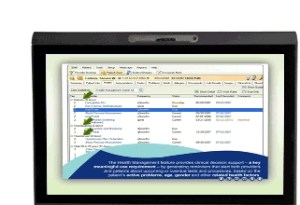
Regardless of the cost, HIPAA security and privacy regulations have changed the hospital environment.  The hospital and its IT and security staff need to be proactive.  There is simply too much at stake and potentially too many issues where mistakes could cause the hospital a serious system problem or result in a large fine.  HIPAA and the responsibility to provide reasonable patient care risk reduction mandate secure healthcare IT operations.  To do less simply allows patient care and healthcare delivery outcomes to be exposed to unacceptable levels of unnecessary risk.

About the Author

Carol S. Miller has an extensive healthcare background in operations, business development and capture in both the public and private sector. Over the last 10 years she has provided management support to projects in the Department of Health and Human Services, Veterans Affairs, and Department of Defense medical programs. In most recent years, Carol has served as Vice President and Senior Account Executive for NCI Information Systems, Inc., Assistant Vice President at SAIC, and Program Manager at MITRE. She has led the successful capture of large IDIQ/GWAC programs, managed the operations of multiple government contracts, interacted with many government key executives, and increased the new account portfolios for each firm she supported.

She earned her MBA from Marymount University; BS in Business from Saint Joseph’s College, and BS in Nursing from the University of Pittsburgh. She is a Certified PMI Project Management Professional (PMP) (PMI PMP) and a Certified HIPAA Professional (CHP), with Top Secret Security clearance issued by the DoD in 2006. Ms. Miller is also a HIMSS Fellow, Past President and current Board member and an ACT/IAC Fellow.

Conclusion

Your thoughts and comments on this ME-P are appreciated. Feel free to review our top-left column, and top-right sidebar materials, links, URLs and related websites, too. Then, subscribe to the ME-P. It is fast, free and secure.

Speaker: If you need a moderator or speaker for an upcoming event, Dr. David E. Marcinko; MBA – Publisher-in-Chief of the Medical Executive-Post – is available for seminar or speaking engagements. Contact: MarcinkoAdvisors@msn.com

OUR OTHER PRINT BOOKS AND RELATED INFORMATION SOURCES:

Product DetailsProduct Details

Paper Medical Records Keep Good Dentists [and Physicians] Honest

Join Our Mailing List

Good Fences Keep Good Neighbors

[By D Kellus Pruitt DDS]

“Changes to an EHR (electronic health record) can go unnoticed and can be harder to trace than changes made to paper records”

Sen. Mark Leno [D-San Francisco, the author of SB 850]

Yesterday, Kendall Taggart posted “Bill would require ‘track changes’ on electronic medical records” on California Watch.com.

http://www.chron.com/disp/story.mpl/deadbymistake/ca/6555170.html

It seems there is a growing problem with providers in California who cannot be held accountable for altering patients’ digital health records to protect themselves rather than their patients. With paper records on the other hand, erasures, ink and even handwriting can be scrutinized should a court of law need reliable evidence. What’s more, Sen. Leno’s feel-good law will not make EDRs any cheaper. Meanwhile, the multifaceted safety of paper dental records is not only proven by a very long track record, but it is irrefutable and free. Hard evidence is the innocent dentist’s friend. Otherwise it’s “he said, she said” and an unpredictable jury that might not like dentists anyway.

Tagggart writes: “A bill working its way through the state Legislature would make it more difficult for health care providers [including dentists] to modify or delete electronic medical records and leave no record of the change … The bill would require providers to automatically record any change or deletion of electronically stored medical information and identify who made the change. Furthermore, the bill would make it possible for patients to see the changes if they requested their medical records.” Do Democrats from California ever consider the price tag of their ideas? Is there any wonder why healthcare costs continue to rise?

Kaiser Responds 

Teresa Stark of Kaiser Permanente responds: “Our system can’t do that, and we’re not aware of any system that can. Given the level of investment required to bring our EHR up to that level, is this really what we want to be spending our money on?”

Regulatory expenses in healthcare are like tsunamis to dentists. Big boats like Kaiser in deep water might hardly notice the swell that will overwhelm our inflatable water wings in the shallows.

And, if it is too expensive for Kaiser – one of the largest healthcare systems in the nation with thousands of staff – imagine how expensive and time-consuming the new law will make electronic dental records? Since California often leads the nation in swell regulatory ideas, will California dentists be the first to flee to paper records should the costs of digital keep rising?

Even before California’s latest regulatory patch is slapped on EDRs, they offer no return on investment. That means paperless practices are more expensive to maintain than paper practices, and ultimately, patients will pay an increased price for paperless dentistry.

Assessment 

Micromanagement of small practices is expensive even if performed using the EDRs dentists themselves purchase. Swell ideas from well-meaning lawmakers are pricing miracle discoveries from safely interconnected EDRs out of reach. Why is HIT incompatible with common sense?

Conclusion

Your thoughts and comments on this ME-P are appreciated. Feel free to review our top-left column, and top-right sidebar materials, links, URLs and related websites, too. Then, subscribe to the ME-P. It is fast, free and secure.

Speaker: If you need a moderator or speaker for an upcoming event, Dr. David E. Marcinko; MBA – Publisher-in-Chief of the Medical Executive-Post – is available for seminar or speaking engagements. Contact: MarcinkoAdvisors@msn.com

OUR OTHER PRINT BOOKS AND RELATED INFORMATION SOURCES:

 Join Our Mailing List

Product Details