Physicians Taking Stock of the “Stock Act”

Join Our Mailing List 

A Side-by-Side Comparison

By Lena Groeger
ProPublica

The Stop Trading on Congressional Knowledge Act, or Stock Act, recently passed in both the House and Senate. The new law would make it easier for the SEC to prosecute federal officials from all three branches who trade equities like stocks based on nonpublic information they receive in the course of their duties.

The versions passed in each chamber are similar, but have notable distinctions that will have to be hashed out when legislators from the two chambers eventually meet.

Assessment

Here, we break down the main differences, with real-life scenarios that illustrate activities the bill targets

Full link: http://www.propublica.org/special/taking-stock-of-the-stock-act-a-side-by-side-comparison

Conclusion

And so, your thoughts and comments on this ME-P are appreciated. Please review our top-left column, and top-right sidebar materials, links, URLs and related websites, too. Then, subscribe to the ME-P. It is fast, free and secure.

Link: http://feeds.feedburner.com/HealthcareFinancialsthePostForcxos

Speaker: If you need a moderator or speaker for an upcoming event, Dr. David E. Marcinko; MBA – Publisher-in-Chief of the Medical Executive-Post – is available for seminar or speaking engagements. Contact: MarcinkoAdvisors@msn.com

Our Other Print Books and Related Information Sources:

Health Dictionary Series: http://www.springerpub.com/Search/marcinko

Practice Management: http://www.springerpub.com/product/9780826105752

Physician Financial Planning: http://www.jbpub.com/catalog/0763745790

Medical Risk Management: http://www.jbpub.com/catalog/9780763733421

Healthcare Organizations: www.HealthcareFinancials.com

Physician Advisors: www.CertifiedMedicalPlanner.com

Subscribe Now: Did you like this Medical Executive-Post, or find it helpful, interesting and informative? Want to get the latest ME-Ps delivered to your email box each morning? Just subscribe using the link below. You can unsubscribe at any time. Security is assured.

Link: http://feeds.feedburner.com/HealthcareFinancialsthePostForcxos

Sponsors Welcomed: And, credible sponsors and like-minded advertisers are always welcomed.

Link: https://healthcarefinancials.wordpress.com/2007/11/11/advertise

Product Details  Product Details

Challenging the NPI Requirement of Blue Cross Blue Shield of Texas Again

Join Our Mailing List

How Far Can They be Pushed?

By D. Kellus Pruitt DDS

Command-and-control organizations like BCBSTX find Facebook difficult to control. Even a small nidus of a complaint posted by a client named Mark about poor service can attract a huge bolus of payback by a dentist, and nobody respects anonymous gatekeepers for huge, unresponsive companies like BCBSTX anyway:

https://www.facebook.com/bluecrossblueshieldoftexas

Mark, as a dentist, I’m very familiar with BCBSTX’s inconsiderate behavior in our communities. At least the anonymous moderator invited your feedback. When I sincerely asked her on Wednesday what federal employees are told about BCBSTX’s NPI requirement, she acted as if the absurd policy hadn’t already wasted enough of my time that day when she provided me an irrelevant link to nowhere – just to get rid of me.

Secret Requirement?

I would actually love to treat federal employees who have BCBSTX insurance because they are some of the nicest people I’ve met. But, BCBSTX’s secret requirement that their clients see only dentists with arbitrary NPI identification numbers (not required by law) makes their employment benefit purchased with taxpayer money worthless if they receive treatment in my office. My office has been told that it has become impossible for paper claims to enter BCBSTX’s modern, computerized system without NPI numbers, and nothing humanly possible can be done to correct the unfortunate problem for dentists who choose not to be HIPAA covered entities.

Evasion?

The moderator’s evasion confirms that even though BCBSTX’s federal customers are led to believe that they can use their dental benefits to help pay for treatment at any licensed dentist’s office, they are not being informed of the NPI requirement, and if they pay the dental bill in full for work done by a dentist without an NPI number, BCBXTX pockets the reimbursement. It just cannot be helped. That’s technology. Tough-luck!

BCBSTX executives naturally prefer that my office manager tell their clients about the obscure restrictions of the dental plans they sell. She catches most federal employees before blocking out time in our schedule to treat them, but nevertheless, one got through on Wednesday morning. It wasted my time as well as the federal employee’s.

Congressional Action?

It’s troublesome to know that the government callously encourages such waste of small business owner’s time and money, not to mention the inconvenience to patients. I’m simply fed up with open appointments for uninformed BCBSTX clients. What’s it take to force BCBSTX to take some responsibility in the community and warn their customers about the limitations of their dental policy before they call my office? Congressional action?

Assessment

I do hope the anonymous BCBSTX employee doesn’t choose to delete this post. Since it seems obvious that their windfall profit is a powerful disincentive for BCBSTX to warn their clients about the NPI restriction any time soon, the more federal employees I can ethically warn through BCBSTX Facebook, the fewer open appointments I’ll have, and less taxpayer money will be wasted on silliness.

cc: Senator John Cornyn

Conclusion

Your thoughts and comments on this ME-P are appreciated. Feel free to review our top-left column, and top-right sidebar materials, links, URLs and related websites, too. Then, subscribe to the ME-P. It is fast, free and secure.

Speaker: If you need a moderator or speaker for an upcoming event, Dr. David E. Marcinko; MBA – Publisher-in-Chief of the Medical Executive-Post – is available for seminar or speaking engagements. Contact: MarcinkoAdvisors@msn.com

OUR OTHER PRINT BOOKS AND RELATED INFORMATION SOURCES:

Product Details

Product Details  Product Details

Product Details

Health Industry Collaboration and e-Patients

More on Inter and Intra Healthcare Stakeholder Relationships 

Join Our Mailing List

According to Jennifer Tomasik MS [jtomasik@cfar.com], writing in the soon to be released ME-P textbook from iMBA Inc www.MedicalBusinessAdvisors.com: “Healthcare Organizations” [Management Strategies, Tools, Techniques and Case Studies], now in-process from (c) Productivity Press for 2012:

We are in a time of great change in healthcare. No one is certain how the future landscape will unfold, but it is clear that changes in regulation, reimbursement, technology, the economy, and science will significantly impact the work of those clinicians and administrators who dedicate their careers to improving patient care.

More Collaboration Needed

Experience has shown that better collaboration between patients and among the many different parts of the healthcare delivery system holds great potential to improve the quality of care and the relationships of those delivering it. It has also shown that the opportunities to improve collaboration are widespread.

Our focus, therefore, should be to introduce and share a selected set of tools that can be used to improve collaboration along several dimensions:

  • Clarifying roles and authority through decision charting,
  • Understanding the “give” and the “get” needed to establish effective alliances through the current state, and
  • Working jointly to establish and test a set of refined expectations through a physician-administrator compact.

Assessment

In the end, improved collaboration can help medical institutions with everything from inter professional productivity, to patient satisfaction to the most critical service of all: caring for patients and saving lives.

Link: http://www.crcpress.com/product/isbn/9781439879900

Conclusion

And so, your thoughts and comments on this ME-P are appreciated. Please review our top-left column, and top-right sidebar materials, links, URLs and related websites, too. Then, subscribe to the ME-P. It is fast, free and secure.

Link: http://feeds.feedburner.com/HealthcareFinancialsthePostForcxos

Speaker: If you need a moderator or speaker for an upcoming event, Dr. David E. Marcinko; MBA – Publisher-in-Chief of the Medical Executive-Post – is available for seminar or speaking engagements. Contact: MarcinkoAdvisors@msn.com

Our Other Print Books and Related Information Sources:

Health Dictionary Series: http://www.springerpub.com/Search/marcinko

Practice Management: http://www.springerpub.com/product/9780826105752

Physician Financial Planning: http://www.jbpub.com/catalog/0763745790

Medical Risk Management: http://www.jbpub.com/catalog/9780763733421

Healthcare Organizations: www.HealthcareFinancials.com

Physician Advisors: www.CertifiedMedicalPlanner.com

Subscribe Now: Did you like this Medical Executive-Post, or find it helpful, interesting and informative? Want to get the latest ME-Ps delivered to your email box each morning? Just subscribe using the link below. You can unsubscribe at any time. Security is assured.

Link: http://feeds.feedburner.com/HealthcareFinancialsthePostForcxos

Sponsors Welcomed: And, credible sponsors and like-minded advertisers are always welcomed.

Link: https://healthcarefinancials.wordpress.com/2007/11/11/advertise

Buy from Amazon

Are “Financial Advisors” True Professionals or Employed Sales Representatives for Retail Products?

Join Our Mailing List 

White House Sides With Sales Reps On Overtime

Dr. David Edward Marcinko MBA CMP™

[ME-P Editor-in-Chief]

www.CertifiedMedicalPlanner.org

As the US Supreme Court is preparing to review the contentious debate about overtime pay for sales reps, the US Solicitor General has filed an amicus curaie, or friend of the court brief, and sided with pharma reps. The move is not surprising, given that the US Department of Labor has, several times, taken a similar step in federal courts around the country where cases were heard.

Far Reaching Implications?

The review is expected to have far-reaching implications for the pharmaceutical industry, and I believe the financial services industry, as well. Why?

Both sectors have been fighting a growing number of cases nationwide over the past several years, but has had mixed results as the issue has continually divided the courts. At the same time, drug makers, Wall Street and broker-dealers have been laying off thousands of sales reps – “financial advisors”, “wealth managers” and stock brokers – as they try to cut costs and alter their business models to prepare for some level of fiduciary accountability.

The Issue

At issue is whether drug reps, and FAs by extension, are exempt from overtime provisions of the Fair Labor Standards Act. The FLSA overtime compensation requirement does not apply to employees who work as outside salespeople, but the law does require employers to pay overtime for hours worked beyond 40 hours a week, unless a FLSA exemption applies.

Link: http://www.pharmalot.com/2012/02/white-house-sides-with-sales-reps-on-overtime/?utm_source=feedburner&utm_medium=feed&utm_campaign=Feed%3A+Pharmalot+%28Pharmalot%29

My Issue

And so, does this mean that most “financial advisors” are really stock-brokers and product pushers after all? At least in medicine, we doctors know what a pharmaceutical rep is – and we understand his/ her roll is to push pharma products, DME and drug sales.

Shouldn’t a salesman – be a salesman – and an “advisor” – be an RIA or RIA rep? I don’t often agree with the White House, but I do on this one.

FAs can’t be independent client advocates – and employees – at the same time

Now, isn’t it time for the public to know that the vast majority of FAs are just salesmen [still SBs], too? Just selling retail financial products to doctors and others; not drugs. After all, FAs can’t be independent client advocates – and employees – at the same time.  And, it appears with this potential filing and ruling; that they truly wish to be the later. Now FAs, admit it!

Assessment

Why do you think FAs are licensed as “registered representatives”? Rarely; a fiduciary among them!

Conclusion

Your thoughts and comments on this ME-P are appreciated. Feel free to review our top-left column, and top-right sidebar materials, links, URLs and related websites, too. Then, subscribe to the ME-P. It is fast, free and secure.

Speaker: If you need a moderator or speaker for an upcoming event, Dr. David E. Marcinko; MBA – Publisher-in-Chief of the Medical Executive-Post – is available for seminar or speaking engagements. Contact: MarcinkoAdvisors@msn.com

OUR OTHER PRINT BOOKS AND RELATED INFORMATION SOURCES:

Product Details  Product Details

Comprehensive Financial Planning Strategies for Doctors and Advisors: Best Practices from Leading Consultants and Certified Medical Planners™

Killer Domestic Violence

Join Our Mailing List

[By staff reporters]

Awareness and Philanthropy Needed

We wish there were a huge philanthropy organization focused on Domestic Violence. Why?

DV is as much a killer as is cancer or diabetes or sepsis. What’s worse: it’s a primary root in violence at large – it breeds dictators, influences foreign policies, and mutilates childhood development. And, we wonder about it’s relatonship, if any, to medical workplace violence and abusive physician behavior as we’ve written about previously on this ME-P?

https://medicalexecutivepost.com/2011/04/06/medical-workplace-violence-prevention-guidelines/

Some would even argue that Domestic Violence is one of the largest Public Relations opportunity of all time. And, if you don’t understand what we mean, we’ve proven our point.

***

psychopath

***

Assessment

So, what is the solution to domestic civilian and medical workplace violence?

If you a victim of  Domestic Violence, click here

Conclusion

Your thoughts and comments on this ME-P are appreciated. Feel free to review our top-left column, and top-right sidebar materials, links, URLs and related websites, too. Then, subscribe to the ME-P. It is fast, free and secure.

Speaker: If you need a moderator or speaker for an upcoming event, Dr. David E. Marcinko; MBA – Publisher-in-Chief of the Medical Executive-Post – is available for seminar or speaking engagements. Contact: MarcinkoAdvisors@msn.com

OUR OTHER PRINT BOOKS AND RELATED INFORMATION SOURCES:


Product Details

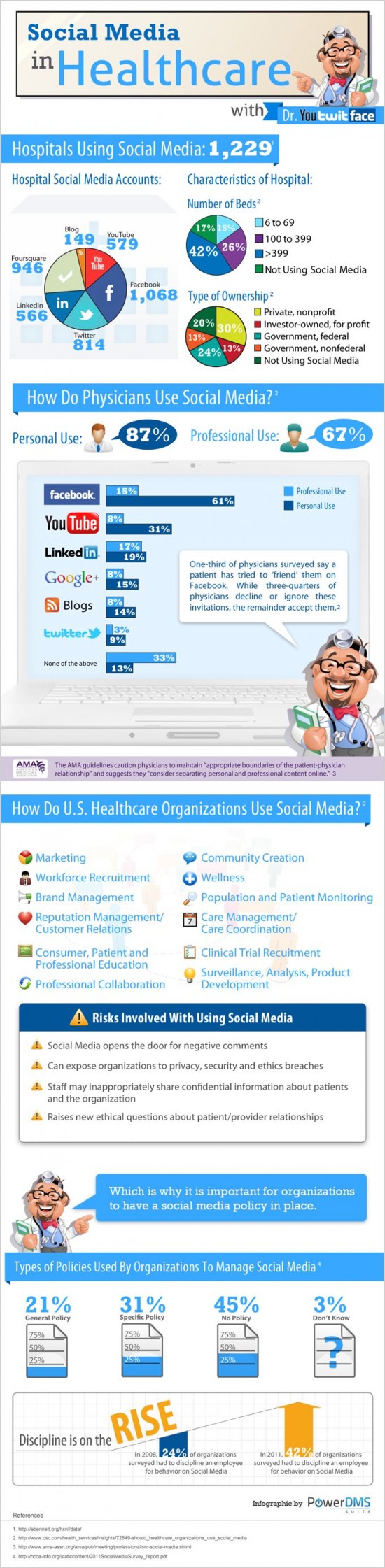
More On Social Media in Healthcare

Join Our Mailing List

Blurring Personal and Professional Lives

Social media is becoming increasingly more prevalent within the healthcare industry.

But, with more hospitals and doctors joining social-media platforms on a consistent basis, it begs the question of “helpful or harmful”?

Assessment

One thing is certain: clear parameters must be established, so professional and personal lines don’t become blurred.

Source: powerdms.com

Conclusion

Your thoughts and comments on this ME-P are appreciated. Feel free to review our top-left column, and top-right sidebar materials, links, URLs and related websites, too. Then, subscribe to the ME-P. It is fast, free and secure.

Speaker: If you need a moderator or speaker for an upcoming event, Dr. David E. Marcinko; MBA – Publisher-in-Chief of the Medical Executive-Post – is available for seminar or speaking engagements. Contact: MarcinkoAdvisors@msn.com

OUR OTHER PRINT BOOKS AND RELATED INFORMATION SOURCES:

   Product Details

Product DetailsProduct Details

Beware Super Bowl XLVI Scams

Join Our Mailing List 

Credit Cards Can Protect ME-P Football Fans

Beware of ticket, travel and counterfeit merchandise scams and use your good judgment and plastic to protect yourself from fraud.

Source: www.CreditDonkey.com

Conclusion

And so, your thoughts and comments on this ME-P are appreciated. Please review our top-left column, and top-right sidebar materials, links, URLs and related websites, too. Then, subscribe to the ME-P. It is fast, free and secure.

Link: http://feeds.feedburner.com/HealthcareFinancialsthePostForcxos

Speaker: If you need a moderator or speaker for an upcoming event, Dr. David E. Marcinko; MBA – Publisher-in-Chief of the Medical Executive-Post – is available for seminar or speaking engagements. Contact: MarcinkoAdvisors@msn.com

Our Other Print Books and Related Information Sources:

Health Dictionary Series: http://www.springerpub.com/Search/marcinko

Practice Management: http://www.springerpub.com/product/9780826105752

Physician Financial Planning: http://www.jbpub.com/catalog/0763745790

Medical Risk Management: http://www.jbpub.com/catalog/9780763733421

Healthcare Organizations: www.HealthcareFinancials.com

Physician Advisors: www.CertifiedMedicalPlanner.com

Subscribe Now: Did you like this Medical Executive-Post, or find it helpful, interesting and informative? Want to get the latest ME-Ps delivered to your email box each morning? Just subscribe using the link below. You can unsubscribe at any time. Security is assured.

Link: http://feeds.feedburner.com/HealthcareFinancialsthePostForcxos

Sponsors Welcomed: And, credible sponsors and like-minded advertisers are always welcomed.

Link: https://healthcarefinancials.wordpress.com/2007/11/11/advertise

Product Details  Product Details

The High Cost of Dying

Join Our Mailing List

An RIP Visual Presentation

You might think that once you expire, your financial worries are over. But alas, even in the afterlife you will still be paying your debts.

Funerals rank among the most expensive purchases many people will ever make, and the burden of payment often falls on family.

Learn how expensive it really is to die.

Source: lifeinsurancequotes.info

Assessment

So, why hasn’t the cost of healthcare come down over the same period?

Conclusion

And so, your thoughts and comments on this ME-P are appreciated. Please review our top-left column, and top-right sidebar materials, links, URLs and related websites, too. Then, subscribe to the ME-P. It is fast, free and secure.

Link: http://feeds.feedburner.com/HealthcareFinancialsthePostForcxos

Speaker: If you need a moderator or speaker for an upcoming event, Dr. David E. Marcinko; MBA – Publisher-in-Chief of the Medical Executive-Post – is available for seminar or speaking engagements. Contact: MarcinkoAdvisors@msn.com

Our Other Print Books and Related Information Sources:

Health Dictionary Series: http://www.springerpub.com/Search/marcinko

Practice Management: http://www.springerpub.com/product/9780826105752

Physician Financial Planning: http://www.jbpub.com/catalog/0763745790

Medical Risk Management: http://www.jbpub.com/catalog/9780763733421

Healthcare Organizations: www.HealthcareFinancials.com

Physician Advisors: www.CertifiedMedicalPlanner.com

Subscribe Now: Did you like this Medical Executive-Post, or find it helpful, interesting and informative? Want to get the latest ME-Ps delivered to your email box each morning? Just subscribe using the link below. You can unsubscribe at any time. Security is assured.

Link: http://feeds.feedburner.com/HealthcareFinancialsthePostForcxos

Sponsors Welcomed: And, credible sponsors and like-minded advertisers are always welcomed.

Link: https://healthcarefinancials.wordpress.com/2007/11/11/advertise

Product Details  Product Details

VOTE-Would You Retain a Bankrupt CFP® for Financial Advice?

Join Our Mailing List

ME-P Readers Respond

Sponsored by: www.CertifiedMedicalPlanner.org

###

According to colleague and financial advisor, Mike Kitces CFP®:

As the difficult economic environment continues, bankruptcy filings in the United States continue to occur at an elevated rate.

And it appears that financial planners are having their share of bankruptcies as well … requiring the CFP Board via their disciplinary process to adjudicate whether a CFP® certificant should receive a public letter of admonition, or has his/her marks suspended or revoked. 

With a rising number of financial planner bankruptcies putting pressure on their disciplinary resources, the CFP Board has proposed a change to how it treats such bankruptcy situations. The upshot: a bankruptcy by a financial planner will no longer bar him/her from getting or keeping the CFP® marks. However, going forward, any bankruptcy by a financial planner will be publicly disclosed for the following 10 years on the CFP Board’s website.

Question: And so, as a doctor, nurse, management consultant or even another financial advisor, would you ever retain a Certified Financial Planner® who had declared bankruptcy?

VOTE AND OPINE

Assessment

Link: http://www.kitces.com/blog/archives/240-CFP-Board-Relaxes-Its-Position-On-Financial-Planner-Bankruptcies…-Sort-Of.html

Conclusion

Your thoughts and comments on this ME-P are appreciated. Feel free to review our top-left column, and top-right sidebar materials, links, URLs and related websites, too. Then, subscribe to the ME-P. It is fast, free and secure.

Link: http://feeds.feedburner.com/HealthcareFinancialsthePostForcxos

Speaker: If you need a moderator or speaker for an upcoming event, Dr. David E. Marcinko; MBA – Publisher-in-Chief of the Medical Executive-Post – is available for seminar or speaking engagements. Contact: MarcinkoAdvisors@msn.com

OUR OTHER PRINT BOOKS AND RELATED INFORMATION SOURCES:

DICTIONARIES: http://www.springerpub.com/Search/marcinko
PHYSICIANS: www.MedicalBusinessAdvisors.com
PRACTICES: www.BusinessofMedicalPractice.com
HOSPITALS: http://www.crcpress.com/product/isbn/9781466558731
CLINICS: http://www.crcpress.com/product/isbn/9781439879900
BLOG: www.MedicalExecutivePost.com
FINANCE: Financial Planning for Physicians and Advisors
INSURANCE: Risk Management and Insurance Strategies for Physicians and Advisors

Product DetailsProduct DetailsProduct Details

Product Details Product Details

Product Details

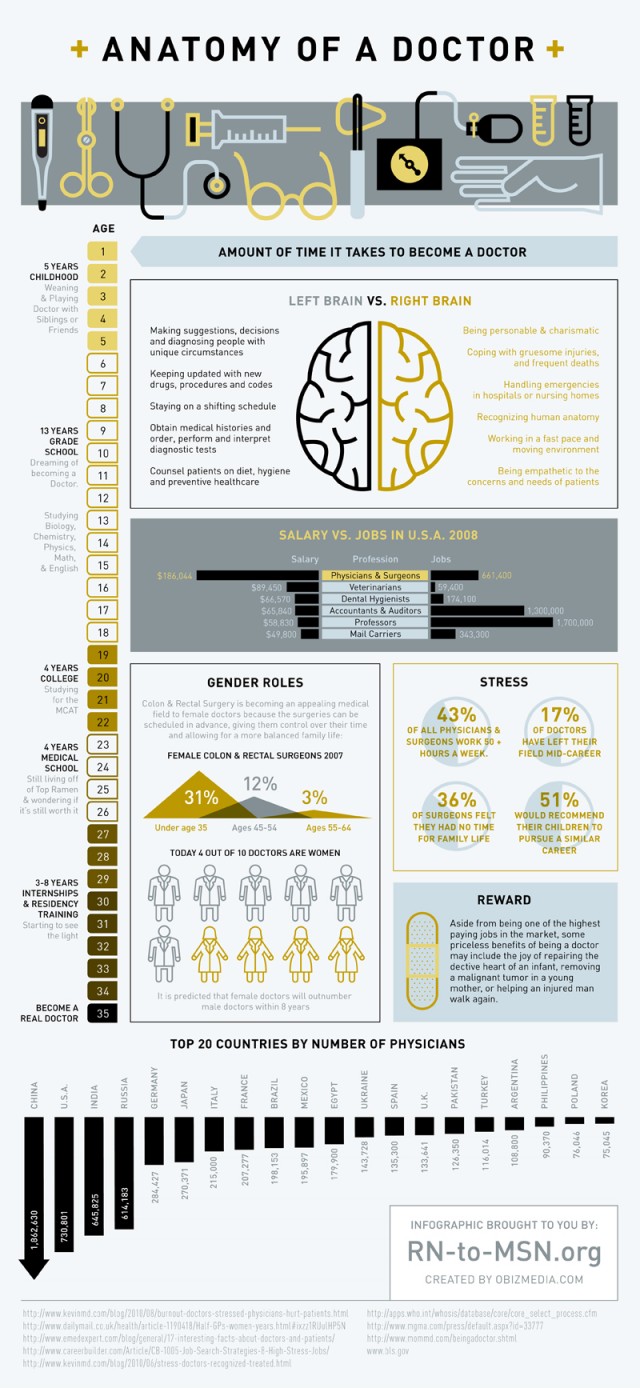
Anatomy of a Doctor

Risks versus Rewards [A Changing Calculus]

Join Our Mailing List

Some laymen enjoy helping others, but don’t seriously consider medical school. Hard work does pay off, but only if you’re good at biology in this case. One problem has always been the crazy amount of names to learn.

The thought of SAT exams, medical school and MCAT tests already raise stress levels. It’s no surprise that a large percent of doctors feel stressed. Today, only half of them recommend their career to others. It seemed like a fun career once all the classes and training was done. And, many doctors seemed to be happy by the way they carried themselves.

Not so today! The higher than average salaries probably helped to boost their attitude before the ACA. But, perhaps not so much, today!

So; not everyone is cut out to be a doctor. Although it sounds really cool and we can dream about it as a child, becoming a doctor is not always practical. It is a high-intensity job but with decreasing stature and pay, likely going forward.

Assessment

But, the joys of helping others and saving lives are always worth it; aren’t they?

Conclusion 

And so, your thoughts and comments on this ME-P are appreciated. Please review our top-left column, and top-right sidebar materials, links, URLs and related websites, too. Then, subscribe to the ME-P. It is fast, free and secure.

Link: http://feeds.feedburner.com/HealthcareFinancialsthePostForcxos

Speaker: If you need a moderator or speaker for an upcoming event, Dr. David E. Marcinko; MBA – Publisher-in-Chief of the Medical Executive-Post – is available for seminar or speaking engagements. Contact: MarcinkoAdvisors@msn.com

Subscribe Now: Did you like this Medical Executive-Post, or find it helpful, interesting and informative? Want to get the latest ME-Ps delivered to your email box each morning? Just subscribe using the link below. You can unsubscribe at any time. Security is assured.

Link: http://feeds.feedburner.com/HealthcareFinancialsthePostForcxos

Sponsors Welcomed: And, credible sponsors and like-minded advertisers are always welcomed.

Link: https://healthcarefinancials.wordpress.com/2007/11/11/advertise

Product DetailsProduct DetailsProduct Details

Product Details

Risk Management, Liability Insurance, and Asset Protection Strategies for Doctors and Advisors: Best Practices from Leading Consultants and Certified Medical Planners™8Comprehensive Financial Planning Strategies for Doctors and Advisors: Best Practices from Leading Consultants and Certified Medical Planners™

***

Invite Dr. Marcinko

***

Death and Grave Stone Symbolism

Common Signs and Symbols

Join Our Mailing List

This infographic takes an in-depth look at the most common signs and symbols used on gravestones around the world.

Assessment

Death is life’s ending. Because everyone who is born eventually dies, it is the center of many traditions and organizations. Customs relating to death are a feature of every culture around the world. And, a part of those customs are symbols, which signify or try to make sense of the phenomena.

Source: LifeInsuranceFinder.au

Conclusion

Your thoughts and comments on this ME-P are appreciated. Feel free to review our top-left column, and top-right sidebar materials, links, URLs and related websites, too. Then, subscribe to the ME-P. It is fast, free and secure.

Link: http://feeds.feedburner.com/HealthcareFinancialsthePostForcxos

Speaker: If you need a moderator or speaker for an upcoming event, Dr. David E. Marcinko; MBA – Publisher-in-Chief of the Medical Executive-Post – is available for seminar or speaking engagements. Contact: MarcinkoAdvisors@msn.com

OUR OTHER PRINT BOOKS AND RELATED INFORMATION SOURCES:

DICTIONARIES: http://www.springerpub.com/Search/marcinko
PHYSICIANS: www.MedicalBusinessAdvisors.com
PRACTICES: www.BusinessofMedicalPractice.com
HOSPITALS: http://www.crcpress.com/product/isbn/9781466558731
CLINICS: http://www.crcpress.com/product/isbn/9781439879900
ADVISORS: www.CertifiedMedicalPlanner.org
BLOG: www.MedicalExecutivePost.com
FINANCE: Financial Planning for Physicians and Advisors
INSURANCE: Risk Management and Insurance Strategies for Physicians and Advisors


Product DetailsProduct DetailsProduct Details

Drug Companies Reduce Payments to Doctors as Scrutiny Mounts

Join Our Mailing List

Dollars for Doctors [How Industry Money Reaches Physicians]

Part of a year-end series on major investigations

By Tracy Weber and Charles Ornstein
ProPublica, January 3rd, 2012, 2:55 p.m.

Some of the nation’s top medical schools cracked down on professors who give paid promotional talks for drugmakers last year, and the firms themselves cut back on such spending in the wake of mounting scrutiny.

Examples

Last year began with the University of Colorado Denver and its affiliated teaching hospitals launching an overhaul of conflict-of-interest policies [1] after ProPublica found that more than a dozen of its faculty members had given paid promotional talks.

“We’re going to just have to say we’re not going to be involved with these speakers bureaus because they’re primarily marketing,” Dr. Richard Krugman, vice chancellor for health affairs, said in an interview in January 2011.

A few months later, Stanford University took disciplinary action against five faculty members [2] identified by ProPublica who had taken money to deliver drug company speeches, a violation of university policy.

And by last fall, there were indications that pharmaceutical companies were also reducing the money [3] they spent on doctor speakers.

Enter ProPublica

ProPublica first published its Dollars for Docs database [4] in October 2010 listing payments to doctors from seven drug companies. When we updated it this September [3] — with data from five additional companies — spending by some of the firms was down.

Cephalon, a relatively small Pennsylvaniacompany that specializes in pain, cancer and central nervous system drugs, paid physicians nearly $9.3 million in 2009 for speaking and consulting. That figure dropped to $5 million in 2010.

AstraZeneca cut its spending on speakers from roughly $22.8 million in the first half of 2010 to about $9.2 million in the second half. Both companies cited business reasons for the decline.

The Year 2011

Throughout 2011, ProPublica also examined the hefty financial support drug and medical-device makers give to medical societies and health advocacy groups and the impact it has on the groups’ positions.

At the national conference of the Heart Rhythm Society [5] in San Francisco, companies sponsored much of what doctors saw — hotel key cards, bus banners, ads on staircases, even motorcyclists driving mini-billboards in a continuous loop around the Moscone convention center. Nearly 50 percent of the society’s funding in 2010 came from the drug and medical device industry. (We even created a neat interactive graphic [6] that allows you to virtually tour the hotel and exhibit hall.)

The society, which represents doctors who treat abnormal heart rhythms, said its funders don’t influence its positions, but it unveiled a new policy requiring more detailed disclosure of board members’ industry ties.

Then, last month, ProPublica reported about the extensive ties between makers of narcotic painkillers and the American Pain Foundation [7], which bills itself as the nation’s largest organization representing patients afflicted by pain. The foundation received nearly 90 percent of its income in 2010 from drug and device makers and takes positions that closely align with the companies.

Despite a steep rise in overdose deaths tied to the drugs, the foundation has said the risk of addiction to the drugs has been over-hyped and that, if anything, they are underused.

Like the heart society, the pain foundation said its’ funders have no influence on its positions.

Assessment

ProPublica also investigated why physicians were not disciplined or prosecuted [8] after they were accused in federal lawsuits of taking kickbacks from drug or device companies or pushing drugs for unapproved uses. We reviewed lawsuits against 15 drug and device companies that were settled since 2006. None of the more than 75 doctors named as participants in alleged schemes were sanctioned by state medical boards or pursued by prosecutors, ProPublica found.

Last year, dozens of news outlets around the country used our data [9] to localize stories about conflicts of interest in medicine — bringing the discussion to communities large and small.

Link: http://www.propublica.org/article/drug-companies-reduce-payments-to-doctors-as-scrutiny-mounts

Conclusion

Your thoughts and comments on this ME-P are appreciated. Feel free to review our top-left column, and top-right sidebar materials, links, URLs and related websites, too. Then, subscribe to the ME-P. It is fast, free and secure.

Link: http://feeds.feedburner.com/HealthcareFinancialsthePostForcxos

Speaker: If you need a moderator or speaker for an upcoming event, Dr. David E. Marcinko; MBA – Publisher-in-Chief of the Medical Executive-Post – is available for seminar or speaking engagements. Contact: MarcinkoAdvisors@msn.com

OUR OTHER PRINT BOOKS AND RELATED INFORMATION SOURCES:

DICTIONARIES: http://www.springerpub.com/Search/marcinko
PHYSICIANS: www.MedicalBusinessAdvisors.com
PRACTICES: www.BusinessofMedicalPractice.com
HOSPITALS: http://www.crcpress.com/product/isbn/9781466558731
CLINICS: http://www.crcpress.com/product/isbn/9781439879900
BLOG: www.MedicalExecutivePost.com
FINANCE: Financial Planning for Physicians and Advisors
INSURANCE: Risk Management and Insurance Strategies for Physicians and Advisors

Product Details

End of Year Tax Giving Tips for Charitable Giving

On IRS published IR-2011-18

By Children’s Home Society of Florida Foundation

Join Our Mailing List

On December 14, 2011, the IRS published IR-2011-18 and suggested a number of tax tips for end-of-year charitable giving. These included several specific recommendations.

1. IRA Rollover – For individuals age 70½ and older who are IRA owners, they may have their IRA custodian make a direct transfer to qualified charities of up to $100,000. These direct transfers may fulfill part or all of the required minimum distribution for this year.

2. Clothing and Household Goods – Deductions for gifts of clothing and household goods are permitted if they are in “good used condition or better.” A gift item that has a value over $500 may be of a different quality, provided that there is an appraisal.

3. Gifts of Money – All gifts of money must be documented through a bank record or receipt. The gift should show the date, amount of the gift and the name of the charitable organization. Bank records may include a cancelled check, a bank statement or a credit card statement. Gifts may also be made through payroll deductions. In this case, the taxpayer should retain a pay stub, Form W-2 or a pledge card that shows the amount, the date of the gift and the name of the charity. If the gift is $250 or more, a contemporaneous written acknowledgement from the charity is required. This receipt must be in the taxpayer’s possession on the date of filing his or her tax return.

4. Timing – A contribution is deductible in the year when it is given. Credit card contributions may be made through December 31st, 2011. Similarly, checks that are sent through U.S. mail by December 31 are deductible if they clear in the normal course.

5. Charities – Deductions are only permitted for gifts to qualified charities. IRS Publication 78 is available on http://www.irs.gov and lists the qualified charitable organizations.

6. Itemized Deductions – Individuals who wish to claim their charitable gifts will need to itemize deductions on Schedule A of Form 1040. Normally, a taxpayer will itemize only if his or her charitable gifts, state and local taxes, mortgage interest and other deductions are larger than the standard deduction.

7. Clothing and Household Item Receipts – The taxpayer should obtain a receipt from the charity. It must list the name of the charity, the date of the gift and a reasonably-detailed description of the gift items.

8. Boat, RV or Car – The gift is usually limited to the gross proceeds from sale if the vehicle is valued at over $500. The charity will send IRS Form 1098-C to the taxpayer and this should be attached to Form 1040.

Conclusion

Your thoughts and comments on this ME-P are appreciated. Feel free to review our top-left column, and top-right sidebar materials, links, URLs and related websites, too. Then, subscribe to the ME-P. It is fast, free and secure.

Link: http://feeds.feedburner.com/HealthcareFinancialsthePostForcxos

Speaker: If you need a moderator or speaker for an upcoming event, Dr. David E. Marcinko; MBA – Publisher-in-Chief of the Medical Executive-Post – is available for seminar or speaking engagements. Contact: MarcinkoAdvisors@msn.com

OUR OTHER PRINT BOOKS AND RELATED INFORMATION SOURCES:

DICTIONARIES: http://www.springerpub.com/Search/marcinko
PHYSICIANS: www.MedicalBusinessAdvisors.com
PRACTICES: www.BusinessofMedicalPractice.com
HOSPITALS: http://www.crcpress.com/product/isbn/9781466558731
CLINICS: http://www.crcpress.com/product/isbn/9781439879900
BLOG: www.MedicalExecutivePost.com
FINANCE: Financial Planning for Physicians and Advisors
INSURANCE: Risk Management and Insurance Strategies for Physicians and Advisors

Product Details  Product Details

The One-Woman Physician Investors Should Not Trust

Join Our Mailing List

Why We Should “Run” from the SEC’s Mary Schapiro

By Dr. David Edward Marcinko MBA CMP™

[Publisher-in-Chief]

OK, I’ve opined about fiduciary accountability for stock brokers, FAs and FPs – as well as Mary Schapiro [Chairman of the SEC] before – on this ME-P. And usually, in not so glowing terms!

But now, Mary really chaps my ethical and linguistic sensibilities.

Why I’m So P…… Off!

According to Bloomberg, and Advisor One [a financial services industry trade magazine], the chairwoman is considering something called the “business model neutral” rule that retains proprietary financial products, and brokerage sales commissions.

This concept of ‘business neutral’ is the one sought by many in the brokerage and insurance industry in order to redefine the term ‘fiduciary’ as an enhanced form of ‘suitability’ with opt-out provisions.

But, it is not sought by me, and should not be accepted by physicians.

Definitions

Suitability Rule – According to the Free Dictionary:

A stated or implied requirement by a regulatory body that a broker or investment adviser must reasonably believe that a certain investment decision will benefit a client before making a recommendation to him/her. That is, the broker or investment adviser must act in good faith, and may not knowingly recommend bad investments. Different regulators and self-regulating organizations incorporate suitable rules in different places in their bylaws. Two commonly referenced suitability rules are Rule 2310 for the Financial Industry Regulatory Authority and Rule 405 for the NYSE. See also: Due diligence, Prudent-person rule, Twisting.

Fiduciary Rule – According to the Free Dictionary:

A uniform standard for financial advisors that requires them to put retail customer interests ahead of their own financial interests.

This is clearly a higher duty [level of care] than suitability. Insurance agents, stock brokers, BDs and most “financial advisors” hate it.

Link: http://www.advisorone.com/2011/12/09/reaction-to-schapiro-comments-on-fiduciary-rule-ar?ref=hp

“Suitability on Steroids”

Some pundits suggest we think of this new “business model neutral” rule as “suitability on steroids.”

However, as most of us in medicine know, steroids are not a panacea and are typically used as a quick fix for short term gain, only.

Otherwise, the excessive use of anabolic steroids is bad for our physical health. Just like Mary Schapiro is bad for our fiscal health. But, a Certified Medical Planner™ is a fiduciary at all times http://www.CertifiedMedicalPlanner.org

More: Enter the CMPs

Assessment       

And so, your thoughts and comments on this ME-P are appreciated. I was an insurance agent and certified financial planner for almost 15 years [Series 7, 63 and 65] before I resigned all – in disgust over the fiduciary flap.

Doctors are fiduciaries. I am a fiduciary, a doctor, and a financial advisor. Shouldn’t all physician-investors demand same from their own financial advisors [NASD-FINRA, RIAs, RIA-Reps]?

But hey – I’m just a medical provider.

Conclusion

Your thoughts and comments on this ME-P are appreciated. Feel free to review our top-left column, and top-right sidebar materials, links, URLs and related websites, too. Then, subscribe to the ME-P. It is fast, free and secure.

Speaker: If you need a moderator or speaker for an upcoming event, Dr. David E. Marcinko; MBA – Publisher-in-Chief of the Medical Executive-Post – is available for seminar or speaking engagements. Contact: MarcinkoAdvisors@msn.com

OUR OTHER PRINT BOOKS AND RELATED INFORMATION SOURCES:

Product DetailsProduct DetailsProduct Details

Financial Planning MDs 2015

Comprehensive Financial Planning Strategies for Doctors and Advisors: Best Practices from Leading Consultants

Front Matter with Foreword by Jason Dyken MD MBA

[BY DOCTORS – FOR DOCTORS – PEER REVIEWED – NICHE FOCUSED]

***

Revisiting Mobile Phone Health Concerns

Mobile Tumor Link Drops-Out

Join Our Mailing List

[By Staff Reporters]

These days nearly everything gives you cancer, except mobile phones, apparently.

Suspicions of a link between brain tumors and mobile phone use have existed for some time. And, if for no other reason, it just seems ill-advised to hold a device that functions with the grace of electromagnetic radiation right next to your brain.

Specious Suspicions?

The reason why these suspicions haven’t graduated into a verifiable link is that mobile phones use non-ionizing radiation, a form of radiation that does not have enough energy to ionize and directly corrupt human DNA to bring about cancer …  in the way that, say planking on the Fukushimapower plant would.

However, at the same time, prolonged exposure to this non-ionizing radiation does pose a risk to the areas of tissue that absorb the energy.

###

###

This infographic neatly explains why the debate is so difficult to win.

Assessment

Skeptics of the link between mobile phones and brain tumors almost have to argue there isn’t any evidence, let alone proof, which is always terribly difficult; while advocates must prove a relationship between two phenomena that develops over a long period of time for only a percentage of a population.

So doctors, what do you think?

Source: anarchius.org

Conclusion     

And so, your thoughts and comments on this ME-P are appreciated. Feel free to review our top-left column, and top-right sidebar materials, links, URLs and related websites, too. Then, subscribe to the ME-P. It is fast, free and secure.

Link: http://feeds.feedburner.com/HealthcareFinancialsthePostForcxos

Our Other Print Books and Related Information Sources:

Health Dictionary Series: http://www.springerpub.com/Search/marcinko

Practice Management: http://www.springerpub.com/product/9780826105752

Physician Financial Planning: http://www.jbpub.com/catalog/0763745790

Medical Risk Management: http://www.jbpub.com/catalog/9780763733421

Subscribe Now: Did you like this Medical Executive-Post, or find it helpful, interesting and informative? Want to get the latest ME-Ps delivered to your email box each morning? Just subscribe using the link below. You can unsubscribe at any time. Security is assured.

Link: http://feeds.feedburner.com/HealthcareFinancialsthePostForcxos

Sponsors Welcomed: And, credible sponsors and like-minded advertisers are always welcomed.

Link: https://healthcarefinancials.wordpress.com/2007/11/11/advertise

Product DetailsProduct DetailsProduct Details

Product Details  Product Details

   Product Details

Doctors on Drugs?

Sponsored Medications Increase MDs Bottom Line

Join Our Mailing List

Increasing in costs each year, prescription pills are one of the most profitable and dominating industries in the nation, with annual sales in the hundreds of billions. Prescribed medications constitute a significant bulk of work that medical coders must transcribe.

Shockingly, the prescription pill industry has questionable practices to increase their bottom line, and in turn, increase coding workload through unnecessary prescriptions.

Though pharmaceutical companies have long-earned a reputation for wooing doctors with gifts, bribes, and incentives, it was only revealed in recent years that they’ve also been paying doctors huge sums of money to promote certain products – and doctors are taking up these offers. These pre-selected medications are not only violating a conflict of interest, they can be largely responsible for increases in patient and insurance costs: a doctor may feel obligated to prescribe an expensive “sponsored” medication over a cheaper alternative.

This in turn, is reflected on the overall rising cost of healthcare, which unfortunately, is exactly what the doctor ordered.

Source: Medical Billing and Coding

Conclusion                

And so, your thoughts and comments on this ME-P are appreciated. Feel free to review our top-left column, and top-right sidebar materials, links, URLs and related websites, too. Then, subscribe to the ME-P. It is fast, free and secure.

Link: http://feeds.feedburner.com/HealthcareFinancialsthePostForcxos

Speaker: If you need a moderator or speaker for an upcoming event, Dr. David E. Marcinko; MBA – Publisher-in-Chief of the Medical Executive-Post – is available for seminar or speaking engagements. Contact: MarcinkoAdvisors@msn.com

Our Other Print Books and Related Information Sources:

Health Dictionary Series: http://www.springerpub.com/Search/marcinko

Practice Management: http://www.springerpub.com/product/9780826105752

Physician Financial Planning: http://www.jbpub.com/catalog/0763745790

Medical Risk Management: http://www.jbpub.com/catalog/9780763733421

Healthcare Organizations: www.HealthcareFinancials.com

Physician Advisors: www.CertifiedMedicalPlanner.com

Subscribe Now: Did you like this Medical Executive-Post, or find it helpful, interesting and informative? Want to get the latest ME-Ps delivered to your email box each morning? Just subscribe using the link below. You can unsubscribe at any time. Security is assured.

Link: http://feeds.feedburner.com/HealthcareFinancialsthePostForcxos

Sponsors Welcomed: And, credible sponsors and like-minded advertisers are always welcomed.

Link: https://healthcarefinancials.wordpress.com/2007/11/11/advertise

Product Details

US Government Glossed Over Cancer Concerns As It Rolled Out Airport X-Ray Scanners

Radiation Safety Concerns

By Michael Grabell
ProPublica, November 1st, 2011, 1:06 pm

On Sept. 23rd, 1998, a panel of radiation safety experts gathered at a Hilton hotel in Maryland to evaluate a new device that could detect hidden weapons and contraband. The machine, known as the Secure 1000, beamed X-rays at people to see underneath their clothing.

One after another, the experts convened by the Food and Drug Administration raised questions about the machine because it violated a longstanding principle in radiation safety — that humans shouldn’t be X-rayed unless there is a medical benefit.

“I think this is really a slippery slope,” said Jill Lipoti, who was the director of New Jersey’s radiation protection program. The device was already deployed in prisons; what was next, she and others asked — courthouses, schools, airports? “I am concerned … with expanding this type of product for the traveling public,” said another panelist, Stanley Savic, the vice president for safety at a large electronics company. “I think that would take this thing to an entirely different level of public health risk.”

The machine’s inventor, Steven W. Smith, assured the panelists that it was highly unlikely that the device would see widespread use in the near future. At the time, only 20 machines were in operation in the entire country.

“The places I think you are not going to see these in the next five years is lower-security facilities, particularly power plants, embassies, courthouses, airports and governments,” Smith said. “I would be extremely surprised in the next five to 10 years if the Secure 1000 is sold to any of these.”

US Marching Millions thru Body Scanners

Today, the United States has begun marching millions of airline passengers through the X-ray body scanners, parting ways with countries in Europe and elsewhere that have concluded that such widespread use of even low-level radiation poses an unacceptable health risk. The government is rolling out the X-ray scanners despite having a safer alternative that the Transportation Security Administration says is also highly effective.

ProPublica Investigates

A ProPublica/PBS NewsHour investigation of how this decision was made shows that in post-9/11America, security issues can trump even long-established medical conventions. The final call to deploy the X-ray machines was made not by the FDA, which regulates drugs and medical devices, but by the TSA, an agency whose primary mission is to prevent terrorist attacks.

Research suggests that anywhere from six to 100 U.S.airline passengers each year could get cancer from the machines. Still, the TSA has repeatedly defined the scanners as “safe,” glossing over the accepted scientific view that even low doses of ionizing radiation — the kind beamed directly at the body by the X-ray scanners — increase the risk of cancer.

“Even though it’s a very small risk, when you expose that number of people, there’s a potential for some of them to get cancer,” said Kathleen Kaufman, the former radiation management director in Los AngelesCounty, who brought the prison X-rays to the FDA panel’s attention.

About 250 X-ray scanners are currently in U.S.airports, along with 264 body scanners that use a different technology, a form of low-energy radio waves known as millimeter waves.

Robin Kane, the TSA’s assistant administrator for security technology, said that no one would get cancer because the amount of radiation the X-ray scanners emit is minute. Having both technologies is important to create competition, he added.

“It’s a really, really small amount relative to the security benefit you’re going to get,” Kane said. “Keeping multiple technologies in play is very worthwhile for the U.S.in getting that cost-effective solution — and being able to increase the capabilities of technology because you keep everyone trying to get the better mousetrap.”

Determined to fill a critical hole in its ability to detect explosives, the TSA plans to have one or the other operating at nearly every security lane in America by 2014. The TSA has designated the scanners for “primary” screening: Officers will direct every passenger, including children, to go through either a metal detector or a body scanner, and the passenger’s only alternative will be to request a physical pat-down.

How did the United States swing from considering such X-rays taboo to deeming them safe enough to scan millions of people a year?

A new wave of terrorist attacks using explosives concealed on the body, coupled with the scanners’ low dose of radiation, certainly convinced many radiation experts that the risk was justified.

But other factors helped the machines gain acceptance.

Gaining Acceptance

Because of a regulatory Catch-22, the airport X-ray scanners have escaped the oversight required for X-ray machines used in doctors’ offices and hospitals. The reason is that the scanners do not have a medical purpose, so the FDA cannot subject them to the rigorous evaluation it applies to medical devices.

Still, the FDA has limited authority to oversee some non-medical products and can set mandatory safety regulations. But the agency let the scanners fall under voluntary standards set by a nonprofit group heavily influenced by industry.

As for the TSA, it skipped a public comment period required before deploying the scanners. Then, in defending them, it relied on a small body of unpublished research to insist the machines were safe, and ignored contrary opinions from U.S. and European authorities that recommended precautions, especially for pregnant women. Finally, the manufacturer, Rapiscan Systems, unleashed an intense and sophisticated lobbying campaign, ultimately winning large contracts.

Both the FDA and TSA say due diligence has been done to assure the scanners’ safety. Rapiscan says it won the contract because its technology is superior at detecting threats. While the TSA says X-ray and millimeter-wave scanners are both effective, Germanydecided earlier this year not to roll out millimeter-wave machines after finding they produced too many false positives.

Most of the news coverage on body scanners has focused on privacy, because the machines can produce images showing breasts and buttocks. But the TSA has since installed software to make the images less graphic. While some accounts have raised the specter of radiation, this is the first report to trace the history of the scanners and document the gaps in regulation that allowed them to avoid rigorous safety evaluation.

Little research on Cancer Risk

Humans are constantly exposed to ionizing radiation, a form of energy that has been shown to strip electrons from atoms, damage DNA and mutate genes, potentially leading to cancer. Most radiation comes from radon, a gas produced from naturally decaying elements in the ground. Another major source is cosmic radiation from outer space. Many common items, such as smoke detectors, contain tiny amounts of radioactive material, as do exit signs in schools and office buildings.

As a result, the cancer risk from any one source of radiation is often small. Outside of nuclear accidents, such as that at Japan’s Fukushima plant, and medical errors, the health risk comes from cumulative exposure.

In Rapiscan’s Secure 1000 scanner, which uses ionizing radiation, a passenger stands between two large blue boxes and is scanned with a pencil X-ray beam that rapidly moves left to right and up and down the body. In the other machine, ProVision, made by defense contractor L-3 Communications, a passenger enters a chamber that looks like a round phone booth and is scanned with millimeter waves, a form of low-energy radio waves, which have not been shown to strip electrons from atoms or cause cancer.

Only a decade ago, many states prohibited X-raying a person for anything other than a medical exam. Even after 9/11, such non-medical X-raying remains taboo in most of the industrialized world. In July, the European Parliament passed a resolution that security “scanners using ionizing radiation should be prohibited” because of health risks. Although the United Kingdom uses the X-ray machine for limited purposes, such as when passengers trigger the metal detector, most developed countries have decided to forgo body scanners altogether or use only the millimeter-wave machines.

While the research on medical X-rays could fill many bookcases, the studies that have been done on the airport X-ray scanners, known as backscatters, fill a file no more than a few inches thick. None of the main studies cited by the TSA has been published in a peer-reviewed journal, the gold standard for scientific research.

Those tests show that the Secure 1000 delivers an extremely low dose of radiation, less than 10 microrems. The dose is roughly one-thousandth of a chest X-ray and equivalent to the cosmic radiation received in a few minutes of flying at typical cruising altitude. The TSA has used those measurements to say the machines are “safe.”

Most of what researchers know about the long-term health effects of low levels of radiation comes from studies of atomic bomb survivors in Hiroshima and Nagasaki. By charting exposure levels and cancer cases, researchers established a linear link that shows the higher the exposure, the greater risk of cancer.

Some scientists argue the danger is exaggerated. They claim low levels stimulate the repair mechanism in cells, meaning that a little radiation might actually be good for the body.

National Academy of Sciences

But, in the authoritative report on low doses of ionizing radiation, published in 2006, the National Academy of Sciences reviewed the research and concluded that the preponderance of research supported the linear link. It found “no compelling evidence” that there is any level of radiation at which the risk of cancer is zero.

Radiation experts say the dose from the backscatter is negligible when compared to naturally occurring background radiation. Speaking to the 1998 FDA panel, Smith, the inventor, compared the increased risk to choosing to visit Denver instead of San Diegoor the decision to wear a sweater versus a sport coat.

Using the linear model, even such trivial amounts increase the number of cancer cases. Rebecca Smith-Bindman, a radiologist at the University of California, San Francisco, estimated that the backscatters would lead to only six cancers over the course of a lifetime among the approximately 100 million people who fly every year. David Brenner, director of Columbia University’s Center for Radiological Research, reached a higher number — potentially 100 additional cancers every year.

“Why would we want to put ourselves in this uncertain situation where potentially we’re going to have some cancer cases?” Brenner asked. “It makes me think, really, why don’t we use millimeter waves when we don’t have so much uncertainty?”

But even without the machines, Smith-Bindman said, the same 100 million people would develop 40 million cancers over the course of their lifetimes. In this sea of cancer cases, it would be impossible to identify the patients whose cancer is linked to the backscatter machines.

How the scanners avoided strict oversight

Although they deliberately expose humans to radiation, the airport X-ray scanners are not medical devices, so they are not subject to the stringent regulations required for diagnostic X-ray machines.

If they were, the manufacturer would have to submit clinical data showing safety and effectiveness and be approved through a rigorous process by the FDA. If the machines contained radioactive material, they would have to report to the Nuclear Regulatory Commission.

But because it didn’t fit into either category, the Secure 1000 was classified as an electronic product. The FDA does not review or approve the safety of such products. However, manufacturers must provide a brief radiation safety report explaining the dose and notify the agency if any overexposure is discovered. According to the FDA, no such incidents have been reported.

Under its limited oversight of electronic products, the FDA could issue mandatory safety regulations. But it didn’t do so, a decision that flows from its history of supervising electronics.

Regulation of electronic products in the United States began after a series of scandals. From the 1930s to the 1950s, it was common for a child to go to a shoe store and stand underneath an X-ray machine known as a fluoroscope to check whether a shoe was the right fit. But after cases arose of a shoe model’s leg being amputated and store clerks developing dermatitis from putting their hands in the beam to adjust the shoe, the practice ended.

In 1967, General Electric recalled 90,000 color televisions that had been sold without the proper shielding, potentially exposing viewers to dangerous levels of radiation. The scandal prompted the creation of the federal Bureau of Radiological Health.

“That ultimately led to a lot more aggressive program,” said John Villforth, who was the director of the bureau. Over the next decade, the bureau created federal safety standards for televisions, medical X-rays, microwaves, tanning beds, even laser light shows.

But in 1982, the FDA merged the radiological health bureau into its medical-device unit.

“I was concerned that if they were to combine the two centers into one, it would probably mean the ending of the radiation program because the demands for medical-device regulation were becoming increasingly great,” said Villforth, who was put in charge of the new Center for Devices and Radiological Health. “As I sort of guessed, the radiation program took a big hit.”

The new unit became stretched for scarce resources as it tried to deal with everything from tongue depressors to industrial lasers. The government used to have 500 people examining the safety of electronic products emitting radiation. It now has about 20 people. In fact, the FDA has not set a mandatory safety standard for an electronic product since 1985.

As a result, there is an FDA safety regulation for X-rays scanning baggage — but none for X-rays scanning people at airports.

Meanwhile, scientists began developing backscatter X-rays, in which the waves are reflected off an object to a detector, for the security industry.

The Secure 1000 people scanner was invented by Smith in 1991 and later sold to Rapiscan, then a small security firm based in southern California. The first major customer was the California prison system, which began scanning visitors to prevent drugs and weapons from getting in. But the state pulled the devices in 2001 after a group of inmates’ wives filed a class-action lawsuit accusing the prisons of violating their civil liberties.

***

***

US Customs Service

The U.S. Customs Service deployed backscatter machines for several years but in limited fashion and with strict supervision. Travelers suspected of carrying contraband had to sign a consent form, and Customs policy prohibited the scanning of pregnant women. The agency abandoned them in 2006, not for safety reasons but because smugglers had learned where the machines were installed and adapted their methods to avoid them, said Rick Whitman, the radiation safety officer for Customs until 2008.

Yet, even this limited application of X-ray scanning for security dismayed radiation safety experts. In 1999, the Conference of Radiation Control Program Directors, a nongovernmental organization, passed a resolution recommending that such screening be stopped immediately.

The backscatter machines had also caught the attention of the 1998 FDA advisory panel, which recommended that the FDA establish government safety regulations for people scanners. Instead, the FDA decided to go with a voluntary standard set by a trade group largely comprising manufacturers and government agencies that wanted to use the machines.

“Establishing a mandatory standard takes an enormous amount of resources and could take a decade to publish,” said Dan Kassiday, a longtime radiation safety engineer at the FDA.

In addition, since the mid-1990s, Congress has directed federal safety agencies to use industry standards wherever possible instead of creating their own.

The FDA delegated the task of establishing the voluntary standards to the American National Standards Institute. A private nonprofit that sets standards for many industries, ANSI convened a committee of the Health Physics Society, a trade group of radiation safety specialists. It was made up of 15 people, including six representatives of manufacturers of X-ray body scanners and five from U.S. Customs and the California prison system. There were few government regulators and no independent scientists.

In contrast, the FDA advisory panel was also made up of 15 people — five representatives from government regulatory agencies, four outside medical experts, one labor representative and five experts from the electronic products industry, but none from the scanner manufacturers themselves.

“I am more comfortable with having a regulatory agency — either federal or the states — develop the standards and enforce them,” Kaufman said. Such regulators, she added, “have only one priority, and that’s public health.”

A representative of the Health Physics Society committee said that was its main priority as well. Most of the committee’s evaluation was completed before 9/11. The standard was published in 2002 and updated with minor changes in 2009.

Ed Bailey, chief of California’s radiological health branch at the time, said he was the lone voice opposing the use of the machines. But after 9/11, his views changed about what was acceptable in pursuit of security.

“The whole climate of their use has changed,” Bailey said. “The consequence of something being smuggled on an airplane is far more serious than somebody getting drugs into a prison.”

Are Inspections Independent?

While the TSA doesn’t regulate the machines, it must seek public input before making major changes to security procedures. In July, a federal appeals court ruled that the agency failed to follow rule-making procedures and solicit public comment before installing body scanners at airports across the country. TSA spokesman Michael McCarthy said the agency couldn’t comment on ongoing litigation.

The TSA asserts there is no need to take additional precautions for sensitive populations, even pregnant women, following the guidance of the congressionally chartered National Council on Radiation Protection & Measurements.

But other authorities have come to the opposite conclusion. A report by France’s radiation safety agency specifically warned against screening pregnant women with the X-ray devices. In addition, the Federal Aviation Administration’s medical institute has advised pregnant pilots and flight attendants that the machine, coupled with their time in the air, could put them over their occupational limit for radiation exposure and that they might want to adjust their work schedules accordingly.

No similar warning has been issued for pregnant frequent fliers.

Even as people scanners became more widespread, government oversight actually weakened in some cases.

Inspections of X-ray equipment in hospitals and industry are the responsibility of state regulators — and before 9/11, many states also had the authority to randomly inspect machines in airports. But that ended when the TSA took over security checkpoints from the airlines.

Instead, annual inspections are done by Rapiscan, the scanners’ manufacturer.

“As a regulator, I think there’s a conflict of interest in having the manufacturer and the facility inspect themselves,” Kaufman said.

Last year, in reaction to public anger from members of Congress, passengers and advocates, the TSA contracted with the Army Public Health Command to do independent radiation surveys. But email messages obtained in a lawsuit brought by the Electronic Privacy Information Center, a civil liberties group, raise questions about the independence of the Army surveys.

One email sent by TSA health and safety director Jill Segraves shows that local TSA officials were given advance notice and allowed to “pick and choose” which systems the Army could check.

That email also suggests that Segraves considered the Army inspectors a valuable public-relations asset: “They are our radiation myth busters,” she wrote to a local security director.

Some TSA screeners are concerned about their own radiation exposure from the backscatters, but the TSA has not allowed them to wear badges that could measure it, said Milly Rodriguez, health and safety specialist for the American Federation of Government Employees, which represents TSA officers.

“We have heard from members that sometimes the technicians tell them that the machines are emitting more radiation than is allowed,” she said.

McCarthy, the TSA spokesman, said the machines are physically incapable of producing radiation above the industry standard. In the email, he said, the inspections allow screeners to ask questions about radiation and address concerns about specific machines.

TSA Video: http://en.wikipedia.org/wiki/File:TSA-_How_It_Works.ogv

The company’s lobbying campaign

While the TSA maintains that the body scanners are essential to preventing attacks on airplanes, it only began rolling them out nine years after 9/11.

After the attempted shoe-bombing in December 2001, the federal government conducted a trial of a Rapiscan backscatter at the Orlando International Airport. But the revealing images drew protests that the machines amounted to a virtual strip search.

The TSA considered the scanners again after two Chechen women blew up Russian airliners in 2004. Facing a continued outcry over privacy, the TSA instead moved forward with a machine known as a “puffer” because it released several bursts of air on the passengers’ clothes and analyzed the dislodged particles for explosives. But after discovering the machines were ineffective in the field and difficult to maintain, the TSA canceled the program in 2006.

Around that time, Rapiscan began to beef up its lobbying on Capitol Hill. It opened a Washington,D.C., office and, according to required disclosures, more than tripled its lobbying expenditures in two years, from less than $130,000 in 2006 to nearly $420,000 in 2008. It hired former legislative aides to Rep. David Price, D-N.C., then chairman of the homeland security appropriations subcommittee, and to Sen. Trent Lott, R-Miss.

It started a political action committee and began contributing heavily to Price; Rep. Bennie Thompson, D-Miss., then head of the homeland security committee; Rep. Jane Harman, D-Calif., also on that committee; and Sen. Thad Cochran, R-Miss., the top Republican on the Senate appropriations committee.

In addition, it opened a new North Carolina plant in Price’s district and expanded its operations in Ocean Springs, Miss., and at its headquarters in Torrance, Calif., in Harman’s district.

“Less than a month after U.S. Senator Trent Lott and other local leaders helped officially open Rapiscan Systems’ new Ocean Springs factory,” Lott’s office announced in a news release in late 2006, “the company has won a $9.1 million Department of Defense contract.”

But Rapiscan still hadn’t landed a major contract to roll out its X-ray body scanners in commercial airports. Indeed, in 2007, with new privacy filters in place, the TSA began a trial of millimeter-wave and backscatter machines at several major airports, after which the agency opted to go with the millimeter-wave machines. The agency said health concerns weren’t a factor.

But with the 2009 federal stimulus package, which provided $300 million for checkpoint security machines, the TSA began deploying backscatters as well. Rapiscan won a $173 million, multiyear contract for the backscatters, with an initial $25 million order for 150 systems to be made inMississippi.

Three other companies — American Science & Engineering, Tek84 Engineering Group and Valley Forge Composite Technologies — make X-ray scanners, but none are used by the TSA. Peter Kant, executive vice president for Rapiscan, said the company expanded its lobbying because its business was increasingly affected by the government.

“There’s a lot of misinformation about the technology; there’s a lot of questions about how various inspection technologies work,” he said. “And we needed a way to be able to provide that information and explain the technology and how it works, and that’s what lobbying is.”

The lawmakers either declined to comment or said the lobbying, campaign contributions and local connections had nothing to do with the TSA’s decision to purchase Rapiscan machines. The TSA said the contract was bid competitively and that the winning machines had to undergo comprehensive research and testing phases before being deployed.

While the scanners were appearing in more and more airports, few passengers went through them, because they were used mostly for random screening or to resolve alarms from the metal detector.

That changed on Christmas Day 2009, when a Nigerian man flying toDetroittried to ignite a pouch of explosives hidden in his underwear.

Following the foiled “Great Balls of Fire” suicide bombing, as the New York Post dubbed it, Homeland Security Secretary Janet Napolitano ramped up plans to roll out body scanners nationwide. Members of Congress and aviation security experts also pushed heavily for the TSA to install more machines that could detect explosives on passengers.

Harman sent a letter to Napolitano, noting that Rapiscan was in her district.

“I urge you to expedite installation of scanning machines in key airports,” Harman wrote in the letter, which was first reported by the website CounterPunch. “If you need additional funds, I am ready to help.”

Michael Chertoff, who had supported body scanners while secretary of Homeland Security, appeared frequently on TV advocating their use. In one interview, he disclosed that his consulting firm, Chertoff Group, had done work for Rapiscan, sparking accusations that he was trying to profit from his time as a government servant.

Despite the criticism, little has been revealed about the relationship. Rapiscan dismissed it, asserting that the consulting work had to do with international cargo and port security issues — not aviation.

“There was nothing that was not above board,” Kant said. “His comments about passenger screening and these machines were simply his own and was nothing that we had engaged the Chertoff Group for.”

In a statement, the Chertoff Group said it “played no role in the sale of whole body imaging technology to TSA” and that Chertoff “was in no way compensated for his public statements.”

A public records request by ProPublica turned up empty: The Department of Homeland Security said it could not find any correspondence to or from Chertoff related to body scanners. DHS also said Chertoff did not use email.

Assessment

The TSA plans to deploy 1,275 backscatter and millimeter-wave scanners covering more than half its security lanes by the end of 2012 and 1,800 covering nearly all the lanes by 2014.

According to annual reports filed with the Securities and Exchange Commission, OSI Systems, the parent company of Rapiscan, has seen revenue from its security division more than double since 2006 to nearly $300 million in fiscal year 2011.

Link: http://www.propublica.org/article/u.s.-government-glossed-over-cancer-concerns-as-it-rolled-out-airport-x-ray.

Miles O’Brien and Kate Tobin of PBS News Hour contributed to this report.

Related Stories:

New Army Study Says Radiation From Airport Body Scanners Is Minor

by Michael Grabell, ProPublica, July 14

TSA Airport Scanners Wouldn’t Catch an Implant Bomber

by Michael Grabell, ProPublica, July 6

Scientists Cast Doubt on TSA Tests of Full-Body Scanners

by Michael Grabell, ProPublica, May 16

Conclusion                

And so, your thoughts and comments on this ME-P are appreciated. Feel free to review our top-left column, and top-right sidebar materials, links, URLs and related websites, too. Then, subscribe to the ME-P. It is fast, free and secure.

Link: http://feeds.feedburner.com/HealthcareFinancialsthePostForcxos

Our Other Print Books and Related Information Sources:

Health Dictionary Series: http://www.springerpub.com/Search/marcinko

Practice Management: http://www.springerpub.com/product/9780826105752

Physician Financial Planning: http://www.jbpub.com/catalog/0763745790

Medical Risk Management: http://www.jbpub.com/catalog/9780763733421

Healthcare Organizations: www.HealthcareFinancials.com

Physician Advisors: www.CertifiedMedicalPlanner.com

Subscribe Now: Did you like this Medical Executive-Post, or find it helpful, interesting and informative? Want to get the latest ME-Ps delivered to your email box each morning? Just subscribe using the link below. You can unsubscribe at any time. Security is assured.

Link: http://feeds.feedburner.com/HealthcareFinancialsthePostForcxos

Sponsors Welcomed: And, credible sponsors and like-minded advertisers are always welcomed.

Link: https://healthcarefinancials.wordpress.com/2007/11/11/advertise

Product DetailsProduct DetailsProduct Details

Product Details  Product Details

   Product Details

Promoting “National Family [Medical] History Day” 2011

AKA Thanksgiving Day

By Staff Reporters

Join Our Mailing List

Did you know that each year since 2004, the Surgeon General has declared Thanksgiving to be National Family History Day?

Over the holiday season or at other times when families gather, the Surgeon General encourages Americans to talk about, and to write down, the health problems that seem to run in their family.  PHRs are a perfect tool in this regard.

Moreover, doctors speak about the FH with patients every day, and as they commence office work on this Black Friday. Of course, learning about a family’s health history may help ensure a longer, healthier future together too!

Assessment

For information from the Office of the Surgeon General, please visit http://www.hhs.gov/familyhistory/

Conclusion                

And so, your thoughts and comments on this ME-P are appreciated. Feel free to review our top-left column, and top-right sidebar materials, links, URLs and related websites, too. Then, subscribe to the ME-P. It is fast, free and secure.

Link: http://feeds.feedburner.com/HealthcareFinancialsthePostForcxos

Speaker: If you need a moderator or speaker for an upcoming event, Dr. David E. Marcinko; MBA – Publisher-in-Chief of the Medical Executive-Post – is available for seminar or speaking engagements. Contact: MarcinkoAdvisors@msn.com

Our Other Print Books and Related Information Sources:

Health Dictionary Series: http://www.springerpub.com/Search/marcinko

Practice Management: http://www.springerpub.com/product/9780826105752

Physician Financial Planning: http://www.jbpub.com/catalog/0763745790

Medical Risk Management: http://www.jbpub.com/catalog/9780763733421

Healthcare Organizations: www.HealthcareFinancials.com

Physician Advisors: www.CertifiedMedicalPlanner.com

Subscribe Now: Did you like this Medical Executive-Post, or find it helpful, interesting and informative? Want to get the latest ME-Ps delivered to your email box each morning? Just subscribe using the link below. You can unsubscribe at any time. Security is assured.

Link: http://feeds.feedburner.com/HealthcareFinancialsthePostForcxos

Sponsors Welcomed: And, credible sponsors and like-minded advertisers are always welcomed.

Link: https://healthcarefinancials.wordpress.com/2007/11/11/advertise

Product Details

On the Leadership Shake-Up at the “Clinician’s Report” Foundation

Paul Child is now the Former CEO of the CR Foundation

[An Exclusive ME-P “Breaking” News Event]

By D. Kellus Pruitt DDS

If you work hard on a righteous pursuit long enough, in spite of what shy people might think of your motives, sometimes you win one for the community.

I wish Dr. Paul Child, former CEO of the Clinician’s Report [CR] Foundation, the best of luck in his new pursuits.

The Exiting CEO [Dr. Paul Child]

In my latest comment on CR Foundation Facebook, I demanded to speak with an anonymous employee’s supervisor because of her unexplained censorship of my three comments – including important questions about EDRs and HIPAA. A few hours ago, that comment was also censored without warning or explanation.

However, in its place I found an announcement that Dr. Child is no longer CEO, and that co-founder Dr. Gordon Christensen himself is taking over the position.

https://www.facebook.com/pages/CR-Foundation/160588080492

The CR Foundation Announcement

“Dr. Paul L. Child Jr., the CEO of Clinicians Report for the last 3-1/2 years, will be leaving CR at the end of 2011 to pursue other interests as he continues his contributions to the dental profession. We wish Paul the best in his new endeavors and are pleased that he will continue to serve CR Foundation as a member of the CR Board of Directors.”

The New CEO [Dr. Gordon J. Christensen]

“Dr. Gordon J. Christensen, the Co-Founder of CR, has been appointed to the position of CEO. He will lead the experienced team of over 400 clinicians in 19 countries and 40 son-site scientists, engineers, and support staff. Additionally, Gordon continues to practice, speak internationally, and provide leadership for needed research in CR.”

Link: http://www.cliniciansreport.org/

That looks to me like a heartfelt apology. I accept.

If any dental leader can be honest with dentists about important, time-sensitive issues nobody else will address it’s Dr. Christensen. He’s a good man with high ideals that don’t include hiding the truth about dental products from dentists in order to shield stakeholders from accountability. 

Assessment 

Now that you’ve witnessed in real time how even one dentist’s voice can improve our community on a national level, why in the hell aren’t you speaking up, Doc?

If your assertiveness is inhibited by traditional notions of “professional conduct,” let me remind you that in Alaska, high school grads are legally extracting large portions of teeth for US citizens who can-least afford complications.

Good luck with silence in a networked marketplace.

Conclusion                

And so, your thoughts and comments on this ME-P are appreciated. Is this new development related to the ME-P titled: In Defense of the eDR Industry?

Link:  https://medicalexecutivepost.com/2011/11/03/in-defense-of-the-edr-industry/

Feel free to review our top-left column, and top-right sidebar materials, links, URLs and related websites, too. Then, subscribe to the ME-P. It is fast, free and secure.

Link: http://feeds.feedburner.com/HealthcareFinancialsthePostForcxos

Our Other Print Books and Related Information Sources:

Health Dictionary Series: http://www.springerpub.com/Search/marcinko

Practice Management: http://www.springerpub.com/product/9780826105752

Physician Financial Planning: http://www.jbpub.com/catalog/0763745790

Medical Risk Management: http://www.jbpub.com/catalog/9780763733421

Healthcare Organizations: www.HealthcareFinancials.com

Physician Advisors: www.CertifiedMedicalPlanner.com

Subscribe Now: Did you like this Medical Executive-Post, or find it helpful, interesting and informative? Want to get the latest ME-Ps delivered to your email box each morning? Just subscribe using the link below. You can unsubscribe at any time. Security is assured.

Link: http://feeds.feedburner.com/HealthcareFinancialsthePostForcxos

Sponsors Welcomed: And, credible sponsors and like-minded advertisers are always welcomed.

Link: https://healthcarefinancials.wordpress.com/2007/11/11/advertise

Product DetailsProduct DetailsProduct Details       

Product Details  Product Details

   Product Details

The Critical Role of Patient Trust in Their Doctors

On Perceptions of the Physician’s Ability to Communicate

Join Our Mailing List 

Often the simplest solutions to problems are the best; remember KISS. So it would seem that when it comes to the impact of increasing patient trust in physicians – on many of the intractable challenges that face the health care industry everyday like nonadherence, lack of involvement, poor health status, dissatisfaction etc – the concept of trust is great, indeed!

Assessment

We explore the link between patient trust and outcomes in the infographic above, which Stephen Wilkins curated and designed. What surprised us however, is how a patient’s level of trust in their doctor, boils downs to the patient’s perception of the physician’s ability to communicate.

Source:  Stephen Wilkins, MPH http://healthecommunications.wordpress.com/about/

Conclusion

And so, your thoughts and comments on this ME-P are appreciated. Feel free to review our top-left column, and top-right sidebar materials, links, URLs and related websites, too. Then, subscribe to the ME-P. It is fast, free and secure.

Link: http://feeds.feedburner.com/HealthcareFinancialsthePostForcxos

Speaker: If you need a moderator or speaker for an upcoming event, Dr. David E. Marcinko; MBA – Publisher-in-Chief of the Medical Executive-Post – is available for seminar or speaking engagements. Contact: MarcinkoAdvisors@msn.com

Our Other Print Books and Related Information Sources:

Health Dictionary Series: http://www.springerpub.com/Search/marcinko

Practice Management: http://www.springerpub.com/product/9780826105752

Physician Financial Planning: http://www.jbpub.com/catalog/0763745790

Medical Risk Management: http://www.jbpub.com/catalog/9780763733421

Healthcare Organizations: www.HealthcareFinancials.com

Physician Advisors: www.CertifiedMedicalPlanner.com

Subscribe Now: Did you like this Medical Executive-Post, or find it helpful, interesting and informative? Want to get the latest ME-Ps delivered to your email box each morning? Just subscribe using the link below. You can unsubscribe at any time. Security is assured.

Link: http://feeds.feedburner.com/HealthcareFinancialsthePostForcxos

Sponsors Welcomed: And, credible sponsors and like-minded advertisers are always welcomed.

Link: https://healthcarefinancials.wordpress.com/2007/11/11/advertise

Product DetailsProduct DetailsProduct Details       

Product Details  Product Details

   Product Details

The AMA says “Power to the Patient” … Finally!

The American Medical Association Recognizes Shared Decision Making

By Staff Reporters

Join Our Mailing List 

Some readers of the ME-P may be surprised to learn that the American Medical Association [AMA] now “recognizes” shared decision making.  A document recommending precisely that is available for your reading pleasure here.

Assessment

The AMA also recognizes that shared decision making can make the physician-patient relationship stronger, opposes any effort to link it to insurance coverage and supports more pilot programs.

Of course, with AMA influence waning at less than 18% of allopathic members, and health 2.0 strategic initiatives rising along with a plethora of other related medical professionals, was there even a choice? 

As one doctor we interviewed said:Congratulations AMA for recognizing the obvious and abandoning your command-control philosophy … and welcome to Y 2012.” 

Conclusion

And so, your thoughts and comments on this ME-P are appreciated. Feel free to review our top-left column, and top-right sidebar materials, links, URLs and related websites, too. Then, subscribe to the ME-P. It is fast, free and secure.

Link: http://feeds.feedburner.com/HealthcareFinancialsthePostForcxos

Speaker: If you need a moderator or speaker for an upcoming event, Dr. David E. Marcinko; MBA – Publisher-in-Chief of the Medical Executive-Post – is available for seminar or speaking engagements. Contact: MarcinkoAdvisors@msn.com

Our Other Print Books and Related Information Sources:

Health Dictionary Series: http://www.springerpub.com/Search/marcinko

Practice Management: http://www.springerpub.com/product/9780826105752

Physician Financial Planning: http://www.jbpub.com/catalog/0763745790

Medical Risk Management: http://www.jbpub.com/catalog/9780763733421

Healthcare Organizations: www.HealthcareFinancials.com

Physician Advisors: www.CertifiedMedicalPlanner.com

Subscribe Now: Did you like this Medical Executive-Post, or find it helpful, interesting and informative? Want to get the latest ME-Ps delivered to your email box each morning? Just subscribe using the link below. You can unsubscribe at any time. Security is assured.

Link: http://feeds.feedburner.com/HealthcareFinancialsthePostForcxos

Sponsors Welcomed: And, credible sponsors and like-minded advertisers are always welcomed.

Link: https://healthcarefinancials.wordpress.com/2007/11/11/advertise

Product Details

My “One” Criterion for Hiring Physician Consultants and Doctor Advisors

More about the Frightening “F” Word

Dr. David Edward Marcinko MBA CMP™

[Publisher-in-Chief]

As you begin to search for a medical practice business advisor or healthcare consultant, be sure to contact the advisor and request a short initial meeting that should be free of charge.

Just as you would select your own physician, you should base your consulting decision on credentials, experience and especially education. Fee schedules are probably of least importance. And, by understanding the “F” word, you stand the best chance of finding an advisor that’s right for your budget, practice and personality.

The Traditional View

The traditional view of medical management consulting, or the financial advisory or financial planning business, is not of a fiduciary. Historically, in the view of many, attorneys, doctors, CPAs and the clergy are proto-typical fiduciaries, as are the small but emerging class of contemporary Certified Medical Planners [CMP™]. They have a clear duty to put the best interests of their clients, patients, congregation, etc., above their own and to disclose conflicts of interest, etc. Too many others who retain this title function as poseurs.

Link: www.CertifiedMedicalPlanner.com

The stock market collapse, SEC debacle, home mortgage and real estate fiascos of the past few years, all highlight the lack of general accounting, financial, business and advisory oversight of Wall Street, the NASD/FINRA and related private and government monitoring agencies. This includes financial and investment advisors, wealth managers and healthcare consultants.

Fiduciary Definition

According to Bennett Aikin, Accredited Investment Fiduciary [AIF®], a fiduciary consultant is someone who offers advice, or manages the assets of another person and stands in a special relationship of trust, confidence, and/or legal responsibility [personal communication].

Link: https://medicalexecutivepost.com/2009/03/01/an-interview-with-bennett-aikin-aif%c2%ae/

Financial designations that indicate fiduciary duty do not exist absent the proto-types mentioned above. Rather, it is function that determines who is a fiduciary; not designations, certifications or licenses to hold a particular trade-mark, service-mark or registration-mark.

So, a fiduciary advisory, according to these definitions can be held accountable for a breach in fiduciary duty, regardless of any expertise they do, or do not have. This underscores the critical nature of understanding the fiduciary standard and delegating certain duties to qualified “professionals” who can fulfill the parts of the process that a non-qualified fiduciary cannot.

Fiduciary? – Get it in Writing!

But, this does not mean it is impossible to find a healthcare consultant who accepts fiduciary responsibility and acknowledges the same. The best way to rectify confusion is to get fiduciary status acknowledged in writing and review all of the necessary steps in the fiduciary process to ensure fulfillment. An acknowledgement of fiduciary status letter can even be a simple checklist to ensure the entire fiduciary process is being covered.

Link: www.CertifiedMedicalPlanner.com

About http://www.fi360.com

Public resources for understanding the fiduciary process and for choosing appropriate consultants include the Department of Labor, the AICPA’s Personal Financial Planning division, and iMBA Inc. Private resources are available from the law firm of Reish Luftman Reicher & Cohen. The firm specializes in employee-benefits law and is considered leading ERISA experts. More resources from www.fi360.com include:

  • Fiduciary Standard of Excellence
  • Safe Steward Document
  • Stewardship Handbook
  • Legal Memorandum Handbook

Conclusion

And so, your thoughts and comments on this ME-P are appreciated. Feel free to review our top-left column, and top-right sidebar materials, links, URLs and related websites, too. Then, subscribe to the ME-P. It is fast, free and secure.

Link: http://feeds.feedburner.com/HealthcareFinancialsthePostForcxos

Speaker: If you need a moderator or speaker for an upcoming event, Dr. David E. Marcinko; MBA – Publisher-in-Chief of the Medical Executive-Post – is available for seminar or speaking engagements. Contact: MarcinkoAdvisors@msn.com

Our Other Print Books and Related Information Sources:

Health Dictionary Series: http://www.springerpub.com/Search/marcinko

Practice Management: http://www.springerpub.com/product/9780826105752

Physician Financial Planning: http://www.jbpub.com/catalog/0763745790

Medical Risk Management: http://www.jbpub.com/catalog/9780763733421

Healthcare Organizations: www.HealthcareFinancials.com

Physician Advisors: www.CertifiedMedicalPlanner.com

Subscribe Now: Did you like this Medical Executive-Post, or find it helpful, interesting and informative? Want to get the latest ME-Ps delivered to your email box each morning? Just subscribe using the link below. You can unsubscribe at any time. Security is assured.

Link: http://feeds.feedburner.com/HealthcareFinancialsthePostForcxos

Sponsors Welcomed: And, credible sponsors and like-minded advertisers are always welcomed.

Link: https://healthcarefinancials.wordpress.com/2007/11/11/advertise

 

Product DetailsProduct DetailsProduct Details       

Product Details  Product Details

   Product Details

Can You Get Cancer From Oral Sex?

Yes Virginia and Virgil – You Can!

Join Our Mailing List 

Yes, and the US is seeing a sharp increase in the number of cases of oral and throat cancer especially among young men, caused by HPV infections contracted during oral sex.

Source: The Mount Sinai Medical Centre

Conclusion

And so, your thoughts and comments on this ME-P are appreciated. Feel free to review our top-left column, and top-right sidebar materials, links, URLs and related websites, too. Then, subscribe to the ME-P. It is fast, free and secure.

Link: http://feeds.feedburner.com/HealthcareFinancialsthePostForcxos

Speaker: If you need a moderator or speaker for an upcoming event, Dr. David E. Marcinko; MBA – Publisher-in-Chief of the Medical Executive-Post – is available for seminar or speaking engagements. Contact: MarcinkoAdvisors@msn.com

Our Other Print Books and Related Information Sources:

Health Dictionary Series: http://www.springerpub.com/Search/marcinko

Practice Management: http://www.springerpub.com/product/9780826105752

Physician Financial Planning: http://www.jbpub.com/catalog/0763745790

Medical Risk Management: http://www.jbpub.com/catalog/9780763733421

Healthcare Organizations: www.HealthcareFinancials.com

Physician Advisors: www.CertifiedMedicalPlanner.com

Subscribe Now: Did you like this Medical Executive-Post, or find it helpful, interesting and informative? Want to get the latest ME-Ps delivered to your email box each morning? Just subscribe using the link below. You can unsubscribe at any time. Security is assured.

Link: http://feeds.feedburner.com/HealthcareFinancialsthePostForcxos

Sponsors Welcomed: And, credible sponsors and like-minded advertisers are always welcomed.

Link: https://healthcarefinancials.wordpress.com/2007/11/11/advertise

Product DetailsProduct DetailsProduct Details       

Product Details  Product Details

   Product Details

Of Interest to MD and FA Philanthropists

About The New Center on Philanthropy

By Staff Reporters

Join Our Mailing List 

Major philanthropists and those successful doctors [and their patients], and affluent financial advisors [and their clients], about to join their ranks increasingly want information about which organizations with causes matching their interests are receiving large gifts, where their peers are giving and where gaps in funding may exist.

Now, they have a new tool that can help them decide where, when and why to make gifts of $1 million or more.

Last week, Indiana University’s Center on Philanthropy rolled out a searchable database of more than 60,000 large, publicly reported gifts it has compiled since 2000. The Million Dollar List covers gifts from individuals, foundations and corporations.

What it is – How it works

The Center on Philanthropy at the Indiana University is a leading academic center dedicated to increasing the understanding of philanthropy and improving its practice through research, teaching, public service and public affairs. Founded in 1987, the Center is a part of the Indiana University School of Liberal Arts at Indiana University-Purdue University Indianapolis.

The Center was founded as the result of the convergence of two ideas.

First, some people recognized the need to professionalize fundraising and to create a permanent, university-based home for The Fund Raising School. Second, others were interested in building knowledge about the philanthropy field through an inter-disciplinary approach grounded in the liberal arts. These ideas, and the goal of bringing scholars and practitioners together to learn from each other, are the founding principles that remain the bedrock of their mission.

Today, the Center says it boasts a thriving research program that informs the work of nonprofit professionals throughout the world. Academic programs related to philanthropy and nonprofit management are attracting from a diverse group of highly talented students. And, The Fund Raising School continues to be the premier international university-based education and training program for fundraisers.

Assessment

So, give em’ a click, and tell us what you think?

http://www.philanthropy.iupui.edu/About/center_overview.aspx

Conclusion

And so, your thoughts and comments on this ME-P are appreciated. Feel free to review our top-left column, and top-right sidebar materials, links, URLs and related websites, too. Then, subscribe to the ME-P. It is fast, free and secure.

Link: http://feeds.feedburner.com/HealthcareFinancialsthePostForcxos

Speaker: If you need a moderator or speaker for an upcoming event, Dr. David E. Marcinko; MBA – Publisher-in-Chief of the Medical Executive-Post – is available for seminar or speaking engagements. Contact: MarcinkoAdvisors@msn.com

Our Other Print Books and Related Information Sources:

Health Dictionary Series: http://www.springerpub.com/Search/marcinko

Practice Management: http://www.springerpub.com/product/9780826105752

Physician Financial Planning: http://www.jbpub.com/catalog/0763745790

Medical Risk Management: http://www.jbpub.com/catalog/9780763733421

Healthcare Organizations: www.HealthcareFinancials.com

Physician Advisors: www.CertifiedMedicalPlanner.com

Subscribe Now: Did you like this Medical Executive-Post, or find it helpful, interesting and informative? Want to get the latest ME-Ps delivered to your email box each morning? Just subscribe using the link below. You can unsubscribe at any time. Security is assured.

Link: http://feeds.feedburner.com/HealthcareFinancialsthePostForcxos

Sponsors Welcomed: And, credible sponsors and like-minded advertisers are always welcomed.

Link: https://healthcarefinancials.wordpress.com/2007/11/11/advertise

Product DetailsProduct DetailsProduct Details       

Product Details  Product Details

   Product Details

Major Accounting Scandals of Interest to MDs and FAs

Join Our Mailing List 

Including Health South, AIG and Others

According to Wikipedia, the company HealthSouth was involved in a corporate accounting scandal in which its Chief Executive Officer, Richard M. Scrushy, was accused of directing company employees to falsely report grossly exaggerated company earnings in order to meet stockholder expectations.

The AIG bonus payments controversy began in March 2009, when it was publicly disclosed that the American International Group (AIG) was to pay approximately $218 million in bonus payments to employees of its financial services division.


Source:

Conclusion

And so, your thoughts and comments on this ME-P are appreciated. Feel free to review our top-left column, and top-right sidebar materials, links, URLs and related websites, too. Then, subscribe to the ME-P. It is fast, free and secure.

Link: http://feeds.feedburner.com/HealthcareFinancialsthePostForcxos

Speaker: If you need a moderator or speaker for an upcoming event, Dr. David E. Marcinko; MBA – Publisher-in-Chief of the Medical Executive-Post – is available for seminar or speaking engagements. Contact: MarcinkoAdvisors@msn.com

Our Other Print Books and Related Information Sources:

Health Dictionary Series: http://www.springerpub.com/Search/marcinko

Practice Management: http://www.springerpub.com/product/9780826105752

Physician Financial Planning: http://www.jbpub.com/catalog/0763745790

Medical Risk Management: http://www.jbpub.com/catalog/9780763733421

Healthcare Organizations: www.HealthcareFinancials.com

Physician Advisors: www.CertifiedMedicalPlanner.com

Subscribe Now: Did you like this Medical Executive-Post, or find it helpful, interesting and informative? Want to get the latest ME-Ps delivered to your email box each morning? Just subscribe using the link below. You can unsubscribe at any time. Security is assured.

Link: http://feeds.feedburner.com/HealthcareFinancialsthePostForcxos

Sponsors Welcomed: And, credible sponsors and like-minded advertisers are always welcomed.

Link: https://healthcarefinancials.wordpress.com/2007/11/11/advertise

Product Details

STD Risk Factors to Consider in Public Health

For Men and Women

Join Our Mailing List 

There are many factors that affect those at risk for contracting an STD. Many times individuals don’t know or understand which things put them at risk of infection. Some STD’s can be transmitted in surprising ways. For those at risk, regular comprehensive testing can help prevent unintended transmissions. Furthermore, early diagnosis of some STD’s can greatly improve treatment options and avoid hassles associated with full blown infection.

Sensitive Topic

This public service announcement may be a sensitive subject for some ME-P readers. So, the graphic below attempts to use a bit of humor to highlight important things to remember for those who are sexually active.

If you’re concerned about STD’s or want to know more, see please your physician or visit the STD Testing page for additional information.

Assessment

Brought to you by www.HealthTestingCenters.com

Conclusion

Your thoughts and comments on this ME-P are appreciated. Feel free to review our top-left column, and top-right sidebar materials, links, URLs and related websites, too. Then, subscribe to the ME-P. It is fast, free and secure.

Link: http://feeds.feedburner.com/HealthcareFinancialsthePostForcxos

Speaker: If you need a moderator or speaker for an upcoming event, Dr. David E. Marcinko; MBA – Publisher-in-Chief of the Medical Executive-Post – is available for seminar or speaking engagements. Contact: MarcinkoAdvisors@msn.com

OUR OTHER PRINT BOOKS AND RELATED INFORMATION SOURCES:

DICTIONARIES: http://www.springerpub.com/Search/marcinko
PHYSICIANS: www.MedicalBusinessAdvisors.com
PRACTICES: www.BusinessofMedicalPractice.com
HOSPITALS: http://www.crcpress.com/product/isbn/9781466558731
CLINICS: http://www.crcpress.com/product/isbn/9781439879900
BLOG: www.MedicalExecutivePost.com
FINANCE: Financial Planning for Physicians and Advisors
INSURANCE: Risk Management and Insurance Strategies for Physicians and Advisors

Product DetailsProduct DetailsProduct Details

Product Details  Product Details

   Product Details 

Health-Care Reform Rules Would Restrict Public Reporting

 Information Restricted to “qualified entities” Only

By Marshall Allen

ProPublica, Sept 15th, 2011, 10:46 am

Join Our Mailing List

It’s estimated that hundreds of thousands of patients die annually from preventable harm suffered while undergoing medical care. The infections, injuries and errors could rank as a leading cause of death in the United States.

The PP-ACA of 2010

Last year’s sweeping health-care reform law — the Patient Protection and Affordable Care Act — promised to improve the problem by allowing outside groups to use Medicare billing records to analyze and publicly report on the quality of care. But proposed rules that would guide the release of the data are being criticized by consumer groups that say the rules would make independent accountability impossible.

CMS  

Agencies typically adopt rules to administer laws like the health-care act. The rules being developed [1] by the Centers for Medicare & Medicaid Services (CMS) propose restricting the release of Medicare billing data to “qualified entities.” To qualify, a group would have to:

  • Pay up to $200,000 for the data.
  • Have its methods pre-approved before obtaining the data.
  • Already possess billing information from other sources to combine with the Medicare data — an advantage to insurance companies.
  • Limit public reporting to quality measures approved by the health-care industry.
  • Present its reports and findings to every doctor and facility being measured before they are released to the public — a requirement that would make large-scale reports difficult.

Medicare officials declined to discuss the proposed rules because they are being finalized after a public comment period ended Aug. 8th. But interviews and a review of comments show that the rules have sharply divided consumer-oriented groups and health-care providers.

Safe Patient Project

Lisa McGiffert, director of the Safe Patient Project run by Consumers Union, the nonprofit publisher of Consumer Reports magazine, said the new law was seen as “a real opportunity” because, for the first time, Medicare data could be used to tell the public about the performance of doctors. But the proposed rules would make it impossible for Consumers Union to use the data, she said.

“The best-kept secret inAmericais what doctors are doing,” McGiffert said. “People should be able to find out information about outcomes of care, whether their docs are using appropriate practices and whether they’re providing too much of something that people don’t need.”

Bruce Boissonnault, president and CEO of the Niagara Health Quality Coalition, a nonprofit that’s been independently measuring the quality of health care since 1995, said the rules are needlessly complex and designed to suppress freedom of information. He said the rules would make it impossible for all but industry insiders to access the new data, giving them control over what’s released.

“We will only see the scraps of information that the industry wants us to discuss,” Boissonnault said. “It’s advertising wrapped in a lab coat.”

Boissonnault [2] and Consumers Union [3] submitted public comments, urging Medicare to reconsider the restrictions.

Enter the AMA

The American Medical Association submitted comments [4] mostly supporting the access limitations and in some cases urging more restrictive rules. For instance, the proposed rules say doctors would need 30 days to review any analysis before it’s publicly reported, but the AMA wants that review period increased to 90 days. The AMA also wants Medicare to consider complaints by physicians against an organization before allowing the organization access to the data.

Assessment

The Federation of American Hospitals, which represents investor-owned health-care facilities, said in its comment [5] that it is “very troubled” by the proposed rules, despite the increased restrictions, because billing data have a limited ability to measure quality. The federation wants a limit on the number of qualified entities that have access to the data.

Link: http://www.propublica.org/article/health-care-reform-rules-would-restrict-public-reporting

Conclusion

Your thoughts and comments on this ME-P are appreciated. Feel free to review our top-left column, and top-right sidebar materials, links, URLs and related websites, too. Then, subscribe to the ME-P. It is fast, free and secure.

Link: http://feeds.feedburner.com/HealthcareFinancialsthePostForcxos

Speaker: If you need a moderator or speaker for an upcoming event, Dr. David E. Marcinko; MBA – Publisher-in-Chief of the Medical Executive-Post – is available for seminar or speaking engagements. Contact: MarcinkoAdvisors@msn.com

Our Other Print Books and Related Information Sources:

Health Dictionary Series: http://www.springerpub.com/Search/marcinko

Practice Management: http://www.springerpub.com/product/9780826105752

Physician Financial Planning: http://www.jbpub.com/catalog/0763745790

Medical Risk Management: http://www.jbpub.com/catalog/9780763733421

Healthcare Organizations: www.HealthcareFinancials.com

Physician Advisors: www.CertifiedMedicalPlanner.com

Subscribe Now: Did you like this Medical Executive-Post, or find it helpful, interesting and informative? Want to get the latest ME-Ps delivered to your email box each morning? Just subscribe using the link below. You can unsubscribe at any time. Security is assured.

Link: http://feeds.feedburner.com/HealthcareFinancialsthePostForcxos

Sponsors Welcomed: And, credible sponsors and like-minded advertisers are always welcomed.

Link: https://healthcarefinancials.wordpress.com/2007/11/11/advertise

Product DetailsProduct DetailsProduct Details       

Product Details  Product Details

   Product Details

A Word About ME-P Links and Commentary

We Are More Than Just … Posts

By Ann Miller RN MHA

[Executive-Director]

Join Our Mailing List

OK, we know our ME-P posts are popular with readers and subscribers. We have more than 2,500 of them, after all.

Comments versus Posts

But, if you are not reading comments, you are not getting all you can from each post. And, if you are not reading the links in each post, you are not getting all you can from the Medical Executive-Post.

So, please don’t fail to check out the comments, and learn from them, too! Along with our contributors and “thought-leaders”, we have some of the smartest readership around the blog-o-sphere.

Assessment

And, rest assured; we almost never block them.

Intelligence – Candor – Goodwill to all!

Conclusion

Your thoughts and comments on this ME-P are appreciated. This is the very essence of social media. Feel free to review our top-left column, and top-right sidebar materials, links, URLs and related websites, too. Then, subscribe to the ME-P. It is fast, free and secure.

Link: http://feeds.feedburner.com/HealthcareFinancialsthePostForcxos

Speaker: If you need a moderator or speaker for an upcoming event, Dr. David E. Marcinko; MBA – Publisher-in-Chief of the Medical Executive-Post – is available for seminar or speaking engagements. Contact: MarcinkoAdvisors@msn.com

Our Other Print Books and Related Information Sources:

Health Dictionary Series: http://www.springerpub.com/Search/marcinko

Practice Management: http://www.springerpub.com/product/9780826105752

Physician Financial Planning: http://www.jbpub.com/catalog/0763745790

Medical Risk Management: http://www.jbpub.com/catalog/9780763733421

Healthcare Organizations: www.HealthcareFinancials.com

Physician Advisors: www.CertifiedMedicalPlanner.com

Subscribe Now: Did you like this Medical Executive-Post, or find it helpful, interesting and informative? Want to get the latest ME-Ps delivered to your email box each morning? Just subscribe using the link below. You can unsubscribe at any time. Security is assured.

Link: http://feeds.feedburner.com/HealthcareFinancialsthePostForcxos

Sponsors Welcomed: And, credible sponsors and like-minded advertisers are always welcomed.

Link: https://healthcarefinancials.wordpress.com/2007/11/11/advertise

Product DetailsProduct DetailsProduct Details       

Product Details  Product Details

   Product Details 

Video on Being a ‘Real Doctor’

DVM vs MD, etc.

By Dr. David Edward Marcinko MBA

[Publisher-in-Chief]

While discussing the future of medicine at Drexel University in Philadelphia recently [privately and off-the-record], a medical colleague shared the below video with me that strangely struck a chord.

Turf Battles

MD vs DO vs DPM vs DDS vs NP vs ANP vs PA vs DNP vs OD vs PT vs DC etc.

Can you think of any others; formal degrees and designations, or mere turf battles?

Assessment

Trust me … it’s worth 3.55 minutes out of your life to view and ponder.

Link: http://www.xtranormal.com/watch/6868901/veterinarian-vs-md

Conclusion

Have we created a system that is more careless health than health care?

And so, your thoughts and comments on this ME-P are appreciated. Feel free to review our top-left column, and top-right sidebar materials, links, URLs and related websites, too. Then, subscribe to the ME-P. It is fast, free and secure.

Link: http://feeds.feedburner.com/HealthcareFinancialsthePostForcxos

Our Other Print Books and Related Information Sources:

Health Dictionary Series: http://www.springerpub.com/Search/marcinko

Practice Management: http://www.springerpub.com/product/9780826105752

Physician Financial Planning: http://www.jbpub.com/catalog/0763745790

Medical Risk Management: http://www.jbpub.com/catalog/9780763733421

Healthcare Organizations: www.HealthcareFinancials.com

Physician Advisors: www.CertifiedMedicalPlanner.com

Subscribe Now: Did you like this Medical Executive-Post, or find it helpful, interesting and informative? Want to get the latest ME-Ps delivered to your email box each morning? Just subscribe using the link below. You can unsubscribe at any time. Security is assured.

Link: http://feeds.feedburner.com/HealthcareFinancialsthePostForcxos

Sponsors Welcomed: And, credible sponsors and like-minded advertisers are always welcomed.

Link: https://healthcarefinancials.wordpress.com/2007/11/11/advertise

Product DetailsProduct DetailsProduct Details       

Product Details  Product Details

   Product Details 

Doctor’s Lawsuit Targets Parents of Patient Who Overdosed

By Marshall Allen
ProPublica, Aug. 26, 2011, 10:57 am

Join Our Mailing List

The dramatic rise in prescription narcotics use [1]—and the subsequent increase in overdose deaths—has led to a spate of lawsuits around the country targeting doctors for malpractice or running pill mills [2]. But legal experts say the case of one family physician in Henderson,Nev., stands out.

The case of Kevin Buckwalter

Dr. Kevin Buckwalter has turned the tables, filing a lawsuit against the parents of a young woman who died from an overdose of narcotics that he prescribed.

Buckwalter’s suit accuses John and Maggie DeBaun of abusing the legal process, intentionally inflicting emotional distress and interfering with his ability to do business by filing a medical malpractice case against him for the death of their daughter.

“I’ve never heard of such a lawsuit,” said Stacey Tovino, a professor at the William S. Boyd School of Law at theUniversity of Nevada, Las Vegas. Tovino and otherNevada legal experts said it appears to them that Buckwalter abused the legal process in an attempt to intimidate the DeBauns.

Buckwalter did not respond to a call for comment. His brother Bryce, who serves as his attorney, declined to comment about the lawsuit. In an email, he accused this reporter of harassment for attempting to contact his brother, said he would seek a restraining order and threatened to sue ProPublica.

A Controversial Subject?

Buckwalter has been a subject of controversy for several years. A 2008 Las Vegas Sun investigation [3], also by this reporter, highlighted the opinions of four pain-management specialists who reviewed Buckwalter’s care of patients and said it appeared to be negligent.

Staci Voyda, a teenager addicted to prescription narcotics, wrote in her journal that she went to Buckwalter to get off drugs. But his treatment included ramping up her dosages of narcotics. She killed herself in August 2007, and family members say the drugs pushed her over the edge.

Another Buckwalter patient, 69-year-old Barbara Baile, was prescribed large doses of narcotics, which caused constipation so severe it ruptured her bowels. A subsequent infection killed her.

These are prescriptions for Xanax and morphine written by Dr. Kevin Buckwalter for Andrea and Clint Duncan. (Sam Morris/Las VegasSun) | See Las Vegas Sun’s full investigation on Painful Painkillers [4].

The DeBauns’ daughter, Andrea Duncan, died in 2005 from intoxication with opiates and benzodiazepines [5], a class of drugs that includes Valium and Xanax. Four days earlier, her husband Clint, also a Buckwalter patient, had overdosed on prescription narcotics and died.

In a 2007 videotaped deposition [6] for an unrelated lawsuit, Buckwalter described the treatment he provided Duncan. Under oath, Buckwalter said he did not examine Duncan on her first visit because he “did not have time,” yet prescribed her 300 tablets of Xanax, an anti-anxiety medication, and the painkiller hydrocodone, a synthetic opiate.

The following year, the U.S. Drug Enforcement Administration and Nevada State Board of Medical Examiners stripped Buckwalter of his license to prescribe controlled substances. The DEA attributed at least eight overdose deaths [7] to Buckwalter. The medical board blamed him for four cases of malpractice [8], including one in which the patient died. Buckwalter closed his practice.

Dallaslawyer Kay Van Wey, who specializes in pill mill cases, filed six lawsuits against Buckwalter on behalf of patients who died or were harmed. The DeBaun case was filed in April 2009, past the statute of limitations in Nevada. But Van Wey argued in the complaint that the deadline should be extended because Buckwalter allegedly concealed his negligence and altered medical records.

A judge didn’t buy the argument and dismissed the case. Buckwalter claims in his lawsuit that the DeBauns sued to harass and annoy him.

Buckwalter has denied all of the allegations that he provided substandard care. His lawsuit against the medical board to get his prescribing privileges reinstated was unsuccessful.

Jeffrey Stempel, a professor at the UNLV law school, said that for the DeBauns’ lawsuit to be considered an “abuse” of the legal process, there would have to be some ulterior motive other than seeking damages for their daughter’s death.

Assessment

Ann McGinley, another professor at the UNLV law school, said it takes more than simply filing a lawsuit to support a claim of intentional infliction of emotional distress. And given that Buckwalter lost his ability to prescribe controlled substances in 2008, it’s difficult to see how the DeBauns interfered with Buckwalter’s ability to conduct his business, she said.

McGinley said that if lawsuits like Buckwalter’s became more common, they could have a chilling effect, discouraging patients from pursuing legitimate malpractice claims. “My concern is that other doctors will take this on as something that they will do regularly,” she said.

Link: http://www.propublica.org/article/doctors-lawsuit-targets-parents-of-patient-who-overdosed

Conclusion

Your thoughts and comments on this ME-P are appreciated. Feel free to review our top-left column, and top-right sidebar materials, links, URLs and related websites, too. Then, subscribe to the ME-P. It is fast, free and secure.

Speaker: If you need a moderator or speaker for an upcoming event, Dr. David E. Marcinko; MBA – Publisher-in-Chief of the Medical Executive-Post – is available for seminar or speaking engagements. Contact: MarcinkoAdvisors@msn.com

OUR OTHER PRINT BOOKS AND RELATED INFORMATION SOURCES:

Product DetailsProduct DetailsProduct Details

Product Details  Product Details

   Product Details 

Docs and FAs Stressed Out Over Fee Disclosures?

Financial Services and Healthcare Industry Affected

By Dr. David Edward Marcinko MBA CMP™

[Publisher-in-Chief]

Starting April 1, 2012, financial advisors [FAs] are going to have to disclose fees for their services to retirement plan sponsors, according to changes to the ERISA rules.

But, as you may not know, advisor fees to retirement plan fiduciaries have gone unnoticed for decades because their compensation comes out of the service providers’ compensation.

Link: http://blog.registeredrep.com/yield_of_dreams/2011/08/12/stressed-over-fee-disclosure-look-to-service-providers-for-templates/

Are Medicine and the Financial Services Sector Similar?

Recently, while visiting the Wharton School at the University of Pennsylvania, and discussing same with several colleagues, I realized that this is not unlike medical provider fees which are typically paid for by a private or public third party insurance-like carrier. Historically, relatively covert to patients, but not so much today!

For example, in 2007, federal and state legislatures called for hospitals across the country to make their prices “transparent.” The term was defined as the full, accurate, and timely disclosure of hospital charges to consumers of healthcare, as well as the process employed to arrive at those fees.

Moreover, transparency does not merely involve publishing a list of prices and fees.  Essentially, hospital CXOs must be able to present their prices in a manner that is understandable to the general public and they must be prepared to explain the rationale behind their charges.

And, for the solo or small group medical practitioner, dentist, retail or direct care practice, is this a trend that is growing or declining?  

Assessment

So, where are fees for FAs, under the above scenario, headed. We know the answer for doctors, of course, buy why are the FAs so fretful? Is it because they fear a healthcare-like meltdown disaster?

And, why would any vendor [doc or FA] fear letting the customer / patient  know the price of his products or services? Aren’t there many companies who are a huge success, following just this business model; retail / wholesale anyone? Why fear telling folks what you charge?

Conclusion

Your thoughts and comments on this ME-P are appreciated. Feel free to review our top-left column, and top-right sidebar materials, links, URLs and related websites, too. Then, subscribe to the ME-P. It is fast, free and secure.

Link: http://feeds.feedburner.com/HealthcareFinancialsthePostForcxos

Our Other Print Books and Related Information Sources:

Health Dictionary Series: http://www.springerpub.com/Search/marcinko

Practice Management: http://www.springerpub.com/product/9780826105752

Physician Financial Planning: http://www.jbpub.com/catalog/0763745790

Medical Risk Management: http://www.jbpub.com/catalog/9780763733421

Healthcare Organizations: www.HealthcareFinancials.com

Physician Advisors: www.CertifiedMedicalPlanner.com

Subscribe Now: Did you like this Medical Executive-Post, or find it helpful, interesting and informative? Want to get the latest ME-Ps delivered to your email box each morning? Just subscribe using the link below. You can unsubscribe at any time. Security is assured.

Link: http://feeds.feedburner.com/HealthcareFinancialsthePostForcxos

Sponsors Welcomed: And, credible sponsors and like-minded advertisers are always welcomed.

Link: https://healthcarefinancials.wordpress.com/2007/11/11/advertise

Product DetailsProduct DetailsProduct Details       

Product Details  Product Details

   Product Details 

Things You Didn’t Know About Death

Not a Unique Experience

Join Our Mailing List 

Death is an experience that we’re all going to have at one point or another. Why not take a few minutes to learn some interesting and some truly bizarre facts about death, dying, and the dead? Brought to you by medicalinsurance.org

Conclusion

Your thoughts and comments on this ME-P are appreciated. Feel free to review our top-left column, and top-right sidebar materials, links, URLs and related websites, too. Then, subscribe to the ME-P. It is fast, free and secure.

Speaker: If you need a moderator or speaker for an upcoming event, Dr. David E. Marcinko; MBA – Publisher-in-Chief of the Medical Executive-Post – is available for seminar or speaking engagements. Contact: MarcinkoAdvisors@msn.com

OUR OTHER PRINT BOOKS AND RELATED INFORMATION SOURCES:

Product Details  Product Details

“Springing” and “Suspending” Advanced Medical Directives

On Well-Know and Little-Know Provisions

By Dr. David Edward Marcinko MBA CMP™

www.CertifiedMedicalPlanner.org

Financial Advisors and attorneys are well aware of various “immediate” and “springing legal directives”, such as springing power of attorney, springing living wills, etc.

“Springing” Advanced Directives

But, what about springing advanced medical directives? Yep! These too not only spring into place, when needed, but can also be suspended?

For example, suspension of advanced medical directives during surgical procedures is possible. But, once out of surgery [time-limited], they would immediately spring back into effect!

Assessment

Financial Advisors, clients and patients should know – and inquire – about the exact time-frame of springing medical directives and related suspensions.

Learn More:

http://www.latimes.com/health/la-he-health-411-20110613,0,62844.story

Conclusion

Your thoughts and comments on this ME-P are appreciated. Feel free to review our top-left column, and top-right sidebar materials, links, URLs and related websites, too. Then, subscribe to the ME-P. It is fast, free and secure.

Link: http://feeds.feedburner.com/HealthcareFinancialsthePostForcxos

Speaker: If you need a moderator or speaker for an upcoming event, Dr. David E. Marcinko; MBA – Publisher-in-Chief of the Medical Executive-Post – is available for seminar or speaking engagements. Contact: MarcinkoAdvisors@msn.com

OUR OTHER PRINT BOOKS AND RELATED INFORMATION SOURCES:

LEXICONS: http://www.springerpub.com/Search/marcinko
PHYSICIANS: www.MedicalBusinessAdvisors.com
PRACTICES: www.BusinessofMedicalPractice.com
HOSPITALS: http://www.crcpress.com/product/isbn/9781466558731
CLINICS: http://www.crcpress.com/product/isbn/9781439879900
ADVISORS: www.CertifiedMedicalPlanner.org
BLOG: www.MedicalExecutivePost.com

Product Details  Product Details

Join the One-Click Movement for DWB

 header

Imagine that you could improve the lives of millions with just a click of a mouse!

You can. And it costs you nothing

One click can help millions around the world

Every new healthcare professional who creates a free account on www.physicianspractice.com will trigger a donation of $10 to the international organization Doctors Without Borders/ Médecins Sans Frontières (MSF) – a non-profit delivering emergency medical assistance in nearly 60 countries to people affected by armed conflict, epidemics, malnutrition, natural disasters, or exclusion from health care. It’s one way of promoting global social good for doctors caring for those in desperate need. 

The goal is to donate $25,000 – enough for vaccinations for 25,000 people against meningitis, measles, polio or other deadly epidemics.

One click improves the care of patients in our local communities

As a leader in providing highly respected and valued content and services to health care professionals in this country, the site provides free content that helps medical practitioners become better, more effective and knowledgeable in the latest discoveries.

In addition to the donation, your click will grant you access to free, timely content from www.physicianspractice.com to help keep you on the cutting edge of practice management and healthcare reform.

One click starts the movement – together we can help save lives

Conclusion

Source: http://www.physicianspractice.com/1c4m

And so, your thoughts and comments on this ME-P is appreciated. Feel free to review our top-left column, and top-right sidebar materials, links, URLs and related websites, too. Then, subscribe to the ME-P. It is fast, free and secure.

Link: http://feeds.feedburner.com/HealthcareFinancialsthePostForcxos

Speaker: If you need a moderator or speaker for an upcoming event, Dr. David E. Marcinko; MBA – Publisher-in-Chief of the Medical Executive-Post – is available for seminar or speaking engagements. Contact: MarcinkoAdvisors@msn.com

Our Other Print Books and Related Information Sources:

Health Dictionary Series: http://www.springerpub.com/Search/marcinko

Practice Management: http://www.springerpub.com/product/9780826105752

Physician Financial Planning: http://www.jbpub.com/catalog/0763745790

Medical Risk Management: http://www.jbpub.com/catalog/9780763733421

Healthcare Organizations: www.HealthcareFinancials.com

Physician Advisors: www.CertifiedMedicalPlanner.com

Subscribe Now: Did you like this Medical Executive-Post, or find it helpful, interesting and informative? Want to get the latest ME-Ps delivered to your email box each morning? Just subscribe using the link below. You can unsubscribe at any time. Security is assured.

Link: http://feeds.feedburner.com/HealthcareFinancialsthePostForcxos

Sponsors Welcomed: And, credible sponsors and like-minded advertisers are always welcomed.

Link: https://healthcarefinancials.wordpress.com/2007/11/11/advertise

   Product Details

Can Americans Trust the ADA?

Join Our Mailing List

Trusting the American Dental Association?

[By D. Kellus Pruitt DDS]

In January 2011 – the same month a new Minnesota law demanded dentists purchase e-prescription software whether they want it or not – the ADA Standards Committee on Dental Informatics published White Paper No. 1070: “Implementation of the Electronic Prescription Standard for Dentistry.”

Minnesota lawmakers who logically turned to the respected ADA for what they expected to be reliable and unbiased professional advice, were assured by the Committee that e-prescribing  will not only “insure the elimination of illegible prescriptions” but it will also “reduce preventable errors such as drug to drug interactions, drug-allergy reactions, dosing errors, therapeutic duplication, and other error types.”

http://www.ada.org/sections/scienceAndResearch/pdfs/ADA_White_Paper_No._1070.pdf

Really, ADA? On what evidence did the ADA Department of Dental Informatics base their self-serving claims?

This week, MedicalNewsToday.com reporter Christian Nordqvist posted “11.7% Medication Error Rate In E-Prescribing,” which directly contradicts the ADA’s advice to trusting Minnesota lawmakers and ADA members. Nordqvist writes: “The chances of mistakes occurring in prescriptions sent electronically are no lower than in those written out by hand, a researcher from Massachusetts General Hospital in Boston wrote in the Journal of American Medical Information Association. This will be a disappointment for health reform experts and policymakers [and ADA officials] who assured that E-prescribing would have fewer medication errors, as well as saving the government billions of dollars.”

http://www.medicalnewstoday.com/articles/230296.php

If one considers the JAMIA a credible Journal, research clearly suggests that e-prescribing is a bust for physicians who write many more prescriptions than dentists. Yet ADA officials continue to encourage dentists to adopt paperless practices without mentioning that e-prescriptions not only produce just as many errors as paper, but that they are hundreds of times more expensive because of the cost of computers, software and HIPAA requirements.

In addition, if a dentist’s computer is stolen or hacked – even if he or she properly reports a breach of e-prescription records – the tragedy can easily bankrupt a practice between the HIPAA fines, state attorneys general lawsuits, patient notifications and local media coverage of the breach (as required by HIPAA/HITECH). The Ponemon Institute estimates the cost to be over $200 per dental patient. And the price is only increasing. I just read that HHS is to conduct 150 HIPAA audits in 2012. Ka-ching!!!

https://www.fbo.gov/index?s=opportunity&mode=form&id=9e045aa4f7e6f8499c5b6f74d5b211e9&tab=core&_cview=0

That announcement from HHS should also conveniently boost sales of “The ADA Practical Guide to HIPAA Compliance” (on sale now at ADA.org for $220 while supplies last).

Sounding the Alarm

I personally started warning ADA leaders about this over 5 years ago. Yet as far as I can tell, they continue to blissfully ignore the IT disaster in dentistry. They don’t have to listen to nobody. And it shows.

As illogical as it sounds for an organization whose only purpose is to serve the interests of dues-paying members, the ADA hasn’t a single “vetted” EDR expert who will allow him or herself to be accessed on the internet. One such rumored expert is long-time ADA Trustee Dr. Robert Faiella. Since the Osterville, Massachusetts periodontist is so secretive with the ADA members he serves, like Soviet leaders of the 1970s, it’s hard to tell for sure if he is still in power or even alive.

Suspiciously, in these days of rapidly-expanding openness through social networks, the ADA cannot even contribute experts’ answers to Sharecare.com as promised – much less open a Facebook with over 12,000 waiting fans. So instead of ADA members’ questions about e-prescribing being answered by ADA experts on a convenient venue like a Facebook, ADA members must turn to irrelevant, Committee-approved publications… just like the Soviet Union of the 1970s.

I have personally found it is easier to obtain responses from my US Senator John Cornyn than from shy ADA officials. But then, I’ve discovered that Senator Cornyn is a remarkably caring individual. Not an evasive not-for-profit apparatchik with nice teeth.

Assessment

How long before dentistry’s handful of entrenched ADA leaders apologize for the harm they’ve caused and stop deceiving Americans about electronic dental records? It’s the least Dr. Robert Faiella could do before resigning his ADA position.

As long as obsolete ADA officials wink at a bankrupt policy of deception, can the reclusive not-for-profit organization ever regain America’s trust?

Conclusion

Your thoughts and comments on this ME-P are appreciated. Feel free to review our top-left column, and top-right sidebar materials, links, URLs and related websites, too. Then, subscribe to the ME-P. It is fast, free and secure.

Speaker: If you need a moderator or speaker for an upcoming event, Dr. David E. Marcinko; MBA – Publisher-in-Chief of the Medical Executive-Post – is available for seminar or speaking engagements. Contact: MarcinkoAdvisors@msn.com

OUR OTHER PRINT BOOKS AND RELATED INFORMATION SOURCES:

   Product Details 

Who are the Sexual Predators?

By Infographics

Courtesy Medical Billing and Coding

Join Our Mailing List

One of the most confusing aspects of the term “sexual predator” is how interchangeable it can be with other terms, especially sex offender. Some states use legal differences in offenders’ crimes to determine the term that most appropriately describes them. However, other states will simply use “sexual predator” as a blanket term to describe anyone that seeks out specific types or partners for sex. This can even include people that go to bars to find a sexual partner.

Assessment

Ever since the NBC news program Dateline made and later retracted the statement that “there were as many as 50,000 sexual predators online at any given time,” there has been a great deal of confusion as to how many sexual predators are out there, and who they actually are.

Conclusion

And so, your thoughts and comments on this ME-P from Infographcs is appreciated. Feel free to review our top-left column, and top-right sidebar materials, links, URLs and related websites, too. Then, subscribe to the ME-P. It is fast, free and secure.

Link: http://feeds.feedburner.com/HealthcareFinancialsthePostForcxos

Speaker: If you need a moderator or speaker for an upcoming event, Dr. David E. Marcinko; MBA – Publisher-in-Chief of the Medical Executive-Post – is available for seminar or speaking engagements. Contact: MarcinkoAdvisors@msn.com

Our Other Print Books and Related Information Sources:

Subscribe Now: Did you like this Medical Executive-Post, or find it helpful, interesting and informative? Want to get the latest ME-Ps delivered to your email box each morning? Just subscribe using the link below. You can unsubscribe at any time. Security is assured.

Link: http://feeds.feedburner.com/HealthcareFinancialsthePostForcxos

Sponsors Welcomed: And, credible sponsors and like-minded advertisers are always welcomed.

Link: https://healthcarefinancials.wordpress.com/2007/11/11/advertise

Product DetailsProduct DetailsProduct Details

Product Details  Product Details

   Product Details 

Who Can’t Afford Health Care?

Expensive Even with Insurance

By Thomas Porostock

Health Care, even with insurance can be expensive, but what if you actually can’t afford medical care?


Conclusion

And so, your thoughts and comments on this ME-P are appreciated. Feel free to review our top-left column, and top-right sidebar materials, links, URLs and related websites, too. Then, subscribe to the ME-P. It is fast, free and secure.

Link: http://feeds.feedburner.com/HealthcareFinancialsthePostForcxos

Speaker: If you need a moderator or speaker for an upcoming event, Dr. David E. Marcinko; MBA – Publisher-in-Chief of the Medical Executive-Post – is available for seminar or speaking engagements. Contact: MarcinkoAdvisors@msn.com

Our Other Print Books and Related Information Sources:

Health Dictionary Series: http://www.springerpub.com/Search/marcinko

Practice Management: http://www.springerpub.com/product/9780826105752

Physician Financial Planning: http://www.jbpub.com/catalog/0763745790

Medical Risk Management: http://www.jbpub.com/catalog/9780763733421

Healthcare Organizations: www.HealthcareFinancials.com

Physician Advisors: www.CertifiedMedicalPlanner.com

Subscribe Now: Did you like this Medical Executive-Post, or find it helpful, interesting and informative? Want to get the latest ME-Ps delivered to your email box each morning? Just subscribe using the link below. You can unsubscribe at any time. Security is assured.

Link: http://feeds.feedburner.com/HealthcareFinancialsthePostForcxos

Sponsors Welcomed: And, credible sponsors and like-minded advertisers are always welcomed.

Link: https://healthcarefinancials.wordpress.com/2007/11/11/advertise

Product DetailsProduct DetailsProduct Details

Product Details  Product Details

   Product Details 

Physicians … Beware the Medical Management Consultants?

Desperate Doctors – Desperate Measures!

By Dr. David Edward Marcinko MBA CMP™

[Publisher-in-Chief]

Are you a doctor desperate for practice enhancement solutions, but don’t know where to turn for help? Or, maybe you’ve already had a bad experience with a non-fiduciary business consultant, or management guru, more interested in his bottom line than your success?

www.CertifiedMedicalPlanner.com

Federal Government Report

Read this Federal Government report to learn what can happen when your advisor is not an informed Certified Medical Planner© designated medical management practitioner.

Link: http://oig.hhs.gov/fraud/docs/alertsandbulletins/consultants.pdf

Assessment

This caution was released in June 2001, a decade ago. It is as true today, as it was then … perhaps even more so.

Link: www.MedicalBusinessAdvisors.com

Conclusion

And so, your thoughts and comments on this ME-P are appreciated. Feel free to review our top-left column, and top-right sidebar materials, links, URLs and related websites, too. Then, subscribe to the ME-P. It is fast, free and secure.

Link: http://feeds.feedburner.com/HealthcareFinancialsthePostForcxos

Speaker: If you need a moderator or speaker for an upcoming event, Dr. David E. Marcinko; MBA – Publisher-in-Chief of the Medical Executive-Post – is available for seminar or speaking engagements. Contact: MarcinkoAdvisors@msn.com

Our Other Print Books and Related Information Sources:

Health Dictionary Series: http://www.springerpub.com/Search/marcinko

Practice Management: http://www.springerpub.com/product/9780826105752

Physician Financial Planning: http://www.jbpub.com/catalog/0763745790

Medical Risk Management: http://www.jbpub.com/catalog/9780763733421

Healthcare Organizations: www.HealthcareFinancials.com

Physician Advisors: www.CertifiedMedicalPlanner.com

Subscribe Now: Did you like this Medical Executive-Post, or find it helpful, interesting and informative? Want to get the latest ME-Ps delivered to your email box each morning? Just subscribe using the link below. You can unsubscribe at any time. Security is assured.

Link: http://feeds.feedburner.com/HealthcareFinancialsthePostForcxos

Sponsors Welcomed:  And, credible sponsors and like-minded advertisers are always welcomed.

Link: https://healthcarefinancials.wordpress.com/2007/11/11/advertise

Product DetailsProduct DetailsProduct Details       

Product Details  Product Details

   Product Details 


Private v. Public Healthcare

A Look Around the World

Join Our Mailing List

By MPH Degree Programs.com 


Conclusion

And so, your thoughts and comments on this ME-P are appreciated. Feel free to review our top-left column, and top-right sidebar materials, links, URLs and related websites, too. Then, subscribe to the ME-P. It is fast, free and secure.

Link: http://feeds.feedburner.com/HealthcareFinancialsthePostForcxos

Speaker: If you need a moderator or speaker for an upcoming event, Dr. David E. Marcinko; MBA – Publisher-in-Chief of the Medical Executive-Post – is available for seminar or speaking engagements. Contact: MarcinkoAdvisors@msn.com

Our Other Print Books and Related Information Sources:

Health Dictionary Series: http://www.springerpub.com/Search/marcinko

Practice Management: http://www.springerpub.com/product/9780826105752

Physician Financial Planning: http://www.jbpub.com/catalog/0763745790

Medical Risk Management: http://www.jbpub.com/catalog/9780763733421

Healthcare Organizations: www.HealthcareFinancials.com

Physician Advisors: www.CertifiedMedicalPlanner.com

Subscribe Now: Did you like this Medical Executive-Post, or find it helpful, interesting and informative? Want to get the latest ME-Ps delivered to your email box each morning? Just subscribe using the link below. You can unsubscribe at any time. Security is assured.

Link: http://feeds.feedburner.com/HealthcareFinancialsthePostForcxos

Sponsors WelcomedAnd, credible sponsors and like-minded advertisers are always welcomed.

Link: https://healthcarefinancials.wordpress.com/2007/11/11/advertise

Product DetailsProduct DetailsProduct Details

Product Details  Product Details

   Product Details 

How to Detect a Dishonest Mortgage Loan Officer

Some Red Flags for Doctors and Others to Consider

From Infographics Archive

Join Our Mailing List 

By creditsesame.com

Mortgage loan officers with questionable ethical standards profited sweetly during the go-go years of the real estate boom, mostly by pushing risky loans to borrowers who didn’t necessarily have what it took to qualify for one the honest way.

The Red Flags

Now, thanks to new legislation and regulations, predatory loan officers are all but out of business. But. that doesn’t necessarily mean you should trust your lender wholeheartedly.

Here are some of the red flags that your loan officer may not be completely honest with you — along with signs that they do have your best interest at heart.

Assessment

Link: http://www.infographicsarchive.com/economics/how-to-detect-a-dishonest-mortgage-loan-officer/

Conclusion

Your thoughts and comments on this ME-P are appreciated. Feel free to review our top-left column, and top-right sidebar materials, links, URLs and related websites, too. Then, subscribe to the ME-P. It is fast, free and secure.

Link: http://feeds.feedburner.com/HealthcareFinancialsthePostForcxos

Speaker: If you need a moderator or speaker for an upcoming event, Dr. David E. Marcinko; MBA – Publisher-in-Chief of the Medical Executive-Post – is available for seminar or speaking engagements. Contact: MarcinkoAdvisors@msn.com

OUR OTHER PRINT BOOKS AND RELATED INFORMATION SOURCES:

DICTIONARIES: http://www.springerpub.com/Search/marcinko
PHYSICIANS: www.MedicalBusinessAdvisors.com
PRACTICES: www.BusinessofMedicalPractice.com
HOSPITALS: http://www.crcpress.com/product/isbn/9781466558731
CLINICS: http://www.crcpress.com/product/isbn/9781439879900
BLOG: www.MedicalExecutivePost.com
FINANCE: Financial Planning for Physicians and Advisors
INSURANCE: Risk Management and Insurance Strategies for Physicians and Advisors

Product Details  Product Details

Some Interesting Information on STDs

Join Our Mailing List

By Infographics

[Courtesy Medical Billing and Coding]

Here are some facts about sexually transmitted diseases [STDs].

Conclusion

Your thoughts and comments on this ME-P are appreciated. Feel free to review our top-left column, and top-right sidebar materials, links, URLs and related websites, too. Then, subscribe to the ME-P. It is fast, free and secure.

Link: http://feeds.feedburner.com/HealthcareFinancialsthePostForcxos

Speaker: If you need a moderator or speaker for an upcoming event, Dr. David E. Marcinko; MBA – Publisher-in-Chief of the Medical Executive-Post – is available for seminar or speaking engagements. Contact: MarcinkoAdvisors@msn.com

OUR OTHER PRINT BOOKS AND RELATED INFORMATION SOURCES:

DICTIONARIES: http://www.springerpub.com/Search/marcinko
PHYSICIANS: www.MedicalBusinessAdvisors.com
PRACTICES: www.BusinessofMedicalPractice.com
HOSPITALS: http://www.crcpress.com/product/isbn/9781466558731
CLINICS: http://www.crcpress.com/product/isbn/9781439879900
BLOG: www.MedicalExecutivePost.com
FINANCE: Financial Planning for Physicians and Advisors
INSURANCE: Risk Management and Insurance Strategies for Physicians and Advisors

Product DetailsProduct DetailsProduct Details

What Counts as a Good Doctor-Patient Relationship?

Nuances of Patient-Centricity

By Mario Moussa PhD MBA

By Jennifer Tomasik MS

Join Our Mailing List

Researchers at the University of Pennsylvania are experimenting with an electronic nose that literally smells disease. In the not-too-distant future, it may be able to detect whether a patient has an infection in the lungs or somewhere else. There is no need to be radiated with an X-ray, or to wait anxiously for two days as bacteria sprouts from a biological sample. One simply lies in a hospital bed while the super-sensitive machine monitors the body’s exhalations.

Of Hippocrates

Hippocrates, the founding father of Western medicine, did it differently. He relied on smell, too. But, he used his actual nose. He sniffed and inspected his patients’ stool, as well as their earwax, pus, and phlegm. Then he went further, recording the details of his patients’ diets, the water they drank, the local weather, and even the positioning of their house. He spent a lot of time getting to know the highly personal facts of his patients’ lives. He was an early practitioner of individualized and holistic medicine.

Rise of the Historical Symptoms Review

But, doctors in the Hippocratic tradition have not always had this kind of intimate relationship with their patients. In 17th. and 18th. century Europe, the standards of human dignity imposed limits, especially on physical contact. Health providers were just as likely to scrutinize the story of an illness as its observable symptoms. Dr. John Symcotts, who had a successful practice that encompassed two English villages, captured his patients’ narratives in casebooks that contained vivid descriptions of intense subjective experiences. One patient, Miss Christian Tenum, complained of “a heavy burden or weight continually pressing down upon the top of her head,” a “pulsing of the arteries,” and “images passing before her eyes.” The diagnosis was unclear. Symcotts prescribed a fluid diet and a medicine that helped her expel stones with her urine. The outcome? Miss Tenum was cured.

Subjective Reporting

In Symcotts’ era, physicians treated subjective reporting as a valid source of information. Using an ancestral form of telemedicine, they even based diagnoses on letters. John Morgan, a founder of the University of Pennsylvania’s Medical School in the late 1700s, offered his expert opinion on patients who lived “ a distance from Philadelphia, whenever the history of the case is properly drawn up and transmitted to me for advice.” Why the emphasis on spoken and written first-hand accounts? In the words of one physician, there was a “repugnance” to physical examination that was “natural and proper.”

Link: www.BusinessofMedicalPractice.com

Assessment

Bottom line: intimacy can take strikingly different forms. This is especially important to remember in the world of Health 2.0, where you have so many choices for communicating.

In purely human terms, we think the relationship that Hippocrates had with his patients was neither better nor worse than the one Symcotts had with Miss Tenum or that Morgan had with his epistolary advice-seekers. Hippocrates paid meticulous attention to a patient’s circumstances: emotional outlook, diet, bodily secretions, family relationships and friends, climate, dwelling. Symcotts may not have known his patient in all of these ways, but he could hardly have been more committed to understanding Miss Tenum’s story in her own terms.

Conclusion

And so, your thoughts and comments on this ME-P are appreciated. In different, but equally valid ways, can Hippocrates, Symcotts, and Morgan be considered patient-centered? Feel free to review our top-left column, and top-right sidebar materials, links, URLs and related websites, too. Then, subscribe to the ME-P. It is fast, free and secure.

Link: http://feeds.feedburner.com/HealthcareFinancialsthePostForcxos

Speaker: If you need a moderator or speaker for an upcoming event, Dr. David E. Marcinko; MBA – Publisher-in-Chief of the Medical Executive-Post – is available for seminar or speaking engagements. Contact: MarcinkoAdvisors@msn.com

Our Other Print Books and Related Information Sources:

Health Dictionary Series: http://www.springerpub.com/Search/marcinko 

Practice Management: http://www.springerpub.com/product/9780826105752

Physician Financial Planning: http://www.jbpub.com/catalog/0763745790

Medical Risk Management: http://www.jbpub.com/catalog/9780763733421

Healthcare Organizations: www.HealthcareFinancials.com

Physician Advisors: www.CertifiedMedicalPlanner.com

Subscribe Now: Did you like this Medical Executive-Post, or find it helpful, interesting and informative? Want to get the latest ME-Ps delivered to your email box each morning? Just subscribe using the link below. You can unsubscribe at any time. Security is assured.

Link: http://feeds.feedburner.com/HealthcareFinancialsthePostForcxos

Sponsors Welcomed: And, credible sponsors and like-minded advertisers are always welcomed.

Link: https://healthcarefinancials.wordpress.com/2007/11/11/advertise

   Product Details 

Cost Conflicts-of-Interest in Medicine

Clinical Care versus Finance

By Render S. Davis MHA CHE

Join Our Mailing List 

Conflicts of interest are not a new phenomenon in medicine. In the fee-for-service system, physicians controlled access to medical facilities and technology, and they benefited financially from nearly every order or prescription they wrote. Consequently, there was an inherent temptation to over-treat patients. Even marginal diagnostic or therapeutic procedures were justified on the grounds of both clinical necessity and legal protection against threats of negligence. 

Costs Rarely Considered

While it could be construed that this represented a direct conflict of interest, it could also be argued that most patients were well served in this system because the emphasis was on thorough, comprehensive treatment – where cost was rarely a consideration.  It was a well known adage that physicians “could do well, by doing good.” 
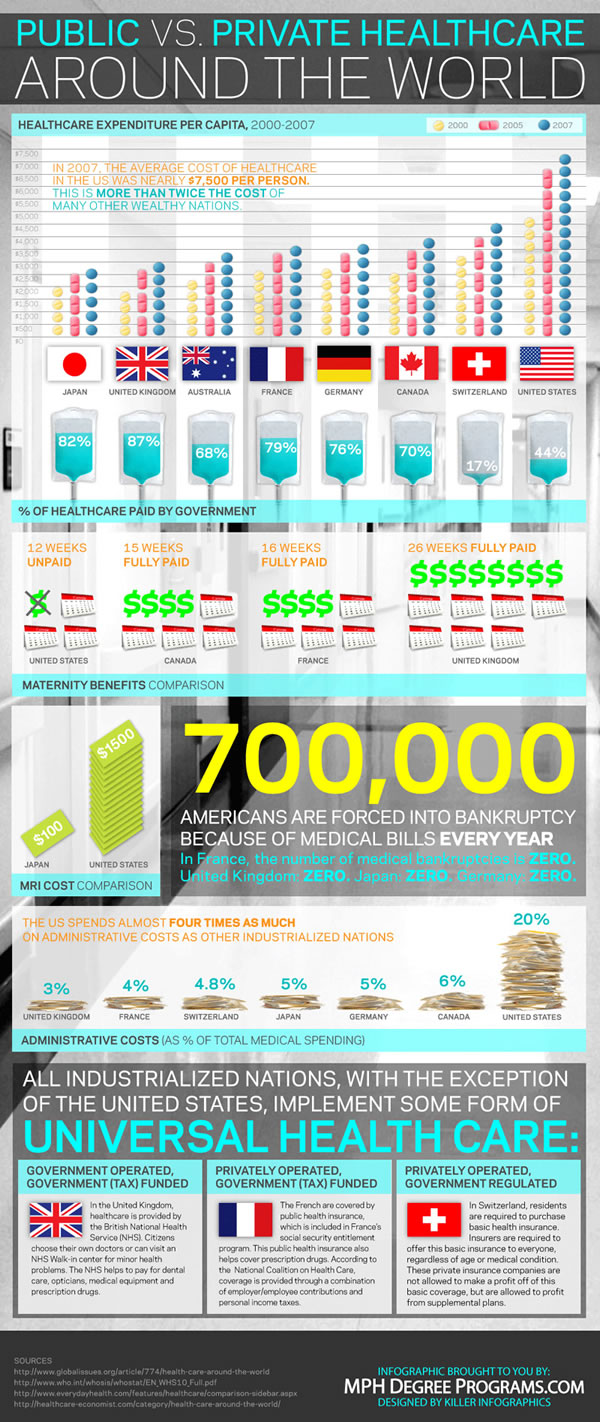
Managed Care

In managed care, the potential conflicts between patients and physicians took on a completely different dimension.  By design, in health plans where medical care was financed through prepayment arrangements, the physician’s income was enhanced not by doing more for his or her patients, but by doing less.  Patients, confronted with the realization that their doctor would be rewarded for the use of fewer resources, could no longer rely with certainty on the motives underlying a physician’s treatment plans.  One inevitable outcome was the continuing decline in patients’ trust in their physicians.  This has been exacerbated to some degree by revelations of significant financial remuneration to physicians by pharmaceutical and medical products firms for their services as researchers or active participants on corporate-funded advisory panels, calling into question the physician’s objectivity in promoting the use of company products to their peers or patients.

Conflicts of Interest

Conflicts of interest may also create concerns at a much higher level, as evidenced by the issues raised in 2008 litigation against Ingenix, a company that for more than a decade, provided information to the insurance industry on payments to out-of-network physicians for their “usual and customary rates (UCR).” As noted in court documents, Ingenix was a wholly-owned subsidiary of United Healthcare and the UCR information sold by the company to insurers may have been fundamentally biased in favor of the insurers, causing patients to pay larger out-of-pocket fees.

Assessment

As a result, New York attorney general Andrew Cuomo filed suit against Ingenix.  This action was followed by suits brought against major insurers by the American Medical Association and several state medical groups for systematic underpayment to members, based on the biased data.  To date there have been monetary settlements, but the issue continues to raise growing concerns regarding conflicts of interest among the key payers for health care.

Conclusion

And so, your thoughts and comments on this ME-P are appreciated. Feel free to review our top-left column, and top-right sidebar materials, links, URLs and related websites, too. Then, subscribe to the ME-P. It is fast, free and secure.

Link: http://feeds.feedburner.com/HealthcareFinancialsthePostForcxos

Speaker: If you need a moderator or speaker for an upcoming event, Dr. David E. Marcinko; MBA – Publisher-in-Chief of the Medical Executive-Post – is available for seminar or speaking engagements. Contact: MarcinkoAdvisors@msn.com

Our Other Print Books and Related Information Sources:

Health Dictionary Series: http://www.springerpub.com/Search/marcinko

Practice Management: http://www.springerpub.com/product/9780826105752

Physician Financial Planning: http://www.jbpub.com/catalog/0763745790

Medical Risk Management: http://www.jbpub.com/catalog/9780763733421

Healthcare Organizations: www.HealthcareFinancials.com

Physician Advisors: www.CertifiedMedicalPlanner.com

Subscribe Now: Did you like this Medical Executive-Post, or find it helpful, interesting and informative? Want to get the latest ME-Ps delivered to your email box each morning? Just subscribe using the link below. You can unsubscribe at any time. Security is assured.

Link: http://feeds.feedburner.com/HealthcareFinancialsthePostForcxos

Sponsors Welcomed: And, credible sponsors and like-minded advertisers are always welcomed.

Link: https://healthcarefinancials.wordpress.com/2007/11/11/advertise

Product Details 

Some Data on Cosmetic Surgery

Infographics

Courtesy Medical Billing and Coding

Here are some fun facts about the many people undergo some sort of cosmetic surgery in the world

Conclusion

And so, your thoughts and comments on this ME-P are appreciated. Feel free to review our top-left column, and top-right sidebar materials, links, URLs and related websites, too. Then, subscribe to the ME-P. It is fast, free and secure.

Link: http://feeds.feedburner.com/HealthcareFinancialsthePostForcxos

Speaker: If you need a moderator or speaker for an upcoming event, Dr. David E. Marcinko; MBA – Publisher-in-Chief of the Medical Executive-Post – is available for seminar or speaking engagements. Contact: MarcinkoAdvisors@msn.com

Our Other Print Books and Related Information Sources:

Health Dictionary Series: http://www.springerpub.com/Search/marcinko

Practice Management: http://www.springerpub.com/product/9780826105752

Physician Financial Planning: http://www.jbpub.com/catalog/0763745790

Medical Risk Management: http://www.jbpub.com/catalog/9780763733421

Healthcare Organizations: www.HealthcareFinancials.com

Physician Advisors: www.CertifiedMedicalPlanner.com

Subscribe Now: Did you like this Medical Executive-Post, or find it helpful, interesting and informative? Want to get the latest ME-Ps delivered to your email box each morning? Just subscribe using the link below. You can unsubscribe at any time. Security is assured.

Link: http://feeds.feedburner.com/HealthcareFinancialsthePostForcxos

Sponsors Welcomed: And, credible sponsors and like-minded advertisers are always welcomed.

Link: https://healthcarefinancials.wordpress.com/2007/11/11/advertise

Product DetailsProduct DetailsProduct Details