The Great Depression of 2008

Join Our Mailing List

Understanding EESA

[By Staff Reporters]

On October 3, 2008, President Bush signed into law the Emergency Economic Stabilization Act (EESA).  It contained significant provisions that will not only impact the financial sector but is a truly “global” law aimed at establishing the stability and reliability of the American banking system and its posture to the world community.

While presenting a speech on the issue in Tampa, Florida, on Saturday, October 11, after a precipitous drop in the stock market the day before, President Bush at 8:00 a.m. (EST) held a press conference with the G-7 Finance Ministers behind him attempting to, once again, quell the fears of the global business community as to a concentrated global effort to “right the ship” of state.

Medical Professionals; et al

Physicians, healthcare administrators, financial advisors, iMBA firm clients, printer-journal subscribers to www.HealthcareFinancials.com and our Executive-Post readers seem to be all asking the same question: are we entering into another “great depression.” To answer this, one needs to review the events leading to this worldwide financial debacle.

Not the Same 

First, this is nothing like the depression of the 1930’s.  The institutions and causes are substantially different.  To prove this your self, just read the seminal work by the economist, John Kenneth Galbraith, “The Great Crash“, and the dissimilarities to the present global situation will be striking.

Second, a little known fact, but two prime catalysts were the principal culprits in this crisis.  One is a financial vehicle called credit default swaps (CDSs) and the other is a generally accepted financial accounting rule known as “mark-to-market”.

Investment Banking Meltdown

At the beginning of 2008, the United States had five major investment banking houses.  By October it had only two remaining.  What brought this major change was the so-called sub-prime debt problem.  But this is the deceptive label given it by naive journalists.  In reality, it was a worldwide market of 54 Trillion (this is not a typo – say again, 54 Trillion) dollar CDS market that collapsed.

Cause and Affect 

How could this happen?  Greed is the short answer but the business expediency of setting up a CDS is largely to blame.  Here’s how it worked.

Example: 

A party would by phone or email enter into a credit default swap contract with a bank.  This could be for an actual debt, e.g. sub-prime obligation or hedging on a non-owned instrument (cross-party) obligation.  Payment of premiums ensured the default.  In the event of default of the obligation, the bank, e.g., Lehman Brothers, would satisfy the contract.  It is a significant fact in these transactions that there was no federal or state regulatory body supervising them. Why?  Because these contracts were not per se securities and, thus, no oversight was necessary.  Of course, the facts belie this assertion — to the tune of 54 Trillion dollars!

Financial Accounting

Then there is the financial accounting rule that required businesses — including financial institutions — to mark their assets, i.e., sub-prime mortgages, to market value.  In a declining market this would require the creation of an unrealized loss on the bank’s books causing investors and others to view the bank as less solvent. 

Assessment

This accounting rule, endorsed by the International Accounting Board in London and enunciated in its International Financial Reporting Standards (IFRS), is also applied overseas.  French President Sarkosy stated that the rule is rescinded in France and the recent EESA of 2008 in the United States requires the SEC to decide whether to suspend it as well.

Conclusion

The DOW fell to 8,519 yesterday, the NASDAQ to 1,615 and the S&P to 896; all medical professionals are anxious. And so, are we entering into another great depression? Please vote.

And, subscribe and contribute your own thoughts, experiences, questions, knowledge and comments on this topic for the benefit of all our Medical Executive-Post readers.

Conclusion

Your thoughts and comments on this ME-P are appreciated. Feel free to review our top-left column, and top-right sidebar materials, links, URLs and related websites, too. Then, subscribe to the ME-P. It is fast, free and secure.

Link: http://feeds.feedburner.com/HealthcareFinancialsthePostForcxos

Speaker: If you need a moderator or speaker for an upcoming event, Dr. David E. Marcinko; MBA – Publisher-in-Chief of the Medical Executive-Post – is available for seminar or speaking engagements. Contact: MarcinkoAdvisors@msn.com

OUR OTHER PRINT BOOKS AND RELATED INFORMATION SOURCES:

LEXICONS: http://www.springerpub.com/Search/marcinko
PHYSICIANS: www.MedicalBusinessAdvisors.com
PRACTICES: www.BusinessofMedicalPractice.com
HOSPITALS: http://www.crcpress.com/product/isbn/9781466558731
CLINICS: http://www.crcpress.com/product/isbn/9781439879900
ADVISORS: www.CertifiedMedicalPlanner.org
BLOG: www.MedicalExecutivePost.com

Product Details  Product Details

HHS, OIG and DOJ Fight Health Fraud

New Five Point Strategy Revealed

Join Our Mailing List 

[By Staff Reporters]

According to the Report on Medicare Compliance, October 20, 2008, the Health and Human Services [HHS] Office of Inspector General [OIG] recently unveiled a five-point strategy for fighting fraud and abuse in anticipation of a new presidential administration.

Five Pillars

The five “pillars” are:

  1. scrutinize who is allowed to bill before enrollment.
  2. establish reasonable and responsive payment methodologies.
  3. help industry adopt practices that promote compliance.
  4. vigilantly monitor claims for payment, and;
  5. respond quickly to detected fraud.

OIG and DOJ

Among other activities, the OIG and Department of Justice [DOJ is using data mining to identify claims problems before they get out of hand.

Assessment

For example, the Office of Evaluation and Inspections [OEIs] issued a 2006 report on aberrant physical therapy billing – physicians were billing for services performed by unlicensed people in the patients’ homes – while an OIG attorney deputized by the Department of Justice [DOJ] is now prosecuting cases based on this violation in the Southern District of Mississippi.

Channel Surfing the ME-P

Have you visited our other topic channels? Established to facilitate idea exchange and link our community together, the value of these topics is dependent upon your input. Please take a minute to visit. And, to prevent that annoying spam, we ask that you register. It is fast, free and secure.

Conclusion

Your thoughts and comments on this ME-P are appreciated. Feel free to review our top-left column, and top-right sidebar materials, links, URLs and related websites, too. Then, subscribe to the ME-P. It is fast, free and secure.

Speaker: If you need a moderator or speaker for an upcoming event, Dr. David E. Marcinko; MBA – Publisher-in-Chief of the Medical Executive-Post – is available for seminar or speaking engagements. Contact: MarcinkoAdvisors@msn.com

OUR OTHER PRINT BOOKS AND RELATED INFORMATION SOURCES:

Product DetailsProduct DetailsProduct Details

Nobel Prize Winners for 2008 thru 2018

Join Our Mailing List
The ME-P Congratulates New Nobel Laureates

[By Staff Reporters]ME-P Logo.2

Since 1901, the Nobel Prize has been honoring men and women from all corners of the globe for outstanding achievements in physics, chemistry, medicine, literature, economics and for working in peace. The foundations for the prize were laid in 1895 when Alfred Nobel wrote his last will, leaving much of his wealth to the establishment of the Nobel Prize

See: www.NobelPrize.org

The 2008 Winners:

Annals of Improbable Research Magazine

A paradoy of the Nobel Prize, the Ig Nobel Prizes are also given each year in early October — around the time the recipients of the genuine Nobel Prizes are announced — for ten achievements that “first make people laugh, and then make them think.” 

Here is a list of the 18th Ig Nobel winners, awarded on Thursday October 2, 2008, at Harvard University, by the Annals of Improbable Research [AIR] magazine.

2008 Ig Nobel Winners:

  • Nutrition: Massimiliano Zampini and Charles Spence for demonstrating that food tastes better when it sounds better.
  • Cognitive Science: Toshiyuki Nakagaki, Hiroyasu Yamada, Ryo Kobayashi, Atsushi Tero, Akio Ishiguro and Agota Toth for discovering that slime molds can solve puzzles.
  • Economics: Geoffrey Miller, Joshua Tyber and Brent Jordan for discovering that exotic dancers earn more when at peak fertility.
  • Physics: Dorian Raymer and Douglas Smith for proving that heaps of string or hair will inevitably tangle.
  • Chemistry: Sheree Umpierre, Joseph Hill and Deborah Anderson for discovering that Coca-Cola is an effective spermicide, and C.Y. Hong, C.C. Shieh, P. Wu and B.N. Chiang for proving it is not.
  • Literature: David Sims for his study “You Bastard: A Narrative Exploration of the Experience of Indignation within Organizations.”
  • Peace: The Swiss Federal Ethics Committee on Non-Human Biotechnology and the citizens of Switzerland for adopting the legal principle that plants’ have dignity.
  • Archaeology: Astolfo Gomes de Mello Araujo and Jose Carlos Marcelino for showing armadillos can scramble the contents of an archaeological dig.
  • Biology: Marie-Christine Cadiergues, Christel Joubert and Michel Franc for discovering that fleas that live on a dog can jump higher than fleas that live on a cat.
  • Medicine: Dan Ariely for demonstrating that expensive fake medicine is more effective than cheap fake medicine.

Assessment

Do we really need Nobel, and Ig Nobel, prize winners each year?

Conclusion

Your thoughts and comments on this ME-P are appreciated. Feel free to review our top-left column, and top-right sidebar materials, links, URLs and related websites, too. Then, subscribe to the ME-P. It is fast, free and secure.

Link: http://feeds.feedburner.com/HealthcareFinancialsthePostForcxos

Speaker: If you need a moderator or speaker for an upcoming event, Dr. David E. Marcinko; MBA – Publisher-in-Chief of the Medical Executive-Post – is available for seminar or speaking engagements. Contact: MarcinkoAdvisors@msn.com

OUR OTHER PRINT BOOKS AND RELATED INFORMATION SOURCES:

LEXICONS: http://www.springerpub.com/Search/marcinko
PHYSICIANS: www.MedicalBusinessAdvisors.com
PRACTICES: www.BusinessofMedicalPractice.com
HOSPITALS: http://www.crcpress.com/product/isbn/9781466558731
CLINICS: http://www.crcpress.com/product/isbn/9781439879900
ADVISORS: www.CertifiedMedicalPlanner.org
PODIATRISTS: www.PodiatryPrep.com
BLOG: www.MedicalExecutivePost.com

Product Details  Product Details

Medical Practice Opportunity

Established Solo Orthopedic Surgical Practice

Beautiful … Atlanta Georgia! 

Partnership / Ownership Opportunity

Dr. John Kelley (404.309.3559)

[The Way Practice & Life Should Be]            

Note: Please mention that you found this listing on the Executive Post job board in your cover letter.    

Link: practice-opportunity-beautiful-atlanta-georgia2                                                         

Patient Focused Health Care 2.0

An Emerging Competitive Trend

Dr. David Edward Marcinko; MBA, CMP™

Publisher-in-Chief

One emerging competitive trend in medicine today is patient-focused healthcare. This concept focuses on patient needs and attempts to humanize patient care.

A Multi-Dimensional Approach

According to Professor Gregory O. Ginn; PhD, MBA, CPA of the UNLV department of healthcare administration, patient focused health care [PFHC] 2.0 is protean and multidimensional, and therefore incorporates the following:

  • patient education;
  • active participation of the patient;
  • involvement of the family;
  • nutrition; art; and music, etc.

Benefits

These issues are thought to improve patient outcomes. Furthermore, some think that patients will benefit from learning how to cope with healthcare processes before they enter into those processes and that this knowledge will result in better outcomes.

Example:

A case model example by Professor Ginn, as seen in www.HealthcareFinancials.com, would be classes to prepare couples for childbirth.

“These classes teach prospective parents the different stages of labor and strategies for dealing with the challenges associated with each stage. They cover options for pain management such as breathing and relaxation techniques and/or analgesics. The classes also provide education about clinical options such as induced labor and caesarian sections, and they cover practical issues such as what to wear and what kind of car seat to buy to transport the newborn home.”

Other Trends

According to the October 2008 issue of Managed Healthcare Executive, other emerging competitive healthcare trends include:

  • Consumer engage care choices,
  • Payment reform,
  • Industry quality and economic benchmarks,
  • Medical home models,
  • Evidence-based medicine,
  • Disease Management, and
  • Comparative effectiveness studies.

Assessment

PFHC 2.0, medical and health education is enormously beneficial in reducing stress and improving the decision-making ability of patients who are involved in healthcare processes. Related disease management [DM] examples include: asthma, diabetes, hypertension, CHF, COPD, CAD, obesity, arthritis and a host of others.  

Conclusion

Please subscribe and contribute your own thoughts, experiences, questions, knowledge and comments on this topic for the benefit of all our Executive-Post readers.

Related Information Sources:

Practice Management: http://www.springerpub.com/prod.aspx?prod_id=23759

Physician Financial Planning: http://www.jbpub.com/catalog/0763745790

Medical Risk Management: http://www.jbpub.com/catalog/9780763733421

Healthcare Organizations: www.HealthcareFinancials.com

Health Administration Terms: www.HealthDictionarySeries.com

Physician Advisors: www.CertifiedMedicalPlanner.com

Speaker: If you need a moderator or speaker for an upcoming event, Dr. David E. Marcinko; MBA – Publisher-in-Chief of the Executive-Post – is available for seminar or speaking engagements. Contact: MarcinkoAdvisors@msn.com  or Bio: www.stpub.com/pubs/authors/MARCINKO.htm

Charity Care versus Managed Care

Join Our Mailing List

Physician Participation in Managed Care Levels

By Staff Writers

According to Robert James Cimasi of Health Capital Consultants LLC, in St. Louis, Researchers at the Center for Analyzing Health System Change [CAHSC] completed a study several years ago on the effect of competition and managed care on charity medical care, provided by physicians, that further illustrates the effects of dysfunctional competition in healthcare.

The Study

The study was based on data on the amount of charity care provided by over 10,000 physicians between 1996 and 1997.

Definition of Charity Care

According to www.HealthDictionarySeries.com and others, charity medical care was defined as healthcare provided without cost or at a reduced cost because of the inability of the patient to pay for the cost of the service.

Inverse Relationship Findings

An inverse relationship was found between the amount of physician revenue derived from managed care and the amount of time spent providing charity care. Specifically, physicians who received 85% or more of their income from managed care provided only half of the hours of charity care provided by physicians who received less than 85% of their revenue from managed care contracts.

Also, physicians practicing in areas with high managed care penetration provided less charity care. Further, a relationship was observed between increased practice size and diminished time spent on charity care.

Assessment

The reporter of the study, a contributor to www.HealthcareFinancials.com and others, attributed these practice differences to increasing financial pressures faced by physicians because of increased competition and their reduced ability to use “cost shifting” to shift excess charges from paying patients to cover costs for those unable to pay. Under the scenario they describe, increasing numbers of the uninsured and the prevalence of managed care plans will continue to shift costs back to the government and the public for indigent care unless systemic changes are made to incorporate provisions for charity care into an increasingly for-profit healthcare system.

References: Cunningham, P. J., et al. “Managed care and physicians’ provision of charity care.” JAMA 281 (1999): 1087.

Conclusion

Your thoughts and comments on this ME-P are appreciated. Feel free to review our top-left column, and top-right sidebar materials, links, URLs and related websites, too. Then, subscribe to the ME-P. It is fast, free and secure.

Speaker: If you need a moderator or speaker for an upcoming event, Dr. David E. Marcinko; MBA – Publisher-in-Chief of the Medical Executive-Post – is available for seminar or speaking engagements. Contact: MarcinkoAdvisors@msn.com

OUR OTHER PRINT BOOKS AND RELATED INFORMATION SOURCES:

 Product DetailsProduct Details

About OmniMedicalSearch.com

New Search Engine for Medical Images

By Jason Morrow

(918) 286-6463
jason@OmniMedicalSearch.com

PRESS RELEASE:

OmniMedicalSearch.com today announced it has released a medical image search engine designed for patients, students, caregivers, and medical professionals.

“Nothing else brings clarity to a subject like images that illustrate the information people research,” OmniMedicalSearch.com founder Jason Morrow said. “Users from around the world will find this search tool incredibly useful.”

Alloyfish Ally

Developed by their long-time support ally, Alloyfish, the image search engine delivers relevant results with an index of 150,000 medical images from 125 different sources that were hand selected. A wide range of images from authoritative medical websites were sought out for the index. “We are going to grow that index and webmasters are invited to submit their medical website for consideration via our Suggest Images link,” Morrow added.

New Search Tool

This new search tool offered by OmniMedicalSearch joins a small handful of search engines focused on medical images. “Besides stock medical images being marketed, there hasn’t been a lot of development in this area,” Morrow said. “However, I think the need and demand has always been there and OMS is committed to providing our users valuable search tools they will come back to use again and again.”

Registration

There are no fees, registration or requirements of any kind to use OmniMedicalSearch.com

Assessment

OmniMedicalSearch.com was founded in 2004 and centered on the premise of providing authoritative search results from reliable health and medical resources. It has since grown from a medical metasearch engine into a full search engine made possible through partnerships with Healthline.com, Google Custom Search, and their own proprietary search technology. OmniMedicalSearch offers six major search options which include: Medical Web, Health News, Forums, MedPro (medical professional level resources), health and medical Shopping Search, and now, a search engine for medical images. OmniMedicalSearch also offers a local directory for clinics and doctors, a reference desk of hard to find resource links, and a growing medical encyclopedia.

Conclusion

User comments, sent to the Executive-Post, are appreciated.

Subscribe Now: Did you like this Executive-Post, or find it helpful, interesting and informative? Want to get the latest E-Ps delivered to your email box each morning? Just subscribe using the link below. You can unsubscribe at any time. Security is assured.

Link: http://feeds.feedburner.com/HealthcareFinancialsthePostForcxos

Vote Presidential Debates [An E-P Poll]

Healthcare Politics 2008

[Executive-Post readers decide]


Speaker: If you need a moderator or speaker for an upcoming event, Dr. David E. Marcinko; MBA – Publisher-in-Chief of the Executive-Post – is available for seminar or speaking engagements. Contact: MarcinkoAdvisors@msn.com  or Bio: www.stpub.com/pubs/authors/MARCINKO.htm

Subscribe Now: Did you like this Executive-Post, or find it helpful, interesting and informative? Want to get the latest E-Ps delivered to your email box each morning? Just subscribe using the link below. You can unsubscribe at any time. Security is assured.

Link: http://feeds.feedburner.com/HealthcareFinancialsthePostForcxos


Capital Formation Considerations for Hospitals

Understanding Risks and Rewards

By Calvin W. Weise CPA; and Staff Writers

All hospital and healthcare-entity capital investments create risk.

Definition of Risk

According to www.HealthDictionarySeries.com, risk is the uncertainty of future events. When hospitals make capital investments, they commit to costs that affect future periods. Those costs are known and relatively fixed. What are unknown are the benefits to be realized by those capital investments.

Capital Investment Risks

For capital investments, risk is the certainty of future costs coupled with the uncertainty of future benefits. In some cases, while the future benefits are uncertain, there is a high degree of certainty that the benefits will exceed the costs. In these cases; risk can be very low. Risk may be better defined as the degree to which the uncertainty of unknown benefits will exceed the known and committed costs.

Burdens and Benefits of Ownership

When capital assets are purchased, both the burdens and the benefits of ownership are transferred to the owner. The burdens are primarily the costs associated with acquisition and installation.

The benefits are primarily the revenues generated by operating the capital assets. Risk of ownership is created to the degree that the benefits are uncertain.

Balancing Act

Hospital managers need to be skilled at balancing and putting hospital assets at risk. Without clear knowledge and understanding of the benefits and the burdens, hospitals can quickly find themselves at unacceptably high levels of risk. Risk must be continually assessed and evaluated in order to successfully put hospital assets at risk. Hospitals and related entities require many varied capital investments; their capital investments represent a risk portfolio. An effective combination of risky assets can often create risk that is less than the sum of the risk of each asset.

Modern Portfolio Theory

Of course, financial managers have know this for years as a basic principle of Modern Portfolio Theory (MPT), first introduced by Harry Markowitz, PhD, with the paper ”Portfolio Selection,” which appeared in the 1952 Journal of Finance. Thirty-eight years later, he shared a Nobel Prize with Merton Miller, PhD, and William Sharpe, PhD, for what has become a broad theory for securities asset selection; and hospital assets may be viewed as little different.

Historical Review

Back in the day, prior to Markowitz’s work, investors focused on assessing the rewards and risks of individual securities in constructing a portfolio. Standard advice was to identify those that offered the best opportunities for gain, with the least risk, and then construct a portfolio from them.

Example:

Following this advice, a hospital administrator might conclude that a positron emission tomography (PET) scanning machine offered good risk-reward characteristics, and pursue a strategy to compile a network of them in a given geographic area.

Intuitively, this would be foolish. Markowitz formalized this intuition. Detailing the mathematics of diversity, he proposed that investors focus on selecting portfolios based on their overall risk-reward characteristics instead of merely compiling portfolios of securities, or capital assets that each individually has attractive risk-reward characteristics.

In a nutshell, just as physician-investors should select portfolios not individual securities, so hospital administrators should select a wide spectrum of radiology services, not merely machines.

Other Strategies

According to Dr. David Edward Marcinko, MBA, CMP™, the Publisher-in-Chief of this portal, some other risk and cost control strategies that will affect hospital ROI include:

  • CDHC and medical HSAs,
  • Universal health insurance,
  • eMRs and HIT investments,
  • P4P, and various
  • Medical quality improvement initiatives.

Assessment

Savvy hospital managers, financial advisors, physician and nurse executives, accountants and healthcare administrators should mitigate ownership risk by constructing their portfolio of risky assets in a manner that lowers overall risk www.HealthcareFinancials.com

Conclusion

Please subscribe and contribute your own thoughts, experiences, questions, knowledge and comments on this topic for the benefit of all our Executive-Post readers.

Related Information Sources:

Practice Management: http://www.springerpub.com/prod.aspx?prod_id=23759

Physician Financial Planning: http://www.jbpub.com/catalog/0763745790

Medical Risk Management: http://www.jbpub.com/catalog/9780763733421

Healthcare Organizations: www.HealthcareFinancials.com

Health Administration Terms: www.HealthDictionarySeries.com

Physician Advisors: www.CertifiedMedicalPlanner.com

Speaker: If you need a moderator or speaker for an upcoming event, Dr. David E. Marcinko; MBA – Publisher-in-Chief of the Executive-Post – is available for seminar or speaking engagements. Contact: MarcinkoAdvisors@msn.com  or Bio: www.stpub.com/pubs/authors/MARCINKO.htm

Subscribe Now: Did you like this Executive-Post, or find it helpful, interesting and informative? Want to get the latest E-Ps delivered to your email box each morning? Just subscribe using the link below. You can unsubscribe at any time. Security is assured.

Link: http://feeds.feedburner.com/HealthcareFinancialsthePostForcxos

Medicare and/or Medigap Acceptance by Doctors

 Join Our Mailing List 

More on the Balance-Billing Conundrum

By Dr. David Edward Marcinko; MBA, CMP™

[Publisher-in-Chief]

dem23

In light of the large number of elderly people, hospitals and doctors often accept Medicare and Medigap coverage without charging above the fees specified by these health insurance programs [ie., do not “balance-bill”].

Other doctors however, do not accept the specified Medicare fees and charge above those fees on a “balance billing” basis (i.e., charging more for their services than the Medicare or Medigap reimbursement schedules provided).

Balance Billing Limitations

Providers are not permitted to “balance bill” more than 15 percent above the schedule amounts. In many circumstances, “balance billing” is limited even further or forbidden outright on a contractual basis with private plans, insurance companies, HMOs, MCOs, etc.

Physician Refusal

Originally, it was projected that “balance billing,” or the refusal of leading medical specialist physicians to accept Medicare for payment, would increase as Medicare fees were further reduced. This apparently did not happen during the last several years.

However, as many managed care plans and HMOs are now reimbursing physicians and other providers at fee schedules considerably below Medicare rates in 2008, this refusal may finally be emerging in some cases. But, we trust it will not be dishonestly sought through inappropriate balance billing.

Assessment

A number of organizations, including the American Association of Retired Persons (AARP), assist seniors with submitting medical bills. After a major health setback, however, seniors may want to rely on health insurance claim specialists to have all their medical expenses properly and speedily processed for reimbursement.

Conclusion

In many cases, traditional Medicare (but not Medicare+ programs) is now the payer of choice for many physicians. And so dear colleagues; either sign-on or refuse, but play by the rules. User opinions and comments, sent to the Medical Executive-Post, are appreciated.

Subscribe Now: Did you like this Medical Executive-Post, or find it helpful, interesting and informative? Want to get the latest ME-Ps delivered to your email box each morning? Just subscribe using the link below. You can unsubscribe at any time. Security is assured.

Link: http://feeds.feedburner.com/HealthcareFinancialsthePostForcxos

Related Information Sources:

Practice Management: http://www.springerpub.com/prod.aspx?prod_id=23759

Physician Financial Planning: http://www.jbpub.com/catalog/0763745790

Medical Risk Management: http://www.jbpub.com/catalog/9780763733421

Healthcare Organizations: www.HealthcareFinancials.com

Health Administration Terms: www.HealthDictionarySeries.com

Physician Advisors: www.CertifiedMedicalPlanner.com

Speaker: If you need a moderator or speaker for an upcoming event, Dr. David E. Marcinko; MBA – Publisher-in-Chief of the Executive-Post – is available for seminar or speaking engagements. Contact: MarcinkoAdvisors@msn.com  or Bio: www.stpub.com/pubs/authors/MARCINKO.htm

Deeper Financial Management Insight

Our Executive-Post Growth

Ann Miller; RN, MHA

Wow! That’s the best word to describe our recent growth! 

Outcomes

The September issue of the Executive-Post was the most successful to-date. Unfortunately, this was – no doubt – in-part to the recent stock market collapse and lack of confidence in the domestic credit and industrial-complex.

Economic Commentary

Read the opinion of Schwab’s Liz Ann Sonders, on the US economy, here:

Link: liz-ann-sonders

And, going forward, we trust our deeper-insight into health economics and financial management will carry the day even more.

Data

Almost 10,000 readers and subscribers visited or signed-in to our complimentary blogs and communications forum. We now reach folks nationally; working in healthcare finance, accounting pharma/biotech, consulting, government, academia, medical management, business and physician recruiting.   

Assessment

Of course, our 2 volume, 1,200 pages, professional quarterly and peer-reviewed premium-print subscription journal-guide is also growing in the hospital and institutional markets. www.HealthcareFinancials.com Many thanks to all supporters; both online and in-print.

Conclusion 

And so, if you want to reach your target audience of healthcare executives, physicians, administrators and medical leaders; with information on your company, product, service, or job opening, just contact Ann: MarcinkoAdvisors@msn.com

Plus, don’t forget to book mark us: www.HealthcareFinancials.wordpress.com

Related Information Sources:

Practice Management: http://www.springerpub.com/prod.aspx?prod_id=23759

Physician Financial Planning: http://www.jbpub.com/catalog/0763745790

Medical Risk Management: http://www.jbpub.com/catalog/9780763733421

Healthcare Organizations: www.HealthcareFinancials.com

Health Administration Terms: www.HealthDictionarySeries.com

Physician Advisors: www.CertifiedMedicalPlanner.com

Speaker: If you need a moderator or speaker for an upcoming event, Dr. David E. Marcinko; MBA – Publisher-in-Chief of the Executive-Post – is available for seminar or speaking engagements. Contact: MarcinkoAdvisors@msn.com  or Bio: www.stpub.com/pubs/authors/MARCINKO.htm

Subscribe Now: Did you like this Executive-Post, or find it helpful, interesting and informative? Want to get the latest E-Ps delivered to your email box each morning? Just subscribe using the link below. You can unsubscribe at any time. Security is assured.

Link: http://feeds.feedburner.com/HealthcareFinancialsthePostForcxos


Financial Industry Links

An Executive-Post List

Staff Writers

  1. Investment Company Institute (mutual fund industry)

Related Information Sources:

Practice Management: http://www.springerpub.com/prod.aspx?prod_id=23759

Physician Financial Planning: http://www.jbpub.com/catalog/0763745790

Medical Risk Management: http://www.jbpub.com/catalog/9780763733421

Healthcare Organizations: www.HealthcareFinancials.com

Health Administration Terms: www.HealthDictionarySeries.com

Physician Advisors: www.CertifiedMedicalPlanner.com

Speaker: If you need a moderator or speaker for an upcoming event, Dr. David E. Marcinko; MBA – Publisher-in-Chief of the Executive-Post – is available for seminar or speaking engagements. Contact: MarcinkoAdvisors@msn.com  or Bio: www.stpub.com/pubs/authors/MARCINKO.htm

Subscribe Now: Did you like this Executive-Post, or find it helpful, interesting and informative? Want to get the latest E-Ps delivered to your email box each morning? Just subscribe using the link below. You can unsubscribe at any time. Security is assured.

Link: http://feeds.feedburner.com/HealthcareFinancialsthePostForcxos

Risk Management and Insurance Strategies for Physicians and Advisors

Foreword and Book Review

Join Our Mailing List

By Lloyd M. Krieger; MD, MBA

Insurance is an important part of all our lives. 

This is especially true for physicians. I currently have no fewer than 10 separate insurance policies associated with my plastic surgery practice. I understand very little about the policies other than that somebody at some point told me I needed each and every one of them, and each made sense when I bought it.

For example, am I over-insured and thus wasting money?  Am I under-insured and thus at risk for a liability disaster?  I never really had the means of answering these questions, until now www.jbpub.com/catalog/9780763733421

The Book

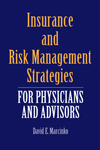
Risk Management and Insurance Strategies for Physicians and Advisors is an essential textbook because it explains to physicians and insurance professionals the background, theory, and practicalities of medical risk management and insurance planning.  The insurance haze is lifted by-dual degreed editor, and Certified Medical Planner™ Dr. David Edward Marcinko MBA, and his team of contributing authors www.jbpub.com/catalog/9780763733421

Goaded Physicians

Doctors, like most people, tend to experience losses more intensely than gains, and evaluate risks in isolation. So it’s no surprise that goaded physicians might prefer vehicles like the guaranteed minimum death benefit of variable annuities, or the assurance that comes with disability or long term care insurance, or traditional cash value life insurance policies, despite their decidedly higher costs and commissions.

Denial Mode

Similarly, physicians may enter denial mode and eschew the potential business impact of HIPAA and Balanced Budget Act risks; self referral risks; OSHA, DEA, EPA, OCR, P&C or managed care risks; managed care contract capitulation risks; employee, expert witness, peer review and on-call risks; and even educational debt load risks, among so many others.

Insurance Professionals

For real insurance professionals on the other hand, this is an exciting time to be practicing medical risk management, because there is much research and creative enlightenment occurring in academic and practitioner communities.

But, one must be willing to abandon ancient thoughts and remain open to new ideas that identify and provide solutions to the contemporaneous problems of physicians.

As an example of this epiphany, the economist Christian Gollier revisits the raison detra’ of insurance, by asking: should one even buy insurance since the industry itself is so skilled at exploiting human foibles?

Although this emerging work is descriptive, it is not yet time tested since some of it aspires to be normative, as developing modern models of savings and consumption hint that insurance may deserve a smaller role in personal risk management than previously believed.

Assessment

Risk Management and Insurance Strategies for Physicians and Advisors fulfill its promise as a peerless tool for physicians wanting to make good decisions about the risks they face. It is also ideal for financial planners, insurance agents and healthcare business advisors wishing to re-educate and help doctors by adding lasting value to their client relationships. With time at a premium for all, and so much information packed into one well-organized resource, this book should be on the desk of every physician, or financial advisor serving the healthcare space. Simply stated, if you read this compelling text with a mind focused on the future, the time you spend will be amply rewarded www.jbpub.com/catalog/9780763733421

Conclusion

Your thoughts and comments on this best seller are appreciated.

Lloyd M. Krieger; MD, MBA

Rodeo Drive Plastic Surgery

The Rodeo Collection

421 North Rodeo Drive

Beverly Hills, CA  90210

Related Information Sources:

Practice Management: http://www.springerpub.com/prod.aspx?prod_id=23759

Physician Financial Planning: http://www.jbpub.com/catalog/0763745790

Medical Risk Management: http://www.jbpub.com/catalog/9780763733421

Physician Advisors: www.CertifiedMedicalPlanner.org

Speaker:If you need a moderator or speaker for an upcoming event, Dr. David E. Marcinko; MBA – Publisher-in-Chief of the Medical Executive-Post – is available for seminar or speaking engagements. Contact: MarcinkoAdvisors@msn.com 

Subscribe Now:Did you like this Medical Executive-Post, or find it helpful, interesting and informative? Want to get the latest ME-Ps delivered to your email box each morning? Just subscribe using the link below. You can unsubscribe at any time. Security is assured.

Link: http://feeds.feedburner.com/HealthcareFinancialsthePostForcxos

Product Details  Product Details

About Waterfront Media

Revolution Health plus Everyday Health

Staff Writers

According to the New York Times on October 3rd, Revolution Health Network just merged with Everyday Health Network; a publisher that owns several health Web sites.

A Threat to WebMD

In a deal that threatens WebMD’s dominance in the online health care space, the new $300 million valuation would give the combined companies enough US traffic to compete with WebMD; now considered the market leader in the online health category

Waterfront Media

The new company will operate under the name Waterfront Media, which runs several sites called the Everyday Health Network, while the Revolution Health Web sites will be absorbed into that network

Assessment

WebMD has also been expanding, as it recently announced that it would acquire the site QualityHealth.com for $50 million and an additional $25 million based on performance.

Conclusion

Please subscribe and contribute your own thoughts and comments on this topic for the benefit of all our Executive-Post readers.

orders@stpub.com

Speaker: If you need a moderator or speaker for an upcoming event, Dr. David E. Marcinko; MBA – Publisher-in-Chief of the Executive-Post – is available for seminar or speaking engagements. Contact: MarcinkoAdvisors@msn.com  or Bio: www.stpub.com/pubs/authors/MARCINKO.htm

Subscribe Now: Did you like this Executive-Post, or find it helpful, interesting and informative? Want to get the latest E-Ps delivered to your email box each morning? Just subscribe using the link below. You can unsubscribe at any time. Security is assured.

Link: http://feeds.feedburner.com/HealthcareFinancialsthePostForcxos

Copyright 2008 iMBA Inc: All rights reserved, USA, unless otherwise noted. Use is restricted to Executive-Post subscribers only. No redistribution is allowed. To avoid violation of iMBA Inc copyright restrictions and redistribution policy, please register for your own free Executive-Post membership. Detailed information and registration links are available at:

Link: http://feeds.feedburner.com/HealthcareFinancialsthePostForcxos

Referrals: Thank you in advance for your electronic referrals to the Executive-Post

Understanding Sector Funds

Join Our Mailing List

Non-Diversified Risk Funds

[Staff Writers]

Although less than 10% of the total number of mutual funds are considered true sector funds, year after year, 40% or more of the top-performing funds have been sector funds. For physician-investors sold on a buy-and-hold strategy, sector funds may not be their cup of tea. Yet, sector funds offer an opportunity to outperform the market indices, possibly even substantially.

Definition

According to the financial and economic Dictionaries of DE Marcinko, HR Hetico and elsewhere, a sector fund may be defined as:

An open-ended mutual fund that seeks to limit its investments to a specific industry or economic sector, for example; technology, real estate or health care. These funds may involve a greater degree of risk than an investment in other mutual funds with greater diversification.

Typically sector funds are more volatile than the majority of growth funds. This volatility springs from: (1) the fact that the majority of stocks in a particular sector fund move together, thereby magnifying the fund’s movement; (2) the focus of the sector fund manager only on stocks in that sector, enabling him or her to target high potential stocks; and (3) the rotation of “in” and “out” sectors at particular times.

What’s a Doctor to Do?

A physician-investor in sector funds needs a strategy that will target sectors on the upswing and signal when to move out of declining funds.

When selecting sector funds, some like Editor-in-Chief Dr. David Edward Marcinko; MBA CMP™ recommend building a list of funds that are manageable, full of choices in all types of markets, diversified (three to four funds for an aggressive portfolio or 10–12 for a less aggressive approach); and liquid. Newer ETF sectors may also be used.

Balancing Act

Also, develop a healthy balance—not a “hit-or-miss” approach. Marcinko and others suggest using the “relative or weighted strength” approach for sector selection by computing the percent change in the price of funds over a certain number of days and then ranking them for short-term, intermediate, and long-term periods.

With respect to determining the proper timing for buying or selling, some suggest the use of an individual fund timing system, such as comparing the current Net Asset Value [NAV] of the sector against a moving average for 60 or 90 days or combining both short- and long-term moving averages.

Signaling

In creating buy-and-sell signals:

  • Keep it simple and manageable.
  • Do not look for perfection.
  • Practice patience.
  • Cut losses and let profits run.
  • Stick with your relative strength.
  • Buy/sell signals consistently.

Assessment

Most of all, be prepared to invest the time necessary to learn sector funds, especially after the 679 point market collapse today; courage!

Conclusion

Your thoughts and comments on this ME-P are appreciated. Feel free to review our top-left column, and top-right sidebar materials, links, URLs and related websites, too. Then, subscribe to the ME-P. It is fast, free and secure.

Speaker: If you need a moderator or speaker for an upcoming event, Dr. David E. Marcinko; MBA – Publisher-in-Chief of the Medical Executive-Post – is available for seminar or speaking engagements. Contact: MarcinkoAdvisors@msn.com

OUR OTHER PRINT BOOKS AND RELATED INFORMATION SOURCES:

Product DetailsProduct DetailsProduct Details

***

Hospital Revenue Cycle Management

Join Our Mailing List

Augmentation thru Technology Adoption

[By Karen White PhD, and Staff ]

Several major hospitals, or healthcare systems, have filed bankruptcy this fiscal quarter. These include a two-hospital system in Honolulu; one in Pontiac, MI; Trinity Hospital in Erin, Tennessee; Century City Doctors Hospital in Beverly Hills, and four hospital system Hospital Partners of America, in Charlotte. 

And so, since cash flow is the life blood of any healthcare revenue cycle management initiative, it is important for physician executives and healthcare administrators to appreciate the impact of modern health information technology systems on this vital function.

Functional Area Targets

Technology plays a key role across all health entity revenue cycle operations. By functional area, the following are key targets:

Patient Access

This is the front-end of a hospital’s revenue cycle. It is made up of all the pre-registration, registration, scheduling, pre-admitting, and admitting functions. Enhancing revenue cycles in this area requires the following:

  • a call center environment with auto dialing, faxing, and Internet connectivity to quickly ensure and verify all pertinent information that is key to correct and timely payment for services rendered;
  • Master Person Index software to eliminate duplicate medical record numbers and assist with achieving of a unique identifier for all patients;
  • registration and admission software that scripts the admission process to assist employees in obtaining required elements and check that insurer-required referrals are documented;
  • denial management definition, including focus on how to obtain all the correct patient information up front while the patient is in-house; and
  • imaging of data up front.

Health Information Management

This is the middle process of a hospital revenue cycle and is often still referred to as “Medical Records.” This area is made up of chart processing, coding, transcription, correspondence, and chart completion. Better control of revenue cycles requires the following recommended technology:

  • chart-tracking software to eliminate manual outguides and decrease the number of lost charts;
  • encoding and grouping software to improve coding accuracy and speed and improve reimbursement;
  • auto printing and faxing capabilities;
  • Internet connectivity for release of information and related document management tasks; and,
  • electronic management of documents.

Patient Financial Services

This is the back-end process of a hospital revenue cycle. The operations include all business office functions of billing, collecting, and follow-up post-patient care. Recommended technology to optimize these functions includes the following:

  • automated biller queues to improve and track the productivity of each biller;
  • claims scrubbing software to ensure that necessary data is included on the claim prior to submission; and
  • electronic claims and reimbursement processing to expedite the payment cycle.

Automation

Automation can lead to decreased paperwork, process standardization, increased productivity, and cleaner claims. In 2004, Hospital & Health Network’s “Most Wired Survey” found that the 100 most wired hospitals — including three out of the four AA+ hospitals in the country — had better control of expenses, higher productivity, and efficient utilization management. Today, these top hospitals tend to be larger and have better access to capital in these times of credit tightening.

Product DetailsProduct Details

Assessment

The positive return on investment in technology increases allocation of funding to technology. This correlation is important because it begins to link the investment in information technology with positive financial returns in all areas of a hospital’s business, including the revenue cycle.

MORE: Rev Cycle Mgmnt

Channel Surfing the ME-P

Have you visited our other topic channels? Established to facilitate idea exchange and link our community together, the value of these topics is dependent upon your input. Please take a minute to visit. And, to prevent that annoying spam, we ask that you register. It is fast, free and secure.

Conclusion

Your thoughts and comments on this ME-P are appreciated. Feel free to review our top-left column, and top-right sidebar materials, links, URLs and related websites, too. Then, subscribe to the ME-P. It is fast, free and secure.

Speaker: If you need a moderator or speaker for an upcoming event, Dr. David E. Marcinko; MBA – Publisher-in-Chief of the Medical Executive-Post – is available for seminar or speaking engagements. Contact: MarcinkoAdvisors@msn.com

OUR OTHER PRINT BOOKS AND RELATED INFORMATION SOURCES:


Product DetailsProduct DetailsProduct Details

Q & A Interview on Medical Practice Valuations

Join Our Mailing List

An Interview with Dr. David Edward Marcinko; MBA, CMP™
[By
Karen Caffarini: Reporter: American Medical News]

Hot Topic

Dr David E Marcinko MBAMedical Practice Appraisals and Valuations

[Unedited Question-Answer Interview]

Excerpt

The allocated purchase price must be reported to the IRS. Goodwill is considered a capital asset. Therefore, the seller will want to allocate as much of the selling price to goodwill as possible. The buyer will want to allocate more of the selling price to non-goodwill assets because goodwill amortization is not tax deductible while depreciation and amortization of other assets is tax deductible. This “negotiated” goodwill will stand as the IRS value.“

Assessment

Thus, the IRS has effectively forced the controversial goodwill determination on practice buyers and sellers. This makes it even more imperative for buyers to specifically identify any hidden practice assets they are acquiring at the time of purchase; or for purchasers to discover them.

Humor

Q: What asset might have less value than a toxic credit-debt-obligation [CDO]?

A: A private medical practice

Conclusion

Your comments are appreciated; especially if you have bought, sold or merged a medical practice recently.

Read it here: ama-news-reply

Speaker: If you need a moderator or speaker for an upcoming event, Dr. David E. Marcinko; MBA – Publisher-in-Chief of the Medical Executive-Post – is available for seminar or speaking engagements. Contact: MarcinkoAdvisors@msn.com

OUR OTHER PRINT BOOKS AND RELATED INFORMATION SOURCES:

LEXICONS: http://www.springerpub.com/Search/marcinko
PHYSICIANS: www.MedicalBusinessAdvisors.com
PRACTICES: www.BusinessofMedicalPractice.com
HOSPITALS: http://www.crcpress.com/product/isbn/9781466558731
CLINICS: http://www.crcpress.com/product/isbn/9781439879900
ADVISORS: www.CertifiedMedicalPlanner.org
BLOG: www.MedicalExecutivePost.com

Product DetailsProduct Details

Ayn Rand on Domestic Health Care

Right or Privilege? [The Beat Goes On!]

By Staff Writers

ME-P Eye

After watching the presidential debate last night, we were struck with two divergent opinions, on the status of domestic healthcare, from the candidates.

Barack H. Obama

Obama says healthcare is an American “right”.

John S. McCain

McCain opines that healthcare is a personal “responsibility”

Ayn Rand

The objectivist philosopher Ayn Rand opines thusly.

Link: ayn-rand-healthcare

Assessment

And so, what do you think about this contentious topic?

Conclusion:

Please subscribe and contribute your own thoughts, experiences, questions, knowledge and comments on this topic for the benefit of all our Executive-Post readers.

Speaker: If you need a moderator or speaker for an upcoming event, Dr. David E. Marcinko; MBA – Publisher-in-Chief of the Executive-Post – is available for seminar or speaking engagements. Contact: MarcinkoAdvisors@msn.com  or Bio: www.stpub.com/pubs/authors/MARCINKO.htm

Subscribe Now: Did you like this Executive-Post, or find it helpful, interesting and informative? Want to get the latest E-Ps delivered to your email box each morning? Just subscribe using the link below. You can unsubscribe at any time. Security is assured.

Link: http://feeds.feedburner.com/HealthcareFinancialsthePostForcxos

Copyright 2008 iMBA Inc: All rights reserved, USA, unless otherwise noted. Use is restricted to Executive-Post subscribers only. No redistribution is allowed. To avoid violation of iMBA Inc copyright restrictions and redistribution policy, please register for your own free Executive-Post membership. Detailed information and registration links are available at:

Link: http://feeds.feedburner.com/HealthcareFinancialsthePostForcxos

Referrals: Thank you in advance for your electronic referrals to the Executive-Post

Long Term Care Insurance [LTCI] Meltdown

Join Our Mailing List

Only the Beginning

By Dr. David Edward Marcinko; MBA, CMP™

[Publisher-in-Chief]

Dr David E Marcinko MBAAs a Certified Financial Planner™ and licensed insurance agent for more than a decade, I am aware of how much the industry is promoting long term care insurance [LTCI] as one solution to the aging baby boomer crisis. And, there is no doubt that a legion of agents and “advisors”, along with readers of the Medical Executive-Post, are aware of the fat commissions these products produce. Of course, I have been criticized for opinions against this product for some time now, along with a philosophy of personal accountability.

Only the Beginning

And so, it is no surprise that Penn Treaty American Corporation [PTAC], a long-term-care insurance company, recently said it would stop issuing new LTCI policies. PTAC said its primary insurance subsidiary will be considered insolvent unless it can raise at least $100 million by January 1st, and that it will accept letters of interest from prospective investors and purchasers through mid-October, while deciding on a course by the end of the year.

Assessment

According to the Philadelphia Inquirer on October 4, the company needs about $100 million to $120 million to cover reinsurance agreements it intentionally dropped because the cost to keep them was more than the value of the agreements.

Conclusion

Your thoughts and comments on this ME-P are appreciated. Feel free to review our top-left column, and top-right sidebar materials, links, URLs and related websites, too. Then, subscribe to the ME-P. It is fast, free and secure.

Link: http://feeds.feedburner.com/HealthcareFinancialsthePostForcxos

Speaker: If you need a moderator or speaker for an upcoming event, Dr. David E. Marcinko; MBA – Publisher-in-Chief of the Medical Executive-Post – is available for seminar or speaking engagements. Contact: MarcinkoAdvisors@msn.com

OUR OTHER PRINT BOOKS AND RELATED INFORMATION SOURCES:

LEXICONS: http://www.springerpub.com/Search/marcinko
PHYSICIANS: www.MedicalBusinessAdvisors.com
PRACTICES: www.BusinessofMedicalPractice.com
HOSPITALS: http://www.crcpress.com/product/isbn/9781466558731
CLINICS: http://www.crcpress.com/product/isbn/9781439879900
ADVISORS: www.CertifiedMedicalPlanner.org
PODIATRISTS: www.PodiatryPrep.com
BLOG: www.MedicalExecutivePost.com
.

Product Details

Politics of Healthcare

Join Our Mailing List

Biden versus Palin

[By Staff Reporters]

Enter the PFCD

The “Partnership to Fight Chronic Disease” recently entered the political arena when it expressed disappointment at last week’s vice-presidential debate; saying Senator Joe Biden and Governor Sarah Palin did not address one of the nation’s most pressing economic issues; the rising cost of healthcare.

The Next Financial Casualty?

Earlier this week, former US Secretary of Health and Human Services Tommy Thompson held a conference call to discuss why healthcare could be what they called “the next financial casualty” in the current economic crisis.

Assessment

The Partnership to Fight Chronic Disease is a national coalition of patients, providers, and community organizations dedicated to raising awareness of the impact of chronic disease in the US. So, is the PFCD correct on this point; did the VP candidates abrogate this issue? Your comments and thoughts are appreciated.

Conclusion

Your thoughts and comments on this ME-P are appreciated. Feel free to review our top-left column, and top-right sidebar materials, links, URLs and related websites, too. Then, subscribe to the ME-P. It is fast, free and secure.

Speaker: If you need a moderator or speaker for an upcoming event, Dr. David E. Marcinko; MBA – Publisher-in-Chief of the Medical Executive-Post – is available for seminar or speaking engagements. Contact: MarcinkoAdvisors@msn.com

OUR OTHER PRINT BOOKS AND RELATED INFORMATION SOURCES:

Comprehensive Financial Planning Strategies for Doctors and Advisors: Best Practices from Leading Consultants and Certified Medical Planners™

***

“Mea-Culpa” from Doctors

Grievous Physician Mistakes

Staff Reporters

Welcome to this op-ed piece where you send us your most grievous investing, medical practice management and/or financial planning mistakes.

As Wall Street unwinds, the problems with Bear-Stearns, Lehman Brothers, USB, Wachovia, Fannie Mae and Freddie Mac, WaMu, Merrill Lynch, SunTrust and AIG, etc, demand that we consider our past transgressions; along with a significant mea-culpa; not to repeat same.

And so, please send us your heart-felt errors so that others may learn from them. Feel free to remain anonymous, if you like. There is no limit to the number of times you can post.

Assessment

Remember, there are two types of mistakes:

  1. Medical practice management, and
  2. Investing and financial planning mistakes.

Conclusion 

Your comments are appreciated. We will begin with a few examples, cited below to get started.

Practice Management: http://www.springerpub.com/prod.aspx?prod_id=23759

Physician Financial Planning: http://www.jbpub.com/catalog/0763745790

Medical Risk Management: http://www.jbpub.com/catalog/9780763733421

Healthcare Organizations: www.HealthcareFinancials.com

Health Administration Terms: www.HealthDictionarySeries.com

Physician Advisors: www.CertifiedMedicalPlanner.com

Speaker: If you need a moderator or speaker for an upcoming event, Dr. David E. Marcinko; MBA – Publisher-in-Chief of the Executive-Post – is available for seminar or speaking engagements. Contact: MarcinkoAdvisors@msn.com  or Bio: www.stpub.com/pubs/authors/MARCINKO.htm

Subscribe Now: Did you like this Executive-Post, or find it helpful, interesting and informative? Want to get the latest E-Ps delivered to your email box each morning? Just subscribe using the link below. You can unsubscribe at any time. Security is assured.

Link: http://feeds.feedburner.com/HealthcareFinancialsthePostForcxos

Copyright 2008 iMBA Inc: All rights reserved, USA, unless otherwise noted. Use is restricted to Executive-Post subscribers only. No redistribution is allowed. To avoid violation of iMBA Inc copyright restrictions and redistribution policy, please register for your own free Executive-Post membership. Detailed information and registration links are available at:

Link: http://feeds.feedburner.com/HealthcareFinancialsthePostForcxos

Referrals: Thank you in advance for your electronic referrals to the Executive-Post

“Reasonably-Preventable” Conditions

More Payment Reductions from Medicare

[Staff Reporters]

Medicare has implemented its new policy of halting payment to hospitals for the added cost of treating patients who are injured in their care.

Reasonably Preventable

According to the New York Times on October 1, Medicare has put 10 “reasonably preventable” conditions on its initial list, including:

  • patients receiving incompatible blood transfusions.
  • developing infections after certain surgeries.
  • undergoing a second operation to retrieve a sponge left behind from the first.
  • developing serious bed sores.
  • developing urinary tract infections caused by catheters, and;
  • suffering injuries from falls.

Congressional Mandates

The Congressionally mandated Medicare measure is not projected to yield large savings – $21 million a year, compared with $110 billion spent on inpatient care in 2007. But, officials believe that the regulations could apply to several hundred thousand hospital stays of the 12.5 million covered annually by Medicare, while the policy will also prevent hospitals from billing patients directly for costs generated by medical errors.

Assessment

Over the last year, four states Medicaid programs have announced that they will not pay for as many as 28 “never events,” joining some of the country’s largest commercial insurers, including WellPoint, Aetna, Cigna and Blue Cross Blue Shield plans in seven states.

Channel Surfing the ME-P

Have you visited our other topic channels? Established to facilitate idea exchange and link our community together, the value of these topics is dependent upon your input. Please take a minute to visit. And, to prevent that annoying spam, we ask that you register. It is fast, free and secure.

Conclusion

Your thoughts and comments on this ME-P are appreciated. Feel free to review our top-left column, and top-right sidebar materials, links, URLs and related websites, too. Then, subscribe to the ME-P. It is fast, free and secure.

Speaker: If you need a moderator or speaker for an upcoming event, Dr. David E. Marcinko; MBA – Publisher-in-Chief of the Medical Executive-Post – is available for seminar or speaking engagements. Contact: MarcinkoAdvisors@msn.com

OUR OTHER PRINT BOOKS AND RELATED INFORMATION SOURCES:

 Product Details 

Financial Planning for Physicians and Advisors Textbook

Join Our Mailing List

Foreword and Book Review

[By Frank A. Cappiello; MBA]fp-book

Financial Planning for Physicians and Advisors is essentially a “how-to book” on finance, financial planning and related topics for healthcare providers.

Fortunately for patients, medicine requires a high degree of professional training, both in terms of science and technology. Unfortunately for providers, it affords little time for acquiring medical practice management skills, or learning about the financial aspects of business or investment planning. 

An Unusual Book

More to the point, this is an unusual textbook on financial planning for two reasons.

First, it is a detailed guide for physician’s seeking the complex road to success and profit in the confusing healthcare industrial complex.  Rarely does one see such clarity of presentation, without the usual jargon that often discourages those trying to learn such a foreign and forbidding subject, as finance. 

Second, the subject matter is focused for medical providers who work in one of the fastest growing industries in the United States. The contributors hope that by integrating both disciplines of finance and medical management, they will help foster affordable and profitable healthcare for our nation, which is so entrepreneurial, yet aging.

A Wall Street Career

In my thirty-five years on Wall Street, I have observed that physicians are particularly disadvantaged when it comes to anything regarding finance.  Most medical professionals have enough on their mind practicing their specialty and keeping up with healthcare technology and practice trends, that planning for their financial future is often forgotten.

Financial planning and good investment practices require a solid background of how companies work in the “real world”, and an awareness of how they function within the economy. These economic essentials are vital to understanding business, as principles like budgeting, risk management, cash flow analysis, fiscal benchmarking and rudimentary accounting are presented in this book.

Furthermore, the necessity of keeping up with state and federal insurance legislation, the Health Insurance Portability and Accountability Act and other complex managed care contracting issues, places a continual burden on the individual practitioner, group or medical network seeking to stay abreast of current developments.

A Personal Knowledge Endeavor

But, the text focuses on financial planning and how the healthcare professional can increase personal knowledge and skills in this area. 

The coverage is both broad and yet detailed, ranging from basic macroeconomic factors that affect our national economy, such as the Gross Domestic Product (a single figure that summarize the business activity of the US), to the more mundane activities of maintaining cash flow, tax reduction strategies, home mortgages and even correcting credit card reporting errors.

Sophisticated Topics

More sophisticated topics include: debt and equity investment vehicles, derivatives, mutual fund and hedge fund investing, portfolio management and risk analysis, and the new laws on tax, retirement and estate planning. The book rightly concludes with practice succession planning for doctors, and begins with a chapter on the psychological meaning of money itself.

Assessment

It seems to me that all those in healthcare are well-served by reading this book with its format and step-by-step setup process for financial success, in terms of starting and ultimately surviving in a complicated business full of pitfalls and misinformation.  Most useful will be the extremely detailed table of contents that allows the user to quickly pinpoint an area of interest, and get started answering a problem.

Simply put, my recommendation is to read: Financial Planning for Physicians and Advisors, and “reap”.

Note:

Frank A. Cappiello; MBA
President, McCullough, Andrews & Cappiello, Inc
10751 Falls Road Suite 250
Lutherville, MD  21093
Distinguished Visiting Professor of
Finance
Loyola College, Maryland

Former Guest Panelist; Wall $treet Week with Louis Rukeyser TV

Conclusion

Your thoughts and comments on this ME-P are appreciated. Feel free to review our top-left column, and top-right sidebar materials, links, URLs and related websites, too. Then, subscribe to the ME-P. It is fast, free and secure.

Speaker: If you need a moderator or speaker for an upcoming event, Dr. David E. Marcinko; MBA – Publisher-in-Chief of the Medical Executive-Post – is available for seminar or speaking engagements. Contact: MarcinkoAdvisors@msn.com

OUR OTHER PRINT BOOKS AND RELATED INFORMATION SOURCES:

Product DetailsProduct Details


MD Seeking an Advisor

Desperate Doctor Seeking Advice and/or Financial Advisor

Hi Ann Miller,

I have contacted you thru the Executive-Post before regarding financial advisement for myself and you have been helpful.

Currently, like many people, I am having tremendous financial problems. I am experiencing a negative personal cash flow and have had to increase my credit card debt to keep ahead of my obligations. I have also maximized my home equity line of credit.

I was wondering if you know of any way that I can obtain capital to help me get over this rough financial time that I am having. I have not had much success with my local bank or credit union.

All comments are appreciated, and I am willing to work with a professional financial advisor, as needed.

Thanks again for your help; and voice.

Anonymous, MD
Los Angeles, CA


Hospital Acquired Conditions

Survey from Aon Insurance Corporation

Staff Reporters

According to a new analysis by insurance giant Aon Corporation, hospital-acquired conditions accounted for 12.2 percent of total legal-liability costs incurred by health care facilities in 2007.

Top Four Injury Claims

In addition, according to a brief about the Aon study in Modern Physician, one out of six claims against health care facilities was associated with hospital-acquired conditions, in 2007. Claims for these injuries were the most frequent of the four hospital-acquired condition categories:

  • Infections
  • injuries,
  • pressure ulcers, and
  • foreign objects left in the body after surgery.

Assessment

Costs of claims associated with pressure ulcers were the most expensive for health care facilities, which paid about $145,000 on average in claims for that condition. Aon analyzed nearly 78,000 claims with a total $9.3 billion of incurred losses for its professional liability report, which included information from more than 1,200 facilities that provided loss and exposure data.  

Conclusion

Your thoughts and comments are appreciated; especially by our physician, medical quality improvement, risk management and insurance agent readers and subscribers.

 Related Information Sources:

Practice Management: http://www.springerpub.com/prod.aspx?prod_id=23759

Physician Financial Planning: http://www.jbpub.com/catalog/0763745790

Medical Risk Management: http://www.jbpub.com/catalog/9780763733421

Healthcare Organizations: www.HealthcareFinancials.com

Health Administration Terms: www.HealthDictionarySeries.com

Physician Advisors: www.CertifiedMedicalPlanner.com

Speaker: If you need a moderator or speaker for an upcoming event, Dr. David E. Marcinko; MBA – Publisher-in-Chief of the Executive-Post – is available for seminar or speaking engagements. Contact: MarcinkoAdvisors@msn.com  or Bio: www.stpub.com/pubs/authors/MARCINKO.htm

Subscribe Now: Did you like this Executive-Post, or find it helpful, interesting and informative? Want to get the latest E-Ps delivered to your email box each morning? Just subscribe using the link below. You can unsubscribe at any time. Security is assured.

Link: http://feeds.feedburner.com/HealthcareFinancialsthePostForcxos

CMO Opportunity in SD

Avera Health Plans

By Judy Kliethermes

Avera Health Plans is a subsidiary of Avera Health, a regional health system providing healthcare services at more than 231 locations in eastern South Dakota and surrounding states. 

Plan Description

Avera Health Plans (AHP) has more than 60 hospitals and 3,100 physicians and licensed practitioners in its regional network.  Care can be accessed in more than 200 counties in the Avera Health Plans service area, with more than 600 physicians providing primary care services.

Position and Duties

The Chief Medical Officer will be responsible for leading and supervising AHP’s performance measurement, quality improvement and utilization management programs.  The Chief Medical Officer (CMO) will work with his/her team to analyze and improve the quality of care and the patterns of care utilization within the AHP network and will work to improve the health status of AHP’s member population. The CMO will supervise the Director of Health Services; oversee Medical Vendor Management and Physician Relations. 

Reporting

Reporting to the President of Avera Health Plans, the CMO will be an active member of the Senior Management Team of AHP.  Additionally, the CMO chairs the health plans’ Regional Care Councils, Utilization Management Committee, P&T Committee, Best Practices Workgroup and Credentialing Committee.

Candidates

Ideal physician candidates will have experience in a leadership role at a health plan and fully understand health care economics and the medical economics of prepaid plans.  Candidates must demonstrate superior communication skills and be able to work well within a team.

Assessment

Qualifications include board certification, a current and unrestricted medical license plus the ability to obtain a license in the State of South Dakota, a minimum of five years of clinical practice experience and a minimum of three years of experience as a health plan physician executive.
   
Conclusion
If you are interested in learning more, please reply to this message and attach a copy of your current CV / resume, or contact me below:
  
Judy Kliethermes
1-800-678-7858 ext. 63451
314-863-3631 Fax
judyk@cejkasearch.com E-mail

CEJKA SEARCH
4 City Place, Ste 300
Saint Louis, Missouri 63141
http://www.cejkasearch.com
 

Subscribe Now: Did you like this Executive-Post, or find it helpful, interesting and informative? Want to get the latest E-Ps delivered to your email box each morning? Just subscribe using the link below. You can unsubscribe at any time. Security is assured.

Link: http://feeds.feedburner.com/HealthcareFinancialsthePostForcxos

Advanced Medical Recruitment, Inc

Employment Opportunities and Job Postings

By Otis J. Archie [President]

advancedmr@cox.net

Software Engineer

Researches, designs, and develops computer software for microprocessor systems for ventilators and related equipment.  Research, design, and develop computer software from inception of project to end of project. Write the qualifications and other test protocols.   Perform engineering and qualification testing. Write specifications, provide appropriate materials for validation testing.  Must be familiar with engineering equipment (i.e. scope, emulator, data acquisition). Manage a project from conceptual design to production release. Occasional travel needed. Bachelor’s degree or higher degree in software design, engineering, physical science, or mathematics

Quality Assurance Technician

Support manufacturing and quality assurance groups to ensure quality product and compliance with quality system policies and procedures, FDA and international requirements, and ISO Standards for Class III Medical Devices. Examine and use prints, schematics, work instructions and procedures .Responsible for the maintenance of the NCMR program. Responsible for ensuring SPC data is accurate and collected in a timely manner. Assist in the analysis and reporting of SPC data.  Assist in more complex inspection and verification of materials and product and associated documentation. Assist and perform quality systems training to company employees.  Assist in the establishment of accept/reject limits for product. Assist and perform disposition, analysis, and reporting of deviations and NCMRs. Assist and perform trending and reporting of NCMRs, internal and external yields, and supplier corrective action.

Qualifications:

Bachelors degree, or Associates degree with 2 years related experience (medical device experience preferred), or equivalent. ASQ Certified Quality Technician (preferred). Knowledge of quality control and quality standards, handbooks, and specification. Sound working knowledge of computer software [Microsoft Word, Microsoft Excel] (required) along with various statistical programs [Minitab, SPSS, WinSPC] (preferred).

Analog Design Engineer

The Analog Design Engineer is responsible for assisting in the electrical design and development of an implantable defibrillator. Participate in design, development, and evaluation of low power, low level analog circuitry at the ASIC and board level including amplifiers and switch-mode power supplies. Comply with all design related standards as developed by external regulatory groups. Comply with department and corporate quality initiatives. 

Qualifications:

BS in Electrical Engineering is required. An advanced degree is highly desired. Minimum of 1-2 years of experience in analog design; low-power design or high voltage circuit design desirable. Strong educational background in analog circuits is required. Medical device or related biomedical experience is highly desired . ASIC development experience is a plus. Familiarity with Orcad, PSPICE, and Mathcad a plus.

Senior Test Engineer

Assist in the design, development and evaluation of new circuits and systems. Design, layout, and build prototype circuits and test fixtures. Troubleshoot and repair circuits and fixtures. Perform tests on circuits and designs using OTS or internally developed test equipment. Program, on a limited basis, circuits and test fixtures. Document all activities from schematic capture to test results.  

Qualifications:

BSEE is a must. 5 years, minimum, experience in prototyping and evaluation of digital and analog electronic circuits in an R & D or Engineering Lab environment. 1 year, minimum, experience in programming microprocessor or FPGA based new products or test fixtures, desirable. Prior use of electronic CAD and/or schematic capture tools are preferred Expertise in the use of electronic equipment such as oscilloscopes, logic analyzers, DVM’s, spectrum analyzers, etc. LabView experience is a must.

Sr. Biomedical Engineer

Designs, executes and interprets experiments that contribute to product strategies. Guides a cross-functional engineering team to complete biomedical engineering tasks like developing proof-of-concept and prototype stage medical devices. Plans and conducts applied research in the engineering lab and on large animal models of cardiac arrest and myocardial infarction with in collaboration with team members. Makes detailed observations, analyzes data and interprets results. Prepares technical reports, summaries, protocols and quantitative analyses. Provides regular status and research updates to multiple stakeholders. Investigates, creates and develops new technologies for product advancement.

Skills:

The requirements listed below are representative of the knowledge, skill, and/or ability required: in-depth knowledge of physiology, biomedical engineering, sensors and general engineering is essential; strong background in medical devices or instrumentation; very strong communication and interpersonal skills; knowledge of cardiovascular physiology, blood-contacting biomaterials, and in vivo experimentation; exposure to product development; ability to work in a cross-functional, matrixed work environment with multiple stakeholders; ability to travel domestically and internationally; exposure to clinical studies is optional. Master’s degree or doctorate in biomedical or electrical engineering or equivalent, plus 1-5 years related experience or equivalent combination of education and experience. Experience with statistical analysis, Excel, and MATLAB or other numerical computation package.

Contact:

Otis J. Archie, President

advancedmr@cox.net

Advanced Medical Recruitment, Inc

31878 Del Obispo, Ste. 118 PMB 472

San Juan Capistrano, CA  92675

PH:  949-340-2136

Toll:  866-620-3927

Web:  www.advancedmr.net

Subscribe Now: Did you like this Executive-Post, or find it helpful, interesting and informative? Want to get the latest E-Ps delivered to your email box each morning? Just subscribe using the link below. You can unsubscribe at any time. Security is assured.

Link: http://feeds.feedburner.com/HealthcareFinancialsthePostForcxos

Hospital Accreditation

Medicare Approves New Organization

Staff Writers

TelescopeAccording to Richard Pizzi, of Healthcare Finance News; the US Centers for Medicare & Medicaid Services [CMS] announced its approval of the first new hospital accreditation organization in more than 40 years.

About DNV Healthcare, Inc.

The decision allows DNV Healthcare Inc., a division of the Norwegian company Det Norske Veritas [DNV], to immediately begin determining if hospitals are in compliance with the Medicare Conditions of Participation [COP]. DNV joins the Joint Commission on the Accreditation of Healthcare Organizations [JCAHO] and the American Osteopathic Association [AOA] as the only national hospital accrediting agency approved by CMS. The company’s authority to accredit hospitals runs through September 26, 2012.

NIAHO

According to DNV, its product – NIAHO – is the first CMS-approved accreditation program to integrate hospital accreditation with ISO 9001. It’s touted as a choice that allows innovation and propels continual improvement. The process is said to unleash a commitment to clinical excellence thru NIAHO accreditation.

According to the website: www.DNV.com NIAHO is revolutionary and yet familiar to all healthcare organizations seeking to meet the Medicare Conditions of Participation, in this manner:

  • NIAHO is designed from the ground up to drive quality transformation into the core processes of running a hospital.
  • With NIAHO, healthcare organizations meet their national accreditation obligations and achieve ISO 9001 compliance in the same, seamless program.
  • Surveys are conducted annually.

National Integrated Accreditation for Healthcare Organizations

As part of the CMS approval process, DNV’s accreditation program, National Integrated Accreditation for Healthcare Organizations [NIAHO] was implemented in multiple hospitals across the country and demonstrated its effectiveness to domestic healthcare officials. To date, 22 US hospitals have been accredited by NIAHO, according to president, Yehuda Dror.

Assessment

Why a new accrediting body for hospitals? Rising costs and increasing medical errors, of course! Clearly, quality isn’t the result of spending more money. Many believe it’s a result of core system effectiveness. In that regard, innovation is needed now, more than ever.

Conclusion

Your comments are appreciated. Is this an example of greater healthcare competition and transparency; or just more bureaucracy?

Related Information Sources:

Practice Management: http://www.springerpub.com/prod.aspx?prod_id=23759

Physician Financial Planning: http://www.jbpub.com/catalog/0763745790

Medical Risk Management: http://www.jbpub.com/catalog/9780763733421

Healthcare Organizations: www.HealthcareFinancials.com

Health Administration Terms: www.HealthDictionarySeries.com

Physician Advisors: www.CertifiedMedicalPlanner.com

Speaker: If you need a moderator or speaker for an upcoming event, Dr. David E. Marcinko; MBA – Publisher-in-Chief of the Executive-Post – is available for seminar or speaking engagements. Contact: MarcinkoAdvisors@msn.com  or Bio: www.stpub.com/pubs/authors/MARCINKO.htm

Subscribe Now: Did you like this Executive-Post, or find it helpful, interesting and informative? Want to get the latest E-Ps delivered to your email box each morning? Just subscribe using the link below. You can unsubscribe at any time. Security is assured.

Link: http://feeds.feedburner.com/HealthcareFinancialsthePostForcxos

Product DetailsProduct DetailsProduct Details       

Product Details  Product Details

Mental Health Parity

Close to [Economic] Reality

Staff Reporters

According to Diana Manos, of Healthcare Finance NewsCongress just moved one step closer to passing legislation that would require companies that offer mental health coverage to offer benefits, co-payments and medical treatment limits equal to those for traditional healthcare coverage.

History

This sort of coverage has been ten years in the making, as the Senate approved a larger tax extender bill [HR. 6049] that includes mental health parity measures. The measure matched a similar bill passed by the House in March and lawmakers are calling for the bills to be made law before year’s end.

Assessment

Senators Pete Domenici (R-NM), Edward M. Kennedy (D-Mass), Mike Enzi (R-Wyo) and Chris Dodd (D-Conn) praised its broad bipartisan support.

Conclusion

Your thoughts and comments are appreciated. Can the country and/or private third party insurance companies afford this mental-health bill?

Related Information Sources:

Practice Management: http://www.springerpub.com/prod.aspx?prod_id=23759

Physician Financial Planning: http://www.jbpub.com/catalog/0763745790

Medical Risk Management: http://www.jbpub.com/catalog/9780763733421

Healthcare Organizations: www.HealthcareFinancials.com

Health Administration Terms: www.HealthDictionarySeries.com

Physician Advisors: www.CertifiedMedicalPlanner.com

Speaker: If you need a moderator or speaker for an upcoming event, Dr. David E. Marcinko; MBA – Publisher-in-Chief of the Executive-Post – is available for seminar or speaking engagements. Contact: MarcinkoAdvisors@msn.com  or Bio: www.stpub.com/pubs/authors/MARCINKO.htm

Subscribe Now: Did you like this Executive-Post, or find it helpful, interesting and informative? Want to get the latest E-Ps delivered to your email box each morning? Just subscribe using the link below. You can unsubscribe at any time. Security is assured.

Link: http://feeds.feedburner.com/HealthcareFinancialsthePostForcxos

What’s’ AIG, WM and LEH Got to Do with It?

Join Our Mailing List

Medical Malpractice Liability … and More

[By Staff Reporters]

With sincere apologies to Tina Turner – and perhaps more than most doctors realize – AIG, LEH and WM may indeed have something to do with “it” – when it comes to medical malpractice insurance. That is, of course, if the “it” – is your liability carrier. Why?

According to David J. Reynolds of the Dow Jones Newswires on 9/25/08, the FPIC Insurance Group www.FPIC.com recently disclosed its investment holdings in some of the financial companies hit hardest by the financial meltdown on Wall Street and in our current economic turmoil.  

The Company

FPIC Insurance Group, Inc., through its subsidiary companies, is a leading provider of medical professional liability [MPL] insurance for physicians, dentists and other healthcare providers. Its largest subsidiary, First Professionals Insurance Company [FPIC], Inc., is the largest writer of MPL insurance in Florida and has served the market for more than 30 years. Licensed in 28 states, their insurance subsidiaries currently write business in 14 states.

SEC Filings

The medical liability insurance company reported, in its filing with the Securities and Exchange Commission [SEC], that it holds securities with an amortized cost of $4.1 million in Lehman Brothers (LEH), $2.1 million in American International Group (AIG), $2.5 million in Morgan Stanley (MS), $2.1 million in Washington Mutual (WM) and $300,000 in Fannie Mae (FNM).

SEC Report

http://phx.corporate-ir.net/phoenix.zhtml?c=93296&p=irol-newsArticle&ID=1202483&highlight=

advisors

Total Assets

As of June 30, the Jacksonville, Fla., company said it had a total of $755.7 million in cash and investments.  

2007 Annual Report

http://library.corporate-ir.net/library/93/932/93296/items/287671/2007AR.pdf

Assessment

So, if you think FPIC or possibly your own medical liability carrier has not been affected by the recent stock market slump – think again. AIG, WM and LEH may just have “something to do with it”, after all!

For more analysis and story commentary, please visit:

Link: http://www.djnewsplus.com/al?rnd=AJZr27%2BhR5N7y%2BByhI1ECg%3D%3D

Conclusion

Your thoughts and comments on this ME-P are appreciated. Feel free to review our top-left column, and top-right sidebar materials, links, URLs and related websites, too. Then, subscribe to the ME-P. It is fast, free and secure.

Speaker: If you need a moderator or speaker for an upcoming event, Dr. David E. Marcinko; MBA – Publisher-in-Chief of the Medical Executive-Post – is available for seminar or speaking engagements. Contact: MarcinkoAdvisors@msn.com

OUR OTHER PRINT BOOKS AND RELATED INFORMATION SOURCES:

Product Details


Events-Planner: October 2008

Events-Planner: October 2008

OCTOBER 2008

Staff Writers

“Keeping track of important health economics and financial industry meetings, conferences and summits.”  

Welcome to this issue of the Executive-Post and our Events-Planner. It contains the latest information on conferences, news, and relevant resources in healthcare finance, economics, research and development, business management, pharmaceutical pricing, and physician/entity reimbursement!  Watch for a new Events-Planner each month.

First, a little about us; the Executive-Post is still a newcomer – we just turned 1 years old!  Today, the website has almost 10,000 visitors per month from all over the country. We have been a successful collaborative effort, thanks to your contributions.  As a result, we are adding new resources daily.  And, we hope the website continues to provide the best place to go for journals, books, conferences, educational resources, tools, and other things you need to establish the value your healthcare consulting and advisory intervention.
So, enjoy the Executive-Post and our monthly Events-Planner with our compliments. 


A Look Ahead this Month

October 1: Print Edition Healthcare Journalism: If you would like to “step-up-your-game” and be considered as a peer-reviewed contributor to the third print edition of: The Business of Medical Practice [Advanced Profit Maximizing Techniques for Savvy Doctors]; just contact Ann at MarcinkoAdvisors@msn.com There are several chapter topics still available. More important dates:

Please send in your meetings and dates for listing in the next issue of our Events-Planner.

MarcinkoAdvisors@msn.com

Related Information Sources:

Practice Management: http://www.springerpub.com/prod.aspx?prod_id=23759

Physician Financial Planning: http://www.jbpub.com/catalog/0763745790

Medical Risk Management: http://www.jbpub.com/catalog/9780763733421

Healthcare Organizations: www.HealthcareFinancials.com

Health Administration Terms: www.HealthDictionarySeries.com

Physician Advisors: www.CertifiedMedicalPlanner.com

Speaker: If you need a moderator or speaker for an upcoming event, Dr. David E. Marcinko; MBA – Publisher-in-Chief of the Executive-Post – is available for seminar or speaking engagements. Contact: MarcinkoAdvisors@msn.com  or Bio: www.stpub.com/pubs/authors/MARCINKO.htm

Subscribe Now: Did you like this Executive-Post, or find it helpful, interesting and informative? Want to get the latest E-Ps delivered to your email box each morning? Just subscribe using the link below. You can unsubscribe at any time. Security is assured.

Link: http://feeds.feedburner.com/HealthcareFinancialsthePostForcxos

Mutual Fund Selection Checklist

The Cautious Physician

Staff Reporters

After today’s 777 point drop on the DJIA; 200 points on the NASDAQ; and 106 points on the S&P; a new bailout reconfiguration is being planned in Washington to avert another calamity going forward. Some say, the current strife was brought about – in large measure – by the financial system operating the way financial operators told us it was supposed to function.  The money is needed, we are told, to bail out the financiers who assured us – up until just a couple of weeks ago – that the system they operated was sound and would need no rescue. So, what really gives? Since no one knows for sure, MDs should do the following regularly:

  • Check your taxation issues. Review your tax returns every year. Review line 53 of the federal tax Form 1040. Total and divide by 12 to show your total tax paid, on average, each month. The result will show excessive taxes paid because of taxable interest, dividends, and capital gain. You will often do yourself a favor by discovering assets that have not been discussed.
  • Check with the mutual fund companies that you do business with to see if they have tax-managed portfolios.
  • Double-check your arithmetic, and don’t worry so much about taxes that you forfeit by mixing too many income-producing bonds in a portfolio looking for long-term growth.
  • Check the fund prospectus and statement to see how much buying and selling are going on inside the fund so you can at least be aware of this and be able to educate your clients.
  • Look at companies who “manage” money managers such as SEI and Lockwood Financial, etc.

Assessment

How true, false or parsed are the above perspectives?

Conclusion

Your comments are appreciated?

Related Information Sources:

Practice Management: http://www.springerpub.com/prod.aspx?prod_id=23759

Physician Financial Planning: http://www.jbpub.com/catalog/0763745790

Medical Risk Management: http://www.jbpub.com/catalog/9780763733421

Healthcare Organizations: www.HealthcareFinancials.com

Health Administration Terms: www.HealthDictionarySeries.com

Physician Advisors: www.CertifiedMedicalPlanner.com

Speaker: If you need a moderator or speaker for an upcoming event, Dr. David E. Marcinko; MBA – Publisher-in-Chief of the Executive-Post – is available for seminar or speaking engagements. Contact: MarcinkoAdvisors@msn.com  or Bio: www.stpub.com/pubs/authors/MARCINKO.htm

Subscribe Now: Did you like this Executive-Post, or find it helpful, interesting and informative? Want to get the latest E-Ps delivered to your email box each morning? Just subscribe using the link below. You can unsubscribe at any time. Security is assured.

Link: http://feeds.feedburner.com/HealthcareFinancialsthePostForcxos

Repeat Warning on Physician Blogs

Join Our Mailing List

Understanding New-Wave Patient Privacy Risks

[By Staff Reporters]Blood Pressure Cuff

Many people are blogging these days, including physicians. Some say the rapidly expanding medium provides a great opportunity for doctors to better educate patients and the public about the practice of medicine.

Warning

But, others warn that medical or just personal opinion blogging, also presents new risks of breaching patient privacy. As blogs proliferate, some hospital privacy officers are considering policies that would provide professional standards for employees engaged in the activity, and protect their institutions from potential violations of HIPAA.

Ohio State Advice

In a recent Report on Patient Privacy [9/22/08], Julie Chicoine, compliance director at The Ohio State University Medical Center, offers the following pointers for physicians:

  • Be careful. “You should … write as if your patients, co-workers, colleagues, etc. are going to read your posting every day, and know that it came from you.
  • Focus on education and general medical principles. Avoid information that is too specific and situations that are likely to be identified by others in your local community.
  • Ask your malpractice carrier if they have issues with this topic.
  • Never post in the heat of passion. No matter what the circumstances, allow yourself a cooling-off period before logging on and sharing your concerns.
  • Blogs are not the appropriate forum for medical mistakes or hospital errors. Pursue those concerns through the appropriate administrative channels within the hospital.
  • Include a disclaimer that posts are not medical advice.

Conclusion

Your thoughts and comments on this ME-P are appreciated. Feel free to review our top-left column, and top-right sidebar materials, links, URLs and related websites, too. Then, subscribe to the ME-P. It is fast, free and secure.

Speaker: If you need a moderator or speaker for an upcoming event, Dr. David E. Marcinko; MBA – Publisher-in-Chief of the Medical Executive-Post – is available for seminar or speaking engagements. Contact: MarcinkoAdvisors@msn.com

OUR OTHER PRINT BOOKS AND RELATED INFORMATION SOURCES:

Product Details

The Pfizer Website

A Medication Safety Initiative

Staff Writers

Pfizer, Inc will be launching a website, now under beta construction, on medication safety to help consumers weigh drug risks and benefits. This is considered, by some, an unusual move in an industry often criticized as using marketing practices that oversell drug benefits and downplay risks.

Patient Advocacy

According to the Associated Press on September 16, Pfizer plans to promote the site by working with medical and patient advocacy groups, as well as with online advertising on websites targeting medical professionals and patients.

Assessment

The detailed future site will include sections written for patients and for health professionals, with plain-English explanations, engaging graphics and clips of video hosts discussing important points. It will also have a prominent link to information about how to report a drug side effect to Medwatch, the Food and Drug Administration [FDA] reporting program.

Conclusion

Your thoughts and comments are appreciated. Is it about time to launch this patient safety initiative; or far too late?

Practice Management: http://www.springerpub.com/prod.aspx?prod_id=23759

Physician Financial Planning: http://www.jbpub.com/catalog/0763745790

Medical Risk Management: http://www.jbpub.com/catalog/9780763733421

Healthcare Organizations: www.HealthcareFinancials.com

Health Administration Terms: www.HealthDictionarySeries.com

Physician Advisors: www.CertifiedMedicalPlanner.com

Speaker: If you need a moderator or speaker for an upcoming event, Dr. David E. Marcinko; MBA – Publisher-in-Chief of the Executive-Post – is available for seminar or speaking engagements. Contact: MarcinkoAdvisors@msn.com  or Bio: www.stpub.com/pubs/authors/MARCINKO.htm

Subscribe Now: Did you like this Executive-Post, or find it helpful, interesting and informative? Want to get the latest E-Ps delivered to your email box each morning? Just subscribe using the link below. You can unsubscribe at any time. Security is assured.

Link: http://feeds.feedburner.com/HealthcareFinancialsthePostForcxos

Copyright 2008 iMBA Inc: All rights reserved, USA, unless otherwise noted. Use is restricted to Executive-Post subscribers only. No redistribution is allowed. To avoid violation of iMBA Inc copyright restrictions and redistribution policy, please register for your own free Executive-Post membership. Detailed information and registration links are available at:

Link: http://feeds.feedburner.com/HealthcareFinancialsthePostForcxos

Referrals: Thank you in advance for your electronic referrals to the Executive-Post


Eli 2 Disclose

Join Our Mailing List

Financial Transparency to Increase

[By Staff Reporters]

In a pharmaceutical industry first, Eli Lilly and Co. said it will begin disclosing how much money it paid to individual doctors for advice, speeches and other services.

placebo-pill

The drug company’s move comes as members of Congress push a disclosure bill in an effort to prevent such payments from improperly influencing medical decisions.

Read more: http://www.msnbc.msn.com/id/26858255

Conclusion

Your thoughts and comments on this ME-P are appreciated. Feel free to review our top-left column, and top-right sidebar materials, links, URLs and related websites, too. Then, subscribe to the ME-P. It is fast, free and secure.

Speaker: If you need a moderator or speaker for an upcoming event, Dr. David E. Marcinko; MBA – Publisher-in-Chief of the Medical Executive-Post – is available for seminar or speaking engagements. Contact: MarcinkoAdvisors@msn.com

OUR OTHER PRINT BOOKS AND RELATED INFORMATION SOURCES:

Product DetailsProduct DetailsProduct Details


Seeking Writers and Contributors

Business of Medical Practice [3rd edition]

Ann Miller; RN, MHA

Project Manager

MarcinkoAdvisors@msn.com

As readers of the Executive-Post may know, our textbook the Business of Medical Practice is a best seller http://www.springerpub.com/prod.aspx?prod_id=23759

Invitation

Accordingly, we wish to personally invite all subscribers to contribute to our third edition now in progress. New and prior chapter are still available for updating; for a low-effort but high-yield contribution. We have others ideas for this peer-reviewed publication, as well. 

Goal

Our goal is to help physician colleagues and medical executives benefit from nationally known experts as an essential platform for their success in the healthcare industry.  

Assessment

And so, please advise and thanks again for your consideration and possible contributions.

Conclusion

Feel free to email me 24/7 for more information about this peer-reviewed publishing opportunity.

Practice Management: http://www.springerpub.com/prod.aspx?prod_id=23759

Physician Financial Planning: http://www.jbpub.com/catalog/0763745790

Medical Risk Management: http://www.jbpub.com/catalog/9780763733421

Healthcare Organizations: www.HealthcareFinancials.com

Health Administration Terms: www.HealthDictionarySeries.com

Physician Advisors: www.CertifiedMedicalPlanner.com

Speaker: If you need a moderator or speaker for an upcoming event, Dr. David E. Marcinko; MBA – Publisher-in-Chief of the Executive-Post – is available for seminar or speaking engagements. Contact: MarcinkoAdvisors@msn.com  or Bio: www.stpub.com/pubs/authors/MARCINKO.htm

Subscribe Now: Did you like this Executive-Post, or find it helpful, interesting and informative? Want to get the latest E-Ps delivered to your email box each morning? Just subscribe using the link below. You can unsubscribe at any time. Security is assured.

Link: http://feeds.feedburner.com/HealthcareFinancialsthePostForcxos

Copyright 2008 iMBA Inc: All rights reserved, USA, unless otherwise noted. Use is restricted to Executive-Post subscribers only. No redistribution is allowed. To avoid violation of iMBA Inc copyright restrictions and redistribution policy, please register for your own free Executive-Post membership. Detailed information and registration links are available at:

Link: http://feeds.feedburner.com/HealthcareFinancialsthePostForcxos

Referrals: Thank you in advance for your electronic referrals to the Executive-Post

Hospital Charge Reports

Charging the Poor – More?

Staff Reporters

According to a new report from the Agency for Healthcare Research and Quality [AHRQ], on September 18, 2008, hospital charges increased in 2005 – the latest reporting period.

Charges; Not Actual Costs

Hospital charges – what patients are billed for their rooms, nursing care, diagnostic tests and other services; and not actual costs – jumped from $873 billion in 2005 to $943 billion in 2006.

www.HealthDictionarySeries.com

Data Summary and Survey Results

Between 2005 and 2006, hospital charges increased by:

  • $38 billion to $44 billion – 15 percent for people with no insurance.
  • $124 billion to $135 billion – 9 percent for Medicaid patients.
  • $411 billion to $444 billion – 8 percent for Medicare patients.
  • $272 billion to $287 billion – 6 percent for patients with private insurance.

Assessment

The steep increase occurred even though hospitals admissions increased only slightly, from 39.2 million to 39.5 million. And, it is interesting to note that charges for uninsured and Medicaid patients, those presumably least able to pay and/or protest, rose more than charges for those with private insurance or Medicare?

Conclusion

Your thoughts and comments are appreciated. Is this fair, not fair, an example of “reverse-charge” shifting, or something else?

Related Information Sources:

Practice Management: http://www.springerpub.com/prod.aspx?prod_id=23759

Physician Financial Planning: http://www.jbpub.com/catalog/0763745790

Medical Risk Management: http://www.jbpub.com/catalog/9780763733421

Healthcare Organizations: www.HealthcareFinancials.com

Health Administration Terms: www.HealthDictionarySeries.com

Physician Advisors: www.CertifiedMedicalPlanner.com

Speaker: If you need a moderator or speaker for an upcoming event, Dr. David E. Marcinko; MBA – Publisher-in-Chief of the Executive-Post – is available for seminar or speaking engagements. Contact: MarcinkoAdvisors@msn.com  or Bio: www.stpub.com/pubs/authors/MARCINKO.htm

Subscribe Now: Did you like this Executive-Post, or find it helpful, interesting and informative? Want to get the latest E-Ps delivered to your email box each morning? Just subscribe using the link below. You can unsubscribe at any time. Security is assured.

Link: http://feeds.feedburner.com/HealthcareFinancialsthePostForcxos


Adam Smith on Health Economics

A Fictional Interview

By Darrell Pruitt; DDSpruitt

Adam Smith, former 18th century Scottish economist, is with me in the cyber-world today.  He wrote his theories on economics around the time of the birth of our nation. His book, “An Inquiry into the Nature and Causes of the Wealth of Nations,” predates the word “capitalism” as well as “economist,” by several decades. 

Yet his common sense wisdom, like that of many post-Renaissance thinkers of his day, still stands tall and true against time. 

Welcome Mr. Smith:

Q: I have just a few questions that I was hoping you could help me with. The first question is one that is so basic, yet it causes more acute embarrassment than most doctors can tolerate.  I happen to have lifelong immunity to such silly feelings. 

Mr. Smith, why are professionals paid so much in comparison to other trades?  Please use the English you are comfortable with.

A: “We trust our health to the physician; our fortune and sometimes our life and reputation to the lawyer and attorney. Such confidence could not safely be reposed in people of a very mean or low condition. Their reward must be such, therefore, as may give them that rank in the society which so important a trust requires. The long time and the great expense which must be laid out in their education, when combined with this circumstance, necessarily enhance still further the price of their labour.”  [Smith (1776) Book I, Chapter 10]

http://www.econlib.org/library/Smith/smWN4.html#B.I,%20Ch.10,%20Of%20Wages%20and%20Profit%20in%20the%20Different%20Employments%20of%20Labour%20and%20Stock

Q: I’m glad you said that instead of me (someone in the room chuckles.)  For whatever reason, doctors in modern society have remained silent while stakeholders, who are not accountable to patients, crowded them away from the bargaining table.  To tell the truth, what you might call stakeholders’ unenlightened self-interest seems a lot like tyranny.  What can doctors do about it?  I know that in your day, organizing labour (oops, you got me doing it now) could get one quickly killed.  Since then labour movements have come and gone in American society.  What are your thoughts about unionized healthcare professionals?

A: “People of the same trade seldom meet together, even for merriment and diversion, but the conversation ends in a conspiracy against the public, or in some contrivance to raise prices. It is impossible indeed to prevent such meetings, by any law which either could be executed, or would be consistent with liberty and justice. But though the law cannot hinder people of the same trade from sometimes assembling together, it ought to do nothing to facilitate such assemblies; much less to render them necessary.”[ibid]

Comment: If I understand you correctly, Mr. Smith, you are saying that even though law should not deprive citizens of the freedom to assemble, which, by the way is now a civil right over here in the new world, the government would be wise to not render it necessary for professionals to do so because it would be impossible to prevent conspiracy against the public.  Let’s hope it doesn’t come to that. 

Now, let me show you evidence that our nation’s leaders, in an honorable effort to hold down the cost of healthcare for the common good, actually forgot that part of your lesson sometime over the last couple of centuries. It is thru a contrivance known as pay-for-performance [P4P}.

P4P

Pay for Performance (P4P), not known in your time, is one of the four cornerstone goals for healthcare reform that our President Bush described in his Executive Order.  He officially calls it “Aligning incentives so that payers, providers, and patients benefit when care delivery is focused on achieving the best value of health care at the lowest cost.”  I know you probably have never experienced the magic quality of “buzzwords” before, and the whole sentence is probably leaving with a dry mouth, wondering what “Aligning incentives” is really about.  Don’t feel bad.  This dialect of modern English is difficult for modern doctors to understand as well. 

To put it simply, Bush and his buddies put together an intricate artificial market system where the quality, price and demand will all be controlled by people other than doctors and their customers. 

Wait.  Please, don’t hang up on me.  I can completely understand why you don’t like it, Mr. Smith.  Get this:  I hear Stalin is pissed that Bush stole his idea of vertical collectivism.  I also think it smells a lot like borscht with turnips.  So, let’s move on.

Q: Finally, Mr. Smith, considering there is already unwanted and expensive interference in our nation’s healthcare system that eliminates natural competition between healthcare providers even before our nation turns to universal care, do you think it is unrealistic to imagine that a year from now consumers could demand black market dentistry rather than wait in lines for regulated dentistry?

A: “Particular acts of parliament, however, still attempt sometimes to regulate wages in particular trades and in particular places. Thus the 8th of George III prohibits under heavy penalties all master tailors in London, and five miles round it, from giving, and their workmen from accepting, more than two shillings and sevenpence halfpenny a day, except in the case of a general mourning.

Whenever the legislature attempts to regulate the differences between masters and their workmen, its counselors are always the masters. When the regulation, therefore, is in favor of the workmen, it is always just and equitable; but it is sometimes otherwise when in favor of the masters.”  [ibid]

Assessment

Damned counselors! 

Thank you; Adam Smith! 

Conclusion 

Your thoughts and comments on this artifice are appreciated.

Practice Management: http://www.springerpub.com/prod.aspx?prod_id=23759

Physician Financial Planning: http://www.jbpub.com/catalog/0763745790

Medical Risk Management: http://www.jbpub.com/catalog/9780763733421

Healthcare Organizations: www.HealthcareFinancials.com

Health Administration Terms: www.HealthDictionarySeries.com

Physician Advisors: www.CertifiedMedicalPlanner.com

Speaker: If you need a moderator or speaker for an upcoming event, Dr. David E. Marcinko; MBA – Publisher-in-Chief of the Executive-Post – is available for seminar or speaking engagements. Contact: MarcinkoAdvisors@msn.com  or Bio: www.stpub.com/pubs/authors/MARCINKO.htm

Subscribe Now: Did you like this Executive-Post, or find it helpful, interesting and informative? Want to get the latest E-Ps delivered to your email box each morning? Just subscribe using the link below. You can unsubscribe at any time. Security is assured.

Link: http://feeds.feedburner.com/HealthcareFinancialsthePostForcxos

Copyright 2008 iMBA Inc: All rights reserved, USA, unless otherwise noted. Use is restricted to Medical Executive-Post subscribers only. No redistribution is allowed. To avoid violation of iMBA Inc copyright restrictions and redistribution policy, please register for your own free Medical Executive-Post membership. Detailed information and registration links are available at:

Link: http://feeds.feedburner.com/HealthcareFinancialsthePostForcxos

Referrals: Thank you in advance for your electronic referrals to the Medical Executive-Post

Product DetailsProduct DetailsProduct Details      

Re-Managing Your IRA

Revisiting Retirement Planning, Yet Again!

Staff Reportersfp-book

In this time of Wall Street chaos, GNP economic recession and marketplace turmoil, doctors must realize that not all investments and related activities are appropriate in IRAs for tax, legal, and investment reasons. This philosophy is an old reminder from Richard B. Toolson who wrote the classic article “Which Assets Don’t Belong in an IRA?” 

Yet, funds in IRAs, if invested appropriately, can make a significant difference in securing a safe and comfortable retirement for any physician.

So, how are thing the same, or different today; and how shall we revisit the Individual Retirement Account [IRA] in today’s environment?

Prohibited Activities

A number of prohibited activities, including borrowing from the account, could result in adverse tax consequences, including losing the account’s tax-deferred status.

An IRA also cannot invest in collectibles such as art objects, antiques, or stamps under penalty of having the cost of the items considered a constructive distribution and subject to tax. IRA accounts also need to avoid Unrelated Business Taxable Income (UBTI), which may result from ownership of an interest in a partnership or “S” corporation or from purchasing securities on margin or borrowing to acquire real estate.

Arguable Activities

The author also advises against holding tax-free, tax-deferred, or tax-sheltered vehicles inside an IRA, such as municipal bonds, Series EE U.S. savings bonds, or variable annuities. Conversely, assets that are expected to generate the greatest relative pretax returns should be held in an IRA. This would include fixed-income investments expected to yield high returns, stocks with high dividend yields, stocks expected to be held short term, mutual funds that emphasize stocks paying high dividends, and mutual funds that expect to hold stocks short term.

Assets Outside IRAs

Investments in individual foreign securities or mutual funds that hold primarily foreign securities are ideally left outside IRAs in order to receive tax credits on the foreign taxes paid. These credits reduce the physician-investor’s tax liability on a dollar-for-dollar basis, subject to certain limits. If these securities are held inside an IRA, any taxes withheld by a foreign country merely reduce the IRA’s market value. The option of receiving a tax credit is not available.

IRA Checklists

What to have in an IRA:

Generally, assets that are expected to generate the greatest relative pretax returns, such as:

  • fixed-income investments expected to yield high returns,
  • stocks with high dividend yields,
  • stocks expected to be held short term,
  • mutual funds that emphasize stocks paying high dividends, and;
  • mutual funds that expect to hold stocks short term.

What not to have in an IRA:

  • collectibles (e.g., art objects, antiques, and stamps),
  • tax-free, tax-deferred, or tax-sheltered vehicles (e.g., municipal bonds, Series EE U.S. savings bonds, or variable annuities), and;
  • investments in individual foreign securities or mutual funds that hold primarily foreign securities.

Activities to Avoid in an IRA:

  • borrowing from the account, and;
  • creating unrelated business taxable income, which may result from ownership of an interest in a partnership or S corporation or from purchasing securities on margin or borrowing to acquire real estate.

Assessment

Informed physicians and their financial advisors can play a valuable role in managing IRAs in a way that maximizes the amounts available at retirement.

Conclusion

Your thoughts and comments are appreciated, as the above is sure to generate some controversy.

Related Information Sources:

Practice Management: http://www.springerpub.com/prod.aspx?prod_id=23759

Physician Financial Planning: http://www.jbpub.com/catalog/0763745790

Medical Risk Management: http://www.jbpub.com/catalog/9780763733421

Healthcare Organizations: www.HealthcareFinancials.com

Health Administration Terms: www.HealthDictionarySeries.com

Physician Advisors: www.CertifiedMedicalPlanner.com

Speaker: If you need a moderator or speaker for an upcoming event, Dr. David E. Marcinko; MBA – Publisher-in-Chief of the Executive-Post – is available for seminar or speaking engagements. Contact: MarcinkoAdvisors@msn.com  or Bio: www.stpub.com/pubs/authors/MARCINKO.htm

Subscribe Now: Did you like this Executive-Post, or find it helpful, interesting and informative? Want to get the latest E-Ps delivered to your email box each morning? Just subscribe using the link below. You can unsubscribe at any time. Security is assured.

Link: http://feeds.feedburner.com/HealthcareFinancialsthePostForcxos


When an ER – Is Not an Emergency Room

Join Our Mailing List

About “InQuickER”

[By Dr. David E. Marcinko; MBA, CMP™]

[By Prof. Hope Rachel Hetico; RN, MHA, CMP™]dave-and-hope

Visits to emergency rooms climbed to a record high of 119.2 million in 2006, up from 115 million in 2005; with an average of 227 visits per minute, according to a new report from the Centers for Disease Control and Prevention [CDC]. So, it’s not surprising that InQuickER” is a new service of Emory-Adventist Hospital [EAH] in Smyrna, Georgia.

How it Works

According to the hospital’s website, patient may schedule his or her trip to the emergency room through an open access process that takes three steps.

1. Reserve an appointment time through the InQuickER website when emergency care for a non-life-threatening issue exists. The site shows the soonest possible time to be seen. You can either reserve that time or choose another time more convenient for you; up to 6 hours later than the first available time. All you need do is briefly describe the injury or illness, and the ER will waiting for you to arrive.

2. Time is saved by filling-out an online registration with medical history that includes allergies and current medications. This allows patient’s to bypass front-desk registration and go straight to a ready and waiting treatment room upon arriving.

3. A printable appointment confirmation slip, with driving directions, completes the online transaction.  

Guaranteed or it’s Free

Be seen in 15 minutes or less — or you don’t pay!

The cost for this premium service is $24.99. Of course, regular charges for diagnosis, treatment, consultants and admission may still apply. Online visitors are admonished to visit the website for additional terms and conditions.

The SIMPLE Button

The average time spent waiting for treatment in an emergency room in a United States is 3.2 hours. So, EAH wants to make life easier by allowing patients to wait in the comfort of their own homes. According to EAH, it’s really that simple.

But, is it really as easy as the SIMPLE button of retail giant, Staples, might suggest? Or, is this an economic operating-room, in-patient, or out-patient-poaching tactic?

Three Key Points

1. Patients don’t always know whether their conditions constitute an emergency.

2. What’s the optimal rate of “inappropriate” ER visits as the surgical analogy of appendicitis comes quickly to mind.

3. How harmful are inappropriate ER visits, as opposed to ER closure due to unfunded EMTALA or other initiatives?

Open-Access Scheduling

The concept of open-access scheduling is not new, and should be embraced more than it is by the medical community. Many feel the public is clamoring for it. But, is it appropriate for emergency room use? Or, is this an artifice just a clocked marketing gimmick.

And, what new term shall we give to “real emergency rooms?” Can the public even marginally discern the term’s meaning,  given the gross abuse of other potentially life saving healthcare mechanisms like 911 calls; as demonstrated by one Reginald Peterson, of Florida, who called the service – twice – because his spicy Italian Subway® sandwich was missing its sauce?

One also wonders how local hospital staff members, and surrounding primary care doctors, internists and related front line practitioners; as well as walk-in and retail-clinics feel about this service; competitive threat or community boon? Is the idea of a non-emergent – emergency – an oxy-moron; muck like the term “jumbo-shrimp”?

Patient Computer Access?

Do the usual homeless, tired, hungry and mentally deranged patients typically seen in inner city ERs have computer access, or “homes to wait in comfort?”

And, wasn’t the managed care revolution, with its no and low-cost copays supposed to put an end to “ER-squatters?”

Assessment

We believe this business strategy will work because of its affluent location, in North-West Atlanta. It will save the ER money and earn income for the hospital. Suburban patients and soccer moms will also love it. But, as young students, we worked in the ER admissions departments of the old Cook County Hospital in Chicago; and Pennsylvania Hospital on Pine Street in Center-City Philadelphia [City of Brotherly Love]. And, we don’t think the scheduling concept would work there; then or now; nor here at Grady Memorial Hospital in Atlanta. Please opine and comment.  

Conclusion

Your thoughts and comments on this ME-P are appreciated. Feel free to review our top-left column, and top-right sidebar materials, links, URLs and related websites, too. Then, subscribe to the ME-P. It is fast, free and secure.

Link: http://feeds.feedburner.com/HealthcareFinancialsthePostForcxos

Speaker: If you need a moderator or speaker for an upcoming event, Dr. David E. Marcinko; MBA – Publisher-in-Chief of the Medical Executive-Post – is available for seminar or speaking engagements. Contact: MarcinkoAdvisors@msn.com

Product Details

Product DetailsProduct Details

***

Seeking Physician Clients?

Direct to Physician [D2P] Advertising

Did you know that our Research & Development suggests the average 47 year old physician earns $187,000 annually, and will amass a corpus of $5.5 million at retirement?

Moreover, more than 50,000 mature physicians control more than $5 million, right now.

If you want a piece of this lucrative market, you must promote your advisory firm, financial products and management services directly to them on the Executive-Post: www.HealthcareFinancials.wordpress.com

  • Receive medical management information for FAs, RRs, RIAs, BDs, MBAs, CLUs, CFAs, JDs, wealth managers, and CFPs™, etc.
  • Get and contribute free tips to help increase doctor referrals.
  • Learn how to boost practice revenue, and promote and attract physician clients.
  • Submit articles to promote your brand and expertise to EP readers.
  • Get  more doctors to say “yes” to your financial, accounting, managerial and legal advisory recommendations;
  • and more.

About Us: https://healthcarefinancials.wordpress.com/2007/10/08/hello-world

Advertise with US: https://healthcarefinancials.wordpress.com/2007/11/11/advertise

Advertise Now: Send us your request for adverting information or sample RATE CARD: www.MarcinkoAdvisors@msn.com

Subscribe: Want to get the latest E-Ps delivered for free to your email box each morning? Just subscribe using the link below. You can unsubscribe at any time. Security is assured.

Link: http://feeds.feedburner.com/HealthcareFinancialsthePostForcxos

Free Market Dentistry

Join Our Mailing List

“Common Sense” 

By Darrell Pruitt DDS

Perhaps my ideas about the Internet, and the American Dental Association [ADA], which I have mentioned before are still too ahead of their time to be easily accepted by most dentists.  When dentists grow accustomed to thinking in a certain way towards the structure of leadership in our professional organization, tradition causes many of them to assume that the system must be right. This is why my arguments, when first examined, create an outcry in defense of the status quo. It will take time rather than reason to convert some loyalists from tradition to transparency.

Internet Flattens Communications

The revolutionary Internet communication which I hope will occur between leaders of the American Dental Association and member dentists is, in a way, the hope of the entire nation. And, that I am the author of messages, shared either directly or through a friend-of-a-friend, is unnecessary to the public. It is the doctrine itself that is important, not the author.  It is appropriate for me to assure you that I am not in any way connected to any business other than my practice of dentistry, and I have no affiliations with any political party.  My staff and my patients hold me to the influence of reason and principle every day.

The Grip on HHS

Insurers have such an unfair grip on Health and Human Services [HHS] that it is easy for a dentist to confound insurance with government, and to feel that there is little distinction between them.  They are different.  They have different origins.  Insurance was founded as free market business based on peoples’ fears of unexpected catastrophes, while our government was founded for protection of citizens from things like avarice. 

The first is a patron to a fearful public; the latter is a punisher who strategically incites fear. They make a symbiotic team to coordinate intrusion while boasting to consumers that by working together they guarantee the highest quality care from the best dentists at incredibly low prices.

Free-Market Pressures

The natural pressures of free-market are ideal influences for both industry and consumers in any society.  Interference in patient-dentist relationships by government, even where necessary, is a tangible cost that patients have to bear. 

Our patients accept increases in fees caused by our government because they trust that government regulation is in everyone’s interest and not to the advantage of any one industry over another, and is well worth the added expense to dental bills.  Even though mandates are expensive, funded or not, this is the best we can hope for from their judicious use. 

***

retro dental exam room

***

HIPAA 2003

However, mandates founded on political favors, such as the changes that were made to the HIPAA when it was amended in 2003, are intolerable.  Who will now protect healthcare providers and their patients from the avarice of insurers?  When leadership of the American Dental Association defiantly favors the same position as government, our calamity is heightened by the fact that they squander professional credibility by misleading us into accepting NPI numbers which will furnish the means by which our businesses will suffer.

Dental Transparency

The light of day never exposed a more worthy cause than transparency in dentistry.  Our predecessors, those who taught us our ethics and who decades ago provided the best business model available for the American Dental Association, should be respected for what they accomplished in forming the ADA. 

Assessment

Virtually the entire world still respects American dentistry. The struggle with transparency in a profession is not limited to dentistry.  It is also not just local in its reach; nor will it be viewed by future American healthcare providers as merely a contemporary phenomenon which was a concern for a day, or a month, or a year, or an age. Internet communication in dentistry is like a growing apple tree.  Any damage done to the sapling now will become an ever more consequential wound for posterity.  

Note: “Common Sense” is modeled after Thomas Paine’s pamphlet.

Conclusion

Your thoughts and comments on this ME-P are appreciated. Feel free to review our top-left column, and top-right sidebar materials, links, URLs and related websites, too. Then, subscribe to the ME-P. It is fast, free and secure.

Speaker: If you need a moderator or speaker for an upcoming event, Dr. David E. Marcinko; MBA – Publisher-in-Chief of the Medical Executive-Post – is available for seminar or speaking engagements. Contact: MarcinkoAdvisors@msn.com

OUR OTHER PRINT BOOKS AND RELATED INFORMATION SOURCES:

 Product DetailsProduct DetailsProduct Details


***

CRS Report for Congress

Enforcement of the HIPAA Privacy and Security Rules

By Darrell K. Pruitt; DDS

I recently came across the “CRS (Congressional Research Service) Report for Congress – Enforcement of the HIPAA Privacy and Security Rules,” updated on August 11, 2008.

http://assets.opencrs.com/rpts/RL33989_20080811.pdf

ADA News Online 

If those responsible for American Dental Association publications were paying attention, someone would have posted a link to the report more than a month ago on ADA News Online.  Was an editor asleep on the job or something?  I think members need to know important information like this as soon as news breaks.  The ADA has both the technology and the capability of serving members much more responsibly.

ADA Lobbyists 

The cover sheet to the report says that the report is “Prepared for Members and Committees of Congress.”  Dentists need to know what their representatives are being told by stakeholders and their lobbyists.  By the way, where are the ADA lobbyists?  Quite frankly, it is my opinion that they are not earning their pay unless they work for basement bargain prices – which they don’t.

HIPAA 

The very first sentence of the report reminds us what the HIPAA Rule of 1996 was supposed to be about before it was quietly amended in 2003:  “The Health Insurance Portability and Accountability Act of 1996 (HIPAA), directed HHS to adopt standards to facilitate the electronic exchange of health information for certain financial and administrative transactions.”  (P.L. 104-191, 110 Stat. 1936 (1996), codified in part at 42 U.S.C. §§ 1320d et seq.)

That sounds benign, and the next paragraph even sounds benevolent.  It promises reduced administrative costs for providers (doctors) as well as payers (insurance companies) through simplification of administration.

“Part C of HIPAA requires ‘the development of a health information system through the establishment of standards and requirements for the electronic transmission of certain health information.’ Such standards are required to be consistent with the objective of reducing the administrative costs of providing and paying for health care.”

HHS Simplification 

The report expands on the HHS meaning of “simplification” under the topic:  “The HIPAA Administrative Simplification Enforcement Rule” (CRS-8):  “The Privacy Rule permits any person to file an administrative complaint for violations. An individual may file a compliant with the Secretary if the individual believes that the covered entity is not complying with the administrative simplification provisions.”

Less Administration?

What was that?  Did you notice what happened?  Doctors were promised less administrative costs through simplification, and then suddenly the CRS Report advertises to politicians that simplification is actually meant to help disgruntled constituents.  Modern payback can be delivered using HIPAA inspectors instead of lawyers and nuisance suits.  It not only simplifies scaring the water out of doctors, but it is cheaper (more accessible) for consumers when revenge is taxpayer-funded.  For those providers expecting good news, I’m afraid promises once again took second seat to votes.

So if the simplification actually does not apply to providers, what are doctors left with?  Responsibilities; of course via “Responsibilities of Covered Entities,” (CRS-9):  “Covered entities are required to provide records and compliance reports to the Secretary to determine compliance, and to cooperate with complaint investigations and compliance reviews.”

Secretarial Action

Since there is a good chance that the HIPAA responsibilities will make a few covered entities angry, someone, probably a seasoned OSHA inspector, had the foresight to create a rule to take care of that potential problem as well.  “Secretarial Action,” (CRS 9):  “Finally, the Rule includes a provision that prohibits covered entities from threatening, intimidating, coercing, discriminating against, or taking any other retaliatory action against anyone who complains to HHS or otherwise assists or cooperates in the HIPAA enforcement process.” 

Enter PWC

That means, providers would do well to be kind to HHS-contracted PriceWaterhouseCoopers inspectors as they search through office computers for evidence.  For dentists, if you offer the contract worker a cup of coffee “with a whole lot of sugar,” be sure you are smiling.  For one thing, they will probably be working on commission soon.  And remember, it is a felony to intentionally contaminate someone’s drink, even before HHS starts adding up penalties.

Civil Money Penalties 

Which brings us to “Civil Money Penalties,” (CRS 10):  “Once a penalty has become final, the Secretary is obligated to notify the public, state, and local medical and professional organizations; state agencies administering health care programs; utilization and quality peer review organizations; and state and local licensing agencies and organizations.”

The NPI Number

Remember the voluntary but permanent NPI number, FOIA-disclosable data and the NPPES? This is where the modular HIPAA plan comes together to form a club-like weapon of intimidation.  If HHS determines that a dentist steps out of line, the Secretary is obligated to let everyone know about the HIPAA infraction for the common good – using the Internet.  That will keep the future doctors down on the farm. or anywhere else but med school.  What are we doing to our grandchildren’s access to quality healthcare, friends?

Common Complaints

Here are the most common complaints:  “HIPAA Enforcement Activity,” (CRS 14):

“According to HHS, the compliance issues most frequently investigated were for [1] impermissible use or disclosure of protected health information, [2] lack of adequate safeguards for protected health information, [3] lack of patient access to his or her protected health information, [4] the disclosure of more information than is minimally necessary to satisfy a particular request for information, and [5] failure to have an individual’s authorization for a disclosure that requires one.”

How Much Info is Enough? 

I think we may be reading a mistake in the document concerning item number 4: “the disclosure of more information than is minimally necessary to satisfy a particular request for information.”  Wow!  How is a provider to know how much is just enough information, and not too much?  Have doctors been sending insurance companies telephone books out of frustration? 

Perhaps doctors think that even if all this sounds tedious, time consuming, expensive and otherwise heavy in liability, HHS isn’t interested in solo practitioners.  PWC inspectors are going after the big players simply because patient complaints are more than likely being filed against impersonal hospitals, pharmacies and insurance companies.  Not doctors.

Vague Statements 

Doctors are sometimes wrong: “The covered entities most commonly required to take corrective action by HHS, in order of frequency, include private practices, general hospitals, outpatient facilities, health plans, and pharmacies.”  Even though the statement is 180 degrees vague, I think the author means to say that private practices are hit most frequently.

Assessment 

Now, as a bookend to this opinion piece, let me repeat the 1996 purpose of HIPAA:  The Health Insurance Portability and Accountability Act of 1996 directed HHS to adopt standards to facilitate the electronic exchange of health information for certain financial and administrative transactions.” 

Conclusion

It sounds hollow now; but your thoughts and comments are appreciated from all covered-entities, not just the dentists.

Practice Management: http://www.springerpub.com/prod.aspx?prod_id=23759

Physician Financial Planning: http://www.jbpub.com/catalog/0763745790

Medical Risk Management: http://www.jbpub.com/catalog/9780763733421

Healthcare Organizations: www.HealthcareFinancials.com

Health Administration Terms: www.HealthDictionarySeries.com

Physician Advisors: www.CertifiedMedicalPlanner.com

Speaker: If you need a moderator or speaker for an upcoming event, Dr. David E. Marcinko; MBA – Publisher-in-Chief of the Executive-Post – is available for seminar or speaking engagements. Contact: MarcinkoAdvisors@msn.com  or Bio: www.stpub.com/pubs/authors/MARCINKO.htm

Subscribe Now: Did you like this Executive-Post, or find it helpful, interesting and informative? Want to get the latest E-Ps delivered to your email box each morning? Just subscribe using the link below. You can unsubscribe at any time. Security is assured.

Link: http://feeds.feedburner.com/HealthcareFinancialsthePostForcxos

Copyright 2008 iMBA Inc: All rights reserved, USA, unless otherwise noted. Use is restricted to Executive-Post subscribers only. No redistribution is allowed. To avoid violation of iMBA Inc copyright restrictions and redistribution policy, please register for your own free Executive-Post membership. Detailed information and registration links are available at:

Link: http://feeds.feedburner.com/HealthcareFinancialsthePostForcxos

Referrals: Thank you in advance for your electronic referrals to the Executive-Post


Such a “Sleazy” Company

About Delta Dental

[By Darrell K. Pruitt; DDS]

pruitt

“A contract provision that holds dentists to Delta’s maximum allowed fee for non-covered services will affect all of Delta’s Premier and Preferred Provider Organization participating dentists throughout the country by January 2011″ (my emphasis).

“Delta Caps Rates Nationally for Two Networks”

I copied the line from an American Dental Association News online article by Arlene Furlong’s article is titled “Delta caps rates nationally for two networks.”

http://www.ada.org/prof/resources/pubs/adanews/adanewsarticle.asp?articleid=3218

This means that if a Delta preferred provider wishes to make up for the profit lost from providing Delta customers 25% discounts on dentistry, doing more cosmetic dentistry will no longer help keep the doors open.  Delta is telling its providers that it will demand discounts on everything for its customers. 

Discount Factor Costs

How much does a 25% discount cut into a dentist’s pay?  Overhead in dental practices typically run about 65%.  Do the math.  If the net profit is 35%, and Delta knocks off 25% the dentist’s fee; that means the dentist takes a 70% cut in pay to treat Delta patients.  How happy do you think dentists are to see Delta patients who show up for appointments? You guessed it.  Delta Dental preferred providers are disagreeable already, according to Doctor Oogle (www.doctoroogle.com), a Patient Driven Referral Site [PDRS]. 

The Delta Dental Rankings

To see how Delta Dental preferred providers rank in patient satisfaction against all other dentists, pick a few names off of Delta’s list and see where they fall on DR. Oogle’s ranking.  I recently saw such a study involving Austin, Texas dentists from almost a year ago.  The Delta dentists’ ranks averaged 206 out of 297 Austin dentists listed on the site.  That is the bottom 30%.  One could say the 70% cut in pay buys Delta Dental clients dental work from the most unpopular 30% of dentists; interesting coincidence.

Cogent Thoughts 

Think about this way: In a little more than two years, if a dentist’s practice consists entirely of Delta Dental patients, the doctor cannot raise fees at all.  What makes leaders of Delta think they can get away with tyranny in the land of the free? 

Furlong further writes: “Tom Dolatowski, Delta’s vice president of marketing and communication, estimates that some 75 percent of dentists nationally are participating in the Delta Dental Premier plan, while some 25-30 percent are participating in the Delta Dental PPO plan.”

That’s how; effective sales techniques

Delta Dental is Simply a Sleazy Company. 

This spring, at the Southwest Dental Conference in Dallas, Delta Dental employees encouraged me and other dentists to apply for NPI numbers.  NPI application forms were prominently displayed in Delta’s booth.  The Delta saleswoman who covers the east side of Fort Worth, my neighborhood, said, “You don’t want to wait until the last minute.  May 23rd is the [final] deadline.”  (The deadline had been delayed a few times).

Then she and other Delta employees emphatically agreed that the NPI number will soon become a licensure requirement for all Texas dentists anyway.  That is an unethical and unlawful lie – condoned, if not encouraged by the leaders of Delta Dental to enhance corporate profits using deception.  Everyone knows that the NPI number helps nobody but insurance companies.

Assessment 

There is no question that Delta Dental desperately wants dentists to volunteer for NPI numbers.  When a dentist applies for the number it gives Delta permission to mine the uninformed dentist’s “Freedom of Information Act-disclosable” data from dental claims.  Delta will use its proprietary algorithms to rate the dentist. Then Delta will display the dentist’s value to society on an Internet website. This way Delta can direct its clients to the best neighborhood dentists according to Delta’s preferences – but not necessarily the patients’. 

The fact that Delta’s customers generally don’t like Delta’s dentists means that the last thing Delta wants published is patients’ opinions – like those in DR. Ogle.

Conclusion 

In my opinion, Delta Dental is such a sleazy company. What is your opinion?

Your thoughts and comments on this ME-P are appreciated. Feel free to review our top-left column, and top-right sidebar materials, links, URLs and related websites, too. Then, subscribe to the ME-P. It is fast, free and secure.

Speaker: If you need a moderator or speaker for an upcoming event, Dr. David E. Marcinko; MBA – Publisher-in-Chief of the Medical Executive-Post – is available for seminar or speaking engagements. Contact: MarcinkoAdvisors@msn.com

OUR OTHER PRINT BOOKS AND RELATED INFORMATION SOURCES:

Product DetailsProduct Details

Healthcare Industry Prognostications

The PWC Report

By Staff Writers

A recent study by PriceWaterhouseCoopers [PWC] suggests that 2008-09 could be a big period for the healthcare sector with structural changes that could alter the industry. These include alterations to hospital Medicare reimbursement, further IRS pressure on non-profit hospitals, the growth of the retail clinic market and the continued emergence of consumer-directed healthcare, according to the PWC Health Research Institute [HRI].

Predictions

For example, with CMS changing the way it pays hospitals – adding 200 diagnosis codes for severity while refusing to pay for some medical errors and “never-events”, some hospitals will see less income, while others more. The firm also predicts that the retail clinic sector will continue to expand, that the FDA will boost drug and medical device safety standards, and that the IRS will bear down hard on non-profit hospitals to prove that they’re providing adequate community benefits.

Assessment

Health economic Sustainable Growth Rate [SGR] prognostications also suggest that the present path of Medicare reimbursement can not be sustained; with harsh cutbacks like 20% physician payment reductions, threatened.

Conclusion

Since these predictions will be spurred, in part, by the shift in political power triggered by November’s presidential election; your thoughts are appreciated?

Practice Management: http://www.springerpub.com/prod.aspx?prod_id=23759

Physician Financial Planning: http://www.jbpub.com/catalog/0763745790

Medical Risk Management: http://www.jbpub.com/catalog/9780763733421

Healthcare Organizations: www.HealthcareFinancials.com

Health Administration Terms: www.HealthDictionarySeries.com

Physician Advisors: www.CertifiedMedicalPlanner.com

Speaker: If you need a moderator or speaker for an upcoming event, Dr. David E. Marcinko; MBA – Publisher-in-Chief of the Executive-Post – is available for seminar or speaking engagements. Contact: MarcinkoAdvisors@msn.com  or Bio: www.stpub.com/pubs/authors/MARCINKO.htm

Subscribe Now: Did you like this Executive-Post, or find it helpful, interesting and informative? Want to get the latest E-Ps delivered to your email box each morning? Just subscribe using the link below. You can unsubscribe at any time. Security is assured.

Link: http://feeds.feedburner.com/HealthcareFinancialsthePostForcxos

Copyright 2008 iMBA Inc: All rights reserved, USA, unless otherwise noted. Use is restricted to Executive-Post subscribers only. No redistribution is allowed. To avoid violation of iMBA Inc copyright restrictions and redistribution policy, please register for your own free Executive-Post membership. Detailed information and registration links are available at:

Link: http://feeds.feedburner.com/HealthcareFinancialsthePostForcxos

Referrals: Thank you in advance for your electronic referrals to the Executive-Post

How to Hire a Medical Accountant

Seek Healthcare Specificity

Staff Reporters

Use these 25 questions to educate yourself about accountants. And, use this 25-point checklist on how to pick a good healthcare focused CPA. It can be a powerful list for any medical professional and might help you bring in extra money, immediately.

Other Areas

In the areas of estate planning and financial planning, it is essential that doctors have a good team of financial professionals. This usually involves, at the very least, a CPA, an attorney, and a fiduciary focused financial advisor [maybe].

CPAs

If you are a CPA for docs, use this list as a reference for your doctor-clients. By bringing up the concept of due diligence on your own, it strengthens your position and makes a perfect opportunity to ask for referrals. You may also want to use this list as a newsletter insert or advertisement of some sort. Put a brief notice at the top of the list stating that doctors should ask their CPAs these questions, and if they need someone who fulfills these requirements, you would be glad to meet with them to discuss the questions.

Financial Advisors

As an FA, use this list as a networking tool. Refer your clients to a competent CPA who you already do business with or would like to do business with. When you refer clients to a good CPA, you open the opportunity for him or her to return the favor. Send this list to your existing clients at tax time as a neutral third party to help them find a good CPA (they already have a good financial advisor—you).

Attorneys

As an attorney, use this list the same way a financial advisor or account would—to network with the top CPAs and MDs in town. You can make it a standard piece in your mailings or newsletters once a year. When you start giving leads to other financial professionals, it will open up referrals that will be beneficial to your business.

Certified Medical Planner®

And, if you are a CPA, FA or attorney, be sure to promote your hard-won credentials for healthcare specificity; like the Certified Medical Planner® designation, for example.

 25 Questions to Ask Your Future Accountant

  1. What designations or credentials do you have?
  2. Are you in practice full-time?
  3. How many years of experience do you have in tax practice?
  4. Do you do all your returns by computer?
  5. What are your fees, and do you have a schedule that I can see?
  6. Can you provide references from other businesses similar to my own?
  7. Do you use any checklists to maximize my deductions?
  8. How soon do you return calls from clients?
  9. Do you teach any tax courses or have you written for any tax publications?
  10. Are you conservative, aggressive, or somewhere in the middle?
  11. What review process do you use in order to ensure a quality product?
  12. Do you specialize in taxes?
  13. What percentage of your practice relates to taxes?
  14. What other accounting services do you personally perform?
  15. May I look at your tax library?
  16. What do you do after tax season?
  17. How often do you take tax courses?
  18. What is your attitude toward audits?
  19. How do you treat gray areas?
  20. Have you ever been disciplined by the IRS, the SEC, or any accounting society?
  21. How many other clients like myself do you have?
  22. Do you offer pre-year-end tax planning as part of your tax service? If so, is there      an extra fee for this?
  23. Are you generally familiar with current health law and managed care policy?
  24. Do you offer any tax planning during the year?
  25. Can you give me a recent tax planning tip or tax change that may benefit me?

Finally, and most importantly of all; how do all of the above synergize into medical and healthcare specificity, for me?

Assessment

As you likely now realize, this list is not for CPAs only; but as a due diligence reminder for most fiduciary financial advisors professionals or attorneys who wish to work with doctor clients; “often the most difficult clients in the business.”

Disclosure

Dr. David E. Marcinko MBA, our Publisher-in-Chief and former CFP®, is founder of the online CMP® program in healthcare economics, management and finance for advisors www.CertifiedMedicalPlanner.com

Conclusion

Your thoughts, opinions and comments are appreciated.

Practice Management: http://www.springerpub.com/prod.aspx?prod_id=23759

Physician Financial Planning: http://www.jbpub.com/catalog/0763745790

Medical Risk Management: http://www.jbpub.com/catalog/9780763733421

Healthcare Organizations: www.HealthcareFinancials.com

Health Administration Terms: www.HealthDictionarySeries.com

Physician Advisors: www.CertifiedMedicalPlanner.com

Speaker: If you need a moderator or speaker for an upcoming event, Dr. David E. Marcinko; MBA – Publisher-in-Chief of the Executive-Post – is available for seminar or speaking engagements. Contact: MarcinkoAdvisors@msn.com  or Bio: www.stpub.com/pubs/authors/MARCINKO.htm

Subscribe Now: Did you like this Executive-Post, or find it helpful, interesting and informative? Want to get the latest E-Ps delivered to your email box each morning? Just subscribe using the link below. You can unsubscribe at any time. Security is assured.

Link: http://feeds.feedburner.com/HealthcareFinancialsthePostForcxos

Copyright 2008 iMBA Inc: All rights reserved, USA, unless otherwise noted. Use is restricted to Executive-Post subscribers only. No redistribution is allowed. To avoid violation of iMBA Inc copyright restrictions and redistribution policy, please register for your own free Executive-Post membership. Detailed information and registration links are available at:

Link: http://feeds.feedburner.com/HealthcareFinancialsthePostForcxos

Referrals: Thank you in advance for your electronic referrals to the Executive-Post

The “Balance-Billing” Conundrum

Join Our Mailing List

Doctors versus Patients

Dr. David Edward Marcinko; MBA, CMP™

[Publisher-in-Chief]dr-david-marcinko1

Recently, it was reported to the public that millions of patients are paying medical bills they don’t actually owe after being confused about the practices of “balanced billing.” .

Formal Definition

According to the Dictionary of Health Insurance and Managed Care – and others – balance billing [BB] may be defined as:

“The practice of a physician, medical clinic, hospital, ASC or medical provider billing a patient for all charges not paid for by an insurance company or healthcare plan. Balance billing is generally prohibited by managed care plans”.

The story in Business Week, on page 40 by Chad Terhune in the September 8, 2008 issue, goes on to discuss how it’s illegal for doctors, hospitals or labs to bill patients for the difference if they deem the insurance payment too low, but that it happens routinely to the tune of $1 billion each year.

And, healthcare journalist Sarah Arnquist similarly noted the practice with more patient BB horror stories in The Health Care Blog [THCB], a policy and political e-periodical not unlike this Executive Post in format; but not content.

Not a New Problem

However, long before the threatening horror-stories first ran about doctors aggressively pursing collections, maybe even as much as a two decades ago, our network of physicians, attorneys, insurance and risk management experts have been writing about this situation in both peer-reviewed and non-peer-reviewed print and traditional publications.

So, the conundrum is not really a new one. In fact, Medicare first prohibited BB, in 1991. But, its ferocity; pitting patient against doctor, might indeed be an emerging issue. And, it is deeply distasteful on many levels. 

Managed Care Contracts

Over the years, managed care has replaced usual, customary and reasonable [UCR] fee-for-service [FFS] medicine with a contracted fee-schedule.  Essentially under managed care, an MD can “charge” just about anything s/he might want, but the managed care organization (MSO) will only reimburse up to its maximum contractual allowance as determined by a previously set fee schedule; known as a managed care legal-contract.

In other words, medical providers have pre-accepted a fee schedule and have agreed and been contracted to accept “payment-in-full” for services rendered. And, the greater the difference between the MD charge and the allowable reimbursement, the more the MD will eventually write off as artificially inflated accounts receivables [ARs].

Therefore, there is no “balance-bill” to pay [sans fine print specials, out-of-network provider and venue clauses, etc].

insurance-book8

Physician Mindset

Yet, the balance billing mindset continuers by some, especially older, doctors and patients! Why mature docs and patients? It’s because the current and next-generation of doctors, and patients, never practiced or worked in a FS environment, and know little of it?

Now, this might occur benignly; but more often than not today – and in my experience as a multiple-hat wearing medical provider, insurance agent, physician-executive and health economist – it occurs maliciously and greedily; pitting the doctor against patient.

Of course, a common physician defense ploy is the cry: “I didn’t know it was wrong” – or – “my staff was doing the balance-billing; not me.”

Staff Education and Training

So, the doctor’s medical staff is an extension of the physician. And, the physician can become vicariously liable for staff transgressions.

Furthermore, several federal regulations, including HIPAA, the False Claims Act, and OSHA have specific staff training requirements. Failure to provide the required training not only subjects the physician to the risk of employee transgression, but also to the risk of administrative discipline for failure to conduct proper training of staff.

Patient Mindset 

Now, since most patients receive health insurance their employers, it seems odd that some remain so naive about this conundrum; ethics aside. I mean, managed care has been around for almost 20 years now, and its risks and benefits are well known. Contract-medicine did not begin yesterday.

And so, where have such gullible patients been living? In a hole void of newspapers, magazines, TVs and the internet? What about their neighbors, gossip, HR advisors or benefits departments at work? I know of Corporate America, and have participated in several educational programs where employees are informed of their duties and responsibilities in this managed care contracted world. 

And so, at the risk of sounding harsh, I often wonder where have these souls been?

In other worlds; naiveté has a price and if you don’t look out for yourself; who will ultimately look out for you? No one! So, get a clue, already! It’s 2008; not 1988.

The Offensive Plan

As a patient, if this occurs to you, as it did to me when I once visited an out of state optometrist who tried to BB me while on vacation, you might consider the following pre-emptive strike. Forewarned is forearmed and it is far better to play offense, than defense, with these aggressive and greedy docs:

  • Read and understand your managed care plan contract. Know your duties and responsibilities. Follow the rules.
  • Privately inform your medial provider that you are aware of the “contract-medicine” concept.
  • Confidently tell the provider to put the BB invoice in writing, under his personal signature.
  • Whisper to him/her you will fax it to your employer, third-party payer, attorney, IRS, OIG, DOJ and/or insurance commissioner for a collegial second-opinion check.

Finally, once the problem has been resolved, politely inform the provider that true BB is illegal; and suggest that if your health plan’s compensation is too low, he/she should not re-enlist on the plan.

dhimc-book1

Outcome

This was all I had to do, as the flustered provider apologized to me, citing personal and staff ignorance. Of course, I then told him of my credentials and my doubt about his “excuse”; but was willing to give him “benefit-of-doubt” this time. No harm-no foul, I reckoned.

Assessment

By personality – maternal side – I tend to employ the passive-aggressive posture of conflict resolution. So, always be knowledgeable but respectful, polite and most of all ‘umble; just like David Copperfield’s fictional character, Uriah Heep.

And, although there will always  be miscreant doctors who try to game-the-system, according to David McKalip MD, Chair, Council on Medical Economics [CME] for the Florida Medical Association [FMA], “A free market with price transparency, quality accountability and private contacting between patient and doctor, is the answer” to the unfortunate balance-billing conundrum.

Conclusion

Your thoughts and comments on this ME-P are appreciated. Feel free to review our top-left column, and top-right sidebar materials, links, URLs and related websites, too. Then, subscribe to the ME-P. It is fast, free and secure.

Speaker: If you need a moderator or speaker for an upcoming event, Dr. David E. Marcinko; MBA – Publisher-in-Chief of the Medical Executive-Post – is available for seminar or speaking engagements. Contact: MarcinkoAdvisors@msn.com

OUR OTHER PRINT BOOKS AND RELATED INFORMATION SOURCES:

Product DetailsProduct DetailsProduct Details   

Seeking Writers and Contributors

Business of Medical Practice [third edition]

Ann Miller; RN, MHA

Project Manager

As readers of the Executive-Post may know, our textbook the Business of Medical Practice is a best seller.

http://www.springerpub.com/prod.aspx?prod_id=23759

Accordingly, we wish to personally invite all subscribers to contribute to our third edition now in progress. New and prior chapters are still available for updating; for a low-effort but high-yield contribution. We have others ideas for this peer-reviewed publication, as well. 

Our goal is to help physician colleagues and medical executives benefit from nationally known experts as an essential platform for their success in the healthcare industry.  And so, please advise and thanks again for your consideration and possible contributions. Feel free to email me 24/7 for more information MarcinkoAdvisors@msn.com

Practice Management: http://www.springerpub.com/prod.aspx?prod_id=23759

Physician Financial Planning: http://www.jbpub.com/catalog/0763745790

Medical Risk Management: http://www.jbpub.com/catalog/9780763733421

Healthcare Organizations: www.HealthcareFinancials.com

Health Administration Terms: www.HealthDictionarySeries.com

Physician Advisors: www.CertifiedMedicalPlanner.com

Speaker: If you need a moderator or speaker for an upcoming event, Dr. David E. Marcinko; MBA – Publisher-in-Chief of the Executive-Post – is available for seminar or speaking engagements. Contact: MarcinkoAdvisors@msn.com  or Bio: www.stpub.com/pubs/authors/MARCINKO.htm

Subscribe Now: Did you like this Executive-Post, or find it helpful, interesting and informative? Want to get the latest E-Ps delivered to your email box each morning? Just subscribe using the link below. You can unsubscribe at any time. Security is assured.

Link: http://feeds.feedburner.com/HealthcareFinancialsthePostForcxos

Copyright 2008 iMBA Inc: All rights reserved, USA, unless otherwise noted. Use is restricted to Executive-Post subscribers only. No redistribution is allowed. To avoid violation of iMBA Inc copyright restrictions and redistribution policy, please register for your own free Executive-Post membership. Detailed information and registration links are available at:

Link: http://feeds.feedburner.com/HealthcareFinancialsthePostForcxos

Referrals: Thank you in advance for your electronic referrals to the Executive-Post

Quality Improvement Initiatives

We Want to Hear from You!

Dr. David Edward Marcinko; MBA CMP™

Publisher-in-Chief

Hope Rachel Hetico; RN, MHA, CMP™

Managing Editor

Our Questions

As new-wave publishers, we value the personal opinions of our complimentary Executive-Post readers.

And, as traditional contributing editors, we also value opinions on our 2 volume, 1,200 pages, premium-print periodical, Healthcare Financials [Journal of Financial Management Strategies] www.HealthcareFinancials.com for institutional subscribers; $535/year.

And so we ask, regardless of venue, do you agree or disagree with what you read in these publications? And, what would you like to read or learn more about?   

Your Answers

Have your voice be heard by sending a letter, opinion or comments on topical suggestions to Executive-Director, Ann Miller RN MHA at: MarcinkoAdvisors@msn.com

Assessment

“Our goal is to augment iterative innovation, and see the health economics sector through your eyes. Otherwise, unlike gravity, our goal of a vibrant interactive professional-sticky-network just won’t happen.”

Conclusion

Remember; “What doesn’t get measured – does not get improved. Help us to improve!

Subscribe Now: Did you like this Executive-Post, or find it helpful, interesting and informative? Want to get the latest E-Ps delivered to your email box each morning? Just subscribe using the link below. You can unsubscribe at any time. Security is assured.

Link: http://feeds.feedburner.com/HealthcareFinancialsthePostForcxos

Practice Management: http://www.springerpub.com/prod.aspx?prod_id=23759

Physician Financial Planning: http://www.jbpub.com/catalog/0763745790

Medical Risk Management: http://www.jbpub.com/catalog/9780763733421

Healthcare Organizations: www.HealthcareFinancials.com

Health Administration Terms: www.HealthDictionarySeries.com

Physician Advisors: www.CertifiedMedicalPlanner.com

Referrals: Thank you in advance for your electronic referrals to the Executive-Post

Paging Doctor Oogle

Patient Driven Referral Sites [PDRSs]

By Dr. Darrell K. Pruitt; DDS

By Staff Writers

It is clear to some practitioners that Internet-based consumerism is the future of medicine; as well as dentistry. 

Regardless of the increasing number of complaints about managed care’s malevolent business model, managed care medical and dental plans are already wilting under the heat of transparency as well as the stifling economy. Market share continues to fall because of Adam Smith-like competition. 

These days, consumers are talking like a small town. Dentistry is no exception in the healthcare space. 

Enter Doctor Oogle

Doctor Oogle is a web 2.0 platform, built on a social architecture of national participation where patients post comments and opine about participating providers; nice or nasty. According to the site, it also offers a public database of dentists with patient feedback about dental practitioners. One can also read reviews, ratings, and recommendations; select a practitioner or schedule an appointment.

Ad-Driven Contrast of PDRSs

In contrast to WebMD, Servicegrades.com or other Patient-Driven Referral Sites (PDRS), which sell dentists ad space, DR. Oogle is completely uninfluenced by paid advertisements because there are none.  Participating dentists pay a flat monthly fee.

Defining Dental Quality 

If we can agree that in dentistry [perhaps more than medicine] patient satisfaction is an important measurement of quality care, DR. Oogle is a natural measuring tool just begging to be used by patients holding preferred provider lists.  In addition, DR. Oogle has the largest database of patient ratings of any other PDRS.

Dollar-Based Dental Benefits 

As businesses pull-back from expensive dental and medical insurance, some providers encourage owners to replace it with a fair and simple dollar-based benefit system; like Direct Reimbursement [DR] instead of intentionally confusing procedure-based benefits. This is akin to a concierge medical practice.

And, dentistry may be more susceptible to consumer influences, than whole-body medicine for a variety of reasons; for example:

  • costs of dental treatment are a small fraction of hospitalization,
  • emergencies are not generally life threatening, even if painful, and,
  • patients readily recognize bad dentistry [sometimes even as it is being performed].

Welcomed Transparency

Some dentists – and doctors – opine that managed care dentistry [medicine] is simply dentistry [medicine] provided by the lowest bidder – with little to no quality control – an unethical/specious business foundation that ultimately leads to the abandonment of patients’ interests.  Of course, this is not a new hue and cry against managed care precepts. 

DIY Studies

And so, in a recently received, and anonymous, do-it-yourself DR. Oogle study; one researcher was shocked at how much the listed dentists were disliked by their customers [patients]. Of course, there are statistical wrinkles: 

  • Maybe these lower rated dentists are not as bad as the reviews describe.
  • Is it possible that a few vocal people who expect discounts are impossible to satisfy?
  • How fair is that to a young dentist – just trying to scrape by anyway possible?
  • What dentist can maintain professionalism indefinitely in the financially thank-less environment of managed care? 
  • What about the future? 

Even if a preferred provider goes bankrupt trying to maintain professional standards, he or she remains sadly unappreciated.  Discount dentistry [medicine] comes at a tremendous price.

Assessment:

Collaborative healthcare 2.0 is the philosophy where patients, providers, and payers interact collaboratively and competitively in order to enhance quality medical services at value-driven prices in the most appropriate venue and time.

Dr. Oogle is an imperfect tool that in many respects seeks to further this goal.

Nevertheless, although metering tools will undoubtedly improve going forward, caring and competent dental professionals need not fear them. All others beware of patient empowerment and transparency.  

Conclusion:

You thoughts and opinions are appreciated. Please comment on Dr. Oogle and/or related doctor evaluation methods. [PDRSs].  Or, discourse on the increasingly transparent healthcare ecosystem in general.

Practice Management: http://www.springerpub.com/prod.aspx?prod_id=23759

Physician Financial Planning: http://www.jbpub.com/catalog/0763745790

Medical Risk Management: http://www.jbpub.com/catalog/9780763733421

Healthcare Organizations: www.HealthcareFinancials.com

Health Administration Terms: www.HealthDictionarySeries.com

Physician Advisors: www.CertifiedMedicalPlanner.com

Speaker: If you need a moderator or speaker for an upcoming event, Dr. David E. Marcinko; MBA – Publisher-in-Chief of the Executive-Post – is available for seminar or speaking engagements. Contact: MarcinkoAdvisors@msn.com  or Bio: www.stpub.com/pubs/authors/MARCINKO.htm

Subscribe Now: Did you like this Executive-Post, or find it helpful, interesting and informative? Want to get the latest E-Ps delivered to your email box each morning? Just subscribe using the link below. You can unsubscribe at any time. Security is assured.

Link: http://feeds.feedburner.com/HealthcareFinancialsthePostForcxos

Copyright 2008 iMBA Inc: All rights reserved, USA, unless otherwise noted. Use is restricted to Executive-Post subscribers only. No redistribution is allowed. To avoid violation of iMBA Inc copyright restrictions and redistribution policy, please register for your own free Executive-Post membership. Detailed information and registration links are available at:

Link: http://feeds.feedburner.com/HealthcareFinancialsthePostForcxos

Referrals: Thank you in advance for your electronic referrals to the Executive-Post