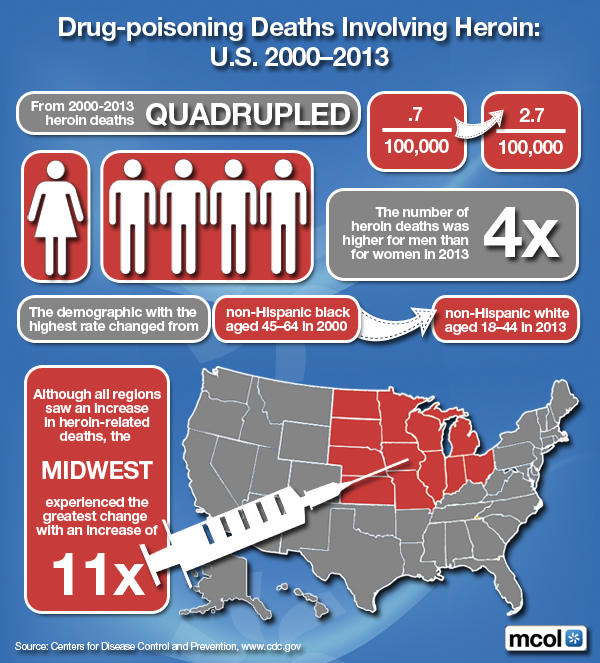
Drug Poisoning Deaths Involving Heroin

Join Our Mailing List 

US 2000-2013 [Quadrupled]

By http://www.MCOL.com

***

ImageProxy

***

More:

Conclusion

Your thoughts and comments on this ME-P are appreciated. Feel free to review our top-left column, and top-right sidebar materials, links, URLs and related websites, too. Then, subscribe to the ME-P. It is fast, free and secure.

Speaker: If you need a moderator or speaker for an upcoming event, Dr. David E. Marcinko; MBA – Publisher-in-Chief of the Medical Executive-Post – is available for seminar or speaking engagements. Contact: MarcinkoAdvisors@msn.com

OUR OTHER PRINT BOOKS AND RELATED INFORMATION SOURCES:

Product DetailsProduct Details

Seeking Authors by “Crowd-Sourcing” our Proposed Medical Marketing TextBook

Join Our Mailing List

Seeking Authors by “Crowd-Sourcing” our Proposed Medical Marketing TextBook

SOAR

MEDICAL PRACTICE MARKETING MANAGEMENT, ADVERTISING, SALES, COMMUNICATION AND SOCIAL MEDIA SKILLS

[New-Wave Success Strategies for Savvy Doctors]

Comprehensive Financial Planning Strategies for Doctors and Advisors: Best Practices from Leading Consultants and Certified Medical Planners(TM)

Product Details

Go back

Your message has been sent

Warning
Warning
Warning
Warning

Warning.

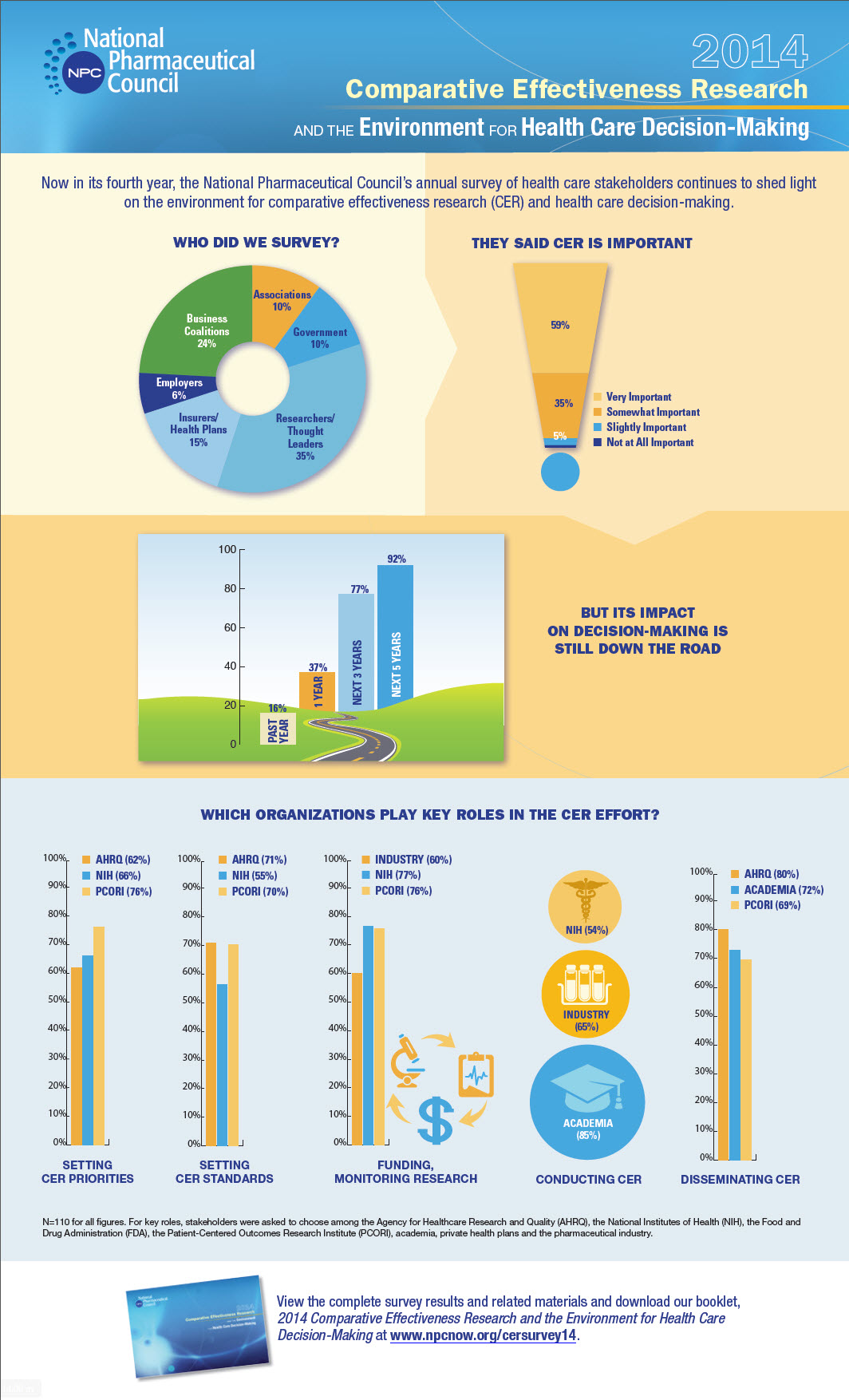
NPCs Info-Graphic on Comparative Effectiveness Research

Join Our Mailing List

National Pharmaceutical Council

[By Staff Reporters]

The National Pharmaceutical Council’s fourth annual survey of health care stakeholders sheds some light on the environment for comparative effectiveness research (CER) and health care decision-making.

***

CER-Survey

***

Questions

  • How important is CER?
  • Which organizations play key roles in the CER effort?
  • How long will it take to see the impact of CER on decision making?

Assessment

Find the answers to these questions and more in this info graphic. (Source: National Pharmaceutical Council, 2014)

Channel Surfing the ME-P

Have you visited our other topic channels? Established to facilitate idea exchange and link our community together, the value of these topics is dependent upon your input. Please take a minute to visit. And, to prevent that annoying spam, we ask that you register. It is fast, free and secure.

More:

Conclusion

Your thoughts and comments on this ME-P are appreciated. Feel free to review our top-left column, and top-right sidebar materials, links, URLs and related websites, too. Then, subscribe to the ME-P. It is fast, free and secure.

Speaker: If you need a moderator or speaker for an upcoming event, Dr. David E. Marcinko; MBA – Publisher-in-Chief of the Medical Executive-Post – is available for seminar or speaking engagements. Contact: MarcinkoAdvisors@msn.com

OUR OTHER PRINT BOOKS AND RELATED INFORMATION SOURCES:

Product DetailsProduct Details

18 Financial Planning Tips For Physicians from a DR-CPA

Join Our Mailing List

For Personal and Medical Practice Management Modernity

Dr. Gary Bode; CPA, MSA, CMP

By Dr. Gary L. Bode CPA MSA CMP [Hon] PA

http://garybodecpa.com/

http://www.CertifiedMedicalPlanner.org

1. Consider establishing an employee stock ownership plan (ESOP).

If you own a clinic or medical practice or business and need to diversify your investment portfolio, consider establishing an ESOP. ESOP’s are the most common form of employee ownership in the U.S. and are used by companies for several purposes, among them motivating and rewarding employees and being able to borrow money to acquire new assets in pretax dollars. In addition, a properly funded ESOP provides you with a mechanism for selling your shares with no current tax liability. Consult a specialist in this area to learn about additional benefits.

2. Make sure there is a succession plan in place.

Have you provided for a succession plan for both management and ownership of your medical practice, clinic or business in the event of your death or incapacity? Many business owners or physician-executives wait too long to recognize the benefits of making a succession plan. These benefits include ensuring an orderly transition at the lowest possible tax cost. Waiting too long can be expensive from a financial perspective (covering gift and income taxes, life insurance premiums, appraiser fees, and legal and accounting fees) and a non-financial perspective (intra-family and intra-company squabbles).

3. Consider the limited liability company (LLC) and limited liability partnership (LLP) forms of ownership.

These entity forms should be considered for both tax and non-tax reasons.

4. Avoid nondeductible compensation.

Compensation can only be deducted if it is reasonable. Recent court-decisions have allowed physician executives or business owners to deduct compensation when (1) the corporation’s success was due to the shareholder-employee, (2) the bonus policy was consistent, and (3) the corporation did not provide unusual corporate prerequisites and fringe benefits.

5. Purchase corporate owned life insurance (COLI).

COLI can be a tax-effective tool for funding deferred executive compensation, funding clinic or company redemption of stock as part of a succession plan, and providing many employees with life insurance in a highly leveraged program. Consult your insurance and tax advisers when considering this technique.

6. Consider establishing a SIMPLE retirement plan.

If you have no more than 100 employees and no other qualified plan, you may set up a Savings Incentive Match Plan for Employees (SIMPLE) into which an employee may contribute up to $12,500 per year if you’re under 50 years old and $15,500 a year if you’re over 50 in 2015. As an employer, you are required to make matching contributions. Talk with a benefits specialist to fully understand the rules and advantages and disadvantages of these accounts.

 ***free_54915

***

7. Establish a Keogh retirement plan before December 31st.

If you are self-employed and want to deduct contributions to a new Keogh retirement plan for this tax year, you must establish the plan by December 31st. You don’t actually have to put the money into your Keogh(s) until the due date of your tax return. Consult with a specialist in this area to ensure that you establish the Keogh or Keoghs that maximize your flexibility and your annual contributions.

8. Section 179 expensing.

Businesses and medical practices may be able to expense up to $25,000 in 2015 for equipment purchases of qualifying property placed in service during the filing year, instead of depreciating the expenditures over a longer time period. The limit is reduced by the amount by which the cost of Section 179 property placed in service during the tax year 2015 exceeds $200,000.

9. Don’t forget deductions for health insurance premiums.

If you are self-employed (or are a partner or a 2-percent S corporation shareholder-employee) you may deduct 100 percent of your medical insurance premiums for yourself and your family as an adjustment to gross income. The adjustment does not reduce net earnings subject to self-employment taxes, and it cannot exceed the earned income from the business under which the plan was established. You may not deduct premiums paid during a calendar month in which you or your spouse is eligible for employer-paid health benefits.

10. Review whether compensation may be subject to self-employment taxes.

If you are a sole proprietor, an active partner in a partnership, or a manager in a limited liability company, the net earned income you receive from the entity may be subject to self-employment taxes.

11. Don’t overlook minimum distributions at age 70½ and rack up a 50 percent penalty.

Minimum distributions from qualified retirement plans and IRAs must begin by April 1 of the year after the year in which you reach age 70½. The amount of the minimum distribution is calculated based on your life expectancy or the joint and last survivor life expectancy of you and your designated beneficiary. If the amount distributed is less than the minimum required amount, an excise tax equal to 50 percent of the amount of the shortfall is imposed.

12. Don’t double up your first minimum distributions and pay unnecessary income and excise taxes.

Minimum distributions are generally required at age seventy and one-half, but you are allowed to delay the first distribution until April 1 of the year following the year you reach age seventy and one-half. In subsequent years, the required distribution must be made by the end of the calendar year. This creates the potential to double up in distributions in the year after you reach age 70½. This double-up may push you into higher tax rates than normal. In many cases, this pitfall can be avoided by simply taking the first distribution in the year in which you reach age 70½.

***

buckets cash

***

13. Don’t forget filing requirements for household employees.

Employers of household employees must withhold and pay social security taxes annually if they paid a domestic employee more than $1,900 a year in 2015 (same as 2014). Federal employment taxes for household employees are reported on your individual income tax return (Form 1040, Schedule H). To avoid underpayment of estimated tax penalties, employers will be required to pay these taxes for domestic employees by increasing their own wage withholding or quarterly estimated tax payments. Although the federal filing is now required annually, many states still have quarterly filing requirements.

14. Consider funding a nondeductible regular or Roth IRA.

Although nondeductible IRAs are not as advantageous as deductible IRAs, you still receive the benefits of tax-deferred income. Note, the income thresholds to qualify for making deductible IRA contributions, even if you or your spouse is an active participant in a employer plan, are increasing.

The $100,000 income test for converting a traditional IRA to a ROTH IRA was permanently eliminated in 2010, allowing anyone to complete the conversion.

You can withdraw all or part of the assets from a traditional IRA and reinvest them (within 60 days) in a Roth IRA. The amount that you withdraw and timely contribute (convert) to the Roth IRA is called a conversion contribution. If properly (and timely) rolled over, the 10 percent additional tax on early distributions will not apply. However, a part or all of the distribution from your traditional IRA may be included in gross income and subjected to ordinary income tax.

Caution: You must roll over into the Roth IRA the same property you received from the traditional IRA. You can roll over part of the withdrawal into a Roth IRA and keep the rest of it. However, the amount you keep will generally be taxable (except for the part that is a return of nondeductible contributions) and may be subject to the 10 percent additional tax on early distributions.

15. Calculate your tax liability as if filing jointly and separately.

In certain situations, filing separately may save money for a married couple. If you or your spouse is in a lower tax bracket or if one of you has large itemized deductions, filing separately may lower your total taxes. Filing separately may also lower the phase out of itemized deductions and personal exemptions, which are based on adjusted gross income. When choosing your filing status, you should also factor in the state tax implications.

16. Avoid the hobby loss rules.

If you choose self-employment over a second job to earn additional income, avoid the hobby loss rules if you incur a loss. The IRS looks at a number of tests, not just the elements of personal pleasure or recreation involved in the activity.

17. Review your will and plan ahead for post-mortem tax strategies.

A number of tax planning strategies can be implemented soon after death. Some of these, such as disclaimers, must be implemented within a certain period of time after death. A number of special elections are also available on a decedent’s final individual income tax return. Also, review your will as the estate tax laws are influx and your will may have been written with differing limits in effect. In 2015, estates of $5,430,000 (up from $5,340,000 in 2014) are exempt from the estate tax with a 40 percent maximum tax rate (made permanent starting in tax year 2013).

18. Check to see if you qualify for the Child Tax Credit.

A $1,000 tax credit is available for each dependent child (including stepchildren and eligible foster children) under the age of 17 at the end of the taxable year. The child credit generally is available only to the extent of a taxpayer’s regular income tax liability. However, for a taxpayer with three or more children, this limitation is increased by the excess of Social Security taxes paid over the sum of other nonrefundable credits and any earned income tax credit allowed to the taxpayer. For 2015 (as in previous years), the income threshold is $3,000.

For more information concerning these financial planning ideas, please call or email us.

More: Enter the CMPs

ABOUT  DR. GARY L. BODE MSA CPA CMP [Hon]

Dr. Gary L. Bode was Chief Executive Officer of Comprehensive Practice Accounting, Inc., a firm specializing in providing tax solutions to medical professionals. Originally, he was a board certified podiatrist and managing partner of a multi-office medical practice for a decade before earning his Master of Science degree in Accounting from the University of North Carolina. He then served as Chief Financial Officer [CFO] for a private mental healthcare facility. Today, Dr. Bode is a nationally known Certified Public Accountant, financial author, educator, and speaker. Areas of expertise include producing customized managerial accounting reports, practice appraisals and valuations, restructurings, and innovative financial accounting as well as proactive tax positioning and tax return preparation for healthcare facilities. He has been quoted in Newsweek.

Channel Surfing the ME-P

Have you visited our other topic channels? Established to facilitate idea exchange and link our community together, the value of these topics is dependent upon your input. Please take a minute to visit. And, to prevent that annoying spam, we ask that you register. It is fast, free and secure.

Conclusion

Your thoughts and comments on this ME-P are appreciated. Feel free to review our top-left column, and top-right sidebar materials, links, URLs and related websites, too. Then, subscribe to the ME-P. It is fast, free and secure.

Speaker: If you need a moderator or speaker for an upcoming event, Dr. David E. Marcinko; MBA – Publisher-in-Chief of the Medical Executive-Post – is available for seminar or speaking engagements. Contact: MarcinkoAdvisors@msn.com

OUR OTHER PRINT BOOKS AND RELATED INFORMATION SOURCES:

Comprehensive Financial Planning Strategies for Doctors and Advisors: Best Practices from Leading Consultants and Certified Medical Planners(TM)* 8

Product DetailsProduct DetailsProduct Details

Take the Geneia “Joy of Medicine” Challenge

Join Our Mailing List

Submit your Ideas – Today!

Bryan Vartabedian, MD's avatar By Bryan Vartabedian MD

It’s a fact, there’s not a lot of joy out there among today’s physicians. 84 % of you report that ‘quality patient time’ may be a thing of the past. And, 67 % of you know a colleague who’s actually thinking about giving it all up.

Timeline

  • about 2 months until voting ends on Wednesday, May 13th, 2015 at 7:00 PM

***

hospital

VOTING LINK HERE:

https://medstro.com/groups/joy

***

Assessment

At Geneia,we’re working hard to find the answers. And; we need a second opinion — yours. Submit your ideas to the Geneia Joy of Medicine Challenge today!

More:

Conclusion

Your thoughts and comments on this ME-P are appreciated. Feel free to review our top-left column, and top-right sidebar materials, links, URLs and related websites, too. Then, subscribe to the ME-P. It is fast, free and secure.

ABOUT

Dr. Bryan Vartabedian is considered one of health care’s most influential voices on technology and medicine. His insight and thought leadership has made him a sought after keynote speaker in the area of medicine and new media. Dr. V has developed unique expertise in understanding how new media can be leveraged by organizations and individual stakeholders in health care. He consequently has served on the advisory board of Stanford’s Medicine X conference and currently serves on the External Advisory Board of the Mayo Clinic Center for Social Media. Dr Vartabedian currently serves as a founding advisor to the Health Care Track at the SXSW Interactive Festival. You can find him quoted in outlets such as The Wall Street Journal, The New York Times, US News and World Report and CNN.

Speaker: If you need a moderator or speaker for an upcoming event, Dr. David E. Marcinko; MBA – Publisher-in-Chief of the Medical Executive-Post – is available for seminar or speaking engagements. Contact: MarcinkoAdvisors@msn.com

OUR OTHER PRINT BOOKS AND RELATED INFORMATION SOURCES:

Product Details

Women Retirement Confidence

Join Our Mailing List 

Financial Preparation

By Rick Kahler MS CFP® http://www.KahlerFinancial.com

Rick Kahler MS CFPWhen it comes to being financially prepared for retirement, Chinese women are the most confident women in the world. In fact, they are almost twice as confident as their US counterparts.

The Survery

This conclusion comes from a 2014 global survey, the Aegon Retirement Readiness Index. It found that the percentage of women saying they are very confident or extremely confident about retirement is 42% in China, 35% in India, 29% in Brazil, 22% in the US, and 18% in Canada.

The survey included responses from 16,000 employees and retirees in 15 countries, half of whom were women. About 62% of the women were married, 52% had some higher education, and 80% took an active role in managing the household finances.

The Insights

Several aspects of this survey really caught my attention:

  • I was puzzled that only two developed countries—the US and Canada—made the top five. The first three—China, India, and Brazil—were  emerging markets with little or no social safety nets in place.
  • Even more notable is that, in the US and Canada, the number of women who do not feel prepared to retire (38% in the US and 36% in Canada) is almost twice as high as the number that are confident about retirement.
  • And more notable yet is that the bottom five includes three developed countries with strong social safety nets. In France, Japan, and Spain, less than 6% of women reported retirement confidence, while 60% or higher said they had no confidence.

It seems puzzling that the countries with large social safety nets spawned less retirement confidence than did developed countries with little or no safety net. Why isn’t it the opposite? Why aren’t women in countries where government plays a big part in retirement income more confident?

The Answer?

Therein may lay the answer. Possibly because of the lack of government retirement programs, people in the emerging market countries like China, India, and Brazil realize they cannot count on anyone but themselves in retirement. They know they must begin saving a significant amount of their income, starting early in life, to be able to sustain themselves in retirement. A failure to do so will result in them literally being “thrown out onto the street” or into the “poor house.” As harsh as that may sound to our Western ears, the reality must be a powerful motivator.

***

Depression

***

The Reality

This reality was brought home to me by two people I met on visits to China and India. One Chinese woman in her 20’s told me she saved a third of her income. She said, “People in America don’t need to save. China doesn’t have the social safety nets you have.” Part of surviving in their society is to learn money skills and how to save early in life for emergencies and retirement. A man I met in India told me much the same story; he had his retirement fully funded by age 45.

In the US and most other developed countries, government programs like Social Security have become the retirement plan of the masses. Yet the majority of women in developed countries don’t seem to find comfort in those programs.

However, neither do they save like their emerging market counterparts. In fact, 56% of Americans live hand to mouth, according to a 2005 survey of retirement savings for baby boomers and others, by Sharon A. Devaney and Sophia T. Chiremba, reported at the US Bureau of Labor Statistics [USBLS].

Assessment

What might motivate women globally to gain confidence in their retirement preparedness? I don’t know. But based on the results of this survey, the answer won’t be found in more government programs.

Conclusion

Your thoughts and comments on this ME-P are appreciated. Feel free to review our top-left column, and top-right sidebar materials, links, URLs and related websites, too. Then, subscribe to the ME-P. It is fast, free and secure.

Speaker: If you need a moderator or speaker for an upcoming event, Dr. David E. Marcinko; MBA – Publisher-in-Chief of the Medical Executive-Post – is available for seminar or speaking engagements. Contact: MarcinkoAdvisors@msn.com

OUR OTHER PRINT BOOKS AND RELATED INFORMATION SOURCES:

Comprehensive Financial Planning Strategies for Doctors and Advisors: Best Practices from Leading Consultants and Certified Medical Planners(TM)

Meet Next-Gen Healthcare Powered by the Industrial Internet

Join Our Mailing List 

This is Your Body Online

[By GE Healthcare IT]

A couple of years ago, the Kadlec Health System in Washington State started testing a new cloud-based technology that mashes up professional networking and diagnostics. The system allows doctors to create a professional profile, store patient images and data together in one place, view them from anywhere and access intuitive analytics.

“It’s like LinkedIn professional networking meets diagnostic imaging,” said Jeanine Banks, general manager of Commercial Cloud Solutions at GE Healthcare IT, which developed the technology. “There is a lot of waste in the system. We want to help rein in the costs and make the system far more efficient.”

A study published in the Journal of American Medical Association found that almost 40 percent of patients are misdiagnosed in primary care [1]. Another report by the American College of Physicians discovered that unnecessary testing and medical procedures, and extra days in the hospital caused by wrong diagnoses could add up to $800 billion per year, close to one-third of all U.S. healthcare costs [2].

***

tumblr_m7tx4hQDeq1qk4ealo1_1280

***

At a panel of experts, John Dineen, president and CEO of GE Healthcare, Bill Ruh, who runs GE’s Global Software Center, and Michael Leavitt, the former secretary of U.S. Health and Human Services discussed the state of American healthcare and the ways to improve it with technology. Their panel, which was moderated by technology investor and philanthropist Esther Dyson, was part of GE’s conference focused on IT in healthcare.

Ruh and Dineen reminded everyone that over the last two decades many consumer-facing industries got thoroughly remade and that healthcare won’t be different. “There was an architectural shift of technology,” Ruh said. “We changed how we deliver and interact with music and books.”

Dineen said that the healthcare landscape was also changing “from cost plus to profit and loss. The consumer will start making buying decisions,” Dineen said. “There’s going to be transparency. There is going to be a real focus on productivity and customer satisfaction and that’s going to require tremendous investment …The industry will pivot over the next few years.”

Industrial Internet systems like the GE technology that’s now working at Kadlec will be one driver of change. But, former Sec. Leavitt said collaborative tools that bring together patients, insurers and providers will help distribute the risk associated with healthcare costs.

“Exchanges will allow consumers to make trade-offs,” Leavitt said. “If you stay with me and get your body in a better shape, I’ll give you a better [insurance] price.”

***

tumblr_inline_nhs0a2MZUr1qzgziy

***

Next-generation healthcare will also focus on outcomes. Dineen said that engineers used to be concerned chiefly with building better machines and “taking the technology to the next level.” But, medical systems in the future will have to combine high quality and lower costs with results.

Dineen and Ruh stressed the need to focus on predictive analytics, which has started empowering other industries. Dineen said that in aviation, Industrial Internet systems can already see “a signature of a problem and get it fixed when [the aircraft] comes to a shop and not on a mountain top.”

“It’s not that you get this magic answer that something is going to break,” Ruh said. “You get early indicators. You still need to have experts in the loop.”

Dineen said that right now, the healthcare industry was going through “this clumsy period when the incentives have not kicked in” yet. He listed three stages of the IT revolution in healthcare that need to take place. They include connecting machines and digitizing data, getting data from siloes like primary care providers, as well as the “rich stage,” which involves analysis and learning from the data.

Assessment

Researchers estimate that the majority of healthcare costs stem from preventable chronic health conditions rather than disease prevention and early detection. Dineen called the status quo “unproductive.” The new system will have the rewards and the incentives to change that, he said.

Citations:

1 Journal of American Medical Association 2012

2 Reuter’s, citing study by American College of Physicians

Conclusion

Your thoughts and comments on this ME-P are appreciated. Feel free to review our top-left column, and top-right sidebar materials, links, URLs and related websites, too. Then, subscribe to the ME-P. It is fast, free and secure.

Speaker: If you need a moderator or speaker for an upcoming event, Dr. David E. Marcinko; MBA – Publisher-in-Chief of the Medical Executive-Post – is available for seminar or speaking engagements. Contact: MarcinkoAdvisors@msn.com

OUR OTHER PRINT BOOKS AND RELATED INFORMATION SOURCES:

Product DetailsProduct Details

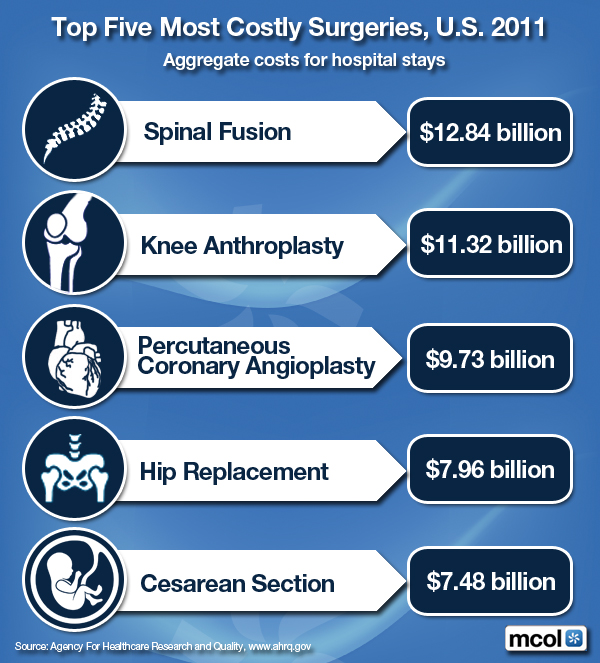
Five Most Costly Domestic Surgeries

Join Our Mailing List

USA Aggregate Hospital Stays for 2011

By http://www.MCOL.com

ImageProxy

Conclusion

Your thoughts and comments on this ME-P are appreciated. Feel free to review our top-left column, and top-right sidebar materials, links, URLs and related websites, too. Then, subscribe to the ME-P. It is fast, free and secure.

Speaker: If you need a moderator or speaker for an upcoming event, Dr. David E. Marcinko; MBA – Publisher-in-Chief of the Medical Executive-Post – is available for seminar or speaking engagements. Contact: MarcinkoAdvisors@msn.com

OUR OTHER PRINT BOOKS AND RELATED INFORMATION SOURCES:

Product DetailsProduct Details

On Physicians and Automobile Leases

Join Our Mailing List

Advantages, Disadvantages and Types

[By Dr. David Edward Marcinko MBA CMP™]

Dr. Marcinko 1972 VetteThe Rites of Spring!

As a former licensed state insurance agent, and financial advisor, I know that leasing a car may have advantages to a physician – and others – such as convenient maintenance, low down and monthly payments, no resale responsibility, and tax savings since you pay sales tax on the lease portion rather than the purchase price of the car.

It might also be worthwhile if the after tax borrowing cost of a home equity loan is less than the lease financing rate.

***

Spring 2011 - NIH

[First Days of Spring 2017]

May Day Weekend 2011 [Dr. David E. Marcinko MBA]

***

Types of Leases

There are two major types of leases: open and closed ended. In the former type, if the car is worth more than the set price upon expiration of the lease, you are responsible for the underage or coverage. In the more advantages later type, the responsibility of the value of the car is shifted to the leasing company. Other tips on care leasing include:

  • Inform the lessor how you want the auto equipped; do not accept unwanted options.
  • Obtain all delivery, and other, charges in advance, including down payment, security.
  • Deposit, registration fees, interest rates, residual value, rebates and all taxes (sales, personal property, use and gross receipt).
  • Know the capitalized cost (selling price) of the car
  • Know annual mileage limits, usually 15-18,000 miles, and all excess use charges.
  • Avoid maintenance and service contracts, and arrange for your own insurance.
  • Understand that terms, such as money factor, or interest factor, may be used instead of the term interest rate. In this case, simply multiple the rate by 24 for an estimate of the true interest rate involved.
  • Read the contract and understand all penalties, especially for premature or late termination, purchase or return terms, and consequences of theft.
  • Check the lease terms through an independent company, such as First National Lease Systems.

Rough Rules of Thumb

A rough rule of thumb to determine whether to buy or lease involves multiplying all the payments required by the number of months you will have to pay, and add the down payment to yield the total amount of the purchase. Then, multiply the lease payment by the number of months, and add required up-front costs, as well as residual value (end of lease buyout cost), to determine the total amount to lease. Compare the two figures to determine the most economical deal.

Typically, a cash deal is less expensive in the long run, providing a higher after tax rate of return is not available, as an alternate investment, for the funds.

***

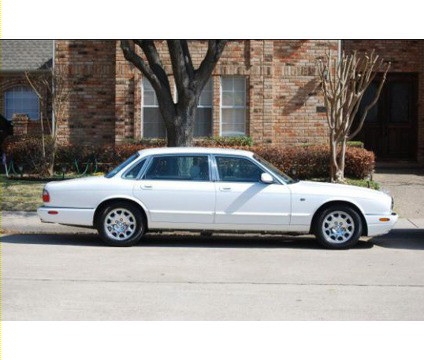
Jaguar Touring sedan XJ-V8-LWB***

Dis-Advantages

But, there are dis-advantages to auto leasing, too!

Perhaps the worse reason to lease a car is to drive one that you could not otherwise afford to drive. This is because most low monthly payments are only composed of two portions: interest on the note and the prorated cost of auto depreciation. No money is applied to ownership of the vehicle.

Assessment

Finally, beware Spring-Fever and do not likely buy “gap” insurance to cover the difference between what your auto insurer would pay if your car was totaled, and what you would owe the leasing firm. It’s usually too expensive and the risk is minimal.

More:

Channel Surfing the ME-P

Have you visited our other topic channels? Established to facilitate idea exchange and link our community together, the value of these topics is dependent upon your input. Please take a minute to visit. And, to prevent that annoying spam, we ask that you register. It is fast, free and secure.

Conclusion

Your thoughts and comments on this ME-P are appreciated. Feel free to review our top-left column, and top-right sidebar materials, links, URLs and related websites, too. Then, subscribe to the ME-P. It is fast, free and secure.

Speaker: If you need a moderator or speaker for an upcoming event, Dr. David E. Marcinko; MBA – Publisher-in-Chief of the Medical Executive-Post – is available for seminar or speaking engagements. Contact: MarcinkoAdvisors@msn.com

OUR OTHER PRINT BOOKS AND RELATED INFORMATION SOURCES:

Comprehensive Financial Planning Strategies for Doctors and Advisors: Best Practices from Leading Consultants and Certified Medical Planners(TM)

***

On the FBI’s Medicare Fraud Strike Forces

Join Our Mailing List

$6.5 Billion in Cash

Edward Bukstel

[By Edward Bukstel]

ME-P SPECIAL REPORT

FBI’s Medicare Fraud Strike Forces Strikes $6.5 Billion in Cash.

***

Miami based Home Health Agency owner guilty of Medicare fraud,  The Medicare Fraud Strike Force since its inception in March 2007, is now operating in nine cities across the country, has charged nearly 2,100 defendants who have collectively billed the Medicare program for more than $6.5 billion.

***

benjamin-bills3

***

 In addition, the HHS Centers for Medicare & Medicaid Services, working in conjunction with the HHS-OIG, are taking steps to increase accountability and decrease the presence of fraudulent providers.

***

Channel Surfing the ME-P

Have you visited our other topic channels? Established to facilitate idea exchange and link our community together, the value of these topics is dependent upon your input. Please take a minute to visit. And, to prevent that annoying spam, we ask that you register. It is fast, free and secure.

***

Money

***

More:

Conclusion

Your thoughts and comments on this ME-P are appreciated. Feel free to review our top-left column, and top-right sidebar materials, links, URLs and related websites, too. Then, subscribe to the ME-P. It is fast, free and secure.

Speaker: If you need a moderator or speaker for an upcoming event, Dr. David E. Marcinko; MBA – Publisher-in-Chief of the Medical Executive-Post – is available for seminar or speaking engagements. Contact: MarcinkoAdvisors@msn.com

OUR OTHER PRINT BOOKS AND RELATED INFORMATION SOURCES:

Product DetailsProduct Details

More on “Passive Investing” for Physicians

Join Our Mailing List 

Basic Financial Concepts

tim

By Timothy J. McIntosh; CFPMBA MPH CMP [hon]

By Jeffery S. Coons; PhD CFA

By Dr. David E. Marcinko; MBA CMP™

Passive investing is a monetary plan in which an investor invests in accordance with a pre-determined strategy that doesn’t necessitate any forecasting of the economy or an individual company’s prospects.

Premise

The primary premise is to minimize investing fees and to avoid the unpleasant consequences of failing to correctly predict the future. The most accepted method to invest passively is to mimic the performance of a particular index. Investors typically do this today by purchasing one or more ‘index funds’. By tracking an index, an investor will achieve solid diversification with low expenses.  Thus, a physician-investor could potentially earn a higher rate of return than an investor paying higher management fees.

Passive management is most widespread in the stock markets.  But; with the explosion of exchange traded funds on the major exchanges, index investing has become more popular in other categories of investing. There are now literally hundreds of different index funds.

***

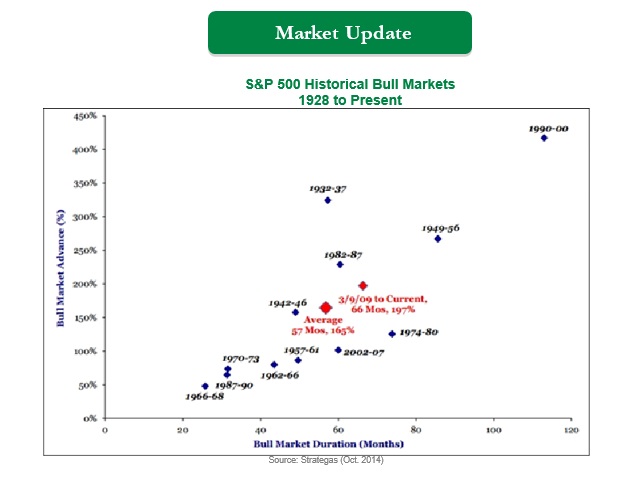
Bull Markets

[Domestic Bull Markets – Historical USA]

***

Passive management is based upon the Efficient Market Hypothesis theory.  The Efficient Market Hypothesis (EMH) states that securities are fairly priced based on information regarding their underlying cash flows and that investors should not anticipate to consistently out-perform the market over the long-term.

The Efficient Market Hypothesis evolved in the 1960s from the Ph.D. dissertation of Eugene Fama.  Fama persuasively made the case that in an active market that includes many well-informed and intelligent investors, securities will be appropriately priced and reflect all available information. If a market is efficient [even emerging and/or world markets], no information or analysis can be expected to result in outperformance of an appropriate benchmark.

***

World Markets

[USA versus World Index]

***

Channel Surfing the ME-P

Have you visited our other topic channels? Established to facilitate idea exchange and link our community together, the value of these topics is dependent upon your input. Please take a minute to visit. And, to prevent that annoying spam, we ask that you register. It is fast, free and secure.

More:

The Author

Timothy J. McIntosh is Chief Investment Officer and founder of SIPCO.  As chairman of the firm’s investment committee, he oversees all aspects of major client accounts and serves as lead portfolio manager for the firm’s equity and bond portfolios. Mr. McIntosh was a Professor of Finance at Eckerd College from 1998 to 2008. He is the author of The Bear Market Survival Guide and the The Sector Strategist.  He is featured in publications like the Wall Street Journal, New York Times, USA Today, Investment Advisor, Fortune, MD News, Tampa Doctor’s Life, and The St. Petersburg Times.  He has been recognized as a Five Star Wealth Manager in Texas Monthly magazine; and continuously named as Medical Economics’ “Best Financial Advisors for Physicians since 2004.  And, he is a contributor to SeekingAlpha.com., a premier website of investment opinion. Mr. McIntosh earned a Bachelor of Science Degree in Economics from Florida State University; Master of Business Administration (M.B.A) degree from the University of Sarasota; Master of Public Health Degree (M.P.H) from the University of South Florida and is a CERTIFIED FINANCIAL PLANNER® practitioner. His previous experience includes employment with Blue Cross/Blue Shield of Florida, Enterprise Leasing Company, and the United States Army Military Intelligence.

Conclusion

Your thoughts and comments on this ME-P are appreciated. Feel free to review our top-left column, and top-right sidebar materials, links, URLs and related websites, too. Then, subscribe to the ME-P. It is fast, free and secure.

Speaker: If you need a moderator or speaker for an upcoming event, Dr. David E. Marcinko; MBA – Publisher-in-Chief of the Medical Executive-Post – is available for seminar or speaking engagements. Contact: MarcinkoAdvisors@msn.com

OUR OTHER PRINT BOOKS AND RELATED INFORMATION SOURCES:

Comprehensive Financial Planning Strategies for Doctors and Advisors: Best Practices from Leading Consultants and Certified Medical Planners(TM)

Understanding State Medical Board Structures

Join Our Mailing List

 “The Tale of Two Boards”

[By Eric A. Dover MD]

[By Michael Lawrence Langan MD]

SOAR

***

The great majority of States have in reality two Medical Boards. All States have a “Board Proper” and all but a handful have an “Administrative Board”.

First Board

The “Board Proper” is, depending on the State, made up of seven to sixteen individuals. There will be a President (Chairperson) and President Elect. The Board Members are “volunteers”, typically placed by the State Governor. The individuals who constitute the Board may vary greatly and are somewhat determined by the medical disciplines overseen by the Medical Board. Oklahoma presently separates Medical Doctors (M.D.) and (D.O.) into two Boards http://www.okmedicalboard.org/

Other Medical Boards may oversee Physician Assistants (P.A.), Midwives, Respiratory Therapists, Podiatrists, Athletic Trainers, etc., who may or may not have direct Board representation. All States have M.D.s on the Board, and some Boards are all M.D.s. Others members of the Board may include D.O.s, P.A.s, Podiatrists, Midwives, Respiratory Therapists, a representative from the Secretary of State’s office, the Commissioner of State Boards or an Educational Director. Many, but not all Medical Boards, will have anywhere from one to three Public Members.

Some States require Public Member(s) come from a specific profession such as a lawyer or hospital administrator. Other States have no such qualifications; therefore the Public Member can be from any profession.

Second Board

The “Administrative Board” is the other Medical Board. They run the operation throughout the year. Their personnel, structure and operation vary widely from State to State.

Most States will have an Executive Director who supervises the Board.   Some states, such as New Mexico http://www.nmmb.state.nm.us/ or Indiana http://www.in.gov/pla/3638.htm, use a State Board Director for all boards, and don’t have a specific Executive Director.

Pennsylvania uses a State Administrator in lieu of an Executive Director. Individuals filling these positions are either legally or administratively trained.

http://www.dos.pa.gov/ProfessionalLicensing/BoardsCommissions/Medicine/Pages/default.aspx#.VOO-ZfZ0zIU

Many States have a Medical Director. They are physicians whose tasks, for example, may include working with Investigators, lending medical expertise or working on Board Committees. Many other State Medical Boards, such as Delaware don’t have one. http://dpr.delaware.gov/boards/medicalpractice/members.shtml

Medical Boards are divided regarding in-house Legal Staff. Oregon has in-house legal staff, but also relies upon a single Assistant Attorney General from the State Department of Justice   http://www.oregon.gov/OMB/Pages/index.aspx.

In Pennsylvania, all State Boards use the Office of General Council for legally related issues. http://www.dos.pa.gov/ProfessionalLicensing/BoardsCommissions/Medicine/Pages/default.aspx#.VOO-ZfZ0zIU.

***

professor

***

Assessment

Each State handles their Medical Board investigations differently. Some have in-house investigators. They may be ex-police officers, which are common, but they don’t have to be.

California’s Investigators are called “Peace Officers” and they aren’t typically ex-police http://www.mbc.ca.gov/

In North Dakota, the Board Members act as the investigative staff and will hire outside investigators if necessary https://www.ndbomex.org/

In Delaware, investigations are handled for all Boards by the Division of Professional Regulation http://dpr.delaware.gov/boards/medicalpractice/members.shtml.

About the Authors

Dr. Eric Dover is a board certified family practice and primary care physician in Portland, Oregon. He is a graduate of the University of California at Los Angeles [UCLA] School of Medicine.

Dr. Michael L. Langan graduated from Oregon Health Sciences University School of Medicine, Portland Oregon as a Medical Doctor 21 years ago. He had his residency training of Geriatric Medicine-Internal Medicine at Beth Israel Deaconess Medicine Center and Internal Medicine at St Vincent Hospital Medicine Center.

Channel Surfing the ME-P

Have you visited our other topic channels? Established to facilitate idea exchange and link our community together, the value of these topics is dependent upon your input. Please take a minute to visit. And, to prevent that annoying spam, we ask that you register. It is fast, free and secure.

Conclusion

Your thoughts and comments on this ME-P are appreciated. Feel free to review our top-left column, and top-right sidebar materials, links, URLs and related websites, too. Then, subscribe to the ME-P. It is fast, free and secure.

Speaker: If you need a moderator or speaker for an upcoming event, Dr. David E. Marcinko; MBA – Publisher-in-Chief of the Medical Executive-Post – is available for seminar or speaking engagements. Contact: MarcinkoAdvisors@msn.com

OUR OTHER PRINT BOOKS AND RELATED INFORMATION SOURCES:

Comprehensive Financial Planning Strategies for Doctors and Advisors: Best Practices from Leading Consultants and Certified Medical Planners(TM)* 8


Understanding the National Practitioner Data Bank (NPDB)

Join Our Mailing List 

What it Is – How it Works?

[By Eric A. Dover MD]

The NPDB, also known as the Data Bank, was written into HCQIA [Health Care Quality Indicators].  It is the national database for all physician reports.

Reporting Entities

Entities that are required to report physicians to this government program are:

  • Medical malpractice payers
  • State health care practitioner licensing and certification authorities
  • Hospitals
  • Other health care entities with formal peer review (HMOs, group practices, managed care organizations)
  • Professional societies with formal peer review
  • Federal and State Government agencies
  • Health insurance companies
  • The information collected by the NPDB includes:
  • Medical malpractice actions against a healthcare provider
  • Any adverse licensure actions by Medical Boards or peer review entities, including revocation, reprimand, censure, suspension, probation or dismissal or closure of any proceedings by reason of the practitioner surrendering the license or leaving the State or jurisdiction.
  • Adverse clinical privileging actions
  • Adverse professional society membership actions
  • Private accreditation organization negative actions or findings against health care practitioners
  • Criminal convictions that are health care-related
  • Exclusions from Federal or State health care programs
  • Entities that can query the NPDB include:
  • Hospitals, health care entities and professional societies with formal peer review
  • State health care practitioner licensing and certification authorities
  • Agencies or contractors administering Federal health care programs
  • State agencies administering State health care programs
  • State Medicaid Fraud Units
  • U.S. Comptroller General, U.S. Attorney General and other law enforcement
  • Self query by health care practitioner
  • Plaintiff’s attorney/pro se plaintiffs, but under limited circumstances
  • “Quality Improvement Organizations”
  • Researchers (statistical data only)
  • Federal and State Government agencies
  • Health plans
  • Researchers (Statistical data only)

Source: http://www.npdb.hrsa.gov/

***

npdb

***

Physician Reportage

Once a physician is reported to the NPDB, their career, if they still have one, is dramatically changed forever.  There is no expungement process to remove defamatory physician reports, whether true or not.  The stain is there forever.  You have the opportunity to write a rebuttal for what it’s worth.  Actions reported to the National Practitioner Data Bank by one entity will most likely trigger cross investigations and actions by other entities.

Source: http://www.drlaw.com/Articles/White-Paper—The-Targeting-of-Physicians—Insigh.aspx

Assessment

It is easy to extrapolate the simplicity of destroying a physician’s career, psyche and family with the untenable protections afforded by HCQIA to those responsible for the destruction.

Channel Surfing the ME-P

Have you visited our other topic channels? Established to facilitate idea exchange and link our community together, the value of these topics is dependent upon your input. Please take a minute to visit. And, to prevent that annoying spam, we ask that you register. It is fast, free and secure.

About

Dr. Eric Dover is a board certified family practice and primary care physician in Portland, Oregon. He is a graduate of the University of California at Los Angeles [UCLA] School of Medicine.

Conclusion

Your thoughts and comments on this ME-P are appreciated. Feel free to review our top-left column, and top-right sidebar materials, links, URLs and related websites, too. Then, subscribe to the ME-P. It is fast, free and secure.

Speaker: If you need a moderator or speaker for an upcoming event, Dr. David E. Marcinko; MBA – Publisher-in-Chief of the Medical Executive-Post – is available for seminar or speaking engagements. Contact: MarcinkoAdvisors@msn.com

OUR OTHER PRINT BOOKS AND RELATED INFORMATION SOURCES:

Comprehensive Financial Planning Strategies for Doctors and Advisors: Best Practices from Leading Consultants and Certified Medical Planners(TM)* 8

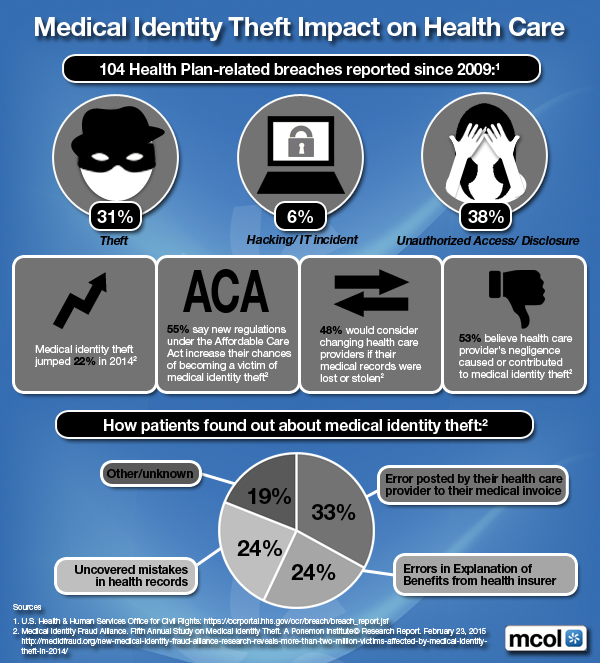
The Impact of Medical Identity Theft on Health Care

Join Our Mailing List

Health Plan Related Breaches Since 2009

By http://www.MCOL.com

ImageProxy

Channel Surfing the ME-P

Have you visited our other topic channels? Established to facilitate idea exchange and link our community together, the value of these topics is dependent upon your input. Please take a minute to visit. And, to prevent that annoying spam, we ask that you register. It is fast, free and secure.

More:

Conclusion

How does this relate to emails? Your thoughts and comments on this ME-P are appreciated. Feel free to review our top-left column, and top-right sidebar materials, links, URLs and related websites, too. Then, subscribe to the ME-P. It is fast, free and secure.

Speaker: If you need a moderator or speaker for an upcoming event, Dr. David E. Marcinko; MBA – Publisher-in-Chief of the Medical Executive-Post – is available for seminar or speaking engagements. Contact: MarcinkoAdvisors@msn.com

OUR OTHER PRINT BOOKS AND RELATED INFORMATION SOURCES:


Product DetailsProduct Details


Is there a Migration of Patients to Paper-Based Dentists?

Join Our Mailing List 

Paper Medical Records Become Popular Again?

[By Kellus Pruitt DDS]

1-darrellpruitt

Starting long ago, I warned that as more dental patients are notified of data breaches – some more than once – we are likely to witness an event mandate stakeholders said would never happen: A migration of patients to paper-based dentists.

Now, because of the rapidly escalating costs and liabilities, defiant, slow adopters of electronic dental records [EDRs] can not only expect to provide dental care at a lower cost than “paperless practices,” but patients are on course to learn that some dentists do not put their patients at risk of medical identity theft by putting identities on computers.

Just sit back and watch!

The Ponemon Institute

In February, the Ponemon Institute published  their “Fifth Annual Study on Medical Identity Theft.”

 “Consumers expect healthcare providers to be proactive in preventing and detecting medical identity theft. Although many respondents are not confident in the security practices of their healthcare provider, 79 percent of respondents say it is important for healthcare providers to ensure the privacy of their health records. Forty-eight percent say they would consider changing healthcare providers if their medical records were lost or stolen. If such a breach occurred, 40 percent say prompt notification by the organization responsible for safeguarding this information is important.”

The Paper-Gold Standard? 

So if your patients start asking you not to put their identities – including medical records – on your computers, what will you do, Doc?

Since encryption is a non-starter in dentistry for solid, business reasons, and will make paperless practices even less competitive with paper-based, would you consider employing staff which knows how to use pegboard, ledger cards and lots of carbon paper (The gold standard of security)?

Or, would you prefer not to give up computerization, yet keep your patients safe?

*** paper

***

More:

Assessment

De-identification of primary electronic dental records is sounding better all the time. Am I right? If patients’ identities are not available, they cannot be hacked.

Channel Surfing the ME-P

Have you visited our other topic channels? Established to facilitate idea exchange and link our community together, the value of these topics is dependent upon your input. Please take a minute to visit. And, to prevent that annoying spam, we ask that you register. It is fast, free and secure.

Conclusion

How does this relate to emails? Your thoughts and comments on this ME-P are appreciated. Feel free to review our top-left column, and top-right sidebar materials, links, URLs and related websites, too. Then, subscribe to the ME-P. It is fast, free and secure.

Speaker: If you need a moderator or speaker for an upcoming event, Dr. David E. Marcinko; MBA – Publisher-in-Chief of the Medical Executive-Post – is available for seminar or speaking engagements. Contact: MarcinkoAdvisors@msn.com

OUR OTHER PRINT BOOKS AND RELATED INFORMATION SOURCES:

Socio Economic Status, Payment Reform and Medical Records

Join Our Mailing List 

Yet Another Component of the Medical Record?

[Dr. David Edward Marcinko MBA CMP™]

http://www.CertifiedMedicalPlanner.org

Dr David E Marcinko MBAHistorically, medical records [paper or electronic] were previously used to aid in the quality of medical care.

Now they are also the basis for payment for services, not as a record or reflection of the care that was actually provided, but as a separate justification for billing. The lack of appropriate documentation now no longer threatens just non-payment for services but risks civil money penalties and criminal charges.

Enter S.E.S.

Today, the idea known as Socio Economic Status [SES] is conceptualized as the social standing, or class of an individual or group. It is often measured as a combination of education, income and occupation. Examinations of socioeconomic status often reveal inequities in access to medical resources, plus issues related to privilege, power and control.

Assessment

SES is increasingly being considered as another payment component [CPT® codes] to medical providers, as reflected in the paper medical record, EMR and elsewhere.

***

eMRs

[Electronic Medical Records]

***

Channel Surfing the ME-P

Have you visited our other topic channels? Established to facilitate idea exchange and link our community together, the value of these topics is dependent upon your input. Please take a minute to visit. And, to prevent that annoying spam, we ask that you register. It is fast, free and secure.

More:

Conclusion

Your thoughts and comments on this ME-P are appreciated. Feel free to review our top-left column, and top-right sidebar materials, links, URLs and related websites, too. Then, subscribe to the ME-P. It is fast, free and secure.

Speaker: If you need a moderator or speaker for an upcoming event, Dr. David E. Marcinko; MBA – Publisher-in-Chief of the Medical Executive-Post – is available for seminar or speaking engagements. Contact: MarcinkoAdvisors@msn.com

OUR OTHER PRINT BOOKS AND RELATED INFORMATION SOURCES:

Comprehensive Financial Planning Strategies for Doctors and Advisors: Best Practices from Leading Consultants and Certified Medical Planners(TM)* 8

On Physicians Texting [SMS]

Join Our Mailing List 

Some Technical Considerations

By Carol Miller BSN RN MBA PMP [Miller Consulting]

Carol S. Miller

Text (SMS = Short Message Service) Messaging has become nearly ubiquitous on mobile devices. According to one survey, approximately 72 percent of mobile phone users send text messages (TMs).

Clinical medical care is not immune from the trend, and in fact physicians appear to be embracing texting on par with the general population. Another survey found that 73 percent of physicians text other physicians about work.

(Source:  Journal of AHIMA, “HIPAA Compliance for Clinician Texting”, by Adam Green, April 2012)

Advantages

Texting can offer providers numerous advantages for clinical care. It may be the fastest and most efficient means of sending information in a given situation, especially with factors such as background noise, spotty wireless network coverage, lack of access to a desktop or laptop, and a flood of e-mails clogging inboxes.

Further, texting is device neutral—it will work on personal or provider-supplied devices of all shapes and sizes. Because of these advantages, physicians may utilize texting to communicate clinical information, whether authorized to do so or not.

Risks

All forms of communication involve some level of risk. Text messaging merely represents a different set of risks that, like other communication technologies, needs to be managed appropriately to ensure both privacy and security of the information exchanged.

Text messages, like all digital data,  may reside on a mobile device indefinitely, where the information can be exposed to unauthorized third parties due to theft, loss, or recycling of the device. Text messages often can be accessed without any level of authentication, meaning that anyone who has access to the mobile phone may have access to all text messages on the device without the need to enter a password.

***

AA9tsnE

***

Texts also are generally not subject to central monitoring by the IT department. Although text messages communicated wirelessly are usually encrypted by the carrier, interception and decryption of such messages can be done with inexpensive equipment and freely available software (although a substantial level of sophistication is needed.

If text messages are used to make decisions about patient care, then they may be subject to the rights of access and amendment. There is a risk of noncompliance with the privacy rule if the covered entity cannot provide patients with access to or amend such text messages.

The Wireless Association

According to 2012 data from CTIA–The Wireless Association, U.S. citizens alone exchange nearly 200 billion text messages every month. So it’s not surprising that an increasing number of clinicians are using text messaging to exchange clinical information, along with a wide range of other modes — smartphones, pagers, computerized physician order entry, emails, etc. Electronic communication is certainly faster, can be more efficient, enhances clinical collaboration and enables clinicians to focus on patient care. But with these benefits comes an increased risk of security breaches.

(Source:  Clarifying the Confusion about HIPAA – Compliant Texting, by Megan Hardiman and Terry Edwards, May 2013)

Unfortunately, vendor hype about the Health Insurance Portability and Accountability Act [HIPAA] is causing many hospitals and health systems to implement stop-gap measures that address part — but not all — of a problem. To identify all vulnerabilities, health care leaders need to consider not only text messaging, but all mechanisms by which protected health information in electronic form is transmitted — as well as the security of those mechanisms.

Mobile device-to-mobile device SMS text messages are generally not secure because they lack encryption.  The sender does not know with certainty that his or her message is indeed received by the intended recipient.  In addition, telecommunications vendor/wireless carrier may store the text messages.

Recent HHS guidance indicates text messaging, as a means of communicating PHI, can be permissible under HIPAA depending in large part on the adequacy of the controls used.  A hospital or provider may be approved for texting after performing a risk analysis or implementing a third-party messaging solution that incorporates measures to establish a secure communication platform that will allow texting on approved mobile devices.

***

AA9tvIj

***

The Ponemon Institute

A study reported in Computer World in May 2013 by the Ponemon Institute with 577 healthcare and It professional in facilities that ranged from fewer than 100 beds to over 500 beds stated that fifty-one percent of the respondents felt HIPAA compliance requirements can be a barrier to providing effective patient care.

Specifically HIPAA reduces time available for patient care (85% of the respondents), makes access to electronic patient information difficult (79% of the respondents) and restricts the use of electronic mobile communications (56% of the respondents).

The study stated “respondents agreed that the deficient communications tools currently in use decrease productivity and limit the time doctors have to spend with patients. “ They also stated “they recognized the value of implementing smartphones, text messaging and other modern forms of communications, but cited overly restrictive security policies as a primary reason why these technologies were not used.”

Clinicians in the survey stated that only 45% of each workday is spent with patients; the remaining 55% is spent communicating and collaborating with other clinicians and using the electronic medical record and other clinical IT systems.

Several other statements made were:

  • Because of the need for security, hospitals and other healthcare organizations continue to use older, outdate technology such as pagers, email and facsimile machines. The use of older technology can also delay patient discharges – now taking an average of 102 minutes.
  • The Ponemon Institute estimated that the lengthy discharge process costs the U.S. hospital industry more than $3.189 billion a year in lost revenue, with another $5 billion lost through decrease doctor productivity and use of outdated technology. Secure text messaging could cut discharge time by 50 minutes.

(Source:  Computer World, “HIPAA rules, outdate tech cost U.S. hospitals $3.38 B a year”, by Lucas Mearian, May, 2013)

***

smart phone mobile ME-P

***

Assessment

Several suggestions offered for these preferred mobile devises are:  1) ensure encryption and access to individuals who need to have access; 2) use secure texting applications; and 3) even consider alerting employees with warnings before they send an email or share files that lets them know they are liable for the information sent

Channel Surfing the ME-P

Have you visited our other topic channels? Established to facilitate idea exchange and link our community together, the value of these topics is dependent upon your input. Please take a minute to visit. And, to prevent that annoying spam, we ask that you register. It is fast, free and secure.

ABOUT CAROL MILLER; BSN, MBA, PMP millerconsultgroup@gmail.com ACT IAC Executive Committee Vice Chairwoman at-Large HIMSS NCA Board Member [President – Miller Consulting Group] Phone: 703-407-4704 and Fax: 703-790-3257

Ms. Carol S. Miller has an extensive healthcare background in operations, business development and capture in both the public and private sector. Over the last 10 years she has provided management support to projects in the Department of Health and Human Services, Veterans Affairs, and Department of Defense medical programs. In most recent years, Carol has served as Vice President and Senior Account Executive for NCI Information Systems, Inc., Assistant Vice President at SAIC, and Program Manager at MITRE. She has led the successful capture of large IDIQ/GWAC programs, managed the operations of multiple government contracts, interacted with many government key executives, and increased the new account portfolios for each firm she supported. She earned her MBA from Marymount University; BS in Business from Saint Joseph’s College, and BS in Nursing from the University of Pittsburgh. She is a Certified PMI Project Management Professional (PMP) (PMI PMP) and a Certified HIPAA Professional (CHP), with Top Secret Security clearance issued by the DoD in 2006. Ms. Miller is also a HIMSS Fellow.

Conclusion

How does this relate to emails? Your thoughts and comments on this ME-P are appreciated. Feel free to review our top-left column, and top-right sidebar materials, links, URLs and related websites, too. Then, subscribe to the ME-P. It is fast, free and secure.

Speaker: If you need a moderator or speaker for an upcoming event, Dr. David E. Marcinko; MBA – Publisher-in-Chief of the Medical Executive-Post – is available for seminar or speaking engagements. Contact: MarcinkoAdvisors@msn.com

OUR OTHER PRINT BOOKS AND RELATED INFORMATION SOURCES:

Product DetailsProduct Details

PARTICIPATE: An Observational Research Study

Join Our Mailing List

 By Patti Peeples; RPh PhD of HealthEconomics.com

SOAR

The results of this Survey will be distributed in a report to all participants in the HealthEconomics.com Newsletter, and ultimately presented in manuscript form.
Your participation is encouraged and should take no more than 15 minutes to complete.

 ImageProxy

Link: https://www.surveymonkey.com/r/ObsResSurvey9

The Survey

In collaboration with HealthEconomics.Com, Jeff Trotter of Continuum Clinical is resuming the widely-praised series of Surveys with this all-new edition focused, once again, on the critical subject of Observational Research.

This thought-provoking Survey strives to uncover challenges associated with the design and implementation of Observational Studies, and the important organizational challenges and opportunities.

  • Who should “drive the bus” in running Observational Studies?
  • How conclusive are findings from Observational Studies?
  • What processes are optimal in support of Observational Research?

Your participation will help provide critical insights regarding this important topic, increasing clarity and shared understanding.

Channel Surfing the ME-P

Have you visited our other topic channels? Established to facilitate idea exchange and link our community together, the value of these topics is dependent upon your input. Please take a minute to visit. And, to prevent that annoying spam, we ask that you register. It is fast, free and secure.

Conclusion

How does this relate to emails? Your thoughts and comments on this ME-P are appreciated. Feel free to review our top-left column, and top-right sidebar materials, links, URLs and related websites, too. Then, subscribe to the ME-P. It is fast, free and secure.

Speaker: If you need a moderator or speaker for an upcoming event, Dr. David E. Marcinko; MBA – Publisher-in-Chief of the Medical Executive-Post – is available for seminar or speaking engagements. Contact: MarcinkoAdvisors@msn.com

OUR OTHER PRINT BOOKS AND RELATED INFORMATION SOURCES:

Product DetailsProduct DetailsProduct Details

Mobile-Health or Global Economy?

Join Our Mailing List

Boom or Bust?

Edward Bukstel

[By Edward Bukstel]

ME-P SPECIAL REPORT

***

mHealth or Global Economy, Boom or Bust?

***

mobile EHR health

***

Channel Surfing the ME-P

Have you visited our other topic channels? Established to facilitate idea exchange and link our community together, the value of these topics is dependent upon your input. Please take a minute to visit. And, to prevent that annoying spam, we ask that you register. It is fast, free and secure.

Conclusion

Your thoughts and comments on this ME-P are appreciated. Feel free to review our top-left column, and top-right sidebar materials, links, URLs and related websites, too. Then, subscribe to the ME-P. It is fast, free and secure.

Speaker: If you need a moderator or speaker for an upcoming event, Dr. David E. Marcinko; MBA – Publisher-in-Chief of the Medical Executive-Post – is available for seminar or speaking engagements. Contact: MarcinkoAdvisors@msn.com

OUR OTHER PRINT BOOKS AND RELATED INFORMATION SOURCES:

Product DetailsProduct Details

UNDERSTANDING SPOUSAL DEBT

Join Our Mailing List

For Doctors and Other Couples

[By Staff Reporters]

The general rule is that spouses are not responsible for each other’s debts, but there are exceptions.

Many states will hold both spouses responsible for a debt incurred by one spouse if the debt constituted a family expense (e.g., child care or groceries).

In addition, community property states will hold one spouse responsible for the other’s debts because both spouses have equal rights to each other’s income.

***

couple

***

Assessment

Also, you are both responsible for any debt that you have in both names (e.g., mortgage, home equity loan, credit card).

More:

Channel Surfing the ME-P

Have you visited our other topic channels? Established to facilitate idea exchange and link our community together, the value of these topics is dependent upon your input. Please take a minute to visit. And, to prevent that annoying spam, we ask that you register. It is fast, free and secure.

Conclusion

Your thoughts and comments on this ME-P are appreciated. Feel free to review our top-left column, and top-right sidebar materials, links, URLs and related websites, too. Then, subscribe to the ME-P. It is fast, free and secure.

Speaker: If you need a moderator or speaker for an upcoming event, Dr. David E. Marcinko; MBA – Publisher-in-Chief of the Medical Executive-Post – is available for seminar or speaking engagements. Contact: MarcinkoAdvisors@msn.com

OUR OTHER PRINT BOOKS AND RELATED INFORMATION SOURCES:

Comprehensive Financial Planning Strategies for Doctors and Advisors: Best Practices from Leading Consultants and Certified Medical Planners(TM)* 8

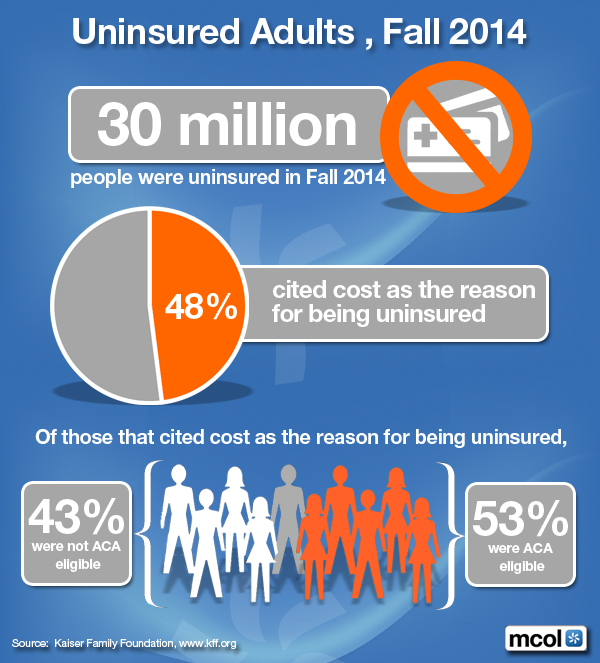
Un-Insured Adults in the USA

Join Our Mailing List

Fall 2014

http://www.MCOL.com

un insured

Channel Surfing the ME-P

Have you visited our other topic channels? Established to facilitate idea exchange and link our community together, the value of these topics is dependent upon your input. Please take a minute to visit. And, to prevent that annoying spam, we ask that you register. It is fast, free and secure.

Conclusion

Your thoughts and comments on this ME-P are appreciated. Feel free to review our top-left column, and top-right sidebar materials, links, URLs and related websites, too. Then, subscribe to the ME-P. It is fast, free and secure.

Speaker: If you need a moderator or speaker for an upcoming event, Dr. David E. Marcinko; MBA – Publisher-in-Chief of the Medical Executive-Post – is available for seminar or speaking engagements. Contact: MarcinkoAdvisors@msn.com

OUR OTHER PRINT BOOKS AND RELATED INFORMATION SOURCES:

Product DetailsProduct Details

A Medicare Fraud 2.0 Prediction

Join Our Mailing List

More on Healthcare Fraud and Abuse with Video

Edward Bukstel

 By Edward Bukstel

ME-P SPECIAL REPORT

***

Medicare Fraud 2.0 Prediction.

***

fraud

***

Channel Surfing the ME-P

Have you visited our other topic channels? Established to facilitate idea exchange and link our community together, the value of these topics is dependent upon your input. Please take a minute to visit. And, to prevent that annoying spam, we ask that you register. It is fast, free and secure.

More: Submitted by Perry D’Alessio CPA

Conclusion

Your thoughts and comments on this ME-P are appreciated. Feel free to review our top-left column, and top-right sidebar materials, links, URLs and related websites, too. Then, subscribe to the ME-P. It is fast, free and secure.

Speaker: If you need a moderator or speaker for an upcoming event, Dr. David E. Marcinko; MBA – Publisher-in-Chief of the Medical Executive-Post – is available for seminar or speaking engagements. Contact: MarcinkoAdvisors@msn.com

OUR OTHER PRINT BOOKS AND RELATED INFORMATION SOURCES:

Product DetailsProduct Details

On Digital Health Investments

Join Our Mailing List

258 Digital Health companies raised over $2 million in Venture Capital in 2014

By Edward Bukstel

Edward Bukstel

    ME-P SPECIAL REPORT

***

$4.1 Billion in Digital Health Investments in 258 Digital Health Investments 2014.

***

business

***

Channel Surfing the ME-P

Have you visited our other topic channels? Established to facilitate idea exchange and link our community together, the value of these topics is dependent upon your input. Please take a minute to visit. And, to prevent that annoying spam, we ask that you register. It is fast, free and secure.

Conclusion

Your thoughts and comments on this ME-P are appreciated. Feel free to review our top-left column, and top-right sidebar materials, links, URLs and related websites, too. Then, subscribe to the ME-P. It is fast, free and secure.

Speaker: If you need a moderator or speaker for an upcoming event, Dr. David E. Marcinko; MBA – Publisher-in-Chief of the Medical Executive-Post – is available for seminar or speaking engagements. Contact: MarcinkoAdvisors@msn.com

OUR OTHER PRINT BOOKS AND RELATED INFORMATION SOURCES:

Product DetailsProduct DetailsProduct Details

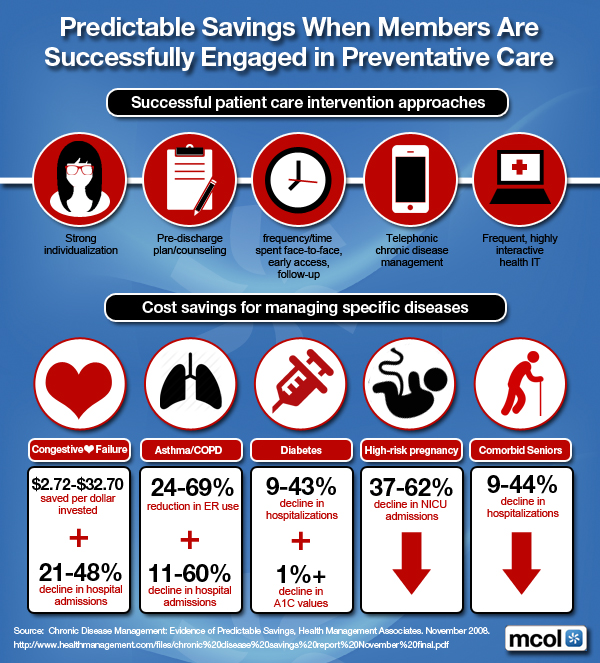
Disease Management and Preventative Health Savings?

Join Our Mailing List

For … Successfully Engaged Members

By http://www.MCOL.com

saving

More:

Channel Surfing the ME-P

Have you visited our other topic channels? Established to facilitate idea exchange and link our community together, the value of these topics is dependent upon your input. Please take a minute to visit. And, to prevent that annoying spam, we ask that you register. It is fast, free and secure.

Conclusion

Your thoughts and comments on this ME-P are appreciated. Feel free to review our top-left column, and top-right sidebar materials, links, URLs and related websites, too. Then, subscribe to the ME-P. It is fast, free and secure.

Speaker: If you need a moderator or speaker for an upcoming event, Dr. David E. Marcinko; MBA – Publisher-in-Chief of the Medical Executive-Post – is available for seminar or speaking engagements. Contact: MarcinkoAdvisors@msn.com

OUR OTHER PRINT BOOKS AND RELATED INFORMATION SOURCES:

Product DetailsProduct DetailsProduct Details

Health Data Breaches Multiplying

Join Our Mailing List

YET – Fines Remain Rare

By Charles Ornstein @charlesornstein

[ProPublica]

Federal health watchdogs say they are cracking down on organizations that don’t protect the privacy and security of patient records, but data suggests otherwise.

***

Fines Remain Rare Even As Health Data Breaches Multiply

***

data

***

Channel Surfing the ME-P

Have you visited our other topic channels? Established to facilitate idea exchange and link our community together, the value of these topics is dependent upon your input. Please take a minute to visit. And, to prevent that annoying spam, we ask that you register. It is fast, free and secure.

More:

Even More:

Conclusion

Your thoughts and comments on this ME-P are appreciated. Feel free to review our top-left column, and top-right sidebar materials, links, URLs and related websites, too. Then, subscribe to the ME-P. It is fast, free and secure.

Speaker: If you need a moderator or speaker for an upcoming event, Dr. David E. Marcinko; MBA – Publisher-in-Chief of the Medical Executive-Post – is available for seminar or speaking engagements. Contact: MarcinkoAdvisors@msn.com

OUR OTHER PRINT BOOKS AND RELATED INFORMATION SOURCES:

Product Details

Product DetailsProduct Details

SUBSTANCE ABUSE AND IMPAIRED PHYSICIANS

On Physician Health Programs [Help or Hindrance?]

[By Eric A. Dover MD]

Approximately 10-12% of physicians will develop a drug or alcohol problem at some point during their career. If physicians are impaired, they should be able to seek help from a firm but supportive and fair resource—one that demands sobriety and can determine when physicians are safe to practice.

About PHPs

Physicians with substance use disorders often seek the assistance of a state physician health program (PHP). Some physicians engage willingly with PHPs, but most are compelled to do so either by their hospital or their board of medicine.  PHPs meet with, assess, and monitor physicians who have been referred to them for substance use or other mental and behavioral health problems.

In most states, physicians who comply with any and all demands of the PHP often may continue to work, provided their sobriety is ensured through drug testing and other means. Many state boards of medicine rely completely on the PHPs for guidance about how to deal with impaired physicians.  PHPs are therefore extremely powerful.

The Problem

The problem with PHPs, though, is that despite their enormous power, they are generally barely known to most physicians and often operate with little oversight and no real means of appealing their recommendations.

To compound matters, evaluation/treatment centers and PHPs are often financially dependent on one another: Centers depend on referrals from PHPs for their viability and, reciprocally, PHP regional and national meetings are often heavily sponsored by these centers.

***

Stress

***

Largely Unknown Practices

Because PHP practices are largely unknown to physicians until they themselves are referred to one, physicians who do register complaints about standard PHP practice are often dismissed as bellyaching. But, some voices of concern have been heard.

For example, several years ago, a paper was published in the Journal of Addiction Medicine outlining concerns about standard PHP practice, which included the points raised above; along with others.

More recently, a group of North Carolina physicians complained about their state PHP to the state auditor. The auditor conducted an investigation and found poor oversight of the PHP by both the state medical society and the board of medicine, a lack of due process for physicians who disputed the PHP’s evaluations and/or recommendations, and multiple instances of potential conflicts of interest.

And so, some authorities suggest a national federation of PHPs to implement national standards for its members and commence routine audits of its members.

Assessment

Doctors who are unsafe to practice medicine ought to be prevented from doing so, but every doctor who enters any kind of treatment or monitoring program should be treated respectfully, and fairly, monitored appropriately, and have legitimate avenues of appealing decisions about their care.

Channel Surfing the ME-P

Have you visited our other topic channels? Established to facilitate idea exchange and link our community together, the value of these topics is dependent upon your input. Please take a minute to visit. And, to prevent that annoying spam, we ask that you register. It is fast, free and secure.

ABOUT

Dr. Eric Dover is a board certified family practice and primary care physician in Portland, Oregon. He is a graduate of the University of California at Los Angeles [UCLA] School of Medicine.

Conclusion

How does this relate to emails? Your thoughts and comments on this ME-P are appreciated. Feel free to review our top-left column, and top-right sidebar materials, links, URLs and related websites, too. Then, subscribe to the ME-P. It is fast, free and secure.

Speaker: If you need a moderator or speaker for an upcoming event, Dr. David E. Marcinko; MBA – Publisher-in-Chief of the Medical Executive-Post – is available for seminar or speaking engagements. Contact: MarcinkoAdvisors@msn.com

OUR OTHER PRINT BOOKS AND RELATED INFORMATION SOURCES:

Investing in State Health Innovation Plans [SHIPs]

Join Our Mailing List

Top Five Investment Priorities
By http://www.MCOL.com

***
SHIPS

***

Channel Surfing the ME-P

Have you visited our other topic channels? Established to facilitate idea exchange and link our community together, the value of these topics is dependent upon your input. Please take a minute to visit. And, to prevent that annoying spam, we ask that you register. It is fast, free and secure.

More:

Conclusion

Your thoughts and comments on this ME-P are appreciated. Feel free to review our top-left column, and top-right sidebar materials, links, URLs and related websites, too. Then, subscribe to the ME-P. It is fast, free and secure.

Speaker: If you need a moderator or speaker for an upcoming event, Dr. David E. Marcinko; MBA – Publisher-in-Chief of the Medical Executive-Post – is available for seminar or speaking engagements. Contact: MarcinkoAdvisors@msn.com

OUR OTHER PRINT BOOKS AND RELATED INFORMATION SOURCES:

Product DetailsProduct DetailsProduct Details