Stocks & Commodities

By A.I.

***

***

  • Stocks: President Trump said there’s a “50/50 chance” of a deal with the EU ahead of next week’s deadline. Investors decided they like those odds, and pushed the NASDAQ and S&P 500 to yet another new closing record high—in fact, the S&P 500 set a new record every day this week. Meanwhile, trade deal talks with Brazil have reportedly stalled.
  • Commodities: Oil fell to a three-week low today as Iran signaled a willingness to come to the negotiating table with European powers for nuclear talks.
  • Hopes of trade deals and less need for a safe haven investment pushed gold prices lower.

COMMENTS APPRECIATED

Like and Subscribe

***

***

Stocks and Commodities

By A.I.

***

***

  • Stocks: Markets shrugged off President Trump’s weekend threat of 30% levies against the EU and Mexico, as well as his proposed 100% secondary tariffs against Russia today. Stocks eked out a win across the board, with the NASDAQ climbing to a new record close.
  • Commodities: Oil prices fell while gold took a breather, but the big winner was orange juice futures, which hit a four-month high thanks to Trump’s promise of 50% tariffs on all imports from Brazil. Coffee prices also climbed.

COMMENTS APPRECIATED

Like and Subscribe

***

***

DAILY UPDATE: Medicare A.I. as Markets Go Down

MEDICAL EXECUTIVE-POST TODAY’S NEWSLETTER BRIEFING

***

Essays, Opinions and Curated News in Health Economics, Investing, Business, Management and Financial Planning for Physician Entrepreneurs and their Savvy Advisors and Consultants

Serving Almost One Million Doctors, Financial Advisors and Medical Management Consultants Daily

A Partner of the Institute of Medical Business Advisors , Inc.

http://www.MedicalBusinessAdvisors.com

SPONSORED BY: Marcinko & Associates, Inc.

***

http://www.MarcinkoAssociates.com

Daily Update Provided By Staff Reporters Since 2007.
How May We Serve You?
© Copyright Institute of Medical Business Advisors, Inc. All rights reserved. 2025

REFER A COLLEAGUE: MarcinkoAdvisors@outlook.com

SPONSORSHIPS AVAILABLE: https://medicalexecutivepost.com/sponsors/

ADVERTISE ON THE ME-P: https://tinyurl.com/ytb5955z

Your Referral Count -0-

CITE: https://www.r2library.com/Resource

Medicare may soon be able to reimburse physicians for using artificial intelligence-based medical devices, thanks to a bipartisan bill recently introduced to Congress. The bill, called the Health Tech Investment Act, would set up a payment system for devices that use AI or machine learning, which the bill’s cosponsors say would encourage providers to use the technology in clinical settings and help improve diagnoses.

CITE: https://tinyurl.com/2h47urt5

Stock markets were down in trading on Friday after President Donald Trump said he wanted to impose a 50-percent tariff on the European Union and a new 25-percent tariff on iPhone maker Apple.

The S&P 500 was down around 0.8 percent, the NASDAQ Composite down 1.0 percent, and the Dow Jones Industrial Average of 0.6 percent.

Apple stock fell 2.3 percent.

CITE: https://tinyurl.com/tj8smmes

Visualize: How private equity tangled banks in a web of debt, from the Financial Times.

COMMENTS APPRECIATED

PLEASE SUBSCRIBE: MarcinkoAdvisors@outlook.com

Thank You

***

***

***

***

EDUCATIONAL TEXTBOOKS: https://tinyurl.com/4zdxuuwf

***

MAASTRICHT Treaty

By Staff Reporters

SPONSOR: http://www.MarcinkoAssociates.com

***

***

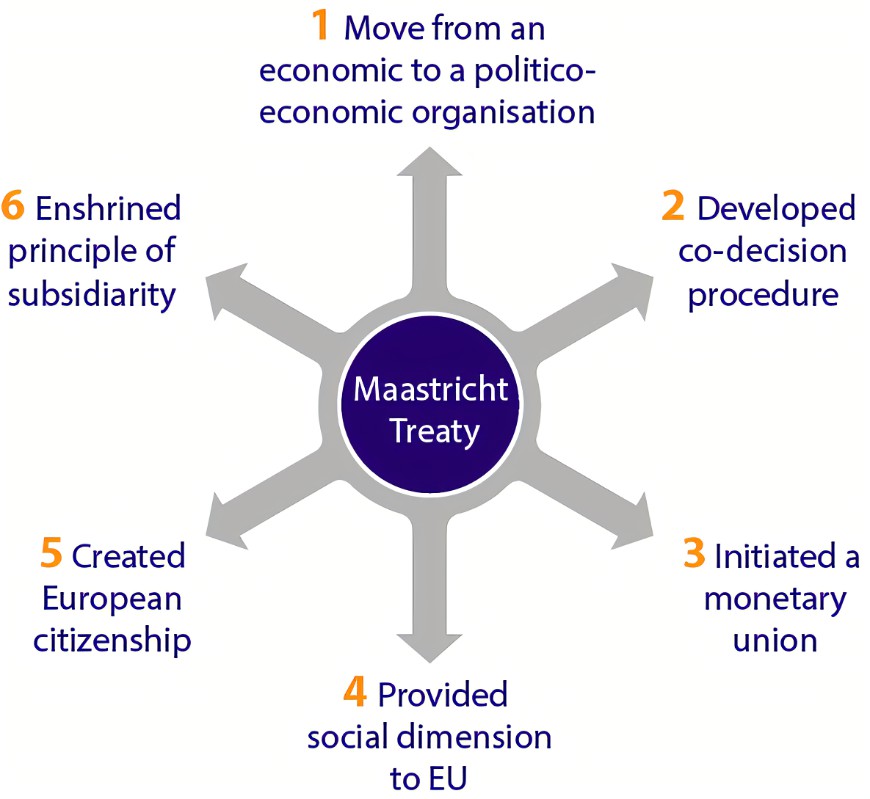
The Maastricht Treaty, signed February 7th, 1992, in Maastricht, the Netherlands, created the European Union (EU) and led to the creation of the euro(€); the single currency adopted by most EU member states.

COMMENTS APPRECIATED

Subscribe and Like

***

***

EUROPEAN UNION Paradox

By Staff Reporters

***

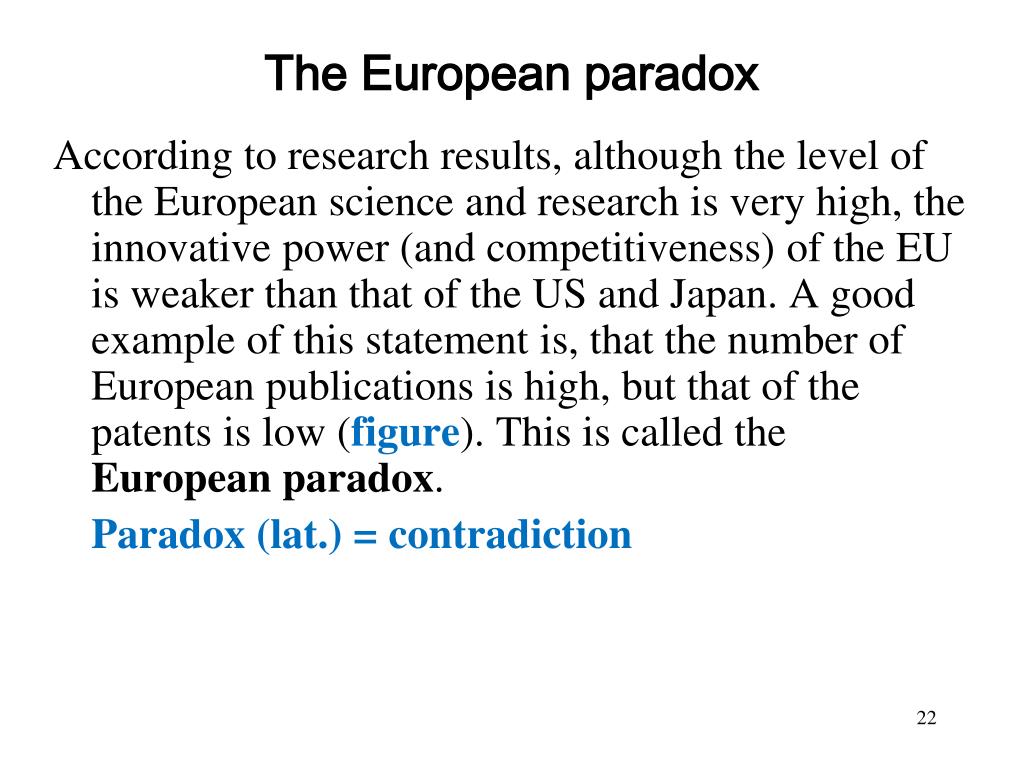
The European Union Paradox is the perceived failure of European countries to translate scientific advances into marketable innovations.

The root of this issue remains debated: is it due to the scientific output being distant from the cutting-edge, or is it because the European innovation system lacks the capacity to harness the potential of groundbreaking research?

And so, this study reveals that, compared to similar European research, the European Research Council has a similar probability of being cited in patents, although it garners a larger number of patent citations. Moreover, patents that do draw upon ERC research are often of superior quality, measured by forward citations.

Compared to similar European research, inventive activities arising from ERC science are predominantly housed within universities and public research organizations. In absolute terms, however, US organizations, especially US companies, still lead in deriving the greatest benefit from ERC science.

Cite: https://papers.ssrn.com/sol3/papers.cfm?abstract_id=4635463

COMMENTS APPRECIATED

Subscribe and Refer Today!

***

***

DAILY UPDATE: “Digital Markets Act” Violations as Stocks Slide

By Staff Reporters

***

***

The European Union is investigating Meta, Apple, and Alphabet for potential violations of its Digital Markets Act. And its regulators have started looking into Amazon as well.

The Digital Markets Act is the EU’s law to make the markets in the digital sector fairer and more contestable. In order to do so, the Digital Markets Act (“DMA”) establishes a set of clearly defined objective criteria to identify “gatekeepers”.

And, stocks were headed for a great Tuesday before investors sent stock indexes back down and leaving the Dow largely unchanged. Meanwhile, Donald Trump’s social media company, Truth Social, surged 16% in its first day of trading, just as the former president must pay $175 million as part of his civil fraud trial.

Here’s where the major benchmarks ended:

  • The S&P 500 index lost 14.61 points (0.3%) to 5,203.58; the Dow Jones Industrial Average dropped 31.31 points (0.1%) to 39,282.33; the NASDAQ Composite tumbled 68.76 points (0.4%) to 16,315.70. 
  • The 10-year Treasury note yield (TNX) fell two basis points to 4.23%.
  • The CBOE Volatility Index edged up 0.05 to 13.24.

In terms of sector performance, utilities, information technology, and energy were the weakest. Health care and financials saw relative strength.

CITE: https://www.r2library.com/Resource

COMMENTS APPRECIATED

Thank You

***

***

META: Busted and Fined!

By Staff Reporters

***

***

LONDON (AP) — The European Union just slapped Meta with a record $1.3 billion privacy fine today and ordered it to stop transferring user data across the Atlantic by October, the latest salvo in a decadelong case sparked by U.S. cybersnooping fears.

The penalty fine of 1.2 billion euros from Ireland’s Data Protection Commission is the biggest since the EU’s strict data privacy regime took effect five years ago, surpassing Amazon’s 746 million euro penalty in 2021 for data protection violations.

***

COMMENTS APPRECIATED

Thank You

***

***

USA nears DEFAULT while Europe INFLATES!

By Staff Reporters

***

***

Treasury Secretary Janet Yellen warned yesterday that the US could run out of money to pay all its bills as early as June 1st if Congress does not raise or suspend the debt limit before then. The US’ first-ever default would be disastrous for financial markets, economists say.

***

Meanwhile, Europe’s painful inflation has inched higher, extending the squeeze on households and keeping pressure on the European Central Bank to unleash what could be another large interest rate increase. Consumer prices in the 20 countries using the euro currency jumped 7% in April from a year earlier, just up from the annual rate of 6.9% in March, the European Union statistics agency Eurostat said today. Food price inflation eased a little, falling to an annual rate of 13.6% from March’s 15.5%, while energy prices rose a more modest 2.5%. Core inflation, which excludes volatile food and fuel, slowed slightly but was still high at 5.6%, underlining the expectation that the ECB will press ahead with its campaign to beat inflation into submission with rate hikes.

***

COMMENTS APPRECIATED

Thank You

***

***

Brexit Re-Deux?

Join Our Mailing List

Rick Kahler MS CFP[By Rick Kahler MSFS CFP®]

British voters shocked the world last week with their 52% to 48% decision to leave the European Union. The uncertainty of how this complex divorce will play out over the coming decade sent global markets reeling.

In fact, London’s Financial Times Stock Exchange 100 lost 4.4% of its value in one day, and the British pound sterling was down 14% against the yen and 10% against the dollar. The financial news media went berserk.

Britain has two years after notifying the EU of its intention to leave to negotiate its exit with policy makers, so we can expect the markets to remain volatile for some time.

Why all the fuss?

The thinking is that British companies will lose access to the European market for duty-free trade and financial services. Some think London will no longer be able to function as Europe’s financial center as it has done, since companies have long seen Britain as the gateway to free trade with the 28 nations in the EU. Eventually, Britain could lose American investment and manufacturing jobs that would move across the channel to mainland Europe. However, this is all speculation. Nobody knows exactly how the Brexit will play out long-term.

One reason it’s unwise to assume the worst is because the Brexit vote is not legally binding on the government. Since British Prime Minister David Cameron resigned his post and called for a new election by October, it’s possible the new government might decide to delay withdrawing from the EU. Or Parliament could instruct the new prime minister not to notify the EU that Britain is withdrawing until the government has had a chance to study further the implications. There could even be a second referendum to undo the first.

Given all these uncertainties, what was and continues to be my advice to investors?

It’s Quite Simple – Do nothing!

The current market disruptions represent an emotional roller coaster, a short-term panic reaction to what is likely to be a very long-term, well-constructed exit from the EU. British companies were certainly not 4% less valuable the day after the vote than the day before, and the pound sterling is not suddenly a second-rate currency. The US, China, and Japan are not part of the EU. Global economies function fine and they will continue to function without Britain in the EU, just as they functioned well before the EU was created in 1989.

The emotions of traders and speculators are driving the short-term market responses to a long-term event that will be worked out by reasonable people who will have their nation’s economic best interests at heart. Long-term investors who sold because of the Brexit will undoubtedly realize they were suckered and manipulated once again by panic masquerading as an assessment of real damage to the companies they’ve invested in.

***

british_pound_sign_black

***

Good News

The good news is that long-term investors who are diversified have only a minority of their portfolios in equities. While the Brexit was not good in the short run for Britain’s currency and global equity markets, it was a positive for investment vehicles. Gold, bonds, and managed futures all profited nicely upon the news of the Brexit. The strategy of global diversification worked—again. And, if equity markets decline sufficiently, long-term investors will be able to rebalance their portfolios by selling a portion of what has appreciated and buying equities. That is called “selling high and buying low.”

Second Thoughts?

Assessment

However much short-term disruption there may be, Britain and the EU will find a way to move through this unexpected event without too much damage. Like every other recent short-term financial calamity, Brexit will become just another blip on the long-term charts.

Conclusion

Your thoughts and comments on this ME-P are appreciated. Feel free to review our top-left column, and top-right sidebar materials, links, URLs and related websites, too. Then, subscribe to the ME-P. It is fast, free and secure.

Speaker: If you need a moderator or speaker for an upcoming event, Dr. David E. Marcinko; MBA – Publisher-in-Chief of the Medical Executive-Post – is available for seminar or speaking engagements. Contact: MarcinkoAdvisors@msn.com

OUR OTHER PRINT BOOKS AND RELATED INFORMATION SOURCES:

Risk Management, Liability Insurance, and Asset Protection Strategies for Doctors and Advisors: Best Practices from Leading Consultants and Certified Medical Planners™8Comprehensive Financial Planning Strategies for Doctors and Advisors: Best Practices from Leading Consultants and Certified Medical Planners™

***

Why the Government is Not-Like Medical Professionals

Join Our Mailing List

An Endless Supply of US Dollars

By Rick Kahler MS CFP® ChFC CCIM www.KahlerFinancial.com

Is the United States in danger of bankruptcy? Contrary to what you may read in the media or hear from many politicians, no, it isn’t. The US Treasury will never run out of dollars. Unlike doctors and medical professionals, it’s impossible.

Reasons Why?

The reason is relatively simple. The US government owns a printing press. As long as goods, services, or obligations are priced in US dollars, the supply of dollars to our government to buy those goods and services is unlimited. This is not true of individual physicians, corporations, cities, states, and countries that don’t issue their own currency.

For most people, this is a hard concept to grasp, with good reason. The capacity of our government to create an unconstrained supply of dollars is a relatively new phenomenon.

The Gold Standard

Until 1971, all US currency was theoretically redeemable in gold. This was known as the gold standard. In the early decades of the 20th century, you could actually go to a bank and change your dollars for gold. That ability was terminated in 1933, but the dollar’s value was still tied to gold. This basically meant the only way the US government could create new dollars was by obtaining more gold, the supply of which only increases by the new amount of gold mined.

Nixon

In 1971 we had a paradigm change in monetary policy that many still don’t understand. President Nixon decoupled the dollar from the gold standard [Nixon also wanted to flood the country with MDs, and drive down physician income, by opening up medical school admissions]. It became a fiat currency, which is used as a medium of exchange but has no intrinsic value. Suddenly, the US government was no longer constrained by solvency issues and could never run out of money. It could create as many dollars as it wished ie; inflation].

Constraints

This didn’t mean it had no constraints. The major constraint to an issuer of fiat currency is inflation. However, creating money does not guarantee inflation if the newly created money is not spent. Japan, for example, is still fighting deflation even though they’ve been pumping money into reserves like crazy for 20 years.

What should have caused a massive rethinking and reeducating of the financial sector went relatively unnoticed. Text books, professors, economists, and politicians largely continued to follow many pre-1971 monetary principles that became irrelevant overnight.

Unlike the federal government, US states, cities, and other government entities cannot print money. They have to get it the old-fashioned way—from taxes, fees, or borrowing. It’s entirely possible for these entities to go bankrupt, just like individuals and corporations, if their outflow exceeds their inflow.
Europe

Interestingly, the same is true for member countries of the European Union. When in 1999 they adopted the Euro and gave up their sovereign right to print their own money, they took on the same status as states. Therefore, a country like Greece, which is a user of currency as a member of the European Union, can involuntarily default on its obligations.

This is a significant difference between the United States and Greece. While Greece can (and most likely will) go bankrupt because it doesn’t have an unlimited supply of Euros, the US can’t go bankrupt because it does have an unlimited supply of dollars.

The major threat that sovereign countries face is not running out of money, but devaluing their currency through inflation. A devalued currency is one that loses its purchasing power and often results in a lower standard of living.

Assessment

Just because the US can’t involuntarily default on its obligations doesn’t mean we can keep on over spending and pretend we don’t have any money worries. As a nation, we still need to acknowledge and deal with our serious financial problems. So should our doctors, financial planners and financial advisors.

Conclusion

Your thoughts and comments on this ME-P are appreciated. Feel free to review our top-left column, and top-right sidebar materials, links, URLs and related websites, too. Then, subscribe to the ME-P. It is fast, free and secure.

Link: http://feeds.feedburner.com/HealthcareFinancialsthePostForcxos

Speaker: If you need a moderator or speaker for an upcoming event, Dr. David E. Marcinko; MBA – Publisher-in-Chief of the Medical Executive-Post – is available for seminar or speaking engagements. Contact: MarcinkoAdvisors@msn.com

Our Other Print Books and Related Information Sources:

Health Dictionary Series: http://www.springerpub.com/Search/marcinko

Practice Management: http://www.springerpub.com/product/9780826105752

Physician Financial Planning: http://www.jbpub.com/catalog/0763745790

Medical Risk Management: http://www.jbpub.com/catalog/9780763733421

Hospitals: http://www.crcpress.com/product/isbn/9781439879900

Physician Advisors: www.CertifiedMedicalPlanner.org

Product Details  Product Details

Euro Currency in the Cross Hairs? [Video]

Join Our Mailing List

How We Got There –  A Review for Physician Investors

By Jonathan Reyes

It’s been two decades since the dream of a unified Europe inched toward a reality. But, as crises have taken hold and bail-outs have become commonplace, how has the continent’s shared currency weathered the storms?

Video Link: http://www.infographicsarchive.com/economics/video-infographic-the-euro-in-the-crosshairs-how-we-got-here

Source: Video infographic made for Bloomberg TV.

Assessment

Important information for all medical professsionals and retail physician investors interested in emerging markets or international investing.

Conclusion

Your thoughts and comments on this ME-P are appreciated. Feel free to review our top-left column, and top-right sidebar materials, links, URLs and related websites, too. Then, subscribe to the ME-P. It is fast, free and secure.

Speaker: If you need a moderator or speaker for an upcoming event, Dr. David E. Marcinko; MBA – Publisher-in-Chief of the Medical Executive-Post – is available for seminar or speaking engagements. Contact: MarcinkoAdvisors@msn.com

OUR OTHER PRINT BOOKS AND RELATED INFORMATION SOURCES:


Product Details  Product Details

The European Debt Crisis

Then … and Now

Join Our Mailing List 

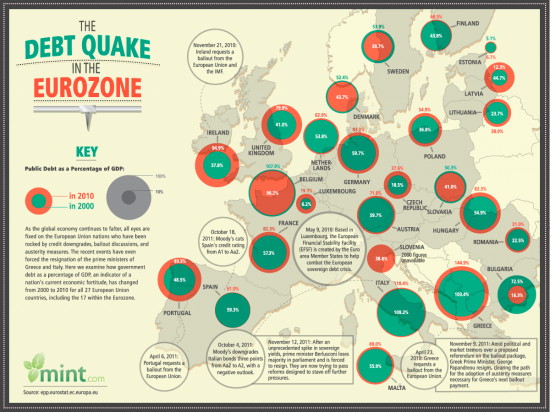
As the global economy continues to falter, all eyes are fixed on the European Union nations who have been rocked by credit downgrades, bailout discussions, and austerity measures.

Column Five Media created this infographic with Mint to examine how government debt as a percentage of GDP has changed from 2000 to 2010 for all 27 European Union countries, including the 17 within the Eurozone.

Source: Mint .

Channel Surfing the ME-P

Have you visited our other topic channels? Established to facilitate idea exchange and link our community together, the value of these topics is dependent upon your input. Please take a minute to visit. And, to prevent that annoying spam, we ask that you register. It is fast, free and secure.

Conclusion

Your thoughts and comments on this ME-P are appreciated. Feel free to review our top-left column, and top-right sidebar materials, links, URLs and related websites, too. Then, subscribe to the ME-P. It is fast, free and secure.

Speaker: If you need a moderator or speaker for an upcoming event, Dr. David E. Marcinko; MBA – Publisher-in-Chief of the Medical Executive-Post – is available for seminar or speaking engagements. Contact: MarcinkoAdvisors@msn.com

OUR OTHER PRINT BOOKS AND RELATED INFORMATION SOURCES:

Product Details  Product Details

Who Admires the EU Healthcare Model?

Not so Fast – Old Man 

By Darrell K. Pruitt; DDS – el Viejo

Here’s something interesting I found on Courthouse News.com about Germany’s mandatory retirement age for dentists.

“EU Court OK’s Age Limits for Firefighters, Dentists” (no byline).

http://www.courthousenews.com/2010/01/14/European_Courts.htm

European Court of Justice  

“The European Court of Justice released a ruling reconciling a ban on age discrimination with German age limits for firefighting and dentistry.”  

The article continues:

“For dentists, the high court agreed with the national court that an age limit is justified by the need to protect patients from declining performance.”

As we wait for octogenarian Gordon Christensen DDS to discover and describe the lame “declining performance” claim in that statement, let me focus on the rest of the paragraph:

“But it said that such a limit must apply across the board, not only for panel-certified dentists within the public sector, but also for private practitioners.”

Touting the Next Generation of Dentists  

It gets worse. The EU openly states that it intends to hand young dentists (and mid-level providers?) an immediate chance at making swell money with a huge demand for dental care that will arise when thousands of thriving dental practices across Europe close.

“The Court of Justice also agreed that such a limit is reasonable to provide work positions for young dentists, but only if it can be proven to fulfill this purpose.”

Assessment 

Hell, I’ll probably still have kids in college if US HIT stakeholders fall in love with this plan. Not only that, but since thousands of dental practices like mine will be up for sale at the same time, the business I’ve built over the last 27 years will be worthless on the open market. 

So what are my plans? I hope the ADA is adequately protecting Americans from such folly.

And – if not?

Porque hablo español, tengo la intención de mover el culo viejo a una ciudad en la costa en México y sacar dientes a los extranjeros ilegales a su regreso desde el norte. ¡Viva el NAFTA!

Join Our Mailing List

Conclusion

And so, your thoughts and comments on this ME-P are appreciated. Who agrees with the EU; why or why not? Feel free to review our top-left column, and top-right sidebar materials, links, URLs and related websites, too. Then, be sure to subscribe to the ME-P. It is fast, free and secure.

Get our Widget: Get this widget!

Our Other Print Books and Related Information Sources:

Practice Management: http://www.springerpub.com/prod.aspx?prod_id=23759

Physician Financial Planning: http://www.jbpub.com/catalog/0763745790

Medical Risk Management: http://www.jbpub.com/catalog/9780763733421

Healthcare Organizations: www.HealthcareFinancials.com

Health Administration Terms: www.HealthDictionarySeries.com

Physician Advisors: www.CertifiedMedicalPlanner.com

Subscribe Now: Did you like this Medical Executive-Post, or find it helpful, interesting and informative? Want to get the latest ME-Ps delivered to your email box each morning? Just subscribe using the link below. You can unsubscribe at any time. Security is assured.

Link: http://feeds.feedburner.com/HealthcareFinancialsthePostForcxos