Government Medicine is Killing Us!

Join Our Mailing List

By Bob Murphy

***

skeleton

Bob Murphy: Government Medicine is Killing Us

***

About

Bob Murphy is our re-posting guest today as he wraps up a three-part series on the anti-market healthcare system in the US.

Conclusion

Your thoughts and comments on this ME-P are appreciated. Feel free to review our top-left column, and top-right sidebar materials, links, URLs and related websites, too. Then, subscribe to the ME-P. It is fast, free and secure.

Speaker: If you need a moderator or speaker for an upcoming event, Dr. David E. Marcinko; MBA – Publisher-in-Chief of the Medical Executive-Post – is available for seminar or speaking engagements. Contact: MarcinkoAdvisors@msn.com

OUR OTHER PRINT BOOKS AND RELATED INFORMATION SOURCES:

[PRIVATE MEDICAL PRACTICE BUSINESS MANAGEMENT TEXTBOOK – 3rd.  Edition]

Product DetailsProduct Details

  [Foreword Dr. Hashem MD PhD] *** [Foreword Dr. Silva MD MBA]

***

The Physician Certification Business?

Join Our Mailing List

Let’s Get Government Out of the Physician Certification Business

Accad

By  MD

Are all certification outfits created the same?

Should the government impose free market features?

Any pro-market health economists out there?

***

diploma

Should the government impose its own standards for certification for physicians?

The short answer is “no.”

***

Let’s Get Government Out of the Physician Certification Business

Conclusion

Your thoughts and comments on this ME-P are appreciated. Feel free to review our top-left column, and top-right sidebar materials, links, URLs and related websites, too. Then, subscribe to the ME-P. It is fast, free and secure.

Speaker: If you need a moderator or speaker for an upcoming event, Dr. David E. Marcinko; MBA – Publisher-in-Chief of the Medical Executive-Post – is available for seminar or speaking engagements. Contact: MarcinkoAdvisors@msn.com

OUR OTHER PRINT BOOKS AND RELATED INFORMATION SOURCES:

Risk Management, Liability Insurance, and Asset Protection Strategies for Doctors and Advisors: Best Practices from Leading Consultants and Certified Medical Planners™

***

On the DOL’s New Fiduciary Rule

Join Our Mailing List

By Rick Kahler MSFS CFP®

Rick Kahler MS CFPThe Department of Labor’s groundbreaking new Fiduciary Rule may change the legal responsibilities of advisors who sell financial products for consumers’ retirement accounts.

Financial services industry pundits aren’t sure whether the new rule is a giant step in the right direction or a successful dodging of a bullet by Wall Street.

Original Intent

The original intent was to require those selling financial products for retirement plans to act as fiduciaries—advisors required to put clients’ interests ahead of their own.

One proposed provision was a “restricted asset list” which would have banned the sale of high-commission products like private REITs and annuities to IRAs and other retirement plans. Wall Street brokers were “expecting a punch in the face that would force a dramatic overhaul of how they dealt with their customers,” notes Joshua Brown, CEO of Ritholtz Wealth Management, in an April 6 article at Fortune.com.

As adopted, the final rule allows financial salespeople to still sell all the controversial illiquid high-commissioned products they currently sell, as long as the brokerage firm can document the product is in the client’s best interest. Brown says this amounts to a “love tap.”

The Pundits

Bob Veres, editor of Inside Information, sees the new Fiduciary Rule as still a big win for consumers and fiduciary advisors. In an April 8 column, he writes, “professional financial planners and advisors have achieved a victory, and the Wall Street and independent broker-dealer service models have been dealt a blow.”

Veres argues that the new fiduciary duty to act in the client’s best interest will by itself preclude financial salespeople from justifying the sale of high-commissioned products in IRAs. He also points out that salespeople will no longer be allowed to receive “fat commissions” for recommending annuities and non-traded REITS, and therefore are unlikely to recommend these products.

Financial planner and writer Michael Kitces [a friend of this ME-P and advocate of iMBA’s online Certified Medical Planner® fiduciary focused professional charter education certification program] suggests the DOL’s concession allowing the current questionable financial products to still be purchased by IRAs may be “a brilliantly executed strategy of conceding to the financial services industry the exact parts that didn’t actually matter in the long run . . . yet keeping the key components that mattered the most,” the fiduciary duty to the client.

MORE: http://www.CertifiedMedicalPlanner.org

Brown believes salespeople will continue recommending higher-cost products “so long as a justification can be made for their being recommended (quality, performance, etc.).”

He adds, “Advisors will still be able to sell the proprietary products of their own firm so long as they can enunciate the reason why these products are in their customers’ “best interests” – a hurdle whose height will probably be adjusted on a case-by-case basis as no one really knows what it means yet.”

Kitces contends the new law will ultimately give the consumer the power through the courts to define what is and isn’t in their best interests. He points out:

***

PetreGloveimage-300x200

***

“In other words, while the DOL fiduciary rule didn’t outright regulate what Wall Street can and cannot do, it did change the legal standard by which those actions will be judged and ensure that eventually the courts will have the opportunity to rule on these fiduciary conflicts.”

While the new rule only applies to retirement assets, Veres and Brown see it as a step toward requiring a fiduciary standard for all investment advice. I tend to agree.

Assessment

Since so many small investors hold retirement accounts, applying a fiduciary standard to those investments may help more consumers understand the difference between fiduciary advisors and product salespeople. As the industry moves toward full compliance with the rule by the April 2017 deadline, we may see an increase in consumer demand for financial advisors who put clients’ interests first.

Conclusion

Your thoughts and comments on this ME-P are appreciated. Feel free to review our top-left column, and top-right sidebar materials, links, URLs and related websites, too. Then, subscribe to the ME-P. It is fast, free and secure.

Speaker: If you need a moderator or speaker for an upcoming event, Dr. David E. Marcinko; MBA – Publisher-in-Chief of the Medical Executive-Post – is available for seminar or speaking engagements. Contact: MarcinkoAdvisors@msn.com

OUR OTHER PRINT BOOKS AND RELATED INFORMATION SOURCES:

Risk Management, Liability Insurance, and Asset Protection Strategies for Doctors and Advisors: Best Practices from Leading Consultants and Certified Medical Planners™  Risk Management, Liability Insurance, and Asset Protection Strategies for Doctors and Advisors: Best Practices from Leading Consultants and Certified Medical Planners™

***

It’s Still Harder to Become a Hairdresser than a Financial Adviser?

Join Our Mailing List

How Come and Why?

[By Jason Zweig]

****

The great journalist H.L. Mencken wrote decades ago
,

“The essence of a genuine professional man is that he cannot be bought.”

And that, in turn, can spring only from a culture of exhaustive training and the highest standards of conduct.

Professions like accounting, law and medicine took decades, often centuries, to advance to the point of requiring rigorous education and licensing for all their members.

***

vintage-beauty-salon-equipment-9

***

Assessment

The field of investment advice remains a long way from being able to call itself a profession.

More: http://blogs.wsj.com/moneybeat/2016/04/08/how-come-its-still-harder-to-become-a-hairdresser-than-a-financial-adviser/

On Wall Street’s Suitability, Prudence and Fiduciary Accountability

Conclusion

Your thoughts and comments on this ME-P are appreciated. Feel free to review our top-left column, and top-right sidebar materials, links, URLs and related websites, too. Then, subscribe to the ME-P. It is fast, free and secure.

Speaker: If you need a moderator or speaker for an upcoming event, Dr. David E. Marcinko; MBA – Publisher-in-Chief of the Medical Executive-Post – is available for seminar or speaking engagements. Contact: MarcinkoAdvisors@msn.com

OUR OTHER PRINT BOOKS AND RELATED INFORMATION SOURCES:

Risk Management, Liability Insurance, and Asset Protection Strategies for Doctors and Advisors: Best Practices from Leading Consultants and Certified Medical Planners™8Comprehensive Financial Planning Strategies for Doctors and Advisors: Best Practices from Leading Consultants and Certified Medical Planners™

***

DOL’s Fiduciary Rule Brings Good News

The DOL and Your Retirement Account

 
Join Our Mailing List 

By Michael Zhuang,

[Principal of MZ Capital Management]
Contributor to Morningstar and Physicians Practice
Michael Zhuang
 
Recently the Department of Labor issued a fiduciary rule that requires financial advisors who manage retirement accounts to act in clients’ best interests.
***
Here is the quote from a Wall Street Journal report … 

About $14 trillion in retirement savings could be affected by the rule, which requires stockbrokers providing retirement advice to act as “fiduciaries” who will serve their clients’ “best interest.” That is stricter than the current standard, which only says they need to offer “suitable” recommendations, a standard that critics say has encouraged some advisers to charge excessive fees or favor investments that offer hidden commissions.

Still, reflecting intense lobbying from the financial industry, which has fought the regulation since it was first proposed six years ago, the final version includes a number of modifications. 

This might come as a surprise to many physician-executives and people that financial advisors do not need to act in clients’ best interests up until this day.  

Alas, as I explained in this article, there are really two types of financial advisors: those who have a broker license (series 7) and those who have a registered investment advisor license (series 65).

Here is the kicker:

93% of all financial advisors are licensed brokers. These are advisors from major Wall Street brokerages like Merrill Lynch, Morgan Stanley and etc., as well as many independent broker-dealers. By law, they do NOT need to act in clients’ best interests. 

Those who have a registered investment advisor license have always been required by law to act in clients’ best interests, but they account for only 7% of all financial advisors. 

The financial industry benefits tremendously from not needing to act in clients’ best interests, for instance, by selling clients high hidden cost financial products. That’s why they fight the fiduciary rule tooth and nail, and with the help of many Senators and Congressmen.

It’s better late than never. I am glad that seven years after the financial crisis that nearly brought the country to its knees, something is finally done to address the rampant conflict of interests in the financial industry. 

There is a caveat though. The fiduciary rule only applies to retirement accounts. So if you have a brokerage account and an IRA account with Merrill Lynch. Your Merrill Lynch broker needs to act in your best interests with your IRA account, but needs NOT with your brokerage account! 

Assessment 

The best way to check whether your financial advisor is a broker is to ask “Do you have a series 7 license?” If the answer is “Yes.” You need a second opinion review. Chances are good that it will find many hidden costs and bad investments.

More: The DOL’s Final Fiduciary Rule: What’s in it and what does it mean for advisors?

Conclusion

Your thoughts and comments on this ME-P are appreciated. Feel free to review our top-left column, and top-right sidebar materials, links, URLs and related websites, too. Then, subscribe to the ME-P. It is fast, free and secure.

Speaker: If you need a moderator or speaker for an upcoming event, Dr. David E. Marcinko; MBA – Publisher-in-Chief of the Medical Executive-Post – is available for seminar or speaking engagements. Contact: MarcinkoAdvisors@msn.com

OUR OTHER PRINT BOOKS AND RELATED INFORMATION SOURCES:

Risk Management, Liability Insurance, and Asset Protection Strategies for Doctors and Advisors: Best Practices from Leading Consultants and Certified Medical Planners™8Comprehensive Financial Planning Strategies for Doctors and Advisors: Best Practices from Leading Consultants and Certified Medical Planners™

****

The Need for Anti-Authoritarians in the Medical Profession

Join Our Mailing List

327518caf4de6ca81321ea8b469a3d42

Question Authority

By Michael Lawrence Langan MD

Anti-authoritarians question whether an authority is a legitimate one before taking that authority seriously.

To evaluate the legitimacy of  an authority it is necessary to do the following:

***

Question Authority: The Need for Anti-Authoritarians in the Medical Profession

***

Conclusion

Your thoughts and comments on this ME-P are appreciated. Feel free to review our top-left column, and top-right sidebar materials, links, URLs and related websites, too. Then, subscribe to the ME-P. It is fast, free and secure.

Speaker: If you need a moderator or speaker for an upcoming event, Dr. David E. Marcinko; MBA – Publisher-in-Chief of the Medical Executive-Post – is available for seminar or speaking engagements. Contact: MarcinkoAdvisors@msn.com

OUR OTHER PRINT BOOKS AND RELATED INFORMATION SOURCES:

Risk Management, Liability Insurance, and Asset Protection Strategies for Doctors and Advisors: Best Practices from Leading Consultants and Certified Medical Planners™ Risk Management, Liability Insurance, and Asset Protection Strategies for Doctors and Advisors: Best Practices from Leading Consultants and Certified Medical Planners™

***

The Medical Profession under Dictatorship

Join Our Mailing List

327518caf4de6ca81321ea8b469a3d42By Michael Lawrence Langan MD

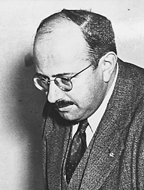
Revisiting Dr. Leo Alexander’s prescient warnings from 1949

 Dr. Leo Alexander (October 11, 1905 – July 20, 1985) was an American psychiatrist, neurologist, educator, and author, of Austrian-Jewish origin. He was a key medical advisor during the Nuremberg Trials. Alexander wrote part of the Nuremberg Code, which provides legal and ethical principles for scientific experiment on humans.

Source: https://en.wikipedia.org/wiki/Leo_Alexander

***

The Medical Profession under Dictatorship–Revisiting Dr. Leo Alexander’s prescient warnings from 1949

***

leoalexander

***

Conclusion

Your thoughts and comments on this ME-P are appreciated. Feel free to review our top-left column, and top-right sidebar materials, links, URLs and related websites, too. Then, subscribe to the ME-P. It is fast, free and secure.

Speaker: If you need a moderator or speaker for an upcoming event, Dr. David E. Marcinko; MBA – Publisher-in-Chief of the Medical Executive-Post – is available for seminar or speaking engagements. Contact: MarcinkoAdvisors@msn.com

OUR OTHER PRINT BOOKS AND RELATED INFORMATION SOURCES:

Risk Management, Liability Insurance, and Asset Protection Strategies for Doctors and Advisors: Best Practices from Leading Consultants and Certified Medical Planners™  Risk Management, Liability Insurance, and Asset Protection Strategies for Doctors and Advisors: Best Practices from Leading Consultants and Certified Medical Planners™

***

The Ambulance Drone Defibrillator?

Join Our Mailing List

[By staff reporters]

Ambulance drone delivers help to heart attack victims

An ambulance drone carrying a defibrillator for rapid response to heart attacks has just been unveiled in the Netherlands.

***

ambulance-drone

***

Source:

Via: Aditi Chopra – HR Admin at Universe Jobs – New Delhi Area, India  Human Resources

Conclusion

Your thoughts and comments on this ME-P are appreciated. Feel free to review our top-left column, and top-right sidebar materials, links, URLs and related websites, too. Then, subscribe to the ME-P. It is fast, free and secure.

Speaker: If you need a moderator or speaker for an upcoming event, Dr. David E. Marcinko; MBA – Publisher-in-Chief of the Medical Executive-Post – is available for seminar or speaking engagements. Contact: MarcinkoAdvisors@msn.com

OUR OTHER PRINT BOOKS AND RELATED INFORMATION SOURCES:

Product DetailsProduct DetailsProduct Details

***

Advisor V. Adviser [The Ultimate “Terminology” Fraudster?]

Join Our Mailing List

Anonymous Doctor

[By Anonymous]

Are the US Securities Acts the Ultimate “Terminology” Fraudster?

As a doctor and investor, I have learned thru the internet that Larry Elford, an Investment Misconduct and Malpractice Consultant – and many others – believe that the ultimate terminology fraudster is the US Securities Acts (1935 & 1940) and the Investment Adviser Act. Why?

They have no such category as “advisor” in the Acts.

Industry lawyers know this well, as does FINRA, and may be using this “spelling ruse” to dupe and deceive millions of Americans into believing that their commission sales “broker” is some kind of fiduciary “adviser” professional.

Some even believe it to be an industry pandemic of “bait and switch” to deceive and then shortchange investors.

Source: http://www.investoradvocates.ca/viewtopic.php?f=1&t=193&sid=1cc2690bde2ebdfaa749be1d35395083#p3867

***

th

***

VIDEO: Here is an under 2 minute glimpse into the Three Card Monte game being played, upon investors, when your Securities Commission proudly tells you to “check your “adviser’s” registration”.

Link: https://youtu.be/zIjt0qRsJKg

Assessment

Is this a mere lexicon conundrum; or truer pathology?

And, did you know that a Certified Medical Planner® is a client fiduciary at all times? Visit: http://www.CertifiedMedicalPlanner.org

cmp-logo16

Enter the CMPs

Conclusion

Your thoughts and comments on this ME-P are appreciated. Feel free to review our top-left column, and top-right sidebar materials, links, URLs and related websites, too. Then, subscribe to the ME-P. It is fast, free and secure.

Speaker: If you need a moderator or speaker for an upcoming event, Dr. David E. Marcinko; MBA – Publisher-in-Chief of the Medical Executive-Post – is available for seminar or speaking engagements. Contact: MarcinkoAdvisors@msn.com

OUR OTHER PRINT BOOKS AND RELATED INFORMATION SOURCES:

***

[PHYSICIAN FOCUSED FINANCIAL PLANNING AND RISK MANAGEMENT COMPANION TEXTBOOK SET]

  Risk Management, Liability Insurance, and Asset Protection Strategies for Doctors and Advisors: Best Practices from Leading Consultants and Certified Medical Planners™       Comprehensive Financial Planning Strategies for Doctors and Advisors: Best Practices from Leading Consultants and Certified Medical Planners™

[Dr. Cappiello PhD MBA] *** [Foreword Dr. Krieger MD MBA]

Front Matter with Foreword by Jason Dyken MD MBA

***

Not Today; DEATH!

Join Our Mailing List

Beware the Ides of March – Public Health

DEMM high-def WhiteBy Dr. David Edward Marcinko MBA CMP®

Welcome, all ME-P readers and subscribers, to the Fulton County Department of Health & Wellness Website, and department, in Atlanta, Georgia.

The interim Director of Health Services is David A. Sarnow, M.D, MPH.

On the site, and in the department itself, you will find information on health topics to keep the community safe from health threats, promoting better health and helping Fulton County, Georgia residents find the health care information they need.

Of course, the others states have similar public health programs. And so, you are welcomed to enjoy the virtual website and explore the physical department – which I bypass almost daily.

***

death

Not Today; DEATH!

***

Margaret Farenger says this is on the side of Fulton County Health Services, Atlanta GA and the artist is Julian Hoke Harris.

Assessment

More information about the Fulton County Georgia Department of Health and Wellness.

Conclusion

Your thoughts and comments on this ME-P are appreciated. Feel free to review our top-left column, and top-right sidebar materials, links, URLs and related websites, too. Then, subscribe to the ME-P. It is fast, free and secure.

Speaker: If you need a moderator or speaker for an upcoming event, Dr. David E. Marcinko; MBA – Publisher-in-Chief of the Medical Executive-Post – is available for seminar or speaking engagements. Contact: MarcinkoAdvisors@msn.com

OUR OTHER PRINT BOOKS AND RELATED INFORMATION SOURCES:

Risk Management, Liability Insurance, and Asset Protection Strategies for Doctors and Advisors: Best Practices from Leading Consultants and Certified Medical Planners™

8Comprehensive Financial Planning Strategies for Doctors and Advisors: Best Practices from Leading Consultants and Certified Medical Planners™

 Harvard Medical School

Boston Children’s Hospital – Psychiatrist

Yale University

***

Invite Dr. Marcinko

***

The REAL Costs of Health Fraud

Join Our Mailing List

Carol S. Miller

By Carol Miller RN MBA

The Cost of Health Fraud

There is no question that real fraud, waste and abuse exists in healthcare today. The Office of Inspector General of the Department of Health and Human Services (HHS) saved American taxpayers a record $21 billion a dozen years ago, according to Inspector General Janet Rehnquist. Savings were achieved through an intensive and continuing crackdown on waste, fraud and abuse in Medicare and over 300 other HHS programs for which the Office of Inspector General (OIG) has oversight responsibility.

More recently, according to the Centers for Medicare and Medicaid Services [CMS] and under the tenure of Eric Himpton Holder, Jr., 82nd Attorney General of the United States and more recently Loretta Lynch, Recovery Asset Contractors [RACs] collected almost $1-B in improper payments during their beta testing period in 2009-10.

Of these payments; 96% were over-payments, 4% were under-payments; and 77% of providers failed to appeal, 7% appealed successfully and 15% appealed unsuccessfully.

And, by Fiscal Year 2016, recovery auditors collectively identified and corrected more than 1,532,249 claims for improper payments, which resulted in more than $3.75 billion dollars in improper payments being corrected. The total corrections identified include more than $3.65 billion in overpayments collected and $102.4 million in underpayments repaid to providers and suppliers.

***

Money

***

After taking into consideration all fees, costs, and first level appeals, the Medicare FFS Recovery Audit Program returned over $3.0 billion to the Medicare Trust Funds.

More Costs

These savings did not take into account program costs and administrative expenses incurred at the third and fourth levels of appeal (Office of Medicare Hearings and Appeals (OMHA) and Medicare Appeals Council within the Departmental Appeals Board (DAB), respectively), as these components do not receive Recovery Audit Program funding for those appeals.

Conclusion

Your thoughts and comments on this ME-P are appreciated. Feel free to review our top-left column, and top-right sidebar materials, links, URLs and related websites, too. Then, subscribe to the ME-P. It is fast, free and secure.

Speaker: If you need a moderator or speaker for an upcoming event, Dr. David E. Marcinko; MBA – Publisher-in-Chief of the Medical Executive-Post – is available for seminar or speaking engagements. Contact: MarcinkoAdvisors@msn.com

OUR OTHER PRINT BOOKS AND RELATED INFORMATION SOURCES:

Risk Management, Liability Insurance, and Asset Protection Strategies for Doctors and Advisors: Best Practices from Leading Consultants and Certified Medical Planners™

 Harvard Medical School

Boston Children’s Hospital – Psychiatrist

Yale University

CONTROLLED SUBSTANCES RISKS IN MEDICINE

Join Our Mailing List 

CONTROLLED SUBSTANCES RISKS for MDs

[By staff reporters] http://www.CertifiedMedicalPlanner.org

The Drug Enforcement Agency (DEA) controls the issuance of DEA numbers that permit the physician to prescribe controlled substances to their patients. The use of controlled substances is important to almost all medical specialties. Family practitioners use codeine to treat coughs and surgeons use narcotics to manage pain. The spectrum-of-use is wide. 

Rogue physicians

Unfortunately, there will always be a rogue physician willing to sell narcotic prescriptions. These physicians cause the DEA to cast a jaundiced eye towards all physicians.

However, the dilemma may be that there are simply too many stories of physicians who “over-use” controlled substances in a practice designed to ease the suffering of their patients; or not? And, how do we differentiate among them all? The physician never knows when a patient coming into the office complaining of pain and asking for pain medication – whether that patient is truly in pain or not – is an undercover agent for the DEA.

***

pills

***

Has it come to prescriber beware?  

This peril and paranoia (combined with the risk of a malpractice claim of “hooking” the patient) causes some physicians to actually under prescribe pain medication. The U.S. Department of Veterans Affairs may be at particular risk.

[SOURCE: Chicago Tribune, January 9th, 2015].

Conclusion

Your thoughts and comments on this ME-P are appreciated. Feel free to review our top-left column, and top-right sidebar materials, links, URLs and related websites, too. Then, subscribe to the ME-P. It is fast, free and secure.

Speaker: If you need a moderator or speaker for an upcoming event, Dr. David E. Marcinko; MBA – Publisher-in-Chief of the Medical Executive-Post – is available for seminar or speaking engagements. Contact: MarcinkoAdvisors@msn.com

OUR OTHER PRINT BOOKS AND RELATED INFORMATION SOURCES:

Risk Management, Liability Insurance, and Asset Protection Strategies for Doctors and Advisors: Best Practices from Leading Consultants and Certified Medical Planners™

 Harvard Medical School

Boston Children’s Hospital – Psychiatrist

Yale University

***

Apology Programs in Medicine

Join Our Mailing List

By staff reporters http://www.CertifiedMedicalPlanner.org

APOLOGY PROGRAMS?

[What they are – How they work]

To deal with the aftermath of medical errors, an increasing number of providers are encouraging injured patients to participate in “medical apology programs.”

The idea, proponents say, is for patients to meet with facility representatives to learn what happened and why.  It gives the patient a chance to ask questions and it gives providers a chance to apologize, and as appropriate, offer compensation.  These programs are promoted as humanitarian, and, at least in terms of providing an emotional outlet for patients, they are.

The evidence also suggests that they are about something else: money.  Every aspect of how they operate – from who risk managers involve, to what those involved are told to say – suggests a key goal is to dissuade patients from seeking compensation by creating an emotional connection with them.

A Study

The data establishes that it works, too.

A 2010 study found that at one major facility, apology programs resulted in fewer injured patients making claims and, among those that did, they accepted a fraction of the amount in settlement compared to patients who made claims before the program was instituted.

For minor injuries, no real harm is done by this; but the outcome can be cataclysmic for seriously injured patients who accept an apology in lieu of compensation.

Doug Wojcieszak, owner of the advocacy group Sorry Works, [http://sorryworkssite.bondwaresite.com] often receives requests to teach doctors how to communicate after a problem. He became interested in the topic when his older brother died at age 39 from a medical error. While losing his brother was awful, the experience was compounded by a total lack of communication and accountability afterward.

***

229_1

***

Curiously, when an attorney suspects that he has committed legal malpractice, he must disclose it to the client and recommend that the client seek outside counsel to get objective legal advice on how to proceed. By contrast, when a doctor suspects that he has committed medical malpractice, at many facilities he is expected to employ a set of protocols that discourage the injured patient from considering the need for compensation. Yet, while an attorney could be disbarred for this sort of behavior, medical apology programs widely receive praise.

Source: Gabriel H. Teninbaum JD: Suffolk University Law School-Chapman Law Review Research Paper 11-30.

Conclusion

Your thoughts and comments on this ME-P are appreciated. Feel free to review our top-left column, and top-right sidebar materials, links, URLs and related websites, too. Then, subscribe to the ME-P. It is fast, free and secure.

Speaker: If you need a moderator or speaker for an upcoming event, Dr. David E. Marcinko; MBA – Publisher-in-Chief of the Medical Executive-Post – is available for seminar or speaking engagements. Contact: MarcinkoAdvisors@msn.com

OUR OTHER PRINT BOOKS AND RELATED INFORMATION SOURCES:

Risk Management, Liability Insurance, and Asset Protection Strategies for Doctors and Advisors: Best Practices from Leading Consultants and Certified Medical Planners™

 Harvard Medical School

Boston Children’s Hospital – Psychiatrist

Yale University

DIRECT PAY MEDICAL PROVIDER RISKS

Join Our Mailing List 

[By staff reporters] http://www.CertifiedMedicalPlanner.org

The Three Basic Duties

A cash-based medical practice or direct care provider has these basic duties:

  1. * to comply with statutory duties such as the drug laws
  2. * to obtain proper consent for medical care
  3. * to render care that is not substantially inferior to that offered by like providers

A breach of any of these duties that causes harm to a patient can result in a malpractice suit. While the first two duties are important, it is the duty to render good quality medical care that is the basis for most malpractice lawsuits. The breach of this duty is most likely to result in a serious patient injury. The prevention of such negligent injuries is the responsibility of the individual provider, but it also basic to the institution’s quality control program.

From the individual provider’s point of view, quality control involves continuing education, attention to detail, and retrospective review of the course of the provider’s patients. The process is only loosely structured and is usually poorly documented. This lack of formal structure is less important for the individual provider because the provider’s actions are judged only within the context of the injured patient in question (although previous actions may be used to negate claims of accidental injury).

Assessment

And so, the legal questions is whether the care rendered the injured patient was negligent. It is not relevant to the case if the provider carried out an effective personal quality control program.

Conclusion

Your thoughts and comments on this ME-P are appreciated. Feel free to review our top-left column, and top-right sidebar materials, links, URLs and related websites, too. Then, subscribe to the ME-P. It is fast, free and secure.

Speaker: If you need a moderator or speaker for an upcoming event, Dr. David E. Marcinko; MBA – Publisher-in-Chief of the Medical Executive-Post – is available for seminar or speaking engagements. Contact: MarcinkoAdvisors@msn.com

OUR OTHER PRINT BOOKS AND RELATED INFORMATION SOURCES:

   Risk Management, Liability Insurance, and Asset Protection Strategies for Doctors and Advisors: Best Practices from Leading Consultants and Certified Medical Planners™

 Harvard Medical School

Boston Children’s Hospital – Psychiatrist

Yale University

***

Ethnic Disparities in Dementia Risk

Join Our Mailing List

By http://www.MCOL.com

One-in-Four Expected to be Diagnosed

***

ImageProxy

***

Conclusion

Your thoughts and comments on this ME-P are appreciated. Feel free to review our top-left column, and top-right sidebar materials, links, URLs and related websites, too. Then, subscribe to the ME-P. It is fast, free and secure.

Speaker: If you need a moderator or speaker for an upcoming event, Dr. David E. Marcinko; MBA – Publisher-in-Chief of the Medical Executive-Post – is available for seminar or speaking engagements. Contact: MarcinkoAdvisors@msn.com

OUR OTHER PRINT BOOKS AND RELATED INFORMATION SOURCES:

Product DetailsProduct Details

***

Rationality and Emotions in Financial Decisions [Video]

Join Our Mailing List

Rationality and Emotions in Financial Decisions

By Professor Eyal Winter [SFI Seminars]

Conclusion

Your thoughts and comments on this ME-P are appreciated. Feel free to review our top-left column, and top-right sidebar materials, links, URLs and related websites, too. Then, subscribe to the ME-P. It is fast, free and secure.

Speaker: If you need a moderator or speaker for an upcoming event, Dr. David E. Marcinko; MBA – Publisher-in-Chief of the Medical Executive-Post – is available for seminar or speaking engagements. Contact: MarcinkoAdvisors@msn.com

OUR OTHER PRINT BOOKS AND RELATED INFORMATION SOURCES:

Risk Management, Liability Insurance, and Asset Protection Strategies for Doctors and Advisors: Best Practices from Leading Consultants and Certified Medical Planners™8Comprehensive Financial Planning Strategies for Doctors and Advisors: Best Practices from Leading Consultants and Certified Medical Planners™

***

USA State Well Being Rankings

Join Our Mailing List

By http://www.MCOL.com

Highest Well-Being Scores

***

ImageProxy

***

Conclusion

Your thoughts and comments on this ME-P are appreciated. Feel free to review our top-left column, and top-right sidebar materials, links, URLs and related websites, too. Then, subscribe to the ME-P. It is fast, free and secure.

Speaker: If you need a moderator or speaker for an upcoming event, Dr. David E. Marcinko; MBA – Publisher-in-Chief of the Medical Executive-Post – is available for seminar or speaking engagements. Contact: MarcinkoAdvisors@msn.com

OUR OTHER PRINT BOOKS AND RELATED INFORMATION SOURCES:

Product DetailsProduct DetailsProduct Details

***

On Income Inequality

Join Our Mailing List

A Passionate Discussion

Rick Kahler MS CFP

By Rick Kahler MS CFP®

Income inequality is a topic of passionate discussion today in many of the circles I move in. The discussion typically starts with a foregone conclusion that income inequality is a huge problem in the US. Some solutions I hear include increasing the top income tax bracket to 90%, initiating an annual wealth tax, or increasing the estate tax to 100%.

While leveling the playing field will certainly solve income inequality, it won’t solve the real problem. When I say that, I often get stares of bewilderment and disdain. It isn’t unusual for people to slowly distance themselves as if I had shapeshifted into Donald Trump.

How bad is it?

First, how bad is income inequality in the US? It’s certainly no worse today than it’s been in the last 80 years. The CIA World Factbook 2015 Gini Index, a rating where 0 is equal income and 100 is completely unequal income, finds the US rates a 45.0, exactly what it was in 1929. That puts us in 38th place, slightly above the global median, which is 39.4. The worst 30 countries have ratings of 46.8 to 63.2.

Regardless of the fact that it has not increased over the last 80 years, what is the real problem with income inequality? A common assumption is that it has created an America where most people don’t have enough to afford a minimal quality of life.

But is that true?

In a column from October 2015, George Will cites a new book, On Equality, by Harry G. Frankfurt, a Princeton emeritus professor of philosophy. Frankfurt drives home a main contention that economic inequality is not inherently morally objectionable and that “doing worse than others does not entail doing badly.” His alternative to economic egalitarianism is the “doctrine of sufficiency,” which is that the moral imperative should be that everyone have enough.

Now, consider this

If you are a US citizen with an income of over $32,400, you are in the world’s top 1%. Globally, you are considered “rich.” Indeed, the poorest 1% of US citizens have more wealth than two-thirds of the world’s people. Clearly, income inequality in the US doesn’t inherently mean everyone in society doesn’t have enough. This would suggest that complaints about US income inequality may be in response to something other than having enough.

***

budget

***

Perhaps the real problem is more of a “discontent of those who are comfortable but envious,” as George Will suggests. Consider this: to be in the top 1% in income in the US you need to earn over $380,000 a year. Someone earning $32,400 a year, even though they are in the global top 1%, may easily lose that perspective when viewing someone earning over $380,000. The comparison could foster discontent by stirring up feelings of envy, jealousy, unworthiness, shame, and guilt. Rather than taking responsibility for and exploring these difficult emotions, instead we often shove them deep within and demonize others.

Will suggests that the biggest underlying producer of income inequality is freedom. Freedom includes the power to choose careers, such as opting to be a teacher rather than an engineer with full knowledge that teachers generally earn substantially less than engineers. The economic and non-economic benefits of each profession are dictated by market forces, rather than those in government deciding the winners and losers.

Assessment

Envy of the rich is almost timeless and universal. Properly reframed, it also can be motivating. Contrary to common perception, 85% of the top 1% did not inherit wealth but are first-generation millionaires or billionaires. Perhaps envy didn’t drive them to try to tear down what others had achieved. Instead, it motivated them to build their own success. 

Conclusion

Your thoughts and comments on this ME-P are appreciated. Feel free to review our top-left column, and top-right sidebar materials, links, URLs and related websites, too. Then, subscribe to the ME-P. It is fast, free and secure.

Speaker: If you need a moderator or speaker for an upcoming event, Dr. David E. Marcinko; MBA – Publisher-in-Chief of the Medical Executive-Post – is available for seminar or speaking engagements. Contact: MarcinkoAdvisors@msn.com

OUR OTHER PRINT BOOKS AND RELATED INFORMATION SOURCES:

Comprehensive Financial Planning Strategies for Doctors and Advisors: Best Practices from Leading Consultants and Certified Medical Planners™

***

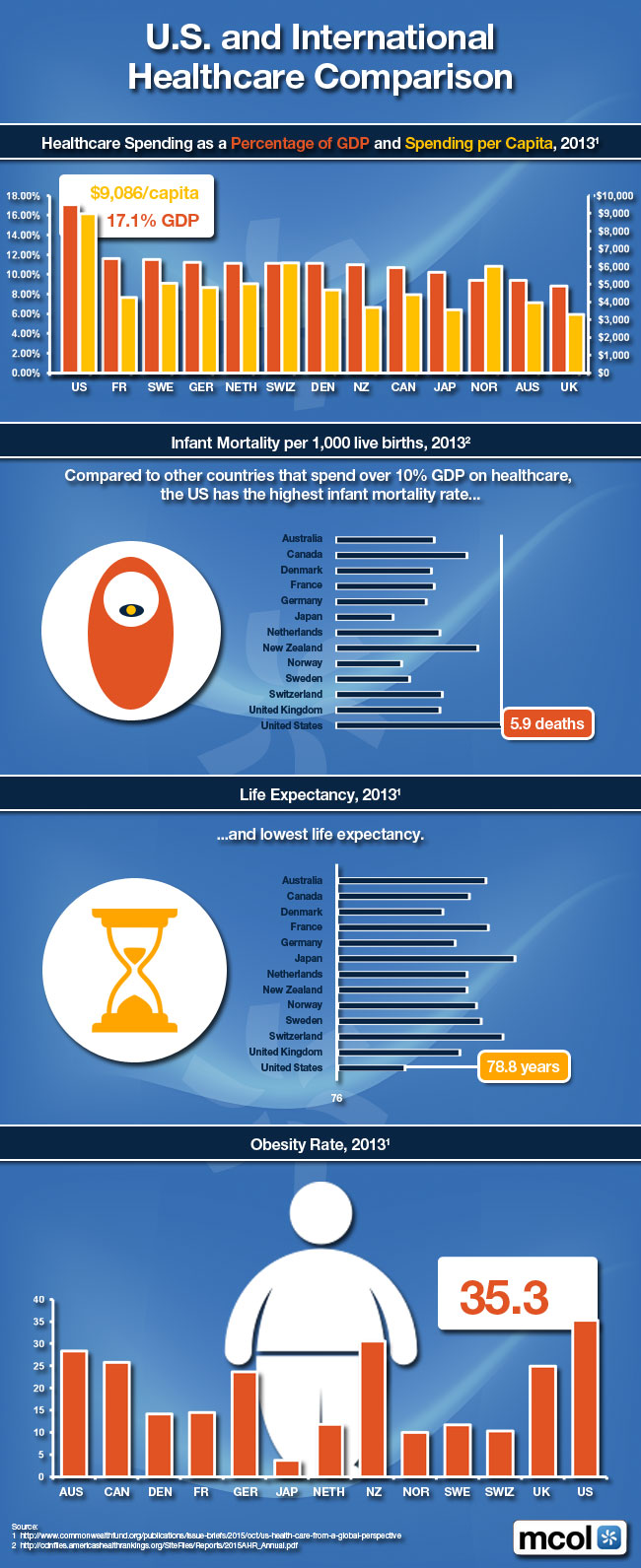
US and International Healthcare Comparison

Join Our Mailing List

By http://www.MCOL.com

As a Percentage of GDP and Spending Per Capita 2013

ImageProxy

Assessment

Your thoughts and comments on this ME-P are appreciated. Feel free to review our top-left column, and top-right sidebar materials, links, URLs and related websites, too. Then, subscribe to the ME-P. It is fast, free and secure.

Speaker: If you need a moderator or speaker for an upcoming event, Dr. David E. Marcinko; MBA – Publisher-in-Chief of the Medical Executive-Post – is available for seminar or speaking engagements. Contact: MarcinkoAdvisors@msn.com

OUR OTHER PRINT BOOKS AND RELATED INFORMATION SOURCES:

Product DetailsProduct DetailsProduct Details

***

On Criminal Penalties for Acts Involving Federal Healthcare Programs

Join Our Mailing List

AN UPDATE

Carol S. MillerBy Carol Miller RN MBA

Individuals and entities are prohibited from “knowingly and willfully” making false statements or presentations in applying for benefits or payments under all federal and state healthcare programs. Individuals also are prohibited from fraudulently concealing or failing to disclose knowledge of an event relating to an initial or continued right to payments. There is also prohibition against knowingly and willingly soliciting or receiving any remuneration (including any kickbacks, bribes, or rebates) directly or indirectly, in cash or in kind, in exchange for referrals. Violations may result in felony convictions with penalties including imprisonment and fines.

Individuals or entities can be excluded from Medicare and Medicaid and more than 200 other federal healthcare programs for a minimum of five years if there is one prior fraud or abuse conviction. Thee exclusions last for ten years and if there are two prior convictions, the exclusion can become permanent. The minimum period of discretionary exclusion is three years, unless DHHS determines that a different period is appropriate.

It is just as important to communicate to the employees when laws or regulations do not impact your organization, such as the Family Medical Leave Act (FMLA), the employment provisions of the Americans with Disabilities Act (ADA) or continuation of health benefits under the Consolidated Omnibus Budget Reconciliation Act (COBRA). These benefits apply only to organization with a specific number of employees, so smaller organizations are not necessarily required to offer these benefits.

***

Obamacare

***

However, the Patient Protection and Affordable Care Act (PPACA) provides a slightly different situation for the provider’s practice. PPACA mandated coverage, penalizing employers who failed to provide it, and creating mechanisms for people to pool risk and buy insurance collectively.

Further the Act stated: 1) all individuals not covered by an employer sponsored health plan, Medicare or Medicaid or other public insurance programs such as Tricare to secure an approved private-insurance policy or pay a penalty, unless the individual has a financial hardship or is a member of a recognized religious sect exempted by the Internal Revenue Service and 2) businesses, including larger medical practices which employ 50 or more people but do not offer health insurance to their full-time employees will pay a tax penalty if the government has subsidized a full-time employee’s healthcare through tax deductions or other means.

Assessment

This is known as the employer mandate. What this means for the provider’s practice is that if the provider is offering healthcare benefits to their staff, the coverage needs to be comparable with the requirements stated in the PPACA and if the practice is not offering healthcare benefits, then the practice must direct the individual to one of the Health Insurance Exchanges that are offering individual coverage plans.

Conclusion

Your thoughts and comments on this ME-P are appreciated. Feel free to review our top-left column, and top-right sidebar materials, links, URLs and related websites, too. Then, subscribe to the ME-P. It is fast, free and secure.

Speaker: If you need a moderator or speaker for an upcoming event, Dr. David E. Marcinko; MBA – Publisher-in-Chief of the Medical Executive-Post – is available for seminar or speaking engagements. Contact: MarcinkoAdvisors@msn.com

OUR OTHER PRINT BOOKS AND RELATED INFORMATION SOURCES:

Risk Management, Liability Insurance and Asset Protection Strategies for Doctors and Advisors

[Best Practices from Leading Consultants and Certified Medical Planners™]

Risk Management, Liability Insurance, and Asset Protection Strategies for Doctors and Advisors: Best Practices from Leading Consultants and Certified Medical Planners™

PHYSICIAN-EXECUTIVE LEADERSHIP AND RISK MANAGEMENT

Join Our Mailing List 

Human Nature, Medical Ethics and Modern Principles

  • By David Edward Marcinko FACFAS CMP® MBA MBBS
  • By Render S. Davis MHA CAE
  • By Hope Rachel Hetico RN MHA CPHQ CMP®
  • By Gary A. Cook EJD CFP® CLU RHU MSFS CMP®

In any textbook of gravitas on medical risk management, asset protection and insurance planning, a chapter on human nature is usually placed at the end of the book, or as an appendix, or an afterthought if included at all.

However, we elected to prominently place this material as the premier chapter of our textbook.

***

 Risk Management, Liability Insurance, and Asset Protection Strategies for Doctors and Advisors: Best Practices from Leading Consultants and Certified Medical Planners™

***

Why?

In the end, the success of any risk management endeavor ultimately comes down to changing human behavior – helping a doctor/nurse/technician alter whatever s/he was doing toward something that will better allow them to avoid errors and pursue quality care and practice management goals.

Yet, there is still remarkably little education or training for medical professionals focused directly on motivation or change theory, in any related area except psychiatry/psychology or perhaps professional liability.

Instead, doctors are increasingly turning to professional consultants to learn best practices on how to help them actually make the behavioral changes necessary to achieve their quality improvement and risk reduction goals; as we attempt to answer these questions.

The Queries:

  • Are you and your medical practice, or clinical, ready for change?
  • How to transition from [traditional] solo practitioner B-models to modern forms?
  • What are leadership, management and governance?
  • In group practices, how is leadership shared?
  • What issues need be considered when hiring a practice administrator or clinic CEO?
  • What is medical ethics and munificence? Why is it needed? How does it work?
  • What are the types of risk?
  • How are risks managed in the medical practice space?

***

confirmation-bias

***

Leadership Shortcomings

In addition, medical practitioners need to strive to avoid what Zenger and Folkman describe as the 10 most common leadership shortcomings based on a survey of 11,000 leaders. They include:

  • Lacks energy and enthusiasm
  • Accepts mediocre self performance
  • Lacks clear vision and direction
  • Poor judgment
  • Not collaboration
  • Not following standards
  • Resistant to new ideas
  • Doesn’t learn from mistakes
  • Lacks interpersonal skills
  • Fails to develop others.

Source: Zenger and Folkman: The Daily Stat: The 10 Most Common Failures of Business Leaders, Harvard Business Publishing, June 4, 2009. 

More:

Assessment

Want to lean even more about hundreds of medical risk management topics? Order our newest text book, today!

Conclusion

Your thoughts and comments on this ME-P are appreciated. Feel free to review our top-left column, and top-right sidebar materials, links, URLs and related websites, too. Then, subscribe to the ME-P. It is fast, free and secure.

Speaker: If you need a moderator or speaker for an upcoming event, Dr. David E. Marcinko; MBA – Publisher-in-Chief of the Medical Executive-Post – is available for seminar or speaking engagements. Contact: MarcinkoAdvisors@msn.com

OUR OTHER PRINT BOOKS AND RELATED INFORMATION SOURCES:

Risk Management, Liability Insurance, and Asset Protection Strategies for Doctors and Advisors: Best Practices from Leading Consultants and Certified Medical Planners™

***

The FIXATION on Financial Planning “Teams”

Join Our Mailing List 

“I Still HATE Teams”

DEMM high-def White

[By Dr. David Edward Marcinko CMP® MBA MBBS]

http://www.CertifiedMedicalPlanner.org

cmp-logo16

The Real Notion of Teams

I HATE teams. There I said it. Now; I repeat. I hate team sports, teams in medicine and especially teams in financial planning. I am NOT a team player; most doctors are independent minded and not team players.

On the other hand, my wife says that I am most assuredly a team player. But, that I just select my teams very carefully. She is much smarter than I; so perhaps she is correct!

Why I Rue the Hospital “Team-Based Medicine” Approach to In-Patient Care

Financial Planning

In financial planning, there seems to be a fixation … that a team is a financial planner [certified; or not] and an attorney; nice-but a couple and not really a team in the true sense of group development as first proposed by Bruce Tuckman PhD, in 1965.

In his model, Tucker maintained that four phases are all necessary and inevitable in order for the team to grow, to face challenges, to tackle problems, to find solutions, to plan work, and to deliver results [Forming – Storming – Norming – Performing].

Later, he added Adjourning to successfully complete the task and break up the team. Timothy Biggs PhD further added the Re-Norming stage to reflect a period where the team re-assembles, as needed. This put the emphasis back on the ME Inc or physician team leader – as too many ‘diplomats’ in a leadership role may prevent the team from reaching full potential.

Source: http://infed.org/mobi/bruce-w-tuckman-forming-storming-norming-and-performing-in-groups/

A Metaphor

This is why “team” must be more than a metaphor. It deserves more than lip service. Delivering client-centered, coordinated financial planning services and products demands true collaboration–a fully integrated team engaged in practices that involve each member at the top, highest and best use of their licensure and education; optimizing their contributions and maximizing their impact on the well being of the client [Boyer Model of Education].

In this context, board Certified Medical Planners™ may play a lead role going forward; along with other like-minded and educated professionals.

Unfortunately, the ranks of CMPs™ while growing; are still painfully small. But, in addition to true expertise, they link physician clients with appropriate providers and resources throughout the holistic professional life/practice planning continuum. They focus on the doctor-client’s totality — emotional, financial, risk and business management and psyche. As fiduciaries at all times; They advocate for the doctor client to connect him/her to the necessary resources, professional advisors and consultants who need to have their voices heard. Such successful, high-functioning financial planning teams give each member a voice.

The medical professional must be an active participant; not a passive bystander. This is not the norm in financial planning today where doctors are urged to hire a team quarterback. But, the NFL-QB is not a generalist at all; his arm is special and unlike all other teams players. He/she is unique, skilled and exceptional. A franchise player!

Past not Prologue

Fortunately, past is not prologue in the era of transparency, information at your fingertips, tablet PCs, Skype® and smart phones. To succeed in the hyper competitive new era of health reform requires education, involvement and active participation.

In short, a new model of physician focused advisor. No longer is there a free lunch of passivity for medical professionals; either as doctors or advisory clients themselves.

For financial planning in the new era of healthcare reform, and robo-advisors, successful doctors will assume the mantle of self-quarterback themselves.

***

a9985330904385_56389b1f75cd9

[Go Team Go]

***

ME Inc., or Going it Alone – but with a Team

The physician, nurse, or other medical professional should easily recognize that there are a vast array of opportunities, obstacles, and pitfalls when it comes to managing one’s finances.

Still, with some modicum of effort, the basic aspects of insurance, investments, taxes, accounting, portfolio management, retirement and estate planning, debt reduction, asset protection and practice management can be largely self-taught. After all, it is NOT rocker science.

After all, anyone can purchase the exact same financial planning software that legions of FAs use, and there are many iterations on the market, as well.  This concept is not unlike patients, using Dr. Google. No license required.

And TAMPs, relegate FAs to the role of “asset gather”; or should I say salesman/woman.

Why Physician-Investors Must Understand TAMPs

Informed Patient [Client]

So, an informed patient or client is ideal; is it not?

Yet, it is realized that nuances and subtleties can make a well-intentioned plan fall short.  The devil truly is in the details.  Moreover, none of these areas can be addressed in isolation. It is common for a solution in one area to cause a new set of problems in another.

Hourly Model 

Accordingly, most health care practitioners would be well served to hire [independent, hourly compensated and prn] financial help.

Unlike some medical problems, financial issues may not cause any “pain” or other obvious symptoms.  Medical professionals tend to have far more complex financial situations than most lay people. Despite the complexities of the new world of health reform, far too many either do nothing; or give up all control totally, to an external advisor. This either/or mistake can be costly in many ways, and should be avoided.

In reality, and at various time in their careers, the medical professional needs a team comprised of at least a financial analyst [CFA], lawyer, management consultant, risk manager [PhD actuary or insurance counselor] and accountant. At various points in time, each member of the team, or significant others, will properly assume a role of more or less importance, but the doctor must usually remain the “quarterback” or leader; in the absence of a truly informed other, or Certified Medical Planner™.

This is necessary because only the doctor [client] has the personal self-mandate with skin in the game, to take a big picture view. And, rightly or wrongly, investments dominate the information available regarding personal finance and the attention of most physicians.  One is much more likely to need or want to discuss the financial markets with their financial advisor than private letter rulings by the IRS, or with their estate planning attorney or tax accountant.

So, while hiring for expertise is a good idea, there is sinister way advisors goad doctors into using all their retail services; all of the time. That artifice is – the value of time. Don’t fall for this out sourcing gambit!

How Doctors Pay for Wealth Management Services

***

crowds

[Not Going it Alone]

***

Assessment

True integrated physician focused and financial planning is at its core a service business, not a product or sales endeavor. And, increasingly money is more likely to be at the top of the list for providers as the healthcare environment is contracting.

So, eschewing the quarterback model of advice, and choosing to self-educate thru these new book and elsewhere, may be one of the best efforts a smart physician can make.

Enter the CMPs

Conclusion

Your thoughts and comments on this ME-P are appreciated. Feel free to review our top-left column, and top-right sidebar materials, links, URLs and related websites, too. Then, subscribe to the ME-P. It is fast, free and secure.

Speaker: If you need a moderator or speaker for an upcoming event, Dr. David E. Marcinko; MBA – Publisher-in-Chief of the Medical Executive-Post – is available for seminar or speaking engagements. Contact: MarcinkoAdvisors@msn.com

OUR OTHER PRINT BOOKS AND RELATED INFORMATION SOURCES:

[PHYSICIAN FOCUSED FINANCIAL PLANNING AND RISK MANAGEMENT COMPANION TEXTBOOK SET]

  Risk Management, Liability Insurance, and Asset Protection Strategies for Doctors and Advisors: Best Practices from Leading Consultants and Certified Medical Planners™ Comprehensive Financial Planning Strategies for Doctors and Advisors: Best Practices from Leading Consultants and Certified Medical Planners™

[Dr. Cappiello PhD MBA] *** [Foreword Dr. Krieger MD MBA]

***

HUMANITARIAN WISDOM IN PATIENT CARE AS A MORAL IMPERATIVE AND …

Join Our Mailing List

…. A MEDICAL RISK MANAGEMENT TOOL in 2018!

***

DEM white shirt

[Dr. David Edward Marcinko CMP™ MBA MBBS]

http://www.CertifiedMedicalPlanner.org

EDITOR-IN-CHIEF

***

In SECTION ONE, of our newest textbook, on medical practitioner personal risk management issues, let us all recall the Canadian physician Sir William Osler MD, one of the founders of Johns Hopkins Hospital in my hometown of Baltimore Maryland, and where I played stickball in the parking lot as a kid. He left a sizeable body of wisdom that has guided many physicians in the practice of medicine. So, allow me to share with you some of that accumulated wisdom and the quotes that have served me well over the years.

From Dr. Osler, I learned the art of putting myself in the patient’s shoes. “The motto of each of you as you undertake the examination and treatment of a case should be ‘put yourself in his place.’ Realize, so far as you can, the mental state of the patient, enter into his feelings.” Osler further stresses that we should “scan gently (the patient’s) faults” and offer the “kindly word, the cheerful greeting, the sympathetic look.”1

“In some of us, the ceaseless panorama of suffering tends to dull that fine edge of sympathy with which we started,” writes Osler in his famous essay “Aequanimitas.”2 “Against this benumbing influence, we physicians and nurses, the immediate agents of the Trust, have but one enduring corrective — the practice towards patients of the Golden Rule of Humanity as announced by Confucius: ‘What you do not like when done to yourself, do not do to others.’”

Medicine can be both art and science as many physicians have discovered. As Osler tells us, “Errors in judgment must occur in the practice of an art which consists largely of balancing probabilities.”2 Osler notes that “Medicine is a science of uncertainty and an art of probability” and also weighs in with the idea that “The practice of medicine is an art, based on science.”3,4

Osler emphasized that excellence in medicine is not an inheritance and is more fully realized with the seasoning of experience. “The art of the practice of medicine is to be learned only by experience,” says Osler. “Learn to see, learn to hear, learn to feel, learn to smell, and know that by practice alone can you become expert.”5

Finally, some timeless wisdom on patient care came from Osler in an address to St. Mary’s Hospital Medical School in London in 1907: “Gain the confidence of a patient and inspire him with hope, and the battle is half won.”6

Osler has also imparted plenty of advice on the business of medicine. In “Aequanimitas,” Osler says there are only two types of doctors: “those who practice with their brains, and those who practice with their tongues.”7

***

Risk Management, Liability Insurance, and Asset Protection Strategies for Doctors and Advisors: Best Practices from Leading Consultants and Certified Medical Planners™

***

In a valedictory address to medical school graduates at McGill University, Osler suggested treating money as a side consideration in a medical career.8 “You have of course entered the profession of medicine with a view of obtaining a livelihood; but in dealing with your patients let this always be a secondary consideration.”

“You are in this profession as a calling, not as a business: as a calling which exacts from you at every turn self-sacrifice, devotion, love and tenderness to your fellow man,” explains Osler in the address to St. Mary’s Hospital Medical School.6 “Once you get down to a purely business level, your influence is gone and the true light of your life is dimmed. You must work in the missionary spirit, with a breadth of charity that raises you far above the petty jealousies of life.”

It is not easy for doctors to combine a passion for patient care, a knowledge of science and the maintenance of business, according to Osler in the British Medical Journal.9 “In the three great professions, the lawyer has to consider only his head and pocket, the parson the head and heart, while with us the head, heart, and pocket are all engaged.”

While some aspects of practice may fall short or be devoid of appropriate financial remuneration, the giving of one’s time, expertise and experience in improving patient outcomes and the quality of their lives may be the greatest gift. “The ‘good debts’ of practice, as I prefer to call them … amount to a generous sum by the end of each year,” says Osler.9

***

http://www.BusinessofMedicalPractice.com

***

MEDICAL Ethics for Challenging Times

[Finding Your Moorings in an Era of Dramatic Change]

Marcinko Ethics

By Render S. Davis MHA

By David Edward Marcinko

***

And so, as you read and reflect on the chapter of SECTION ONE, always remember the words and wisdom of Dr. William Osler, and keep patient welfare as your first priority.

Dr. David Edward Marcinko; CMP™ MBA MBBS [Hon]

[Chief Executive Officer]

iMBA Inc., Norcross, GA

References

  1. Penfield W. Neurology in Canada and the Osler centennial. Can Med Assoc J. 1949; 61(1): 69-73
  2. Osler W. Aequanimitas. Chapter 9, P. Blakiston’s Son and Co., Philadelphia, 1925, p. 159
  3. Bean WB. William Osler: Aphorisms, CC Thomas, Springfield, IL, p. 129.
  4. Osler W. Aequanimitas. Chapter 3, P. Blakiston’s Son and Co., Philadelphia, 1925, p. 34
  5. Thayer WS. Osler the teacher. In: Osler and Other Papers. Johns Hopkins Press, Baltimore, 1931, p. 1.
  6. Osler W. The reserves of life. St. Mary’s Hosp Gaz. 1907;13 (1):95-8.
  7. Osler W. Aequanimitas. Chapter 7, P. Blakiston’s Son and Co., Philadelphia, 1925, p. 124
  8. Osler W. Valedictory address to the graduates in medicine and surgery, McGill University. Can Med Surg J. 1874; 3:433-42.
  9. Osler W. Remarks on organization in the profession. Brit Med J. 1911; 1(2614):237-9.
  10. Jacobs. AM: PMNews, April, 2015.

***

[PHYSICIAN FOCUSED FINANCIAL PLANNING AND RISK MANAGEMENT COMPANION TEXTBOOK SET]

  Risk Management, Liability Insurance, and Asset Protection Strategies for Doctors and Advisors: Best Practices from Leading Consultants and Certified Medical Planners™ Comprehensive Financial Planning Strategies for Doctors and Advisors: Best Practices from Leading Consultants and Certified Medical Planners™

[Dr. Cappiello PhD MBA] *** [Foreword Dr. Krieger MD MBA]

***

R.I.P. Lon Jefferies MBA CFP®

Join Our Mailing List

***

Dear ME-P Readers and Subscribers

It is with a heavy heart that we inform you that Lon Jefferies passed away unexpectedly this weekend due to complications inherent with a seizure disorder.  We are extremely saddened by Lon’s all-too-soon departure.  He was a vital contributor to this Medical Executive-Post and Financial Planning industry writ large; and he will be greatly missed.

***

Lon Jefferies

http://www.NewWorthAdvice.com

***

As you know, Lon was an excellent financial planner and prolific blogger.  To his credit – one of the variables he planned for  – was the possibility of a life altering event such as this.  With this foresight, Lon chose to align his financial planning services with his team at Net Worth Advisory Group.  Lon’s plan ensures that each client can continue to receive the same high level of financial planning and assistance going forward, while allowing his beneficiaries to receive some residual income.

Our most sincere sympathies go out to Lon’s new bride Jen, his parents, and their families.

With best regards and sincere sympathy.

Dr. David Edward Marcinko MBA CMP® MBBS

[Publisher and Editor-in-Chief]

***

Irish Health Minister For Health (Leo Varadkar) Slams Greedy Drug Companies.. Plus.. Pharma CEO, Martin Schkreli Is Arrested For Fraud..
Pharma CEO Martin Schkreli is Arrested For Fraud

***

pills+many+colors+mrc

***

Conclusion

Your thoughts and comments on this ME-P are appreciated. Feel free to review our top-left column, and top-right sidebar materials, links, URLs and related websites, too. Then, subscribe to the ME-P. It is fast, free and secure.

Speaker: If you need a moderator or speaker for an upcoming event, Dr. David E. Marcinko; MBA – Publisher-in-Chief of the Medical Executive-Post – is available for seminar or speaking engagements. Contact: MarcinkoAdvisors@msn.com

OUR OTHER PRINT BOOKS AND RELATED INFORMATION SOURCES:

Doctor-Patient RELATIONSHIPS in the MODERN Health 2.0 ERA

Join Our Mailing List 

[Can We Talk? – A Collaborative Shift in Bedside Manner]

By Mario Moussa PhD MS

By David E. Marcinko MBBS MBA CMP

By Jennifer Tomasik PhD MS

Jennifer Tomasik

“The single biggest problem in communication is the illusion that it has taken place.”

George Bernard Shaw 

Star Trek fans have seen the future of medicine.

Leonard McCoy, also known as “Bones,” describes himself as a “simple country doctor,” although he plies his trade using 23rd. century medical technology. A deeply caring humanist, Bones often spars with the hyper-logical Spock—half human, half Vulcan. But as the Star Trek saga unfolds through The Next Generation, Deep Space Nine, and finally Voyager, Star Fleet physicians become increasingly rational and less recognizably human. The Voyager’s “Doctor” is no person at all. “He” is an infallible computer program designed to mimic compassion, self-assurance, and other soulful qualities.[i]

Health/Web 2.0

Today, when patients communicate through instant messaging, Twitter, Facebook, and other Health/Web 2.0 electronic mediums, they might feel that health providers are already more like the virtual “Doctor” than the all-too-human “Bones.” Before long, according to one technology expert, 20% – 50% of all doctor-patient communication will be virtual.[ii] But we suggest you pause before rocketing ahead into this brave new future that advocates call Health 2.0—the application of social media tools to the health care environment.

Electronic technology

Electronic technology in all of its forms has obviously had a profound impact on medicine. We focus here on just one of its most notable effects: the changing doctor-patient relationship. We believe Health 2.0 has the potential to deepen this relationship—or not. It depends on how you use it.

There are an almost overwhelming number of social media tools for managing the doctor-patient relationship. How do you choose the right ones? We offer some guidance in this essay by focusing on three issues:

The issues

  1. What matters most in the doctor-patient relationship?
  2. What counts as a good relationship?
  3. How should you use social media tools to build a relationship?

We have found that there is no one best way to use Health 2.0 technology. But there is just one rule. As the novelist E.M. Forster said, “Only connect.”

***

masks

***

Conclusion

Your thoughts and comments on this ME-P are appreciated. Feel free to review our top-left column, and top-right sidebar materials, links, URLs and related websites, too. Then, subscribe to the ME-P. It is fast, free and secure.

Speaker: If you need a moderator or speaker for an upcoming event, Dr. David E. Marcinko; MBA – Publisher-in-Chief of the Medical Executive-Post – is available for seminar or speaking engagements. Contact: MarcinkoAdvisors@msn.com

  • Petrany, Stephen M. “Star Trek and the Future of Family Medicine.” Family Medicine 40.2 (2008): 132 – 133.
  • Silverman, Jennifer. “Impact of Virtual Visits on Doctor-Patient Relationship Unclear: an end to ‘true medicine’?” Ob.Gyn. News 38.21 (2003): 29.

***

[PRIVATE MEDICAL PRACTICE BUSINESS MANAGEMENT TEXTBOOK – 3rd.  Edition]

Product DetailsProduct Details

  [Foreword Dr. Hashem MD PhD] *** [Foreword Dr. Silva MD MBA]
***

Newer Thoughts on Long Term Care Insurance

Join Our Mailing List

Most LTCI policies are SOLD… not Bought!

DEM white shirt

By Dr. David Edward Marcinko MBA CMP

To be sure, physicians and Financial Advisors are aware that there is a sometime need to recommend a LTCI policy to clients. Of course, in such cases, it is a good idea to work with a low load provider (or the physician or client’s agent).

The Need?

Yet, most LTCI policies are sold by insurance agents for big commissions; not bought, and that most statistics used to sell LTCI policies are fear-based and half-truths. I know, as I was a licensed insurance agent for more than a decade.

Even the Department of Health and Human Services [DHHS] gets into the fear mongering on their website quoting that “about 70 percent of people over age 65 require some type of long-term care services during their lifetime”

Source: http://www.longtermcare.gov/LTC/Main_Site/Planning/Index.aspx

Department of Health and Human Services

This may be a deceptive statistic as it omits the length of long-term care needed in these 70% of cases. And, it is not 3+ years in all these cases [our estimate is closer to 2.5]. With the stamp of approval by the Supreme Court of the United States SCOTUS on the PP-ACA, we may be looking at social LTCI in the US like other social medicine countries and give up on private LTCI insurance altogether.

Other Countries

Germany introduced mandatory long-term care insurance in 1995. Japan and France also have a LTCI tax funded insurance plan. And, the poor utilization and growing risks associated with long-term care insurance, are leading a growing number of insurance agents, financial advisors and Certified Medical Planners™ to recommend alternatives to their clients.

***

elderly

***

Assessment

To be a thought-leader ahead of the curve, the newest aging trend is away from LTCI and toward sheltering at home – living at home and dying at home. Perhaps, this is the way it should be.

Dying should not be a for-profit industry.

http://www.CertifiedMedicalPlanner.org

More:

Conclusion

Your thoughts and comments on this ME-P are appreciated. Feel free to review our top-left column, and top-right sidebar materials, links, URLs and related websites, too. Then, subscribe to the ME-P. It is fast, free and secure.

Speaker: If you need a moderator or speaker for an upcoming event, Dr. David E. Marcinko; MBA – Publisher-in-Chief of the Medical Executive-Post – is available for seminar or speaking engagements. Contact: MarcinkoAdvisors@msn.com

OUR OTHER PRINT BOOKS AND RELATED INFORMATION SOURCES:

***

[PHYSICIAN FOCUSED FINANCIAL PLANNING AND RISK MANAGEMENT COMPANION TEXTBOOK SET]

  Risk Management, Liability Insurance, and Asset Protection Strategies for Doctors and Advisors: Best Practices from Leading Consultants and Certified Medical Planners™    Comprehensive Financial Planning Strategies for Doctors and Advisors: Best Practices from Leading Consultants and Certified Medical Planners™

[Dr. Cappiello PhD MBA] *** [Foreword Dr. Krieger MD MBA]

***

Deception in the Financial Service Industry

Join Our Mailing List

ME-P Special Report

Continue reading

Proposing a Possible [San Bernardino CA] Medical Work Place Violence Prevention Initiative?

Join Our Mailing List

The Haddon Matrix for Health Place Injury Prevention and Workplace Violence

By

[Eugene Schmukler; PhD MBA MEd – Certified Trauma Specialist]

***

An invaluable tool for healthcare violence prevention program establishment is the Haddon Matrix. In 1968, William Haddon, Jr., a public health physician with the New York State Health Department, developed a matrix of categories to assist researchers trying to address injury prevention systematically. The idea was to look at injuries in terms of causal factors and contributing factors, rather than just using a descriptive approach. It is only recently that this model has been put to use in the area of workplace violence.

The Matrix Framework

The matrix is a framework designed to apply the traditional public health domains of host, agent, and disease to primary, secondary, and tertiary injury factors. When applied to workplace violence, the “host” is the victim of workplace violence, such as a nurse. The “agent” is a combination of the perpetrator and his or her weapon(s) and the force with which an assault occurs. The “environment” is divided into two sub domains: the physical and the social environments. The location of an assault such as the ER, the street, an examining room, or hospital ward is as important as the social setting in patient interaction, presence of co-workers, and supervisor support.

Modifications

Subsequent versions of the matrix divide the environment into Physical environment and Social, Socio-economic, or Sociocultural environment. Each factor is then considered a pre-event phase, an event phase, and a post-event phase.

***

sad

***

Medical / Healthcare Setting

The Haddon Matrix lends itself to a medical setting in that it uses a classical epidemiological framework to categorize “pre-event,” “event,” and “post-event” activities according to the infectious disease vernacular, host (victim), vector (assailant or weapon), and environment. The strength of the Haddon Matrix is that it includes the ability to assess “pre-events” or precursors in order to develop primary preventive measures.


Phases

Host

Agent

Physical Environment

Social Environment

Pre-event (prior to assault)

Knowledge

Self-efficacy

Training

History of prior violence communicated

Assess objects that could become weapons, actual weapons, egress (means of escape)

Visit in pairs or with escort

Event (assault)

De-escalation

Escape techniques

Alarms/2-way phones

Reduce lethality of patient via increasing your distance

Egress, alarm, cell phone

Code and security procedures

Post-event (post-assault)

Medical care/counseling

Post-event debriefing

Referral

Law enforcement

Evaluate role of physical environment

All staff debrief and learn

Modify plan if appropriate


Policy?

From the perspective of administration, the Haddon Matrix does not implicate policy. This means that the matrix does not necessarily guide policy. When implemented, the Haddon Matrix can be a “politically” neutral, trans-or multi-disciplinary, objective tool that identifies opportunities for intervention. Furthermore, it outlines sensible “targets of change” for the physical and social environment.


Phase

Affected individual and population

Agent used

Environment

Pre-event

Psychological first aid

Communicate efforts to limit action

Have plans in place detailing agency roles in prevention and detection

Event

Population uses skills

Mobilize trauma workers

Communicate that response systems are in place

Post-event

Assessment, triage, and psychological treatment

Communicate, establish outreach centers

Adjust risk communication

End results

Limit distress responses, negative behavior changes and psychological illness

Minimize loss of life and impact of attack

Minimize disruption in daily routines


More: Was the San Bernardino CA Massacre Work Place Violence?

***

Risk Management, Liability Insurance, and Asset Protection Strategies for Doctors and Advisors: Best Practices from Leading Consultants and Certified Medical Planners™    8Risk Management, Liability Insurance, and Asset Protection Strategies for Doctors and Advisors: Best Practices from Leading Consultants and Certified Medical Planners™

***

Assessment

And so, was San Bernardino workplace violence – or not; please opine?

Conclusion

Your thoughts and comments on this ME-P are appreciated. Feel free to review our top-left column, and top-right sidebar materials, links, URLs and related websites, too. Then, subscribe to the ME-P. It is fast, free and secure.

Link: http://feeds.feedburner.com/HealthcareFinancialsthePostForcxos

Speaker: If you need a moderator or speaker for an upcoming event, Dr. David E. Marcinko; MBA – Publisher-in-Chief of the Medical Executive-Post – is available for seminar or speaking engagements. Contact: MarcinkoAdvisors@msn.com

OUR OTHER PRINT BOOKS AND RELATED INFORMATION SOURCES:

***

Product DetailsProduct Details

   8

***

APHA – Giving Tuesday

Join Our Mailing List

ImageProxy

Dear Dr. David Marcinko,

#GivingTuesday is the global movement dedicated to giving back. It kicks off the holiday giving season and I hope you will join me by making a contribution to APHA.

Please consider making a donation in two areas where we need your help the most:

Your donation makes you part of Generation Public Health, APHA’s movement to create the healthiest nation in one generation. With your generous contribution we can continue to support the groundbreaking work of public health professionals and help turn today’s students into tomorrow’s leaders.

After you make your donation, please share on Facebook, Twitter, Instagram and other social media that you donated on #GivingTuesday and joined #GenerationPublicHealth.

Thank you for all that you do to support APHA!

Sincerely,
Dr. B Signature
Georges C. Benjamin, MD
[Executive Director]
Georges C. Benjamin, MD

Consumer Experience with Drug Advertisements

Join Our Mailing List

On D-2-C Ads?

By http://www.MCOL.com

***

ImageProxy

***

Conclusion

Your thoughts and comments on this ME-P are appreciated. Feel free to review our top-left column, and top-right sidebar materials, links, URLs and related websites, too. Then, subscribe to the ME-P. It is fast, free and secure.

Speaker: If you need a moderator or speaker for an upcoming event, Dr. David E. Marcinko; MBA – Publisher-in-Chief of the Medical Executive-Post – is available for seminar or speaking engagements. Contact: MarcinkoAdvisors@msn.com

OUR OTHER PRINT BOOKS AND RELATED INFORMATION SOURCES:

[PRIVATE MEDICAL PRACTICE BUSINESS MANAGEMENT TEXTBOOK – 3rd.  Edition]

Product Details

  [Foreword Dr. Hashem MD PhD] *** [Foreword Dr. Silva MD MBA]

***

The Most Common Health Complaints in the USA

Join Our Mailing List

The Top  Five [5] Complaints – 2015

By http://www.MCOL.com

ImageProxy

Conclusion

Your thoughts and comments on this ME-P are appreciated. Feel free to review our top-left column, and top-right sidebar materials, links, URLs and related websites, too. Then, subscribe to the ME-P. It is fast, free and secure.

Speaker: If you need a moderator or speaker for an upcoming event, Dr. David E. Marcinko; MBA – Publisher-in-Chief of the Medical Executive-Post – is available for seminar or speaking engagements. Contact: MarcinkoAdvisors@msn.com

OUR OTHER PRINT BOOKS AND RELATED INFORMATION SOURCES:

***

[HEALTH INSURANCE, MANAGED CARE, ECONOMICS, FINANCE AND HEALTH INFORMATION TECHNOLOGY COMPANION DICTIONARY SET]

      Product DetailsProduct DetailsProduct Details

[Mike Stahl PhD MBA] *** [Foreword Dr.Mata MD CIS] *** [Dr. Getzen PhD]

***

How Companies Value Body Parts?

Join Our Mailing List
A ProPublica Price Check
By Lena Groeger and Michael Grabell
   ***
             

        ProPublica

                                                                      ***

Injured workers are entitled to compensation for permanent disabilities under state workers’ comp laws.

More:

***

body

Price Check: How Companies Value Body Parts

***

But – Texas has long allowed companies to opt out and write their own benefit plans.

More:

Assessment

Benefits for the same body part can differ dramatically depending on which company you work for.

Related Story »

Conclusion

Your thoughts and comments on this ME-P are appreciated. Feel free to review our top-left column, and top-right sidebar materials, links, URLs and related websites, too. Then, subscribe to the ME-P. It is fast, free and secure.

Speaker: If you need a moderator or speaker for an upcoming event, Dr. David E. Marcinko; MBA – Publisher-in-Chief of the Medical Executive-Post – is available for seminar or speaking engagements. Contact: MarcinkoAdvisors@msn.com

OUR OTHER PRINT BOOKS AND RELATED INFORMATION SOURCES:

 ***

[HEALTH INSURANCE, MANAGED CARE, ECONOMICS, FINANCE AND HEALTH INFORMATION TECHNOLOGY COMPANION DICTIONARY SET]

Product DetailsProduct DetailsProduct Details

[Mike Stahl PhD MBA] *** [Foreword Dr.Mata MD CIS] *** [Dr. Getzen PhD]

***

New Tools for A Healthy Future

Join Our Mailing List

By Terri D. Wright, PhD, MPH                   

***

ImageProxy

***

APHA’s Policy Center Creates Tools for A Healthy Future

DEAR DAVID – The central challenge of the American Public Health Association is to create the healthiest nation in one generation. APHA’s Center for Public Health Policy was established almost 10 years ago to bring together analytical public health expertise and infuse the public health field with expert materials and tools in response to this challenge.

The Center embraces the public health issues that threaten population health. Our work is done through national and state partnerships and by leveraging resources across multiple sectors, including government, philanthropy and non-profit. Fundamental to all that we do: strategies to ensure health equity for all.

We invite you to learn about our work and stay abreast of our progress on producing resources for our members and constituents. The following priorities represent our core work to create a healthy nation:

  • Assuring health equity for all.
  • Promoting systems transformation to integrate public health and health care and improve population health.
  • Improving the natural and built environments to support health and create environmental justice.

We will keep you updated on our priority issues and encourage you to connect with our team.

We invite your feedback as we embark on this journey – phpolicycenter@apha.org

Sincerely,
Terri D Wright Signature

***

[HOSPITAL OPERATIONS, ORGANIZATIONAL [BEHAVIOR AND FINANCIAL MANAGEMENT COMPANION TEXTBOOK SET]

Product DetailsProduct Details

[Foreword Dr. Phillips MD JD MBA LLM] *** [Foreword Dr. Nash MD MBA FACP]

***

On Socially Responsible Investing

Join Our Mailing List

Balancing profits, people and the planet

Rick Kahler MS CFP

By Rick Kahler MS CFP®  http://www.KahlerFinancial.com

Balancing profits, people, and the planet can be tricky. Many physicians and other investors prefer to put their funds into companies that not only make money, but that also reflect the investors’ values. Some take this concept, often described as “socially conscious” or “socially responsible” investing, very seriously. There are also financial advisors who specialize in this niche.

Yet investing in companies whose values align with your own is not as simple as it may seem.

Business owners and corporate executives

In my experience with business owners and corporate executives, most of them take an interest in bettering the people who work with them, the planet, and their own lives. They run their companies with integrity. They don’t break the law. They respect their customers and don’t take advantage of them, but give them fair value in exchange for their money. They offer compensation and working conditions that will attract and retain good employees. Ultimately, they understand that ethical business practices are not only the right thing to do, but the best way to run profitable businesses.

But, how do you as an investor know whether a company is bettering  people and the planet while it is making a profit? One method is to choose companies in which to invest by using some type of socially responsible screening. Such screening looks to exclude companies producing products that harm people or the earth, or companies judged to have poor corporate cultures.

The challenges

One challenge with using such screens is that we don’t all have the same definitions of what may be socially or morally offensive. Investor A may not want to own stock in oil or mining companies. Investor B may be concerned about goods produced in unsafe working conditions. Investor C may not want to support companies that sell tobacco or alcohol.

A second challenge is that companies change. They may expand, diversify, or merge with other companies until it’s difficult to pinpoint their values, products, and company culture. A company may sell a lot of great products that do a lot of good for people, but have one division that produces a product some investors may find offensive. And it’s even harder to screen for companies that have good cultures—especially since there’s no clear definition of a “good” culture.

Choices

Investors can choose mutual funds that include only socially responsible companies, but any such fund is almost guaranteed to include companies that you would otherwise exclude.

If you are serious about investing only in companies that support your values, it’s essential to research them before you invest and monitor them regularly to ensure their practices or products don’t change. You also may find it necessary to give companies or SRI funds a little leeway—settling for perhaps 95% compliance with your values rather than insisting on 100%.

But sadly, even if you could invest your money in the shares of companies that totally support your values, doing so may not have much impact on that company, its people, or the planet. One reason for this is that your investment is likely to be a miniscule fraction of the company’s stock.

In addition, most often when we invest in stocks, we do not buy shares directly from the company. We buy shares, through a stock exchange, that are being sold by other investors. The profits or losses involved in trading those stocks accrue to the third-party buyers and sellers. They don’t directly affect the company’s bottom line.

***

gv

***

Assessment

For most small investors, making a difference through socially responsible investing may be an illusory goal. Its only real impact may be to help us feel better about ourselves.

Conclusion

Your thoughts and comments on this ME-P are appreciated. Feel free to review our top-left column, and top-right sidebar materials, links, URLs and related websites, too. Then, subscribe to the ME-P. It is fast, free and secure.

Speaker: If you need a moderator or speaker for an upcoming event, Dr. David E. Marcinko; MBA – Publisher-in-Chief of the Medical Executive-Post – is available for seminar or speaking engagements. Contact: MarcinkoAdvisors@msn.com

OUR OTHER PRINT BOOKS AND RELATED INFORMATION SOURCES:

***

[WHERE LEARNING IS A plus+]

Career Development, Products and Services

“The informed voice of a new generation of fiduciary advisors for healthcare”

CMP logo

http://www.CertifiedMedicalPlanner.org 

 Our New Text – “Take a Peek Inside – Now Available

Comprehensive Financial Planning Strategies for Doctors and Advisors: Best Practices from Leading Consultants and Certified Medical Planners(TM)

Front Matter with Foreword by Jason Dyken MD MBA

logos

“BY DOCTORS – FOR DOCTORS – PEER REVIEWED – FIDUCIARY FOCUSED”

***

New AIDS Data in America

Join Our Mailing List

What the Atlanta HIV Data Tells Us About Public Health in America

BY MAITHRI VANGALA

Maithri Vangala is a former editor with The Health Care Blog.

This article was initially published in Georgia Health News.

***

ImageProxy2

National HIV Testing Day

ImageProxy3

By muttermuseum on Instagram

***

More:

Conclusion

Your thoughts and comments on this ME-P are appreciated. Feel free to review our top-left column, and top-right sidebar materials, links, URLs and related websites, too. Then, subscribe to the ME-P. It is fast, free and secure.

Speaker: If you need a moderator or speaker for an upcoming event, Dr. David E. Marcinko; MBA – Publisher-in-Chief of the Medical Executive-Post – is available for seminar or speaking engagements. Contact: MarcinkoAdvisors@msn.com

OUR OTHER PRINT BOOKS AND RELATED INFORMATION SOURCES:

Product DetailsProduct DetailsProduct Details

[Mike Stahl PhD MBA] *** [Foreword Dr.Mata MD CIS] *** [Dr. Getzen PhD]

Medical Provider Billing Facts for 2014

Join Our Mailing List 

A Look at Medicare Spending

By http://www.MCOL.com

***

billing

***

Conclusion

Your thoughts and comments on this ME-P are appreciated. Feel free to review our top-left column, and top-right sidebar materials, links, URLs and related websites, too. Then, subscribe to the ME-P. It is fast, free and secure.

Speaker: If you need a moderator or speaker for an upcoming event, Dr. David E. Marcinko; MBA – Publisher-in-Chief of the Medical Executive-Post – is available for seminar or speaking engagements. Contact: MarcinkoAdvisors@msn.com

OUR OTHER PRINT BOOKS AND RELATED INFORMATION SOURCES:

[HOSPITAL OPERATIONS, ORGANIZATIONAL BEHAVIOR AND FINANCIAL MANAGEMENT COMPANION TEXTBOOK SET]

Product DetailsProduct Details

[Foreword Dr. Phillips MD JD MBA LLM] *** [Foreword Dr. Nash MD MBA FACP]

***

The Need for Anti-Trust and OIG Investigation of Physician Health Programs

Join Our Mailing List

Sunshine is the Best Disinfectant!

Langan MD

By Michael Lawrence Langan, M.D.

***

The Need for Anti-Trust and OIG Investigation of Physician Health Programs—Sunshine is the Best Disinfectant!

***

Mutter

***

Conclusion

Your thoughts and comments on this ME-P are appreciated. Feel free to review our top-left column, and top-right sidebar materials, links, URLs and related websites, too. Then, subscribe to the ME-P. It is fast, free and secure.

Speaker: If you need a moderator or speaker for an upcoming event, Dr. David E. Marcinko; MBA – Publisher-in-Chief of the Medical Executive-Post – is available for seminar or speaking engagements. Contact: MarcinkoAdvisors@msn.com

OUR OTHER PRINT BOOKS AND RELATED INFORMATION SOURCES:

[HOSPITAL OPERATIONS, ORGANIZATIONAL BEHAVIOR AND FINANCIAL MANAGEMENT COMPANION TEXTBOOK SET]

Product DetailsProduct Details

[Foreword Dr. Phillips MD JD MBA LLM] *** [Foreword Dr. Nash MD MBA FACP]

***

Some Cost Ranges for Common Medical Procedures

Join Our Mailing List 

A Price Transparency Survey in MASSACHUSETTS

By http://www.MCOL.com

***

ImageProxy

***

More: FAIR Health Dental Cost Look Up

Conclusion

Your thoughts and comments on this ME-P are appreciated. Feel free to review our top-left column, and top-right sidebar materials, links, URLs and related websites, too. Then, subscribe to the ME-P. It is fast, free and secure.

Speaker: If you need a moderator or speaker for an upcoming event, Dr. David E. Marcinko; MBA – Publisher-in-Chief of the Medical Executive-Post – is available for seminar or speaking engagements. Contact: MarcinkoAdvisors@msn.com

OUR OTHER PRINT BOOKS AND RELATED INFORMATION SOURCES:

Sponsors Welcomed: Credible sponsors and like-minded advertisers are always welcomed.

Product Details

[HEALTH INSURANCE, MANAGED CARE, ECONOMICS, FINANCE AND HEALTH INFORMATION TECHNOLOGY COMPANION DICTIONARY SET]

      Product DetailsProduct DetailsProduct Details

[Mike Stahl PhD MBA] *** [Foreword Dr.Mata MD CIS] *** [Dr. Getzen PhD]

***

Understanding the Psychology of [Medical] Data Analytics

Join Our Mailing List

Right with People

Gary Jackson

By Gary Jackson

[Psychology of the Analytics Dilemma]

What if analytical models would have predicted that same sex marriages were going to be legal in the United States by 2015 way back in 1995?

  • Would the concept have been accepted earlier?
  • Debated earlier?
  • Viewpoints changed?

Assessment

Probably not!

The Psychology of Analytics – Right with People

***

Analytics

***

More:

Even More:

Much More:

About Gary Jackson

Gary Jackson is technologist, a host of a podcast called bigdatastupid.com and a Writer for icrunchdata News Hong Kong, China.

Conclusion

Your thoughts and comments on this ME-P are appreciated. Feel free to review our top-left column, and top-right sidebar materials, links, URLs and related websites, too. Then, subscribe to the ME-P. It is fast, free and secure.

Speaker: If you need a moderator or speaker for an upcoming event, Dr. David E. Marcinko; MBA – Publisher-in-Chief of the Medical Executive-Post – is available for seminar or speaking engagements. Contact: MarcinkoAdvisors@msn.com

OUR OTHER PRINT BOOKS AND RELATED INFORMATION SOURCES:

Risk Management, Liability Insurance, and Asset Protection Strategies for Doctors and Advisors: Best Practices from Leading Consultants and Certified Medical Planners™8Comprehensive Financial Planning Strategies for Doctors and Advisors: Best Practices from Leading Consultants and Certified Medical Planners™

“The Certified Medical Planner™ professional designation and education program was created by the Institute of Medical Business Advisors Inc., and Dr. David Edward Marcinko and his team (who wrote this book). It is intended for financial advisors who aim specifically to serve physicians and the medical community.

Content focuses not only on the insurance and professional liability issues relevant to physicians, but also provides an understanding of the risky business of medical practice so advisors can help work more successfully with their doctor-clients.”

Michael E. Kitces, MSFS, MTAX, CFP®, CLU, ChFC, RHU, REBC, CASL

[www.Kitecs.com, Reston, Virginia, USA]

http://www.CertifiedMedicalPlanner.org

***

Happy Birthday Irene Bergman [A 99-year-old financial advisor]

Join Our Mailing List 

Happy Birthday – Ring that NYSE Bell

[By staff reporters]

A 99-year-old financial advisor and holocaust survivor will be the oldest person to ring to the bell at the New York Stock Exchange in honor of her 100th birthday; today August. 2nd, 2015.

As a teen, Irene Bergman wanted to follow her private banker father to the Berlin stock exchange, but the Nazis chased them out of Europe in 1942. Now she is a financial advisor at Stralem & Co., overseeing institutional and individual clients, which she advises from her midtown apartment decorated with paintings from Dutch masters and pre-war European furniture.

***

stock-exchange-

***

Conclusion

Your thoughts and comments on this ME-P are appreciated. Feel free to review our top-left column, and top-right sidebar materials, links, URLs and related websites, too. Then, subscribe to the ME-P. It is fast, free and secure.

Speaker: If you need a moderator or speaker for an upcoming event, Dr. David E. Marcinko; MBA – Publisher-in-Chief of the Medical Executive-Post – is available for seminar or speaking engagements. Contact: MarcinkoAdvisors@msn.com

OUR OTHER PRINT BOOKS AND RELATED INFORMATION SOURCES:

Comprehensive Financial Planning Strategies for Doctors and Advisors: Best Practices from Leading Consultants and Certified Medical Planners(TM)

“In an era where doctors must have a solid understanding of the basics of financial management, this book is a must-have on every physician’s private book collection. Although not a substitute for a formal business education, this book will help physicians navigate effectively through the hurdles of day-to-day financial decisions with the help of an accountant, financial and legal advisors.

This book would make an excellent reference for teaching medical students and residents the basics of monetary management. I highly recommend this book and commend Dr. Marcinko and the Institute of Medical Business Advisors, Inc. on a job well done.”

Manuel J. Colón MD

Some Thoughts on the Role of Animals in Medicine

Join Our Mailing List

The backbone of anatomical, physiological and clinical research

[By Stephanie Eichberg]

In 2012, a book appeared on the shelves of popular science that (re)acquainted the public with a medical revelation; namely that animals share with humans a wide range of acute and chronic diseases as well as psychological disorders, and that they can accordingly ‘teach us about being human’.

From the point of view of the history of medicine, it appears strange that this is presented as ‘new’ knowledge, considering human-animal comparisons have long formed the backbone of anatomical, physiological and clinical research.

No matter what historical period you investigate, you’ll find that the diseased bodies, brains and behaviors of animals have always been serving as surrogates for our own afflicted bodies, brains and behaviors.

 ***

guinea pig

Some Thoughts on the Role of Animals in Medicine

***

More: October is “Cut Out Dissection” Month

Conclusion

Your thoughts and comments on this ME-P are appreciated. Feel free to review our top-left column, and top-right sidebar materials, links, URLs and related websites, too. Then, subscribe to the ME-P. It is fast, free and secure.

Speaker: If you need a moderator or speaker for an upcoming event, Dr. David E. Marcinko; MBA – Publisher-in-Chief of the Medical Executive-Post – is available for seminar or speaking engagements. Contact: MarcinkoAdvisors@msn.com

OUR OTHER PRINT BOOKS AND RELATED INFORMATION SOURCES:

Product Details

[Foreword Dr. Phillips MD JD MBA LLM] 

Product Details

[Foreword Dr. Nash MD MBA FACP]

Investing and the “Tragedy of the Commons”

Join Our Mailing List

On Economics, Investing and Behavioral Finance

DEMM high-def White

[By Dr. David E. Marcinko MBA]

Although I did not fall asleep during my psychiatry rotations, or psychology classes, in medical school; the concept of ToC was not known to me until my first economics class while in B-School.

What it is!

The tragedy of the commons is a term, originally used by Garrett Hardin, to denote a situation where individuals acting independently and rationally according to each’s self-interest behave contrary to the best interests of the whole group by depleting some common resource.

The term is taken from the title of an article written by Hardin in 1968, which is in turn based upon an essay by a Victorian economist on the effects of unregulated grazing on common land.

Commons” in this sense has come to mean such resources as atmosphere, oceans, rivers, fish stocks, the office refrigerator, energy or any other shared resource which is not formally regulated; not common land in its agricultural sense.

The tragedy of the commons concept is often cited in connection with sustainable development, meshing economic growth and environmental protection, as well as in the debate over global warming. It has also been used in analyzing behavior in the fields of economics, evolutionary psychology, anthropology, game theory, politics, taxation, and sociology.

However the concept, as originally developed, has also received criticism for not taking into account the many other factors operating to enforce or agree on regulation in this scenario.

Example: UMD ‘tragedy of the commons‘ tweet goes viral – Baltimore Sun

Investing Behavior?

Today, some financial advisors, wealth managers, doctors and behavioral psychologists believe the ToC is an increasingly important concept in investing.

Source: https://en.wikipedia.org/wiki/Tragedy_of_the_commons

***

confirmation-bias

Greed is still trumping fear, and that’s bad for stocks …

***

Assessment

So what does all this have to do with investing? Are we experiencing this phenomenon in the markets, today?

Read the article thru the link above; fear and greed.

More:

Conclusion

Your thoughts and comments on this ME-P are appreciated. Feel free to review our top-left column, and top-right sidebar materials, links, URLs and related websites, too. Then, subscribe to the ME-P. It is fast, free and secure.

Speaker: If you need a moderator or speaker for an upcoming event, Dr. David E. Marcinko; MBA – Publisher-in-Chief of the Medical Executive-Post – is available for seminar or speaking engagements. Contact: MarcinkoAdvisors@msn.com

OUR OTHER PRINT BOOKS AND RELATED INFORMATION SOURCES:

Product DetailsProduct DetailsProduct Details

Comprehensive Financial Planning Strategies for Doctors and Advisors: Best Practices from Leading Consultants and Certified Medical Planners(TM)

Front Matter with Foreword by Jason Dyken MD MBA

logos

“BY DOCTORS – FOR DOCTORS – PEER REVIEWED – FIDUCIARY FOCUSED”

***

Well-Being Rankings for Older Americans

Join Our Mailing List

States with the Highest Scores

By http://www.MCOL.com

***

ImageProxy-2

***

Conclusion

Your thoughts and comments on this ME-P are appreciated. Feel free to review our top-left column, and top-right sidebar materials, links, URLs and related websites, too. Then, subscribe to the ME-P. It is fast, free and secure.

Speaker: If you need a moderator or speaker for an upcoming event, Dr. David E. Marcinko; MBA – Publisher-in-Chief of the Medical Executive-Post – is available for seminar or speaking engagements. Contact: MarcinkoAdvisors@msn.com

OUR OTHER PRINT BOOKS AND RELATED INFORMATION SOURCES:

Risk Management, Liability Insurance, and Asset Protection Strategies for Doctors and Advisors: Best Practices from Leading Consultants and Certified Medical Planners™8Comprehensive Financial Planning Strategies for Doctors and Advisors: Best Practices from Leading Consultants and Certified Medical Planners™

“With time at a premium, and so much vital information packed into one well organized resource, this comprehensive textbook should be on the desk of everyone serving in the healthcare ecosystem. The time you spend reading this frank and compelling book will be richly rewarded.”

Dr. J. Wesley Boyd MD PhD MA

[Harvard Medical School, Boston, Massachusetts, USA]

Visiting MorbidAnatomy.com

Join Our Mailing List 

Surveying the Interstices of Art and Medicine, Death and Culture

[By Ann Miller RN MHA]

Since 2007, Morbid Anatomy has been excavating and celebrating the obscure, the forgotten and the macabre via a blog, lecture series, workshops, parties, and open to the public research library. They are now taking Morbid Anatomy to the next level with the creation of The Morbid Anatomy Museum: a new 4,200 square foot non-profit institution opened in April 2014.

Morbid Anatomy Museum 

The Morbid Anatomy Museum features a much expanded lecture/workshop space, a bar/cafe, a gift shop, an expanded library and permanent collection and temporary exhibition space where they showcase, among other things, the eccentric taxidermy of Walter Potter, the art of death and 17th Century Dutch “artist of death” Frederik Ruysch among others.

***

ghoul

***

http://morbidanatomy.blogspot.com

Assessment

Much like this ME-P, Morbid Anatomy will never appeal to a mass market. This, we believe, is part of its charm.

Note: Graphic content but well worth a look!

Conclusion

Your thoughts and comments on this ME-P are appreciated. Feel free to review our top-left column, and top-right sidebar materials, links, URLs and related websites, too. Then, subscribe to the ME-P. It is fast, free and secure.

Speaker: If you need a moderator or speaker for an upcoming event, Dr. David E. Marcinko; MBA – Publisher-in-Chief of the Medical Executive-Post – is available for seminar or speaking engagements. Contact: MarcinkoAdvisors@msn.com

OUR OTHER PRINT BOOKS AND RELATED INFORMATION SOURCES:

Product DetailsProduct DetailsProduct Details

[Mike Stahl PhD MBA] *** [Foreword Dr.Mata MD CIS] *** [Dr. Getzen PhD] 

How Emotional Intelligence Can Make You a Better Investor

Join Our Mailing List

IQ versus EQ

vitaly

By Vitaliy Katsenelson CFA

Your knee hurts, so you pay a visit to your favorite orthopedist. He smiles, maybe even gives you a hug, and then tells you: “I feel your pain. Really, I do. But I don’t treat left knees, only right ones. I find I am so much better with the right ones. Last time I worked on a left knee, I didn’t do so well.”

Though many professionals — doctors as well as lawyers, architects and engineers — get to choose their specializations, they rarely get to choose the problems they solve. Problems choose them. Investors enjoy the unique luxury of choosing problems that let them maximize the use of not just their IQ but also their EQ — emotional intelligence.

Let’s start with IQ

Our intellectual capacity to analyze problems will vary with the problem in front of us. Just as we breezed through some subjects in college and struggled with others, our ability to understand the current and future dynamics of various companies and industries will fluctuate as well. This is why we buy stocks that fall within our sphere of competence. We tend to stick with ones where our IQ is the highest.

Though we usually think about our capacity to analyze problems as being dependable and stable over time, it isn’t. It might be if we were characters from Star Trek, with complete control over our emotions, like Mr. Spock, or who lacked emotions, like Lieutenant Commander Data. This is where our EQ comes in.

I am not a licensed psychologist, but I have huge experience treating a very difficult patient: me. And what I have found is that emotions have two troublesome effects on me.

First, they distort probabilities; so even if my intellectual capacity to analyze a problem is not impacted, my brain may be solving a distorted problem.

Second, my IQ is not constant, and my ability to process information effectively declines under stress. I either lose the big picture or overlook important details. This dilemma is not unique to me; I’m sure it affects all of us to various degrees.

The higher my EQ with regard to a particular company, the more likely that my IQ will not degrade when things go wrong (or even when they go right). There is a good reason why doctors don’t treat their own children: Their ability to be rational (properly weighing probabilities) may be severely compromised by their emotions.

Example:

A friend of mine who is a terrific investor, and who will remain nameless though his name is George, once told me that he never invests in grocery store stocks because he can’t be rational when he holds them. If we spent some Freudian time with him, we’d probably discover that he had a traumatic childhood event at the grocery store (he may have been caught shoplifting a candy bar when he was eight), or he may have had a bad experience with a grocery stock early in his career. The reason for his problem is irrelevant; what is important is that he has realized that his high IQ will be impaired by his low EQ if he owns grocery stocks.

There is no cure for emotions, but we can dramatically minimize the impact they have on us as investors by adjusting our investment process. First and foremost, investors have the incredible advantage of picking domains where they can remain rational.

For instance, I would not be able to keep a cool head if I owned gold. I can recite the arguments for and against gold (lately, with negative interest rates in certain European countries, the “for” arguments have started to make even more sense). But, intellectually, I cannot reconcile the fact that gold is an asset that generates no cash flows, and thus to me it has no financial center of gravity. I have no idea what it is worth. The very idea of owning gold bothers me, and therefore I know that if I did own it, my EQ would be low. I’d be buying high and selling low.

Now, as a value investor, when I buy a stock and it declines 30 percent, I want to buy more of it (assuming its business has not changed). I wouldn’t trust that I could do this in the gold market.

To be a successful investor, you don’t need Albert Einstein’s IQ (though sometimes I wish I had Spock’s EQ). Warren Buffett undoubtedly has a very high IQ, but even the Oracle of Omaha chooses carefully his battles; for instance, he doesn’t invest in technology stocks.

***

masks

Our Luxury

Investors have the luxury of investing only in stocks for which both their IQ and EQ are maximized, because there are tens of thousands of stocks out there to choose from, and they need just a few dozen.

Assessment

Meanwhile, I hope when I go see the doctor, he will tell me, “I don’t do left knees,” because the best result will come from a doctor who while treating me will utilize both IQ and EQ.

ABOUT

Vitaliy N. Katsenelson, CFA, is Chief Investment Officer at Investment Management Associates in Denver, Colo.

Conclusion

Your thoughts and comments on this ME-P are appreciated. Feel free to review our top-left column, and top-right sidebar materials, links, URLs and related websites, too. Then, subscribe to the ME-P. It is fast, free and secure.

Speaker: If you need a moderator or speaker for an upcoming event, Dr. David E. Marcinko; MBA – Publisher-in-Chief of the Medical Executive-Post – is available for seminar or speaking engagements. Contact: MarcinkoAdvisors@msn.com

OUR OTHER PRINT BOOKS AND RELATED INFORMATION SOURCES:

Comprehensive Financial Planning Strategies for Doctors and Advisors: Best Practices from Leading Consultants and Certified Medical Planners™

Risk Management, Liability Insurance, and Asset Protection Strategies for Doctors and Advisors: Best Practices from Leading Consultants and Certified Medical Planners™

Written by doctors and healthcare professionals, this textbook should be mandatory reading for all medical school students—highly recommended for both young and veteran physicians—and an eliminating factor for any financial advisor who has not read it.

The book uses jargon like ‘innovative,’ ‘transformational,’ and ‘disruptive’—all rightly so!

It is the type of definitive financial lifestyle planning book we often seek, but seldom find.

LeRoy Howard MA CMPTM [Candidate and Financial Advisor, Fayetteville, North Carolina]

http://www.CertifiedMedicalPlanner.org

Question Authority: The Need for Anti-Authoritarians in the Medical Profession

Join Our Mailing List

Michael Lawrence Langan, M.D.

[Boston, Massachusetts]

M.D. Harvard Medical School, Massachusetts General Hospital 1997-2013. Geriatric Medicine, Internal Medicine

***

iMBA Inc Textbooks

Product DetailsProduct Details

Risk Management, Liability Insurance, and Asset Protection Strategies for Doctors and Advisors: Best Practices from Leading Consultants and Certified Medical Planners™8Comprehensive Financial Planning Strategies for Doctors and Advisors: Best Practices from Leading Consultants and Certified Medical Planners™

Disrupted Physician

Screen Shot 2015-05-30 at 7.27.10 PM
Anti-authoritarians question whether an authority is a legitimate one before taking that authority seriously.  images-24To evaluate the legitimacy of  an authority it is necessary to:
1. Assess whether they actually know what they are talking about.
2. Assess whether the authorities are honest in their intentions.  When anti-authoritarians assess an authority to be illegitimate, they challenge and resist that authority.
There is a paucity of anti-authoritarianism in the medical community concerning groups who have gained tremendous sway in the regulation of the medical profession.    There is an absence of anti-authoritarian questioning  of  what is essentially illegitimate and irrational authority.
images-26In order for these organizations to maintain power it is necessary that their authoritative opinion remain unquestioned and unchallenged.  Consciously manufactured propaganda has persuaded regulatory and public opinion of their value and to maintain power it is necessary that this authority remain insulated from outside evaluation because the entire system is based…

View original post 301 more words

PERSONAL FINANCIAL ACCOUNTING AND INCOME TAXATION FOR DOCTORs

Join Our Mailing List

A SPECIAL ME-P REPORT

[The Ethical Pursuit of Tax Reduction and Avoidance]

perry-dalessio-cpa

[By Perry D’Alessio CPA]

The objective of tax planning is to arrive at the lowest overall tax cost on the activities performed.  In as much as physicians constitute 14% of the so-called and maligned “one-percenters” [$388,905 earned-not passive income/year]; this essay will address some methods and strategies to reduce federal and state income taxes. It is applicable to all physicians and medical professionals; as independent practitioners or employees.

So, how much in income taxes do the wealthy pay? The top 10 percent of taxpayers paid over 70 percent of the total amount collected in federal income taxes in 2010, the latest year figures are available, according to the Tax Foundation, a think tank that advocates for lower taxes. That’s up from 55 percent in 1986. The remaining 90 percent bore just under 30 percent of the tax burden. And, 47 percent of all Americans pay hardly anything at all.

Realize, that’s just federal income tax and doesn’t include payroll tax for Social Security and Medicare (which the vast majority of people pay), plus state taxes and all of the other taxes we face. When you add them all together; using figures from the Tax Policy Center and the Institute on Taxation and Economic Policy. Earners in the top 1 percent pay about 43 percent of their incomes in tax. People in the middle quintile pay 25 percent while the poorest fifth pays 13 percent.

Finally, before you assume these one- and 10-percenters are living on luxury yachts and in million-dollar mansions, consider how little money it takes to be a top wage earner.

According to 2011 IRS data, the top 1 percent have adjusted gross incomes of $388,905 per year or more. To be in the top 10 percent, you need an adjusted gross income of just $120,136 or more. These are good incomes to be sure, but definitely not enough to be out work, or the medical office, for more than a few weeks each year.

***

Comprehensive Financial Planning Strategies for Doctors and Advisors: Best Practices from Leading Consultants and Certified Medical Planners(TM)

***

Now consider the following more specifically:

  • 42 percent of all federal tax revenue came from individual income taxes in 2010 and it has been the largest single source of revenue since 1950.
  • Individuals paid more than $2.2 trillion in 2010.
  • Bush-era tax cuts have finally expired, giving us the 20th century tax rates with the top income tax rate of 39.6%, we have not seen rates this high in almost 15 years.
  • 39.6% tax rate kicks in at $400,000 for individual taxpayers and $450,000 for married couples filing jointly.
  • Taxpayers who make over $200,000 ($250,000 for married taxpayers) will be subject to the Medicare surtax. If that’s you, Medicare surtax will be tacked on to your wages, compensation, or self-employment income over that amount. The amount of the surcharge is .9%. 
  • Net Investment Income Tax (NIIT) new as of 2013; if you have both net investment income and modified adjusted gross income (MAGI) of at least $200,000 for an individual taxpayer and $250,000 for taxpayers filing as married an additional 3.8 percent of the net investment income is an added tax. 

ASSESMENT

So, where do you fall on this schematic, doctor?

Channel Surfing

Have you visited our other topic channels? Established to facilitate idea exchange and link our community together, the value of these topics is dependent upon your input. Please take a minute to visit. And, to prevent that annoying spam, we ask that you register.

Link: http://feeds.feedburner.com/HealthcareFinancialsthePostForcxos

ABOUT

Perry D’Alessio has twenty years’ experience in public accounting. He specializes in the taxation of closely held businesses and their owners, as well as high wealth individuals. He has a broad range of experience that includes individual, corporate, partnership, fiduciary, estate, and gift taxation. Business development has also been a focus. Particularly in the Healthcare and Fitness Industry, he worked with successful entities whose emphasis was on growth through development of strategic relationships and unit building.  Mr.  D’Alessio received his Bachelor of Business Administration degree in Accounting from Baruch College. He is a Certified Public Accountant in New York. He is a member of the American Institute of Certified Public Accountants (AICPA), the New York State Society of Certified Public Accountants (NYSSCPA). He served on several New York State Society tax committees including: PCAOB and HealthCare. Mr. D’Alessio presents at financial and medical associations throughout the region, and authored a book chapter in the “Financial Management Strategies for Hospitals and Healthcare Organizations” for the Institute of Medical Business Advisors, Inc.

Conclusion

Your thoughts and comments on this ME-P are appreciated. Feel free to review our top-left column, and top-right sidebar materials, links, URLs and related websites, too. Then, subscribe to the ME-P. It is fast, free and secure.

Speaker: If you need a moderator or speaker for an upcoming event, Dr. David E. Marcinko; MBA – Publisher-in-Chief of the Medical Executive-Post – is available for seminar or speaking engagements. Contact: MarcinkoAdvisors@msn.com

OUR OTHER PRINT BOOKS AND RELATED INFORMATION SOURCES:

Risk Management, Liability Insurance, and Asset Protection Strategies for Doctors and Advisors: Best Practices from Leading Consultants and Certified Medical Planners™8Comprehensive Financial Planning Strategies for Doctors and Advisors: Best Practices from Leading Consultants and Certified Medical Planners™

Drug Companies and Doctors [A Story of Corruption]

Join Our Mailing List

Product DetailsProduct Details

Risk Management, Liability Insurance, and Asset Protection Strategies for Doctors and Advisors: Best Practices from Leading Consultants and Certified Medical Planners™8Comprehensive Financial Planning Strategies for Doctors and Advisors: Best Practices from Leading Consultants and Certified Medical Planners™

Disrupted Physician

Drug Companies and Doctors: A Story of Corruption.

What we need is a Marcia Angell to take on the multi-billion dollar drug and alcohol testing, assessment and treatment industry.

Screen Shot 2015-06-01 at 7.22.25 PMWhile all eyes were focused on the drug companies these multi-billion dollar industries erected a scaffold of immunity and profit by removing (and blocking) themselves from essentially all aspects of accountability; answerability, justification for actions and the ability to be punished by outside actors.    The 2009 quote in reference to “big pharma”  is just as applicable to the drug and alcohol testing industry,”  the inpatient assessment and treatment centers and the “authorities” pushing public policy and swaying public opinion to accept irrational and illegitimate authoritative opinion as truth.

And unlike the pharmaceutical industries carefully constructed “bent science” which requires a keen eye and critical analysis , the evidence-base supporting the testing, assessment and treatment industry rests on a foundation that can…

View original post 541 more words

BENEFITS OF A HEALTHCARE COMPLIANCE PROGRAM

Join Our Mailing List 

Reality versus Perception

By Carol Miller RN MHA

Carol S. MillerThere are many associated benefits of a healthcare or medical practice compliance program, some of which are only perceived whereas others are very definitive.  Most providers try to comply with the rules and regulations and what is or is not covered by different insurance programs.

Risk Management and Quality Initiatives

Regardless of their ethical and quality processes in their office practice, the decision to develop and implement a compliance program still is an important and needed business decision.  The processes involved in a compliance program can help improve the organization’s performance by providing basic principles in quality improvement which can help improve the provider’s bottom line.

The Benefits

Several benefits of a compliance program are:

  • Improving the quality of patient care
  • Servicing as a resource for information about compliance-related issues
  • Saving time, money, and associated apprehensions during audits or reviews
  • Preventing or identifying improper conduct with systems for evaluation and correction
  • Providing training for employees and contracted services to recognize fraud and abuse
  • Providing a way for employees to report potential problems
  • Demonstrating to staff and community that the practice is committed to honesty and appropriate conduct
  • Minimizing loss associated with false claims through early recognition and reporting, and decreasing the provider’s exposure to civil penalties, sanctions and other administrative actions, such as exclusion

The OIG

The OIG has developed a series of voluntary compliance program guidance documents directed at various segments of the healthcare industry, such as hospitals, nursing homes, third-party billers, durable medical equipment suppliers, clinical laboratories, home health agencies, hospices, nursing facilities, ambulance suppliers, pharmaceutical manufacturers, physician practices, and others, to encourage the development and use of internal controls to monitor adherence to statutes, regulations and program requirements.

***

Safe

***

Fraud and Abuse, Too!

The OIG documents also identify fraud and abuse risks to watch out for when creating a programs

ABOUT

Ms. Carol S. Miller has an extensive healthcare background in operations, business development and capture in both the public and private sector. Over the last 10 years she has provided management support to projects in the Department of Health and Human Services, Veterans Affairs, and Department of Defense medical programs. In most recent years, Carol has served as Vice President and Senior Account Executive for NCI Information Systems, Inc., Assistant Vice President at SAIC, and Program Manager at MITRE. She has led the successful capture of large IDIQ/GWAC programs, managed the operations of multiple government contracts, interacted with many government key executives, and increased the new account portfolios for each firm she supported. She earned her MBA from Marymount University; BS in Business from Saint Joseph’s College, and BS in Nursing from the University of Pittsburgh. She is a Certified PMI Project Management Professional (PMP) (PMI PMP) and a Certified HIPAA Professional (CHP), with Top Secret Security clearance issued by the DoD in 2006. Ms. Miller is also a HIMSS Fellow.

CASE MODEL: Compliance

Assessment

The documents provide principles to follow when developing a compliance program that best suits the organization’s needs.

Conclusion

Your thoughts and comments on this ME-P are appreciated. Feel free to review our top-left column, and top-right sidebar materials, links, URLs and related websites, too. Then, subscribe to the ME-P. It is fast, free and secure.

Speaker: If you need a moderator or speaker for an upcoming event, Dr. David E. Marcinko; MBA – Publisher-in-Chief of the Medical Executive-Post – is available for seminar or speaking engagements. Contact: MarcinkoAdvisors@msn.com

OUR OTHER PRINT BOOKS AND RELATED INFORMATION SOURCES:

Comprehensive Financial Planning Strategies for Doctors and Advisors: Best Practices from Leading Consultants and Certified Medical Planners(TM)