MONEY Supply in Circulation

By Staff Reporters

SPONSOR: http://www.MarcinkoAssociates.com

***

***

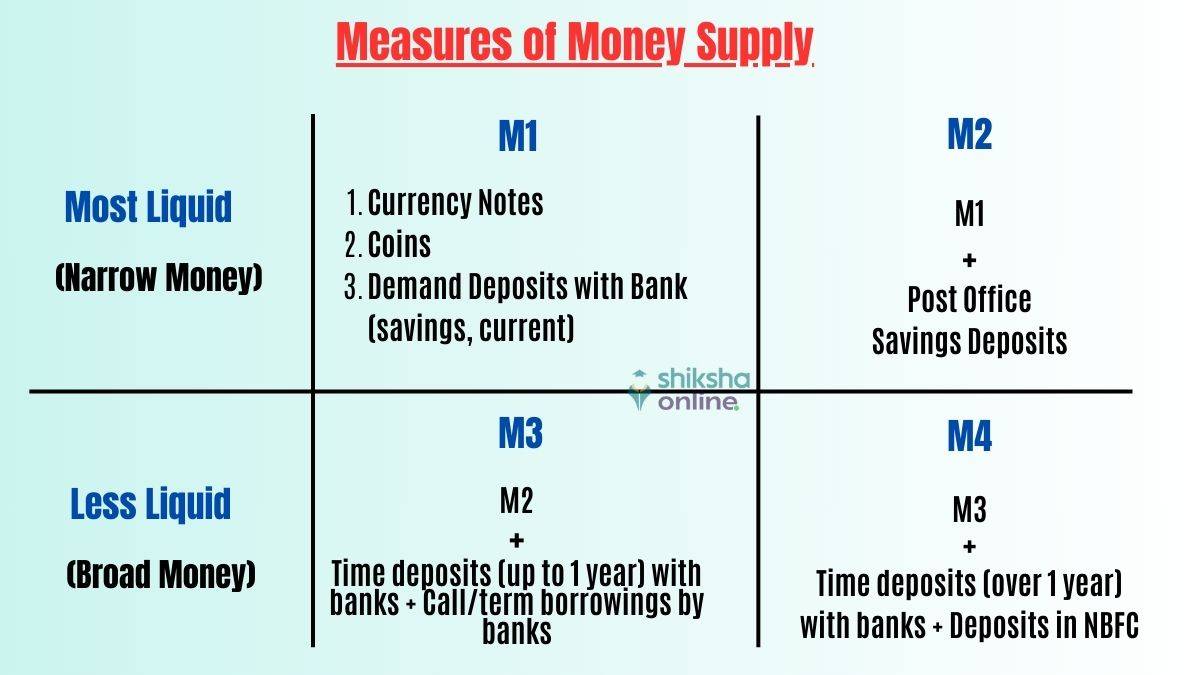
MONEY SUPPLY: The amount of money in circulation. The money supply measures
currently (1985) used by the Federal Reserve System are:


 M 1 – Currency in circulation + demand deposit + other check-type deposits. 35
 M2 – M 1 + savings and small denomination time deposits + overnight repurchase
agreements at commercial banks + overnight Eurodollars + money market mutual
fund shares.
 M3 – M2 + large-denomination time deposits (Jumbo CDs) + term repurchase
agreements.
 M4 – M3 + other liquid assets (such as term Eurodollars, bankers acceptances,
commercial paper, Treasury securities and U.S. Savings Bonds)

COMMENTS APPRECIATED

Like and Subscribe

***

***

DAILY UPDATE: FDIC Misconduct as Stocks Climb

MEDICAL EXECUTIVE-POST TODAY’S NEWSLETTER BRIEFING

***

Essays, Opinions and Curated News in Health Economics, Investing, Business, Management and Financial Planning for Physician Entrepreneurs and their Savvy Advisors and Consultants

Serving Almost One Million Doctors, Financial Advisors and Medical Management Consultants Daily

A Partner of the Institute of Medical Business Advisors , Inc.

http://www.MedicalBusinessAdvisors.com

SPONSORED BY: Marcinko & Associates, Inc.

***

http://www.MarcinkoAssociates.com

Daily Update Provided By Staff Reporters Since 2007.
How May We Serve You?
© Copyright Institute of Medical Business Advisors, Inc. All rights reserved. 2024

REFER A COLLEAGUE: MarcinkoAdvisors@outlook.com

SPONSORSHIPS AVAILABLE: https://medicalexecutivepost.com/sponsors/

ADVERTISE ON THE ME-P: https://tinyurl.com/ytb5955z

Your Referral Count -0-

The stock market will be open on Christmas Eve 2024 but will close early at 1 p.m. ET in anticipation of Christmas Day. This early closure allows market participants to wind down ahead of the holiday.

CITE: https://www.r2library.com/Resource

The Federal Deposit Insurance Corporation has suspended pay bonuses for roughly two dozen executives under investigation for misconduct, a year after a Wall Street Journal investigation revealed a toxic and sexualized workplace culture at the bank regulator.

CITE: https://tinyurl.com/2h47urt5

Stocks climbed on Monday as tech rallied and investors considered the path of interest rates next year after the Fed hinted they would stay higher for longer.

The S&P 500 (^GSPC) gained 0.7%, while the tech-heavy NASDAQ (^IXIC) rose almost 1%. The Dow Jones Industrial Average (^DJI) erased earlier losses to edge almost 0.2% higher.

Semiconductor stocks gained, as shares of chipmakers Nvidia (NVDA) and Broadcom (AVGO) rose more than 3% and 5%, respectively. And, robust gains from social media platform Meta (META) and EV giant Tesla (TSLA) also helped lead the broader market higher.

CITE: https://tinyurl.com/tj8smmes

Visualize: How private equity tangled banks in a web of debt, from the Financial Times.

COMMENTS APPRECIATED

PLEASE SUBSCRIBE: MarcinkoAdvisors@outlook.com

Thank You

***

***

***

***

EDUCATIONAL TEXTBOOKS: https://tinyurl.com/4zdxuuwf

***

DAILY UPDATE: Hims & Hers, MSFT-AI, Neuralink, FDIC and New Market Highs

MEDICAL EXECUTIVE-POST TODAY’S NEWSLETTER BRIEFING

***

Essays, Opinions and Curated News in Health Economics, Investing, Business, Management and Financial Planning for Physician Entrepreneurs and their Savvy Advisors and Consultants

Serving Almost One Million Doctors, Financial Advisors and Medical Management Consultants Daily

A Partner of the Institute of Medical Business Advisors , Inc.

http://www.MedicalBusinessAdvisors.com

SPONSORED BY: Marcinko & Associates, Inc.

***

http://www.MarcinkoAssociates.com

Daily Update Provided By Staff Reporters Since 2007.
How May We Serve You?
© Copyright Institute of Medical Business Advisors, Inc. All rights reserved. 2024

REFER A COLLEAGUE: MarcinkoAdvisors@msn.com

SPONSORSHIPS AVAILABLE: https://medicalexecutivepost.com/sponsors/

ADVERTISE ON THE ME-P: https://tinyurl.com/ytb5955z

***

Microsoft unveiled new PCs with AI-powered features.

CITE: https://www.r2library.com/Resource

Hims & Hers stock soared as much as 38% on the news that it’ll provide GLP-1 injections with the same active ingredient as Ozempic or Wegovy for just $199/month—an 85% discount compared to Wegovy’s ~$1,350 monthly price tag (without insurance).

***

FDIC Chair Martin Gruenberg will resign after an investigation found widespread sexual harassment at the agency. But he won’t step down until a successor is named.

CITE: https://tinyurl.com/2h47urt5

The FDA granted Elon Musk’s neurotech company Neuralink, approval to place its brain chip into a second human test subject using a new method designed to correct issues that arose after its inaugural insertion in January, per the Wall Street Journal.

And, Optum Rx is shaking up its pharmacy model. The business says it will make drug costs more predictable and transparent for clients.

CITE: https://tinyurl.com/tj8smmes

  • All three indexes ended the day higher after Fed Governor Christopher Waller stopped by CNBC and mentioned he doesn’t think raising interest rates is in the cards, even if the Fed is waiting for more data before making cuts. The NASDAQ continued to hit new all-time highs today as investors place their bets before Nvidia’s earnings announcement tomorrow afternoon, and the S&P 500 hit yet another record.
  • Copper continued to rise as the market comes to terms with the metal’s importance, while oil fell on the news that the Biden administration will release 1 million barrels of gasoline this summer from the Northeast reserve. Meanwhile, ethereum continued to climb on the news that a new ETF may be joining the fray.

Here’s where the major benchmarks ended:

  • The S&P 500 index rose 13.28 points (0.3%) to 5,321.41; the Dow Jones Industrial Average® ($DJI) gained 66.22 points (0.2%) to 39,872.99; the NASDAQ Composite advanced 37.75 points (0.2%) to 16,832.62.
  • The 10-year Treasury note yield (TNX) lost more than 2 basis points to 4.414%.
  • The CBOE Volatility Index® (VIX) fell 0.29 to 11.86.

Banking and consumer staples were among the market’s strongest performers Tuesday, while utility shares extended a sharp upswing over the past month. The Dow Jones Utility Average® ($DJU) added 0.5% and closed at a 12-month high. Transportation companies were among the weakest performers.

In other markets, Gold (/GC) futures slipped from Monday’s record high above $2,454 per ounce, while Silver (/SI) futures ended near a 12-year high around $32.21. Gold futures are still up 17% this year due to several factors, including reports of China’s central bank buying actual gold as well as escalating conflict in the Middle East. Gold is viewed by some as a safe-haven asset during periods of heightened geopolitical tension.

COMMENTS APPRECIATED

PLEASE SUBSCRIBE: MarcinkoAdvisors@msns.com

Thank You

***

***

***

***

EDUCATIONAL TEXTBOOKS: https://tinyurl.com/4zdxuuwf

***

DAILY UPDATE: Republic First Bank Seized and Sold to Fulton Bank

MEDICAL EXECUTIVE-POST TODAY’S NEWSLETTER BRIEFING

***

Essays, Opinions and Curated News in Health Economics, Investing, Business, Management and Financial Planning for Physician Entrepreneurs and their Savvy Advisors and Consultants

Serving Almost One Million Doctors, Financial Advisors and Medical Management Consultants Daily

A Partner of the Institute of Medical Business Advisors , Inc.

http://www.MedicalBusinessAdvisors.com

SPONSORED BY: Marcinko & Associates, Inc.

***

http://www.MarcinkoAssociates.com

Daily Update Provided By Staff Reporters Since 2007.
How May We Serve You?
© Copyright Institute of Medical Business Advisors, Inc. All rights reserved. 2024

REFER A COLLEAGUE: MarcinkoAdvisors@msn.com

SPONSORSHIPS AVAILABLE: https://medicalexecutivepost.com/sponsors/

ADVERTISE ON THE ME-P: https://tinyurl.com/ytb5955z

***

Republic First Bank. The FDIC said regulators seized the troubled Philadelphia-based bank and agreed to sell it to Fulton Bank. While news of a regional bank failure might take you back to March 2023 when Silicon Valley Bank bit the dust, Republic First was much smaller than SVB (and much smaller than the similarly named First Republic, which ultimately got absorbed by JPMorgan Chase as regional banks struggled). And, because there’s already a buyer, there are no lingering questions about the safety of deposits.

So, while the first bank failure of the year is a sign that regional banks are still in a bad way, it’s unlikely to spur a larger crisis.

CITE: https://www.r2library.com/Resource

COMMENTS APPRECIATED

PLEASE SUBSCRIBE: MarcinkoAdvisors@msns.com

Thank You

***

***

***

***

EDUCATIONAL TEXTBOOKS: https://tinyurl.com/4zdxuuwf

***

BANKS: JPMorgan Chase, BoA, Wells Fargo and CitiGroup Report

By Staff Reporters

***

***

JPMorgan Chase’s profit fell in the fourth quarter as the lender set aside nearly $3 billion to help refill a government deposit insurance fund. JPMorgan and several major banks are required to pay a bulk of the $16 billion to replenish the Federal Deposit Insurance Corporation’s deposit insurance fund (DIF), which was drained after Silicon Valley Bank and Signature Bank failed last year.

***

Bank of America’s fourth-quarter profit shrank as the lender took $3.7 billion in combined charges to refill a government deposit insurance fund and phase out a loan index. Its net interest income (NII) – the difference between what banks earn from loans and pay to depositors – fell 5% to $13.9 billion as the company spent more to keep customer deposits and demand for loans stayed subdued amid high interest rates.

***

Wells Fargo press release (NYSE:WFC): Q4 Non-GAAP EPS of $1.29 beats by $0.20. Revenue of $20.48B (+2.2% Y/Y) beats by $100M. Shares -1% PM. Fourth quarter 2023 results included: ◦ $(1.9) billion, or ($0.40) per share, of expense from an FDIC special assessment ◦ $(969) million, or ($0.20) per share, of severance expense for planned actions ◦ $621 million or $0.17 per share, of discrete tax benefits related to the resolution of prior period tax matters ◦ Provision for credit losses in fourth quarter 2023 included an increase in the allowance for credit losses driven by credit card and commercial real estate loans, partially offset by a lower allowance for auto loans. The change in allowance for credit losses also included higher net loan charge-offs for commercial real estate office and credit card loans

***

Citigroup (C) is in the middle of a complicated restructuring. It made it clear Wednesday that its fourth quarter earnings report Friday will be complicated, too.

The giant New York-based bank said in a regulatory document it will take more than $3 billion in one-time reserves and expenses as part of those fourth quarter results. They include everything from a $1.3 billion reserve build for currency exposure in Argentina and Russia to $780 million in charges related to severance costs and other aspects of a wide-ranging restructuring of the bank led by CEO Jane Fraser.

CITE: https://www.r2library.com/Resource

***

***

COMMENTS APPRECIATED

Thank You
***

***

About Nvidia [+] and WeWork [-]

By Staff Reporters

***

***

  • Markets: AI leader Nvidia’s earnings will be out on Wednesday, and Fed Chair Jerome Powell’s annual speech will be at the Fed conference in Jackson Hole on Friday.
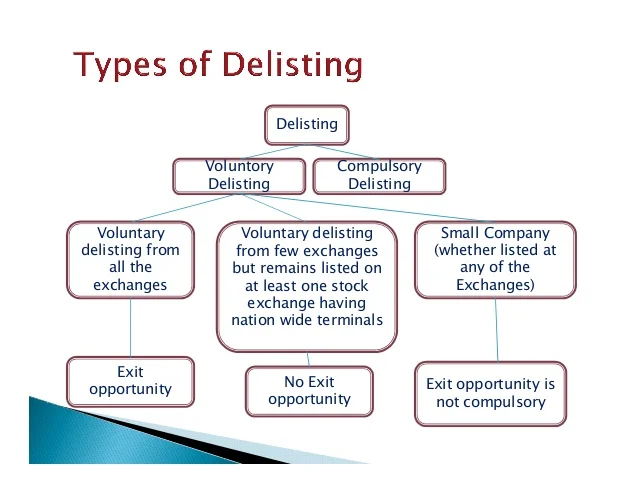
  • Stock spotlight: WeWork, the co-working company just announced a 1-for-40 reverse stock split in an attempt to avoid getting de-listed from the New York Stock Exchange.

***

***

INSTANT BANK PAYMENTS? The “FedNow” 24/7 Service

By Staff Reporters

***

***

According to Morning Brew, the US banking system is about to speed up, potentially eliminating those frustrating waiting days it can take for money to hit your account. The Fed is launching its FedNow instant payment service later this month. The new system will enable banks to send each other cash instantly, 24/7, as an alternative to the existing system that runs only during regular business hours and often takes days to move money.

FedNow could put America’s banking system on track to catch up to countries like India and Nigeria, where high-speed payments are as common. The US does already have an instant payments system, but it’s private rather than government-backed, and it hasn’t been widely adopted. It’s mostly only used by big banks, and only 1.4% of US transactions happen in real time, according to payment systems company ACI Worldwide.

FedNow enabled services will soon likely appear at the 41 banks that have been certified to participate so far.

  • People moving money between banks or paying bills could complete their transactions in seconds without the need to plan payments days in advance.
  • Businesses will be able to access customer payments immediately and to send workers payments more frequently with instant direct deposit rather than the usual payroll cycle.

BUT … Faster payments could mean faster bank runs, too!

Some experts worry that allowing people to drain their bank accounts instantaneously could make SVB-style bank runs more likely. Smaller banks struggling with liquidity would have even less time to react to customer panic and get collateral for emergency government loans to cover fleeing cash.

But there are safeguards built in. FedNow has a transaction limit of $500,000, and banks can set their own ceilings to ensure that customers don’t pull their deposits.

***
COMMENTS APPRECIATED

Thank You

***

***

CPI REPORT: May Round-Up 2023

By Staff Reporters

***

***

DEFINITION: A consumer price index (CPI) is a price index, the price of a weighted average market basket of consumer goods and services purchased by households. Changes in measured CPI track changes in prices over time.

CITE: https://www.r2library.com/Resource

***

4 Key Points from the Report

1. Energy is doing a lot of the work. Cheaper energy played a major role in pulling inflation down to 4% last month from 4.9% in April, per Axios. Gas prices plunged almost 20% from last year, when Russia’s invasion of Ukraine sent fuel costs to the moon, while broader energy prices fell nearly 12%.

2. “Revenge spending” is down. Once COVID pandemic lock downs lifted, Americans splurged on vacations, leisure, and recreation (new pickle ball paddles!) in what economists dubbed “revenge spending.” Now that everyone has taken their week long trip to Italy, there are signs that revenge spending is waning: Airfare prices dropped 13% annually in May and, according to the US Travel Association, hotel demand is below 2019 levels. Bad for your Instagram, but good for inflation.

3. Food prices are up. The cost of food ticked up 0.2% in May from April after staying flat in the previous two months, showing how inflation has persisted on grocery store shelves. But not all aisles are created equal—the price of eggs dropped nearly 14% from April (the biggest one-month drop since 1951), while fruit and veggie prices rose 1.3%.

4. More than anything else, rent is propping up inflation. Shelter costs are the largest category in the CPI report, and they’re still on the upward march, climbing 8.7% from a year earlier. The good news: Economists say this government data doesn’t reflect on-the-ground information, such as reports of softening rent by Zillow and Apartment List. Shelter costs in the CPI are expected to decline during the second half of the year.

***

***

COMMENTS APPRECIATED

Thank You

***

BEWARE: Mobile Payment Service Apps Lack FDIC Insurance

Mobile money, mobile money transfers and mobile wallets

By Staff Reporters

***

***

DEFINITION: A mobile payment, also referred to as mobile money, mobile money transfer and mobile wallet, is any of various payment processing services operated under financial regulations and performed from or via a mobile device, as the cardinal class of digital wallet. Instead of paying with cash, cheque, or credit cards, a consumer can use a payment app on a mobile device to pay for a wide range of services and digital or hard goods. Although the concept of using non-coin-based currency systems has a long history, it is only in the 21st century that the technology to support such systems has become widely available.

Mobile payments began adoption in Japan in the 2000s and later all over the world in different ways. The first patent exclusively defined “Mobile Payment System” was filed in 2000.

Don’t use Mobile Payment Services to Park Cash, CFPB Warns.

Venmo may not be that much better than stuffing bills under your mattress when it comes to keeping your money safe long term, the Consumer Financial Protection Bureau recently cautioned.

The app and others, like CashApp, Apple Pay, and PayPal, aren’t banks, so the Federal Deposit Insurance Corporation doesn’t provide insurance for funds stored there, the CFPB pointed out. The agency said there are billions of dollars at risk if these apps suffer an SVB-like bank failure.

***

***

***

COMMENTS APPRECIATED

Thank You

***

***

FDIC: Lifting the Insurance Deposit Cap?

By Staff Reporters

***

Understanding FDIC insurance limits

The FDIC wants to make sure it can cover everyone with a bank account, so to make that happen, it caps how much money it insures. The FDIC says its standard is to cover up to “$250,000 per depositor, per insured bank, for each account ownership category.

CITE: https://www.r2library.com/Resource/Title/082610254

Here’s an example: Let’s say you have $100,000 in your checking account and $150,000 in your savings, all at the same bank. The FDIC classifies those under the same category: single accounts. So you would have hit your FDIC deposit limit. Every additional cent deposited into either account would be uninsured. But if you have money in other banks or other deposit categories, you may have additional coverage.

Could the insured deposit cap get a lift?

At least four US lawmakers—two from each side of the aisle—said they would support raising the cap on FDIC-insured deposits in order to reassure frazzled bank customers that their deposits are safe. The current cap is $250,000 (up from $100k pre-financial crisis), but Democratic Sen. Elizabeth Warren said bumping it up “is a good move.” Opponents of raising the cap say it would only increase risk-taking and bad behavior by banks. Some even argue we should lower it.

COMMENTS APPRECIATED

Thank You

***

ORDER: https://www.routledge.com/Risk-Management-Liability-Insurance-and-Asset-Protection-Strategies-for/Marcinko-Hetico/p/book/9781498725989

***

First Republic and Silicon Valley Banks are NOT Microsoft!

By Staff Reporters

***

***

Wall Street’s $30 billion infusion into First Republic Bank didn’t manage to calm investors’ jitters about how banks are holding up. The regional bank’s stock tanked again Friday, dragging most of the market down with it. Moody’s Investors Service downgraded its credit rating on First Republic Bank to junk, citing a “deterioration in the bank’s financial profile.” First Republic’s debt rating was cut to B2 from Baa1, Moody’s said. Fitch Ratings and S&P Global Ratings downgraded First Republic Bank’s debt earlier this week.

The downgrade reflects “the deterioration in the bank’s financial profile and the significant challenges First Republic Bank faces over the medium term in light of its increased reliance on short-term and higher cost wholesale funding due to deposit outflows,” Moody’s analysts said in a release.

And, SVB’s parent company filed for Chapter 11 bankruptcy yesterday, buying it time to pay off creditors and making it easier to sell off its assets (but the bank itself, currently in the hands of the FDIC, isn’t part of the filing). Meanwhile, President Biden called on Congress to make it easier to punish bank executives if their mismanagement causes a bank to collapse, including allowing regulators to claw back their pay.

***

But Big Tech stocks got a boost from investors looking to park their cash in non-bank companies, pushing Microsoft to its best weeks in almost eight years.

CITE: https://www.r2library.com/Resource/Title/0826102549

***

COMMENTS APPRECIATED

Thank You

ORDER: https://www.routledge.com/Risk-Management-Liability-Insurance-and-Asset-Protection-Strategies-for/Marcinko-Hetico/p/book/9781498725989

***

DAILY UPDATE: The Bitcoin Boost Up!

By Staff Reporters

***

***

Bitcoin prices climbed to as high as $27,293 last week, wrapping up the cryptocurrency’s best week since January 2021. And it has Silicon Valley Bank and friends to thank for it. Crypto diehards claim bitcoin’s gains are the result of people losing faith in traditional banking after SVB and Signature imploded (though it’s worth noting that Signature was a big player in the crypto world).

However, after the second-and third-biggest bank failures in history, economists started second-guessing whether the Fed would stick to the plan to hike interest rates again or change course to protect the rest of the very fragile banking industry. That could mean the crypto market, which slid into the dreaded Crypto Winter in the first half of last year because of macroeconomic factors like the Fed’s rate hikes, might finally be approaching spring.

So, according to MorningBrew, the Fed’s interest rate decision next week will likely serve as crypto’s redeux. And despite the banking industry hoping Jerome Powell pauses the interest rate hikes, February’s inflation numbers showed that the Fed may need to stick to its original plan to keep inflation in check.

***

COMMENTS APPRECIATED

Thank You

***

ORDER: https://www.amazon.com/Dictionary-Health-Information-Technology-Security/dp/0826149952/ref=sr_1_5?ie=UTF8&s=books&qid=1254413315&sr=1-5

***

A ‘Flawed’ SEC Program [A Retrospective “April Fool’s Day” Analysis]

Join Our Mailing List

SEC Failed to Rein in Investment Banks [April Fool’s Day – 2015]

By Ben Protess, ProPublica – October 1, 2008 5:01 pm EDT

Editor’s Note: This investigative report was first published ten years ago. And so, we ask you to consider – on this April Fool’s Day 2019 – how [if] things have changed since then?  

***
Flag MOney

***

The Securities and Exchange Commission [SEC] last week abolished the special regulatory program that it applied to Wall Street’s largest investment banks. Known as the “consolidated supervised entities” program, it relaxed the minimum capital requirements for firms that submitted to the commission’s oversight, and thus, in the view of some experts, helped create the current global financial crisis.

But, the SEC’s decision to ax the program currently affects no one, since three of the five firms that voluntarily joined the program previously collapsed and the other two reorganized.

The Decision – 18 Months Ago

The decision came last Friday, one day after the commission’s inspector general released a report [1] (PDF) detailing the program’s failed oversight of Bear Stearns before the firm collapsed in March. The commission’s chairman, Christopher Cox, a longtime opponent of industry regulation, said in a statement [2] that the report “validates and echoes the concerns” he had about the program, which had been voluntary for the five Wall Street titans since 2004.

The report found that the SEC division that oversees trading and markets was “not fulfilling its obligations. “These reports are another indictment of failed leadership,” said Sen. Charles Grassley (R-Iowa) who requested the inspector general’s investigation.

The SEC program, approved by the commission in 2004 under Cox’s predecessor, William Donaldson, allowed investment banks to increase their amount of leveraged debt. But, there was a tradeoff: Banks that participated allowed their broker-dealer operations and holding companies to be subject to SEC oversight. Previous to 2004, the SEC only had authority to oversee the banks’ broker dealers.

Longstanding SEC rules required the broker dealers to limit their debt-to-net-capital ratio and issue an early warning if they began to approach the limit. The limit was about 15-to-1, according to the inspector general report, meaning that for every $15 of debt, the banks were required to have $1 of equity.

But the 2004 “consolidated supervised entities” program revoked these limits. The new program also eliminated the requirement that firms keep a certain amount of capital as a cushion in case an asset defaults.

Bear Sterns

As a result, the oversight program created the conditions that helped cause the collapse of Bear Stearns. Bear had a gross debt ratio of about 33-to-1 prior to its demise, the inspector general found. The inspector general also found that Bear was fully compliant with the programs’ requirements when it collapsed, which raised “serious questions about whether the capital requirement amounts were adequate,” the report said.

The report quoted Lee Pickard, a former SEC official who helped write the original debt-limit requirements in 1975 and now argues the 2004 program is largely to blame for the current Wall Street crisis.

“The SEC gave up the very protections that caused these firms to go under,” Pickard said in an interview with ProPublica. “The SEC in 2004 thought it gained something in oversight, but in turn it gave up too much public protection. You don’t bargain in a way that causes you to give up serious protections.”

Pickard, now a senior partner at a Washington, D.C.-based law firm, estimated that prior to the 2004 program most firms never exceeded an 8-to-1 debt-to-net capital ratio.

The previous program “had an excellent track record in preserving the securities markets’ financial integrity and protecting customer assets,” Pickard wrote [3] in American Banker this August. The new program required “substantial SEC resources for complex oversight, which apparently are not always available.”

Asked if he believes the 2004 program was a direct cause of the current crisis, Pickard told ProPublica, “I’m afraid I do.”

The New York Times reported Saturday that the SEC created the program after “heavy lobbying” for the plan from the investment banks. The banks favored the SEC as their regulator, the Times reported, because that let them avoid regulation of their fast-growing European operations by the European Union, which has been threatening to impose its own rules since 2002.

SEC Spokesman

A SEC spokesman declined to comment for this article, referring inquires to Chairman Cox’s statement. In the statement, Cox admitted the program “was fundamentally flawed from the beginning.” But Cox, a former Republican congressman from California, offered mild support for the program as recently as July when he testified before the House Committee on Financial Services. The program, among other oversight efforts, Cox said, had “gone far to adapt the existing regulatory structure to today’s exigencies.” He added that legislative improvements were necessary as well, and has since told Congress that the program failed.

More Questions

So why did the commission not end the program sooner? Some say that the program’s flaws only recently became apparent. “As late as 2005, the program seemed to make a lot of sense,” said Charles Morris, a former banker who predicted the current financial crisis in his book written last year, The Trillion Dollar Meltdown [4]. The SEC “didn’t know it didn’t work until we had this stress.”

And leverage does not always spell trouble. In a strong economy, leverage can also be attractive because it can increase the profitability of banks through lending.

In his recent statement, Cox said the inspector general’s findings reflect a deeper problem: “the lack of specific legal authority for the SEC or any other agency to act as the regulator of these large investment bank holding companies.”

Secretary of the Treasury Henry Paulson has called for a refining of the regulatory structure to reflect the global and interconnected nature of today’s financial system. In any case, the program’s failure can be seen in the disappearance of the participating banks: Bear Stearns, Lehman Brothers, Merrill Lynch, Morgan Stanley and Goldman Sachs.

skeleton-jpeg1

***

Assessment

Merrill Lynch’s leverage ratio was possibly as high as 40-to-1 this year and Lehman Brothers faced a ratio of about 30-to-1, according to Bloomberg [5].

The Fed and Treasury Department forced Bear Stearns into a merger with JPMorgan Chase in March. And the last two months, Lehman Brothers went bankrupt and sold their core U.S. business to British bank Barclays PLC, and Merrill Lynch was acquired by Bank of America. Morgan Stanley and Goldman Sachs, the two remaining large independent investment banks, changed their corporate structures to become bank holding companies, which are regulated by the Federal Reserve.

As these banks have folded or reorganized over the last several months, the Federal Reserve has largely assumed the SEC’s oversight responsibilities, though the commission will still have the power to regulate broker dealers.

Original Essay: http://www.propublica.org/article/flawed-sec-program-failed-to-rein-in-investment-banks-101

Conclusion

Your thoughts and comments on this ME-P are appreciated. Feel free to review our top-left column, and top-right sidebar materials, links, URLs and related websites, too. Then, subscribe to the ME-P. It is fast, free and secure.

Link: http://feeds.feedburner.com/HealthcareFinancialsthePostForcxos

Speaker: If you need a moderator or speaker for an upcoming event, Dr. David E. Marcinko; MBA – Publisher-in-Chief of the Medical Executive-Post – is available for seminar or speaking engagements. Contact: MarcinkoAdvisors@msn.com

OUR OTHER PRINT BOOKS AND RELATED INFORMATION SOURCES:

Product DetailsProduct DetailsProduct Details

Comprehensive Financial Planning Strategies for Doctors and Advisors: Best Practices from Leading Consultants and Certified Medical Planners(TM)

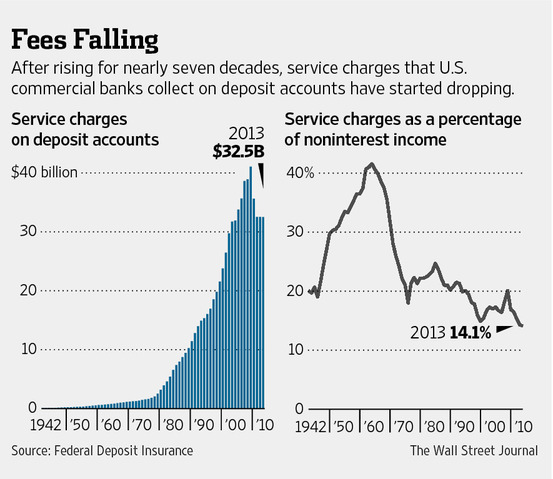
How Banks’ Fee Bonanza Dries Up

Join Our Mailing List

Changes in rules and customer behaviors are squeezing what was for decades a key source of revenue

[By Dr. Carey via FDIC]

***

fees

***

Assessment

More:

Conclusion

Your thoughts and comments on this ME-P are appreciated. Feel free to review our top-left column, and top-right sidebar materials, links, URLs and related websites, too. Then, subscribe to the ME-P. It is fast, free and secure.

Speaker: If you need a moderator or speaker for an upcoming event, Dr. David E. Marcinko; MBA – Publisher-in-Chief of the Medical Executive-Post – is available for seminar or speaking engagements. Contact: MarcinkoAdvisors@msn.com

OUR OTHER PRINT BOOKS AND RELATED INFORMATION SOURCES:

Product DetailsProduct Details

At a Time of Needed Financial Overhaul

A Leadership Vacuum

By Jesse Eisinger
ProPublica, May 18, 2011, 3:10 p.m.

Join Our Mailing List 

After the worst crisis since the Great Depression, President Obama has unleashed an unusual force to regulate the financial system: a bunch of empty seats [1].

With Sheila C. Bair soon to leave her post at the Federal Deposit Insurance Corporation, the Obama administration will have five major bank regulatory positions either unfilled or staffed with acting directors.

About The Trade

In this column, co-published with New York Times’ DealBook, I monitor the financial markets to hold companies, executives and government officials accountable for their actions. Tips? Praise? Contact me at jesse@propublica.org

The administration has inexplicably left open the vice chairman for banking supervision, a new position at the Federal Reserve created by the Dodd-Frank Act, despite having a candidate that many people think is an obvious choice: Daniel K. Tarullo [2]. The new Consumer Financial Products Board chairman is unnamed. There are some lower-level positions that don’t have candidates, including the head of the Treasury’s Office of Financial Research and the Financial Stability Oversight Council insurance post.

Perhaps most important, the Office of the Comptroller of the Currency, is being headed by an acting comptroller, John Walsh, who took over the agency last August. Nine months have passed without a leader who might better reflect the Obama administration’s views on banking regulation, a time lag made worse by the office’s coddling of the banks [3] even as they have acknowledged rampant abuse and negligence in the foreclosure process.

The vacancies come at a time that calls for stiffer regulatory examination. The financial regulatory system was remade under Dodd-Frank and requires strong leaders to put the changes into effect. Though the acting heads insist they feel empowered to make serious decisions, they have roughly the same authority as substitute high school teachers.

The Obama Administration

Supposedly, the Obama administration is getting close to naming people to head the comptroller’s office and the F.D.I.C. But we’ve been hearing that for a while. In April, Barbara A. Rehm of American Banker wrote that the administration was working on a big package of nominations to send to the Hill all at once. A month later, we’re still twiddling our thumbs in anticipation.

So what’s going on?

In a vacuum of leadership, conspiracy theories arise. One is that Treasury Secretary Timothy F. Geithner is making a power grab and doesn’t mind that these roles aren’t filled. The idea is that he is asserting his influence over the Dodd-Frank rule-making process. A former adviser to Mr. Geithner dismissed that notion as ridiculous, and that’s persuasive to me. It seems too Machiavellian by half.

If it’s not Mr. Geithner, then who or what is responsible for the vacancies? Not surprisingly, people close to the administration blame Republicans. The nomination process has become hopelessly broken in Washington. Even low-level appointments are now deeply partisan affairs, the playthings of score-settling senators with memories like elephants and the social responsibility of hyenas (which probably insults hyenas).

The Obama administration put up Peter A. Diamond for a position on the Federal Reserve board. Winning a little something called the Nobel Prize [4] hasn’t helped him with confirmation, however Sen. Richard Shelby, the powerful Alabama Republican and ranking member of the banking committee, is standing in his way. The senator also quashed the nomination [5] of Joseph A. Smith Jr. to head the Federal Housing Finance Agency.

Blame Game

But much of the blame for this situation lies with the Obama administration. It’s almost as if the president and his staff have thrown up their hands. The administration has had trouble finding good candidates who are willing to go through the vetting process and has shied away from fights. It also hasn’t seeded the ground or supported the nominations it has made, people complain.

A Democratic Senate staff member confided worry to me about the fate of Mark Wetjen, whom the administration nominated last week as a candidate for a seat on the Commodity Futures Trading Commission. “They didn’t shop it and they didn’t get buy-in,” the staff member said. “The administration doesn’t seem to be putting any sort of effort into it.”

Making these appointments will help answer a question: Where does Mr. Obama stand on financial regulation?

With the Geithner appointment, the president chose early on the path of continuity over muscular regulation. Immediately, the Treasury secretary became the personification of every Obama financial policy. Mr. Geithner remains the most politically costly appointment Mr. Obama has made, saddling him with all the Bush presidency’s financial crisis decisions. After all, Mr. Geithner, as head of the Federal Reserve Bank of New York, was intimately involved in the emergency actions of September 2008. Republicans made great hay tying Democrats to the Wall Street bailouts in the 2010 midterm elections. Now, of course, Republicans are leading Democrats in Wall Street campaign donations [6].

With these positions unfilled, Mr. Obama is losing out on a political opportunity to draw a line between himself and his opposition.

Assessment

But it’s more important than that. Allowing these vacancies to linger drains leadership from the financial overhaul at the exact moment when it is needed most.

Link: http://www.propublica.org/thetrade/item/at-a-time-of-/0763745790

Channel Surfing the ME-P

Have you visited our other topic channels? Established to facilitate idea exchange and link our community together, the value of these topics is dependent upon your input. Please take a minute to visit. And, to prevent that annoying spam, we ask that you register. It is fast, free and secure.

Conclusion

Your thoughts and comments on this ME-P are appreciated. Feel free to review our top-left column, and top-right sidebar materials, links, URLs and related websites, too. Then, subscribe to the ME-P. It is fast, free and secure.

Speaker: If you need a moderator or speaker for an upcoming event, Dr. David E. Marcinko; MBA – Publisher-in-Chief of the Medical Executive-Post – is available for seminar or speaking engagements. Contact: MarcinkoAdvisors@msn.com

OUR OTHER PRINT BOOKS AND RELATED INFORMATION SOURCES:

Product DetailsProduct DetailsProduct Details

Product Details  Product Details

   Product Details 

Understanding Money Market Account Risks

Terms and Definitions for Physician Investors

By Staff Writers56371606

The recent banking industry debacle has prompted several of our cost-conscience doctor-clients to rethink money market account risks and related products. We trust this brief review is helpful to all concerned.

Money Market Deposit Accounts

First, the term “money market account” must be defined.

Link: http://www.HealthDictionarySeries.org

dhimc-book2

There are two types of money market accounts [MMAs] that most people refer to when using this term. The first is a money market deposit account (MMDA). This is an account at a bank designed to compete with money market mutual funds (MMMF). MMDAs usually pay less interest than money market mutual funds and in return offer federal insurance on balances, now up to $250,000 with convenience through check writing and access through ATMs [reverts back to $100,000 after December 31, 2009]. MMDAs under this amount do not have any risk of failure because they are insured by the US government.

Money Market Mutual Funds

Money market mutual funds are mutual funds that invest in short-term instruments with maturities of less than one year, and usually offer check writing on the account. They are not federally insured, but are considered safe in stable economic times. Net Asset Value [NAV] is one dollar; USD. Nevertheless, a few have “broken-the-buck” with NAV at some increment below $1.00 USD.

fp-book7

Evaluation Methods

The first way to evaluate the MMMF risk is to look at the average length of maturities in the portfolio. The shorter the maturity – the safer the MMMF. The second way is to look at the type of security owned by the fund. Government securities are generally less risky than corporate securities. Interested investors can also contact a rating service that evaluates the securities in a MMMF’s portfolio.

And now – a few related words about “so-called” high-yielding CDs.

High Yielding Brokered Bank CDs

insurance-book5

First, the physician-investor should determine if the CD is issued by a federally insured institution. If the answer is yes, the investor knows that a portion of his money is safe if the institution fails. If the answer is no, the doctor should obtain the institution’s ratings from the appropriate rating agencies and analyze the institution’s financials. Second, the physician-investor should investigate the volatility of the CD’s return.

Assessment

When interest rates fluctuate, the price of MMAs and CDs fluctuate much like bonds. Therefore, short-term securities are less risky than long-term securities; all things being equal.

Conclusion

And so, your thoughts and comments on this Medical Executive-Post are appreciated. Are you looking at these terms and conditions more closely during this national economic crisis? Please opine and advise.


Risk Management, Liability Insurance, and Asset Protection Strategies for Doctors and Advisors: Best Practices from Leading Consultants and Certified Medical Planners™8Comprehensive Financial Planning Strategies for Doctors and Advisors: Best Practices from Leading Consultants and Certified Medical Planners™


About FDIC.gov

What it is – How it works

Staff Reporters

handcuffsThe Federal Deposit Insurance Corporation (FDIC) preserves and promotes public confidence in the US financial system by insuring deposits in banks and thrift institutions for up to $250,000 (through December 31, 2009); and by identifying, monitoring and addressing risks to the deposit insurance funds; and by limiting the effect on the economy and the financial system when a bank or thrift institution fails

Mission

The FDIC is an independent agency created by the Congress that maintains the stability and public confidence in the nation’s financial system by insuring deposits, examining and supervising financial institutions, and managing receiverships.

Vision

The FDIC is a leader in developing and implementing sound public policies, identifying and addressing new and existing risks in the nation’s financial system, and effectively and efficiently carrying out its insurance, supervisory, and receivership management responsibilities.

The Website

The website www.FDIC.gov has these tabs-of-interest:

  • Deposit Insurance
  • Consumer Protections
  • Industry Analysis and Analysis
  • Regulations and Examinations
  • Failed Bank Information
  • Institutional Asset Sales
  • Breaking News and Events

Assessment

This site is an excellent resource for physicians, financial advisors, medical executives and all investors in this time of national economic crisis:

For more information:

Federal Deposit Insurance Corporation
Consumer Response Center
2345 Grand Boulevard, Suite 100
Kansas City, MO 64108-2638
Fax Number (703) 812-1020

Conclusion

And so, your thoughts and comments on this Medical Executive-Post are appreciated.

Speaker: If you need a moderator or speaker for an upcoming event, Dr. David E. Marcinko; MBA – Publisher-in-Chief of the Executive-Post – is available for seminar or speaking engagements. Contact: MarcinkoAdvisors@msn.com  or Bio: www.stpub.com/pubs/authors/MARCINKO.htm

Subscribe Now: Did you like this Medical Executive-Post, or find it helpful, interesting and informative? Want to get the latest E-Ps delivered to your email box each morning? Just subscribe using the link below. You can unsubscribe at any time. Security is assured.

Link: http://feeds.feedburner.com/HealthcareFinancialsthePostForcxos