Financial Industry Links

An Executive-Post List

Staff Writers

  1. Investment Company Institute (mutual fund industry)

Related Information Sources:

Practice Management: http://www.springerpub.com/prod.aspx?prod_id=23759

Physician Financial Planning: http://www.jbpub.com/catalog/0763745790

Medical Risk Management: http://www.jbpub.com/catalog/9780763733421

Healthcare Organizations: www.HealthcareFinancials.com

Health Administration Terms: www.HealthDictionarySeries.com

Physician Advisors: www.CertifiedMedicalPlanner.com

Speaker: If you need a moderator or speaker for an upcoming event, Dr. David E. Marcinko; MBA – Publisher-in-Chief of the Executive-Post – is available for seminar or speaking engagements. Contact: MarcinkoAdvisors@msn.com  or Bio: www.stpub.com/pubs/authors/MARCINKO.htm

Subscribe Now: Did you like this Executive-Post, or find it helpful, interesting and informative? Want to get the latest E-Ps delivered to your email box each morning? Just subscribe using the link below. You can unsubscribe at any time. Security is assured.

Link: http://feeds.feedburner.com/HealthcareFinancialsthePostForcxos

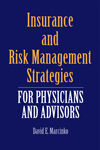
Risk Management and Insurance Strategies for Physicians and Advisors

Foreword and Book Review

Join Our Mailing List

By Lloyd M. Krieger; MD, MBA

Insurance is an important part of all our lives. 

This is especially true for physicians. I currently have no fewer than 10 separate insurance policies associated with my plastic surgery practice. I understand very little about the policies other than that somebody at some point told me I needed each and every one of them, and each made sense when I bought it.

For example, am I over-insured and thus wasting money?  Am I under-insured and thus at risk for a liability disaster?  I never really had the means of answering these questions, until now www.jbpub.com/catalog/9780763733421

The Book

Risk Management and Insurance Strategies for Physicians and Advisors is an essential textbook because it explains to physicians and insurance professionals the background, theory, and practicalities of medical risk management and insurance planning.  The insurance haze is lifted by-dual degreed editor, and Certified Medical Planner™ Dr. David Edward Marcinko MBA, and his team of contributing authors www.jbpub.com/catalog/9780763733421

Goaded Physicians

Doctors, like most people, tend to experience losses more intensely than gains, and evaluate risks in isolation. So it’s no surprise that goaded physicians might prefer vehicles like the guaranteed minimum death benefit of variable annuities, or the assurance that comes with disability or long term care insurance, or traditional cash value life insurance policies, despite their decidedly higher costs and commissions.

Denial Mode

Similarly, physicians may enter denial mode and eschew the potential business impact of HIPAA and Balanced Budget Act risks; self referral risks; OSHA, DEA, EPA, OCR, P&C or managed care risks; managed care contract capitulation risks; employee, expert witness, peer review and on-call risks; and even educational debt load risks, among so many others.

Insurance Professionals

For real insurance professionals on the other hand, this is an exciting time to be practicing medical risk management, because there is much research and creative enlightenment occurring in academic and practitioner communities.

But, one must be willing to abandon ancient thoughts and remain open to new ideas that identify and provide solutions to the contemporaneous problems of physicians.

As an example of this epiphany, the economist Christian Gollier revisits the raison detra’ of insurance, by asking: should one even buy insurance since the industry itself is so skilled at exploiting human foibles?

Although this emerging work is descriptive, it is not yet time tested since some of it aspires to be normative, as developing modern models of savings and consumption hint that insurance may deserve a smaller role in personal risk management than previously believed.

Assessment

Risk Management and Insurance Strategies for Physicians and Advisors fulfill its promise as a peerless tool for physicians wanting to make good decisions about the risks they face. It is also ideal for financial planners, insurance agents and healthcare business advisors wishing to re-educate and help doctors by adding lasting value to their client relationships. With time at a premium for all, and so much information packed into one well-organized resource, this book should be on the desk of every physician, or financial advisor serving the healthcare space. Simply stated, if you read this compelling text with a mind focused on the future, the time you spend will be amply rewarded www.jbpub.com/catalog/9780763733421

Conclusion

Your thoughts and comments on this best seller are appreciated.

Lloyd M. Krieger; MD, MBA

Rodeo Drive Plastic Surgery

The Rodeo Collection

421 North Rodeo Drive

Beverly Hills, CA  90210

Related Information Sources:

Practice Management: http://www.springerpub.com/prod.aspx?prod_id=23759

Physician Financial Planning: http://www.jbpub.com/catalog/0763745790

Medical Risk Management: http://www.jbpub.com/catalog/9780763733421

Physician Advisors: www.CertifiedMedicalPlanner.org

Speaker:If you need a moderator or speaker for an upcoming event, Dr. David E. Marcinko; MBA – Publisher-in-Chief of the Medical Executive-Post – is available for seminar or speaking engagements. Contact: MarcinkoAdvisors@msn.com 

Subscribe Now:Did you like this Medical Executive-Post, or find it helpful, interesting and informative? Want to get the latest ME-Ps delivered to your email box each morning? Just subscribe using the link below. You can unsubscribe at any time. Security is assured.

Link: http://feeds.feedburner.com/HealthcareFinancialsthePostForcxos

Product Details  Product Details

Long Term Care Insurance [LTCI] Meltdown

Join Our Mailing List

Only the Beginning

By Dr. David Edward Marcinko; MBA, CMP™

[Publisher-in-Chief]

Dr David E Marcinko MBAAs a Certified Financial Planner™ and licensed insurance agent for more than a decade, I am aware of how much the industry is promoting long term care insurance [LTCI] as one solution to the aging baby boomer crisis. And, there is no doubt that a legion of agents and “advisors”, along with readers of the Medical Executive-Post, are aware of the fat commissions these products produce. Of course, I have been criticized for opinions against this product for some time now, along with a philosophy of personal accountability.

Only the Beginning

And so, it is no surprise that Penn Treaty American Corporation [PTAC], a long-term-care insurance company, recently said it would stop issuing new LTCI policies. PTAC said its primary insurance subsidiary will be considered insolvent unless it can raise at least $100 million by January 1st, and that it will accept letters of interest from prospective investors and purchasers through mid-October, while deciding on a course by the end of the year.

Assessment

According to the Philadelphia Inquirer on October 4, the company needs about $100 million to $120 million to cover reinsurance agreements it intentionally dropped because the cost to keep them was more than the value of the agreements.

Conclusion

Your thoughts and comments on this ME-P are appreciated. Feel free to review our top-left column, and top-right sidebar materials, links, URLs and related websites, too. Then, subscribe to the ME-P. It is fast, free and secure.

Link: http://feeds.feedburner.com/HealthcareFinancialsthePostForcxos

Speaker: If you need a moderator or speaker for an upcoming event, Dr. David E. Marcinko; MBA – Publisher-in-Chief of the Medical Executive-Post – is available for seminar or speaking engagements. Contact: MarcinkoAdvisors@msn.com

OUR OTHER PRINT BOOKS AND RELATED INFORMATION SOURCES:

LEXICONS: http://www.springerpub.com/Search/marcinko
PHYSICIANS: www.MedicalBusinessAdvisors.com
PRACTICES: www.BusinessofMedicalPractice.com
HOSPITALS: http://www.crcpress.com/product/isbn/9781466558731
CLINICS: http://www.crcpress.com/product/isbn/9781439879900
ADVISORS: www.CertifiedMedicalPlanner.org
PODIATRISTS: www.PodiatryPrep.com
BLOG: www.MedicalExecutivePost.com
.

Product Details

What’s’ AIG, WM and LEH Got to Do with It?

Join Our Mailing List

Medical Malpractice Liability … and More

[By Staff Reporters]

With sincere apologies to Tina Turner – and perhaps more than most doctors realize – AIG, LEH and WM may indeed have something to do with “it” – when it comes to medical malpractice insurance. That is, of course, if the “it” – is your liability carrier. Why?

According to David J. Reynolds of the Dow Jones Newswires on 9/25/08, the FPIC Insurance Group www.FPIC.com recently disclosed its investment holdings in some of the financial companies hit hardest by the financial meltdown on Wall Street and in our current economic turmoil.  

The Company

FPIC Insurance Group, Inc., through its subsidiary companies, is a leading provider of medical professional liability [MPL] insurance for physicians, dentists and other healthcare providers. Its largest subsidiary, First Professionals Insurance Company [FPIC], Inc., is the largest writer of MPL insurance in Florida and has served the market for more than 30 years. Licensed in 28 states, their insurance subsidiaries currently write business in 14 states.

SEC Filings

The medical liability insurance company reported, in its filing with the Securities and Exchange Commission [SEC], that it holds securities with an amortized cost of $4.1 million in Lehman Brothers (LEH), $2.1 million in American International Group (AIG), $2.5 million in Morgan Stanley (MS), $2.1 million in Washington Mutual (WM) and $300,000 in Fannie Mae (FNM).

SEC Report

http://phx.corporate-ir.net/phoenix.zhtml?c=93296&p=irol-newsArticle&ID=1202483&highlight=

advisors

Total Assets

As of June 30, the Jacksonville, Fla., company said it had a total of $755.7 million in cash and investments.  

2007 Annual Report

http://library.corporate-ir.net/library/93/932/93296/items/287671/2007AR.pdf

Assessment

So, if you think FPIC or possibly your own medical liability carrier has not been affected by the recent stock market slump – think again. AIG, WM and LEH may just have “something to do with it”, after all!

For more analysis and story commentary, please visit:

Link: http://www.djnewsplus.com/al?rnd=AJZr27%2BhR5N7y%2BByhI1ECg%3D%3D

Conclusion

Your thoughts and comments on this ME-P are appreciated. Feel free to review our top-left column, and top-right sidebar materials, links, URLs and related websites, too. Then, subscribe to the ME-P. It is fast, free and secure.

Speaker: If you need a moderator or speaker for an upcoming event, Dr. David E. Marcinko; MBA – Publisher-in-Chief of the Medical Executive-Post – is available for seminar or speaking engagements. Contact: MarcinkoAdvisors@msn.com

OUR OTHER PRINT BOOKS AND RELATED INFORMATION SOURCES:

Product Details


SEC Rule 151-A and Insurance Agents

NAFA Criticizes the SEC

Staff Reportersinsurance-book

Insurance agents without securities licenses won’t be able to sell index annuities under this new proposed rule.

NAFA Opines

The National Association of Fixed Annuities (NAFA) recently took a firm stand against the Security & Exchange Commission’s (SEC) proposed Rule 151A, which would regulate index annuities as securities rather than as insurance products.

Insurance-Securities Hybrid Product

NAFA said in a statement issued in July that it “strongly disagrees with the SEC proposal and will pursue all available avenues of recourse,” including taking legal recourse, if required.

Assessment

NAFA Says Nix SEC Rule 151A.

Conclusion

In other words, if Rule 151A is adopted, insurance agents without securities licenses would not be able to sell Index Annuities [IAs].  IAs are investment products that combine both fixed income investments and equity index options so as to be able to leverage opportunities in both.

Please comment and opine; especially insurance agents, investment advisors and financial planners.

Speaker: If you need a moderator or speaker for an upcoming event, Dr. David E. Marcinko; MBA – Publisher-in-Chief of the Executive-Post – is available for seminar or speaking engagements. Contact: MarcinkoAdvisors@msn.com  or Bio: www.stpub.com/pubs/authors/MARCINKO.htm

Subscribe Now: Did you like this Executive-Post, or find it helpful, interesting and informative? Want to get the latest E-Ps delivered to your email box each morning? Just subscribe using the link below. You can unsubscribe at any time. Security is assured.

Link: http://feeds.feedburner.com/HealthcareFinancialsthePostForcxos

Copyright 2008 iMBA Inc: All rights reserved, USA, unless otherwise noted. Use is restricted to Executive-Post subscribers only. No redistribution is allowed. To avoid violation of iMBA Inc copyright restrictions and redistribution policy, please register for your own free Executive-Post membership. Detailed information and registration links are available at:

Link: http://feeds.feedburner.com/HealthcareFinancialsthePostForcxos

Referrals: Thank you in advance for your electronic referrals to the Executive-Post

Medically-Focused Insurance Agents?

Avoiding the “Managed Care Ripple Effect”

[By Dr. David Edward Marcinko; MBA, CMP™]

The healthcare industrial complex represents a large and diverse industry, and the livelihood of other synergistic professionals who advise doctors depend on it as well. These include insurance agents who themselves wish to avoid the collateral ripple effects of the current healthcare debacle.

The Name Game

As a registered health underwriter, insurance counselor, long term care or life insurance agent, it seems that almost every insurance agent is also acquiring a general securities license, or CFP®, in addition to the CLU or ChFC after their name.

The Transition

Currently, about 240,000 life insurance agents, down from more than one million in 1965, are being pressured to move toward financial planning, as distribution of insurance products over the Internet spreads like wildfire.

Meanwhile, the same insurance and investment companies that are knocking on your door are also courting the medical professionals with their practice enhancement programs.  Even if you are not interested in going into the financial planning business, you have seen the status of the American College erode of late, even as your own business has declined because of the World Wide Web and various discounted insurance companies.

More Competition

And, in the eyes of your former golden-goose doctor-clients, you may have become a charlatan with the recent mortgage, insurance and banking industry collapse of 2008. Now, it seems as though everyone is clamoring for a piece of your insurance business and cloaking it in the guise of the contemporary topic of the day; medical practice risk-management and financial planning.

If you think this is an exaggerated statement; think again? More than a decade ago, an October 1997 survey conducted by Deloitte & Touche Consulting Group of New York, found insurance agents ranked last in having the trust of a wide selection of the public! The insurance debacle today only exacerbates this opinion.  

Regaining Trust

But, how do you regain this lost trust, and what about this new entity known as managed care. How do you learn about it at this stage in your career?

What ever happened to whole-life insurance; or traditional indemnity health insurance, with its deductibles, co-payments and 80/20 patient responsibility? It was so easy to sell, provided good coverage and the agent made a nice profit.

As an insurance agent, all you want to know is, can I still sell insurance and make a living?  Like all struggling collateral advisors, you find yourself asking, how do I “talk the talk, and walk the walk”, in this new era of insurance, transparency and liability turmoil?

Assessment

Slowly, as you read about the Certified Medical Planneronline educational program, you become empowered with knowledge and ideas for new insurance product derivatives that actually provide value to your physician clients www.CertifiedMedicalPlanner.com

After the proscribed course of study, you are no longer just an insurance salesman, but a trusted risk-management advisor and Certified Medical Planner™ for the healthcare industry. You have avoided the “managed care ripple effect.”

Disclaimer: Dr. Marcinko, a former insurance agent and Certified Financial Planner, is Founder of the Certified Medial Planner program for all fiduciary consultants in health economics, finance and medical practice management.

Conclusion

Your thoughts and comments on this ME-P are appreciated. Feel free to review our top-left column, and top-right sidebar materials, links, URLs and related websites, too. Then, subscribe to the ME-P. It is fast, free and secure.

Link: http://feeds.feedburner.com/HealthcareFinancialsthePostForcxos

Speaker: If you need a moderator or speaker for an upcoming event, Dr. David E. Marcinko; MBA – Publisher-in-Chief of the Medical Executive-Post – is available for seminar or speaking engagements. Contact: MarcinkoAdvisors@msn.com

DICTIONARIES: http://www.springerpub.com/Search/marcinko
PHYSICIANS: www.MedicalBusinessAdvisors.com
PRACTICES: www.BusinessofMedicalPractice.com
HOSPITALS: http://www.crcpress.com/product/isbn/9781466558731
CLINICS: http://www.crcpress.com/product/isbn/9781439879900
BLOG: www.MedicalExecutivePost.com
FINANCE: Financial Planning for Physicians and Advisors
INSURANCE: Risk Management and Insurance Strategies for Physicians and Advisors

Product DetailsProduct DetailsProduct Details

Health Insurers Secrets

Seven Things you don’t Know about Health Insurance

By Staff Reporters

“Myth Busters”

Wrapped up in all the noise these days are myths on health insurance that were perhaps once true – or maybe never were.

So, here’s a look at seven things you probably didn’t know about your health insurer.

Link: http://articles.moneycentral.msn.com/Insurance/InsureYourHealth/7SecretsOfHealthInsurers.aspx

Conclusion

Your thoughts are appreciated; especially from insurance agents, industry insiders and medical providers; please opine and comment.

Speaker: If you need a moderator or speaker for an upcoming event, Dr. David E. Marcinko; MBA – Publisher-in-Chief of the Executive-Post – is available for seminar or speaking engagements. Contact: MarcinkoAdvisors@msn.com  or Bio: www.stpub.com/pubs/authors/MARCINKO.htm

Subscribe Now: Did you like this Executive-Post, or find it helpful, interesting and informative? Want to get the latest E-Ps delivered to your email box each morning? Just subscribe using the link below. You can unsubscribe at any time. Security is assured.

Link: http://feeds.feedburner.com/HealthcareFinancialsthePostForcxos

Copyright 2008 iMBA Inc: All rights reserved, USA, unless otherwise noted. Use is restricted to Executive-Post subscribers only. No redistribution is allowed. To avoid violation of iMBA Inc copyright restrictions and redistribution policy, please register for your own free Executive-Post membership. Detailed information and registration links are available at:

Link: http://feeds.feedburner.com/HealthcareFinancialsthePostForcxos

Referrals: Thank you in advance for your electronic referrals to the Executive-Post

Practicing Medicine “Bare”

Join Our Mailing List

Understanding Hold-Harmless Managed Care Contract Clauses

[By Dr. Charles F. Fenton, III; JD]

Most doctors would not think of “practicing medicine bare”; yet perhaps the definition of this term should be re-framed?

Historical Definition

In the past, the term “practicing-bare” meant that a medical provider did not have malpractice insurance.

However, some current managed care contracts require that providers not only have certain limits of malpractice insurance coverage, but also furnish the company with evidence of same. Therefore, some of these providers are under the impression that they are not “practicing-bare.”

Hold Harmless Clauses

Unfortunately, most medical providers have no protection from adverse results arising out of a “Hold-Harmless” clause in a managed care contract or provider-agreement. And, most malpractice insurance companies do not provide such coverage.

So, if your malpractice insurance company does not provide coverage for such events, it is incumbent upon you and your associations to lobby malpractice insurance carriers to provide this coverage.

An additional rider, at an additional premium for Hold-Harmless coverage, would help the doctor sleep better at night.

Contract Considerations

The first question doctors should ask is: Would I consider practicing without malpractice insurance?

If the answer to this question is “no”, then the next question that should be asked is: “Why am I assuming the risk under the Hold Harmless Clause?” 

If you cannot provide a lucent answer to this question (stating: “I have no choice,” is not a lucent answer!), then you should consider not signing the managed care contract.

Judgment Proof

Nonetheless, if a medical provider has signed a managed care contract, then they should understand that they are essentially practicing bare, and should take steps to reduce this exposure. In effect, the provider should attempt to become “judgment-proof.”

Such a step does present its own risks. Ultimately, the first step for every physician who signs a managed care contract, with hold harmless agreement, is to read the contract and then consult an attorney or other professional. Of late, plaintiff-attorneys are beginning to make inroads in suing managed care companies. The managed care attorneys foresaw such events and provided protection for the company in the contracts most providers have signed.

As your patients and other plaintiffs become successful in suing and recovering from managed care companies, those companies are going to seek indemnity from you; the provider. Unless you protect yourself, you are likely to become a collateral casualty to some degree or another.

The current practice of medicine presents may perils and risks to doctors and other providers. A doctor may not be able to insure against all these risks, and should take defensive steps to avoid future problems.

Channel Surfing the ME-P

Have you visited our other topic channels? Established to facilitate idea exchange and link our community together, the value of these topics is dependent upon your input. Please take a minute to visit. And, to prevent that annoying spam, we ask that you register. It is fast, free and secure.

Conclusion

Your thoughts and comments on this ME-P are appreciated. Feel free to review our top-left column, and top-right sidebar materials, links, URLs and related websites, too. Then, subscribe to the ME-P. It is fast, free and secure.

Speaker: If you need a moderator or speaker for an upcoming event, Dr. David E. Marcinko; MBA – Publisher-in-Chief of the Medical Executive-Post – is available for seminar or speaking engagements. Contact: MarcinkoAdvisors@msn.com

OUR OTHER PRINT BOOKS AND RELATED INFORMATION SOURCES:

Product Details  Product Details

   Product Details 

Physician Owned Hospitals

New Patient Disclosure Rules

Staff Reporters

According to Bloomberg News, August 19, 2008, doctors with financial stakes in hospitals where they work must tell patients being referred to those facilities about the ownership link, under new rules from Medicare.

Patient Queries

Patients who ask about investors in a physician-owned hospital must be furnished with a list of all doctors, and their immediate family members, who own or have an investment interest and make referrals.

Assessment

Medicare is seeking to make it harder for doctors to boost their payments by referring patients to their own facilities; and it already bars self-referrals for 11 services. The agency said it would end reimbursement agreements with physician-owned hospitals that don’t follow the new disclosure requirements.

Conclusion

What do you think about this, “if they don’t ask – don’t tell” policy; your informed opinions and comments are appreciated. Is it too much disclosure, or not enough?


Practice Management:
http://www.springerpub.com/prod.aspx?prod_id=23759

Physician Financial Planning: http://www.jbpub.com/catalog/0763745790

Medical Risk Management: http://www.jbpub.com/catalog/9780763733421

Healthcare Organizations: www.HealthcareFinancials.com

Health Administration Terms: www.HealthDictionarySeries.com

Physician Advisors: www.CertifiedMedicalPlanner.com

Speaker: If you need a moderator or speaker for an upcoming event, Dr. David E. Marcinko; MBA – Publisher-in-Chief of the Executive-Post – is available for seminar or speaking engagements. Contact: MarcinkoAdvisors@msn.com  or Bio: www.stpub.com/pubs/authors/MARCINKO.htm

Subscribe Now: Did you like this Executive-Post, or find it helpful, interesting and informative? Want to get the latest E-Ps delivered to your email box each morning? Just subscribe using the link below. You can unsubscribe at any time. Security is assured.

Link: http://feeds.feedburner.com/HealthcareFinancialsthePostForcxos

Copyright 2008 iMBA Inc: All rights reserved, USA, unless otherwise noted. Use is restricted to Executive-Post subscribers only. No redistribution is allowed. To avoid violation of iMBA Inc copyright restrictions and redistribution policy, please register for your own free Executive-Post membership. Detailed information and registration links are available at:

Link: http://feeds.feedburner.com/HealthcareFinancialsthePostForcxos

Referrals: Thank you in advance for your electronic referrals to the Executive-Post

A Fresh Look at Annuities

An Often Maligned Insurance-Investment Vehicle

[By Staff Reporters] 

Join Our Mailing List 

Most doctors are familiar with fixed annuities (particularly during periods of high interest rates like two decades ago), which come in two basic varieties—the traditional single or multiple-year initial rate guarantee product or the market value adjusted (MVA) interest rate product.

Once the guaranteed rate ends however, the physician-investor is at the mercy of the insurance company’s renewal rate.

MVAs have offered higher interest rates but function much like bonds if surrendered before the end of the guarantee period. If interest rates have declined, the cash surrender value increases and vice versa. This can be mitigated by “laddering” as one would do with bonds.

Literature Review

In his article “Annuities on the Horizon” (Financial Strategies, Fall 1996, pp. 44–46, Investors Financial Group Inc.), author Clifford Jack acquainted financial advisors and others with a recoup of vintage annuities.

For instance, while variable annuities were historically limited to the most basic of investment portfolios, many now offer portfolios that include international equity, mid-cap equity, high yield bonds, REITS, ETFs, and global bonds with many different fund management companies. Others include multiple guaranteed accounts offering competitive interest rates, which provide the flexibility to make a tax-free transfer into these types of accounts or to dollar cost average into the equity accounts.

Indexed Annuities

The equity indexed annuity product allows participation in the upside of the S&P 500 Index by crediting an interest rate that is tied directly to the performance of the index. Most guarantee a percentage participation rate that varies depending on the current interest rate environment. If the contract is held until the end of the guarantee period, investors can be assured of a return of original premium, plus a minimum guaranteed interest rate of 3%.

An equity indexed-annuity is likely to outperform fixed annuities when interest rates are low and variable annuities when the market is trending downward. They permit participation in stock market-like rates of return with downside protection. And, for retirement age physician investors, look at immediate versions of equity index annuity products, which link income payments to an index and thereby offer an inflation hedge.

Assessment

Faced with a rocky market and unknown interest rate scenarios, annuities may be a consideration to the portfolios of suitable physicians; if costs are appreciated, other qualified retirement plans fully funded and time-line long. Comments on this often contentious topic, are appreciated. Are these annuities an insurance product, investment product, or both; and why not use a “purer-play for same?”

***

critics

***

Conclusion

Your thoughts and comments on this ME-P are appreciated. Feel free to review our top-left column, and top-right sidebar materials, links, URLs and related websites, too. Then, subscribe to the ME-P. It is fast, free and secure.

Speaker: If you need a moderator or speaker for an upcoming event, Dr. David E. Marcinko; MBA – Publisher-in-Chief of the Medical Executive-Post – is available for seminar or speaking engagements. Contact: MarcinkoAdvisors@msn.com

OUR OTHER PRINT BOOKS AND RELATED INFORMATION SOURCES:

Product Details  Product Details

Comprehensive Financial Planning Strategies for Doctors and Advisors: Best Practices from Leading Consultants and Certified Medical Planners(TM)

Medicare GAO Report on Radiology

Prior Imaging-Authorization Suggested

Staff Reporters

As reported in the Wall Street Journal, on July 14, 2008, Medicare may be soon requiring prior authorization to curtail unnecessary utilization of CT scans, MRIs and other forms of medical imaging, a new Government Accounting Office [GAO] report suggests.

The Medicare Report

To cut imaging costs, Medicare has been reducing certain physician payments, sifting through its data to spot improper claims, and educating medical practitioners about the issue. But, the GAO reported that post-payment claims review alone is inadequate to manage medical imaging – one of the fastest growing parts of Medicare – and suggests that Medicare include prior authorization as a possible front-end tactic.

The Findings

The GAO pointed to new evidence of imaging overuse in physician practices, including:

  • The proportion of Medicare spending on in-office imaging rose from 58 percent to 64 percent from 2000 to 2006.
  • Imaging became an increasingly large slice of doctors’ revenue pie. For example, cardiologists got 36 percent of their total Medicare revenue from in-office imaging in 2006, compared with 23 percent in 2000.
  • In-office imaging spending per Medicare patient varied widely nationwide in 2006, from $62 in Vermont to $472 in Florida.

Assessment

What might proponents of the classic Dartmouth Study on healthcare quality say about these findings?

Conclusion

Please comment on the above; opinions from health economists, actuaries and our radiology colleagues are especially welcomed.

Speaker:If you need a moderator or speaker for an upcoming event, Dr. David E. Marcinko; MBA – Publisher-in-Chief of the Medical Executive-Post – is available for seminar or speaking engagements. Contact: MarcinkoAdvisors@msn.com 

Subscribe Now:Did you like this Medical Executive-Post, or find it helpful, interesting and informative? Want to get the latest ME-Ps delivered to your email box each morning? Just subscribe using the link below. You can unsubscribe at any time. Security is assured.

Link: http://feeds.feedburner.com/HealthcareFinancialsthePostForcxos

Copyright 2008 iMBA Inc: All rights reserved, USA, unless otherwise noted. Use is restricted to Medical Executive-Post subscribers only. No redistribution is allowed. To avoid violation of iMBA Inc copyright restrictions and redistribution policy, please register for your own free Medical Executive-Post membership. Detailed information and registration links are available at:

Link: http://feeds.feedburner.com/HealthcareFinancialsthePostForcxos

Referrals: Thank you in advance for your electronic referrals to the Medical Executive-Post.

Product DetailsProduct DetailsProduct Details

Physician Malpractice Liability Immunity

Join Our Mailing List

Free Charity Medical Care?

[By Staff Reporters]insurance-book

Sen. Mike Enzi [R-Wyoming], the senior Republican on the Senate Health, Education, Labor and Pensions Committee [HELP], recently introduced legislation that would allow physicians and other medical professionals to volunteer their services at charity clinics and community health centers free from medical liability concerns.

Query

What is your opinion on this idea, given that there are more than 42 million uninsured Americans, in need? Please comment and explain? We are especially interested in hearing from doctors, lawyers, actuaries and health economists.

Conclusion

Your thoughts and comments on this ME-P are appreciated. Feel free to review our top-left column, and top-right sidebar materials, links, URLs and related websites, too. Then, subscribe to the ME-P. It is fast, free and secure.

Speaker: If you need a moderator or speaker for an upcoming event, Dr. David E. Marcinko; MBA – Publisher-in-Chief of the Medical Executive-Post – is available for seminar or speaking engagements. Contact: MarcinkoAdvisors@msn.com

OUR OTHER PRINT BOOKS AND RELATED INFORMATION SOURCES:


Product Details  Product Details


Baby Boomers Financially Unprepared

Potential Medical Disability Survey

Staff Reporters

According to findings from a recent Harris Interactive survey conducted on behalf of America’s Health Insurance Plans (AHIP) between April 25 – 29, 2008, baby boomers are financially unprepared if they themselves, or the primary wage earner in their household, suffered a medical disability and was unable to work for an extended period of time.

Survey findings:

  • More than half (55 percent) of baby boomers said that they are either not at all or somewhat unprepared financially should they themselves or the primary wage earner in their household became disabled.
  • One in five (22 percent) say they are “not at all prepared” if a disability occurred.
  • Conversely, only 15 percent report that they are very or extremely prepared for a potential disability.
  • More than half (55 percent) say that it is at least somewhat likely that they would tap into their retirement savings in the event that they or the primary wage earner in their household became disabled and could not work for an extended period.
  • Nearly a third (32 percent) reported that it is extremely/very likely/likely that they would need to tap into retirement savings.
  • Nearly one in five boomers (19 percent) reports that it is not at all likely that they would tap into retirement savings.
  • 17 percent report that they do not have any retirement savings at all.

Source: Harris Interactive Inc.

Assessment

What does this survey reveal to doctors, hospitals, financial advisors and the entire health insurance industry?

Conclusion

Please opine and comment.

Related Information Sources:

Practice Management: http://www.springerpub.com/prod.aspx?prod_id=23759

Physician Financial Planning: http://www.jbpub.com/catalog/0763745790

Medical Risk Management: http://www.jbpub.com/catalog/9780763733421

Healthcare Organizations: www.HealthcareFinancials.com

Health Administration Terms: www.HealthDictionarySeries.com

Physician Advisors: www.CertifiedMedicalPlanner.com

Speaker: If you need a moderator or speaker for an upcoming event, Dr. David E. Marcinko; MBA – Publisher-in-Chief of the Executive-Post – is available for seminar or speaking engagements. Contact: MarcinkoAdvisors@msn.com  or Bio: www.stpub.com/pubs/authors/MARCINKO.htm

Subscribe Now: Did you like this Executive-Post, or find it helpful, interesting and informative? Want to get the latest E-Ps delivered to your email box each morning? Just subscribe using the link below. You can unsubscribe at any time. Security is assured.

Link: http://feeds.feedburner.com/HealthcareFinancialsthePostForcxos

Copyright 2008 iMBA Inc: All rights reserved, USA, unless otherwise noted. Use is restricted to Executive-Post subscribers only. No redistribution is allowed. To avoid violation of iMBA Inc copyright restrictions and redistribution policy, please register for your own free Executive-Post membership. Detailed information and registration links are available at:

Link: http://feeds.feedburner.com/HealthcareFinancialsthePostForcxos

Referrals: Thank you in advance for your electronic referrals to the Executive-Post.

Life Insurance Policies and Trusts

Tax and Estate Planning for Doctors

Staff Writers

All subscribers to the Executive-Post know that carefully crafted arrangements may minimize estate and income taxes.

Life Insurance Policies

The simplest way for a medical or other professional to avoid estate tax on the proceeds from life insurance policy death-benefit, is having a properly drafted trust own the life insurance policy. The best approach is for the trust to purchase the policy, but if you already own it, you can transfer the policy to a trust. If the doctor survives the transfer by no less than three years, the proceeds will escape estate taxation [three year throw-back rule]. The settlor can retain the right to remove the trustee and appoint a successor, who is not related or subordinate to the grantor. Most grantors wish to retain such a right.

Periodic Gifting

Generally, the insured provides funds for the premium payments through periodic gifts to the trust. In most cases, the gift qualifies as a gift of a present interest (rather than future interest), qualifying for the $12,000 exemption.

By using a Crummey withdrawal power, the beneficiary is permitted to withdraw property whenever a contribution is made. The right usually is given each year with a specified period (30–60 days). If an affirmative election is not made, the power will lapse. This notice should provide reasonable time for the election and be in writing. Generally, the withdrawal right must be exercised affirmatively. In any event, if the beneficiary does not take action or respond to the letters, the Tax Court has previously indicated that 15 days is a reasonable period of time.

Minor’s Guardian

The Crummey power can be exercised by a minor’s guardian (parents). However, it is best if someone else can exercise the withdrawal right if the donor is also the parent. An unrelated guardian can always have the right to exercise the Crummey withdrawal power.

Last-to-Die Insurance

A popular use of insurance for physicians is the so called last-to-die insurance policy. Such insurance is payable upon the death of both the donor and his spouse.

For a Family Owned Business [FOB], this permits the owner to bequeath or gift the stock to the spouse free of transfer tax when the second spouse dies the insurance proceeds are paid to the trust and utilized to pay the estate taxes on the FOB stock. The insurance proceeds are free from both estate and income tax.

Conclusion

Your thoughts, opinions and comments are appreciated.

Related Information Sources:

Practice Management: http://www.springerpub.com/prod.aspx?prod_id=23759

Physician Financial Planning: http://www.jbpub.com/catalog/0763745790

Medical Risk Management: http://www.jbpub.com/catalog/9780763733421

Healthcare Organizations: www.HealthcareFinancials.com

Health Administration Terms: www.HealthDictionarySeries.com

Physician Advisors: www.CertifiedMedicalPlanner.com

Speaker: If you need a moderator or speaker for an upcoming event, Dr. David E. Marcinko; MBA – Publisher-in-Chief of the Executive-Post – is available for seminar or speaking engagements. Contact: MarcinkoAdvisors@msn.com  or Bio: www.stpub.com/pubs/authors/MARCINKO.htm

Subscribe Now: Did you like this Executive-Post, or find it helpful, interesting and informative? Want to get the latest E-Ps delivered to your email box each morning? Just subscribe using the link below. You can unsubscribe at any time. Security is assured.

Link: http://feeds.feedburner.com/HealthcareFinancialsthePostForcxos

Referrals: Thank you in advance for your electronic referrals to the Executive-Post.

Financial Advisors Not “Up” on Annuities?

Join Our Mailing List

Results of a New Survey

[By Staff Reporters]

In the interactive June edition of Investment Advisor magazine, Savita Iyer-Ahrestani reported on a new study of annuities.

Of course, subscribers of the Medical Executive-Post already know that more and more Americans are counting on financial advisors to help them prepare for a secure retirement; rightly or wrongly. And, this includes physicians and medical professionals.

But, what if the “advisors” are not up to the task – or even just product salesmen – as reported by Iyer-Ahrestani?

The Spectrem Group Survey

Mitch Politzer, senior VP of Lincoln, Nebraska-based Ameritas Advisor Services, had a suspicion that might be the case, so he teamed up with Chicago-based market research firm Spectrem Group and put together a survey aimed at testing advisor know-how and opinion on the kinds of investment products available on the market today.

Results

“The results of the survey showed that most financial advisors are really very skilled at investing for their clients, as they’re driven by equity markets (and to a lesser degree bond markets) and a desire to outperform industry benchmarks,” Politzer says.

“This works for the accumulation phase of a client’s life, yet advisors are less skilled when they have to shift gears for the phase of a client’s life when they’re interested in income and sustaining their assets.”

Gun-Shy on Annuities

Most advisors, Politzer says, seem to have dated beliefs about various retirement products, are slow to innovate, and most are gun-shy when it comes to annuities. According to the survey, 70% of advisors are concerned about locking their clients into a long-term retirement income product, and if they do, they would prefer the product not be an annuity.

Assessment

This survey of professional advisors shows strength in the “accumulation-phase” that is not matched when it comes to income and asset preservation during the “distribution-phase.” www.MedicalBusinessAdvisors.com

And, are FAs really shy about annuity product sales with their traditionally high commission rates?

Conclusion

Your thoughts and comments on this ME-P are appreciated. Feel free to review our top-left column, and top-right sidebar materials, links, URLs and related websites, too. Then, subscribe to the ME-P. It is fast, free and secure.

Speaker: If you need a moderator or speaker for an upcoming event, Dr. David E. Marcinko; MBA – Publisher-in-Chief of the Medical Executive-Post – is available for seminar or speaking engagements. Contact: MarcinkoAdvisors@msn.com

OUR OTHER PRINT BOOKS AND RELATED INFORMATION SOURCES:

Product Details  Product Details

RAC Contractors to be Identified

Join Our Mailing List

CMS Aims to Reduce Fraud

[By Staff Writers]

This month, the Centers for Medicare and Medicaid Services [CMS] will name the auditing firms that will review hospitals’ books for payment mistakes, while hospital officials say results in other states suggest the auditors will give priority to recovering overpayments.

The RAC Program

Under the so-called Recovery Asset Contractor [RAC] program, CMS pays auditors a fee based on the amount of improper payments discovered.

Hospital officials worry this “bounty hunter” approach – the second for CMS after medical practice audits – will create a bias in auditors to focus only on collecting government overpayments, reported the Pittsburgh Business Times on June 16, 2008.

Pilot Program Results

Some hospitals point to a pilot audit program in New York, Florida and California, which found $357.2 million in overpayments and just $14.3 million in underpayments. Medicare estimates its error rate at 3.9 percent in 2007, down from 9.8 percent in 2003, but still totaling $10.8 billion in improper payments

Assessment

Is this another instance of brute intimidation or just honest review?

Conclusion

Your thoughts and comments on this ME-P are appreciated. Feel free to review our top-left column, and top-right sidebar materials, links, URLs and related websites, too. Then, subscribe to the ME-P. It is fast, free and secure.

Speaker: If you need a moderator or speaker for an upcoming event, Dr. David E. Marcinko; MBA – Publisher-in-Chief of the Medical Executive-Post – is available for seminar or speaking engagements. Contact: MarcinkoAdvisors@msn.com

OUR OTHER PRINT BOOKS AND RELATED INFORMATION SOURCES:

Product DetailsProduct DetailsProduct Details

Product Details  Product Details

   Product Details 

Economics of Variable Annuities

The “Ups and Downs” of Variable Investments

[By Staff Writers]

Join Our Mailing List 

The chief advantage of variable annuities is that investment income or gains are not currently taxable. However, when distributions are made, all gain is ordinary income, even if substantially all of the gains realized on the investment were capital gains.

Investments made directly by a Family Owned Business [FOB] member, for example, does not achieve tax deferral. But, assuming the dividends and other income are small (e.g., a growth portfolio), and all gains are capital gains taxed at the maximum rate, then direct investment may be a far superior method of investment.

Forbes summed it up, saying, “Don’t be a sucker!”

Despite Forbes’ warning, variable annuities are not necessarily an easy investment decision.

Sales Growth

Sales of variable annuities have continued to grow despite the reduction of capital gain rates in the recent years of the Bush Presidency, and the future is unknown. But, if the deferral is long enough, or if the portfolio throws-off ordinary income (e.g., a bond portfolio), then variable annuities may be desirable. However, doctors and medical professionals should exercise caution about variable annuities.

Fees and Expenses

Variable annuity fees vary widely from carrier to carrier but in many cases they are still high, putting such investments at a competitive disadvantage. If the fees are reasonable, and the medical professional client intends to invest in high yield bonds (also know as junk bonds), then a variable annuity can be attractive.

The same is true for traders who move in and out of funds and earn a large amount of short-term capital gains. In any event, all doctors should check the fees charged by the insurance company because they vary widely. Some funds that charge fees also have outperformed other funds.

Taxation

Investing in traditional equity can give rise to dividends of 1.5% (the average) that is subject to taxation. Variable annuities shelter the dividends, but at a cost often reaching 1.25%. This is not exactly an attractive investment trade-off.

Capital Gains

In addition, all capital gains derived from the portfolio are taxable as ordinary income when distributed; also not a good result.

Distributions upon Death

Assets held outright get a step-up in basis upon death. Variable annuity distributions are income-in-respect-of-a-decedent. Thus, there is no step-up in basis. This is harsh taxation, and the combined estate and income taxes can be 100% (e.g. the decedent’s estate may be is subject to a 5% surtax).

Thus, a 55-60% estate tax and a 35-40% ordinary income tax rate results in 100% taxation and confiscation. Counting the limitation on a deduction, the effective tax rate might be 42%, causing the combined taxes to exceed 100%. If the estate taxes can be deducted from the income taxes, the taxation of variable annuities is lessened.

Moreover, if a family business client has a charitable interest, using income-in-respect-of-a-decedent property to fund a gift to charity is a sound planning idea (the charity pays no income taxes and gifts to charities are not subject to estate taxes). Here, variable annuities may have one big advantage; they can prevent creditors from reaching assets. However, if this is a concern then the same results can be achieved by using an asset protection trust.

globe

Assessment

Tax deferral always appeals to medical and other clients, but in some cases, variable annuity tax deferral may not be a effective tax planning tool. In addition, postmortem planning can help to reduce the tax burden to children.

Variable annuities require clear analysis and discussion. Doctors, and their accountants and financial advisors should discuss this issue before investing in them. The reason, quite simply, is that most doctors do not like to pay current tax and they may leap at a variable annuity which can result in increased taxation. How ironic!

Conclusion

Your thoughts and comments on this ME-P are appreciated. Feel free to review our top-left column, and top-right sidebar materials, links, URLs and related websites, too. Then, subscribe to the ME-P. It is fast, free and secure.

Link: http://feeds.feedburner.com/HealthcareFinancialsthePostForcxos

Speaker: If you need a moderator or speaker for an upcoming event, Dr. David E. Marcinko; MBA – Publisher-in-Chief of the Medical Executive-Post – is available for seminar or speaking engagements. Contact: MarcinkoAdvisors@msn.com

OUR OTHER PRINT BOOKS AND RELATED INFORMATION SOURCES:

DICTIONARIES: http://www.springerpub.com/Search/marcinko
PHYSICIANS: www.MedicalBusinessAdvisors.com
PRACTICES: www.BusinessofMedicalPractice.com
HOSPITALS: http://www.crcpress.com/product/isbn/9781466558731
CLINICS: http://www.crcpress.com/product/isbn/9781439879900
BLOG: www.MedicalExecutivePost.com
FINANCE: Financial Planning for Physicians and Advisors
INSURANCE: Risk Management and Insurance Strategies for Physicians and Advisors

Product Details  Product Details

Living Trust Myth-Busters

Reality Bites for Some Doctors

Staff Writers

Medical professionals are turning to living trusts in increasing numbers for their estate planning needs. But, two major trust myths need to be explored.

Myth 1:  Living trusts save taxes.

Reality: They do not. Income earned by a living trust is taxable to the physician or other grantor, and when he or she dies, the assets are includable in the estate for estate tax purposes. All traditional planning methods (i.e., marital deduction, estate tax exemption, charitable giving) are available to all estates—whether or not the assets are in a living trust.

Myth 2: Living trusts save probate expenses.

Reality: Living trusts do avoid probate, which makes them attractive to medical professionals, but the question is whether the costs of establishing and administering the trust outweigh probate costs. Living trusts are quite useful, however, when the grantor owns real estate in more than one state. The living trust avoids ancillary probate in other states, which can result in significant savings—especially if the investments are relatively modest because ancillary probate can cost more than the real estate is worth. Likewise, living trusts are helpful if a discretionary investment manager is used. Living trusts also result in faster estate proceeds transference.

Assessment

A living trust should be only a part of a physician’s estate plan. Currently, living trusts are commonly used in conjunction with wills www.MedicalBusinessAdvisors.com

Conclusion

What has been your experience with living trusts; pro or con? Comments are appreciated.

Related Information Sources:

Practice Management: http://www.springerpub.com/prod.aspx?prod_id=23759

Physician Financial Planning: http://www.jbpub.com/catalog/0763745790

Medical Risk Management: http://www.jbpub.com/catalog/9780763733421

Healthcare Organizations: www.HealthcareFinancials.com

Health Administration Terms: www.HealthDictionarySeries.com

Physician Advisors: www.CertifiedMedicalPlanner.com

Speaker: If you need a moderator or speaker for an upcoming event, Dr. David E. Marcinko; MBA – Publisher-in-Chief of the Executive-Post – is available for seminar or speaking engagements. Contact: MarcinkoAdvisors@msn.com  or Bio: www.stpub.com/pubs/authors/MARCINKO.htm

Subscribe Now: Did you like this Executive-Post, or find it helpful, interesting and informative? Want to get the latest E-Ps delivered to your email box each morning? Just subscribe using the link below. You can unsubscribe at any time. Security is assured.

Link: http://feeds.feedburner.com/HealthcareFinancialsthePostForcxos

Referrals: Thank you in advance for your electronic referrals to the Executive-Post.

Key-Man Life Insurance Proceeds Ruling

Join Our Mailing List

IRS Tax Exempt Treatment Ruling

[By Robert Whirley, CPA]

A recent revenue ruling has been issued by the Internal Revenue Service addressing the tax exempt treatment of life insurance policy proceeds on “key-man” policies of Subchapter S-Corporations; medical and/or otherwise. 

Excerpts

Revenue Ruling 2008-42 concludes that premiums paid by the S-Corporation on an employer-owned life insurance contract, of which it is directly or indirectly a beneficiary, do not reduce the S-Corporation’s AAA. Further, the benefits received because of the death of the insured from an employer-owned life insurance contract that meets an exception under Code Sec. 101(j)(2) do not increase its AAA.

Assessment

This may sound like Greek to some doctors. The affect is that life insurance proceeds on key-man policies in an S-Corporation are essentially trapped in the corporation. Any distribution of that cash to surviving S-Corporation shareholders – or to the estate of the deceased shareholder – triggers a taxable event.   

It is therefore vital for any doctor with a life policy paid by your medical practice, or other S-corporation, to discuss the tax policy and estate planning particulars with your accountant.

Channel Surfing the ME-P

Have you visited our other topic channels? Established to facilitate idea exchange and link our community together, the value of these topics is dependent upon your input. Please take a minute to visit. And, to prevent that annoying spam, we ask that you register. It is fast, free and secure.

Conclusion

Your thoughts and comments on this ME-P are appreciated. Feel free to review our top-left column, and top-right sidebar materials, links, URLs and related websites, too. Then, subscribe to the ME-P. It is fast, free and secure.

Speaker: If you need a moderator or speaker for an upcoming event, Dr. David E. Marcinko; MBA – Publisher-in-Chief of the Medical Executive-Post – is available for seminar or speaking engagements. Contact: MarcinkoAdvisors@msn.com

OUR OTHER PRINT BOOKS AND RELATED INFORMATION SOURCES:

Product Details  Product Details


Physician Buy-Sell Agreements

Join Our Mailing List

A Details Checklist

[By Staff Reporters]biz-book3

All medical practice and other business agreements that dictate what happens to a physician’s property should be addressed in a document called a “buy-sell agreement.”  

Definition 

A buy-sell agreement stipulates what would happen to your medical practice should you die, become disabled, leave, or wish to retire. The agreement states that your partner or partners will buy your interest upon your death and stipulates that your estate will sell your interest. It is a binding agreement to both parties. 

Its’ structure with differing model types, has been addressed in the Executive-Post previously, by Lawrence E. Howes CFP™ and Joel B. Javer; CFP™. 

Link: https://healthcarefinancials.wordpress.com/2008/02/06/medical-practice-buy-sell-agreements

But now, the following check-list is submitted for consideration, as this very personal document is created after reviewing the following issues, and more: 

Checklist:

A buy-sell agreement should address at least the following events:

  • Death of doctor,
  • Disability of doctor,
  • Retirement of doctor,
  • Voluntary or involuntary termination of doctor,
  • Number of disability-months required for physician to give up ownership in the practice,
  • Age requirements to retire from the group (for example, to qualify for retirement, a physician must be at least 62 years old; otherwise the withdrawal is considered voluntary),
  • In the case of a voluntary withdrawal, agreement specifies how much notice is required,
  • In the case of a voluntary withdrawal, agreement specifies whether there will be penalties to the buy-out price if the owner forms a competing practice, joins a competing practice, or violates the employment contract,
  • In the case of an involuntary withdrawal, agreement specifies how much notice is required,
  • Agreement specifies the required vote to admit a new physician into the group,
  • Reasonableness of the buy-out price of an ownership interest has been reviewed,
  • If the buy-out price is to be based on an appraised value, the qualifications of the appraiser have been assessed,
  • Agreement specifies, based on the current practice environment, whether goodwill should be paid to a departing owner,
  • The manner in which the buy-out price will be paid has been established and reviewed,
  • The tax consequences of the buy-out provisions have been reviewed,
  • The buy-out amount has been calculated for each owner using the current formula in the agreement,
  • Each owner has reviewed the calculations,
  • All parties agree to the reasonableness of the buy-out amounts.

Assessment

What else should or could be included in the above checklist; please comment and opine?

Conclusion

Your thoughts and comments on this ME-P are appreciated. Feel free to review our top-left column, and top-right sidebar materials, links, URLs and related websites, too. Then, subscribe to the ME-P. It is fast, free and secure.

Speaker: If you need a moderator or speaker for an upcoming event, Dr. David E. Marcinko; MBA – Publisher-in-Chief of the Medical Executive-Post – is available for seminar or speaking engagements. Contact: MarcinkoAdvisors@msn.com

OUR OTHER PRINT BOOKS AND RELATED INFORMATION SOURCES:

Product Details

Ask a Financial Advisor

Certified Medical Planner

Second-to-Die Life Insurance

QUESTION: Why has second-to-die life insurance become so popular with medical professionals and others?

Conclusion

Your thoughts and comments on this ME-P are appreciated. Feel free to review our top-left column, and top-right sidebar materials, links, URLs and related websites, too. Then, subscribe to the ME-P. It is fast, free and secure.

Link: http://feeds.feedburner.com/HealthcareFinancialsthePostForcxos

Speaker: If you need a moderator or speaker for an upcoming event, Dr. David E. Marcinko; MBA – Publisher-in-Chief of the Medical Executive-Post – is available for seminar or speaking engagements. Contact: MarcinkoAdvisors@msn.com

OUR OTHER PRINT BOOKS AND RELATED INFORMATION SOURCES:

LEXICONS: http://www.springerpub.com/Search/marcinko
PHYSICIANS: www.MedicalBusinessAdvisors.com
PRACTICES: www.BusinessofMedicalPractice.com
HOSPITALS: http://www.crcpress.com/product/isbn/9781466558731
CLINICS: http://www.crcpress.com/product/isbn/9781439879900
ADVISORS: www.CertifiedMedicalPlanner.org
BLOG: www.MedicalExecutivePost.com

Product DetailsProduct DetailsProduct Details

Product Details  Product Details

Survey on Convenient Care Medical Clinics

Possible Solution to the Healthcare Dilemma?

Staff Reporters

Another new survey suggests that convenient care medical clinics (CCMCs) could be a potential solution to health care issues, if fears can be alleviated; at least in the Keystone State.

The Survey

The survey by Widener University in Elder Pennsylvania, found that while baby-boomers aged 43 to 64 were most interested in using these clinics, many also expressed concerns regarding the quality of care likely to be delivered.

Aged played a significant role in a person’s likelihood of using a CCMC: among respondents aged 43 to 49, more than half (54 percent) were very likely or somewhat likely to use the clinics, while that number dropped to a mere 25 percent among those over 80 years of age.

Assessment

Access to health insurance influences an individual’s likelihood of using a CCMC: the percentage of respondents who were very likely or somewhat likely to use a CCMC was higher among individuals without health care insurance, than among those with insurance (65 percent versus 40 percent).

Women in the survey indicated they were very likely to worry about misdiagnosis (25 percent), yet they were more inclined to use these types of facilities than men (43 percent versus 37 percent).

Please visit related Executive-Posts for more information on this emerging topic.

Conclusion

Your thoughts and comments on the above survey are appreciated? Is the CCMC concept revolutionary, or merely evolutionary, and how do DNPs fit in the model?

Related Information Sources:

Practice Management: http://www.springerpub.com/prod.aspx?prod_id=23759

Physician Financial Planning: http://www.jbpub.com/catalog/0763745790

Medical Risk Management: http://www.jbpub.com/catalog/9780763733421

Healthcare Organizations: www.HealthcareFinancials.com

Health Administration Terms: www.HealthDictionarySeries.com

Physician Advisors: www.CertifiedMedicalPlanner.com

Speaker: If you need a moderator or speaker for an upcoming event, Dr. David E. Marcinko; MBA – Publisher-in-Chief of the Executive-Post – is available for seminar or speaking engagements. Contact: MarcinkoAdvisors@msn.com  or Bio: www.stpub.com/pubs/authors/MARCINKO.htm

Subscribe Now: Did you like this Executive-Post, or find it helpful, interesting and informative? Want to get the latest E-Ps delivered to your email box each morning? Just subscribe using the link below. You can unsubscribe at any time. Security is assured.

Link: http://feeds.feedburner.com/HealthcareFinancialsthePostForcxos

Referrals: Thank you in advance for your electronic referrals to the Executive-Post.

The “Risky Business” of Web 2.0 Doctor Bloggers

Join Our Mailing List

A Mashed-Up Opinion

By Dr. David Edward Marcinko; MBA, CMP™

[Publisher-in-Chiefdem2]

Today, after personally reviewing far too many blogs, and according to www.NPR.org, there are more than120, 000 health care forums on the Internet with opinions ranging from pharmaceuticals, to sexual dysfunction, to acne.

The same goes for commercial doctor blogs that promote lotions, balms and potions, diets and vitamins, minerals, herbs, drinks and elixirs, or various other ingest-ants, digest-ants or pharmaceuticals, etc. Link: www.MyFootShop.com

And, to other doctors, the blogging craze is a new novelty where there are no rules, protocols, standards or precise figures on how many “medical-doctor” or related physician-blogs are “out there.” Unfortunately, too many recount gory ER scenes, or pictorially illustrate horrific medical conditions, or serious and traumatic injuries. www.physicianspractice.com/index/fuseaction/articles.details/articleID/1136.htm

Of course, others simply are medical practice websites, or those that entice patients into more lucrative plastic surgery or concierge medical practices. Some are from self-serving/credible plaintiff-seeking attorneys wishing to assist patients. Link: www.FootLaw.com

Disgruntled Doctors

But not all physician blogs are geared toward practice information, marketing or medical sensationalism. In fact, just the opposite seems to be the case in extremely candid blogs, like “Ranting Docs”, “White Coat Rants,” “Grunt Docs”, “Cancer Doc,” “The Happy Hospitalist,” “Mom MD”, “Cross-Over Health”, “Angry Docs” and “M.D.O.D.,” which bills itself as “Random Thoughts from a Few Cantankerous American Physicians.” Link: www.thehappyhospitalist.blogspot.com 

According to some of these, they are more like personal journals, or public diaries, where doctors vent about reimbursement rates, difficult cases, medical mistakes, declining medical prestige and control, and/or what a “bummer” it is to have so many patients die; not pay, or who are indigent, noncompliant, etc.www.CrossOverHealth.wordpress.com

We call these the “disgruntled doctor sites.” Some even talk about their own patients, coding issues, or various doctor-patient shenanigans.

Privacy Issues 

But, according to psychiatrist and blogger Dr. Deborah Peel and others, the problem with blogging about patients is the danger that one will be able to identify themselves – the doctor – or that others who know them will be able to identify them.”  Her affiliation, Patient Privacy Rights, rightly worries that patients might tracked back to the individual, and adversely affect their employment, health insurance or other aspects of life.

And, according to Dr. Charles F. Fenton; III, JD and Dr. Jay S. Grife; Esq., MA, both frequent posters to this Executive-Post blog forum, it is certainly true that if a doctor violates a patient’s privacy there could be legal consequences. Under HIPAA, physicians could face fines or even jail time. In some states, patients can file a civil lawsuit if they believe a doctor has violated their privacy. Still, internet privacy issues are an evolving gray-area that if not wrong, may still be morally and ethically questionable. Link: www.patientprivacyrights.org

Opinions May Vary

Our colleague Robert Wachter MD, author of a blog called “Wachter’s World,” says it’s important for doctors to be able to share cases, as long as they change the facts substantially. On the other hand, the author of “Wachter’s World” and a leading expert on patient safety alternately suggests “You might say we as doctors should never be talking about experiences with our patients online or in books or in articles.”

But, he says that “patients shouldn’t take all the information on blogs at face value. Taken for what they are — unedited opinions, and in some cases entertainment — blogs can give readers some useful insight into the good, the bad and the ugly of the medical profession”. Link: http://www.the-hospitalist.org/blogs

Assessment

Well, fair enough! But, the above caveats are a big “if” according to Gene Schmckler of the Institute of Medical Business Advisors, Inc. Link: www.MedicalBusinessAdvisors.com

Eugene Schmuckler, PhD is a behavioral psychologist and stress management expert who opines that “doctors unhappy with their current medical career choice, or its modern evolution, should probably consider counseling or even career change guidance, re-education and re-engineering.” It is very inappropriate to vent career frustrations in a public venue. It’s far better for the blog to be private and/or by invitation only; if at all. Link: www.healthcarefinancials.wordpress.com/2007/12/03/physician-career-development-essay

In My View – Risky Business

I believe that a hybrid mash-up of both views can be wholly appropriate, or grossly inappropriate in some cases. Of course the devil is in the details; linguistics and semantics aside. Nevertheless; what is not addressed in electronic physician “mea-culpas” are the professional liability risks and concerns that are evolving in this quasi-professional, quasi-lay, communication forum.

For example, we have seen medical mistakes, and liability admissions of all sorts, freely and glibly presented. In fact,

“some physicians find that the act of liability blogging as a professional confession that is useful in moving past their malpractice mistakes. And, it is also a useful way to begin a commitment to a better professional life of caring in the future. It helps eliminate the toxic residue and angst of professional liability and guilt. Moreover, as they are unburdened of past acts of omission or commission, doctors should remember to also forgive those who have wronged them. This helps greatly with the process and brings additional peace.”

However, although some may say that this electronic confession is good for the soul, it may not be good for your professional liability carrier, or you, when plaintiff’s attorneys release a legion of IT focused interns, or automated bots, searching online for your self-admissions and scouring for your self-incriminations.

Of course, a direct connection to a specific patient may still not be made and no HIPAA violation is involved. But, a vivid imagination is not need needed to envision this type of blind medical malpractice discovery deposition query even now. www.jbpub.com/detail.cfm?TemplateName=alliedhealth&bc=3342-3&ThisPage=Table%20of%20Contents

Q: “Doctor Smith, I noted all the medical errors admitted on your blog. What other mistakes did you make in the care and treatment of my client?”

And so, the question of plausible deniability, or culpability, is easily raised. 

If you must journalize your thoughts for sanity or stress release; do it in print. And, don’t tell anyone about it so the diary won’t be subpoenaed. Then tear it up and throw it away.

Remember, with risk management, “It is all about credibility.” Don’t trash yours!

These thoughts may be especially important if you covet a medical career as a researcher, editor, educator, medical expert or something other than a working-class or employed physician.

Link: https://healthcarefinancials.wordpress.com/2007/12/07/122

Assessment

Remember, there are all sorts of new fangled risks out-there for the modern medical practitioner to consider; so beware!

Conclusion

Your thoughts and comments on this ME-P are appreciated. Feel free to review our top-left column, and top-right sidebar materials, links, URLs and related websites, too. Then, subscribe to the ME-P. It is fast, free and secure.

Speaker: If you need a moderator or speaker for an upcoming event, Dr. David E. Marcinko; MBA – Publisher-in-Chief of the Medical Executive-Post – is available for seminar or speaking engagements. Contact: MarcinkoAdvisors@msn.com

OUR OTHER PRINT BOOKS AND RELATED INFORMATION SOURCES:

Product DetailsProduct Details


Secular Annuities

What Exactly is a Secular Hospital Annuity?

Your assistance is appreciated.

Thank you.

Anonymous Physician-Executive

Lake Worth, Florida


Split-Dollar Life Insurance Plans for Doctors

  A Valuable but Complex Business Arrangement for Physicians

 By Gary A. Cook; MSFS, CLU, RHU, CFP® CMP™fp-book

Split dollar arrangements can be a complicated and confusing concept for even the most experienced insurance professionals or financial advisors. 

Moreover, for most physicians and healthcare executives they seem to be fraught with even more confusion. 

The Basic Concept

This concept is, in its simplest terms, a way for a medical practice to share the cost and benefit of a life insurance policy with a valued physician employee. 

In a normal split dollar arrangement, the employee doctor will receive valuable life insurance coverage at little cost to them.  The medical practice business entity pays the majority of the premium, but is usually able to recover the entire cost of providing this benefit. 

Approaches and Structures [IRS Notice 2002-8 and 2002-59]

Following the publication of IRS Notices 2002-8 and 2002-59, there are currently two general approaches to the ownership of business split-dollar life insurance: Employer-owned or Employee-owned. (In addition, Proposed Regulation 164754-01, substantially changed split-dollar arrangements even further.  

Both the medical practitioner and his/her financial advisor should research this area thoroughly before proceeding or making any recommendations. Regardless of the method used, a written agreement must be prepared to spell out the rights and obligations of the parties.

[1] Employer-owned method [IRS Tables and PS38 Rates] 

In the employer-owned method the employer is the sole owner of the policy. A written split-dollar agreement usually permits the employee to name the beneficiary for most of the death proceeds. The employer owns all the cash value and has the unfettered right to borrow or withdraw it as necessary. 

At the end of the formal agreement, the healthcare business entity can generally (1) continue the policy as key person insurance, (2) transfer ownership to the insured and report the cash values as additional income to the insured, (3) sell the policy to the insured, or (4) use a combination of these methods. This is commonly referred to as “rollout.”

Medical practitioners, and their advisors, should be careful not to include rollout language in the split-dollar agreement. Many plans are set up with the intent—although not in writing—to transfer the policy to the insured after a certain number of years.

The reason the rollout should not be included is that if the parties formally agree that after a specified number of years—or following a specific event—related only to the circumstances surrounding the policy, that the policy will be turned over to the insured, the IRS could declare that the entire transaction was a sham and that its sole purpose was to avoid taxation of the premiums to the employee.  

If that happens, the IRS may deem that the premiums paid should be considered income to the employee when they were paid. If this comes up in an audit years after the inception of the agreement, it may generate substantial interest and penalties in addition to the additional taxes due. The death proceeds available to the insured employee’s beneficiary are considered a current economic benefit. Also called reportable economic benefit (REB), it is an annually taxable event to the employee.  

If an individual policy is involved, the REB is calculated by multiplying the face amount times government’s rate tables, or the insurance company’s alternative term rates, using the insured’s age.  

If a second-to-die policy is involved, the government’s PS38 rates or the company’s alternative PS38 rates will be used.

Any part of the premium actually paid by the employee is used to offset any REB dollar-for-dollar. 

The employer-owned method is primarily used when the employer wishes to maintain as much control as possible over the life insurance policy or for officers and executives of publicly-held corporations. This employee perquisite can be used to reward key employees with current inexpensive death protection and simultaneously provide a potential handcuff for them by informally funding a deferred compensation agreement. 

[2] Employee-owned method [Code § 7872] 

With the employee-owned method, the insured-employee doctor is generally the applicant and owner of the policy.  Any premiums paid by the practice are deemed to be loans to the employee and the employee reports as income an imputed interest rate on the cumulative amount of loan based on Code § 7872.

A collateral assignment is made for the benefit of the business to cover the cumulative loan amount.  In some cases, the assignment may allow the assignee to have access to the cash values of the policy by way of a policy loan. This method is unavailable for officers and executives of publicly- held corporations because of the current restrictions on corporate loans (the Sarbanes-Oxley Act). 

The employee-owned method is somewhat similar to the older collateral assignment form of split-dollar. The benefits for the employee are both the ability to control large amounts of death proceeds as well as developing equity in the policy.

Whether or not this new method catches on will depend greatly on the imputed interest rate published by the IRS every July. If set low enough, this may be an excellent opportunity for the employee to use inexpensive business dollars to pay for life insurance.  

Illustrative Example: 

Dr. Charles Tryon is a valuable member of a team of surgeons at St. Mary’s Hospital.  He has recently developed a new technique for treating brain aneurysms.  The hospital would like to keep him on staff for years to come. 

Dr. Tryon is married and has one small child and his wife is pregnant.  He has requested that the hospital provide him with more life insurance.  The hospital’s board of directors meets with a number of financial advisors to review their options and they settle on an employer-owned method split dollar arrangement. 

As a result, they will purchase and pay for a life insurance policy on Dr. Tryon, providing him the bulk of the death benefit for his family, as long as he is a member of their hospital staff.  They have also agreed to bonus Dr. Tryon the amount equal to the Reportable Economic Benefit, in order to keep his insurance cost at a minimum.

 Advertisement 


Meet a New Executive-Post Sponsor


RealDealDocs


As professionals at some of the leading companies in the United States, we all recognized throughout our careers that one of the challenges associated with negotiating and drafting deals is finding language perfect for what you’re working on, if only you could find it. Everyone from huge professional firms to individual professionals have been trying to solve this problem, but the challenge has been two-fold: 1) finding a huge, centralized library of documents to access (so there’s plenty to choose from); and 2) the fact that this information needs to be profiled, not just full text searchable, because full text search alone just isn’t good enough to find exactly what you’re looking for.


That’s where the innovation the RealPractice™ Suite of products comes in.


What Makes RealDealDocs™ Unique?


Over the past eight years, we built a proprietary, patented categorization engine which efficiently organizes huge libraries of professional documents, including deal agreements and litigation work product. We combined it with a blazing fast full text search engine and refined it by reviewing the results over millions of professional documents. Importantly, we have also presented this application in an easy to learn search interface so users can figure out how to get to the information the first time they use it. So, whether you’re trying to find an example of an employment agreement for a financial executive at a bank in North Carolina or an obscure pricing clause for a supply agreement out of Asia, you’re going to quickly be able to find it.


The RealPractice™ Suite has been adopted at many of the largest professional corporations in the world for their internal document collections, and it is used by tens of thousands of professionals every month. Now we’ve applied this technology to millions of documents that we’ve pulled from public records. These documents have been drafted for companies both large and small by many of the top law firms from around the world. The result is RealDealDocs™, which has been rapidly adopted by lawyers, investment bankers, consultants and professionals at companies of all sizes.


Over the next several months, we’ll be adding new features to RealDealDocs™, including a distinct forms library on top of all of the final agreements pulled from fully negotiated and completed deals and consolidating additional informational resources.


For more information, we encourage you to visit our website at www.PracticeTechnologies.com.


310.395.8830 ext 810
866.877.3770 ext 810 Toll Free
sales@RealDealDocs.com


Assessment

The above is not intended to be a complete treatise on the split dollar concept. There are many different variations that continue to change and develop daily.  Due to the complexity of split dollar and potential tax implications it is recommended that when considering a split dollar arrangement, an experienced team of advisors be consulted.

Conclusion

Your thoughts and comments on this ME-P are appreciated. Feel free to review our top-left column, and top-right sidebar materials, links, URLs and related websites, too. Then, subscribe to the ME-P. It is fast, free and secure.

Link: http://feeds.feedburner.com/HealthcareFinancialsthePostForcxos

Speaker: If you need a moderator or speaker for an upcoming event, Dr. David E. Marcinko; MBA – Publisher-in-Chief of the Medical Executive-Post – is available for seminar or speaking engagements. Contact: MarcinkoAdvisors@msn.com

OUR OTHER PRINT BOOKS AND RELATED INFORMATION SOURCES:

DICTIONARIES: http://www.springerpub.com/Search/marcinko
PHYSICIANS: www.MedicalBusinessAdvisors.com
PRACTICES: www.BusinessofMedicalPractice.com
HOSPITALS: http://www.crcpress.com/product/isbn/9781466558731
CLINICS: http://www.crcpress.com/product/isbn/9781439879900
BLOG: www.MedicalExecutivePost.com
FINANCE: Financial Planning for Physicians and Advisors
INSURANCE: Risk Management and Insurance Strategies for Physicians and Advisors

Product Details  Product Details

Homeowner Insurance Policy Endorsements

Home Title and Boat Insurance for Physicians

By Gary A. Cook; MSFS, CLU, RHU, CFP® CMP™ insurance-book

The physician homeowner is well advised to consider a multitude of endorsements and/or potential increases in their insurance policy limits. 

Examples include:

· Scheduling personal property, such as jewelry, furs, golf equipment and computers, which have been exempted from coverage, or coverage has a severe dollar limitation. 

· Increasing liability coverage to take advantage of the minimums needed for “Umbrella Liability” to be covered shortly.

· Theft extension endorsement to remove the exclusion for loss of unattended property from a motor vehicle, trailer or watercraft.

· Earthquake and/or sinkhole collapse coverage.

· Increasing the deductible from the standard $250 to a convenient self-insurance amount. 

Two other important riders include home-title and boat insurance. 

Home Title Insurance

As a routine part of any home purchase, a history of the title to the property, as well as any liens or conveyances, is completed.  This is referred to as title insurance, and typically protects the mortgage lender from any title defects.

If a title defect causes loss, the title insurance company will indemnify the lender, not the homebuyer, to the extent of the loan.  These are single premium policies of indefinite duration, but can terminate when the loan is retired.

Title insurance is usually required by the lender at the time of settlement.  If the state does not required this coverage to be paid by the seller, its payment can certainly be negotiated by the parties involved. The medical professional should also inquire as to the cost of their own title insurance policy.  This second policy would protect them rather than the mortgage lender. 

Although it would undoubtedly add to the expense of closing, there is no harm in requesting that the seller be responsible for providing this protection to the purchaser as well.

Boat Insurance Overview

Watercraft and small pleasure boats are usually covered within a homeowner policy, but generally only for $1,000.  More expensive boats are often insured either under a separate Inland Marine policy or as a Personal Articles Floater (attachment) to the homeowner’s policy.

The decision between these two alternatives usually involves the liability risk element. There is no provision in the Personal Article Floater for liability, and although it could be increased on the homeowners, it is usually preferable to use a separate policy.

Other items to consider are the size of the craft, maximum speed, engine horsepower, waters navigated and special uses, such as water skiing or racing. Yacht insurance is usually written in the traditional terms of Ocean Marine insurance, with both “Hull” coverage and “Protection and Indemnity” liability coverage. 

It is quite different from an Inland Marine policy and is beyond the scope of this discussion. 

Conclusion 

And so, what is your experience with any – or all – of the above insurance policy riders; worthwhile or worthless? 

More Information: http://www.jbpub.com/catalog/9780763733421

Insurance Terms and Definitions for Physicians

Join Our Mailing List

A “Need-to-Know” Glossary for all Medical Professionals

Product DetailsProduct DetailsProduct Details

[By Staff Writers]

Attained age: The premium rate charged to an insured at his or her current age on a policy conversion that would be the same as that offered by a company to new insureds who could qualify for standard rates.

Beneficiary: A person or entity named by the policyholder to receive death benefits under a life insurance policy. 

Cash value: The amount available in cash that accumulates in a whole life, universal life, variable life, or universal variable life policy upon voluntary termination of a policy before it becomes payable by death or maturity. 

Death benefit: Gross proceeds payable to a beneficiary from a life insurance policy. This includes the policy face amount and any additional insurance amounts paid by reason of the insured’s death, such as accidental death benefits and the face amount of any paid-up additional insurance or any term rider.

Deficit Reduction Act of 1984 (DEFRA): Act that changed the way life insurance companies are taxed, including a tax law definition of life insurance for purposes of determining whether a policy qualifies for favorable tax treatment. DEFRA made endowment policies obsolete. 

Grace period: A period of 31 days past the payment due date, during which the premium may be paid without penalty. 

Investment yield: Yield calculated after investment-related expenses and before taxes.

Lapse ratio: Percentage of policies that are terminated by the insured or lapse, prior to death.

Life insurance: The transfer to an insurance company of part or all of the risk of financial loss due to the death of an insured person. Upon such death, the insurance company agrees to pay a stated sum or future income to the beneficiaries.

Mortality charges: Charges a company makes against the policy to cover the policy’s share of the cost of death claims, which is the cost of providing the insurance protection.

Nonforfeiture option: Choices available to a policyholder who surrenders a cash value policy before the maturity date based on his or her interest in the contract. 

Period of contestability: A stipulated period of time in which a life insurance company is prevented from voiding a life insurance contract and challenging the coverage because of alleged statements by the insured. When fraud is involved, the period of contestability does not expire. 

Tax and Miscellaneous Revenue Act of 1988 (TAMRA): Act that created a new class of life insurance contracts (modified endowment contracts), which are subject to less favorable taxation rules than those applying to life insurance that failed the TRA 1986 test. 

Conclusion

Your thoughts and comments on this ME-P are appreciated. Feel free to review our top-left column, and top-right sidebar materials, links, URLs and related websites, too. Then, subscribe to the ME-P. It is fast, free and secure.

Speaker: If you need a moderator or speaker for an upcoming event, Dr. David E. Marcinko; MBA – Publisher-in-Chief of the Medical Executive-Post – is available for seminar or speaking engagements. Contact: MarcinkoAdvisors@msn.com

OUR OTHER PRINT BOOKS AND RELATED INFORMATION SOURCES:

Product DetailsProduct DetailsProduct Details


Questionable Insurance Policies for Doctors

Beware the Hype of Superfluous Products

Gary A. Cook; MSFS, CLU, RHU, CFP® CMP™

The following insurance policies should be carefully considered by physicians before purchase, since they may be unnecessary, too expensive, provide only minimal benefits or be duplicated in other insurance policies.

Avoid or Purchase?

These suspect insurance policy types include credit life or home mortgage insurance (decreasing term), life insurance for children, accident policies for students and pets, hospital indemnity policies, dread disease insurance, credit card insurance, pet health insurance, life insurance for the elderly, funeral insurance, flight insurance, pre-paid legal insurance and most extended warranties on automobiles, televisions, stereos, home computers and the like.   

On the other hand, the following types of coverage may be important in selected cases: trip cancellation insurance, termite insurance and flood and earthquake insurance. Regardless, the purchase choice for all of the above is your own – so think carefully. 

The “Perfect” Retirement Insurance Vehicle – Does Not Exist! 

Additionally, according to fee-only life insurance expert Peter C. Katt of Kalamazoo, Michigan, doctors should be on guard against believing in the existence of perfect retirement vehicles funded through “springing” cash value life insurance plans.

These plans reportedly feature payments of very large premiums while the policy is subject to favorable tax treatment, and then transferring the policy to the insured doctor when it appears to have no taxable value, after which the cash value springs to life. 

Assessment – Beware the VEBA

Unfortunately, in the real world, tax deductible contributions and tax-free benefits do not exist without resorting to fraud or deception.

Particularly notorious are the so-called continuous group insurance and VEBA (Voluntary Employee Benefit Association) pre-paid retiree plans, despite the fact that the later have been mistakenly endorsed by state medical societies – in certain cases.  

Conclusion

Always remember that no matter how professional and sincere marketers appear, there are no life insurance that can legitimately provide tax-deductible insurance with tax-free retirement benefits.  

Therefore, you should always consult a qualified professional for further information regarding your specific needs. And so, have you ever been “burned” or benefited by any of the above insurance policy types? 

More information: ttp://www.jbpub.com/catalog/9780763733421   

About insurance agents: https://healthcarefinancials.wordpress.com/2007/12/18/insurance-agents-raising-the-bar

Fiduciary education: http://www.CertifiedMedicalPlanner.org

https://www.crcpress.com/Risk-Management-Liability-Insurance-and-Asset-Protection-Strategies-for/Marcinko-Hetico/p/book/9781498725989


More on “Umbrella” Liability Insurance

Join Our Mailing List

Negligence Based Coverage – Vital for Physicians

By Gary A. Cook; MSFS, CLU, RHU, CFP® CMP™ 

Negligence is generally the basis for liability “umbrella” insurance.   

Definition of Negligence

Negligence may be defined as the failure on the part of an individual to exercise the proper degree of care required by the circumstances.

It may consist of the failure to do something, or doing something that should not have been done.  It is the omission to do what a reasonable and prudent person would have done in the ordinary conduct of human affairs.

Umbrella Insurance Policy Structure

Umbrella insurance policies should be considered anytime the medical professional or healthcare practitioner has a substantial current income or has accumulated a sizable estate, and is concerned about asset protection from potential litigation.   

Umbrella policies vary greatly in structure so care should be taken to examine all of the various aspects of the policy carefully. Not only do umbrella policies vary in structure, but they can be arranged with many different endorsements to meet the specific needs of the medical professional. 

Examples:

A few illustrations for the practicing physician would be:

· The addition of personal injury coverage (to include libel, slander and defamation of character).

· Incidental medical business pursuits (to include coverage to personal automobiles where the healthcare or business activity was incidental and not the primary purpose of the use of the car).

· The broadening of personal automobile coverage (to the insured regardless of whose vehicle they were driving and the coverage afforded that vehicle).

***

policy insurance

***

Assessment

And so, what has been your experience with this insurance policy type which is typically very inexpensive?

Channel Surfing the ME-P

Have you visited our other topic channels? Established to facilitate idea exchange and link our community together, the value of these topics is dependent upon your input. Please take a minute to visit. And, to prevent that annoying spam, we ask that you register. It is fast, free and secure.

Conclusion

Your thoughts and comments on this ME-P are appreciated. Feel free to review our top-left column, and top-right sidebar materials, links, URLs and related websites, too. Then, subscribe to the ME-P. It is fast, free and secure.

Speaker: If you need a moderator or speaker for an upcoming event, Dr. David E. Marcinko; MBA – Publisher-in-Chief of the Medical Executive-Post – is available for seminar or speaking engagements. Contact: MarcinkoAdvisors@msn.com

OUR OTHER PRINT BOOKS AND RELATED INFORMATION SOURCES:

Comprehensive Financial Planning Strategies for Doctors and Advisors: Best Practices from Leading Consultants and Certified Medical Planners(TM) 

Key-Person Insurance for Physicians

Another Business Use of Life Insurance

Gary A. Cook; MSFS, CLU, RHU, CFP® CMP™ 

If a key physician were to die prematurely, what would potentially happen to the affected medical practice?

In many cases, especially in smaller practices, it would have a devastating affect on the bottom line, or even precipitate a bankruptcy. 

In these circumstances, a form of business insurance, called “key person coverage”, may be recommended in order to alleviate the potential financial problems resulting from the death of that employee.

Variations on a Life Insurance Theme

In our scenario, the medical practice would purchase and own a life insurance policy on the key person or physician. Upon the death of the key doctor employee, the life insurance proceeds could be used to:

· Pay off bank loans for the practice;

· Replace lost profits of the practice;

· Establish a reserve for the search, hiring and training of a physician replacement. 

Example: 

Main Lion Hospital [MLH] gained national recognition as an innovator with a new procedure for laser eye surgery. Not only have they invested an enormous sum of money in the equipment used, but they are also very dependent on the talents and continued employment of Dr. David James Williamson IV, who helped design the equipment and procedure.

Assessment:

Fearing the economic consequences if Dr. Williamson were to die, MLH purchased an insurance policy on his life to help pay for the immediate replacement and the training of another specialist.

And so, do you have this type of insurance policy as either the key-physician, or an associate doctor in a medical practice that recognizes the need?

Related information: www.jbpub.com/catalog/9780763733421

More info: www.HealthDictionarySeries.com

Physician Workers’ Compensation Insurance [WCI]

Join Our Mailing List

A Necessity for Contemporary Medical Practices

[Staff Writers]

Workers’ Compensation Insurance [WCI] is reported to be the largest line of commercial insurance, possibly because it is also a statutory obligation for most physicians and all employers who have common law employees.

Purpose of WCI

Workers’ Compensation provides coverage for lost income due to on-the-job accidents or work-related disability or death, and benefits vary by state. Its purpose is not only to provide these benefits but also to reduce potential litigation.

Physician-Executive Benefits of WCI 

Medical office staff employees accepting the benefit payments from a Workers’ Compensation claim generally forego the right to sue their physician-employer. Workers’ Compensation rates are established by job descriptions and commercial rates for the medical professional’s office are some of the lowest available.

WCI Structures

Generally, the three methods of providing Workers’ Compensation coverage are: 1. Private commercial insurance; 2. Governmental insurance funds; and 3. Self-insurance.

There are however, seven “monopolistic” states – Nevada, North Dakota, Ohio, Washington, West Virginia, and Wyoming – which may not permit private commercial insurance.

Assessment 

The medical professional may be inclined to the third method of WCI coverage, especially in the larger offices.  Since the weekly benefits are typically below $750, this seems to make some sense. In larger medical groups, the physician-owners can elect not to be covered, as it is usually more convenient for the medical-executive to cover this risk with personal disability income insurance. 

Medical clinics or other healthcare entities, which wish to take more direct control of costs and benefit management, should consider self-insuring only after receiving expert advice.  This is one form of coverage that truly requires a trusted, knowledgeable insurance and risk-management advisor. 

Conclusion

What has been your experience with WCI in your geographic area? If your medical practice does not provide WC insurance; why not? 

***

PHYSICIAN FOCUSED RISK MANAGEMENT TEXTBOOK

Risk Management, Liability Insurance, and Asset Protection Strategies for Doctors and Advisors: Best Practices from Leading Consultants and Certified Medical Planners™

***

Insurance Agents – Raising the Bar

[Few] Insurance Agents Learn About Modern Health Economics  

Staff Writers  insurance-book

As a registered health underwriter [RHU], insurance counselor, long-term care or life insurance agent, it seems that almost everyone today is also acquiring a general securities license, or becoming a “financial advisor.”

Introduction 

Currently, about 240,000 of the nation’s life insurance agents – down from more than one million in 1965 – are being pressured to move toward financial planning as distribution of insurance products over the Internet spreads like wildfire.

Meanwhile, the same insurance and investment companies that are knocking on your door are also courting the medical professionals with their practice enhancement and risk management programs. 

The Pondering 

So, even if you were not interested in doing financial planning for doctor’s, you have seen the status of the American College erode as your own business has declined because of the World Wide Web. 

And, in the eyes of your former golden goose doctor-clients, you may have become a charlatan as everyone is clamoring for a piece of your insurance business and cloaking it off in the guise of the contemporary topic of the day; medical practice management, healthcare business consulting and personal financial planning for physicians.  

Think this is an exaggerated statement? A prior – and oft repeated – survey first conducted by Deloitte & Touche Consulting Group of New York, found insurance agents ranked last in having the trust of a wide selection of the public!  

So you ponder and consider how to regain this lost trust and try to understand contemporary managed medical care and the current healthcare industrial complex?  

But, how do you learn about it at this stage in your career? 

  • What ever happened to the traditional indemnity health insurance, with its deductibles and 80/20 patient responsibility?
  • Where did the whole-life insurance policy buyer go, with its fat-profits for me and my sponsoring company?
  • How did I become a dinosaur insurance sales-agent?  

The Realization 

It was so easy to sell insurance in the good old days – your product provided good coverage – and the agent made a nice sales profit. So what – if it was expensive for the client?  Now, you realize that making a living will be more difficult in the future.  Like all the struggling collateral advisors in healthcare, you find yourself asking; how do I talk the talk and walk the walk – in this new era of insurance change and health reform turmoil?  

The Epiphany 

Slowly, as you study and re-engineer, you become empowered with knowledge for new risk management derivatives that provide added-value to physician clients.

And, you learn to integrate physician-focused financial planning concepts with medical practice management principles.  You learn something about health-economics and you seek to become a “fiduciary” and actually work for the client; not the insurance company. 

You are no longer just an insurance salesman, but are becoming a trusted advisor for the medical community.  You are slowly recreating your career and may successfully avoid the managed care “ripple effect”, after all. 

Educational information: www.CertifiedMedicalPlanner.com

Related Info: http://www.jbpub.com/catalog/9780763733421

Medical Practice Business Insurance

More Needed than Just Medical Malpractice Insurance

 By Staff Writers

Join Our Mailing List 

There are several insurance, risk management and related liability mattes that physicians face today. These include, but are not limited to the following issues:  

1. New Thoughts on Malpractice Liability Insurance: 

The Capitation Liability Theory of malpractice views liability management and premium costs in light of the managed care revolution.  For example, although the indemnity reimbursement model was the bedrock of healthcare financing, the incidence of litigation is believed to be the most frequent in this system.

Similarly, errors of commission, which may be more likely in a fee-based system, are easier to prove than errors of omission in a fixed system.  

Conversely, a capitated reimbursement system suggests the level of malpractice risk, and associated litigation, decreases as the volume of capitated care increases.  

 Therefore, since the future is unknown, choose a malpractice insurance company rated “A” or better by AM Best (http://www.ambest.com). True indications of a strong company are often reflected in the firm’s net premium to surplus ratio, where a lower ratio is better and the industry average is about .81; net liability to surplus ratio, which the industry average is 4.1; net average ratio, where the industry average is 4.9; and reserve-to-surplus ratio, in which the industry average is about 3.6-4.1. (Physicians Insurers Association of America) 

2. Fire, Theft and Liability Insurance: 

Fire and theft insurance is used to cover office equipment and contents, while leasehold insurance protects against loss due to the termination of a favorable lease caused by the insured perils. 

3. Worker’s Compensation Insurance:  

Worker’s compensation is mandatory to cover a loss of income, medical expenses, and rehabilitation. Most states also have established second-injury funds which are designed to compensate employee’s who suffer a second disability injury and thus shield the employer physician from the increased costs associated with a second injury.

4. Business Interruption / Loss of Income Protection Insurance: 

This covers the ongoing medical offices expenses and income loss, because of office damage, and continues during the Period of Restoration.  Most business interruption is written on an indemnity basis, and consists of two broad types: Business Income Coverage Form (Add Extra Expense) and Business Income Coverage Form (Without Extra Expense).  

Either type requires co-insurance and both require a choice of three income coverage forms: (1) business income including rental value, (2) business income excluding rental value, and (3) rental value only. Consideration should also be made for man / woman insurance and account’s receivable insurance.  

5. Dishonesty Insurance: 

A Fidelity Insurance Bond protects the doctor employer against employee dishonesty and covers the loss of money, securities or other property resulting from acts by the bonded person.

In a Surety bond, one party (surety) agrees to be responsible to a second party (obligee) for the obligations of a third party (the principal).

In medicine, surety bonds are used in situations in which one of the parties insists on a guarantee of indemnity if the second party fails to perform a specific act. Such a requirement may arise in connection with professional medical employment contracts or other situations in which there may be doubt concerning the ability to perform medical or office related business tasks.

6. Billing Errors & Omissions Insurance

This coverage protects you against liability for unintentional billing errors when you bill a third party, including Medicare/Medicaid, or managed care organizations. This is usually a separate policy that provides limits of liability from $100,000/$100,000, up to $1 million/$1 million to cover both defense and indemnity costs. 

Other endorsements may also be obtained to pay civil fines, penalties, judgments and settlements, or increased limits of liability, up to $1 million/$1 million. All terms, conditions and limitations are outlined in the actual policy form

Conclusion

What other types of medical practice risks are out there, and how do you mitigate them; if at all?

For more related information:Risk Management and Insurance for Physicians and Advisors” http://www.jbpub.com/catalog/9780763733421

Product Details  Product Details

Risk Retention Groups

Join Our Mailing List

RRGs and Medical Malpractice Insurance Companies

[By Dr. David Edward Marcinko; FACFAS, MBA, CMP™]

dr-david-marcinko1

Definition

Risk Retention Groups are owner-controlled insurance companies authorized by the Federal Risk Retention Act of 1986.  An RRG provides liability Insurance to members who engage in similar or related business or activities for all or any portion of the exposures of group members, excluding first party coverage’s, such as property, workers’ compensation and personal lines.  Authorization under the federal statute allows a group to be chartered in one state, but able to engage in the business of insurance in all states, subject to certain specific and limited restrictions.  The Federal Act preempts state law in many significant ways.

RRG Advantages:

Medical RRGs

  • Avoidance of multiple state filing and licensing requirements;
  • Member control over risk and litigation management issues;
  • Establishment of stable market for coverage and rates;
  • Elimination of market residuals;
  • Exemption from countersignature laws for agents and brokers;
  • No expense for fronting fees;
  • Unbundling of services.

Of 130 new medical malpractice liability insurance companies that entered the market between 2002 and 2006, 65 percent were risk-retention groups, according to a study conducted for the National Risk Retention Association by the actuarial consulting company Milliman Inc.

Statistics from the Risk Retention Reporter, a journal that tracks the industry, showed that through September, 43 percent of the 23 risk-retention groups formed this year across various sectors are doctor-owned, while in 2001, no new physician risk-retention groups joined the market.

RRG Disadvantages

Some doctors and industry experts warn about drawbacks of risk-retention groups and question whether the physician-run companies – most of them relatively young – can survive future claims payouts and tough market cycles, while doctors do not have access to state guaranty funds to back up their coverage if a risk-retention group struggles financially or goes out of business. The Risk Retention Reporter noted that, anecdotally, physician self-insurance companies have failed at no greater rate than traditional carriers in recent years. 

Conclusion

Your thoughts and comments on this ME-P are appreciated. Feel free to review our top-left column, and top-right sidebar materials, links, URLs and related websites, too. Then, subscribe to the ME-P. It is fast, free and secure.

Speaker: If you need a moderator or speaker for an upcoming event, Dr. David E. Marcinko; MBA – Publisher-in-Chief of the Medical Executive-Post – is available for seminar or speaking engagements. Contact: MarcinkoAdvisors@msn.com

OUR OTHER PRINT BOOKS AND RELATED INFORMATION SOURCES:

Product Details  Product Details

The CSO Life Insurance Table

Do You Know About the “New-Old” 2001-2009 CSO Life Insurance Table?

By Dr. David Edward Marcinko; MBA, CMP™

Publisher-in-Chiefinsurance-book  

As physicians and medical professionals, we know that all life insurance and annuity product pricing is based on mortality – the expectation of when, not if, death will occur.  

But, did you know that at its December 2002 meeting, the National Association of Insurance Commissioners (NAIC, http://www.naic.org) approved a new mortality table for individual life insurance products sold in the United States.  

The 2001 Commissioners Standard Ordinary (CSO) Table is the new valuation mortality table – insurers will use it to determine mortality risk when they calculate their own company reserves.  So, all physicians should be aware that this may lead to structural changes to term policies including a reduction in term rates and higher issues ages for level term products.   

The good news is that several large insurers have already lowered term rates 20-30%. 

The trouble is that the “new CSO table” is not required to be used by all insurance companies until 2009! 

Your comments are appreciated? 

More on: “New Risks for Physicians to Manage”

www.physiciansmoneydigest.com/article.cfm?ID=3146


Related info: http://www.jbpub.com/catalog/978076373342

Product DetailsProduct DetailsProduct Details       

Product Details  Product Details

1


Annuity Insurance Products

Join Our Mailing List

A Brief Overview of Annuities for Physicians

[By Gary A. Cook, MSFS, CFP®, CLU, ChFC, RHU, LUTCF, CMP™ (Hon)]

[By Kathy D. Belteau, CFP®, CLU, ChFC, FLMI]

[By Philip E. Taylor, CLU, ChFC, FLMI]fp-book1

 Introduction

Annuities were reportedly first used by Babylonian landowners to set aside income from a specific piece of farmland to reward soldiers or loyal assistants for the rest of their lives.

Today’s annuities substitute cash for farmland; however the concept is the same. In 1770, the first annuities were sold in the United States and were issued by church corporations for the benefit of ministers and their families. Annuities have grown on a tax-deferred basis since enactment of the Federal Income Tax Code in 1913.  They began to gain widespread acceptance in the early 1980s when interest rates credited exceeded 10%.  During the last two decades, annuities have been the fastest growing sector of premiums for life insurance companies.

Nevertheless, are they actually “needed” by contemporary physicians – – or merely “sold” to them? 

An annuity is a legal contract between an insurance company and the owner of the contract. The insurance company makes specific guarantees in consideration of money being deposited with the company.

Annuities are generally classified as fixed or variable – deferred or immediate.  As their names indicate, deferred annuities are designed as saving funds to accumulate for future use.They are growth-oriented products where the tax on the interest earned is deferred until the money is withdrawn.  An immediate annuity is used for systematically withdrawing money without concern for the money lasting until the end.  The insurance company assumes this risk.

Deferred Annuities

The deferred annuity contract, like a permanent life insurance policy, has been found by some to be a convenient method of accumulating wealth.  Funds can be placed in deferred annuities in a lump sum, called Single Premium Deferred Annuities, or periodically over time, called Flexible Premium Deferred Annuities.  Either way, the funds placed in a deferred annuity grow without current taxation (tax-deferred).  .

Fixed Deferred Annuity

Fixed deferred annuities provide a guaranteed minimum return of return (usually around 3 percent per year) and typically credit a higher, competitive rate based on the current economic conditions.

Fixed annuities are usually considered conservative investments as the principal (premium) is guaranteed not to vary in value. Insurance companies are required by state insurance laws to maintain a reserve fund equal to the total value of fixed annuities.  Fixed annuities are also protected by State Guaranty Fund Laws. 

Example: 

Dr. Park, a retired physician, desires a safe financial vehicle for $100,000 of her excess savings.  She doesn’t need the earnings of this investment for current income and also wants to reduce her income tax liability.  She decides to purchase a fixed deferred annuity with her $100,000.  The annuity guarantees a 3 percent annual return and the current rate is 6 percent. 

After the first year, $6,000 of interest is credited to the annuity and Dr. Park has no current income taxes as a result.  If the 6 percent interest rate does not change, after 3 years, the annuity will have $119,102 of value.

Variable Deferred Annuity

Recently, variable deferred annuities have become very popular.  Like fixed annuities, variable deferred annuities offer tax-deferred growth, but this is where the similarities end.  Variable annuities are not guaranteed.  The appreciation or depreciation in value is totally dependent on market conditions.

Variable deferred annuities assets are maintained in separate accounts (similar to mutual funds) that provide different investment opportunities.  Most of the separate accounts have stock market exposure, and therefore, variable annuities do not offer a guaranteed rate of return.

But, the upside potential is typically much greater than that of a fixed annuity. The value of a variable deferred annuity will fluctuate with the values of the investments within the chosen separate accounts.  Although similar to mutual funds, there are some key differences.  These include:

·  A variable annuity provides tax deferral whereas a regular mutual fund does not

·  If a variable annuity loses money because of poor separate account performance, and the owner dies, most annuities guarantee at least a return of principal to the heirs.  This guarantee of principal only applies if the annuity owner dies.  If the annuity value decreases below the amount paid in, and the annuity is surrendered while the owner is alive, the actual cash value is all that is available.

·  When money is eventually withdrawn from a deferred annuity, it is taxable at ordinary income tax rates.  With taxable mutual funds, they can be liquidated and taxed at lower, capital gains rates.

·  There is also a 10 percent penalty if the annuity owner is under 59½ when money is withdrawn.  There is no such charge for withdrawals from a mutual fund.

· The fees charged inside of a variable annuity (called mortality and expense charges) are typically more than the fees charged by a regular mutual fund. 

Assessment

Variable deferred annuities are sensible for physicians who want stock market exposure while minimizing taxes.  Most financial advisors and Certified Medical Planners™ [CMP™] recommend regular mutual funds when the investment time horizon is under 10 years.  But if the time horizon is more than 10 years, variable annuities may occasionally become more attractive because of the additional earnings from tax-deferral. 

Both types of deferred annuities are subject to surrender charges.  Surrender charges are applied if the annuity owner surrenders the policy during the surrender period, which typically run for 5 to 10 years from the purchase date.  The charge usually decreases each year until it reaches zero.  The purpose of the charge is to discourage early surrender of the annuity. 

Equity Index Annuity 

The equity index annuity combines the basic elements of both the variable and the fixed annuity. The credited interest earnings are generally linked to a percent of increase in an index, such as the Standard & Poor’s 500 Composite Stock Price Index (S&P 500). This percentage is called the Participation Rate and may be guaranteed for a specified period of up to 10 years or adjusted annually. Thus, the physician annuity owner is able to participate in a portion of market gains while limiting the risk of loss. 

Typically, the indexed annuity has a fixed principal, with the insurance company and contract owner sharing the investment risk.  If the S&P 500 Index goes up, so do interest earnings.  If it declines, the insurance company guarantees the principal.   

So, the physician contract owner accepts the risk of an unknown interest yield based on the growth or decline of the S&P 500.  Medical professionals and healthcare practitioners should pay particular attention to surrender penalties, asset management fees and any monthly caps on appreciation. 

Immediate Annuities

Immediate annuities provide a guaranteed income stream.  An immediate annuity can be purchased with a single deposit of funds, possibly from savings or a pension distribution, or it can be the end result of the deferred annuity, commonly referred to as annuitization.  Just like deferred annuities, immediate annuities can also be fixed or variable.  

Immediate annuities can be set up to provide periodic payments to the policy owner annually, semiannually, quarterly or monthly.  The annuity payments can be paid over life or for a finite number of years.  They can also be paid over the life of a single individual or over two lives. 

Insurance Agent Commissions

Immediate Fixed Annuity

Immediate fixed annuities typically pay a specified amount of money for as long as the annuitant lives.They may also be arranged to only pay for a specified period of time, i.e., 20 years.  They often contain a guaranteed payout period, such that, if the annuitant lives less than the guaranteed number of years, the heirs will receive the remainder of the guaranteed payments. 

A note of caution here, as the selection of an immediate annuity is an irrevocable decision! 

Example: 

Dr. Jones is 70 years old and retired.  He is only of average wealth, but is concerned that if he lives too long, he could deplete his savings.  He decides to use $100,000 and purchase a lifetime immediate annuity with 20 years certain.  The insurance company promises to pay him $7,000 per year as long as he lives. If Dr. Jones dies four years after purchase, he would only have received $28,000 out of a $100,000 investment.  However, his heirs will receive $7,000 for the next 16 years.  If Dr. Jones survives to the age of 98, he would have received $196,000 (or 28 years of $7,000).

Immediate Variable Annuity

Immediate variable annuities provide income payments to the annuitant that fluctuates with the returns of the separate accounts chosen.  The theory is that since the stock market has historically risen over time, the annuity payments will rise over time and keep pace with inflation.   If this is indeed what happens, it is a good purchase, but it cannot be guaranteed. 

Some companies will, at a minimum, provide a guarantee of a low minimum monthly payment no matter how poorly the separate accounts perform.

Split annuities

A popular method of adding income and yet still accumulating savings is through the use of two separate annuity policies.  Part of the funds is placed in an immediate annuity to provide monthly income.  The balance is placed in a deferred annuity grows to the total value of the premium paid for both annuities.  

The income that is received from the Immediate Annuity includes a portion of the initial premium, as well as the taxable interest earned.   Only the portion of income that is interest is taxable. The ratio between the annuity principal and interest being paid out is called an Exclusion Ratio. 

Example:

Dr. Jeanne Jones has put $100,000 into a 5-year non-tax deferred vehicle at 5%. The earnings to supplement Jeanne’s retirement is $25,000.  With a combined federal and state tax of 33%, the net after tax income would be $16,750. Jeanne takes the same $100,000 using the split annuity concept she would receive $24,444 over the 5 years.  Based on an exclusion ration of 89%, her total taxable amount is $2,797.  This would yield $923 in taxes at the same 33% tax rate.  Jeanne would have $23,521 of spendable income with the split annuity compared to the $16,750.

Qualified Annuities

The term qualified refers to those annuities which permit tax-deductible contributions under one of the Internal Revenue Code (IRC) sections, i.e., § 408 Individual Retirement Accounts (IRA), § 403(b) Tax Sheltered Annuities, § 401(k) Voluntary Profit Savings Plans.  Qualified annuities can also result from a rollover from such a plan.  

Assessment

Currently, there is much lively debate in the industry as to whether an annuity, which is tax-deferred by nature, should be used as a funding vehicle within a tax-qualified plan, i.e., a tax-shelter within a tax-shelter.  Since the investment options within the annuity are also generally available to the plan participant without the additional management expenses of the annuity policy, it is felt this could be a breach of fiduciary responsibility. And, most insurance agents are not fiduciaries. 

Both the National Association of Securities Dealers (NASD) and the Securities and Exchange Commission (SEC) have gone on record as criticizing these sales.  

However, there are numerous examples of deferred annuities that have outperformed similar investment-category mutual funds, even after taking the annuity expenses into account. 

Conclusion

Your thoughts and comments on this ME-P are appreciated. Feel free to review our top-left column, and top-right sidebar materials, links, URLs and related websites, too. Then, subscribe to the ME-P. It is fast, free and secure.

Speaker: If you need a moderator or speaker for an upcoming event, Dr. David E. Marcinko; MBA – Publisher-in-Chief of the Medical Executive-Post – is available for seminar or speaking engagements. Contact: MarcinkoAdvisors@msn.com

OUR OTHER PRINT BOOKS AND RELATED INFORMATION SOURCES:


MARCINKO’s New Risk Management and Asset Protection Textbook for MDs and Financial Advisors

Join Our Mailing List

Risk Management, Liability Insurance, and Asset Protection Strategies for Doctors and Advisors [Best Practices from Leading Consultants and Certified Medical Planners]

***

 Our New Text – “Take a Peek Inside 

Available – ORDER NOW!

***

Risk Management, Liability Insurance, and Asset Protection Strategies for Doctors and Advisors: Best Practices from Leading Consultants and Certified Medical Planners™8Risk Management, Liability Insurance, and Asset Protection Strategies for Doctors and Advisors: Best Practices from Leading Consultants and Certified Medical Planners™

***

Foreword by J. WESLEY BOYD MD PhD MA

logos

“BY DOCTORS – FOR DOCTORS – PEER REVIEWED – FIDUCIARY FOCUSED”

***

Book Reviews

“Physicians who don’t understand modern risk management, insurance, business and asset protection principles are sitting ducks waiting to be taken advantage of by unscrupulous insurance agents and financial advisors; and even their own prospective employers or partners. This comprehensive volume from Dr. David Marcinko, and his co-authors, will go a long way toward educating physicians on these critical subjects that were never taught in medical school or residency training.”
—Dr. James M. Dahle, MD, FACEP, Editor of The White Coat Investor, Salt Lake City, Utah, USA

“With time at a premium, and so much vital information packed into one well organized resource, this comprehensive textbook should be on the desk of everyone serving in the healthcare ecosystem. The time you spend reading this frank and compelling book will be richly rewarded.”
—Dr. J. Wesley Boyd, MD, PhD, MA, Harvard Medical School, Boston, Massachusetts, USA

“Physicians have more complex liability challenges to overcome in their lifetime, and less time to do it, than other professionals. Combined with a focus on practicing their discipline, many sadly fail to plan for their own future. They need trustworthy advice on how to effectively protect themselves, families and practice, from the many overt and covert risks that could potentially disrupt years of hard work.
Fortunately, this advice is contained within ‘Risk Management, Liability Insurance, And Asset Protection Strategies For Doctors And Advisors: Best Practices From Leading Consultants And Certified Medical Planners™’. Written by Dr. David Edward Marcinko, Nurse Hope Rachel Hetico and their team of risk managers, accountants, insurance agents, attorneys and physicians, it is uniquely positioned as an integration of applied, academic and peer-reviewed strategies and research, with case studies, from top consultants and Certified Medical Planners™. It contains the latest principles of risk management and asset protection strategies for the specific challenges of modern physicians. My belief is that any doctor who reads and applies even just a portion of this collective wisdom will be fiscally rewarded. The Institute of Medical Business Advisors has produced another outstanding reference for physicians that provide peace of mind in this unique marketplace! In my opinion, it is a mandatory read for all medical professionals.”
—David K. Luke, MS-PFP, MIM, CMP™, Net Worth Advisory Group, Inc., Sandy, Utah, USA

“This book is a well-constructed, comprehensive and experiential view of risk management throughout the entire medical practice life-cycle. It is organized in an accessible, high-yield style that is familiar to doctors. Each chapter has case models, examples and insider tips and useful pearls. I was pleased to see multi-degreed physicians sharing their professional experiences in a textbook on something other than clinical medicine. I can’t decide if this book is right on – over the top – or just plain prescient. Now, after a re-read, I conclude it is all of the above; and much more.”
—Dr. Peter P. Sidoriak, Pottsville, Pennsylvania, USA

“When a practicing physician thinks about their risk exposure resulting from providing patient care, medical malpractice risk immediately comes to mind. But; malpractice and liability risk is barely the tip of the iceberg, and likely not even the biggest risk in the daily practice of medicine. There are risks from having medical records to keep private, risks related to proper billing and collections, risks from patients tripping on your office steps, risks from medical board actions, risk arising from divorce, and the list goes on and on. These liabilities put a doctor’s hard earned assets and career in a very vulnerable position. This new book from Dr. David Marcinko and Prof. Hope Hetico shows doctors the multiple types of risk they face and provides examples of steps to take to minimize them. It is written clearly and to the point, and is a valuable reference for any well-managed practice. Every doctor who wants to take preventive action against the risks coming at them from all sides needs to read this book.”
—Richard Berning, MD, FACC, New Haven, Connecticut, USA

“This is an excellent companion book to Dr. Marcinko’s Comprehensive Financial Planning Strategies For Doctors And Advisors: Best Practices from Leading Consultants and Certified Medical Planners™. It is all inclusive yet easy to read with current citations, references and much frightening information. I highly recommend this text. It is a fine educational and risk management tool for all doctors and medical professionals.”
—Dr. David B. Lumsden, MD, MS, MA, Orthopedic Surgeon, Baltimore, Maryland, USA

“This comprehensive text book provides an in-depth presentation of the cyber security and real risk management, asset protection and insurance issues facing all medical profession today. It is far beyond the mere medical malpractice concerns I faced when originally entering practice decades ago.”
—Dr. Barbara s. Schlefman, DPM, MS, Family Foot Care, PA, Tucker, Georgia, USA

“Am I over-insured and thus wasting money? Am I under-insured and thus at risk for a liability or other disaster? I never really had the means of answering these questions; until now.”
—Dr. Lloyd M. Krieger, MD, MBA, Rodeo Drive Plastic Surgery, Beverly Hills, California, USA

“I read and use this book, and several others, from Dr. David Edward Marcinko and his team of advisors.”
—Dr. John Kelley, DO, Orthopedic Surgeon, Tucker, Georgia, USA

“An important step in the risk management, insurance planning and asset protection process is the assessment of needs. One can create a strong foundation for success only after all needs have been analyzed so that a plan can be constructed and then implemented. This book does an excellent job of recognizing those needs and addressing strategies to reduce them.
—Shikha Mittra, MBA, CFP®, CRPS®, CMFC®, AIF®, President – Retire Smart Consulting LLC, Princeton, New Jersey, USA

“The Certified Medical Planner™ professional designation and education program was created by the Institute of Medical Business Advisors Inc., and Dr. David Edward Marcinko and his team (who wrote this book). It is intended for financial advisors who aim specifically to serve physicians and the medical community. Content focuses not only on the insurance and professional liability issues relevant to physicians, but also provides an understanding of the risky business of medical practice so advisors can help work more successfully with their doctor-clients.”
—Michael E. Kitces, MSFS, MTAX, CFP®, CLU, ChFC, RHU, REBC, CASL, http://www.Kitecs.com, Reston, Virginia, USA

“I have read this text and used consulting services from the Institute of Medical Business of Advisors, Inc. on several occasions.”
—Dr. Marsha Lee, DO, Radiologists, Norcross, Georgia, USA

“The medical education system is grueling and designed to produce excellence in medical knowledge and patient care. What it doesn’t prepare us for is the slings and arrows that come our way once we actually start practicing medicine. Successfully avoiding these land mines can make all the difference in the world when it comes to having a fulfilling practice. Given the importance of risk management and mitigation, you would think these subjects would be front and center in both medical school and residency – ‘they aren’t.’ Thankfully, the brain trust over at iMBA Inc., has compiled this comprehensive guide designed to help you navigate these mine fields so that you can focus on what really matters – patient care.”
—Dennis Bethel, MD, Emergency Medicine Physician

MORE: FRONT MATTER Risk Management

***

business-valuation1

***

Invite Dr. Marcinko

***