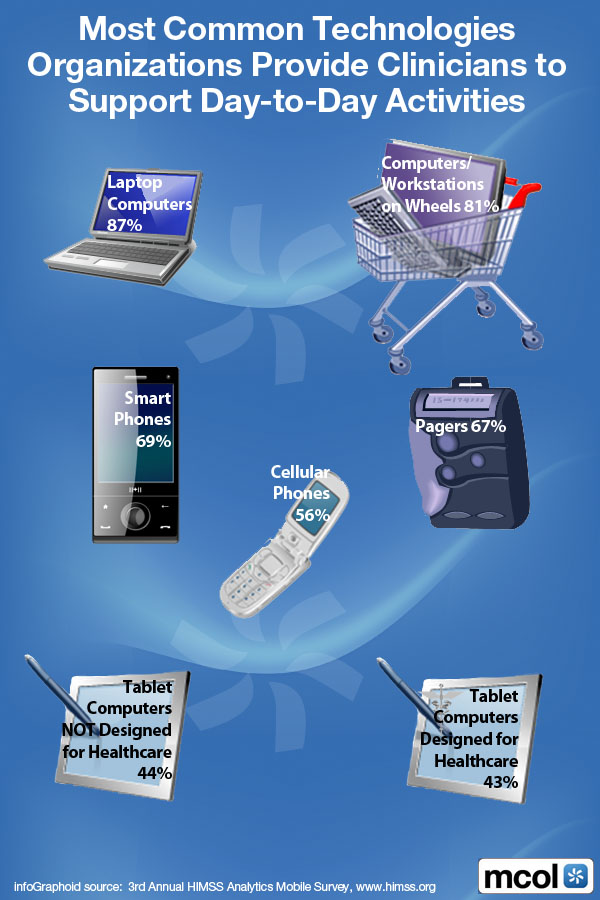
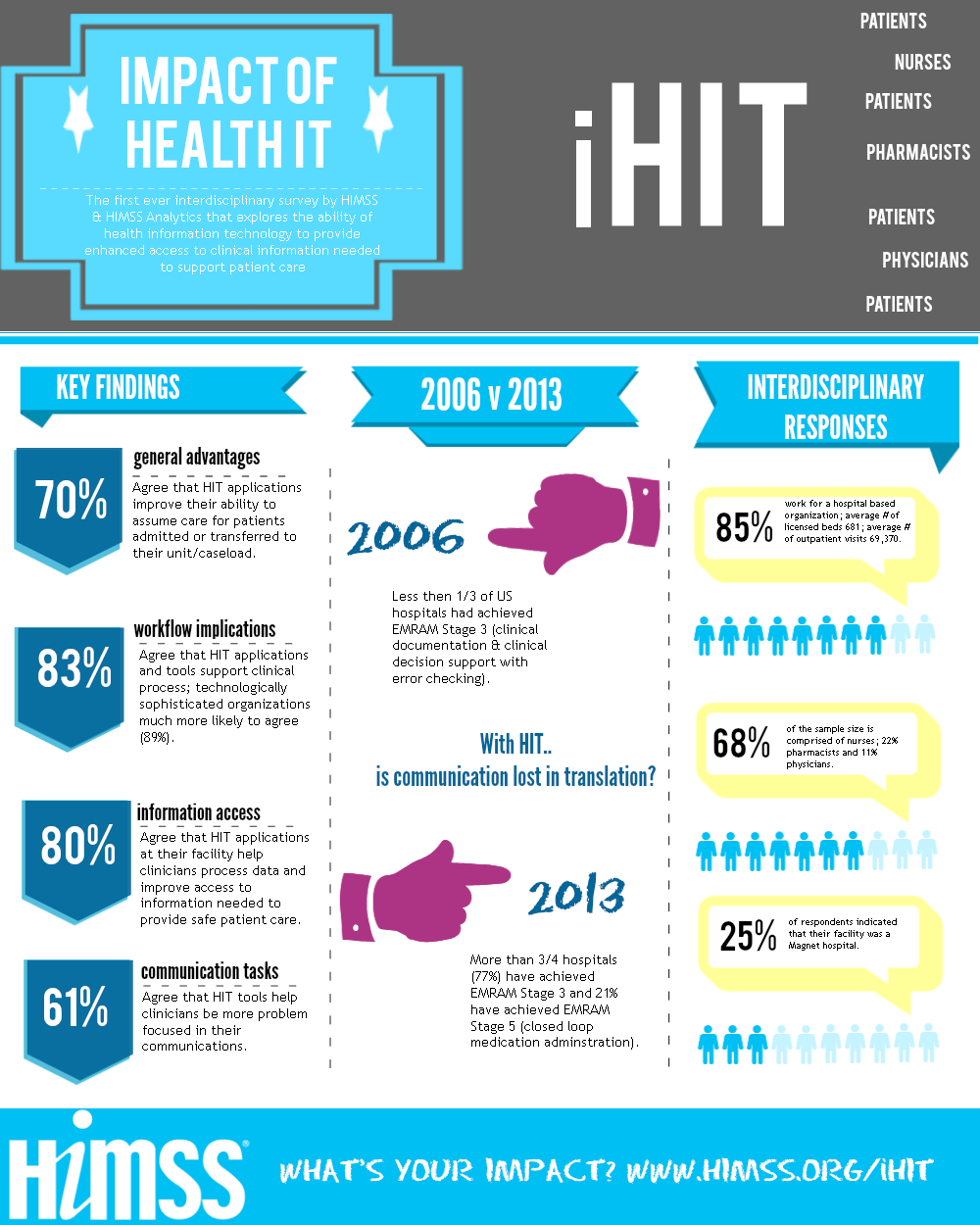
Common Daily Clinician Health Technologies

Join Our Mailing List

Most Commonly Provided to Support Daily Activities

www.MCOL.com

Health Technology

More:

Conclusion

Your thoughts and comments on this ME-P are appreciated. Feel free to review our top-left column, and top-right sidebar materials, links, URLs and related websites, too. Then, subscribe to the ME-P. It is fast, free and secure.

Link: http://feeds.feedburner.com/HealthcareFinancialsthePostForcxos

Speaker: If you need a moderator or speaker for an upcoming event, Dr. David E. Marcinko; MBA – Publisher-in-Chief of the Medical Executive-Post – is available for seminar or speaking engagements. Contact: MarcinkoAdvisors@msn.com

OUR OTHER PRINT BOOKS AND RELATED INFORMATION SOURCES:

DICTIONARIES: http://www.springerpub.com/Search/marcinko
PHYSICIANS: www.MedicalBusinessAdvisors.com
PRACTICES: www.BusinessofMedicalPractice.com
HOSPITALS: http://www.crcpress.com/product/isbn/9781466558731
CLINICS: http://www.crcpress.com/product/isbn/9781439879900
BLOG: www.MedicalExecutivePost.com
FINANCE: Financial Planning for Physicians and Advisors
INSURANCE: Risk Management and Insurance Strategies for Physicians and Advisors

Product DetailsProduct Details

Product Details

On Malicious Healthcare Cyber Traffic

Join Our Mailing List

According to Sector

By www.MCOL.com

Cyber Traffic

Conclusion

Your thoughts and comments on this ME-P are appreciated. Feel free to review our top-left column, and top-right sidebar materials, links, URLs and related websites, too. Then, subscribe to the ME-P. It is fast, free and secure.

Link: http://feeds.feedburner.com/HealthcareFinancialsthePostForcxos

Speaker: If you need a moderator or speaker for an upcoming event, Dr. David E. Marcinko; MBA – Publisher-in-Chief of the Medical Executive-Post – is available for seminar or speaking engagements. Contact: MarcinkoAdvisors@msn.com

OUR OTHER PRINT BOOKS AND RELATED INFORMATION SOURCES:

DICTIONARIES: http://www.springerpub.com/Search/marcinko
PHYSICIANS: www.MedicalBusinessAdvisors.com
PRACTICES: www.BusinessofMedicalPractice.com
HOSPITALS: http://www.crcpress.com/product/isbn/9781466558731
CLINICS: http://www.crcpress.com/product/isbn/9781439879900
BLOG: www.MedicalExecutivePost.com
FINANCE: Financial Planning for Physicians and Advisors
INSURANCE: Risk Management and Insurance Strategies for Physicians and Advisors

Product DetailsProduct DetailsProduct Details

Product DetailsProduct Details

Product Details

Join the 4th Global m-Health App Developer Economics Study

Join Our Mailing List

Invitation to Participate

By Flavio Zoppini

Dear Dr. Marcinko,

I am contacting you to ask the ME-P to become a partner for the 4th Global M-Health App Developer Economics.

The 4th Global MHealth App Developer Economics is conducted in partnership with Global Health Alliance and established global mHealth players and healthcare publishers like Happtique, HIMSS, WIP and Pharmaphorum.

Our partners will help us to make this project the largest mHealth app development study globally.  The target audience for the study is mHealth app developers and publishers as well as decision makers in the healthcare industry and institutions that oversees mHealth activities.

Results will be presented on the mHealth Summit in Berlin May 2014.

Partner benefits:

  • Our partners will get first hand insights from the study results.
  • Brand will be part of the largest study about mHealth apps.
  • Raise awareness for publications and blogs among a large target group.

We invite you to become a partner as well and help us to:

  • Invite survey participants. The study will be largely based on the results of a global online survey which has been launched last week.

Here is a link to the survey. Take the survey

Write about the results of the study once it is finished.

Here are some topics the study is covering:

  • Impact on healthcare: e.g. how will mHealth apps help to reduce healthcare costs?
  • Market potential: e.g. what are the mHealth app categories that offer the biggest market potential in the next five years?
  • Business models: e.g. what impact do sensors and wearable devices (e.g. glucometers and glasses) have on mHealth apps?
  • Trends: e.g. what will be the main distribution channels for mHealth apps in five years?
  • The market’s current status: e.g. what are the main reasons for publishing mHealth apps?
  • Innovation: e.g. how do APIs change the way mHealth apps deliver their services?

SONY DSC

Assessment

We would like you to join the team of partners for this project.  I look forward to your ME-P reader feedback.

Conclusion

Your thoughts and comments on this ME-P are appreciated. Feel free to review our top-left column, and top-right sidebar materials, links, URLs and related websites, too. Then, subscribe to the ME-P. It is fast, free and secure.

Link: http://feeds.feedburner.com/HealthcareFinancialsthePostForcxos

Speaker: If you need a moderator or speaker for an upcoming event, Dr. David E. Marcinko; MBA – Publisher-in-Chief of the Medical Executive-Post – is available for seminar or speaking engagements. Contact: MarcinkoAdvisors@msn.com

OUR OTHER PRINT BOOKS AND RELATED INFORMATION SOURCES:

DICTIONARIES: http://www.springerpub.com/Search/marcinko
PHYSICIANS: www.MedicalBusinessAdvisors.com
PRACTICES: www.BusinessofMedicalPractice.com
HOSPITALS: http://www.crcpress.com/product/isbn/9781466558731
CLINICS: http://www.crcpress.com/product/isbn/9781439879900
BLOG: www.MedicalExecutivePost.com
FINANCE: Financial Planning for Physicians and Advisors
INSURANCE: Risk Management and Insurance Strategies for Physicians and Advisors

Product DetailsProduct Details

Product Details

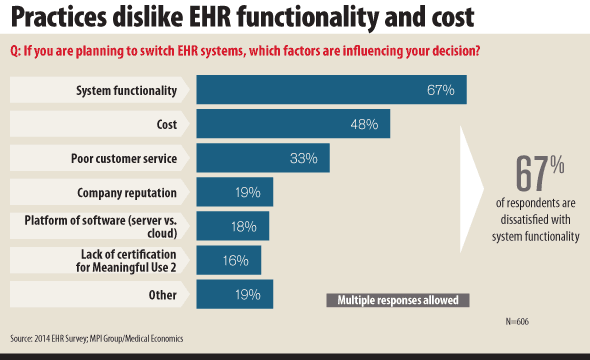
Do Medical Practices Really Like EHRs?

Join Our Mailing List

Do practices like functionality and cost?

By www.MCOL.com

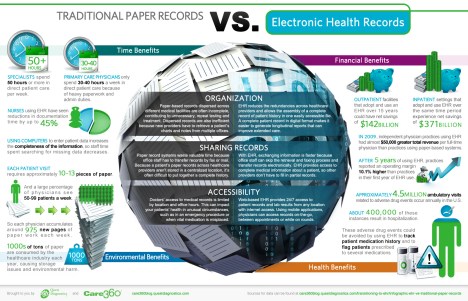
EHR

More:

  1. The Percentage of Office-Based Doctors with EHRs
  2. Do Nurses like EHRs?
  3. EHRs – Still Not Ready For Prime Time
  4. The “Price” of eHRs

Conclusion

Your thoughts and comments on this ME-P are appreciated. Feel free to review our top-left column, and top-right sidebar materials, links, URLs and related websites, too. Then, subscribe to the ME-P. It is fast, free and secure.

Link: http://feeds.feedburner.com/HealthcareFinancialsthePostForcxos

Speaker: If you need a moderator or speaker for an upcoming event, Dr. David E. Marcinko; MBA – Publisher-in-Chief of the Medical Executive-Post – is available for seminar or speaking engagements. Contact: MarcinkoAdvisors@msn.com

OUR OTHER PRINT BOOKS AND RELATED INFORMATION SOURCES:

DICTIONARIES: http://www.springerpub.com/Search/marcinko
PHYSICIANS: www.MedicalBusinessAdvisors.com
PRACTICES: www.BusinessofMedicalPractice.com
HOSPITALS: http://www.crcpress.com/product/isbn/9781466558731
CLINICS: http://www.crcpress.com/product/isbn/9781439879900
BLOG: www.MedicalExecutivePost.com
FINANCE: Financial Planning for Physicians and Advisors
INSURANCE: Risk Management and Insurance Strategies for Physicians and Advisors

Product DetailsProduct Details

Product Details

Are Dentists Satisfied with their EDRs?

Join Our Mailing List

Major Discontent With EHR Adoption

[By D. Kellus Pruitt DDS]

1-darrellpruittUnlike physicians, dentists never complain. That means they are probably 100% satisfied with their electronic dental records.

What do you think, Doc?

MarketWatch 

Recently, the Wall Street Journal’s MarketWatch posted a press release titled, “Physicians Cite Major Discontent With Adoption And Use of Electronic Health Record Systems, Despite Government’s $27 Billion Incentive Program”

http://www.marketwatch.com/story/physicians-cite-major-discontent-with-adoption-and-use-of-electronic-health-record-systems-despite-governments-27-billion-incentive-program-2014-02-07

“CLEVELAND, Feb. 7, 2014 /PRNewswire/ — The $27 billion government experiment to incentivize physicians to convert to electronic health records (EHRs) has not been worth it, according to nearly 70% of physicians surveyed.

Medical Economics 

***

In fact, a national [Medical Economics] survey of nearly 1,000 physicians, set for release on February 10, 2014, shows widespread dissatisfaction related to the functionality and cost of these patient record systems. About 45% of physicians believe patient care is actually worse as a result of adopting EHR technology, two-thirds would not purchase their current EHR system again, and 43% of physicians say these systems have resulted in significant financial losses.

In addition, the current state of technology has not improved the coordination of care with hospitals, physicians say.”

***

It is probably better for HHS that very few dentists were able to participate in the ARRA stimulus giveaway. Otherwise, tax-paying citizens might have learned about the wastefulness of Meaningful Use requirements for dentists – which nobody has the guts to reveal. That pretty much rules out brilliant Meaningful Use ideas.

Those who might patriotically defend the benefits of the tasks would do so, if they were idiots.

So how do dentists feel about their electronic dental records? It’s hard to tell. Over 96% of them are HIPAA-covered entities, making them vulnerable to audits, which can be “random” now. As one can imagine, very few dentists openly discuss EDRs. Do you think the silence is more likely to improve or harm patient care?

doc

Even though thousands of physicians have participated in dozens of national surveys like Medical Economics’ over the last few years, as far as I know, not one survey of dentists’ opinions has ever been published. Perhaps someone can prove me wrong. I doubt it.

The Survey

The results from the Medical Economics survey include:

  • 67% say that system functionality influences their decisions to purchase or switch systems.
  • 48% say that cost is influencing their decisions to purchase or switch systems.
  • Nearly half of physicians say that implementation of EHR systems has made the quality of patient care worse.
  • 69% of respondents say that coordination of care with hospitals has not improved.
  • 45% say they have spent more than $100,000 on an EHR
  • 77% of the largest practices (more than 10 physicians) spent more than $200,000 on an EHR.
  • 38% doubt their systems will still be viable in 5 years.

Assessment

Not long ago, Wisconsin became the first state to outlaw paper dental records, which are both cheaper and safer than digital.

So, is it still too soon for dentists and patients demand more transparency in dentistry? When costs and danger are hidden in dental care, it is always the last in line who suffer the most – clueless, trusting dental patients.

Am I right, Doc?

More:

  1. Sales of Dental Equipment and eDRs Down
  2. Military Electronic Dental Records [eDRs]
  3. Dr. Pruitt Invites Dr. Cohen to Discuss eDRs
  4. Cyber Insurance for Dentists

Conclusion

Your thoughts and comments on this ME-P are appreciated. Feel free to review our top-left column, and top-right sidebar materials, links, URLs and related websites, too. Then, subscribe to the ME-P. It is fast, free and secure.

Link: http://feeds.feedburner.com/HealthcareFinancialsthePostForcxos

Speaker: If you need a moderator or speaker for an upcoming event, Dr. David E. Marcinko; MBA – Publisher-in-Chief of the Medical Executive-Post – is available for seminar or speaking engagements. Contact: MarcinkoAdvisors@msn.com

OUR OTHER PRINT BOOKS AND RELATED INFORMATION SOURCES:

DICTIONARIES: http://www.springerpub.com/Search/marcinko
PHYSICIANS: www.MedicalBusinessAdvisors.com
PRACTICES: www.BusinessofMedicalPractice.com
HOSPITALS: http://www.crcpress.com/product/isbn/9781466558731
CLINICS: http://www.crcpress.com/product/isbn/9781439879900
BLOG: www.MedicalExecutivePost.com
FINANCE: Financial Planning for Physicians and Advisors
INSURANCE: Risk Management and Insurance Strategies for Physicians and Advisors

Product DetailsProduct Details

Product Details

Before You Jump to a Full-Fledged EMR Check Out Other Options [Part 2]

Join Our Mailing List

HIT: PART TWO

By Shahid Shah MS

Shahid N. ShahWowsa!

What a year [2013] in the HIT business?

Because of all the talk about EMRs and medical records software you’ll have many reasons to start immediately looking for an EMR vendor.

Try to resist that urge and look at broader non-EMR solutions that can help remove some of the non-clinical burdens from your staff in 2014:

  • Fax Server – a fax server allows you to centrally manage all incoming and outgoing faxes. Since most medical practices live on fax, this is one of the fastest investments you can recoup.
  • Shared drives – start using shared drives either using your existing software or you can purchase inexpensive “network disks” for a few hundred dollars to share business forms, online directories, reports, scanned charts, and many other files.
  • Online backups and Internet PACS storage – there are online tools like JungleDisk.com that allow you to store gigabytes of encrypted data into the Internet “cloud” for just a few dollars a month.
  • E-mail (beware of HIPAA, though) – internal office messaging and email is a great place to start. If you haven’t started your office automation journey here you should. If you’re going to use it for patient communications you’ll need to make sure you have patient approvals and appropriate encryption. If you’re on Gmail today and you want to have customers immediately be able to communicate with you on Gmail, that’s generally HIPAA compliant because communications between two Gmail accounts stays within the Google data center and is not sent unencrypted over the Internet.
  • E-Prescribing – e-prescribing is a great place to start your automation journey because it’s a fast way to realize how much slower the digital process is in capturing clinical data. If e-prescribing alone makes you slower in your job, EMRs will likely affect you even more. If you’re productive with e-prescribing then EMRs in general will make you more productive too.
  • Office Online and Google Apps (scheduling, document sharing) – Google and Microsoft® have some very nice online tools for managing contacts (your patients are contacts), scheduling (appointments), dirt simple document management, and getting everyone in the office “on the same page”. Before you jump into full-fledged EMRs see if these basic free tools can do the job for you.
  • Modular clinical groupware – this is a new category of software that allows you to collaborate with colleagues on your most time-consuming or most-needy patients and leave the remainder of them as-is. By automating what’s taking the most of your time you don’t worry about the majority of patients who aren’t.
  • Patient registry and CCR bulletin boards – if you’re just looking for basic patient population management and not detailed office automation then patient registries and CCR databases are a great start. These don’t help with workflow but they do manage patient summaries.
  • Document imaging – scanning and storing your paper documents is something that affects everyone; all scanners come with some basic imaging software that you can use for free. Once you’re good at scanning and paper digitization you can move to “medical grade” document managements that can improve productivity even more.
  • Clinical content repository (CMS) – open source systems like DrupalModules.com and Joomla.org do a great job of content management and they can be adapted to do clinical content management.
  • Electronic lab reporting – if labs are taking up most of your time, you can automate that pretty easily with web-based lab reporting systems.
  • Electronic transcription – if clinical note taking is taking most of your time, you can automate that by using electronic transcribing.
  • Speech recognition – another “point solution” to helping with capturing clinical notes; you can get a system up and running for under $250.
  • Instant Messaging (IM) – IM gives you the ability to connect directly with multiple rooms within your office using free software; if you want, you can also connect with patients and other physicians during work hours.

working with computer

Assessment

Can you think of any others?

Part One: Before you Jump to a Full-Fledged EMR Check out Other Options [Part 1]

Conclusion

Your thoughts and comments on this ME-P are appreciated. Feel free to review our top-left column, and top-right sidebar materials, links, URLs and related websites, too. Then, subscribe to the ME-P. It is fast, free and secure.

Link: http://feeds.feedburner.com/HealthcareFinancialsthePostForcxos

Speaker: If you need a moderator or speaker for an upcoming event, Dr. David E. Marcinko; MBA – Publisher-in-Chief of the Medical Executive-Post – is available for seminar or speaking engagements. Contact: MarcinkoAdvisors@msn.com

OUR OTHER PRINT BOOKS AND RELATED INFORMATION SOURCES:

DICTIONARIES: http://www.springerpub.com/Search/marcinko
PHYSICIANS: www.MedicalBusinessAdvisors.com
PRACTICES: www.BusinessofMedicalPractice.com
HOSPITALS: http://www.crcpress.com/product/isbn/9781466558731
CLINICS: http://www.crcpress.com/product/isbn/9781439879900
BLOG: www.MedicalExecutivePost.com
FINANCE: Financial Planning for Physicians and Advisors
INSURANCE: Risk Management and Insurance Strategies for Physicians and Advisors

Product DetailsProduct Details

Can Physician-Patient Intimacy be Electronic?

Join Our Mailing List 

More on Emerging Information and Communication Technologies

[By Jennifer Tomasik MS, © iMBA Inc., All rights reserved. USA]

Jennifer TomasikToday’s electronic and social media make possible a certain kind of healthcare intimacy.

ICTs—information and communication technologies—enable 24/7 monitoring of basic information such as blood pressure, glucose levels, pulse, and respiration.

ICTs

In one study, an ICT not only made it easier for patients to stay in touch with their doctors, the outcomes were also significantly better. Today, Hippocrates is no longer trailing patients around the house to keep track of their snacks and moods.

But, Hippocrates has gone digital in the form of a wearable device that records subtle changes in biological markers and communicates them instantaneously to a health provider

Taking a Pause

While this is obviously a great advance, we suggest you pause for a moment before plugging in. Why? ICTs and social media tools can make a difference to one of the most important dimensions—physiological outcomes. But you can have the latest interactive technology at your disposal and still fail to be connected.

Example:

A story that a friend told us shows how. One morning, her elderly father was touching up the paint on his sailboat. Nearby, another boat-owner, who happened to be an emergency medical technician, noticed her father was struggling to breathe and that his lips had turned purple. A trip to the local community hospital led to a barrage of high-tech tests and procedures, a diagnosis of emphysema, later complications with cerebral hematomas, and hospitalizations and re-hospitalizations that brought him into contact with a neurologist, a neurosurgeon, a cardiologist, and a pulmonologist. Throughout her father’s medical ordeal, the team of specialists stayed in touch with each other and the primary care physician via various electronic media.

But, one person remained out of the loop—her father. One day, six months into the experience, the primary care physician phoned our friend’s mother to check on his patient. Her father recalls thinking, “Why was he calling her?” The physician was communicating, but he was emotionally disconnected.

eMRs and MU

The Moral

The moral of the story: communication needs to be patient-centered in both electronic and psychological terms. That means understanding how someone likes to communicate and making sure the medium fits the message. Electronic media are just part of the equation. The other is the doctor-patient relationship. Once a relationship is established, it may be fine to use e-mail to send information about dosage.

But, delivering a new diagnosis may require the extra effort of scheduling a phone call or a face-to-face visit.

Assessment

Today, since you have so many Health 2.0 choices, it takes some effort to select the right way to communicate in a particular situation.

ABOUT THE AUTHOR

Jennifer Tomasik is a Principal at CFAR, a boutique management consulting firm specializing in strategy, change and collaboration. Jennifer has worked in the health care sector for nearly 20 years, with expertise in strategic planning, large-scale organizational and cultural change, public health, and clinical quality measurement. She leads CFAR’s Health Care practice. Jennifer has a Master’s in Health Policy and Management from the Harvard School of Public Health. Her clients include some of the most prestigious hospitals, health systems and academic medical centers in the country.

Conclusion

Your thoughts and comments on this ME-P are appreciated. Feel free to review our top-left column, and top-right sidebar materials, links, URLs and related websites, too. Then, subscribe to the ME-P. It is fast, free and secure.

Link: http://feeds.feedburner.com/HealthcareFinancialsthePostForcxos

Speaker: If you need a moderator or speaker for an upcoming event, Dr. David E. Marcinko; MBA – Publisher-in-Chief of the Medical Executive-Post – is available for seminar or speaking engagements. Contact: MarcinkoAdvisors@msn.com

OUR OTHER PRINT BOOKS AND RELATED INFORMATION SOURCES:

DICTIONARIES: http://www.springerpub.com/Search/marcinko
PHYSICIANS: www.MedicalBusinessAdvisors.com
PRACTICES: www.BusinessofMedicalPractice.com
HOSPITALS: http://www.crcpress.com/product/isbn/9781466558731
CLINICS: http://www.crcpress.com/product/isbn/9781439879900
BLOG: www.MedicalExecutivePost.com
FINANCE: Financial Planning for Physicians and Advisors
INSURANCE: Risk Management and Insurance Strategies for Physicians and Advisors

Product Details

Product DetailsProduct Details

How “Leaner” Hospitals Can Be Profitable in 2014

    Our Newest Textbooks with Checklists

Buy from Amazon

Learn How to Profit and Thrive in the PP-ACA Era

BOOK FOREWORD / TESTIMONIAL

###

Financial Management Strategies for Hospitals and Healthcare Organizations: Tools, Techniques, Checklists and Case Studies

###

Before you Jump to a Full-Fledged EMR Check out Other Options [Part 1]

Join Our Mailing List

HIT: PART ONE … OF TWO PARTS

By Shahid Shah MS

Shahid N. Shah MSWowsa!

What a year [2013] in the HIT business?

Because of all the talk about EMRs and medical records software you’ll have many reasons to start immediately looking for an EMR vendor.

Try to resist that urge and look at broader non-EMR solutions that can help remove some of the non-clinical burdens from your staff in 2014:

  • Using Microsoft Office Outlook® or an online calendaring system like Google to maintain patient schedules. While most vendors of clinical scheduling will tell you that medical scheduling is too complex to be handled by non-medical scheduling systems, most small and medium sized physician practices can easily get by with free or very inexpensive and non-specialized scheduling tools. By using general-purpose scheduling tools you will find that you can use less expensive consultants or IT help to manage your patient scheduling technology needs.
  • Using off-the-shelf address book software such as those built into Microsoft Office®, the Windows® and Macintosh® operating systems, or online tools such as Google apps you can maintain complete patient and contact registries for managing your patient lists. While a patient registry may not give you all of the features and functions you need immediately they can grow to a system that will meet your needs over time.
  • Using physician practice management systems you can remove much of the financial bookkeeping and insurance record-keeping burdens from your staff. Unlike calendaring or address book functionality which can be adapted from non-medical systems, insurance claims and related bookkeeping is an area where you should choose specific software based on how your practice earns its revenue. For example if a majority of your claims are Medicare related, then you should choose software that is specifically geared towards government claims management. If however your revenue comes less from insurance and more from traditional cash or related means you can easily use small business accounting software like Quicken® or Microsoft accounting.
  • Using computer telephony technology you can integrate automatic call in and call out the services that can be tied to your phone system so that you can track phone calls or send out call reminders.
  • Using integrated medical devices that can capture, collect, and transmit physiological patient data you can reduce paper capture of vital signs and other clinical data so that your staff are freed to do other work.
  • Using e-mail, instant messaging, social networking, and other online advanced tools you can reduce the number of phone calls that your practice receives and needs to return and yet continue to improve the patient physician communication process. One of the most time-consuming parts of any office is the back-and-forth phone calls so any reduction in phone calls will yield significant productivity increases.

eHRs

Assessment

Can you think of any other work-arounds?

Conclusion

Your thoughts and comments on this ME-P are appreciated. Feel free to review our top-left column, and top-right sidebar materials, links, URLs and related websites, too. Then, subscribe to the ME-P. It is fast, free and secure.

Link: http://feeds.feedburner.com/HealthcareFinancialsthePostForcxos

Speaker: If you need a moderator or speaker for an upcoming event, Dr. David E. Marcinko; MBA – Publisher-in-Chief of the Medical Executive-Post – is available for seminar or speaking engagements. Contact: MarcinkoAdvisors@msn.com

OUR OTHER PRINT BOOKS AND RELATED INFORMATION SOURCES:

DICTIONARIES: http://www.springerpub.com/Search/marcinko
PHYSICIANS: www.MedicalBusinessAdvisors.com
PRACTICES: www.BusinessofMedicalPractice.com
HOSPITALS: http://www.crcpress.com/product/isbn/9781466558731
CLINICS: http://www.crcpress.com/product/isbn/9781439879900
BLOG: www.MedicalExecutivePost.com
FINANCE: Financial Planning for Physicians and Advisors
INSURANCE: Risk Management and Insurance Strategies for Physicians and Advisors

Product DetailsProduct Details

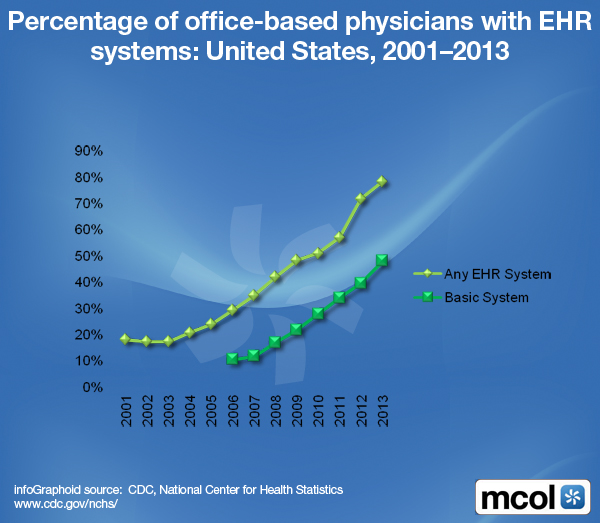
The Percentage of Office-Based Doctors with EHRs

Join Our Mailing List

US 2001-2013

By www.MCOL.com

EHR

Conclusion

Your thoughts and comments on this ME-P are appreciated. Feel free to review our top-left column, and top-right sidebar materials, links, URLs and related websites, too. Then, subscribe to the ME-P. It is fast, free and secure.

Link: http://feeds.feedburner.com/HealthcareFinancialsthePostForcxos

Speaker: If you need a moderator or speaker for an upcoming event, Dr. David E. Marcinko; MBA – Publisher-in-Chief of the Medical Executive-Post – is available for seminar or speaking engagements. Contact: MarcinkoAdvisors@msn.com

OUR OTHER PRINT BOOKS AND RELATED INFORMATION SOURCES:

DICTIONARIES: http://www.springerpub.com/Search/marcinko
PHYSICIANS: www.MedicalBusinessAdvisors.com
PRACTICES: www.BusinessofMedicalPractice.com
HOSPITALS: http://www.crcpress.com/product/isbn/9781466558731
CLINICS: http://www.crcpress.com/product/isbn/9781439879900
BLOG: www.MedicalExecutivePost.com
FINANCE: Financial Planning for Physicians and Advisors
INSURANCE: Risk Management and Insurance Strategies for Physicians and Advisors

Product DetailsProduct Details

Product Details

Medical Provider Readiness for ICD-10?

Join Our Mailing List

And, for Health Plans, too!

By www.MCOL.com

ImageProxy

Conclusion

Your thoughts and comments on this ME-P are appreciated. Feel free to review our top-left column, and top-right sidebar materials, links, URLs and related websites, too. Then, subscribe to the ME-P. It is fast, free and secure.

Link: http://feeds.feedburner.com/HealthcareFinancialsthePostForcxos

Speaker: If you need a moderator or speaker for an upcoming event, Dr. David E. Marcinko; MBA – Publisher-in-Chief of the Medical Executive-Post – is available for seminar or speaking engagements. Contact: MarcinkoAdvisors@msn.com

OUR OTHER PRINT BOOKS AND RELATED INFORMATION SOURCES:

DICTIONARIES: http://www.springerpub.com/Search/marcinko
PHYSICIANS: www.MedicalBusinessAdvisors.com
PRACTICES: www.BusinessofMedicalPractice.com
HOSPITALS: http://www.crcpress.com/product/isbn/9781466558731
CLINICS: http://www.crcpress.com/product/isbn/9781439879900
BLOG: www.MedicalExecutivePost.com
FINANCE: Financial Planning for Physicians and Advisors
INSURANCE: Risk Management and Insurance Strategies for Physicians and Advisors

Product DetailsProduct Details

Product Details

3 Steps to Take Before Buying Healthcare E-Signature Solutions

Join Our Mailing List

More on Paperless Healthcare Records

[By Patrick McTosh]

The movement towards paperless healthcare is growing. Every year, more and more health professionals are beginning to implement EMRs and EHRs as a way to turn their file cabinets into data on a hard drive. While EHRs help the problems of storing paper, they do not create documents that can be legally, securely and efficiently shared with third parties and patients during day to day activities.

These issues can be addressed by implementing an electronic signature solution. These types of solutions allow professions to create documents for physician orders, prescriptions, patient admissions, consent forms and other important medical documents in a timely and relatively paper free manner.

Verify EHR or EMR Integration

It’s important to ensure that whatever electronic signature software is compatible with your current EHR and EMR software. While most e-signature solution providers claim they have specialized services for healthcare organization, it’s best to confirm with a phone call or email that they have experience integrating their services with the EMR that is currently in use.

Verify Local Legislation & Signature Guidelines

Hospital accreditors have already recognized e-signatures as equivalent to paper signatures. However, it’s always important to verify federal and state regulations regarding e-prescriptions and electronic signatures.

For example, the latest DEA regulations on electronic prescriptions require digital signatures to have at least a biometric authentication. In addition, some states have not adopted the Uniform Electronic Transactions Act and therefore have difference laws pertaining to the legality of e-signatures.

Most e-signature providers specializing in healthcare tend to be on top of these things because better legal compliance is one of the benefits of e-signatures as a whole, but it’s always better do double check.

eHRs

Ensure It’s Human Error Proof

Many e-signature solutions attempt to reduce the risk of human error due to lost, damage or incorrectly completed forms which can cause significant delays. As most e-signature software will actually guide the signer through the complete process ensuring that the document meets necessary requirements before sealing the document with a tamper-evident digital seal.

Assessment

However, not all providers have such precautions against human errors, but it is definitely a must in the healthcare industry.

Conclusion

Your thoughts and comments on this ME-P are appreciated. Feel free to review our top-left column, and top-right sidebar materials, links, URLs and related websites, too. Then, subscribe to the ME-P. It is fast, free and secure.

Link: http://feeds.feedburner.com/HealthcareFinancialsthePostForcxos

Speaker: If you need a moderator or speaker for an upcoming event, Dr. David E. Marcinko; MBA – Publisher-in-Chief of the Medical Executive-Post – is available for seminar or speaking engagements. Contact: MarcinkoAdvisors@msn.com

OUR OTHER PRINT BOOKS AND RELATED INFORMATION SOURCES:

DICTIONARIES: http://www.springerpub.com/Search/marcinko
PHYSICIANS: www.MedicalBusinessAdvisors.com
PRACTICES: www.BusinessofMedicalPractice.com
HOSPITALS: http://www.crcpress.com/product/isbn/9781466558731
CLINICS: http://www.crcpress.com/product/isbn/9781439879900
BLOG: www.MedicalExecutivePost.com
FINANCE: Financial Planning for Physicians and Advisors
INSURANCE: Risk Management and Insurance Strategies for Physicians and Advisors

Product DetailsProduct Details

On Health Websites and “Apps”

Join Our Mailing List 

Not Just a Fad – Anymore

By Jennifer Tomasik, Carey Huntington and Fabian Poliak

http://www.CFAR.com

Jennifer Tomasik

Health Information Technology [HIT] may have arrived slowly into clinics and insurance companies, but the pace of innovation and adoption in consumer electronics today is astounding (and accelerating).

Devices are quickly penetrating every facet of our lives in the form of laptops, smartphones, tablets, and beyond. Thousands of health and wellness websites and software applications (“apps”) already exist, and we believe their role in healthcare will be increasingly a central one. Some are crucial elements of health organizations’ programming, such as the online platform that ShapeUp is built on: www.ShapeUp.com

Are they Effective?

Many are stand-alone tools without an organization or programming per se—i.e. apps for counting calories, monitoring glucose levels, or tracking sleep. But are websites and applications effective means of engaging individuals in their own health? And if so, what separates the good ones from the bad ones?

The Data

A 2009 meta-analysis of web-based smoking cessation programs found the pooled quit rate for participants to be 14.8% after follow-up conducted three months out, and 11.7% after six months out. [i] These figures are an improvement over the rate of people attempting to quit without any help or resources, as previously cited.

Internal Studies

From our own study of health websites and applications, we are beginning to see that high-quality digital resources share many of the same characteristics as great products and services do in the physical world. They create pull by engaging users via explicit reward structures. They enable teamwork and foster social accountability. Their content is interactive, informative, and often individualized. Their use is intuitive, convenient (e.g. accessible by web on a laptop or tablet and by smartphone “mobile apps”), and even effortless to the user (e.g. automatically collecting, synchronizing, and analyzing information).

Apps

Fragmentation

The fragmented world of websites and applications is not without its problems.

In today’s “app market,” the void that many websites and applications fill is not necessarily in the best interest of “health consumers,” and the quality of their products or services is often questionable. We see such issues as a reality of any market in its early stages.

Assessment

However, we are optimistic that greater consultation with medical professionals, greater investment and competition among health organizations, and improved regulation can help this new market mature into an indispensable virtual ecosystem of resources for health-seeking individuals.

More:

Conclusion

Your thoughts and comments on this ME-P are appreciated. Feel free to review our top-left column, and top-right sidebar materials, links, URLs and related websites, too. Then, subscribe to the ME-P. It is fast, free and secure.

Link: http://feeds.feedburner.com/HealthcareFinancialsthePostForcxos

Speaker: If you need a moderator or speaker for an upcoming event, Dr. David E. Marcinko; MBA – Publisher-in-Chief of the Medical Executive-Post – is available for seminar or speaking engagements. Contact: MarcinkoAdvisors@msn.com

OUR OTHER PRINT BOOKS AND RELATED INFORMATION SOURCES:

DICTIONARIES: http://www.springerpub.com/Search/marcinko
PHYSICIANS: www.MedicalBusinessAdvisors.com
PRACTICES: www.BusinessofMedicalPractice.com
HOSPITALS: http://www.crcpress.com/product/isbn/9781466558731
CLINICS: http://www.crcpress.com/product/isbn/9781439879900
BLOG: www.MedicalExecutivePost.com
FINANCE: Financial Planning for Physicians and Advisors
INSURANCE: Risk Management and Insurance Strategies for Physicians and Advisors


[i] Myung SK, McDonnell DD, Kazinets G, Seo HG, Moskowitz JM. “Effects of Web- and computer-based smoking cessation programs: meta-analysis of randomized controlled trials.” Arch Intern Med 2009;169(10):929-37.

Product DetailsProduct Details

Product Details

What is Form 834?

Join Our Mailing List 

President Obama’s Most Important Number

[By Staff Reporters]

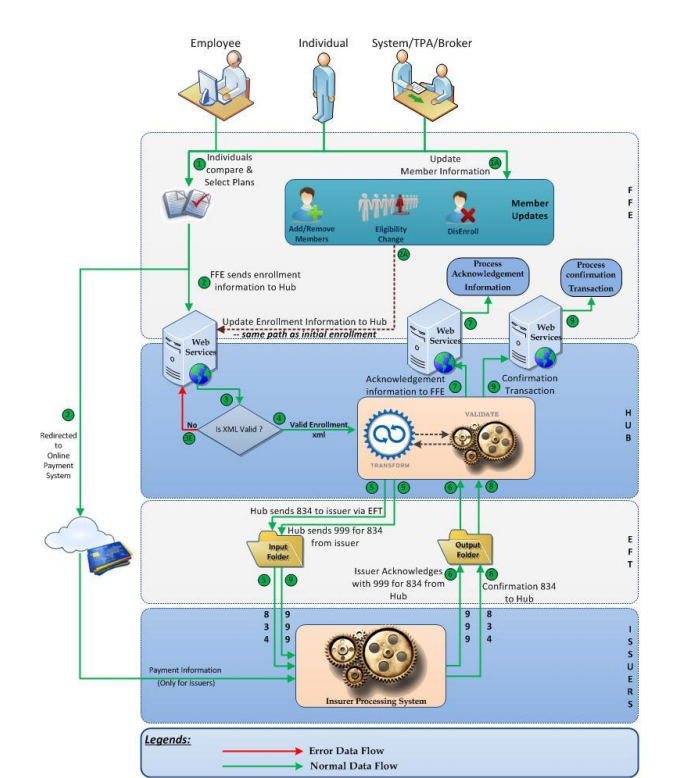
This is an “834 EDI transmission.”

Health Insurers sometimes call it, more simply, “an 834.” It is a technical, back-end reporting tool that consumers never see on the Federal Website. It is meant to be read by computers, not human beings. It’s the form that tells the insurer’s system who you are and what you need. And, it might be the new health-care law’s biggest problem.

Insurers report that, in some cases, 834s are coming in wrong. That’s a much more serious problem than the online traffic bottlenecks that have dominated coverage of the health-care law’s rollout.

Washington Post Article:

This is an “834 EDI transmission.” Insurers sometimes call it, more simply, “an 834.” It is a technical, back-end reporting tool that consumers never see. It is meant to be read by computers, not human beings. It’s the form that tells the insurer’s system who you are and what you need. And it might be the new health-care law’s biggest problem.

Insurers report that, in some cases, 834s are coming in wrong. That’s a much more serious problem than the online traffic bottlenecks that have dominated coverage of the health-care law’s rollout.

HIEs

What is the ANSI 834 Enrollment Implementation Format?

The 834 Transaction is the HIPAA-compliant Benefit Enrollment and Maintenance Transaction. Its purpose is to electronically transmit enrollment and dis-enrollment information.

In 2004, DHCS implemented a 4010 834 solution, however, this was implemented along with a supplemental transaction that held eligibility history.

The HIPAA 5010 version of all transactions is scheduled to be implemented on January 1st, 2012. DHCS will implement a compliant 5010 834 on this date. The current FAME file will continue to be made available for a short period of time after this date to allow plans time to transition. Once this transition period has been completed the FAME file will no longer be made available to managed care plans.

Impacted Covered Entities

Internal DHCS program areas and DHCS Health Plan trading partners.

Links:

5010 834 Documents

General FAME Documents

MEDICARE PART D INFORMATION

Project Information

DHCS Medicare Part D information web page

MMA Part D Carrier Cross Reference Table (pdf)

File Layouts

MMEF 2100 Medicare Part D layout (pdf)

MMEF REC Medicare Part D layout (pdf)

Assessment

best-diagram

Conclusion

Your thoughts and comments on this ME-P are appreciated. Feel free to review our top-left column, and top-right sidebar materials, links, URLs and related websites, too. Then, subscribe to the ME-P. It is fast, free and secure.

Link: http://feeds.feedburner.com/HealthcareFinancialsthePostForcxos

Speaker: If you need a moderator or speaker for an upcoming event, Dr. David E. Marcinko; MBA – Publisher-in-Chief of the Medical Executive-Post – is available for seminar or speaking engagements. Contact: MarcinkoAdvisors@msn.com

OUR OTHER PRINT BOOKS AND RELATED INFORMATION SOURCES:

DICTIONARIES: http://www.springerpub.com/Search/marcinko
PHYSICIANS: www.MedicalBusinessAdvisors.com
PRACTICES: www.BusinessofMedicalPractice.com
HOSPITALS: http://www.crcpress.com/product/isbn/9781466558731
CLINICS: http://www.crcpress.com/product/isbn/9781439879900
BLOG: www.MedicalExecutivePost.com
FINANCE: Financial Planning for Physicians and Advisors
INSURANCE: Risk Management and Insurance Strategies for Physicians and Advisors

Product DetailsProduct Details

Product Details

On Healthcare.Gov System Availability

Join Our Mailing List

A Review of Website “Uptime”

By www.MCOL.com

HG

Conclusion

Your thoughts and comments on this ME-P are appreciated. Feel free to review our top-left column, and top-right sidebar materials, links, URLs and related websites, too. Then, subscribe to the ME-P. It is fast, free and secure.

Link: http://feeds.feedburner.com/HealthcareFinancialsthePostForcxos

Speaker: If you need a moderator or speaker for an upcoming event, Dr. David E. Marcinko; MBA – Publisher-in-Chief of the Medical Executive-Post – is available for seminar or speaking engagements. Contact: MarcinkoAdvisors@msn.com

OUR OTHER PRINT BOOKS AND RELATED INFORMATION SOURCES:

DICTIONARIES: http://www.springerpub.com/Search/marcinko
PHYSICIANS: www.MedicalBusinessAdvisors.com
PRACTICES: www.BusinessofMedicalPractice.com
HOSPITALS: http://www.crcpress.com/product/isbn/9781466558731
CLINICS: http://www.crcpress.com/product/isbn/9781439879900
BLOG: www.MedicalExecutivePost.com
FINANCE: Financial Planning for Physicians and Advisors
INSURANCE: Risk Management and Insurance Strategies for Physicians and Advisors

Product DetailsProduct DetailsProduct Details

Product Details  Product Details

Product DetailsProduct Details

Product Details

A Mobile Health “apps” Opinion Survey

Join Our Mailing List

Original Research Opportunity

By Thomas Martin [Doctoral Candidate]

[School of Public Policy and Administration]

University of Delaware – trm@udel.edu

[412-992-1285]

Dear Dr. Marcinko and ME-P Readers and Subscribers,

The University of Delaware is conducting research to assess medical provider attitudes towards applications “Apps” in healthcare settings.  Mobile devices hold great promise for reshaping the “time and place” where an individual receives care. This study is almost complete.

The Research

Please consider forwarding this to a colleague if you thought the questions were intriguing. The research tool evaluates a number of key topics emerging in the healthcare space:

  • Opinions on the integration of apps into the Meaningful Use program
  • Characteristics important to users when downloading an app
  • Assessing desirable pricing structures

Invitation

I’d like to invite you and your ME-P readers to provide feedback on how you leverage Apps in the healthcare setting. The research instrument should take no more than 10 minutes to complete and all responses are confidential. The results may be published in a scholarly journal or industry research publication.

Respondents should be:

  • U.S. Providers, Physicians, or Nurses
  • IT Staff involved in Health IT and mobile decisions

If you have any questions, please do not hesitate to contact Thomas Martin (PI) at trm@Udel.edu,tmartin@himss.org or 412 992 1285.

personal-phone

Assessment

the research

Conclusion

Your thoughts and comments on this ME-P are appreciated. Feel free to review our top-left column, and top-right sidebar materials, links, URLs and related websites, too. Then, subscribe to the ME-P. It is fast, free and secure.

Link: http://feeds.feedburner.com/HealthcareFinancialsthePostForcxos

Speaker: If you need a moderator or speaker for an upcoming event, Dr. David E. Marcinko; MBA – Publisher-in-Chief of the Medical Executive-Post – is available for seminar or speaking engagements. Contact: MarcinkoAdvisors@msn.com

OUR OTHER PRINT BOOKS AND RELATED INFORMATION SOURCES:

DICTIONARIES: http://www.springerpub.com/Search/marcinko
PHYSICIANS: www.MedicalBusinessAdvisors.com
PRACTICES: www.BusinessofMedicalPractice.com
HOSPITALS: http://www.crcpress.com/product/isbn/9781466558731
CLINICS: http://www.crcpress.com/product/isbn/9781439879900
ADVISORS: www.CertifiedMedicalPlanner.org
PODIATRISTS: www.PodiatryPrep.com
BLOG: www.MedicalExecutivePost.com
FINANCE: Financial Planning for Physicians and Advisors
INSURANCE: Risk Management and Insurance Strategies for Physicians and Advisors

Product DetailsProduct Details

Product Details

Pennsylvania dental patients’ stolen social security numbers posted online

Join Our Mailing List 

EDR Data breach in Williamsport, Pennsylvania

By D. Kellus Pruitt DDS

1-darrellpruittOver the last 7 years, I have absorbed a surprising amount of criticism for warning my community that electronic dental records continue to grow both more expensive and more dangerous than paper dental records. That chunk of bad news which not one dental leader is ready to acknowledge is becoming increasingly difficult for even the most popular practice management consultants and other 3rd parties to hide. Unresponsiveness from those who profit from EDR sales is unethical and has already harmed dental patients.

Vulnerability Notes

In the Vulnerability Notes that have been issued by the US Department of Homeland Security to dental software giant Dentrix in the last year, security expert Justin Shafer was thanked in both for alerting authorities to Dentrix’s weaknesses.

Though evasive EDR stakeholders were able to fend off transparency far too long, it is fast becoming obvious to the world that their free ride with no accountability has always been destined to end ugly, and greed is to blame. Unforgiving media coverage of the nation’s loss of confidence in EDRs just might start in day or so in the parking lot of dentist’s office near Williamsport, Pennsylvania. Take cover, Dentrix

Eyeing Dentrix 

In the last two years, Justin Shafer’s uninvited watchful eye over Dentrix’s vulnerabilities may have already helped protect millions of dental patients from identity theft. Nevertheless, Dentrix’s security problems which company officials apparently hide, continue to endanger the welfare of uninformed Americans. I have learned that Shafer doesn’t give up easily. He’s in HIT for the long haul.

Yesterday morning, he posted a heads-up on the City of Williamsport’s Facebook, as well four other local Facebooks, warning of the results of a dental office data breach of Dentrix software: Dental patients’ social security numbers have become available on a zip file from Piratebay.

Shafer: “I am willing to bet there are a lot of your citizens SSN’s in this database. Look at rsc_dat.dat and patient.dat… Seems a dental database ended up on piratebay. You may already know.. you may not.”

He explained it to me this way: “the practice info is in rsc_dat.dat, patient info is in pat_dat.dat. It’s a nightmare, and I told dentrix and the doctor a full year ago.”

Insightful or clueless dentist?

Assessment 

Did your opinion of censorship in dental care recently undergo change?

Conclusion

Your thoughts and comments on this ME-P are appreciated. Feel free to review our top-left column, and top-right sidebar materials, links, URLs and related websites, too. Then, subscribe to the ME-P. It is fast, free and secure.

Link: http://feeds.feedburner.com/HealthcareFinancialsthePostForcxos

Speaker: If you need a moderator or speaker for an upcoming event, Dr. David E. Marcinko; MBA – Publisher-in-Chief of the Medical Executive-Post – is available for seminar or speaking engagements. Contact: MarcinkoAdvisors@msn.com

OUR OTHER PRINT BOOKS AND RELATED INFORMATION SOURCES:

DICTIONARIES: http://www.springerpub.com/Search/marcinko
PHYSICIANS: www.MedicalBusinessAdvisors.com
PRACTICES: www.BusinessofMedicalPractice.com
HOSPITALS: http://www.crcpress.com/product/isbn/9781466558731
CLINICS: http://www.crcpress.com/product/isbn/9781439879900
BLOG: www.MedicalExecutivePost.com
FINANCE: Financial Planning for Physicians and Advisors
INSURANCE: Risk Management and Insurance Strategies for Physicians and Advisors

Product DetailsProduct Details

Product Details

Is HEALTHCARE.GOV Fundamentally Flawed?

Join Our Mailing List

You Decide

By Ayo Fathiah

Hello Dr. David Edward Marcinko,

My name is Ayo, I’m the mother of two beautiful kids and one of the Americans that was relying on healthcare.gov to provide me with a reasonably priced health insurance.

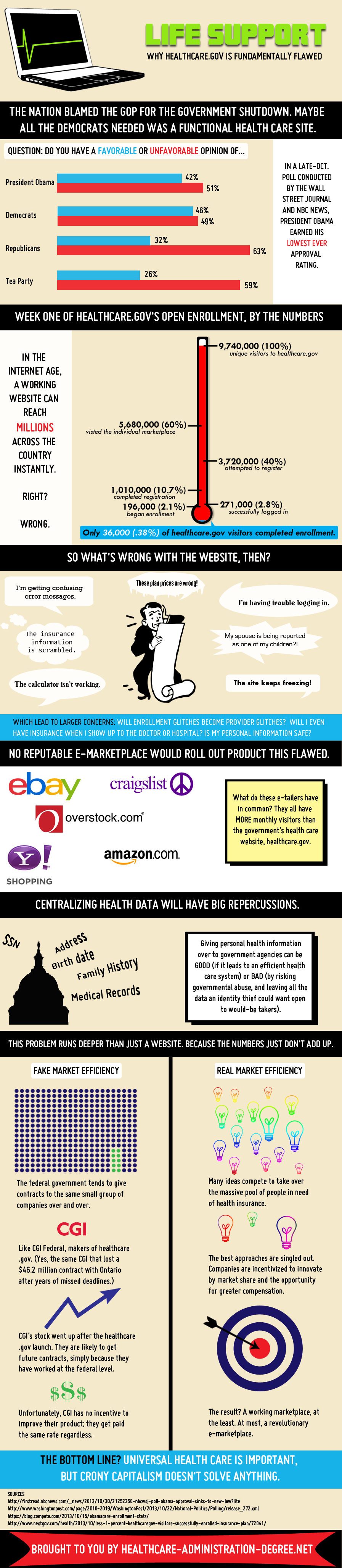
I came across your ME-P articles when researching what exactly has gone wrong with the website. I was one of the millions that tried to sign up during the first days after the launch and couldn’t get through due to a bunch of errors. While I’m still trying to find the best insurance for my family, I just wanted to share with you some stats showing why the website was a major flop.

***

interface

***

And, I thought it might be interesting to your readers, because I saw a many readers talking about it. Isn’t it surprising that less than 1% of people that went on the website signed up for an insurance?

HCdotGOV_final

The Website

1.) Had extremely low login success rates. 2.) Long delays and time outs 3.) Confusing Error Messages 4.) Non-functional calculators 5.) Scrambled insurance information 6.) Spouses reported as children 7.) Plan pricing misreported.

Assessment

Leading to the larger questions:

  • Will enrollment glitches become provider glitches?
  • Will people who enrolled with the glitchy show up at hospitals with no insurance?
  • Will the information of those who enrolled be at risk?

DANGER: Centralized data SSN Address Ages Names Health conditions Family History

Leads to centralized power over everyday Americans

Good: if we can make an efficient healthcare system

Bad: Governmental Abuse, and all the data an identity thief could want

But this problem runs deeper than just a website… Because the numbers just don’t add up.

Universal healthcare is important, but crony capitalism doesn’t solve anything.

Citations:

  1. http://msnbcmedia.msn.com/i/MSNBC/Sections/A_Politics/_Today_Stories_Teases/Late_October_NBC_WSJ.pdf
  2. https://blog.compete.com/2013/10/15/obamacare-enrollment-stats/
  3. http://www.nextgov.com/health/2013/10/less-1-percent-healthcaregov-visitors-successfully-enrolled-insurance-plan/72041/

Conclusion

Your thoughts and comments on this ME-P are appreciated. Feel free to review our top-left column, and top-right sidebar materials, links, URLs and related websites, too. Then, subscribe to the ME-P. It is fast, free and secure.

Link: http://feeds.feedburner.com/HealthcareFinancialsthePostForcxos

Speaker: If you need a moderator or speaker for an upcoming event, Dr. David E. Marcinko; MBA – Publisher-in-Chief of the Medical Executive-Post – is available for seminar or speaking engagements. Contact: MarcinkoAdvisors@msn.com

OUR OTHER PRINT BOOKS AND RELATED INFORMATION SOURCES:

LEXICONS: http://www.springerpub.com/Search/marcinko
PHYSICIANS: www.MedicalBusinessAdvisors.com
PRACTICES: www.BusinessofMedicalPractice.com
HOSPITALS: http://www.crcpress.com/product/isbn/9781466558731
CLINICS: http://www.crcpress.com/product/isbn/9781439879900
ADVISORS: www.CertifiedMedicalPlanner.org
BLOG: www.MedicalExecutivePost.com

Product DetailsProduct DetailsProduct Details

Product Details  Product Details

Product DetailsProduct Details

Product Details

The PP-ACA from Medicine to Dentistry

Obamacare and Dentistry

[By D. Kellus Pruitt DDS]

1-darrellpruitt It seems that problems with the PP-ACA have migrated from traditional medicine to the world of dentistry.

“MaineCare dentists hit with massive fines for minor clerical errors, they say – Some clinics face more than $200,000 in penalties under a new audit system that threatens to wipe out services for kids.”

-Joe Lawlor [Staff writer] Portland Press Herald [November 6, 2013]

http://www.pressherald.com/news/MaineCare_dentists_hit_with_massive_fines_for_minor_clerical_errors__they_say_.html

 “The new system gives auditors, who work for a private contractor, financial incentives to find small errors by paying them more for each mistake they discover.” Maine adopted the auditing system to comply with the federal Affordable Care Act, otherwise known as Obamacare.

 Lawlor continues: “The audits are intended to root out fraud and abuse, but dentists told the Portland Press Herald that auditors are finding typographical or clerical errors that do not compromise patients’ care or defraud the government.”

A Clawback?

Dr. Michael Dowling, co-owner of Falmouth Pediatric Dentistry, tells the Herald, “This is not finding fraud and abuse. This is a clawback. They (state officials) are trying to take back money that we billed them legitimately.”

Still want to help the poor so much that you are willing to take your chances with the ACA auditing system, Doc?

Dentists facing bankruptcy

According to Lawlor, some dentists are actually facing bankruptcy because of ridiculously expensive fines over minor errors. Other Maine dentists who are otherwise willing to work for charity-level fees in order to help children who have nowhere else to turn, are dropping out of MaineCare. President Obama’s plan to use outrageous fines to fund the state and federal coffers, as well as the bonuses of ambitious auditors, is destined to fail.

How can the Affordable Care Act [PP-ACA] possibly make care more affordable for children with toothaches, if it runs off all the dentists?

Mobile-Security

Assessment

Is it beginning to look to you like Obamacare might have been designed to serve the interests of unaccountable healthcare stakeholders rather than the interests of doctors and patients – the healthcare principals? Why do we put up with this crap, Doc?

Conclusion

Your thoughts and comments on this ME-P are appreciated. Feel free to review our top-left column, and top-right sidebar materials, links, URLs and related websites, too. Then, subscribe to the ME-P. It is fast, free and secure.

Link: http://feeds.feedburner.com/HealthcareFinancialsthePostForcxos

Speaker: If you need a moderator or speaker for an upcoming event, Dr. David E. Marcinko; MBA – Publisher-in-Chief of the Medical Executive-Post – is available for seminar or speaking engagements. Contact: MarcinkoAdvisors@msn.com

OUR OTHER PRINT BOOKS AND RELATED INFORMATION SOURCES:

LEXICONS: http://www.springerpub.com/Search/marcinko
PHYSICIANS: www.MedicalBusinessAdvisors.com
PRACTICES: www.BusinessofMedicalPractice.com
HOSPITALS: http://www.crcpress.com/product/isbn/9781466558731
CLINICS: http://www.crcpress.com/product/isbn/9781439879900
ADVISORS: www.CertifiedMedicalPlanner.org
BLOG: www.MedicalExecutivePost.com

Product DetailsProduct Details

The RAND Corporation’s Health IT Legacy‏

Join Our Mailing List 

Understanding ObamaCare and HIT Data Breaches

[By Darrell K. Pruitt DDS]

1-darrellpruittTwo current topics in the HIT industry: (1) A dishonest 2005 RAND study set up lawmakers for disappointment in electronic health records, which are essential to Obamacare, and (2) I told you so.

The Reports

Just the other day, there were reports of two data breaches of EHRs involving over 734,000 patients in Texas and California.

http://www.ihealthbeat.org/articles/2013/10/23/health-facilities-in-california-texas-report-health-data-breaches

For reasons like this, the wisdom of an ambitious mandate for paperless healthcare by 2014 is beginning to be questioned by the same lawmakers who were sucked in years ago by RAND’s tainted 2005 study.

According to the vendor-friendly results gleaned from vendor-friendly data supplied by vendors, EHRs should have started saving 100,000 lives and $77 billion a year, years ago. Predictably, that has not happened. Far from it!

The Findings 

The happy findings – discredited even by RAND in January of this year – were paid for by Cerner and GE, who profited immensely from their RAND investment. Since nationwide adoption of EHRs became a bi-partisan goal with bubbly beginnings and millions of campaign dollars, the costs and danger of healthcare IT didn’t appear to bother conservatives until three months after RAND admitted the study was garbage.

In April, six GOP senators, led by Sen. John Thune (R-S.D.), released a detailed report criticizing HHS Secretary Kathleen Sebelius’ execution of a $35 billion initiative to promote EHRs as part of the ARRA stimulus package. (See: “GOP senators raise concerns with push for electronic medical records,” by Sam Baker, April 16, 2013, The Hill).

http://thehill.com/blogs/healthwatch/medicare/294273-gop-senators-raise-concerns-with-push-for-electronic-medical-records

Wither ARRA?

Have you ever wondered why ARRA was passed as a jobs bill rather than as part of healthcare reform? Any ideas?

More recently, with the conservatives’ failure to stop Obamacare even by shutting down government, EHRs have become recognized as the ACA’s next best weakness. Yesterday, Greg Scandlen, writing for RightSideNews.com, posted “The Tyranny of Electronic Systems.” It goes downhill from there.

http://www.rightsidenews.com/2013102333379/life-and-science/health-and-education/the-tyranny-of-electronic-systems.html

Even More

Also yesterday, Michelle Mailkin writing for Townhall.com, an ultra-conservative website similar to RightSideNews, posted, “Don’t Forget Obamacare’s Electronic Medical Records Wreck.

http://townhall.com/columnists/michellemalkin/2013/10/23/dont-forget-obamacares-electronic-medical-records-wreck-n1730172?utm_source=TopBreakingNewsCarousel&utm_medium=story&utm_campaign=BreakingNewsCarousel

Assessment 

Conservatives found traction: Without the anticipated healthcare savings from EHRs, Obamacare will not survive. These times are not as happy for EHR stake-holders as RAND led them to expect.

Conclusion

Your thoughts and comments on this ME-P are appreciated. Feel free to review our top-left column, and top-right sidebar materials, links, URLs and related websites, too. Then, subscribe to the ME-P. It is fast, free and secure.

Link: http://feeds.feedburner.com/HealthcareFinancialsthePostForcxos

Speaker: If you need a moderator or speaker for an upcoming event, Dr. David E. Marcinko; MBA – Publisher-in-Chief of the Medical Executive-Post – is available for seminar or speaking engagements. Contact: MarcinkoAdvisors@msn.com

OUR OTHER PRINT BOOKS AND RELATED INFORMATION SOURCES:

LEXICONS: http://www.springerpub.com/Search/marcinko
PHYSICIANS: www.MedicalBusinessAdvisors.com
PRACTICES: www.BusinessofMedicalPractice.com
HOSPITALS: http://www.crcpress.com/product/isbn/9781466558731
CLINICS: http://www.crcpress.com/product/isbn/9781439879900
ADVISORS: www.CertifiedMedicalPlanner.org
BLOG: www.MedicalExecutivePost.com

Product DetailsProduct DetailsProduct Details

Product Details  Product Details

Product DetailsProduct Details

Product Details

Understanding Global Location Numbers Used in Healthcare Today

Join Our Mailing List 

Defining Global Location Numbers in Hospital Supply Chain Management

By Adam Higman and Brian Mullahey

By Kristin Spenik and Jerzy Kaczor

Product DetailsProduct DetailsProduct Details

Global Location Numbers (GLNs) are widely used throughout healthcare supply chain groups.

The Dictionary of Health Information Technology and Security defines a GLN as a unique, 13-digit number that links the name, industry, and address of a particular item that pinpoints the “legal, functional, or physical location within a business or organizational entity”, in particular hospitals and healthcare organizations.

  • Legal: Hospitals, healthcare organizations, distributors, suppliers, freight carriers, etc.
  • Functional: Specific departments within legal entities, i.e. purchasing departments, nursing stations, wards, etc. in hospitals
  • Physical: Hospital rooms, hospital wings, cabinets, shelving units, delivery points, loading docks, warehouses, etc.

AHRMM

According to the Association for Healthcare Resource & Materials Management, the premier organization for healthcare supply chain professionals, global locations numbers can recover your facility’s revenue stream, enhance the accuracy of documenting Group Purchasing Organization [GPO] sales, and end the use “of single purpose proprietary supplier numbers”.

The Objective

The ultimate objective is getting everyone involved in the supply chain process to use identical numbers.

For instance, if the GPO communicates to the manufacturer that your hospital utilizes a specific GLN, then it is more likely that the manufacturer will associate the hospital’s materials and supplies with the correct GPO contract price.

In addition, if distributors utilize GLNs along with manufacturers and producers to determine the manufacturer’s price that was given, the hospital will likely secure the correct rate when purchasing supplies directly from distributors.

Conclusion

Your thoughts and comments on this ME-P are appreciated. Feel free to review our top-left column, and top-right sidebar materials, links, URLs and related websites, too. Then, subscribe to the ME-P. It is fast, free and secure.

Link: http://feeds.feedburner.com/HealthcareFinancialsthePostForcxos

Speaker: If you need a moderator or speaker for an upcoming event, Dr. David E. Marcinko; MBA – Publisher-in-Chief of the Medical Executive-Post – is available for seminar or speaking engagements. Contact: MarcinkoAdvisors@msn.com

OUR OTHER PRINT BOOKS AND RELATED INFORMATION SOURCES:

LEXICONS: http://www.springerpub.com/Search/marcinko

PHYSICIANS: www.MedicalBusinessAdvisors.com

PRACTICES: www.BusinessofMedicalPractice.com

HOSPITALS: http://www.crcpress.com/product/isbn/9781466558731

CLINICS: http://www.crcpress.com/product/isbn/9781439879900

ADVISORS: www.CertifiedMedicalPlanner.org

PODIATRISTS: www.PodiatryPrep.com

BLOG: www.MedicalExecutivePost.com

Product DetailsProduct Details

Product Details

Hospital Information Systems and the PP-ACA

Join Our Mailing List

Extension of Hospital Information Systems Beyond the Hospital

By Brent A. Metfessel MD

Dr. MetfesselThe Patient Protection and Affordable Care Act (ACA), affirmed after the November 7th 2012 presidential election, includes a number of policies and potential projects with the aim of improving quality of care while reducing costs – or at least greatly slowing increases in health care costs from year to year.

Included in this effort are CMS payment incentives for providers that can show care patterns that meet the goals of high quality, cost-efficient care.

HHS and ACOs 

On March 31, 2011, the Department of Health and Human Services (HHS) released a set of proposed new rules to aid clinicians, hospitals, and other health facilities and providers to improve coordination of care for Medicare patients using a model known as Accountable Care Organizations (ACOs). ACOs that are shown to lower health care cost growth while meeting CMS quality benchmarks, including measures of patient/caregiver experience of care, care coordination, patient safety, preventive health, and health of high-risk populations, will receive incentive payments as part of the Medicare Shared Savings Program.

But, in some proposed models ACOs may also be held accountable for shared losses.

Care Co-ordination

Coordination of care means that hospitals, physician offices, and other providers have a complete record of patients’ episodes of care, including diagnostic tests, procedures, and medication information.  This potentially would decrease extra costs from unnecessary duplication of services as well as reducing medical errors from incomplete understanding of the patients’ illness histories and medical care provided.

It is also believed that better coordination of care may prevent 30-day hospital readmissions (which occur for nearly one in five Medicare discharges), since needed post-discharge care would be more readily obtainable with more aggressive care coordination.

Medicare patients in ACOs, however, would still be allowed to see providers outside of the ACO, and proposals exist to prevent physicians in ACOs from being penalized for patients with a greater illness severity or complexity.

According to a CMS analysis, ACOs may result in Medicare savings of up to $960 million over three years.  Although the Affordable Care Act’s ACO provisions primarily target Medicare beneficiaries, private insurers are also beginning to create care models based on the accountable care paradigm.  Insurers could offer similar incentives to the ACO model described above, and which might include features such as performance based contracting or tiered benefit models that favor physicians who score highly on care quality and cost-efficiency measures.

Balance

Only the Beginning

ACOs and other implementations of the accountable care paradigm, however, are in their beginning stages, with a number of pilots around the country currently being conducted to more fully evaluate the concept, and there still is some controversy over the best way to achieve these goals. It is a continuing balancing act.

The critical point here is that in all likelihood, with the advent of the ACA and other initiatives, stemming the upward tide of medical cost increases becomes an even higher priority, and no matter what the final models will look like, the success of any of the models requires a high level of care coordination – requiring information systems that are fully compatible and allow seamless and errorless transmission of information between sites of service and the various providers that can be involved in patient care.

More:

  1. Ground Breaking Book Explains Why Accountable Care Organizations May Be the Answer the Health Care Industry Has Been Seeking!
  2. Evaluating ACOs at Mid-Launch
  3. How Using a ‘Scorecard’ Can Smooth Your Hospital’s Transition to a Population Health-Based Reimbursement Model
  4. Doubting the Accountable Care Organization B-Model

Assessment

Thus, wherever a patient goes for care, all the information needed to provide high-quality and cost-efficient care is immediately available.

References

Feds Take Critical Look at Meaningful Use Payments”, InformationWeek Healthcare, October 24, 2012.  http://www.informationweek.com/healthcare/policy/feds-take-critical-look-at-meaningful-us/240009661 [Accessed on November 2, 2012].

Conclusion

Your thoughts and comments on this ME-P are appreciated. Feel free to review our top-left column, and top-right sidebar materials, links, URLs and related websites, too. Then, subscribe to the ME-P. It is fast, free and secure.

Link: http://feeds.feedburner.com/HealthcareFinancialsthePostForcxos

Speaker: If you need a moderator or speaker for an upcoming event, Dr. David E. Marcinko; MBA – Publisher-in-Chief of the Medical Executive-Post – is available for seminar or speaking engagements. Contact: MarcinkoAdvisors@msn.com

OUR OTHER PRINT BOOKS AND RELATED INFORMATION SOURCES:

LEXICONS: http://www.springerpub.com/Search/marcinko
PHYSICIANS: www.MedicalBusinessAdvisors.com
PRACTICES: www.BusinessofMedicalPractice.com
HOSPITALS: http://www.crcpress.com/product/isbn/9781466558731
CLINICS: http://www.crcpress.com/product/isbn/9781439879900
ADVISORS: www.CertifiedMedicalPlanner.org
PODIATRISTS: www.PodiatryPrep.com
BLOG: www.MedicalExecutivePost.com

Product DetailsProduct Details

Product Details

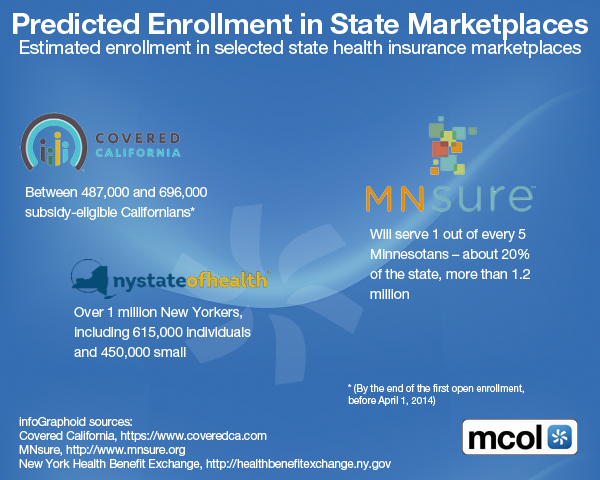
Marketplace HIE Enrollment Update

Join Our Mailing List

In Selected States

[By www.MCOL.com]

###

enrollment

###

Conclusion

Your thoughts and comments on this ME-P are appreciated. Feel free to review our top-left column, and top-right sidebar materials, links, URLs and related websites, too. Then, subscribe to the ME-P. It is fast, free and secure.

Link: http://feeds.feedburner.com/HealthcareFinancialsthePostForcxos

Speaker: If you need a moderator or speaker for an upcoming event, Dr. David E. Marcinko; MBA – Publisher-in-Chief of the Medical Executive-Post – is available for seminar or speaking engagements. Contact: MarcinkoAdvisors@msn.com

OUR OTHER PRINT BOOKS AND RELATED INFORMATION SOURCES:

DICTIONARIES: http://www.springerpub.com/Search/marcinko
PHYSICIANS: www.MedicalBusinessAdvisors.com
PRACTICES: www.BusinessofMedicalPractice.com
HOSPITALS: http://www.crcpress.com/product/isbn/9781466558731
CLINICS: http://www.crcpress.com/product/isbn/9781439879900
BLOG: www.MedicalExecutivePost.com
FINANCE: Financial Planning for Physicians and Advisors
INSURANCE: Risk Management and Insurance Strategies for Physicians and Advisors

Product DetailsProduct DetailsProduct Details

Product DetailsProduct Details

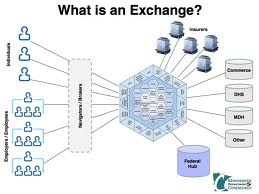
Understanding Basics of the Health Insurance Exchanges [HIEs]

Join Our Mailing List 

The Four Basic Categories of the PP-ACA

By Rick Kahler CFP® http://www.KahlerFinancial.com

Rick Kahler CFPThe opening date was yesterday, October 1, 2013. And today, the competition is lined-up and ready to go after bronze, silver, gold, and even platinum.

These competitors aren’t athletes, but insurance providers. The field they are entering is the new health insurance exchanges [HIEs] as mandated by Obamacare [ACA].

The New Year

Beginning January 1st 2014, nearly everyone in the US will need to have health insurance or pay a tax penalty. Those not insured through their employers can apply for coverage through these health insurance exchanges, also called “marketplaces.” Enrollment began October 1st, 2013 for coverage starting in January, 2014.

These exchanges are intended to make it easier to find insurance providers and compare their coverage and costs. Each state’s exchange website will list all the policies available in that state, with prices and policy provisions.

So far, over half of the states (including my State of South Dakota) have opted to use exchanges managed by the federal government instead of setting up their own.

The Four Basic [Colors] Categories

Bronze, silver, gold, and platinum describe the four basic categories of policies that will be available through the exchanges at different costs. Here is a very brief summary of each category.

Bronze

The least expensive option is a bronze plan, which might be the best choice for younger people with lower incomes and good health. The plan will pay 60% of health care costs and the insured will be responsible for 40%.

Silver

The second level, silver, will pay 70% of health care costs.

Gold and Platinum

Gold covers 80%, and a platinum plan covers 90%. Obviously, the categories with higher benefits also will have higher premiums.

The Essential Benefits

All these plans are required to cover “essential health benefits.” These include preventive and wellness care like cancer screening, chronic disease management, pediatric care, many prescription drugs, injury rehabilitation, mental health and addiction treatment, maternity and newborn care, hospitalization, and emergency services.

Companies are not allowed to deny coverage or charge more for those with pre-existing conditions. There are no lifetime benefit limits.

The Carrot and Stick Approach

The requirement to have health insurance coverage, the “stick” of Obamacare, is accompanied by a “carrot” in the form of federal subsidies to help pay insurance premiums. It’s estimated that two-thirds of Americans will be eligible for subsidies, which will be figured on a sliding scale. The upper limit for qualifying is four times the federal poverty level, which amounts to about $88,000 a year for a family of four.

Other Outlines

This ME-P summary is just the barest outline of the health care changes coming our way. To find out more, it’s a good idea to spend some time online, especially at two sites that offer a lot of helpful information.

  1. The First site is the federal government website at www.HealthCare.gov. It provides links to the state exchanges, plus detailed information that for the most part is explained in straightforward, plain English.
  2. The Second site is the Henry J. Kaiser Family Foundation at kff.org. An especially useful tool available here (http://kff.org/interactive/subsidy-calculator/) is a calculator to determine the federal subsidy that applies at your family’s income level.

Obamacare 2014

The elements of Obamacare that take effect in 2014 represent a huge shift in the way we cover health care costs. I strongly recommend that you start now to figure out what this will mean for you and your family.

###

Obama Care

###

Don’t wait until December and end up making hasty decisions in a last-minute rush. The more informed you are; the better insurance choices you can make.

Assessment

The changeover to the new insurance environment is likely to be chaotic and confusing. Navigating it will take some energy, commitment, and stamina. When all the scrambling is over, we can only hope the ultimate winners will be the American people.

Conclusion

Your thoughts and comments on this ME-P are appreciated. Feel free to review our top-left column, and top-right sidebar materials, links, URLs and related websites, too. Then, subscribe to the ME-P. It is fast, free and secure.

Link: http://feeds.feedburner.com/HealthcareFinancialsthePostForcxos

Speaker: If you need a moderator or speaker for an upcoming event, Dr. David E. Marcinko; MBA – Publisher-in-Chief of the Medical Executive-Post – is available for seminar or speaking engagements. Contact: MarcinkoAdvisors@msn.com

OUR OTHER PRINT BOOKS AND RELATED INFORMATION SOURCES:

DICTIONARIES: http://www.springerpub.com/Search/marcinko
PHYSICIANS: www.MedicalBusinessAdvisors.com
PRACTICES: www.BusinessofMedicalPractice.com
HOSPITALS: http://www.crcpress.com/product/isbn/9781466558731
CLINICS: http://www.crcpress.com/product/isbn/9781439879900
BLOG: www.MedicalExecutivePost.com
FINANCE: Financial Planning for Physicians and Advisors
INSURANCE: Risk Management and Insurance Strategies for Physicians and Advisors

Product DetailsProduct Details

Product Details

On the Notice of Privacy Practices

Join Our Mailing List 

Encryption and HHS are Taking Hits

[By D. Kellus Pruitt DDS]

1-darrellpruittIt is bad politics for the President’s Department of Health and Human Services to get caught deceiving voters.

Word gets around much faster than it did before transparency sucked the power from the entrenched.

The NoPP

You know those Notice of Privacy Practices (NoPP) forms we are asked to sign in doctors’ offices? Since it makes no difference to anyone whether patients sign them or not, why needlessly waste everyone’s time? The NoPP is not an agreement, and just because virtually everyone is tricked into signing it, does not mean anyone reads it. HIPAA has become a source of danger to patients, with no redeeming value.

HHS Estimates 

According to the US Department of Health and Human Services own recent estimate:

“… many centuries of time—nearly 35 centuries, in fact, or just short of 30.7 million hours—will be devoted each year by healthcare providers and patients for the dissemination to patients and their acknowledgement of HIPAA notices of privacy practices [NoPP] for protected healthcare information, HHS estimates. Even at just 3 minutes apiece, with 613 million of these routine privacy notices to be delivered, signed and stored, the time adds up…”

-Joseph Conn

… “HHS estimates 32.8 million hours of interaction required to comply with privacy, security rules” …

-ModernHealtcare.com [September 5, 2013]

http://www.modernhealthcare.com/article/20130904/BLOG/309049995?AllowView=VW8xUmo5Q21TcWJOb1gzb0tNN3RLZ0h0MWg5SVgra3NZRzROR3l0WWRMWGJYZjBGRWxyd01qUzMyWmVpNTNnWUpiV2s=&utm_source=link-20130904-BLOG-309049995&utm_medium=email&utm_campaign=hits

Censorship Concerns? 

I tried to bring attention to this absurdity over a year ago – back when HHS was still keeping unfavorable news about EHRs hidden from voters using censorship:

… “Put another way, the ONLY reason for a doctor to ask patients if they feel like signing the NoPP is to protect already busy doctors from a HIPAA fine. How is that not senseless, yet admittedly humorous bureaucratic waste?” …

On July 3, 2012, my opinion of the waste that HHS recently confirmed was censored by an HHS employee from the taxpayer-supported Linkedin site, Health IT and Electronic Health Records. If that is not against federal law, it damn sure should be.

http://www.linkedin.com/groups/IT-in-Healthcare-Why-Building-3993178.S.216432610?qid=bafac2e5-fb9c-4a39-8348-5a3074abff67&trk=groups_items_see_more-0-b-ttl

Among the items that HHS requires providers include in Notices of Privacy Practice is a one-sentence statement addressing data breaches:

…“We will let you know promptly if a breach occurs that may have compromised the privacy or security of your information [unless it is encrypted]”…

http://www.hhs.gov/ocr/privacy/hipaa/npp_booklet_hc_provider.pdf

Now that it is widely known that encryption is no longer acceptably secure, protection from accountability is encryption vendors’ only remaining selling point. HIPAA stipulates that if breached patient information is encrypted according to standards set forth by the National Institute of Standards and Technology (NIST), doctors are freed from the tremendous cost of notifying (former) patients – even though patients’ privacy and security have been nevertheless compromised.

For example, two weeks ago, the NIST abandoned the very encryption standards that HIPAA demands. Oops! (See: “Government Standards Agency ‘Strongly’ Suggests Dropping its Own Encryption Standard,” by Jeff Larson and Justin Elliott, ProPublica, September 13, 2013).

http://www.propublica.org/article/standards-agency-strongly-suggests-dropping-its-own-encryption-standard

###

eMR Privacy

###

NSA Secrets 

US spy agency NSA’s secret success at decrypting previously impenetrable codes – which was revealed by former NSA contractor Edward Snowden – proves that today’s best encryption is tomorrow’s crossword puzzle. What’s more, once an individual’s medical identity is lost in the cloud, it can never be reeled back in.

And, when DNA records are included, a breach today could put the welfare of generations of Americans at risk.

A Gut-Check 

The ultimate gut-check: If your encrypted identity were fumbled, wouldn’t you want to be notified? Of course you would.

Assessment 

In my opinion, the HIPAA Rule should be immediately amended to demand notification of all individuals involved in all data breaches unless they allow opt out. Who knows? Some might prefer not to be bothered.

What is your opinion; doctor, patient and/or consultant?

Conclusion

Your thoughts and comments on this ME-P are appreciated. Feel free to review our top-left column, and top-right sidebar materials, links, URLs and related websites, too. Then, subscribe to the ME-P. It is fast, free and secure.

Speaker: If you need a moderator or speaker for an upcoming event, Dr. David E. Marcinko; MBA – Publisher-in-Chief of the Medical Executive-Post – is available for seminar or speaking engagements. Contact: MarcinkoAdvisors@msn.com

OUR OTHER PRINT BOOKS AND RELATED INFORMATION SOURCES:

Product DetailsProduct Details

Did the NSA End Obamacare?

Join Our Mailing List

Did ambitious NSA officials unintentionally end Obamacare years ago?

[By D. Kellus Pruitt DDS]

1-darrellpruittIf loss of trust in encryption ends Obamacare, can whistleblower Edward Snowden be blamed for that as well? Yep.

What’s even more ominous, the former National Security Agency contractor’s news that encrypted medical records are no longer secure reached Alaska on a weekend.

“Risky electronic health records: Alaska should make information exchange system safer – Imagine: The National Security Agency slips into your doctor’s office and peeks at your medical records,”

by Alaska ACLU executive director Joshua Decker was posted hours ago on Newsminer.com, out of Fairbanks.

http://www.newsminer.com/opinion/community_perspectives/risky-electronic-health-records-alaska-should-make-information-exchange-system/article_a9947eb0-1863-11e3-8153-001a4bcf6878.html

Decker questions the security of the state’s Health Information Exchange (HIE), and offers common sense but costly steps which arguably lessen the danger of privacy breaches – including giving patients the choice of “opting-in” to permit their encrypted, but increasingly vulnerable identities to be shared online via Obamacare’s exchanges.

My POV 

In my opinion, if informed Americans are given the choice of volunteering to risk identity theft, HIEs won’t be around a year from now, and neither will Obamacare. If informed Americans are not given a choice, the costs are even greater. Americans deserve honesty.

National Obamacare Hangs in the Balance

In a related, slow-burning game-changer, Obamacare hangs in the balance, not just for Alaska, but for the nation.

It was September 5th when the Guardian Weekly posted: “Revealed: how US and UK spy agencies defeat internet privacy and security,” written by James Ball, Julian Borger and Glenn Greenwald, and based on top secret NSA information Snowden stole.

http://www.theguardian.com/world/2013/sep/05/nsa-gchq-encryption-codes-security

Snowden told the Guardian that years ago, the NSA joined with the UK’s spy agency GCHQ (Government Communications Headquarters) to successfully make encryption obsolete – including for medical records.

Naturally, if properly informed Americans fear that secrets they tell their doctors might be breached, incorrect EHRs become less than worthless. They become dangerous.

More on Health Information Exchanges

What’s more, even before the added expense of waiting for Americans to opt-in to the exchanges – instead of discouraging them from opting-out – the very funding for the increasingly-battered Obamacare is based on a rumor of savings.

Starting years ago, health IT lobbyists, including former Speaker of the House Newt Gingrich, told lawmakers to expect annual savings of $77 billion and 100,000 lives – quoting the results of a once popular, EHR-friendly 2005 RAND study which was funded by General Electric and Cerner Corporation.

Obamacare

As you can see, while we were not paying attention, we were had!

The RAND Study

Predictably, both GE and Cerner profited immensely from the development and sales of EHR systems before the RAND study was widely discredited months ago – even by RAND.

According to a NY Times article from January, “Cerner’s revenue has nearly tripled since the report was released, to a projected $3 billion in 2013, from $1 billion in 2005.”

(See: “In Second Look, Few Savings From Digital Health Records by Reed Abelson and Julie Creswell, January 10, 2013).

http://www.nytimes.com/2013/01/11/business/electronic-records-systems-have-not-reduced-health-costs-report-says.html?_r=0

Assessment

Last weekend’s bad news for Obamacare is still under the radar, but I predict within days it will become apparent that the mounting obstacle between President Obama and healthcare reform will be in regaining trust his administration squandered while helping GE and Cerner profits at the expense of soon-to-be pissed off American patients.

Conclusion

Your thoughts and comments on this ME-P are appreciated. Feel free to review our top-left column, and top-right sidebar materials, links, URLs and related websites, too. Then, subscribe to the ME-P. It is fast, free and secure.

Link: http://feeds.feedburner.com/HealthcareFinancialsthePostForcxos

Speaker: If you need a moderator or speaker for an upcoming event, Dr. David E. Marcinko; MBA – Publisher-in-Chief of the Medical Executive-Post – is available for seminar or speaking engagements. Contact: MarcinkoAdvisors@msn.com

OUR OTHER PRINT BOOKS AND RELATED INFORMATION SOURCES:

DICTIONARIES: http://www.springerpub.com/Search/marcinko
PHYSICIANS: www.MedicalBusinessAdvisors.com
PRACTICES: www.BusinessofMedicalPractice.com
HOSPITALS: http://www.crcpress.com/product/isbn/9781466558731
CLINICS: http://www.crcpress.com/product/isbn/9781439879900
BLOG: www.MedicalExecutivePost.com
FINANCE: Financial Planning for Physicians and Advisors
INSURANCE: Risk Management and Insurance Strategies for Physicians and Advisors

Product DetailsProduct Details

Informatics at the Intersection of Healthcare IT

An Informative Inforgraphic

Join Our Mailing List
Did you know that 50,000 HIT professionals will be needed in the next 7 years?
###
Well, that’s according to the University of Illinois at Chicago’s Online Health Informatics Program, which published an infographic asserting that the industry needs new ways to provide improved care, sans errors. And, healthcare informatics is where that potential resides.
###
But, what do healthcare informaticists actually do? What are the sub-disciplines of the practice? And, how do they enhance medical care delivery? … Scroll down to find out.

###

it

###

Related Resources

Conclusion

Your thoughts and comments on this ME-P are appreciated. Feel free to review our top-left column, and top-right sidebar materials, links, URLs and related websites, too. Then, subscribe to the ME-P. It is fast, free and secure.

Link: http://feeds.feedburner.com/HealthcareFinancialsthePostForcxos

Speaker: If you need a moderator or speaker for an upcoming event, Dr. David E. Marcinko; MBA – Publisher-in-Chief of the Medical Executive-Post – is available for seminar or speaking engagements. Contact: MarcinkoAdvisors@msn.com

OUR OTHER PRINT BOOKS AND RELATED INFORMATION SOURCES:

Health Dictionary Series: http://www.springerpub.com/Search/marcinko

Practice Management: http://www.springerpub.com/product/9780826105752

Physician Financial Planning: http://www.jbpub.com/catalog/0763745790

Medical Risk Management: http://www.jbpub.com/catalog/9780763733421

Hospitals: http://www.crcpress.com/product/isbn/9781439879900

Physician Advisors: www.CertifiedMedicalPlanner.org

Product DetailsProduct DetailsProduct Details

Product DetailsProduct Details

The Danger of Used Health Information Technology

Join Our Mailing List

Remember to destroy that hard drive!

By D. Kellus Pruitt DDS

1-darrellpruittNEWS FLASH!

Affinity Health Plan to Pay $1.2 Million+ for HIPAA Violations -The HHS Office for Civil Rights on August 14 sent the industry a message on the importance of erasing protected health information on hardware being sold, recycled or returned,” by Joseph Goedert, HealthDataManagement.

http://www.healthdatamanagement.com/news/breach-notification-hipaa-privacy-security-affinity-46483-1.html

Talk about bad luck

A photocopier once leased by Affinity Health was purchased by CBS Evening News – which discovered that the copier’s hard drive contains 344,579 individuals’ unencrypted Protected Health Information.

The Response

In response to the federal investigation triggered by the CBS discovery, the Office of Civil Rights announced: “OCR’s investigation indicated that Affinity impermissibly disclosed the protected health information of these affected individuals when it returned multiple photocopiers to leasing agents without erasing the data contained on the copier hard drives.

Moreover ….

In addition, the investigation revealed that Affinity failed to incorporate the electronic protected information stored on photocopier hard drives in its analysis of risks and vulnerabilities as required by the Security Rule, and failed to implement policies and procedures when returning the photocopiers to its leasing agents.”

Assessment

Before disposing of used technology, remember to destroy the hard drive.

Conclusion

Your thoughts and comments on this ME-P are appreciated. Feel free to review our top-left column, and top-right sidebar materials, links, URLs and related websites, too. Then, subscribe to the ME-P. It is fast, free and secure.

Link: http://feeds.feedburner.com/HealthcareFinancialsthePostForcxos

Speaker: If you need a moderator or speaker for an upcoming event, Dr. David E. Marcinko; MBA – Publisher-in-Chief of the Medical Executive-Post – is available for seminar or speaking engagements. Contact: MarcinkoAdvisors@msn.com

OUR OTHER PRINT BOOKS AND RELATED INFORMATION SOURCES:

DICTIONARIES: http://www.springerpub.com/Search/marcinko
PHYSICIANS: www.MedicalBusinessAdvisors.com
PRACTICES: www.BusinessofMedicalPractice.com
HOSPITALS: http://www.crcpress.com/product/isbn/9781466558731
CLINICS: http://www.crcpress.com/product/isbn/9781439879900
BLOG: www.MedicalExecutivePost.com
FINANCE: Financial Planning for Physicians and Advisors
INSURANCE: Risk Management and Insurance Strategies for Physicians and Advisors

Product DetailsProduct Details

A Survey on Applications in Mobile Healthcare

Join Our Mailing List
University of Delaware Research

By Thomas Martin
Doctoral Candidate
School of Public Policy and Administration
University of Delaware
412 992 1285
trm@udel.edu

Dear Dr. Marcinko,

The University of Delaware is conducting a study to assess provider attitudes towards applications “Apps” in healthcare settings. Mobile devices hold great promise for reshaping the “time and place” where an individual receives care.

Key Topics

The research tool evaluates a number of key topics emerging in the healthcare space:

  • Opinions on the integration of apps into the Meaningful Use program
  • Characteristics important to users when downloading an app
  • Assessing desirable pricing structures

I’d like to invite you and the ME=P readers to provide us with feedback on how you leverage Apps in the healthcare setting. The research instrument should take no more than 10 minutes to complete and all responses will remain confidential. The results may be published in a scholarly journal or industry research publication.

ME-P Respondents Should Be:

• U.S. Providers, Physicians, or Nurses
• IT Staff involved in Health IT and mobile decisions

smart phone mobile ME-P

Assessment

If you have any questions, please do not hesitate to contact (PI) at trm@Udel.edu, tmartin@himss.org or follow this link to the Survey:

Take the Survey

Or copy and paste the URL below into your internet browser:
https://delaware.qualtrics.com/WRQualtricsSurveyEngine/?Q_SS=6GwUOhdbw9Z193f_1Te8TH0W0ZEYMGF&_=1

Conclusion

Your thoughts and comments on this ME-P are appreciated. Feel free to review our top-left column, and top-right sidebar materials, links, URLs and related websites, too. Then, subscribe to the ME-P. It is fast, free and secure.
Link: http://feeds.feedburner.com/HealthcareFinancialsthePostForcxos

Speaker: If you need a moderator or speaker for an upcoming event, Dr. David E. Marcinko; MBA – Publisher-in-Chief of the Medical Executive-Post – is available for seminar or speaking engagements. Contact: MarcinkoAdvisors@msn.com

OUR OTHER PRINT BOOKS AND RELATED INFORMATION SOURCES:

Health Dictionary Series: http://www.springerpub.com/Search/marcinko
Practice Management: http://www.springerpub.com/product/9780826105752
Physician Financial Planning: http://www.jbpub.com/catalog/0763745790
Medical Risk Management: http://www.jbpub.com/catalog/9780763733421
Hospitals: http://www.crcpress.com/product/isbn/9781439879900
Physician Advisors: http://www.CertifiedMedicalPlanner.org

Product DetailsProduct DetailsProduct Details

Product Details  Product Details

Product DetailsProduct Details

About the ICD-10 Hub

Join Our Mailing List
Free Transition Information and News

[By Staff Reporters]

ICD-10 Hub is a leading source of information about ICD-10 news and events.

Sponsored by the AAPC and Navicure, this website is dedicated to being an essential resource to help practices and HIT vendors understand how this transition will impact the entire industry and how every organization can properly prepare.

loop11

Assessment

So, give em’ a click, and tell us what you think?

http://icd10hub.com/

Conclusion

Your thoughts and comments on this ME-P are appreciated. Feel free to review our top-left column, and top-right sidebar materials, links, URLs and related websites, too. Then, subscribe to the ME-P. It is fast, free and secure.
Link: http://feeds.feedburner.com/HealthcareFinancialsthePostForcxos

Speaker: If you need a moderator or speaker for an upcoming event, Dr. David E. Marcinko; MBA – Publisher-in-Chief of the Medical Executive-Post – is available for seminar or speaking engagements. Contact: MarcinkoAdvisors@msn.com

OUR OTHER PRINT BOOKS AND RELATED INFORMATION SOURCES:
Health Dictionary Series: http://www.springerpub.com/Search/marcinko
Practice Management: http://www.springerpub.com/product/9780826105752
Physician Financial Planning: http://www.jbpub.com/catalog/0763745790
Medical Risk Management: http://www.jbpub.com/catalog/9780763733421
Hospitals: http://www.crcpress.com/product/isbn/9781439879900
Physician Advisors: http://www.CertifiedMedicalPlanner.org

Product DetailsProduct Details

Do Nurses like EHRs?

Join Our Mailing List

Do RNs like using electronic health records?

[A seldom considered POV]

1-darrellpruitt

BY Darrell K. Pruitt DDS

Some Facebook comments:

Big problems when you have unexpected “downtimes”.

July 15 at 3:10pm · Like · 4

It is an absolute train wreck. I haven’t seen one record of mine that is not riddled with mistakes. Especially the allergies, they show me taking meds I’m allergic to and not taking meds I’m actually on. A true mess!! And now the records are all intertwined. I don’t like it at all!!

July 15 at 3:10pm · Like · 2

It is a nightmare!

July 15 at 3:18pm · Like

I retired just in time so I don’t have to deal with this fiasco.

July 15 at 3:19pm via mobile · Like · 2

IT SUCKS

July 15 at 3:19pm · Like

I don’t like them; my doctors don’t like them; how it will affect patient care is still a ‘jury out’ matter, but we can guess it will NOT help.

July 15 at 3:30pm · Like

Our Rural Community Healthcare system is just now switching over to this .. along with our hospital switching over to a totally new computer system .. the 2 systems do not talk to each other..In my personal experience I find that the “computer” world takes us away from Direct Patient Care (to busy playing “ring around the Rosie” on the computer).

July 15 at 3:40pm · Like · 4

I like them, but it is frustrating having “downtime.”

July 15 at 3:41pm · Like

I hear patients stating things like “my doctors don’t know who I am because they don’t look at me they are glued to the computer”. It saddens me patients feel less valued. I’ve worked in places where they’ve had paper charts and places computerized. Seems the computers are redundant and I personally prefer paper charts. Chart one assessment not one assessment 4 different places.

July 15 at 3:44pm via mobile · Like · 3

It looks to me like physicians are cutting and pasting old histories and physicals, complete with the errors. Doctors in a local ER charted complete physicals on me when they did not get closer than 5 feet away. The records are difficult to read, difficult to find information; and it is not number in chronological order.

July 15 at 3:47pm · Like

I dislike it. Besides the down time, I find it very impersonal. I don’t feel as if I am giving my full attention to my pt, nor do I feel my PCP is hearing what I’m saying . They are too busy putting in info on the computer. As for the down time you then have to work late to put in the info gathered while the system is down.

July 15 at 3:47pm via mobile · Like · 2

eHRs

Assessment

https://www.facebook.com/friendanurse/posts/654085127954821

More: On DIgital Deaths

http://www.bloomberg.com/news/2013-06-25/digital-health-records-risks-emerge-as-deaths-blamed-on-systems.html

(50+ other comments)

Conclusion

Your thoughts and comments on this ME-P are appreciated. Feel free to review our top-left column, and top-right sidebar materials, links, URLs and related websites, too. Then, subscribe to the ME-P. It is fast, free and secure.

Speaker: If you need a moderator or speaker for an upcoming event, Dr. David E. Marcinko; MBA – Publisher-in-Chief of the Medical Executive-Post – is available for seminar or speaking engagements. Contact: MarcinkoAdvisors@msn.com

OUR OTHER PRINT BOOKS AND RELATED INFORMATION SOURCES:

Product DetailsProduct DetailsProduct Details

Purchase ME-P Textbooks, Handbooks and Dictionaries to Thrive

 Our Library is Growing … thanks to you

Join Our Mailing List

By Ann Miller RN MHA

[ME-P Executive-Director]

We have been publishing the Medical Executive-Post for more than eight years now. And, with almost 3,000 formal posts, by the nation’s brightest experts, we have a treasure trove of information available to you.

So now, for the first time, all this information – and more – has been codified, updated, copy-righted and copy-protected in print form for your purchase and use. All have been edited by our Publisher – Dr. David Edward Marcinko and Professor Hope Rachel Hetico.

Just click on an image below to order.

Product DetailsProduct DetailsProduct Details

Product Details  Product Details

Product DetailsProduct Details

Assessment

Purchase our white papers, too: https://medicalexecutivepost.com/white-papers/

Conclusion

Your thoughts and comments on this ME-P are appreciated. Feel free to review our top-left column, and top-right sidebar materials, links, URLs and related websites, too. Then, subscribe to the ME-P. It is fast, free and secure.

Link: http://feeds.feedburner.com/HealthcareFinancialsthePostForcxos

Speaker: If you need a moderator or speaker for an upcoming event, Dr. David E. Marcinko; MBA – Publisher-in-Chief of the Medical Executive-Post – is available for seminar or speaking engagements. Contact: MarcinkoAdvisors@msn.com

OUR OTHER PRINT BOOKS AND RELATED INFORMATION SOURCES:

Health Dictionary Series: http://www.springerpub.com/Search/marcinko

Practice Management: http://www.springerpub.com/product/9780826105752

Physician Financial Planning: http://www.jbpub.com/catalog/0763745790

Medical Risk Management: http://www.jbpub.com/catalog/9780763733421

Hospitals: http://www.crcpress.com/product/isbn/9781439879900

Physician Advisors: www.CertifiedMedicalPlanner.org

Business%20Optimization

The Cost of [Healthcare] Data Storage Through-Out the Years

Join Our Mailing List

A Hard Drive History Infographic

By Mike Thomas historyofharddrives@gmail.com

425 N Prince St
Lancaster, PA 17603
7172079980

Data storage wasn’t as inexpensive as it is today. Technology is always advancing and doing bigger and better things that seemed impossible at one time. With that being said, the price of data storage has only decreased while the size of the storage overall has vastly increased.

The following infographic delves into the price of data storage throughout the years beginning with the first hard drive on the market, the RAMAC 305 that was available in 1956. Follow the timeline throughout history and read about the transformation of these data storing devices. Whether you’re a computer geek, a technology hoarder, or new to the computer world we live in, this infographic is one you will enjoy. Share this on your social media profiles, email it to the IT department at the office, or blog about these outrageously priced data storage devices to gain a new appreciation for the storage capacity we have today.

MD and financial literacy

History Of Data Storage Devices

They just don’t build things quite like they used to. This statement may seem clichéd, but it greatly applies to data – and not in a bad way. Through the years, technology becomes more and more advanced, exceeding expectations and pushing toward new and innovative products and capabilities.

In the case of this infographic, computer memory and data storage have increasingly changed since their beginnings in 1956. If we hadn’t learned how to make memory and data storage servers smaller, then we’d still have rooms solely dedicated to these large machines like the RAMAC 305 that was the size of two large refrigerators. Computers would still be gigantic and immobile, unlike our sleek and portable laptops. Nowadays, our laptops, cell phones, and desktop computers are smaller than years past but are equipped with larger memory capabilities that it once had.

Advances in Computer Data Storage Devices

To gain a better appreciation for the advances in technology, we’ve created an infographic that highlights the data storage throughout the years. Beginning with the RAMAC hard drive, we outline all types of storage devices from 1956 to present. Learn how much money these products cost at the time as well as what the price would be like with inflation factored in. It’s interesting to understand these data storage solutions, particularly how they became smaller in size yet bigger in storage capabilities. Millions of people from school students to business professionals rely on the memory in their computer to save documents, presentations, and other important information.

How crazy would it be if one megabyte of storage still cost $10,000 like in 1956? If that were still the case, laptop prices would be out of this world, and many companies and schools wouldn’t have computers to work on. Sprinkled throughout the infographic are interesting facts on how much a megabyte of storage has cost throughout the years. These amazing statistics demonstrate jut how much the price of storage has decreased since 1956.

RocklandIT Infographic

infographic on the cost of data storage

[click to enlarge]

Save, Store, and Share

Whether you’re an MD, FA, CPA, JD, student, computer geek or just interested in learning more about [medical] data storage devices, feel free to share this information with friends, family, and others. We hope that you enjoy reading this content and we encourage that you blog, tweet, pin, and share this graphic with the world.

Assessment

And, your HIT department, hospital, clinic or office coworker might appreciate viewing this infographic and possibly recollect using one of these storage devices of the past.

Conclusion

Your thoughts and comments on this ME-P are appreciated. Feel free to review our top-left column, and top-right sidebar materials, links, URLs and related websites, too. Then, subscribe to the ME-P. It is fast, free and secure.
Link: http://feeds.feedburner.com/HealthcareFinancialsthePostForcxos

Speaker: If you need a moderator or speaker for an upcoming event, Dr. David E. Marcinko; MBA – Publisher-in-Chief of the Medical Executive-Post – is available for seminar or speaking engagements. Contact: MarcinkoAdvisors@msn.com

OUR OTHER PRINT BOOKS AND RELATED INFORMATION SOURCES:

Health Dictionary Series: http://www.springerpub.com/Search/marcinko
Practice Management: http://www.springerpub.com/product/9780826105752
Physician Financial Planning: http://www.jbpub.com/catalog/0763745790
Medical Risk Management: http://www.jbpub.com/catalog/9780763733421
Hospitals: http://www.crcpress.com/product/isbn/9781439879900
Financial Advisors: http://www.CertifiedMedicalPlanner.org

Product DetailsProduct Details

Impact of Health Information Technology

Join Our Mailing List

An HIT Infographic

[By HIMSS Clinical Informatics Community]

Practicing clinicians have indicated strong support for the ability of health IT to overcome communication challenges among care providers. Considering that a series of Institute of Medicine reports on errors in healthcare have led to widespread recognition that siloed practices and inadequate communication are primary contributors to medical errors, continued endorsement for health IT will lead to better communication and enhanced quality of care.

The results come from the 2013 iHIT study conducted by HIMSS and HIMSS Analytics, released during HIMSS13, the organization’s annual conference and exhibition. The study was designed to explore the role of health IT from an inter-professional communication perspective. More than 500 clinician respondents working in a care delivery setting provided information on the value of health IT in support of quality care.

Read the Full Study & Final Report

HIMSS 2013 iHIT Study – Final Report
HIMSS 2013 iHIT Study – Executive Summary

 HIT

Assessment

According to the study, the health IT tools in place at the provider organizations of respondents support various clinical processes and provide improved access to the information needed to prepare for delivery of care. This includes having improved access to information needed on patients transferring to a clinician’s unit/caseload, ultimately resulting in enhanced levels of patient care.

Conclusion

Your thoughts and comments on this ME-P are appreciated. Feel free to review our top-left column, and top-right sidebar materials, links, URLs and related websites, too. Then, subscribe to the ME-P. It is fast, free and secure.

Link: http://feeds.feedburner.com/HealthcareFinancialsthePostForcxos

Speaker: If you need a moderator or speaker for an upcoming event, Dr. David E. Marcinko; MBA – Publisher-in-Chief of the Medical Executive-Post – is available for seminar or speaking engagements. Contact: MarcinkoAdvisors@msn.com

OUR OTHER PRINT BOOKS AND RELATED INFORMATION SOURCES:

Product DetailsProduct Details

Market for Mobile Health App Services Will Reach $26 Billion By 2017

Join Our Mailing List

mHealth services start to leverage apps to become commercially successful

[By Markus Pohl]

The market for mHealth services has now entered the commercialization phase and will reach $ 26 billion globally by 2017 says the new “Global Mobile Health Market Report 2013-2017 ”by research2guidance. Smartphone applications have begun to enable the mHealth industry to successfully monetize their services.

The Impending Revolution

Ralf-Gordon Jahns, Head of Research at research2guidance, points out “Our findings indicate that the long-expected mobile revolution in healthcare is set to happen. Both healthcare providers and consumers are embracing smartphones as a means to improving healthcare.”

The Publishers

Top mHealth publishers manage to generate more than 3 million free and 300.000 paid downloads in the USA on the iOS platform. The reach on other platforms and in other countries differ at lot but show also the increase of business potential for mHealth apps.

Not only are consumers taking advantage of smartphones to manage and improve their own health, but also healthcare professionals. A significant number (15%) of mHealth applications are primarily designed for healthcare professionals. These include CME (Continued Medical Education), remote monitoring and healthcare management applications.

The Climate

Currently there are 97,000 mHealth applications in major app stores, 42% of them adhering to the paid business model. With more and more traditional healthcare providers joining the mobile applications market, the business models will broaden to include healthcare services, sensor, advertising and drug sales revenues.

“With the growing sophistication level of mHealth applications, only 9% of the total market revenue in the next 5 years will come from application download revenue”explains Patrick Houck Analyst at research2guidance. “84% of total mHealth application market revenue will come from related services and products such as sensors”.

###

eHRs

Assessment

The “Global Mobile Health Market Report 2013-2017 ”by research2guidance is a business guide for traditional healthcare companies, mHealth specialists as well as for mobile operators wishing to successfully engage into the new mHealth market.

About research2guidance:

research2guidance is a Berlin-based mobile app economy specialist. The company’s service offerings include app strategy consulting, market studies and research.

Link to blog post: http://www.research2guidance.com/the-market-for-mhealth-app-services-will-reach-26-billion-by-2017/

Link to graph: http://www.research2guidance.com/wp-content/uploads/2013/03/the-mhealth-market-has-reached-the-commercialization-phase.png

Link to report: http://www.research2guidance.com/shop/index.php/mhealth-report-2

Contact:

Ralf-Gordon Jahns [+49 30 609 893 362] ralf.jahns@research2guidance.com

Conclusion

Your thoughts and comments on this ME-P are appreciated. Feel free to review our top-left column, and top-right sidebar materials, links, URLs and related websites, too. Then, subscribe to the ME-P. It is fast, free and secure.

Speaker: If you need a moderator or speaker for an upcoming event, Dr. David E. Marcinko; MBA – Publisher-in-Chief of the Medical Executive-Post – is available for seminar or speaking engagements. Contact: MarcinkoAdvisors@msn.com

OUR OTHER PRINT BOOKS AND RELATED INFORMATION SOURCES:

Product DetailsProduct Details

Healthcare Adversaries [video]

Join Our Mailing List

Of HHS and AHIP

By Darrell K. Pruitt DDS

pruitt6If HHS and AHIP continue to give doctors the bum’s rush, what languages can we expect migrant providers to speak well?

The Conference

Last week, I came across a video of a health care conference held a month ago at the University of Miami. During a discussion period, a Miami spinal surgeon named Dr. Nordham warned that more Medicare pay cuts will make small, solo practices like his unsustainable.

Karen Speaks

Panelist Karen Ignagni, who is president and the CEO of America’s Health Insurance Plans (AHIP), reacted defensively in favor of continued unsustainable discounts – but with a hasty, disingenuous response: “We’re seeing out of network charges of 95 times Medicare fees.” While as if on cue, former HHS Secretary Donna Shalala, who is also president of the university, offered her cold interpretation of the small business owner’s legitimate fears: “He’s really complaining that the price is going down [according to law].”

Shalala Speaks

After also ignoring the physician’s plea, “There needs to be more transparency,” Shalala and Ignagni continue an irrelevant, buzzword-filled discussion with each other using flowing hand gestures while shutting out the doctor’s attempts to bring the conversation back on topic. Then abruptly, without giving Dr. Nordham the opportunity to say another word, Shalala slammed the door: “…. I think we’ll take the next question, thank you.” Then she threw him a bone, “It’s a very important question, though.”

###

MD with eHR

Assessment

The 4 minutes of unvarnished disrespect of Dr. Nordham is so transparent that one wonders whether Shalala and Ignagni were even aware that their half-baked PR game was being recorded for C-span.

http://www.c-spanvideo.org/event/214023 (from 2:09:53 to 2:13:42)

They probably thought nobody stays up that late.

More: Chapter 13: IT, eMRs & GroupWare

Conclusion

Your thoughts and comments on this ME-P are appreciated. Feel free to review our top-left column, and top-right sidebar materials, links, URLs and related websites, too. Then, subscribe to the ME-P. It is fast, free and secure.

Link: http://feeds.feedburner.com/HealthcareFinancialsthePostForcxos

Speaker: If you need a moderator or speaker for an upcoming event, Dr. David E. Marcinko; MBA – Publisher-in-Chief of the Medical Executive-Post – is available for seminar or speaking engagements. Contact: MarcinkoAdvisors@msn.com

Our Other Print Books and Related Information Sources:

Health Dictionary Series: http://www.springerpub.com/Search/marcinko

Practice Management: http://www.springerpub.com/product/9780826105752

Physician Financial Planning: http://www.jbpub.com/catalog/0763745790

Medical Risk Management: http://www.jbpub.com/catalog/9780763733421

Hospitals: http://www.crcpress.com/product/isbn/9781439879900

Physician Advisors: www.CertifiedMedicalPlanner.org

Product Details

The Flaws of Electronic Records

Join Our Mailing List

Reporting on an Op-Ed by Drexel University’s Scot Silverstein

By Darrell K. Pruitt DDS

pruittRecently, on Philly.com, I read the following interesting essay and counter-opinion.

“The flaws of electronic records – Drexel University’s Scot Silverstein is a leading critic of the rapid switch to computerized medical charts, saying the notion that they prevent more mistakes than they cause is not proven.”

by Jay Hancock, writing in:

KAISER HEALTH NEWS.

http://www.philly.com/philly/entertainment/20130218_The_flaws_of_electronic_records.html

Do you recall that I advised dentists to wait a year or so before purchasing electronic dental records?

Dr. Silverstein warns Hancock that we’re in the midst of “a mania” as traditional patient charts are switched to computers. “We know it causes harm, and we don’t even know the level of magnitude. That statement alone should be the basis for the greatest of caution and slowing down.”

Silverstein Speaks

Silverstein tells Hancock that he doesn’t discount the potential of digital records to eliminate duplicate scans and alert doctors to drug interactions and unsuspected dangers.

“But, the rush to implementation has produced badly designed products that may be more likely to confound doctors than enlighten them, he says. Electronic health records, Silverstein believes, should be rigorously tested under government supervision before being used in life-and-death situations, much like medical hardware or airplanes.”

Physician George Lundberg, editor at large for MedPage Today, says Silverstein “is an essential critic of the field,” and that “It’s too easy for those of us in medicine to get excessively enthusiastic about things that look like they’re going to work out really well. Sometimes we go too far and don’t see the downside of things.”

Hancock Writes

Hancock writes. “Many say he comes on too strong.” Remind you of anyone? It’s easy to fall into a habit of “coming on too strong” once politeness proves ineffective and not nearly as much fun.

Silverstein points out that since the government doesn’t require caregivers to report problems, “many computer-induced mistakes may never surface.”

In dentistry, EHR stakeholders bury computer-induced mistakes even deeper by ignoring and even censoring dentists’ concerns about cost and safety.

Shah Opines

Furthermore, ME-P thought-leader Shahid N. Shah MS opines in Chapter 4 of the book: www.BusinessofMedicalPractice.com

Chapter 13: IT, eMRs & GroupWare

And … Pruitt Wonders?

I sincerely wonder how many dentists have been kicked off of DrBicuspid, DentalTown, Dental Economics and LinkedIn for pointing out dangerous flaws in advertisers’ dental products. I offered to start a listing of the censored, but got no response. Nevertheless, I bet I’m not the only one.

Assessment

More opinions from ME-P contributors and essayists:

Conclusion

Your thoughts and comments on this ME-P are appreciated. Feel free to review our top-left column, and top-right sidebar materials, links, URLs and related websites, too. Then, subscribe to the ME-P. It is fast, free and secure.

Link: http://feeds.feedburner.com/HealthcareFinancialsthePostForcxos

Speaker: If you need a moderator or speaker for an upcoming event, Dr. David E. Marcinko; MBA – Publisher-in-Chief of the Medical Executive-Post – is available for seminar or speaking engagements. Contact: MarcinkoAdvisors@msn.com

OUR OTHER PRINT BOOKS AND RELATED INFORMATION SOURCES:

DICTIONARIES: http://www.springerpub.com/Search/marcinko
PHYSICIANS: www.MedicalBusinessAdvisors.com
PRACTICES: www.BusinessofMedicalPractice.com
HOSPITALS: http://www.crcpress.com/product/isbn/9781466558731
CLINICS: http://www.crcpress.com/product/isbn/9781439879900
BLOG: www.MedicalExecutivePost.com
FINANCE: Financial Planning for Physicians and Advisors
INSURANCE: Risk Management and Insurance Strategies for Physicians and Advisors

Product DetailsProduct Details

Appreciating Early Results of the Health 2.0 Initiative

Join Our Mailing List

In Population Health and Patient Self Management

Jennifer TomasikBy Jennifer Tomasik MS

By Carey Huntington

By Fabian Poliak

www.CFAR.com

Despite the growth in Health 2.0 interaction over the past few years, we still see Health 2.0 in its infancy relative to the potential it holds for activating patients in managing and being more accountable for their own health. There is further hard evidence that its strategies are already improving patients’ quality of life, expanding providers’ expertise, and helping health systems and payors financially.

On Patient Self Management

And, if Health 2.0 can, as discussed elsewhere on this ME-P, enable people to reduce smoking, become physically fit, and more actively participate with their providers in the management of chronic disease, we posit that these things combine to result in a better sense of health and wellbeing for those involved.

One would logically conclude that these kinds of interventions result in fewer interactions with the healthcare system, an issue that Harrison et al tackled in a study earlier this year that was published in Population Health Management. It looked at the relationship between self-reported individual wellbeing and future healthcare utilization and cost. They found that higher self-reported wellbeing was associated with fewer hospitalizations, visits to the emergency room, and use of medications.

Overall, the authors concluded that improving wellbeing (or what we would refer to as a perceived sense of health) holds tremendous promise in reducing future use of healthcare services and the costs associated with that care[i]. We see Health 2.0 as an effective way to enable people to improve their wellbeing and suggest that its impact will continue to mount over time in terms of better outcomes and reduced cost.

Health 2.0 Offerings

Health 2.0 offerings are looking at a variety of ways to measure their impact beyond cost and quality. The Collaborative Chronic Care Network, for example, is reporting on number of participants, response rates via text, and pilot projects undertaken, but not yet on clinical or financial impact of its patient partnerships. Even well-known companies, like Patients LikeMe, are not currently reporting their specific impact on influencing organizations and institutions in healthcare to drive toward standards of care and other cost-reduction solutions—rather, they are reporting their impact on individual lives, through testimonials on the power of connection. Their vision of results rings true for many components and actors in Health 2.0:

We envision a world where information exchange between patients, doctors, pharmaceutical companies, researchers, and the healthcare industry can be free and open; where, in doing so, people do not have to fear discrimination, stigmatization, or regulation; and where the free flow of information helps everyone. We envision a future where every patient benefits from the collective experience of all, and where the risk and reward of each possible choice is transparent and known.[ii]

This description does not mention economics, but it also does not mention illness. And we know that clients of companies like ShapeUp are working in the background compiling their own estimates of the savings that these programs and other interventions are likely to have on their healthcare costs. This is the kind of data that will “triangulate” out to other organizations and help build momentum for Health 2.0.

###

Achievement

From Sickness to Health

As we shift from a system that addresses sickness to one that promotes health, we may experience that the more interesting promise of Health 2.0 is less about economics and more about accelerating a sweeping cultural shift that focuses our collective and individual energy on wellness. We know that tools alone—the supports that can help catalyze behavior change—will not be totally responsible for the change in outlook.

But, the tools and other supports in Health 2.0 will serve as some of the key catalysts, ushering in a new era that foregrounds prevention, wellness, and better management of chronic disease, and works to reduce the economic burden on health systems, governments, and individuals themselves. 

Assessment 

Conclusion

Your thoughts and comments on this ME-P are appreciated. Feel free to review our top-left column, and top-right sidebar materials, links, URLs and related websites, too. Then, subscribe to the ME-P. It is fast, free and secure.

Link: http://feeds.feedburner.com/HealthcareFinancialsthePostForcxos

About the Authors

Jennifer Tomasik is a Principal at CFAR, a boutique management consulting firm specializing in strategy, change and collaboration. Jennifer has worked in the health care sector for nearly 20 years, with expertise in strategic planning, large-scale organizational and cultural change, public health, and clinical quality measurement. She leads CFAR’s Health Care practice. Jennifer has a Master’s in Health Policy and Management from the Harvard School of Public Health. Her clients include some of the most prestigious hospitals, health systems and academic medical centers in the country.

Carey Huntington and Fabian Poliak both work in CFAR’s Health Care practice.

Speaker: If you need a moderator or speaker for an upcoming event, Dr. David E. Marcinko; MBA – Publisher-in-Chief of the Medical Executive-Post – is available for seminar or speaking engagements. Contact: MarcinkoAdvisors@msn.com

OUR OTHER PRINT BOOKS AND RELATED INFORMATION SOURCES:


[i] Harrison PL, Pope JE, Coberley CF, Rula EY. “Evaluation of the Relationship Between Individual Well-Being and Future Health Care Utilization and Cost.” Population Health Management 2012;15(00).

[ii] “Corporate FAQ – What is the future of healthcare in a PatientsLikeMe world?” PatientsLikeMe. Online. Accessed 12 Oct 2012. <http://www.patientslikeme.com/help/faq/Corporate&gt;

Product Details

Dr. Benjamin Solomon Carson, Sr for President?

Join Our Mailing List

Forget …. Being like Mike – Instead … Be like Ben 

By Dr. David Edward Marcinko MBA CMP™

Hopkins Medical SchoolA unique speech was delivered by neuro-surgeon Benjamin Carson MD on February 7, 2013 at the National Prayer Breakfast in President Barack Obama’s presence.

Who is Ben Carson MD?

Benjamin Solomon “Ben” Carson, Sr. (born September 18, 1951) is an American neurosurgeon and the Director of Pediatric Neurosurgery at Johns Hopkins Hospital. He was awarded the Presidential Medal of Freedom, the highest civilian award in the United States, by President George W. Bush, in 2008.

The Breakfast

During the breakfast, Carson suggested that political correctness is a “dangerous” threat to free speech and encouraged Americans to share their views without hesitation. Carson also included his ideas on the national debt, deficits, taxation and health care; he explains his personal position on each matter.

Here is a teaser quote:

I don’t like to bring up problems without coming up with solutions… What about our taxation system? It is so complex, there is no one who can possibly comply with every jot and tittle. That doesn’t make any sense.

What we need to do is come up with something that’s simple. The inherently fair principle is proportionality: you make 10 billion dollars, you put in a billion. You make 10 dollars, you put in one. Of course, you have to get rid of the loopholes.

Some people say, ‘That’s not fair! It’s doesn’t hurt the guy who made 10 billion dollars.’ Where does it say you have to hurt that guy? He just put a billion dollars into the pot!

My Connectinon to Ben Carson

Ok, I really don’t have any connection to Dr. Carson despite the seven degrees of separation philosophy. But, I did grow up in Baltimore Maryland and played stickball in the parking lot of the famed Johns Hopkins University  Hospital. I was even seen in the ER for a minor injury as a kid.

But, I was not accepted into medical school there, and could not attend Johns Hopkins University up on North Charles Street for my undergraduate career, because of the expense.

The Video

Nevertheless, this video is worth watching. It is 26 minutes in length and it is interesting to watch the president grimace as he gives a complete opposite solution to every problem the country faces.

Link: http://www.youtube.com/watch?v=vyyHegP255g

Ben’s Proposals

I especially liked Ben’s thoughts on the following topics:

  • Replacing the IRS with tithing for all income levels. No need to hurt the successful among us with a graduated tax system.
  • Giving all Americans a Health Savings Account [HSA] at birth. This will not only give them some financial skin-in-the game, but makes them educated stewards of their healthcare needs, treatments and expenses. And, the savings portion would be transferrable to a next generation beneficiary for estate-like continuity.
  • Giving everyone a personal electronic health record [pEHR] at birth.
  • Reforming the welfare state so it does not become a way of life
  • Morality and the PC mania.

Assessment

Ben is one smart pediatric brain surgeon. I would consider voting for him in a heart-beat. But, as a surgeon, I am like him, a doer who wants to solve a problem.

Unfortunately, Washington politicians are often talkers who place self-interest above all. Problem solving often takes a back-seat to pleasing constituents. 

Conclusion

Your thoughts and comments on this ME-P are appreciated. Feel free to review our top-left column, and top-right sidebar materials, links, URLs and related websites, too. Then, subscribe to the ME-P. It is fast, free and secure.

Link: http://feeds.feedburner.com/HealthcareFinancialsthePostForcxos

Speaker: If you need a moderator or speaker for an upcoming event, Dr. David E. Marcinko; MBA – Publisher-in-Chief of the Medical Executive-Post – is available for seminar or speaking engagements. Contact: MarcinkoAdvisors@msn.com

Our Other Print Books and Related Information Sources:

Health Dictionary Series: http://www.springerpub.com/Search/marcinko

Practice Management: http://www.springerpub.com/product/9780826105752

Physician Financial Planning: http://www.jbpub.com/catalog/0763745790

Medical Risk Management: http://www.jbpub.com/catalog/9780763733421

Hospitals: http://www.crcpress.com/product/isbn/9781439879900

Physician Advisors: www.CertifiedMedicalPlanner.org

Product DetailsProduct DetailsProduct Details

Product Details  Product Details

Product DetailsProduct Details

How I Lost my Battle Against the NPI

Join Our Mailing List

Refusing a National Provider Identifier Number

By Darrell K. Pruitt DDS

pruittI can no longer refuse to apply for a National Provider Identifier (NPI). I lost that long battle. Anyone rejoicing?

I’m spent. My leverage has vanished. Telling insurers “I have no NPI” held much more inherent power than “I have an NPI but I won’t share it with you on principle.” Far too many words. My profession has become dominated by unresponsive, unaccountable 3rd parties that dental leaders in the ADA welcome as policy. Working together, they promote and commandeer the technology dentists purchase and clueless patients pay for in increased fees. I have painfully learned that principles are only for dentists who can still afford them, and it’s a bad economy for luxuries.

Non-HIPAA Entity

Since I am not a HIPAA-covered entity and therefore not required by law to adopt an NPI, my capitulation to extortion disappoints me as an American citizen. I still find it hard to believe that an anti-consumer HIPAA rule enthusiastically enforced by the dental benefits industry could force me to “volunteer” for a PERMANENT identifier. As I and 96% of dentists become jerked around by our NPIs, I hope dental historians note that I am the ONLY dentist who publicly asked “Why?” instead of “Why not?” After 6 years, I’m still awaiting an answer to that question from leaders who continue to promote the NPI to dentists while ignoring their questions.

Dental Benefits Providers

I was able to hold out up until Aetna, Delta Dental and other dental benefits providers deprived my office of access to details of patients’ dental benefits unless I have an NPI. I’m waiting for someone – anyone – to tell me how the identifier can possibly improve the dental care of those who pay Aetna and Delta Dental premiums, especially if their benefits are intentionally kept secret from their dentists. I am certain that if the nation’s employers who purchase dental benefits were aware of the transparent nonsense, they would never purchase such products. Where’s the US Chamber of Commerce? Where’s the FTC? How about the US Constitution?

This is exactly why there needs to be more openness in our profession, Doc. The cockroaches who were invited to quietly overrun dentistry cannot withstand transparency, yet I don’t know how much longer I can fight for it without further risking the health of my practice.

As anyone can understand – and as anticipated by corporate executives in the insurance industry as well as by those with vested interests in the ADA Department of Dental Informatics – to have to explain to new patients why I cannot estimate how much they will owe for treatment would destroy my practice. Outside the US, other societies deem it unethical to deny patients informed consent to treatment for any reason. The NPI is such an egregious blunder that I never expect those who promoted to accept ownership.

###

NPI

Assessment

If I lost the battle, who won? Do EDR enthusiasts in the ADA call this a glorious victory and a likely source of ADA pride for decades to come? Or is it much more shameful? Since I lost freedom, I want to know who won?

Conclusion

Your thoughts and comments on this ME-P are appreciated. Feel free to review our top-left column, and top-right sidebar materials, links, URLs and related websites, too. Then, subscribe to the ME-P. It is fast, free and secure.

Link: http://feeds.feedburner.com/HealthcareFinancialsthePostForcxos

Speaker: If you need a moderator or speaker for an upcoming event, Dr. David E. Marcinko; MBA – Publisher-in-Chief of the Medical Executive-Post – is available for seminar or speaking engagements. Contact: MarcinkoAdvisors@msn.com

Our Other Print Books and Related Information Sources:

Health Dictionary Series: http://www.springerpub.com/Search/marcinko

Practice Management: http://www.springerpub.com/product/9780826105752

Physician Financial Planning: http://www.jbpub.com/catalog/0763745790

Medical Risk Management: http://www.jbpub.com/catalog/9780763733421

Hospitals: http://www.crcpress.com/product/isbn/9781439879900

Physician Advisors: www.CertifiedMedicalPlanner.org

Product DetailsProduct Details

Medical Records [Time Benefits versus Financial Benefits]

Join Our Mailing List

Paper versus eMRs [Organization – InterOperability – Accessibility]

www.BusinessofMedicalPractice.com

MRs

Assessment

Chapter 13: IT, eMRs & GroupWare

Conclusion

Your thoughts and comments on this ME-P are appreciated. Feel free to review our top-left column, and top-right sidebar materials, links, URLs and related websites, too. Then, subscribe to the ME-P. It is fast, free and secure.

Link: http://feeds.feedburner.com/HealthcareFinancialsthePostForcxos

Speaker: If you need a moderator or speaker for an upcoming event, Dr. David E. Marcinko; MBA – Publisher-in-Chief of the Medical Executive-Post – is available for seminar or speaking engagements. Contact: MarcinkoAdvisors@msn.com

OUR OTHER PRINT BOOKS AND RELATED INFORMATION SOURCES:

DICTIONARIES: http://www.springerpub.com/Search/marcinko
PHYSICIANS: www.MedicalBusinessAdvisors.com
PRACTICES: www.BusinessofMedicalPractice.com
HOSPITALS: http://www.crcpress.com/product/isbn/9781466558731
CLINICS: http://www.crcpress.com/product/isbn/9781439879900
BLOG: www.MedicalExecutivePost.com
FINANCE: Financial Planning for Physicians and Advisors
INSURANCE: Risk Management and Insurance Strategies for Physicians and Advisors

Product Details

A Mobile Health Enterprise [Audio] Conversation with Shahid N. Shah

Join Our Mailing List

“Just because we have apps for smartphones doesn’t mean we have real mobility in healthcare

By Ann Miller RN MHA

Product Details

www.BusinessofMedicalPractice.com

App47 CEO and co-founder Chris Schroeder hosts a great podcast series called “What’s Happening!” in which he covers topics around enterprise-grade Mobile Application Management for securely deploying, managing, and analyzing business-critical mobile apps.

The Expert

Recently, Chris interviewed Shahid N. Shah MS, a ME-P “thought-leader” and The Healthcare IT Guy, for an episode in which they spoke at length about the management of enterprise healthcare apps, what mobility means in healthcare, and why technically-savvy clinicians are the only real salvation for the healthcare IT industry.

The Conversation

The audio version of the podcast is available on theApp47 site

More from the Expert

http://businessofmedicalpractice.com/chapter-13-2/

Conclusion

Your thoughts and comments on this ME-P are appreciated. Feel free to review our top-left column, and top-right sidebar materials, links, URLs and related websites, too. Then, subscribe to the ME-P. It is fast, free and secure.

Link: http://feeds.feedburner.com/HealthcareFinancialsthePostForcxos

Speaker: If you need a moderator or speaker for an upcoming event, Dr. David E. Marcinko; MBA – Publisher-in-Chief of the Medical Executive-Post – is available for seminar or speaking engagements. Contact: MarcinkoAdvisors@msn.com

OUR OTHER PRINT BOOKS AND RELATED INFORMATION SOURCES:

LEXICONS: http://www.springerpub.com/Search/marcinko
PHYSICIANS: www.MedicalBusinessAdvisors.com
PRACTICES: www.BusinessofMedicalPractice.com
HOSPITALS: http://www.crcpress.com/product/isbn/9781466558731
CLINICS: http://www.crcpress.com/product/isbn/9781439879900
ADVISORS: www.CertifiedMedicalPlanner.org
BLOG: www.MedicalExecutivePost.com

creativity

How Physicians Use Digital Media for Interaction

Join Our Mailing List

A Break-Down by Medical Specialty

www.BusinessofMedicalPractice.com

Taking-the-Pulse-US-2012

Assessment

Chapter 13: IT, eMRs & GroupWare

Conclusion

Your thoughts and comments on this ME-P are appreciated. Feel free to review our top-left column, and top-right sidebar materials, links, URLs and related websites, too. Then, subscribe to the ME-P. It is fast, free and secure.

Link: http://feeds.feedburner.com/HealthcareFinancialsthePostForcxos

Speaker: If you need a moderator or speaker for an upcoming event, Dr. David E. Marcinko; MBA – Publisher-in-Chief of the Medical Executive-Post – is available for seminar or speaking engagements. Contact: MarcinkoAdvisors@msn.com

Our Other Print Books and Related Information Sources:

Health Dictionary Series: http://www.springerpub.com/Search/marcinko

Practice Management: http://www.springerpub.com/product/9780826105752

Physician Financial Planning: http://www.jbpub.com/catalog/0763745790

Medical Risk Management: http://www.jbpub.com/catalog/9780763733421

Hospitals: http://www.crcpress.com/product/isbn/9781439879900

Physician Advisors: www.CertifiedMedicalPlanner.org

Product Details

What’s Next for Healthcare Information Technology Innovation?

Join Our Mailing List

A Video Panel Discussion

By Shahid N. Shah MS

Dr. David Edward Marcinko MBA

http://www.healthcareguy.com/

Shahid N. Shah MSIn Nashville a few weeks ago, at the Vanderbilt Healthcare Conference, I gave a short talk on a panel focused on the question “What’s next for healthcare information technology innovation?”

The Key Questions

The talk focused on answering a couple of key questions:

  • What does innovation in healthcare mean?
  • Where are the major areas in healthcare where innovation is required?

The Take-Aways

And it had a few key takeaways:

  • Understand health tech buyer fallacies
  • Understand PBU: Payer vs. Benefiter vs. User
  • Understand why healthcare businesses buy stuff so you can build the right thing

Assessment

My speaker deck is found below (if you’re reading this through a feed reader you should click into the blog so that it is visible). You can download the PDF here. After you’ve flipped through it, let me know what you think by dropping some comments below.

Editor’s Note: Mr. Shah is a ME-P thought-leader and an internationally recognized enterprise software analyst that specializes in healthcare IT with an emphasis on e-health, EHR/EMR, Meaningful Use, data integration, medical device connectivity, health informatics, and legacy modernization. He contributed CH 13 to: www.BusinessofMedicalPractice.com and Chapter 13: IT, eMRs & GroupWare

Conclusion

Your thoughts and comments on this ME-P are appreciated. Feel free to review our top-left column, and top-right sidebar materials, links, URLs and related websites, too. Then, subscribe to the ME-P. It is fast, free and secure.

Link: http://feeds.feedburner.com/HealthcareFinancialsthePostForcxos

Speaker: If you need a moderator or speaker for an upcoming event, Dr. David E. Marcinko; MBA – Publisher-in-Chief of the Medical Executive-Post – is available for seminar or speaking engagements. Contact: MarcinkoAdvisors@msn.com

OUR OTHER PRINT BOOKS AND RELATED INFORMATION SOURCES:

DICTIONARIES: http://www.springerpub.com/Search/marcinko
PHYSICIANS: www.MedicalBusinessAdvisors.com
PRACTICES: www.BusinessofMedicalPractice.com
HOSPITALS: http://www.crcpress.com/product/isbn/9781466558731
CLINICS: http://www.crcpress.com/product/isbn/9781439879900
BLOG: www.MedicalExecutivePost.com
FINANCE: Financial Planning for Physicians and Advisors
INSURANCE: Risk Management and Insurance Strategies for Physicians and Advisors

Product Details

The Medical App Debacle

Join Our Mailing List

Regulating the App Store

[By Adam Ghosh]

Back when Apple first released the idea of the app store to the public, they probably had no idea how proliferate it would be and how it would weave itself into countless workplaces and individuals’ hands.  A quick look on the store today will return you with some 700,000 apps of which 13,000 are health-related.  With so many apps being released on a weekly basis, the credibility as well as the usefulness of some of these applications began to be called into question (a good example of which is an “x-ray” app which just shows pre-rendered images and responds to movements made by the smartphone).

Enter the FDA

To combat this, the FDA has been working on a set of rules and guidelines that will better weed out the less than ideal applications that could potentially lead to misdiagnosis, as well as a host of other problems associated with individuals receiving information that has not been upheld by a healthcare professional or a credible source.

The problem with these apps comes down to one of categorization.  The FDA has the ability to regulate apps that enter the app store that have tags as “medical software,” but not those that have been submitted under the category of “wellness.”  As you can imagine, apps that have not had their credibility upheld generally don’t get submitted under the first category, but rather the second.  The real problem with this happens when a “wellness” app suggest or recommends healthcare advice that has not been backed up an industry professional and consequently may lead to some serious health problems.

Example:

Let’s take a closer look at a good example of this in action.  A ways back, a large number of software companies were capitalizing on the idea of the pedometer and the ability to track one’s footsteps throughout the day.  It was only a matter of time before the app store saw its versions enter the hands of iPhone users across the globe. The issue?  Some of these apps were just fine, giving users the ability to track their steps and better calculate the amount of calories burned over a given period of time.  However, if the same app has any wording linking the amount of steps you take to weight management or obesity then it moves out of the realm of simply being a wellness application and instead becomes a medical app that has not been thoroughly regulated.

Even though it is a suggestion that has become common knowledge (exercise leading to weight loss) the application has indeed violated the app stores regulatory language.  Often times, the software companies behind these aren’t even aware a violation has occurred until they receive a message detailing the removal of said app from the store. It is this exact problem that the FDA seeks to correct but the changes won’t come overnight.

The process will start with an evaluation of a given app to determine the risk level it poses and if the information given is inaccurate or not fleshed out enough.  Representatives in charge of this movement have stated several times that the process won’t be as all encompassing as once imagined.  The pedometer example is a good indicator of apps that might be passed by when a decision is being made.  While a certain pedometer app may not have a licensed professional substantiating its health claims, the risk an obese person has from exercising is fairly low and thus not a priority of the FDA to regulate said app.

smart phone mobile ME-P

Real Issues

The real issue lies with apps that are more closely tied to high-risk adverse health conditions like cancers, heart problems or acute viruses.  If an app gives you a series of pictures of individuals with a certain kind of rash that is indicative of “X” virus and a user then takes medical advice on the assumption that they share the same symptoms, a serious problem has occurred.

With such a high propensity for misdiagnosing, the FDA isn’t asking that you blatantly ignore or cease to use all applications that have not been backed up by an expert.  The FDA is rather suggesting that individuals use their best judgment when seeking out advice via the app store.  If something appears serious visit a physician or a doctor, not an automated response from an app you paid .99 cents for.

Assessment

The FDA hopes to put the final touches on their regulatory guidelines sometime in the next two months.  When the guidelines go live, you can expect to see a huge change to the quality and quantity of the medical apps that are released onto the iOS store.

About the Author:

Adam Ghosh has over twenty years experience as a researcher in the medical field. In that time he has worked with allergists and vascular surgeons, and everyone in between. Now he supplements his early retirement by contributing to: http://www.weatherbyhealthcare.com

Conclusion

Your thoughts and comments on this ME-P are appreciated. Feel free to review our top-left column, and top-right sidebar materials, links, URLs and related websites, too. Then, subscribe to the ME-P. It is fast, free and secure.

Speaker: If you need a moderator or speaker for an upcoming event, Dr. David E. Marcinko; MBA – Publisher-in-Chief of the Medical Executive-Post – is available for seminar or speaking engagements. Contact: MarcinkoAdvisors@msn.com

OUR OTHER PRINT BOOKS AND RELATED INFORMATION SOURCES:

Product Details

Confusion About “Meaningful Use” Reigns

Join Our Mailing List

Are Doctors Embracing or Ignoring ARRA?

By D. Kellus Pruitt DDS

pruittAre physicians embracing ARRA Meaningful Use cash incentives or ignoring them? That depends on whom one asks.

Doctors versus the Feds

National progress towards Meaningful Use of expensive EHRs depends on whether one talks to federal employees whose jobs depend on the stimulus mandate, or doctors who purchase EHRs to improve care rather than to use them … Meaningfully.

The Feds

Today, Joseph Conn, writing for ModernHealthcare, posted a rosy outlook for MU adoption according to researchers working for HHS’ Office of the National Coordinator (ONC). They base their optimism for job security on a recent National Center for Health Statistics (NCHS) survey:

“A growing number of office-based physicians are using more-robust EHRs that have higher-level functions needed to help the doctors qualify for federal EHR incentive payments [for Meaningful Use] and assist them in providing better, safer care for patients, the researchers reported.” (See “Researchers: More doctors using more-sophisticated EHRs”).

http://www.modernhealthcare.com/article/20121212/NEWS/312129956/researchers-more-doctors-using-more-sophisticated-ehrsJust

eMR and HIT Security

The Doctors

However, yesterday, in an InformationWeek article by Ken Terry titled, “Meaningful Use Doesn’t Drive Doctors’ EHR Selection,” doctors suggested a more depressing future for MU sophistication based on the same NCHS survey:

“Jason Mitchell, MD, assistant director of the Center for Health IT at the American Academy of Family Physicians (AAFP), told InformationWeek Healthcare that he found [the lagging adoption of MU-capable EHRs] puzzling. While there’s no doubt that Meaningful Use has driven much of the increase in EHR use, he said, it seems strange that so many physicians would buy and implement EHRs that could not be used to show Meaningful Use.”

http://www.informationweek.com/healthcare/electronic-medical-records/meaningful-use-doesnt-drive-doctors-ehr/240144093

Assessment

Whom should doctors believe – HHS employees who give away billions of stimulus dollars for Meaningful Use, or family physicians who have determined that the subsidy isn’t worth the cost and effort?

Conclusion

Your thoughts and comments on this ME-P are appreciated. Feel free to review our top-left column, and top-right sidebar materials, links, URLs and related websites, too. Then, subscribe to the ME-P. It is fast, free and secure.

Link: http://feeds.feedburner.com/HealthcareFinancialsthePostForcxos

Speaker: If you need a moderator or speaker for an upcoming event, Dr. David E. Marcinko; MBA – Publisher-in-Chief of the Medical Executive-Post – is available for seminar or speaking engagements. Contact: MarcinkoAdvisors@msn.com

OUR OTHER PRINT BOOKS AND RELATED INFORMATION SOURCES:

DICTIONARIES: http://www.springerpub.com/Search/marcinko
PHYSICIANS: www.MedicalBusinessAdvisors.com
PRACTICES: www.BusinessofMedicalPractice.com
HOSPITALS: http://www.crcpress.com/product/isbn/9781466558731
CLINICS: http://www.crcpress.com/product/isbn/9781439879900
BLOG: www.MedicalExecutivePost.com
FINANCE: Financial Planning for Physicians and Advisors
INSURANCE: Risk Management and Insurance Strategies for Physicians and Advisors


Product Details

The “Price” of eHRs

Join Our Mailing List

Race to electronic health records may come with a price

By Fred Schulte

Amid all the enthusiasm over increasing the use of information technology in health, politicians and policy makers paid little attention to the implications of a gold rush sparked when billions of taxpayers’ dollars suddenly came up for grabs. Hundreds of medical technology companies scrambled to sell digital systems — often by promising doctors and hospitals they could boost revenues by billing higher rates to Medicare and other health insurers.

The fallout from those early decisions could be coming back to haunt taxpayers, according to a three-part investigative series from the Center for Public Integrity. The series documented that thousands of medical professionals steadily billed Medicare for more complex and costly health care over the past decade — adding $11 billion or more to their fees — despite little evidence elderly patients required more treatment.

In this essay, reporter Fred Schulte explains how the project came about, how the Center did its reporting and provides plenty of background on medical coding, Medicare billing and the potential fallout as health care providers install and use electronic systems.

Assessment

Full link: Race to electronic health records may come with a price

Publisher’s Note: Fred Schulte is a four-time Pulitzer Prize finalist, most recently in 2007 for a series on Baltimore’s arcane ground rent system. Schulte’s other projects exposed excessive heart surgery death rates in veterans’ hospitals, substandard care by health insurance plans treating low-income people and the hidden dangers of cosmetic surgery in medical offices. He spent much of his career at The Baltimore Sun in Maryland, where I first noted his work, and then the South Florida Sun-Sentinel. Schulte has received the George Polk Award, two Investigative Reporters and Editors awards, three Gerald Loeb Awards for business writing and two Worth Bingham Prizes for investigative reporting. The University of Virginia graduate is the author of Fleeced!, an exposé of telemarketing scams. Schulte can be reached at fschulte@publicintegrity.org or 202-481-1210.

eHRs

Conclusion

Your thoughts and comments on this ME-P are appreciated. Feel free to review our top-left column, and top-right sidebar materials, links, URLs and related websites, too. Then, subscribe to the ME-P. It is fast, free and secure.

Link: http://feeds.feedburner.com/HealthcareFinancialsthePostForcxos

Speaker: If you need a moderator or speaker for an upcoming event, Dr. David E. Marcinko; MBA – Publisher-in-Chief of the Medical Executive-Post – is available for seminar or speaking engagements. Contact: MarcinkoAdvisors@msn.com

OUR OTHER PRINT BOOKS AND RELATED INFORMATION SOURCES:

DICTIONARIES: http://www.springerpub.com/Search/marcinko
PHYSICIANS: www.MedicalBusinessAdvisors.com
PRACTICES: www.BusinessofMedicalPractice.com
HOSPITALS: http://www.crcpress.com/product/isbn/9781466558731
CLINICS: http://www.crcpress.com/product/isbn/9781439879900
BLOG: www.MedicalExecutivePost.com
FINANCE: Financial Planning for Physicians and Advisors
INSURANCE: Risk Management and Insurance Strategies for Physicians and Advisors

Product Details

A Financial eMR “Got-Ya” from Uncle Sam?

Join Our Mailing List

CMS and the Feds Want to Verify Docs eMR Info Before Meaningful Use Payment

By ME-P Staff Reporters

The conversion to electronic medical records [eMRs] is “vulnerable” to fraud and abuse because of the failure of Medicare and CMS officials to develop appropriate safeguards, according to a sharply critical report just issued by federal investigators.

###

[mobile eMR in clincal use]

###

Full Report: https://oig.hhs.gov/oei/reports/oei-05-11-00250.pdf

Assessment

Requiring an audit before paying hospitals and doctors could  significantly delay payments to providers.

Ya think!

Conclusion

Your thoughts and comments on this ME-P are appreciated. Feel free to review our top-left column, and top-right sidebar materials, links, URLs and related websites, too. Then, subscribe to the ME-P. It is fast, free and secure.

Link: http://feeds.feedburner.com/HealthcareFinancialsthePostForcxos

Speaker: If you need a moderator or speaker for an upcoming event, Dr. David E. Marcinko; MBA – Publisher-in-Chief of the Medical Executive-Post – is available for seminar or speaking engagements. Contact: MarcinkoAdvisors@msn.com

Our Other Print Books and Related Information Sources:

Health Dictionary Series: http://www.springerpub.com/Search/marcinko

Practice Management: http://www.springerpub.com/product/9780826105752

Physician Financial Planning: http://www.jbpub.com/catalog/0763745790

Medical Risk Management: http://www.jbpub.com/catalog/9780763733421

Hospitals: http://www.crcpress.com/product/isbn/9781439879900

Physician Advisors: www.CertifiedMedicalPlanner.org

Product Details

Health IT Vendors Ponied-Up Political Cash to Both Parties

Join Our Mailing List

The Presidential Election 2012

This November saw healthcare executives pay big campaign money to both political parties.

Health IT vendors, however, upped the ante this election year, paying out some hefty donations of their own. Judith Faulkner, CEO of Epic, and Allscripts CEO Glen Tullman are among this year’s top spenders.

Source: http://www.govhealthit.com/news/infographic-health-it-vendors-pony-political-cash-both-parties?topic=75

Conclusion

Your thoughts and comments on this ME-P are appreciated. Feel free to review our top-left column, and top-right sidebar materials, links, URLs and related websites, too. Then, subscribe to the ME-P. It is fast, free and secure.

Link: http://feeds.feedburner.com/HealthcareFinancialsthePostForcxos

Speaker: If you need a moderator or speaker for an upcoming event, Dr. David E. Marcinko; MBA – Publisher-in-Chief of the Medical Executive-Post – is available for seminar or speaking engagements. Contact: MarcinkoAdvisors@msn.com

Our Other Print Books and Related Information Sources:

Health Dictionary Series: http://www.springerpub.com/Search/marcinko

Practice Management: http://www.springerpub.com/product/9780826105752

Physician Financial Planning: http://www.jbpub.com/catalog/0763745790

Medical Risk Management: http://www.jbpub.com/catalog/9780763733421

Hospitals: http://www.crcpress.com/product/isbn/9781439879900

Physician Advisors: www.CertifiedMedicalPlanner.org

Product DetailsProduct DetailsProduct Details

Product Details  Product Details

Product Details

The Horrific Waste & Dangers of Paper Medical Records?

Join Our Mailing List

Will that be Paper or Electrons?

[By Staff Reporters]

Paper medical records continue to be a serious waste and posses potential HIPAA violations as paper charts are vulnerable to being lost, stolen, or destroyed.

According to some reports, managing paper charts, from transcriptions to labor needed to pull and re-file charts, costs medical practices $116,375 a year on average.

Taking a Look

The waste & dangers of paper medical records infographic shown below created by IBX Vault takes deep look into the administrative, physical, and technical safeguards required by covered entities and business associates per the HIPAA privacy rule to secure patient data. The visualization also compares the potential security risks of paper medical records vs. EMRs stating that only 7 out of 479 breaches were related to EMRs.

[See also: The High Cost of HIPAA Violations Infographic]

Privacy and Treatments

While it is important to note that the adoption of EMRs present some security risks of its own as many critics have cited potential privacy concerns that may lead to expensive medical treatments.

Assessment

Additionally, it is imperative to note the tremendous financial harm that implementing an EMR does to a hospital’s bottom-line.

Conclusion

Your thoughts and comments on this ME-P are appreciated. Feel free to review our top-left column, and top-right sidebar materials, links, URLs and related websites, too. Then, subscribe to the ME-P. It is fast, free and secure.

Speaker: If you need a moderator or speaker for an upcoming event, Dr. David E. Marcinko; MBA – Publisher-in-Chief of the Medical Executive-Post – is available for seminar or speaking engagements. Contact: MarcinkoAdvisors@msn.com

OUR OTHER PRINT BOOKS AND RELATED INFORMATION SOURCES:

Product Details