A 3-D View of a Chart That Predicts The Economic Future

Join Our Mailing List

Yield Curve 101

[By GREGOR AISCH and AMANDA COX]

The yield curve shows how much it costs the federal government to borrow money for a given amount of time, revealing the relationship between long- and short-term interest rates.

It is, inherently, a forecast for what the economy holds in the future — how much inflation there will be, for example, and how healthy growth will be over the years ahead — all embodied in the price of money today, tomorrow and many years from now.

***

3-d

A 3-D View of a Chart That Predicts The Economic Future

***

More:

Conclusion

Your thoughts and comments on this ME-P are appreciated. Feel free to review our top-left column, and top-right sidebar materials, links, URLs and related websites, too. Then, subscribe to the ME-P. It is fast, free and secure.

Speaker: If you need a moderator or speaker for an upcoming event, Dr. David E. Marcinko; MBA – Publisher-in-Chief of the Medical Executive-Post – is available for seminar or speaking engagements. Contact: MarcinkoAdvisors@msn.com

OUR OTHER PRINT BOOKS AND RELATED INFORMATION SOURCES:

Comprehensive Financial Planning Strategies for Doctors and Advisors: Best Practices from Leading Consultants and Certified Medical Planners(TM)

Front Matter with Foreword by Jason Dyken MD MBA

logos

“BY DOCTORS – FOR DOCTORS – PEER REVIEWED – FIDUCIARY FOCUSED”

***

Some Thoughts on the Role of Animals in Medicine

Join Our Mailing List

The backbone of anatomical, physiological and clinical research

[By Stephanie Eichberg]

In 2012, a book appeared on the shelves of popular science that (re)acquainted the public with a medical revelation; namely that animals share with humans a wide range of acute and chronic diseases as well as psychological disorders, and that they can accordingly ‘teach us about being human’.

From the point of view of the history of medicine, it appears strange that this is presented as ‘new’ knowledge, considering human-animal comparisons have long formed the backbone of anatomical, physiological and clinical research.

No matter what historical period you investigate, you’ll find that the diseased bodies, brains and behaviors of animals have always been serving as surrogates for our own afflicted bodies, brains and behaviors.

 ***

guinea pig

Some Thoughts on the Role of Animals in Medicine

***

More: October is “Cut Out Dissection” Month

Conclusion

Your thoughts and comments on this ME-P are appreciated. Feel free to review our top-left column, and top-right sidebar materials, links, URLs and related websites, too. Then, subscribe to the ME-P. It is fast, free and secure.

Speaker: If you need a moderator or speaker for an upcoming event, Dr. David E. Marcinko; MBA – Publisher-in-Chief of the Medical Executive-Post – is available for seminar or speaking engagements. Contact: MarcinkoAdvisors@msn.com

OUR OTHER PRINT BOOKS AND RELATED INFORMATION SOURCES:

Product Details

[Foreword Dr. Phillips MD JD MBA LLM] 

Product Details

[Foreword Dr. Nash MD MBA FACP]

FinFair 2015

***

 ADVERTISEMENT

FF

Truly one of the Most Groundbreaking FinTech & Alternative Finance Programs to Come to Wall Street

Discussions will include:

  • Applications of Reg A+ from small business capital formation to private debt securitizations
  • Enhancing small cap deal distribution & aftermarket support
  • How Reg A+ will Impact Community Investing
  • An introduction to next-Gen Broker Dealers and online financing platforms
  • How Financial Advisors and RIAs will benefit from Reg A+
  • Building vibrant venture exchanges
  • New trends in liquidity and clearing
  • Diversifying fixed-income portfolios with P2P, P2B and P2R debt
  • Distinguishing between a FinTech bubble or a financial revolution.

po

REGISTER HERE

For those who can’t join us in person on the 29th, feel free to join us virtually.

Clear here for details on FinFair’s live broadcast

***

Some Prognostications On Government Bond Yields?

Join Our Mailing List

Gazing into the Future … Always Dangerous!

tim[By Timothy J. McIntosh MBA CFP® MPH]

Given that government bond yields today are at historical lows, the opportunity for price appreciation is minimal. More likely, the collection of interest payments will provide most, if not all, of market returns.

Additionally, interest rates could also trend up over the ensuing decade.  This would result in capital losses as bond prices decline, reducing total return further.  Much like the decade of the 1940s, total returns from bonds will most likely be subdued as either market interest rates remain constant or interest rates trend upwards.

Most certainly, physicians and all investors, cannot expect an average long term return of 5.40%.  A 3% total return over the ensuing decade is most probable.  The problem with this examination is that most individual investors have a substantial portion of their assets in bonds, especially of the government sort.  As the average total portfolio return target for most investors is 6-8% on an annualized basis, investors must expect either a substantial decline in interest rates from the current historic lows, or that stocks will make up the difference.

***

Portrait of two surgeons in a operating theatre

***

Although bonds do present moderate investments returns for today’s investor, without bonds as part of a portfolio, investment losses could be a much higher percentage if invested in stocks alone.  But, stocks do generate a higher rate of return over a long period, in short or immediate term, they may well be outperformed by bonds, especially at critical periods in the economic cycle. Bonds in general are known for the stability and predictability of returns. Bonds, especially those of the government kind, have a low standard deviation (volatility).

In fact, bonds are one of the least risky asset classes an investor can own.  When combining bonds in a diversified portfolio, you will lower your overall risk.  The tradeoff, of course, is the return will be lower than an all stock portfolio.

Most investors have money parked in bonds of the government type, i.e. notes, bills, or bonds.  The reason for this has to do with risk and diversification.  Government bonds have one of the lowest risk profiles of any asset class, and have generally produced consistent returns.  Government bonds are also thought to maintain a very low correlation (a statistical measure of how two securities move in relation to each other) with equities.  The long-term average correlation is about 0.09.

***

Bonds

***

However, this verity has to be examined on a long-term framework.  In fact, correlations between U.S. stocks and treasury bonds have swung widely over the past eighty years. The correlation was positive for most of the late 1930s and throughout the 1940s.  In the 1950s, the correlation was actually negative as stocks advanced strongly and bonds suffered from declining prices (due to increasing interest rates).  From the mid-1960s until 2000 there was a positive correlation, averaging about 0.50.  The correlation turned negative once gain during the past decade.

This was primarily due to the fact that stocks struggled mightily with two large bear market declines (2002, 2008), while bonds rallied strongly as interest rates declined.  So much of the supposed low or negative correlation depends upon what time period you examine. The principal problem with owning government bonds is the negative correlation an investor is looking for only appears sporadically throughout history.

Assessment

There are a number of risk variables to consider when investing in bonds as they may affect the value of the bond investment over time. These variables include changes in interest rates, income payments, bond maturity, redemption features, credit quality, priority in capital structure, price, yield, tax status and other provisions.

ABOUT

Timothy J. McIntosh is Chief Investment Officer and founder of SIPCO.  As chairman of the firm’s investment committee, he oversees all aspects of major client accounts and serves as lead portfolio manager for the firm’s equity and bond portfolios. Mr. McIntosh was a Professor of Finance at Eckerd College from 1998 to 2008. He is the author of The Bear Market Survival Guide and the The Sector Strategist.  He is featured in publications like the Wall Street Journal, New York Times, USA Today, Investment Advisor, Fortune, MD News, Tampa Doctor’s Life, and The St. Petersburg Times.  He has been recognized as a Five Star Wealth Manager in Texas Monthly magazine; and continuously named as Medical Economics’ “Best Financial Advisors for Physicians since 2004.  And, he is a contributor to SeekingAlpha.com., a premier website of investment opinion. Mr. McIntosh earned a Bachelor of Science Degree in Economics from Florida State University; Master of Business Administration (M.B.A) degree from the University of Sarasota; Master of Public Health Degree (M.P.H) from the University of South Florida and is a CERTIFIED FINANCIAL PLANNER® practitioner. His previous experience includes employment with Blue Cross/Blue Shield of Florida, Enterprise Leasing Company, and the United States Army Military Intelligence.

Conclusion

Your thoughts and comments on this ME-P are appreciated. Feel free to review our top-left column, and top-right sidebar materials, links, URLs and related websites, too. Then, subscribe to the ME-P. It is fast, free and secure.

Speaker: If you need a moderator or speaker for an upcoming event, Dr. David E. Marcinko; MBA – Publisher-in-Chief of the Medical Executive-Post – is available for seminar or speaking engagements. Contact: MarcinkoAdvisors@msn.com

OUR OTHER PRINT BOOKS AND RELATED INFORMATION SOURCES:

Comprehensive Financial Planning Strategies for Doctors and Advisors: Best Practices from Leading Consultants and Certified Medical Planners(TM)

“Physicians who don’t understand modern risk management, insurance, business and asset protection principles are sitting ducks waiting to be taken advantage of by unscrupulous insurance agents and financial advisors; and even their own prospective employers or partners.

This comprehensive volume from Dr. David Marcinko, and his co-authors, will go a long way toward educating physicians on these critical subjects that were never taught in medical school or residency training.”

Dr. James M. Dahle MD FACEP

[Editor of The White Coat Investor, Salt Lake City, Utah, USA]

http://www.CertifiedMedicalPlanner.org

We’ve seen the Future of Translational Medicine

Join Our Mailing List

An Encore Presentation

[By Steve Blank]

A team of 110 researchers and clinicians, in therapeutics, diagnostics, devices and digital health in 25 teams at UCSF, has just shown us the future of translational medicine.  It’s Lean, it’s fast, it works and it’s unlike anything else ever done.

It’s going to get research from the lab to the bedside cheaper and faster.

Lean LaunchPad for Life Sciences and Healthcare

Welcome to the Lean LaunchPad for Life Sciences and Healthcare (part of the National Science Foundation I-Corps).

This post is part of our series on the Lean Startup in Life Science and Health Care.

***

disruptive

 ***

We’ve seen the Future of Translational Medicine and it’s Disruptive

The Class

Our class talked to 2,355 customers, tested 947 hypotheses and invalidated 423 of them.  They had 1,145 engagements with instructors and mentors. (We kept track of all this data by instrumenting the teams with LaunchPad Central software.)

In a packed auditorium in Genentech Hall at UCSF, the teams summarized what they learned after 10 weeks of getting out of the building. This was our version of Demo Day – we call it “Lessons Learned” Day. Each team make two presentations:

  • 2 minutes YouTube Video: General story of what they learned from the class
  • 8 minute Lessons Learned Presentation: Very specific story about what they learned in 10 weeks about their business model

Assessment

In the next few posts I’m going to share a few of the final “Lessons Learned” presentations and videos and then summarize lessons learned from the teaching team.

We’ve seen the Future of Translational Medicine and it’s Disruptive

Conclusion

Your thoughts and comments on this ME-P are appreciated. Feel free to review our top-left column, and top-right sidebar materials, links, URLs and related websites, too. Then, subscribe to the ME-P. It is fast, free and secure.

Speaker: If you need a moderator or speaker for an upcoming event, Dr. David E. Marcinko; MBA – Publisher-in-Chief of the Medical Executive-Post – is available for seminar or speaking engagements. Contact: MarcinkoAdvisors@msn.com

OUR OTHER PRINT BOOKS AND RELATED INFORMATION SOURCES:

Product Details

Product Details

Product Details

“When a practicing physician thinks about their risk exposure resulting from providing patient care, medical malpractice risk immediately comes to mind. But; malpractice and liability risk is barely the tip of the iceberg, and likely not even the biggest risk in the daily practice of medicine. There are risks from having medical records to keep private, risks related to proper billing and collections, risks from patients tripping on your office steps, risks from medical board actions, risk arising from divorce, and the list goes on and on. These liabilities put a doctor’s hard earned assets and career in a very vulnerable position.

These new books from Dr. David Marcinko and Prof. Hope Hetico show doctors the multiple types of risk they face and provides examples of steps to take to minimize them. They are written clearly and to the point, and are a valuable reference for any well-managed practice. Every doctor who wants to take preventive action against the risks coming at them from all sides needs to read these books.”

Richard Berning MD FACC [New Haven, Connecticut, USA]

***

Financial Projections for Startups

David Cummings on Startups

Recently I saw another one of the dreaded financial charts in a startup’s executive summary: $0 revenue today and $25 million in revenue in year three. Whenever I see this, I immediately know that the CEO either a) doesn’t have any startup experience or b) hasn’t done the appropriate homework. Can a company go from $0 to $25 million in three years from a cold start? Yes. Does it make the startup look credible in an executive summary? No.

Here are a few thoughts on financial projections for startups:

  • Study the Inc. 500, especially technology companies. What does the revenue ramp look like there? These are some of the fastest growing companies in the country, and annual revenueslike $1M to $4M to $10M are more the norm (and incredibly high growth).
  • Build a bottom-up forecast based on number of leads generated, conversion from lead to opportunity, number of trained…

View original post 100 more words

Investing and the “Tragedy of the Commons”

Join Our Mailing List

On Economics, Investing and Behavioral Finance

DEMM high-def White

[By Dr. David E. Marcinko MBA]

Although I did not fall asleep during my psychiatry rotations, or psychology classes, in medical school; the concept of ToC was not known to me until my first economics class while in B-School.

What it is!

The tragedy of the commons is a term, originally used by Garrett Hardin, to denote a situation where individuals acting independently and rationally according to each’s self-interest behave contrary to the best interests of the whole group by depleting some common resource.

The term is taken from the title of an article written by Hardin in 1968, which is in turn based upon an essay by a Victorian economist on the effects of unregulated grazing on common land.

Commons” in this sense has come to mean such resources as atmosphere, oceans, rivers, fish stocks, the office refrigerator, energy or any other shared resource which is not formally regulated; not common land in its agricultural sense.

The tragedy of the commons concept is often cited in connection with sustainable development, meshing economic growth and environmental protection, as well as in the debate over global warming. It has also been used in analyzing behavior in the fields of economics, evolutionary psychology, anthropology, game theory, politics, taxation, and sociology.

However the concept, as originally developed, has also received criticism for not taking into account the many other factors operating to enforce or agree on regulation in this scenario.

Example: UMD ‘tragedy of the commons‘ tweet goes viral – Baltimore Sun

Investing Behavior?

Today, some financial advisors, wealth managers, doctors and behavioral psychologists believe the ToC is an increasingly important concept in investing.

Source: https://en.wikipedia.org/wiki/Tragedy_of_the_commons

***

confirmation-bias

Greed is still trumping fear, and that’s bad for stocks …

***

Assessment

So what does all this have to do with investing? Are we experiencing this phenomenon in the markets, today?

Read the article thru the link above; fear and greed.

More:

Conclusion

Your thoughts and comments on this ME-P are appreciated. Feel free to review our top-left column, and top-right sidebar materials, links, URLs and related websites, too. Then, subscribe to the ME-P. It is fast, free and secure.

Speaker: If you need a moderator or speaker for an upcoming event, Dr. David E. Marcinko; MBA – Publisher-in-Chief of the Medical Executive-Post – is available for seminar or speaking engagements. Contact: MarcinkoAdvisors@msn.com

OUR OTHER PRINT BOOKS AND RELATED INFORMATION SOURCES:

Product DetailsProduct DetailsProduct Details

Comprehensive Financial Planning Strategies for Doctors and Advisors: Best Practices from Leading Consultants and Certified Medical Planners(TM)

Front Matter with Foreword by Jason Dyken MD MBA

logos

“BY DOCTORS – FOR DOCTORS – PEER REVIEWED – FIDUCIARY FOCUSED”

***

Connect to the ME-P Searchable Virtual Library

Join Our Mailing List

Our Searchable, and Ranking, Knowledge Portal

By Ann Miller RN MHA

[Executive Director]

We’ve collected all of our best research, solution information, and social buzz to create the Medical Executive-Post Portal and new virtual, and real, library.

From the new ME-P Portal, you can search, sort, and filter through our information archives to quickly find what you’re looking for—or feel free to browse and explore a variety of topics when you have a few minutes to spare.

From subject-specific original, or curated, blog posts and researched-based white papers, to solution overviews, e-Briefs, infographics, dictionaries, CD-ROMs, handbooks, major textbooks and more; you’ll find the answers to your healthcare economics, administration, financial planning and medical practice management and business questions here.

And explore a library of answers to your complex healthcare business decisions

blog

Learn more – to earn more

Even better, our web-based platform serves up the content you want most in your preferred format. Choose a user-friendly text-file, web-based flip book, e-file, or download, save, and print a PDF – or order a soft back or hard cover book – it’s your choice.

Conclusion

Your thoughts and comments on this ME-P are appreciated. Feel free to review our top-left column, and top-right sidebar materials, links, URLs and related websites, too. Then, subscribe to the ME-P. It is fast, free and secure.

Speaker: If you need a moderator or speaker for an upcoming event, Dr. David E. Marcinko; MBA – Publisher-in-Chief of the Medical Executive-Post – is available for seminar or speaking engagements. Contact: MarcinkoAdvisors@msn.com

OUR OTHER PRINT BOOKS AND RELATED INFORMATION SOURCES:

Product DetailsProduct DetailsProduct Details

Product Details  Product Details

Product Details

Product DetailsProduct Details

Risk Management, Liability Insurance, and Asset Protection Strategies for Doctors and Advisors: Best Practices from Leading Consultants and Certified Medical Planners™Comprehensive Financial Planning Strategies for Doctors and Advisors: Best Practices from Leading Consultants and Certified Medical Planners™

Well-Being Rankings for Older Americans

Join Our Mailing List

States with the Highest Scores

By http://www.MCOL.com

***

ImageProxy-2

***

Conclusion

Your thoughts and comments on this ME-P are appreciated. Feel free to review our top-left column, and top-right sidebar materials, links, URLs and related websites, too. Then, subscribe to the ME-P. It is fast, free and secure.

Speaker: If you need a moderator or speaker for an upcoming event, Dr. David E. Marcinko; MBA – Publisher-in-Chief of the Medical Executive-Post – is available for seminar or speaking engagements. Contact: MarcinkoAdvisors@msn.com

OUR OTHER PRINT BOOKS AND RELATED INFORMATION SOURCES:

Risk Management, Liability Insurance, and Asset Protection Strategies for Doctors and Advisors: Best Practices from Leading Consultants and Certified Medical Planners™8Comprehensive Financial Planning Strategies for Doctors and Advisors: Best Practices from Leading Consultants and Certified Medical Planners™

“With time at a premium, and so much vital information packed into one well organized resource, this comprehensive textbook should be on the desk of everyone serving in the healthcare ecosystem. The time you spend reading this frank and compelling book will be richly rewarded.”

Dr. J. Wesley Boyd MD PhD MA

[Harvard Medical School, Boston, Massachusetts, USA]

Visiting MorbidAnatomy.com

Join Our Mailing List 

Surveying the Interstices of Art and Medicine, Death and Culture

[By Ann Miller RN MHA]

Since 2007, Morbid Anatomy has been excavating and celebrating the obscure, the forgotten and the macabre via a blog, lecture series, workshops, parties, and open to the public research library. They are now taking Morbid Anatomy to the next level with the creation of The Morbid Anatomy Museum: a new 4,200 square foot non-profit institution opened in April 2014.

Morbid Anatomy Museum 

The Morbid Anatomy Museum features a much expanded lecture/workshop space, a bar/cafe, a gift shop, an expanded library and permanent collection and temporary exhibition space where they showcase, among other things, the eccentric taxidermy of Walter Potter, the art of death and 17th Century Dutch “artist of death” Frederik Ruysch among others.

***

ghoul

***

http://morbidanatomy.blogspot.com

Assessment

Much like this ME-P, Morbid Anatomy will never appeal to a mass market. This, we believe, is part of its charm.

Note: Graphic content but well worth a look!

Conclusion

Your thoughts and comments on this ME-P are appreciated. Feel free to review our top-left column, and top-right sidebar materials, links, URLs and related websites, too. Then, subscribe to the ME-P. It is fast, free and secure.

Speaker: If you need a moderator or speaker for an upcoming event, Dr. David E. Marcinko; MBA – Publisher-in-Chief of the Medical Executive-Post – is available for seminar or speaking engagements. Contact: MarcinkoAdvisors@msn.com

OUR OTHER PRINT BOOKS AND RELATED INFORMATION SOURCES:

Product DetailsProduct DetailsProduct Details

[Mike Stahl PhD MBA] *** [Foreword Dr.Mata MD CIS] *** [Dr. Getzen PhD] 

Is Social Security a Rip-Off?

Join Our Mailing List

 “WHERE DID THAT MONEY GO?”

Rick Kahler MS CFP

By Rick Kahler MS CFP http://www.KahlerFinancial.com

A reader recently forwarded me an email that began, “Who died before they collected Social Security?” It asked how many people only collected a small portion of what they paid into Social Security because they, or a spouse, died soon after retiring. Then it screamed in all caps, “WHERE DID THAT MONEY GO?”

Introduction

The rest of the piece, after calculations of how much an average person pays into Social Security, suggested the government is short-changing those who die before they receive back in benefits everything they paid in. It claimed that Social Security premiums were to have been put in a “locked box,” that instead they were loaned to the US Treasury, and that Social Security is therefore running out of money.

The many misstatements and errors in this piece highlight a common misunderstanding about the Social Security insurance program. It is not an income tax. Nor; is it actually insurance – or an investment!

Example:

If you earn a salary, you are familiar with the FICA (Federal Insurance Contributions Act) tax that, like federal income tax, is withheld from your paycheck. Everyone must pay it on their first $118,500 of earned income. The current rate for employees is 7.65% (6.2% for Social Security and 1.45% for Medicare), an amount matched by employers. The self-employed pay 15.3%.

FICA payments are not an income tax, but are insurance premiums used to fund the Social Security program. It is a direct transfer program, meaning the money coming into the plan is immediately paid out to retired or disabled participants. The proceeds are not directly deposited to the general account to be spent however Congress wishes.

***

train station

***

The Tipping Point?

However, in the past, because more money came into Social Security than was paid out in benefits, the program did loan the excess to the US Treasury Department (receiving bonds in return) to fund the operating expenses of the federal government. The program built up a significant investment in US Treasuries until 2010, when it began paying more out in benefits than it receives from participants. The program is now beginning to redeem the bonds. Officials project that in 2033 the program will have depleted the investment in bonds and will need to either adjust benefits, raise the payroll tax, or borrow from the US Treasury.

What it’s not?

  • Social Security isn’t insurance in the sense that insurance pays only when a person suffers a loss. With Social Security, everyone who has worked for more than 10 years will collect a monthly income upon retirement.
  • SS is also not a savings account or a retirement plan like an IRA or a 401(k). It is not set aside in a segregated account with your name on it. The money you pay in doesn’t accumulate or earn interest. If Social Security were designed as a retirement plan that would refund what participants pay in, plus some type of return, the payroll tax would far surpass 15.3%.

What it is?

So if Social Security isn’t an income tax, an insurance plan, or a retirement plan, what is it? It’s an annuity. Participants are guaranteed a monthly income for life; a lesser amount if they retire at age 62 or a higher amount if they wait until full retirement age or later.

Like any annuity, when you die the payments stop. The amount of the payroll tax/premium incorporates actuarial estimates of how many people will die before the average mortality age or live long past it. The money paid in by people who die early is not “missing.”

Assessment

If you have questions about Social Security, you can find detailed information at www.socialsecurity.gov. It’s a much more reliable source than anonymous forwarded emails.

Conclusion

Your thoughts and comments on this ME-P are appreciated. Feel free to review our top-left column, and top-right sidebar materials, links, URLs and related websites, too. Then, subscribe to the ME-P. It is fast, free and secure.

Speaker: If you need a moderator or speaker for an upcoming event, Dr. David E. Marcinko; MBA – Publisher-in-Chief of the Medical Executive-Post – is available for seminar or speaking engagements. Contact: MarcinkoAdvisors@msn.com

OUR OTHER PRINT BOOKS AND RELATED INFORMATION SOURCES:

Risk Management, Liability Insurance, and Asset Protection Strategies for Doctors and Advisors: Best Practices from Leading Consultants and Certified Medical Planners™8Comprehensive Financial Planning Strategies for Doctors and Advisors: Best Practices from Leading Consultants and Certified Medical Planners™


“The medical education system is grueling and designed to produce excellence in medical knowledge and patient care. What it doesn’t prepare us for is the slings and arrows that come our way once we actually start practicing medicine. Successfully avoiding these land mines can make all the difference in the world when it comes to having a fulfilling practice. Given the importance of risk management and mitigation, you would think these subjects would be front and center in both medical school and residency – ‘they aren’t.’

Thankfully, the brain trust over at iMBA Inc., has compiled this comprehensive guide designed to help you navigate these mine fields so that you can focus on what really matters – patient care.”

 Dennis Bethel MD [Emergency Medicine Physician]


On the State of Medical Provider Directory Accuracy?

Join Our Mailing List

Across the USA

By http://www.MCOL.com

***

directory

***

Conclusion

Your thoughts and comments on this ME-P are appreciated. Feel free to review our top-left column, and top-right sidebar materials, links, URLs and related websites, too. Then, subscribe to the ME-P. It is fast, free and secure.

Speaker: If you need a moderator or speaker for an upcoming event, Dr. David E. Marcinko; MBA – Publisher-in-Chief of the Medical Executive-Post – is available for seminar or speaking engagements. Contact: MarcinkoAdvisors@msn.com

OUR OTHER PRINT BOOKS AND RELATED INFORMATION SOURCES:

      Product DetailsProduct DetailsProduct Details

Health Organizations Slammed by Cyber Breaches

Join Our Mailing List

Top TEN Health Organizations Slammed by Cyber Breaches

Last year, the FBI released a private notice to the healthcare industry warning providers that their cybersecurity systems are lax compared to other industries, according to Reuters.

The notice reportedly stated, “The healthcare industry is not as resilient to cyber intrusions compared to financial and retail sectors, therefore the possibilities of increased cyber intrusions is likely.”

More: http://managedhealthcareexecutive.modernmedicine.com/managed-healthcare-executive/news/ten-health-organizations-slammed-cyber-breaches?page=0,1

***

lock

READ: Under Attack: Executives Face Rising Cybersecurity Risks

***

Considering the recent outbreak of major breaches affecting the industry, it appears that those concerns were warranted. The healthcare industry accounted for 43% of major data breaches reported in 2014, according to the Identity Theft Resource Center.

While 2015 data are not yet available, the steady stream of cybersecurity breaches has continued, and many organizations have already reported major breaches. Here are 10 recent victims.

Conclusion

Your thoughts and comments on this ME-P are appreciated. Feel free to review our top-left column, and top-right sidebar materials, links, URLs and related websites, too. Then, subscribe to the ME-P. It is fast, free and secure.

Speaker: If you need a moderator or speaker for an upcoming event, Dr. David E. Marcinko; MBA – Publisher-in-Chief of the Medical Executive-Post – is available for seminar or speaking engagements. Contact: MarcinkoAdvisors@msn.com

OUR OTHER PRINT BOOKS AND RELATED INFORMATION SOURCES:

***

[Foreword Dr.Mata MD CIS]

***

  Risk Management, Liability Insurance, and Asset Protection Strategies for Doctors and Advisors: Best Practices from Leading Consultants and Certified Medical Planners™

***

“Physicians have more complex liability challenges to overcome in their lifetime, and less time to do it, than other professionals. Combined with a focus on practicing their discipline, many sadly fail to plan for their own future. They need trustworthy advice on how to effectively protect themselves, families and practice, from the many overt and covert risks that could potentially disrupt years of hard work. Fortunately, this advice is contained within Risk Management, Liability Insurance, And Asset Protection Strategies For Doctors And Advisors [Best Practices From Leading Consultants And Certified Medical Planners™].

Written by Dr. David Edward Marcinko, Nurse Hope Rachel Hetico and their team of risk managers, accountants, insurance agents, attorneys and physicians, it is uniquely positioned as an integration of applied, academic and peer-reviewed strategies and research, with case studies, from top consultants and Certified Medical Planners™. It contains the latest principles of risk management and asset protection strategies for the specific challenges of modern physicians. My belief is that any doctor who reads and applies even just a portion of this collective wisdom will be fiscally rewarded. The Institute of Medical Business Advisors has produced another outstanding reference for physicians that provide peace of mind in this unique marketplace! In my opinion, it is a mandatory read for all medical professionals.”

David K. Luke MS-PFP, MIM, CMP™ [Net Worth Advisory Group, Inc., Sandy, Utah, USA

http://www.CertifiedMedicalPlanner.org

How Emotional Intelligence Can Make You a Better Investor

Join Our Mailing List

IQ versus EQ

vitaly

By Vitaliy Katsenelson CFA

Your knee hurts, so you pay a visit to your favorite orthopedist. He smiles, maybe even gives you a hug, and then tells you: “I feel your pain. Really, I do. But I don’t treat left knees, only right ones. I find I am so much better with the right ones. Last time I worked on a left knee, I didn’t do so well.”

Though many professionals — doctors as well as lawyers, architects and engineers — get to choose their specializations, they rarely get to choose the problems they solve. Problems choose them. Investors enjoy the unique luxury of choosing problems that let them maximize the use of not just their IQ but also their EQ — emotional intelligence.

Let’s start with IQ

Our intellectual capacity to analyze problems will vary with the problem in front of us. Just as we breezed through some subjects in college and struggled with others, our ability to understand the current and future dynamics of various companies and industries will fluctuate as well. This is why we buy stocks that fall within our sphere of competence. We tend to stick with ones where our IQ is the highest.

Though we usually think about our capacity to analyze problems as being dependable and stable over time, it isn’t. It might be if we were characters from Star Trek, with complete control over our emotions, like Mr. Spock, or who lacked emotions, like Lieutenant Commander Data. This is where our EQ comes in.

I am not a licensed psychologist, but I have huge experience treating a very difficult patient: me. And what I have found is that emotions have two troublesome effects on me.

First, they distort probabilities; so even if my intellectual capacity to analyze a problem is not impacted, my brain may be solving a distorted problem.

Second, my IQ is not constant, and my ability to process information effectively declines under stress. I either lose the big picture or overlook important details. This dilemma is not unique to me; I’m sure it affects all of us to various degrees.

The higher my EQ with regard to a particular company, the more likely that my IQ will not degrade when things go wrong (or even when they go right). There is a good reason why doctors don’t treat their own children: Their ability to be rational (properly weighing probabilities) may be severely compromised by their emotions.

Example:

A friend of mine who is a terrific investor, and who will remain nameless though his name is George, once told me that he never invests in grocery store stocks because he can’t be rational when he holds them. If we spent some Freudian time with him, we’d probably discover that he had a traumatic childhood event at the grocery store (he may have been caught shoplifting a candy bar when he was eight), or he may have had a bad experience with a grocery stock early in his career. The reason for his problem is irrelevant; what is important is that he has realized that his high IQ will be impaired by his low EQ if he owns grocery stocks.

There is no cure for emotions, but we can dramatically minimize the impact they have on us as investors by adjusting our investment process. First and foremost, investors have the incredible advantage of picking domains where they can remain rational.

For instance, I would not be able to keep a cool head if I owned gold. I can recite the arguments for and against gold (lately, with negative interest rates in certain European countries, the “for” arguments have started to make even more sense). But, intellectually, I cannot reconcile the fact that gold is an asset that generates no cash flows, and thus to me it has no financial center of gravity. I have no idea what it is worth. The very idea of owning gold bothers me, and therefore I know that if I did own it, my EQ would be low. I’d be buying high and selling low.

Now, as a value investor, when I buy a stock and it declines 30 percent, I want to buy more of it (assuming its business has not changed). I wouldn’t trust that I could do this in the gold market.

To be a successful investor, you don’t need Albert Einstein’s IQ (though sometimes I wish I had Spock’s EQ). Warren Buffett undoubtedly has a very high IQ, but even the Oracle of Omaha chooses carefully his battles; for instance, he doesn’t invest in technology stocks.

***

masks

Our Luxury

Investors have the luxury of investing only in stocks for which both their IQ and EQ are maximized, because there are tens of thousands of stocks out there to choose from, and they need just a few dozen.

Assessment

Meanwhile, I hope when I go see the doctor, he will tell me, “I don’t do left knees,” because the best result will come from a doctor who while treating me will utilize both IQ and EQ.

ABOUT

Vitaliy N. Katsenelson, CFA, is Chief Investment Officer at Investment Management Associates in Denver, Colo.

Conclusion

Your thoughts and comments on this ME-P are appreciated. Feel free to review our top-left column, and top-right sidebar materials, links, URLs and related websites, too. Then, subscribe to the ME-P. It is fast, free and secure.

Speaker: If you need a moderator or speaker for an upcoming event, Dr. David E. Marcinko; MBA – Publisher-in-Chief of the Medical Executive-Post – is available for seminar or speaking engagements. Contact: MarcinkoAdvisors@msn.com

OUR OTHER PRINT BOOKS AND RELATED INFORMATION SOURCES:

Comprehensive Financial Planning Strategies for Doctors and Advisors: Best Practices from Leading Consultants and Certified Medical Planners™

Risk Management, Liability Insurance, and Asset Protection Strategies for Doctors and Advisors: Best Practices from Leading Consultants and Certified Medical Planners™

Written by doctors and healthcare professionals, this textbook should be mandatory reading for all medical school students—highly recommended for both young and veteran physicians—and an eliminating factor for any financial advisor who has not read it.

The book uses jargon like ‘innovative,’ ‘transformational,’ and ‘disruptive’—all rightly so!

It is the type of definitive financial lifestyle planning book we often seek, but seldom find.

LeRoy Howard MA CMPTM [Candidate and Financial Advisor, Fayetteville, North Carolina]

http://www.CertifiedMedicalPlanner.org

Do you Want to be a Millionaire?

Join Our Mailing List

Millionaire versus Billionaire

By Rick Kahler MS CFP®  http://www.KahlerFinancial.com

Rick Kahler MS CFP

Doctor – Would you like to build up a million-dollar nest egg by the time you retire?

For middle-class earners, that goal is challenging but possible if you start at age 25 and save $1750 a month. Many married couples could do this by maxing out their 401(k) contributions. Or; you could take the route that many people follow and build a small business – or medical practice – into a million-dollar asset.

FREE WHITE PAPER [Is Medical Practice a New Asset Class?] from iMBA, Inc

Billion … with a “B”

What if you want to accumulate a billion-dollar nest egg instead? Starting at the same age of 25, you would need to save $21 million a year. Good luck with getting any employer match on that.

There’s a vast difference between a million and a billion. It’s completely misleading when activists, politicians, and the media refer glibly to “millionaires and billionaires” as if the two are almost interchangeable. Someone with a net worth of one million dollars isn’t even close to being in the same category as someone worth one billion.

Here are a few more examples to clarify the difference:

  • One million seconds from now is about 11 and a half days away. One billion seconds from now is about 31 and a half years in the future.
  • A million hours ago was 114 years in the past, early in the 20th century; our ancestors were using electricity and telephones. A billion hours ago was over 114,155 years in the past; our ancestors had evolved into Homo sapiens but were still using primitive stone tools.
  • Put one million ants on one side of a scale and a female Asian elephant on the other side. The million ants, at around six pounds, would hardly register against the elephant’s three tons. Put a billion ants on the scale, however, and they would balance or even outweigh the elephant.
  • One million pennies stacked on top of each other would make a tower nearly a mile high. One billion pennies stacked on top of each other would make a tower almost 870 miles high.
  • If you earned $45,000 a year and stashed it all under your mattress, you’d have one million dollars at the end of 22 years. To accumulate one billion dollars at that same rate, you’d need the help of your many-times-great grandchildren, because it would take 22,000 years.

Security versus Wealth

In today’s world, being a millionaire represents financial security, not vast wealth. At a withdrawal rate of 3%—the amount most experts consider sustainable—an investment portfolio of one million dollars will provide an income of $30,000 a year. Combined with Social Security, that would be enough to live comfortably but not lavishly in retirement.

Three percent of one billion dollars, on the other hand, will furnish an income of $30 million a year; definitely private jet and gated estate territory.

If millions and billions aren’t challenging enough, here’s a quick look at trillions. One trillion is a million millions, or a thousand billions. It would take one thousand elephants to balance the weight of one trillion ants. Astronomers estimate the number of stars in our Milky Way galaxy between 100 billion and 400 billion; not even close to a trillion. No wonder it’s so hard for most of us to wrap our minds around information like, “The current US national debt is more than 16.7 trillion dollars.”

***

how-much-is-a-trillion

***

Assessment

Becoming a millionaire? It’s not only achievable, but wise if you want financial security in old age. Becoming a billionaire? You’d better plan to invent something amazing, write several dozen international best-sellers, or build an incredibly successful business. Becoming a trillionaire? Don’t waste your time thinking about it. For good reason, the word isn’t even in the dictionary.

Speaker: If you need a moderator or speaker for an upcoming event, Dr. David E. Marcinko; MBA – Publisher-in-Chief of the Medical Executive-Post – is available for seminar or speaking engagements. Contact: MarcinkoAdvisors@msn.com

OUR OTHER PRINT BOOKS AND RELATED INFORMATION SOURCES:

 Risk Management, Liability Insurance, and Asset Protection Strategies for Doctors and Advisors: Best Practices from Leading Consultants and Certified Medical Planners™8Comprehensive Financial Planning Strategies for Doctors and Advisors: Best Practices from Leading Consultants and Certified Medical Planners™

Personal financial success in the PP-ACA era will be more difficult to achieve than ever before. It requires the next generation of doctors to rethink frugality, delay gratification, and redefine the very definition of success and work–life balance. And, they will surely need the subject matter medical specificity and new-wave professional guidance offered in this book.

This book is a ‘must-read’ for all health care professionals, and their financial advisors, who wish to take an active role in creating a new subset of informed and pioneering professionals known as Certified Medical Planners™.

Dr. Mark D. Dollard FACFAS [Private Practice, Tyson Corner, Virginia

http://www.CertifiedMedicalPlanner.org

Invite Dr. Marcinko

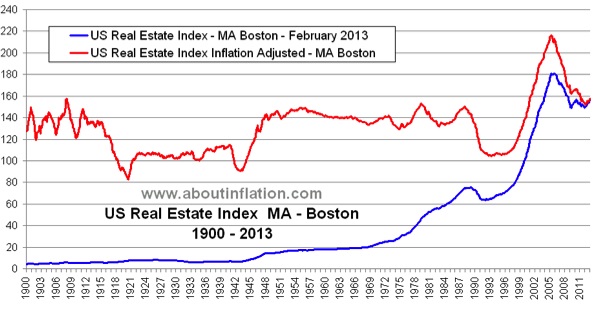
US Real Estate Investing Index 2015

Join Our Mailing List

Update July 2015

pb

Patrick Bourbon CFA

[Bourbon Financial Management

***

real estate

Conclusion

Your thoughts and comments on this ME-P are appreciated. Feel free to review our top-left column, and top-right sidebar materials, links, URLs and related websites, too. Then, subscribe to the ME-P. It is fast, free and secure.

Speaker: If you need a moderator or speaker for an upcoming event, Dr. David E. Marcinko; MBA – Publisher-in-Chief of the Medical Executive-Post – is available for seminar or speaking engagements. Contact: MarcinkoAdvisors@msn.com

OUR OTHER PRINT BOOKS AND RELATED INFORMATION SOURCES:

Risk Management, Liability Insurance, and Asset Protection Strategies for Doctors and Advisors: Best Practices from Leading Consultants and Certified Medical Planners™8Comprehensive Financial Planning Strategies for Doctors and Advisors: Best Practices from Leading Consultants and Certified Medical Planners™

“The medical education system is grueling and designed to produce excellence in medical knowledge and patient care. What it doesn’t prepare us for is the slings and arrows that come our way once we actually start practicing medicine. Successfully avoiding these land mines can make all the difference in the world when it comes to having a fulfilling practice. Given the importance of risk management and mitigation, you would think these subjects would be front and center in both medical school and residency – ‘they aren’t.’

Thankfully, the brain trust over at iMBA Inc., has compiled this comprehensive guide designed to help you navigate these mine fields so that you can focus on what really matters – patient care.”

  Dennis Bethel MD [Emergency Medicine Physician]

The Road to Crowd-Centric Retail Alternatives and the Future of Financial Products

Join Our Mailing List

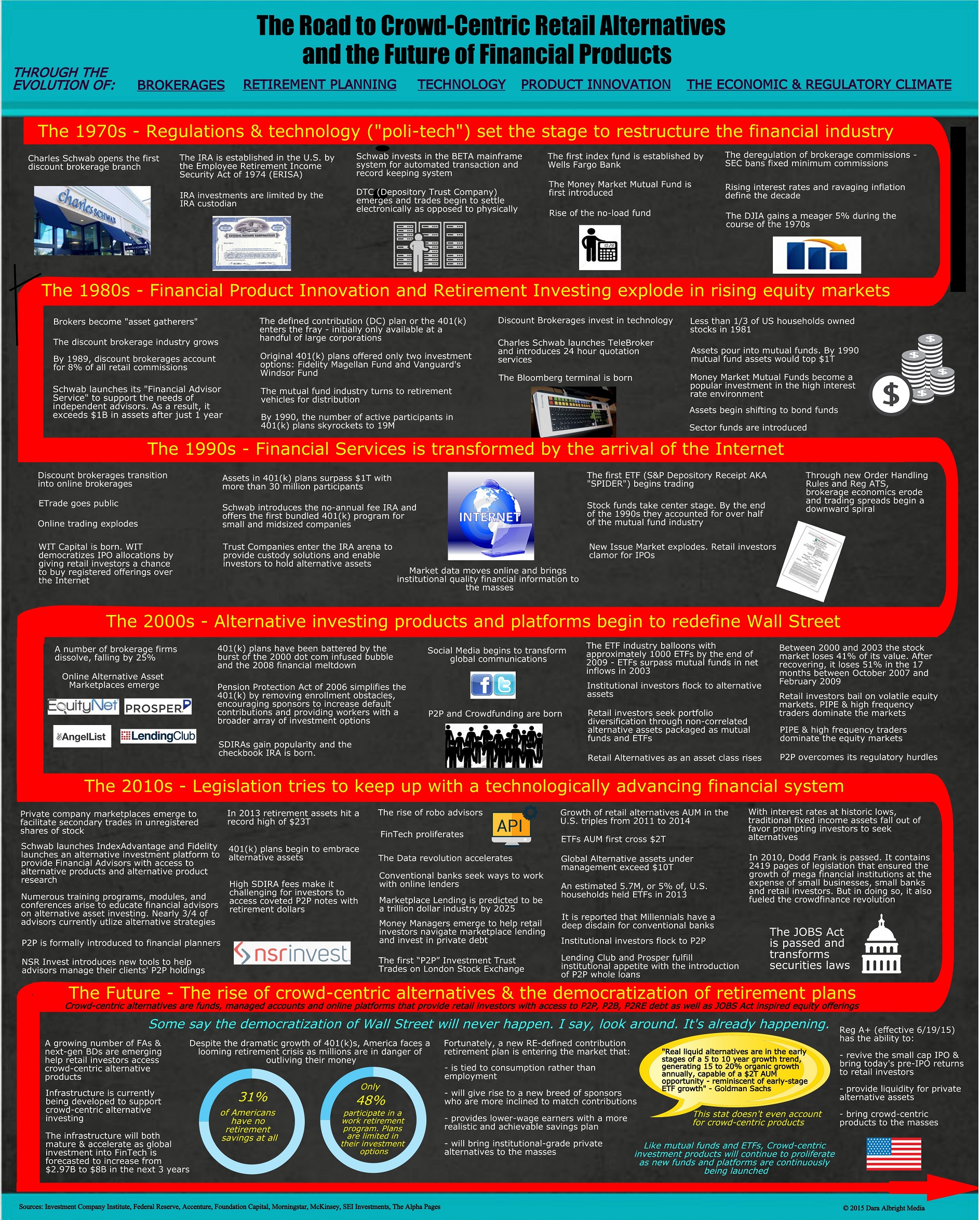
Including an Evolutionary Info-graphic

dara-pic

By Dara Albright

In simpler times, American workers relied on pensions to secure their retirement. Those who desired a supplement to their pension income opted to save during their pre-retirement years. Like television stations, investment options were primarily limited to three main providers. Instead of being bogged down with choices, savers essentially had their pick of placing money in interest bearing savings accounts, stocks or bonds. With the exception of occasionally having to get up from the sofa to change the television channel, life was pretty uncomplicated.

Then the 70s arrived – bringing a rash of polyester and laying the groundwork for sweeping changes throughout the financial system.

Ever since, our capital markets have been in a perpetual state of transformation fueled by innovations in brokerage services, advisory tools, investment products, retirement plans, financial technology and shifts in both the political as well as economic climate. The confluence of these evolutions – as depicted in the infographic below – continues to not only redefine retail investing, but America’s entire retirement framework.

***

the-road-to-crowd-centric-alternatives1

[Check out this spectacular infographic depicting the evolution of financial services and where it’s all headed]

Click photo twice to enlarge

***

From salespeople into asset gatherers

During the past four and a half decades the brokerage business has moved online, slashed commissions and turned its commission-based securities salespeople into asset gatherers. As the number of brokerage firms steadily declined, online alternative asset marketplaces began to rise.

The IRA and 401(k) transformed America’s retirement structure as pension plans became less and less prevalent. These new retail retirement vehicles fed the mutual fund business, and in tandem both industries ballooned into multi trillion dollar markets.

Tools were developed that would enable financial advisors to navigate across a growing number of asset classes and help ensure the proper diversification of retail portfolios. These advisory resources also contributed to the proliferation of new asset classes and retirement accounts.

Legislative changes coupled with technological achievement led to the democratization of both financial products as well as market data. This “poli-tech” dynamic not only furthered the growth of conventional asset classes, it inspired a host of innovative online investing platforms, lending models, equity financing structures and the creation of new asset classes.

A groundswell of investment products

Over the years, a groundswell of investment products has been engineered for the mass market resulting in the flow of retail dollars across money markets, mutual funds and ETFs. Particularly during the recent years, as interest rates reached historic lows and equity markets became excessively volatile, there has been an upsurge of interest in uncorrelated alternative assets.

To meet the mounting demand, a wave of retail alternative products entered the market. According to McKinsey, retail alternatives will soon account for almost 50% of total retail revenues. Furthermore, Goldman Sachs believes that retail alternatives are in the early stages of a 5-10 year growth trend – reminiscent of early-stage ETF growth and capable of becoming a $2T AUM opportunity.

As financial advisors were becoming acquainted with a growing number of retail alternative products packaged through mutual funds and ETFs, a new niche of alternatives known as crowd-centric alternatives had been gaining popularity – particularly among institutional and internet savvy retail investors.

These crowd-centric alternatives – designed to bring non-correlated yield and pre-IPO equity growth to mainstream investors’ portfolios – are made up of public as well as private funds, managed accounts and online platforms that provide investors with access to peer-to-peer, peer-to-business and peer-to-real estate debt as well as JOBS Act inspired equity offerings.

While momentum continues to build for crowd-centric alternatives, an interesting phenomenon has been brewing in the retirement plan industry. Flaws in the current IRA and 401(k) structures as well as the social security system have legislators as well as economists scrambling to prevent a looming retirement crisis. Thus far, none of the publicly proposed solutions even begin to scratch the surface of the predicament. That is until now.

Fortunately, a soon-to-be-unveiled RE-defined contribution retirement plan will resolve inherent issues by 1) unleashing a new generation of plan sponsors more inclined to match contributions, 2) providing lower-wage earners with a more realistic and achievable savings plan, and by 3) bringing higher yielding institutional-grade alternatives to the masses. (A new white paper: “The RE-defined Contribution Plan: Powering Economic Growth While Preventing a National Retirement Crisis” will be released shortly)

Fascinatingly, the RE-defined contribution plan and crowd-centric alternative assets have the potential to power one another’s expansion in much the same way that the IRA, 401(k) and mutual fund industry fueled each other’s massive growth in prior decades.

***

conference room

***

Crowd-centric alternatives

While the existing statistics for retail alternatives are staggering, none of the forecasters have even accounted for crowd-centric alternatives. If history is any guide, crowd-centric alternatives are about to catapult the retail alternative industry to unforeseen heights – particularly given the following key factors:

  • The surfacing of a more proficient retirement vehicle that accommodates alternative investing;
  • The introduction of new tools designed to assist financial advisors in managing their client’s crowd-centric holdings;
  • A growing number of financial advisors and next-gen BDs emerging to help retail investors access crowd-centric alternative products;
  • The prolific growth of marketplace lending;
  • Traditional offline private debt businesses migrating online;
  • The influx of P2P, P2B, P2RE managed products;
  • The maturation of the infrastructure to support crowd-centric alternative investing;
  • Venture capital is pouring into fintech (projected to nearly triple in the next 3 years). This will enthuse innovation and lead to greater sophistication of products, platforms and infrastructure;
  • The implementation of additional key components of the JOBS Act will inspire the creation of new investment products for the masses as well as provide liquidity for private alternatives.

Assessment

Although I cannot promise that polyester and orange shag carpets won’t make a comeback, I can absolutely guarantee that financial services will continue to evolve through the progression of new ideas, products, tools and technology.

More:

Conclusion

Your thoughts and comments on this ME-P are appreciated. Feel free to review our top-left column, and top-right sidebar materials, links, URLs and related websites, too. Then, subscribe to the ME-P. It is fast, free and secure.

Speaker: If you need a moderator or speaker for an upcoming event, Dr. David E. Marcinko; MBA – Publisher-in-Chief of the Medical Executive-Post – is available for seminar or speaking engagements. Contact: MarcinkoAdvisors@msn.com

OUR OTHER PRINT BOOKS AND RELATED INFORMATION SOURCES:

Risk Management, Liability Insurance, and Asset Protection Strategies for Doctors and Advisors: Best Practices from Leading Consultants and Certified Medical Planners™8Comprehensive Financial Planning Strategies for Doctors and Advisors: Best Practices from Leading Consultants and Certified Medical Planners™

Health professionals are small business owners who need to apply their self-discipline tactics in establishing and operating successful practices. Talented trainees are leaving the medical profession because they fail to balance the cost of attendance against a realistic business and financial plan. Principles like budgeting, saving, and living below one’s means, in order to make future investments for future growth, asset protection, and retirement possible are often lacking. This textbook guides the medical professional in his/her financial planning life journey from start to finish. It ranks a place in all medical school libraries and on each of our bookshelves.

Dr. Thomas M. DeLauro DPM [Professor and Chairman – Division of Medical Sciences, New York College of Podiatric Medicine]

The Surgeons Scorecard

Join Our Mailing List

Coming Soon: ProPublica’s Surgeon Scorecard

***

sergtech

***

Millions of patients a year undergo common elective operations – things like knee and hip replacements or gall bladder removals.

But, there’s almost no information available about the quality of surgeons who do them. ProPublica analyzed 2.3 million Medicare operations and identified 67,000 patients who suffered serious complications as a result: infections, uncontrollable bleeding, even death.

We’ll be reporting the complication rates of 17,000 surgeons — so patients can make an informed choice.

***

Product DetailsProduct Details

[Foreword J. Phillips MD JD MBA] [Foreword D. Nash MD MBA]

Conclusion

Your thoughts and comments on this ME-P are appreciated. Feel free to review our top-left column, and top-right sidebar materials, links, URLs and related websites, too. Then, subscribe to the ME-P. It is fast, free and secure.

Question Authority: The Need for Anti-Authoritarians in the Medical Profession

Join Our Mailing List

Michael Lawrence Langan, M.D.

[Boston, Massachusetts]

M.D. Harvard Medical School, Massachusetts General Hospital 1997-2013. Geriatric Medicine, Internal Medicine

***

iMBA Inc Textbooks

Product DetailsProduct Details

Risk Management, Liability Insurance, and Asset Protection Strategies for Doctors and Advisors: Best Practices from Leading Consultants and Certified Medical Planners™8Comprehensive Financial Planning Strategies for Doctors and Advisors: Best Practices from Leading Consultants and Certified Medical Planners™

Disrupted Physician

Screen Shot 2015-05-30 at 7.27.10 PM
Anti-authoritarians question whether an authority is a legitimate one before taking that authority seriously.  images-24To evaluate the legitimacy of  an authority it is necessary to:
1. Assess whether they actually know what they are talking about.
2. Assess whether the authorities are honest in their intentions.  When anti-authoritarians assess an authority to be illegitimate, they challenge and resist that authority.
There is a paucity of anti-authoritarianism in the medical community concerning groups who have gained tremendous sway in the regulation of the medical profession.    There is an absence of anti-authoritarian questioning  of  what is essentially illegitimate and irrational authority.
images-26In order for these organizations to maintain power it is necessary that their authoritative opinion remain unquestioned and unchallenged.  Consciously manufactured propaganda has persuaded regulatory and public opinion of their value and to maintain power it is necessary that this authority remain insulated from outside evaluation because the entire system is based…

View original post 301 more words

I-Corps at the NIH

Join Our Mailing List

More on Evidence-Based Translational Medicine

By Steve Blank

We have learned a remarkable process that allow us to be highly focused, and we have learned a tool of trade we can now repeat. This has been of tremendous value to us.

Andrew Norris

Principal Investigator BCN Biosciences

Over the last three years the National Science Foundation I-Corps has taught over 700 teams of scientists how to commercialize their technology and how to fail less, increasing their odds for commercial success.

To see if this same curriculum would work for therapeutics, diagnostics, medical devices and digital health, we taught 26 teams at UCSF a life science version of the NSF curriculum. 110 researchers and clinicians, and Principal Investigators got out of the lab and hospital, and talked to 2,355 customers. (Details here)

For the last 10 weeks 19 teams in therapeutics, diagnostics and medical devices from the National Institutes of Health (from four of the largest institutes; NCINHBLI, NINDS, and NCATS) have gone through the I-Corps at NIH.

87 researchers and clinicians spoke to 2,120 customers, tested 695 hypotheses and pivoted 215 times. Every team spoke to over 100 customers.

Three Big Questions
The NIH teams weren’t just teams with ideas, they were fully formed companies with CEO’s and Principal Investigators who already had received a $150,000 grant from the NIH. With that SBIR-Phase 1 funding the teams were trying to establish the technical merit, feasibility, and commercial potential of their technology. Many will apply for a Phase II grant of up to $1 million to continue their R&D efforts.

Going into the class we had three questions:

  1. Could companies who were already pursuing a business model be convinced to revisit their key commercialization hypotheses – and iterate and pivot if needed?
  2. Was getting the Principal Investigators and CEO out of the building more effective than the traditional NIH model of bringing in outside consultants to do commercialization planning?
  3. Would our style of being relentlessly direct with senior scientists, who hadn’t had their work questioned in this fashion since their PhD orals, work with the NIH teams?

I-Corps at the NIH: Evidence-based Translational Medicine 

Evidence-based Translational Medicine
We’ve learned that information from 100 customers is just at the edge of having sufficient data to validate/invalidate a company’s business model hypotheses. As for whether you can/should push scientists past their comfort zone, the evidence is clear – there is no other program that gets teams anywhere close to talking to 100 customers. The reason? For entrepreneurs to get out of the building at this speed and scale is an unnatural act. It’s hard, there are lots of other demands on their time, etc. But we push and cajole hard, (our phrase is we’re relentlessly direct,) knowing that while they might find it uncomfortable the first three days of the class, they come out thanking us.

The experience is demanding but time and again we have seen I-Corps teams transform their business assumptions. This direct interaction with potential users and customers is essential to commercialize science (whether to license the technology or launch a startup.) This process can’t be outsourced. These teams saved years and millions of dollars for themselves, the NIH and the U.S. taxpayer. Evidence is now in-hand that with I-Corps@NIH the NIH has the most effective program for commercializing science.

Lessons Learned Day
Every week of this 10 week class, teams present a summary of what they learned from their customers interviews. For the final presentation each team created a two minute video about their 10-week journey and a 8-minute PowerPoint presentation to tell us where they started, what they learned, how they learned it, and where they’re going. This “Lessons Learned” presentation is much different than a traditional demo day. It gives us a sense of the learning, velocity and trajectory of the teams, rather than a demo day showing us how smart they are at a single point in time.

BCN Biosciences
This video from team BCN Biosciences describes what the intensity, urgency, velocity and trajectory of an I-Corps team felt like. Like a startup it’s relentless.

BCN is developing a drug that increases anti-cancer effect of radiation in lung cancer (and/or reduces normal tissue damage by at least 40%). They were certain their customers were Radiation Oncologists, that MOA data was needed, that they needed to have Phase 1 trial data to license their product, and needed >$5 million and 6 years. After 10 weeks and 100 interviews, they learned that these hypotheses were wrong.

If you can’t see the BCN Biosciences video click here

The I-Corps experience helped the BCN Bioscience team develop an entirely new set set of business model hypotheses – this time validated by customers and partners. The “money slides” for BCN Biosciences are slides 22 and 23.

I-Corps at the NIH: Evidence-based Translational Medicine 

Conclusion

Your thoughts and comments on this ME-P are appreciated. Feel free to review our top-left column, and top-right sidebar materials, links, URLs and related websites, too. Then, subscribe to the ME-P. It is fast, free and secure.

Speaker: If you need a moderator or speaker for an upcoming event, Dr. David E. Marcinko; MBA – Publisher-in-Chief of the Medical Executive-Post – is available for seminar or speaking engagements. Contact: MarcinkoAdvisors@msn.com

OUR OTHER PRINT BOOKS AND RELATED INFORMATION SOURCES:

Product Details

Product Details

Product Details

“When a practicing physician thinks about their risk exposure resulting from providing patient care, medical malpractice risk immediately comes to mind. But; malpractice and liability risk is barely the tip of the iceberg, and likely not even the biggest risk in the daily practice of medicine. There are risks from having medical records to keep private, risks related to proper billing and collections, risks from patients tripping on your office steps, risks from medical board actions, risk arising from divorce, and the list goes on and on. These liabilities put a doctor’s hard earned assets and career in a very vulnerable position.

These new books from Dr. David Marcinko and Prof. Hope Hetico show doctors the multiple types of risk they face and provides examples of steps to take to minimize them. They are written clearly and to the point, and are a valuable reference for any well-managed practice. Every doctor who wants to take preventive action against the risks coming at them from all sides needs to read these books.”

Richard Berning MD FACC [New Haven, Connecticut, USA]

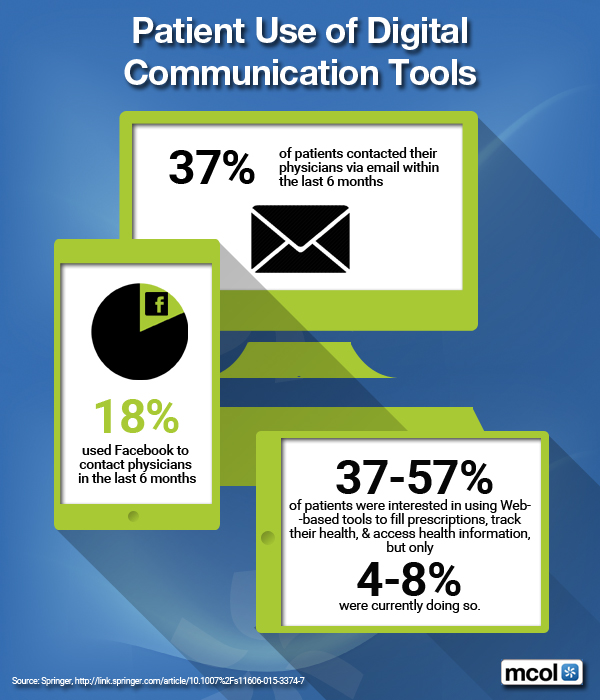
Patient Use of Digital Communication Tools

Join Our Mailing List

An Info-Graphic

http://www.MCOL.com

***

digital tools

***

Conclusion

Your thoughts and comments on this ME-P are appreciated. Feel free to review our top-left column, and top-right sidebar materials, links, URLs and related websites, too. Then, subscribe to the ME-P. It is fast, free and secure.

Speaker: If you need a moderator or speaker for an upcoming event, Dr. David E. Marcinko; MBA – Publisher-in-Chief of the Medical Executive-Post – is available for seminar or speaking engagements. Contact: MarcinkoAdvisors@msn.com

OUR OTHER PRINT BOOKS AND RELATED INFORMATION SOURCES:

Product Details

Product DetailsProduct Details

[Foreword Dr. Phillips MD JD MBA LLM] *** [Foreword Dr. Nash MD MBA FACP]

Calculate the Odds that your Job will be Stolen by a ROBOT?

Join Our Mailing List

What are your chances?

[By staff reporters]

In an increasingly digital world the workforce is becoming more automated than ever before. In this decade we’ve faced the challenge of interactive POS systems impacting the retail employment sector, but what industries are next?

Understanding the future of your job role can help you plan your career path more effectively, and decide if it’s time to change direction.

Using NPR’s handy calculator you can see just how safe your job is from the robots. To save you some time we’ve listed the top industries and their rankings

  • Sales: 99% chance of being automated
  • Accountants: 93.5% chance of being automated
  • Retail: 92.3% chance of being automated
  • Programmers: 48% chance of being automated
  • Housekeeping: 68.8% chance of being automated
  • Lawyer: 3.5% chance of being automated
  • Teaching: >1% chance of being automated

***

Feeling pretty confident? Congratulations!

SplitShire-

Source:

http://www.npr.org/sections/money/2015/05/21/408234543/will-your-job-be-done-by-a-machine

***

Assessment

Even if you are a doctor, nurse, accountant or financial advisor – use the calculator to check it out.

More:

Even More:

The Great and Powerful WOZ Speaks:

Steve Wozniak, Other Geniuses Debate Whether Robots Will Tend To Our Every Whim Or Murder Us

Conclusion

Your thoughts and comments on this ME-P are appreciated. Feel free to review our top-left column, and top-right sidebar materials, links, URLs and related websites, too. Then, subscribe to the ME-P. It is fast, free and secure.

Speaker: If you need a moderator or speaker for an upcoming event, Dr. David E. Marcinko; MBA – Publisher-in-Chief of the Medical Executive-Post – is available for seminar or speaking engagements. Contact: MarcinkoAdvisors@msn.com

OUR OTHER PRINT BOOKS AND RELATED INFORMATION SOURCES:

Risk Management, Liability Insurance, and Asset Protection Strategies for Doctors and Advisors: Best Practices from Leading Consultants and Certified Medical Planners™8Comprehensive Financial Planning Strategies for Doctors and Advisors: Best Practices from Leading Consultants and Certified Medical Planners™

I read and use this book, and several others, from Dr. David Edward Marcinko and his team of advisors.

JOHN KELLEY; DO

Transparency Program Obscures Pharma Payments to RNs and PAs

Join Our Mailing List

New data largely excludes nurse practitioners and physician assistants

By Charles Ornstein | @charlesornstein  |  Pro Publica

New data on drug and device company payments to doctors largely excludes nurse practitioners and physician assistants, though they play an ever-larger role in health care.

One advanced-practice nurse pleaded guilty last month to taking drug company kickbacks.

NOTE: This story was co-published with NPR’s Shots blog.

pill mill

More:

http://www.propublica.org/article/transparency-program-obscures-pharma-payments-nurses-physician-assistants?utm_source=et&utm_medium=email&utm_campaign=dailynewsletter&utm_content=&utm_name=

Conclusion

Your thoughts and comments on this ME-P are appreciated. Feel free to review our top-left column, and top-right sidebar materials, links, URLs and related websites, too. Then, subscribe to the ME-P. It is fast, free and secure.

Speaker: If you need a moderator or speaker for an upcoming event, Dr. David E. Marcinko; MBA – Publisher-in-Chief of the Medical Executive-Post – is available for seminar or speaking engagements. Contact: MarcinkoAdvisors@msn.com

OUR OTHER PRINT BOOKS AND RELATED INFORMATION SOURCES:

Risk Management, Liability Insurance, and Asset Protection Strategies for Doctors and Advisors: Best Practices from Leading Consultants and Certified Medical Planners™8Risk Management, Liability Insurance, and Asset Protection Strategies for Doctors and Advisors: Best Practices from Leading Consultants and Certified Medical Planners™

Although this book targets physicians, I was pleased to see that it also addressed the risk management, financial planning and employment benefit needs of nurses; physical, respiratory, and occupational therapists; CRNAs, hospitalists, and other members of the health care team….highly readable, practical, and understandable.

Nurse Cecelia T. Perez RN [Hospital Operating Room Manager, Ellicott City, Maryland

Using Deposits and Withdrawals to Rebalance Your Portfolio

Join Our Mailing List 

Benefits of portfolio rebalancing well documented

[By Lon Jefferies MBA CFP®] http://www.NetWorthAdvice.com

Lon JefferiesThe benefits of rebalancing a portfolio are well documented. Constant and routine rebalancing forces a physician or any investor to lighten the portfolio positions that have recently performed well and use the resulting funds to buy more shares of the assets in the portfolio that have remained flat or even declined in value. In other words, rebalancing causes the investor to sell high and buy low.

Most financial professionals recommend rebalancing your portfolio at least once a year (I rebalance my clients’ portfolios on a semi-annual basis).

However, the tax status of an investment account can have a significant impact on a rebalancing strategy. While investments within a tax-advantaged account like a traditional or Roth IRA can be sold without tax implications, selling appreciated assets in a taxable investment accounts will create a capital gains liability.

Consequently, while rebalancing within a tax-advantaged account should be a no-brainer, investors should carefully consider the tax implications that may result from rebalancing a normal investment account.

***

prt_320x212_1397595292

[Routine Portfolio Rebalancing]

***

For this reason, investors should view every deposit to or withdrawal from a taxable investment account as a chance to rebalance. Depositing new money is a free opportunity to buy more of the positions in which the portfolio is underweight.

Example:

For example, suppose an investment account of $100,000 has a target asset allocation of 50% stocks and 50% bonds ($50,000 invested in both). After a year in which stocks made 10% and bonds were flat, the portfolio would consist of $55,000 of stocks and $50,000 of bonds, for a total account balance of $105,000. If at this point the investor would like to invest an additional $5,000, the entire contribution should be placed in bonds, bringing the actual portfolio allocation back to 50% stocks and 50% bonds ($55,000 in each).

Of course, this same strategy can be implemented regardless of the size of the additional contribution. If the investor wanted to contribute $10,000 in year two, the total account value would be $115,000 ($105k current balance + $10k new money). In order to get back to our 50% stock and 50% bond targets, we would want $57,500 in each position. With $55,000 already invested in stocks, we would only want to invest $2,500 of the new money into stocks and place the remaining $7,500 into bonds, bringing both portions of the portfolio up to their targets.

Taking withdrawals from a taxable investment account should also be viewed as an opportunity to rebalance. Rebalancing via withdrawals may not be free as it is when rebalancing is done when new funds are deposited because appreciated assets are likely sold, creating a tax liability. However, when a withdrawal is taken from a taxable account, it is still wise to sell overweight asset categories to produce the funds needed for the distribution.

Example:

Let’s return to our previous example of a 50% stock and 50% bond target portfolio that had grown to $55,000 of stock and $50,000 of bonds. If the investor then wanted to withdraw $10,000, he could take the entire distribution out of bonds which would allow him to free up the amount needed without creating a tax liability. However, the resulting portfolio would consist of $55,000 of stocks and $40,000 of bonds – a ratio of approximately 58% stocks and 42% bonds.

This is a significantly more volatile portfolio than the target 50% / 50% portfolio. For example, in 2008 a portfolio that consisted of 50% large cap stocks and 50% long term government bonds lost -7.16%. Meanwhile, a portfolio of 58% stocks and 42% bonds lost -11.93% over the same period – a 66.6% increase in volatility.

Alternatively, I’d suggest using the $10,000 withdrawal to rebalance the portfolio, bringing the resulting $95,000 portfolio back to 50% stocks and 50% bonds ($47,500 in each). Of course, to do this, the investor would liquidate $7,500 of stocks and $2,500 of bonds. Although this could potentially create a small capital gains tax liability, this is a tax bill that will need to be paid at some point anyhow, and the investor will maintain a portfolio with the target amount of volatility.

Further, remember that the long-term capital gains rate (which applies to any capital assets held for over a year) is a favorable tax rate. For single filers with a taxable income of less than $37,450 and joint filers with a taxable income of less than $74,900, the capital gains tax rate is actually 0%!

Additionally, for single filers with a taxable income of between $37,450 and $406,750 and joint filers with a taxable income of between $74,900 and $457,600, the capital gains tax rate is only 15%. Consequently, the investor can likely rebalance the portfolio back to the target allocation via the withdrawal while incurring only a nominal tax bill.

***

healthfinance

***

Assessment

While rebalancing provides a significant increase in investment return over long time periods, tax implications should be considered when determining whether or not to rebalance a taxable investment account. However, depositing money to or withdrawing money from these accounts provides a favorable opportunity to obtain the return premium rebalancing creates while minimizing tax implications.

Conclusion

Your thoughts and comments on this ME-P are appreciated. Feel free to review our top-left column, and top-right sidebar materials, links, URLs and related websites, too. Then, subscribe to the ME-P. It is fast, free and secure.

Speaker: If you need a moderator or speaker for an upcoming event, Dr. David E. Marcinko; MBA – Publisher-in-Chief of the Medical Executive-Post – is available for seminar or speaking engagements. Contact: MarcinkoAdvisors@msn.com

OUR OTHER PRINT BOOKS AND RELATED INFORMATION SOURCES:

Risk Management, Liability Insurance, and Asset Protection Strategies for Doctors and Advisors: Best Practices from Leading Consultants and Certified Medical Planners™8Comprehensive Financial Planning Strategies for Doctors and Advisors: Best Practices from Leading Consultants and Certified Medical Planners™

Physicians are notoriously excellent at diagnosing and treating medical conditions. However, they are also notoriously deficient in managing the business aspects of their medical practices. Most will earn $20-30 million in their medical lifetime, but few know how to create wealth for themselves and their families. This book will help fill the void in physicians’ financial education. I have two recommendations: 1) every physician, young and old, should read this book; and 2) read it a second time!

Dr. Neil Baum MD [Clinical Associate Professor of Urology, Tulane Medical School, New Orleans, Louisiana]

http://www.CertifiedMedicalPlanner.org

Enter the CMPs

Life Science Startups Rising

Join Our Mailing List

Life Science Startups Rising in the UK

Stephen Chambers spent 22 years in some of the most innovative companies in life science as the director of gene expression and then as a co-founder of his own company.

Here’s his story

Today he runs SynbiCITE, the UK’s synthetic biology consortium of 56 industrial partners and 19 Academic institutions located at Imperial College in London.

Stephen and SynbiCITE, just launched the world’s first Lean LaunchPad for Synthetic Biology program.

***

steve blank

By Steve Blank

Conclusion

Your thoughts and comments on this ME-P are appreciated. Feel free to review our top-left column, and top-right sidebar materials, links, URLs and related websites, too. Then, subscribe to the ME-P. It is fast, free and secure.

Speaker: If you need a moderator or speaker for an upcoming event, Dr. David E. Marcinko; MBA – Publisher-in-Chief of the Medical Executive-Post – is available for seminar or speaking engagements. Contact: MarcinkoAdvisors@msn.com

OUR OTHER PRINT BOOKS AND RELATED INFORMATION SOURCES:

Product DetailsProduct Details

David Belk MD Announces New Website [True Cost of Healthcare.net]

Join Our Mailing List

A Site Re-Design

belk[By David Belk MD]

Here’s the new website with a whole new look that’s been redesigned by Modern Creations: http://truecostofhealthcare.org

There are three new sections:

The first is a study of the prices of brand name medications. It shows that the price pharmacies in the US pay for brand name drugs have gone up an average of 40% in 2 1/2 years. That’s about 18 times the rate of inflation.

The other two new pages examine Medicare supplemental policies as well as Part D and Advantage programs:

The page on supplemental policies is an expansion of the blog I wrote 2 years ago on the subject. It answers just about any question you might have about what Medicare covers and how much you would expect to pay if you have Medicare and need medical treatment

***

 David Belk, M.D., Announces New Website

hospital bills

***

Assessment

Feel free to tell me what you think of it. Also, I’m sending this message from my new email address – truecostofhealthcare@gmail.com

Conclusion

Your thoughts and comments on this ME-P are appreciated. Feel free to review our top-left column, and top-right sidebar materials, links, URLs and related websites, too. Then, subscribe to the ME-P. It is fast, free and secure.

Speaker: If you need a moderator or speaker for an upcoming event, Dr. David E. Marcinko; MBA – Publisher-in-Chief of the Medical Executive-Post – is available for seminar or speaking engagements. Contact: MarcinkoAdvisors@msn.com

OUR OTHER PRINT BOOKS AND RELATED INFORMATION SOURCES:

Product DetailsProduct Details

“Navigating a course where sound organizational management is intertwined with financial acumen requires a strategy designed by subject-matter experts. Fortunately, Financial Management Strategies for Hospital and Healthcare Organizations: Tools, Techniques, Checklists and Case Studies provides that blueprint”

 —David B. Nash MD MBA Jefferson Medical College, Thomas Jefferson University, PA

On Medical Inflation Rising [Managed Care vs Reference Based Pricing]

Join Our Mailing List 

Beating Medical Trends

[By William Rusteberg]

www.RiskManagers.us (click on WEBLOG)

Medical inflation continues to rise at a rate above the growth rate in the economy. Facing rate increases year after year, plan sponsors, with their financial backs to the wall, have historically resorted to cost shifting. These continued failed attempts to control costs have driven some to seek alternate means to restore pricing sanity to health care. To many, the cost of health insurance can mean the difference between profit and loss.

The Problem

Understanding the cost of health care is directly related to what we agree to pay, more and more employers are questioning managed care contracts upon which their health care costs are based. Many are discovering the truth for the first time. Secretive contracts between health care givers and third party intermediaries contain provisions that guarantee continuous and systematic cost increases. Shared savings side agreements and other schemes found in the health industry economic chain help fuel raging health insurance costs.

Known as medical trend, cost increases have proven to be consistent and predictable. The expected rise in the cost of medical services over time is expressed as an annual percentage increase and is an important element in underwriting future risk. Medical trend is a dominant cost driver in rate making. The annual compounding effect can double or triple health care costs in just a few years.

“For managed care plans, the medical care inflation part of trend is a function of the changes in provider reimbursement rates that are negotiated. To the extent that such negotiations entail factors such as outliers and provider bonuses, the trend rate may be materially more than simply the weighted average increase in fees.” Kevin Gabriel, MBA, FSA, MAAA, Chief Actuary of Sierra Berkshire Associates, Inc.

Photo of hands of businesspeople during discussing

Photo of hands of businesspeople during discussing

The Solution

Moving away from managed care contracts, more and more employers are embracing a myriad of reference based pricing models. These models can vary in scope and reach; however all share certain common characteristics in conformance with prudent business practices. Price transparency and claim benchmarking are key elements.

In 2007 – 2008 we approached several of our clients to suggest something different to control costs. The concept was simple. Eschew managed care contracts in lieu of claim benchmarking off multiple data points such as Medicare reimbursement rates. Removing managed care contracts, i.e, PPO, and paying providers quickly, fairly and directly had an immediate impact on claim costs.

After 15 months we performed a study by running 100% of claims back through the prior PPO network reimbursement rates. This exercise proved a net savings of 43% above and beyond the PPO discounts we would have otherwise experienced. Instead of doing the same thing year after year, our clients did something different and it worked.

It has been seven years since our first client exited the managed care world.  Subsequently more clients have embarked on the same journey, most with equally good results. None have returned to the world of managed care.

stock market

The Evidence

Skeptics may ask “How have your clients fared over time? Have they won the battle against medical trend?” The answer may be found by reviewing the experience of four of our clients who have been on a reference based pricing model for five years or more.

Our study is based on actual paid, mature medical claims through succeeding plan years starting in the first year on reference based pricing benchmarked off the prior year under a managed care plan. All claims above stop loss levels have been excluded.

This abbreviated analysis does not recognize changing demographics and plan changes. For example the leveraging effect of higher deductibles will increase trend factors. Of particular importance it should be noted that plan changes occurred in each case through improved benefits supported by claim savings. This study includes medical claims only.

One must understand that medical trend is just one of the factors used to calculate renewal rates for health plans and stop loss insurance. Each year carriers set their own trend level based on various factors, including the current health care inflation rate, analysts’ forecasts and their own experiences. However, our clients are self-funded and thus bear most risk with actual trend directly affecting costs without the benefit of pooling to any significant degree.

Over the past several years, trend rates have consistently run 8-10% nationally, though certain regions have seen significantly higher or lower figures. Prescription drug trends (which are a component of this) have been more volatile. In the early 2000’s these trends were above 15%. They then fell back to single digit levels. But they have now returned to the teens.” – Kevin Gabriel, MBA, FSA, MAA

In comparing our client’s experience with average medical trend, we relied upon Heffernan Benefit Advisory Services – 2013 Trend Report; Historical Trend Factors. Based on this report, we are using 9.615% as average annual medical only trend factor.

statistics

Political Subdivision – 400 Employee Lives

This case has been on RBP for 7 years. They experienced poor claim years in 2010 and 2012. In 2012, for example, there were 14 large claims that approached or exceeded $125,000. Medical PEPM for 2014 and 2015 (to date) is less than 2008. Benefits have been improved; no deductible or co-insurance features with all benefits subject to co-pays only. Funding increase over seven years has been 15.6% or 2.23% per year.

Beating Medical Trends

Public School District – 900 Employee Lives

This case has demonstrated a consistent downward claim trend. Current PEPM (2015) is less than 2008-2009. No benefit reductions. Some benefit improvements. Plan funding has remained essentially static for the past five years. 

Beating Medical Trends

Medical Industry – 280 Employee Lives

Plan year 2012-2013 experienced an outlier year with several large claims and 34 pregnancies. Current medical PEPM is 16% higher than under managed care plan in 2008-2009, representing a 2.66% increase per year (sans outliers). This illustrates that higher utilization and outlier claims will result in increasing cost which would occur under either managed care or RBP model. However, RBP trend factor continues below industry benchmarks. 

Beating Medical Trends

Retail Business – 818 Employee Lives

This case has consistently been well below medical trend. Current medical PEPM is significantly lower than plan year 2008-2009. This case has not raised plan contributions in seven years.

Beating Medical Trends

Conclusion

Managed care has failed. Medical costs continue to soar. Providers are charging more and we continue to agree to blindly pay up through secretive contracts negotiated by vested interests. Medical trend has, and continues to be, consistently at double digits or close to it.

Cost plus insurance / reference based pricing is a proven method to maintain and even improve comprehensive coverage while at the same time keeping costs reasonable, predictable and consistent. Industry sources estimate reference based pricing plans represent 10% market share and rising. An east coast hedge fund, seeking opportunities in reference based pricing models, predicts reference based pricing will gain 60% market share within the next five years.

“What moves things is innovation. But it’s not easy to innovate in stagnant, hyper-regulated, captured sectors” – Max Borders  (www.fee.org)  Cost shifting under the Affordable Care Act will continue to fail to control costs.

Reference Based Pricing represents the last frontier in innovation to control health care costs in a tightly regulated and controlled market.

Plan sponsors can reasonably expect to reduce their health care costs below medical trend without benefit reductions or cost shifting of any kind.

Conclusion

Your thoughts and comments on this ME-P are appreciated. Feel free to review our top-left column, and top-right sidebar materials, links, URLs and related websites, too. Then, subscribe to the ME-P. It is fast, free and secure.

Speaker: If you need a moderator or speaker for an upcoming event, Dr. David E. Marcinko; MBA – Publisher-in-Chief of the Medical Executive-Post – is available for seminar or speaking engagements. Contact: MarcinkoAdvisors@msn.com

OUR OTHER PRINT BOOKS AND RELATED INFORMATION SOURCES:

 Product DetailsProduct Details

“Navigating a course where sound organizational management is intertwined with financial acumen requires a strategy designed by subject-matter experts. Fortunately, Financial Management Strategies for Hospital and Healthcare Organizations: Tools, Techniques, Checklists and Case Studies provides that blueprint”

 —David B. Nash MD MBA Jefferson Medical College, Thomas Jefferson University, PA

Doctors Going Granular on Investment Risk

Join Our Mailing List 

It is Not What You Think!

[By Lon Jefferies MBA CMP® CFP®]

Lon JefferiesA new logic has been surfacing amongst the top minds in the financial planning industry.

Many of my favorite financial authors – Warren Buffett, Josh Brown, Nick Murray, Howard Marks, and others – have proposed the need to redefine the word “risk.”

Risk” vs “Volatility”

Most investors and financial advisors tend to utilize the words “risk” and “volatility” interchangeably. We measure how risky a portfolio is by examining its potential downside performance.

For example, we review how much a similar portfolio lost during 2008 or when the tech bubble popped in 2000-2002. When doing this, we are really talking about volatility rather than risk. Volatility – usually measured by standard deviation – reflects how much a portfolio is likely to increase or decrease in value when the market as a whole fluctuates. Risk, however, is quite different.

Two Threats

Josh Brown characterizes risk as the possibility of two threats:

  1. The possibility of not having enough money to fund a specific goal, which includes the possibility of outliving your money
  2. The possibility of a permanent loss of capital.

Example:

In a dramatic example of how volatility is different from risk, consider a retiree with a $10 million portfolio who only spends $50,000 a year. Next, assume the investor experiences a two-year period in which during the first year his portfolio loses 50% of its value and in year two the portfolio earns a 100% return. Thus, after year one the portfolio would only be worth $5 million and after year two it would again be worth $10 million.

Clearly, this is a very volatile portfolio that is subject to a wide range of potential performance outcomes. However, is this portfolio truly risky to the investor? According to Mr. Brown’s first factor, the portfolio is not risky because the investor will have enough money to fund his $50k per year retirement regardless of whether his portfolio is valued at $10 million or $5 million. Additionally, the portfolio is also not risky according to the second factor in that the investor didn’t experience a permanent loss.

Investors tend to view stocks as risky assets because their returns have a large standard deviation (variation from a mean). Similarly, we tend to view money market equivalents such as CDs and savings accounts as very safe investments because their returns have less dispersion, and consequently, are more predictable.

However, rather than considering stocks to be risky and cash equivalents to be safe, it would be more accurate to consider stocks an investment with high volatility and cash to be a holding with low volatility.

***

hacker

***

What is the difference?

Suppose it is determined that you need an average rate of return of 6% over time to achieve your retirement goals. Historically, over a sufficiently significant period of time, stocks have returned an average of about 10% per year while cash equivalents have returned about 3% per year. Consequently, if these averages continue in the future, you actually have a very low chance of reaching your retirement goal of not outliving your money if you place money in the “safe” investment of a cash equivalent, while you would actually have a high probability of reaching your retirement goal if you place money in a more volatile basket of stocks.

By this metric, cash is actually the more risky investment because investing in it would increase the probability of outliving your funds. Meanwhile a basket of stocks, if given enough time to achieve its historically average rate of return, is actually the safer investment as it gives you a higher probability of not outliving your nest egg.  Thus, while a portfolio of stocks will almost certainly experience more short-term volatility, over an extended period of time it very well may be a safer investment for ensuring your retirement goals are met.

Further, Mr. Brown proposes that the muddying of definition between risk and volatility is something a portion of the financial service industry has done on purpose. Brown suggests that the easiest way to sell someone a product is to first convince them they have a need. If hedge fund managers, insurance agents, and annuity salesmen can make consumers believe that volatility is equal to risk, and that since their products minimize volatility they must also minimize risk, they can achieve more sales.

However, even if an annuity can eliminate downside volatility, if it limits potential return to an amount that is insufficient to achieve the investor’s long-term goals, the investment is still more risky than an investment with more short-term volatility but a higher probability of long-term success.

***

Bell Curve

***

Assessment

Next time the market goes through a correction, remember that the drop in your portfolio’s value is a reflection of the potential volatility your portfolio is capable of experiencing. Yet, recall that as long as you don’t sell your assets and suffer a permanent loss of your investment capital, you can allow the market time to recover and achieve its historical rate of return.

Doing so will ultimately make your investment strategy less risky than utilizing investment options that experience less volatility because it maximizes the probability you will eventually achieve your long-term financial goals.

More:

Conclusion

Your thoughts and comments on this ME-P are appreciated. Feel free to review our top-left column, and top-right sidebar materials, links, URLs and related websites, too. Then, subscribe to the ME-P. It is fast, free and secure.

Speaker: If you need a moderator or speaker for an upcoming event, Dr. David E. Marcinko; MBA – Publisher-in-Chief of the Medical Executive-Post – is available for seminar or speaking engagements. Contact: MarcinkoAdvisors@msn.com

OUR OTHER PRINT BOOKS AND RELATED INFORMATION SOURCES:

Risk Management, Liability Insurance, and Asset Protection Strategies for Doctors and Advisors: Best Practices from Leading Consultants and Certified Medical Planners™8Comprehensive Financial Planning Strategies for Doctors and Advisors: Best Practices from Leading Consultants and Certified Medical Planners™

This book was crafted in response to the frustration felt by doctors who dealt with top financial, brokerage, and accounting firms. These non-fiduciary behemoths often prescribed costly wholesale solutions that were applicable to all, but customized for few, despite ever-changing needs. It is a must-read to learn why brokerage sales pitches or Internet resources will never replace the knowledge and deep advice of a physician-focused financial advisor, medical consultant, or collegial Certified Medical Planner™ financial professional.

Parin Khotari MBA [Whitman School of Management, Syracuse University, New York]

http://www.CertifiedMedicalPlanner.org

Enter the CMPs

FREE WHITE PAPER [Is Medical Practice a New Asset Class?] from iMBA, Inc.

Is Medical Practice a New Asset Class Under MPT?

Get your FREE White Paper

SPONSOR:

http://www.CertifiedMedicalPlanner.org

Valuing the Private Practice Physician’s Quintessential Alternative Financial Investment

Dr. DEM

By Dr. David Edward Marcinko MBA CMP

As we know, the investment industry and Modern Portfolio Theory [MPT] strives to make optimal ‘allocations’ into different ‘asset classes’; according to some defined risk tolerance level or efficient frontier.
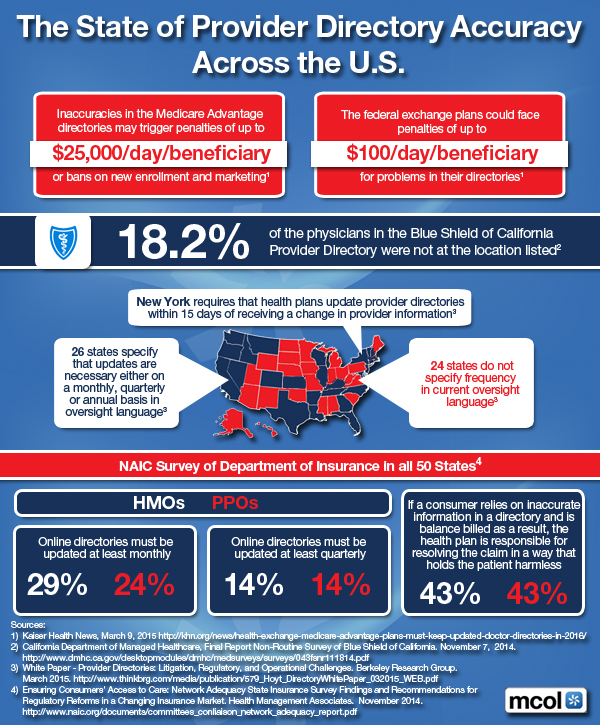
Equities, fixed income, property, private equity, emerging markets and so, are all ‘asset classes’, into which physician investors and mutual fund or portfolio managers will make an allocation of their total funds under management. It is quite proper for them to do this as they seek to balance the risk and potential returns for their own; ME, Inc., or other clients’ money.

And, by creating a “new” asset class, this concept opens the door to significant capital flows; advisory and management fees. Hence; the unrelenting innovation of Wall Street, and its’ commission driven and fee-seeking mavens, is unending.

The Social Security Example:

This concept may be illustrated using Social Security as an example.

Wall Street opines, if you’re not counting on Social Security benefits as a part of an overall asset allocation strategy, you may be missing out on bigger gains in a retirement portfolio. Those of this ilk say that retirement investors should consider the value of their Social Security as a portion of their fixed-income investments …. Others believe it may be too risky.

***

Empty Retired Doctor's Lounge

***

The Portfolio Shift

Generally, adopting this strategy would mean shifting a big portion of investible assets out of bonds and into stocks and into the hands of money managers, stock brokers and wealth managers for a fee; of course. This is akin to those financial advisors who rightly or wrongly goaded clients to not pay off a home mortgage and instead reposition the free cash flow into a rising; and then falling; market. Of course, there are detractors, as well as proponents of this emerging financial planning philosophy.

For example, Jack Bogle, founder of the Vanguard Group, often cites his penchant for basing one’s asset allocation on age. (If you’re 40 years old, you have 40% of your investments in fixed income and 60% in equities. By the time you’re 60, you’ve got 60% in fixed income, 40% in equities).

Now, let’s again consider Social Security, citing a physician with $300,000 in an investment portfolio, and capitalizing the stream of future payments. If the $300,000 is all in equity funds, even equity-index funds, and $300,000 in Social Security, you are already at 50/50″ fixed income versus equities.

The next step is a conversation as this the nexus of where Social Security meets risk management. So, how will the doctor feel when market goes up and down? Some may believe the concept, but not enjoy the inevitable more fluctuating self-directed 401-k, or 403-b plan. One must be comfortable with taking on a larger stock position.

Sources:

  • Andrea Coombes; MarketWatch, September, 2013.

Others experts, like Paul Merriman, opine that Social Security is not an asset class and the idea is fundamentally flawed and should not be a part of anyone’s portfolio.

***

Physician SGR Critics and the Doctor Fix

***

Why?

As classically defined, a portfolio is composed of financial assets. A financial asset is something that can be sold. Social Security cannot be bought and sold. Because of that, it has a market value of zero.

Therefore, since a medical practice can be bought or sold, the definitional decision is left up to the informed reader, modern physician or financially enlightened financial advisor; or Certified Medical Planner.

Source:

Order NOW!

To help you decide if medical practice is indeed an asset class – and how much a practice may be worth – and how to valuate a practice – request your free white paper using the order form below.

 Comprehensive Financial Planning Strategies for Doctors and Advisors: Best Practices from Leading Consultants and Certified Medical Planners(TM)

Courtesy

http://www.CertifiedMedicalPlanner.org

Request your FREE White Paper Here!

Go back

Your message has been sent

Warning
Warning
Warning
Warning

Warning.

DOCs – Declare your INDEPENDENCE Day!

Join Our Mailing List

By Pamela Wible MD via Ann Miller RN MHA

***

9 out of 10 doctors wouldn’t recommend medicine as a profession

Doctors4th-640x480

 Why?

***
Here are a few factoids.
  • Pages in U.S. tax code: 74,608
  • Pages of Medicare regulations by which physicians must abide: > 132,000
  • Current number of diagnostic and procedure codes doctors must know: 17,000
  • Number of codes docs are responsible for with new guidelines in October: >140,000.
  • Percent of working hours doctors spend on non-patient-related paperwork: 22 percent
  • Percent of working hours doctors spend on patient-related paperwork: > 60 percent
  • Percent of time doctors spend looking at computers instead of patients: 40 percent
  • Percent of working hours new doctors spend face-to-face with patients: 12 percent
  • Which is how many minutes per patient: 8

Assessment

Maybe that’s why over 1 million Americans will lose their doctors to suicide this year.

More:

Join me this July 4th weekend to declare your independence

LINK: https://www.youtube.com/watch?v=VDF0kJpVpXw&feature=player_embedded

LINK: youtube https://www.youtube.com/watch?v=VDF0kJpVpXw?feature=player_detailpage&w=640&h=360

A Mid-Year Update on Physician Compensation

Join Our Mailing List

Medscape Compensation Report

vicki

By Vicki Rackner MD

A 2015  Medscape Compensation Report sheds light on physicians’ earning potential.

Here are some key findings from a survey of 20,000 physicians in 26 specialties:

  • Orthopedists ($421,000) and cardiologists ($376,000) are still the top earners among physicians.
  • Physicians in private practice earn significantly more ($329,000 for specialists) than do employed physicians ($258,000 for specialists), despite the trend toward employment.
  • Male physicians earn more ($284,000) than their female counterparts ($215,000).
  • North Dakota and Alaska ($330,000) are the top-paying states for physicians, while Rhode Island ($217,000) and Maryland ($237,000) are the lowest-paying.
  • 9% of physicians have concierge or cash-only practices, the same percentage as last year, while ACO participation continues to grow.
Assessment

However, it’s not what you make that’s important; it’s what you keep. Click here to read a blog post about the Myth of the Rich Doctor that addresses the disconnect between income and wealth.

***

fashion-

***

More:

So, what are your thoughts about physicians’ potential to enjoy financial independence?

ABOUT

Vicki Rackner MD is an author, speaker and consultant who offers a bridge between the world of medicine and the world of business. She helps businesses acquire physician clients, and she helps physicians run more successful practices. Contact her at (425) 451-3777

pnhp-long-setweisbartversion-52-638

Will single-payer really reduce administrative waste?

Conclusion

Your thoughts and comments on this ME-P are appreciated. Feel free to review our top-left column, and top-right sidebar materials, links, URLs and related websites, too. Then, subscribe to the ME-P. It is fast, free and secure.

Speaker: If you need a moderator or speaker for an upcoming event, Dr. David E. Marcinko; MBA – Publisher-in-Chief of the Medical Executive-Post – is available for seminar or speaking engagements. Contact: MarcinkoAdvisors@msn.com

OUR OTHER PRINT BOOKS AND RELATED INFORMATION SOURCES:

Risk Management, Liability Insurance, and Asset Protection Strategies for Doctors and Advisors: Best Practices from Leading Consultants and Certified Medical Planners™8Comprehensive Financial Planning Strategies for Doctors and Advisors: Best Practices from Leading Consultants and Certified Medical Planners™

There is no other comprehensive book like it to help doctors, nurses, and other medical providers accumulate and preserve the wealth that their years of education and hard work have earned them.
—Dr. Jason Dyken MD MBA

[Dyken Wealth Strategies, Gulf Shores, Alabama]

Update on Health Insurance Coverage in the USA

Join Our Mailing List

By Poverty Level in 2014

By http://www.MCOL.com

Conclusion

Your thoughts and comments on this ME-P are appreciated. Feel free to review our top-left column, and top-right sidebar materials, links, URLs and related websites, too. Then, subscribe to the ME-P. It is fast, free and secure.

Speaker: If you need a moderator or speaker for an upcoming event, Dr. David E. Marcinko; MBA – Publisher-in-Chief of the Medical Executive-Post – is available for seminar or speaking engagements. Contact: MarcinkoAdvisors@msn.com

OUR OTHER PRINT BOOKS AND RELATED INFORMATION SOURCES:

Comprehensive Financial Planning Strategies for Doctors and Advisors: Best Practices from Leading Consultants and Certified Medical Planners™

There is no other comprehensive book like it to help doctors, nurses, and other medical providers accumulate and preserve the wealth that their years of education and hard work have earned them.

Jason Dyken MD MBA [Dyken Wealth Strategies, Gulf Shores, Alabama]

Risk Management, Liability Insurance, and Asset Protection Strategies for Doctors and Advisors: Best Practices from Leading Consultants and Certified Medical Planners™

I have read these texts and used consulting services from the Institute of Medical Business of Advisors, Inc., on several occasions. 

MARSHA LEE; DO [Radiologists, Norcross, GA]

Can Physicians Achieve their Financial Independence [Day] Without Budgeting?

Join Our Mailing List

A New Twist on an old Holiday Tradition

[By Rick Kahler CFP® MS ChFC CCIM]

Doctor – Here’s a new twist on an old Resolution: If you want to give yourself the security of financial independence, try budgeting the way many wealth accumulators do.

The secret? They don’t budget!

Your first reaction might be, “Of course these people don’t budget! They have so much money, they don’t need to.”

That may be true for some of those who have money today, but I’m referring to people who want to remain wealthy or those who are “wealth accumulators.” These are people who don’t start out with money, but who build up significant wealth over time.

Live on Less

Many successful wealth accumulators, and too few medical professionals, don’t follow a detailed budget in the traditional sense. Instead, they develop the habit of living on less than they make. They do this by setting clear priorities. Here is how it works:

The List

1. Out of every dollar earned, take taxes out first. If you receive a paycheck from an employer, this is done for you. On any earnings where taxes aren’t withheld, estimate the amount of tax you’ll owe and stick it into savings.

2. Take out 15% to 30% to invest for your future. When you’re just starting out, you may have to begin with a much lower percentage, but begin and be consistent. Research tells us if you have 30 years until retirement and you plan to live for 30 years after retirement, you need to save 17% of your salary to maintain the same standard of living upon retirement. When you get a raise, contribute two-thirds of it to your investments and use one-third for increasing your lifestyle. If you want to become financially independent, this step is essential.

3. Save another 10% to 20% for emergencies and short-term needs like vacations, Christmas, and replacing vehicles. Again, you may have to start with a lower percentage, but begin with whatever you can, and be consistent.

4. Take out 5% to 10% for giving.

5. Live on the rest. Pay the bills as they come in, and use what’s left over for discretionary lifestyle spending.

Sounds simple, right? Of course, “simple” isn’t necessarily the same as “easy.” By now, if you’ve done the math, you can see that following this plan means living on as little as one-half to even one-third of your gross earnings.

***

Image processed by CodeCarvings Piczard ### FREE Community Edition ### on 2013-05-29 19:30:54Z | http://piczard.com | http://codecarvings.com

Image permission to the ME-P and iMBA Inc., and processed by CodeCarvings Piczard at piczard.com

***

Assessment

If you’re living from paycheck to paycheck, just barely managing to pay the bills, the idea of living on half of what you make goes beyond absurd. It probably seems impossible. It may, in the short term, be impossible.

Yet there are ways to live on less than you earn, even if to begin with it’s only a little less. Share a cheap apartment with a roommate. Drive an old car that you don’t have to make payments on. Eat at home. Buy used furniture and second-hand clothes. Get a temporary second job solely for the purpose of building up some savings.

What is most important is developing the pattern of living on less than you make. Fostering a frugal mindset is absolutely essential if you want to achieve financial independence. When you commit to saving first—even if you can only save a small amount—you have made one of the wisest financial decisions you can ever make.

This non-budgeting spending style takes away much of the pressure of trying to follow a rigid budget. There’s no need to keep track of envelopes or categories. You’ve made the hard decisions first, and you get to spend everything in the checkbook.

Budgeting without a budget can turn you into a wealth accumulator. It works because you take your future off the top.

The Author

Rick Kahler, Certified Financial Planner®, MS, ChFC, CCIM, is the founder and president of Kahler Financial Group in Rapid City, South Dakota. In 2009 his firm was named by Wealth Manager as the largest financial planning firm in a seven-state area. A pioneer in the evolution of integrating financial psychology with traditional financial planning profession, Rick is a co-founder of the five-day intensive Healing Money Issues Workshop offered by Onsite Workshops of Nashville, Tennessee. He is one of only a handful of planners nationwide who partner with professional coaches and financial therapists to deliver financial coaching and therapy to his clients. Learn more at KahlerFinancial.com

Conclusion      

Your thoughts and comments on this ME-P are appreciated. Feel free to review our top-left column, and top-right sidebar materials, links, URLs and related websites, too. Then, subscribe to the ME-P. It is fast, free and secure.

ME-P and Independence Day 2010

Speaker: If you need a moderator or speaker for an upcoming event, Dr. David E. Marcinko; MBA – Publisher-in-Chief of the Medical Executive-Post – is available for seminar or speaking engagements. Contact: MarcinkoAdvisors@msn.com

OUR OTHER PRINT BOOKS AND RELATED INFORMATION SOURCES:

Product DetailsProduct DetailsProduct Details

Product Details  Product Details

   From the Publisher

“One needs to have the right words, and to use seemingly everyday terms in a way that economists and healthcare financial experts speak. Simply put, my suggestion is to refer to the Dictionary of Healthcare Economics and Finance frequently, and ‘reap'”.

Thomas E. Getzen, PhD Executive Director, International Health Economics Association (iHEA) Professor of Risk, Insurance and Healthcare Management The Fox School of Business-Temple University Philadelphia, Pennsylvania

Product Details

Comprehensive Financial Planning Strategies for Doctors and Advisors: Best Practices from Leading Consultants and Certified Medical Planners(TM)

Finding Value in an Overpriced Stock Market

Join Our Mailing List

Behind the Ugly Red Door

vitalyBy Vitaliy Katsenelson CFA

I am about to write a quarterly letter to clients, telling them that despite all the giddiness in the stock market, we are in Value Investor Second Hell. This is not the first hell; that one is reserved for value traps — stocks that look cheap based on past earnings but whose earnings are about to disappear, whereupon the stocks will permanently decline.

***

The second hell is when you cannot find value. I recently read a study that said the difference in valuation between the cheapest stocks (the lowest 10 percent of the market) and the rest of the market is the smallest it has been in more than 20 years. Of course, the market overall is very pricey; finding undervalued stocks in this environment has become increasingly difficult.

***

To adapt, you need to understand that there are two types of value stocks. The first are statistically cheap — their cheapness stares you in the face. This breed is quickly becoming scarce; even Hewlett-Packard Co. and Xerox Corp. are now found in growth investors’ portfolios. But before I talk about the second type of value stocks, let me tell you how my wife and I bought our house.

***

statistics

***

It was 2005. The housing market in Denver, just as in the rest of the U.S., was getting bubbly. Our family was about to grow, though we did not know it yet. We had sold our condo and were renting month to month and thus were under no pressure to buy a house, but we were keeping our eyes peeled for the right one at the right price. It was a nine-month journey. We even made some offers (usually below the asking price), which the sellers laughed at. They were right; their houses sold above the asking prices in just a few days.

***

I vividly remember how we finally found our house — and I have to admit it was entirely my wife’s doing. We were flipping through photos of house listings that met our criteria. We stumbled on a picture of an ugly green house with a bright red garage door, which had been on the market for six months. I made a snarky comment that this house would be on the market for another six months and was about to click to the next, but my supersmart wife said, “Wait.” She skipped all the pictures of the ugly outside and zeroed in on the photos of the interior of the house.

***

To my great surprise, this ugly duckling was ugly only on the exterior and had been completely redesigned inside. It was a perfect house for us. Since it had been on the market for a long time, the seller was willing to accept our low offer. I, like everyone else who did not buy this house for six months, was turned off by an ugly outside (which could be easily corrected with some paint) and failed to look deeper.

***

Back to the stock market. The other breed of value stocks are the ones with “ugly green paint jobs and bright red garage doors,” the ones that look unappealing from the outside and aren’t even cheap, at least not according to the statistics at everyone’s fingertips. Often, backward-looking statistics don’t capture such companies’ true earnings power, as it has yet to show itself. These are the stocks you should patiently seek out, especially in today’s value-deprived environment.

***

circuit

***

A stock that comes to mind is Micron Technology, a maker of memory chips. Micron has destroyed more capital over the years than Communism and Socialism combined. To be fair, it was not Micron’s fault: Its profitability — or lack thereof — was determined by its industry. Micron was a large player in a very fragmented business that Asian governments thought was strategic to the development of their countries, and so they subsidized their local companies. The memory industry was ridden with overcapacity. But nothing transforms an industry better than a financial crisis. The 2008–’09 global recession weeded out the weak players, and Micron bought the last one, Elpida Memory, in 2013 on the cheap, almost doubling its revenues.

***

Now the DRAM industry has only three players: Micron, Samsung and SK Hynix (a South Korean version of Micron). NAND memory (used in flash and solid-state drives) has the same competitors plus SanDisk Corp. Barriers to entry are enormous — a new entrant would have to spend billions of dollars on R&D and then tens of billions on factories. Therefore this cozy, oligopolylike industry structure is unlikely to change. Samsung, the largest player in the space, has an extra incentive to keep chip prices high because they give it a competitive advantage against Apple and, more important, against low-end Chinese smartphone makers that have to buy memory at market prices.

***

Gross margins of all memory companies have been gradually rising and still have significant room to grow. If Micron achieves its target margin level, in the mid to high 40s, its earnings will hit $4 to $6 per share in a few years, giving it a modest price-earnings ratio of 4 to 5 times. This is one cheap “ugly green paint job, bright red garage door” stock.

***

ABOUT
Vitaliy N. Katsenelson, CFA, is Chief Investment Officer at Investment Management Associates in Denver, Colo.
 

Conclusion

Your thoughts and comments on this ME-P are appreciated. Feel free to review our top-left column, and top-right sidebar materials, links, URLs and related websites, too. Then, subscribe to the ME-P. It is fast, free and secure.

Speaker: If you need a moderator or speaker for an upcoming event, Dr. David E. Marcinko; MBA – Publisher-in-Chief of the Medical Executive-Post – is available for seminar or speaking engagements. Contact: MarcinkoAdvisors@msn.com

OUR OTHER PRINT BOOKS AND RELATED INFORMATION SOURCES:

Risk Management, Liability Insurance, and Asset Protection Strategies for Doctors and Advisors: Best Practices from Leading Consultants and Certified Medical Planners™8Comprehensive Financial Planning Strategies for Doctors and Advisors: Best Practices from Leading Consultants and Certified Medical Planners™

I have read these texts and used consulting services from the Institute of Medical Business of Advisors, Inc., on several occasions. 

MARSHA LEE; DO [Radiologist, Norcross, GA]