A Look at Suicide Statistics

The Eleventh Leading Cause of Domestic Death

Courtesy Medical Billing and Coding [Infographics]

Join Our Mailing List

One million people commit suicide every year. Suicide is the 11th leading cause of death in the US.

Japan

Japan also has one of the highest suicide rates in the industrialized world and these suicides are mostly attributed to unemployment and depression. It is the leading cause of death for Japanese people under 30; many choose to jump in front of trains as a suicide method. When suicide hotlines were set up in Japan, 1300 calls a week were received.

Assessment

This is a staggering number in Japan, and it signifies the importance of obtaining a job for people, since unemployment and depression are popular reasons for suicide.

Link: http://www.medicalbillingandcoding.org/a-look-at-suicide-statistics/

Conclusion

Your thoughts and comments on this ME-P are appreciated. Feel free to review our top-left column, and top-right sidebar materials, links, URLs and related websites, too. Then, subscribe to the ME-P. It is fast, free and secure.

Link: http://feeds.feedburner.com/HealthcareFinancialsthePostForcxos

Speaker: If you need a moderator or speaker for an upcoming event, Dr. David E. Marcinko; MBA – Publisher-in-Chief of the Medical Executive-Post – is available for seminar or speaking engagements. Contact: MarcinkoAdvisors@msn.com

OUR OTHER PRINT BOOKS AND RELATED INFORMATION SOURCES:

DICTIONARIES: http://www.springerpub.com/Search/marcinko
PHYSICIANS: www.MedicalBusinessAdvisors.com
PRACTICES: www.BusinessofMedicalPractice.com
HOSPITALS: http://www.crcpress.com/product/isbn/9781466558731
CLINICS: http://www.crcpress.com/product/isbn/9781439879900
BLOG: www.MedicalExecutivePost.com
FINANCE: Financial Planning for Physicians and Advisors
INSURANCE: Risk Management and Insurance Strategies for Physicians and Advisors

Product DetailsProduct DetailsProduct Details

Product Details  Product Details

   Product Details 

The Epsilon Hack [An Opinion Poll Survey]

An Internet Security Survey

Join Our Mailing List

The recent breach at Epsilon, the Dallas online marketing vendor to more than 2,000 businesses, generated a lot of headlines.  Epsilon clients include financial companies like American Express, Ameriprise Financial, Barclays Bank, Capital One, Citibank, City Market, JPMorgan Chase, as well as Best Buy, The College Board, Disney Vacations, Hilton Honors, The Home Shopping Network, Kroger, Marriott Rewards, Ritz-Carleton, TiVo, Verizon and Walgreens, among others. 

VOTE AND OPINE

And so, should companies be all that worried? How about doctors, hospitals, medical clinics, patients, FAs, BDs, RIAs, CPAs etc? 

Our Other Print Books and Related Information Sources:

Health Dictionary Series: http://www.springerpub.com/Search/marcinko 

Practice Management: http://www.springerpub.com/product/9780826105752

Physician Financial Planning: http://www.jbpub.com/catalog/0763745790

Medical Risk Management: http://www.jbpub.com/catalog/9780763733421

Healthcare Organizations: www.HealthcareFinancials.com

Physician Advisors: www.CertifiedMedicalPlanner.com

Subscribe Now: Did you like this Medical Executive-Post, or find it helpful, interesting and informative? Want to get the latest ME-Ps delivered to your email box each morning? Just subscribe using the link below. You can unsubscribe at any time. Security is assured.

Link: http://feeds.feedburner.com/HealthcareFinancialsthePostForcxos

Sponsors Welcomed:  And, credible sponsors and like-minded advertisers are always welcomed.

Link: https://healthcarefinancials.wordpress.com/2007/11/11/advertise

Product Details  Product Details

   Product Details 

The Absurdity of “Meaningful Use” Requirements in Dentistry

Let’s End the Silence

By D. Kellus Pruitt DDS

Hey, Doc. How can your silence possibly serve your patients’ best interests?

For my colleagues in the audience who have quietly examined the critical and timely issues I’ve repeatedly offered for discussion – adults with post-graduate degrees who might have briefly considered publicly responding  to what I write, but who still cannot take ownership of an opinion – what on Earth is holding you back? Whatever it is, I say there are only lame, self-serving excuses for dentists to continue to betray patients’ trust. So how does that make you feel, Doc? A little angry maybe? Indignant? Let’s work on that professional nerve a little more. Maybe I’ll get a rise out of you yet.

Where Have You Been? 

As a healthcare provider whose trusting patients depend on you to protect their interests from stakeholders who cannot be held accountable – where have you been? Do you really believe dentists’ stoicism upholds and promotes the ideals of the healing profession? What about the Hippocratic Oath? How?

Or, is your shyness perhaps the manifestation of a character weakness revealing little confidence in your own personal ethics? You can’t blame me if that pisses you off. As long as you are silent, it’s impossible for me to tell a thing about you. So please, feel free to describe how my observations make you feel. You could easily change my opinion by merely speaking up to defend your silence … which promises to be an interesting argument.

ADA Members 

Or, maybe, as an ADA member, or more so a vetted official, professional silliness isn’t your choice at all. Perhaps you are torn between supporting common sense and honesty in your community and a professional dedication to the ADA’s committee-approved slogan “Speaking with one voice.” What looks to me like a cheap PR hack’s piece of art – purchased by either a clueless or nasty-cynical ADA official – is intended to not only keep members in their place as policy, but to also give state and national politicians the impression that all dentists unquestioningly unite behind any and all ADA ideas – sight unseen. (Public discussion of policy with membership is never permitted, even though it’s just dentistry). Elsewhere in the world, that would be called tyranny. It’s also easy to see that “one voice” is a generous exaggeration of our current dental leaders’ influence in Washington.

Stage 2 Meaningful Use

If anonymous leaders who secretly manage a silent profession insulated from the community were the least bit effective at protecting dental patients’ welfare, dentists who actually provide dentistry for the poor wouldn’t be faced with absurd and overwhelming Stage 2 Meaningful Use documentation requirements that will be enforced by CMS in 2012:

  • Record Smoking Status for Patients 13 Years Old or Older
  • Generate Lists of Patients by Specific Condition
  • Check Insurance Eligibility Electronically from Public and Private Payers
  • Submit Claims Electronically to Public and Private Payers
  • Provide Patients with Timely Electronic Access to their Patient Information
  • Computerized provider order entry (CPOE)
  • eRX
  • Record Demographics
  • Record and Chart Vital Sign
  • Patient Reminder
  • Electronic Copies
  • Clinical Summaries
  • Advising Smokers to Quit

Rising Above Politics

As healthcare professionals, our patients depend on us to rise above political correctness and petty, cheap slogans. Indeed, how good is it for healthcare when doctors evade unpopular issues? Can anyone in the audience explain how our patients are better served by PR hacks than dialogue? Anyone?

Assessment

Face it. The absurdity of Meaningful Use [MU] requirements in dentistry proves that our non-responsive leadership is incapable of protecting our dental patients. From now on, only you and I can do that on our own as individuals. But to make a difference, you must be heard.

Conclusion

Your thoughts and comments on this ME-P are appreciated. Feel free to review our top-left column, and top-right sidebar materials, links, URLs and related websites, too. Then, subscribe to the ME-P. It is fast, free and secure.

Link: http://feeds.feedburner.com/HealthcareFinancialsthePostForcxos

Speaker: If you need a moderator or speaker for an upcoming event, Dr. David E. Marcinko; MBA – Publisher-in-Chief of the Medical Executive-Post – is available for seminar or speaking engagements. Contact: MarcinkoAdvisors@msn.com

OUR OTHER PRINT BOOKS AND RELATED INFORMATION SOURCES:

Product DetailsProduct DetailsProduct Details

Product Details  Product Details

   Product Details 

The Great Health Care Challenges [A Slide show]

The US Health Care Crisis and the Complexities of Reform

By Austin Frakt PhD

Dr. Austin Frakt blogs over at The Incidental Economist which contemplates health care with a focus on research, and an eye on reform. It is about economics, health policy, health services, health care and – yes – politics. And, Austin is a health policy wonk that we admire here at the ME-P

 www.TheIncidentalEconomist.com 

Last fall he created a slide show on the challenges presented by our health care system. He has updated it circa March 11 2011 and has now allowed us, and others, to post freely. We appreciate him for this educational gesture.

Thank you.

Ann Miller RN MHA

[Executive-Director]

Link: Frakt Great Healthcare Challenges

About Austin Frakt PhD

Austin is the creator, manager, host, and primary author of The Incidental Economist. He is a health economist with an educational background in physics and engineering. After receiving his PhD in statistical and applied mathematics he spent four years at a research and consulting firm conducting policy evaluations for federal health agencies. Austin now has a joint appointment with the Department of Health Policy and Management at Boston University’s (BU’s) School of Public Health and Health Care Financing & Economics (HCFE) at the Boston VA Healthcare System, U.S. Department of Veterans Affairs. He studies economic issues pertaining U.S. health care policy with a recent but not exclusive focus on Medicare and the uninsured. He has authored numerous peer-reviewed, scholarly publications, many relevant to health care financing, economics, and policy. His papers have appeared in Health Care Financing Review, Health Affairs, Health Economics, International Journal of Health Care Finance and Economics, Journal of Health Politics, Policy and Law, among other journals. For over a year, he has been a regular columnist for Kaiser Health News and he has contributed commentary for the New York Times’ Room for Debate forum.

Austin’s interests include economics and health care, of course, but also politics, personal finance, and the amusements of family life. Outside of his principal work duties, he manages his household’s finances, is CFO of a small business, and looks after his two children.

You are welcome to “friend” Austin on Facebook, follow the blog via his Google Buzz feed, and subscribe to his Google Reader bundles. Austin does not have a personal Twitter account. When he has something to communicate he does it on this blog. If you wish, contact Austin with anything on your mind via the contact form. (The views expressed in Austin’s posts are his own and do not necessarily reflect the positions of the Department of Veterans Affairs or Boston University.)

Conclusion

And so, your thoughts and comments on this ME-P are appreciated. Feel free to review our top-left column, and top-right sidebar materials, links, URLs and related websites, too. Then, subscribe to the ME-P. It is fast, free and secure.

Speaker: If you need a moderator or speaker for an upcoming event, Dr. David E. Marcinko; MBA – Publisher-in-Chief of the Medical Executive-Post – is available for seminar or speaking engagements. Contact: MarcinkoAdvisors@msn.com and http://www.springerpub.com/Search/marcinko

Our Other Print Books and Related Information Sources:

Health Dictionary Series: http://www.springerpub.com/Search/marcinko

Practice Management: http://www.springerpub.com/product/9780826105752

Physician Financial Planning: http://www.jbpub.com/catalog/0763745790

Medical Risk Management: http://www.jbpub.com/catalog/9780763733421

Healthcare Organizations: www.HealthcareFinancials.com

Physician Advisors: www.CertifiedMedicalPlanner.com

Subscribe Now: Did you like this Medical Executive-Post, or find it helpful, interesting and informative? Want to get the latest ME-Ps delivered to your email box each morning? Just subscribe using the link below. You can unsubscribe at any time. Security is assured.

Link: http://feeds.feedburner.com/HealthcareFinancialsthePostForcxos

Sponsors Welcomed: And, credible sponsors and like-minded advertisers are always welcomed.

Link: https://healthcarefinancials.wordpress.com/2007/11/11/advertise

Product DetailsProduct DetailsProduct Details       

Product Details  Product Details

   Product Details 

Spillovers, Complementarities and Specialization in the Hospital Industry

Broadening Focus

Join Our Mailing List

NBER Working Paper No. 16937
Issued in April 2011

The long-standing argument that focused operations out-perform others stands in stark contrast to claims about the benefits of broader operational scope and is addressed by Jonathan R. Clark, Robert Huckman in this working paper

Specialize Expertise

The performance benefits of focus are typically attributed to reduced complexity, lower uncertainty, and the development of specialized expertise, while the benefits of greater breadth are linked to the economies of scope achieved by sharing common resources, such as advertising or production capacity, across activities. Within the literature on corporate strategy, this tension between focus and breadth is reconciled by the concept of related diversification (i.e., a firm with multiple operating units, each specializing in distinct but related activities). They consider whether there are similar benefits to related diversification within an operating unit and examine the mechanism that generates these benefits.

Cardio-Vascular Care Context

Using the empirical context of cardiovascular care within hospitals, the authors first examine the relationship between a hospital’s level of specialization in cardiovascular care and the quality of its clinical performance on cardiovascular patients. They find that, on average, focus has a positive effect on quality performance. They then distinguish between positive spillovers and complementarities to examine: (1) the extent to which a hospital’s specialization in areas related to cardiovascular care directly impacts performance on cardiovascular patients (positive spillovers) and (2) whether the marginal benefit of a hospital’s focus in cardiovascular care depends on the degree to which the hospital “co-specializes” in related areas (complementarities).

Assessment

In this setting, they find evidence of such complementarities in hospital specialization.

Link: https://hq.ssrn.com/login/pubSignInJoin.cfm?nber_id=w16937

Conclusion

And so, your thoughts and comments on this ME-P are appreciated. Feel free to review our top-left column, and top-right sidebar materials, links, URLs and related websites, too. Then, subscribe to the ME-P. It is fast, free and secure.

Link: http://feeds.feedburner.com/HealthcareFinancialsthePostForcxos

Speaker: If you need a moderator or speaker for an upcoming event, Dr. David E. Marcinko; MBA – Publisher-in-Chief of the Medical Executive-Post – is available for seminar or speaking engagements. Contact: MarcinkoAdvisors@msn.com

Our Other Print Books and Related Information Sources:

Health Dictionary Series: http://www.springerpub.com/Search/marcinko

Practice Management: http://www.springerpub.com/product/9780826105752

Physician Financial Planning: http://www.jbpub.com/catalog/0763745790

Medical Risk Management: http://www.jbpub.com/catalog/9780763733421

Healthcare Organizations: www.HealthcareFinancials.com

Physician Advisors: www.CertifiedMedicalPlanner.com

Subscribe Now: Did you like this Medical Executive-Post, or find it helpful, interesting and informative? Want to get the latest ME-Ps delivered to your email box each morning? Just subscribe using the link below. You can unsubscribe at any time. Security is assured.

Link: http://feeds.feedburner.com/HealthcareFinancialsthePostForcxos

Sponsors Welcomed: And, credible sponsors and like-minded advertisers are always welcomed.

Link: https://healthcarefinancials.wordpress.com/2007/11/11/advertise

Product Details 

Challenging a Naive eDR Advocate

An Open Letter to Dr. Margaret Scarlett

By D. Kellus Pruitt; DDS

For the last few weeks, I’ve been challenging a naive EDR advocate. They are becoming increasingly hard to find. Here is what I posted today on her blog.

Dear Dr. Margaret Scarlett

This open conversation on your Medscape Connect blog not only alerts the nation to the possibility of imminent failure of interoperability in post-computerized dentistry, but it also features dialogue introducing potential solutions around otherwise insurmountable problems the industry is encountering.

http://boards.medscape.com/forums?128@884.9VVBadZEUsj@.2a077212!comment=1

Courageous 

A forum such as yours that invites frank discussion about the faults of EDRs is almost unprecedented and entirely politically-incorrect. But then, that is why it is incredibly meaningful. Thank you for your courage, Dr. Scarlett.

Collegial

Let’s keep it collegial but challenging.

First of all, in your April 21st response, you justifiably expressed concern that EHR/fax hybrids might increase danger of data breaches over the incredible risk that already exists in digitalized healthcare. I assume that now that you know more about cloud-based companies such as Sfax, you agree that your security concern is unfounded. Fax, telephone and the US Mail will always be more secure than the internet – an often-forgotten fact. Any arguments?

A large part of your response concerned interoperability and aggregation problems that will be easily solved by the Health Information Exchanges (HIE) and EHR/fax companies. Why would their product not be seamless like any other digital transmission? From our perspective as dentists, your concern is a non-issue. Anything that can be printed on paper can come up on a computer screen and vice versa. Fortunately for our patients, you and I don’t have to worry ourselves about the technological magic of common office equipment.

I just have to say that when I read about your concern for “dependence on ink supplies, phone connections, or the availability of personnel to handle pieces of papers without any mistakes,” I noticed you didn’t say anything about saving the forests and paper cuts. Quite frankly, I think even you recognize that these lame arguments against a new idea are disingenuous stretches. Who’s to say there will be fewer keystroke errors on digital records than paper? See what I mean?

Lastly, in your April 21st response, you seem to suggest that unless the vast majority of dentists spend tens of thousands of dollars to purchase EDRs which will raise the cost of the care they provide, huge pools of data stored in HIEs that you claim somehow “assure patient-centered care,” will not be available to dentistry. You’ve got to be kidding. How many years away is that science? Let me repeat: Dental patients are fortunate that EDRs are going nowhere because of dentists’ solid business reasons in the land of the free. Until EDR advocates base sales claims on evidence rather than hearsay, they are only entertaining themselves with the fantasy.

Assessment 

I only wish the anonymous EHR experts in the ADA who are quietly influencing lawmakers would step out and introduce themselves to the community they serve. Can you think of any possible reason that the ADA can’t answer a few questions about what they have been doing on our behalf. Or should that not concern dentists?

Conclusion

And so, your thoughts and comments on this ME-P are appreciated. Feel free to review our top-left column, and top-right sidebar materials, links, URLs and related websites, too. Then, subscribe to the ME-P. It is fast, free and secure.

Link: http://feeds.feedburner.com/HealthcareFinancialsthePostForcxos

Speaker: If you need a moderator or speaker for an upcoming event, Dr. David E. Marcinko; MBA – Publisher-in-Chief of the Medical Executive-Post – is available for seminar or speaking engagements. Contact: MarcinkoAdvisors@msn.com

Our Print Books and Related Information Sources:

Health Dictionary Series: http://www.springerpub.com/Search/marcinko 

Practice Management: http://www.springerpub.com/product/9780826105752

Physician Financial Planning: http://www.jbpub.com/catalog/0763745790

Medical Risk Management: http://www.jbpub.com/catalog/9780763733421

Healthcare Organizations: www.HealthcareFinancials.com

Physician Advisors: www.CertifiedMedicalPlanner.com

Subscribe Now: Did you like this Medical Executive-Post, or find it helpful, interesting and informative? Want to get the latest ME-Ps delivered to your email box each morning? Just subscribe using the link below. You can unsubscribe at any time. Security is assured.

Link: http://feeds.feedburner.com/HealthcareFinancialsthePostForcxos

Sponsors Welcomed: And, credible sponsors and like-minded advertisers are always welcomed.

Link: https://healthcarefinancials.wordpress.com/2007/11/11/advertise

Product DetailsProduct DetailsProduct Details       

Product Details  Product Details

   Product Details 

Why Your Stitches Cost $1,500 [Part I]

InfoGraphics – Part 1

Courtesy Medical Billing and Coding

Join Our Mailing List

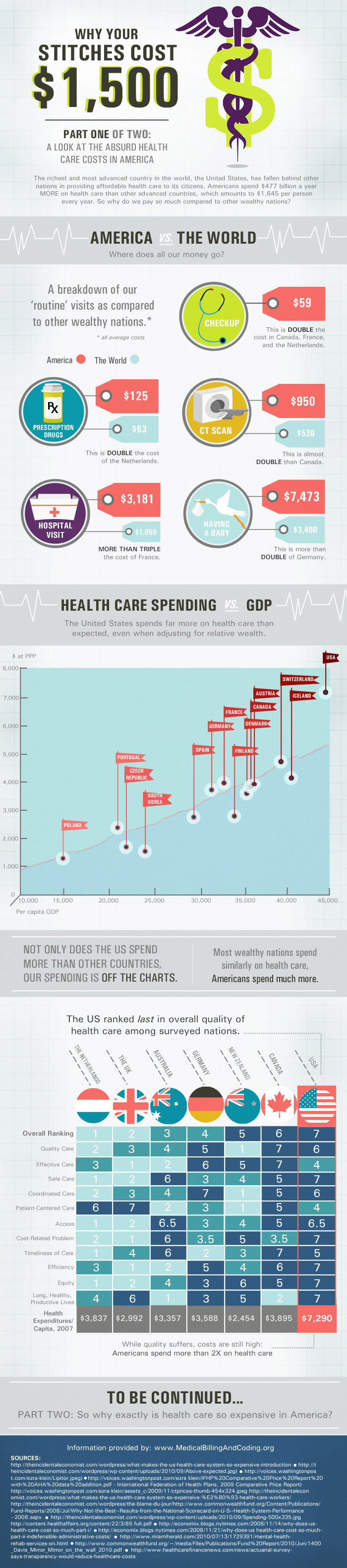
The United State has fallen behind other nations, failing to provide affordable health care to its citizens. Americans spend $477 billion a year MORE on health care than other advanced countries.

So why do we pay so much compared to other wealthy nations?

Part 1 of 2 in a Series

This Infographic is part one in a two part series which dissects the state of our health care system and presents some alarming numbers.

Link: http://www.medicalbillingandcoding.org/medical-costs-1/

Part 2: https://medicalexecutivepost.com/?p=30972&preview=true

Conclusion

And so, your thoughts and comments on this ME-P are appreciated. Feel free to review our top-left column, and top-right sidebar materials, links, URLs and related websites, too. Then, subscribe to the ME-P. It is fast, free and secure.

Link: http://feeds.feedburner.com/HealthcareFinancialsthePostForcxos

Speaker: If you need a moderator or speaker for an upcoming event, Dr. David E. Marcinko; MBA – Publisher-in-Chief of the Medical Executive-Post – is available for seminar or speaking engagements. Contact: MarcinkoAdvisors@msn.com

Health Dictionary Series: http://www.springerpub.com/Search/marcinko

Practice Management: http://www.springerpub.com/product/9780826105752

Physician Financial Planning: http://www.jbpub.com/catalog/0763745790

Medical Risk Management: http://www.jbpub.com/catalog/9780763733421

Healthcare Organizations: www.HealthcareFinancials.com

Physician Advisors: www.CertifiedMedicalPlanner.com

Subscribe Now: Did you like this Medical Executive-Post, or find it helpful, interesting and informative? Want to get the latest ME-Ps delivered to your email box each morning? Just subscribe using the link below. You can unsubscribe at any time. Security is assured.

Link: http://feeds.feedburner.com/HealthcareFinancialsthePostForcxos

Sponsors WelcomedAnd, credible sponsors and like-minded advertisers are always welcomed.

Link: https://healthcarefinancials.wordpress.com/2007/11/11/advertise

Product DetailsProduct DetailsProduct Details       

Product Details  Product Details

   Product Details 

Are Doctors Switching Financial Advisors?

A Survey Poll

Join Our Mailing List

Doctor, have you considered switching your financial advisor due to higher fees or poor portfolio performance since the “flash-crash” of 2008? Please vote and opine.

VOTE:

Conclusion

And so, your thoughts and comments on this ME-P are appreciated. Feel free to review our top-left column, and top-right sidebar materials, links, URLs and related websites, too. Then, subscribe to the ME-P. It is fast, free and secure.

Link: http://feeds.feedburner.com/HealthcareFinancialsthePostForcxos

Speaker: If you need a moderator or speaker for an upcoming event, Dr. David E. Marcinko; MBA – Publisher-in-Chief of the Medical Executive-Post – is available for seminar or speaking engagements. Contact: MarcinkoAdvisors@msn.com

Our Print Books and Related Information Sources:

Health Dictionary Series: http://www.springerpub.com/Search/marcinko

Practice Management: http://www.springerpub.com/product/9780826105752

Physician Financial Planning: http://www.jbpub.com/catalog/0763745790

Medical Risk Management: http://www.jbpub.com/catalog/9780763733421

Healthcare Organizations: www.HealthcareFinancials.com

Physician Advisors: www.CertifiedMedicalPlanner.com

Subscribe Now: Did you like this Medical Executive-Post, or find it helpful, interesting and informative? Want to get the latest ME-Ps delivered to your email box each morning? Just subscribe using the link below. You can unsubscribe at any time. Security is assured.

Link: http://feeds.feedburner.com/HealthcareFinancialsthePostForcxos

Sponsors Welcomed: And, credible sponsors and like-minded advertisers are always welcomed.

Link: https://healthcarefinancials.wordpress.com/2007/11/11/advertise

Product Details  Product Details

Guide to Biostatistics

Clinical Tools

Join Our Mailing List

Here is a white paper of important epidemiological concepts and common bio-statistical terms to help doctors and related professionals translate medical research into everyday practice.

Link: http://www.medpagetoday.com/Medpage-Guide-to-Biostatistics.pdf

Conclusion

And so, your thoughts and comments on this ME-P are appreciated. Feel free to review our top-left column, and top-right sidebar materials, links, URLs and related websites, too. Then, subscribe to the ME-P. It is fast, free and secure.

Link: http://feeds.feedburner.com/HealthcareFinancialsthePostForcxos

Our Print Books and Related Information Sources:

Health Dictionary Series: http://www.springerpub.com/Search/marcinko

Practice Management: http://www.springerpub.com/product/9780826105752

Physician Financial Planning: http://www.jbpub.com/catalog/0763745790

Medical Risk Management: http://www.jbpub.com/catalog/9780763733421

Healthcare Organizations: www.HealthcareFinancials.com

Physician Advisors: www.CertifiedMedicalPlanner.com

Subscribe Now: Did you like this Medical Executive-Post, or find it helpful, interesting and informative? Want to get the latest ME-Ps delivered to your email box each morning? Just subscribe using the link below. You can unsubscribe at any time. Security is assured.

Link: http://feeds.feedburner.com/HealthcareFinancialsthePostForcxos

Sponsors Welcomed: And, credible sponsors and like-minded advertisers are always welcomed.

Link: https://healthcarefinancials.wordpress.com/2007/11/11/advertise

Introducing Carol S. Miller BSN MBA

Our Newest Thought-Leader

By Ann Miller RN MHA

[Executive-Director]

Carol S. Miller BSN, MBA, PMP has an extensive healthcare background in operations, business development and capture in both the public and private sector. Over the last 10 years she has provided management support to projects in the Department of Health and Human Services, Veterans Affairs, and Department of Defense medical programs.

Resume

In most recent years, Carol has served as Vice President and Senior Account Executive for NCI Information Systems, Inc., Assistant Vice President at SAIC, and Program Manager at MITRE. She has led the successful capture of large IDIQ/GWAC programs, managed the operations of multiple government contracts, interacted with many government key executives, and increased the new account portfolios for each firm she supported. She is a HIMSS Fellow, Past President and current Board member and an ACT/IAC Fellow.

Education

Carol earned her MBA from Marymount University; BS in Business from Saint Joseph’s College, and BS in Nursing from the University of Pittsburgh. She is a Certified PMI Project Management Professional (PMP) (PMI PMP) and a Certified HIPAA Professional (CHP), with Top Secret Security clearance issued by the DoD in 2006.

Assessment

Carol can be reached at 703.407.4704 or carol.miller@macksonconsulting.com

Our Print Books and Related Information Sources:

Health Dictionary Series: http://www.springerpub.com/Search/marcinko

Practice Management: http://www.springerpub.com/product/9780826105752

Physician Financial Planning: http://www.jbpub.com/catalog/0763745790

Medical Risk Management: http://www.jbpub.com/catalog/9780763733421

Healthcare Organizations: www.HealthcareFinancials.com

Physician Advisors: www.CertifiedMedicalPlanner.com

Subscribe Now: Did you like this Medical Executive-Post, or find it helpful, interesting and informative? Want to get the latest ME-Ps delivered to your email box each morning? Just subscribe using the link below. You can unsubscribe at any time. Security is assured.

Link: http://feeds.feedburner.com/HealthcareFinancialsthePostForcxos

Sponsors Welcomed: And, credible sponsors and like-minded advertisers are always welcomed.

Link: https://healthcarefinancials.wordpress.com/2007/11/11/advertise

Product DetailsProduct DetailsProduct Details       

Are Doctors Throwing in the Towel?

Doctors versus Insurers

By Staff Reporters

Despite the success of entrepreneurial doctors – the number of doctors who enter private practice are in decline.

The Survey

For example, according to a survey by the “Physicians Foundation”, 89% of respondents believe the traditional model of independent private practice “is a dinosaur soon to go extinct.”

Survey: http://www.physiciansfoundations.org/uploadedFiles/Health%20Reform%20and%20the%20Decline%20of%20Physician%20Private%20Practice.pdf

Pod Cast: http://healthystate.org/archives/5764

Assessment

So we ask; what do you think?

Are physicians “throwing in the towel” and leaving private medical practice?  

Conclusion

Your thoughts and comments on this ME-P are appreciated. Our goal is to prevent same. Feel free to review our top-left column, and top-right sidebar materials, links, URLs and related websites, too. Then, subscribe to the ME-P. It is fast, free and secure.

Link: http://feeds.feedburner.com/HealthcareFinancialsthePostForcxos

Speaker: If you need a moderator or speaker for an upcoming event, Dr. David E. Marcinko; MBA – Publisher-in-Chief of the Medical Executive-Post – is available for seminar or speaking engagements. Contact: MarcinkoAdvisors@msn.com

Our Other Print Books and Related Information Sources:

Health Dictionary Series: http://www.springerpub.com/Search/marcinko

Practice Management: http://www.springerpub.com/product/9780826105752

Physician Financial Planning: http://www.jbpub.com/catalog/0763745790

Medical Risk Management: http://www.jbpub.com/catalog/9780763733421

Healthcare Organizations: www.HealthcareFinancials.com

Physician Advisors: www.CertifiedMedicalPlanner.com

Subscribe Now: Did you like this Medical Executive-Post, or find it helpful, interesting and informative? Want to get the latest ME-Ps delivered to your email box each morning? Just subscribe using the link below. You can unsubscribe at any time. Security is assured.

Link: http://feeds.feedburner.com/HealthcareFinancialsthePostForcxos

Sponsors Welcomed: And, credible sponsors and like-minded advertisers are always welcomed.

Link: https://healthcarefinancials.wordpress.com/2007/11/11/advertise

Product DetailsProduct DetailsProduct Details       

Product Details  Product Details

   Product Details

Update On Medical Smartphone Apps

Offering a Window Of Opportunity For M-Health Service Providers

By Markus Pohl

Join Our Mailing List

The potential revenue that could be made in the mobile healthcare app market is just a fraction of the total integrated healthcare market. Service providers within the healthcare market have a window of opportunity with the possibilities that the mobile apps market offers right now.

The benefits of integrated electronic and mobile healthcare solutions are evident. At the moment there is a lot of potential for companies to scale up their services and learn how to adapt to the changing market. But they have to act quickly to seize the moment. In the last few years those solutions either remained as isolated pilots or struggled with all kinds of barriers from healthcare stakeholders, with only a few exceptions.

Integrated Solutions 

As it is not clear when integrated solutions will become widely accepted around the globe, more and more e-health and m-health service provides are rethinking their strategy. They are turning away from complex and integrated solutions that need acceptance of all national healthcare stakeholders to more simple patient centric services.

m-Health Services Rising

This rethinking process goes hand in hand with the rise of the smartphone app market. In the next 5 years the smartphone app market will help the mobile healthcare industry to reach a new level. mHealth apps will be widely used and will demonstrate the technological possibilities of smartphones. Technology, educated patients/doctors and proof of cost savings for health insurance providers will eventually allow companies to make money with mhealth apps.

Before the smartphone app market brought new life to the mobile healthcare market, mHealth service providers struggled to scale up their solutions. Most of them never made it out of the trial stage. Some of them were just too basic, such as simple pill reminders running on SMS as the primary delivery technology. More complex solutions that were based on eHealth initiatives integrated the features of a mobile device with a database (electronic health records), but failed mainly because of political barriers and low awareness amongst patients.

Assessment 

For more information on the smartphone based mHealth market and its business opportunities for healthcare provides please see our latest report on the mHealth market: “Mobile Health Market Report 2010-2015”.

Contact:

research2guidance

+49 30 609 893 363

markus.pohl@research2guidance.com

Conclusion

Your thoughts and comments on this ME-P are appreciated. Feel free to review our top-left column, and top-right sidebar materials, links, URLs and related websites, too. Then, subscribe to the ME-P. It is fast, free and secure.

Link: http://feeds.feedburner.com/HealthcareFinancialsthePostForcxos

Speaker: If you need a moderator or speaker for an upcoming event, Dr. David E. Marcinko; MBA – Publisher-in-Chief of the Medical Executive-Post – is available for seminar or speaking engagements. Contact: MarcinkoAdvisors@msn.com

OUR OTHER PRINT BOOKS AND RELATED INFORMATION SOURCES:

DICTIONARIES: http://www.springerpub.com/Search/marcinko
PHYSICIANS: www.MedicalBusinessAdvisors.com
PRACTICES: www.BusinessofMedicalPractice.com
HOSPITALS: http://www.crcpress.com/product/isbn/9781466558731
CLINICS: http://www.crcpress.com/product/isbn/9781439879900
BLOG: www.MedicalExecutivePost.com
FINANCE: Financial Planning for Physicians and Advisors
INSURANCE: Risk Management and Insurance Strategies for Physicians and Advisors

Product Details 

On the US Tax Code Complexity

Recent Ways and Means Committee Meeting

By Children’s Home Society of Florida Foundation

Join Our Mailing List

At an April 13th 2011 hearing on the tax code before the Ways and Means Committee, witnesses noted that there is a general consensus on the complexity of the tax code.

Enter Albert Einstein

One witness quoted Albert Einstein, recipient of 1921 Nobel Prize in Physics. While he was the world expert on the Theory of Relativity, Dr. Einstein also commented that “the hardest thing in the world is to understand the income tax.”

At the hearing, Chairman Dave Camp (R-MI) noted there are “nearly 4,500 changes in the last decade – 579 of them in 2010 alone – the code is too complex.” Other representatives and witnesses agreed that the sheer size and complexity of the Internal Revenue Code make compliance very challenging.

Enter the AICPA

Annette Nellen represented the American Institute of Certified Public Accountants in the hearing. She indicated that there are five specific steps that could be taken to substantially reduce the complexity and cost of complying with the code. These include the following actions.

1. Higher Education Deductions and Credits – Reduce the Hope Credit, American Opportunity Credit, Lifetime Learning Credit, the tuition and fees deduction and other benefits into one simple credit.

2. Education Phase Out – Create one definition for qualified education expenses and eliminate the multiple phase outs under the current system.

3. Kiddie Tax – For children with unearned income under age 18 or students under age 24, simplify the current method where they pay tax at their parents’ rate.

4. Mileage Rates – Create the same mileage rate for business purposes, medical purposes and qualified charitable travel.

5. Alternative Minimum Tax – Repeal the tax because it is too complicated to modify.

Enter the Financial Planner

Financial Planner Mark Johannessen is a CFP™ and Managing Director of a McLean, Virginia financial firm. He was President of the Financial Planning Association in 2008 and suggested that there are a number of Internal Revenue Code issues that make financial planning difficult.

First, there are temporary provisions. For example, the 2011 tax rate on dividends is 15%, but the scheduled tax rate on dividends in 2013 is 43.4%. While it’s possible that Congress could change the law between now and 2013, it makes investment planning very difficult.

Second, many changes are temporary and Congress tends to act very late in the year. Congress passed the IRA Charitable Rollover for 2010 on December 17. By that date, most individuals had already taken their required minimum distribution. Johannessen indicated that the late date “negatively impacted both the individuals’ planned charitable giving” and also the charities who received fewer gifts.

Third, the uncertainty in estate tax law continues to make planning quite difficult. While the current exemption is $5 million and there now is portability for couples, the current law only applies for 2011 and 2012. To do good planning, it is essential to know what the law will be in future years.

Assessment

Conclusion

And so, your thoughts and comments on this ME-P are appreciated. Feel free to review our top-left column, and top-right sidebar materials, links, URLs and related websites, too. Then, subscribe to the ME-P. It is fast, free and secure.

Link: http://feeds.feedburner.com/HealthcareFinancialsthePostForcxos

Speaker: If you need a moderator or speaker for an upcoming event, Dr. David E. Marcinko; MBA – Publisher-in-Chief of the Medical Executive-Post – is available for seminar or speaking engagements. Contact: MarcinkoAdvisors@msn.com

Our Other Print Books and Related Information Sources:

Health Dictionary Series: http://www.springerpub.com/Search/marcinko

Practice Management: http://www.springerpub.com/product/9780826105752

Physician Financial Planning: http://www.jbpub.com/catalog/0763745790

Medical Risk Management: http://www.jbpub.com/catalog/9780763733421

Healthcare Organizations: www.HealthcareFinancials.com

Physician Advisors: www.CertifiedMedicalPlanner.com

Subscribe Now: Did you like this Medical Executive-Post, or find it helpful, interesting and informative? Want to get the latest ME-Ps delivered to your email box each morning? Just subscribe using the link below. You can unsubscribe at any time. Security is assured.

Link: http://feeds.feedburner.com/HealthcareFinancialsthePostForcxos

Sponsors Welcomed: And, credible sponsors and like-minded advertisers are always welcomed.

Link: https://healthcarefinancials.wordpress.com/2007/11/11/advertise

Product DetailsProduct DetailsProduct Details       

Product Details  Product Details

DNR versus [P]MOLST

Of Differences and Distinctions

By Dr. David Edward Marcinko MBA

By Hope Rachel Hetico RN MHA

DNR Definition

A Do Not Resuscitate Order (DNR) is a refusal of cardiopulmonary resuscitation in the event of cardiac or pulmonary arrest.  A DNR, which is signed by a physician upon your consent, applies only if you are in a hospital or nursing home. If you are in your residence, a hospice, a clinic, or anywhere else and do not wish to be resuscitated, you must have a “Non-Hospital” DNR signed by your physician.

Sample form: http://www.ochealthinfo.com/docs/forms/ems_dnr_form.pdf

P-MOLST Definition

A P-MOLST (Physician – Medical Orders for Life-Sustaining Treatment) can be used to document your wishes concerning various forms of life-sustaining medical treatment, including DNR, endotracheal intubation and mechanical ventilation, artificial nutrition and hydration, future hospitalization, antibiotics, and other instructions. It is designed to improve the quality of end of life care for those with serious health conditions or those who wish to define their care wishes when facing the end of life. The form must be completed by both you and your physician. It is intended to apply immediately, and not upon a trigger of future incapacity. The form may be completed in stages as a medical condition deteriorates.

Sample form: http://www.compassionandsupport.org/pdfs/professionals/molst/DOH-5003_06.10_.FINAL__.pdf

Assessment 

Subsequent to the publication of the Institute of Medicine Report “Approaching Death: Improving Care at the End-of-Life”, the Rochester Individual Practice Association and BlueCross BlueShield Rochester Region End-of-Life/Palliative Care Professional Advisory Committee was formed to address these and related issues.

Link: http://www.compassionandsupport.org/index.php/about_us

Conclusion

Your thoughts and comments on this ME-P are appreciated. Feel free to review our top-left column, and top-right sidebar materials, links, URLs and related websites, too. Then, subscribe to the ME-P. It is fast, free and secure.

Link: http://feeds.feedburner.com/HealthcareFinancialsthePostForcxos

Speaker: If you need a moderator or speaker for an upcoming event, Dr. David E. Marcinko; MBA – Publisher-in-Chief of the Medical Executive-Post – is available for seminar or speaking engagements. Contact: MarcinkoAdvisors@msn.com

OUR OTHER PRINT BOOKS AND RELATED INFORMATION SOURCES:

Product DetailsProduct DetailsProduct Details

Seeking Medical Director [HRMC]

Heartland Regional Medical Center

By Deedra Hartung

CLASSIFIED ADVERTISEMENT

Join Our Mailing List

Dear Dr. Marcinko,

Cejka Executive Search has been exclusively retained by Heartland Health, a physician-led, integrated health care system in St. Joseph, Missouri, to recruit a physician leader who will serve as Medical Director of Heartland Regional Medical Center (HRMC).

About HRMC

HRMC is a 491-bed medical center comprised of a 250-member medical staff, including 125 employed physicians, and is a 2009 Malcolm Baldrige National Quality award winner. Heartland Health is rapidly moving towards becoming an Accountable Care Organization and will likely be a Medicare ACO Pilot Site. Heartland Health includes a large physician clinic, foundation, health plan and other ventures and affiliations.

Responsibilities

In collaboration with the Administrator of HRMC, the Medical Director will be responsible for providing clinical and operational oversight, communicating the vision of the medical center, building partnerships with key stakeholders and advocating quality and safety measures within clinical and ancillary departments. Additionally, the Medical Director will serve as a mentor and coach to the medical staff and the leadership team. The Medical Director position is ideal for a physician leader wanting additional operational experience in preparation for a future in a position as a CEO.

Qualifications

Candidates must be board certified, eligible for a Missouri license and possess a minimum of ten years clinical experience.  An MBA or MHA is highly preferred. Ideal candidates will have experience with peer review, credentialing, population health, clinical research and the development of a residency program.

View Additional Details

Qualified candidates may submit their CV’s or contact:
Deedra Hartung
Executive Vice President, Managing Principal
Cejka Executive Search
800-209-8143, Extension 63518
Email: jkliethermes@cejkasearch.com

www.cejkaexecutivesearch.com

Understanding the Referral Relationship in Medicine

Cultivating a Steady Stream of Patients

By Dr. David Edward Marcinko MBA

[Publisher-in-Chief]

Developing and cultivating a steady stream of referrals involves good planning, an investment of time and energy in the referral relationship, and a keen understanding of referring physicians’ needs and priorities.

According to consultant Carolyn Merriman, enhancing the referral relationship is a step-by-step process, not unlike the clinical process, that begins by identifying target physicians and their needs, prioritizing the list of referral contacts and then determining the best way to reach them.

Link: www.BusinessofMedicalPractice.com

Make it a Win-Win Relationship

For example, a physician may routinely refer patients to a particular specialist because he or she has an out­standing reputation for medical expertise and competence, is more accessible than comparable practitioners or has a convenient location for the referring physician’s patients. The physician may have a relationship with the specialist because of marketing by a local hospital or the specialist’s own practice. And, in some cases the two physicians have a social relationship.

There are many ways to create and maintain these relationships. Physicians should choose the approach that works best for them, put together a plan and stay consistent. Look for ways to make the relationship a win-win for both practices or for the referring hospital or outpatient facility.

Link: Front Matter BoMP – 3

The SHSMD

If you are not comfortable with developing referral relationships for your practice, seek out partners, office staff or hospital partners who can appropriately assist, train or support you in this effort. Many hospitals have staff focused on physician sales and service.

The Society for Healthcare Strategy and Market Development (SHSMD) recently reported that 41% of hospitals had dedicated sales staff support, with more than half of those using their sales staff to support cardiology and radiology.

Assessment

Often, hospitals are seeking physician speakers for community seminars, wellness programs and other outreach efforts. Ask about participating in these venues. Offer to write articles for newsletters, the Web site or local media outlets. All of these expose the physician and the practice to referral sources as well as the public.

Conclusion

Your thoughts and comments on this ME-P are appreciated. Feel free to review our top-left column, and top-right sidebar materials, links, URLs and related websites, too. Then, subscribe to the ME-P. It is fast, free and secure.

Speaker: If you need a moderator or speaker for an upcoming event, Dr. David E. Marcinko; MBA – Publisher-in-Chief of the Medical Executive-Post – is available for seminar or speaking engagements. Contact: MarcinkoAdvisors@msn.com

OUR OTHER PRINT BOOKS AND RELATED INFORMATION SOURCES:


Ref: “By the Numbers, 2008.”  Society for Healthcare Strategy and Market Development of the American Hospital Association.

Product Details 

Vows of Change at Moody’s

But, the Flaws Remain the Same

By Jesse Eisinger ProPublica | @eisingerj 

Join Our Mailing List

In the aftermath of the financial crisis, nobody has gone to prison and there haven’t been any serious structural changes in the financial system. But at least everyone involved feels bad about it and has vowed to change, right? For Moody’s Investors Service, those pledges are empty, Bill Harrington says.

In this column, co-published with New York Times’ DealBook, I monitor the financial markets to hold companies, executives and government officials accountable for their actions.

A Window to the Debacle

Mr. Harrington was an analyst in the structured finance group at Moody’s for more than a decade, much of it spent rating collateralized debt obligations. He worked at Moody’s until the middle of last year, although he left the C.D.O. group in 2006. In his job, he had a window on the biggest debacle in the history of credit ratings. Companies like his allowed banks to pass off hundreds of billions worth of paper onto investors by waving their magic wands and deeming the securities investment-worthy.

Since then, the government has tried to change the ratings agencies. The Dodd-Frank financial reform law has some bold measures, like making the ratings firms liable for their judgments. Unfortunately, the rules are in danger of not being enforced because of budget constraints and resistance from the agencies.

But the biggest problems at Moody’s may have been cultural. The dominant ethos during the boom, instilled by Brian M. Clarkson, the former president and chief operating officer [1], was that customer service was Job 1. And the customers were the bankers.

Banker Customers

The ability for bankers to run the show has long been an obvious flaw in the ratings system for structured products. Investment banks create the securities and benefit when they receive generous ratings. Banks pay the agencies that supply the ratings. Yet the agencies are somehow supposed to hold the line with the people who are responsible for their paychecks.

To Moody’s credit, Mr. Clarkson is now gone. To Moody’s discredit, however, his philosophy is largely still in place, at least according to Mr. Harrington.

To the last day Mr. Harrington was there, he says, bankers remained hard-charging and aggressive advocates for their deals, sometimes to the point of abusing the analysts.

Wall Street ain’t beanbag, so that’s not surprising. The troubling aspect is that the Moody’s bosses acted like disinterested brokers between two sides in disputes with analysts, instead of standing up for the analysts and defending their independence. “That was the standard operating procedure that got worse and worse. We didn’t get the benefit of the doubt,” Mr. Harrington said.

When I asked Moody’s about Mr. Harrington’s experiences, a spokesman wrote in an e-mail: “We take strong exception to your characterization of Moody’s culture. We have always had an unwavering culture of integrity, analytical independence and objectivity and that culture has only grown stronger since the financial crisis.” He pointed to numerous efforts at Moody’s to improve the ratings process and to bolster Moody’s procedures.

In the spring of 2009, Mr. Harrington was working on a deal and a banker was persistently calling him. He returned the first call, but had other work that day and didn’t return the next two calls right away. “I thought caller ID served a purpose,” he said wryly.

Soon after, his boss alerted him to a call he’d received from Michael Kanef, the head of compliance. Mr. Kanef wanted to know why Mr. Harrington hadn’t returned the banker’s call. Mr. Harrington was shocked. Why was the head of compliance getting involved? But he got the apparent message: Analysts are to lean over backward for the bankers. That had been Mr. Clarkson’s philosophy, and now it was his successors’.

“The culture persists — and it’s being enforced by compliance department,” Mr. Harrington said.

So who is Mr. Kanef? Before he was the head of regulatory affairs and compliance, he was in charge of ratings on residential mortgage-backed securities [2]. Did such an executive deserve a promotion?

And then there is Raymond W. McDaniel, the chief executive throughout the housing boom, the bust and the entire financial crisis. He remains at the helm. And he had to swallow the bitter pill of more than $9 million in compensation last year. Indeed, most of Moody’s top management has been in place through the crisis.

Moody’s didn’t make Mr. Kanef or Mr. McDaniel available for comment.

The Blame Game

So if Moody’s doesn’t think the executives who ran the company were responsible for its collapse in reputation and contribution to the multitrillion-dollar financial crisis, who do they think is to blame? The analysts, Mr. Harrington says. The hard-working, low-level minions with little decision-making power.

Mr. McDaniel has conceded that sometimes “we drink the Kool-Aid.”

But that hardly makes the analysts to blame.

“If some analysts drank the Kool-Aid, it was only because management mixed and stirred it up and threatened that analysts wouldn’t get to heaven on the spaceship unless he or she drank it,” Mr. Harrington said.

Moody’s has recognized it has a disaster on its hands — a public relations disaster. Clients — the investors who use ratings — have been losing faith in the agencies. Mr. Harrington said that Moody’s executives marched analysts into meetings to explain how they were going to tell their clients about how much Moody’s had grown and learned from its mistakes. It was as if they were in “Communist re-education camp,” he said.

At one of these meetings, an analyst asked if they could be given training in how to deal with banker abuse, Mr. Harrington recalls. The suggestion was immediately shot down by the executive running the meeting.

Moody’s says that its retraining efforts are part of its continuing efforts to reach out to investors to improve its ratings.

Assessment

When Moody’s executives make public presentations, as when Mr. McDaniel testified [3] in front of the Financial Crisis Inquiry Commission, the overarching theme is that the agency’s problem was limited to the housing-related structured finance. Few people saw how fast and deep the housing market would crash. How could the ratings agencies?

A few weeks ago, Alan Greenspan penned an instantly notorious line: “With notably rare exceptions,” [4] he wrote, unfettered financial markets have worked well. Moody’s persists in believing that with notably rare exceptions, so too have credit ratings.

Full Article: http://www.propublica.org/thetrade/item/vows-of-change-at-moodys-but-the-flaws-remain-the-same/

Conclusion

And so, your thoughts and comments on this ME-P are appreciated. Feel free to review our top-left column, and top-right sidebar materials, links, URLs and related websites, too. Then, subscribe to the ME-P. It is fast, free and secure.

Link: http://feeds.feedburner.com/HealthcareFinancialsthePostForcxos

Speaker: If you need a moderator or speaker for an upcoming event, Dr. David E. Marcinko; MBA – Publisher-in-Chief of the Medical Executive-Post – is available for seminar or speaking engagements. Contact: MarcinkoAdvisors@msn.com

Our Other Print Books and Related Information Sources:

Health Dictionary Series: http://www.springerpub.com/Search/marcinko

Practice Management: http://www.springerpub.com/product/9780826105752

Physician Financial Planning: http://www.jbpub.com/catalog/0763745790

Medical Risk Management: http://www.jbpub.com/catalog/9780763733421

Healthcare Organizations: www.HealthcareFinancials.com

Physician Advisors: www.CertifiedMedicalPlanner.com

Subscribe Now: Did you like this Medical Executive-Post, or find it helpful, interesting and informative? Want to get the latest ME-Ps delivered to your email box each morning? Just subscribe using the link below. You can unsubscribe at any time. Security is assured.

Link: http://feeds.feedburner.com/HealthcareFinancialsthePostForcxos

Sponsors Welcomed: And, credible sponsors and like-minded advertisers are always welcomed.

Link: https://healthcarefinancials.wordpress.com/2007/11/11/advertise

Product DetailsProduct DetailsProduct Details       

Product Details  Product Details

Launching Partnership for Patients

Better Care, Lower Costs

By Staff Reporters

Join Our Mailing List

Doctors, nurses and other health care providers in America work incredibly hard to deliver the best care possible to their patients.  Unfortunately, an alarming number of patients are harmed by medical mistakes in the health care system and far too many die prematurely as a result.

Just Launched

The Obama Administration has just launched the Partnership for Patients: Better Care, Lower Costs, a new public-private partnership that will help improve the quality, safety, and affordability of health care for all Americans.  The Partnership for Patients brings together leaders of major hospitals, employers, physicians, nurses, and patient advocates along with state and federal governments in a shared effort to make hospital care safer, more reliable, and less costly.

Partnership Goals  

The two goals of this new partnership are to:

  • Keep patients from getting injured or sicker. By the end of 2013, preventable hospital-acquired conditions would decrease by 40% compared to 2010.  Achieving this goal would mean approximately 1.8 million fewer injuries to patients with more than 60,000 lives saved over three years.
  • Help patients heal without complication. By the end of 2013, preventable complications during a transition from one care setting to another would be decreased so that all hospital readmissions would be reduced by 20% compared to 2010.  Achieving this goal would mean more than 1.6 million patients would recover from illness without suffering a preventable complication requiring re-hospitalization within 30 days of discharge.   

Toward a More Sustainable Health Care System

Achieving these goals will save lives and prevent injuries to millions of Americans, and has the potential to save up to $35 billion dollars across the health care system, including up to $10 billion in Medicare savings, over the next three years.  Over the next ten years, it could reduce costs to Medicare by about $50 billion and result in billions more in Medicaid savings.  This will help put our nation on the path toward a more sustainable health care system.

Institute of Medicine

In 1999, the landmark Institute of Medicine study, “To Err is Human,” estimated that as many as 98,000 Americans die every year from preventable medical errors. Despite many successful efforts, this statistic has not improved much in the following decade.  And many more patients get injured or sicker from preventable adverse events after being admitted to a hospital.  After more than a decade of work to understand and address these problems, promising examples of better practices exist, but patients too often are still injured in the course of receiving care.  At any given time, about one in every 20 patients have an infection related to their hospital care.

  • On average, one in seven Medicare beneficiaries is harmed in the course of their care, costing the government an estimated $4.4 billion every year.
  • Nearly one in five Medicare patients discharged from the hospital is readmitted within 30 days – that’s approximately 2.6 million seniors at a cost of over $26 billion every year.

Assessment

There is much more work to be done to prevent unnecessary harm to patients.

Link:  http://www.healthcare.gov/center/programs/partnership/about/index.html

Conclusion

And so, your thoughts and comments on this ME-P are appreciated. Will this initiative be a success or another governmental boondoggle? Feel free to review our top-left column, and top-right sidebar materials, links, URLs and related websites, too. Then, subscribe to the ME-P. It is fast, free and secure.

Link: http://feeds.feedburner.com/HealthcareFinancialsthePostForcxos

Speaker: If you need a moderator or speaker for an upcoming event, Dr. David E. Marcinko; MBA – Publisher-in-Chief of the Medical Executive-Post – is available for seminar or speaking engagements. Contact: MarcinkoAdvisors@msn.com

Our Other Print Books and Related Information Sources:

Health Dictionary Series: http://www.springerpub.com/Search/marcinko

Practice Management: http://www.springerpub.com/product/9780826105752

Physician Financial Planning: http://www.jbpub.com/catalog/0763745790

Medical Risk Management: http://www.jbpub.com/catalog/9780763733421

Healthcare Organizations: www.HealthcareFinancials.com

Physician Advisors: www.CertifiedMedicalPlanner.com

Subscribe Now: Did you like this Medical Executive-Post, or find it helpful, interesting and informative? Want to get the latest ME-Ps delivered to your email box each morning? Just subscribe using the link below. You can unsubscribe at any time. Security is assured.

Link: http://feeds.feedburner.com/HealthcareFinancialsthePostForcxos

Sponsors Welcomed: And, credible sponsors and like-minded advertisers are always welcomed.

Link: https://healthcarefinancials.wordpress.com/2007/11/11/advertise

Product Details 

Budget Committee Proposes 25% Tax Rate

The Ryan Plan for FY 2012

By Children’s Home Society of Florida Foundation

Join Our Mailing List

On April 5th House Budget Committee Chair Paul Ryan (R-WI) presented his budget proposal for Fiscal Year 2012. The comprehensive proposal included over $4 trillion in reduced spending during the next decade and a plan to reduce both the personal and corporate top tax rates to 25%.

House Ways and Means Committee

The tax reform provisions will be handled by the House Ways and Means Committee. Chairman Dave Camp (R-MI) noted that, “with nearly 4,500 changes in the last decade alone, the code is too complex. And with Americans spending over 6 billion hours and over $160 billion annually to comply with the code, it is too costly and too burdensome. Clearly, the time for comprehensive reform has come.”

Many Loopholes

Both parties have raised the possibility of tax reform this year. At a meeting in Pennsylvania, President Obama was asked about the potential for reforming corporate taxes. He noted that the U.S. has “one of the highest tax codes for corporations in the world.”

However, due to “many loopholes” a number of U.S. corporations pay little or no taxes. Moreover, President Obama suggests that it would be good “to reform our tax code, simplify it, lower the rate for corporations, but eliminate a bunch of the loopholes.”

Assessment

Treasury Secretary Timothy Geithner also indicated to the Senate Committee on Appropriations that he is developing a “comprehensive corporate tax reform plan” and it will be released quite soon. Sec. Geithner indicated his plan would include, “a very strong pro-investment, pro-growth, pro-competitiveness proposal.”

Conclusion

And so, your thoughts and comments on this ME-P are appreciated. Feel free to review our top-left column, and top-right sidebar materials, links, URLs and related websites, too. Then, subscribe to the ME-P. It is fast, free and secure.

Link: http://feeds.feedburner.com/HealthcareFinancialsthePostForcxos

Speaker: If you need a moderator or speaker for an upcoming event, Dr. David E. Marcinko; MBA – Publisher-in-Chief of the Medical Executive-Post – is available for seminar or speaking engagements. Contact: MarcinkoAdvisors@msn.com

Our Other Print Books and Related Information Sources:

Health Dictionary Series: http://www.springerpub.com/Search/marcinko

Practice Management: http://www.springerpub.com/product/9780826105752

Physician Financial Planning: http://www.jbpub.com/catalog/0763745790

Medical Risk Management: http://www.jbpub.com/catalog/9780763733421

Healthcare Organizations: www.HealthcareFinancials.com

Physician Advisors: www.CertifiedMedicalPlanner.com

Subscribe Now: Did you like this Medical Executive-Post, or find it helpful, interesting and informative? Want to get the latest ME-Ps delivered to your email box each morning? Just subscribe using the link below. You can unsubscribe at any time. Security is assured.

Link: http://feeds.feedburner.com/HealthcareFinancialsthePostForcxos

Sponsors Welcomed: And, credible sponsors and like-minded advertisers are always welcomed.

Link: https://healthcarefinancials.wordpress.com/2007/11/11/advertise

Product DetailsProduct DetailsProduct Details       

Product Details  Product Details

On the Anniversary of the Affordable Care Act [A Video]

An Audio-Video Review One Year Later

By Staff Reporters

Join Our Mailing List

Reforms under the Affordable Care Act have brought an end to some of the worst abuses of the insurance industry. These reforms have given Americans new rights and benefits, by helping more children get health coverage, ending lifetime and most annual limits on care, allowing young adults under 26 to stay on their parent’s health insurance, and giving patients access to recommended preventive services without cost.

Link: http://www.healthcare.gov/?gclid=CO72rYyUkKgCFeM85QoddjY3yg

Other Benefits

Many other new benefits of the law have taken effect, including 50% discounts on brand-name drugs for seniors in the Medicare “donut hole,” and tax credits for small businesses that provide insurance to employees. More rights, protections and benefits for Americans are on the way through 2014.

Assessment

See major parts of the law on this interactive timeline, or read the Patient’s Bill of Rights.

And, find out how the Patient Protection and Affordable Care Act [ACA]  provides better benefits and better health.

Video Link: http://www.healthcare.gov/law/introduction/index.html

Conclusion

And so, your thoughts and comments on this ME-P are appreciated. Is this post a shill for Obama-Care and the Federal Government? Feel free to review our top-left column, and top-right sidebar materials, links, URLs and related websites, too. Then, subscribe to the ME-P. It is fast, free and secure.

Link: http://feeds.feedburner.com/HealthcareFinancialsthePostForcxos

Speaker: If you need a moderator or speaker for an upcoming event, Dr. David E. Marcinko; MBA – Publisher-in-Chief of the Medical Executive-Post – is available for seminar or speaking engagements. Contact: MarcinkoAdvisors@msn.com

Our Other Print Books and Related Information Sources:

Health Dictionary Series: http://www.springerpub.com/Search/marcinko

Practice Management: http://www.springerpub.com/product/9780826105752

Physician Financial Planning: http://www.jbpub.com/catalog/0763745790

Medical Risk Management: http://www.jbpub.com/catalog/9780763733421

Healthcare Organizations: www.HealthcareFinancials.com

Physician Advisors: www.CertifiedMedicalPlanner.com

Subscribe Now: Did you like this Medical Executive-Post, or find it helpful, interesting and informative? Want to get the latest ME-Ps delivered to your email box each morning? Just subscribe using the link below. You can unsubscribe at any time. Security is assured.

Link: http://feeds.feedburner.com/HealthcareFinancialsthePostForcxos

Sponsors Welcomed: And, credible sponsors and like-minded advertisers are always welcomed.

Link: https://healthcarefinancials.wordpress.com/2007/11/11/advertise

Product Details 

Strengthening Physician Hospital Relationships

A PHO Primer 

By Dr. David Edward Marcinko MBA, CMP™

[Publisher-in-Chief]

Contrary to popular belief, physician-hospital relationships are not always driven by formal economics partnerships such as joint ventures, employment or medical director stipends. A concerted physician outreach program demonstrates a hospital’s commitment to working together more effectively.

Example

For example, Bon Secours Hampton Roads Health System in Virginia uses a systematic outreach program in which senior leadership, supplemented by physicians sales staff, meet regularly with physicians to identify critical operational issues that are disrupting their practice. The program is so important to building referral relationships with physicians who have other options for alignment that the system CEO reviews the issues list daily.

Link: www.BusinessofMedicalPractice.com

Key Areas 

Regardless of the partnership model, consultant Carolyn Merriman believes effective physician-hospital relationships call for alignment in four key areas:

  • Leadership – physicians are included in developing the strategic direction of the hospital and its programs and services.
  • Input – physician input is sought from people and areas beyond the traditional medical executive committee, often using younger, informal leaders who are the future leaders of the medical staff.
  • Communication – physicians feel heard and responded to as they identify issues and challenges they encounter as they practice medicine, and they feel that processes are in place for effectively resolving the issues.
  • Relationship Management – executives understand what motivates physicians professionally and personally and use that information to build a solid foundation of trust and mutual respect as they build and foster relationships.

Assessment

In a 2007 survey, the American College of Healthcare Executives (ACHE) found that physician-hospital relations was the third most pressing issue for hospital CEOs, topped only by financial challenges and care for the uninsured. Within the physician-hospital category, specific concerns included creating win-win collaboration, physician requests for payment for service to the hospital, competition with physician-owned facilities/equipment, medical staff structures/leadership and niche providers. 

Certainly from the physician’s perspective, a better relationship with hospital leaders and hospital staff makes life infinitely easier. We do, after all, share a common denominator—the patient. Like the physician, the hospital is equally interested in providing patients with the very best quality and service possible.

Conclusion

And so, your thoughts and comments on this ME-P are appreciated. Feel free to review our top-left column, and top-right sidebar materials, links, URLs and related websites, too. Then, subscribe to the ME-P. It is fast, free and secure.

Link: http://feeds.feedburner.com/HealthcareFinancialsthePostForcxos

Speaker: If you need a moderator or speaker for an upcoming event, Dr. David E. Marcinko; MBA – Publisher-in-Chief of the Medical Executive-Post – is available for seminar or speaking engagements. Contact: MarcinkoAdvisors@msn.com

Our Other Print Books and Related Information Sources:

Health Dictionary Series: http://www.springerpub.com/Search/marcinko

Practice Management: http://www.springerpub.com/product/9780826105752

Physician Financial Planning: http://www.jbpub.com/catalog/0763745790

Medical Risk Management: http://www.jbpub.com/catalog/9780763733421

Healthcare Organizations: www.HealthcareFinancials.com

Physician Advisors: www.CertifiedMedicalPlanner.com

Subscribe Now: Did you like this Medical Executive-Post, or find it helpful, interesting and informative? Want to get the latest ME-Ps delivered to your email box each morning? Just subscribe using the link below. You can unsubscribe at any time. Security is assured.

Link: http://feeds.feedburner.com/HealthcareFinancialsthePostForcxos

Sponsors Welcomed: And, credible sponsors and like-minded advertisers are always welcomed.

Link: https://healthcarefinancials.wordpress.com/2007/11/11/advertise

Product Details 

Donating to the Victims in Japan

How the ME-P is Helping Out

By Dr. David Edward Marcinko, MBA CMP™

[Publisher and Editor-in-Chief]

Millions of Japanese are struggling in the cold; without electricity or heat. And, rolling blackouts have been implemented as the earth-quake and tsunami devastated country faces a crippled power grid.

And, of course, all medical professionals realize that there is no “safe threshold” for any amount of ionizing radiation. 

Info Link: http://www.msnbc.msn.com/id/42079799/ns/world_news-disaster_in_japan/?gt1=43001

You Can Help

And so, one way you – our ME-P readers and subscribers can help your fellow physicians who are already on the ground in Japan helping to care for the wounded – is to donate to Doctors Without Borders.

Donors can give between $35 to up to $10,000 or more directly on its website.

Thank you.

Our Other Print Books and Related Information Sources:

Health Dictionary Series: http://www.springerpub.com/Search/marcinko

Practice Management: http://www.springerpub.com/product/9780826105752

Physician Financial Planning: http://www.jbpub.com/catalog/0763745790

Medical Risk Management: http://www.jbpub.com/catalog/9780763733421

Healthcare Organizations: www.HealthcareFinancials.com

Physician Advisors: www.CertifiedMedicalPlanner.com

Subscribe Now: Did you like this Medical Executive-Post, or find it helpful, interesting and informative? Want to get the latest ME-Ps delivered to your email box each morning? Just subscribe using the link below. You can unsubscribe at any time. Security is assured.

Link: http://feeds.feedburner.com/HealthcareFinancialsthePostForcxos

Sponsors Welcomed: And, credible sponsors and like-minded advertisers are always welcomed.

Link: https://healthcarefinancials.wordpress.com/2007/11/11/advertise

Heathcare Administraton Dictionary Series

ADVERTISEMENT


Product DetailsProduct DetailsProduct Details      

Sample Front Matter Link:

9780826149947_chapter 

About the HCUPnet Data Base

An AHRQ Project

HCUPnet is a free, on-line query system based on data from the Healthcare Cost and Utilization Project (HCUP). It provides access to health statistics and information on hospital inpatient and emergency department utilization.

Link: http://hcupnet.ahrq.gov/HCUPnet.jsp

HCUPnet overview

HCUPnet is an on-line query system that gives you instant access to the largest set of all-payer health care databases that are publicly available. Using HCUPnet’s easy step-by-step query system, you can generate tables and graphs on national and regional statistics and trends for community hospitals in the U.S. In addition, community hospital data are available for those States that have agreed to participate in HCUPnet.

Community hospitals are defined as short-term, non-federal, general and other hospitals, excluding hospital units of other institutions (e.g., prisons). National and regional HCUP data include OB-GYN, ENT, orthopedic, cancer, pediatric, public, and academic medical hospitals. They exclude long term care, rehabilitation, psychiatric, and alcoholism and chemical dependency hospitals, but these types of discharges are included if they are from community hospitals.

The HCUP Project

HCUPnet is part of the Healthcare Cost and Utilization Project (HCUP) of the Agency for Healthcare Research and Quality (AHRQ). HCUPnet generates statistics using data from HCUP’s Nationwide Inpatient Sample (NIS), the Kids’ Inpatient Database (KID), the State Inpatient Databases (SID) and the State Emergency Department Databases (SEDD). These databases and HCUPnet would not be possible without the statewide data collection projects that provide data to HCUP. You can purchase many HCUP databases to do more detailed analyses not possible through HCUPnet. For more information on purchasing HCUP data go to: HCUP Central Distributor Web site

HCUPnet also provides statistics based on the AHRQ Quality Indicators (QIs) which have been applied to the HCUP Nationwide Inpatient Sample. These statistics provide insight into potential quality of care problems. You can download software for the QIs from the Quality Indicators Web site and apply them to your own data.

Assessment

Data from the following statewide data organizations appear in HCUPnet as part of the Nationwide Inpatient Sample (NIS), the Kids’ Inpatient Database (KID), State Inpatient Databases (SID) or as State Emergency Department Databases (SEDD):

Conclusion

And so, your thoughts and comments on this ME-P are appreciated. Feel free to review our top-left column, and top-right sidebar materials, links, URLs and related websites, too. Then, subscribe to the ME-P. It is fast, free and secure.

Link: http://feeds.feedburner.com/HealthcareFinancialsthePostForcxos

Speaker: If you need a moderator or speaker for an upcoming event, Dr. David E. Marcinko; MBA – Publisher-in-Chief of the Medical Executive-Post – is available for seminar or speaking engagements. Contact: MarcinkoAdvisors@msn.com

Our Other Print Books and Related Information Sources:

Health Dictionary Series: http://www.springerpub.com/Search/marcinko

Practice Management: http://www.springerpub.com/product/9780826105752

Physician Financial Planning: http://www.jbpub.com/catalog/0763745790

Medical Risk Management: http://www.jbpub.com/catalog/9780763733421

Healthcare Organizations: www.HealthcareFinancials.com

Physician Advisors: www.CertifiedMedicalPlanner.com

Subscribe Now: Did you like this Medical Executive-Post, or find it helpful, interesting and informative? Want to get the latest ME-Ps delivered to your email box each morning? Just subscribe using the link below. You can unsubscribe at any time. Security is assured.

Link: http://feeds.feedburner.com/HealthcareFinancialsthePostForcxos

Sponsors Welcomed: And, credible sponsors and like-minded advertisers are always welcomed.

Link: https://healthcarefinancials.wordpress.com/2007/11/11/advertise

Product DetailsProduct DetailsProduct Details       

Product Details  Product Details

   Product Details 

Call for Authors, Contributors, Opinions and Essays

The Network and Forum for Doctors, and their Financial Advisors and Management Consultants

By Ann Miller RN MHA

[Executive-Director

MarcinkoAdvisors@msn.com

Join Our Mailing List 

The Medical Executive-Post publishes material that is practical, versatile, and user-friendly for our target audience in the integrated healthcare industrial and financial services complex. So, if you have an essay, article, op-ed piece or post proposal on a topic that would benefit our readers and subscribers, we would like to hear from you.

Topic Specificity

Or, become part of our ME-P search team and get published for fun and profit! We’ll give you an occasional topic, and you tell us how your life and medical or financial advisory practice has been affected by it. Just send in your best stories and musings in essay form.

Examples:

Doctors: tell us your most interesting Health 2.0 story from the patient clinical examination room.

Financial Advisors: tell us your most interesting Web 2.0 story from a physician-client engagement.

Conclusion

Your thoughts and comments on this ME-P are appreciated. Feel free to review our top-left column, and top-right sidebar materials, links, URLs and related websites, too. Then, subscribe to the ME-P. It is fast, free and secure.

Link: http://feeds.feedburner.com/HealthcareFinancialsthePostForcxos

Speaker: If you need a moderator or speaker for an upcoming event, Dr. David E. Marcinko; MBA – Publisher-in-Chief of the Medical Executive-Post – is available for seminar or speaking engagements. Contact: MarcinkoAdvisors@msn.com

OUR OTHER PRINT BOOKS AND RELATED INFORMATION SOURCES:

DICTIONARIES: http://www.springerpub.com/Search/marcinko
PHYSICIANS: www.MedicalBusinessAdvisors.com
PRACTICES: www.BusinessofMedicalPractice.com
HOSPITALS: http://www.crcpress.com/product/isbn/9781466558731
CLINICS: http://www.crcpress.com/product/isbn/9781439879900
BLOG: www.MedicalExecutivePost.com
FINANCE: Financial Planning for Physicians and Advisors
INSURANCE: Risk Management and Insurance Strategies for Physicians and Advisors

Product DetailsProduct DetailsProduct Details

Product Details  Product Details

   Product Details 

Understanding MCO Fixed-Rate Contract Negotiations [Case Model]

The Hope Outreach Medical Clinic

By Staff Reporters

The Hope Outreach Medical Clinic (HOMC) is a private, for-profit, single specialty medical clinic in a south-eastern state.  It submitted its bi-annual Request for Proposal (RFP) to continue its current managed care fixed-rate contract.  Upon review of the RFP, however, Sunshine Indemnity Insurance Company, the managed care organization (MCO), denied the contract request for the upcoming year.

CEO Shock

In shock, the clinic’s CEO asked the clinic’s administrator to work with its legal team to develop a defensible estimate of economic damages that would occur as a result of the lost contract.  The clinic intended to bring suit against the MCO for breach-of-contract.  However, the administrator is not an attorney and is loathe to-enter the fray.  After consideration however, he decided to assist in filing the Statement of Claim (SOC) because he realized that changes in patient services (unit) volume would be a valid economic surrogate.  He then requested the following information from his controller, in order to develop a change in economic profit [damages] estimate:

  • Change in patient visits (unit) volume
  • Fees (price) per patient (unit)
  • Marginal (incremental) cost per patient (unit)
  • Change in current fees (prices)
  • Patient volume (units) affected

Key Issues:

1) Fee (price) per patient (units) may be obtained from the fee schedule used by the MCO to pay HOMC.

2) Marginal (incremental) costs per patient (unit) are approximated using variable costs.

3) Higher cost payers exist because lower patient volumes raise the average cost per patient (unit) due to existing fixed costs. The administrator’s financial work-product to estimate monetary damages and assist the legal team is explained as follows.

Assessment

Change in profit estimate by: www.MedicalBusinessAdvisors.com

Change-in-Profit = Change in patient (unit) volume X [Fee (price per patient unit) – Incremental (marginal) cost per patient (unit)] – [Change in current price (fees) X Patient (unit) volume affected].

Conclusion

And so, your thoughts and comments on this ME-P are appreciated. Feel free to review our top-left column, and top-right sidebar materials, links, URLs and related websites, too. Then, subscribe to the ME-P. It is fast, free and secure.

Speaker: If you need a moderator or speaker for an upcoming event, Dr. David E. Marcinko; MBA – Publisher-in-Chief of the Medical Executive-Post – is available for seminar or speaking engagements. Contact: MarcinkoAdvisors@msn.com and http://www.springerpub.com/Search/marcinko

Our Other Print Books and Related Information Sources:

Subscribe Now: Did you like this Medical Executive-Post, or find it helpful, interesting and informative? Want to get the latest ME-Ps delivered to your email box each morning? Just subscribe using the link below. You can unsubscribe at any time. Security is assured.

Link: http://feeds.feedburner.com/HealthcareFinancialsthePostForcxos

Sponsors Welcomed: And, credible sponsors and like-minded advertisers are always welcomed.

Product DetailsProduct DetailsProduct Details

Product Details  Product Details

   Product Details 

Take the Accountable Care Act Survey

Please Vote

Join Our Mailing List 

QUERY: Should the Supreme Court decide the future of the Accountable Care Act?

Conclusion

And so, your thoughts and comments on this ME-P are appreciated. Feel free to review our top-left column, and top-right sidebar materials, links, URLs and related websites, too. Then, subscribe to the ME-P. It is fast, free and secure.

Link: http://feeds.feedburner.com/HealthcareFinancialsthePostForcxos

Speaker: If you need a moderator or speaker for an upcoming event, Dr. David E. Marcinko; MBA – Publisher-in-Chief of the Medical Executive-Post – is available for seminar or speaking engagements. Contact: MarcinkoAdvisors@msn.com

Subscribe Now: Did you like this Medical Executive-Post, or find it helpful, interesting and informative? Want to get the latest ME-Ps delivered to your email box each morning? Just subscribe using the link below. You can unsubscribe at any time. Security is assured.

Link: http://feeds.feedburner.com/HealthcareFinancialsthePostForcxos

Sponsors Welcomed: And, credible sponsors and like-minded advertisers are always welcomed.

Link: https://healthcarefinancials.wordpress.com/2007/11/11/advertise

About the Third and Fourth Stock Trading Markets

On OTC and Private Transactions

dem

By Dr. David Edward Marcinko MBA

http://www.CertifiedMedicalPlanner.org

Join Our Mailing List

In most cases, a market maker of a stock in the NASDAQ system must report his trade in 90 seconds, but there is another circumstance in which the trade must be reported. This is called the third market, and is defined as transactions in exchange listed securities in the OTC market.

For example, even though IBM is listed on the NYSE, an OTC market marking firm can acquire the IBM stock and begin to make a market for it just like an OTC stock. All of these trades are considered the third market, and are reported to the Consolidated Quotation System (CQS) within 90 seconds of the trade.

Fourth Market

The fourth market is defined as private transactions made directly between large investors, institutions such as banks, mutual funds, and insurance companies without the use of a securities firm.

In other words, fourth market trading is usually one institution swapping securities in its portfolio with another large institution. From the stock broker’s viewpoint, there is one problem with the fourth market.

Assessment

Since no broker/dealer is involved, no registered representative is involved and there is no commission to be earned. These trades are reported on a system called Instinet. This is advantageous to larger medial foundations or institutional investors.

Conclusion

And so, your thoughts and comments on this ME-P are appreciated. Feel free to review our top-left column, and top-right sidebar materials, links, URLs and related websites, too. Then, subscribe to the ME-P. It is fast, free and secure.

Speaker: If you need a moderator or speaker for an upcoming event, Dr. David E. Marcinko; MBA – Publisher-in-Chief of the Medical Executive-Post – is available for seminar or speaking engagements. Contact: MarcinkoAdvisors@msn.com

Planning your eMR Escape from IT Hell

Lessons I Learned in B-School

Dr. David Edward Marcinko MBA

[Publisher-in-Chief]

www.BusinessofMedicalPractice.com

Of course, as a doctor, you will spend weeks or months in the “sales and demo cycle” for selecting an EMR. If you’re lucky you will have time to consider all workflows; if you’re even luckier you will test drive the system and make sure training goes smoothly. You will also try to ensure that deployment will be easy. However, another thing not to forget is to plan how to get out of an HIT application or her system after it’s been installed for a while.

Why Get Out?

Why is getting out important? Every application looks better in a demo than in a working environment and every solution becomes “legacy” sooner or later. Every system will be replaced or augmented at some point in time. The cost of acquisition (“barrier to entry”) is well understood now as something we need to calculate. But the “barrier to exit” or switching cost is something you must calculate at the time you decide what systems to purchase.

If you can’t answer the “how, in 6, 18, or 24 months, will I be able to move on to the next-better technology or system?” Question if you’ve not completed your due diligence in the sales cycle. Vendor sales staff are quite reticent to answer the “how do I leave your system” question; you will need to press hard and ask for a plan before signing any contracts.

The Hard Questions

When preparing an RFI or RFP, ask eMR vendors specific questions about how easy it is to get out of their technology (rather than just how easy to it is to deploy and interoperate). Put in specific test cases and have your folks consider this fact when they are looking at all new purchases.

The Expert Speaks

And, according to HIT expert Shahid N. Shah MS, writing for Chapter 13 in the third edition of our book, the “Business of Medical Practice”, here are some specific factors to consider:

Front Matter Link: Front Matter BoMP – 3

  • Do you own your data or does the vendor? If you don’t have crystal clear statements in writing that the data is yours and that you can do whatever you want with it, don’t sign the contract. Look for a new vendor.
  • Is the database structure and all data easily accessible to you without involving the vendor? If only your vendor can see the data, you’re locked in so be very wary. Find out what database the vendor is using and make sure you can get to the database directly without needing their permission.
  • Are the data formats that the system uses to communicate with other vendors open? If not, you don’t own your data. Be sure that at least CCR and CCD formats are available and that all document data is accessible in standard PDF or MS Office friendly formats. Discrete data should be extractable in XML or HL7.
  • How much of the technology stack is based on industry standards? The more proprietary the tech, the more you’re locked in.
  • Are all the programming APIs open, documented, and available without paying royalties or license costs? If not, when you try to get out you’ll pay dearly.

Assessment

In B-school, back in the day, the first thing we learned when writing a business plan and/or seeking banking, angel or VC money was formulating an exit strategy. Or, how do I get my [own] investors money back? A lesson I still remember today and can apply to eMRs. How about you?

Conclusion

And so, your thoughts and comments on this ME-P are appreciated. Feel free to review our top-left column, and top-right sidebar materials, links, URLs and related websites, too. Then, subscribe to the ME-P. It is fast, free and secure.

Speaker: If you need a moderator or speaker for an upcoming event, Dr. David E. Marcinko; MBA – Publisher-in-Chief of the Medical Executive-Post – is available for seminar or speaking engagements. Contact: MarcinkoAdvisors@msn.com and http://www.springerpub.com/Search/marcinko

Our Other Print Books and Related Information Sources:

Health Dictionary Series: http://www.springerpub.com/Search/marcinko

Practice Management: http://www.springerpub.com/product/9780826105752

Physician Financial Planning: http://www.jbpub.com/catalog/0763745790

Medical Risk Management: http://www.jbpub.com/catalog/9780763733421

Healthcare Organizations: www.HealthcareFinancials.com

Physician Advisors: www.CertifiedMedicalPlanner.com

Subscribe Now: Did you like this Medical Executive-Post, or find it helpful, interesting and informative? Want to get the latest ME-Ps delivered to your email box each morning? Just subscribe using the link below. You can unsubscribe at any time. Security is assured.

Link: http://feeds.feedburner.com/HealthcareFinancialsthePostForcxos

Sponsors Welcomed: And, credible sponsors and like-minded advertisers are always welcomed.

Link: https://healthcarefinancials.wordpress.com/2007/11/11/advertise

Product DetailsProduct DetailsProduct Details       

Product Details  Product Details

   Product Details 

Understanding Workers’ Compensation

Join Our Mailing List

A Primer for the Physician Executive

By Dr. David Edward Marcinko MBA

[Publisher-in-Chief]

Workers’ Compensation is reported to be the largest line of commercial insurance, possibly because it is also a statutory obligation for employers, like doctors, who have common law employees.  Workers’ Compensation provides coverage for lost income due to on-the-job accidents or work-related disability or death, and benefits vary by state.  Its purpose is not only to provide these benefits but also to reduce potential litigation. Employees accepting the benefit payments from a Workers’ Compensation claim generally forego the right to sue their employer. Workers’ Compensation rates are established by job descriptions and commercial rates for the medical professional’s office are some of the lowest available.

The Methods

There are three methods of providing Workers’ Compensation coverage:

1.   Private commercial insurance

2.   Governmental insurance funds

3.   Self-insure

The medical professional may be inclined to the third method, especially in the larger offices. Since the weekly benefits are typically below $500, this would seem to make a lot of sense. But, as in larger groups, the officers and owners can elect not to be covered – it is usually more convenient for the medical professional to cover this risk with personal disability income insurance.

The Monopolistic States

There are, however, seven “monopolistic” states – Nevada, North Dakota, Ohio, Washington, West Virginia, and Wyoming – which do not permit private commercial insurance.

Assessment

Larger offices or companies, which wish to take more direct control of costs and benefit management, should consider self-insuring only after receiving expert advice.  This is one form of coverage that truly requires a trusted, knowledgeable insurance advisor.

Channel Surfing the ME-P

Have you visited our other topic channels? Established to facilitate idea exchange and link our community together, the value of these topics is dependent upon your input. Please take a minute to visit. And, to prevent that annoying spam, we ask that you register. It is fast, free and secure.

Conclusion

Your thoughts and comments on this ME-P are appreciated. Feel free to review our top-left column, and top-right sidebar materials, links, URLs and related websites, too. Then, subscribe to the ME-P. It is fast, free and secure.

Speaker: If you need a moderator or speaker for an upcoming event, Dr. David E. Marcinko; MBA – Publisher-in-Chief of the Medical Executive-Post – is available for seminar or speaking engagements. Contact: MarcinkoAdvisors@msn.com

OUR OTHER PRINT BOOKS AND RELATED INFORMATION SOURCES:

Product DetailsProduct DetailsProduct Details

Product Details  Product Details

   Product Details 

Blog for the ME-P

Informed Writers, Thought-Leaders and Experts Wanted

By Ann Miller RN MHA

[Executive-Director]

Send us your essays, op-ed pieces and /or blogs!

Contact us for more information if you are interested in writing a post or becoming a ME-P blogger. Amateurs, journalists and professionals invited.

Link: MarcinkoAdvisors@msn.com

Subscribe Now: Want to get the latest ME-Ps delivered to your email box each morning? Just subscribe using the link below. You can unsubscribe at any time. Security is assured.

Link: http://feeds.feedburner.com/HealthcareFinancialsthePostForcxos

Sponsors Welcomed: And, credible sponsors and like-minded advertisers are always welcomed.

Link: https://healthcarefinancials.wordpress.com/2007/11/11/advertise

Assessing Job [Dis]-Satisfaction Among Primary Care Doctors

Comment Period of Solicitation

By Staff Reporters

Join Our Mailing List 

A recent survey of 3,729 family care physicians found that 40.3% considered leaving their primary care practices, with 16.5% reporting that 2010 was the first year they had considered such a career change.

M3 Global Research

“The poll results are not surprising given the rising financial pressures for family practices,” said Craig Overpeck, chief operating officer of M3 Global Research.

“Only 15.6% hold out hope of 2011 being a better than average year for their personal income, with 17.7% forecasting 2011 to be one of the worst earning years of their career. The survey also reported only three out of five physicians enjoying better job satisfaction than they anticipated on their first day in medical school.”

The ME-P Wants to Know:

  • Are you satisfied with being a primary care physician?
  • Why or why not?
  • What do you think the main reasons are for dissatisfaction among primary care physicians?
  • Would you advise a medical student to go into primary care?

Channel Surfing the ME-P

Have you visited our other topic channels? Established to facilitate idea exchange and link our community together, the value of these topics is dependent upon your input. Please take a minute to visit. And, to prevent that annoying spam, we ask that you register. It is fast, free and secure.

Conclusion

Your thoughts and comments on this ME-P are appreciated. Feel free to review our top-left column, and top-right sidebar materials, links, URLs and related websites, too. Then, subscribe to the ME-P. It is fast, free and secure.

Speaker: If you need a moderator or speaker for an upcoming event, Dr. David E. Marcinko; MBA – Publisher-in-Chief of the Medical Executive-Post – is available for seminar or speaking engagements. Contact: MarcinkoAdvisors@msn.com

OUR OTHER PRINT BOOKS AND RELATED INFORMATION SOURCES:

Product DetailsProduct DetailsProduct Details

Product Details  Product Details

   Product Details