BOARD CERTIFICATION EXAM STUDY GUIDES Lower Extremity Trauma
[Click on Image to Enlarge]
ME-P Free Advertising Consultation
The “Medical Executive-Post” is about connecting doctors, health care executives and modern consulting advisors. It’s about free-enterprise, business, practice, policy, personal financial planning and wealth building capitalism. We have an attitude that’s independent, outspoken, intelligent and so Next-Gen; often edgy, usually controversial. And, our consultants “got fly”, just like U. Read it! Write it! Post it! “Medical Executive-Post”. Call or email us for your FREE advertising and sales consultation TODAY [678.779.8597] Email: MarcinkoAdvisors@outlook.com
Medical & Surgical e-Consent Forms
ePodiatryConsentForms.com
iMBA Inc., OFFICES
Suite #5901 Wilbanks Drive, Norcross, Georgia, 30092 USA [1.678.779.8597]. Our location is real and we are now virtually enabled to assist new long distance clients and out-of-town colleagues.
ME-P Publishing
SEEKING INDUSTRY INFO PARTNERS?
If you want the opportunity to work with leading health care industry insiders, innovators and watchers, the “ME-P” may be right for you? We are unbiased and operate at the nexus of theoretical and applied R&D. Collaborate with us and you’ll put your brand in front of a smart & tightly focused demographic; one at the forefront of our emerging healthcare free marketplace of informed and professional “movers and shakers.” Our Ad Rate Card is available upon request [678-779-8597].
Posted on June 29, 2025 by Dr. David Edward Marcinko MBA MEd CMP™
By A.I.
***
***
Markets: That feeling when you have a $10 trillion rally. To wit:
The S&P 500 closed at a record high this week despite a brief dip as trade tensions with Canada ratcheted up. That puts the index about 20% up from its April low, when the broad tariff announcement sent it spiraling, and up ~5% for the year.
NVIDIA also hit an all-time high, and it keeps edging closer to becoming the first company to hit a $4 trillion valuation.
Phantom equity is an increasingly popular tool within businesses, particularly startups and private companies, for incentivizing employees without diluting ownership. It allows firms to reward key personnel by linking compensation to the company’s performance, aligning employee interests with those of shareholders.
Basic Mechanisms of Phantom Equity
Phantom equity operates as a contractual agreement offering employees a simulated stake in the business without issuing actual stock. This arrangement appeals to companies aiming to maintain control over their equity structure while providing performance-based incentives. The benefits mimic stock ownership, such as dividends and capital appreciation, without the complexities of transferring actual shares.
The company establishes a phantom equity plan that defines terms such as vesting schedules, performance metrics, and payout conditions. Vesting schedules, often ranging from three to five years, encourage employee retention. Performance metrics may include revenue growth, profit margins, or other financial indicators aligned with strategic goals. Once vested, employees receive cash payments based on the value of the phantom shares, determined by the company’s valuation at payout.
Valuations, often conducted through third-party appraisals or internal financial metrics, directly affect payouts. If the company grows significantly, the value of phantom shares increases, resulting in higher payouts. Conversely, if performance declines, the value of these shares decreases, reducing compensation.
Types of Phantom Equity Plans
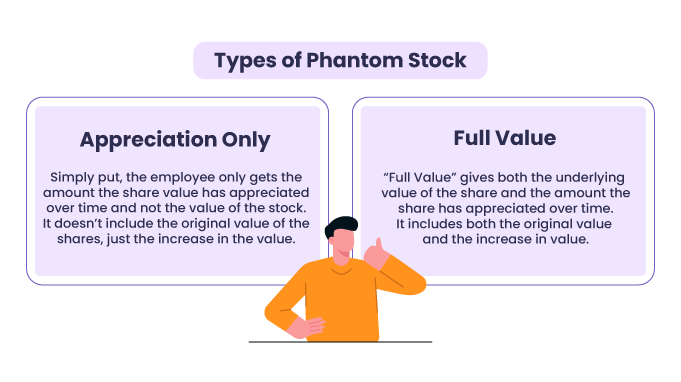
Phantom equity plans can be customized to suit a company’s goals, with two primary types being most common: appreciation-only arrangements and full-value arrangements.
Appreciation-Only Arrangements
Appreciation-only arrangements reward employees for the increase in the company’s value over a specified period. Employees are granted phantom shares that reflect the appreciation in the company’s valuation from the grant date to the payout date.
For instance, if phantom shares are initially valued at $10 each and the valuation rises to $15, the employee receives a payout of $5 per share. This structure ties employee rewards to company growth without affecting equity. Companies must rely on precise valuation methods, often adhering to GAAP or IFRS, to ensure fairness and compliance.
Full-Value Arrangements
Full-value arrangements provide payouts equivalent to the full value of phantom shares at vesting or payout. This includes both the initial value and any appreciation.
For example, if phantom shares are initially valued at $10 and later rise to $15, the employee receives $15 per share. While offering greater potential rewards, full-value arrangements require a larger financial commitment from the company. Careful financial planning and adherence to standards like ASC 718, which governs share-based compensation, are essential for managing these plans effectively.
Posted on March 7, 2025 by Dr. David Edward Marcinko MBA MEd CMP™
MEDICAL EXECUTIVE-POST–TODAY’SNEWSLETTERBRIEFING
***
Essays, Opinions and Curated News in Health Economics, Investing, Business, Management and Financial Planning for Physician Entrepreneurs and their Savvy Advisors and Consultants
“Serving Almost One Million Doctors, Financial Advisors and Medical Management Consultants Daily“
A Partner of the Institute of Medical Business Advisors , Inc.
US stocks tanked to session lows on Thursday after more tariff whiplash from the Trump administration.
The Dow Jones Industrial Average (^DJI) fell 1%, or over 400 points, while the S&P 500 (^GSPC) dropped nearly 2%. The tech-heavy NASDAQ Composite (^IXIC) plummeted more than 2.6%. The Nasdaq is now more than 10% off its December record high and officially entered into correction territory.
Trade-war uncertainty has persisted as investors weighed how far President Donald Trump would be willing to negotiate on tariffs. On Thursday, Trump said he would pause tariffs on some Mexican goods, and the White House later said the delay also includes goods from Canada.
Posted on January 6, 2025 by Dr. David Edward Marcinko MBA MEd CMP™
BREAKING NEWS!
By Staff Reporters
***
***
TORONTO—Canadian Prime Minister Justin Trudeau just announced that he will resign after almost a decade in power, bowing to members of his party who have been calling on him to step aside ahead of an election later this year.
“It has become clear to me that if I’m having to fight internal battles, I cannot be the best option in that election,” said Trudeau in an announcement from the country’s capital, Ottawa.
States that have long pushed the FDA to allow drug importation from Canada touted the move as a major step forward in their efforts to lower prescription drug spending and rein in healthcare costs. But while the idea of importing drugs from Canada is new for states, some businesses have been using existing drug import pathways to help consumers save money on certain high-cost medications.
***
More than 20 million US residents—a record number, according to the Biden administration—have signed up for health insurance through the Affordable Care Act’s marketplaces. (the New York Times)
***
Here’s where the major benchmarks ended:
Stocks were a mixed bag yesterday as investors pored over the first big earnings reports and new data showing that wholesale prices surprisingly went down in December. Airlines took a hit after Delta beat earning expectations but lowered its profit forecast.
The S&P 500 index rose 3.59 points (0.1%) to 4,783.83, up 1.8% for the week; the Dow Jones Industrial Average® (DJI) fell 118.04 points (0.3%) to 37,592.98, up 0.3% for the week; the NASDAQ Composite rose 2.57 points to 14,972.76, up 3.1% for the week.
The 10-year Treasury note yield (TNX) fell about 3 basis points to 3.943%.
The CBOE® Volatility Index (VIX) rose 0.26 to 12.70.
Retailers and consumer discretionary shares were among the market’s weakest performers Friday, and regional banks were also under pressure. The KBW Regional Banking Index (KRX) fell 2% for the week and ended at a one-month low. Energy shares led gainers behind strength in crude oil futures. The small-cap-focused Russell 2000® Index (RUT) ended little-changed for the week but is still down 3.8% so far this year.
Markets: Stocks climbed a bit on Friday as investors took in the news that the US added more jobs than expected in December, capping off an epic 2023 for the labor market. But it wasn’t a bright start to the year, as all three major averages broke a nine-week winning streak. Stock spotlight: The country’s largest hospital landlord, Medical Properties Trust, tanked after revealing that its biggest tenant was $50 million behind on rent.
***
Yesterday, the Food and Drug Administration (FDA) approved Florida’s request to import bargain medications from the country. It’s the first state to get permission from the agency to bring in medications from Canada under a law Congress passed 20 years ago to help Americans pay less for drugs. Florida officials say ordering cheaper drugs for conditions like HIV and diabetes from Canadian wholesalers will save Medicaid and other state programs $150 million over the first year.







 Support our online development, and advance our onground research initiatives in free market economics, as we seek to showcase the brightest Next-Gen minds.
THE ME-P DISCLAIMER: Posts, comments and opinions do not necessarily represent iMBA, Inc., but become our property after submission. Copyright © 2006 to-date. iMBA, Inc allows colleges, universities, medical and financial professionals and related clinics, hospitals and non-profit healthcare organizations to distribute our proprietary essays, photos, videos, audios and other documents; etc. However, please review copyright and usage information for each individual asset before submission to us, and/or placement on your publication or web site. Attestation references, citations and/or back-links are required. All other assets are property of the individual copyright holder.
Support our online development, and advance our onground research initiatives in free market economics, as we seek to showcase the brightest Next-Gen minds.
THE ME-P DISCLAIMER: Posts, comments and opinions do not necessarily represent iMBA, Inc., but become our property after submission. Copyright © 2006 to-date. iMBA, Inc allows colleges, universities, medical and financial professionals and related clinics, hospitals and non-profit healthcare organizations to distribute our proprietary essays, photos, videos, audios and other documents; etc. However, please review copyright and usage information for each individual asset before submission to us, and/or placement on your publication or web site. Attestation references, citations and/or back-links are required. All other assets are property of the individual copyright holder.















 The Leading Business Education Network for Doctors, Financial Advisors and Health Industry Consultants