About the HumanCondition [HCX]

Join Our Mailing List

Transformational Experiences and Innovation in Healthcare

[By Staff Reporters]

To solve human problems

HumanCondition [HCX] was created with the notion that in order to truly innovate – you need to be sensitive, yet take risks and make bold moves. Listen well, understand modern technologies and above all understand how to benefit from insightful, sensitive and intelligent design.

The Vision

The HCX vision is through a wide lens to see opportunities others would miss. They make sure to vet carefully to avoid dredging and believe there are smarter and faster ways to problem solving if you know the appropriate tools to use–and if these tools don’t exist, to create them. Intelligent human capital coupled with the application of off-the-shelf and advanced technologies is a powerful mix.

To Innovate

The term innovation means a new way of doing something. It may refer to incremental or revolutionary changes in thinking, products, processes, or organizations. Ideas alone are one thing, yet true innovation is an idea applied successfully.

How to innovate?

HCX believes that in order to solve real business needs and problems you have to first really understand the problems. Don’t take a shotgun approach to problem solving. Rather, build insight, define goals, present observations then begin iterative ideation using modern design thinking.

To love what you do

You don’t often find such a diverse mix of talent from the creative, technical and business strategy worlds in one place. HCX stays focused on the end user’s experience and business objectives. What do you want them to say when they leave, and what do you want them to tell their friends and neighbors? How many years do you want them to remember your experience?

Assessment

HCX analyzes challenging problems in health care and develops insightful solutions through proven methodologies. HCX works with healthcare facilities, pharmaceutical organizations, medical manufactures, teaching organizations and governments to define and create systems, products, training and communications toolsets that address the very specific needs of the healthcare industry.

Link: http://www.hcxdesign.com

Assessment

So, give em’ a click and tell us what you think?

Conclusion

Your thoughts and comments on this ME-P are appreciated. Feel free to review our top-left column, and top-right sidebar materials, links, URLs and related websites, too. Then, subscribe to the ME-P. It is fast, free and secure.

OUR OTHER PRINT BOOKS AND RELATED INFORMATION SOURCES:

Speaker: If you need a moderator or speaker for an upcoming event, Dr. David E. Marcinko; MBA – Publisher-in-Chief of the Medical Executive-Post – is available for seminar or speaking engagements. Contact: MarcinkoAdvisors@msn.com

Product DetailsProduct DetailsProduct Details

Product Details  Product Details

   Product Details 

“Meaningful Use” for Ambulatory Care Medical Practices

Join Our Mailing List

EHR Objectives and Measures

By Shahid N. Shah MS  

For ambulatory care practices and physicians there are about 25 objectives and measures that must be met to become a “meaningful user”. Keep in mind that meaningful use is not tied to a certified EHR alone; in fact, unless you use the EHR properly and in all the ways the government wants you to, you will not be a “meaningful user”.

Don’t be fooled by EHR vendors guaranteeing that they will make you a “meaningful user” – no vendor’s software, no matter how nice, can get your staff to use the software in the way the government wants. You, as the CIO of your practice, are the only one that can guarantee that. In fact, you don’t even need an EHR from a vendor to meet the requirements – you can even roll your own, use open source, or find any other means.

Fear and Promises

In general, as long as you can attest and send data to the government that they require you can do it in any way that you want. Be aware that some unscrupulous vendors are scaring practices and making promises that they cannot keep.

Final MU Rules

The final Meaningful Use (MU) Rule was published by HHS on July 13, 2010. It defines 24 objectives for and measures eligible hospitals that could be met to become a meaningful user and qualify for incentive funding. There is a “core set” that must be met by all institutions and a “menu set” of from which organizations must implement at least 5 objectives.

Core Set Objectives

These are the “core set” of 14 objectives that must be met by all institutions and a “menu set” of 10 from which organizations must implement at least 5 objectives (at least 1 public health objective must be chosen from that set).

  1. Use Computer Provider Order Entry (CPOE).
  2. Implement drug-drug, drug-allergy, and drug-formulary checks.
  3. Record demographics.
  4. Implement one clinical decision support rule.
  5. Maintain an up-to-date problem list of current and active diagnoses based on ICD-9-CM or SNOMED CT.
  6. Maintain active medication list.
  7. Maintain active medication allergy list.
  8. Record and chart changes in vital signs.
  9. Record smoking status for patients 13 years or older.
  10. Report hospital clinical quality measures to CMS or States.
  11. Provide patients with an electronic copy of their health information, upon request.
  12. Provide patients with an electronic copy of their discharge instructions at time of discharge, upon request.
  13. Capability to exchange key clinical information among providers of care and patient-authorized entities electronically.
  14. Protect electronic health information.

Menu Set Objectives

These are the “menu set” of 10 objectives from which organizations must implement at least 5. At least one public health objective must be chosen from this set as well (numbers 8 or 9). Drug-formulary checks.

  1. Record advanced directives for patients 65 years or older.
  2. Incorporate clinical lab test results as structured data.
  3. Generate lists of patients by specific conditions.
  4. Use certified EHR technology to identify patient-specific education resources and provide to patient, if appropriate.
  5. Medication reconciliation.
  6. Summary of care record for each transition of care/referrals.
  7. Capability to submit electronic data to immunization registries/systems.
  8. Capability to provide electronic submission of reportable lab results to public health agencies.
  9. Capability to provide electronic syndromic surveillance data to public health agencies.

Government Agencies and Participants Involved in MU

As you can see in the Figure, the Office of the National Coordinator for Healthcare IT (ONCHIT) is a component of the Department of Health and Human Services (HHS). ONCHIT, usually abbreviated just ONC, is the principal policy group of the Federal Government that defines and manages NHIN.

Figure Link: Figure 

* ONC is responsible for coordinating with the Department of Commerce’s National Institute of Standards and Technology (NIST) on the specifications for the NHIN standards.

* The HIT Policy and HIT Standards Committees are the working groups that advise ONC on what to put in the standards.

* NIST is responsible for coming up with the test materials (assertions, procedures, methods, tools, data, and so on) that will be used to certify working systems 

Conclusion

Your thoughts and comments on this ME-P are appreciated. Feel free to review our top-left column, and top-right sidebar materials, links, URLs and related websites, too. Then, subscribe to the ME-P. It is fast, free and secure.

Link: http://feeds.feedburner.com/HealthcareFinancialsthePostForcxos

Speaker: If you need a moderator or speaker for an upcoming event, Dr. David E. Marcinko; MBA – Publisher-in-Chief of the Medical Executive-Post – is available for seminar or speaking engagements. Contact: MarcinkoAdvisors@msn.com

OUR OTHER PRINT BOOKS AND RELATED INFORMATION SOURCES:

Product Details 

The “Whole Tooth” Blog Talk Radio to Interview Dr. Darrell Pruitt on eHRs

Join Our Mailing List

Plugging my Interview and Otherwise Clogging Things

[By D. Kellus Pruitt DDS]

Where are the EDR cheerleaders when I need them? On Tuesday May 31st, I’ve got a show to put on!

http://www.blogtalkradio.com/thewholetooth

Where are the EDR Cheerleaders?

Every now and then I still come across EDR vendors on the internet who would mislead naïve dentists about their product to make a sale. Today, I held FirstEMR representative Robert Evans accountable for self-serving misinformation he posted on EMR and HIPAA forum. (My dad would be proud that I told him “Get that garbage out of here!”). Then, remembering my manners, I invited Mr. Evans to please call into The Whole Tooth Blogtalkradio program on May 31 to further discuss the future of EHRs in dentistry. Unfortunately, because of things like the reflexive “garbage” statement, I don’t think he’ll show.

I try my best to be “collegial,” but I simply cannot pretend unethical sales techniques are acceptable in my neighborhood, and I want to help my friends easily recognize them… so what if I have a little fun.

http://www.emrandhipaa.com/emr-and-hipaa/2010/11/18/emr-stimulus-q-and-a-emr-stimulus-money-and-dentists/comment-page-1/#comment-133132

Of Robert Evans

Thanks for your response, Robert Evans.

As I read your list of 6 rationalizations for electronic dental records here on the EMR and HIPAA forum , it occurred to me that you haven’t had a chance to read my detailed post on this thread from November 22 (Number 14) in which I de-bunked 28 similar myths – substantially including your 6. But since I never tire of doing this, let’s once again go through the details of a popular national blunder in dentistry you and other well-intentioned stakeholders in the HIT industry were sucked into.

“My personal background is medical administration and operations.” That would explain your misconceptions about EHRs in the unique field of dentistry.

For your first mistake, you say “Dentists can qualify as eligible providers for ARRA incentives” You really should have gone on to explain that for a dentist to qualify for the stimulus money, 30% of his or her practice has to be from Medicare/Medicaid. Since you surely should have known that, to fail to mention it could easily be interpreted as deceptive.

This is just a guess, but I’d say less than 10% of the dentists in the nation in private practice would make it on that qualification alone even if it made business sense to accept government money and the expensive demands that come with it. Since you are in the EHR business, you may have more accurate figures on that. What’s more, our grandchildren’s money will be gone long before the stimulus makes it to dentistry. You should already know that as well.

“All of our clients, including Dentists, Endodontists, Periodontists, Implant Surgeons and more are extremely pleased that they made the transition “ All of them, Robert? Really?

The ME-P Forum 

This ME-P forum right here is full of stories about disappointed providers – perhaps other than your clients – who are finding huge problems with the transition. De-installations are far too common. It seems like a while back it was close to 30%. Then again, since you are in the business, you probably have more accurate figures for that as well.

Even the stimulus money isn’t sufficient subsidy for physicians to realize a return on investment in EMRs. And virtually nobody is interoperable as planned. That means the office tools you sell raise the cost of healthcare rather than lower it. What’s more, physicians stand to benefit from interoperability much more than dentists regardless of stimulus money. And if a dentist can’t expect ROI from an office tool, it’s called a hobby.

By the way, have you looked at the Stage 2 Meaningful Use requirements that stand between dentists and disappearing ARRA money? Well-meaning outsiders with plans for the common good just don’t realize that someone has to enter every piece of irrelevant detail about dental patients that CMS requires in order to receive full payment.

It’s a trap, Robert. And it’s not very well hidden. Dentists don’t take candy from strangers.

The Benefits

“The benefits to your office are numerous and too many to mention here; but, please take into account the following”:

1. Never having to worry about compliance issues, as we are 100% compliant with all standards and formats that CMS is mandating.

– You are 100% scary. As long as a provider stores or transmits electronic PHI he or she clearly must be concerned about HIPAA compliance issues. What’s more, as a Business Entity for the dentists you serve, if your computer system is hacked or someone on your end otherwise fumbles or steals 500 or more of a dentists’ patients’ PHI, all of the dentist’s patients must be notified of the danger of identity theft. In addition, federal law stipulates that news of the data breach must be broadcast as a press release in the dentist’s local media. This can easily bankrupt a dentist… You just had to know about this before today.

Your compliancy claim is not only wrong, but it is irresponsible and unethical advertising. You are not 100% compliant. Since the Rule is intentionally vague, nobody is. Get that garbage out of here!

2. Greatly reduce or even eliminate human error. Some offices have brought back billing into their control and terminated the outsourcing.

– Are you kidding? Eliminate human error? Someone put you up to this didn’t they. And “outsourcing”? Once again, this is misleading and irresponsible information, Robert. What about keystroke errors? Only frustrated vendors wish computers would replace human intelligence.

3. Facilitate lab and prescription orders. Offices using e-scribe services are already on board into accepting the benefits of an EMR.

– So does this mean that when the lab delivery person comes to my office to pick up plaster models of a patient’s teeth, the prescription for the restoration must be sent separately by email instead of inserting a short hand-written note in the package… with the relevant patient’s models?

– I don’t sign enough prescriptions to make e-prescribing worth it. I really, really don’t. So how expensive would you make dental care?

4. Simple and efficient scheduling. The reception and schedulers are not tied to the telephone, fax and charting tasks as well as insurance verifications.

– That’s never before been a significant problem. Dental offices were run surprisingly efficient for decades before computers were around. Since dentistry is intricate handwork, the bottleneck in dental offices isn’t the front desk. It’s the dentist.

– What’s so wrong with telephone and fax, by the way? One doesn’t have to be a HIPAA-covered entity to use those tools.

– As for insurance verification, is the EDR intended to help the patient or the insurance company?

5. No fumbling for charts, paperwork, etc. (significant cost savings)

– Prove it.

6. Gain 15+ hours per week, back!

– Where did find this chunk of information? Please don’t insult us with wild, irresponsible statements to improve sales of your product. That would be unethical.

“Again, there are too many to list here, but contact me anytime for a quick on-site or online demonstration and let us prove to you that FirstEMR is the most appropriate solution to meet your required EMR needs.”

eDR Mandate? 

Did you intentionally say my “required” EMR needs? You wouldn’t be implying that EMRs are somehow “mandated” in dentistry are you, Robert? That would be called a rookie mistake and you would be about a year behind information published in the ADA News, which was wrong to mislead members on this point in 2008.

http://www.ada.org/5348.aspx

Rather than contacting you for a quick on-site or online demonstration, I’ll do you one better. I am to be interviewed on “The Whole Tooth” blogtalkradio on May 31 concerning the future of EHRs in dentistry. It promises to be an unprecedented discussion about the obscure topic, and is certain to be educational to thousands of dentists who have been misled for years about HIPAA and EDRs.

http://www.blogtalkradio.com/thewholetooth

Assessment

When the time comes, a telephone number will be provided for live questions. I invite you to call in, Robert, and we can discuss EHRs in dentistry before an audience of around 15,000.

Conclusion

Your thoughts and comments on this ME-P are appreciated. Feel free to review our top-left column, and top-right sidebar materials, links, URLs and related websites, too. Then, subscribe to the ME-P. It is fast, free and secure.

Speaker: If you need a moderator or speaker for an upcoming event, Dr. David E. Marcinko; MBA – Publisher-in-Chief of the Medical Executive-Post – is available for seminar or speaking engagements. Contact: MarcinkoAdvisors@msn.com

OUR OTHER PRINT BOOKS AND RELATED INFORMATION SOURCES:

Product DetailsProduct DetailsProduct Details

Product Details  Product Details

   Product Details 


Is HI-TECH Dead?

Join Our Mailing List

You Decide!

[By D. Kellus Pruitt DDS]

Yesterday, Don Fluckinger, Features Writer for SearchhealthIT, posted “Blumenthal: Building national health network could take decades”

“When Dr. David Blumenthal was national health IT coordinator, he focused on 2015, the HITECH Act’s original target date for meeting meaningful use criteria. Now that he’s back in civilian life, he’s taking a longer view of the initiative to create a national health network triggered by the HITECH Act’s cash incentives to physicians and hospitals using electronic health record (EHR) systems.”

http://searchhealthit.techtarget.com/news/2240035845/Blumenthal-Building-national-health-network-could-take-decades

Even though Fluckinger assures us that post-ONC, Blumenthal is still a “HITECH Act champion,” I’m not so sure. Perhaps in spirit only!

A Multi-Decade Project?

Last week, Dr. Blumenthal was the keynote speaker at the Massachusetts annual health IT conference. According to Fluckinger, he told the audience that building a secure, national, interoperable health information system “was always going to be a multi-year, maybe even multi-decade project.” That’s not what I remember. I remember being told that if I didn’t purchase a network-ready EHR for my dental practice by 2014, I wouldn’t be paid by insurance companies.

What Happened?

So, what happened to President Bush’s 2004 Executive Order of “interoperability (even with dentists) by 2014”? Is it too soon to say that he failed? So who is going to tell the thousands of HIT stakeholders who have been attracted by the smell of stimulus billions? Blumenthal?

Assessment 

I can only imagine that now that Dr. Blumenthal left his job as head of the ONC for a new job as a health policy professor at Harvard School of Public Health, the openness of life outside government makes him uncomfortable with the lame talking points he once pushed as part of his job, without cracking a smile.

Conclusion

Your thoughts and comments on this ME-P are appreciated. Feel free to review our top-left column, and top-right sidebar materials, links, URLs and related websites, too. Then, subscribe to the ME-P. It is fast, free and secure.

Speaker: If you need a moderator or speaker for an upcoming event, Dr. David E. Marcinko; MBA – Publisher-in-Chief of the Medical Executive-Post – is available for seminar or speaking engagements. Contact: MarcinkoAdvisors@msn.com

OUR OTHER PRINT BOOKS AND RELATED INFORMATION SOURCES:

Product DetailsProduct DetailsProduct Details

Product Details  Product Details

   Product Details 

Meet Mackson Consulting LLC

Our Newest Sponsor

ADVERTISEMENT

By Ann Miller RN MHA

Join Our Mailing List

Who They Are

Mackson Consulting is a premier IT services firm headquartered in Reston, Virginia with a focus on straightforward approaches to optimizing business results. Mackson develops and integrates complete systems of all sizes.

For every engagement they bring to bear our unique combination of technical expertise, broad experience to quickly understand our customer environments, and strong systems engineering and program management skills. Their focus is on optimizing the business results of our clients and resolving problems of crucial importance to our nation.

Capabilities

  • Full range of Software Development Lifecycle capabilities (SDLC)
  • Enterprise Architecture design and delivery
  • Business Process reengineering
  • Operations and Maintenance support
  • Database design and optimization
  • Oracle application, middleware and database experts
  • Project Management Leadership
  • Subject Matter Expertise in Health IT

Assessment

Mackson is a professional services and technology solutions provider specializing in application development, enterprise architecture and project management services. They provide a wide variety of IT services to both public sector and commercial clients.

Contact:

Carol S. Miller BSN, MBA

Mackson Consulting LLC
1818 Library Street
Suite 500
Reston, Virginia 20190

www.MacksonConsulting.com

info@macksonconsulting.com

On Physician Relations Management [PRM] Technology

Join Our Mailing List

Criteria for Selection

By Dr. Gary L. Bode MSA, CPA, LLC

Both research and experience reveals an often confusing, complicated world of claims, features, and upgrades, a wide array of technical architectures, and an even wider array of pricing structures when it comes to choosing Physician [Customer] Relations Management [PRM] software.

For me – as a medical practice management consultant – critical criteria for selection includes the following features.

Scalability:

In a young medical practice, a scalable marketing program and PRM infrastructure should be flexible enough to accommodate specialty trends effortlessly and seamlessly without crushing your marketing infrastructure or its’ people, patients or processes. A scalable PRM infrastructure should allow a new channel, a new patient segment, a medical product or service-line seamlessly and with minimum incremental effort or cost.

Interoperability:

You may need an authoring tool today to develop your collateral data, and so select a simple MSFT Word® program. Later, you may want to conduct campaigns to re-introduce your practice or gauge satisfaction among current patients through an online survey. The software you build or purchase for individual activities should be able to co-exist and talk to each other. The software you purchase does not have to be monolithic, but it needs to be modular and work together incrementally.

For example, your e-mail campaign software, CPOESs [computerized physician order entry systems] and e-prescribing functions should work with your authoring tools and eMR.

In today’s complex and fast paced evolution of PRM products, newer technologies need to co-exist with older legacy technologies, and futuristic eMR systems; so interoperability is one of the critical criteria for PRM technology selection.

Ease of Use:

As a young medical practice, pulled in different directions, it is important to have a PRM solution that is easy to use and does not necessitate extensive user training.

Cost structure:

Remember, all PRM software comes with obvious costs as well as hidden costs. Ask the right questions and find out the hidden costs for systems implementation, integration and user training.

Assessment

Channel Surfing the ME-P

Have you visited our other topic channels? Established to facilitate idea exchange and link our community together, the value of these topics is dependent upon your input. Please take a minute to visit. And, to prevent that annoying spam, we ask that you register. It is fast, free and secure.

Conclusion

Your thoughts and comments on this ME-P are appreciated. Feel free to review our top-left column, and top-right sidebar materials, links, URLs and related websites, too. Then, subscribe to the ME-P. It is fast, free and secure.

Speaker: If you need a moderator or speaker for an upcoming event, Dr. David E. Marcinko; MBA – Publisher-in-Chief of the Medical Executive-Post – is available for seminar or speaking engagements. Contact: MarcinkoAdvisors@msn.com

OUR OTHER PRINT BOOKS AND RELATED INFORMATION SOURCES:


Product Details 

A Video Vision of Healthcare’s Future from Microsoft

By Staff Reporters

Medical Tourism and Health Information Technology in Malaysia

Join Our Mailing List

According to Dan Dunlop, over at The Healthcare Marketer, the following video promotes Malaysia as a preferred healthcare destination. It positions the country as a one stop destination for all medical and tourism related needs, bringing together related service providers on a single platform. Malaysia would like to be seen as being on the leading edge of technology.

Malaysia Healthcare

In fact, here’s what the Malaysia Healthcare website had to say about the video:

“With state of the art hospitals being built in Malaysia; it’s just a matter of time before we experience seamless healthcare delivery. Malaysia Healthcare patients use a portable Personal Health Record (PHR) called the iPHER that carries all their PHI which includes, medications, lab tests, diagnosis, immunizations, alternative procedures, digital images, dental records, ophthalmic care (lens and contact prescriptions) and DNA any where in the world with no need to access the Internet to view the information. Malaysia Healthcare currently uses this PHR to reduce medical errors and create continuity of care for all their patients and to provide seamless healthcare delivery.”

Assessment

This is an incredible video that demonstrates how Microsoft sees the future of healthcare and shows one vision for how technology will potentially improve our way of life!

***

ME-P medical malpractice education

***

More:

Link: http://www.youtube.com/watch?v=6aKNK7OTHKs&feature=player_embedded#at=235

Conclusion

Your thoughts and comments on this ME-P are appreciated. Feel free to review our top-left column, and top-right sidebar materials, links, URLs and related websites, too. Then, subscribe to the ME-P. It is fast, free and secure.

Speaker: If you need a moderator or speaker for an upcoming event, Dr. David E. Marcinko; MBA – Publisher-in-Chief of the Medical Executive-Post – is available for seminar or speaking engagements. Contact: MarcinkoAdvisors@msn.com

OUR OTHER PRINT BOOKS AND RELATED INFORMATION SOURCES:

Product DetailsProduct DetailsProduct Details

Product Details  Product Details

   Product Details 

The Epsilon Hack [An Opinion Poll Survey]

An Internet Security Survey

Join Our Mailing List

The recent breach at Epsilon, the Dallas online marketing vendor to more than 2,000 businesses, generated a lot of headlines.  Epsilon clients include financial companies like American Express, Ameriprise Financial, Barclays Bank, Capital One, Citibank, City Market, JPMorgan Chase, as well as Best Buy, The College Board, Disney Vacations, Hilton Honors, The Home Shopping Network, Kroger, Marriott Rewards, Ritz-Carleton, TiVo, Verizon and Walgreens, among others. 

VOTE AND OPINE

And so, should companies be all that worried? How about doctors, hospitals, medical clinics, patients, FAs, BDs, RIAs, CPAs etc? 

Our Other Print Books and Related Information Sources:

Health Dictionary Series: http://www.springerpub.com/Search/marcinko 

Practice Management: http://www.springerpub.com/product/9780826105752

Physician Financial Planning: http://www.jbpub.com/catalog/0763745790

Medical Risk Management: http://www.jbpub.com/catalog/9780763733421

Healthcare Organizations: www.HealthcareFinancials.com

Physician Advisors: www.CertifiedMedicalPlanner.com

Subscribe Now: Did you like this Medical Executive-Post, or find it helpful, interesting and informative? Want to get the latest ME-Ps delivered to your email box each morning? Just subscribe using the link below. You can unsubscribe at any time. Security is assured.

Link: http://feeds.feedburner.com/HealthcareFinancialsthePostForcxos

Sponsors Welcomed:  And, credible sponsors and like-minded advertisers are always welcomed.

Link: https://healthcarefinancials.wordpress.com/2007/11/11/advertise

Product Details  Product Details

   Product Details 

The Absurdity of “Meaningful Use” Requirements in Dentistry

Let’s End the Silence

By D. Kellus Pruitt DDS

Hey, Doc. How can your silence possibly serve your patients’ best interests?

For my colleagues in the audience who have quietly examined the critical and timely issues I’ve repeatedly offered for discussion – adults with post-graduate degrees who might have briefly considered publicly responding  to what I write, but who still cannot take ownership of an opinion – what on Earth is holding you back? Whatever it is, I say there are only lame, self-serving excuses for dentists to continue to betray patients’ trust. So how does that make you feel, Doc? A little angry maybe? Indignant? Let’s work on that professional nerve a little more. Maybe I’ll get a rise out of you yet.

Where Have You Been? 

As a healthcare provider whose trusting patients depend on you to protect their interests from stakeholders who cannot be held accountable – where have you been? Do you really believe dentists’ stoicism upholds and promotes the ideals of the healing profession? What about the Hippocratic Oath? How?

Or, is your shyness perhaps the manifestation of a character weakness revealing little confidence in your own personal ethics? You can’t blame me if that pisses you off. As long as you are silent, it’s impossible for me to tell a thing about you. So please, feel free to describe how my observations make you feel. You could easily change my opinion by merely speaking up to defend your silence … which promises to be an interesting argument.

ADA Members 

Or, maybe, as an ADA member, or more so a vetted official, professional silliness isn’t your choice at all. Perhaps you are torn between supporting common sense and honesty in your community and a professional dedication to the ADA’s committee-approved slogan “Speaking with one voice.” What looks to me like a cheap PR hack’s piece of art – purchased by either a clueless or nasty-cynical ADA official – is intended to not only keep members in their place as policy, but to also give state and national politicians the impression that all dentists unquestioningly unite behind any and all ADA ideas – sight unseen. (Public discussion of policy with membership is never permitted, even though it’s just dentistry). Elsewhere in the world, that would be called tyranny. It’s also easy to see that “one voice” is a generous exaggeration of our current dental leaders’ influence in Washington.

Stage 2 Meaningful Use

If anonymous leaders who secretly manage a silent profession insulated from the community were the least bit effective at protecting dental patients’ welfare, dentists who actually provide dentistry for the poor wouldn’t be faced with absurd and overwhelming Stage 2 Meaningful Use documentation requirements that will be enforced by CMS in 2012:

  • Record Smoking Status for Patients 13 Years Old or Older
  • Generate Lists of Patients by Specific Condition
  • Check Insurance Eligibility Electronically from Public and Private Payers
  • Submit Claims Electronically to Public and Private Payers
  • Provide Patients with Timely Electronic Access to their Patient Information
  • Computerized provider order entry (CPOE)
  • eRX
  • Record Demographics
  • Record and Chart Vital Sign
  • Patient Reminder
  • Electronic Copies
  • Clinical Summaries
  • Advising Smokers to Quit

Rising Above Politics

As healthcare professionals, our patients depend on us to rise above political correctness and petty, cheap slogans. Indeed, how good is it for healthcare when doctors evade unpopular issues? Can anyone in the audience explain how our patients are better served by PR hacks than dialogue? Anyone?

Assessment

Face it. The absurdity of Meaningful Use [MU] requirements in dentistry proves that our non-responsive leadership is incapable of protecting our dental patients. From now on, only you and I can do that on our own as individuals. But to make a difference, you must be heard.

Conclusion

Your thoughts and comments on this ME-P are appreciated. Feel free to review our top-left column, and top-right sidebar materials, links, URLs and related websites, too. Then, subscribe to the ME-P. It is fast, free and secure.

Link: http://feeds.feedburner.com/HealthcareFinancialsthePostForcxos

Speaker: If you need a moderator or speaker for an upcoming event, Dr. David E. Marcinko; MBA – Publisher-in-Chief of the Medical Executive-Post – is available for seminar or speaking engagements. Contact: MarcinkoAdvisors@msn.com

OUR OTHER PRINT BOOKS AND RELATED INFORMATION SOURCES:

Product DetailsProduct DetailsProduct Details

Product Details  Product Details

   Product Details 

Challenging a Naive eDR Advocate

An Open Letter to Dr. Margaret Scarlett

By D. Kellus Pruitt; DDS

For the last few weeks, I’ve been challenging a naive EDR advocate. They are becoming increasingly hard to find. Here is what I posted today on her blog.

Dear Dr. Margaret Scarlett

This open conversation on your Medscape Connect blog not only alerts the nation to the possibility of imminent failure of interoperability in post-computerized dentistry, but it also features dialogue introducing potential solutions around otherwise insurmountable problems the industry is encountering.

http://boards.medscape.com/forums?128@884.9VVBadZEUsj@.2a077212!comment=1

Courageous 

A forum such as yours that invites frank discussion about the faults of EDRs is almost unprecedented and entirely politically-incorrect. But then, that is why it is incredibly meaningful. Thank you for your courage, Dr. Scarlett.

Collegial

Let’s keep it collegial but challenging.

First of all, in your April 21st response, you justifiably expressed concern that EHR/fax hybrids might increase danger of data breaches over the incredible risk that already exists in digitalized healthcare. I assume that now that you know more about cloud-based companies such as Sfax, you agree that your security concern is unfounded. Fax, telephone and the US Mail will always be more secure than the internet – an often-forgotten fact. Any arguments?

A large part of your response concerned interoperability and aggregation problems that will be easily solved by the Health Information Exchanges (HIE) and EHR/fax companies. Why would their product not be seamless like any other digital transmission? From our perspective as dentists, your concern is a non-issue. Anything that can be printed on paper can come up on a computer screen and vice versa. Fortunately for our patients, you and I don’t have to worry ourselves about the technological magic of common office equipment.

I just have to say that when I read about your concern for “dependence on ink supplies, phone connections, or the availability of personnel to handle pieces of papers without any mistakes,” I noticed you didn’t say anything about saving the forests and paper cuts. Quite frankly, I think even you recognize that these lame arguments against a new idea are disingenuous stretches. Who’s to say there will be fewer keystroke errors on digital records than paper? See what I mean?

Lastly, in your April 21st response, you seem to suggest that unless the vast majority of dentists spend tens of thousands of dollars to purchase EDRs which will raise the cost of the care they provide, huge pools of data stored in HIEs that you claim somehow “assure patient-centered care,” will not be available to dentistry. You’ve got to be kidding. How many years away is that science? Let me repeat: Dental patients are fortunate that EDRs are going nowhere because of dentists’ solid business reasons in the land of the free. Until EDR advocates base sales claims on evidence rather than hearsay, they are only entertaining themselves with the fantasy.

Assessment 

I only wish the anonymous EHR experts in the ADA who are quietly influencing lawmakers would step out and introduce themselves to the community they serve. Can you think of any possible reason that the ADA can’t answer a few questions about what they have been doing on our behalf. Or should that not concern dentists?

Conclusion

And so, your thoughts and comments on this ME-P are appreciated. Feel free to review our top-left column, and top-right sidebar materials, links, URLs and related websites, too. Then, subscribe to the ME-P. It is fast, free and secure.

Link: http://feeds.feedburner.com/HealthcareFinancialsthePostForcxos

Speaker: If you need a moderator or speaker for an upcoming event, Dr. David E. Marcinko; MBA – Publisher-in-Chief of the Medical Executive-Post – is available for seminar or speaking engagements. Contact: MarcinkoAdvisors@msn.com

Our Print Books and Related Information Sources:

Health Dictionary Series: http://www.springerpub.com/Search/marcinko 

Practice Management: http://www.springerpub.com/product/9780826105752

Physician Financial Planning: http://www.jbpub.com/catalog/0763745790

Medical Risk Management: http://www.jbpub.com/catalog/9780763733421

Healthcare Organizations: www.HealthcareFinancials.com

Physician Advisors: www.CertifiedMedicalPlanner.com

Subscribe Now: Did you like this Medical Executive-Post, or find it helpful, interesting and informative? Want to get the latest ME-Ps delivered to your email box each morning? Just subscribe using the link below. You can unsubscribe at any time. Security is assured.

Link: http://feeds.feedburner.com/HealthcareFinancialsthePostForcxos

Sponsors Welcomed: And, credible sponsors and like-minded advertisers are always welcomed.

Link: https://healthcarefinancials.wordpress.com/2007/11/11/advertise

Product DetailsProduct DetailsProduct Details       

Product Details  Product Details

   Product Details 

Guide to Biostatistics

Clinical Tools

Join Our Mailing List

Here is a white paper of important epidemiological concepts and common bio-statistical terms to help doctors and related professionals translate medical research into everyday practice.

Link: http://www.medpagetoday.com/Medpage-Guide-to-Biostatistics.pdf

Conclusion

And so, your thoughts and comments on this ME-P are appreciated. Feel free to review our top-left column, and top-right sidebar materials, links, URLs and related websites, too. Then, subscribe to the ME-P. It is fast, free and secure.

Link: http://feeds.feedburner.com/HealthcareFinancialsthePostForcxos

Our Print Books and Related Information Sources:

Health Dictionary Series: http://www.springerpub.com/Search/marcinko

Practice Management: http://www.springerpub.com/product/9780826105752

Physician Financial Planning: http://www.jbpub.com/catalog/0763745790

Medical Risk Management: http://www.jbpub.com/catalog/9780763733421

Healthcare Organizations: www.HealthcareFinancials.com

Physician Advisors: www.CertifiedMedicalPlanner.com

Subscribe Now: Did you like this Medical Executive-Post, or find it helpful, interesting and informative? Want to get the latest ME-Ps delivered to your email box each morning? Just subscribe using the link below. You can unsubscribe at any time. Security is assured.

Link: http://feeds.feedburner.com/HealthcareFinancialsthePostForcxos

Sponsors Welcomed: And, credible sponsors and like-minded advertisers are always welcomed.

Link: https://healthcarefinancials.wordpress.com/2007/11/11/advertise

Update On Medical Smartphone Apps

Offering a Window Of Opportunity For M-Health Service Providers

By Markus Pohl

Join Our Mailing List

The potential revenue that could be made in the mobile healthcare app market is just a fraction of the total integrated healthcare market. Service providers within the healthcare market have a window of opportunity with the possibilities that the mobile apps market offers right now.

The benefits of integrated electronic and mobile healthcare solutions are evident. At the moment there is a lot of potential for companies to scale up their services and learn how to adapt to the changing market. But they have to act quickly to seize the moment. In the last few years those solutions either remained as isolated pilots or struggled with all kinds of barriers from healthcare stakeholders, with only a few exceptions.

Integrated Solutions 

As it is not clear when integrated solutions will become widely accepted around the globe, more and more e-health and m-health service provides are rethinking their strategy. They are turning away from complex and integrated solutions that need acceptance of all national healthcare stakeholders to more simple patient centric services.

m-Health Services Rising

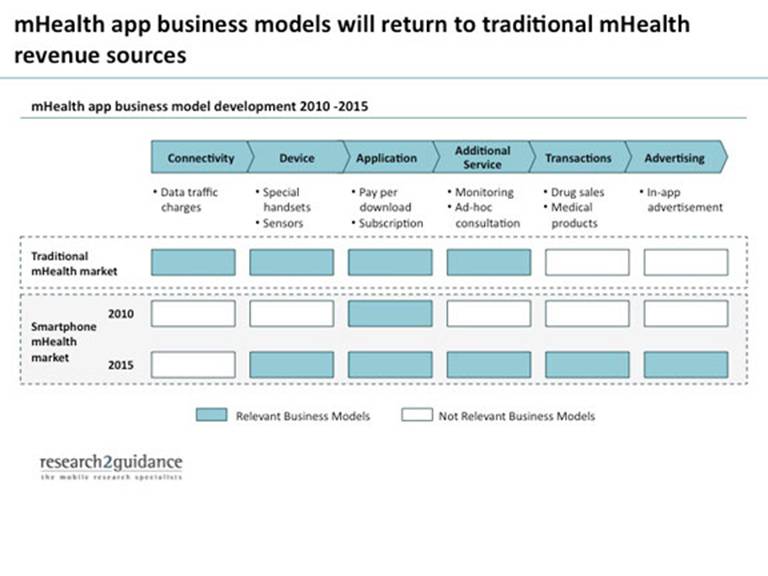
This rethinking process goes hand in hand with the rise of the smartphone app market. In the next 5 years the smartphone app market will help the mobile healthcare industry to reach a new level. mHealth apps will be widely used and will demonstrate the technological possibilities of smartphones. Technology, educated patients/doctors and proof of cost savings for health insurance providers will eventually allow companies to make money with mhealth apps.

Before the smartphone app market brought new life to the mobile healthcare market, mHealth service providers struggled to scale up their solutions. Most of them never made it out of the trial stage. Some of them were just too basic, such as simple pill reminders running on SMS as the primary delivery technology. More complex solutions that were based on eHealth initiatives integrated the features of a mobile device with a database (electronic health records), but failed mainly because of political barriers and low awareness amongst patients.

Assessment 

For more information on the smartphone based mHealth market and its business opportunities for healthcare provides please see our latest report on the mHealth market: “Mobile Health Market Report 2010-2015”.

Contact:

research2guidance

+49 30 609 893 363

markus.pohl@research2guidance.com

Conclusion

Your thoughts and comments on this ME-P are appreciated. Feel free to review our top-left column, and top-right sidebar materials, links, URLs and related websites, too. Then, subscribe to the ME-P. It is fast, free and secure.

Link: http://feeds.feedburner.com/HealthcareFinancialsthePostForcxos

Speaker: If you need a moderator or speaker for an upcoming event, Dr. David E. Marcinko; MBA – Publisher-in-Chief of the Medical Executive-Post – is available for seminar or speaking engagements. Contact: MarcinkoAdvisors@msn.com

OUR OTHER PRINT BOOKS AND RELATED INFORMATION SOURCES:

DICTIONARIES: http://www.springerpub.com/Search/marcinko
PHYSICIANS: www.MedicalBusinessAdvisors.com
PRACTICES: www.BusinessofMedicalPractice.com
HOSPITALS: http://www.crcpress.com/product/isbn/9781466558731
CLINICS: http://www.crcpress.com/product/isbn/9781439879900
BLOG: www.MedicalExecutivePost.com
FINANCE: Financial Planning for Physicians and Advisors
INSURANCE: Risk Management and Insurance Strategies for Physicians and Advisors

Product Details 

Heathcare Administraton Dictionary Series

ADVERTISEMENT


Product DetailsProduct DetailsProduct Details      

Sample Front Matter Link:

9780826149947_chapter 

About the HCUPnet Data Base

An AHRQ Project

HCUPnet is a free, on-line query system based on data from the Healthcare Cost and Utilization Project (HCUP). It provides access to health statistics and information on hospital inpatient and emergency department utilization.

Link: http://hcupnet.ahrq.gov/HCUPnet.jsp

HCUPnet overview

HCUPnet is an on-line query system that gives you instant access to the largest set of all-payer health care databases that are publicly available. Using HCUPnet’s easy step-by-step query system, you can generate tables and graphs on national and regional statistics and trends for community hospitals in the U.S. In addition, community hospital data are available for those States that have agreed to participate in HCUPnet.

Community hospitals are defined as short-term, non-federal, general and other hospitals, excluding hospital units of other institutions (e.g., prisons). National and regional HCUP data include OB-GYN, ENT, orthopedic, cancer, pediatric, public, and academic medical hospitals. They exclude long term care, rehabilitation, psychiatric, and alcoholism and chemical dependency hospitals, but these types of discharges are included if they are from community hospitals.

The HCUP Project

HCUPnet is part of the Healthcare Cost and Utilization Project (HCUP) of the Agency for Healthcare Research and Quality (AHRQ). HCUPnet generates statistics using data from HCUP’s Nationwide Inpatient Sample (NIS), the Kids’ Inpatient Database (KID), the State Inpatient Databases (SID) and the State Emergency Department Databases (SEDD). These databases and HCUPnet would not be possible without the statewide data collection projects that provide data to HCUP. You can purchase many HCUP databases to do more detailed analyses not possible through HCUPnet. For more information on purchasing HCUP data go to: HCUP Central Distributor Web site

HCUPnet also provides statistics based on the AHRQ Quality Indicators (QIs) which have been applied to the HCUP Nationwide Inpatient Sample. These statistics provide insight into potential quality of care problems. You can download software for the QIs from the Quality Indicators Web site and apply them to your own data.

Assessment

Data from the following statewide data organizations appear in HCUPnet as part of the Nationwide Inpatient Sample (NIS), the Kids’ Inpatient Database (KID), State Inpatient Databases (SID) or as State Emergency Department Databases (SEDD):

Conclusion

And so, your thoughts and comments on this ME-P are appreciated. Feel free to review our top-left column, and top-right sidebar materials, links, URLs and related websites, too. Then, subscribe to the ME-P. It is fast, free and secure.

Link: http://feeds.feedburner.com/HealthcareFinancialsthePostForcxos

Speaker: If you need a moderator or speaker for an upcoming event, Dr. David E. Marcinko; MBA – Publisher-in-Chief of the Medical Executive-Post – is available for seminar or speaking engagements. Contact: MarcinkoAdvisors@msn.com

Our Other Print Books and Related Information Sources:

Health Dictionary Series: http://www.springerpub.com/Search/marcinko

Practice Management: http://www.springerpub.com/product/9780826105752

Physician Financial Planning: http://www.jbpub.com/catalog/0763745790

Medical Risk Management: http://www.jbpub.com/catalog/9780763733421

Healthcare Organizations: www.HealthcareFinancials.com

Physician Advisors: www.CertifiedMedicalPlanner.com

Subscribe Now: Did you like this Medical Executive-Post, or find it helpful, interesting and informative? Want to get the latest ME-Ps delivered to your email box each morning? Just subscribe using the link below. You can unsubscribe at any time. Security is assured.

Link: http://feeds.feedburner.com/HealthcareFinancialsthePostForcxos

Sponsors Welcomed: And, credible sponsors and like-minded advertisers are always welcomed.

Link: https://healthcarefinancials.wordpress.com/2007/11/11/advertise

Product DetailsProduct DetailsProduct Details       

Product Details  Product Details

   Product Details 

Planning your eMR Escape from IT Hell

Lessons I Learned in B-School

Dr. David Edward Marcinko MBA

[Publisher-in-Chief]

www.BusinessofMedicalPractice.com

Of course, as a doctor, you will spend weeks or months in the “sales and demo cycle” for selecting an EMR. If you’re lucky you will have time to consider all workflows; if you’re even luckier you will test drive the system and make sure training goes smoothly. You will also try to ensure that deployment will be easy. However, another thing not to forget is to plan how to get out of an HIT application or her system after it’s been installed for a while.

Why Get Out?

Why is getting out important? Every application looks better in a demo than in a working environment and every solution becomes “legacy” sooner or later. Every system will be replaced or augmented at some point in time. The cost of acquisition (“barrier to entry”) is well understood now as something we need to calculate. But the “barrier to exit” or switching cost is something you must calculate at the time you decide what systems to purchase.

If you can’t answer the “how, in 6, 18, or 24 months, will I be able to move on to the next-better technology or system?” Question if you’ve not completed your due diligence in the sales cycle. Vendor sales staff are quite reticent to answer the “how do I leave your system” question; you will need to press hard and ask for a plan before signing any contracts.

The Hard Questions

When preparing an RFI or RFP, ask eMR vendors specific questions about how easy it is to get out of their technology (rather than just how easy to it is to deploy and interoperate). Put in specific test cases and have your folks consider this fact when they are looking at all new purchases.

The Expert Speaks

And, according to HIT expert Shahid N. Shah MS, writing for Chapter 13 in the third edition of our book, the “Business of Medical Practice”, here are some specific factors to consider:

Front Matter Link: Front Matter BoMP – 3

  • Do you own your data or does the vendor? If you don’t have crystal clear statements in writing that the data is yours and that you can do whatever you want with it, don’t sign the contract. Look for a new vendor.
  • Is the database structure and all data easily accessible to you without involving the vendor? If only your vendor can see the data, you’re locked in so be very wary. Find out what database the vendor is using and make sure you can get to the database directly without needing their permission.

  • Are the data formats that the system uses to communicate with other vendors open? If not, you don’t own your data. Be sure that at least CCR and CCD formats are available and that all document data is accessible in standard PDF or MS Office friendly formats. Discrete data should be extractable in XML or HL7.
  • How much of the technology stack is based on industry standards? The more proprietary the tech, the more you’re locked in.
  • Are all the programming APIs open, documented, and available without paying royalties or license costs? If not, when you try to get out you’ll pay dearly.

Assessment

In B-school, back in the day, the first thing we learned when writing a business plan and/or seeking banking, angel or VC money was formulating an exit strategy. Or, how do I get my [own] investors money back? A lesson I still remember today and can apply to eMRs. How about you?

Conclusion

And so, your thoughts and comments on this ME-P are appreciated. Feel free to review our top-left column, and top-right sidebar materials, links, URLs and related websites, too. Then, subscribe to the ME-P. It is fast, free and secure.

Speaker: If you need a moderator or speaker for an upcoming event, Dr. David E. Marcinko; MBA – Publisher-in-Chief of the Medical Executive-Post – is available for seminar or speaking engagements. Contact: MarcinkoAdvisors@msn.com and http://www.springerpub.com/Search/marcinko

Our Other Print Books and Related Information Sources:

Health Dictionary Series: http://www.springerpub.com/Search/marcinko

Practice Management: http://www.springerpub.com/product/9780826105752

Physician Financial Planning: http://www.jbpub.com/catalog/0763745790

Medical Risk Management: http://www.jbpub.com/catalog/9780763733421

Healthcare Organizations: www.HealthcareFinancials.com

Physician Advisors: www.CertifiedMedicalPlanner.com

Subscribe Now: Did you like this Medical Executive-Post, or find it helpful, interesting and informative? Want to get the latest ME-Ps delivered to your email box each morning? Just subscribe using the link below. You can unsubscribe at any time. Security is assured.

Link: http://feeds.feedburner.com/HealthcareFinancialsthePostForcxos

Sponsors Welcomed: And, credible sponsors and like-minded advertisers are always welcomed.

Link: https://healthcarefinancials.wordpress.com/2007/11/11/advertise

Product DetailsProduct DetailsProduct Details       

Product Details  Product Details

   Product Details 

About the Mobile Health Market

Sensor-Based Mobile Apps Show How M-Health Business Models Could Work

By Markus Pohl

Join Our Mailing List 

Making money with mobile healthcare applications takes much more effort than most developers expected. M-Health apps normally do not get into the app stores’ top ranking lists and thus do not receive high download numbers.

m-Health Applications Business Models

But, there are working business models for the mHealth applications. Within the mobile health app category revenue won’t be generated through app stores. More and more mHealth app publishers have understood that they have to adapt their business model accordingly. Turning away from the “normal” pay-per-download models to practices like charging for medical service (call a doc) or sensor based models.

Sensor Based Models

Sensor based business models seem to have particularly caught the attention of mHealth app publishers over the last 6 months. The idea behind this model is not to sell an app but to use the app to promote the sales of a sensor. Revenue will be generated outside the app store.

Trend Examples: 

Here are some examples to highlight this trend.

  • Health and Wellness Monitoring tools combine fitness-related equipment to track pulse, calories, running speed, heart rate, or use sensor-devices to monitor weight control, fetus observation and eye testing. Target groups for these products are fitness and health-conscious users aged mainly between 35 and 45 years.
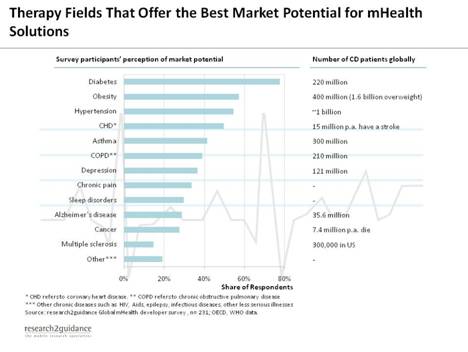
  • Chronic Condition Monitoring tools monitor health conditions like heart disease, hypertension, diabetes, asthma and obesity. They generate revenue from selling a sensor-device with a free application. Target groups are healthcare providers, medical personnel and chronically ill people between 30 and 50 years.
  • Diagnosis Tools are mainly targeted at professionals, who increasingly demand more portable and easy-to-use devices for easier communication with patients and peers.
  • Educational and Motivational Tools monitor habit patterns (e.g. sleep monitoring via app/device) or serve as useful didactic instruments for science education (e.g. portable microscopes).

Traditional health care service providers and especially medical device manufacturers should be aware of these trends and start to connect to the smartphone world.

To find a detailed overview of mHealth business models – please see the Mobile Health Market Report 2010-2015. Or, take a look at more mobile healthcare research from research2guidance.

Assessment

Outside app store revenue will drive the market. Sensor-based business models prove how to actually make money with mobile applications.

Conclusion

And so, your thoughts and comments on this ME-P are appreciated. Feel free to review our top-left column, and top-right sidebar materials, links, URLs and related websites, too. Then, subscribe to the ME-P. It is fast, free and secure.

Link: http://feeds.feedburner.com/HealthcareFinancialsthePostForcxos

Speaker: If you need a moderator or speaker for an upcoming event, Dr. David E. Marcinko; MBA – Publisher-in-Chief of the Medical Executive-Post – is available for seminar or speaking engagements. Contact: MarcinkoAdvisors@msn.com

Our Other Print Books and Related Information Sources:

Health Dictionary Series: http://www.springerpub.com/Search/marcinko

Practice Management: http://www.springerpub.com/product/9780826105752

Physician Financial Planning: http://www.jbpub.com/catalog/0763745790

Medical Risk Management: http://www.jbpub.com/catalog/9780763733421

Healthcare Organizations: www.HealthcareFinancials.com

Physician Advisors: www.CertifiedMedicalPlanner.com

Subscribe Now: Did you like this Medical Executive-Post, or find it helpful, interesting and informative? Want to get the latest ME-Ps delivered to your email box each morning? Just subscribe using the link below. You can unsubscribe at any time. Security is assured.

Link: http://feeds.feedburner.com/HealthcareFinancialsthePostForcxos

Sponsors Welcomed: And, credible sponsors and like-minded advertisers are always welcomed.

Link: https://healthcarefinancials.wordpress.com/2007/11/11/advertise

Product DetailsProduct DetailsProduct Details       

Product Details  Product Details

   Product Details 

Search Guidance for a Chief Medical Security Officer

A Business Case Model

By Richard J. Mata MD MS CIS

Dr. Mata

Join Our Mailing List

The Mighty-Soft Hospital is a futuristic 1,500 bed fortress-like facility operating with a state-of-the-art dual wired-wireless infrastructure complete with computerized physician order entry  system, radio frequency inventory device (RFID) control tags, and integrated electronic medical records (EMRs) that are the envy of its competitors and vendors, and offer a formidable strategic competitive advantage in the marketplace.

Now, imagine the potential liability, PR disaster and chagrin when its enfant terrible CEO is told of a massive security breach similar to the ChoicePoint and Lexis-Nexis fiascos.  The ID theft involves release of critically protected healthcare financial, employment, clinical, and contact information for all of its patients, employees, physicians, business associates, and affiliated medical personnel.

Suddenly, senior management is charged with the task of establishing the new position of Chief Medical Security Officer (CMSO) for Mighty-Soft, and navigating a crisis management dilemma never previously faced by the formerly HIPAA-compliant electronic giant.

The CMSO is to be a senior level management position responsible for championing institutional security.  Awareness of electronic and HIPAA policy and procedure developments, while working to ensure compliance with internal and external standards related to information security, is vital.  The CMSO is to report directly to the CEO and the CIO.

The Search Committee developed the following list of CMSO duties and responsibilities:

  • Chair the hospital’s Information Security and Privacy Committee in its policy development efforts to maintain the security and integrity of information assets in compliance with state and federal laws, and accreditation standards.
  • Provide project management and operational responsibility for the administration, coordination, and implementation of information security policies and procedures across the enterprise-wide hospital system.
  • Perform periodic information security risk assessments including disaster recovery and contingency planning, and coordinate internal audits to ensure that appropriate access to information assets is maintained.
  • Work with the financial division to coordinate a business recovery plan.
  • Serve as a central repository for information security-related issues and performance indicators.  Research security or database software for implementing the central repository, and note that a server based system could be useful for a Wide Area Network (WAN), so this information can be shared with the enterprise-wide hospital system.  Develop, implement, and administer a coordinated process for response to such issues.
  • Function when necessary as an approval authority for platform and/or application security and coordinate efforts to educate the hospital community in good information security practices.
  • Maintain a broad understanding of federal and state laws relating to information security and privacy, security policies, industry best practices, exposures, and their application to the healthcare information technology environment.
  • Make recommendations for short- and long-range security planning in response to future systems, new technology, and new organizational challenges.
  • Act as an advocate for security and privacy on internal and external committees as necessary.
  • Develop, maintain, and administer the security budget required to fulfill organizational information security expectations.
  • Demonstrate effectiveness with consensus building, policy development, and verbal and written communication skills.
  • Possess the clear ability to explain information technology concepts to audiences outside the field.
  • Become the public face for the Mighty-Soft Hospital’s legacy security system.

Minimum Qualifications:

  • MD, DO, DPM, DDS, DMD, with bachelor’s/master’s degree in computer science or related field or equivalent experience.
  • Three or more years of experience in the healthcare industry.
  • Five or more years of experience in information security.
  • Eight or more years of experience in information technology.
  • In-depth understanding of network and system security technology and practices across all major computing areas (mainframe, client/server, PC/LAN, telephony) with a special emphasis on Internet related technology.

Preferred Qualifications:

  • Experience with electronic medical devices.
  • Specific experiences in the healthcare industry.
  • Familiarity with legislation and standards for PHI and patient privacy.
  • Demonstrated successful project management expertise.
  • Professional certification, e.g., CISSP, CISA, PMP.
  • Experience with student record/higher education laws.

Key Issues:

  • What is your IT hardware infrastructure and how are security-related devices deployed?
  • What security requirements are imposed by federal and state authorities on your institution?
  • What would you consider the most important criteria for choosing a CMSO?
  • What relationship will the CMSO have with the CIO, CMIO and CEO?
  • What level of security education/training do you consider necessary for your hospital community?
  • What are the key security issues your CMSO will have to address?
  • What are the key privacy issues?
  • What are the key risk management issues?
  • What are the pros and cons of EHRs for your institution?
  • What do you see as the EHR priorities for your CMSO?
  • What are the security issues of EHRs for your institution?

Assessment

How would you select a CMSO?

Conclusion

And so, your thoughts and comments on this ME-P are appreciated. Feel free to review our top-left column, and top-right sidebar materials, links, URLs and related websites, too. Then, subscribe to the ME-P. It is fast, free and secure.

Speaker: If you need a moderator or speaker for an upcoming event, Dr. David E. Marcinko; MBA – Publisher-in-Chief of the Medical Executive-Post – is available for seminar or speaking engagements. Contact: MarcinkoAdvisors@msn.com

OUR OTHER PRINT BOOKS AND RELATED INFORMATION SOURCES:

Product DetailsProduct DetailsProduct Details

Product Details  Product Details

   Product Details 

Not so Fast – Examining eMR Options and Alternatives

Look Before you Leap

By Shahid N. Shah MS

Because of all the talk about electronic medical records [EMRs] and medical records software, doctors have many reasons to start immediately looking for an EMR vendor.

But, try to resist that urge and look at broader non-EMR solutions that can help remove some of the non-clinical burdens from your staff.

Here are some examples from Chapter 13, in our new book: www.BusinessofMedicalPractice.com

  • Using Microsoft Office Outlook® or an online calendaring system like Google to maintain patient schedules. While most vendors of clinical scheduling will tell you that medical scheduling is too complex to be handled by non-medical scheduling systems, most small and medium sized physician practices can easily get by with free or very inexpensive and non-specialized scheduling tools. By using general-purpose scheduling tools you will find that you can use less expensive consultants or IT help to manage your patient scheduling technology needs.
  • Using off-the-shelf address book software such as those built into Microsoft Office®, the Windows® and Macintosh® operating systems, or online tools such as Google apps you can maintain complete patient and contact registries for managing your patient lists. While a patient registry may not give you all of the features and functions you need immediately they can grow to a system that will meet your needs over time.
  • Using physician practice management systems you can remove much of the financial bookkeeping and insurance record-keeping burdens from your staff. Unlike calendaring or address book functionality which can be adapted from non-medical systems, insurance claims and related bookkeeping is an area where you should choose specific software based on how your practice earns its revenue. For example if a majority of your claims are Medicare related, then you should choose software that is specifically geared towards government claims management. If however your revenue comes less from insurance and more from traditional cash or related means you can easily use small business accounting software like Quicken® or Microsoft accounting.
  • Using computer telephony technology you can integrate automatic call in and call out the services that can be tied to your phone system so that you can track phone calls or send out call reminders.
  • Using integrated medical devices that can capture, collect, and transmit physiological patient data you can reduce paper capture of vital signs and other clinical data so that your staff are freed to do other work.
  • Using e-mail, instant messaging, social networking, and other online advanced tools you can reduce the number of phone calls that your practice receives and needs to return and yet continue to improve the patient physician communication process. One of the most time-consuming parts of any office is the back-and-forth phone calls so any reduction in phone calls will yield significant productivity increases.

Assessment

Any other ideas?

Link: Front Matter BoMP – 3

Conclusion

And so, your thoughts and comments on this ME-P are appreciated. Feel free to review our top-left column, and top-right sidebar materials, links, URLs and related websites, too. Then, subscribe to the ME-P. It is fast, free and secure.

Speaker: If you need a moderator or speaker for an upcoming event, Dr. David E. Marcinko; MBA – Publisher-in-Chief of the Medical Executive-Post – is available for seminar or speaking engagements. Contact: MarcinkoAdvisors@msn.com and http://www.springerpub.com/Search/marcinko

Our Other Print Books and Related Information Sources:

Health Dictionary Series: http://www.springerpub.com/Search/marcinko

Practice Management: http://www.springerpub.com/product/9780826105752

Physician Financial Planning: http://www.jbpub.com/catalog/0763745790

Medical Risk Management: http://www.jbpub.com/catalog/9780763733421

Healthcare Organizations: www.HealthcareFinancials.com

Physician Advisors: www.CertifiedMedicalPlanner.com

Subscribe Now: Did you like this Medical Executive-Post, or find it helpful, interesting and informative? Want to get the latest ME-Ps delivered to your email box each morning? Just subscribe using the link below. You can unsubscribe at any time. Security is assured.

Link: http://feeds.feedburner.com/HealthcareFinancialsthePostForcxos

Sponsors Welcomed: And, credible sponsors and like-minded advertisers are always welcomed.

Link: https://healthcarefinancials.wordpress.com/2007/11/11/advertise

Product Details 

Smartphone App Market Outperformes Other Booming Markets – 3 Years Benchmark

The Smartphone Applications Market is Impressive 

By Markus Pohl

Join Our Mailing List 

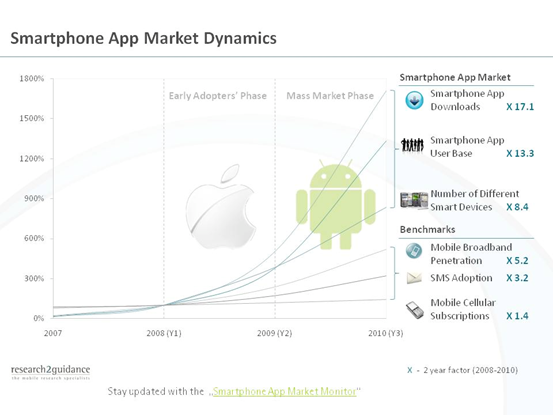
The mobile applications market made it from ramp-up phase to a mass market in only 3 years. This is much faster than previous mobile market sectors needed.

Berlin, March 8th, 2011 

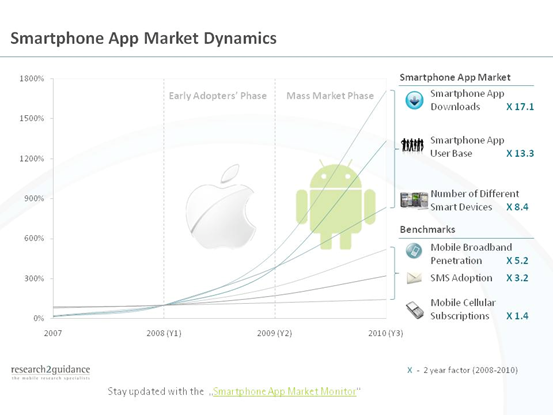
The numbers regarding the smartphone applications market are impressive: Global app download numbers increased by 1700%, user base by 1300%, number of different smart devices by 800%, number of apps by 500% and even app store number increased by 300% in the first 3 years.

With application numbers increasing by almost 100.000 apps per quarter on all major app stores the competition level in a category and platform can change over night, which has an immediate impact on download numbers. Compared to these trends user behavior and demographics in terms of age, gender, usage time, downloads etc. has not changed so quickly over the last three years but will do when applications are proliferating into the mass market. There will be substantial differences per country and platform any company should be aware of, when formulating their application strategy.

Apple dominated the years 2008 and 2009. Since 2010 the hype moved over to Android. With the partnership of Microsoft and Nokia, this might change again as deteriorating average application download numbers on the Android platform will make developers shift again their priorities. What will be the most promising application types and categories will be the next big question.

When looking at the initial phases of other markets, companies really had a lot of time to decide on if, how and when to enter the market. It seems that industry cycles become shorter and shorter and the ability of a company to react very quickly becomes even more important. To stay updated on current trends subscribe to our new “Smartphone App Market Monitor”. This monitoring subscription service will be updated every quarter. Benefit from the intro offer, which saves you 20% until 31st of March.

Twitter: #smartphone #app market outperformes other booming markets – 3 years #benchmark http://j.mp/hRMi6c

About research2guidance:

research2guidance is a Berlin-based market research company specialized in the mobile industry. The company’s service offerings include comprehensive market studies, as well as bespoke research and consultancy.

research2guidance | The Mobile Research Specialists

phone: +49 (0) 30 60 989 3363

mobile: +49 (0) 178 4007736

fax: +49 (0) 30 60 989 3369

email: mp@research2guidance.com

www.research2guidance.com

Conclusion

And so, your thoughts and comments on this ME-P are appreciated. Feel free to review our top-left column, and top-right sidebar materials, links, URLs and related websites, too. Then, subscribe to the ME-P. It is fast, free and secure.

Speaker: If you need a moderator or speaker for an upcoming event, Dr. David E. Marcinko; MBA – Publisher-in-Chief of the Medical Executive-Post – is available for seminar or speaking engagements. Contact: MarcinkoAdvisors@msn.com and http://www.springerpub.com/Search/marcinko

Our Other Print Books and Related Information Sources:

Health Dictionary Series: http://www.springerpub.com/Search/marcinko 

Practice Management: http://www.springerpub.com/product/9780826105752

Physician Financial Planning: http://www.jbpub.com/catalog/0763745790

Medical Risk Management: http://www.jbpub.com/catalog/9780763733421

Healthcare Organizations: www.HealthcareFinancials.com

Physician Advisors: www.CertifiedMedicalPlanner.com

Subscribe Now: Did you like this Medical Executive-Post, or find it helpful, interesting and informative? Want to get the latest ME-Ps delivered to your email box each morning? Just subscribe using the link below. You can unsubscribe at any time. Security is assured.

Link: http://feeds.feedburner.com/HealthcareFinancialsthePostForcxos

Sponsors Welcomed: And, credible sponsors and like-minded advertisers are always welcomed.

Link: https://healthcarefinancials.wordpress.com/2007/11/11/advertise

About Consent Care.Net

The Case for Fully Informed Consent

By Dr. Martin Young

MBChB, FCS(SA)Otol.

martin@carespace.net

The issue of ‘informed consent’ is an ever present bugbear in all healthcare systems around the world, raising its head time after time in journals, weblogs, healthcare administration policies and, above all, medical malpractice lawsuits. Every mention emphasizes the need for improving this difficult issue, but in spite thereof little seems to change.  ConsentCare is a new initiative aiming at addressing the challenges of facilitating and enhancing informed consent.

Why the big deal?

Medical ethicists have long known that, if trust is indeed the cornerstone of the successful doctor-patient relationship, that subjecting a person to medical or surgical treatment without discussing all aspects thereof wherever possible, i.e. fully informed consent, constitutes a betrayal of that trust.

Common opinion asserts that good informed consent creates better mental preparation for surgery, decreased anxiety, shorter hospital stays, earlier recognition of complications by patients before they become serious, and a generally higher success rate and satisfaction rate for the surgery.

70% of the detail of discussion about surgical detail and risk held in doctors’ rooms is forgotten by patients by the time the consultation is over. Patients are ordinarily asked to consent to surgical procedures ‘on the spot’ without access to the detailed documentation of the risks of those procedures that they can consider in their own time and own comfortable environment.

A person knowing all the information about his or her procedure acts as another measure of control to avoid outright human error, such as the wrong operation, or operating on the wrong side.

Almost every case of litigation following surgery will address the adequacy of the consent process.

The right to full knowledge about medical or surgical interventions is entrenched as a human right, even legally enforceable by inclusion in the constitutions of some countries.

No longer is a successful surgical outcome adequate protection against litigation, particularly where the consent is deemed to have contained inadequate information.

In an environment where litigation is on the increase, and expectations, demands and knowledge by the public have heightened, adequate and fully informed consent is one of the few protections doctors can apply both to their own benefit and to that of their patients.

The challenges

Good informed consent is not just presentation of a form that demands the patient’s signature on the bottom.  The process is dependent on all aspects of a good doctor-patient interaction, i.e. positive and empathetic communication, good bedside manner, open and frank discussion of alternatives and costs, opportunity to ask questions, to seek independent advice, and to make decisions based on full disclosure of relevant facts.  The result can however be a valuable clinical record of benefit to all role-players in the process of having a surgical procedure.

The demands of taking fully informed consent are considerable.  No patient is the same, and a standard ‘one size fits all’ approach cannot take this into consideration. The same can be said for the doctor taking the consent.  All have individual approaches and styles that should facilitated by the consent process.  Again, ‘one size fits all’ is as inappropriate for doctors as it is for patients.  The challenge for doctors is in documenting the process for both their patients’ and their own benefit.  Without technological assistance this is impossible to do, for example, to the satisfaction of a medical malpractice lawyer hell-bent on proving medical negligence.

Solutions

ConsentCare was designed taking all these considerations into account, but preserving the traditional and familiar signed document as a final result .  A web-based platform was used, making the system accessible to both doctors and patients through a doctor portal and a patient portal, and opening the possibilities of direct doctor-patient communication around the specified procedure.  Call it if you like a ‘mini-Facebook’ around the consent process.

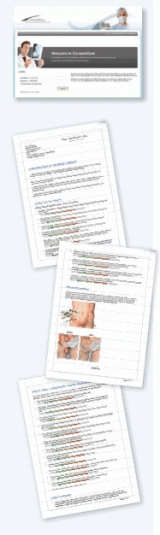
On logging in a doctor adds a new patient, and proceeds through progressive steps, selecting procedure name, adding or editing graphics, and having editorial control over the content at all stages.  An “editor’s” function allows preset information to be saved, speeding up the process for subsequent consents.

For all procedures a detailed consent document specific to the doctor, patient and procedure is produced in pdf form within a few minutes. This can be emailed to a patient beforehand, edited digitally using tablet PC’s, or printed out and discussed on the spot, leaving all options open as per the doctor’s preferences.

The potential

No other process leaves better evidence of a doctor’s ethical approach, transparency, patient care and responsibility than the informed consent process.  This is a document that should be in the patient’s possession as well as in the medical record, an ethical yardstick of due diligence.  It gives very little clinical detail away other than a patient’s name, the procedure, and likelihood of expected risks.  As such, this can assist the detailed case management of patients, warn nursing staff of anticipated complications, and allocate patients to different levels of post operative care.  It becomes a valuable nursing tool, not just a medicolegal hassle.

The record of a doctor’s approach to his patients in terms of attention to informed consent can be an ethical yardstick that raises that doctor’s profile above the rest.  In an era of doctor and hospital ratings, rising healthcare costs, rising litigation, and increasingly limited resources, all payers, i.e. patients, funders and insurers, could benefit from recognizing where their money is best spent.

The doctor’s excuse “I don’t have the time” should no longer be relevant. Technology takes care of that issue.  The consent process is so important, and with such cost-saving potential in the long term, that time considerations should be far secondary to ethical considerations.  In an era where low markups on doctors’ services promote the push to do high numbers of procedures, the consent process could be the one determinant to start reversing that process.

So, doctors, please make the time, cut the volumes, but, funders and insurers, make sure the doctor does not pay a financial penalty, and is remunerated properly for work done properly.  And malpractice insurers, please take note, and lower premiums for users.

Herein lies the true potential of facilitated informed consent, a ‘win-win’ for everyone involved.

Our position 

ConsentCare is a working proof-of-concept,  available for ‘reskinning’ to the designs of any users /institutions, with the same design elements applied to the final document, and can be hosted on private servers.

Interested users are invited to sign in on the website at www.consentcare.net for more information and a look around with basic functionality, and to contact me for more information.

Conclusion

And so, your thoughts and comments on this ME-P are appreciated. Feel free to review our top-left column, and top-right sidebar materials, links, URLs and related websites, too. Then, subscribe to the ME-P. It is fast, free and secure.

Channel Surfing the ME-P

Have you visited our other topic channels? Established to facilitate idea exchange and link our community together, the value of these topics is dependent upon your input. Please take a minute to visit. And, to prevent that annoying spam, we ask that you register. It is fast, free and secure.

Conclusion

Your thoughts and comments on this ME-P are appreciated. Feel free to review our top-left column, and top-right sidebar materials, links, URLs and related websites, too. Then, subscribe to the ME-P. It is fast, free and secure.

Speaker: If you need a moderator or speaker for an upcoming event, Dr. David E. Marcinko; MBA – Publisher-in-Chief of the Medical Executive-Post – is available for seminar or speaking engagements. Contact: MarcinkoAdvisors@msn.com

OUR OTHER PRINT BOOKS AND RELATED INFORMATION SOURCES:

Product Details    

On Track for Meaningful Use?

Are we on track to be a huge disappointment to our children’s children – or What?

[By Darrell K. Pruitt DDS]

When our grandchildren get the bill for the Obama administration’s subsidies benefitting primarily the health information technology industry, I bet they’re going to be really, really pissed at us for allowing today’s lawmakers to blow their 28 billion dollars to please HIT advocates who mislead consumers as well as lawmakers about the benefits of EHRs.

The Doctors Speak 

According to physicians who actually do the hard lifting in healthcare, the “meaningful use” requirements that they must prove in order to qualify for stimulus money will arguably increase both the cost and danger of healthcare – all for the benefit of stakeholders rather than principals. For one thing, “meaningful use” is meaningless if it fails to help physicians treat their patients. I think HIT stakeholders’ grandchildren should somehow be held accountable to my grandchildren.

Opposing Opinions  

Just days apart this week, two HIT reporters, Rich Daly from ModernHealthcare.com and Joseph Goedert from HealthDataManagment.com described two opposing letters the Office of the National Coordinator for Health Information Technology (ONC) recently received: One from doctors and one from patients (et al).

On Monday, here is how Daly’s article “AMA to ONC: EHR program doesn’t work for docs” began:

http://www.modernhealthcare.com/article/20110302/NEWS/303029950/1153

“Many physicians—specialists in particular—will not participate in the federal electronic health-record adoption incentive program because it requires them to include patient data that they do not otherwise collect, according to a Feb. 25 letter from 39 medical organizations letter to the Office of the National Coordinator for Health Information Technology”

On Wednesday, Joseph Goedert, writing for HealthDataManagment.com began “Consumer Groups: Hold Strong on MU” with this:

http://www.healthdatamanagement.com/news/meaningful-use-criteria-comments-consumers-42080-1.html

“A coalition of 25 consumer groups and unions is asking federal officials to hold firm on more stringent criteria for Stage 2 of electronic health records meaningful use, and expressing support for going further. For instance, because patients still trust their providers more than other information sources, holding providers accountable for actual usage of a patient Web portal ‘is entirely appropriate and we strongly urge ONC to resist pressure from the provider community to absolve them from responsibility for making these services available and useful to their patients,’ according to a comment letter to the Office of the National Coordinator”

  • AARP
  • Advocacy for Patients with Chronic Illness, Inc.
  • AFL-CIO
  • American Association on Health and Disability
  • American Hospice Foundation
  • Caring from a Distance
  • Center for Democracy & Technology
  • Childbirth Connection
  • Consumers for Affordable Health Care
  • Consumers Union
  • Families USA
  • Family Caregiver Alliance
  • Healthwise
  • Mothers Against Medical Error
  • National Alliance for Caregiving
  • National Coalition for Cancer Survivorship
  • National Consumers League
  • National Family Caregivers Association
  • National Health Law Program
  • National Partnership for Women & Families
  • National Women’s Health Network
  • OWL – The Voice of Midlife and Older Women
  • SEIU
  • The Children’s Partnership

Like the “Record Demographics” MU mandate, this is all for the “common good” I suppose. Consumer Advocasy groups wouldn’t mislead patients, would they?

I doubt many Americans represented by these 25 organizations ever imagined a new federal requirement that doctors record each patient’s demographics. (Notice of Proposed Rulemaking: Medicare and Medicaid Programs; Electronic Health Record Incentive Program; Federal Register / Vol. 75, No. 8 / Wednesday, January 13, 2010 / page 1861; RIN 0938-AP78).

This means that the 25 stakeholder groups are doing their best to help American taxpayers hold physicians accountable to record and share their patients’ demographic information with the US government – private information about me and my family members that I personally don’t trust the government to be given – even if I’m in vulnerable need of health care.

Daly’s Article 

According to Daly’s article, the demands of MU are distractions for increasingly busy doctors and staff whose focus, I believe, should include eye-contact with patients with specific health problems rather than irrelevant data needs of third parties, including consumer advocacy groups.

On the other hand, if consumer advocacy groups have successfully defined for the federal government what clueless patients allegedly need, who will the mandate really benefit? 25 consumer advocacy groups don’t equal one consumer, so their letter isn’t grass roots at all. It’s deception wearing lipstick. Gullible and vulnerable patients are again being misrepresented by HIT stakeholders for a cut of our grandchildren’s 28 billion.

Assessment

Finally, if MU requirements are an arguably expensive and dangerous distraction for physicians, how can the law possibly be any less absurd for dentists? I’ll look at meaningful use as well at the ADA’s apparently flagging commitment to EHRs next. The ADA is abandoning state informatics departments – leaving them exposed to ADA members’ questions they are unable to answer. It looks to me that intra-ADA relationships are deteriorating quickly, but nevertheless, traditional stoicism still hasn’t been broken. “Image is everything” – ADA/IDM slogan.

Dentists

Here’s a teaser, dentists: Chances are, your state ADA organization hasn’t yet shared with you how the MU requirement of CPOE (Computerized physician order entry – page 1858) will change your practice communications. If you are a HIPAA-covered entity with an NPI number and you don’t email instructions to your denture lab rather than include a hand-written note with the relevant patient’s plaster models, you won’t qualify for stimulus money. What can possibly go wrong with that meaningful idea?

Conclusion

Your thoughts and comments on this ME-P are appreciated. Feel free to review our top-left column, and top-right sidebar materials, links, URLs and related websites, too. Then, subscribe to the ME-P. It is fast, free and secure.

Speaker: If you need a moderator or speaker for an upcoming event, Dr. David E. Marcinko; MBA – Publisher-in-Chief of the Medical Executive-Post – is available for seminar or speaking engagements. Contact: MarcinkoAdvisors@msn.com

OUR OTHER PRINT BOOKS AND RELATED INFORMATION SOURCES:

Product DetailsProduct DetailsProduct Details

Product Details  Product Details

   Product Details 

About HealthCareAndYou.org

What it is – How it works?

By Staff Reporters

Join Our Mailing List 

At a time when many Americans are confused about the healthcare overhaul law, a coalition of groups representing doctors, nurses, pharmacists and consumers has launched a website to answer questions about the Affordable Care Act.

The new website – HealthCareandYou.org – doesn’t delve into the politics behind the law, but spells out what the law means to consumers, depending on the state they live in and their age. The website also provides a timeline, telling consumers when different parts of the law go into effect.

The Site

According to the site, The Affordable Care Act is a health care law that aims to improve our current health care system by increasing access to health coverage for Americans and introducing new protections for people who have health insurance.

If you have health insurance, you will benefit from steps to stop insurance companies from cancelling your coverage if you get sick. The law will also require insurance plans to cover your out-of-pocket costs for many proven preventive and screening services, such as colonoscopies and mammograms, to catch problems at their earliest, most treatable stages.

Your job might not offer health insurance. Or, maybe you have been denied coverage because of a pre-existing condition such as asthma or cancer. The law now offers health plans for people with pre-existing conditions who have had trouble finding care. And it will increase access to coverage for more Americans in 2014.

The law helps small businesses pay for health insurance for their employees. And it supports programs that will help increase the number of primary care physicians, nurses, physician assistants and other health care professionals.

Assessment

It is important to understand what the law means for you. Check out what changes have already taken place and learn more about what is happening in your state.

Link: http://www.healthcareandyou.org

Conclusion

And so, your thoughts and comments on this ME-P are appreciated. Feel free to review our top-left column, and top-right sidebar materials, links, URLs and related websites, too. Then, subscribe to the ME-P. It is fast, free and secure.

Speaker: If you need a moderator or speaker for an upcoming event, Dr. David E. Marcinko; MBA – Publisher-in-Chief of the Medical Executive-Post – is available for seminar or speaking engagements. Contact: MarcinkoAdvisors@msn.com and http://www.springerpub.com/Search/marcinko

Our Other Print Books and Related Information Sources:

Health Dictionary Series: http://www.springerpub.com/Search/marcinko

Practice Management: http://www.springerpub.com/product/9780826105752

Physician Financial Planning: http://www.jbpub.com/catalog/0763745790

Medical Risk Management: http://www.jbpub.com/catalog/9780763733421

Healthcare Organizations: www.HealthcareFinancials.com

Physician Advisors: www.CertifiedMedicalPlanner.com

Subscribe Now: Did you like this Medical Executive-Post, or find it helpful, interesting and informative? Want to get the latest ME-Ps delivered to your email box each morning? Just subscribe using the link below. You can unsubscribe at any time. Security is assured.

Link: http://feeds.feedburner.com/HealthcareFinancialsthePostForcxos

Sponsors Welcomed: And, credible sponsors and like-minded advertisers are always welcomed.

Link: https://healthcarefinancials.wordpress.com/2007/11/11/advertise

Product DetailsProduct DetailsProduct Details       

Product Details  Product Details

   Product Details 

“Journal of Financial Management Strategies” for Healthcare Organizations

ADVERTISEMENT

Hospitals and Healthcare Organizations

[A Textbook of Financial Management Strategies]

Buy from Amazon


Mobile Trends and their Impact on the [Medical] App Market

Mobile World Congress Review

By Markus Pohl

Join Our Mailing List 

Some major trends about the mobile apps market were clearly visible at the Mobile World Congress in Barcelona this week. How will trends like new operating systems, new devices, new technologies, developer migration, etc. affect the global apps market? Here is a quick rundown:

Symbian is dead long live Windows 7

This is probably the biggest single piece of news to emerge from last week’s event. Windows 7 will be used as the primary OS for Nokia’s smartphone portfolio. According to Mr. Elop (Nokia CEO) there will be a two year transition time before all new devices are being shipped with the OS from Microsoft, but from our discussions with Microsoft and Nokia we realize that there is a large amount of pressure to make that period as short as possible, especially as it will become even more difficult to convince developers to develop for Symbian, a dead end platform. The co-existence of Nokia phones running on WindowsPhone 7, Symbian and MeeGo presents a challenge. The future of MeeGo seems to be very uncertain even though Nokia and Intel stated their intent to offer an alternative platform especially for non smartphone devices.  Windows 7 will definitely become a very interesting platform for developers in the future. If it will meet the expectations of those two giants is not clear just yet.

Tablets are everywhere

All major and quite a few smaller OEMs presented their answer to the iPad. They were probably the most touched and intensively tested devices at the MWC. Apple created this new market and sold almost 15 million iPads in only 9 months. Not many analysts forecasted this tremendous success (including us). Samsung unveiled the Galaxy Tab’s successor the Galaxy Tab 10.1 based on Android’s avatar for tablets: Honeycomb. LG, HP, HTC, Motorola, RIM, Lenovo and Toshiba all announced devices at the MWC 2011. RIM plans to release its super Playbook’s WiFi version late in Q1 2011, and HSPA+ and LTE, office software capability, multitasking OS, along with Flash, HTML5 and open internet standards in H2 2011. HP also unveiled Touchpad, a webOS based tablet. ZTE will accelerate its expansion on smart devices by launching lightweight tablets based on Honeycomb, which will be due in Q3 2011. Malata, a smaller Chinese vendor, only showed its portfolio of tablets in Barcelona. What it shows: There will be hundreds of tablets launched by the end of 2011. It is going to be the year of the tablets. Make sure your apps look good on them.

Broad awareness for m-Health and home monitoring

mHealth was clearly the biggest cross industry topic on the conference. Most of the OEM and operators as well as big fishes like Qualcomm and IBM showed some of their solutions which make use of a mobile device to support the treatment of a patient. Interesting that most of the mHealth solutions where not smartphone centered but made use of a specific device. Only smaller players which showed their solutions in the health care pavilion where mainly smartphone focused.  Home monitoring has been another interesting cross industry area which caught a lot of attention during the week. Telco companies used an entire pavilion, the “Embedded House”, to showcase their offerings. It became clear that the Telco industry will compete against the energy industry in that promising market.

Cross platform development is becoming more visible

It is clear that in the following years developers will face increasing challenges in developing apps for multi app platforms. There are some promising cross platform development tools and platforms out there which should gain more attention in the near future. There are a growing number of companies concentrating on those services such as Service2Media, Mobile Distillery, ideas2mobile and Geniem. Another interesting concept that showcased at the event is Kinoma by Marvell. This could be described as an app store within an app store. Marvell claims that apps running in the Kinoma environment must be developed only once and work on Android and Windows 7 operating systems.

Assessment 

Stay updated with our “App Market Monitoring”.

Link to blog post: http://www.research2guidance.com/gsma-mobile-world-congress-in-barcelona-impact-on-the-app-market/

Link to picture: http://www.research2guidance.com/wp-content/uploads/2011/02/2011-02-21-Barcelona.png

Twitter: #Mobile #Trends And Their Impact On The #App #Market – MWC Review: http://bit.ly/eMy2JR

About research2guidance:

research2guidance is a Berlin-based market research company specialized in the mobile industry. The company’s service offerings include comprehensive market studies, as well as bespoke research and consultancy.

Contact:

Markus Pohl

research2guidance

+49 30 609 893 363

markus.pohl@research2guidance.com

Conclusion

And so, your thoughts and comments on this ME-P are appreciated. Feel free to review our top-left column, and top-right sidebar materials, links, URLs and related websites, too. Then, subscribe to the ME-P. It is fast, free and secure.

Speaker: If you need a moderator or speaker for an upcoming event, Dr. David E. Marcinko; MBA – Publisher-in-Chief of the Medical Executive-Post – is available for seminar or speaking engagements. Contact: MarcinkoAdvisors@msn.com and http://www.springerpub.com/Search/marcinko

Our Other Print Books and Related Information Sources:

Health Dictionary Series: http://www.springerpub.com/Search/marcinko

Practice Management: http://www.springerpub.com/product/9780826105752

Physician Financial Planning: http://www.jbpub.com/catalog/0763745790

Medical Risk Management: http://www.jbpub.com/catalog/9780763733421

Healthcare Organizations: www.HealthcareFinancials.com

Physician Advisors: www.CertifiedMedicalPlanner.com

Subscribe Now: Did you like this Medical Executive-Post, or find it helpful, interesting and informative? Want to get the latest ME-Ps delivered to your email box each morning? Just subscribe using the link below. You can unsubscribe at any time. Security is assured.

Link: http://feeds.feedburner.com/HealthcareFinancialsthePostForcxos

Sponsors Welcomed: And, credible sponsors and like-minded advertisers are always welcomed.

Link: https://healthcarefinancials.wordpress.com/2007/11/11/advertise

Product Details 

Medical Practice Social Media Marketing Plan Survey

Medical Practice Marketing Plan Survey for Doctors?

Join Our Mailing List 

“We’re considering integrating social media into our medical practice marketing plan,” Dr. Joseph Frank Stankowsy started out saying.

Then he backtracked—“Yet, all we hear about it is what we can’t do from a HIPAA and security compliance perspective.”

And so, do you incorporate social media into your medical practice marketing plan? Please vote and opine here.

Channel Surfing the ME-P

Have you visited our other topic channels? Established to facilitate idea exchange and link our community together, the value of these topics is dependent upon your input. Please take a minute to visit. And, to prevent that annoying spam, we ask that you register. It is fast, free and secure.

Conclusion

Your thoughts and comments on this ME-P are appreciated. Feel free to review our top-left column, and top-right sidebar materials, links, URLs and related websites, too. Then, subscribe to the ME-P. It is fast, free and secure.

Speaker: If you need a moderator or speaker for an upcoming event, Dr. David E. Marcinko; MBA – Publisher-in-Chief of the Medical Executive-Post – is available for seminar or speaking engagements. Contact: MarcinkoAdvisors@msn.com

OUR OTHER PRINT BOOKS AND RELATED INFORMATION SOURCES:

Product DetailsProduct DetailsProduct Details

Product Details  Product Details

   Product Details 

On eMRs and Disease Management

Join Our Mailing List

One Clinical Area Where Electronic Benefits May Exceed Paper’s Molecules

By Dr. David Edward Marcinko [Publisher-in-Chief]

www.BusinessofMedicalPractice.com

One area where technology assessments, clinical guidelines, and especially eMR aggregated data can make a true difference in patient care is in disease management.

The DMAA

The Disease Management Association of America (DMAA) defines disease management as “a system of coordinated health care interventions and communications for populations with conditions in which patient self-care efforts are significant”. 

Disease management supports the physician-patient relationship and places particular significance on the prevention of exacerbations and complications of chronic diseases using evidence-based clinical guidelines and integrating those recommendations into initiatives to empower patients to be active partners with their physicians in managing their conditions.

Disease Targets

Typically, targets for disease management efforts include chronic conditions such as asthma, diabetes, chronic obstructive pulmonary disease, coronary artery disease, and heart failure, where patients can be active in self-care and where appropriate lifestyle changes can have a significant favorable impact on illness progression.

Link: Front Matter BoMP – 3

Outcomes Measurement

The DMAA also emphasizes the importance of process and outcomes measurement and evaluation, along with using the data to influence management of the condition.

Assessment

Although claims and administrative data can be used to measure and evaluate selected processes and outcomes, eMRs will be needed to capture the full spectrum of data for analyzing illness response to disease management programs and to support necessary changes in care plans to improve both intermediate outcomes (such as lab values), and long-range goals (such as the prevention of illness exacerbations, managing co-orbidities, and halting the progression of complications).

Is this where eMRs can shine far and above traditional ink and paper medical records?

Channel Surfing the ME-P

Have you visited our other topic channels? Established to facilitate idea exchange and link our community together, the value of these topics is dependent upon your input. Please take a minute to visit. And, to prevent that annoying spam, we ask that you register. It is fast, free and secure.

Conclusion

Your thoughts and comments on this ME-P are appreciated. Feel free to review our top-left column, and top-right sidebar materials, links, URLs and related websites, too. Then, subscribe to the ME-P. It is fast, free and secure.

Speaker: If you need a moderator or speaker for an upcoming event, Dr. David E. Marcinko; MBA – Publisher-in-Chief of the Medical Executive-Post – is available for seminar or speaking engagements. Contact: MarcinkoAdvisors@msn.com

OUR OTHER PRINT BOOKS AND RELATED INFORMATION SOURCES:

Product Details 

A Survey to Understand the Modern Doctor-Patient Milieu

Doctors – Take Our Professional Contentment [“Happiness”] Survey

By Ann Miller RN MHA

[Executive-Director]

Join Our Mailing List 

www.BusinessofMedicalPractice.com

Today, when patients communicate through instant messaging, Twitter, Facebook, and other Web 2.0 electronic mediums, they might feel that health providers are already more like the virtual “Doctor” than the all-too-human “Bones.”

The Contemporary Practice Milieu

Before long, according to one technology expert, 20% – 50% of all doctor-patient communication will be virtual. But we suggest you pause before rocketing ahead into this brave new future that advocates call Health 2.0—the application of social media tools to the health care environment.

Electronic technology in all of its forms has obviously had a profound impact on medicine. We focus here on just one of its most notable effects: the changing doctor-patient relationship. We believe Health 2.0 has the potential to deepen this relationship—or not. It depends on how you use it.

Our Guidance

There are an almost overwhelming number of social media tools for managing the doctor-patient relationship. How do you choose the right ones? We offer some guidance in this essay by focusing on three issues:

  • What matters most in the doctor-patient relationship?
  • What counts as a good relationship?
  • How should you use social media tools to build a relationship?

We have found that there is no one best way to use Health 2.0 technology. But, there is just one rule. As the novelist E.M. Forster said, “Only connect.”

The Survey

And so, we ask you to opine:

  • Has your doctor-patient relationship changed in recent years with the rise of the Internet search engines like “Dr. Google and Dr. Oogle” [for dentists] and the push to empower patients to take a greater role in their own care via HD-HCPs, private or direct payment models, etc?
  • Are patients more demanding of your time and attention than in the past? Do they understand the economic pressures that affect your practice? Do they care, or should they even care?
  • How do you handle noncompliant or uncooperative patients? What strategies work best or least? Is this issue underappreciated by the people pushing to base a greater portion of reimbursement on quality measures and outcomes?
  • How much time each week do you spend on paperwork, phone calls to payers, insurance companies, and other administrative tasks? How much has this increased in the last few years? Have you reached your breaking point, yet?

Assessment

Please give us your thoughts and opinions in the text box below.

Conclusion

Your thoughts and comments on this ME-P are appreciated. Feel free to review our top-left column, and top-right sidebar materials, links, URLs and related websites, too. Then, subscribe to the ME-P. It is fast, free and secure.

Speaker: If you need a moderator or speaker for an upcoming event, Dr. David E. Marcinko; MBA – Publisher-in-Chief of the Medical Executive-Post – is available for seminar or speaking engagements. Contact: MarcinkoAdvisors@msn.com and http://www.springerpub.com/Search/marcinko

Our Other Print Books and Related Information Sources:

Health Dictionary Series: http://www.springerpub.com/Search/marcinko 

Practice Management: http://www.springerpub.com/product/9780826105752

Physician Financial Planning: http://www.jbpub.com/catalog/0763745790

Medical Risk Management: http://www.jbpub.com/catalog/9780763733421

Healthcare Organizations: www.HealthcareFinancials.com

Physician Advisors: www.CertifiedMedicalPlanner.com

Subscribe Now: Did you like this Medical Executive-Post, or find it helpful, interesting and informative? Want to get the latest ME-Ps delivered to your email box each morning? Just subscribe using the link below. You can unsubscribe at any time. Security is assured.

Link: http://feeds.feedburner.com/HealthcareFinancialsthePostForcxos

Sponsors Welcomed: And, credible sponsors and like-minded advertisers are always welcomed.

Link: https://healthcarefinancials.wordpress.com/2007/11/11/advertise

Product DetailsProduct DetailsProduct Details       

Product Details  Product Details

   Product Details 


Silverman, Jennifer. “Impact of Virtual Visits on Doctor-Patient Relationship Unclear: an end to ‘true medicine’?” Ob.Gyn. News 38.21 (2003): 29.

Why m-Health App Developers Won’t Make Money with Current Pay-Per Download Business Models

A Broadening Business Model

By Markus Pohl

markus.pohl@research2guidance.com

Join Our Mailing List 

Despite the hype around mobile health applications and big market projections mobile health app developers will not be able to create big revenues with a pay per download business models. But how will mHealth apps generate enough sustainability to meet the rising expectations during this hype phase? And how will mHealth business models evolve in the next five years?

The Hype 

Mobile health applications are experiencing a second hype phase after first enthusiasm in the early 2000s. By looking back a few years we can see how the business will evolve in the future. Business models of traditional mHealth solutions which long existed before the smartphone app market hype already showed the revenue sources which will become important in the future. Traditional mHealth solutions from 2000-2008 have typically been sold in bundles, which include connectivity charges, a device, and the application and/or service charge. In the more sophisticated traditional mHealth solutions the price for the application and the application sales revenues were minor contributors to the total revenue generated by the solution. Frequently the price for the app was not even disclosed.

First Gen  

The first generation of mHealth solutions in the new smartphone applications market have adopted a narrow range of business models, concentrating on revenues generated from application download sales, and subscriptions for content access over a period of time; average of 4-8 USD per download depending on the app store. In a very few cases publishers have linked the application to a device/sensor or service, such as the WiThing Scales Sync which provides a free application for use with a scale which is sold through the publisher’s website.

Broadening Business Model 

The business model will broaden once more when the enabling technology becomes sufficiently advanced. Sensors and special devices that are designed to take advantage of the smartphone interface will facilitate more advanced applications, and at the same time healthcare industry players with the capability of providing complex service offerings will enter the market. These factors will allow revenue generation through multiple sources apart from application downloads including for example through service charges for HCPs remotely monitoring patients’ health condition, or through product sales for special devices and sensors that relate to an application’s functionality.

As the market develops, applications will facilitate the sale of products and services such as medications through a compliance application or a mobile pharmacy application. These device and service sales will become the major revenue source for mHealth application providers by 2015.

Advertising revenues will become a revenue stream, as it will across the smartphone application market and will add to the mHealth providers’ income but only to a little extent.

Assessment 

As opposed to the traditional model, connectivity will not be part of the bundle, as most smartphone users will already have some kind of data plan.

Today’s dominant pay per download business model will give way to those other revenue stream. Developers of mHealth applications should be aware of that and adopt their products and service accordingly.

To see more details on the future trends in mHealth business models please have a look at the “Mobile Health Market Report 2010-2015”.

About research2guidance:

research2guidance is a Berlin-based market research company specialized in the mobile industry. The company’s service offerings include comprehensive market studies, as well as bespoke research and consultancy.

Contact:

research2guidance

+49 30 609 893 363

Conclusion

And so, your thoughts and comments on this ME-P are appreciated. Feel free to review our top-left column, and top-right sidebar materials, links, URLs and related websites, too. Then, subscribe to the ME-P. It is fast, free and secure.

Speaker: If you need a moderator or speaker for an upcoming event, Dr. David E. Marcinko; MBA – Publisher-in-Chief of the Medical Executive-Post – is available for seminar or speaking engagements. Contact: MarcinkoAdvisors@msn.com and http://www.springerpub.com/Search/marcinko

Our Other Print Books and Related Information Sources:

Health Dictionary Series: http://www.springerpub.com/Search/marcinko

Practice Management: http://www.springerpub.com/product/9780826105752

Physician Financial Planning: http://www.jbpub.com/catalog/0763745790

Medical Risk Management: http://www.jbpub.com/catalog/9780763733421

Healthcare Organizations: www.HealthcareFinancials.com

Physician Advisors: www.CertifiedMedicalPlanner.com

Subscribe Now: Did you like this Medical Executive-Post, or find it helpful, interesting and informative? Want to get the latest ME-Ps delivered to your email box each morning? Just subscribe using the link below. You can unsubscribe at any time. Security is assured.

Link: http://feeds.feedburner.com/HealthcareFinancialsthePostForcxos

Sponsors Welcomed: And, credible sponsors and like-minded advertisers are always welcomed.

Link: https://healthcarefinancials.wordpress.com/2007/11/11/advertise

Product DetailsProduct DetailsProduct Details       

Product Details  Product Details

   Product Details 

The Continuing Debate over Electronic Medical Records Systems

Join Our Mailing List

Are We There Yet? – In Healthcare Organizations

[By Richard J. Mata MD, MS]

Dr. Mata

Paper-based medical records have been in existence for centuries and their gradual replacement by computer-based records has been slowly underway for over twenty years in western healthcare systems.

Computerized information systems have not achieved the same degree of penetration in healthcare as is seen in other sectors such as finance, transportation, and the manufacturing and retail industries.

Further, deployment has varied greatly from country to country and from specialty to specialty and in many cases has revolved around local systems designed for local use.

The DHHS

In a 2005 DHHS study, national penetration of electronic health records (EHRs) may have reached over 90% in primary care practices in Norway, Sweden, and Denmark (2003), but has been limited to 17% of physician office practices in the U.S. (2001-2003). By 2011, and the ACA, this number may now be approaching 20-25% in the US but adoption may actually be slowing.

The ISMS Vision

According to the Illinois State Medical Society there is a “Sweeping Vision for EHRs”:

  • EHRs will provide a comprehensive view of all patient information
  • Quality of care will be improved.
  • Physicians will more easily be able to review the “complete” medical record.
  • An appropriately configured EHR system will provide “alerts” and “notices” to help health care providers incorporate best practices into patient treatments. Ideally clinical decision support should be built in and be evidence-based.

Medical errors can be reduced:

  • Treatment and administrative costs will be reduced.
  • Public health will be improved.

Defining Electronic Records Systems

The 2003 Institute of Medicine (IOM) Patient Safety Report describes an EHR as encompassing:

  • a longitudinal collection of electronic health information for and about persons;
  • [immediate] electronic access to person- and population-level information by authorized users;
  • provision of knowledge and decision-support systems [that enhance the quality, safety, and efficiency of patient care] and
  • support for efficient processes for health care delivery.

IOM Report

A 1997 IOM report, The Computer-Based Patient Record: An Essential Technology for Health Care provides a more extensive definition:

A patient record system is a type of clinical information system, which is dedicated to collecting, storing, manipulating, and making available clinical information important to the delivery of patient care. The central focus of such systems is clinical data and not financial or billing information. Such systems may be limited in their scope to a single area of clinical information (e.g., dedicated to laboratory data), or they may be comprehensive and cover virtually every facet of clinical information pertinent to patient care (e.g., computer-based patient record systems).

The EHR definitional model document developed by the Health Information and Management Systems Society (HIMSS, 2003) includes “a working definition of an EHR, attributes, key requirements to meet attributes, and measures or ‘evidence’ to assess the degree to which essential requirements have been met once EHR is implemented.”

IOM Re-Deux

In another IOM report, Key Capabilities of an Electronic Health Record System [Tang, 2003], identifies a set of eight core care delivery functions that EHR systems should be capable of performing in order to promote greater safety, quality and efficiency in health care delivery. The eight core capabilities that EHRs should possess are:

  1. Health information and data. Having immediate access to key information – such as patients’ diagnoses, allergies, lab test results, and medications – would improve caregivers’ ability to make sound clinical decisions in a timely manner.
  2. Result management. The ability for all providers participating in the care of a patient in multiple settings to quickly access new and past test results would increase patient safety and the effectiveness of care.
  3. Order management. The ability to enter and store orders for prescriptions, tests, and other services in a computer-based system should enhance legibility, reduce duplication, and improve the speed with which orders are executed.
  4. Decision support. Using reminders, prompts, and alerts, computerized decision-support systems would help improve compliance with best clinical practices, ensure regular screenings and other preventive practices, identify possible drug interactions, and facilitate diagnoses and treatments.
  5. Electronic communication and connectivity. Efficient, secure, and readily accessible communication among providers and patients would improve the continuity of care, increase the timeliness of diagnoses and treatments, and reduce the frequency of adverse events.
  6. Patient support. Tools that give patients access to their health records, provide interactive patient education, and help them carry out home monitoring and self-testing can improve control of chronic conditions, such as diabetes.
  7. Administrative processes. Computerized administrative tools, such as scheduling systems, would greatly improve hospitals’ and clinics’ efficiency and provide more timely service to patients.
  8. Reporting. Electronic data storage that employs uniform data standards will enable health care organizations to respond more quickly to federal, state, and private reporting requirements, including those that support patient safety and disease surveillance.”

Assessment

After reviewing the above, are we there yet in – 2011?

Conclusion

Your thoughts and comments on this ME-P are appreciated. Feel free to review our top-left column, and top-right sidebar materials, links, URLs and related websites, too. Then, subscribe to the ME-P. It is fast, free and secure.

Speaker: If you need a moderator or speaker for an upcoming event, Dr. David E. Marcinko; MBA – Publisher-in-Chief of the Medical Executive-Post – is available for seminar or speaking engagements. Contact: MarcinkoAdvisors@msn.com

OUR OTHER PRINT BOOKS AND RELATED INFORMATION SOURCES:

Product DetailsProduct DetailsProduct Details

Product Details 

ICD-10 is Not an Airplane

It’s Another Part of HIPAA the ADA Won’t Discuss

By D. Kellus Pruitt DDS

A couple of days following the heads up I posted concerning the imminent upgrade from the tedious ICD-9 coding system to the ICD-10 that is said to be exponentially more complicated, informatics specialist Tom Sullivan posted a signal to fellow coders nationwide: “7 tactics for making ICD-10 urgent.”

http://www.healthcareitnews.com/blog/7-tactics-making-icd-10-urgent 

If you are fed up with unfunded, non-productive and ineffective mandates like I am, I imagine an alert to coders to create urgency in your practice makes your ear lobes burn bright red as well.

Tedious Administrative Tasks 

According to Sullivan, the ICD-10 presents providers with new requirements for “care management protocols, clinical and financial databases and reports, reimbursement, registries, quality management and research.” These requirements do not promote patients’ best interests. These tedious administrative tasks only enable HIPAA-covered entities to get paid.

ADA

If you are a HIPAA-covered dentist with a voluntary but permanent 10-digit NPI number which is required for ICD-10 compliancy, are you aware if ADA leaders have yet described the ICD-10 coding system any better than they described the NPI number that Delta Dental, BCBSTX, as well as the ADA aggressively promoted years ago?

Who knows? The ICD-10 may not even apply to dentistry. Somewhere deep in the HIPAA Rule, there might be a footnote that says “except in dental practices.”

Department of Dental Informatics

This isn’t the first time I’ve heard rumors about HIPAA’s nasty surprises for dentists. Five years ago this month, “quality” control through dental informatics was enthusiastically but perhaps prematurely revealed to me by an excited spokesman for the ADA Department of Dental Informatics. It was his email that equipped me with everything I needed for this 5 year adventure.

Shortly afterwards, the topic of HIPAA became so poisonous for ADA officials to discuss that the misled leaders who unwittingly signed on to promote digital fantasies in dentistry only rarely appeared in print and never on the internet – leaving the responsibility of informing naïve and trusting ADA members about the downsides of EHRs to those who sell EHRs.

Nevertheless, following three years of official silence about HIPAA from the ADA, in the last 14 months there have been two commentaries published in the JADA which promote quality control in dentistry. The first was written by James Bader DDS and appeared in the December 2009 edition of the JADA titled “Challenges in quality assessment of dental care.”

http://jada.ada.org/cgi/content/full/140/12/1456  

Quality Control 

The second commentary concerning quality control was written by Editor Michael Glick DMD titled ““When good may not be good enough — The need for clinical performance measures in dentistry.” (I’m no longer able to access JADA online).

EBD 

HIT stakeholders Bader and Glick, who are both fervent supporters of Evidence Based Dentistry as well as paperless dental practices, carefully tiptoe around what looks to me like an oppressive, micromanaged future for dentists. They both argue what must be a desperate committee-approved talking point – that quality assessment is critically important for ADA members so that fully-licensed dentists will have digital, Evidence-Based proof that their care is better than dental therapists’ who work for much less money.

Are ADA leaders sitting around a big table in ADA Headquarters when they think up this crap?

In addition, the cloistered committee concludes that patients’ opinions of their dentists is too difficult to collect and less reliable than algorithms based on dental claims and other data provided by the ICD-10 (?).

In fact, Dr. Bader is so confident in Evidence-Based digital results, he dismisses the need for any patient involvement in quality assessment: “Patient satisfaction has been shown to be associated only weakly with other assessments of quality of care, which means that it cannot be used as a surrogate for measures of technical quality.” Try telling that to a formerly satisfied dental patient who suddenly must pick his or her next dentist from a “preferred” provider list of strangers.

Assessment 

You mean like Ingenix’s measures of technical quality, Dr. Bader? In 2008, NY Attorney General Andrew Cuomo spanked the UnitedHealth subsidiary for selling algorithmic excuses to insurers to be used to cheat out-of-network physicians.

Conclusion

If you are a small business owner who reasonably asks to be paid no more and no less than what one is owed as quickly as possible – if not immediately like all other businesses in the land of the free – I’m pretty sure Sullivan’s 7 pearls intended to make ICD-10 more urgent for doctors will light up the lobes again. And so, your thoughts and comments on this ME-P are appreciated. Feel free to review our top-left column, and top-right sidebar materials, links, URLs and related websites, too. Then, subscribe to the ME-P. It is fast, free and secure.

Speaker: If you need a moderator or speaker for an upcoming event, Dr. David E. Marcinko; MBA – Publisher-in-Chief of the Medical Executive-Post – is available for seminar or speaking engagements. Contact: MarcinkoAdvisors@msn.com and http://www.springerpub.com/Search/marcinko

Our Other Print Books and Related Information Sources:

Health Dictionary Series: http://www.springerpub.com/Search/marcinko

Practice Management: http://www.springerpub.com/product/9780826105752

Physician Financial Planning: http://www.jbpub.com/catalog/0763745790

Medical Risk Management: http://www.jbpub.com/catalog/9780763733421

Healthcare Organizations: www.HealthcareFinancials.com

Physician Advisors: www.CertifiedMedicalPlanner.com

Subscribe Now: Did you like this Medical Executive-Post, or find it helpful, interesting and informative? Want to get the latest ME-Ps delivered to your email box each morning? Just subscribe using the link below. You can unsubscribe at any time. Security is assured.

Link: http://feeds.feedburner.com/HealthcareFinancialsthePostForcxos

Sponsors Welcomed: And, credible sponsors and like-minded advertisers are always welcomed.

Link: https://healthcarefinancials.wordpress.com/2007/11/11/advertise

Product Details 


An Argument for Wikileaks in US Healthcare

On Allscripts CEO Glen Tullman

By Darrel K. Pruitt DDS

In 2008, Allscripts CEO Glen Tullman told Alex Nussbaurm of Bloomberg.com that physicians should take out loans to invest in his EHR product “to ensure that doctors have some skin in the game.” What did you expect? How much charm does it take to sell federally subsidized products when everyone knows that they’re mandated anyway?

Life Sans Blumenthal 

Yesterday, Nicole Lewis posted “Health IT’s Future without David Blumenthal” – a glowing and arguably deserved tribute to Dr. David Blumenthal who is leaving the ONC

http://www.informationweek.com/news/healthcare/leadership/showArticle.jhtml;jsessionid=0OLOEMENGCENJQE1GHRSKH4ATMY32JVN?articleID=229201216&pgno=1&queryText=&isPrev=

From where I’m sitting, it’s clear that Tullman used Lewis and InformationWeek to score more points with Washington and Wall Street, while continuing to marginalize the interests of those who actually take out loans to purchase his product: “David shepherded ONC through a very critical time . . . the creation, definition, and implementation of meaningful use, which really is a way to ensure that physicians actually use electronic records to improve care, but also that taxpayers get good value for their investment.” What about the doctor’s investment and more importantly, if a doctor is busy clicking on links to qualify for meaningful use dollars, who is accountable to the patients?

I don’t know about you, but it’s not difficult for me to recognize that like other HIT stakeholders whose careers are propped up by easy mandates rather than finicky satisfied customers, Tullman indeed has solid free-market reasons to play to investors and politicians while fearing his customers. They’re pissed at the man.

A Nationwide Survey           

HCPlexus recently partnered with Thompson Reuters to conduct a nationwide survey of almost 3,000 physicians concerning their opinions of the quality of health care in the near future considering the Patient Protection and Affordable Care Act (PPACA), Electronic Medical Records, and their effects on physicians and their patients. (See “5-page Executive Summary”)

http://www.hcplexus.com/PDFs/Summary—2011-Thomson-Reuters-HCPlexus-National-P

“Sixty-five percent of respondents believe that the quality of health care in the country will deteriorate in the near term. Many cited political reasons, anger directed at insurance companies, and critiques of the reform act – some articulating the strong feelings they have regarding the negative effects they expect from the PPACA.”

At this crucial time when Republicans are already threatening to cut off remaining HITECH funding, whose job will it be to break the news to HHS Secretary Kathleen Sebelius that the EHR savings she was counting on to fund a major portion of healthcare reform are only as valuable as CEO Tullman’s politically-correct fantasy? Pop! From what Nicole Lewis writes, my bet is that the Secretary won’t take the news well: “[Sebelius] reiterated that the successful adoption and use of HIT is fundamental to virtually every other important goal in the reform of the nation’s health care system.” Such pressure from the top down will make it even more difficult for HIT stakeholders, including insurers and politicians, to disown the most egregious. crowd-pleasin’, bi-partisan blunder in medical history since blood-letting was declared Best Practice by popular demand.

According to the HCPlexus-Reuters survey results, one in four physicians think EHRs will actually cause more harm than help in spite of Dr. Blumenthal’s best efforts. I wonder if the escalating bad press about EHRs helped Blumenthal decide to return to his academic position at Harvard. Of course, the controversy over HITECH is nothing new. There have been signs for years that EHRs, including Allscripts products, will neither improve care nor provide taxpayers (our grandchildren) a good value for their investment.

If Tullman was unaware of the highly critical HCPlexus-Reuters study when he assured InformationWeek that his subsidized product has value in the marketplace, he must have been aware of the disappointing news concerning two other recent studies performed by Public Library of Sciences (PLoS) and Stanford which also confirm that EHRs do not improve care. So imagine what it’s like to be one of Tullman’s new, naïve and trusting customers who are expected to use the product for something it’s not designed to do.

My Opinion 

It’s my opinion that Tullman’s apparently incorrigible business ethics have no place in the land of the free, and that more transparency in healthcare would help protect the nation from such politically-connected tyrants. Tullman, a long-time Chicago friend of Barack Obama and a Wall Street sweetheart, would still be just another domesticated CEO if it weren’t for the bi-partisan mandate for electronic health records that help Allscripts, Obama and Wall Street more than clueless patients.

Assessment 

If you want to seriously cut costs in US healthcare as well as cut our grandchildren’s taxes, demand transparency from not just the doctors and patients, but from stakeholders as well. Protected communications between good ol’ boys in healthcare are hardly diplomatic cables about military secrets and always increase the cost of healthcare.

Conclusion

And so, your thoughts and comments on this ME-P are appreciated. So when do you want to get the website started? I’m here to serve wherever you need me. Feel free to review our top-left column, and top-right sidebar materials, links, URLs and related websites, too. Then, subscribe to the ME-P. It is fast, free and secure.

Speaker: If you need a moderator or speaker for an upcoming event, Dr. David E. Marcinko; MBA – Publisher-in-Chief of the Medical Executive-Post – is available for seminar or speaking engagements. Contact: MarcinkoAdvisors@msn.com and http://www.springerpub.com/Search/marcinko

Our Other Print Books and Related Information Sources:

Health Dictionary Series: http://www.springerpub.com/Search/marcinko

Practice Management: http://www.springerpub.com/product/9780826105752

Physician Financial Planning: http://www.jbpub.com/catalog/0763745790

Medical Risk Management: http://www.jbpub.com/catalog/9780763733421

Healthcare Organizations: www.HealthcareFinancials.com

Physician Advisors: www.CertifiedMedicalPlanner.com

Subscribe Now: Did you like this Medical Executive-Post, or find it helpful, interesting and informative? Want to get the latest ME-Ps delivered to your email box each morning? Just subscribe using the link below. You can unsubscribe at any time. Security is assured.

Link: http://feeds.feedburner.com/HealthcareFinancialsthePostForcxos

Sponsors Welcomed: And, credible sponsors and like-minded advertisers are always welcomed.

Link: https://healthcarefinancials.wordpress.com/2007/11/11/advertise

Product DetailsProduct DetailsProduct Details       

Product Details  Product Details

   Product Details 

Is Informatics the The Curse of Healthcare Reform?

Join Our Mailing List

Medical Coding Complications and Greed

[By Darrell K. Pruitt DDS]

Coding complications in government healthcare ALWAYS favor the house — CMS guarantees it with lawsuits and whistleblower rewards that could attract dishonest employees. Are you careful who you hire?

Complications 

Complications in healthcare informatics – including 5-digit CPT® code mistakes as well as foul-ups that involve physicians’ “voluntary” 10-digit National Provider Identifier numbers – ALWAYS grant insurers more time to pay past-due bills owed to their clients and their clients’ doctors.

Call me Cynical 

Call me cynical, but if interest rates climb ever higher as predicted, watch for unexplained, proportional increases in coding errors to help fund insurance CFOs’ bonuses while raising the cost of healthcare even more without improving value. Is it any wonder why Americans don’t get the quality of healthcare we purchase compared to citizens in other countries? Tax-payers in my neighborhood are begging for in-network providers who put their patients’ interests ahead of insurers’ as much as allowed by insurers’ self-serving rules – without committing fraud. As a general rule, healthcare stakeholders accommodate parasites more than principals.

CPT® Codes and Patient Care 

Accurate CPT® coding may have nothing to do with patient care, but CMS makes it nevertheless important to physicians. Whereas the most innocent NPI foul-ups reliably delay payment and never turn out well for providers, the new fraud and abuse provisions of the Patient Protection and Affordable Care Act [ACA] can cause an innocent coding mistake on a Medicare claim to land the doc in court with charges of fraud depending on the quality of employees one hires – but only if the error favors the provider and not the payer. In June, David Burda posted “Attorney tells audience to brace for a storm of whistle-blower lawsuits” on ModernHealthcare.com.

http://www.modernhealthcare.com/article/20100623/NEWS/306209989/-1

Of Whistle-Blower Lawsuits

Burda reports that healthcare attorney Joanne Judge, a partner with Stevens & Lee in Reading, Pa., predicts a significant increase in whistle-blower lawsuits simply because the new law makes it far too easy for a dishonest employee to file an unwarranted lawsuit. No longer is there a requirement for the whistleblower, who stands to win money from his or her patriotic effort, to directly witness the crime. That kind of idea could catch on in this economy.

computer-hardware1

“The new law also converts accidental Medicare overpayments to providers into potential false claims, Judge said. She said the law considers an overpayment as fraud if the overpayment isn’t identified by the provider and returned to the government within 60 days. Judge said that will require providers to beef up their internal billing systems to detect an overpayment as soon as possible and then send Medicare back its money.”

Assessment 

What can possibly go wrong with that plan? Thorough background checks on all new employees is increasingly important, doc. For my employment security issues, I’ve learned to depend on Richard at Investigation Resource Service out of Dallas. He’s never let me down (This is not a paid ad).

Conclusion

Your thoughts and comments on this ME-P are appreciated. Feel free to review our top-left column, and top-right sidebar materials, links, URLs and related websites, too. Then, subscribe to the ME-P. It is fast, free and secure.

Speaker: If you need a moderator or speaker for an upcoming event, Dr. David E. Marcinko; MBA – Publisher-in-Chief of the Medical Executive-Post – is available for seminar or speaking engagements. Contact: MarcinkoAdvisors@msn.com

OUR OTHER PRINT BOOKS AND RELATED INFORMATION SOURCES:

Product Details 

Why Doctors DO NOT Need eMRs?

Join Our Mailing List

Why Doctors DO NEED Patient Collaboration Tools!

By Shahid N. Shah MS

As a doctor, it seems as though you’re being told by everyone that you need to jump into electronic health records and electronic medical records software; that’s like telling you that you need to manage patients’ records and is so obvious as to be useless advice.

Focus on Patient Care

Of course, it’s true you need tools to manage records but that’s just the first step. Try not to think about or talk about EMRs; instead, focus on patient care collaboration tools. Here are the kinds of collaboration you need to do on a daily basis and where EMRs and EHRs usually do not help you:

Collaborative Tools

  • Reach out and market to new patients and communicate with existing patients that you may have lost touch with; you need tools that will promote you and your practice so that you can convert visitors to your website into paying patients and clients.
  • Register new patients and maintain patient data – find and work with tools that make the patient fill out major portions of your EMR for you; think of it as “self-service” EMR with tools that can be exposed on your website so that patients can do it themselves.
  • Help cover your medical risks by presenting medical liability coverage information to patients via your website using tools that can prove that they read the materials like informed consent, surgical prep, preparing for a procedure, etc.
  • Allow patients to see their schedule and help manage their appointments directly; if airlines can coordinate and manage aircraft and seats you should be able to get a system that allows patients to schedule an appointment with you.
  • Encourage the use of personal health records (PHRs) and make sure you review and link to the patient’s PHRs. This allows you to be ready to pull data from the PHRs in the future and get out of daily data entry when possible.
  • Get feedback about your practice and patient satisfaction using online surveys.
  • Be able to and receive send secure e-mails and documents to colleagues instead of playing phone tag or faxing constantly.

Assessment

As you can see from the simple list above, when people tell you to use EMRs they forget that the EMR is not only not enough but may be the wrong thing to focus on if you’re looking to streamline operations.

Link: Front Matter BoMP – 3

http://www.BusinessofMedicalPractice.com

Conclusion

Your thoughts and comments on this ME-P are appreciated. Feel free to review our top-left column, and top-right sidebar materials, links, URLs and related websites, too. Then, subscribe to the ME-P. It is fast, free and secure.

Speaker: If you need a moderator or speaker for an upcoming event, Dr. David E. Marcinko; MBA – Publisher-in-Chief of the Medical Executive-Post – is available for seminar or speaking engagements. Contact: MarcinkoAdvisors@msn.com

OUR OTHER PRINT BOOKS AND RELATED INFORMATION SOURCES:

Link: https://healthcarefinancials.wordpress.com/2007/11/11/advertise

Product DetailsProduct DetailsProduct Details

How to Choose eMR and HIT Consultants

Seeking Unbiased – Not Vendor Driven – Advice

By Shahid N. Shah, MS

www.BusinessofMedicalPractice.com

When you choose to implement your medical records technology, you’ll want to be sure that you get sound and unbiased advice. If you think the selections and decisions are too complicated to do by yourself so getting help is prudent. After you’ve learned more about RECs, which can give you free advice and help, look at some paid consultants as well because most RECs will simply choose a few local consultants that marketed themselves well to the RECs and not because the consultants are necessarily good at their jobs.

Consulting Types

The kinds of consultants you will need include:

  • Meaningful Use (MU) Consultant. An MU consultant should only be needed if you’re going after government stimulus funds. This is a person that knows how a medical practice works, inside and out, and all the legal and regulatory details about Meaningful Use. This is not a typical IT contractor or technical consultant; it must be someone who is focused on MU. Because you will not get increased government reimbursements unless you meet MU, the MU Consultant is probably more important than your IT consultant. The MU consultant should help you figure out whether or not you qualify for incentives, how to take advantage of incentive program, how to use RECs, how to ensure that you can qualify for MU without disrupting your practice and losing money, and finally whether you should even care about MU.
  • A good MU Consultant will tell you when to walk away from MU and not implement certain technologies just as readily as when to implement it.
  • Another major thing to focus on when choosing an MU consultant is to be sure that they know your local area’s rules, regulations, and technology providers (not national).
  • Try to make sure that your MU Consultants are paid very little upfront and will share the risk with you as you try to achieve success. They should get paid when you get paid and should not be paid full price unless you get incentive payments from the government. 
  • EMR Consultant. If you’re ready to buy an EMR the MU Consultant can help you pick products but getting advice from an EMR Consultant who knows all the hundreds of packages (and doesn’t just know 1 or 2 that he’s seen before) and which one will be best for you may be worth investing in. Be careful if your EMR Consultant is coming from a REC or a vendor side – ask them to disclose any ties to the products they are helping you select. Some EMR consultants are business focused and others are technically focused; you should pick the one based on what your needs are: for example, if you’re great at technology, choose a business-focused consultant (and vice-versa). 
  • IT Consultant. This is something that’s obvious but you need excellent advice on hardware, software, inter-office networking, Internet connectivity, bandwidth analysis, and a whole host of other technology needs. 
  • Integration Consultant. Most people forget this consultant because it’s not obvious but in order to make sure that all the medical records data you’re collecting can be shared in between your systems, your hospital, and with the government you need an integration consultant. Their job is to know all the relevant standards like HL7, DICOM, CCR, CCD, XML, etc. along with things like HL7 routers and tools that can share medical data records between your EMR, practice management system, and health information exchanges (HIEs).

Assessment 

Front Matter BoMP – 3

Conclusion

And so, your thoughts and comments on this ME-P are appreciated. How do you select an eMR consultant? Feel free to review our top-left column, and top-right sidebar materials, links, URLs and related websites, too. Then, subscribe to the ME-P. It is fast, free and secure.

Speaker: If you need a moderator or speaker for an upcoming event, Dr. David E. Marcinko; MBA – Publisher-in-Chief of the Medical Executive-Post – is available for seminar or speaking engagements. Contact: MarcinkoAdvisors@msn.com and http://www.springerpub.com/Search/marcinko

Our Other Print Books and Related Information Sources:

Health Dictionary Series: http://www.springerpub.com/Search/marcinko 

Practice Management: http://www.springerpub.com/product/9780826105752

Physician Financial Planning: http://www.jbpub.com/catalog/0763745790

Medical Risk Management: http://www.jbpub.com/catalog/9780763733421

Healthcare Organizations: www.HealthcareFinancials.com

Physician Advisors: www.CertifiedMedicalPlanner.com

Subscribe Now: Did you like this Medical Executive-Post, or find it helpful, interesting and informative? Want to get the latest ME-Ps delivered to your email box each morning? Just subscribe using the link below. You can unsubscribe at any time. Security is assured.

Link: http://feeds.feedburner.com/HealthcareFinancialsthePostForcxos

Sponsors Welcomed: And, credible sponsors and like-minded advertisers are always welcomed.

Link: https://healthcarefinancials.wordpress.com/2007/11/11/advertise

Product DetailsProduct DetailsProduct Details      

Has the HIT Bubble Already Popped?

Long Before Reaching … Dentistry

[By Darrell K. Pruitt DDS]

HCPlexus recently partnered with Thompson Reuters to conduct a nationwide survey of almost 3,000 physicians about their opinions of the quality of health care in the near future considering the Patient Protection and Affordable Care Act (PPACA), Electronic Medical Records, and their effects on physicians and their patients. (See “5-page Executive Summary”)

http://www.hcplexus.com/PDFs/Summary—2011-Thomson-Reuters-HCPlexus-National-P

Results:

“Sixty-five percent of respondents believe that the quality of health care in the country will deteriorate in the near term. Many cited political reasons, anger directed at insurance companies, and critiques of the reform act – some articulating the strong feelings they have regarding the negative effects they expect from the PPACA.”

What’s more, one in four physicians think eHRs will cause more harm than help. So what’s the accepted threshold for the Hippocratic Oath to come into play?

Do you also find excitement in healthcare reform’s surprises? Experiencing the sudden, last minute turns healthcare reform has taken lately is like riding shotgun with Mayhem behind the wheel, texting. Here’s other discouraging news from the same HCPlexus-Thompston Reuters survey: “A surprising 45% of all respondents indicated they did not know what an ACO is, exposing a much lower awareness of ACOs versus the broader implications of PPACA. It appears there has been a lack of physician education in this area.”

ACOs Defined 

Since I also had no idea what an ACO is, I searched the term and came across a timely article that was posted on NPR only days ago titled, “Accountable Care Organizations, Explained.”

http://www.npr.org/2011/01/18/132937232/accountable-care-organizations-explained

Author Jenny Gold writes: “ACOs are a new model for delivering health services that offers doctors and hospitals financial incentives to provide good quality care to Medicare beneficiaries while keeping down costs.” Does that remind anyone of insurance HMO promises just before the bad idea collided with surprisingly intelligent consumers in the early 1990s? Kelly Devers, a senior fellow at the nonprofit Urban Institute, is quoted: “Some people say ACOs are HMOs in drag,” There’s a sharp turn nobody warned us about.

HMO Differentiation 

Further blurring the difference between ACOs and HMOs, Gold adds “An ACO is a network of doctors and hospitals that shares responsibility for providing care to patients. Under the new law, ACOs would agree to manage all of the health care needs of a minimum of 5,000 Medicare beneficiaries for at least three years.” I wonder if we’ll see a resurrection of HMO gag orders preventing physicians from discussing effective but expensive treatment alternatives not offered by the ACO.

As expected, not only are hospitals and doctors competing for the opportunity to run ACOs, but so are former HMO insurance agents. Devers explains, “Insurers say they can play an important role in ACOs because they track and collect data on patients, which is critical for coordinating care and reporting on the results.” As a provider, do you trust UnitedHealth’s Ingenix data mining tendencies? A few years ago, NY State Attorney General Andrew Cuomo spanked the company for selling insurers pseudo-scientific excuses to cheat out-of-network physicians.

Just like Health Maintenance Organizations don’t maintain health, insurer-based Accountable Care Organizations will not bring accountability to care any more than the Patient Protection and Affordable Care Act provides patient protection and affordable care. And since I’m exposing blatant bi-partisan deceptions, there is no privacy or accountability in the Health Insurance Portability and Accountability Act, and the “HIPAA Administrative Simplification Statute and Rules Act” doesn’t.

HITECH Funding

Gold suggests that because HITECH rules were written intentionally vague in order to push the envelope of stakeholders’ imaginations, similar to HIPAA’s ineffective security rules I suppose, the doctors’ predictable ignorance of ACOs is understandable.

But then again, all this may not even matter in a few months. According to Howard Anderson, Executive Editor of HealthcareInfoSecurity.com, HITECH funding itself is threatened. He recently posted “GOP Bill Would Gut HITECH Funding – Unobligated HITECH Act Funds Would be Eliminated.”

http://www.govinfosecurity.com/articles.php?art_id=3306

Assessment

While Obama’s healthcare reform teeters between two houses, I encourage consumers to plead with their lawmakers to stop being suckered in by cheap, meaningless buzzwords sprinkled in the titles of bills. I’m hoping we can at least get them to read a little deeper. Be on your toes. Mayhem is “recalculating.”

Conclusion

Your thoughts and comments on this ME-P are appreciated. Feel free to review our top-left column, and top-right sidebar materials, links, URLs and related websites, too. Then, subscribe to the ME-P. It is fast, free and secure.

Speaker: If you need a moderator or speaker for an upcoming event, Dr. David E. Marcinko; MBA – Publisher-in-Chief of the Medical Executive-Post – is available for seminar or speaking engagements. Contact: MarcinkoAdvisors@msn.com

OUR OTHER PRINT BOOKS AND RELATED INFORMATION SOURCES:

Product DetailsProduct DetailsProduct Details

Product Details  Product Details

   Product Details 

[Do] eHRs Fail to Improve Healthcare Quality?

I told you so … wow! That felt really, really good!

By D. Kellus Pruitt DDS 

If you haven’t been following the bad news for electronic health records that has broken in the popular media in the last few days, you may be unaware of recent studies that are about as welcome in Washington DC as Wikileaks revelations of diplomatic farts – but much more serious. Healthcare reform itself is in the balance, and President Obama’s credibility with mandates is already shot.

Records will show that a few politically-incorrect troublemakers knew all along that EHRs will fail to save money or improve the quality of healthcare – ever – unless doctors and patients are involved in their development. This troublemaker warned dentists 5 years ago about how HIT stakeholder and former Speaker of the House Newt Gingrich deceived naïve ADA Delegates about benefits of eHRs to dental patients. In turn, 3 years later, the ADA’s HIT stakeholder, Dr. Robert Ahlstrom, deceived Bush’s HHS Secretary Michael Leavitt with biased, self-serving testimony he gave to the NCVHS. (See “Dr. Robert H. Ahlstrom’s controversial HIPAA testimony” that I posted in 2008.)

http://community.pennwelldentalgroup.com/forum/topics/dr-robert-h-ahlstroms

Do you still not agree that long ago, I told you so?

At a time when President Obama’s healthcare reform is teetering between the Houses, just wait until lawmakers catch the news I’m bringing to you hours, days or even weeks ahead of Fox News: Transparency just caused a huge chunk of anticipated funding for reform to evaporate like American’s property values. After billions of stimulus dollars have been gleefully spent benefiting influential healthcare stakeholders rather than principals, the bi-partisan feel-good digital fantasy is bankrupt. Pop goes the bubble.

Although there have been minor news reports of growing disappointment in eHRs for years, the results of two recent studies by Public Library of Sciences (PLoS) and Stanford clearly expose the lack of value of eHRs for Americans. We’ve been had.

The WSJ 

On January 21, the Wall Street Journal posted an article titled, “Study Looks For, Can’t Find Much Evidence of E-Health’s Benefits,” by Katherine Hobson.

http://blogs.wsj.com/health/2011/01/21/study-looks-for-cant-find-much-evidence-of-e-healths-benefits/

Hobson writes: “With the U.S. and the U.K. heading full steam towards electronic medical records and other health IT applications, how much evidence is there that they improve care?

Not a whole lot, according to a review of existing research on the topic published this week by PLoS Medicine. While governments and other proponents are claiming that digitizing health records can save lives and increase efficiency, the review’s ‘key conclusion is that these claims need to be scrutinized before people invest quite large sums of money in these technologies,’ Aziz Sheikh, lead author of the study and a professor of primary care research and development at the Center for Population Health Sciences at the University of Edinburgh, tells the Health Blog.’”

US News & World Report

And; only hours ago, US News & World Report posted a story titled “Electronic Record-Keeping Alone May Not Boost Health Care.” (no byline).

http://health.usnews.com/health-news/managing-your-healthcare/policy/articles/2011/01/25/electronic-record-keeping-alone-may-not-boost-health-care

“Electronic health records have so far done little to improve the quality of health care in the United States, a new study states.

Researchers from the Stanford University School of Medicine analyzed data on use of electronic records from 2005 through 2007. The data came from a nationwide physician survey that encompassed nearly 250,000 outpatient visits.”

The ADA 

So how does the truth about eHRs affect ADA leadership’s stubborn push for paperless practices in dentistry? Well, if as a trusting ADA member, you haven’t already swallowed the propaganda, now wouldn’t be a good time to convert to paperless.

eDRs

Though my unpopular but accurate statements about eDRs eventually got me in secret trouble with vetted, anonymous Texas Dental Association officials, I predicted this week’s bad news years ago on the TDA online forum. Unfortunately, my warnings to other TDA members about the ADA’s biggest blunder in history were censored by the TDA Executive Director without warning or explanation. Why? She isn’t accountable to anyone and “Image is everything.” (ADA/IDM slogan).

Just how difficult can it be to recognize that eHRs are inefficient in dental practices for simple, common sense reasons? First of all, dental records which involve prevention and treatment of disease in the lower third of the face rarely include laboratory test results like medical records which concern the whole body. In addition, dentists maintain tenfold fewer thin patient charts than physicians’ thick ones. So if the value of eHRs are questionable for hospital care involving millions of charts, I think dentists are safe to ignore Presidential eHR mandates. The bottleneck in dental offices isn’t the front desk, it’s the dentist … or at least it should be. As for thumbing your nose at a Presidential mandate, I wouldn’t get too concerned. Obama also mandated that the prison at Guantanamo Bay was to be closed over a year ago. It didn’t happen, and nobody went to jail.

Unfunded Mandates 

Unfunded mandates just don’t carry the respect they once did when they were less common and actually made sense. Considering the absurdity of eHRs in dentistry, worse things could happen for trusting, clueless Americans.

Those who represent our concerns in government probably don’t yet realize that in the last four days, the price of healthcare reform skyrocketed even further out of reach, and we simply cannot borrow any more money from our grandchildren just to throw it away on expensive hi-tech crap. As for myself, I’m sending this ME-P to my national and state representatives: Cornyn, Hutchison, Barton, Burgess, Harris, Davis, Patrick and Veasey, I hope you will contact your representatives as well. The Internet makes it so easy these days to educate those who would otherwise determine our future based on deception from healthcare stakeholders.

Assessment 

I publicly challenge Dr. Robert Ahlstrom, who is currently a member of the ADA Council on Dental Practice and chair of the Members Advisory Group to an Internet discussion concerning electronic health records in dentistry. It’s the same unanswered challenge I issued to the influential dentist over 3 years ago: I still say electronic dental records are an expensive hobby paid for by dental patients in higher fees, and they do nothing to improve patient care. What do you have to say about that, Dr. Robert Ahlstrom? You know you’re going to have to face me again and again, so please don’t disappoint ADA members by continuing to hide. It makes the whole ADA look cowardly.

Conclusion

Always remember: I told you so, Dr. Robert Ahlstrom. And so, your thoughts and comments on this ME-P are appreciated. How do you select an eMR consultant? Feel free to review our top-left column, and top-right sidebar materials, links, URLs and related websites, too. Then, subscribe to the ME-P. It is fast, free and secure.

Speaker: If you need a moderator or speaker for an upcoming event, Dr. David E. Marcinko; MBA – Publisher-in-Chief of the Medical Executive-Post – is available for seminar or speaking engagements. Contact: MarcinkoAdvisors@msn.com and http://www.springerpub.com/Search/marcinko

Our Other Print Books and Related Information Sources:

Health Dictionary Series: http://www.springerpub.com/Search/marcinko

Practice Management: http://www.springerpub.com/product/9780826105752

Physician Financial Planning: http://www.jbpub.com/catalog/0763745790

Medical Risk Management: http://www.jbpub.com/catalog/9780763733421

Healthcare Organizations: www.HealthcareFinancials.com

Physician Advisors: www.CertifiedMedicalPlanner.com

Subscribe Now: Did you like this Medical Executive-Post, or find it helpful, interesting and informative? Want to get the latest ME-Ps delivered to your email box each morning? Just subscribe using the link below. You can unsubscribe at any time. Security is assured.

Link: http://feeds.feedburner.com/HealthcareFinancialsthePostForcxos

Sponsors Welcomed: And, credible sponsors and like-minded advertisers are always welcomed.

Link: https://healthcarefinancials.wordpress.com/2007/11/11/advertise

Product Details 

Building a Modern Electronic Heath Data Warehouse

A Brief “How-to” Essay with Commentary

By Staff Reporters

Join Our Mailing List 

According to a Standish Group survey, more than 70% of Health Information Technology applications go over budget and time and medical data warehouse applications are no exception. However, if you adopt a process, an oriented development approach and implement a rigorous project management discipline, your increase the likelihood that your medical data warehouse will be effective.

Key Steps

This is a simplified list, but reveals some of the key steps needed to build a medical data warehouse.

  • Extracting data from the data sources – can be very challenging as data might reside on different systems and this forces you to prioritize what data you want and what role that plays in your patient relations management decision-making. This step involves moving data from the source (for example to your Web site) to a central location (e.g. your marketing data mart).
  • Transforming the data – a key activity after data extraction.  This is critical to have cleaner data and involves modification, enhancement or elimination of data based on the job instructions.
  • Loading the transformed data into a dimensional database.
  • Building reports for decision makers (e.g. this could be a report for your marketing management outlining the analysis of your latest patient acquisition campaign).

Assessment

The first 3 steps – Effective data extract, transform and load (ETL) processes represent the number one success factor for your medical data warehouse project and can absorb up to 70 percent of the time spent on a typical warehousing project.

Conclusion

Your thoughts and comments on this ME-P are appreciated. Feel free to review our top-left column, and top-right sidebar materials, links, URLs and related websites, too. Then, subscribe to the ME-P. It is fast, free and secure.

Link: http://feeds.feedburner.com/HealthcareFinancialsthePostForcxos

Speaker: If you need a moderator or speaker for an upcoming event, Dr. David E. Marcinko; MBA – Publisher-in-Chief of the Medical Executive-Post – is available for seminar or speaking engagements. Contact: MarcinkoAdvisors@msn.com

OUR OTHER PRINT BOOKS AND RELATED INFORMATION SOURCES:

LEXICONS: http://www.springerpub.com/Search/marcinko
PHYSICIANS: www.MedicalBusinessAdvisors.com
PRACTICES: www.BusinessofMedicalPractice.com
HOSPITALS: http://www.crcpress.com/product/isbn/9781466558731
CLINICS: http://www.crcpress.com/product/isbn/9781439879900
ADVISORS: www.CertifiedMedicalPlanner.org
BLOG: www.MedicalExecutivePost.com


Product DetailsProduct DetailsProduct Details

About the CDT Health Privacy Project

Survey of Concerns about Health 2.0 and HIPAA

By Staff Reporters 

The Center for Democracy and Technology is a non-profit public interest organization working to keep the Internet open, innovative, and free.

A Civil Liberties Group

As a civil liberties group with expertise in law, technology, and policy, CDT works to enhance free expression and privacy in communications technologies by finding practical and innovative solutions to public policy challenges while protecting civil liberties.

Assessment

The CDT is dedicated to building consensus among all parties interested in the future of the Internet and other new communications media. 

http://cdt.org/about

Health 2.0 / HIPAA Survey

Submit your questions on Health 2.0 / HIPAA here:

Link: http://cdt.org/blogs/cdt/submit-questions-health-20hipaa

Deven McGraw is Director of the Health Privacy Project for the CDT.

Conclusion

And so, your thoughts and comments on this ME-P are appreciated. Feel free to review our top-left column, and top-right sidebar materials, links, URLs and related websites, too. Then, subscribe to the ME-P. It is fast, free and secure.

Our Other Print Books and Related Information Sources:

Health Dictionary Series: http://www.springerpub.com/Search/marcinko

Practice Management: http://www.springerpub.com/product/9780826105752

Physician Financial Planning: http://www.jbpub.com/catalog/0763745790

Medical Risk Management: http://www.jbpub.com/catalog/9780763733421

Healthcare Organizations: www.HealthcareFinancials.com

Physician Advisors: www.CertifiedMedicalPlanner.com

Subscribe Now: Did you like this Medical Executive-Post, or find it helpful, interesting and informative? Want to get the latest ME-Ps delivered to your email box each morning? Just subscribe using the link below. You can unsubscribe at any time. Security is assured.

Link: http://feeds.feedburner.com/HealthcareFinancialsthePostForcxos

Sponsors Welcomed: And, credible sponsors and like-minded advertisers are always welcomed.

Link: https://healthcarefinancials.wordpress.com/2007/11/11/advertise

Product DetailsProduct DetailsProduct Details       

Doctor – “The eMR Made Me Do It?”

Podiatrist Disciplined for Inaccurate eHR Records

Source: James T. Mulder: The Post-Standard [1/21/11]

 Join Our Mailing List 

What

The state Education Department has taken disciplinary action against a Liverpool foot doctor charged with professional misconduct.

Who

Dr. Bryan Gregory Popovici, a podiatrist, was fined $2,500 and placed on probation for two years by the state Education Department. Popovici admitted in a signed consent agreement that he failed to keep accurate patient records.

Why

The state said Popovici failed to document diagnostics performed, whether treatment options were discussed with a patient, and his rationale for placing a patient in a hard cast rather than a soft cast. 

The Defense

Meghann N. Roehl, Popovici’s attorney, said the problems stemmed from Popovici’s new electronic medical record system. “Dr. Popovici was an early adopter of electronic medical records,” Roehl said. “The earlier versions had software glitches which he is working hard to correct.”

Editor’s Note: The potential for increased liability because of eMR use has been discussed elsewhere on this ME-P.

Conclusion

And so, your thoughts and comments are appreciated. Do eMRs increase medical malpractice liability? Will eMRs be used as a plaintiff / defense argument in other disciplinary or liability actions? Feel free to review our top-left column, and top-right sidebar materials, links, URLs and related websites, too. Then, subscribe to the ME-P. It is fast, free and secure.

Speaker: If you need a moderator or speaker for an upcoming event, Dr. David E. Marcinko; MBA – Publisher-in-Chief of the Medical Executive-Post – is available for seminar or speaking engagements. Contact: MarcinkoAdvisors@msn.com and http://www.springerpub.com/Search/marcinko

Our Other Print Books and Related Information Sources:

Health Dictionary Series: http://www.springerpub.com/Search/marcinko

Practice Management: http://www.springerpub.com/product/9780826105752

Physician Financial Planning: http://www.jbpub.com/catalog/0763745790

Medical Risk Management: http://www.jbpub.com/catalog/9780763733421

Healthcare Organizations: www.HealthcareFinancials.com

Physician Advisors: www.CertifiedMedicalPlanner.com

Subscribe Now: Did you like this Medical Executive-Post, or find it helpful, interesting and informative? Want to get the latest ME-Ps delivered to your email box each morning? Just subscribe using the link below. You can unsubscribe at any time. Security is assured.

Link: http://feeds.feedburner.com/HealthcareFinancialsthePostForcxos

Sponsors Welcomed: And, credible sponsors and like-minded advertisers are always welcomed.

Link: https://healthcarefinancials.wordpress.com/2007/11/11/advertise

Product Details 

e-Filing Tax Season is Now Open

About IR-20 11-5

By Children’s Home Society of Florida Foundation

In a flurry of information letters, the IRS just announced that e-Filing is now open. According to IR-2011-5, the benefit of e-filing is that any taxpayer may receive faster refunds and ensure that their tax return is accurately reported.

The Commissioner Speaks

IRS Commissioner Doug Shulman stated, “IRS e-File is the best option for everyone, especially for people impacted by recent tax law changes. e-File ensures people can file accurately and get refunds quickly. With a new legislative e-File mandate for tax preparers, we anticipate that more tax return preparers will be using e-File this year and we urge people who prepare their own taxes to give it a try.”

Methods of Filing

The e-Filing may be accomplished through three different methods. Tax return preparers may e-File, commercial software may offer the option or there is IRS Free File. The Free File program is available on www.irs.gov. Taxpayers should click on “Free File” and will be permitted to access tax software to prepare their returns. Free File is available for taxpayers with 2010 adjusted gross income of $58,000 or less.

In the view of the IRS, Free File is “perfect for first-time filers, families looking to save money or older Americans adept at using the Internet.”

e-Signature Needed

Those who file electronically will also need an electronic signature. The electronic signature requires a five-digit personal identification number (PIN). There are three ways to obtain your PIN.

1. Self Select – You may use your tax software and select your own five-digit PIN. If you used a PIN in 2009, you may use that number. Alternatively, you may enter your adjusted gross income from your 2009 return to obtain your PIN. The PIN can be a five-digit number, but may not be all zeros.

2. Practitioner PIN – If you are using a paid tax preparer, you may sign IRS Form 8879 and authorize your paid preparer to generate your five-digit PIN. The paid preparer will retain Form 8879, but will not mail it to the IRS.

3. IRS Issue of PIN – If you do not know your 2009 adjusted gross income or your 2009 PIN, the IRS will request a temporary Form 8879(EFP). The Electronic Filing PIN may be obtained using your tax preparation software or through http://www.irs.gov. With the Electronic Filing PIN you may complete your electronic signature.

Military

If your spouse is a military person serving in a combat zone, you are permitted to use the self-select PIN. You will need to obtain IRS Form 8453, attach a Power of Attorney and mail it to the IRS.

Assessment

This program may also be ideal for FAs, medical students, interns, residents, fellows, nurses, new practitioners and all allied medical professionals who qualify.

Conclusion

And so, your thoughts and comments on this ME-P are appreciated. Feel free to review our top-left column, and top-right sidebar materials, links, URLs and related websites, too. Then, subscribe to the ME-P. It is fast, free and secure.

Speaker: If you need a moderator or speaker for an upcoming event, Dr. David E. Marcinko; MBA – Publisher-in-Chief of the Medical Executive-Post – is available for seminar or speaking engagements. Contact: MarcinkoAdvisors@msn.com and http://www.springerpub.com/Search/marcinko

Our Other Print Books and Related Information Sources:

Health Dictionary Series: http://www.springerpub.com/Search/marcinko

Practice Management: http://www.springerpub.com/product/9780826105752

Physician Financial Planning: http://www.jbpub.com/catalog/0763745790

Medical Risk Management: http://www.jbpub.com/catalog/9780763733421

Healthcare Organizations: www.HealthcareFinancials.com

Physician Advisors: www.CertifiedMedicalPlanner.com

Subscribe Now: Did you like this Medical Executive-Post, or find it helpful, interesting and informative? Want to get the latest ME-Ps delivered to your email box each morning? Just subscribe using the link below. You can unsubscribe at any time. Security is assured.

Link: http://feeds.feedburner.com/HealthcareFinancialsthePostForcxos

Sponsors Welcomed: And, credible sponsors and like-minded advertisers are always welcomed.

Link: https://healthcarefinancials.wordpress.com/2007/11/11/advertise


Product Details  Product Details

About Cyber Insurance for Doctors

Join Our Mailing List

What it is – How it works?

By Staff Reporters

All medical practitioners and ME-P readers and subscribers are aware that there are stiff penalties for protected health information [PHI] data breaches. And, the HIPPA policies and laws are legendary.

Security Standards

Cyber security standards are standards which enable healthcare and other organizations to practice safe security techniques to minimize the number of successful cyber security attacks and HIPPA information breaches.

Assessment

These guides provide general outlines as well as specific techniques for implementing cyber security. For certain specific standards, cyber security certification by an accredited body can be obtained. There are many advantages to obtaining certification including the ability to get cyber security insurance.

Link: ISA – Cyber-Insurance Metrics and Impact on Cyber-Security

Conclusion

Your thoughts and comments on this ME-P are appreciated. Feel free to review our top-left column, and top-right sidebar materials, links, URLs and related websites, too. Then, subscribe to the ME-P. It is fast, free and secure.

Speaker: If you need a moderator or speaker for an upcoming event, Dr. David E. Marcinko; MBA – Publisher-in-Chief of the Medical Executive-Post – is available for seminar or speaking engagements. Contact: MarcinkoAdvisors@msn.com

OUR OTHER PRINT BOOKS AND RELATED INFORMATION SOURCES:

Product DetailsProduct DetailsProduct Details

Product Details  Product Details

   Product Details 

The Rising Tide of EHR Vendors

Electronic Health Records (EHRs)

By Don Fornes

[Founder & CEO, Software Advice]

EHR software vendors aren’t churning out profits like you might expect. You’d think that the Federal subsidies for EHR implementation would create a rising tide that lifted all boats in the EHR software industry. In reality, some vendors are about to capsize.

Based on data points I’ve observed in the market over the past few months, I think some vendors are facing a cash flow crunch. They’re thrilled to have the wind at their backs for once, but the pace is proving hard to maintain as market evolution has accelerated under the unnatural effect of government subsidies.

Here’s the problem.

EHR Vendors Are Spending Money Like Crazy

Most software markets evolve over a twenty or thirty-year period. Consider the enterprise resource planning (ERP) market: the first ERP vendors were founded in the early 1970s, but rapid growth and innovation continued until about the year 2000. The EHR market, however, will mature in the next five years. This is because healthcare providers are buying EHR systems sooner than they otherwise would, to make the most of massive federal subsidies and avoid penalties. Consequently, EHR vendors are in a mad rush to gain market share.

Those that win will own a massive customer base paying recurring support fees. Those that lose will become irrelevant from a market share standpoint and will be ingested into a larger vendor (if they’re lucky; some will just go broke). As a result, EHR vendors are increasing their R&D budgets to develop new features and meet meaningful use criteria. Their marketing colleagues are spending heavily on demand generation and brand building. These vendors have no choice but to win today’s market share battle.

But Medical Providers Are Gun Shy

Almost a year and a half passed between when the American Recovery & Reinvestment Act (ARRA) was signed in 2009, and the final definitions of “Meaningful Use” and “Certified EHR” were issued in July 2010. Certainly that process was no small task, but during that time, most providers took a wait-and-see approach to EHR adoption. There have been tens, maybe hundreds, of thousands of practices out kicking tires, but fewer than expected are writing checks to buy an EHR system. Furthermore, a disproportionate share of these deals – I’m estimating >60% – are going to the top ten market leaders, which is typical of enterprise software markets.

With meaningful use criteria now defined, I believe demand trends have improved. Providers now have the clarity necessary to make purchase decisions with confidence. That can’t happen soon enough, however. EHR spending has to catch up with the investments these vendors have been making over the past two years.

And Subscription Pricing Constrains Cash Flow

To complicate matters further, the software industry as a whole is shifting to cloud computing. Providers have not yet embraced the Cloud en masse, but they have embraced the subscription pricing model popularized by Cloud vendors. Why make a large, up-front investment in a perpetual license when you can just pay monthly for what you consume? Subscriptions are even more logical in light of a five-year subsidy payout.

To meet physician demands, the major EHR players are now offering low monthly pricing and publishing it right on their home pages. EHR vendors love this recurring subscription revenue, but their cash flow is spread out into the future as a result. It takes a healthy balance sheet to withstand this transition.

So what do we have so far?

  • EHR vendors are investing lots of money;
  • providers are writing fewer checks than expected; and,
  • checks that are written are smaller and spread out.

The result is a very difficult cash flow scenario for many, but not all, EHR vendors. Lately, I’ve seen some EHR vendors stretching their payables out 90 or even 120 days. Meanwhile, I’ve been surprised to hear that some leading vendors are operating between breakeven and just a few points of profit margin. Both practices represent good financial discipline considering the pace of market evolution. In reality, however, some vendors are struggling – “taking on water,” to stick with our nautical imagery.

Buyers Beware

The EHR and practice management markets have always been highly fragmented into hundreds of software vendors, largely as a result of the need to service small and demanding local practices. As a result, providers have seen plenty of vendors fail to reach critical mass, then close up shop or sell out. Anecdotally, I also know that some of the leading EHR vendors grew their top line 30% to 60% last year, while laggards foundered. Gaps between winners and losers are expanding quickly, so expect to see more consolidation.

Vendor size is important, but isn’t the deciding factor for success and viability. In this intense market, success will result from execution. The winners and losers will be determined by the competency and discipline of their management. EHR vendors must spend with discipline and generate a strong return on their investments. It wouldn’t hurt to raise capital, either, but not all vendors will need to take this step.

It’s tough for providers to assess the financial viability of private EHR vendors. Software Advice offers our Guide to Assessing Medical Software Vendor Viability, but the industry really needs a trusted third-party to evaluate the 400 plus vendors. Organizations like CCHITInfoGard and ICSA Labs are all certifying EHRs against functional criteria. However, buyers also need the equivalent of an A.M. Best orMoody’s to rate the financial health of EHR vendors. Okay, maybe without the negligence and bias the later demonstrated during the mortgage bubble.

Assessment

Link:  http://www.softwareadvice.com/medical/electronic-medical-record-software-comparison/

There will be some big EHR winners within the next five years and consolidation will be a net positive for the industry. However, buyers must be careful not to become collateral damage as the fierce battle for market share plays out. It’s important to determine which vendors are closing businesses, growing their revenue and building a sustainable, profitable business. Providers should keep in mind that their success is tied to the success of the software vendor that will enhance and support their EHR system in years to come.

Conclusion

Your thoughts and comments on this ME-P are appreciated. Feel free to review our top-left column, and top-right sidebar materials, links, URLs and related websites, too. Then, subscribe to the ME-P. It is fast, free and secure.

Speaker: If you need a moderator or speaker for an upcoming event, Dr. David E. Marcinko; MBA – Publisher-in-Chief of the Medical Executive-Post – is available for seminar or speaking engagements. Contact: MarcinkoAdvisors@msn.com

OUR OTHER PRINT BOOKS AND RELATED INFORMATION SOURCES:

Product Details

Product DetailsProduct DetailsProduct Details

Has the ADA Ever Mentioned Quality Control?

About My Tell-All Book?

By D. Kellus Pruitt DDS

One day, I’m going to write a tell-all book about quality control dentistry …  But, for all I’ve been told, it might be fiction.

The Quality Mandate 

Here’s something I find entertaining about the “quality” reporting mandate that was quietly written into HIPAA about the time President Clinton amended the 1966 Freedom of Information Act – making doctors’ records no longer proprietary business information. The 1996 HIPAA Rule is modular, and around every corner, we’ve learned there is an exploding surprise that was slipped into a thick bill long ago. The bolus technique of passing difficult legislation is not unlike the way the 2000 page healthcare reform bill was handled. It gets crap through the system too quick to be read, understood and debated by principals in healthcare who aren’t paying attention anyway. It’s a rule-making policy that simply favors stakeholders rather than doctors and patients. Depending on the campaign contributions, silliness can catch fire like a Madoff investment.

Dental Quality Compliance 

I don’t know about physicians, but dentists have never been warned about the quality control part of compliance. Now that it’s an integral part of healthcare reform’s imaginary funding, it’s a sure bet that no ADA official is willing to discuss the egregious blunder even anonymously.

ADA Department of Informatics

Soon enough, ADA members will learn about the clandestine quality control efforts of the ADA Department of Informatics – the brainchild of former ADA Sr. Vice President Dr. John Luther, who I hear is no longer part of the organization. Although I’m a persistent, nosey outsider peeking into a secretive not-for-profit organization (?), from what I can tell, the ADA’s interest in quality control began about 6 years ago following a visit to the ADA Headquarters by Newt Gingrich – which evidently favored the ADA Department of Dental Informatics with federal funding to replace dependence on finicky members’ dues. Had ADA members who were busy treating dental patients actually known the directions the ADA took the ADA’s mission statement for easy money, Dr. Luther’s career with the organization would have been even shorter.

Anonymous ADA Leaders 

Knowing that anonymous ADA leaders’ blunders no longer stay hidden forever, don’t you find the shyness of today’s dental leaders amusing? Don’t you just know the trusting early-adopters of interoperable eDRs will be pissed off when they discover that long ago, the ADA could have warned them about ambitious stakeholders’ plans for the profession?

Assessment

Who’s going to break the sweet news to dues-paying members before CMS, insurers, and quality control consultants (today’s dental insurance consultants), are granted a back door to HIPAA-compliant dentists’ interoperable computers allowing access for real-time quality control authorities, as well as fraud, HIPAA, FTC and other inspectors working on commission? It’s a dark tale.

Conclusion

And so, your thoughts and comments on this ME-P are appreciated. Feel free to review our top-left column, and top-right sidebar materials, links, URLs and related websites, too. Then, subscribe to the ME-P. It is fast, free and secure.

Our Other Print Books and Related Information Sources:

Health Dictionary Series: http://www.springerpub.com/Search/marcinko

Practice Management: http://www.springerpub.com/product/9780826105752

Physician Financial Planning: http://www.jbpub.com/catalog/0763745790

Medical Risk Management: http://www.jbpub.com/catalog/9780763733421

Healthcare Organizations: www.HealthcareFinancials.com

Physician Advisors: www.CertifiedMedicalPlanner.com

Subscribe Now: Did you like this Medical Executive-Post, or find it helpful, interesting and informative? Want to get the latest ME-Ps delivered to your email box each morning? Just subscribe using the link below. You can unsubscribe at any time. Security is assured.

Link: http://feeds.feedburner.com/HealthcareFinancialsthePostForcxos

Sponsors Welcomed: And, credible sponsors and like-minded advertisers are always welcomed.

Link: https://healthcarefinancials.wordpress.com/2007/11/11/advertise

Product DetailsProduct DetailsProduct Details       

David B. Nash MD MBA FACP

ADVERTISEMENT
Product Details

Hospitals & Healthcare Organizations

FOREWORD 

David Nash MD MBA

It should come as no surprise to our readers that the nation faces a financial crisis in healthcare. 

Currently, the United States spends nearly 16% of the world’s largest economy on providing healthcare services to its citizens.  Another way of looking at this same information is to realize that we spend nearly $6,500 per man, woman, and child per year to deliver health services.  And, what do we get for the money we spend?  

This is an important policy question and the answer is disquieting.  Although the man and woman on the street may believe we have the best health system in the world, on an international basis, using well-accepted epidemiologic outcome measures, our investment does not yield much!  

According to information from the World Health Organization and other international bodies, the United States of America ranks somewhere towards the bottom of the top fifteen developed nations in the world, regarding the outcome in terms of improved health for the monies we spend on healthcare. 

From a financial and economic perspective then, it appears as though the 16% of the GDP going to healthcare may not represent a solid investment with a good return. 

It is then timely that our colleagues at the Institute of Medical Business Advisors, Inc. have brought us their greatest work: Healthcare Organizations: [Financial Management Strategies]; a two-volume set of nearly 1,200 pages.  

Certainly, this comprehensive manual, and its quarterly updates, is not for everyone. It is intended only for those executives and administrators who understand that clinics, hospitals and healthcare organizations are complex businesses, with advances in science, technology, management principles and patient/consumer awareness often eclipsed by regulations, rights, and economic restrictions.  Navigating a course where sound organizational management is intertwined with financial acumen requires a strategy designed by subject matter experts. Fortunately, Healthcare Organizations: [Financial Management Strategies] provides that blueprint.

Allow me to outline its strengths and put it into context relative to other policy works around the nation. 

For nearly two years, the research team at iMBA, Inc., has sought out the best minds in the healthcare industrial complex to organize the seemingly impossible-to-understand strategic financial backbone of the domestic healthcare system.   

The periodical print-guide is organized into two volumes in order to appropriately cover many of the key topics at hand.  It has a natural flow, starting with Competitive Strategy and moving through Asset Management, Cost Management, and Claims Management.  

Volume 1, most especially the Competitive Strategy section, has broad appeal and would be of interest to most people in the health insurance industry, including managed care, hospitals, third party benefit managers and the pharmaceutical industry. 

Volume 2 continues in a well-organized theme, progressing from Risk Management and Compliance to Health Policy, Information Technology, and most importantly, Financial Benchmarking. 

Volume 2 would be of greater interest to those in the policy sphere, both in Washington, DC, in state legislatures, consulting companies, medical colleges, and graduate schools of health administration, public health and related fields. Every day colleagues ask me to help explain the seemingly incomprehensible financial design of our healthcare system.  These two volumes would go a long way toward answering their queries. 

I also believe both volumes would be appropriate as text books and reference tools in graduate level courses taught in schools of business, public health, health administration, and medicine. 

In my travels about the nation, many faculty members would also benefit from the support of these two volumes as it is nearly impossible, even for experts in the field, to grasp all of the rapidly evolving details. 

On a personal level, I was particularly taken with the Competitive Strategy section and it brought back enjoyable memories of my work nearly twenty-five years ago at the Wharton School, on the campus of the University of Pennsylvania.  There, I was exposed to some of the best economic minds in the healthcare business and it was a watershed event for me forming some of my earliest opinions about the healthcare system. 

I also very much enjoyed the section on Health Policy, most especially, the section on the Sarbanes-Oxley Act for hospitals and healthcare organizations.  I believe we have not fully embraced the comprehensive nature of Sarbanes-Oxley on the hospital side, and envision a day when hospital boards will be held accountable for quality, in the same way that proprietary corporations are held accountable for the strength and comprehensiveness of their audit reports. Simply put, Sarbanes-Oxley for quality is around the corner and this volume goes a long way toward preparing our basic understanding of the Act and its potential future implications. Congratulations to all authors, but this one in particular deserves specific mention. As a board member for a major national integrated delivery system, I am happy that there appears to be a greater interest in the intricacies of Sarbanes-Oxley on the healthcare side of the ledger. 

In summary, Healthcare Organizations: [Financial Management Strategies] represents a unique marriage between the Institute of Medical Business Advisors, Inc., and its many contributors from across the nation.  As its mission statement suggests, I believe this massive interpretive text carries out its vision to connect healthcare financial advisors, hospital administrators, business consultants, and medical colleagues everywhere. It will help them learn more about organizational behavior, strategic planning, medical management trends and the fluctuating healthcare environment; and consistently engage everyone in a relationship of trust and a mutually beneficial symbiotic learning environment.  

Editor-in-Chief and healthcare economist Dr. David Edward Marcinko and his colleagues at the Institute of Medical Advisors, Inc should be complimented for conceiving and completing this vitally important project. There is no question that Healthcare Organizations: [Journal of Financial Management Strategies] will indeed enable us to leverage our cognitive assets and prepare a future generation of leaders capable of tackling the many challenges present in our healthcare economy.  

My suggestion therefore, is to “read it, refer to it, recommend it, and reap.”  

David B. Nash MD, MBA
The Dr. Raymond C and Doris N. Professor and
Chair of the Department of Health Policy
Jefferson Medical College
Thomas Jefferson University
Philadelphia, Pa, USA
 

Conclusion

Your thoughts and comments on this ME-P are appreciated. Feel free to review our top-left column, and top-right sidebar materials, links, URLs and related websites, too. Then, subscribe to the ME-P. It is fast, free and secure.

Link: http://feeds.feedburner.com/HealthcareFinancialsthePostForcxos

Speaker: If you need a moderator or speaker for an upcoming event, Dr. David E. Marcinko; MBA – Publisher-in-Chief of the Medical Executive-Post – is available for seminar or speaking engagements. Contact: MarcinkoAdvisors@msn.com

OUR OTHER PRINT BOOKS AND RELATED INFORMATION SOURCES:

LEXICONS: http://www.springerpub.com/Search/marcinko
PHYSICIANS: www.MedicalBusinessAdvisors.com
PRACTICES: www.BusinessofMedicalPractice.com
HOSPITALS: http://www.crcpress.com/product/isbn/9781466558731
CLINICS: http://www.crcpress.com/product/isbn/9781439879900
ADVISORS: www.CertifiedMedicalPlanner.org
BLOG: www.MedicalExecutivePost.com

Product Details

Defining Health Level Seven [HL-7]

Join Our Mailing List

What it is – How it works?

By Dr. David Edward Marcinko MBA CMP™

http://www.CertifiedMedicalPlanner.org

[Publisher-in-Chief]

HL7 is an international community of health care subject matter experts and information technology physicians and scientists collaborating to create standards for the exchange, management, and integration of protected electronic health care information. The Ann Arbor, Mich.-based Health Level Seven (HL7) standards developing organization has evolved Version 3 of its standard, which includes the Reference Information Model (RIM) and Data Type Specification (both ANSI standards).

HL7-3

The HL7 Version 3 is the only standard that specifically deals with creation of semantically interoperable health care information, essential to building the national infrastructure; HL7 promotes the use of standards within and among health care organizations to increase the effectiveness and efficiency of health care delivery for the benefit of all patients, payers, and third parties; uses an Open System Interconnection (OSI) and high level seven health care electronic communication protocol that is unique in the medical information management technology space and modeled after the International Standards Organization (ISO) and American National Standards Institute (ANSI); each has a particular health care domain such as pharmacy, medical devices, imaging, or insurance (claims processing) transactions. Health Level Seven’s domain is clinical and administrative data.

The Goals

Goals include:

  • develop coherent, extendible standards that permit structured, encoded health care information of the type required to support patient care, to be exchanged between computer applications while preserving meaning;
  • develop a formal methodology to support the creation of HL7 standards from the HL7 Reference Information Model (RIM);
  • educate the health care industry, policymakers, and the general public concerning the benefits of health care information standardization generally and HL7 standards specifically;
  • promote the use of HL7 standards world-wide through the creation of HL7 International Affiliate organizations, which participate in developing HL7 standards and which localize HL7 standards as required;
  • stimulate, encourage, and facilitate domain experts from health care industry stakeholder organizations to participate in HL7 to develop health care information standards in their area of expertise;
  • collaborate with other standards development organizations and national and international sanctioning bodies (e.g., ANSI and ISO) in both the health care and information infrastructure domains to promote the use of supportive and compatible standards; and
    • collaborate with health care information technology users to ensure that HL7 standards meet real-world requirements and that appropriate standards development efforts are initiated by HL7 to meet emergent requirements.

Assessment

http://www.springerpub.com/Search/marcinko

HL7 focuses on addressing immediate needs but the group dedicates its efforts to ensuring concurrence with other U.S. and International standards development activities. Argentina, Australia, Canada, China, Czech Republic, Finland, Germany, India, Japan, Korea, Lithuania, The Netherlands, New Zealand, Southern Africa, Switzerland, Taiwan, Turkey, and the United Kingdom are part of HL7 initiatives.

Conclusion

Your thoughts and comments on this ME-P are appreciated. Feel free to review our top-left column, and top-right sidebar materials, links, URLs and related websites, too. Then, subscribe to the ME-P. It is fast, free and secure.

Speaker: If you need a moderator or speaker for an upcoming event, Dr. David E. Marcinko; MBA – Publisher-in-Chief of the Medical Executive-Post – is available for seminar or speaking engagements. Contact: MarcinkoAdvisors@msn.com

OUR OTHER PRINT BOOKS AND RELATED INFORMATION SOURCES:

Product DetailsProduct DetailsProduct Details

Product DetailsProduct Details

Do Patients Really Believe in eMRs?

Not Necessarily

By Dr. David Edward Marcinko MBA CMP™

[Publisher-in-Chief]

A NPR / Kaiser / Harvard School of Public Health patient opinion poll of more than a year ago [Aril 2009], demonstrated that for the most part, patients believed that just spending money on eMR’s was not going to improve their health or bring down health care costs.

The Personal Touch

In fact, the most important part, it seems, is their relationship with their doctor [ie, trust].

Link: Harvard

Assessment

So, how does this square with the following tends?

  • Patient-Doctor face time is decreasing.
  • Doctors avoid eye contact because of poor keyboarding computer input skills.
  • Some medical schools may abandon courses in physical diagnosis.

Conclusion

Your thoughts and comments on this ME-P are appreciated. Feel free to review our top-left column, and top-right sidebar materials, links, URLs and related websites, too. Then, subscribe to the ME-P. It is fast, free and secure.

Link: http://feeds.feedburner.com/HealthcareFinancialsthePostForcxos

Speaker: If you need a moderator or speaker for an upcoming event, Dr. David E. Marcinko; MBA – Publisher-in-Chief of the Medical Executive-Post – is available for seminar or speaking engagements. Contact: MarcinkoAdvisors@msn.com

OUR OTHER PRINT BOOKS AND RELATED INFORMATION SOURCES:

DICTIONARIES: http://www.springerpub.com/Search/marcinko
PHYSICIANS: www.MedicalBusinessAdvisors.com
PRACTICES: www.BusinessofMedicalPractice.com
HOSPITALS: http://www.crcpress.com/product/isbn/9781466558731
CLINICS: http://www.crcpress.com/product/isbn/9781439879900
BLOG: www.MedicalExecutivePost.com
FINANCE: Financial Planning for Physicians and Advisors
INSURANCE: Risk Management and Insurance Strategies for Physicians and Advisors

Product DetailsProduct DetailsProduct Details

Product Details  Product Details

   Product Details