Understanding Paradoxes in Modern Medicine

By Dr. David Edward Marcinko MBA MEd CMP

SPONSOR: http://www.CertifiedMedicalPlanner.org

***

***

What is a Paradox? 

A paradox is a figure of speech that can seem silly or contradictory in form, yet it can still be true, or at least make sense in the context given. This is sometimes used to illustrate thoughts or statements that differ from traditional ideas. So, instead of taking a given statement literally, an individual must comprehend it from a different perspective. Using paradoxes in speeches and writings can also add wit and humor to one’s work, which serves as the perfect device to grab a reader or a listener’s attention.

But paradoxes can be quite difficult to explain by definition alone, which is why it is best to refer to a few examples to further your understanding.

A good paradox example is in the famous television show House. Here, Dr. House is a rude, selfish, and narcissistic character who alienates everyone around him, even his own colleagues. However, he is also a brilliant doctor who is committed to saving lives. Regardless of his mean exterior, Dr. House is a moral and compassionate man who cares about his patients. The paradox here is how the character strives to save people’s lives despite his ruthless personality and behavior.

Modern health care appears to be rich in contradictions, and it is claimed to be paradoxical in a number of ways. In particular health care is held to be a paradox itself: it is supposed to do good; but is also accused of doing harm.

  • The expression “first do no harm,” which is a Latin phrase, is not part of the original or modern versions of the Hippocratic Oath, which was originally written in Greek (“primum non nocere,” the Latin translation from the original Greek.)
  • The Hippocratic Oath, written in the 5th century BCE, does contain language suggesting that the physician and his assistants should not cause physical or moral harm to a patient. 
  • The first known published version of “do no harm” dates to medical texts from the mid-19th century, and is attributed to the 17th century English physician Thomas Sydenham.  

Difference between Paradox and Oxymoron

Most people tend to confuse a paradox with an oxymoron, and it’s not hard to see why. Most oxymoron examples appear to be compressed version of a paradox, in which it is used to add a dramatic effect and to emphasize contrasting thoughts. Although they may seem greatly similar in form, there are slight differences that set them apart.

A paradox consists of a statement with opposing definitions, while an oxymoron combines two contradictory terms to form a new meaning. But because an oxymoron can play out with just two words, it is often used to describe a given object or idea imaginatively. As for a paradox, the statement itself makes you question whether something is true or false. It appears to contradict the truth, but if given a closer look, the truth is there but is merely implied.

The Paradox in Medicine and Health Care

Dr. Bernard Brom [Editor: SA Journal of Natural Medicine] suggests modem medicine is riddled with paradoxes. Most doctors live with these paradoxes without being aware of the conflict of interest that these paradoxes represent. Intrinsic to a general understanding of science is the idea that science frees us from misunderstanding and guides us towards clear decision making.

Most veteran doctors with experience know that medical science still does not give definitive answers, that each individual is unique, that one can never be sure how a patient will respond to a particular drug, or what the outcome of a particular operation will be. Human beings are not machines and therefore do not respond according to Newtonian logic, and therefore a paradox in medicine is not surprising. Medicine is an art which uses scientific techniques and approaches. It is, however, important to face these paradoxes. It is both humbling and enlightening, enriching those who consider the implications deeply enough.

The Compensation versus Value Paradox

Regardless of specialty, degree designation or delivery model, private practice physician salary is traditionally inversely related to independent medical practice business value.

SALARY: https://medicalexecutivepost.com/2024/07/21/medicare-doctor-salary-rates-would-cut-pay-3/

In other words, the more a doctor takes home in compensation from his practice, the less ownership in a private practice is worth, and vice versa.

VALUE: https://medicalexecutivepost.com/2008/01/11/how-to-maximize-medical-practice-value/

Higher doctor salary equals lower practice appraisal value.

BROKE DOCTORS: https://medicalexecutivepost.com/2025/08/02/doctors-going-broke-and-living-paycheck-to-paycheck/

This is the difference between a short-term and long-term compensation strategy.

COMMENTS APPRECIATED

EDUCATION: Books

SPEAKING: Dr. Marcinko will be speaking and lecturing, signing and opining, teaching and preaching, storming and performing at many locations throughout the USA this year! His tour of witty and serious pontifications may be scheduled on a planned or ad-hoc basis; for public or private meetings and gatherings; formally, informally, or over lunch or dinner. All medical societies, financial advisory firms or Broker-Dealers are encouraged to submit an RFP for speaking engagements: CONTACT: Ann Miller RN MHA at MarcinkoAdvisors@outlook.com -OR- http://www.MarcinkoAssociates.com

Like and Subscribe

***

***

CAPITATION REIMBURSEMENT: A Historical Economic Review

***

By Dr. David Edward Marcinko MBA MEd CMP

SPONSOR: http://www.CertifiedMedicalPlanner.org

***

***

DEFINITION

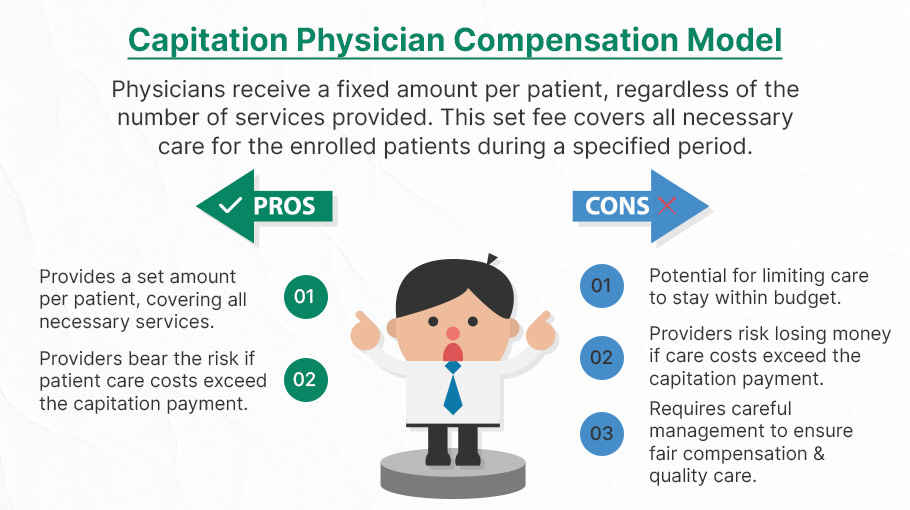
Capitation is a type of healthcare payment system in which a physician or hospital is paid a fixed amount of money per patient for a prescribed period by an insurer or physician association. The cost is based on the expected healthcare utilization costs for a group of patients for that year.

With capitation, the physician—otherwise known as the primary care physician— is paid a set amount for each enrolled patient whether a patient seeks care or not. The PCP is usually contracted with an HMO whose role it is to recruit patients.

ACOs: https://medicalexecutivepost.com/2024/12/01/record-breaking-savings-for-acos-in-2023/

***

***

CAPITATION REIMBURSEMENT HISTORY

According to Richard Eskow, CEO of Health Knowledge Systems of Los Angeles, capitated medical reimbursement has been used in one form or another, in every attempt at healthcare reform since the Norman Conquest. Some even say an earlier variant existed in ancient China [personal communication]. 

Initially, when Henry I assumed the throne of the newly combined kingdoms of England and Normandy, he initiated a sweeping set of healthcare reforms. Historical documents, though muddled, indicate that soon thereafter at least one “physician,” John of Essex, received a flat payment honorarium of one penny per day for his efforts. Historian Edward J. Kealey opined that sum was roughly equal to that paid to a foot-soldier or a blind person. Clearer historical evidence suggests that American doctors in the mid-19th century were receiving capitation-like payments. No less an authoritative figure than Mark Twain, in fact, is on record as saying that during his boyhood in Hannibal, MO his parents paid the local doctor $25/year for taking care of the entire family regardless of their state of health.

Later, Sidney Garfield MD [1905-1984] is noted as one of the great under-appreciated geniuses of 20th century American medicine stood in the shadow cast by his more celebrated partner, Henry J. Kaiser. Garfield was not the first physician to embrace the notion of prepayment capitation, nor was he the first to understand that physicians working together in multi-specialty groups could, through collaboration and continuity of care, outperform their solo practice colleagues in almost every measure of quality and efficiency. The Mayo brothers, of course, had prior claim to that distinction. What Garfield did, was marry prepayment to group practice, providing aligned financial incentives across every physician and specialty in his medical group, as well as a culture of group accountability for the care of every member of the affiliated health plan. He called it “the new economics of medicine,” and at its heart was a fundamentally new paradigm of care that emphasized – prevention before treatment – and health before sickness.  Under his model: the fewer the sick – the greater the remuneration. And: the less serious the illness, the better off the patient and the doctors.

VBC: https://medicalexecutivepost.com/2018/12/07/the-state-of-value-based-care-vbc/

***

***

Such ideas were heresy to the reigning fee-for-service, solo practice, ideologues of the mainstream medical establishment of the 1940s and ‘50s, of course. Throughout the period, Garfield and his group physicians were routinely castigated by leaders of the AMA and county medical associations as socialistic and unethical. The local medical associations in Garfield’s expanding service areas – the San Francisco Bay Area, Los Angeles, and Portland, Oregon – blocked group practice physicians from association membership, effectively shutting them out of local hospitals, denying them patient referrals or specialty society accreditation. Twice in the 1940s, formal medical association charges were brought against Garfield personally, at one time temporarily succeeding in suspending his license to practice medicine.

Of course, capitation payments made a comeback in the first cost-cutting managed care era of the 1980-90s because fee-for-service medicine created perverse incentives for physicians by paying more for treating illnesses and injuries than it does for preventing them — or even for diagnosing them early and reducing the need for intensive treatment later. Nevertheless, the modern managed care industry’s experience with capitation wasn’t initially a good one. The 1980-90s saw a number of HMOs attempt to put independent physicians, especially primary care doctors, into a capitation reimbursement model. The result was often negative for patients, who found that their doctors were far less willing to see them — and saw them for briefer visits — when they were receiving no additional income for their effort. Attempts were also made to aggregate various types of health providers — including hospitals and physicians in multiple specialties — into “capitation groups” that were collectively responsible for delivering care to a defined patient group. These included healthcare facilities and medical providers of all types: physicians, osteopaths, podiatrists, dentists, optometrists, pharmacies, physical therapists, hospitals and skilled nursing homes, etc.

However, the healthcare industry isn’t collective by nature, and these efforts tended to be too complicated to succeed. One lesson that these experiments taught is that provider behavior is difficult to change unless the relationship between that behavior and its consequences is fairly direct and easy to understand.

MORE: https://medicalexecutivepost.com/wp-content/uploads/2008/11/capitation-actuarial-medical-econometrics.pdf

Today, the concept of prepayment and medical capitation is to uncouple compensation from the actual number of patients seen, or treatments and interventions performed. This is akin to a fixed price restaurant menu, as opposed to an àla carte eatery.

COMMENTS APPRECIATED

EDUCATION: Books

SPEAKING: Dr. Marcinko will be speaking and lecturing, signing and opining, teaching and preaching, storming and performing at many locations throughout the USA this year! His tour of witty and serious pontifications may be scheduled on a planned or ad-hoc basis; for public or private meetings and gatherings; formally, informally, or over lunch or dinner. All medical societies, financial advisory firms or Broker-Dealers are encouraged to submit an RFP for speaking engagements: CONTACT: Ann Miller RN MHA at MarcinkoAdvisors@outlook.com -OR- http://www.MarcinkoAssociates.com

Like, Refer and Subscribe

***

***

Multi-Specialty Surveys for Physician Compensation – Released

By Health Capital Consultants, LLC

***

***

It’s the most wonderful time of the year – Survey Season! Beginning in late May each year, numerous industry normative benchmark physician production and compensation surveys begin publishing the most recent year’s reports. These healthcare and specialty specific surveys annually report specific types of physician compensation and productivity metrics across the country for various specialties and are widely used by hospitals, physician practices, and healthcare compensation and valuation experts, are often used for the determination of Fair Market Value (FMV) physician compensation for regulatory compliance purposes.

CITE: https://www.r2library.com/Resource

Additionally, the government has referenced and utilized industry normative benchmark compensation surveys (including those listed below) in reviewing and litigating physician compensation arrangements, indicating their reliance on this data as well. (Read more…)

COMMENTS APPRECIATED

Thank You

***

***

MEDICARE / MEDICAID: Physician Acceptance Down

By Staff Reporters

***

***

Physicians Who Accept Medicare, Medicaid at All-time Low of 65%

Reduced Medicare and Medicaid payments are having more physicians considering reducing those patient bases, according to Medscape’s “Physician Compensation Report” for 2023. Sixty-five percent of physicians surveyed said they would continue treating current Medicare or Medicaid patients and take on new ones, according to the report. Medscape said it is the lowest percentage it has seen in its annual compensation reports. Five years ago, 71 percent of physicians said they would continue treating current Medicare or Medicaid patients and take on new ones. 

CITE: https://www.r2library.com/Resource

For the report, Medscape collected responses from 10,011 physicians across more than 29 specialties. The data was collected between Oct. 7, 2022, and Jan. 17, 2023. Eight percent of physicians surveyed said they would not take on new Medicare patients, and 5 percent said they would not take new Medicaid patients. Four percent said they will stop treating some or all of their current Medicare patients and will not take on new ones, and 3 percent said the same about Medicaid patients. Twenty-two percent said they have not yet decided how they will move forward regarding Medicare and Medicaid patients, according to the report. 

Source: Andrew Cass, Becker’s Payer Issues [4/18/23]

***

COMMENTS APPRECIATED

Thank You

***

PODCAST: How Doctors are Really Paid?

Learn the Incentives in Physician Compensation

BY ERIC BRICKER MD

RAND and Harvard University Researchers Recently Published a Study in the Journal of the American Medical Association Examining How Doctors are Paid by Hospital System-Owned Practices. The Study Found that only 9% of Primary Care Physician Compensation was Based on Value (Quality and Cost-Effectiveness) and only 5.3% of Specialist Compensation was Based on Value.

The Study Concluded: “The results of this cross-sectional study suggest that PCPs and specialists despite receiving value-based reimbursement incentives from payers, the compensation of health system PCPs and specialists was dominated by volume-based incentives designed to maximize health systems revenue.”

***

***

MORE: https://medicalexecutivepost.com/2020/09/19/what-doctors-must-do-to-file-an-aetna-claim-to-get-paid/?preview_id=237387&preview_nonce=44f9028974&preview=true

RELATED: https://medicalexecutivepost.com/2008/09/12/how-doctors-get-paid/

***

BUSINESS MEDICINE: https://www.amazon.com/Business-Medical-Practice-Transformational-Doctors/dp/0826105750/ref=sr_1_9?ie=UTF8&qid=1448163039&sr=8-9&keywords=david+marcinko

***

HOSPITALS: https://www.amazon.com/Financial-Management-Strategies-Healthcare-Organizations/dp/1466558733/ref=sr_1_3?ie=UTF8&qid=1380743521&sr=8-3&keywords=david+marcinko

****

COMMENTS APPRECIATED

Subscribe to the Medical Executive-Post

Thank You

***

BUSINESS MANAGEMENT STUDY: Physician Vertical Integration

***

BY HEALTH CAPITAL CONSULTANTS, LLC.

DEFINITION: Vertical integration is an arrangement in which the supply chain of a company is integrated and owned by that company. Usually each member of the supply chain produces a different product or service, and the products combine to satisfy a common need.

CITE: https://www.r2library.com/Resource/Title/0826102549

***

Study: Vertical Integration Not Financially Beneficial for Physicians


A study released in the December 2021 issue of Health Affairs examined the correlation between hospital/health system ownership of physician practices and physician compensation. While a number of studies have analyzed the “rapidly growing trend” of vertical integration from the hospital/health system perspective, this is the first study to evaluate vertical integration from the physician practice perspective.

This Health Capital Topics article will discuss the study’s findings and potential implications. (Read more…) 

***

***

COMMENTS APPRECIATED

Thank You

Subscribe to the Medical Executive-Post

***

***

Most Physician Compensation Plans Still Productivity-Based

By Health Capital Consultants, LLC

***

Study: Most Physician Compensation Plans Still Productivity-Based

A study conducted by the RAND Corporation and published in the January 2022 issue of the Journal of the American Medical Association (JAMA) seeking to determine whether health systems primarily incentivize volume or value in their physician compensation models found that almost all physicians are still compensated through a volume-based model that rewards productivity over the value of care provided.

CITE: https://www.r2library.com/Resource/Title/0826102549

These study results are in direct contradiction to the longstanding narrative that the U.S. healthcare delivery system is shifting away from volume-based reimbursement and toward VBR. (Read more…) 

***

***

COMMENTS APPRECIATED

Thank You

Subscribe to the Medical Executive-Post

***

***

***

***

PODCAST: Explaining Relative Value Units As a Physician

By Business Savvy Physician

****

***

HEALTH ECONOMICS CITE: https://www.r2library.com/Resource/Title/0826102549

***

COMMENTS APPRECIATED

Thank You

***

***

***

***

PODCAST: Physician Relative Value Units?

HOW DOCTORS GET PAID!

By Eric Bricker MD

YOUR COMMENTS ARE APPRECIATED.

Thank You

****

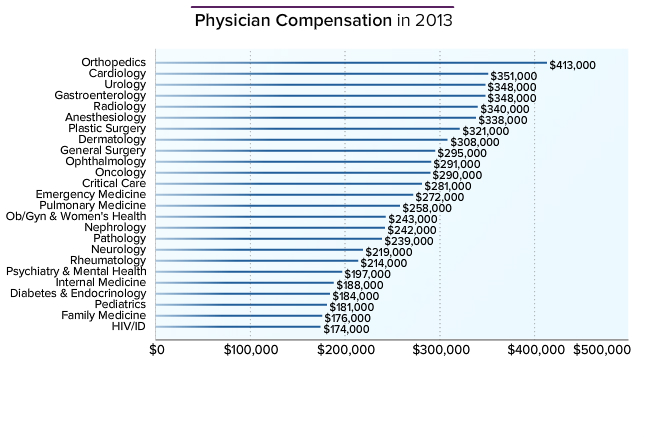
2013 Physician Compensation Report

Join Our Mailing List

Salary Update

By MedScape

Doc Comp

[Click to Enlarge]

Full Report:

More:

Conclusion

Your thoughts and comments on this ME-P are appreciated. Feel free to review our top-left column, and top-right sidebar materials, links, URLs and related websites, too. Then, subscribe to the ME-P. It is fast, free and secure.

Link: http://feeds.feedburner.com/HealthcareFinancialsthePostForcxos

Speaker: If you need a moderator or speaker for an upcoming event, Dr. David E. Marcinko; MBA – Publisher-in-Chief of the Medical Executive-Post – is available for seminar or speaking engagements. Contact: MarcinkoAdvisors@msn.com

OUR OTHER PRINT BOOKS AND RELATED INFORMATION SOURCES:

Product Details

Should We With-Hold Payment to Doctors, Financial Advisors and Others Who Make Mistakes?

Join Our Mailing List 

A Modified Reprint … and Different Perspective on “Never-Events”

By Dr. David Edward Marcinko FACFAS, MBA, CMP™

Dr. MarcinkoOK; I admit it. I played HS baseball as a youth. Today, I am a doctor and financial advisor. I owned and operated a surgical center and did musculoskeletal surgery for two decades.

Later, as a health economist and financial planner, I acted as an SEC registered investment advisor to medical colleagues for almost 15 years.  I’ve been a reporter, writer and journalist for three decades and Editor-in-Chief of this ME-P for eight years. Along my career path several physician-partners were dual degreed lawyers.

I still am deeply involved in all these activities as a hobbyist, consultant, part-time practitioner, editor and educator. Occasionally, I do make mistakes. There … I admit it. I am not perfect!

For example; I remember the time when I ordered the wrong patient medication dose [noted and corrected by an astute RN] – Dropped an infield fly ball and lost the game – Used the wrong corporate EBIDTA, for an estimated financial calculation, which cost me and the client a few bucks – Referenced the wrong citation and made an author angry – Forgot to check a reference source which made my publisher mad at me – AND – Confused two different medical malpractice cases I was reviewing to the chagrin of my defendant doctor and his attorney; etc, etc.  You get the picture.

Mea culpa – mea maxima culpa!

The Encore Post

And so, it is with delight that the ME-P re-posts the following essay – on mistakes – by colleague Dr. Michael Kirsch who is a gastroenterologist that blogs at MD Whistleblower.

Medical Errors Earn Hospitals Money – Who Knew?

In brief, it goes something like this.

Never-Events

The argument to withhold payment for medical care that resulted from medical error is potent.  This is known as a never-event because it is not supposed to happen – ever! Giving a patient the wrong blood type during a transfusion is a good example of a never-event.

Unfortunately – Keep in mind that defining a medical error is not as easy as it sounds.  One can easily imagine how easy it would be too confuse a medical complication, which is a blameless event, from an error or a negligent act.

Consider This

If the patient develops a complication, should I, the hospital and those I consult not be paid for the additional care required?

Now, by extension, let us consider some other professions in the same way; especially those for which I am associated.

IOW: Would every profession consent to returning fees for mistaken advice or service?  So, do you agree with the following?

  • Financial advisors should return fees if investment performance is below a designated threshold or differs from their peers.
  • Attorneys that offered ineffective legal arguments at trial should surrender fees after appeal.
  • A professional baseball player who drops a fly ball should lose a day’s pay.
  • A newspaper publisher should offer a rebate to all readers if a news story is found to be inaccurate owing to a lack of proper editorial oversight; etc.

I think you get the picture! And, see how I personalized these examples.

More

We realize that mistakes of all types cost money, as do some of the hypothetical examples above.  We also accept that financial incentives can change behavior and can be an effective tool.

Medical-errors

Assessment

But, every human endeavor has a finite error rate and we should be cautious before using an economic drone attack against only the medical profession; or even the others mentioned above … and more.

Let’s use a scalpel here and not a sledge hammer.  And, those of you outside of medicine; please feel free to explain why your occupation should be spared from this health reform strategy?

The Reprint: Would every profession consent to returning fees for mistakes?

Conclusion

Your thoughts and comments on this ME-P are appreciated. Feel free to review our top-left column, and top-right sidebar materials, links, URLs and related websites, too. Then, subscribe to the ME-P. It is fast, free and secure.

Link: http://feeds.feedburner.com/HealthcareFinancialsthePostForcxos

  • Speaker: If you need a moderator or speaker for an upcoming event, Dr. David E. Marcinko; MBA – Publisher-in-Chief of the Medical Executive-Post – is available for seminar or speaking engagements. Contact: MarcinkoAdvisors@msn.com


Product DetailsProduct Details

Risk Management, Liability Insurance, and Asset Protection Strategies for Doctors and Advisors: Best Practices from Leading Consultants and Certified Medical Planners™8Comprehensive Financial Planning Strategies for Doctors and Advisors: Best Practices from Leading Consultants and Certified Medical Planners™

***

Invite Dr. Marcinko

***

An Emerging Values-Based Healthcare Payment Model

Join Our Mailing List

Understanding Non-Traditional Physician Reimbursement Paradigms

[By Staff Reporters]

www.BusinessofMedicalPractice.com

According to Brian Knabe MD, Mark Fendrick, MD and Michael E. Chernew, PhD, instead of the one size fits all approach of traditional health insurance reimbursement, a “clinically-sensitive” cost-sharing system that supports co-payments related to evidence-based value for targeted patients seems plausible.

The New Model

In this model, out-of-pocket costs are based on price and a cost/quality tradeoff in clinical circumstances: low co-payments for interventions of highest value, and higher co-payments for interventions with little proven health benefit. Smarter benefit packages are designed to combine disease management with cost sharing to address spending growth.

Assessment

Today, whether independent or employed, physicians can pursue creative compensation models not like the one briefly described above and unknown just a decade ago.

Conclusion

Your thoughts and comments on this ME-P are appreciated. Feel free to review our top-left column, and top-right sidebar materials, links, URLs and related websites, too. Then, subscribe to the ME-P. It is fast, free and secure.

Speaker: If you need a moderator or speaker for an upcoming event, Dr. David E. Marcinko; MBA – Publisher-in-Chief of the Medical Executive-Post – is available for seminar or speaking engagements. Contact: MarcinkoAdvisors@msn.com

OUR OTHER PRINT BOOKS AND RELATED INFORMATION SOURCES:

Product DetailsProduct DetailsProduct Details

The Effects of Healthcare Reform Legislation on Physician Compensation

Is a Future Look Predicated on the Past?

By Dr. Brian J. Knabe; CFP® CMP™

By Dr. David Edward Marcinko; MBA CMP™

By Prof. Hope Rachel Hetico; RN, MHA CPHQ CMP™

www.BusinessofMedicalPractice.com

With the passage of healthcare reform legislation, officially known as the Patient Protection and Affordable Care Act of 2010, many questions remain regarding its effect upon physicians’ livelihood.

Undoubtedly this bill moves the healthcare system several steps closer to a socialized model, but the effects on physicians’ salaries and compensation models are far from clear.

Other Countries

One way to see the effect that this shift may have on compensation is to look to other countries, many of which already have a more socialized system in place.

According to the CRS Report for Congress, US Health Care Spending:  Comparison with Other OECD Countries http://assets.opencrs.com/rpts/RL34175_20070917.pdf) US specialists rank near the top in compensation compared to these other countries, trailing the Netherlands and Australia.  The average specialist in the US made $230,000 in this survey.  The comparable salary in Canada is $161,000, $150,000 in the UK, and $253,000 in the Netherlands.  Generalists in the US are at the top in terms of compensation with an average of $161,000.  This compares to $107,000 in Canada, $118,000 in the UK, and $117,000 in the Netherlands.

Inflation Adjustments

Another indicator of physician salary trends is the change in compensation adjusted for inflation.  According to the American Medical Association, the inflation-adjusted income for the average patient care physician declined from $180,930 to $168,122 from 1995 to 2003, a 7% decrease. And, the inflation adjusted decrease is more substantial given the low interest rate environment thru 2010, and going forward.

Physician Net Income Chart

  Average net income
  1995 2003 Decrease
All patient care physicians $180,930 $168,122 7%
Primary care physicians $135,036 $121,262 10%
Medical specialists $178,840 $175,011 2%
Surgical specialists $245,162 $224,998 8%

Source: http://www.ama-assn.org/amednews/site/free/prsc0724.htm

Given these trends, as well as the fact that an increasing percentage of healthcare payments are coming from dwindling government sources, it is likely that physician salaries will decline as “healthcare reform” legislation is implemented.  In fact, it is likely that this trend will accelerate.  A 15% to 25% inflation-adjusted decline in salaries over the next decade is a reasonable prediction.

Assessment

It is also important to note that the level of student debt in the US continues to rise, while college and medical education are usually subsidized in other countries.  Many foreign physicians graduate with no student loan debt.  The ratio of debt level to salary in the US continues to become more onerous for new physicians.

Conclusion

Your thoughts and comments on this ME-P are appreciated. Feel free to review our top-left column, and top-right sidebar materials, links, URLs and related websites, too. Then, subscribe to the ME-P. It is fast, free and secure.

Link: http://feeds.feedburner.com/HealthcareFinancialsthePostForcxos

Speaker: If you need a moderator or speaker for an upcoming event, Dr. David E. Marcinko; MBA – Publisher-in-Chief of the Medical Executive-Post – is available for seminar or speaking engagements. Contact: MarcinkoAdvisors@msn.com

OUR OTHER PRINT BOOKS AND RELATED INFORMATION SOURCES:

Product Details  Product Details

Physician Compensation Trends Query?

Tacoma / Seattle Washington Area

As compensation professionals, Certified Medical Planners [CMPs] and financial advisors [FAs], what kinds of trends are you observing in physician compensation for multi-specialty hospitals in the Tacoma/Seattle Washington state locations? 

Additionally, what innovations (in 2008) are observed in the manner doctors and hospital leadership are compensated?

Please e-mail ASAP, if possible to Kkyewu1@aol.com

Thank you ever so much!
Warm Regards.
Beverly Motley