DAILY UPDATE: Pharmacies v. PBMs as Stock Markets Tank!

MEDICAL EXECUTIVE-POST TODAY’S NEWSLETTER BRIEFING

***

Essays, Opinions and Curated News in Health Economics, Investing, Business, Management and Financial Planning for Physician Entrepreneurs and their Savvy Advisors and Consultants

Serving Almost One Million Doctors, Financial Advisors and Medical Management Consultants Daily

A Partner of the Institute of Medical Business Advisors , Inc.

http://www.MedicalBusinessAdvisors.com

SPONSORED BY: Marcinko & Associates, Inc.

***

http://www.MarcinkoAssociates.com

Daily Update Provided By Staff Reporters Since 2007.
How May We Serve You?
© Copyright Institute of Medical Business Advisors, Inc. All rights reserved. 2025

REFER A COLLEAGUE: MarcinkoAdvisors@outlook.com

SPONSORSHIPS AVAILABLE: https://medicalexecutivepost.com/sponsors/

ADVERTISE ON THE ME-P: https://tinyurl.com/ytb5955z

Your Referral Count -0-

CITE: https://www.r2library.com/Resource

Independent pharmacies and pharmacy benefit managers (PBMs) are at odds over a proposed rule change from the Centers for Medicare and Medicaid Services (CMS) over the Medicare Part D program. Pharmacies vs. PBMs

CITE: https://tinyurl.com/2h47urt5

US stocks plummeted on Monday afternoon, as selling accelerated in the last hour of trading after President Trump indicated there was “no room left” for tariff negotiations with Canada and Mexico, with levies against both countries set to go into effect tomorrow.

The S&P 500 (^GSPC) fell 1.7% while the tech-heavy NASDAQ Composite (^IXIC) dropped 2.6%. The Dow Jones Industrial Average (^DJI) fell more than 600 points, or almost 1.5%, as the major US indexes came off a volatile week and a losing February.

Tech led the sell-off with shares of Nvidia (NVDA) tanking more than 8%. All of the “Magnificent 7” stocks declined.

CITE: https://tinyurl.com/tj8smmes

Visualize: How private equity tangled banks in a web of debt, from the Financial Times.

COMMENTS APPRECIATED

PLEASE SUBSCRIBE: MarcinkoAdvisors@outlook.com

Thank You

***

***

***

***

EDUCATIONAL TEXTBOOKS: https://tinyurl.com/4zdxuuwf

***

PHYSICIANS: Is $2.5 Million “Really” Enough to Retire at Age 65?

By Staff Reporters

SPONSOR: http://www.MarcinkoAssociates.com

DOCTORS ARE DIFFERENT: https://marcinkoassociates.com/doctors-unique/

***

***

Is $2.5 Million Really Enough to Retire?

A retirement nest egg of $2.5 million can likely produce an annual income of $100,000 for as long as you are likely to live. This is using the 4% withdrawal rate many financial advisors consider standard. After starting with the first withdrawal of 4% of the total, the annual withdrawal will adjust for inflation. For example, if inflation runs at the target 2% rate of federal policymakers, during retirement the retiree will withdraw:

$100,000

in the first year

$102,000

in the second year

$104,040

in the third year and so on …

According to this model and conventional wisdom, a 4% withdrawal rate will allow a portfolio to last for at least 30 years. This would permit a 65-year-old retiree to maintain consistent purchasing power until age 95 and beyond.

For most retirees, this will likely be adequate to maintain a satisfying standard of living. Only about 3% of 2,000 retirees surveyed by the Employee Benefit Research Institute in 2022 spent $7,000 or more per month, equivalent to $84,000 in annual spending.

This model does not include a number of other factors. For instance, nearly all retirees are eligible for Social Security. For 2023, the maximum monthly Social Security benefit for people who claim benefits at full retirement age is $3,627. That’s equal to more than half the spending of the top 3% of retirees surveyed by EBRI. And, like the standard withdrawal rate, Social Security benefits are indexed to inflation.

5 Variables for Retiring With $2.5 Million at Age 65

While $2.5 million could seem like enough to retire at 65, many factors could change the outlook.

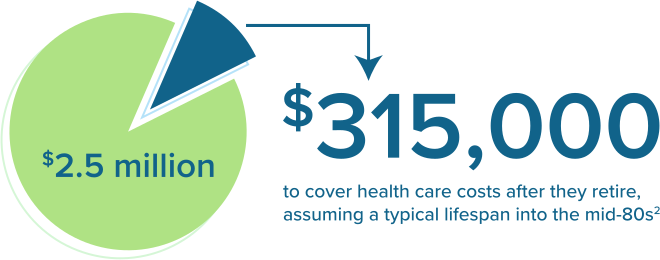
1. Unexpected Healthcare Costs

The Fidelity Retiree Health Care Cost Estimate suggests an average 65-year-old couple could need (approximate, after taxes):Unexpected Healthcare Costs

This assumes both spouses are enrolled in traditional Medicare, which between Medicare Part A and Part B covers expenses such as hospital stays, doctor visits and services, physical therapy, lab tests and more, and in Medicare Part D, which covers prescription drugs.

This figure does not include long-term care (“custodial care”), most dental care, eye exams and more, so your estimated healthcare costs in retirement could be considerably more.

2. Inflation

Inflation can powerfully influence retirees’ financial well-being. When inflation occurs, it reduces the purchasing power of money withdrawn from your retirement account. You can increase withdrawals to maintain purchasing power, but this risks more quickly depleting your savings.

3. Market Downturns

Inflation isn’t the only cause of market downturns. Business cycles and financial crises can exaggerate normal fluctuations in stock market valuations. If you’re selling investments to generate income for living expenses, you may want to sell more if valuations are down.

4. Longevity

While living a long life is positive, you could outlive the money you’ve saved for retirement. Many financial planners use life expectancy to age 95 or 100 when developing plans for funding retirement.

The Social Security Administration says an average 65-year-old male can live to age 83, while the average woman can live to age 86. However, people in their 80s and 90s also generally reduce their spending, with the exception of healthcare costs.

5. Estate Planning

Retiring at 65 with $2.5 million likely involved generating high income and savings, so there’s a chance you could have assets to pass on. With estate planning, adding members of your family as beneficiaries for homes you paid off with a mortgage may have long-term positives.

You may also want to think about any additional income streams. For example, if you own a medical practice or business, you may want to add your family as a beneficiary so they can decide to keep the business running or sell it.

CITE: https://www.r2library.com/Resource

COMMENTS APPRECIATED

Thank You

***

***

***

Valuation of Medicare Advantage Plans and the Competitive Environment

By Health Capital Consultants, LLC

***

***

Medicare Advantage (MA) plans, also known as Part C plans, serve as a supplement or an alternative to Original (also called Traditional) fee-for-service (FFS) Medicare Part A and Part B coverage, but they are still part of the Medicare program.

CITE: https://www.r2library.com/Resource/Title/082610254

Most of these plans also include Part D (drug) coverage. MA was created by Congress to offer seniors an alternative to Original Medicare – with an emphasis on treating and managing the health of the whole patient. MA plans are offered to Medicare beneficiaries by Medicare-approved private companies, known as MA Organizations (MAOs), that must follow rules set by Medicare. (Read more…) 

***

COMMENTS APPRECIATED

Thank You

ORDER: https://www.amazon.com/Dictionary-Health-Insurance-Managed-Care/dp/0826149944/ref=sr_1_4?ie=UTF8&s=books&qid=1275315485&sr=1-4

***

PODCAST: The Four [4] Parts of Medicare

UNDERSTAND AND KNOW THE DIFFERENCE: A, B C & D

CITE: https://www.r2library.com/Resource/Title/0826102549

BY MEDICARE – CMS

***

***
YOUR COMMENTS ARE APPRECIATED.

Thank You

***

Ban on Referenced Based Drug Pricing

Join Our Mailing List

A Medicare and CMS Three-Sixty

[By Staff Reporters]rboa_16

According to Jane Zhang and Vanessa Fuhrmans of the Wall Street Journal, on January 10, 2009, the last days of the Bush administration saw a proposed ban that allows private insurers to charge Medicare beneficiaries stiff penalties if they choose brand-name drugs instead of cheaper generic drugs.

Referenced Based Pricing

Under reference-based drug pricing, the penalty for insisting on a brand-name drug often amounts to the price difference between the drug and the generic version, plus a copayment. In some cases, that leaves patients paying the full price of the brand-name drug. In contrast, buyers of brand-name drugs when there is no generic equivalent are charged just a copayment. Nearly 10% of drug plans used the pricing technique to steer beneficiaries to lower-cost generics www.HealthDictionarySeries.com 

CMS Announcement

Of course, the announcement from the Centers for Medicare and Medicaid Services came after lawmakers and patient advocates protested that reference-based pricing made it difficult for consumers to calculate drug costs.

CMS Renouncement

But, the agency reversed itself 360 degrees this week, proposing to ban such pricing for the 2010 drug plans. The WSJ reported that complicated formulas made it “very difficult to accurately convey the extent of expected out-of-pocket spending” for prescription drugs. And, “The basis for this decision is our belief that reference-based pricing may be inherently misleading to beneficiaries and inconsistent with our goal of improving transparency.”

The Pfizer-Wyeth Drug Deal

Following the ban, investors appeared skeptical about the just announced Pfizer-Wyeth drug deal. Pfizer will pay $68 billion for Wyeth, which is the biggest in the drug sector since 2000. The merger comes as Pfizer faces the difficult hurdle of dealing with patent expirations for some of its biggest drugs, including its cholesterol-lowering Lipitor, which makes up about 25% of the company’s overall sales.

Assessment

The ban is part of CMS’s criteria for prescription-drug plans that insurers will offer for 2010. The criteria won’t be final until March, leaving a narrow window for the Obama administration to change them.

Conclusion

Your thoughts and comments on this ME-P are appreciated. Feel free to review our top-left column, and top-right sidebar materials, links, URLs and related websites, too. Then, subscribe to the ME-P. It is fast, free and secure.

Speaker: If you need a moderator or speaker for an upcoming event, Dr. David E. Marcinko; MBA – Publisher-in-Chief of the Medical Executive-Post – is available for seminar or speaking engagements. Contact: MarcinkoAdvisors@msn.com

OUR OTHER PRINT BOOKS AND RELATED INFORMATION SOURCES:

Product DetailsProduct DetailsProduct Details

***