Understanding the Capital Asset Pricing Model

CAP-M

***

***

By Dr. David Edward Marcinko MBA MED CMP

SPONSOR: http://www.CertifiedMedicalPlanner.org

***
***

Dr. Harry Markowitz is credited with developing the framework for constructing investment portfolios based on the risk-return tradeoff. William Sharpe, John Lintner, and Jan Mossin are credited with developing the Capital Asset Pricing Model (CAPM).

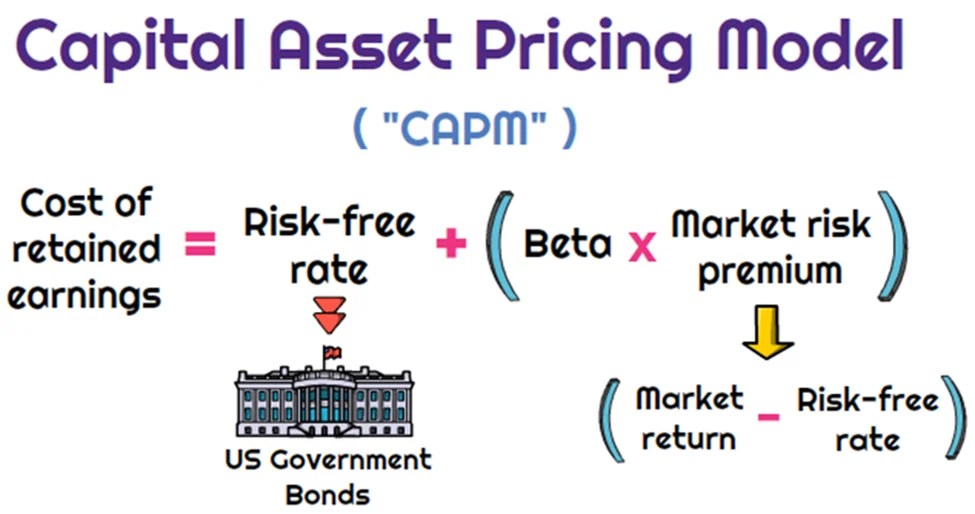
CAPM is an economic model based upon the idea that there is a single portfolio representing all investments (i.e., the market portfolio) at the point of the optimal portfolio on the Capital Market Line (CML) and a single source of systematic risk, beta, to that market portfolio.  The resulting conclusion is that there should be a “fair” return investors should expect to receive given the level of risk (beta) they are willing to assume. 

The excess return, or return above the risk-free rate, that may be expected from an asset is equal to the risk-free return plus the excess return of the market portfolio times the sensitivity of the asset’s excess return to the market portfolio excess return.  Beta, then, is a measure of the sensitivity of an asset’s returns to the market as a whole.  A particular security’s beta depends on the volatility of the individual security’s returns relative to the volatility of the market’s returns, as well as the correlation between the security’s returns and the markets returns. 

While a stock may have significantly greater volatility than the market, if that stock’s returns are not highly correlated with the returns of the overall market (i.e., the stock’s returns are independent of the overall market’s returns), then the stock’s beta would be relatively low.  A beta in excess of 1.0 implies that the security is more exposed to systematic risk than the overall market portfolio, and likewise, a beta of less 1.0 means that the security has less exposure to systematic risk than the overall market. 

MPT has helped focus investors on two extremely critical elements of investing that are central to successful investment strategies. 

First, MPT offers the first framework for investors to build a diversified portfolio.  Furthermore, an important conclusion that can be drawn from MPT is that diversification does in fact help reduce portfolio risk. 

Thus, MPT approaches are generally consistent with the first investment rule of thumb, “understand and diversify risk to the extent possible.” 

Additionally, the risk/return tradeoff (i.e., higher returns are generally consistent with higher risk) central to MPT based strategies has helped investors recognize that if it looks too good to be true, it probably is.

Passive Investing

Passive investing is a monetary plan in which an investor invests in accordance with a pre-determined strategy that doesn’t necessitate any forecasting of the economy or an individual company’s prospects.  The primary premise is to minimize investing fees and to avoid the unpleasant consequences of failing to correctly predict the future. The most accepted method to invest passively is to mimic the performance of a particular index. Investors typically do this today by purchasing one or more ‘index funds’. By tracking an index, an investor will achieve solid diversification with low expenses. 

An ivestor could potentially earn a higher rate of return than an investor paying higher management fees.  Passive management is most widespread in the stock markets.  But  with the explosion of exchange traded funds on the major exchanges, index investing has become more popular in other categories of investing.  There are now literally hundreds of different index funds.  

Passive management is based upon the Efficient Market Hypothesis theory.  The Efficient Market Hypothesis (EMH) states that securities are fairly priced based on information regarding their underlying cash flows and that investors should not anticipate to consistently out-perform the market over the long-term.

The Efficient Market Hypothesis evolved in the 1960s from the Ph.D. dissertation of Eugene Fama.  Fama persuasively made the case that in an active market that includes many well-informed and intelligent investors, securities will be appropriately priced and reflect all available information. If a market is efficient, no information or analysis can be expected to result in out-performance of an appropriate benchmark. There are three distinct forms of EMH that vary by the type of information that is reflected in a security’s price:

  • Weak Form

This form holds that investors will not be able to use historical data to earn superior returns on a consistent basis.  In other words, the financial markets price securities in a manner that fully reflects all information contained in past prices. 

  • Semi-Strong Form

This form asserts that security prices fully reflect all publicly available information.  Therefore, investors cannot consistently earn above normal returns based solely on publicly available information, such as earnings, dividend, and sales data. 

  • Strong Form

This form states that the financial markets price securities such that, all information (public and non-public) is fully reflected in the securities price; investors should not expect to earn superior returns on a consistent basis, no matter what insight or research they may bring to the table.

While a rich literature has been established regarding whether EMH actually applies in any of its three forms in real world markets, probably the most difficult evidence to overcome for backers of EMH is the existence of a vibrant money management and mutual fund industry charging value-added fees for their services. 

The notion of passive management is counterintuitive to many investors.  Passive investing proponents follow the strong market theory of EMH.  These proponents argue several points including;

  1. In the long term, the average investor will have a typical before-costs performance equal to the market average. Therefore the standard investor will gain more from reducing investment costs than from attempting to beat the market over time. 
  • The efficient-market hypothesis argues that equilibrium market prices fully reflect all existing market information.  Even in the case where some of the market information is not currently reflected in the price level, EMH indicates that an individual investor still cannot make use of that information. It is widely interpreted by many academics that to try and systematically “beat the market” through active management is a fools game.

Not everyone believes in the efficient market.  Numerous researchers over the previous decades have found stock market anomalies that indicate a contradiction with the hypothesis.  The search for anomalies is effectively the hunt for market patterns that can be utilized to outperform passive strategies.  Such stock market anomalies that have been proven to go against the findings of the EMH theory include;

  1. Low Price to Book Effect
  2. January Effect
  3. The Size Effect
  4. Insider Transaction Effect
  5. The Value Line Effect

All the above anomalies have been proven over time to outperform the market.  For example, the first anomaly listed above is the Low Price to Book Effect.  The first and most discussed study on the performance of low price to book value stocks was by Dr. Eugene Fama and Dr. Kenneth R. French.  The study covered the time period from 1963-1990 and included nearly all the stocks on the NYSE, AMEX and NASDAQ. The stocks were divided into ten subgroups by book/market and were re-ranked annually. In the study, Fama and French found that the lowest book/market stocks outperformed the highest book/market stocks by a substantial margin (21.4 percent vs. 8 percent).  Remarkably, as they examined each upward decile, performance for that decile was below that of the higher book value decile.  Fama and French also ordered the deciles by beta (measure of systematic risk) and found that the stocks with the lowest book value also had the lowest risk. 

Today, most researchers now deem that “value” represents a hazard feature that investors are compensated for over time.  The theory being that value stocks trading at very low price book ratios are inherently risky, thus investors are simply compensated with higher returns in exchange for taking the risk of investing in these value stocks. The Fama and French research has been confirmed through several additional studies.  In a Forbes Magazine 5/6/96 column titled “Ben Graham was right–again,” author David Dreman published his data from the largest 1500 stocks on Compustat for the 25 years ending 1994. He found that the lowest 20 percent of price/book stocks appreciably outperformed the market.  

One item a medical professional should be aware of is the strong paradox of the efficient market theory.   If each investor believes the stock market were efficient, then all investors would give up analyzing and forecasting.  All investors would then accept passive management and invest in index funds.  But if this were to happen, the market would no longer be efficient because no one would be scrutinizing the markets.  In actuality, the efficient market hypothesis actually depends on active investors attempting to outperform the market through diligent research.

The case for passive investing and in favor of the EMH is that a preponderance of active managers do actually underperform the markets over time.  The latest study by Standard and Poor’s (S&P) confirms this fact.  S&P recently compared the performance of actively-managed mutual funds to passive market indexes twice per year. The 2012 S&P study indicated that indexes were once again outperforming actively-managed funds in nearly every asset class, style and fund category. The lone exception in the 2012 report was international equity, where active outperformed the index that S&P chose.  The study examined one-year, three-year and five-year time periods. Within the U.S. equity space, active equity managers in all the categories failed to outperform the corresponding benchmarks in the past five year period.  More than 65 percent of the large-cap active managers lagged behind the S&P 500 stock index.  More than 81 percent of mid-cap mutual funds were outperformed by the S&P MidCap 400 index. 

Lastly, 77 percent of the small-cap mutual funds were outperformed by the S&P SmallCap 600 index.  U.S. bond active managers fared no better that equity managers over a five year period. More than 83 percent of general municipal mutual funds under-performed the S&P National AMT-Free Municipal Bond index, 93 percent of government long-term funds under-performed the Barclays Long Government index, nearly 95 percent of high yield corporate bond funds under-performed the Barclays High Yield index.  Although the performance measurements for index investing are very strong, many analysts find three negative elements of passive investing;

  1. Downside Protection:  When the stock market collapses like in 2008, an index investor will assume the same loss as the market.  In the case of 2008, the S&P 500 stock index fell by more than 50 percent, offering index investors no downside protection.
  • Portfolio Control:  An index investor has no control over the holdings in the fund. In the event that a certain sector becomes over-owned (i.e. technology stocks in 2000), an index investor maintains the same weight as the index.
  • Average Returns:  An index investor will never have the opportunity to outperform the market, but will always follow.  Although the markets are very efficient, an investor can perhaps take advantage of market anomalies and invest with those managers who have maintained a long-term performance edge over the respective index. 

COMMENTS APPRECIATED

EDUCATION: Books

SPEAKING: Dr. Marcinko will be speaking and lecturing, signing and opining, teaching and preaching, storming and performing at many locations throughout the USA this year! His tour of witty and serious pontifications may be scheduled on a planned or ad-hoc basis; for public or private meetings and gatherings; formally, informally, or over lunch or dinner. All medical societies, financial advisory firms or Broker-Dealers are encouraged to submit an RFP for speaking engagements: CONTACT: Ann Miller RN MHA at MarcinkoAdvisors@outlook.com -OR- http://www.MarcinkoAssociates.com

Like, Refer and Subscribe

***

***

TRADITIONAL INVESTMENT PORTFOLIO DIVERSIFICATION MODEL: Routed by Larry Fink CEO of BlackRock?

BREAKING NEWS – MARKET VOLATILITY

By Staff Reporters

***

***

US stocks nosedived on Thursday, with the Dow tumbling more than 1,200 points as President Trump’s surprisingly steep “Liberation Day” tariffs sent shock waves through markets worldwide. The tech-heavy NASDAQ Composite (IXIC) led the sell-off, plummeting over 4%. The S&P 500 (GSPC) dove 3.7%, while the Dow Jones Industrial Average (^DJI) tumbled roughly 3%. [ongoing story].

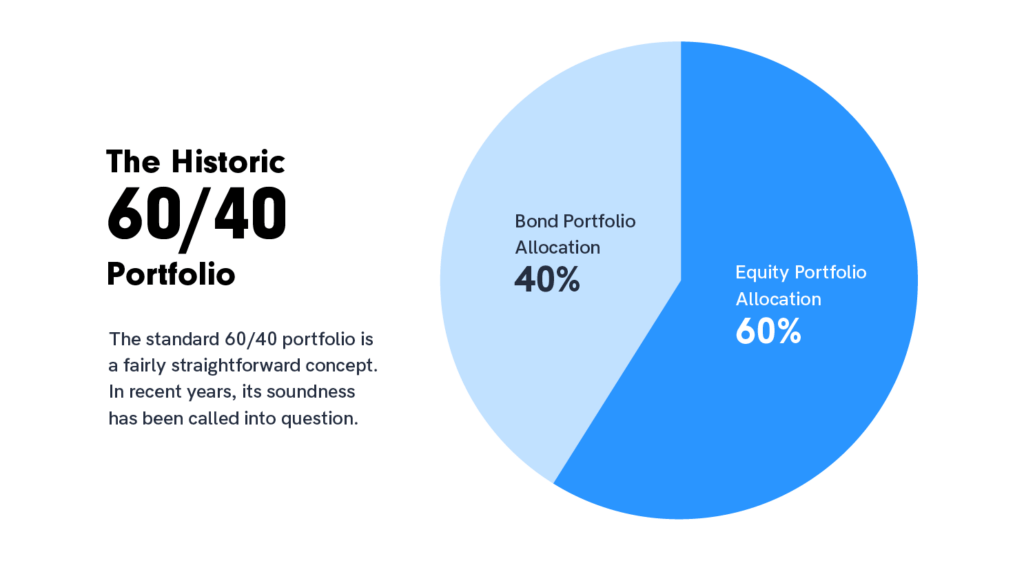
So, does the traditional 60 stock / 40 bond strategy still work or do we need another portfolio model?

***

The 60/40 strategy evolved out of American economist Harry Markowitz’s groundbreaking 1950s work on modern portfolio theory, which holds that investors should diversify their holdings with a mix of high-risk, high-return assets and low-risk, low-return assets based on their individual circumstances.

While a portfolio with a mix of 40% bonds and 60% equities may bring lower returns than all-stock holdings, the diversification generally brings lower variance in the returns—meaning more reliability—as long as there isn’t a strong correlation between stock and bond returns (ideally the correlation is negative, with bond returns rising while stock returns fall).

CORRELATION: https://medicalexecutivepost.com/2024/10/27/correlation-diversification-in-finance-and-investments/

For 60/40 to work, bonds must be less volatile than stocks and economic growth and inflation have to move up and down in tandem. Typically, the same economic growth that powers rallies in equities also pushes up inflation—and bond returns down. Conversely, in a recession stocks drop and inflation is low, pushing up bond prices.

***

  • But, the traditional 60/40 portfolio may “no longer fully represent true diversification,” BlackRock CEO Larry Fink writes in a new letter to investors.
  • Instead, the “future standard portfolio” may move toward 50/30/20 with stocks, bonds and private assets like real estate, infrastructure and private credit, Fink writes.
  • Here’s what experts say individual investors may want to consider before dabbling in private investments.

It may be time to rethink the traditional 60/40 investment portfolio, according to BlackRock CEO Larry Fink. In a new letter to investors, Fink writes the traditional allocation comprised of 60% stocks and 40% bonds that dates back to the 1950s “may no longer fully represent true diversification.

DI-WORSIFICATION: https://medicalexecutivepost.com/2024/04/09/what-is-financial-portfolio-di-worsification-2/

EDUCATION: Books

SPEAKING: Dr. Marcinko will be speaking and lecturing, signing and opining, teaching and preaching, storming and performing at many locations throughout the USA this year! His tour of witty and serious pontifications may be scheduled on a planned or ad-hoc basis; for public or private meetings and gatherings; formally, informally, or over lunch or dinner. All medical societies, financial advisory firms or Broker-Dealers are encouraged to submit a RFP for speaking engagements: MarcinkoAdvisors@outlook.com 

COMMENTS APPRECIATED

Read, Like, Subscribe and Refer

***

***

The Legacy of Dr. Jack Treynor

The History Behind A Popular Investing Theory

[By Dr. David Edward Marcinko MBA CMP™]

http://www.CertifiedMedicalPlanner.org

[Publisher-in-Chief]

In his 1959 “Portfolio Selection,” Harry Markowitz PhD [father of MPT], said that investors should diversify against market risk but that determining the required return from such a group of diversified assets was another matter. Seven years later, economist Jack Treynor PhD wrestled with the issue of how investors can measure the expected risk in a portfolio against its expected return. Meanwhile, William Sharpe developed his own measure of risk and return known as the Capital Asset Pricing Model (CAPM) first published in the Journal of Finance in 1964 and discussed elsewhere on the ME-P.

A Seminal Paper

Treynor’s 1961 paper entitled “Toward a Theory of Market Value of Risky Assets” concluded that investors expect greater compensation for the larger risk they take in the stock market than they do from risk-free assets, such as Treasury bills. He called it the “equity risk premium” and created a method to predict it.

Fisher Black Collaboration

In 1973, Treynor collaborated with Fischer Black to devise a method for predicting the risk premium and to demonstrate its overarching importance in the behavior of capital markets as well as in portfolio selection. From 1969 through 1981 he furthered the work of many leading financial theorists, including Sharpe and Black, when he edited the Financial Analysts Journal.

Intellectual Band-Aid

In an interview about a decade ago, Treynor stated his belief that modern finance is preoccupied with statistical, rather than economic, thinking about risk. He explained that beta has come under attack in recent years because it is a statistical concept of risk. An economic concept of risk would have a lot more predictive value—it would be tied more intimately into fundamental analysis of companies and portfolios. He refers to beta as “just an intellectual Band-Aid.”

The Jensen Alpha

Treynor also described Bill Jensen’s alpha as looking at a market line established by a large number of funds and identifying those that had returns above the market line. Accordingly, a portfolio manager can increase his or her alpha by simply buying and selling larger positions of the same research recommendations.

Assessment

Black and Treynor developed a ratio of alpha to residual risk (return squared /risk squared), which shows that when you have everything else equal and you increase this ratio, you improve performance. And, they actually introduced the term Sharpe ratio.

Note: “It’s All About Odds,” Jonathan Burton, Dow Jones Asset Management, July/August 1997, pp. 20–28, Dow Jones Financial Publishing Corp., (732) 389-8700.

Conclusion

Your thoughts and comments on this ME-P are appreciated. Feel free to review our top-left column, and top-right sidebar materials, links, URLs and related websites, too. Then, subscribe to the ME-P. It is fast, free and secure.

Speaker: If you need a moderator or speaker for an upcoming event, Dr. David E. Marcinko; MBA – Publisher-in-Chief of the Medical Executive-Post – is available for seminar or speaking engagements. Contact: MarcinkoAdvisors@msn.com

OUR OTHER PRINT BOOKS AND RELATED INFORMATION SOURCES:

Product DetailsProduct DetailsProduct Details

Product Details  Product Details

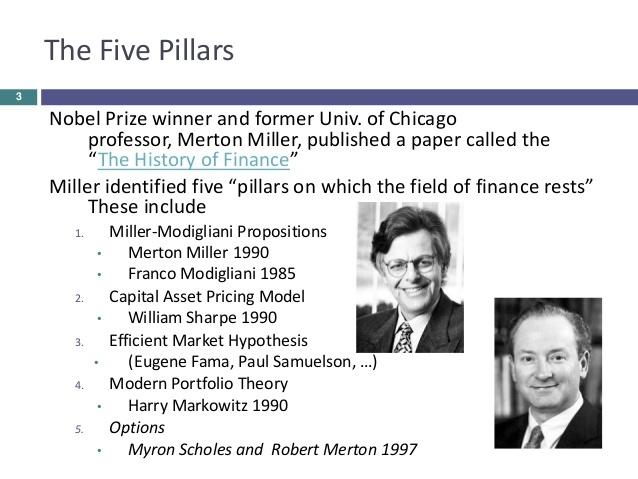
The Five Pillars of Finance

A Solid Foundation for Investing

[By staff reporters]

***

***

Conclusion

Your thoughts and comments on this ME-P are appreciated. Feel free to review our top-left column, and top-right sidebar materials, links, URLs and related websites, too. Then, subscribe to the ME-P. It is fast, free and secure.

Speaker: If you need a moderator or speaker for an upcoming event, Dr. David E. Marcinko; MBA – Publisher-in-Chief of the Medical Executive-Post – is available for seminar or speaking engagements.

Book Marcinko: https://medicalexecutivepost.com/dr-david-marcinkos-bookings/

Subscribe: MEDICAL EXECUTIVE POST for curated news, essays, opinions and analysis from the public health, economics, finance, marketing, IT, business and policy management ecosystem.

DOCTORS:

“Insurance & Risk Management Strategies for Doctors” https://tinyurl.com/ydx9kd93

“Fiduciary Financial Planning for Physicians” https://tinyurl.com/y7f5pnox

“Business of Medical Practice 2.0” https://tinyurl.com/yb3x6wr8

HOSPITALS:

“Financial Management Strategies for Hospitals” https://tinyurl.com/yagu567d

“Operational Strategies for Clinics and Hospitals” https://tinyurl.com/y9avbrq5

***

Risk Management, Liability Insurance, and Asset Protection Strategies for Doctors and Advisors: Best Practices from Leading Consultants and Certified Medical Planners™8Comprehensive Financial Planning Strategies for Doctors and Advisors: Best Practices from Leading Consultants and Certified Medical Planners™

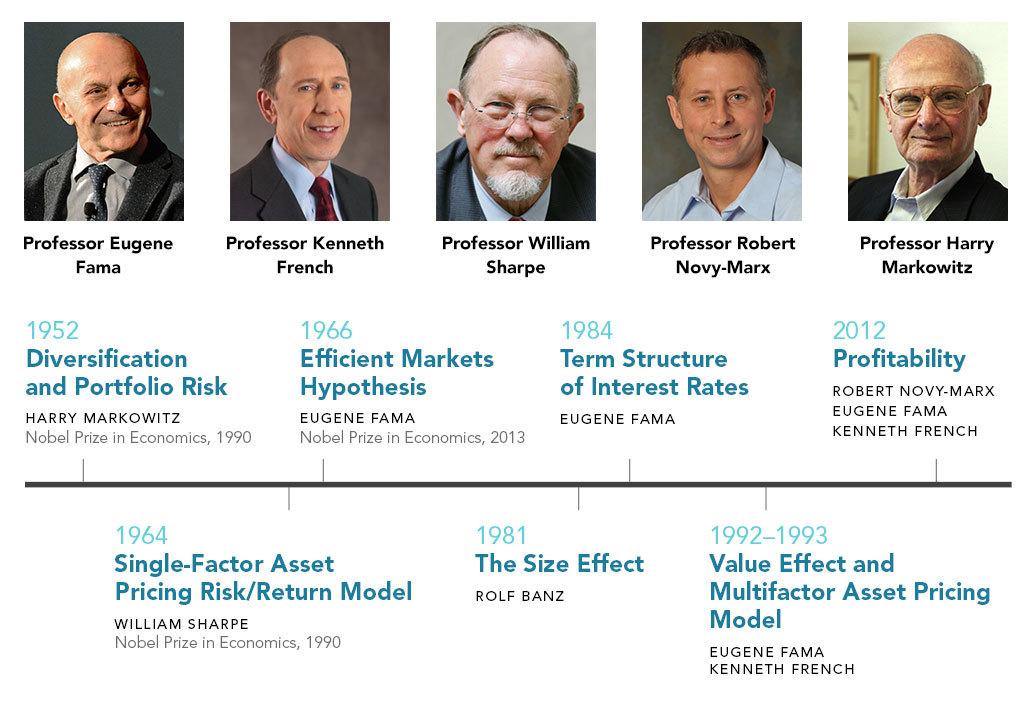
Some Economists of Note

For Physician-Investors to Know

[By staff reporters]

***

***

***

***

Your thoughts are appreciated.

RESOURCES:

“Insurance & Risk Management Strategies for Doctors” https://tinyurl.com/ydx9kd93

“Fiduciary Financial Planning for Physicians” https://tinyurl.com/y7f5pnox

“Business of Medical Practice 2.0” https://tinyurl.com/yb3x6wr8

THANK YOU

Risk Management, Liability Insurance, and Asset Protection Strategies for Doctors and Advisors: Best Practices from Leading Consultants and Certified Medical Planners™8Comprehensive Financial Planning Strategies for Doctors and Advisors: Best Practices from Leading Consultants and Certified Medical Planners™

Do Physician Investors and/or their Financial Advisors Use and Abuse Modern Portfolio Theory?

Join Our Mailing List

The Cultural Clash of Passivity versus Activity

By Dr. David Edward Marcinko MBA CMP™

www.CertifiedMedicalPlanner.org

[Publisher-in-Chief]

Ninety-three year old Professor Harry Markowitz PhD, coined the phrase “modern portfolio theory” [MPT] and concluded that investors are rewarded for taking certain risks but may not get rewarded for taking others. He developed the notion of an “efficient frontier” for different groups of asset classes and the idea that the higher the expected return, the higher the risk.

The Brinson, Hood, Beebower Study

In their 1986 study, Brinson, Hood, and Beebower attempted to measure three investment activities: (1) asset class selection, (2) market timing, and (3) security selection. They concluded that asset class selection had, by far, the greatest effect on the risk/return characteristics of a portfolio (some 93.6% of performance). But the most startling conclusion was that, if left alone, investment policy would have produced a higher average return than when market timing and security selection were taken into account. These latter factors actually reduced the average return over a 10-year period.

The Fama & French Study

In 1982, Fama and French found that three factors—market exposure, company size, and “value”—were systematic risks that explained the vast majority of equity market returns. “U.S. small-cap value stocks” is therefore a discreet asset class possessing all three of these systematic risks.

Most physicians and financial advisors are aware of modern portfolio theory but some fail to apply the principles to actual investor situations. Three examples: (1) using erroneous asset-class definitions, (2) using actively managed funds, and (3) relying on market timing. The abuse of modern portfolio theory can create portfolios loaded with latent risks that, on the surface, appear benign.

Not all Agree

Not everyone is in agreement with modern portfolio theory. Some detractors agree in principle, recognizing, for example, that “value” stocks have had higher returns than “growth” issues but they cite the cause as “mispricing” rather than risk.

Assessment

Institutional investors have gradually increased their commitment to passive strategies from virtually zero 20 years ago to 30% or more in the last decade [Think: Vanguard].

Individual and physician investors, on the other hand, have less than a 5% commitment.

Note: “Modern Portfolio Theory: Fact or Fiction?,” Gerard F. Stellwagen and Robin P. LaCouture, NAPFA Advisor, July 1997, pp. 1–7, National Association of Personal Financial Advisors for Fee-Only Financial Advisors.

Conclusion

Your thoughts and comments on this ME-P are appreciated. Feel free to review our top-left column, and top-right sidebar materials, links, URLs and related websites, too. Then, subscribe to the ME-P. It is fast, free and secure.

Link: http://feeds.feedburner.com/HealthcareFinancialsthePostForcxos

Speaker: If you need a moderator or speaker for an upcoming event, Dr. David E. Marcinko; MBA – Publisher-in-Chief of the Medical Executive-Post – is available for seminar or speaking engagements. Contact: MarcinkoAdvisors@msn.com

OUR OTHER PRINT BOOKS AND RELATED INFORMATION SOURCES:

DICTIONARIES: http://www.springerpub.com/Search/marcinko
PHYSICIANS: www.MedicalBusinessAdvisors.com
PRACTICES: www.BusinessofMedicalPractice.com
HOSPITALS: http://www.crcpress.com/product/isbn/9781466558731
CLINICS: http://www.crcpress.com/product/isbn/9781439879900
ADVISORS: www.CertifiedMedicalPlanner.org
PODIATRISTS: www.PodiatryPrep.com
BLOG: www.MedicalExecutivePost.com
FINANCE: Financial Planning for Physicians and Advisors
INSURANCE: Risk Management and Insurance Strategies for Physicians and Advisors

Product DetailsProduct DetailsProduct Details

Product Details  Product Details

   Product Details 

The Living Legacy of Dr. Harry Markowitz

Creating Diversified Portfolios of Uncorrelated Assets

By Dr. David Edward Marcinko MBA CMP™

[Publisher-in-Chief]

More than a half century ago, a paper appeared in The Journal of Finance written by a 24-year-old doctoral candidate in economics at the University of Chicago—Harry Markowitz. It was called “Portfolio Selection” and suggested that investors take into account risk in pursuit of the highest return—a concept that we take for granted today [Modern Portfolio Theory].

Markowitz drew a trade-off curve between risk and reward and called it the “efficient frontier.” A rational physician executive or other investor who knew his or her risk tolerance could choose an appropriate portfolio from a point on this curve. Markowitz led investors to diversified portfolios of uncorrelated investments.

Dissertation Follow-up

Markowitz followed up his dissertation in 1959 with a book entitled Portfolio Selection [Efficient Diversification of Investment]. His many contributions to finance earned him the Nobel Prize in Economic Science in 1990 along with William Sharpe and Merton Miller. He reasoned that diversification is about avoiding the covariance.

If risks are uncorrelated, you can reduce the risk of a portfolio to practically zero by sufficient diversification. This doesn’t work if risks are correlated. If one invests in a very large number of securities that are correlated, risk does not approach zero but rather the average covariance, which is a very substantial amount of risk.

Where It All Started

It was at the RAND Corporation that Markowitz met William [Bill] Sharpe who was working on his PhD at UCLA. Markowitz takes issue with Sharpe’s Capital Asset Pricing Model (CAPM), which claims that the expected return of a security depends only on its beta—ignoring fundamental analysis.

CAPM also implies that the market portfolio is efficient, even though investors in the market may not act rationally. It says that the market portfolio is a mean-variance efficient portfolio. Markowitz disputes this conclusion. He points to Fama and French and others who have found that expected returns are more closely related to book-to-price or size—not to beta.

hm

Assessment

The still living Markowitz fends off criticism of mean-variance analysis only being valid when probability distributions are normal by stating that he realizes that probability distributions are not normal in the real world.

But, if they are similar to a normal distribution, mean variance does a good job at approximating expected utility. He admits that when they are too dispersed, mean variance doesn’t work well.

Note: Travels along the Efficient Frontier,” an interview with Harry Markowitz by Jonathan Burton, Dow Jones Asset Management, May/June 1997, pp. 21–28, Dow Jones Financial Publishing Corp.

Conclusion

And so, your thoughts and comments on this ME-P are appreciated. Do you use MPT when investing, or CAP-M? Feel free to review our top-left column, and top-right sidebar materials, links, URLs and related websites, too. Then, subscribe to the ME-P. It is fast, free and secure.

OUR OTHER PRINT BOOKS AND RELATED INFORMATION SOURCES:

Product DetailsProduct DetailsProduct Details

Product Details  Product Details

Comprehensive Financial Planning Strategies for Doctors and Advisors: Best Practices from Leading Consultants and Certified Medical Planners™

***

Hospital Capital Formation, Harry Markowitz and Modern Portfolio Theory

Strategic Risk Considerations for Physician-Executives and Healthcare CXOs

[By Calvin W. Wiese; MBA, CPA, CMA]

To most all financial advisors, wealth managers and stock-brokers, the work of Harry Markowitz and Modern Portfolio Theory [MPT] is not usually discussed in terms of hospital capital formation. But, perhaps it should!

Capital Investments Create Risk

Capital investments create risk. Risk is the uncertainty of future events. When hospitals make capital investments, they commit to costs that affect future periods. Those costs are known and relatively fixed. What are unknown are the benefits to be realized by those capital investments.

Defining Risk

For capital investments, risk is the certainty of future costs coupled with the uncertainty of future benefits. In some cases, while the future benefits are uncertain, there is a high degree of certainty that the benefits will exceed the costs. In these cases, risk can be very low. Risk may be better defined as the degree to which the uncertainty of unknown benefits will exceed the known and committed costs.

Asset Burdens and Benefits

When capital assets are purchased, both the burdens and the benefits of ownership are transferred to the owner. The burdens are primarily the costs associated with acquisition and installation. The benefits are primarily the revenues generated by operating the capital assets. Risk of ownership is created to the degree that the benefits are uncertain.

Understanding Risk

Hospital managers need to be skilled at putting hospital assets at risk. Without clear knowledge and understanding of the benefits and the burdens, hospitals can quickly find themselves at unacceptably high levels of risk. Risk must be continually assessed and evaluated in order to successfully put hospital assets at risk. Hospitals require many varied capital investments; their capital investments represent a risk portfolio. An effective combination of risky assets can often create risk that is less than the sum of the risk of each asset.

Modern Portfolio Theory

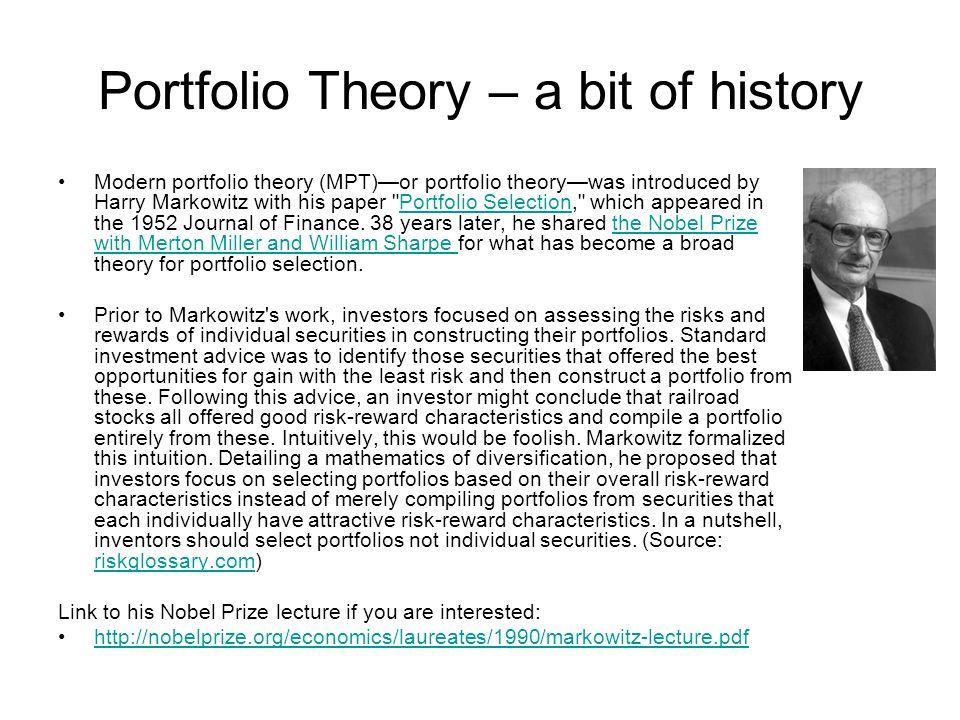
Of course, financial managers have know this for years as a basic principle of Modern Portfolio Theory (MPT), first introduced by Harry Markowitz, PhD, with the paper “Portfolio Selection,” which appeared in the 1952 Journal of Finance. Thirty-eight years later, he shared a Nobel Prize with Merton Miller, PhD, and William Sharpe, PhD, for what has become a broad theory for securities asset selection; and hospital assets may be viewed as little different.

Prior to Markowitz’s work, investors focused on assessing the rewards and risks of individual securities in constructing a portfolio. Standard advice was to identify those that offered the best opportunities for gain with the least risk and then construct a portfolio from them. Following this advice, a hospital administrator might conclude that a positron emission tomography (PET) scanning machine offered good risk-reward characteristics, and pursue a strategy to compile a network of them in a given geographic area. Intuitively, this would be foolish. Markowitz formalized this intuition.

Detailing the mathematics of diversity, he proposed that investors focus on selecting portfolios based on their overall risk-reward characteristics instead of merely compiling portfolios of securities, or capital assets that each individually has attractive risk-reward characteristics. In a nutshell, just as investors should select portfolios not individual securities, so hospital administrators should select a wide spectrum of radiology services, not merely machines.

Join Our Mailing List

Assessment

Savvy hospital managers will mitigate ownership risk by constructing their portfolio of risky assets in a manner that lowers overall risk

Conclusion

Your thoughts and comments on this ME-P are appreciated. Feel free to review our top-left column, and top-right sidebar materials, links, URLs and related websites, too. Then, subscribe to the ME-P. It is fast, free and secure.

Link: http://feeds.feedburner.com/HealthcareFinancialsthePostForcxos

Speaker: If you need a moderator or speaker for an upcoming event, Dr. David E. Marcinko; MBA – Publisher-in-Chief of the Medical Executive-Post – is available for seminar or speaking engagements. Contact: MarcinkoAdvisors@msn.com

OUR OTHER PRINT BOOKS AND RELATED INFORMATION SOURCES:

Product Details  Product Details

Product Details

Strategic Modern Portfolio Theory Considerations in Hospital Capital Formation

Understanding Risk for Doctors and Financial Advisors

By Calvin W. Wiese; MBA, CPA

www.HealthcareFinancials.com

Hospital capital investments financial create risk. Risk is the uncertainty of future events. When hospitals make capital investments, they commit to costs that affect future periods. Those costs are known and relatively fixed. What are unknown are the benefits to be realized by those capital investments. For capital investments, risk is the certainty of future costs coupled with the uncertainty of future benefits. In some cases, while the future benefits are uncertain, there is a high degree of certainty that the benefits will exceed the costs. In these cases, risk can be very low.

Risk Re-Defined

Risk may be better defined as the degree to which the uncertainty of unknown benefits will exceed the known and committed costs. For example, when capital assets are purchased, both the burdens and the benefits of ownership are transferred to the owner. The burdens are primarily the costs associated with acquisition and installation. The benefits are primarily the revenues generated by operating the capital assets. Risk of ownership is created to the degree that the benefits are uncertain.

Managing Risk

Hospital managers and physician executives need to be skilled at putting hospital assets at risk. Without clear knowledge and understanding of the benefits and the burdens, hospitals can quickly find themselves at unacceptably high levels of risk. Risk must be continually assessed and evaluated in order to successfully put hospital assets at risk. Hospitals require many varied capital investments; their capital investments represent a risk portfolio. An effective combination of risky assets can often create risk that is less than the sum of the risk of each asset.

About MPT

Of course, financial managers have know this for years as a basic principle of Modern Portfolio Theory (MPT), first introduced by Harry Markowitz, PhD, with the paper “Portfolio Selection,” which appeared in the 1952 Journal of Finance. Thirty-eight years later, he shared a Nobel Prize with Merton Miller, PhD, and William Sharpe, PhD, for what has become a broad theory for securities asset selection; and hospital assets may be viewed as little different. Prior to Markowitz’s work, investors focused on assessing the rewards and risks of individual securities in constructing a portfolio. Standard advice was to identify those that offered the best opportunities for gain with the least risk and then construct a portfolio from them.

Following this advice, a hospital administrator might conclude that a positron emission tomography (PET) scanning machine offered good risk-reward characteristics, and pursue a strategy to compile a network of them in a given geographic area. Intuitively, this would be foolish. Markowitz formalized this intuition. Detailing the mathematics of diversity, he proposed that investors focus on selecting portfolios based on their overall risk-reward characteristics instead of merely compiling portfolios of securities, or capital assets that each individually has attractive risk-reward characteristics. In a nutshell, just as investors should select portfolios not individual securities, so hospital administrators should select a wide spectrum of radiology services, not merely machines.

Assessment

Savvy hospital managers will mitigate ownership risk by constructing their portfolio of risky assets in a manner that lowers overall risk.

Conclusion

Join Our Mailing List

And so, your thoughts and comments on this ME-P post are appreciated. How do you define financial risk in your healthcare organization? How do you manage and mitigate it? Feel free to review our top-left column, and top-right sidebar materials, links, URLs and related websites, too. Then, be sure to subscribe to the ME-P. It is fast, free and secure.

Link: http://feeds.feedburner.com/HealthcareFinancialsthePostForcxos

Speaker: If you need a moderator or speaker for an upcoming event, Dr. David E. Marcinko; MBA – Publisher-in-Chief of the Executive-Post – is available for seminar or speaking engagements. Contact: MarcinkoAdvisors@msn.com 

Get our Widget: Get this widget!

Our Other Print Books and Related Information Sources:

Practice Management: http://www.springerpub.com/prod.aspx?prod_id=23759

Physician Financial Planning: http://www.jbpub.com/catalog/0763745790

Medical Risk Management: http://www.jbpub.com/catalog/9780763733421

Healthcare Organizations: www.HealthcareFinancials.com

Health Administration Terms: www.HealthDictionarySeries.com

Physician Advisors: www.CertifiedMedicalPlanner.com

Subscribe Now: Did you like this Medical Executive-Post, or find it helpful, interesting and informative? Want to get the latest ME-Ps delivered to your email box each morning? Just subscribe using the link below. You can unsubscribe at any time. Security is assured.

Link: http://feeds.feedburner.com/HealthcareFinancialsthePostForcxos

Sponsors Welcomed

And, credible sponsors and like-minded advertisers are always welcomed.

Link: https://healthcarefinancials.wordpress.com/2007/11/11/advertise

Whither Physician Self-Portfolio Management?

Do it Yourself Considerations

By Clifton N. McIntire, Jr.; CIMA, CFP®

By Lisa Ellen McIntire; CIMA, CFP®fp-book

In order to self create and monitor an investment portfolio for personal, office, or medical foundation use, the physician investor should ask him/herself three questions:

1. How much do I have invested?

2. How much did I make on my investments?

3. How much risk did I take to get that rate of return?

How Am I Doing?

Most doctors and health care professionals know how much money they have invested. If they don’t, they can add a few statements together to obtain a total. Few actually know the rate of return achieved during last year’s debacle, or so far this year in 2009. Everyone can get this number by simply subtracting the ending balance from the beginning balance and dividing the difference. But, few take the time to do it. Why? A typical response to the question is, “We were doing fine” -or- “We did terrible last year.”

But, ask how much risk is in the portfolio and help is needed. Nobel laureate Harry Markowitz, PhD said, “If you take more risk, you deserve more return.” Using standard deviation, he referred to the “variability of returns” –  in other words, how much the portfolio goes up and down, its volatility.

Your Own Portfolio

How, and even whether or not to create and manage your own portfolio, is what this brief post is about.

First, you must determine what to do with your investments. How much risk can be taken and what is the time frame? You must understand the concept of risk vs. reward and write an investment policy statement.

Next, the assets that will be used for investment must be selected. This involves asset allocation and mixing different styles of investment management to achieve the desired results, and is the point where you go it alone, or professional investment managers are selected.

Be sure to review expenses, like wrap accounts, service fees, AUMs, commissions and compare mutual funds with private money management.

Monitor

Once the initial portfolio is in place, the performance must be monitored to assure compliance with the investment policy.  Here’s where you consider 401k or 403(b) plans, pension plans, retirement accounts, as well as how to change doctor trustees or managers when necessary.

Assessment

Finally, consider the role of professional consultants. Now after all of this, if you still want to do it yourself rather than be a doctor, the entire process will be professionally illustrated. An actual physicians’ financial plan with investing portfolio was reviewed previously, along with the steps taken to improve returns and reduce risk.

Link: https://healthcarefinancials.wordpress.com/2009/09/03/evaluating-a-sample-physician-financial-plan-iii/

Join Our Mailing List

Conclusion

And so, your thoughts and comments on this Medical Executive-Post are appreciated. Feel free to review our top-left column, and top-right sidebar materials, links, URLs and related websites, too. Then, be sure to subscribe to the ME-P. It is fast, free and secure.

Link: http://feeds.feedburner.com/HealthcareFinancialsthePostForcxos

Speaker: If you need a moderator or speaker for an upcoming event, Dr. David E. Marcinko; MBA – Publisher-in-Chief of the Executive-Post – is available for seminar or speaking engagements. Contact: MarcinkoAdvisors@msn.com 

Get our Widget: Get this widget!

Our Other Print Books and Related Information Sources:

Practice Management: http://www.springerpub.com/prod.aspx?prod_id=23759

Physician Financial Planning: http://www.jbpub.com/catalog/0763745790

Medical Risk Management: http://www.jbpub.com/catalog/9780763733421

Healthcare Organizations: www.HealthcareFinancials.com

Health Administration Terms: www.HealthDictionarySeries.com

Physician Advisors: www.CertifiedMedicalPlanner.com