PHYSICIANS: Why Salary is Down?

MEDICAL PROVIDER PAYMENTS LOWERED

***

***

Statistic: $2.8+ billion dollars

That’s how much Blue Cross and Blue Shield plans agreed to pay to settle litigation over claims they conspired to lower payments to providers. (Healthcare Dive)

COMMENTS APPRECIATED

EDUCATION: Books

SPEAKING: Dr. Marcinko will be speaking and lecturing, signing and opining, teaching and preaching, storming and performing at many locations throughout the USA this year! His tour of witty and serious pontifications may be scheduled on a planned or ad-hoc basis; for public or private meetings and gatherings; formally, informally, or over lunch or dinner. All medical societies, financial advisory firms or Broker-Dealers are encouraged to submit an RFP for speaking engagements: CONTACT: Ann Miller RN MHA at MarcinkoAdvisors@outlook.com -OR- http://www.MarcinkoAssociates.com

***

MEDICINE: Emergent Care

SOME PHYSICIAN WORK FOR FREE

By Staff Reporters

SPONSOR: http://www.MarcinkoAssociates.com

***

***

What is an Emergency Medicine Physician?

An emergency medicine physician is a medical doctor who specializes in the diagnosis, treatment, and management of acute and life-threatening medical conditions that require immediate intervention. These physicians work in hospital emergency departments, urgent care centers, and other acute care settings, where they provide rapid assessment, stabilization, and treatment to patients of all ages with a wide range of medical emergencies.

Emergency medicine physicians are trained to handle diverse medical emergencies, including trauma, cardiac emergencies, respiratory distress, severe infections, neurological emergencies, and obstetric emergencies, among others. They play a vital role in the front line management of medical emergencies, ensuring that patients receive prompt and appropriate care to improve outcomes and save lives.

***

Classic: Emergent Room or Emergency Department care is the provision of immediate medical service offering outpatient care for the treatment of acute and chronic illness and injury. It requires a broad and comprehensive fund of knowledge to provide such care. Excellence in care for patients with complex and or unusual conditions is founded on the close communication and collaboration between the urgent care medicine physician, the specialists and the primary physicians.

Modern: Urgent care does not replace your primary care physician. An urgent care center is a convenient option when someone’s regular physician is on vacation or unable to offer a timely appointment. Or, when illness strikes outside of regular office hours, urgent care offers an alternative to waiting for hours in a hospital Emergency Room.

Examples: Chest pain, bleeding that cannot be stopped and loss of consciousness; etc.

***

***

SOME ER DOCTORS WORK FOR FREE

The new president of emergency medicine for the Alberta Medical Association says Emergency Room physicians already coping with long hours, staff shortages and jammed waiting rooms are also being obligated, in some cases, to work for free. Dr. Warren Thirsk says the government has yet to follow through on a promise to reimburse emergency room doctors for so-called “good faith” payments.

“There’s been lots of excuses, but the bottom line is no one has actually received a penny for those suspended good-faith payments,” Thirsk said in an interview. “On average, every emergency physician in this province is out thousands of dollars for free work.” Good-faith payments reimburse ER doctors when they see patients who don’t have identification and can’t prove an Alberta Health Care Insurance Plan billing number.

Thirsk said the United Conservative government stopped those payments when it ripped up the master agreement with the AMA in early 2020. He said it promised to bring back those payments when the two sides agreed to a new deal in September 2022. But to date that hasn’t happened, he said.

“I’m legally and morally bound to look after you [if] you’re unidentified [as a patient],” said Thirsk, an emergency room doctor at Edmonton’s Royal Alexandra Hospital.

“I’m going to look after you because it’s the right thing to do no matter what the problem is.”

COMMENTS APPRECIATED

The Medical Executive-Post is a  news and information aggregator and social media professional network for medical and financial service professionals. Feel free to submit education content to the site as well as links, text posts, images, opinions and videos which are then voted up or down by other members. Comments and dialog are especially welcomed. Daily posts are organized by subject. ME-P administrators moderate the activity. Moderation may also conducted by community-specific moderators who are unpaid volunteers.

Like and Refer

***

***

Multi-Specialty Surveys for Physician Compensation – Released

By Health Capital Consultants, LLC

***

***

It’s the most wonderful time of the year – Survey Season! Beginning in late May each year, numerous industry normative benchmark physician production and compensation surveys begin publishing the most recent year’s reports. These healthcare and specialty specific surveys annually report specific types of physician compensation and productivity metrics across the country for various specialties and are widely used by hospitals, physician practices, and healthcare compensation and valuation experts, are often used for the determination of Fair Market Value (FMV) physician compensation for regulatory compliance purposes.

CITE: https://www.r2library.com/Resource

Additionally, the government has referenced and utilized industry normative benchmark compensation surveys (including those listed below) in reviewing and litigating physician compensation arrangements, indicating their reliance on this data as well. (Read more…)

COMMENTS APPRECIATED

Thank You

***

***

MEDICARE DOCTOR SALARY RATES: Would Cut Pay 3%

By Staff Reporters

***

***

Orthopedic doctors and surgeons earn on average 558 thousand U.S. dollars annually. This makes Orthopedic doctors and surgeons the most well-compensated physicians in the United States as of 2024, followed by plastic surgeons. Plastic surgeons were, by far, the highest earning physicians in the U.S. in 2023. An orthopedic physician specializes in injuries and diseases involving bones, muscles, joints, nerves and other parts of the musculoskeletal system.

Although orthopedic doctors and surgeons have the highest average annual salary, from 2023 to 2024 their compensation actually decreased by 3 percent. In comparison, compensation for physicians specialized in physical medicine and rehabilitation increased 11 percent during this time, while plastic surgeons saw the largest decrease of 13 percent. The region with the highest annual compensation for physicians was West North Central in 2024, with physicians earning some 404 thousand U.S. dollars in this region.

There are currently around 29.2 active physicians per 10,000 people in the U.S. Around 29 percent of physicians in the U.S. are aged between 56 and 65 years, while only 11 percent are 35 years or younger. The vast majority of physicians are employed by hospitals or groups and work an average of 51 hours per week.

***

Medicare Rates in 2025 Would Cut Pay For Docs by About 3%

And so, Federal officials on July 11th proposed Medicare rates that effectively would cut physician pay by about 3% in 2025, touching off a fresh round of protests from medical associations. The 2025 draft base rate, or conversion factor, is slated to drop to $32.36 from the current level of $33.29, the Centers for Medicare & Medicaid Services said.

This proposed cut is mostly due to the 5-year freeze in the physician schedule base rate mandated by the 2015 Medicare Access and CHIP Reauthorization Act (MACRA). Congress designed MACRA with an aim of shifting clinicians toward programs that would peg pay increases to quality measures.

Source: Kerry Dooley Young, MD Edge [7/11/25]

COMMENTS APPRECIATED

Thank You

***

***

PHYSICIAN COMPENSATION: Rising but NOT with Inflation!

By Staff Reporters and MGMA Survey

Physician Compensation is Rising but Not Keeping Pace with Inflation

Despite physician and advanced practice provider productivity continuing its post-pandemic recovery, compensation gains are being outstripped by the most severe inflationary growth in decades, according to a new report. Provider compensation increased across the board, with primary care physicians (PCPs) receiving the biggest increase last year. Growth in median total compensation for primary care doctors doubled from 2021 to 2022—from pay growth of 2.13% to 4.41%. But these gains were eclipsed by the rate of inflation at 7% and 6.5%, respectively.

CITE: https://www.r2library.com/Resource

Surgical and non-surgical specialists saw their change in median total compensation cool slightly in 2022, dropping from 3.89% for surgical specialists in 2021 to 2.54% in 2022, and from 3.12% for non-surgical physicians in 2021 to 2.36% in 2022, according to the Medical Group Management Association’s 2023 provider compensation and production report.

Source: Heather Landi, Fierce Healthcare [6/6/23]

***

COMMENTS APPRECIATED

Thank You

***

***

MEDICARE / MEDICAID: Physician Acceptance Down

By Staff Reporters

***

***

Physicians Who Accept Medicare, Medicaid at All-time Low of 65%

Reduced Medicare and Medicaid payments are having more physicians considering reducing those patient bases, according to Medscape’s “Physician Compensation Report” for 2023. Sixty-five percent of physicians surveyed said they would continue treating current Medicare or Medicaid patients and take on new ones, according to the report. Medscape said it is the lowest percentage it has seen in its annual compensation reports. Five years ago, 71 percent of physicians said they would continue treating current Medicare or Medicaid patients and take on new ones. 

CITE: https://www.r2library.com/Resource

For the report, Medscape collected responses from 10,011 physicians across more than 29 specialties. The data was collected between Oct. 7, 2022, and Jan. 17, 2023. Eight percent of physicians surveyed said they would not take on new Medicare patients, and 5 percent said they would not take new Medicaid patients. Four percent said they will stop treating some or all of their current Medicare patients and will not take on new ones, and 3 percent said the same about Medicaid patients. Twenty-two percent said they have not yet decided how they will move forward regarding Medicare and Medicaid patients, according to the report. 

Source: Andrew Cass, Becker’s Payer Issues [4/18/23]

***

COMMENTS APPRECIATED

Thank You

***

PODCAST: If You Pay Doctors More, Will They Work More or Less?

Income and Substitution Effects in Healthcare Economics

By Erice Bricker MD

***

***

CITE: https://www.r2library.com/Resource/Title/082610254

COMMENTS APPRECIATED

Thank You

Subscribe to the Medical Executive-Post

***

***

***

***

PODCAST: Physician Relative Value Units?

HOW DOCTORS GET PAID!

By Eric Bricker MD

YOUR COMMENTS ARE APPRECIATED.

Thank You

****

How Much Money Do You Make – Doctor?

Join Our Mailing List

Ruminations on the Last Taboo!

By Rick Kahler MS CFP® http://www.KahlerFinancial.com

Rick Kahler CFP“How much money do you make?”

We don’t ask people, let alone doctors and medical professionals, that question; but we’d love to know the answer.

In this country, we’re fixated on a person’s annual income. That’s the primary measure we use to determine social status and define success.

Income Qualifier?

Income also is the qualifier for government welfare programs. It defines people as poor, middle class, or rich. And, of course, it determines how much of your income the government will take. The more you bring in, the higher the percentage of your earnings you will pay in federal, state, and local taxes.

Income as a Poor Indicator of Net Worth

While we project a lot of things onto someone’s income, most of what we project is untrue. Income is not the best indicator of a person’s wealth or net worth.

Examples:

Last year Dr. Brent’s tax return showed an adjusted gross income of $20,000. Dr. Bill’s was $2 million. Who is richer? Most people would say Bill. The US and state governments also would say Bill. Actually, Brent is far and away the wealthier of the two.

Why and How?

Consider these two real-life examples:

  • Dr. Bill lives in New York, New York, which has both high property taxes and a city income tax. Paying city, state, and federal income taxes, plus property taxes on his luxurious home, takes around half of his salary. With take-home pay of about $1 million, Bill spends $1.2 million a year on his mortgage payments, college and private school tuition, and his lifestyle. He overspends his net income by $200,000 a year. He owes more on his condo than it’s worth, and he has significant credit card debt. When you total his assets and liabilities, he has a negative net worth of $1 million. He has managed to hold everything together so far, but technically, Bill is bankrupt.

Jaguar XJ

  • Dr. Brent lives in Rapid City, South Dakota. He is retired, owns a modest home which is paid for, and lives on about $40,000 a year. He didn’t pay any income taxes last year, partly because some of his income is from tax-free municipal bonds and mostly because he wrote off a large investment loss which left him with $20,000 of adjusted gross income. Brent has no debt. His net worth is $5,000,000.

Steering Jaguar

The truth is that what people make tells us very little about whether they are rich or not. In these examples, judging from income alone, it would be easy to reach the inaccurate conclusion that Bill must be far wealthier than Brent. His lifestyle is certainly more lavish—which of course is part of the reason he isn’t wealthy.

Many people who have high incomes but are heavily in debt might have lifestyles lower than others who make significantly less but have no debt. It’s not uncommon that people with high incomes choose to live a lifestyle that is far below what they could afford. In fact, this is one of the best ways to build real wealth.

The Income Non-Indicator

Income is a poor indicator of whether someone is rich. Even more important, it’s a poor indicator of how they handle money. I once worked with a family with an annual income of around $5 million who had a net worth of minus $3.5 million. They may have looked like “millionaires,” but they were not.

On the other hand, I work with many clients who have annual incomes around $100,000 a year, spend $60,000 a year, and are worth $2 to $5 million.

Assessment

The bottom line is that wealth is defined by net worth, not income. A high income doesn’t equal wealth; it equals a better opportunity to build wealth. Not everyone is wise enough to take advantage of that opportunity.

More:

Conclusion

Your thoughts and comments on this ME-P are appreciated. Feel free to review our top-left column, and top-right sidebar materials, links, URLs and related websites, too. Then, subscribe to the ME-P. It is fast, free and secure.

Speaker: If you need a moderator or speaker for an upcoming event, Dr. David E. Marcinko; MBA – Publisher-in-Chief of the Medical Executive-Post – is available for seminar or speaking engagements. Contact: MarcinkoAdvisors@msn.com

OUR OTHER PRINT BOOKS AND RELATED INFORMATION SOURCES:

Product Details  Product Details

Product Details

Should We With-Hold Payment to Doctors, Financial Advisors and Others Who Make Mistakes?

Join Our Mailing List 

A Modified Reprint … and Different Perspective on “Never-Events”

By Dr. David Edward Marcinko FACFAS, MBA, CMP™

Dr. MarcinkoOK; I admit it. I played HS baseball as a youth. Today, I am a doctor and financial advisor. I owned and operated a surgical center and did musculoskeletal surgery for two decades.

Later, as a health economist and financial planner, I acted as an SEC registered investment advisor to medical colleagues for almost 15 years.  I’ve been a reporter, writer and journalist for three decades and Editor-in-Chief of this ME-P for eight years. Along my career path several physician-partners were dual degreed lawyers.

I still am deeply involved in all these activities as a hobbyist, consultant, part-time practitioner, editor and educator. Occasionally, I do make mistakes. There … I admit it. I am not perfect!

For example; I remember the time when I ordered the wrong patient medication dose [noted and corrected by an astute RN] – Dropped an infield fly ball and lost the game – Used the wrong corporate EBIDTA, for an estimated financial calculation, which cost me and the client a few bucks – Referenced the wrong citation and made an author angry – Forgot to check a reference source which made my publisher mad at me – AND – Confused two different medical malpractice cases I was reviewing to the chagrin of my defendant doctor and his attorney; etc, etc.  You get the picture.

Mea culpa – mea maxima culpa!

The Encore Post

And so, it is with delight that the ME-P re-posts the following essay – on mistakes – by colleague Dr. Michael Kirsch who is a gastroenterologist that blogs at MD Whistleblower.

Medical Errors Earn Hospitals Money – Who Knew?

In brief, it goes something like this.

Never-Events

The argument to withhold payment for medical care that resulted from medical error is potent.  This is known as a never-event because it is not supposed to happen – ever! Giving a patient the wrong blood type during a transfusion is a good example of a never-event.

Unfortunately – Keep in mind that defining a medical error is not as easy as it sounds.  One can easily imagine how easy it would be too confuse a medical complication, which is a blameless event, from an error or a negligent act.

Consider This

If the patient develops a complication, should I, the hospital and those I consult not be paid for the additional care required?

Now, by extension, let us consider some other professions in the same way; especially those for which I am associated.

IOW: Would every profession consent to returning fees for mistaken advice or service?  So, do you agree with the following?

  • Financial advisors should return fees if investment performance is below a designated threshold or differs from their peers.
  • Attorneys that offered ineffective legal arguments at trial should surrender fees after appeal.
  • A professional baseball player who drops a fly ball should lose a day’s pay.
  • A newspaper publisher should offer a rebate to all readers if a news story is found to be inaccurate owing to a lack of proper editorial oversight; etc.

I think you get the picture! And, see how I personalized these examples.

More

We realize that mistakes of all types cost money, as do some of the hypothetical examples above.  We also accept that financial incentives can change behavior and can be an effective tool.

Medical-errors

Assessment

But, every human endeavor has a finite error rate and we should be cautious before using an economic drone attack against only the medical profession; or even the others mentioned above … and more.

Let’s use a scalpel here and not a sledge hammer.  And, those of you outside of medicine; please feel free to explain why your occupation should be spared from this health reform strategy?

The Reprint: Would every profession consent to returning fees for mistakes?

Conclusion

Your thoughts and comments on this ME-P are appreciated. Feel free to review our top-left column, and top-right sidebar materials, links, URLs and related websites, too. Then, subscribe to the ME-P. It is fast, free and secure.

Link: http://feeds.feedburner.com/HealthcareFinancialsthePostForcxos

  • Speaker: If you need a moderator or speaker for an upcoming event, Dr. David E. Marcinko; MBA – Publisher-in-Chief of the Medical Executive-Post – is available for seminar or speaking engagements. Contact: MarcinkoAdvisors@msn.com


Product DetailsProduct Details

Risk Management, Liability Insurance, and Asset Protection Strategies for Doctors and Advisors: Best Practices from Leading Consultants and Certified Medical Planners™8Comprehensive Financial Planning Strategies for Doctors and Advisors: Best Practices from Leading Consultants and Certified Medical Planners™

***

Invite Dr. Marcinko

***

A New Physician Compensation Report

Join Our Mailing List
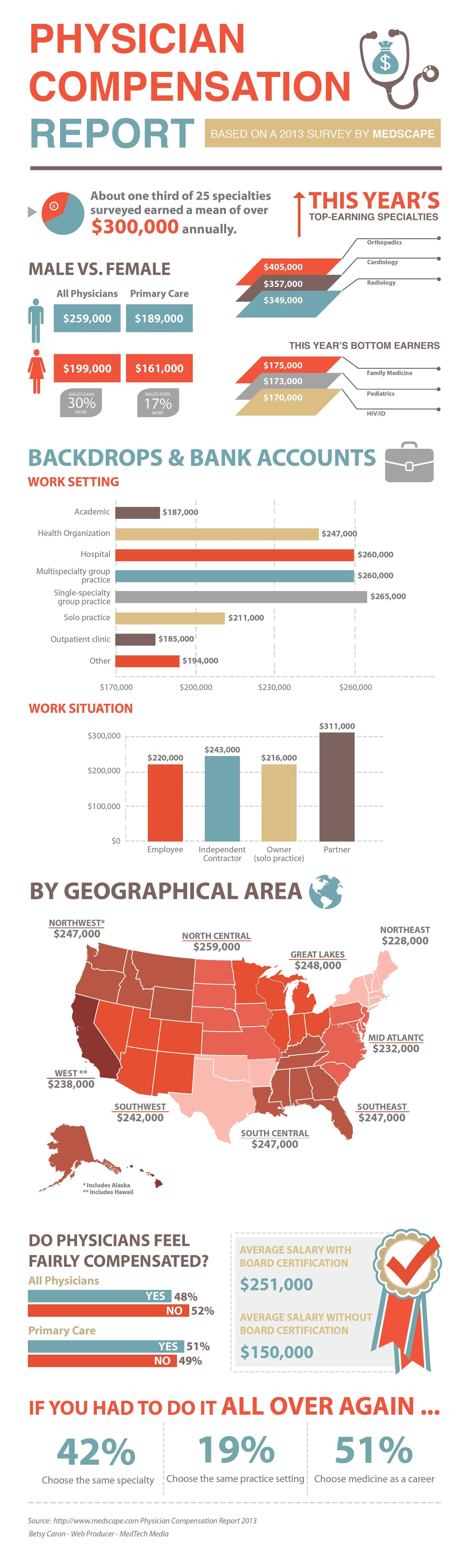
A Physician Compensation Infographic and Review

Doctors saw a small salary increases in 2012 but they were smaller than those in 2011, according to a physician compensation survey released this week by global consulting firm, the Hay Group.

For example, in 2011, physician salaries increased by 2.7 percent but 2012 saw they increased only by 2.5 percent.

####
Pay
More

Conclusion

Your thoughts and comments on this ME-P are appreciated. Feel free to review our top-left column, and top-right sidebar materials, links, URLs and related websites, too. Then, subscribe to the ME-P. It is fast, free and secure.

Link: http://feeds.feedburner.com/HealthcareFinancialsthePostForcxos

Speaker: If you need a moderator or speaker for an upcoming event, Dr. David E. Marcinko; MBA – Publisher-in-Chief of the Medical Executive-Post – is available for seminar or speaking engagements. Contact: MarcinkoAdvisors@msn.com

OUR OTHER PRINT BOOKS AND RELATED INFORMATION SOURCES:

Product DetailsProduct Details

More on the Doctor Salary “WARS” – er! ah! … CONUNDRUM!

Join Our Mailing List

Compensation Trend Data Sources

cropped-dem

By Dr. David Edward Marcinko MBA

[Editor-in-Chief] www.BusinessofMedicalPractice.com

Related chapters: Chapter 27: Salary Compensation and Chapter 29: Concierge Medicine and Chapter 30: Practice Value-Worth


***

PERSONAL PREAMBLE

***

Physician compensation is a contentious issue and often much fodder for public scrutiny. Throw modern pay for performance [P4P], and related metrics, into the mix and few situations produce the same level of emotion as doctors fighting over wages, salary and other forms of reimbursement.

This situation often springs from a failure of both sides to understand mutual compensation terms-of-art when the remuneration deal was first negotiated. This physician salary and compensation information is thus offered as a reference point for further investigations.

Introduction 

More than a decade ago, Fortune magazine carried the headline “When Six Figured Incomes Aren’t Enough. Now Doctors Want a Union.” To the man in the street, it was just a matter of the rich getting richer. The sentiment was quantified in the March 31, 2005 issue of Physician’s Money Digest when Greg Kelly and I reported that a 47-y.o. doctor with 184,000 dollars in annual income would need about 5.5 million dollars for retirement at age.

Of course, physicians were not complaining back then under the traditional fee-for-service system; the imbroglio only began when managed care adversely impacted income and the stock market crashed in 2008.

Today, the situation is vastly different as medical professionals struggle to maintain adequate income levels. Rightly or wrongly, the public has little sympathy for affluent doctors following healthcare reform. While a few specialties flourish, others, such as primary care, barely move.

In the words of colleague Atul Gawande, MD, a surgeon and author from Brigham and Women’s Hospital in Boston, “Doctors quickly learn that how much they make has little to do with how good they are. It largely depends on how they handle the business side of practice.”  And so, it is critical to understand contemporary thoughts on physician compensation and related trends.

Compensation Trend Data Sources

A growing number of surveys measure physician compensation, encompassing a varying depth of analysis. Physician compensation data, divided by specialty and subspecialty, is central to a range of consulting activities including practice assessments and valuations of medical entities. It may be used as a benchmarking tool, allowing the physician executive or consultant to compare a practitioner’s earnings with national and local averages.

The Medical Group Management Association’s (MGMA’s) annual Physician Compensation and Production Correlations Survey is a particularly well-known source of this data in the valuation community. Other information sources include Merritt Hawkins and Associates; and the annual the Health Care Group’s, [www.theHealthCareGroup.com] Goodwill Registry.

###

Portfolio analysis

www.CertifiedMedicalPlanner.org

Assessment

However, all sources are fluid and should be taken with a grain of statistical skepticism, and users are urged to seek out as much data as possible and assess all available information in order to determine a compensation amount that may be reasonably expected for a comparable specialty situation. And, realize that net income is defined as salary after practice expenses but before payment of personal income taxes.

Conclusion

Your thoughts and comments on this ME-P are appreciated. Feel free to review our top-left column, and top-right sidebar materials, links, URLs and related websites, too. Then, subscribe to the ME-P. It is fast, free and secure.

Link: http://feeds.feedburner.com/HealthcareFinancialsthePostForcxos

Speaker: If you need a moderator or speaker for an upcoming event, Dr. David E. Marcinko; MBA – Publisher-in-Chief of the Medical Executive-Post – is available for seminar or speaking engagements. Contact: MarcinkoAdvisors@msn.com

OUR OTHER PRINT BOOKS AND RELATED INFORMATION SOURCES:

DICTIONARIES: http://www.springerpub.com/Search/marcinko
PHYSICIANS: www.MedicalBusinessAdvisors.com
PRACTICES: www.BusinessofMedicalPractice.com
HOSPITALS: http://www.crcpress.com/product/isbn/9781466558731
CLINICS: http://www.crcpress.com/product/isbn/9781439879900
BLOG: www.MedicalExecutivePost.com
FINANCE: Financial Planning for Physicians and Advisors
INSURANCE: Risk Management and Insurance Strategies for Physicians and Advisors

Product Details

Risk Management, Liability Insurance, and Asset Protection Strategies for Doctors and Advisors: Best Practices from Leading Consultants and Certified Medical Planners™ Risk Management, Liability Insurance, and Asset Protection Strategies for Doctors and Advisors: Best Practices from Leading Consultants and Certified Medical Planners™

***

Invite Dr. Marcinko

***

Where Does An MDs Salary Go?

Are Doctors Typical or A-typical?

Join Our Mailing List

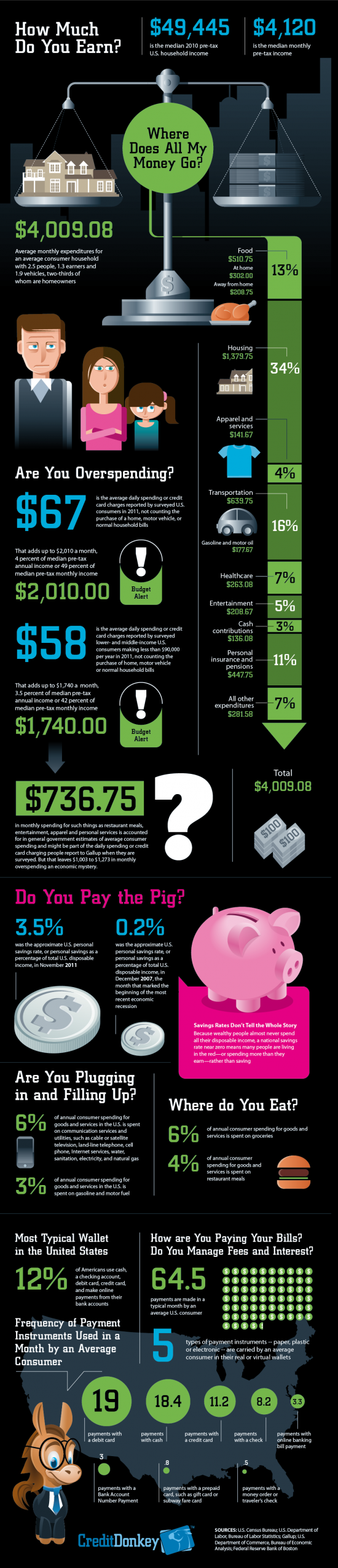
Here is what typical Americans earn in salary, spend in a month, and how they pay their bills. Now, compare this to physicians and other medical professionals.

This analysis suggests that many people [even some doctors] are most likely spending more than they earn each month. It also shows steady movement away from cash and checks toward plastic and electronic payment instruments, which can result in unfamiliar or unchecked fees and interest charges that can increase overspending and indebtedness.

Source: creditdonkey.com

Assessment

Managing your spending and payments will help track monthly expenditures.

Conclusion

Your thoughts and comments on this ME-P are appreciated. Feel free to review our top-left column, and top-right sidebar materials, links, URLs and related websites, too. Then, subscribe to the ME-P. It is fast, free and secure.

Link: http://feeds.feedburner.com/HealthcareFinancialsthePostForcxos

Speaker: If you need a moderator or speaker for an upcoming event, Dr. David E. Marcinko; MBA – Publisher-in-Chief of the Medical Executive-Post – is available for seminar or speaking engagements. Contact: MarcinkoAdvisors@msn.com

Our Other Print Books and Related Information Sources:

Health Dictionary Series: http://www.springerpub.com/Search/marcinko

Practice Management: http://www.springerpub.com/product/9780826105752

Physician Financial Planning: http://www.jbpub.com/catalog/0763745790

Medical Risk Management: http://www.jbpub.com/catalog/9780763733421

Healthcare Organizations: www.HealthcareFinancials.com

Physician Advisors: www.CertifiedMedicalPlanner.com

Subscribe Now: Did you like this Medical Executive-Post, or find it helpful, interesting and informative? Want to get the latest ME-Ps delivered to your email box each morning? Just subscribe using the link below. You can unsubscribe at any time. Security is assured.

Link: http://feeds.feedburner.com/HealthcareFinancialsthePostForcxos

Sponsors Welcomed: And, credible sponsors and like-minded advertisers are always welcomed.

Link: https://healthcarefinancials.wordpress.com/2007/11/11/advertise

Product Details  Product Details

Product Details

Are Physicians Really Going Broke?

Am I Prescient, Lucky or Just an Observant Trend Reporter?

By Dr. David Edward Marcinko MBA CMP™

[Publisher-in-Chief]

A few years ago I was involved in a Physician’s Money Digest report that showed the average physician reader (ie, 47 years old and $184,000 in annual income) would need about $5.5 million to retire. This was in 2007-08, right before the infamous financial “meltdown”.

Lifestyle Preservation

Now, that’s if they planned to have the same lifestyle after retirement as in the years just prior to retirement. In other words, to live on 80% of pre-retirement income, my doctor colleagues would need about $4.4 million. Although that isn’t exactly loose change, the average PMD reader at the time, had a head start, with a net worth of $1.1 million. By maxing out on retirement plans, we reckoned the average reader could be in shouting distance of the goal by age 65.

Although the figures were daunting, they were a wakeup call to the fact these doctors, now age 52-53, still needed to save more aggressively to be able to finance the retirement they were working toward. But since then, their home worth and practice value, savings, investment and retirement accounts are probably down in 2012; as is their net worth. Down –  and I mean way down!

Link: http://www.physiciansmoneydigest.com/issues/2005/92/3951

Fast Forward to 2012

Today, some pundits posit that doctors in America are harboring an embarrassing secret: Many of them are going broke. This quiet trend and seeming reality, which is spreading nationwide, is claiming a wide range of casualties including family physicians, cardiologists and oncologists. Sadly, it is a trend that I have professionally observed and personally seen.

Link: http://money.cnn.com/2012/01/05/smallbusiness/doctors_broke/

Doctors list shrinking insurance reimbursements, changing regulations, rising business and drug costs among the factors preventing them from keeping their practices afloat. And, no doubt, these are all true reasons – in part. But, some experts counter that doctors’ lack of business acumen is also to blame.

So, that’s why we started our physician focused financial planning firm www.MedicalBusinessAdvisors.com  –  and – our online educational program for their managerial consultants and financial advisors www.CertifiedMedicalPlanner.com These firms were conceived and launched more than a decade ago; to much derision and haughtiness at the time. Not some much today, however! Why?

Assessment

A decade ago, Forbes magazine ran an article about doctors making six figure salaries and still wanting a medical union to bargain collectively.  This was a bit difficult for the average man or woman in the street to imagine about such learned professionals, formerly considered affluent and a cut above the rest. So, where is medical union clout today? Where is MD salary clout? And, where is physician net worth now – and in the future?  Doctor – what’s in your wallet?

Conclusion           

And so, your thoughts and comments on this ME-P are appreciated. Are doctors really going broke? Are they OWS…ers? Was I prescient, lucky or just an observant reporter of this trend, early on? Please review our top-left column, and top-right sidebar materials, links, URLs and related websites, too. Then, subscribe to the ME-P. It is fast, free and secure.

Link: http://feeds.feedburner.com/HealthcareFinancialsthePostForcxos

Speaker: If you need a moderator or speaker for an upcoming event, Dr. David E. Marcinko; MBA – Publisher-in-Chief of the Medical Executive-Post – is available for seminar or speaking engagements. Contact: MarcinkoAdvisors@msn.com

Our Other Print Books and Related Information Sources:

Health Dictionary Series: http://www.springerpub.com/Search/marcinko

Practice Management: http://www.springerpub.com/product/9780826105752

Physician Financial Planning: http://www.jbpub.com/catalog/0763745790

Medical Risk Management: http://www.jbpub.com/catalog/9780763733421

Healthcare Organizations: www.HealthcareFinancials.com

Physician Advisors: www.CertifiedMedicalPlanner.com

Subscribe Now: Did you like this Medical Executive-Post, or find it helpful, interesting and informative? Want to get the latest ME-Ps delivered to your email box each morning? Just subscribe using the link below. You can unsubscribe at any time. Security is assured.

Link: http://feeds.feedburner.com/HealthcareFinancialsthePostForcxos

Sponsors Welcomed: And, credible sponsors and like-minded advertisers are always welcomed.

Link: https://healthcarefinancials.wordpress.com/2007/11/11/advertise

Product DetailsProduct DetailsProduct Details

Product Details  Product Details

Product Details

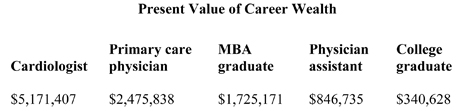
Doctor Salary v. Others [Present Value of Career Wealth]

Specialists v. GPs v. MBAs v. PAs v. College Graduates

Join Our Mailing List

Researchers at Duke University modeled the earning potential of cardiologists and primary care physicians between the ages of 22 and 65, taking into account medical school debt, earning potential and the age at which doctors begin earning an income.

According to John Goodman, they then conducted similar analyses for the average b-school, physician assistant and college graduate.

Assessment

Conclusion

Your thoughts and comments on this ME-P are appreciated. Feel free to review our top-left column, and top-right sidebar materials, links, URLs and related websites, too. Then, subscribe to the ME-P. It is fast, free and secure.

Link: http://feeds.feedburner.com/HealthcareFinancialsthePostForcxos

Speaker: If you need a moderator or speaker for an upcoming event, Dr. David E. Marcinko; MBA – Publisher-in-Chief of the Medical Executive-Post – is available for seminar or speaking engagements. Contact: MarcinkoAdvisors@msn.com

OUR OTHER PRINT BOOKS AND RELATED INFORMATION SOURCES:

Product DetailsProduct DetailsProduct Details

An Emerging Values-Based Healthcare Payment Model

Join Our Mailing List

Understanding Non-Traditional Physician Reimbursement Paradigms

[By Staff Reporters]

www.BusinessofMedicalPractice.com

According to Brian Knabe MD, Mark Fendrick, MD and Michael E. Chernew, PhD, instead of the one size fits all approach of traditional health insurance reimbursement, a “clinically-sensitive” cost-sharing system that supports co-payments related to evidence-based value for targeted patients seems plausible.

The New Model

In this model, out-of-pocket costs are based on price and a cost/quality tradeoff in clinical circumstances: low co-payments for interventions of highest value, and higher co-payments for interventions with little proven health benefit. Smarter benefit packages are designed to combine disease management with cost sharing to address spending growth.

Assessment

Today, whether independent or employed, physicians can pursue creative compensation models not like the one briefly described above and unknown just a decade ago.

Conclusion

Your thoughts and comments on this ME-P are appreciated. Feel free to review our top-left column, and top-right sidebar materials, links, URLs and related websites, too. Then, subscribe to the ME-P. It is fast, free and secure.

Speaker: If you need a moderator or speaker for an upcoming event, Dr. David E. Marcinko; MBA – Publisher-in-Chief of the Medical Executive-Post – is available for seminar or speaking engagements. Contact: MarcinkoAdvisors@msn.com

OUR OTHER PRINT BOOKS AND RELATED INFORMATION SOURCES:

Product DetailsProduct DetailsProduct Details