COMPOUNDING PHARMACY: Disadvantages

By Dr. David Edward Marcinko MBA MEd

***

***

⚠️ Cons of Compounding Pharmacies

1. Quality and Safety Concerns

  • Medications are not FDA-approved, meaning they don’t go through the same rigorous testing as commercial drugs.
  • Risk of contamination or incorrect formulation if strict standards aren’t followed.
  • Potency can vary between batches, leading to inconsistent therapeutic effects.

2. Limited Regulation

  • Oversight is less stringent compared to mass-produced pharmaceuticals.
  • Standards may differ depending on the state or the specific pharmacy.
  • Patients may not always know whether their compounding pharmacy meets high-quality benchmarks.

3. Insurance and Cost Issues

  • Compounded medications are often not covered by insurance.
  • They can be more expensive due to customization and small-scale production.

4. Availability and Accessibility

  • Not all pharmacies offer compounding services.
  • Patients may need to travel farther or wait longer to receive their medication.

***

***

5. Evidence and Efficacy

  • Limited clinical trials or scientific evidence supporting compounded formulations.
  • Effectiveness may rely heavily on anecdotal reports rather than standardized studies.

6. Risk of Errors

  • Human error in measuring, mixing, or labeling can lead to incorrect dosages.
  • Lack of standardized packaging may increase confusion for patients.

👉 In short: while compounding pharmacies can provide personalized solutions, the downsides include less regulation, higher costs, safety risks, and limited evidence of efficacy compared to FDA-approved medications.

COMMENTS APPRECIATED

EDUCATION: Books

SPEAKING: Dr. Marcinko will be speaking and lecturing, signing and opining, teaching and preaching, storming and performing at many locations throughout the USA this year! His tour of witty and serious pontifications may be scheduled on a planned or ad-hoc basis; for public or private meetings and gatherings; formally, informally, or over lunch or dinner. All medical societies, financial advisory firms or Broker-Dealers are encouraged to submit an RFP for speaking engagements: CONTACT: Ann Miller RN MHA at MarcinkoAdvisors@outlook.com -OR- http://www.MarcinkoAssociates.com

Like, Subscribe and Refer

***

***

Safe Disposal: National Prescription Drug Take Back Day

PODCAST: National Prescription Drug Take Back Day

October 25, 2025

By Dr. David Edward Marcinko MBA MEd

***

The National Prescription Drug Take Back Day aims to provide a safe, convenient, and responsible means of disposing of prescription drugs, while also educating the general public about the potential for abuse of medications.

Prescription Pill Bottles

PODCAST: https://www.bing.com/videos/search?q=dea+take+back+day&&view=detail&mid=0D5B986D9C5FD79B077B0D5B986D9C5FD79B077B&&FORM=VRDGAR

MORE DEA: https://takebackday.dea.gov/

Conclusion

Your thoughts and comments on this ME-P are appreciated. Feel free to review our top-left column, and top-right sidebar materials, links, URLs and related websites, too. Then, subscribe to the ME-P. It is fast, free and secure.

Speaker: If you need a moderator or speaker for an upcoming event, Dr. David E. Marcinko; MBA – Publisher-in-Chief of the Medical Executive-Post – is available for seminar or speaking engagements. Contact: MarcinkoAdvisors@msn.com

Ambulance DEM

***

***

DAILY UPDATE: Done Global TeleHealth

MEDICAL EXECUTIVE-POST TODAY’S NEWSLETTER BRIEFING

***

Essays, Opinions and Curated News in Health Economics, Investing, Business, Management and Financial Planning for Physician Entrepreneurs and their Savvy Advisors and Consultants

Serving Almost One Million Doctors, Financial Advisors and Medical Management Consultants Daily

A Partner of the Institute of Medical Business Advisors , Inc.

http://www.MedicalBusinessAdvisors.com

SPONSORED BY: Marcinko & Associates, Inc.

***

http://www.MarcinkoAssociates.com

Daily Update Provided By Staff Reporters Since 2007.
How May We Serve You?
© Copyright Institute of Medical Business Advisors, Inc. All rights reserved. 2024

REFER A COLLEAGUE: MarcinkoAdvisors@msn.com

SPONSORSHIPS AVAILABLE: https://medicalexecutivepost.com/sponsors/

ADVERTISE ON THE ME-P: https://tinyurl.com/ytb5955z

***

CITE: https://www.r2library.com/Resource

The NASDAQ nabbed its fifth-straight record close last week, and the S&P 500 snapped its four-day streak. Both were up for the week as investors digested data that showed inflation cooling. Adobe became the latest company to soar thanks to AI, spiking after delivering better-than-expected earnings and forecasts.

CITE: https://tinyurl.com/2h47urt5

Those who rely on ADHD medication got some bad news last week when the CDC issued a health advisory alerting patients that there may be possible “increased risks for injury and overdose,” after two executives at Done Global, a telehealth company, were arrested for fraud linked to allegedly selling Adderall over the internet. The CDC warned that as many as 30,000 to 50,000 adult patients could be affected. https://tinyurl.com/3rf5py6c

CITE: https://tinyurl.com/tj8smmes

COMMENTS APPRECIATED

PLEASE SUBSCRIBE: MarcinkoAdvisors@msn.com

Thank You

***

***

***

***

EDUCATIONAL TEXTBOOKS: https://tinyurl.com/4zdxuuwf

***

DAILY UPDATE: Retirement Security Rule, National Drug Take Back Day, Spotify, Cleveland Clinic, NAR and the Mixed Stock Markets

MEDICAL EXECUTIVE-POST TODAY’S NEWSLETTER BRIEFING

***

Essays, Opinions and Curated News in Health Economics, Investing, Business, Management and Financial Planning for Physician Entrepreneurs and their Savvy Advisors and Consultants

Serving Almost One Million Doctors, Financial Advisors and Medical Management Consultants Daily

A Partner of the Institute of Medical Business Advisors , Inc.

http://www.MedicalBusinessAdvisors.com

SPONSORED BY: Marcinko & Associates, Inc.

***

http://www.MarcinkoAssociates.com

Daily Update Provided By Staff Reporters Since 2007.
How May We Serve You?
© Copyright Institute of Medical Business Advisors, Inc. All rights reserved. 20224

REFER A COLLEAGUE: MarcinkoAdvisors@msn.com

SPONSORSHIPS AVAILABLE: https://medicalexecutivepost.com/sponsors/

ADVERTISE ON THE ME-P: https://tinyurl.com/ytb5955z

***

Otherwise known as “National Prescription Drug Take Back Day,” National Drug Take Back Day on April 25th is sponsored by the Drug Enforcement Agency. Its goal is to keep the public aware of the dangers of prescription drug use and misuse. Many Americans don’t know how to safely dispose of the prescription drugs that have been sitting in the medicine cabinet past their prime. Using these expired drugs, or using someone else’s, is dangerous and puts both the public and the environment at risk.

CITE: https://www.r2library.com/Resource

Spotify made money in Q1. According to Morning Brew, the streaming music giant grew its revenue last quarter by 20% to $3.8 billion on a record $180 million in profit, it announced yesterday. The smash report comes after Spotify cut costs last year, which included laying off more than a quarter of its workforce. The company also raised prices in 2023 for the first time in a decade as it further expanded beyond music into audio books and other categories. Spotify shares soared ~11% following the news.

***

Here’s where the major benchmarks ended:

  • The S&P 500 index® (SPX) rose 1.08 points (0.02%) to 5,071.63; the Dow Jones Industrial Average® ($DJI) fell 42.77 points (0.1%) to 38,460.92; the NASDAQ Composite® ($COMP) added 16.11 points (0.1%) to 15,712.75.
  • The 10-year Treasury note yield rose more than 4 basis points to 4.644%.
  • The CBOE Volatility Index® (VIX) rose 0.28 to 15.97.

Transportation shares were among the market’s weakest performers Wednesday behind a drop of more than 10% in Old Dominion Freight Line (ODFL), which reported lighter-than-expected quarterly revenue. The shipper’s nosedive helped send the Dow Jones Transportation Average ($DJT) down 2.3%. Consumer staples, semiconductors, and utilities posted moderate advances. The Dow Jones Utility Index ($DJU) gained for the sixth straight day and ended at a three-and-a-half-month high.

***

The National Association of Realtors’ $418 million settlement over an alleged conspiracy to inflate commissions received preliminary approval yesterday. It’s a new world order: Sellers won’t have to pay buyers’ agents anymore. There’s been talk of a metaphorical death of real estate agents, or a mass extinction; the jury is still out, but RE/MAX cofounder and chairman Dave Liniger doesn’t seem too concerned. 

CITE: https://tinyurl.com/2h47urt5

The Labor Department announced it has finalized its Retirement Security Rule, which aims to protect American workers who are saving for retirement and relying on advice from fiduciaries for it. The new rule will update the definition of an investment advice fiduciary under the Employee Retirement Income Security Act and the Internal Revenue Code.

CITE: https://tinyurl.com/tj8smmes

Clinicians don’t always get it right, and their mistakes can be costly: Studies show misdiagnoses lead to roughly 800,000 patient deaths or permanent disabilities each year in the US and cost the healthcare system an estimated $20 billion annually. Cleveland Clinic is using telehealth to try to combat misdiagnoses via its virtual second opinions program, which has saved an average of $8,705 per patient by avoiding unnecessary treatments, according to an analysis released in March.

COMMENTS APPRECIATED

PLEASE SUBSCRIBE: MarcinkoAdvisors@msns.com

Thank You

***

***

***

***

EDUCATIONAL TEXTBOOKS: https://tinyurl.com/4zdxuuwf

***

PODCAST: CVS Health PBM Change Pricing

By Eric Bricker MD

***

***

COMMENTS APPRECIATED

Thank You

***

***

DAILY UPDATE: Rx MDMA

By Staff Reporters

***

***

A psychedelic drug could be an effective treatment for PTSD, according to research published in Nature Medicine this week.

MDMA, aka “ecstasy” or “molly,” combined with therapy, was shown to produce a “clinically meaningful” improvement for almost 90% of treated patients with moderate and severe PTSD.

MORE: https://nida.nih.gov/publications/research-reports/mdma-ecstasy-abuse/what-mdma

The encouraging results put the currently illicit substance on a path to becoming a prescription drug if US regulators approve it for widespread clinical use.

***
COMMENTS APPRECIATED

Thank You

***

***

***

NARCAN: OTC Naloxone Hydrochloride

NARCAN

By Staff Reporters

***

***

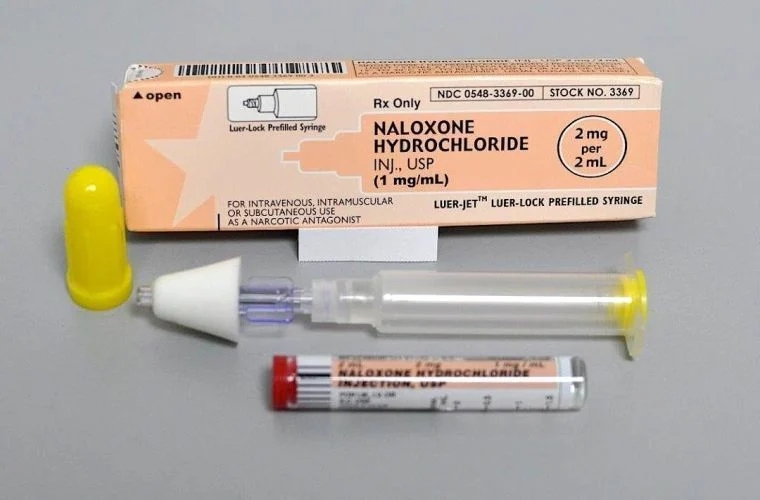
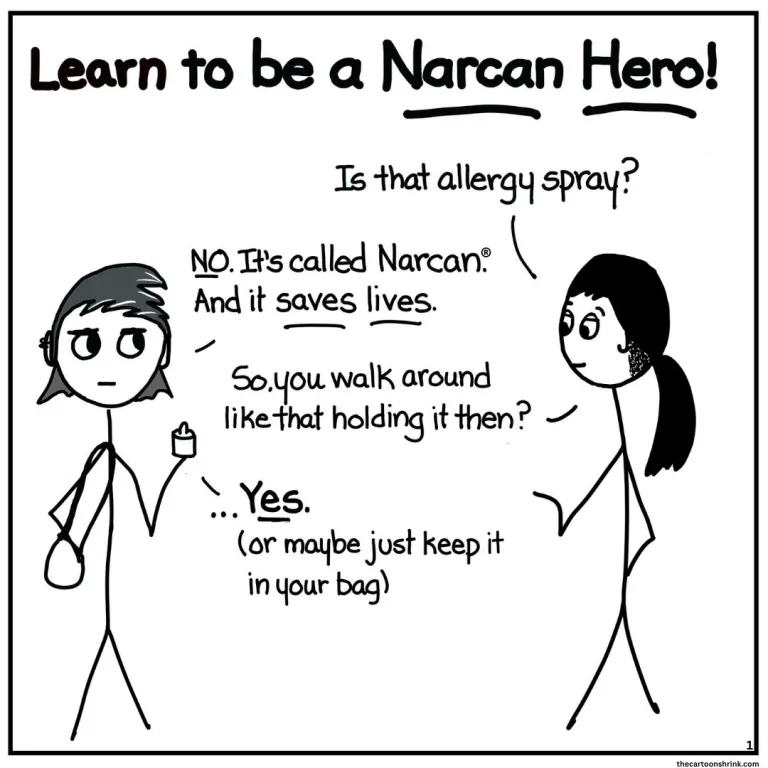
According to Morning Brew, for the first time, people across the US will be able to purchase an overdose-reversal drug that’s as easy to administer as Flonase, without a prescription. Next week, nationwide chains like Walgreens, CVS, Walmart, and Rite Aid will begin selling two-dose boxes of Narcan, a naloxone nasal spray that saves people from opioid overdose, in stores and online.

Making naloxone widely accessible has long been a goal for public health experts because Fentanyl-laced drugs can kill people before paramedics arrive, but some now worry that over-the-counter Narcan’s $45 retail price could be too high for those who need it most.

That’s where insurance comes in:

  • Medicaid and Medicare already cover prescription naloxone, and so far, Missouri, California, Massachusetts, Washington, Rhode Island, and Oregon Medicaid programs said they’ll cover OTC Narcan, too.
  • While private health plans often restrict OTC drug coverage, Blue Cross Blue Shield of Massachusetts said it’ll fully cover nonprescription Narcan.

But this won’t help the one-fifth of people with opioid use disorder who are uninsured. Some government and harm reduction programs give out Narcan for free—and those groups can now order two-dose boxes in bulk at a discounted $41 per box, according to manufacturer Emergent BioSolutions.

PODCAST BALTIMORE NOD: https://medicalexecutivepost.com/2022/08/31/what-is-the-baltimore-nod/

***

***

MORE: https://www.routledge.com/Risk-Management-Liability-Insurance-and-Asset-Protection-Strategies-for/Marcinko-Hetico/p/book/9781498725989

***

COMMENTS APPRECIATED

Thank You

***

DEA Temporarily Extends Tele-Health Prescribing Flexibility

By Staff Reporters

***

***

Tele-Health medical providers are cheering the Drug Enforcement Agency (DEA) move to temporarily extend virtual prescribing flexibility.

The DEA is looking to buy some time to consider whether it should require patients to see doctors face-to-face to get prescriptions for controlled drugs or continue to allow Tele-Health prescriptions. The agency received a record 38,000 public comments on its proposed rule.

Source: Heather Landi, Fierce Healthcare [5/3/23]

***
COMMENTS APPRECIATED

Thank You

***

***

A 4/20 [Medical] Cannabis Culture Day Pictorial

Join Our Mailing List

About Four-Twenty Day

[By Anonymous DEA Agent]

Today is … 420, 4:20, or 4/20 (pronounced four-twenty)

And, it refers to consumption of cannabis and, by extension, a way to identify oneself with cannabis subculture. Observances based on the number include the time (4:20 p.m.) as well as the date (April 20).

Again … that’s today as this ME-P was published @ 4:20 p.m., EST!

THE DEA DESTROYS A POT FARM

PHOTOS: 

  1. Photo taken after the “grow” was eradicated. There is still no “pot” of gold at the end of the rainbow.
  2. DEA taking one of many seized vehicles/equipment.
  3. The marijuana farm was operating under the name “Brian’s Green Thumb Farm.”
  4. Inside the barn, Agents found rows and rows of drying marijuana.
  5. Over 2,000 pounds of drying marijuana from the barn, bagged and ready for destruction.
  6. Air view of the massive “grow” from the guard tower.
  7. One of two sleeping shelters, each guarding the middle perimeter. In the back, one of four tents, each positioned in the corners for guards.
  8. The plant being ripped out of the ground by the backhoe.

© iMBA Inc. All rights reserved.

Assessment

Link: http://en.wikipedia.org/wiki/420_(cannabis_culture)

In 2019: Carl’s Jr. was become the first major fast-food chain to debut a cannabis-infused burger.

Conclusion

Your thoughts and comments on this ME-P are appreciated. Feel free to review our top-left column, and top-right sidebar materials, links, URLs and related websites, too. Then, subscribe to the ME-P. It is fast, free and secure.

Speaker: If you need a moderator or speaker for an upcoming event, Dr. David E. Marcinko; MBA – Publisher-in-Chief of the Medical Executive-Post – is available for seminar or speaking engagements. Contact: MarcinkoAdvisors@msn.com

OUR OTHER PRINT BOOKS AND RELATED INFORMATION SOURCES:

Product DetailsProduct DetailsProduct Details

PODCAST: How to Write a Medical Prescription [Rx]

There are 7 Parts to a Physican’s Drug Prescription

By Eric Bricker MD

***

***

CITE: https://www.r2library.com/Resource/Title/082610254

***

COMMENTS APPRECIATED

Thank You

Subscribe to the Medical Executive-Post

***

***

PODCASTS: How Prescription [Rx] Coverage Works

Formulary Tiers, PBM, Rebates, Spread-Pricing Explained

By Dr. Eric Bricker MD

***

***

CITE: https://www.r2library.com/Resource/Title/082610254

***

***

***
YOUR COMMENTS ARE APPRECIATED.

Thank You

***

PODCASTS: FDA Pharmaceutical Industry Ties

CONFLICTS OF INTEREST?

The New York Times Had an Excellent Article on the FDA on September 2, 2021.

The Article Described How the FDA Began Receiving Funding from the Pharmaceutical Industry Itself to Pay for FDA Employee Salaries in 1992–a Potential Conflict-of-Interest. Subsequently, a Study Found that 1/3 of Drugs Approved by the FDA Were Found to Have Safety Problems from 2000 -2010. Another Potential Conflict-of-Interest is Number of FDA Regulators Who Leave Their Positions to Take High-Paying Jobs at Pharmaceutical Companies.

By Eric Bricker MD

FDA rescinds emergency authorization for COVID-19 antibody treatment  bamlanivimab | TheHill

PODCAST:

***

YOUR COMMENTS ARE APPRECIATED.

Thank You

****

***

About the Opioid Crisis

And, Drug Distributors

[By Vitaliy Katsenelson CFA]

I don’t know anyone personally who has been affected by the opioid epidemic in the US. And I truly hope I never will. I don’t know if I would be able to maintain objectivity in my analysis of drug distributors and their involvement in this epidemic if I had experienced getting a call at night informing me that my loved one had died from a drug overdose. Drug overdoses killed 70,237 Americans in 2017. Of these deaths, 47,600 (67.8%) involved opioids and 17,000 involved prescription opioids (24% of total overdose deaths). Legally prescribed opioids are killing 47 of us every day.

How did we get here?

According to the National Institute on Drug Abuse: “In the late 1990s, pharmaceutical companies reassured the medical community that patients would not become addicted to prescription opioid pain relievers, and healthcare providers began to prescribe them at greater rates. This subsequently led to widespread diversion and misuse of these medications before it became clear that these medications could indeed be highly addictive.”

Today pharma distributors are used as scapegoats for the opioid epidemic – not because they are guilty but because they have money and they are “drug distributors.” They are dragged through the same mud as the tobacco companies and British Petroleum (after it spilled millions of gallons of oil in the Gulf of Mexico). Despite negative headlines, we own drug distributors.

Here is why:

They distribute legally prescribed medicine to pharmacies that are approved by several government agencies, including the DEA. Doctors write scripts; pharma distributors order medicine from pharma manufacturers and deliver them to pharmacies. The sad truth about the opioid epidemic is that 21-29% of patients who were prescribed them for chronic pain misused them, and 8-12% of those who received an opioid prescription developed an opioid use disorder.
However, just as truck drivers cannot be held liable for delivering cigarettes to convenience stores, pharma distributors are not manufacturers of drugs and cannot be held liable for the addictive properties of the drugs they distribute or the fact that doctors overprescribe them and patients misuse them.
Also, the DEA should be responsible for limiting the illegal use of opioids. That is its job – DEA stands for Drug Enforcement Agency. It has legal and enforcement resources that distributors lack. And it has a lot more data and tools. Drug distributors do their part and provide data to the ARCOS database that DEA manages.
***
drugs
***
However, each individual distributor has data only for the drugs it distributes, while DEA has data (which it doesn’t share with distributors) for all opioid sales to pharmacies. The DEA is in a much better position to spot suspicious activity in orders than distributors. The DEA controls how much legal opioid is manufactured in the US every year and has been increasing quotas of opioids produced.
Opioids constitute only a very small percentage of the $450 billion in drugs distributed in the US, and thus incentives for distributors to overdistribute opioids are very limited. Though lawyers and the media keep saying that distributors are some of the largest companies in the S&P 500 by sales, they forget to mention that distributors operate on razor thin margins of less than 2%. Comparing the distributors (not even the makers) of legal medicine, that helps millions of people cope with excruciating pain, to cigarette companies that have a 40% pretax profit margin on a product that doesn’t have a societal benefit, and is almost guaranteed to cause cancer if you use it long enough, creates awesome headlines but has little substance.
  • What if DEA was the one distributing all the opioid drugs to pharmacies instead of McKesson, Cardinal Health, and Amerisource Bergen?
  • Would fewer people get addicted to opioids?
  • Would opioids be less accessible? Remember, DEA sets the production targets every year.
Maybe DEA would catch a few bad actors sooner – it has more data than distributors and a specific skillset and mindset aimed at catching criminals.
But in the big scheme of things, even if DEA distributed opioids nothing would really change. Doctors would still prescribe them; some patients would still get addicted to them … and so on. Distributors will likely settle lawsuits for two reasons:
First, McKesson already settled with the FDA for $150 million for “failure to report suspicious orders of pharmaceutical drugs.”
***
Second, McKesson and other drug distributors don’t want to be involved in costly and protracted litigation. We don’t know how much the settlement will be, but it is very unlikely to be in the hundreds of billions of dollars and likely (see reasons above) to be hundreds of millions or a few billion dollars.
***
Assessment
Today McKessonʻs market capitalization is $25 billion. We think the company is worth at least $50 billion (at 15 times earnings), thus there is a $25 billion of margin of safety. If the lawsuit costs the company less than $25 billion, McKesson will be a profitable investment; if not, then the market is right and we are wrong.

Conclusion

Your thoughts and comments on this ME-P are appreciated. Feel free to review our top-left column, and top-right sidebar materials, links, URLs and related websites, too. Then, subscribe to the ME-P. It is fast, free and secure.

Speaker: If you need a moderator or speaker for an upcoming event, Dr. David E. Marcinko; MBA – Publisher-in-Chief of the Medical Executive-Post – is available for seminar or speaking engagements.

Book Marcinko: https://medicalexecutivepost.com/dr-david-marcinkos-bookings/

Subscribe: MEDICAL EXECUTIVE POST for curated news, essays, opinions and analysis from the public health, economics, finance, marketing, IT, business and policy management ecosystem.

DOCTORS:

“Insurance & Risk Management Strategies for Doctors” https://tinyurl.com/ydx9kd93

“Fiduciary Financial Planning for Physicians” https://tinyurl.com/y7f5pnox

“Business of Medical Practice 2.0” https://tinyurl.com/yb3x6wr8

HOSPITALS:

“Financial Management Strategies for Hospitals” https://tinyurl.com/yagu567d

“Operational Strategies for Clinics and Hospitals” https://tinyurl.com/y9avbrq5

***

Risk Management, Liability Insurance, and Asset Protection Strategies for Doctors and Advisors: Best Practices from Leading Consultants and Certified Medical Planners™Comprehensive Financial Planning Strategies for Doctors and Advisors: Best Practices from Leading Consultants and Certified Medical Planners™

***

The Pill Mill Epidemic

Join Our Mailing List 

What it is – How it works?

michelle

[By Michelle Peterman]

miche.peterman@gmail.com

People who are getting access to prescription medication illegally are on the rise, thanks to what the government and drug addiction specialists call “Pill Mills.”

The United States has a significant enough problem with people addicted to illegal substances, such as heroin, cocaine, and methamphetamines.

What Is A Pill Mill?

You may be asking yourself, “What’s A Pill Mill?” All over the US there are legitimate doctors and pain management centers that are in place to assist patients with managing pain. These centers take great care to make sure patients do not become addicted to their medications and will provide assistance if they do.

Unfortunately, there are pain management centers that operate as these “Pill Mills” and are glorified drug dealers. These people are as bad as the drug suppliers and traffickers who sell Heroin or Ice on the streets. Pill Mills will often have a walk in appointment policy, minimum record keeping methods, and armed guards. Other signs include accepting cash-only, no physical exams, and supplying patients with doses of narcotics that are over the authorized limits.

Many people who are legally prescribed medication may start self-medicating and become addicted, needing more and more drugs. These same individuals often turn to pill mills to gain access to prescriptions that more ethical doctors would not give them.

***

pill mill

***

Pill Mill Issues in Florida

It has been said that Florida is the epicenter of the pill mill industry. In 2010, as many as seven people were dying every day as a result of a prescription medication overdose in the State of Florida, and countless other deaths were occurring throughout The States. Authorities believed that Florida had become a haven for drug abusers and distributors to make huge profits in dispensing narcotics illegally.

In 2011, government took action and many pain management centers, medical practices, and clinics were raided. This happened in South Florida with the intention to crack down on the many “pill mills” that the authorities strongly suspected were prescribing Oxycodone in extremely high doses outside of controlled substance authority guidelines.

The authorities also found during their investigation that patients were recruited via the Internet. Six clinic owners and various other staff were indicted on charges that they conspired together to illegally supply patients with over 660,000 high and illegal doses of Oxycodone and collected over $22 million in profits.

***

pill mill

***

The DEA Wages War Against Pill Mills in the South

In 2010, Florida had over nine hundred registered pain management centers. As of January 2014, that number dropped to around three hundred and fifty clinics.

However, it seems that Georgia is now dealing with many of those businesses that fled Florida after stricter measures were implemented. Huffington Post reports that “The DEA is prosecuting pain clinic operators who used to do business in Florida and picked up and moved to Georgia immediately after Florida passed tougher restrictions in 2011.”

Moreover, just recently, Drug Enforcement Administration Raids ‘Pill Mills’ in Four Southern States, including Arkansas, Alabama, Louisiana, and Mississippi.

Assessment

Prescription drug abuse has been declared a massive epidemic in the United States and yet another fight the authorities are trying to win. Tougher regulations and crackdowns from the DEA seem to be making a dent in this major issue.

More:

Sources:

Channel Surfing

Have you visited our other topic channels? Established to facilitate idea exchange and link our community together, the value of these topics is dependent upon your input. Please take a minute to visit. And, to prevent that annoying spam, we ask that you register.

Link: http://feeds.feedburner.com/HealthcareFinancialsthePostForcxos

ABOUT

Michelle is a former communications associate who transitioned into building her own freelance business. She enjoys health and staying on top of the latest news.  Sitting by the beach is one of her favorite activities in her free time.

Conclusion

Your thoughts and comments on this ME-P are appreciated. Feel free to review our top-left column, and top-right sidebar materials, links, URLs and related websites, too. Then, subscribe to the ME-P. It is fast, free and secure.

Speaker: If you need a moderator or speaker for an upcoming event, Dr. David E. Marcinko; MBA – Publisher-in-Chief of the Medical Executive-Post – is available for seminar or speaking engagements. Contact: MarcinkoAdvisors@msn.com

OUR OTHER PRINT BOOKS AND RELATED INFORMATION SOURCES:

Product DetailsProduct Details

Product DetailsProduct DetailsProduct Details

Today is “World Pharmacist” Day

Join Our Mailing List 

Brainchild of the International Pharmaceutical Federation [IPF]

[By Dr. David Edward Marcinko MBA CMP™]

DEM blue tieWorld Pharmacists Day was the brainchild of the International Pharmaceutical Federation (IPF), with the council of this organization voting to establish the event in the late 2000s during a conference they staged in Istanbul, Turkey.

The aim of the day is to bring attention to pharmacies and the positive benefits they offer when it comes to health and FIP encourages all its members to get involved to make the event a success.

***

WPD

***

Each year the organization announces a different theme so that associations and individuals in the pharmaceutical industry can put together national campaigns or local projects to showcase the good work they do in helping to improve the health of people around the world. This can include giving lectures, holding exhibitions, or organizing an activity day for adults and kids to demonstrate the many ways that a pharmacy can help them.

Link: http://worldpharmacistsday.org/

Conclusion

Your thoughts and comments on this ME-P are appreciated. Feel free to review our top-left column, and top-right sidebar materials, links, URLs and related websites, too. Then, subscribe to the ME-P. It is fast, free and secure.

Speaker: If you need a moderator or speaker for an upcoming event, Dr. David E. Marcinko; MBA – Publisher-in-Chief of the Medical Executive-Post – is available for seminar or speaking engagements. Contact: MarcinkoAdvisors@msn.com

OUR OTHER PRINT BOOKS AND RELATED INFORMATION SOURCES:

 Product DetailsProduct Details


3 Steps to Take Before Buying Healthcare E-Signature Solutions

Join Our Mailing List

More on Paperless Healthcare Records

[By Patrick McTosh]

The movement towards paperless healthcare is growing. Every year, more and more health professionals are beginning to implement EMRs and EHRs as a way to turn their file cabinets into data on a hard drive. While EHRs help the problems of storing paper, they do not create documents that can be legally, securely and efficiently shared with third parties and patients during day to day activities.

These issues can be addressed by implementing an electronic signature solution. These types of solutions allow professions to create documents for physician orders, prescriptions, patient admissions, consent forms and other important medical documents in a timely and relatively paper free manner.

Verify EHR or EMR Integration

It’s important to ensure that whatever electronic signature software is compatible with your current EHR and EMR software. While most e-signature solution providers claim they have specialized services for healthcare organization, it’s best to confirm with a phone call or email that they have experience integrating their services with the EMR that is currently in use.

Verify Local Legislation & Signature Guidelines

Hospital accreditors have already recognized e-signatures as equivalent to paper signatures. However, it’s always important to verify federal and state regulations regarding e-prescriptions and electronic signatures.

For example, the latest DEA regulations on electronic prescriptions require digital signatures to have at least a biometric authentication. In addition, some states have not adopted the Uniform Electronic Transactions Act and therefore have difference laws pertaining to the legality of e-signatures.

Most e-signature providers specializing in healthcare tend to be on top of these things because better legal compliance is one of the benefits of e-signatures as a whole, but it’s always better do double check.

eHRs

Ensure It’s Human Error Proof

Many e-signature solutions attempt to reduce the risk of human error due to lost, damage or incorrectly completed forms which can cause significant delays. As most e-signature software will actually guide the signer through the complete process ensuring that the document meets necessary requirements before sealing the document with a tamper-evident digital seal.

Assessment

However, not all providers have such precautions against human errors, but it is definitely a must in the healthcare industry.

Conclusion

Your thoughts and comments on this ME-P are appreciated. Feel free to review our top-left column, and top-right sidebar materials, links, URLs and related websites, too. Then, subscribe to the ME-P. It is fast, free and secure.

Link: http://feeds.feedburner.com/HealthcareFinancialsthePostForcxos

Speaker: If you need a moderator or speaker for an upcoming event, Dr. David E. Marcinko; MBA – Publisher-in-Chief of the Medical Executive-Post – is available for seminar or speaking engagements. Contact: MarcinkoAdvisors@msn.com

OUR OTHER PRINT BOOKS AND RELATED INFORMATION SOURCES:

DICTIONARIES: http://www.springerpub.com/Search/marcinko
PHYSICIANS: www.MedicalBusinessAdvisors.com
PRACTICES: www.BusinessofMedicalPractice.com
HOSPITALS: http://www.crcpress.com/product/isbn/9781466558731
CLINICS: http://www.crcpress.com/product/isbn/9781439879900
BLOG: www.MedicalExecutivePost.com
FINANCE: Financial Planning for Physicians and Advisors
INSURANCE: Risk Management and Insurance Strategies for Physicians and Advisors

Product DetailsProduct Details

Fake Sandwich Drug Concealment

Join Our Mailing List 

Hiding illegal drugs in a plastic “sandwich”

By Anonymous

[Click to View]

Fake Sandwich Concealment

Conclusion

Your thoughts and comments on this ME-P are appreciated. Feel free to review our top-left column, and top-right sidebar materials, links, URLs and related websites, too. Then, subscribe to the ME-P. It is fast, free and secure.

Speaker: If you need a moderator or speaker for an upcoming event, Dr. David E. Marcinko; MBA – Publisher-in-Chief of the Medical Executive-Post – is available for seminar or speaking engagements. Contact: MarcinkoAdvisors@msn.com

OUR OTHER PRINT BOOKS AND RELATED INFORMATION SOURCES:

Product DetailsProduct DetailsProduct Details

Why President Nixon Signed the Controlled Substances Act in 1970

Join Our Mailing List

The DEA History

[By Staff Reporters]

Doctors prescribe harmful and potentially addictive drugs, and they all hold a DEA license to do so.

But, did you know that one of the foundations upon which the Drug Enforcement Administration was created is the Controlled Substances Act (CSA)? It was signed into law as part of a broader set of laws called The Comprehensive Drug Abuse Prevention and Control Act of 1970.

The CSA

As all doctors and nurses know, the CSA created five schedules for controlled substances ranging from Schedule I, the most restrictive classification to Schedule V, the least so.

Schedule I drugs have a 1) High potential for abuse 2) No currently accepted medical use in treatment in the United States and c) Lack of accepted safety for use under medical supervision.

Medicare and Medicaid drug capsules

Definition of Controlled Substance Schedules

An updated and complete list  of the schedules is published annually in Title 21 Code of Federal Regulations  (C.F.R.) §§ 1308.11 through 1308.15.

Substances are placed in their respective schedules based on whether  they have a currently accepted medical use in treatment in the United States,  their relative abuse potential, and likelihood of causing dependence when  abused.  Some examples of the drugs in  each schedule are listed below.

Schedule I Controlled Substances

Substances in this schedule have no currently accepted  medical use in the United States, a lack of accepted safety for use under  medical supervision, and a high potential for abuse.

Some examples of substances listed in Schedule I are:  heroin, lysergic acid diethylamide (LSD), marijuana (cannabis), peyote,  methaqualone, and 3,4-methylenedioxymethamphetamine (“Ecstasy”).

Schedule II Controlled Substances

Substances in this schedule have a high potential for abuse  which may lead to severe psychological or physical dependence.

Examples of Schedule II narcotics include: hydromorphone  (Dilaudid®), methadone (Dolophine®), meperidine (Demerol®), oxycodone  (OxyContin®, Percocet®), and fentanyl (Sublimaze®, Duragesic®).  Other Schedule II narcotics include:  morphine, opium, and codeine.

Examples of Schedule II stimulants include: amphetamine  (Dexedrine®, Adderall®), methamphetamine (Desoxyn®), and methylphenidate  (Ritalin®).

Other Schedule II substances include: amobarbital,  glutethimide, and pentobarbital.

Schedule III Controlled Substances

Substances in this schedule have a potential for abuse less  than substances in Schedules I or II and abuse may lead to moderate or low  physical dependence or high psychological dependence.

Examples of  Schedule III narcotics include: combination products containing less than 15  milligrams of hydrocodone per dosage unit (Vicodin®), products containing not  more than 90 milligrams of codeine per dosage unit (Tylenol with Codeine®), and  buprenorphine (Suboxone®).

Examples of Schedule III non-narcotics include:  benzphetamine (Didrex®), phendimetrazine, ketamine, and anabolic steroids such  as Depo®-Testosterone.

Schedule IV Controlled Substances

Substances in this schedule have a low potential for abuse  relative to substances in Schedule III.

Examples of Schedule IV substances include: alprazolam  (Xanax®), carisoprodol (Soma®), clonazepam (Klonopin®), clorazepate  (Tranxene®), diazepam (Valium®), lorazepam (Ativan®), midazolam (Versed®),  temazepam (Restoril®), and triazolam (Halcion®).

Schedule V Controlled Substances

Substances in this schedule have a low potential for abuse  relative to substances listed in Schedule IV and consist primarily of  preparations containing limited quantities of certain narcotics.

Examples of Schedule V substances include: cough  preparations containing not more than 200 milligrams of codeine per 100  milliliters or per 100 grams (Robitussin AC®, Phenergan with Codeine®), and  ezogabine.

The Nixon Connection

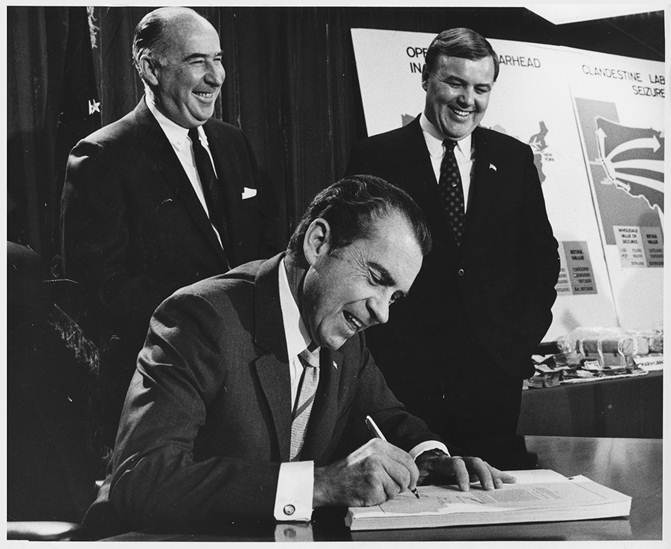
CSA as part of the Comprehensive Drug Abuse Prevention and Control Act was signed into law by President Richard Nixon on October 27, 1970.

RMN

[President Nixon Signs the Controlled Substances Act] 

Assessment

This picture was taken on that day at the White House. Behind the president is Attorney General John Mitchell and next to the president is BNDD Director Jack Ingersoll.

Conclusion

Your thoughts and comments on this ME-P are appreciated. Feel free to review our top-left column, and top-right sidebar materials, links, URLs and related websites, too. Then, subscribe to the ME-P. It is fast, free and secure.

Link: http://feeds.feedburner.com/HealthcareFinancialsthePostForcxos

Speaker: If you need a moderator or speaker for an upcoming event, Dr. David E. Marcinko; MBA – Publisher-in-Chief of the Medical Executive-Post – is available for seminar or speaking engagements. Contact: MarcinkoAdvisors@msn.com

OUR OTHER PRINT BOOKS AND RELATED INFORMATION SOURCES:

DICTIONARIES: http://www.springerpub.com/Search/marcinko
PHYSICIANS: www.MedicalBusinessAdvisors.com
PRACTICES: www.BusinessofMedicalPractice.com
HOSPITALS: http://www.crcpress.com/product/isbn/9781466558731
CLINICS: http://www.crcpress.com/product/isbn/9781439879900
BLOG: www.MedicalExecutivePost.com
FINANCE: Financial Planning for Physicians and Advisors
INSURANCE: Risk Management and Insurance Strategies for Physicians and Advisors

Product DetailsProduct Details

The DEA’s [Original] Model Paraphernalia Law

Join Our Mailing List

Drug use in the 60s and 70s

By Staff Reporters

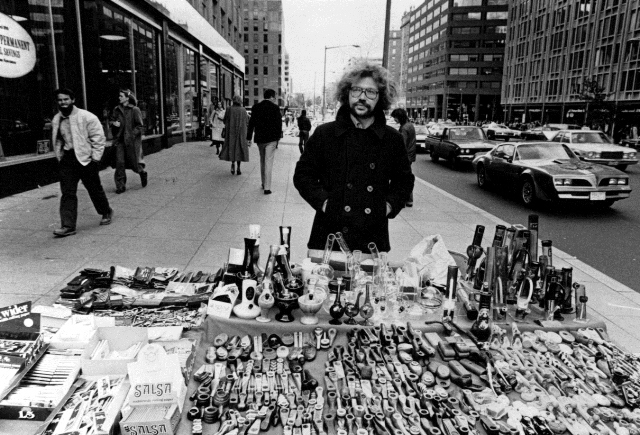
In the 1960’s and 1970’s drug use in the United States continued to grow, peaking in 1979. This was, in part, due to the wide, legal availability of drug paraphernalia like that captured in this picture of a dealer on a street corner near DEA headquarters (then located at 1405 I Street NW in Washington DC) in the late 1970’s.

###

DEA

###

In order to combat this trend, DEA was asked by the White House to create a model Drug Paraphernalia Law to be implemented and enforced at the state and local level, giving DEA and other partners another tool in the fight against drug abuse.

Conclusion

Your thoughts and comments on this ME-P are appreciated. Feel free to review our top-left column, and top-right sidebar materials, links, URLs and related websites, too. Then, subscribe to the ME-P. It is fast, free and secure.

Speaker: If you need a moderator or speaker for an upcoming event, Dr. David E. Marcinko; MBA – Publisher-in-Chief of the Medical Executive-Post – is available for seminar or speaking engagements. Contact: MarcinkoAdvisors@msn.com

OUR OTHER PRINT BOOKS AND RELATED INFORMATION SOURCES:

Product DetailsProduct DetailsProduct Details

Do Foreclosures Promote Clandestine Pot Houses?

Join Our Mailing List

About Indoor Marijuana Grow Farms and Labs

[By DEA Agent]

Marijuana growers are shifting to the suburbs from rural and commercial areas, helped by a housing crisis that created a glut of affordable home and basement farms like the images below.

BASEMENT POT HOUSE

CLOSE-UP VIEW

Assesment

Unlike traditional earthen farming methods in the photos above, hydroponic grow boxes may be large stealth cabinets that produce fresh marijuana, or other herbs and vegetables, in an indoor garden and grow on water, nutrients and grow-lights alone.

Conclusion

Your thoughts and comments on this ME-P are appreciated. Feel free to review our top-left column, and top-right sidebar materials, links, URLs and related websites, too. Then, subscribe to the ME-P. It is fast, free and secure.

Speaker: If you need a moderator or speaker for an upcoming event, Dr. David E. Marcinko; MBA – Publisher-in-Chief of the Medical Executive-Post – is available for seminar or speaking engagements. Contact: MarcinkoAdvisors@msn.com

OUR OTHER PRINT BOOKS AND RELATED INFORMATION SOURCES:

Product DetailsProduct DetailsProduct Details

Product Details  Product Details

Product Details

About Next-Gen Bath Salts

Join Our Mailing List

By The DEA Agent

Innocent Name – The Dangerous Consequences of MDPV

The recent media explosion over bath salts is not unwarranted. Over the past two years, the public eye has zoomed in on dangerous drug, still legally sold in some states. And, there’ve been many bizarre cases of violence and psychotic outbursts from users.

About MDPV

But, what exactly are bath salts?

Assessment

Keep reading the above to learn about the history and effects of bath salts.

Source: rehab-international.org

More info: http://en.wikipedia.org/wiki/Methylenedioxypyrovalerone

Conclusion

Your thoughts and comments on this ME-P are appreciated. Feel free to review our top-left column, and top-right sidebar materials, links, URLs and related websites, too. Then, subscribe to the ME-P. It is fast, free and secure.

Speaker: If you need a moderator or speaker for an upcoming event, Dr. David E. Marcinko; MBA – Publisher-in-Chief of the Medical Executive-Post – is available for seminar or speaking engagements. Contact: MarcinkoAdvisors@msn.com

OUR OTHER PRINT BOOKS AND RELATED INFORMATION SOURCES:

Product DetailsProduct DetailsProduct Details

Actual DEA “Meth Lab” Drug Raid [POV Photo Essay]

Join Our Mailing List

Just say No to “Illegal” Drugs

By Anonymous DEA Agent

Preparing for a clandestine night-time lab raid – inner city row-house; Baltimore, MD

Spot lights and infrared beams cast a luminescent hue.

Note the armed agent silhouetted in the attic window.

Assessment

Danger – these guys mean business.

Conclusion

Your thoughts and comments on this ME-P are appreciated. Feel free to review our top-left column, and top-right sidebar materials, links, URLs and related websites, too. Then, subscribe to the ME-P. It is fast, free and secure.

Link: http://feeds.feedburner.com/HealthcareFinancialsthePostForcxos

Speaker: If you need a moderator or speaker for an upcoming event, Dr. David E. Marcinko; MBA – Publisher-in-Chief of the Medical Executive-Post – is available for seminar or speaking engagements. Contact: MarcinkoAdvisors@msn.com

OUR OTHER PRINT BOOKS AND RELATED INFORMATION SOURCES:

DICTIONARIES: http://www.springerpub.com/Search/marcinko
PHYSICIANS: www.MedicalBusinessAdvisors.com
PRACTICES: www.BusinessofMedicalPractice.com
HOSPITALS: http://www.crcpress.com/product/isbn/9781466558731
CLINICS: http://www.crcpress.com/product/isbn/9781439879900
BLOG: www.MedicalExecutivePost.com
FINANCE: Financial Planning for Physicians and Advisors
INSURANCE: Risk Management and Insurance Strategies for Physicians and Advisors

Product DetailsProduct DetailsProduct Details

About Drug Use and Abuse in America

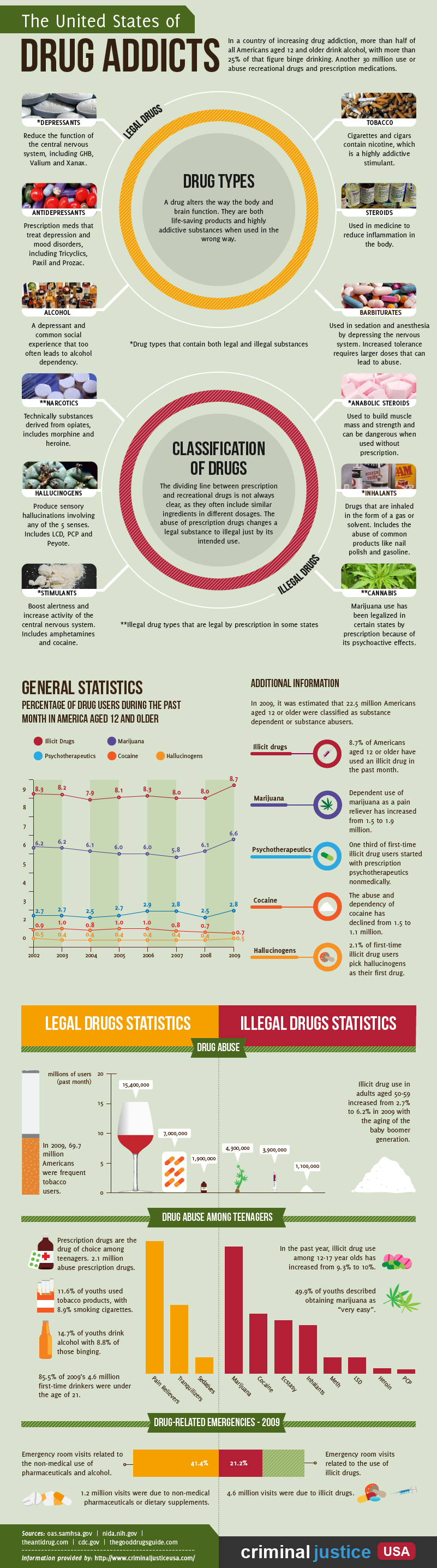
The United States of Drug Addicts?

By Muhammad Saleem with ME-P Staff Reporters
http://muhammadsaleem.com
msaleem@gmail.com

Example 1:

Georgia meth seizure near US record
[Augusta Chronicle 12/01/2010]

Gwinnett County police seized nearly half a ton of methamphetamine with an estimated street value of $44.6 million from a home in Norcross, one of the biggest meth seizures ever made in the United States.

Police raided a house off  Beaver Ruin Road between Interstate 85 and Buford Highway late Monday after authorities got a report that a large amount of meth was being produced there.

Officers found 150 pounds of crystal methamphetamine ready for sale and 200 gallons of liquid methamphetamine oil in a large drug lab.

Gwinnett County police called in the U.S. Drug Enforcement Administration and a fire department hazmats team because of the size of the drug lab.

“This would feed hundreds and hundreds of addicts and destroy who knows how many lives, countless lives,” said Rodney Benson of the DEA field office in Atlanta. No one was in the home at the time of the raid, police said.

Authorities said they suspect a Mexican-based drug trafficking organization in the drug-making operation, but added investigators have not determined what group was responsible.

Police arrested 33-year-old Jose Galvez-Vela of Weslaco, Texas, and charged him with trafficking in meth. Police didn’t say exactly where he was arrested and didn’t know if he had a lawyer. Authorities said they are seeking others following the raid in Norcross, in the Northern Atlanta suburb of Gwinnett County.

The discovery underscored a growing trend of Mexican drug trafficking organizations smuggling liquid meth into the United States to be converted into a crystal form for sale, Benson said. The liquid can be converted to crystal form within 48 hours, he said.

Investigators in hazmats suits cautiously removed the meth and flammable drug-making chemicals from the house Monday. It didn’t appear that anyone was living in the house and that it was used strictly for manufacturing meth, police said. The house was “really a powder keg, ready to blow at any time,” Benson said. “Clearly removing that threat from that house is clearly making that neighborhood much safer today.”

The house is set in a quiet, low-to middle-income subdivision, Gwinnett police Cpl. Edwin Ritter said.

Example 2:

Georgia police seize meth worth $44.6M from house
[Los Angeles Times 12/01/2010]

NORCROSS, Ga. (AP) — Investigators have seized hundreds of pounds of methamphetamine with an estimated street value of $44.6 million in suburban Atlanta, one of the biggest meth seizures in the country, authorities said Tuesday. Investigators said the raid was conducted late Monday at a house in Norcross, just north of Atlanta, after authorities were told a large amount of meth was being produced there. They reported finding 150 pounds of crystal methamphetamine ready for sale and 200 gallons of liquid methamphetamine oil in a large drug lab.

“This would feed hundreds and hundreds of addicts and destroy who knows how many lives, countless lives,” said Rodney Benson with the federal Drug Enforcement Administration’s field office in Atlanta.

No one was in the home at the time of the raid, police said. Authorities said they suspect a Mexican-based drug trafficking organization in the drug making operation, but added investigators have not determined what group was responsible.

Investigators said they arrested 33-year-old Jose Galvez-Vela of Weslaco, Texas, and charged him with trafficking in meth. Police didn’t say exactly where he was arrested and didn’t know if he had a lawyer. Authorities said they are seeking others following the raid in Norcross, in the northern Atlanta suburb of Gwinnett County.

The discovery underscored a growing trend of Mexican drug trafficking organizations smuggling methamphetamine in liquid form across the border with the United States to be converted into a crystal form for sale, Benson said. The liquid can be converted to crystal form within 48 hours, he added. Investigators in hazmat suits used extreme caution as they removed the meth and highly flammable drugmaking chemicals from the house. It didn’t appear that anyone was living in the house and that it was used strictly for manufacturing meth, police said.

The house was “really a powder keg, ready to blow at any time,” Benson said. “Clearly removing that threat from that house is clearly making that neighborhood much safer today.”

The house is set in a quiet, low-to middle-income subdivision, Gwinnett police Cpl. Edwin Ritter said. Benson said the lab’s location was typical of Mexican drug organizations known to operate sophisticated networks from nondescript houses in suburban Atlanta for distribution along the East Coast.

Investigators said they were following several leads to others allegedly involved but declined further comment, citing an ongoing investigation.

Citing the size of the drug lab and the hazardous chemicals involved, police said they requested help from the DEA and a hazardous materials team with a local fire department.

Editor’s Note

Although Georgia is the home of the ME-P, these Georgia State examples were purely coincidental.

Source: http://www.criminaljusticeusa.com

Conclusion

Your thoughts and comments on this ME-P are appreciated. Feel free to review our top-left column, and top-right sidebar materials, links, URLs and related websites, too. Then, subscribe to the ME-P. It is fast, free and secure.

Speaker: If you need a moderator or speaker for an upcoming event, Dr. David E. Marcinko; MBA – Publisher-in-Chief of the Medical Executive-Post – is available for seminar or speaking engagements. Contact: MarcinkoAdvisors@msn.com

OUR OTHER PRINT BOOKS AND RELATED INFORMATION SOURCES:

Product DetailsProduct DetailsProduct Details

Product Details  Product Details

   Product Details


Doctor’s Lawsuit Targets Parents of Patient Who Overdosed

By Marshall Allen
ProPublica, Aug. 26, 2011, 10:57 am

Join Our Mailing List

The dramatic rise in prescription narcotics use [1]—and the subsequent increase in overdose deaths—has led to a spate of lawsuits around the country targeting doctors for malpractice or running pill mills [2]. But legal experts say the case of one family physician in Henderson,Nev., stands out.

The case of Kevin Buckwalter

Dr. Kevin Buckwalter has turned the tables, filing a lawsuit against the parents of a young woman who died from an overdose of narcotics that he prescribed.

Buckwalter’s suit accuses John and Maggie DeBaun of abusing the legal process, intentionally inflicting emotional distress and interfering with his ability to do business by filing a medical malpractice case against him for the death of their daughter.

“I’ve never heard of such a lawsuit,” said Stacey Tovino, a professor at the William S. Boyd School of Law at theUniversity of Nevada, Las Vegas. Tovino and otherNevada legal experts said it appears to them that Buckwalter abused the legal process in an attempt to intimidate the DeBauns.

Buckwalter did not respond to a call for comment. His brother Bryce, who serves as his attorney, declined to comment about the lawsuit. In an email, he accused this reporter of harassment for attempting to contact his brother, said he would seek a restraining order and threatened to sue ProPublica.

A Controversial Subject?

Buckwalter has been a subject of controversy for several years. A 2008 Las Vegas Sun investigation [3], also by this reporter, highlighted the opinions of four pain-management specialists who reviewed Buckwalter’s care of patients and said it appeared to be negligent.

Staci Voyda, a teenager addicted to prescription narcotics, wrote in her journal that she went to Buckwalter to get off drugs. But his treatment included ramping up her dosages of narcotics. She killed herself in August 2007, and family members say the drugs pushed her over the edge.

Another Buckwalter patient, 69-year-old Barbara Baile, was prescribed large doses of narcotics, which caused constipation so severe it ruptured her bowels. A subsequent infection killed her.

These are prescriptions for Xanax and morphine written by Dr. Kevin Buckwalter for Andrea and Clint Duncan. (Sam Morris/Las VegasSun) | See Las Vegas Sun’s full investigation on Painful Painkillers [4].

The DeBauns’ daughter, Andrea Duncan, died in 2005 from intoxication with opiates and benzodiazepines [5], a class of drugs that includes Valium and Xanax. Four days earlier, her husband Clint, also a Buckwalter patient, had overdosed on prescription narcotics and died.

In a 2007 videotaped deposition [6] for an unrelated lawsuit, Buckwalter described the treatment he provided Duncan. Under oath, Buckwalter said he did not examine Duncan on her first visit because he “did not have time,” yet prescribed her 300 tablets of Xanax, an anti-anxiety medication, and the painkiller hydrocodone, a synthetic opiate.

The following year, the U.S. Drug Enforcement Administration and Nevada State Board of Medical Examiners stripped Buckwalter of his license to prescribe controlled substances. The DEA attributed at least eight overdose deaths [7] to Buckwalter. The medical board blamed him for four cases of malpractice [8], including one in which the patient died. Buckwalter closed his practice.

Dallaslawyer Kay Van Wey, who specializes in pill mill cases, filed six lawsuits against Buckwalter on behalf of patients who died or were harmed. The DeBaun case was filed in April 2009, past the statute of limitations in Nevada. But Van Wey argued in the complaint that the deadline should be extended because Buckwalter allegedly concealed his negligence and altered medical records.

A judge didn’t buy the argument and dismissed the case. Buckwalter claims in his lawsuit that the DeBauns sued to harass and annoy him.

Buckwalter has denied all of the allegations that he provided substandard care. His lawsuit against the medical board to get his prescribing privileges reinstated was unsuccessful.

Jeffrey Stempel, a professor at the UNLV law school, said that for the DeBauns’ lawsuit to be considered an “abuse” of the legal process, there would have to be some ulterior motive other than seeking damages for their daughter’s death.

Assessment

Ann McGinley, another professor at the UNLV law school, said it takes more than simply filing a lawsuit to support a claim of intentional infliction of emotional distress. And given that Buckwalter lost his ability to prescribe controlled substances in 2008, it’s difficult to see how the DeBauns interfered with Buckwalter’s ability to conduct his business, she said.

McGinley said that if lawsuits like Buckwalter’s became more common, they could have a chilling effect, discouraging patients from pursuing legitimate malpractice claims. “My concern is that other doctors will take this on as something that they will do regularly,” she said.

Link: http://www.propublica.org/article/doctors-lawsuit-targets-parents-of-patient-who-overdosed

Conclusion

Your thoughts and comments on this ME-P are appreciated. Feel free to review our top-left column, and top-right sidebar materials, links, URLs and related websites, too. Then, subscribe to the ME-P. It is fast, free and secure.

Speaker: If you need a moderator or speaker for an upcoming event, Dr. David E. Marcinko; MBA – Publisher-in-Chief of the Medical Executive-Post – is available for seminar or speaking engagements. Contact: MarcinkoAdvisors@msn.com

OUR OTHER PRINT BOOKS AND RELATED INFORMATION SOURCES:

Product DetailsProduct DetailsProduct Details

Product Details  Product Details

   Product Details 

Settlement Reached with Temple University Health System

Diversion of Controlled Substances

By Anonymous

Join Our Mailing List 

NOV 01, 2010 — PHILADELPHIA – The Temple University Health System (“TUHS”), today, agreed to pay $130,000 to the U.S. government for failing to keep proper receiving, dispensing and inventory records of controlled substances, and failing to take effective precautions to prevent theft or loss of controlled substances, announced United States Attorney Zane David Memeger. In addition, TUHS agreed to implement a detailed Compliance Assessment Plan to review and monitor its policies and procedures relating to controlled substances.

“Hospitals must have effective controls to prevent and detect drug diversion, in order to
prevent people from suffering significant physical harm, addiction or death when they use controlled substances without appropriate supervision from their doctor”,
Memeger said.

Back to 2004

In 2004, Temple University Hospital’s lack of control over controlled substances allowed its then chief resident of anesthesiology to steal 107 vials of Ketamine and smaller amounts of Fentanyl, Midazolam and Morphine. The resident doctor, who attempted to sell the drugs to an undercover Drug Enforcement Administration (DEA) operative was charged and convicted. In addition, from January 2007 to February 2007, an anesthesiologist at Jeanes Hospital, a Temple University Health Systems facility, manipulated the computerized controlled substance distribution system to extract 35 vials of Fentanyl and five vials of Morphine for his own personal use. DEA Special Agent in Charge John J. Bryfonski stated:

“The public expects our health professionals to honor their oath and follow both regulations and the law to assure the health and safety of the people they treat. When these professionals depart from their oath and the law by diverting controlled substance-pharmaceuticals from legitimate medical uses to illegal uses, DEA will investigate and hold them accountable.”

The DEA Audits

Following these thefts, DEA audited five Temple University Health Systems facilities and found that the hospital failed to keep dispensing records for certain controlled substances; failed to note on the required DEA form the number of packages of controlled substances the pharmacy received and the date it received them; failed to verify the amount of controlled substances coming into the pharmacy on each invoice; and kept inaccurate inventory of certain controlled substances.

Stricter Future Controls

TUHS voluntarily initiated changes to their drug dispensing system, to provide stricter measures for accessing the medication and frequent counts of the facilities’ inventory. In addition to the monetary settlement, TUHS agreed to implement an innovative Compliance Assessment Plan whereby an independent consultant will survey the Temple facilities and recommend remedial changes as necessary. The agreement requires TUHS to report to DEA discrepancies revealed during these audits.

Assessment

This resolution is part of the Eastern District of Pennsylvania’s Special Focus team Health Care Fraud initiative. The case was investigated by DEA Philadelphia Division Diversion Group. The case was handled by Assistant United States Attorney Susan R. Becker, Auditor Allison Barnes and Healthcare Fraud Consultant Ray Uhlhorn.

Conclusion

Your thoughts and comments on this ME-P are appreciated. Feel free to review our top-left column, and top-right sidebar materials, links, URLs and related websites, too. Then, subscribe to the ME-P. It is fast, free and secure.

Speaker: If you need a moderator or speaker for an upcoming event, Dr. David E. Marcinko; MBA – Publisher-in-Chief of the Medical Executive-Post – is available for seminar or speaking engagements. Contact: MarcinkoAdvisors@msn.com

OUR OTHER PRINT BOOKS AND RELATED INFORMATION SOURCES:

Product DetailsProduct DetailsProduct Details

Product Details  Product Details

   Product Details 

On the New Pot Health Policy in NJ?

Join Our Mailing List

It’s Medicinal – Man!

By Staff Reporters

Did you know that in January 2010, New Jersey became the 14th state in the nation to legalize marijuana use for certain chronic illnesses?

Other states where the use of medical marijuana is permitted include Alaska, California, Colorado, Hawaii, Maine, Michigan, Montana, Nevada, New Mexico, Oregon, Rhode Island, Vermont, and Washington; around a dozen more states are weighing pending bills.

Jersey is Toughest State

The New Jersey law is the most restrictive in the nation and authorizes prescribed marijuana for only a handful of chronic illnesses, such as multiple sclerosis, cancer, glaucoma, epilepsy, Crohn’s disease, AIDS, muscular dystrophy and Lou Gehrig’s disease. Unlike other states, physicians in New Jersey will not be able to prescribe medical marijuana for anxiety, headaches, or chronic pain.

Dispensaries

According to reports, the state of New Jersey plans to authorize six dispensaries, and patients will receive identification cards authorizing them to purchase the drug. They will not be able to grow their own marijuana or use it in public, however. And, individuals without a prescription will still be subject to criminal prosecution if caught in possession of marijuana.

http://www.hcplive.com/oncology/articles/Marijuana?utm_source=Listrak&utm_medium=Email&utm_term=%2foncology%2farticles%2fMarijuana&utm_campaign=Legalizing+Medical+Marijuana

Assessment

Do you support the use of medical marijuana? If you are a doctor that lives in a state where medical marijuana is legalized, have you prescribed it to any patients? If you live in a state where medical marijuana is not legalized, do you want it to be? What about you patients, out there?

Conclusion

Your thoughts and comments on this ME-P are appreciated. Feel free to review our top-left column, and top-right sidebar materials, links, URLs and related websites, too. Then, subscribe to the ME-P. It is fast, free and secure.

Speaker: If you need a moderator or speaker for an upcoming event, Dr. David E. Marcinko; MBA – Publisher-in-Chief of the Medical Executive-Post – is available for seminar or speaking engagements. Contact: MarcinkoAdvisors@msn.com

OUR OTHER PRINT BOOKS AND RELATED INFORMATION SOURCES:

Product DetailsProduct DetailsProduct Details