What’s at Stake in the Supreme Court’s Health Care Decisions?

Join Our Mailing List

On the PP-ACA

By Lena Groeger ProPublica

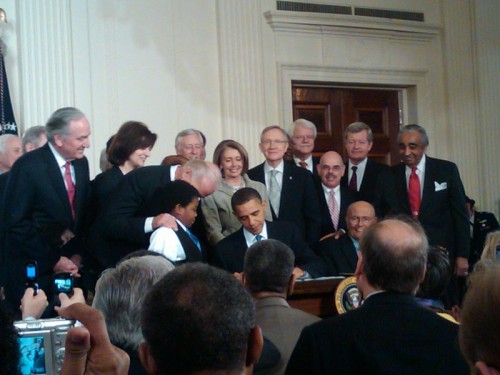
Yesterday, the Supreme Court began hearing arguments on the health care reform law. So, in this essay, we made a map of the possible outcomes following the Court’s schedule over the next three days.

The Court will hear all three days of arguments, even if they eventually decide not to decide the bulk of the case, and is unlikely to issue a decision on the case until late June or early July.

Assessment

Link: http://www.propublica.org/special/mapping-the-supreme-courts-health-care-arguments

For more information on different states’ progress implementing health care reforms, see this comprehensive list.

Conclusion

Your thoughts and comments on this ME-P are appreciated. Feel free to review our top-left column, and top-right sidebar materials, links, URLs and related websites, too. Then, subscribe to the ME-P. It is fast, free and secure.

Link: http://feeds.feedburner.com/HealthcareFinancialsthePostForcxos

Speaker: If you need a moderator or speaker for an upcoming event, Dr. David E. Marcinko; MBA – Publisher-in-Chief of the Medical Executive-Post – is available for seminar or speaking engagements. Contact: MarcinkoAdvisors@msn.com

Our Other Print Books and Related Information Sources:

Health Dictionary Series: http://www.springerpub.com/Search/marcinko

Practice Management: http://www.springerpub.com/product/9780826105752

Physician Financial Planning: http://www.jbpub.com/catalog/0763745790

Medical Risk Management: http://www.jbpub.com/catalog/9780763733421

Hospitals: http://www.crcpress.com/product/isbn/9781439879900

Physician Advisors: www.CertifiedMedicalPlanner.org

Product Details

Happy Birthday PP-ACA

Join Our Mailing List

What if You Threw a Party – and Nobody Came?

Assessment

Two year anniversary [2010-2012].

Conclusion

Your thoughts and comments on this ME-P are appreciated. Feel free to review our top-left column, and top-right sidebar materials, links, URLs and related websites, too. Then, subscribe to the ME-P. It is fast, free and secure.

Link: http://feeds.feedburner.com/HealthcareFinancialsthePostForcxos

Speaker: If you need a moderator or speaker for an upcoming event, Dr. David E. Marcinko; MBA – Publisher-in-Chief of the Medical Executive-Post – is available for seminar or speaking engagements. Contact: MarcinkoAdvisors@msn.com

Our Other Print Books and Related Information Sources:

Health Dictionary Series: http://www.springerpub.com/Search/marcinko

Practice Management: http://www.springerpub.com/product/9780826105752

Physician Financial Planning: http://www.jbpub.com/catalog/0763745790

Medical Risk Management: http://www.jbpub.com/catalog/9780763733421

Hospitals: http://www.crcpress.com/product/isbn/9781439879900

Physician Advisors: www.CertifiedMedicalPlanner.org

Product DetailsProduct DetailsProduct Details

Product Details  Product Details

Product Details

On the Protecting Access to Healthcare (PATH) Act

Join Our Mailing List

ADA Makes Progress Against McCarran-Ferguson

By D. Kellus Pruitt DDS

The ADA makes real progress against McCarran-Ferguson. I’ve watched the American Dental Association fight long and hard against the unfair McCarran-Ferguson Act of 1945. ADA leaders and I still don’t agree on the need for transparency in the professional organization instead of proud unresponsiveness, but nevertheless, I’ve always been publicly supportive of their efforts to repeal the M-F Act.

Insurance Industry

The insurance industry is powerful in Washington. Over the short term, common sense has proven to be far less influential than their generous campaign contributions – making this a long haul for ADA officials. Yet the amendment to H.R. 5, Protecting Access to Healthcare (PATH) Act, which was offered by Rep. Paul Gosar (R-Ariz.), a dentist, is finally scheduled to come up for a vote on Thursday, March 22, 2012

Good Work – ADA

http://www.ada.org/news/6926.aspx

If passed, the legislation will restore the application of antitrust laws to the business of health insurance. Makes sense, right? After all, if every other business in the nation, including professional organizations, can be prosecuted by the FTC for collusion, why should Delta Dental, BCBSTX and other members of the National Association of Dental Plans (NADP) be exempt from antitrust laws which protect their clients.

I and others are hopeful that this will end many of dental insurers’ current business practices which unfairly force dentists to accept take it or leave it terms that would be unacceptable in a fair market. Maybe the repeal will also make insurance lawyers think twice before alerting the FTC when ADA News speaks honestly about the harm caused by suspiciously similar policies of numerous NADP members.

Assessment

Even if the M-F is repealed, here is an example of truth in dental care that I bet ADA leaders still won’t be able to share with Americans: Unfair downward pressure on contracted dentists’ payments always hurts clueless dental patients the most. Delta Dental’s greed will never be satisfied and dentists’ ethics aren’t free.

NADP, meet the FTC.

Conclusion

Your thoughts and comments on this ME-P are appreciated. Feel free to review our top-left column, and top-right sidebar materials, links, URLs and related websites, too. Then, subscribe to the ME-P. It is fast, free and secure.

Link: http://feeds.feedburner.com/HealthcareFinancialsthePostForcxos

Our Other Print Books and Related Information Sources:

Health Dictionary Series: http://www.springerpub.com/Search/marcinko

Practice Management: http://www.springerpub.com/product/9780826105752

Physician Financial Planning: http://www.jbpub.com/catalog/0763745790

Medical Risk Management: http://www.jbpub.com/catalog/9780763733421

Healthcare Organizations: www.HealthcareFinancials.com

Physician Advisors: www.CertifiedMedicalPlanner.com

Subscribe Now: Did you like this Medical Executive-Post, or find it helpful, interesting and informative? Want to get the latest ME-Ps delivered to your email box each morning? Just subscribe using the link below. You can unsubscribe at any time. Security is assured.

Link: http://feeds.feedburner.com/HealthcareFinancialsthePostForcxos

Sponsors Welcomed: And, credible sponsors and like-minded advertisers are always welcomed.

Link: https://healthcarefinancials.wordpress.com/2007/11/11/advertise

Product DetailsProduct DetailsProduct Details

How Much are the 2012 Presidential Candidates [Net] Worth?

Surprised or Not?

Join Our Mailing List

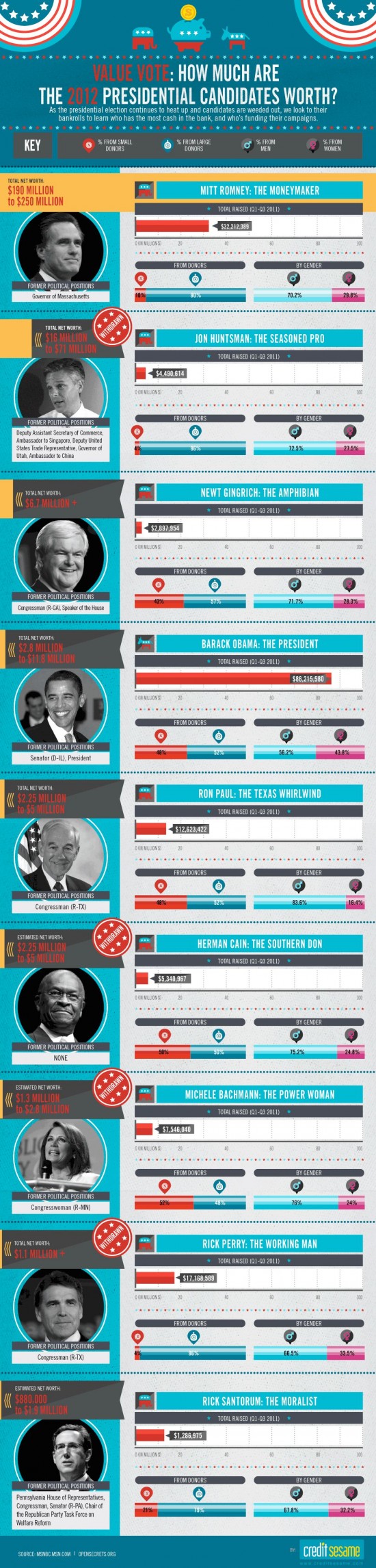
As the presidential election continues to heat up for “Super Tuesday” this March 6th 2012 – and candidates are weeded out – we look to their bankrolls to learn who has the most cash in the bank, and who’s funding their campaigns.

Source: creditsesame.com

Assessment

From small donors to large, and donations from men versus women, do these numbers surprise you?

Conclusion

And so, your thoughts and comments on this ME-P are appreciated. Please review our top-left column, and top-right sidebar materials, links, URLs and related websites, too. Then, subscribe to the ME-P. It is fast, free and secure.

Link: http://feeds.feedburner.com/HealthcareFinancialsthePostForcxos

Speaker: If you need a moderator or speaker for an upcoming event, Dr. David E. Marcinko; MBA – Publisher-in-Chief of the Medical Executive-Post – is available for seminar or speaking engagements. Contact: MarcinkoAdvisors@msn.com

Our Other Print Books and Related Information Sources:

Health Dictionary Series: http://www.springerpub.com/Search/marcinko

Practice Management: http://www.springerpub.com/product/9780826105752

Physician Financial Planning: http://www.jbpub.com/catalog/0763745790

Medical Risk Management: http://www.jbpub.com/catalog/9780763733421

Healthcare Organizations: www.HealthcareFinancials.com

Physician Advisors: www.CertifiedMedicalPlanner.com

Subscribe Now: Did you like this Medical Executive-Post, or find it helpful, interesting and informative? Want to get the latest ME-Ps delivered to your email box each morning? Just subscribe using the link below. You can unsubscribe at any time. Security is assured.

Link: http://feeds.feedburner.com/HealthcareFinancialsthePostForcxos

Sponsors Welcomed: And, credible sponsors and like-minded advertisers are always welcomed.

Link: https://healthcarefinancials.wordpress.com/2007/11/11/advertise

Product DetailsProduct DetailsProduct Details

Product Details Product Details

Product Details

Physicians Taking Stock of the “Stock Act”

Join Our Mailing List 

A Side-by-Side Comparison

By Lena Groeger
ProPublica

The Stop Trading on Congressional Knowledge Act, or Stock Act, recently passed in both the House and Senate. The new law would make it easier for the SEC to prosecute federal officials from all three branches who trade equities like stocks based on nonpublic information they receive in the course of their duties.

The versions passed in each chamber are similar, but have notable distinctions that will have to be hashed out when legislators from the two chambers eventually meet.

Assessment

Here, we break down the main differences, with real-life scenarios that illustrate activities the bill targets

Full link: http://www.propublica.org/special/taking-stock-of-the-stock-act-a-side-by-side-comparison

Conclusion

And so, your thoughts and comments on this ME-P are appreciated. Please review our top-left column, and top-right sidebar materials, links, URLs and related websites, too. Then, subscribe to the ME-P. It is fast, free and secure.

Link: http://feeds.feedburner.com/HealthcareFinancialsthePostForcxos

Speaker: If you need a moderator or speaker for an upcoming event, Dr. David E. Marcinko; MBA – Publisher-in-Chief of the Medical Executive-Post – is available for seminar or speaking engagements. Contact: MarcinkoAdvisors@msn.com

Our Other Print Books and Related Information Sources:

Health Dictionary Series: http://www.springerpub.com/Search/marcinko

Practice Management: http://www.springerpub.com/product/9780826105752

Physician Financial Planning: http://www.jbpub.com/catalog/0763745790

Medical Risk Management: http://www.jbpub.com/catalog/9780763733421

Healthcare Organizations: www.HealthcareFinancials.com

Physician Advisors: www.CertifiedMedicalPlanner.com

Subscribe Now: Did you like this Medical Executive-Post, or find it helpful, interesting and informative? Want to get the latest ME-Ps delivered to your email box each morning? Just subscribe using the link below. You can unsubscribe at any time. Security is assured.

Link: http://feeds.feedburner.com/HealthcareFinancialsthePostForcxos

Sponsors Welcomed: And, credible sponsors and like-minded advertisers are always welcomed.

Link: https://healthcarefinancials.wordpress.com/2007/11/11/advertise

Product Details  Product Details

The ACA and Rising Healthcare Costs?

Join Our Mailing List
Effects of Affordable Care Act on Private Health Care Costs Remain to be Seen
[By Staff Reporters]
###
The latest data on economic growth shows the American economy spent the last quarter growing at a rate equal to 2.5 percent a year. That’s neither recession-level bad nor full employment recovery-level good, but it’s worth diving into the numbers to see exactly what’s driving this slow expansion.
###
A significant part of the growth came from personal spending on health care as insurance premiums continue to rise, meaning a lot of that growth wasn’t very productive. That health care costs are rising—and rising faster than most other expenses—is a problem that businesses and policymakers have struggled with for years: It’s the major cause of federal budget deficits and the reason behind the health care law passed in 2010. While the effects of the Affordable Care Act on private health care costs remain to be seen—many of its provisions will not go into affect for another two years—health care economists like Harvard’s David Cutler say it draws on nearly every idea that exists to lower costs.
###
But, Cutler adds that while we wait for pilot programs to succeed and scale or fail, more changes to the system—including a public insurance option and further incentives for health providers to reform delivery—should be on the table.While policymakers in Washington and state capitals wait on politics and legal challenges to the 2010 law, consumers can take action themselves to lower costs. Innovative health care companies are coming up with new ways to make cost savings easier to find.

infographic, healthcare, politics, business, cost, transparency, GOOD

Source: Simplee

Conclusion

Your thoughts and comments on this ME-P are appreciated. Feel free to review our top-left column, and top-right sidebar materials, links, URLs and related websites, too. Then, subscribe to the ME-P. It is fast, free and secure.

Link: http://feeds.feedburner.com/HealthcareFinancialsthePostForcxos

Speaker: If you need a moderator or speaker for an upcoming event, Dr. David E. Marcinko; MBA – Publisher-in-Chief of the Medical Executive-Post – is available for seminar or speaking engagements. Contact: MarcinkoAdvisors@msn.com

OUR OTHER PRINT BOOKS AND RELATED INFORMATION SOURCES:

DICTIONARIES: http://www.springerpub.com/Search/marcinko
PHYSICIANS: www.MedicalBusinessAdvisors.com
PRACTICES: www.BusinessofMedicalPractice.com
HOSPITALS: http://www.crcpress.com/product/isbn/9781466558731
CLINICS: http://www.crcpress.com/product/isbn/9781439879900
ADVISORS: www.CertifiedMedicalPlanner.org
PODIATRISTS: www.PodiatryPrep.com
BLOG: www.MedicalExecutivePost.com
FINANCE: Financial Planning for Physicians and Advisors
INSURANCE: Risk Management and Insurance Strategies for Physicians and Advisors

Product DetailsProduct Details

On Political Financial Plans

Join Our Mailing List 

From Republican Presidential Candidates

With less than a year away, the republican election machine is fired up and ready to go. Hot topics include the economy, housing, jobs, Medicare, Social Security, and all sorts of healthcare initiatives and regulations of interest to medical professionals.

Source: totalbankruptcy.com

Assessment

How has your opinion on the above changed now that there are only four contenders left?

Conclusion

And so, your thoughts and comments on this ME-P are appreciated. Please review our top-left column, and top-right sidebar materials, links, URLs and related websites, too. Then, subscribe to the ME-P. It is fast, free and secure.

Link: http://feeds.feedburner.com/HealthcareFinancialsthePostForcxos

Speaker: If you need a moderator or speaker for an upcoming event, Dr. David E. Marcinko; MBA – Publisher-in-Chief of the Medical Executive-Post – is available for seminar or speaking engagements. Contact: MarcinkoAdvisors@msn.com

Our Other Print Books and Related Information Sources:

Health Dictionary Series: http://www.springerpub.com/Search/marcinko

Practice Management: http://www.springerpub.com/product/9780826105752

Physician Financial Planning: http://www.jbpub.com/catalog/0763745790

Medical Risk Management: http://www.jbpub.com/catalog/9780763733421

Healthcare Organizations: www.HealthcareFinancials.com

Physician Advisors: www.CertifiedMedicalPlanner.com

Subscribe Now: Did you like this Medical Executive-Post, or find it helpful, interesting and informative? Want to get the latest ME-Ps delivered to your email box each morning? Just subscribe using the link below. You can unsubscribe at any time. Security is assured.

Link: http://feeds.feedburner.com/HealthcareFinancialsthePostForcxos

Sponsors Welcomed: And, credible sponsors and like-minded advertisers are always welcomed.

Link: https://healthcarefinancials.wordpress.com/2007/11/11/advertise

   Product Details

The Americans with Disabilities Act and Deaf Patients

Interpreting … the Interpreter

Ask-an-Advisor

Join Our Mailing List

QUERY:

I understand that as doctors we need to accommodate the disabled and follow the ADA of 1990. In the case of hearing-impaired patients, it is our cost to have an interpreter present.

But, for example, is the doctor able to dictate what interpreter will be used or does the patient decide who will be interpreting? As far as the charge for the services of the interpreter, how is the appropriate fee set?

It takes about twenty minutes for us to see a hearing-impaired patient. We are told from the interpreting service that it is their policy to charge us for a minimum of two hours.

Any thoughts?

Assessment

Link:  http://www.ada.gov/pubs/ada.htm

Conclusion

Your thoughts and comments on this ME-P are appreciated. Feel free to review our top-left column, and top-right sidebar materials, links, URLs and related websites, too. Then, subscribe to the ME-P. It is fast, free and secure.

Speaker: If you need a moderator or speaker for an upcoming event, Dr. David E. Marcinko; MBA – Publisher-in-Chief of the Medical Executive-Post – is available for seminar or speaking engagements. Contact: MarcinkoAdvisors@msn.com

OUR OTHER PRINT BOOKS AND RELATED INFORMATION SOURCES:


Product DetailsProduct DetailsProduct Details

On e-Claim Only Dental Plans

About their Hidden Costs – I’m Talking PHI Breaches

By D. Kellus Pruitt DDS

If the rumor is true about Bluebell Ice Cream’s “e-claim-only” dental benefit plan that is to go into effect in March, how many in the east-central Texas town of Brenham (pop. 16,000) will be properly warned about the danger to themselves, their families and Bluebell officials’ reputations because of reckless policy?

Transmissions Risks

Each time their dentists send an electronic dental claim (e-claim) over the internet to insurance employees in Chicago as a favor to a patient – and especially the insurer – the Bluebell employee’s digital medical identity which is worth fifty bucks on the black market, rides along to destinations unknown. It’s my guess that very few Bluebell employees are yet aware of the increasing risk of medical identity theft from dentists’ e-claims – much less given the opportunity to opt out of the risk by simply visiting a dentist who still uses the telephone, fax and US Mail.

Security Risks Growing

It certainly won’t improve my popularity with 9 out of 10 dentists for saying this, but risks of identity theft from HIPAA-covered dental offices are climbing daily. In the introduction to a recent interview with Larry Ponemon, chairman and founder of the Ponemon Institute, GovernmentIT.com editor Tom Sullivan ominously described the ever-increasing risk of a massive “data spill” of perhaps millions of patients’ protected health information (PHI):

 “The street value of health information is 50 times greater than that of other data types. Even worse, the healthcare industry is among the weakest at protecting such information. With organized criminals trying to steal medical IDs, sloppy mistakes becoming more commonplace, mobile devices serving as single sign-on gateways to records and even bioterrorism now a factor, healthcare is ripe for some a wake-up call – one that just might come in the form a damaging ‘data spill.’” (See: “Q&A: How a health ‘data spill’ could be more damaging than what BP did to the Gulf.”

Tom Sullivan – Editor [December 05, 2011]

http://govhealthit.com/news/qa-how-health-data-spill-could-be-worse-what-bp-did-gulf?page=0,0

According to Dr. Ponemon:

“The basic issue, when you think about data theft not data loss – because it’s hard to know whether that lost data ultimately ends up in the hands of the cybercriminal and all of these bad things occur – but in the case of identity theft, the end goal has been historically to steal a person’s identity, and just like getting a financial record, getting a health record probably has your credit card, debit card, and payment information contained in that record.”

Of Credit Cards … and More!

But that’s not all. Credit cards are just chump change. He continues:

“The financial records are actually lucrative for the bad guy, but the health record is actually much, much more valuable item because it not only gives you the financial information but it also contains the health credential, and it’s very hard to detect a medical identity theft. What we’ve found in our studies is that medical identity theft is likely to be on the rise and, of course, there’s an awareness within the healthcare organizations that participate in our study that they’re starting to see this as more of a medical identity theft crime. It’s not just about stealing credit cards and buying goodies, it’s about stealing who you are, possibly getting medical treatment and, therefore, messing up your medical record.”

Dr. Ponemon suggests that the victim may not know about the theft until he or she “stumbles on something that alerts them their medical identity was stolen.” Perhaps something like death following anaphylactic shock from a medication that was once digitally highlighted as “Allergic to.” Understandably, Ponemon adds that respondents recognized altered medical histories as an emerging threat they believed was affecting the patients in their organizations. Such danger for dental patients is almost non-existent if their dentists simply don’t put PHI on office computers.

Should a data breach of Bluebell Ice Cream employees’ identities occur in Brenham or Chicago, which is more likely than not, the fact that electronic dental records do nothing to improve the quality of dental care won’t make Brenham citizens any happier with local Bluebell officials. 

Conclusion       

And so, your thoughts and comments on this ME-P are appreciated. Please review our top-left column, and top-right sidebar materials, links, URLs and related websites, too. Then, subscribe to the ME-P. It is fast, free and secure.

Link: http://feeds.feedburner.com/HealthcareFinancialsthePostForcxos

Speaker: If you need a moderator or speaker for an upcoming event, Dr. David E. Marcinko; MBA – Publisher-in-Chief of the Medical Executive-Post – is available for seminar or speaking engagements. Contact: MarcinkoAdvisors@msn.com

Our Other Print Books and Related Information Sources:

Health Dictionary Series: http://www.springerpub.com/Search/marcinko

Practice Management: http://www.springerpub.com/product/9780826105752

Physician Financial Planning: http://www.jbpub.com/catalog/0763745790

Medical Risk Management: http://www.jbpub.com/catalog/9780763733421

Healthcare Organizations: www.HealthcareFinancials.com

Physician Advisors: www.CertifiedMedicalPlanner.com

Subscribe Now: Did you like this Medical Executive-Post, or find it helpful, interesting and informative? Want to get the latest ME-Ps delivered to your email box each morning? Just subscribe using the link below. You can unsubscribe at any time. Security is assured.

Link: http://feeds.feedburner.com/HealthcareFinancialsthePostForcxos

Sponsors Welcomed: And, credible sponsors and like-minded advertisers are always welcomed.

Link: https://healthcarefinancials.wordpress.com/2007/11/11/advertise


Product Details

Controlling Health Care Spending [An NIHCM Foundation Webinar]

The Imperative to Act and Diverse Views of the Road Forward

Join Our Mailing List 

The U.S.now spends $2.5 trillion annually on health care, accounting for well over 17 percent of GDP and growing rapidly with challenging fiscal consequences. Despite the imperative to control spending, we face much uncertainty about how to move to a more sustainable path.

Political opposition threatens implementation of the Affordable Care Act, and many of its cost-control measures are still unproven. A long-term fix for Medicare physician payment remains elusive. The trigger mechanism activated by the failure of the Super Committee is poised to affect myriad health programs, but decisions on the specific cuts await sure-to-be intense congressional negotiations.

And, the many ideas for entitlement reform that were advanced during deficit reduction talks continue to generate much debate but little consensus.

Topics

To shed light on these complex issues, this webinar will feature leading health policy experts discussing topics including:

  • health spending growth and the implications for government budgets, employers and individuals
  • the societal trade-offs we face as health spending grows and as we think about ways to control spending
  • alternative viewpoints on the viability of cost control approaches now being tried and the most promising options for the future.

Assessment

Visit NIHCM Foundation’s website to view an agenda and additional resources on health care spending. And, please register by noon (EST) on February 1st.

Conclusion        

And so, your thoughts and comments on this ME-P are appreciated. Please review our top-left column, and top-right sidebar materials, links, URLs and related websites, too. Then, subscribe to the ME-P. It is fast, free and secure.

Link: http://feeds.feedburner.com/HealthcareFinancialsthePostForcxos

Speaker: If you need a moderator or speaker for an upcoming event, Dr. David E. Marcinko; MBA – Publisher-in-Chief of the Medical Executive-Post – is available for seminar or speaking engagements. Contact: MarcinkoAdvisors@msn.com

Our Other Print Books and Related Information Sources:

Health Dictionary Series: http://www.springerpub.com/Search/marcinko

Practice Management: http://www.springerpub.com/product/9780826105752

Physician Financial Planning: http://www.jbpub.com/catalog/0763745790

Medical Risk Management: http://www.jbpub.com/catalog/9780763733421

Healthcare Organizations: www.HealthcareFinancials.com

Physician Advisors: www.CertifiedMedicalPlanner.com

Subscribe Now: Did you like this Medical Executive-Post, or find it helpful, interesting and informative? Want to get the latest ME-Ps delivered to your email box each morning? Just subscribe using the link below. You can unsubscribe at any time. Security is assured.

Link: http://feeds.feedburner.com/HealthcareFinancialsthePostForcxos

Sponsors Welcomed: And, credible sponsors and like-minded advertisers are always welcomed.

Link: https://healthcarefinancials.wordpress.com/2007/11/11/advertise

Product Details

Apply AcademyHealth / NCHS Health Policy Fellowships

How to Apply – January 9th Deadline Looming!

Join Our Mailing List 

Vision

AcademyHealth seeks to improve health and health care by generating new knowledge and moving knowledge into action.

Mission

As the pre-eminent professional society for health services researchers and health policy analysts, AcademyHealth collaborates with the health services research community and other key stakeholders to support the development of health services research by:

  • Expanding and improving the scientific basis of the field;
  • Increasing the capabilities and skills of researchers;  
  • Promoting the development of the necessary financial, human, infrastructure, and data resources;
  • Facilitate the use of the best available research and information;
  • Translating research findings and the lessons of experience into useful information for clinical, management, and policy decisions;  
  • Enhancing communication and interaction between health services researchers and health policymakers;
  • Assist health policy and practice leaders in addressing major health challenges;
  • Providing high quality policy and technical assistance;
  • Offering educational programs that advance the use of policy analysis and research; and
  • Identifying areas where additional research and information are needed.

Assessment

Link: http://www.academyhealth.org/Training/content.cfm?ItemNumber=1435&navItemNumber=2332

Conclusion      

And so, your thoughts and comments on this ME-P are appreciated. Please review our top-left column, and top-right sidebar materials, links, URLs and related websites, too. Then, subscribe to the ME-P. It is fast, free and secure.

Link: http://feeds.feedburner.com/HealthcareFinancialsthePostForcxos

Speaker: If you need a moderator or speaker for an upcoming event, Dr. David E. Marcinko; MBA – Publisher-in-Chief of the Medical Executive-Post – is available for seminar or speaking engagements. Contact: MarcinkoAdvisors@msn.com

Our Other Print Books and Related Information Sources:

Health Dictionary Series: http://www.springerpub.com/Search/marcinko

Practice Management: http://www.springerpub.com/product/9780826105752

Physician Financial Planning: http://www.jbpub.com/catalog/0763745790

Medical Risk Management: http://www.jbpub.com/catalog/9780763733421

Healthcare Organizations: www.HealthcareFinancials.com

Physician Advisors: www.CertifiedMedicalPlanner.com

Subscribe Now: Did you like this Medical Executive-Post, or find it helpful, interesting and informative? Want to get the latest ME-Ps delivered to your email box each morning? Just subscribe using the link below. You can unsubscribe at any time. Security is assured.

Link: http://feeds.feedburner.com/HealthcareFinancialsthePostForcxos

Sponsors Welcomed: And, credible sponsors and like-minded advertisers are always welcomed.

Link: https://healthcarefinancials.wordpress.com/2007/11/11/advertise

Product DetailsProduct DetailsProduct Details       


The Texas Dental Association Board Must Face the Truth

More on NPI Numbers

[By D. Kellus Pruitt DDS]

Dear Past TDA Board Members

I have some questions similar to the ones that got me suspended from the TDA a year ago: Who among you can defend your decision to persuade trusting TDA members to volunteer for National Provider Identifier (NPI) numbers?

And, why did you give up on the effort while BCBSTX continues to unfairly force dentists who aren’t even HIPAA covered entities to adopt the identifiers?

If you’re still unaware that everyone can see TDA leaders allowed themselves to be manipulated by stakeholders like BCBSTX, prepare yourself. It won’t be long before at least a few TDA members blame you personally for the bad things I warned would come to dentists with NPI numbers. Since the identifier does nothing to improve the quality of care, its promotion cannot be reconciled with the mission statement of the TDA, leaders. I hope angry dentists throughout the state seek the names of those of you who misled them.

A Non-Profit 

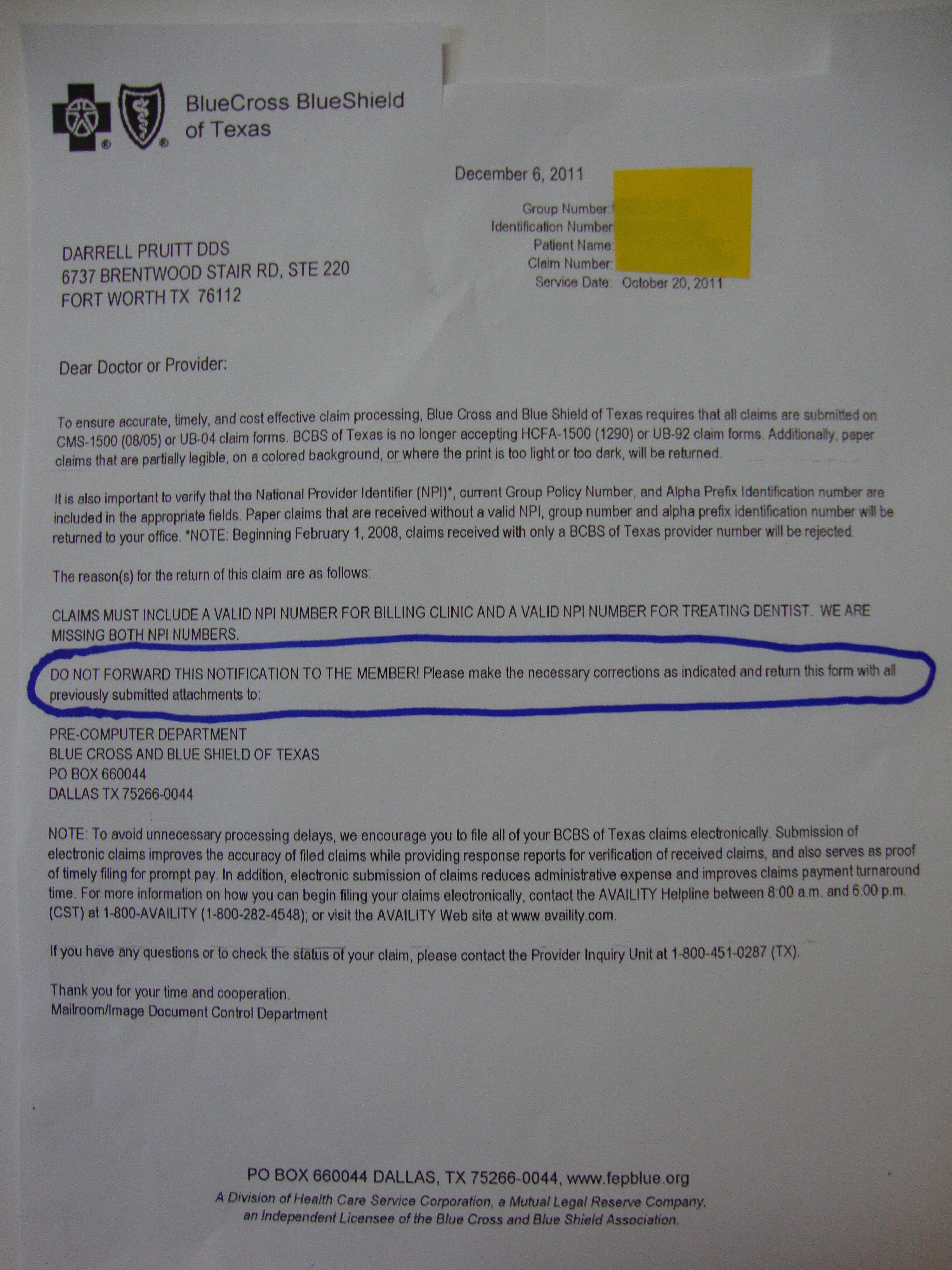
BCBSTX is a non-profit whose handsome profits are paid by taxpayers. The healthcare parasite sells dental insurance to theUSgovernment for federal employees. In their letter to me that I’ve attached, you can see for yourself that along with BCBSTX’s stated refusal to process any of their clients’ dental claims that come from my office, it says in capital letters, “DO NOT FORWARD THIS NOTIFICATION TO THE MEMBER!” How proud does it make you feel to know BCBSTX defines your level of ethics, TDA Board? Two years ago, your Director of Membership censored from the TDA Facebook this dentist’s criticism of BCBSTX’s NPI demands. Sometimes, you bozos are idiots.

I have no contractual relationship with BCBSTX, so as soon as could, I defied BCBSTX’s order and sent their client the letter – making sure to point out that BCBSTX ordered me to keep it secret from her. As you might expect, she’s pissed at BCBSTX! I hope she looks into a class action lawsuit. I bet BCBSTX has been secretly extorting their customers’ dentists by the thousands … but then, do you even care, TDA? What did BCBSTX offer the TDA that caused you to betray dentists and patients who used to have faith in your honesty?

BCBSTX is a Tyrant, and the TDA is an Enabler

There’s more: As a favor to our patients, my office has traditionally called their insurers for coverage information so that those who purchased the dental benefits will know how much of the bill they are responsible for before we start treatment. It’s called transparency.

Today, my office manager informed me that according to alerts she has received from insurers, if I don’t “volunteer” for a National Provider Identifier (NPI) number by 2012, my office will be deprived of the right to product information about BCBSTX’s plans. How does that help anyone, TDA?

Assessment 

Were you aware that this was the purpose of the NPI number when you pushed TDA members to sign up? Do you even care? Because of your silence inTexas’ dental community, it’s really hard to tell.

Conclusion

Your thoughts and comments on this ME-P are appreciated. Feel free to review our top-left column, and top-right sidebar materials, links, URLs and related websites, too. Then, subscribe to the ME-P. It is fast, free and secure.

Speaker: If you need a moderator or speaker for an upcoming event, Dr. David E. Marcinko; MBA – Publisher-in-Chief of the Medical Executive-Post – is available for seminar or speaking engagements. Contact: MarcinkoAdvisors@msn.com

OUR OTHER PRINT BOOKS AND RELATED INFORMATION SOURCES:

Product Details

Newt Gingrich has his Way with the ADA

Dentists should be furious with Gingrich for commandeering the ADA

By D. Kellus Pruitt DDS

On This Week roundtable discussion this morning [Sunday], George Will began his comments about Newt Gingrich, now a frontrunner, by saying that he “embodies everything disagreeable about modern Washington.”

Dentists should be furious with not only Gingrich, but with our inattentive dental leaders as well.

Why? 

A couple of days ago, Steve Chapman posted “Gingrich’s corruption” on the ChicagoTribune.com.

http://www.chicagotribune.com/news/opinion/chapman/chi-gingrichs-corruption-20111118,0,4581968.story

Chapman writes:

“Conservatives may be able to forgive Newt Gingrich for being an adulterer and for his flip-flops on climate change and mandatory health insurance. They are willing to put those aside because they think he’s shown a fierce attachment to their cause. But, the latest revelations will be harder to digest, because they suggest that his allegiance is for sale.”

He punctuates the condemnation with a quote from USA Today:

http://www.usatoday.com/news/politics/story/2011-11-16/newt-gingrich-think-tank-opeds/51246512/1  

“In a series of op-eds stretching over several years, Gingrich repeatedly advocated for various health-care related issues, including electronic health care records, ways to improve the health care sector, and medical malpractice reform without acknowledging the issues were directly connected to members of the Center for Health Transformation, a for-profit think tank he founded in 2003.”

Newt, for a Freddie Mac historian, you’re pretty sly!

According to information that Center for Health Transformation [CHT] spokeswoman Susan Meyers provided USA Today, healthcare stakeholders participating in Gingrich’s “think tank” can expect to pay Gingrich between $5,000 and $200,000, “depending on how many employees attend the center’s meetings and use other services.”

Wouldn’t you just love to ask Ms. Meyers if Gingrich’s think tank members are more likely to realize a return on their investment than their software offers dentists?

I suggested to the editor of the Chicago Tribune to specifically ask ADA President-elect Dr. Robert Faiella questions about the cost and safety of EHRs in dentistry. Then I followed the comment with,

 “And, be sure to tell Dr. Faiella that D. Kellus Pruitt DDS referred you to him. Though we’ve never met, he knows who I am. If you get around to it, you might ask him how much HIPAA compliance raises the cost of dentistry. There are thousands of dentists who would find the President-elect’s answer to that question truly enlightening.”

I Do Find this Fun

Psst…! Chicago Tribune Editor; want a hot tip? I know of a local but far-reaching lead concerning the malignant, corporate corruption described by Steve Chapman in his article. A reporter wouldn’t have to travel far to aggravate employees of a secretive, command and control organization. The ADA National Headquarters is just down the street at 211 East Chicago Avenue. In 2004, the widely-overlooked, not-for-profit’s lack of transparency made it especially vulnerable to Gingrich’s deceptive selling points!

ADA Officials

I think everyone agrees that asking ADA officials reasonable questions about the cost and safety of any high-tech dental product they recommend – including electronic dental record systems – is not unreasonable.

In fact, now that Steve Chapman has shown Newt Gingrich’s profit motives for misleading our dental leaders, caution seems prudent.

This could be ornery-fun if, like me, someone on your staff gets a kick out of asking shy good ol’ boys questions they are hardly ready to answer. I wish the Tribune luck getting past anonymous, unaccountable gatekeepers who shield ADA officials from accountability. I suggest sending your questions to Dr. Robert Faiella. He is not only the unresponsive Chair of the ADA Electronic Health Record Workgroup, but he is the ADA’s latest insensitive President-elect.

Dentists should be furious with Newt Gingrich for commandeering the ADA

Psst…! Chicago Tribune Editor! You interested in another hot tip? I know of a local but potentially far-reaching lead concerning the malignant, corporate corruption described by Steve Chapman in his article exposing Newt Gingrich’s poor manners.

Should you choose to do so, you won’t have to travel far to aggravate employees of a stoic, command and control organization. The national headquarters for the American Dental Association is just down the street at 211 East Chicago Avenue. The widely-forgotten, not-for-profit’s traditional lack of transparency made it especially vulnerable to Gingrich’s deception back in 2004.

I think everyone agrees that asking ADA leaders reasonable questions about the cost and safety of any high-tech dental product they recommend – including electronic dental record systems – is not unreasonable.

In fact, now that Steve Chapman has shown us Newt Gingrich’s motives for misleading our dental leaders, caution seems prudent.

This could be ornery-fun if someone on your staff gets a kick out of asking shy good ol’ boys questions they are not yet ready to answer.

Nevertheless, the ADA will refuse to respond to questions, Editor. Even while I was still a member of the professional organization up until a year ago, it clearly aggravated dental leaders when I repeatedly questioned the cost and safety of EDRs on local, state and national levels of the organization.

I always find evasion intriguing. Maybe you will have better luck getting past anonymous, unaccountable gatekeepers who shield the good ol’ boys from transparency.

Assessment 

Join Our Mailing List

Here’s the official to whom I suggest you futileyly address your questions: Dr. Robert Faiella. He is not only the unresponsive Chair of the ADA Electronic Health Record Workgroup, but he is theADA’s latest insensitive President-elect.

Conclusion

And so, your thoughts and comments on this ME-P are appreciated. Feel free to review our top-left column, and top-right sidebar materials, links, URLs and related websites, too. Then, subscribe to the ME-P. It is fast, free and secure.

Link: http://feeds.feedburner.com/HealthcareFinancialsthePostForcxos

Our Other Print Books and Related Information Sources:

Health Dictionary Series: http://www.springerpub.com/Search/marcinko

Practice Management: http://www.springerpub.com/product/9780826105752

Physician Financial Planning: http://www.jbpub.com/catalog/0763745790

Medical Risk Management: http://www.jbpub.com/catalog/9780763733421

Healthcare Organizations: www.HealthcareFinancials.com

Physician Advisors: www.CertifiedMedicalPlanner.com

Subscribe Now: Did you like this Medical Executive-Post, or find it helpful, interesting and informative? Want to get the latest ME-Ps delivered to your email box each morning? Just subscribe using the link below. You can unsubscribe at any time. Security is assured.

Link: http://feeds.feedburner.com/HealthcareFinancialsthePostForcxos

Sponsors Welcomed: And, credible sponsors and like-minded advertisers are always welcomed.

Link: https://healthcarefinancials.wordpress.com/2007/11/11/advertise

Product DetailsProduct DetailsProduct Details       

Product Details  Product Details

   Product Details

OWS versus Tea Party Movement

Understanding Two Poplar Political Movements

By Staff Reporters

This infographic compares the two most popular political movements in the United States: Occupy Wall Street and the Tea Party Movement.

It debunks several misconceptions surrounding both movements, including the stereotype that OWS protesters are largely lazy, liberal, and jobless -OR- does it?

Assessment

Is this a matter of conservative [republican] medical professionals versus liberal [democratic] laymen – or something else?

More:

Conclusion                

And so, your thoughts and comments on this ME-P are appreciated. Feel free to review our top-left column, and top-right sidebar materials, links, URLs and related websites, too. Then, subscribe to the ME-P. It is fast, free and secure.

Link: http://feeds.feedburner.com/HealthcareFinancialsthePostForcxos

Our Other Print Books and Related Information Sources:

Health Dictionary Series: http://www.springerpub.com/Search/marcinko

Practice Management: http://www.springerpub.com/product/9780826105752

Physician Financial Planning: http://www.jbpub.com/catalog/0763745790

Medical Risk Management: http://www.jbpub.com/catalog/9780763733421

Healthcare Organizations: www.HealthcareFinancials.com

Physician Advisors: www.CertifiedMedicalPlanner.com

Subscribe Now: Did you like this Medical Executive-Post, or find it helpful, interesting and informative? Want to get the latest ME-Ps delivered to your email box each morning? Just subscribe using the link below. You can unsubscribe at any time. Security is assured.

Link: http://feeds.feedburner.com/HealthcareFinancialsthePostForcxos

Sponsors Welcomed: And, credible sponsors and like-minded advertisers are always welcomed.

Link: https://healthcarefinancials.wordpress.com/2007/11/11/advertise

Product DetailsProduct DetailsProduct Details       

Product Details  Product Details

   Product Details

More Evidence of the Association between Hospital Market Concentration and Higher Prices and Profits

NIHCM Expert Voices in Health Care Policy

By James C. Robinson, PhD

Join Our Mailing List

In this essay, Dr. James Robinson presents results from his latest work showing that the prices hospitals charge to private insurers for 6 common procedures are 30 to 50 percent higher when the hospital is located in a market where it faces less competition from other hospitals.

These findings add to the already substantial body of research showing that consolidation in hospital markets confers market power that enables hospitals to secure higher prices.

When seen in the context of current policies encouraging additional provider consolidation through accountable care organizations [ACOs], this work serves as an important reminder that ongoing vigilance of the potential anti-competitive effects of these new delivery systems is needed along with other measures to counteract growing market power of providers.

About the Author:

James C. Robinson, PhD is the Leonard D. Schaeffer Professor of Health Economics and Director, Berkeley Centerfor Health Technology, University of California, at Berkeley.

Conclusion

Your thoughts and comments on this ME-P are appreciated. Feel free to review our top-left column, and top-right sidebar materials, links, URLs and related websites, too. Then, subscribe to the ME-P. It is fast, free and secure.

Speaker: If you need a moderator or speaker for an upcoming event, Dr. David E. Marcinko; MBA – Publisher-in-Chief of the Medical Executive-Post – is available for seminar or speaking engagements. Contact: MarcinkoAdvisors@msn.com

OUR OTHER PRINT BOOKS AND RELATED INFORMATION SOURCES:

Product DetailsProduct DetailsProduct Details

Accountable Care Organizations are Here

The Final Federal Guidelines

By Garfunkel Wild PC

http://www.garfunkelwild.com

Join Our Mailing List

The much anticipated final federal regulations on accountable care organizations (ACOs) were published on October 20th, 2011. The Affordable Care Act created ACOs to deliver seamless, high quality care to traditional fee-for-service Medicare beneficiaries while reducing the cost of care to those beneficiaries. If successful, ACOs will receive a portion of the shared savings they achieve for the Medicare program.

ACO Workgroup 

The Garfunkel Wild ACO Workgroup is in the process of analyzing these final regulations, and we will be hosting a webinar in the near future to discuss ACO participation and other ways providers can move towards collaborative care.

Final Regulations

In reviewing the final regulations, it is clear CMS took public comments to their proposed regulations seriously and made significant changes that should strengthen the ACO program. Some of these changes include:

  • Allowing ACOs to participate in an upside shared savings track (without being subject to downside losses) for the first three years of participation
  • Expanding the definition of participants eligible to form ACOs to include federally qualified health centers (“FQHCs”)
  • Reducing by about half the number of quality measures ACOs have to report
  • Permitting ACOs to share in first dollar saved once a minimum savings rate is achieved
  • Creating more flexibility for start dates for ACOs beginning in 2012
  • Removing EHR readiness as a condition of participation
  • Revising the process of assigning beneficiaries to ACOs from a pure retrospective process to a prospective process that includes retroactive adjustments

Assessment

Also published with the CMS final regulations were interim final regulations published by the Office of Inspector General addressing the waiver of the application of federal fraud and abuse laws; a final policy statement issued by the Federal Trade Commission and Department of Justice outlining the agencies’ antitrust enforcement policies for ACOs, and an IRS Fact Sheet regarding tax exempt organizations participating in the Medicare Shared Savings program.

Conclusion                

And so, your thoughts and comments on this ME-P are appreciated. Feel free to review our top-left column, and top-right sidebar materials, links, URLs and related websites, too. Then, subscribe to the ME-P. It is fast, free and secure.

Link: http://feeds.feedburner.com/HealthcareFinancialsthePostForcxos

Our Other Print Books and Related Information Sources:

Health Dictionary Series: http://www.springerpub.com/Search/marcinko

Practice Management: http://www.springerpub.com/product/9780826105752

Physician Financial Planning: http://www.jbpub.com/catalog/0763745790

Medical Risk Management: http://www.jbpub.com/catalog/9780763733421

Healthcare Organizations: www.HealthcareFinancials.com

Physician Advisors: www.CertifiedMedicalPlanner.com

Subscribe Now: Did you like this Medical Executive-Post, or find it helpful, interesting and informative? Want to get the latest ME-Ps delivered to your email box each morning? Just subscribe using the link below. You can unsubscribe at any time. Security is assured.

Link: http://feeds.feedburner.com/HealthcareFinancialsthePostForcxos

Sponsors Welcomed: And, credible sponsors and like-minded advertisers are always welcomed.

Link: https://healthcarefinancials.wordpress.com/2007/11/11/advertise

Product Details

About Healthcare Financials.com

WELCOME ALL HEALTH 2.0 COLLEAGUES

[An Open Invitation]

Product Details 

All hospitals and healthcare organizations, both emerging and mature, face a daunting financial scenario in today’s volatile healthcare reimbursement environment.  Decreasing revenues, increasing costs, and high consumer expectations present a complex challenge for CEOs, CFOs, physicians and nurse executives, administrators, financial advisors and department managers who must not only lead in today’s climate, but also position their organizations for tomorrow’s financial tumult and potential political changes of the Obama Administration.

Produced by a team of leading doctors, physician executives, nurses, medical professionals, economists, administrators, lawyers, and accountants, skilled business leaders and IT consultants, among many others; Healthcare Organizations [Journal of Financial Management Strategies] on CD-ROM, or SaaS, looks at ways to manage assets, costs, human resources and healthcare claims.  Everything – from inventory management to hybrid and activity based cost analysis in order to accelerate the cash conversion cycle – is scrutinized.  And, modern health economic themes like competitive strategy, workplace violence and financial benchmarks, for both public and private entities, are included.

We also examine contemporaneous topics such as the lessons learned from the corporate healthcare market competition and the PPMC imbroglio of the early 2000’s, and the domestic financial meltdown of 2009. This includes current methods for achieving hospital objectives, negotiating and analyzing cost-volume-profit contracts, and understanding the financial impact of regulatory requirements under HIPAA, STARK I-III, OSHA, the US Patriot Acts, the Deficit Reduction Act [DRA], the often contentious Sarbanes-Oxley Act, ARRA and HITECH Acts, and the Fair and Accurate Credit Transactions [FACT] Act.

In addition, information technology issues like electronic medical records (eMRs), RFID controls, RSS feeds and blogs, Health 2.0 initiatives and computerized physician order entry (CPOE) systems are examined in detail. Virtually no  operational, strategic business, health economics, or financial management topic is omitted.

“This wide-ranging examination of the fiscal

management scene for hospitals, healthcare

organizations, clinics and outpatient centers 

includes case models, extensive appendices, 

and detailed checklists and templates that

step the reader through a review of main

issues for each chapter.”

Health Care Organizations [Journal of Financial Management Strategies] on CD-ROM, or SaaS, is dedicated to meeting the administrative needs of our nation’s healthcare organizations in order to help them maintain a competitive edge in the markets they serve; and to take advantage of emerging business opportunities. We therefore invite you to be the first health economics cynosure in your hospital, facility, or healthcare system to join us for the journey.

Let Health Care Organizations [Journal of Financial Management Strategies] be your guide. 

Subscribe today … Succeed tomorrow!

Dr. David Edward Marcinko MBA, CMP

[Founder, CEO and Editor-in-Chief]

iMBA Inc – Suite #5901 Wilbanks Drive

Norcross, GA 30092-1141

Product Details 

The Legal eHR [Extreme Caution Ahead]

Is there such a thing?

By Dr. David Edward Marcinko MBA CMP

[Editor-in-Chief]

Electronic medical and healthcare records [eMRs and eHRs] are a hot topic and the subject of many positive and negative posts and comments on this ME-P; and around the healthcare space. Personally, I am agnostic on the subject – trending against – for most physicians at this point in time.

In other words, the technology is just not there yet regarding “ease of use”, inter-operability, common transmission and security standards, and common platform, etc. This is reminiscent of the early days of the word processing industry, when I first used Edix-Wordex, Leading Edge, Word Perfect, Word Star, ASCII, PFR-Write, PC-Write, etc.  It was both exciting and confusing, being a writer and editor, at that time. Sorta like working in an electronic Tower of Babel; or using the many disparate eHR systems existing today?

I am not a Luditte, however. I’m a former American Health Information Management Association (AHIMA), and Healthcare Information and Management Systems Society (HIMSS), member. And, I’m certain that eHRs will be pervasive one day, but I’ll reserve my opinions, my money and information security, and my patient’s data until then. After all, I am a MSFT-Word® guy today as I thank Bill Gates for consolidating the formerly competitive, and chaotic, word processing software space. Yes, sometimes monopolies are a good thing! 

Malpractice Issues

Moreover, it seems I have been a Cassandra [the daughter of King Priam and Queen Hecuba of Troy] of sorts, crying aloud about the professional liability and medical malpractice issues of eMRS; here on this ME-P, during my speeches and lectures, as wells as in our books and CDs. All to no avail; until now!

Links: https://medicalexecutivepost.com/2009/12/23/will-electronic-records-raise-the-legal-standard-of-care-and-increase-malpractice-risk/

I suppose this is a product of my prior work as a licensed insurance agent for the State of Georgia, a malpractice reviewer, a court approved medical-legal expert witness, and author of the book: “Risk Management and Insurance Planning for Physicians and their Advisors”.

Link: http://www.jbpub.com/catalog/9780763733421

Assessment

Q: And so, is there a legal eHR and is it different from traditional eHRs?

A: You bet there is!

Read Link: http://www.himss.org/content/files/LegalEMR_Flyer3.pdf

Conclusion

And so, your thoughts and comments on this ME-P are appreciated. Think I am still mis-guided, or worse, paranoid? Feel free to review our top-left column, and top-right sidebar materials, links, URLs and related websites, too. Then, subscribe to the ME-P. It is fast, free and secure.

Link: http://feeds.feedburner.com/HealthcareFinancialsthePostForcxos

Speaker: If you need a moderator or speaker for an upcoming event, Dr. David E. Marcinko; MBA – Publisher-in-Chief of the Medical Executive-Post – is available for seminar or speaking engagements. Contact: MarcinkoAdvisors@msn.com

Our Other Print Books and Related Information Sources:

Health Dictionary Series: http://www.springerpub.com/Search/marcinko

Practice Management: http://www.springerpub.com/product/9780826105752

Physician Financial Planning: http://www.jbpub.com/catalog/0763745790

Medical Risk Management: http://www.jbpub.com/catalog/9780763733421

Physician Advisors: www.CertifiedMedicalPlanner.org

   Product Details

Government Launches Population Health Improvement Initiative

Called “Million Hearts”

[By Staff Reporters]

The Department of Health and Human Services (HHS) has launched a “Million Hearts” campaign that is designed to prevent a million heart attacks and strokes in the next 5 years.

Assessment

You can read about it in the New England Journal here or in Circulation here.  There is also more detail here at the HHS gov web site.

Conclusion

Your thoughts and comments on this ME-P are appreciated. Feel free to review our top-left column, and top-right sidebar materials, links, URLs and related websites, too. Then, subscribe to the ME-P. It is fast, free and secure.

Link: http://feeds.feedburner.com/HealthcareFinancialsthePostForcxos

Speaker: If you need a moderator or speaker for an upcoming event, Dr. David E. Marcinko; MBA – Publisher-in-Chief of the Medical Executive-Post – is available for seminar or speaking engagements. Contact: MarcinkoAdvisors@msn.com

OUR OTHER PRINT BOOKS AND RELATED INFORMATION SOURCES:

LEXICONS: http://www.springerpub.com/Search/marcinko
PHYSICIANS: www.MedicalBusinessAdvisors.com
PRACTICES: www.BusinessofMedicalPractice.com
HOSPITALS: http://www.crcpress.com/product/isbn/9781466558731
CLINICS: http://www.crcpress.com/product/isbn/9781439879900
ADVISORS: www.CertifiedMedicalPlanner.org
BLOG: www.MedicalExecutivePost.com

Product DetailsProduct DetailsProduct Details

Product Details  Product Details

   Product Details 

Does Financial Regulation Kill Jobs?

Perhaps Not!

By Marian Wang
ProPublica, Sept. 12, 2011, 1:20 pm

Join Our Mailing List

With the presidential campaign in motion, and President Obama urging immediate passage of his new jobs bill, the attention in Washington has shifted almost exclusively to the economy and job creation. And, that means a shift away from regulation, right? Not necessarily.

Growth Spurts?

Some regulators and financial industry experts are predicting the opposite—that new financial regulations will spur some growth.

For example, The New York Times’ DealBook blog cited derivatives regulation [1] as one example. Dodd-Frank requires a substantial chunk of the $600-trillion derivatives market to trade on exchanges or on new electronic trading platforms.

“I have no doubt that these new regulations, instituting new types of clearing, trading and reporting platforms, will foster a landslide of hiring in the financial sector,”

Bart Chilton of the Commodity Futures Trading Commission said in a recent speech cited by the Times. As another New York Times piece noted, previous financial regulation laws have resulted in additional jobs for accountants and lawyers [2], at least.

But, separate from the jobs created to actually handle new regulation, others have pointed out that regulations can have a long-term, positive effect on overall economic growth by preventing the types of crises that put an industry on life-support.

The Studies

Last year, two studies by central bankers and regulators found that the short-term impacts of stricter capital requirements were “significantly smaller” than the estimates published by banking groups, the Times reported.

Rather, the studies said that stricter regulation would lead to more long-term growth [3] by preventing future crises.

Banks see higher capital requirements

  • Which require them to have more financial cushion to balance out risk-taking as a damper on profits.
  • And, they have repeatedly warned that tougher rules will hamper lending, reduce investment and slow economic growth.

Assessment

But, not everyone sees it that way. Swiss regulators, for instance, indicated last year that they would impose even tougher capital standards on their country’s banks on the premise that investors would rather put their trust [4]—and their dollars—in safer banks.

Conclusion

And so, your thoughts and comments on this ME-P are appreciated. Feel free to review our top-left column, and top-right sidebar materials, links, URLs and related websites, too. Then, subscribe to the ME-P. It is fast, free and secure.

Link: http://feeds.feedburner.com/HealthcareFinancialsthePostForcxos

Speaker: If you need a moderator or speaker for an upcoming event, Dr. David E. Marcinko; MBA – Publisher-in-Chief of the Medical Executive-Post – is available for seminar or speaking engagements. Contact: MarcinkoAdvisors@msn.com

Our Other Print Books and Related Information Sources:

Health Dictionary Series: http://www.springerpub.com/Search/marcinko

Practice Management: http://www.springerpub.com/product/9780826105752

Physician Financial Planning: http://www.jbpub.com/catalog/0763745790

Medical Risk Management: http://www.jbpub.com/catalog/9780763733421

Subscribe Now: Did you like this Medical Executive-Post, or find it helpful, interesting and informative? Want to get the latest ME-Ps delivered to your email box each morning? Just subscribe using the link below. You can unsubscribe at any time. Security is assured.

Link: http://feeds.feedburner.com/HealthcareFinancialsthePostForcxos

Sponsors Welcomed: And, credible sponsors and like-minded advertisers are always welcomed.

Link: https://healthcarefinancials.wordpress.com/2007/11/11/advertise

Product Details  Product Details

The ACA Individual Mandate [Voter Opinion Survey]

Individual Mandate Opinion Survey

Join Our Mailing List

Do you think the individual mandate of PPACA should be overturned?

Conclusion

Your thoughts and comments on this ME-P are appreciated. Feel free to review our top-left column, and top-right sidebar materials, links, URLs and related websites, too. Then, subscribe to the ME-P. It is fast, free and secure.

Speaker: If you need a moderator or speaker for an upcoming event, Dr. David E. Marcinko; MBA – Publisher-in-Chief of the Medical Executive-Post – is available for seminar or speaking engagements. Contact: MarcinkoAdvisors@msn.com

OUR OTHER PRINT BOOKS AND RELATED INFORMATION SOURCES:

   Product Details 

RAC Demand Letters Replaced

CMS Transfers Responsibility

By Staff Reporters

Join Our Mailing List 

January 2012 marks a significant change for Recovery Auditors as the Centers for Medicare & Medicaid Services (CMS) is transferring the responsibility for demand letters from the auditors to claims processing contracts. The reason for the change is “to avoid any delays in demand letter issuance,” according to MLN Matters article 7436.

The Result

As a result, when a Recovery Auditor finds improper payments, they will submit claim adjustments to your Medicare (claims processing) contractor. The contractors will carry the responsibility of fielding concerns throughout the time frame of the payment recovery and the appeals process.

Assessment

Read the full article here.

Conclusion

And so, your thoughts and comments on this ME-P are appreciated. Feel free to review our top-left column, and top-right sidebar materials, links, URLs and related websites, too. Then, subscribe to the ME-P. It is fast, free and secure.

Link: http://feeds.feedburner.com/HealthcareFinancialsthePostForcxos

Our Other Print Books and Related Information Sources:

Health Dictionary Series: http://www.springerpub.com/Search/marcinko

Practice Management: http://www.springerpub.com/product/9780826105752

Physician Financial Planning: http://www.jbpub.com/catalog/0763745790

Medical Risk Management: http://www.jbpub.com/catalog/9780763733421

Healthcare Organizations: www.HealthcareFinancials.com

Physician Advisors: www.CertifiedMedicalPlanner.com

Subscribe Now: Did you like this Medical Executive-Post, or find it helpful, interesting and informative? Want to get the latest ME-Ps delivered to your email box each morning? Just subscribe using the link below. You can unsubscribe at any time. Security is assured.

Link: http://feeds.feedburner.com/HealthcareFinancialsthePostForcxos

Sponsors Welcomed: And, credible sponsors and like-minded advertisers are always welcomed.

Link: https://healthcarefinancials.wordpress.com/2007/11/11/advertise

Product DetailsProduct DetailsProduct Details       

Product Details  Product Details

   Product Details 

Why PACs Won’t Jeopardize a Hospital’s Tax Exempt Status?

According to IRS Private Letter Ruling

By http://www.garfunkelwild.com/

Recently, the Internal Revenue Service (“IRS”) issued a private letter ruling (the “Ruling”) that will allow the requesting tax-exempt hospital to establish and operate a social welfare organization as a means of engaging in political activities and establishing a larger presence in the political arena. The Ruling concluded that these actions will not jeopardize the hospital’s tax-exempt status under the Internal Revenue Code of 1986, as amended, (“IRC”) § 501(c)(3). Pursuant to IRC § 501(c)(3), a corporation organized and operated exclusively for religious, charitable, scientific, literary or educational purposes is exempt from federal income taxes, provided that its net earnings do not inure to the benefit of a private individual and a substantial part of its activities do not involve lobbying or related political conduct.

The Requesting Hospital

The requesting hospital is a comprehensive regional, integrated health care system that has qualified as a tax-exempt, charitable organization (the “Hospital”).  Currently, the Hospital conducts an insubstantial amount of lobbying through its government affairs department (the “Department”), in an effort to improve the cost efficiency of health care services. The Ruling serves to permit the Hospital to take a more active role in the political arena, through the formation of a separate, non-profit social welfare organization (the “Organization”) that will, in turn, establish two independent political action committees (collectively “PACs”).

Social welfare organizations are tax-exempt entities that are designed to promote the general welfare of the community. See IRC § 501(c)(4).  Social welfare organizations may conduct political campaign activities and establish political organizations, as long as political campaigning is not the primary activity. Reg. § 1.501(c)(4)-1(a)(2)(ii).  Accordingly, in order for the Hospital to create the Organization, the IRS requires that the Organization (a) remain independent from the Hospital and (b) apply for tax-exempt status as a social welfare organization.  Notwithstanding the preceding sentence, the Hospital proposed that it would remain the sole voting member of the Organization, and that the majority of the Organization’s Board of Directors would be officers, directors or employees of the Hospital.  The IRS permitted the Hospital to act accordingly, provided the Hospital complied with the IRS requirements set forth in this Legal Alert, and expanded upon in the Ruling.

More on the Private Ruling

The Ruling permitted the Organization to establish two PACs for the purpose of accepting contributions from, or making expenditures to, a political candidate or party.  See IRC § 527(e). As part of its analysis, the IRS concluded that the PACs, Organization and Hospital must operate independently, in order to ensure that the political activities of the Organization and the PACs would not be attributed to the Hospital and would not impact the Hospital’s tax-exempt status.  To comply with the Ruling, the PACs must maintain separate bank accounts and records, as well as separate addresses and phone numbers.  In addition, any leasing or sharing of employees, goods or services among the Hospital, Organization and PACs must be conducted at arms-length.

Assessment

Furthermore, the Ruling concluded that the Hospital may establish and operate a voluntary payroll deduction plan permitting Hospital employees to make political contributions through the PACs.  The Ruling provided that political contributions by employees of the Hospital will not impact the tax-exempt status of the Hospital, as long as the Hospital does not influence the employees’ choices regarding contribution.

Editor’s Note

Please note that this Private Letter Ruling is limited to the facts at issue, and should not be relied upon by anyone other than the Hospital.

Conclusion

And so, your thoughts and comments on this ME-P are appreciated. Feel free to review our top-left column, and top-right sidebar materials, links, URLs and related websites, too. Then, subscribe to the ME-P. It is fast, free and secure.

Link: http://feeds.feedburner.com/HealthcareFinancialsthePostForcxos

Our Other Print Books and Related Information Sources:

Health Dictionary Series: http://www.springerpub.com/Search/marcinko

Practice Management: http://www.springerpub.com/product/9780826105752

Physician Financial Planning: http://www.jbpub.com/catalog/0763745790

Medical Risk Management: http://www.jbpub.com/catalog/9780763733421

Healthcare Organizations: www.HealthcareFinancials.com

Physician Advisors: www.CertifiedMedicalPlanner.com

Subscribe Now: Did you like this Medical Executive-Post, or find it helpful, interesting and informative? Want to get the latest ME-Ps delivered to your email box each morning? Just subscribe using the link below. You can unsubscribe at any time. Security is assured.

Link: http://feeds.feedburner.com/HealthcareFinancialsthePostForcxos

Sponsors Welcomed: And, credible sponsors and like-minded advertisers are always welcomed.

Link: https://healthcarefinancials.wordpress.com/2007/11/11/advertise

Product DetailsProduct DetailsProduct Details      

OCR Imposes Penalties for Employee’s Unauthorized Viewing of PHI

By Garfunkel Wild, PC

Join Our Mailing List 

Early in July, the Department of Health and Human Services Office of Civil Rights (“OCR”) entered into a settlement for $865,500 with UCLA Health System (“UCLAHS”) as a result of complaints alleging that UCLAHS employees repeatedly and without permissible reason looked at the electronic protected health information (“ePHI”) of celebrity patients.

Initial Complaints

Although the complaint was initially made by only two patients, in its investigation OCR determined that from 2005-2008 unauthorized employees of UCLAHS repeatedly looked at the ePHI of numerous other patients as well. In addition to paying the settlement, UCLAHS committed to a correction action plan that includes (1) implementation of policies and procedures; (2) robust training for employees; (3) a commitment to sanction offending employees; and (4) designation of an independent monitor to assess compliance over 3 years.

Assessment

This settlement is the fourth settlement in a year and highlights OCR’s increasing enforcement of violations to HIPAA Privacy and Security Rules. Failure to have an effective HIPAA compliance program can result in significant monetary penalties, and therefore, providers and business associates alike should be evaluating their HIPAA compliance programs to ensure that appropriate safeguards are in place.

Conclusion

Your thoughts and comments on this ME-P are appreciated. Feel free to review our top-left column, and top-right sidebar materials, links, URLs and related websites, too. Then, subscribe to the ME-P. It is fast, free and secure.

Link: http://feeds.feedburner.com/HealthcareFinancialsthePostForcxos

Speaker: If you need a moderator or speaker for an upcoming event, Dr. David E. Marcinko; MBA – Publisher-in-Chief of the Medical Executive-Post – is available for seminar or speaking engagements. Contact: MarcinkoAdvisors@msn.com

OUR OTHER PRINT BOOKS AND RELATED INFORMATION SOURCES:

Product DetailsProduct DetailsProduct Details

Product Details  Product Details

   Product Details 

Medicare and the Budget Control Act’s Joint Select Committee

Creating Spending Reductions for the Next Decade?

By Children’s Home Society of Florida Foundation

Join Our Mailing List 

Under the compromise between President Obama and leaders of the House and Senate, the Budget Control Act of 2011 created spending reductions of over $900 billion during the next decade. The bill also requires leaders of the House and Senate to appoint members to a Joint Select Committee. The committee has three Republican, three Democratic Senators, three Republican and three Democratic Representatives.

House and Senate leaders have now appointed the committee members. The 12 committee members are tasked with creating a $1.5 trillion budget solution by Thanksgiving. Their bill will be voted on without amendments by December 23, 2011.

If the committee is not able to develop and pass a bill by Dec. 23, there will be $1.2 trillion in budget cuts. Half of the cuts will come from the Department of Defense and one-half will be reductions in payments to Medicare providers.

Majority Leader Harry Reid (D-NV) appointed three Senators. The Co-Chair of the Joint Select Committee will be Sen. Patty Murray (D-WA). His other two appointees are Sen. John Kerry (D-MA) and Sen. Max Baucus (D-MT). Sen. Kerry is Chair of the Senate Foreign Relations Committee and Sen. Baucus is Chair of the Senate Finance Committee.

Republican Leader Mitch McConnell (R-KY) appointed Sen. John Kyl (R-AZ), Sen. Pat Toomey (R-PA) and Sen. Rob Portman (R-OH). Sen. Kyl is the Republican Whip and a senior member of the Finance Committee. Sen. Toomey is a member of the Budget Committee. Sen. Portman was previously Director of the Office of Management and Budget.

Speaker John Boehner (R-OH) appointed Rep. Jeb Hensarling (R-TX) as Co-Chair of the committee. His other appointments are Rep. Dave Camp (R-MI) and Rep. Fred Upton (R-MI). Rep. Camp is Chairman of the Ways and Means Committee and Rep. Upton chairs the Energy and Commerce Committee.

Democratic Leader Nancy Pelosi (D-CA) appointed Rep. James Clyburn (D-SC), House Ways and Means Member Xavier Becerra (D-CA) and Budget Committee Member Chris Van Hollen (D-MD).

The Joint Select Committee is expected to initiate meetings in September after Congress returns from the August recess.

Editor’s Note: There will undoubtedly be a spirited debate. All of the twelve committee members will want to avoid drastic budget cuts for the Department of Defense or Medicare providers. The group will need to discuss potential cuts in discretionary expenditures, defense and entitlements. With the appointments of key taxwriters Baucus and Camp, it is clear that taxes will also be a part of the discussion. Whether or not there are tax increases as part of the budget solution remains to be seen.

Conclusion

And so, your thoughts and comments on this ME-P are appreciated. Feel free to review our top-left column, and top-right sidebar materials, links, URLs and related websites, too. Then, subscribe to the ME-P. It is fast, free and secure.

Link: http://feeds.feedburner.com/HealthcareFinancialsthePostForcxos

Speaker: If you need a moderator or speaker for an upcoming event, Dr. David E. Marcinko; MBA – Publisher-in-Chief of the Medical Executive-Post – is available for seminar or speaking engagements. Contact: MarcinkoAdvisors@msn.com

Our Other Print Books and Related Information Sources:

Health Dictionary Series: http://www.springerpub.com/Search/marcinko

Practice Management: http://www.springerpub.com/product/9780826105752

Physician Financial Planning: http://www.jbpub.com/catalog/0763745790

Medical Risk Management: http://www.jbpub.com/catalog/9780763733421

Healthcare Organizations: www.HealthcareFinancials.com

Physician Advisors: www.CertifiedMedicalPlanner.com

Subscribe Now: Did you like this Medical Executive-Post, or find it helpful, interesting and informative? Want to get the latest ME-Ps delivered to your email box each morning? Just subscribe using the link below. You can unsubscribe at any time. Security is assured.

Link: http://feeds.feedburner.com/HealthcareFinancialsthePostForcxos

Sponsors Welcomed: And, credible sponsors and like-minded advertisers are always welcomed.

Link: https://healthcarefinancials.wordpress.com/2007/11/11/advertise

Product Details  Product Details

   Product Details 


On Single Unit Surgical Centers

Proposed Registration and Licensure Requirements

By Garfunkel Wild, PC

Join Our Mailing List 

Legislation enacted on March 23, 2009 required single suite surgical facilities that are conducted by surgical practices (the “Surgical Practices”) to register with the New Jersey Department of Health and Senior Services (“NJDHSS”) by September 17, 2009, and prohibited registration of new Surgical Practices. However, registration requirements were not implemented or enforced.  Previously, Surgical Practices were regulated by the Board of Medical Examiners.  The proposed regulations intend to set forth both registration and regulatory requirements for existing Surgical Practices, but preserve the statutory moratorium on new Surgical Practices.

New Jersey Department of Health and Senior Services

Surgical Practices that are in operation on the effective date of the proposed regulation must register with the NJDHSS or cease operations no later than ninety (90) days from the effective date.  A Surgical Practice that has not commenced operation by the effective date but has filed specifications and/or other required building or zoning documents with the municipality in which the Surgical Practice will be located must register with the NJDHSS prior to commencing operations.  All Surgical Practices to be registered in the future must register within two (2) years of receiving approval from the municipality in which it will be located. Registration will be valid for one year and will be subject to annual renewal.  Along with the renewal application, the registrant would be required to submit a copy of its certification from the Centers for Medicare and Medicaid Services (“CMS”) or other documentation of accreditation. In the event that a Surgical Practice fails to maintain such certification or accreditation, the registration would lapse.

The proposed regulations would also provide for standardized requirements for the transfer of ownership and relocation of all Surgical Practices. Importantly, a Surgical Practice would be permitted to apply for approval of a transfer of ownership by submitting a completed registration application at least ninety (90) days prior to the planned transfer of ownership.  Additionally, a registered Surgical Practice would be permitted to relocate within twenty (20) miles after submitting certain documentation set forth in the regulations. A relocated Surgical Practice would not be permitted to expand the scope of services at a new location.

New Legislation

In addition, legislation has been introduced which would go further than the proposed regulations and require all Surgical Practices in operation as of the date of enactment to become licensed by the NJDHSS as ambulatory care facilities licensed to provide surgical services within one year of the effective date.  Such Surgical Practices would be exempt from the ambulatory care facility assessment.  In addition, the moratorium on new ambulatory care facilities would remain in effect. 

Assessment

If this legislation is enacted, the NJDHSS would not issue new registrations for Surgical Practices after the effective date.  However, a registered Surgical Practice may transfer ownership or relocate after the effective date if it becomes licensed as an ambulatory care facility prior to applying for a new license. Surgical Practices would be required to obtain ambulatory care accreditation from an accrediting body recognized by CMS as a condition of licensure.

Conclusion

And so, your thoughts and comments on this ME-P are appreciated. Feel free to review our top-left column, and top-right sidebar materials, links, URLs and related websites, too. Then, subscribe to the ME-P. It is fast, free and secure.

Link: http://feeds.feedburner.com/HealthcareFinancialsthePostForcxos

Speaker: If you need a moderator or speaker for an upcoming event, Dr. David E. Marcinko; MBA – Publisher-in-Chief of the Medical Executive-Post – is available for seminar or speaking engagements. Contact: MarcinkoAdvisors@msn.com

Our Other Print Books and Related Information Sources:

Health Dictionary Series: http://www.springerpub.com/Search/marcinko

Practice Management: http://www.springerpub.com/product/9780826105752

Physician Financial Planning: http://www.jbpub.com/catalog/0763745790

Medical Risk Management: http://www.jbpub.com/catalog/9780763733421

Healthcare Organizations: www.HealthcareFinancials.com

Physician Advisors: www.CertifiedMedicalPlanner.com

Subscribe Now: Did you like this Medical Executive-Post, or find it helpful, interesting and informative? Want to get the latest ME-Ps delivered to your email box each morning? Just subscribe using the link below. You can unsubscribe at any time. Security is assured.

Link: http://feeds.feedburner.com/HealthcareFinancialsthePostForcxos

Sponsors Welcomed                               

And, credible sponsors and like-minded advertisers are always welcomed.

Link: https://healthcarefinancials.wordpress.com/2007/11/11/advertise

Product DetailsProduct DetailsProduct Details       

Product Details  Product Details

   Product Details 

Proposed Regulations on HIPAA Accounting of Disclosures

New Rules and Regulations for Covered Healthcare Entities

ADVERTISEMENT

Join Our Mailing List 

By HCR@garfunkelwild.com

Proposed regulations regarding HIPAA accounting of disclosures have been recently published and are open for public comments.  If enacted in their current form, the new regulations will require Covered Entities to make significant revisions to their current HIPAA procedures and may require modifications to current computer systems.  

The HI-TECH Act

Under the HITECH Act, regulations must be enacted that allow individuals to receive a much expanded accounting of disclosures of electronic health information, including disclosures made for treatment, payment and health care operations. 

In order to accomplish this, the proposed regulations differentiate between “accountings of disclosures” and “access reports.”  Accountings will continue to be a list of certain limited types of disclosures.  Access reports will be similar to “audit trails” and must include information regarding each access to an individual’s electronic health information.  Covered Entities must be able to provide, upon request, both accountings and access reports.

Covered Entities

The proposed regulations also include specific requirements, including the following:

  • Accountings and access reports must be available in regard to disclosures or access, as applicable, for 3 years and must be provided within 30 days of the request. 
  • Accountings and access reports will be required only for health information maintained in designated record sets (e.g., medical records, billing records).
  • Accountings and access reports must include information about disclosures of, and access to, information maintained by business associates.
  • There are additional exceptions to the types of disclosures that must be included on an accounting (e.g., exceptions will include disclosures about abuse and to medical examiners).

Conclusion

And so, your thoughts and comments on this ME-P are appreciated. Feel free to review our top-left column, and top-right sidebar materials, links, URLs and related websites, too. Then, subscribe to the ME-P. It is fast, free and secure.

Link: http://feeds.feedburner.com/HealthcareFinancialsthePostForcxos

Speaker: If you need a moderator or speaker for an upcoming event, Dr. David E. Marcinko; MBA – Publisher-in-Chief of the Medical Executive-Post – is available for seminar or speaking engagements. Contact: MarcinkoAdvisors@msn.com

Our Other Print Books and Related Information Sources:

Health Dictionary Series: http://www.springerpub.com/Search/marcinko

Practice Management: http://www.springerpub.com/product/9780826105752

Physician Financial Planning: http://www.jbpub.com/catalog/0763745790

Medical Risk Management: http://www.jbpub.com/catalog/9780763733421

Healthcare Organizations: www.HealthcareFinancials.com

Physician Advisors: www.CertifiedMedicalPlanner.com

Subscribe Now: Did you like this Medical Executive-Post, or find it helpful, interesting and informative? Want to get the latest ME-Ps delivered to your email box each morning? Just subscribe using the link below. You can unsubscribe at any time. Security is assured.

Link: http://feeds.feedburner.com/HealthcareFinancialsthePostForcxos

Sponsors Welcomed: And, credible sponsors and like-minded advertisers are always welcomed.

Link: https://healthcarefinancials.wordpress.com/2007/11/11/advertise

Product Details 

A Review of HIPAA EHR Security Regulations

Join Our Mailing List

Focus on the Hospital Industry

Carol S. MillerBy Carol S. Miller BSN MBA

With the implementation of EMRs, Internet access, intranet availability throughout the hospital and physician complexes, as well as from home or any virtual site, the potential for security violations and associated vulnerabilities may have already caused serious harm to many hospitals and to the IT community in general.  Implementation of HIPAA security standards across the United States at hospitals, clinics, medical complexes, universities, federal facilities such as the VA, DoD or IHS and others have been inconsistent.  In addition, the HIPAA privacy regulations have given the responsibility for the patient health record to the patient — the impact of which has not been fully addressed nor is it supported by healthcare IT rules and regulations.

In Control?

Throughout the entire healthcare industry, there are concerns over who has access, who is in control, and whether the release of information impacts the privacy and security of the patient medical information or presents a risk to patient well-being, the quality of patient care, compliance issues, and potential fines to the hospital community.

The simple fact is that security is a problem that could have a catastrophic effect on any hospital.  Most Chief Information Officers have increased their “security-related” and “computer specialist” staff to address security issues, but most believe that their security is still vulnerable and needs to be improved.  Understanding a complex group of technologies and processes that have been built and modified many times over the years, especially at a large university or medical center complex, will be not only time-consuming, but also costly.  Security, like complex IT systems, was never designed in any organized manner.  It simply expanded as more and more access was made available, patient rights were defined, technology capabilities expanded, and more Internet-related communications and document-sharing occurred.

Hospital Security Concerns

Further, HIPAA security requirements were thrown into the mix in an era when hospital budgets were shrinking, and hospitals were trying to meet their costs through consolidation or reduction of programs and staff.

The prime concerns for information security are:

  • confidentiality – information is accessible only by authorized people and processes;
  • integrity – information is not altered or destroyed; and
  • availability – information is there when you need it.

Hospitals will continue to review, update and further document their security issues, monitor changes, and develop processes to mitigate the problems.  Gap analyses will continue to determine where vulnerabilities are or potentially could occur.  This process will be time consuming, but will enable the hospitals to determine how each system is integrated into their portfolio of systems and applications, and how it will be integrated with new technology.  Most importantly, it will facilitate identification of the detailed process of requesting, securing, and approving access to confidential patient records, systems, or applications.  It will enable hospitals to move forward with other technology enhancements in a secure manner.

Patchwork Security Quill

As stated previously, security has grown piecemeal as needs have been integrated with system, application, and software program growth.  It is literally a patchwork of various security functions and restrictions that may just be applicable to a certain application or software product or may be applicable to several applications but not all.  Various security software or SaaS packages have been deployed at different facilities across the United States that provide firewalls, access controls, tracking systems, and various other HIPAA security compliant capabilities; however, even with all these controls no one person within a hospital environment is fully aware of all the security requirements, security structures, the integration of the security network or whether any of the security network works efficiently and effectively.  Building a basic understanding of the entire network is the basis for developing and improving the entire HIPAA-related security process.  Besides the security involved within the hospital systems and through the Internet, there is still the issue of physical security, security theft or inappropriate access to patient information.

Typical Security Queries

The following list provides examples of typical questions related to security of information stored either on the laptop or on an accessible Intranet site from the laptop that should be addressed. All of these questions relate to additional time and expense in having an assigned individual monitor all aspects of this tracking process:

  • Is there an accurate record or log of each piece of equipment referenced at the hospital?
  • Do I know how many of the laptops are portable and used at home?
  • Are personal digital assistants (PDAs) and laptops encrypted and is the employee required to change passwords frequently?
  • Do I know how many of these portable systems are used for personal services?
  • Do I know how many of these laptops are used by family members?
  • Do I know how secure the portable systems are?
  • Do I know if they are just password protected or whether other security measures are in place?
  • Is every piece of equipment accounted for when employees leave, including PDA, laptop, CD, DVD, or other storage devices?
  • Do I know who can access confidential patient information from a remote office or home?
  • Is there a defined process for discarding old computers and old media?
  • Do employees know the hospital’s reporting process if their laptop is stolen or hacked?
  • Is virus and spyware software continually updated?
  • Are employees provided with information on how to secure their laptops or blackberries?
  • Do employees know what to do when attachments from unknown sources are sent and/or downloaded?
  • Does the employee use home-burned CDs/DVDs on their laptop?
  • Is system backup maintained by every employee?
  • Do employees know to “log off” when leaving their desktop or is there an automatic “log off” capability built within the system?

Security Administrators and Managers

Hospitals are employing security administrators and security staff to identify potential risks, vulnerabilities, risk scenarios, and develop policy and procedures to address all of these issues.  HIPAA compliance reviews and approval processes from HIPAA officers or legal counsel will be an added process for the hospital as part of any security consideration.  All of these security review processes, requirements, and staffing represent new and most likely unbudgeted costs with higher-than-anticipated associated costs to the hospital.  Costs need to be based on the affiliated risk, and the associated manpower or technical systems/software required to fix the risk; these indirect costs (i.e., not direct labor costs related to patient care) are being met from the hospital profits.

Risk Assessment Queries

Every covered entity should complete a risk assessment and review it periodically.  Focus areas that need to be addressed in the risk plan include the following:

  • workforce clearance (does the job require access to patient information and is it documented in the job description);
  • training (ongoing awareness and reminders); and
  • termination (what are the processes and procedures for assuring that a terminated employee does not have future access to any confidential patient information).

Today it is important for all hospitals to focus on contingency plans and disaster recovery to prevent any arbitrary loss of patient information.  Hospitals need to plan for and demonstrate that disasters such as Katrina or 9/11 or Japan or Alabama will not affect the security of the systems or access to patient information.

Many hospitals provide routine reviews, and system maintenance and updates to combat potential security problems or concerns with regard to confidential patient information.  However, inadvertent or even intentional changes to systems can cause serious data problems as the data integrates throughout the hospital IT environment.  Security breaches at this level can come from inside or outside the hospital.  They can be malicious or accidental and they can be related to system function disruption or data degradation.  They can relate to potential failures to properly share data and coordinate information.  They can also be the cause of major patient clinical errors, physician dissatisfaction, inaccurate record information, duplication of records, and as always, additional cost to the hospital that must identify the potential breach, develop a solution, and correct the issue at hand.

Main Concern

Direct access to information is probably the biggest security issue.  It affects personnel access to the systems they need in their daily jobs and tends to be poorly controlled.  Because hospitals need to provide access to information, they are sometimes lax about who has that access.  As an example, ask any hospital to not only identify each access user on the system, but also identify who uses each specific application.  Few hospitals have that capability. They would require additional resources to develop not only a major computerized index, but also the time and attention to monitor and to change users’ rights to access.  Many hospitals routinely request that the business or IT manager provide access for new employees that is similar to what another comparable staff person has — not really addressing the particular “right to know” or determining whether the new employee really needs a particular level of access.  Experience within the hospital environment also shows that many of the staff still have the same access to systems that they have had for years, even though they may have changed positions several times.

Finally, many staff have access to confidential patient information, yet few of the hospitals have ever linked this “right of access” to a background check.  Access to the hospital system is given to employees to perform a job.  In turn, the hospital is widely opening its doors to access a wide range of financial or confidential information, or even competitive information.  Many of these hospitals have employed designated staff to change and delete access rights, or allow read-only access, or read/write access; however, vulnerability still can exist.  Security is a trade-off between control and flexibility and there will always be weak points.  For those hospitals that have in place a comprehensive security review process, policy and procedures, and a contingency plan, the risks and liability can be limited.

Assessment

Regardless of the cost, HIPAA security and privacy regulations have changed the hospital environment.  The hospital and its IT and security staff need to be proactive.  There is simply too much at stake and potentially too many issues where mistakes could cause the hospital a serious system problem or result in a large fine.  HIPAA and the responsibility to provide reasonable patient care risk reduction mandate secure healthcare IT operations.  To do less simply allows patient care and healthcare delivery outcomes to be exposed to unacceptable levels of unnecessary risk.

About the Author

Carol S. Miller has an extensive healthcare background in operations, business development and capture in both the public and private sector. Over the last 10 years she has provided management support to projects in the Department of Health and Human Services, Veterans Affairs, and Department of Defense medical programs. In most recent years, Carol has served as Vice President and Senior Account Executive for NCI Information Systems, Inc., Assistant Vice President at SAIC, and Program Manager at MITRE. She has led the successful capture of large IDIQ/GWAC programs, managed the operations of multiple government contracts, interacted with many government key executives, and increased the new account portfolios for each firm she supported.

She earned her MBA from Marymount University; BS in Business from Saint Joseph’s College, and BS in Nursing from the University of Pittsburgh. She is a Certified PMI Project Management Professional (PMP) (PMI PMP) and a Certified HIPAA Professional (CHP), with Top Secret Security clearance issued by the DoD in 2006. Ms. Miller is also a HIMSS Fellow, Past President and current Board member and an ACT/IAC Fellow.

Conclusion

Your thoughts and comments on this ME-P are appreciated. Feel free to review our top-left column, and top-right sidebar materials, links, URLs and related websites, too. Then, subscribe to the ME-P. It is fast, free and secure.

Speaker: If you need a moderator or speaker for an upcoming event, Dr. David E. Marcinko; MBA – Publisher-in-Chief of the Medical Executive-Post – is available for seminar or speaking engagements. Contact: MarcinkoAdvisors@msn.com

OUR OTHER PRINT BOOKS AND RELATED INFORMATION SOURCES:

Product DetailsProduct Details

IRS and the Affordable Care Act

Proud of Track Record

By Children’s Home Society of Florida Foundation

Join Our Mailing List 

IRS Commissioner Douglas Shulman testified before the Senate Appropriations Subcommittee on Financial Services and General Government on June 8 2011. He stated, “Mr. Chairman, the IRS is also proud of its implementation track record over the past few years.”

IRS Successes

There are multiple areas the IRS views as significant successes:

1. Collecting Taxes on International Funds – The IRS created a “landmark deal” with the government of Switzerland and has recovered substantial amounts of income tax. Over 15,000 taxpayers participated in the Voluntary Disclosure Program (VDP). In addition, 4,000 other taxpayers have voluntarily disclosed bank accounts throughout the world. The bank accounts have produced substantial taxes and penalties for the IRS. In addition, the overseas funds will be subject to U.S. taxes in the future.

2. Preparer Tax Identification Numbers (PTIN) – The PTIN now is required for all tax return preparers. Over 700,000 preparers have registered. This enables the IRS to monitor preparers’ qualificatons and to identify preparers who are committing tax fraud.

3. Telephone Support – The IRS has a goal of 93% toll-free tax law accuracy. The toll-free customer satisfaction rating for the IRS the past year was 92%.

4. Website – http://www.irs.gov has been very popular with taxpayers. There were 305 million webpage visits to the site in the past year. This is up 14% over the prior year. The “Where’s My Refund?” electronic tracking tool also increased in popularity.

5. Smart Phone – The IRS unveiled its first application for smart phones called “IRS2Go.” This application allows taxpayers with smart phones to check the status of tax refunds and obtain additional information.

6. eFiling – Each year, over 100 million taxpayers use the eFile Program. The IRS has been able to close five of 10 sites that previously were processing paper returns because of the efficiency of the eFile System.

IRS Changes

The IRS is also preparing for major increased responsibility that will be required under the Affordable Care Act (ACA). Under the wide-ranging healthcare law, there will be major changes for most Americans. The majority of these changes will affect individuals in 2014:

1. Premium Assistance Tax Credit – Individuals with lower and moderate incomes may qualify for a healthcare tax credit.

2. Advanced Premium Payments – Individuals who qualify for the healthcare tax credit may receive advance monthly payments to their healthcare insurance provider.

3. Reconciling Tax Credits – For those individuals who receive advance healthcare payments to providers, their tax return will necessarily require a reconciliation of the tax credits with the advance payments. It appears that the first date for this return will be April 15, 2015. IRS forms will include a reconciliation for the 2014 tax credits.

4. Individual Coverage Requirement – For individuals in 2014, there will be a mandatory coverage requirement. Those without coverage will be required to make a payment to the IRS.

5. Employer Payments – For employers who are required to participate in the healthcare programs for employees, they will need to report that participation or make an employer payment to the IRS.

ACA

Editor’s Note: Your editor and this organization take no position with respect to IRS practices and the comments of IRS Commissioner Shulman. This information is offered as a service to our readers.

Channel Surfing the ME-P

Have you visited our other topic channels? Established to facilitate idea exchange and link our community together, the value of these topics is dependent upon your input. Please take a minute to visit. And, to prevent that annoying spam, we ask that you register. It is fast, free and secure.

Conclusion

Your thoughts and comments on this ME-P are appreciated. Feel free to review our top-left column, and top-right sidebar materials, links, URLs and related websites, too. Then, subscribe to the ME-P. It is fast, free and secure.

Speaker: If you need a moderator or speaker for an upcoming event, Dr. David E. Marcinko; MBA – Publisher-in-Chief of the Medical Executive-Post – is available for seminar or speaking engagements. Contact: MarcinkoAdvisors@msn.com

OUR OTHER PRINT BOOKS AND RELATED INFORMATION SOURCES:

Product DetailsProduct DetailsProduct Details

Product Details  Product Details

   Product Details 

John Maynard Keynes v.s. FA Hayek

A Rapping Video

By Staff Reporters

Join Our Mailing List

Is the Great Recession over?

***

***

How is prosperity best created? By government spending or free, unencumbered markets!

***

ext

***

John Maynard Keynes and FA Hayek rap it out on this YouTube video, released last week by collaborators John Papola and Russ Roberts.

 

Video Links:

  • Check out the very hilarious and brilliant video here.
  • Round 1 here.
  • And here’s a podcast about Papola and Hayek’s collaboration.

MORE:

Conclusion

In any case, early planning is the key to supporting both your kids’ futures and your retirement. Making logical college funding decisions, rather than emotional ones, creates a win/win for everyone.

Your thoughts and comments on this ME-P are appreciated. Feel free to review our top-left column, and top-right sidebar materials, links, URLs and related websites, too. Then, subscribe to the ME-P. It is fast, free and secure.

Link: http://feeds.feedburner.com/HealthcareFinancialsthePostForcxos

Speaker: If you need a moderator or speaker for an upcoming event, Dr. David E. Marcinko; MBA – Publisher-in-Chief of the Medical Executive-Post – is available for seminar or speaking engagements. Contact: MarcinkoAdvisors@msn.com

OUR OTHER PRINT BOOKS AND RELATED INFORMATION SOURCES:

DICTIONARIES: http://www.springerpub.com/Search/marcinko
PHYSICIANS: www.MedicalBusinessAdvisors.com
PRACTICES: www.BusinessofMedicalPractice.com
HOSPITALS: http://www.crcpress.com/product/isbn/9781466558731
CLINICS: http://www.crcpress.com/product/isbn/9781439879900
BLOG: www.MedicalExecutivePost.com
FINANCE: Financial Planning for Physicians and Advisors
INSURANCE: Risk Management and Insurance Strategies for Physicians and Advisors

Product DetailsProduct DetailsProduct Details

Product Details  Product Details

The Absurdity of “Meaningful Use” Requirements in Dentistry

Let’s End the Silence

By D. Kellus Pruitt DDS

Hey, Doc. How can your silence possibly serve your patients’ best interests?

For my colleagues in the audience who have quietly examined the critical and timely issues I’ve repeatedly offered for discussion – adults with post-graduate degrees who might have briefly considered publicly responding  to what I write, but who still cannot take ownership of an opinion – what on Earth is holding you back? Whatever it is, I say there are only lame, self-serving excuses for dentists to continue to betray patients’ trust. So how does that make you feel, Doc? A little angry maybe? Indignant? Let’s work on that professional nerve a little more. Maybe I’ll get a rise out of you yet.

Where Have You Been? 

As a healthcare provider whose trusting patients depend on you to protect their interests from stakeholders who cannot be held accountable – where have you been? Do you really believe dentists’ stoicism upholds and promotes the ideals of the healing profession? What about the Hippocratic Oath? How?

Or, is your shyness perhaps the manifestation of a character weakness revealing little confidence in your own personal ethics? You can’t blame me if that pisses you off. As long as you are silent, it’s impossible for me to tell a thing about you. So please, feel free to describe how my observations make you feel. You could easily change my opinion by merely speaking up to defend your silence … which promises to be an interesting argument.

ADA Members 

Or, maybe, as an ADA member, or more so a vetted official, professional silliness isn’t your choice at all. Perhaps you are torn between supporting common sense and honesty in your community and a professional dedication to the ADA’s committee-approved slogan “Speaking with one voice.” What looks to me like a cheap PR hack’s piece of art – purchased by either a clueless or nasty-cynical ADA official – is intended to not only keep members in their place as policy, but to also give state and national politicians the impression that all dentists unquestioningly unite behind any and all ADA ideas – sight unseen. (Public discussion of policy with membership is never permitted, even though it’s just dentistry). Elsewhere in the world, that would be called tyranny. It’s also easy to see that “one voice” is a generous exaggeration of our current dental leaders’ influence in Washington.

Stage 2 Meaningful Use

If anonymous leaders who secretly manage a silent profession insulated from the community were the least bit effective at protecting dental patients’ welfare, dentists who actually provide dentistry for the poor wouldn’t be faced with absurd and overwhelming Stage 2 Meaningful Use documentation requirements that will be enforced by CMS in 2012:

  • Record Smoking Status for Patients 13 Years Old or Older
  • Generate Lists of Patients by Specific Condition
  • Check Insurance Eligibility Electronically from Public and Private Payers
  • Submit Claims Electronically to Public and Private Payers
  • Provide Patients with Timely Electronic Access to their Patient Information
  • Computerized provider order entry (CPOE)
  • eRX
  • Record Demographics
  • Record and Chart Vital Sign
  • Patient Reminder
  • Electronic Copies
  • Clinical Summaries
  • Advising Smokers to Quit

Rising Above Politics

As healthcare professionals, our patients depend on us to rise above political correctness and petty, cheap slogans. Indeed, how good is it for healthcare when doctors evade unpopular issues? Can anyone in the audience explain how our patients are better served by PR hacks than dialogue? Anyone?

Assessment

Face it. The absurdity of Meaningful Use [MU] requirements in dentistry proves that our non-responsive leadership is incapable of protecting our dental patients. From now on, only you and I can do that on our own as individuals. But to make a difference, you must be heard.

Conclusion

Your thoughts and comments on this ME-P are appreciated. Feel free to review our top-left column, and top-right sidebar materials, links, URLs and related websites, too. Then, subscribe to the ME-P. It is fast, free and secure.

Link: http://feeds.feedburner.com/HealthcareFinancialsthePostForcxos

Speaker: If you need a moderator or speaker for an upcoming event, Dr. David E. Marcinko; MBA – Publisher-in-Chief of the Medical Executive-Post – is available for seminar or speaking engagements. Contact: MarcinkoAdvisors@msn.com

OUR OTHER PRINT BOOKS AND RELATED INFORMATION SOURCES:

Product DetailsProduct DetailsProduct Details

Product Details  Product Details

   Product Details 

The Great Health Care Challenges [A Slide show]

The US Health Care Crisis and the Complexities of Reform

By Austin Frakt PhD

Dr. Austin Frakt blogs over at The Incidental Economist which contemplates health care with a focus on research, and an eye on reform. It is about economics, health policy, health services, health care and – yes – politics. And, Austin is a health policy wonk that we admire here at the ME-P

 www.TheIncidentalEconomist.com 

Last fall he created a slide show on the challenges presented by our health care system. He has updated it circa March 11 2011 and has now allowed us, and others, to post freely. We appreciate him for this educational gesture.

Thank you.

Ann Miller RN MHA

[Executive-Director]

Link: Frakt Great Healthcare Challenges

About Austin Frakt PhD

Austin is the creator, manager, host, and primary author of The Incidental Economist. He is a health economist with an educational background in physics and engineering. After receiving his PhD in statistical and applied mathematics he spent four years at a research and consulting firm conducting policy evaluations for federal health agencies. Austin now has a joint appointment with the Department of Health Policy and Management at Boston University’s (BU’s) School of Public Health and Health Care Financing & Economics (HCFE) at the Boston VA Healthcare System, U.S. Department of Veterans Affairs. He studies economic issues pertaining U.S. health care policy with a recent but not exclusive focus on Medicare and the uninsured. He has authored numerous peer-reviewed, scholarly publications, many relevant to health care financing, economics, and policy. His papers have appeared in Health Care Financing Review, Health Affairs, Health Economics, International Journal of Health Care Finance and Economics, Journal of Health Politics, Policy and Law, among other journals. For over a year, he has been a regular columnist for Kaiser Health News and he has contributed commentary for the New York Times’ Room for Debate forum.

Austin’s interests include economics and health care, of course, but also politics, personal finance, and the amusements of family life. Outside of his principal work duties, he manages his household’s finances, is CFO of a small business, and looks after his two children.

You are welcome to “friend” Austin on Facebook, follow the blog via his Google Buzz feed, and subscribe to his Google Reader bundles. Austin does not have a personal Twitter account. When he has something to communicate he does it on this blog. If you wish, contact Austin with anything on your mind via the contact form. (The views expressed in Austin’s posts are his own and do not necessarily reflect the positions of the Department of Veterans Affairs or Boston University.)

Conclusion

And so, your thoughts and comments on this ME-P are appreciated. Feel free to review our top-left column, and top-right sidebar materials, links, URLs and related websites, too. Then, subscribe to the ME-P. It is fast, free and secure.

Speaker: If you need a moderator or speaker for an upcoming event, Dr. David E. Marcinko; MBA – Publisher-in-Chief of the Medical Executive-Post – is available for seminar or speaking engagements. Contact: MarcinkoAdvisors@msn.com and http://www.springerpub.com/Search/marcinko

Our Other Print Books and Related Information Sources:

Health Dictionary Series: http://www.springerpub.com/Search/marcinko

Practice Management: http://www.springerpub.com/product/9780826105752

Physician Financial Planning: http://www.jbpub.com/catalog/0763745790

Medical Risk Management: http://www.jbpub.com/catalog/9780763733421

Healthcare Organizations: www.HealthcareFinancials.com

Physician Advisors: www.CertifiedMedicalPlanner.com

Subscribe Now: Did you like this Medical Executive-Post, or find it helpful, interesting and informative? Want to get the latest ME-Ps delivered to your email box each morning? Just subscribe using the link below. You can unsubscribe at any time. Security is assured.

Link: http://feeds.feedburner.com/HealthcareFinancialsthePostForcxos

Sponsors Welcomed: And, credible sponsors and like-minded advertisers are always welcomed.

Link: https://healthcarefinancials.wordpress.com/2007/11/11/advertise

Product DetailsProduct DetailsProduct Details       

Product Details  Product Details

   Product Details 

Launching Partnership for Patients

Better Care, Lower Costs

By Staff Reporters

Join Our Mailing List

Doctors, nurses and other health care providers in America work incredibly hard to deliver the best care possible to their patients.  Unfortunately, an alarming number of patients are harmed by medical mistakes in the health care system and far too many die prematurely as a result.

Just Launched

The Obama Administration has just launched the Partnership for Patients: Better Care, Lower Costs, a new public-private partnership that will help improve the quality, safety, and affordability of health care for all Americans.  The Partnership for Patients brings together leaders of major hospitals, employers, physicians, nurses, and patient advocates along with state and federal governments in a shared effort to make hospital care safer, more reliable, and less costly.

Partnership Goals  

The two goals of this new partnership are to:

  • Keep patients from getting injured or sicker. By the end of 2013, preventable hospital-acquired conditions would decrease by 40% compared to 2010.  Achieving this goal would mean approximately 1.8 million fewer injuries to patients with more than 60,000 lives saved over three years.
  • Help patients heal without complication. By the end of 2013, preventable complications during a transition from one care setting to another would be decreased so that all hospital readmissions would be reduced by 20% compared to 2010.  Achieving this goal would mean more than 1.6 million patients would recover from illness without suffering a preventable complication requiring re-hospitalization within 30 days of discharge.   

Toward a More Sustainable Health Care System

Achieving these goals will save lives and prevent injuries to millions of Americans, and has the potential to save up to $35 billion dollars across the health care system, including up to $10 billion in Medicare savings, over the next three years.  Over the next ten years, it could reduce costs to Medicare by about $50 billion and result in billions more in Medicaid savings.  This will help put our nation on the path toward a more sustainable health care system.

Institute of Medicine

In 1999, the landmark Institute of Medicine study, “To Err is Human,” estimated that as many as 98,000 Americans die every year from preventable medical errors. Despite many successful efforts, this statistic has not improved much in the following decade.  And many more patients get injured or sicker from preventable adverse events after being admitted to a hospital.  After more than a decade of work to understand and address these problems, promising examples of better practices exist, but patients too often are still injured in the course of receiving care.  At any given time, about one in every 20 patients have an infection related to their hospital care.

  • On average, one in seven Medicare beneficiaries is harmed in the course of their care, costing the government an estimated $4.4 billion every year.
  • Nearly one in five Medicare patients discharged from the hospital is readmitted within 30 days – that’s approximately 2.6 million seniors at a cost of over $26 billion every year.

Assessment

There is much more work to be done to prevent unnecessary harm to patients.

Link:  http://www.healthcare.gov/center/programs/partnership/about/index.html

Conclusion

And so, your thoughts and comments on this ME-P are appreciated. Will this initiative be a success or another governmental boondoggle? Feel free to review our top-left column, and top-right sidebar materials, links, URLs and related websites, too. Then, subscribe to the ME-P. It is fast, free and secure.

Link: http://feeds.feedburner.com/HealthcareFinancialsthePostForcxos

Speaker: If you need a moderator or speaker for an upcoming event, Dr. David E. Marcinko; MBA – Publisher-in-Chief of the Medical Executive-Post – is available for seminar or speaking engagements. Contact: MarcinkoAdvisors@msn.com

Our Other Print Books and Related Information Sources:

Health Dictionary Series: http://www.springerpub.com/Search/marcinko

Practice Management: http://www.springerpub.com/product/9780826105752

Physician Financial Planning: http://www.jbpub.com/catalog/0763745790

Medical Risk Management: http://www.jbpub.com/catalog/9780763733421

Healthcare Organizations: www.HealthcareFinancials.com

Physician Advisors: www.CertifiedMedicalPlanner.com

Subscribe Now: Did you like this Medical Executive-Post, or find it helpful, interesting and informative? Want to get the latest ME-Ps delivered to your email box each morning? Just subscribe using the link below. You can unsubscribe at any time. Security is assured.

Link: http://feeds.feedburner.com/HealthcareFinancialsthePostForcxos

Sponsors Welcomed: And, credible sponsors and like-minded advertisers are always welcomed.

Link: https://healthcarefinancials.wordpress.com/2007/11/11/advertise

Product Details 

Budget Committee Proposes 25% Tax Rate

The Ryan Plan for FY 2012

By Children’s Home Society of Florida Foundation

Join Our Mailing List

On April 5th House Budget Committee Chair Paul Ryan (R-WI) presented his budget proposal for Fiscal Year 2012. The comprehensive proposal included over $4 trillion in reduced spending during the next decade and a plan to reduce both the personal and corporate top tax rates to 25%.

House Ways and Means Committee

The tax reform provisions will be handled by the House Ways and Means Committee. Chairman Dave Camp (R-MI) noted that, “with nearly 4,500 changes in the last decade alone, the code is too complex. And with Americans spending over 6 billion hours and over $160 billion annually to comply with the code, it is too costly and too burdensome. Clearly, the time for comprehensive reform has come.”

Many Loopholes

Both parties have raised the possibility of tax reform this year. At a meeting in Pennsylvania, President Obama was asked about the potential for reforming corporate taxes. He noted that the U.S. has “one of the highest tax codes for corporations in the world.”

However, due to “many loopholes” a number of U.S. corporations pay little or no taxes. Moreover, President Obama suggests that it would be good “to reform our tax code, simplify it, lower the rate for corporations, but eliminate a bunch of the loopholes.”

Assessment

Treasury Secretary Timothy Geithner also indicated to the Senate Committee on Appropriations that he is developing a “comprehensive corporate tax reform plan” and it will be released quite soon. Sec. Geithner indicated his plan would include, “a very strong pro-investment, pro-growth, pro-competitiveness proposal.”

Conclusion

And so, your thoughts and comments on this ME-P are appreciated. Feel free to review our top-left column, and top-right sidebar materials, links, URLs and related websites, too. Then, subscribe to the ME-P. It is fast, free and secure.

Link: http://feeds.feedburner.com/HealthcareFinancialsthePostForcxos

Speaker: If you need a moderator or speaker for an upcoming event, Dr. David E. Marcinko; MBA – Publisher-in-Chief of the Medical Executive-Post – is available for seminar or speaking engagements. Contact: MarcinkoAdvisors@msn.com

Our Other Print Books and Related Information Sources:

Health Dictionary Series: http://www.springerpub.com/Search/marcinko

Practice Management: http://www.springerpub.com/product/9780826105752

Physician Financial Planning: http://www.jbpub.com/catalog/0763745790

Medical Risk Management: http://www.jbpub.com/catalog/9780763733421

Healthcare Organizations: www.HealthcareFinancials.com

Physician Advisors: www.CertifiedMedicalPlanner.com

Subscribe Now: Did you like this Medical Executive-Post, or find it helpful, interesting and informative? Want to get the latest ME-Ps delivered to your email box each morning? Just subscribe using the link below. You can unsubscribe at any time. Security is assured.

Link: http://feeds.feedburner.com/HealthcareFinancialsthePostForcxos

Sponsors Welcomed: And, credible sponsors and like-minded advertisers are always welcomed.

Link: https://healthcarefinancials.wordpress.com/2007/11/11/advertise

Product DetailsProduct DetailsProduct Details       

Product Details  Product Details

On the Anniversary of the Affordable Care Act [A Video]

An Audio-Video Review One Year Later

By Staff Reporters

Join Our Mailing List

Reforms under the Affordable Care Act have brought an end to some of the worst abuses of the insurance industry. These reforms have given Americans new rights and benefits, by helping more children get health coverage, ending lifetime and most annual limits on care, allowing young adults under 26 to stay on their parent’s health insurance, and giving patients access to recommended preventive services without cost.

Link: http://www.healthcare.gov/?gclid=CO72rYyUkKgCFeM85QoddjY3yg

Other Benefits

Many other new benefits of the law have taken effect, including 50% discounts on brand-name drugs for seniors in the Medicare “donut hole,” and tax credits for small businesses that provide insurance to employees. More rights, protections and benefits for Americans are on the way through 2014.

Assessment

See major parts of the law on this interactive timeline, or read the Patient’s Bill of Rights.

And, find out how the Patient Protection and Affordable Care Act [ACA]  provides better benefits and better health.

Video Link: http://www.healthcare.gov/law/introduction/index.html

Conclusion

And so, your thoughts and comments on this ME-P are appreciated. Is this post a shill for Obama-Care and the Federal Government? Feel free to review our top-left column, and top-right sidebar materials, links, URLs and related websites, too. Then, subscribe to the ME-P. It is fast, free and secure.

Link: http://feeds.feedburner.com/HealthcareFinancialsthePostForcxos

Speaker: If you need a moderator or speaker for an upcoming event, Dr. David E. Marcinko; MBA – Publisher-in-Chief of the Medical Executive-Post – is available for seminar or speaking engagements. Contact: MarcinkoAdvisors@msn.com

Our Other Print Books and Related Information Sources:

Health Dictionary Series: http://www.springerpub.com/Search/marcinko

Practice Management: http://www.springerpub.com/product/9780826105752

Physician Financial Planning: http://www.jbpub.com/catalog/0763745790

Medical Risk Management: http://www.jbpub.com/catalog/9780763733421

Healthcare Organizations: www.HealthcareFinancials.com

Physician Advisors: www.CertifiedMedicalPlanner.com

Subscribe Now: Did you like this Medical Executive-Post, or find it helpful, interesting and informative? Want to get the latest ME-Ps delivered to your email box each morning? Just subscribe using the link below. You can unsubscribe at any time. Security is assured.

Link: http://feeds.feedburner.com/HealthcareFinancialsthePostForcxos

Sponsors Welcomed: And, credible sponsors and like-minded advertisers are always welcomed.

Link: https://healthcarefinancials.wordpress.com/2007/11/11/advertise

Product Details 

Take the Accountable Care Act Survey

Please Vote

Join Our Mailing List 

QUERY: Should the Supreme Court decide the future of the Accountable Care Act?

Conclusion

And so, your thoughts and comments on this ME-P are appreciated. Feel free to review our top-left column, and top-right sidebar materials, links, URLs and related websites, too. Then, subscribe to the ME-P. It is fast, free and secure.

Link: http://feeds.feedburner.com/HealthcareFinancialsthePostForcxos

Speaker: If you need a moderator or speaker for an upcoming event, Dr. David E. Marcinko; MBA – Publisher-in-Chief of the Medical Executive-Post – is available for seminar or speaking engagements. Contact: MarcinkoAdvisors@msn.com

Subscribe Now: Did you like this Medical Executive-Post, or find it helpful, interesting and informative? Want to get the latest ME-Ps delivered to your email box each morning? Just subscribe using the link below. You can unsubscribe at any time. Security is assured.

Link: http://feeds.feedburner.com/HealthcareFinancialsthePostForcxos

Sponsors Welcomed: And, credible sponsors and like-minded advertisers are always welcomed.

Link: https://healthcarefinancials.wordpress.com/2007/11/11/advertise

Assessing the Affordable Care Act

Comment Period of Solicitation

By Staff Reporters

Join Our Mailing List 

Last week marked the first anniversary of the Affordable Care Act (ACA) being signed into law by President Obama, and one year into the new era of health care reform it’s clear that Americans remain divided in their views on the ACA.

Depending on the source, polls show the public remains confused about many aspects of the law, with mixed support for several provisions and strong opposition to the individual mandate and other parts of the ACA.

Legal Challenges

With several lawsuits challenging the constitutionality of the ACA, governors and state legislators vowing to refuse funding to implement certain ACA programs, and Congress poised to revise or repeal some or all of the law, opponents of the ACA are hopeful that they will have the chance to go back to the drawing board to craft reform legislation more to their liking.

Supporters

Meanwhile, supporters are pointing to widespread public approval of many of the insurance reforms in the law and claiming that once the health exchanges and other major components of the ACA take effect, public support will continue to grow.

The ME-P Wants to Know:

  • Has your support for the ACA changed at all in the year since it was signed into law?
  • Are you pleased with the outcomes to date of the Affordable Care Act?
  • Will the major provisions that have not yet been implemented be able to fulfill the stated goal of covering more patients while reducing overall health care costs?
  • If you are not a supporter of this law, which sections are in most need of revision? Or are you in favor of complete repeal of this law?
  • If you prefer repeal, what alternative approach to health care reform do you favor?

Assessment

Please opine in the comment box below.

Conclusion

And so, your thoughts and comments on this ME-P are appreciated. Feel free to review our top-left column, and top-right sidebar materials, links, URLs and related websites, too. Then, subscribe to the ME-P. It is fast, free and secure.

Link: http://feeds.feedburner.com/HealthcareFinancialsthePostForcxos

Speaker: If you need a moderator or speaker for an upcoming event, Dr. David E. Marcinko; MBA – Publisher-in-Chief of the Medical Executive-Post – is available for seminar or speaking engagements. Contact: MarcinkoAdvisors@msn.com and http://www.springerpub.com/Search/marcinko

Our Other Print Books and Related Information Sources:

Health Dictionary Series: http://www.springerpub.com/Search/marcinko

Practice Management: http://www.springerpub.com/product/9780826105752

Physician Financial Planning: http://www.jbpub.com/catalog/0763745790

Medical Risk Management: http://www.jbpub.com/catalog/9780763733421

Healthcare Organizations: www.HealthcareFinancials.com

Physician Advisors: www.CertifiedMedicalPlanner.com

Subscribe Now: Did you like this Medical Executive-Post, or find it helpful, interesting and informative? Want to get the latest ME-Ps delivered to your email box each morning? Just subscribe using the link below. You can unsubscribe at any time. Security is assured.

Link: http://feeds.feedburner.com/HealthcareFinancialsthePostForcxos

Sponsors Welcomed: And, credible sponsors and like-minded advertisers are always welcomed.

Link: https://healthcarefinancials.wordpress.com/2007/11/11/advertise

Product DetailsProduct DetailsProduct Details       

Product Details  Product Details

   Product Details 

About the Patient Choice Act

On HR 2520

By Staff Reporters

Join Our Mailing List

Austin Frakt PhD, over at www.TheIncidentalEconomist.com has been writing that many of the policy attributes, mechanisms and challenges facing the Affordable Care Act (ACA) are similar to those of the Ryan-Rivlin plan and what Ezra Klein calls Ryan-Coburn. 

http://theincidentaleconomist.com/wordpress/ryan-coburn-ryan-rivlin-and-aca/?utm_source=feedburner&utm_medium=email&utm_campaign=Feed%3A+TheIncidentalEconomist+%28The+Incidental+Economist+%28Posts%29%29

The PCA

Ryan-Coburn is The Patients’ Choice Act (PCA) that was introduced into the last Congress, and is what may be the most comprehensive Republican health reform proposal put into bill form.  Co-sponsor Sen. Richard Burr (R-NC) has said the PCA will be reintroduced in this Congress. 

Assessment

Act Link: Patient Choice Act

Conclusion

And so, your thoughts and comments on this ME-P are appreciated. Feel free to review our top-left column, and top-right sidebar materials, links, URLs and related websites, too. Then, subscribe to the ME-P. It is fast, free and secure.

Speaker: If you need a moderator or speaker for an upcoming event, Dr. David E. Marcinko; MBA – Publisher-in-Chief of the Medical Executive-Post – is available for seminar or speaking engagements. Contact: MarcinkoAdvisors@msn.com and http://www.springerpub.com/Search/marcinko

Our Other Print Books and Related Information Sources:

Health Dictionary Series: http://www.springerpub.com/Search/marcinko 

Practice Management: http://www.springerpub.com/product/9780826105752

Physician Financial Planning: http://www.jbpub.com/catalog/0763745790

Medical Risk Management: http://www.jbpub.com/catalog/9780763733421

Healthcare Organizations: www.HealthcareFinancials.com

Physician Advisors: www.CertifiedMedicalPlanner.com

Subscribe Now: Did you like this Medical Executive-Post, or find it helpful, interesting and informative? Want to get the latest ME-Ps delivered to your email box each morning? Just subscribe using the link below. You can unsubscribe at any time. Security is assured.

Link: http://feeds.feedburner.com/HealthcareFinancialsthePostForcxos

Sponsors Welcomed: And, credible sponsors and like-minded advertisers are always welcomed.

Link: https://healthcarefinancials.wordpress.com/2007/11/11/advertise


Product DetailsProduct DetailsProduct Details       

Product Details  Product Details

   Product Details 


Healthcare Reform at a Glance

A One-Stop-Look-See with Comparisons

By Staff Reporters

Link: Health-Care-Reform-Comparison-in-Brief

[Courtesy: BuckConsultants]

Conclusion

And so, your thoughts and comments on this ME-P are appreciated. Feel free to review our top-left column, and top-right sidebar materials, links, URLs and related websites, too. Then, subscribe to the ME-P. It is fast, free and secure.

Speaker: If you need a moderator or speaker for an upcoming event, Dr. David E. Marcinko; MBA – Publisher-in-Chief of the Medical Executive-Post – is available for seminar or speaking engagements. Contact: MarcinkoAdvisors@msn.com and http://www.springerpub.com/Search/marcinko

Our Other Print Books and Related Information Sources:

Health Dictionary Series: http://www.springerpub.com/Search/marcinko

Practice Management: http://www.springerpub.com/product/9780826105752

Physician Financial Planning: http://www.jbpub.com/catalog/0763745790

Medical Risk Management: http://www.jbpub.com/catalog/9780763733421

Healthcare Organizations: www.HealthcareFinancials.com

Physician Advisors: www.CertifiedMedicalPlanner.com

Subscribe Now: Did you like this Medical Executive-Post, or find it helpful, interesting and informative? Want to get the latest ME-Ps delivered to your email box each morning? Just subscribe using the link below. You can unsubscribe at any time. Security is assured.

Link: http://feeds.feedburner.com/HealthcareFinancialsthePostForcxos

Sponsors Welcomed: And, credible sponsors and like-minded advertisers are always welcomed.

Link: https://healthcarefinancials.wordpress.com/2007/11/11/advertise

Product Details 

On Track for Meaningful Use?

Are we on track to be a huge disappointment to our children’s children – or What?

[By Darrell K. Pruitt DDS]

When our grandchildren get the bill for the Obama administration’s subsidies benefitting primarily the health information technology industry, I bet they’re going to be really, really pissed at us for allowing today’s lawmakers to blow their 28 billion dollars to please HIT advocates who mislead consumers as well as lawmakers about the benefits of EHRs.

The Doctors Speak 

According to physicians who actually do the hard lifting in healthcare, the “meaningful use” requirements that they must prove in order to qualify for stimulus money will arguably increase both the cost and danger of healthcare – all for the benefit of stakeholders rather than principals. For one thing, “meaningful use” is meaningless if it fails to help physicians treat their patients. I think HIT stakeholders’ grandchildren should somehow be held accountable to my grandchildren.

Opposing Opinions  

Just days apart this week, two HIT reporters, Rich Daly from ModernHealthcare.com and Joseph Goedert from HealthDataManagment.com described two opposing letters the Office of the National Coordinator for Health Information Technology (ONC) recently received: One from doctors and one from patients (et al).

On Monday, here is how Daly’s article “AMA to ONC: EHR program doesn’t work for docs” began:

http://www.modernhealthcare.com/article/20110302/NEWS/303029950/1153

“Many physicians—specialists in particular—will not participate in the federal electronic health-record adoption incentive program because it requires them to include patient data that they do not otherwise collect, according to a Feb. 25 letter from 39 medical organizations letter to the Office of the National Coordinator for Health Information Technology”

On Wednesday, Joseph Goedert, writing for HealthDataManagment.com began “Consumer Groups: Hold Strong on MU” with this:

http://www.healthdatamanagement.com/news/meaningful-use-criteria-comments-consumers-42080-1.html

“A coalition of 25 consumer groups and unions is asking federal officials to hold firm on more stringent criteria for Stage 2 of electronic health records meaningful use, and expressing support for going further. For instance, because patients still trust their providers more than other information sources, holding providers accountable for actual usage of a patient Web portal ‘is entirely appropriate and we strongly urge ONC to resist pressure from the provider community to absolve them from responsibility for making these services available and useful to their patients,’ according to a comment letter to the Office of the National Coordinator”

  • AARP
  • Advocacy for Patients with Chronic Illness, Inc.
  • AFL-CIO
  • American Association on Health and Disability
  • American Hospice Foundation
  • Caring from a Distance
  • Center for Democracy & Technology
  • Childbirth Connection
  • Consumers for Affordable Health Care
  • Consumers Union
  • Families USA
  • Family Caregiver Alliance
  • Healthwise
  • Mothers Against Medical Error
  • National Alliance for Caregiving
  • National Coalition for Cancer Survivorship
  • National Consumers League
  • National Family Caregivers Association
  • National Health Law Program
  • National Partnership for Women & Families
  • National Women’s Health Network
  • OWL – The Voice of Midlife and Older Women
  • SEIU
  • The Children’s Partnership

Like the “Record Demographics” MU mandate, this is all for the “common good” I suppose. Consumer Advocasy groups wouldn’t mislead patients, would they?

I doubt many Americans represented by these 25 organizations ever imagined a new federal requirement that doctors record each patient’s demographics. (Notice of Proposed Rulemaking: Medicare and Medicaid Programs; Electronic Health Record Incentive Program; Federal Register / Vol. 75, No. 8 / Wednesday, January 13, 2010 / page 1861; RIN 0938-AP78).

This means that the 25 stakeholder groups are doing their best to help American taxpayers hold physicians accountable to record and share their patients’ demographic information with the US government – private information about me and my family members that I personally don’t trust the government to be given – even if I’m in vulnerable need of health care.

Daly’s Article 

According to Daly’s article, the demands of MU are distractions for increasingly busy doctors and staff whose focus, I believe, should include eye-contact with patients with specific health problems rather than irrelevant data needs of third parties, including consumer advocacy groups.

On the other hand, if consumer advocacy groups have successfully defined for the federal government what clueless patients allegedly need, who will the mandate really benefit? 25 consumer advocacy groups don’t equal one consumer, so their letter isn’t grass roots at all. It’s deception wearing lipstick. Gullible and vulnerable patients are again being misrepresented by HIT stakeholders for a cut of our grandchildren’s 28 billion.

Assessment

Finally, if MU requirements are an arguably expensive and dangerous distraction for physicians, how can the law possibly be any less absurd for dentists? I’ll look at meaningful use as well at the ADA’s apparently flagging commitment to EHRs next. The ADA is abandoning state informatics departments – leaving them exposed to ADA members’ questions they are unable to answer. It looks to me that intra-ADA relationships are deteriorating quickly, but nevertheless, traditional stoicism still hasn’t been broken. “Image is everything” – ADA/IDM slogan.

Dentists

Here’s a teaser, dentists: Chances are, your state ADA organization hasn’t yet shared with you how the MU requirement of CPOE (Computerized physician order entry – page 1858) will change your practice communications. If you are a HIPAA-covered entity with an NPI number and you don’t email instructions to your denture lab rather than include a hand-written note with the relevant patient’s plaster models, you won’t qualify for stimulus money. What can possibly go wrong with that meaningful idea?

Conclusion

Your thoughts and comments on this ME-P are appreciated. Feel free to review our top-left column, and top-right sidebar materials, links, URLs and related websites, too. Then, subscribe to the ME-P. It is fast, free and secure.

Speaker: If you need a moderator or speaker for an upcoming event, Dr. David E. Marcinko; MBA – Publisher-in-Chief of the Medical Executive-Post – is available for seminar or speaking engagements. Contact: MarcinkoAdvisors@msn.com

OUR OTHER PRINT BOOKS AND RELATED INFORMATION SOURCES:

Product DetailsProduct DetailsProduct Details

Product Details  Product Details

   Product Details 

On the Collapse of Medical Labor Unions?

Join Our Mailing List

Lessons Learned from the State of Wisconsin

[By Dr. David Edward Marcinko MBA, CMP™]

Did you know that healthcare journalist William F. Shea opined a decade ago that there were numerous psychological barriers against the formation of physicians unions [personal communication].

The Reasons

These included (1) public perception of doctor’s as a “cut above” ordinary workers; (2) doctor’s attempts to wrap collective bargaining in a mantle of patient’s rights that lacked credibility; and (3) the highly educated physician’s ability to re-engineer and seek alternate employment opportunities rather than accept the salary scale or lack of autonomy present in restrictive managed care entities.

Assessment

Time has proven him correct as MD resignation through individual re-deployment and/or innovation has been more effective than any “strike” if called for by one practitioner, or union group, at a time.

MORE: Unions

MORE: https://www.beckershospitalreview.com/hospital-physician-relationships/princeton-economists-physicians-are-taking-money-away-from-the-rest-of-us.html?origin=bhre&utm_source=bhre&oly_enc_id=

Conclusion

Your thoughts and comments on this ME-P are appreciated. Feel free to review our top-left column, and top-right sidebar materials, links, URLs and related websites, too. Then, subscribe to the ME-P. It is fast, free and secure.

Link: http://feeds.feedburner.com/HealthcareFinancialsthePostForcxos

Speaker: If you need a moderator or speaker for an upcoming event, Dr. David E. Marcinko; MBA – Publisher-in-Chief of the Medical Executive-Post – is available for seminar or speaking engagements. Contact: MarcinkoAdvisors@msn.com

OUR OTHER PRINT BOOKS AND RELATED INFORMATION SOURCES:

LEXICONS: http://www.springerpub.com/Search/marcinko
PHYSICIANS: www.MedicalBusinessAdvisors.com
PRACTICES: www.BusinessofMedicalPractice.com
HOSPITALS: http://www.crcpress.com/product/isbn/9781466558731
CLINICS: http://www.crcpress.com/product/isbn/9781439879900
ADVISORS: www.CertifiedMedicalPlanner.org
BLOG: www.MedicalExecutivePost.com

Product DetailsProduct DetailsProduct Details

Product Details

Protecting Personal Health Information [PHI on Talk Radio]

Check out the Xerox Blog Talk Radio

By Staff Reporters

Join Our Mailing List 

Federal regulations require that healthcare organizations put new safeguards be put in place to protect a person’s personal health information, also known as PHI. This means new challenges for anyone who handles sensitive data [covered entities]. And, there are also severe penalties if the guidelines aren’t followed.

From ACS

Mark Tripodi, chief innovation officer for ACS’ government healthcare solutions group will explain why data can easily be put at risk and what can be done to ensure organizations meet privacy standards.

Assessment

You can access the recording here: http://bit.ly/eyv65U.

For more on Xerox: http://xrx.sm/news.

Conclusion

Your thoughts and comments on this ME-P are appreciated. Feel free to review our top-left column, and top-right sidebar materials, links, URLs and related websites, too. Then, subscribe to the ME-P. It is fast, free and secure.

Link: http://feeds.feedburner.com/HealthcareFinancialsthePostForcxos

Speaker: If you need a moderator or speaker for an upcoming event, Dr. David E. Marcinko; MBA – Publisher-in-Chief of the Medical Executive-Post – is available for seminar or speaking engagements. Contact: MarcinkoAdvisors@msn.com

OUR OTHER PRINT BOOKS AND RELATED INFORMATION SOURCES:

DICTIONARIES: http://www.springerpub.com/Search/marcinko
PHYSICIANS: www.MedicalBusinessAdvisors.com
PRACTICES: www.BusinessofMedicalPractice.com
HOSPITALS: http://www.crcpress.com/product/isbn/9781466558731
CLINICS: http://www.crcpress.com/product/isbn/9781439879900
BLOG: www.MedicalExecutivePost.com
FINANCE: Financial Planning for Physicians and Advisors
INSURANCE: Risk Management and Insurance Strategies for Physicians and Advisors

Product Details 

About HealthCareAndYou.org

What it is – How it works?

By Staff Reporters

Join Our Mailing List 

At a time when many Americans are confused about the healthcare overhaul law, a coalition of groups representing doctors, nurses, pharmacists and consumers has launched a website to answer questions about the Affordable Care Act.

The new website – HealthCareandYou.org – doesn’t delve into the politics behind the law, but spells out what the law means to consumers, depending on the state they live in and their age. The website also provides a timeline, telling consumers when different parts of the law go into effect.

The Site

According to the site, The Affordable Care Act is a health care law that aims to improve our current health care system by increasing access to health coverage for Americans and introducing new protections for people who have health insurance.

If you have health insurance, you will benefit from steps to stop insurance companies from cancelling your coverage if you get sick. The law will also require insurance plans to cover your out-of-pocket costs for many proven preventive and screening services, such as colonoscopies and mammograms, to catch problems at their earliest, most treatable stages.

Your job might not offer health insurance. Or, maybe you have been denied coverage because of a pre-existing condition such as asthma or cancer. The law now offers health plans for people with pre-existing conditions who have had trouble finding care. And it will increase access to coverage for more Americans in 2014.

The law helps small businesses pay for health insurance for their employees. And it supports programs that will help increase the number of primary care physicians, nurses, physician assistants and other health care professionals.

Assessment

It is important to understand what the law means for you. Check out what changes have already taken place and learn more about what is happening in your state.

Link: http://www.healthcareandyou.org

Conclusion

And so, your thoughts and comments on this ME-P are appreciated. Feel free to review our top-left column, and top-right sidebar materials, links, URLs and related websites, too. Then, subscribe to the ME-P. It is fast, free and secure.

Speaker: If you need a moderator or speaker for an upcoming event, Dr. David E. Marcinko; MBA – Publisher-in-Chief of the Medical Executive-Post – is available for seminar or speaking engagements. Contact: MarcinkoAdvisors@msn.com and http://www.springerpub.com/Search/marcinko

Our Other Print Books and Related Information Sources:

Health Dictionary Series: http://www.springerpub.com/Search/marcinko

Practice Management: http://www.springerpub.com/product/9780826105752

Physician Financial Planning: http://www.jbpub.com/catalog/0763745790

Medical Risk Management: http://www.jbpub.com/catalog/9780763733421

Healthcare Organizations: www.HealthcareFinancials.com

Physician Advisors: www.CertifiedMedicalPlanner.com

Subscribe Now: Did you like this Medical Executive-Post, or find it helpful, interesting and informative? Want to get the latest ME-Ps delivered to your email box each morning? Just subscribe using the link below. You can unsubscribe at any time. Security is assured.

Link: http://feeds.feedburner.com/HealthcareFinancialsthePostForcxos

Sponsors Welcomed: And, credible sponsors and like-minded advertisers are always welcomed.

Link: https://healthcarefinancials.wordpress.com/2007/11/11/advertise

Product DetailsProduct DetailsProduct Details       

Product Details  Product Details

   Product Details 

“Journal of Financial Management Strategies” for Healthcare Organizations

ADVERTISEMENT

Hospitals and Healthcare Organizations

[A Textbook of Financial Management Strategies]

Buy from Amazon


About the CDT Health Privacy Project

Survey of Concerns about Health 2.0 and HIPAA

By Staff Reporters 

The Center for Democracy and Technology is a non-profit public interest organization working to keep the Internet open, innovative, and free.

A Civil Liberties Group

As a civil liberties group with expertise in law, technology, and policy, CDT works to enhance free expression and privacy in communications technologies by finding practical and innovative solutions to public policy challenges while protecting civil liberties.

Assessment

The CDT is dedicated to building consensus among all parties interested in the future of the Internet and other new communications media. 

http://cdt.org/about

Health 2.0 / HIPAA Survey

Submit your questions on Health 2.0 / HIPAA here:

Link: http://cdt.org/blogs/cdt/submit-questions-health-20hipaa

Deven McGraw is Director of the Health Privacy Project for the CDT.

Conclusion

And so, your thoughts and comments on this ME-P are appreciated. Feel free to review our top-left column, and top-right sidebar materials, links, URLs and related websites, too. Then, subscribe to the ME-P. It is fast, free and secure.

Our Other Print Books and Related Information Sources:

Health Dictionary Series: http://www.springerpub.com/Search/marcinko

Practice Management: http://www.springerpub.com/product/9780826105752

Physician Financial Planning: http://www.jbpub.com/catalog/0763745790

Medical Risk Management: http://www.jbpub.com/catalog/9780763733421

Healthcare Organizations: www.HealthcareFinancials.com

Physician Advisors: www.CertifiedMedicalPlanner.com

Subscribe Now: Did you like this Medical Executive-Post, or find it helpful, interesting and informative? Want to get the latest ME-Ps delivered to your email box each morning? Just subscribe using the link below. You can unsubscribe at any time. Security is assured.

Link: http://feeds.feedburner.com/HealthcareFinancialsthePostForcxos

Sponsors Welcomed: And, credible sponsors and like-minded advertisers are always welcomed.

Link: https://healthcarefinancials.wordpress.com/2007/11/11/advertise

Product DetailsProduct DetailsProduct Details       

Doctor – “The eMR Made Me Do It?”

Podiatrist Disciplined for Inaccurate eHR Records

Source: James T. Mulder: The Post-Standard [1/21/11]

 Join Our Mailing List 

What

The state Education Department has taken disciplinary action against a Liverpool foot doctor charged with professional misconduct.

Who

Dr. Bryan Gregory Popovici, a podiatrist, was fined $2,500 and placed on probation for two years by the state Education Department. Popovici admitted in a signed consent agreement that he failed to keep accurate patient records.

Why

The state said Popovici failed to document diagnostics performed, whether treatment options were discussed with a patient, and his rationale for placing a patient in a hard cast rather than a soft cast. 

The Defense

Meghann N. Roehl, Popovici’s attorney, said the problems stemmed from Popovici’s new electronic medical record system. “Dr. Popovici was an early adopter of electronic medical records,” Roehl said. “The earlier versions had software glitches which he is working hard to correct.”

Editor’s Note: The potential for increased liability because of eMR use has been discussed elsewhere on this ME-P.

Conclusion

And so, your thoughts and comments are appreciated. Do eMRs increase medical malpractice liability? Will eMRs be used as a plaintiff / defense argument in other disciplinary or liability actions? Feel free to review our top-left column, and top-right sidebar materials, links, URLs and related websites, too. Then, subscribe to the ME-P. It is fast, free and secure.

Speaker: If you need a moderator or speaker for an upcoming event, Dr. David E. Marcinko; MBA – Publisher-in-Chief of the Medical Executive-Post – is available for seminar or speaking engagements. Contact: MarcinkoAdvisors@msn.com and http://www.springerpub.com/Search/marcinko

Our Other Print Books and Related Information Sources:

Health Dictionary Series: http://www.springerpub.com/Search/marcinko

Practice Management: http://www.springerpub.com/product/9780826105752

Physician Financial Planning: http://www.jbpub.com/catalog/0763745790

Medical Risk Management: http://www.jbpub.com/catalog/9780763733421

Healthcare Organizations: www.HealthcareFinancials.com

Physician Advisors: www.CertifiedMedicalPlanner.com

Subscribe Now: Did you like this Medical Executive-Post, or find it helpful, interesting and informative? Want to get the latest ME-Ps delivered to your email box each morning? Just subscribe using the link below. You can unsubscribe at any time. Security is assured.

Link: http://feeds.feedburner.com/HealthcareFinancialsthePostForcxos

Sponsors Welcomed: And, credible sponsors and like-minded advertisers are always welcomed.

Link: https://healthcarefinancials.wordpress.com/2007/11/11/advertise

Product Details 

David B. Nash MD MBA FACP

ADVERTISEMENT
Product Details

Hospitals & Healthcare Organizations

FOREWORD 

David Nash MD MBA

It should come as no surprise to our readers that the nation faces a financial crisis in healthcare. 

Currently, the United States spends nearly 16% of the world’s largest economy on providing healthcare services to its citizens.  Another way of looking at this same information is to realize that we spend nearly $6,500 per man, woman, and child per year to deliver health services.  And, what do we get for the money we spend?  

This is an important policy question and the answer is disquieting.  Although the man and woman on the street may believe we have the best health system in the world, on an international basis, using well-accepted epidemiologic outcome measures, our investment does not yield much!  

According to information from the World Health Organization and other international bodies, the United States of America ranks somewhere towards the bottom of the top fifteen developed nations in the world, regarding the outcome in terms of improved health for the monies we spend on healthcare. 

From a financial and economic perspective then, it appears as though the 16% of the GDP going to healthcare may not represent a solid investment with a good return. 

It is then timely that our colleagues at the Institute of Medical Business Advisors, Inc. have brought us their greatest work: Healthcare Organizations: [Financial Management Strategies]; a two-volume set of nearly 1,200 pages.  

Certainly, this comprehensive manual, and its quarterly updates, is not for everyone. It is intended only for those executives and administrators who understand that clinics, hospitals and healthcare organizations are complex businesses, with advances in science, technology, management principles and patient/consumer awareness often eclipsed by regulations, rights, and economic restrictions.  Navigating a course where sound organizational management is intertwined with financial acumen requires a strategy designed by subject matter experts. Fortunately, Healthcare Organizations: [Financial Management Strategies] provides that blueprint.

Allow me to outline its strengths and put it into context relative to other policy works around the nation. 

For nearly two years, the research team at iMBA, Inc., has sought out the best minds in the healthcare industrial complex to organize the seemingly impossible-to-understand strategic financial backbone of the domestic healthcare system.   

The periodical print-guide is organized into two volumes in order to appropriately cover many of the key topics at hand.  It has a natural flow, starting with Competitive Strategy and moving through Asset Management, Cost Management, and Claims Management.  

Volume 1, most especially the Competitive Strategy section, has broad appeal and would be of interest to most people in the health insurance industry, including managed care, hospitals, third party benefit managers and the pharmaceutical industry. 

Volume 2 continues in a well-organized theme, progressing from Risk Management and Compliance to Health Policy, Information Technology, and most importantly, Financial Benchmarking. 

Volume 2 would be of greater interest to those in the policy sphere, both in Washington, DC, in state legislatures, consulting companies, medical colleges, and graduate schools of health administration, public health and related fields. Every day colleagues ask me to help explain the seemingly incomprehensible financial design of our healthcare system.  These two volumes would go a long way toward answering their queries. 

I also believe both volumes would be appropriate as text books and reference tools in graduate level courses taught in schools of business, public health, health administration, and medicine. 

In my travels about the nation, many faculty members would also benefit from the support of these two volumes as it is nearly impossible, even for experts in the field, to grasp all of the rapidly evolving details. 

On a personal level, I was particularly taken with the Competitive Strategy section and it brought back enjoyable memories of my work nearly twenty-five years ago at the Wharton School, on the campus of the University of Pennsylvania.  There, I was exposed to some of the best economic minds in the healthcare business and it was a watershed event for me forming some of my earliest opinions about the healthcare system. 

I also very much enjoyed the section on Health Policy, most especially, the section on the Sarbanes-Oxley Act for hospitals and healthcare organizations.  I believe we have not fully embraced the comprehensive nature of Sarbanes-Oxley on the hospital side, and envision a day when hospital boards will be held accountable for quality, in the same way that proprietary corporations are held accountable for the strength and comprehensiveness of their audit reports. Simply put, Sarbanes-Oxley for quality is around the corner and this volume goes a long way toward preparing our basic understanding of the Act and its potential future implications. Congratulations to all authors, but this one in particular deserves specific mention. As a board member for a major national integrated delivery system, I am happy that there appears to be a greater interest in the intricacies of Sarbanes-Oxley on the healthcare side of the ledger. 

In summary, Healthcare Organizations: [Financial Management Strategies] represents a unique marriage between the Institute of Medical Business Advisors, Inc., and its many contributors from across the nation.  As its mission statement suggests, I believe this massive interpretive text carries out its vision to connect healthcare financial advisors, hospital administrators, business consultants, and medical colleagues everywhere. It will help them learn more about organizational behavior, strategic planning, medical management trends and the fluctuating healthcare environment; and consistently engage everyone in a relationship of trust and a mutually beneficial symbiotic learning environment.  

Editor-in-Chief and healthcare economist Dr. David Edward Marcinko and his colleagues at the Institute of Medical Advisors, Inc should be complimented for conceiving and completing this vitally important project. There is no question that Healthcare Organizations: [Journal of Financial Management Strategies] will indeed enable us to leverage our cognitive assets and prepare a future generation of leaders capable of tackling the many challenges present in our healthcare economy.  

My suggestion therefore, is to “read it, refer to it, recommend it, and reap.”  

David B. Nash MD, MBA
The Dr. Raymond C and Doris N. Professor and
Chair of the Department of Health Policy
Jefferson Medical College
Thomas Jefferson University
Philadelphia, Pa, USA
 

Conclusion

Your thoughts and comments on this ME-P are appreciated. Feel free to review our top-left column, and top-right sidebar materials, links, URLs and related websites, too. Then, subscribe to the ME-P. It is fast, free and secure.

Link: http://feeds.feedburner.com/HealthcareFinancialsthePostForcxos

Speaker: If you need a moderator or speaker for an upcoming event, Dr. David E. Marcinko; MBA – Publisher-in-Chief of the Medical Executive-Post – is available for seminar or speaking engagements. Contact: MarcinkoAdvisors@msn.com

OUR OTHER PRINT BOOKS AND RELATED INFORMATION SOURCES:

LEXICONS: http://www.springerpub.com/Search/marcinko
PHYSICIANS: www.MedicalBusinessAdvisors.com
PRACTICES: www.BusinessofMedicalPractice.com
HOSPITALS: http://www.crcpress.com/product/isbn/9781466558731
CLINICS: http://www.crcpress.com/product/isbn/9781439879900
ADVISORS: www.CertifiedMedicalPlanner.org
BLOG: www.MedicalExecutivePost.com

Product Details