How “Leaner” Hospitals Can Be Profitable in 2014

    Our Newest Textbooks with Checklists

Buy from Amazon

Learn How to Profit and Thrive in the PP-ACA Era

BOOK FOREWORD / TESTIMONIAL

###

Financial Management Strategies for Hospitals and Healthcare Organizations: Tools, Techniques, Checklists and Case Studies

###

Before you Jump to a Full-Fledged EMR Check out Other Options [Part 1]

Join Our Mailing List

HIT: PART ONE … OF TWO PARTS

By Shahid Shah MS

Shahid N. Shah MSWowsa!

What a year [2013] in the HIT business?

Because of all the talk about EMRs and medical records software you’ll have many reasons to start immediately looking for an EMR vendor.

Try to resist that urge and look at broader non-EMR solutions that can help remove some of the non-clinical burdens from your staff in 2014:

  • Using Microsoft Office Outlook® or an online calendaring system like Google to maintain patient schedules. While most vendors of clinical scheduling will tell you that medical scheduling is too complex to be handled by non-medical scheduling systems, most small and medium sized physician practices can easily get by with free or very inexpensive and non-specialized scheduling tools. By using general-purpose scheduling tools you will find that you can use less expensive consultants or IT help to manage your patient scheduling technology needs.
  • Using off-the-shelf address book software such as those built into Microsoft Office®, the Windows® and Macintosh® operating systems, or online tools such as Google apps you can maintain complete patient and contact registries for managing your patient lists. While a patient registry may not give you all of the features and functions you need immediately they can grow to a system that will meet your needs over time.
  • Using physician practice management systems you can remove much of the financial bookkeeping and insurance record-keeping burdens from your staff. Unlike calendaring or address book functionality which can be adapted from non-medical systems, insurance claims and related bookkeeping is an area where you should choose specific software based on how your practice earns its revenue. For example if a majority of your claims are Medicare related, then you should choose software that is specifically geared towards government claims management. If however your revenue comes less from insurance and more from traditional cash or related means you can easily use small business accounting software like Quicken® or Microsoft accounting.
  • Using computer telephony technology you can integrate automatic call in and call out the services that can be tied to your phone system so that you can track phone calls or send out call reminders.
  • Using integrated medical devices that can capture, collect, and transmit physiological patient data you can reduce paper capture of vital signs and other clinical data so that your staff are freed to do other work.
  • Using e-mail, instant messaging, social networking, and other online advanced tools you can reduce the number of phone calls that your practice receives and needs to return and yet continue to improve the patient physician communication process. One of the most time-consuming parts of any office is the back-and-forth phone calls so any reduction in phone calls will yield significant productivity increases.

eHRs

Assessment

Can you think of any other work-arounds?

Conclusion

Your thoughts and comments on this ME-P are appreciated. Feel free to review our top-left column, and top-right sidebar materials, links, URLs and related websites, too. Then, subscribe to the ME-P. It is fast, free and secure.

Link: http://feeds.feedburner.com/HealthcareFinancialsthePostForcxos

Speaker: If you need a moderator or speaker for an upcoming event, Dr. David E. Marcinko; MBA – Publisher-in-Chief of the Medical Executive-Post – is available for seminar or speaking engagements. Contact: MarcinkoAdvisors@msn.com

OUR OTHER PRINT BOOKS AND RELATED INFORMATION SOURCES:

DICTIONARIES: http://www.springerpub.com/Search/marcinko
PHYSICIANS: www.MedicalBusinessAdvisors.com
PRACTICES: www.BusinessofMedicalPractice.com
HOSPITALS: http://www.crcpress.com/product/isbn/9781466558731
CLINICS: http://www.crcpress.com/product/isbn/9781439879900
BLOG: www.MedicalExecutivePost.com
FINANCE: Financial Planning for Physicians and Advisors
INSURANCE: Risk Management and Insurance Strategies for Physicians and Advisors

Product DetailsProduct Details

Why Modern Physician-Hospital Relations are more Important than Ever?

Join Our Mailing List 

It’s all About Collaboration

[By Jennifer Tomasik MS]

Jennifer TomasikToday’s constantly changing medical environment demands so much more of hospitals and physicians alike. Connections with one another become all-important as partners build practices, work with office staff to streamline services, collaborate with specialists to provide advanced care, use technology to enhance processes and communication, and align with hospitals to tap into sophisticated treatment and diagnostic resources. So much more can be accomplished and offered, and the complexities of business and professional life simplified, when relationships are cultivated, maintained and appreciated.

Example:

Perhaps a certain medical practice has a better way of organizing around the patient or a more effective way to recruit and retain a new physician, both of which are centered on developing strong relationships?

There may be opportunities to build healthier relationships with hospital leadership by seeking out occasions to provide meaningful and constructive feedback and input. The bottom line is that collaboration, whether it’s within the practice, across referral partnerships or with a hospital or other provider, is a key to making the relationship more successful for all involved.

Six Steps to Building Strong Relationships

Building a strong physician-to-physician or physician-to-hospital relationship is no different than building a relationship with your bank, your lawyer, your accountant or other non-healthcare service provider. You want each of them to make your life easier, solve your problems, return your calls and value both your business and you as a customer.

And, you treat each other with mutual respect, trust and even admiration.

The Six Steps

These six steps can go a long way toward building and sustaining strong relationships.

  1. Do your homework. Research the opportunities and learn from what others have done before you get started. Educate yourself about what has worked well and compare that situation to your own.
  2. Establish goals. Look at your consistent challenges, business issues, practice patterns and results and prioritize how those determine your goals. Use this as benchmarking data to help identify future needs and goals.
  3. Build a list of potential relationships. Create a profile of the ideal partner for a relationship. Then develop a list of potential partners who have as many of those characteristics as possible.
  4. Create a framework for competition. Consider what you offer to potential partners and how you can leverage that to your advantage in evaluating future relationships. Because some potential partners may eventually become your fiercest competitors, be cautious with the types of information and data you share.
  5. Select the relationship. Whether the relationship is with a fellow physician, a support staff person or a hospital system, use an interview process to determine the right match.
  6. Start off on the right foot. Conduct a kick-off meeting to start the relationship with open communication and clear expectations. Establish an atmosphere of collaboration and mutual respect. Allow other team members to get to know the newest addition while he or she is given time to get to know the practice and its processes and procedures. Ask for feedback early on in the relationship to avoid culture clashes or misunderstandings.  Don’t allow electronic communication or online social networking to replace personal, face-to-face communication.

Hospital with paper MRs

More:

ABOUT THE AUTHOR

Jennifer Tomasik is a Principal at CFAR, a boutique management consulting firm specializing in strategy, change and collaboration. Jennifer has worked in the health care sector for nearly 20 years, with expertise in strategic planning, large-scale organizational and cultural change, public health, and clinical quality measurement. She leads CFAR’s Health Care practice. Jennifer has a Master’s in Health Policy and Management from the Harvard School of Public Health. Her clients include some of the most prestigious hospitals, health systems and academic medical centers in the country.

Conclusion

Your thoughts and comments on this ME-P are appreciated. Feel free to review our top-left column, and top-right sidebar materials, links, URLs and related websites, too. Then, subscribe to the ME-P. It is fast, free and secure.

Link: http://feeds.feedburner.com/HealthcareFinancialsthePostForcxos

Speaker: If you need a moderator or speaker for an upcoming event, Dr. David E. Marcinko; MBA – Publisher-in-Chief of the Medical Executive-Post – is available for seminar or speaking engagements. Contact: MarcinkoAdvisors@msn.com

OUR OTHER PRINT BOOKS AND RELATED INFORMATION SOURCES:

DICTIONARIES: http://www.springerpub.com/Search/marcinko
PHYSICIANS: www.MedicalBusinessAdvisors.com
PRACTICES: www.BusinessofMedicalPractice.com
HOSPITALS: http://www.crcpress.com/product/isbn/9781466558731
CLINICS: http://www.crcpress.com/product/isbn/9781439879900
BLOG: www.MedicalExecutivePost.com
FINANCE: Financial Planning for Physicians and Advisors
INSURANCE: Risk Management and Insurance Strategies for Physicians and Advisors

Product Details

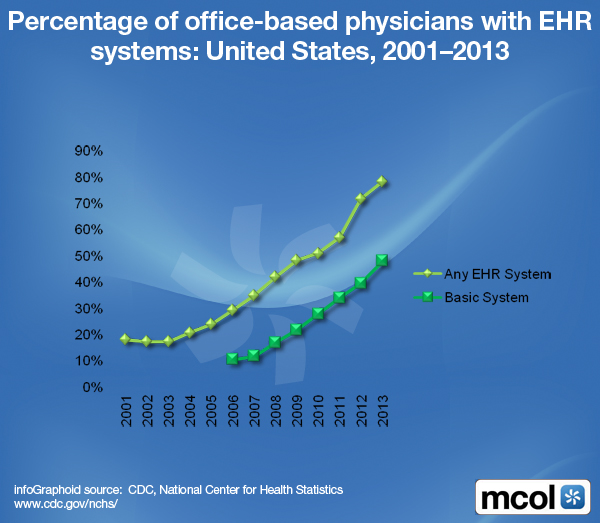
The Percentage of Office-Based Doctors with EHRs

Join Our Mailing List

US 2001-2013

By www.MCOL.com

EHR

Conclusion

Your thoughts and comments on this ME-P are appreciated. Feel free to review our top-left column, and top-right sidebar materials, links, URLs and related websites, too. Then, subscribe to the ME-P. It is fast, free and secure.

Link: http://feeds.feedburner.com/HealthcareFinancialsthePostForcxos

Speaker: If you need a moderator or speaker for an upcoming event, Dr. David E. Marcinko; MBA – Publisher-in-Chief of the Medical Executive-Post – is available for seminar or speaking engagements. Contact: MarcinkoAdvisors@msn.com

OUR OTHER PRINT BOOKS AND RELATED INFORMATION SOURCES:

DICTIONARIES: http://www.springerpub.com/Search/marcinko
PHYSICIANS: www.MedicalBusinessAdvisors.com
PRACTICES: www.BusinessofMedicalPractice.com
HOSPITALS: http://www.crcpress.com/product/isbn/9781466558731
CLINICS: http://www.crcpress.com/product/isbn/9781439879900
BLOG: www.MedicalExecutivePost.com
FINANCE: Financial Planning for Physicians and Advisors
INSURANCE: Risk Management and Insurance Strategies for Physicians and Advisors

Product DetailsProduct Details

Product Details

Understanding Economics of the Medical Practice Profit Motive

  Join Our Mailing List 

Wither the Patient-Assembly Line Product Mentality

By Dr. David Edward Marcinko MBA CMP™

[Editor-in-Chief]

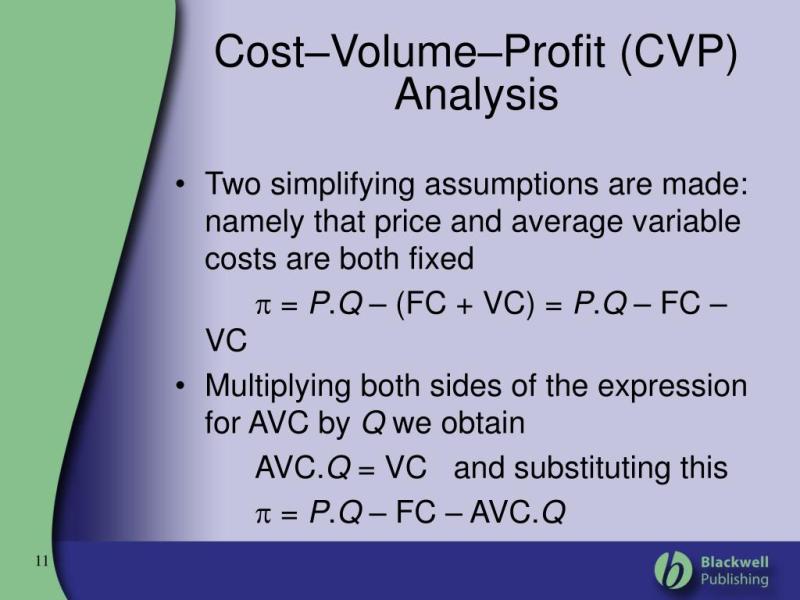
Dr. MarcinkoA cost-volume-profit relationship exists in any healthcare entity and emphasizes the point that the goal of an efficient emerging healthcare organization (EHO) should be profit optimization, rather than revenue or volume maximization.

The profit of any healthcare facility is what’s left after all financial outflows are removed from all financial inflows. This optimization is reached at the point where patient volume, fee per patient, and costs per patient produce highest profit, not the highest revenue.

This is the point of maximum efficiency and is where you want to be. It can be described in the equation below.

The Profit Equation

Medical profit traditionally can be defined by the equation:

Profit = (Price x Volume) – Costs

or P = (P x V) – C

whereas:

Revenue = Price x Volume

or R = PV

Making more Money

To make more money and increase profits, the [physician-executive] doctor must increase price (if possible), increase volume (if possible), or decrease costs (if possible); and ideally the doctor should perform all three maneuvers simultaneously.

Assumptions

If we assume that only costs are under the doctor’s control (a not altogether valid strategy), any strategic financial planning process that ignores them will not be beneficial.

A more efficient doctor addresses cost and volume together; but at some point, more volume does not equal more profit. This point is known as the average cost per patient and should be determined and known for each doctor, service segment, clinic, or hospital.

If visually graphed, the curve would be “U” shaped with both arms extending upward and the hump pointed downward at its most efficient point on the long-range average cost (LRAC) curve.

This tangent is the point of maximum efficiency and this is where the healthcare entity should be, as seen diagrammatically below.

Figs 1 and 2

Working harder by taking on more patients, performing additional procedures, or working additional hours in this scenario will not get the clinic, hospital, or medical practice ahead, only further behind and less economically efficient.

Thus, the main goal for all EHOs is profit improvement, not just revenue improvement …. DO-H!

Doctor-Business

The Cost Volume Relationship

Once the fixed and variable costs of a medical practice or hospital clinic are known, the effects of changes in volume on its cost structure can easily be determined.

This is known as the cost-volume relationship, as seen diagrammatically below.

Figs 1 and 2

Cost-Volume-Profit Analysis

Once a basic understanding of medical cost behavior has been achieved, the techniques of cost-volume-profit analysis (CVPA) can be used to further refine the managerial cost and profit aspects of the office business unit. They can also help illustrate the important differences between the traditional office net income statement and the more contemporary contribution margin income statement.

***

***

Assessment

CVPA is thus concerned with the relationship among prices of medical services, unit volume, per unit variable costs, total fixed costs, and the mix of services provided.

MORE: Negotiating CVPA

Conclusion

Your thoughts and comments on this ME-P are appreciated. Feel free to review our top-left column, and top-right sidebar materials, links, URLs and related websites, too. Then, subscribe to the ME-P. It is fast, free and secure.

Link: http://feeds.feedburner.com/HealthcareFinancialsthePostForcxos

Speaker: If you need a moderator or speaker for an upcoming event, Dr. David E. Marcinko; MBA – Publisher-in-Chief of the Medical Executive-Post – is available for seminar or speaking engagements. Contact: MarcinkoAdvisors@msn.com

OUR OTHER PRINT BOOKS AND RELATED INFORMATION SOURCES:

LEXICONS: http://www.springerpub.com/Search/marcinko
PHYSICIANS: www.MedicalBusinessAdvisors.com
PRACTICES: www.BusinessofMedicalPractice.com
HOSPITALS: http://www.crcpress.com/product/isbn/9781466558731
CLINICS: http://www.crcpress.com/product/isbn/9781439879900
ADVISORS: www.CertifiedMedicalPlanner.org
PODIATRISTS: www.PodiatryPrep.com
BLOG: www.MedicalExecutivePost.com

Children and Inheritances

Join Our Mailing List

The Last Money Taboo?

By Rick Kahler CFP® http://www.KahlerFinancial.com

Rick Kahler CFPTalking about money is taboo in the US. If you don’t believe me, next time you’re at a social gathering ask everyone these two questions:

1. “What was your taxable income last year?”

2. “What is your net worth?”

Well, it’s not a recommended way to make new friends.

The Money Taboo

The taboo on money conversations can cause real difficulties when it extends to families. My experience as a financial planner suggests most families in the US have a “no-talk” rule around money. While a lot of family members know each other’s earnings, fewer know family members’ net worth. Even fewer have asked about their parents’ estate planning.

Many don’t intend to ever ask.  A blogger who calls himself the Financial Samurai wrote: “I never want to have the inheritance talk with my parents unless they initiate the conversation.”

Based on the responses to his article, he isn’t the only person holding this opinion. Most children recoil at even the thought of asking their parents about the particulars of their estate plans.

None of My Business

In my experience, the most common reasons for not talking to parents about their inheritance plans are these:  “It’s none of my business,” “I don’t want them to think I am greedy,” and, “It will ruin our relationship.”

Why Not Ask?

Let’s look at each of these reasons:

1. “It’s none of my business.” It’s true that parents have no obligation to disclose their finances and estate plan to their children. Yet it could quickly become your business if you are named as an executor in their wills, a successor trustee in a trust, or an agent in their powers of attorney. Asking whether you are designated as any of these roles is totally reasonable. If you are, then knowing the particulars of their estate plan and finances would be helpful for you to know. It is such a reasonable request that, if your parents are not willing to discuss the details, you may be best served asking them to name someone else.

2. “I don’t want them to think I am greedy.” If you’ve had your hand out to your parents most of your life, asking them how much you’re going to get when they kick off may not evoke a loving response. However; if you have never asked your parents for money – or – if you have asked for money and have paid them back; then you probably don’t have much to worry about! If you approach the topic from the standpoint of wanting to be fully prepared to carry out any duties bestowed upon you, I seriously doubt your parents will suddenly think you’ve morphed into a greedy, money-sucking leach.

3. “It will ruin our relationship.” One of the strongest money scripts around talking about money is that doing so will permanently harm a relationship. The Financial Samurai wrote, “I hate thinking about money and family because so often money tears relationships apart.” While money issues can certainly tear apart a relationship, so can abusing alcohol, sex, drugs, work, power, and a host of other things.

Mature Woman

Assessment

What I’ve seen is that keeping secrets about money is more harmful to relationships than talking about money. When the no-talk rule is in effect, family members make up their own stories about what is real. Those stories are rarely true, and the assumptions around them can cause misunderstanding and mistrust.

Being the first to break a family’s “no money talk” rule isn’t easy. Yet having the courage to start money conversations can be a service to the whole family. In my experience, it ultimately leads to better estate plans, more trust, and stronger relationships.

Conclusion

Your thoughts and comments on this ME-P are appreciated. Feel free to review our top-left column, and top-right sidebar materials, links, URLs and related websites, too. Then, subscribe to the ME-P. It is fast, free and secure.

Link: http://feeds.feedburner.com/HealthcareFinancialsthePostForcxos

Speaker: If you need a moderator or speaker for an upcoming event, Dr. David E. Marcinko; MBA – Publisher-in-Chief of the Medical Executive-Post – is available for seminar or speaking engagements. Contact: MarcinkoAdvisors@msn.com

OUR OTHER PRINT BOOKS AND RELATED INFORMATION SOURCES:

DICTIONARIES: http://www.springerpub.com/Search/marcinko
PHYSICIANS: www.MedicalBusinessAdvisors.com
PRACTICES: www.BusinessofMedicalPractice.com
HOSPITALS: http://www.crcpress.com/product/isbn/9781466558731
CLINICS: http://www.crcpress.com/product/isbn/9781439879900
BLOG: www.MedicalExecutivePost.com
FINANCE: Financial Planning for Physicians and Advisors
INSURANCE: Risk Management and Insurance Strategies for Physicians and Advisors

Product Details  Product Details

On the Growing Population [Mental] Health Cohorts

Join Our Mailing List

[By Carol Miller RN MBA]

Carol S. MillerIncreased and Diversified Patient Populations

It is well know that patient populations at community mental health centers are on the rise and this rise is associated with different groups or classifications of individuals. Some centers may or may not have experienced increases in these specific classifications previously; however, they are increasing in many centers today and will continue in the future.

For example:

Older Adults

There is an unprecedented number of older adults who are experiencing substance abuse issues, depression, anxiety, or dementia-related behavioral and psychiatric symptoms along with a multitude of medical issues as well as complicated medication regimens that frequent these centers across the United States. The current clinic healthcare workforce is not prepared to address this influx of patients and their associated special needs at these centers.

Youngsters

Another category, children and teenagers, is also on the rise. This can be attributed to more schools referring students, more families seeking care for their children, more emphasis being placed upon mental health treatments and medications, or a combination of things.

Minorities

Minorities, such as Hispanics, Latinos, African American, and others are somewhat reluctant to seek behavioral health treatment because of the associated cultural stigma surrounding mental health. However, when these same individuals have a combined physical and mental healthcare related need, they are seeking care at community centers.

PTSD

Finally, others seeking care have had terrorism scares, are Veterans with Post Traumatic Stress Disorder (PTSD) and other affiliated behavioral symptoms, or have been afflicted with a long term mental or emotional issue from the impact of natural disasters that caused a lost loved one, home, pet, or job.

Brain view

Assessment

Many of these individuals not only have mental health issues but also have one or many medical health issues creating a complex case.

Conclusion

Your thoughts and comments on this ME-P are appreciated. Feel free to review our top-left column, and top-right sidebar materials, links, URLs and related websites, too. Then, subscribe to the ME-P. It is fast, free and secure.

Link: http://feeds.feedburner.com/HealthcareFinancialsthePostForcxos

Speaker: If you need a moderator or speaker for an upcoming event, Dr. David E. Marcinko; MBA – Publisher-in-Chief of the Medical Executive-Post – is available for seminar or speaking engagements. Contact: MarcinkoAdvisors@msn.com

OUR OTHER PRINT BOOKS AND RELATED INFORMATION SOURCES:

DICTIONARIES: http://www.springerpub.com/Search/marcinko
PHYSICIANS: www.MedicalBusinessAdvisors.com
PRACTICES: www.BusinessofMedicalPractice.com
HOSPITALS: http://www.crcpress.com/product/isbn/9781466558731
CLINICS: http://www.crcpress.com/product/isbn/9781439879900
BLOG: www.MedicalExecutivePost.com
FINANCE: Financial Planning for Physicians and Advisors
INSURANCE: Risk Management and Insurance Strategies for Physicians and Advisors

Product Details

Medical Provider Readiness for ICD-10?

Join Our Mailing List

And, for Health Plans, too!

By www.MCOL.com

ImageProxy

Conclusion

Your thoughts and comments on this ME-P are appreciated. Feel free to review our top-left column, and top-right sidebar materials, links, URLs and related websites, too. Then, subscribe to the ME-P. It is fast, free and secure.

Link: http://feeds.feedburner.com/HealthcareFinancialsthePostForcxos

Speaker: If you need a moderator or speaker for an upcoming event, Dr. David E. Marcinko; MBA – Publisher-in-Chief of the Medical Executive-Post – is available for seminar or speaking engagements. Contact: MarcinkoAdvisors@msn.com

OUR OTHER PRINT BOOKS AND RELATED INFORMATION SOURCES:

DICTIONARIES: http://www.springerpub.com/Search/marcinko
PHYSICIANS: www.MedicalBusinessAdvisors.com
PRACTICES: www.BusinessofMedicalPractice.com
HOSPITALS: http://www.crcpress.com/product/isbn/9781466558731
CLINICS: http://www.crcpress.com/product/isbn/9781439879900
BLOG: www.MedicalExecutivePost.com
FINANCE: Financial Planning for Physicians and Advisors
INSURANCE: Risk Management and Insurance Strategies for Physicians and Advisors

Product DetailsProduct Details

Product Details

Are Employees Opting Out of 401(k) or 403(b) Plans?

Join Our Mailing List 

New Retirement Thoughts for all Employees

By Rick Kahler CFP® http://www.KahlerFinancial.com

Rick Kahler CFPHow hard is it to do things we know are good for us – like exercising more – or saving for retirement?

New Year’s Resolutions

This time of year, with broken New Year’s resolutions piling up like snow-banks, it’s clear that the answer is “very hard.” Most of us have good intentions, but we aren’t so good at taking consistent action to turn those intentions into reality.

Retirement Pans

One of the areas where many people don’t do what’s best for them-selves is participating in company retirement plans. If your employer offers a 401(k) or 403(b) plan, it’s ridiculous not to participate in it. For one thing, it’s an easy way to put money away for retirement before you see it—and before you pay taxes on it. Even better, the employer’s matching contributions give an extra boost to your savings that’s almost like found money.

Yet studies have shown that only 67% of eligible employees participate in these plans if they have to choose to sign up. When employees are automatically enrolled in the plans, and have to actively choose to opt out; however, the level of participation increases to 77%.

For this reason, the US government in recent years is encouraging large employers to offer automatic-enrollment retirement plans.

US News Report

Yet a recent article in US News points out a downside to this well-intentioned attempt to save procrastinating non-savers from themselves. Plans with automatic enrollment may have higher participation, but that doesn’t necessarily mean greater benefits for employees.

Why no Better?

When more employees participate in a 401(k) plan, the employer has higher costs in the form of increased matching contributions.

A study last fall by the Center for Retirement Research at Boston College found that companies with automatic enrollment tend to compensate for those higher costs with smaller matches. The average amount—3.2%, compared with 3.5% for plans that don’t have automatic enrollment—may seem insignificant. Yet over time it can make a big difference in the amount of money an employee has available at retirement.

Default Rates

More importantly, the study also found that the default contribution rate (the amount invested out of each paycheck) in some automatic-enrollment plans resulted in employees saving less than had they chosen that amount themselves. The default contribution rates are likely to be less than the rate required to receive the employer’s maximum matching contribution. The default investment options also tend to have underperforming investment choices compared to those chosen independently by participants.

Report Synopsis

One rather obvious conclusion of the study is that automatic enrollment means more retirement savings for employees who otherwise would not have signed up for a 401(k). At the same time, because of the lower employer matches, employees who would have chosen to sign up anyway are likely to end up with less retirement savings than they would have in a non-automatic plan.

MD Retirement planning

Questions

Does this mean automatic-enrollment 401(k) plans are not a good option for retirement saving? Not at all! If you passively participate in an automatic plan and leave your contributions at the default contribution rates and investment choices, you’ll still be better off than if you don’t participate at all.

Research

Yet the research suggests that settling for the employer defaults, a one-size-fits-most option, is probably not your best choice. You can choose instead to educate yourself about the investment choices in a plan, contribute the maximum amount you can, and take full advantage of the employer match. The more you learn about the available options, the better choices you’ll be able to make.

Assessment

Ultimately, no employer or plan manager will ever care more about your investments than you do. The most successful retirement savers are still those who take responsibility for their own future.

Conclusion

Your thoughts and comments on this ME-P are appreciated. Feel free to review our top-left column, and top-right sidebar materials, links, URLs and related websites, too. Then, subscribe to the ME-P. It is fast, free and secure.

Link: http://feeds.feedburner.com/HealthcareFinancialsthePostForcxos

Speaker: If you need a moderator or speaker for an upcoming event, Dr. David E. Marcinko; MBA – Publisher-in-Chief of the Medical Executive-Post – is available for seminar or speaking engagements. Contact: MarcinkoAdvisors@msn.com

OUR OTHER PRINT BOOKS AND RELATED INFORMATION SOURCES:

DICTIONARIES: http://www.springerpub.com/Search/marcinko
PHYSICIANS: www.MedicalBusinessAdvisors.com
PRACTICES: www.BusinessofMedicalPractice.com
HOSPITALS: http://www.crcpress.com/product/isbn/9781466558731
CLINICS: http://www.crcpress.com/product/isbn/9781439879900
BLOG: www.MedicalExecutivePost.com
FINANCE: Financial Planning for Physicians and Advisors
INSURANCE: Risk Management and Insurance Strategies for Physicians and Advisors

Product Details  Product Details

Three New Medical Management and Retirement Planning Videos

Join Our Mailing List

Watch These Channel Presentations

By Andrew Schwartz CPA

www.schwartzaccountants.com

Andrew SchwartzRetirement Plan Basics for Practice Owners

Wondering which type of retirement plan makes the most sense for your practice? Here, you’ll also learn why it makes sense to set up and begin to max out your retirement plan savings as soon as possible.

Million Dollar Metrics for General Dentists

General dentists can learn which metrics to generate to gauge how their practice is doing, and compare those metrics with other practices, including a sample of practices that routinely collect one million dollars or more each year.

SIBS: Implementing a Simple Incentive Bonus System

Learn to increase revenues and profits at your practice by implementing a Simple Incentive Bonus System [SIBS]. We’ve seen a lot of clients implement a SIBS and experience immediate results within their practices.

Conclusion

Your thoughts and comments on this ME-P are appreciated. Feel free to review our top-left column, and top-right sidebar materials, links, URLs and related websites, too. Then, subscribe to the ME-P. It is fast, free and secure.

Link: http://feeds.feedburner.com/HealthcareFinancialsthePostForcxos

Speaker: If you need a moderator or speaker for an upcoming event, Dr. David E. Marcinko; MBA – Publisher-in-Chief of the Medical Executive-Post – is available for seminar or speaking engagements. Contact: MarcinkoAdvisors@msn.com

OUR OTHER PRINT BOOKS AND RELATED INFORMATION SOURCES:

DICTIONARIES: http://www.springerpub.com/Search/marcinko
PHYSICIANS: www.MedicalBusinessAdvisors.com
PRACTICES: www.BusinessofMedicalPractice.com
HOSPITALS: http://www.crcpress.com/product/isbn/9781466558731
CLINICS: http://www.crcpress.com/product/isbn/9781439879900
BLOG: www.MedicalExecutivePost.com
FINANCE: Financial Planning for Physicians and Advisors
INSURANCE: Risk Management and Insurance Strategies for Physicians and Advisors

Product DetailsProduct Details

Product Details

National Health Expenditure Growth

Join Our Mailing List

A Report from the Office of the Actuary

Source: Centers for Medicare & Medicaid Services

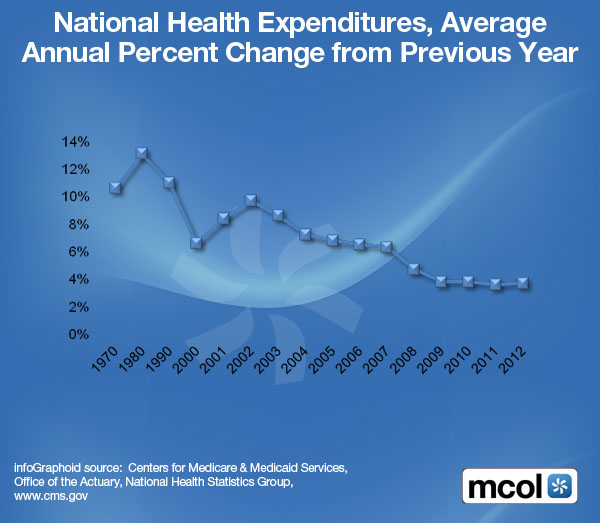
According to the Centers for Medicare & Medicaid Services (CMS) Office of the Actuary, overall national health expenditures grew at an annual rate of 3.7 percent in 2012, marking the fourth consecutive year of low growth. Health spending as a share of gross domestic product fell slightly from 17.3 percent in 2011 to 17.2 percent in 2012.

Private Insurance

Private health insurance spending growth remained low. Private health insurance spending continued to grow at a low rate, increasing 3.2 percent in 2012 compared to 3.4 percent growth in 2011. Medicare spending growth continued to be low. Despite a large uptick in Medicare enrollment, Medicare spending growth slowed slightly in 2012, increasing by 4.8 percent compared to 5.0 percent growth in 2011.

The Totals for MC/MD

Total Medicare spending per enrollee grew by only 0.7 percent in 2012. Medicaid spending continued to grow at a historically low rate. Total Medicaid spending grew 3.3 percent in 2012. While an increase over 2011, this increase still represents historically low overall growth rates tied to improved economic conditions, as well as efforts by states to control costs.

Rx Drugs

Prescription drug spending growth was low. Retail prescription drug spending slowed in 2012, growing only 0.4 percent as the result of numerous drugs losing their patent protection, leading to increased sales of lower-cost generics. Nursing home spending growth slowed.

Pharma

Assessment

Spending for freestanding nursing care facilities and continuing care retirement communities increased by only 1.6 percent in 2012, down from 4.3 percent growth in 2011, due to a one-time Medicare rate adjustment for skilled nursing facilities.

Conclusion

Your thoughts and comments on this ME-P are appreciated. Feel free to review our top-left column, and top-right sidebar materials, links, URLs and related websites, too. Then, subscribe to the ME-P. It is fast, free and secure.

Link: http://feeds.feedburner.com/HealthcareFinancialsthePostForcxos

Speaker: If you need a moderator or speaker for an upcoming event, Dr. David E. Marcinko; MBA – Publisher-in-Chief of the Medical Executive-Post – is available for seminar or speaking engagements. Contact: MarcinkoAdvisors@msn.com

OUR OTHER PRINT BOOKS AND RELATED INFORMATION SOURCES:

DICTIONARIES: http://www.springerpub.com/Search/marcinko
PHYSICIANS: www.MedicalBusinessAdvisors.com
PRACTICES: www.BusinessofMedicalPractice.com
HOSPITALS: http://www.crcpress.com/product/isbn/9781466558731
CLINICS: http://www.crcpress.com/product/isbn/9781439879900
BLOG: www.MedicalExecutivePost.com
FINANCE: Financial Planning for Physicians and Advisors
INSURANCE: Risk Management and Insurance Strategies for Physicians and Advisors

Product DetailsProduct Details

Product Details

Reviewing National Health Expenditures

Join Our Mailing List

Average Annual Percent Change from the Previous Year

By www.MCOL.com

ImageProxy

Conclusion

Your thoughts and comments on this ME-P are appreciated. Feel free to review our top-left column, and top-right sidebar materials, links, URLs and related websites, too. Then, subscribe to the ME-P. It is fast, free and secure.

Link: http://feeds.feedburner.com/HealthcareFinancialsthePostForcxos

Speaker: If you need a moderator or speaker for an upcoming event, Dr. David E. Marcinko; MBA – Publisher-in-Chief of the Medical Executive-Post – is available for seminar or speaking engagements. Contact: MarcinkoAdvisors@msn.com

OUR OTHER PRINT BOOKS AND RELATED INFORMATION SOURCES:

DICTIONARIES: http://www.springerpub.com/Search/marcinko
PHYSICIANS: www.MedicalBusinessAdvisors.com
PRACTICES: www.BusinessofMedicalPractice.com
HOSPITALS: http://www.crcpress.com/product/isbn/9781466558731
CLINICS: http://www.crcpress.com/product/isbn/9781439879900
BLOG: www.MedicalExecutivePost.com
FINANCE: Financial Planning for Physicians and Advisors
INSURANCE: Risk Management and Insurance Strategies for Physicians and Advisors

Product DetailsProduct Details

Product Details

3 Steps to Take Before Buying Healthcare E-Signature Solutions

Join Our Mailing List

More on Paperless Healthcare Records

[By Patrick McTosh]

The movement towards paperless healthcare is growing. Every year, more and more health professionals are beginning to implement EMRs and EHRs as a way to turn their file cabinets into data on a hard drive. While EHRs help the problems of storing paper, they do not create documents that can be legally, securely and efficiently shared with third parties and patients during day to day activities.

These issues can be addressed by implementing an electronic signature solution. These types of solutions allow professions to create documents for physician orders, prescriptions, patient admissions, consent forms and other important medical documents in a timely and relatively paper free manner.

Verify EHR or EMR Integration

It’s important to ensure that whatever electronic signature software is compatible with your current EHR and EMR software. While most e-signature solution providers claim they have specialized services for healthcare organization, it’s best to confirm with a phone call or email that they have experience integrating their services with the EMR that is currently in use.

Verify Local Legislation & Signature Guidelines

Hospital accreditors have already recognized e-signatures as equivalent to paper signatures. However, it’s always important to verify federal and state regulations regarding e-prescriptions and electronic signatures.

For example, the latest DEA regulations on electronic prescriptions require digital signatures to have at least a biometric authentication. In addition, some states have not adopted the Uniform Electronic Transactions Act and therefore have difference laws pertaining to the legality of e-signatures.

Most e-signature providers specializing in healthcare tend to be on top of these things because better legal compliance is one of the benefits of e-signatures as a whole, but it’s always better do double check.

eHRs

Ensure It’s Human Error Proof

Many e-signature solutions attempt to reduce the risk of human error due to lost, damage or incorrectly completed forms which can cause significant delays. As most e-signature software will actually guide the signer through the complete process ensuring that the document meets necessary requirements before sealing the document with a tamper-evident digital seal.

Assessment

However, not all providers have such precautions against human errors, but it is definitely a must in the healthcare industry.

Conclusion

Your thoughts and comments on this ME-P are appreciated. Feel free to review our top-left column, and top-right sidebar materials, links, URLs and related websites, too. Then, subscribe to the ME-P. It is fast, free and secure.

Link: http://feeds.feedburner.com/HealthcareFinancialsthePostForcxos

Speaker: If you need a moderator or speaker for an upcoming event, Dr. David E. Marcinko; MBA – Publisher-in-Chief of the Medical Executive-Post – is available for seminar or speaking engagements. Contact: MarcinkoAdvisors@msn.com

OUR OTHER PRINT BOOKS AND RELATED INFORMATION SOURCES:

DICTIONARIES: http://www.springerpub.com/Search/marcinko
PHYSICIANS: www.MedicalBusinessAdvisors.com
PRACTICES: www.BusinessofMedicalPractice.com
HOSPITALS: http://www.crcpress.com/product/isbn/9781466558731
CLINICS: http://www.crcpress.com/product/isbn/9781439879900
BLOG: www.MedicalExecutivePost.com
FINANCE: Financial Planning for Physicians and Advisors
INSURANCE: Risk Management and Insurance Strategies for Physicians and Advisors

Product DetailsProduct Details

On Inheritances by Country

Join Our Mailing List 

Spending an Inheritance

By Rick Kahler CFP® www.KahlerFinancial.comRick Kahler CFP

Stroll through a retirement camping resort or pass an RV on the highway, and you might see this bumper sticker:

“We’re spending our children’s inheritance”

No Joke

Apparently, this isn’t a joke. A December 13, 2013, article in CNN Money reported on a recent survey by the British-based international financial services company HSBC which asked more than 16,000 people in 15 countries about their estate plans. The US ranks last in the percentage of retired parents (56%) that intend to leave money to their kids. This is significantly below the 15-country average of 69% and far below the leading percentage of 86% in India.

US Rank

The US also ranks sixth in the amount of money ($177,000) that parents expect to pass on. This is behind Australia ($501,000), Singapore ($371,000), the UK ($234,185), France ($233,699), and Taiwan ($191,039).

No doubt there are many reasons for the country-by-country differences in what parents expect to leave their children. These may include differences in cultures, beliefs about family responsibilities, and attitudes toward charitable giving.

Contributing Factors

Other contributing factors, however, are differences in countries’ economic strength and tax laws. In a December 13 interview with The Australian, Graham Heunis, the head of retail banking and wealth management for HSBC Australia, credited some of the large inheritances there to the country’s unbroken 22 recent years of economic prosperity. Australian household wealth grew 7.6 per cent a year over the past decade, making it one of the richest nations per capita in the world.

Heunis also said, “In markets like the UK and US, inheritance and estate tax may cost heirs upwards of 40 per cent of an inheritance. With no inheritance tax in Australia, it’s no surprise the value and proportion of inheritance among Australian retirees is exponentially higher than the rest of the world.”

A Good Thing

It’s refreshing to see that accumulating and keeping wealth is still looked upon as a good thing in some countries. I doubt it’s a coincidence that most of those countries have strong economies, similar to what the US enjoyed in the past.

According to the 2013 Index of Economic Freedom, Singapore and Australia, the top two countries for inheritances, are two of the only three countries considered to have “free economies.” (The third is Hong Kong, where the average amount parents expect to pass on to kids is $145,943.) The US, considered the third top “free economy” in 2000, now sits at tenth as a “mostly free economy.”

Survey

This survey is not good news for baby boomers hoping to retire on inheritances from their parents. According to CNN Money, “About two-thirds of U.S. respondents said the inheritances they receive will at least partly fund their retirement, and 10% said they will rely on their inheritance completely to retire.”

If two-thirds of middle-aged Americans expect substantial inheritances, but only about half of elderly retired parents expect to leave inheritances, somebody is going to be disappointed.

Still, for those, like the majority of baby boomers, who are unprepared for retirement, every little bit helps. While an inheritance of $177,000 won’t put anyone on Easy Street in retirement, it could pay off a home mortgage or, if invested wisely, generate a monthly income of $450 for life.

inheritance

Another Problem

One last problem for potential heirs, of course, is that just because parents expect to leave an inheritance doesn’t mean they will be able to do so. Medical expenses or other unanticipated costs might well eat up parents’ resources during their lifetimes.

Assessment

Ultimately, relying on an inheritance for your retirement is never a wise move. It’s far wiser to use your own resources, start retirement planning early, and build your own financial security.

Conclusion

Your thoughts and comments on this ME-P are appreciated. Feel free to review our top-left column, and top-right sidebar materials, links, URLs and related websites, too. Then, subscribe to the ME-P. It is fast, free and secure.

Link: http://feeds.feedburner.com/HealthcareFinancialsthePostForcxos

Speaker: If you need a moderator or speaker for an upcoming event, Dr. David E. Marcinko; MBA – Publisher-in-Chief of the Medical Executive-Post – is available for seminar or speaking engagements. Contact: MarcinkoAdvisors@msn.com

OUR OTHER PRINT BOOKS AND RELATED INFORMATION SOURCES:

DICTIONARIES: http://www.springerpub.com/Search/marcinko
PHYSICIANS: www.MedicalBusinessAdvisors.com
PRACTICES: www.BusinessofMedicalPractice.com
HOSPITALS: http://www.crcpress.com/product/isbn/9781466558731
CLINICS: http://www.crcpress.com/product/isbn/9781439879900
BLOG: www.MedicalExecutivePost.com
FINANCE: Financial Planning for Physicians and Advisors
INSURANCE: Risk Management and Insurance Strategies for Physicians and Advisors

Product Details  Product Details

Learn the “Right” Investing Lessons from 2013

Join Our Mailing List 

Understanding the Recency Effect

Lon JeffriesBy Lon Jefferies MBA CFP® www.NetWorthAdvice.com

The year 2013 was viewed as a very positive one by most investors; especially physician-investors.

The S&P 500 index (measuring large cap U.S. stocks) was up 32.39% for the year.

However, the reality is most other asset categories didn’t come close to keeping up with the pace set by U.S. equities.

For instance:

  • Foreign Stocks (IEFA): 22.46%
  • Emerging Markets (IEMG): -2.77%
  • Real Estate (IYR): 1.16%
  • US Government Bonds (IEF): -6.09%
  • US TIPS (TIP): -8.49%
  • Corporate Bonds (LQD): -2.00%
  • International Bonds (IGOV): -1.37%
  • Emerging Market Bonds (LEMB): -6.73%
  • Commodities (DJP): -11.12%
  • Gold (GLD): -28.33%

In Hindsight

In retrospect, the way to maximize your gain last year would have been to hold a completely undiversified portfolio consisting of nothing but U.S. stocks. The danger going forward is to learn the wrong lesson from 2013. Investors always have the temptation to fall prey to the Recency Effect, continuing and exaggerating the behaviors that worked in the recent past believing the environment we’ve just been through will be permanent.

The Long-Term Benefits of Diversification

Many will abandon their investment strategy because it didn’t give them the absolute best result last year, failing to recognize the long-term benefit of diversification. I’d argue that a better perspective is to remind yourself that the definition of diversification is that you always dislike a portion of your portfolio.

Always Laggards

Even in the most widely prosperous market environment, a truly diversified portfolio will have an element or two that lags the market. In fact, if at any time a portion of your portfolio isn’t generating negative returns, you should be concerned about a lack of diversification in your investment strategy.

Allocate Assets Now

Now is an ideal time to review your asset allocation and remind yourself why we diversify. Modifying your allocation with a focus on what happened in 2013 would be similar to guessing a coin flip will land on tails because it did on the previous flip.

Stock Market

Assessment

The correct lesson to take from 2013 is that over time, a well-diversified portfolio is capable of producing sufficient returns to help you reach your investment goals while minimizing risk.

Conclusion

Your thoughts and comments on this ME-P are appreciated. Feel free to review our top-left column, and top-right sidebar materials, links, URLs and related websites, too. Then, subscribe to the ME-P. It is fast, free and secure.

Link: http://feeds.feedburner.com/HealthcareFinancialsthePostForcxos

Speaker: If you need a moderator or speaker for an upcoming event, Dr. David E. Marcinko; MBA – Publisher-in-Chief of the Medical Executive-Post – is available for seminar or speaking engagements. Contact: MarcinkoAdvisors@msn.com

OUR OTHER PRINT BOOKS AND RELATED INFORMATION SOURCES:

DICTIONARIES: http://www.springerpub.com/Search/marcinko
PHYSICIANS: www.MedicalBusinessAdvisors.com
PRACTICES: www.BusinessofMedicalPractice.com
HOSPITALS: http://www.crcpress.com/product/isbn/9781466558731
CLINICS: http://www.crcpress.com/product/isbn/9781439879900
BLOG: www.MedicalExecutivePost.com
FINANCE: Financial Planning for Physicians and Advisors
INSURANCE: Risk Management and Insurance Strategies for Physicians and Advisors

Product Details  Product Details

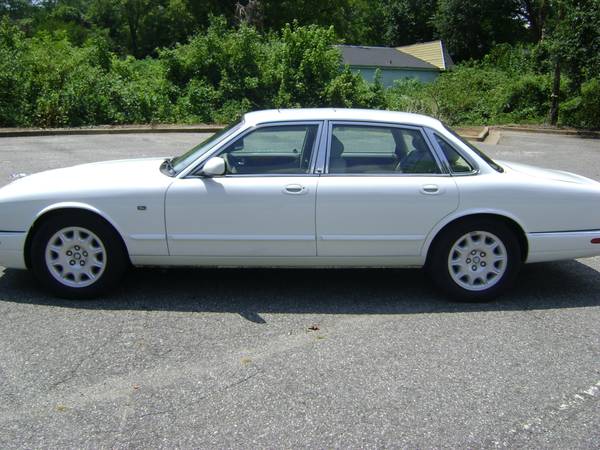
The 2000 Jaguar Touring Sedan [One of the finest luxury cars ever built – yesterday]

Join Our Mailing List 

About the JAGUAR XJ-V8-L [circa 2000]

By Dr. David Ewdard Marcinko MBA CMP™

Dr. David E. Marcinko MBAProof is in the long haul, of course [more than a decade for me], but it appears as if Jaguar finally threw off the curse of unreliability. Credit typically goes to many sources, but leading the pack has to be Jaguar’s prior owner, Ford, which has brought its mighty engineering and quality suppliers into the Jaguar picture. Tata Motors, today.

Based on my experience, the XJ8L represents the highest point in Jaguar’s history. Many think it’s one of the finest luxury sedans ever built. The Vanden Plas, named for a famous British maker of custom automobile bodies, is the most luxurious XJ8L, swathed in chrome, walnut and lambs wool.

As the XJ8 designation suggests, this is a V8-powered Jag. The V12 and inline 6-cylinder engines were discontinued with the 1999 models. The 4.0-liter V8 called a sweetheart was refined in 2000 to reduce emissions. Performance was not affected.

Jaguar’s XJ8 was available in four versions in 2000: Originally priced at $55,780 XJ8, the $60,830 long wheelbase XJ8L, the even more luxurious $64,880 Vanden Plas and the $69,030 supercharged and fully loaded XJR. Those prices compared favorably to those of the $66,970 BMW 740iL and the $74,495 Mercedes-Benz S420; back in the day.

2

Walkaround

Regardless of trim line, Jaguar’s XJ is a beautiful car. It is stately without being stuffy, and the soft lines are uniquely Jaguar. The 2000 XJ8 continued the design theme set in 1986; Jaguar tried horizontal, contemporary-looking headlights in the 1980s, but they were so universally assailed that the company came back with round lights and they are critical to the overall look.

The Vanden Plas shares the longer wheelbase with the XJ8L, which is 117.9 inches. The standard XJ8 and the XJR ride on a 113-in. wheelbase. Visually, that wheelbase extension is reflected in the length of the rear windows.

The powertrain, suspension and electrical system were new to the sedan. Tata now owns Jaguar and has brought financial support and technology to the company, which greatly benefited the XJ8. Electrical systems, electronics and other traditional Jaguar problem areas have been eliminated since Ford got involved.

The 4.0-liter V8 has double overhead-cams and four valves per cylinder. It produces 290 horsepower at 6100 rpm and 290 pound-feet of torque at 4250 rpm.

That impressive power is delivered to the rear wheels through a five-speed automatic transmission. This electronically controlled automatic adapts to varying driving conditions; it senses whether the driver is cruising along the highway, hot-footing down a back road or climbing a long grade and it varies shift points accordingly for optimum power and efficiency.

The transmission also had a self-regulating adaptive capability; it compensates automatically for the effects of aging by adjusting shift quality based on any slippage it detects. Sport and standard modes can be selected by the driver: The standard PRNDL pattern can be used, or shifts can be made manually by moving the stick to the left.

Automatic Stability Control comes standard on all Jaguars. ASC operates at all speeds, using engine intervention to reduce wheel spin on slippery roads. If a rear wheel starts to spin, the anti-lock brake (ABS) controller signals a computer, which controls the spinning by reducing throttle, retarding ignition timing or cutting fuel to the cylinders. This feature has been a bit problematic for me; and others.

An optional traction control system includes all ASC functions plus brake intervention. This system comes as part of the All-Weather package, which also includes heated front and rear seats. Both types of traction control can be switched off.

The front suspension is fully independent with unequal-length upper and lower wishbones, coil springs, shocks and an anti-roll bar. Double wishbones are also used at the rear with the drive shafts acting as upper links.

They are arranged for anti-lift under braking and anti-squat under acceleration. Variable-ratio rack-and-pinion power steering is speed-sensitive.

1

Interior

Jaguar’s uniqueness is especially evident inside my vehicle. Getting in is like sliding into an English gentleman’s club, with yards of supple leather, luxurious deep-pile carpeting, and polished wood on the doors, instrument panel and steering wheel. The instruments are simple and understated in keeping with the elegant mood.

Memory functions automatically adjust the driver’s seat, steering wheel and outside mirror. The driver’s seat moves back when Park is engaged for easy exit. It moves back to the last position it was set when the ignition is turned on. A [fragile] cup-holder pops out from the console, but any drinks in it tend to get in the way of shifting.

Thanks to the long wheelbase of the Vanden Plas, or L model, the rear compartment is huge and legroom is expansive. The bench seat has two depressed seating areas, but a third person would be comfortable in the middle. Airplane-like tray tables fold down from the front seatbacks. A small pod with two rocker switches on the left side of the passenger seat allows rear-seat passengers to move the seat fore and aft and adjust the angle of the seat back. Headroom is just as generous as legroom.

4

Driving Impression

The unique looks of the XJ8 and L are complemented by a driving experience all its own. Mercedes and BMW share a ride that is more on the firm side and generally feel tight and buttoned up. Lexus and Infiniti offer a softer ride and a more relaxed atmosphere. The XJ8L is wonderfully comfortable with an elegant feel.

Acceleration performance is startling with instant throttle response. On dry pavement, the Jag will light the rear tires up if the traction control is turned off. In a handful of seconds it’s hurtling past the speed limit. Jaguar says the XJ8 can accelerate from 0 to 60 mph in 6.9 seconds, an impressive feat given its size and weight at 290-horse-power. (The 370-horsepower XJR can do it in a mere 5.4 seconds.)

Shifting is silky smooth, even at full throttle. You can almost feel the transmission signaling the engine to reduce power slightly because a shift is coming. It’s an almost imperceptible pause as the shift is made.

I had some fun with the manual shifting mode, but it seemed superfluous with a transmission that does such a great job on its own. The manual operation is electronically controlled to prevent downshifting at an inappropriate speed. The gear can be selected, but the shift won’t be made until speed has dropped sufficiently.

Differences between Normal and Sport suspension modes are perceptible on rough surfaces and in hard cornering. The Sport setting lets a little more road roughness come through the steering, but gives the car a slightly flatter stance in cornering.

Driving on narrow roads, I discovered that the fenders loom large from the driver’s seat. The left front fender obscures the center line and the right front fender masks the verge to give the driver a feeling the car is taking up all the lane and more. But it isn’t; and we never posed a threat to mail boxes or other vehicles.

The steering lets the driver feel connected to the road, providing a strong sense of control. The wheels do not straighten by themselves after a tight maneuver; they must be brought back in line by turning the steering wheel, just like a race car.

Quiet is an expected part of the luxury quotient, but we didn’t expect this much quiet. It is so quiet inside it’s almost eerie. No wind noise, no road noise, no harmonics from various systems. You can hear the transmission as it reaches a shift point, and there is a sound you realize must be the engine, but it is more like an electric motor humming than a V8 combusting.

Visibility is good in all directions; but I find the headrests make it a bit cumbersome. The C-pillars are quite thin, so rear visibility is above average for cars this size.

Overall, my 2000 XJ-8L provides a very pleasurable driving experience.

3

Assessment

This is certainly one of the finest cars built – yesterday. Ford’s involvement has undoubtedly had a lot to do with that achievement. The old quality bugaboo seems to be just a memory.

BMW and Mercedes and the rest really can’t be compared with the XJ8, other than in price, because the Jaguar offers something altogether different. In price, however, the XJ8 or L was very competitive. For luxury with a difference, drive a Jaguar XJ8 or L series.

Conclusion

Your thoughts and comments on this ME-P are appreciated. Feel free to review our top-left column, and top-right sidebar materials, links, URLs and related websites, too. Then, subscribe to the ME-P. It is fast, free and secure.

Link: http://feeds.feedburner.com/HealthcareFinancialsthePostForcxos

Speaker: If you need a moderator or speaker for an upcoming event, Dr. David E. Marcinko; MBA – Publisher-in-Chief of the Medical Executive-Post – is available for seminar or speaking engagements. Contact: MarcinkoAdvisors@msn.com

OUR OTHER PRINT BOOKS AND RELATED INFORMATION SOURCES:

DICTIONARIES: http://www.springerpub.com/Search/marcinko
PHYSICIANS: www.MedicalBusinessAdvisors.com
PRACTICES: www.BusinessofMedicalPractice.com
HOSPITALS: http://www.crcpress.com/product/isbn/9781466558731
CLINICS: http://www.crcpress.com/product/isbn/9781439879900
BLOG: www.MedicalExecutivePost.com
FINANCE: Financial Planning for Physicians and Advisors
INSURANCE: Risk Management and Insurance Strategies for Physicians and Advisors

Product DetailsProduct DetailsProduct Details

Product Details  Product Details

Product DetailsProduct Details

Product Details

The Impact of Rising Interest Rates on Bonds

Join Our Mailing List

On Interest and Exchange Rates

Lon JeffriesBy Lon Jefferies MBA CFP® www.NetWorthAdvice.com

An interest rate hike has been widely anticipated for some time. According to an October survey of 50 top economists conducted by the Wall Street Journal, the yield on the 10-year Treasury was forecasted to rise nearly one percentage point to 3.47% by the end of 2014.

What impact would such a rise have on your investment or retirement portfolio?

The Impact

Christopher Philips, a senior analyst in Vanguard’s Investment Strategy Group, points out the historical inaccuracy of such forecasts.

For instance, a similar survey conducted in 2010 had economists predicting a 4.24% 10-year Treasury yield by the end of the year, an increase from 3.61% at the time of the forecast. In actuality, rates declines to 3.30% at year-end. The inaccuracy of these forecasts is well documented.

In fact, as Allen Roth mentioned in the December issue of Financial Planning Magazine, a 2005 study by the University of North Carolina titled “Professional Forecasts of Interest Rates and Exchange Rates” found economists predict future rates far less accurately than a random coin flip would fare as a predictor.

Clearly, we can’t be confident what interest rates will do in 2014, but what if economists are finally correct and rates rise? How damaging would an interest rate increase be for bonds? If interest rates rise one percentage point next year, the intermediate aggregate bond index is expected to lose -2.8% — far from catastrophic. Of course, such potential risk is notably minimal when compared to the downside of owning stocks (remember the -36.93% loss endured by the S&P 500 in 2008?).

Historical Performance

It is also interesting to study how bonds have historically performed in periods of rising interest rates. Craig Israelsen, a BYU professor, recently documented how bonds performed during the two most recent periods of rate increases. Israelsen points out that although the federal discount rate rose from 5.46% to 13.42% from 1977 through 1981, the intermediate government/credit index had a 5.63% annualized return during that period. The next period of rising interest rates was from 2002 through 2006, when the federal discount rate had a fivefold increase: from 1.17% to 5.96%. During this period, the intermediate government/credit index obtained a 4.53% annual return. Clearly, even in an environment of rising interest rates, bond performance was surprisingly strong.

##

Muni Bond Underwriters

###

Most importantly, investors should never forget the value bonds add to a portfolio as a diversifier to stocks. Frequently, the performance of stocks and bonds are inversely related.

For instance, when the stock market suffered during the tech bubble crash of 2000-2002, the Barclays Long-Term Government Bond Index rose 20.28%, 4.34%, and 16.99% in those years, respectively.

Current Indices

More recently, when the S&P 500 lost -36.93% in 2008, the Long-Term Government Bond Index rose 22.69% during the year. This diversification benefit may prove useful when stocks ultimately cool off from the extended hot streak they have experienced since 2009.

In 2013, the Aggregate Bond Index decreased in value by -1.98%. Given the occasional negative correlation in performance between stocks and bonds, is it really surprising that bonds didn’t produce a positive return given the incredible year stocks had (S&P 500 up over 32%)? Additionally, held within a diversified portfolio, isn’t the -1.98% return produced by bonds during the recent equity surge a small price to pay for the additional security they are likely to provide when markets reverse?

Assessment

It doesn’t seem prudent to avoid bonds entirely during periods of expected interest rate increases.

  1. First, forecasts of rising rates are far from certain.
  2. Second, even if interest rates rise bonds are still likely to be far less risky than stocks.
  3. Third, rising interest rates don’t necessarily mean declining bond values are a certainty – in fact, bonds performed quite well during the past two periods of rate increases.
  4. Finally, bonds are a vitally important part of a diversified portfolio, and owning uncorrelated and negatively correlated assets will be critical when equities ultimately lose their momentum.

Conclusion

Your thoughts and comments on this ME-P are appreciated. Feel free to review our top-left column, and top-right sidebar materials, links, URLs and related websites, too. Then, subscribe to the ME-P. It is fast, free and secure.

Link: http://feeds.feedburner.com/HealthcareFinancialsthePostForcxos

Speaker: If you need a moderator or speaker for an upcoming event, Dr. David E. Marcinko; MBA – Publisher-in-Chief of the Medical Executive-Post – is available for seminar or speaking engagements. Contact: MarcinkoAdvisors@msn.com

OUR OTHER PRINT BOOKS AND RELATED INFORMATION SOURCES:

DICTIONARIES: http://www.springerpub.com/Search/marcinko
PHYSICIANS: www.MedicalBusinessAdvisors.com
PRACTICES: www.BusinessofMedicalPractice.com
HOSPITALS: http://www.crcpress.com/product/isbn/9781466558731
CLINICS: http://www.crcpress.com/product/isbn/9781439879900
BLOG: www.MedicalExecutivePost.com
FINANCE: Financial Planning for Physicians and Advisors
INSURANCE: Risk Management and Insurance Strategies for Physicians and Advisors

Product Details  Product Details

The Associated Press “American Dream”?

Join Our Mailing List 

On Changing Definitions

By Rick Kahler CFP® http://www.KahlerFinancial.com

Rick Kahler CFPThe surest road to financial success and independence is a long one. That path includes working hard at a career you enjoy, living on less than you earn, taking educated and appropriate risks, and building wealth gradually through diversified investing.

The American Dream

I know many people who have followed this route successfully. Their achievement—what has long been described as the American Dream—should be something to be proud of.

The Associated Press

Apparently, in today’s world, that isn’t the case. At least not according to an Associated Press news article published in the Rapid City Journal on December 9, 2013. The headline was straightforward enough: “Rising riches: 1 in 5 in US reaches affluence.” The article stated that 20% of Americans will have household incomes of $250,000 or more at some point in their lives. This includes those with high incomes for only one year or a few years. During those periods of affluence, they are in the top 2% of earners.

AP Inaccuracies and Assumptions

Beyond that, the piece was filled with inaccuracies and assumptions.

First, its writers confused “affluence” and “wealth.” Someone with a high income in a given year is affluent. Anyone with a basic grasp of finance, however, understands that wealth is associated with net worth. When only 2% of Americans have a net worth of $1 million or more, 20% can’t be accurately described as wealthy.

A One Time Affluent Deal

Some high earners are two-income couples, or professionals like physicians, at the peak of their careers. For others, affluence is a one-time deal.

Consider this example: A couple in their 50’s have always earned around $40,000 a year (adjusted for inflation). The husband inherits a $250,000 IRA from his parents. The couple decides to distribute the money in the IRA, pay the income taxes, and use the balance to pay off their mortgage. For that one year only, their income exceeds $250,000. That certainly isn’t enough to earn the label of “new rich.”

The article notes these “new rich” tend to be “much more fiscally conservative” than other Americans and “less likely to support public programs, such as food stamps or early public education to help the disadvantaged.” This makes anyone who ever receives over $250,000 in any one year look like Ebenezer Scrooge before his transformation. but it is true.

Windfalls

Ask anyone, no matter how liberal, who received a windfall in 2013 and watched 25% to 50% of it disappear to federal and state income taxes, whether they are happy about this income redistribution.

The AP also notes the number of people reporting income of over $250,000 doubled since 1979, leaving the impression that the rich are getting richer while the poor are getting poorer. While this is technically correct, the figures are meaningless because they are not adjusted for inflation.

cropped-header.jpg

Accenture’s Institute for High Performance and Research

The article also cites Paul F. Nunes of Accenture’s Institute for High Performance and Research, in support of its contention that those who are newly or temporarily affluent aren’t spending enough. Their “capacity to spend more will be important to a U.S. economic recovery.” Instead, they “spend just 60 percent of their before-tax income, often setting the rest aside for retirement or investing.”

Taking Care of Business

In other words, these successful Americans are doing exactly what the American Dream says they should do. They are taking care of themselves and planning for the future by working to build their short-term affluence into lasting wealth and financial independence.

Assessment

For this, they should be applauded. It would be more helpful to our country, economically and socially, to see them as role models rather than part of the problem. Instead of trying to bring successful people down, we would achieve more by using their example to lift others up.

More:

Conclusion

Your thoughts and comments on this ME-P are appreciated. Feel free to review our top-left column, and top-right sidebar materials, links, URLs and related websites, too. Then, subscribe to the ME-P. It is fast, free and secure.

Link: http://feeds.feedburner.com/HealthcareFinancialsthePostForcxos

Speaker: If you need a moderator or speaker for an upcoming event, Dr. David E. Marcinko; MBA – Publisher-in-Chief of the Medical Executive-Post – is available for seminar or speaking engagements. Contact: MarcinkoAdvisors@msn.com

OUR OTHER PRINT BOOKS AND RELATED INFORMATION SOURCES:

DICTIONARIES: http://www.springerpub.com/Search/marcinko
PHYSICIANS: www.MedicalBusinessAdvisors.com
PRACTICES: www.BusinessofMedicalPractice.com
HOSPITALS: http://www.crcpress.com/product/isbn/9781466558731
CLINICS: http://www.crcpress.com/product/isbn/9781439879900
BLOG: www.MedicalExecutivePost.com
FINANCE: Financial Planning for Physicians and Advisors
INSURANCE: Risk Management and Insurance Strategies for Physicians and Advisors

Product Details  Product Details

ACOs and Marketplace Competition

Join Our Mailing List

An Estimation of Material Impact

By www.MCOL.com

ACOs

Assessment

Conclusion

Your thoughts and comments on this ME-P are appreciated. Feel free to review our top-left column, and top-right sidebar materials, links, URLs and related websites, too. Then, subscribe to the ME-P. It is fast, free and secure.

Link: http://feeds.feedburner.com/HealthcareFinancialsthePostForcxos

Speaker: If you need a moderator or speaker for an upcoming event, Dr. David E. Marcinko; MBA – Publisher-in-Chief of the Medical Executive-Post – is available for seminar or speaking engagements. Contact: MarcinkoAdvisors@msn.com

OUR OTHER PRINT BOOKS AND RELATED INFORMATION SOURCES:

DICTIONARIES: http://www.springerpub.com/Search/marcinko
PHYSICIANS: www.MedicalBusinessAdvisors.com
PRACTICES: www.BusinessofMedicalPractice.com
HOSPITALS: http://www.crcpress.com/product/isbn/9781466558731
CLINICS: http://www.crcpress.com/product/isbn/9781439879900
BLOG: www.MedicalExecutivePost.com
FINANCE: Financial Planning for Physicians and Advisors
INSURANCE: Risk Management and Insurance Strategies for Physicians and Advisors

Product DetailsProduct Details

Product Details

On Items NOT Purchased in the Sale of a Medical Practice

Join Our Mailing List

Excluded – Not Included – Items

By Dr. Charles F. Fenton III JD

fentonMuch is written about the sale of a medical practice: price, taxes, terms, loans, negotiations and FMV etc; especially on this ME-P by Editor Dr. Dave Marcinko and his team. Excellent thoughts, all! But, little is written about items not purchased.

So, here is a different perspective.

Excluded Items

Items not purchased or “excluded items” often list the personal items of the parties – or of the employees of the parties. Such items would often include:

  1. All cash on hand or on deposit;
  2. All accounts receivable generated prior to the closing date;
  3. All prepaid expenses, utility deposits, tax rebates, insurance claims, credits due from suppliers and other allowances after Closing Date;
  4. The personal effects, including but not limited to; photographs, diplomas, uniforms, books, mementos, memorabilia, personally owned art objects and any other personal property owned by them;
  5. Life insurance, disability insurance, and disability buy-out insurance on seller;
  6. Motor vehicles used in connection with the practice;
  7. Any and all tangible and intangible assets used in conjunction with another practice of seller; and
  8. All other assets owned by seller other than those specifically described as items purchased.

ME-P medical malpractice education

Assessment

The exact items transferred will often depend upon the prior negotiations of the parties.

For example, the parties may have agreed that the accounts receivable will be transferred with the practice. In such an instance, the accounts receivable will be listed as an item to be purchased.

MORE:

Conclusion

Your thoughts and comments on this ME-P are appreciated. Feel free to review our top-left column, and top-right sidebar materials, links, URLs and related websites, too. Then, subscribe to the ME-P. It is fast, free and secure.

Link: http://feeds.feedburner.com/HealthcareFinancialsthePostForcxos

Speaker: If you need a moderator or speaker for an upcoming event, Dr. David E. Marcinko; MBA – Publisher-in-Chief of the Medical Executive-Post – is available for seminar or speaking engagements. Contact: MarcinkoAdvisors@msn.com

OUR OTHER PRINT BOOKS AND RELATED INFORMATION SOURCES:

DICTIONARIES: http://www.springerpub.com/Search/marcinko
PHYSICIANS: www.MedicalBusinessAdvisors.com
PRACTICES: www.BusinessofMedicalPractice.com
HOSPITALS: http://www.crcpress.com/product/isbn/9781466558731
CLINICS: http://www.crcpress.com/product/isbn/9781439879900
BLOG: www.MedicalExecutivePost.com
FINANCE: Financial Planning for Physicians and Advisors
INSURANCE: Risk Management and Insurance Strategies for Physicians and Advisors

Product DetailsProduct Details

Product Details