BOARD CERTIFICATION EXAM STUDY GUIDES Lower Extremity Trauma
[Click on Image to Enlarge]
ME-P Free Advertising Consultation
The “Medical Executive-Post” is about connecting doctors, health care executives and modern consulting advisors. It’s about free-enterprise, business, practice, policy, personal financial planning and wealth building capitalism. We have an attitude that’s independent, outspoken, intelligent and so Next-Gen; often edgy, usually controversial. And, our consultants “got fly”, just like U. Read it! Write it! Post it! “Medical Executive-Post”. Call or email us for your FREE advertising and sales consultation TODAY [678.779.8597] Email: MarcinkoAdvisors@outlook.com
Medical & Surgical e-Consent Forms
ePodiatryConsentForms.com
iMBA Inc., OFFICES
Suite #5901 Wilbanks Drive, Norcross, Georgia, 30092 USA [1.678.779.8597]. Our location is real and we are now virtually enabled to assist new long distance clients and out-of-town colleagues.
ME-P Publishing
SEEKING INDUSTRY INFO PARTNERS?
If you want the opportunity to work with leading health care industry insiders, innovators and watchers, the “ME-P” may be right for you? We are unbiased and operate at the nexus of theoretical and applied R&D. Collaborate with us and you’ll put your brand in front of a smart & tightly focused demographic; one at the forefront of our emerging healthcare free marketplace of informed and professional “movers and shakers.” Our Ad Rate Card is available upon request [678-779-8597].
Posted on October 14, 2025 by Dr. David Edward Marcinko MBA MEd CMP™
By Staff Reporters
***
***
STOCKHOLM (AP) — Three researchers who probed the process of business innovation won the Nobel memorial prize in economics Monday for explaining how new products and inventions promote economic growth and human welfare, even as they leave older companies in the dust.
Their work was credited with helping economists better understand how ideas and technology succeed by disrupting established ways — a process as old as steam locomotives replacing horse-drawn wagons and as contemporary as e-commerce shuttering shopping malls.
The award was shared by Dutch-born Joel Mokyr, 79, who is at Northwestern University; Philippe Aghion, 69, who works at the Collège de France and the London School of Economics; and Canadian-born Peter Howitt, 79, who is at Brown University.
Posted on October 7, 2025 by Dr. David Edward Marcinko MBA MEd CMP™
By A. I.
***
***
A trio of scientists — two of them American and one Japanese — have won the Nobel Prize in Medicine for their discoveries concerning peripheral immune tolerance, a mechanism by which the body helps prevent itself from attacking its own tissues instead of foreign invaders.
Mary E. Brunkow, Fred Ramsdell and Shimon Sakaguchi will share the prize for discoveries that “launched the field of peripheral tolerance, spurring the development of medical treatments for cancer and autoimmune diseases,” the Nobel Assembly said in a news release. The trio will now share the prize money of 11 million Swedish kronor (nearly $1.2 million).
Posted on October 17, 2024 by Dr. David Edward Marcinko MBA MEd CMP™
By Staff Reporters
***
***
Authors of the seminal textbook Why Nations Fail, Daron Acemoglu, James Robinson, and former International Monetary Fund chief economist Simon Johnson will split the roughly $1 million cash prize for their research, which found a link between a country’s prosperity and the institutions it established during European colonization.
Places developed either “inclusive” or “extractive” institutions based on population density. The former allowed for inclusive governance (i.e., democracy), while the latter extracted resources to benefit a small group of elites.
Countries that developed inclusive institutions have experienced long-term prosperity; those with exclusive institutions haven’t. “Broadly speaking, the work that we have done favors democracy,” Acemoglu said.
Eample: In the twin cities of Nogales, on the US-Mexico border, the north and south parts of the transborder city have the same climate and the same resources, but the section in the US is far richer because of the country’s institutions, according to the researchers.
Critics. Some academics argue the Nobel winners’ premise ignores the effects of culture on prosperity. Others point to an irrefutable counterexample: China continues to experience explosive growth despite having an autocratic government.
Posted on October 8, 2024 by Dr. David Edward Marcinko MBA MEd CMP™
BREAKING NEWS
By Staff Reporters
***
***
The Nobel Prize in Physics has been awarded to two researchers who helped build the foundations of the artificial intelligence that surrounds us today.
John Hopfield and Geoffrey Hinton both worked on machine learning techniques that would go on to power products such as ChatGPT.
Hopfield’s research is carried out at Princeton University and Hinton works at the University of Toronto.
Posted on March 28, 2024 by Dr. David Edward Marcinko MBA MEd CMP™
NOBEL PRIZE WINNER AND FATHER OF BEHAVIORAL ECONOMICS
By Staff Reporters
DEFINITION: According to Wikipedia, behavioral economics is the study of the psychological, cognitive, emotional, cultural and social factors involved in the decisions of individuals or institutions, and how these decisions deviate from those implied by classical economic theory.
Behavioral economics is primarily concerned with the bounds of rationality of economic agents. Behavioral models typically integrate insights from psychology, neuroscience and microeconomic theory. The study of behavioral economics includes how market decisions are made and the mechanisms that drive public opinion.
Behavioral economics began as a distinct field of study in the 1970s and ’80s, but can be traced back to 18th-century economists, such as Adam Smith, who deliberated how the economic behavior of individuals could be influenced by their desires.
The status of behavioral economics as a subfield of economics is a fairly recent development; the breakthroughs that laid the foundation for it were published through the last three decades of the 20th century. Behavioral economics is still growing as a field, being used increasingly in research and in teaching.
***
***
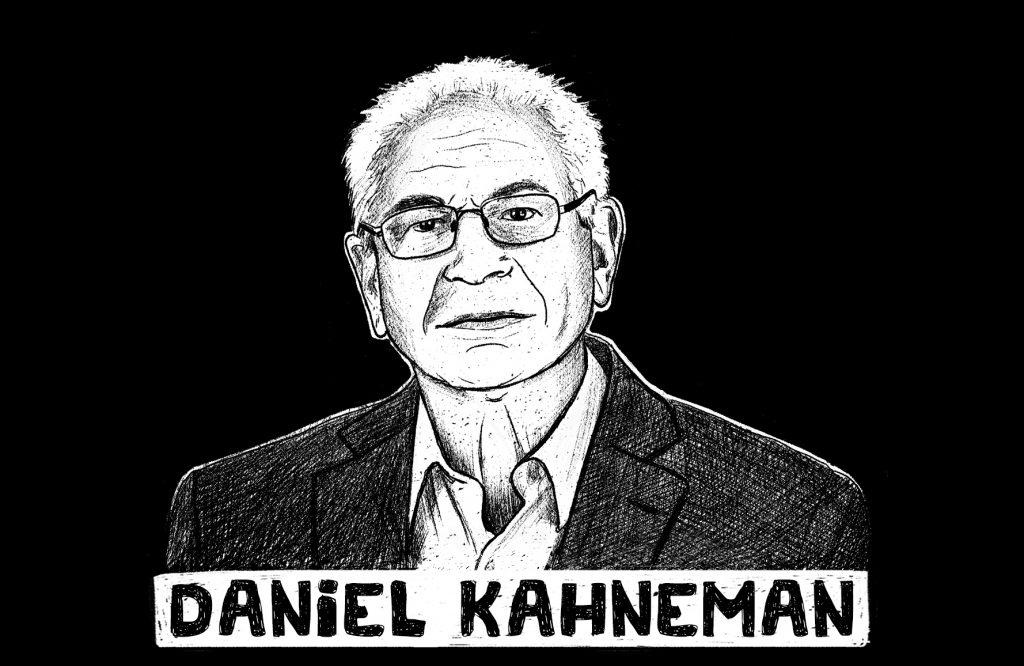
Daniel Kahneman PhD, the father of behavioral economics, died yesterday at age 90 years old. He’s best known for applying psychology to economics and uncovering biases and mental shortcuts that make people act irrationally, as he chronicled in his best-selling book Thinking, Fast and Slow.
Kahneman, along with his long-time collaborator and friend Amos Tversky PhD, developed “prospect theory,” or loss-aversion theory, which earned him the Nobel Prize in Economics in 2002 (which he shared with fellow economist Vernon Smith). The idea is that people value losses and gains differently, so we feel more bad about losing $100 than we feel good about making the same amount. He applied this theory to investors, who had previously been considered rational decision-makers. It shows up elsewhere, too—for example, golfers putt better when they’re facing the loss of a stroke than when they might gain one.
Two other biases he identified include:
The “peak-end rule” that people remember an experience primarily based on how they felt at its most intense moment and the final part of it. It’s why you consider a whole vacation good if the last day was good—or the opposite.
The conjunction fallacy where people erroneously think the probability of two things being true is more likely than just one thing, which the famous “Linda the Bank Teller” problem illustrates.
Posted on October 11, 2022 by Dr. David Edward Marcinko MBA MEd CMP™
By Staff Reporters
***
***
STOCKHOLM (AP) — Former U.S. Federal Reserve Chair Ben Bernanke, who put his academic expertise on the Great Depression to work reviving the American economy after the 2007-2008 financial crisis, won the Nobel Prize in economic sciences along with two other U.S.-based economists for their research into bank failures.
The three Nobel Prize winners in economics show that science is happening all around us—if we’re willing to look.
David Card, Joshua Angrist, and Guido Imbens, US-based economists who shared the prize awarded yesterday, helped pioneer the use of “natural experiments” to conduct studies on real-life situations as if they had happened in a tightly controlled lab.
Here’s one example: Card is most famous for his and Alan Krueger’s 1993 study on the effects of minimum wage on employment. They compared fast food jobs in New Jersey, which had just raised its minimum wage from $4.25 to $5.05, to fast food restaurants in neighboring Pennsylvania. The idea was that NJ and PA are generally pretty similar, so any observed differences in the labor market could lead to important conclusions about raising the minimum wage.
What did they find? That NJ’s higher minimum wage did not hurt job growth…and may have even increased employment. This shocked most experts at the time.
Bottom line: Natural experiments are now ubiquitous in economics research, but only because these Nobel Prize recipients showed what was possible. —NF
Your thoughts and comments on this ME-P are appreciated. Feel free to review our top-left column, and top-right sidebar materials, links, URLs and related websites, too. Then, subscribe to the ME-P. It is fast, free and secure.
Speaker: If you need a moderator or speaker for an upcoming event, Dr. David E. Marcinko; MBA – Publisher-in-Chief of the Medical Executive-Post – is available for seminar or speaking engagements.
Subscribe: MEDICAL EXECUTIVE POST for curated news, essays, opinions and analysis from the public health, economics, finance, marketing, IT, business and policy management ecosystem.
Posted on February 26, 2013 by Dr. David Edward Marcinko MBA MEd CMP™
BREAKING NEWS
New Award Doubles Nobel Prize Money
Launching one of the world’s richest science prizes, a foundation created by Silicon Valley tech luminaries last week, awarded $3 million each to 11 health researchers studying stem cells, genetics, cancer and other diseases.
Your thoughts and comments on this ME-P are appreciated. Feel free to review our top-left column, and top-right sidebar materials, links, URLs and related websites, too. Then, subscribe to the ME-P. It is fast, free and secure.
Speaker: If you need a moderator or speaker for an upcoming event, Dr. David E. Marcinko; MBA – Publisher-in-Chief of the Medical Executive-Post – is available for seminar or speaking engagements. Contact: MarcinkoAdvisors@msn.com
OUR OTHER PRINT BOOKS AND RELATED INFORMATION SOURCES:
Posted on October 4, 2010 by Dr. David Edward Marcinko MBA MEd CMP™
Test-tube Baby Pioneer Wins Nobel Prize in Medicine
By Staff Reporters
STOCKHOLM — Robert Edwards of Britain won the 2010 Nobel Prize in medicine today for developing in-vitro fertilization, a breakthrough that has helped millions of infertile couples worldwide have children.
Assessment
Edwards, an 85-year-old professor emeritus at the University of Cambridge, started working on IVF as early as the 1950s. He developed the technique, in which egg cells are fertilized outside the body and then implanted in the womb, together with gynecologist surgeon Patrick Steptoe, who died in 1988.
Your thoughts and comments on this ME-P are appreciated. Feel free to review our top-left column, and top-right sidebar materials, links, URLs and related websites, too. Then, subscribe to the ME-P. It is fast, free and secure.
Speaker: If you need a moderator or speaker for an upcoming event, Dr. David E. Marcinko; MBA – Publisher-in-Chief of the Medical Executive-Post – is available for seminar or speaking engagements. Contact: MarcinkoAdvisors@msn.com
OUR OTHER PRINT BOOKS AND RELATED INFORMATION SOURCES:
Posted on October 22, 2008 by Dr. David Edward Marcinko MBA MEd CMP™
The ME-P Congratulates New Nobel Laureates
[By Staff Reporters]
Since 1901, the Nobel Prize has been honoring men and women from all corners of the globe for outstanding achievements in physics, chemistry, medicine, literature, economics and for working in peace. The foundations for the prize were laid in 1895 when Alfred Nobel wrote his last will, leaving much of his wealth to the establishment of the Nobel Prize
A paradoy of the Nobel Prize, the Ig Nobel Prizes are also given each year in early October — around the time the recipients of the genuine Nobel Prizes are announced — for ten achievements that “first make people laugh, and then make them think.”
Here is a list of the 18th Ig Nobel winners, awarded on Thursday October 2, 2008, at Harvard University, by the Annals of Improbable Research [AIR] magazine.
2008 Ig Nobel Winners:
Nutrition: Massimiliano Zampini and Charles Spence for demonstrating that food tastes better when it sounds better.
Cognitive Science: Toshiyuki Nakagaki, Hiroyasu Yamada, Ryo Kobayashi, Atsushi Tero, Akio Ishiguro and Agota Toth for discovering that slime molds can solve puzzles.
Economics: Geoffrey Miller, Joshua Tyber and Brent Jordan for discovering that exotic dancers earn more when at peak fertility.
Physics: Dorian Raymer and Douglas Smith for proving that heaps of string or hair will inevitably tangle.
Chemistry: Sheree Umpierre, Joseph Hill and Deborah Anderson for discovering that Coca-Cola is an effective spermicide, and C.Y. Hong, C.C. Shieh, P. Wu and B.N. Chiang for proving it is not.
Literature: David Sims for his study “You Bastard: A Narrative Exploration of the Experience of Indignation within Organizations.”
Peace: The Swiss Federal Ethics Committee on Non-Human Biotechnology and the citizens of Switzerland for adopting the legal principle that plants’ have dignity.
Archaeology: Astolfo Gomes de Mello Araujo and Jose Carlos Marcelino for showing armadillos can scramble the contents of an archaeological dig.
Biology: Marie-Christine Cadiergues, Christel Joubert and Michel Franc for discovering that fleas that live on a dog can jump higher than fleas that live on a cat.
Medicine: Dan Ariely for demonstrating that expensive fake medicine is more effective than cheap fake medicine.
Assessment
Do we really need Nobel, and Ig Nobel, prize winners each year?
Conclusion
Your thoughts and comments on this ME-P are appreciated. Feel free to review our top-left column, and top-right sidebar materials, links, URLs and related websites, too. Then, subscribe to the ME-P. It is fast, free and secure.
Speaker: If you need a moderator or speaker for an upcoming event, Dr. David E. Marcinko; MBA – Publisher-in-Chief of the Medical Executive-Post – is available for seminar or speaking engagements. Contact: MarcinkoAdvisors@msn.com
OUR OTHER PRINT BOOKS AND RELATED INFORMATION SOURCES:







 Support our online development, and advance our onground research initiatives in free market economics, as we seek to showcase the brightest Next-Gen minds.
THE ME-P DISCLAIMER: Posts, comments and opinions do not necessarily represent iMBA, Inc., but become our property after submission. Copyright © 2006 to-date. iMBA, Inc allows colleges, universities, medical and financial professionals and related clinics, hospitals and non-profit healthcare organizations to distribute our proprietary essays, photos, videos, audios and other documents; etc. However, please review copyright and usage information for each individual asset before submission to us, and/or placement on your publication or web site. Attestation references, citations and/or back-links are required. All other assets are property of the individual copyright holder.
Support our online development, and advance our onground research initiatives in free market economics, as we seek to showcase the brightest Next-Gen minds.
THE ME-P DISCLAIMER: Posts, comments and opinions do not necessarily represent iMBA, Inc., but become our property after submission. Copyright © 2006 to-date. iMBA, Inc allows colleges, universities, medical and financial professionals and related clinics, hospitals and non-profit healthcare organizations to distribute our proprietary essays, photos, videos, audios and other documents; etc. However, please review copyright and usage information for each individual asset before submission to us, and/or placement on your publication or web site. Attestation references, citations and/or back-links are required. All other assets are property of the individual copyright holder.











 The Leading Business Education Network for Doctors, Financial Advisors and Health Industry Consultants